FM 3-96 BRIGADE COMBAT TEAM (OCTOBER 2015) - page 1
*FM 3-96
Headquarters
Field Manual
Department of the Army
No. 3-96
Washington, DC,
2FWREHU 2015
Brigade Combat Team
Contents
Page
PREFACE
vii
INTRODUCTION
ix
Chapter 1
ORGANIZATION
1-1
Section I - Infantry Brigade Combat Team
1-1
Section II - Stryker Brigade Combat Team
1-6
Section III - Armored Brigade Combat Team
1-10
Chapter 2
THREAT
2-1
Section I - Understanding the Threat
2-1
Threat Composition, Disposition, and Intention
2-1
State and Nonstate Actors
2-2
Networks
2-3
Section II - Potential Threat Groups
2-3
States
2-3
Nonstate Organizations
2-3
Criminal Networks and Opportunists
2-4
Individuals
2-4
Section III - Threat Characteristics and Organization
2-5
Section IV - Threat Capabilities, Tactics, and Techniques
2-6
Physical Dimension
2-6
Psychological and Informational Dimension
2-7
Political Dimension
2-8
Section V - Countering Adaptations and Retaining the Initiative
2-8
Chapter 3
MISSION COMMAND
3-1
Section I - Fundamental Nature and Philosophy of Mission Command
3-1
Fundamental Principles
3-1
Command Presence
3-2
Illustrations of the Six Principles of Mission Command
3-3
Section II - Mission Command Warfighting Function
3-4
Mission Command Tasks
3-5
Distribution Restriction: Approved for public release; distribution is unlimited.
*This manual supersedes FM 3-90.6, dated 14 September 2010.
i
Contents
Operations Process
3-5
Integrating Processes and Continuing Activities
3-12
Knowledge and Understanding
3-13
Mission Command System
3-14
Section III - Organization
3-16
Staff Organization
3-16
Command Post Organization and Operation
3-23
Command Post Cells and Staff Elements
3-26
Section IV - Staff Processes and Procedures
3-33
Standard Operating Procedures
3-33
Battle Rhythm
3-33
Meetings
3-33
Running Estimate
3-34
Section V - Network and Information Systems
3-35
Chapter 4
RECONNAISSANCE AND SECURITY
4-1
Section I - Reconnaissance and Security Forces
4-1
Reconnaissance and Security Operations
4-1
Commander’s Reconnaissance and Security Planning Guidance
4-3
Targeting and Requirements Development
4-5
Combined Arms, Air-ground Reconnaissance and Security Operations
4-6
Reconnaissance and Security Force Sustainment
4-6
Section II - Reconnaissance
4-7
Reconnaissance Fundamentals
4-7
Forms of Reconnaissance
4-9
Information Collection
4-10
Reconnaissance Handover
4-11
Section III - Security Operations
4-11
Fundamentals of Security Operations
4-11
Security Operations Tasks
4-12
Chapter 5
UNDERSTAND, SHAPE, INFLUENCE, AND CONSOLIDATE GAINS
5-1
Section I - Understanding the Operational Environment
5-1
Section II - Shape the Environment
5-3
Section III - Influence Audiences
5-4
Section IV - Influence Outcomes
5-6
Section V - Consolidate Gains
5-6
Chapter 6
OFFENSE
6-1
Section I - Characteristics of the Offense
6-1
Surprise
6-3
Concentration
6-3
Tempo
6-3
Audacity
6-3
Section II - Common Offensive Planning Considerations
6-3
Joint, Interorganizational, and Multinational Teams
6-4
Mission Command
6-4
Movement and Maneuver
6-5
ii
FM 3-96
2FWREHU
Contents
Intelligence
6-8
Fires
6-8
Sustainment
6-9
Protection
6-10
Specific Operational Environments
6-15
Section III - Forms of Maneuver
6-17
Envelopment
6-17
Turning Movement
6-22
Infiltration
6-23
Penetration
6-24
Flank Attack
6-26
Frontal Attack
6-27
Section IV - Offensive Tasks
6-28
Movement to Contact
6-28
Attack
6-34
Exploitation
6-40
Pursuit
6-42
Section V - Transitions
6-44
Transition to a Focus on the Conduct of Defensive Tasks
6-44
Transition to a Focus on the Conduct of Stability Tasks
6-45
Chapter 7
DEFENSE
7-1
Section I - Characteristics of the Defense
7-1
Disruption
7-3
Flexibility
7-3
Maneuver
7-3
Mass and Concentration
7-3
Operations In-depth
7-4
Preparation
7-4
Security
7-4
Section II - Common Defensive Planning Considerations
7-5
Mission Command
7-5
Movement and Maneuver
7-7
Intelligence
7-9
Fires
7-11
Sustainment
7-12
Protection
7-13
Specific Operational Environments
7-16
Section III - Forms of the Defense
7-16
Defense of a Linear Obstacle
7-16
Perimeter Defense
7-18
Reverse-slope Defense
7-19
Section IV - Defensive Control Measures
7-20
Section V - Defensive Tasks
7-26
Area Defense
7-26
Mobile Defense
7-36
Retrograde
7-38
2FWREHU
FM 3-96
iii
Contents
Section VI - Transition
7-42
Transition to a Focus on the Conduct of Offensive Tasks
7-43
Transition to a Focus on the Conduct of Stability Tasks
7-44
Chapter 8
STABILITY
8-1
Section I - Foundation for Operations Focused on Stability
8-1
Stability Principles
8-1
Stability Framework
8-3
Section II - Stability Environment
8-3
Sources of Instability
8-3
Understanding Political Objectives
8-4
Achieve Unity of Effort Across Diverse Organizations
8-5
Seizing the Initiative
8-7
Retaining the Initiative
8-7
Exploiting the Initiative
8-8
Section III - Primary Stability Tasks
8-8
Establish Civil Security
8-8
Establish Civil Control
8-10
Restore Essential Services
8-12
Support to Governance
8-14
Support to Economic and Infrastructure Development
8-16
Section IV - Transitions
8-17
Transition to a Focus on the Conduct of Defensive Tasks
8-18
Transition to a Focus on the Conduct of Offensive Tasks
8-18
Chapter 9
SUSTAINMENT
9-1
Section I - Fundamentals of Sustainment
9-1
Sustainment Warfighting Function
9-1
Principles of Sustainment
9-2
Principles of Personnel Services
9-2
Principles of the Army Health System
9-2
Section II - Sustaining the Brigade Combat Team
9-3
Sustainment Staff
9-3
Brigade Support Battalion
9-5
Operation Process
9-9
Resupply Operations
9-14
Contracting Support
9-15
Medical Support
9-16
Section III - Echelon Support
9-18
Echelon of Support
9-19
Echelons Above Brigade
9-21
Section IV - Brigade Support Area
9-23
Locations for Support Areas
9-23
Operational Area Security
9-24
Supply Routes and Convoys
9-26
GLOSSARY
................................................................................................................ Glossary-
1
iv
FM 3-96
2FWREHU
Contents
REFERENCES
References-
1
INDEX
....................................................................................................................... Index-
1
Figures
Figure 1-1. Infantry brigade combat team
1-3
Figure 1-2. Modified Stryker brigade combat team
1-9
Figure 1-3. Armored brigade combat team
1-11
Figure 3-1. Brigade combat team command and staff organization
3-17
Figure 3-2. Integrating and functional cells
3-26
Figure 4-1. Variations of action
4-4
Figure 6-1. Single envelopment
6-18
Figure 6-2. Double envelopment
6-18
Figure 6-3. Encirclement operations
6-20
Figure 6-4. Vertical envelopment (example air assault)
6-21
Figure 6-5. Turning movement
6-22
Figure 6-6. Infiltration
6-24
Figure 6-7. Penetration
6-25
Figure 6-8. Expanding the penetration
6-26
Figure 6-9. Flank attack
6-27
Figure 6-10. Frontal attack
6-28
Figure 6-11. Organization of forces for a movement to contact
6-29
Figure 6-12. Organization of forces for the breach
6-35
Figure 6-13. Organization of forces for the assault
6-36
Figure 6-14. Organization of forces for an exploitation
6-41
Figure 6-15. Organization of forces for a frontal pursuit
6-42
Figure 6-16. Organization of forces for a combination pursuit
6-43
Figure 7-1. Kasserine Pass and Sbiba Gap map
7-2
Figure 7-2. Deep-close-security operational framework, contiguous area of
operations
7-6
Figure 7-3. Historical example, defense of a linear obstacle, Fredericksburg 1862
7-18
Figure 7-4. Historical example of a perimeter defense, Chip’yong-Ni, 1951
7-19
Figure 7-5. Historical example of a reverse-slope defense, Kakazu Ridge, 1945
7-20
Figure 7-6. Common brigade combat team defensive control measures
7-22
Figure 7-7. Area defense, noncontiguous area of operations
7-24
Figure 7-8. Strong point placement
7-26
Figure 7-9. Area defense, organization of forces (contiguous area of operations)
7-28
Figure 7-10. Defense in-depth
7-31
Figure 7-11. Forward defense
7-32
Figure 7-12. Counterattack
7-36
2FWREHU
FM 3-96
v
Contents
Figure 7-13. Mobile defense, fixing force
7-37
Figure 7-14. Mobile defense, committed striking force
7-37
Figure 7-15. Delay from successive positions
7-39
Figure 7-16. Delay from alternate positions
7-40
Figure 9-1. Notional battalion concept of support
9-19
Figure 9-2. Example of sustainment echelons above the BCT
9-22
Tables
Table 3-1. Preparation activities
3-9
vi
FM 3-96
2FWREHU
Preface
Army FM 3-96 provides doctrine for the brigade combat team (BCT). This publication describes relationships,
organizational roles and functions, capabilities and limitations, and responsibilities within the BCT. Tactics, the
employment and ordered arrangement of forces in relation to each other (CJCSM 5120.01), are discussed in this
manual and are intended to be used as a guide. They are not prescriptive. FM 3-96 applies to the infantry brigade
combat team, Stryker brigade combat team, and armored brigade combat team. This publication supersedes FM
3-90.6, Brigade Combat Team.
To comprehend the doctrine contained in this publication, readers must first understand the principles of the Army
profession and the Army ethic as described in ADP 1, The Army. Readers also must understand the principles of war,
the nature of unified land operations, and the links between the operational and tactical levels of war described in
JP 3-0, Joint Operations; ADP 3-0, and ADRP 3-0, Unified Land Operations; FM 3-94, Theater Army, Corps, and
Division Operations, and ATP 3-91, Division Operations. In addition, readers should understand the fundamentals of
the operations process found in ADP 5-0 and ADRP 5-0, The Operations Process, associated with offensive and
defensive tasks contained in FM 3-90-1, Offense and Defense Volume 1, and reconnaissance, security, and tactical
enabling tasks contained in FM 3-90-2, Reconnaissance Security and Tactical Enabling Tasks, Volume 2. The reader
must comprehend how stability tasks described in ADP 3-07 and ADRP 3-07, Stability, carry over and affect offensive
and defensive tasks and vice versa. Readers must understand how the operation process fundamentally relates to the
Army’s design methodology, military decisionmaking process, and troop-leading procedures and the principles of
mission command as described in ADP 6-0 and ADRP 6-0, Mission Command, and FM 6-0, Command and Staff
Organization and Operations.
The principal audience for FM 3-96 is the commanders, staffs, officers, and noncommissioned officers of the brigade,
battalions, and squadron within the BCT. The audience also includes the United States Army Training and Doctrine
Command institutions and components, and the United States Army Special Operations Command. This publication
serves as an authoritative reference for personnel developing doctrine, materiel and force structure, institutional and
unit training, and standard operating procedures for the BCT.
Commanders, staffs, and subordinates ensure their decisions and actions comply with United States, international, and
in some cases, host-nation laws and regulations. Commanders at all levels ensure their Soldiers operate within the law
of war and the rules of engagement. (Refer to FM 27-10 for additional information.)
FM 3-96 uses joint terms where applicable. Selected joint and Army terms and definitions appear in both the glossary
and the text.Terms for which FM 3-96 is the proponent publication (the authority) are marked with an asterisk (*) in
the glossary. Definitions for which FM 3-96 is the proponent publication are boldfaced in the text and the term is
italicized. For other definitions shown in the text, the term is italicized and the number of the proponent publication
follows the definition. Unless this publication states otherwise, masculine nouns and pronouns refer to both men
and women.
FM 3-96 applies to the Active Army, the Army National Guard/the Army National Guard of the United States, and
the United States Army Reserve unless otherwise stated.
The proponent for FM 3-96 is the United States Army Training and Doctrine Command. The preparing agency is the
United States Army Maneuver Center of Excellence. Send comments and recommendations on a DA Form 2028,
(Recommended Changes to Publications and Blank Forms) to: Commanding General, Maneuver Center of Excellence,
Directorate of Training and Doctrine, ATTN: ATZK-TDD, 1 Karker Street, Fort Benning, GA 31905-5410; by email
to usarmy.benning.mcoe.mbx.doctrine@mail.mil; or submit an electronic DA Form 2028.
2FWREHU
FM 3-96
vii
This page intentionally left blank.
Introduction
The Army provides readily available and trained regionally aligned and globally responsive forces to prevent
conflict, shape the security environment, and win wars. Army forces maintain proficiency in the fundamentals of
decisive action, and possess capabilities to meet specific geographic combatant command requests. Regionally
aligned forces provide combatant commanders with an Army headquarters tailored to missions from tactical level
to joint task force capable. The brigade combat team shapes the security environment and wins across the range
of military operations. (Refer to FM 3-94 for additional information.)
FM 3-96 focuses on the employment and ordered arrangement of forces within the BCT during the conduct of
decisive action across the range of military operations. The tactics addressed in this manual include the ordered
arrangement and maneuver—the employment of forces in the operational area through movement in combination
with fires to achieve a position of advantage in respect to the enemy (JP 3-0)—of units in relation to each other,
the terrain, and the enemy. Tactics vary with terrain and other circumstances; they change frequently as the enemy
reacts and friendly forces explore new approaches. Applying tactics usually entails acting under time constraints
with incomplete information. Tactics always require judgment in application; they are always descriptive, not
prescriptive. FM 3-96 addresses the tactical application of tasks associated with the offense, the defense, and
operations focused on stability. FM 3-96 does not discuss defense support of civil authorities.
Employing tactics addressed in FM 3-96 may require using and integrating techniques. Echelon-specific ATPs
address techniques, non-prescriptive ways or methods used to perform missions, functions, or tasks (CJCSM
5120.01).
This manual incorporates the significant changes in Army doctrinal terminology, concepts, constructs, and proven
tactics developed during recent operations. It also incorporates doctrinal terms and changes based on Doctrine 2015.
Note: This manual is written based on the current structure of the BCT and its subordinate units. The
organizational charts in chapter 1 illustrate the near-term changes to the structure of the BCT. Future
changes to the organizational structures of the BCT will be published as change documents to
the manual.
The following is a brief introduction and summary of changes by chapter.
Chapter 1 - Organization
Chapter 1 addresses the deployability, role, and organizational characteristics of the BCT as optimized and trained
to conduct offensive and defensive tasks, and operations in support of stability to function across the range of
military operations. Chapter 1 describes the organization and mission of the Infantry, Stryker, and armored BCT.
Chapter 2 - Threat
Chapter 2 discusses the threat as a fundamental part of an overall operational environment for any operation. In
addition, Chapter 2 discusses—
z
Understanding the threat.
z
Potential threat groups.
z
Threat characteristics and organization.
z
Threat capabilities, tactics, and techniques.
z
Countering adaptations and retaining the initiative.
Chapter 3 - Mission Command
Chapter 3 addresses the fundamental nature and philosophy of mission command. The philosophy requires the
commander to lead from a position that allows timely decisions based on an assessment of the operational
environment and application of judgment. In addition, Chapter 3—
z
Addresses the mission command warfighting function as it assists the commander with blending the
art of command with the science of control.
z
Emphasizes the human aspects of mission command.
2FWREHU
FM 3-96
ix
Introduction
z
Discusses BCT command and staff operations.
z
Describes how the commander cross-functionally organizes his staff into cells and working groups.
z
Describes the establishment of centers to assist with coordinating operations.
z
Describes the types and composition of command posts at brigade echelon.
Chapter 4 - Reconnaissance and Security
Chapter 4 discusses reconnaissance and security as continuous and essential to support the conduct of offense,
defense, and stability. Chapter 4 provides—
z
The doctrinal basis for reconnaissance and security forces.
z
An overview of the fundamentals and forms of reconnaissance.
z
A discussion of information collection and reconnaissance handover.
z
An overview of security fundamentals and security operations tasks.
Chapter 5 - Understand, Shape, Influence, and Consolidate Gains
Chapter 5 addresses the missions and efforts required to shape and influence the operational environment through
understanding. Chapter 5 discussion includes—
z
Actions that clarify intentions.
z
Activities that modify behavior.
z
Attaining outcomes through actions.
Chapter 6 - Offense
Chapter 6 discusses offensive actions to destroy, defeat, or neutralize the enemy. The chapter addresses the
characteristics of a BCT offense and describes the four offensive tasks: movement to contact, attack, exploitation,
and pursuit. Chapter 6 also discusses—
z
Common offensive planning considerations.
z
Forms of maneuver.
z
Planning considerations when transitioning to other tactical operations.
Note. ADRP 3-90, dated 31 August 2012, adds a sixth form of maneuver, flank attack.
Chapter 7 - Defense
Chapter 7 discusses defensive actions to defeat enemy attacks, gain time, control key terrain, protect critical
infrastructure, secure the population, and economize forces. The chapter addresses BCT defense characteristics
and describes the three defensive tasks: area defense, mobile defense, and retrograde. Chapter 7 also discusses—
z
Common defensive planning considerations.
z
Forms of the defense.
z
Forms of defensive maneuver.
z
Planning considerations when transitioning to other tactical operations.
Chapter 8 - Stability
Chapter 8 addresses BCT support to operations focused on stability tasks. This chapter encompasses various
military missions, tasks, and activities conducted outside the United States in coordination with other instruments
of national power. In addition, Chapter 8—
z
Addresses the foundation (principles and framework), and environment during stabilization.
z
Discusses the BCT’s responsibilities and roles when supporting stability tasks.
z
Discusses the transition from stability to other tactical operations.
Chapter 9 - Sustainment
Chapter 9 discusses the process at every echelon that sustainment planners and operators use to anticipate the
needs of the maneuver units. Chapter 9 also discusses the following—
x
FM 3-96
2FWREHU
Introduction
z
Fundamentals of sustainment.
z
Sustaining the brigade combat team.
z
Staff and unit responsibilities and relationships.
z
Echelon support.
z
Brigade support area.
2FWREHU
FM 3-96
xi
This page intentionally left blank.
Chapter 1
Organization
Brigade combat teams (BCTs) organize to conduct decisive action, which is the
continuous, simultaneous combinations of offensive, defensive, and stability or
defense support of civil authorities tasks (ADRP 3-0). The BCT is the Army’s primary
combined arms, close combat force. BCTs often operate as part of a division or joint
task force. The division or joint task force acts as a tactical headquarters that can
control up to six BCTs in high- or mid-intensity combat operations. The tactical
headquarters assigns the BCT its mission, area of operations, and supporting elements.
The headquarters coordinates the BCT’s actions with other BCTs in the formation. The
BCT might be required to detach subordinate elements to other brigades attached or
assigned to the division or task force. Usually, this tactical headquarters assigns
augmentation elements to the BCT. Field artillery, maneuver enhancement,
sustainment, and combat aviation brigades can all support BCT operations. (Refer to
ATP 3-91 for additional information on division operations.)
Note. This field manual does not address defense support of civil authorities. Refer
to ADRP 3-28 and ATP 3-28.1 for information about defense support of civil
authorities.
The BCT includes capabilities across the mission command, movement and maneuver,
intelligence, fires, sustainment, and protection warfighting functions. These
capabilities are scalable to meet mission requirements. All BCTs include maneuver;
field artillery; intelligence; signal; engineer; chemical, biological, radiological, and
nuclear (CBRN); and sustainment capabilities. Higher commanders augment BCTs for
specific missions with additional combat power. Augmentation might include aviation,
armor, infantry, field artillery, air defense, military police, civil affairs, military
information support elements, engineers, CBRN, and information systems.
Organizational flexibility enables the BCT to accomplish the mission across the range
of military operations. The three types of BCTs are the infantry brigade combat team
(IBCT), the Stryker brigade combat team (SBCT), and the armored brigade combat
team (ABCT). The following sections describe each BCT’s mission and organization.
SECTION I - INFANTRY BRIGADE COMBAT TEAM
1-1. The IBCT is an expeditionary, combined arms formation optimized for dismounted operations in
complex terrain—a geographical area consisting of an urban center larger than a village and/or of two or
more types of restrictive terrain or environmental conditions occupying the same space (ATP 3-34.80). The
IBCT can conduct entry operations by ground, air land, air assault, or amphibious assault (via surface and
vertical) into austere areas of operations with little or no advanced notice. Airborne IBCTs can conduct
vertical envelopment by parachute assault. The IBCT’s dismounted capability in complex terrain separates
it from other functional brigades and BCTs.
1-2. Mission variables, categories of specific information needed to conduct operations (ADP 1-01), help
to determine the task organization and required augmentation for the IBCT. For example, if additional tactical
mobility is required, the IBCT can temporarily be augment with aviation assets to conduct air movements or
air assault operations, or augment with wheeled assets such as mine-resistant ambush protected vehicles.
2FWREHU
FM 3-96
1-1
Chapter 1
1-3. The role of the IBCT is to close with the enemy using fire and movement to destroy or capture enemy
forces, or to repel enemy attacks by fire, close combat, and counterattack. Fire and movement is the concept
of applying fires from all sources to suppress, neutralize, or destroy the enemy, and the tactical
movement of combat forces in relation to the enemy (as components of maneuver applicable at all
echelons). At the squad level, fire and movement entails a team placing suppressive fire on the enemy
as another team moves against or around the enemy.
1-4. The IBCT performs complementary missions to SBCTs and ABCTs. IBCT complementary missions
include control of land areas, populations, and resources. The IBCT optimizes for the offense against
conventional, hybrid, and irregular threats in severely restrictive terrain. The IBCT performs missions such
as reducing fortified areas, infiltrating and seizing objectives in the enemy’s rear, eliminating enemy force
remnants in restricted terrain, securing key facilities and activities, and conducting stability in the wake of
maneuvering forces.
1-5. IBCTs easily configure for area defense and as the fixing force component of a mobile defense. The
IBCT’s lack of heavy combat vehicles reduces its logistic requirements. Not having heavy combat vehicles
gives higher commanders greater flexibility when adapting various transportation modes to move or
maneuver the IBCT. Airborne IBCTs conduct airborne assault-specific missions. All IBCTs can conduct air
assault operations. (Refer to FM 3-99 for information on airborne and air assault operations.)
1-6. The IBCT is a combined arms force organized around dismounted infantry. Cavalry, field artillery,
engineer, intelligence, signal, sustainment, and CBRN reconnaissance units are organic to the IBCT. Higher
commanders augment the IBCT for a specific mission. Augmentation can include aviation, armor, field
artillery, air defense, military police, civil affairs, military information support elements, engineers, CBRN,
and additional information systems assets.
1-7. The addition of the brigade engineer battalion (BEB) and the battery to the field artillery battalion are
recent formation modifications that some IBCTs are currently fielding, or will be fielding in the near future.
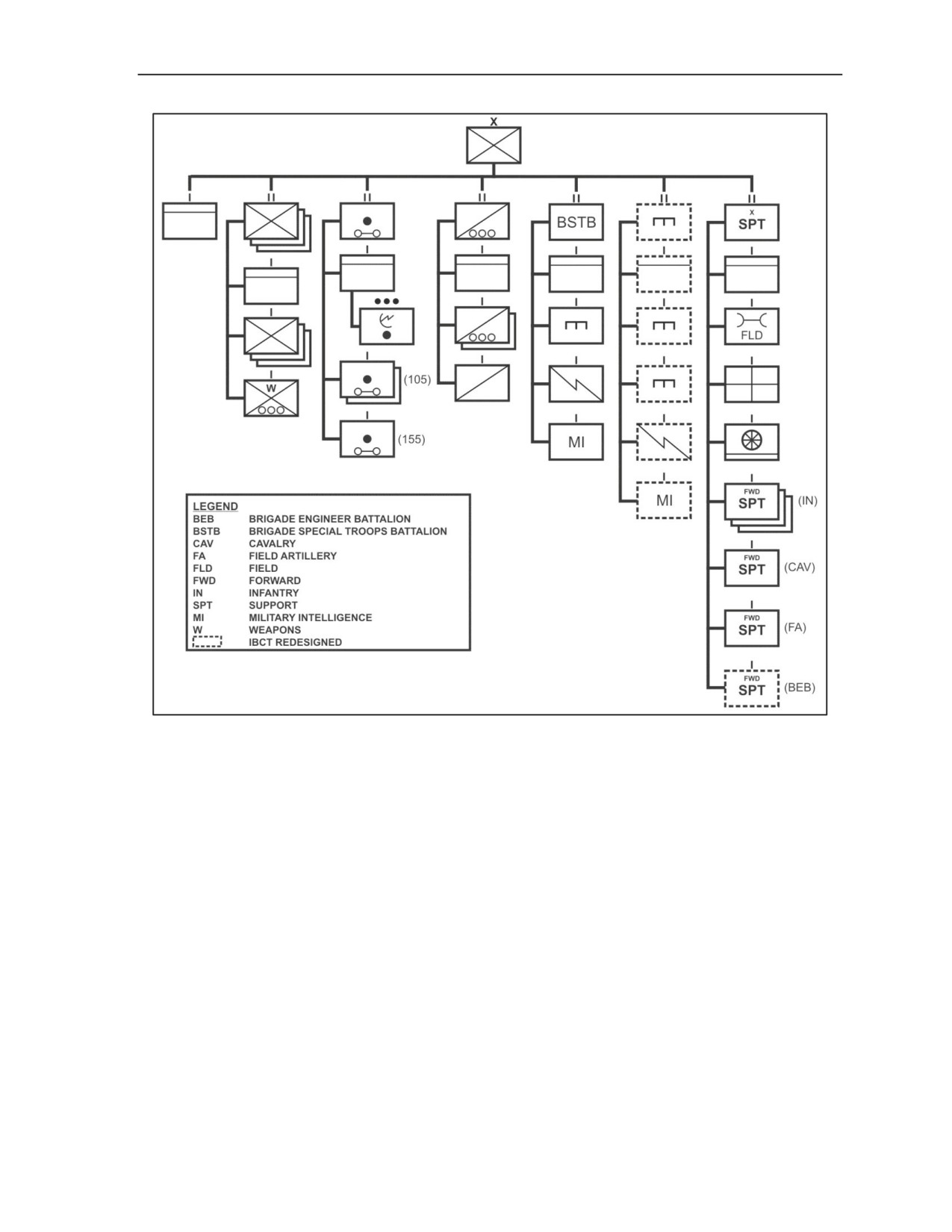
The BEB replaces the brigade special troops battalion (BSTB) and has a second engineer company. Figure
1-1 illustrates the current IBCT design; the dashed lines represent the redesigned IBCT.
Note. The brigade special troops battalion that converts to a brigade engineer battalion within the
IBCT no longer has a military police platoon; another engineer company is added and the CBRN
reconnaissance platoon locates in the brigade engineer battalion headquarters and headquarters
company.
1-8. Three infantry battalions serve as the IBCT’s primary maneuver force. The infantry battalions organize
with a headquarters and headquarters company, three rifle companies, and a weapons company. The
headquarters and headquarters company provides planning and intelligence, signal, and fire support to the
battalion. The headquarters company has a battalion command section, a battalion staff section, a company
headquarters, a battalion medical, scout, mortar and signal platoon, and a sniper squad. (Refer to FM 3-21.20
for additional information.)
1-9. Infantry rifle companies have three infantry rifle platoons, a mortar section, and a headquarters section.
Each rifle platoon has three infantry rifle squads and a weapons squad. The mortar section has two squads,
each with a 60-mm mortar. Habitual attachments to the infantry rifle company include a fire support team at
the company level and forward observer teams at the platoon level, medics assigned to the rifle platoons, and
a senior medic at the company level. (Refer to FM 3-21.10 for additional information.)
1-2
FM 3-96
2FWREHU
Organization
Figure 1-1. Infantry brigade combat team
1-10. The infantry weapons company has a company headquarters and four assault platoons. Each assault
platoon has two sections of two squads and a leader’s vehicle. Each squad contains four Soldiers and a vehicle
mounting the heavy weapons. The heavy weapons can be tailored to a mission based on mission, enemy,
terrain and weather, troops and support available, time available and civil considerations (commonly referred
to as METT-TC or mission variables). Infantry weapons companies are equipped with the following
weapons: the tube launched, optically tracked, wire guided Improved Target Acquisition System, the MK 19,
40-mm grenade machine gun, the M2 series heavy machine gun, the M240 series machine gun, and the
Javelin medium close combat missile system. While all of the weapons vehicles can mount the MK 19 and
the M2, only two vehicles per platoon are equipped to mount the Improved Target Acquisition System.
Habitual attachments for the weapons company include a fire support team at the company level and medics.
(Refer to FM 3-21.12 for additional information.)
1-11. The IBCT contains a cavalry squadron, and an infantry battalion scout platoon. These units organize,
train, and equip to conduct reconnaissance and surveillance tasks and security operations. However,
reconnaissance and surveillance tasks and security operations remain a core competency of the infantry rifle
company, platoon, and squad.
1-12. The IBCT cavalry squadron has four troops: a headquarters and headquarters troop; two mounted
reconnaissance troops; and one dismounted reconnaissance troop. (See FM 3-20.96.) The two mounted
reconnaissance troops are equipped with wheeled vehicles.
(See FM
3-20.971.) The dismounted
reconnaissance troop enables dismounted infiltration and rotary-wing aircraft insertion. (See ATTP 3-20.97.)
2FWREHU
FM 3-96
1-3
Chapter 1
1-13. The IBCT field artillery battalion has four batteries: a headquarters and headquarters battery, two (only
one battery in airborne battalions) 105-mm firing batteries (M119 series), and one 155-mm firing
battery (M777-series). The field artillery battalion provides massing fires in space and time on single or
multiple targets with precision, near precision, and area fires to support BCT operations. The field artillery
battalion has two AN/TPQ-53 counterfire radars and four AN/TPQ-50 lightweight countermortar radars for
target acquisition. (Refer to FM 3-09 for additional information.)
Notes.
1. Current fielded target acquisition weapons locating radars consist of the AN/TPQ-36,
AN/TPQ-37, AN/TPQ-50, and the AN/TPQ-53. The AN/TPQ-53 is being fielded. Once
completely fielded, all field artillery target acquisition platoons, except the division artillery, will
have two AN/TPQ-53s and four AN/TPQ-50 radars. The division artillery’s target acquisition
platoon will consist of two AN/TPQ-53s and two AN/TPQ-50 radars.
2. Munitions with a precision capability such as the Global Positioning System-aided Excalibur
155-mm projectile, guided multiple launch rocket system (MLRS) rockets, and the advanced
precision munitions initiative 120-mm mortar rounds have a circular error probable of less than
10 meters. Munitions with a near-precision capability have a circular error probable between 10
and 50 meters. Area capabilities have a circular error probable greater than 50 meters. Circular
error probable is an indicator of the delivery accuracy of a weapon system used as a factor in
determining probable damage to a target. It is the radius of a circle within which half of the rounds
fired at a target will impact. Even at the munitions’ largest anticipated delivery error, the aimpoint
is within the munitions’ anticipated radius of direct effects.
1-14. The brigade support battalion (BSB) is the organic sustainment unit of the IBCT. (See chapter 9.) The
BSB plans, prepares, executes, and assesses replenishment operations to support brigade operations. The
battalion ensures the IBCT can conduct self-sustained operations. The six forward support companies provide
each battalion and squadron commander with dedicated logistic assets, less Class VIII (medical supplies),
that meet the supported unit’s requirements. The BSB also has an assigned distribution company, a field
maintenance company, and a Role 2 medical company. The Role 2 medical company provides Army Health
System (health service support and force health protection) and Class VIII support. The BSB within the
SBCT and the ABCT provides the same function and has the same general configuration as the BSB within
the IBCT, with the most significant differences in the maintenance capabilities. (Refer to chapter 9 and ATP
4-90 for additional information.)
1-15. The BSTB provides control and sustainment to the organic engineer company, signal company,
military intelligence company, military police platoon, and the CBRN reconnaissance platoon, as well as
other units attached to the IBCT. The BSTB has a headquarters and headquarters company to provide
administrative, logistics, and medical support to its organic and attached units. On order, the BSTB can plan,
prepare, and execute security missions for areas not assigned to other units in the IBCT area of operations.
BSTB units can defeat small local threats and, with augmentation or control of some of its organic units such
as military police, organize response forces to defeat organized threats. (Refer to ATP 3-90.61 for additional
information.)
1-16. The BSTB organization of the headquarters and headquarters company includes the BSTB
headquarters, company headquarters, military police platoon, CBRN reconnaissance platoon, Army Health
System support, security section, unit ministry team, legal section, and the support platoon. The headquarters
and headquarters company commander assists the BSTB commander with locating the BSTB main command
post. The BSTB commander decides the company’s location. The company units, less detachments, receive
their missions from the BSTB commander. The company provides all sustainment functions necessary for
the BSTB to accomplish its mission successfully.
1-17. The BSTB combat engineer company performs essential mobility, countermobility, and survivability
tasks for the IBCT. The engineer company supports assured mobility, enhances protection, enables force
projection and logistics, builds partner capacity, and develops infrastructure, all of which enables freedom of
action for the IBCT. The combat engineer company consists of three mobility platoons and one mobility
1-4
FM 3-96
2FWREHU
Organization
support platoon. The company has no organic gap crossing capability and requires augmentation from
echelons above brigade engineers. (Refer to ATP 3-34.22 for additional information.)
1-18. The brigade engineer battalion (BEB) has mission command of assigned and attached engineer
companies for IBCTs where the BSTB has converted to a BEB. Additionally, a signal company, military
intelligence company, and CBRN reconnaissance platoon are assigned. The BEB is responsible for
administrative, logistics, training, and protection support of subordinate units and has a typical functional
staff; however, the staff is predominantly engineers. (Refer to FM 3-34 and ATP 3-34.22 for additional
information.) The typical staff for the BEB is as follows:
z
Human resources section. The human resources section is responsible for the personnel
administration of the battalion’s specialized military occupational skills.
z
Military intelligence company. The intelligence section’s military intelligence officer is
responsible for providing intelligence to the brigade engineer battalion and assisting the military
intelligence company. The military intelligence company receives administrative and sustainment
support from the brigade engineer battalion.
z
Operations section. The operations section includes combat (ATP 3-34.22), general (see ATP
3-34.40), and geospatial engineers (see ATP 3-34.80) at the center of technical planning and
estimating. The operations section is responsible for the battalion’s training, operations, and plans.
z
Chemical, biological, radiological, and nuclear platoon. The CBRN platoon provides technical
advice to the brigade engineer battalion. The CBRN platoon receives administrative and
sustainment support from the brigade engineer battalion.
z
Sustainment section. The sustainment section coordinates the integration of supply, maintenance,
transportation, and services for the battalion.
z
Signal company. The signal company is responsible for network management, knowledge
management, and information assurance to the brigade engineer battalion. The signal company
receives administrative and sustainment support from the brigade engineer battalion.
1-19. The command and support relationship between units listed above dictate whether the BEB logistically
supports or coordinates support with the BCT, the BSB, or other unit higher headquarters. Unless the IBCT
directs otherwise, the BEB retains command and support relationships with organic and attached units,
regardless of location on the battlefield. Companies may be task-organized further to maneuver task forces
and/or a subordinate company or troop.
1-20. The two engineer companies of the BEB provide the IBCT with the minimum capability to support
offensive and defensive tasks during decisive action. These tasks include bypassing, marking, and breaching
obstacles, assisting in the assault of fortified positions, emplacing obstacles to shape terrain, constructing or
enhancing survivability positions, conducting route reconnaissance and information collection, and
identifying and clearing explosive hazards. Supporting these tasks maintains the IBCT’s freedom of
maneuver and inhibits the enemy’s ability to mass and maneuver. Each company is slightly different, but the
company’s primary focus is to support the combat engineering discipline with breaching, gap crossing, and
digging assets, and route clearance capabilities.
1-21. Engineer Company A is identical in the infantry and armored BCTs. This engineer company provides
combat engineer support and consists of a company headquarters, two combat engineer platoons, and one
engineer support platoon. The company provides mobility, countermobility, survivability, and limited
construction support to the BCT. The combat engineer platoons provide the BCT with assets for breaching
and obstacle emplacement. The engineer support platoon consists of a platoon headquarters, a horizontal
squad that provides specialized engineer equipment to support limited general engineering tasks assigned to
the company, and a breach squad that provides specialized equipment to support mobility, countermobility,
and sustainment tasks assigned to the company. In an SBCT, company A has a company headquarters and
two combat engineer platoons. Instead of an engineer support platoon, it has a bridge section and a horizontal
squad. The breach squad of the SBCT is limited to mine-clearing line charges and proofing equipment in the
company. The Stryker BCT has a Volcano. The airborne IBCT has a rapidly emplaced bridge system.
1-22. Engineer Company B is slightly different in the infantry, armored, and Stryker BCTs. Company B is
generally of the same composition as company A, but it has an additional route clearance platoon. This
platoon provides the detection and neutralization of explosive hazards and reduces obstacles along routes
2FWREHU
FM 3-96
1-5
Chapter 1
that enable force projection and logistics. This route clearance platoon can sustain lines of communications
as members of the combined arms team or autonomously in a permissive environment. The infantry and
armored BCT organizations for this company are organized the same; however, the breach section contains
different equipment and capabilities. The breach section consists of bridging, whereas the IBCT and airborne
IBCT breach section consists of mine-clearing line charges. The IBCT currently does not have a bridging
capability and requires augmentation from echelons above brigade engineers if bridging capability is
required. The airborne IBCT has a rapidly emplaced bridge system. The SBCT has a Volcano. (Refer to FM
3-34 and ATP 3-34.22 for additional information on the engineer companies within the BEB.)
1-23. The signal company connects the unit to the Department of Defense Information Network. The
company has a headquarters and two network extension platoons. These platoons consist of a joint network
node team, a high capacity line of sight section, a data support team, a wireless network extension team, and
an enhanced position location reporting system network manager and gateway (if the brigade is so equipped).
Usually, one network extension support platoon locates at the IBCT main command post and another locates
at the BSB main command post. The users supported by the IBCT signal company use Army mission
command software and hardware capabilities to collaborate, decide, and lead the IBCT’s operations. (Refer to FM
6-02 for additional information.)
1-24. The military intelligence company mission is to conduct analysis, full motion video, signals
intelligence, geospatial intelligence, and human intelligence activities. The military intelligence company
comprises a company headquarters and four platoons (analysis, signals intelligence collection, human
intelligence collection, and tactical unmanned aircraft system). Intelligence operations, conducted by the
military intelligence company, collect information about the intent, activities, and capabilities of threats and
relevant aspects of the operational environment to support the BCT commanders’ decisionmaking across the
range of military operations. The military intelligence company provides analysis and intelligence production
support to the IBCT S-2 and supports the IBCT and its subordinate commands through collection, analysis,
and dissemination of information and intelligence. (Refer to FM 2-0 for additional information.)
1-25. The CBRN reconnaissance platoon conducts dismounted CBRN reconnaissance and surveillance. (See
ATP 3-11.37.) The CBRN platoon has the following capabilities:
z
Provides dismounted assessments in urban operational environments to confirm or deny the
presence of CBRN hazards.
z
Provides presumptive identification of CBRN hazards.
z
Collects, packages, and transports CBRN environmental samples for analysis.
z
Conducts small-scale CBRN hazard mitigation (shielding, removal).
z
Supports site exploitation.
SECTION II - STRYKER BRIGADE COMBAT TEAM
1-26. The SBCT is an expeditionary combined arms force organized around mounted infantry. SBCT units
operate effectively in most terrain and weather conditions due to their rapid strategic deployment and
mobility. The role of the SBCT is to close with the enemy by means of fire and movement, to destroy or
capture enemy forces, or repel enemy attacks by fire, close combat, and counterattack to control land areas,
including populations and resources. The SBCT can gain the initiative early, seize and retain key terrain, any
locality, or area, the seizure or retention of which affords a marked advantage to either combatant (JP 2-01.3),
and conduct massed fire, fire from a number of weapons directed at a single point or small area (JP 3-02), to
stop the enemy.
1-27. The SBCT is task organized to meet specific mission requirements. All SBCTs include maneuver, field
artillery, intelligence, signal, engineer, CBRN, and sustainment capabilities. This organizational flexibility
enables SBCTs to function across the range of military operations. Higher commanders augment the SBCT
for a specific mission with additional capabilities such as aviation, armor, field artillery, air defense, military
police, civil affairs, military information support elements, engineers, CBRN, and information systems assets.
1-28. SBCTs balance combined arms capabilities with significant mobility. The SBCT primarily fights as a
dismounted infantry formation that includes three SBCT infantry battalions. The SBCT infantry battalion has
three SBCT infantry rifle companies each with three SBCT infantry rifle platoons. Each SBCT infantry rifle
1-6
FM 3-96
2FWREHU
Organization
company has a section of organic 120-mm Stryker mortar carrier vehicles with 60-mm dismounted mortar
capabilities, a sniper team and a mobile gun system platoon with three mobile gun system vehicles. The
headquarters and headquarters company also has a mortar platoon equipped with 120-mm Stryker mortar
carrier vehicles that have an 81-mm mortar dismounted capability. In addition, the headquarters and
headquarters company has a scout platoon, fire support team, one sniper squad, and a medical platoon. (Refer
to FM 3-21.21 and FM 3-21.11 for additional information.)
1-29. The cavalry squadron of the SBCT is extremely mobile. The cavalry squadron is composed of four
troops, one headquarters and headquarters troop, and three reconnaissance troops equipped with Stryker
reconnaissance vehicles. (See FM 3-20.96.) The CBRN reconnaissance platoon is equipped with an M1135
nuclear, biological, and chemical reconnaissance vehicle Stryker. The CBRN reconnaissance platoon
determines the presence and extent of CBRN contamination. The CBRN reconnaissance platoon has the
following capabilities:
z
Provides large area, rapid CBRN assessment surveys to support reconnaissance.
z
Supports site exploitation and CBRN consequence management by assessing CBRN hazards.
z
Provides biological surveillance.
z
Provides presumptive identification of all known CBRN hazards.
z
Reports, marks, and identifies bypass routes around contaminated areas.
z
Collects and transfers CBRN environmental samples.
Note. Under the new SBCT formation modification address below, the CBRN reconnaissance
platoon transitions from the cavalry squadron to the headquarters and headquarters company of
the brigade engineer battalion. (See paragraphs 1-39 and 1-40.)
1-30. Each of the reconnaissance troops includes three scout platoons, a fire support team, and a mortar
section. The three scout platoons contain four reconnaissance vehicles, each with a crew and scout team for
dismounted reconnaissance. The mortar section consists of two 120-mm mounted mortar carrier vehicles led
by a sergeant first class. (Refer to FM 3-20.971 and ATP 3-20.98 for additional information.)
1-31. The SBCT field artillery battalion has four batteries: a headquarters and headquarters battery and three
six-gun lightweight M777-series 155-mm towed howitzer batteries. The SBCT field artillery battalion
permits each howitzer battery to organize with two firing platoons of three guns each. The battalion supports
SBCT operations with precision, near precision, and area fires. The field artillery battalion has two
AN/TPQ-53 counterfire radars and four AN/TPQ-50 lightweight countermortar radars for target acquisition.
(Refer to FM 3-09 for additional information.)
Notes.
1. Current fielded target acquisition weapons locating radars consist of the AN/TPQ-36,
AN/TPQ-37, AN/TPQ-50, and the AN/TPQ-53. The AN/TPQ-53 is being fielded. Once
completely fielded, all field artillery target acquisition platoons, except the division artillery, will
have two AN/TPQ-53s and four AN/TPQ-50 radars. The division artillery’s target acquisition
platoon will consist of two AN/TPQ-53s and two AN/TPQ-50 radars.
2. Munitions with a precision capability such as the Global Positioning System-aided Excalibur
155-mm projectile, guided MLRS rockets, and the advanced precision munitions initiative
120-mm mortar rounds have a circular error probable of less than 10 meters. Munitions with a
near-precision capability have a circular error probable between
10 and 50 meters. Area
capabilities have a circular error probable greater than 50 meters. Circular error probable is an
indicator of the delivery accuracy of a weapon system used as a factor in determining probable
damage to a target. It is the radius of a circle within which half of the rounds fired at a target will
impact. Even at the munitions’ largest anticipated delivery error, the aimpoint is within the
munitions’ anticipated radius of direct effects.
1-32. The brigade support battalion (BSB) is the organic sustainment unit of the SBCT. (See chapter 9.) The
BSB has four subordinate companies: a distribution company; a field maintenance company; a medical
2FWREHU
FM 3-96
1-7
Chapter 1
company; and a headquarters and headquarters company. Within the current structure of the BSB, the
battalion task-organizes to provide support to each supported unit in the SBCT through the distribution
company, the field maintenance company, and the Role 2 medical company that provides Army Health
System (health service support and force health protection) and Class VIII support. The addition of six
forward support companies (FSCs) is a recent formation change that some SBCTs are fielding currently, or
will be fielding in the near future. These FSCs provide each battalion or squadron commander with dedicated
logistic assets, less Class VIII
(medical supplies), that are organized to meet the supported unit’s
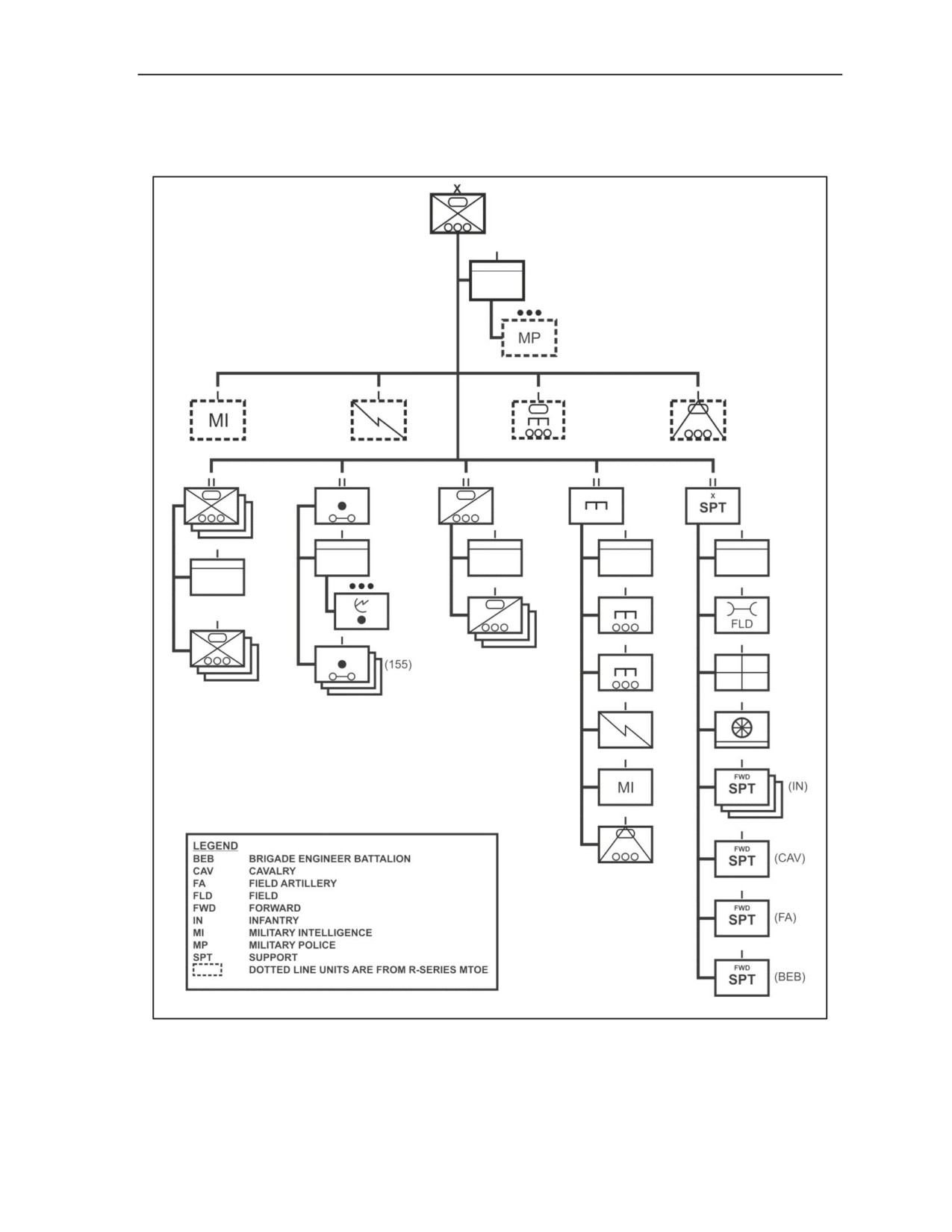
requirements. Figure 1-2 depicts the new task organization for SBCTs with the additions.
1-33. FSCs provide direct support to each of the SBCT battalions and squadron. The FSCs link the BSB to
the supported unit. Each FSC organizes to support a specific type of infantry, engineer, or field artillery
battalion or cavalry squadron. FSCs provide field feeding, field maintenance, and distribution support for
supplies, fuel, and ammunition. FSC structures are similarly with the most significant differences in the
maintenance capabilities.
1-34. The FSC commander is the senior logistician for the maneuver battalion. The FSC commander assists
the battalion S-4 with the battalion logistics planning. The commander is responsible for executing the
logistics plan according to the BSB and supported battalion or squadron commanders' guidance. (Refer to chapter
9 and ATP 4-90 for additional information.)
1-35. The antiarmor company is the primary antiarmor force in the SBCT. The company has three platoons,
each with three Stryker antitank guided missile vehicles, and a fire support team. The SBCT commander
normally task organizes the antiarmor company to perform a variety of tactical missions as part of operations.
The antiarmor company integrates with the appropriate maneuver elements to fill this combat role. (Refer to
FM 3-21.91 for additional information.)
1-36. The combat engineer company provides the minimum capability to perform essential mobility,
countermobility, and survivability tasks for the SBCT. The engineer company supports assured mobility,
enhances protection, enables force projection and logistics, builds partner capacity, and develops
infrastructure. The engineer company support allows the SBCT freedom of action. The combat engineer
company may augment with additional engineer capabilities but focuses on the integrated application of
inherent engineer capabilities. The company has three mobility platoons and one mobility support platoon.
Even though the company has four rapidly emplaced bridge systems, it has limited organic gap crossing
capability. (Refer to ATP 3-34.22 for additional information.)
1-37. The brigade signal company is organic to the SBCT. The company connects the unit to the Department
of Defense Information Network. The company has two network extension platoons and various signal
support teams under the company headquarters. The SBCT signal company supports users who operate on
the LandWarNet common server. (Refer to FM 6-02 for additional information.)
1-38. The military intelligence company mission is to conduct analysis, full motion video, signals
intelligence, geospatial intelligence, and human intelligence activities. Intelligence operations, conducted by
the military intelligence company, collect information about the intent, activities, and capabilities of threats
and relevant aspects of the operational environment to support the BCT commanders’ decisionmaking across
the range of military operations. The military intelligence company comprises a company headquarters and
four platoons (analysis, signals intelligence collection, human intelligence collection, and tactical unmanned
aircraft system). These platoons are under the operational control of the SBCT intelligence staff officer (S-2).
These platoons provide support to the development of the SBCT common operational picture, situation
development, intelligence preparation of the battlefield, and targeting effects. The platoons integrate and
analyze combat information and reports to develop intelligence products in response to priority intelligence
requirements. The SBCT can conduct human intelligence collection activities with assistance from the human
intelligence platoon. (Refer to FM 2-0 for additional information.)
1-39. The addition of a brigade engineer battalion (BEB) is a recent formation modification that some SBCTs
are currently fielding, or will be fielding in the near future. The SBCT receives organic engineer planning
and execution from the BEB. The BEB assigns and attaches engineer companies that provide maneuver
support for bridging, breaching, route clearance, identification of explosive hazards, and horizontal
construction support. The battalion also assigns a military intelligence company, signal company, and
antiarmor company. Under the new modification, the CBRN reconnaissance platoon transitions from the
1-8
FM 3-96
2FWREHU
Organization
cavalry squadron to the headquarters and headquarters company of the BEB. (Refer to FM 3-34 and ATP
3-34.22 for additional information.) Figure 1-2, page 1-9, depicts the SBCT task organization with these new
additions.
Figure 1-2. Modified Stryker brigade combat team
1-40. The BEB has a typical functional staff; however, the staff is predominantly engineers. (See Section I
of this chapter for BEB staff structure.) The battalion’s operations section is responsible for training,
operations, and plans for the battalion. The operations section includes combat (ATP 3-34.22), general (see
2FWREHU
FM 3-96
1-9
Chapter 1
ATP 3-34.40), and geospatial engineers (see ATP 3-34.80). A CBRN platoon is responsible for providing
CBRN technical advice to the brigade engineer battalion. Organic, assigned, or attached elements may be
task organized to a maneuver task force and/or to a subordinate company or troop. When the engineer
battalion receives or provides augmentation, the command and support relationship dictates whether the
brigade engineer battalion logistically supports or coordinates support with the SBCT, brigade support
battalion, or other units’ higher headquarters. The brigade engineer battalion retains its command and support
relationships with all its organic and attached units, regardless of their location within the area of operation,
unless the SBCT directs otherwise.
1-41. In some instances, the commander may direct the BEB to secure one or both of the SBCT’s command
posts, assign the BEB to their own area of operations, or give the BEB responsibility for a base perimeter or
area defense. A significant change to the engineer battalion mission may affect its ability to provide engineer
support to the SBCT. The SBCT staff weighs the level of risks associated with these missions and may
recommend additional engineer augmentation from echelons above brigade units to mitigate potential
negative effects.
1-42. Two nearly identical engineer companies provide the SBCT with the minimum capability to support
offensive and defensive tasks. The engineer companies support the SBCT so it can breach and cross obstacles,
assist in the assault of fortified positions, emplace obstacles to protect friendly forces, construct or enhance
survivability positions, conduct route reconnaissance and information collection, identify and clear
improvised explosive devices, and perform other tasks during decisive action. (See section I of this chapter
for additional information on the engineer companies within the BEB.)
SECTION III - ARMORED BRIGADE COMBAT TEAM
1-43. The ABCT’s role is to close with the enemy using fire and movement to destroy or capture enemy
forces, to repel enemy attacks by fire, to engage in close combat, and to counterattack to control land areas,
including populations and resources. The ABCT organizes to concentrate overwhelming combat power.
Mobility, protection, and firepower enable the ABCT to conduct offensive tasks with great precision and
speed. The ABCT performs complementary missions to the IBCT and SBCT.
1-44. The ABCT conducts offensive tasks to defeat, destroy, or neutralize the enemy. The ABCT conducts
defensive tasks to defeat an enemy attack, buy time, economize forces, and develop favorable conditions for
offensive actions. During stability, the ABCT’s commitment of time, resources, and forces establish and
reinforce diplomatic and military resolve to achieve a safe, secure environment and a sustainable peace.
1-45. The ABCT conducts sustained and large-scale actions within the foundations of unified land
operations. The ABCT can fight without additional combat power but can be task-organized to meet the
precise needs of its missions. The ABCT conducts expeditionary deployments and integrates the Army’s efforts
with unified action partners.
1-46. The ABCT is a combined arms organization consisting of three combined arms battalions of Armor
and mechanized infantry companies. Cavalry, field artillery, engineer, intelligence, signal, sustainment, and
CBRN reconnaissance units are organic to the ABCT, also. Higher commanders augment the ABCT for a
specific mission. Augmentation can include aviation, armor, field artillery, air defense, military police, civil
affairs, military information support operations elements, engineers, CBRN, and additional information
systems assets.
1-47. The addition of the brigade engineer battalion and battery to the field artillery battalion is a recent
formation modification that some ABCTs are currently fielding, or will be fielding in the near future. The
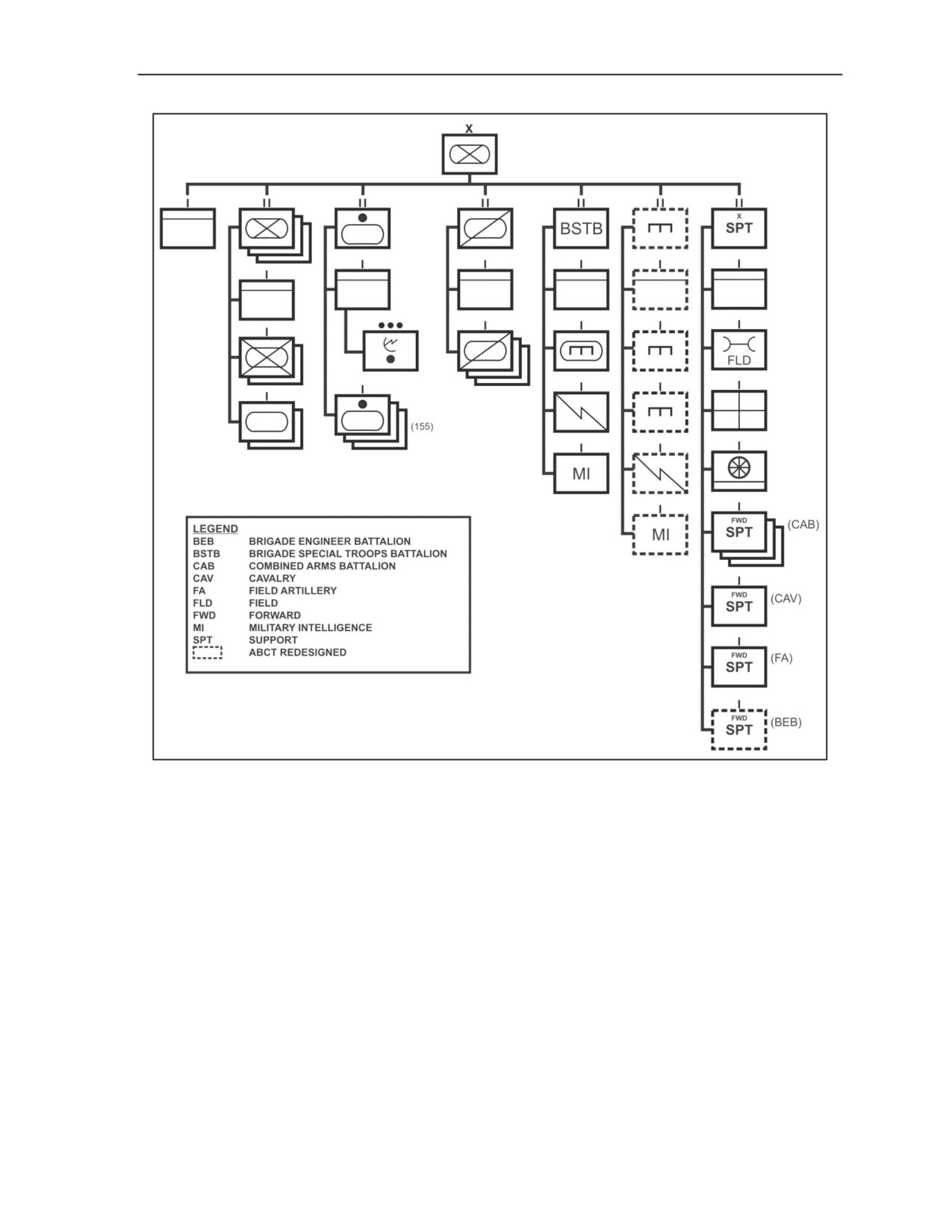
brigade engineer battalion replaces the BSTB and has a second engineer company. Figure 1-3, page 1-11,
illustrates the current ABCT design. The dashed lines represent the redesigned ABCT.
Note. The brigade special troops battalion that convert to a brigade engineer battalion within the
ABCT no longer has a military police platoon; another engineer company is added and the CBRN
reconnaissance platoon locates in the brigade engineer battalion headquarters and headquarters
company.
1-10
FM 3-96
2FWREHU
Organization
Figure 1-3. Armored brigade combat team
1-48. Three combined arms battalions are the ABCT’s primary maneuver force. The combined arms
battalion combines the efforts of its two Armor companies and two mechanized infantry companies along
with the headquarters company to execute tactical missions as part of a combined arms operation. The
combined arms battalion conducts sustained combined arms and close combat land operations as an essential
part of the ABCT formation. Combined arms battalions serve as a deterrent to armed conflict; they can deploy
worldwide in the conduct of decisive action. Combined arms battalions are responsible for executing
combined arms operations within their assigned area of operations to support the ABCT commander. (Refer
to FM 3-90.5 and FM 3-90.1 for additional information.)
1-49. The fundamental purpose of the cavalry squadron is to perform reconnaissance and surveillance tasks
and conduct security operations in close contact with the enemy and civilian populations, often in conjunction
with fighting for information to support the ABCT commander. The conduct of security operations by the
squadron provides an economy of force while allowing the ABCT commander the flexibility to conserve
combat power for engagements where he desires. (Refer to FM 3-20.96 for additional information.)
1-50. The ABCT field artillery battalion has four batteries, a headquarters and headquarters battery and three
batteries of six M109A6 Paladin self-propelled 155-mm howitzers. The batteries are manned and equipped
to operate as two separate firing platoons of three guns. The field artillery battalion provides massing fires in
space and time on single or multiple targets with precision, near precision, and area fires to support ABCT
2FWREHU
FM 3-96
1-11
Chapter 1
operations. The field artillery battalion has two AN/TPQ-53 counterfire radars and four AN/TPQ-50
lightweight countermortar radars for target acquisition. (Refer to FM 3-09 for additional information.)
Notes.
1. Current fielded target acquisition weapons locating radars consist of the AN/TPQ-36,
AN/TPQ-37, AN/TPQ50, and the AN/TPQ-53. The AN/TPQ-53 is being fielded. Once
completely fielded, all field artillery target acquisition platoons except the division artillery will
have two AN/TPQ-53s and four AN/TPQ-50 radars. The division artillery’s target acquisition
platoon will consist of two AN/TPQ-53s and two AN/TPQ-50s radars.
2. Munitions with a precision capability such as the Global Positioning System-aided Excalibur
155-mm projectile, guided MLRS rockets, and the advanced precision munitions initiative
120-mm mortar rounds have a circular error probable of less than 10 meters. Munitions with a
near-precision capability have a circular error probable between
10 and 50 meters. Area
capabilities have a circular error probable greater than 50 meters. Circular error probable is an
indicator of the delivery accuracy of a weapon system, used as a factor in determining probable
damage to a target. It is the radius of a circle within which half of the rounds fired at a target will
impact. Even at the munitions’ largest anticipated delivery error, the aimpoint is within the
munitions’ anticipated radius of direct effects.
1-51. The brigade support battalion (BSB) is the organic sustainment unit of the ABCT that forms the nucleus
for the ABCT’s sustainment operations. (See chapter 9.) The BSB plans, prepares, executes, and assesses
replenishment operations to support ABCT operations. The BSB distributes Class I (subsistence), Class II
(clothing), Class III (petroleum, oil, and lubricants), Class IV (construction and barrier materials), Class V
(ammunition), and Class IX (repair parts). The BSB provides food services, and Roles 1 and 2 of the Army
Health System (health service support and force health protection), as well as field maintenance and limited
recovery. The BSB maintains visibility of the theater distribution systems, synchronizing the flow of
throughput into the ABCT’s operational area.
1-52. The BSB positions forward support companies with combined arms battalions, the cavalry squadron,
the field artillery battalion, and when converted, the brigade engineer battalion to support the ABCT. The
ABCT conducts sustained operations for a finite period of time due to the BSB’s materiel-carrying capability.
Designated distribution managers coordinate and synchronize logistics flow according to the commander’s
priorities. Distribution managers have asset and in-transit visibility to optimize the distribution system within
their area of operations. Advanced information systems such as movement tracking systems, battle command
sustainment support systems, and advanced planning and optimization decision support tools provide this
capability. (Refer to chapter 9 and ATP 4-90 for additional information.)
1-53. The brigade special troops battalion (BSTB) provides control and sustainment to the organic engineer
company, signal company, military intelligence company, military police platoon, and the CBRN
reconnaissance platoon as well as other units attached to the ABCT. (The BSTB of the ABCT has the same
configuration as in the IBCT. See Section I of this chapter for subordinate unit discussion.) The BSTB
provides sustainment to its organic and attached units so they can support the ABCT commander and staff.
During combat operations, the BSTB utilizes all available assets to supplement the capabilities of other rear
units while conducting continuous reconnaissance and security of rear areas. In addition, the BSTB has the
five primary responsibilities listed below.
z
Ensures its organic units are properly trained and equipped to conduct their doctrinal missions.
z
Provides mission command while integrating and supporting company and smaller-sized units
attached to the ABCT.
z
Prepares all subordinate units for their missions, ensures their protection, and provides
administrative and sustainment support.
z
Secures one or more of the ABCT command posts.
z
Conducts support area security when properly augmented on order.
1-54. The mission of the BSTB allows the ABCT staff to focus their responsibilities in anticipation of the
ABCT commander’s requirements and to plan future operations rather than focus on the administrative and
1-12
FM 3-96
2FWREHU
Organization
tactical operations of the BSTB’s organic units and any ABCT attachments. Just like the other battalions in
the ABCT, the BSTB receives unit missions from the BCT commander through the ABCT S-3.
1-55. The BSTB headquarters and headquarters company provides administrative, sustainment (including
field feeding), and Army Health System support to its organic units and any nonorganic attached units of the
ABCT. In addition to the military police platoon and CBRN reconnaissance platoon, the headquarters and
headquarters company has a detachable field maintenance section that provides direct maintenance support
to the engineer company and any attached engineer assets.
1-56. The BSTB is responsible for the security and sustainment of the BCT command posts. The BSTB
assumes control of access and security of the base cluster containing the ABCT main command post,
remaining elements of the BSTB’s own organic units, and any ABCT attachments. If properly augmented,
the BSTB can plan, prepare, and execute missions in the ABCT’s areas of operation that are not assigned to
other units. (Refer to ATP 3-90.61 for additional information.)
1-57. See Section I of this chapter for information on the BSTB that has converted to a brigade engineer
battalion within the ABCT. The brigade engineer battalion in the ABCT has the same configuration as in the
IBCT.
2FWREHU
FM 3-96
1-13
This page intentionally left blank.
Chapter 2
Threat
Threats are a fundamental part of an overall operational environment. A threat is any
combination of actors, entities, or forces that have the capability and intent to harm
United States forces, United States national interests, or the homeland (ADRP 3-0).
Threats may include individuals, groups of individuals (organized or not organized),
paramilitary or military forces, nation-states, or national alliances. When threats
execute their capability to do harm to the United States, they become enemies.
SECTION I - UNDERSTANDING THE THREAT
2-1. In general, the various actors in any area of operation can qualify as a threat, an enemy, an adversary,
a neutral actor, or a friend. An enemy is a party identified as hostile against which the use of force is authorized
(ADRP 3-0). An enemy is also called a combatant and is treated as such under the law of war. An adversary
is a party acknowledged as potentially hostile to a friendly party and against which the use of force may be
envisaged (JP 3-0). A neutral is a party identified as neither supporting nor opposing friendly or enemy forces
(ADRP 3-0). Land operations often prove complex because a threat, an enemy, an adversary, a neutral, or a
friend intermix, often with no easy means to distinguish one from another.
THREAT COMPOSITION, DISPOSITION, AND INTENTION
2-2. Leaders must understand that not all potential state adversaries seek to avoid United States forces or
strengths, particularly those state adversaries with overwhelming numbers combined with favorable ground,
and those with a chemical, biological, radiological, and nuclear weapons of mass destruction capability.
North Korea and Iran are examples. Today’s forces must prepare to deal with symmetrical threats as seen in
Operation Desert Storm, as well as asymmetrical threats seen during Operation Iraqi Freedom and Operation
Enduring Freedom.
2-3. The term hybrid threat has evolved to capture the seemingly increased complexity of operations, the
multiplicity of actors involved, and the blurring among traditional elements of conflict. A hybrid threat is the
diverse and dynamic combination of regular forces, irregular forces, terrorist forces, and/or criminal elements
unified to achieve mutually benefitting effects (ADRP 3-0).
2-4. The brigade combat team commander must understand threats, criminal networks, enemies, and
adversaries, to include both state and nonstate actors, in the context of the operational environment. When
the BCT commander understands the threat, he can visualize, describe, direct, and assess operations to seize,
exploit, and retain the initiative. The commander and staff must develop and maintain running estimates (see
chapter 3) of the situation. To develop and maintain running estimates of the situation as the basis for
continuous adaptation, the commander and staff must consider their own forces within the realm of emerging
threats as well as the mission, terrain, friendly forces, and civilian populations.
2-5. Interactions of various actors affect the BCT’s area of operation in terms of eight interrelated
operational variables, a comprehensive set of information categories used to define an operational
environment (ADP 1-01). The categories are political, military, economic, social, information, infrastructure,
physical environment, and time (PMESII-PT). Some of these actors include the following:
z
Unified action partners.
z
Nongovernmental organizations.
z
Private volunteer organizations.
z
International and private security organizations.
z
Media.
2FWREHU
FM 3-96
2-1
Chapter 2
z
Multinational corporations.
z
Transnational criminal organizations.
z
Insurgents.
z
Violent extremist organizations.
z
Tribes, clans, and ethnic groups indigenous to the area of operations.
z
Regional influences such as other nation-states.
2-6. The BCT engages in close combat while operating in complex terrain in close proximity to civilian
populations. Current and future battlefields require the BCT to fight and win in mountainous, urban, jungle,
and desert environments and subsurface areas below ground level. (See chapter 6.) The physical challenges
presented by complex terrain, and the continuous interactions of numerous actors, each with their own
agendas, objectives, interests, and allegiances, influence the operational environment and mission
accomplishment.
2-7. The resulting human and political dynamics of the operational environment produce additional layers
of complexity to BCT operations. As a result, the BCT commander and staff must understand the complicated
relationships and the complex interactions between the various actors that produce tactical challenges and
opportunities. Understanding is critical to seizing, retaining, and exploiting the initiative over enemies and
adversaries. Understanding is equally critical to the consolidation of tactical gains to achieve sustainable
political outcomes consistent with the mission.
STATE AND NONSTATE ACTORS
2-8. The BCT must be prepared to defeat determined state and nonstate actors that combine conventional
and unconventional tactics to avoid our forces’ strengths (such as mobility, long-range surveillance, and
precision fires capabilities) while attacking our perceived vulnerabilities (such as our difficulty identifying
the enemy among civilian populations). Current and future threats use a variety of means, including
conventional combined arms operations, terrorism, insurgency, political subversion, and information
operations to evade United States forces and disrupt tactical and combined arms capabilities. (See FM
3-24.2.) United States enemies and adversaries seize the initiative and dictate the terms and tempo of
operations in their favor. Enemies and adversaries rely on their established sources of strength. These sources
of strength include networks that facilitate the undetected movement of logistics, finances, people, and
weapons areas within complex terrain to exploit United States and unified action partner military, political,
social, economic, and information vulnerabilities.
2-9. The enemy employs tactical countermeasures to limit the United States forces ability to develop the
situation, to avoid decisive engagements, and to initiate contact under advantageous conditions. The enemy
also employs technological countermeasures to reduce their signature on the battlefield and degrade the
United States forces ability to detect, engage, and destroy them. Many hostile nation-states continue to
procure conventional capabilities such as tanks, antitank guided missiles, manned aircraft, and air defense
systems. These conventional weapons systems are increasingly available to nonstate enemy organizations
and hybrid threats. Enemy forces also integrate emerging technology such as robotics, unmanned aircraft
systems, cyber, and nano-technologies. Enemies and adversaries combine conventional and unconventional
tactics to counter, evade, or disrupt United States forces’ efforts across the range of military operations.
2-10. The use of weapons of mass destruction in future conflict is inevitable. Many threat organizations
already possess weapons of mass destruction, (chemical, biological, radiological, or nuclear weapons) and
their delivery systems
(for example, rockets and artillery). Enemies employ these weapons of mass
destruction to obtain a relative advantage over United States forces to achieve their objectives. Threat
organizations that do not currently possess weapons of mass destruction consistently seek opportunities to
acquire them. The potential catastrophic effects associated with the threat or use of weapons of mass
destruction adds greater uncertainty to an already complex environment. The BCT commander must
anticipate and plan for the conduct of weapons of mass destruction-elimination operations through the four
weapons of mass destruction-elimination activities, which are isolation, exploitation, destruction, and
monitoring and redirection. (Refer ATP 3-11.23 for additional information.)
2-2
FM 3-96
2FWREHU
Threat
2-11. In current and future conflicts, the BCT commander and staff must rapidly develop a detailed and
adaptable understanding of the threat, as it exists within the context of local conditions. Such a contextualized
understanding allows the commander and staff to determine the nature of the conflict and to gain visibility
of the enemy’s structure and methods of operation. This determination allows commanders to identify
emerging opportunities to seize, retain and exploit the initiative, exert influence over local actors, and
consolidate tactical gains into strategic success. By understanding the internal workings of current and future
enemies and adversaries, the BCT commander can exploit possibilities to disrupt the enemy and then rapidly
dislocate, isolate, disintegrate, and destroy enemy forces.
NETWORKS
2-12. The BCT commander and staff must determine an enemy’s strategies, objectives, and the multiple
dimensions, (physical, psychological, informational, and political) in which he operates to defeat him. The
BCT identifies and depicts networks (such as criminal, financial, terrorist, security forces) as friendly, enemy,
or neutral based on how they affect the mission. The BCT supports friendly networks, influences neutral
networks, and disrupts, neutralizes, or defeats enemy networks. Network assessment is continuous and
collaborative, integrating unified action partners whenever possible. Unified action partners supply much of
the information needed for an accurate assessment. At the tactical level, units develop an understanding of
various networks through reconnaissance in close contact with the enemy and civilian populations. Network
assessment considerations include—
z
Objectives and strategy.
z
Key individuals, groups, nodes, and their roles within a network.
z
Relationships between key individuals and networks.
z
Resources that flow across, into, and out of networks
(such as people, money, weapons,
and narcotics).
z
Network intersections where illicit networks connect to legitimate institutions and leaders.
z
Network strengths and vulnerabilities.
SECTION II - POTENTIAL THREAT GROUPS
2-13. Threat groups populate the complex operational environment of current and future-armed conflict.
Threat groups include nation-state militaries, insurgent organizations, transnational criminal organizations,
and terrorist groups. These threat groups may align themselves based on mutual goals and common interests.
As a result, the BCT commander must prepare to defeat a complicated and often shifting array of enemies
and threats. Understanding enemy and threat capabilities, as well as their political, economic, or ideological
aims, is an essential element of seizing, retaining, and exploiting the initiative.
STATES
2-14. States are sovereign governments that control a defined geographic area. Although social movements
and global real-time communications reduce the relative power of some states, the state remains the entity
that generates, sustains, and employs combat power. States have a number of advantages over organizations.
These advantages include the recognition and support of other states, the authority to create laws governing
the population and the authority to enforce laws through the control of institutions such as their standing
armies and internal security forces, and the ability to raise money through taxation. Using their military
forces, states have access to the institutions required to generate doctrinal, organizational, training, and
materiel components of combined arms teams and their associated combat power. As a result, the BCT
commander must understand a sovereign government’s combat capabilities to work with or fight against that
sovereign government.
NONSTATE ORGANIZATIONS
2-15. Nonstate organizations are groups that operate within states, but who act outside of the system to
support or achieve their own political goals. Such organizations can be small and informal, or large and
formal. Frequently, organizations consist of a predominant tribal, ethnic, national, or religious group, but
2FWREHU
FM 3-96
2-3
Chapter 2
there are corporate, criminal, and transnational organizations as well. Threat organizations may vary in
capabilities and in the goals, they pursue. Often enemies and adversaries seek alliances of convenience by
combining criminal networks, terrorists, state and nonstate actors, insurgents, transnational groups, proxies,
and paramilitaries to attain short or near-term objectives. For example, during the Iraq war, a variety of
organizations operated in the country, some of whom posed threats to the United States mission. Insurgent
and militia organizations included Al Qaida, the Islamic State of Iraq, Jaysh al Mahdi, Asaab al Haq, Khattaib
Hizballah, the Sons of Iraq, and a variety of Kurdish militia groups. Energy and other corporations with their
private security forces operated inside the country, also. At times, the United Nations and other transnational
organizations or nongovernment organizations operated within the country. Each of the organizations that
operated in Iraq had different, frequently opposing goals. Many of the organizations were directly opposed
to United States forces, but even the organizations that were not overt enemies had separate goals that did
not align with United States interests. The BCT commander, therefore, must understand and prepare to work
with and fight against a wide variety of organizations, many of which may be tied directly to sovereign states.
CRIMINAL NETWORKS AND OPPORTUNISTS
2-16. Criminal networks are often stakeholders in state weaknesses. The government institutions’
weaknesses allow criminal networks to have freedom of movement and to divert state resources without
repercussions from law enforcement and rule of law. Criminal networks often ally other state and nonstate
organizations to engage in and facilitate a range of illicit activities (intimidation and coercion) to capture and
subvert critical state functions and institutions. These networks often align regionally and ethnically. The
networks build alliances with political leaders, financial institutions, law enforcement, foreign intelligence,
and security agencies to pursue political and criminal agendas. Many networks operate with impunity,
consistently avoiding meaningful investigations and prosecution, by exerting influence within law
enforcement, investigative and judicial institutions within a nation-state government.
2-17. Opportunists often take advantage of unstable conditions to pursue their personal goals and agendas.
Opportunists can work with, for, or against an insurgency. Their interests determine their actions, operations,
and conduct. An opportunist can work both sides to gain a positional advantage, to maximize influence, to
maximize profits, or to avoid retribution. Opportunists can facilitate movement of insurgents while providing
intelligence to counterinsurgents. Counterinsurgent or insurgent objectives do not restrict or govern
opportunists.
2-18. Commanders and staffs should identify the presence of criminal networks and opportunists.
Commanders and staffs must assess criminal networks and opportunists’ impact on the mission and
protection while planning and executing actions to mitigate those negative impacts. The BCT works with
local, federal, United States Army, unified action partners, and law enforcement personnel to mitigate the
threat of these groups and individuals. The BCT also integrates law enforcement personnel into their
operations and synchronizes their operations to facilitate the reduction and elimination of criminal networks
and the threat posed by opportunists, ultimately creating an environment where local law enforcement
agencies can assume responsibility in this effort.
INDIVIDUALS
2-19. Identifying the threat posed by states and organizations is relatively easy when compared to the
challenge of identifying the threat posed by a single individual. Although United States forces have not
historically focused on neutralizing the threat of a single person, the growing interconnectivity of states,
organizations, and individuals increases the ability of an individual with sufficient computer technical skills
to attack United States interests and forces using an army of computers. The BCT must be prepared to defend
its mission command system against cyber-attacks, whether initiated by a state, organization, or individual.
In addition to fighting and defeating states and organizations, the BCT commander and staff must retain the
ability to identify, disrupt, and isolate individuals within the political, social, and tactical context of the
operational environment.
2-4
FM 3-96
2FWREHU
Threat
SECTION III - THREAT CHARACTERISTICS AND ORGANIZATION
2-20. Today and in the future, situations will call upon the BCT to fight and win against regular and irregular
forces, terrorist forces, and criminal elements. Criminal elements employ unconventional, terrorist tactics
and hybrid threats that combine conventional, unconventional, and terrorist methods to meet their goals and
political aims.
2-21. Regular forces are part of nation-states that employ military capabilities and forces in military
competition and conflict. Normally, regular forces conduct operations to accomplish the following
objectives, defeat an enemy’s armed forces, destroy an enemy’s war-making capacity, and seize or retain
territory.
2-22. Regular forces often possess technologically advanced weapon systems integrated into mechanized
and motorized combined arms formations and light infantry forces. Enemy equipment that the BCT may
encounter in combat include armored fighting vehicles, anti-armor systems, air defense systems, ballistic
missiles, manned and unmanned aircraft, indirect fire systems, mines, and digital communications systems.
Regular force organizations are hierarchical (companies, battalions, brigades, and so forth) with a centralized
command and control structure. Regular forces can conduct long-term conventional and unconventional
operations. Examples of regular forces include—
z
Islamic Republic of Iran Army.
z
Peoples Liberation Army of China.
z
Russian Army.
z
North Korean People’s Army.
2-23. Irregular forces may be armed individuals or groups who are not members of the regular armed forces,
police, or other internal security forces. Irregular forces employ unconventional, asymmetric methods to
counter United States advantages. Unconventional methods may include terrorism, insurgency, and guerrilla
warfare. A weaker enemy often uses unconventional methods to exhaust the United States collective will
through protracted conflict. Economic, political, informational, and cultural initiatives usually accompany
and may even be the chief means of an attack on United States influences. Irregular forces or complex threats
include paramilitaries, terrorists, guerillas, and criminal organizations and networks.
2-24. Irregular forces or complex threats have political objectives and ideology and grievance is the
motivation. These grievances may be real or perceived. Identifying these objectives and motivations can be
difficult for a number of reasons, such as—
z
Multiple insurgent groups with differing goals and motivations may be present.
z
Insurgent leaders may change and the movement’s goals change with them.
z
Movement leaders may have different motivations from their followers.
z
Insurgents may hide their true motivations and make false claims.
z
Goals of the insurgency may change due to operational environment changes.
2-25. Irregular forces customarily operate in small, dispersed, decentralized formations or cells (team and
squad size) within a decentralized command and control structure. Irregular forces are often highly motivated
with established local, regional and worldwide support networks. Irregular forces threat capability is limited
to small-arms weapons, antitank weapons, man-portable air defense missiles, mortars, short-range rockets,
homemade radio frequency weapons, rudimentary robotics, counter-unmanned aircraft systems, and
improvised explosive devices. However, some irregular threats possess the financial means to acquire
advanced weapon systems and technologies. Examples of irregular forces in armed conflicts include—
z
Revolutionary Army Forces of Columbia-People’s Army (1964).
z
Mujahidin in Afghanistan (1979).
z
Palestine Liberation Organization in the West Bank (2001).
z
Al Qaeda in Iraq (2007).
z
Taliban in Afghanistan (2009).
z
Islamic State in Iraq and the Levant (2013).
2FWREHU
FM 3-96
2-5
Chapter 2
2-26. Hybrid threats are the diverse and dynamic combination of regular and irregular threats, terrorist forces,
or criminal elements unified (or allied) to achieve mutually benefitting effects. Hybrid threats may include
nation-state actors that employ protracted forms of warfare, possibly using proxy forces to coerce and
intimidate, or nonstate actors employing capabilities traditionally associated with states. Hybrid threats can
operate under a centralized or decentralized command and control structure. Examples of hybrid threats are
Hezbollah in Lebanon (2006) and Hamas in Gaza (2008).
2-27. Combat experiences in Afghanistan, Iraq, and other recent conflicts in Lebanon, Mali, Syria, Gaza,
Northern Nigeria, and Southern Thailand demonstrate a migration of capabilities, tactics, and techniques
previously only associated with military forces of nation-states to state-sponsored and nonstate entities. This
migration of capabilities presents friendly maneuver forces with a challenge that extends beyond defeating
an enemy’s regular force. Current and future threats do and can combine and transition between regular and
irregular warfare adopting strategies, tactics, and techniques to evade and disrupt United States advantages
and gain tactical advantages within the physical, psychological, informational, and political dimensions of
armed conflict. As a result, the BCT must prepare to counter lethal evasion and disruption capabilities from
a variety of forces (regular, irregular, and hybrid) in current and future operational areas.
SECTION IV - THREAT CAPABILITIES, TACTICS, AND TECHNIQUES
2-28. Current and future enemies employ a series of integrated tactical and technical countermeasures to
counter United States operational and tactical advantages. Countermeasures are deception operations,
dispersion, concealment, and the intermingling with civilians in urban terrain. The enemy also employs
technological countermeasures, such as cyber-attacks and global positioning system jamming, to evade and
disrupt the United States force’s ability to develop the situation, seize the initiative, and consolidate tactical gains
into favorable outcomes.
2-29. The BCT commander and staff must determine an enemy’s strategies and objectives and understand
the multiple dimensions in which he operates to defeat him. The following paragraphs address the three
dimensions in which enemies operate. These dimensions are the physical dimension, the psychological and
informational dimension, and the political dimension.
PHYSICAL DIMENSION
2-30. Current and future enemies operate within complex terrain to evade United States weapon systems,
advanced combined arms and air-ground capabilities. They operate in and among the population to evade
detection, preserve their combat power, and retain their freedom of movement. The enemy often establishes
relationships with local, regional, and transnational criminal organizations, and violent extremist
organizations to finance their operations and gain access to illicit trafficking networks to move illegal
weapons, munitions, weapons of mass destruction, people, narcotics, or money.
EVASION TACTICS AND TECHNIQUES
2-31. Enemy forces use deception, cover and concealment, smoke, or other obscurant when conducting
operations. They move in small, dispersed units, formations, groups, or cells to avoid detection. They conduct
short engagements with three- to ten-man elements that break contact before United States forces can bring
indirect fire or airborne strike platforms to bear. The enemy creates false battlefield presentations and reduces
signatures through deliberate and expedient means of deception to frustrate United States Army information
collection efforts. The enemy uses hardened and buried facilities and multispectral decoys to mask the
signatures of high-value systems (such as short-range ballistic missiles and surface-to-air missiles). The
enemy also exploits safe havens within hostile states or in ungoverned areas and takes advantage of
subsurface means to avoid detection (for example tunnels, underground facilities, sewers, drainage systems,
and other subterranean spaces). As enemies evade United States and coalition forces, they seek to expand
their freedom of movement through intimidation and coercion. The enemy exploits civilian populations and
cultural sites to hide key weapon systems.
2-6
FM 3-96
2FWREHU
Threat
DISRUPTION TACTICS AND TECHNIQUES
2-32. Enemy forces employ combinations of lethal and other actions to disrupt United States forces’ efforts
to shape the operational environment. Lethal actions can be offensive and defensive in nature through
decisive force. Other actions can be agitation, propaganda, and exploitation of the local population. Enemies
employ integrated and networked combined arms teams to offset United States capabilities. They employ
small, dispersed, squad-sized teams armed with technologically advanced lethal weapons. Lethal weapons
include rocket-propelled grenades, antitank guided missiles, and man-portable air-defense systems to conduct
short engagements, and to defend against United States armored, counter-unmanned and unmanned aircraft
systems, and rotary-wing aircraft capabilities. Enemies seek opportunities to mass forces against vulnerable
targets, such as small combat outposts, dismounted patrols, and logistic convoys where they believe they can
achieve quick victories with little risk of decisive engagements. When available, enemy forces employ
armored or technical vehicles to increase their tactical mobility, protection, and firepower. Current and future
enemies also integrate indirect fires such as rockets, mortars, and artillery into their operations.
2-33. Enemies augment their small combined arms teams’ tactical capabilities by employing inexpensive
countermeasures such as improvised explosive device, Molotov cocktails, suicide bombers, civilians as
obstacles (demonstrators and crowds to incite riots), and fire and smoke as weapon systems. Enemies use
these countermeasures to impede United States forces’ ability to move and maneuver, or to prevent and delay
United States forces from conducting operations. At the same time, enemies seek to acquire technologies
such as unmanned aircraft systems (that may be weaponized for precision strike capability), satellite imagery,
forward-looking infrared, and electronic warfare systems or platforms.
2-34. The enemy is proficient at establishing and maintaining communications and at disrupting United
States forces’ command and control systems. The enemy disrupts combined-arms capabilities through
combinations of Global Positioning System jamming, cyber-attacks, data pirating, and satellite
neutralization. Developing and maintaining these capabilities requires extensive recruitment, training, and
outsourcing for personnel with the required skill set to conduct such attacks.
2-35. The loss of space-based communications due to enemy activity remains a major concern for United
States Army forces conducting deployed operations. Whether the enemy action against satellites or with
intermittent jamming and spoofing causes the communication interruptions, the resulting black-out requires
United States forces to adapt and adjust until the restoration of communications. Short-term losses or
disruptions of satellite communications mitigate through alternative communications methods and courier
networks.
2-36. Regular, irregular, and hybrid forces present formidable tactical challenges to the BCT when combined
with area denial weapons. Area denial weapons included area denial systems, artillery munitions, land mines,
and weapons of mass destruction. Enemy operations emphasize deception, cover, mobility, and most
importantly, depth in the defense. In the offense, enemy operations emphasize deception, cover, mobility,
and most importantly, infiltration techniques. Taken together, regular, irregular, and hybrid forces on the
current and future battlefield employ significant combined arms capabilities that seek to disrupt BCT
operations and dislocate BCT combined arms capabilities.
PSYCHOLOGICAL AND INFORMATIONAL DIMENSION
2-37. Current and future enemies recognize the importance of public perception and its impact on the conduct
of operations. The enemy attempts to influence the will of the American people, key allies, and the
populations among whom there are conflicts, through propaganda, disinformation, and attacks on United
States and allies’ assets at home and abroad. The enemy conducts propaganda and disinformation operations
to shape local and international public opinion and perception against the United States, host nation, or
coalition forces. The enemy undermines ongoing stabilization efforts, marginalizing successes, exploiting
instances of friendly force missteps, and fabricating or exaggerating friendly force cultural shortcomings.
Enemy organizations attempt to manipulate local, regional, and worldwide news and social media outlets to
achieve their ends and solicit new recruits to their cause. For example, mobile phones can activate improvised
explosive devices with the results captured on digital cameras, transmitted via satellite phones, and posted
on internet chat rooms for a worldwide audience. Additionally, the enemy operating within urban terrain uses
2FWREHU
FM 3-96
2-7
Chapter 2
tactics that increase the potential for civilian casualties and collateral damage to undermine the resolve of
both the United States and the local populace.
POLITICAL DIMENSION
2-38. Politics, and in particular, competition for power, resources, and survival drive conflicts and are key
to their resolution. Understanding the political dynamics at the local level allows BCT commanders to
identify the enemy’s strategy, capabilities, and potential weaknesses within the political environment. This
understanding aids in identifying targets that undermine or counter United States and coalition efforts that
consolidate gains and achieve a sustainable political outcome consistent with United States vital interests.
2-39. The enemy exploits societal divisions along political, economic, ethnic, tribal, and religious lines. The
enemy offers benefits to favored groups and disenfranchises opposing groups within the population to exploit
societal divisions. These activities protect their sources of strength, consolidate their power, and assist in
establishing political legitimacy. The enemy also seeks opportunities to exert this legitimacy by filling
societal roles that United States forces or host-nation leaderships have failed to address. As enemies and
adversaries pursue this strategy, they often align with criminal organizations to undermine and attack existing
government institutions. The resulting corruption, acceptance of illicit activities, and paralysis undermine
political reform and stability efforts and prevent information gathering. The enemy promotes weaknesses
within political institutions by disrupting or influencing elections at the local, provincial, and national level
by conducting attacks on voting sites, intimidating election officials, manipulating political districts, and by
backing corrupt officials. Additionally, the enemy may attempt to assassinate, abduct, or extort key civic,
ethnic, or military leaders to undermine security and good governance, degrade friendly forces’ morale,
garner media attention to gain support and sway populace opinion, raise funds, and attract new recruits. Weak
government institutions allow the enemy and other in state stakeholders the freedom and ability to divert
state resources without repercussions from law enforcement and rule of law.
2-40. The enemy’s political subversion campaign seeks to exploit existing social and political weaknesses.
Degrading public opinion of United States and host-nation efforts, disrupting United States and local force’s
abilities to provide essential services and security, and alienating the populace from supporting friendly forces
are efforts within this campaign. Like the physical capabilities of the enemy, the BCT commander must
recognize and counter these efforts as he seeks to maintain the initiative. He must visualize the threat in its
political context to understand the dynamics existing within his area of operations and to determine tactical
objectives that lead to the achievement of sustainable political outcomes consistent with United States vital
interests. The commander can reassure and protect indigenous populations while simultaneously identifying,
disrupting, isolating, and ultimately defeating the enemy if he understands the political dynamics of a conflict.
SECTION V - COUNTERING ADAPTATIONS AND RETAINING THE INITIATIVE
2-41. Countering enemy adaptations and retaining the initiative in future-armed conflicts requires forces that
understand the threat and the operational environment. Effective information collection must overcome
increasingly sophisticated area-denial actions and capabilities to develop the situation. Joint combined arms
capabilities must be complimentary and effectively integrated to identify opportunities to seize, retain, and
exploit the initiative and dominate in an increasingly challenging and complex environment.
2-42. The BCT must be able to fight for understanding to develop the situation while in contact with the
enemy and in close proximity to the population. The BCT commander and staff must understand the tactical,
human, and political dynamics associated with current and future-armed conflict because of the requirements
and challenges of the operational environment. The BCT commander’s and staff’s understanding must extend
beyond enemy organizations and their capabilities and include ethnic groups, political factions, tribes or
clans, religious sects, or ideological movements and their agendas. Identifying and distinguishing these
groups and the associated dynamics is extremely difficult and requires a detailed, in-depth information
collection effort through every phase of the operation. Only through an effective information collection effort
can the BCT gain the understanding necessary to defeat an adaptive and determined enemy on current and
future battlefields.
2-8
FM 3-96
2FWREHU
Chapter 3
Mission Command
Mission command is the exercise of authority and direction by the commander using
mission orders to enable disciplined initiative within the commander’s intent to
empower agile and adaptive leaders in the conduct of unified land operations (ADP
6-0). The brigade combat team (BCT) commander uses mission command to seize,
retain, and exploit the initiative through mission orders. Mission orders are directives
that emphasize to subordinates the results to be attained, not how they are to achieve
them (ADP 6-0). The word initiative as it relates to mission orders describes personal
initiative. The commander’s intent is a clear and concise expression of the purpose of
the operation and the desired military end state that supports mission command,
provides focus to the staff, and helps subordinate and supporting commanders act to
achieve the commander’s desired results without further orders, even when the operation
does not unfold as planned (JP 3-0). The BCT commander uses the mission command
philosophy to exploit and enhance uniquely human skills. The commander executes
mission command through balancing the art of command, the creative and skillful
exercise of authority through timely decisionmaking and leadership (ADP 6-0), with
the science of control, the systems and procedures used to improve the commander’s
understanding and support accomplishing missions (ADP 6-0).
SECTION I - FUNDAMENTAL NATURE AND PHILOSOPHY OF MISSION
COMMAND
3-1. Understanding the fundamental nature and philosophy of mission command is essential to the effective
conduct of operations. Military operations are human endeavors conducted in complex and ever-changing
operational environments. The commander’s ability to visualize relationships among opposing human wills
is essential to understanding the fundamental nature of operations. Mission command is both a philosophy
of command and a warfighting function. To account for the uncertain nature of operations, mission command
(as opposed to detailed command) tends to be decentralized and flexible. This uncertain nature requires an
environment of mutual trust and shared understanding among commanders, subordinates, and partners. This
section focuses on the fundamental nature and philosophy of mission command and using mission orders to
ensure disciplined initiative within the commander's intent, enabling agile and adaptive commanders, leaders,
and organizations. (Refer to ADP 6-0 and ADRP 6-0 for additional information.)
FUNDAMENTAL PRINCIPLES
3-2. The commander focuses his order on the purpose of the operation through mission orders. Mission
orders allow the commander’s subordinates the greatest possible flexibility to accomplish assigned tasks. To
assist in the effective exercise of mission command, commanders and leaders consider the following six
fundamental principles:
z
Build cohesive teams through mutual trust.
z
Create shared understanding.
z
Provide a clear commander’s intent.
z
Exercise disciplined initiative.
z
Use mission orders.
z
Accept prudent risk.
2FWREHU
FM 3-96
3-1
Chapter 3
COMMAND PRESENCE
3-3. The philosophy requires the commander to lead from a position that allows timely decisions based on
an operational environment assessment of the operational environment and application of judgment. The
BCT commander may find it necessary to locate forward of the main command post. For example, the
commander may position with the main effort to gain understanding, prioritize resources, influence others,
and mitigate risk. To do this, the BCT commander must understand how the fundamental principles of
mission command guide and help balance the art of command with the science of control.
3-4. The Armored Raid on Baghdad in 2003 offers an example of how the mission command philosophy
enabled a BCT to seize, retain, and exploit the initiative in an uncertain environment. The vignette below
demonstrates how the six principles of mission command guided the BCT commander during the operation.
It also describes how the commander used the principles of mission command to balance of the art of command
and science of control.
ARMORED RAID ON BAGHDAD, 5 APRIL 2003
On 5 April 2003, COL David Perkins’ 2d Brigade, 3d Infantry Division (Mechanized),
conducted a raid into western Baghdad as part of the division’s advance on Baghdad after
a two-week march of over 700 kilometers from Kuwait. As part of the advance, COL
William Grimsley’s 1st Brigade had already seized the Baghdad airport west of the city
(Objective LIONS) from the southwest, bypassing the urban sprawl of the Iraqi capital. In
the meantime, Perkins’ brigade had seized the key intersection of Highways 8 and 1
(Objective SAINTS) south of the city, creating a partial cordon around the Iraqi capital.
The raid, ordered by 3d Infantry Division commander MG Buford Blount and V Corps
commander LTG William S. Wallace, was conducted as a battalion-sized
reconnaissance-in-force into western Baghdad to determine the composition and strength
of Iraqi forces defending the capital.
Staging out of Objective SAINTS, the column of M1A1 Abrams tanks and M2 Bradley
Fighting Vehicles from LTC Eric Schwartz’s Task Force 1st Battalion, 64th Armor
Regiment (TF 1-64 AR) would advance north on Highway 8, (the main north-south
expressway west of the Tigris River) into western Baghdad. The column then turned west
to link with Grimsley’s troops at the airport. Since the enemy situation was unclear, the
operation required initiative and flexibility from the officers, noncommissioned officers,
and soldiers executing the operation. Wallace judged that such a bold plan was a reasonable
risk. The raid was the first armored foray into a major city since World War II. Perkins’
concept for the raid, called a thunder run by the tankers, was for an advance up Highway 8
that “…create[d] as much confusion… inside the city [as possible].” In mitigating the
inherent risk of the operation, the 2d brigade commander considered “…that my soldiers or
my units [could] react to chaos much better than the enemy [could].” Perkins’ specific
guidance to Schwartz was to “conduct a movement to contact north along Highway 8 to
determine the enemy’s disposition, strength, and will to fight.”
Schwartz praised the straightforward commander’s intent and purpose. “The planning was
simple,” he explained, “The Thunder Run mission was the simplest of all tasks that we
were given. There was no maneuver required. It was simply battle orders followed by battle
drills.” Based on Perkins’ intent to maintain tempo, Schwartz chose to leave all lightly
armored wheeled vehicles at the base of SAINTS. Departing at 0630 on 5 April, Schwartz’s
command included 731 men, 30 M1A1Abrams tanks, 14 Bradley infantry fighting
vehicles, 14 engineer vehicles, and other tracked support vehicles.
Within minutes of moving north of SAINTS, the Americans came under sporadic small
arms, mortar, and rocket-propelled grenade fire from Iraqi irregular forces firing from
hastily prepared positions adjacent to the highway. Within an hour the small arms fire and
rocket propelled grenade volleys had turned the operation into something akin to running
a gauntlet of fire, but they did little to slow the column. The plan prohibited slowing the
3-2
FM 3-96
2FWREHU
Mission Command
advance for specific targets, which were passed instead to follow-on vehicles by radio.
However, this concept jettisoned temporarily when, six kilometers from the line of
departure, a rocket-propelled grenade round fired from an overpass exploded in the engine
compartment of SSG Jason Diaz’s C Company tank, immobilizing it. As Diaz’s crew
struggled to put out the growing fire and rig the tank for recovery, other Abrams and
Bradley vehicles formed a defensive perimeter. Using coaxial machine gun fire and main
gun rounds, the column repulsed several dismounted attacks and approaches by suicide
vehicles. Several Americans were wounded. Since Perkins’ order emphasized momentum,
LTC Schwartz decided after a half hour delay, to renew the northerly advance and destroy
Diaz’s tank with incendiaries to keep it out of enemy hands. With the spearhead about
halfway to the airport, Iraqi small arms fire fatally wounded SSG Stevon Booker, an A
Company tank commander, while a nearby Bradley was disabled by rocket-propelled
grenade fire which wounded the driver, also. In this case, the delay was short, with the
wounded men placed in other vehicles and the Bradley rigged for towing. Soon the column
was back on the move.
Schwartz’s force turned in the direction of the airport at the intersection of Highway 8 and
the Qaddissiyah Expressway, the main east-west thoroughfare between the airport west of
the city and downtown Baghdad. Hundreds of paramilitary fighters and military personnel
continued to fire on the column from all directions, only to fall victim to the Americans’
overwhelming firepower. After a total travel time of two hours and 20 minutes, the column
arrived at the airport.
COL Perkins concluded that the reconnaissance in force had completely surprised the
enemy. “[The Iraqis] thought that they could bloody our nose enough on the outside of the
city … that we just would not push through block by block,” Perkins explained. The raid
had cost five casualties (one killed and four wounded), one Abrams tank destroyed, and
one Bradley heavily damaged. Iraqi losses were estimated to be at least 1000 fighters killed,
one T-72 tank, and 30 to 40 BMPs (Boyevaya Mashina Pekhotys) destroyed, and the
elimination of a large number of light vehicles and countless roadside bunkers.
The operation demonstrated that United States Armored forces could penetrate Baghdad at
will, while suffering minimal casualties. The operation provided excellent indicators of
enemy tactics, strength, and fighting positions. LTG Wallace and MG Blount praised the
5 April “Thunder Run.” They envisioned the operation as a prelude to additional armored
missions in and around the city that would disrupt the Baghdad defenses with the ultimate
goal of regime collapse. Using the lessons learned on 5 April, Perkins launched a second,
larger operation on 7 April, which resulted in the occupation of downtown Baghdad and
the final fall of the Baathist government.
ILLUSTRATIONS OF THE SIX PRINCIPLES OF MISSION
COMMAND
3-5. The application of the six principles of mission command, combined with COL Perkins’ use of the art
of command and science of control helped reduce uncertainty during the planning, preparation, and execution
of the 5 April 2003 movement to contact through Baghdad. Soldiers easily understood the mission and intent,
which were simple and clear. COL Perkins’ command presence forward set a positive example for TF 1-64
Armor and allowed him to assess the situation and apply judgment.
3-6. The science of control was illustrated by the actions of the 2/3 ID. The 2/3 ID main command post
facilitated mission accomplishment by coordinating with the 3d ID main command post and with 1/3 ID,
synchronizing and integrating actions, informing COL Perkins, and providing procedural control for the 2/3
ID units in OBJ SAINTS. The paragraphs below described the six principles of mission command illustrated
in the vignette above.
2FWREHU
FM 3-96
3-3
Chapter 3
BUILD COHESIVE TEAMS THROUGH MUTUAL TRUST
3-7. The 2d Brigade was a regular Army unit, which had stabilized both command tours and personnel
assignments during its overseas tour. While the campaign was only two weeks old, the brigade had been in
Kuwait for over six months prior to that and had trained intensively. By 5 April, two continuous weeks of
combat experience augmented the training. COL Perkins trusted his commanders and Soldiers because of
their high level of training and their proven performance in combat.
CREATE SHARED UNDERSTANDING
3-8. The corps, division, and brigade commanders clearly conveyed their intents, objectives, and key tasks
to subordinate commanders. The long train-up for the campaign in Kuwait and the previous two weeks of
operations facilitated shared understanding. Additionally, the raid was essentially a battle drill, which TF
1-64 Armor had executed many times before, both in training and in combat.
PROVIDE A CLEAR COMMANDER’S INTENT
3-9. Both LTG Wallace and MG Blount provided clear and concise commanders’ intents for the 5 April
mission. Their intent was to conduct a raid into Baghdad in an armored column to test the Iraqi military’s
urban defenses, collect intelligence, and pressure the regime. COL Perkins added his own emphasis to
maintain momentum throughout the movement and to create as much confusion among enemy elements as
possible.
EXERCISE DISCIPLINED INITIATIVE
3-10. Commanders at all levels had confidence that their subordinates could do the job with minimal
direction because of shared understanding, mutual trust, and the experience level of the unit. This prevented
the column from bogging down at several points during the operation. When SSG Diaz’s tank was disabled,
for example, LTC Schwartz and COL Perkins knew the crew had done whatever they could to save the tank
and accepted that it must be destroyed and abandoned.
USE MISSION ORDERS
3-11. When COL Perkins issued his order for the reconnaissance in force, he directed TF 1-64 AR to attack
up Highway 8 all the way to the Baghdad Airport to collect intelligence about the composition and disposition
of the Iraqi forces that were defending the city. He provided clear intent, objectives, and graphics and allowed
LTC Schwartz to execute. The directive was unambiguous: maintain momentum, hand over targets to trailing
armored vehicles, and avoid becoming tied down into a pitched battle. The directive also maximized
individual initiative.
ACCEPT PRUDENT RISK
3-12. COL Perkins used armored vehicles to execute the 5 April Thunder Run. The brigade’s vulnerable,
wheeled vehicles remained at the base at OBJ SAINTS. This deprived the task force of certain logistical and
sustainment functions during the course of the operation. The fact that the operation was a raid of short
duration mitigated the risk, which required quick movement by combat elements not encumbered by
soft-skinned vehicles requiring protection.
3-13. Colonel Perkins used his knowledge of the art of command to position himself and his S-2 in an M113
into the lead task force formation to build understanding and enable timely decisions. This position allowed
him to assess the situation, apply judgment, and prioritize resources to accomplish the mission. In addition,
COL Perkins’ command presence forward gave him the ability to influence TF 1-64 Armor through personal
example and guidance.
SECTION II - MISSION COMMAND WARFIGHTING FUNCTION
3-14. The mission command warfighting function is the related tasks and systems that develop and integrate
those activities enabling a commander to balance the art of command and the science of control in order to
3-4
FM 3-96
2FWREHU
Mission Command
integrate the other warfighting functions (ADRP 3-0). Mission command—as a warfighting function—assists
the commander in balancing the art of command with the science of control, while emphasizing the human
aspects of mission command. A warfighting function is a group of tasks and systems (people, organizations,
information, and processes) united by a common purpose that the commander uses to accomplish missions
(ADRP 3-0). By itself, the mission command warfighting function cannot achieve objectives or accomplish
missions. Mission accomplishment requires the integration of all the warfighting functions. Mission
command provides purpose and direction to the other warfighting functions. Mission command tasks and the
mission command system are elements of the mission command warfighting function. (Refer to ADRP 6-0
for additional information.)
MISSION COMMAND TASKS
3-15. The commander is the central figure in mission command. The commander is responsible for
accomplishing assigned missions while the staff performs essential functions that amplify the effectiveness
of operations. Throughout operations, the commander uses a clear commander’s intent to encourage
disciplined initiative while providing enough direction to integrate and synchronize the force at the decisive
place and time.
3-16. To this end, the commander performs three primary mission command warfighting function tasks. The
commander’s first task is to drive the operations process through the activities of understanding, visualizing,
describing, directing, leading, and assessing operations. The second task is to develop teams, both within
their own organizations and with unified action partners. The commander’s third task is to inform and
influence audiences, inside and outside their organizations.
3-17. The staff supports the commander and subordinate commanders with understanding situations,
decisionmaking, and implementing decisions throughout the conduct of operations. The staff does this
through the four staff tasks below:
z
Conduct the operations process (plan, prepare, execute, and assess).
z
Conduct knowledge management and information management.
z
Synchronize information-related capabilities.
z
Conduct cyber electromagnetic activities.
3-18. Five additional tasks reside within the mission command warfighting function. These commander-led
and staff-supported additional tasks are—
z
Conduct military deception.
z
Conduct civil affairs operations.
z
Install, operate, and maintain the network.
z
Conduct airspace control.
z
Conduct information protection.
OPERATIONS PROCESS
3-19. The Army’s framework for exercising mission command is the operations process—the major mission
command activities performed during operations: planning, preparing, executing, and continuously assessing
the operation (ADP 5-0). The BCT commander, assisted by his staff, uses the operations process to drive the
conceptual and detailed planning necessary to understand, visualize, and describe the operational
environment, make and articulate decisions; and direct, lead, and assess military operations.
3-20. The operations process, while simple in concept (plan, prepare, execute, and assess), is dynamic in
execution. The BCT commander and staff use the operations process to integrate numerous tasks executed
throughout the headquarters and with subordinate units. The commander organizes and trains the staff and
subordinates as an integrated team to simultaneously plan, prepare, execute, and assess operations. In addition
to the principles of mission command, the commander and staff consider the following additional principles
for the effective use of the operations process:
z
Commanders drive the operation process.
z
Build and maintain situational understanding.
2FWREHU
FM 3-96
3-5
///////////////////////////////////////