FM 3-22.32 IMPROVED TARGET ACQUISITION SYSTEM, M41 (July 2005) - page 5
FM 3-22.32
A-6. SAFETY PRECAUTIONS FOR THE BASIC SKILLS TRAINER
The following safety precautions must be observed when using the BST.
DANGER
THIS EQUIPMENT USES HIGH VOLTAGE TO
OPERATE. NEVER USE UNGROUNDED EXTEN
SION CORDS, UNGROUNDED ADAPTERS, OR
ANY UNGROUNDED OUTLET TO CONNECT THE
BST. DEATH ON CONTACT MAY RESULT IF
PERSONNEL FAIL TO OBSERVE SAFETY
PRECAUTIONS.
a. Use two people to lift the instructor console. The console is heavy and lifting by
only one man could result in serious injury.
b. Do not attempt to open shipping cases before pressing the air pressure release
valves on the side of the cases. Serious injury to personnel could result from opening
cases with high pressure inside.
c. Turn off the power to the BST and disconnect the wall outlet plug before
beginning cleaning procedures.
A-6
8 July 2005
FM 3-22.32
APPENDIX B
ITAS TRAINING DEVICES
The ITAS training devices consist of the ITAS BST, which is the indoor
trainer, and the FTT, which is the force-on-force trainer. The BST will be
used in place of the TOW gunner trainer (TGT) to qualify individual
gunners and for additional sustainment training as the unit deems
necessary. The ITAS FTT will be used in place of the TOW field tactical
trainer (TFTT) for outdoor tracking sustainment and in place of MILES
when conducting Tables 5 through 12 of the ITAS training tables.
The ITAS FTT provides realistic device-based training for simulating
tactical engagements. It is valuable in maneuver training exercises and
Army training and evaluation programs. However, the ITAS FTT is not a
precision gunnery trainer and should not be used to train gunner tracking
skills.
Section I. ITAS BASIC SKILL TRAINER
The BST is the training device that the ITAS gunner will use to conduct initial,
sustainment, and qualification training. The BST has a variety of exercises that require
the gunner to engage targets that replicate the engagement procedures of the M41 ITAS.
B-1. COMPONENTS AND FEATURES
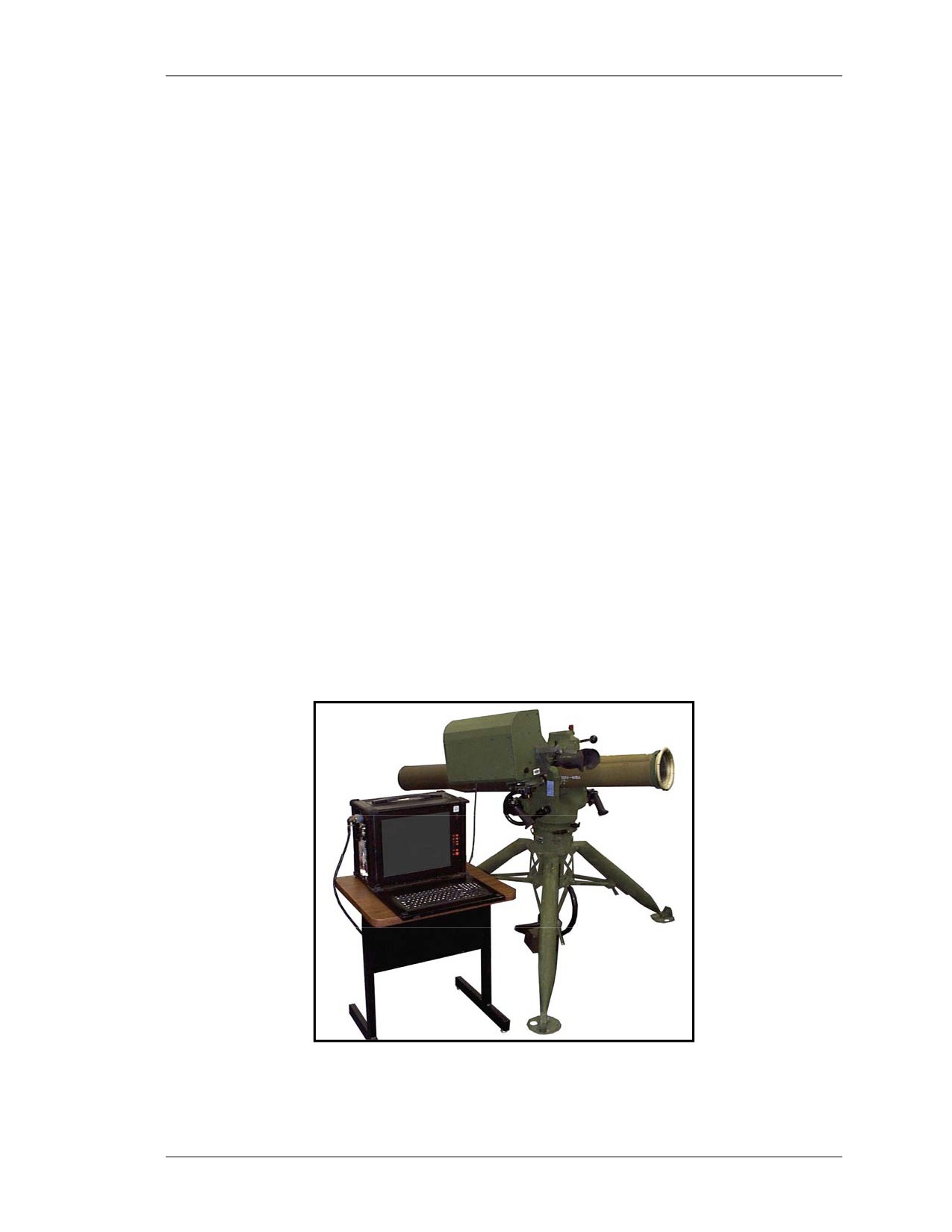
The BST consists of BST-unique components and ITAS components. The major
BST-unique components are the instructor station and the student station (Figure B-1).
The ITAS components are the traversing unit, tripod, and the launch tube.
Figure B-1. Instructor station and student station.
8 July 2005
B-1
FM 3-22.32
a. The BST simulates the sight(s), controls, switches and indicators of the M41
ITAS. Battlefield scenes, which include both enemy and friendly vehicles, can be seen
through the gunner’s sight(s). Using the controls and switches, the gunner selects a target,
fires, and tracks it. The headsets simulate the blast of the TOW and the “singing” of the
wire. The gunner sees and hears hit-and-miss explosions, hears commands from the
instructor, and hears battlefield sounds of small arms and guns. The score is displayed at
the end of each mission.
b. The BST provides novice gunnery skill training, gunnery skill progression, and
sustainment training. It is used to train the following skills:
• Correct firing position.
• Target identification.
• Target engageability determination.
• Target engagement, including tracking and firing.
• Fire commands.
B-2. ASSEMBLY AND OPERATION
The following manuals are used for proper assembly and operation of the BST. (These
manuals are under development.)
a. The BST operator’s guide discusses procedures for unpacking, assembly,
disassembly, and repacking for storage and or shipment.
b. TM 9-6920-721-10 discusses preparation for operation, preliminary inspections,
warm-up, and operational checkout procedures.
c. TM 9-6920-721-10 discusses operating procedures performed by the instructor in
order to conduct training.
B-3. SAFETY PRECAUTIONS
The following safety precautions should be observed when using the BST.
a. Use two people to lift the instructor console. The console is heavy and lifting by
only one man could result in serious injury.
b. Do not attempt to open shipping cases before pressing the air pressure relief
valves on the side of the cases. Serious injury to personnel could result from opening
cases with high pressure inside.
c. Turn off the power to the BST trainer and disconnect the wall outlet plug before
beginning cleaning procedures.
DANGER
THIS EQUIPMENT USES HIGH VOLTAGE TO
OPERATE. NEVER USE UNGROUNDED EXTEN-
SION CORDS, UNGROUNDED ADAPTERS, OR
ANY UNGROUNDED OUTLET TO CONNECT THE
BST. DEATH ON CONTACT MAY RESULT IF
PERSONNEL FAIL TO OBSERVE SAFETY
PRECAUTIONS.
B-2
8 July 2005
FM 3-22.32
Section II. ITAS FIELD TACTICAL TRAINER
The FTT is used to teach precision gunnery skills to ITAS gunners in the field. This
training can occur on designated ranges, in general outdoor areas, or in representative
tactical environments. The FTT trains gunners to adopt a correct firing position, assess
target engageability, and engage and track the target. Missile launch, flight, and impact
effects are realistically simulated by the FTT.
B-4. COMPONENTS AND FEATURES
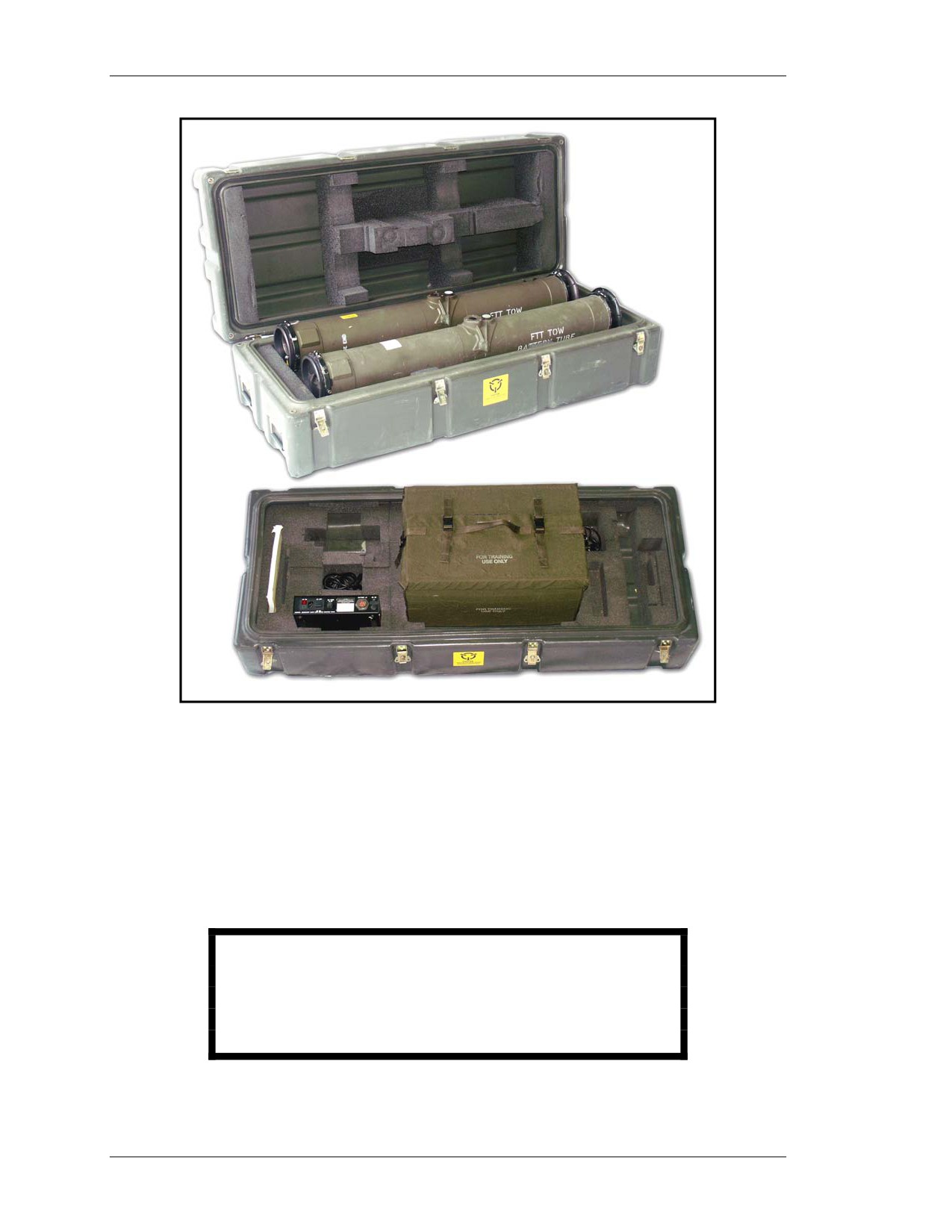
The FTT consists of FTT-unique components and an ITAS weapon system. The FTT
attaches to the ITAS and replaces some of its components. The FTT can be either
tripod-mounted or HMMWV-mounted. It can be configured for the M1121 (Figure B-2,
page B-4).
a. The FTT uses the ITAS weapon system equipment to enhance training realism. In
addition, most of the FTT components resemble actual weapon system equipment. The
FTT uses a retroreflector to designate its target. The retroreflector returns a portion of the
laser beam generated by the gunner. The laser beam enables precise measurement of
target range and location relative to the gunner. The retroreflector can be mounted on a
variety of target vehicles, which can be maneuvered as required during a training
mission. Targets equipped with MILES sensors can also be engaged by the FTT.
b. The FTT operator loads the M80 blast simulator, sets the duration of the
obscuration that simulates the smoke produced at missile launch, and selects the relative
size of the target. Following missile launch, the operator monitors gunner performance
during missile flight. At the end of each mission, the operator is provided with a readout
of mission results.
B-5. ASSEMBLY AND OPERATION
The following manuals are used for proper assembly and operation of the FTT. (These
manuals are currently under development.)
a. The BST operator’s guide
(M1121) discusses procedures for unpacking,
assembly, disassembly, and repacking of the FTT.
b. TM 9-6920-721-10 (M1121) discusses procedures for preliminary inspection,
power-up, and operational checkout of the FTT.
c. TM 9-6920-721-10 (M1121) discusses procedures for operating the FTT.
8 July 2005
B-3
FM 3-22.32
Figure B-2. ITAS field tactical trainer components (M1121).
B-6. SAFETY PRECAUTIONS
The laser light emitted by the FTT is considered eye safe, but suitable precautions must
be taken to avoid possible eye damage from overexposure to this radiated energy. (See
the preface to TM 9-6920-721-10 and the laser range safety procedures in AR-385-63
and TB MED-279 for these precautions.) To avoid personnel injury and equipment
damage, four people are required to lift and carry each shipping container.
DANGER
THE ATWESS USED WITH THE FTT CAN CAUSE
DEATH OR INJURY. OBSERVE THE PRECAU-
TIONS LISTED IN THE PREFACE OF TM 9-6920-
721-10.
B-4
8 July 2005
FM 3-22.32
APPENDIX C
FORWARD LOOKING INFRARED
This appendix provides the gunner with a greater understanding of
how to acquire targets with the ITAS. Visible light is seen either directly
from a light source or indirectly as the light reflects from an object into
the eye. The ITAS can create images using the infrared part of the
spectrum in a process referred to as imaging infrared or I2R.
The ITAS allows the gunner to see a target at night and during
light rain, fog, haze, or dusty atmospheric conditions by taking advantage
of a type of energy similar to visible light known as “infrared.”
C-1. ELECTROMAGNETIC SPECTRUM
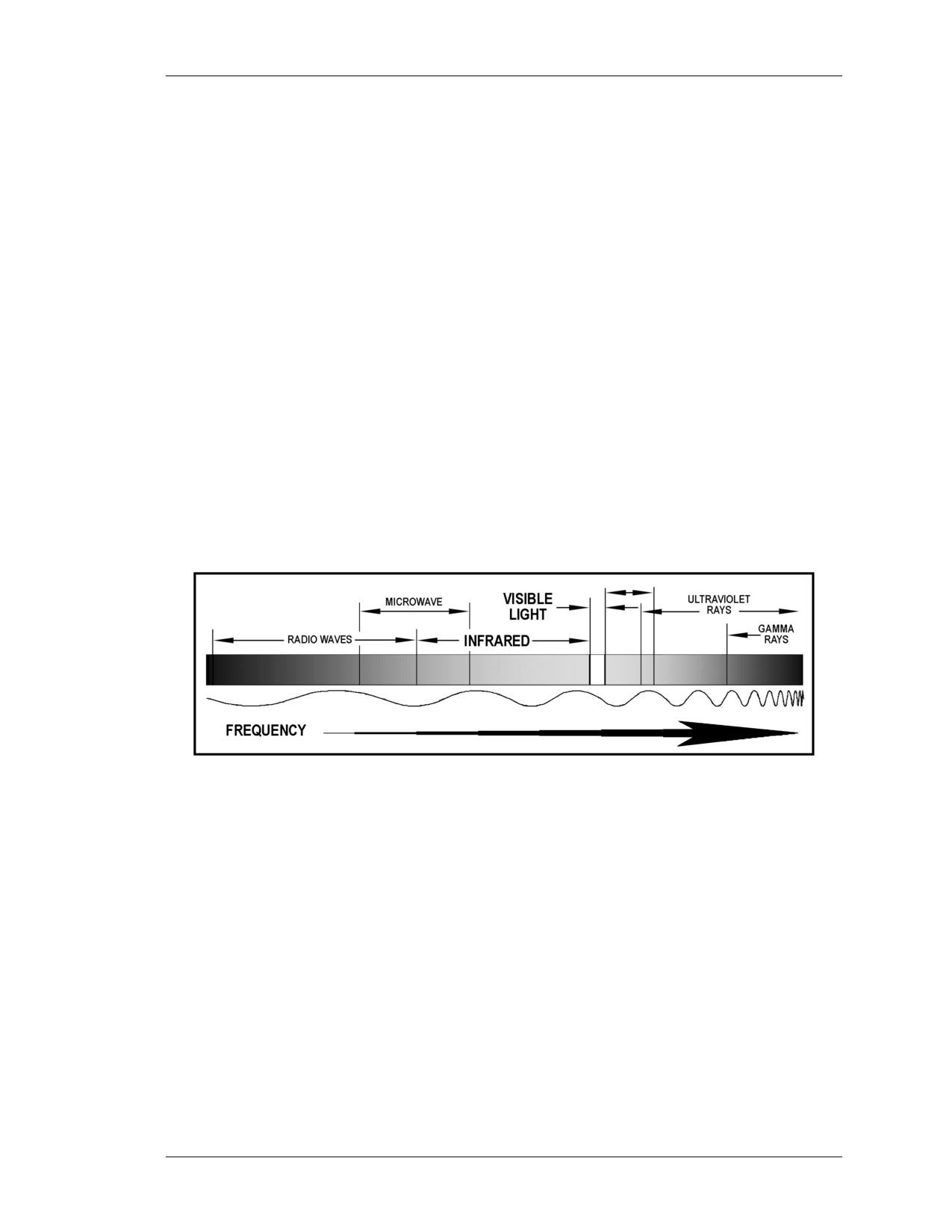
The electromagnetic spectrum (Figure C-1) contains various forms of energy including
radio and television transmission spectrums, x-rays, and visible light humans can see.
Visible light is a very small portion of the overall electromagnetic spectrum. Each type of
energy is assigned a place in the spectrum according to its frequency—from lowest to
highest. As the frequency changes, the characteristics change, so types of energy are
bundled into groups of frequencies, or bands, which have similar characteristics. The
ITAS uses the infrared band for its NVS.
Figure C-1. Electromagnetic spectrum.
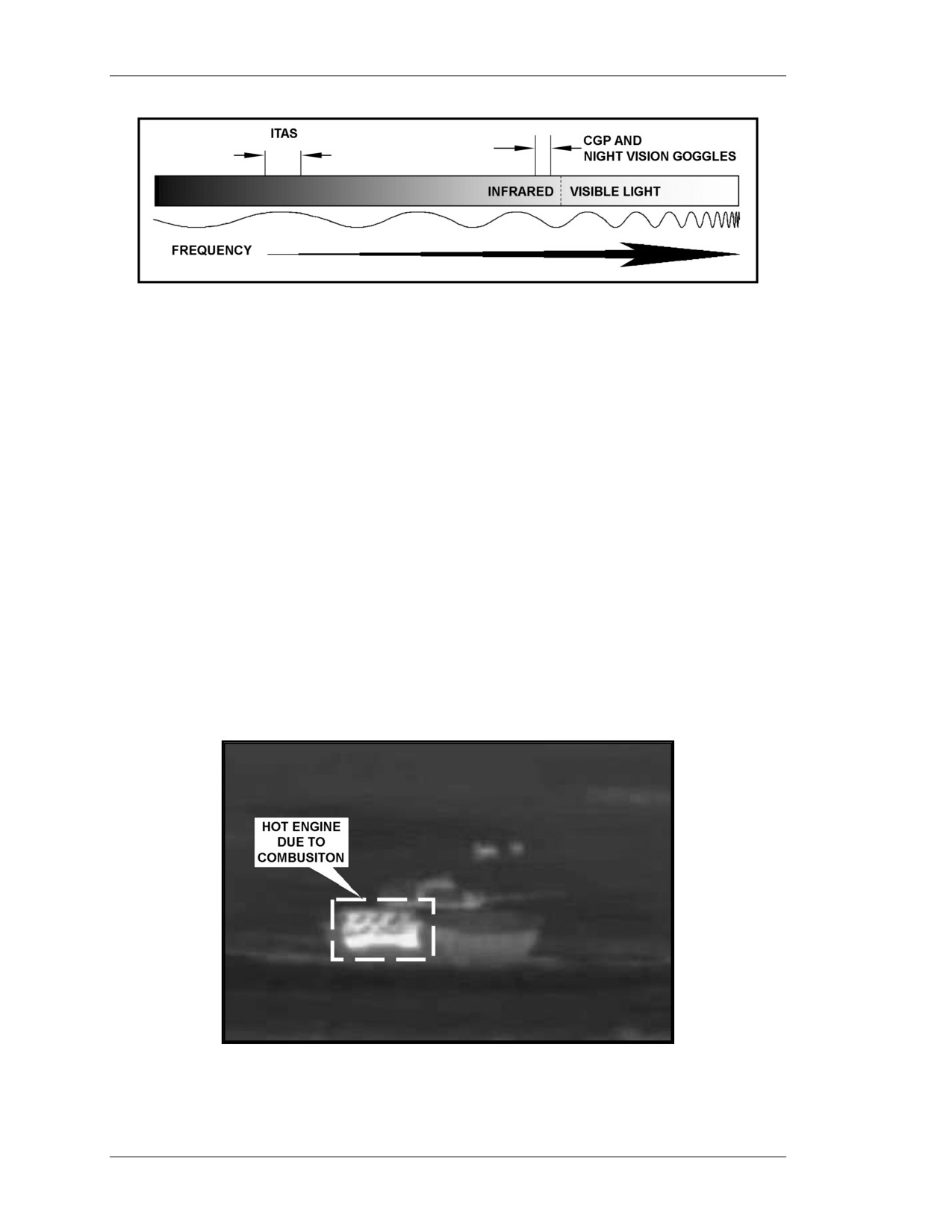
a. The ITAS operates using frequencies in only a small part of the IR band
(Figure C-2, page C-2). Other weapon systems operate in this same area, such as the
Javelin and Dragon, which means the gunner should be able to see anything with the
Javelin and Dragon that he can see with the ITAS.
b. Other systems operate using frequencies in other parts of the IR band. This
includes such equipment as the commander’s ground pointer (CGP) and night vision
goggles (NVG). Using the CGP and NVGs as an example, when the platoon leader points
to a target with the CGP, the gunner can see what the platoon leader points at because the
NVGs that the gunner wears operates at the same IR frequency as the CGP. Using the
ITAS, the gunner cannot see where the CGP points because CGP emits a beam outside
the IR band that the ITAS uses.
8 July 2005
C-1
FM 3-22.32
Figure C-2. Infrared band.
C-2. INFRARED WAVES
Infrared waves are a form of energy traveling as an electromagnetic form of heat. Heat
creates IR waves and IR waves create heat. For instance, the heat lamps at fast-food
restaurants are above the food, yet they keep the food warm even though heat rises. The
reason is that the lamps radiate IR waves down onto the food, and when the IR strikes the
food, the food warms up. IR can be emitted in any direction.
a. Infrared Sources. Everything on the face of the earth emits IR in the IR band
used by the ITAS. Hotter objects emit more IR, and cooler objects emit less. Some
objects are classified as IR sources meaning they are able to stay hot by themselves using
another form of energy—such as nuclear energy, combustion, and friction—to generate
heat energy.
(1) Nuclear Energy. Nuclear energy is produced either by splitting atomic particles
(called fission) or combining atomic particles together in different forms (called fusion).
The sun uses a nuclear reaction to generate heat and is our primary source of IR energy.
(2) Combustion (Figure C-3). Combustion means there is heat produced by a slow
burning (such as a bonfire) or very quick burning (such as a controlled explosion).
Vehicle engines generate heat due to combustion.
Figure C-3. Heat caused by combustion.
C-2
8 July 2005
FM 3-22.32
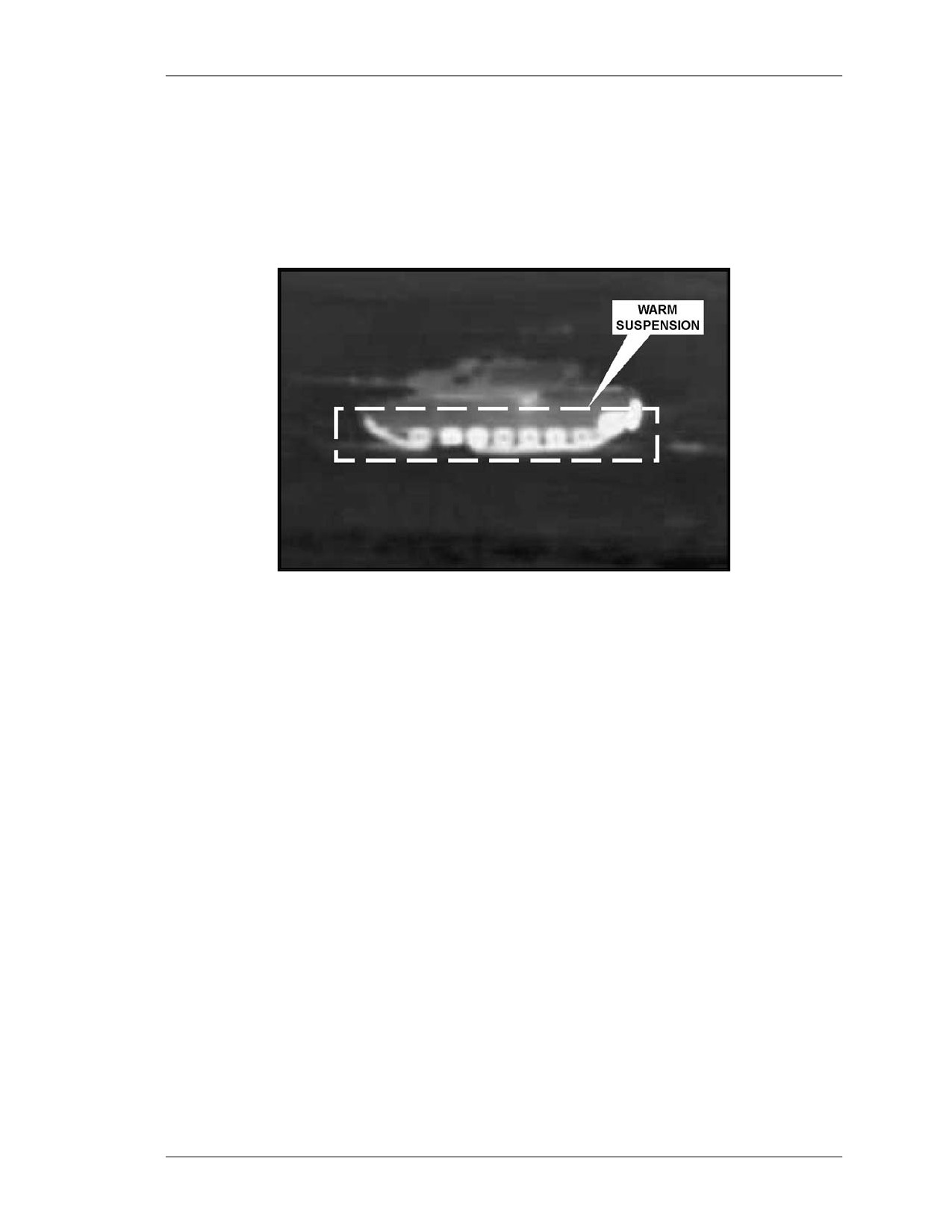
(3) Friction. Friction produces heat by rubbing objects together. For example, when
you rub your hands together very quickly, friction causes your hands to warm up, which
causes them to give off more IR. The same reaction occurs when a vehicle moves. Its
suspension and motion mechanism (tires or tracks) creates friction moving against
themselves or against the ground causing the suspension parts to warm up and produce IR
(Figure C-4).
Figure C-4. Heat caused by friction.
b. Infrared Characteristics. All objects have the IR characteristics of reflection (if
IR energy is reflected as in a mirror), absorption (if IR energy is absorbed as in friction),
and emission (if IR energy comes from an IR source as in combustion). Like visible light,
IR is affected by being transmitted through the atmosphere.
(1) Reflecting Versus Absorbing. All objects reflect and absorb IR energy in varying
amounts. What is not absorbed is reflected.
(a) Objects that reflect IR well do not absorb it well. Plant life, such as trees and
grass, reflects IR well. This reflection makes the plants appear to heat up instantly when
the sun strikes them and to cool off instantly when the sun blocks the plants.
(b) Absorbing is the opposite of reflecting. Objects that absorb IR well do not reflect
it well. Objects such as tanks and rocks absorb IR well. When the sun comes up, this
absorption makes these objects stay cold or cool for a longer time when everything else is
warm. When the sun goes down, these objects stay hot much longer than other objects in
the target scene. For example, illumination tape that becomes dimmer the longer it glows.
(2) Emitting IR. Emitting is closely associated with absorbing. Just like illumination
tape that absorbs light before it glows, objects are heated to emit IR. For example, an
emitting source is like the human body or a combustion engine that generates heat. When
an object absorbs IR, it warms up. As it warms up, it emits more IR. When the heat
source is removed, the object continues to emit IR, which causes it to cool off, and the
amount of IR that it emits steadily decreases.
(3) Transmitting IR. Just like light, IR is affected by particles in the atmosphere
known as obscurants because they obscure the gunner’s view of the target scene.
8 July 2005
C-3
FM 3-22.32
(a) Obscurants include such things as dust, snow, hail, sleet, fog, and so forth. The
effect these obscurants have on IR is noticeably less than their effect on light. Unlike
light, some obscurants have no effect on the ability to see an IR image
(b) Obscurants with large-sized particles—snow, sleet, rain, fog, and some forms of
smoke—affect the amount of IR that reaches the NVS. As these obscurants become
thicker or heavier, the amount of IR that reaches the NVS decreases, which decreases the
range at which a gunner can see a target with the NVS.
c. Physical Properties. When the sun comes up, some objects heat up faster than
others because they have different IR characteristics. An object’s IR characteristics are
determined by its physical properties—mass, density, color, and texture. These properties
combine to enhance an object’s ability to reflect or absorb the IR that comes into contact
with it.
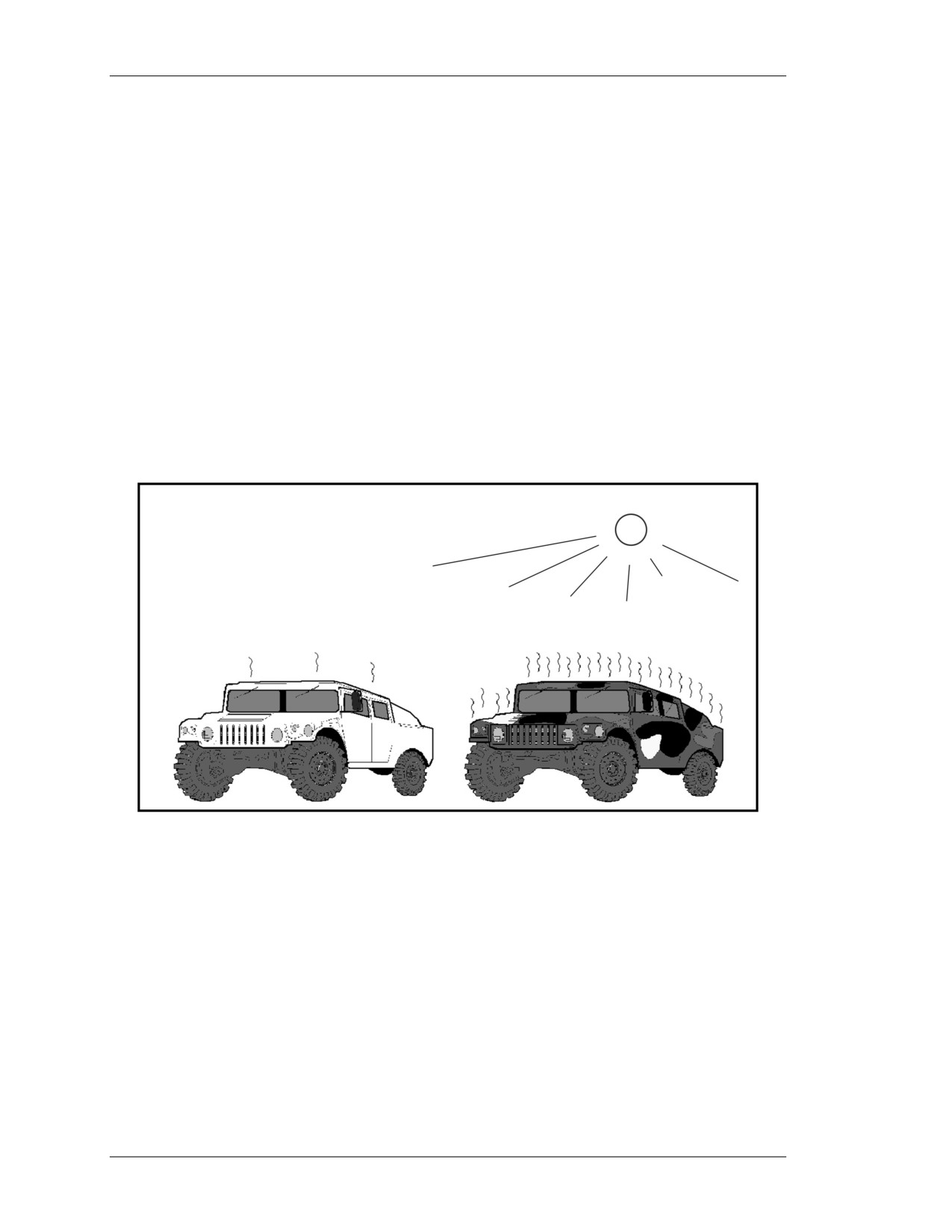
(1) Color. Light colored objects, such as a vehicle with desert camouflage, reflect
more IR than they absorb, and heat slowly in the sun (Figure C-5). Dark colored objects,
such as a vehicle with woodland camouflage, absorb more IR than they reflect, and heat
quickly in the sun.
Figure C-5. Infrared affected by color.
(2) Density. The density of objects affects how much IR they absorb and,
therefore, emit.
(a) When objects such as trees and grass are exposed to sunlight, they do not become
too hot to touch because they do not absorb IR well. As a result, they do not emit IR well,
either. This is because the material they are made of is not very dense or heavy.
(b) When objects such as vehicles and rocks are exposed to sunlight, they can become
too hot to touch. They absorb and emit IR well, because these objects are denser or
heavier than the trees and grass.
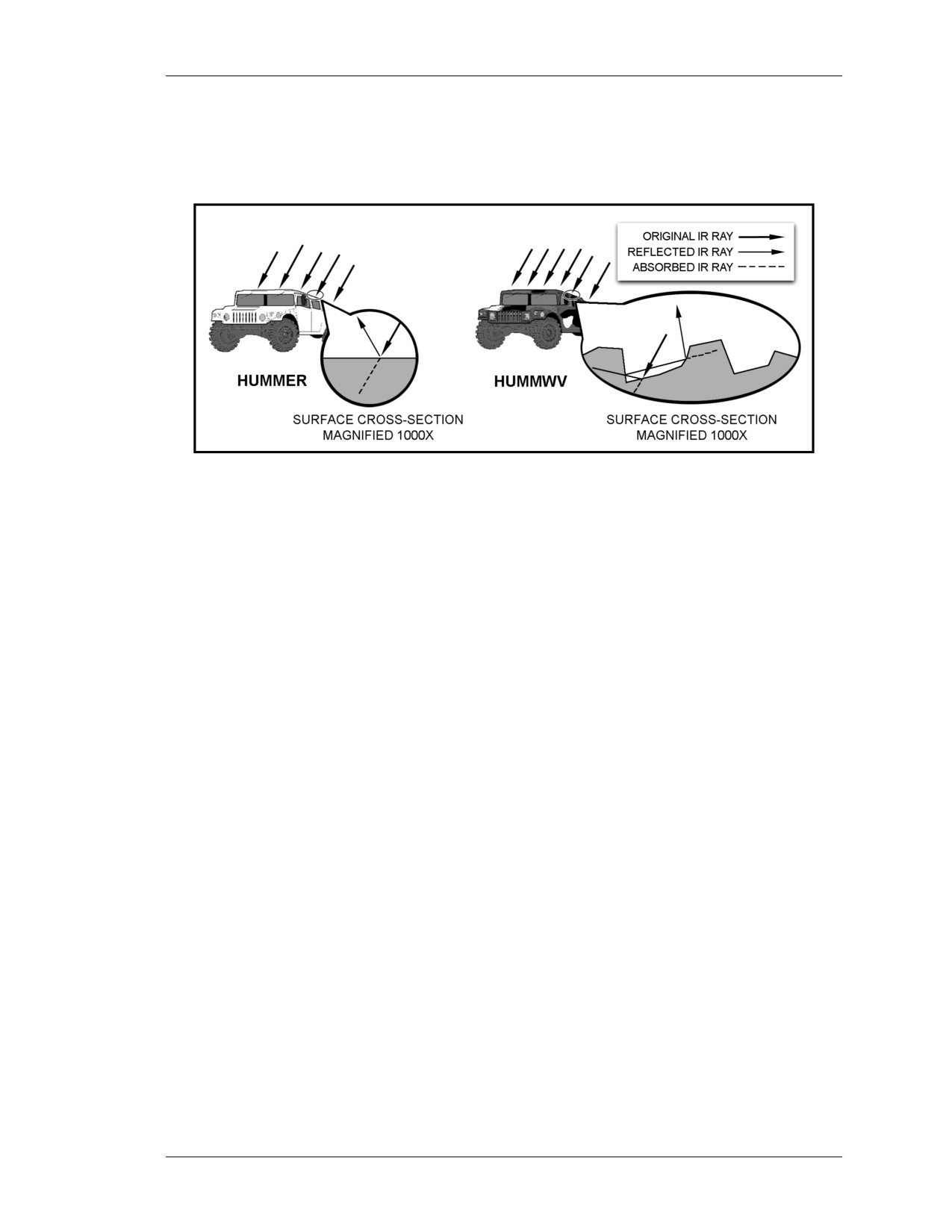
(3) Surface Texture. Although a military HMMWV and the civilian version
(Hummer) both become hot when exposed to sunlight, the Hummer does not heat up as
fast as the HMMWV does. The reason for this is the difference in the surface texture, or
C-4
8 July 2005
FM 3-22.32
finish, on the two vehicles. The Hummer has a smooth, waxed surface which tends to
reflect well, whereas the HMMWV has a rough surface due to the chemical-agent
resistant coating (CARC) paint that tends to absorb well (Figure C-6).
Figure C-6. Smooth versus rough surface texture.
(4) Mass. The more mass an object has, the more IR it can absorb, the longer it takes
to heat up, the longer it can emit IR, and the longer it takes to cool off. For example,
when both a tank and an M16 are in the sun, the armor plates on the tank take longer to
heat up than the barrel of the M16 because they have more mass. As a result, the armor
plates absorb more IR, and they take longer to heat up to the same temperature as the
M16 barrel. Once they are hot, the armor plates emit IR for a much longer time than the
barrel of the M16, and they take longer to cool off.
C-3. DELTA-T
The NVS uses IR to create images regardless of visible light levels. The images it
displays are made possible by the presence of Delta-Ts (∆T in graphics). Delta-Ts allow
distinction between one part of the target scene and another—whether it is different parts
of the same object or different objects in the target scene. The gunner can use the ITAS
IR imagery during the day as well as at night.
a. Definition. Delta-T is an abbreviation for change in temperature or difference in
temperature. Delta is a Greek letter (∆) that stands for change or difference; T stands for
temperature.
b. Temperature/Infrared Relationship. As the temperature of an object increases,
so does the amount of IR it emits. For example, the engine compartment on a tank with
its engine running emits more IR than the front of the hull.
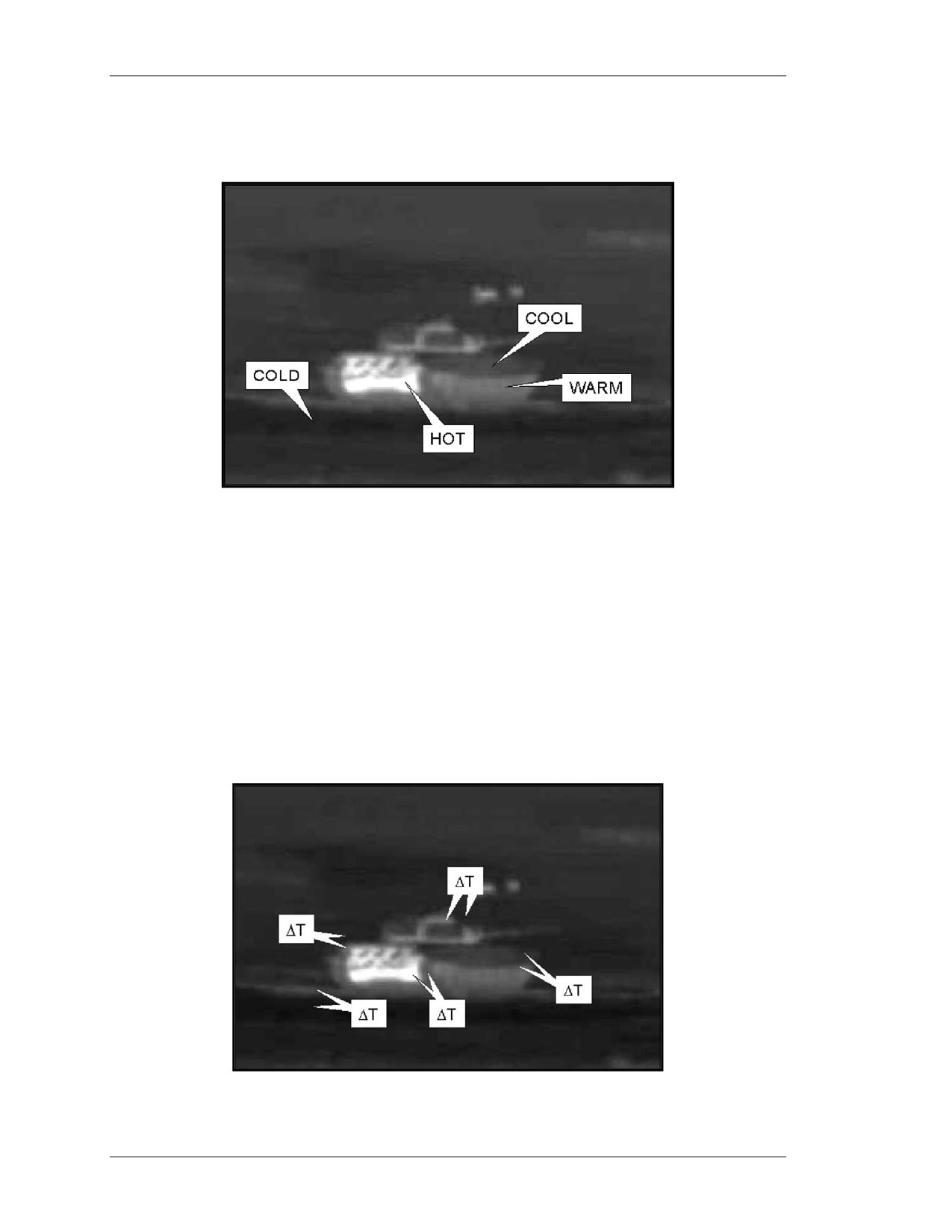
c. Display of Infrared Levels. The NVS displays IR levels as a change in
brightness, according to each object’s temperature. The coldest objects in a target scene
appear black; the hottest appear bright green. Everything in between appears as
increasingly brighter shades of green as each object’s temperature increases. For
example, the engine compartment on a tank with its engine running appears bright green
(Figure C-7, page C-6). Since the hull generally is the coldest part of a tank, it appears
8 July 2005
C-5
FM 3-22.32
black. The suspension, which is hotter than the hull but cooler than the engine
compartment, appears in a different shade of green.
Figure C-7. Display of IR levels.
NOTE: In the figures shown, the coldest objects appear black and the hottest appear
white (bright green in the TAS display). Everything in between appears as
increasingly brighter shades of gray (shades of green in the TAS).
d. Delta-T to Visible Image. Delta-Ts occur between different objects in the target
scene and between the different parts of a target. This technique allows the gunner to see
different objects in the target scene, and to distinguish between different parts of a target
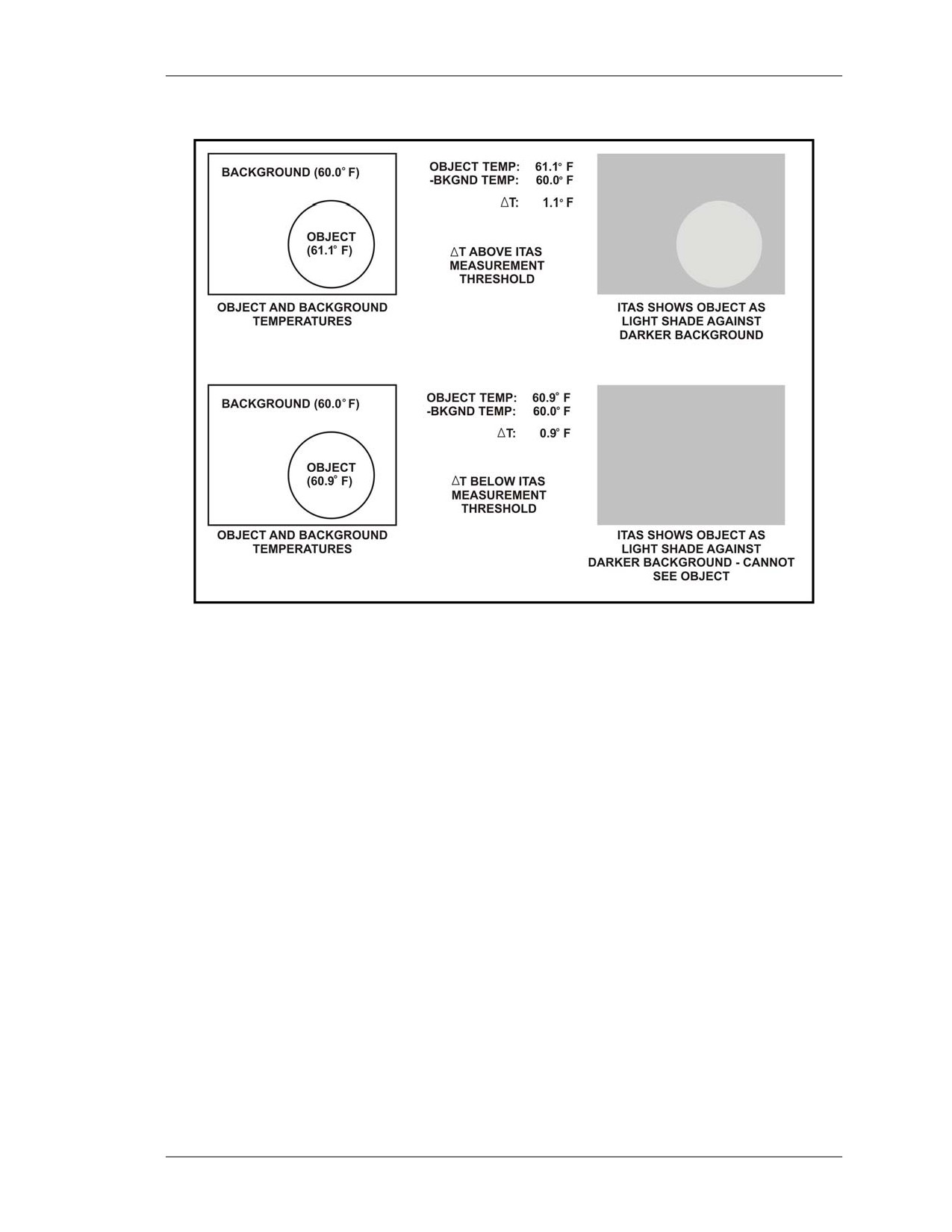
(Figure C-8). For the gunner to see a target with the ITAS, a measurable Delta-T (which,
for ITAS, is a difference between 1 degree Fahrenheit or greater) must exist between the
target and its background (Figure C-9).
Figure C-8. Delta-Ts.
C-6
8 July 2005
FM 3-22.32
Figure C-9. Measurable Delta-Ts.
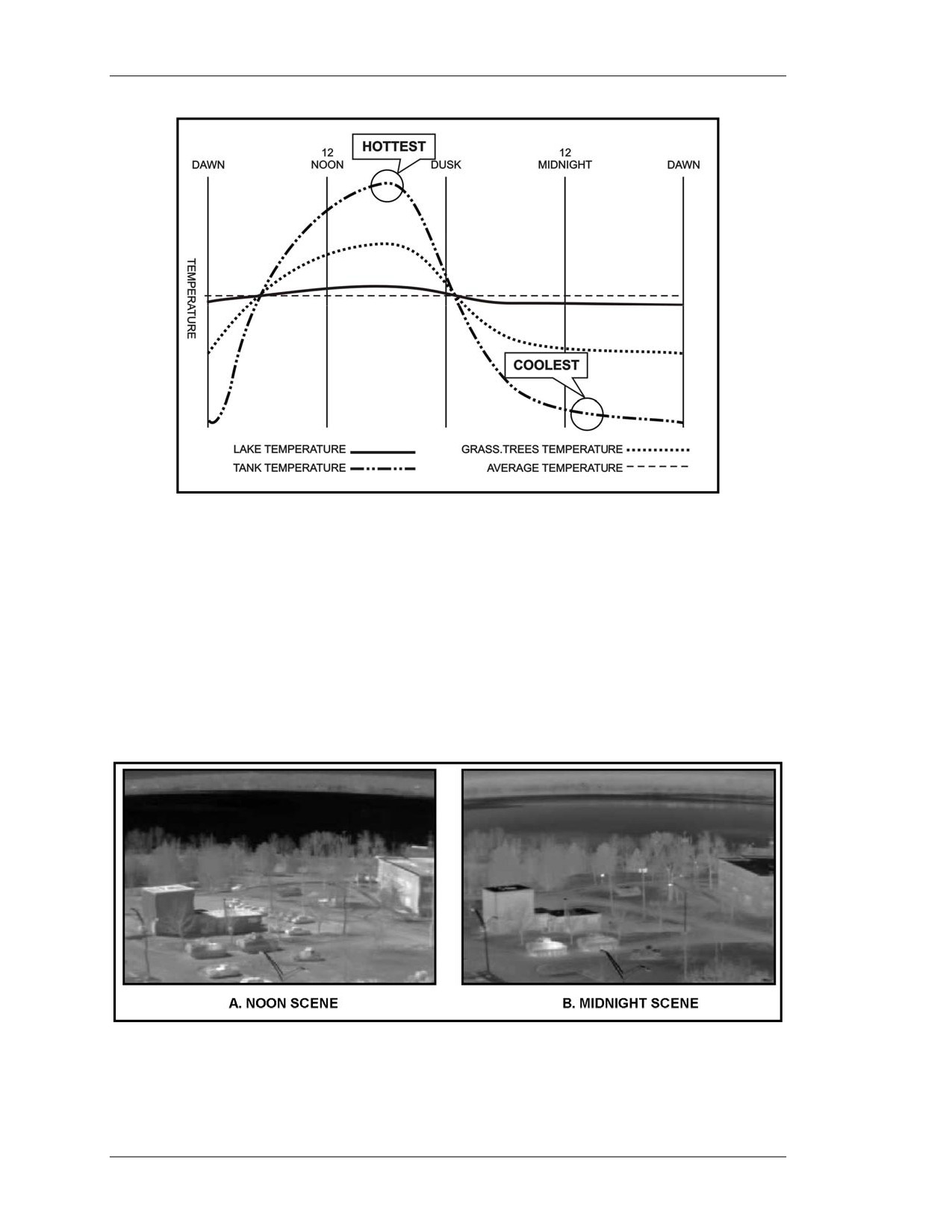
e. Delta-Ts Over a 24-Hour Period. The temperature relationship between one
object and another changes during the day due to heating and cooling as the sun rises
and sets (Figure C-10, page C-8).
(1) The gunner knows that vehicles, buildings, and asphalt roads get hot in the sun.
Grass and trees become warm, but not so hot they cannot be touched. Large bodies of
water do not warm up noticeably in one day. Objects that heat up the most during the day
tend to become the coldest at night. Objects that heat up very little during the day tend to
cool off very little at night. Figure C-11 (page C-8) shows two images on the same terrain
(one at noon and the other at midnight).
8 July 2005
C-7
FM 3-22.32
Figure C-10. Temperatures of objects during 24-hour period.
(a) In the noon example (A, Figure C-11), the buildings, roads, and vehicles are the
hottest objects in the scene. The grassy areas and trees are shaded to indicate they are
warm, and the river is black, which indicates it is the coolest object in the target scene.
(b) In the midnight example (B, Figure C-11), the Delta-Ts changed. Now, the river
is the warmest, the grass and trees are next, with the roads and vehicles being the coolest
(with the exception of the engine compartment and exhaust on the vehicles). This
example shows how the relationship of Delta-Ts changes among objects in a target scene
over the course of a day.
Figure C-11. Delta-T changes from day to night.
C-8
8 July 2005
FM 3-22.32
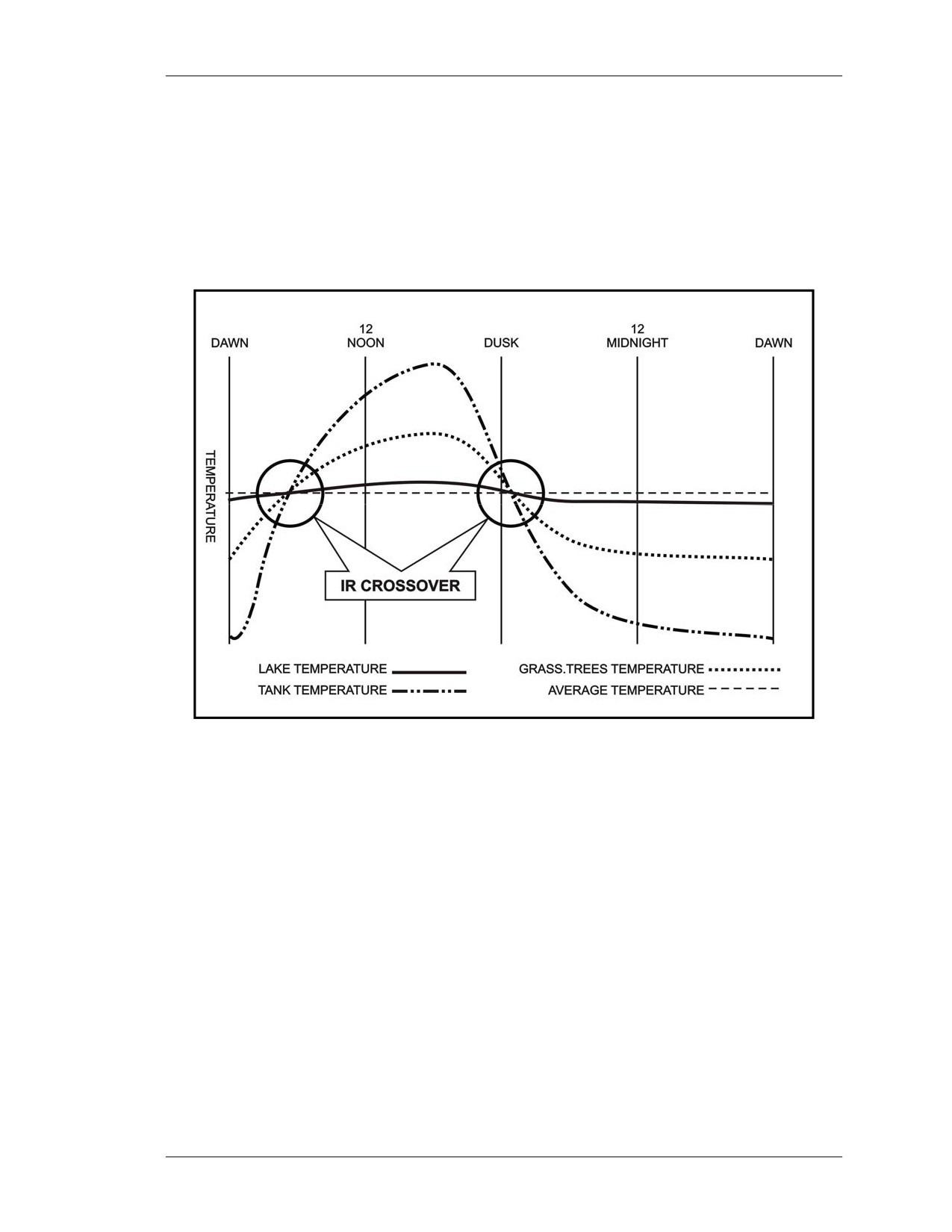
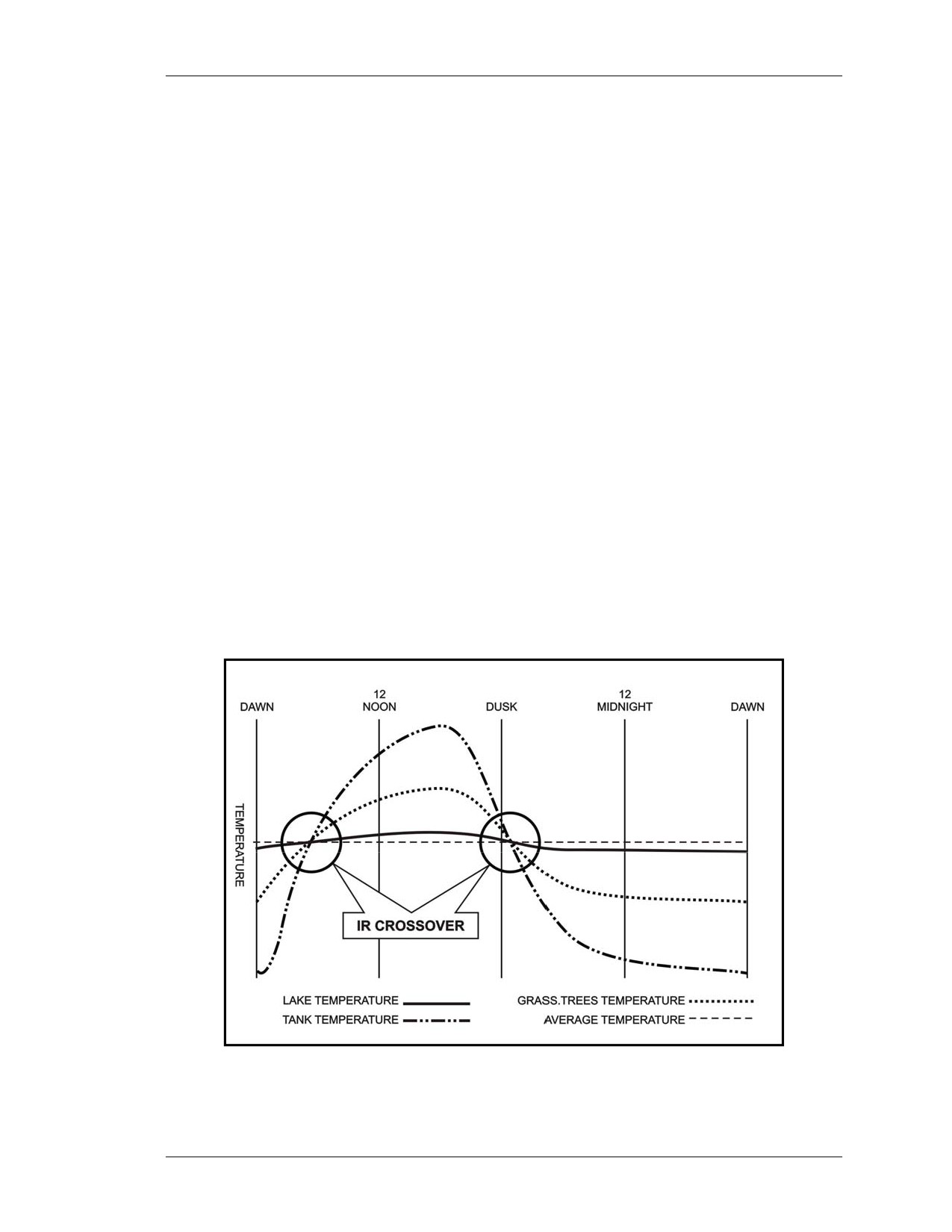
(2) Twice a day, around dawn and dusk, the temperatures of the tank, grass, and trees
cross over from being hotter than the river to being cooler (Figure C-12). These two
periods are known as IR crossover because of the change in the temperature relationships
and the visual effect that it produces. During these two periods, everything in the target
scene is about the same temperature, which means there are few, if any measurable
Delta-Ts. As shown earlier, when there is no measurable Delta-T, the gunner cannot
distinguish a target from its background.
Figure C-12. Crossover periods.
f. Infrared Image Adjustment. Proper image adjustment is vital to accomplish the
mission because it allows the gunner to see targets that may otherwise be hidden. There is
no perfect image adjustment. Image adjustment is subjective and should be done
according to the gunner’s preference.
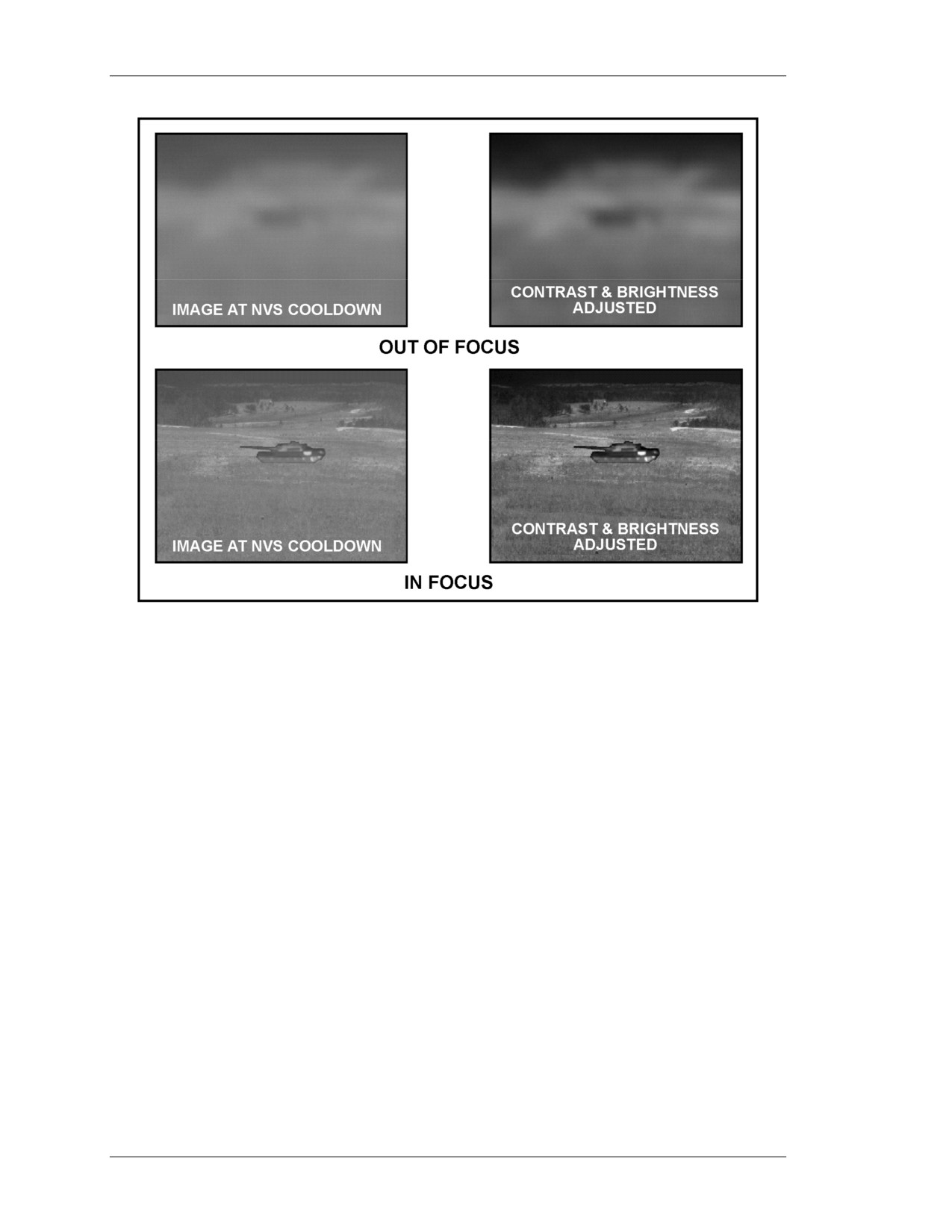
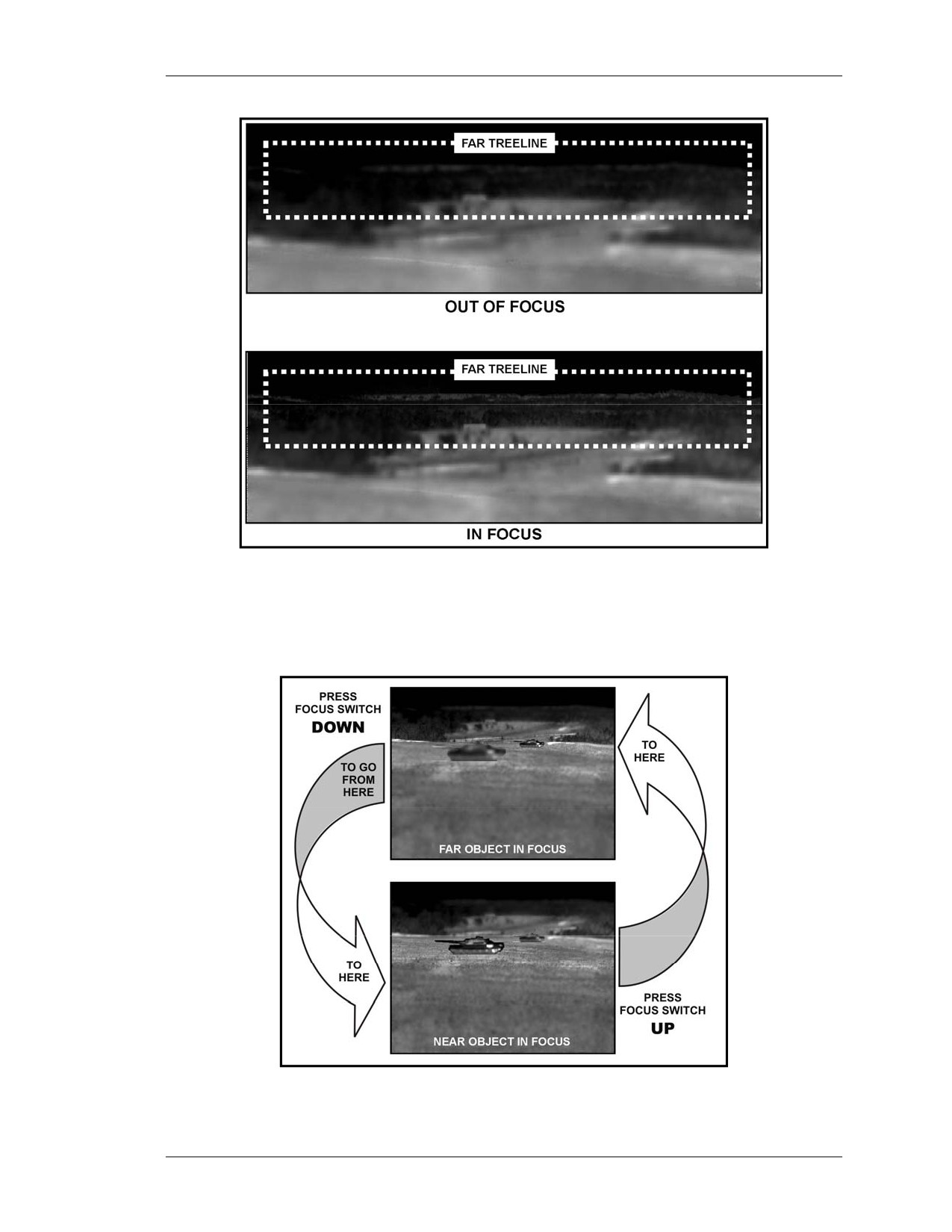
(1) Focus. The BCF switch is used to adjust the NVS image focus. (An object is in
focus when the gunner can easily identify its details or features.) Just like a camera, when
an object is in focus in the NVS, anything closer or farther away appears out of focus.
When the gunner first uses the NVS after cool down, he adjusts the focus before he
adjusts the contrast and brightness. Otherwise, the edges of objects in the target scene are
blurred, and the gunner is not able to adjust contrast and brightness properly
(Figure C-13, page C-10).
8 July 2005
C-9
FM 3-22.32
Figure C-13. Focus adjustments.
NOTE: Before focusing the NVS image, focus the TAS display with the diopter
adjust ring.
(a) Initial Adjustment. To adjust focus initially—
• Pick an object in the target scene such as a far tree line.
• Press the BCF switch to activate the BCF menu (Figure C-14).
• Select FOCUS on the BCF menu.
• Press the BCF switch up or down to make focus adjustments.
• When the tree line comes into focus, release the BCF switch. If the focus
adjustment overshoots, press the BCF switch back and forth to make
minor adjustments.
C-10
8 July 2005
FM 3-22.32
Figure C-14. Focus on far tree line.
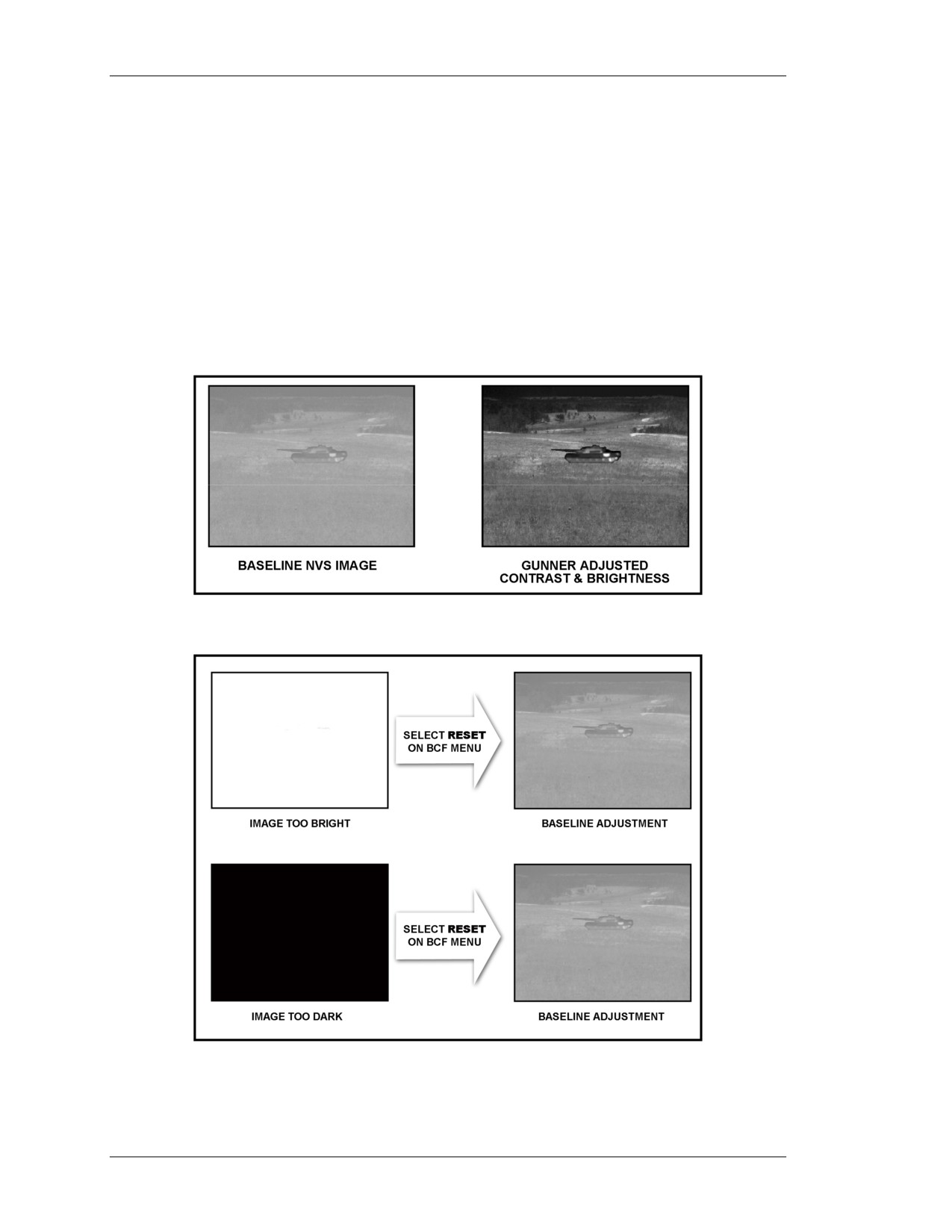
(b) Focus Direction. To focus on objects farther away, press the BCF switch up
(Figure C-15). To focus on objects that are near, press the BCF switch down.
Figure C-15. Focus direction.
8 July 2005
C-11
FM 3-22.32
(2) Contrast and Brightness Adjustment. Once the image is in focus, it may be
necessary to adjust the contrast and the brightness. As the situation changes, the gunner
adjusts the focus, the contrast, and the brightness to help in target acquisition.
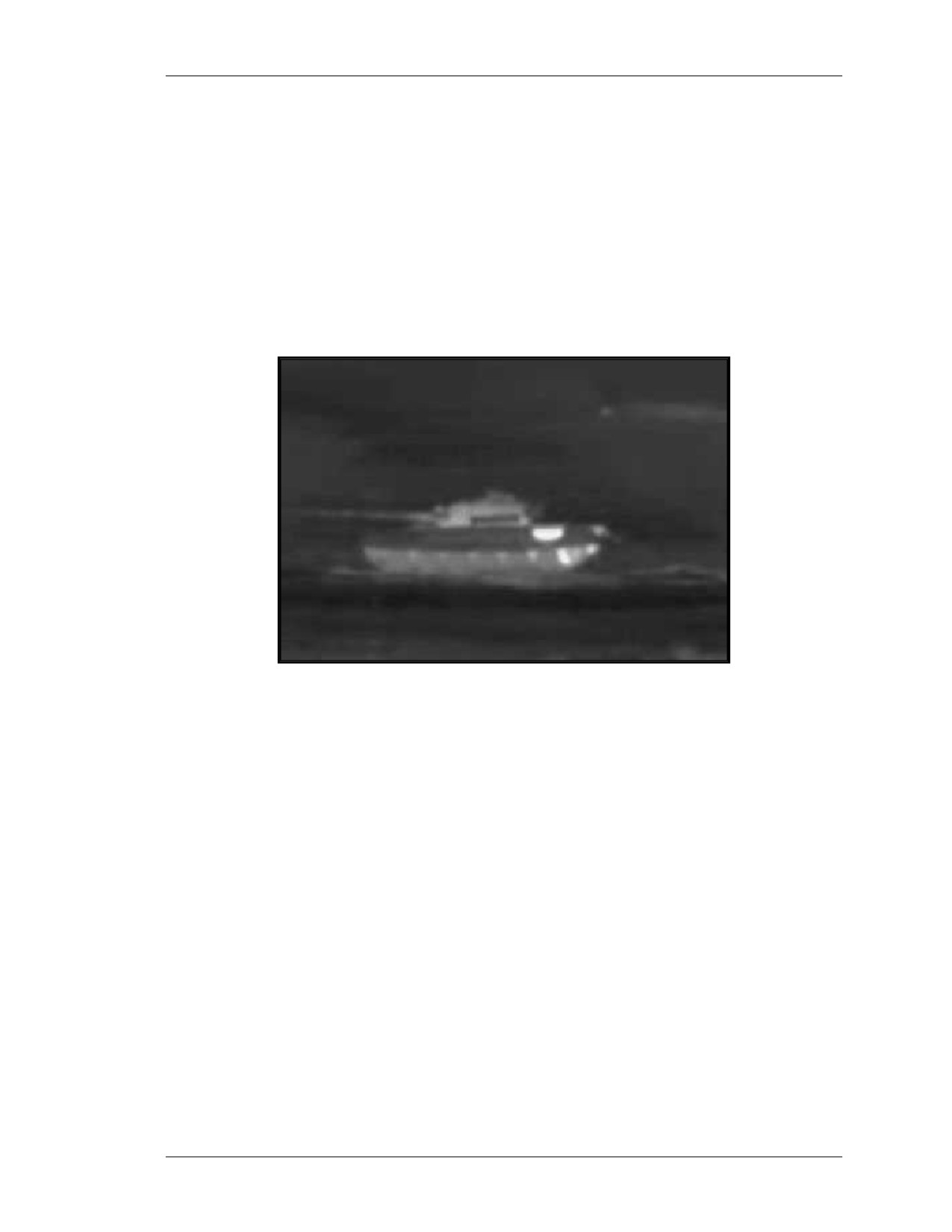
(a) TAS Power-up. When the power switch is turned to ON and the NVS reaches cool
down, the NVS automatically adjusts contrast and brightness for the IR in the target
scene (Figure C-16). This gives the gunner a baseline image for making an initial focus
adjustment only. He still must fine-tune the contrast and brightness according to the task.
If the gunner adjusts the contrast and brightness to an extreme (all black or all bright
green) and cannot readjust to obtain a usable image, he takes corrective action by
selecting RESET on the BCF menu. The NVS adjusts itself to the baseline image
(Figure C-17).
Figure C-16. NVS initial contrast and brightness baseline.
Figure C-17. Return to baseline from an extreme
contrast/brightness adjustment.
C-12
8 July 2005
FM 3-22.32
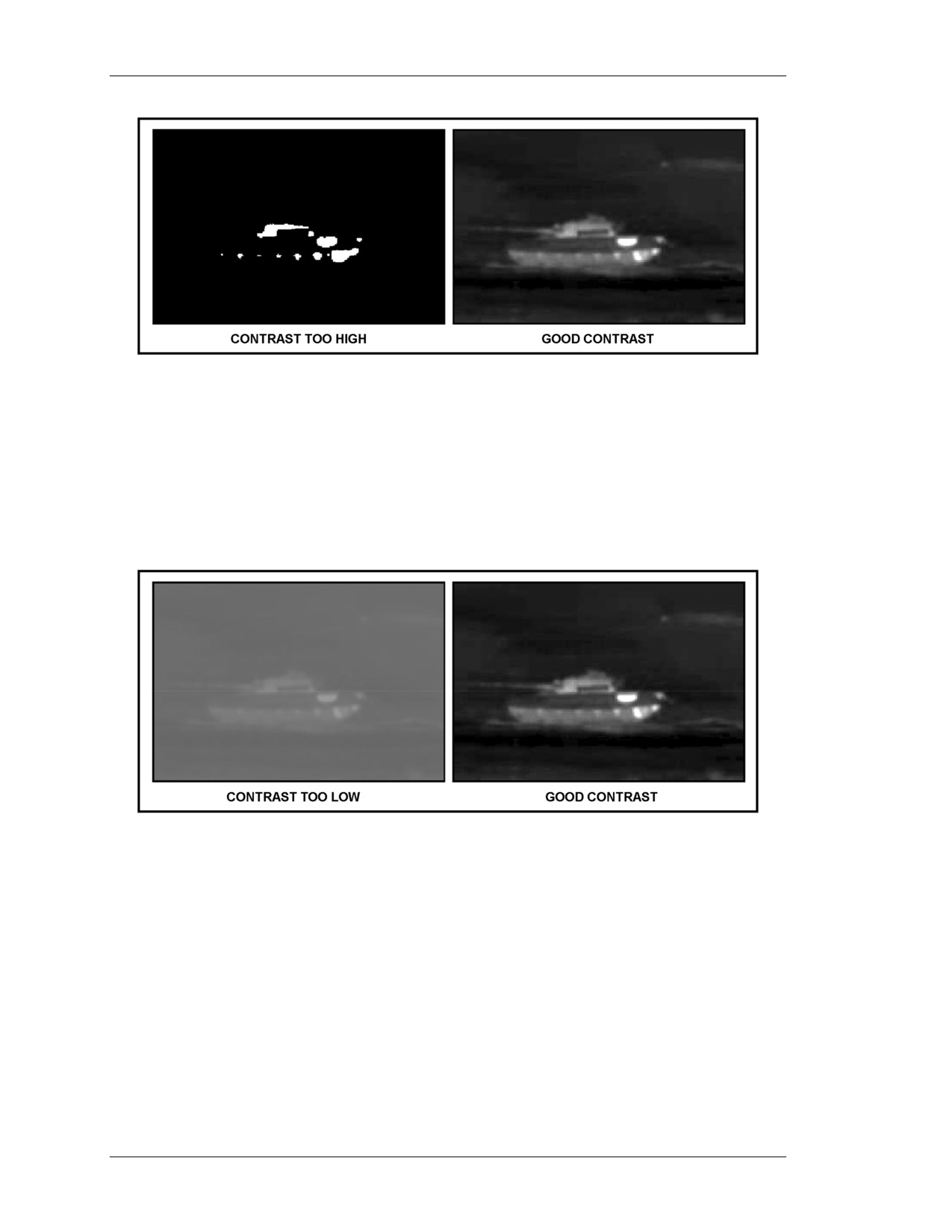
(b) Proper Adjustment. A properly adjusted target image is one in which the gunner
sees a few black spots (the coldest objects) and a few bright green spots (the hottest
objects) (Figure C-18). Everything else should be distributed across the shades of green.
• Adjusting the brightness affects the contrast, and adjusting the contrast affects
the brightness. The gunner adjusts one, then the other, in small increments,
until he has a target image that looks good to him for the task he is doing.
• If the gunner cannot tell whether to adjust the contrast or the brightness first
because the entire screen appears bright green or the entire screen appears
black, he adjusts the brightness first. If the gunner can see everything in the
target scene, he adjusts the contrast first.
Figure C-18. Properly adjusted contrast and brightness.
(c) Contrast Adjustment. Contrast adjusts the difference between the bright green
objects and the black objects with respect to the middle shades of green.
NOTE: Bright green objects in the TAS appear white in the figures used here. Objects
that are shades of green in the TAS appear in shades of gray in the figures.
• When the contrast is too high (Figure C-19, page C-14), all objects are
adjusted away from the shades of green in the middle toward the two
extremes, so they appear either bright green or black. The gunner decreases
the contrast by selecting CTRS on the BCF menu and pressing the BCF
switch down. This decrease brings objects back from the two extremes into
the shades of green.
8 July 2005
C-13
FM 3-22.32
Figure C-19. High versus good contrast adjustments.
• When contrast is too low (Figure C-20), all objects are adjusted into the
shades of green in the middle away from the two extremes, so nothing appears
black or bright green. The gunner increases the contrast by selecting CTRS on
the BCF menu and pressing the BCF switch up. This increase spreads the
objects out from the middle shades of green back toward the extremes of
bright green and black.
Figure C-20. Low versus good contrast adjustments.
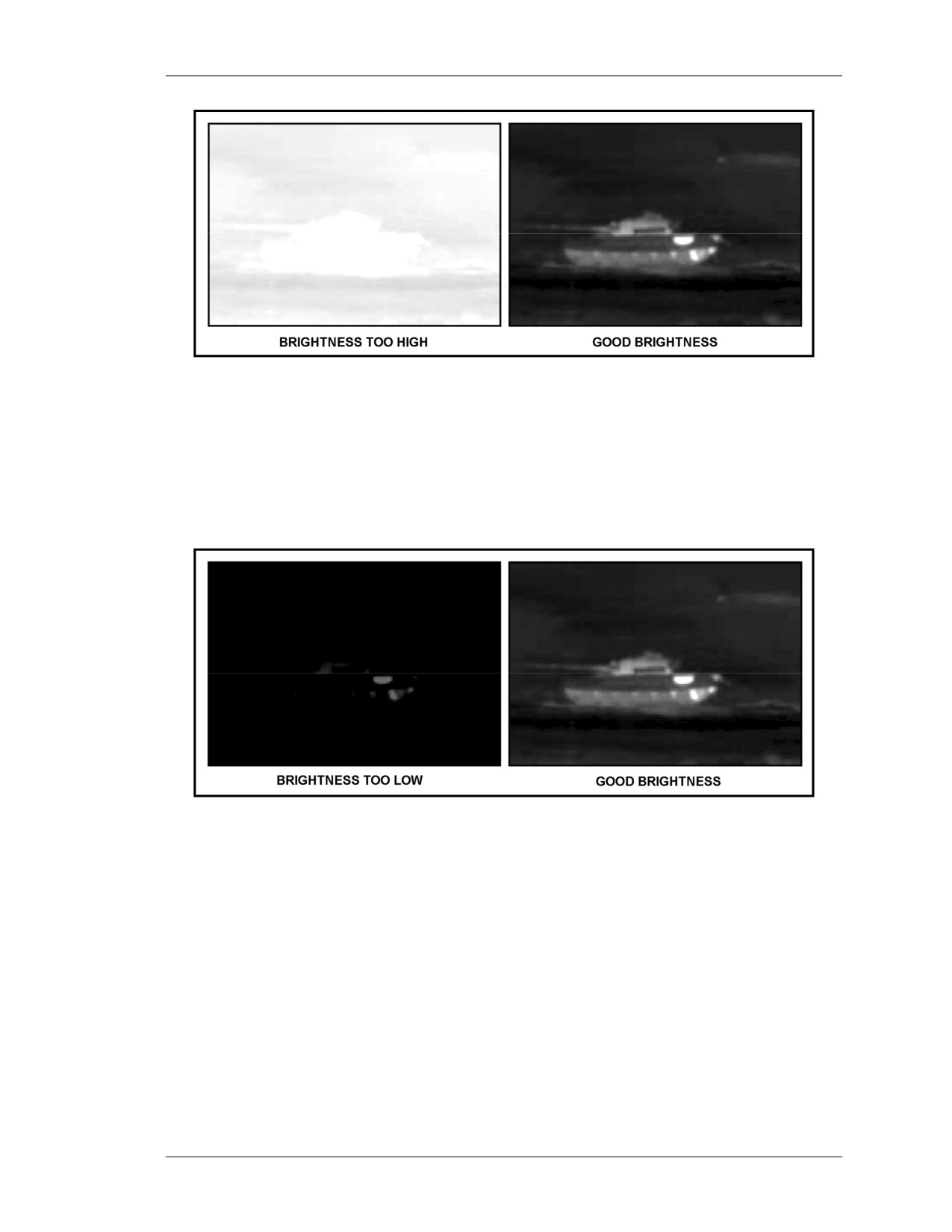
(d) Brightness Adjustment. Adjusting the brightness changes the intensity, or
brightness, of the objects in a target scene in the same direction. Increasing brightness
makes all objects brighter and decreasing it makes them darker.
• When the brightness is too high (Figure C-21), most objects in the target scene
appear bright green, a few appear in shades of green, and none are black. The
gunner decreases the brightness by selecting BRT on the BCF menu and
pressing the BCF switch down. This decrease drives down the intensity of all
objects until some of them appear black.
C-14
8 July 2005
FM 3-22.32
Figure C-21. High versus good brightness adjustments.
• When brightness is too low (Figure C-22), most objects appear black, a few
appear as shades of green, and none appear bright green. The gunner increases
the contrast by selecting BRT on the BCF menu and pressing the BCF switch
up. This increase drives up the intensity of all objects until some areas appear
bright green.
Figure C-22. Low versus good contrast adjustments.
C-4. FACTORS THAT AFFECT INFRARED TARGET IMAGES AND
DELTA-Ts
Conditions that affect the gunner’s ability to acquire a target include limited visibility
conditions, solar heating, human activity, and range to the target.
a. Limited Visibility Conditions (Natural and Man-Made). Rain, snow, sleet,
fog, haze, smoke, dust, and darkness are referred to collectively as limited visibility
conditions.
(1) These conditions affect the gunner’s ability to acquire and engage targets with the
ITAS, especially when using day FOV. The gunner uses the NVS to overcome darkness,
haze, and some smoke systems.
8 July 2005
C-15
FM 3-22.32
(2) The NVS can see through low levels of these obscurants better than the daysight.
Its capability is restricted at higher levels of obscurations. The effect on the NVS image is
a decrease in contrast.
b. Solar Heating. Solar heating is the single greatest influence on the target scene
Delta-T changes. Solar heating also causes IR clutter and IR crossover, both of which can
restrict the gunner’s ability to engage a target.
(1) Weather. Weather can greatly change the amount of solar heat on objects. Objects
observed during clear weather have good Delta-Ts due to the high amount of solar
heating. In addition, the objects can change their appearance during a 24-hour period.
During periods of precipitation (snow, rain, sleet, and so forth), there is little solar heating
and the Delta-Ts are low.
(2) Infrared Clutter. Infrared clutter is a term used to describe a pattern of Delta-Ts
in the target scene that prevents the gunner from distinguishing a target from its
background. This pattern is similar to the effect that is attempted when a soldier wears the
battle dress uniform (BDU). The BDUs have a certain color pattern to blend with the
background, cluttering the gunner’s outline and making it difficult for an enemy to see
him. Infrared clutter can be natural or man-made. Differences between the two include
cause or origin, effect on the target scene, area of coverage, time and location of
appearance, and temperature of the clutter objects relative to the target.
(a) The sun creates natural IR clutter, which generally covers large areas of terrain,
such as a field, scattered rocks, or a hillside, creating a disadvantage when trying to
engage a target.
(This clutter can prevent the gunner from seeing a target and its
movement with the NVS, but not with the daysight.) Natural clutter is unpredictable, so
the gunner cannot tell if or when the target is visible. The gunner must pay attention to
areas of clutter so he can keep track of moving targets that enter these areas. Although
natural IR clutter can prevent the gunner from seeing the target, it usually occurs during
the day when the daysight works well for surveillance. However, if he cannot see the
target with the NVS, the gunner will not be able to see it with the seeker either. Natural
clutter is caused either by solar heating or by IR reflecting off objects in the target scene.
• When solar heating causes clutter, the clutter stays in the same place and
keeps the same appearance for a long time. Delta-Ts are present in the target
and in the background, but the two Delta-T patterns match so closely that the
gunner may not be able to distinguish the target from the background. In
addition, the range of temperatures in the clutter is the same as those in the
target. To correct, the gunner first adjusts the contrast and the brightness. If
the contrast and brightness adjustments do not distinguish the target from its
background, the gunner must wait for the target to move out of the clutter or
wait for the Delta-Ts to change.
• When reflected IR causes clutter, the clutter comes and goes randomly with
the appearance of the sun, and at different locations. (This can cause the
gunner to suddenly lose a target that was visible or make a target appear
suddenly that was hidden from him.) Its appearance is such that the target and
the clutter look like one large area of uniform temperature. Generally, a
gunner can defeat this type of clutter by increasing the contrast and decreasing
the brightness. If not, he must wait for the target to move out of the clutter or
wait for the Delta-Ts to change.
C-16
8 July 2005
FM 3-22.32
(b) Man-made clutter occurs when conditions exist that are influenced by human
activity that affects objects in the target scene. A target being in an area that has flames
(burning vehicles or buildings) can work for the gunner and, at the same time, against
him. An enemy vehicle may be able to use the flames to hide, making it difficult for the
seeker to obtain a lock-on. However, based on the Delta-Ts, the gunner may be able to
detect the target. To achieve this, the gunner must change the contrast and brightness
based on the appearance of the target. He starts by adjusting the brightness first, then the
contrast until he has a good target scene. Although the gunner may be able to counter the
effects of IR clutter in the NVS (WFOV or NFOV) by adjusting the contrast and
brightness, he may not be able to see the target in seeker FOV. If the corrective action
does not work on the target scene and allow the gunner to acquire the target, he should—
• Wait for the target to leave the area of IR clutter.
• Wait for the target to change in temperature, then try to engage the target.
• Wait for the objects causing the IR clutter to change in temperature, then try
to engage the target.
(c) Infrared crossover prevents the gunner from seeing the target because everything
in the target scene (the background terrain and the target) is about the same temperature.
This occurs twice in a 24-hour period—at dawn and again at dusk. During these times,
the target is nearly the same temperature as its background, so the Delta-T between the
target and its background is low (Figures C-23). The ITAS detects Delta-Ts as low as
1 degree Fahrenheit. The gunner can overcome the effects of crossover by adjusting
contrast and brightness. In addition, crossover will not occur for all parts of the target at
the same time. Part of the target will always have a measurable Delta-T between it and
the background so the gunner can determine the target’s location.
Figure C-23. IR crossover times.
8 July 2005
C-17
FM 3-22.32
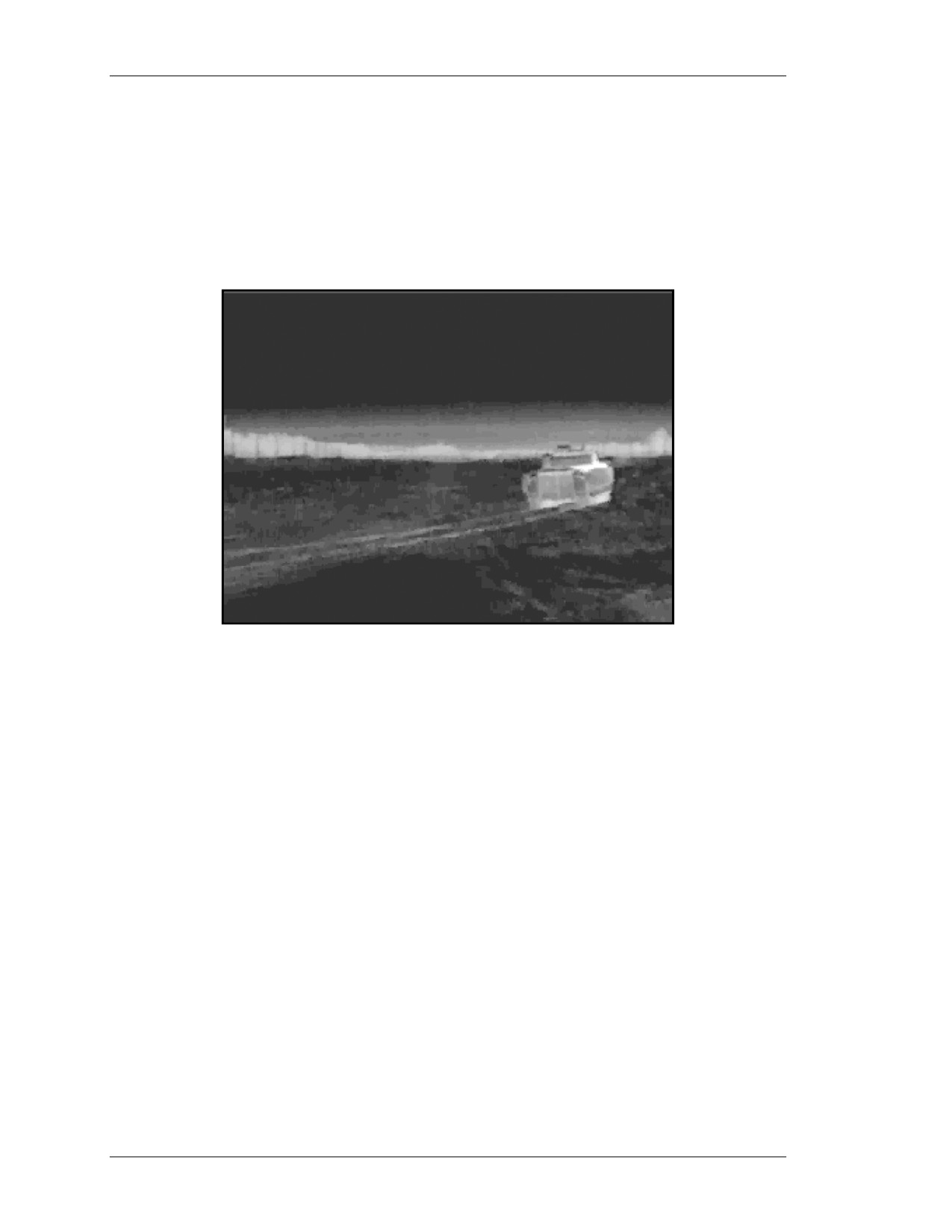
c. Human Activity. Human activity also affects the amount of IR in objects in the
target scene, which disrupts the natural changes that should occur in their IR images. For
example, vehicles and asphalt roads should appear dark green at night. When a vehicle is
driven for a while, it appears bright green around the engine, exhaust, and suspension as a
direct result of human activity. When enough vehicles drive on a road, the road will
appear as light green where wheel or track friction causes the road surface temperature to
increase (Figure C-24).
Figure C-24. Road temperature increases
due to friction from vehicle tracks.
NOTE: Thermal signatures, as shown in Figure C-24, may not appear the same in
actual field or combat conditions where road wheels and vehicle silhouettes
may be partially obscured or degraded due to hull-down positions, terrain
masking, natural vegetation, and so on.
d. Range to Target. The gunner’s ability to distinguish a target at maximum range
from its background is restricted due to limitations of the NVS magnification, image
resolution, and obscurants. When the target moves toward the gunner, the clarity of target
details increases as range to the target decreases. The gunner can use the ZOOM in the
NVS to see targets at long ranges.
C-5. TARGET ACQUISITION
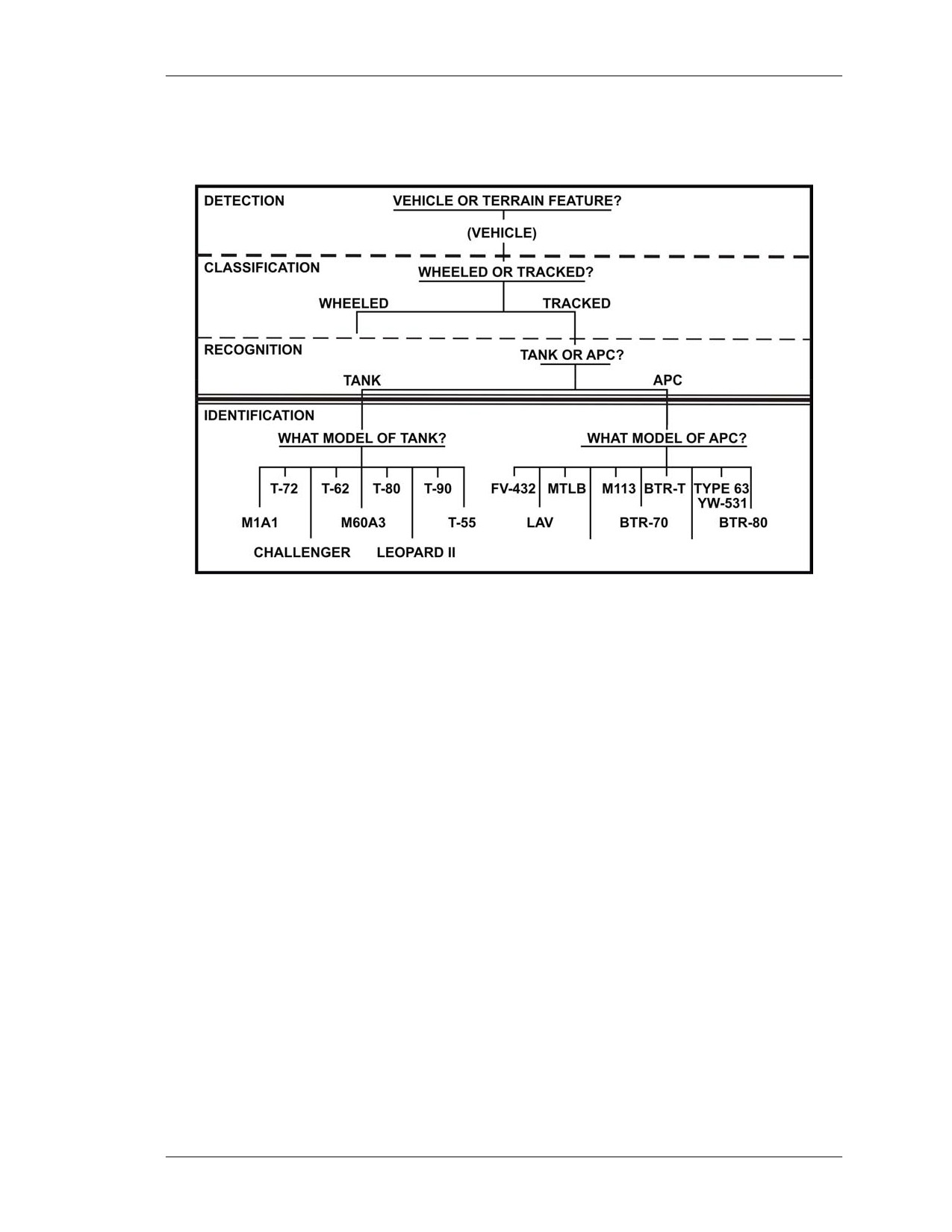
Target acquisition consists of target detection, classification, recognition, and
identification (Figure C-25). Each step has a specific field of view associated with it.
These FOV steps allow the gunner to progress efficiently into target engagement. The
first three steps are discussed in the target acquisition process only. Target identification
is taught at the unit level. Various media is available to assist the unit in this training.
C-18
8 July 2005
FM 3-22.32
NOTE: Foreign tanks may be equipped with devices to focus engine exhaust down
and to one side of the vehicle causing a different and unexpected hot spot.
Figure C-25. Target acquisition steps.
a. Field of View Sequence. As the gunner detects, classifies, and recognizes a
target, then determines its engageability, he must change the field of view as the task
requires.
(1) Day Field of View. Day FOV provides a full-color, visible-light target image.
Day FOV imagery is only useful during daylight hours with clear weather. The gunner
should use it primarily during NVS cool down or when the IR conditions make it difficult
to see the target in the NVS. The day FOV has a wide and narrow field of view.
(a) Wide Field of View. WFOV provides 4.2x magnification of the target scene. It is
ideal for use during surveillance and target detection due to its large area of coverage.
The low magnification means the gunner cannot see the target details very well, which
makes it a poor tool for target classification, recognition, and identification.
(b) Narrow Field of View. NFOV provides about 9x magnification of the target scene.
Its higher magnification is useful for seeing target details for target classification,
recognition, and identification. At the same time, the restricted area of coverage makes it
difficult to use for target detection.
(2) Night Vision Sight. The NVS provides two fields of view: WFOV and NFOV.
Both provide IR images and zoom capability and can be used at any time of day under
any weather conditions. The NVS is the gunner’s primary sight.
(a) Wide Field of View. WFOV provides 4x magnification of the target scene. It is
ideal for use during surveillance and target detection due to its large area of coverage.
The low magnification means the gunner cannot see the target details very well, which
makes it a poor tool for target classification, recognition, and identification.
8 July 2005
C-19
FM 3-22.32
(b) Narrow Field of View. NFOV provides about 12x magnification of the target
scene. Its higher magnification is useful for seeing target details for target classification,
recognition, and identification. At the same time, the restricted area of coverage makes it
difficult to use for target detection.
(c) Zoom. Zoom doubles the magnification of the NVS when it is in surveillance
mode. WFOV doubles from 4x to 8x magnification, and NFOV doubles from 12x to 24x
magnification. Zoom is an excellent tool for target recognition and identification.
b. Target Detection. The first step in the target acquisition process is target
detection (Figure C-26). During this step, the gunner scans his sector of fire to find or
acquire a target using the TAS, mainly the NVS. Target detection describes the process
by which the gunner visually locates and distinguishes the features of a vehicle from the
surrounding terrain features. Some techniques that help detect targets are discussed
below.
Figure C-26. Target acquisition―detection.
(1) Scanning for Targets. The gunner should―
(a) Scan the entire sector of fire using WFOV.
(b) Scan slowly and steadily in a consistent, systematic pattern.
(c) Pay special attention to those positions in which a target might appear.
(d) Identify the location of objects, such as TRPs, trees, roads, buildings, and
previously killed targets, that have a distinct IR signature. This enables the gunner to
quickly locate targets in his sector of fire.
(e) Look for man-made shapes that have straight lines and block angles.
(2) Scanning Techniques. The gunner scans his sector of fire continuously using
rapid scan, slow scan, and detailed search.
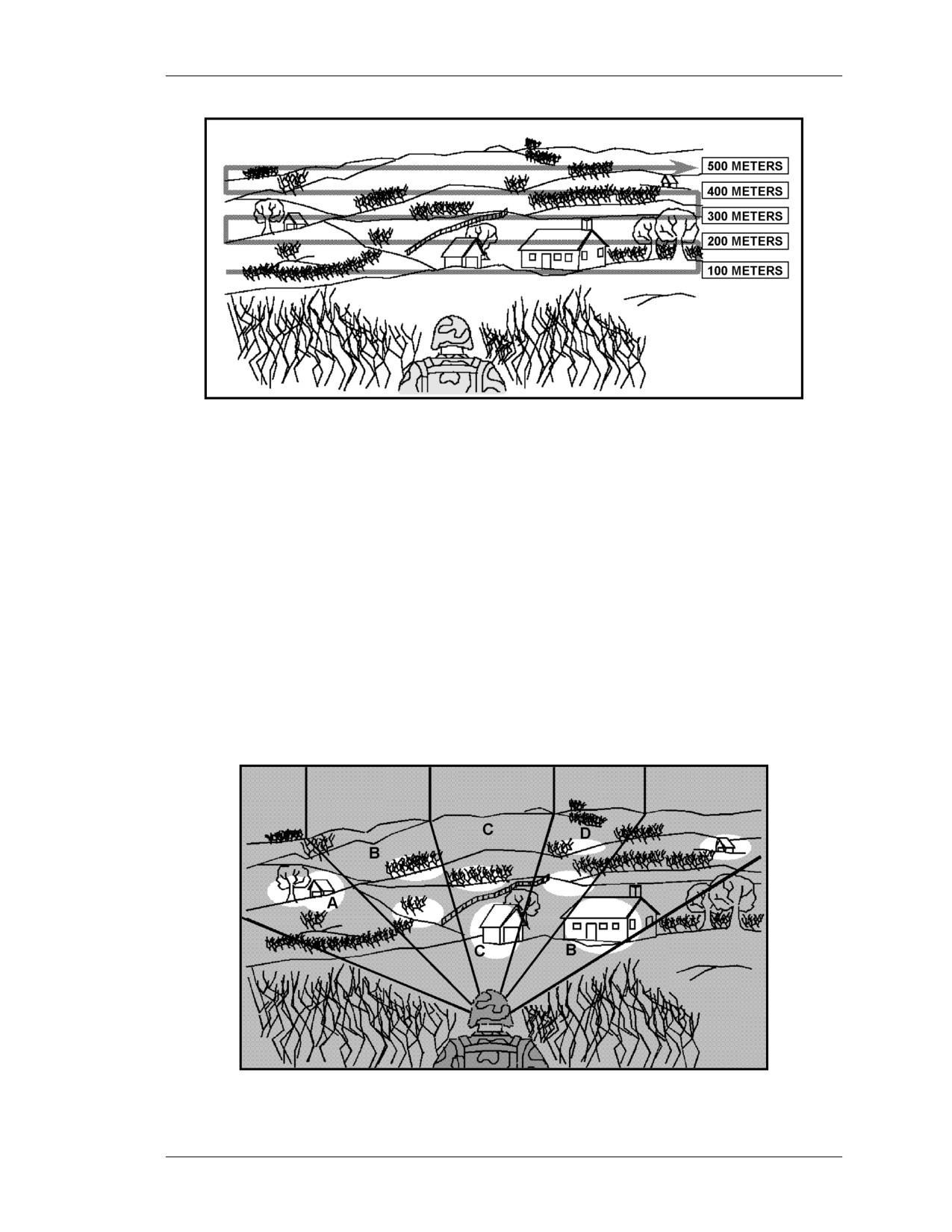
(a) Rapid Scan (Figure C-27). Rapid scan is used to detect obvious signs of enemy
activity. It is usually the first method the gunner uses. To conduct a rapid scan, do the
following:
• Search a strip of terrain about 100 meters deep from left to right, pausing at
short intervals.
• Search another 100-meter strip farther out from right to left overlapping the
first strip scanned and pausing at short intervals.
• Continue this method until the entire sector of fire has been searched.
(b) Slow Scan. The slow scan search technique uses the same process as the rapid
scan but much more deliberately, which means a slower side-to-side movement and more
frequent pauses. When a possible target has been detected, the gunner stops and searches
the immediate area thoroughly using the detailed search.
C-20
8 July 2005
FM 3-22.32
Figure C-27. Rapid/slow scan pattern.
(3) Detailed Search. If the gunner finds no targets using either the rapid or slow scan
techniques, he makes a careful, detailed search of the target area using NFOV
(Figure C-28). The detailed search is like the slow scan, but searches smaller areas with
frequent pauses and almost incremental movement. The detailed search, even more than
the rapid or slow scan, depends on breaking a larger sector into smaller sectors to ensure
everything is covered in detail and no possible enemy positions are overlooked. When the
gunner pauses to look at areas where targets could be hiding, he may also use the zoom to
magnify details in that area.
• Concentrate on likely vehicle positions and suspected armor avenues of
approach.
• Look for target signatures around prominent terrain features such as road
junctions, hills, and lone buildings. Also, look at areas with cover and
concealment such as tree lines and draws.
Figure C-28. Detailed search.
8 July 2005
C-21
FM 3-22.32
c. Defensive Operations (Moving Targets). When trying to detect the enemy, the
gunner should look and listen for signs of enemy presence.
(1) Dust or Vehicle Exhaust. Moving vehicles often raise dust. Stay alert for dust
because it can be spotted at long ranges.
(2) Vehicle Movement. Look for enemy movement along high-speed avenues of
approach. Search along terrain features that offer masking such as tree lines and draws.
(3) Flashing Hot Spots. As a vehicle moves over small gullies and hills at a distance,
its hot spots appear to be flashing and appear to become visible, then invisible as the
vehicle drops below the observation line.
(4) Sounds. Equipment or vehicle sounds can alert the gunner to the direction or
general location of the enemy. These sounds may not pinpoint the enemy’s exact
location, but if a sound alerts the gunner to a general area, he is more likely to spot the
enemy in that area using the detailed search technique.
(5) Image Adjustment. The gunner can spot moving targets easily due to the hot IR
signatures from the suspension, engine compartment, and exhaust and due to the changes
in the target aspect as the target moves in his sector of fire. When the gunner is in a
defensive position, he adjusts the image so he can see all of the terrain features, which
helps him locate any targets moving in his sector of fire.
d. Offensive Operations (Stationary Targets). During offensive operations, the
gunner may encounter stationary targets. A stationary target is more difficult to detect
than a moving target because it does not give away its location by moving, but can be
partly or completely concealed by a terrain feature. Key IR signatures may be cold.
Depending on how long the target has been stationary, the gunner may see hot, cold, or
partly cool signatures. The IR image of a hot, stationary target is much easier to detect
than that of a cold, stationary target. The gunner can augment his visual search to find an
enemy emplacement. The difficulty in detecting a target is directly affected by the
temperature of the surrounding terrain.
(1) Sounds. Listen for equipment and vehicle sounds.
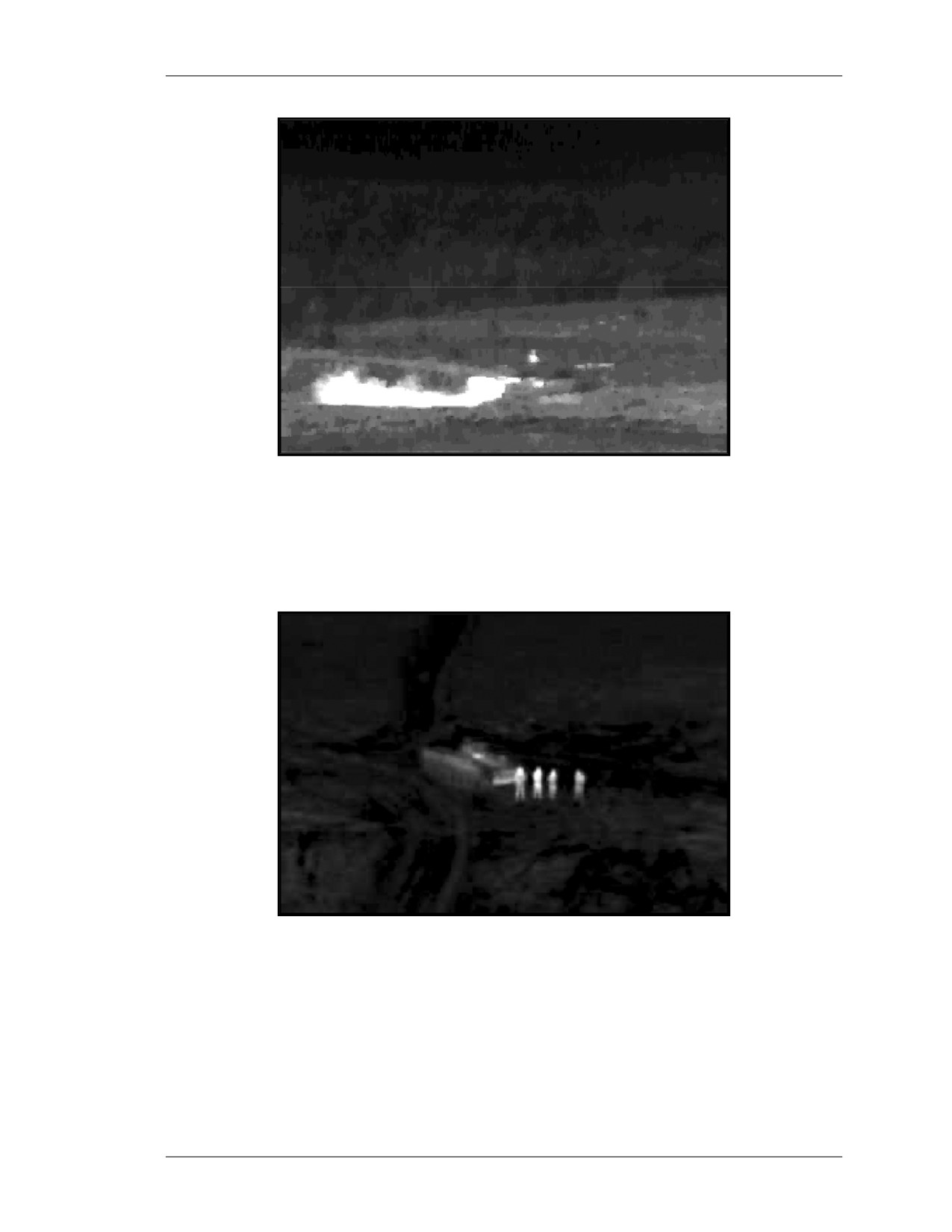
(2) Vehicle Exhaust. Be alert to the presence of vehicle exhaust. Tanks need their
engines started every few hours to charge the batteries, which creates a large plume of
exhaust (Figure C-29) and a distinctive smell, which may linger even after the engine has
been turned off.
C-22
8 July 2005
FM 3-22.32
Figure C-29. Vehicle exhaust.
(3) Dismounted Troops (Figure C-30). The human body is a good IR source and
appears as a hot image. Watch for dismounted troop movement that can reveal the
position of a mechanized force.
Figure C-30. Dismounted troops as IR source.
(4) Vehicle Positions. Look for enemy positions in obvious places such as road
junctions, hilltops, and lone buildings. Observe areas with cover and concealment such as
wood lines and draws.
(5) Image adjustment. The gunner may have to adjust the image several times to
detect stationary targets due to various circumstances. He should and examine the
following:
8 July 2005
C-23
FM 3-22.32
• In what aspect (frontal or flank) he sees the targets, which affects what IR
signatures he is able to see.
• If the targets are partly hidden by a terrain feature, such as when it is in
defilade or in a tree line.
• Whether targets are hot from recent activity or solar heating, partly cool due to
reduced activity, or cold due to long inactivity.
e. Hot Stationary Targets. Hot stationary targets are the easiest to detect. When a
stationary target has hot signatures, the gunner can assume there has been recent activity
or solar heating. To find hot signatures easily, adjust contrast up and brightness down so
that only the hottest signatures appear in the field of view, and the rest of the scene is
black. When the gunner thinks he has detected a target, he adjusts the contrast and
brightness so he can see the rest of the target’s features. Depending on the target’s
exposure and aspect, some of the signatures to look for include the suspension system,
engine compartment/exhaust, gun tube or barrel, and an indirect signature called
backlighting.
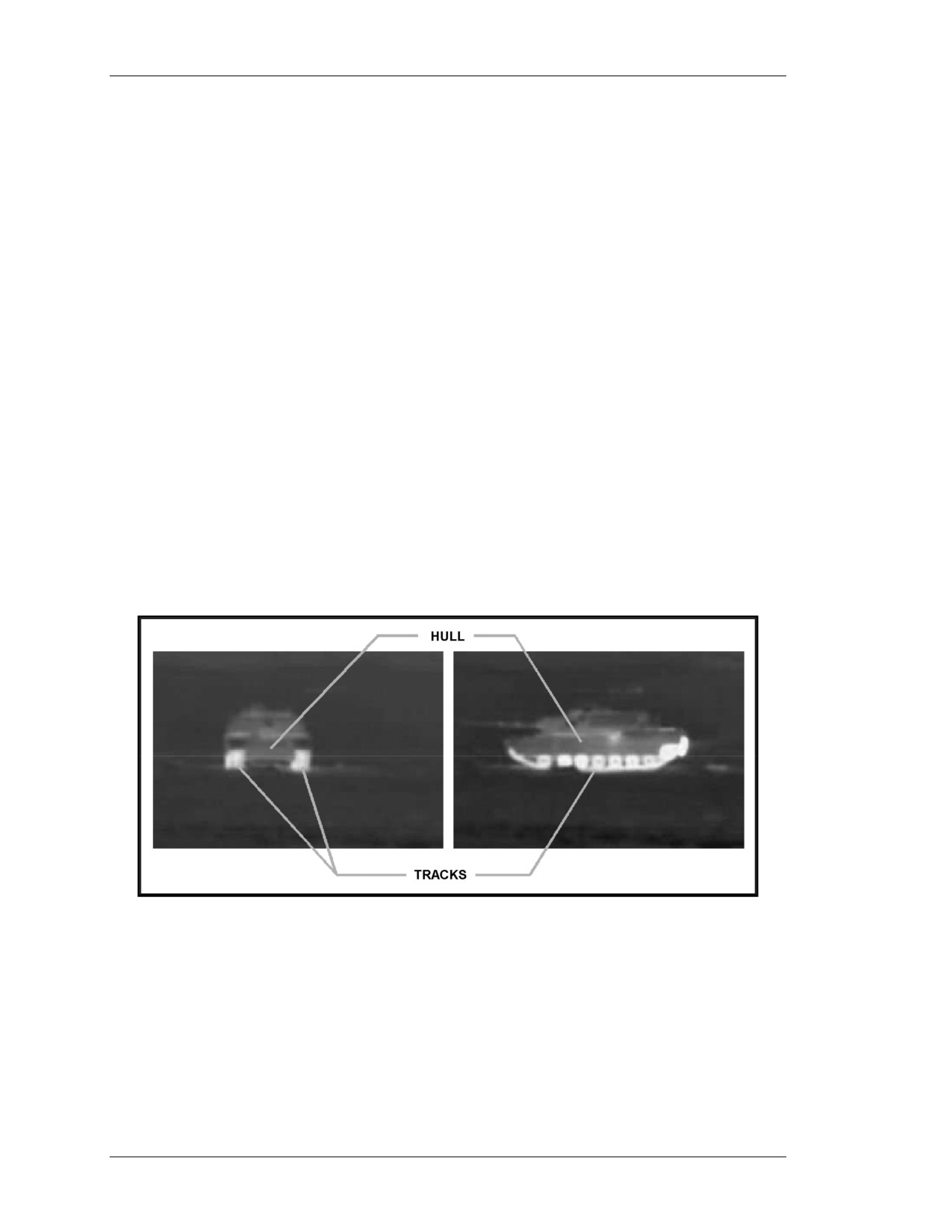
(1) Suspension System. When a target has moved recently, its suspension presents a
hot IR signature.
(a) The track area presents hot spots due to heating from friction.
(b) When viewed from the front, the tracks are normally visible as two IR signatures
on either side of and below a larger dark area (the hull) (Figure C-31). If viewed from the
flank, the tracks and road wheels normally are visible as a hot signature beneath a larger
dark area (the hull).
Figure C-31. Track and hull signatures.
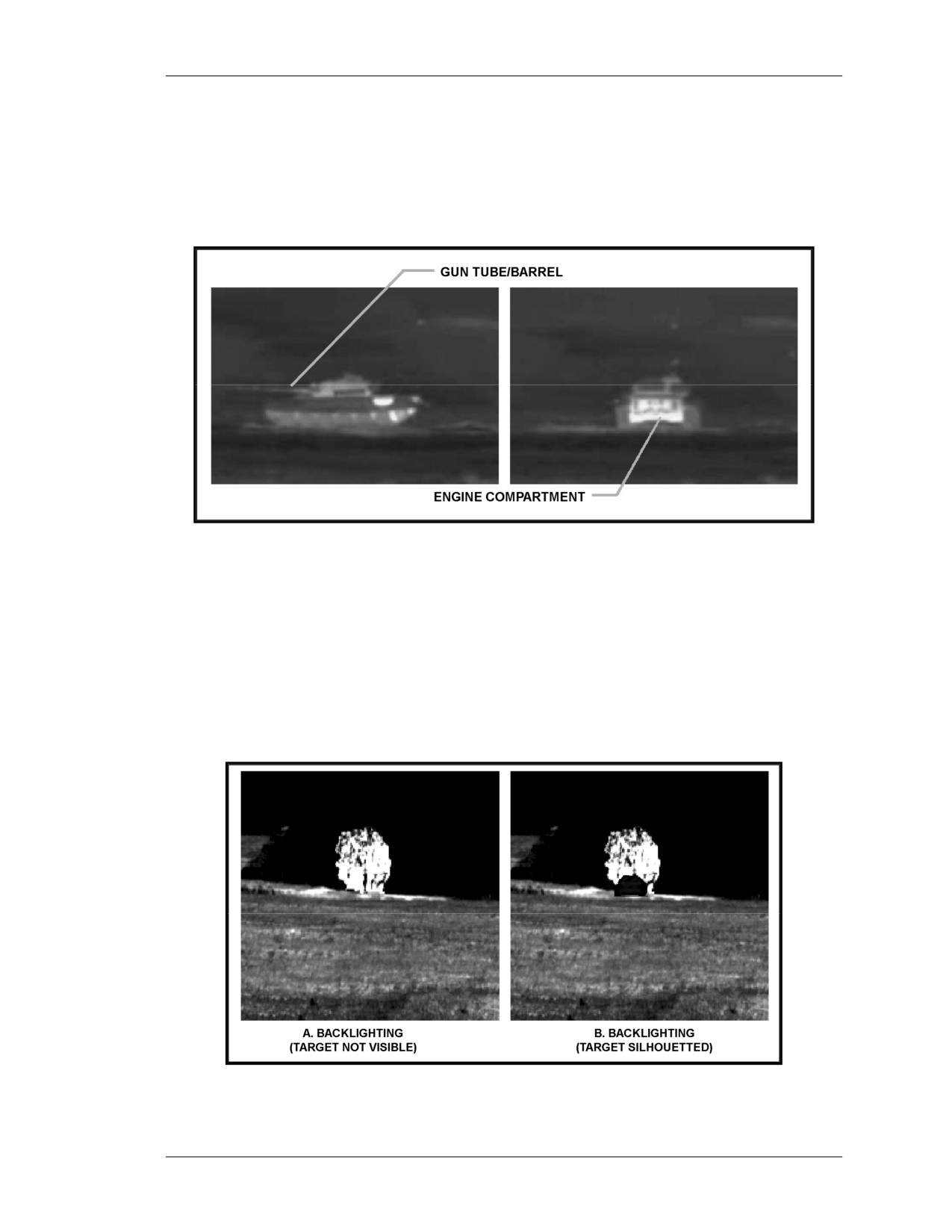
(2) Engine Compartment (C-32). The engine compartment is usually a reliable IR
signature for the following reasons:
(a) Due to the extreme heat generated by the engine and the large mass of metal of
which it is made, a stationary vehicle’s engine compartment gives off a hot IR signature
for several hours after the vehicle is stopped. The engine takes longer to cool than the rest
of the hull.
C-24
8 July 2005
FM 3-22.32
(b) A stationary vehicle engine must be started after long periods of inactivity to keep
its battery charged. This situation keeps the IR image hot.
(3) Gun Tube/Barrel. The gun tube or barrel is another area to look for heat
(Figure C-32). When the gun has been fired recently, it appears hotter than
its background.
Figure C-32. Engine compartment and gun tube/barrel.
(4) Backlighting. Backlighting is an indirect IR signature that indicates the presence
of a target. It is called an indirect IR signature because, though it is not physically part of
the target, it is caused by heat from the target—usually, from the exhaust. Backlighting
occurs when an IR source, such as a tank’s exhaust, emits IR, which reflects off another
object such as a tree. Even though the gunner may not see a vehicle, backlighting warns
him of its presence (Figure C-33A). When the target is between the gunner and the
backlighting, the target may appear as a silhouette (Figure C-33B).
Figure C-33. Backlighting.
8 July 2005
C-25
FM 3-22.32
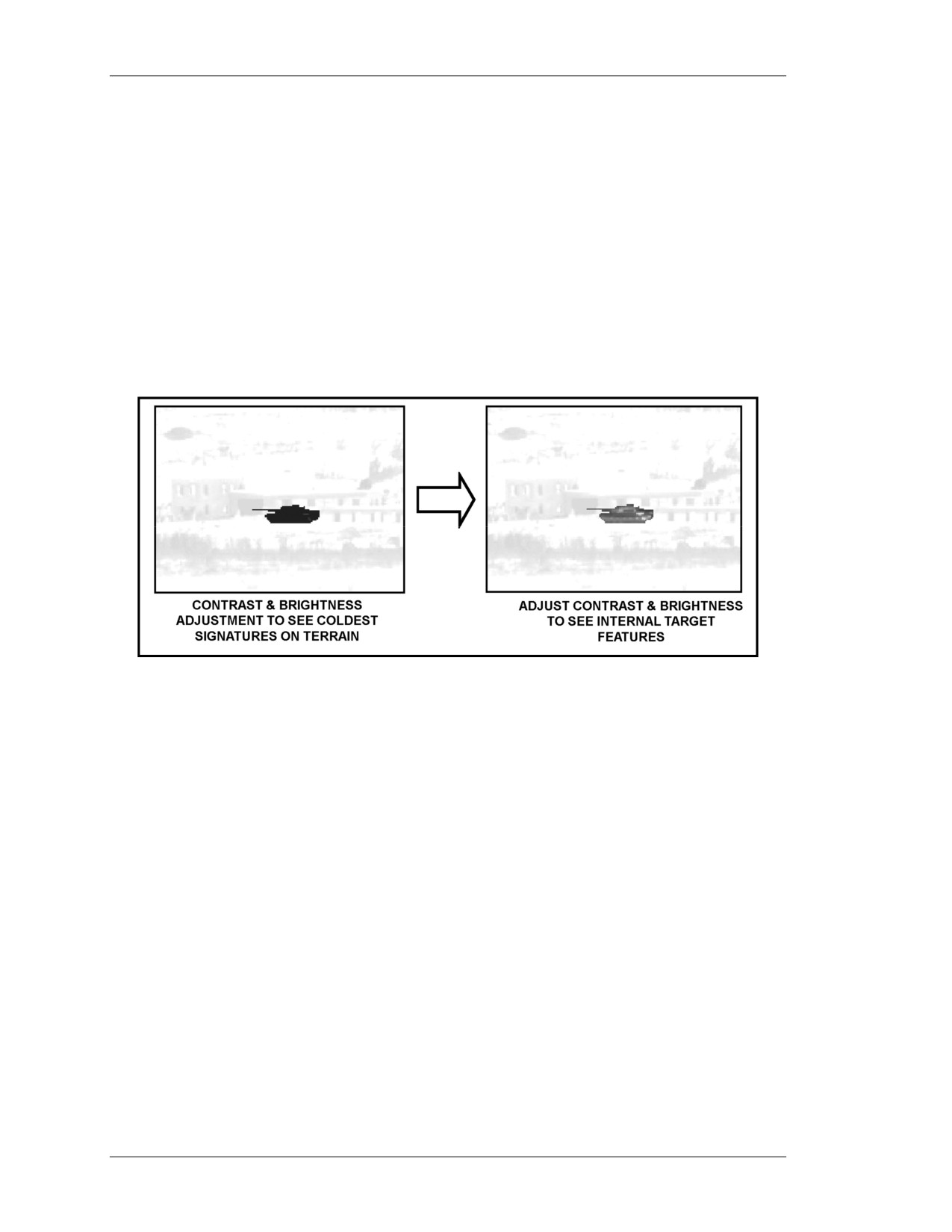
f. Cold Stationary Targets. When the gunner sees a cold stationary target, he can
assume there has been no recent activity. (While the absence of heat likely indicates an
absence of activity, it is possible that the tank may be using a remotely located generator
for power to deceive U.S. thermal imaging systems.) A cold target is cooler than its
background. It appears as a dark green or black image against a lighter green background.
Look for an IR signature that resembles a silhouette of a wheeled or tracked vehicle
(Figure C-34).
(1) To find cold targets easily, adjust contrast and brightness up so only the coldest
signatures appear in the gunner’s field of view and the rest of the scene is bright green.
(2) When the gunner thinks he has detected a target, he adjusts the contrast and the
brightness so he can see the rest of the target’s features.
Figure C-34. Image adjustment for detecting cold, stationary targets.
g. Partially Cool Stationary Targets. When stationary targets are partially cooled,
the gunner can assume there has been some activity. Partially cool stationary targets are
especially difficult to detect because their signatures are closer to the same temperature as
the surrounding terrain. Their signatures also become distorted and incomplete as they
cool. This procedure causes the signatures to blend with the background. To find partially
cool targets, the gunner has to adjust the contrast and the brightness in various
combinations while he scans his sector of fire.
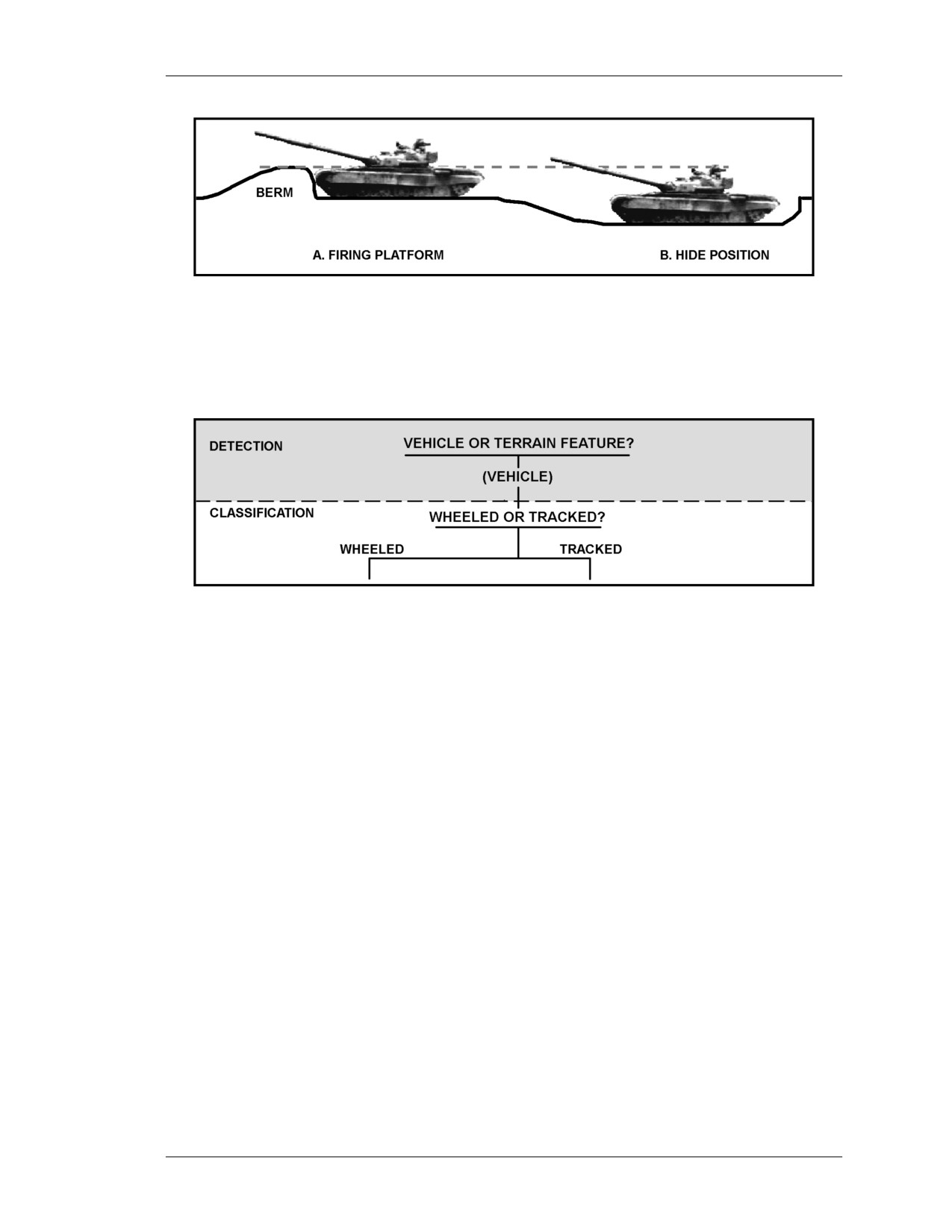
h. Hull Defilade Targets (Tanks). Hull defilade targets are the most difficult to
detect because they are not visible at all times. When a tank is in defilade, it moves
back-and-forth between a firing platform and its hide position.
(1) Firing Platform Position (A, Figure C-35). The tank stays on the firing platform
long enough to fire its main gun. During the short period of time that it is in this position,
the gunner sees only the turret and gun tube. As soon as the tank fires, it moves to its hide
position.
(2) Hide Position (B, Figure C-35). When a tank is in its hide position, the gunner
cannot see the target, but he may be able to see the tank commander’s head.
C-26
8 July 2005
FM 3-22.32
Figure C-35. Tank in defilade.
C-6. TARGET CLASSIFICATION
Once the gunner detects a potential target, he begins the process of elimination to
determine the target’s classification (Figure C-36).
Figure C-36. Target acquisition process―classification step.
a. Classification Features. There are specific features that the gunner looks for to
classify a vehicle. These features include the suspension system, location of the engine
compartment, and presence of a gun tube. Whether or not a feature is visible depends on
the target aspect (frontal or flank).
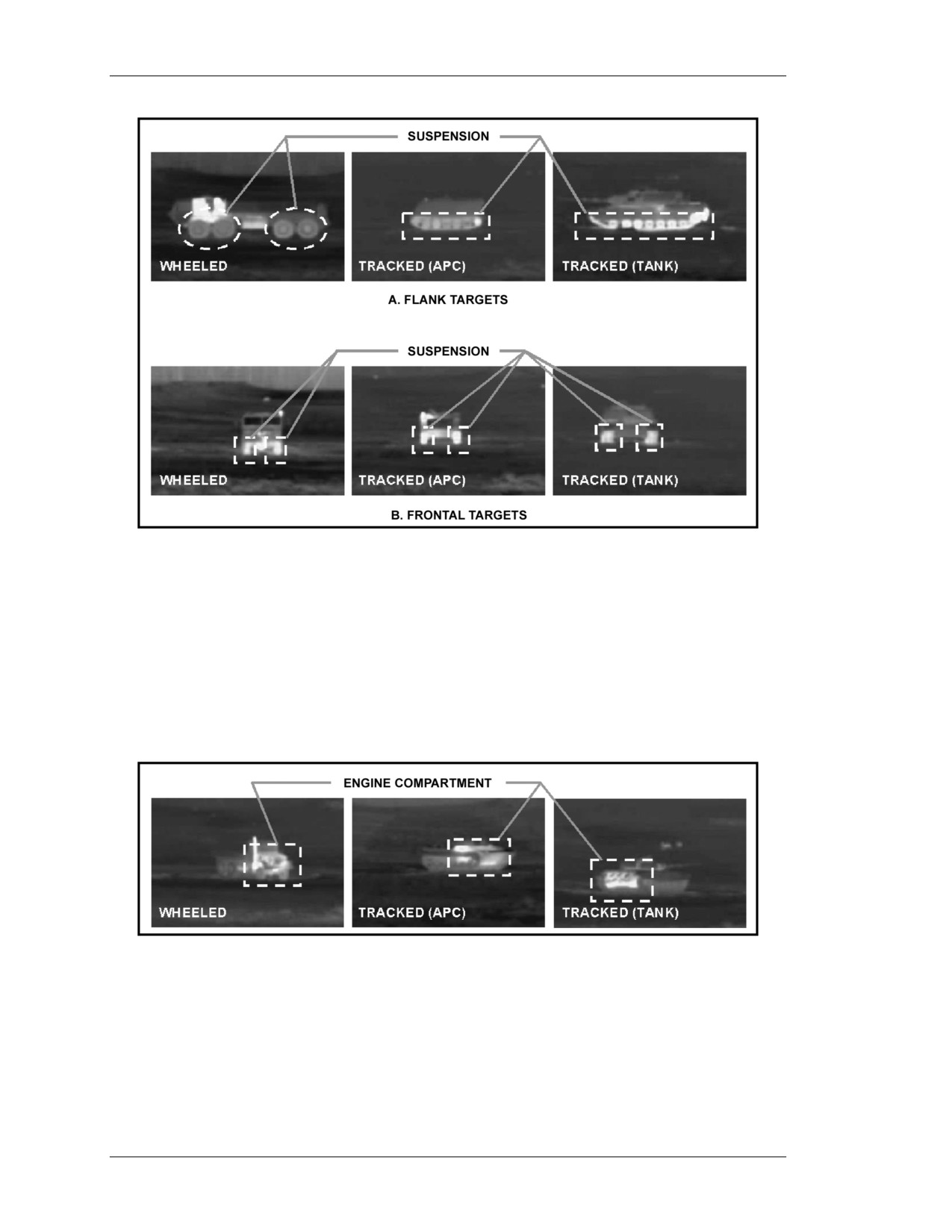
(1) Suspension System. The type of suspension system defines the target’s
classification.
(a) Wheeled Vehicle (Flank). A wheeled vehicle has two to five round hot spots at its
base that appear large compared to the rest of the vehicle (A, Figure C-37, page C-28).
(b) Tracked Vehicle (Flank). A tracked vehicle has five to seven round hot spots
created by the road wheels that look small compared to the rest of the vehicle. The tracks
may be visible, and depending on the vehicle configuration, the gunner may see return
rollers or skirts (A, Figure C-37, page C-28).
(c) Wheeled and Tracked Vehicles (Frontal). On frontal targets, the suspensions for
wheeled and tracked vehicles look similar in the NVS (B, Figure C-37, page C-28).
8 July 2005
C-27
FM 3-22.32
Figure C-37. Classification features―suspension system.
(2) Engine Compartment (Figure C-38). The location of the engine compartment
helps determine the target’s classification.
(a) Wheeled Vehicles. Generally, the engine on a wheeled vehicle is located at the
front.
(b) Tracked Vehicles. The location of the engine on a tracked vehicle depends on
whether the vehicle is a tank or an APC. Tanks have engine compartments located at the
rear. APCs generally have engine compartments located at the front.
Figure C-38. Classification features―engine compartment location.
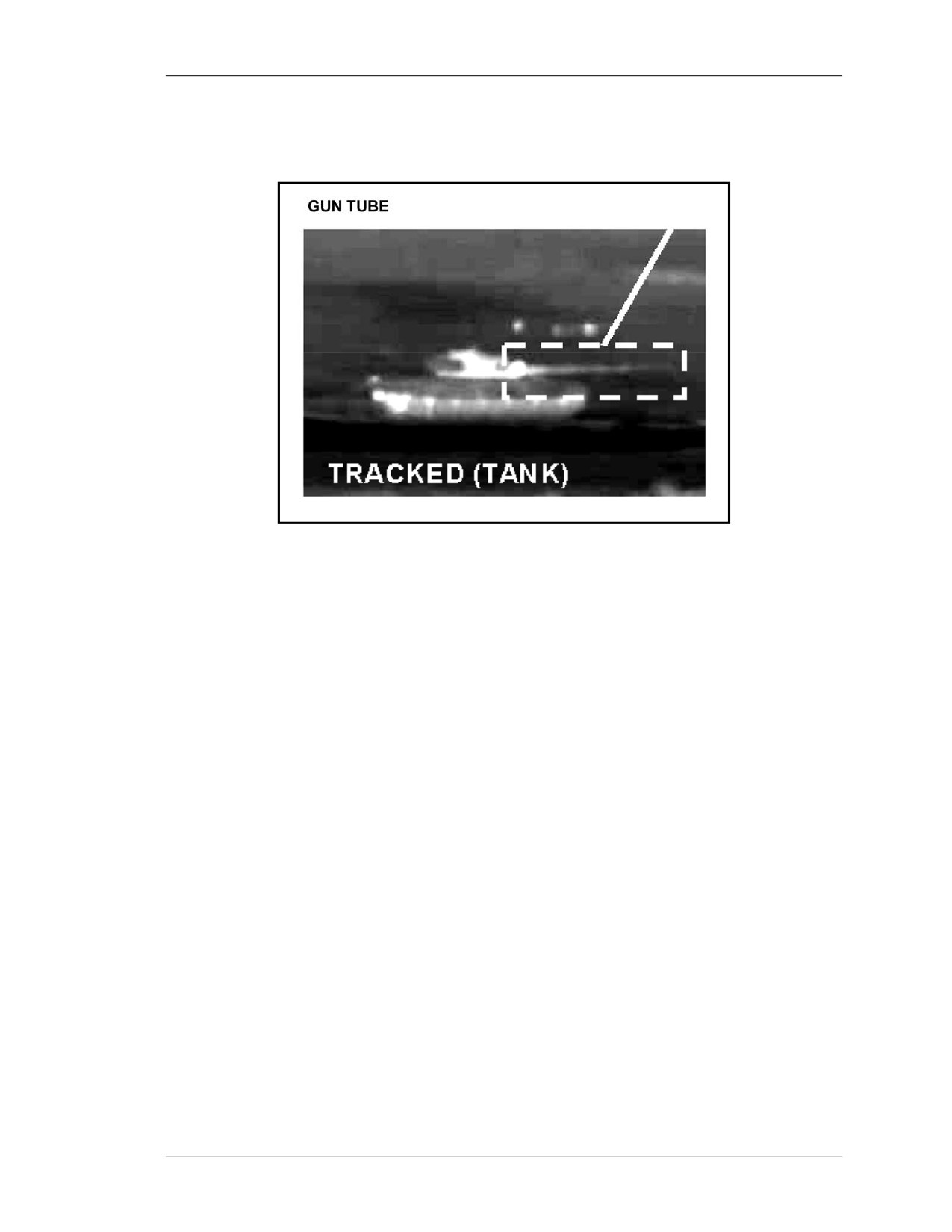
(3) Gun Tube/Barrel. When a gun tube or barrel is mounted on a turret or cupola, the
TOW gunner may or may not be able to see it, depending on turret orientation.
(a) Wheeled Vehicle. In most cases, wheeled vehicles do not have a gun tube, but
they may have some type of smaller support gun (machine gun) mounted.
C-28
8 July 2005
FM 3-22.32
(b) Tracked Vehicle. When the turret is oriented to the proper angle, the gun tube
signature stands out from the turret (Figure C-39).
Figure C-39. Classification features―gun tube/barrel.
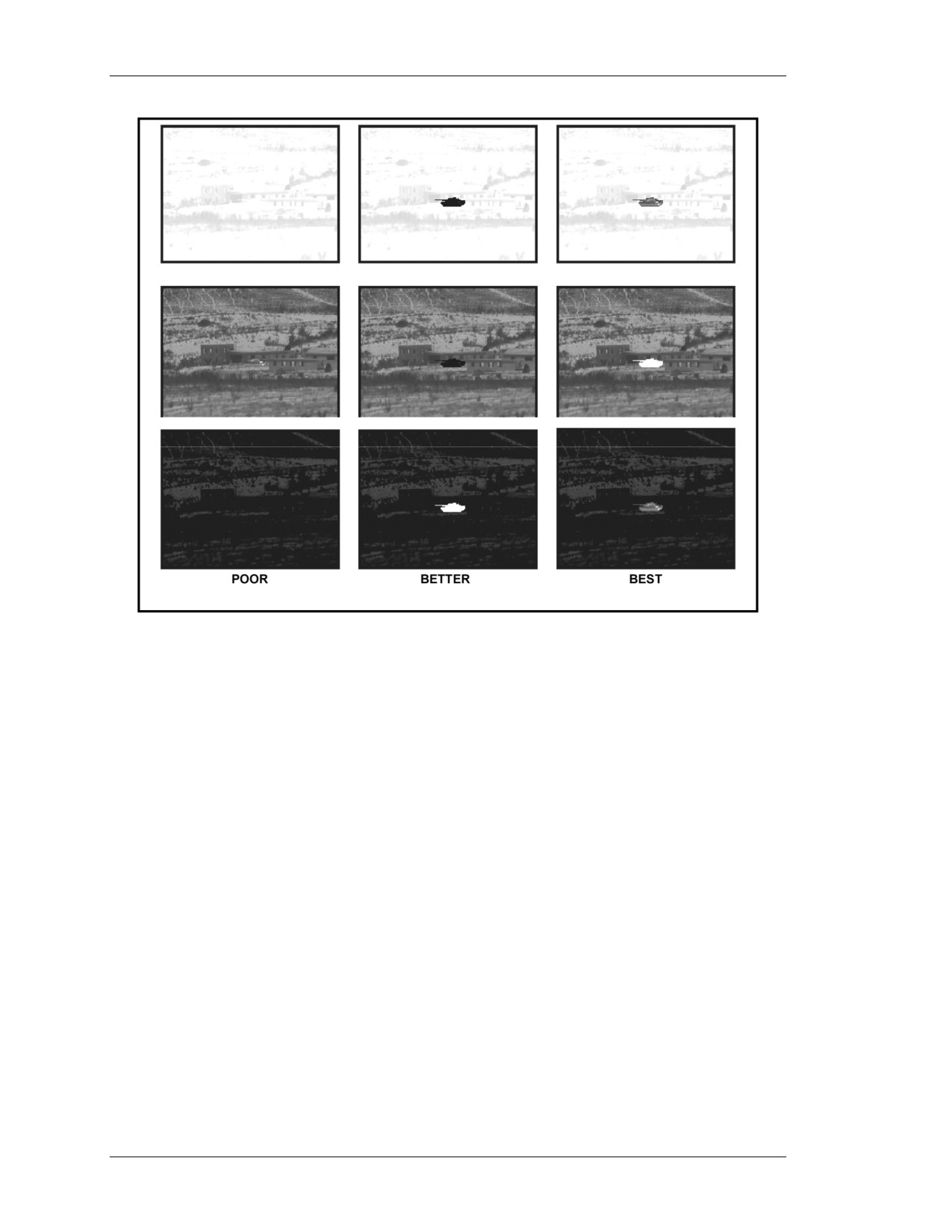
NOTE: Proper adjustment of focus, contrast, and brightness enables the gunner to
classify and recognize targets. Adjust the image so the target features stand
out from the surrounding terrain features. It may be necessary to make several
adjustments for the same target. Figure C-40 (page C-30) shows examples of
poorly adjusted and properly adjusted target images for classification and
recognition.
8 July 2005
C-29
FM 3-22.32
Figure C-40. Image adjustments for target classification and recognition.
b. Defensive Operations (Moving Targets). Some targets may be easier to classify
and recognize than others for the following reasons:
(1) Range to the Target. Even under ideal conditions, classifying and recognizing a
target at long ranges is difficult due to the NVS magnification and image resolution. As
range to the target decreases, target details become clearer, which makes classification
and recognition easier.
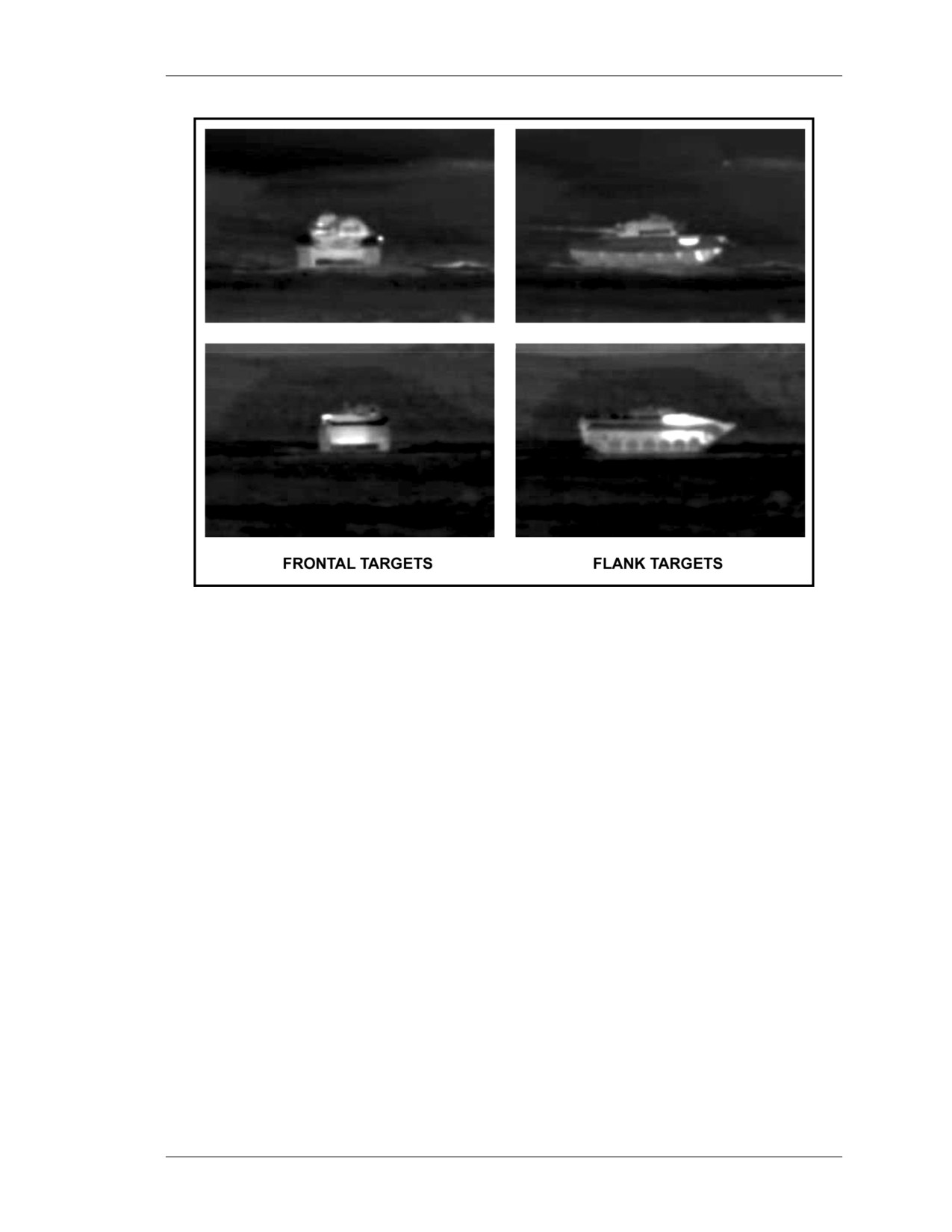
(2) Target Aspect. Flank targets are easier to classify and recognize than frontal
targets (Figure C-41). The profile exposes the suspension and other distinctive features,
such as turrets, engine compartments, gun tubes, or other armament.
C-30
8 July 2005
FM 3-22.32
Figure C-41. Classification and recognition features
of flank versus frontal target.
(3) Target Movement. A moving target allows the gunner to see it from more than
one aspect making it easier to classify and recognize than a frontal target moving in a
straight line.
(4) Terrain. Targets try to remain hidden from the gunner by staying in cover and
concealment, or by using the terrain to mask their movement. Depending on the amount
of terrain masking, the gunner may see only one or two features from which to classify
and recognize a target.
c. Offensive Operations (Stationary Targets). The gunner’s ability to detect,
classify, and recognize a stationary target depends on:
• Position of the target with respect to the gunner’s location.
• Enemy activity.
• Proper image adjustment.
• Amount of target exposure.
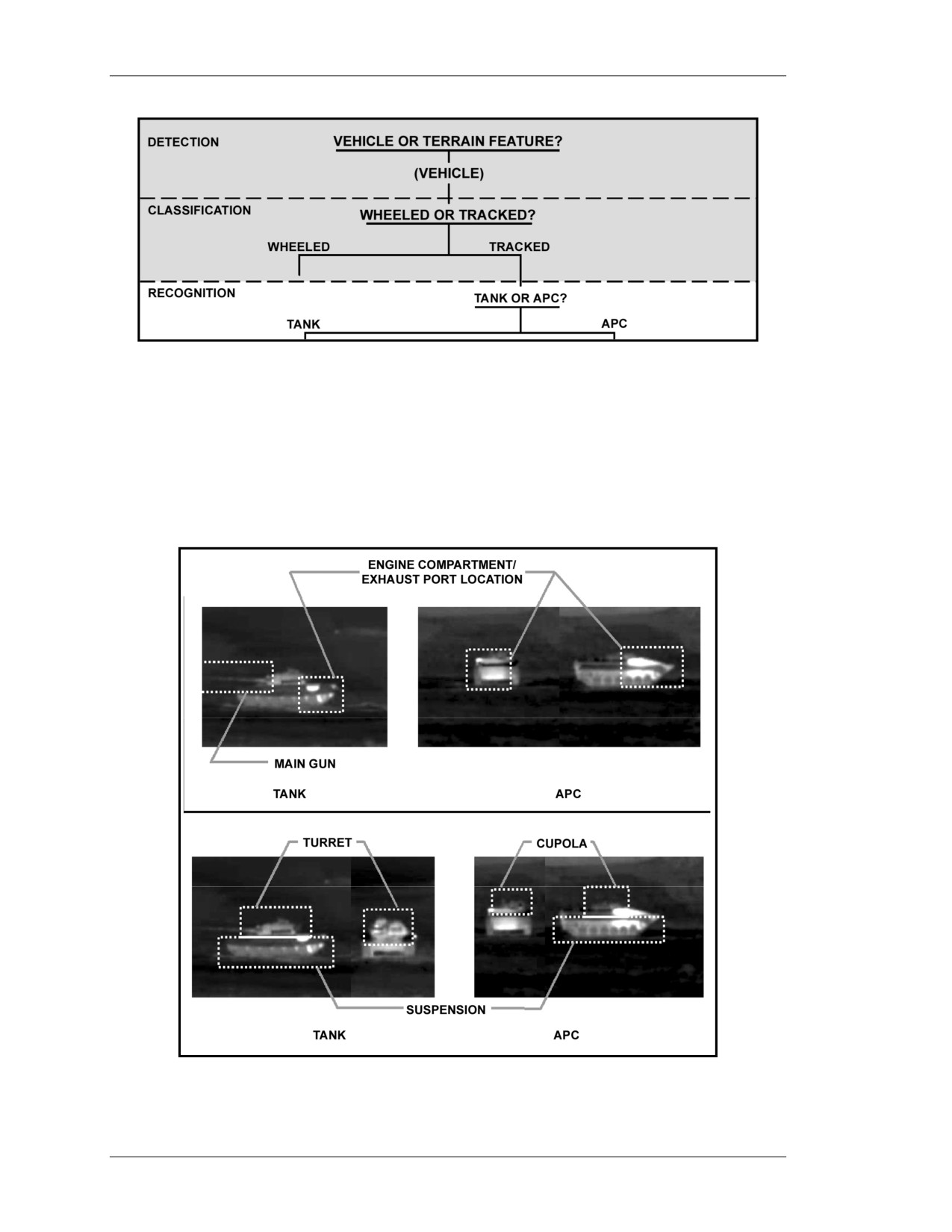
C-7. TARGET RECOGNITION
Target recognition is the next step in the process of determining whether a tracked
vehicle is a tank or an APC (Figure C-42, page C-32).
8 July 2005
C-31
FM 3-22.32
Figure C-42. Target acquisition process―recognition step.
a. Image Adjustment. Image adjustment for target recognition is the same as for
classification. The gunner should make image adjustments so the target features stand out
from the surrounding terrain features. The gunner may have to keep adjusting contrast
and brightness to bring out different target details.
b. Recognition Features. The major differences between tanks and APCs are shown
in Figure C-43 and Table C-1:
Figure C-43. Target recognition features
C-32
8 July 2005

FM 3-22.32
SIGNATURE
TANK
APC
ENGINE
LOCATED IN REAR
LOCATED IN FRONT
COMPARTMENT
EXHAUST PORTS
LOCATED IN REAR
LOCATED IN FRONT OR ON THE
SIDE
MAIN GUN
LONG AND THICK
SHORT AND THIN
TURRET
YES - AND LARGE
YES, MOST HAVE TURRETS
CUPOLA
NEW TANKS―NO
YES―USUALLY SMALL
OLD TANKS―YES
SIZE/SHAPE
LARGE AND SLOPING
SMALL AND RECTANGULAR
Table C-1. Target recognition features.
C-8. TARGET IDENTIFICATION
Enough information may be available to engage a target after the gunner has detected,
classified, and recognized it, but the final step in target acquisition is identification. The
enemy may have armored vehicles common to our allies, and the gunner must be sure of
his target. The ITAS provides the gunner with a thermal image of a target; therefore, the
gunner must have a clear understanding of thermal vehicle signatures as well as daylight
images. Training aids available to the units come in different forms from CD-ROM and
graphic training aids (GTAs) to actual photographs. These tools prepare the gunner to
correctly identify enemy vehicles versus friendly ones.
a. The Recognition of Combat-Vehicles (ROC-V) CD-ROM is available from the
Night Vision and Electronic Sensors Directorate, PM-FLIR. This directorate can be
contacted for assistance in vehicle identification at ROC-V@nvl.army.mil.
b. Graphic training aids 17-2-11 and 17-2-13 (available through the local TSC)
provide the gunner with line drawings and pictures of friendly and enemy vehicles.
c. Jane’s Defense Combat Armored Vehicle Identification contains pictures and
descriptions of most armored vehicles currently in service throughout the world.
8 July 2005
C-33
This page intentionally left blank.
FM 3-22.32
APPENDIX D
ANTIARMOR RANGE CARD
The range card is a sketch of a gunner’s assigned sector of fire. It
contains information that helps in planning and controlling fires, in
detecting and engaging targets, and in orienting replacement personnel.
Using range cards allows a gunner or a replacement gunner to find and
engage targets quickly. The standard range card (FM 7-8) is slightly
modified when employing an antiarmor weapons system. This appendix
outlines how to prepare an antiarmor range card.
D-1. DESCRIPTION
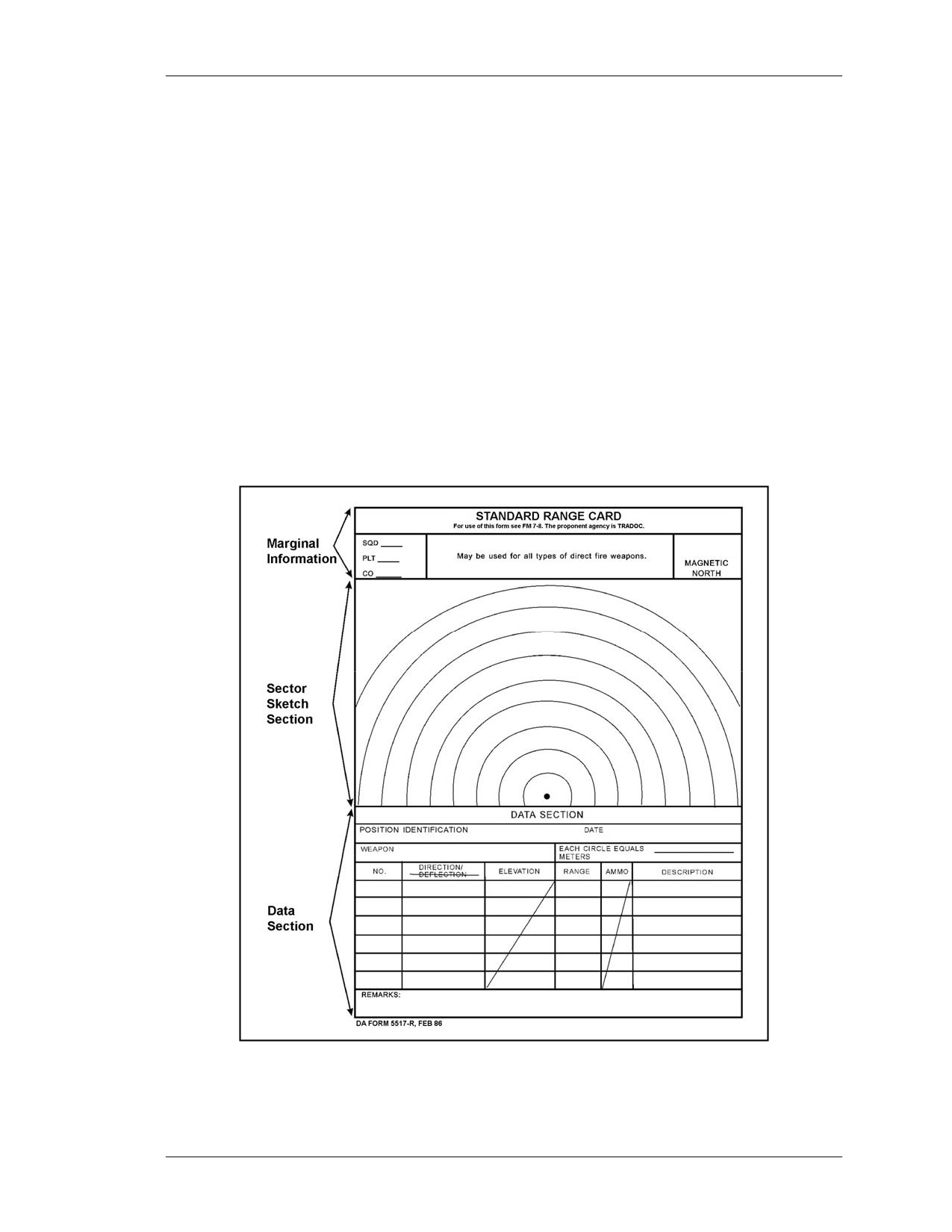
A DA Form 5517-R, (Standard Range Card), is a record of the firing data for a weapon
system on a given sector of fire. This record facilitates target engagement during good or
limited visibility conditions. It is divided into three sections
(Figure D-1): marginal
information, sector sketch section, and data section.
Figure D-1. Three sections of a range card (DA Form 5517-R).
8 July 2005
D-1