FM 3-22.32 IMPROVED TARGET ACQUISITION SYSTEM, M41 (July 2005) - page 4
FM 3-22.32
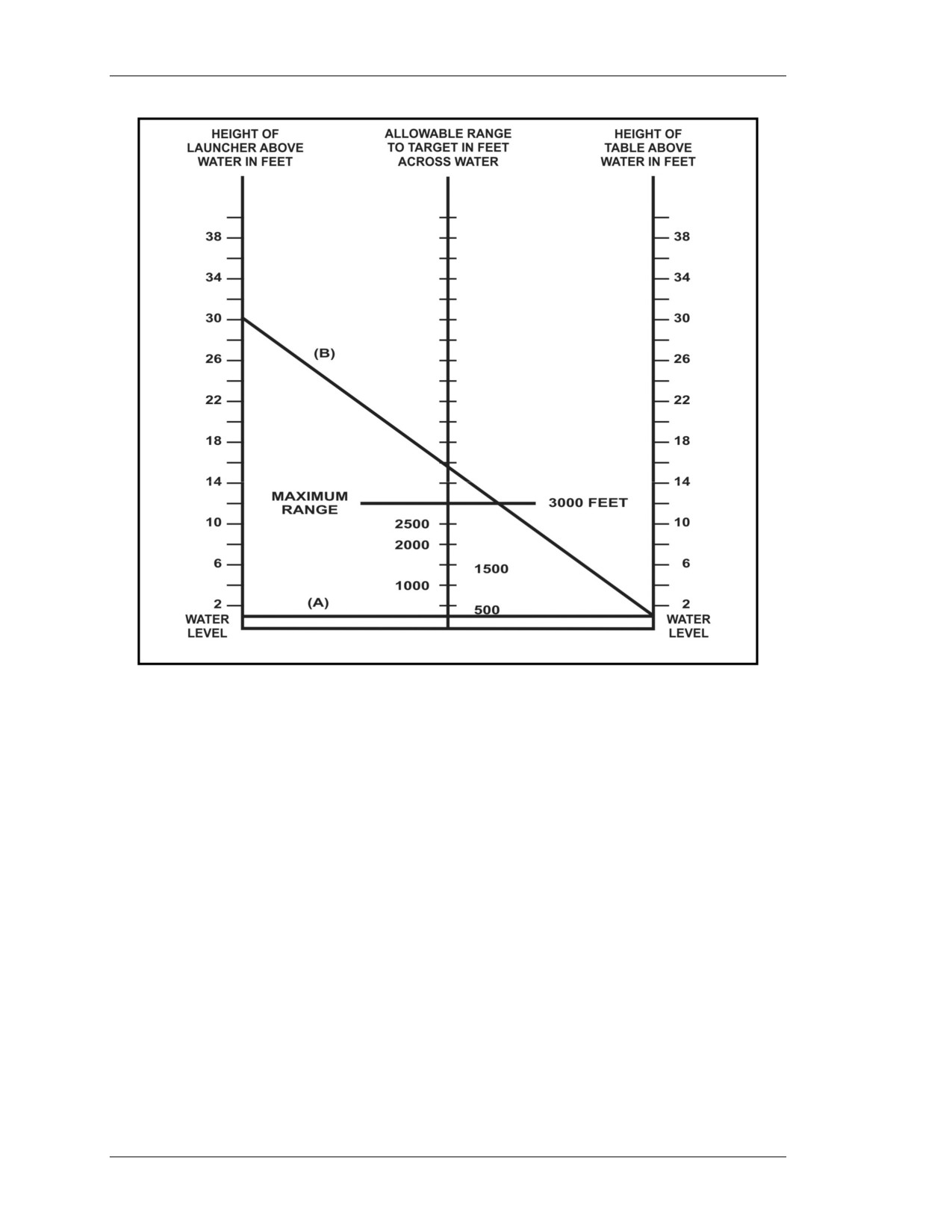
Table 4-3. Range per height above water for TOW missiles BGM-71A,
BGM-71A-2, BTM-71A, or BTM-71A-2.
4-6
8 July 2005
FM 3-22.32
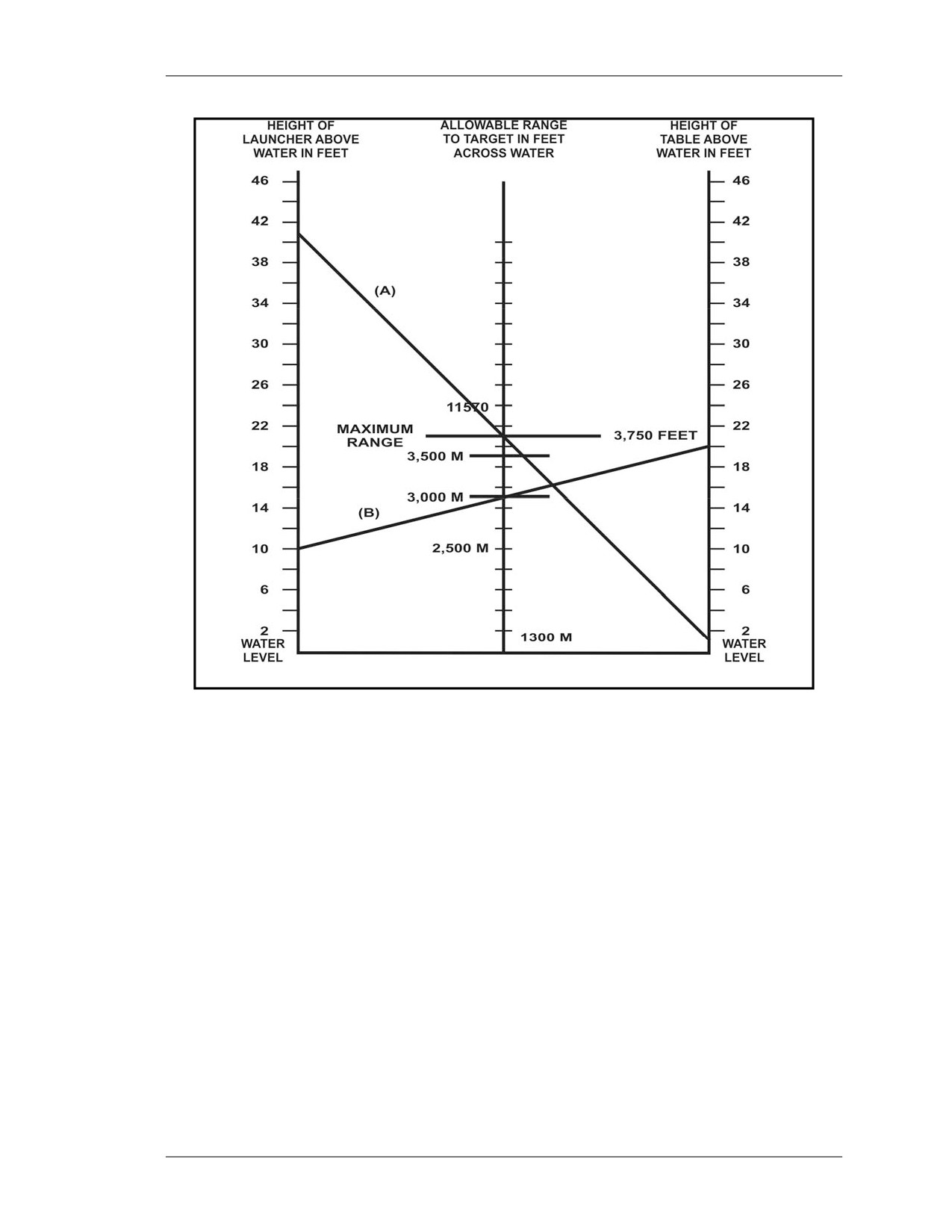
Table 4-4. Range per height above water for TOW missiles BGM-71A-1,
BGM-71A-3, BTM-71A, BTM-71C, BGM-71C-1, BGM-71D, BTM-71A-1, or
BTM-71A-3.
(1) Determine the type of missile being used.
(2) Determine the height above the water surface of the ITAS and place a tick mark at
the corresponding height in the left-hand column of the table.
(3) Determine the height above the water surface of the target. Place a tick mark at
the corresponding height in the right-hand column of the table.
(4) Connect the two tick marks with a straight line. The point where the lines
intersect the center column is the maximum range the missile can travel without getting
too close to the water.
4-2.
FIRING OVER ELECTRICAL LINES
If the command-link wires contact a live high-voltage power line, personnel can be
injured, control of the missile can be lost, and the launcher electronics may be damaged.
In addition to power lines, other high-voltage sources include street cars, electric train
ways, and some moving target trolleys on training ranges.
8 July 2005
4-7
FM 3-22.32
4-3.
FIRING IN WINDY CONDITIONS
Gusty, flanking, or quartering winds can cause the launch tube to vibrate and spoil the
tracking performance. The effect is similar to driving in a strong crosswind. Erecting a
windscreen next to the launcher helps to reduce this problem. Strong winds can move the
missile around during flight, but as long as the crosshairs are kept on the center mass of
the target, the weapon system itself can compensate for wind effects.
4-4.
FIRING THROUGH SMOKE AND AREA FIRES
Smoke can obscure the line of sight and hide the target when using the daysight.
Whenever obscuration is encountered the gunner should switch to the NVS mode. Fire
can burn through the command-link wire, causing loss of control of the missile. The
gunner should avoid firing through fire and over fires if there is a possibility that the
wires will contact the fire before missile impact.
4-5.
FIRING FROM BUNKERS AND BUILDINGS
TOW missiles will not be fired from buildings or bunkers, or within 100 meters of a
vertical or nearly vertical backstop without the approval of the commanding general
(IAW AR 385-63).
4-6.
CLEARANCE REQUIREMENTS
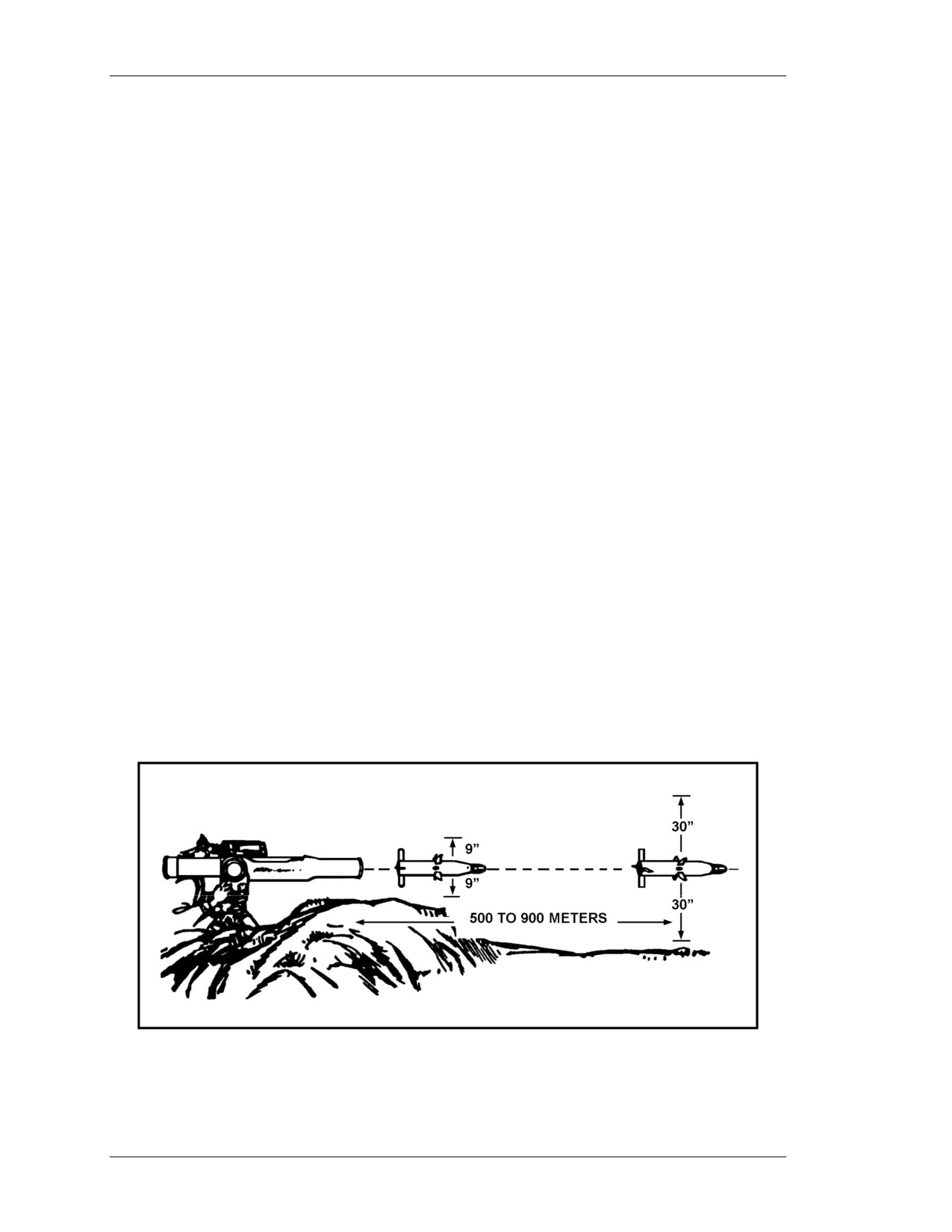
TOW missiles must have at least 9 inches of clearance at the end of the launch tube so the
wings and control surfaces of the missile will not be damaged when they extend after
clearing the launch tube. The muzzle of the launch tube must extend beyond any
enclosure, windowsill, or aperture, and at least 30 inches of clearance must be between
the line of sight and any obstruction from 500 to 900 meters downrange. A 30-inch
line-of-sight clearance ensures a high probability the missile will not strike the ground on
the way to the target (Figure 4-3). These clearance requirements, along with all TOW
missile limitations, must be taken into account before engaging targets with the ITAS.
Figure 4-3. Clearance requirements.
4-8
8 July 2005
FM 3-22.32
Section II. TARGET ENGAGEABILITY
Tanks and mechanized units are trained to use terrain-driving techniques to conceal
movement, and drivers are taught to move vehicles quickly from one concealed position
to another. ITAS gunners and squad leaders must determine the range to a target and
determine if the exposure time (the time a vehicle is in a gunner’s sight) is long enough to
allow a missile to reach its target. Antiarmor crewmen must understand that many
armored forces worldwide operate with a “wingman” concept whereby, at the first sign of
an antiarmor missile launch, vehicles scan sectors and engage with whatever ammunition
is loaded.
4-7.
DETERMINE IF A TARGET IS WITHIN RANGE
The ITAS gunner or squad leader can use the daysight, nightsight, or binocular method to
determine if a target is within range.
a. Daysight Method. When in daysight mode, the ITAS gunner uses passive or
active ranging to determine the range to a target. (See TM 9-1425-923-12 for more
information on how to use passive and active ranging.)
b. Night Vision Sight Method. When in NVS, the ITAS has both an active and
passive LRF. The passive mode is preferred because the active range finding mode emits
a laser that may be detected by laser detection devices used on some modern armored
vehicles. The passive method uses a box in the same manner as the ATT track gate.
c. Binocular Method. Use the reticle in binoculars to determine if a target is within
range by looking at the length, width, or height of the vehicle. Follow the same
procedures when using the M17 and M19 binoculars, even though the reticles differ
slightly. The M17 tick marks are only 1.7 mils long while the tick marks on the M19
reticle are 5 mils long (2.5 mils on each side of the horizontal and vertical scales).
(1) To determine if a target is within range at 3,000 meters based on the length of the
target, place the length of the target on the vertical scale. If one-third or more of the
vehicle extends beyond the tick mark, the vehicle is in range (Figure 4-4, page 4-10). A
vehicle 6.5 meters long will measure about 2.2 mils at 3,000 meters and about 1.7 mils at
3,750 meters.
8 July 2005
4-9
FM 3-22.32
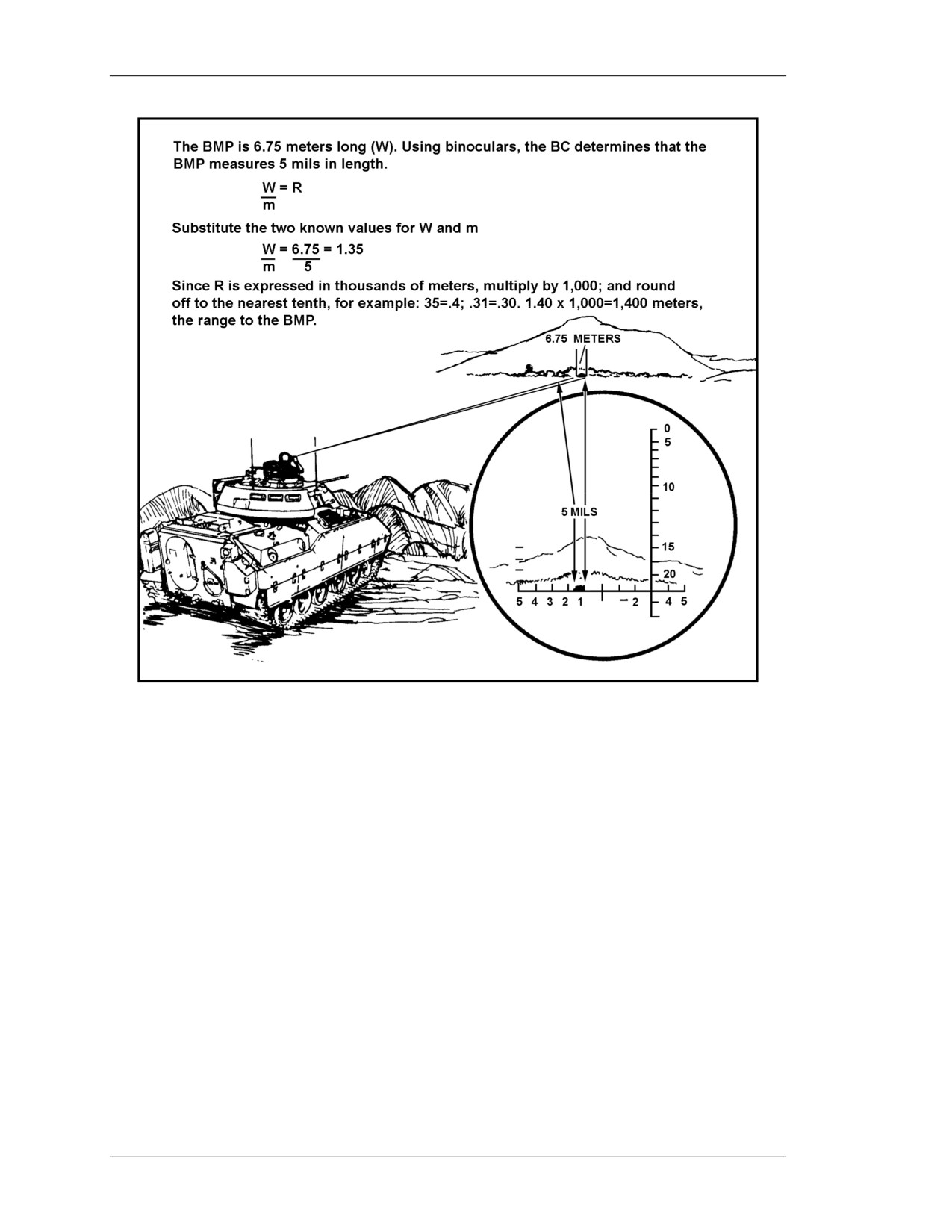
Figure 4-4. Range determination using binoculars.
(2) To determine if a target is within range at 3,000 meters based on the width of the
target, place the target on the small tick mark on the vertical scale. If the target covers
two-thirds or more of the tick mark, the vehicle is within range. A vehicle 3.4 meters
wide will measure 1.1 mils at 3,000 meters and .85 mils at 3,750 meters. (Most former
Warsaw Pact APCs are less than 3.4 meters wide and can be engaged at smaller mil
values.)
(3) To determine if a target is within range at 3,000 meters based on the height of the
target, place the target on one of the tick marks on the horizontal scale. If the height of
the vehicle is one-half or more of the height of one of the tick marks, the vehicle is within
range. A vehicle 2.4 meters high (the size of most former Warsaw Pact vehicles), will
measure .8 mils at 3,000 meters and .6 mils at 3,750 meters.
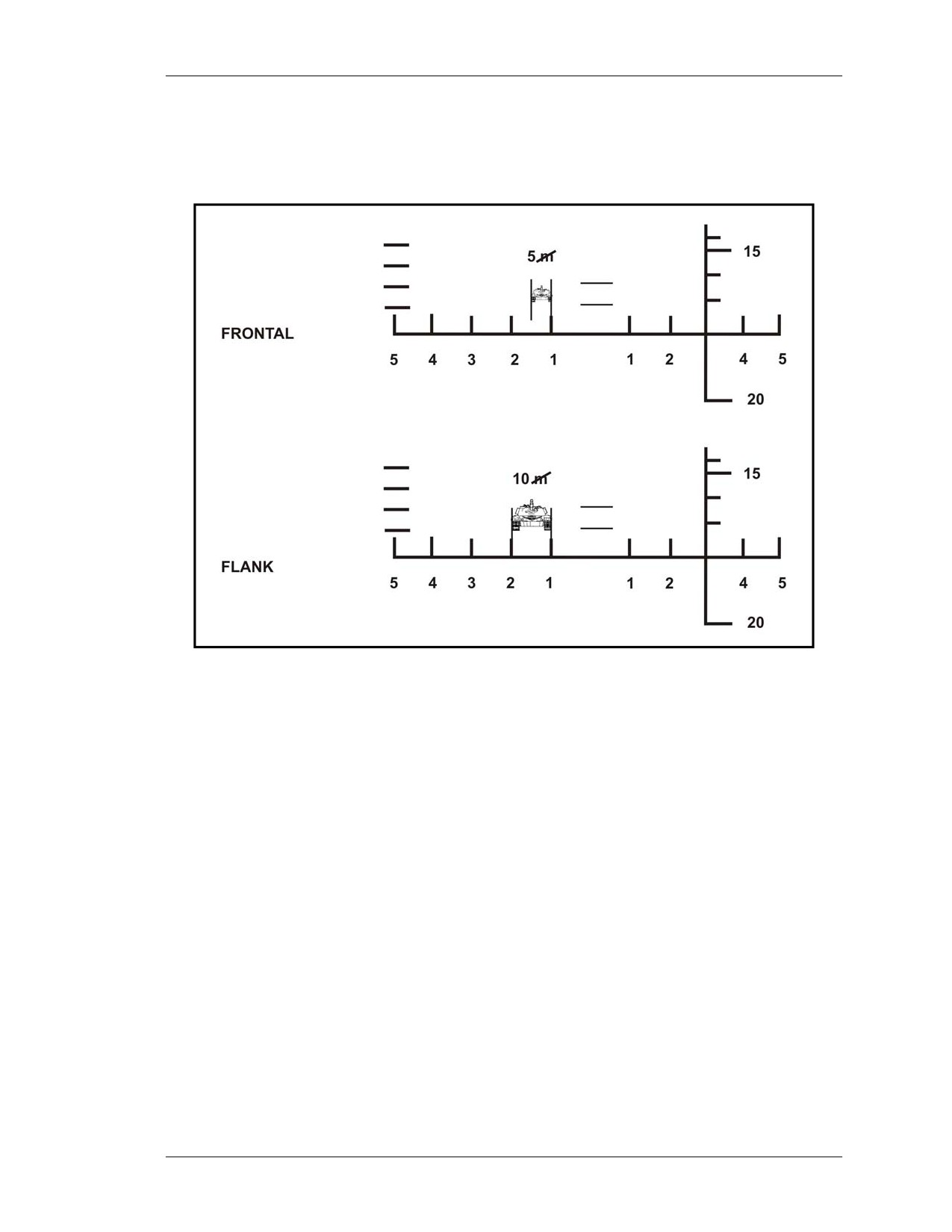
(4) The mil-relation formula is: known target measurement (W) divided by the mil
measurement equals the range factor (R). The range factor is then multiplied by 1,000 to
determine the target range. To determine if a target is within range using the mil-relation
formula, the gunner determines the known width, height, or length with the binocular’s
mil scale, substitutes the mil relation, and computes the range. When measuring frontal
width, he measures only the vehicle’s front slope (from left front corner to right front
4-10
8 July 2005
FM 3-22.32
corner). When measuring flank width, he measures the entire vehicle (Figure 4-5).
Accuracy of this method depends on knowing the target dimensions and on the gunner’s
ability to make precise measurements with the binoculars.
Figure 4-5. Target measurement using binocular reticle.
(a) The mil is a unit of angular measurement equal to 1/6400 of a circle. There are
about 18 mils in 1 degree. One mil equals the width, height, or length of 1 meter at a
range of 1,000 meters. This relationship remains constant as the angle or range changes.
Standard Army measurements use the metric system. Other units of measurement (yards,
feet, or inches) may be substituted to express the target size or range; however, all
information must be expressed in the same unit of measure.
(b) The relationship of the target width in mils and meters (W) is constant at varying
distances, which makes accurate range determination possible. The mil relation holds true
whether the W factor is width, height, or length. Therefore, the range can be determined
if the target dimensions are known. Target height may be the most consistent
measurement, because length and width change as targets move on the battlefield. Also,
target height is used to determine “battle carry” (the pre-indexed range and ammunition)
used during offensive operations.
NOTES:
1. The distance between tick marks on the horizontal scale is 10 mils.
2. If the weapon system is in an elevated firing position or if the lower
portion of the target vehicle is hidden by foliage or terrain, the binocular
method cannot be used.
8 July 2005
4-11
FM 3-22.32
4-8.
DETERMINE EXPOSURE TIME
The half-sight method of determining exposure time is based on a vehicle speed of 35
kilometers per hour (the expected top vehicle speed of armored vehicles on level or
gently sloping dry terrain).
a. Daysight Method. Use the cross lines on the daysight tracker to determine the
exposure time of a target.
(1) Place the cross lines of the daysight tracker on the center of the visible mass of the
vehicle.
(2) In the NFOV, if the area between the vertical cross line and the edge of the field
of view in the direction of travel is clear of obstruction, the target is engageable.
(3) If obstructions appear between the vertical cross line and the edge of the field of
view, the time of exposure would not be long enough for the missile flight before the
target moved out of sight.
b. Nightsight Method. The procedure to determine exposure time is the same for
the nightsight as for the daysight, except the nightsight must be set on narrow field of
view.
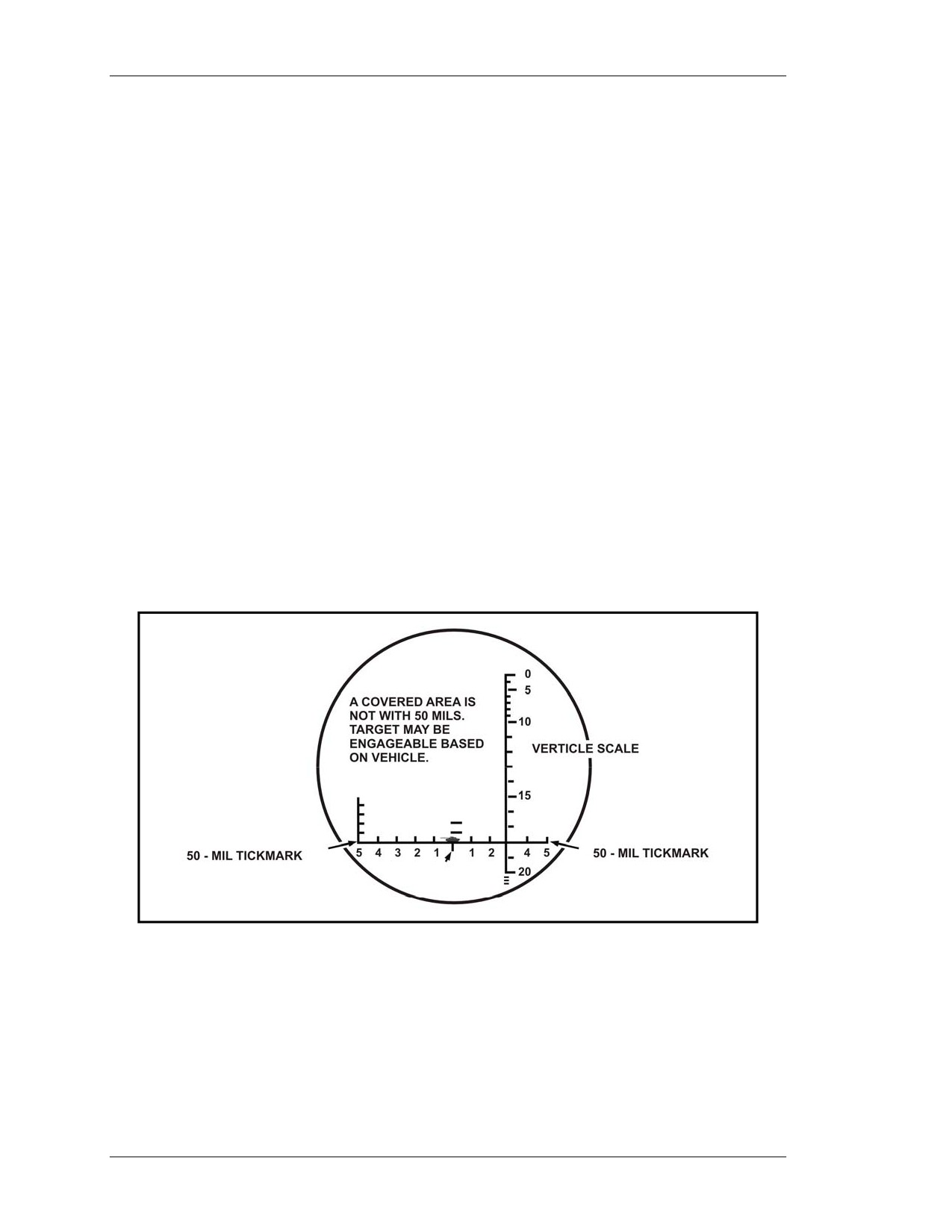
c. Binocular Reticle Method. Use the reticle in the binoculars to determine the
exposure time of a target.
(1) Place the zero tick mark of the horizontal scale at the center of the vehicle.
(2) If the area between the vehicle and the 50-mil tick mark is clear of obstructions in
the direction of travel, the target is engageable (Figure 4-6).
Figure 4-6. Binocular reticle method.
4-9.
FIRE COMMANDS
The six elements of a fire command are: alert, type of missile, target description, target
direction, range, and execution. Additional commands may be used after execution,
depending on the situation, to let crewmembers know what is to be done next. Whether
4-12
8 July 2005
FM 3-22.32
mounted or dismounted, the elements of the fire command are the same. (Figure 4-7
shows an example of a squad fire command.)
SQUAD
SQUAD, TOW2B MISSILE; ONE TANK NORTH
LEADER:
OF TRP 1; 2,000 METERS; AT MY COMMAND.
GUNNER:
IDENTIFIED.
SQUAD
FIRE.
LEADER:
SQUAD
CEASE TRACKING, OUT OF ACTION.
LEADER:
Figure 4-7. Example of a squad fire command.
a. Alert. The first element of the fire command alerts the crew for an immediate
engagement. The squad leader commands, “Squad,” and the gunner begins observing the
target area.
b. Type of Missile. Because a variety of TOW missiles are used and their
capabilities vary, a particular type of missile must be specified. An ITAS crew in battle
will probably have a mix of different missiles and a wide variety of target arrays to
engage (see FM 3-22.34 [FM 23-34] for TOW missile types and configurations). For
example, if the target is a BTR-60 or BMP-1, the squad leader may command, TOW 2; if
the target is a T-80 with reactive armor, he may command, TOW 2B. All TOW missiles
in production are line-of-sight missiles except the TOW 2B. The TOW 2B is normally a
FOSD missile but, with the capabilities of the ITAS, can be changed to a line-of-sight
missile.
c. Target Description. The second element identifies the target for the gunner. If
several similar targets are present, this element tells the gunner which target to engage
first. Most targets can be described using the terms listed in Table 4-5, page 4-14. Targets
that are combinations of the ones listed in Table 4-5, such as a truck mounting a missile
system, are identified by combining terms—for example, TRUCK MOUNTING
ANTITANK. When the gunner sees the target, he announces, “Identified.” If multiple
targets appear, the commander may specify which target will be engaged by the gunner—
for example, FIRST TANK or RIGHT TRACK.
8 July 2005
4-13

FM 3-22.32
TARGET
ANNOUNCED AS
Any tank or tank-like vehicle
TANK
Several tanks
TANK FORMATION
Any unarmored vehicle
TRUCK
Any halftrack or armored personnel
TRACK
carrier
Helicopters
CHOPPER
All fixed-wing aircraft
PLANE
Personnel
TROOPS
Any machine gun
MACHINE GUN
Any antitank gun or towed artillery
ANTITANK
piece
Any other target
A short word or phrase that
clearly describes the target.
Table 4-5. Terms used to describe targets.
d. Target Direction. If the target is moving, the direction of movement is given
after the description to aid the gunner in locating the target. After the gunner is given the
location of a target, he can search for the target in the direction of movement. A target
reference point (TRP) can also be used to help the gunner locate the target. A TRP is an
easily recognizable feature or point on the ground (either natural or man-made) used for
identifying targets and controlling fires. They can be used to designate targets for
companies, platoons, sections, and individual weapons. They can also be used to
designate the center of an area where the commander plans to distribute or converge the
fires of all his weapons. TRPs are usually designated by the company commander or
platoon leaders. Weapons will engage targets from different directions, so compass points
(for example, north, east), rather than “right” or “left,” are used when giving directions
centered on a TRP.
e. Range. The range is given to help the gunner identify his target and to determine
its engageability. The squad or section leader can determine the range to the target using
the naked eye, binoculars (mil-relation formula), or reference materials (maps, range
cards).
(1) Naked Eye. One method for using the naked eye to determine range is the football
field method. The squad or section leader counts in 100-meter increments, estimating the
number of football fields that could fit between the firing position and the target.
(2) Binoculars. Binoculars and the mil-relation formula can be used to determine
range. To use this method, the squad or section leader must know the width, height, or
length of the target. He determines the width, height, or length with the mil scale on the
binoculars; substitutes the mil-relation; and computes the range.
(3) Reference Materials. Maps can be used to determine range by counting the grid
lines between the firing position and the target or by adjusting from a known point.
Range cards can also be used to determine the range to the target.
f. Execution. Two commands are necessary for execution: a preparatory command
and a command of execution.
4-14
8 July 2005
FM 3-22.32
(1) AT MY COMMAND is a preparatory command that warns the gunner not to fire
until given the command of execution.
(2) FIRE is the only command of execution used to fire a missile.
g. Additional Commands. In addition to the six elements of the fire command,
some other commands are needed.
(1) The command CEASE TRACKING or CEASE TRACKING, OUT OF ACTION
is issued after seeing the round detonate or when the squad or section leader wants to halt
firing.
(a) CEASE TRACKING tells the crew the squad or section leader intends to stay in
position and engage another target immediately or when one appears.
(b) CEASE TRACKING, OUT OF ACTION tells the crew the squad or section
leader intends to move to another position.
(2) To determine the method of engagement, the section leader (or above) selects a
fire pattern depending on the opposing force’s formation. The section leader directs,
FRONTAL, DEPTH, or CROSSFIRE when the gunner is faced with multiple targets.
(3) When the target is identified, the gunner announces, “Identified.”
(4) If the gunner cannot see the target, he announces, “Lost.”
(5) If the gunner cannot identify the target, he announces, “Cannot identify.”
(6) The loader announces,
“Backblast clear,” before the command of execution
is given.
h. Repeating Commands. When a crewmember fails to hear or understand any
element of a fire command, he announces the element in question. For example, if the
gunner asks, “Location?” the squad leader repeats the location element such as, “From
hill seven six two, west two hundred.”
i.
Correcting Errors. To correct an error in a fire command, the squad leader
announces, “Correction,” and corrects only the element in error. He completes the
command by announcing all elements after the corrected element. He does not try to
correct an element that has been needlessly included, such as the direction element. He
corrects the omission of an element by announcing “Correction” and then the omitted
element. After announcing the omitted element, he completes the command.
j.
Commands for the Driver. Although directions to the driver are not part of the
fire command, the squad leader or gunner gives them in short terms.
4-10. TARGET TRACKING
To track a target, the gunner visually acquires the target through the TAS
a. Manual Engagement. To track the target, after target engageability has been
determined, the gunner operates the hand controls on the traversing unit to keep the
reticle in the launcher sight aligned with the target. The TAS is attached to and aligned
with the launch tube. The launch tube stabilizes the exit of the missile from the launcher
for alignment during initial missile flight. On achieving target alignment, the gunner fires
the missile by manually depressing the trigger switch. Thereafter, all operations are
automatic and the gunner’s only task is to maintain alignment of the sight reticle and the
target until missile impact.
b. Aided Target Tracker Engagement. After target engageability has been
determined, the gunner activates the ATT (adjust, size, and lock). If the ATT will not
8 July 2005
4-15
FM 3-22.32
lock after the second attempt, the gunner must engage in the manual mode. All actions
are the same as described in the daysight method of engagement.
c. Deviations. Deviations of the missile from the line-of-sight trajectory are sensed
in the launcher sight by infrared means that receive information from infrared radiators
attached to the missile. This information is processed in the form of electrical signals to
produce error signals proportional to the azimuth and elevation displacements of the
missile from the intended trajectory. Correction commands are derived from these error
signals and are sent to the missile over the command-link wires, which are dispensed
from the missile. The missile performs corrective maneuvers using aerodynamic control
surfaces that deflect in response to the command signals from the launcher. On target
impact, a high-explosive, shaped-charge warhead is detonated.
4-11. HELICOPTER ENGAGEMENT
Enemy armor is the primary threat to friendly ground forces employed in forward areas.
The primary mission of the ITAS is the destruction of these tanks at the greatest possible
range. However, ITAS gunners can also successfully engage attacking enemy helicopters,
which are a significant threat to ground forces. Engaging helicopters with the ITAS
should be considered primarily as a means of self-defense. ITAS crews should not
consider helicopters as a routine target of opportunity, but should leave them to
conventional ADA assets when possible. Launch warning receiver technology available
worldwide makes engagement of rotary-wing aircraft potentially a dangerous action.
a. ITAS positions are selected to cover armor avenues of approach, but these
long-range fields of fire also facilitate the engagement of aircraft. The section leader’s,
squad leader’s, and crew’s observation from these positions can provide the early
warning required to successfully engage aircraft.
b. The engagement of attacking helicopters should be done by ITAS sections, not
individual weapon systems. ITAS sections should automatically engage helicopters that
are attacking their positions. If one squad in a section is being attacked by a helicopter,
the other squad should engage the helicopter while the first squad seeks cover. ITAS
crews and sections should be trained to automatically respond to helicopter attacks in this
manner.
4-16
8 July 2005
FM 3-22.32
CHAPTER 5
TACTICAL CONSIDERATIONS
This chapter discusses tactical considerations, capabilities, and
limitations of the TOW weapon system in conjunction with the ITAS. To
integrate the ITAS into tactics and techniques, the leadership from the
company commander down to the squad leader must be familiar with the
field manuals appropriate to the organizations and to the organizational
level (FMs 3-21.9, 7-7, 3-21.71, 7-8, 7-10, or 3-21.91).
This chapter also discusses how to construct a fighting position that
provides the crew with good cover and concealment while allowing for the
best possible engagement of the enemy.
Section I. PURPOSE AND FUNDAMENTALS
The purpose of the TOW is to destroy enemy armored vehicles out to 3,750 meters. The
ITAS has replaced the TOW’s M220A2 sight system in selected infantry units.
Commanders may use the TOW and ITAS in various roles from supporting fire to
conducting surveillance. Commanders must understand the unique capabilities and
limitations of the TOW and the ITAS to enhance the unit’s combat power.
5-1.
FUNDAMENTALS OF EMPLOYMENT
Using the fundamentals of antiarmor employment increases the probability of destroying
targets and enhances the survivability of the antiarmor elements.
a. Mutual Support. Units provide mutual support to each other by their relative
positions (with respect to each other and the enemy) and their inherent capabilities.
Mutual support is established by employing the ITAS by section and by overlapping
sectors of fire between sections.
(1) Employment. Employment of the ITAS by section establishes mutual support. If
one section is attacked or forced to displace, the other section can continue to cover the
assigned sector. To achieve this, sections position themselves so that fires directed at one
section do not suppress the other section.
(2) Overlapping Sectors. Overlapping the sectors of fire is essential to mutual
support. It must be accomplished with primary, secondary, and alternate sectors of fire.
b. Security. Antiarmor units are vulnerable to attack by dismounted infantry. To
protect antiarmor units, position them near friendly infantry units. Antiarmor squads do
not need to be collocated with infantry, but the infantry should be able to cover
dismounted avenues of approach to the antiarmor positions. When moving with infantry,
antiarmor units provide their own local security.
c. Flank Engagements. Antiarmor units should be positioned to engage enemy
armored vehicles from the flank. Frontal shots at enemy armor are less desirable
because—
• An armored vehicle’s protection is greatest in the front.
• An armored vehicle’s firepower and crew are normally oriented to the front.
• Frontal engagements increase the chance of detection and suppression.
• Target Identification is more difficult from the front.
8 July 2005
5-1
FM 3-22.32
d. Standoff Range. The TOW in conjunction with the ITAS has an advantage of
accuracy over most tanks’ main guns at extended ranges (beyond the 2,000-meter range
of tanks’ main guns). The accuracy of a tank’s main gun decreases with increased range
while that of an TOW does not. Positioning ITAS to exploit its maximum range
decreases vulnerability to detection and return fire. This range advantage, called standoff,
is the difference between the tank’s maximum effective range and the ITAS maximum
range. With its maximum range of 3,750 meters, an ITAS has the standoff advantage
against a tank with a maximum effective range of 2,000 meters.
e. Cover and Concealment. Cover and concealment are critical to the survivability
of antiarmor weapons systems. Cover is protection from the fire of enemy weapons and
from enemy observation. It may be natural or man-made. Concealment is protection from
observation only. Concealment hides a soldier, vehicle, position, or unit from ground and
aerial observers and gunners. It includes not only camouflage but also light, noise,
movement, and odor discipline. With recent improvements in night vision and other
detection devices, darkness alone no longer constitutes concealment.
f. Depth. Antiarmor fire should be employed in depth. In the offense, routes and
firing positions should be selected to support the forward movement of attacking units. In
the defense, antiarmor positions may be either forward initially and moved to in-depth
positions as the enemy closes, or they may be positioned initially in depth.
g. Combined Arms Team. Skillful integration of infantry, armor, engineer, and
artillery assets will significantly improve the survivability and lethality of antiarmor
units.
h. Aided Target Tracker versus Manual Engagement. The ITAS affords the
gunner the option of choosing an ATT engagement or a manual engagement. An ATT
engagement is usually the preferred method because it increases the probability of a hit
by minimizing gunner error. It may not be the preferred method in a quick-reaction
scenario because track gate adjustment may take longer than the time available.
5-2.
EMPLOYMENT CAPABILITIES AND LIMITATIONS
The TOW and ITAS have capabilities and limitations that the commander must be aware
of to effectively employ the weapon system.
a. Capabilities. The TOW is mainly an antitank weapon used for long-range
engagement of armored targets. It can be employed in all weather conditions as long as
the gunner can see the target through the ITAS. The TOW also provides a long-range
assault capability against heavily fortified bunkers, pillboxes, and gun emplacements.
(1) The TOW missile can destroy targets at a minimum range of 65 meters and a
maximum range of 3,750 meters. The TOW 2B missile can destroy targets at a minimum
range of 200 meters and a maximum range of 3,750 meters.
(2) The automatic missile tracking and control capabilities of the ITAS provide a high
first-round-hit probability. To operate the system, the gunner places the track gates on the
target, fires the missile, and centers the crosshairs on the target image until missile
impact. The optical tracking and command functions within the system guide the missile
to the target as long as the gunner keeps the crosshairs on target.
b. Mobility. The ITAS can be vehicle-mounted or ground-emplaced
(tripod-
mounted) for operation. Missiles can be launched from either operational mode. (Detailed
operating procedures for each configuration are provided in Chapters 3 and 4.)
5-2
8 July 2005
FM 3-22.32
(1) The entire system can be carried by a single crew for short distances. Moving it
over long distances without the vehicle will require two crews, which causes two systems
to be out of operation at the same time.
(2) The vehicle-mounted launcher is more mobile and can be quickly prepared for
use. The launcher can be assembled and disassembled without the use of tools.
(3) Built-in self-test circuits can be used to check the operational condition of the
assembled launcher, whether ground- or vehicle- mounted.
Section II. EMPLOYMENT IN OFFENSIVE/DEFENSIVE OPERATIONS
The TOW is the antiarmor weapon system organic to most infantry battalions that
provides a heavy antiarmor capability in the offense and defense. This section covers
basic antiarmor fundamentals, capabilities, limitations and employment considerations,
which must become routine operation as a result of battle-focused training. The ITAS is a
battalion level asset that will support companies (depending on their mission) and the
armor threat within their area of operation. At times, an ITAS section may support lower
echelons such as a rifle platoon. Operational control is assigned at battalion level and is
paramount to mission success. It is a command and control requirement that ensures
accountability and responsibility. However, leaders should acknowledge the antiarmor
section leader’s technical and tactical proficiency to ensure that the ITAS and TOW are
employed in accordance with current doctrine.
5-3.
OFFENSIVE OPERATIONS
The TOW contributes to offensive operations by providing long-range fires that destroy
enemy armor and protect the force from armored counterattacks. In the absence of
armored targets, the TOW can engage enemy fortifications and hovering helicopters. The
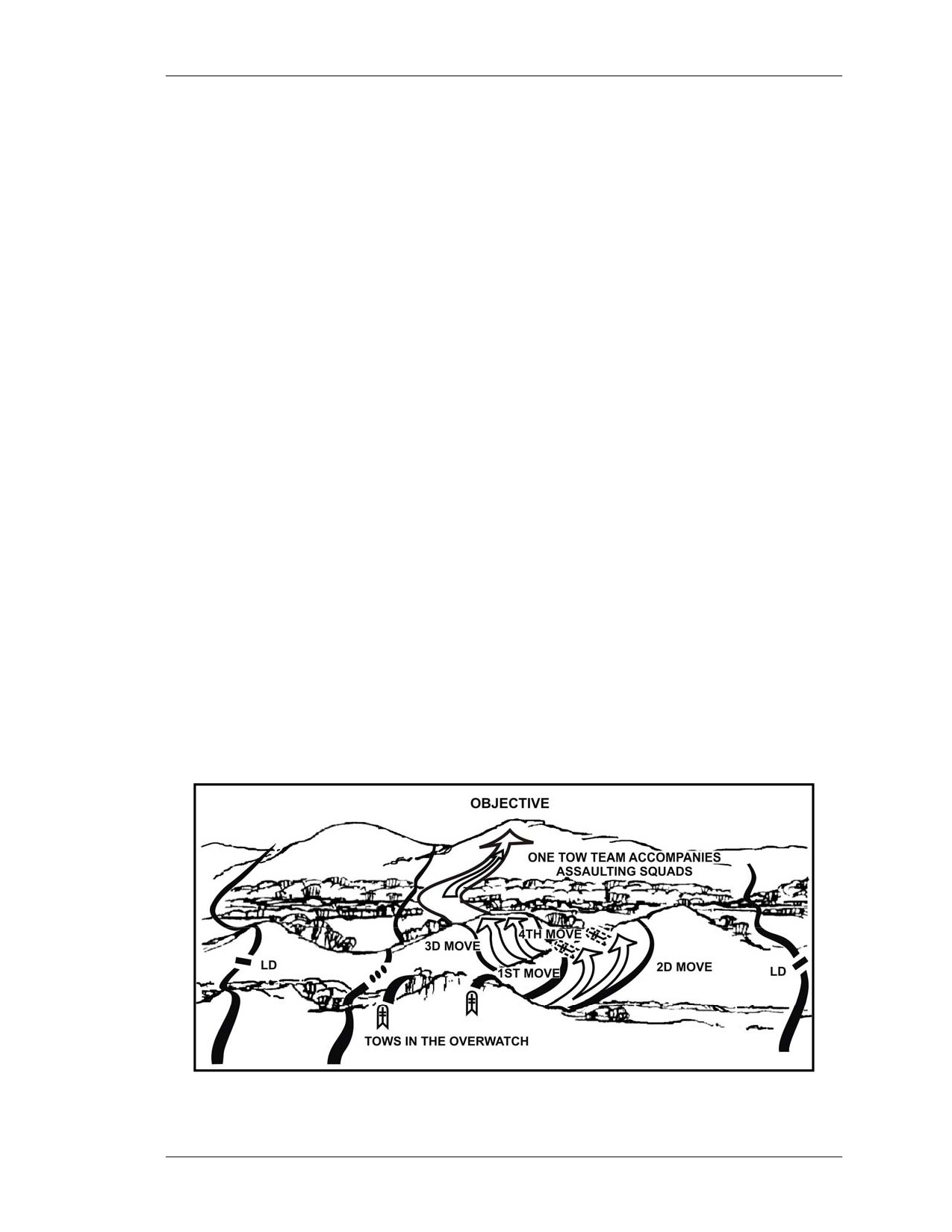
TOW is normally used in a support-by-fire role during offensive operations. The primary
consideration for such employment is the availability of appropriate fields of fire and the
armored threat. TOW crews can, however, effectively protect flanks against armored
threats and can also provide overwatch for unit movement (Figure 5-1).
Figure 5-1. TOW supporting offensive operations.
8 July 2005
5-3
FM 3-22.32
5-4.
ANTIARMOR AMBUSH ROLE
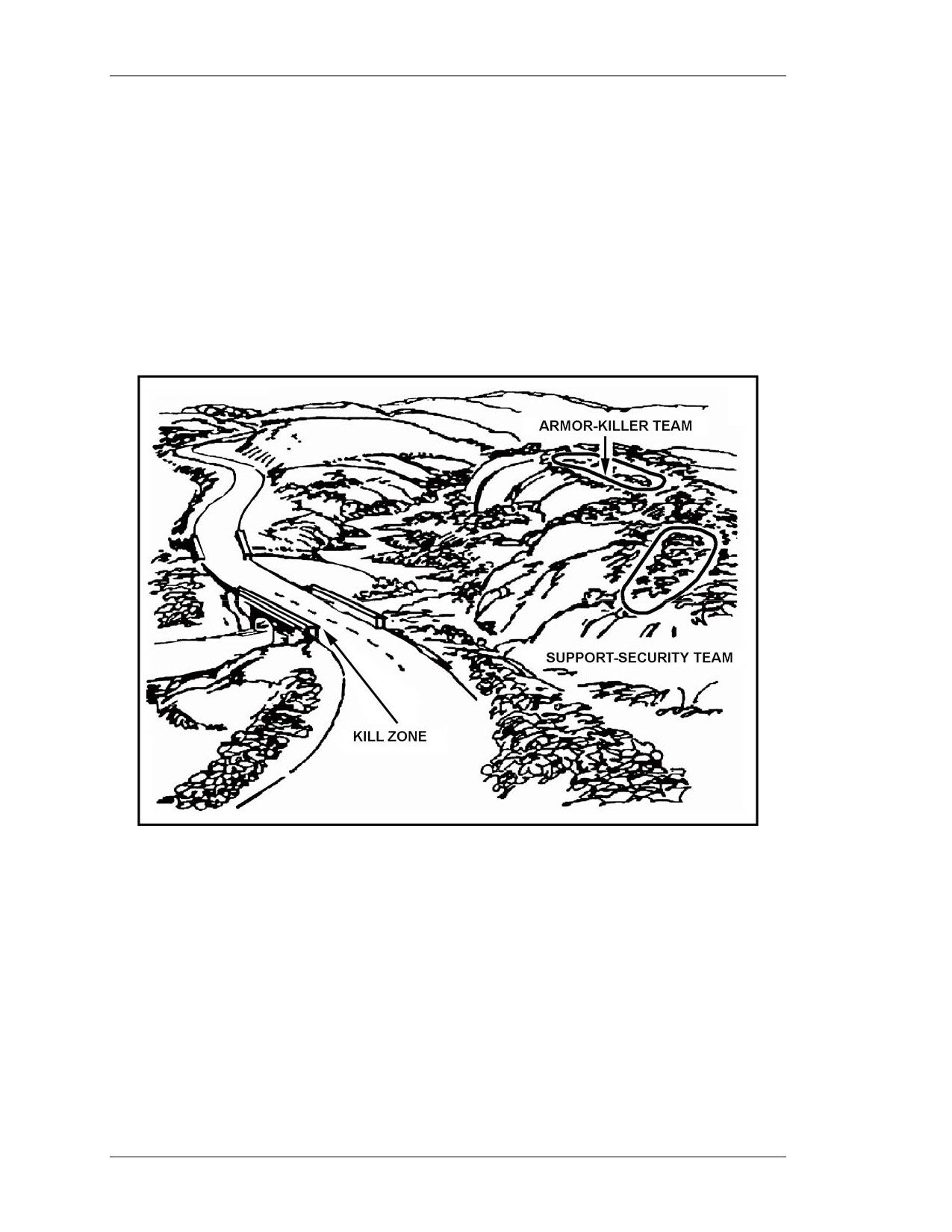
Antiarmor ambushes are usually conducted to destroy small groups of armored vehicles,
force the enemy to move more slowly and cautiously, or force the enemy into a choke
point. Any unit conducting an antiarmor ambush can use the TOW for this purpose. The
TOW has a relatively slow rate of fire, so other weapons systems must be prepared to
engage the vehicles while the TOW gunners load new rounds. The 3,750-meter range of
the TOW missile allows some flexibility in choosing ambush positions. In addition to
fires into the kill zones, the TOW can be employed in a security role to guard high-speed
avenues of approach, to slow or stop enemy reinforcements, or to destroy vehicles
attempting to flee the kill zone (Figure 5-2).
Figure 5-2. Antiarmor ambush.
5-5.
DEFENSIVE OPERATIONS
In the defense the antiarmor section leader is responsible for assigning sectors to the
ITAS squad. The squad leader chooses the location that can best cover the sector while
applying the basic fundamentals of employment. During planning, the leader considers
the enemy armor threat, then positions antiarmor weapons accordingly to cover armor
avenues of approach. He also considers the fields of fire, tracking time, and minimum
engagement distance of each weapon. The section leader or squad leader selects a
primary position and sector of fire for each antiarmor weapon. He also picks alternate and
supplementary positions for them. Each position should allow flank fire and have cover
and concealment. The leader should integrate the ITAS into his limited visibility security
5-4
8 July 2005

FM 3-22.32
and observation plan. The gunner prepares a range card for his primary position; if time
permits, he also prepares them for his alternate and supplementary positions.
a. Personnel Duties. The tasks listed below must be
performed
to successfully
employ the ITAS in the defense (Table 5-1).
AA
AA
SECTON
SECTION
----------
DRIVER/
TASKS TO BE PERFORMED
-----------
GUNNER
SECTION
LOADER
SQUAD
SERGEAN
LEADER
T
Integrate TOW into the tactical
plan:
• Select general weapons
positions.
X
• Assign sectors of fire.
• Coordinate mutual support.
• Coordinate with adjacent
units.
Reconnoiter for and select
tentative firing positions
(primary, alternate, and
X
X
supplementary) and routes
between positions.
Supervise continual preparation
X
X
X
and improvement of positions.
Coordinate security for the
X
squads.
Inspect the selection of tentative
firing positions and confirm or
X
X
X
make adjustments.
Supervise preparation of
X
X
antiarmor range card.
Control movement of crews
X
X
between positions.
Issue fire command to gunners.
X
X
Coordinate resupply.
X
Identify enemy avenues of
X
approach.
Prepare fighting positions
(primary alternate and
X
X
X
supplementary).
Prepare antiarmor range card.
X
Designate target reference
X
points.
Prepare rounds for firing.
X
React to fire commands.
X
Engage targets.
X
Table 5-1. Personnel duties.
8 July 2005
5-5
FM 3-22.32
b. ITAS Placement. The squad leader selects the fighting position and assigns the
sector of fire. Considering the fundamentals of antiarmor employment will greatly
improve the crew’s survivability.
(1) Integrate with Adjacent Units. ITAS crews must coordinate with adjacent units to
ensure security.
(2) Engage at Maximum Range. The TOW’s 3,750-meter maximum range makes it
difficult for the enemy to engage the crew with direct fire, which forces the enemy to
deploy earlier than intended.
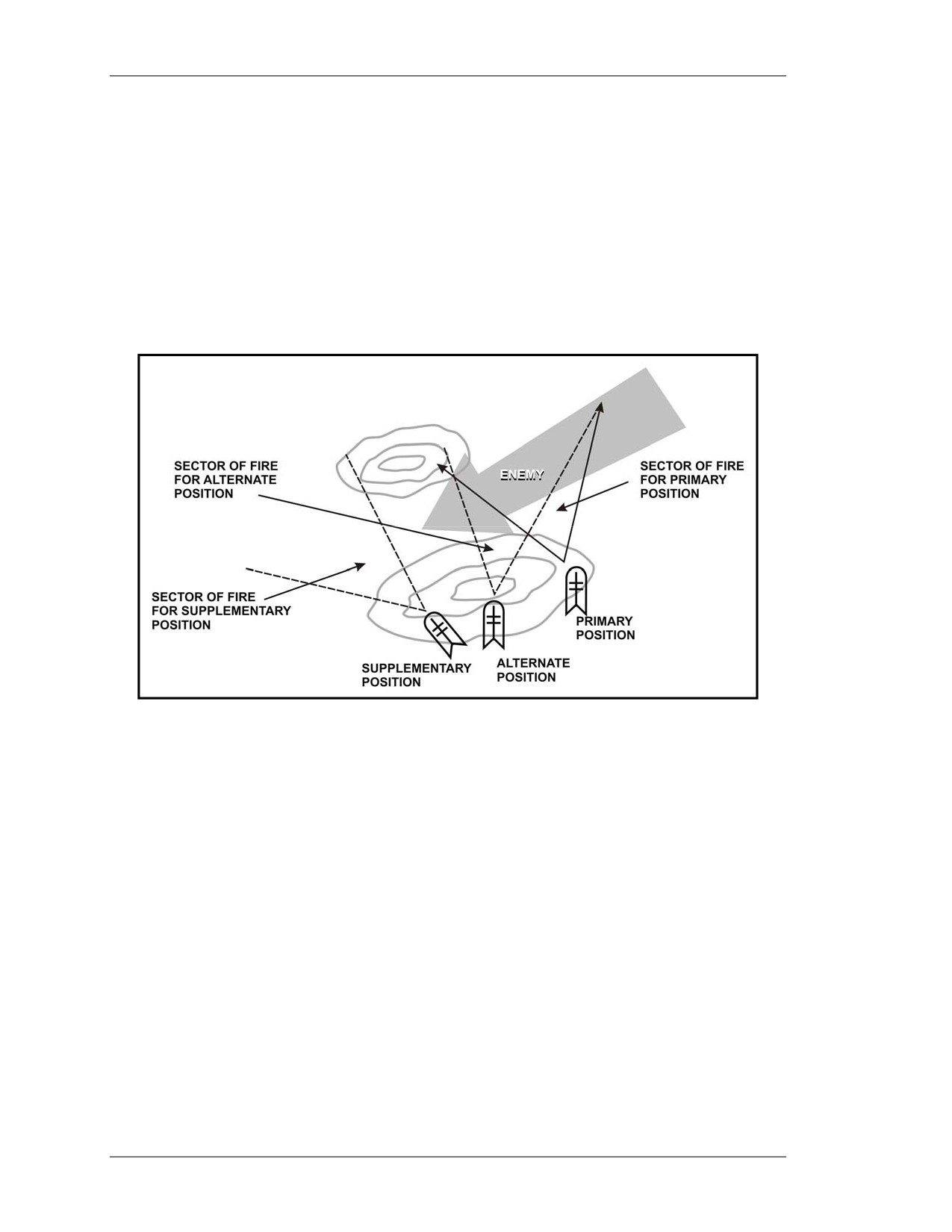
c. Positions. The three types of firing positions are primary, alternate, and
supplementary (Figure 5-3).
Figure 5-3. Primary, alternate, and supplementary firing positions.
(1) Primary. The primary position is one from which a gunner or team can cover the
assigned sector of fire. It should have good observation, cover and concealment, and
good fields of fire.
(2) Alternate. The alternate position is one from which a gunner or crew can either
move to the flank or slightly to the rear of the primary position. The gunner or crew must
be able to cover the same sector of fire as from the primary position. The gunner moves
to the alternate position when the primary position can no longer be occupied. The
decision to change positions is made by the leader.
(3) Supplementary. The supplementary position is one from which a gunner or crew
covers avenues of approach and any TRPs not covered by the primary and alternate
positions. This position is usually close enough to the primary position to share mutual
support with other positions. This position should also have good observation, cover and
concealment, and good fields of fire.
5-6
8 July 2005
FM 3-22.32
5-6.
OTHER TACTICAL OPERATIONS
Other tactical operations the ITAS may be employed in include stability and support and
urban operations.
a. Stability and Support Operations. During stability operations, ITAS crews may
be used against an armored threat if one exists. If no armored threat exists, the ITAS crew
can provide an enhanced surveillance capability. In the case of roadblocks, TOW crew
can provide protection against vehicles that attempt to run the roadblock. To be effective
in this task, the crew must be able to position itself where they have an unimpeded view
of the approaches to the roadblock. The gunner must clearly understand the rules of
engagement (ROE) to know when he is authorized to engage targets, which may be at
minimum range. The observation capability of the ITAS may be useful during support
operations, but it is not likely that a missile will ever be fired.
b. Urban Operations. The TOW is primarily used to defeat main battle tanks and
other armored combat vehicles. It has a moderate capability against bunkers, buildings,
and other fortified targets commonly found during combat in built-up areas; therefore, the
TOW may not be the weapon of choice in the urban environment (FM 3-06.11
[FM 90-10-1]).
(1) TOW crews provide overwatching antitank fires during the attack of a built-up
area. Within built-up areas, they are best employed along major thoroughfares to attain
adequate fields of fire. The minimum engagement distance limits firing opportunities in
the confines of densely built-up areas.
(2) Additional considerations include fires, caused by both friendly and enemy, that
may cause target acquisition and lock-on problems and clutter on the battlefield, which
may cause lock-on problems.
5-7.
ENGAGEMENT CONSIDERATIONS
Engagement considerations for the TOW include engagement distance, crossover,
backblast, weapon penetration, and breaching structural walls. TOW systems should
always seek to engage at maximum range. If within 1,000 meters of an enemy, the flight
time of the TOW missile would likely be greater than the flight time of a main gun tank
round.
a. Engagement Distance. The TOW has a minimum range of 65 meters and a
maximum range of 3,750 meters. The TOW 2B has a minimum range of 200 meters and
a maximum range of 3,750, which limits its use in built-up areas. Few areas in the inner
city permit the gunner to fire much beyond the minimum arming distance. The gunner is
usually limited to firing down streets, rail lines, parks, or plazas.
b. Crossover. At times, the ATT will not be able to distinguish between the
background and the target because the two will have the same temperature (crossover). In
this situation, the gunner can use manual engagement to engage targets, if visibility
permits.
c. Breaching Structural Walls. The TOW is not effective when breaching
structural walls. The antitank guided missiles (ATGMs) are not designed to breach
structural walls effectively.
8 July 2005
5-7
FM 3-22.32
Section III. FIGHTING POSITIONS
TOW fighting positions may be mounted or dismounted, depending on the situation. A
camouflage net can be used with either configuration.
5-8.
DISMOUNTED TOW FIGHTING POSITION
A dismounted
(tripod-mounted) TOW fighting position must meet the following
specifications:
• Allows the squad to engage the enemy in its assigned sector of fire.
• Provides protection for both the weapon and its crew.
• Blends with its surroundings so that it cannot easily be detected 35 meters to
the front and cannot be seen from the air.
a. The position should be constructed sequentially as follows:
(1) Assemble the launcher.
(2) Clear the fields of fire while ensuring the sector is under observation.
(3) Dig the weapon position first, then add overhead protection for the crew.
(4) Build a parapet to the front and flanks of the position.
(5) Disconnect the MGS and place it in the position made for it. Place the launcher
into the position. Reconnect the MGS and check the boresight.
(6) Improve the position by adding overhead cover for the crew and system.
(7) Camouflage the position.
(8) Inspect the position and its camouflage. If possible, move at least 35 meters to the
front of the position and study it.
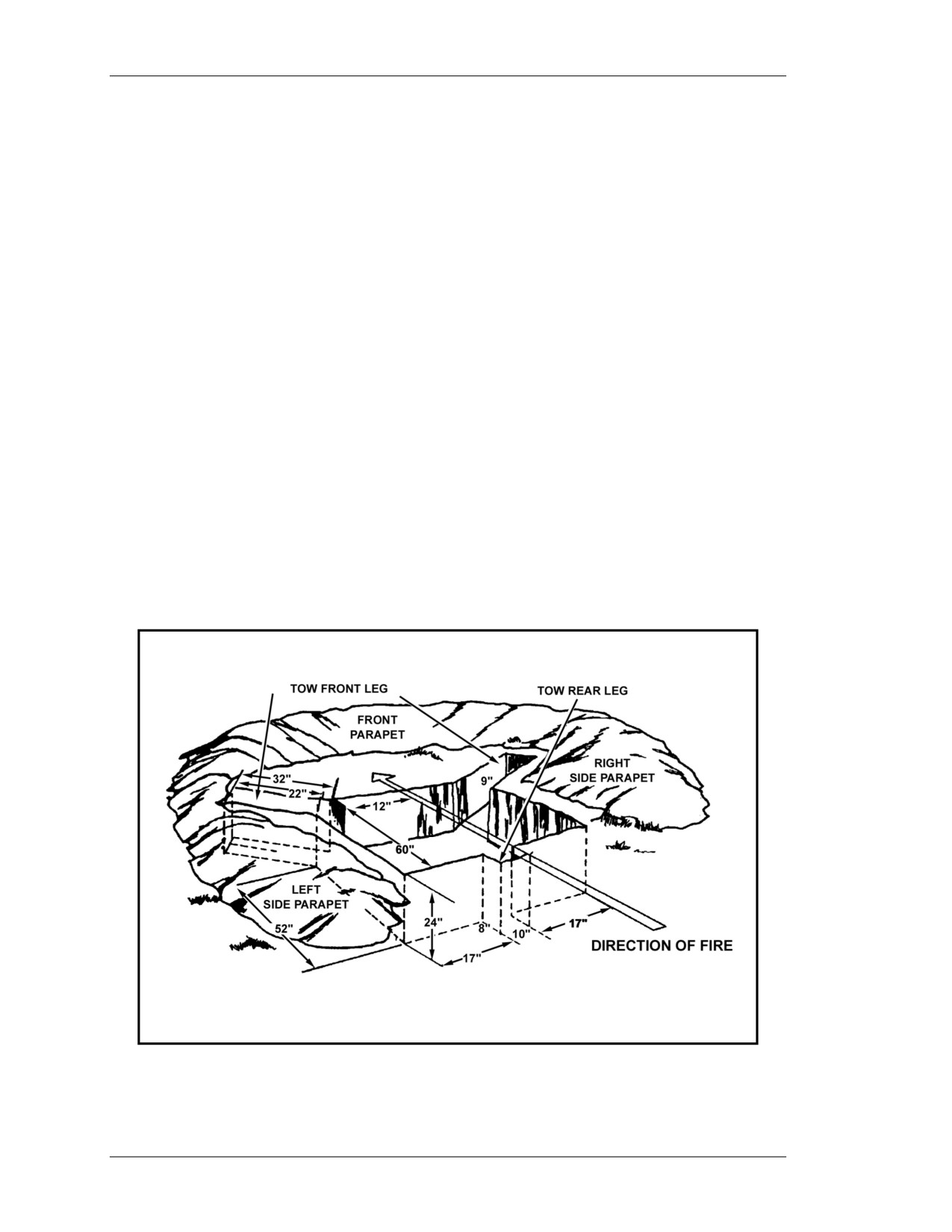
b. The initial position should look like the position in Figure 5-4.
Figure 5-4. Tripod-mounted TOW fighting position.
5-8
8 July 2005
FM 3-22.32
(1) Make the position 24 inches deep.
(2) Make the parapet at least 18 inches thick to keep out small-arms fire and artillery
fragments. It should provide 9 inches of muzzle clearance under the launch tube.
(3) Do not place dirt or equipment in the backblast area.
(4) Scoop out a place for the MGS either under or to the front of the tripod.
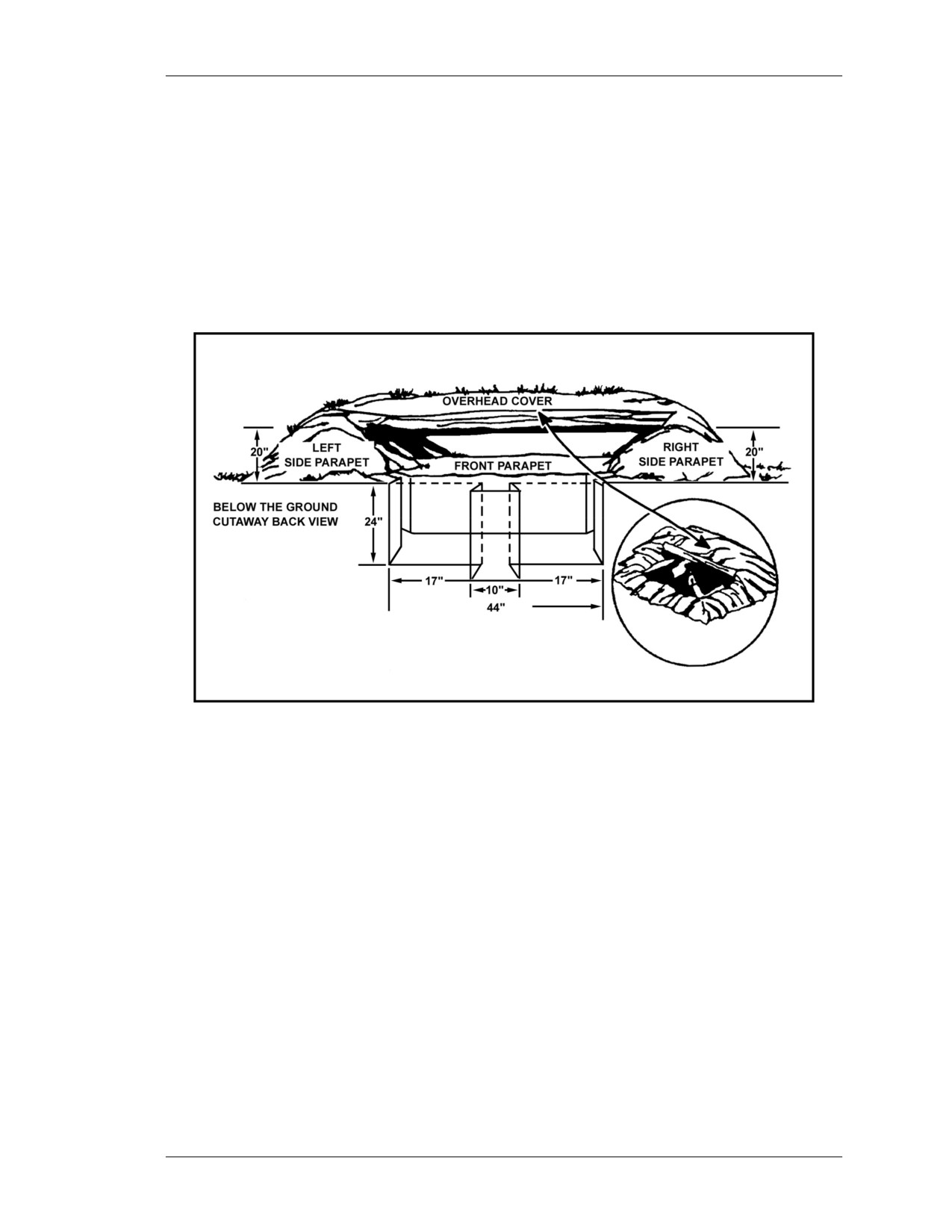
(5) Dig a storage/protective area for the crew and missiles to one flank at a 90-degree
angle to the primary direction of fire. Use the strongest material available for the roof.
Put canvas or plastic down before throwing dirt on the roof to keep the ceiling from
leaking. Place at least 20 inches of dirt on top of the storage/protective area (Figure 5-5)
Figure 5-5. Storage/protective area.
(6) Ensure the ground behind the TOW is free of leaves and dirt out to 25 meters so
the backblast does not leave a signature.
(7) Ensure all the standard principles of camouflage are followed. (For example,
cover all fresh dirt with leaves and brush, replace withered foliage, always approach
position from rear, and so forth.)
5-9.
MOUNTED TOW FIGHTING POSITION
A mounted TOW fighting position must meet the following specifications:
• Does not restrict the TOW’s target engagement.
• Provides concealment from ground and air observation for the crew and
vehicle.
• Backblast area is as clear as possible of debris that would increase launch
signature.
a. Camouflage and conceal the firing position.
(1) All vehicles travel to a position over the same route to prevent the enemy from
detecting the number of vehicles present.
8 July 2005
5-9
FM 3-22.32
(2) The route taken should follow existing paths, roads, fences, or natural lines in
terrain.
(3) Exposed routes should not end at a position.
(4) If only a short portion of the route into a position is exposed, sweep out the tracks
with tree branches.
(5) Traffic in and out of a position should be held to essential movements only.
(6) Upon moving into a position, be sure to erase the trail leading into it.
(7) Ensure all standard principles of camouflage are adhered to
(same as for
tripod-mounted position).
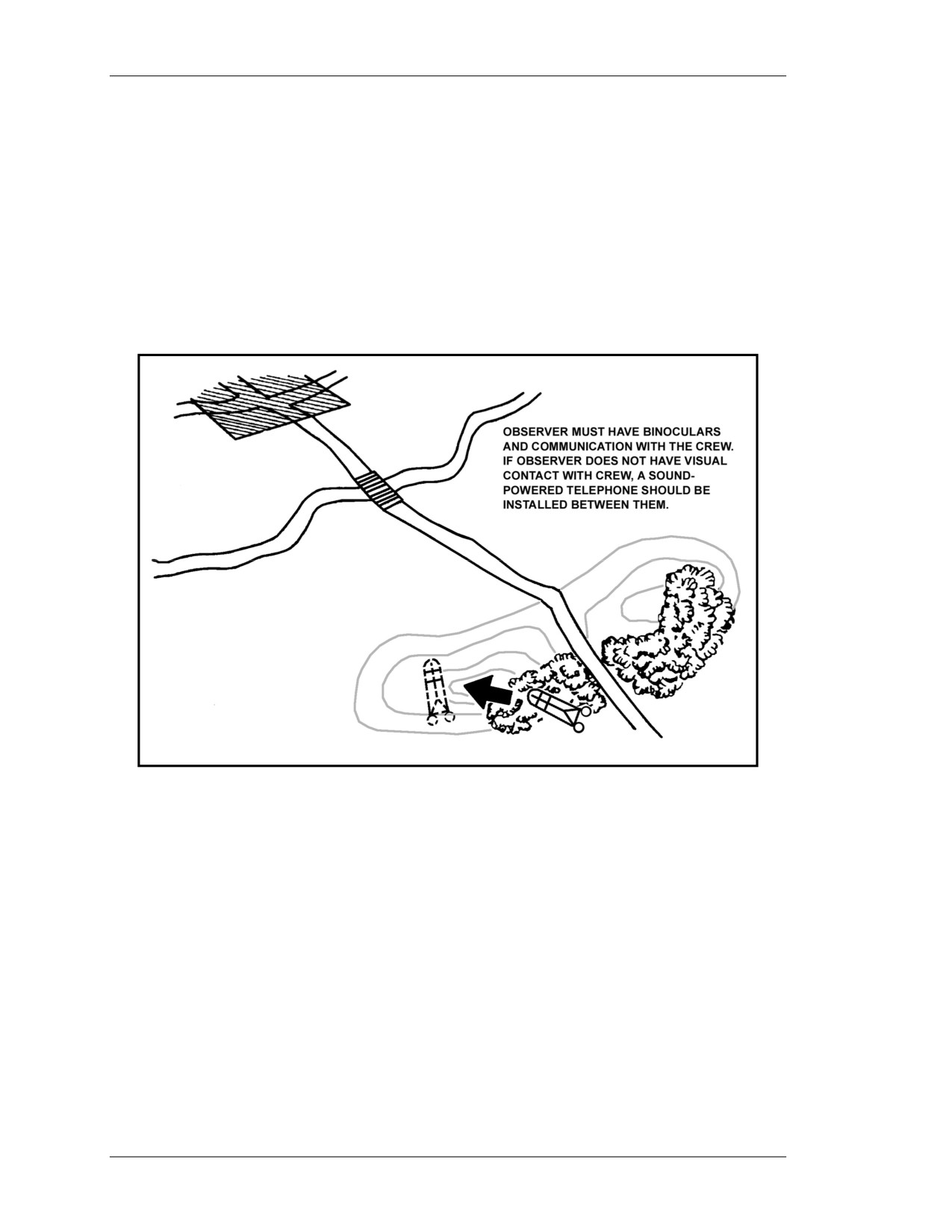
b. If a hull-down position is not available, use a hide position (Figure 5-6).
Figure 5-6. TOW hide position.
c. If possible, move at least 35 meters in front of the position to ensure that it looks
natural and blends with its surroundings.
5-10. CAMOUFLAGE NETS
When camouflaging any TOW fighting position, whether mounted or dismounted, the net
must be positioned so it does not hang in the backblast area. If any portion of the net is in
the backblast area, the net will be damaged and could collapse on top of the launcher
when a missile is launched. Also, the net must not interfere with the field of fire.
5-10
8 July 2005
FM 3-22.32
Chapter 6
TRAINING PROGRAM
The ITAS training program integrates the ITAS into the overall unit
training program to increase combat readiness and ensure trainers and
gunners are proficient in operating and maintaining the ITAS. The
strategy is a multiechelon, device-based program that allows the unit to
train at individual, crew, platoon, and company levels. The foundation of
this training program is obtaining and sustaining individual basic skills
through a train-the-trainer concept with collective training as the
capstone to ensure these skills are battle-focused to support the unit’s
mission-essential task list
(METL). The recommended training plan
incorporates current doctrine, technology, and guidance to prepare the
ITAS gunner, crew, and unit to survive and win.
6-1.
TRAINING STRATEGY
The commander must know the current status of ITAS training in the unit. He conducts
an assessment to determine the initial and sustainment training required to maintain the
proficiency of the ITAS crews. The commander is responsible for providing guidelines
on training ITAS crews. The unit’s training program is based on the unit’s METL, battle
focus, and the supporting individual, leader, and collective tasks. The ITAS training
strategy is composed of five primary components:
• Initial training.
• Sustainment training.
• Collective training.
• Force-on-force training.
• Leader training.
a. Initial Training. Initial gunner training is conducted at the institution during the
one-station unit training
(OSUT) program of instruction (POI). All infantry OSUT
soldiers attend familiarization training on antiarmor weapons, which consists of a period
of instruction designed as an overview of the TOW weapon system. Initial gunner
training is conducted in the unit for soldiers assigned to ITAS crews. Trainers will use the
guidelines prescribed in this chapter to train their crewmembers, culminating in the
successful completion of the GST.
b. Sustainment Training. Sustainment training ensures soldiers retain skills learned
during initial training. This training takes place entirely in the unit monthly, bimonthly,
quarterly, and annually.
(1) Gunners retain their skills by practicing target engagement at least monthly, firing
10 out of 20 missions from the monthly sustainment exercises using the BST. Gunners
practices field engagements using the FTT every quarter. Once each quarter, the gunner
completes the entire GST. If the gunner does not perform satisfactorily, he retrains and
retests until he does.
(2) As individual ITAS crewmen, squads, sections, and platoons become qualified,
the commander maintains that status by sustainment training and evaluation, and by crew
stabilization. While personnel changes are inevitable, changes within squads should
8 July 2005
6-1
FM 3-22.32
ensure maximum stability for the longest periods of time in units. Personnel changes
should be examined in detail to ensure crew integrity and combat readiness.
c. Collective Training. Collective training is the coordinated performance of
individual skills and tasks as a team. Collective tasks are normally performed by more
than one soldier. Collective training takes place in the unit to integrate the ITAS into the
unit’s overall combat power using the FTT.
(1) Common crew task training is the first level of collective training. Common crew
tasks provide the basic technical collective tasks performed by the crew to accomplish the
wartime mission. These tasks tell “how to” and allow each soldier in the crew to perform
his tasks. As a result, the squad leader, gunner, driver, and loader combine their learned
individual technical skills to perform as one crew on their assigned vehicle.
(2) The critical squad and platoon collective tasks are called battle drills. Battle drills
are mostly independent of METT-TC and require minimal leader actions to execute.
They are standardized throughout the U.S. Army. Battle drills are found in the applicable
drill book for each echelon and equipment-type unit. The battle drills for antiarmor
platoons are found in ARTEP 7-91-Drill.
(3) Common crew tasks are tasks performed by an ITAS crew that are not battle drills
but are performed in the same manner. An example of a common crew task is
Dismount/Remount the ITAS. Crew tasks are crucial to applying tactics to enhance
survival and to accomplish the ITAS crew’s mission of providing antiarmor direct fire
support to destroy the enemy.
(4) Collectively, common crew tasks and battle drills form each action the crew must
perform. For example, this manual discusses the common crew tasks to mount, stow,
dismount, and engage a target with an M41 ITAS TOW missile launcher mounted on an
M1121 HMMWV.
(5) ARTEP training exercises are used to practice, evaluate, and sustain collective
tasks and mission proficiency. They have specific goals and are modified based on
METT-TC factors. Exercises are structured to the availability of resources, time, and
training areas. (See appropriate ARTEP7-91-MTP for details on planning and conducting
an ARTEP exercise.)
d. Force-On-Force Training. Force-on-force training is conducted with the FTT
during squad, platoon, company, and FTX/STX. It helps sustain proficiency on the proper
ways to scan for and engage targets using the ITAS in a tactical environment.
e. Leader Training. Leaders are taught to train, maintain, and employ the ITAS in
courses such as OES and NCOES. The training must continue in units formally through
NCO and officer professional development classes and informally through personal
initiative. Leader training is conducted in both the institution and the unit.
(1) ITAS leader training begins with the basic understanding of the ITAS, its
capabilities and limitations; then moves to understanding the fundamentals of ITAS
tactical employment; and includes how to integrate the ITAS into company-level training.
(2) Leaders must learn and then practice how to employ and integrate ITAS into their
units. Using TEWT is an effective way to develop the leader’s tactical understanding.
Employing gunners with their squads helps train other squad or fire team members to
perform their duties (providing security, locating targets, and so on). After-action reviews
must be conducted after all training exercises so ITAS security, operation, and
6-2
8 July 2005
FM 3-22.32
employment considerations can be more effectively integrated into the unit-training plan.
(For more information on tactical employment see FM 3-21.91[FM 7-91]).
6-2.
COMMANDER’S TRAINING ASSESMENT AND PLANNING
All mandatory ITAS gunnery training and testing is included in the 12 ITAS gunnery
exercises plus the quarterly GST. However, the commander must still conduct an
accurate assessment of the state of ITAS training in his unit to determine the additional
training necessary to prepare the unit for the quarterly and semiannual exercises. The
commander must remember that the unit must meet the standards outlined in DA
Pam 350-38 to be certified in the training status C1, fully trained. An accurate
assessment of training requirements and thorough planning produce an effective unit
training program. The commander should start early, be thorough, and be flexible and
creative. All aspects of the training program should be coordinated to produce the
desired results.
a. The commander should refer to FM 7-1, when developing his unit training
program. This FM applies the doctrine established in FM 22-100, and assists leaders in
the development and execution of training programs.
b. The heart of an effective training program is the development of a METL and the
soldier tasks, leader tasks, and collective tasks that support the METL. Battle focus drives
the METL development process; the METL is based on the wartime mission, and the unit
must train as it plans to fight. FM 7-1 illustrates this process in clear and practical terms.
c. Once the commander has developed the unit METL and referenced the
appropriate field manuals, he must look at the training strategy to ensure that it is
incorporated as part of the total Army ITAS training strategy.
6-3.
TRAINING DEVICES
The ITAS/TOW system includes three training devices: the BST, the FTT, and the MSR.
Use the three training devices in combination to produce a highly skilled ITAS gunner.
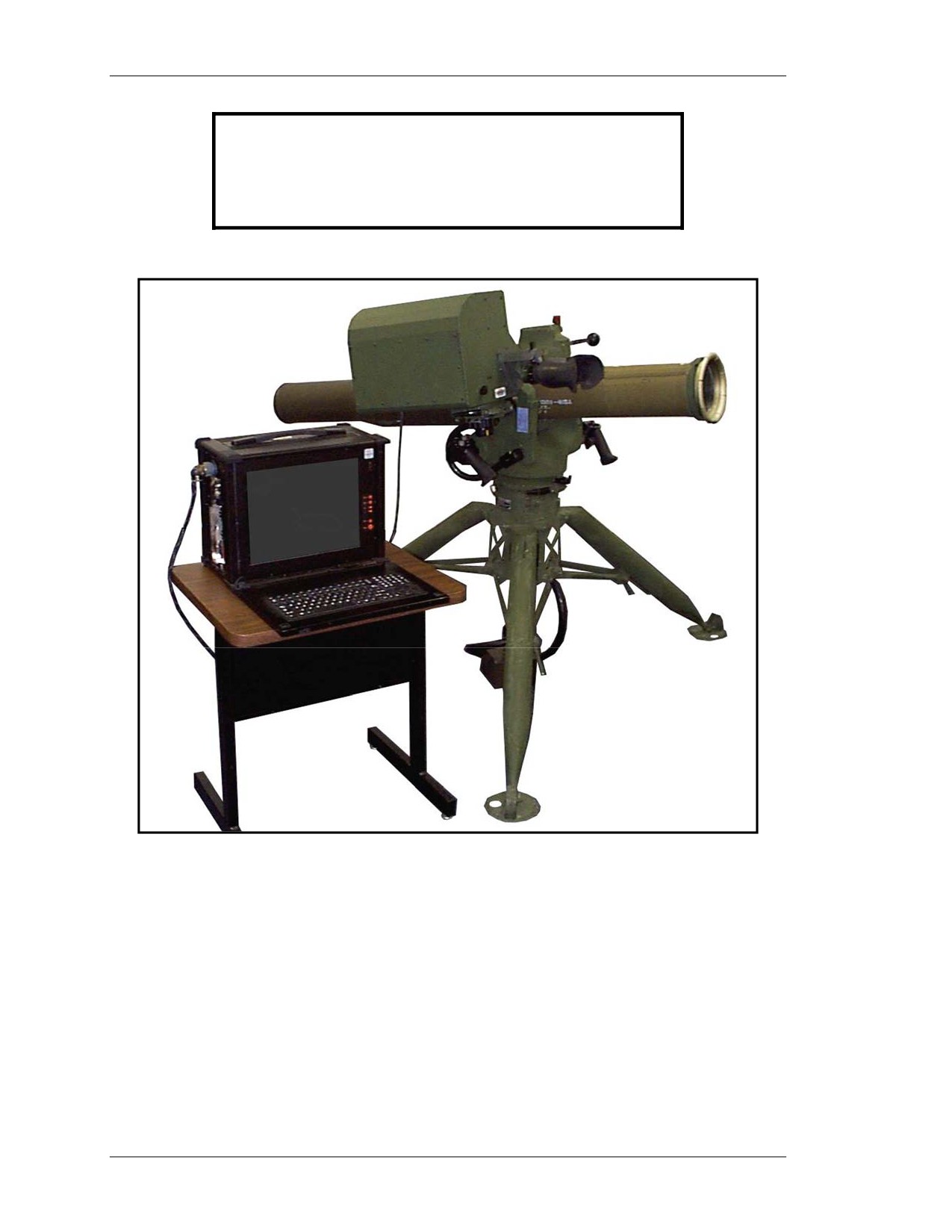
a. Basic Skills Trainer. The ITAS BST is the primary training device for initial,
sustainment, practice, and qualification of individual gunner skills for the ITAS (Figure
6-1, page 6-4). It simulates most tactical scenarios and system malfunctions that ITAS
gunners may encounter on the modern battlefield. The ITAS BST consists of two major
components: a portable personal computer called the instructor station and a student
station. The ITAS BST introduces new soldiers to the actual ITAS controls, handgrips,
and system responses by connecting directly to the tactical system TU and accurately
simulating all system functions including on-screen menus, laser ranging, and missile
flight. The BST helps more advanced soldiers master system operation through
progressive levels of training requiring a better understanding of all target engagement
procedures including target detection, classification, recognition and identification; ATT
operation; and manual tracking.
8 July 2005
6-3
FM 3-22.32
CAUTION
The BST is a computer and can be damaged or
destroyed if treated roughly. Do not expose the BST
to dirt, extreme humidity, or extreme temperature
changes.
Figure 6-1. Basic skills trainer.
(1) Instructor Station. The instructor station equipment centers around a desktop
personal computer (PC) that provides the means to install or upgrade software, create and
save gunner training records, and monitor gunner performance during an exercise. It is
controlled by point-and-click mouse commands with a means for entering and saving
gunner training record data on a 3.5-inch disk. The instructor station allows the instructor
to monitor the gunner’s actions during the exercise. After the exercise is over, the
monitor can be used to critique the gunner’s performance by replaying the exercise.
(2) Student Station. The student station consists of a simulated tactical acquisition
system (STAS) and a simulated fire control system (SFCS) used in conjunction with the
tactical TU and tripod. It reproduces simulated battlefield imagery—visual indicators the
6-4
8 July 2005
FM 3-22.32
gunner uses during target engagement—and operational sounds from a built-in
speaker system.
(3) Training Exercises. The BST contains training exercises for initial ITAS training
and qualification with two retests for each qualification exercise. The initial training and
qualification exercises are stored in separate directories with additional directories for
sustainment and advanced gunnery training. Exercises contain terrain models,
three-dimensional target models, weather conditions (rain, snow, fog, and so forth), and
malfunctions (hangfire, misfire, and so forth). Exercise run times are from one to seven
minutes long.
(4) Simulated Imagery. The computer-generated infrared and daylight imagery
reflects the magnification and spectral capabilities of the ITAS. The BST training
exercises use digital images of real terrain from actual visible light and infrared imagery.
As the gunner works through an exercise, identical imagery is displayed on the instructor
station.
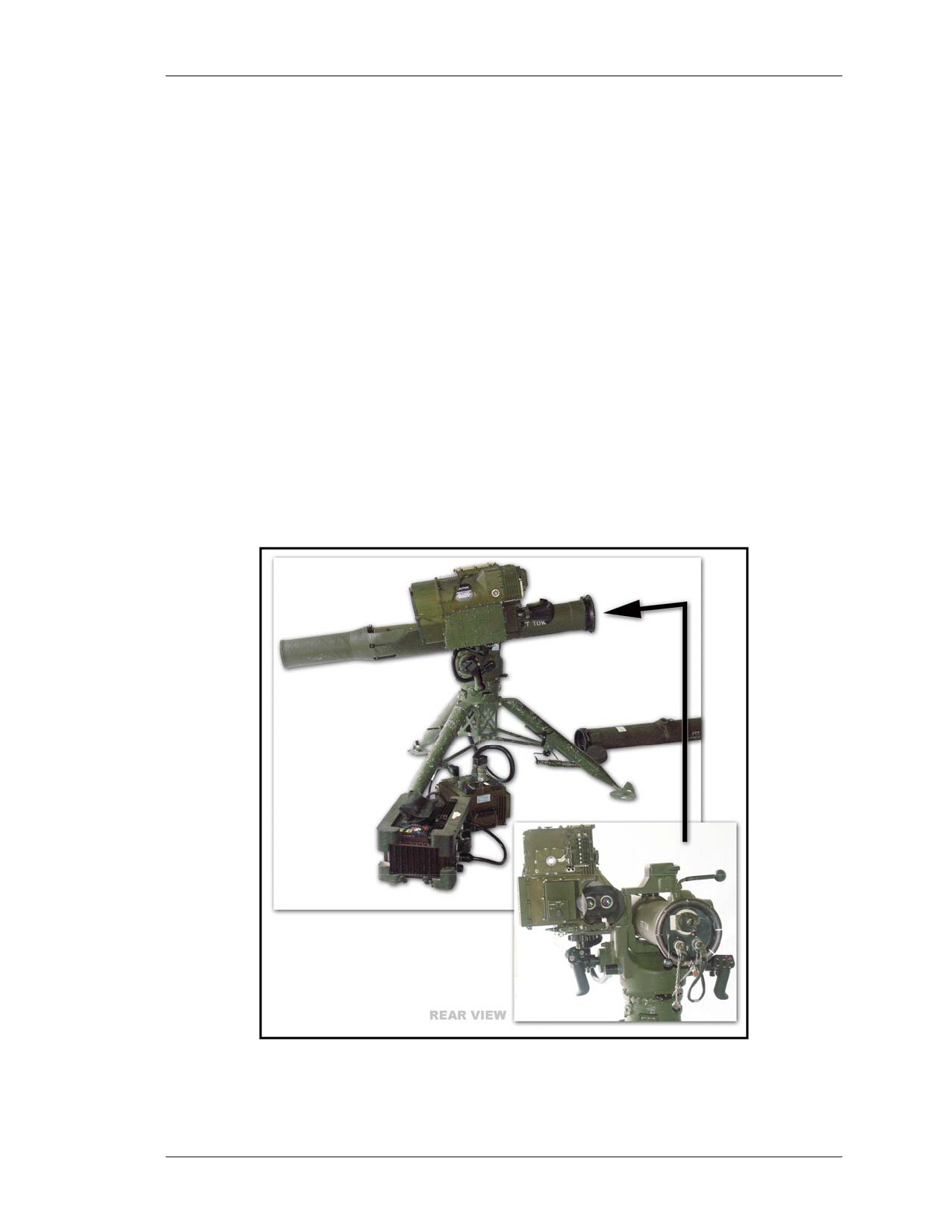
b. Field Tactical Trainer. The FTT is a fully integrated, three-dimensional
force-on-force training device. It combines the TAS with a simulated round, which
incorporates a MILES laser transmitter to allow simulated ITAS engagements during
training exercises. The FTT simulates the operation and engagement parameters of the
ITAS (Figure 6-2).
Figure 6-2. Field tactical trainer.
8 July 2005
6-5
FM 3-22.32
6-4.
TRAINING SUPPORT PACKAGES AND RESOURCES
Appropriate manuals will provide information received from courses, such as the
AntiArmor Leaders Course, and hands-on experience with the system. (These manuals
have not yet been published.)
• TOW Improved Target Acquisition System (ITAS) Basic Skills Trainer (BST)
Operator Maintenance Manual.
• TOW Improved Target Acquisition System (ITAS) Basic Skills Trainer (BST)
Instructor Guide.
• TOW ITAS Gunner, New Equipment Training, Student Guide.
• TOW ITAS Gunner, New Equipment Training, Instructor Guide.
• Technical Manual, Operator and Organizational Maintenance Manual for
TOW Improved Target Acquisition System (ITAS) M41, TM 9-1425-923-12.
• Instructor Certification Program.
6-5.
ITAS GUNNERY TRAINING
The ITAS gunnery training program is divided into four phases: individual gunnery,
squad gunnery, section gunnery, and platoon gunnery. Phase I (individual gunnery)
consists of the GST and ITAS Gunnery Exercises 1 through 4. Phase II (squad gunnery)
consists of ITAS Gunnery Exercises 5 through 8. Phase III (section gunnery) consists of
ITAS Gunnery Exercises 9 and 10. Phase IV (platoon gunnery) consists of ITAS
Gunnery Exercises 11 and 12. (Blank forms for scoring all gunnery phases are located in
the back of this manual for local reproduction.)
NOTE: The second quarterly GST should be conducted at least seven days prior to
conducting ITAS Gunnery Exercises 7 through 12.
a. Phase I—Individual Training. Phase I consists of sustainment training with the
BST and the tasks evaluated during the GST. It is conducted on a monthly basis to
maintain proficiency.
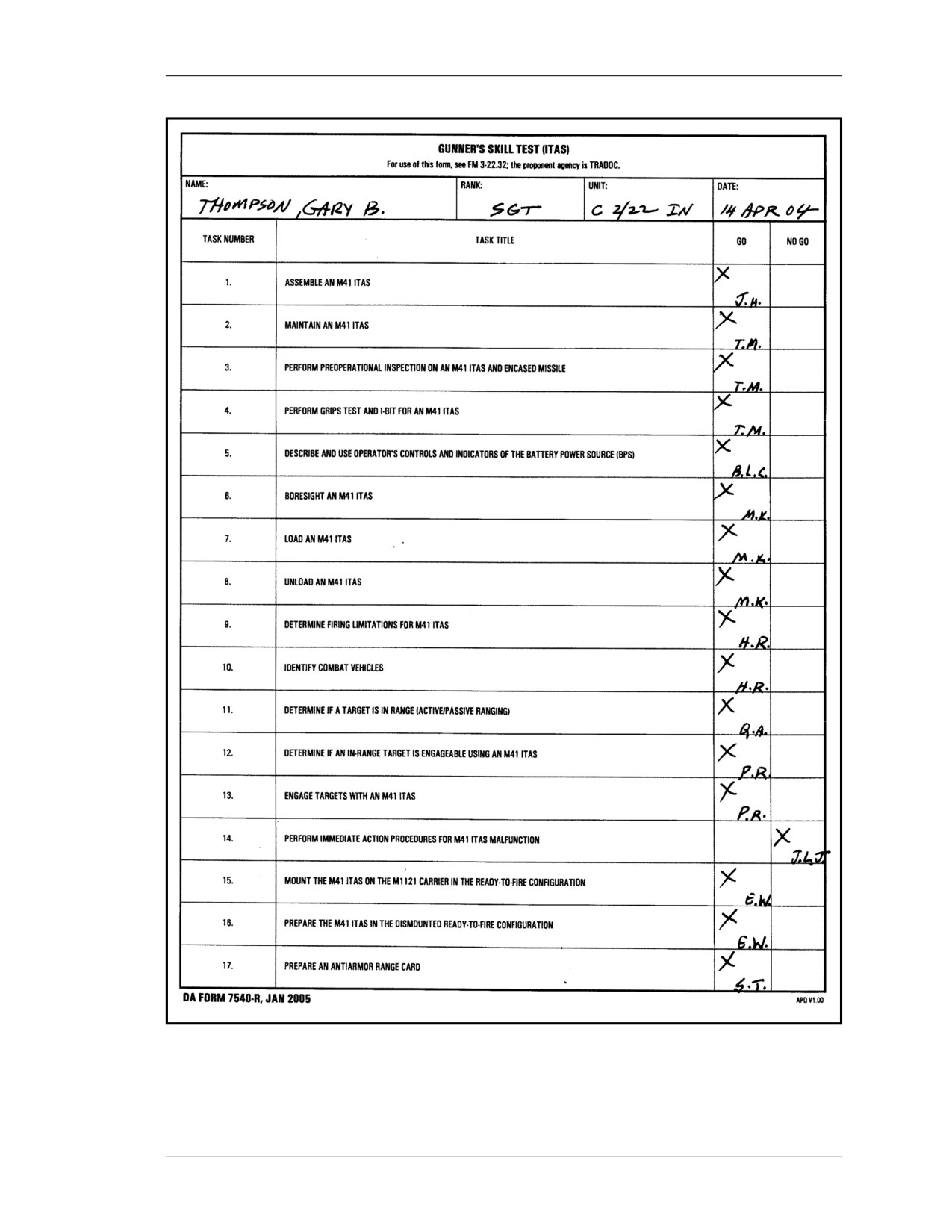
• Gunner Skills Test. Use DA Form 7540-R (Gunner’s Skill Test (ITAS)) to
score the Gunner’s Skill Test (Figure 6-3 shows an example of a completed
DA Form 7540-R).
• ITAS Gunnery Exercise 1, Individual Gunnery Practice.
• ITAS Gunnery Exercise 2, Individual Gunnery Sustainment.
• ITAS Gunnery Exercise 3, Individual Gunnery Qualification.
• ITAS Gunnery Exercise 4, Individual Gunnery Qualification Retest.
6-6
8 July 2005
FM 3-22.32
Figure 6-3. Example completed DA Form 7540-R.
8 July 2005
6-7
FM 3-22.32
b. Phase II—Squad Training. Phase II consists of refresher training on the set up
and operation of FTT or MILES equipment, as necessary, in preparation for ITAS
Gunnery Exercises 5 and 6 and sustainment training, as necessary, to prepare for ITAS
Gunnery Exercises 7 and 8.
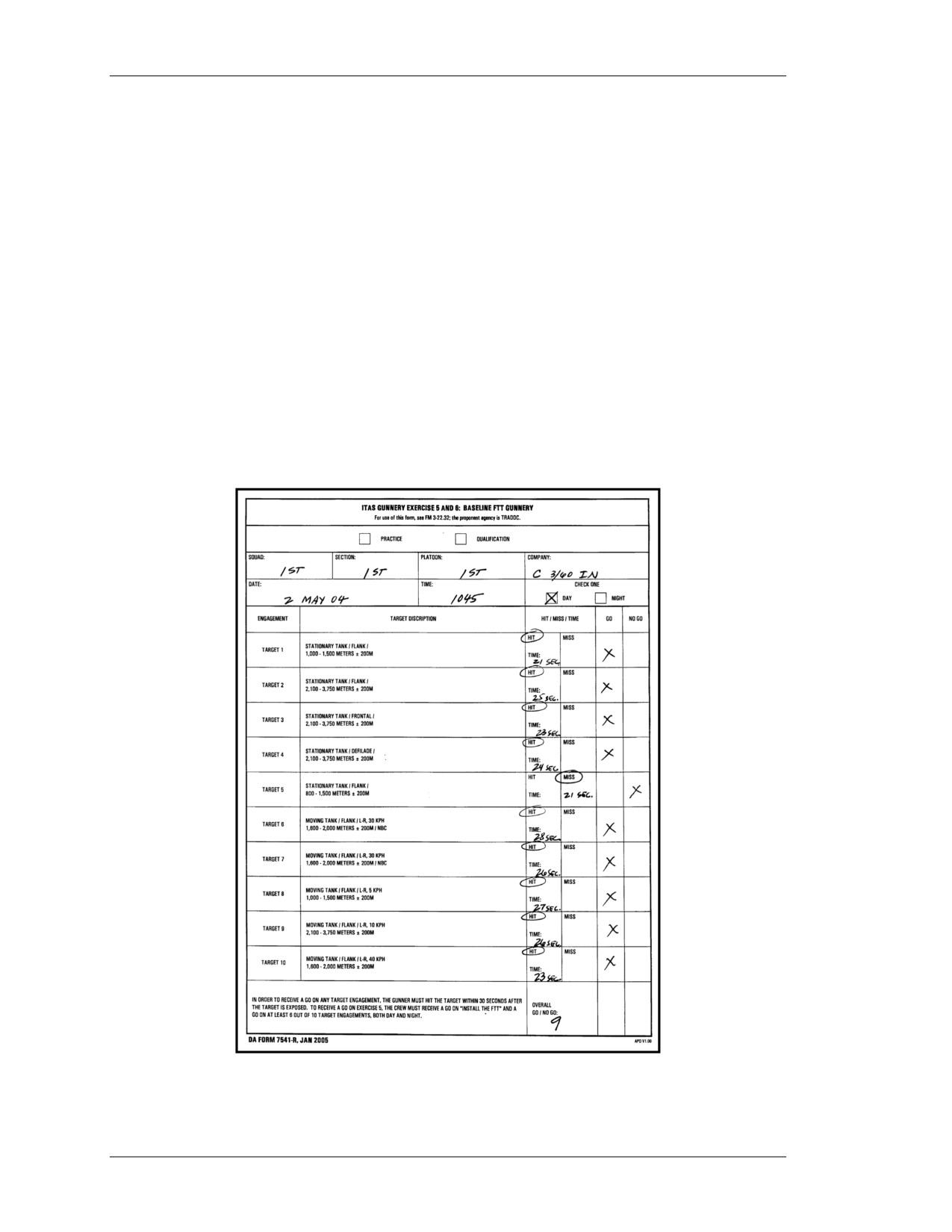
• ITAS Gunnery Exercise 5, Baseline Gunnery Practice. Use DA Form 7541-R
(ITAS Gunnery Exercise 5 and 6: Baseline FTT Gunnery) to score exercises 5
and 6. (Figure 6-4 shows an example of a completed DA Form 7541-R.)
• ITAS Gunnery Exercise 6, Baseline Gunnery Qualification.
• ITAS Exercise 7, Squad Gunnery Practice (in preparation for Exercise 8). Use
DA Form 7542-R (ITAS Gunnery Exercise 7: Squad Gunnery Practice FTT)
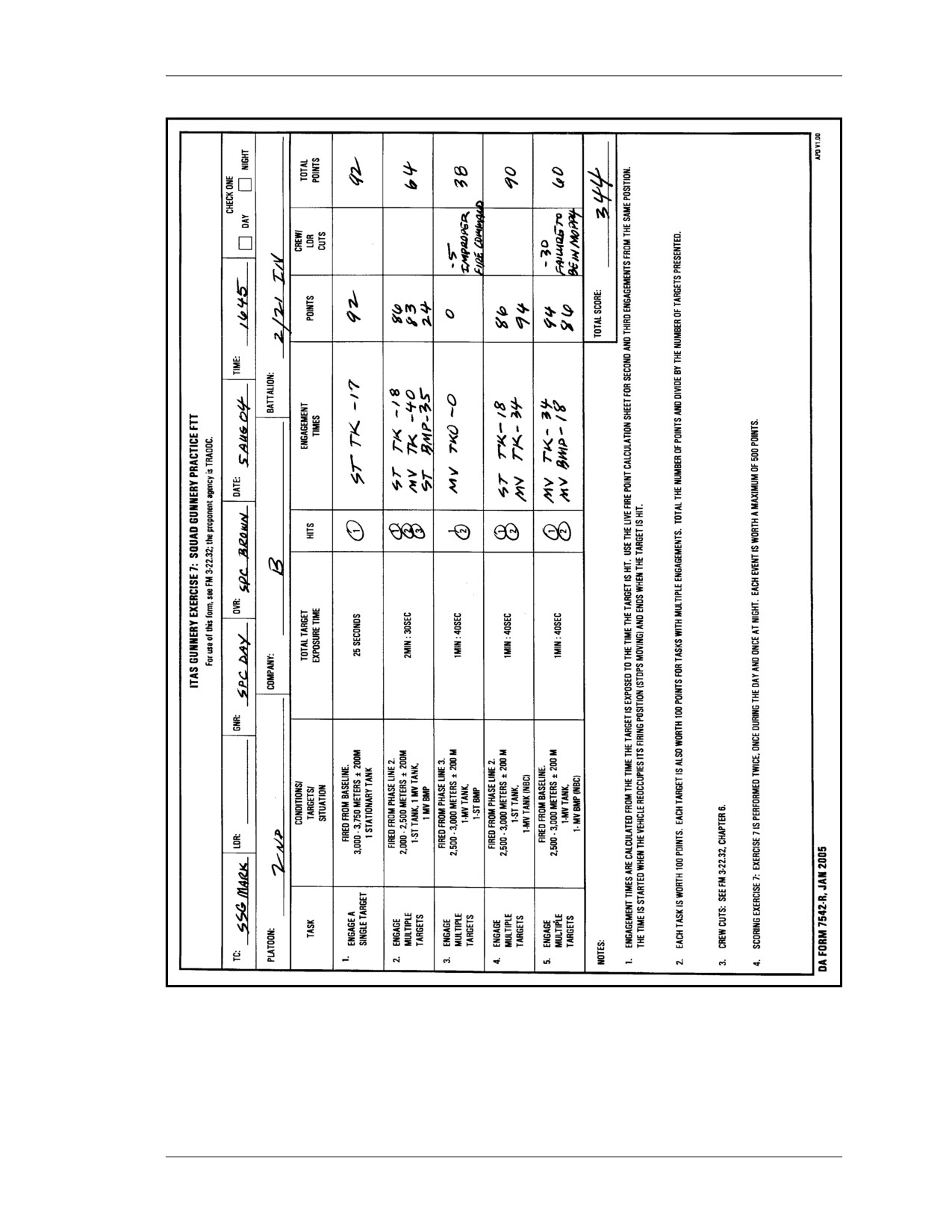
to score exercise 7. (Figure 6-5, shows an example of a completed DA Form
7542-R.)
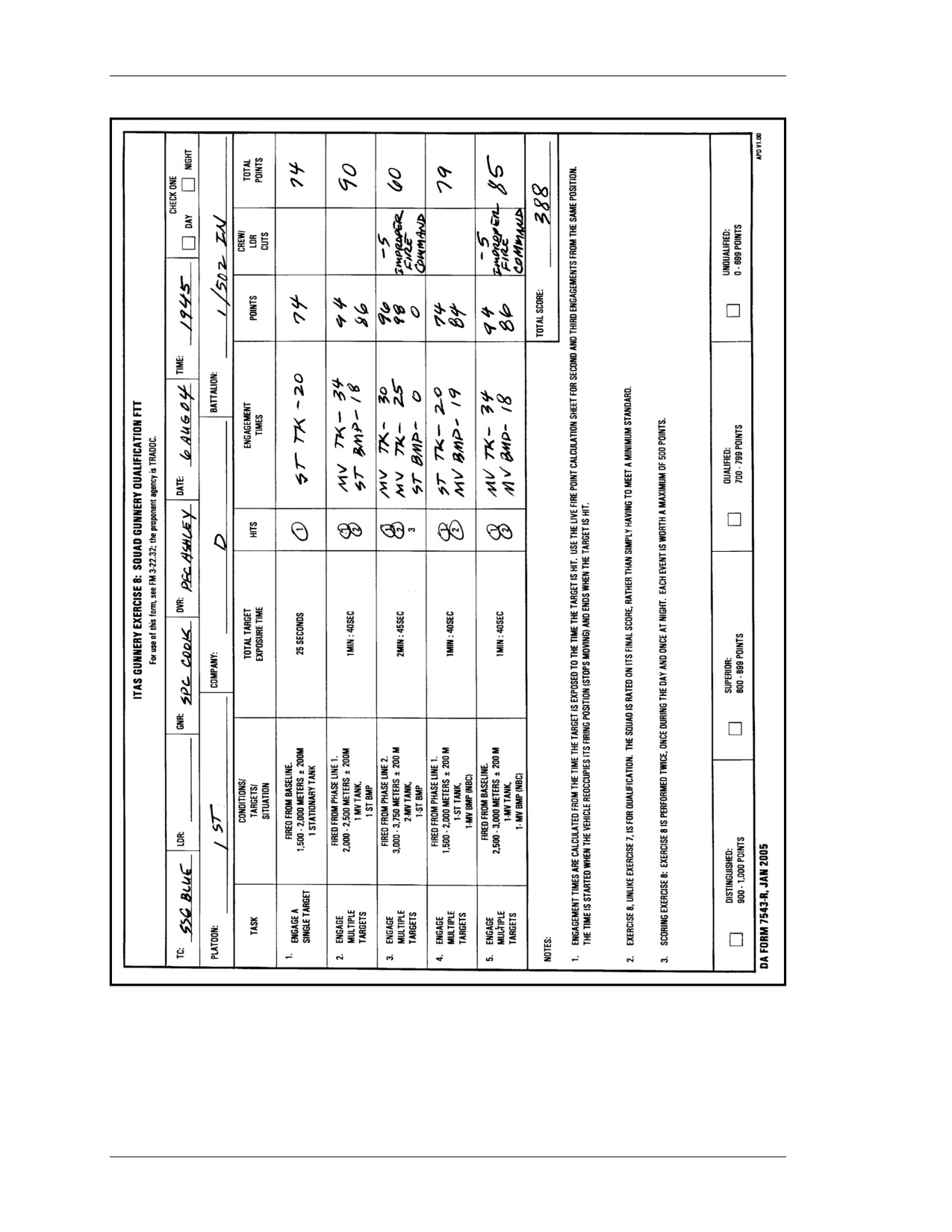
• ITAS Gunnery Exercise 8, Squad Gunnery Qualification. Use DA Form
7543-R (ITAS Gunnery Exercise 8: Squad Gunnery Qualification FTT) to
score exercise 8. (Figure 6-6, page 6-10, shows an example of a completed
DA Form 7543-R.)
Figure 6-4. Example completed DA Form 7541-R.
6-8
8 July 2005
FM 3-22.32
Figure 6-5. Example completed DA Form 7542-R.
8 July 2005
6-9
FM 3-22.32
Figure 6-6. Example completed DA Form 7543-R.
6-10
8 July 2005
FM 3-22.32
c. Phase III—Section Training. Phase III consists of sustainment training, as
necessary, to prepare for ITAS Gunnery Exercises 9 and 10.
• ITAS Gunnery Exercise 9, Section Gunnery Practice (in preparation for
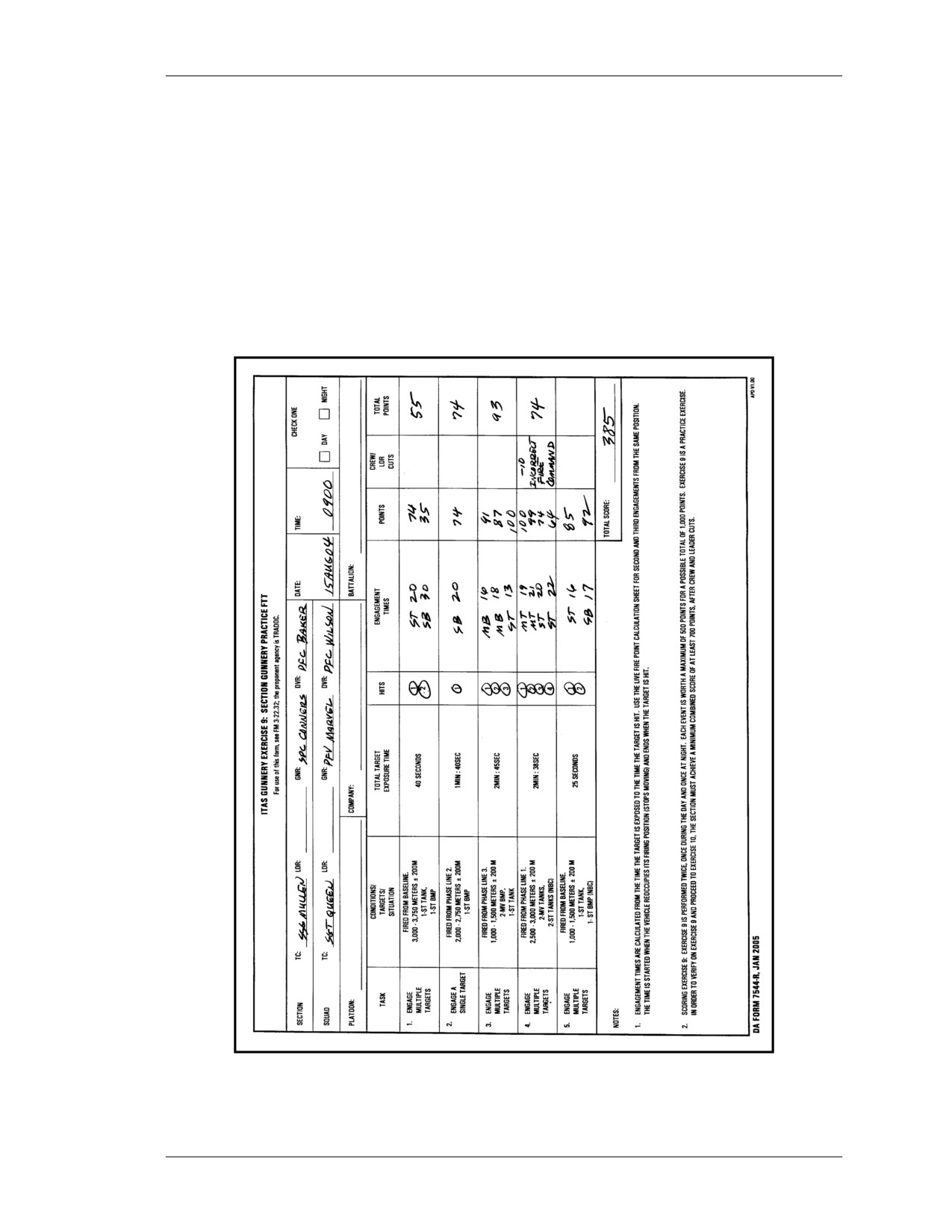
Exercise 10). Use DA Form 7544-R (ITAS Gunnery Exercise 9: Section
Gunnery Practice FTT) to score exercise 9. (Figure 6-7 shows an example of a
completed DA Form 7544-R.)
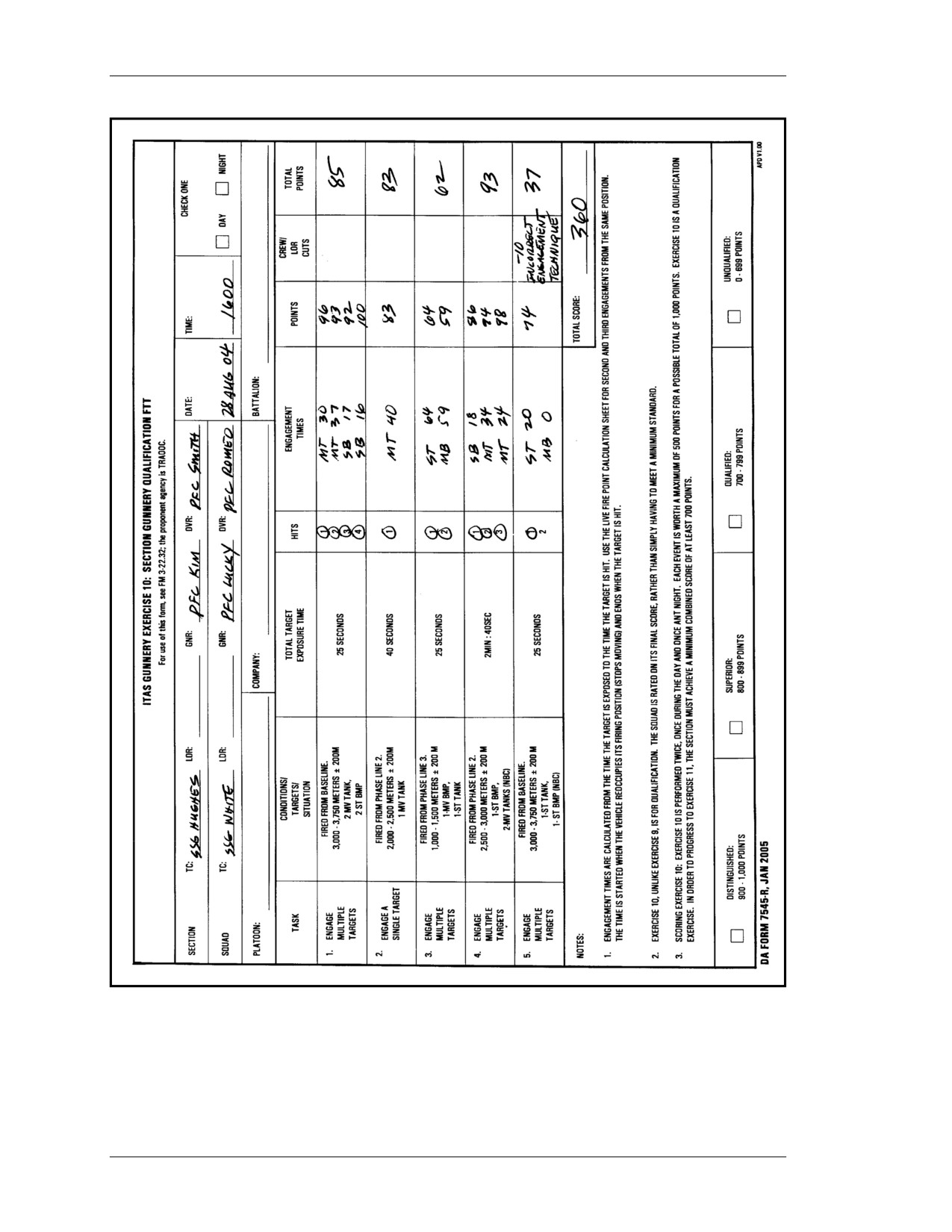
• ITAS Gunnery Exercise 10, Section Gunnery Qualification. Use DA Form
7545-R (ITAS Gunnery Exercise 10: Section Gunnery Qualification FTT) to
score exercise 9. (Figure 6-8, page 6-12, shows an example of a completed
DA Form 7545-R).
Figure 6-7. Example completed DA Form 7544-R.
8 July 2005
6-11
FM 3-22.32
Figure 6-8. Example completed DA Form 7545-R.
6-12
8 July 2005
FM 3-22.32
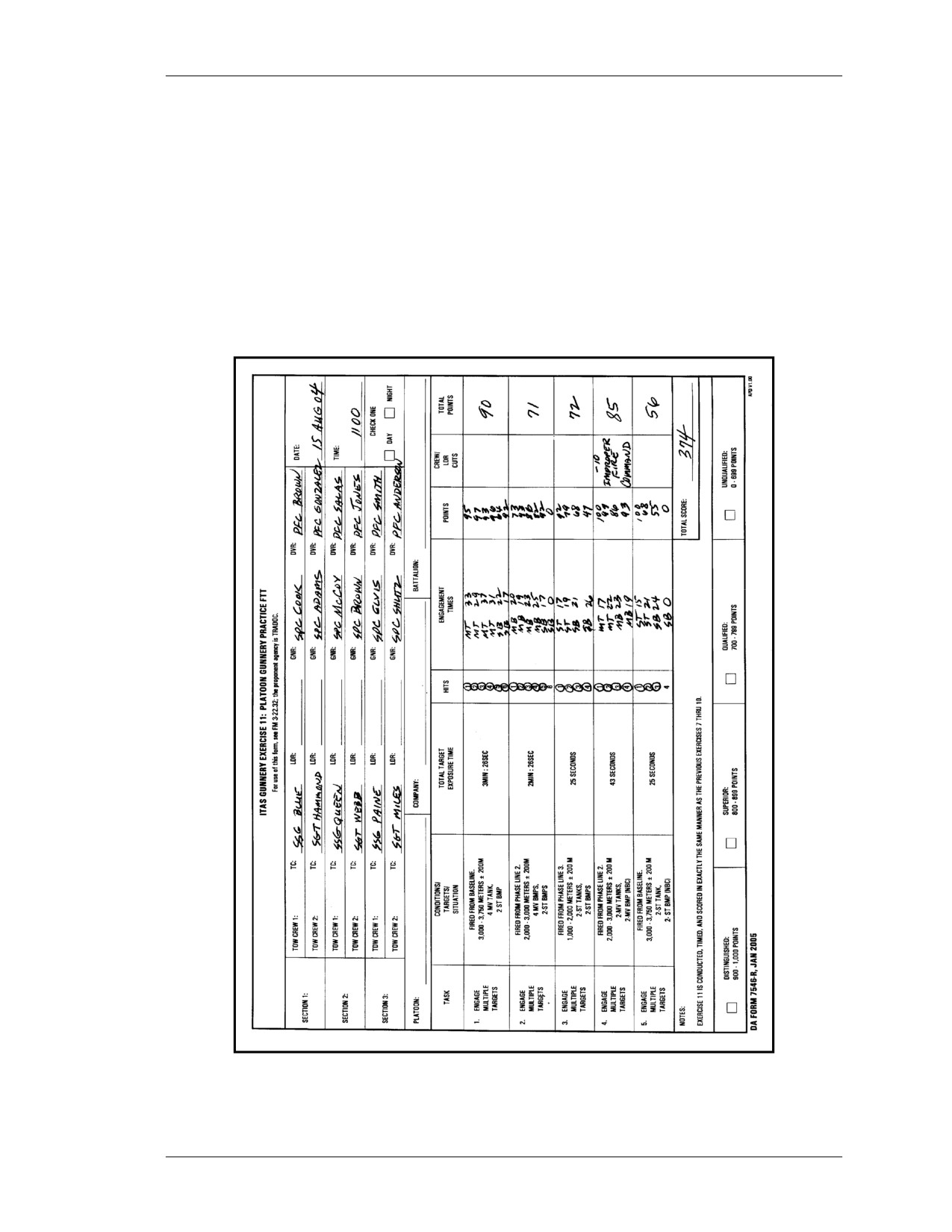
d. Phase IV—Platoon Training. Phase IV consists of sustainment training, as
necessary, to prepare for ITAS Gunnery Exercise 11 and 12.
• ITAS Gunnery Exercise 11, Platoon Gunnery Practice (in preparation for
Exercise 12). Use DA Form 7546-R (ITAS Gunnery Exercise 11: Platoon
Gunnery Practice FTT) to score exercise 11. (Figure 6-9 shows an example of
a completed DA Form 7546-R.)
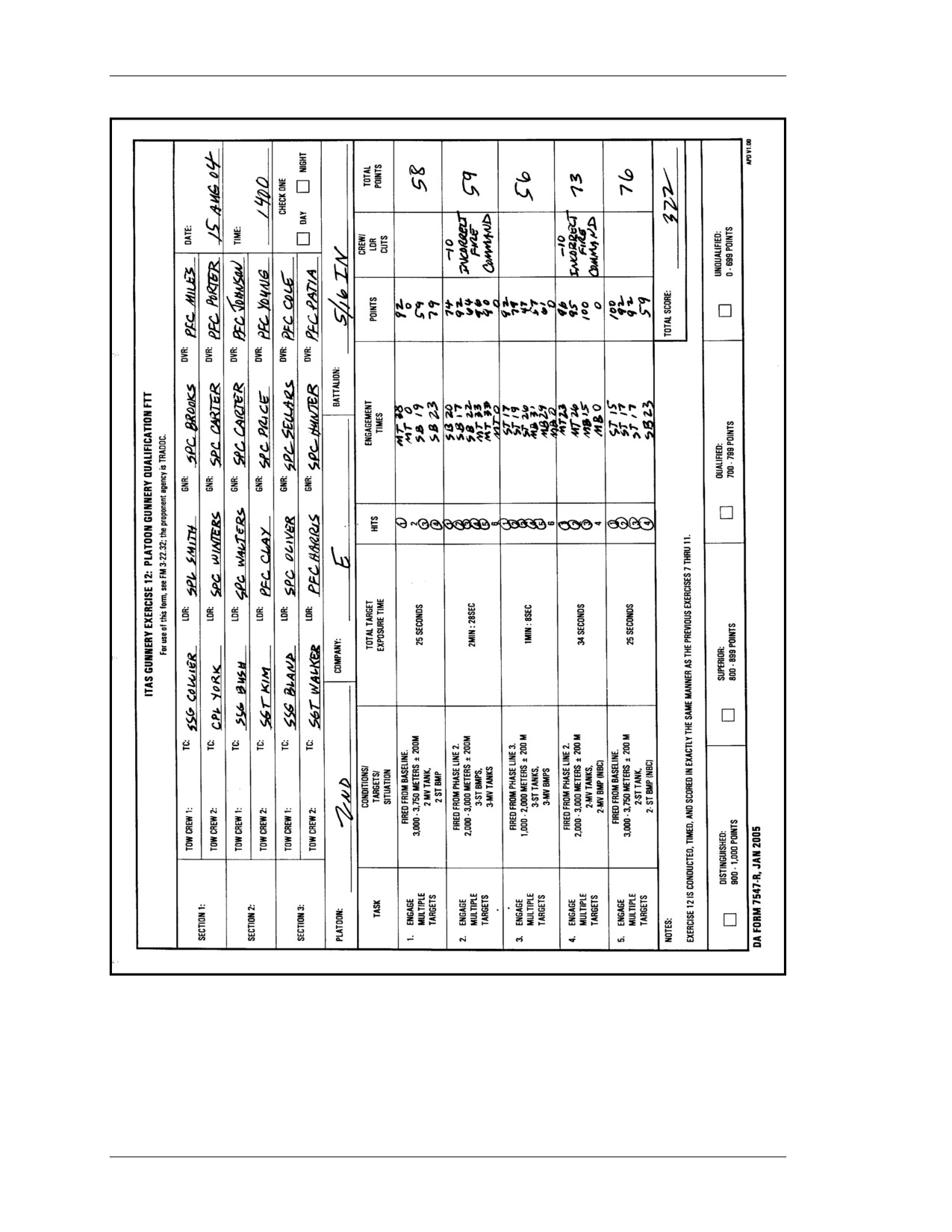
• ITAS Gunnery Exercise 12, Platoon Gunnery Qualification. Use DA Form
7547-R (ITAS Gunnery Exercise 12: Platoon Gunnery Qualification FTT) to
score exercise 12. (Figure 6-10, page 6-14, shows an example of a completed
DA Form 7547-R.)
Figure 6-9. Example completed DA Form 7546-R.
8 July 2005
6-13
FM 3-22.32
Figure 6-10. Example completed DA Form 7547-R.
6-14
8 July 2005
FM 3-22.32
APPENDIX A
SAFETY
Units should develop local directives and standing operating
procedures (SOPs) for safety procedures. These should include individual
responsibilities, safety requirements, proximity limits for personnel and
explosives, location and sequence of operations, equipment required for
handling munitions, and protection for troops. Individual responsibility
for operations involving explosives must be designated. Troops must not
tamper with the encased missiles other than to remove the forward
handling ring and dust cover.
Because of the danger to troops from the backblast, extreme care must
be used in all phases of training. This danger should be emphasized from
the first stage of training. All crew tasks, position and tracking exercises,
and firings with the simulation round should be conducted as though
missiles were being fired.
A-1. SAFETY PRECAUTIONS
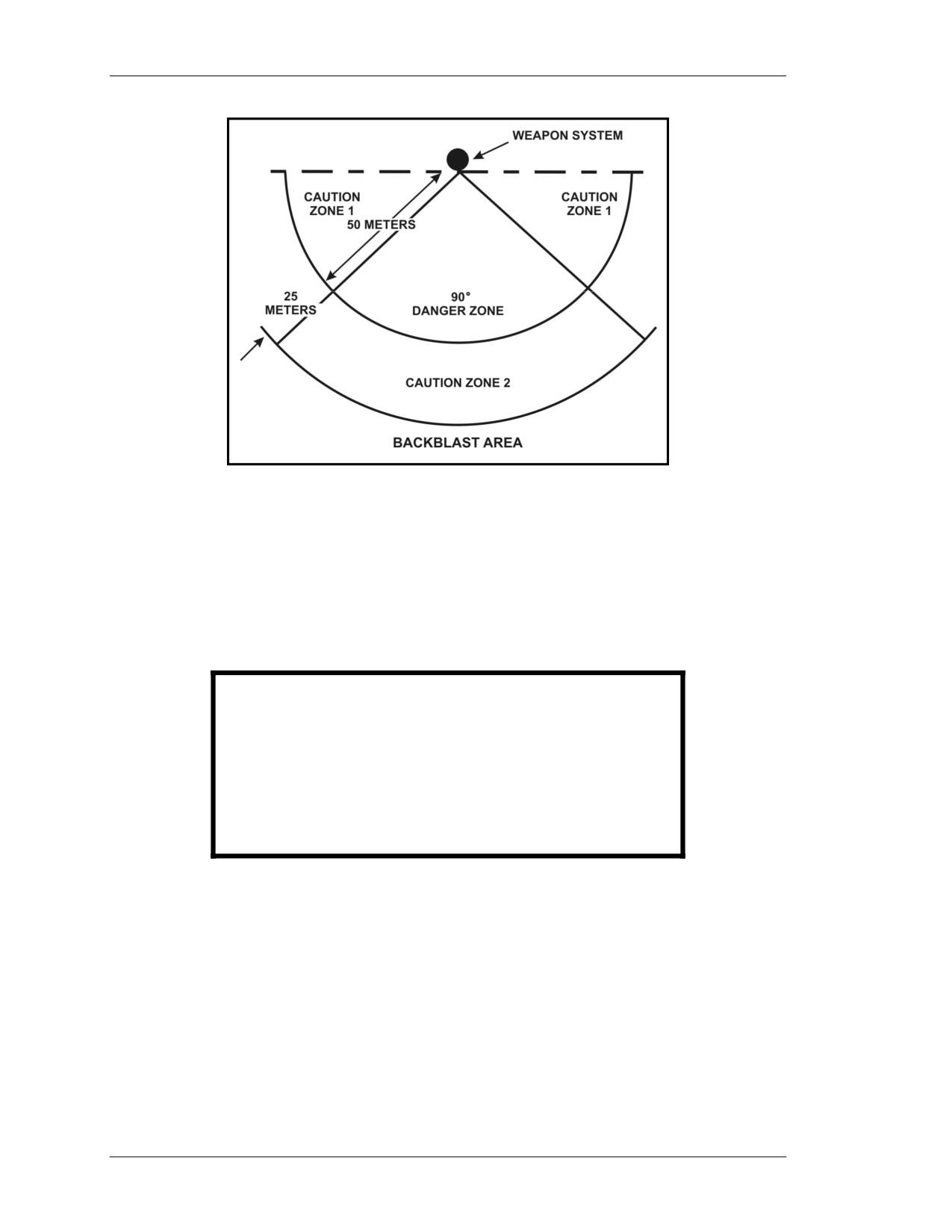
The TOW backblast area extends 75 meters to the rear of the launcher and forms a
90-degree danger area. It is divided into a danger zone and a caution zone.
a. The danger zone extends 50 meters to the rear of the launcher. In this zone,
serious casualties or fatalities are likely to occur from the blast and flying debris.
b. The caution zone extends an additional 25 meters to the rear of the danger zone.
In this zone, a soldier is safe provided he does not face the aft end of the launcher. During
training, the caution zone must be clear (Figure A-1, page A-2). (For further information
on ITAS firing limitations, see Chapter 2.)
WARNING
All crew members must wear V-51R
(or
equivalent) earplugs that have been fitted by
qualified medical personnel. Failure to use the
proper earplugs during missile firing could cause
serious injury.
8 July 2005
A-1
FM 3-22.32
Figure A-1. TOW backblast area.
c. The surface danger zone for any firing range consists of a firing area, a target
area, impact area, and danger areas surrounding these locations. An additional area for
occupation by personnel during firings may also be required. The shape and size of the
surface danger zone varies with the type of missile or rocket being fired. (Refer to
AR 385-63 for dimensions.)
WARNING
When firing the ITAS from confined spaces, such
as dugouts or rooms, the gunner must be aware
that structural damage to the enclosure may
occur and occupants might be injured by flying
debris. Severe concussion and concentration of
toxic gases may result. There is also a danger of
starting fires.
d. In accordance with AR 385-63, the ITAS will not be fired from buildings or
bunkers, or within 100 meters of a vertical or nearly vertical backstop without the
approval of the commanding general.
A-2. MISSILE HANDLING PRECAUTIONS
Improper handling of the encased missile may damage the components and cause
malfunctions when the missile is launched. If the encased missile is dropped, the end
handling rings and the launch container may be damaged. If the missile has been
damaged or there is damage to the launch container (other than minor deformation of
A-2
8 July 2005
FM 3-22.32
handling rings), the encased missile should be returned to the ammunition unit for
inspection and disposition.
A-3. SIGHTING AND AIMING PRECAUTIONS
Gunners must not look at the sun or bright lights while sighting through the daysight
tracker—serious eye burn could result. They must not look through the daysight tracker
at an air field test set on the control tower unless the distance between the daysight
tracker and the test set is more than 300 feet.
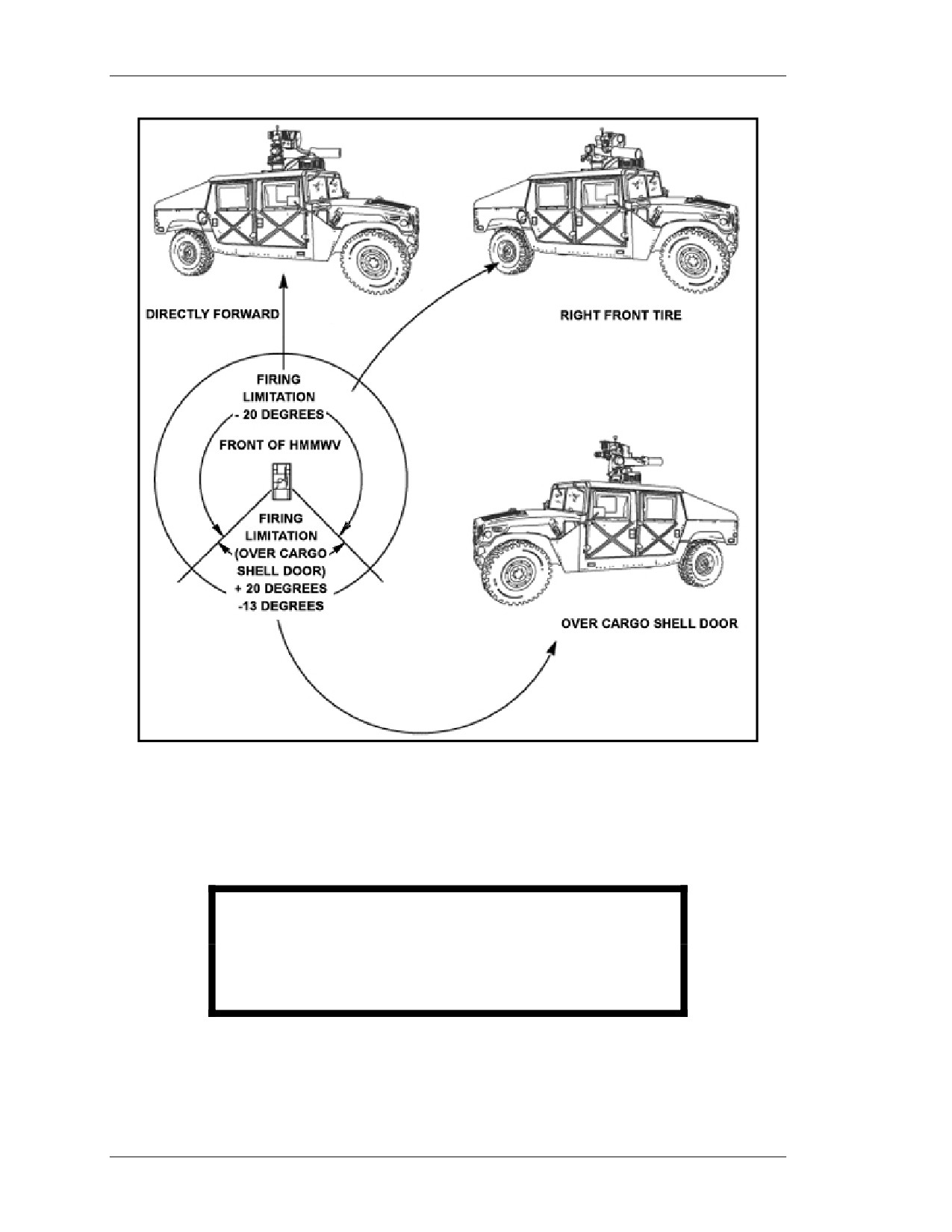
A-4. FIRING ANGLE LIMITATIONS
Azimuth and elevation firing angles are limited by the traversing unit, the vehicle, and
other external restrictions. All elevation angles are referenced to the horizontal plane of
the traversing unit. All azimuth angles are referenced to the long axis of the vehicle and
depend on whether the launch tube points over the front or rear of the vehicle. The other
reference line is the line of sight from the ITAS to the target. (The firing angle limitations
of the ITAS carriers are shown in Figure A-2, page A-4.)
WARNING
At angles greater than 20 degrees above ground
level, hazards to the gunner may exist in the
overpressure waves and debris caused by the
backblast during training. Do not use angles
greater than 20 degrees.
a. When the ITAS is tripod-mounted, a 360-degree lateral track is possible, because
the traversing unit is not restricted in azimuth. Mechanical stops limit the elevation angle
coverage to 20 degrees below and 30 degrees above the horizontal plane.
b. Before the missile is fired, the line-of-sight angle should be estimated at the
expected time of launch and throughout the expected missile flight time. The firing
position should be changed or a different target selected if a line-of-sight angle exceeds
the firing limitation angle.
8 July 2005
A-3
FM 3-22.32
Figure A-2. Firing limitations.
A-5. SAFETY PRECAUTIONS FOR FIELD TACTICAL TRAINER
The following safety precautions must be observed when using the FTT.
DANGER
THE ATWESS BLAST SIMULATOR USED WITH
THE FTT CAN
CAUSE DEATH
OR INJURY.
OBSERVE THE PRECAUTIONS LISTED IN THE
PREFACE OF TM 9-6920-721-10.
A-4
8 July 2005
FM 3-22.32
a. Do not load an ATWESS cartridge until ready to fire. If the target is lost, remove
the ATWESS cartridge from the firing chamber before moving the FTT. (Gloves are
recommended when loading or unloading the ATWESS cartridge.)
b. Before pulling the PULL-TO-ARM switch, always check to ensure no personnel
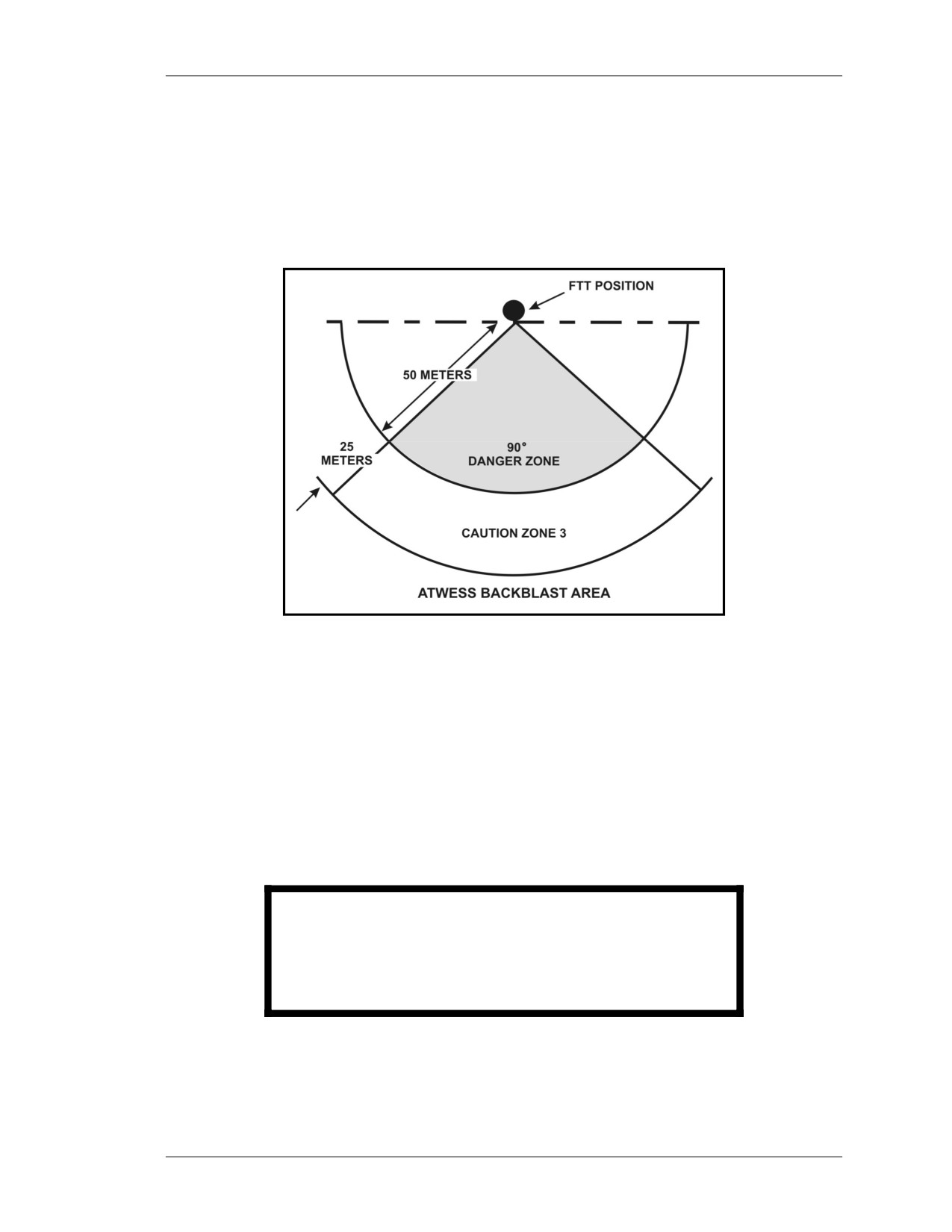
or equipment (antennas) are in the ATWESS danger zone, which extends for 75 meters
behind the ATWESS firing chamber and covers an arc 90 degrees wide (Figure A-3).
Figure A-3. ATWESS danger zone.
c. The laser light emitted by the FTT is considered eye safe, but suitable precautions
must be taken to avoid possible eye damage from overexposure to this radiated energy.
The preface to TM 9-6920-721-10, the laser range safety procedures in AR-385-63, and
TB MED-279 discuss these precautions.
d. Never view the laser being fired through stabilized optics, such as binoculars or
telescopic weapon sights, when within 75 meters of the transmitter.
e. To avoid personnel injury and equipment damage, four people are needed to lift
and carry each shipping container.
DANGER
THIS EQUIPMENT USES HIGH VOLTAGE TO
OPERATE. DEATH ON CONTACT MAY RESULT IF
PERSONNEL FAIL TO OBSERVE THE SAFETY
PRECAUTIONS LISTED IN TM 9-6920-721-10.
8 July 2005
A-5