FM 6-02.43 SIGNAL SOLDIER’S GUIDE (March 2009) - page 5
Chapter 5
5-29. The MSE system provides both voice and data communications
on an automatic, discrete-addressed, fixed-directory basis using flood-
search routing. The system supports both mobile and wire subscribers
with a means to exchange C2 information in a dynamic tactical
environment.
5-30. MSE was designed to provide communications in an area of
operation of up to 37,500 square km (15,000 square miles). The system
is digital, secure, and highly flexible. MSE also contains features that
deal with link or functional element outages, traffic overload, and rapid
movement of users.
5-31. Throughout the maneuver area, subscribers connect to extension
nodes by radio or wire. These extension nodes serve as local call
switching centers and provide access to the network by connecting to a
node center.
MSE Components
5-32. Node centers provide essential switching, traffic control, and
access points for MSE. After determining the coverage area, node
centers are allocated to establish a corps MSE grid network. Node
centers are primarily linked by LOS radios to provide communications
throughout the system via the node center switch. The cable connects
TACSAT and TROPO systems to the node center. If one node center is
disabled, the system automatically routes communications through
another node center. The node center switch serves as an access point
for large extension nodes (LENs), small extension nodes (SENs), radio
access unit, system control center-2s, and Integrated System Control
(ISYSCON).
5-33. The forced entry switch combines the essential functions of the
node center switch, LEN, node management facility, and a radio access
unit into one shelter. The forced entry switch, combined with a LOS
AN/TRC-198, comprises the contingency communications package.
5-12
FM 6-02.43
17 March 2009
Transport Systems
5-34. The LEN switch provides wired communications for personnel
at large CPs. A LEN switch enables up to 164-wired subscribers to
communicate freely using automatic flood search routing.
5-35. The SEN switch supports the communications needs of smaller
CPs. The AN/TTC-48 (V)1 can support 26-wired subscribers and the
(V)2 can support 41-wired subscribers.
5-36. The radio access unit, AN/TRC-191, is a fully automatic radio
interface for mobile subscriber radiotelephone terminal subscribers. It
connects directly to the node center by cable or remotely via LOS
radio. The radio access unit is capable of terminating a maximum of
eight radio telephone calls at any one time. The planning range
between the mobile subscriber radiotelephone terminal and the radio
access unit is 15 km (9.3 miles).
5-37. The ISYSCON is the automated, theater-wide, tactical-
communications network-management system used to plan, configure,
monitor, and control the entire spectrum of military tactical
communications systems. ISYSCON features include mission plan
management, network planning and engineering, battlefield frequency
spectrum management, tactical packet network management, and WAN
management. (Refer to Appendix A for more information on battlefield
spectrum management.)
5-38. The AN/TRC-190 (V)1 is an LOS multi-channel radio terminal.
It provides point-to-point UHF radio links using the AN/GRC-226 (P)
radio set between various nodes of the MSE system. The (V)1 is
equipped with one AB-1339 mast with Band I and Band III antennas.
The planning range of the UHF radio is 40 km (28 miles).
5-39. The AN/TRC-190 (V)2 is an LOS multi-channel radio terminal.
It provides point-to-point UHF radio links using the AN/GRC-226 (P)
radio set between various nodes of the MSE system. The (V)2 is
equipped with two AN/GRC-226(P) radio sets (one online and one
spare) and one AB-1339 mast with Band I and Band III antennas. The
planning range of the UHF radio is 40 km (28 miles). The (V)2
17 March 2009
FM 6-02.43
5-13
Chapter 5
typically deploys as an analog interface to North Atlantic Treaty
Organization forces.
5-40. The AN/TRC-190 (V)3 is an LOS multi-channel radio terminal.
It provides point-to-point UHF radio links using the AN/GRC-226 (P)
radio set between various nodes of the MSE system. The (V)3 is
equipped with four AN/GRC-226(P) radio sets (three online and one
spare) and three AB-1339 masts with two Band I and two Band III
antennas. The planning range of the UHF radio is 40 km (28 miles).
Each radio link supports a single full-duplex group-level connection
and a single digital voice orderwire channel. The AN/TRC-190 (V)3
typically deploys with the node center switch and is a radio relay.
5-41. The AN/TRC-190 (V)4 is an LOS multi-channel radio terminal.
It provides point-to-point UHF radio links using the AN/GRC-226 (P)
radio set between various nodes of the MSE system. Each radio link
supports a single full-duplex group-level connection and a single
digital voice orderwire channel. The AN/TRC-190 (V)4 is equipped
with two AN/GRC-226 (P) radio sets (two online) and two AB-1339
masts with Band I and Band III antennas. The planning range of the
UHF radio is 40 km (28 miles). If the AN/TRC-190 (V)4 has an
AN/GRC-224 (P) radio set installed, it can provide a short-range, down
the hill, and point-to-point SHF radio link. The AN/TRC-190 (V)4
typically deploys with the LEN switch.
TRI-SERVICE TACTICAL
5-42. Currently, if TRI-TAC systems are used they are employed at
the theater level. Similar to MSE, the TRI-TAC network forms a
communications grid of area nodes, which covers the AO. The area
nodes normally interconnect by LOS links up to 40 km (28 miles)
apart. Users gain access to the network at many extension nodes, which
tie into the area nodes through LOS links. The use of relay assemblages
can increase the distance between nodes. TACSAT and TROPO links
further extend the range between nodes.
5-14
FM 6-02.43
17 March 2009
Chapter 6
Federation of Networks
This chapter provides an overview of the
federations of networks that are most commonly
used today: The reader is referred to additional
publications for detailed information on subject
matter beyond the scope of the chapter. As
communications needs grow, new networks will
be acquired. This chapter does not represent all
communications assets currently available to
commanders and signal leaders.
INTRODUCTION
6-1. The federation of networks are specialized networks and
systems that are commonly referred to as
“stovepipes” and will
continue to operate until fully integrated into a single enterprise. These
stovepipes are designed to meet a commander’s unique intelligence,
operational, and sustainment needs. They serve a narrow community of
users and have limited or no interoperability with other systems. These
networks are required by different warfighting functions, many of
which are not directly installed, operated, or maintained by signal
personnel. The following paragraphs discuss some of the most widely
used systems.
17 March 2009
FM 6-02.43
6-1
Chapter 6
COMBAT NET RADIOS
6-2. The primary role of CNR is voice transmission for C2. The
secondary role includes data transmission where other data capabilities
do not exist. The CNR is primarily designed around the SINCGARS,
the single channel TACSAT, and the high frequency radio.
6-3. More tactical radios with these or like capabilities are found at
division and below. Each of these systems has different capabilities and
transmission characteristics.
Note. Refer to other doctrinal publications that may be
accessed
on
the
doctrine
AKO portal at
tactical radios being used throughout the Army. The portal
requires a common access card to access.
BLUE FORCE TRACKING
6-4. The BFT system is an L-band SATCOM tracking and
communication system that provides the commander eyes on the
friendly forces and the ability to send and receive text messages. BFT
operates with FBCB2 software. FBCB2s terrestrial-based radio is
EPLRS, a networking radio that provides transport and position
location when necessary.
6-5. The BFT contains computer hardware and software,
interconnecting cables, L-band satellite transceiver, a precision
lightweight global positioning system receiver, a mission data loader to
transfer larger files, and an installation kit appropriate to the host
vehicle type
(if applicable). Other major BFT systems include the
Movement Tracking System and Talon Reach. (Refer to FMI 6-02.45
for more information on these systems.)
6-2
FM 6-02.43
17 March 2009
Federation of Networks
ARMY BATTLE COMMAND SYSTEM
6-6. ABCS is the integration of primarily user-owned and -operated
automated systems. These information subsystems access critical
warfighting functions and information resident on other similar
warfighting systems in a seamless and secure manner. ABCS is a
common hardware system (CHS) and a core set of common support
software, which is functionally unique to each sub-system.
Note. These integrated information systems allow
commanders and their staff access to real or near-real time
information in the full spectrum of military operations. Refer
to Appendix B for an overview of the ABCS information
systems and services.
COMBAT SERVICE SUPPORT VERY
SMALL APERTURE TERMINAL
6-7. The Combat Service Support Very Small Aperture Terminal
(CSS VSAT) SATCOM system provides wideband NIPRNET
connectivity to all major sustainment nodes across the Army. The CSS
VSAT enables deployed maneuver and support battalions to reach key
sites located in the CONUS and in sanctuary. The CSS VSAT is
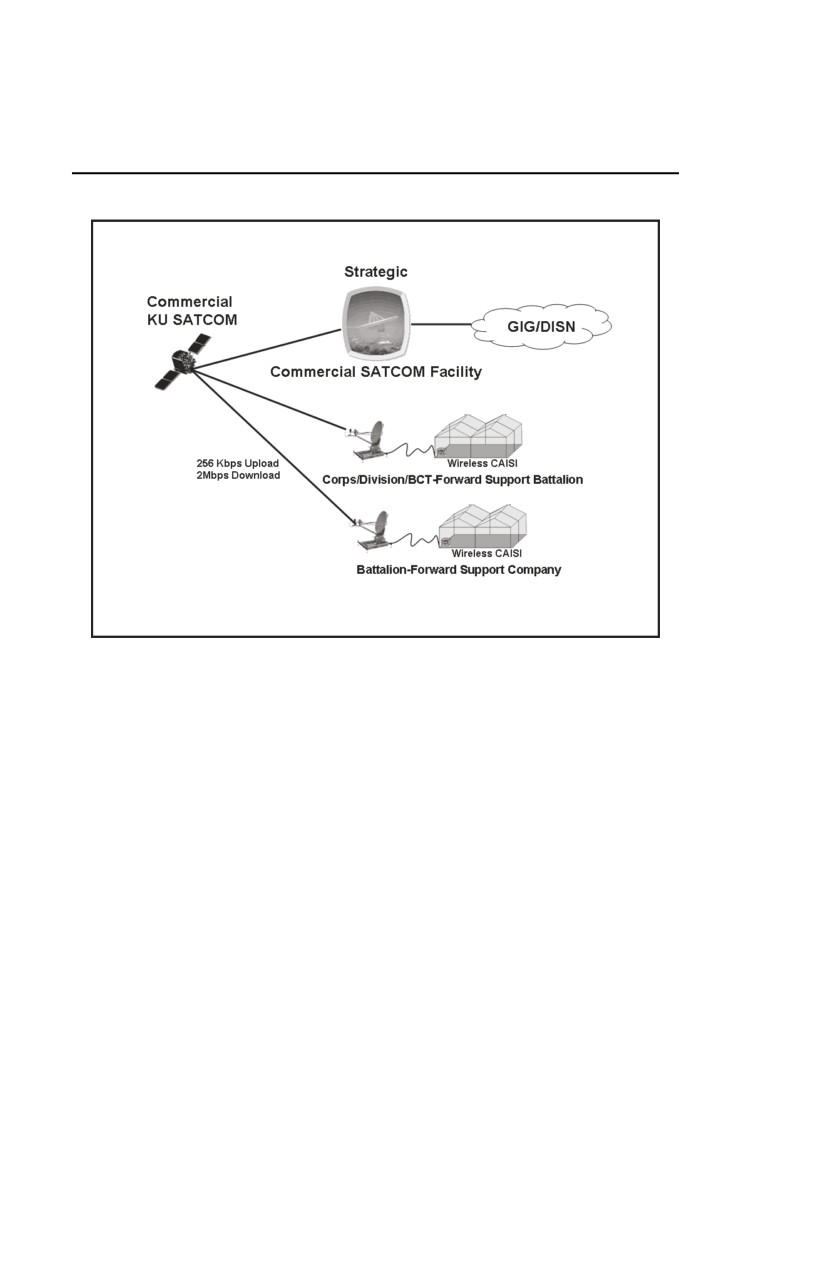
combined with the wireless Combat Service Support Automated
Information Systems Interface (CAISI) to provide flexible connectivity
for sustainment systems such as the property book unit supply
enhanced. Figure 6-1 illustrates the CSS VSAT architecture.
17 March 2009
FM 6-02.43
6-3
Chapter 6
Figure 6-1. CSS VSAT architecture
COMBAT SERVICE SUPPORT AUTOMATED INFORMATION
SYSTEMS INTERFACE BRIDGE MODULE
6-8. The CAISI is a wireless LAN that provides tactical network
connections for logistics and health service support information
systems. The CAISI bridge module serves as the LAN server and
connects up to 112 individual logistics systems through the CSS VSAT
to the global internet grid. CAISI can transmit and receive signals in a
clear LOS range of up to four miles. The CAISI bridge is operated by
the S-4
(logistics staff officer) section. Systems that use CAISI
include—
z
CSS VSAT.
z
Battle Command Sustainment and Support System.
z
Transportation Coordinators’ Automated Information for
Movement System (V II).
6-4
FM 6-02.43
17 March 2009
Federation of Networks
z
Medical Communications for Combat Casualty Care (MC4).
z
Standard Army Ammunition System.
TROJAN SPECIAL PURPOSE INTEGRATED REMOTE
INTELLIGENCE TERMINAL
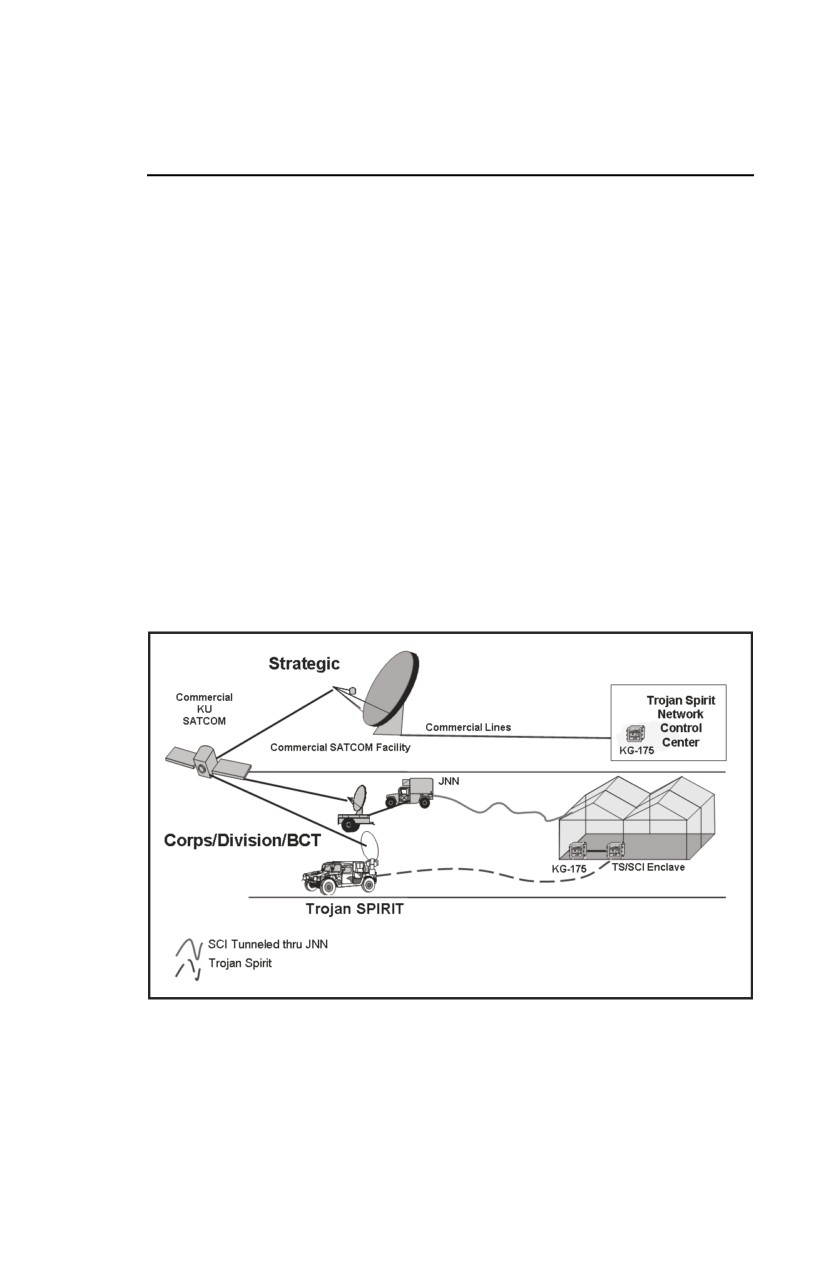
6-9. Trojan SPIRIT is a military intelligence operated system that is
a critical network enabler for the commander and the intelligence
elements. It is currently the primary network capability connecting the
deployed user to TOP SECRET/Sensitive Compartmented Information
networks that include the Joint Worldwide Intelligence
Communications System and the National Security Agency network.
The data may be either delivered over a dedicated Trojan SPIRIT suite
or tunneled through the JNN components via KG-175 tactical fast lane
in-line network encryption devices. Figure
6-2 depicts the Trojan
SPIRIT at corps, division, or brigade being tunneled through the JNN
to other points of presence that do not have a dedicated Trojan SPIRIT.
Figure 6-2. Trojan SPIRIT architecture
17 March 2009
FM 6-02.43
6-5
Chapter 6
MEDICAL COMMUNICATIONS FOR COMBAT
CASUALTY CARE
6-10. The MC4 together with the Theater Medical Information
Program provides near real time medical information for the medical
community in a tactical environment. This family of systems supports
C2, situational understanding, and commodity management by
seamlessly linking, both vertically and horizontally, all echelons of
medical care and logistics.
6-11. The MC4 provides the following capabilities and functions—
z
Electronic medical record.
z
Medical surveillance.
z
Patient accountability.
z
Medical regulating.
z
Medical reference.
z
Medical logistics.
z
Reporting and security.
MEDICAL SURVEILLANCE AND ELECTRONIC
MEDICAL RECORD
6-12. Armed Forces Health Longitudinal Technology Application
(AHLTA)-Mobile (formerly known as Battlefield Medical Information
System Tactical-Joint) operates on a hand-held device enabling medics
in the field to record initial patient encounter data and synchronize it
with the AHLTA-Tactical (formerly Combat Health Care System II-
Tactical) application. AHLTA-Mobile is an application used on a
point-of-care hand-held assistant that records, stores, retrieves, and
transmits the essential elements of patient encounters in an operational
setting.
6-13. This information is synchronized and the data transmitted to a
server for surveillance, analysis, storage, and retrieval purposes.
Reference materials, diagnostic and treatment decision aids, and
logistic support software can also be included to facilitate patient care,
6-6
FM 6-02.43
17 March 2009
Federation of Networks
MOS skill training, and mission planning. It can act as a stand-alone
system or can transmit medical data to servers providing data for
readiness, medical history, consultation, evacuation, and other medical
planning and force health surveillance operations.
6-14. Joint medical workstation and theater medical data store are
Web-based applications accessible via the MC4 system. Joint medical
workstation is a medical surveillance tool on a classified network
allowing unit commanders access to a summary of multiple reports for
enhanced medical SA. It offers users the ability to view individual
patient encounters anywhere in the world.
6-15. Providers can view stored medical data on the Soldier
regardless of where it was input. Patient encounters in theater are
entered through the MC4 laptop with AHLTA-Tactical to the theater
medical data store server, where the records can be accessed via joint
medical workstation
(SIPRNET) and theater medical data store
(NIPRNET). The records are also transferred to the Central Database
Repository as part of the Soldier’s life-long medical record.
PATIENT ACCOUNTABILITY
6-16. Patient Accounting and Reporting Real-Time Tracking System
is an application that offers casualty location and medical condition
information to authorized users instantly via the Battle Command
Network.
6-17. Joint Patient Tracking Application is a patient tracking
application that receives medical information from MC4 via theater
medical data store. This allows Army commanders to track their
wounded Soldiers, by name, throughout the CONUS and OCONUS.
MEDICAL LOGISTICS
6-18. Theater Army Medical Management Information System
customers assistance module and the defense medical logistics standard
support customer assistance module are applications that interface to
the Theater Army Medical Management Information System medical
17 March 2009
FM 6-02.43
6-7
Chapter 6
logistics inventory program that provides additional medical logistics
capabilities, including inventory access and medical equipment (Class
VIII) ordering between levels of care.
REPORTING, COMMUNICATIONS, AND SECURITY
6-19. Theater Medical Information Program is an application that
provides the security and communications path for the data transfer
from AHLTA-Tactical and AHLTA-mobile to the theater medical data
store and joint medical workstation servers. Theater Medical
Information Program reports provide query capabilities against the
local database. It also provides commanders with SA information and
patient visibility, along with support for pre-defined status reporting
and epidemiology monitoring.
PUBLIC AFFAIRS OFFICE DIGITAL VIDEO
AND IMAGERY DISTRIBUTION SYSTEM
6-20. Public Affairs Office Digital Video and Imagery Distribution
System (DVIDS) is a state-of-the-art, around-the-clock operation that
provides a timely, accurate, and reliable connection between the media
around the world and the military serving in Iraq, Afghanistan, Kuwait,
Qatar, and Bahrain.
6-21. Through a network of portable Ku-band satellite transmitters
located in-theater and a distribution hub in Atlanta, Georgia, DVIDS
makes available real-time, broadcast-quality video, still images, and
print products, as well as immediate interview opportunities with
service members, commanders, and subject matter experts.
6-22. Using advanced technology and innovative processing DVIDS
processes and manages massive amounts of content seamlessly through
backend Web applications that manage workflow for all different
media types. Built upon the backend of the Encompass Asset
Management System, DVIDS processes and distributes (including play
out) all digital video, tape-free.
6-8
FM 6-02.43
17 March 2009
Federation of Networks
GLOBAL BROADCAST SYSTEM
6-23. The GBS provides a one-way, high-speed, information flow of
high volume data and multimedia information such as unmanned
aircraft system video, imagery, maps, weather, sustainment, and air
tasking orders. GBS uses military satellites augmented by commercial
Ku band satellites. The GBS is found at all levels and usually resides
within the G-6/S-6 section. However, it is general purpose user-
operated and may be assigned to other sections such as the G-2/S-2.
6-24. GBS is a system of broadcast managers, injection points,
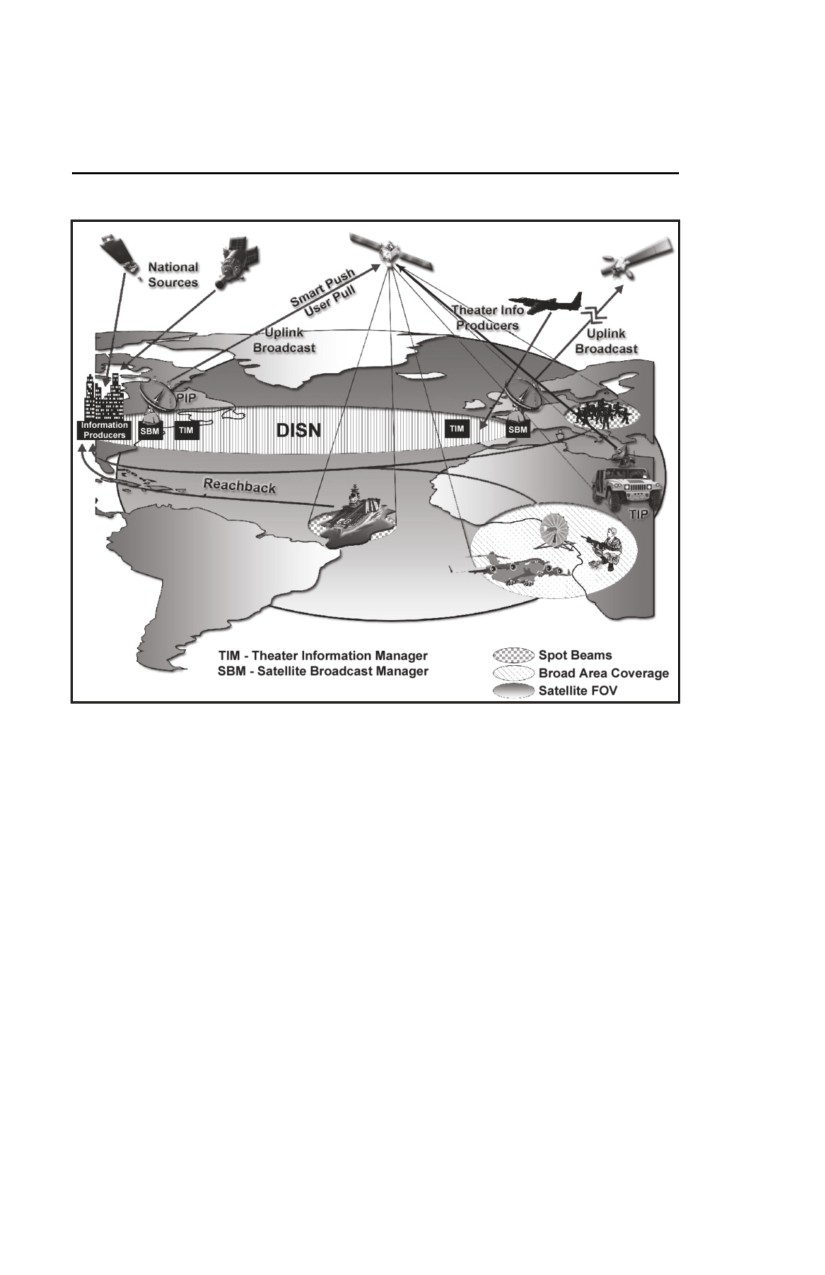
broadcast satellites, receiver terminals, and management processes for
requesting and coordinating the distribution of information products. It
supports routine operations, training and military exercises, special
activities, crisis, SA, weapons targeting, intelligence, and the transition
to and conduct of opposed operations short of nuclear war.
6-25. GBS provides joint operations with high speed, multimedia
communications and information flow for deployed, on the move (in-
transit), or garrisoned forces. Homeland defensive operations are
supported by a requirement for CONUS coverage, which also provides
exercise support, training, and workups for deployment. GBS also
supports military operations with US allies or multinational forces
dependent on security and cryptographic releasability restrictions.
Figure 6-3 depicts the system architecture for the GBS.
17 March 2009
FM 6-02.43
6-9
Chapter 6
Figure 6-3. GBS architecture
6-26. Today’s DOD needs large volumes of information delivered
rapidly to deployed, on the move, and garrison users. Many of these
information requirements are standard products, such as imagery,
intelligence, training, 24-hour commercial news, various tactical video
(for example, unmanned aircraft system video, commander’s tactical
briefing, etc.), weather services, and other desired broadcast services.
Other unique information products are tailored for an operating area,
such as local weather products, environmental sensing updates, theater
intelligence reports, airborne reconnaissance video, air tasking orders,
Tomahawk mission data updates, SA updates, and theater-generated
mapping and imagery composites. GBS uses current digital satellite
broadcasting technology to disseminate these information products to
the GBS users.
6-10
FM 6-02.43
17 March 2009
Federation of Networks
6-27. High data rate satellite terminals are characteristically large and
fixed, but GBS receive terminals are small, mobile, and receive high-
volume data using 1-meter or smaller antennas. Mobile force elements,
free from restrictive large fixed terminals, can receive information
formerly available only to command centers. Current GBS technology
supports data rates between 1.544 and 45 Mbps depending on satellite
capability, but transmits at lower data rates to support disadvantaged
users or to compensate for environmental conditions. Each satellite that
supports the GBS will be served by a satellite broadcast manager and a
primary injection point (PIP) or a theater injection point (TIP). The
GBS relies on DISN connectivity to relay information from national
and theater information sources to the satellite broadcast manager for
broadcast injection via a PIP.
6-28. The GBS TIP will be available under selected theater tactical
brigades that are equipped and structured to install, operate, and
maintain it. The GBS TIP enables in-theater forces to transmit
information via the GBS as opposed to being able only to receive
information transmitted by the PIPs.
BROADCAST MANAGEMENT SEGMENT
6-29. A fundamental feature of GBS is the broadcast management
segment which retrieves, accepts, coordinates, and
(if required)
packages information such as general broadcast products,
“Smart
Push” products, and “User Pull” products. The required information is
gathered from both national and theater sources for broadcast based on
the direction and priorities identified by their respective combatant
commanders and their functional users.
6-30. The broadcast management segment also performs any
additional functions necessary to support the efficient use of GBS.
These functions include, but are not limited to, managing space
segment coverage and capacity sharing, providing interface protocols
and standards designed to allow information providers to submit
information in a form acceptable by the GBS broadcast, and
coordinating with the combatant commander information manager cells
17 March 2009
FM 6-02.43
6-11
Chapter 6
to apply combatant commander’s priorities. Within the maneuver force,
the GBS is a user-owned and -operated system that provides a high
bandwidth data broadcast capability to multiple users in the AO.
TRANSMIT SEGMENT
6-31. The transmit segment consists of two satellite broadcast
manager facilities; three fixed PIPs, and deployable TIPs. The high
data rate bit stream is transmitted from one of the fixed or deployable
injection points, as directed by the combatant commanders, and
managed by the broadcast management segment in each satellite field
of view. The information being transmitted is received by a myriad of
GBS receiver systems. At the direction of the combatant commander
theater information manager, the satellite broadcast manager collects
data files and digital video from national, DOD, and inter- and intra-
theater information sources; constructs a broadcast stream; and
transmits the signal to the GBS transponders on the UHF follow-on
satellite.
SPACE SEGMENT
6-32. The GBS space segment is supported by two UHF follow-on
satellites. There are four Ka-band transponders hosted on each of these
UHF follow-on satellites dedicated to GBS applications. Each satellite
also has one steerable patch array antenna that can be moved to the
appropriate location to support broadcast from a TIP.
6-33. Each of the UHF follow-on satellites has three GBS dedicated
steerable downlink antennas for broadcast within that satellite’s
geographic field of view. Information fed to the satellite can be routed
from the four transponders to the three downlink beams as deemed
appropriate by the combatant commander based on user dispersion and
operational necessity. All components of the GBS architecture are
designed for interoperability with the wideband global satellites as they
become available. The GBS is compatible with commercial Ku-band
satellites that are used to provide broadcast coverage outside the UHF
follow-on/GBS field of view (CONUS) or as needed for augmentation
6-12
FM 6-02.43
17 March 2009
Federation of Networks
for the UHF follow-on/wideband global satellite constellations
depending upon unit dispersion and information requirements in
specific geographical areas.
GROUND RECEIVE SEGMENT
6-34. GBS receive suites receive, process, and disseminate GBS
broadcast content to end-users over backend communications
networks. Receive suites consist of a receiver/transmitter and receive
broadcast manager. The receiver/transmitter consists of an antenna
group that includes a dish antenna, a low noise block down converter,
satellite tracking hardware and software, and associated interface
cabling and equipment.
6-35. The receive broadcast manager consists primarily of the
integrated receiver decoder assembly, one or more computer systems
with receive broadcast manager software installed, a cryptographic
unit, and associated hardware including splitters, cabling, and switches.
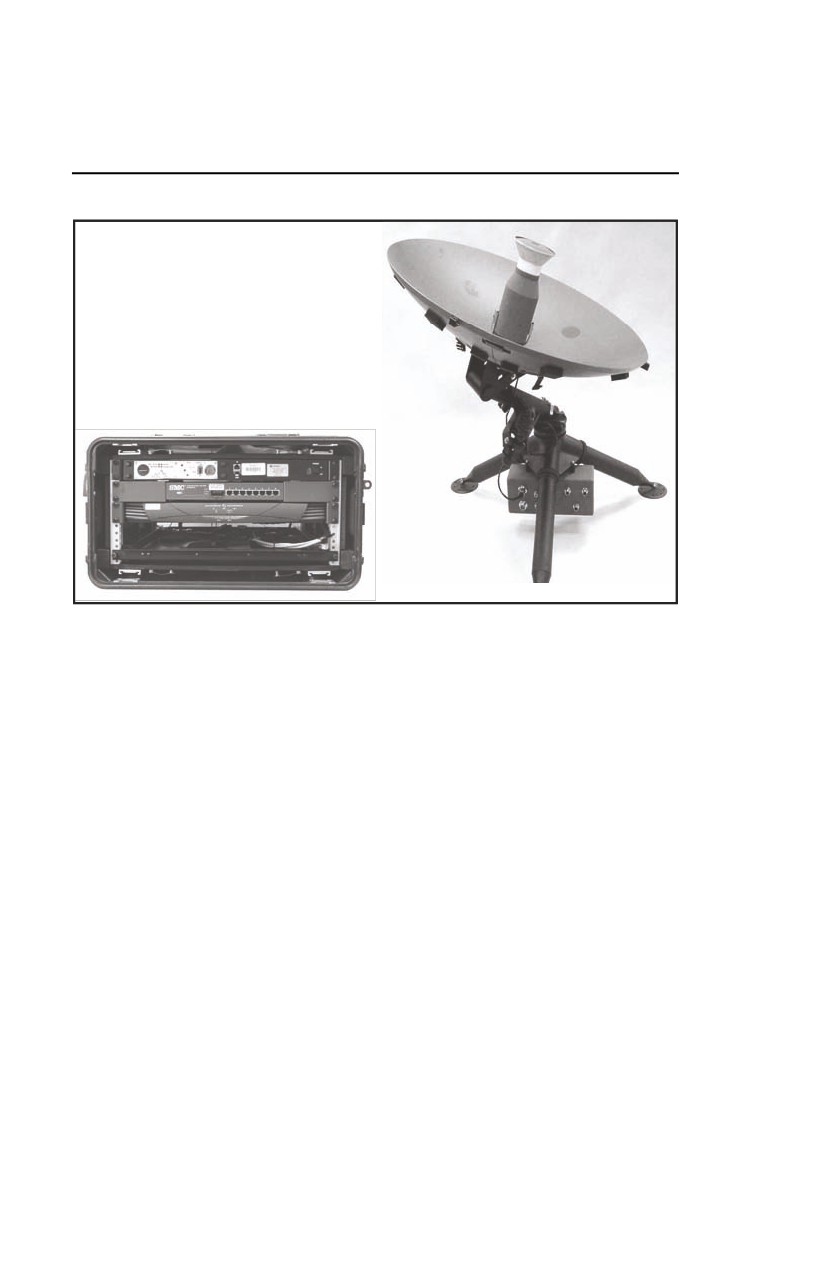
6-36. Receive suites are designed around an open architecture and
may be configured based on the demands of the individual user.
Receive suites can be either transportable or fixed ground receive
suites (refer to Figure 6-4). There may be variations of these receive
suites for airborne, portable, and mobile applications in the future.
17 March 2009
FM 6-02.43
6-13
Chapter 6
Receive Terminal
Receive Broadcast Manager
Figure 6-4. Transportable ground receive suite
GBS MISSION REQUEST
6-37. Units must articulate requirements via submission of a GBS
mission request prior to deployment and update the request as mission
needs dictate changes in types of information products, time and pace
of initial delivery/updates, and modification of delivery times or unit
locations. It is critical that GBS mission requests are tailored to support
specific unit missions and that the G-6/information management
officer/knowledge management officer collects staff information
requirements and identifies the location of associated national source
repositories.
6-38. The information management officer/knowledge management
officer can access the satellite broadcast manager product catalog via
SIPRNET to select those products already available from the satellite
broadcast manager and include them in the GBS mission request
submission.
6-14
FM 6-02.43
17 March 2009
Federation of Networks
6-39. For those products not already available on the personal
computer, units must provide specific location information on the GBS
mission request to facilitate the satellite broadcast manager’s ability to
acquire the information and prepare it for broadcast IAW the unit
established timelines and priorities. Pre-deployment network
integration is recommended to confirm GBS mission request
effectiveness and network integration, and identify any GBS mission
request changes that are required.
G-6/S-6 Officer and GBS
6-40. The G-6/S-6 officer is responsible for planning and integration
of all peripheral devices
(for example, LAN, WAN, computer
hardware, monitors, etc.) needed to make information available to the
end user. The G-6/S-6 officer is also responsible for processing user-
addressed information in the manner that best suits his needs.
6-41. Matching staff needs with available products is challenging.
The G-6/S-6 officer must identify each staff section’s information
needs and select those that are best satisfied by the GBS dissemination
architecture. This is based on type, size, criticality of priority, and
information repository location. Those that are deemed appropriate for
GBS delivery is included on the GBS mission request submission.
TELEENGINEERING OPERATIONS
CENTER
6-42. The TeleEngineering Operations Center provides deployed
DOD personnel the worldwide capability to talk directly with experts
in the United States when a problem in the field needs quick resolution.
Deployed troops can be linked to subject matter experts within the
Corps of Engineers, private industry, and academia to obtain detailed
analysis of complex problems that would be difficult to achieve with
the limited expertise or computational capabilities available in the field.
17 March 2009
FM 6-02.43
6-15
Chapter 6
6-43. TeleEngineering Operations Center staff members respond to
incoming information requests and provide detailed analyses of
problems, such as flooding potential due to dam breaches, load
carrying capacities of roads and bridges, field fortifications, and
evaluation of transportation networks.
TELEENGINEERING COMMUNICATIONS EQUIPMENT
6-44. TeleEngineering communications equipment provides video
teleconferences and data transfers that can be conducted from remote
sites where other means of communications are nonexistent or
unavailable.
6-45. The TeleEngineering toolkit is a software product that provides
a valuable analysis tool to personnel on the ground or going into an
area of operation. By annotating an area of interest, a small reference
file can be sent back to the subject matter experts to provide requests
for a variety of information, including cross-country mobility analysis,
flood analysis, and vegetation information. The response can then be
sent back and graphically displayed using the TeleEngineering toolkit.
6-46. The automated route reconnaissance kit combines the power of
the TeleEngineering toolkit with a global positioning system, video
camera, and three-dimensional accelerometers to provide automated
route reconnaissance.
STANDARDIZED INTEGRATED
COMMAND POST SYSTEM
6-47. The Standardized Integrated Command Post System (SICPS)
provides modular, interoperable, and fully integrated command post
platforms and information and communications physical infrastructure
with joint capabilities to commanders and staffs. SICPS integrates
ABCS systems, intercoms, large-scale video displays, and LANs into
standard Army command post shelters and tents.
6-16
FM 6-02.43
17 March 2009
Federation of Networks
6-48. SICPS is primarily a non-developmental effort that integrates
state-of-the-art government off-the-shelf and COTS equipment into
tactically mobile/deployable platforms that support the operational
needs of the current force and the Stryker BCT force, and has direct
applicability to the Future Force. SICPS consists of three major
subsystems: the SICPS command post platform, the SICPS family of
tents with trailer-mounted support systems, and the command center
system.
6-49. The SICPS family of tents with trailer-mounted support systems
is a series of quickly erected tents, power generation and environmental
control units that will provide the command post with environmentally
controlled workspace, power distribution, lighting, tables, integrated
flooring, a cable management system, and a common grounding
system. A large-scale display and its associated video controller that
make up the command center system supports enhanced collaborative
staff functions.
6-50. SICPS and its integrated infrastructure are the critical enablers
that support the capability needed to fully realize shared situational
understanding, for example, common operational picture, inherent in
the various Army and joint C2 communications and network systems
that enable network centric C2. SICPS also serves as an enabler for
approved battle command systems by hosting the ABCS information
service server associated with the ABCS (V) 6.4 architecture, as well
as other servers such as the command post of the future (CPOF) server
and servers associated with Global Command and Control System-
Army (GCCS-A).
17 March 2009
FM 6-02.43
6-17
This page intentionally left blank.
Appendix A
Electromagnetic Spectrum
Management Operations
Radio frequency spectrum is the range of
electromagnetic frequencies used in the
transmission of voice, data, and video. It is a
shared resource that is non-expendable and
finite. A limited number of channels or
frequencies can be accommodated at any time in
an AO. This appendix provides an understanding
of spectrum management and addresses the roles
of the spectrum manager. (For more information
on EMSO, refer to FMI 6-02.70.)
THE ELECTROMAGNETIC SPECTRUM
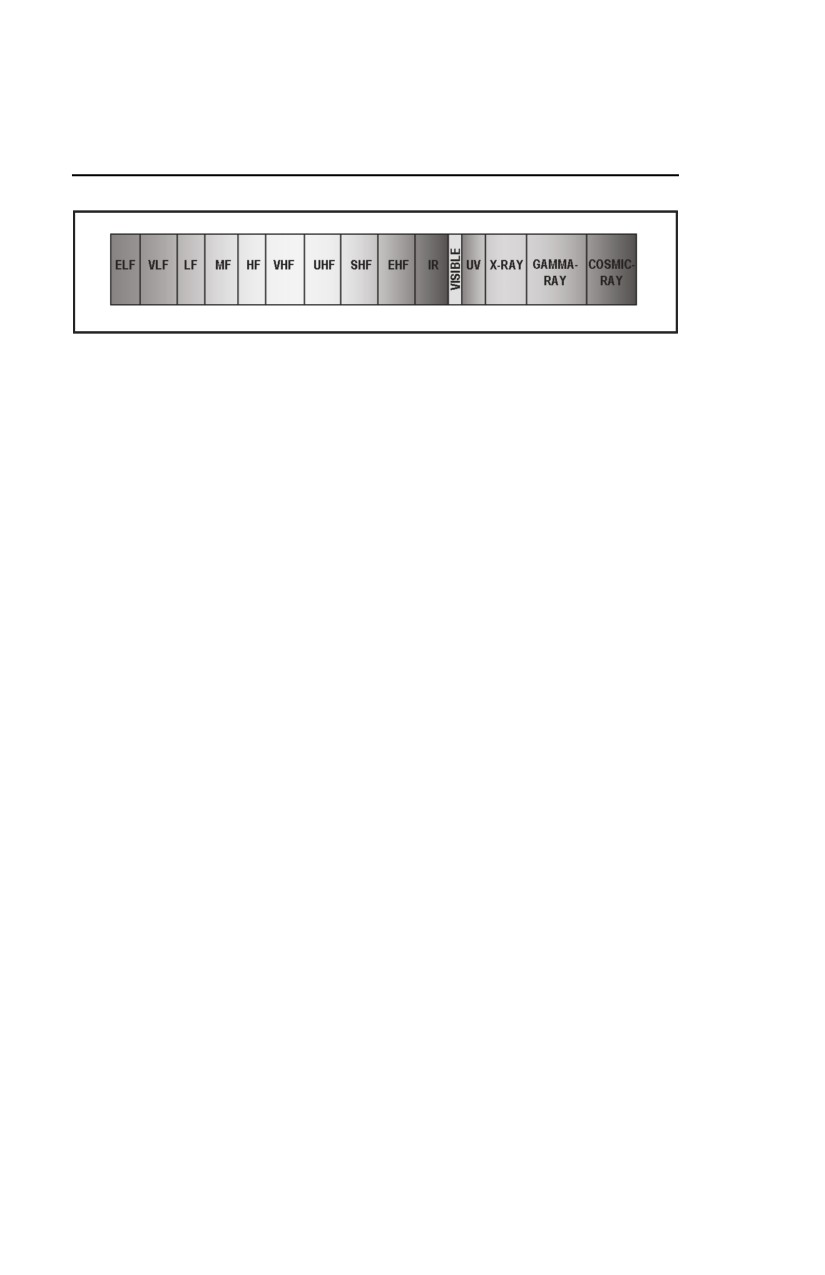
A-1. Electromagnetic spectrum is defined as the entire range of
radiated energy from low frequency (LF) radio waves through visible
light radiation and further to gamma and cosmic rays. Figure A-1
below depicts the full range of the electromagnetic spectrum. To enable
network centric warfare, the Army must have access to the radio
frequency portion of the spectrum, which is generally considered the
high frequency to EHF range of frequencies.
17 March 2009
FM 6-02.43
A-1
Appendix A
Figure A-1. The electromagnetic spectrum
A-2. The Army does not own any spectrum in the United States or in
any foreign country. In the United States, the Army shares government
allocated spectrum with federal agencies and other military services.
For example, of the 2320 frequencies a SINCGARS radio can use, only
200 of these are available for government use while the rest are shared
or borrowed from the Federal Communications Commission.
A-3. The spectrum is a sovereign resource that each country controls
and regulates to satisfy economic and security needs, as necessary.
While there are some international bands for radio services, countries
parcel the electromagnetic spectrum to meet their individual needs. For
example, radio frequency systems designed to operate in one
geographic area or country, or the United States may not be able to
legally operate in other geographic areas such as Europe.
ELECTROMAGNETIC SPECTRUM OPERATIONS
A-4. EMSO incorporates spectrum management, frequency
assignments, policy implementation, and host nation coordination that
enables the efficient use of the electromagnetic spectrum for combat
operations. EMSO enables and supports all spectrum dependent
emitters to include wireless extensions of networked communications
systems, all domains of electronic warfare, and many other information
management systems that support EMSO consists of planning,
operating, and coordinating joint use of the electromagnetic spectrum
through operational, engineering, administrative, and policy
implementation procedures. The objective of EMSO is to enable
electronic systems that rely on wireless connectivity to perform their
A-2
FM 6-02.43
17 March 2009
Electromagnetic Spectrum Management Operations
functions in the intended environment without causing or suffering
unacceptable frequency interference.
A-5. The primary focus of spectrum management is to obtain a valid
frequency license from the controlling authority at the international,
national, host nation, unified command, multinational, or military
department level agencies to operate equipment on a certain specified
frequency.
A-6. The Army spectrum management process includes the
application of operational, engineering, and administrative procedures
to allotted radio frequency bands to maximize reuse and sharing of the
spectrum that is available. It enables electronic equipment to perform
their functions in their intended environment using electromagnetic
compatibility measures, without suffering degradation from or causing
unacceptable degradation to other equipment.
A-7. It centers on managing discrete frequencies or frequency bands
using frequency allotments and frequency assignments; assuring
compliance with local radio regulatory policy, rules, and procedures;
application of sound electromagnetic compatibility measure practices;
resolution of harmful interference at the lowest operational level
possible; and timely reporting of incidents of harmful interference that
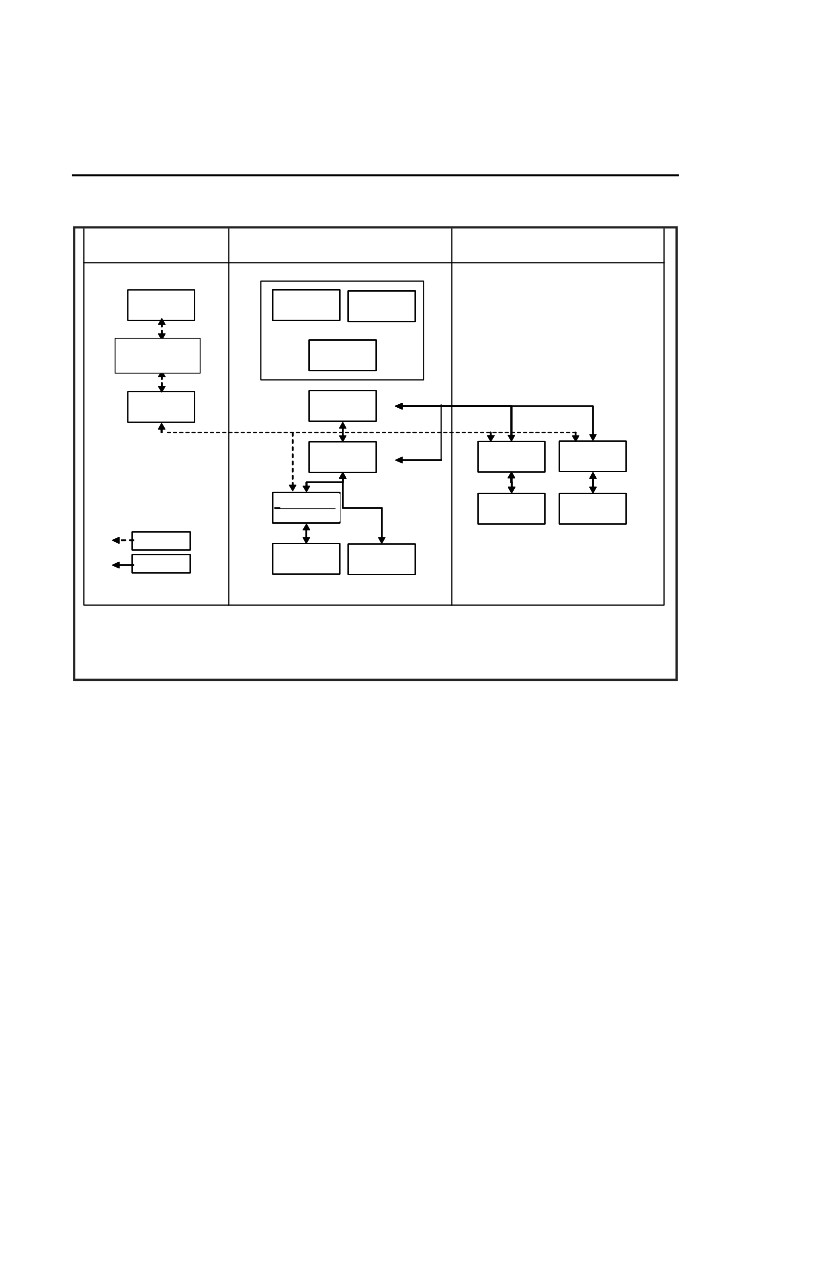
cannot be resolved locally. Figure A-2 illustrates the Army spectrum
management process.
TACTICAL SPECTRUM MANAGEMENT
A-8. Spectrum management is bottom driven for requirements and
top fed for resources. The division and BCTs represent the “pointy end
of the spear,” and it is critical that all requirements are captured by the
G-6/S-6 at each echelon to ensure the commander receives the proper
resources.
17 March 2009
FM 6-02.43
A-3
Appendix A
OCONUS
CONUS
ARNG / USAR
Host
DISA
IRAC
Nation
/ JSC
Combatant
ASMO
Commander
Service
AFMO
Component
or AFC
DOIM
TAG
USAR
RSC
Corps
ARNG
USAR
Division
Units
Units
OCONUS
Garrison
CONUS
BCT
Tennant
IRAC- Interdepartment Radio Advisory Board AFMO- Army Frequency Management Office
JSC- Joint Spectrum Center
TAG- The Adjutant General
ASMO- Area Spectrum Manager Office
RSC- Regional Support Command
AFC- Are Frequency Coordinator
USAR- United States Army Reserve
DOIM- Director of Information Management
ARNG- Army National Guard
Figure A-2. Army spectrum management process
A-9. In the past, the bulk of spectrum management was concerned
with communications emitters for the backbone and CNR networks.
Today’s operational environment presents many unique spectrum
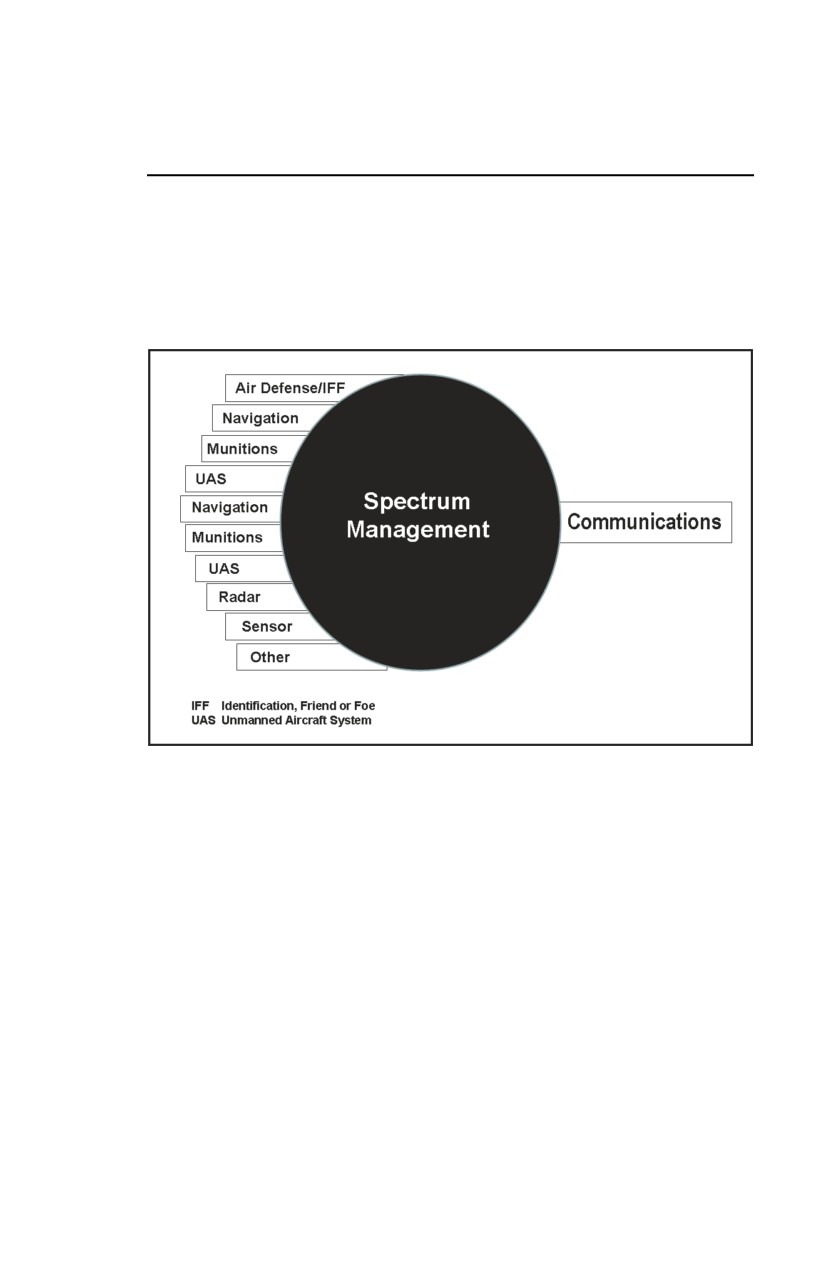
challenges. Figure A-3 shows that, while communications is certainly a
spectrum management concern, there are many other competing
systems for spectrum. It is the G-6/S-6 responsibility to coordinate with
all spectrum users in the AO to ensure all requirements for spectrum
access are identified. A list of all radio frequency emitters in the AO
must be maintained by the G-6/S-6 to ensure that competing systems
for the same portion of spectrum can be identified and prioritized for
frequency assignments.
A-4
FM 6-02.43
17 March 2009
Electromagnetic Spectrum Management Operations
A-10. The geographical combatant commander is the controlling
authority for spectrum. The geographical combatant commander
normally provides subordinate units, as an allotment, a pool of
frequencies to be used by certain equipment in certain geographical
locations on a first come first serve basis.
Figure A-3. Spectrum management radio frequency systems
TACTICAL SPECTRUM MANAGEMENT OPERATIONS
PROCESS
A-11. The role of the spectrum manager is to gather, adjudicate, and
forward requirements for all spectrum support for the division to the
next higher authority.
17 March 2009
FM 6-02.43
A-5

Appendix A
A-12. During day-to-day operations/training at home station, the G-6
spectrum manager normally uses Spectrum XXI to maintain and update
resident frequency records and requests. The automated
communications engineering software (ACES) builds and publishes the
CEOI, and a network-planning tool such as ISYSCON or detailed
planning and engineering module engineers frequencies for LOS
networks. Table A-1 describes these tools.
Table A-1. Spectrum management tools and descriptions
System
Description
The ACES is a net planning software program for the
US Army. ACES works in a ruggedized Windows NT
COTS platform for tactical operations and in desktop
Windows NT workstations in strategic locations. ACES
allows military users to perform fully automated
cryptonet, signal operating instructions, CEOI, joint
CEOI, and electronic protection planning, management,
ACES
validation, and generation distribution at the time and
location of need. The Military Communications
Electronics Board has designated ACES as the Joint
Spectrum Management Planning software (called Joint
Automated Communications-Electronics Operating
System [JACS]) for multiservice operations.
JACS has the same basic function as ACES. JACS’s
core purpose is to allow an interface between the joint
JACS
CEOI generation tool with service unique
communications planning software and spectrum
management automated tools.
The Joint Network Management System is used at joint
level to integrate network management functions. The
Joint Network
spectrum management portion uses existent systems
Management
(Spectrum XXI/JACS/ACES), and while providing some
System
level of integration, it essentially adds no new
capabilities to the spectrum management process.
ISYSCON,
The ISYSCON, detailed planning and engineering
DPEM, and
module, and network planning terminal are used
primarily to engineer the Army LOS communications
NPT
network for division and below.
A-6
FM 6-02.43
17 March 2009
Electromagnetic Spectrum Management Operations
Spectrum XXI is the spectrum management tool
designated by the Military Communications Electronics
Board as the joint DOD spectrum management
standard. It is used to create, modify, renew, and delete
permanent/temporary frequency assignments/proposals
worldwide.
The Spectrum XXI software was developed under the
management and direction of the DOD Joint Spectrum
Center and the National Telecommunications and
Information Administration. Spectrum XXI was
developed to automate many processes and
standardize the spectrum management process
throughout the federal government.
Spectrum XXI is not a program of record and therefore
did not follow the traditional acquisition process.
Spectrum XXI
Spectrum XXI was designed as a tool for combatant
commanders and consequently is not agile enough to
support maneuver operations. It is, however, the only
tool available at this time to assist in spectrum
management. Spectrum XXI can be used in either a
stand-alone mode or connected to regional servers via
the SIPRNET; however, the client server relationship is
not automatic. The clients must initiate a data exchange
to update both the server and the client’s machine. In
addition, equipment such as satellites and radars are
many times, not accounted for which creates
inaccuracies in the electromagnetic picture. Spectrum
XXI also has no visibility of real time operations and is
reliant on the operator to update the database to
maintain accuracy, which in a highly dynamic
operational environment is unlikely.
A-13. During mobilization, spectrum managers are involved in all
planning meetings to determine what frequency requirements will be
based on the division structure (which and how many types of brigades
will be in the division). Once the initial requirements are determined,
the spectrum managers will begin building the master net list, initiate
frequency requests, and begin coordination of electronic warfare
issues.
17 March 2009
FM 6-02.43
A-7
Appendix A
A-14. Once the frequency allotment has been received and the
network plans are finalized, the CEOI is built and published, and
distribution of frequencies to other equipment such as unmanned
aircraft systems, munitions, radars, etc., will be accomplished.
Note. There is currently no spectrum management tool that
allows for en route planning. Only manual adjustments can be
made to any plans.
A-15. In the AO, any adjustments to the spectrum management plan
are made by exception due to Spectrum XXI, ACES/JACS, and
ISYSCON/Joint Network Management System being static planning
tools that do not support maneuver operations.
A-16. During operations, the spectrum manager will constantly be
resolving frequency deconfliction issues and participating in electronic
warfare planning. Depending on the type of operations, the spectrum
manager may also be negotiating with host nations, non-governmental
organizations, or joint, interagency and multinational organizations for
spectrum support and/or deconfliction.
A-17. A unique challenge facing spectrum managers today is the use
of the spectrum by the enemy to detonate improvised explosive
devices. It is possible to mitigate the danger by jamming specific
frequency bands; however, this also denies use of these bands for
operational use. The spectrum manager must work closely with the
appropriate staff sections in order to best support the commander’s
intent and the mission.
Stability Operations
A-18. Spectrum managers should refine and update their plans to keep
the database as accurate as possible. As units rotate or leave the AO,
diligent database maintenance is required to accurately reflect
assignments to efficiently use the electromagnetic spectrum. The
spectrum manager ensures that spectrum remains available for key
A-8
FM 6-02.43
17 March 2009
Electromagnetic Spectrum Management Operations
military systems while at the same time negotiating for commercial
spectrum for post, camp, or station operations such as the land mobile
radio or security systems.
A-19. The spectrum manager must work closely with the G-2/S-2 and
G-3/S-3 to coordinate electronic warfare planning and execution
including publication of the Joint Restricted Frequency List. Once the
resources have been allotted, the spectrum manager will assign
frequencies to all emitters in the AO to include those for the network.
A-20. The spectrum manager will work with the appropriate network
manager to assist in the frequency engineering of the network (for
example, LOS radio shots and building and publishing the division
CEOI). Due to the scarcity of spectrum in certain situations, it may be
necessary for the G-6/S-6 to make recommendations to the commander
concerning the prioritization of spectrum assignments.
Sustainment Training
A-21. The skills associated with spectrum management software are
highly perishable. The G-6/S-6 must secure access to the SIPRNET for
the spectrum manager to properly operate Spectrum XXI for training
and operational exercises. Failure to have access to the SIPRNET will
limit the use of Spectrum XXI as a stand-alone client and hinder its
effectiveness as the spectrum manager’s primary tool.
Note. The G-6/S-6 must ensure regular training and use of the
software to maintain proficiency.
SPECTRUM VIOLATION
A-22. It is critical that all levels of command understand the inherent
risk of violating the rules of proper spectrum management. In many
cases, a radio signal is all that connects a Soldier, platoon, or company
to safety by providing SA or available support. In the past, bootlegging
a frequency only affected the communications network. However,
17 March 2009
FM 6-02.43
A-9
Appendix A
today that practice can have first order, and in many cases, second and
third order effects that are undesirable on other systems.
A-23. Emitters that are turned on in a geographic AO without the
proper clearance and certification have the same affect as bootlegging a
frequency. Some of the effects of these actions have included the
crashing of a multi-million dollar unmanned aircraft system and lack of
communications between elements during critical situations.
A-10
FM 6-02.43
17 March 2009
Appendix B
Army Battle Command System
The ABCS (V) 6.4 is a core set of common
support software that is commonly run on a
CHS, a specialized workstation, or a COTS
laptop. These integrated information systems
allow commanders and their staff access to real
or near-real time information in the full
spectrum of military operations. This appendix
describes the key fielded and developmental
information systems available to forces under
the ABCS.
ABCS INTRODUCTION
B-1. ABCS is a collection of information systems that provides
commanders and staffs with SA, situational understanding, and the
capability to exchange necessary information across echelons and
warfighting functions during full spectrum operations. Each system
plays a critical part in planning, preparing for, executing and assessing
operations. ABCS automates the combat business process during the
prosecution of well known and rehearsed staff battle drills. These battle
drills and systems provide TOCs the ability to analyze, coordinate,
direct, and synchronize combat operations during maneuver operations.
The Battle Command Common Services platform employs a publish-
and-subscribe data dissemination service to enable the exchange of
information between different systems, as well as business enterprise
services to enable dissemination of knowledge beyond the boundaries
17 March 2009
FM 6-02.43
B-1
Appendix B
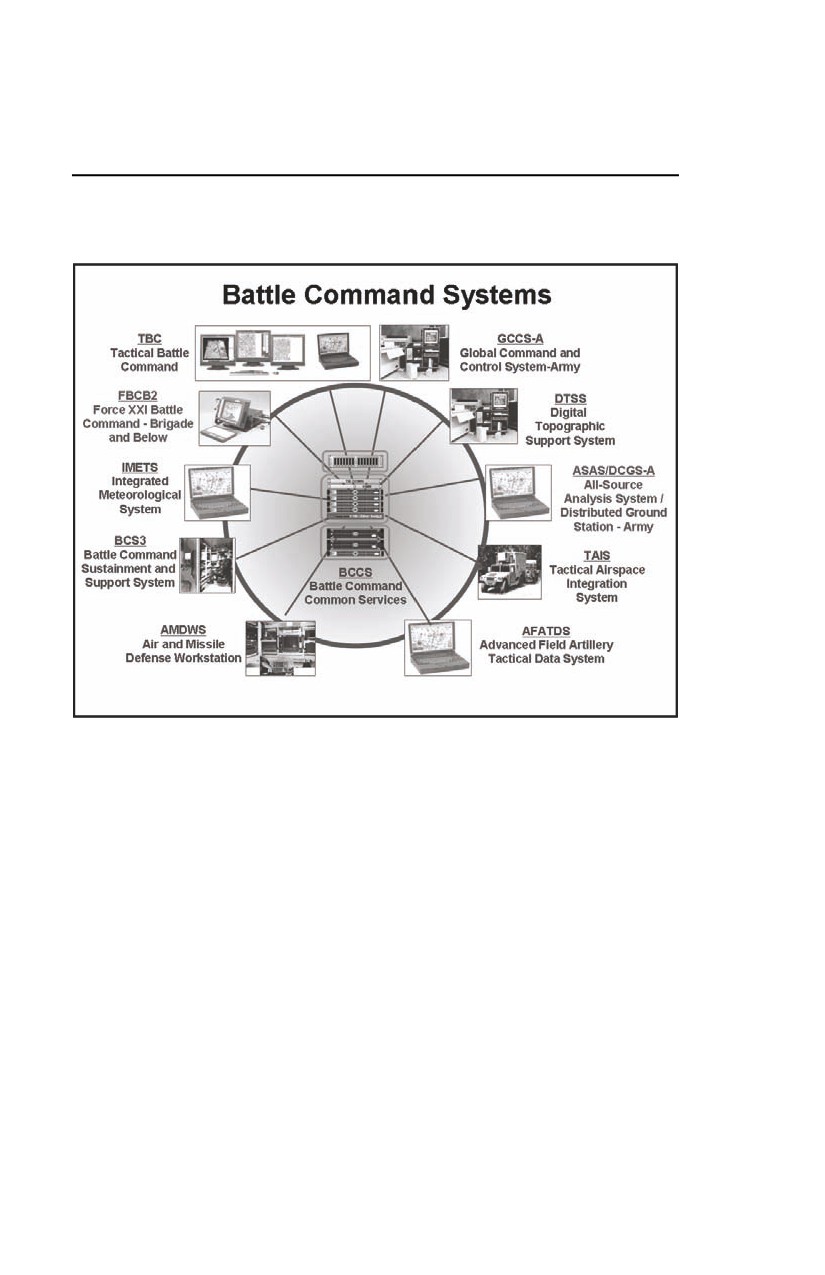
of ABCS clients. The following paragraphs describe the systems that
comprise ABCS and Figure B-1 depicts the ABCS.
Figure B-1. The Army battle command system
TACTICAL BATTLE COMMAND
B-2. Tactical Battle Command consists of the Maneuver Control
System and CPOF.
Maneuver Control System
B-3. The Maneuver Control System allows commanders and staffs to
visualize the operational environment and synchronize the elements of
combat power for successful execution of combat operations. The
Maneuver Control System also serves as the primary system to
integrate and manage data from supporting ABCS systems onto a
B-2
FM 6-02.43
17 March 2009
Army Battle Command System
single map display to create a user-defined common operating picture.
It provides the planning tools to support and manage deliberate mission
planning and to produce and disseminate orders. It also provides Army
engineer and joint chemical, biological, radiological and nuclear tools
to support planning, execution and management of engineer and
chemical, biological, radiological and nuclear missions and tasks.
Command Post of the Future
B-4. CPOF) is a decision support system that provides SA and
collaborative tools to key leaders and staff. CPOF integrates
information from the ABCS and other systems to provide a continuous
and near real-time common operating picture to the commander and
staff to enable map-centric visualization of planning and significant
operational activities.
GLOBAL COMMAND AND CONTROL
SYSTEM-ARMY
B-5. The GCCS-A provides the link for the ABCS to the Global
Command and Control System. The GCCS-A provides a common
operating picture and associated friendly and enemy status information
and provides force employment planning and execution tools. These
include receipt of forces, intra-theater planning, readiness, force
tracking, onward movement, and execution status. GCCS-A is not
ordinarily found below division level.
ALL SOURCE ANALYSIS
SYSTEM/DISTRIBUTED COMMON
GROUND SYSTEM-ARMY
B-6. The All Source Analysis System (ASAS) is an intelligence
fusion system that provides a timely, accurate, and relevant picture of
the enemy situation. It provides graphic representations of the enemy
situation to ABCS and provides all source intelligence to support
development of the common operating picture. It also supports
17 March 2009
FM 6-02.43
B-3
Appendix B
management of intelligence, surveillance assets, intelligence collection,
provision of electronic warfare support, and the protection warfighting
function. The All Source Analysis System interoperates with organic
intelligence and electronic warfare sensors; joint, theater, and national
sensors; and preprocessors as well as other services’ intelligence
processors.
B-7. ASAS will be replaced by the Distributed Common Ground
System-Army (DCGS-A). DCGS-A provides distributed intelligence,
surveillance, and reconnaissance information to Army and Joint and
multinational forces. DCGS-A is used to perform planning,
management, control and tasking
(for some sensors), processing,
displaying, and dissemination functions, providing a robust
interoperability capability. It will empower the commanders, decision
makers, and analysts with intelligence, surveillance, and
reconnaissance information and fused products at all echelons.
B-8. DCGS-A will deliver state-of-the-art imagery intelligence,
signals intelligence, measurement and signatures intelligence, human
intelligence, all source, and fusion capabilities. DCGS-A enables
commanders to achieve situational understanding by leveraging
multiple sources of data, information, and intelligence.
BATTLE COMMAND SUSTAINMENT
SUPPORT SYSTEM
B-9. The Battle Command Sustainment Support System is the
maneuver sustainment C2 system that provides a concise picture of unit
sustainment requirements and support capabilities. It connects and
supports the logistician by integrating the logistics common picture and
in-transit visibility, enabling the view of material in the logistics
pipeline. It exchanges information with ABCS and joint systems.
B-4
FM 6-02.43
17 March 2009
Army Battle Command System
AIR AND MISSILE DEFENSE PLANNING
AND CONTROL SYSTEM
B-10. The Air and Missile Defense Workstation is the C2 component
of the Air and Missile Defense Planning and Control System. It is a
digitized tool for monitoring and managing air and missile defense plan
with the ground scheme of maneuver. It is used to integrate sensors, air
defense fire units, and CPs from the air defense artillery battery
through theater echelons. The Air and Missile Defense Workstation is
used to display air and missile defense plans and air SA to ABCS and
commanders at all echelons.
ADVANCED FIELD ARTILLERY
TACTICAL DATA SYSTEM
B-11. The Advanced Field Artillery Tactical Data System is a fire
support planning, coordinating, and controlling system that provides
for counter-fire, interdiction, and suppression of enemy targets. It
provides integrated support for all fire support assets including field
artillery, mortars, close air support, naval gunfire, and attack helicopter.
The Advanced Field Artillery Tactical Data System displays fire
support systems, target types, command guidance, available munitions,
and weapons status so that informed decisions may be made based on
the commander’s guidance.
FORCE XXI BATTLE COMMAND,
BRIGADE AND BELOW
B-12. FBCB2 provides increased SA to the commander by depicting
an accurate and automatic view of friendly force, enemy forces,
obstacles, and known battlefield hazards. FBCB2 supports OPCON
through the transmission and receipt of orders, reports, and data.
FBCB2 uses two forms of communications means: terrestrial and
satellite. FBCB2 terrestrial uses EPLRS and, to a lesser extent,
SINCGARS to exchange data and provide SA. FBCB2 satellite, known
as BFT, shares SA with terrestrial units and ABCS systems that use
17 March 2009
FM 6-02.43
B-5
Appendix B
reachback tunnels found in regional operation centers. Terrestrial- and
satellite-based FBCB2s are interoperable and allow the exchange of SA
between them. Approximately 70 percent of the forces employ BFT
with terrestrial-based FBCB2 used by 30 percent of the forces.
B-13. FBCB2 is a mission essential sub-element and a key component
of ABCS. It is also interoperable with the maneuver control system,
ASAS, Advanced Field Artillery Tactical Data System, air and missile
defense workstation, and Battle Command Sustainment Support
System. FBCB2 will feed the ABCS common database with automated
positional friendly information and current tactical battlefield geometry
for friendly and known/suspected enemy forces. Common hardware
and software design will facilitate training and SOP.
TACTICAL AIRSPACE INTEGRATION
SYSTEM
B-14. The Tactical Airspace Integration System (TAIS) is a digitized,
integrated, and automated system that provides Army airspace C2 and
air traffic services. The TAIS links the air defense and airspace
management cell to the joint force air component commander’s theater
battle management core systems for Army airspace integration into the
joint fight. The TAIS also interfaces with civil airspace control
agencies and provides input to ABCS.
DIGITAL TOPOGRAPHIC SUPPORT
SYSTEM
B-15. The Digital Topographic Support System provides automated
support for terrain mapping and analysis, and creation of topographic
products. It provides on screen and hard copy terrain analysis products
that include on and off road mobility maps, concealment maps, on road
choke point maps, and tactical fording/bridging maps. The Digital
Topographic Support System is ordinarily found at the corps through
brigade level. Digital Topographic Support System geospatial and
topographic capabilities will be provided as a capability within DCGS-
A when it is fielded.
B-6
FM 6-02.43
17 March 2009
Army Battle Command System
INTEGRATED METEOROLOGICAL
SYSTEM
B-16. The Integrated Meteorological System provides an automated
weather system to receive, process, and disseminate weather
observations, forecasts, and weather and environmental effects decision
aids from the corps through brigade level. The Integrated
Meteorological System processes and collates forecasts, observations,
and climatological data to produce timely and accurate weather
products tailored to the commander’s needs. It is able to analyze and
graphically display the impact of current and projected weather
conditions on friendly and enemy capabilities. Integrated
Meteorological System weather capabilities will be provided as a
capability within DCGS-A when it is fielded.
ISYSCON (V)4, TACTICAL INTERNET
MANAGEMENT SYSTEM
B-17. The ISYSCON (V)4 provides the tactical Army commander, G-
6/S-6 officer, and signal staff an automated system to support LANs
and CNR-based WANs. CNR consists of EPLRS, wideband
networking waveform radios, SINCGARS, and SATCOM.
Specifically, the ISYSCON
(V)4 will support initialization and
management of critical information devices. The ISYSCON (V)4 will
support information operations and automation in support of combat
forces, their weapon systems, and the other related automated systems.
The ISYSCON (V)4 will provide LAN management services for LANs
at all echelons from theater through maneuver battalions. LAN
management includes the planning, configuring, and fault management
for all network devices located on each LAN.
BATTLE COMMAND COMMON SERVICES
B-18. The Battle Command Common Services platform is a collection
of server hardware and software application that provides the core
ABCS interoperability services and the infrastructure necessary to
17 March 2009
FM 6-02.43
B-7
Appendix B
employ enterprise-class services and an objective service-oriented
architecture. BCCS provides TOCs at multiple echelons a localized
network directory, access control and other services to an expanding
array of ABCS and non-ABCS systems
(collaboration servers,
databases, file servers, websites, email, etc.) and networks that are
operated either in a standalone configuration or as part of the GIG.
B-8
FM 6-02.43
17 March 2009
Appendix C
Signal Military Occupational
Specialties
As the Army transforms to a modular force, our
deployed forces become more dependent on
information passed over the network. Signal
communications Soldiers and information
systems
Soldiers
must
provide
the
communication services required to accomplish
the mission. This appendix provides an overview
of the signal enlisted and officer branches
MOSs.
ENLISTED MILITARY OCCUPATIONAL
SPECIALTIES
C-1. The enlisted signal MOS (25 career management field) covers a
vast area of communications equipment. Depending on the MOS,
enlisted signal Soldiers are trained to install, operate, and maintain
strategic and tactical communications and information equipment.
Signal Soldiers can train and work on equipment such as—
z
Digital group multiplexer.
z
COTS equipment (for example, IP routers, PROMINA switches).
z
Tri/Quad band SATCOM.
z
WIN-T.
z
High capacity LOS.
17 March 2009
FM 6-02.43
C-1
Appendix C
z
Tactical radios (for example, AN/PRC-150, Joint Tactical Radio
System, SINCGARS, and multiband inter/intra team radio).
z
FBCB2 and EPLRS.
SIGNAL REGIMENT OFFICER AREA OF
CONCENTRATION
C-2. The Signal Corps is a basic branch of the Army. Signal officers
lead Soldiers and units that provide and manage communications and
information systems support for the C2 of combined arms forces.
Signal support includes NETOPS, IA, information dissemination
management, network management, and management of the
electromagnetic spectrum. Signal support encompasses all aspects of
designing, installing, maintaining, and managing information networks
to include communications links, computers, and other components of
LANs and WANs.
C-3. Signal support also includes the integration of user-owned and -
operated systems into the networks. Signal forces plan, install, operate,
and maintain voice and data communications networks that employ
single and multi-channel satellite, TROPO, terrestrial microwave,
switching, messaging, video-teleconferencing, visual information, and
other related systems. They integrate tactical, strategic, and sustaining
base communications and information processing and management
systems into a seamless global information network that supports
knowledge dominance for Army, joint, and multinational operations.
SIGNAL WARRANT OFFICERS
C-4. Signal warrant officers are adaptive technical experts, leaders,
trainers, and advisors who provide technical leadership and advice in
planning and directing NETOPS communications, and IA at all levels
of command from sustaining military bases to forward-deployed
fighting forces in support of Army, joint, combined, and multinational
operations worldwide. Signal warrant officer MOSs include
255Z
Senior Signal Systems Technician;
250N Network Operations
Technician; 251A Information Systems Technician; and 254A Signal
C-2
FM 6-02.43
17 March 2009