FM 6-02.43 SIGNAL SOLDIER’S GUIDE (March 2009) - page 3
Chapter 2
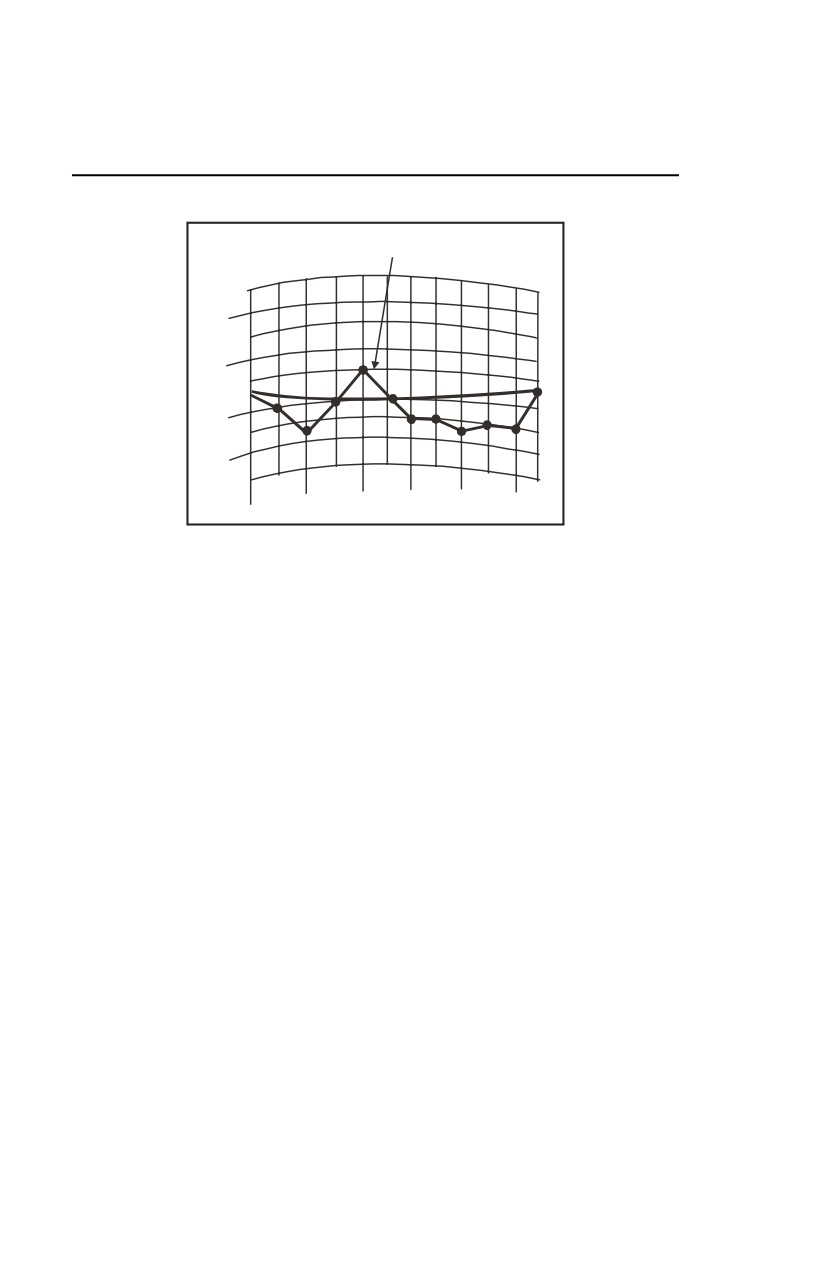
LOS Path Blocked
800
600
400
200
Elevation
10
15
20
5
25
0
Figure 2-4. Sample LOS study
2-60. The materials needed to perform a manual radio LOS analysis
are—
z
Grid coordinates of both stations.
z
Path profile paper, 4/3-earth radius (if possible).
z
Map sheet containing both stations.
z
Graphic Training Aid 5-2-12 protractor and coordinate scale.
2-61. Follow the steps below to perform a manual radio LOS
analysis—
z
Step 1. On the map sheet, place a dot at each proposed site
location and circle it for ease of finding it later.
z
Step 2. Draw a line from point A to point B and determine the
distance between the two. If the distance is greater than 48 km
(29.8 miles) and
40 km (24.8 miles) for mobile subscriber
equipment (MSE), the points exceed maximum planning range and
the transmissions may be too weak to receive. A relay may be
needed; however, its use is undesirable and should be used as a
last resort so that unnecessary assets are not tied up in one radio
link.
2-24
FM 6-02.43
17 March 2009
Signal Planning Process
z
Step 3. Determine the elevation in meters of the originating and
destination stations. Plot them the proper distance apart on the
profile paper. (Remember to add the antenna height.)
z
Step 4. Divide the distance between the stations into 1 km (.62
miles) increments.
z
Step 5. Determine the highest elevation in meters at 1 km (.62
miles) increments. Plot these on the profile chart.
z
Step 6. Connect the points to establish a graphic picture of the
terrain along the path between the two stations.
z
Step 7. Draw a straight line between the antenna stations. This line
represents the multi-channel radio transmission path.
Note. If the transmission path does not clear the terrain, LOS
is not possible. Another terminal site or a relay site should be
chosen. Leaders at company, platoon, and team level should
manually profile radio shots as soon as possible.
ADDITIONAL SIGNAL SUPPORT
EQUIPMENT CHECKS DURING
OPERATIONS
2-62. The following are basic checks and balances that should be
performed once the unit is executing the mission.
2-63. Power, grounding, and power distribution are extremely
important to signal planning. Approximately fifty percent of all
communications outages are attributed to power failures. Key
components to power planning are the selection of a power source, set-
up of power generators, grounding of power sources and electrical
components, and distribution and extension of power.
17 March 2009
FM 6-02.43
2-25
Chapter 2
Note. Power (symbol P) is defined by units called watts (W).
Current (symbol I) is defined by units called an ampere (amp
or A). Voltage or the potential difference
(symbol E) is
defined by units called volts.
Power = (Current) x (voltage) or P = IE or P = I (voltage)
GENERATORS, CIRCUIT BREAKERS, AND POWER SOURCES
2-64. Signal Soldiers are often signed for or responsible for unit
generators. The right generator, circuit breaker, and power source will
ensure signal equipment functions properly. Before a power source is
selected, separate signal equipment from air conditioners, refrigerators,
microwaves, heaters, coffee pots, etc. Air conditioners have
compressors, and for most models, the compressor only engages
periodically. Each time the compressor engages, the power draw
increases, creating fluctuation in the current available. Current
fluctuations cause electronic devices to react abnormally and failure is
more likely to occur.
2-65. Circuit breakers need to be rated for the circuit requirements.
For example, a 20 amp circuit breaker on a 110 volt circuit provides P
= (110) (20) W = 2200 W or 2.2 kilowatts (Kw).
2-66. Generators must be set up properly and be matched to the task.
Generators normally operate with one, two, or three phases, and should
be loaded to 80 percent of capacity when possible. Loads should be
distributed to all phases of the generator.
2-67. Phases of the generator divide the available power rating by the
number of phases. For example, a single-phase
10 Kw generator
provides P = IV, 10 Kw = (110) (I) or I = 10 Kw/110 volts = 90 amps.
A three phase 15 Kw generator provides 5 Kw on each circuit or 5
Kw/110 volts = 45amps. Therefore, if a 50-amp circuit is required, a
single-phase 10 Kw generator is better than a three phase 15 Kw
generator. Bigger is not always better when taking all of these factors
into consideration.
2-26
FM 6-02.43
17 March 2009
Signal Planning Process
2-68. Power generators require level ground and proper grounding.
Power sources are especially susceptible to faults when electrical
grounds do not meet to standards. Generators typically have 9-foot
copper ground rods with copper grounding cables that should be used
at all times. Ensure they are checked (less than 25 ohms of resistance)
after installation. Use ground test meters every time to ensure proper
ground before operation. Use salt and water, add ground rods and link
them together with copper cable until the requirement is met; less
resistance is better. Never ground a power source together with a signal
entry panel or any signal equipment. Power sources and power feeders
should always remain separate.
2-69. Power generators play an important role for signal leaders. The
following steps are equally important, whether using commercial or
tactical generators. Ensure the following steps are being preformed to
keep generators working properly during operations—
z
Paralleling generators and using switch boxes can be essential to a
power plan for communications equipment. Generators must be
cabled properly, and the switch box must be rated to perform the
job. Even in the best situation, a power spike or failure may occur
if the system is not set up right.
z
Ensure power generators are in good working order and track
hours operated by using the hour meter or by keeping a logbook,
and perform preventative checks and services before, during, and
after operations.
z
Use clean, uncontaminated fuel.
z
Replace air and oil filters regularly and more often in austere
environments. Most generators must be off line to change filters.
Sandy environments can cause air filters to clog quicker than
normal so replace or clean them more often when necessary.
z
Generators must be kept as cool as possible. Sun loading (sun
shining directly on a generator) can cause overheating. Shading a
generator with sunshades or camouflage can keep the temperature
within the normal operating range even if the ambient temperature
is high.
17 March 2009
FM 6-02.43
2-27
Chapter 2
z
During operations, it is important to watch the loading of
generators. Usage can also cause the load to become unbalanced.
z
Ensure all Soldiers know how to use a multimeter on all assigned
equipment. They are essential for signal equipment and can make
the difference between a piece of equipment staying in good
condition or always having to be repaired. Another useful tool is a
plug-in polarity checker (which can be found at most electrical
shops). The polarity checker has light emitting diode readouts that
provide information about the source of power.
z
Ensure that all operators are proficient in cutover emergency
procedures.
2-70. It is important for signal leaders to know what power is
available at all plug-in points being used. Most equipment comes with
a power cord and the cord is rated to provide the needed electricity to
the electronic components from the origination source.
2-71. If the length of the provided power cable is being extended by
using extension cords or other cables, measure the power available at
the source of the last plug, or calculate the power loss for the cable and
ensure the original source can provide what is needed over the distance
of the extension. The gauge of the cable or the loss rating will need to
be known.
2-72. An uninterruptible power supply
(UPS) at the end of an
extension cord cannot recharge if it is not provided enough power. If
the UPS is getting just enough power to provide power to the
components it services, when back-up power is needed the UPS will
fail. Soldiers must measure the power into the UPS and ensure it has
the capacity to provide failsafe power to the components it is
responsible for protecting. In the wrong configuration, the UPS may
inhibit the components from working properly by taking power from
the source. Even a fully charged UPS may steal power from the circuit
over time.
2-28
FM 6-02.43
17 March 2009
Chapter 3
The Network
The network is an essential asset that enables the
Army to rapidly transform and execute full
spectrum joint operations. The network enables
leaders with minimal forward presence to C2
maneuver formations, sustain the force, and
achieve broad political-military objectives
across the full spectrum of operations. The
network touches every entity, including
individual Soldiers. It is a critical weapon in the
fight and must be robust, flexible, and adaptive
to the commander’s needs. This chapter provides
an overview of the GIG, LWN, network C2, and
current and future networks.
GLOBAL INFORMATION GRID
3-1. The Department of Defense (DOD) Directive 8100.1 defines the
GIG and its assets as globally interconnected, end-to-end set of
information capabilities, associated processes, and personnel for
collecting, processing, storing, disseminating, and managing
information on demand to Soldiers, policy makers, and support
personnel. The GIG includes all owned and leased communications
and computing systems and services, software (including applications),
data security services, and other associated services necessary to
achieve information superiority. It also includes National Security
Systems as defined in Section 5142 of the Clinger-Cohen Act of 1996.
17 March 2009
FM 6-02.43
3-1
Chapter 3
3-2. The GIG supports all DOD, national security, and related
intelligence community missions and functions (strategic, operational,
tactical, and business) in war and in peace. The GIG provides
capabilities from all operating locations (bases, posts, camps, stations,
facilities, mobile platforms, and deployed sites). The GIG also provides
interfaces to multinational and non-DOD users and systems.
3-3. The overarching objective of the GIG vision is to provide the
President and Secretary of Defense, DOD personnel, intelligence
personnel, businesses, policy makers, and non-DOD users with
information, decision superiority, and full-spectrum dominance.
3-4. Achieving the GIG vision requires substantial augmentation of
today’s information sharing technology features and new technology
capabilities. The preponderance of GIG functionality will be realized
through leveraging commercial technologies and standards (augmented
as necessary) to meet unique DOD mission critical needs. These needs
pertain to availability, integrity, confidentiality, access control, and
non-repudiation.
3-5. The signal planner relies on the NETOPS functions of
management of the network, information dissemination, and network
defense to ensure that commanders at each echelon retain the flexibility
to employ LWN capabilities in the most decentralized fashion to meet
their operational needs; while also ensuring the LWN meets the
interoperability standards necessary to allow full integration in to the
GIG.
ECHELONED AND INTERDEPENDENT NETWORKS
3-6. A joint-focused network is based on a mix of military and
commercial systems that capitalize on new and emerging technologies
to provide enhanced capabilities to commanders and staff at all
echelons.
3-2
FM 6-02.43
17 March 2009
The Network
3-7. The network must provide—
z
Seamless end-to-end capabilities for:
National security, DOD, and intelligence
community requirements from peacetime business
support through all levels of conflict.
Strategic, tactical, post, camp, and station level
users.
z
Information capabilities for:
Joint high capacity netted operations.
Linking
state-of-the-art
weapons
and
intelligence,
surveillance, and reconnaissance
systems.
US government interagency information sharing
capability.
Strategic, tactical, and functional applications.
“Plug-and-play”
interoperability
and
connectivity between US and multinational users.
Defense in depth against all threats.
MULTINATIONAL NETWORKS
3-8. Multinational, interagency, and commercial networks exist
throughout the tactical environment. They are an integral component of
the network and enable Soldiers to use the network as a multinational
and joint force network. The requirement and ability to exchange
information between multinational and joint forces are critical to a
successful leverage and use of all information available to today’s
Soldier.
LANDWARNET
3-9. LWN is the Army’s portion of the GIG. LWN encompasses all
Army information management systems and information systems that
collect, process, store, display, disseminate, and protect information
17 March 2009
FM 6-02.43
3-3
Chapter 3
worldwide. It enables execution of Army C2 processes and supports
operations through wide dissemination of relevant information. LWN
facilitates rapidly converting relevant information into decisions and
actions. It allows commanders to exercise C2 from anywhere in their
AO.
3-10. LWN consists of all Army networks, from sustaining military
bases to forward deployed forces. It includes all Army owned, leased,
and leveraged DOD communications as well as computing systems and
services, applications, and data security services. LWN is the
combination of infostructure and services from across the Army and
consists of the corps, division, and BCTs/brigade’s supporting
deployed forces. LWN also includes the National Guard Net and the
Army Reserve Net.
3-11. Tactical networks rely on the LWN for C2 and sustainment
support. They leverage internal, strategic, and national capabilities to
orchestrate the theater network battle. The corps, division, and BCT
will deploy into theater from multiple force projection platforms. This
complex environment demands full connectivity, complete
synchronization, and consistent worldwide standards to allow
immediate access to the fight. Corps, division, and BCTs will
dynamically maneuver forces and employ network capabilities within
the enterprise. The integration of network capabilities across all
echelons (BCT to BCT, BCT to division, division to corps, etc.) will
require total synchronization across all NETOPS disciplines.
Note. NETOPS is addressed in detail in other doctrinal
publications that may be accessed on the doctrine AKO portal
at http://gordon.army.mil/doctrine. These publications include
tactics, techniques, and procedures, organization details,
operational imperatives, responsibilities, and detailed policies
for Army NETOPS affecting the LWN and joint
communications systems. The portal requires a common
access card to access.
3-4
FM 6-02.43
17 March 2009
The Network
NETWORK COMMAND AND CONTROL
3-12. The senior mission commander at each echelon commands and
controls the network. To ensure that a seamless and autonomous
network is achieved, the senior mission commander delegates authority
to the G-6 for the following—
z
Control and configure the network.
z
Move signal personnel and equipment around the battlefield.
z
Modify network configuration specifications on the battlefield to
support both current and future operations.
TELECOMMUNICATIONS SERVICE ORDER
3-13. The G-3 executes control through the OPORD process, and the
G-6 executes control through the TSO process. For current operations,
the G-6 executes network reconfigurations based on the TSO process
and as specified by the commander in the OPORD. These changes
include frequency modification, router configurations, or equipment
settings. When reconfiguration involves the movement of personnel
and equipment within the current operation, the G-6 coordinates the
adjustment with the G-3, and the appropriate FRAGO is issued by the
G-3 in support of the reconfiguration.
3-14. The TSO carries the same weight as an appropriate FRAGO for
the configuration of the network. This process flows from the CCDR J-
6 through the JTF operational chain of command structure to facilitate
the establishment and health of the enterprise network and theater
network.
MILITARY DECISION MAKING PROCESS
3-15. The G-6/S-6 officer participates in the MDMP and identifies the
correct placement of network equipment and personnel on the
battlefield in support of the mission. The information is then vetted,
through COA development, and published in the unit OPORD and
requisite signal annex.
(Refer to Chapter
2 for a more in-depth
explanation of the role the signal planner plays in the MDMP process.)
17 March 2009
FM 6-02.43
3-5
Chapter 3
NETWORK OPERATIONS
3-16. NETOPS is the operational construct consisting of the essential
tasks, SA, and C2 that the Commander, United States Army Strategic
Command will use to operate and defend the GIG. The Army uses the
NETOPS construct to operate, manage, and defend its portion of the
GIG, the LWN. NETOPS provides units the ability to harness the
power of the LWN and bring this power to the battlefield where it is
needed most, thus increasing the lethality of Army tactical units.
3-17. The objective of NETOPS is to enable Army signal
commanders and G-6/S-6s to provide communications system
operations support to users conducting the Army’s operational mission.
NETOPS enables the allocation of network, information system,
security, and information dissemination resources that directly support
operational forces. NETOPS provides users with end-to-end
connection and visibility of strategic, operational, and theater and
tactical network management, IA, and information dissemination
management resources.
Note. FM
3-0, Chapter
7 covers information superiority
consisting of: intelligence, surveillance and reconnaissance,
information operations, knowledge management, and
information management. Information protection is an Army
information task that contributes to information superiority
and usually falls directly under the responsibility of the G-6/S-
6.
INFORMATION PROTECTION
3-18. Information protection is a key component of information
superiority and is the active or passive measures to protect and defend
friendly information and information systems to ensure friendly access
to timely, accurate, and relevant information while denying adversaries
the opportunity to exploit friendly information and information systems
for their own purposes. Information protection comprises IA, CND,
and electronic protect capabilities (FM 3-0).
3-6
FM 6-02.43
17 March 2009
The Network
INFORMATION ASSURANCE
3-19. IA provides for the restoration of information systems by
incorporating protection, detection, and reaction capabilities and
consists of measures that protect and defend information and
information systems by ensuring their availability, integrity,
authentication, confidentiality, and non-repudiation—
z
Availability is the timely and reliable access to data and services
by authorized users.
z
Integrity is the protection from unauthorized change, including
destruction.
z
Authentication is the certainty of user or receiver identification and
authorization to receive specific categories of information.
z
Confidentiality is the protection from unauthorized disclosure.
z
Non-repudiation is proof of message receipt and sender
identification, so neither can deny having processed the data.
COMPUTER NETWORK DEFENSE
3-20. CND consists of measures designed to protect and defend
information, computers and networks from disruption, denial,
degradation or destruction. It includes all measures to detect
unauthorized network activity and computer network attack and to
defend computers and networks against it. These measures include
access controls, malicious computer code and program detection, and
intrusion detection tools.
ELECTRONIC PROTECTION
3-21. Electronic protection is that division of electronic warfare
involving actions taken to protect personnel, facilities, and equipment
from any effects of friendly or enemy use of the electromagnetic
spectrum that degrade, neutralize, or destroy friendly combat
capability. Friendly forces use emission control and other anti-jamming
measures to perform electronic protection. See FM 6-02.70 for further
information on electronic protection.
17 March 2009
FM 6-02.43
3-7
Chapter 3
NETWORK SERVICE CENTER
3-22. The network service center concept addresses the Soldier
requirement for ubiquitous, standardized, and modular service support
across the globe. The network service center is a virtual collection of
standardized capabilities realized via several disparate facilities and
organizations. While initial network service center capabilities will be
Army-focused, the objective network service center is a joint capability
and would provide standard services to any theater operational or
strategic or tactical unit as defined by joint guidance.
3-23. The network service center is a capability consisting of a
combination of the following—
z
Network transport, comprised of regional hub nodes (fixed
regional hub node
[FRHN], mobile regional hub node
[MRHN], and THN) and their associated capabilities.
z
Information services, including area processing centers,
knowledge centers, and GIG enterprise services.
z
NETOPS functions performed at each echelon.
3-24. FRHNs associated with network service centers will be
positioned to provide near global coverage with the MRHNs and THNs
available to service units deployed outside the coverage of FRHNs.
FRHNs enable the corps, division, and brigade to deploy rapidly
without requiring the advanced deployment of the organic division hub
node. The network service center is a regional asset that supports
geographic CCDRs and is operated by theater signal brigades.
3-25. The network service center will provide a fixed platform in
sanctuary at which user servers and applications can be hosted, giving
immediate access to required services and servers located at the FRHN
or area processing center. The network service center can be pre-loaded
with Army applications, standard baseline operating systems, patches,
and security configurations to allow a seamless transition for the
deployed user.
3-26. Corps and expeditionary signal battalions (ESBs) do not have
organic hub nodes and will draw their support primarily from an FRHN
3-8
FM 6-02.43
17 March 2009
The Network
or THN. FRHNs also augment division THNs when the operational
requirements exceed its capacity.
G-6/S-6 NETWORK OPERATIONS
3-27. The responsibilities of the G-6/S-6 at each echelon, discussed
earlier, lays out the specific roles of each cell within the G-6/S-6
section. This section focuses on the NETOPS functions of the G-6/S-6.
3-28. NETOPS control is the authority granted to a senior signal
officer and his staff from their immediate operational commander in
compliance with joint, Army, and theater NETOPS policy and
direction. This ensures the day-to-day compliance of their network
with their associated LWN and GIG requirements. In addition, the fast
moving nature of NETOPS, which is inherently a
24-hour/7-day
operation, requires quick decisions and adjustments that exceed the
responsiveness of the traditional orders process.
3-29. The Army identifies technical matters such as network
operations and assigns responsibilities for them to an appropriate
organization. These organizations use technical channels established by
regulation policy or directive (FM 3-0).
3-30. The senior ARFOR mission commander commands and
controls the tactical Army network in compliance with joint, Army, and
theater NETOPS policy and direction. To ensure that a seamless and
autonomous network is achieved, the mission commander delegates the
authority to control and configure the network to the G/S-6. The G/S-6
executes this control through the TSO process.
3-31. The TSO process and technical channels are used for
coordinating the configuration of the network. This process flows from
the geographic combatant commander (GCC) J-6 through the JTF,
combined JFLCC, ARFOR, corps, division, BCT, and the battalion J-6,
G-6, and S-6 structure respectively to facilitate the establishment and
health of the enterprise network and theater network.
17 March 2009
FM 6-02.43
3-9
Chapter 3
3-32. Through technical channels coordination and the TSO process,
the signal officer and staff execute the commander’s directives to
maintain and secure their network. This process involves policy,
guidance, and directives issued to subordinate signal organizations
along the NETOPS channels. The TSO does not allow the
commander’s signal staff to move equipment or personnel but it does
allow them to coordinate configuration management of network
devices within their AO. If there is a need to move equipment or
personnel in order to meet network requirements, the signal staff
coordinates with their respective G-3 or S-3 and issue a FRAGO to the
existing signal annex of the OPORDs for movement.
3-33. It is important to remember the TSO is a current operations
process. The TSO is designed to give the commander, through his
signal staff, a means to adjust and modify the existing network plan to
meet unexpected circumstances that can range from outright network
attacks to system failures and service interruptions. Any future
NETOPS control issues must be planned and executed through the
orders process (MDMP) performed by the chain of command.
3-34. All signal elements at each echelon must coordinate with the
superior G-6/S-6 element during the engineering, installation,
operation, maintenance, management and defense of the information
network. The maneuver battalion coordinates with the BCT S-6 who in
turn coordinates with the division G-6 and so on to provide a holistic
network with each echelon controlling their information systems based
on guidance and procedures from their next higher echelon. Each
echelon G-6/S-6 has overall responsibility for establishing information
network and provides the operational and technical support to all units
assigned or attached operating in the AO.
NETOPS MISSION PLANNING
3-35. NETOPS mission planning is the collection of current and
future user requirements, requirements validation and prioritization,
mission alignment to the commander’s intent, the allocation of
technical and organizational resources, and the publication of
3-10
FM 6-02.43
17 March 2009
The Network
OPORDs. Major NETOPS mission planning is normally performed
during the first phase of the operation. Smaller scale mission planning
is performed in all phases of operations as dictated by mission
requirements.
3-36. All organizations are involved in the NETOPS mission planning
process. As each echelon performs mission planning, guidance is given
to subordinate echelons. This guidance is then used to create or refine
NETOPS mission planning at the lower echelon. Mission planning is a
continual process that is performed by the organization’s S-6/G-6 staff.
3-37. For the BCT and below, NETOPS mission planning is
performed by the BCT S-6. The BCT provides mission planning
support to subordinate maneuver battalions.
3-38. The corps and division G-6 performs NETOPS mission
planning in support of the corps and division. The corps and division
provide mission planning guidance to assigned BCTs and support
brigades as well as coordinating mission planning efforts between its
subordinate BCTs and support brigades
CURRENT AND FUTURE NETWORKS
3-39. The network requires corresponding investment and
improvements, from home station to deployed forces. Linking
deployed commanders to strategic and national resources remains
critical. The standardized tactical entry point (STEP), teleport, FRHN,
or THN supports this capability by allowing worldwide, real-time
collaborative planning and execution. A subset of STEP sites are being
upgraded to teleports, enabling access to both military and commercial
satellites.
3-40. As the Army transforms to a lighter, more mobile, modular, and
strategically responsive organization, the network is also transforming
to a fully enabled robust network with the creation of area processing
centers to enable an always-on, secure, global, plug-n-play capability
for expeditionary forces.
17 March 2009
FM 6-02.43
3-11
Chapter 3
3-41. Area processing centers are Army enterprise infostructure
centers located on DOD facilities at which functional and common
services applications are run, associated information is stored and
replicated, and that information is consistently NETOPS managed.
Area processing centers interface to Army installation networks
through an Army network-level secure Virtual Private Network service
provisioned within the DOD GIG terminated at an Army Enterprise-
managed LWN point of presence and to Army deployed forces through
Warfighter Information Network-Tactical (WIN-T) Increment 1 hub
nodes, DOD standard tactical entry points, and DOD teleports.
3-42. Area processing centers are operated, managed, and defended
by NETCOM/9th Signal Command
(Army)
[SC(A)], while still
permitting warfighter and functional application owners to securely
and remotely manage their processing assets and data within the
centers.
3-43. The network enables leaders of the joint and expeditionary force
to C2 maneuver formations while sustaining the force with minimal
forward presence. The network reaches every entity, to include the
individual Soldier, and allows leaders to achieve broad political-
military objectives across the full spectrum of operations.
3-44. To achieve these capabilities, the Army is currently fielding the
WIN-T Increment 1, an interim network transport solution as part of
the WIN-T program. The interim capabilities include a SATCOM
based network infrastructure that enables commanders to C2 Army,
joint, and multinational forces. The future Joint Tactical Radio System
will extend the network battalion and below.
3-45. The components of Joint Tactical Radio System include
airborne, maritime, fixed station, ground mobile radio, and handheld,
man-pack and small form fit. The Joint Tactical Radio System is a
software-based networking radio that will deliver networks to the
mounted, dismounted, and un-mounted joint force. Pre-engineering
design model ground mobile radios are currently available in the
Experimental BCT Future Combat System.
3-12
FM 6-02.43
17 March 2009
Chapter 4
Theater Operations
Theater operation assets are those signal
elements that fall under the signal command of
any given theater, as well as those entities that
fall under NETCOM that support signal
operations for an ASCC AO and above. Those
elements include Soldiers, systems, equipment,
materiel, applications, and facilities apportioned
within a theater to install, operate, maintain, and
defend LWN capabilities, which provide
network enabled capability and facilitate
information superiority at strategic, operational,
and tactical levels. This chapter discusses the
missions, functions, and characteristics of
theater operations as they relate to changes
fueling the Army’s move to transformation and
modularity.
LEVERAGING THEATER OPERATION
ASSETS
4-1. Theater operation assets to do the “heavy lifting” in extending
GIG services to the JFC, ASCC commander, and Army elements
operating in theater operational echelons and above. Most often, this
means installing and operating large-scale, non-mobile network
infrastructures, tactical gateways, heavy network systems, nodes and
17 March 2009
FM 6-02.43
4-1
Chapter 4
hubs necessary for increased bandwidth, range extension, and theater
reachback. Theater operations often provide large-scale connections
between tactical networks and the GIG. Theater operations provide a
pooled network provisioning capability in general support of tactical
forces without organic network support. An ESB’s mission is
significant in not only installing, operating, maintaining, and
defending the LWN at higher levels of command, but also in
providing network support to ASCC elements operating at the tactical
corps/division levels.
4-2. The primary design of theater operations is to provide the
resources and personnel necessary to meet flexible conditions
sometimes in austere environments. They meet the requirements for
large-scale network and information services for major command
posts, installations, facilities, base clusters, and enclaves. Most
notably, they provide networks and services supporting large user
populations located at—
z
JTF, ARFOR, JFLCC, or Theater Army HQ.
z
Theater base support and intermediate staging bases.
z
Seaports of debarkation (SPODs) and aerial ports of debarkation
(APODs).
z
Tactical assembly areas.
z
Theater and logistics support centers.
z
Logistics operations centers and supporting temporary
installations.
PROVIDING “OTHER” SERVICE SUPPORT
4-3. Theater operations also perform a variety of missions to meet
specialized requirements. This extends to supporting other services
such as non-governmental organizations and the Department of
Homeland Security (DHS).
4-2
FM 6-02.43
17 March 2009
Theater Operations
SUPPORT TO NAVFOR, MARFOR OR AFFOR
COMPONENT JTF
4-4. A JTF performing missions having specific, limited objectives
or missions of short duration normally dissolves when its purpose is
complete. These missions very likely generate very specialized
network requirements that cannot be met with organic resources. The
JTF must often rely on a signal command to augment those of its
service component in order to tie joint network requirements
effectively to the GIG and fully integrate service communications
links to ARFOR, AFFOR, MARFOR, JSOTF, and NAVFOR. Vital
to the JTF mission is the capability of the signal command to provide
an in-range extension of reachback services. Because JTF and
combined headquarters are not fixed organizations, network support
must be scaled to the requirement based on METT-TC. One aspect of
meeting modularity requirements is the ability to “plug and play”
signal assets to meet unique or tailored needs.
SUPPORT TO THE DHS
4-5. The mission of the DHS is to prevent terrorist attacks within the
United States, reduce America’s vulnerability to terrorism, and to
minimize damage, mitigate effects, and recover from attacks that do
occur. To accomplish this mission, DHS has the authority to mobilize
resources of the federal government to include continental United
States (CONUS) based signal assets. The foremost role of these assets
is to provide LWN capability in support of DHS crisis situations and
the interface of Army information systems with government agency
information systems. Crisis response operations involve Army tactical
elements in a variety of roles. C2 of those elements require flexible,
secure communications system networks that are independent of
civilian and government networks. Army networked communications
provide responders with communications means that are free from the
potential degradation posed by threat activity or overuse. They also
enable interface with other branches of service to provide joint force
capability should the situation require it.
17 March 2009
FM 6-02.43
4-3
Chapter 4
SUPPORT TO SPECIAL OPERATIONS FORCES
4-6. Special operations forces (SOF) comprise specific missions that
may find signal commands augmenting organic, dedicated SOF signal
forces tasked to provide C2 networks and communications systems to
a joint special operations task force, combined unconventional
warfare task force or coalition SOF task force. On occasion, SOF
must operate in conventional environments or require theater
augmentation to meet network requirements. Base operational support
to SOF units often calls on signal commands. Particular to this case
are Civil Affairs, psychological operations, and SOF engaged in
specialized theater missions such as weapons of mass destruction
counter proliferation, coalition support, security assistance, foreign
internal defense, as well as network links into theater LWN.
SECTION I - MAJOR COMMANDS
NETCOM/9TH SC(A)
4-7. NETCOM/9th SC(A), as a direct reporting unit to Headquarters,
Department of the Army (HQDA) chief information officer (CIO)/G-
6, is the predominant signal force and network service provider
related to the Army and Theater LWN enterprise and the GIG.
NETCOM/9th SC(A) has authority to implement and enforce
enterprise policy and provides authoritative guidance concerning the
techniques, procedures, standards, configurations, designs, devices
and systems to accomplish specific functional tasks and missions.
NETCOM/9th SC(A) has full enterprise level responsibility for all
global Army networks and information systems that comprise LWN.
NETCOM/9th SC(A) CONUS trained and organized tactical forces
are OPCON to US Army Forces Command (FORSCOM), specifically
for supporting specific national command authority objectives.
NETCOM/9th SC(A) delivers IT and common user services and
exercises administrative control (ADCON) of service assigned and
attached forces to support the GCC and the ASCC commanders.
4-4
FM 6-02.43
17 March 2009
Theater Operations
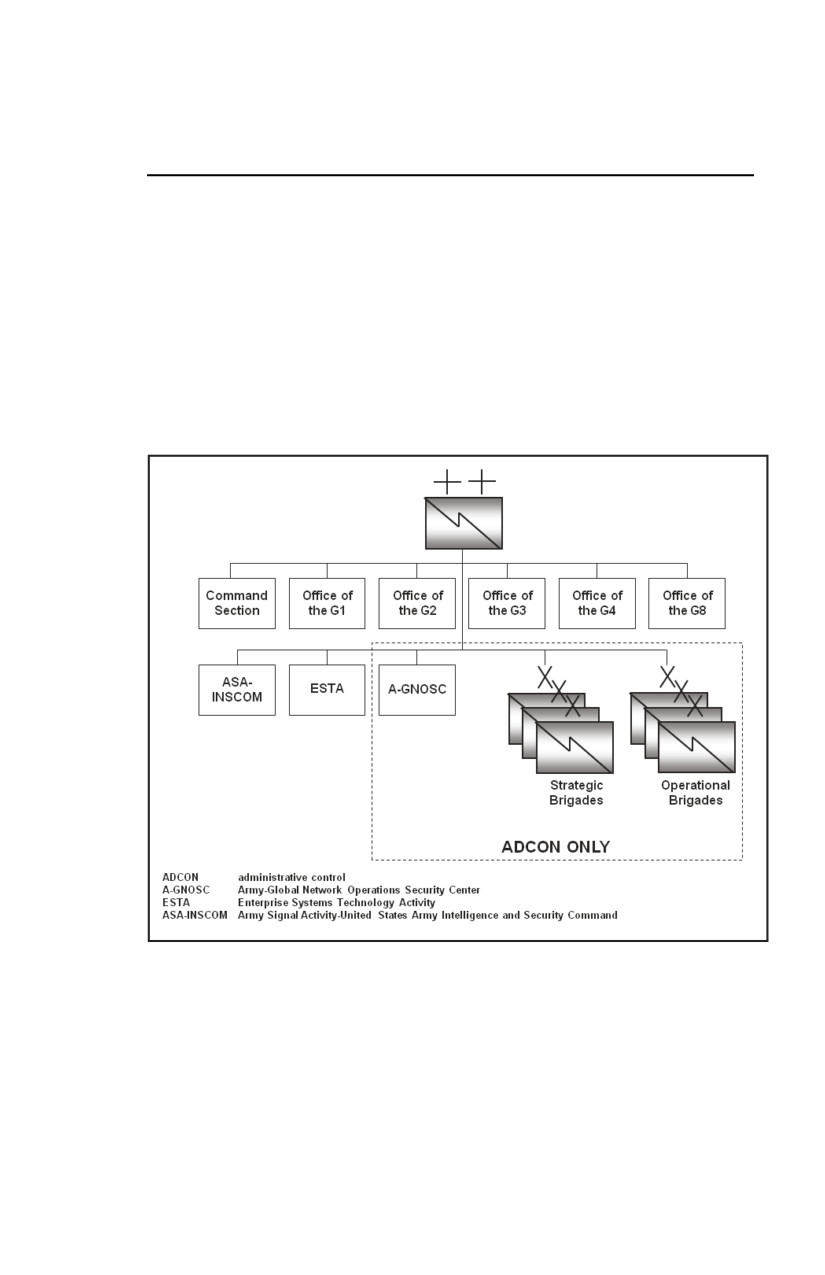
4-8. Headquarters, NETCOM/9th SC(A) is comprised of a standard
general officer level staff
(G-1 through assistant chief of staff,
logistics (G-4) and assistant chief of staff, resource management (G-
8) located at Fort Huachuca, Arizona, and an liaison officer (LNO)
staff and leadership presence in the National Capital Region working
directly with Army CIO/G-6 and other DOD service staffs (refer to
Figure 4-1). The headquarters can deploy C2 or technical elements
and sub-elements to a theater of operations to support CCDR
requirements directly or to augment subordinate units.
Figure 4-1. NETCOM/9th SC(A) Organization
17 March 2009
FM 6-02.43
4-5
Chapter 4
4-9. NETCOM/9TH SC(A) is the single Army authority to operate,
control, and defend the Army’s infostructure at the enterprise level. It
is a global enterprise framework including theater signal commands,
brigades, NETOPS and security centers and regional chief
information officers (RCIOs), with the senior Theater-level signal
commander serving as the ASCC G-6. It has the authority to
implement and enforce enterprise policy and provides authoritative
direction concerning the techniques, procedures, standards,
configurations, designs, devices and systems to accomplish specific
functional tasks and missions. It exercises authoritative enterprise
NETOPS technical direction over all organizations that operate,
connect to or maintain the LWN Army’s portion of the GIG.
NETCOM/9th SC(A), in supporting the CIO/G-6 and serving as a
global and theater force provider has the responsibility to—
z
Assign operational tasks affecting theater LWN.
z
Designate network related objectives to support combatant
command requirements.
z
Resource operational requirements.
z
Provide staff actions in direct support of mobilization
requirements.
z
Provide deployment or deployment sustainment operations.
z
Provide integration oversight for the Active Army and Army
Reserve (USAR).
z
Provide oversight of training and exercises.
z
Provide support to the Homeland Security Operations Center and
reachback operations.
4-10. NETCOM also performs the following tasks and functions:
z
Executes oversight for centralized configuration and compliance
for theater LWN. This requires monitoring and oversight of
configuration changes of Army tactical and strategic voice and
data infrastructures to ensure interoperability with joint directives.
z
Manages the Army Military Affiliate Radio System program.
z
Provides engineering support to the ASCC G-6 or signal command
as required or when requested.
4-6
FM 6-02.43
17 March 2009
Theater Operations
z
Engineers, installs, operate, and maintain data networks in support
of JTF, Army, and nongovernmental agencies as required.
z
Serves as the proponent for quality assessment, quality control,
and assistance control for communications infrastructure, systems,
networks, and sub-networks by means of deployed assessment
teams.
NETCOM MAJOR SUBORDINATE ELEMENTS
4-11. In addition to its command relationship with CONUS and
outside continental United States
(OCONUS) signal commands,
NETCOM also has direct relationship over several subordinate
elements that are vital to the LWN and network enabled capabilities:
Enterprise Systems Technology Activity (ESTA), the Army-Global
Network Operations and Security Center (A-GNOSC), and the Army
Signal Activity-United States Army Intelligence and Security
Command (ASA-INSCOM).
Enterprise Systems Technology Activity
4-12. ESTA is NETCOM’s subordinate and is responsible for
engineering, installing, operating, maintaining, and defending
enterprise networks throughout the LWN. ESTA develops,
implements, and enforces enterprise systems management
(ESM)
processes and activities required to operate and manage the LWN and
Army interface with the GIG. In addition, ESTA—
z
Serves the Army CIO/G-6.
z
Coordinates external requirements with the HQDA staff and major
Army command CIOs.
z
Establishes ESM and IA policies and procedures and executes
necessary actions to ensure common user services within a secure
NETOPS framework across the LWN enterprise.
z
Provides operational policy and functional staff oversight for ESM
operations to CONUS installation DOIMs and RCIOs.
z
Assesses, develops, staffs, and manages ESM functional proponent
requirements and service level agreements for the LWN.
17 March 2009
FM 6-02.43
4-7
Chapter 4
z
Conducts testing, evaluation, and architectural review of
operational architectures to ensure that new systems facilitate
technological compliance. Ensures all capabilities fielded within
the LWN conform to established standards, practices, and
procedures.
z
Provides technical expertise to execute long-haul and base
communications programs.
z
Provides oversight of all Army activities related to the allocation,
allotment, and assignment of RF spectrum.
Army Global Network Operations and Security Center
4-13. A-GNOSC is another essential sub-element of NETCOM. Its
mission is to develop and disseminate LWN situational understanding
by collecting and maintaining near real-time status information on
vital LWN resources, networks, information systems, and intra-
theater gateways STEP and teleport). Its primary mission focus
centers on LWN operational compliance, management, and defense.
The A-GNOSC is integrated with the 1st Information Operations
Command (Land) and the Army Computer Emergency Response
Team (ACERT) to create a consolidated NETOPS center called A-
GNOSC/ACERT TOC. Each TNOSC is integrated with a Regional
Computer Emergency Response Team (RCERT).
Compliance
4-14. The A-GNOSC has the authority to ensure implementation of
and compliance with approved DOD, joint, and Army NETOPS
policies and procedures. The A-GNOSC also maintains liaison with
the Army operations center and the
1st Information Operations
Command. The A-GNOSC will ensure compliance with network
system standards and operational procedures before any IT resource,
network, system, or application is connected to the LWN. A-GNOSC
will also participate in reviews, tests, evaluations, and forums
affecting
information systems development, architectures,
applications, and interfaces.
4-8
FM 6-02.43
17 March 2009
Theater Operations
Management
4-15. The A-GNOSC interfaces with the Joint Task Force-Global
Network Operations (JTF-GNO) Global Network Operations Center,
all Army TNOSCs, and functional and other service NOSCs in order
to provide worldwide operational and technical support across
strategic, operational, and tactical levels. It serves to resolve problems
affecting network services and operations in two or more theaters and
oversees domain name services (DNS) and Internet protocol (IP)
services provisioning and management for Army Forces.
Defense
4-16. Operating in conjunction with the ACERT, the A-GNOSC
plays a major role in a comprehensive and global network defense for
the LWN and tactical networks, including monitoring compliance
with issued IA vulnerability alerts and directing Army-wide actions.
Army Signal Activity-United States Army Intelligence and
Security Command
4-17. ASA-INSCOM falls under the command authority of
NETCOM/9th SC(A) and under OPCON of the INSCOM. The ASA-
INSCOM commander serves dual roles and is also the INSCOM G-6.
ASA-INSCOM’s mission is to provide planning, programming,
budgeting, engineering, installation, and operational management of
secure and non-secure telecommunications to the National Security
Agency, HQDA, INSCOM, and NETCOM/9th SC(A).
17 March 2009
FM 6-02.43
4-9
Chapter 4
SECTION II - STRATEGIC AND FIXED STATION
ELEMENTS
Strategic and Fixed Station
The terms strategic and fixed station describe
organizations that do not typically deploy from
their home stations and include organizations
that
provide intra- and/or inter-theater
communications. These organizations typically
support both power projection and C2
requirements spanning from the warfighter
through the Secretary of Defense to the
President of the United States. They form the
“backbone” of the LWN and are the focal point
for installation support and theater extension.
Because of the fluid nature of the contemporary
operational environment, some theater and
strategic
organizations
find
themselves
supporting the operational level of war. For this
reason, efforts have been made to re-designate
all strategic and fixed station organizations as
“operational base” signal forces.
Note. The strategic signal organizational structure is in the
process of changing. The focus is shifting the current structure
from a scenario-based to a capability-based design. The
following outlines the new structure and its capabilities.
4-10
FM 6-02.43
17 March 2009
Theater Operations
STRATEGIC SIGNAL BRIGADES
4-18. The mission of a strategic signal brigade is to provide
operational base and sustaining signal support
(communications,
automation, and network management) to maintain the warfighter in a
geographic area of responsibility
(AOR) and to enable power
projection platforms required for force projection. These units
provide the following:
z
C2, operations, logistics, and administrative support for all
assigned communications assets
(earth terminals, microwave
systems, COMSEC equipment, fiber optics/cable, etc.).
z
Installation, operation and maintenance of tactical interface, and
sustaining base and strategic signal support functions
(communications, automation, and network management) to
sustain the warfighter in a geographic AOR.
z
NETOPS at the installation level.
z
Access to the LWN for all Army assets assigned to a geographic
area and to tactical Army assets deployed in other theaters.
z
Support to the brigade staff that is responsible for planning,
coordinating, and supervising the brigade mission area functions.
z
Advice to the commanders, staff, and information system users on
the capabilities, limitations, and employment of all tactical and
non-tactical signal and network assets available to a particular
supported command.
z
Advice to the supported commanders and staff on information
management, automation policy, technical matters, performance,
and supervision of system analysis and programming functions on
related abilities.
z
All-source intelligence assessments and estimates at the
operational and strategic levels dealing with enemy capabilities,
intentions, and vulnerabilities pertaining to the LWN and to the
commander. This also entails predicting the enemy courses of
action, producing threat estimates, ensuring proper dissemination
17 March 2009
FM 6-02.43
4-11
Chapter 4
of intelligence information and products, and evaluating
intelligence products as they relate to the LWN and the GIG.
2D SIGNAL BRIGADE
4-19. This brigade is a subordinate command of NETCOM/9th SC(A)
with OPCON vested in United States Army, European Command
(USAREUR). The 2nd Signal Brigade’s mission is to install, operate,
and maintain the communications infrastructure and systems capable
of extending the GIG on order to Army, joint, and combined forces.
21ST SIGNAL BRIGADE
4-20. This brigade is a subordinate command of NETCOM/9th SC(A).
The 21st Signal Brigade’s mission is to provide for the integration of
telecommunications services that include tactical and fixed stations
for the DOD and other federal agencies within CONUS and to
provide visual documentation of US, allied, and hostile forces during
combat operations and peacetime training exercises.
160TH SIGNAL BRIGADE
4-21. This brigade is a subordinate command of NETCOM/9th SC(A).
The 160th Signal Brigade is OPCON to United States Army Central
Command during peacetime. Its command and support relationships
can change during wartime. Currently headquartered in SWA, the
brigade has extended the LWN to the warfighter by installing
commercial communications facilities and capabilities throughout the
United States Central Command
(CENTCOM). Their primary
mission is to install, operate, and maintain strategic communications
in an active theater of war.
516TH SIGNAL BRIGADE
4-22. This brigade is a subordinate command of 311th (SC[T]) with
OPCON vested in the United States Army, Pacific Command
(USARPAC). The 516th Signal Brigade’s mission is to provide signal
4-12
FM 6-02.43
17 March 2009
Theater Operations
support to Pacific warfighting forces, to provide theater information
and communication systems policy and programming functions, and
to advise the Commanding General, USARPAC, on resources
required by major subordinate commands
(MSCs) for C2 and
communications system deployable assets.
STRATEGIC BATTALIONS, COMPANIES AND MODULES
4-23. NETCOM/9th SC(A) theater strategic signal battalions and
companies provide the Army’s worldwide strategic LWN information
backbone that can be extended wherever combat forces deploy. These
organizations can be found in both a strategic signal brigade and a
tactical signal brigade. This seamless information infrastructure is
operational 24 hours a day, 7 days a week, and 365 days a year. The
network is a mix of tactical and commercial systems that capitalize on
new and emerging technologies to provide enhanced capabilities to
deployed and fixed station warfighters. NETCOM strategic units
stationed in theaters of operation provide operational and strategic
communications services to CCDRs and Army warfighters.
4-24. The strategic signal force structure is a critical element in
enabling joint and expeditionary battle command communications
across the full spectrum of operations. The following strategic
battalion and company table of organization and equipment designs
are based on capability requirements specific to that location’s
executive agent responsibilities and mission directives that were
identified by NETCOM. Figure 4-2 represents the strategic design
that is driving the new strategic force structure currently being
implemented.
Battalion Headquarters
4-25. Battalion Headquarters provides C2, staff planning, and
supervision of assigned and attached strategic signal units.
17 March 2009
FM 6-02.43
4-13
Chapter 4
Company Headquarters
4-26. Company Headquarters provides C2 and logistic support for the
company. Its operations section is responsible for planning,
coordinating, and supervising the operations of all company strategic
communication and signal support missions.
4-14
FM 6-02.43
17 March 2009
Theater Operations
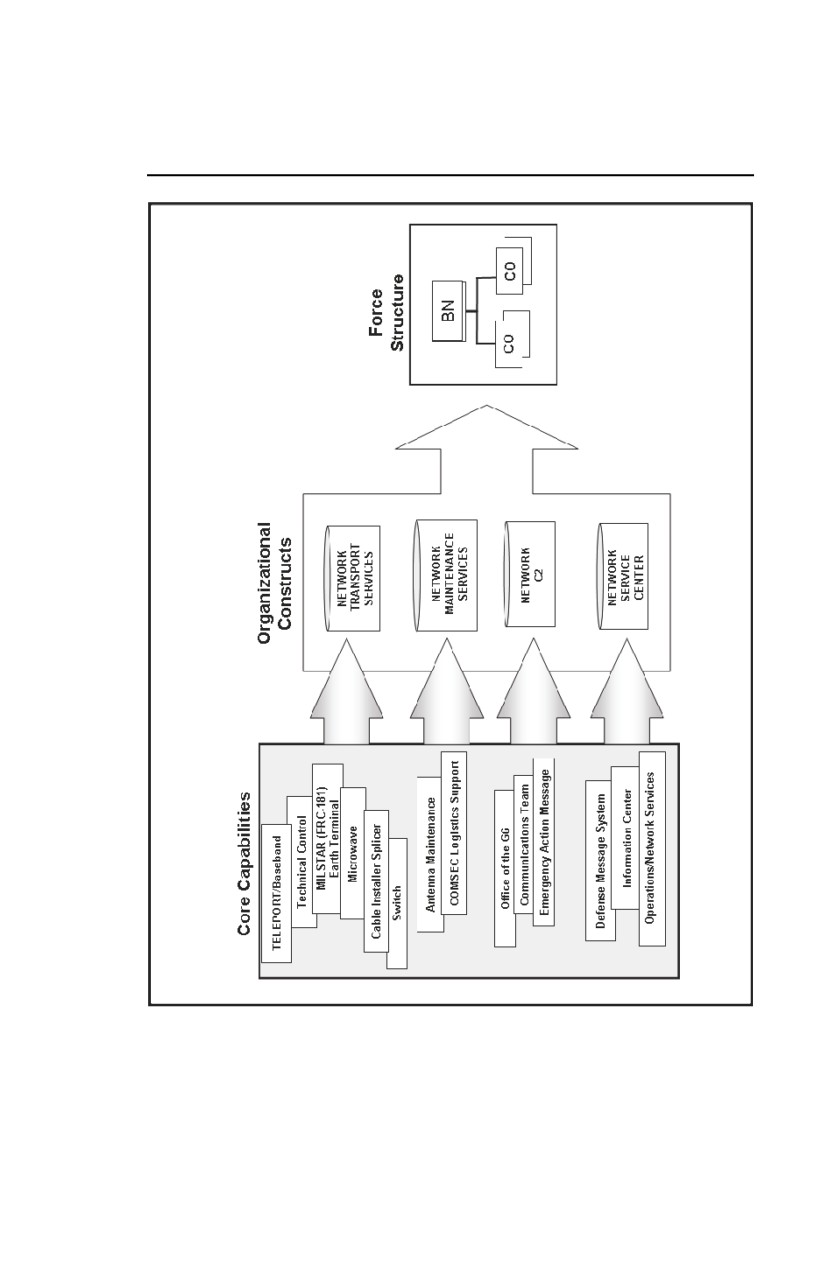
Figure 4-2. Strategic design
17 March 2009
FM 6-02.43
4-15
Chapter 4
4-27. The Network Service Center, Network Transport Services,
Network Maintenance Services, and Network Command and Control
are organizational constructs that were derived from consolidating
like functions and small teams to create a standardized design that is
based on a core capability.
Network Service Center
4-28. NETOPS. Responsible for planning, coordinating, and
supervising the Network Service Center.
4-29. Network Management Section. Provides inside/outside plant
operation and maintenance on digital telecommunication equipment.
4-30. Data Network Administration Team. Provides IA assistance
for network systems unique to a geographic region, also LNO to
Regional Network Operations and Security Center.
4-31. Dial Central Office. Provides inside/outside plant operation
and maintenance on voice telecommunication equipment for a
geographic region.
4-32. Dial Service Assistance Switch Operations. Provides
information support and dial assistance for customers in a geographic
region.
4-33. Network Management Team. Provides technical customer
assistance and, as required, dispatches voice/digital touch labor
maintainers for a geographic region.
4-34. Video Telecommunication Hub. Provides operation and
maintenance of commercial Video Telecommunication Hub/Bridge
for a geographic region.
4-35. DMS/COMSEC
Team.
Provides
DMS
organizational/individual electronic messaging and COMSEC
material support for customers in a geographic region.
4-16
FM 6-02.43
17 March 2009
Theater Operations
4-36. Certification Authorization Workstation
(CAW) Team.
Provides COMSEC material support and management for customers
in a geographic region.
4-37. DSN Switch (Defense System Network). Provides operation
and maintenance of a commercial and/or tactical electronic switching
system for a geographic region.
4-38. Area Support Team. Provides installation, operation, and
maintenance of commercial communication systems for a geographic
region.
Network Transport Services
4-39. Global Operations. Responsible for planning, coordinating,
and supervising the operations and maintenance of SATCOM
terminal sites.
4-40. SATCOM Terminal Teams. Provide earth terminal
communications as part of the Defense Satellite Communications
System
(DSCS), which is used to establish CCDRs networks,
emergency action message (EAM) dissemination, force direction,
integrated tactical warning and assessment (ITW&A) reception, and
summary transmissions.
4-41. Baseband Teams. Provide a tactical interface to the DSCS,
which is used to establish CCDRs networks, JTF networks, and EAM
dissemination, force direction, and ITW&A reception and summary
transmissions.
4-42. Advanced Baseband Teams. Provide additional commercial
and military bands that provide a tactical interface to the DSCS using
teleport as the baseband. Types of advanced baseband include the
following: UFG, extremely high frequency (EHF), C, Ka, and Ku.
4-43. Automated Technical Control. Provides an intermediate level
of OPCON and technical direction over Defense Communications
System (DCS) facilities and systems, as required by DISA. The
following identify the two different facility classifications:
17 March 2009
FM 6-02.43
4-17
Chapter 4
z
Circuit (V) 1: technical control with 100 to 1000 circuits.
z
Circuit (V) 2: technical control with 1000 + circuits.
4-44. Microwave Teams. Provide installation, operation, and
maintenance of microwave communications for a geographic area.
4-45. Cable Install/Splice Teams. Provide permanent and emergency
splicing of copper and fiber optic cable systems, as well as
installation and maintenance of base support cable and wire systems
within a geographic area.
Network Maintenance Services
4-46. COMSEC Log Support Team. Provides COMSEC custodian
functions, COMSEC equipment maintenance, and COMSEC logistics
functions to a geographic region.
4-47. Antenna Maintenance Team. Supervises the emergency and
scheduled maintenance services and quality assurance inspections for
antenna and antenna support structure of the Army and other
government agencies.
4-48. Long-Haul Maintenance Team. Provides electronic equipment
maintenance of communication systems, i.e. microwave. The team
performs engineering quality control and continuity testing of
microwave circuits, trunks, systems, and facilities.
Network C2
4-49. EAM Systems. Provide emergency and contingency
communications to a region along the entire spectrum of conflict.
4-50. ASCC/CCDR
Communication
Team.
Provides
communications support in the form of secure frequency modulation
radio, UHF TACSAT, record telecommunications message support,
and COMSEC equipment maintenance to combatant and/or Army
service component commanders.
4-51. Communications Management Support Team
(CMST).
Provides deployable communications support directly to Secret
4-18
FM 6-02.43
17 March 2009
Theater Operations
Service agents engaged in protective missions for presidential
candidates, visiting dignitaries, and other special events, as directed.
4-52. Office of the G-6. Provides plans, operations, staff oversight,
and coordination for information and communication systems support
to Army, Joint, and Combined Headquarters.
4-53. MILGROUP COLUMBIA. Provides supported commander
communications assistance in the form of single channel TACSAT,
high frequency (HF) radio, secure frequency modulation radio, non-
tactical single channel radio, automated information and COMSEC
installation, operation, and maintenance
(IOM). It also provides
signal advice, expertise, and training to non-signal personnel in
supported units.
4-54. JTF BRAVO Honduras. Provides staff oversight, planning,
coordination, management, and command of telecommunications
system and information systems support functions support to combat
and non-combat Army, Joint, and Combined Headquarters.
SECTION III - SIGNAL OPERATIONS
ORGANIZATIONS FOR THE MODULAR
FORCE
4-55. In theater, the numbered Army is organized and equipped
primarily as the ASCC for a geographical combatant command. To
support command, control, telecommunications, and network
requirements, the ASCC commander calls on several modular,
multifunctional, scalable units that provide communications network
support across theater echelons and spectrum of conflict.
ARMY SERVICE COMPONENT COMMAND G-6
4-56. Theater LWN greatly depends on many factors starting with the
ASCC G-6. The ASCC G-6 is responsible for all LWN operations
17 March 2009
FM 6-02.43
4-19
Chapter 4
within a specified geographical region. The theater G-6 provides
LWN support to the geographical combatant command, to Army units
operating in the theater in support of the geographical combatant
command, and to other services and joint elements as directed by the
geographical combatant command and theater army commanders.
4-57. The ASCC G-6 serves as the theater senior signal officer
providing network oversight of theater LWN and joint systems under
its control. Additionally, the ASCC G-6 develops theater LWN
requirements and manages the activities and resources needed to
install, employ, and protect all operational and strategic networks
supporting the ASCC and its subordinate forces. The ASCC G-6 will
also ensure proper integration and protection of all tactical networks
employed by maneuver and tactical forces at the corps/division and
BCT levels to ensure those tactical commanders have the quality of
service they need to prosecute the fight. Some duties of the ASCC G-
6 are to—
z
Provide and maintain NETOPS SA of the theater LWN
environment and network asset availability.
z
Maintain network status and provide oversight of NETOPS,
changes, threats, and emerging requirements of the theater LWN.
z
Provide internal IT support to ASCC headquarters.
z
Execute and manage theater EMS management functions.
z
Coordinate with host-nation communications authorities.
z
Provide oversight of the theater CND posture.
z
Oversee theater COMSEC operations to include storage,
management, distribution, inspection, and compliance.
z
Provide input to the TNCC and JNCC as required.
z
Provide theater battlefield EMS management to include allotment,
assignment, and control of radio and SATCOM frequencies for
units assigned, attached, or OPCON to the ASCC and spectrum
issues affecting joint, coalition, and host-nation agency
requirements.
4-20
FM 6-02.43
17 March 2009
Theater Operations
z
Execute CIO functions for the theater and oversees theater
enterprise programs, projects, and initiatives IAW Clinger-Cohen
Act and Army regulation (AR) 25-1.
z
Coordinate LWN IA activities with IO Cell, TNOSC, and RCERT
and recommend theater information operations condition postures
IAW G-2/G-3/IO.
z
Act as JTF J-6 or JFLCC J-6/ARFOR G-6 as required.
JOINT COMMAND J-6 OFFICER
4-58. The J-6 officer serves on the combatant command staff as the
communications director, and he may have dual responsibilities as the
SC(T) commander. The J-6 officer assumes the role of the CCDR
network manager with the establishment of a joint NETOPS control
center that manages and controls all communications systems and
networks deployed during joint operations and exercises. The joint
NETOPS control center is the single control agency for the
management and operational direction of all joint communications
elements in the theater of operations. The NETOPS responsibilities of
the J-6 officer are to —
z
Formulate policy and guidance for all communications assets
supporting the joint forces commander.
z
Develop communications and information architectures and plans
to support the mission of the CCDR.
z
Develop policy and guidance for integrating and installing
operational networks.
z
Provide C2 of the joint information systems infrastructure.
z
Exercise staff supervision and OPCON of the theater assets
provided by DISA, other services, and other DOD agencies.
z
Perform network management activities, functions, and tasks
required to manage effectively and efficiently the joint information
systems infrastructure and multinational networks supporting the
CCDR mission.
17 March 2009
FM 6-02.43
4-21
Chapter 4
z
Provide oversight of the theater NETOPS control center in the
management and control of the CCDR’s communications assets in
theater.
z
Adhere to COMSEC principles with the establishment of effective
IA program initiatives.
J-6 and Communications Information Systems
4-59. Within the joint force operational headquarters, the J-6
communications information systems staff provides adequate support
for joint operations and uses interoperable communications
information systems procedures at all levels in the joint force. Where
appropriate, the J-6 staff forms a Joint Information Communications
Control Center, and its functions are to—
z
Support the joint forces commander and the C2 facilities.
z
Exercise supervision over communications and information
activities, including EMSO and information security of
subordinate commands and force components.
z
Provide connectivity with the regional North Atlantic Treaty
Organization and host nation’s communications system,
commercial communications, and adjacent commands.
Note. Most theater level signal assets are scheduled for
reorganization. It is not uncommon for the senior signal
organization in a theater to be a signal brigade as opposed to a
SC(T). These brigade commanders will hold the same
responsibilities as a SC(T) commander.
SIGNAL COMMAND (THEATER)
4-60. The SC(T) is the highest level, deployable organization in
charge of theater LWN. It is a major subordinate command of
NETCOM and operates OPCON of a supported ASCC. The SC(T) is
4-22
FM 6-02.43
17 March 2009
Theater Operations
organized, equipped, and manned to plan, engineer, integrate,
manage, and defend the Army’s portion of the GIG with the mission
of operating as the primary network provider for theater LWN. It
exercises C2 over strategic and tactical organizations, the TNOSC,
visual information (VI) resources, wire and cable and commercial
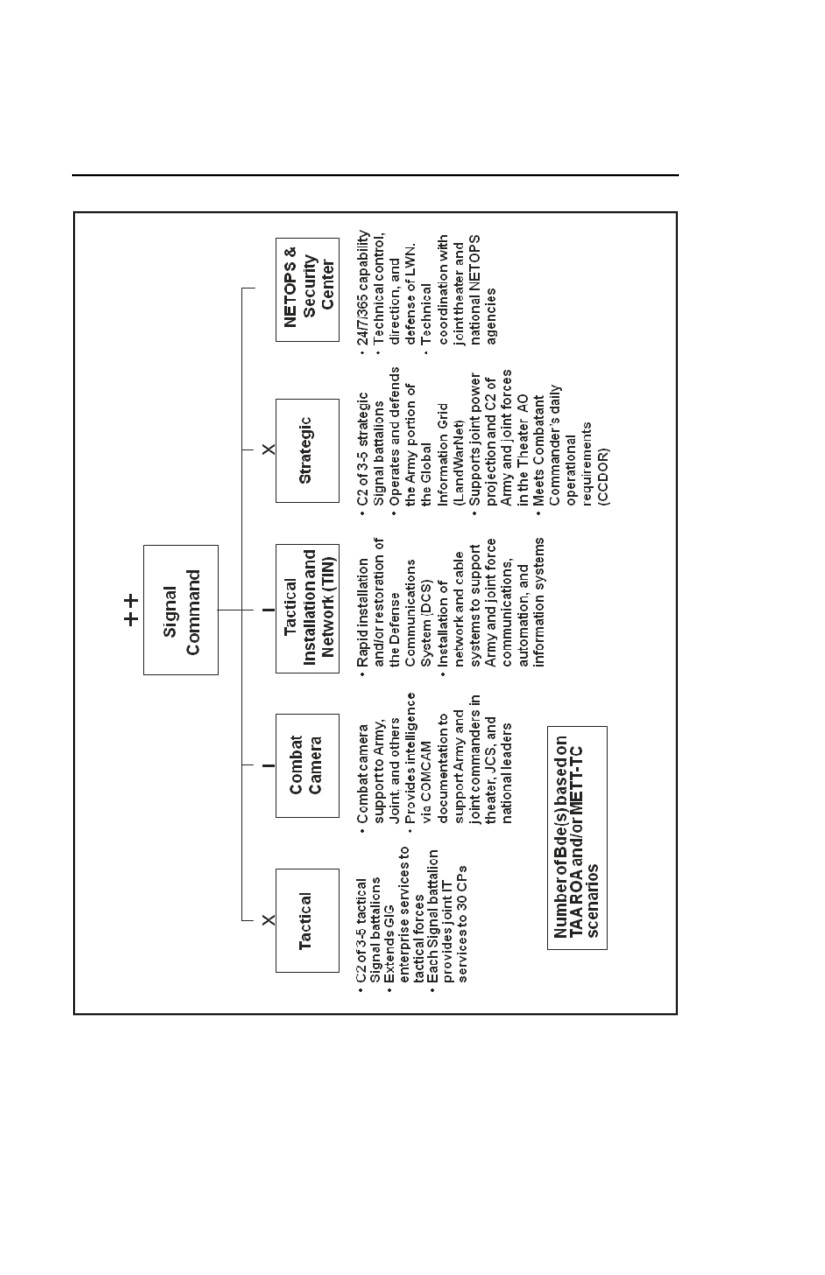
infrastructures, and theater CE maintenance. Total force composition
under the C2 of the SC(T) depends on METT-TC (Figure 4-3) and
the CCDRs’ requirements.
4-61. A SC(T) or senior theater signal brigade provides signal support
to the ASCC including MCO missions. The SC(T) C2s multiple
theater signal brigades and joint and coalition information signal
support elements. A signal brigade rather than a full SC(T) usually
provides support to ASCC missions that do not involve MCOs.
4-62. The SC(T) HQs is a standard Table of Organization and
Equipment design. To meet regional or theater-unique METT-TC-
based requirements and combatant command’s daily operational
requirements, it may be necessary to provide an augmentation table of
distribution and allowances and a modified table of organization and
equipment exception authorization document to tailor the SC(T) to
meet selected fixed infrastructure mission requirements.
4-63. The commander of the theater’s senior signal organization
SC(T) or signal brigade (tactical) serves as the theater G-6. While the
SC(T) commander receives mission orders from the ASCC
commander, the SC(T) also performs network management through
technical channels via HQ NETCOM, the applicable Geographical
Combatant Command J-6, and the United States Strategic
Command/JTF-GNO for service and global enterprise management,
technical compliance, and network defense.
4-64. The SC(T) depends on other organizations for large-scale
communication infrastructure architecture engineering support;
theater facility engineering support; health services; human resource,
finance, and administrative services; troop transportation support; and
legal services. The SC(T) depends on the ASCC for theater COMSEC
and EMS management.
17 March 2009
FM 6-02.43
4-23
Chapter 4
Figure 4-3. SC(T) subordinate elements
4-24
FM 6-02.43
17 March 2009