FM 6-02.43 SIGNAL SOLDIER’S GUIDE (March 2009) - page 2
Signal Soldier’s Roles and Responsibilities
network structure and increases the bandwidth capability from
approximately
6-40 megabits per second
(Mbps). The embedded
NETOPS cell provides the management to enable the division network.
1-62. In addition, by expanding bandwidth, the division has the
capability to dynamically reassign the bandwidth so that the
communications support plan can match the division commander’s
ground tactical plan. An example of this capability is the division
designating a BCT as the main effort for an assault. The division
commander’s primary effort is to give the BCT a direct unmanned
aircraft system/sensor feed that must be broadcasted across the entire
network. The division G-6 matches the communications support plan
enabling the added, nonorganic capability by allocating a larger
segment of the division-enabled bandwidth.
1-63. The following are the division NOSC responsibilities—
z
In coordination with the operational chain of command, STNOSC,
and subordinate organizations, monitors, manages, and ensures
implementation of enterprise system management/network
management, information dissemination management/content
staging, and IA/CND activities.
z
Provides near real-time awareness of division networks and
systems to the division G-6 and STNOSC.
z
Coordinates actions to resolve attacks/incidents on the division
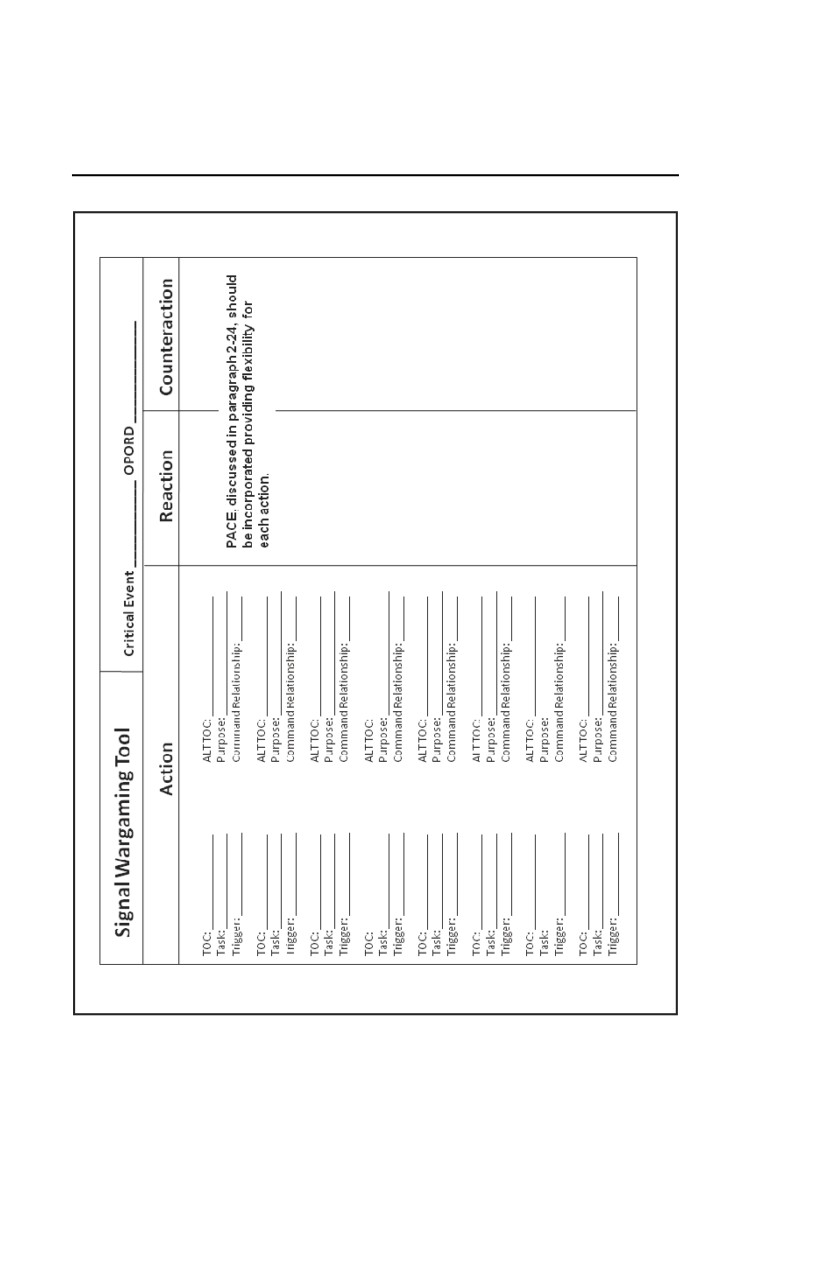
network with the STNOSC and subordinate organizations.
z
Coordinates operational procedures and requirements for IA/CND
and information systems security with the supporting Army service
component command regional computer emergency response
team.
z
In coordination with division signal company, monitors, manages,
and controls intra-division information network components.
z
Monitors the operation of the networks in the division’s
subordinate units.
z
Provides support and assistance to the subordinate NOSCs as
required.
17 March 2009
FM 6-02.43
1-31
Chapter 1
z
Administers the organizational message system (defense message
system
[DMS]) in the division, including managing network
addresses and sub-domains.
z
Coordinates
operation
and maintenance support of
communications systems. These systems are attached to support
deployed division forces with the split-base and reach operations
capability to the home base.
z
Shares enterprise system management/network management
information with other management or monitoring centers.
z
Provides the supporting STNOSC and ARFOR NOSC with near
real-time information on the status and performance of intra-
division networks.
z
Orders and accounts for all forms of COMSEC material, including
storing keys in encrypted form and performing key generation and
automatic key distribution.
z
Performs COMSEC material accounting functions and
communicates with other COMSEC elements.
z
Performs content staging/information dissemination management
functions to support all aspects of relevant information
dissemination.
z
Provides near real-time awareness of division networks and
systems that support the joint backbone to the JTF Joint Network
Operations Control Center (JNCC) when the division is serving as
the ARFOR.
G-6 AND THE MOBILE COMMAND GROUP
1-64. The G-6 may or may not be a participant in the MCG. Since
there is limited space for division staff, it is up to the division
commander as to the specific composition of the MCG. If the G-6 or
his representative does participate in the MCG, his responsibilities will
vary and depend on how the MCG operates (ground or air) and from
what location. The G-6 will have minimal network access and virtually
no network management tools beyond those contained in his vehicle.
Available MCG communications systems will include voice and data.
1-32
FM 6-02.43
17 March 2009
Signal Soldier’s Roles and Responsibilities
DIVISION SIGNAL COMPANY ROLES AND
RESPONSIBILITIES
1-65. The division signal company provides
24-hour operations
supporting the division headquarters. It provides operational elements
designed to engineer, install, operate, maintain, and defend the joint
theater network supporting division operations as an integral part of the
division, theater army, ARFOR, or JTF IAW technical guidance
provided by the division G-6 officer.
1-66. This support creates responsive redirection of network
priorities, policies, and allocations to better support tactical operations
in the division or subordinate brigades. The division G6 (assistant chief
of staff, network operations) officer’s technical oversight ensures the
division network personnel and equipment are trained and maintained
at the levels required to be successful.
DIVISION SIGNAL COMPANY ORGANIZATION
1-67. The division signal company is subordinate to the STB and
consists of the headquarters, G-6 and signal detachment. To ensure the
division commanders’ intent is met, the division signal company
operates under the authority of the division G-6 officer where the G-6
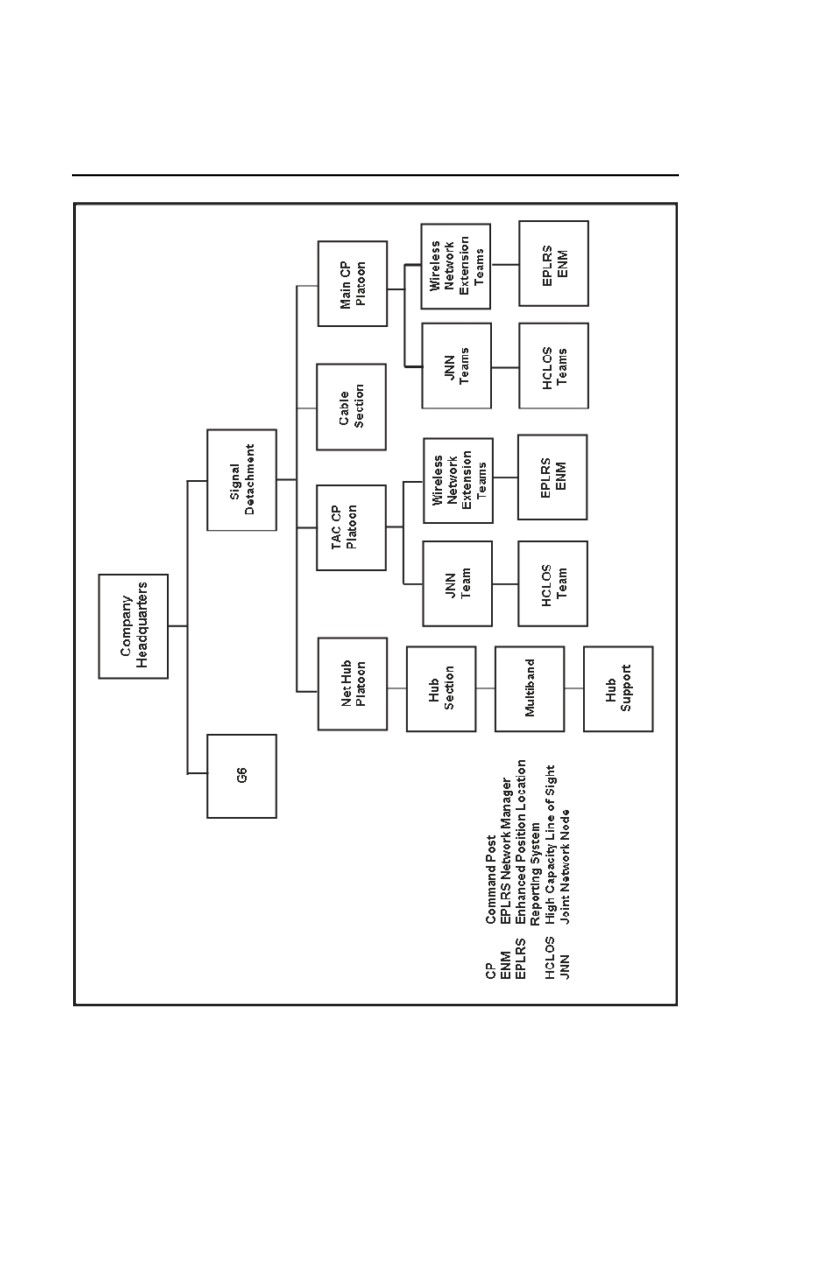
controls all NETOPS. Figure 1-6 provides a diagram of the division
signal company organization.
1-68. The company is commanded by a major with a sergeant major
assigned as the chief signal NCO and the signal detachment is assigned
a captain and first sergeant. The G-6 is comprised of the staff G-6
section previously addressed. The signal detachment contains the
elements necessary to support the main and TAC CPs and addressed
here.
1-69. The company headquarters provides command, control, and
command supervision of signal detachments assigned or attached to the
company. The headquarters section is responsible for implementation
of operations and intelligence directives received from higher
headquarters.
17 March 2009
FM 6-02.43
1-33
Chapter 1
Figure 1-6. Division signal company organization
1-34
FM 6-02.43
17 March 2009
Signal Soldier’s Roles and Responsibilities
1-70. The signal company commander maintains command authority
and is responsible for the health and welfare, training readiness, and
electronic and vehicle maintenance of all signal company personnel
and equipment. The signal company commander directs the company’s
organic detachments and any attached elements.
Signal Detachment
1-71. The signal detachment is modular and can deploy and support
the division main and TAC CP LWN systems. It is composed of
multiple voice and data sub-networks providing information exchange
among division elements. The sub-networks overlap by echelon to
provide survivable and robust networks.
1-72. The signal detachment headquarters provides for command,
control, and coordination of the detachment mission. It is designed to
provide command, control, and supervision to the three platoons that
provide communications support to the division main and TAC CP.
1-73. The company headquarters provides C2 to the company. The
headquarters is responsible for administration and logistics support.
The detachment headquarters provides the detachment C2 and limited
NETOPS support.
1-74. The network hub platoon consists of the TDMA and frequency
division multiple access (FDMA) multiband sections and the baseband
and hub support sections. It installs, operates, and maintains the
network hubs and satellite connectivity to the GIG.
Main CP and TAC CP platoons
1-75. The main CP and TAC CP platoons support the division and
TAC CPs. These platoons differ in that the main CP platoon has an
additional JNN, HCLOS, and SMART-T team assigned to it. These
platoons have capabilities and personnel to provide the following
services—
z
BLOS and LOS connectivity.
z
Secure voice (tactical and Defense Switched Network).
17 March 2009
FM 6-02.43
1-35
Chapter 1
z
NIPRNET, SIPRNET, and Joint Worldwide Intelligence
Communications System (limited).
z
Defense Red Switch Network.
z
Video teleconferencing.
z
Installation and administration of CP networks.
z
Voice radio
(single channel SATCOM, high frequency, and
SINCGARS).
z
Voice radio range extension.
z
Help desk.
z
Performs field level maintenance on CE systems.
Network Hub Platoon
1-76. The network hub platoon provides the division tactical hub node
(THN) necessary to connect and make use of DISN/GIG services. The
division tactical hubs provide TDMA and FDMA satellite connectivity.
The network hub platoon consists of the TDMA and FDMA multiband
section, the Baseband and Hub Support Sections. It installs, operates
and maintains the network hub and satellite connectivity to the GIG.
Cable Section
1-77. The cable section assists the data support teams at the division
main and TAC CPs as needed to establish the division infrastructure
and inside cable functions.
THE CORPS
Note. The headquarters design and unit structure of the corps
is pending review, information in this manual represents the
latest information available.
1-36
FM 6-02.43
17 March 2009
Signal Soldier’s Roles and Responsibilities
1-78. The corps headquarters is being restructured to fill four primary
roles. The corps headquarters primarily serves as an intermediate
tactical headquarters in a major combat operation (MCO), but it may be
used as an ARFOR headquarters, JTF headquarters, or Joint Force
Land Component Command (JFLCC) headquarters.
1-79. The corps headquarters has essential C2 capabilities and is
rapidly deployable to provide C2 for Army, joint, and multinational
forces engaged in operations. The corps headquarters does not have
any organic troops other than the STB. It can control any mix of
modular brigades and divisions.
CORPS COMMAND POSTS
1-80. The modular corps design, combined with robust
communications, gives the corps commander a flexible CP structure.
Like the division, the corps has three CPs: main CP, TAC CP, and
MCG.
MAIN COMMAND POST
1-81. The main CP is responsible for the continuity of corps
operations. It synchronizes the conduct of corps current operations and
allocates available resources. It oversees the future planning, analysis
for current and future operations, sustainment coordination, and other
staff functions. The main CP is much larger than the TAC CP and is
organized into a mix of warfighting functions and integrating cells for
staff communications and interaction. All warfighting functions are
represented or available to serve temporarily in the current operations
and plans integrating cells.
TACTICAL COMMAND POST
1-82. The corps TAC CP is organized as a current operations
integrating cell. It can control the corps operations for a limited amount
of time when the main CP is unavailable. The TAC CP may be used to
control combinations of operations involving subordinate units, such as
17 March 2009
FM 6-02.43
1-37
Chapter 1
river crossings, passage of lines, and relief in place. The TAC CP
receives a task-organized support element of communications and life
support provided by the headquarters battalion.
Mobile Command Group
1-83. The MCG has organic ground C2 vehicles, a small security
force, and communications. The MCG staff is not fixed. The corps
commander selects members of the corps staff based on the situation.
The corps signal company provides communications capabilities.
Early Entry Command Post
1-84. The early entry CP is an ad hoc organization comprised of
equipment and personnel from the staff of the main and TAC CPs. The
early entry CP is staffed with a mix of current operations personnel and
planners able to coordinate the reception of the corps and plan its initial
operations.
G-6 RESPONSIBILITIES AT THE CORPS
COMMAND POSTS
1-85. The corps G-6 has separate elements to support the main CP
and TAC CP, though augmentation of the TAC CP is sometimes
required due to METT-TC. The functions of the G-6 elements differ
based on the responsibilities they are assigned. In addition, the
composition of the G-6 may be augmented depending on the situation
and the role the corps is assigned. The MCG and early entry CP have
no fixed organization and their composition will depend on METT-TC.
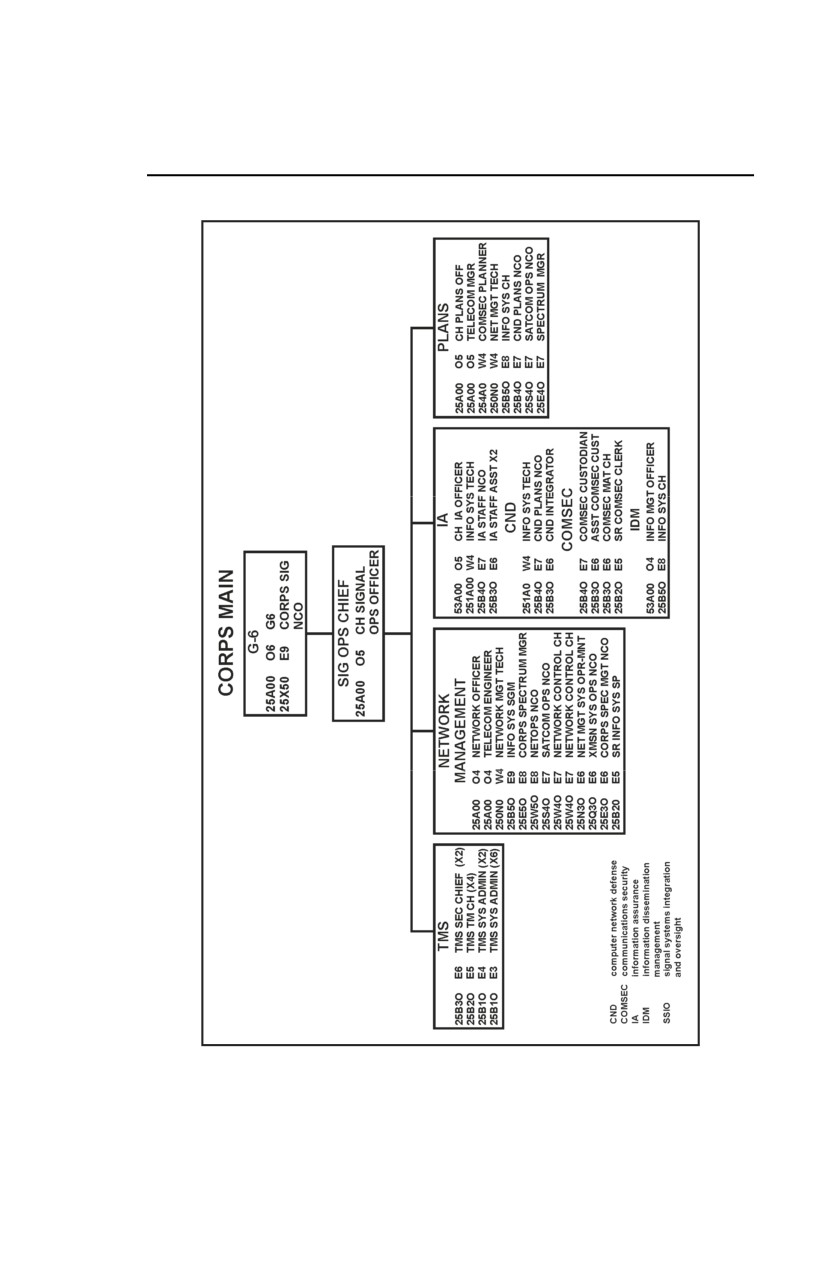
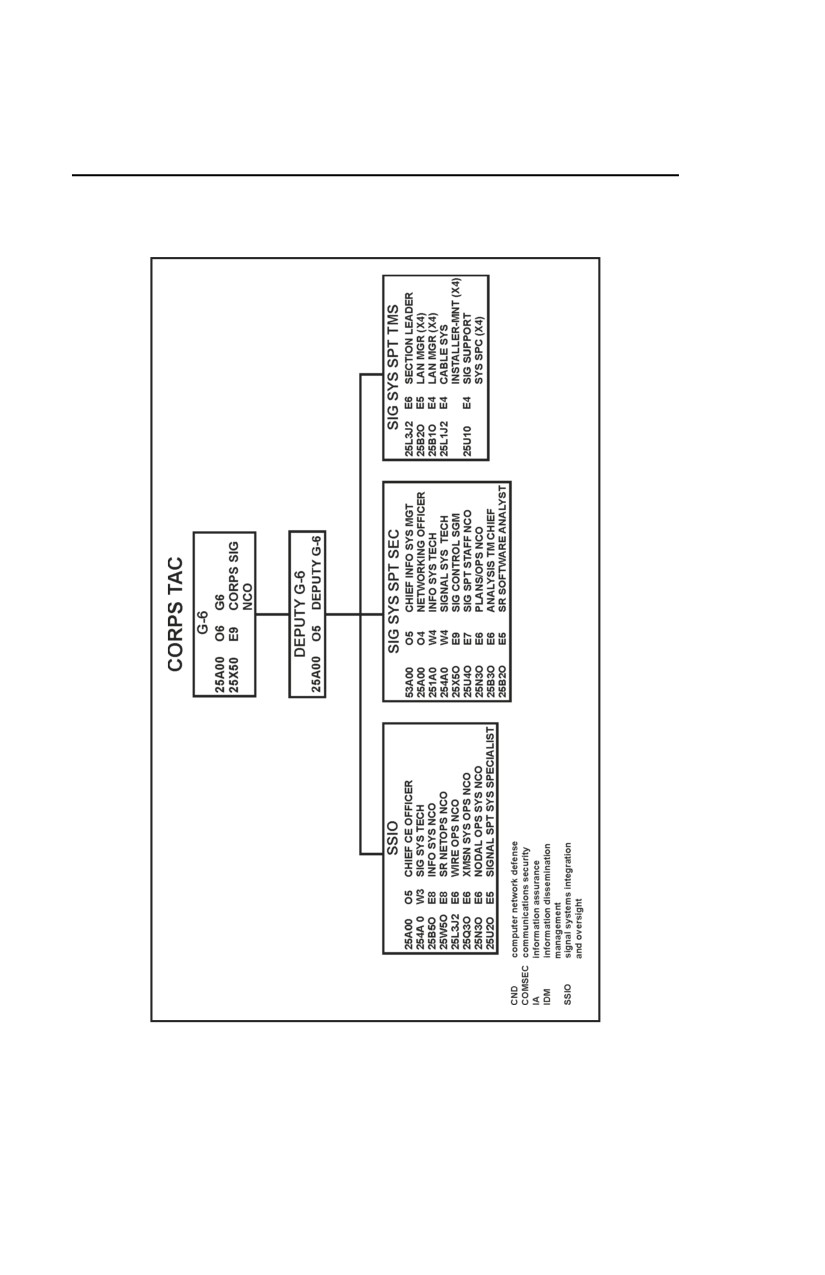
Figures 1-7 and 1-8 shows the corps G-6 section organization.
1-38
FM 6-02.43
17 March 2009
Signal Soldier’s Roles and Responsibilities
Figure 1-7. Corps G6 section organization
17 March 2009
FM 6-02.43
1-39
Chapter 1
Figure 1-8. Corps G6 section organization
1-40
FM 6-02.43
17 March 2009
Signal Soldier’s Roles and Responsibilities
CORPS G-6 OFFICER
1-86. The corps G-6 officer is the principal staff officer for all matters
concerning communications, EMSO, and networks. The G-6 officer
has authority over the corps information networks including training
readiness responsibility of the corps signal company. The G-6 is
responsible for planning, designing, and directing the corps signal
company to execute the communications plan to support the corps
commander’s intent. By executing the commander’s intent, the G-6
directs all technical changes to the network.
1-87. To make physical moves to signal equipment, the G-6
recommends FRAGOs to direct such movement with the G-3. He is
responsible for advising the corps commander, staff, and subordinate
commanders on communications operational matters.
ROLES AND RESPONSIBILITIES
1-88. The corps G-6 officer has the following roles and
responsibilities—
z
Prepares, maintains, and updates communications operations
estimates, plans, and orders. These orders will often cause
configuration management changes across multiple brigades. (See
Appendix D for a sample Signal Annex to an OPORD.)
z
Monitors and makes recommendations on all technical
communications and information operations.
z
Advises the commander, staff, and subordinate commanders on
communications and information operations and network priorities
for C2 (for example, changing bandwidth allocation to support the
corps main effort or a brigade reinforced with additional
intelligence, surveillance, and reconnaissance assets).
z
Directs technical changes to all portions of the corps network via
the TSO process.
z
Develops, produces, changes/updates, and distributes signal
operating instruction material.
17 March 2009
FM 6-02.43
1-41
Chapter 1
z
Prepares/publishes communications operations SOPs for corps
CPs.
z
Coordinates, plans, and manages corps EMSO within the corps
AO.
z
Plans and coordinates with higher and lower headquarters
regarding information systems upgrades, replacements,
eliminations, and integrations.
z
In coordination with the G-2, G-3, G-7 operational chain of
command, and STNOSC, plans and directs all IA activities and
information operations vulnerability and risk assessments.
z
In coordination with the staff, actively coordinates with a variety
of external agencies to develop the information and
communications plans, manages the information network, obtains
required services, and supports mission requirements.
z
Confirms and validates user information requirements in direct
response to a tactical mission.
z
Establishes communications and information policies and
procedures for using and managing information tools and
resources.
z
Acts as the JFLCC J-6 officer, if required. Equipment and
personnel augmentation will be required to support this mission
and will be provided by theater as necessary.
z
Provides signal unit operations sections with direction and
guidance during preparation of network plans and produces
diagrams establishing the information WAN.
z
Plans and integrates information systems and ABCS equipment
due to unit task organization/reorganization.
z
In coordination with the JTF, plans and directs all NETOPS
activities within the corps AO.
1-42
FM 6-02.43
17 March 2009
Signal Soldier’s Roles and Responsibilities
TRAINING READINESS RESPONSIBILITIES
1-89. The corps G-6 officer has the following training readiness
responsibilities—
z
Ensures the development of required skills of all signal personnel
within the corps AO.
z
In coordination with the G-1, identifies requirements and manages
the distribution of signal personnel within the corps.
z
In coordination with the G-3, monitors and provides oversight for
information dissemination to change warfighting functions,
priorities, and control measures within the corps AO.
z
Ensures automation systems and administration procedures for all
automation hardware and software used by the corps comply with
the GIG procedures and standards or Army specifications.
z
In coordination with the STB staff, ensures the corps signal
company is trained to support corps missions and tasks.
CORPS G-6 OFFICER AND THE NOSC
1-90. The corps G-6 officer employs a fully integrated NOSC
providing NETOPS functions for the corps. All corps signal elements
must coordinate with the NOSC during the engineering, installation,
operation, maintenance, and defense of the corps information network.
1-91. The corps NOSC has overall responsibility for establishing the
corps information network and provides the operational and technical
support to all of the corps signal elements in its AO.
1-92. The corps NOSC performs the NETOPS activities, functions,
and tasks required to create a dynamic and responsive network. This
network also quickly shifts priorities to support the ground tactical
plan. This management function extends the strategic GIG’s
capabilities into responsive, dynamic, and tactical formations.
17 March 2009
FM 6-02.43
1-43
Chapter 1
1-93. The corps NOSC has the following responsibilities—
z
In coordination with the operational chain of command, STNOSC,
and subordinate organizations, monitors, manages, and ensures
implementation of enterprise system management/network
management, information dissemination management/content
staging, and IA/CND activities.
z
Coordinates actions to resolve attacks/incidents on the corps
network with the STNOSC and subordinate organizations.
z
Coordinates operational procedures and requirements for IA/CND
and information systems security with the operational chain of
command and supporting regional computer emergency response
team.
z
In coordination with the corps signal company commander,
monitors, manages, and controls intra-corps information network
components.
z
Monitors the operation of the networks in the corps units.
z
Provides support and assistance to the subordinate NOSCs, as
required.
z
Administers the organizational message system
(DMS) in the
corps, including managing network addresses and sub-domains.
z
Coordinates
operation
and maintenance support of
communications systems.
z
Shares enterprise system management/network management
information with other management or monitoring centers.
z
Provides the supporting STNOSC and ARFOR NOSC with near
real-time information on the status and performance of corps
networks.
z
Orders and accounts for all forms of COMSEC material, including
storing keys in encrypted form and performing key generation and
automatic key distribution.
z
Performs COMSEC material accounting functions and
communicates with other COMSEC elements.
1-44
FM 6-02.43
17 March 2009
Signal Soldier’s Roles and Responsibilities
z
Performs information dissemination management/content staging
functions to support all aspects of relevant information
dissemination.
z
Provides near real-time awareness of corps networks and systems
that support the joint backbone to the JTF JNCC when the corps is
serving as the ARFOR/JFLCC.
CORPS G-6 OFFICER AS JOINT FORCE LAND COMPONENT
COMMAND J-6 RESPONSIBILITIES
1-94. The JTF J-6 officer is responsible to the commander, JTF, for—
z
Determining personnel requirements, including the number of
personnel, grade, and clearance, and any personnel peculiarities
for the directorate. Forwarding these requirements to the JTF
personnel directorate of a joint staff (J-1) with appropriate billet
description and justification.
z
Providing the communications system to support reliable, timely
information flow in support of joint operations. This includes the
development of communications systems architectures and plans,
as well as policy, guidance, and instructions for the integration and
installation of operational communications systems.
z
The JTF J-6 officer exercises staff supervision of all
communications systems assets. This also includes Chairman, Joint
Chiefs of Staff controlled transportable assets, automated
information systems, COMSEC, and networks necessary to
accomplish the overall joint force mission.
z
Ensuring that subordinate service and/or component headquarters
establish network management and control centers. The JTF J-6
officer establishes clear lines of communications and reporting
obligations between control centers. Each element of the JTF must
have clearly defined missions and responsible areas within the
network.
17 March 2009
FM 6-02.43
1-45
Chapter 1
z
Coordinating cross-service agreements between the JTF
headquarters, component planners, and the JNCC. The JTF J-6
officer establishes a JNCC to manage all communications systems
deployed during operations and exercises. The JNCC:
Exercises control and technical management
over communications control centers belonging to
deployed components and subordinate commands.
Serves as the single control agency for
management and operational direction of the joint
communications networks and infrastructure.
Performs planning, execution, technical, and
management functions.
Develops/disseminates standards and procedures
and collects and presents communications system
management statistical data. The JNCC manages all
tactical communications systems and strategic
communications connectivity as defined by the joint
operational architecture.
z
Reviewing all communications systems plans prepared by
subordinate component commanders. The JTF J-6 facilitates the
execution of all communications systems actions to maximize
support to the commander JTF and adjudicates any conflicts.
NETWORK SYSTEMS MAINTENANCE
1-95. Army transformation presents challenges for signal leaders and
staff requiring greater coordination to ensure success of the network.
The challenge centers on the G-6, S-6, and division/brigade signal
company leadership. Overcoming the challenge requires working
through the organizational boundaries of the respective STB, and
brigades to sustain the LWN. Refer to Appendix E for detailed
maintenance information.
1-46
FM 6-02.43
17 March 2009
Signal Soldier’s Roles and Responsibilities
ARMY FORCE GENERATION MODEL
1-96. The Army force generation model is the structured progression
of increased unit readiness over time resulting in recurring periods of
availability of trained, ready, and cohesive units prepared for
operational deployment in support of civil authorities and combatant
commander (CCDR) requirements.
1-97. The Army force generation model cycles Army brigades
through three force pools of progressive readiness over a specified
time—currently three years for the Active Army and six years for the
Reserve Component. This goal has not yet been attained. These three
force pools are reset/train, ready, and available. Throughout the
process, an attempt is made to stabilize assigned personnel for the
duration of the readiness cycle.
RESET/TRAIN
1-98. Units enter the reset/train force pool when they redeploy from
long-term operations or complete their planned deployment window in
the available force pool. Reset is a series of actions taken to restore
units to a desired level of combat capability commensurate with
mission requirements and available resources.
READY FORCE POOL
1-99. Units in the ready force pool are available for full spectrum
operations. They may be mobilized and can be committed to meet
operational requirements. Deploying units from the ready force pool
constitute a surge. Units continue their structured progression of
collective training to achieve the higher theater or core mission
essential task list capability for full spectrum operations. Units move
from ready to the available force pool when commanders assess they
have met designated capability levels and the units have entered their
designated window for deployment.
17 March 2009
FM 6-02.43
1-47
Chapter 1
AVAILABLE FORCE POOL
1-100. Units in the available force pool are at the highest state of
training and readiness levels and the first to be considered for sourcing
operational requirements. All Active Army and Reserve Component
rotational units pass through the one-year available force pool window
when they may deploy to meet an operational requirement or remain
focused on a specific contingency requirement.
1-48
FM 6-02.43
17 March 2009
Chapter 2
Signal Planning Process
The G-6/S-6 uses a warning order (WARNO) to
initiate the signal planning process. The G-6/S-6
gathers general information on the initial who,
what, when, and where and of the proposed
operation. This chapter covers the necessary
steps that effectively execute the signal planning
process.
SIGNAL LEADER’S ROLE IN THE
MILITARY DECISION MAKING PROCESS
2-1. The G-6/S-6 is the principal staff officer for all matters
concerning signal operations, automation and network management,
and information security. The G-6/S-6 initiates the signal planning
process, to support the MDMP, when the WARNO is received. He
coordinates with all the elements involved in the proposed operation.
The signal steps, actions, and events discussed below are critical to
mission success of the MDMP.
Note. Appendix D is a sample signal annex to an OPORD.
Refer to FM 5-0 for an in-depth explanation of an OPORD.
STEP ONE: RECEIPT OF THE MISSION
2-2. Once the mission is received and the staff is alerted, the staff
gathers the tools to begin planning and conducting an initial assessment
17 March 2009
FM 6-02.43
2-1
Chapter 2
of the mission. If there is a higher headquarters operation plan, read the
base order, review Annex C (Operational Graphics), Annex A (Task
Organization), the signal annex, and other annexes as needed. The G-
6/S-6 will extract specified, implied, and essential tasks as well as any
facts, assumptions, and constraints that apply to the G-6/S-6 staff. The
staff will continue to develop running estimates and prepare WARNO
(number one) with the intent of coming back together and
consolidating each section’s work on the overall mission analysis
briefing for the commander and staff.
WARNO (Number One)
2-3. WARNO (number one) is a preliminary notice of an order to
action, which determines if a unit is slated for a possible deployment. It
also includes pertinent information such as—
z
Analysis of the AO.
z
General enemy and friendly situation.
z
Attachments/detachments.
z
Type and time of operation.
z
Tentative time line.
z
Security, movement, and/or reconnaissance instruction.
z
Other pertinent information.
2-4. WARNO
(number one) may also include specific
communications elements that the S-6/G-6 may receive as an
attachment
(for example, a tactical satellite
[TACSAT] operator).
These assets are often task organized to brigade and battalion level. If
new COMSEC material must be requested, then that information
should be listed in the WARNO. Specific communication and C2
information in the WARNO may include—
z
Attached communications assets.
z
Specific equipment (what type, where and when it needs to be
picked up, if applicable).
z
Date and time of digital C2 rehearsal or communications exercise
(if known).
2-2
FM 6-02.43
17 March 2009
Signal Planning Process
z
Type of COMSEC to be used.
z
CP positioning.
z
Specific communications or C2 guidance.
z
Succession of command.
Initial Planning
2-5. The S-6 must also brief the communications chief/section so
they can begin to execute their initial deployment preparation as
defined in the unit SOP.
Request For Information
2-6. A request for information (RFI) is sent to a higher headquarters
for clarification of an issue
(unit SOP should specify a means for
submitting and tracking RFIs). RFIs should be quality controlled,
tracked, and consolidated in one location. An RFI manager (usually in
the S-3 section) should consolidate similar information request from
multiple elements. The G-6/S-6 should also track his own RFIs.
STEP TWO: CONDUCT MISSION ANALYSIS
2-7. During the mission analysis the S-6/G-6 will conduct the
following tasks—
z
Determine how much time he has to complete the mission.
z
Analyze the order form higher headquarters.
z
Coordinate with adjacent, higher, and lower unit S-6s.
z
Complete a signal staff estimate.
z
Conduct a signal site analysis describing how the terrain, weather,
and enemy will affect the mission. Include wideband versus
narrowband in the analysis.
z
Capture any signal-specific guidance.
z
Identify facts and assumptions.
z
Identify specified, implied, and essential tasks.
z
Provide input to WARNO (number two).
17 March 2009
FM 6-02.43
2-3
Chapter 2
Effective Mission Analysis
2-8. Conducting effective mission analysis is the key to the G-6/S-6
successfully providing signal support to the unit and providing the G-
6/S-6 with a voice in the planning process. Many G-6s/S-6s fail to have
the necessary tools to conduct an effective mission analysis, which may
lead to a signal support plan that is developed after a COA has been
selected. This failure leaves the S-6 scrambling to support the COA
that may not be supportable.
Time Management and Coordination
2-9. The G-6/S-6 must determine how much time he has to complete
the mission analysis based on the time line published by the executive
officer. If no guidance is issued, ask. Ideally, the commander has
issued his guidance, the executive officer has published a time line, and
the staff has issued WARNO (number one). This early in the process
the commander often may not be able to provide specific guidance.
Signal Staff Estimate
2-10. The G-6/S-6 should complete a signal staff estimate. It is based
on the G-6/S-6 ability to support, compare, and approve friendly
COAs. The estimate includes all of the signal information including, at
a minimum, a signal mission analysis chart (which will outline what
signal equipment is on-hand, in-use, non-mission capable, and
available), projected wireless network extension sites, and FM
coverage (mission analysis side).
Signal Site Analysis
2-11. The G-6/S-6 should conduct a signal site analysis of the entire
AO, if possible, the area of interest. (Signal site selection is explained
later in the chapter.) This signal site analysis will provide flexibility
later in the planning and execution process. For this analysis he should
focus on providing area-type coverage, so should the mission change
2-4
FM 6-02.43
17 March 2009
Signal Planning Process
and the operation is required in another area, he will already know
where effective communications coverage can be obtained.
Note. Do not just focus on hilltops. Many times an effective
location can be found in a valley or saddle that will provide a
wireless network extension team better survivability than a
hilltop that the enemy may also be trying to use as an
observation post.
2-12. The G-6/S-6 must also know the effective planning distance for
each available communications asset. Conducting an effective
evaluation of the terrain and developing a visual understanding of how
you will be able to support the mission is critical to planning process.
2-13. The G-6/S-6 must have a good understanding of the mission
and terrain analysis products to help the commander visualize how the
G-6/S-6 staff will support the mission. In many cases, a picture is
worth a thousand words. The picture helps the commander understand
what the staff is doing and why.
2-14. The G-6/S-6 will coordinate with the S-2 to determine the
enemy threat to anticipated communications locations. If the S-2 has
completed the enemy situation template, it can be used to ensure
communications sites have not been placed on or near any enemy
known or templated position.
2-15. As the G-6/S-6 determines the needs of the units, the potential
number of wireless network extension sites/teams needed to cover the
AO operations may become the criteria used later to determine which
COA is most supportable.
2-16. A communications plan to support the intelligence, surveillance,
and reconnaissance effort may be needed. The G-6/S-6 and
intelligence, surveillance, and reconnaissance section will determine
how best to support the intelligence, surveillance, and reconnaissance
plan with communications. Many times the scouts/reconnaissance,
surveillance, and target acquisition/long-rang surveillance conduct
17 March 2009
FM 6-02.43
2-5
Chapter 2
operations far from the current forward line of troops; therefore, they
need long-range communications assets to support them.
2-17. Once the G-6/S-6 has identified all of the communications
requirements, the staff must prepare and deliver the mission analysis
brief to the commander. The commander needs to know the relevant
information to develop a situational understanding and formulate
detailed planning guidance. The commander and staff only need the G-
6/S-6 information that could directly affect how the COA will be
developed.
2-18. For example, if the high frequency range is a constraint because
the operations area either does not have the use of high frequency
ranges or there are a limited number of high frequency ranges available
to the brigade, another means of communications for long-range
communications will need to be identified. Additional information that
should be briefed includes any attachments and detachments,
equipment shortages and how the terrain affects communications. It is
important for digital brigades to report on the range of the near-term
digital radio based on the terrain.
WARNO (Number Two)
2-19. After the mission analysis brief, the staff disseminates WARNO
(number two). It should include the following communications-specific
elements—
z
Time and place of the communications exercise.
z
Information that was not available for WARNO number one.
z
Visualization
(graphic) products used for the mission analysis
brief.
z
Digital file(s) subordinate S-6s can modify and use for their
mission analysis.
STEP THREE: COA DEVELOPMENT
2-20. During COA development, the staff can be developing two or
three COAs based on the guidance given by the commander. COAs are
2-6
FM 6-02.43
17 March 2009
Signal Planning Process
usually developed by the S-3 and/or the executive officer, not the
commander. Many times the S-6 cannot cover down on the
development of multiple plans because they are being developed
simultaneously in different locations. In this case, the G-6/S-6 and
communications chief can cover down on different COA development
locations, or, if that is not possible, the G-6/S-6 should float between
the locations to track all COAs.
2-21. It is at this point that effective terrain analysis, developed in
mission analysis, become extremely important. The operation staff
officer developing the COA may ask the G-6/S-6 if his plan can be
supported by the communications plan the G-6/S-6 has been
developing. The wrong answer from the G-6/S-6 here may result in a
COA that is difficult or impossible to support during wargaming. A
complete or nearly complete terrain analysis will allow the G-6/S-6 to
answer this question with confidence.
COA Criteria
2-22. Each COA developed should meet the following criteria:
z
Complete. It must complete the task in the mission statement.
z
Feasible. The unit must have the capacity to accomplish the
mission in the terms of available time, space, and resources.
z
Acceptable. The tactical or operational advantage gained by
executing the COA must justify the cost in resources, especially
casualties.
z
Distinguishable. Each COA must differ significantly from the
others.
z
Suitable. It must accomplish the mission and comply with the
commander’s guidance.
Note. While each maneuver COA must meet all five criteria,
your communications plan need not. It may not need to be
distinguishable; one plan may be able to support several
COAs.
17 March 2009
FM 6-02.43
2-7
Chapter 2
Decisive Points
2-23. The commander’s staff should define the decisive point for each
COA. The G-6/S-6 should focus on this point. The G-6/S-6 must
absolutely be able to provide robust, reliable and redundant
communications support.
S-6 Input to COA Development
2-24. The G-6/S-6 provides the following input during COA
development—
z
Use a terrain-based visualization program to refine proposed
tactical operations center (TOC) and C2 node locations.
z
Identify communications dead space.
z
Conduct a risk assessment.
z
Identify proposed TOC and C2 node locations and displacement
triggers.
z
Consider enemy locations.
z
Plan for all phases of each COA to include the intelligence,
surveillance, and reconnaissance fight.
z
Apply the complete, feasible, acceptable, distinguishable, and
suitable criteria to each COA.
z
Consider primary, alternate, contingency, and emergency
communications (PACE) for each COA. An emergency means of
communications does not always have to be equipment; it may be
a procedure, such as moving back to the last known effective
communications point or linking up at a grid coordinate. The
PACE concept has always been a valuable tool to ensure there is a
back up communications plan in place in case the primary plan
fails. An example of the PACE concept would be—
Primary-—JNN.
Alternate—TACSAT.
Contingency—high frequency.
Emergency—SINCGARS.
2-8
FM 6-02.43
17 March 2009
Signal Planning Process
STEP FOUR: COA ANALYSIS (WARGAMING)
2-25. COA analysis
(wargaming) involves the following
procedures—
z
Assemble tools;
FM coverage.
Signal mission analysis chart (completed).
Map.
Signal wargaming matrix
(with locations
penciled in).
Evaluation criteria table.
Small signal/C2 icons
(include main CP and
TAC CP).
z
Apply evaluation criteria.
z
Identify critical events.
z
Identify decision points.
z
Recommend COA(s).
z
Issue WARNO (number three).
z
Prepare for OPORD brief.
z
Prepare for rehearsals.
2-26. Wargaming is a disciplined process and is probably one of the
most time consuming events other than conducting mission analysis.
The G-6/S-6 will need to know what critical events the staff will
wargame, the evaluation criteria for each COA, and what wargaming
method will be used.
2-27. The commander or executive officer dictates which wargaming
method the staff will use prior to the wargame. There are three
wargaming methods:
z
The box method is a detailed analysis of a critical area, such as an
engagement area, a river crossing, or a landing zone. It is useful
when planning operations in noncontiguous AO.
17 March 2009
FM 6-02.43
2-9
Chapter 2
z
The belt method divides the AO into belts (areas) running the
width of the AO. The belt method is most effective when terrain is
divided into well-defined cross-compartments, during phased
operations
(such as river crossings, air assaults, or airborne
operations), or when the enemy is deployed in clearly defined belts
or echelons.
z
The avenue in depth method focuses on one avenue of approach
at a time, beginning with the decisive operation.
G-6/S-6 Wargaming
2-28. Prior to wargaming, the G-6/S-6 must have his tools ready to be
effective. These tools include—
z
FM footprint “slides.”
z
COA evaluation criteria table.
z
Signal wargaming tool matrix.
z
Higher headquarters order.
z
Map.
z
Signal mission analysis chart.
z
Signal modified table of organization and equipment analysis
worksheet.
z
Previously constructed icons or “stickies.”
2-29. The wargame follows an action-reaction-counteraction cycle.
Actions are those events initiated by the side with initiative (normally
the force on the offensive). Reactions are the other side’s actions in
response. Counteractions are the first side’s responses to reactions.
This sequence of action-reaction-counteraction is continued until the
critical event is complete or until the commander determines that he
must use another COA to accomplish the mission. The G-6/S-6 will
move “stickies” during each turn and identify grid coordinates for key
locations (refer to Figure 2-1 for an example of a signal wargaming
matrix).
2-30. Throughout the wargame, the staff must evaluate each COA
against some criteria that has been determined or approved by the
2-10
FM 6-02.43
17 March 2009
Signal Planning Process
commander. The G-6/S-6 should also have some communications
evaluation criteria he uses for each COA. This could be the number of
wireless network extension teams needed to support each COA, the
amount of security available to each wireless network extension team,
or any other criteria the G-6/S-6 determines. Figure 2-2 can be used to
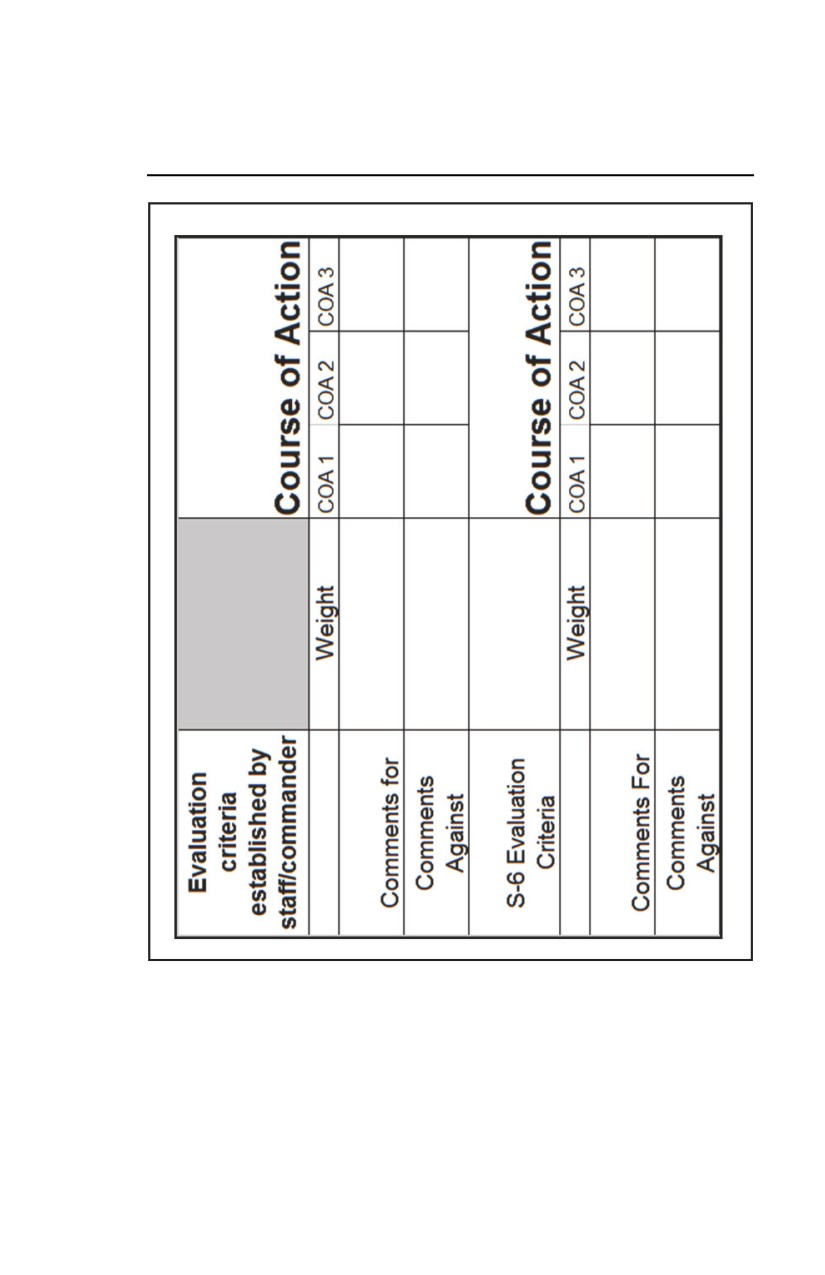
help capture how the G-6/S-6 will evaluate each COA.
2-31. When the staff briefs the commander, only the criteria he set
forth will be briefed; however, the G-6/S-6 may be asked which COA
he can best support and why. Here is where the G-6/S-6 portion of the
evaluation table can be used to clearly articulate why one is better and
what evaluation criteria was used to reached a decision.
Communications Nodes
2-32. Prior to conducting the wargame, the G-6/S-6 should have
already identified where he is going to place the wireless network
extension sites/teams and any other communications nodes. This
information is filled into the wargaming tool. The G-6/S-6 uses the tool
when he briefs these locations at the wargame. The S-6 should talk in
terms of where the signal node is located, its task and purpose, and its
command relationship. The G-6/S-6 should also use triggers to jump
the communications nodes forward.
17 March 2009
FM 6-02.43
2-11
Chapter 2
Figure 2-1. Example of a signal wargaming matrix
2-12
FM 6-02.43
17 March 2009
Signal Planning Process
Figure 2-2. COA evaluation criteria
17 March 2009
FM 6-02.43
2-13
Chapter 2
2-33. During the wargame, location tasks, purposes, triggers
(synchronization), and command relationships may change. The
wargaming tool can also be used to capture these changes. At the end
of the wargame, the G-6/S-6 will use this chart to help him write his
scheme of the signal support for the signal annex (refer to Annex D for
an example of a signal annex).
STEP FIVE: COA COMPARISON
2-34. The G-6/S-6 will want to consider comparing C2 of his portion
of each COA such as the number of wireless network extension
systems needed to support each COA and the amount of security
available to protect each wireless network extension team. (Refer to
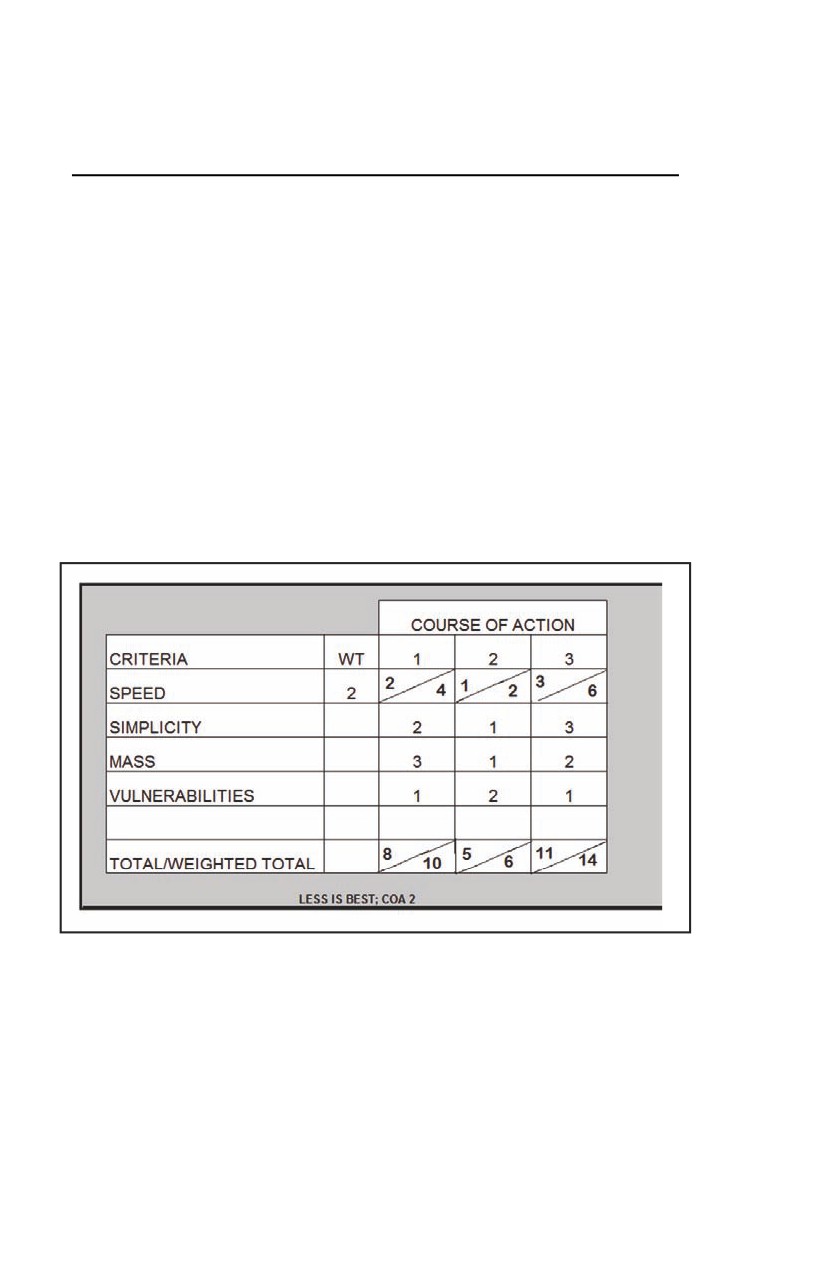
Figure 2-3 for a sample COA comparison-briefing slide.)
Figure 2-3. Sample COA comparison briefing slide
2-14
FM 6-02.43
17 March 2009
Signal Planning Process
STEP SIX: COA APPROVAL (DECISION BRIEF)
2-35. During the COA approval, the G-6/S-6 needs to be prepared to
discuss why he thinks a specific COA is more supportable than
another. The G-6/S-6 should have a copy of the evaluation criteria he
used to evaluate the various COAs. This chart covers not only specific
evaluation criteria the staff used as a whole, but the evaluation criteria
the G-6/S-6 used as well. These criteria could be anything from the
amount of security available for each C2 node to the number of
wireless network extension sites needed to support each COA. This
chart becomes important because the staff’s evaluation criteria often do
not address issues with which the G-6/S-6 is concerned.
2-36. Many commanders go around the room and ask various staff
officers if they agree with the COA recommended by the collective
staff and, if not, why. The G-6/S-6 can use this chart to argue that the
COA selected by the collective staff leaves the wireless network
extension sites without security and makes them vulnerable.
Final Planning Guidance
2-37. After the commander selects the COA, he may issue some final
planning guidance that may include a refined commander’s intent, new
commander’s critical information requirement, priorities for
warfighting functions to include communications guidance, orders
preparation, and rehearsal and preparation guidance.
WARNO (Number Three)
2-38. WARNO (number three) should include any of the products that
were used for the wargaming process that could be used by battalion S-
6s in their planning. This should include main CP/TAC CP locations
and the triggers to move them. These will become the basis for the
scheme of signal support. Any FM footprint or other products
developed should also be included as well as updated commander’s
critical information requirement and essential elements of friendly
17 March 2009
FM 6-02.43
2-15
Chapter 2
information, principle tasks assigned to subordinate units, preparation
and rehearsal instructions, and the final time line for operations.
STEP SEVEN: ORDERS PRODUCTIONS CHECKLIST
2-39. The staff prepares the OPORD by turning the selected COA into
a clear, concise concept of operation and required supporting
information. The concept of operations for the approved COA becomes
the concept of operations for the order. The commander reviews and
approves orders before the staff reproduces and disseminates them.
2-40. The S-6 can use the following orders productions checklist—
z
Publish base order paragraph 5 and the signal annex with all
appendices.
z
Continually check and verify that changes are included in Annex
A, Task Organization.
z
Publish the signal support overlays(s).
z
Ensure all tasks to maneuver units are listed in both Annex H and
the base order.
z
Coordinate with the fire support officer and ensure no-fire areas
are established over the C2 node sites.
z
Publish initial and jump locations of all C2 nodes.
z
Provide diagrams showing the scheme of signal support and FM
coverage.
z
Prepare for rehearsal(s):there are five types of rehearsals (FM 6-0):
Confirmation brief.
Back brief.
Battle drills/SOP rehearsal.
Combined arms rehearsal.
Support rehearsal.
2-41. The S-6 is responsible for writing paragraph 5 of the base order
and ensuring task-organized units are listed in any additional annexes.
Many times there is very little time in between COA approval, the
OPORD brief, and producing the written OPORD. To be successful,
2-16
FM 6-02.43
17 March 2009
Signal Planning Process
the S-6 needs to have a “shell” or template signal annex already
developed that outlines all the necessary recurring items.
2-42. Appendices to the signal annex could include a bubble chart
diagram for the FM nets, a listing of call signs, and the network
diagram. Some critical information that some may consider information
that should be included in an SOP could still be included in the
OPORD; compromise procedures are a good example. This may be an
SOP item, but many attached units will not have access to read the
unit’s SOP.
2-43. The scheme of the signal support should be written by phase
just like the base order. Each phase should start with the priority of
communications for that phase followed by a space to allow for easy
reference.
2-44. The G-6/S-6 should also produce an FM coverage overlay in
maneuver control system or whatever management system the unit is
using. Most of the time this overlay will not be displayed as part of the
common operating picture system in the unit’s CP. However, if a
communications node is lost during execution, the G-6/S-6 can call up
the overlay and quickly brief the command and staff on how
communications are affected across the AO. Commanders and staff can
also use this as guide to understand where coverage can be provided.
OPORD Brief
2-45. The OPORD briefing will allow each staff section to provide its
input while keeping the brief to approximately one hour. Information
briefed should only pertain to the subordinate commanders receiving
the order.
2-46. The G-6/S-6 should brief net priorities, task organizations, and
TOC locations as well as C2 nodes with task purpose by phase. Use
supporting terrain tools to show where the G-6/S-6 staff can and cannot
provide communications support.
17 March 2009
FM 6-02.43
2-17
Chapter 2
G-6/S-6 TROOP LEADING PROCEDURES
AND THE MILITARY DECISION MAKING
PROCESS
2-47. The final briefing of the OPORD is not the only responsibility
of the G-6/S-6. Troop leading procedures extend the MDMP to small
unit level.
(Refer to
5-0 for more information on troop leading
procedures.) Troop leading procedures provide leaders a framework for
planning and preparing for operations. During the initial receipt of the
OPORD or WARNO, the G-6/S-6 should brief the section
sergeant/communications sergeant so subordinate Soldiers can start to
prepare for their portion of the mission. During this time the
communications section/platoon will ensure the following items are
checked—
z
Prescribed load list on hand.
z
Basic load of batteries.
z
Operational radios.
z
Additional radios needed for contingency use.
z
Deadlined communications equipment.
z
C2 vehicles prior to deployment.
z
Radio transmission operator’s certification/maintenance training.
z
Hardware and software that will be used to construct or
troubleshoot while working on the information network
(data
cables, network interface card, software drivers).
z
Updated signal operating instructions information
(call signs,
challenges, and passwords).
z
Pre-combat inspection (load plans).
z
Appropriate satellite access requests are submitted or DISA
commercial SATCOM leases are operational.
2-18
FM 6-02.43
17 March 2009
Signal Planning Process
2-48. The following are basic communications checks and balances
that should be performed to ensure a successful mission once the
OPORD is received—
z
Verify the location of the field trains and administrative and
logistics/combat trains for coverage of the administrative/logistical
net.
z
Coordinate signal support as required. Verify frequencies and
COMSEC. Always verify that the TACSAT or additional wireless
network extension assets will be available and briefed if needed.
z
Coordinate with the medical officer and verify medical evacuation
frequency and call signs.
z
Coordinate location and times that the radio access unit/EPLRS
filling stations are filling subscribers’ terminal devices.
z
Define time-sharing and procedures for critical nets, especially
SATCOM-facsimile plan for liaison officers with required
communications and communications electronics operational
instructions (CEOI) to overcome problems with inter/intra service
operations especially during short missions.
z
Coordinate common-user nets and power requirements, which
could simplify unnecessary redundancy during deployment.
z
Ensure the S-3 has key communications events on the execution
matrix, and net calls are done daily or tied to a specific event in the
planning process.
SIGNAL SITE SELECTION
2-49. The following paragraphs explain how to conduct a signal site
selection for a battalion/company or platoon size element.
2-50. All tactical situations are unique and depend on METT-TC. In
every situation, the company must meet two basic requirements. First,
the survivability of signal assets and personnel is vitally important to
accomplish the company mission. Second, strict security programs and
defense plans must be implemented at all levels of command.
17 March 2009
FM 6-02.43
2-19
Chapter 2
To accomplish these two requirements, the company must accomplish
the following:
z
Site commanders must form a defensive plan and escape routes for
their site.
z
The survival of the site depends on readiness. The site commander
must ensure that each Soldier knows his part in the overall
defense.
z
All independent operations must include a risk assessment to
reduce injury and damage to equipment.
Site Reconnaissance
2-51. The reconnaissance team should consider the following—
z
Before occupation, leaders should perform a reconnaissance of the
proposed area. For example, the reconnaissance team should
consist of the company leader, the transmission supervisor
(if
applicable), node supervisor (if applicable), and a security team.
The reconnaissance team participant will depend on the type of
unit. The reconnaissance team will have FM communications at all
times.
z
When conducting a reconnaissance of a signal site, several
considerations need to be made to ensure the selected site will
meet all mission requirements. Key leaders from all sections that
will occupy a site should participate in the reconnaissance.
z
The reconnaissance team must ensure that the size of the site is
adequate to accommodate all assemblages and that they can be
tactically dispersed on the site.
z
Ensure that the site can be easily secured. Take into consideration
the size, the amount of personnel that will be available at any
given time to defend the site, and the amount of entrances or
avenues of approach leading to the site. Consider how well the site
is concealed from major roads or other vantage points. This may
involve traveling around the entire site from a distance to visualize
what the enemy would see.
2-20
FM 6-02.43
17 March 2009
Signal Planning Process
z
Ensure that the site is close enough to the supported elements for
them to connect to the signal assemblages. The farther away the
shelters are from the subscribers, the harder it will be to
troubleshoot.
Site Selection
2-52. The reconnaissance team should be considered the following for
site selection—
z
The site layout should be made including marking stakes to
indicate where each signal assemblage should be parked. Proposed
assemblage and antenna locations will be recorded in ten digit
grids. Access roads should also be identified.
z
A proposed site diagram should be made showing the site layout of
all signal assemblages to include the route of all signal and power
cables, and a plan for the use of a 30-meter mast. Planning cable
routes will ensure sufficient separation between signal and power
cables to prevent signal loss due to power hum on signal cables.
z
The access road through the site should be planned and the buried
cable points should be designated. This will allow new signal
assemblages to be added to the site without disrupting
communications.
z
All designated ground guides and supervisory personnel will be
briefed on the site layout and the designated entry routes into the
site. The ground guides will direct the signal assemblages into
their site positions by the designated routes and will provide
organization and speedy movement onto the site.
Site Layout
2-53. The reconnaissance team should consider the following for the
site layout—
z
Separate all signal cables from power cables by at least 10 feet.
The only place this is not possible is at the van signal entry panel.
If signal and power cables must cross, cross them at right angles
and separate with sandbags.
17 March 2009
FM 6-02.43
2-21
Chapter 2
z
Site layout plans must give priority of positioning to antennas so
they may have optimum locations.
z
Pulse code modulation cables cannot pass within 200 feet of a high
frequency station antenna or high frequency station coaxial cable.
z
All ultra high frequency
(UHF)/super high frequency
(SHF)
antennas will be installed high enough to clear terrain to the front,
yet remain concealed by the trees as terrain allows.
z
Each antenna will be located at the position that is best for its
particular azimuth. Antennas will be placed at a minimum distance
of twice the antenna height from power lines. Each antenna will be
positioned so that if it falls, it cannot damage another antenna.
Tents will not be placed within antenna fall radius.
z
Antennas will be positioned to reduce the possibility of co-site
interference.
z
Each vehicle and generator set will have drip pans and chock
blocks placed (front/rear) to prevent motion after positioning.
z
Technical limitations of the equipment such as maximum length
and number of cable runs.
SIGNAL SITE SECURITY
2-54. Signal sites must be able to defend themselves against sabotage,
ground forces, and airborne/air assault forces with little or no outside
help. They must also be prepared to survive enemy air, artillery, and
chemical, biological, radiological, and nuclear attack.
2-55. There are several different types of signal sites. Some
considerations must be made when planning a site defense, based on
the chosen site. Current threat situational status is an important factor
when planning and committing assets and personnel to defend a site.
Use METT-TC and order priorities accordingly.
Remote Sites
2-56. Remote sites are small teams located in isolated positions,
usually for relay or wireless network extension purposes. They cannot
2-22
FM 6-02.43
17 March 2009
Signal Planning Process
defeat a large enemy force. Teams should try to remain concealed and
report enemy activity to higher headquarters. The teams conduct risk
assessments from the remote sites to determine the probability of
mission success. Leaders must carefully track specific threats and move
teams quickly when in danger.
Collocated Sites
2-57. Usually these teams, such as an extension node, deploy to
support a unit CP. The team members are responsible for a portion of
the perimeter defense. Careful coordination must be done with the
collocating unit. One central authority should be responsible for all
defense matters associated with the site.
Node Sites
2-58. Usually this platoon-sized signal element may or may not
collocate with another unit. Based on the enemy threat level, the signal
site commander must plan a site defense and coordinate with nearby
units for mutual support.
PROFILING RADIO LINKS
2-59. Obtaining LOS between two stations is essential when forming
a multichannel radio link. For most systems, the LOS planning range is
about 40 kilometers (km) (28 miles), due to the earth’s curvature. LOS
analysis may be done by automated means using one of several
different programs such as the System Planning, Engineering and
Evaluation Device (hosted by the Marine Corps) or the Voice of
America Coverage Analysis Program that was released by the US
Department of Commerce. Refer to Figure 2-4 for an example of an
LOS analysis study.
17 March 2009
FM 6-02.43
2-23