FM 6-02.43 SIGNAL SOLDIER’S GUIDE (March 2009) - page 1
FM 6-02.43
Field Manual
Headquarters
Department of the Army
No. 6-02.43
Washington, DC 17 March 2009
SIGNAL SOLDIER’S GUIDE
Contents
Page
PREFACE
vii
INTRODUCTION
ix
Chapter 1 SIGNAL SOLDIER’S ROLES AND
RESPONSIBILITIES
1-1
Signal Soldier Responsibilities to the
Commander
1-1
Battalion S-6 Officer
1-3
Brigade S-6 Officer
1-7
DISTRIBUTION RESTRICTION: Approved for public release;
distribution is unlimited.
17 March 2009
FM 6-02.43
i
Contents
Signal Company Commanders
1-17
Division Command and Control
1-18
G-6 Responsibilities at the Division
Command Posts
1-20
Division G-6 Officer Roles and
Responsibilities
1-21
The Corps
1-36
Corps Command Posts
1-37
G-6 Responsibilities at the Corps
Command Posts
1-38
Corps G-6 Officer
1-41
Network Systems Maintenance
1-46
Army Force Generation Model
1-47
Chapter 2
SIGNAL PLANNING PROCESS
2-1
Signal Leader’s Role in the Military
Decision Making Process
2-1
G-6/S-6 Troop Leading Procedures and
the Military Decision Making Process
2-18
Additional Signal Support Equipment
Checks During Operations
2-25
Chapter 3
THE NETWORK
3-1
Global Information Grid
3-1
LandWarNet
3-3
Network Command and Control
3-5
Network Operations
3-6
Information Protection
3-6
Network Service Center
3-8
G-6/S-6 Network Operations
3-9
Current and Future Networks
3-11
ii
FM 6-02.43
17 March 2009
Contents
Chapter 4
THEATER OPERATIONS
4-1
Leveraging Theater Operation Assets
4-1
Providing “Other” Service Support
4-2
Section I - Major Commands
4-4
NETCOM/9th SC(A)
4-4
Section II - Strategic and Fixed
Station Elements
4-10
Strategic Signal Brigades
4-11
Section III - Signal Operations
4-19
Organizations for the Modular Force
4-19
Chapter 5
TRANSPORT SYSTEMS
5-1
WIN-T Increment 1
5-1
Mobile Subscriber Equipment
5-11
Tri-Service Tactical
5-14
Chapter 6
FEDERATION OF NETWORKS
6-1
Introduction
6-1
Blue Force Tracking
6-2
Army Battle Command System
6-3
Combat Service Support Very Small
Aperture Terminal
6-3
Public Affairs Office Digital Video and
Imagery Distribution System
6-8
Global Broadcast System
6-9
TeleEngineering Operations Center
6-15
Standardized Integrated Command Post
System
6-16
17 March 2009
FM 6-02.43
iii
Contents
Appendix A ELECTROMAGNETIC SPECTRUM
MANAGEMENT OPERATIONS
A-1
Appendix B ARMY BATTLE COMMAND SYSTEM
B-1
Appendix C SIGNAL MILITARY OCCUPATIONAL
SPECIALTIES
C-1
Appendix D SIGNAL ANNEX TO AN OPORD
D-1
Appendix E MAINTENANCE
E-1
GLOSSARY
Glossary-1
REFERENCES
References-1
INDEX
Index - 1
Figures
Figure 1-1. BCT S-6 staff organization
1-8
Figure 1-2. BCT signal company organizational structure
1-13
Figure 1-3. Modular support brigades signal company
organizational structure
1-16
Figure 1-4. Division G-6 section organization
1-25
Figure 1-5. Division G-6 section organizations
1-26
Figure 1-6. Division signal company organization
1-34
Figure 1-7. Corps G6 section organization
1-39
Figure 1-8. Corps G6 section organization
1-40
Figure 2-1. Example of a signal wargaming matrix
2-12
Figure 2-2. COA evaluation criteria
2-13
Figure 2-3. Sample COA comparison briefing slide
2-14
Figure 2-4. Sample LOS study
2-24
iv
FM 6-02.43
17 March 2009
Contents
Figure 4-1. NETCOM/9th SC(A) Organization
4-5
Figure 4-2. Strategic design
4-15
Figure 4-3. SC(T) subordinate elements
4-24
Figure 4-4. 7TH SC(T) organization
4-27
Figure 4-5. Theater tactical signal brigade
4-30
Figure 4-6. The ESB structure
4-37
Figure 4-7. Theater TIN company
4-43
Figure 4-8. Theater COMCAM company
4-47
Figure 4-9. TNOSC DSD structure
4-50
Figure 4-10. TNOSC DSD elements-TNT, TIC, and TLT with
corps/division
4-52
Figure 4-11. TNOSC DSD elements-TNT, TIC, and TLT without
corps/division
4-53
Figure 5-1. WIN-T Increment 1 architecture
5-3
Figure 5-2. Command post node
5-8
Figure 6-1. CSS VSAT architecture
6-4
Figure 6-2. Trojan SPIRIT architecture
6-5
Figure 6-3. GBS architecture
6-10
Figure 6-4. Transportable ground receive suite
6-14
Figure A-1. The electromagnetic spectrum
A-2
Figure A-2. Army spectrum management process
A-4
Figure A-3. Spectrum management radio
frequency systems
A-5
Figure B-1. The Army battle command system
B-2
Figure C-1. DA PAM 611-21 Web site page
C-3
Figure D-1. OPORD paragraph 5, command
and signal outline
D-2
17 March 2009
FM 6-02.43
v
Contents
Figure D-2. Outline of a signal annex
D-3
Figure E-1. Two level maintenance process flow
E-3
Figure E-2. BCT maintenance operations
E-8
Tables
Table A-1. Spectrum management tools and descriptions
A-6
vi
FM 6-02.43
17 March 2009
Preface
This field manual is a pocket reference guide for signal Soldiers at all
echelons. It is intended to help signal Soldiers understand and
implement Army communications systems operations in a modular
force construct.
This manual addresses the roles and responsibilities of the signal
Soldier and signal planning during the military decision making
process. It also provides an overview of the Global Information Grid,
LandWarNet and its transport systems, network operations and
spectrum management. It also addresses the transformed signal
structure from the maneuver battalion through theater level and the
support provided between echelons.
Note. As of June 2007, the Joint Network Node-Network
program has been incorporated into the Warfighter
Information Network-Tactical program and designated as
Warfighter Information Network-Tactical Increment 1. When
joint network node is used in this document, it refers to the
equipment and not to the program.
This publication applies to the Active Army, the Army National Guard
(ARNG)/Army National Guard of the United States (ARNGUS), and
the United States Army Reserve (USAR) unless otherwise stated.
The proponent of this publication is the United States Army Training
and Doctrine Command (TRADOC). The preparing agency of this
publication is the US Army Signal Center.
17 March 2009
FM 6-02.43
vii
Preface
Send comments and recommendations on DA Form
2028
(Recommended Changes to Publications and Blank Forms) via e-mail
to
signal.doctrine@us.army.mil. Key your comments and
recommendations to pages and lines of text to which they apply.
Provide reasons for your comments to ensure understanding and proper
evaluation.
Mailing address is: Commander, United States Army Signal Center and
Fort Gordon, ATTN: ATZH-IDC-CB (Doctrine Section), Building
29808, 506 Chamberlain Ave, Fort Gordon, GA 30905-5075.
Unless this publication states otherwise, masculine nouns and pronouns
do not refer exclusively to men.
viii
FM 6-02.43
17 March 2009
Introduction
The Army has decentralized most of its signal capabilities. Corps,
divisions, brigade combat teams, and support brigades now have signal
forces organic to the units who own, operate, train, and maintain their
unique signal forces. Corps signal brigades and division signal
battalions have inactivated leaving a large part of the Army force
supported by pooled theater assets. Supporting the commander with
reliable and vigorous communications is a direct result of detailed
signal planning. Understanding the commander’s intent is the most
critical step for a signal leader.
Signal Soldiers and planners are chartered to build networks that
almost intuitively act on behalf of the commander’s intent; networks
where information is guaranteed based on policies aligned with the
commander’s critical information requirements and intent. To build this
network, planners must successfully synchronize and integrate the
assets to support the plan and the commander. Signal Soldiers have the
great responsibility to facilitate the combined arms, joint, and
multinational fight. This mission is critical to increasing the combat
power in the modular force. The signal planner plays a critical role in
enabling combat successes and prevailing in the information war.
17 March 2009
FM 6-02.43
ix
This page intentionally left blank.
Chapter 1
Signal Soldier’s Roles and
Responsibilities
The Army’s transformation to a modular force
has transformed the signal structure. Division
signal battalions and corps signal brigades have
been inactivated with the signal support now
embedded within each modular organization.
Division
and corps are headquarters
organizations with units attached as mission
dictates and have signal companies assigned that
support the headquarters element only. Each
brigade combat team (BCT) or modular support
brigade has its own organic signal company to
provide support. This chapter addresses the roles
and responsibilities of the signal Soldier to the
commander and his responsibilities at each
echelon.
SIGNAL SOLDIER RESPONSIBILITIES TO
THE COMMANDER
1-1. The transformation to a modular Army and the elimination of
the corps signal brigade and division signal battalion has removed the
traditional support structure for the assistant chief of staff, network
operations
(G-6)/network operations staff officer
(S-6). This has
required the G-6/S-6 to build working relationships with organizations
17 March 2009
FM 6-02.43
1-1
Chapter 1
that have traditionally been provided by a signal brigade or battalion
staff. The G-6/S-6 must establish a viable working relationship not
only with the staff officers within his organization, but also with
higher, lower, and adjacent organizations. These organizations include
sustainment, signal, and other supported or supporting organizations
that the G-6/S-6 is required to coordinate training or specific mission
requirements.
1-2. The signal leader is responsible to the commander for the
following—
z
Reports the status of the units’ communications and information
system maintenance during briefings
(information, decision,
mission, and staff). He provides a status report of all the
information systems on the local area network (LAN).
z
Participates in the military decision making process
(MDMP).
(Refer to Field Manual [FM] 5-0 for more information on the
MDMP.) As part of the commander’s staff, the signal leader
performs the following critical tasks during planning:
Develops and maintains running estimates.
Identifies specified and implied tasks.
Identifies constraints.
Identifies key facts and assumptions.
Performs intelligence preparation of the
battlefield.
Formulates the concepts of operations and
support in line with the commander’s intent.
Develops the scheme of maneuver to support the
course of action (COA).
Prepares, authenticates, and distributes his
portion of the plan or order, annexes, estimates,
appendixes, and supporting plans.
z
During the development of the COA, assesses the communications
feasibility of each COA. He determines the communications and
computer requirements and compares them to available assets. He
1-2
FM 6-02.43
17 March 2009
Signal Soldier’s Roles and Responsibilities
identifies potential shortfalls and recommends actions to eliminate
or reduce their effect.
z
Recommends commander’s critical information requirements
(CCIR). Commanders designate CCIR and essential elements of
friendly information to let their staff and subordinates know what
information they deem necessary for decision-making.
z
Develops/Prepares signal sections of the unit standing operating
procedures (SOP) in accordance with (IAW) the commander’s
intent.
z
Completes or assists during staff studies and decision papers as
necessary.
BATTALION S-6 OFFICER
1-3. The battalion S-6 officer and communications chief lead the
Signal Regiment’s front-line Soldiers. Battalions are equipped with
network and systems enablers providing capabilities that in the past
were only provided at echelons brigade and higher. These enablers (for
example, Blue Force Tracking [BFT], combat service support [CSS]
satellite communications
[SATCOM], and the command post node
[CPN]) require greater external coordination than earlier systems.
1-4. The battalion S-6 officer is responsible for the supervision of all
automated information systems, network management, computer
network defense
(CND), electromagnetic spectrum operations
(EMSO), and information assurance (IA). (Refer to Appendix A for
more information on EMSO.) The primary signal operations planner is
also an active member of the staff planning during the MDMP. He
determines the supportability and feasibility of the signal plan versus
the scheme of maneuver. Early involvement in the MDMP by the
battalion S-6 officer is critical to the successful development of a
comprehensive and complementary signal plan. (Refer to Chapter 2 for
more information on the signal planning process.)
17 March 2009
FM 6-02.43
1-3
Chapter 1
ROLES AND RESPONSIBILITIES
1-5. The battalion S-6 section is organized to support the
commander’s intent. The S-6 officer maintains overall authority and
responsibility for the communications assets and operations within the
battalion area of operations (AO).
1-6. As a principal staff officer, the battalion S-6 officer interacts
closely with the battalion commander, executive officer, operations
staff officer
(S-3), and other staff officers to determine specific or
unique communications and network requirements. The battalion S-6
officer must work closely with the brigade S-6 officer and adjacent
headquarters to ensure efficient communications employment
throughout the battalion AO. The S-6 officer is responsible for
maintenance on organic signal systems within the battalion.
1-7. Each maneuver battalion is equipped with combat net radio
(CNR) capabilities. The battalion provides primary internal
communications and an organic CPN enables wideband beyond line of
sight (BLOS) access to the brigade information network and limited
Defense Information Systems Network
(DISN) services
(SECRET
Internet Protocol Router Network [SIPRNET], Voice over Internet
Protocol telephones, and Non-Secure Internet Protocol Router Network
[NIPRNET]).
1-8. The battalion S-6 officer has the following responsibilities—
z
Prepares, maintains, and updates communications operations
estimates, plans, and orders. (These orders will often be cause for
configuration management changes across the battalion.)
z
Monitors and makes recommendations on all technical
communications and information operations.
z
Advises the commander, staff, and subordinate commanders on
communications and information operations and network priorities
for command and control (C2) (for example, changing bandwidth
allocation to support a specific battalion mission).
z
Works closely with the brigade S-6 in developing signal-operating
instructions.
1-4
FM 6-02.43
17 March 2009
Signal Soldier’s Roles and Responsibilities
z
Prepares/publishes communication operations SOP for the
battalion.
z
Works closely with the brigade S-6 in the planning and
management of BCT EMSO.
z
Plans and coordinates with higher and lower headquarters
regarding information systems upgrade, replacement, elimination,
and integration.
z
In coordination with the intelligence staff officer (S-2) and S-3,
coordinates, plans, and directs all IA and CND activities and
information operations vulnerability and risk assessments.
z
In coordination with the staff, actively coordinates with the
brigade S-6 to develop the information and communications plans,
manage the information network, obtain required services, and
support mission requirements.
z
Confirms and validates user information requirements in direct
response to the tactical mission.
z
Establishes information policies and procedures for using and
managing information tools and resources.
z
Provides signal personnel with direction and guidance during
preparation of network plans and diagrams establishing the
information network.
z
Plans and integrates information systems and Army Battle
Command System
(ABCS) equipment IAW unit task
organization/reorganization.
(See Appendix B for a detailed
discussion on ABCS.)
z
In coordination with the brigade S-6, plans and directs all network
operations (NETOPS) activities within the battalion AO.
z
Plans and monitors all battalion networks and manages the LAN
utilizing the organic S-6 section personnel.
z
Oversees communications security
(COMSEC) operations to
include storage, management, distribution, inspection, and
compliance.
z
Responsible for the field level maintenance on communications
electronics (CE) systems.
17 March 2009
FM 6-02.43
1-5
Chapter 1
TRAINING READINESS RESPONSIBILITIES
1-9. The battalion S-6 officer has the following training readiness
responsibilities—
z
In coordination with the brigade S-6 officer, ensures the
development of required skills of all battalion signal personnel.
z
In coordination with the personnel staff officer (S-1), identifies
requirements and manages the distribution of signal personnel
within the battalion. (Refer to Appendix C for more information on
signal Soldier military occupational specialty [MOS], changes, and
tasks.)
z
In coordination with the S-3, monitors and provides oversight for
information dissemination to change any warfighting functions,
priorities, and control measures within the battalion.
z
In coordination with the battalion S-6 staff, ensures automation
systems and administration procedures for all automation hardware
and software employed by the battalion is joint and Army
compliant.
FUNCTIONAL RESPONSIBILITIES SUPPORTING THE
BATTALION
1-10. The battalion S-6 officer is a principal coordinating staff officer.
In this capacity, he works directly for the battalion executive officer.
Additionally, he directly supports the executive officer’s battalion
maintenance plan (outlined later in this chapter under Network Systems
Maintenance). There is also a close relationship between the battalion
S-3 and S-6. The S-6 must understand the S-3s plans, thought process,
and methodology to make the network react intuitively to support the
fight.
1-6
FM 6-02.43
17 March 2009
Signal Soldier’s Roles and Responsibilities
BRIGADE S-6 OFFICER
1-11. The brigade S-6 officer, as a principal staff officer, interacts
closely with the brigade commander, executive officer, operations staff
officer (S-3), and other staff officers to determine specific or unique
communications and network requirements. The brigade S-6 officer
and his staff plan the communications and information systems support
(to include EMSO) for the brigade, brigade command posts (CPs), and
subordinate units organic to, assigned to, or operating within the
brigade AO.
1-12. The brigade S-6 section is organized to best support the
commander’s intent. This section addresses the roles and
responsibilities of the brigade S-6. Unless specifically noted, these
roles and responsibilities apply to both the BCT S-6 officer and the
modular support brigade S-6 officer.
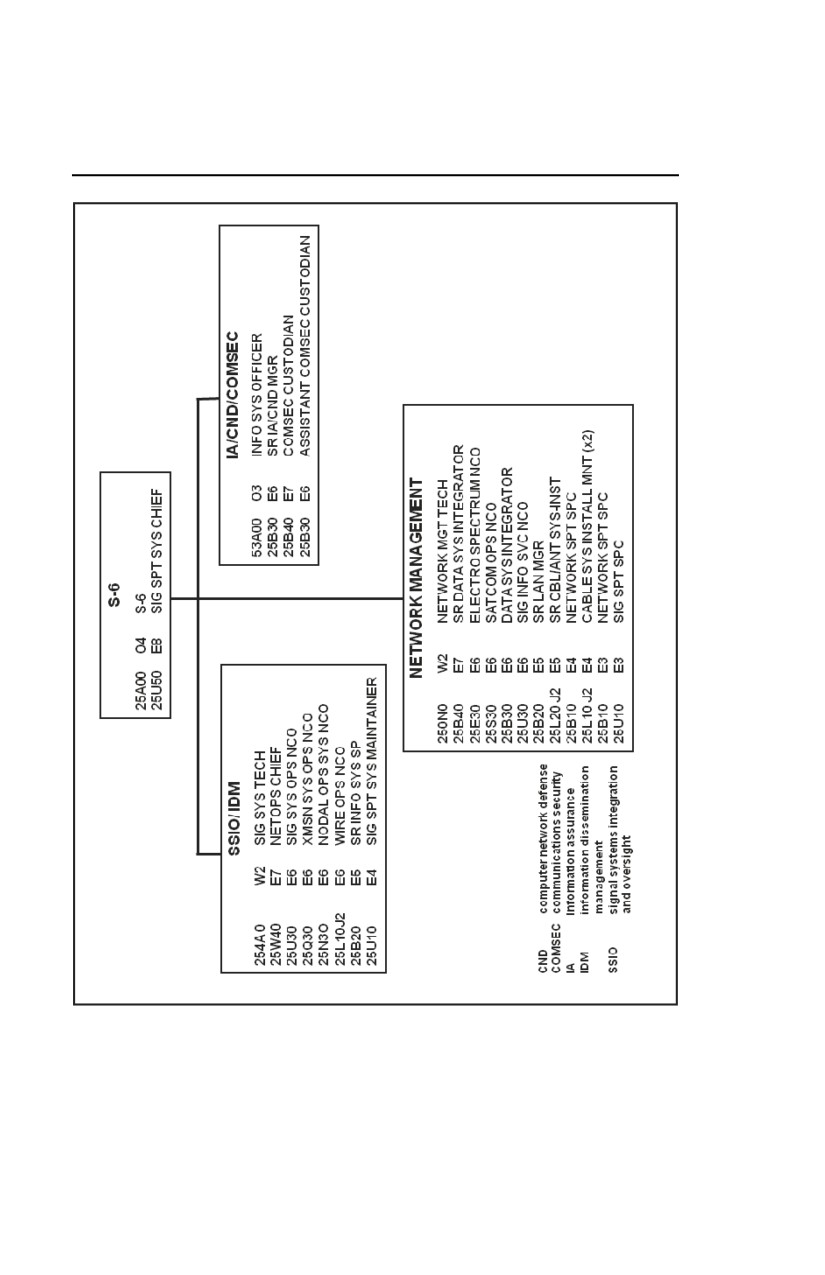
1-13. Figure
1-1 depicts the BCT S-6 staff organization. This
organization reflects the consolidation of the NETOPS section from the
signal company to the S-6 to provide a more efficient organization and
facilitate the S-6’s ability to perform the critical functions required.
The S-6 staff organization differs in the support brigades only in that
there are two less 25L10J2.
1-14. The S-6 section personnel are located within the brigade CPs to
support the commander’s communications requirements across the AO.
The brigade S-6 officer works closely with the division G-6 officer and
brigade signal company commander.
17 March 2009
FM 6-02.43
1-7
Chapter 1
Figure 1-1. BCT S-6 staff organization
1-8
FM 6-02.43
17 March 2009
Signal Soldier’s Roles and Responsibilities
ROLES AND RESPONSIBILITIES
1-15. The brigade S-6 officer has the following responsibilities that
reside in the network management and IA/CND/COMSEC cells—
z
Prepares, maintains, and updates communications and information
operations estimates, plans, and orders. Orders will often direct
configuration management changes across multiple battalions.
z
Monitors and makes recommendations on all technical
communication and information operations.
z
Can be designated as the Army forces
(ARFOR) G-6 when
needed. (Equipment and personnel augmentation will be required
to support this mission.)
z
Advises the commander, staff, and subordinate commanders on
communication operations and network priorities for C2
(for
example, changing bandwidth allocation to support the brigade
main effort such as a battalion reinforced with additional
intelligence, surveillance, and reconnaissance assets).
z
Develops, produces, changes/updates, and distributes signal-
operating instructions.
z
Prepares/publishes communications operations SOP for brigade
CPs.
z
Coordinates, plans, and manages brigade EMSO within the
brigade’s AO.
z
Plans and coordinates with higher and lower headquarters
regarding information systems upgrades, replacements,
eliminations, and integrations.
z
In coordination with the operational chain of command and corps,
plans and directs all NETOPS activities within the brigade AO.
z
Plans, manages, and monitors all brigade CP networks using S-6
section personnel.
z
Staffs and supervises the activities of the NETOPS cell in the
network operations security center (NOSC).
17 March 2009
FM 6-02.43
1-9
Chapter 1
z
Oversees COMSEC operations to include storage, management,
distribution, inspection, and compliance.
z
Responsible for the field level maintenance on CE systems.
1-16. The information systems officer is responsible to the S-6 for the
following—
z
In coordination with the S-2 and S-3, coordinates, plans, and
directs all IA activities and information operations vulnerability
and risk assessments.
z
In coordination with the brigade S-6 staff, actively coordinates
with a variety of external agencies to develop the information and
communications plans, manages the information network, obtains
required services, and supports mission requirements.
z
Confirms and validates user information requirements in direct
response to the tactical mission.
z
Establishes information policies and procedures for using and
managing information tools and resources.
z
Provides signal unit operations sections with direction and
guidance during preparation of network plans and diagrams
establishing the information network.
z
Ensures the accreditation and integration of all hardware and
software in the AO connected to the LAN/wide area network
(WAN).
z
Plans and integrates information systems and ABCS equipment
due to unit task organization/reorganization.
TRAINING READINESS RESPONSIBILITIES
1-17. The brigade S-6 officer has the following training readiness
responsibilities
and exercises them through the signal systems
integration and oversight (SSIO) cell—
z
In coordination with the division G-6, ensures the development of
required skills of all signal personnel within the brigade AO.
z
In coordination with the S-1, identifies requirements and manages
the distribution of signal personnel within the brigade.
1-10
FM 6-02.43
17 March 2009
Signal Soldier’s Roles and Responsibilities
z
In coordination with the S-3, monitors and provides oversight for
information dissemination to change warfighting functions
priorities and control measures within the brigade AO.
z
In coordination with the S-6 staff, ensures information systems and
administration procedures for all automation hardware and
software employed by the brigade are joint and Army compliant.
z
In coordination with the brigade special troops battalion (BSTB)
staff, ensures the brigade signal company is trained to support
brigade missions and tasks.
1-18. When a BCT operates independently, the brigade S-6 officer
performs all the duties and has the same responsibilities as a G-6
officer. These duties and responsibilities include—
z
Coordinates, plans, and manages the brigade EMSO, both internal
and external to the brigade.
z
Plans and manages the brigade information network with the corps
Service Theater Network Operations and Security Center
(STNOSC), the corps supporting brigade, the regional Defense
Information System Agency
(DISA) support team, or the
supported command, control, communications, and computer
operations directorate of a joint staff (J-6).
z
In coordination with strategic corps STNOSC and the corps-
supporting brigade, plans and manages the brigade IA systems
(firewalls, intrusion detection systems, and access control lists).
z
Plans and manages the brigade information dissemination
management/content staging procedures (user profiles, file and
user priorities, and dissemination policies).
z
Plans and manages all IA/CND operations to include, but not
limited to, key management distribution, IA vulnerability alert
compliance, intrusion detection device management and
operations, and compliance with all directives.
17 March 2009
FM 6-02.43
1-11
Chapter 1
z
Deploys range extension assets to maintain connectivity and
reliability of the brigade information network.
z
Evaluates network requirements to determine needs for unmanned
aircraft system
(brigade level) and communications relay
requirements.
BRIGADE SIGNAL COMPANY ORGANIZATION
1-19. This section addresses brigade signal companies that are organic
to the BCT; the brigade signal company that is organic to the maneuver
enhancement brigade (MEB) and sustainment brigades; and the brigade
signal company that is organic to the fires, combat aviation brigade,
and the battlefield surveillance brigade. The three different brigade
signal companies are designed with equipment and personnel to
specifically support their designated brigade organizations.
1-20. The signal company within the heavy and infantry BCT is
subordinate to the BSTB with the Stryker brigade combat team (SBCT)
signal company being a separate company. The signal company
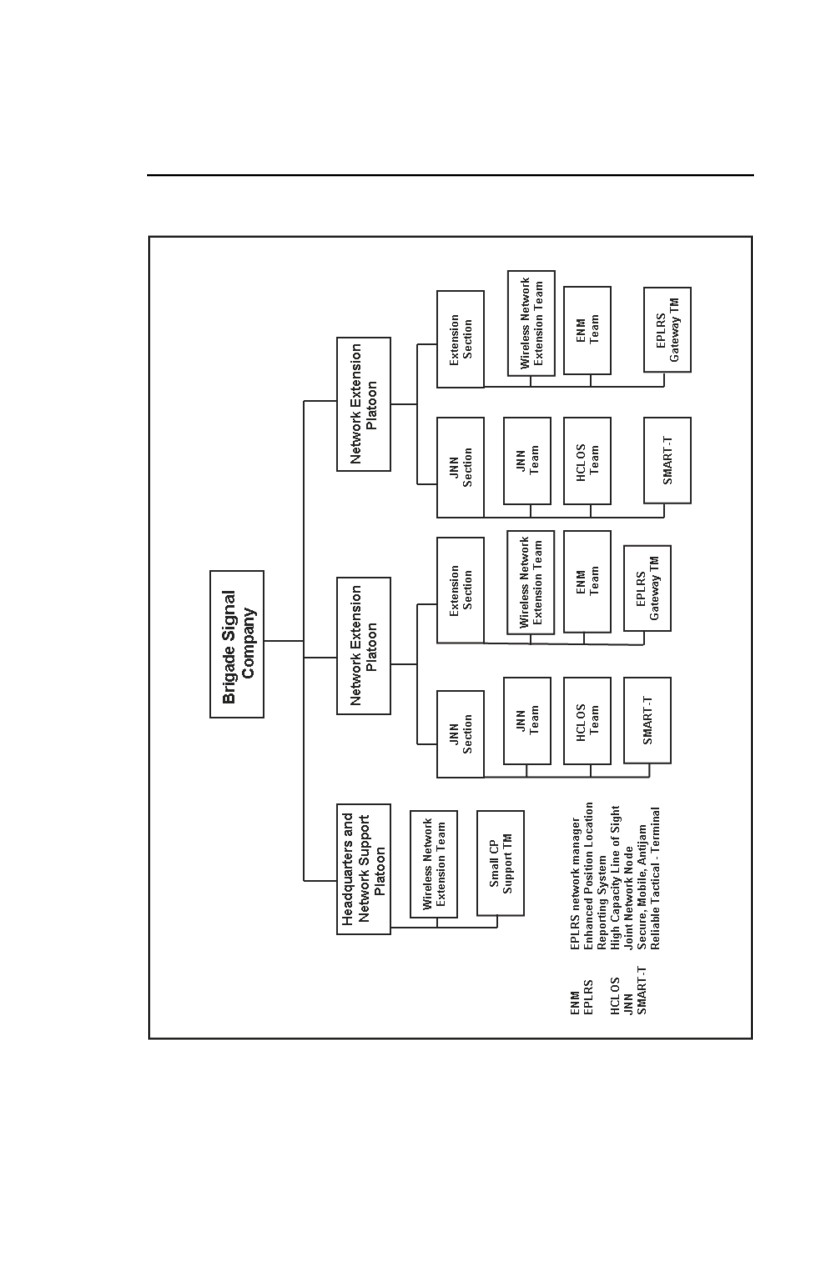
organic to the BCT has a headquarters and two network support
platoons. Figure 1-2 depicts the BCT signal company.
HEADQUARTERS AND NETWORK SUPPORT PLATOON
1-21. The headquarters and network support platoon within the BCT
consists of the company headquarters, small CP support team(s), and
wireless network extension team(s).
Company Headquarters
1-22. The company headquarters provides C2, logistics, and
administrative support for the company and coordinates the
maintenance support of CE systems with the brigade S-6.
Wireless Network Extension Team(s)
1-23. The wireless network extension team(s) within the brigade
signal companies provides BLOS connectivity for the various CPs and
C2 nodes.
1-12
FM 6-02.43
17 March 2009
Signal Soldier’s Roles and Responsibilities
Figure 1-2. BCT signal company organizational structure
17 March 2009
FM 6-02.43
1-13
Chapter 1
Small Command Post Support Team(s)
1-24. The small CP support team within the brigade signal company
provides BLOS connectivity and tactical LAN support to the tactical
CP and other C2 nodes.
NETWORK EXTENSION PLATOON
1-25. The network extension platoon consists of the joint network
node (JNN) and extension sections and supports a major C2 node.
There are two network extension platoons within the brigade signal
company supporting the BCT: one network extension platoon supports
the brigade main, and the other network extension platoon supports the
brigade tactical CP (TAC CP).
Joint Network Node Section
1-26. The JNN section provides voice, video, and data services to the
main and TAC CP. It provides habitual BLOS and line of sight (LOS)
support to the main CP and TAC CP. The JNN can terminate circuits,
provide data and battlefield video teleconferencing center connectivity
to host equipment, and interface special circuits such as Defense
Switched Network, North Atlantic Treaty Organization circuits, and
commercial gateways.
Wireless Network Extension, Enhanced Position Location
Reporting System Network Manager and Enhanced Position
Location Reporting System Teams
1-27. The wireless network extension, Enhanced Position Location
Reporting System
(EPLRS) Network Manager and EPLRS teams
provides frequency modulated
(FM) wireless network extension,
EPLRS network management, and an EPLRS gateway team for the
assigned CP.
1-14
FM 6-02.43
17 March 2009
Signal Soldier’s Roles and Responsibilities
MODULAR SUPPORT BRIGADE SIGNAL COMPANIES
1-28. The sustainment brigade signal company is subordinate to the
BSTB and the fires, combat aviation brigade, battlefield surveillance
brigade, and MEB signal companies are separate companies within
their respective brigades. The signal companies differ in structure only
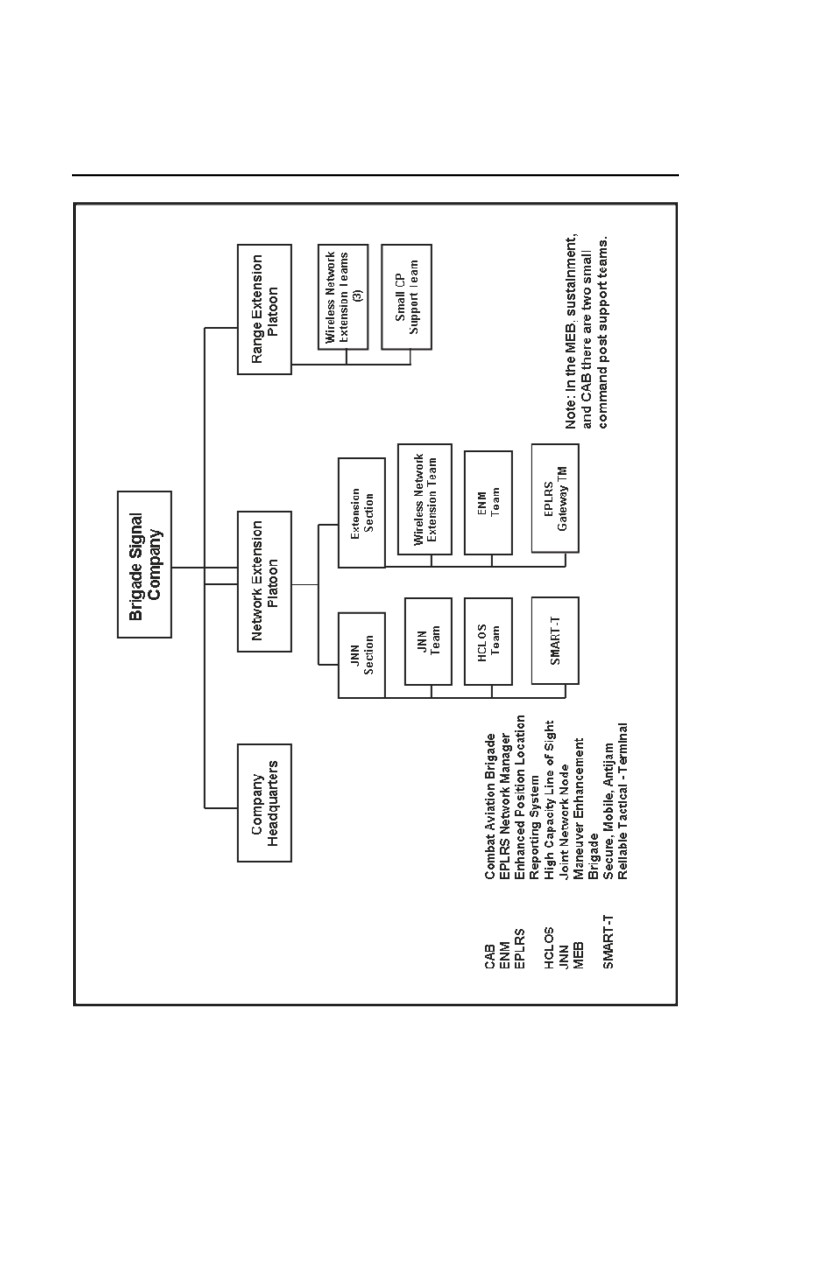
in that the signal company supporting the MEB, sustainment, and
combat aviation brigade contains two small CP support teams vice one
in the battlefield surveillance brigade and fires brigade signal
companies. Figure 1-3 depicts the modular support brigades signal
companies.
COMPANY HEADQUARTERS
1-29. The company headquarters provides C2, logistics, and
administrative support for the company.
NETWORK EXTENSION PLATOON
1-30. The network extension platoon provides support to the brigade
main CP.
Joint Network Node Section
1-31. The JNN team provides switching, satellite, and data package
capabilities. The high-capacity line of sight (HCLOS) team provides
LOS connectivity between brigade CPs and higher, adjacent, and
subordinate units. The secure mobile anti-jam reliable tactical terminal
(SMART-T) is a tactical SATCOM terminal that provides BLOS
connectivity between the brigade and higher or adjacent headquarters.
17 March 2009
FM 6-02.43
1-15
Chapter 1
Figure 1-3. Modular support brigades signal company
organizational structure
1-16
FM 6-02.43
17 March 2009
Signal Soldier’s Roles and Responsibilities
Extension Section
1-32. The extension section provides a wireless network extension
team for range extension of the brigade Single Channel Ground and
Airborne Radio System (SINCGARS) network and EPLRS teams to
provide net control station and gateway capability for data
reconstitution of EPLRS, near term digital radio, and SINCGARS data
traffic.
RANGE EXTENSION PLATOON
1-33. The range extension platoon provides C2 for three SINCGARS
wireless network extension teams for coverage of the brigade AO and
small CP support teams that provide support for subordinate brigade
CPs.
SIGNAL COMPANY COMMANDERS
1-34. The signal company commanders within the corps, division, and
brigade share much the same organization and work closely with their
respective G-6/S-6.
1-35. The signal company commander is responsible for the
installation, operation, and maintenance of the information network.
While the G-6/S-6 has authority over the network and recommends the
emplacement and displacement of signal assets, the execution orders
are developed and issued through the normal command channels,
usually a fragmentary order (FRAGO) from the assistant chief of staff,
operations (G-3)/S-3 directing movement. The authority over the signal
company’s assets is employed using TSOs, using the NETOPS
functions and the applicable NOSC.
1-36. The signal company commander maintains command authority
and is responsible for the health and welfare, training readiness and
electronic and vehicle maintenance of all signal company personnel
and equipment. The signal company commander directs the company’s
organic detachments and any attached or operational control (OPCON)
elements.
17 March 2009
FM 6-02.43
1-17
Chapter 1
1-37. The signal company commander in a modular support brigade
has a unique challenge in that these support brigades are designed to
support BCTs and may carry out specific tasks to support echelons
above BCT. The support brigades are flexible organizations with
additional capabilities added based on factors of mission, enemy,
terrain and weather, troops and support available, time available and
civil considerations
(METT-TC). Thus, the signal company
commander must support the brigade day-to-day mission as well as the
mission of the organization the support brigade is attached to for
specific operations.
S-6 and the Combat Service Support Automation
Management Officer
1-38. The S-6 section assists the CSS automation management officer
in troubleshooting mission application software problems. As system
administrators and system/software security managers for sustainment
hardware platforms, the CSS automation management officer will
perform all tasks normally associated with information technology (IT)
operations, ranging from issuing passwords to installing anti-virus
software. They will assist and advise on turn-in procedures for line
replaceable unit (LRU) items. The S-6 is responsible for maintaining,
administering, and troubleshooting the network for the CSS automation
management officer.
DIVISION COMMAND AND CONTROL
1-39. The division is the Army’s primary tactical and operational
warfighting headquarters. It is designed as a modular, C2 headquarters
for full spectrum operations. When deployed, the division headquarters
is organized around three C2 elements: the main CP, TAC CP, and a
mobile command group (MCG).
1-18
FM 6-02.43
17 March 2009
Signal Soldier’s Roles and Responsibilities
DIVISION COMMAND POSTS
1-40. The design of the division gives the commander various options
for the employment of the headquarters. The MCG is equipped to
permit the division commander to reach any point in the division AO
by ground or air and remain linked to the rest of the headquarters and
to the common operational picture. The main CP can locate anywhere
in the AO, remain linked to the operation, develop plans, conduct
analysis, and provide detailed estimates. The TAC CP provides
flexibility for training, readiness, and operations.
Main Command Post
1-41. The organic division signal company supports the main CP, but
it requires longer set up and tear down time than the other CPs. Since
there is a lengthier time required for setup and connectivity, the main
CP normally deploys and sets up in a semi-stationary base within
theater.
Tactical Command Post
1-42. The TAC CP is supported by the organic division signal
company and has similar equipment. The TAC CP can rapidly tear
down and setup, but is not equipped for battle command on the move.
The TAC CP must halt to use full communications and network
capabilities.
Mobile Command Group
1-43. The MCG has organic ground C2 vehicles, a small security
force, and communications. The MCG staff is not fixed. The
commander selects members of the division staff to fill the MCG seats.
Given that the number of seats is limited by the ground and air systems,
only two or three members of the division staff go with the MCG.
17 March 2009
FM 6-02.43
1-19
Chapter 1
DEPLOYMENT OF DIVISION COMMAND POSTS
1-44. The combination of CPs allows the division commander to
rotate readiness and training responsibilities while the division is in
garrison. The TAC CP maintains a higher readiness posture and may
configure equipment and personnel into an early entry CP package to
fit constrained lift with the other equipment and personnel prepared to
follow. The early entry CP may require augmentation from the main
CP.
1-45. The MCG deploys following the introduction of subordinate
forces into the joint operations area (JOA), and after the TAC CP is
operational there. The commander may elect to deploy the MCG with
the earliest deploying elements of the division or wait until the number
of units has reached the level where the commander’s presence is more
important in the JOA than at the home station.
1-46. The main CP, less any individuals and equipment needed to
augment the TAC CP to form the early entry CP, remains at home
station during the initial phase of the deployment process. Once the
early entry CP is established within the JOA of the gaining joint forces
command, the commander deploys the main CP into the JOA.
Normally the main CP deploys in at least two echelons.
G-6 RESPONSIBILITIES AT THE DIVISION
COMMAND POSTS
1-47. The division G-6 has separate elements to support the main CP
and TAC CP, though augmentation of the TAC CP is sometimes
required due to METT-TC. The functions of the G-6 elements differ
based on the responsibilities they are assigned.
1-20
FM 6-02.43
17 March 2009
Signal Soldier’s Roles and Responsibilities
DIVISION G-6 OFFICER ROLES AND
RESPONSIBILITIES
1-48. The division G-6 officer is the senior signal officer who
exercises staff oversight of the division information network. The G-6
officer possesses the expertise to anticipate the need for dynamically
changing the network to support the division commanders’ scheme of
maneuver.
1-49. The G-6 officer derives his authority to control the network
from the division commander; this authority empowers him to use all
signal equipment and personnel to complete his mission. A successful
mission implies that all signal-training requirements are met prior to
employment. He controls these network assets via the NOSC and uses
the TSO, much like the division G-3, uses the FRAGO to control the
maneuver forces under the division. The G-6 officer’s network
responsibilities encompass all the management and control of the
network. The NOSC enables the G-6 to monitor the health of the
network in support of the command.
1-50. The G-6 officer is the principal staff officer for all matters
concerning communications, EMSO, and networks. The G-6 officer
has the technical oversight responsibility over the division information
networks including training readiness responsibility of the division
signal company. The G-6 officer is accountable for all network
transport, network services, and the viability of information systems
across the force.
1-51. By executing the commander’s intent, the G-6 officer directs all
technical changes to the network. To make physical moves to signal
equipment, the G-6 officer recommends FRAGOs to direct such
movement with the G-3. He is responsible for advising the division
commander, staff, and subordinate commanders on communications
and information operational matters (staff responsibilities, technical
guidance, and training readiness responsibilities).
17 March 2009
FM 6-02.43
1-21
Chapter 1
1-52. The division G-6 officer has the following responsibilities—
z
Prepares, maintains, and updates communications and information
operations estimates, plans, and orders. These orders will often
direct configuration management changes across multiple
brigades.
z
Monitors and makes recommendations on all technical
communications and information operations.
z
Acts as the ARFOR G-6 when needed (equipment and personnel
augmentation may be required to support this mission).
z
Advises the commander, staff, and subordinate commanders on
communications operations and network priorities for C2
(for
example, changing bandwidth allocation to support the division
main effort—a brigade reinforced with additional intelligence,
surveillance, and reconnaissance assets).
z
Directs technical changes to all portions of the division network
via the TSO process.
z
Acts as the joint task force (JTF) J-6, if required. Equipment and
personnel augmentation will be required to support this mission
and will be provided by the theater-level units such as the theater
G-6, a signal command (theater) (SC[T]), or a signal brigade/Army
service component command (ASCC).
z
Prepares and/or publishes communications operations SOPs for
division CPs.
z
Coordinates, plans, and manages division EMSO within the
division AO.
z
Plans and coordinates with higher and lower headquarters
regarding information systems upgrade, replacement, elimination,
and integration.
z
In coordination with the assistant chief of staff, intelligence (G-2)),
G-3, assistant chief of staff, information operations
(G-7),
operational chain of command, and STNOSC, coordinates, plans,
and directs all IA activities and information operations
vulnerability and risk assessments.
1-22
FM 6-02.43
17 March 2009
Signal Soldier’s Roles and Responsibilities
z
In coordination with the division G-6 staff—
Actively coordinates with a variety of external
agencies to develop the information and
communications plans, manages the information
network, obtains required services, and supports
mission requirements.
Develops, produces, changes, and/or updates and
distributes signal-operating instructions.
Confirms and validates user information
requirements in direct response to the tactical
mission.
z
Establishes information policies and procedures for using and
managing information tools and resources.
z
Provides units assigned or attached to the division with direction
and guidance during preparation of network plans and produces
diagrams establishing the information network.
z
Plans and integrates information systems and ABCS equipment
due to unit task organization/reorganization.
z
In coordination with the corps and JTF, plans and directs all
NETOPS activities within the division AO.
z
Coordinates the contractor support for CE systems within the
division AO.
TRAINING READINESS RESPONSIBILITIES
1-53. The division G-6 officer has the following training readiness
responsibilities—
z
Ensures the development of required skills of all signal personnel
within the division AO.
z
In coordination with the assistant chief of staff, personnel (G-1),
identifies requirements and manages the distribution of signal
personnel within the division.
17 March 2009
FM 6-02.43
1-23
Chapter 1
z
In coordination with the G-3, monitors and provides oversight for
information dissemination to adjust to changing warfighting
function priorities and control measures within the division AO.
z
In coordination with the division G-6 staff, ensures automation
systems and administration procedures for all automation hardware
and software used by the division comply with the Global
Information Grid
(GIG) procedures and standards or Army
specifications.
z
Ensures, in coordination with the special troops battalion (STB)
commander, the division signal company is trained to support
division missions and tasks during home station training events
and deployments.
DIVISION G-6 ORGANIZATION
1-54. The division G-6 is organized and resourced to provide
NETOPS support to the division CPs (tactical, main, and MCG). The
G-6 uses NETOPS functions to synchronize disparate division unit
networks into one division information network, as a part of the
LandWarNet (LWN) and GIG. The NETOPS functions performed in
the subordinate support brigades and BCTs provide a second echelon
of NETOPS management that the division G-6 coordinates as part of a
greater NETOPS plan. The division G-6 has separate elements to
support the main CP and TAC CP, though augmentation of the TAC
CP is sometimes required due to METT-TC. The functions of the G-6
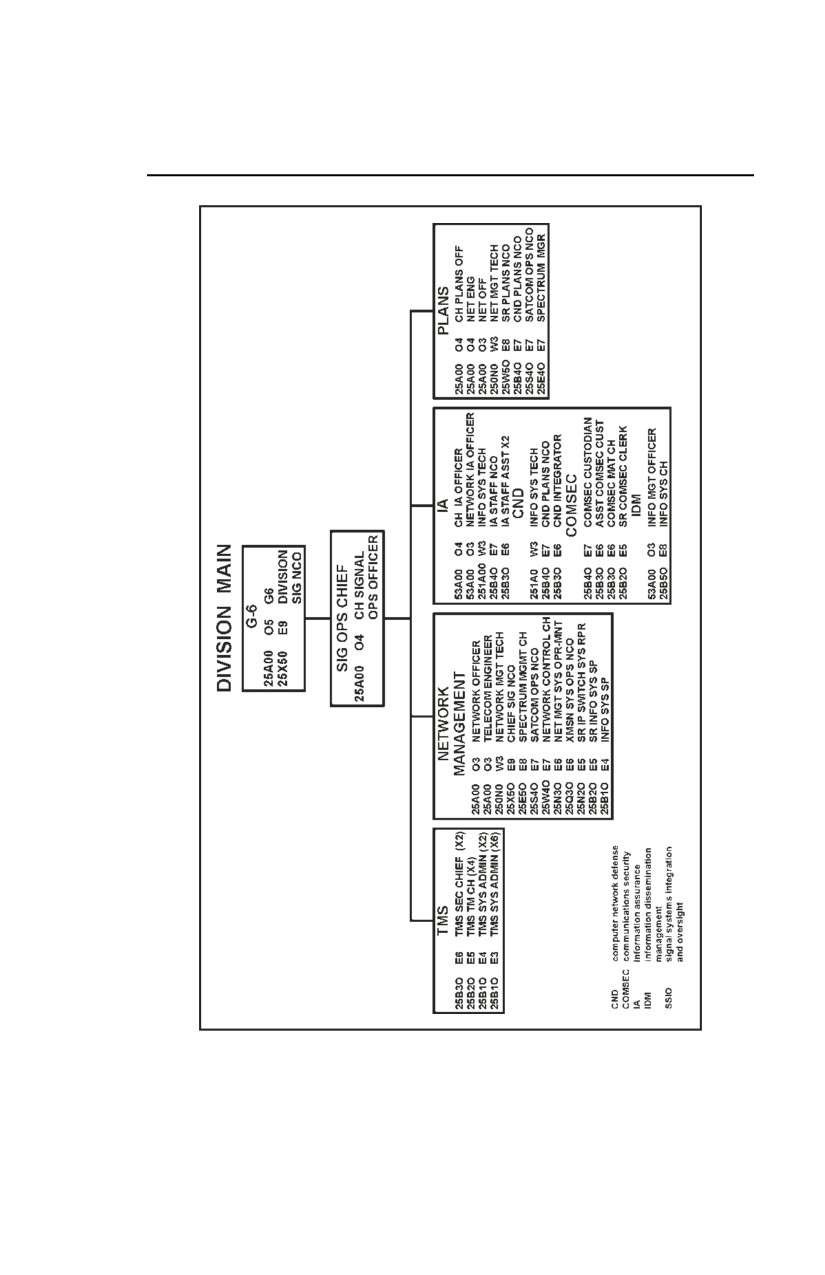
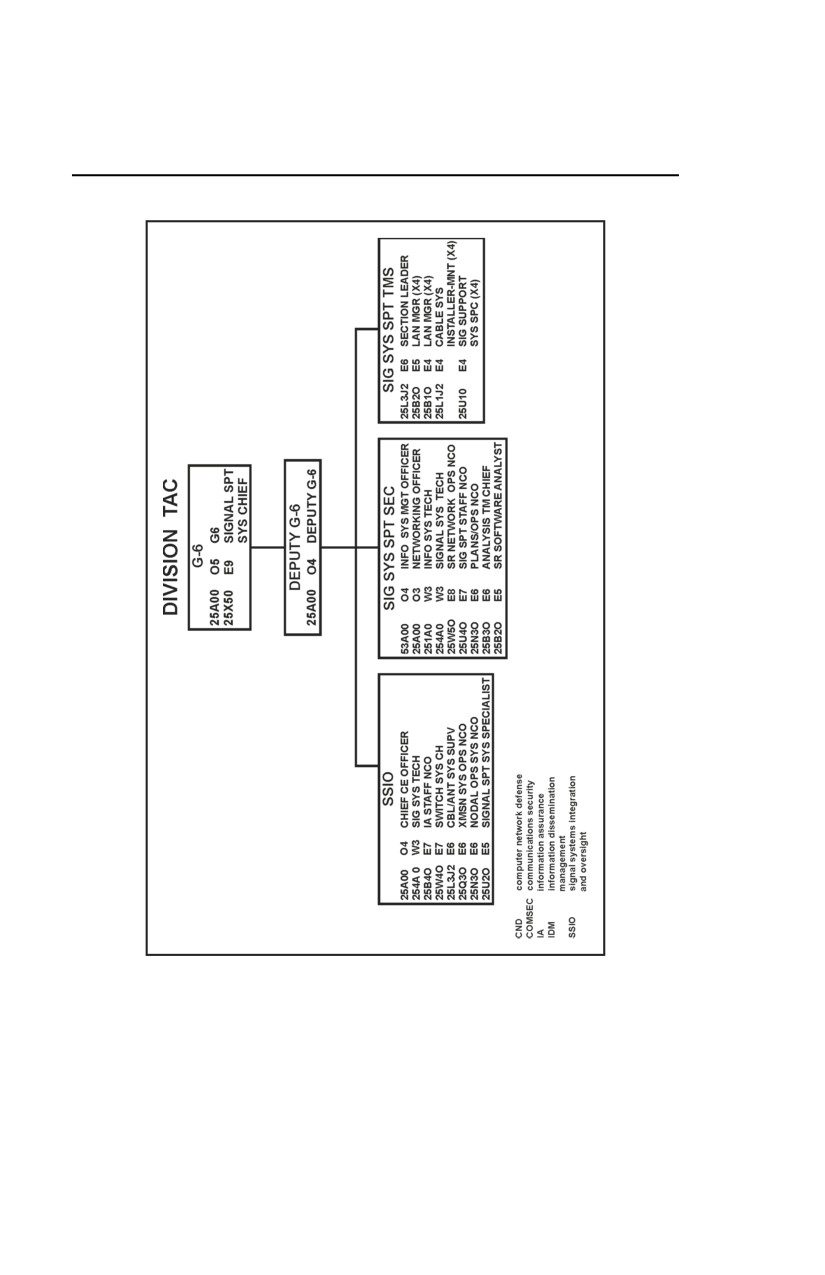
elements differ based on the responsibilities they are assigned. Figures
1-4 and 1-5 show the division G-6 section organization.
1-24
FM 6-02.43
17 March 2009
Signal Soldier’s Roles and Responsibilities
Figure 1-4. Division G-6 section organization
17 March 2009
FM 6-02.43
1-25
Chapter 1
Figure 1-5. Division G-6 section organizations
1-26
FM 6-02.43
17 March 2009
Signal Soldier’s Roles and Responsibilities
G-6 Signal Operations
1-55. The signal operations section consists of a network
management, plans, IA, and information dissemination management
elements. The signal operations section has the following
responsibilities—
z
Integrates network management, information dissemination
management, and IA functions.
z
Maintains network connectivity across the division, to include
units deployed to the AO, units en route to the AO, and units at the
home station.
z
Manages the division network from the applications residing on
individual platforms through the points at which the division
network connects to the GIG.
z
Executes deliberate modifications to the division network to meet
the needs of the commander.
z
Manages requirements; accepts, validates, and tracks headquarters
and subordinate unit communications requirements (computers,
cell phones, radios, etc.).
z
Monitors network performance.
z
Manages the quality of service of the services provided through
the division network, including the interoperability of the division
network with external networks that are not controlled by the G-6
(for example, Global Broadcast System [GBS], Trojan Special
Purpose Integrated Remote Intelligence Terminal [SPIRIT], and
CSS very small aperture terminal [VSAT]).
z
Coordinates satellite access requests and deconflicts frequencies.
z
Resolves, reports, and coordinates with other agencies to resolve
radio frequency conflicts.
z
Secures access into the division network and monitors access and
activities internal to the network.
z
Provides situational awareness
(SA) to the theater network
operations security center
(TNOSC) and SA/network common
operating picture to authorized division recipients.
17 March 2009
FM 6-02.43
1-27
Chapter 1
z
Ensures compliance with GIG network defense policies and JTF-
global NETOPS/TNOSC GIG network defense communications
tasking orders and or telecommunications service orders (TSOs).
z
Prepares, maintains and updates command information
management estimates, plans, and orders.
z
In coordination with the G-3, establishes procedures for using
relevant information and information systems to develop the
common operational picture.
z
Coordinates, plans, and directs the development of the common
operational picture within the main CP.
z
Coordinates with staff sections to ensure information quality
criteria
(accuracy, timeliness, usability, completeness, precision,
and reliability) are maintained.
z
Coordinates local information network capabilities and services.
z
Monitors and reports status of information network; coordinates
future network connectivity.
z
Coordinates future communications and information operations
interface with joint and multinational forces to include host nation.
z
Provides EMSO.
z
Develops and publishes Annex K to the division operation order
(OPORD).
z
Plans the transition of responsibility for the tactical network from
the division to permanent theater signal assets (integrated theater
signal battalion or commercial/contract).
G-6 Signal System Integration Oversight Section
1-56. The signal system integration oversight section performs the
following functions—
z
Oversees network certification for division units.
z
Coordinates and tracks communications systems modernization.
z
Coordinates and tracks communications systems maintenance.
z
Oversees contractor support.
z
Coordinates and tracks communications maintenance.
1-28
FM 6-02.43
17 March 2009
Signal Soldier’s Roles and Responsibilities
z
Coordinates collective communications systems training.
z
Coordinates communications systems commercialization.
z
Coordinates division communications readiness exercises.
z
Training readiness responsibility for division headquarters and
assigned unit JNN teams.
z
Oversees the installation of division CP wire and cable, to include
cable system installation in fixed facilities,
z
Coordinates field level maintenance support for commercial off-
the-shelf (COTS) and government off-the-shelf systems.
G-6 Signal System Support Section
1-57. The G-6 signal system support section supports the TAC CP to
temporarily assume C2 of current operations, future operations, plans
and analysis, or C2 of specific tasks while the main CP is either
emplacing or displacing. When not deployed, the TAC falls in on and
reinforces the capabilities of the main CP. The employment of the
signal system support teams is METT-TC dependent. These teams
support the main and TAC CPs as needed. The G-6 signal system
support section performs the following functions for the tactical CP—
z
Manages the local equipment and facilities that collect, process,
store, display, and disseminate information, including computers
(hardware and software) and communications as well as policies
and procedures for their use.
z
Monitors, manages, and controls organic communications systems
that interface with the GIG.
z
Performs tactical NETOPS functions
(network management,
information dissemination management, IA).
z
Manages a set of integrated applications, processes, and services
that provide the capability for producers and users to locate,
retrieve, and send/receive information.
z
Install, operate, maintain, and defend server data (SIPRNET) and
military Internet
(NIPRNET) in support of the division CP
operations.
17 March 2009
FM 6-02.43
1-29
Chapter 1
z
Manage installation and operation of the LAN, to include
cable/wire installation and troubleshooting.
z
Install CP cable and wire; coordinates and supervises team
members in the construction, installation, and recovery of cable
and wire communications systems and auxiliary equipment within
division CPs.
z
Forms a portion of the division Information Service Support
Office.
z
Installs and operates the division’s IT help desk; provides e-mail
assistance and other help desk functions.
z
Assist division units with network installation and troubleshooting
as directed by the G-6.
DIVISION NETWORK OPERATIONS SECURITY CENTER
1-58. The division G-6 officer is responsible for the employment of a
fully integrated NOSC providing NETOPS functions for the division.
All division signal elements must coordinate with the division NOSC
during the engineering, installation, operation, maintenance, and
defense of the division information network.
1-59. The division NOSC has overall responsibility for establishing
the division information network and providing the operational and
technical support to all units assigned or attached to the division
operating in the AO.
1-60. The division NOSC performs the NETOPS activities, functions,
and tasks required to create a dynamic and responsive network. This
network also quickly shifts priorities in order to support the ground
tactical plan. This management function extends the strategic GIG
capabilities into responsive, dynamic, and tactical formations.
1-61. In order to increase responsiveness of a complex network and to
facilitate the bandwidth required to support the division headquarters
and brigade networks, the division employs a NETOPS cell with the
regional network service center. The regional network service center
flattens disparate time division multiple access
(TDMA) satellite
1-30
FM 6-02.43
17 March 2009
///////////////////////////////////////