FM 6-02.43 SIGNAL SOLDIER’S GUIDE (March 2009) - page 6
Signal Military Occupational Specialties
Systems Support Technician. DA PAM
600-3 contains a
comprehensive professional development guide for signal warrant
officers.
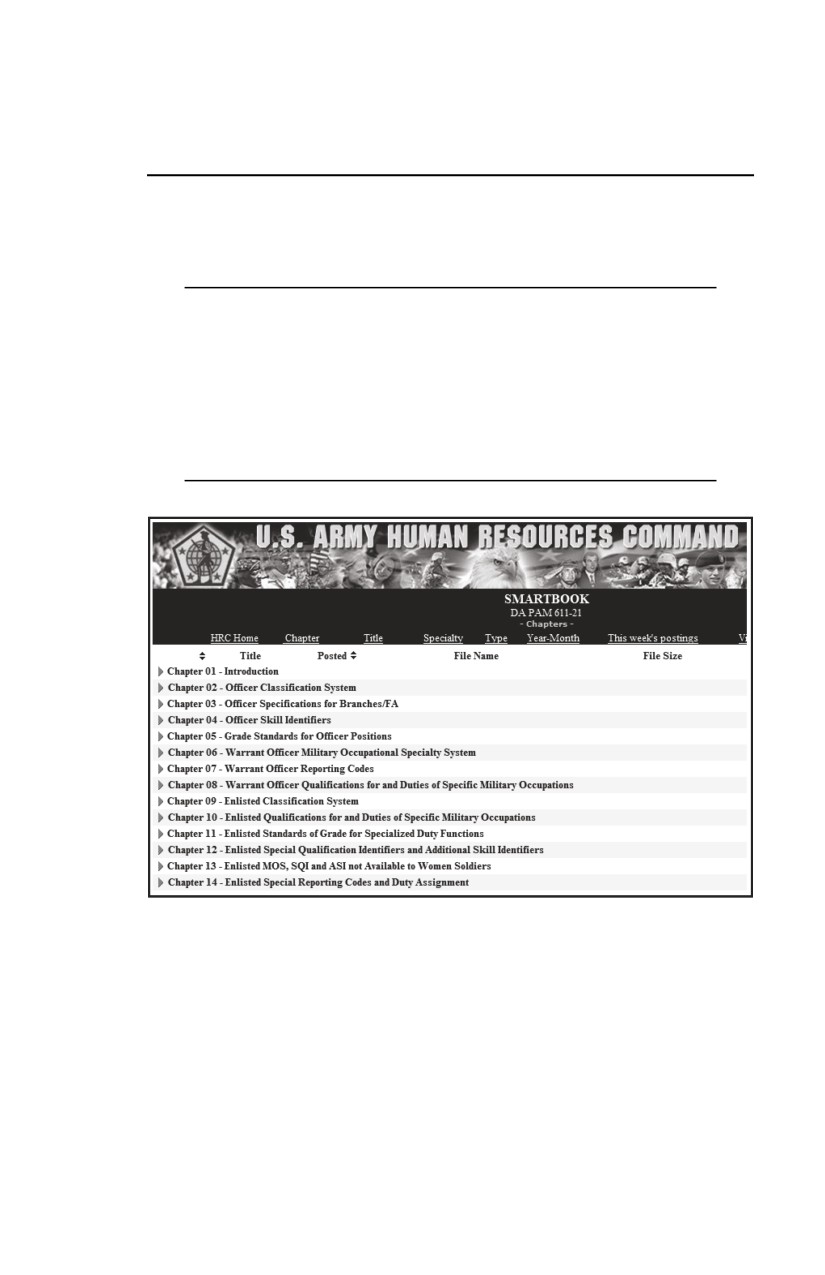
Note. DA PAM 611-21 contains a comprehensive guide to all
MOSs, to include areas of concentration, duty descriptions (by
grade), and standards of grade tables. DA PAM 611-21 can be
accessed through the US Army Human Resources Command
which is updated with current changes (refer to Figure C-1 for
an example of the Web site page).
Figure C-1. DA PAM 611-21 Web site page
17 March 2009
FM 6-02.43
C-3
This page intentionally left blank.
Appendix D
Signal Annex of an OPORD
The signal leader is responsible for paragraph 5
and the signal annex of an OPORD. This
appendix has outlines of paragraph
5 and a
signal annex of an OPORD.
PARAGRAPH FIVE OF AN OPERATION
ORDER
D-1. Figure D-1 outlines two examples of paragraph 5 of an OPORD
(command and signal).
17 March 2009
FM 6-02.43
D-1
Appendix D
Outline One
5. COMMAND AND SIGNAL.
a. Command. State the map coordinates for command post locations and at least one
future location for each command post. Identify the chain of command if not addressed in
unit SOPs.
b. Signal. List signal instructions not specified in unit SOPs. Identify the specific signal
operating instructions edition in effect, required reports and formats, and times the reports
are submitted.
Outline Two
5. COMMAND AND SIGNAL.
a. Command.
• State the location of key functional area leaders.
• Designate a functional area chain of command and succession of command.
• Designate a headquarters to control the effort within functional area work lines
on an area basis.
• List command posts and other C2 facilities and their locations.
b. Signal.
• State edition number of SOI in effect. Do not write “current SOI in effect.”
• Describe the nets to monitor for reports.
• Designate critical functional area reporting requirements.
Figure D-1. OPORD paragraph 5, command and signal
outline
SIGNAL ANNEX FOR AN OPERATION
ORDER
D-2. Figure D-2 is an outline of a signal annex of an OPORD.
D-2
FM 6-02.43
17 March 2009
Signal Annex of an OPORD
[Classification]
Include heading if annex distributed separately from base OPLAN/OPORD.
ANNEX H (COMMAND, CONTROL, COMMUNICATION, and COMPUTER OPERATIONS)
TO OPERATION ORDER NO ## [code name]—[issuing headquarters]
1. SITUATION.
a. Enemy forces. Refer to annex B, appendix 1-Intelligence estimate. Also provide enemy
capability and activity by describing enemy capabilities that may affect communications systems.
b. Friendly forces.
• Primary communications gateways providing connectivity to higher, lower, and adjacent units.
• Critical communications security measures required to counter expected enemy EW capabilities
and protect C2 systems.
• External communications assets that augment signal support unit capabilities.
c. Environment. In separate subparagraphs list all critical terrain, weather, and civil considerations
that would impact C4 operations. Refer to appropriate annexes as required.
d. Attachments and detachments.
2. MISSION. State the computers and information systems operations mission in support of this
operation.
3. EXECUTION.
a. Scheme of signal support operations.
(1) Describe the concept of signal operations, including primary and back-up systems supporting
critical C2 networks.
(2) Outline the plan for extending C2 systems by each phase of the operation.
(3) List critical links between tactical and strategic communications systems.
(4) Identify critical limitations of organic signal support assets. Define limitations of assets from
higher headquarters.
(5) State signal support tasks that all non-signal units must perform to accomplish missions and
tasks beyond normal requirements.
(6) State signal support priorities.
b. Tasks to subordinate units.
• Signal support tasks that maneuver elements must accomplish that the base OPLAN/OPORD
does not contain.
• Signal support tasks that signal units supporting maneuver elements are to accomplish only as
necessary to ensure unity of effort.
c. Coordinating instructions.
• Critical signal support instructions not already covered in the base OPLAN/OPORD.
• Key times or events critical to information systems and network control procedures.
• Army Battle Command System control procedures.
4. SERVICE SUPPORT.
5. COMMAND AND SIGNAL.
a. Identify C2 systems control hierarchy for the common user network.
b. Identify local area network control procedures for network administration and management.
c. Use appendixes to diagram any changes to standard communications networks.
ACKNOWLEDGE: (if distributed separately from base order).
[Authenticator’s last name]
[Authenticator’s rank]
APPENDIXES:
DISTRIBUTION: (if distributed separately from base order).
Figure D-2. Outline of a signal annex
17 March 2009
FM 6-02.43
D-3
This page intentionally left blank.
Appendix E
Maintenance
The Army’s transformation to a modular
structure has posed unique challenges for CE
maintenance. The inactivation of corps signal
brigades and division signal battalions resulted
in the loss of dedicated CE maintenance
sections. The corps, division, and brigade signal
companies do not contain dedicated CE
maintenance entities. The implementation of two
level maintenance and the proliferation of COTS
signal equipment have changed the way
maintenance
is
performed
and
the
responsibilities of signal Soldier. This appendix
describes the required CE maintenance structure
that enables two level maintenance policies and
to ensure communications and network
maintenance.
TWO LEVEL MAINTENANCE
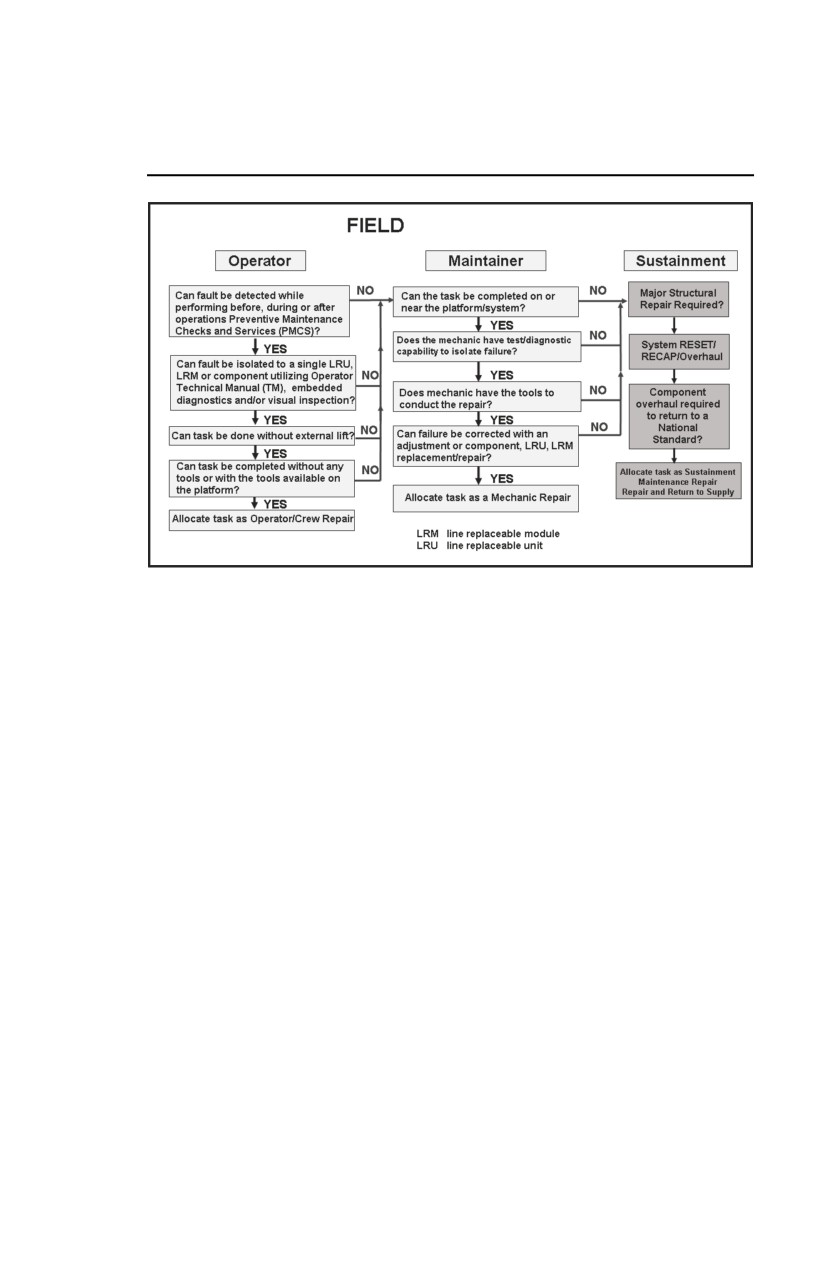
E-1. The Army has transitioned from a four level maintenance
structure to a two level maintenance structure: field and sustainment.
The elimination of organic maintenance sections within signal units as
a part of modularity has combined with the implementation of the two
level maintenance policy to produce a unique maintenance
environment that presents a significant challenge to signal Soldiers.
17 March 2009
FM 6-02.43
E-1
Appendix E
FIELD MAINTENANCE
E-2. Field maintenance generally combines the two levels formerly
known as organizational and direct support maintenance and focuses
on returning a failed system to an operational status. This is
accomplished by fault isolation and replacing the failed component
assembly or module on the system. These field maintenance
capabilities are also known as
“replace forward” or
“on system”
maintenance. The operator/maintainer 25 series signal Soldier performs
“on system” maintenance for communications and network systems
and devices. MOS
25U performs operator/maintainer level
maintenance for systems and devices that were identified as unit level
maintenance items under the old four level maintenance construct.
SUSTAINMENT MAINTENANCE
E-3. Sustainment maintenance focuses on repairing broken
components and end items “off system” and returning them to the
supply system. Military or civilian personnel perform this maintenance
at echelons above brigades. These two levels are also referred to as
“replace forward and repair rear”. Figure E-1 shows the two level
maintenance process flow. The operator/maintainers 25 series signal
Soldiers perform “on system” maintenance. MOS 94 series Soldiers
will perform
“off systems” maintenance for communications and
network equipment.
E-4. The uniqueness of the signal equipment and the imperative of
maintaining the network, where downtime is measured in minutes does
not always support the process flow. The separation between operator
and maintainer is blurred and results in the
25 series
operator/maintainer performing equipment replacing tasks to maintain
the viability of the network. In addition, the proliferation of COTS
equipment in newly fielded systems such as the WIN-T Increment 1
suite of equipment has resulted in much of the maintenance and
equipment replacement necessitating the employment of civilian field
service representatives (CFSRs) to maintain equipment and systems
availability.
E-2
FM 6-02.43
17 March 2009
Maintenance
Figure E-1. Two level maintenance process flow
NETWORK SYSTEMS MAINTENANCE
E-5. Army transformation presents challenges for signal leaders and
staff requiring greater coordination to ensure success of the network.
The challenge centers on the G-6, S-6, and division/brigade signal
company leadership. Overcoming the challenge requires working
through the organizational boundaries of the respective STB, and
brigades to sustain the LWN.
CE MAINTENANCE IN THE MANUEVER
BATTALION
E-6. The battalion S-6 is responsible for field level maintenance on
battalion CE systems. The S-6 works with the battalion S-4 and
supporting forward support company to provide a comprehensive
maintenance plan that is incorporated into the unit maintenance SOP.
This effort ensures that there are clearly understood procedures in place
17 March 2009
FM 6-02.43
E-3
Appendix E
to ensure a positive maintenance posture. The S-6 must also coordinate
with the S-4 and brigade S-6 for CFSR support as necessary.
E-7. The Army modular transformation and the implementation of
the two level maintenance policy moved a
25U, Signal Support
Systems Maintainer from the battalion S-6 to the forward support
company of the brigade support battalion (BSB). These positions have
been moved back to the battalion S-6 sections. The 25U—
z
Performs
organizational
level
maintenance on unit
communications and electronic systems, remote control systems,
intercoms, and information systems. Troubleshoots to a defective
LRU/line replaceable module (LRM) unit communications and
electronic systems, COMSEC devices, remote control systems,
intercoms, and information systems. Replaces and evacuates to the
forward support company for repair faulty LRUs/LRMs on
communications and electronic systems, and information systems.
z
Repairs and installs unit CE systems wiring and cabling.
z
Installs and removes all unit vehicular and base station
communications, electronics, and information systems. This
includes installation kits, antennas, and cables on all platforms.
z
Performs communications and electronic systems test using
appropriate test, measuring and diagnostic equipment (TMDE).
z
Maintains TMDE calibration records.
z
Manages and maintains battery inventory and charging systems.
z
Orders and maintains bench stock.
z
Applies all modification and directions such as technical bulletin
guidance.
E-8. Each maneuver battalion is supported by a forward support
company from the BSB to perform field level maintenance. The
forward support company has a maintenance platoon that repairs
automotive, armament, ground support, electronic, and missile
equipment. The forward support company focuses on LRUs using
combat spares from prescribed load list and shop stock. It has a service
and recovery section and performs battle damage assessment and
repair. The forward support company’s maintenance control section
E-4
FM 6-02.43
17 March 2009
Maintenance
uses unit level logistics system-ground to order repair parts. The
forward support company commander establishes unit maintenance
collection points in coordination with the maneuver battalion S-4.
E-9. The SBCT does not contain forward support companies. The
BSB will task organize to support the combined arms battalion that
make up the SBCT.
CE MAINTENANCE IN THE BRIGADE
E-10. The brigade S-6 is responsible for monitoring the status and
sustaining the brigade networks that comprise the LWN. The brigade
S-6, working closely with the brigade signal company commander,
BSTB staff, and the executive officer, ensures the critical network
maintenance and parts needed to remain operational.
E-11. The Army modular transformation and the implementation of
the two level maintenance policy moved the 25U, Signal Support
Systems Maintainer from the brigade S-6 section to the BSB. These
positions have been moved back to the brigade S-6 sections. The
25U—
z
Performs
organizational
level
maintenance on unit
communications and electronic systems, COMSEC devices,
remote control systems, intercoms, and information systems.
z
Troubleshoots to a defective LRU/LRM unit communications and
electronic systems, remote control systems, intercoms, and
information systems.
z
Replaces and evacuates to the forward support company for repair
faulty LRUs/LRMs on communications and electronic systems,
and information systems.
z
Repairs and installs unit CE systems wiring and cabling.
z
Installs and removes all unit vehicular and base station
communications, electronics, and information systems. This
includes installation kits, antennas, and cables on all platforms.
z
Performs communications and electronic systems test using
appropriate TMDE.
17 March 2009
FM 6-02.43
E-5
Appendix E
z
Maintains TMDE calibration records.
z
Manages and maintains battery inventory and charging systems.
z
Orders and maintains bench stock.
z
Applies all modification and directions such as technical bulletin
guidance.
E-12. Each brigade, with the exception of the SBCT, contains a BSB
that has forward support companies and a field maintenance company.
The BSB in the SBCT does not have forward support companies and is
task organized as needed to provide support for battalions within the
SBCT. In the other brigades, the forward support companies support
the maneuver battalions and the field maintenance company supports
the brigade headquarters and other non-maneuver units in the brigade
such as the BSTB.
E-13. The field maintenance company contains a base support platoon
that provides electronic equipment maintenance support and conducts
float management of communications and electronic equipment to the
forward support companies. The forward support company focuses on
LRUs using combat spares from prescribed load list and shop stock. It
has a service and recovery section and performs battle damage
assessment and repair. The forward support company’s maintenance
control section uses unit level logistics system-ground to order repair
parts. The forward support company commander establishes unit
maintenance collection points in coordination with the maneuver
battalion S-4.
BRIGADE S-6
E-14. The brigade S-6 monitors the status and sustains the brigade
networks that comprise the LWN. The brigade S-6, working closely
with the brigade signal company commander, BSTB staff, and the
executive officer, ensures the critical network maintenance and parts
needed to remain operational.
E-6
FM 6-02.43
17 March 2009
Maintenance
BRIGADE SIGNAL COMPANY
E-15. The brigade signal company commander coordinates network
performance and maintenance issues with the brigade S-6 through the
BSTB staff. The brigade signal company has operator-maintainers
tasked with performing field level maintenance on organic signal
assemblages. The executive officer of the signal company coordinates
maintenance support for organic equipment in the signal company and
maintains oversight on the status of all logistical and maintenance
matters within the company.
BCT MAINTENANCE
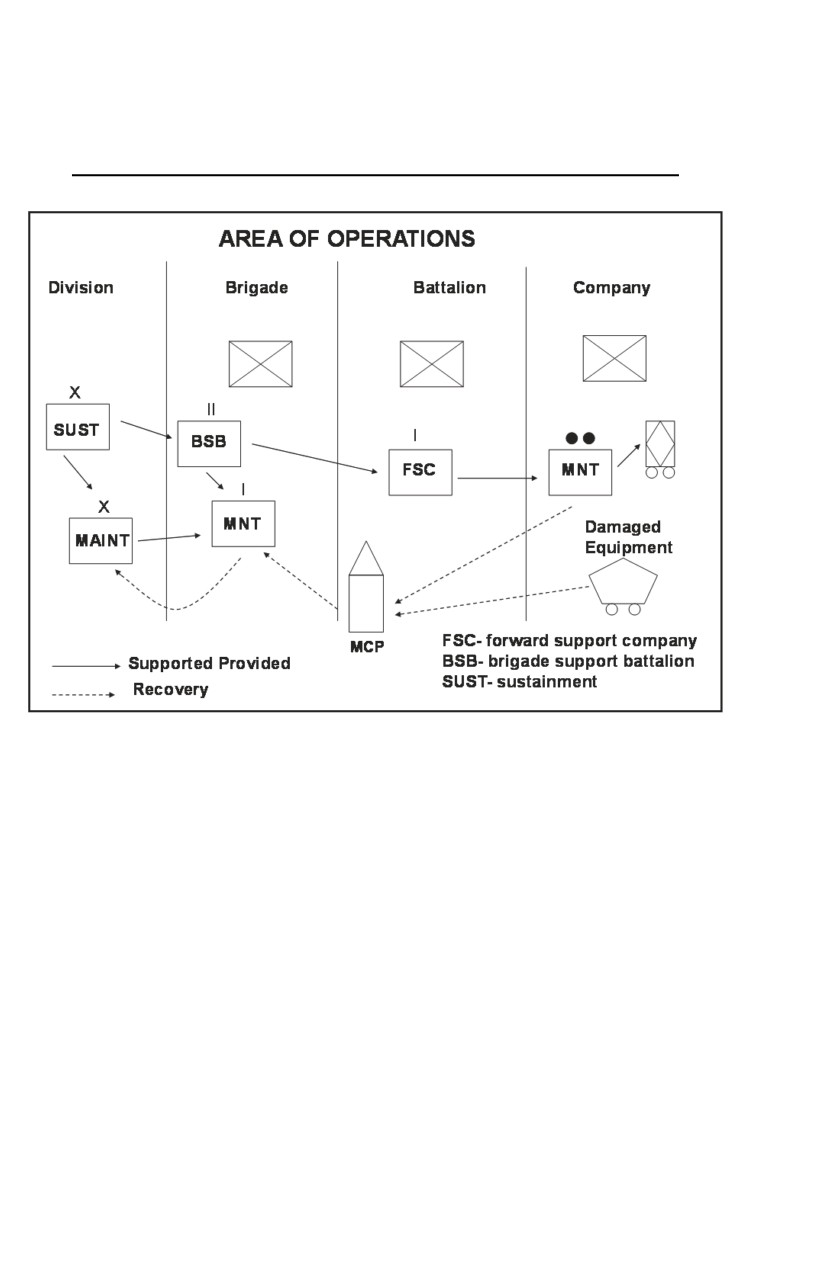
E-16. This section is based on FM 3-90.6 and discusses maintenance
procedures in the BCT. Figure E-2 is an example of BCT maintenance
operations.
FIELD MAINTENANCE
E-17. Company commanders ensure that vehicle crews and equipment
operators perform preventive maintenance checks and services. To
provide quick turnaround of maintenance problems, each maneuver
company has a field maintenance team from their supporting forward
support company. This field maintenance team has contact
maintenance trucks and mechanics that are trained in the company’s
equipment.
17 March 2009
FM 6-02.43
E-7
Appendix E
Figure E-2. BCT maintenance operations
E-18. Units not receiving support from a forward support company
(for example, a BSTB) receive their maintenance support from the field
maintenance company of the BSB. Located in the brigade support area,
the field maintenance company provides very limited backup support
to forward support companies since it exists primarily to provide
support to non-maneuver units (BCT headquarters, BSB, and BSTB). It
also serves as the maintenance point for low-density equipment. When
required, the BSB dispatches maintenance teams to perform on-site
diagnosis, make minor adjustments, and conduct repairs.
E-8
FM 6-02.43
17 March 2009
Maintenance
E-19. Maintenance of low density, specialized equipment
(for
example, BCT CPs and division signal company) usually requires
maintenance by DA civilians or contractors. The BSTB S-4 must
develop specific management procedures for this maintenance.
RECOVERY AND EVACUATION
E-20. Forward support companies are responsible for recovering their
supported unit’s damaged equipment as well as their own equipment. If
the vehicle is repairable, the company recovers it to the unit
maintenance collection points or main supply route based on SOP or
the OPORD. The use of FBCB2 enables recovery vehicles to identify
the exact location of the inoperable piece of equipment. When the
decision is made to repair the equipment at the brigade support area,
either recovery or evacuation is used. If the forward support company
recovery assets are overextended, recovery support can be coordinated
with the brigade support area to prevent excessive repair delays.
Equipment that cannot be repaired at the brigade support area usually is
evacuated and replaced with an operational readiness float
COMSEC MAINTENANCE
E-21. COMSEC equipment is evacuated through normal maintenance
channels to the BSB or the brigade signal company, if appropriate.
(Refer to TB 380-41 for information on procedures for safeguarding,
accounting and supply control of COMSEC material.)
CONTROLLED EXCHANGE
E-22. Controlled exchange is the removal of serviceable parts from an
item of non-mission capable equipment to install on another piece of
equipment that can be rendered mission capable more quickly or easily.
The BCT SOP may give battalion commanders the authority to direct
control exchanges as long as controlled substitutions are conducted
IAW AR 750-1, Chapters 4-9.
17 March 2009
FM 6-02.43
E-9
Appendix E
CONTRACTOR SUPPORT
E-23. The BCT often uses contractors and DA civilians for
maintenance support. The BCT S-4 usually plans for the protection and
supervision of contractors and DA civilians. System contractors
support deployed forces under pre-arranged contracts. This support
provides specific support to materiel systems throughout the materiel’s
life cycle and during peacetime and contingency operations. These
systems include, but are not limited to, vehicles, weapons systems,
unmanned aircraft systems, and communications equipment. System
contractors usually work for their own contracting officers, not the
BSB contracting officers. The Army material command usually
administers its systems contractors with an in-theater logistics support
element. Contractor support for CE systems is coordinated by the
brigade S6 or signal company commander with the division G-6.
E-24. Protecting contractors in the operational environment is the BCT
commander’s responsibility. When contractors are expected to perform
in potentially hostile areas, the supported military forces must assure
the protection of their operations and personnel. Provisions of the Law
of War do not consider contracted personnel and DOD civilians as
combatants. Commanders must understand that contractors are subject
to the same threat as Soldiers and must plan accordingly. Commanders
must provide security to contractors that support the contractors’
operations, or eliminate the use of contractor support as an option in
areas where security becomes an issue. Contractor personnel cannot
take an active role in hostilities, but they retain the inherent right to self
defense.
CE MAINTENANCE AT THE DIVISION
LEVEL
E-25. The division G-6 is responsible for monitoring the status and
sustaining the division networks that comprise the LWN. The
division G-6, working closely with the division signal company,
division headquarters battalion staff, and the executive officer,
ensures the critical network maintenance is performed and parts
E-10
FM 6-02.43
17 March 2009
Maintenance
are available as needed for C&E systems to remain operational.
The SSIO cell is staffed to perform these functions. The deputy G-
6 will ordinarily have the day-to-day responsibility of maintaining
this oversight.
E-26. The division signal company staff coordinates network
performance and maintenance issues with the division G-6 through
the division headquarters battalion staff. The division signal
company has operator/maintainers tasked with performing field
level maintenance on organic signal assemblages. The executive
officer of the signal company coordinates maintenance support for
organic equipment in the signal company and maintains oversight
on the status of all logistical and maintenance matters within the
company.
CE MAINTENANCE AT THE THEATER
LEVEL
E-27. NETCOM/9th SC(A) is responsible for maintenance support of
all echelons above corps communications assigned by either HQDA or
the CIO/G-6. This responsibility includes—
z
Organization and operation of all area maintenance and supply
facilities (AMSFs) supporting OCONUS commanders.
z
NETCOM/9th SC(A) maintenance support teams (MSTs).
z
COMSEC logistic support units.
z
Module and repair activities required for direct exchange of CE
material and other electronics material as assigned.
AREA MAINTENANCE AND SUPPLY FACILITY
E-28. The AMSF provides logistical support for echelons above corps
non-tactical communications and information systems used in an
overseas theater. There are currently two AMSFs in operation: one in
Europe and one in the Pacific that provide centralized retail supply and
maintenance support for all NETCOM/9th SC(A) telecommunications
17 March 2009
FM 6-02.43
E-11
Appendix E
material, and other CE material within the European and Pacific
theaters of operation.
E-29. The AMSF supports the Defense Satellite Communications
System, the LWN portion of the GIG, Armed Forces Radio and
Television Service, Military Affiliate Radio System, and other theater
unique communications or C2 systems. The AMSF may also provide
support to other US military departments, DOD activities, and other US
government agencies or installations.
E-30. The AMSF may be operated directly by the US Army or may be
operated by a civilian contractor with US Army oversight. Soldiers,
civilians and/or local national personnel may staff AMSFs.
E-31. AMSF support includes—
z
Furnishing maintenance assistance support teams to provide
scheduled and emergency backup maintenance and technical
assistance and instruction at the CE facility or unit location that is
beyond the unit’s capability and authorization.
z
Maintaining an authorized stockage list of CE supplies and CE
repair parts.
z
Maintaining approved stock record account to receive, store, and
issue items on CE bills of material.
z
Maintaining an approved stock of operational readiness float.
z
Maintaining capability to provide a training base for specialized
CE material, and to respond to emergency assistance request from
supported units.
z
Assisting supported units in correcting faults found during
performance evaluations and inspections to improve and maintain
the operational availability of CE systems and equipment.
z
Operating a module and printed circuit board repair section can
repair unserviceable equipment using microelectronics repair
methods and automatic test equipment.
z
Repairing peripheral material, such as power and environmental,
when not supported by the facility engineer or other area support
maintenance units.
E-12
FM 6-02.43
17 March 2009
Maintenance
MAINTENANCE SUPPORT TEAM
E-32. The Maintenance Support Team provides scheduled, emergency,
or on-call mobile maintenance support to CE fixed facilities or other
NETCOM/9th SC(A) units. Maintenance Support Teams are a
functional responsibility of AMSF and other authorized command
maintenance organizations.
EXPEDITIONARY SIGNAL BATTALION
E-33. The ESB has sufficient organic supply and maintenance
structure to handle normal logistical requirements in garrison or when
the subordinate elements are in close proximity to one another during
an operation. Companies, platoons, sections, and teams that are
deployed separately will ordinarily receive logistical, maintenance, and
spare parts support from the supported unit. Maintenance services and
repair parts for unit-unique equipment may be provided by the
supported unit or may require the deployment of battalion maintenance
or maintenance support unit assets. Both the battalion and companies
contain CE/COMSEC maintenance sections for these purposes.
CONTRACTOR FIELD SERVICE
REPRESENTATIVES
E-34. The rapid fielding of COTS based systems, in particular, the
WIN-T Increment 1 suite of equipment necessitated a strong CFSR
presence to establish and maintain the equipment. When originally
fielded the CFSR support was division centric to provide the support in
the units where they were urgently needed. As the Army has grown
increasingly modular with the systems fielded to a growing number of
units, it has been recognized that this system of CFSR support is too
costly and manpower intensive to be maintained. As the number of
trained Army specialists that are produced by institutional bases rise,
the number of CFSRs required will be proportionally reduced. This
will be done over time with CFSRs remaining for the near future.
17 March 2009
FM 6-02.43
E-13
Appendix E
E-35. The concept of CFSR support is moving from the division
centric model to an area or regional focus, the current number of
CFSRs will be responsible for support by region throughout the world
rather than individual units.
E-36. Regional support centers are maintained by contract for repair of
evacuated equipment as well as a repository for spare parts for affected
systems within their respective regions.
SIGNAL EQUIPMENT MAINTENANCE
E-37. The signal companies at the brigade, division, corps, and theater
levels have operator-maintainers performing field level maintenance on
organic signal assemblages. The signal company staff coordinates
network support issues and maintenance issues with the G-6/S-6
through the STB staff. The G-6/S-6 section maintains oversight
responsibility for all systems within their AO.
E-38. As new communications systems are fielded and upgraded, such
as the WIN-T Increment 1 suite of equipment, spare parts and critical
operational floats are provided. These spare parts and equipment are
maintained by the appropriate signal company and section or as
specified in unit maintenance SOPs. Critical items are normally
maintained at the regional support center.
COMMERCIAL-OFF-THE-SHELF EQUIPMENT
E-39. The proliferation of COTS equipment in new systems has
resulted in different procedures for maintenance than required for
standard Army equipment.
E-40. Common hardware system-3 (CHS-3) items as well as non-
CHS-3 items under warranty that are part of fielded systems such as
WIN-T Increment 1 are returned to the nearest regional support center
for repair/replacement. There are three regional support centers located
in CONUS, one in Germany and at other locations determined by
current operations.
E-14
FM 6-02.43
17 March 2009
Maintenance
CE MAINTENANCE SCENARIOS
E-41. CE maintenance procedures and steps will differ based on the
type of equipment involved
(COTS/CHS-3 or Army standard
equipment), local policies and SOPs, and METT-TC. The following
two scenarios are meant to illustrate the typical flow and route of
equipment and, while not all inclusive, provide a representative sample.
ARMY STANDARD EQUIPMENT
E-42. Typically, a 25U Signal Support Systems Maintainer will be
notified of a problem such as a malfunctioning SINCGARS mounted in
a vehicle. The 25U will troubleshoot the radio using the appropriate
technical manual and diagnostic tools such as a multimeter to isolate
the fault. The 25U will then repair the identified failed LRU or replace
it. If the repair of the LRU is outside the scope of the 25U, the 25U will
evacuate it to the supporting maintenance element for repair by the 94
series maintainer. The supporting maintenance element will evacuate
the LRU, if they are unable to repair it, to the sustainment maintenance
element for repair and return to the Army inventory.
COTS/CHS-3 EQUIPMENT
E-43. In the case of COTS CE equipment, the operator/maintainer,
such as a 25N in a JNN, will troubleshoot the equipment and identify
the fault using the appropriate TM and built-in-test equipment
contained within the COTS component. After identifying the faulty
component, the 25N will replace it with a spare or operational float.
This will be verified by a CFSR. The faulty component is then
evacuated to the supporting regional support center using the most
expeditious means available, which may include mail or courier. The
exact means of evacuation of the equipment will be set by local policy
and SOPs.
17 March 2009
FM 6-02.43
E-15
This page intentionally left blank.
Glossary
SECTION I - ACRONYMS AND ABBREVIATIONS
ABCS
Army Battle Command System
ACERT
Army Computer Emergency Response
Team
ACES
automated communications engineering
software
ADCON
administrative control
A-GNOSC
Army Global Network Operations and
Security Center
AHLTA
Armed Forces Health Longitudinal
Technology Application
amp
ampere
AMSF
area maintenance and supply facility
AO
area of operations
AOR
area of responsibility
AR
Army regulation
ARFOR
Army forces
ASAS
All Source Analysis System
ASA
Army Signal Activity
ASCC
Army Service component command
BCT
brigade combat team
17 March 2009
FM 6-02.43
Glossary-1
Glossary
BFT
Blue Force Tracking
BLOS
beyond line of sight
BSB
brigade support battalion
BSN
brigade subscriber node
BSTB
brigade special troops battalion
C2
command and control
CAISI
combat service support automated
information systems interface
CCDR
combatant commander
CCIR
commander’s critical information
requirements
CE
communications and electronics
CEOI
communications-electronics operating
instructions
CFSR
civilian field service representatives
CHS
common hardware system
CIO
chief information officer
CND
computer network defense
CNR
combat net radio
COA
course of action
COMCAM
combat camera
COMSEC
communications security
CONUS
continental United States
Glossary-2
FM 6-02.43
17 March 2009
Glossary
COTS
commercial off-the-shelf
CP
command post
CPN
command post node
CPOF
command post of the future
CSS
combat service support (legacy terms only)
DA
Department of the Army
DA PAM
Department of the Army pamphlet
DCS
Defense Communications Sysem
DCGS-A
Distributed Common Ground System-
Army
DHS
Department of Homeland Security
DISA
Defense Information System Agency
DISN
Defense Information Systems Network
DKET
Deployable Ku Band earth terminal
DMS
defense message system
DOD
Department of Defense
DSCS
Defense Satellite Communications System
DSD
Deployment Support Division
DVIDS
digital video imagery distribution system
EAC
echelons above corps
EHF
extremely high frequency
ELF
extremely low frequency
EMSO
electromagnetic spectrum operations
17 March 2009
FM 6-02.43
Glossary-3
Glossary
EPLRS
Enhanced Position Location Reporting
System
ESB
expeditionary signal battalion
ESTA
Enterprise Systems Technology Activity
FBCB2
Force XXI Battle Command Brigade and
Below
FDMA
frequency division multiple access
FM
frequency modulated/field manual
FMI
field manual interim
FRAGO
fragmentary order
FRHN
fixed regional hub node
G-1
assistant chief of staff, personnel
G-2
assistant chief of staff, intelligence
G-3
assistant chief of staff, operations
G-4
assistant chief of staff, logistics
G-6
ssistant chief of staff, network operations
G-7
assistant chief of staff, information
operations
G-8
assistant chief of staff, resource
management
GBS
Global Broadcast System
GCC
geographic combatant commander
GCCS-A
Global Command and Control System-
Army
Glossary-4
FM 6-02.43
17 March 2009
Glossary
GIG
Global Information Grid
HCLOS
high-capacity line of sight
HF
high frequency
HQ
headquarters
HQDA
Headquarters, Department of the Army
HHC
headquarters and headquaters company
IA
information assurance
IAW
in accordance with
INSCOM
Intelligence and Security Command
IP
Internet Protocol
IR
infared
ISYSCON
Integrated System Control
IT
information technology
J-1
personnel directorate of a joint staff
J-6
communications system directorate of a
joint staff; command, control,
communications, and computer systems
staff section
JACS
Joint Automated Communications-
Electronics Operating System
JFLCC
Joint Force Land Component Command
JNCC
joint network operations control center
JNN
joint network node
JNN-N
Joint Network Node-Network
17 March 2009
FM 6-02.43
Glossary-5
Glossary
JOA
joint operations area
JTF
joint task force
JTF-GNO
joint task force-global network operations
kbps
kilobits per second
km
kilometer
Kw
kilowatt
LAN
local area network
LEN
large extension node
LF
low frequency
LOS
line of sight
LRM
line replaceable module
LRU
line replaceable unit
LWN
LandWarNet
Mbps
megabits per second
MC4
Medical Communications for Combat
Casualty Care
MCG
mobile command group
MCO
major combat operation
MDMP
military decision making process
MEB
maneuver enhancement brigade
METT-TC
mission, enemy, terrain and weather,
troops and support available, time
available and civil considerations
Glossary-6
FM 6-02.43
17 March 2009
Glossary
MF
medium frequency
MOS
military occupational specialty
MRHN
mobile regional hub node
MSE
mobile subscriber equipment
NETCOM
Network Enterprise Technology Command
NETOPS
network operations
NIPRNET
Non-Secure Internet Protocol Router
Network
NOC-V
network operations center-vehicle
NOSC
network operations security center
OCONUS
outside continental United States
OPCON
operational control
OPORD
operation order
PACE
primary, alternate, contingency,
emergency
PIP
primary injection point
RCERT
regional computer emergency repsonse
team
RCIO
regional chief information officer
RFI
request for information
S-1
personnel staff officer
S-2
intelligence staff officer
S-3
operations staff officer
17 March 2009
FM 6-02.43
Glossary-7
Glossary
S-4
logistics staff officer
S-6
network operations staff officer
SA
situational awareness
SATCOM
satellite communications
SBCT
Stryker brigade combat team
SC(A)
signal command (army)
SC(T)
signal command (theater)
SEN
small extension node
SHF
super high frequency
SICPS
Standardized Integrated Command Post
System
SINCGARS
Single Channel Ground And Airborne
Radio System
SIPRNET
SECRET Internet Protocol Router
Network
SMART-T
secure, mobile, anti-jam, reliable tactical-
terminal
SOF
special operations forces
SOP
standing operating procedures
SPIRIT
special purpose integrated remote
intelligence terminal
STB
special troops battalion
SSIO
signal systems integration and oversight
STEP
standardized tactical entry point
Glossary-8
FM 6-02.43
17 March 2009
Glossary
STNOSC
Service theater network operations
security center
TACSAT
tactical satellite
TAC CP
tactical command post
TAIS
Tactical Airspace Integration System
TDMA
time division multiple access
THN
tactical hub node
TIN
tactical installation and network
TIP
theater injection point
TM
technical manual
TMDE
test, measuring and diagnostic equipment
TNOSC
theater network operations security center
TOC
tactical operations center
TRI-TAC
Tri-Service Tactical
TROPO
Tropospheric scatter; tropospheric
TSO
telecommunications service order
TTSB
theater tactical signal brigade
UHF
ultra high frequency
UPS
uninterruptible power supply
US
United States
USARC
United States Army Reserve Command
USARSO
United States Army South
UV
ultraviolet
17 March 2009
FM 6-02.43
Glossary-9
Glossary
VHF
very high frequency
VLF
very low frequency
VSAT
very small aperture terminal
W watts
WAN wide area network
WARNO warning order
WIN-T
Warfighter Information Network-Tactical
Glossary-10
FM 6-02.43
17 March 2009
Glossary
SECTION II - TERMS
annex
(joint) A document appended to an operation order or
other document to make it clearer or to give further
details. (JP 1-02)
ARFOR
(Army) The Army Service component headquarters for a
joint task force or a joint and multinational force. (FM 3-
0)
Army Service component command
(joint) Command responsible for recommendations to the
joint force commander on the allocation and employment
of Army forces within a combatant command. (JP 3-31)
area of operations
(joint) An operational area defined by the joint force
commander for land and naval forces. Areas of operation
do not typically encompass the entire operational area of
the joint force commander, but should be large enough
for component commanders to accomplish their missions
and protect their forces. (JP 3-0)
command and control
(Army) The exercise of authority and direction by a
properly designated commander over assigned and
attached forces in the accomplishment of the mission.
Commanders perform command and control functions
through a command and control system. (FM 6-0)
17 March 2009
FM 6-02.43
Glossary-11
Glossary
commander’s critical information requirement
(joint) Information requirements identified by the
commander as being critical to facilitating timely
decision-making. The two key elements are friendly
force information requirements and priority intelligence
requirements. (JP 3-0)
command post
(Army) A unit’s or subunit’s headquarters where the
commander and the staff perform their activities. (FM 6-
0)
communications security
(joint) The protection resulting from all measures designed to deny
unauthorized persons information of value that might be derived
from the possession and study of telecommunications, or to
mislead unauthorized persons in their interpretation of the results
of such possession and study. (JP 6-0)
computer network defense
(joint) Actions taken through computer networks to
protect, monitor, analyze, detect and respond to
unauthorized activity within Department of Defense
information systems and computer networks. (JP 6-0)
course of action
(joint) 1. Any sequence of activities that an individual or
unit may follow. 2. A possible plan open to an individual
or commander that would accomplish, or is related to the
accomplishment of the mission. 3. The scheme adopted to
accomplish a job or mission. 4. A line of conduct in an
engagement. 5. A product of the Joint Operation Planning
and Execution System concept development phase and
the course-of-action determination steps of the joint
operation planning process. (JP 5-0)
Glossary-12
FM 6-02.43
17 March 2009
Glossary
electromagnetic spectrum
(joint) The range of frequencies of electromagnetic
radiation from zero to infinity. It is divided into 26
alphabetically designated bands. (JP 1-02)
electromagnetic spectrum operations
Planning, operating, and coordinating joint use of the
electromagnetic spectrum through operational, planning,
and administrative procedures. The objective of
electromagnetic spectrum operations is to enable
electronic systems to perform their functions in the
intended environment without causing or suffering
unacceptable frequency interference. (FMI 6-02.70)
electronic protection
(joint) Division of electronic warfare involving actions
taken to protect personnel facilities and equipment from
any effects of friendly or enemy use of the
electromagnetic spectrum that degrade, neutralize or
destroy friendly combat capability. (JP 3-13.1)
electronic warfare
(joint) Military action involving the use of
electromagnetic and directed energy to control the
electromagnetic spectrum or to attack the enemy.
Electronic warfare consists of three divisions: electronic
attack, electronic protection, and electronic warfare
support. (JP 3-13.1)
electronic warfare support
(joint) Division of electronic warfare involving actions
tasked by, or under direct control of, an operational
commander to search for, intercept, identify, and locate or
localize sources of intentional and unintentional radiated
electromagnetic energy for the purpose of immediate
threat recognition, targeting, planning, and conduct of
future operations. (JP 3-13.1)
17 March 2009
FM 6-02.43
Glossary-13
Glossary
fragmentary order
(Army) A form of operation order that contains
information of immediate concern to subordinates. It is an
oral, digital, or written message that provides brief,
specific, and timely instructions without loss of clarity. It
is issued after an operation order to change or modify
that order or to execute a branch or sequel to that order.
(FM5-0)
identification, friend or foe
(joint) A device that emits a signal positively identifying
it as a friendly. (JP 1-02)
information assurance
(joint) Measures that protect and defend information and
information systems by ensuring their availability,
integrity, authentication, confidentiality, and
nonrepudiation. This includes providing for restoration of
information systems by incorporating protection,
detection, and reaction capabilities. (JP 3-13)
information dissemination management
Capability to provide a managed flow of relevant
information based on the command’s missions. (FM 3-13)
information system
(joint)The entire infrastructure, organization, personnel,
and components that collect, process, store, transmit,
display, disseminate, and act on information. (JP 1-02)
jamming
The deliberate radiation or reflection of electromagnetic
energy to prevent or degrade the receipt of information by
a receiver. It includes communications and
noncommunications jamming. (FM 2-0)
Glossary-14
FM 6-02.43
17 March 2009
Glossary
line of sight
(joint) The unobstructed path from a Soldier/Marine,
weapon, weapon sight, electronic-sending and -receiving
antennas, or piece of reconnaissance equipment to
another point. (FM 34-130)
multichannel
(joint) Pertaining to communications, usually full duplex,
on more than one channel simultaneously. Multichannel
transmission may be accomplished by either time-,
frequency-, code-, and phase-division multiplexing or
space diversity. (JP 1-02)
near real time
(joint) Pertaining to the timeliness of data or information
which has been delayed by the time required for
electronic communication and automatic data processing.
This implies that there are no significant delays. (JP 1-02)
net (communications)
(joint) An organization of stations capable of direct
communications on a common channel or frequency. (JP
1-02)
net control station
(joint) A communications station designated to control
traffic and enforce circuit discipline within a given net.
(JP 1-02)
Non-Secure Internet Protocol Router Network
Worldwide unclassified but sensitive packet switch
network that uses high-speed internet protocol routers and
high-capacity Defense Information Systems Network
circuitry.
17 March 2009
FM 6-02.43
Glossary-15
Glossary
operational environment
(joint) A composite of the conditions, circumstances, and
influences that affect the employment of military forces
and bear on the decisions of the unit commander. (JP 3-0)
request for information
(joint) 1. Any specific time-sensitive ad hoc requirement
for intelligence information or products to support an
ongoing crisis or operation not necessarily related to
standing requirements or scheduled intelligence
production. A request for information can be initiated to
respond to operational requirements and will be validated
in accordance with the theater command’s procedures. 2.
The National Security Agency/Central Security Service
uses this term to state ad hoc signals intelligence
requirements (JP 2-01)
sanctuary
(joint) A nation or area near or contiguous to the combat area that,
by tacit agreement between the warring powers, is exempt from
attack and therefore serves as a refuge for staging, logistic, or
other activities of the combatant powers. (JP 1-02)
SECRET Internet Protocol Router Network
(joint) The worldwide SECRET-level packet switch
network that uses high-speed internet protocol routers and
high-capacity Defense Information Systems Network
circuitry. (JP 6-0)
signal
(joint) 1. As applied to electronics, any transmitted
electrical impulse. 2. Operationally, a type of message,
the text of which consists of one or more letters, words,
characters, signal flags, visual displays, or special sounds
with prearranged meaning, and which is conveyed or
transmitted by visual, acoustical, or electrical means. (JP
1-02)
Glossary-16
FM 6-02.43
17 March 2009
Glossary
signal operation instructions
(joint) A series of orders issued for technical control and
coordination of the signal communication activities of a
command. (JP 1-02)
signals intelligence
(joint) 1. A category of intelligence comprising either
individually or in combination all communications
intelligence, electronic intelligence, and foreign
instrumentation signals intelligence, however transmitted.
2. Intelligence derived from communications, electronic,
and foreign instrumentation signals. (JP 2-0)
17 March 2009
FM 6-02.43
Glossary-17