FM 3-11.4 MULTISERVICE TACTICS, TECHNIQUES, AND PROCEDURES FOR NUCLEAR, BIOLOGICAL, AND CHEMICAL (NBC) PROTECTION (June 2003) - page 4
n.
Radiac Meter, IM-93/UD. The IM-93/UD radiac meter detects and measures
cumulative exposure to short-duration, high or low intensity, X-ray and gamma ray
radiation. The IM-93/UD can be clipped to the user’s pocket or can be attached to some
object in the area that is to be measured for total dose radiation exposure. The radiac meter
measures from 0 to 600 cGy, in increments of 20. The maximum acceptable leakage is 12
cGy per day (24 hours). The primary users are the USA, USN, and the USMC.
o.
Radiac Meter, IM-147/PD. The IM-147/PD radiac meter detects and measures
cumulative exposure to short-duration, high or low intensity, X-ray and gamma ray
radiation. The IM-147/PD can be clipped to the user’s pocket or can be attached to some
object in the area that is to be measured for total dose radiation exposure. The radiac meter
measures from 0 to 50 RADS in increments of 2. The maximum acceptable leakage is 1 cGy
per day (24 hours). The primary users are the USA, USN, and USMC.
p.
Charger, Radiac, PP-1578A/PD. The radiac charger is a frictional generator of
static electricity required to charge the IM-93/UD and IM-147/PD radiac meters. The PP-
1578A/PD and the dosimeters associated with it are being phased out of service within the
USA. It is being replaced by the AN/UDR-13 pocket radiac set.
q.
Radiac Set, AN/VDR-2. The AN/VDR-2 is designed to detect and measure
nuclear radiation from fallout and radioisotopes. It is used to perform ground radiological
surveys in vehicles or in a dismounted mode as a handheld instrument. The AN/VDR-2
measures dose rate from 0.1 to 230 cGy per hour, and measures total dose from 0.1 to 999
cGy. The primary users are the USA and the USMC.
r.
Radiac Set, AN/PDR-75. The AN/PDR-75 radiac set detects and measures
nuclear radiation from fallout and nuclear detonations. The system consists of a computer
indicator, radiac, CP-696/PDR-75 and a detector radiac, DT-236/PDR-75. The system
monitors and records the exposure of individual personnel to gamma and neutron radiation.
The CP-696/PDR-75 is used to measure the accumulated neutron and gamma radiation
dose recorded by the DT-236/PDR-75. The DT-236/PDR-75 is worn by personnel who may
be exposed to radiation. It allows for radiation monitoring of individual personnel, provides
accurate readings for extended periods of time after exposure, and measures from 0 to 999
cGy in any combination of neutron and gamma doses. The primary users are the USA and
USMC.
s.
Radiac Set, AN/PDR-77. The radiac set AN/PDR-77 detects and measures alpha,
X-ray, beta, and gamma radiation. The system incorporates commercially available
measurement electronics, an alpha probe, a beta gamma probe, and an X-ray probe. The
AN/PDR-77 measures count rate from 1 to 999,000 counts per minute. The primary user is
the USA.
t.
Radiac Set, AN/PDR-27R. The AN/PDR-27R is designed to detect beta radiation
and to measure and detect gamma radiation. The primary user is the USN.
u.
Radiac Set, AN/PDR-43. The AN/PDR-43 is a pulsed (time-controlled) end-
window Geiger-Muller type radiac set that serves as the USN’s standard, high-range, beta-
gamma survey instrument. The primary user is the USN.
A-16
v.
Radiac Set, AN/PDR-56. The AN/PDR-56 is a portable, scintillation type
instrument used for detecting alpha contamination. The system includes large and small
interchangeable probes with a probe extension. The primary users are the USN and the
USMC.
w. Radiac Set, AN/PDR-65. The AN/PDR-65 and AN/PDR-65A are the USN’s
standard fixed instrument for measuring gamma radiation intensity and providing dose
information. The AN/PDR-65/65A system measures gamma intensities to 10,000 cGyph and
records cumulative doses to 9,999 cGyph. The primary user is the USN.
x.
Detector, Radiac, Dosimeter DT-60C/PD. The DT-60C/PD personnel dosimeter is
a high-range, non-self-reading dosimeter. A CP-95A/PD reader must be used to determine
the total dose. The system measures gamma radiation exposure up to 600 cGy. The primary
user is the USN.
y.
Dosimeter Reader, CP-95A/PD. The CP-95A/PD is designed to read the DT-60-
series personnel dosimeter. The CP-95A/PD will operate over a range of 0 to 200 cGyph in
10-cGy steps and 0 to 1,000 cGyph in 20-cGy steps, with each 100 roentgens a major
subdivision. The primary user is the USN.
z.
Dosimeter, IM-143B/PD. The IM-143B/PD is a pen-like, self-reading pocket
dosimeter and is designed to read gamma radiation exposure in the 0 to 600 roentgens
range. The primary users are the USN, USAF and USMC.
aa. Radiac Charger, PP-4276C/PD. The PP-4276C/PD is a transistorized battery-
operated charger. The system is designed to charge and zero the pocket dosimeter. The
primary users are the USN and USMC.
bb. Multifunctional Survey Meter, ADM-300A. The ADM-300A is a battery-operated,
self-diagnostic, multiple-function instrument. It is used alone to locate and measure low-
and high-intensity radioactivity in the form of gamma rays or beta particles. It is used with
external probes to locate and measure alpha, beta, gamma, X-ray, and neutron radiation.
The primary user is the USAF.
cc. Handheld Assay. The handheld assay (HHA) is a specific biological-detection
component used with the M31 and M31A1 BIDS. The HHA (in most cases) is used as a
backup for the primary specific detection components in the M31 and M31A1 BIDS. The
HHA is also a subcomponent of the DOD biological sampling kit that is used by all services.
dd. Detector System, Biological Agent, Joint Portal Shield, M99. The portal shield is
a system that can identify up to eight biological agents simultaneously. The Mark III sensor
network measures the amount of particles in the air and determines if an increased
concentration in the 1 to 10 micron range constitutes a biological attack. With an M21 or
M22 chemical detector added, the system also detects chemical agents. It has
meteorological and communications equipment and an auxiliary generator in case of
commercial power failure.
ee. DOD Biological Sampling Kit. This kit can be used to support the presumptive
identification process for biological agents. It can be used one time and contains—
A-17
• One panel of up to 8 HHAs.
• One bottle of buffer solution.
• One packet of sterile, cotton swabs.
• One set of laminated instruction cards.
• One 10- by 10-centimeter cutout.
A-18
Appendix B
GUIDELINES FOR THE NUCLEAR, BIOLOGICAL, AND CHEMICAL
PORTION OF A COLLECTIVE PROTECTION STANDING
OPERATING PROCEDURE
1.
Background
This appendix provides sample information that could be used to help prepare a CP
system SOP, support shelter entry/exit procedures, prepare a shelter for operation, and
discuss classes of COLPRO and associated equipment.
2.
Suggested Guidelines for Preparation of a Collective Protection System
Standing Operating Procedure
The information in this paragraph is intended as a guide for units. Each unit should
modify and expand this guidance to develop its own SOP. Each SOP should consider
peculiarities of unit organization, mission, equipment, and environmental situation. An
SOP should delineate operational details of a shelter or a van equipped for CP. For
example, details must include NBC-related duties of a guard (where applicable) and entry
and exit procedures.
The SOP should consider the following:
• Responsibilities.
• Type and location of the shelter or van.
• Resource estimates (e.g., number of shelter management personnel).
• Frequency of and requirements for entries and exits.
• Maintenance of the area around the shelter.
• Personnel entry procedures.
• Emergency operation procedures, interior procedures, operating procedures for
shelter attendants, and logistics considerations.
• Number of nonshelter personnel assigned to the same site as the shelter or
van.
a.
Outline Objective and Responsibilities.
(1)
Background. The objective of the shelter plan is to provide the best
available physical protection for personnel. Key elements to a successful personnel shelter
plan include adequate shelters, personnel who are familiar with shelter procedures,
B-1
personnel trained in shelter management, the ability to activate and close shelters at the
appropriate times, the ability to stock shelters with required supplies and equipment, and
the ability to occupy shelters for extended periods.
(2)
Fixed-Site Commander. To implement a successful shelter program, the
commander develops a comprehensive protection program to provide sufficient shelter
spaces for military and emergency-essential civilians (include added-forces projections for
teams and supplies). He also determines the type and quantity of shelters based on the
threat and considers the use of open-air CCAs and toxic-free areas (TFAs).
(3)
Unit Commander. The commander’s responsibilities include—
• Implementing instructions and publishing unit and facility
implementing instructions and checklists for shelter operations as required.
• Planning supply and resupply actions. Logistics planning includes
preparing shelter operations for several consecutive days after fallout peaks or after the
onset of CB contamination. Logistics planning also considers medical requirements.
• Identifying shelter management team (SMT) requirements. Ensure that
SMT members do not have conflicting duties. Identify and train selected unit personnel
identified for mobilization in shelter management techniques.
• Training SMTs. Train personnel to operate, maintain, and perform
inspections and minor troubleshooting of the equipment within the shelter. This should
include filtration, air conditioning and heating, electrical, sanitation, and communications
systems. Personnel should also maintain portable detection devices.
• Conducting operational planning. Stagger work shifts and rest cycles, as
the mission permits to minimize bottlenecks during shelter processing. Leaders should also
develop shelter floor plan diagrams and oversee the operation of the exposure control
system.
(4)
Fixed-Site NBC Personnel. Fixed-site NBC personnel should plan for
expedient hardening to increase the protective capability of the shelter during contingency
operations. Additionally, they should—
• Direct the performance of preventive and unit level maintenance on
available CP systems.
• Provide potable water to sustain operations.
• Train SMTs in facility and equipment operation, shelter management,
and shelter equipment use.
(5)
Individuals. Each individual should know the location of their protective
shelter and understand the processing procedures in the shelter.
B-2
b.
Conduct Shelter Planning. For planning purposes, all military and emergency-
essential civilians will occupy the shelter space during appropriate readiness stages.
Planning factors for shelter operations should include—
• Providing the minimum shelter team size for emergency operations and rest-
and-relief shelters for CB protection and nuclear fallout. There should be one shelter
supervisor and one monitor per shift.
• Allowing one space per two persons assigned to a rest-and-relief shelter.
• Providing positive overpressure of filtered air in collective protection facilities
to keep CB agents out of the TFA.
• Providing outward airflow through the air locks and CCA to minimize hazards.
• Considering the use and location of open air CCAs and TFAs.
c.
Ensure Clean Areas Around the Protective Entrance. Provide procedures in an
SOP to decontaminate the area surrounding the shelter or van entrance if liquid agent is
present. Decontamination methods could include turning over or removing a top layer of
soil, removing snow, or adding a clean layer of soil or sand. A clean surface can also be
obtained by laying down a piece of plastic, cardboard, canvas, plywood, or other material.
Use soap or detergent with water to decontaminate areas such as entrance steps.
d.
Prepare Personnel Entry Procedures. SOPs should address entry procedures to
ensure the least risk of contamination to personnel and equipment inside the shelter and
the least interference with tactical operations.
(1)
General SOP Guidance. Guidance could include the following:
• The shelter attendant uses a detector to check all individuals for
contamination. Unless the absence of contamination can be verified, assume that all
individuals are contaminated and ensure that they perform the specific entry procedures.
• Chemical detector paper only detects agents in liquid form, most likely
thickened, liquid agents. Unthickened agents absorb into overgarment materials and
cannot be detected by detector paper. However, agent vapor may desorb from clothing
inside shelters or vans and present vapor hazards.
• One of the attendant’s main NBC duties is assisting personnel who are
entering the shelter. He must help them decontaminate and remove their contaminated
overgarments. The attendant must check himself periodically for contamination, especially
the gloves.
(2)
Detailed SOP Guidance. Describe the steps required for entry into a shelter.
Give sufficient detail to avoid confusion. Standardize the procedures, and try to ensure that
they are consistent with procedures for larger shelters. Specific instructions for entry into
shelters or vans will vary depending on the system. (See applicable TMs/TOs for specific
information from which entry procedures can be developed.) Detailed guidance could
include the following:
B-3
• Use a chemical agent detector/detector paper or a radiac meter to check
for the presence of contamination on individuals.
• Store contaminated items outside the shelter. Use protective covers,
such as plastic or canvas, near the entrance; and ensure that items are not in the path of
the entrance door.
• Decide whether grossly contaminated individuals need to enter the
shelter.
e.
Prepare Personnel Exit Procedures. SOPs describe the exit procedures for shelter
occupants. Emphasize the importance of contamination reduction measures. Include the
following in the SOP:
• Occupants leaving the shelter must put on their MOPP gear if an attack is
imminent, occurring, or has occurred.
• Occupants may need to leave the shelter temporarily or for brief periods during
an attack. They should carefully avoid contaminating their MOPP gear.
• One person may be assigned outside duties if a shelter or a van has more than
one occupant. That person should be rotated if possible.
WARNING
When entries are performed in a contaminated environment, conduct monitoring
inside the shelter every
15 minutes. If the detector changes color or the CAM
indicates more then one bar, all individuals should mask until the source of
contamination is located and removed and/or further tests indicate contamination is
no longer present.
f.
Prepare Shelter or Van Emergency Operations SOP. Personnel should
familiarize themselves with the procedures to follow if equipment failure occurs and the
alarm sounds. If an alert is given and the shelter or van is prepared for NBC operations,
the alarm system should alert the occupants to any of several types of equipment failure.
Individuals should handle equipment-related emergencies according to the proper
organizational maintenance manual and unit SOP. The following paragraphs illustrate
examples of potential situations that could occur:
• Sudden loss of positive pressure in the shelter. Lights and horns on a
component module may signal an alarm. Occupants must put on their masks. An assigned
occupant confirms this signal by checking power, lights, and horn. If the alarms are
confirmed and compartment positive pressure is lost, occupants must remain masked while
the assigned operator pursues the problem. The operator uses the organizational
maintenance manual to locate the problem and if possible, repair it. The operator may not
find the problem readily, or perhaps it cannot be repaired. In either case, the occupants
must dress at the appropriate MOPP level.
B-4
• Malfunctioning of the gas-particulate filter unit. If the change-filter light
comes on, the occupants must put on their masks. An assigned occupant determines if the
filter is operating. He follows procedures in the organizational maintenance manual. If the
filters need to be replaced, occupants must work in the appropriate MOPP gear until the
filters are replaced, the air is purged, and the detectors indicate that masks can be
removed.
WARNING
Never change filters during an NBC attack.
• Interior contamination by entry of contaminated item or personnel. If the
interior becomes contaminated, the occupants must work in appropriate MOPP gear until
the shelter air flow purges the agent from the air and a detector indicates the agent is no
longer present. Wipe off any unabsorbed liquid agent from the equipment. Use a wet rag if
moisture will not harm the equipment.
g.
Outline Interior Procedures for Occupants. SOPs describe the step-by-step
monitoring procedures. If the detector indicates the presence of contamination, occupants
must mask immediately and check shelter pressure, door, and power. Replace filters
according to the SOP and the appropriate operational maintenance manual.
WARNING
Ensure that the undressing area is well-ventilated and remove
contaminated overgarments from the hot-line area to avoid vapor
buildup.
h. Provide SOP Guidance for Shelter Attendants (Guards). Describe operating
procedures for shelter attendants and nonshelter personnel, including visitors. Shelters or
vans may be collocated with another unit. If so, assign nonshelter personnel as shelter
attendants, when possible. Nonshelter personnel are those not essential to the operation of
shelter or van mission-essential equipment. Consider the following for inclusion in the SOP:
• The shelter attendant monitors for agent presence once an alert has been
issued, but before the attack. After an attack ceases, the attendant periodically monitors
the outside air.
• Shelter attendants and nonshelter personnel assist in shelter or van
operations. They perform such tasks as refueling generators, realigning antennas, and
assisting in entry and exist of shelter personnel and visitors.
i.
Determine Contaminated Equipment/Expendable Supplies Requirements.
(1)
Contaminated Equipment and Clothing. SOPs provide guidance for the
disposal of contaminated equipment and clothing. Contaminated equipment and clothing is
kept out of the way of entering personnel. This helps avoid confusion and the spread of
contamination.
B-5
(2)
Expendable Items. The SOP addresses the storage of supplies for certain
expendable items in protective shelters or vans. These are for use by individuals entering
and leaving the shelter or van and could include—
• Decontamination materials, such as soap or detergent, bleach, M291
skin decontamination kits, and water.
• Decontamination equipment, including buckets, rags for wiping, and
brushes for scrubbing.
• M256-series detector kits.
• Disposable field-expedient items.
• MOPP gear.
• BDUs in various sizes.
• Batteries.
• Plastic bags, trash cans, and other containers to be used for protecting
uncontaminated items.
3.
Entry and Exit Procedures
Entry and exit procedures are slow and risky procedures; therefore, the commander
must allow only those personnel who are mission-essential to enter and exit. Entry and exit
procedures for ship COLPRO are covered in detail in the CBR defense bill specific to that
ship. Entry and exit procedures for a vehicle, fixed-site, or mobile shelter are specified in
unit SOPs. Step-by-step instructions for all systems allow for safe transition from
individual to COLPRO and back. Entry and exit operations can become high risk, especially
those involving allied forces with different languages, equipment, and training.
a.
Background.
(1)
To illustrate procedures, various MOPP gear ensemble combinations can
be used to depict procedures for entry and exit from a shelter, entry and exit from an
armored vehicle, or entry and exit from a contaminated area. The MOPP gear ensemble
may include—
• Ground personnel IPE: field protective mask with or without hood (based on
the type of overgarment worn), a mask carrier, a helmet with CP cover, an individual
weapon, an armored vest (if worn), and MOPP gear. (See shelter entry/exit instructions for
personnel wearing BDO or JSLIST.)
• Combat vehicle and aircrew IPE: tank or aircraft mask with or without hood
(based on the type of overgarment worn), a combat vehicle or aircraft crewman helmet, an
individual weapon, an armored vest (if worn), and MOPP gear. (See shelter entry/exit
instructions for individuals in a combat vehicle, an aircraft, or a hatch vehicular system
without an air lock.)
B-6
(2)
Each ensemble and type of enclosure has certain characteristics that dictate
different steps. Therefore, procedures for a particular option are a composite of general
guidelines for individual and COLPRO. Entry and exit procedures in this appendix
illustrate the necessity to modify procedures based on their application and system
configuration. Procedures presented herein give steps common to all entry and exit
procedures. Actual procedures for a particular system should be more specific. The
procedures should be in the system TM, and they should appear in the unit SOP.
b.
Collective Protective Shelter with an Air Lock.
(1)
Site Selection. Select a site for shelter erection that is free of liquid
contamination. If setting up a shelter where the external agent concentration produces a
relative chemical hazard reading of less than one bar on the CAM (indication that no agent
is present), entry into the shelter is unlimited. Information on setting up, striking, and
operating the shelter is contained in applicable equipment publications.
(2)
Presence of an Agent. Where the external concentration of an agent
produces a CAM reading of one bar or more, entries should be discontinued unless they are
mission-essential. Personnel entering the shelter follow entry instructions when an
external concentration of an agent is detected or suspected or when liquid contamination is
detected or suspected on their overgarments. Other guidance includes—
• Establishing a hot line at least 4 feet from the personnel entry air lock
and 14 feet for a litter air lock. Check the floor area between the hot line and the entrance
for evidence of liquid contamination. Use both visual check and detector/monitoring
equipment.
• Decontaminating the area if contamination is present. Cover it with a
plastic sheet or similar impermeable material or find another area, if possible.
• Removing overgarments in a room or a covered area (if possible) that is
separate from the room in which the entrance is located and establishing a hot line at the
doorway between the two rooms. Keep the room with the air lock as clean as possible.
(3)
Equipment. Do not allow equipment to enter the shelter unless it is known
to be free of contamination. Pre-position decontamination kits, alarms, detector kit
samplers, and a CAM inside the air lock. These components require periodic replenishment,
depending on the frequency of entries. The CAM will require fresh batteries based on TM
guidance.
(4)
Procedures Prior to Entry. If contaminated, all personnel must be
decontaminated before they are permitted entry. Use chemical and radiological detection
equipment to check for the presence of contamination on individuals and their equipment.
WARNING
If the outer door has been opened, always purge the air lock before opening the inner
door. When operating in a toxic environment, never open the outer and inner doors
of the air lock at the same time.
B-7
(5)
Entry Procedures. Personnel—
• Remove MOPP gear (except masks), BDUs, and boots outside the air
lock. This procedure reduces the amount of possible contamination entering the air lock.
• Ensure that the air lock is empty and the inner door is closed.
• Enter the air lock and close the outer door.
• Check for contamination after the air lock is purged. If contaminated,
the individual must return to the outside and decontaminate his skin. He then returns to
the air lock and repeats the purge cycle and contamination check. If no contamination is
detected, the protective mask is removed and placed in a plastic bag. The plastic bag is
sealed and labeled. The individual opens the inner air lock door and enters the shelter. The
plastic bag is carried into the shelter with the individual.
(6)
Exit Procedures. Personnel—
• Ensure that the ambulatory air lock is empty and the outer door is
closed.
• Enter the air lock and close the inner door.
• Put on protective masks and exit through the outer door.
• Put on BDUs and boots and then assume the established MOPP level
before departing the immediate area of the exit door.
WARNING
Do not open the outer door until the protective mask has been donned.
c.
Shelter Entry Instructions for Ground Troop Ensemble (BDO). Personnel can
perform entry steps with or without assistance from a buddy or shelter attendant. However,
personnel can perform some steps more easily and safely with help; therefore, the buddy
system is strongly recommended. Personnel in the ground troop ensemble (BDO) may use
the following 13 steps:
• Step 1. Use detector paper to determine the areas of gross liquid
contamination on equipment and garments. Give special emphasis to these areas, and use
field-expedient absorbents, such as sand, dirt, or rags, to remove the gross liquid
contamination. Take special care to avoid touching these areas during overgarment doffing.
Note: If a radiological or biological hazard is present, lightly wipe down the overgarment
with hot, soapy water before entering the shelter. This will dampen the overgarment and
B-8
reduce any secondary aerosolization of radiological or biological contamination while
conducting doffing procedures.
• Step 2. Remove the LCE, mask carrier, and helmet before crossing into the
shelter. If the hood is worn over the LCE, loosen the hood straps. Remove the M291
decontamination kit and the waterproof bag and keep them.
• Step 3. Untie the ankle cords and open the hook-and-pile fasteners and
zippers of both trouser legs.
• Step 4. Undo the rear snaps of the jacket. Leave the top snap closed and undo
the remaining two front snaps. Untie the waist cords, but leave the zipper closed.
• Step 5. Undo the shoulder straps. Remove them from beneath the arms and
reattach them over the shoulder. (Use assistance if necessary.) Loosen the neck cord.
Decontaminate the mask hood with the M291 decontamination kit. The M291
decontamination kit is a single-packet, one-step application. Open the packet, slip the
fingers into the pad strap, and decontaminate the mask and hood thoroughly. The M291
decontamination kit can also be used to decontaminate equipment that needs to be taken
into the shelter.
• Step 6. Decontaminate the gloves before rolling the hood. (Use assistance if
necessary.) Leave the hood zipper closed. Grasp the hood by the straps and lift the hood off
the shoulders and partially off the head until most of the back of the head is exposed. Roll
the hood. Start at the chin, making sure that the zipper and neck cord are tucked into the
roll, and work around the entire mask until the rolled hood will stay up, off the shoulders.
Roll the hood tightly against the mask without pulling the hood off the back of the head.
Note: If your assistant is also entering the shelter, he also performs steps 1 through 6
before proceeding to step 7.
• Step 7. Undo the top jacket snap and open the jacket zipper. With one hand,
pull the sleeve band over the hand without loosening the glove (make a fist if necessary).
Remove that arm from the sleeve. Repeat the procedure for the other arm. Place the jacket
away from the entry path.
• Step 8. Stand against a wall or other support for balance, and unsnap and
unzip the trousers. (Use assistance if necessary.) Pull or have the assistant pull the
trousers over the heels of the chemical overboots/GVOs for removal, or walk the trousers off
by alternately lifting one foot while holding the trouser material to the ground with the
other foot. Leave the overboots or GVOs on, and place the trousers away from the entry
path.
Note: If your assistant, if also entering the shelter, he also performs steps 7 and 8 now
before proceeding to step 9.
• Step 9. For a van with an air lock, go up the steps and loosen the overboot
laces or GVO clasps. Open the door, remove one overboot or GVO at a time, toss it away
from the steps, and step into the air lock with the exposed field boot. Do not touch exposed
field boots on the exterior platform surface or stairs after removing the overboots or GVOs.
B-9
Note: When operating an air lock system in a contaminated environment, the protective
entrance (PE) and the shelter interior must be monitored with detection equipment.
• Step 10. Enter the air lock and ensure that the door is closed. When the low-
pressure indicator light in the PE module goes out, rotate the purge time clockwise to its
full extent. Do not set the purge time until after the low-pressure light goes out.
• Step 11. Decontaminate the gloves again, and then decontaminate the bottom
(rolled portion) of the hood. Wait for completion of the purge cycle. When the timer bell
sounds, loosen the gloves but do not remove them.
• Step 12. Clear the air lock. A trained operator will use the CAM, if available,
to detect and indicate the relative level of chemical agent vapor hazard present on
personnel, clothing, or equipment as well as the interior of the PE or shelter. When
sampling results are negative, stop breathing (hold your breath), remove the mask and
hood, and place them in the waterproof bag. Remove the gloves and drop them to the floor.
Keep the waterproof bag.
WARNING
A suspected false-positive reading must be verified with other monitoring equipment, such
as M8/M9 detector paper and the M256 detector kit before proceeding further.
• Step 13. Enter the shelter. Continue to hold your breath, enter the shelter, and
then resume breathing.
WARNING
When entries are performed in a contaminated environment, monitor them every 30
minutes. If detector/monitoring shows positive, all personnel should mask until the source
of the contamination is located and removed and/or further tests indicate the
contamination is no longer a threat.
d.
Shelter Entry Instructions for Ground Troop Ensemble (JSLIST). Personnel in
the ground troop ensemble (JSLIST) may use the following 13 steps for doffing IPE.
• Step 1. Use detector paper to determine the areas of gross liquid
contamination on equipment and garments. Give special emphasis to these areas and use
field-expedient absorbents, such as sand, dirt, or rags, to remove the gross liquid
contamination. Take special care to avoid touching these areas during overgarment doffing.
Note: If a radiological or biological hazard is present, lightly wipe down the overgarment
with hot, soapy water before entering the shelter. This will dampen the overgarment and
reduce any secondary aerosolization of radiological or biological contamination while
conducting doffing.
• Step 2. Remove the LCE, mask carrier, and helmet before crossing into the
shelter. Remove the DKIE and the waterproof bag, and keep them.
Note: If the JSLIST is worn, the mask will not have a hood attached.
B-10
• Step 3. Unfasten the hook-and-pile fasteners at the wrist and ankles. Untie
the bow in the coat and retention cord (if tied), unfasten the webbing strip snap, and allow
the waist coat retention cord loop to retract. Touching only the outside surfaces of the coat,
loosen the bottom of the coat by pulling the material at the bottom of the coat away from
the body. Locate the trouser suspender snap couplers by feeling the outside of the coat.
After locating the snap couplers, squeeze them to release the suspenders.
Note: Avoid touching the throat area. If the JSLIST is worn, pull the overgarment hood
over the protective mask and secure it.
• Step 4. (Use an assistant if possible.) Decontaminate the mask using the
M291 decontamination kit. Take special care to decontaminate the eyelens, face blank,
barrel locks, and the front edge of the hood. The individual or assistant, if used, will
decontaminate his gloves. Unfasten the barrel locks and loosen the drawstrings.
Note: Use the M291 to decontaminate any equipment taken into the shelter.
• Step 5. Unfasten the front closure hook-and-pile tape at the chin down to the
chest, and then pull the slide fastener down to the chest area.
• Step 6. (Use an assistant if possible.) Grasp the hood by the outside surface
near each barrel lock, lift the hood up off the head, and reverse-roll the hood one time while
pulling it toward the back of the head to remove. If assistance is available, use the
procedures outlined in FM 3-5, NBC Decontamination (MOPP gear exchange) to remove the
hood.
Note: If the assistant is entering the shelter, he perform steps 1 through 6 before
proceeding to step 7.
• Step 7. Unfasten the front closure hook-and-pile tape and slide the fastener
from the chest down to the bottom of the coat. Grasp the front of the coat and pull the coat
back until it is off the shoulders. Extend the arms behind the back and work them out of
the sleeves. Move the coat away from the entry path.
• Step 8. Unfasten the hook-and-pile fastener tapes on the waistband of the
trousers. Unfasten the two front closure snaps, and open the fly slide fastener. Grasp the
trousers at the hips and pull them down to the knees (use assistant if possible). Pull or have
the assistant pull the trousers over the heels of the boots for removal, or walk the trousers
off by alternately lifting one foot while holding the trouser material to the ground with the
other foot. Leave boots on and move the trousers away from the entry path.
Note: If the assistant is entering the shelter, he performs steps 7 and 8 before proceeding to
step 9.
• Step 9. A ground-based shelter with an air lock entry is not applicable to the
Patriot Missile System. For a van with an air lock, go up the steps and unfasten the two
strap buckles on the MULOs or unfasten the clasps on the BVOs/GVOs. Open the door,
remove one MULO or overboot at a time, toss it away from the steps, and step into the air
lock with the exposed combat boot (without the MULO). Do not touch the exposed combat
boots on the exterior platform surface or stairs after removing the MULOs or BVOs/GVOs.
Note: When operating an air lock system in a contaminated environment, the PE and the
shelter interior must be monitored with detection equipment.
B-11
• Step 10. Enter the air lock, and ensure that the door is closed. When the low-
pressure light in the PE module goes out, rotate the purge time clockwise to its full extent.
Do not set the purge time until after the low-pressure light goes out.
• Step 11. Decontaminate the gloves again and wait for completion of the purge
cycle. When the timer bell sounds, loosen the gloves but do not remove them.
• Step 12. A trained operator will use the CAM, if available, to detect and
indicate the relative level of agent vapor hazard present on personnel, clothing, or
equipment as well as the interior of the PE/shelter. When sampling results are negative,
stop breathing (hold your breath), remove the mask, and place it in the waterproof bag.
Remove the gloves and drop them to the floor. Keep the waterproof bag.
• Step 13. Enter the shelter, and resume breathing.
WARNING
A suspected false-positive reading must be verified with other monitoring
equipment, such as M8 and/or M9 detector paper and the M256 detector kit before
proceeding further.
WARNING
When entries are performed in a contaminated environment, monitor them every 30
minutes. If detector/monitoring shows positive, all personnel should mask until the
source of the contamination is located and removed and/or further tests indicate the
contamination is no longer a threat.
e.
Shelter Exit Instructions for Ground Troop Ensemble. Overgarment donning
procedures for exiting the shelter are less time-consuming and risky than doffing
procedures. Whenever possible, ensure that replacement or spare overgarments are pre-
positioned inside the shelter. For systems with a high rate of entry and exit, commanders
must provide periodic resupply of spare overgarments. Personnel should follow these four
steps:
• Step 1: Put on clean overgarments, overboots or GVOs, and gloves inside the
shelter.
• Step 2: Check the compartment control module (CCM)/system control module
(SCM) to ensure that the air lock is unoccupied. Stop breathing and step into the entrance,
bringing the waterproof bag.
Note: The “occupied” (or purge) indicator being off on the CCM or the SCM does not
positively indicate the lack of someone in the entrance.
• Step 3: Open the waterproof bag, remove the mask by the straps with one
hand, and make sure that the hood is inside out over the front of the mask. Place the mask
to the chin and face, and pull the head harness over the head. Tighten the cheek straps,
B-12
clear and seal the mask, and resume breathing. Unroll the hood, pull it over the head, and
tighten the neck cord.
• Step 4: Exit the air lock, and ensure that the PE door is fully closed after
exiting.
f.
Shelter Entry Instructions for Combat Vehicle or Aircrew Ensemble. Use of the
combat vehicle crewman mask or the aircraft crewman helmet with a different mask
configuration requires differences in removing and handling the hood. The microphone cord
hangs down to the shoulders. It can transfer contamination if not secured to the helmet.
The microphone boom must be tucked in well against the helmet; otherwise, it snags the
hood. In addition, the main power cord extends beyond the hood. If contaminated, it will be
very difficult to decontaminate. To avoid these problems, personnel should use the following
four steps:
• Step 1. If the vehicle helmet is worn underneath the hood, remove the hood
(from back to front) from the helmet, remove it from around the eye lenses, and then
remove it from the filter hose. If the hood is worn underneath the helmet, remove the
helmet first, and then remove the hood from the mask in the manner described.
WARNING
Do not touch the eyelens area or the canister hose. These are difficult to decontaminate
and are potential transfer hazards.
• Step 2. With the mask and helmet (if applicable) still on, remove the
overgarment jacket and trousers. Use the same basic procedures outlined for personnel in
the ground troop ensemble, with one exception. When performing the doffing procedure,
bend at the waist to prevent the filter canister and hose from touching the body when the
overgarment is being removed.
• Step 3. Proceed to the air lock or the hot line. Remove the boots when stepping
into the air lock.
• Step 4. Just before entering the protective enclosure, remove the mask, helmet,
and gloves. Seal the mask inside the waterproof bag, and enter the enclosure.
Note: For systems without an air lock, remove the mask, helmet, and gloves only after tests
indicate the absence of vapor. Place the mask inside the waterproof bag, and seal the bag.
g.
Shelter Exit Instructions for Combat Vehicle or Aircrew Ensemble.
Overgarment donning procedures for exiting the shelter are less time-consuming and risky
than doffing procedures. Whenever possible, ensure that replacement or spare
overgarments are pre-positioned inside the shelter. For systems with a high rate of entry
and exit, commanders must provide periodic resupply of spare overgarments. Personnel
should follow these three steps:
B-13
• Step 1. Put on clean overgarments, overboots or GVOs, and gloves inside the
shelter.
• Step 2. Check to ensure that the air lock is unoccupied. Stop breathing, and
step into the entrance, bringing the waterproof bag.
• Step 3. Open the waterproof bag, don the mask, and put on gloves.
Note: For systems without air lock, all personnel don MOPP gear before anyone exits the
protective enclosure. After the exit, those remaining reseal and purge the enclosure. When
vapor contamination drops below detection levels, the remaining personnel can follow
unmasking procedures.
h. Shelter Hatch Vehicular System Without an Air Lock. They are for entering and
exiting a combat fighting vehicle in an NBC environment. They can be modified for shelters
without an air lock. Before exiting for mission-essential tasks, personnel should don their
SCALP or expedient protective clothing if available, such as wet-weather gear over their
MOPP gear. When they complete the tasks, they should remove any expedient protective
clothing in a top-to-bottom sequence. They must avoid touching clean overgarments with
the cover exterior. If heavy liquid contamination is present and/or additional overgarments
are available, personnel must perform two doffing procedures—one for the cover and one for
the overgarment. Entry and exit procedures detailed herein assume the following
conditions:
• The vehicle exterior is contaminated.
• The crew is operating buttoned-up with the NBC overpressure system on.
• The crew is wearing all of their protective clothing (except mask and gloves).
• The exit is for a mission-essential task, such as corrective maintenance.
• The overpressure system remains on throughout the exit and entry cycle.
• The tactical situation is relatively safe, such as during rearming and/or
refueling operations.
• The vehicle is not under fire.
• Contact with the enemy is unlikely.
• Immediate movement is not anticipated.
(1)
Entry Instructions. The loader on an armored fighting vehicle performs
steps 1 through 8. When the loader completes step 8, other personnel perform step 1 and
then steps 4 through 8. The last individual in must close the hatch. With the hatch closed,
the crew performs steps 9 through 12.
• Step 1. Mount the vehicle over the left, front road wheel.
B-14
• Step 2. Decontaminate the hatch and the area around the hatch
(approximately 4 feet in diameter) using the M11 or M13 DAP. Get the water can from the
left bustle rack.
• Step 3. Flush the decontaminant from the loader’s hatch and
surrounding area after the required stand time.
• Step 4. Stand next to the loader’s hatch, and remove any field-expedient
protective items or wet-weather gear. Take care not to touch the exterior of any field-
expedient protective clothing items, wet-weather gear, or gloves. Discard the removed items
over the side.
• Step 5. Loosen the rain trousers, if worn. Roll them with the clean side
out, while pulling them down to the ankles. Do not allow the contaminated side of field-
expedient protective clothing items, rain gear, or contaminated gloves to touch the
overgarment. Discard the rain trousers over the side.
• Step 6. Lift one foot, and remove the boot cover. Discard it over the side
of the vehicle, and place that foot, with exposed boot, inside the decontaminated area.
Repeat this procedure for the other foot.
• Step 7. Decontaminate gloves with the personal decontamination kit.
• Step 8. Lower yourself into the vehicle.
• Step 9. Resume operations as if in a contaminated environment.
• Step 10. Monitor the interior after a purge cycle and as the tactical
situation permits. A crew member should begin sampling with detector/monitoring
equipment.
• Step 11. Proceed with unmasking procedures if detector results are
negative. If no symptoms appear, remove masks and gloves at the vehicle commander’s
order. Operate in the normal overpressure, buttoned-up mode.
• Step 12. Remain in MOPP gear if the detector results continue to be
positive. Remain protected until the mission is complete and further decontamination can
be performed or until further tests are negative.
(2)
Exit Instructions. Perform the following steps to safely exit the vehicle:
• Step 1. Traverse the turret until the main gun is centered over the front
slope.
• Step 2. Put on the mask and protective gloves.
• Step 3. The loader exits before any other crew member exits. Put on the
SCALP, a field-expedient protective clothing item, or rain gear and boot covers. Carry the
personal decontamination kit, and exit through the loader’s hatch.
B-15
• Step 4. Remaining personnel move to the loader’s station. Put on the
SCALP, a field-expedient protective clothing item, or rain gear and boot covers. Carry the
personal decontamination kit, and exit through the loader’s hatch. The last person to exit
must carry the decontamination apparatus and close the hatch.
• Step 5. The loader determines if the vehicle and surrounding area are
contaminated.
Note: Follow the procedures for detecting the presence of chemical agents. For immediate
detection, the loader uses M8/M9 paper for suspected liquid agents. The vehicle
commander can use detector/monitoring equipment to detect any vapor agents. If the need
to exit the vehicle is urgent, skip this time-consuming step and assume that the area is
contaminated.
• Step 6. The crew may reduce its MOPP level and perform step 7 if no
contamination is present. If detector/monitoring equipment indicates contamination is
present, decontaminate the loader’s hatch and an area approximately 4 feet in diameter
around it.
• Step 7. Perform the task(s) that dictated the exit.
i.
Open-Air, Toxic-Free Area. Personnel who transition from a
contaminated area to an open-air TFA follow a deliberate process to ensure that there is no
transfer of contamination. Table B-1 outlines the procedures for processing personnel into
an open air TFA.
B-16

Table B-1. CCA Processing Steps to Enter an Open-Air TFA
Processing Steps
Station 1
Arrival and Initial Decontamination Area
1. Split into two-person buddy teams.
(Note: Try to team with an inividual wearing the same protective
overgarment as yourself.)
2. Check each other for visual evidence or signs of contact hazard
(liquid, solid, or dusty).
(Note: Special interest should be given to gloves, hood/mask, and
M9 paper.)
3. Disconnect hook and pile fasteners for hose/canister and allow to
hang freely.
WARNING
Using two fingers, apply pressure to the mask front voice mitter and
to the beard of the JFIRE to hold the mask firmly in place and
prevent loss of mask seal integrity.
4. Thoroughly decontaminate yourself and all exterior equipment,
including the weapon, using the M295 decontamination kit provided.
Buddies should assist each other in decontaminating hard-to-reach
areas. Special interest should be given to gloves, hood/mask, and
filter canisters.
*
*
5. Discard used M295 decontamination kits into the trash hamper.
6. EOD buddy teams will spray the 5 percent chlorine solution, using
*
the multipurpose sprayer (pump-presurized) to all exposed areas of
the Level A suit.
7. Proceed to the weapons clearing, washing and holding area.
Weapons Clearing, Washing, and Holding Area
1. Complete weapons clearing/turn-in (if required) before
decontaminating gloves and overboots.
2. Step into the boot wash tray.
3. Wash the gloves in the decontaminating tub.
*
*
*
*
4. Rinse the gloves in the rinse tub.
5. Proceed directly to the equipment removal area if a holding area is
*
*
*
*
not established.
B-17
Table B-1. CCA Processing Steps to Enter an Open-Air TFA (Continued)
Processing Steps
Station 1 (Continued)
Holding Area
Note: EOD personnel wearing Level A suits will proceed directly to
*
Station 3 (overboot removal area). Decontaminate boots in foot trays
provided along the way.
The holding area is designed to allow shade for personnel waiting to
process. Informational signs may be developed for personnel to read
while waiting. This is a location to post installation-specific information.
The following is general information that could be posted within the area:
1. Carefully read the notices posted on the information boards prior to
beginning your processing.
2. Remove your individual protective equipment in the order specified
by the posted instructions.
3. Take cover and don protective mask and gloves immediately if the
CCA ror TFA complex comes under attack or is otherwise
compromised.
4. Discard used M295 decontamination kits into the trash hamper.
External Equipment Removal Area
WARNING
Take care when doffing items. Do not remove mask or any
protective clothing. Contact hazard transfer to exposed skin and/or
the respiratory tract can lead to sickness or death.
1. Undo the hook and pile attachments on the hood underarm straps.
2. Reattach the underarm straps over the shoulder.
3. Remove all external items other than the protective mask and
overgarment, and place them on racks. These items include the
*
*
helmet, vest (aircrew), webgear, mask carrier, flak vest, cold-/wet-
weather gear, and other nonessential items.
(Important: Do not let previously decontaminated equipment touch
the ground.)
4. Empty all pockets and place items in storage hampers.
5. Proceed to Station 2, mask wipe and hood removal area.
*
*
*
6. Decontaminate boots in foot trays provided along the way.
B-18
Table B-1. CCA Processing Steps to Enter an Open-Air TFA (Continued)
Processing Steps
Station 2
Mask Wipe and Hood Removal Area
WARNING
Using two fingers, apply pressure to the mask front voice mitter and
to the beard of the JFIRE to hold the mask firmly in place and
prevent loss of mask seal integrity.
Individual
•
*
Firefighters will hold masks in place with two fingers on the
beard/breathing valve.
Attendant
• Loosen the individual’s hood drawstring.
• Reattach underarm straps over the shoulder (if not already
completed).
• Wipe down eyelens outserts and around the filter element using the
5 percent chlorine solution.
• Wipe all exposed areas of the CW mask (lens and canister) with
the 5 percent chlorine solution.
• Repeat wipe-down procedures with water.
*
• Pull the hood over individual’s head and unsnap the hood straps
with pliers. Cut the hood temple straps if necessary.
• Pull the hood off the mask, and drop the hood in the hamper.
*
Attendant and Individual
• Decontaminate and rinse gloves in tubs provided.
*
*
*
Individual
*
*
*
• Proceed to Station 3, overboot removal area.
Important: JFIRE personnel proceed directly to Station 3, protective
overgarment removal area.
*
B-19
Table B-1. CCA Processing Steps to Enter an Open-Air TFA (Continued)
Processing Steps
Station 3 (Continued)
Overboot Removal Area
WARNING
While waiting in line, read all instructions for this station and watch
other processing teams in front of you.
1.
Proceed to the first available bench as a buddy team, and sit on the
bench with boots resting on the dirty side of the bench.
2.
Undo both of hook and pile fastener trouser leg fasteners and unzip
leg zippers.
3.
Undo all overboot fasteners.
4.
Pull up the outer pant leg of the Level A suit to fully expose the
bunker boots.
5.
One individual will lift his leg closest to the center of the bench and
rest it on the bench as the buddy removes the overboot/bunker
boot and drops it into the hamper. Once the overboot/bunker boot
is removed, place the foot on the clean side of the bench (the
bench is now straddled).
6.
The other individual will complete the same procedures until both
individuals are straddling the bench.
7.
Process the remaining boot in the same manner utilizing the buddy
*
*
system.
8.
Wipe down the bench with 5 percent chlorine solution.
9.
Decontaminate and rinse gloves in tubs provided, and proceed to
the protective overgarment removal area.
Protective Overgarment Removal Area
Important: Working as a buddy team, remove the overgarment, bunker
pants, or Level A suit. One individual will perform the procedure first,
and then the buddy will perform it.
1. BDO.
a. Trouser Removal.
Buddy
*
•
unfasten front fly closure.
Individual
•
B-20

Table B-1. CCA Processing Steps to Enter an Open-Air TFA (Continued)
Processing Steps
Station 3 (Continued)
Protective Overgarment Removal Area (Continued)
Trouser Removal (continued).
Buddy
• Lower the individual’s BDO trousers to his knees. (Note: Do not
turn BDO trousers inside out when removing them.)
Individual
• Steady self by holding on to the rack and extending feet back one
at a time.
Buddy
•
containment hamper.
Individual and Buddy
• Decontaminate and rinse gloves in tubs provided.
• Repeat procedures for buddy.
b. Jacket Removal
Buddy
• Loosen zippers, undo hook-and-pile fasteners, and untie the
drawstring on the front of the jacket.
• Undo hook and pile fastener attachment points on each sleeve cuff.
Individual
• Turn and face away from the buddy, make a fist with both hands,
and hold arms behind body.
Buddy
• Pull the jacket down and away from the individual’s shoulders,
helping to remove his arms from the sleeves one at a time. For
elastic sleeve cuffs, the jacket comes off inside out. For hook and
pile fastener sleeve cuffs, the jacket comes off right side out.
• Place jacket in the containment hamper.
*
B-21

Table B-1. CCA Processing Steps to Enter an Open-Air TFA (Continued)
Processing Steps
Station 3 (Continued)
b. Jacket Removal (continued).
Individual and Buddy
• Decontaminate and rinse gloves in tubs provided.
• Repeat the jacket removal steps for the buddy and proceed to
Station 4, glove removal area.
*
2. JFIRE (Bunker Trousers and CPO Trouser Removal).
Firefighter 1
• Push bunker pants down to the top of bunker boots.
• Reach through the CPO jacket, and pinch the hasp to release
suspenders.
Firefighter 2
• Unsnap and untie the waist elastic coat retention cord.
• Unfasten the waistband hook-and-pile fastener tapes and front fly
closures.
Firefighter 1
• Turn and face away from firefighter 2.
• Steady self by holding on to the rack. Extend feet back, one at a
time.
Firefighter 2
• Remove bunker trousers, boots, and CPO trousers at the same
time; and place them into the containment hamper.
• Place an uncontaminated, disposable plastic boot or sock on the
foot before touching the ground.
• Repeat the process for the other leg.
*
B-22

Table B-1. CCA Processing Steps to Enter an Open-Air TFA (Continued)
Processing Steps
Station 3 (continued)
Protective Overgarment Removal Area (continued)
2. JFIRE (Bunker Trousers and CPO Trouser Removal) (continued).
Firefighters 1 and 2
• Reverse this process (e.g., Firefighter 1 now performs Firefighter 2
actions and vice versa).
Firefighters 1 and 2
*
• Decontaminate and rinse gloves in tubs provided. Note: Firefighters
will remove the CPO jacket according to the CPO removal
procedures below.
3. CPO.
a. Trouser Removal.
Individual
• Reach through the jacket and pinch the hasp to release the
suspenders.
Buddy
• Unsnap and untie the waist elastic retention cord.
• Unfasten the waistband hook-and-pile fastener tapes and front fly
closures.
Individual
• Turn and face away from the buddy.
Buddy
• Lower the individual’s trousers to his knees.
(Note: Do not turn the
trousers inside out as they are removed.)
Individual
• Steady self by holding on to the rack. Extend feet back one at a
time.
Buddy
*
• Remove the individual’s trousers, and place them into the
containment hamper.
B-23

Table B-1. CCA Processing Steps to Enter an Open-Air TFA (Continued)
Processing Steps
Station 3 (Continued)
Protective Overgarment Removal Area (Continued)
Trouser Removal (continued).
Individual and Buddy
• Decontaminate and rinse gloves in tubs provided.
• Repeat procedures for buddy.
b. Jacket Removal.
• Individual will disconnect the canister and hose assembly and
secure it away from the CPO jacket.
• The buddy will loosen zippers and hook-and-pile tape on the front
of the jacket, jacket sleeves and hood.
• Individual will turn and face the buddy. Lean slightly forward with
chin out and head up.
• The buddy will stretch the CPO hood out and pull it back away from
the head.
• Individual will turn and face away from the buddy, make a fist with
both hands, and hold arms behind the back.
• The buddy will pull the jacket down and away from the shoulders,
helping remove the arms from the sleeves one at a time.
Note: The arms should come out of the coat without turning the sleeves
inside out.
• The buddy will place jacket in the containment hamper.
Individual and Buddy
• Decontaminate and rinse gloves in tubs provided.
• Reverse roles and repeat above jacket removal procedures.
• Proceed to Station 4.
*
*
4. EOD—HAZMAT Level A Suit.
Important: Each of the following steps requires the assistance of a
buddy.
a. Unfasten the belt inside the suit, and don gloves. (The gloves
are stored inside the Level A suit.)
*
B-24
Table B-1. CCA Processing Steps to Enter an Open-Air TFA (Continued)
Processing Steps
Station 3 (Continued)
Protective Overgarment Removal Area (Continued)
4. HAZMAT Level A Suit (continued).
b. Open the hook-and-pile closure and zipper.
c. Pull the suit down to knee level, ensuring that the outside of
the suit does not contact the uniform or skin in the process.
d. Remove the suit, one leg at a time, by lifting the leg backward
and pulling it free from the suit.
e. Decontaminate and rinse gloves in tubs provided, and place
an uncontaminated disposable plastic sock or boot on the exposed foot
before it touches the ground.
(Note: Once the suit is unzipped, the CW mask can be switched from
bottled air to ambient air.)
f.
Place the suit in the contaminant hamper.
g. Decontaminate and rinse gloves in tubs provided.
h. Proceed to Station 4, glove removal area.
*
Station 4
Glove Removal Area
WARNING
Avoid contacting the outside of the rubber glove with unprotected
hands.
1. Work off both rubber gloves at the same time, and drop into the
contaminent hamper.
2. Work off the fire/CW protective gloves at the same time until they
are halfway off, and drop them into contaminent hamper.
3. Proceed to the mask-monitoring/removal area.
*
*
*
*
B-25
Table B-1. CCA Processing Steps to Enter an Open-Air TFA (Continued)
Processing Steps
Station 4 (Continued)
Mask Monitoring Removal Area
WARNING
Avoid contact with the outside of the rubber glove with unprotected
hands.
Individual
• Face the attendant, spread legs apart, and hold arms out to the
side with palms up.
Vapor Hazard Area Attendant
• Monitor individual using the CAM. (See procedures below.)
• If the CAM bar readings are less than the CAM monitoring chart,
the individual will remove the mask according to the mask removal
procedures below.
• If the CAM bar readings are equal to or greater than what is listed
*
in the CAM monitoring chart, the individual will don clean gloves
and proceed to the uniform/undergarment removal area.
• Have the individual face away and extend his feet back, one at a
time. Monitor the bottom of each foot.
*
*
• Pay special attention to the palms, wrists, ankles, neck, and
bottoms of feet.
security number on a mask ID tag before the individual removes the
mask.
Attendant
• Ask the individual for his name and social security number, and
*
*
write it on the mask tag.
• Bring the hood over the individual’s head.
*
Individual
• Use both hands, grasp the lower head harness straps, and take
*
*
*
*
three deep breaths, holding the last one.
B-26
Table B-1. CCA Processing Steps to Enter an Open-Air TFA (Continued)
Processing Steps
Station 4 (Continued)
Mask Monitoring Removal Area
Individual
• Pull the mask out and away from the face, remove mask, and place
it on the table.
Attendant
• Attach the mask tag to the head harness buckle and place the
mask in the container.
Individual
• Continue holding breath and eyes open until reaching the TFA.
Uniform/Undergarment Removal Area
CAUTION
Bending too far forward in the mask may cause the seal of the mask
to leak on some individuals. Use the boot step to elevate the foot
when untying the combat boot laces.
1. Place foot on boot step, and untie combat boots.
2. Hold onto the rack for balance, and remove combat boots or
disposable booties. The boot remover may be used if desired.
3. Remove BDU shirt and place it in the hamper.
4. Remove BDU trousers, and place them in the hamper.
5. Return to the mask-monitoring/removal area.
following emergency steps:
1. Stop CCA operations immediately.
2. Monitor the surrounding area within the VHA to verify the levels,
*
*
*
*
and look for any potential hot spots.
B-27

Table B-1. CCA Processing Steps to Enter an Open-Air TFA (Continued)
CCA Processing Steps
Station 4 (Continued)
Uniform/Undergarment Removal Area
3. Decontaminate hot spots with decontamination kits, washing with 5
percent chlorine solution, sealing, removing, covering, etc.
4. Continue CCA operations once levels are below the ones listed in
the CAM monitoring risk matrix chart below.
5. If levels have not changed—
• Check the serviceability of CAMs. Replace them as necessary,
and remonitor area.
• Verify the wind direction. Ensure that the CCA is still located
downwind or crosswind.
CAM Monitoring - Risk Matrix Chart
CAM SCALE
CAM BAR READING
H
3 or more bars
(Do not remove protective mask)
G
1 or more bars
(Do not remove protective mask)
4.
Wartime Shelter Preparation and Operation
a.
Shelter Organization and Operation. The commander exercises normal C2 over
forces in shelters to ensure that personnel are available to continue the wartime mission. A
shelter command structure should reflect the typical unit command structure. The same
personnel who perform these functions during peacetime should continue their duties
during wartime shelter operations. The shelter preparation and organization involves
designating SMTs; preparing for collection and warning; understanding preattack, during-
attack, and postattack recovery actions; understanding CCA operations; and making
provisions for IPE disposition. For example—
• The owning organization commander is the commander for all organizational
shelters.
• The owning organization first sergeant is the administrative first sergeant
for all organizational shelters.
B-28
b.
Shelter Management Teams. SMTs are preidentified by the unit commander for
each shelter and perform the following functions:
• Operate the shelter.
• Select personnel to perform shelter operational tasks.
• Control entry, exit, and internal shelter occupant location.
• Monitor for NBC contamination.
• Brief personnel exiting the shelter into a contaminated environment on the
effects of contamination and the exposure limits.
• Perform immediate decontamination.
• Establish a CCA and TFA for each shelter, if appropriate.
• Establish radiological exposure control procedures for each shelter if the
threat warrants.
• Detect and measure gamma radiation and CW agents.
• Determine if contamination is present inside and immediately outside the
shelter.
c.
Preattack Actions. Units and SMTs should—
• Recall shelter teams and activate shelters.
• Improve shelter survivability inside and out.
• Recall personnel not performing mission-critical tasks to their assigned
shelter at the proper readiness stage.
d.
During-Attack Actions. SMTs should—
• Suspend shelter in and out processing and secure the doors.
• Instruct personnel to take whatever cover is available.
• Instruct personnel to don IPE items if required.
• Monitor overpressure and filtration systems for damage when applicable.
• Monitor for contamination.
e.
Postattack Actions. SMTs should—
B-29
• Check for damage, unexploded ordnance (UXO), casualties, and
contamination.
• Implement radiological exposure control procedures for a nuclear/radiological
hazard.
• Initiate decontamination procedures for people, supplies, and equipment
entering the shelter.
• Implement contamination control/avoidance procedures for all personnel
performing outside, mission-essential tasks.
• Wear IPE as directed by the commander.
f.
Shelter Equipment. Each shelter should have a shelter kit. Contents may vary;
however, each kit should have—
• A first aid kit that is sufficient for the expected number of personnel and
their likely medical needs.
• A floor plan identifying the preplanned areas and the emergency, utility
shutoff locations.
• A base grid map with medical facilities, shelters, control centers, and key
phone numbers indicated.
• SMT identification devices (e.g., badges or armbands).
• Operational manuals for the shelter system, support equipment, and
specialized equipment.
• Shelter directives and operational checklists to cover all shelter operation
aspects.
g.
CCA Operations. CCAs can be part of a shelter or they can be in the open air.
CCAs are essential to sustained operations in an NBC environment. They limit the spread
of contamination into a TFA so that personnel can work or obtain rest and relief without
wearing IPE. They also provide a controlled environment in which to safely remove
contaminated IPE. CCA operations include—
• Developing procedures and checklists for assistants and signs for processing
personnel.
• Obtaining supplies and equipment for stocking and resupply.
• Covering shelter and CCA supplies and equipment that are susceptible to
contamination under covers.
• Processing personnel and material through a CCA before entering a
designated TFA.
B-30
• Decontaminating IPE (except the overgarment) as soon as practical after
contamination occurs.
• Considering all exposed IPE as contaminated when liquid contamination is
present.
• Bagging and removing liquid-contaminated IPE and waste from the CCA as
soon as possible to reduce vapor levels, and bagging and removing trash from shelters.
h. IPE Disposition. Process contaminated IPE according to the overgarment TO/TM
instructions. CCA personnel should—
• Prepare serviceable protective masks for reuse.
• Discard contaminated, permeable IPE.
• Retain other equipment not addressed above for reuse.
i.
Checklist Requirements. In most cases, checklists should be specific enough to
allow an untrained person to accomplish all needed actions. Checklists may address the
following areas—
• Casualty Care. Establish a first aid and buddy care capability for the shelter.
• Security. Secure all entry and exit points when the shelter is operational. Use
only one point for entrance and exit.
• Fire Control. Inspect the shelter during each shift to identify potential fire
sources.
• Supply. Coordinate consumable resupply with the control center responsible
for the consumables.
• Subsistence. Provide subsistence.
• Administrative. Keep an events log of the shelter from activation until
deactivation.
• Mortuary. (see Joint Pub 4-06, Joint Tactics, Techniques, and Procedures for
Mortuary Affairs in Joint Operations).
• Sleeping. Plan for and operate a sleeping area for the shelter.
5.
Classes of Site Collective Protection and Associated Protective Equipment
a.
Classes of Fixed-Site Collective Protection. For fixed-site COLPRO facilities,
classes of protection are defined according to the degree of protection provided.
(1)
Class I, Pressurized Shelters. Class I structures are pressurized, fully
integrated shelters that provide active protection. These systems have high-efficiency air
B-31
filtration and positive-pressure (overpressure) systems. Dampers control ventilation
openings automatically. These facilities require a CCA and a purging air lock to
accommodate mission-required entries and exits. The protection afforded by a pressurized
shelter depends on the filter capacity to remove agents. Class I facilities are divided into
four subclasses:
• Class I-A, Fully Integrated. Class I-A structures include buildings constructed
tightly enough to integrate COLPRO with maximum efficiency. The CCA can be internal to
the building or it can be located outside.
• Class I-B, Partially Integrated. Class I-B structures require permanent
modifications, such as ductwork and sealing, to all or part of a facility to provide COLPRO
for its occupants. Heating and cooling must be upgraded. The CCA may be permanently
installed inside or located outside.
• Class I-C, Expedient. Class I-C structures require that selected portions of the
building be sealed by temporary measures, such as plastic sheeting and tape. In turn,
transportable filter units are temporarily mounted to the building to provide COLPRO.
Heating/cooling may or may not be employed, and a temporary CCA would need to be
established.
• Class I-D, Secondary Enclosure. Class 1-D enclosures can be used for
temporary protection. The buildings are not suitable for sealing, but they are suitable for
the use of portable internal enclosures or liner systems, such as the M28 or M20A1 CPE.
Such application allows for the use of existing facilities and auxillary heating and cooling
systems.
(2)
Class II, Intermediate Shelters. This class of shelters provides continuous
protection in buildings that have forced ventilation. It protects against CB and/or
radiological agents entering through outside air intakes. Air filtration equipment is applied
to the outside air intakes and the normal rates of introduction of outside air with little or no
overpressure are maintained.
(3)
Class III, Passive Shelters. This class of shelters are unventilated and may
be used for an incident such as a transient release of a TIC. Limited protection is achieved
by closing the building and turning off the HVAC before the cloud arrives.
b.
Protective Entrances. PEs provide an interface between the contaminated
environment and the protected enclosure. PEs include the following types—
(1)
Protective Entrance Without an Air Lock. In a contaminated environment,
overpressure systems not having a PE (air lock) must prevent contamination from entering
the enclosure. Drills and procedures must be established for this purpose. A system without
an air lock consists of a clean interior shelter area only. During a liquid or vapor chemical
attack, the system must remain closed and personnel must not enter or exit. Opening the
doors allows contamination inside, and personnel must assume a higher MOPP level until
the interior is purged or decontaminated.
B-32
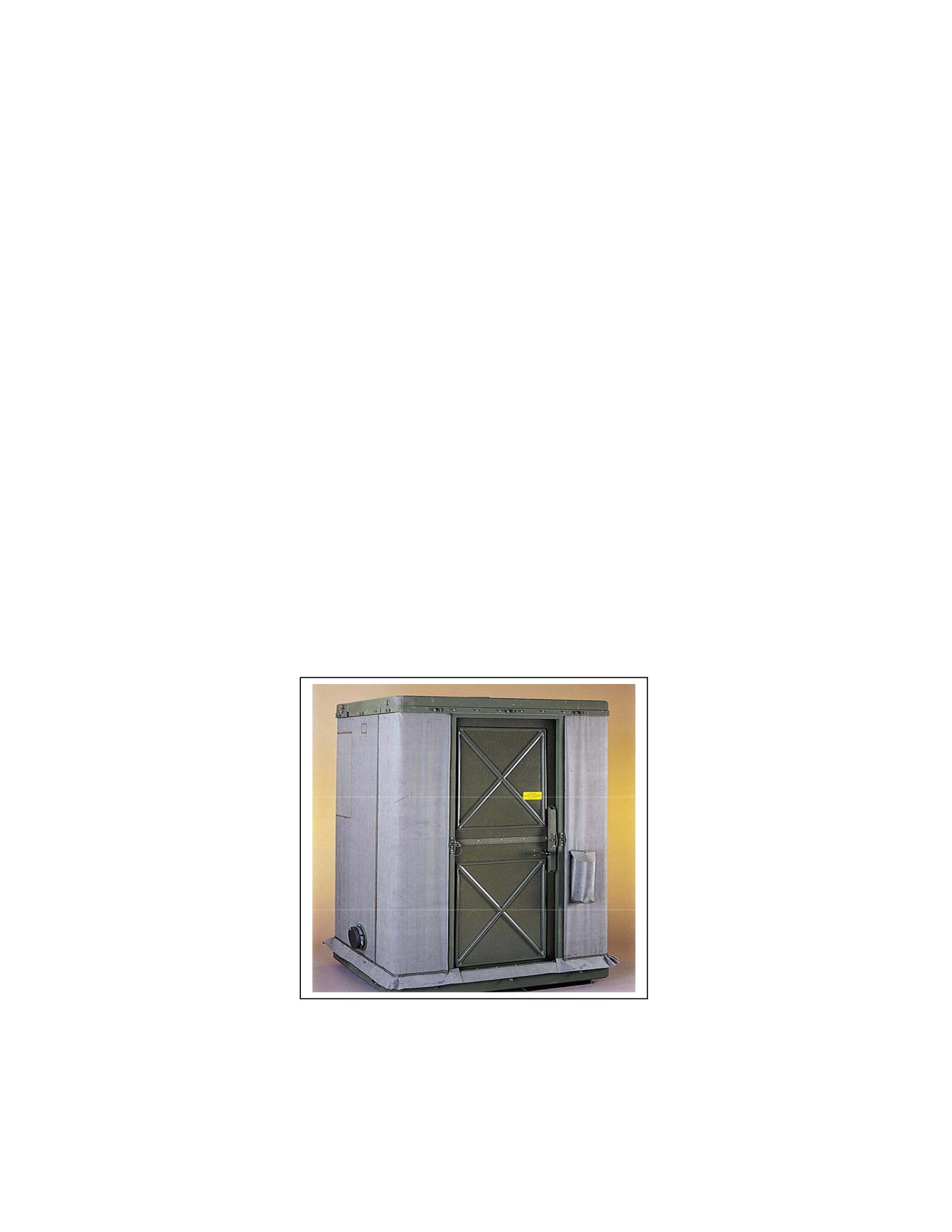
(2)
Protective Entrance With an Air Lock. An air lock prevents contamination
from entering the enclosure. The air lock is pressurized, and contamination is eliminated
through the use of filtered air. Air pressure in the entrance is slightly less than that in the
protective enclosure but slightly more than outside pressure. An air lock is a transition
enclosure—a protected entryway in which personnel wait for a period of 3 to 5 minutes
before entering or exiting the TFA. The main function of the air lock is to prevent direct
vapor transport into the TFA. During the air lock-purging period, the flow of filtered air
through the air lock flushes out airborne contaminants introduced with the opening of the
outer door. The air lock also ensures that TFA overpressure is not compromised during the
entry or exit. Air passing through the air lock purges contaminants that might enter during
entry or exit of personnel or equipment. This air comes from the protective enclosure, the
filter unit, or both. Different PE configurations create variations of the overpressure
category. The variations are those with a single air lock and those with a two-stage air lock.
(a) Protective Entrance With Single Air Lock. Many shelters modified for
COLPRO use a single-compartment protective entrance. An example is the M12 protective
entrance (Figure B-1). Using a dedicated filter unit for the air lock helps maintain TFA
integrity. Before entering the air lock from a contaminated area, personnel must remove
their MOPP gear except gloves and masks. Minor exposure to a chemical agent vapor is
possible between the overgarment removal and the entrance into the air lock. Clothing
tends to absorb any chemical agent vapor in the atmosphere during this brief exposure. The
amount of agent absorbed depends on the agent concentration in the atmosphere, the
length of exposure, the type of agent, the type of clothing exposed, and the climatic
conditions. The air purge in the air lock flushes out the contaminated air. It also reduces
the amount of absorbed agent on clothing before the individual enters the protective
shelter. After an individual and/or piece of equipment enters the protective shelter,
monitoring ensures that hazardous levels of the agent are not carried inside.
Figure B-1. M12 Protective Entrance
(b) Protective Entrance with Two-Stage Air Lock. Adding a CCA to a
single air lock system creates a two-stage air lock (Figure B-2 [page B-34]). Entering
B-33
personnel remove MOPP gear in the CCA. This system affords better control of liquid and
vapor hazards during entry and exit.
No Air-Lock System
Single Air-Lock System
Two Stage Air-Lock System
Figure B-2. Collective-Protection
Entrance Configurations
(3)
Integral Protective Entrances. Integral PEs are those that are included in
the manufacturing process for the shelter. Integral PEs are designed to offer improved
accessibility, more convenient storage and transport, and reduced setup time. For example,
the contamination avoidance protective entrance (CAPE) is on every Standardized
Integrated Command Post System (SICPS) shelter fielded. The CAPE helps to minimize
liquid and vapor contamination during limited entry/exit. Occupants must be masked and
the shelter purged following use. There are two types of integral PEs—internal and
external. Integral PEs are smaller than the detachable PEs and require less airflow during
the purge cycle.
• Internal Integral PE. Deployed internally, the integral PE can remain in its
functional configuration and need not be stowed for transport. Since it is contained within
the shelter, it is much less vulnerable on the battlefield.
• External Integral PE. The external integral PE is used for shelters that cannot
sacrifice the internal space. The external integral PE must be stowed for transport.
c.
Establishment of Protective Shelters. There is equipment in the US DOD
inventory that can be used to establish protective shelters. Examples include the fan filter
assembly (FFA) 580; the USAF A/E32C or Army C-100 air conditioner; the field depolyable
environmental control unit (FDECU) with CB hardening kit and M28 CPE blower, a filter,
and air ducts; the chemically/biologically hardened air management plant (CHAMP); and
the M96 modular collective protective equipment (MCPE) filter unit.
(1)
Fan Filter Assembly 580. The FFA 580-filter unit for is a 600 CFM filter.
The FFA 580 employs the modular CPE filter set, which is the most widely used filter set
among the USA, USN, and USAF. This unit provides an option for integrating filtration
with air conditioning, and it has the lowest hardware and operating costs among
transportable filter units employing standard military filters. Where the building would
B-34
require more than the capacity of the FFA 580 unit, the M49 filter unit or a large-capacity,
commercial filter unit built to military specifications should be considered.
(2)
Modification of Environmental Control Units. Short of major modifications
to the HVAC systems, users could modify an existing environmental control unit by adding
a GPFU.
B-35

Appendix C
HUMAN FACTOR EFFECTS OF MISSION-ORIENTED PROTECTIVE
POSTURE
1.
Background
This appendix provides information on the physiological and psychological stress
incurred while wearing the BDU, BDO, or JSLIST. Once an accurate assessment of the
NBC threat has been made, the key to selecting an appropriate MOPP level lies in
understanding the physiological and psychological stresses placed upon the wearer.
Multiple physiological and psychological factors can impact unit personnel, but there are
countermeasures that can be taken to mitigate the effects.
2.
Physiological Factors
a.
Heat Stress. Body temperature must be maintained within narrow limits for
optimum physical and mental performance. The body produces more heat during work than
at rest. Normally, the body cools itself by the evaporation of sweat and the radiation of heat
at the skin surface. MOPP gear restricts these heat loss mechanisms because of its high
insulation and low permeability to water vapor. In addition, physical work tasks require
more effort when personnel wear protective clothing because of its added weight and
restricted movement. Work intensity is also a major contributing factor to heat stress that
can be managed by leaders. Military work can be categorized as light, moderate, or heavy.
Table C-1 provides examples of work activities that can be used as guides in estimating the
work intensity for a particular mission or task.
Table C-1. Work Intensities of Military Tasks1
Light (Easy) Work
Moderate Work
Heavy (Hard) Work
Weapons maintenance
Walking on loose sand at 2.5 mph
Walking on hard surfaces at 3.5 mph
with no load
with more than a 40-pound load
Walking on hard surfaces at 2.5
mph, with less than a 30-pound load
Walking on hard surfaces at 3.5 mph
Walking on loose sand at 2.5 mph,
with less than a 40-pound load
with any load
Guard Duty
Calisthenics
Armament crew functions
Marksmanship training
Patrolling
Rapid runway repair
Drills and ceremonies
Individual movement techniques
Heavy aircraft repair
Tower operations
such as low or high crawl
Pilot ground activities
Avionics shop activities
CP activities
Aircraft maintenance activities
1 Representative tasks listed in this table were obtained from FM 21-10/MCRP 4-11.10, Field Hygiene and Sanitation.
C-1
(1)
Military personnel wearing CP clothing often experience heat stress. To
prevent such heat stress from resulting in heat stress-related injuries, they follow a
prescribed cycle of work and rest periods. The work/rest cycles are based on the
environment (temperature, humidity, and solar load), the workload of the individual, and
the clothing ensemble being worn. These work/rest cycles are usually described in terms of
minutes of work allowed per hour. The remainder of the hour (after completing the allowed
work) is used for rest to allow heat to dissipate and to allow the individual to cool down.
(2)
Under most conditions, when individuals are wearing heavier garments,
the amount of work allowed per hour is less than the amount of work allowed when wearing
a lighter garment. However, under some conditions, the work allowed per hour is actually
greater when wearing a heavier garment than when wearing a lighter garment.
(3)
When an individual is wearing CP clothing, the primary modes of heat
exchange between the individual and the surroundings are by conduction, evaporation (of
sweat), and solar radiation (if the sun is out). The nature of CP clothing is such that
convective heat transfer (due to the movement of the air) is minimized by the garments and
is not a significant factor. Evaporation will always result in a cooling effect for the
individual if the water vapor can escape from the clothing ensemble. The amount of
evaporative cooling depends on the humidity of the ambient air and upon the rate at which
the water vapor can escape.
(4)
Solar radiation (if present) will always result in adding heat to the
individual. As the sun beats down on the surface of the clothing, the garments will heat up.
Eventually, the heat will be transferred through the clothing layers to the individual. This
heat from the solar radiation will increase the heat stress situation.
(5)
Heat transfer by conduction depends on the skin temperature of the
individual and the ambient air temperature. When the skin temperature is greater than
the ambient temperature, the heat will transfer from the skin to the surrounding air. When
the ambient air temperature is greater than the skin temperature, the heat will transfer
from the surroundings to the skin, heating up the individual.
(6)
In most situations, the total heat lost (by evaporation and conduction [if the
skin is warmer than the ambient air]) is greater than the heat gained (by solar radiation, if
present, and by conduction, if the air is warmer than the skin). Insulation, of course,
reduces the rate at which this heat transfer occurs, but it cannot prevent it entirely. The
greater the insulation, the lower the rate of heat transfer and the greater the heat stress
induced upon the individual. This is the normal, expected situation in which the heavier
garment (i.e., BDO) induces more heat stress than the lighter garment (i.e., JSLIST).
(7)
In some cases, especially under conditions of high ambient temperature or a
solar load, the heat gained from the environment is greater than the heat loss. Insulation
reduces the rate at which this heat transfer occurs. In this case, the heavier garment
protects the individual from the high external heat load better than the lighter garment.
Hence, an individual can actually work longer in the heavier garment (i.e., BDO) than in
the lighter garment (i.e., JSLIST) under such conditions. This is why desert nomads wear
wool to protect themselves from the high external heat load caused by solar radiation and
high ambient air temperatures.
C-2
b.
Dehydration.
(1)
Impact. Because of higher body temperatures, individuals in MOPP gear
sweat considerably more than usual, often more than 1.5 quarts of water every hour during
work. Water must be consumed to replace lost fluids, or dehydration will follow. Even a
slight degree of dehydration impairs the body’s ability to regulate its temperature and
nullifies the benefits of heat acclimatization and physical fitness. It increases the
susceptibility to heat injury and reduces work capacity, appetite, and alertness. Even in
individuals who are not heat casualties, the combined effects of dehydration, restricted heat
loss from the body, and increased work effort place a severe strain on the body’s functions.
Individuals, therefore, suffer from decrements in mental and physical performance. The
difficulty of drinking in MOPP increases the likelihood of dehydration. Thirst is not an
adequate indicator of dehydration, and individuals will not sense when they are
dehydrated. Individuals will habitually fail to replace body water losses, even when
drinking water is readily available.
(2)
Mitigation Measures. Individuals should drink as much water as possible
before donning the mask. Frequent drinking while working is more effective in
maintaining hydration than waiting until rest periods to drink. The unit chain of command
must take responsibility for enforcing regular and timely fluid replacement in their
personnel.
c.
Inadequate Nutrition.
(1)
Impact. In addition to bodily requirements for electrolyte (salt) replacement
caused by sustained and excessive sweating, the higher work intensities typical of
operations in MOPP lead to an increased demand for calories. The lack of adequate energy
supplies can lead to decrements in physical and mental performance.
(2)
Mitigation Measures. The method selected to minimize feeding-related
problems depends on the availability of safe, uncontaminated areas, and operational
constraints. In a contaminated area where there is also a vapor hazard, personnel can be
moved into a contamination-free facility or CPS. Since CPSs have limited capacity, small
groups can be rotated through these facilities. In a contaminated area with no COLPRO
available, relocate personnel to a safe area for feeding by rotating small portions of the unit
or by replacing the entire unit. If personnel are in a contaminated area with no detectable
vapor hazard or in a clean area where they are under a constant threat of NBC attack, use
a rotating method to feed about 25 percent at any one time. Take care to prevent
contaminating the food.
C-3