FM 4-20.142 Airdrop of Supplies and Equipment: Rigging Loads for Special Operations (September 2007) - page 4
Chapter 4
1
3
2
1.
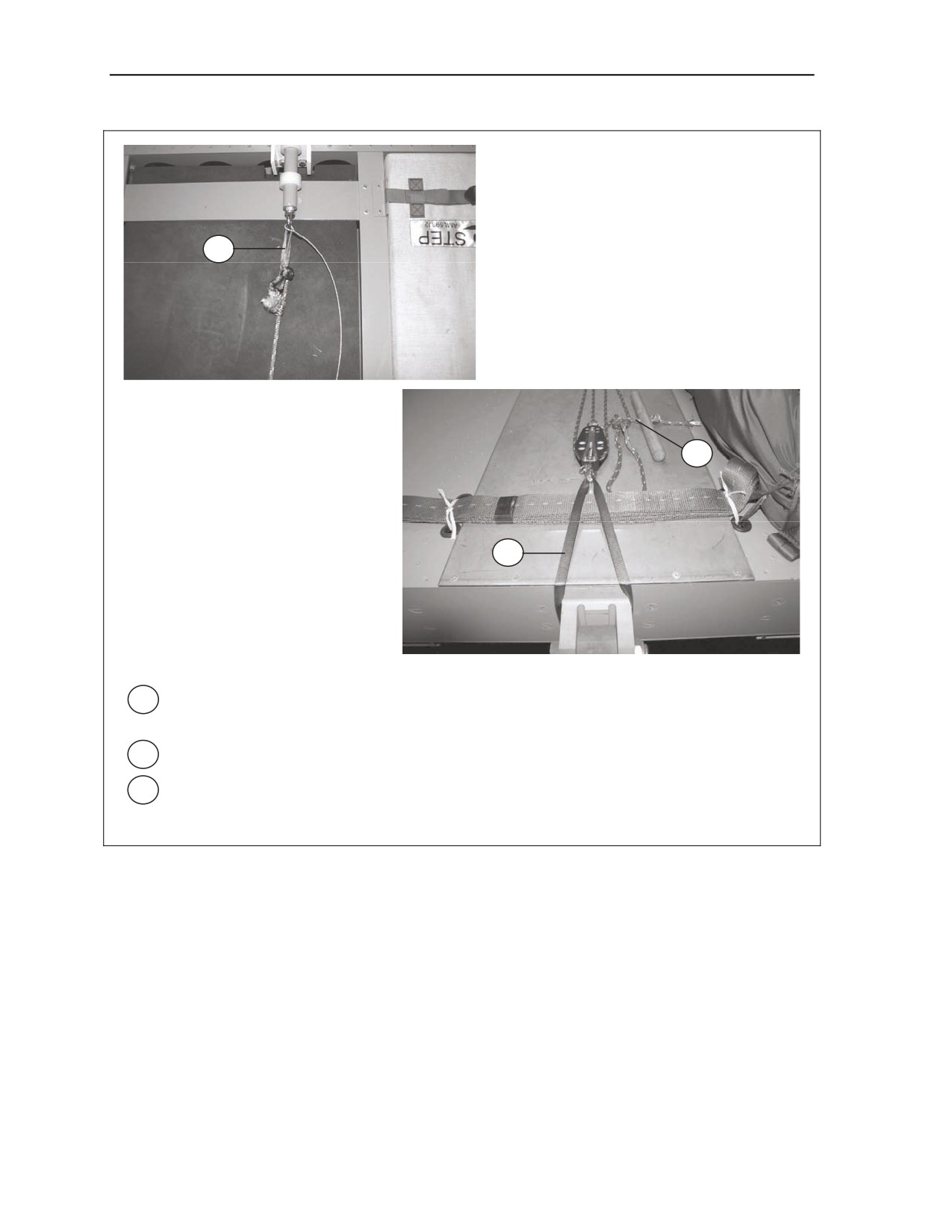
Secure the pulley assembly to the end ring of the push rod with a loop of 1/2-inch tubular
nylon cord tied with a square knot.
2.
Tie the running end to the extraction bracket with 1/2-inch tubular nylon.
3. Pull on the free end of the cord to ensure that the push rod can be pulled fully against its
spring.
Figure 4-4. Platform Release Pulley Assembly Installed
FM 4-20.142/MCRP 4-11.3P/NAVSEA SS400-AD-MMO-010/ TO 13C7-51-21
4-4
19 September 2007
Rigging the Naval Special Warfare Rigid Inflatable Boat (NSW RIB) for Low-Velocity Airdrop
4
3
3
5
2
2
2
1
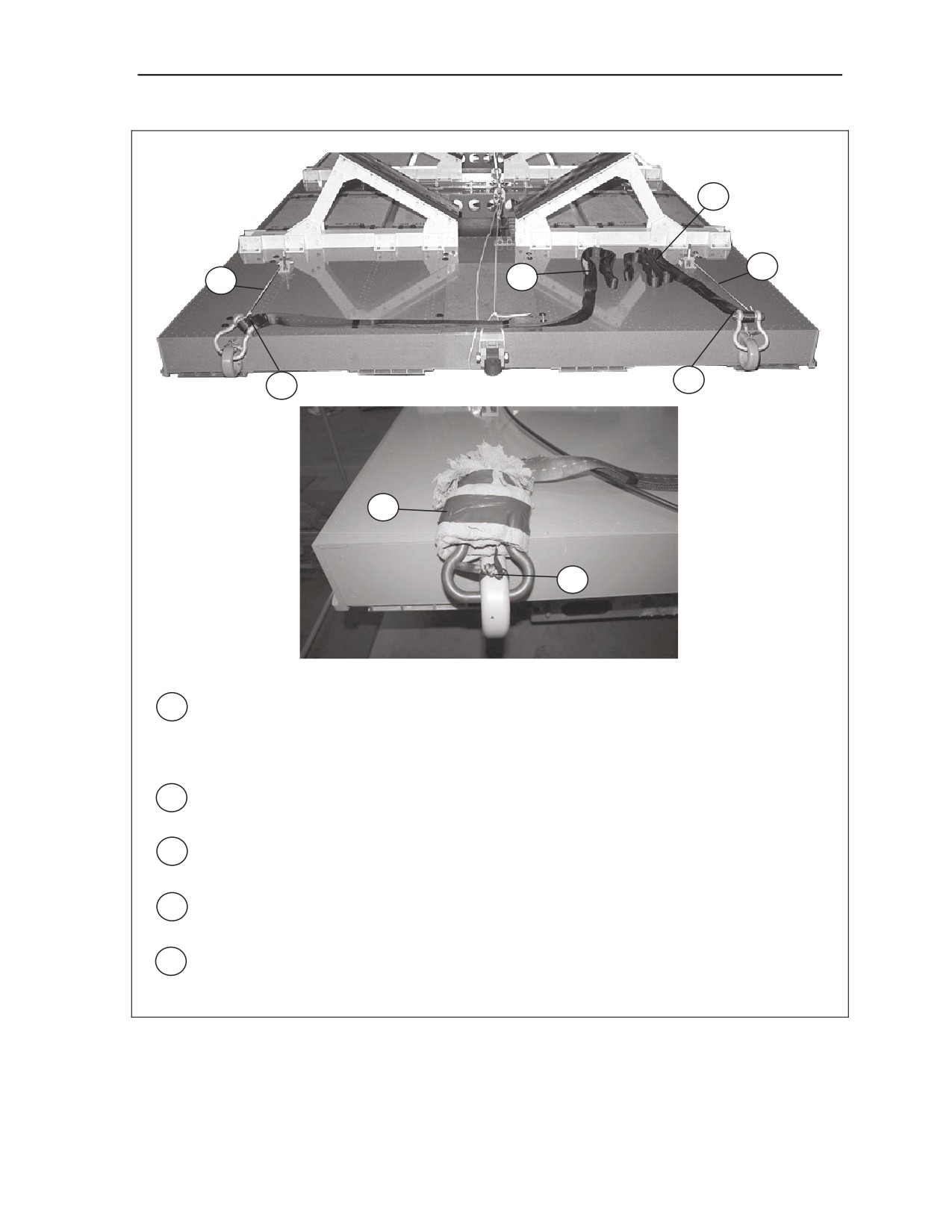
1.
Center a length of 1/2-inch tubular nylon webbing with a girth hitch in the bell of a medium
clevis. Bring the ends of the webbing over the top of the suspension point and secure tightly
with a surgeon’s knot and locking knot, with overhand knots in the running ends. Repeat for
the other side of the platform.
2.
Install a 9-foot, 2-loop, type XXVI nylon sling on the bolt of each medium clevis. Wrench-
tighten the nuts. Pad each clevis with cellulose wadding and tape in place.
3.
Secure each clevis in an upright position with a length of type I, 1/4-inch cotton webbing tied
to a convenient point on the platform.
4.
Pass the right sling up to a point centered between the four pairs of deck holes on the right
side of the platform. S-fold the sling as shown.
5. Pass the left suspension sling across the rear between the pairs of deck holes, and up to
meet the right sling. S-fold the left sling in the same way.
Figure 4-5. Platform Recovery Parachute and Slings Installed
FM 4-20.142/MCRP 4-11.3P/NAVSEA SS400-AD-MMO-010/ TO 13C7-51-21
19 September 2007
4-5
Chapter 4
6
8
7
9
6
10
11
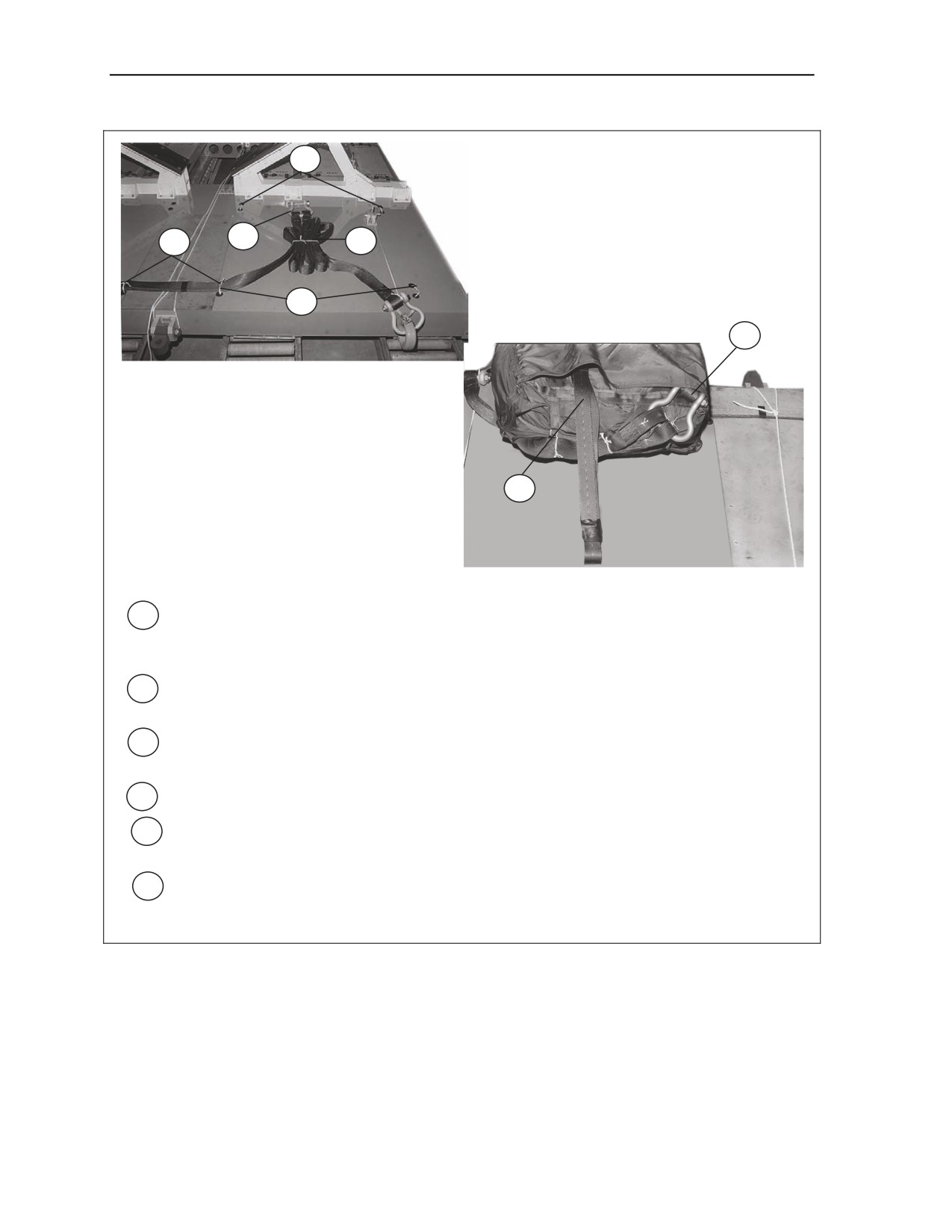
6.
Pass an 18-inch length of 1/2-inch tubular nylon webbing through each pair of deck holes to
the right of the extraction bracket. Tie with a square knot, with overhand knots in the running
ends. Rotate the knots to the underside of the platform, and tape the nylon webbing.
7.
Tie the left suspension sling to each of the two pairs of deck holes with a single turn of type I,
1/4-inch cotton webbing.
8.
Place the free ends of both slings in the bell of a medium clevis, and place the clevis against
the base of the right rear stanchion.
9. Tie the folds of the two slings together with a length of type I, 1/4-inch cotton webbing.
10. Remove the tripled cotton webbing bag closing tie from the G-12-clevis. Install a 20-foot, 2
loop, type XXVI riser extension on the bolt of the G-12 clevis.
11. Stow the riser extension in the G-12E bag according to FM 4-20.102/MCRP 4
11.3J/NAVSEA SS400-AB-MMO-010/TO 13C7-1-5.
Figure 4-5. Platform Recovery Parachute and Slings Installed (continued)
FM 4-20.142/MCRP 4-11.3P/NAVSEA SS400-AD-MMO-010/ TO 13C7-51-21
4-6
19 September 2007
Rigging the Naval Special Warfare Rigid Inflatable Boat (NSW RIB) for Low-Velocity Airdrop
15
14
12
13
16
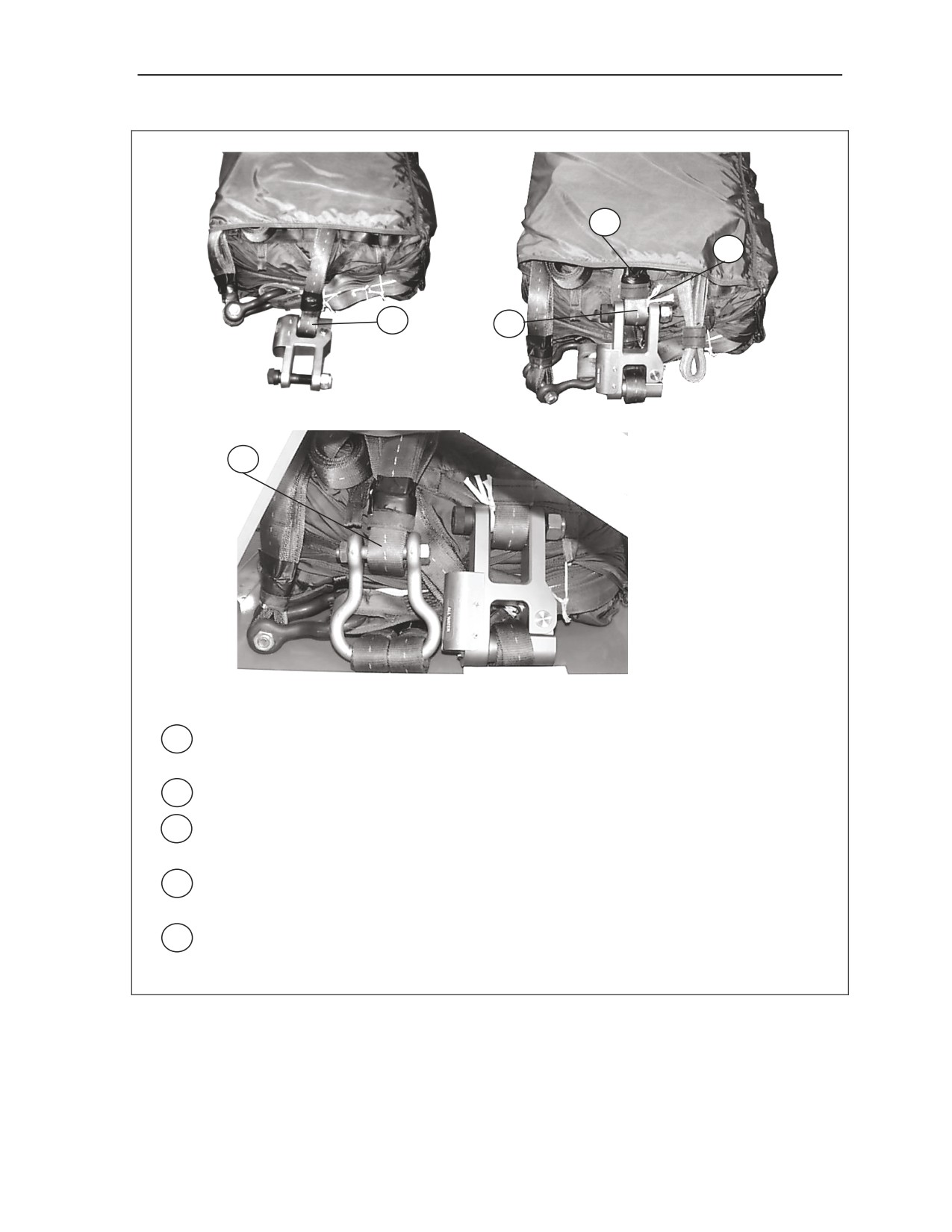
12. Inspect a water-activated parachute release (WAPR) according to the manufacturer’s
instructions. Attach the discharge end of the WAPR to the riser extension.
13. Attach a 3-foot, 2-loop, type XXVI nylon sling to the stationary bolt of the WAPR.
14. Safety the bolt of the WAPR to the G-12 bag stow bar with one turn single type I, 1/4-inch
cotton webbing.
15. Fold the 3-foot sling in half and secure it with paper masking tape (not shown). Place the
sling under the G-12 riser extension flap.
16. Turn the parachute so that the WAPR faces the front of the platform. Connect the free end of
the 3-foot sling installed in step 13 to the clevis at the end of the platform suspension slings.
Figure 4-5. Platform Recovery Parachute and Slings Installed (continued)
FM 4-20.142/MCRP 4-11.3P/NAVSEA SS400-AD-MMO-010/ TO 13C7-51-21
19 September 2007
4-7
Chapter 4
19
20
22
18
18
21
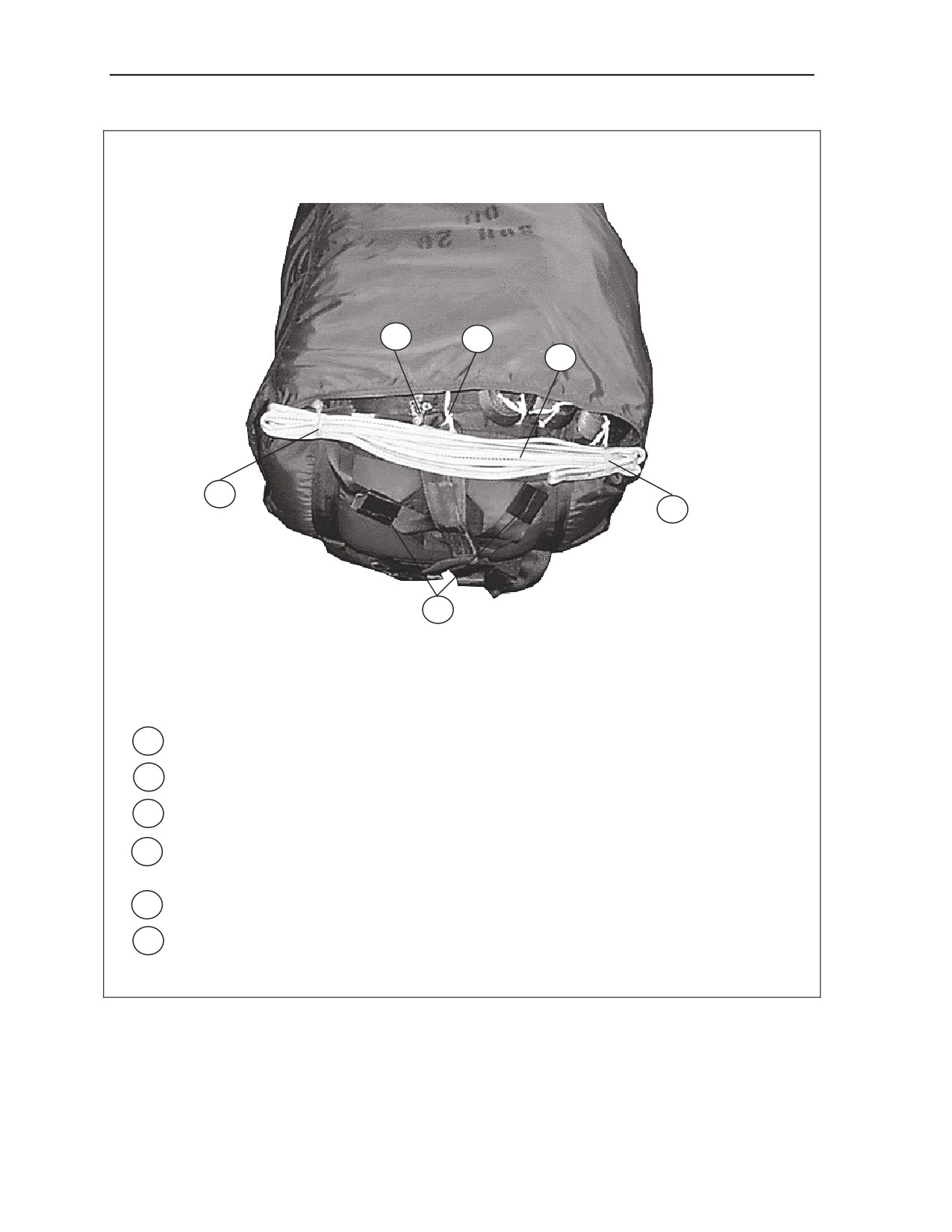
17. Remove the universal static line snap hook from a T-10 universal static line (not shown).
18. Girth hitch two retainer bands to each end of the riser extension stow bar.
19. Girth hitch the universal static line to the bridle loop of the G-12 cargo parachute.
20. Safety the bridle loop to the riser extension stow bar with one turn single of type I, 1/4-inch
cotton webbing.
21. S-fold the excess bridle assembly and secure it with tape.
22. S-fold the universal static line across the rear of the parachute, securing it with the retainer
bands installed in step 18. Wrap the retainer bands twice around the static line.
Figure 4-5. Platform Recovery Parachute and Slings Installed (continued)
FM 4-20.142/MCRP 4-11.3P/NAVSEA SS400-AD-MMO-010/ TO 13C7-51-21
4-8
19 September 2007
Rigging the Naval Special Warfare Rigid Inflatable Boat (NSW RIB) for Low-Velocity Airdrop
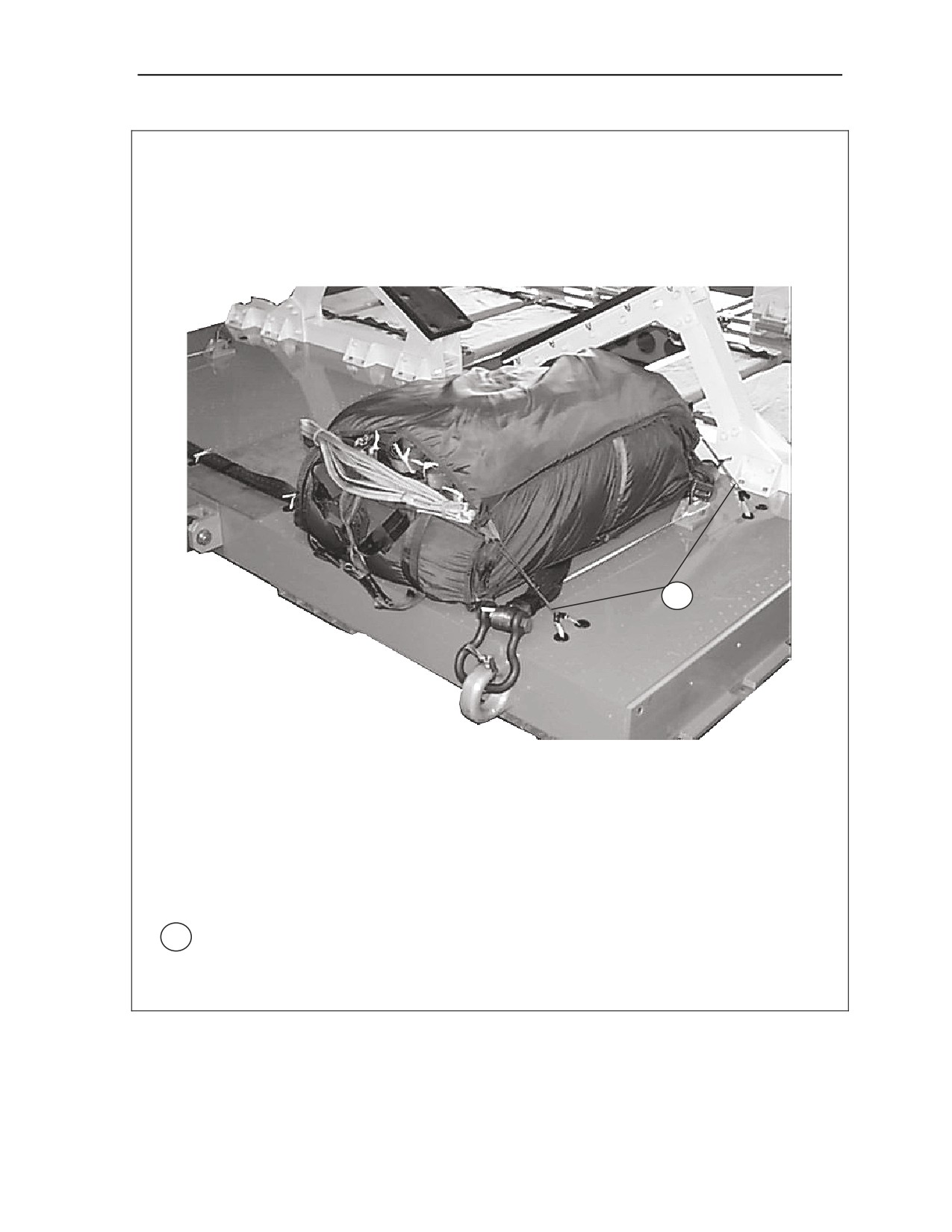
23
23. Place the G-12 parachute over the suspension slings, and align with the rear edge of the
platform and the center deck holes as shown. Tie the corners of the G-12 deployment bag to
the ties placed in step 6 with type III nylon cord with the core threads removed.
Figure 4-5. Platform Recovery Parachute and Slings Installed (continued)
FM 4-20.142/MCRP 4-11.3P/NAVSEA SS400-AD-MMO-010/ TO 13C7-51-21
19 September 2007
4-9
Chapter 4
INSTALLING THE PLATFORM RELEASE SYSTEM
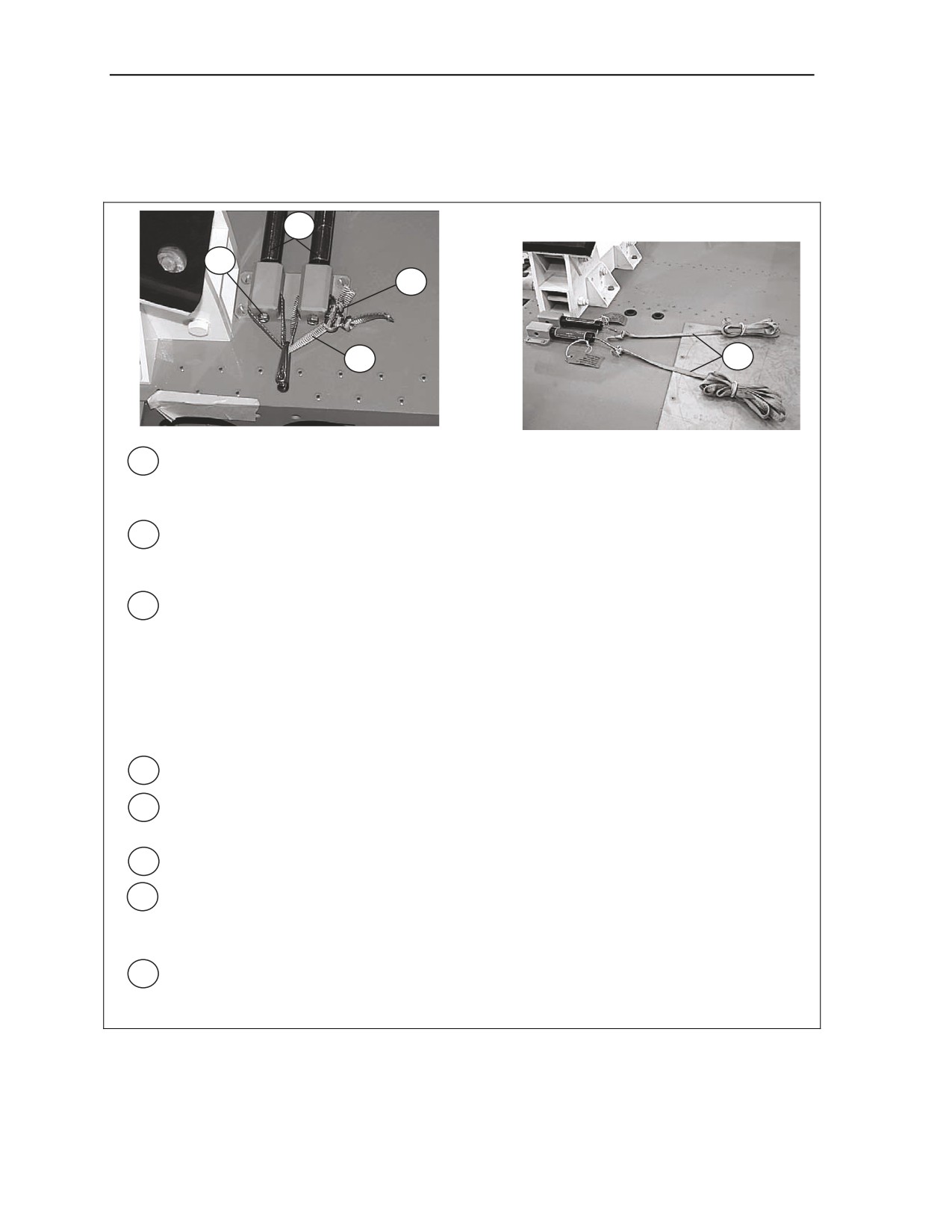
4-3. Install the components of the platform release system as shown in Figures 4-6 and 4-7.
2
4
5
3
7
Note. This knot must be on the left forward end of the cutter brackets.
1.
Put tension on the central push rod using the pulley assembly. Insert the T-pin through the
push rod holes when the holes are aligned with the pin bracket. Connect the drawbar cable to
the bolt end of the halyard shackle (Not shown).
2.
Install two M-21 reefing line cutters in the cutter brackets. Ensure that the screws on the
sides of the cutters are facing the deck of the platform. Ensure the cotter pins can be
removed from the cutters once they are installed.
3.
Route a length of 1/2-inch tubular nylon as follows:
• Through the left cutter bracket
• Through the bell end of the locking halyard shackle
• Through the inside of the left cutter bracket, and out through the left side
• Through right cutter bracket
• Back through the bell end of the locking halyard shackle, and up to the other free end of
the tie
4.
Tighten the screws in the bottom ends of the cutter brackets.
5.
Secure the running ends tightly with a surgeon’s knot and locking knot, with an overhand knot
in the running ends.
6.
Disconnect the cable from the halyard shackle. Replace the shackle pin (not shown).
7.
Install a 10-foot length of ½-inch tubular nylon webbing to each M-21 cutter arming cable with
three alternating half hitches and overhand knots in the running ends. S-fold the excess and
secure temporarily with retainer bands.
8.
Remove tension on the central push rod using the pulley assembly. Ensure the T-pin is
removed (not shown).
Figure 4-6. Cutters Installed
FM 4-20.142/MCRP 4-11.3P/NAVSEA SS400-AD-MMO-010/ TO 13C7-51-21
4-10
19 September 2007
Rigging the Naval Special Warfare Rigid Inflatable Boat (NSW RIB) for Low-Velocity Airdrop
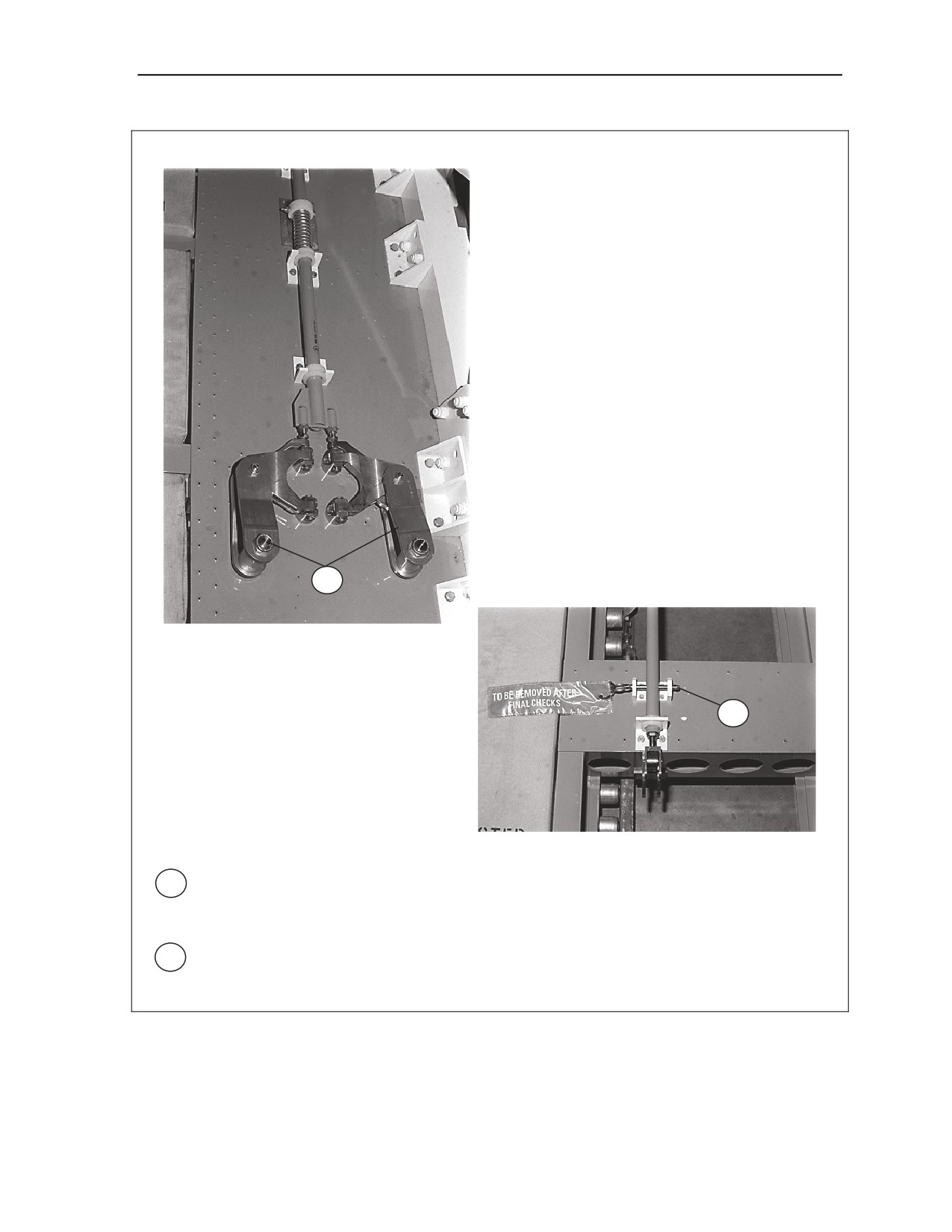
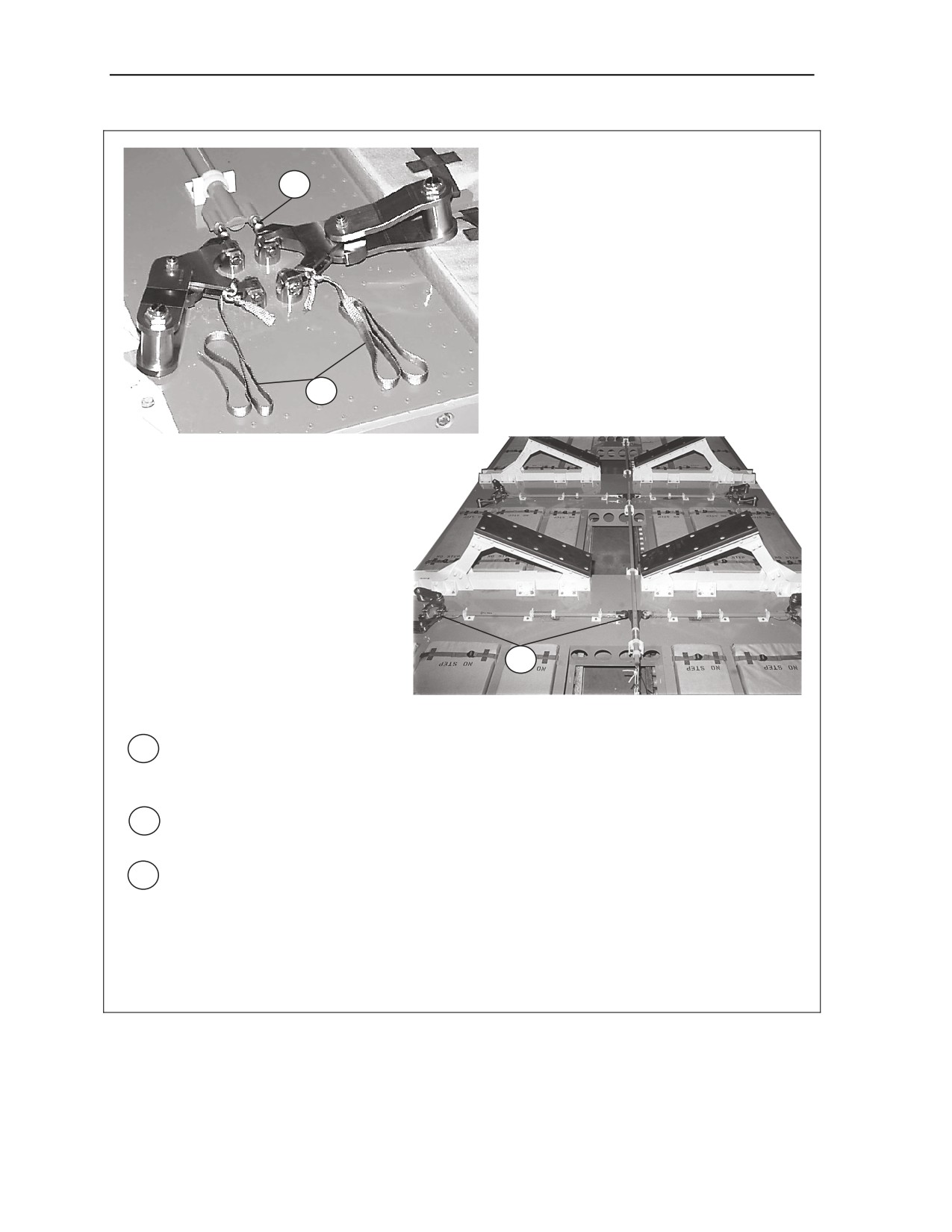
1
2
1. Place a tiedown shackle in each scissor release unit. Make sure the large nuts face the edge
of the platform, and are facing up. Make sure the scissor units are closed around the
shackles.
2. Put tension on the central push rod with the lanyard attached to the pulley assembly. Insert
the T-pin through the push rod holes when the holes are aligned with the pin bracket.
Figure 4-7. Scissor Release Units Prepared and Tested
FM 4-20.142/MCRP 4-11.3P/NAVSEA SS400-AD-MMO-010/ TO 13C7-51-21
19 September 2007
4-11
Chapter 4
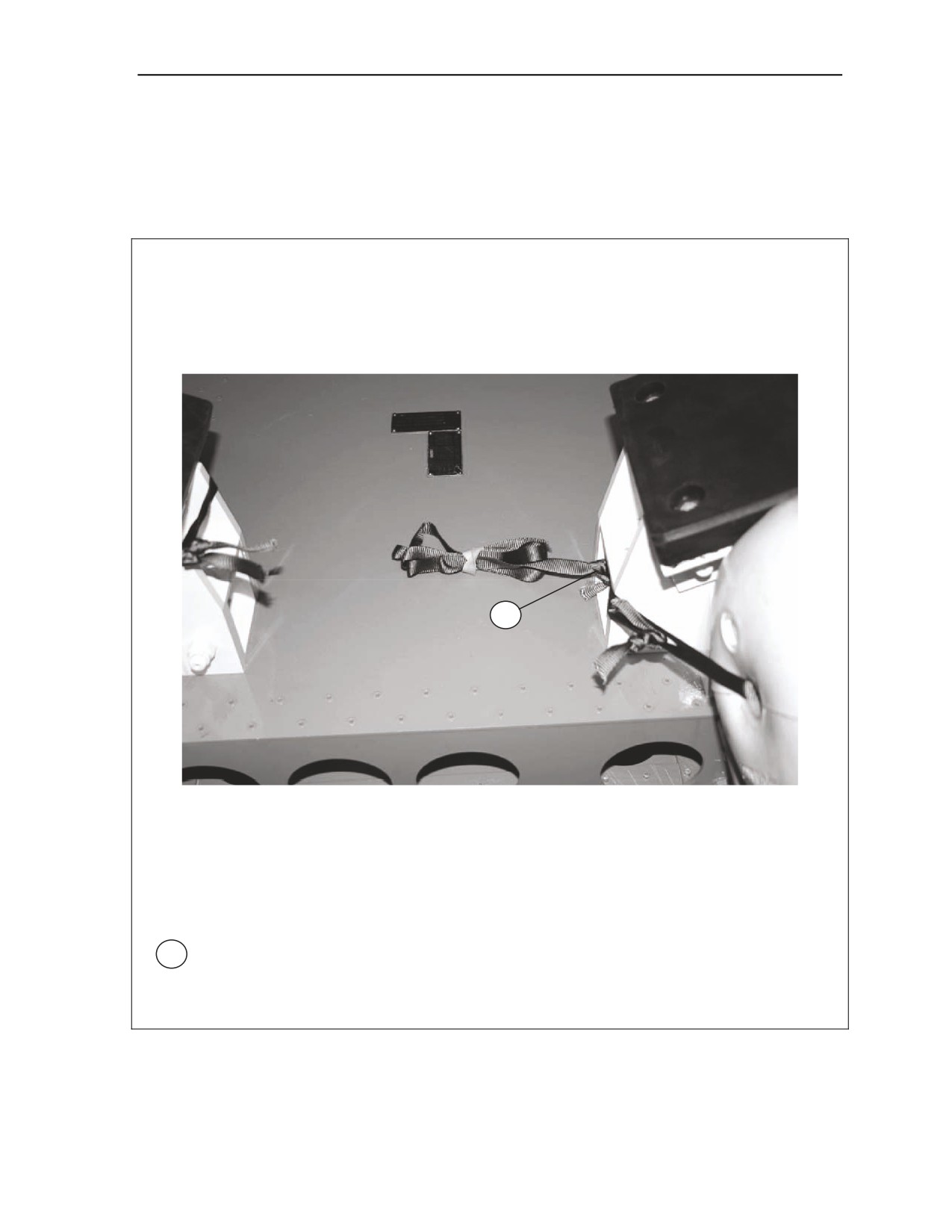
3
4
3
3.
Check all eight scissor release units to make sure they are held in place by the lateral rods.
When the central push rod is under tension and held by the pin, the cams engage the lateral
push rods to close the scissor releases.
4.
Tie a 60-inch length of ½-inch tubular nylon webbing to the outside leg of each scissor
release unit with three alternating half hitches and overhand knots in the running ends.
5. Test the scissor release system as follows:
• One person removes the T-pin at the front end of the push rod while another person
keeps the lanyard attached to the pulley under tension
• A third person holds the nylon lines attached to each pair of shackles. Release the
tension from the pulley, and be sure all eight shackles release from the scissor release
units as they are pulled by the lines (not shown)
Figure 4-7. Scissor Release Units Prepared and Tested (continued)
FM 4-20.142/MCRP 4-11.3P/NAVSEA SS400-AD-MMO-010/ TO 13C7-51-21
4-12
19 September 2007
Rigging the Naval Special Warfare Rigid Inflatable Boat (NSW RIB) for Low-Velocity Airdrop
INSTALLING EXTRACTION FORCE TRANSFER COUPLING (EFTC)
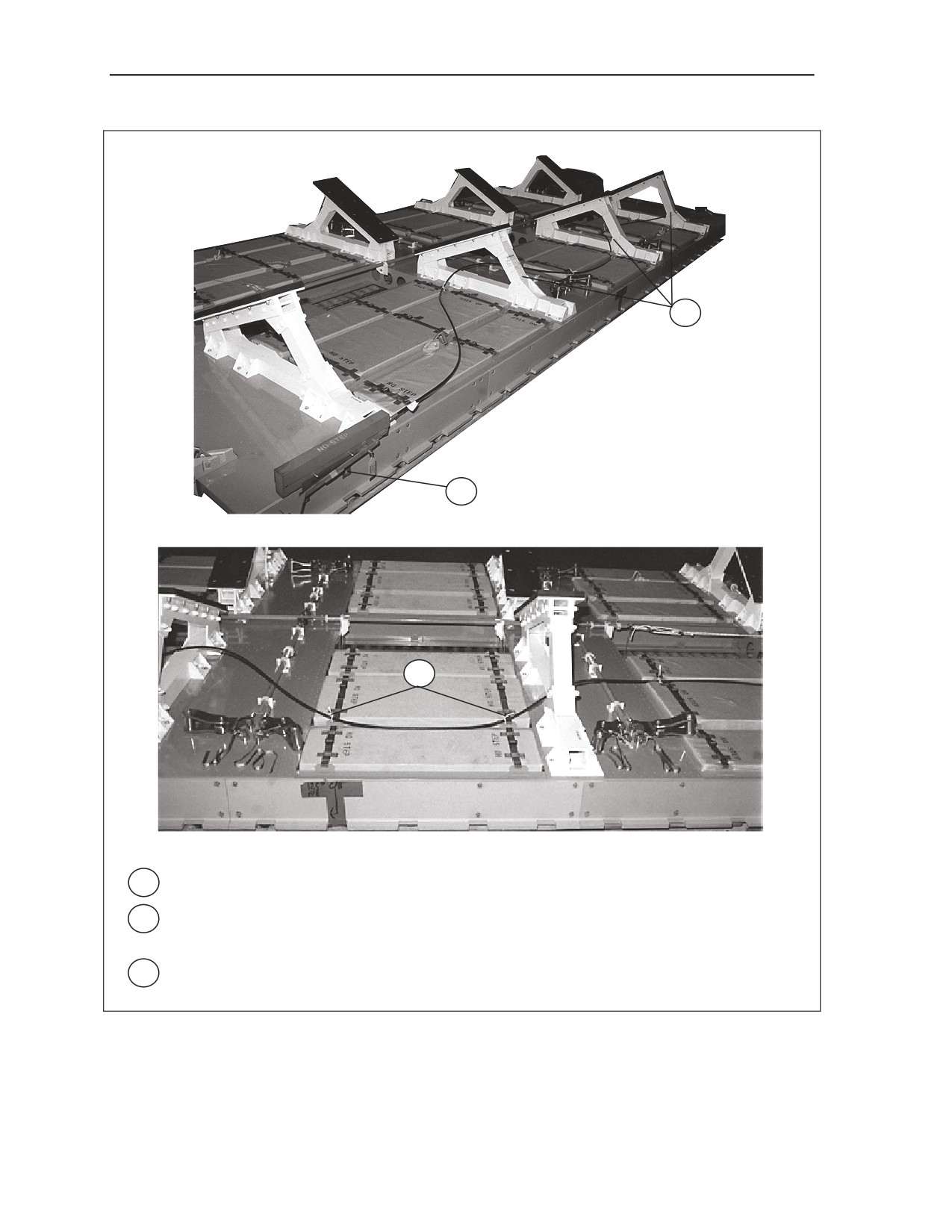
4-4. Install the drop arm retaining line as shown in Figure 4-8. Inspect and prepare the EFTC and a 24
foot cable in accordance with FM 4-20.102/MCRP 4-11.3J/NAVSEA SS400-AB-MMO-010/TO 13C7-1-5
and as shown in Figure 4-9.
1
1. Tie a 60-inch length of 1/2-inch tubular nylon webbing to the front right cradle bar with three
alternating half hitches and overhand knots in the running ends. S-fold the excess and secure
it temporarily with a rubber retainer band.
Figure 4-8. Drop Arm Retaining Line Installed
FM 4-20.142/MCRP 4-11.3P/NAVSEA SS400-AD-MMO-010/ TO 13C7-51-21
19 September 2007
4-13
Chapter 4
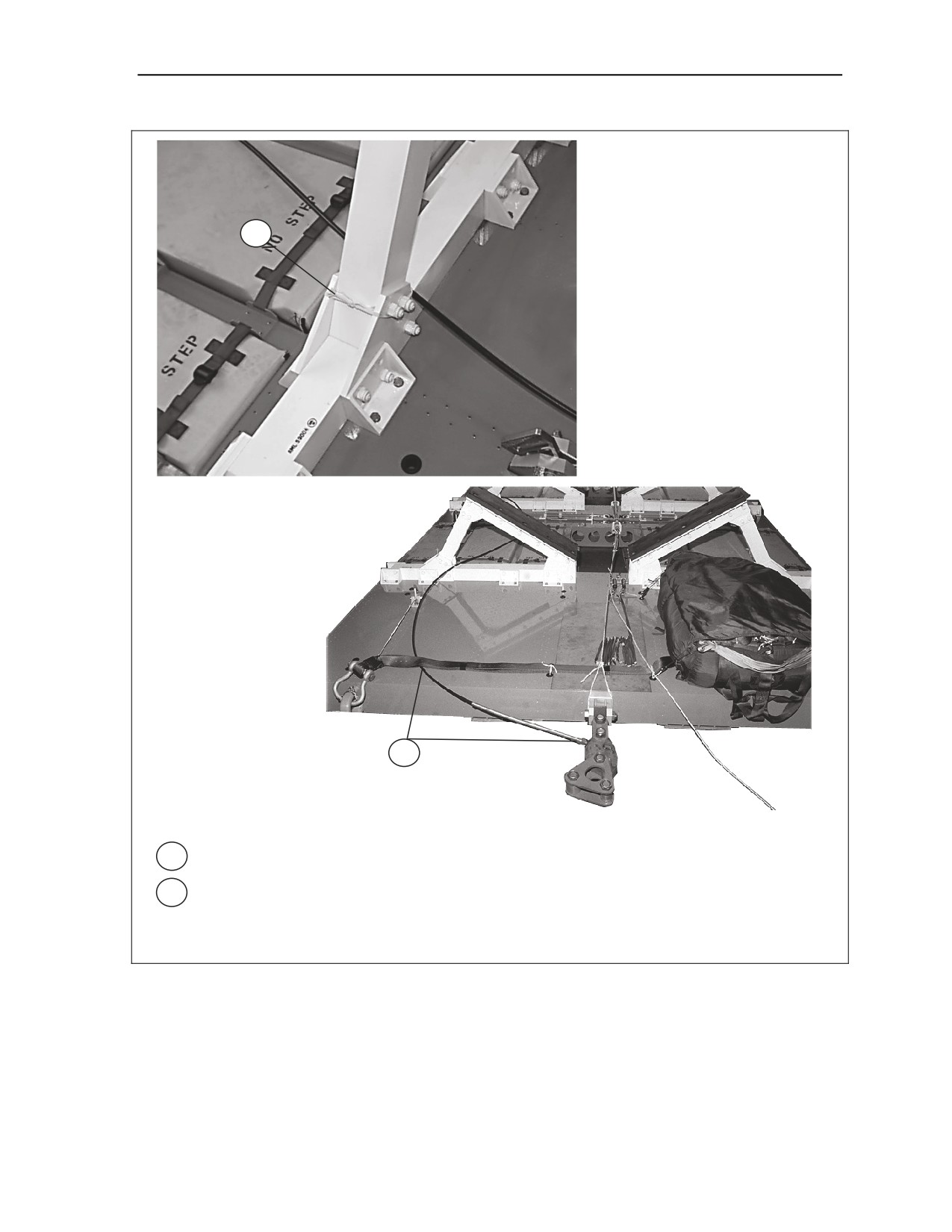
2
1
3
1.
Mount the actuator in the bracket provided and install a 24-foot EFTC cable to the actuator.
2.
Route the cable through left stanchions 2, 3, and 4. Be sure that the cable does not contact
any spring or push rod end in the push rod system.
3. Safety the cable to the flotation device securing brackets whenever possible.
Figure 4-9. EFTC Installed
FM 4-20.142/MCRP 4-11.3P/NAVSEA SS400-AD-MMO-010/ TO 13C7-51-21
4-14
19 September 2007
Rigging the Naval Special Warfare Rigid Inflatable Boat (NSW RIB) for Low-Velocity Airdrop
4
5
4. Tie the cable to the left rear stanchion arm with type I, 1/4-inch cotton webbing.
5. Install the EFTC latch assembly. Be sure the cable is routed under the suspension sling
before connecting it to the latch assembly.
Note. Replace any cable that has been used for a water drop.
Figure 4-9. EFTC Installed (continued)
FM 4-20.142/MCRP 4-11.3P/NAVSEA SS400-AD-MMO-010/ TO 13C7-51-21
19 September 2007
4-15
Chapter 4
LIFTING AND POSITIONING BOAT
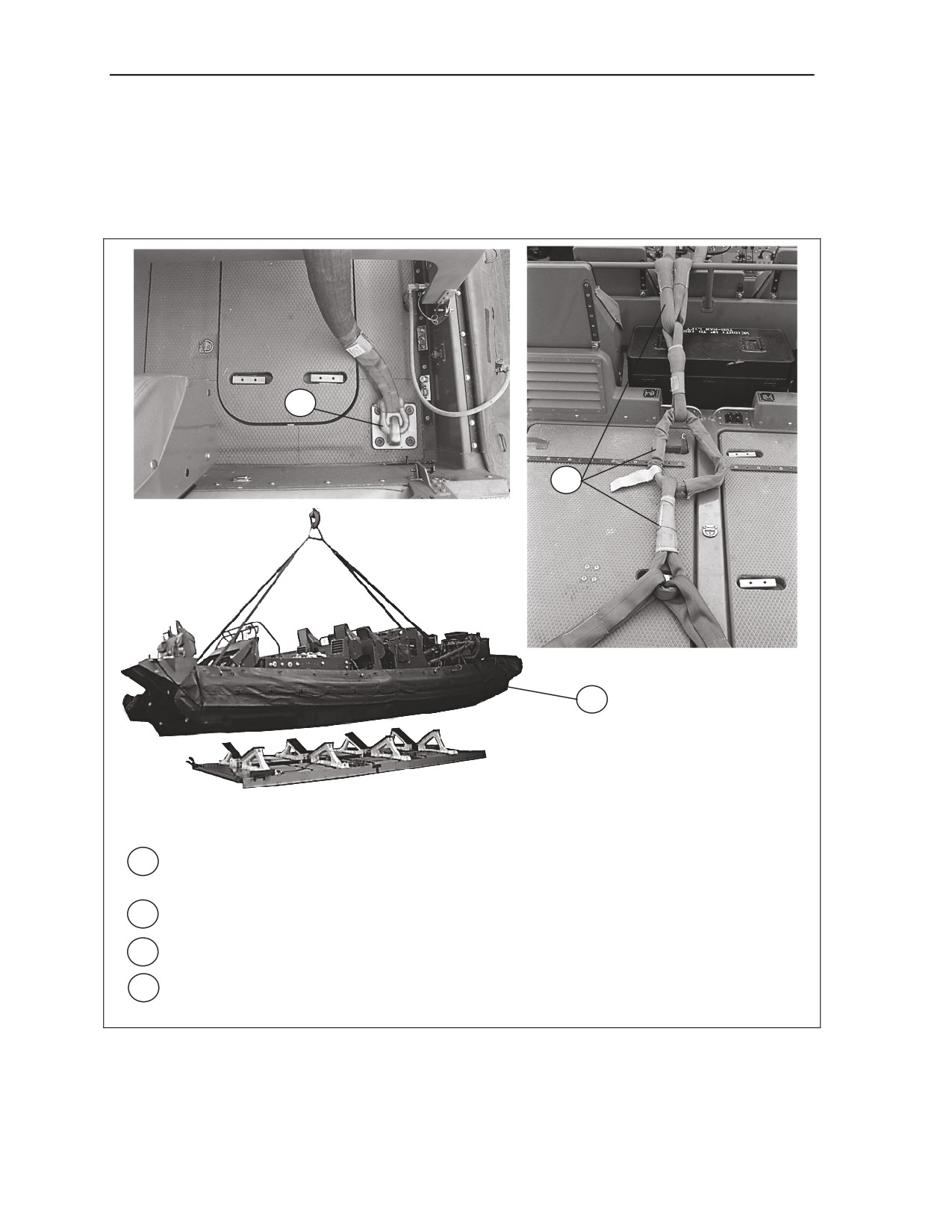
4-5. Use the lift kit provided with the boat (four long slings, three short loops, and clevises, instructions)
to place the boat onto the cradles as shown in Figure 4-10. Be sure that the Airdrop Boat Preparation
Checklist has been completed and signed before proceeding with the preparation of the boat.
1
2
3
1.
Attach a sling to each lifting provision with a screw-pin clevis, ensuring that the pins are
facing inboard to outboard.
2.
Assemble the lift kit according to the manufacturer’s instructions.
3.
Position the boat with the bow facing the rear of the platform.
4. Remove the lifting slings and shackles after positioning the boat (not shown).
Figure 4-10. Boat Lifted and Placed on Platform
FM 4-20.142/MCRP 4-11.3P/NAVSEA SS400-AD-MMO-010/ TO 13C7-51-21
4-16
19 September 2007
Rigging the Naval Special Warfare Rigid Inflatable Boat (NSW RIB) for Low-Velocity Airdrop
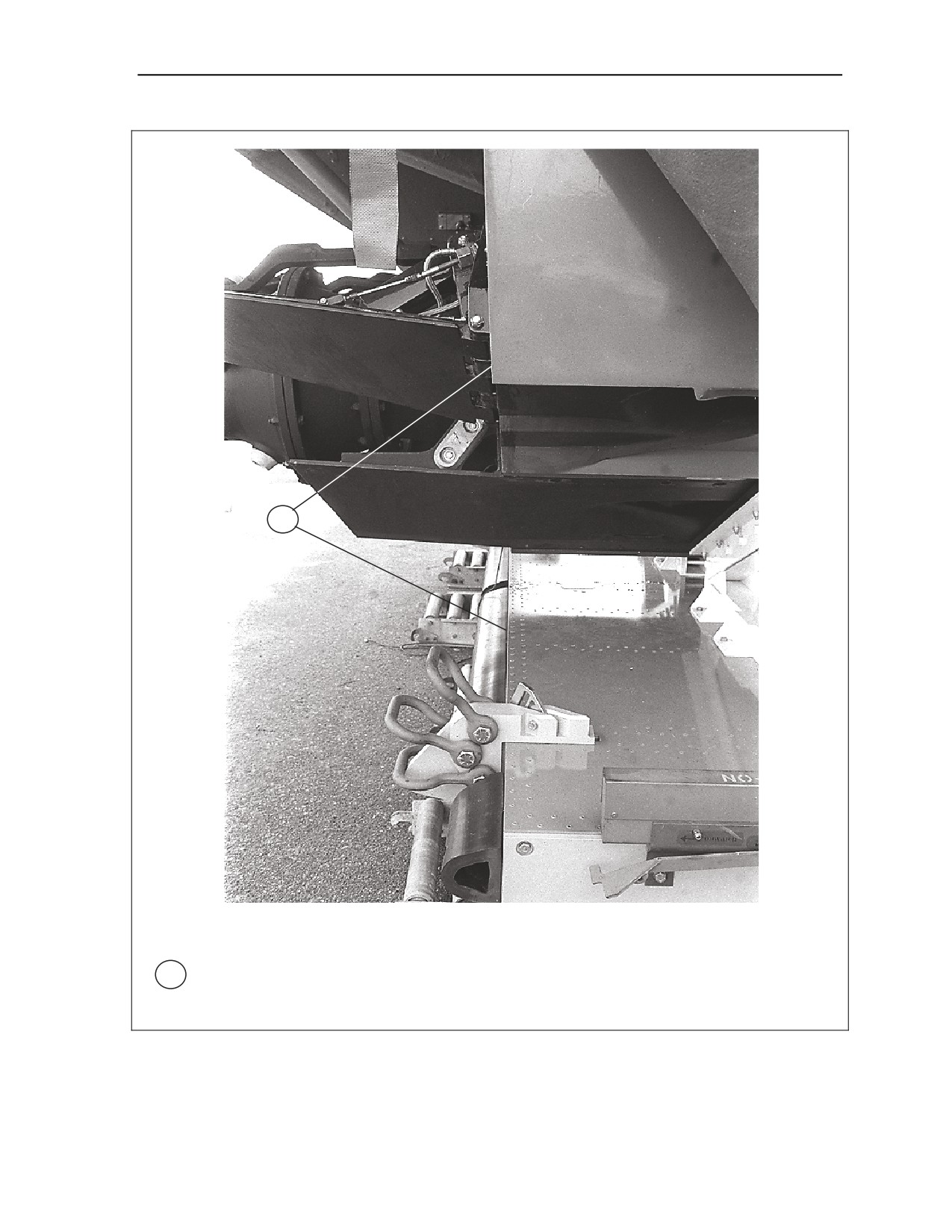
5
5. Align the rear edge of the transom with the front edge of the platform, disregarding the rubber
bumpers.
Figure 4-10. Boat Lifted and Placed on Platform (continued)
FM 4-20.142/MCRP 4-11.3P/NAVSEA SS400-AD-MMO-010/ TO 13C7-51-21
19 September 2007
4-17
Chapter 4
PREPARING BOAT
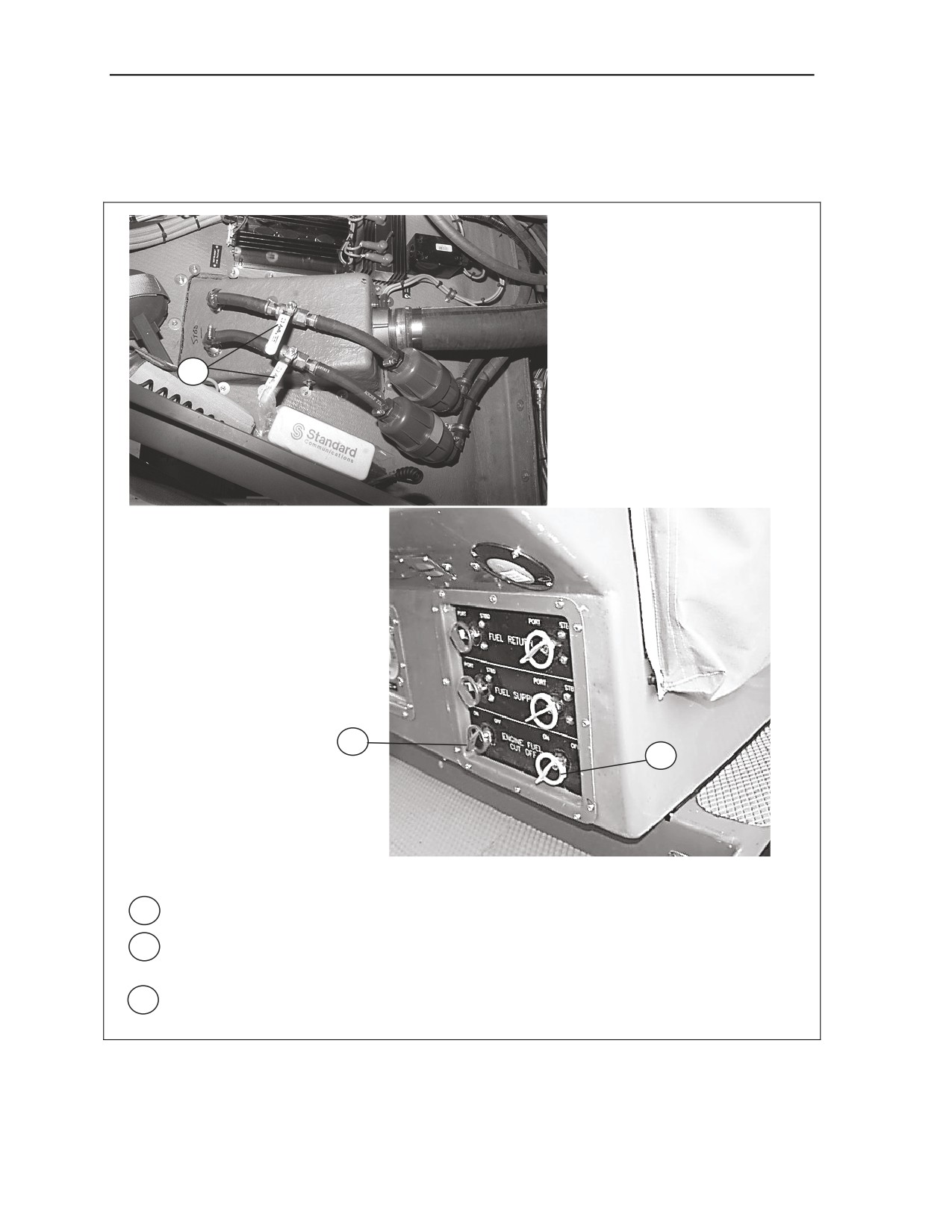
4-6. Prepare the boat as shown in Figures 4-11 through 4-16.
2
3
3
1.
Make sure the fuel tanks have no more than 68 gallons (75%) of fuel each (not shown).
2.
Close the four fuel vent shut-off valves (two port, two starboard) inside the control access
hatch.
3. Turn the fuel shut-off valves (the two valves at the bottom) to the “OFF” position.
Figure 4-11. Fuel System Prepared
FM 4-20.142/MCRP 4-11.3P/NAVSEA SS400-AD-MMO-010/ TO 13C7-51-21
4-18
19 September 2007
Rigging the Naval Special Warfare Rigid Inflatable Boat (NSW RIB) for Low-Velocity Airdrop
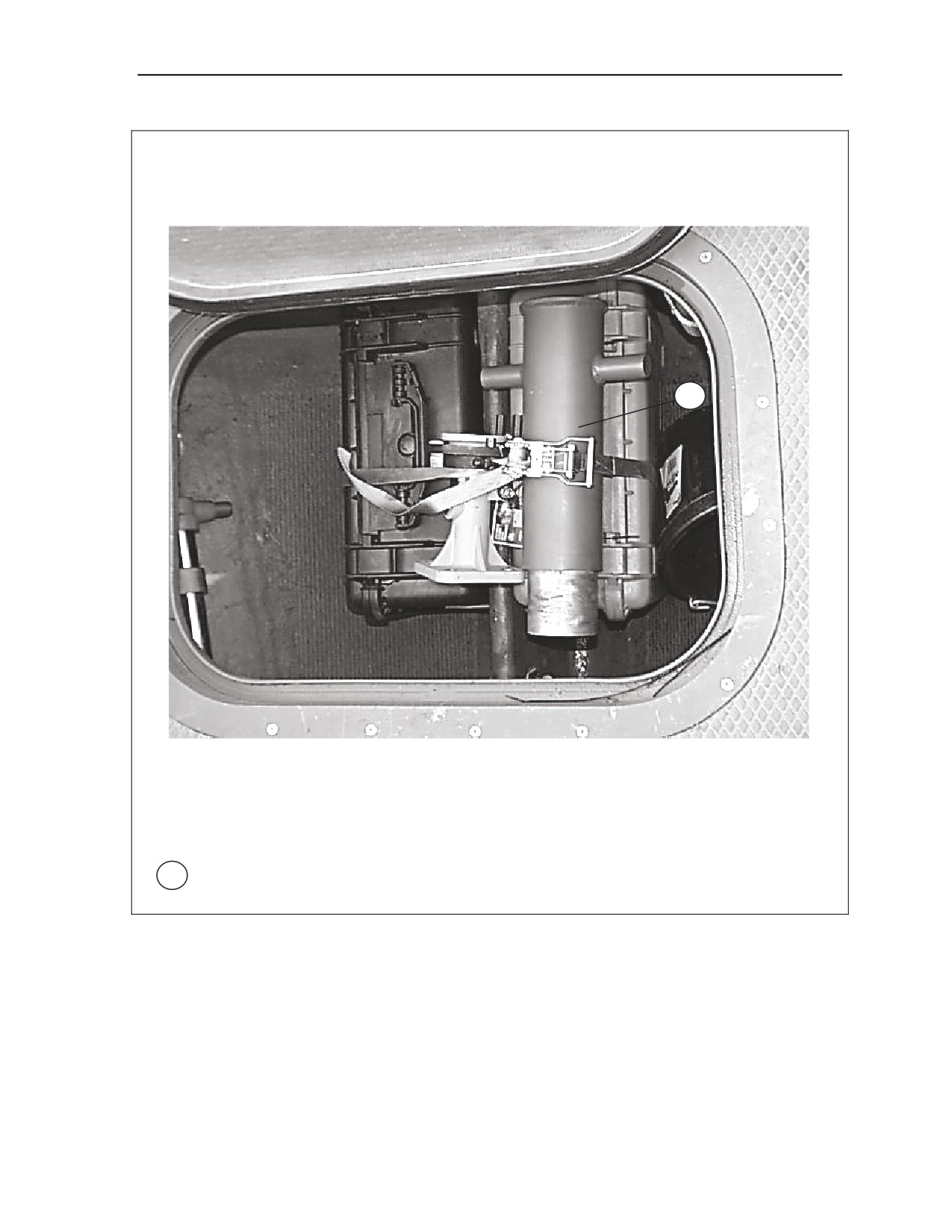
1
1. Remove the forward tow post. Stow and secure it in a convenient location.
Figure 4-12. Boat Equipment Stowed in Hatch
FM 4-20.142/MCRP 4-11.3P/NAVSEA SS400-AD-MMO-010/ TO 13C7-51-21
19 September 2007
4-19
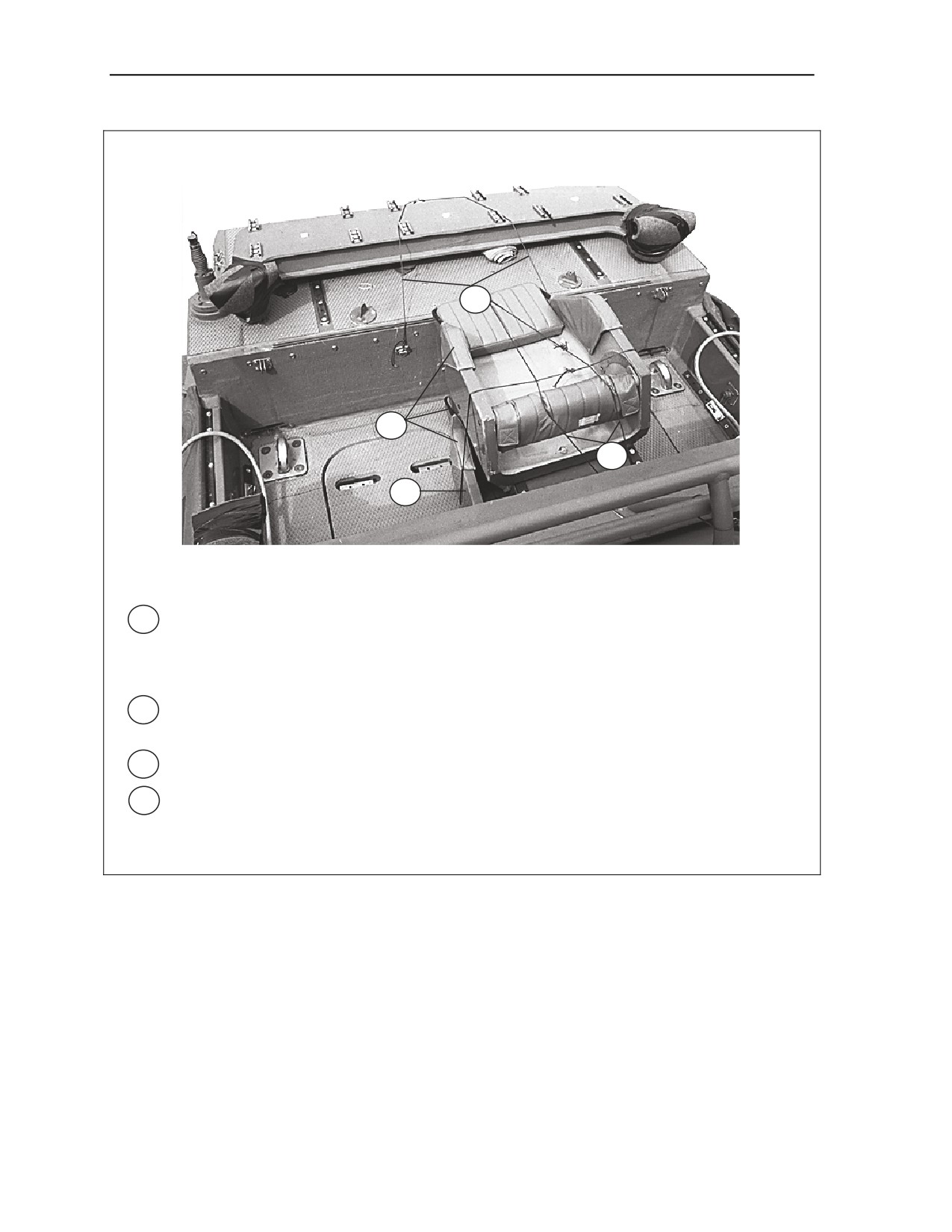
Chapter 4
1
2
4
3
Note. When the fourth row of bolster seats is removed for missions not needing them, steps 1 through 4 may be omitted.
1. Remove the bolster seats from row 4. Remove the life ring and stow it in hold 2. Fold the row
4 bolster frame back on the rolled and tied splash guard. Secure the bolster frame with a
length of type III nylon cord through the left and right deck rings on the swimmer deck, and
through the center deck ring at the back of the swimmer deck.
2. Center one seat on the floor face up. Place a second seat squarely over the first face down.
Place the third seat over the second face up.
3. Tie all three seats together with a length of type III nylon cord.
4. Run a length of type III nylon cord through the deck ring under the third bolster seat row, up
through the handle of seat two, over the top seat, and to the top center deck ring on the
swimmer deck. Tie both running ends on top of the seats.
Figure 4-13. Bolster Seats Stowed
FM 4-20.142/MCRP 4-11.3P/NAVSEA SS400-AD-MMO-010/ TO 13C7-51-21
4-20
19 September 2007
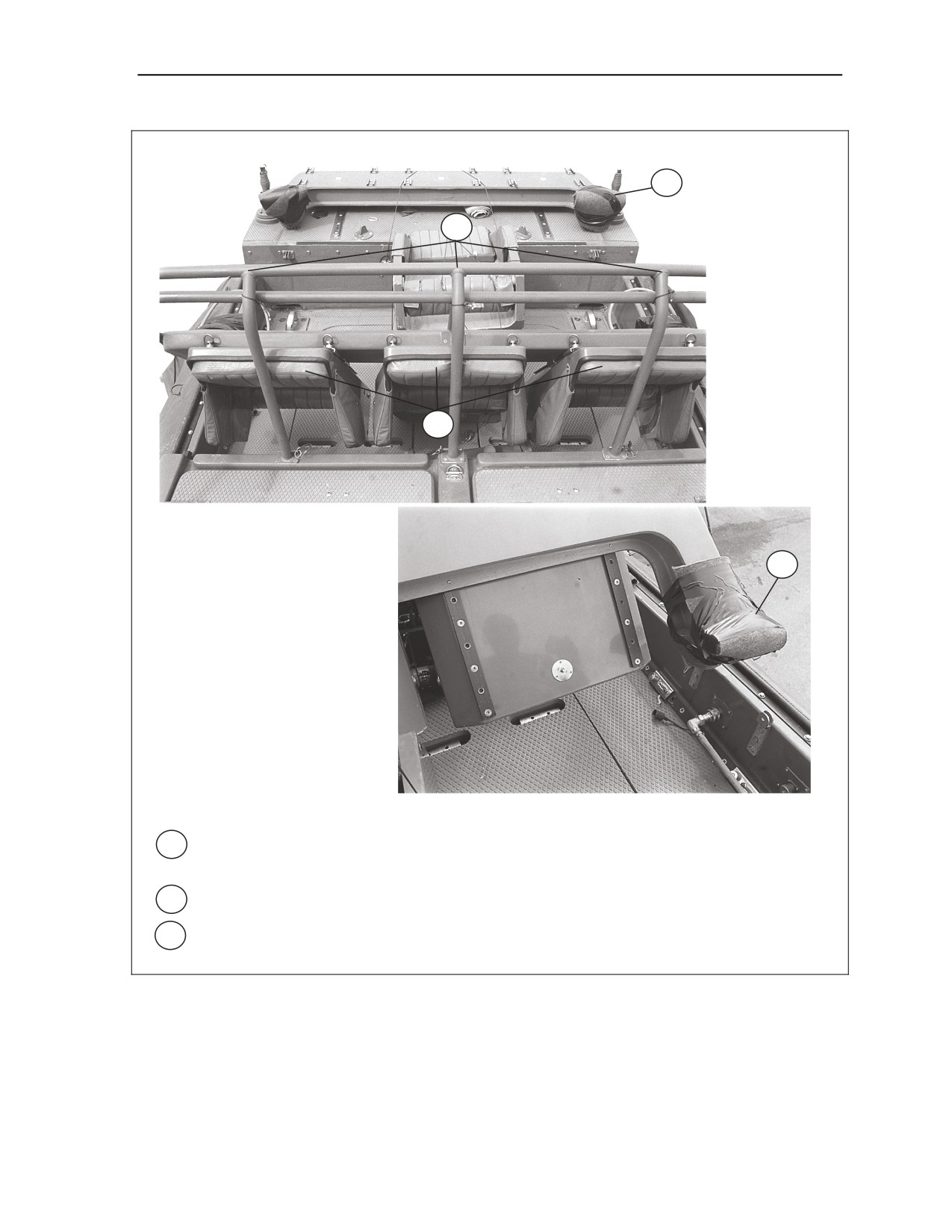
Rigging the Naval Special Warfare Rigid Inflatable Boat (NSW RIB) for Low-Velocity Airdrop
7
6
5
7
5.
Lower all the bolster seats in rows 1, 2, and 3 to their lowest position. Fold row 3 bolster seat
frame all the way forward.
6.
Tie the frame to the handrail in three places with type III nylon cord.
7. Pad each corner of row 5 and 4 bolster frames with cellulose wadding and tape in place.
Figure 4-13. Bolster Seats Stowed (continued)
FM 4-20.142/MCRP 4-11.3P/NAVSEA SS400-AD-MMO-010/ TO 13C7-51-21
19 September 2007
4-21
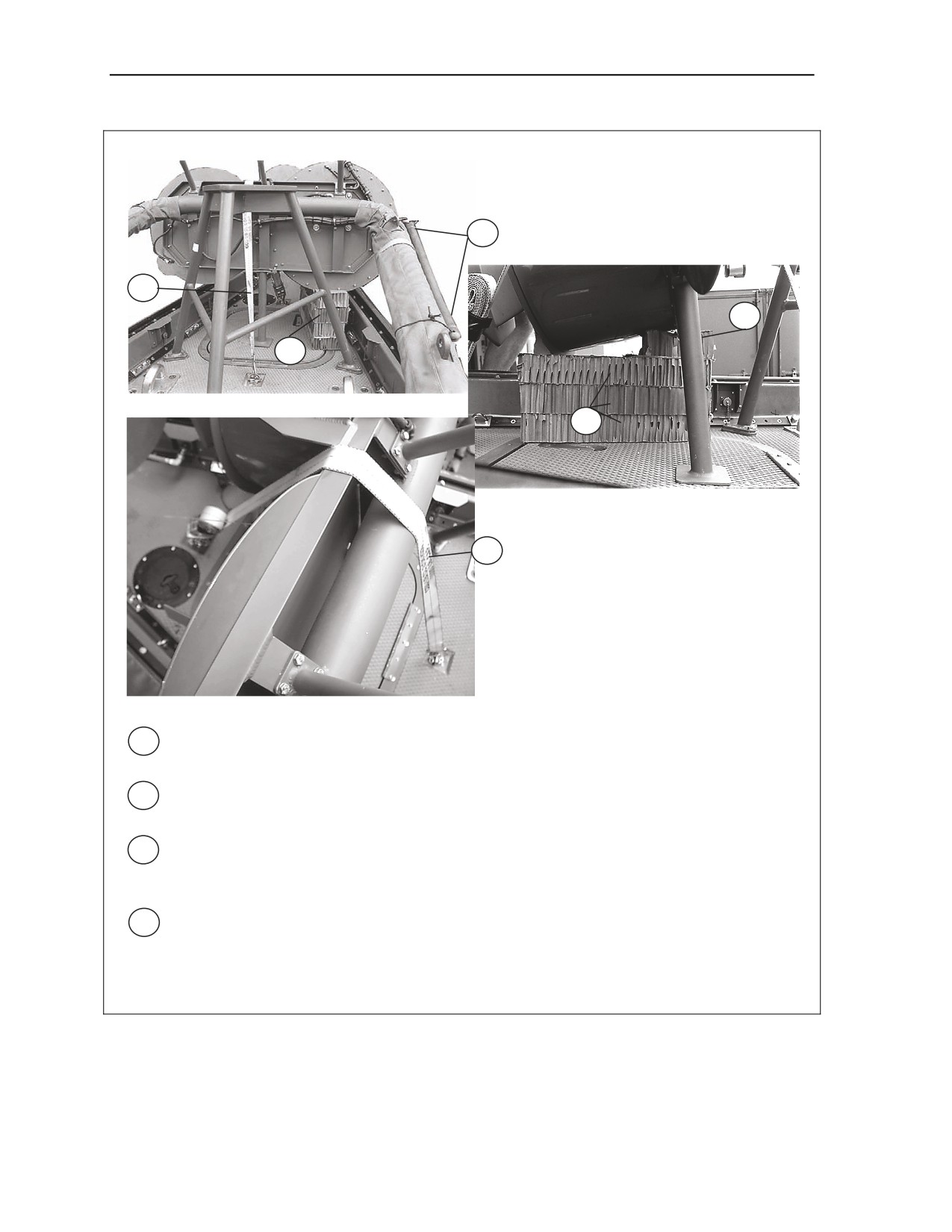
Chapter 4
2
4
1
3
3
4
1.
Unbolt the supports for the radar arch and fold the arch forward so that it rests on its support
post.
2.
Secure the support arms to the radar arch with type III nylon cord tied through the bolt holes
of the arms.
3.
Glue three 20- by 6-inch pieces and one 6- by 6-inch piece of honeycomb together as shown.
Center the honeycomb under the radar unit. The radar unit should be supported by both the
support post and the honeycomb.
4. Attach a length of 1/2-inch tubular nylon webbing to each of the center deck rings forming a
3/4-inch loop. Secure the radar arch with a CGU-1B tiedown assembly to the 1/2-inch tubular
nylon, attaching the ratchet end to the front ring. Route the tiedown assembly over the radar
unit as shown.
Figure 4-14. Radar Arch Folded and Secured
FM 4-20.142/MCRP 4-11.3P/NAVSEA SS400-AD-MMO-010/ TO 13C7-51-21
4-22
19 September 2007
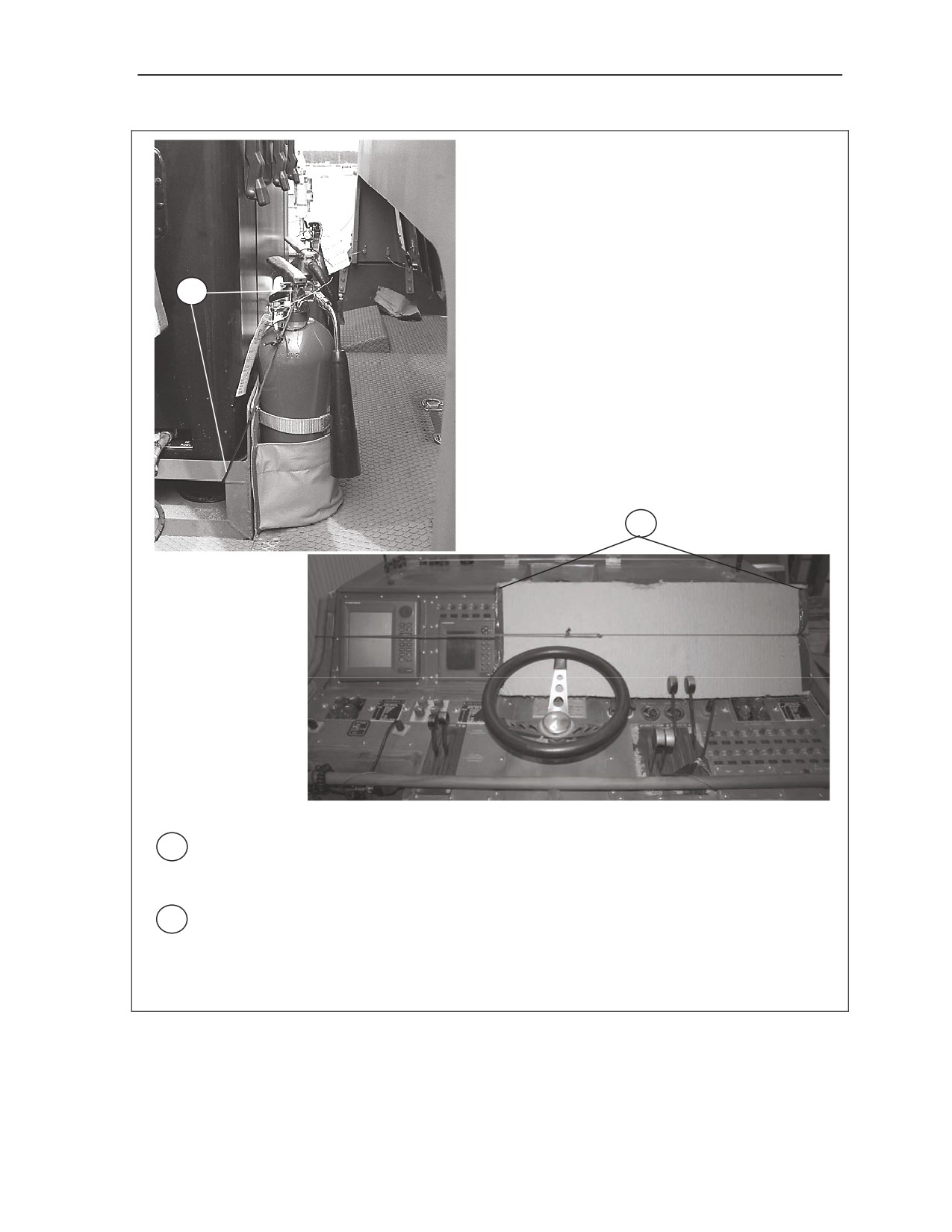
Rigging the Naval Special Warfare Rigid Inflatable Boat (NSW RIB) for Low-Velocity Airdrop
1
2
1. Secure the three fire extinguishers behind the driver’s compartment with type III nylon cord.
Route the cord under the storage box and through the holes on the necks of the fire
extinguishers.
2. Tie two 12- by 36-inch pieces of honeycomb to the instrument panel. Ensure that the
honeycomb is flush with the starboard side handrail, making sure the GPS and radar screens
are accessible. Tape the edges of the honeycomb and tie it to the handrail with type III nylon
cord.
Figure 4-15. Console Prepared
FM 4-20.142/MCRP 4-11.3P/NAVSEA SS400-AD-MMO-010/ TO 13C7-51-21
19 September 2007
4-23
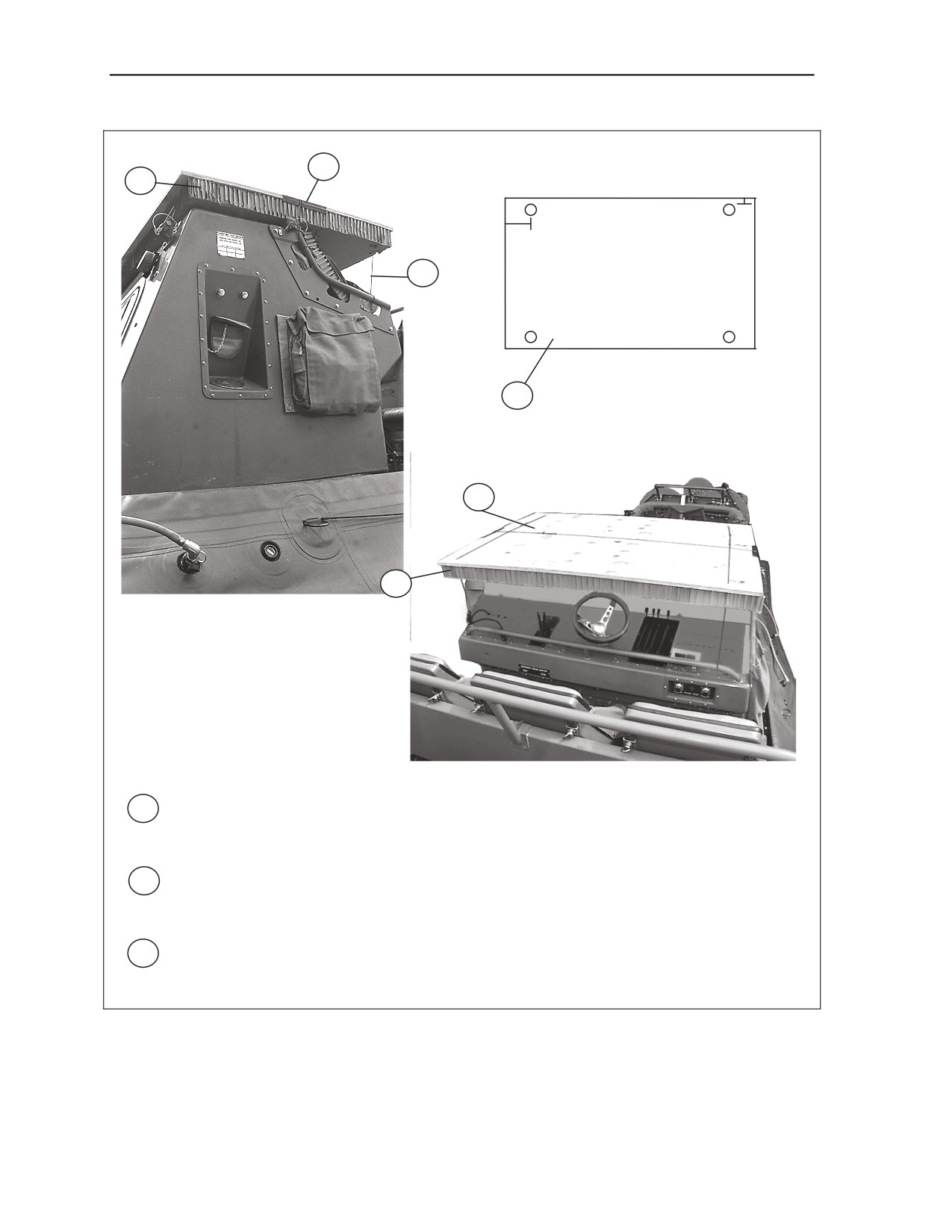
Chapter 4
Note. This drawing is not to scale and all dimensions are in inches.
4
3
59
1 1/2
4 1/2
5
38
4
4
3
3. Place a 36- by 59-inch piece of honeycomb over the folded windshield. Crush and cut to
ensure that it completely covers the windshield surface. Ensure that the edge of the
honeycomb and plywood is flush with the front of the console.
4. Drill 1/2-inch holes in a 1/2- by 38- by 59-inch piece of plywood as shown. Center and glue
the plywood over the honeycomb placed in step 3 above. Center a type III nylon cord tie over
the center of the plywood from the left to the right handrail.
5. Secure the plywood on each side to the console handrails, through the side holes in the
plywood and to the push-pull pins.
Figure 4-15. Console Prepared (continued)
FM 4-20.142/MCRP 4-11.3P/NAVSEA SS400-AD-MMO-010/ TO 13C7-51-21
4-24
19 September 2007
Rigging the Naval Special Warfare Rigid Inflatable Boat (NSW RIB) for Low-Velocity Airdrop
1
3
2
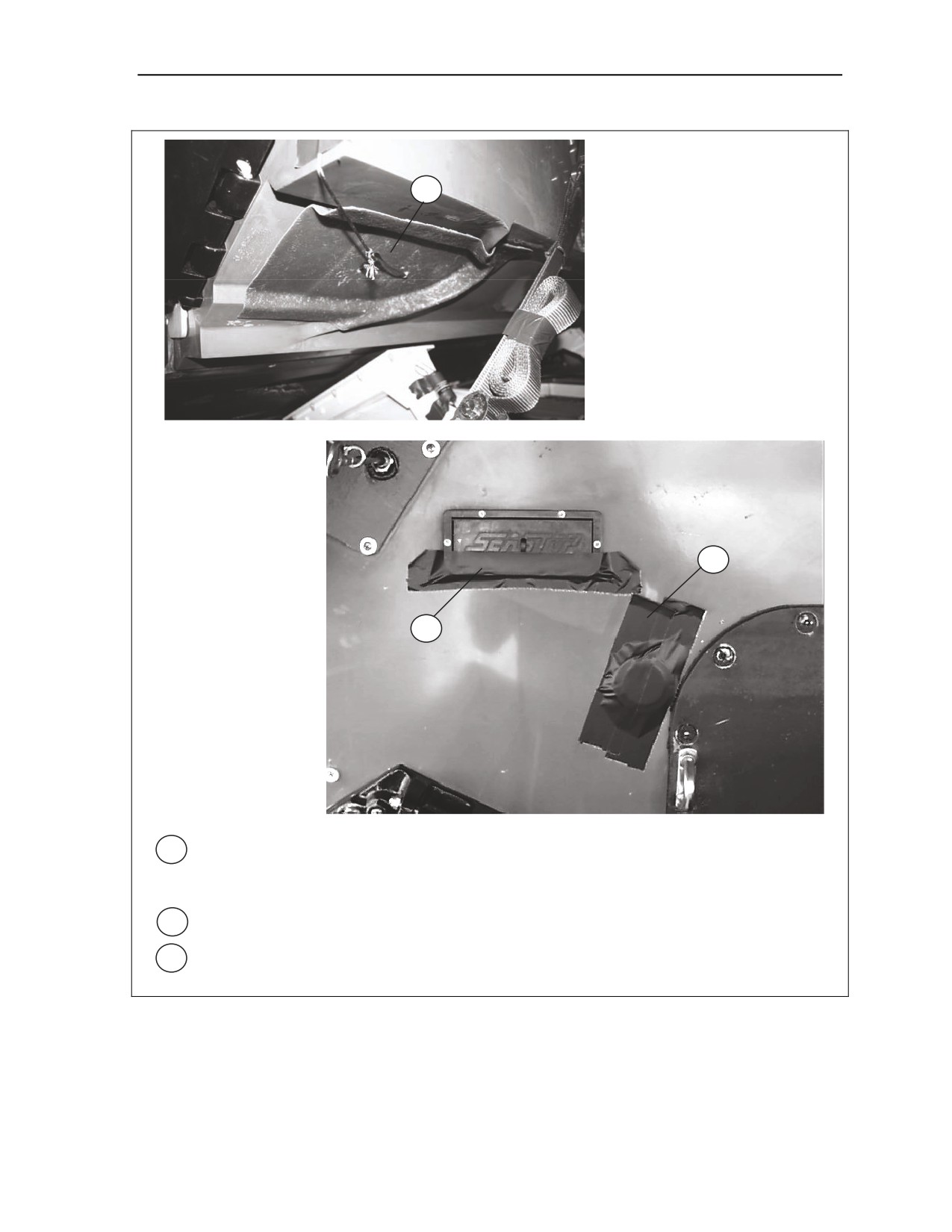
1.
Make a handle for each exhaust port cover with ½-inch tubular nylon. Tie a length of type III
nylon cord to the handle and to the grommet on the aft sponson cover. Attach several pieces
of interlocking velcro to the exhaust covers and attach the exhaust port covers in place.
2.
Tape the bottom edge of the deck drainage flap on each side of the transom.
3. Tape the bilge pump overboard discharge holes on each side of the transom.
Figure 4-16. Discharge Holes, Drainage Flaps, and Exhaust Port Covers Secured
FM 4-20.142/MCRP 4-11.3P/NAVSEA SS400-AD-MMO-010/ TO 13C7-51-21
19 September 2007
4-25
Chapter 4
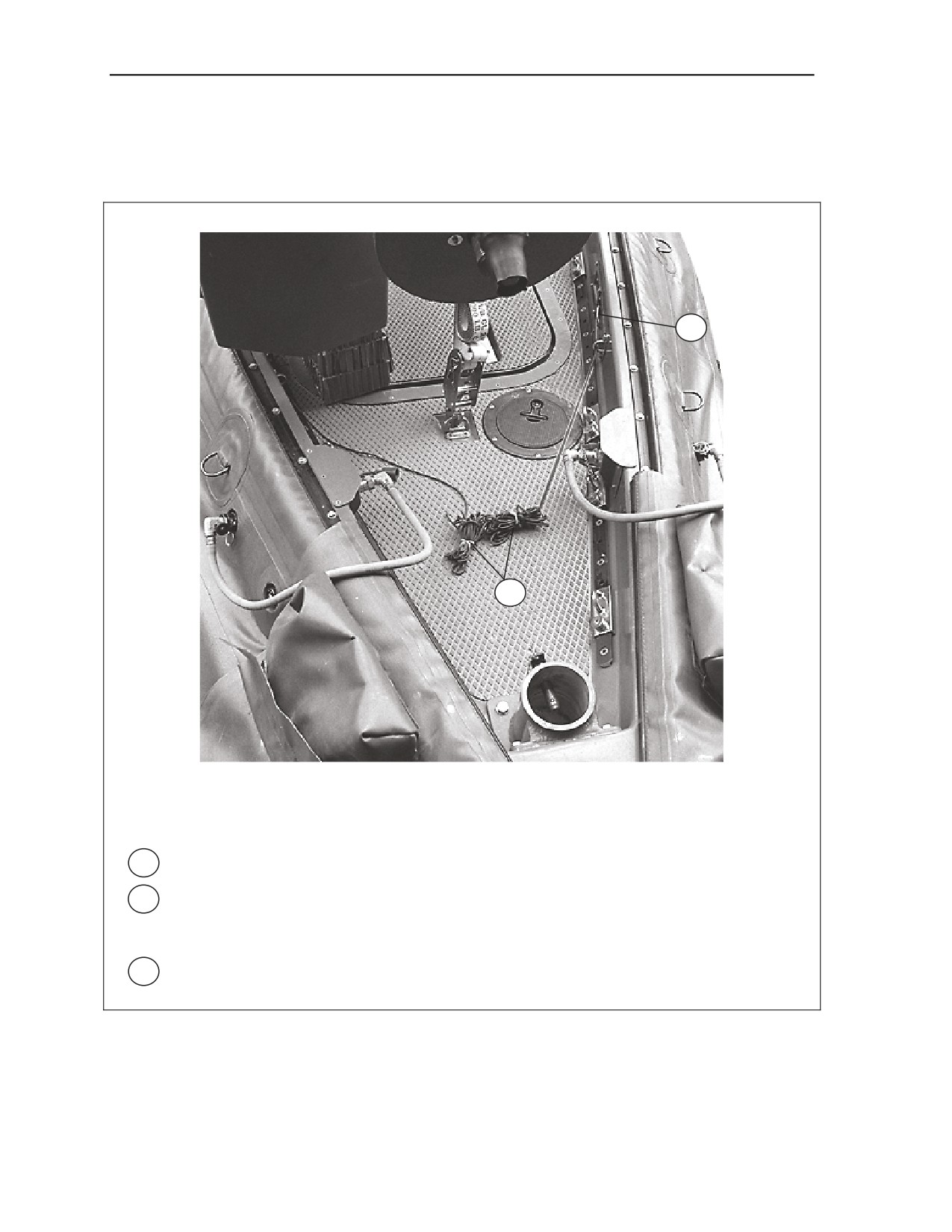
PREPARING THE SPONSON INFLATION SYSTEM
4-7. Prepare the sponson inflation system as shown in Figure 4-17.
2
3
1.
Make sure the hose connections for the sponson inflation system are tight (not shown).
2.
Remove the core threads from two 6-foot lengths of type III nylon cord. Pass one end of the
cord through the tiedown ring and tie it to the sponson activation cable ring. Repeat for the
other side of the boat.
3. Fold the excess cord and secure with retainer bands in the middle of the deck.
Figure 4-17. Sponson Inflation System Connected
FM 4-20.142/MCRP 4-11.3P/NAVSEA SS400-AD-MMO-010/ TO 13C7-51-21
4-26
19 September 2007
Rigging the Naval Special Warfare Rigid Inflatable Boat (NSW RIB) for Low-Velocity Airdrop
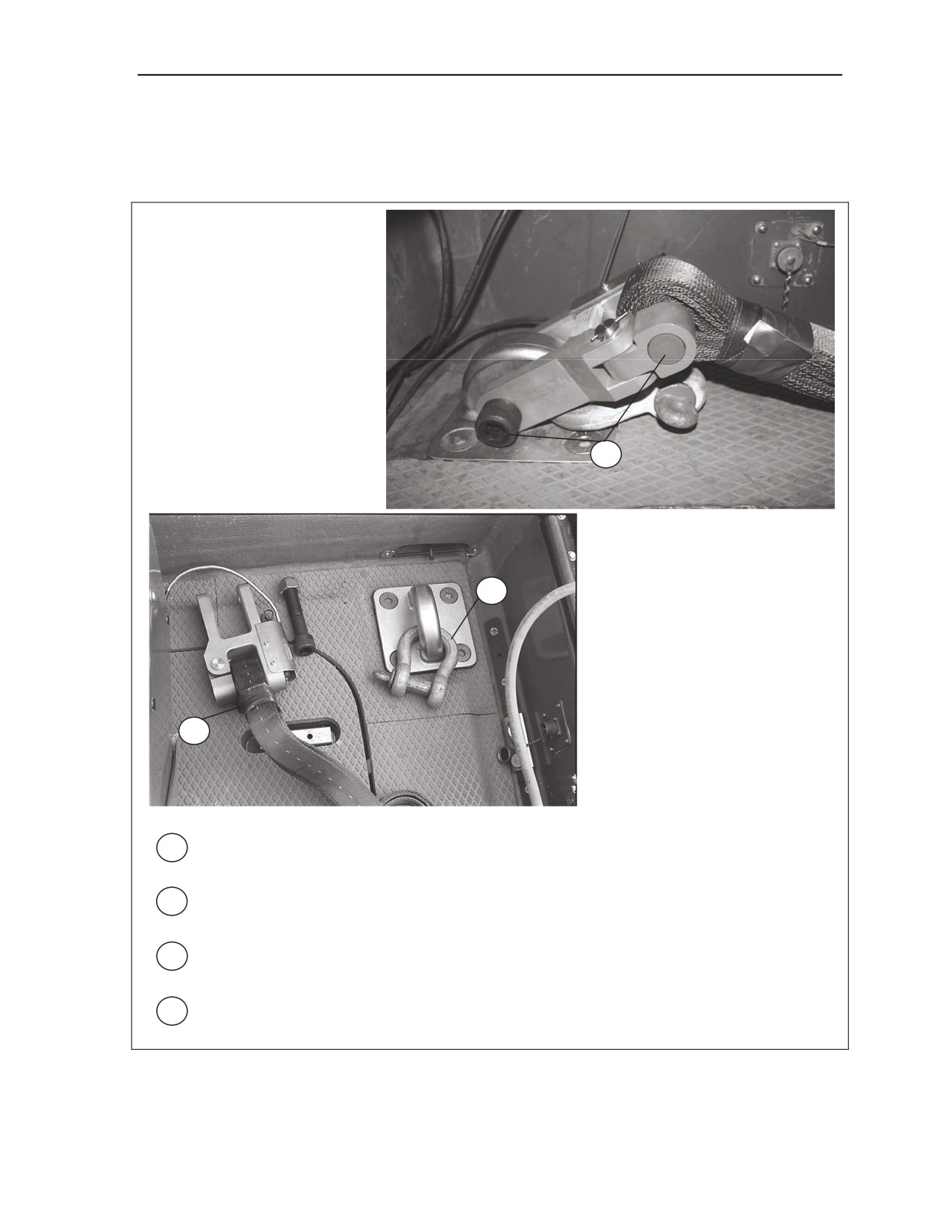
INSTALLING THE WATER ACTIVATED PARACHUTE RELEASE
4-8. Install the four water-activated parachute releases as shown in Figure 4-18.
3
1
3
1.
Place a shackle from the lift kit onto each suspension point, with the pin facing inboard to
outboard as shown. These must be used for lifting the load, not for suspension (not shown).
2.
Attach a 20-foot, 4-loop, type XXVI nylon sling to the discharge end of each WAPR (not
shown).
3.
Attach the WAPR to the suspension point, with the red dust cap facing inboard. Be sure that
the bolt faces inboard to outboard. Tighten the bolt wrench tight.
4. Attach the three remaining suspension slings as in steps 1 through 3 above (not shown).
Figure 4-18. Water-Activated Parachute Releases Installed
FM 4-20.142/MCRP 4-11.3P/NAVSEA SS400-AD-MMO-010/ TO 13C7-51-21
19 September 2007
4-27
Chapter 4
INSTALLING THE BOAT COVER, SPONSON, TIES, AND SPONSON
COVERS
4-9. Install the boat cover as shown in Figure 4-19. Make the sponson ties as shown in Figure 4-20.
Install the aft sponson covers as shown in Figure 4-21.
2
1
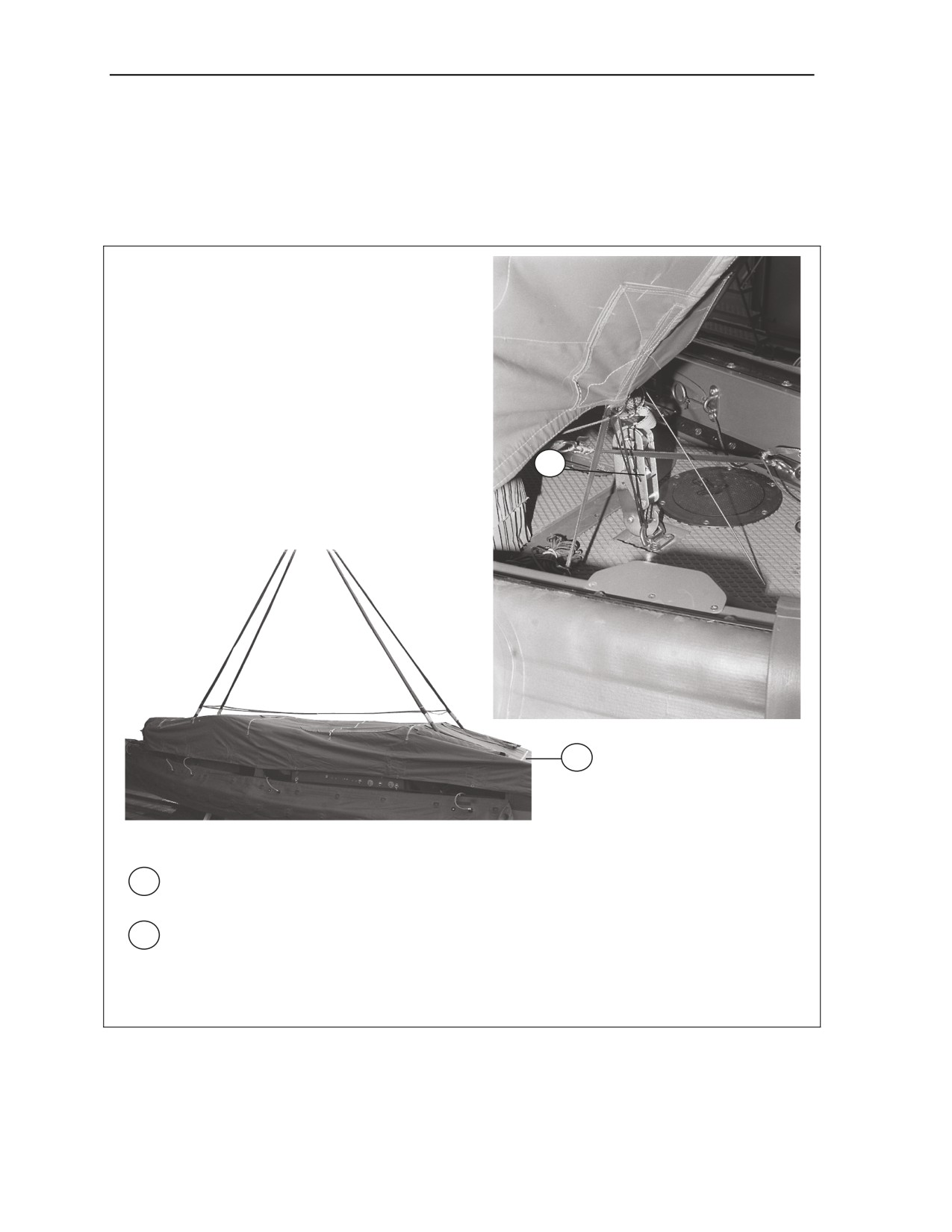
1. Install the cover provided with the boat in a fore-to-aft direction. Pull the suspension slings
through the holes provided and raise them temporarily.
2. Tie a loop of ½-inch tubular nylon to each sail car tie-down in the forward cockpit. Attach a
ratchet strap provided at the front of the cover to each loop, each strap attaching to the loop
on the opposite side. Tighten the ratchet straps just enough so that tension on the cover is
not placed on the lights and antennas on top of the radar arch.
Figure 4-19. Boat Cover Installed
FM 4-20.142/MCRP 4-11.3P/NAVSEA SS400-AD-MMO-010/ TO 13C7-51-21
4-28
19 September 2007
Rigging the Naval Special Warfare Rigid Inflatable Boat (NSW RIB) for Low-Velocity Airdrop
3
3
3
3
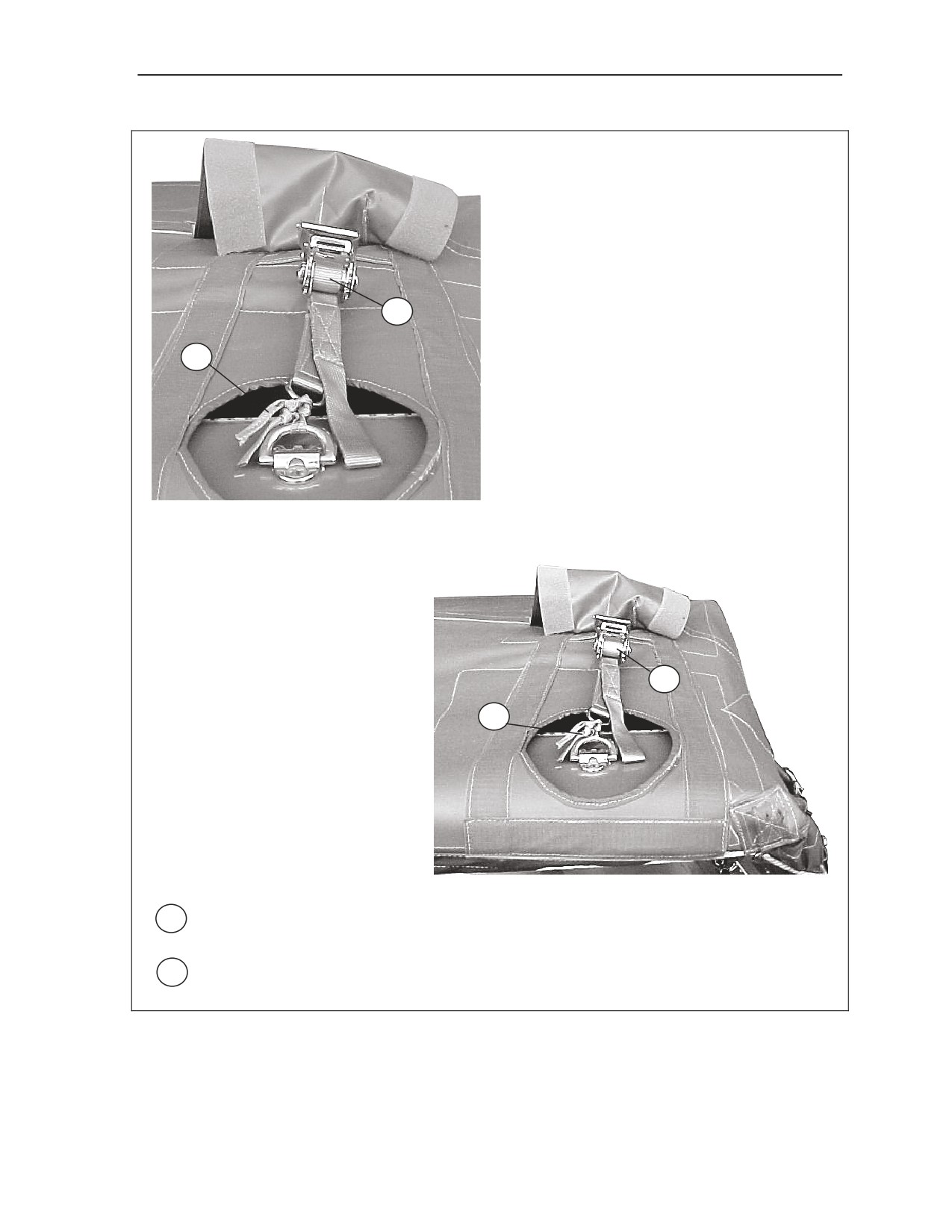
3. Secure the cover to the bustle of the boat through the two ports in the cover. Secure the end
of each ratchet strap to the folding padeye with a loop of 1/2-inch tubular nylon webbing.
4. Adjust the ratchets to place tension on the cover (not shown).
Figure 4-19. Boat Cover Installed (continued)
FM 4-20.142/MCRP 4-11.3P/NAVSEA SS400-AD-MMO-010/ TO 13C7-51-21
19 September 2007
4-29
Chapter 4
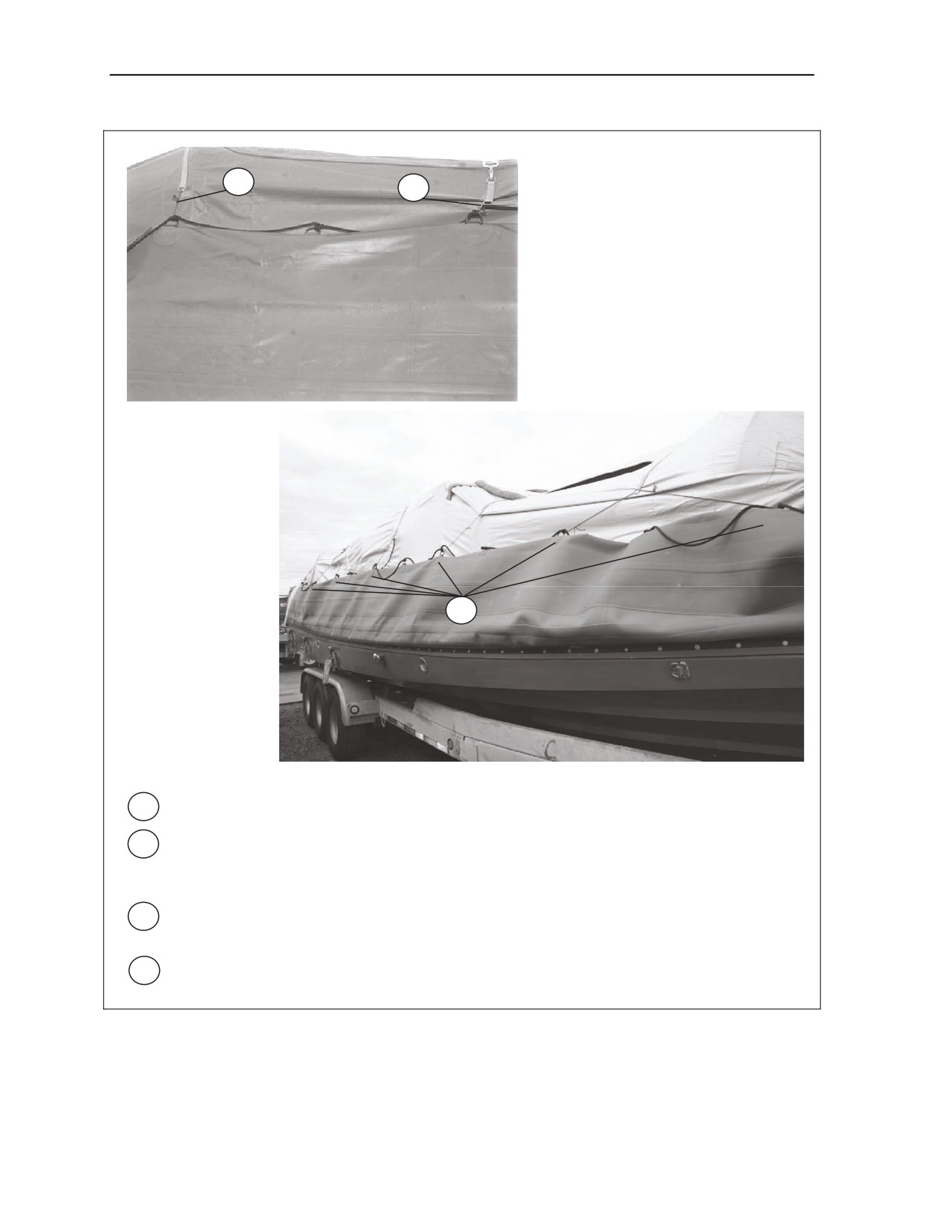
6
5
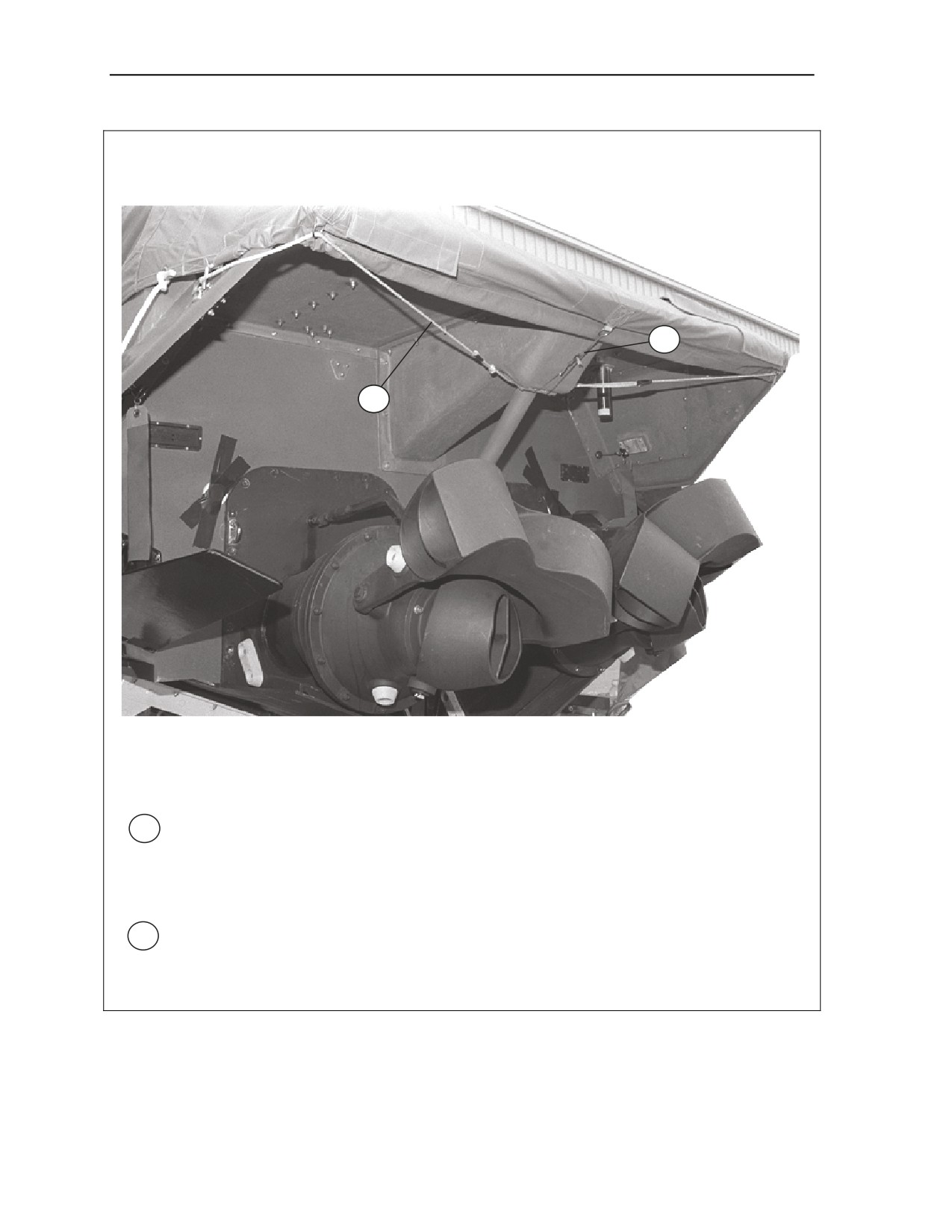
5. Run a length of 1/2-inch tubular nylon through the D-rings on both sides of the bustle, and tie
off, making a three-finger loop. Route the bolt rope through the loops of 1/2-inch tubular nylon
and tighten the bolt rope along the edges of the cover on both sides of the boat. Be sure that
the cover extends below the edges of the bustle. Form a loop in each running end of the bolt
rope.
6. Route a length of type III nylon cord through the looped ends of the bolt rope, around the
swim platform support bar, and through the center grommet on the boat cover, forming a
continuous loop. Tie off with a cinch knot.
Figure 4-19. Boat Cover Installed (continued)
FM 4-20.142/MCRP 4-11.3P/NAVSEA SS400-AD-MMO-010/ TO 13C7-51-21
4-30
19 September 2007
Rigging the Naval Special Warfare Rigid Inflatable Boat (NSW RIB) for Low-Velocity Airdrop
7
8
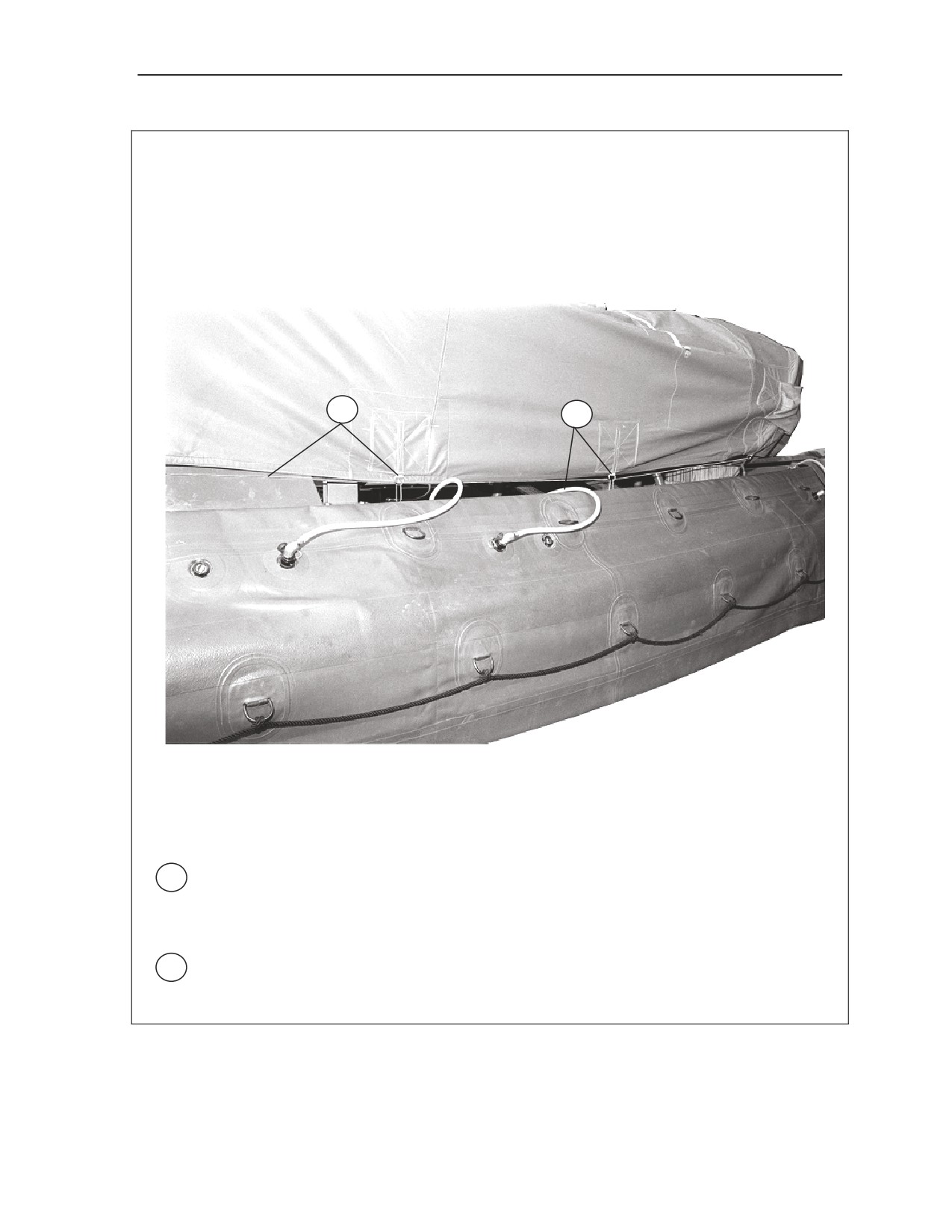
7. Cut a length of type III nylon cord long enough to encircle the entire boat cover. Beginning at
the left rear sail car, route the cord up through the sewn D-ring on the cover, over through the
next sewn D-ring, down through the tie-down ring or sail car, and up through the same sewn
cover D-ring.
8. Repeat this pattern all around the cover, pull the cord taut and tie it off to the right rear sail
car.
Figure 4-19. Boat Cover Installed (continued)
FM 4-20.142/MCRP 4-11.3P/NAVSEA SS400-AD-MMO-010/ TO 13C7-51-21
19 September 2007
4-31
Chapter 4
3
2
4
1.
Cut fourteen 6-foot lengths of type III nylon cord. Remove the core threads (not shown).
2.
Starting at the rear of the boat, route a length of type III nylon cord down through the sewn D-
ring on the boat cover, and through the sewn D-ring on the sponson. Have assistants support
the weight of the sponson while tying the cord around both D-rings.
3.
Repeat step 2 with the next D-ring on the boat cover. Ensure that you only make a tie to
every other D-ring on the sponson.
4. Repeat steps 2 and 3 on the other side.
Figure 4-20. Sponsons Tied
FM 4-20.142/MCRP 4-11.3P/NAVSEA SS400-AD-MMO-010/ TO 13C7-51-21
4-32
19 September 2007
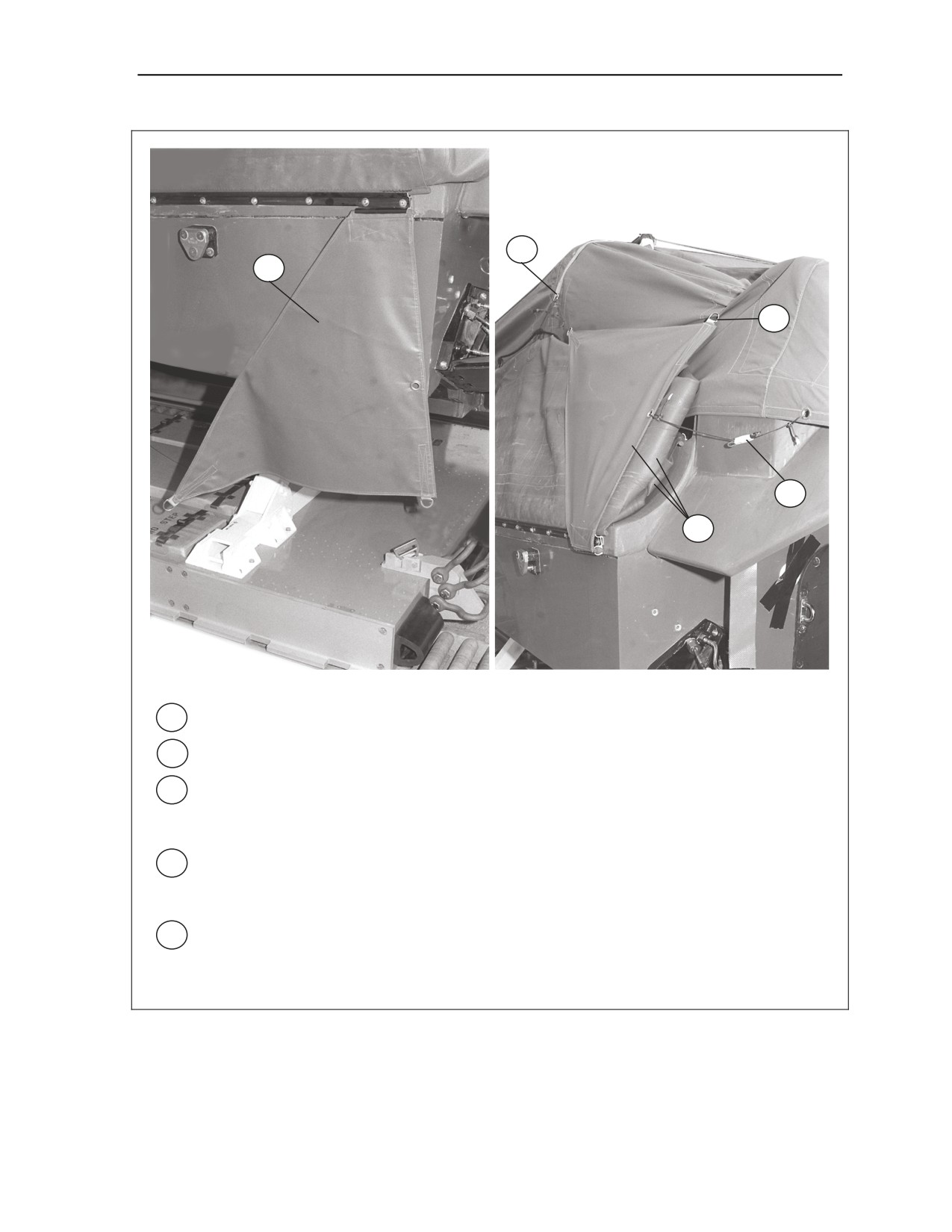
Rigging the Naval Special Warfare Rigid Inflatable Boat (NSW RIB) for Low-Velocity Airdrop
4
1
3
5
2
1. Slide the small end of the aft sponson covers into the slots provided.
2. Fold the rear of the sponson inward, and raise the sponson cover over the fold.
3. Pass a 36-inch length of type III nylon cord with the core threads removed through the D-ring
on the right angle corner of the sponson cover, and through the rear sewn D-ring on the boat
cover. Tie the running ends together.
4. Pass a 48-inch length of type III nylon cord with the core threads removed through the D-ring
on the front corner of the sponson cover, and through the second sewn D-ring on the boat
cover. Tie the running ends together.
5. Tie one end of a 60-inch length of type III nylon cord to the center grommet on the sponson
cover, and the other end to the last grommet on the boat cover. S-fold the excess cord and
tape the folds with masking tape (not shown).
Figure 4-21. Aft Sponson Covers Tied
FM 4-20.142/MCRP 4-11.3P/NAVSEA SS400-AD-MMO-010/ TO 13C7-51-21
19 September 2007
4-33
Chapter 4
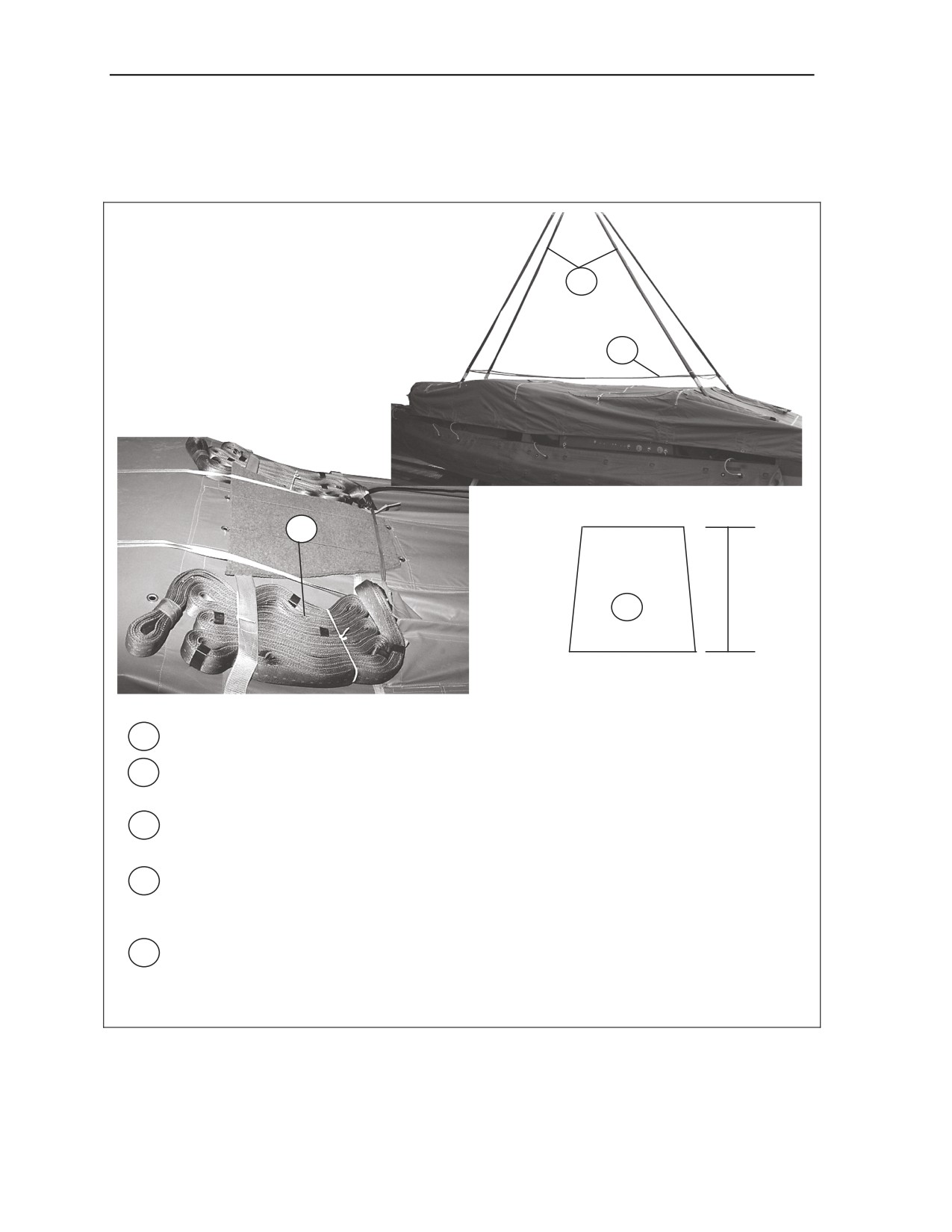
PREPARING SUSPENSION SLINGS
4-10. Raise and safety the suspension slings as shown in Figure 4-22.
1
2
11
4
23
5
26
1.
Raise the suspension slings, allowing no twists in them.
2.
Make the deadman’s tie in accordance with FM 4-20.102/MCRP 4-11.3J/NAVSEA SS400
AB-MMO-010/TO 13C7-1-5.
3.
Lower the slings. Route the suspension slings from the front of the platform through the
center hook-and-pile suspension sling straps on the boat cover (not shown).
4.
S-fold the rear suspension slings over the open hook-and-loop fasteners just ahead of the
sling exit port on the cover. Tie the folds in two places (top and bottom) with type I, 1/4-inch
cotton webbing. Secure the hook portion of the fasteners over the slings.
5. Cut a piece of 1/2-inch felt as shown. Place the felt on the boat cover, narrow end to the rear,
and under the deadman’s tie. Tie the felt in place through the grommets in the cover with
type III nylon cord, knotted under the cover.
Figure 4-22. Suspension Slings Safetied and Stowed
FM 4-20.142/MCRP 4-11.3P/NAVSEA SS400-AD-MMO-010/ TO 13C7-51-21
4-34
19 September 2007
Rigging the Naval Special Warfare Rigid Inflatable Boat (NSW RIB) for Low-Velocity Airdrop
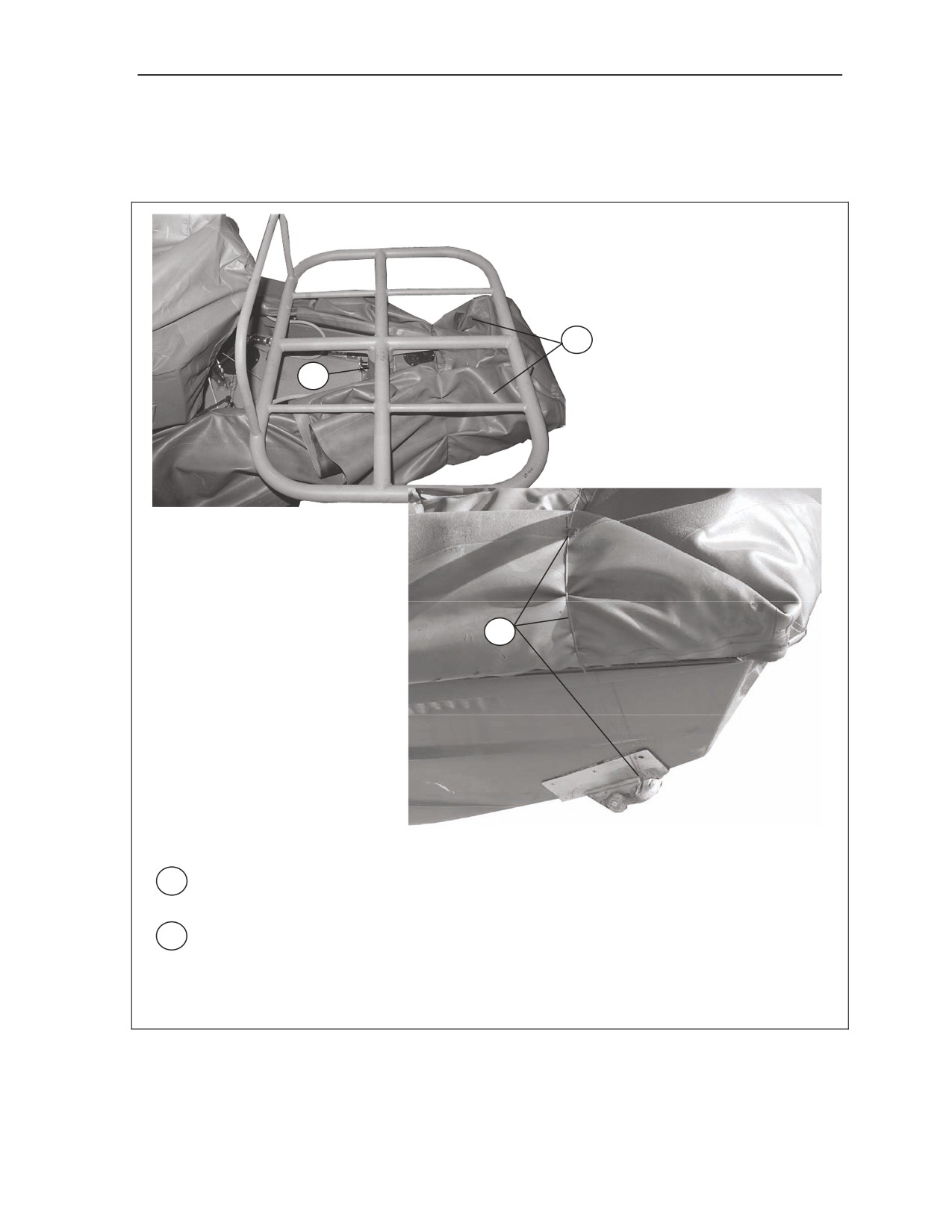
INSTALLING PARACHUTE STOWAGE PLATFORM
4-11. Tie the front sponsons, and install the parachute stowage platform as shown in Figure 4-23.
2
1
2
1. Insert the post of the parachute stowage platform into the king post base. Use the push-pull
pin for the king post base to secure the stowage platform in place.
2. Fold the bow sponson tube under the stowage platform, folding the front flap first, then the
two sides. Tie a length of type III nylon cord with the core threads removed around the
sponsons, the hull of the boat, and through the towing shackle. Ensure that the tie is routed
aft of the forward tow post mount.
Figure 4-23. Front Sponsons Folded and Parachute Stowage Platform Installed
FM 4-20.142/MCRP 4-11.3P/NAVSEA SS400-AD-MMO-010/ TO 13C7-51-21
19 September 2007
4-35
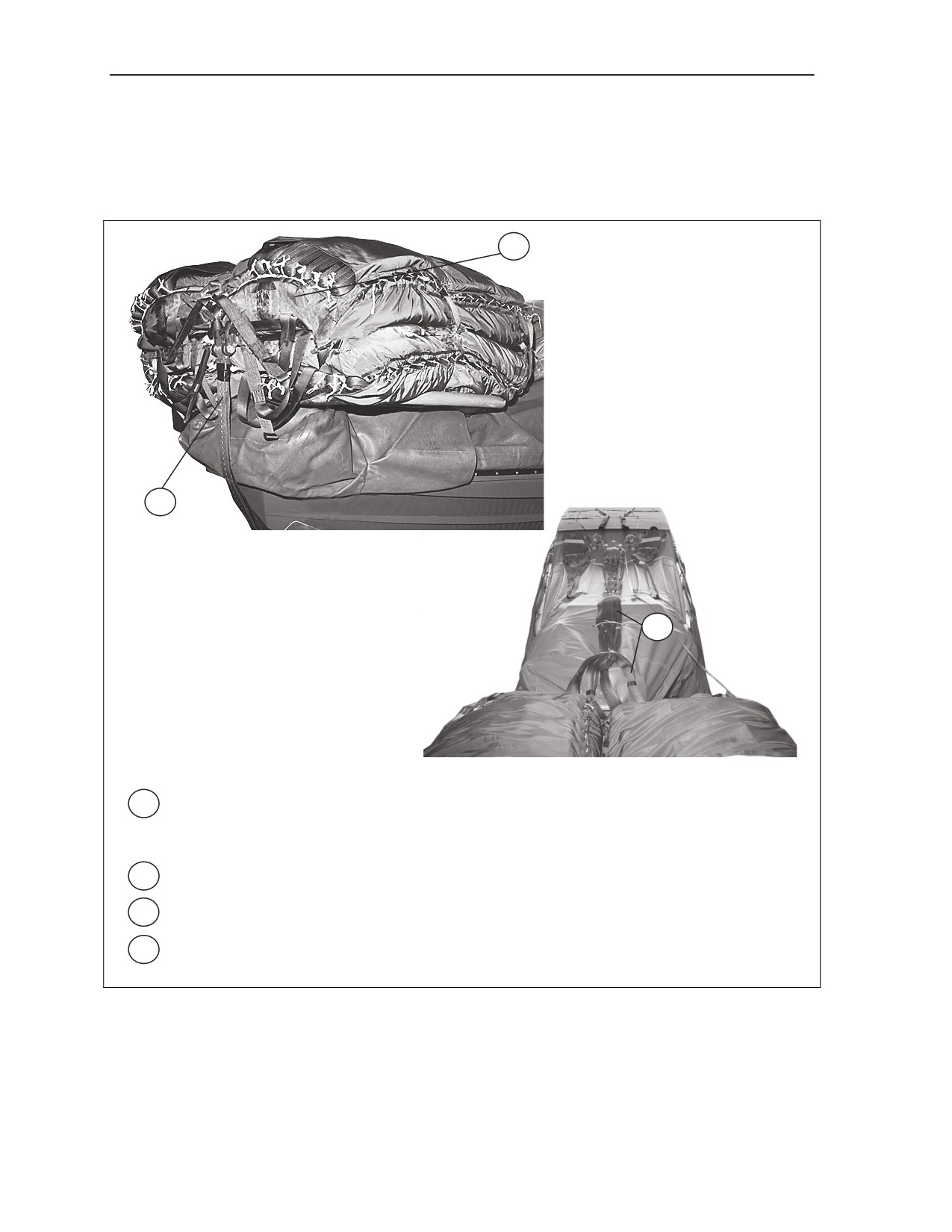
Chapter 4
INSTALLING CARGO PARACHUTES
4-12. Install four G-11 cargo parachutes according to FM 4-20.102/MCRP 4-11.3J/NAVSEA SS400-AB
MMO-010/TO 13C7-1-5 and as shown in Figure 4-24.
2
3
4
1.
Attach and stow a 60-foot, 3 loop, type XXVI riser extension to each of the four G-11B cargo
parachutes according to FM 4-20.102/MCRP 4-11.3J/NAVSEA SS400-AB-MMO-010/TO
13C7-1-5 (not shown).
2.
Cluster the parachutes on the parachute storage platform.
3.
Attach a 16-foot, 2 loop, type XXVI deployment line to the deployment clevis.
4. Pull enough of the riser extensions from each parachute to reach the release.
Figure 4-24. Cargo Parachutes Installed
FM 4-20.142/MCRP 4-11.3P/NAVSEA SS400-AD-MMO-010/ TO 13C7-51-21
4-36
19 September 2007
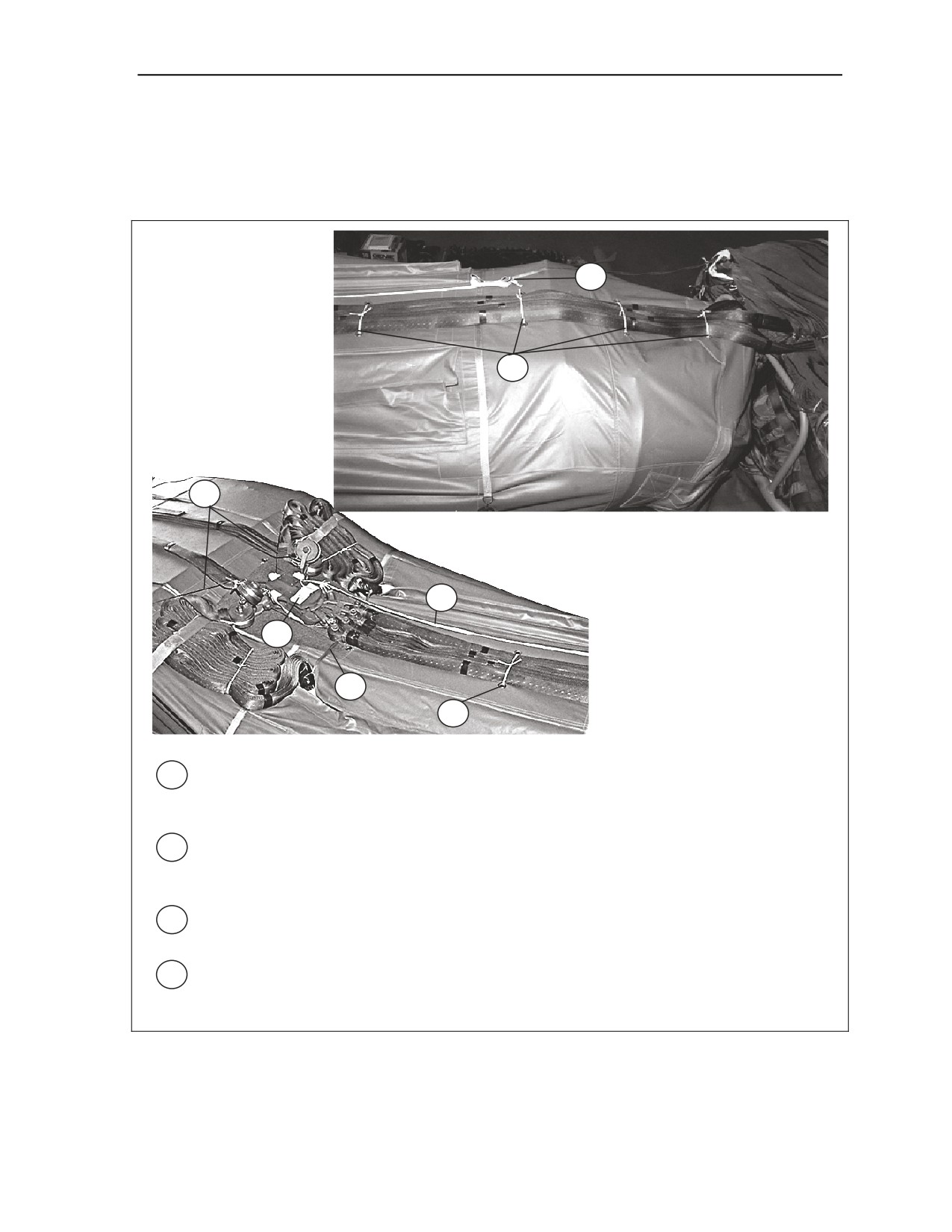
Rigging the Naval Special Warfare Rigid Inflatable Boat (NSW RIB) for Low-Velocity Airdrop
INSTALLING M-2 CARGO PARACHUTE RELEASE
4-13. Prepare and install an M-2 cargo parachute release according to FM
4-20.102/MCRP
4
11.3J/NAVSEA SS400-AB-MMO-010/TO 13C7-1-5, and as shown in Figure 4-25.
4
3
2
4
1
2
3
1.
Center an M-2 cargo parachute release on the felt as shown. Attach the riser extensions and
suspension slings according to FM 4-20.102/MCRP 4-11.3J/NAVSEA SS400-AB-MMO
010/TO 13C7-1-5.
2.
Safety tie the release at the top and bottom with type III nylon cord through the grommets
provided in the cover. Tie the type III nylon cord to the radar arch or other convenient points
on the boat.
3.
Safety the riser extensions in four places with type I, ¼-inch cotton webbing tied one turn
single through the grommets in the cover.
4. Make a 20-foot arming wire lanyard for this load. Prepare the lanyard according to TM 1670
296-20&P.
Figure 4-25. M-2 Cargo Parachute Release Installed
FM 4-20.142/MCRP 4-11.3P/NAVSEA SS400-AD-MMO-010/ TO 13C7-51-21
19 September 2007
4-37
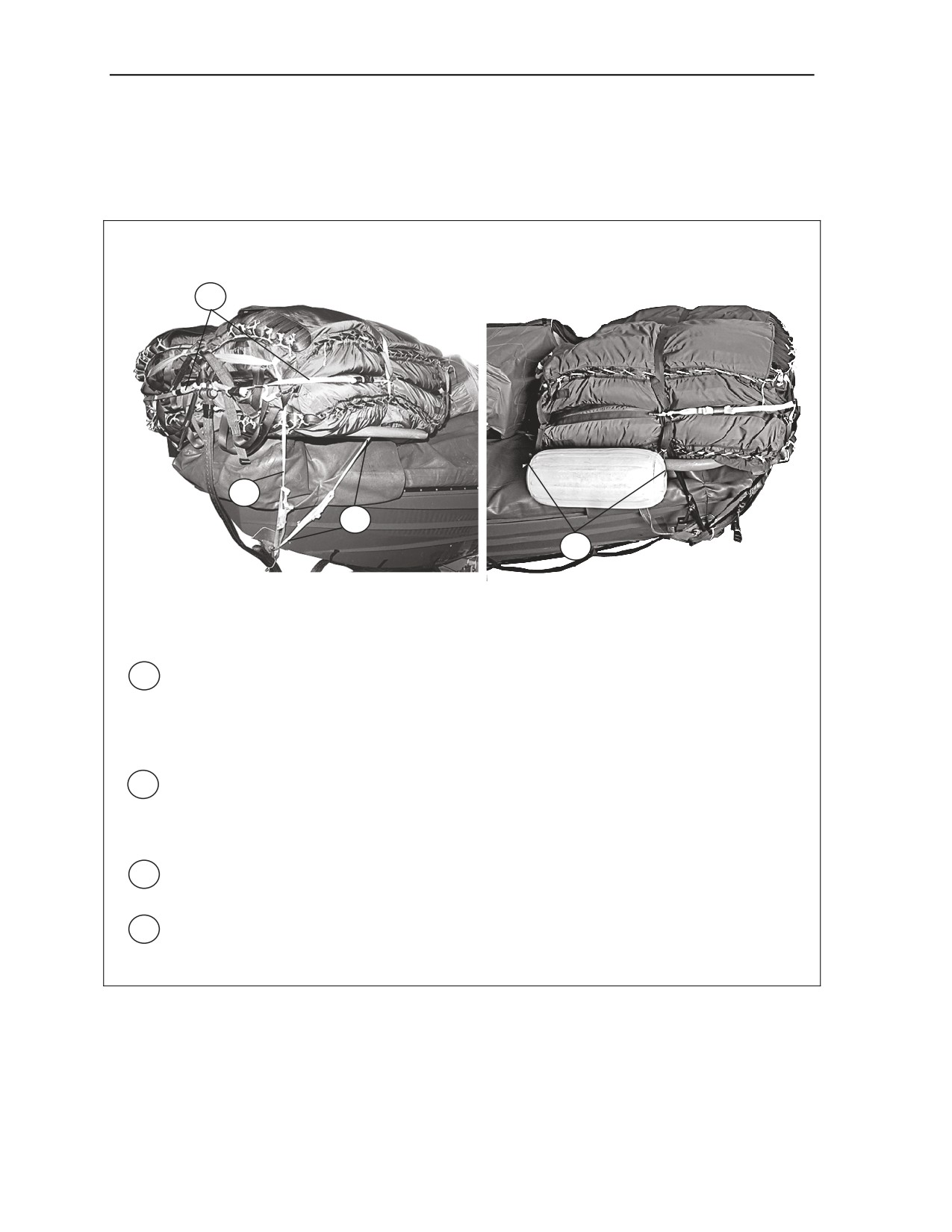
Chapter 4
INSTALLING PARACHUTE RESTRAINTS
4-14. Restrain the cargo parachute according to FM
4-20.102/MCRP 4-11.3J/NAVSEA SS400-AB
MMO-010/TO 13C7-1-5 and as shown in Figure 4-26.
3
2
1
4
1.
Route the center parachute restraint strap down inside the outer bars and behind (aft) the
horizontal bars of the parachute stowage platform. Route both sides through the towing
shackle. Tightening both sides simultaneously, tie with a trucker’s hitch, secured with three
alternating half hitches and an overhand knot in the running end. S-fold any excess and
secure with tape.
2.
Route the rear parachute restraint strap down the outside of the outer bars of the parachute
stowage platform. Route both sides through the towing shackle. Tightening both sides
simultaneously, tie with a trucker’s hitch, secured with three alternating half hitches and an
overhand knot in the running end. S-fold any excess and secure with tape.
3.
Install two multi-cut release straps according to FM 4-20.102/MCRP 4-11.3J/NAVSEA
SS400-AB-MMO-010/TO 13C7-1-5.
4. Tie a flotation device to the carrying handles of the lower deployment bag on each side with
1/2-inch tubular nylon webbing.
Figure 4-26. Cargo Parachutes Restrained
FM 4-20.142/MCRP 4-11.3P/NAVSEA SS400-AD-MMO-010/ TO 13C7-51-21
4-38
19 September 2007
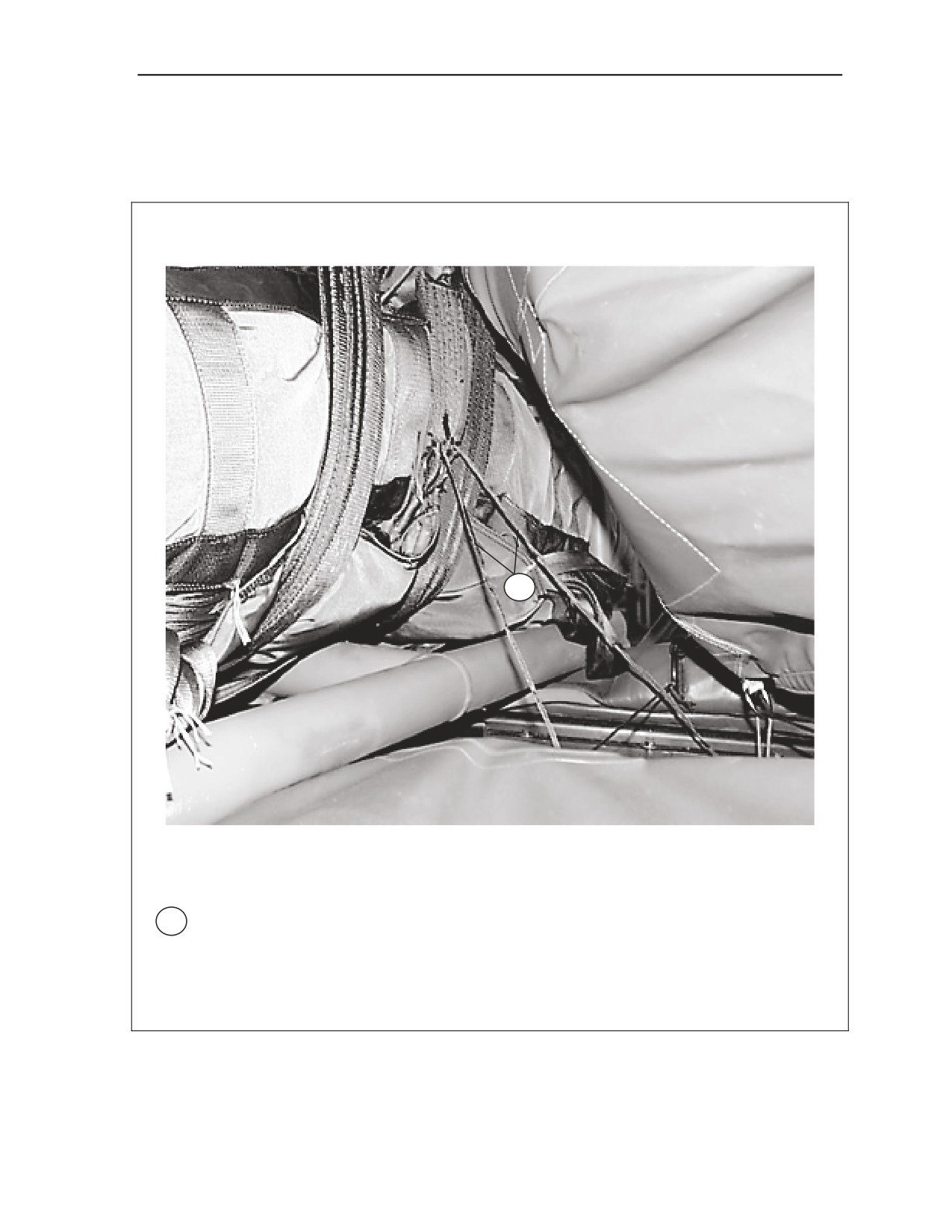
Rigging the Naval Special Warfare Rigid Inflatable Boat (NSW RIB) for Low-Velocity Airdrop
INSTALLING SPONSON ACTIVATION LANYARD
4-15. Install the sponson activation lanyard as shown in Figure 4-27.
1
1. Pass the sponson inflation lanyards installed in Figure 4-17 over all items and route through
the bottom center carrying handle of the G-11 parachute. Remove the slack between the
sponson activation cable ring and the G-11 carrying handles, but do not pull taut. Tie each
lanyard to the bottom carrying handle of the G-11 cargo parachute with three alternating half
hitches and an overhand knot in the running end. Cut off any excess.
Figure 4-27. Sponson Activation Lanyard Installed
FM 4-20.142/MCRP 4-11.3P/NAVSEA SS400-AD-MMO-010/ TO 13C7-51-21
19 September 2007
4-39
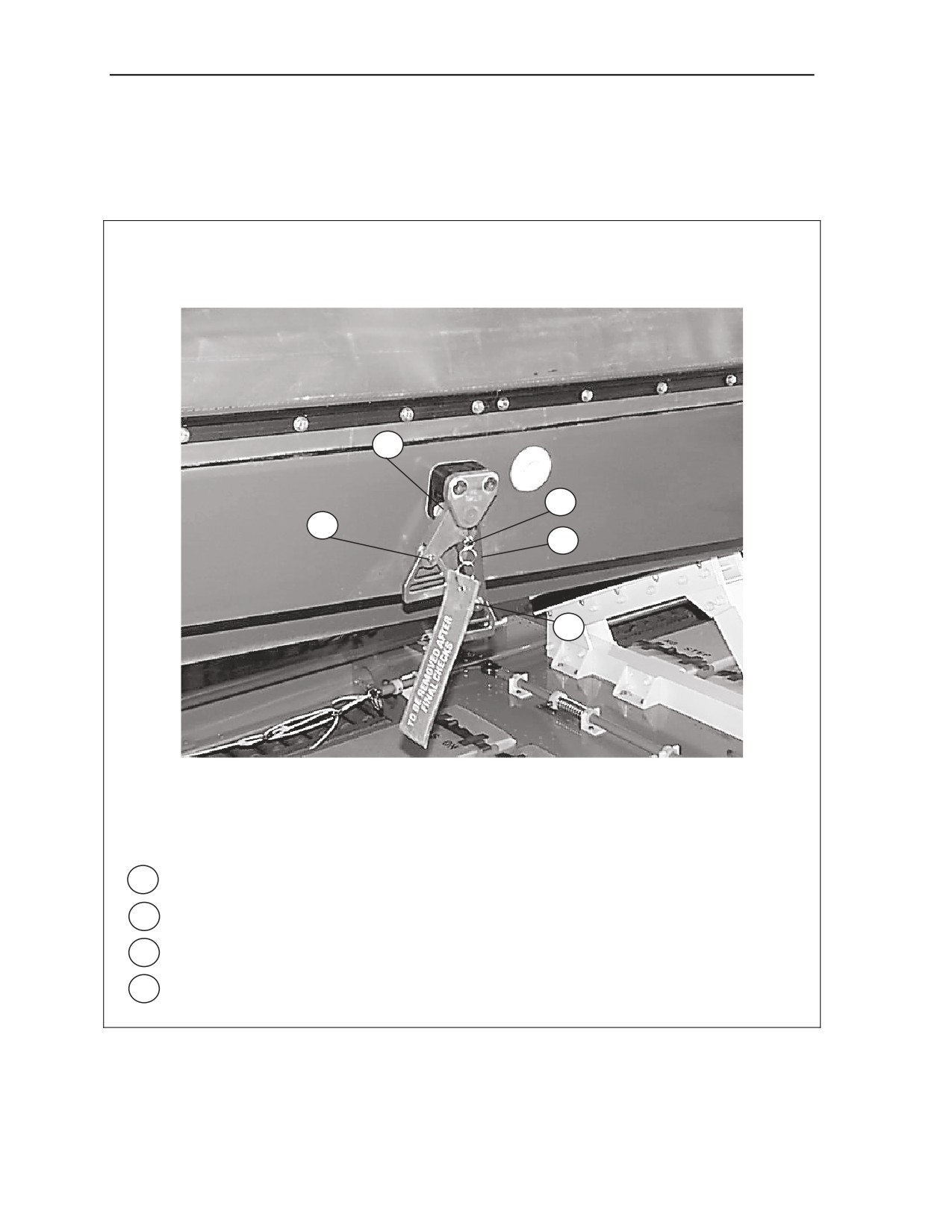
Chapter 4
PREPARING AND TESTING THE NSW RIB RESTRAINT SYSTEM
4-16. Prepare the restraint system as shown in Figure 4-28. Prepare the restraint system for test fire as
shown in Figure 4-29. Test fire the system as shown in Figure 4-30.
1
2
3
4
3
1.
Install a release caliper assembly on each of the boat restraint provisions (four on each side).
2.
Make sure the long arm faces the stem of the boat.
3.
Make sure the cotter pin on each arm faces outward.
4. Secure each caliper assembly in place with the pin provided.
Figure 4-28. Restraint System Prepared
FM 4-20.142/MCRP 4-11.3P/NAVSEA SS400-AD-MMO-010/ TO 13C7-51-21
4-40
19 September 2007
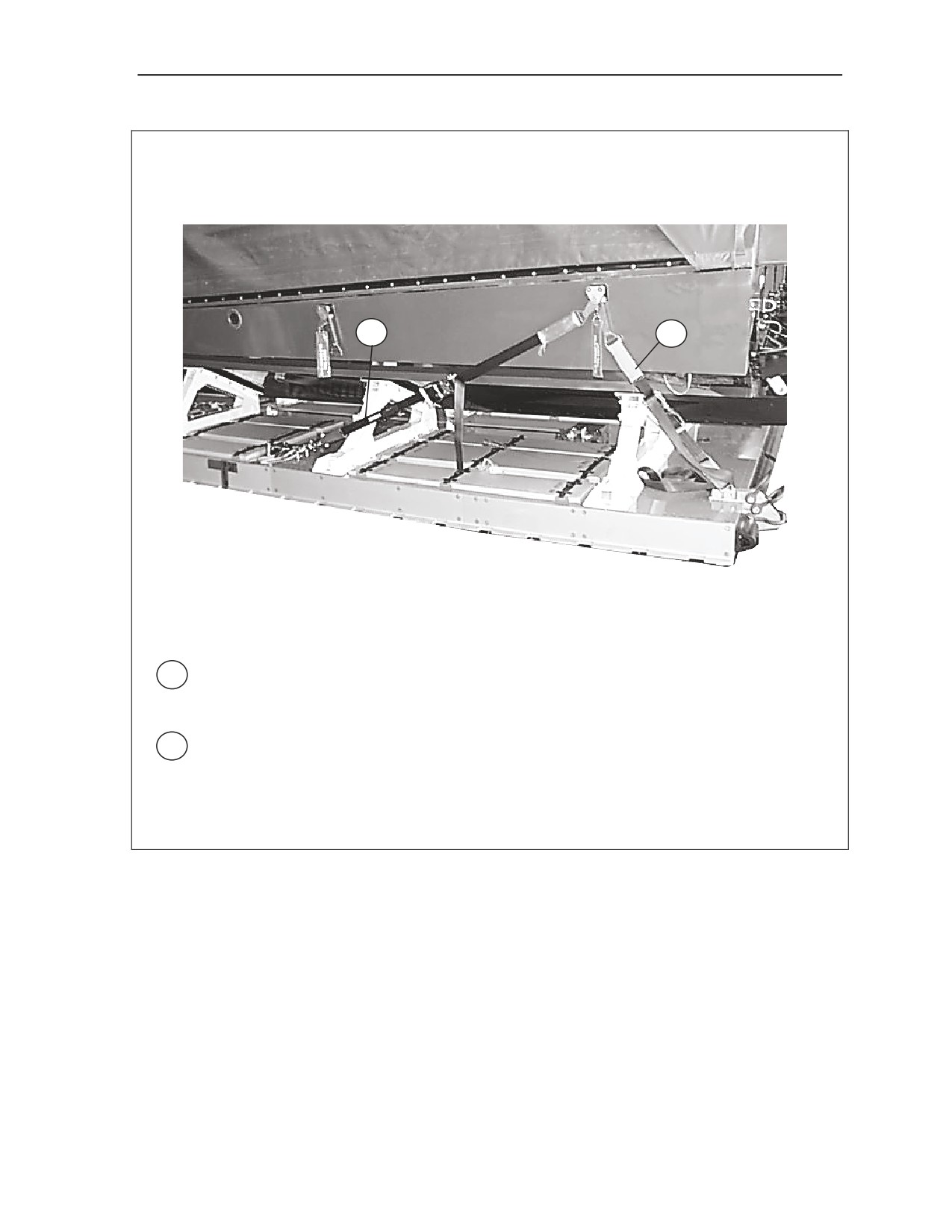
Rigging the Naval Special Warfare Rigid Inflatable Boat (NSW RIB) for Low-Velocity Airdrop
6
5
5. With the ratchet handle facing outboard, pass a lashing through the link on the emergency aft
restraint bracket, and up through the long arm of the caliper release unit. Connect the lashing
at the ratchet.
6. From outboard, pass the free end of the second lashing through the large diameter pin of the
1/2-inch shackle fitted to the scissor release unit. Pass the free end upward and inboard
through the short arm of the caliper release unit. Connect the lashing at the ratchet.
Note. Allow no twists in these lashings. Be sure that the protective sleeves on the lashings are positioned to protect them from
metal contact. Do not tighten the lashings until all are installed.
Figure 4-28. Restraint System Prepared (continued)
FM 4-20.142/MCRP 4-11.3P/NAVSEA SS400-AD-MMO-010/ TO 13C7-51-21
19 September 2007
4-41
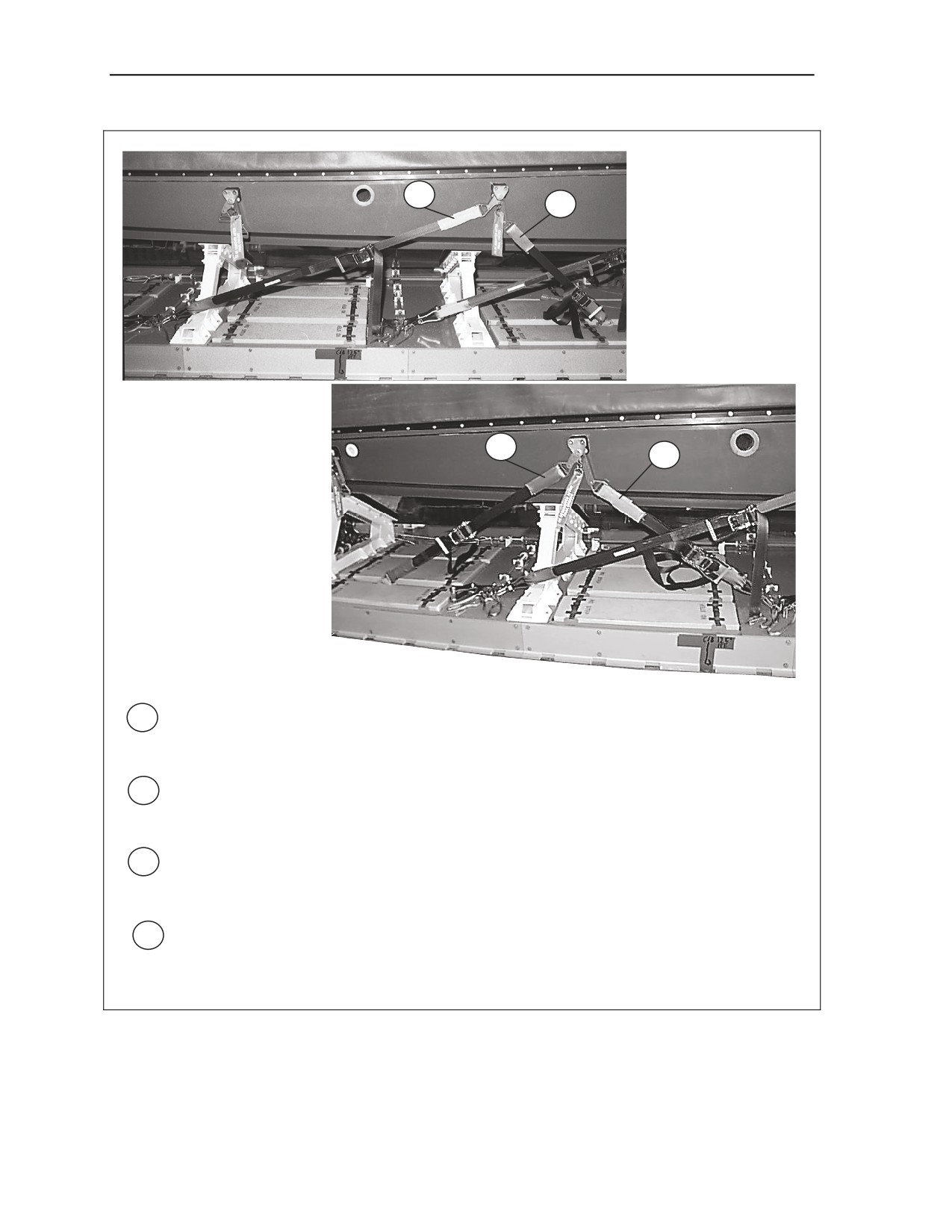
Chapter 4
8
7
9
10
7.
With the ratchet handle facing outward, pass a lashing through the link between the first and
second row of flotation devices, and up through the long arm of the caliper release unit.
Connect the lashing at the ratchet.
8.
From outboard, pass the free end of another lashing through the large diameter pin of the
1/2-inch shackle fitted to the second scissor release unit. Pass the free end upward and
inboard through the short arm of the caliper release unit. Connect the lashing at the ratchet.
9. With the ratchet handle facing outward, pass a lashing through the link between the first and
second row of flotation devices, and up through the short arm of the caliper release units.
Connect the lashing at the ratchet.
10. From outboard, pass the free end of another lashing through the large-diameter pin of the
1/2-inch shackle fitted to the first scissor release unit. Pass the free end upward and inboard
through the long arm of the caliper release unit. Connect the lashing at the ratchet.
Figure 4-28. Restraint System Prepared (continued)
FM 4-20.142/MCRP 4-11.3P/NAVSEA SS400-AD-MMO-010/ TO 13C7-51-21
4-42
19 September 2007
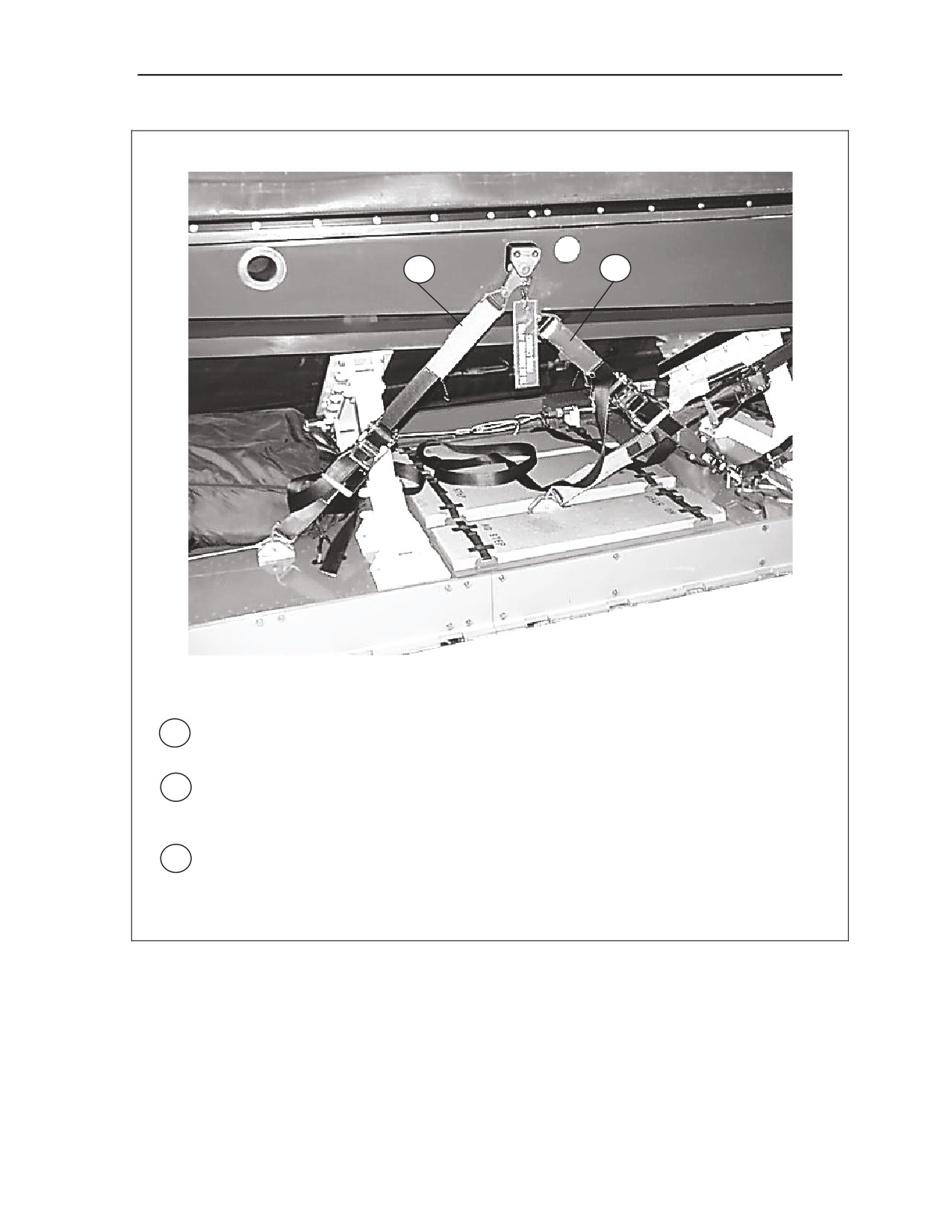
Rigging the Naval Special Warfare Rigid Inflatable Boat (NSW RIB) for Low-Velocity Airdrop
11
12
11. With the ratchet handle facing outward, pass a lashing through the rearmost link, and up
through the short arm of the caliper release unit. Connect the lashing at the ratchet.
12. From outboard, pass the free end of another lashing through the large-diameter pin of the
1/2-inch shackle fitted to the second scissor release unit. Pass the free end upward and
inboard through the long arm of the caliper release unit. Connect the lashing at the ratchet.
13. Repeat steps 1 through 12 for the other side of the boat.
Note. Starting at the stern, tighten the lashings simultaneously on the port and starboard sides. Tighten no more than hand
tight. Proper tension is applied to a pair of lashings attached to each caliper release assembly when the pin can be withdrawn
and re-inserted easily. Do not secure excess lashing until test-firing is completed.
Figure 4-28. Restraint System Prepared (continued)
FM 4-20.142/MCRP 4-11.3P/NAVSEA SS400-AD-MMO-010/ TO 13C7-51-21
19 September 2007
4-43
Chapter 4
3
1
2
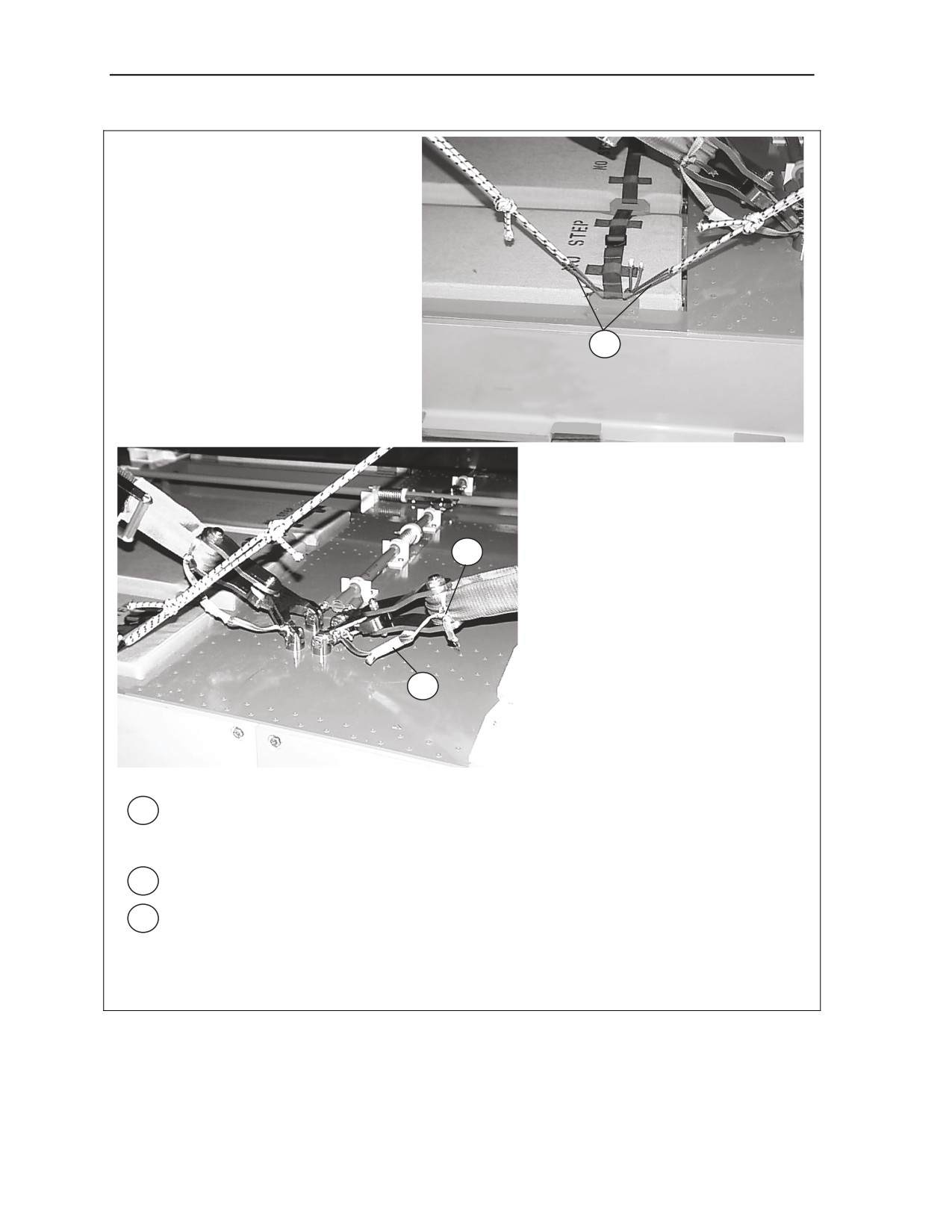
1.
Tie the running ends of the 1/2-inch tubular nylon webbing placed in Figure 4-7, step 4 to
each lashing, just above the shackle, making sure that 17 inches of nylon remains from knot
to knot.
2.
S-fold and tape the excess.
3. Cut twelve 24-inch lengths of type III nylon cord. Locate flotation device securing brackets 2,
4, and 6 (counting from the front of the platform). Tie two 2-inch loops of cord in each
bracket, on either side of the flotation device retaining strap. Be sure the knots are on the
inboard side of the brackets. Tie overhand knots in each running end, and trim the excess.
Figure 4-29. Restraint System Prepared for Test-Fire
FM 4-20.142/MCRP 4-11.3P/NAVSEA SS400-AD-MMO-010/ TO 13C7-51-21
4-44
19 September 2007