FM 4-20.142 Airdrop of Supplies and Equipment: Rigging Loads for Special Operations (September 2007) - page 2
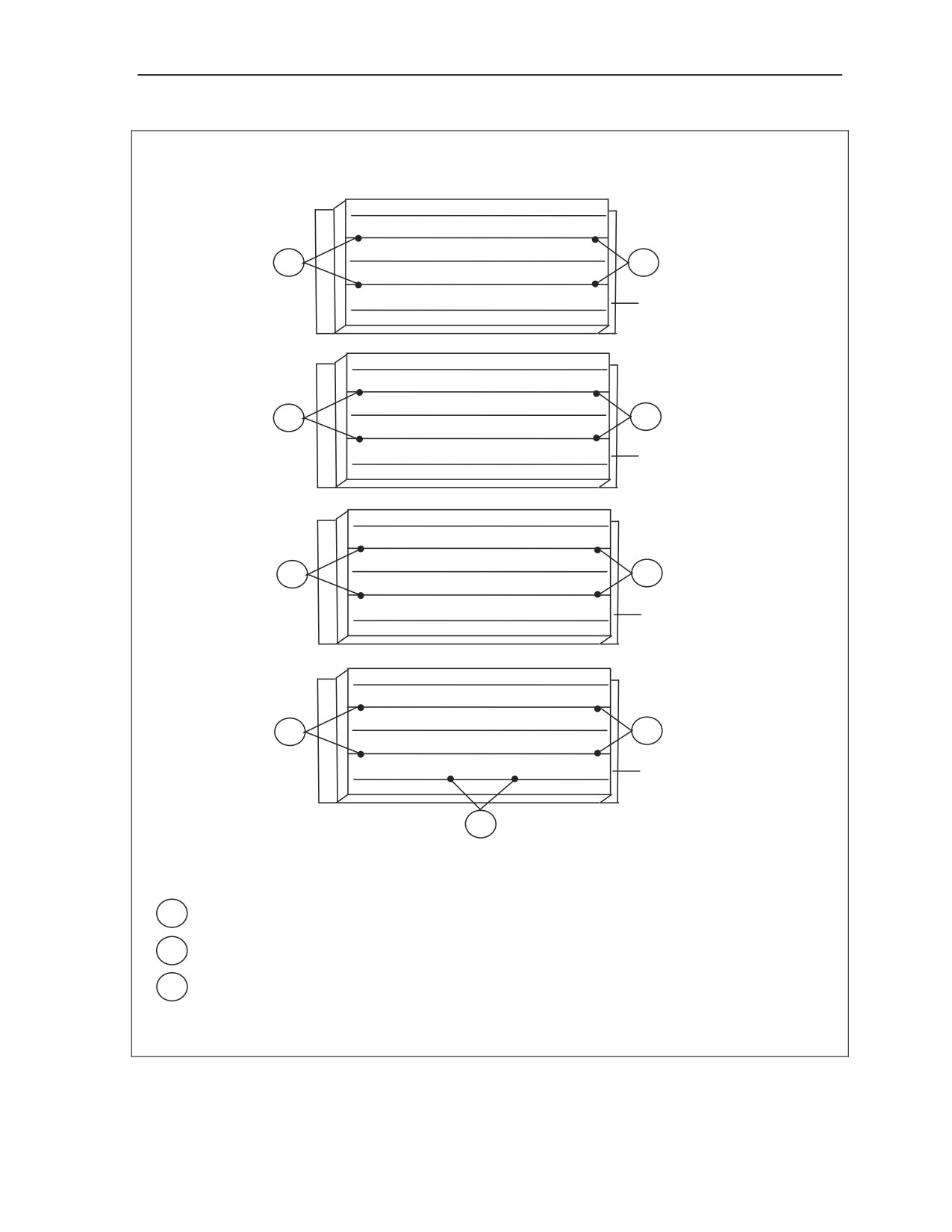
Rigging Combat Rubber Raiding Craft
Bow
1
1
Floorboard 1
1
1
Floorboard 2
Left
Right
1
1
Floorboard 3
1
1
Floorboard 4
2
Aft
1. Drill two 1/2-inch holes in both sides of each floor panel.
2. Drill two additional holes in the rear floor panel centered near the aft edge.
3. Run a 4-foot length of 1/2-inch or 1-inch tubular nylon webbing through both holes prepared
in Step 1. Tie the ends of the nylon webbing together with a square knot and an overhand
knot in the running ends on the bottom of the platform .(Not shown)
Note. Additional floorboard holes may be drilled to accommodate the accompanying load.
Figure 2-11. Boat Prepared with Hard Deck (Aluminum Floorboards)
FM 4-20.142/MCRP 4-11.3P/NAVSEA SS400-AD-MMO-010/ TO 13C7-51-21
19 September 2007
2-15
Chapter 2
5
4
4
D
H
C
G
8
B
F
Right
Left
A
E
6
Bow
9
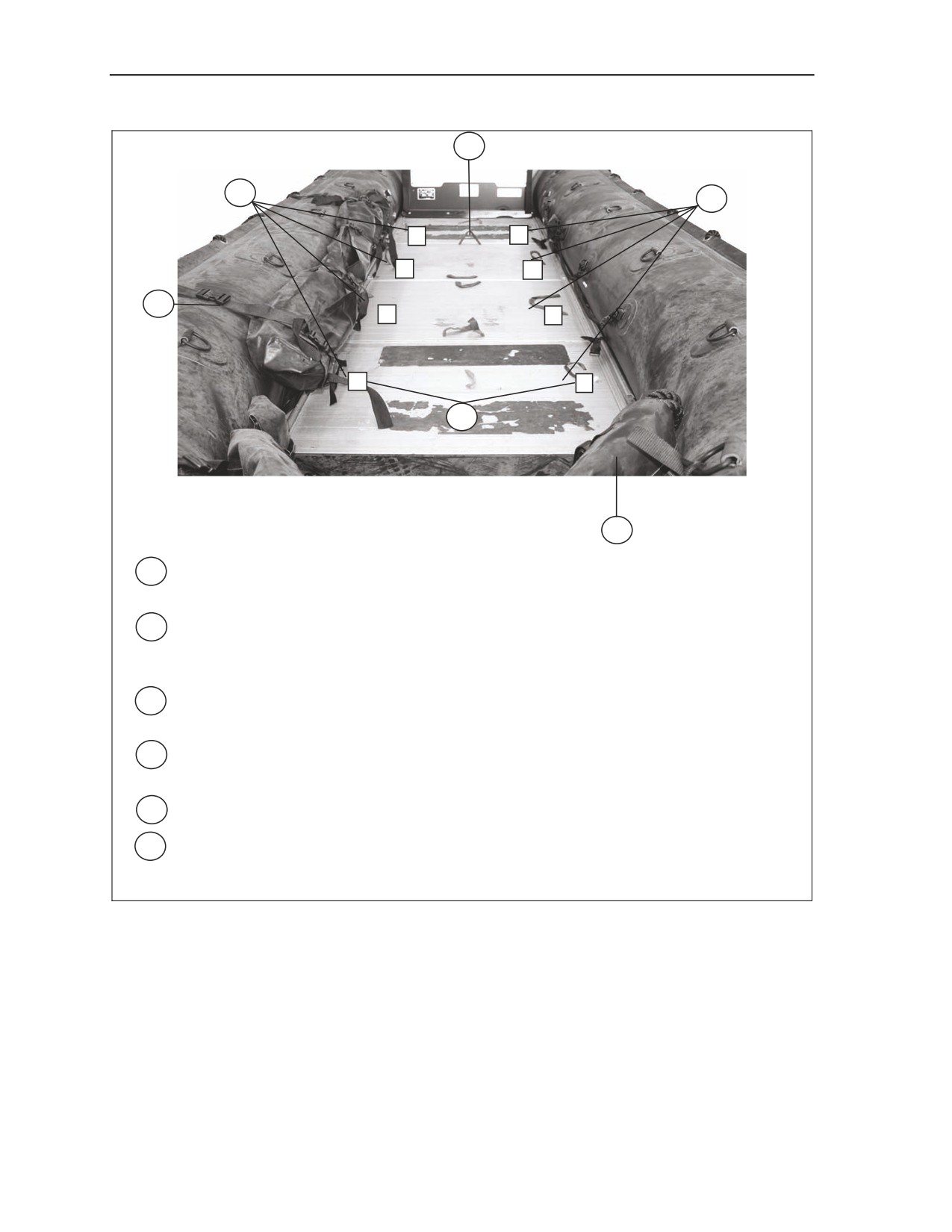
4.
Run a 6-foot length of 1/2-inch or 1-inch tubular nylon webbing through the two holes
prepared in Step 2. Secure as in Step 3.
5.
Install the floor panels, and inflate the boat.
Note. Additional ties may be added to panels to accommodate the accompanying load.
6.
Start at the bow of the boat and name the in-boat tiedowns on the right side A, B, C and D.
Name the in-boat tiedowns on the left side E, F, G and H.
7.
Tie chemical lights to the bow of the boat and to the center side carrying handles with type
I, 1/4-inch cotton webbing if dictated by mission requirements (not shown).
8.
Using type III nylon cord, tie the paddles to the side of the boat in the holders provided.
9. Stow an air pump and air hose in each of the pockets provided in the right front and left
rear of the boat.
Figure 2-11. Boat Prepared with Hard Deck (Aluminum Floorboards) (Continued)
FM 4-20.142/MCRP 4-11.3P/NAVSEA SS400-AD-MMO-010/ TO 13C7-51-21
2-16
19 September 2007
Rigging Combat Rubber Raiding Craft
3
Right
2
3
A
B
C
D
1
Bow
4
G
H
E
F
Left
3
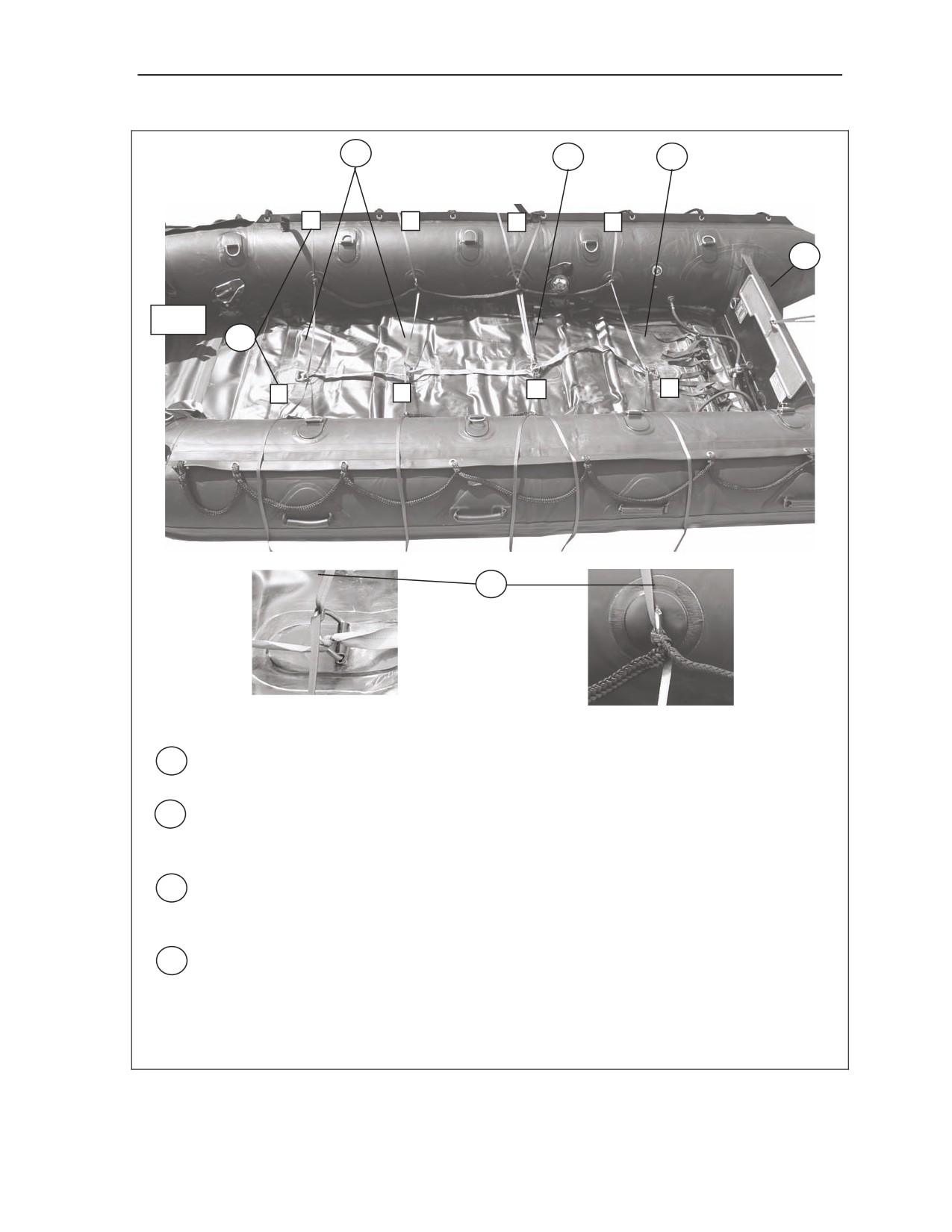
1. Girth hitch a 14-foot length of 1/2-inch tubular nylon webbing to the bracket on the inboard
side of the transom.
2. Girth hitch two 14-foot lengths of 1/2-inch tubular nylon webbing to the second in-floor D-ring
from the rear of the boat. Pass the running ends through the nearest safety rope D-ring and
over the side.
3. Girth hitch one 14-foot length of 1/2-inch tubular nylon webbing to each of the three
remaining in-floor D-rings. Pass each running end through the nearest safety rope D-ring and
over the side.
4. Start at the bow of the boat and name the in-boat tiedowns on the right side A, B, C and D.
Name the in-boat tiedowns on the left side E, F, G and H.
Figure 2-12. Boat Prepared with Roll-up Floor
FM 4-20.142/MCRP 4-11.3P/NAVSEA SS400-AD-MMO-010/ TO 13C7-51-21
19 September 2007
2-17
Chapter 2
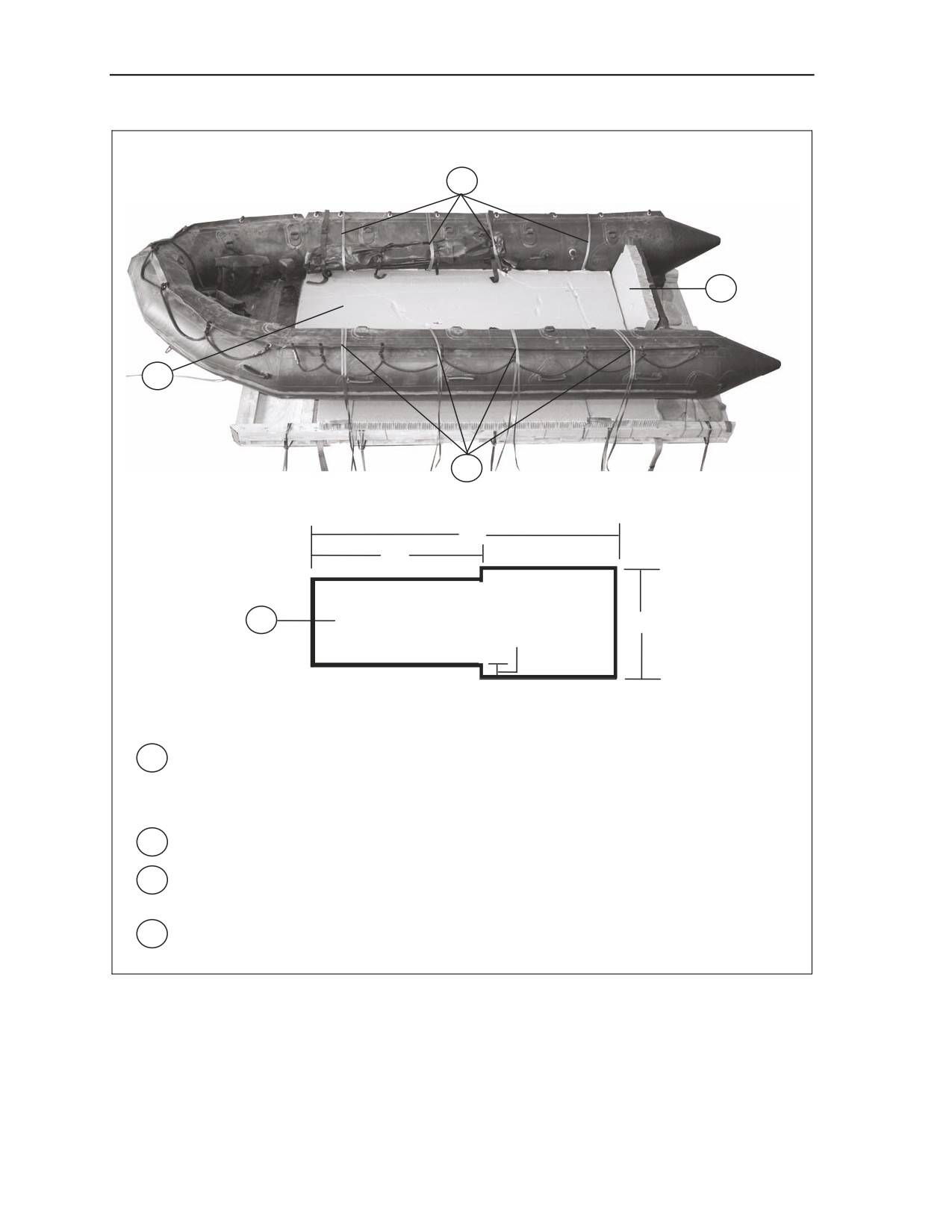
Notes. 1. All dimensions given are in inches.
2. Drawing is not to scale.
1
2
4
1
96
54
3
36
2
Note. The procedures in Step 1 are only used on boats with hard deck (aluminum floorboards).
1. Pass a 13-foot length of 1/2-inch tubular nylon webbing through each in-boat tiedown
positioned in Steps 4 and 5 of Figure 2-11. Even the ends, and tie in place with a girth
hitch. Lay the lengths outside the boat.
Note. Boats with or without hard deck (aluminum floorboards) will be prepared as shown in Steps 2, 3 and 4.
2. Set a 13- by 36-inch piece of honeycomb against the transom.
3. Make 2- by 54-inch cutout on each side, starting from the same end, of a 36- by 96-inch
piece of honeycomb.
4. Place the honeycomb on the floor of the boat with the cutouts against the paddles.
Figure 2-13. Honeycomb Prepared and Positioned
FM 4-20.142/MCRP 4-11.3P/NAVSEA SS400-AD-MMO-010/ TO 13C7-51-21
2-18
19 September 2007
Rigging Combat Rubber Raiding Craft
POSITIONING BOAT
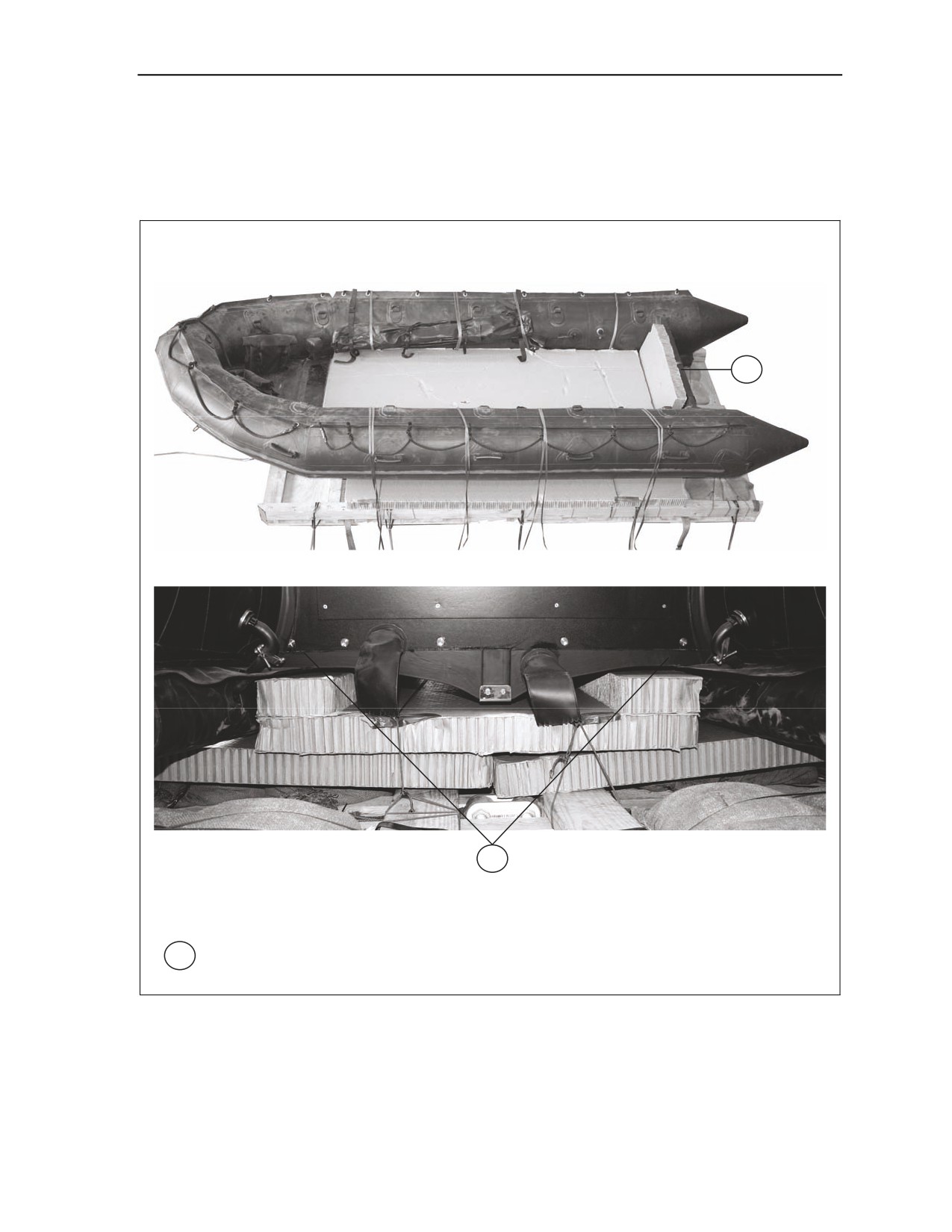
2-8. Center the boat on the platform with the transom even with the front edge of the honeycomb as
shown in Figure 2-14.
1
Front
1
Front
1. Set the boat on the platform with transom even with front edge of the honeycomb.
Figure 2-14. Boat Positioned
FM 4-20.142/MCRP 4-11.3P/NAVSEA SS400-AD-MMO-010/ TO 13C7-51-21
19 September 2007
2-19
Chapter 2
PREPARING, PLACING, AND SECURING ACCOMPANYING LOAD
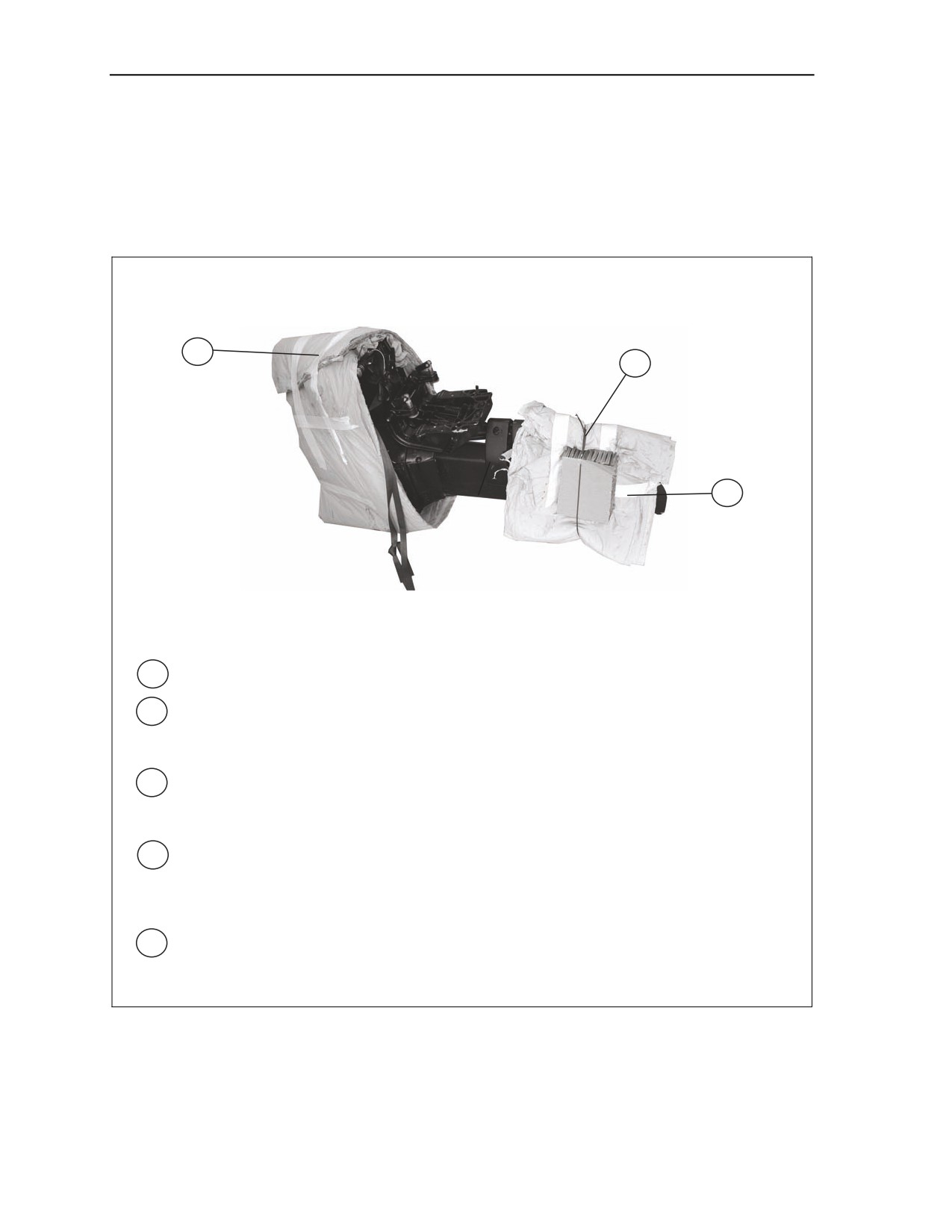
2-9. Prepare the Johnson Enforcer or Bombardier outboard engine and fuel tanks as shown in Figure 2-
15. Prepare the three tiedown rings as shown in Figure 2-16. Place the engines, fuel tanks, and load as
shown in Figure 2-17. Secure the tiedown rings as shown in Figure 2-18. Secure the engines, fuel tanks,
and load as shown in Figure 2-19.
4
2
1
1. Wrap the lower unit of the outboard engine with cellulose wadding and tape in place.
2. Tie a 6- by 12-inch piece of honeycomb to the lower unit of the outboard engine using type
III nylon cord. Tape edges of honeycomb with cloth backed adhesive tape to prevent
cutting by the type III nylon cord.
3. Lay a 6- by 6-inch piece of honeycomb on the engine. Fold the operating handle onto the
honeycomb and tie in place with type III nylon cord Wrap the handle with cellulose
wadding and tape in place (not shown).
4. Tie the engine cover in place with two lengths of type III nylon cord (not shown). Wrap the
housing with cellulose wadding and tape in place.
Note. Put only five gallons of fuel in each container if collapsible plastic containers are used. Force out all air before closing
them. Pad between plastic tanks and engine or other equipment with 1/2-inch felt (not shown).
5. Make sure the fuel tank is at least 1/2 full but no more than 3/4 full (not shown).
Note. If using a metal fuel tank pad with several layers of cellulose wadding, do not cover the handle and tape the wadding
in place.
Figure 2-15. Johnson Enforcer or Bombardier Outboard Engine and Fuel Tank Prepared
FM 4-20.142/MCRP 4-11.3P/NAVSEA SS400-AD-MMO-010/ TO 13C7-51-21
2-20
19 September 2007
Rigging Combat Rubber Raiding Craft
2
1
3
5
1.
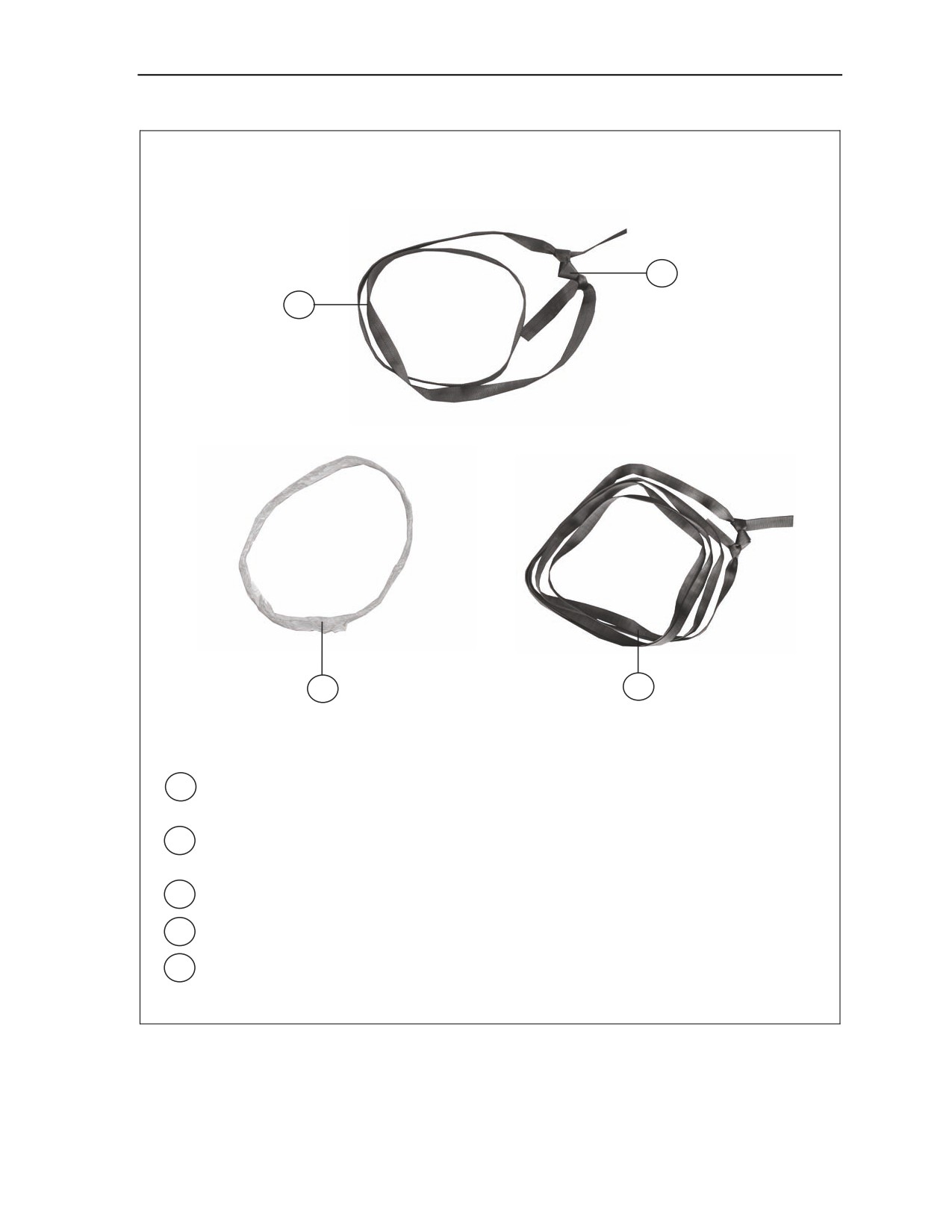
Use a 60-inch length of 1-inch nylon webbing to make a two-ply tiedown ring 10 inches in
diameter.
2.
Tie the ends of the webbing together with a square knot, and tie an overhand knot in each
free end.
3.
Wrap the nylon webbing using 2-inch adhesive tape.
4.
Repeat steps 1 through 3 to form a second tiedown ring (not shown).
5. Use a 120-inch length of 1-inch tubular nylon webbing to make a four-ply tiedown ring 10
inches in diameter. Tie the nylon as in Step 2. Wrap as in Step 3.
Figure 2-16. Tiedown Rings Formed
FM 4-20.142/MCRP 4-11.3P/NAVSEA SS400-AD-MMO-010/ TO 13C7-51-21
19 September 2007
2-21
Chapter 2
CAUTION
An accompanying load weighing at least 650 pounds but no more
than 1,170 pounds must be dropped with a single Zodiac F470U
boat. Safety the engine to a convenient point in the boat with a
length of 1/2-inch or 1-inch tubular nylon webbing.
3
1
2
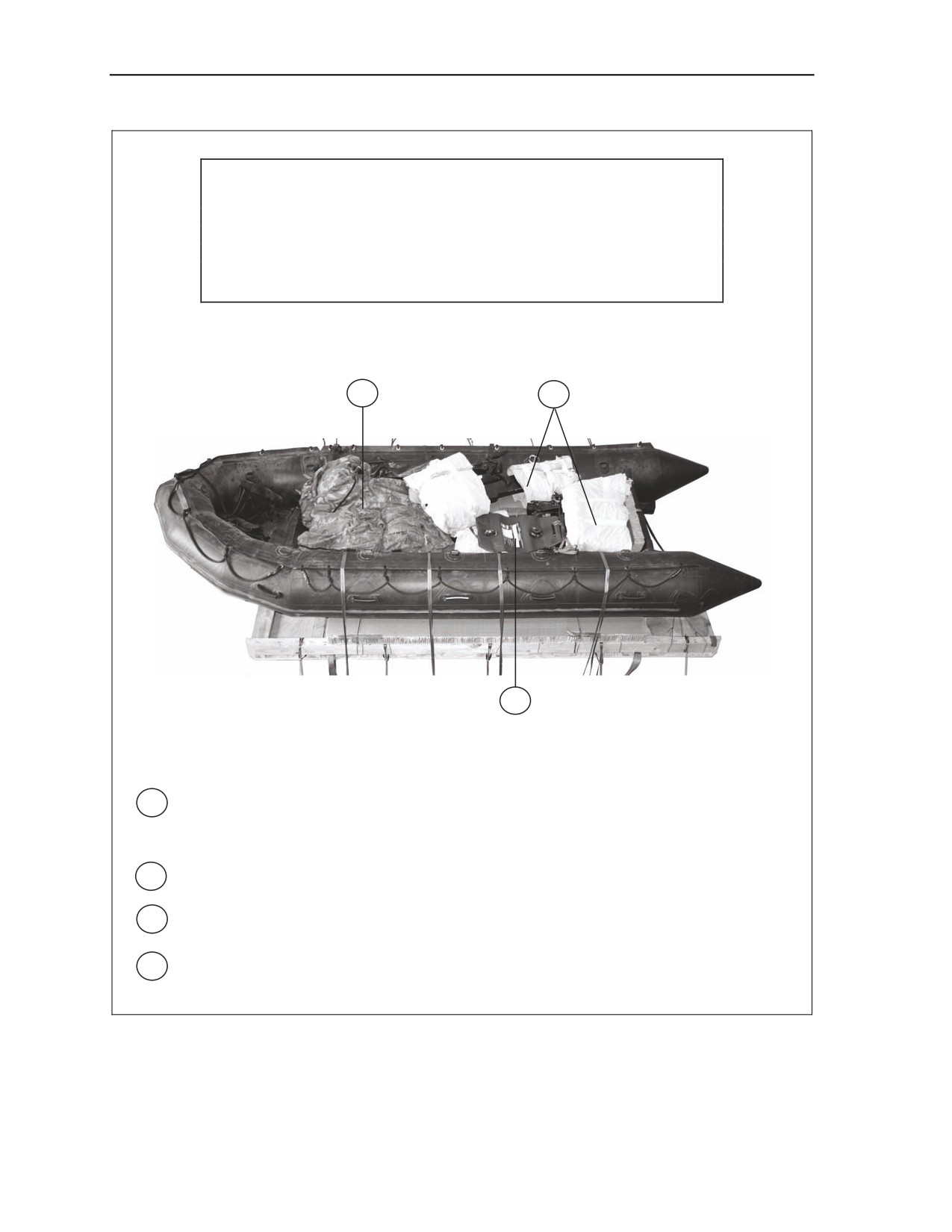
1. Lay the outboard engine, operating handle facing up, in the rear of the boat. Place the top
of the engine 3 inches from the transom.
Note. If placing a second engine, prepare as in Figure 2-15 and place as shown above.
2. Set the fuel tank beside the lower unit.
Note. Up to four collapsible tanks may be rigged in each boat.
3. Lay the rucksacks in the boat. Tie the frames together using type III nylon cord.
4. Place the weapons between the two rows of rucksacks. Tie them to a convenient D-ring on
the boat with two lengths of type III nylon cord (not shown).
Figure 2-17. Engines, Fuel Tanks and Accompanying Load Placed
FM 4-20.142/MCRP 4-11.3P/NAVSEA SS400-AD-MMO-010/ TO 13C7-51-21
2-22
19 September 2007
Rigging Combat Rubber Raiding Craft
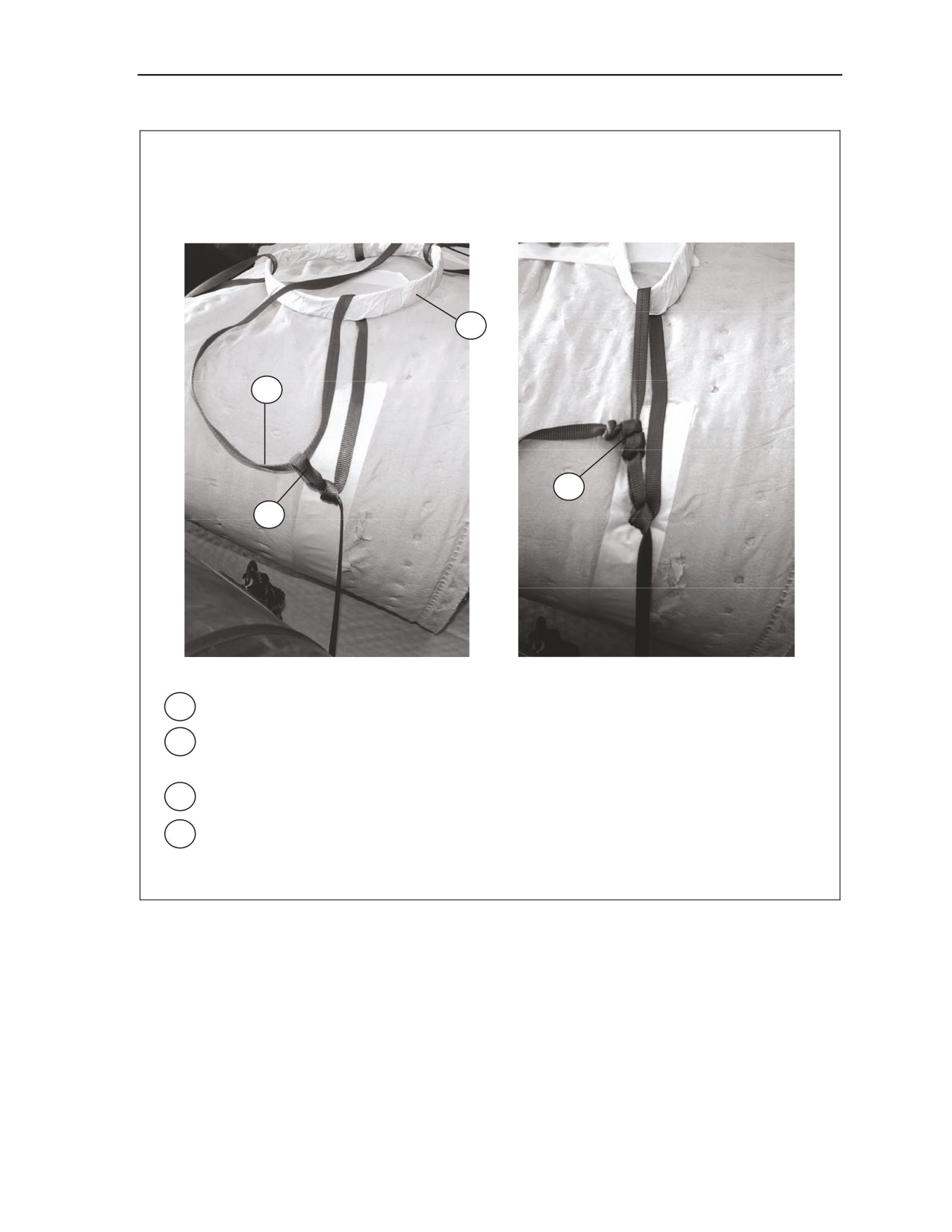
Note. Use the following procedures when securing the tiedown ring in boats with a roll-up floor.
Secured Using Roll-up Floor
1
3
4
2
1. Place a two-ply tiedown ring over the accompanying load as described.
2. Tie a loop in the standing end of the 1/2-inch tubular nylon webbing. Tie an overhand knot
in the running end.
3. Pass the running end of the 1/2-inch tubular nylon through the tiedown ring.
4. Pass the running end of the 1/2-inch tubular nylon through the loop made in Step 2. Pull it
tight and tie with three alternating half hitch knots. Tie an overhand knot in the running end.
Note. The purpose of this method of tying is to allow the lashings to slide easily off the tiedown ring once cut.
Figure 2-18. Tiedown Rings Secured
FM 4-20.142/MCRP 4-11.3P/NAVSEA SS400-AD-MMO-010/ TO 13C7-51-21
19 September 2007
2-23
Chapter 2
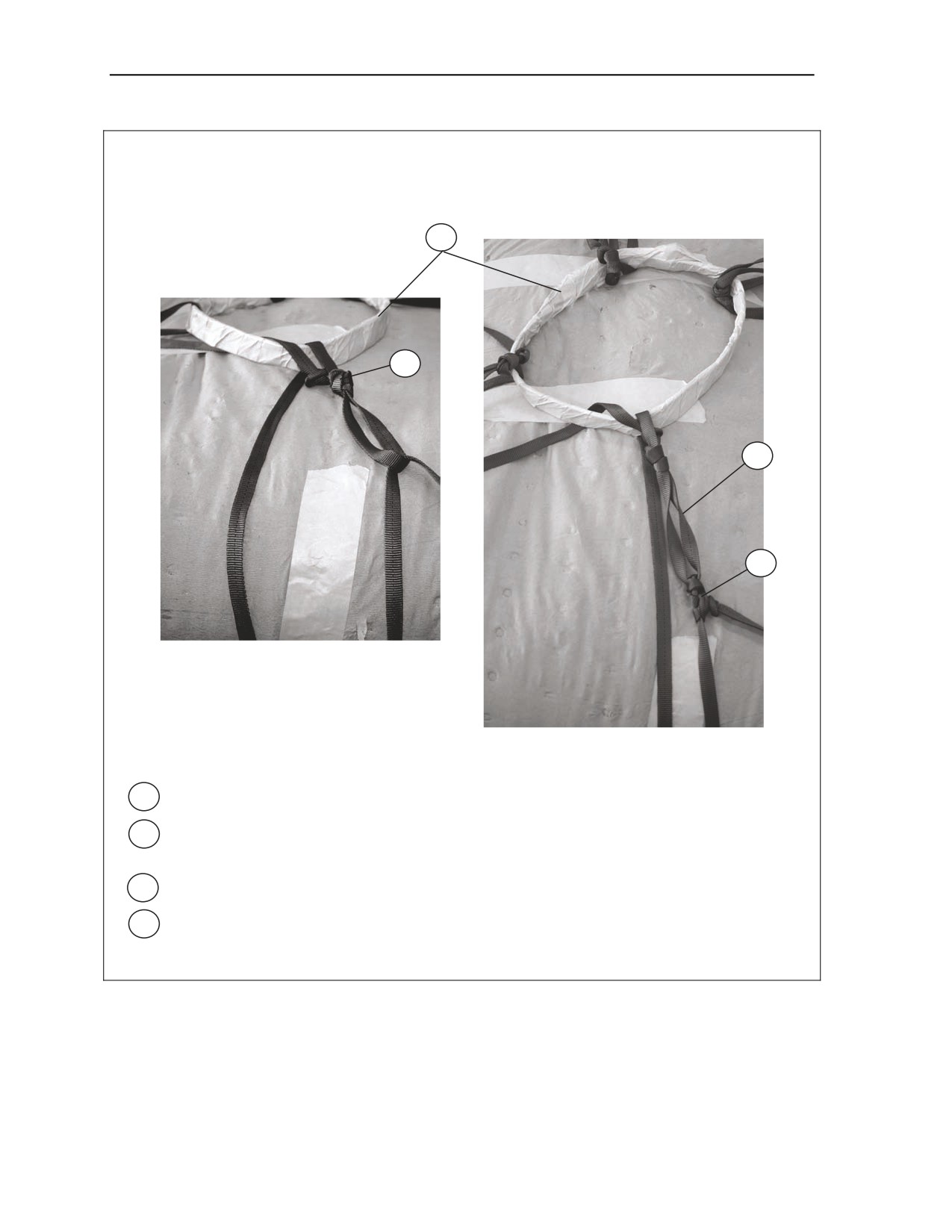
Note. Use the following procedures when securing the tiedown ring in boats with a hard deck (aluminum floorboards).
Secured Using Hard Deck Floor
5
6
7
8
5.
Place a two-ply tiedown ring over the accompanying load as described.
6.
Tie a loop in one end of the 1/2-inch tubular nylon webbing. Tie an overhand knot in the
running end.
7.
Pass the loop end through the tiedown ring.
8. Pass the opposite end of the 1/2-inch tubular nylon through the loop made in Step 6, pull it
tight and tie with three alternating half hitch knots. Tie an overhand knot in the running end.
Figure 2-18. Tiedown Rings Secured (Continued)
FM 4-20.142/MCRP 4-11.3P/NAVSEA SS400-AD-MMO-010/ TO 13C7-51-21
2-24
19 September 2007
Rigging Combat Rubber Raiding Craft
5
3
A
B
C
D
4
2
E
F
G
H
1
5
3
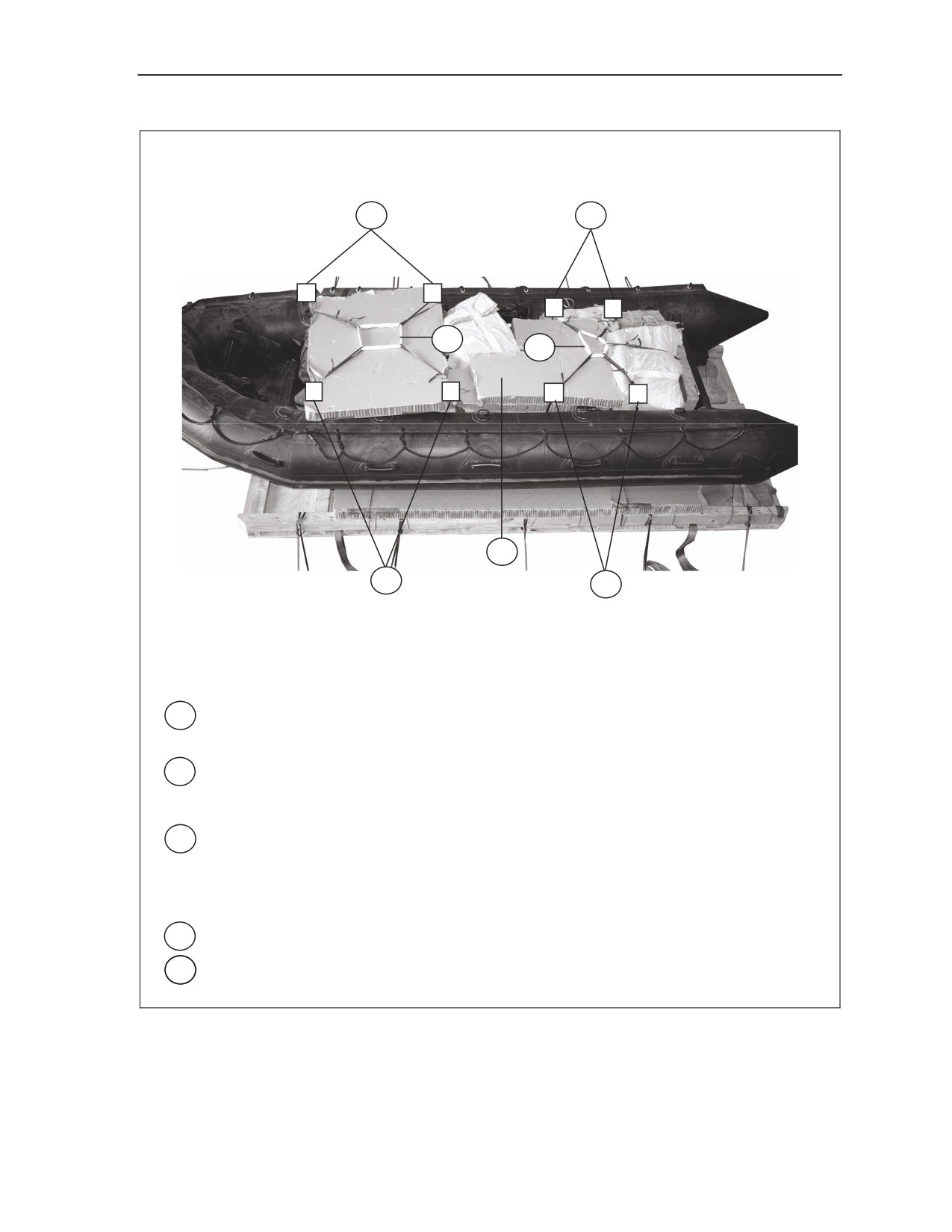
1.
Cut and place honeycomb over the accompanying load as shown.
Note. Honeycomb placement over the accompanying load is optional.
2.
Center a two-ply tiedown ring (Figure 2-16) on the middle unit of the outboard engine.
Note. Keep the two-ply, 10-inch tiedown ring centered over the middle unit of the outboard engine. Use the procedures in
Figure 2-18 to secure the in-boat tiedowns, depending on the type of floor used in the boat.
3.
Pass one tie from in-boat tiedowns C, D, G, and H on both sides of the boat and from the
tiedown on the transom through the tiedown ring. Tie each tie to the loop made in one of
the running ends. Secure them to the ring as shown in Figure 2-18 accordingly.
Note. Route the ties on the transom through the handle on the fuel tank. Secure the fuel tank to a convenient D-ring with
type III nylon cord.
4.
Center a two-ply tiedown ring on the rucksacks.
5. Use in-boat tiedowns A, B, E and F to restrain the load as described in Step 3 above.
Figure 2-19. Engines, Fuel Tanks and Accompanying Load Secured
FM 4-20.142/MCRP 4-11.3P/NAVSEA SS400-AD-MMO-010/ TO 13C7-51-21
19 September 2007
2-25
Chapter 2
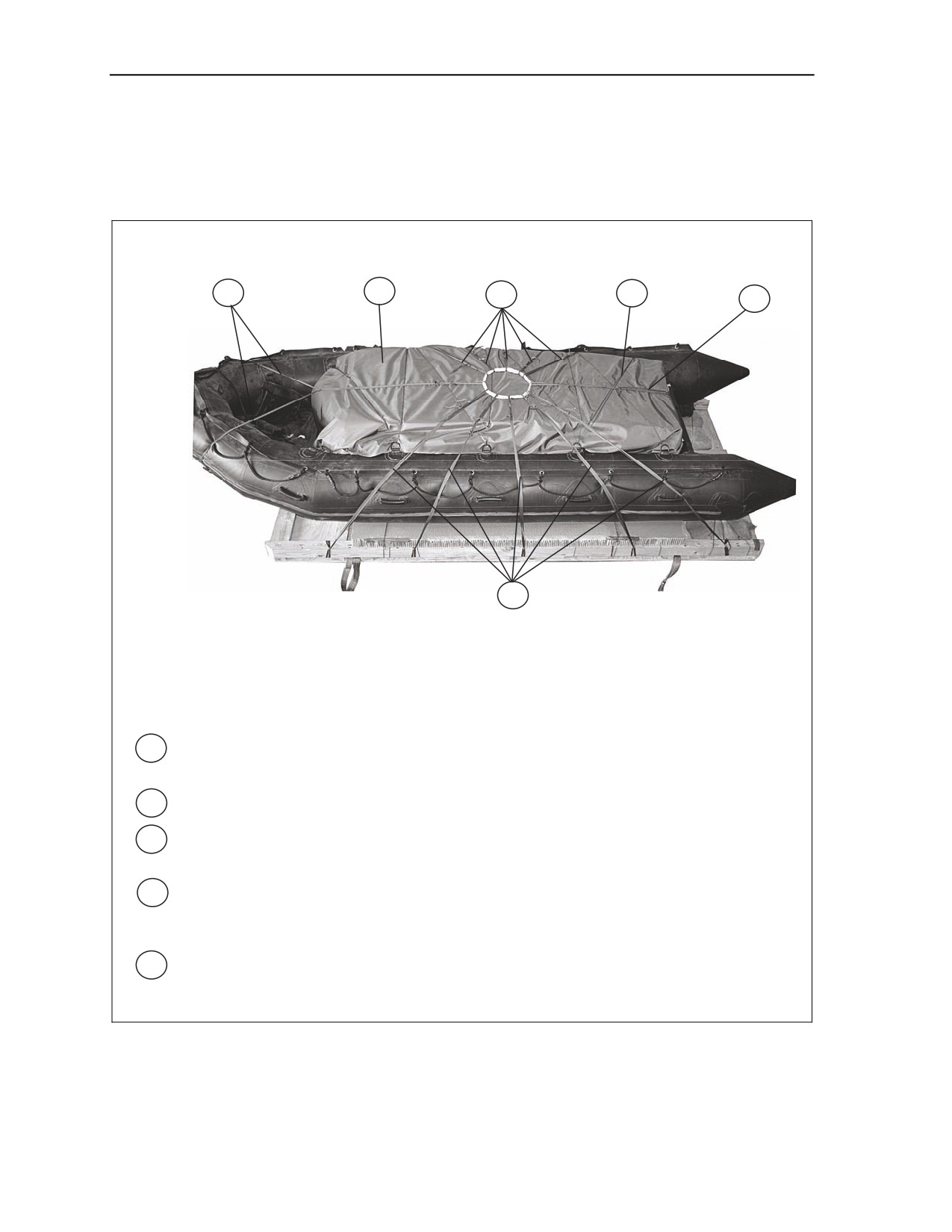
INSTALLING LOAD COVER AND LASHING BOAT
2-10. Place a 5- by 10-foot piece of cotton duck or nylon cover over the accompanying load and lash the
boat to the platform as shown in Figure 2-20.
Left
4
1
3
2
5
Rear
Front
3
Right
1. Place a 5- by 10-foot piece of cotton duck or nylon cover over the accompanying load.
Push the edges of the cloth down between the load and the side of the boat.
2. Tie the cloth in place with type III nylon cord using the D-rings on the sides of the boat.
3. Tie all the 18-foot lashings to the four-ply, 10-inch tiedown ring as described in Figure 2
16, Steps 1 through 5.
4. Pass one end of the rear lashing around each side of the bow. Tie the ends together with
an overhand knot. Tie the remainder of the lashing to the four-ply, 10-inch tiedown ring as
described in Figure 2-18, Steps 5 through 8.
5. Use the intermediate loop tie to tie each end of the front lashing to the four-ply, 10-inch
tiedown ring as described in Figure 2-18, Steps 5 through 8.
Figure 2-20. Cover Placed, Secured and Load Lashed to Platform
FM 4-20.142/MCRP 4-11.3P/NAVSEA SS400-AD-MMO-010/ TO 13C7-51-21
2-26
19 September 2007
Rigging Combat Rubber Raiding Craft
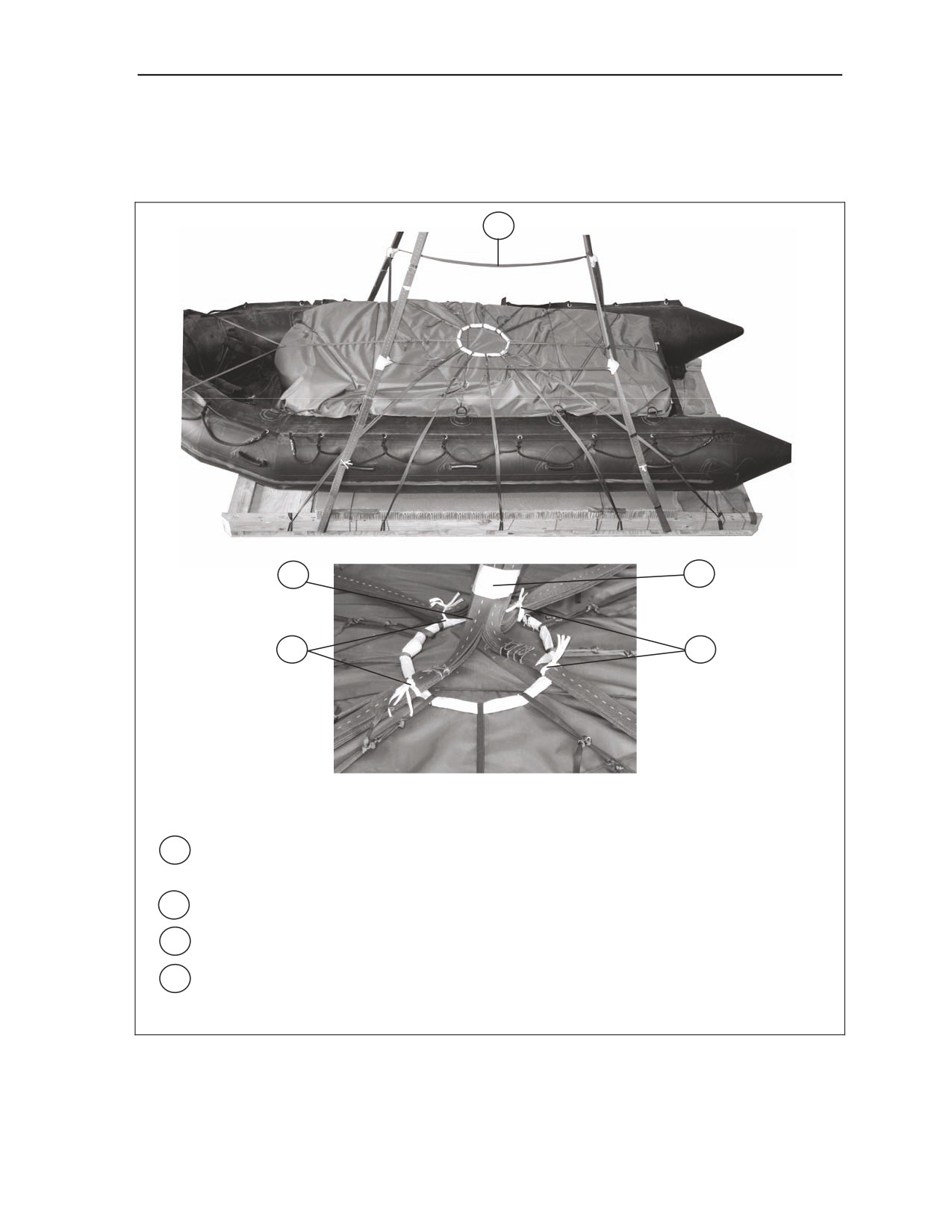
SAFETY TIEING SUSPENSION SLINGS
2-11. Safety the suspension slings as shown in Figure 2-21.
1
2
4
3
3
1.
Raise the suspension slings and install deadman’s tie according to FM 4-20.102/MCRP 4
11.3JNAVSEA SS400-AB-MMO-010/TO 13C7-1-5/.
2.
Lower the suspension slings until they touch the tie down ring.
3.
Tie each sling to the tiedown ring with two lengths of 80-pound, 1/4-inch cotton webbing.
4. Tape the slings together at the tiedown ring and at 2-foot intervals with two turns of paper
masking tape.
Figure 2-21. Suspension Slings Safety Tied
FM 4-20.142/MCRP 4-11.3P/NAVSEA SS400-AD-MMO-010/ TO 13C7-51-21
19 September 2007
2-27
Chapter 2
STOWING PARACHUTE
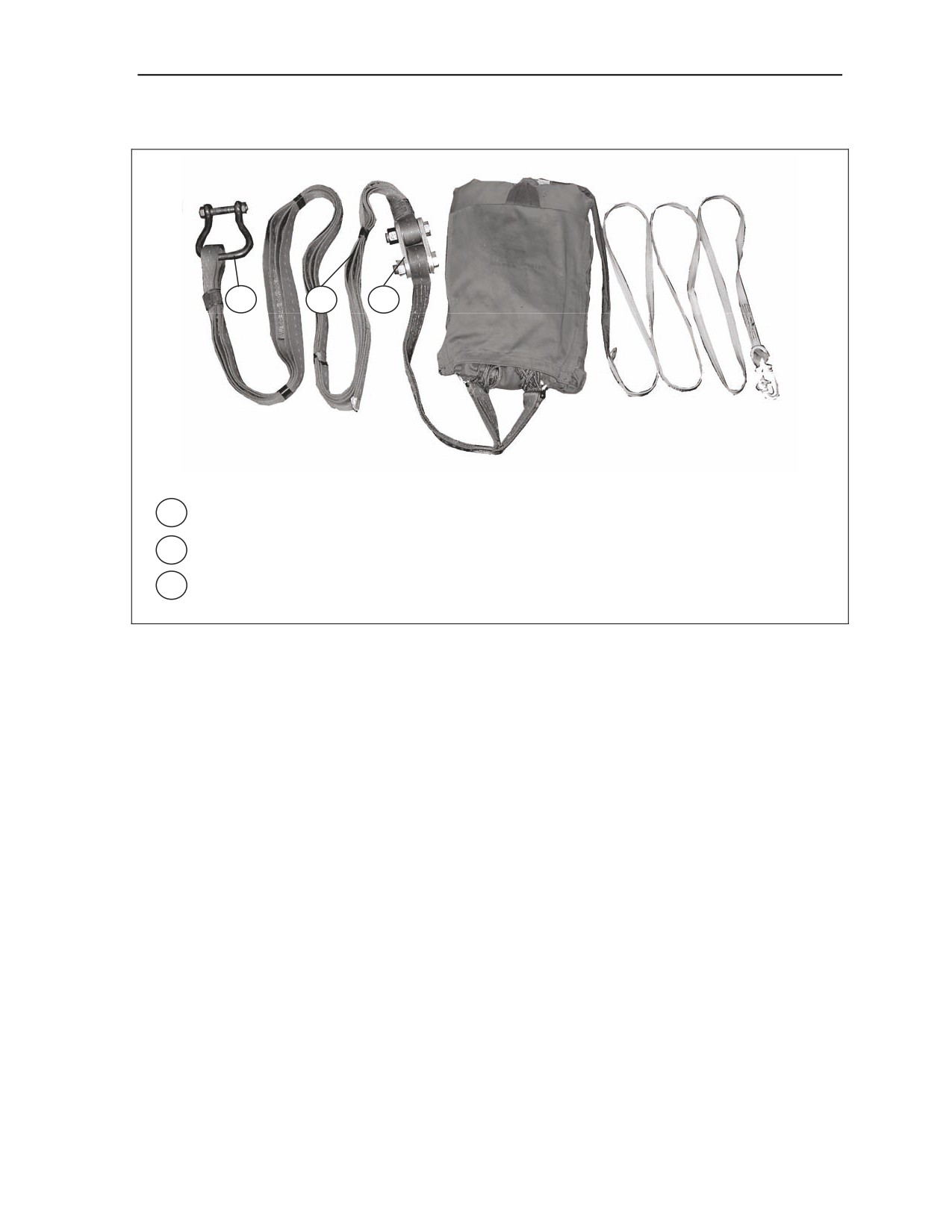
2-12. A 15-foot cargo extraction parachute is used to deploy the G-12 cargo parachute after the load is
pushed from the aircraft. When used as a deployment parachute for this load, the 15-foot cargo extraction
parachute is packed in a T-10 deployment bag.
Note. If the standard 15-foot parachute deployment bag is attached to the parachute, remove the
bag at the bag retaining line.
• Packing the 15-foot extraction parachute. Use the following items to pack the 15-foot cargo
extraction parachute in a T-10 deployment bag for use with this load as shown in Figures 2-22
through 2-26:
One T-10 deployment bag with universal static line
Retainer bands as required
Type I, 1/4-inch cotton webbing
Ticket number 5, 8/4 cotton thread
One large cargo suspension clevis
In addition, for a parachute with a 36-inch adapter web, use one 9-foot (3-loop), type XXVI
nylon sling and one two-point connector link.
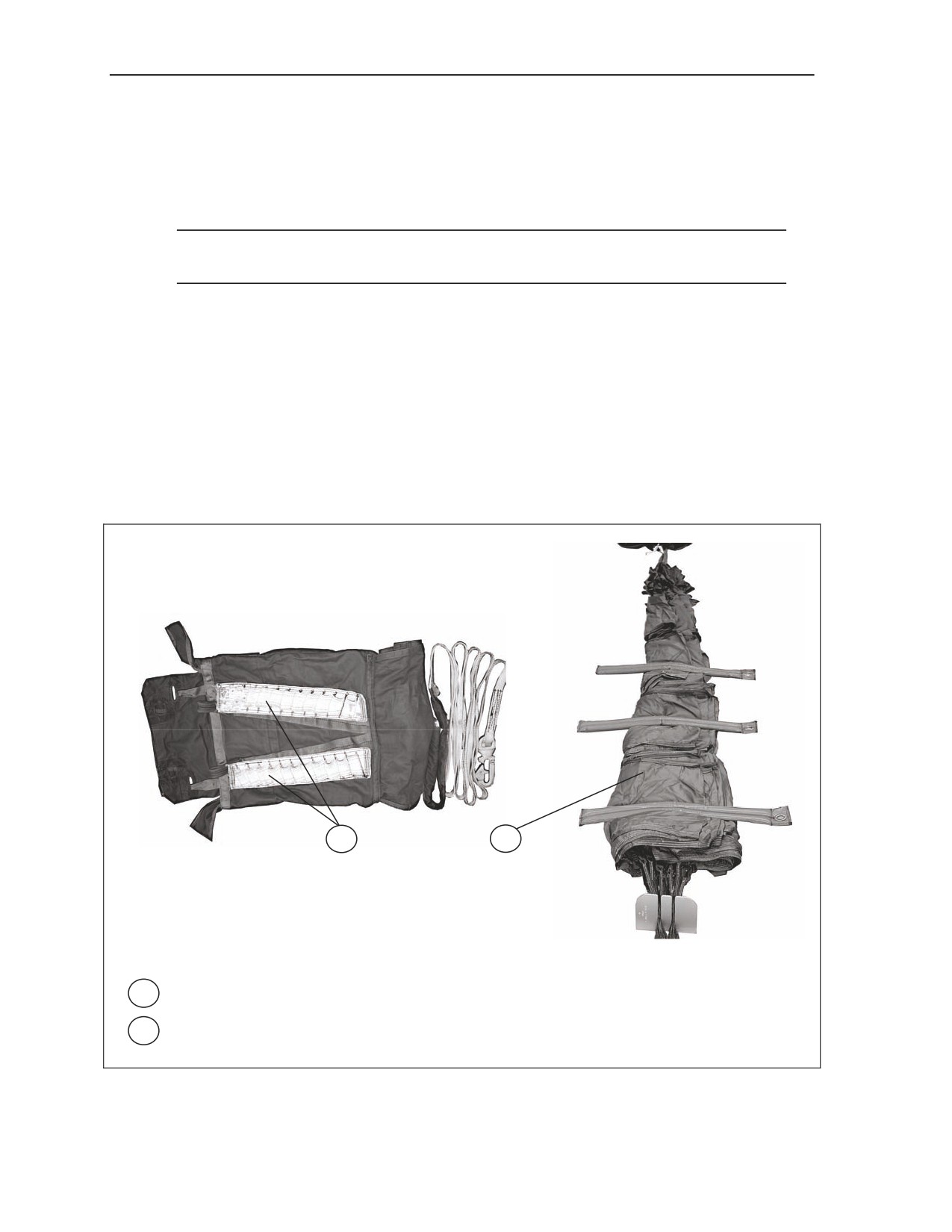
1
2
1. Attach retainer bands to the first eight stow loops on each side of the T-10 deployment bag.
2. Flat fold and long fold the canopy according to TM 10-1670-278-23&P/TO 13C5-26
2/NAVAIR 13-1-27/TM 01109C-23&P/1.
Figure 2-22. 15-Foot Extraction Parachute Stowed
FM 4-20.142/MCRP 4-11.3P/NAVSEA SS400-AD-MMO-010/ TO 13C7-51-21
2-28
19 September 2007
Rigging Combat Rubber Raiding Craft
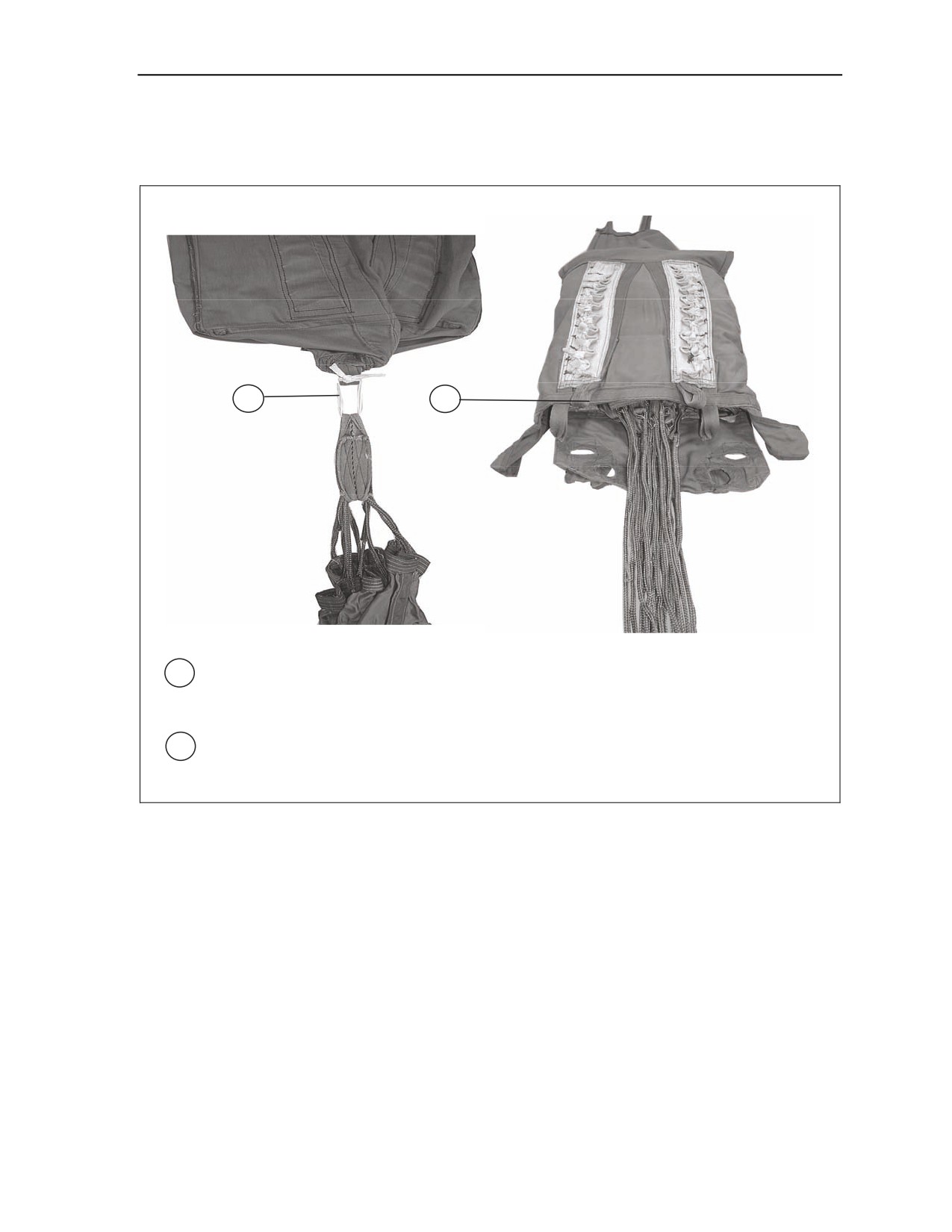
1
2
1. Pass two lengths of type I, 1/4-inch cotton webbing through the bridle loop of the
deployment bag to form a 3-inch loop. Cross the ends of the webbing over the bridle
attaching loop. Tie them with a surgeon’s knot and locking knot.
2. S-fold the canopy into the deployment bag, starting at the upper right corner of the bag.
Figure 2-23. Deployment Bag Attached and Canopy Stowed
FM 4-20.142/MCRP 4-11.3P/NAVSEA SS400-AD-MMO-010/ TO 13C7-51-21
19 September 2007
2-29
Chapter 2
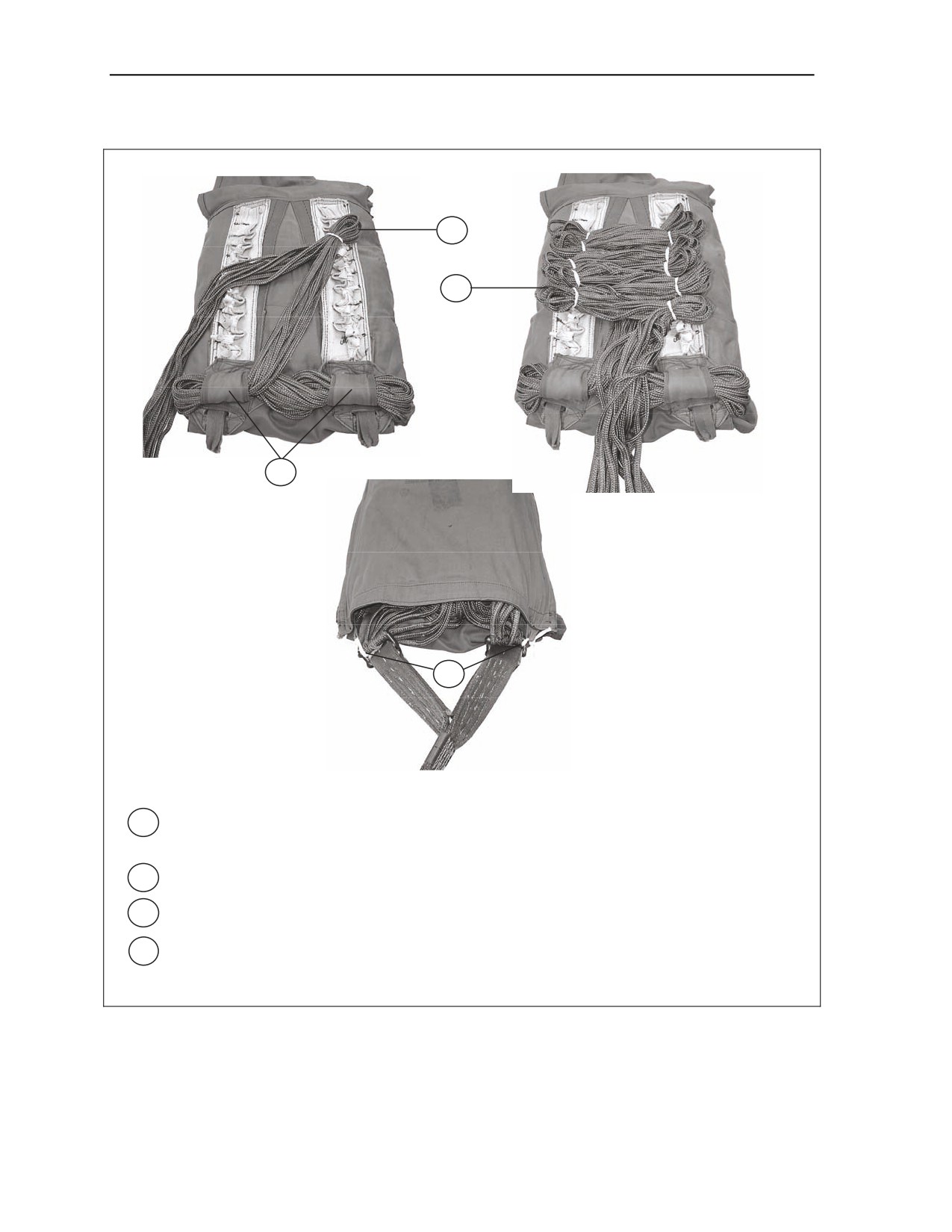
2
3
1
4
1. Make the locking stows as shown above and according to TM 10-1670-293-23&P/TO 14D1
2-467-2/TM 01136C-23&P/2.
2. Make the first suspension line stow with the upper right retainer band.
3. Continue stowing the lines from side to side.
4. Pass a length of type I, 1/4-inch cotton webbing through the right side connector link, the
connector link loops, and the suspension line protector flap loop. Tie it with a surgeon’s knot
and locking knot. Repeat the procedures on the left side.
Figure 2-24. Locking Stows and Suspension Line Stows Made and Connector Links Tied
FM 4-20.142/MCRP 4-11.3P/NAVSEA SS400-AD-MMO-010/ TO 13C7-51-21
2-30
19 September 2007
Rigging Combat Rubber Raiding Craft
3
2
1
1.
Attach a two-point, 3 3/4-inch link assembly to a 36-inch adapter web.
2.
Attach a 9-foot (3-loop), type XXVI nylon sling to the two point 3 3/4-inch link assembly.
3. Bolt a cargo suspension clevis or a two-point, 3 3/4-inch link assembly to the free end of the
sling (shown).
Figure 2-25. Deployment Line Installed on 36-inch Adapter Web
FM 4-20.142/MCRP 4-11.3P/NAVSEA SS400-AD-MMO-010/ TO 13C7-51-21
19 September 2007
2-31
Chapter 2
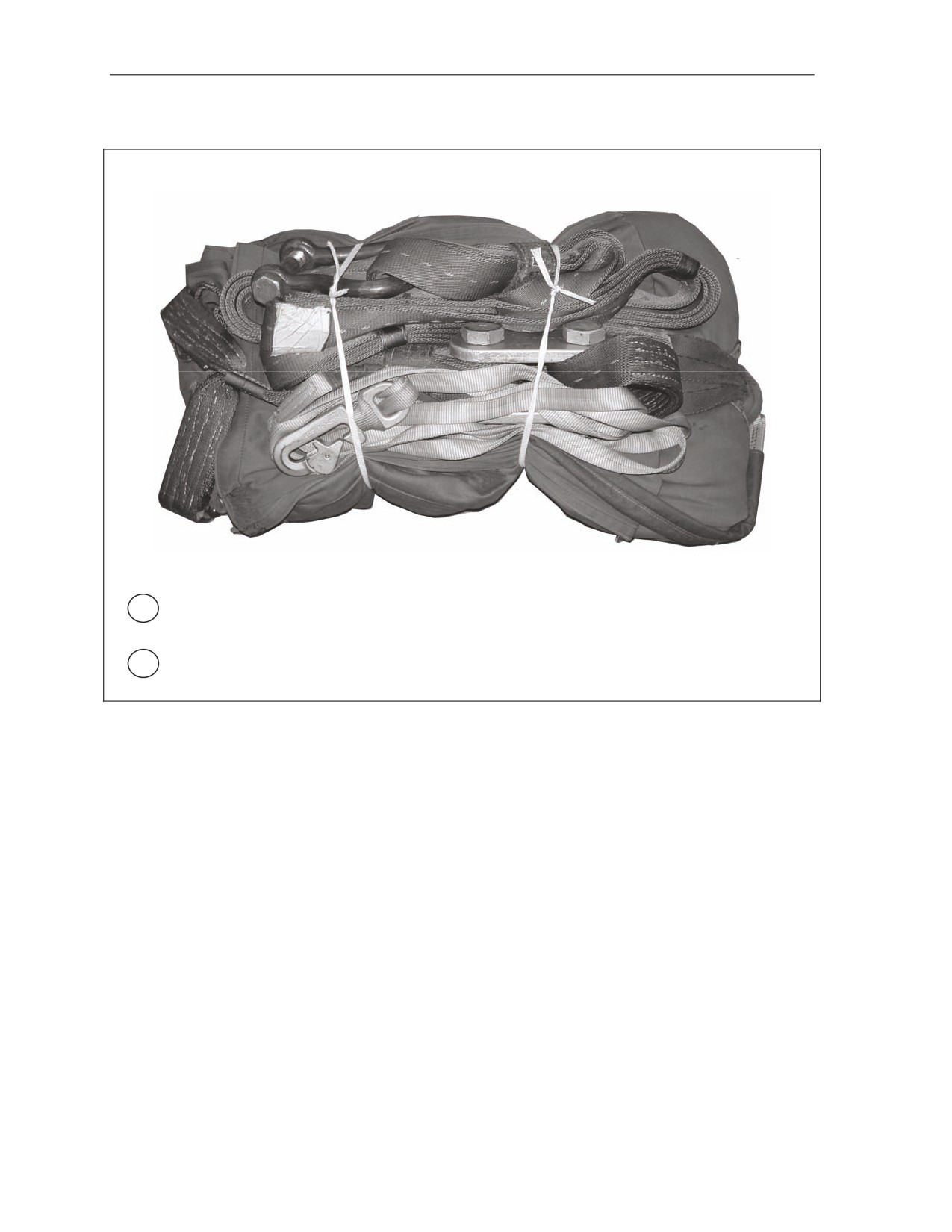
1. S-fold the deployment line and the universal static line. Place them on top of the deployment
bag.
2. Secure the deployment line and the universal static line in place with two lengths of type I,
1/4-inch cotton webbing wrapped around the lines and the bag.
Figure 2-26. Cargo Extraction Parachute Packed in a T-10 Deployment Bag
FM 4-20.142/MCRP 4-11.3P/NAVSEA SS400-AD-MMO-010/ TO 13C7-51-21
2-32
19 September 2007
Rigging Combat Rubber Raiding Craft
STOWING THE G-12 CARGO PARACHUTE AND 15-FOOT CARGO
EXTRACTION PARACHUTE
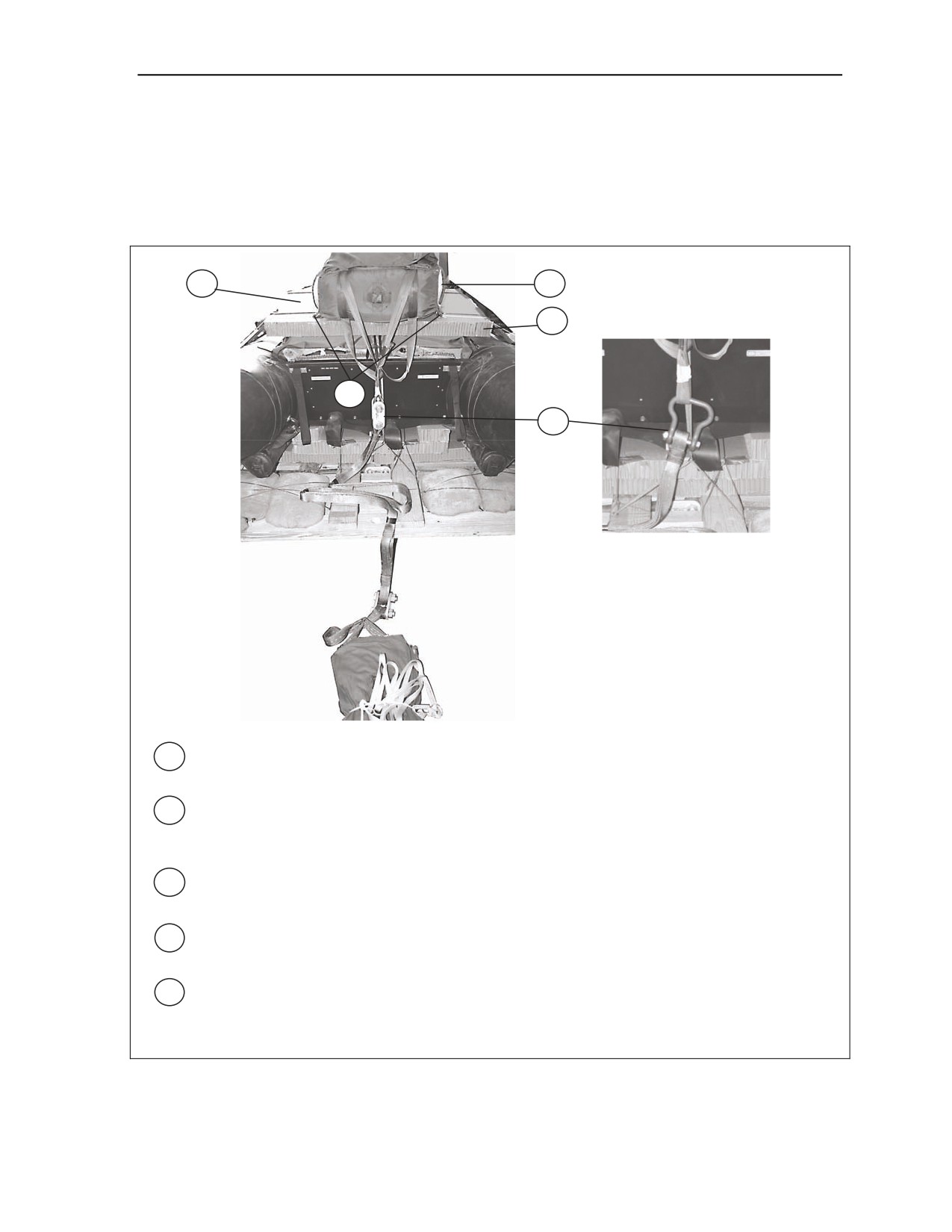
2-13. Prepare and stow one G-12 cargo parachute as shown in Figure 2-27. Stow the 15-foot cargo
extraction parachute as shown in Figure 2-28.
1
3
2
4
5
1.
Lay a 36- by 55-inch piece of honeycomb on the top front of the accompanying load. Extend it
1-inch past the transom.
2.
Bend the honeycomb over the load towards the sides of the boat. Tie it to convenient places
with type III nylon cord. Use tape under the cord to prevent it from cutting the honeycomb.
(not shown)
3.
Set a G-12 cargo parachute on top of the honeycomb with the bridle toward the front of the
platform.
4.
Tie each corner of the parachute to the platform with one length of type I, 1/4-inch cotton
webbing.
5.
Attach the 9-foot sling from the 15-foot cargo extraction parachute to the G-12 cargo
parachute deployment bag with a cargo suspension clevis (medium) or a two-point, 3 3/4-inch
link assembly.
Figure 2-27. G-12 Cargo Parachute Positioned on Load and 15-foot Cargo Extraction
Parachute Attached
FM 4-20.142/MCRP 4-11.3P/NAVSEA SS400-AD-MMO-010/ TO 13C7-51-21
19 September 2007
2-33
Chapter 2
2
1
4
3
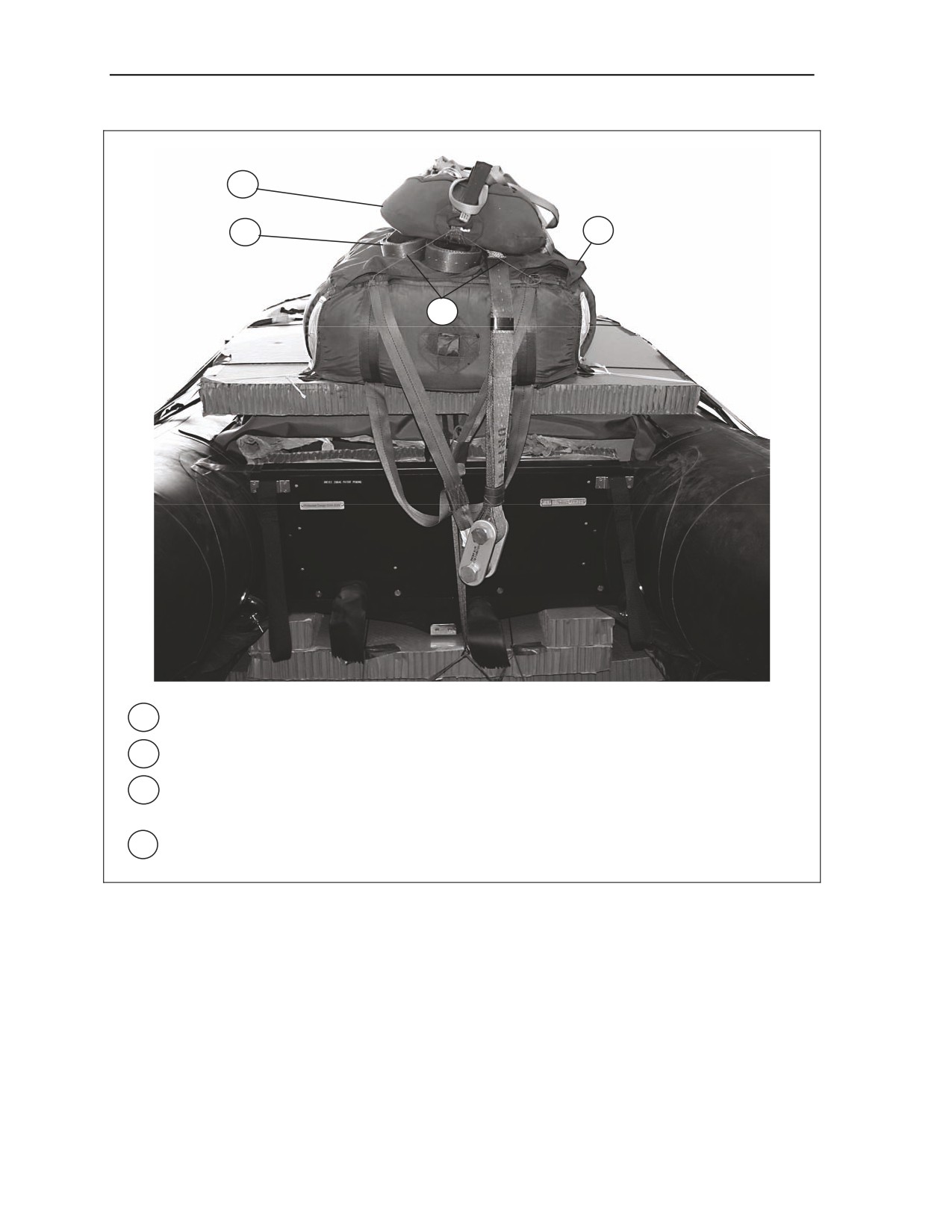
1.
Lay the 9-foot sling of the cargo extraction parachute on top of the G-12 cargo parachute.
2.
Place the 15-foot cargo extraction parachute on top of the 9-foot sling.
3.
Tie the extraction parachute to the G-12 cargo parachute with four lengths of ticket number 5,
8/4 cotton thread.
4. Attach rubber retainer bands to the riser retaining loops on the G-12 cargo parachute. Fold
the static line, and hold the folds in place with the retainer bands.
Figure 2-28. Cargo Extraction Parachute Placed on Load
FM 4-20.142/MCRP 4-11.3P/NAVSEA SS400-AD-MMO-010/ TO 13C7-51-21
2-34
19 September 2007
Rigging Combat Rubber Raiding Craft
INSTALLING PARACHUTE RELEASE
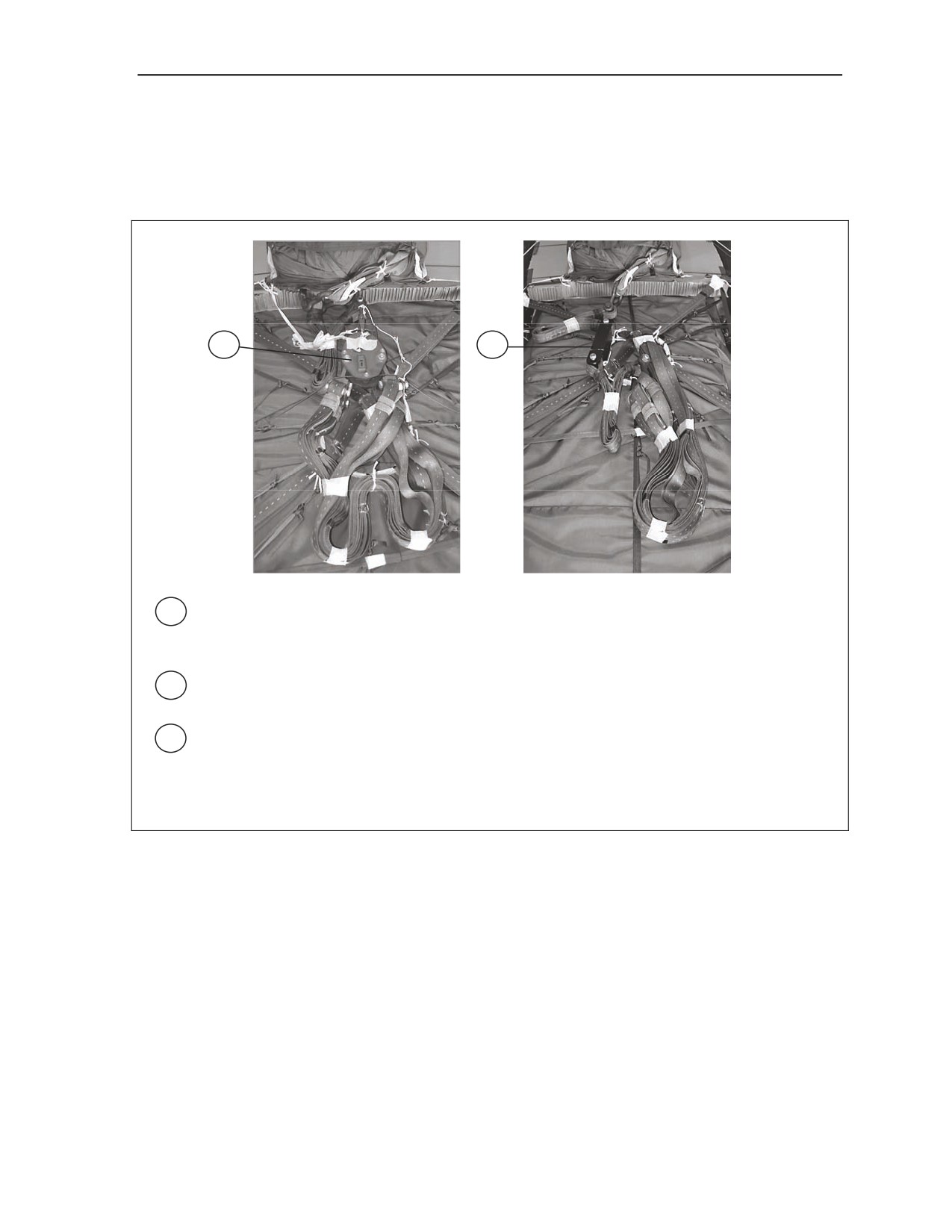
2-14. Use the M-1 or the automatic cargo parachute release on this load as shown in Figure 2-29 and
according to FM 4-20.102/MCRP 4-11.3J/NAVSEA SS400-AB-MMO-010/TO 13C7-1-5.
2
3
1. Perform the pre-drop activation test to insure the automatic cargo parachute release is fully
functional and ready to use according to FM 4-20.102/MCRP 4-11.3J/NAVSEA SS400-AB
MMO-010/TO 13C7-1-5.
2. Prepare, install, and safety the M-1 cargo parachute release according to FM 4-20.102/
MCRP 4-11.3J NAVSEA SS400-AB-MMO-010/TO 13C7-1-5.
3. Prepare, install, and safety the automatic cargo parachute release according to FM 4
20.102/MCRP 4-11.3J/NAVSEA SS400-AB-MMO-010/TO 13C7-1-5.
Note. When using the automatic cargo parachute release, install a 25-foot drag line from the G-12
deployment bag to the main body of the automatic cargo parachute release.
Figure 2-29. Cargo Parachute Release Installed
FM 4-20.142/MCRP 4-11.3P/NAVSEA SS400-AD-MMO-010/ TO 13C7-51-21
19 September 2007
2-35
Chapter 2
INSTALLING FLOTATION DEVICE
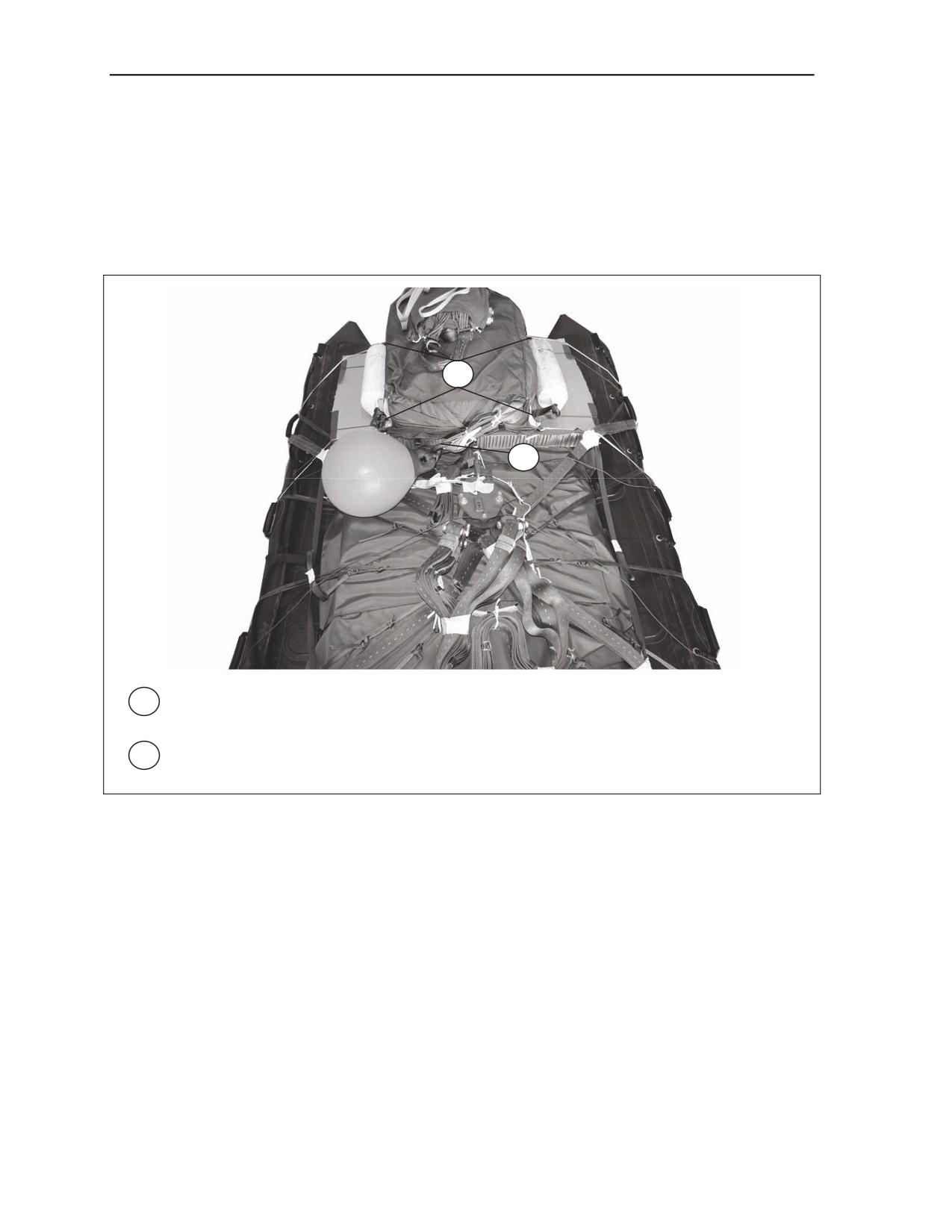
2-15. Use flotation devices on training loads to help recover the parachute and parachute deployment bag.
Install the flotation devices as shown in Figure
2-30. Recommended flotation devices include dock
bumpers, life preservers, diving buoys, and two 12- by 12-inch pieces of honeycomb taped with waterproof
tape.
1
2
1. Tie one flotation device to the G-12 cargo parachute deployment bag clustering attaching
straps with 1-inch tubular nylon.
2. Tie one flotation device to the clevis between the cargo parachute and the parachute release
assembly with a length of 1-inch tubular nylon webbing.
Figure 2-30. Flotation Devices Tied to Load
FM 4-20.142/MCRP 4-11.3P/NAVSEA SS400-AD-MMO-010/ TO 13C7-51-21
2-36
19 September 2007
Rigging Combat Rubber Raiding Craft
MARKING RIGGED LOAD
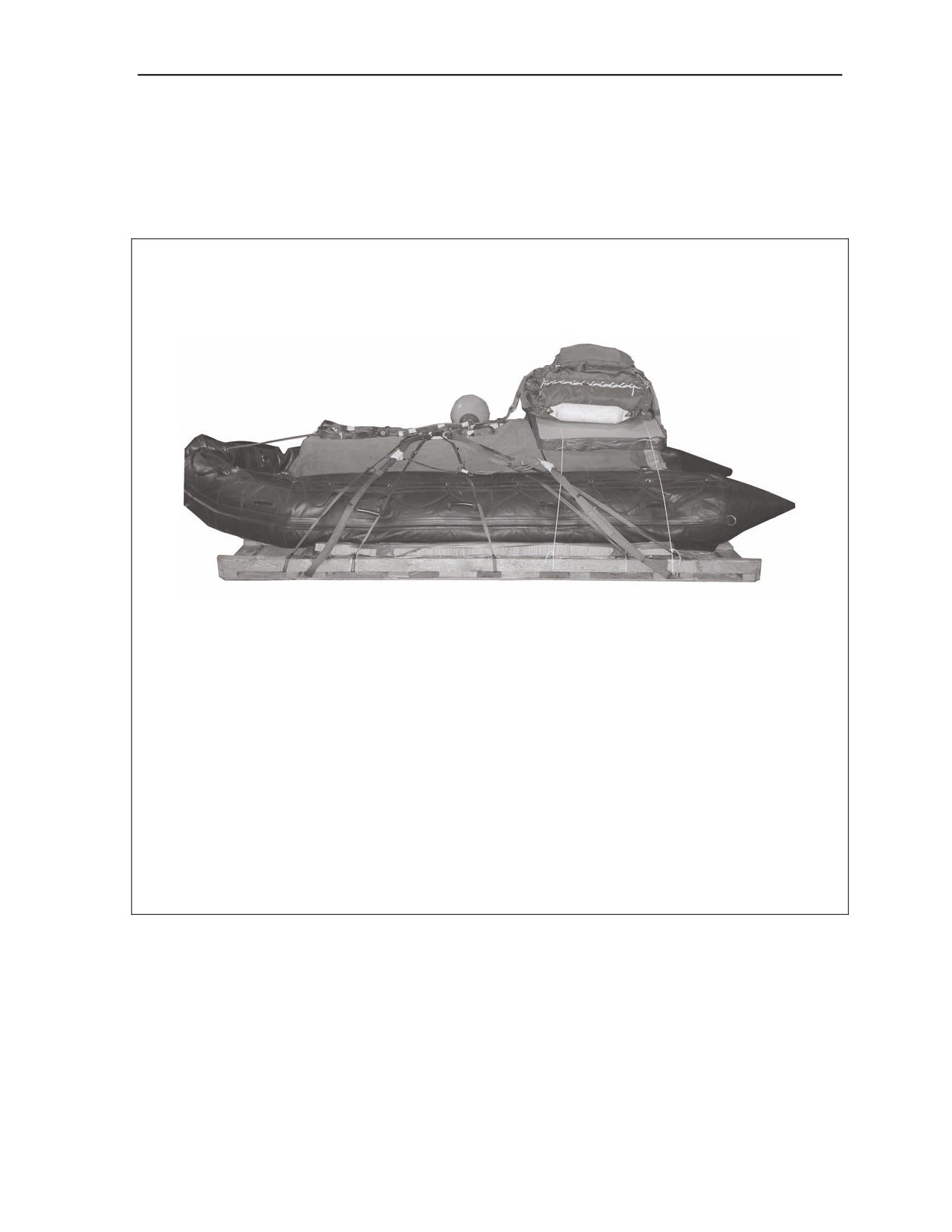
2-16. Mark the rigged load according to FM
4-20.102/MCRP 4-11.3J/NAVSEA SS400-AB-MMO
010/TO 13C7-1-5 and as shown in Figure 2-31. If the accompanying load varies from the one shown, the
weight, height, and CB must be recomputed.
Weight: Load shown
2,470 pounds
Height
60 inches
Width
75 inches
Length
189 inches
Overhang: Front
16 inches
Rear
29 inches
CB (from front edge of platform)
60 inches
Figure 2-31. F470 Combat Rubber Raiding Craft Fully Rigged
FM 4-20.142/MCRP 4-11.3P/NAVSEA SS400-AD-MMO-010/ TO 13C7-51-21
19 September 2007
2-37

Chapter 2
EQUIPMENT REQUIRED
2-17. The equipment needed to prepare and rig this load is listed in Table 2-1. Additional items may be
listed with the load description.
Table 2-1. Equipment Required for Rigging the Combat Rubber Raiding Craft for Low-Velocity
Airdrop
National Stock Number
Item
Quantity
8105-00-285-4744
Bag, sand
16
1670-00-568-0323
Band, rubber, parachute
As required
No NSN
Bolt, carriage, 3/8-in dia, 7-in long, with washer and nut (add eight
8
for training)
No NSN
Bolt, carriage, 3/8-in dia, 5-in long with washer and nut
4
1670-01-064-4928
Centerline (G-12E, 57 feet)
4030-00-090-5354
Clevis assembly, large, 1-in., shackle
2
1
4030-00-678-8560
Clevis, shackle, 3/8 inch diameter
1
8305-00-242-3593
Cloth, cotton duck, 60 inches
4 yd
4020-00-240-2146
Cord, nylon, type III, 550 lb
As required
1670-00-360-0328
Cover, clevis, large
1
8135-00-664-6958
Cushioning material, cellulose wadding
As required
1670-01-476-3131
Deployment bag, w/o static line
1
5306-00-435-8994
Deployment bag, parachute (G-12)
2
1670-00-039-5073
Link assembly, two-point, 3 3/4”
2
1670-00-487-6077
Link assembly connector, type IV
Lumber: (Platform)
4
5510-00-220-6146
2- by 4- by 10-in
4
2- by 4- by 75-in
2
2- by 6- by 30-in
4
2- by 6- by 75in
2
5510-00-220-6148
2- by 6- by 144-in
2
5510-00-220-6274
4- by 4- by 144-in
Nail, steel, wire, common:
As required
5315-00-010-4657
6d
As required
5315-00-010-4659
8d
As required
5315-00-164-5121
20d
1670-00-753-3928
Pad, energy-dissipating, honeycomb,
4 sheets
3- by 36- by 96-in
(1)
6- by 6-in
(1)
6- by 12-in
(1)
7- by 17-in
(2)
7- by 28-in
(2)
7- by 36-in
(1)
36- by 55-in
(3)
36- by 96-in
FM 4-20.142/MCRP 4-11.3P/NAVSEA SS400-AD-MMO-010/ TO 13C7-51-21
2-38
19 September 2007

Rigging Combat Rubber Raiding Craft
Table 2-1. Equipment Required for Rigging the Combat Rubber Raiding Craft for Low-Velocity
Airdrop (Continued)
National Stock Number
Item
Quantity
1670-00-788-8666
Parachute, G-12
1
1670-01-063-3715
Parachute Cargo 15-ft Extraction
1
5530-00-128-4981
Plywood, 3/4- by 48- by 75-in
3
Release, cargo, airdrop:
1670-01-097-8816
M-1, cargo parachute release
1
1670-01-337-4366
Automatic cargo parachute release
1
Sling, cargo, airdrop:
1670-01-062-6301
3-foot (2 loop), type XXVI
2
1670-01-062-6304
9-foot (2 loop), type XXVI
1
1670-01-062-6302
16-foot (2 loop), type XXVI
4
1670-01-063-7761
20-foot (2-loop), type XXVI
1
7510-00-266-5016
Tape, adhesive, pressure sensitive,
As required
2-in, OD
8125-00-074-5124
Tape, adhesive, cloth backed, type
As required
IV, 2-in
8310-00-917-3945
Thread, cotton, 8/7 (ticket 5)
As required
8305-00-268-2411
Webbing, textile
(cotton, type I,
As required
Nat, 1/4-in, 80lb.)
8305-00-262-2455 (GRN)
Webbing, textile nylon, tubular
As required
8305-00-082-5752 (WHT)
1/2-in, OD
8305-00-268-2455
Webbing, textile nylon, tubular, 1
As required
in
FM 4-20.142/MCRP 4-11.3P/NAVSEA SS400-AD-MMO-010/ TO 13C7-51-21
19 September 2007
2-39

Chapter 2
SECTION II-RIGGING DOUBLE ZODIAC F470U BOAT
DESCRIPTION OF LOAD
2-18. The description of the load rigged in this section is given below.
• Inflated Zodiac F470 rubber raiding craft. This boat is rigged in tandem on a 75- by 144-inch
combat expendable platform (CEP) with a G-12E cargo parachute. Tandem loads require two
parachutes. The boats weigh 250 pounds each. When inflated, each boat is 75 inches wide, 185
inches long, and 22 inches high. One or two 35-horsepower outboard engines that weigh 136
pounds each power the boat shown or one 55-horsepower engine that weighs 215 pounds with a
full fuel tank. Six paddles weighing a total of 24 pounds and two sets of air pumps with hoses are
part of each boat’s equipment.
Note. A 40-horsepower engine is the largest that may be used on this boat when the boat is
equipped with the accordion floor. An engine as large as 65-horsepower may be used on this
boat with a solid floor.
• Accompanying load. An accompanying load weighing at least 650 pounds but no more than
1,170 pounds must be dropped with the boat.
PREPARING THE PLATFORM
2-19. Build a new CEP, or inspect and repair a used platform, using the procedures shown in Figures 2-1
through 2-4 and as described in paragraph 2-2.
INSTALLING SUSPENSION SLINGS AND STOWING SANDBAGS
2-20. Install four suspension slings on the platform according to paragraph 2-3 and Figure 2-5. Stow
sandbags on the platform according to paragraph 2-4 and Figure 2-6.
PLACING AND SECURING HONEYCOMB STACKS
2-21. Build, place, and secure the honeycomb stacks as shown in Figures 2-8 and 2-9
PREPARING BOATS
2-22. Inflate the boats except the keel. If the keel is inflated, let the air out. Install the hose clips as shown
in Figure 2-10. Prepare the boats as shown in Figures 2-10 through 2-12.
POSITIONING FIRST BOAT
2-23. Position the first boat as shown in Figure 2-14.
PREPARING AND STOWING ACCOMPANYING LOAD
2-24. Prepare and stow the outboard engines, fuel tanks, paddles, all boat accessories, and accompanying
load as described in paragraph 2-9 and Figures 2-15 through 2-17.
FM 4-20.142/MCRP 4-11.3P/NAVSEA SS400-AD-MMO-010/ TO 13C7-51-21
2-40
19 September 2007
Rigging Combat Rubber Raiding Craft
LEVELING, COVERING, AND LASHING FIRST BOAT AND
ACCOMPANYING LOAD
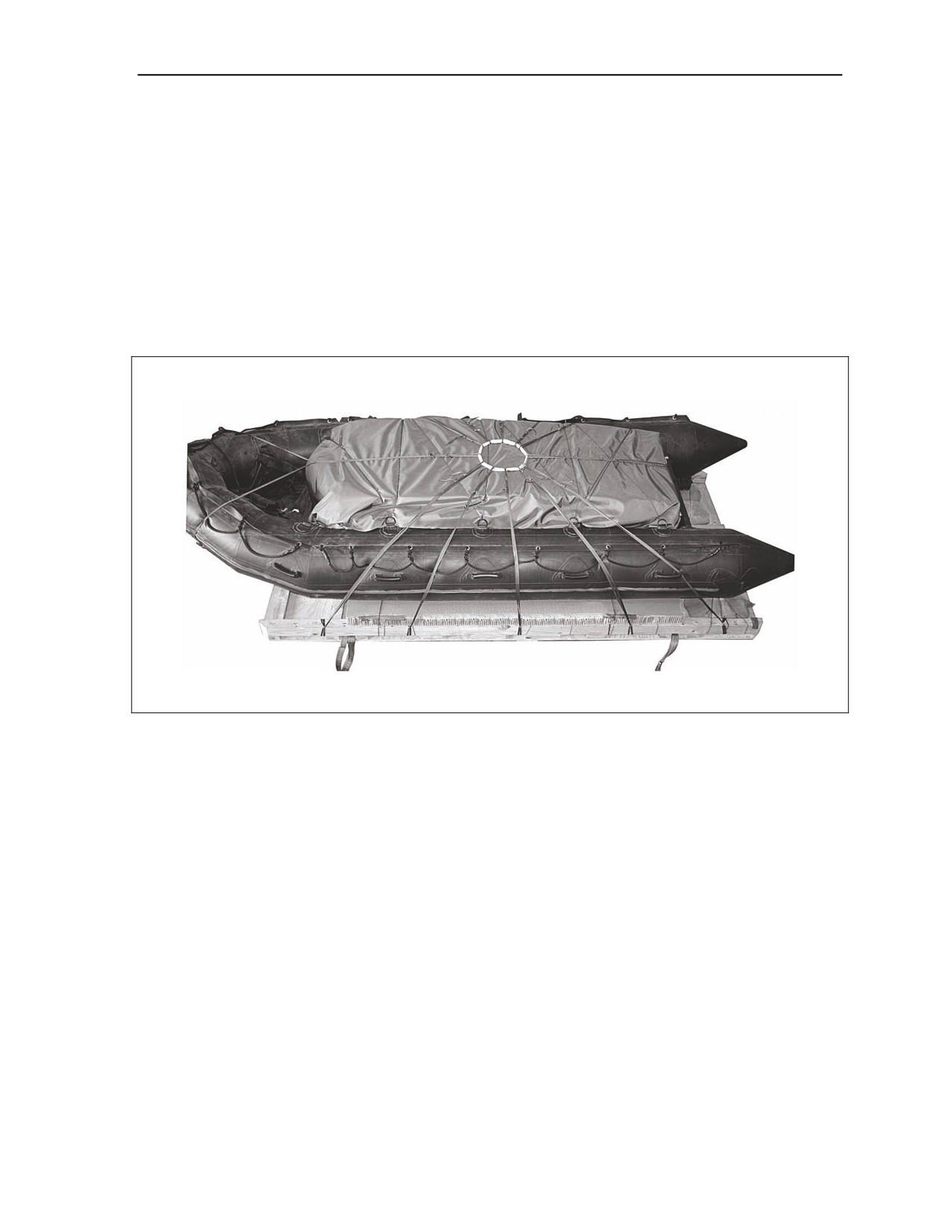
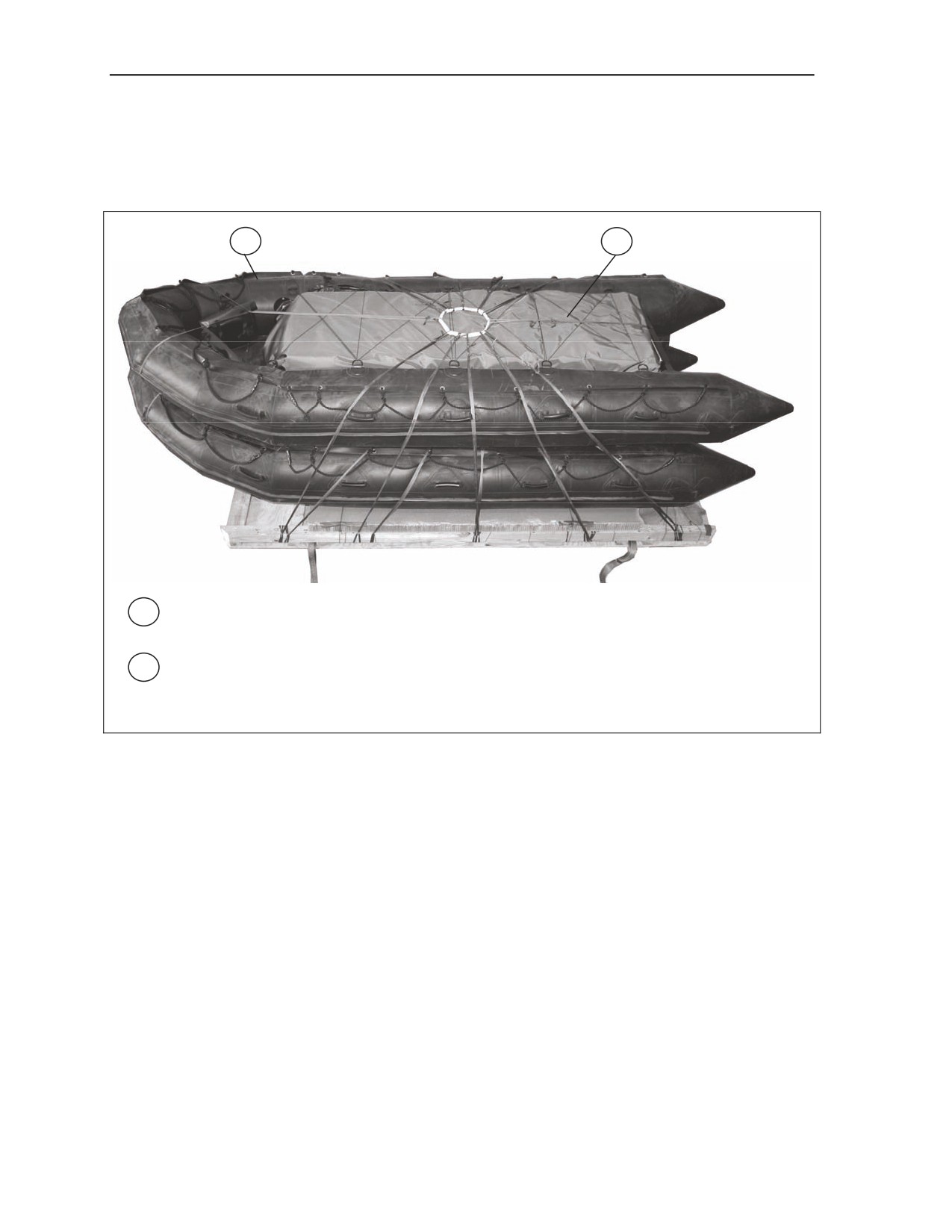
2-25. Level the load on the first boat, position the load cover, and lash the boat to the platform as
described below, and shown in Figure 2-31.
• Use honeycomb pieces to level the load to the top of the engine. If collapsible fuel tanks are
used, fit honeycomb around them by standing the honeycomb on edge for support.
• Place a 30- by 90-inch piece of honeycomb on top of the leveled load.
• Cover the load as shown in Figure 2-20.
• Lash the boat to the platform as shown in Figures 2-18, 2-20, and 2-31.
Figure 2-31. Load Covered, Tied in Place and Boat Lashed to Platform
FM 4-20.142/MCRP 4-11.3P/NAVSEA SS400-AD-MMO-010/ TO 13C7-51-21
19 September 2007
2-41
Chapter 2
PLACING AND LOADING SECOND BOAT
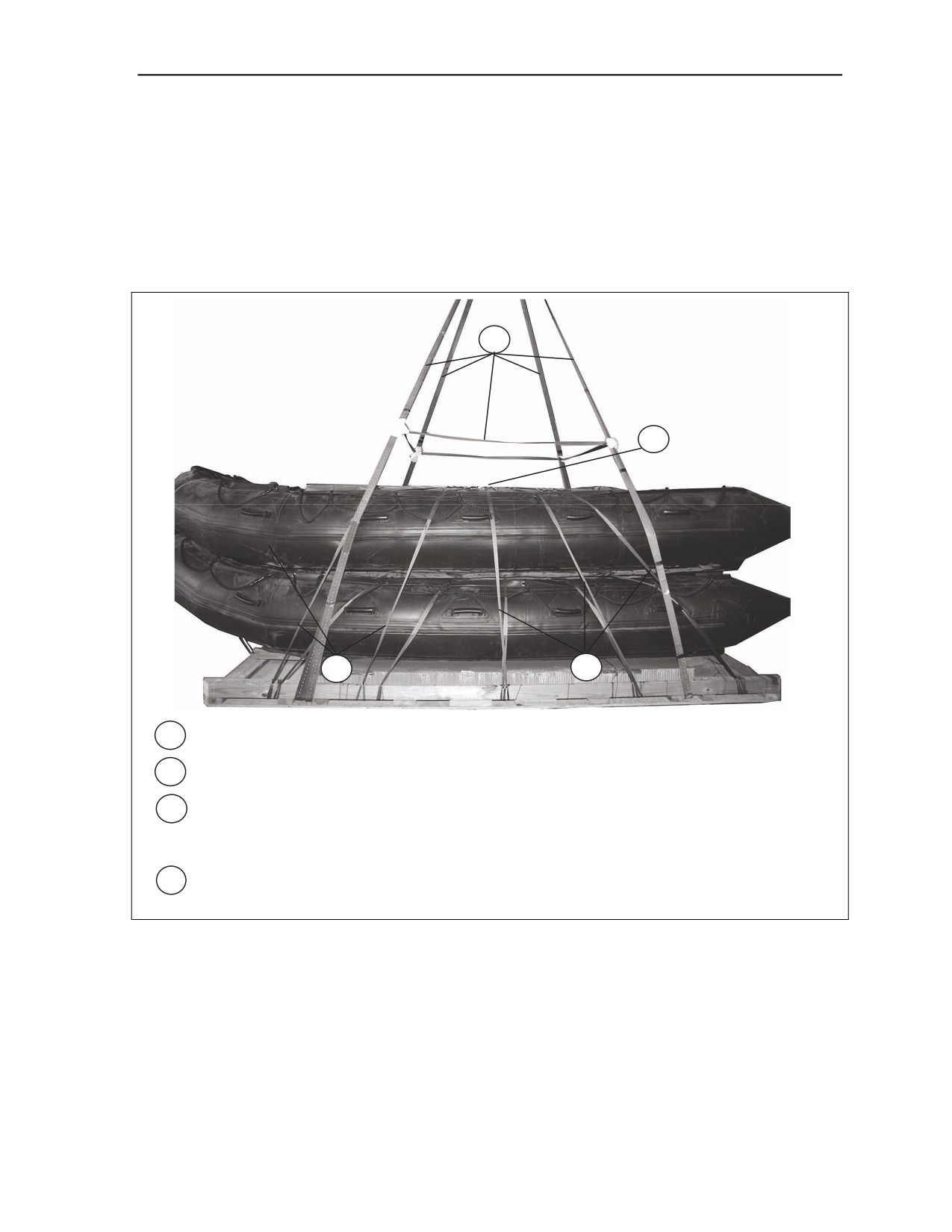
2-26. Prepare, place, load, and cover the second Zodiac F470U boat as shown in Figure 2-32.
1
2
1. Inflate the second boat except the keel (not shown). Prepare it according to Figures 2-10
through 2-12.
2. Prepare, stow, and cover third engine, fuel tanks, and load items according to Figures 2-15
through 2-20.
Figure 2-32. Second Boat Prepared, Placed and Covered
FM 4-20.142/MCRP 4-11.3P/NAVSEA SS400-AD-MMO-010/ TO 13C7-51-21
2-42
19 September 2007
Rigging Combat Rubber Raiding Craft
LASHING SECOND BOAT TO PLATFORM
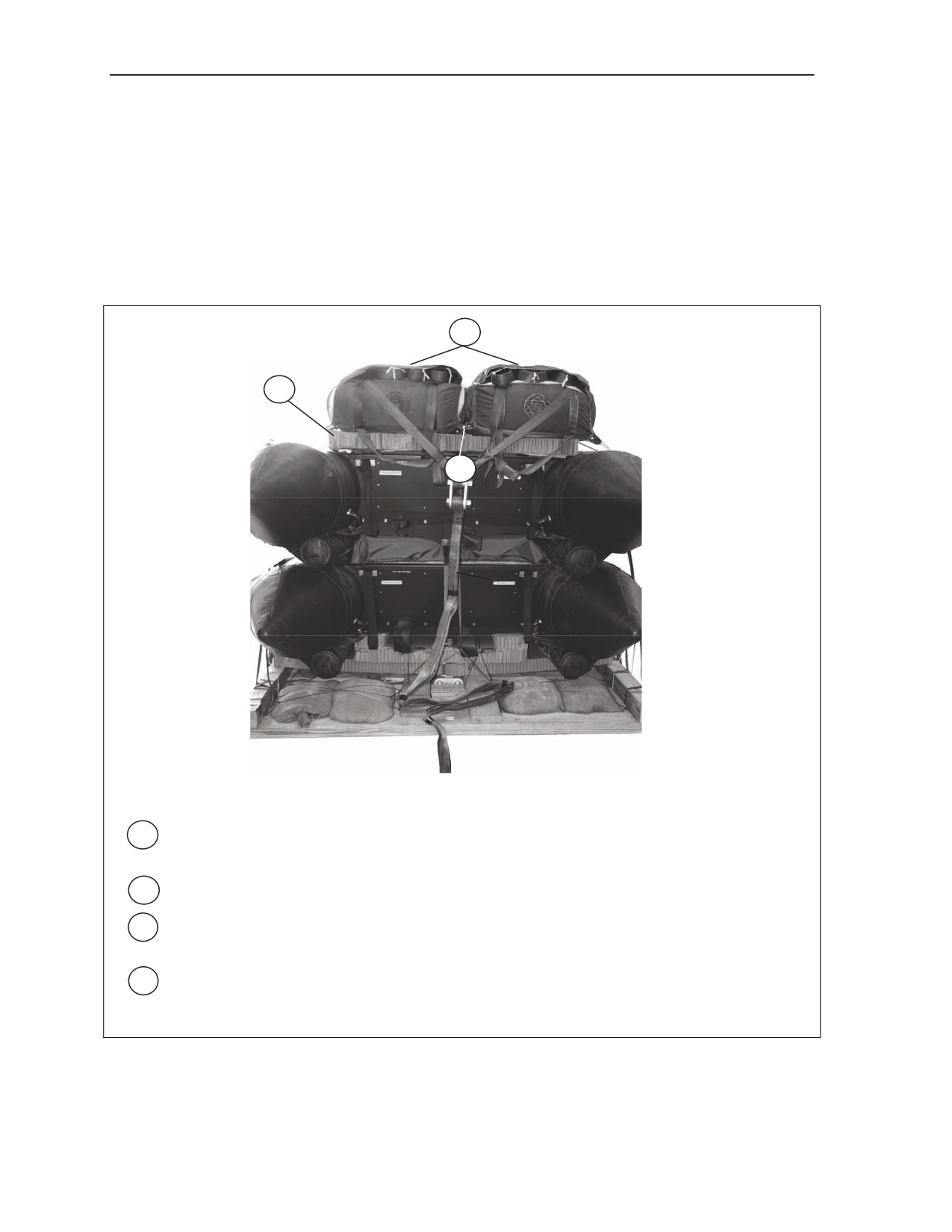
2-27. Lash the second boat to the platform as shown in Figures 2-32 and 2-33.
SAFETY TIEING SUSPENSION SLINGS
2-28. Make a deadman’s tie, and safety the suspension slings according to FM 4-20.102/MCRP 4
11.3J/NAVSEA SS400-AB-MMO-010/TO 13C7-1-5 and as shown in Figures 2-21 and 2-33.
3
1
2
2
1.
Center the four-ply tiedown ring over the load cover of the second boat.
2.
Position the lashings and tie them to the tiedown ring as shown in Figures 2-18 through 2-20.
3.
Raise the suspension slings, and make the deadman’s tie, using 1/2-inch double or 1-inch
tubular nylon webbing according to FM 4-20.102/ MCRP 4-11.3J/NAVSEA SS400-AB-MMO
010/TO 13C7-1-5, using 1/2-inch double or 1-inch tubular nylon webbing.
4. Lower the slings and tie them to the tiedown ring as shown in Figure 2-21.
Figure 2-33. Boat Lashed and Suspension Slings Safety Tied
FM 4-20.142/MCRP 4-11.3P/NAVSEA SS400-AD-MMO-010/ TO 13C7-51-21
19 September 2007
2-43
Chapter 2
STOWING PARACHUTES
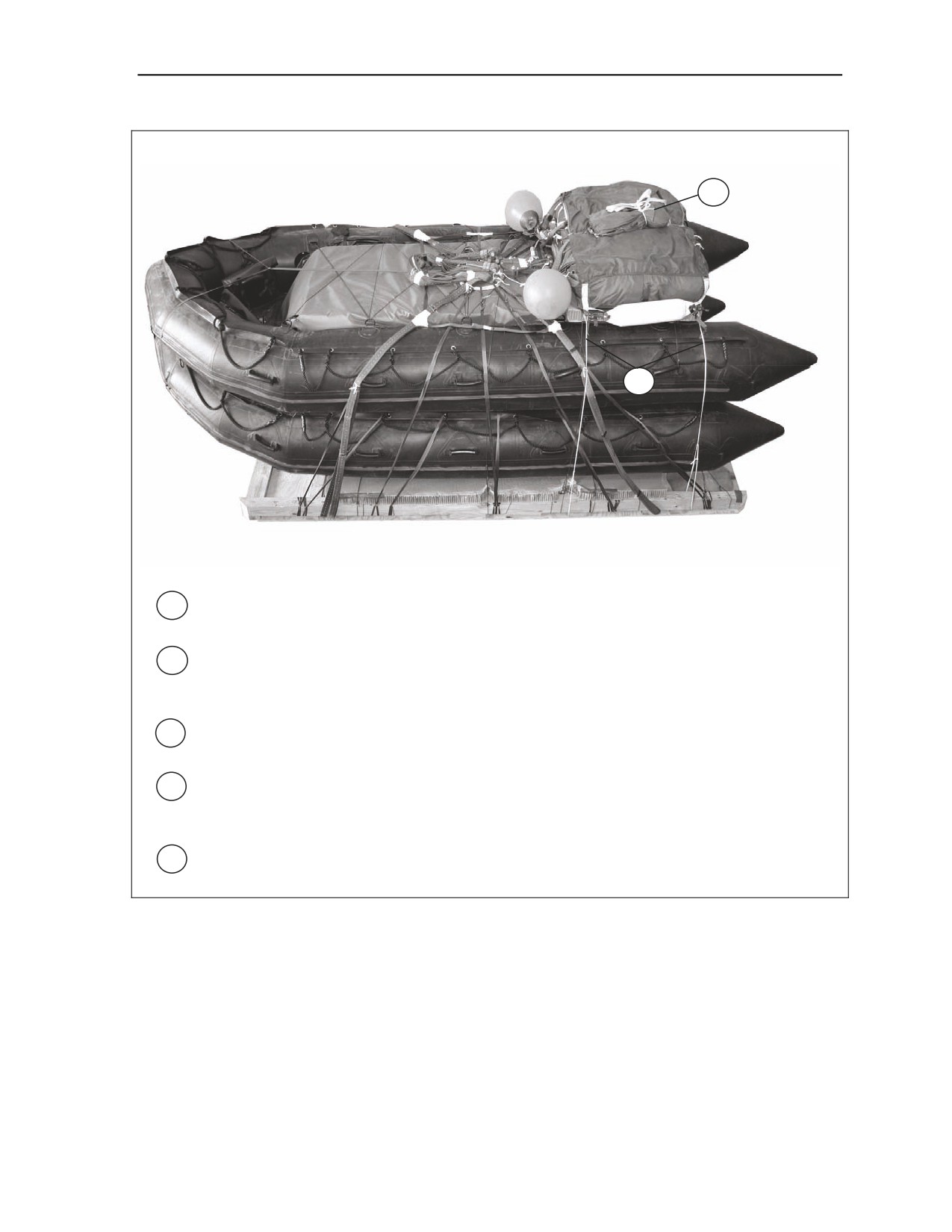
2-29. Stow parachutes as described below.
• Lay a 36- by 55-inch piece of honeycomb across the load cover of the second boat as shown in
Figure 2-34.
• Prepare and pack the 15-foot cargo extraction parachute as described in paragraph 2-12.
• Prepare two G-12 cargo parachutes. Stow them on front of the load according to FM 4
20.102/MCRP 4-11.3J/NAVSEA SS400-AB-MMO-010/TO 13C7-1-5.
3
1
4
1.
Lay a 36- by 55-inch piece of honeycomb across the load cover of the second boat extending
1-inch past the transom.
2.
Bend the honeycomb over the load. Tape the edges of the honeycomb (not shown).
3.
Set two G-12 cargo parachutes on the honeycomb with the riser extension compartment up
and the bridle toward the front of the platform.
4. Cluster the parachutes together with single lengths of type I, 1/4-inch cotton webbing.
Figure 2-34. Parachutes Stowed
FM 4-20.142/MCRP 4-11.3P/NAVSEA SS400-AD-MMO-010/ TO 13C7-51-21
2-44
19 September 2007
Rigging Combat Rubber Raiding Craft
7
5
5.
Secure the parachutes to convenient points on the load with four lengths of type I, 1/4-inch
cotton webbing.
6.
Attach the deployment line (9-foot, type XXVI nylon webbing sling) from the packed 15-foot
extraction parachute to the G-12 bridles with a two-point link assembly or a medium clevis
(not shown)
7.
Center the 15-foot cargo extraction parachute on top of the G-12 cargo parachutes. Safety it
in place with ticket number 5, 8/4 cotton thread.
8.
S-fold the slack in the deployment line, and tape the folds. Secure the clustering clevis to the
riser extension tiedown loops with a double length of type I, 1/4-inch cotton webbing (not
shown).
9. Remove the left secondary bag closing tie from both G-12 parachutes (not shown).
Figure 2-34. Parachutes Stowed (continued)
FM 4-20.142/MCRP 4-11.3P/NAVSEA SS400-AD-MMO-010/ TO 13C7-51-21
19 September 2007
2-45
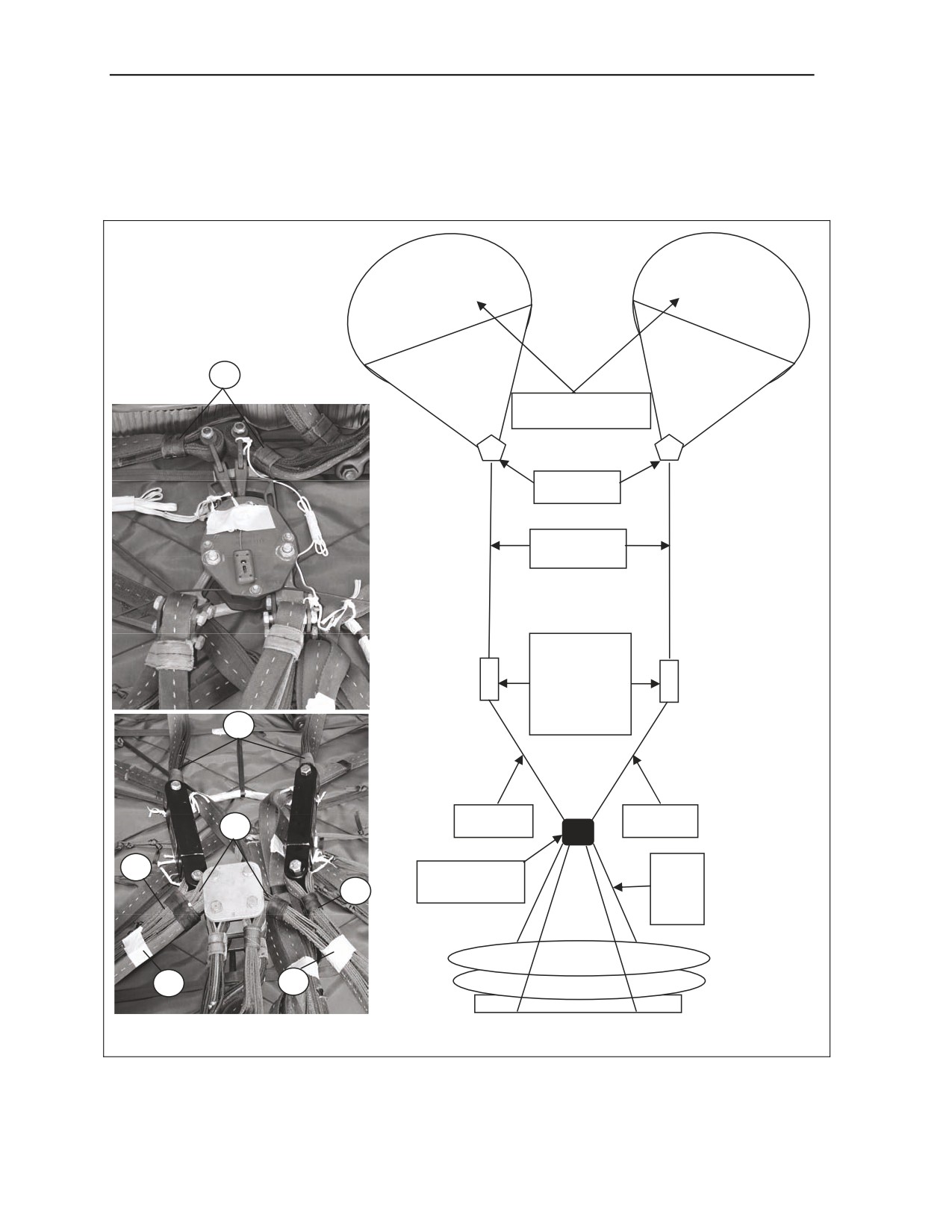
Chapter 2
INSTALLING PARACHUTE RELEASE
2-30. Use either one M-1 release or two automatic cargo parachute releases according to FM
4
20.102/MCRP 4-11.3J/NAVSEA SS400-AB-MMO-010/TO 13C7-1-5.
1
G-12 Cargo Parachute
G-12 Clevis
20-Ft Sling
Automatic
Cargo
Parachute
Release
2
3-Ft Sling
3-Ft Sling
4
3
16-Ft
8 spool coupler
sling
3
4ea.
7
7
Figure 2-35. M-1 and Automatic Cargo Parachute Release Installed
FM 4-20.142/MCRP 4-11.3P/NAVSEA SS400-AD-MMO-010/ TO 13C7-51-21
2-46
19 September 2007

Rigging Combat Rubber Raiding Craft
1.
Attach the riser extensions on the G-12 parachutes to the two parachute connectors on the
M-1 release. Safety the release to convenient points on the platform with type III nylon cord.
2.
Attach 20-foot type XXVI nylon webbing, riser extensions to the main body of the hydraulic
cargo release.
3.
Attach a 3-foot sling to the release fitting shackle (lower body).
4.
Attach opposite ends of the 20-foot riser extension to the large clevis.
5.
Secure both releases to the donut using a single turn type I, 1/4-inch cotton webbing on both
ends of each release (not shown).
6.
Secure the 8 spool load coupler or large clevis to the donut using one turn type I, 1/4-inch
cotton webbing (not shown).
7.
Tape excess webbing of 3-foot sling with masking tape.
8. Secure cherry buoy to the main body of the hydraulic cargo release with 1-inch tubular nylon
webbing. (not shown)
Figure 2-35. M-1 and Automatic Cargo Parachute Release Installed (continued)
EQUIPMENT REQUIRED
2-31. In addition to the items listed in Table 2-1, use one additional G-12 cargo parachute, four 36- by 96
inch pieces of honeycomb, two 5- by 96-inch pieces of honeycomb, two 30- by 90-inch pieces of
honeycomb, one 13- by 36-inch piece of honeycomb, and one eight spool coupler and another automatic
cargo parachute release and another 20-foot (2-loop), type XXVI sling.
FM 4-20.142/MCRP 4-11.3P/NAVSEA SS400-AD-MMO-010/ TO 13C7-51-21
19 September 2007
2-47
Chapter 2
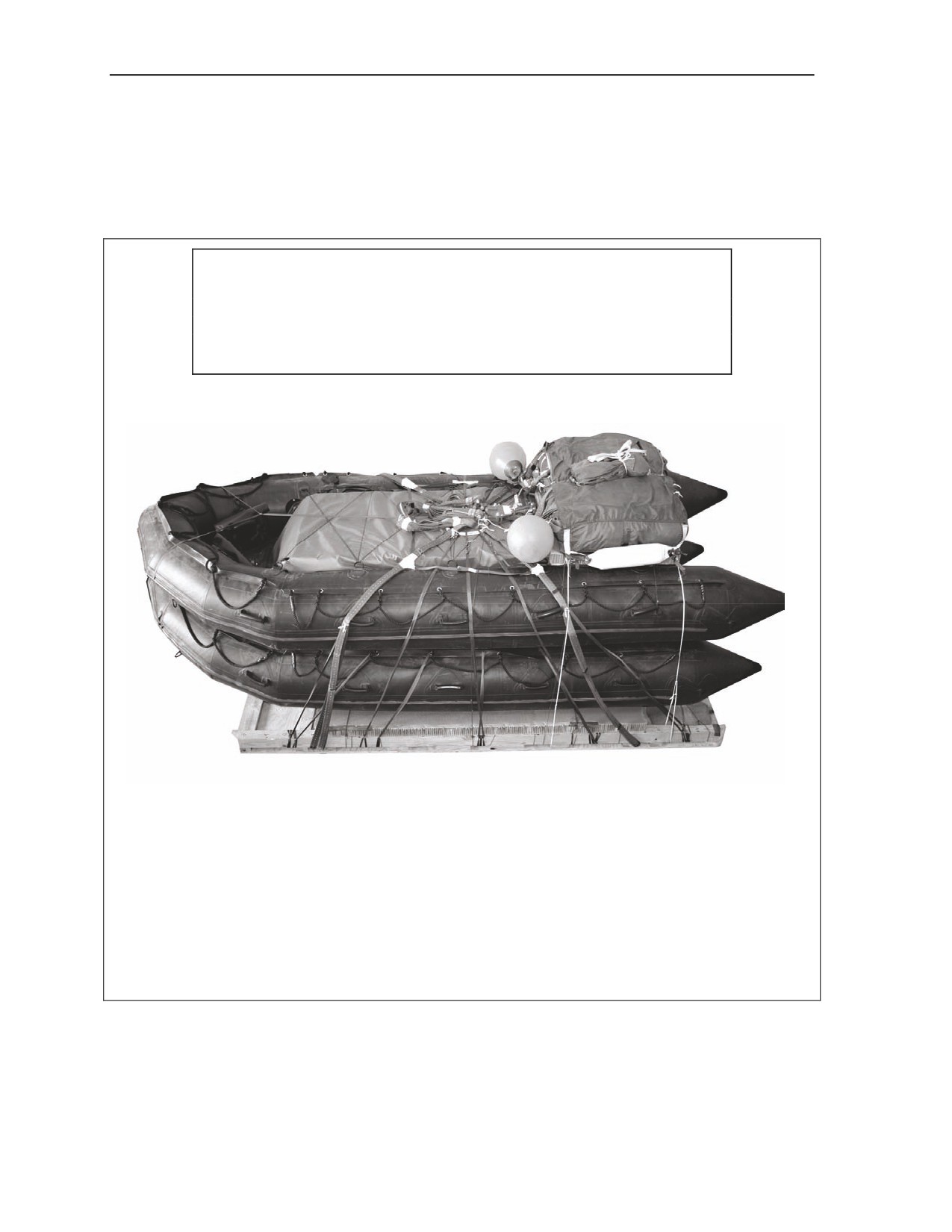
MARKING RIGGED LOAD
2-32. Mark the rigged load according to FM
4-20.102/MCRP 4-11.3J/NAVSEA SS400-AB-MMO
010/TO 13C7-1-5 and as shown in Figure 2-36. If the accompanying load varies from the one shown, the
weight, height, and CB must be recomputed.
CAUTION:
Make the final rigger inspection required by FM 4-20.102/MCRP 4
11.3J/NAVSEA SS400-AB-MMO-010/TO 13C7-1-5 before the load
leaves the rigging site.
Note. Remove the plastic and tape from the fuel pump and filter and reattach them before using the MARS engine. Inflate the
keel before using the boat.
Weight: (maximum suspended weight)
3500 pounds
Height
86 inches
Width
75 inches
Length
189 inches
Overhang: Front
16 inches
Rear
29 inches
CB (from front edge of platform)
60 inches
Figure 2-36. Double Zodiac F470U Fully Rigged
FM 4-20.142/MCRP 4-11.3P/NAVSEA SS400-AD-MMO-010/ TO 13C7-51-21
2-48
19 September 2007

Chapter 3
Rigging Zodiac F470U Boat in A-22 Cargo Bag
DESCRIPTION OF LOAD
3-1. The description of the load rigged in this section is given below.
• The Zodiac F470U Combat Rubber Raiding Craft (CRRC) is described in this chapter. This boat
is rigged in an adapted A-22 cargo bag on a 48- by 48-inch skid board for low-velocity airdrop
over water. The boat is rigged with the 35-horsepower Marine Amphibious Reconnaissance
Submersible (MARS) engine installed on the boat transom. This boat is designed for rapid
inflation and deployment of the boat. The load shown weighs 600 pounds.
• The accompanying load is limited to equipment that can be stowed on both sides of the engine
box and secured within the A-22 cargo bag. No accompanying load is shown.
CAUTION
This load differs from other rubber boat loads. Strict adherence to
rigging procedures is critical.
ADAPTING A-22 CARGO BAG
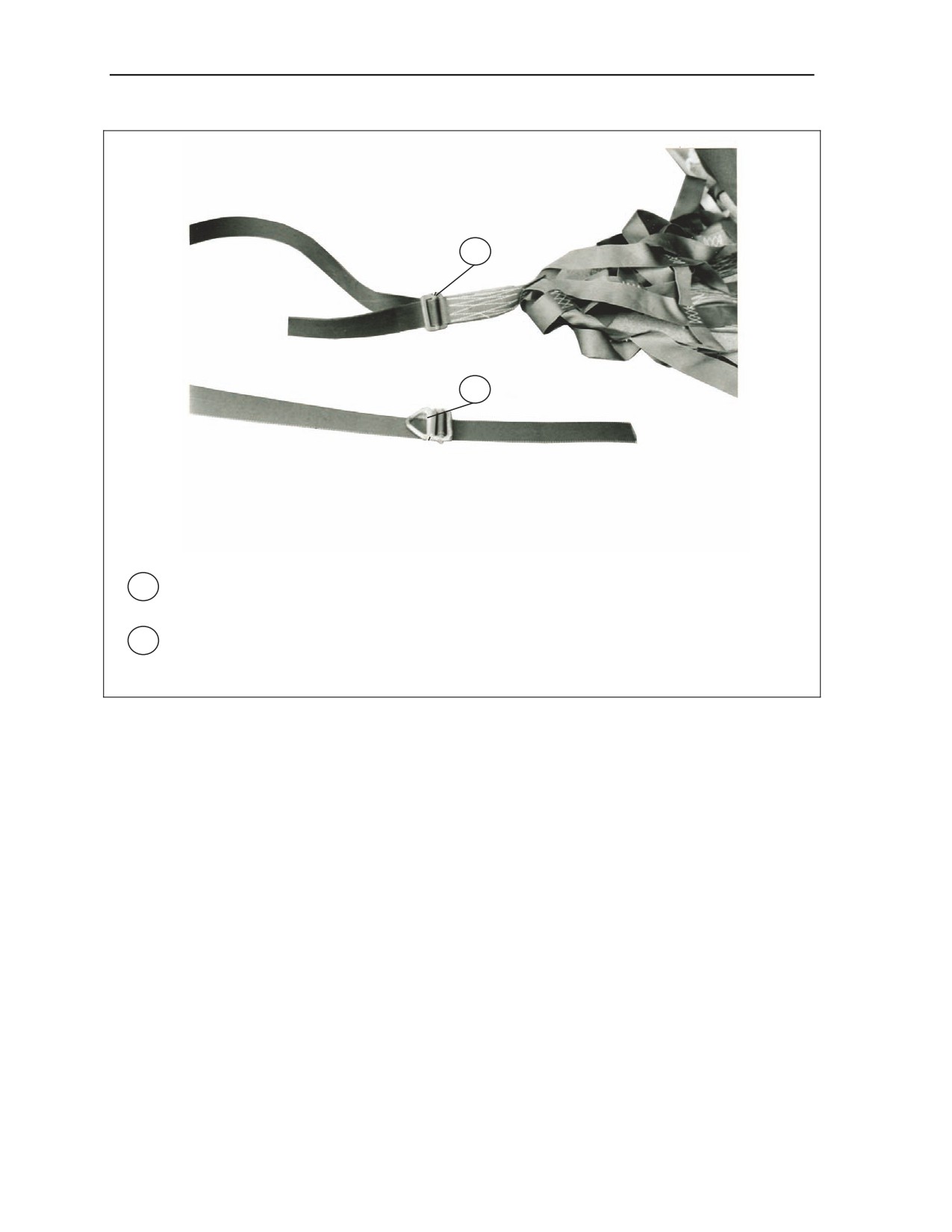
3-2. Adapt the long and short tiedown straps on the sling assembly of the A-22 cargo bag as shown in
Figure 3-1.
FM 4-20.142/MCRP 4-11.3P/NAVSEA SS400-AD-MMO-010/ TO 13C7-51-21
19 September 2007
3-1
Chapter 3
2
1
1. Install a V-ring to one end of a 36-inch length of type VIII nylon webbing. Prepare a second
assembly in the same way.
2. Thread the free end of each length of type VIII nylon webbing through the quick fit adapter on
the long tiedown strap. Repeat for the short tiedown strap.
Figure 3-1. Sling Assembly Adapted
FM 4-20.142/MCRP 4-11.3P/NAVSEA SS400-AD-MMO-010/ TO 13C7-51-21
3-2
19 September 2007
Rigging Zodiac F470U Boat in A-22 Cargo Bag
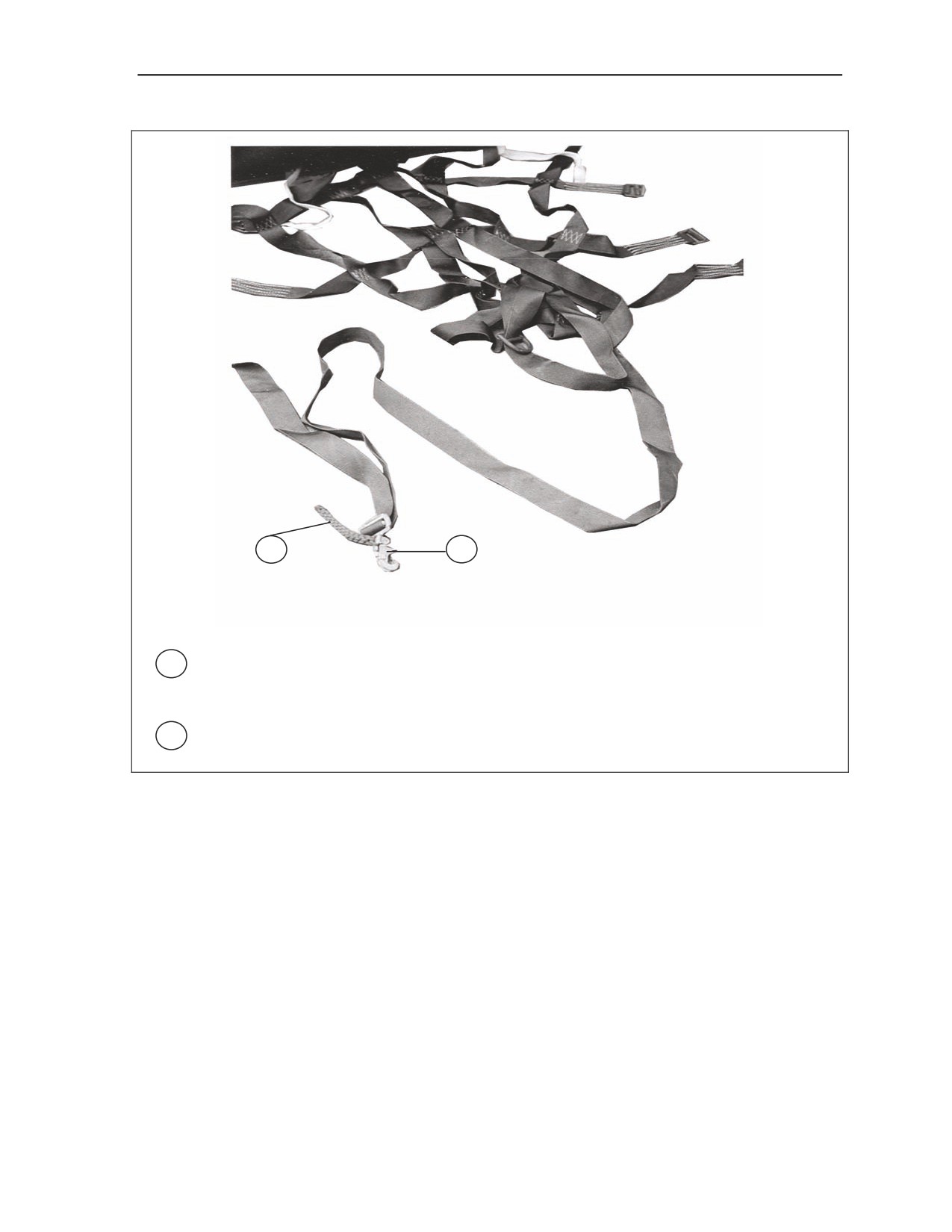
4
3
3. Install a parachute harness snap to each of the remaining long and short tiedown straps on
the sling assembly. Install the parachute harness snap so that it will open inward when the A
22 container is closed.
4. Make a pull handle for each parachute harness ejector snap.
Figure 3-1. Sling Assembly Adapted (continued)
FM 4-20.142/MCRP 4-11.3P/NAVSEA SS400-AD-MMO-010/ TO 13C7-51-21
19 September 2007
3-3

Chapter 3
CONSTRUCTING ENGINE PROTECTION BOX
3-3. Construct the engine protection box as shown in Figure 3-2. If the engine protection box is to be
recovered and reused, construct the box of oiled marine-grade plywood and aluminum braces. For one-time
use, standard plywood and nails may be used.
Note. This drawing is not to scale.
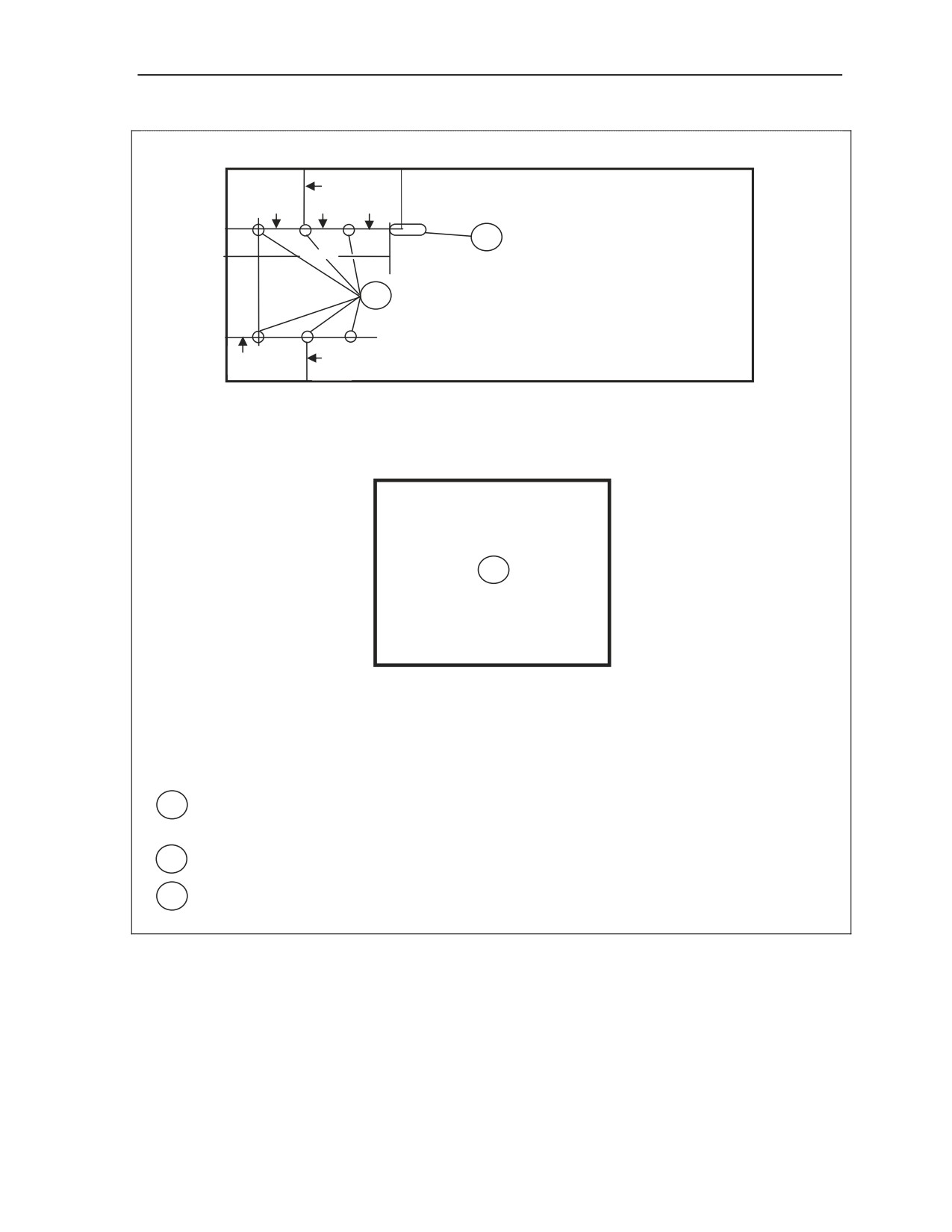
48”
48”
2”
2”
1. Drill 1/2-inch holes as shown in a 3/4- by 48- by 48-inch piece of plywood. This piece will be
the bottom.
Figure 3-2. Engine Protection Box Constructed
FM 4-20.142/MCRP 4-11.3P/NAVSEA SS400-AD-MMO-010/ TO 13C7-51-21
3-4
19 September 2007
Rigging Zodiac F470U Boat in A-22 Cargo Bag
TOP
4”
4”
6”
6”
6”
3
19”
FRONT
17”
2
4”
4”
51”
4
17”
18”
2. Drill 1/2-inch holes as shown in two 3/4- by 17- by 51-inch pieces of plywood. These pieces
will be used as the sides.
3. Cut a 2- by 1/2-inch slot in each side 19 inches from the front edge and 4 inches from the top.
4. Cut two 3/4- by 17- by 18-inch pieces of honeycomb to be used as the ends.
Figure 3-2. Engine Protection Box Constructed (continued)
FM 4-20.142/MCRP 4-11.3P/NAVSEA SS400-AD-MMO-010/ TO 13C7-51-21
19 September 2007
3-5
Chapter 3
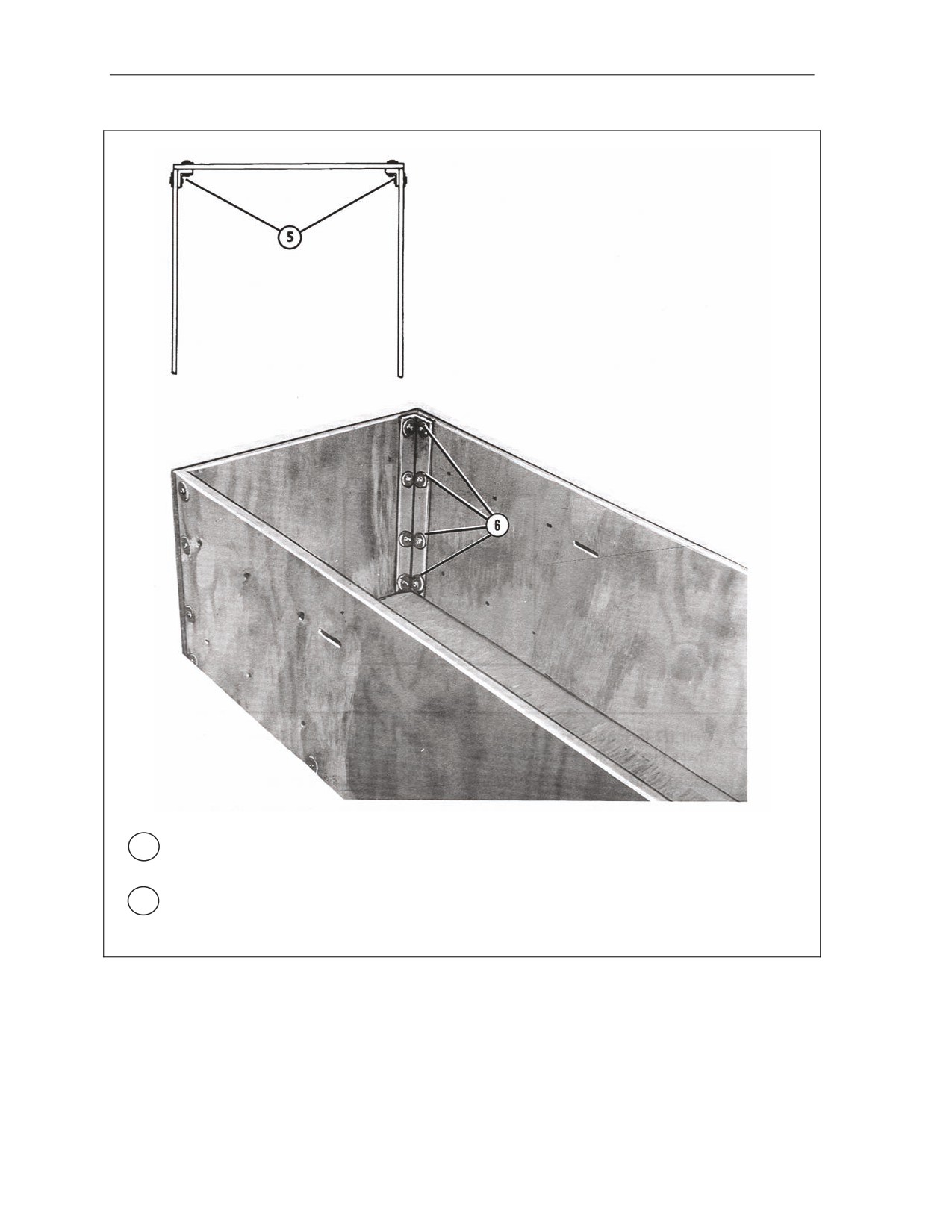
5. Join the ends and the sides of the box with a 17-inch length of angled aluminum. Fit the ends
of the box to the outside edges of the sides.
6. Drill four holes (one at each end of the brace and two evenly spaced between the end holes).
Install bolts and nuts using 1 1/2-inch diameter fender washers under each bolt and each nut.
Figure 3-2. Engine Protection Box Constructed (continued)
FM 4-20.142/MCRP 4-11.3P/NAVSEA SS400-AD-MMO-010/ TO 13C7-51-21
3-6
19 September 2007
Rigging Zodiac F470U Boat in A-22 Cargo Bag
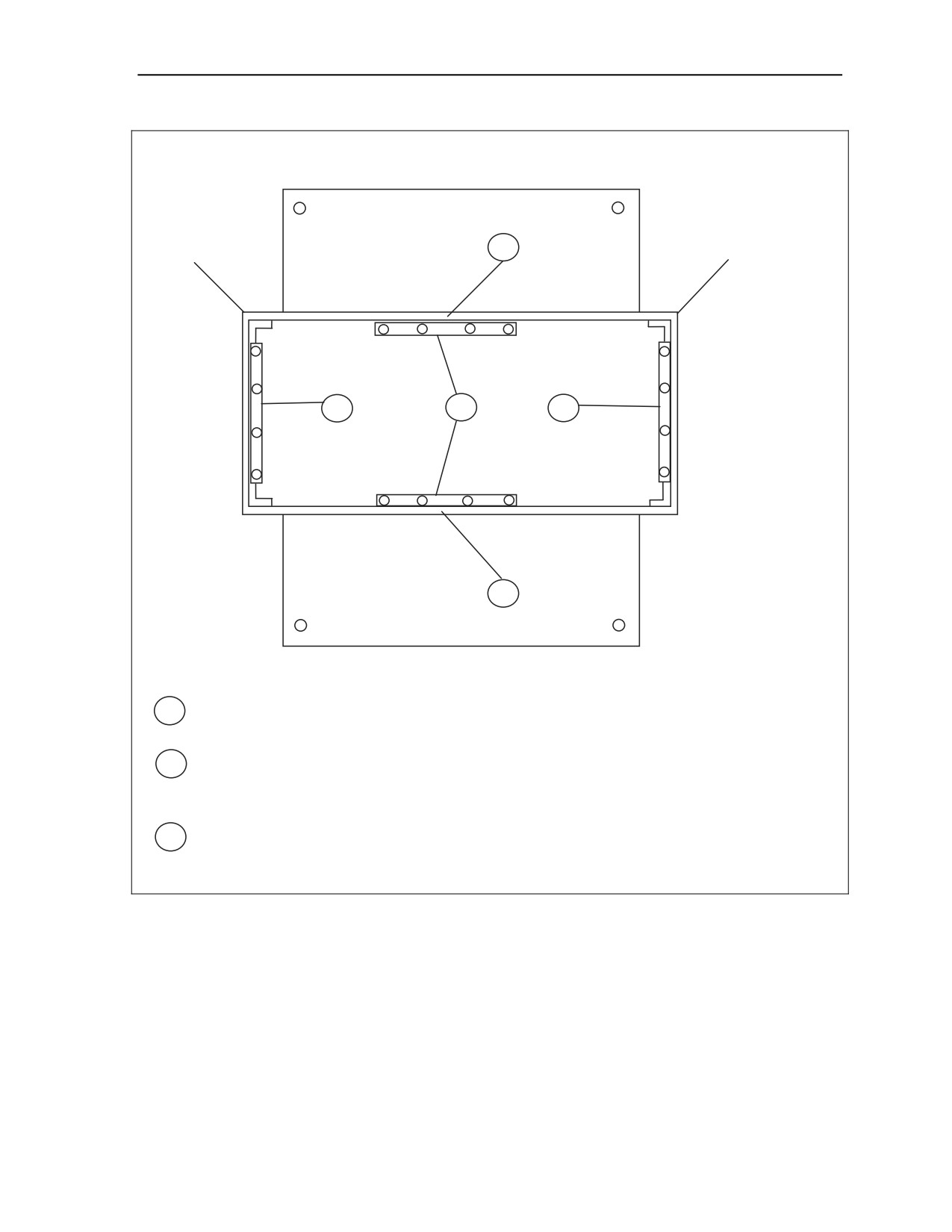
Note. This drawing is not to scale.
2 1/4”
2 1/4”
OVERHANG
7
OVERHANG
8
9
8
7
7.
Center the sides of the box over the bottom so that the ends overhang the bottom 1 1/2
inches at the front and rear.
8.
Join each end of the box to the bottom with a 14-inch length of angled aluminum. Drill holes
and install fasteners and washers as in step 6. Note that the total overhang at each end for a
51-inch box is 2 1/4 inches.
9. Join each side of the box to the bottom with a 20-inch length of angled aluminum centered
along each side. Drill holes and install fasteners and washers as in step 6.
Figure 3-2. Engine Protection Box Constructed (continued)
FM 4-20.142/MCRP 4-11.3P/NAVSEA SS400-AD-MMO-010/ TO 13C7-51-21
19 September 2007
3-7