FM 4-20.142 Airdrop of Supplies and Equipment: Rigging Loads for Special Operations (September 2007) - page 1

*FM 4-20.142 (FM 10-542)
MCRP 4-11.3P
NAVSEA SS400-AD-MMO-010
TO 13C7-51-21
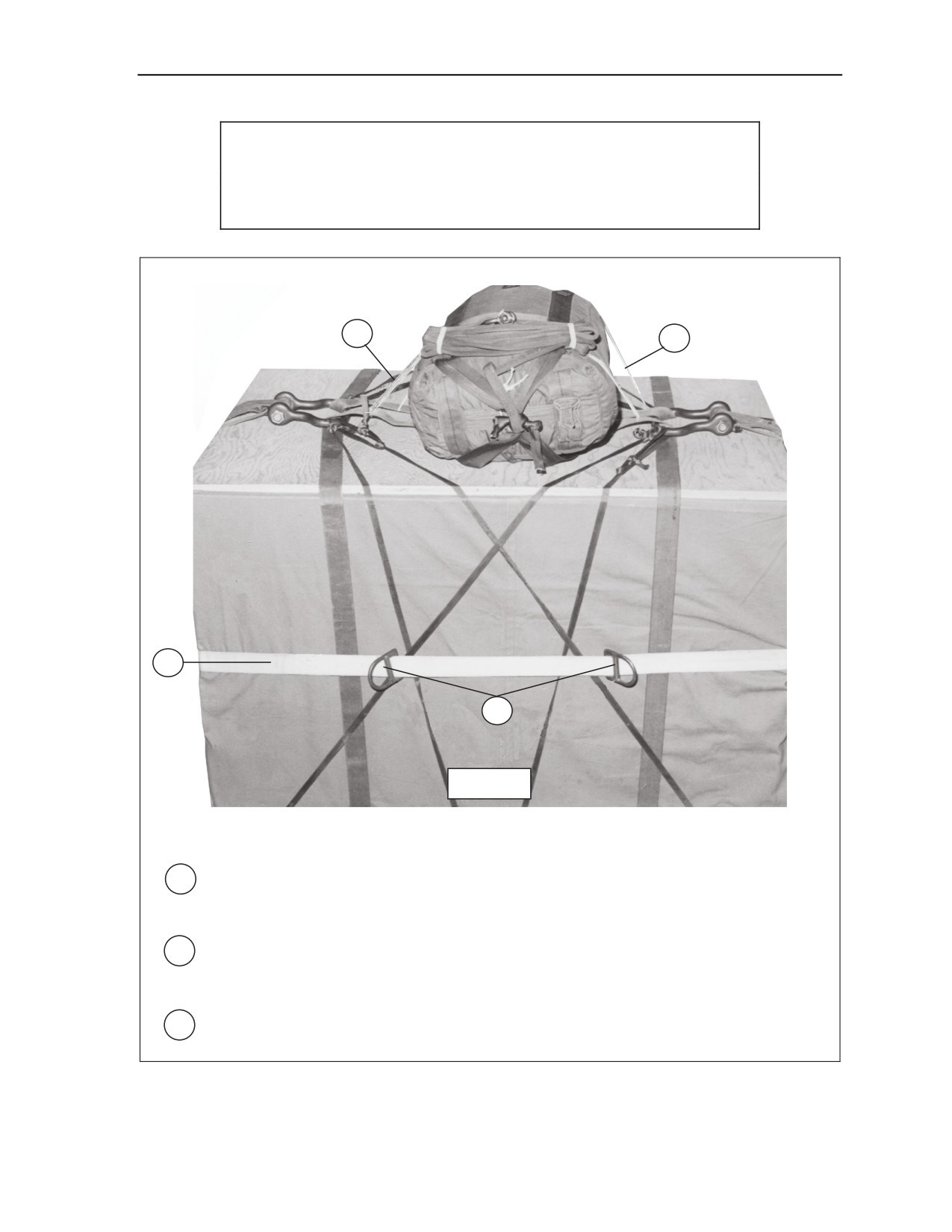
Field Manual
Headquarters
Department of the Army
No. 4-20.142 (10-542)
United States Marine Corps
MCRP
Department of the Navy
No. 4-11.3P
Department of the Air Force
Naval Sea Command
Washington, DC, 19 September 2007
No. SS400-AD-MMO-010
Technical Order
No. 13C7-51-21
AIRDROP OF SUPPLIES AND EQUIPMENT:
RIGGING LOADS FOR SPECIAL OPERATIONS
Contents
Page
PREFACE
v
INTRODUCTION
vii
Chapter 1
RIGGING HIGH SPEED LOW LEVEL AERIAL DELIVERY SYSTEM (HSLLADS)
CONTAINER LOADS
1-1
Section I-Rigging the Container
1-1
Description of Load
1-1
Preparing Container
1-2
Loading Container
1-4
Constructing Container Straps
1-5
Closing Container and Stowing Parachute
1-6
Equipment Required
1-10
Section II-Modifying and Packing the 22-Foot and 28-Foot Cargo
Extraction Parachutes
1-11
Modifying Cargo Extraction Parachute Deployment Bag
1-11
Attaching Static Line and Bridle Loop Breakcord
1-14
Stowing Suspension Lines
1-16
Packing Parachute
1-16
Stowing Static Line
1-17
Distribution Restriction: Approved for public release; distribution is unlimited.
*This publication supersedes FM 10-542/NAVSEA SS400-AD-MMO-010/TO 13C7-51-21, 7 October 1987.
19 September 2007
i

Contents
Chapter 2
RIGGING COMBAT RUBBER RAIDING CRAFT
2-1
Section I-Rigging Single Zodiac F470U Boat
2-1
Description of Load
2-1
Preparing the Platform
2-1
Installing Suspension Slings
2-9
Stowing Sandbags
2-10
Attaching Lashings to the Platform
2-11
Building, Placing and Securing Honeycomb Stacks
2-12
Preparing Boat
2-14
Positioning Boat
2-19
Preparing, Placing, and Securing Accompanying Load
2-20
Installing Load Cover and Lashing Boat
2-26
Safety Tieing Suspension Slings
2-27
Stowing Parachute
2-28
Stowing the G-12 Cargo Parachute and 15-Foot Cargo Extraction Parachute 2-33
Installing Parachute Release
2-35
Installing Flotation Device
2-36
Marking Rigged Load
2-37
Equipment Required
2-38
Section II-Rigging Double Zodiac F470U Boat
2-40
Description of Load
2-40
Preparing the Platform
2-40
Installing Suspension Slings and Stowing Sandbags
2-40
Placing and Securing Honeycomb Stacks
2-40
Preparing Boats
2-40
Positioning First Boat
2-40
Preparing and Stowing Accompanying Load
2-40
Leveling, Covering, and Lashing First Boat and Accompanying Load
2-41
Placing and Loading Second Boat
2-42
Lashing Second Boat to Platform
2-43
Safety Tieing Suspension Slings
2-43
Stowing Parachutes
2-44
Installing Parachute Release
2-46
Equipment Required
2-47
Marking Rigged Load
2-48
Chapter 3
RIGGING ZODIAC F470U IN A-22 CARGO BAG
3-1
Description of Load
3-1
Adapting A-22 Cargo Bag
3-1
Constructing Engine Protection Box
3-4
Preparing Skid and A-22 Cargo Bag and Placing Engine Box
3-10
Preparing Engine and Securing Engine in Box
3-13
Preparing Boat and Inflation System
3-17
Collapsing and Folding Boat, Completing Inflation System Connection and
Loading Fuel Tanks
3-21
Securing A-22 Cargo Bag
3-28
Modifying Type IV Link Assembly for use with Hydraulic Release
3-32
Installing Parachute Release and Parachutes
3-36
FM 4-20.142/MCRP 4-11.3P/NAVSEA SS400-AD-MMO-010/ TO 13C7-51-21
ii
19 September 2007

Contents
Installing Flotation Devices and Chemical Lights (Optional)
3-41
Marking Rigged Load
3-43
Equipment Required
3-44
CHAPTER 4
RIGGING THE NAVAL SPECIAL WARFARE (NSW) RIGID INFLATABLE BOAT
(RIB) FOR LOW-VELOCITY AIRDROP
4-1
Description of Load
4-1
Preparing Platform
4-2
Installing the Platform Release System
4-10
Installing Extraction Force Transfer Coupling (EFTC)
4-13
Lifting and Positioning Boat
4-16
Preparing Boat
4-18
Preparing the Sponson Inflation System
4-26
Installing the Water Activated Parachute Release
4-27
Installing the Boat Cover, Sponson, Ties, and Sponson Covers
4-28
Preparing Suspension Slings
4-34
Installing Parachute Stowage Platform
4-35
Installing Cargo Parachutes
4-36
Installing M-2 Cargo Parachute Release
4-37
Installing Parachute Restraints
4-38
Installing Sponson Activation Lanyard
4-39
Preparing and Testing the NSW RIB Restraint System
4-40
Connecting M-21 Cutter Arming Wire Lanyards
4-47
Securing G-12E Parachute Static Line
4-48
Placing Extraction Parachutes
4-49
Marking the Rigged Load
4-49
Equipment Required
4-50
CHAPTER 5
RIGGING THE ADVANCED RESCUE CRAFT (ARC) ON A COMBAT
EXPENDABLE PLATFORM (CEP)
5-1
SECTION I-RIGGING THE GP 800 ARC
5-1
Description of Load
5-1
Building the Combat Expendable Platform
5-2
Preparing the Platform
5-4
Preparing and Positioning Honeycomb
5-6
Positioning the ARC
5-8
Preparing the ARC
5-9
Lashing the ARC
5-13
Safety Tieing Suspension Slings
5-16
Stowing Parachute
5-17
Installing the Automatic Cargo Parachute Release
5-18
Stowing the Extraction Parachute
5-19
Attaching Flotation Devices for Training Loads
5-21
Marking the Rigged Load
5-22
Equipment Required
5-23
SECTION II-RIGGING THE XL1200 ARC
5-24
Description of Load
5-24
Building the Combat Expendable Platform
5-25
Preparing the Platform
5-27
FM 4-20.142/MCRP 4-11.3P/NAVSEA SS400-AD-MMO-010/ TO 13C7-51-21
19 September 2007
iii

Contents
Preparing and Positioning Honeycomb
5-29
Positioning the ARC
5-31
Preparing the ARC
5-32
Lashing the ARC
5-36
Safety tieing Suspension Slings
5-39
Stowing Cargo Parachute
5-40
Installing the Automatic Cargo Parachute Release
5-41
Stowing the Extraction Parachute
5-42
Attaching Flotation Devices for Training
5-44
Marking the Rigged Load
5-45
Equipment Required
5-46
CHAPTER 6
RIGGING THE WIND SUPPORTED AERIAL DELIVERY SYSTEM (WSADS)
SNOW GOOSE
6-1
Description of Load
6-1
Installing Air Launch Parachute
6-2
Installing Pyrotechnic Cutters
6-10
Recovery Dispatch Pin Placement
6-14
Securing Landing Gear
6-16
Installing Propeller Brake
6-18
Installing Deflector Lanyards
6-19
Equipment Required
6-21
GLOSSARY
Glossary-1
REFERENCES
References-1
FM 4-20.142/MCRP 4-11.3P/NAVSEA SS400-AD-MMO-010/ TO 13C7-51-21
iv
19 September 2007

Preface
SCOPE
This manual tells and shows how to rig the following airdrop loads for special operations:
• Four different High Speed Low Level Aerial Delivery System (HSLLADS) container loads
rigged for airdrop from the MC-130 aircraft.
• Two different inflated Combat Rubber-Raiding Crafts (CRRC) rigged on a Combat Expendable
Platform (CEP) for low-velocity airdrop from a C-130 or C-17 aircraft.
• The Rigging Alternate Method Zodiac (RAMZ) is rigged in an A-22 container for low-velocity
airdrop from a C-130 or C-17 aircraft.
• The Naval Special Warfare Rigid Inflatable Boat (NSWRIB) is rigged for low-velocity airdrop
on a specially designed platform from a C-130 or C-17 aircraft.
• Two different Advanced Rescue Crafts (ARC) rigged on a combat expendable platform (CEP)
for low velocity airdrop from a C-130 or C-17 aircraft.
• The Wind Supported Aerial Delivery System (WSADS) Snow Goose is a low-cost, reusable,
fully autonomous, Unmanned Aerial Vehicle (UAV) that can be used to carry out a variety of
missions at otherwise inaccessible locations for low velocity airdrop from a C-130 or C-17
aircraft.
APPLICABILITY
This publication applies to the Active Army, the Army National Guard/Army National Guard of the United
States, and the United States Army Reserve unless otherwise stated.
USER INFORMATION
The proponent of this publication is the United States Army Training and Doctrine Command (TRADOC). You
are encouraged to report any errors or omissions and to suggest ways of making this a better manual.
Army personnel, send your comments on DA Form 2028 (Recommended Changes to Publications and Blank
Forms) directly to:
Director
Aerial Delivery and Field Services Department
USA Quartermaster Center and School
710 Adams Avenue
Fort Lee, Virginia 23801-1502
Marine Corps. Readers of this publication are encouraged to submit suggestions and changes through the
Universal Need Statement (UNS) process. The UNS submission process is delineated in Marine Corps Order
3900.15A, Marine Corps Expeditionary Force Development System, which can be obtained from the Marine
Corps Publications Electronic Library Online (universal reference locator:
information:
• Location of change
Publication number and title
FM 4-20.142/MCRP 4-11.3P/NAVSEA SS400-AD-MMO-010/ TO 13C7-51-21
19 September 2007
v

Preface
Current page number
Paragraph number (if applicable)
Line number
Figure or table number (if applicable)
• Nature of change
Addition/deletion of text
Proposed new text
MCCDC will consolidate changes and forward to:
Director
Aerial Delivery and Field Services Department
USA Quartermaster Center and School
710 Adams Avenue
Fort Lee, Virginia 23801-1502
Navy personnel send all correspondence to the (PEO LMW) Program Office.
Program Executive Officer,
Littoral and Mine Warfare (PMS NSW)
614 Sicard St. SE
Washington Navy Yard, DC 20376-7210
PEO LMW will consolidate changes and forward to:
Director
Aerial Delivery and Field Services Department
USA Quartermaster Center and School
710 Adams Avenue
Fort Lee, Virginia 23801-1502
Air Force personnel, send your reports on AFTO Form 22 through your respective command Weapons and
Tactics to:
Headquarters
Air Mobility Command (AMC/A3DT)
402 Scott Drive, Unit 3AI
Scott AFB, Illinois 62225-5302
Air Force personnel in Special Operations Command, send your reports on AFTO Form 22 (Technical Order
Publication Improvement Report). HQ AMC/A3DT will consolidate and forward changes to:
Director
Aerial Delivery and Field Services Department
USA Quartermaster Center and School
710 Adams Avenue
Fort Lee, Virginia 23801-1502
Also, send an information copy of AFTO Form 22 to:
584 CBSS/GBMUDE
380 Richard Ray Blvd
STE 104
Robins AFB, Georgia. 31098-1640
FM 4-20.142/MCRP 4-11.3P/NAVSEA SS400-AD-MMO-010/ TO 13C7-51-21
vi
19 September 2007

Introduction
Introduction
DESCRIPTION OF ITEMS
The descriptions of the items rigged in this manual are given below:
• High Speed Low Level Aerial Delivery System (HSLLADS): The HSLLADS container is an
adjustable container made of an A-21 cargo cover and other airdrop items. The dimensions and
weight capacity of the container is determined by the load being airdropped.
• Zodiac F470U Combat Rubber Raiding Craft (CRRC): The inflated Zodiac 470U boat is
airdropped singly or in pairs. Each boat is 75 inches wide, 22 inches high, 185 inches long and
may be airdropped utilizing a roll-up floor or hard deck. A single boat weighs approximately 322
pounds.
• Zodiac F470U Combat Rubber Raiding Craft rigged in an A-22 Container or Rigging
Alternate Method Zodiac (RAMZ): The boat is rigged in an A-22 container rigged for low-
velocity airdrop over water. The boat is deflated and rigged for rapid inflation and deployment
once in the water.
• Naval Special Warfare Rigid Inflatable Boat (NSWRIB): The NSWRIB is 108 inches wide,
100 inches high and 432 inches long. The boat rigged on its platform can weigh a maximum of
20,640 pounds.
• Advanced Rescue Craft (ARC): The ARC is rigged on a 48- x 87-inch combat expendable
platform for low-velocity airdrop. The load can be rigged with or without a 20-man life raft and a
rescue board, a rucksack, and an aid bag. The ARC is 70 inches high, 48 inches wide and 111
inches long. The ARC is 1,140 pounds when rigged.
• Snow Goose: The Wind Supported Aerial Delivery System (WSADS) Snow Goose is a low-
cost, reusable, fully autonomous, unmanned aerial vehicle (UAV) that can be used to carry out a
variety of missions at otherwise inaccessible locations. It is quickly configurable for air or
ground launch deployable missions.
SPECIAL CONSIDERATIONS
CAUTION
Only ammunition listed in FM 4-20.153/MCRP 4-11.3B/TO 13C7-18-41
may be airdropped. Only ammunition and supplies approved for high
velocity or HSLLADS airdrop may be airdropped by HSLLADS. When
a dangerous material is being rigged, the container must be marked,
labeled and comply with AFMAN 24-204(I)/TM 38-250/NAVSUP PUB
505/MC0 P4030.19H/DLAI 4145.3. A copy of this manual must be
available to the joint airdrop inspectors during the before and after
loading inspections.
HSLLADS Container. The following items apply to the HSLLADS container:
• A multiple drop of four HSLLADS containers may be airdropped on one pass provided the total
weight of the load does not exceed 2,200 pounds.
• The type XXVI nylon webbing used to secure multiple HSLLADS loads will be furnished by the
US Army.
• HSLLADS containers are airdropped from the MC-130 aircraft only.
FM 4-20.142/MCRP 4-11.3P/NAVSEA SS400-AD-MMO-010/ TO 13C7-51-21
19 September 2007
vii

Introduction
Note. For Air Force use only. A HSLLADS container weighing at least 250 pounds may be
airdropped for continuance training purposes only, provided the 35 pounds per square foot
minimum is maintained. For unilateral training loads honeycomb is not required.
Boats and Parachutists. The following items apply to boats and parachutists:
• At no time will the total number of static lines on the anchor line cable for personnel and cargo
exceed 20.
• The total rigged weight of rubber raiding craft loads on CEP must be a minimum of 2,100
pounds. Sandbags or other ballast may be added to the platform for this purpose.
FM 4-20.142/MCRP 4-11.3P/NAVSEA SS400-AD-MMO-010/ TO 13C7-51-21
viii
19 September 2007
Chapter 1
Rigging High Speed Low Level Aerial Delivery System
(HSLLADS) Container Loads
SECTION I-RIGGING THE CONTAINER
DESCRIPTION OF LOAD
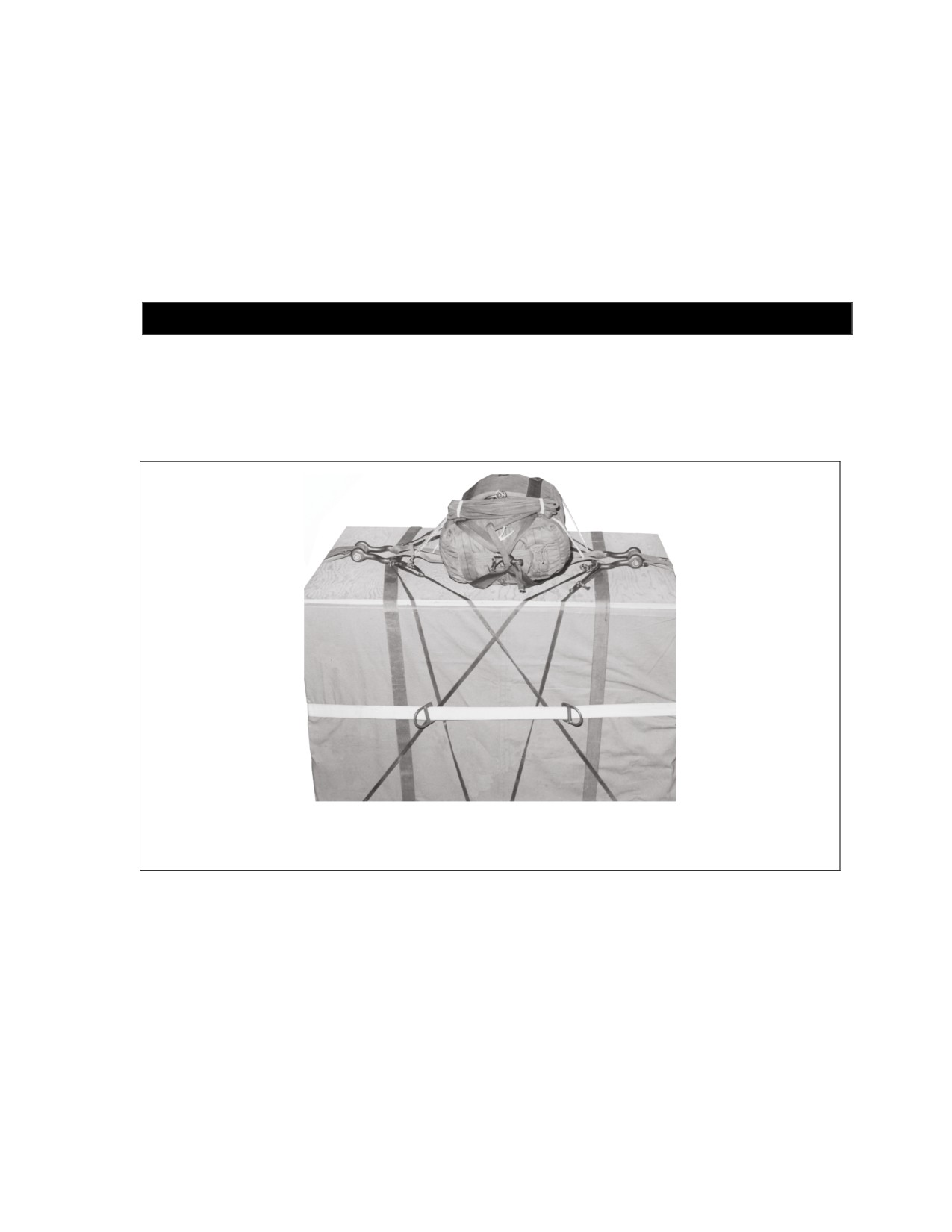
1-1. The HSLLADS container (Figure 1-1) is an adjustable container made of an A-21 (nylon) cargo
cover and other airdrop items. The assembled items are rigged to ensure that the container will withstand
the shock of the parachute opening when airdropped at high speeds.
Figure 1-1. High Speed Low Level Aerial Delivery System (HSLLADS)
FM 4-20.142/MCRP 4-11.3P/NAVSEA SS400-AD-MMO-010/ TO 13C7-51-21
19 September 2007
1-1
Chapter 1
PREPARING CONTAINER
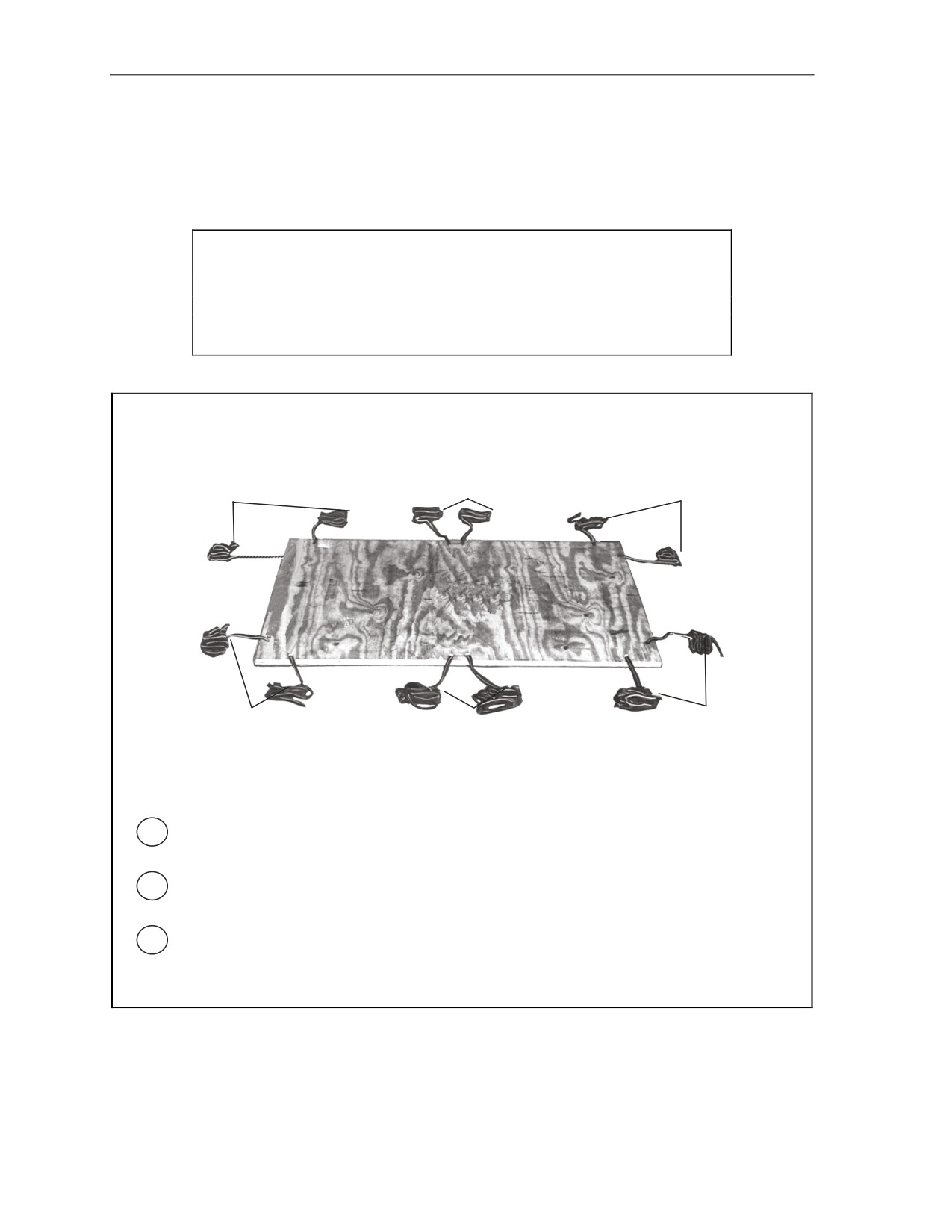
1-2. Dimensions of the load base in these procedures are typical. The size of the load base may change to
fit other supply loads. Prepare the load base and HSLLADS container as shown in Figures 1-2 and 1-3.
CAUTION
When a container is rigged for delivery from Air Force aircraft, the
rigged weight divided by the largest surface area (measured in square
feet) must be a minimum of 35 pounds per square foot.
SKID TIEDOWN 6
SKID TIEDOWN 4
SKID TIEDOWN 2
SKID TIEDOWN 5
SKID TIEDOWN 3
SKID TIEDOWN 1
1. Drill 1/2-inch diameter holes 4 inches from each corner and 1 inch from the edge of a 3/4-
by 30- by 48-inch piece of plywood.
2. Center two additional 1/2-inch diameter holes on each 48 inch side of the skid 4 inches
from each other and 1 inch from the edge.
3. Thread a 12-foot length of 1/2-inch tubular nylon webbing through each pair of holes in the
skid. (Doubled, type III nylon cord may be used).
Note. Denoted skid tiedown numbers are referred to in Figure 1-7.
Figure 1-2. Skid Prepared
FM 4-20.142/MCRP 4-11.3P/NAVSEA SS400-AD-MMO-010/ TO 13C7-51-21
1-2
19 September 2007
Rigging High Speed Low Level Aerial Delivery System (HSLLADS) Container Loads
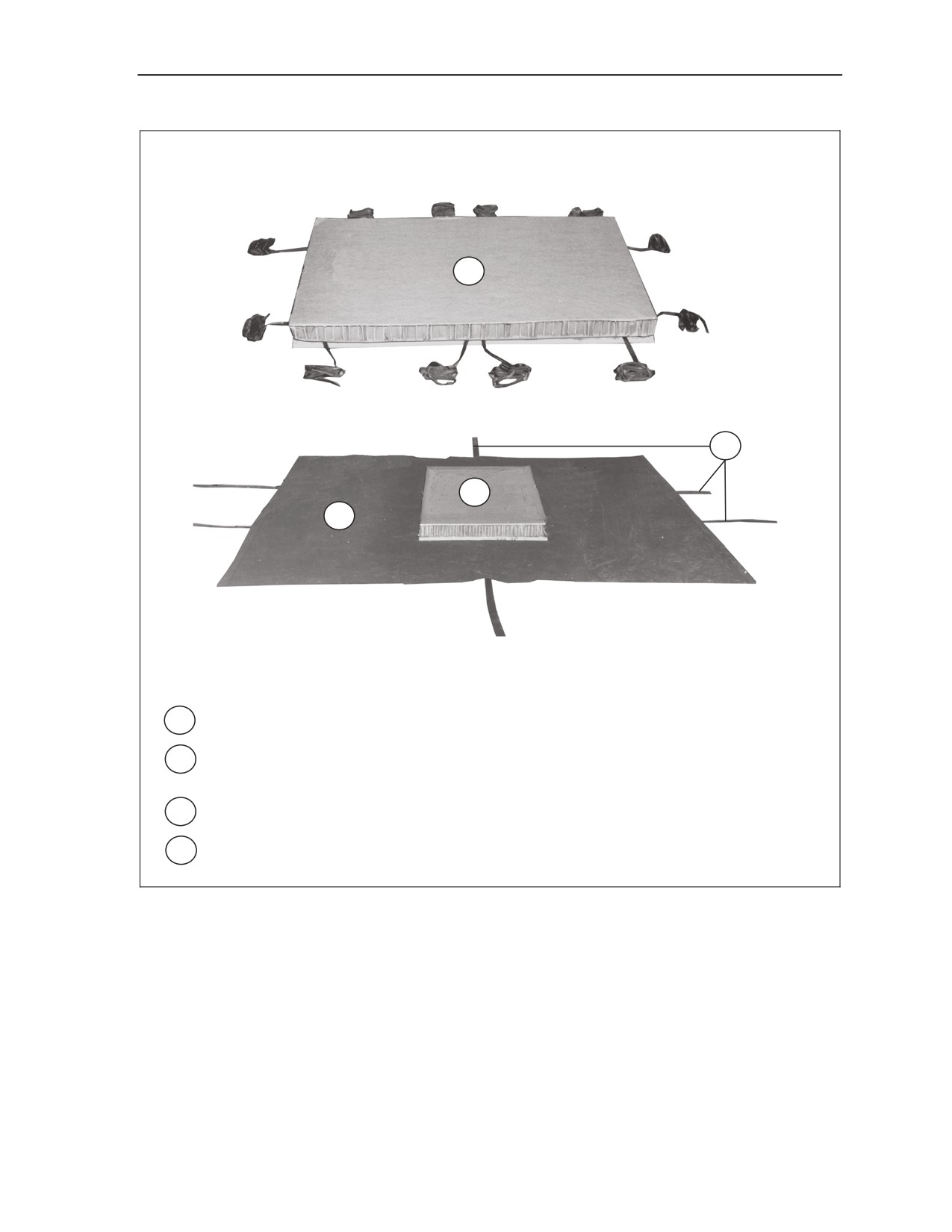
1
3
4
2
4.
Center a 30- by 48-inch piece of honeycomb on the skid.
5.
Thread three 12- foot lengths of type X nylon webbing through the keepers on the A-21
cargo cover.
6.
Place the cover, with the webbing down, on top of the honeycomb and skid.
7. Center another 3/4- by 30- by 48-inch piece of plywood and a 30- by 48-inch piece of
honeycomb on top of the cargo cover. This is the load base.
Figure 1-3. A-21 Honeycomb, Container Cover and Load Base Placed on Skid
FM 4-20.142/MCRP 4-11.3P/NAVSEA SS400-AD-MMO-010/ TO 13C7-51-21
19 September 2007
1-3
Chapter 1
LOADING CONTAINER
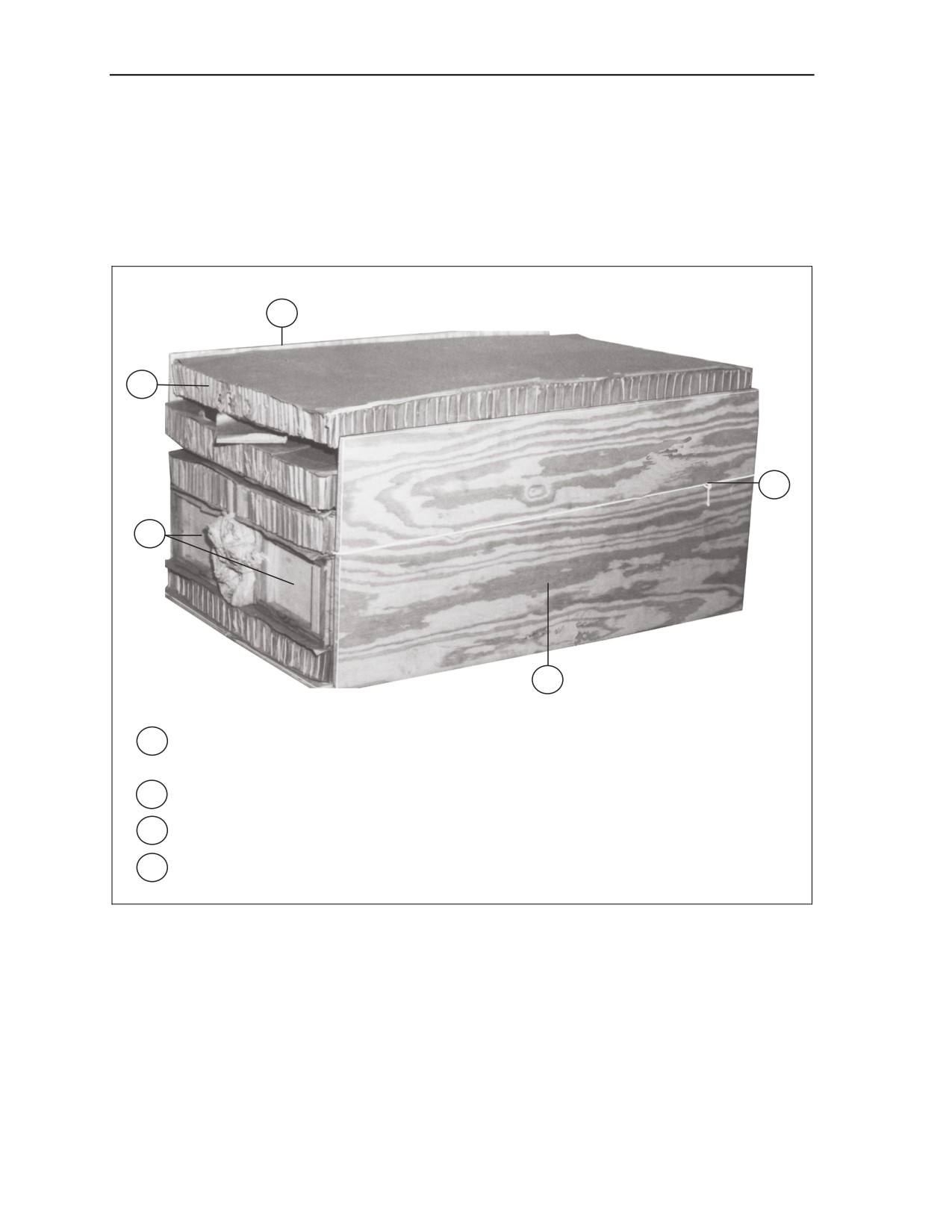
1-3. Place the items to be airdropped on the honeycomb in the manner shown in Figure 1-4. Place the
durable or heavy items on the bottom and the lighter or more fragile items on the middle or top layers. Use
the cellulose wadding, felt or honeycomb to cushion the rigged items. Use honeycomb to level and square
the load before closing the container.
Note. The rigged container must weigh at least 250 pounds but no more than 600 pounds.
3
2
4
1
3
1. Place the items to be airdropped on the load base.
Note. Only items that have been tested and approved for high-velocity or HSLLADS airdrop may be loaded in this container.
2. Square the load using the necessary honeycomb pieces.
3. Place a 3/4-inch piece of plywood cut to fit on each side of the load.
4. Tie the plywood in place with type III nylon cord.
Figure 1-4. Load Positioned on Load Base with Sideboards in Place
FM 4-20.142/MCRP 4-11.3P/NAVSEA SS400-AD-MMO-010/ TO 13C7-51-21
1-4
19 September 2007
Rigging High Speed Low Level Aerial Delivery System (HSLLADS) Container Loads
CONSTRUCTING CONTAINER STRAPS
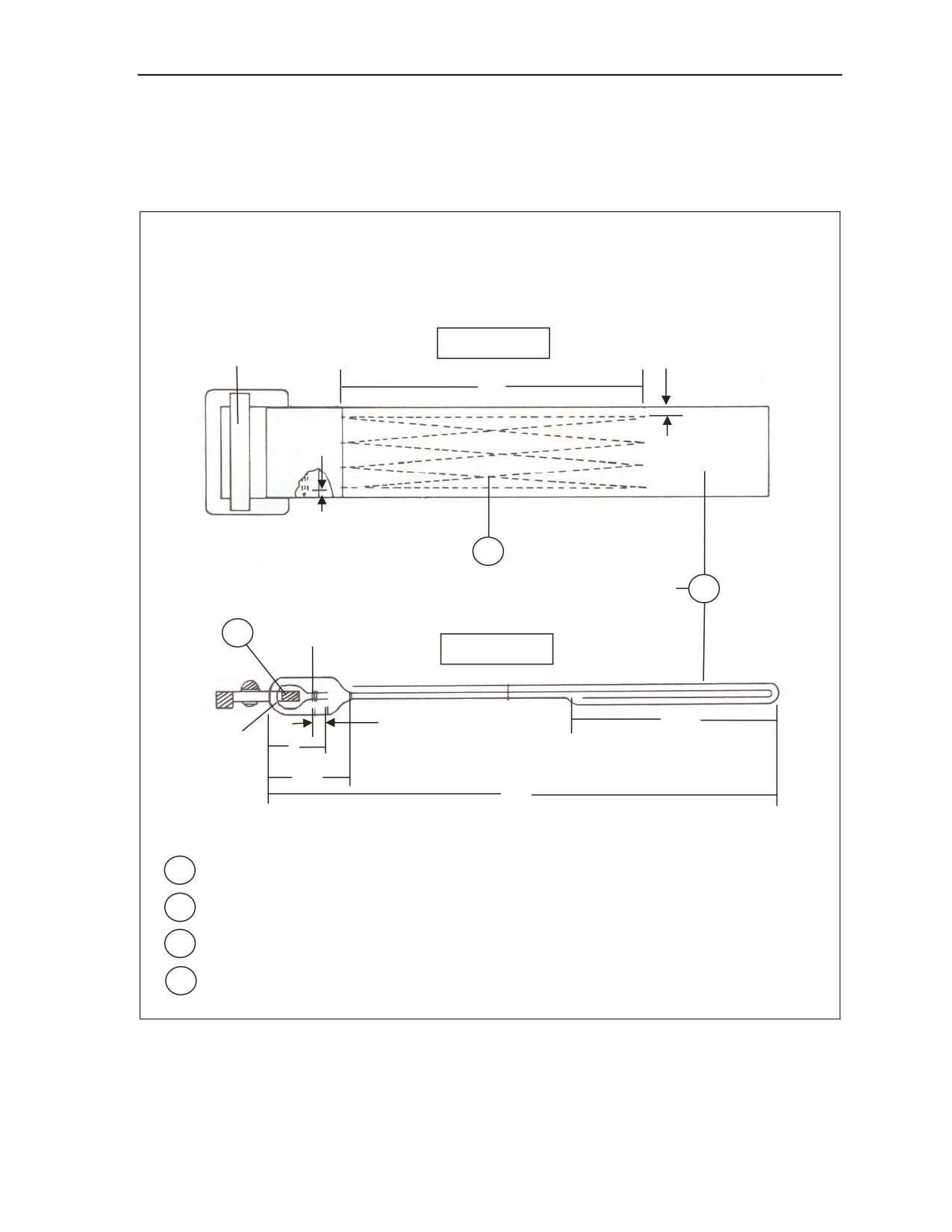
1-4. Construct two container straps as shown in Figure 1-5.
Note.
1. Sewing should be five to seven stitches per inch.
2. All dimensions given are in inches.
3. This drawing is not to scale.
Friction Adapter:
TOP VIEW
(Part No. MS22040-2)
3/16
6
1/8
4
33-inch, Type X
1
Nylon Webbing
3
Stitching
SIDE VIEW
3 3/4
1/4
Buffer
(2 1/4-inch,
1
Type X Nylon
1 1/2
Webbing)
10
1.
Cut a 33-inch and a 2 1/4-inch length of type X nylon webbing.
2.
Sear both ends of the webbing (not shown).
3.
Sew a friction adapter and buffer in one end and a loop in the other end.
4. Use number 3 or 5 cord and sew the 6-inch, four-point WW stitch.
Figure 1-5. HSLLADS Container Strap Prepared
FM 4-20.142/MCRP 4-11.3P/NAVSEA SS400-AD-MMO-010/ TO 13C7-51-21
19 September 2007
1-5
Chapter 1
CLOSING CONTAINER AND STOWING PARACHUTE
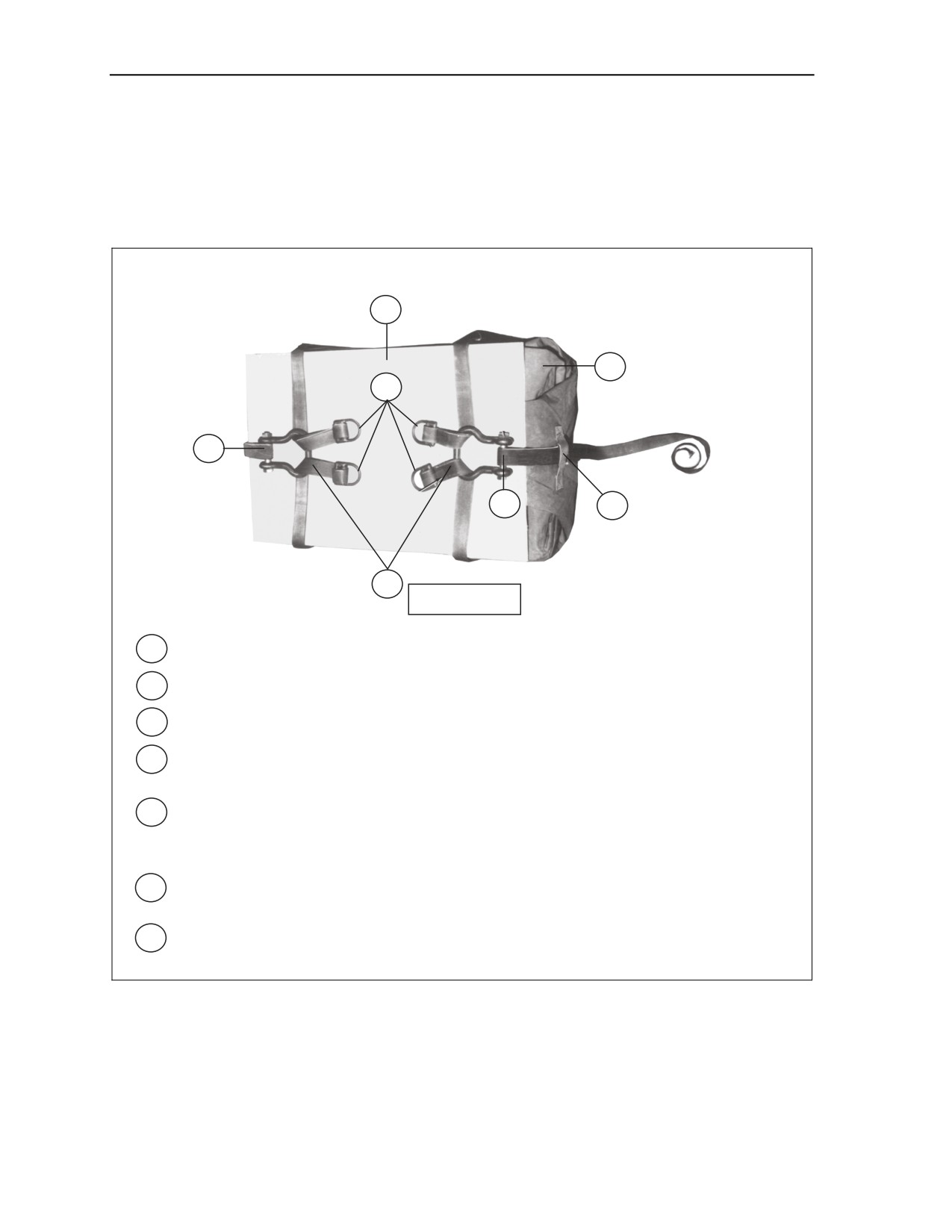
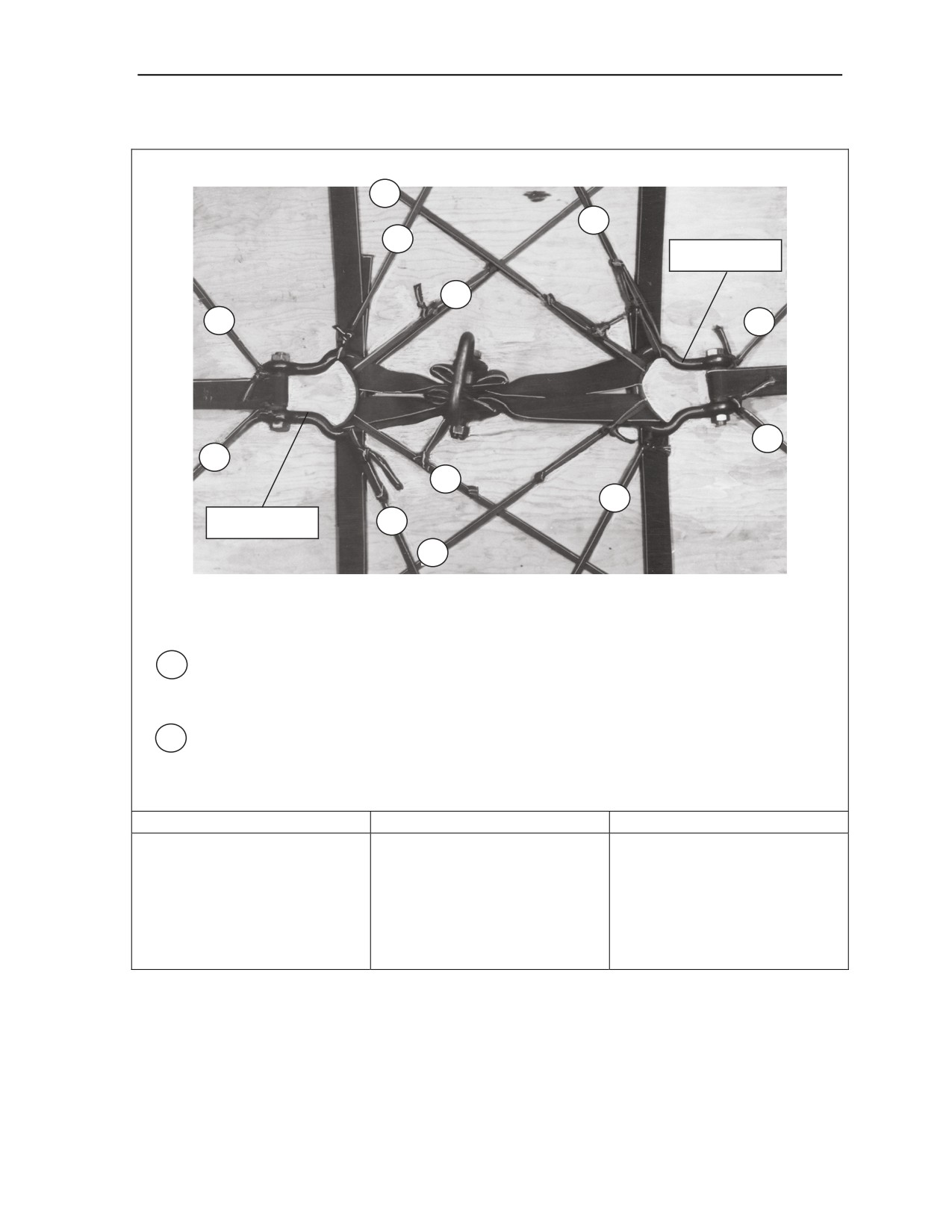
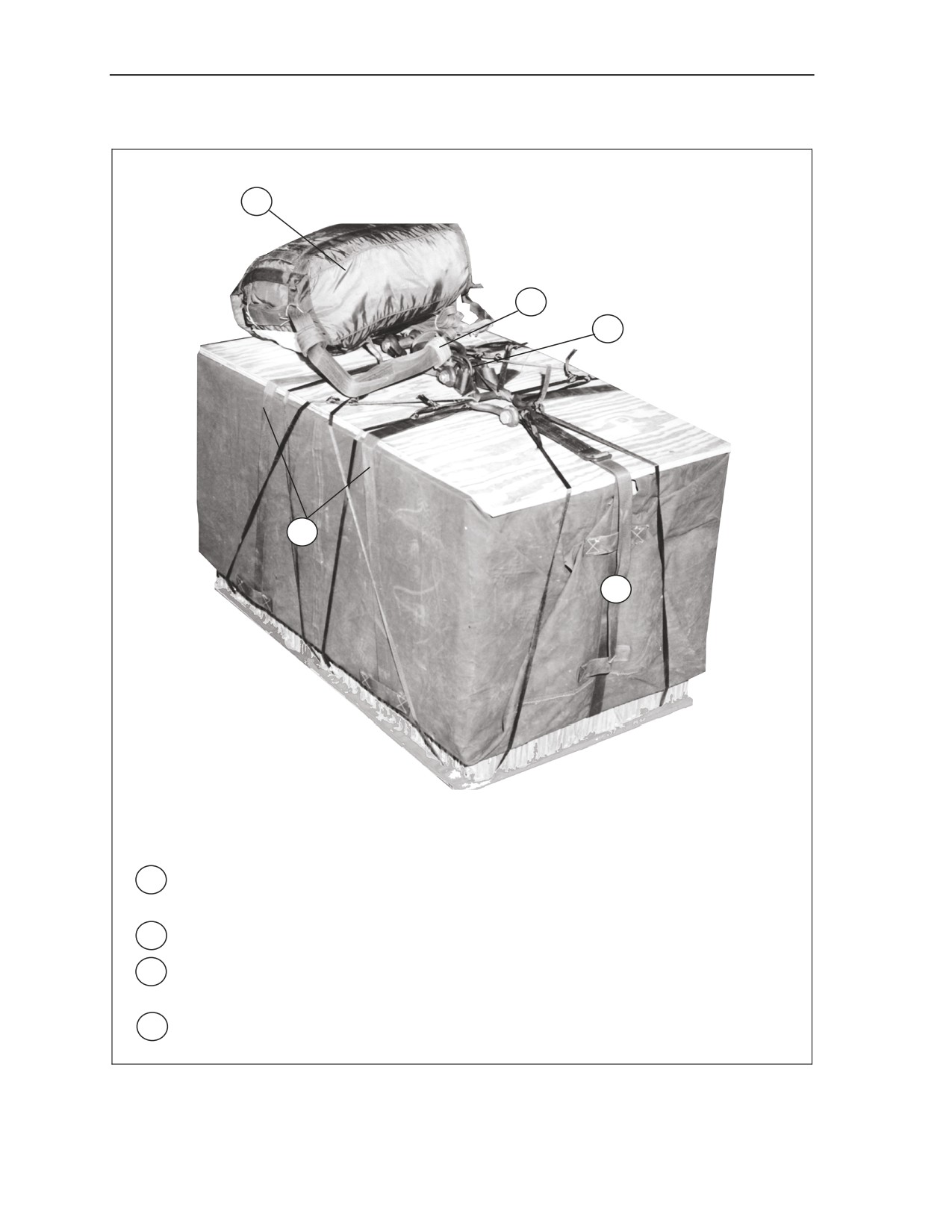
1-5. Close the container and secure the skid as shown in Figures 1-6 and 1-7. Attach and restrain a 22
foot cargo extraction parachute to the load as shown in Figures 1-8 and 1-9. If a 22-foot cargo extraction
parachute is not available, use a 28-foot cargo extraction parachute.
2
1
7
5
3
4
6
SIDE VIEW
1. Close the cargo cover, and fold under the excess material.
2. Place a 3/4-inch piece of plywood, cut to fit, on top of the load.
3. Fit the loop end of a container strap on the bolt of a cargo suspension clevis.
4. Pass the free end of a 12-foot, type X nylon webbing strap (attached to the A-21 container
cover) through the container strap's friction adapter.
5. Attach the second container strap to the other end of the 12-foot, type X nylon webbing
strap and then bolt the second cargo suspension clevis in the same manner as in steps 3
and 4.
6. Run the remaining type X nylon webbing straps around the container. Pass the ends of the
straps under and up through the cargo suspension clevises.
7. Place a D-ring on each end of the type X nylon webbing straps.
Figure 1-6. HSLLADS Container Closed
FM 4-20.142/MCRP 4-11.3P/NAVSEA SS400-AD-MMO-010/ TO 13C7-51-21
1-6
19 September 2007
Rigging High Speed Low Level Aerial Delivery System (HSLLADS) Container Loads
6
4
4
CLEVIS 1
2
6
2
1
5
1
3
CLEVIS 2
3
5
Steps:
1. Tie an end of the 12-foot length of 1/2-inch tubular nylon (positioned on the skid in Figure 1
1) to each clevis indicated below under the first tie column using three half-hitch knots and
one overhand knot.
2. Form a loop an appropriate distance from the end of each piece of 1/2-inch tubular nylon for
the second tie. Pass the free end through the clevis indicated below in the second tie column
and back through the loop. Pull the 1/2-inch tubular nylon tight, and tie it with three half-hitch
knots and one overhand knot.
Skid Tie-down Number
First Tie
Second Tie
1
Clevis 1
Clevis 2
2
Clevis 1
Clevis 2
3
Clevis 1
Clevis 2
4
Clevis 2
Clevis 1
5
Clevis 2
Clevis 1
6
Clevis 2
Clevis 1
Figure 1-7. Skid Tied to the Container
FM 4-20.142/MCRP 4-11.3P/NAVSEA SS400-AD-MMO-010/ TO 13C7-51-21
19 September 2007
1-7
Chapter 1
1
2
3
4
4
1.
Prepare and pack a 22- or 28-foot cargo extraction parachute according to TM 10-1670
277-23&P (28ft) or TM-1670-279-23&P (22-ft).
2.
Place the adapter web of the cargo extraction parachute on a cargo suspension clevis.
3.
Place four D-rings on the bolt of the cargo suspension clevis that has the adapter web
attached.
4. Tighten all straps. Fold any excess webbing, and tape it or tie it with 80-pound cotton
webbing.
Figure 1-8. Parachute Prepared
FM 4-20.142/MCRP 4-11.3P/NAVSEA SS400-AD-MMO-010/ TO 13C7-51-21
1-8
19 September 2007
Rigging High Speed Low Level Aerial Delivery System (HSLLADS) Container Loads
CAUTION
The load band must be as tight as possible to prevent it from stretching
when it is attached to the release system.
1
1
2
3
FRONT
1. Be sure the parachute is installed so that the apex faces forward in the aircraft. Restrain
the parachute to the load with a tie of one turn of single, type I, ¼-inch cotton webbing from
each of the four cluster attaching loops to the straps on the container.
2. Use a 15-foot tiedown strap or a length of type XXVI, nylon webbing with two D-rings
attached as a load band around the rigged HSLLADS container at the estimated vertical
center of balance.
3. Place the two D-rings on the front of the load. Secure the tiedown strap with a D-ring and a
load binder.
Figure 1-9. Parachute Restrained and Load Band Installed
FM 4-20.142/MCRP 4-11.3P/NAVSEA SS400-AD-MMO-010/ TO 13C7-51-21
19 September 2007
1-9

Chapter 1
EQUIPMENT REQUIRED
1-6. The equipment needed to prepare and rig the HSLLADS container is listed in Table 1-1.
Table 1-1. Equipment Required for Rigging a HSLLADS Container
National Stock Number
Item
Quantity
4030-00-678-8562
Clevis, 3/4-inch medium
3
4030-00-360-0304
Clevis, small
3
4020-00-240-2146
Cord, nylon, type III, 550-lb
As required
1670-00-360-0321
Cover, canvas, type A-21 bag
1
8135-00-664-6958
Cushioning material (Cellulose wadding)
As required
5365-00-937-0147
D-ring, 10,000- lb
6
8305-00-958-3685
Felt, 1/2-inch
As required
1670-00-753-3928
Pad, energy-dissipating, honeycomb
As required
Parachute, cargo extraction:
1670-00-687-5458
22-ft. or
1
1670-00-262-1797
28-ft. with deployment-bag
1
5530-00-618-8073
Plywood, 3/4-inch
As required
1670-00-136-9820
Static line, cargo parachute with universal static line
1
No NSN
Strap, container assembly (fabricated locally)
2
1670-00-937-0271
* Tie-down assembly, 15-ft.
1
Webbing:
8305-00-268-2411
Cotton, type I, 1/4-inch
As required
8305-00-082-5752
Nylon, tubular, 1/2-inch
As required
8305-00-268-2455
Nylon, tubular, 1-inch
As required
8305-00-261-8585
Nylon, type VIII
As required
8305-00-261-8584
Nylon, type X
12 yd.
* When the following item is not available, the following items are required:
1670-00-937-0272
Binder, load, 10,000-lb.
1
1670-00-937-0147
D-ring
2
8305-00-206-9219
Webbing, nylon, type XXVI
15-ft.
FM 4-20.142/MCRP 4-11.3P/NAVSEA SS400-AD-MMO-010/ TO 13C7-51-21
1-10
19 September 2007
Rigging High Speed Low Level Aerial Delivery System (HSLLADS) Container Loads
SECTION II-MODIFYING AND PACKING THE 22-FOOT AND 28-FOOT CARGO
EXTRACTION PARACHUTES
MODIFYING CARGO EXTRACTION PARACHUTE DEPLOYMENT
BAG
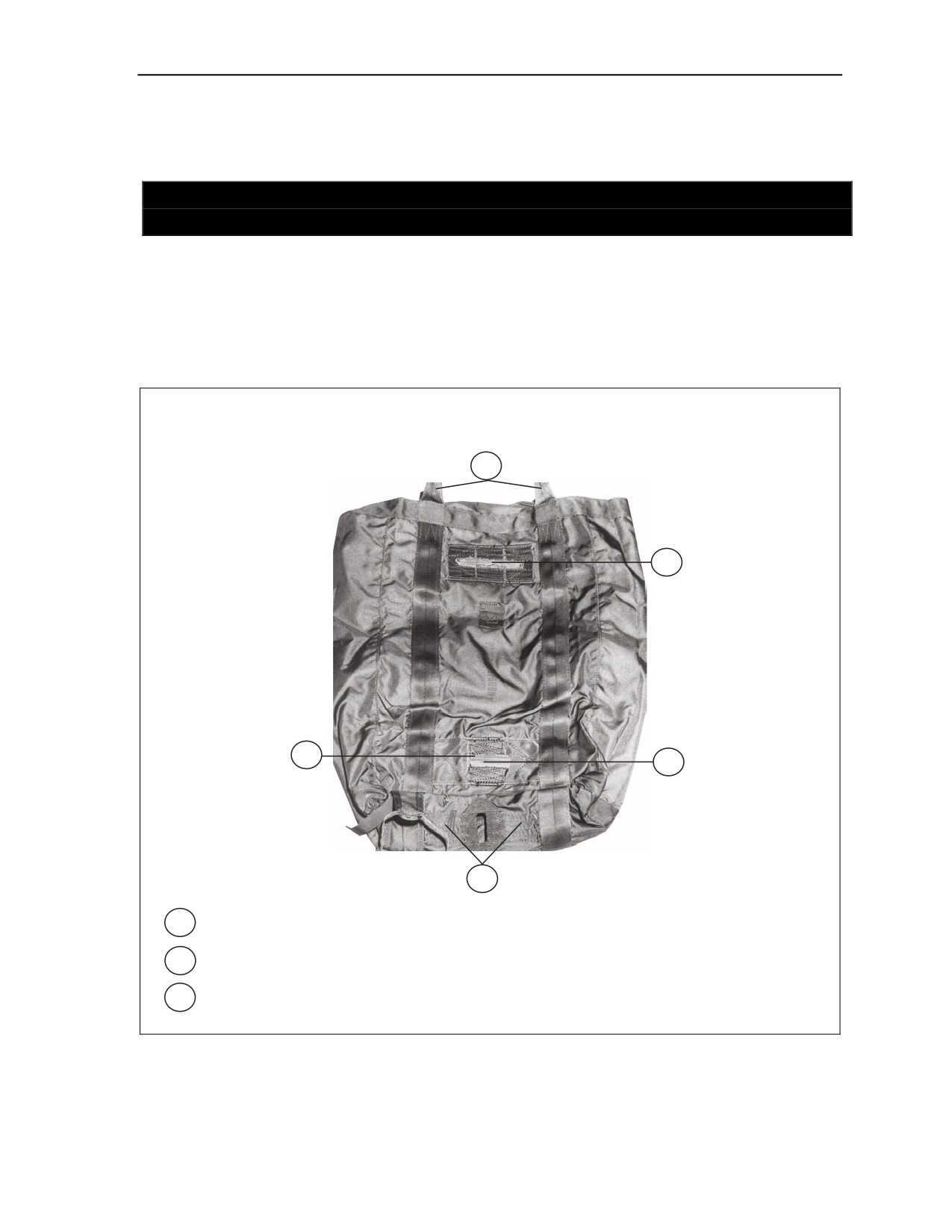
1-7. Remove the pendulum line, safety cords, deployment bag bridle loop, and V-rings from the
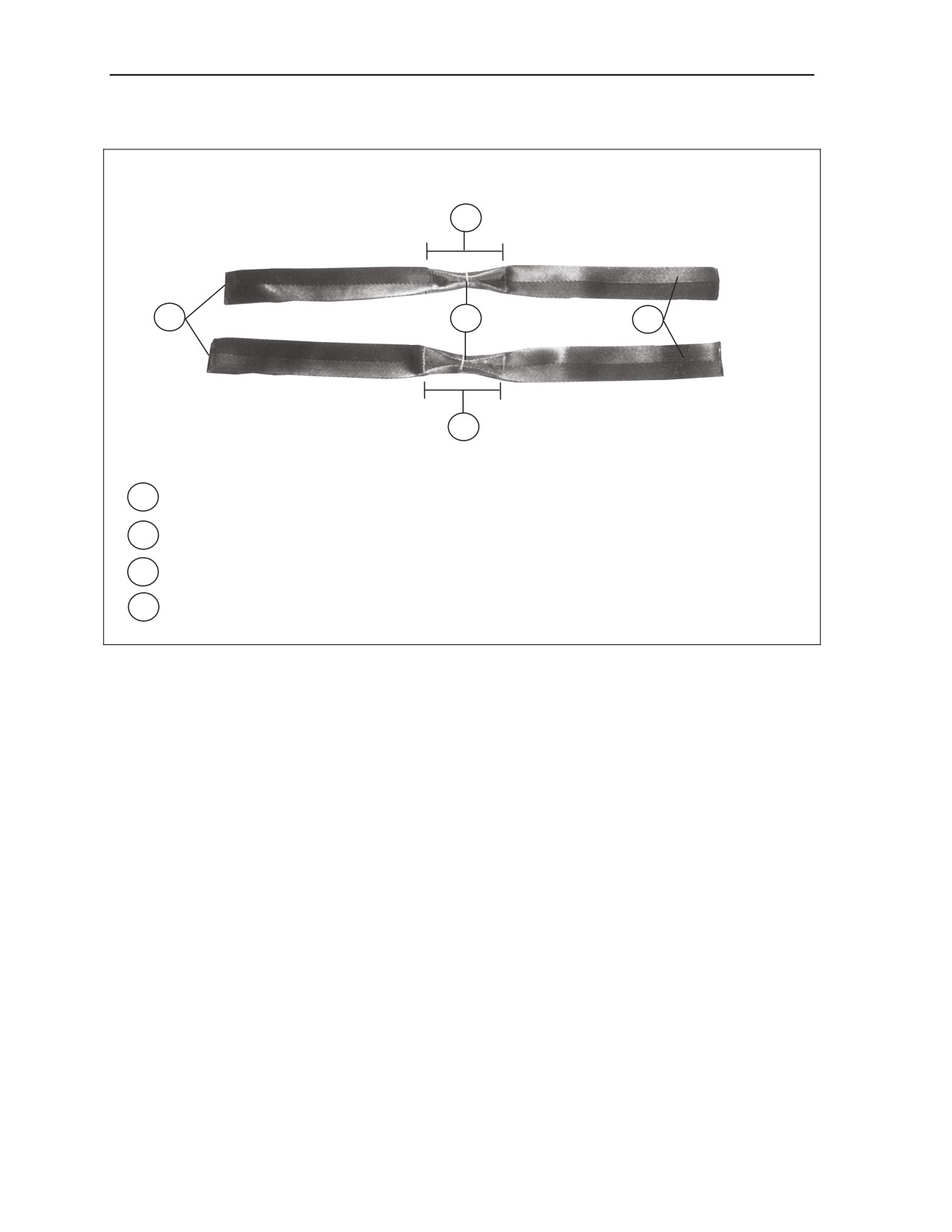
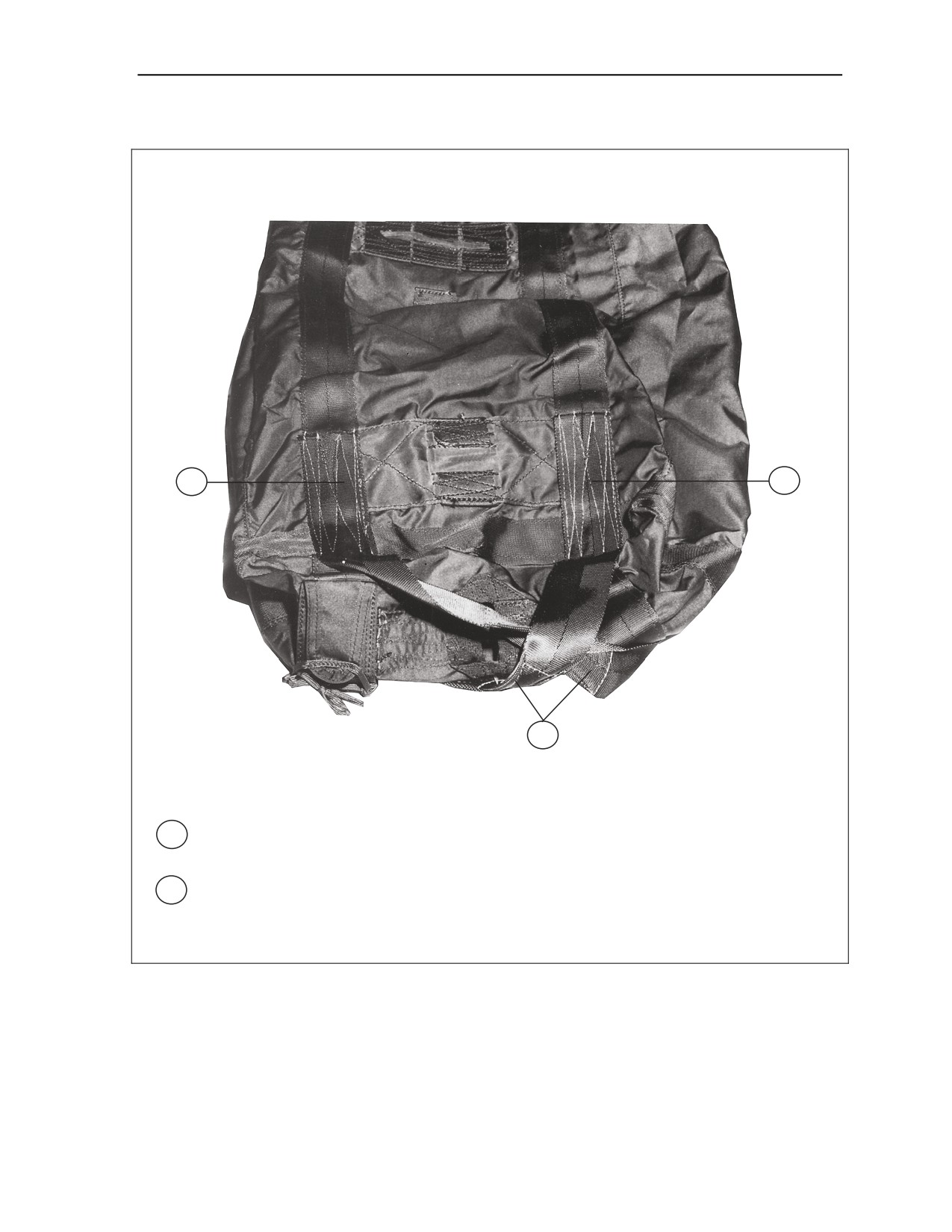
deployment bag as shown in Figure 1-10. Construct two bridle straps as shown in Figure 1-11. Attach the
bridle straps to the deployment bag as shown in Figure 1-12.
Note.
1. If the 28-foot cargo extraction parachute is to be used, the deployment bag must be used. Prepare the bag as you
would for the 22-foot cargo extraction parachute.
2. Do not remove the slot reinforcement.
2
1
2
1
3
1.
Cut the V-rings off the deployment bag.
2.
Cut the safety cords off the bag.
3. Cut the bridle loop strap from the deployment bag.
Figure 1-10. Deployment Bag Modified
FM 4-20.142/MCRP 4-11.3P/NAVSEA SS400-AD-MMO-010/ TO 13C7-51-21
19 September 2007
1-11
Chapter 1
3
2
4
1
3
1.
Cut two 24-inch lengths of treated, type VIII nylon webbing.
2.
Sear the cut ends.
3.
Form a 4-inch roll in the center of each strap.
4. Stitch around the roll and across the center of the roll with ticket 3 nylon cord.
Figure 1-11. Bridle Straps Formed
FM 4-20.142/MCRP 4-11.3P/NAVSEA SS400-AD-MMO-010/ TO 13C7-51-21
1-12
19 September 2007
Rigging High Speed Low Level Aerial Delivery System (HSLLADS) Container Loads
1
1
2
1. Sew one end of a bridle strap to a main strap (on each side of the bag) with a 5-inch four-
point WW stitch formation. Use ticket 3 nylon cord.
2. Cross the bridle straps diagonally over the end of the bag. Sew the free end of each bridle
strap to the main strap on the other side of the bag with a 5-inch four-point WW stitch
formation.
Figure 1-12. Bridle Straps Attached to the 22-Foot Cargo Extraction Parachute Deployment
Bag
FM 4-20.142/MCRP 4-11.3P/NAVSEA SS400-AD-MMO-010/ TO 13C7-51-21
19 September 2007
1-13
Chapter 1
ATTACHING STATIC LINE AND BRIDLE LOOP BREAKCORD
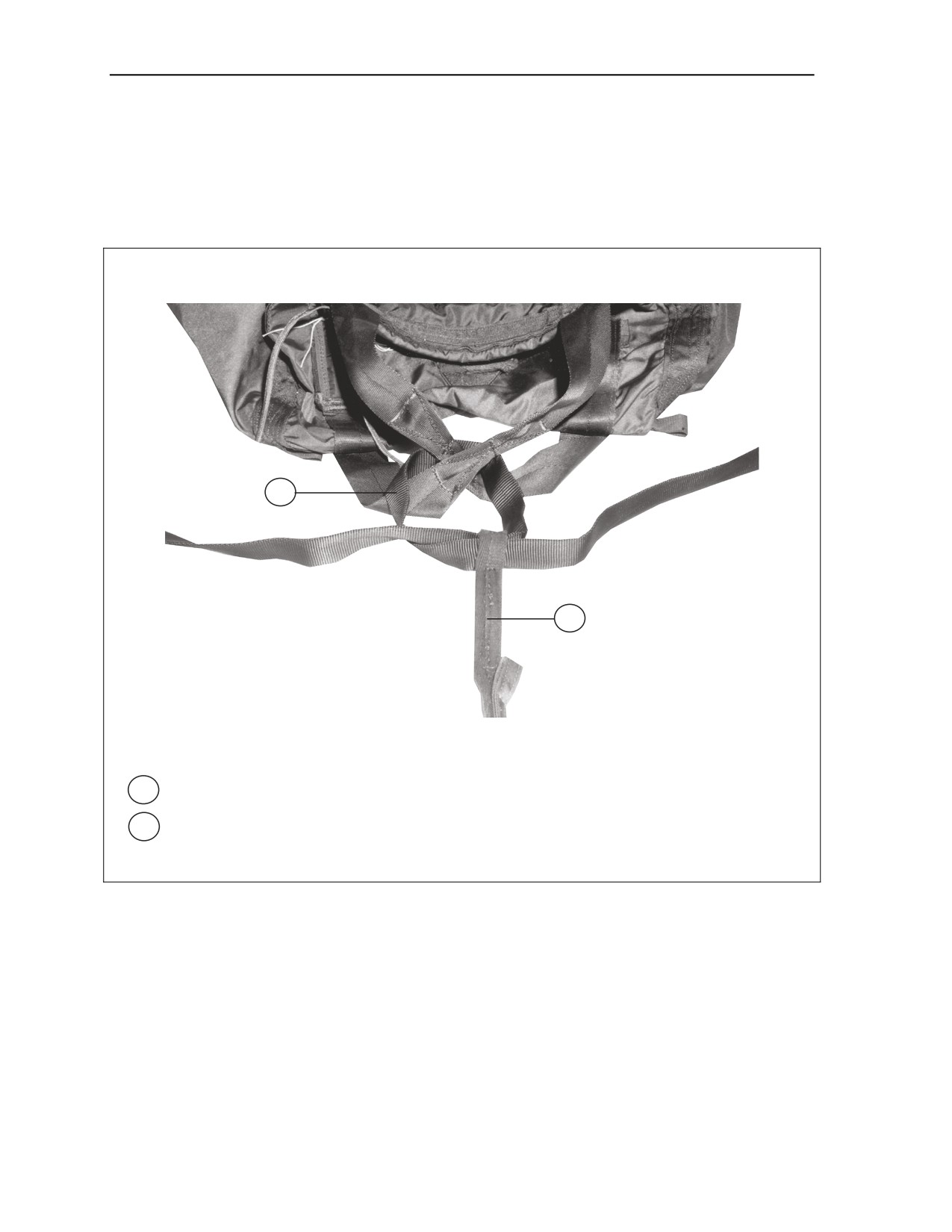
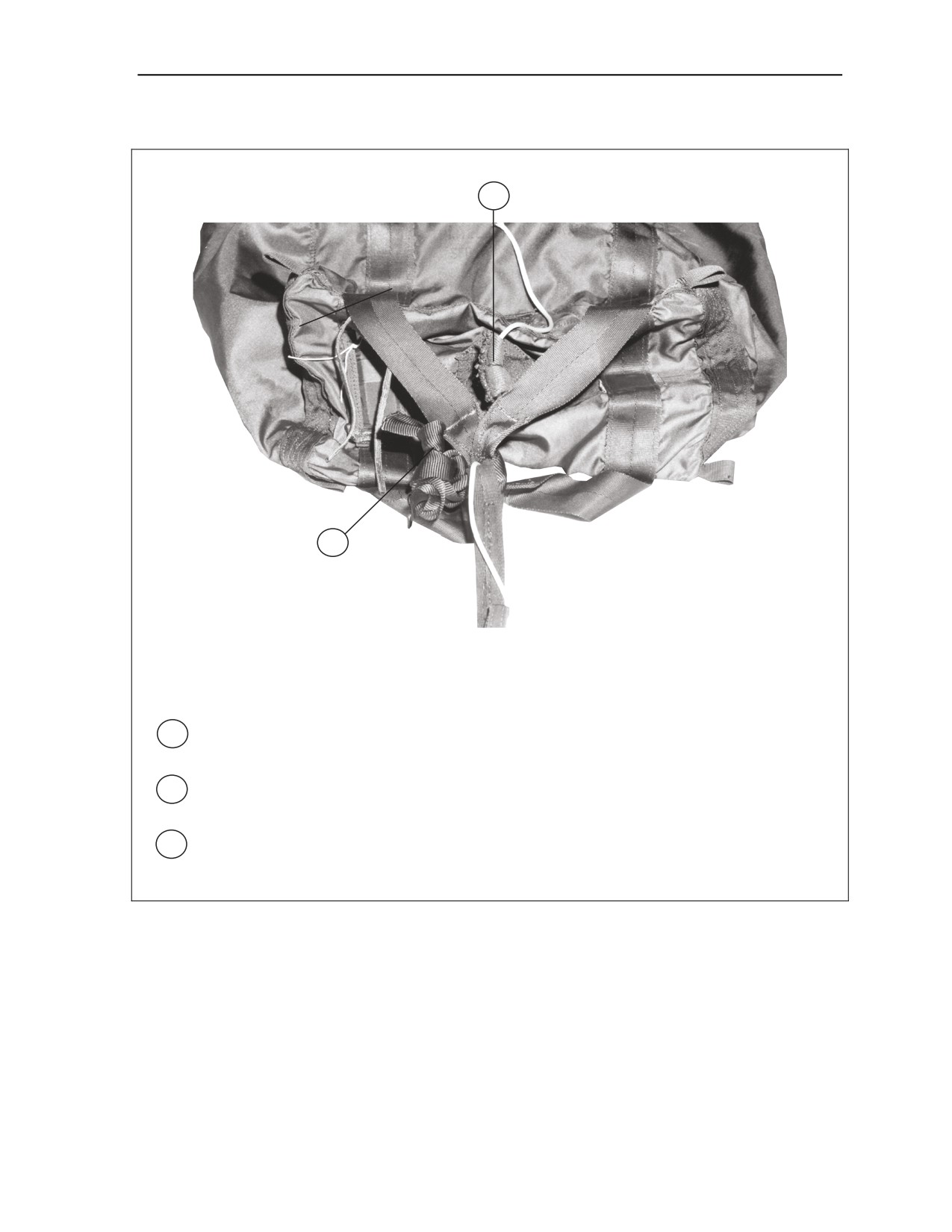
1-8. Using the G-14/Universal Static Line (USL) cargo parachute static line, attach the static line to the
bag bridle straps with a length of 1-inch tubular nylon webbing as shown in Figure 1-13. Make the bridle
loop break cord tie as shown in Figure 1-14. Stow the static line as shown in Figure 1-15.
2
1
1. Use G-14 cargo parachute static line or USL.
2. Pass a length of 1-inch tubular nylon webbing through the static line break cord attaching
loop and around the crossed bridle straps to make a two-ply tie.
Figure 1-13. Static Line Positioned
FM 4-20.142/MCRP 4-11.3P/NAVSEA SS400-AD-MMO-010/ TO 13C7-51-21
1-14
19 September 2007
Rigging High Speed Low Level Aerial Delivery System (HSLLADS) Container Loads
2
1
1.
Secure the 1-inch tubular nylon webbing with a surgeon's knot, locking knot, and an
overhand knot in the running ends.
2.
Pass a length of coreless type III nylon cord through the parachute bridle loop and through
the static line break cord attaching loop.
3. Tie the coreless type III, nylon cord using a surgeon’s knot and locking knot with an overhand
knot in the running end (not shown).
Figure 1-14. Static Line Attached and Bridle Loop Break Cord Placed and Tied
FM 4-20.142/MCRP 4-11.3P/NAVSEA SS400-AD-MMO-010/ TO 13C7-51-21
19 September 2007
1-15

Chapter 1
STOWING SUSPENSION LINES
1-9. Use ticket number 8/7, cotton thread instead of retainer bands to stow the suspension lines. Attach
the thread to the suspension line retaining straps by making a loop around the straps. Place the suspension
line stow between both ends of a length of ticket number 8/7, cotton thread. Secure the ends with a
surgeon's knot and a locking knot.
PACKING PARACHUTE
1-10. Pack the 22-foot cargo extraction parachute according to the procedures in TM 10-1670-279-23&P/
TO 13C5-27-2/NAVAIR 13-1-28. If using the 28-foot cargo extraction parachute, pack the parachute
according to the procedures in TM 10-1670-277-23&P/TO 13C5-28-2/NAVAIR 13-1-30.
Note. Make the bag-closing tie using one turn single, type I, ¼-inch cotton webbing.
FM 4-20.142/MCRP 4-11.3P/NAVSEA SS400-AD-MMO-010/ TO 13C7-51-21
1-16
19 September 2007
Rigging High Speed Low Level Aerial Delivery System (HSLLADS) Container Loads
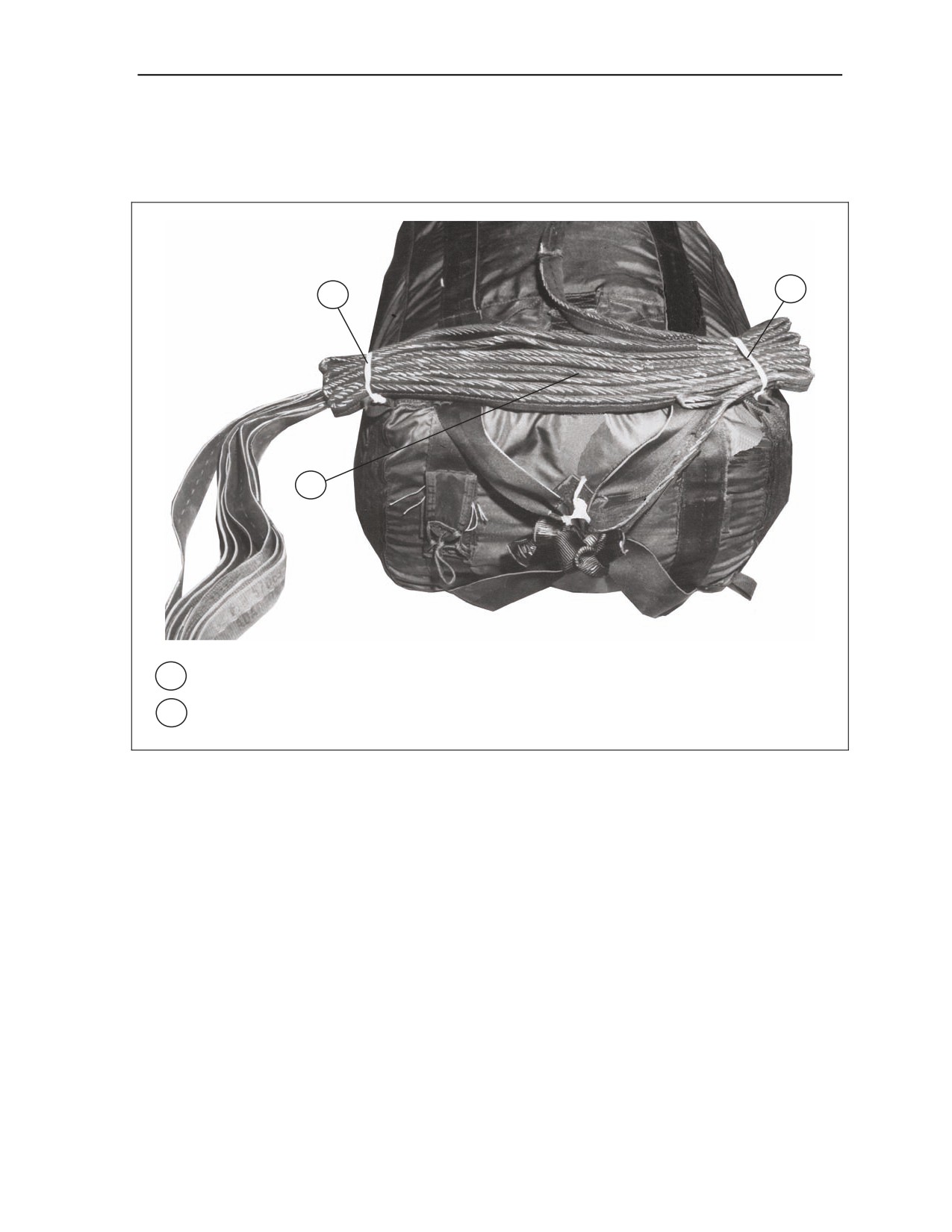
STOWING STATIC LINE
1-11. Stow the static line as shown in Figure 1-15.
1
1
2
1. Attach a retainer band to each of the two cluster attaching loops nearest the static line.
2. S-fold the static line, and secure it with the installed retainer bands.
Figure 1-15. Break Cord Tie Made and Static Line Stowed
FM 4-20.142/MCRP 4-11.3P/NAVSEA SS400-AD-MMO-010/ TO 13C7-51-21
19 September 2007
1-17

This page intentionally left blank.

Chapter 2
Rigging Combat Rubber Raiding Craft
SECTION I-RIGGING SINGLE ZODIAC F470U BOAT
DESCRIPTION OF LOAD
2-1. The description of the load rigged in this section is given below.
• Inflated zodiac F470U rubber raiding craft. This boat is rigged on a 75- by 144-inch combat
expendable platform (CEP) with one G-12E cargo parachute. The weight of the boat is 250
pounds. When inflated, the boat is 75 inches wide, 185 inches long and 22 inches high. One or
two 35-horsepower outboard engines that weigh 136 pounds each power the boat shown or one
55 horsepower engine that weighs 215 pounds with a full fuel tank, six paddles weighing a total
of 24 pounds and two sets of air pumps with hoses are parts of each boat’s equipment.
Note. A 40-horsepower engine is the largest that may be used on this boat when the boat is
equipped with the accordion floor. An engine as large as 65-horsepower may be used on this
boat without the accordion floor.
• Accompanying load. An accompanying load weighing at least 650 pounds but no more than
1,170 pounds must be dropped with the boat.
PREPARING THE PLATFORM
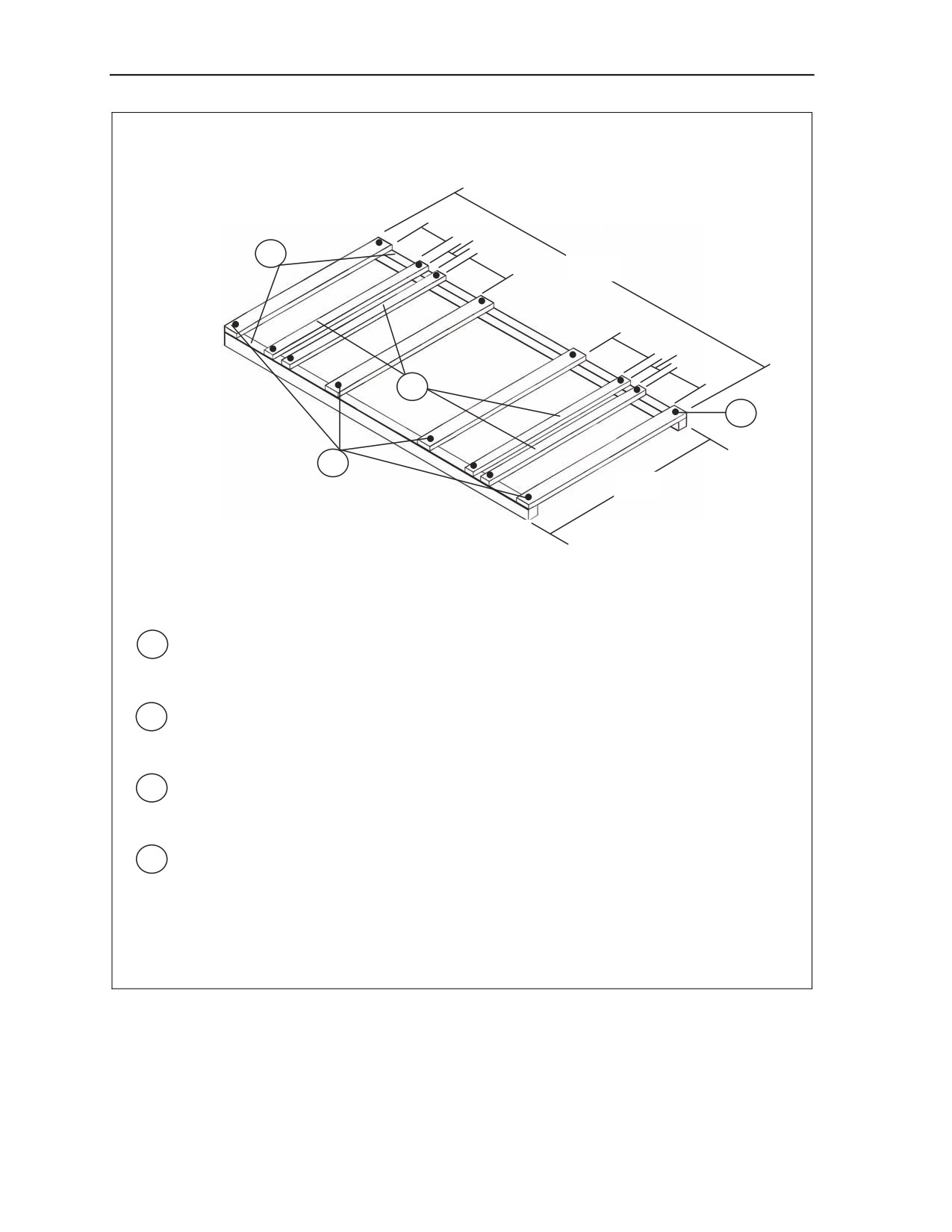
2-2. Build a new CEP, or recondition a used one, using the procedures shown in Figures 2-1 through 2-4
and as described below. This platform is used for all the loads in this chapter.
• New platform. When no used CEP is available, build a new platform for this load as shown in
Figures 2-1 through 2-4. Salt-treated lumber is recommended for the platform frame.
• Used platform. When a used CEP is available, inspect and recondition it as described below.
• Inspecting for damaged or missing parts. Check the platform to see that all parts are present.
Inspect each part carefully for damage. When the following conditions exist, the platform is not
suitable for use until it is repaired:
-
Any part is missing.
-
A stringer or spacer block is broken, cracked, split, or severely gouged.
-
A plywood panel is cracked or gouged through at least one ply for a width of 2 inches
or more.
-
A plywood panel is gouged for a length of 12 inches or more.
• Inspecting parts, screws or nails. Check the entire platform for loose stringers, spacer blocks,
and plywood panels. Also, check for loose, missing, damaged, or protruding screws, bolts or
nails. These defects may be corrected as follows:
-
Nail loose parts that are undamaged. Do not nail in original holes or in the grain line
used before. Use screws when possible.
-
Replace loose, damaged, or missing nails, screws, and bolts. Reset or remove and
replace protruding nails, screws, and bolts.
FM 4-20.142/MCRP 4-11.3P/NAVSEA SS400-AD-MMO-010/ TO 13C7-51-21
19 September 2007
2-1
Chapter 2
Notes. 1. All dimensions shown are in inches.
2. Drawing is not to scale.
Longitudinal Stringers
(4- by 4- by 144)
4 3/4
13
1
144
15
Lateral Stringers
4 3/4
15
(2- by 4- by 75)
3
13
4
2
Lateral Stringers
75
(2- by 6- by 75)
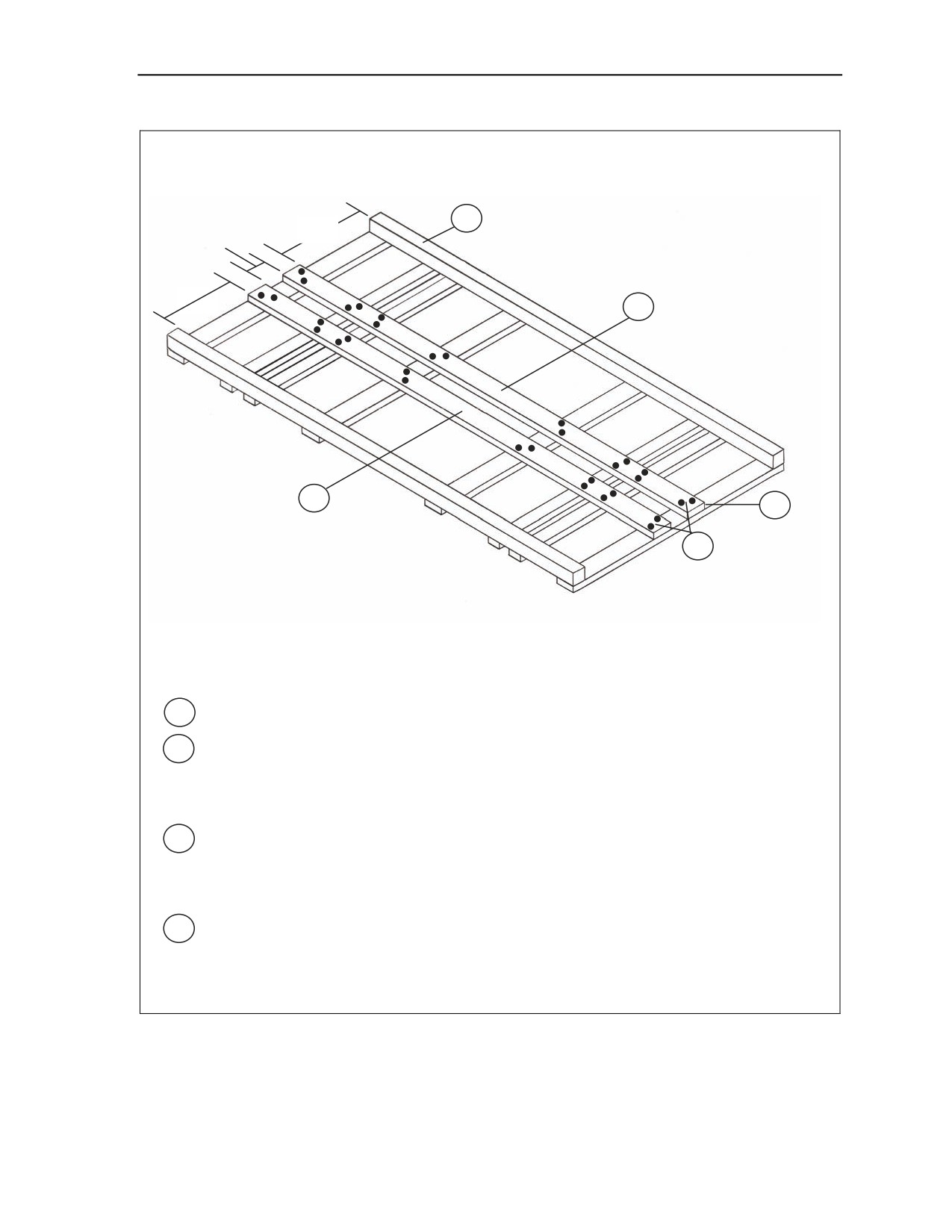
1. Mark, cut and layout two 4- by 4- by 144-inch pieces of treated lumber to be used as
longitudinal stringers. Place them 75 inches apart on a level surface with the crowns of the
stringers down.
2. Mark, cut and layout four 2- by 6- by 75-inch pieces of treated lumber to be used as lateral
stringers across the longitudinal stringers, placing one at each end and the other two at the
center as shown.
3. Mark, cut and layout the four 2- by 4- by 75-inch pieces of treated lumber to be used as
lateral stringer across the longitudinal stringers, placing the two stringers next to each 2-
by 6- by 75-inch end stringer as shown.
4. Using the measurements shown, measure and mark reference lines and position the eight
lateral stringers in place. Apply waterproof construction adhesive to each lap joint. Square
the platform frame and tack the lateral stringers to the longitudinal stringers using 16d
nails. Place each nail 3 inches inboard of each lateral stringer.
Note. CEPs built before June 2006 that were used with the Type IV connector link will be used
until exhausted.
Figure 2-1. Platform Frame Built
FM 4-20.142/MCRP 4-11.3P/NAVSEA SS400-AD-MMO-010/ TO 13C7-51-21
2-2
19 September 2007
Rigging Combat Rubber Raiding Craft
Notes. 1. All dimensions shown are in inches.
2. Drawing is not to scale.
5
25
7
25
8
8
7
6
Longitudinal Stringers
(4- by 6- by 144)
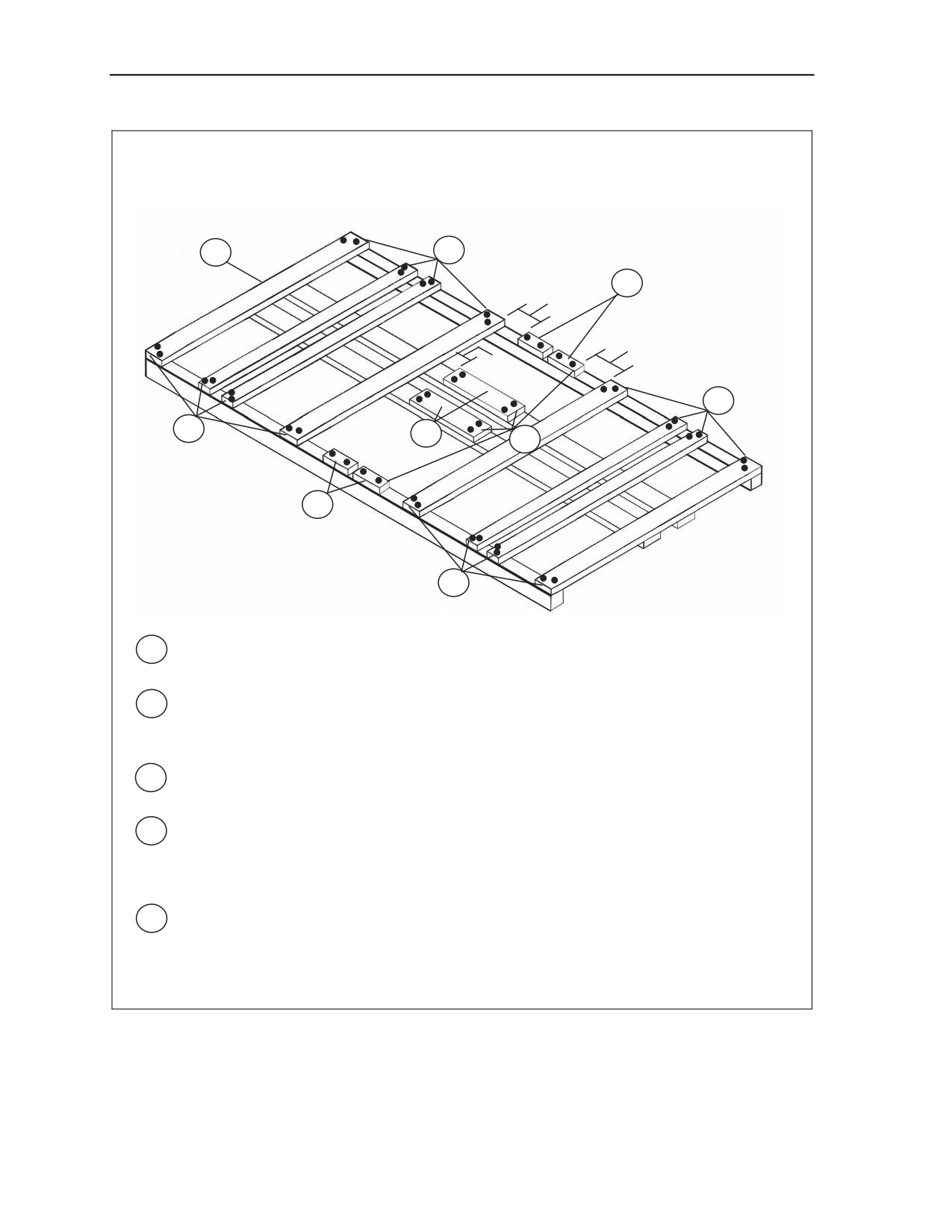
5. Turn the frame over and square the frame.
6. Mark, cut and place two 2- by 6- by 144-inch pieces of treated lumber to be used as
longitudinal stringers on the frame. Assemble and position the inboard side of each
stringer 3½ inches from the center of the frame’s width as shown. This will create a 7 inch
space between the two inboard longitudinal stringers.
7. Ensure the platform is still square and mark reference lines for the inboard longitudinal
stringer placement across each lateral stringer. Apply waterproof construction adhesive to
each lap joint and tack the longitudinal stringers to the outboard lateral stringers using one
8d nail placed 2 inches inboard from each end.
8. Drill two diagonally spaced 3/16-inch diameter pilot holes, 2½ inches deep at each lateral
stringer intersection of the two inboard longitudinal stringers. Install a 2½-inch screw into
each pilot hole.
Note. Ensure the screw heads are tightened flush with the surface of the longitudinal stringers.
Figure 2-1. Platform Frame Built (Continued)
FM 4-20.142/MCRP 4-11.3P/NAVSEA SS400-AD-MMO-010/ TO 13C7-51-21
19 September 2007
2-3
Chapter 2
Notes. 1. All dimensions shown are in inches.
2. Drawing is not to scale.
Spacer Blocks
1
4
(2- by 4- by 10)
2
7 1/
2
7 1/2
5 1/4
4
Spacer Blocks
4
(2- by 6- by 32)
3
5
2
Spacer Blocks
(2- by 4- by 10)
4
1. Turn the platform over so the lateral stringers are facing up and ensure the frame is
square.
2. Apply waterproof construction adhesive to one side of each spacer block. Adhere the four
2- by 4- by- 10-inch spacer blocks to the outboard longitudinal stringers as shown,
maintaining 7 ½ inches between the lateral stringers and stringer blocks.
3. Center and adhere the two 2- by 6- by 32-inch spacer blocks on the inboard longitudinal
stringers.
4. Drill two diagonally spaced 3/16-inch diameter pilot holes, 4 inches deep, 1 1/2-inches from
the ends of the lateral stringer. Install a 4-inch screw into each pilot hole. Ensure the screw
heads are tightened flush with the surface.
Note. Do not position the pilot holes on the extreme corners of the frame where the corners will be cut-off later.
5. Drill a 3/16-inch diameter pilot hole, 2 1/2 inches deep, and 1 1/2 inches from the end of
each spacer block. Drill one hole in each end of the four outboard spacer blocks and two
holes at each end of both inboard spacer blocks. Install a 2 1/2-inch screw into each pilot
hole. Ensure the screw heads are tightened flush with the surface.
Figure 2-2. Spacer Blocks Attached to Frame
FM 4-20.142/MCRP 4-11.3P/NAVSEA SS400-AD-MMO-010/ TO 13C7-51-21
2-4
19 September 2007
Rigging Combat Rubber Raiding Craft
Notes. 1. All dimensions shown are in inches.
2. Drawing is not to scale.
3
2
1
Plywood
2
(3/4- by 48- by 75)
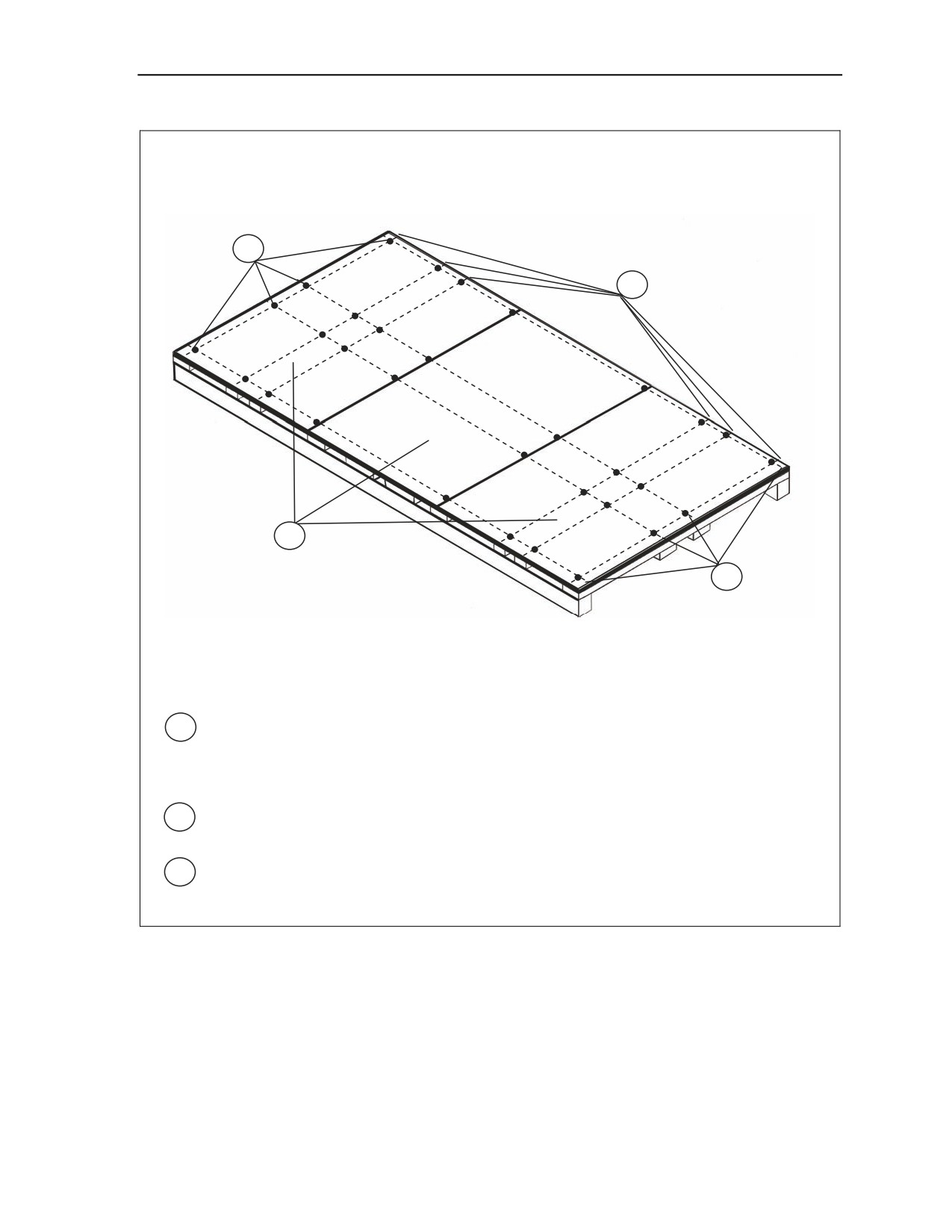
1.
Apply waterproof construction adhesive to each lateral stringer and spacer block. Mark, cut
and layout three ¾- by 48- by 75-inch sheets of plywood across the platform frame,
positioning the plywood flush with the frame’s edges. Nail each plywood sheet to the
platform frame using one 8d nail placed 2 inches in from the corner of each plywood sheet.
2.
Using a chalk line, locate and mark the centerline of each lateral stringer across the
plywood as shown. Repeat for the four longitudinal stringers.
3. At the reference line intersection, drill a 3/8-inch diameter hole through the plywood and
framing.
Figure 2-3. Plywood Attached to Frame
FM 4-20.142/MCRP 4-11.3P/NAVSEA SS400-AD-MMO-010/ TO 13C7-51-21
19 September 2007
2-5
Chapter 2
Notes. 1. All dimensions shown are in inches.
2. Drawing is not to scale.
6
4
Plywood
6
5
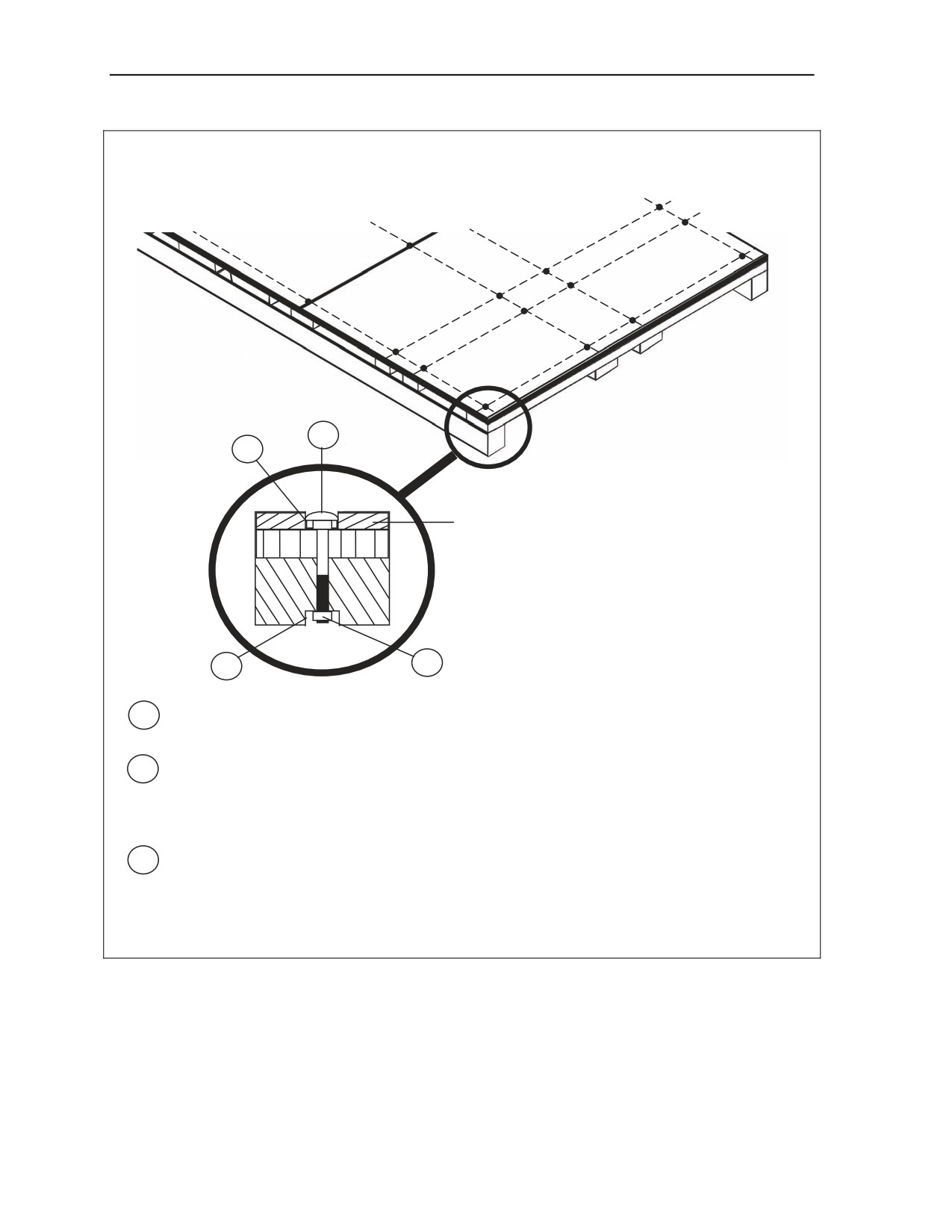
4. Using a 7/8-inch countersink bit, countersink a ¼-inch hole in each 3/8-inch diameter hole
prepared in Step 3.
5. Turn the platform over. Using a 1-inch diameter countersink bit, countersink a ¾-inch hole in
each outboard 3/8-inch diameter hole prepared in step 4. Additionally, countersink a ¾-inch
hole in each inboard 3/8-inch diameter hole prepared in step 4.
Note. Do not countersink holes too deep or the platform will be structurally weakened.
6. From the plywood side, insert 6-inch carriage bolts into each outboard longitudinal stringer
hole and 4-inch carriage bolts into each inboard longitudinal stringer hole. Tap the bolt heads
into place. Install a washer and nut to the outboard bolts only and tighten until the top of the
bolt head is flush with the plywood surface.
Note. The washers and nuts will be installed onto the inboard carriage bolts when the platform is turned over.
Figure 2-3. Plywood Attached to Frame (Continued)
FM 4-20.142/MCRP 4-11.3P/NAVSEA SS400-AD-MMO-010/ TO 13C7-51-21
2-6
19 September 2007
Rigging Combat Rubber Raiding Craft
Notes. 1. All dimensions shown are in inches.
2. Drawing is not to scale.
7
9
8
7.
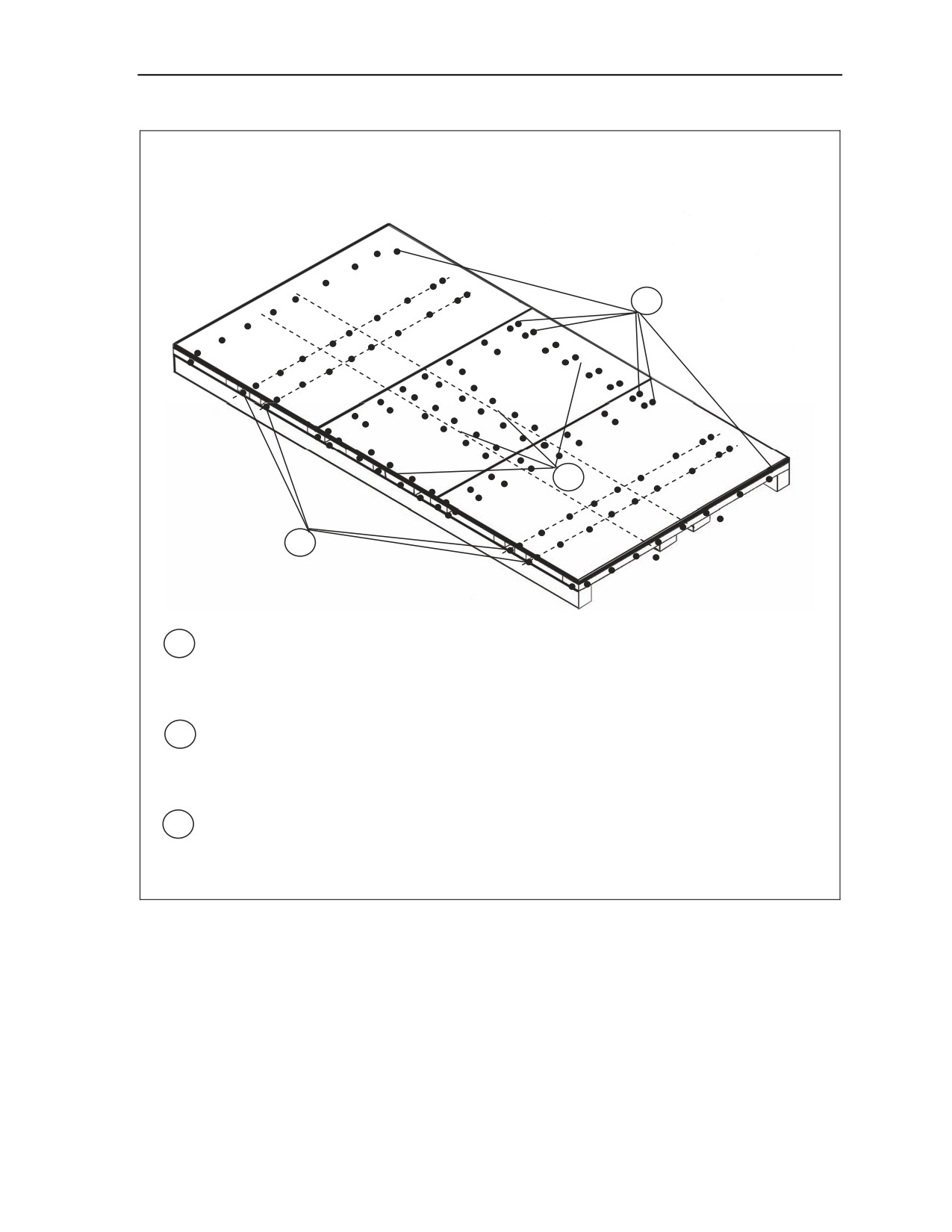
Starting 4½ inches inboard from the sides and 1 inch in from each end of the platform, drill
a 2-inch deep pilot hole using a 3/16-inch bit at 6-inch intervals. Repeat for the plywood
edges that are flush together across the lateral stringers. Install a 2-inch screw into each
pilot hole and tighten flush with the surface.
8.
Using the inboard lateral stringer chalk lines previously prepared as a guide, drill 3/16-inch
diameter pilot holes across the platform at each lateral stringer. Start 4 1/2-inches inboard
from the platform side at 6-inch intervals. Install a 2-inch screw into each pilot hole and
tighten flush with the surface.
9. Drill additional pilot holes 1 inch inboard from the ends of each inboard lateral stringer, 1
inch inboard from each platform edge and at 6 inch intervals into the spacer blocks. Install
a 2-inch screw into each pilot hole and tighten flush with the surface.
Figure 2-3. Plywood Attached to Frame (Continued)
FM 4-20.142/MCRP 4-11.3P/NAVSEA SS400-AD-MMO-010/ TO 13C7-51-21
19 September 2007
2-7
Chapter 2
Notes. 1. All dimensions shown are in inches.
2. Drawing is not to scale.
1
Rear
2
D9
D8
C8
D7
1
B8
C7
Left
B7
D6
C6
B6
D5
C5
D4
A9
B5
A8
D3
C4
A7
B4
D2
C3
1
A6
D1
B3
C2
A5
B2
C1
Right
A4
B1
A3
3
2
2
A2
Front
A1
1
Corner
Removed
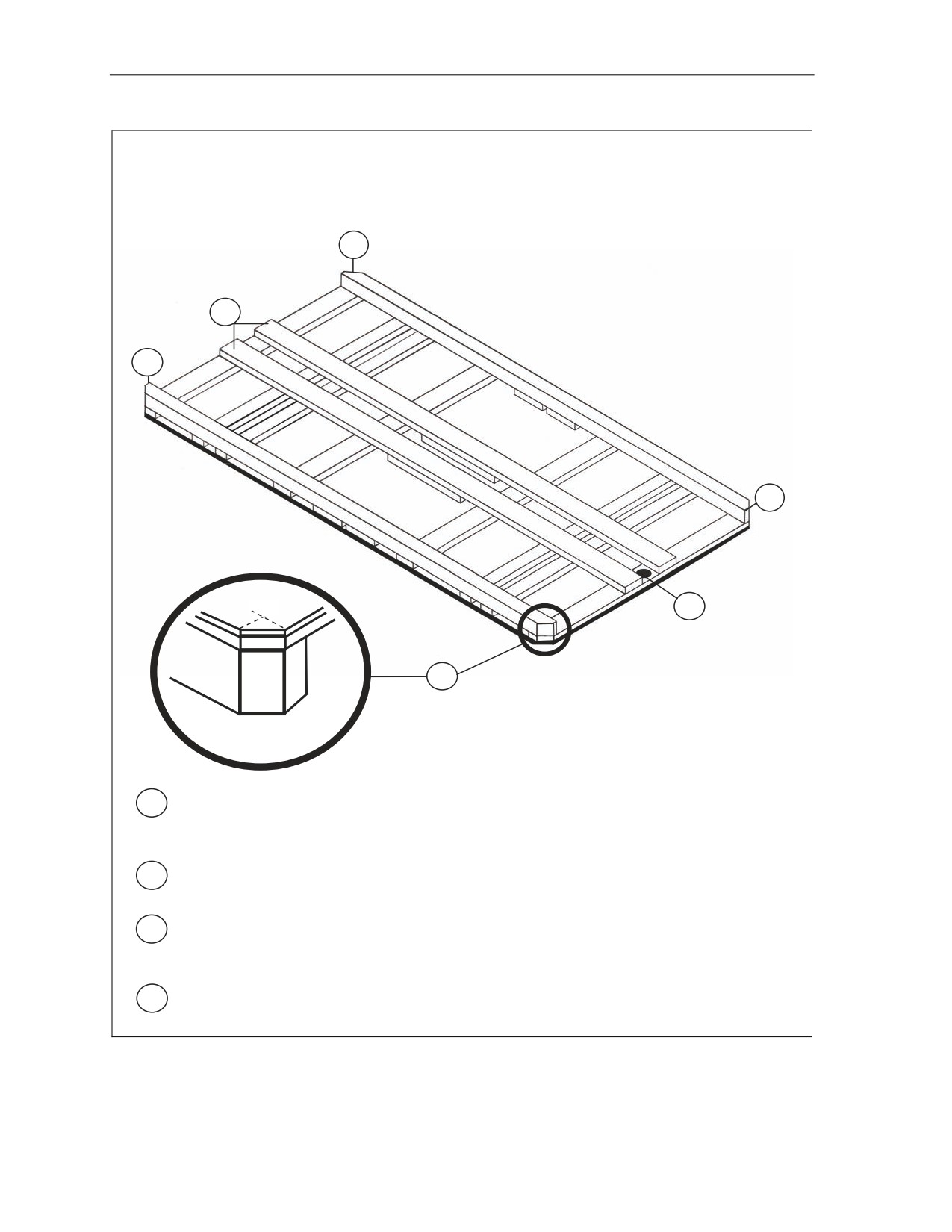
1.
Mark a 2-inch square on each corner of the platform. Draw a diagonal line across each
square as a reference line and saw off each corner with a circular saw to start the cut, and
a handsaw to finish through the cut thickness.
2.
Turn the platform right side up, install washers and nuts to the inboard carriage bolts, and
tighten until the top of the bolt head is flush with the plywood surface.
3. Drill a 2-inch hole, 3 inches and centered through the front lateral stringer and plywood as
shown.
Note. Inspect the platform. Make sure there are no protruding screws, nails or bolts on the bottom of the platform.
4. Label the tiedown spaces on each longitudinal stringer as shown above.
Figure 2-4. Corners Cut Off, Bolts Installed and Tiedown Spaces Numbered
FM 4-20.142/MCRP 4-11.3P/NAVSEA SS400-AD-MMO-010/ TO 13C7-51-21
2-8
19 September 2007
Rigging Combat Rubber Raiding Craft
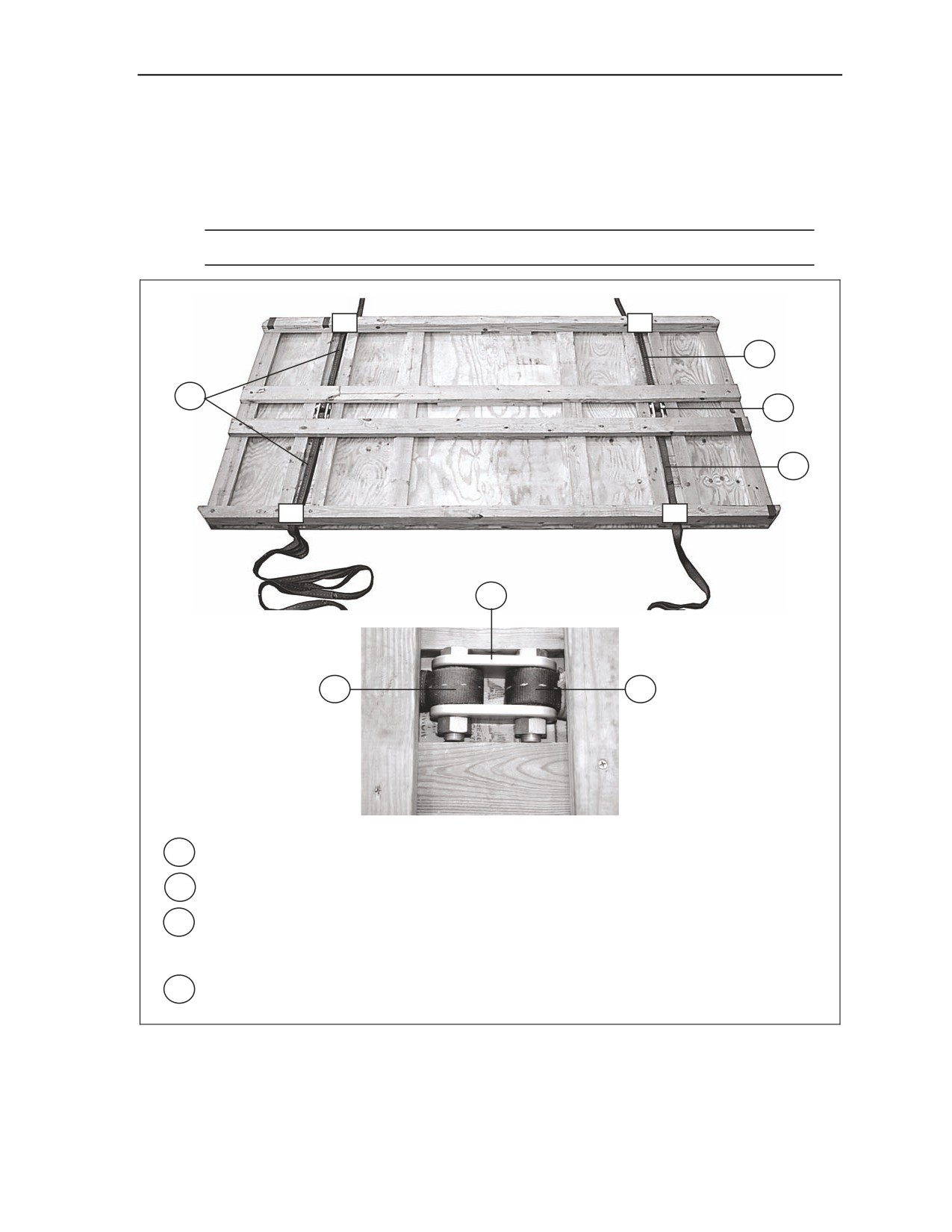
INSTALLING SUSPENSION SLINGS
2-3. Install four 16-foot (2-loop), type XXVI nylon webbing slings as suspension slings on the platform.
Use two 3¾-inch two-point link assemblies or two type IV link assemblies with covers to finish installing
the suspension slings. Installation is shown in Figure 2-5.
Note. The two-point link cannot be installed on platforms manufactured before June 2006.
D8
D2
2
Rear
Front
4
3
1
A8
A2
3
2
1
1. Run a 16-foot (2-loop), type XXVI sling from the right side of the platform through tiedown space A2.
2. Run a 16-foot (2-loop), type XXVI sling from the left side of the platform through tiedown space D2.
3. Join the two slings together between the center longitudinal stringers using a 3¾-inch two-point link
(shown) or a type IV link assembly. Place the link on the floor between the longitudinal stringers.
Note. If using the type IV, place a link cover around the type IV link and secure.
4. Repeat steps 1, 2 and 3 to install the rear slings through tiedown spaces A8 and D8.
Figure 2-5. Suspension Slings Installed on Platform
FM 4-20.142/MCRP 4-11.3P/NAVSEA SS400-AD-MMO-010/ TO 13C7-51-21
19 September 2007
2-9
Chapter 2
STOWING SANDBAGS
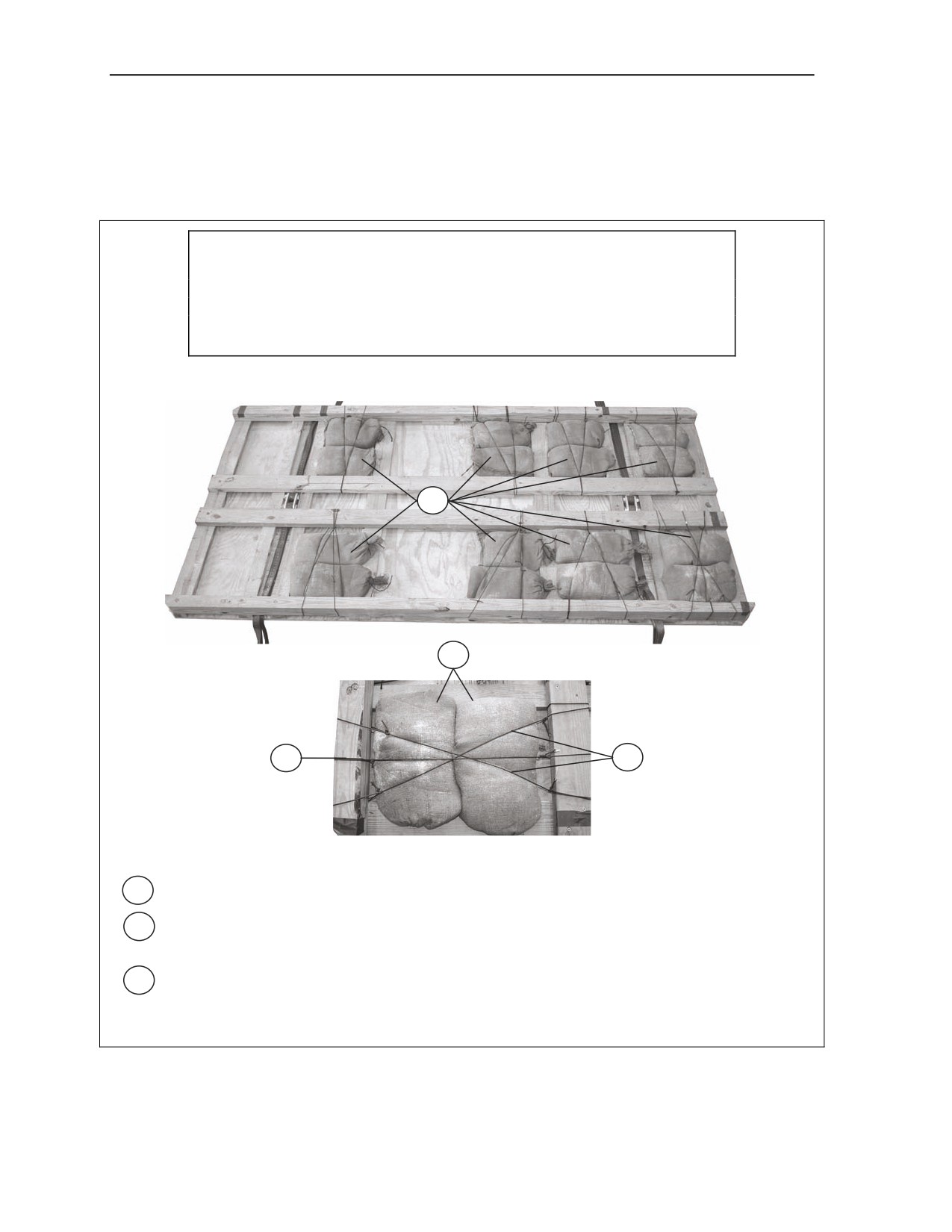
2-4. Fill 16 sandbags with 35 pounds of sand or gravel in each bag. Stow the sandbags in the platform
recesses as shown in Figure 2-6.
CAUTION
Ensure that all sandbags are securely tied to the platform recess to
prevent them from separating from the load during the extraction
deployment sequence.
Rear
Front
1
1
2
3
1. Lay two sandbags in each platform recess as shown.
2. Tie a length of type III nylon cord across both sandbags and to the appropriate tie down
spaces.
3. Form an X over each pair of sandbags using type III nylon cord and tie the cord to the
appropriate tie down spaces.
Note. For training drops, use less sand or remove the sandbags before de-rigging the boat.
Figure 2-6. Sandbags Stowed on Platform
FM 4-20.142/MCRP 4-11.3P/NAVSEA SS400-AD-MMO-010/ TO 13C7-51-21
2-10
19 September 2007
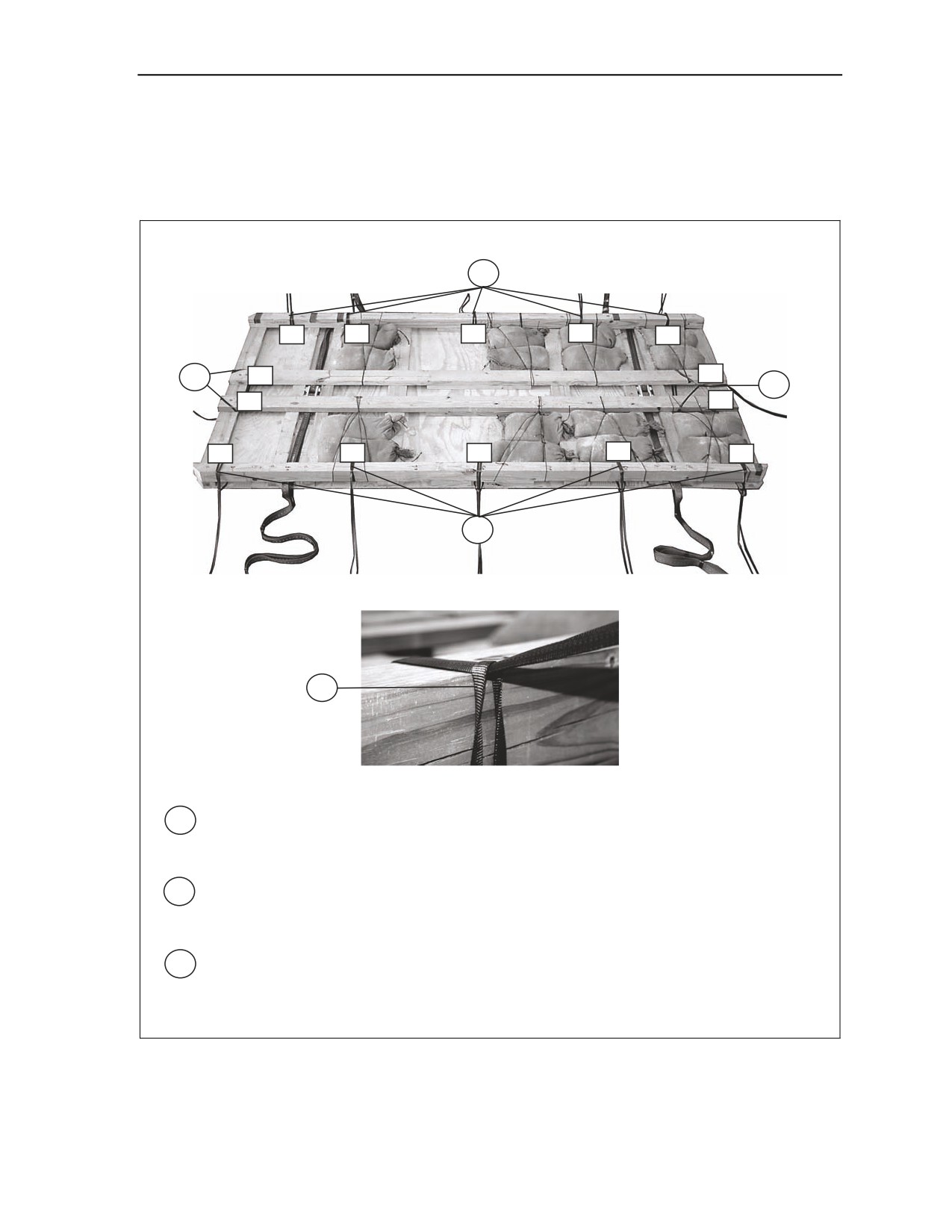
Rigging Combat Rubber Raiding Craft
ATTACHING LASHINGS TO THE PLATFORM
2-5. Using ten 18-foot and two 26-foot lengths of 1/2-inch tubular nylon webbing, attach the lashings to
the CEP as shown in Figure 2-7.
Left
1
Rear
D9
D7
D5
D3
D1
Front
3
C8
C1
2
B8
B1
A9
A7
A5
A3
A1
1
Right
1
1. Girth-hitch the 18-foot lengths of 1/2-inch tubular nylon webbing through tiedown spaces
A1, A3, A5, A7 and A9 on the right outboard longitudinal stringer and through tiedown
spaces D1, D3, D5, D7 and D9 on the left outboard longitudinal stringer.
2. Pass one of the 26-foot lengths of 1/2-inch tubular nylon webbing through tiedown spaces
B1 and C1. Even the ends and make an overhand knot about 18 inches from the tiedown
spaces.
3. Pass one end of the other 26-foot length of 1/2-inch tubular nylon webbing through tiedown
spaces B8 and C8. Even the ends and make an overhand knot about 18 inches from the
tiedown space.
Figure 2-7. Boat Lashings Attached
FM 4-20.142/MCRP 4-11.3P/NAVSEA SS400-AD-MMO-010/ TO 13C7-51-21
19 September 2007
2-11
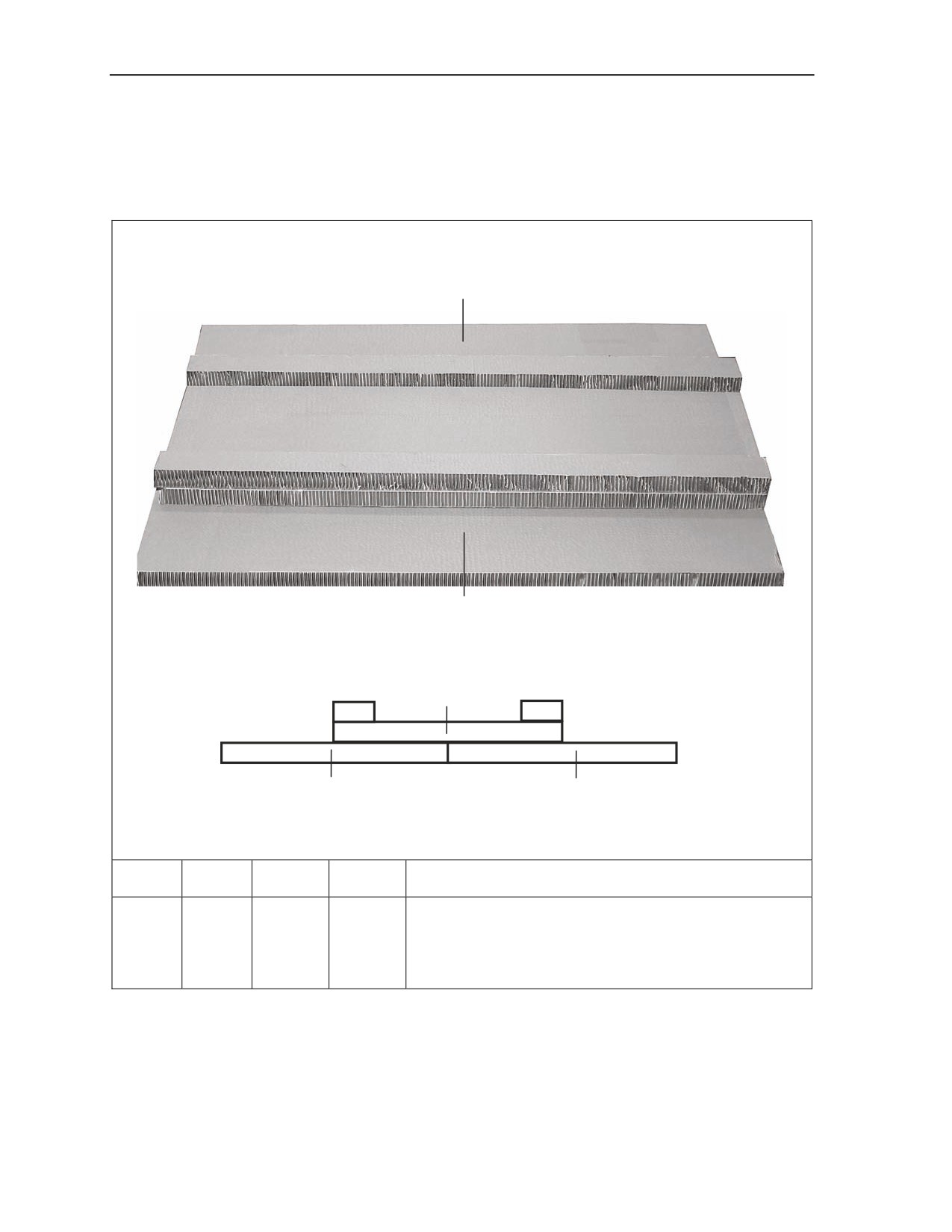
Chapter 2
BUILDING, PLACING AND SECURING HONEYCOMB STACKS
2-6. Build the honeycomb stacks as shown in Figure 2-8. Place and secure the honeycomb stacks as
shown in Figure 2-9.
Stack 2
Stack 3
Stack 1
Stack 3
Stack 1
Stack 2
Stack
Width
Length
Pieces
Instructions
Number
(Inches)
(Inches)
1
1
36
96
2
1
36
96
3
1
36
96
2
5
96
Glue a 5- by 96-inch piece of honeycomb flush with each
outside edge of the full sheet of honeycomb.
Figure 2-8. Honeycomb Stacks Built
FM 4-20.142/MCRP 4-11.3P/NAVSEA SS400-AD-MMO-010/ TO 13C7-51-21
2-12
19 September 2007
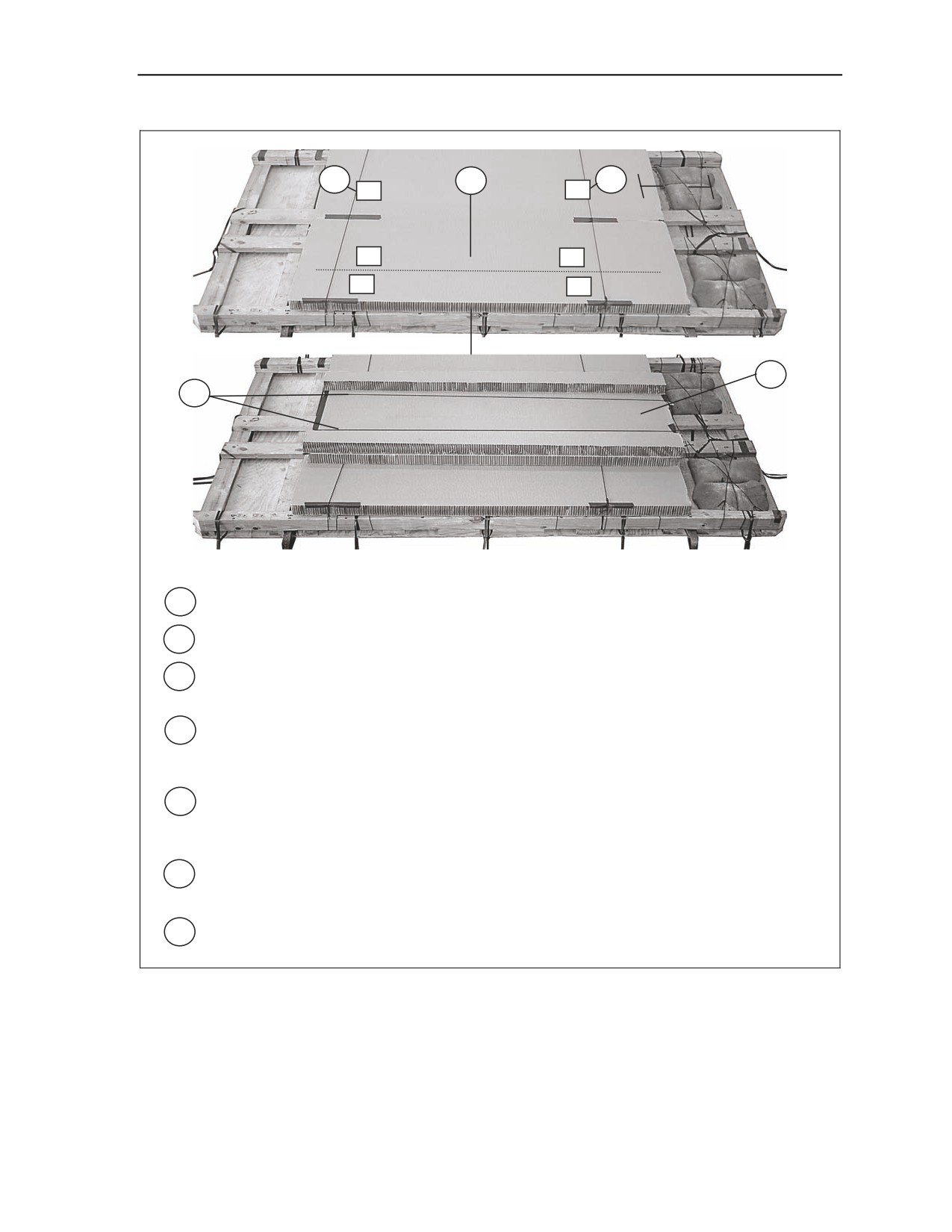
Rigging Combat Rubber Raiding Craft
Left
3
5
3
D7
D3
23
B7
B3
Rear
A7
Front
A3
6
7
Note. To prevent damage to the honeycomb, tape the edges where the type III nylon cord passes.
1. Pass a length of type III nylon cord through tiedown spaces A3 and B3 (not shown).
2. Pass a length of type III nylon cord through tiedown spaces A7 and B7 (not shown).
3. Pass a length of type III nylon cord through tiedown spaces C3 and D3 (on the left side of
the platform) and another length through tie down spaces C6 and D7.
4. Lay a 36- by 96-inch piece of honeycomb on the right side of the platform 23 inches from
the front of the platform. Tie the honeycomb in place with the type III nylon cord placed in
Steps 1 and 2 (not shown).
5. Lay a 36- by 96-inch piece of honeycomb on the left side of the platform 23 inches from the
front of the platform. Tie the honeycomb in place with the type III nylon cord placed in Step
3.
6. Center and glue stack 3 over stacks 1 and 2 flush with the front and rear of the
honeycomb.
7. Tie stack 3 to the inboard longitudinal stringers of the platform with lengths of type III nylon
cord.
Figure 2-9. Honeycomb Placed and Secured
FM 4-20.142/MCRP 4-11.3P/NAVSEA SS400-AD-MMO-010/ TO 13C7-51-21
19 September 2007
2-13
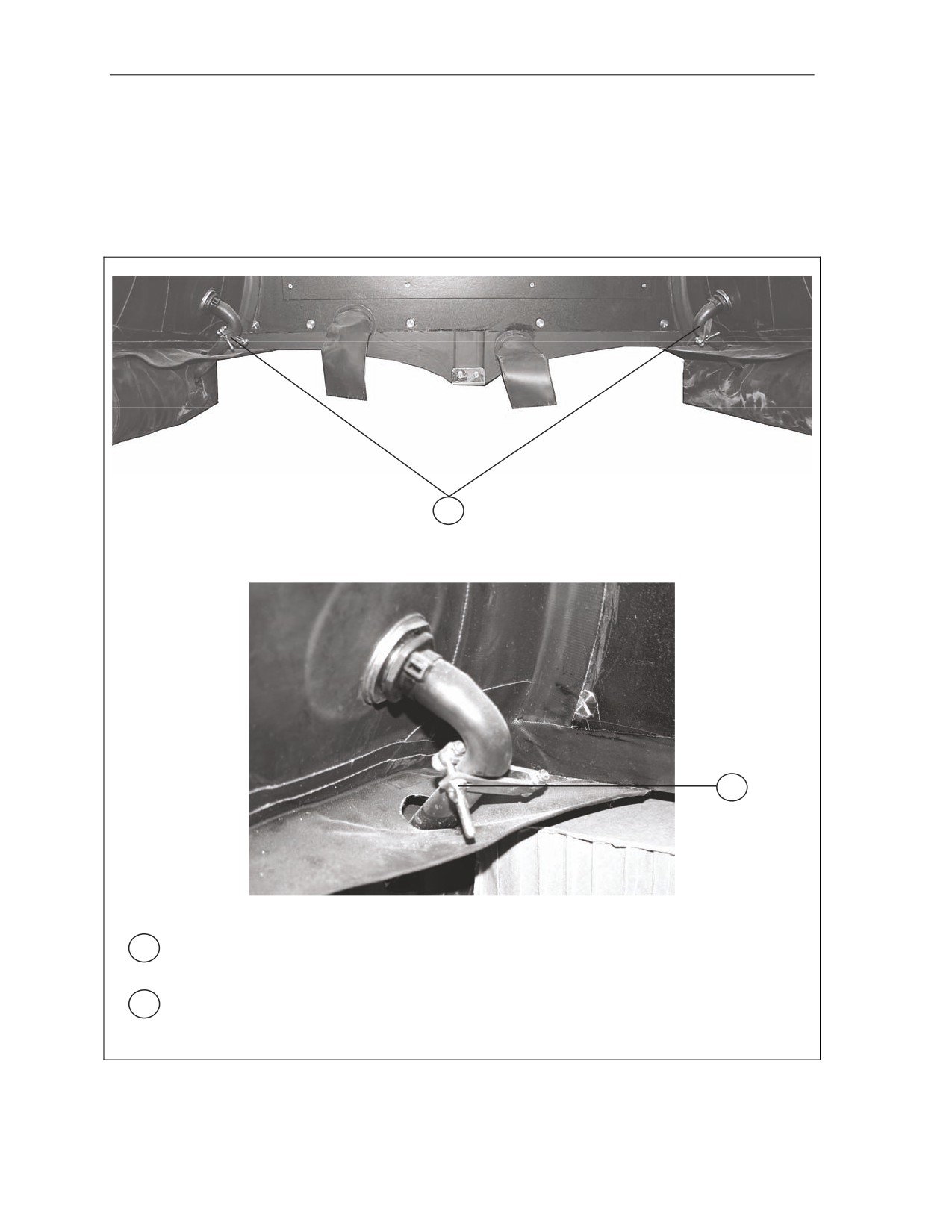
Chapter 2
PREPARING BOAT
2-7. Inflate the boat except the keel. If the keel is inflated, let the air out. Install the hose clips as shown in
Figure 2-10. Prepare boats with a hard deck (aluminum floorboards) as shown in Figure 2-11. Prepare
boats with a roll-up floor as shown in Figure 2-12. Prepare and position honeycomb in both boats as shown
in Figure 2-13.
Right
Left
2
2
1. Remove the hose clips from the stowage pockets behind the transom on the left and right
sides of the boat (not shown).
2. Place the hose clips around the hoses connecting the upper and lower tubes, and tighten the
hose clips with the wing nuts provided.
Figure 2-10. Hose Clips Installed
FM 4-20.142/MCRP 4-11.3P/NAVSEA SS400-AD-MMO-010/ TO 13C7-51-21
2-14
19 September 2007
///////////////////////////////////////