FM 3-34.22 ENGINEER OPERATIONS—BRIGADE COMBAT TEAM AND BELOW (February 2009) - page 5

Appendix E
Combined Arms Gap-Crossing Operations
The purpose of a gap-crossing operation is to project combat power across a linear
obstacle (wet or dry) to accomplish a mission. A gap crossing normally requires
special equipment or materials that are limited or nonexistent as organic assets in the
BCT. It is incumbent on engineer planners to highlight the need for augmentation of
additional assets early in the planning process. Those assets are then task-organized
in a manner that best supports the commander’s concept of the operation. This
appendix serves as a quick reference for leaders planning gap-crossing operations.
(See FM 3-90.12 for more detailed information.)
TYPES
E-1. The three types of gap crossings are deliberate, hasty, and covert. Regardless of the type of crossing,
the planning requirements and engineer technical support are similar. The following text provides a brief
description of each type of crossing. (See table E-1 for a list of gap-crossing fundamentals.)
Table E-1. Gap-crossing fundamentals
Fundamental
Description
z
Mitigates the vulnerability of an exposed force conducting a crossing by—
Implementing a deception plan.
Surprise
Enforcing OPSEC measures (camouflage, noise, electromagnetic,
and light discipline).
z
Develops an accurate and complete intelligence picture of the enemy and
terrain.
z
Plans and initiates deceptive operations early to mask the actual
Extensive preparation
preparation.
z
Improves routes and establishes traffic control to handle traffic volume of
the crossing operation.
z
Conducts full-scale rehearsals.
z
Plans for multiple approach routes from the AA to crossing sites.
z
Establishes lateral routes to access alternate crossing sites.
Flexible planning
z
Retains crossing equipment in reserve to replace losses or create
alternative sites.
z
Uses multiple crossing means and/or methods.
z
Prevents target formation.
Traffic control
z
Contributes to flexibility by enabling changes in the sequence, timing, or
crossing sites.
z
Enables C2 through terrain management.
z
Integrates additional functions within existing C2 nodes.
z
Organizes the force into an—
Assault force (seize the objective farside).
Organization
Assured mobility force (provide the crossing means, traffic control,
and obscuration).
Bridgehead force.
Breakout force.
11 February 2009
FM 3-34.22
E-1

Appendix E
Table E-1. Gap-crossing fundamentals (continued)
Fundamental
Description
z
Masses combat power on the farside faster than the enemy.
Speed
z
Prevents interference with the flow of vehicles once the crossing has
started.
z
Determines unit and asset requirements.
Gap size
z
Defines gap sizes early.
z
Locates gaps and determines the purpose of crossings.
Location and purpose
z
Determines potential crossing sites and types of crossings.
z
Designs routes from AAs to crossing sites that can support a large volume
of traffic.
z
Develops routes to allow lateral movement and easy access in and out of
AAs
staging or waiting areas.
z
Considers cover and concealment along routes.
z
Considers the impact of sharp curves, narrow roads, and overhead
obstructions.
z
Drives the number of crossing sites and the type and amount of required
assets.
Size/type of crossing units
z
Determines the number and type of vehicles (tracked or wheeled) that
impact the type of crossing equipment and its emplacement duration.
z
Determines the type of crossing based on the mission, enemy,
Deliberate or hasty versus
significance of the crossing, troops and assets available, need for
covert
additional C2, and time available.
z
Assesses capabilities against the following requirements:
The BCT requires at least one (normally two for HBCT) MAC for hasty
Assets required or
crossings.
available
The MRBC is required for gaps greater than 18 meters.
The engineer terrain team analysis of each gap along maneuver routes
is critical in determining gap-crossing requirements.
z
Considers the different purposes and support capabilities of tactical and
Duration of emplacement
support bridging.
Sustainment of crossing
z
Performs the necessary maintenance and inspections required for the
equipment
crossing equipment.
DELIBERATE
E-2. A BCT can do a deliberate crossing; but in most cases, a division or higher organization provides C2
for the crossing because it involves more than one BCT. Deliberate crossings usually involve gaps greater
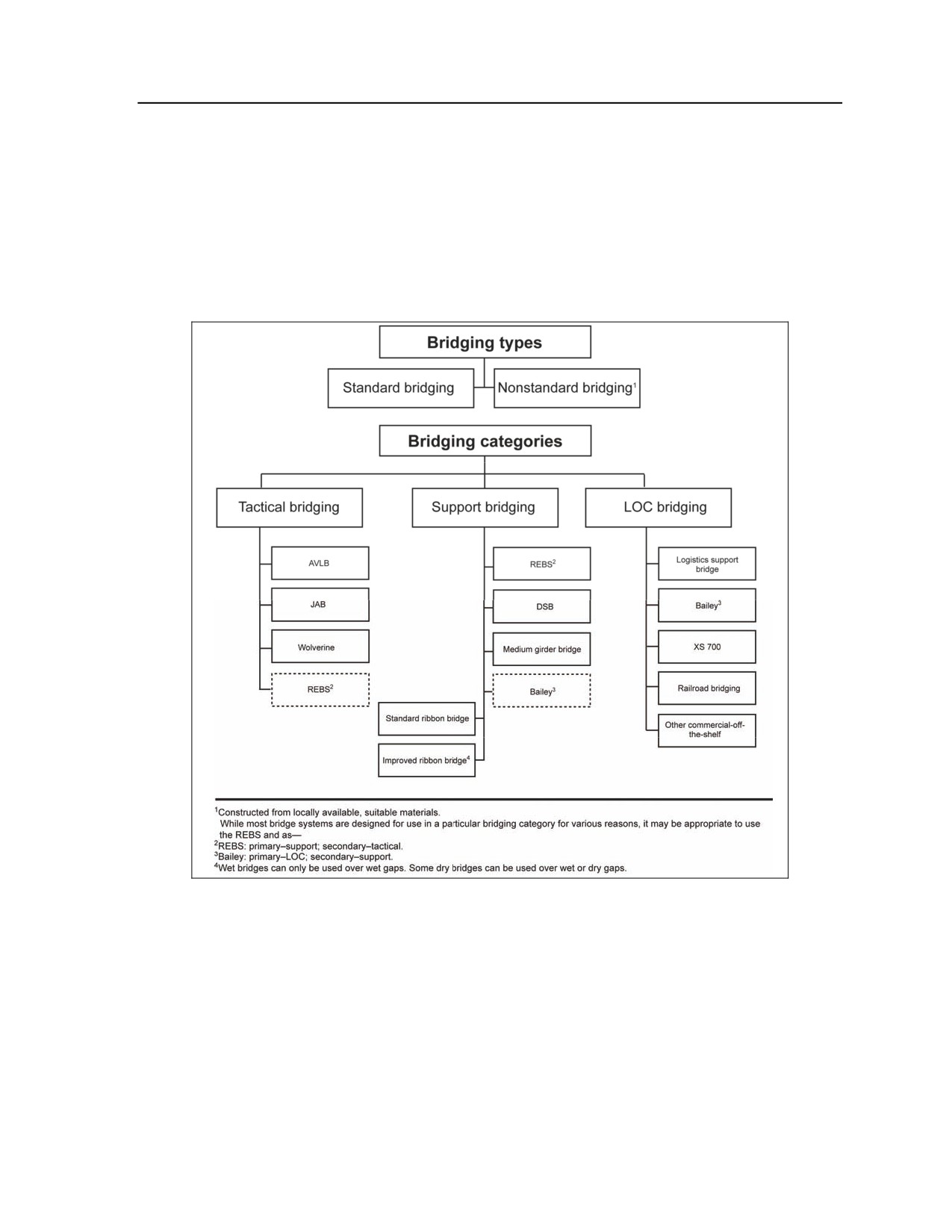
than 20 meters and normally require support bridging. (See figure E-1 for the categories of bridging.) The
deliberate gap crossing (wet or dry) is conducted when a hasty crossing is not feasible or has failed.
E-3. A deliberate gap crossing is characterized by—
z
A significant contiguous obstacle.
z
Strong enemy resistance.
z
The necessity to clear entry and exit crossing points of enemy forces.
E-4. A deliberate gap crossing involves—
z
Centralized planning and control by the division or BCT.
z
Thorough preparations, including the time to perform extensive reconnaissance and rehearsals.
z
The massing of forces and crossing equipment.
E-5. The BCT operates as one of the following elements during a deliberate crossing if it is a division
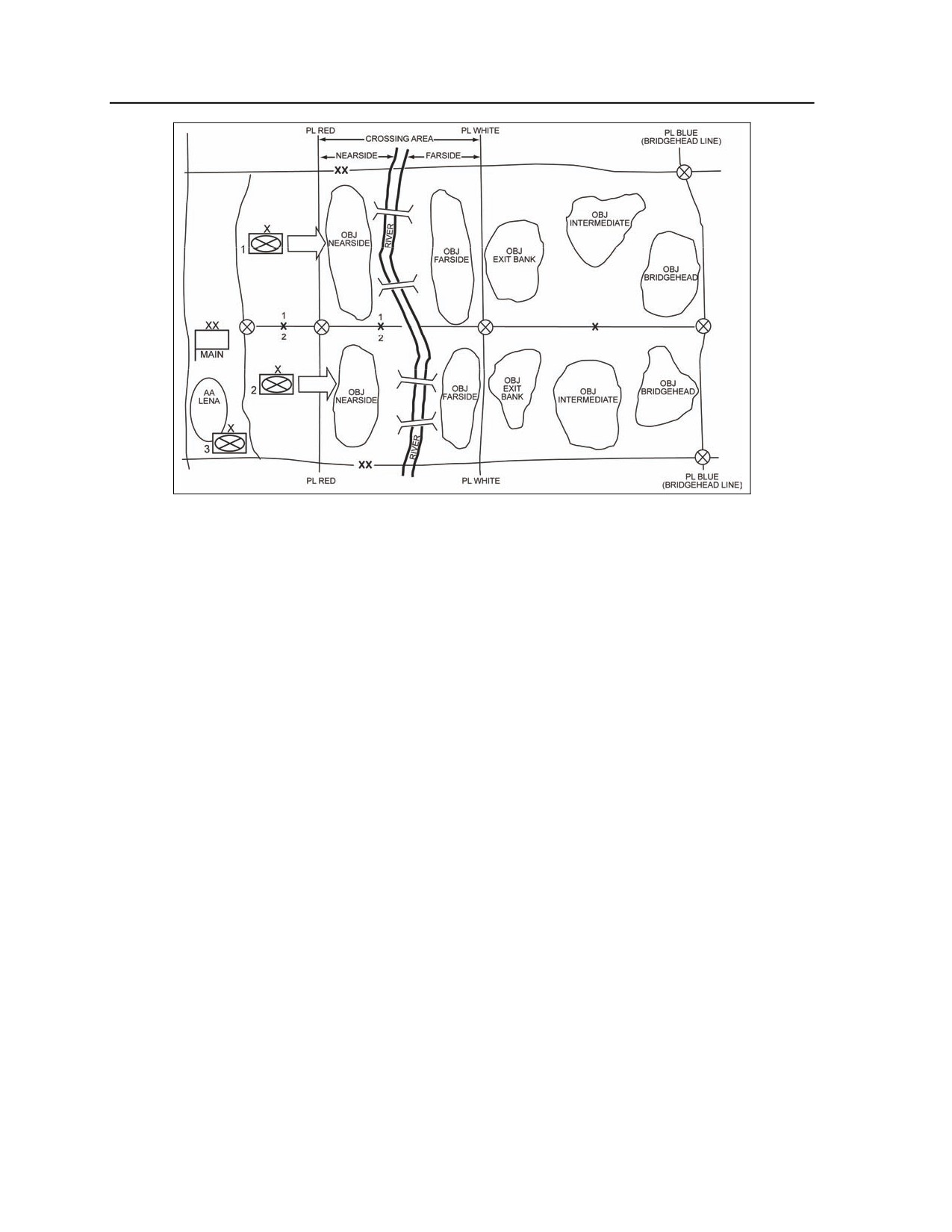
operation (see figure E-2, page E-4, for a sample deliberate gap crossing):
E-2
FM 3-34.22
11 February 2009
Combined Arms Gap-Crossing Operations
z
Assault force. The assault force seizes the objective farside and eliminates enemy direct fires on
the crossing site.
z
Assured mobility force. This element provides crossing means, traffic control, and obscuration.
This force usually consists of maneuver, engineer, military police, and CBRN units.
z
Bridgehead force. The bridgehead force attacks from an attack position farside to secure the
bridgehead, eliminating enemy direct fire and observed indirect fire on the crossing area.
z
Breakout force. Once the gap crossing is complete and the bridgehead line is secured, a
breakout force crosses the gap behind the bridgehead force and attacks out of the bridgehead.
This element is not usually part of the unit that conducts the gap crossing.
Figure E-1. Type and categories of bridging
11 February 2009
FM 3-34.22
E-3
Appendix E
Figure E-2. Sample deliberate gap crossing
HASTY
E-6. A hasty gap crossing (wet or dry) is possible when enemy resistance is weak and the gap is not a
severe obstacle. The BCT may seize existing fords or bridges or use organic or expedient crossing means.
Hasty gap crossings are typically for, but are not limited to, gaps 20 meters or less in width and can be
overcome by self-bridging assets (organic or augmented) within the BCT. They are normally done through
tactical bridging
(AVLB, joint assault bridge [JAB], Wolverine, or rapidly emplaced bridge system
[REBS]). The SBCT has four organic REBSs, each capable of spanning 13 meters and crossing vehicles up
to military load classification (MLC) 40 (caution crossing). Neither the HBCT nor IBCT has organic
gap-crossing capability, so they require augmentation. Coordination for additional gap-crossing support
from the division must be made as early as possible prior to the crossing.
E-7. A hasty gap crossing is preferable to a deliberate crossing because there is no intentional pause to
prepare. Planned, organized, and executed much like a hasty breaching operation, the unit must consider
the integration of crossing assets in their movement formation, redundancy in crossing means, traffic flow
across the gap, and recovery of crossing assets. To accomplish a gap crossing efficiently, bridging assets
should be located in a position within the maneuver formation where positive control can be maintained.
Because a gap crossing constricts and splits the maneuver force at the crossing site, the plan must be
flexible enough for the commander to be able to make execution decisions based on acceptable opportunity
and threat variances.
Hasty (Wet)
E-8. The depth and width of the wet gap, bank conditions, and current velocity are major factors in
determining the maneuver unit’s ability to conduct a hasty (wet) gap crossing. These factors determine if
the maneuver force can cross by fording or swimming, if expedient materials can be used, or if specific
bridging assets are required. Identifying wet gaps early and deploying the required resources allow hasty
crossings of known or anticipated gaps to occur.
E-4
FM 3-34.22
11 February 2009
Combined Arms Gap-Crossing Operations
Hasty (Dry)
E-9. Typical dry gap obstacles that maneuver forces encounter include AT ditches, craters, dry river beds,
partially blown bridges, and similar obstacles. Maneuver forces can use the ACE to push down the sides of
ditches or fill in craters. Substantial fill material placed in dry gaps allows the passage of tracked vehicles.
The crossing site can be improved and maintained for wheeled traffic use by follow-on forces. The AVLB,
Wolverine, JAB, or REBS are also well suited for hasty (dry) gap crossings. As with any hasty crossing,
consideration must be given to the need for replacement bridging so that the maneuver unit can maintain its
assets for follow-on, gap-crossing requirements.
In-Stride
E-10. An in-stride gap crossing is merely a variation of a hasty gap crossing (wet or dry) with the unique
requirement for a company, team, or lower to do the gap crossing in a drill-like fashion. In-stride gap
crossings can occur when a given gap is not the same as the unit planned or anticipated. To conduct an
in-stride gap crossing, the unit must be well trained, have established SOPs, and be task-organized with the
proper assets and capabilities. A battalion is the principal unit to plan, coordinate, and control an in-stride
gap crossing, but a company normally conducts the actual crossing.
COVERT
E-11. The covert gap crossing is used to overcome gaps (wet or dry) without being detected by the enemy.
It is used when surprise is essential to infiltrate across a gap and when limited visibility and gap conditions
present an opportunity to complete the crossing without being seen. The covert gap crossing is normally
accomplished by a battalion-size element or smaller (dismounted or in wheeled vehicles), as a BCT is
typically too large to maintain the level of stealth necessary to conduct a successful covert gap crossing.
E-12. The primary purpose of a covert gap crossing is to move forces across a gap undetected to infiltrate
forces to the farside. It should not be confused with the assault phase of a deliberate gap-crossing
operation. While a covert crossing can precede a deliberate or hasty gap crossing by a like-sized or larger
element, it is planned and conducted as a separate operation. Common crossing means to facilitate a covert
crossing include rope bridges, infantry foot bridges, boats, fording and swimming, or aerial insertion.
Whatever means is used, consideration must be given to the recovery of crossing assets. Plans
(contingencies) should also be made to deal with the possibility that the covert crossing may be
compromised.
PLANNING
E-13. Gap-crossing fundamentals are the same for all gap crossings, but their application varies. Crossing
fundamentals must be applied to ensure success when conducting any type of gap crossing (see table E-1,
page E-1).
E-14. Gap-crossing considerations are those things that the commander should, as a minimum, consider
before making a crossing that involves crossing equipment or procured materials (see table E-2, page E-8).
E-15. Units plan gap-crossing operations in the same fashion as any tactical operation, with one major
difference—force allocation against enemy units has an added dimension of time as affected by rate.
Friendly forces can only arrive on the battlefield as quickly as which they can be brought across the gap.
The rate at which combat forces need to cross directly affects the number of crossing sites.
E-16. Planners perform crossing calculations at least twice—once during initial planning, where simple
calculations are used to produce quick buildup information and the second time, after the commander
selects a specific COA and planners begin to develop detailed crossing plans. Crossing calculations are
critical during COA evaluations to ensure that force buildup supports the COA.
E-17. During mission analysis and after the staff has recognized that a gap-crossing operation is necessary,
they conduct an initial IPB by—
z
Identifying key terrain affecting the crossing.
z
Creating a template of the enemy defense at the gap.
11 February 2009
FM 3-34.22
E-5
Appendix E
z
Estimating the crossing capability of the area using terrain data and available crossing means.
z
Calculating force crossing rates for each crossing area using the troop list.
z
Reviewing available bridging assets.
E-18. During COA development, the staff—
z
Uses the commander’s guidance to sketch out several COAs.
z
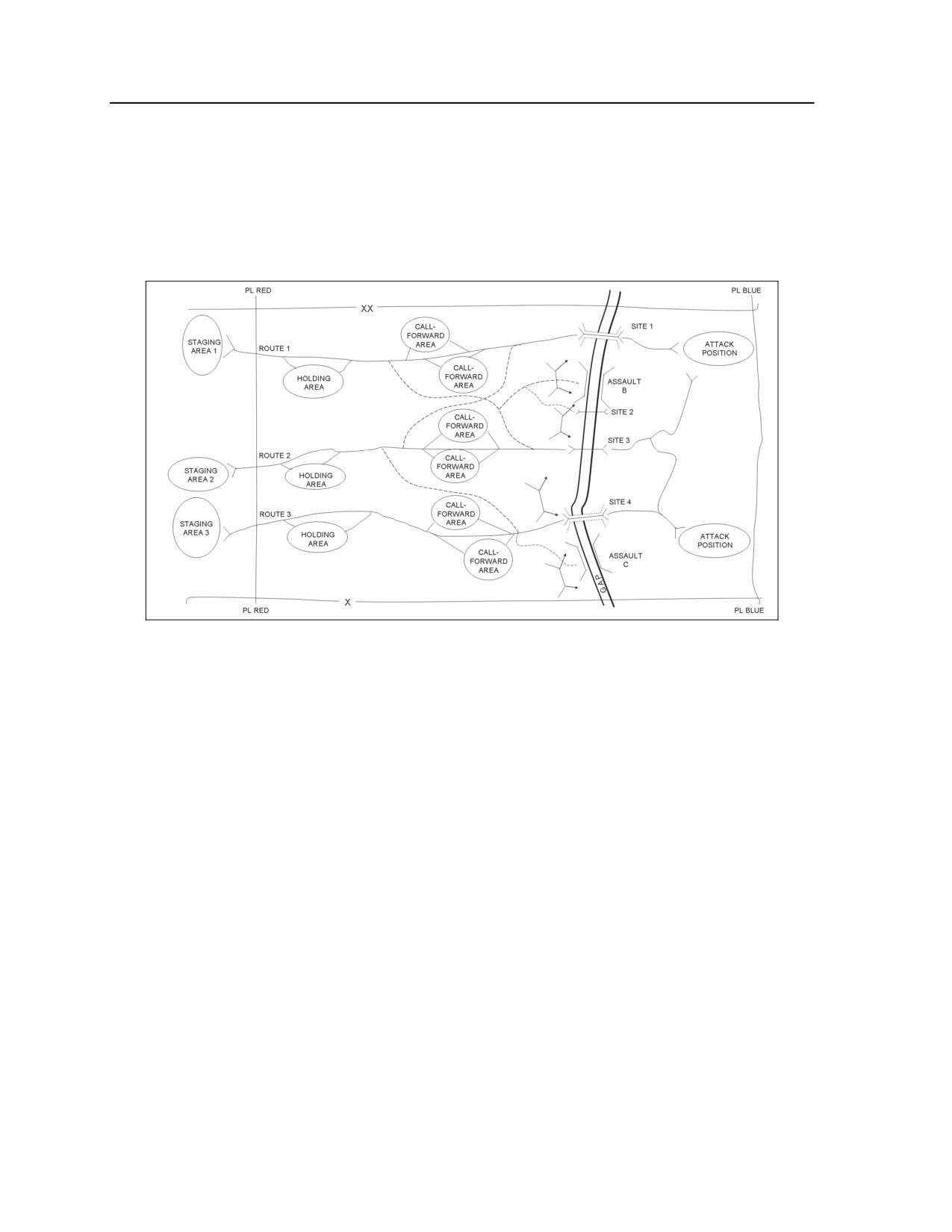
Develops the scheme of maneuver, fire plan, and support plan for each COA, considering
crossing capabilities and the order of crossing (see figure E-3).
Figure E-3. Sample BCT crossing area overlay for a COA
E-19. The staff performs COA analysis and comparison as for any other tactical operation. Once a COA is
selected, the ENCOORD develops a detailed crossing plan to support the operation. (See FM 3-90.12 for
detailed information on developing a crossing plan.)
PHASES OF A DELIBERATE GAP CROSSING
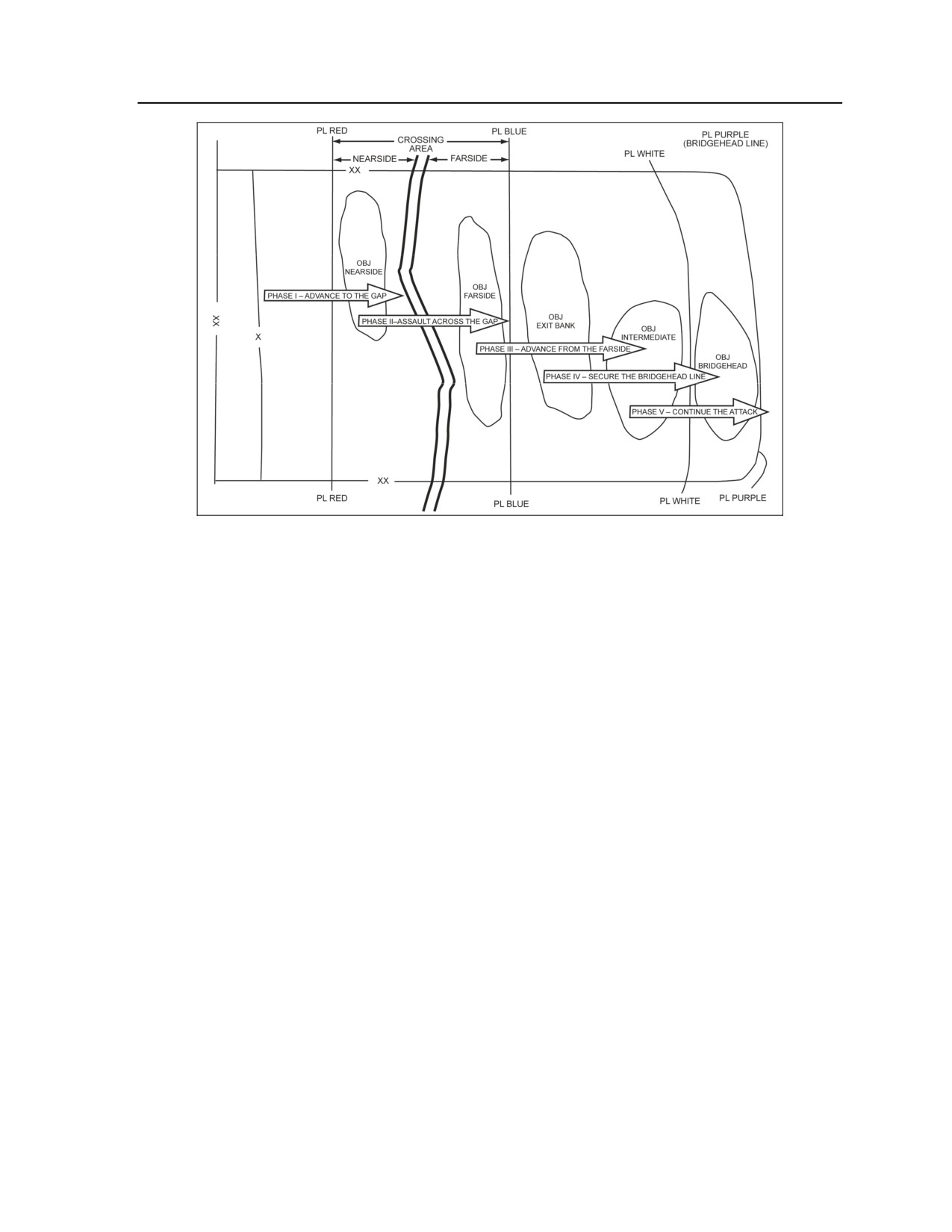
E-20. An offensive, deliberate gap crossing operation has five phases. They are distinct phases for
planning, but there is no pause between them in execution. (See figure E-4 for an overview of a deliberate
gap crossing.) The phases are as follows:
z
Advance to the gap (Phase I). The first phase is the attack to seize the objective nearside.
z
Assault across the gap (Phase II). The second phase involves units assaulting across the gap to
seize the objective farside, eliminating direct fire into crossing sites (typically, when rafting can
begin).
z
Advance from the farside (Phase III). The third phase is the attack to secure the exit bank and
intermediate objectives that eliminate direct and observed indirect fires into the crossing area
(typically, when rafting transitions to bridging).
z
Secure the bridgehead line (Phase IV). The fourth phase of the gap-crossing operation
involves units that secure bridgehead objectives to protect the bridgehead against counterattack.
This gains additional time and space for the buildup of forces for the attack out of the
bridgehead.
z
Continue the attack (Phase V). The fifth phase is the attack out of the bridgehead to defeat the
enemy at a subsequent or final objective. It is considered a phase of gap-crossing operations
because the timing and initiation of this phase typically depends on the success of the other four
phases.
E-6
FM 3-34.22
11 February 2009
Combined Arms Gap-Crossing Operations
Figure E-4. Overview of a deliberate gap crossing
CONTROL ELEMENTS
E-21. Division and brigade commanders are responsible for crossing their formations. They organize their
staffs and subordinate commanders to help them control the crossing. Division and brigade headquarters
operate from a command group, main CP, and TAC CP. At the division level, an engineer brigade or an
additional MEB is normally designated as the crossing area headquarters for the execution of a deliberate
gap crossing. In a deliberate gap-crossing operation, it may be necessary to collocate a center for
movement control to assist crossing area headquarters in monitoring traffic and routes between release
lines (RLs). Some hasty (dry) gap crossings may not require all of the control elements discussed. (See
table E-2, page E-8.)
11 February 2009
FM 3-34.22
E-7

Appendix E
Table E-2. CP tasks
Secure the
Advance to the
Assault Across
Advance From the
Continue the
Phase/CP
Bridgehead
River
the River
Farside
Attack
Line
z
Coordinates
z
Coordinates
z
Coordinates
z
Coordinates
z
Coordinates
operations to
operations to
operations to
operations to
operations to
isolate division
isolate the
isolate the exit
isolate the
isolate enemy
advance to
crossing area
bank and
bridgehead.
attack against
Division main
the
and the
intermediate
z
Sustains the
corps objectives.
CP
gap-crossing
farside
objectives.
fight.
z
Sustains the
site.
objectives.
z
Sustains the
fight.
z
Sustains the
z
Sustains the
fight.
fight.
fight.
z
Advances to
z
Assaults
z
Advances from
z
Secures the
z
Continues the
the river.
across the
the farside.
bridgehead
attack.
z
Coordinates
river.
z
Assists BCTs in
line.
z
Directs the
division
z
Coordinates
the transition to
z
Coordinates
attack and
seizure of the
the division
seize and secure
the lead
integrates
Division TAC
objective
dismounted
the exit bank
brigade
follow-on BCTs
CP
nearside.
assault of the
and the
attack to
into the attack.
gap to attack
intermediate and
seize and
positions on
bridgehead
secure
the farside.
objectives.
bridgehead
objectives.
z
Coordinates
z
Facilitates
z
Coordinates
z
Continues
z
Continues
marking,
BCT assault
marking, control,
crossing
crossing
control, and
crossings.
and
operations.
operations.
improvement
z
Coordinates
improvement of
of routes from
the
routes and the
the staging
preparation of
establishment of
Engineer
areas to the
farside exit
holding areas in
brigade or
crossing sites.
sites.
the farside
MEB (division
z
Lays out
crossing area.
crossing-area
z
Begins rafting
staging,
operations. (If
z
Transition to
headquarters)
holding, and
indirect fire is
bridging
call-forward
suppressed,
operations.
areas.
bridging may
z
Continues
z
Establishes
begin.)
crossing
ERPs and
operations.
TCPs.
z
Coordinates
z
Coordinates
z
Coordinates the
z
Coordinates
z
Prepares to
the lead TF
the
TF attack to
the TF attack
reorganize and
attack to seize
dismounted
seize and secure
to seize and
follow the
and secure
assault
the exit bank
secure of
breakout force
BCT TAC
objective
crossing to
and intermediate
bridgehead
attack out of the
nearsides.
secure farside
objectives.
objectives.
bridgehead
objectives.
toward division
objectives.
E-8
FM 3-34.22
11 February 2009

Combined Arms Gap-Crossing Operations
Table E-2. CP tasks (continued)
Secure the
Advance to
Assault Across
Advance From the
Continue the
Phase/CP
Bridgehead
the River
the River
Farside
Attack
Line
z
Moves into
z
Coordinates
z
Controls
z
Controls the
z
Passes
the crossing
assault crossing
follow-on TFs
passage of
crossing-area
area to
means for
passing through
brigade units
control to
BCT main CP
provide
dismounted TFs
the crossing
into the
division TAC CP.
(brigade
traffic
and continues
area into attack
crossing area
crossing-area
control,
the obscuration
positions.
and prepares
headquarters)
crossing
of crossing sites.
to cross
means, and
breakout
obscuration.
forces.
DIVISION HEADQUARTERS
E-22. One of the deputy commanding generals (DCGs) is typically designated to provide C2 for the
division deliberate gap crossing as the crossing area commander (CAC). His primary function is to control
the gap-crossing operation, including synchronizing forces and integrating the warfighting functions as
they pertain to the crossing operation. The division TAC CP is normally established to provide C2 for the
lead BCT attack across the gap and to subsequent objects. The division main CP prepares the gap-crossing
plan and directs operations to isolate the bridgehead from enemy reinforcements and counterattacking
formations. The division crossing-area engineer is typically the commander of the engineer brigade or the
senior engineer of the MEB that is supporting the division deliberate gap crossing. The division
headquarters usually serves as division crossing-area headquarters. Under the direction of the division
CAC, the division gap-crossing activities are coordinated within the crossing area.
BRIGADE COMBAT TEAM HEADQUARTERS
E-23. The BCT TAC CP controls the advance to the gap and the attack across the gap. It displaces across
the gap as soon as practical after the assault to control the fight for the exit side and the intermediate and
bridgehead objectives. The BCT main CP controls the crossing of the remaining BCT. It prepares the BCT
crossing plan and provides the staff nucleus to coordinate it. For BCT crossings, the S-4 (assisted by the
supporting military police platoon leader, the company commander, or the BCT PM and engineers if
available) organize a small, temporary traffic control cell within the BCT main CP to coordinate with the
division movement center for movement control. Once the lead battalions assault across the gap and secure
the objective farside, the crossing area is activated. The BCT CAC, normally the BCT DCO or XO,
controls the movement of forces inside the crossing area. The BCT main CP controls the assured mobility
force that normally consists of an engineer battalion headquarters with bridge companies and other
engineer capabilities, military police, and perhaps CBRN units that have obscuration capabilities. This
leaves the BCT commander free to direct key activities while the DCO runs the crossing. The CAC
controls the—
z
Movement and positioning of all elements transiting or occupying positions within the crossing
area.
z
Security elements at crossing sites.
z
Assured mobility forces (engineer, military police, and CBRN units) within the crossing area.
E-24. Each forward BCT is normally task-organized for the crossing operation with an engineer battalion
headquarters and subordinate elements. The engineer battalion commander is responsible to the BCT CAC
for the engineer crossing means and sites and generally functions as the BCT crossing area engineer
(CAE). While unlikely, if multiple engineer battalions are required to carry out a BCT deliberate crossing,
an engineer brigade would typically provide C2 and the engineer brigade commander would serve as BCT
CAE. The CAE informs the CAC of changes due to equipment or operator difficulties or threat variances
that render a crossing means inoperable or reduce its capacity. He commands those engineers tasked to
move BCT forces across the gap. They remain there as the attack proceeds beyond exit side objectives.
Task-organized combat engineers within the maneuver battalions remain under the C2 of those
organizations to support their movement and maneuver after the gap crossing.
11 February 2009
FM 3-34.22
E-9
Appendix E
CROSSING-SITE COMMANDER
E-25. Each crossing site has an engineer, typically a company commander or a platoon leader, who
handles the crossing of the units sent to the site. Normally, the crossing-site commander (CSC) is the
company commander for the bridge unit operating the site. He commands the engineers operating the
crossing means and the engineer regulating points (ERPs) at the call-forward areas for that site. He
maintains the site and decides on the immediate action needed to remove broken-down or damaged
vehicles that interfere with activities at the site. The CSC is responsible to the CAE and keeps him
informed on the status of the site.
UNIT MOVEMENT CONTROL OFFICER
E-26. Each battalion or separate unit commander designates a movement control officer who coordinates
unit movement according to the movement control plan. He provides staff planners with detailed
information on unit vehicle types and quantities.
CONTROL MECHANISMS
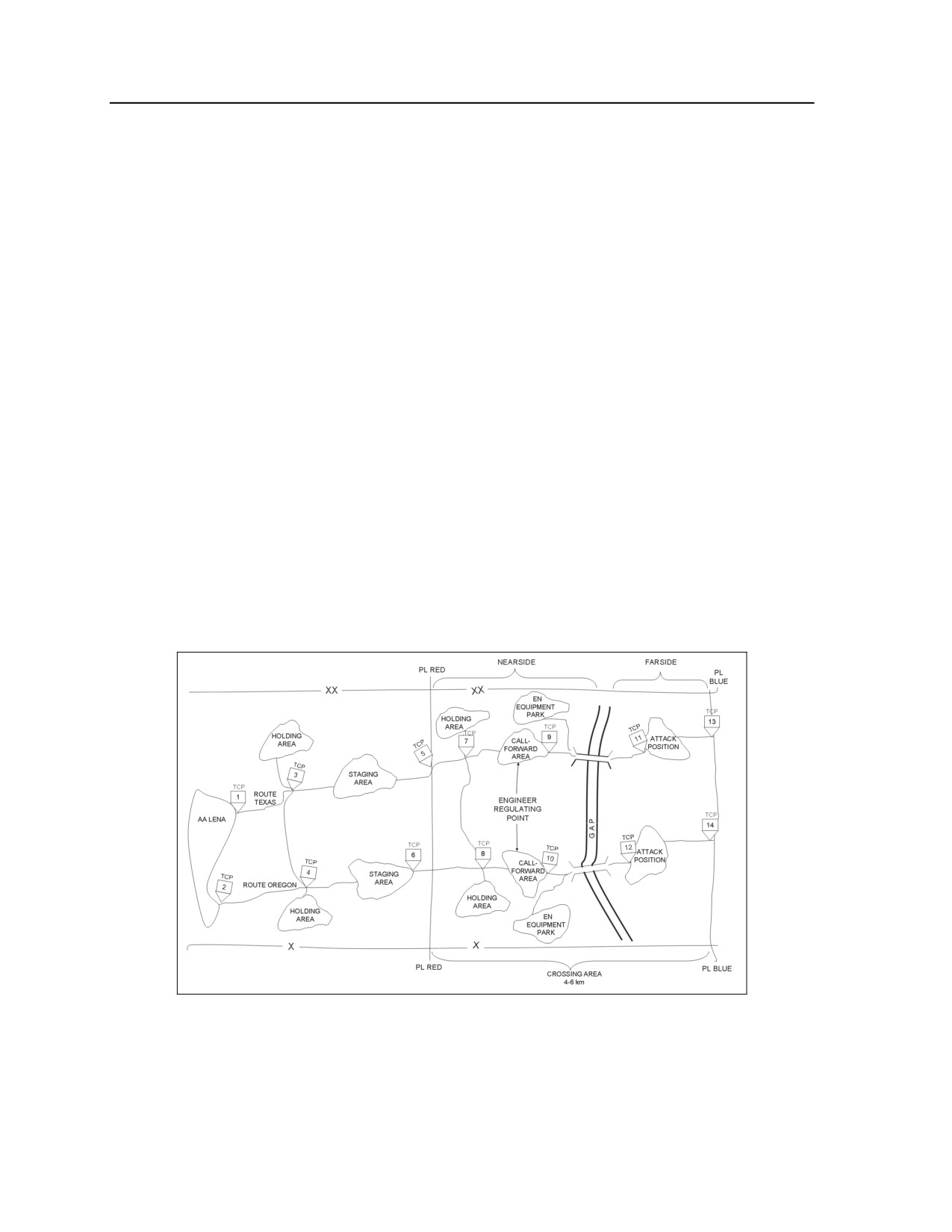
E-27. A major control mechanism category is graphic control measures. The commander uses the
following graphic control measures (see figure E-5) to delineate AORs for subordinates and to ease traffic
control:
z
RLs. RLs are used to delineate the crossing area. RLs are located on the farside and the
nearside, within 3 to 4 kilometers of the gap, and indicate a change in the headquarters that is
controlling movements. Typically, they are graphically identified as PLs and located on easily
identifiable terrain when possible.
z
Crossing areas. Crossing areas are normally brigade-size, controlled-access areas for
gap-crossing operations that are designed to decrease traffic congestion at the gap. They
normally extend 3 to 4 kilometers on each side of the gap, are METT-TC-dependent, and are
defined by BCT boundaries and RLs.
Figure E-5. Graphic control measures
E-10
FM 3-34.22
11 February 2009
Combined Arms Gap-Crossing Operations
z
Engineer equipment park (EEP). An EEP is an area near (at least 1 kilometer away) the
crossing site that is used to assemble, prepare, and store bridging or crossing equipment and
material. EEPs are positioned where they do not interfere with traffic to the crossing sites and
where equipment can be dispersed and concealed.
z
ERP. The ERP is a checkpoint, manned by engineers, that ensures vehicles do not exceed the
capacity of the crossing means and provides drivers with final instructions before crossing.
ERPs report to the CSC. TCPs are collocated with the ERP to ensure that vehicles clear call-
forward areas. As a minimum, each crossing site requires an ERP at its own call-forward area.
z
TCP. A TCP is a manned post on both sides of the gap that is used to preclude the interruption
of traffic flow or movement along designated routes. TCP personnel assist crossing-area
headquarters by reporting and regulating the movement of units. TCPs are normally positioned
at critical crossroads, road junctions, staging areas, holding areas, and ERPs.
z
Waiting areas. Waiting areas are located adjacent to routes that are used for concealing
vehicles, troops, and equipment while an element is waiting to resume movement. They are
located on both sides of the gap, close to crossing areas. Commanders use the following waiting
areas:
Staging area. A staging area is a battalion-size area where forces wait to enter the crossing
area.
Call-forward area. A call-forward area is a company-size waiting area within the crossing
area where engineers make final preparations.
Holding area. A holding area is a battalion-size area outside the crossing area or a
company size area within it that is used to disperse units during traffic interruptions.
Attack position. An attack position is the last position within the bridgehead before leaving
the crossing area.
Assault position. An assault position is the last covered and concealed position where final
preparations are made before assaulting the objective.
Assembly area. An assembly area is an area that a unit occupies to prepare for an operation
that offers good road access, cover, and concealment.
11 February 2009
FM 3-34.22
E-11
Appendix F
Engineer Running Estimate
As previously discussed in chapter 2, the running estimate is a logical thought
process and extension of the MDMP. RI in the engineer running estimate supports the
commander’s visualization and decisionmaking. The ENCOORD prepares and
refines the running estimate concurrently with the planning process of the supported
maneuver force and maintains it continuously throughout planning, preparation,
execution, and assessment. This appendix provides more detail on how mission
analysis, facts, assumptions, and variables furnish the structure for the running
estimate and how the estimate supports the planning, preparation, execution, and
assessment of operations. Commanders are rarely briefed on the contents of every
staff section running estimate. The ENCOORD only briefs the part of the estimate
that applies to the situation and the issue or decision being addressed. During
operations, running estimates are usually presented orally, especially during
preparation and execution. Written estimates may be prepared to support contingency
planning during peacetime. Even then, they are normally prepared only at higher
level headquarters. (Written estimates follow the generic format in FM 5-0, figure E-
1. See FMs 3-0, 5-0, and 6-0 for more information on the running estimate.)
PLANNING
F-1. Prior to receiving a mission, the engineer staff running estimate consists of the ENCOORD’s broad
assessment of the OE and SA of engineer capabilities. Once a mission is assigned, the estimate becomes
focused on RI to assist the commander in decisionmaking.
Mission analysis (MDMP, Step 2) enables commanders to refine their SU of the OE and determine their
mission. Mission variables (see FM 6-0) are considered during mission analysis. From the engineer perspective
(see chapter 1), mission analysis equates to seeing the tactical problem and sharing the engineer view of the
OE, identifying engineer requirements, and determining what engineer capabilities are required to solve the
problem. Once the problem is identified, the balancing of requirements versus capabilities and the integration of
engineer capabilities into the concept of the operation become the objectives during COA development and
implementation.
F-2. As stated in chapter 2, the running estimate parallels the MDMP. Mission analysis, facts, and
assumptions, and variables (METT-TC) furnish the structure for the running estimate. The engineer
running estimate is initiated by—
z
Analyzing the higher-headquarters order.
z
Conducting IPB.
z
Analyzing the engineer mission.
z
Conducting a risk assessment.
ANALYZE THE HIGHER-HEADQUARTERS ORDER
F-3. The ENCOORD thoroughly analyzes the higher-headquarters order by initially focusing on the
engineer annex, which conveys the overall maneuver unit mission, commander’s intent, and concept of the
operation (two levels up). Analysis includes understanding—
11 February 2009
FM 3-34.22
F-1
Appendix F
z
The current situation (enemy and friendly).
z
The maneuver unit mission, commander’s intent, and concept of the operation (two levels up).
z
The engineer mission, intent, and scheme of engineer operations (two levels up).
z
The assigned AO (normally prescribed by boundary lines).
z
The estimated time available.
z
The missions of adjacent units and their relation to the higher-headquarters plan.
z
How engineers (by task and purpose) contribute to the mission, commander’s intent, and
concept of the operation (two levels up).
z
The assets available.
CONDUCT INTELLIGENCE PREPARATION OF THE BATTLEFIELD
F-4. IPB is an integrating process and is critical to the success of planning. IPB is a systematic,
continuous process of analyzing the threat and environment, which includes terrain, weather, and civil
considerations. The IPB centers on creating a maneuver template of the enemy, anticipating its capabilities,
and predicting its intentions based on threat doctrine norms and the order of battle. Defining the OE
identifies the characteristics of the environment that influence friendly and threat operations. The engineer
must understand the S-2 doctrinal template and SITEMP to analyze enemy engineer capabilities. Engineer
reconnaissance (as discussed in chapter 3) may be required to support IPB, and the ENCOORD must be
proactive in recognizing these requirements and tasking the appropriate engineer elements. The four steps
of the IPB are as follows:
z
Step 1. Define the OE. This includes identifying characteristics that influence friendly and
threat operations. It helps determine the AI and identifies gaps in intelligence. It is also the basis
for analyzing terrain, weather, civil considerations, and threat forces.
z
Step 2. Describe environmental effects. This involves evaluating the effects of all aspects of
the environment and includes an examination of terrain, weather, and civil considerations.
z
Step 3. Evaluate the threat. This is a detailed study of enemy forces and their composition,
organization, tactical doctrine, weapons, and equipment, and supporting systems. Threat
evaluation determines enemy capabilities and limitations and how they prefer to fight.
z
Step 4. Develop possible enemy COAs. This involves developing possible enemy COAs, based
on analysis of the previous steps.
F-5. IPB is conducted by the entire staff, with each staff member providing input based on their areas of
expertise and focus. The ENCOORD focuses on terrain, weather, and civil consideration analysis and
enemy mission and M/CM/S capabilities.
Terrain, Weather, and Civil Consideration Analysis
F-6. The ENCOORD analyzes the terrain, weather, and civil considerations and assesses their impact on
military and engineer operations. As the terrain-visualization expert, he coordinates for geospatial products
from the geospatial engineering team to enhance the commander’s visualization of the terrain and enable
decisionmaking. The object of terrain analysis is to determine the impact that the terrain and weather have
has on mission accomplishment. The engineer supports the S-2 in this process. For tactical operations,
terrain is analyzed using the five military aspects of terrain
(OAKOC). (See FM 6-0 for a detailed
discussion of OAKOC.)
F-7. Existing and reinforcing obstacles are analyzed during the IPB and running estimate processes, but
the focus is on existing obstacles. Obstacles define AAs; create cross compartments in AAs; and can turn,
fix, block, or disrupt a maneuver. Some examples of obstacles are—
z
Natural.
Swamps.
Dense forests.
Deep, steep-sloped ravines.
Rivers.
F-2
FM 3-34.22
11 February 2009

Engineer Running Estimate
Streams.
Hills or mountains with excessive slopes.
z
Cultural.
Urban areas.
Quarries.
Railroad beds.
Built-up or elevated roads.
Potential EHs (gas storage sites).
F-8. Reinforcing obstacles are those constructed, emplaced, or detonated to enhance existing obstacles or
terrain. Some examples are—
z
Minefields.
z
Tank ditches.
z
Abatis.
z
Tank walls.
z
Road craters.
z
Wire entanglements.
F-9. A weather analysis determines the effect of weather on the mission (see table F-1). Snow, dust,
humidity, and temperature extremes have an impact on Soldier efficiency and limit the potential of
weapons and equipment. Poor visibility affects the integration of obstacle emplacement with survivability
positions in EA development. Inclement weather usually favors an attacker because defenders are less
alert; however, it degrades mobility and C2 and weapons are less effective. The attacker can close with the
defender more easily in limited visibility conditions.
Table F-1. Weather effects
Weather Condition
Area/Element Affected
Temperature
Soldiers, weapons, equipment, and civil disorder
Humidity
Soldiers and equipment
Precipitation
Soldiers, trafficability, and equipment
Visibility
Observation and integration of obstacles and survivability
Light data
Observation and survivability construction rate
Damaged materiel and structures; reduced visibility (blowing sand, dust, and
High winds
battlefield debris), impaired vehicle movement, improved traffic ability (causing soil
(greater than 35 knots)
to dry faster), and temperatures below 40° (makes wind chill a critical consideration)
Friendly close air support (2,500-foot ceiling), threat close air support (300-foot
Cloud cover
ceiling), visibility, smoke or chemical-agent employment, and temperature
F-10. Civil considerations comprise the influence of man-made infrastructure, civilian institutions, and
attitudes and activities of civilian leaders, populations, and organizations within an AO on the conduct of
military operations (see FM 6-0). The ENCOORD analyzes the effects of civil considerations to understand
the population (demographics and culture), government, economics, NGOs, history, and other factors. This
analysis influences the selection of objectives, movement of forces, and positioning of units for current
operations and future plans. Civil considerations comprise six characteristics (ASCOPE). (See FM 6-0 for
a detailed discussion of ASCOPE.)
Enemy Mission and Mobility, Countermobility, and Survivability Capabilities
F-11. Threat evaluation and integration are major components of the IPB. Enemy mission and M/CM/S
capabilities are subcomponents of the threat evaluation and integration process. The ENCOORD supports
the S-2 during the threat evaluation by focusing on enemy engineer capability as it relates to the enemy
mission. When executing this component of the running estimate, the ENCOORD must first understand the
11 February 2009
FM 3-34.22
F-3
Appendix F
anticipated enemy mission (attack or defend) and consider how enemy engineers are doctrinally employed.
The ENCOORD then develops an estimate of enemy engineer capabilities. To do this, the ENCOORD uses
the S-2 order of battle and knowledge of enemy engineer forces and other assets (combat vehicle
reconnaissance effort or self-entrenching capabilities) that may impact engineer operations. The
ENCOORD must also consider intelligence pertaining to recent enemy engineer activity or TTP.
F-12. The ENCOORD uses the S-2 SITEMP and enemy capability estimate to plot the enemy engineer
effort
(obstacle or survivability effort) and its probable location. Coordinating with the S-2, the
ENCOORD recommends IR that confirms or denies enemy engineer capability in the SITEMP. A
summary of the enemy mission and M/CM/S capabilities are as follows:
z
Anticipate enemy engineer operations and their impact on the battle.
z
Assess threat patterns and capabilities in an asymmetric environment.
z
Consider enemy mission and doctrinal-employment of engineers.
z
Estimate enemy engineer capabilities based on the—
S-2 order of battle.
Threat engineer organizations.
Personnel and equipment capabilities.
Recent activity or newly developed TTP.
F-13. Based on the S-2 SITEMP, enemy patterns, and enemy engineer doctrine (TTP), the ENCOORD
plots enemy—
z
Mobility assets and their relative location within enemy formations.
z
Mine capability (tactical and protective obstacle effort), mine systems, and firing ranges of
artillery-delivered SCATMINEs.
z
Engineer reconnaissance assets based on doctrine organization within enemy maneuver units.
z
HVTs (bridging assets, breaching assets, SCATMINE delivery systems).
ANALYZE THE ENGINEER MISSION
F-14. Analyze the engineer mission by—
z
Identifying specified and implied M/CM/S and general engineering tasks.
z
Analyzing friendly mission and M/CM/S capabilities.
z
Determining constraints.
z
Determining risk, as applied to engineer capabilities.
z
Conducting time analysis.
z
Developing essential tasks for M/CM/S.
IDENTIFY SPECIFIED AND IMPLIED TASKS
F-15. The ENCOORD identifies specified and implied tasks for M/CM/S, which ultimately results in the
development of essential tasks for M/CM/S (discussed previously in chapter 2).
F-16. Specified tasks are specifically assigned to a unit by higher headquarters. They may be found in the
base order, annexes (ISR annex), and overlays. For engineers, this could include—
z
Obstacle zones.
z
Obstacle belts with intents.
z
Required number of breach lanes.
z
Type of breach designated by the higher commander.
F-17. Implied tasks must be performed to accomplish a specified task or the mission, but are not stated in
the higher-headquarters order. For engineers, this could include—
z
Obstacle handover coordination during a relief-in-place mission.
z
UXO removal or assistance with EOD removal.
z
Gap-crossing operation support if the crossing of a river is necessary to accomplish the mission.
F-4
FM 3-34.22
11 February 2009
Engineer Running Estimate
Analyze Friendly Mission and Capabilities
F-18. The ENCOORD must understand the friendly mission, commander’s intent, and concept of the
operation and understand how engineer capabilities contribute to the mission. To estimate the friendly
mission and M/CM/S capabilities, the ENCOORD must—
z
Consider the friendly mission.
z
Evaluate friendly engineer capabilities and their impact on accomplishing the mission.
z
Estimate the available engineer assets based on the task organization of—
Maneuver forces.
Engineer forces.
Higher engineer headquarters.
Adjacent engineer units.
HN or contractor capabilities.
z
Consider the availability of critical resources.
z
Estimate the total engineer capability based on engineer planning.
F-19. The ENCOORD considers all assets that can provide engineer capability, including task-organized
engineer units, nonengineer unit assets have (mine plows), assets under the control of higher engineer
headquarters (HN and contracted civilian support), and adjacent units. This understanding facilitates
requests for additional resources based on shortfalls identified during mission analysis and COA
development.
F-20. Having determined the assets available, the ENCOORD works with the S-3 to determine the
estimated time available. The ENCOORD can apply standard planning factors or known unit work rates to
determine the total engineer capability. For example, in the offense, the ENCOORD focuses on the total
amount of breaching equipment (MICLICs, AVLBs, engineer platoons, and any engineer augmentation)
and translates that into the number of breach lanes. In the defense, the ENCOOD determines the number of
minefields (or linear effort in kilometers), hull or turret defilade positions, and tank ditches that engineers
could construct with available resources. In stability operations, the focus may be on the number of
clearing teams that can be created. The ENCOORD uses these capability estimates during COA
development.
F-21. The ENCOORD combines the analysis of terrain and weather, and the analysis of the enemy and
friendly mission, and M/CM/S capabilities to form facts and assumptions about the—
z
Likely enemy engineer effort.
z
Most probable enemy COA.
z
Potential enemy vulnerabilities.
z
Critical friendly requirements.
z
Impact of the preceding factors on the mission.
Determine Constraints
F-22. Constraints are restrictions placed on a unit by higher headquarters. They dictate an action or
inaction, thus restricting the freedom of action a subordinate commander has for planning. Constraints can
take the form of a requirement to do something. For engineers, this could include designated reserve
targets, obstacle belts (with intents), and lane requirements. Constraints can also prohibit action, such as
stated approval authority for use of SCATMINEs. Obstacle zones and belts are also examples of
constraints because they limit the area in which tactical obstacles can be placed.
Determine Risk
F-23. Risk (tactical and accidental) consideration begins during planning, as commanders designate and
weigh the decisive operation. To do this, they accept risk elsewhere to mass the combat power needed to
accomplish the mission. A commander may specify an acceptable risk to accomplish the mission. For
11 February 2009
FM 3-34.22
F-5
Appendix F
instance, the priority obstacle effort in a defense may be employed on the most likely enemy AA, while
situational obstacles are to be planned on the most dangerous AA as an economy-of-force measure. The
ENCOORD must understand how a risk involving an engineer capability specifically impacts combined
arms operations and must advise the commander accordingly. One such risk is the decision to employ or
not employ ERTs to support the ISR process. (FM 3-90 and FM 6-0 discuss tactical risk.)
Perform Time Analysis
F-24. The ENCOORD must ensure that engineer operations are included in the combined arms time
analysis. The time analysis has several steps. The first step is to determine the actual time available. The
ENCOORD establishes an assumption of the time available while preparing the friendly capabilities
portion of the running estimate and then refines the time analysis. This technique assists the ENCOORD in
accurately refining the estimate of time available and adjusting the friendly engineer capability
accordingly. A good tool to use in this process is a basic timeline sketch that includes the—
z
Supported unit OPORD.
z
Engineer unit OPORD.
z
Movement times.
z
LD or prepare-to-defend times.
z
Rehearsals.
z
Hours of darkness or limited visibility.
Develop Essential Tasks for Mobility, Countermobility, and Survivability
F-25. As discussed in chapter 2, an essential task for M/CM/S is a specified or implied M/CM/S task that
is critical to combined arms mission success. These tasks are identified from the specified and implied
tasks. From these tasks, combined with the maneuver commander’s guidance, the ENCOORD and other
staff representatives recommend essential tasks for M/CM/S to the maneuver commander during the
mission analysis brief. At the conclusion of the mission analysis brief, the commander approves those
essential tasks for M/CM/S that are considered relevant. (See chapter 2 for essential tasks for M/CM/S.)
CONDUCT RISK ASSESSMENT
F-26. CRM is an integrating process and occurs during all operation activities. CRM is the process of
identifying, assessing, and controlling hazards (risks) that arise from operational factors and balancing that
risk with mission benefits (see FM 5-19). CRM involves the following steps:
z
Step 1. Identify hazards.
z
Step 2. Assess hazards to determine risk.
z
Step 3. Develop controls and make risk decisions.
z
Step 4. Implement controls.
z
Step 5. Supervise and evaluate.
Note. Step 3 is accomplished during COA development, analysis, comparison, and approval. In
Step 4, controls are implemented through mission orders, mission briefings, running estimates,
and SOPs. Step 5 is conducted continuously throughout the operation.
F-27. Commanders integrate CRM into the MDMP and TLP. During mission analysis, the focus is on
performing the first two steps, which are assessment steps. Hazards are identified using METT-TC as a
standard format. Hazards can be associated with enemy activity, accident potential, weather or
environmental conditions, health, sanitation, behavior, and/or materiel or equipment. Hazards are assessed,
and risk is assigned in terms of probability and severity. (See FM 5-19 for detailed information on CRM.)
F-6
FM 3-34.22
11 February 2009

Engineer Running Estimate
PREPARATION AND EXECUTION
F-28. Maintaining the running estimate is one of the CP functions that directly contribute to assessing and
directing ongoing operations and planning future operations. The construct of the running estimate also
provides a framework for organizing and arranging information displays with the CP or cell.
F-29. During preparation and execution, staffs analyze the situation within their fields of interest in terms
of mission variables to maintain running estimates. Maintaining a running estimate helps the staff make
recommendations (within their areas of expertise) to support the commander’s decisionmaking. Staffs also
use the running estimate to offering recommendation (for information and assistance only) to other staff
elements and subordinate commanders. Staff recommendations may be in writing, but are usually
presented orally during preparation and execution. Presentations may be formal or informal and in the form
of briefings, written estimates, or staff studies.
F-30. During preparation and execution, the engineer running estimate is updated based on new
information that answers the IR established during planning. IR includes all information elements that the
commander and staff need to address mission variables and successfully conduct operations. (Table F-2
shows the mission variables of METT-TC and some of the associated IR for each factor.)
Table F-2. IR in relation to METT-TC
Mission Variable
IR
z Status of engineer missions (focused on essential tasks for
M/CM/S)
Mission
Planned
Prepared
Executed
z Enemy disposition
Organization
Strength
Location
z OBSTINTEL
Enemy
ISR results
Engineer reconnaissance
Mine strikes
z Enemy capabilities (new TTPs)
z Enemy vulnerabilities
z Probable enemy COAs
z Updated terrain information to reflect the effects of combat
Terrain and weather
z Environmental considerations
Troops and support
z
Current task organization
available
z
Engineer combat power
Unit readiness (normally two levels down) (personnel
strength [critical MOS], maintenance status, and supply
status)
M/CM/S capabilities
z
Supplies and support available
Joint, multinational, and interagency forces
DOD or DOS civilians
Contractors
11 February 2009
FM 3-34.22
F-7
Appendix F
Table F-2. IR in relation to METT-TC
Mission Variable
IR
Time available
z
Information related to how much time is available to plan,
prepare, and execute operations
Civil considerations
z
Influences and immediate impacts on engineer operations in
the AO
Areas (district boundaries, economic centers, religious or
tribal enclaves)
Structures (bridges, dams, power plants, cultural sites)
Capabilities (status of essential services, HN resources,
and services that can support military operations)
Organizations (nonmilitary groups or institutions that can
influence the population)
People (attitudes and activities of civil leaders and
populations)
Events (holidays, elections, natural or man-made
disasters)
F-31. During preparation, running estimates continue to track resource status. Priority for assessment is on
answering PIR, FFIR, priority civil information requirements and, especially, CCIR that fall within the
engineer area of expertise.
F-32. During execution, running estimates focus on identifying variances, assessing their effect on
achieving the end state, and recommending corrective actions to keep the operation within the
commander’s intent. Assessments also address the supportability of sequels and future operations.
F-8
FM 3-34.22
11 February 2009
Appendix G
Orders and Annexes
Plans and orders are critical components to mission command. They foster mission
command by clearly conveying the commander’s intent, assigning tasks and purposes
to subordinates, and providing the minimum coordinating measures necessary to
synchronize the operation. Plans and orders encourage initiative by providing the
“what” and “why” of a mission and leave the “how to” to subordinates. To maintain
clarity and simplicity, plans and orders include annexes only when necessary and if
they pertain to the entire command. Annexes contain the details of support and
synchronization necessary to accomplish the mission. Because of their design and
purpose, annexes are not suitable as a supporting unit OPORD. This appendix
provides the format and a brief explanation for producing the engineer annex and
engineer unit orders. (See FM 5-0 for more information on planning and orders.)
ENGINEER ANNEX
G-1. The engineer annex contains information that is not included in the base order but is critical to the
engineer plan or required for subordinate engineer planning. It does not include instructions or orders
directly for engineer units, but covers critical aspects of the entire engineer plan. The engineer annex is not
a replacement for engineer unit orders. For example, it does not give subunit orders and service support
instructions. The engineer annex should meet the following general criteria:
z
Includes critical information derived from the running estimate process.
z
Contains all critical information and tasks not covered elsewhere in the order.
z
Does not contain items covered in SOPs unless the mission requires a change to the SOP (unless
required to inform augmenting units).
z
Avoids qualified directives.
z
Provides information that is clear, complete, brief, and timely.
z
Includes only information and instructions that have been fully coordinated in other parts of the
plan or order.
G-2. The engineer annex includes any combination of written instructions, matrices, or overlays to
convey the necessary details of the engineer plan. The engineer annex shown in figure G-1, page G-2, is
oriented toward combat operations, but the format remains applicable for stability and civil support
operations though the actual content may differ.
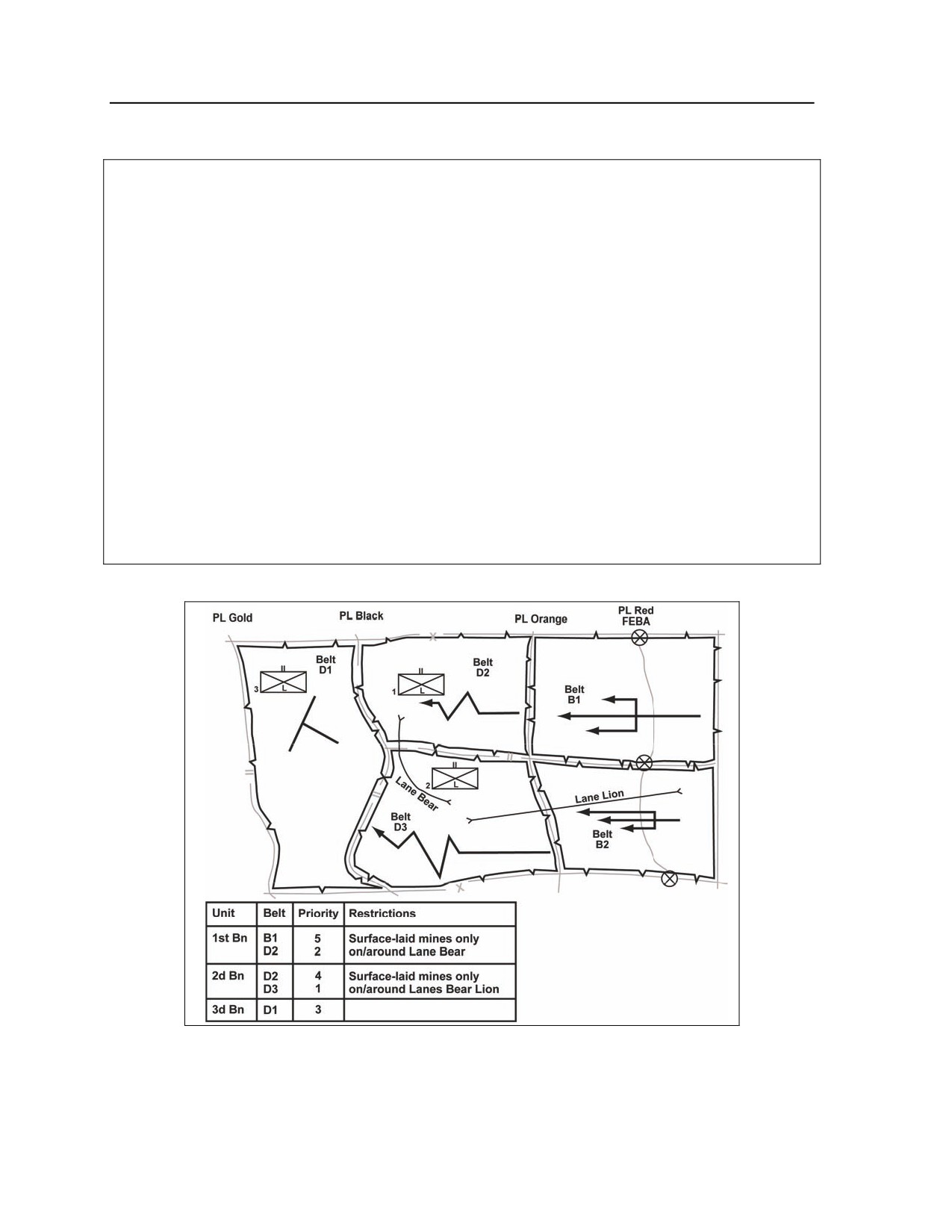
G-3. Matrices may be used as part of the body of the engineer annex or as separate appendixes. Matrices
are used to quickly convey or summarize information that does not need explanation, such as logistics
allocations, obstacle zone priorities and restrictions, or task summaries (execution matrix). The use and
format of matrices should be explained in unit SOPs so that nonorganic units have a quick point of
reference for adapting to supported or augmented unit procedures. Overlays are used to give information or
instructions and expedite integration into the overall combined arms plan. Figure G-2, page G-4, provides a
sample matrix and overlay. At the tactical level, information included on overlays may include, but is not
limited to—
z
All existing and proposed friendly obstacles and control measures (obstacle zones, restrictions,
and lanes; directed or reserve targets; situational obstacles with the associated NAI or TAI; and
decision points).
z
Known and plotted enemy obstacles (must also be on the SITEMP).
11 February 2009
FM 3-34.22
G-1
Appendix G
z
Sustainment locations and routes, as they apply to engineer operations.
z
CBRN-contaminated areas.
z
Areas affected by environmental considerations.
[Classification]
(Place the required classification at the top and bottom of every page of the annex.)
Copy ___ of ___ copies
Issuing headquarters
Place of issue
Date-time group of signature
Message reference number
ANNEX F (ENGINEER) TO OPERATION ORDER NO____________________.
1.
SITUATION.
a. Enemy forces. Include a detailed description of enemy engineer units and assets and known
obstacles. Refer to Annex B (Intelligence) as required.
b. Friendly forces. State the higher-headquarters concept of engineer support and provide the
adjacent unit concept of engineer support.
c. Environment.
(1) Terrain. Describe how the terrain affects engineer operations.
(2) Weather. Describe how the weather affects engineer operations.
(3) Civil considerations. Describe the impacts of civil considerations on engineer operations.
d. Attachments and detachments. List all attached and detached M/CM/S assets to clarify task
organization. Highlight changes in engineer task organization occurring during operations and the
effective times or events.
2.
MISSION. State the engineering mission in support of the operation.
3.
EXECUTION.
a.
Scheme of engineer operations. Same scheme as in the base order.
z
Provide a narrative of M/CM/S, general engineering, and geospatial engineering tasks required
to enable success of the supported scheme of maneuver.
z
List the essential tasks for M/CM/S (include task and purpose for each) and explain how each
supports the scheme of maneuver.
z
Ensure that the scheme of engineer operations corresponds to the maneuver unit concept of
operations, which provides the foundation and structure for engineer operations. If the
operation is phased, the scheme of engineer operations is also phased using the same
phases. If the operation is not phased, use the same format as the supported unit concept of
operation.
z
Address required areas under each phase in order of priority by phase. If there is no support
provided in an area during a phase, do not mention that area. The engineer effort addressed
under each phase applies to the supported unit during that phase, regardless of when the effort
is completed. For example, engineers emplace obstacles during the preparation phase of the
defense, though the obstacle intent is mentioned during the execution phase.
General comments. Provide a brief, one sentence comment that broadly describes
engineer support for the phase.
Mobility. Explain each mobility task (breaching, reducing obstacles, marking lanes,
providing guides, maintaining a route), relative location (route, objective), priority of
reduction asset used (use plows first, then MICLICs), and that maneuver unit being
supported.
Countermobility. Identify each obstacle belt, group, or individual in order of priority, intent
(target, relative location, and effect), maneuver unit responsible, and indirect fires
allocated. Provide execution criteria for reserve targets and situational obstacles.
Survivability. Identify each survivability task, its relative location (BP, EA), and the unit it
supports. This includes smoke operations when used for survivability purposes; for
example, obscuration during breaching.
Figure G-1. Engineer annex
G-2
FM 3-34.22
11 February 2009
Orders and Annexes
General engineering. Identify each general engineering task, its location, its priority, the unit
it supports, or how it supports the operation.
Geospatial engineering. Identify specific geospatial engineering tasks, their purpose, and
the priorities of support as appropriate.
b. Tasks to subordinate units. List engineer tasks not included in the base order to be accomplished
by a specific subordinate unit. Provide the task and purpose for specific engineer assets that are
task-organized to a subordinate unit, as necessary to ensure unity of effort. Tasks in the annex
should be subtasks or supporting tasks to those assigned in the base order and listed as necessary
to clarify or ensure the unity of effort. All essential tasks for M/CM/S must be captured in the base
order.
c. Coordinating instructions. Include—
z Critical engineer instructions common to two or more maneuver units not already covered in the
base OPORD.
z SOP information if needed for emphasis.
z Times or events in which obstacle control measures become effective if they differ from the
effective time of the order.
z Engineer-related PIR that must be considered or reported by subordinate engineer elements.
z Obstacle restrictions.
z Mission reports needed to support the operation if not covered in the signal paragraph or unit
SOP.
z Explanation of engineer work lines if used.
z References to countermobility and survivability timelines, as necessary.
z Lane marking if not covered in the supported unit SOP.
z Relevant environmental considerations.
4.
SERVICE SUPPORT.
a. Command-regulated classes of supply.
z Highlight subunit allocations of command-regulated classes of supply that impact on the CSR.
z May summarize in a matrix or table.
b. Supply distribution plan.
z State the method of supply (supply point, tailgate, or service station) to be used for Class IV and
V (obstacle) supplies for each subunit.
z Give tentative locations for Class IV and V supply points or locations for linkup of corps push
packages directly to units.
z Give the allocation of Class IV and V supplies by group.
z May summarize in a matrix or table.
c. Transportation. List the allocation and priority of support for the supported unit haul or airlift assets
dedicated to moving Class IV and V supplies and any requirements for subordinate units to
supplement the transportation of mission loads.
d. HSS. Address the concept of support for engineer elements operating within the AO, especially
those under higher-headquarters control providing DS and GS to the supported unit.
e. Host nation.
z
Type and location of HN engineer facilities, assets, and support.
z
Procedures for requesting and acquiring HN engineer support.
z
Limitations or restrictions on HN support (HN personnel not authorized forward of a specific PL).
5.
COMMAND AND SIGNAL.
a. Command. Designate the headquarters that controls engineer effort within work lines on an area
basis. Clearly identify the release authority for special munitions and mines. State the location of key
engineer leaders by phase.
Figure G-1. Engineer annex (continued)
11 February 2009
FM 3-34.22
G-3
Appendix G
b. Signal.
z
Identify communication networks monitored by the ENCOORD and engineer unit CPs if different
than the SOP.
z
Identify engineer reporting requirements if not covered in the SOP.
z
List task organization linkup times, places and signals.
ACKNOWLEDGE: (if distributed separately from the base order)
[Authenticator’s last name]
[Authenticator’s rank]
APPENDIXES:
1. Engineer overlay.
2. Environmental considerations.
3. GI&S.
4. Mobility execution matrix and timeline.
5. Countermobility execution matrix and timeline.
6. Survivability execution matrix and timeline.
7. General engineering integration.
DISTRIBUTION: (if distributed separately from the base order)
[Classification]
(Place the required classification at the top and bottom of every page of the annex.)
Figure G-1. Engineer annex (continued)
Figure G-2. Sample matrix and overlay
G-4
FM 3-34.22
11 February 2009
Orders and Annexes
ENGINEER UNIT ORDERS
G-4. The engineer commander uses a unit order to exercise control over subordinate engineer units. At
the outset of an operation, the commander uses the order to—
z
Affect the necessary task organization of engineers into the gaining or supported unit.
z
Assign initial missions.
z
Establish integration with the gaining unit sustainment structure.
G-5. Once task organization is effective (during operations), the engineer commander directs subsequent
orders only to those engineer units under his command. Orders, missions, and instructions to engineer units
in a command relationship to maneuver units are included in gaining unit orders.
WARNING ORDER
G-6. A WARNORD helps subordinate commanders and staffs initiate planning and prepare for an
upcoming operation. The engineer commander issues WARNORDs to all supporting engineer units to
facilitate parallel planning. WARNORDs do not authorize execution unless specifically stated. There are
three prescribed WARNORDs produced during the MDMP, but only one when using TLP (see FM 5-0,
chapter 4, for information on TLP). The number of WARNORDs is not fixed. As more information
becomes available, leaders can and should issue additional WARNORDs. (The WARNORD format is
shown in FM 5-0, appendix G.) (See FM 5-0, chapter 4, for the recommended information provided in an
initial WARNORD issued below battalion level.) The minimum amount of information for each
WARNORD is described below:
z
WARNORD 1. WARNORD 1 is issued during Step 1 of the MDMP or Step 2 of TLP.
WARNORD 1 includes—
Type of operation and general location.
Initial operational timeline.
Movements to initiate, especially for engineer heavy equipment or assets (bridging assets or
construction materials) that travel slowly or must be moved long distances.
Collaborative planning sessions directed by the commander, which could entail planning
with another engineer headquarters supporting an adjacent unit or operating at a higher
echelon.
Initial IR or CCIR.
ISR tasks that could involve engineer reconnaissance.
z
WARNORD 2. WARNORD 2 is issued at the conclusion of Step 2 of the MDMP. WARNORD
2 includes—
Approved unit mission statement.
Commander’s intent.
Task organization changes, attachments, and detachments.
AO description (sketch, overlay).
CCIR and essential elements of friendly information (EEFI).
Risk guidance.
Surveillance and reconnaissance instructions.
Initial movement instructions.
Security measures.
Military deception guidance.
Mobility and countermobility guidance.
Specific priorities.
Updated operational timeline.
Guidance on collaborative events and rehearsals.
11 February 2009
FM 3-34.22
G-5
Appendix G
z
WARNORD 3. WARNORD 3 is issued during Step 6 of the MDMP. WARNORD 3
includes—
Mission.
Commander’s intent.
Updated CCIR and EEFI.
Concept of operations.
AO description (sketch, overlay).
Principal tasks assigned to subordinate units.
Preparation and rehearsal instructions not included in the SOP.
Final timeline for operations.
OPERATION ORDER
G-7. The engineer commander issues an OPORD to all subordinate engineer units. The engineer unit
OPORD is shown in figure G-3. Figure G-4, page G-10, shows an engineer execution matrix. When the
order is an OPLAN instead of an OPORD, the assumptions are included at the end of the situation
paragraph.
FRAGMENTARY ORDER
G-8. The engineer commander frequently needs to modify the engineer unit OPORD to direct changes in
engineer operations and allow subordinate units to take advantage of tactical opportunities. The engineer
commander can do this by issuing a FRAGO, but only to engineer units under his command. Changes in
instructions to engineers supporting maneuver units in command relationships are conveyed through input
into the gaining unit FRAGO. The key to issuing a FRAGO is to maximize the use of the current OPORD
by specifying only information and instructions that have changed. FRAGOs include all five OPORD
paragraph headings (see FM 5-0, appendix G, for FRAGO format). After each heading, provide the new
information or state “no change.” The engineer commander may be afforded the opportunity to issue
FRAGOs to subordinate leaders face to face. If not, FRAGOs are normally issued over the radio or in
digital systems. The engineer company XO or 1SG may issue the FRAGO in person to subordinates to
ensure that direct coordination is made and that graphics are distributed to platoon leaders. A FRAGO
usually provides—
z
Changes to unit task organizations.
z
Changes in the current enemy and friendly situations, which usually gives the reason for the
FRAGO.
z
Changes to the scheme of engineer operations and corresponding changes to subunit tasks and
changes in the commander’s intent.
G-6
FM 3-34.22
11 February 2009
Orders and Annexes
[Classification]
(Place the required classification at the top and bottom of every page of the OPORD.)
Copy___ of ___ copies
Issuing engineer headquarters
(Place [coordinates] country)
(Date-time group)
(Message reference number)
OPERATION ORDER (number) (code name if used)
References: Maps and other references required
Time zone used throughout the order
Task organization:
z
Shown by phase.
z
Include all engineer headquarters of units under supported unit control.
z
List companies and special platoons task-organized to headquarters.
z
Can list special equipment to clarify tasks to subordinate units.
z
Indicate command and support relationships as appropriate.
1.
SITUATION.
a. Enemy forces. Include—
z
Macro picture of enemy forces facing the supported maneuver unit.
z
Current disposition of enemy forces, including the location of major enemy units (known and
plotted), strength, designation (if known), composition, and current activities.
z
Enemy engineer activities and capabilities.
z
Most probable enemy COA.
b. Friendly forces.
(1) Higher. Include—
z
Maneuver unit mission and commander’s intent (one and two levels up).
z
Supported unit concept of the operation (at a minimum, the scheme of maneuver).
z
Engineer mission, commander’s intent, and scheme of engineer operations (one and two
levels up).
(2) Adjacent units. Highlight missions of adjacent maneuver and engineer units that could impact
operations.
c. Environment.
(1) Terrain. Describe how the terrain affects operations.
(2) Weather. Describe how the weather affects operations.
(3) Civil considerations. Describe the impact of civil considerations on operations.
d. Attachments and detachments.
z
List attachments and detachments of organic and augmenting engineer assets, as necessary,
to clarify task organization.
z
Highlight changes in the task organization occurring during operations (by phase if applicable),
along with effective times or events that trigger the change.
2.
MISSION. This is the engineer unit mission statement and contains the elements who, what, when,
where, and why.
3.
EXECUTION.
a. Intent. The engineer commander’s intent for the operation must be easy to remember and clearly
understood two echelons down. Typically, it is three to five sentences long.
z
Describe what constitutes success for the engineers in supporting the maneuver unit mission
(linked to maneuver unit decisive operation). Includes the purpose of engineer operations and
the conditions that define the end state.
Figure G-3. Engineer unit OPORD
11 February 2009
FM 3-34.22
G-7
Appendix G
z
Provide subordinate leaders with the linkage between the engineer mission, scheme of
engineer operations, and tasks to subordinate engineer units.
z
Do not describe the scheme of engineer operations or subunit tasks.
b.
Scheme of engineer operations.
z
Write a clear, concise narrative of the engineer plan from the beginning to the end. Use the
same phases of the supported maneuver unit’s concept of operation (if the operation is
phased) to organize the narrative.
z
Focus on the essential tasks for M/CM/S.
z
Do not entail a summary of all engineer tasks.
z
Clearly identify the priority of effort and priority of support for each phase of the supported unit
concept of operation.
(1) Obstacles.
z
Supplement the narrative above, focusing specifically on the intent of the countermobility
effort.
z
Identify obstacle belts and groups used to support maneuver unit operations throughout
the depth of the AO.
z
Assign belt and group responsibilities, priorities, and restrictions to subordinate engineer
units.
z
Reference an obstacle matrix if used.
z
Identify and assign responsibilities for directed and reserve obstacles.
(2) Situational obstacles.
z
Describe the concept for the employment of situational obstacles, focusing on how they
will be used to complement or augment conventional, tactical obstacle efforts.
z
Provide details on NAIs, TAIs, decision points, and execution criteria or reference an
obstacle matrix if used.
z
Clearly state the headquarters maintaining the authority to use SCATMINEs and any
restrictions on duration (by belt).
c.
Tasks to subordinate units.
z
State the missions or tasks assigned to each unit that reports directly to the headquarters
issuing the order. Tactical tasks include a purpose that links it to the supported unit concept of
operation.
z
Use a separate subparagraph for each unit. Tasks are generally listed in the order they are
executed during the operation.
z
Clearly distinguish “be prepared” and “on order” tasks from normal tasks.
d.
Coordinating instructions. Include tasks and instructions that are common to two or more
subordinate units and not covered in unit SOPs, including—
z
Time or condition when a plan or an order becomes effective.
z
CCIR.
z
Risk reduction control measures. These are measures unique to this operation. They are not
included in unit SOPs and may include mission-oriented protective posture, vehicle recognition
signals, and fratricide prevention measures.
z
Rules of engagement (refer to an annex if required).
z
Environmental considerations.
z
Additional coordinating instructions, such as—
Pertinent coordinating instructions listed in the supported unit order.
Reporting requirements common to two or more units if not covered in the “signal”
paragraph.
Authorization for direct coordination between subordinate or adjacent engineer-specific
tasks.
Figure G-3. Engineer unit OPORD (continued)
G-8
FM 3-34.22
11 February 2009
Orders and Annexes
4. SERVICE SUPPORT.
a. Support concept.
z
Provide subordinates with the general concept of logistics support.
z
Identify, in general, primary and backup (emergency) means of subordinate unit sustainment.
Must address who (platoons and sections), how (area support, unit support, supply point
distribution, and unit distribution), where (FSC/BSB), and what (classes of supply and critical
services).
z
Ensure consistency with task organization and command and support relationships.
z
Make maximum reference to maneuver or support unit sustainment graphics.
z
List the locations of key sustainment nodes as they apply to the concept for logistics support
(FSCs/BSBs, combat and field trains, BSA, ASPs, ATPs) and planned subsequent locations if
they change during the operation.
b. Materiel and services.
(1) Supply.
z
List the allocation and CSR for each unit based on missions.
z
List basic loads to be maintained by the unit.
z
List the method of obtaining supplies if different from the general concept (mission logistics
may be different than unit [scheduled] logistics).
z
Address any special arrangements or plans to sustain specific mission needs (Class III, IV,
or V supply push packages to sustain engineer operations).
(2) Transportation.
z
List primary, alternate, designated, and contaminated MSRs.
z
State allocations of haul assets.
(3) Services. List the location and means of requesting and obtaining each service.
c. HSS. Indicate the primary and backup means of CASEVAC or MEDEVAC, including locations of MTFs
providing support of an area or a unit.
d. Personnel support.
z
Identify the method of handling EPWs and the locations of EPW collection points.
z
Identify the method of receiving mail, religious services, and graves registration.
e. Civil-military cooperation. Identify engineer supplies, services, or equipment provided by HN or
civilian contractors.
5. COMMAND AND SIGNAL.
a. Command.
z
List the location of supported unit and engineer company key leaders and CPs during the operation
and planned movements.
z
Designate the logical chain of command.
b. Signal.
z
Identify communications peculiarities for the operation not covered in the SOP.
z
Identify critical reporting requirements of subordinates if they are not covered in the coordinating
instructions or SOP.
z
Designate nets for mission and routine reports.
ACKNOWLEDGE:
(Commander’s signature [optional])
(Commander’s last name)
(Commander’s Rank)
OFFICIAL:
[Authentication]
Figure G-3. Engineer unit OPORD (continued)
11 February 2009
FM 3-34.22
G-9
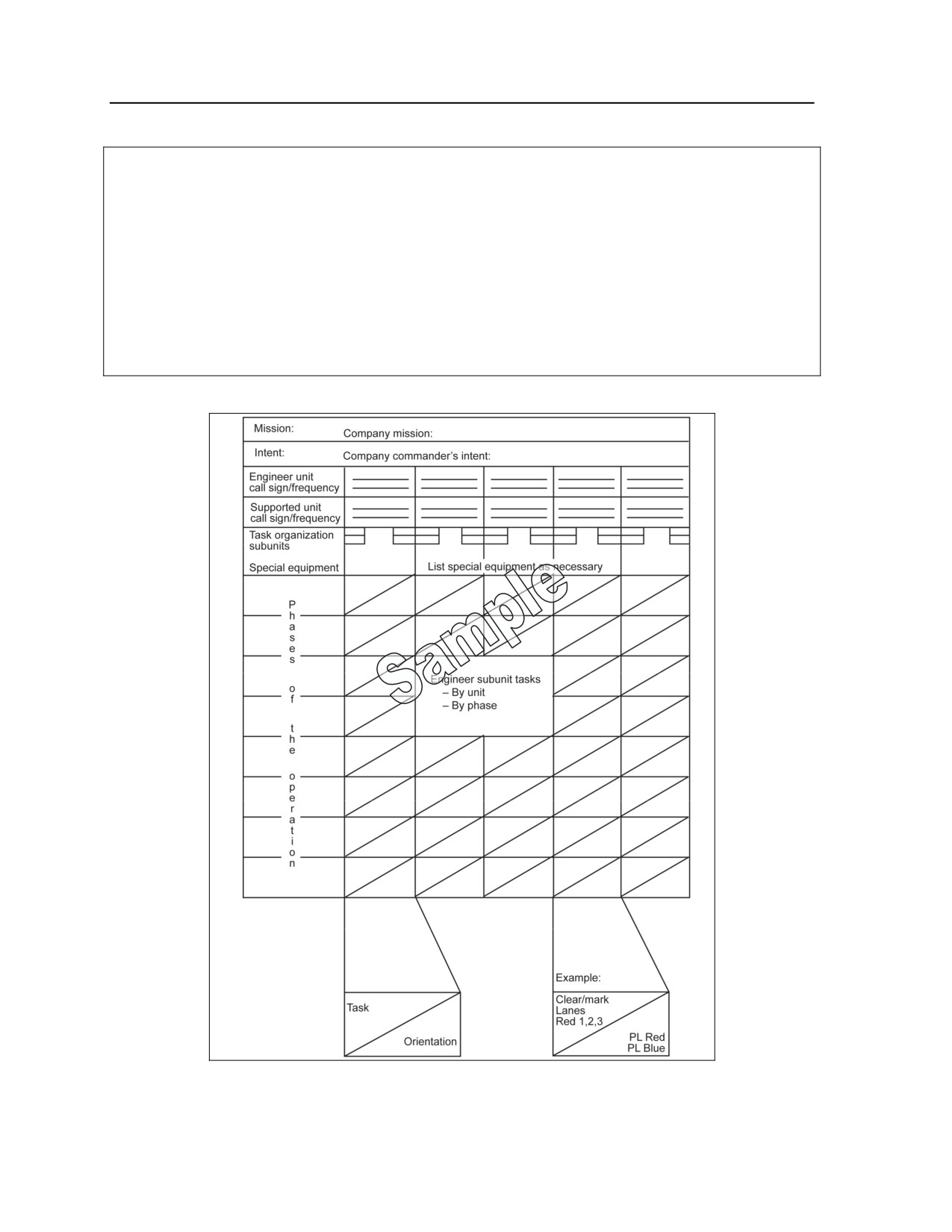
Appendix G
ANNEXES: See FM 5-0 as a guide for annexes and appendixes. Annexes may include but are not limited to—
z
Engineer execution matrix.
z
Enemy obstacle overlay or SITEMP.
z
Supported unit maneuver and sustainment graphics.
z
Directed, situational, and reserve obstacle matrixes and overlays.
z
Survivability execution matrix or timeline.
DISTRIBUTION:
[Classification]
Place the required classification at the top and bottom of every page of the OPLAN or OPORD.
Figure G-3. Engineer unit OPORD (continued)
Figure G-4. Sample engineer execution matrix
G-10
FM 3-34.22
11 February 2009
Appendix H
Urban Operations
Army forces will likely operate in an urban environment. An urban environment is
characterized by complex terrain, a concentrated population, and an infrastructure of
systems. Each urban operation is unique and differs because of the multitude of
combinations presented by the threat, the urban area itself, the major operation of
which it may be part, and the fluidity of societal and geopolitical considerations. In
other environments, commanders normally address the depth, breadth, and height of
the AO in terms of airspace and surface. In an urban environment, they broaden their
scope, including supersurface and subsurface areas that voluminously extend the AO.
Engineers can expect a higher proportion of engineer capabilities within combined
arms organizations at the lower-tactical levels, to include the task organization of
engineer assets into combined arms teams at the platoon and squad levels. UO are
planned, prepared for, and executed in the same basic fashion as any other type of
environment; however, there are special considerations for engineers operating in
urbanized terrain. (See FM 3-06 and FM 3-06.11 for more information.)
OPERATING IN AN URBAN ENVIRONMENT
H-1. UO are offense, defense, stability, and civil support operations conducted on terrain where man-
made construction and high population density are dominant features. UO in future conflicts are very likely
due to increasing world population and accelerated growth of cities. Operations in an urban environment
usually occur when the—
z
Urban area is between two natural obstacles and no bypass exists.
z
Seizure or retention of an urban area contributes to the attainment of an overall objective.
z
Urban area is in the path of a general advance and cannot be surrounded or bypassed.
z
Political or humanitarian concerns require the control of an urban area or necessitate operations
within an urban area.
z
BCT assigned objective lies within an urban area.
z
Defense from an urban area supports a more effective overall defense or cannot be avoided.
z
Occupancy of the urban area and seizure or control of key terrain is necessary to prevent the
enemy from occupying the urban area and establishing a presence, thus avoiding more difficult
operations in the future.
H-2. Understanding the potential effects of the urban environment on warfighting functions allows the
commander to better visualize the OE. The staff should be intimately familiar with the effects in their area
of expertise and use that knowledge to understand the problem and develop creative and innovative
solutions to achieve the commander’s intent. Table H-1, page H-2, shows some likely effects that the urban
environment can have on warfighting functions.
11 February 2009
FM 3-34.22
H-1

Appendix H
Table H-1. Effects of an urban environment on warfighting functions
Warfighting Function
Likely Effects of an Urban Environment
z
Urban terrain canalizes and compartmentalizes maneuvering forces.
Movement and maneuver
z
Mounted movement is restricted to roadways.
z
Cover and concealment is provided by buildings and the population.
z
More data points exist to examine during IPB.
z
Complex terrain must be analyzed.
z
Understanding the “C” in METT-TC and the effects on operations is
Intelligence
important.
z
Each urban setting presents unique threat patterns and TTPs.
z
The terrain, society, and infrastructure are dynamic and changes based
on friendly action or nonaction.
z
Challenges to target acquisition exist.
Fires
z
Increased potential for collateral damage is present.
z
Functional infrastructure, existing resource, and supportive civilians may
facilitate sustainment activities.
z
Damaged infrastructure and a hostile population may hamper
Sustainment
sustainment activities.
z
Innovative task organizations of engineer elements require an integrated
approach to sustainment.
z
Noncontiguous operations dictate a mission C2 system.
z
UO characterized by junior leaders is executed, decentralized
C2
operations.
z
Frequency-modulated communication is degraded in urban terrain.
z
UO generate a large volume of information that can overload INFOSYS.
z
Physical terrain offers increased survivability.
Protection
z
General engineers are required for high-end hardening.
z
Survivability support required for civilians (if tasked).
H-3. Army leaders follow the framework for urban operations outlined in FM 3-06. They identify the
portion of the urban area that is essential to mission success, shape the area, precisely mass the effects of
combat power to rapidly dominate the area, protect and strengthen initial gains without losing momentum,
and transition control of the area to another agency. The Army framework for urban operations provides a
means for conceptualizing the application of Army combat power and capabilities in the urban
environment. It assists commanders in visualizing urban operations; it is not a planner’s tool for phasing an
operation.
CONSIDERATIONS WITHIN THE ARMY FRAMEWORK FOR URBAN OPERATIONS
H-4. In UO, engineers view the urban environment through the five components of the framework for
urban operations (understand, shape, engage, consolidate, and transition) using the construct of the running
estimate and application of engineer considerations provided in previous chapters for offensive, defensive,
stability, and civil support operations.
Understand
H-5. Understanding requires continuous assessment (throughout planning, preparation, and execution) of
the current situation and the progress and evaluation of an operation against MOE to make decisions and
adjustments. Engineer planners use the running estimate and IPB process to assess and understand the
urban environment. They observe and learn about the urban environment
(terrain, society, and
infrastructure) and mission variables (METT-TC).
H-2
FM 3-34.22
11 February 2009
Urban Operations
Shape
H-6. Engineers help shape the AO by assuring the mobility of forces and helping to isolate objectives
(physically, electronically, and psychologically) to deny enemy sources of support and freedom of
movement. Engineers prevent an enemy unit from having contact with other enemy forces (cordon
technique) and averting isolation points that are critical to freedom of action. Engineers also provide civil-
military engineering and construction projects to influence a cooperative relationship with the civil political
system and protect portions of the civil population or critical infrastructure. This is especially true in
stability and civil support operations.
Engage
H-7. Engineers engage by applying the full range of engineer capabilities in support of friendly actions
against decisive points leading to centers of gravity. In offensive operations, engineers support strikes
against the enemy center of gravity (an enemy leader); enemy combat power; enemy communication
capability; or a physical structure of cultural, political, or economic significance. The forms of offensive
maneuver, types of offensive operations, and the engineer support and considerations of each (discussed in
chapter 6) still apply in UO. In defensive operations, engineers support efforts to deny enemy control of the
vital functions and critical infrastructure of the urban area. Engineers leverage defensive advantages of the
urban terrain in controlling the enemy direction of attack by reinforcing natural and man-made obstacles.
H-8. In stability operations, the ability to engage depends on the type of operation. Techniques used for
engagement vary according to the situation and as situations mature during long-term operations.
Engineers are postured to provide the entire range of engineer capabilities in synchronization with the
friendly concept of the operation. In civil support operations, engineers remain responsive and innovative
in applying engineer capabilities, typically in support of the lead agency.
Consolidate
H-9. Army forces protect and strengthen initial gains and ensure retention of the initiative. This includes
actions to eliminate isolated or bypassed threat forces and increase security and protect LOCs. It may
include activities in support of the civilian population, such as the restoration of key urban infrastructure. A
significant consolidation effort for engineers may be the reduction or elimination of numerous EHs within
the urban area. Consolidation follows each critical activity.
Transition
H-10. When planning UO, commanders ensure that they plan, prepare for, and manage transitions.
Transitions are movements from one phase of an operation to another or a change in responsibility from
one unit, organization, or agency to another. Transitions occur in UO frequently and are complex, often
involving agencies other than U.S. military organizations. For civil-military engineering and construction
projects, transitions and transfers of authority can result in the loss of momentum and the inability to affect
short-term objectives, due to the often lengthy lead times associated with various resourcing processes for
different types of funding sources. Master planning and the development of mid- and long-term plans and
their inclusion in budgeting cycles facilitate the short-term requirements for the organization or element
assuming control.
FUNDAMENTALS
H-11. Though UO may differ from one operation to the next, the UO fundamentals shown in figure H-1,
page H-4, are applicable regardless of the mission or level of command. These fundamentals are
particularly relevant to an environment dominated by man-made structures and a dense noncombatant
population.
(See FM 3-06 for a detailed explanation of these fundamentals.) The fundamentals of
controlling the essentials, minimizing collateral damage, preserving critical infrastructure, and restoring
essential services are particularly important to engineers.
11 February 2009
FM 3-34.22
H-3
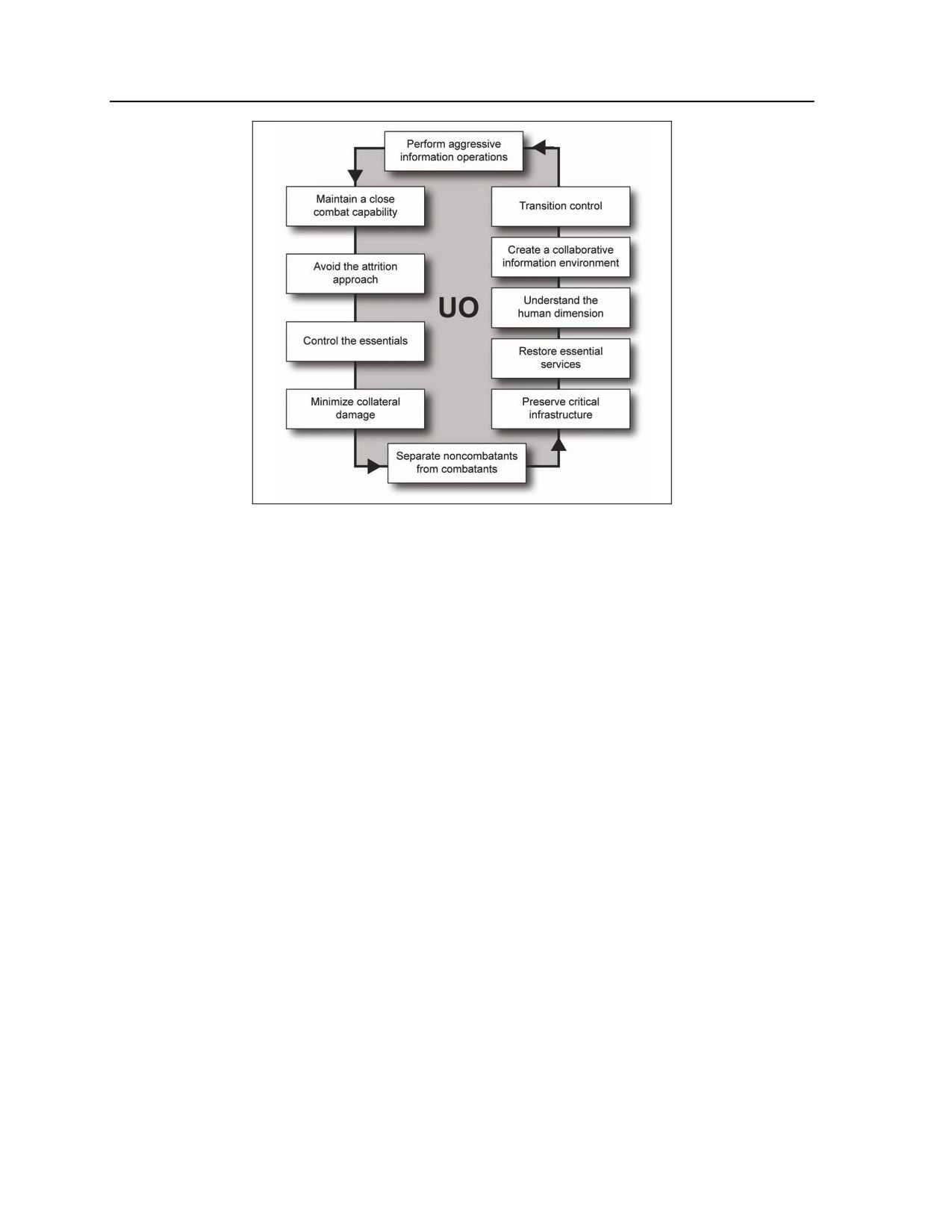
Appendix H
Figure H-1. UO fundamentals
Control the Essentials
H-12. Controlling the essentials pertains to the fact that many urban areas are too large to be effectively
controlled without an enormous force. Engineers are particularly aware of the limited availability of
engineer capabilities and rely on the determination of the essential tasks for M/CM/S to focus the
application of engineer combat power. Engineers are important contributors in helping commanders
understand key terrain from an engineer perspective, especially in determining the significance of critical
infrastructure (public works, bridges, road networks), its functional importance to the population, and its
potential impact on friendly operations.
Minimize Collateral Damage
H-13. With regards to minimizing collateral damage, engineers are keen to the often underestimated
effects of collateral damage on infrastructure, including impacts on the environment and extensive
resources inherent with the “you broke it, you fix it” ideology.
Preserve Critical Infrastructure
H-14. Preserving critical infrastructure is similar, but different than minimizing collateral damage.
Engineers aid the commander in identifying critical infrastructure so that it can be preserved and protected
from the enemy or hostile civilians. Engineer planners work together with CA and other planners in
forecasting the effort to restore essential services (power, water, sewage) that were already nonfunctional
or could be impacted during an operation.
(See FM 3-34.170 for a discussion of infrastructure
reconnaissance.)
Restore Essential Services
H-15. Engineers play an important role in restoration efforts, especially with their construction project
management capabilities and contracting mechanisms. Army forces seek to transfer responsibility for
providing essential services to other agencies, NGOs, or the local government as quickly and effectively as
possible.
H-4
FM 3-34.22
11 February 2009
Urban Operations
PLANNING FOR URBAN OPERATIONS
H-16. The complexity of the urban environment provides more data points for the IPB process to identify,
evaluate, and monitor. The human and societal aspects of the environment and the physical complexity
primarily cause this difference. Relationships between aspects of the environment, built on an immense
infrastructure of formal and informal systems connecting the population to the urban area, are usually less
familiar to analysts. Thus, the urban environment often requires more specifically focused intelligence
resources to plan, prepare for, execute, and assess operations than in other environments. No two urban
areas are alike physically (in population or infrastructure). Experiences gained in one area are not readily
transferable to another urban area. Each characteristic of the urban environment (terrain, society, and
infrastructure) is dynamic and can change in response to UO or external influences. Civilian populations
pose a special challenge to commanders conducting UO. Civilians react to, interact with, and influence (to
varying degrees) Army forces.
ENGINEER RUNNING ESTIMATE
H-17. UO are planned, prepared for, and executed in the same basic way as any other type of environment;
however, the elements of the urban environment (terrain, society, and infrastructure) and the many
variables and conditions associated with UO require special consideration. The running estimate discussed
in chapter 2 and appendix E provides the framework for planning engineer support to UO.
Terrain
H-18. The running estimate assesses the impact of terrain on both friendly and enemy engineer
capabilities. The military aspects of terrain (OAKOC) remain critical to the analysis of natural terrain in,
under, and around urban areas (see table H-2, page H-6). LOS analysis is performed to identify possible
sniper locations and observation posts. Planners use blueprints of buildings to analyze building
compositions and determine their effects on weapon and breaching systems. The urban area is viewed with
consideration to collateral damage (safety zones for unprotected civilians) and protected areas (churches,
hospitals, and cultural sites). Geospatial engineer teams can facilitate decisionmaking and staff planning
with geospatial products (3-D displays and LOS overlays). The use of special overlays (sewer, electric, and
water systems) can also aid planning.
11 February 2009
FM 3-34.22
H-5

Appendix H
Table H-2. Terrain analysis in areas using OAKOC
Component
Considerations Analysis
z
Smoke (fire), dust (explosions), and flying debris.
z
Rubble.
Observation and fields of fire
z
Engagement ranges (minimum safe distances, safety zones,
backblast factors), ricochets.
z
Elevations and depressions.
z
Mobility corridors (surface, supersurface, subsurface).
AA
z
General restriction to roadways.
z
Landmarks and buildings with cultural, social, political, historical, or
Key terrain
economic significance.
z
Rubble.
z
Civilian vehicles.
z
Inadequate bridges and overpasses (structural integrity, weight and
size restricted).
Obstacles
z
Tunnels, underpasses, roadways (overhead clearance, narrowness,
medians).
z
Mines, IEDs, and other EHs.
z
Rivers and lakes.
z
Protection provided by buildings.
z
Building composition and effects on weapon penetration.
Cover and concealment
z
Civilians.
z
Civilian vehicles.
Weather
H-19. Weather and its effects during UO are similar to other OEs. Uncontrolled ambient light of an urban
area can affect night vision capabilities. Smog inversion layers are common over cities and can affect
ground and air temperatures (thermal sighting during crossover periods), Soldier health, and visibility.
Weather effects on civilians must also be considered. For example, rain and flooding may render certain
areas unusable or may collapse sewage infrastructure, excessive snowfall can paralyze transportation
infrastructure and impede human services (fire, police, medical), and excessive heat can overload power
grids with increased usage of air conditioners.
Civil Considerations
H-20. Civil considerations take on added importance in UO. The mere presence of urban residents creates
conditions for restrictive ROE, increases stress on Soldiers and logistic capabilities, and confuses threat
identification. The six characteristics of civil considerations (see FM 6-0) are expressed in ASCOPE (see
table H-3).
H-21. It is critical to know and understand which groups live in an urban area, what relationships exist
among them, and how each population group responds to friendly and threat activities. Societal
understanding (see FM 3-06, appendix B) must go beyond a superficial awareness of gestures and taboos
to develop a thorough understanding of the organizing principles that make the urban society hold together
and function as a coherent entity (or not). Geospatial products can help graphically visualize demographic
features within an area.
H-6
FM 3-34.22
11 February 2009

Urban Operations
Table H-3. Civil considerations using ASCOPE
Component
Considerations
z
Areas defined by political boundaries (districts, municipalities).
z
Locations of government centers.
z
Social, political, religious, or criminal enclaves.
Areas
z
Agricultural and mining regions.
z
Trade routes.
z
Possible sites for temporary settlement of dislocated civilians or
other civil functions.
z
Effects of structure location, function, and capabilities on
operations.
z
Traditional HVTs (bridges, communication towers, power plants,
Structures
dams).
z
Cultural (protected) sites (churches, mosques, hospitals).
z
Military usefulness (jails, warehouses, television and radio stations,
print plants).
z
Status of essential services.
Capabilities
z
HN resources and services (interpreters, construction material and
services) that can support military operations.
z
Nonmilitary groups or institutions within the HN that can influence
the population (labor unions, service organizations, criminal
Organizations
organizations).
z
Organizations from outside the AO (UN agencies, U.S. government
agencies, NGOs) that can provide specialized capabilities.
z
Attitudes and activities of civil leaders and populations.
z
Ethnicity.
People
z
Culture.
z
Religion.
z
Needs and intentions of the people.
z
Routine, cyclical, planned, or spontaneous activities that
Events
significantly affect organizations, people, and military operations
(holidays, elections, celebrations, natural or man-made disasters).
Enemy Mission and Mobility, Countermobility, and Survivability Capabilities
H-22. The process of analyzing the enemy mission and engineering capabilities previously discussed as
part of the running estimate remains the same for UO. The major difference that requires added focus is the
impact of civilians. Distinguishing the enemy from noncombatants may be virtually impossible. The enemy
is not concerned with the ROE and is not constrained to minimize collateral damage. Each urban
environment (terrain, society, and infrastructure) presents unique challenges and opportunities.
Engineer Mission Analysis
H-23. Just as in planning for other environments, identifying the essential tasks for M/CM/S is critical to
analyzing the engineer mission in UO. An overall assessment of the engineer requirements will likely
reveal that engineers are required in higher proportions at the lower tactical level in response to the
noncontiguous and decentralized operations inherent within UO. It will also likely be discovered that
general engineering capabilities are necessary in manipulating urban terrain. General engineers will be in
greater demand in UO to improve or restore the infrastructure in supporting force bed-down requirements
and providing the necessary hardening to protect facilities and critical infrastructure.
H-24. Engineer planners must assess the restrictions on engineer capabilities imposed by the ROE and the
presence of noncombatants. Not all engineer systems can be utilized in an urban environment with the
11 February 2009
FM 3-34.22
H-7
Appendix H
emphasis on limiting collateral damage. Depending on the threat, the noncontiguous nature of UO also
requires the additional allocation of security forces to protect vulnerable general engineers conducting
operations outside secured areas. The setting also requires additional emphasis on route and area clearance
missions to enable the freedom of movement.
H-25. The urban setting provides opportunities for additional resources and services not always available
in other environments. The engineer considers the availability of HN equipment, construction materials,
fortification resources, civilian workforce assets, and civilian subject matter experts (SMEs). Materials and
resources may also come from other sources, such as NGOs. Engineer planners look at the availability of
ammonium nitrate, acetylene, propane, lumber yards, Jersey barriers, vehicles, and construction equipment
that can influence friendly defensive operations and the enemy. (See FM 3-34.170 for a discussion of
engineer reconnaissance and resource assessments.)
SPECIAL CONSIDERATIONS FOR ENGINEER LEADERS
H-26. UO provides numerous opportunities and challenges for engineers. Engineer leaders at all levels
must—
z
Identify special equipment needs for platoons and squads supporting the combined arms team.
z
Develop engineer squad UO kits (see FM 3-06.11 and FM 3-06.20) that include—
Bolt cutters, grapnels, lane-marking kits, and cutting tools.
Expedient reduction tools.
Forced-entry tools (hooligan tools, crowbars, sledgehammers).
Satchel charges (field-expedient).
Rope ladders or other lightweight, foldable ladders.
Marking material (paint, chalk, engineer tape, chemical lights).
Field-expedient and special breaching charges of common urban barriers (see FM 3-06.11).
Rifle-launched entry munitions or battering rams.
Additional light sources for operating inside buildings and subsurface structures.
z
Ensure that time is available to conduct combined arms rehearsals at the lowest level.
z
Train engineer junior leaders to enable decentralized operations (team leader level).
z
Ensure that ROEs are simple and easily understood by every Soldier.
z
Conduct demolition cross training throughout the combined arms team.
z
Share lessons learned and TTPs obtained through recent or current operations throughout the
force and training institutions (training at replacement centers, staging bases).
H-8
FM 3-34.22
11 February 2009
Source Notes
This section lists sources by page number. Where material appears in a paragraph,
both the page number and paragraph number are listed. Boldface indicates titles of
vignettes.
1-1
“My engineers can do anything. There just aren’t enough of them.” Major General Raymond Odierno,
Commander, 4th Infantry Division, Operation Iraqi Freedom.
2-1
“The instruments of battle are valuable only if one knows how to use them.” Colonel Ardant du Picq
3-1
“Know your enemy and know yourself; in a hundred battles you will never be in peril.” Sun Tzu
4-1
“Strategy is the art of making use of time and space. Space we can recover; lost time, never.”
5-1
“The clever combatant imposes his will on the enemy, but does not allow the enemy’s will to be
6-1
“The tactician determines his solution by a thorough mastery of doctrine and existing TTP, tempered
and honed by experience gained through training and operations. He uses his creativity to develop
solutions for which the enemy is neither prepared, nor able to cope.” FM 3-90 [Online]. Available:
7-1
“Dominance on the battlefield will be squandered if the United States does not have the tools to win
hearts and minds and secure lasting peace out of its military engagements.” Robert C. Orr. As quoted.
in the Whitehouse, Anthony W.,
“Enlarging the Cadre of Deployable Federal Civilians for
Stabilization and Reconstruction Operations,” 15 March 2006, U.S. Army War College [Online].
8-1
“Good logistics is combat power.” Lieutenant General William G. Pagonis, Director of Logistics, Gulf
11 February 2009
FM 3-34.22
Source Notes-1
Glossary
The glossary lists acronyms/abbreviations and terms with Army or joint definitions,
and other selected terms. Where Army and joint definitions are different, (Army)
follows the term.
SECTION I - ACRONYMS AND ABBREVIATIONS
1SG
first sergeant
3-D
three-dimensional
AA
avenue of approach
ABL
authorized basic load
AC2
airspace command and control
ACE
armored combat earthmover
ACR
armored cavalry regiment
ADA
air defense artillery
ADAM
area-denial artillery munition
AFATDS
advanced field artillery tactical data system
AFCESA
Air Force Civil Engineering Support Agency
AGM
attack guidance matrix
AHD
antihandling device
AHS
Army health system
AI
area of interest
ALO
air liaison officer
AO
area of operations
AOR
area of responsibility
AP
antipersonnel
APOE
aerial port of embarkation
AR
Army regulation
ARNG
Army National Guard
ARNGUS
Army National Guard of the United States
ASCOPE
areas, structures, capabilities, organizations, people, and events
ASP
ammunition supply point
AT
antitank
ATM
advanced trauma management
ATP
ammunition transfer point
ATT
Army tactical task
attn
attention
AVLB
armored, vehicle-launched bridge
11 February 2009
FM 3-34.22
Glossary-1
Glossary
BAE
brigade aviation element
BCS3
Battle Command Sustainment Support System
BCT
brigade combat team
BDA
battle damage assessment
BFT
Blue Force Tracker
BHL
battle handover line
BJA
brigade judge advocate
BM
benchmark
bn
battalion
BP
battle position
BSA
brigade support area
BSB
brigade support battalion
BSMC
brigade support medical company
BSTB
brigade special troops battalion
C
combat
C2
command and control
CA
civil affairs
CAB
combined arms battalion
CAC
crossing area commander
CAE
crossing area engineer
CAS
close air support
CASEVAC
casualty evacuation
CAT
civil affairs team
CAT-B
civil affairs team-bravo
CBRN
chemical, biological, radiological, and nuclear
CBRNE
chemical, biological, radiological, nuclear, and high-yield explosives
cbt
combat
CCD
camouflage, concealment, and deception
CCIR
commander’s critical information requirements
cdr
commander
CEA
captured enemy ammunition
CFZ
critical friendly zone
CIC
command information center
CID
criminal investigation division
CK
containerized kitchen
CLS
combat lifesaver
CMOC
civil-military operations center
co
company
COA
course of action
COMSEC
communications security
Glossary-2
FM 3-34.22
11 February 2009
Glossary
const
construction
CONUS
continental United States
COP
common operational picture
CP
command post
CPM
critical path method
CRM
composite risk management
CSC
crossing-site commander
CSR
controlled supply rate
CTA
common table of allowances
CTOP
common topographic operating picture
CW2
chief warrant officer two
cy
cubic yard(s)
D3A
decide, detect, deliver, and assess
DA
Department of the Army
DCG
deputy commanding general
DCGS-A
Distributed Common Ground System-Army
DCO
deputy commanding officer
DCP
detainee collection point
dd
doctrine division
DD
Department of Defense
DEA
Drug Enforcement Agency
DEUCE
Deployable, universal combat earthmover
div
division
DOD
Department of Defense
DOS
Department of State
DS
direct support
DSB
dry support bridge
DTSS-B
Digital Topographic Support System-Base
E3
private first class
E4
specialist
E5
sergeant
E6
staff sergeant
E7
sergeant first class
EA
engagement area
EAB
echelons above brigade
ECU
environmental control unit
EEFI
essential elements of friendly information
EEP
engineer equipment park
EFSP
engineer forward supply point
EH
explosive hazard
11 February 2009
FM 3-34.22
Glossary-3