FM 3-34.22 ENGINEER OPERATIONS—BRIGADE COMBAT TEAM AND BELOW (February 2009) - page 3
Engineer Support to Combat Operations
6-57. The maneuver unit may use supporting forces or follow-and-support forces to widen the penetration
and improve the breach lanes. The ENCOORD must understand the commander’s intent to ensure that
forces have enough engineer support. When a follow-and-support force is employed, it assumes the
responsibility for widening the POP and improving the lanes. This may require a smaller, more centralized
engineer organization to accomplish that task.
Countermobility
6-58. Depending on the enemy situation, countermobility may quickly become the priority of effort to help
defeat counterattacks against lodgment. Follow-and-support forces are normally used to secure lodgment
and defeat counterattacks. Therefore, engineers must—
z
Anticipate the size of the counterattack force.
z
Analyze likely AAs.
z
Allocate the countermobility assets needed to disrupt or fix counterattack forces.
6-59. Engineer planners must design obstacle belts that permit the use of tactical and situational obstacles.
Normally, these obstacle belts are developed and passed to the battalions for planning, but are only active
on the order of the brigade commander. Forces securing lodgment require flexible, responsive obstacle
capabilities, such as SCATMINEs
(Volcanos, Gators, Modular-Pack Mine Systems
[MOPMs]) and
intelligent munitions.
Exploitation
6-60. Once the objective is secured, the engineer priority shifts to assisting the force in exploiting its
success by ensuring the mobility of the exploiting subordinate units. To facilitate the exploitation, the
ENCOORD must ensure that the scheme of engineer operations allows for rapid development of a lane
network within the penetration. The lane network must support the uninterrupted forward passage of the
reserve to subsequent objectives and the flow of sustainment to forces in the penetration. Once the force
has passed through the lanes, responsibility is passed to outside forces to improve and maintain the lane
network.
INFILTRATION
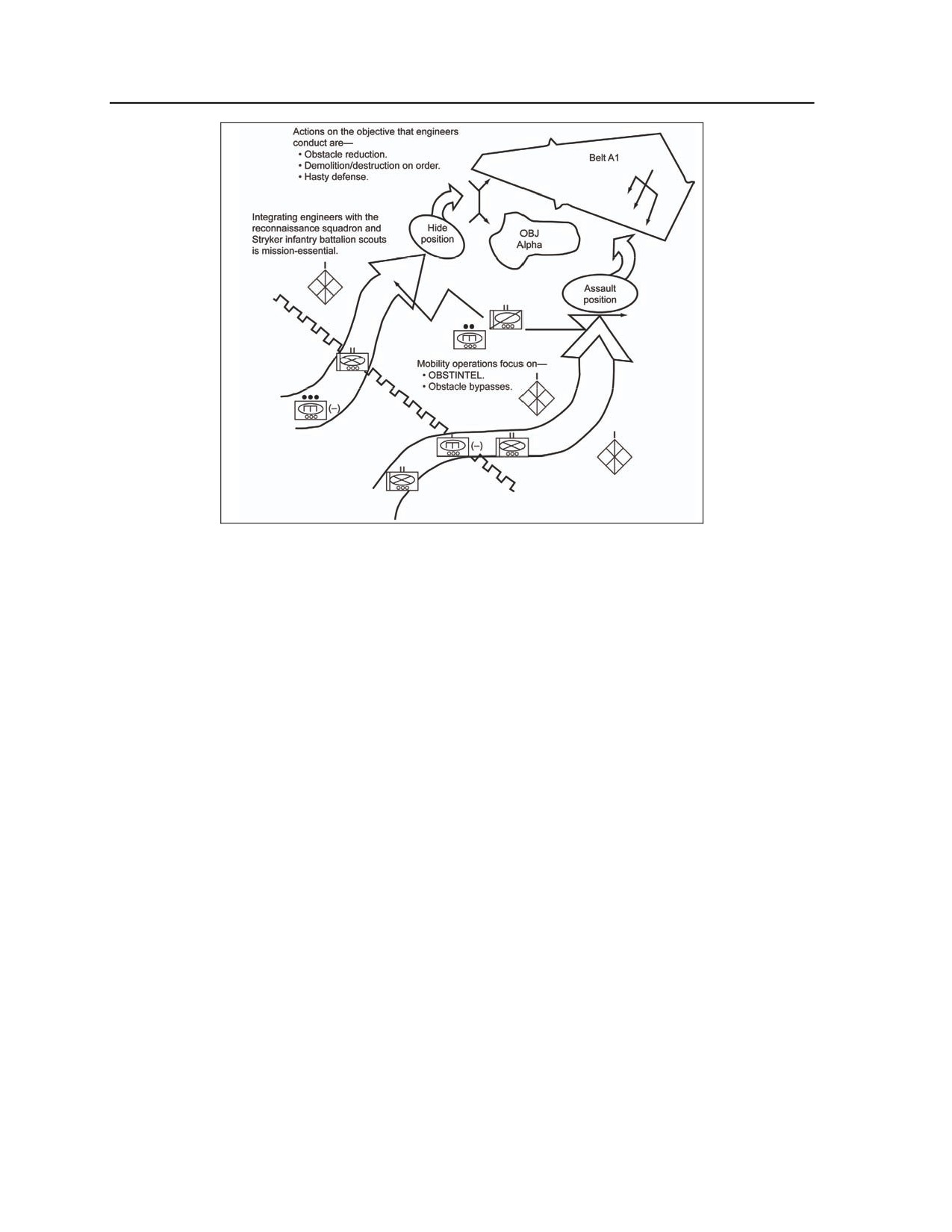
6-61. Infiltration (see figure 6-6, page 6-14) is a form of maneuver where the attacking force conducts
covert movement through or into an area occupied by enemy forces. This is done to occupy a position of
advantage in the enemy rear, while exposing only small elements to enemy defensive fires. This form of
maneuver is the preferred form of infantry maneuver because it permits a smaller force (not larger than a
battalion) to use stealth and surprise to attack a larger or fortified force. Infiltrations are normally carried
out on foot or by air, but they can be executed by selected vehicles or watercraft. Infiltration is most
feasible in the following instances:
z
During limited visibility.
z
Over rough terrain.
z
Through areas unoccupied by the enemy.
z
With dismounted elements.
z
Through areas not covered by enemy observation and fire.
11 February 2009
FM 3-34.22
6-13
Chapter 6
Figure 6-6. Example of an infiltration
Intelligence Preparation of the Battlefield
6-62. Infiltrations require extensive reconnaissance to be successful. This reconnaissance includes—
z
Identifying the enemy disposition across the area to be infiltrated.
z
Identifying infiltration lanes.
z
Locating assault positions for the attacking force.
z
Identifying enemy weaknesses.
z
Observing enemy activity.
6-63. Engineer reconnaissance assists the commander in determining the method of infiltration, the task
organization, and the size of the infiltrating units. OBSTINTEL is critical. Reconnaissance is also vital in
determining actual routes and whether single or multiple infiltration lanes are used. Successful engineer
support to an infiltration is predicated by careful, detailed terrain analysis by the ENCOORD and engineer
unit commanders.
6-64. Existing gaps in the enemy defensive system and the locations of enemy security elements must be
identified. Natural obstacles and predicted enemy obstacles must also be considered. Engineers infiltrating
with the RS and battalion scouts verify, report (OBSTINTEL), mark, and (as required) reduce obstacles
along the infiltration lanes.
6-65. The ENCOORD develops IR for inclusion in the S-2 collection plan. In addition to the IR developed
in support of the infiltration itself, others are identified specifically at the objective area
(especially
OBSTINTEL). ERTs may be identified to support selected reconnaissance requirements. Examples of IR
include the—
z
Location, type, density, and employment method of obstacles in and around the objective.
z
Recommended location for the POP.
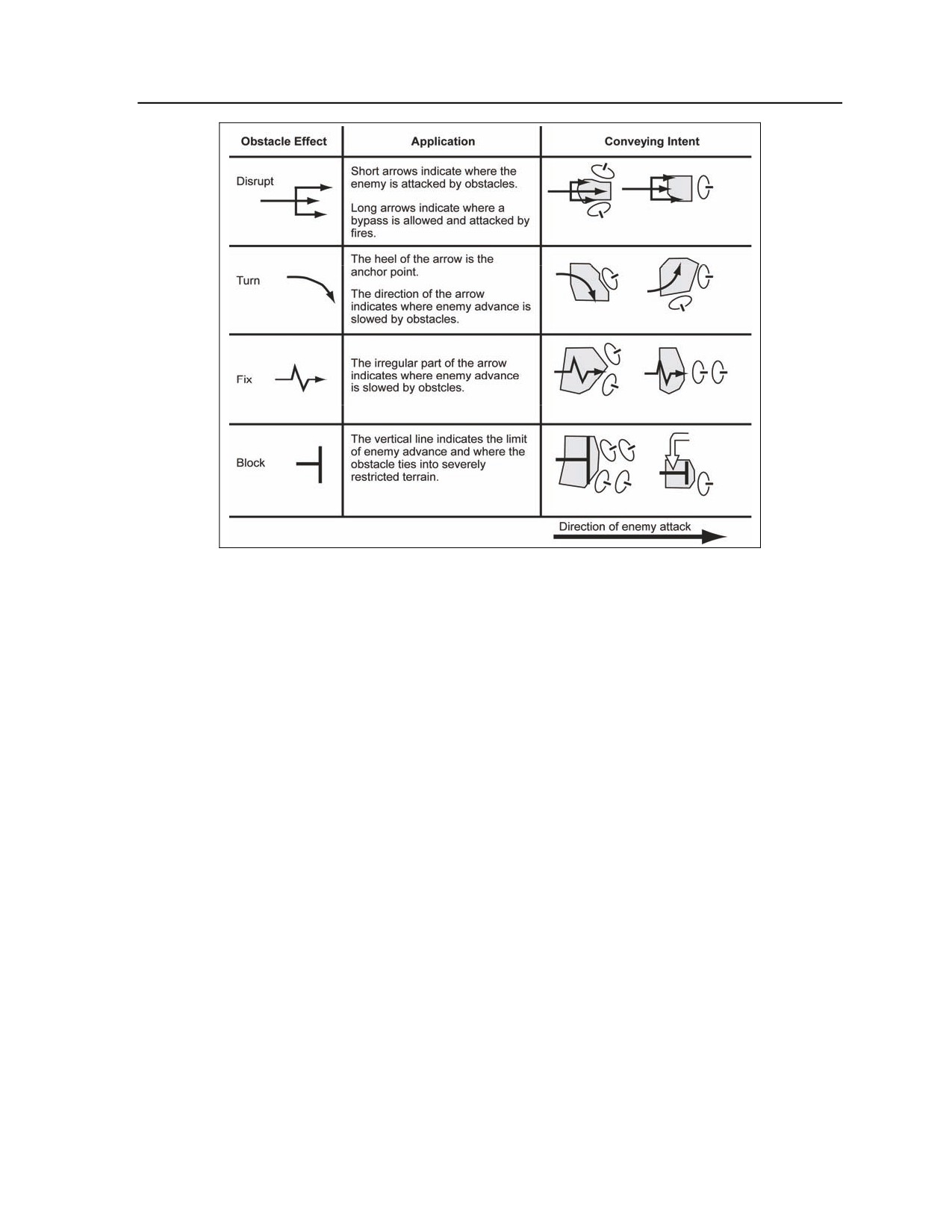
z
Potential breach lanes for attacking units and the level of survivability of the enemy forces on
the objective.
6-14
FM 3-34.22
11 February 2009
Engineer Support to Combat Operations
z
Possible enemy counterattack routes in support of the objective.
z
Critical infrastructure that needs protection.
Mobility
6-66. Mobility is the main focus of engineer units during an infiltration, with priority of support to the
main effort along the infiltration lane. Due to the decentralized nature of the maneuver, providing task-
organized engineer support to each infiltrating unit may not be feasible. Maneuver units must be trained
and capable of executing the mobility operations anticipated on infiltration lanes. The requirement for
dedicated support during the infiltration is minimized through the following:
z
Detailed predictive analysis by staff planners, represented on an enemy situational template
(SITEMP).
z
Accurate and timely intelligence updates provided by engineers working with scouts during
reconnaissance.
z
Detailed combined arms rehearsals.
Actions on the Objective
6-67. To provide adequate support to maneuver battalions and the RS during actions on the objective,
detailed engineer planning at the brigade centers on war-gaming likely contingencies and transitions.
Engineers may be task-organized to one or more maneuver battalions or the RS in a command relationship
during the infiltration and for subsequent actions on the objective. This ensures the maneuver commander’s
flexibility to further task-organize engineers and establish absolute control during breaching operations that
follow actions on the objective. Subsequent, on-order missions (defense) may dictate a change in the task
organization of engineer units. They may need to change from a command relationship to a support
relationship with maneuver battalions or the RS. This is done to speed up the response of engineer units
and ensure responsive sustainment support.
Sustainment
6-68. Infiltrations often require clearing extended MSRs from the LD to the attacking force. MSRs become
particularly vital when the objective is secured and the attacking force requires support (Class V resupply,
ground medical evacuation [MEDEVAC], barrier materials, engineer equipment, or situational-obstacle
material) for a hasty defense. The infiltrating force bypasses obstacles and focuses on those enemy forces
that may interdict high-speed AAs and MSRs. Therefore, the clearance of MSRs commonly resembles
small-scale linkup operations and is planned and resourced accordingly. Breaching operations are common
during MSR clearance. The BCT may need to rely on EAB engineer augmentation assets to provide the
assets necessary to execute them.
DEFENSIVE OPERATIONS
6-69. Defensive operations are a prelude to the offense. Defense plans should not be designed simply to
resist enemy attack. Rather, they should aim at reverting to the offense and decisively defeating the enemy.
Defensive operations defeat an enemy attack, buy time, economize forces, or develop conditions favorable
for offensive operations. Engineer focus is on attacking the enemy’s ability to influence operating areas
(countermobility through combined arms obstacle integration) and on assuring mobility for friendly
repositioning or counterattacking forces.
6-70. Planning for defensive operations is inextricably linked to offensive operations, and for planning
purposes, must consider the transition from offensive operations to follow-on offensive operations. Many
planning considerations for the offense also apply to the defense. The engineer running estimate provides
the framework for synchronizing and integrating engineer support into defensive operations. (See chapter 2
for more planning considerations for defensive operations.)
11 February 2009
FM 3-34.22
6-15

Chapter 6
CHARACTERISTICS
6-71. The defending force arrives first on the battlefield and, with the help of engineers, shapes the OE to
its advantage. Based on the higher-commander’s intent, maneuver commanders and their fire support
officer (FSO) and engineer support site tactical obstacles to enhance the effects of direct and indirect fires
on the enemy. Engineers provide technical expertise and advice to the commander on tactical obstacle
emplacement. Fortifications allow fires from positions that best disrupt and destroy the attacker. Because of
defending-force survivability, the defender can postpone the commitment of major forces until the attack
develops and then strike the extended enemy over selected, prepared terrain.
6-72. Engineers provide essential combat engineering support to the defense. With this support, the force
can position itself and fight from terrain where it otherwise could not survive. EAB engineer augmentation
is typically required to support the intensive requirements for engineer support in the defense.
6-73. Preparation, security, disruption, massed effects, and flexibility characterize successful defensive
operations. The mission of the ENCOORD and engineer commanders is to plan and execute engineer
missions that enhance the maneuver unit’s ability to combine fires, obstacles, and maneuver to destroy an
attacking enemy. Developing an effective defensive plan requires the use of sequential planning and an
understanding of defensive characteristics. (See table 6-1 for enhanced-technology impacts.)
Table 6-1. Enhanced-technology impacts to defensive characteristics
Defensive Characteristic
Impacts
z Enhanced, decentralized integration and execution
z Automated tracking and planning of engineer requirements
z Enhanced terrain visualization to identify survivability and obstacle
Preparation
requirements
z Improved ability to conduct parallel planning and warfighting function
integration
z Enhanced SA of the OE
z Simultaneous coordination and synchronization of the defense
Security
z Sensor munitions that disrupt enemy attacks, protect flanks, and protect
otherwise undefended portions of the AO
Disruption
z Rapid obstacle emplacement capability to attack an enemy forward of EAs
z Enhanced INFOSYS and intelligence that facilitate C2 and the
Massed effects
concentration of forces, obstacles, and fires
z Rapid adjustment and simultaneous dissemination of engineer plans
through digital FRAGOs, updated graphics, and situation updates
Flexibility
z Facilitated C2 and task organizing for transition to the offense
z Increased flexibility with improved sensors and munitions
Preparation
6-74. Preparation of the defense includes planning and plan refinement, positioning of forces, constructing
obstacles and fighting positions, preparing other survivability requirements, planning and synchronizing
fires, positioning logistics, and conducting inspections and rehearsals.
(See FM 90-7 for detailed
information on obstacle planning and resourcing and FM 5-103 for information on preparing fighting and
protective positions.)
6-75. To prepare for the defense, the commander must be familiar with the capabilities and limitations of
the enemy. The terrain must be analyzed in detail from all perspectives and then verified from the ground.
The commander then organizes the defense with a mixture of direct- and indirect-fire weapons (directed at
the enemy main threat). Capabilities of these weapons are enhanced by the terrain.
6-76. Engineers play an essential role in preparing the defense. Based on the commander’s intent,
engineers emplace tactical obstacles to produce specific effects on the enemy. They also construct
survivability positions that allow the maneuver unit to sustain the fight and protect critical C2 nodes.
6-16
FM 3-34.22
11 February 2009
Engineer Support to Combat Operations
6-77. Engineer success in the preparation phase depends on the ability of the ENCOORD to conduct
integrated planning with the combined arms staff. The ENCOORD must identify the full range of engineer
requirements in support of decisive and shaping operations, understand the capabilities of engineers and
equipment on the battlefield, and determine the resources (manpower, equipment, and material) required
and available to meet the demand. As described in FM 90-7 (to be revised as FM 3-34.13), obstacle
control, intent, and resourcing are top-down driven (initiated by the higher headquarters), whereas the
process of integrating the actual obstacle location with fires is bottom-up driven
(initiated by the
subordinate or emplacing unit).
6-78. Engineer focus in the preparation phase is not limited to close combat in the MBA. Each element of
the defensive framework must be considered during engineer mission analysis and accounted for in the
scheme of engineer operations.
6-79. A critical planning piece during defensive operations is EA development. (The results of the
engineer running estimate described in chapter 2 and appendix E support the steps of EA development.)
The following seven steps represent a way to build an EA:
z
Step 1. Identify likely enemy AAs. Engineers analyze the terrain, weather, civil considerations,
and enemy M/CM/S capabilities and estimate their effects on mobility. Engineers integrate
geospatial products into tactical decision aids (such as the MCOO) to help commanders and staff
visualize important aspects of the terrain to support planning and decisionmaking.
z
Step 2. Determine the likely enemy concept of operations. Engineers analyze the enemy
mission and M/CM/S capabilities to determine and create a template of enemy engineer
activities.
z
Step 3. Determine where to kill the enemy. Geospatial products (such as line-of-sight [LOS]
overlays) help commanders and staff design EAs.
z
Step 4. Plan and integrate obstacles. The combined arms integration of fires and tactical
obstacles is crucial to achieving success in the defense. Obstacles are integrated into the defense
based on the terrain, obstacle intent (target, location, and obstacle effects), and fires. Methods
for employing situational obstacles and their associated triggers are coordinated and
synchronized. Obstacle emplacement begins after the final determination is made on the location
of friendly weapon systems and fire control measures. Engineers mark obstacles and lanes to
prevent fratricide. (See FM 90-7 for detailed information on obstacle coordination and obstacle-
siting procedures.)
z
Step 5. Emplace weapons systems (includes preparation of fighting positions). Geospatial
products can display the suitability of areas for preparing fighting positions based on LOS and
the soil or ground conditions. Engineers incorporate priorities for survivability and manage
survivability tasks using execution matrices and timelines based on the commander’s intent.
(FM 5-103 provides information on preparing fighting positions.)
z
Step 6. Plan and integrate indirect fires. Engineers ensure that obstacles are included in the
FS plan and coordinate for situational obstacles, lane closure, and breached-obstacle repair.
Engineers coordinate to ensure that the FS plan is refined based on the actual location and
orientation of emplaced obstacles.
z
Step 7. Rehearse the execution of operations in the EA. Engineers emplacing obstacles and
constructing survivability positions rehearse contact actions and movement to assembly areas or
the occupation of fighting positions when defense preparation is complete. Engineers supporting
security, counterattack, and reserve forces conduct combined arms breaching rehearsals and
precombat checks on breaching systems.
Note. Although listed sequentially, Steps 4, 5, and 6 should be performed concurrently.
11 February 2009
FM 3-34.22
6-17
Chapter 6
Security
6-80. The security of the force is provided principally through deception and physical means. In the
defense, the friendly unit deceives the enemy by concealing its strengths and weaknesses. Normally, a
security force positioned between the enemy and the main body secures the main body. The purpose of this
measure is to provide early warning and disrupt or delay the enemy attack. Engineers task-organized with
the RS or the security forces operating under the control of the RS focus on providing situational obstacles
and sensors with the intent of disrupting or delaying the enemy attack and providing early warning.
Disruption
6-81. Commanders use all available means to disrupt enemy forces. They disrupt attackers and isolate
them from mutual support to defeat them in detail. Disruption in the defense is achieved by—
z
Defeating or misleading enemy reconnaissance forces.
z
Impeding enemy maneuver.
z
Disrupting enemy reserves.
z
Neutralizing enemy FS.
z
Interrupting enemy C2.
z
Engaging enemy lead elements and affecting their rate of advance.
6-82. Disruption counters enemy initiative and prevents it from concentrating combat power against a
single part of the defense. The general goal of disruption is to—
z
Force the enemy to fight in more than one direction.
z
Keep the enemy under direct and indirect fires.
z
Prevent enemy penetrations.
6-83. The method a commander chooses to achieve disruption varies with the situation, but the ultimate
goal is to spoil the attacker’s coordination. The ENCOORD and engineer commanders work closely with
BCT and maneuver battalion staffs to ensure that combat engineering (M/CM/S) functions are integrated
into disruption activities, leveraging the capabilities of geospatial engineering to optimize their effects.
Enemy reconnaissance efforts and probing attacks must be defeated without disclosing the defensive
scheme of maneuver. Tactical obstacles are designed and emplaced to disrupt enemy formations and cause
the enemy to move into desired EAs. This prevents the enemy from effectively concentrating mass against
any portion of the defense.
Massed Effects
6-84. In the defense, the commander masses effects to exploit or create an enemy weakness. This is
achieved by designating the main effort with all other efforts and actions supporting and sustaining this
effort. To mass effects during the battle, the maneuver unit may—
z
Economize in some areas.
z
Retain a reserve.
z
Maneuver repeatedly.
z
Alter the terrain in the AO.
6-85. Engineers support the massing of effects by employing obstacles, constructing fortifications, and
providing mobility to counterattack or reserve forces. The principal role of the engineer in massing effects
is to ensure that tactical obstacles are integrated with defender fires to disrupt, turn, fix, or block enemy
forces and create effective EAs where the maneuver commander intends to kill the enemy. These efforts,
combined with fortifications (augmentation required) and protective obstacles, enhance the defense. The
defending force must be able to direct its actions at the enemy from a survivable position. (See figure 6-7
for obstacle effects.)
6-18
FM 3-34.22
11 February 2009
Engineer Support to Combat Operations
Figure 6-7. Obstacle effects
Flexibility
6-86. The commander maintains flexibility through—
z
Detailed planning.
z
Sound preparation.
z
In-depth task organization.
z
Reserve forces.
z
Continuous reconnaissance.
z
C2.
6-87. Ultimately, flexibility requires that the commander visualize the AO to determine the enemy scheme
of maneuver in adequate time to integrate the effects of fires and maneuver against it. Commanders must
be able to counterattack and employ reserve forces at any time. Engineers assist in maintaining flexibility
by—
z
Using situational obstacles.
z
Task-organizing for rapid transition to the offense.
z
Providing necessary mobility and countermobility support to reserve and counterattacking
forces.
z
Improving or maintaining routes needed to reposition forces within the defense.
TYPES
6-88. The three types of defensive operations are mobile defense, area defense, and retrograde operations.
The three types are significantly different and must be dealt with differently during planning and execution.
(See FM 3-90, FM 3-90.5, and FM 3-90.6 for more detailed information.)
11 February 2009
FM 3-34.22
6-19
Chapter 6
Mobile Defense
6-89. Mobile defense focuses on defeating or destroying the enemy by allowing advancement to a point
where it is exposed to a decisive counterattack by the striking force. Mobile defense uses a combination of
offensive, defensive, and delaying actions. It is characterized by relatively small, fixing forces forward and
the use of maneuver supported by obstacles to take the initiative. Mobile defense requires a large striking
force with mobility equal to or greater than that of the enemy to counterattack and defeat the enemy force.
6-90. Engineer support to a mobile defense focuses on using obstacles to attack enemy maneuver and
providing mobility to the striking force and reserve. Most countermobility and survivability assets support
the fixing force, while most mobility assets support the striking force. Obstacle zone planning received
from the division and obstacle belt planning at the brigade level are directed at the most likely enemy COA
rather than the terrain. Belts are aimed at enemy maneuver in the brigade AO to support its destruction by
counterattack. Therefore, obstacle belt planning is more restrictive to assure the mobility of the striking
force. Situational obstacles are advantageous in the mobile defense by allowing the commander to exploit
enemy vulnerabilities, exploit success, separate follow-on forces, and provide flank protection.
6-91. The survivability effort is uniquely tailored in a force-oriented defense. To create the conditions for a
counterattack, battalions may need to fight throughout the depth of their AO using multiple primary and
subsequent BPs. Protective obstacle effort may occur at any point within the mobile defense, though
minimal protective-obstacle effort may be required forward as the defense is geared toward a proactive
fight. The protective-obstacle effort and, typically, the supporting fighting-position effort are concentrated
where enemy penetration must be stopped to allow the counterattack to take place. Obstacle control
measures ensure that battalion obstacle efforts do not affect strike force ability to maneuver.
Area Defense
6-92. Area defense denies enemy access to specific terrain for a specific time. It is organized to absorb the
enemy into an interlocked-series of positions from which it can be destroyed. Area defense differs from
mobile defense in that most defending forces are committed to defending positions while the rest is kept in
reserve. To accomplish this, forces use a combination of defensive positions and small mobile reserves.
Commanders organize the defense around the static framework provided by defensive positions, seeking to
destroy enemy forces with interlocking fires or local counterattacks that are focused on EAs.
6-93. The commander organizes an area defense by designating his MBA and assigning AOs, BPs, or both
to subordinate units located within the MBA. He also creates a security area in front of the MBA. In
planning an area defense, the commander can organize a defense in depth or a forward defense based on
where defensible terrain is within assigned AO (terrain characteristics), the chosen enemy COA estimate,
and the other METT-TC factors. (See FM 3-90, FM 3-90.5, and FM 3-90.6 for more information.)
6-94. A defense in depth is the preferred option when the tactical conditions allow. It limits the enemy’s
ability to exploit a penetration through additional defensive positions employed in-depth. Alternate and
supplementary positions, combat outposts, and mutually supporting strong points forward of the perimeter
extend the depth.
6-95. The intent of a forward defense is to prevent enemy penetration of the defense. Due to its inherent
lack of depth, the forward defense is the least preferred option. Commanders use a forward defense, when
directed, to retain forward terrain or when the terrain (strong natural obstacles) favors a defense in that part
of the AO.
6-96. The focus of the engineer effort is on providing the maneuver commander with the ability to hold
terrain while enabling maneuver units to concentrate fires from static positions. During area defense,
engineer involvement in terrain analysis is vital. Engineers help identify key and decisive terrain that
supports the commander’s concept of the operation, with a focus on where the commander wants to kill the
enemy. During obstacle planning, obstacle control measures are designed to give maximum flexibility to
subordinate units, while focusing the tactical obstacle effort on terrain retention. The ENCOORD must
advise the maneuver commander of the resource requirements of each subordinate unit based on its
assigned essential tasks for M/CM/S and must coordinate through the appropriate channels to ensure that
the units are resourced accordingly.
6-20
FM 3-34.22
11 February 2009
Engineer Support to Combat Operations
6-97. The survivability effort in area defense must—
z
Enhance the ability of the force to accurately concentrate fires from static positions into
designated EAs.
z
Provide the force with an increased level of protection from the sustained effects of enemy fires.
z
Deceive the enemy as to the exact location of the defense.
6-98. If the construction and implementation of EAs are successful, the enemy is forced to conduct
assaults on the defensive positions in an effort to suppress or defeat maneuver force concentrated fires into
the EAs. Survivability positions and protective obstacles must provide necessary protection for maneuver
forces to continue engaging the enemy successfully from primary or alternate positions. Effective
defensive positions and mobile reserves are key components for a successful area defense.
6-99. The ENCOORD enables each of these through proper planning and preparation. The ENCOORD
must also understand the tactical-obstacle effort of subordinate units and coordinate their effort to ensure
that they are mutually supporting. The ENCOORD tracks preparation by monitoring subordinate unit status
reports and specific progress on obstacle emplacement and survivability timelines, anticipating and
resolving problems that may occur.
Retrograde Operations
6-100. A retrograde operation is an organized, orderly movement of forces away from the enemy. The
basic types of retrograde operations are delay, withdrawal, and retirement. All three are usually combined
in simultaneous or sequential action. For example, a battalion TF may conduct a delay to facilitate the
withdrawal or retirement of the remaining elements of the brigade. The basic types are—
z
Delay. A force that is under pressure trades space for time. The intent is to—
Slow the enemy.
Cause enemy casualties.
Stop the enemy (where possible) without becoming decisively engaged.
Note. A delaying force accomplishes this by defending, disengaging, moving, and defending
again. The concept of the operation for a delay frequently requires offensive operations
(counterattacks and spoiling attacks) on the part of the delaying force. (See FM 3-90 for more
information.)
z
Withdrawal. A withdrawal allows a unit to disengage from the enemy and reposition for some
other mission. The mission may be to delay the enemy, defend another position, or attack at
another place and time. The following are the two types of withdrawals:
Under pressure. A unit disengages and moves to the rear while in contact with the enemy.
Not under pressure. A unit disengages and moves to the rear while the enemy is not
attacking.
z
Retirement. The force moves to the rear in an organized manner and is not in contact with the
enemy. Tactical movement techniques and foot and vehicular road marches are employed. A
retirement may follow a withdrawal or begin before contact is made with the enemy.
6-101. Mobility and countermobility operations are normally the focus of engineer support to retrograde
operations. The actual priority of effort depends on whether or not the unit is in contact with the enemy.
The underlying purpose of engineer support to retrograde operations is twofold. The steps are as follows:
z
Step 1. The mobility of the force must be maintained, regardless of the type of retrograde
operation being conducted. Mobility operations focus on maintaining the ability of the force in
contact to disengage while preserving the main body’s freedom of maneuver.
z
Step 2. The force must be protected because they are particularly vulnerable to enemy actions
during retrograde operations. Consequently, retrograde operations are normally conducted under
limited-visibility conditions. Engineers support units left in contact and extend the time available
to the commander by reducing enemy mobility through obstacles, fires, and terrain optimization.
11 February 2009
FM 3-34.22
6-21
Chapter 6
6-102. Engineer involvement in combined arms planning for a retrograde operation is critical. The level
of detail developed by the staff and the ENCOORD affects resourcing, task organization, and execution.
Because of the tempo required during the operation, all contingencies must be addressed, war-gamed,
prioritized, and resourced before execution. The tactical situation does not normally facilitate any
significant changes to a plan once the operation is underway. Engineer involvement is of special
importance during the IPB process. Input into the MCOO highlights the terrain effects on the attacking
enemy. Once determined, this product of the terrain analysis impacts the—
z
Obstacle positions.
z
Required lane locations.
z
Decision point positions (to cause lane closure or the execution of situational and reserve
obstacles).
z
Counterattack planning.
6-103. The ENCOORD coordinates with the S-2 on engineer-specific IR. The IR are aimed at facilitating
and maximizing the efforts of engineers supporting units conducting the counterreconnaissance fight and
retrograde operation. Considerations include predicting enemy reconnaissance efforts on the SITEMP and
main-body attack routes into the AO. These considerations aid in planning and executing obstacle belts and
groups that support the retrograde operation.
6-104. The identification of routes that the force uses is vital to all retrograde operations. Mobility must
be maintained along these routes. While conducting terrain analysis during the IPB process, the
ENCOORD works closely with the S-2 to determine feasible routes. Once this planning is complete, the
routes are coordinated with the S-3 and the commander to determine which routes are required to meet
operational requirements. With these routes identified, route reconnaissance can be conducted to verify
their trafficability and suitability for the force. Information gained on the reconnaissance is critical during
COA development and analysis. Route selection also affects countermobility planning and execution. Once
the routes are finalized, engineer unit commanders ensure that they are upgraded and maintained as
directed. LOC maintenance typically requires EAB augmentation. Lanes through friendly obstacles must
be established and marked. Every Soldier in the unit must clearly understand the unit lane-marking system.
Guides are frequently left at obstacle lane locations to ensure safe passage. Because of the critical nature of
the mission, commanders must assume the responsibility of providing guides if the mission variables allow.
6-105. A major component in countermobility planning and execution during a retrograde operation is the
synchronization of the warfighting functions. Countermobility missions can only be executed with a clear
understanding of the commander’s intent and concept of the operation. Situational obstacles are a key
combat multiplier to the commander. Situational obstacles, like other engineer operations in retrograde
operations, are normally centrally controlled.
6-106. The maneuver unit may only have limited assets to use for survivability, given the critical
requirements for mobility and countermobility. The survivability that is provided typically focuses on
supporting the protection of key C2 and other critical systems. Selected fighting positions may also be
developed to support key EAs supporting the retrograde. Existing fighting positions that support the
scheme of maneuver of the withdrawal may also be used, but most survivability depends on the effective
use of terrain and other measures (CCD).
6-107. C2 of lane closure is vital to retrograde operations. Normally, lane closure is centrally planned and
executed by the BCT to ensure that mission execution conforms to the commander’s intent and the scheme
of maneuver. Frequently, obstacles identified for closing lanes become brigade reserve obstacles. Lane
closure depends on—
z
Enemy and friendly activities.
z
Level of contact.
z
Size of the force left in contact.
z
Engineer forces available.
z
Time available.
6-22
FM 3-34.22
11 February 2009
Engineer Support to Combat Operations
6-108. Lane closure parties (engineers if the mission variables allow) close lanes upon notification from
the commander to whom execution authority was delegated (the maneuver force over watching the
obstacle). Synchronization is critical to prevent the trapping of friendly forces between the obstacle and the
enemy. Target turnover becomes important when reserve targets are prepared by engineers and turned over
to maneuver units for execution. Target turnover and its execution must be detailed so that the receiving
unit (platoon or squad leader) can execute the mission according to the brigade commander’s intent. All
lane closure operations must be rehearsed. (See FM 90-7.)
6-109. If aviation augmentation is available to support the rapid repositioning of units and to attack
enemy forces, engineers may need to conduct FACE operations and obstacle emplacement. Detailed
planning between aviation units and the ENCOORD is critical to synchronizing this effort.
6-110. Deception operations target the enemy’s ability to be decisive and prevent the concentration of
combat power against friendly force weakness. The ENCOORD coordinates with the S-2 and S-3 during
initial planning to determine what battlefield deception assets are available. For example, a mobile gun
system (MGS) or tank silhouette that is partially dug-in may cause the enemy to think the friendly force is
defending a retrograde operation instead of conducting one. In addition to shaping the battlefield,
countermobility operations can also deceive the enemy as to what mission the unit is actually conducting.
For example, using engineer equipment forward gives the appearance of preparing for a hasty defense
while covering the withdrawal of a force. Battlefield deception is part of CCD. (See FM 20-3.)
6-111. Even though the unit is conducting a retrograde operation, some engineer assets and supplies may
be moving forward. Other equipment may require specialized support. The ENCOORD is responsible for
resolving these issues. This is accomplished by coordinating with the S-3 or S-4 on the following:
z
Transportation support for selected engineer equipment found in EAB units that require
assistance due to their slow speed. To meet this requirement, transportation assets may have to
come from higher headquarters and be pre-positioned to support this movement.
z
Movement of engineer Class V supplies and the specific locations required for delivery. Some
Class V supplies may need to be positioned forward to facilitate the execution of lane closure.
z
Fuel requirements of engineer equipment, factored into the decision on the quantity of fuel that
remains forward.
TECHNIQUES
6-112. Maneuver units usually defend using one or more defense techniques. The five basic techniques
are—
z
Defend an AO. This provides the greatest degree of freedom for subordinates to plan fires,
maneuver, and obstacles. When the BCT assigns a defense in the AO to subordinate battalions,
the ENCOORD provides obstacle control measures that are commensurate with the battalion
AO and provide maximum latitude for subordinate engineer planners. The BCT ENCOORD
must ensure that subordinate obstacle plans are mutually supporting of flank units and tied in
along common boundaries.
z
Defend a BP. This reduces the instructions needed to move a force. A BP is normally associated
with an assigned EA or a specific enemy AA. The commander must look two levels down when
assigning BPs to ensure adequate space for primary, supplementary, and alternate positions of
key weapons.
z
Defend a reverse slope. The commander organizes a reverse-slope defense on the portion of a
terrain feature or slope with a topographical crest that masks the main defensive positions from
enemy observation and direct fire. It is generally useful at lower tactical levels (battalion and
below). The goal is to make the enemy commit his forces against the forward slope of the
defense, resulting in an uncoordinated attack across the exposed crest. The topographical crest
normally marks the far edge of the EA. Engineers are challenged in shaping the battlefield with
obstacles that can be covered by fire. Some of the best locations for obstacles may only be
covered from positions on the forward slope.
11 February 2009
FM 3-34.22
6-23
Chapter 6
z
Defend a strong point. A strong point is a heavily-fortified BP that must be tied to a natural or
reinforcing obstacle. It requires significant engineer effort, roughly requiring a one-day effort
from an engineer unit the same size as the unit defending the strongpoint.
z
Defend a perimeter. A perimeter defense is a defense oriented in all directions used by a unit
for self-protection or to protect other units located within the perimeter. The commander can
employ the perimeter defense as an option when conducting an area or mobile defense. A
successful perimeter defense relies on aggressive patrolling and security operations. Engineers
employ tactical obstacles (including the integration of hasty protective obstacles) in support of
the established perimeter. (Similar engineer considerations are discussed in chapter 4 in support
of an area security mission.)
Note. See FM 3-90, FM 3-90.5, and FM 3-90.6 for more information.
URBAN AREAS AND COMPLEX TERRAIN CONSIDERATIONS
6-113. Offensive and defensive operations may be conducted in urban areas, jungles, forests,
mountainous areas, deserts, extremely hot areas, and arctic and cold regions. Each environment presents its
own challenges to planning and conducting engineer operations and may require engineers to employ
specialized knowledge, skills, techniques, and equipment. The following paragraphs present characteristics
of five special environments that impact engineer operations. They are intended only as an overview of
those environments. For additional information, see FM 3-34.170 and FM 5-103. Each has sections on
urban areas and complex terrain that are focused on reconnaissance and survivability, respectively.
URBAN AREAS
6-114. Engineers are enabled and challenged when operating in urban areas. When forces are required to
operate in urban areas, significant engineer augmentation is likely required. Engineers provide unique
geospatial products for the complex terrain of cities (3-D terrain and subterranean visualization products).
Assured mobility is an important framework for maneuver commanders to consider in determining how to
shape and dominate in urban terrain. Considerations for minimizing collateral damage during the reduction
of EHs (IEDs and UXOs) are especially important in an urban setting. General engineering tasks are
prevalent throughout all operations, especially during the transition to stability or civil support operations.
(See appendix H, FM 3-06, and FM 3-06.11, for additional information on operations in urban terrain. FM
3-06 provides a new framework (understand, shape, engage, consolidate, and transition) for visualizing
UO.)
JUNGLES AND FORESTS
6-115. Jungles are humid, tropic areas with a dense growth of trees and vegetation. Visibility is typically
less than 100 feet, and areas are sparsely populated. Mounted infantry and armor operations are limited in
jungle areas, and jungle vegetation provides excellent concealment from air and ground observation.
Vegetation does not provide adequate cover from small-caliber weapons, direct fire, artillery, or indirect
fire fragments. Adequate cover is available using the natural ravines and gullies produced by erosion from
the high annual rainfall of the area. Few natural or locally procured materials are available in jungle areas.
Other considerations that often require aboveground protective construction are high water tables, dense
undergrowth, and tree roots. (For more information on operations in this special environment, see FM 90-
5.)
MOUNTAINOUS AREAS
6-116. Characteristics of mountain ranges include rugged and poorly trafficable terrain, steep slopes, and
altitudes greater than
1,600 feet. Irregular mountain terrain provides numerous places for cover and
concealment. Because of rocky ground, it is difficult and often impossible to dig belowground positions;
therefore, boulders and loose rocks are used in aboveground construction. Construction materials used for
6-24
FM 3-34.22
11 February 2009
Engineer Support to Combat Operations
both structural and shielding components are most often indigenous rocks, boulders, and rocky soil. Often,
rock formations are used as structural-wall components without modification. Conventional tools are
inadequate for preparing individual and crew-served weapons fighting positions in rocky terrain. Engineers
assist with light equipment and tools (pneumatic jackhammers) delivered to mountain areas by helicopter.
Explosives and demolitions are used extensively for positions requiring rock and boulder removal. (FM 3-
97.6 and FM 3-97.61 provide detailed information on mountain operations.)
DESERTS AND EXTREMELY HOT AREAS
6-117. Deserts are extensive, arid, treeless environments that suffer from a severe lack of rainfall and
possess extreme daily temperature fluctuations. The terrain is sandy with boulder-strewn areas, mountains,
dunes, deeply eroded valleys, areas of rock and shale, and salt marshes. Effective natural barriers are found
in steep-slope rock formations. Wadis and other dried up drainage features are used extensively for
protective position placement. Camouflage, concealment, light, and noise disciplines are important
considerations in desert terrain. Target acquisition and observation are relatively easy in desert terrain.
(FM 90-3 provides detailed information on the considerations associated with desert operations.)
ARCTIC AND COLD REGIONS
6-118. Cold regions of the world are characterized by deep snow, permafrost, seasonally frozen ground,
frozen lakes and rivers, glaciers, and long periods of extremely cold temperatures. Digging in frozen or
semifrozen ground is difficult with equipment and virtually impossible for a Soldier with an entrenching
tool. Construction fighting and protective position in snow or frozen ground takes up to twice as long as
positions in unfrozen ground. Operations in cold regions are affected by wind and the possibility of thaw
during warming periods. An unexpected thaw causes a severe drop in the soil strength, which creates mud
and drainage problems. Positions near bodies of water must be carefully located to prevent flood damage
during the spring melting season. Wind protection greatly decreases the effects of cold on Soldiers and
equipment. (FM 31-70 provides detailed information on the considerations associated with arctic and cold
region operations.)
FOCUSED SUPPORT TO OTHER UNITS WITHIN AND
AUGMENTING THE BRIGADE COMBAT TEAM
6-119. Engineers provide focused and specific support to various units within and augmenting the BCT.
Much of the following discussion has to do with the hardening aspects of survivability (see FM 5-103) and
the requirement for engineer support to properly protect vital equipment and personnel. Another significant
aspect may be engineer reconnaissance (see FM 3-34.170). Most often, organic engineers are focused on
and dedicated to the tactical mission in support of maneuver units within the BCT. Many of the tasks are
performed by augmenting engineer units, although combat engineers organic to the BCT may also perform
them.
ARTILLERY
6-120. Most engineer missions in support to FA units and assets are through survivability operations.
Artillery units often require engineer support to construct survivability positions for individual howitzers,
fire direction centers (FDCs), and radars. These survivability positions are built to protect Soldiers and
equipment from the effects of direct and indirect fires.
6-121. Q36 and Q37 radars are used by artillery units to facilitate counterfire missions. These are
valuable assets to the BCT commander and often a high priority for protection. Most often, berms are used
around radars to protect them from enemy fires. These radars are HVTs for enemy forces and have no
armor or self-protection capability. During operations, engineer planners must consider survivability for
these assets.
11 February 2009
FM 3-34.22
6-25
Chapter 6
AIR DEFENSE ARTILLERY
6-122. Engineer support to ADA units and assets is focused on hardening and other survivability tasks.
ADA assets may include radars used to detect incoming aircraft or tactical ballistic missiles. These radars
and firing systems may require the construction of berms to protect them from enemy action. Though the
BCT does not have any organic ADA units, it can expect to be routinely augmented with ADA capabilities.
The BCT can also expect to have corps- and division-controlled ADA assets positioned with the BCT AO,
which may require survivability effort from the BCT task-organized engineer force.
6-123. In heavily wooded or jungle terrain, ADA units may require engineers to clear fields of fire to
facilitate missile launch or direct-fire engagements by avengers. Augmenting engineer equipment and
capabilities may be required to meet these tasks. When static, these weapon systems may require
survivability positions that protect Soldiers and the system, but also allow the full use of the air defense
components of the vehicle.
AVIATION
6-124. Engineer support to aviation units and assets focuses on FACE tasks. These tasks can often be met
by organic BCT engineers, but most likely require augmenting engineers for many of the general
engineering tasks. (See FM 3-34.2 for details on FACE operations.)
6-125. Organic engineers within the BCT can quickly berm temporary aviation revetments to protect
aircraft from the effects of enemy fires. When aircraft parking areas become more permanent, general
engineering support is required to emplace HESCO Bastion Concertainers®. These HESCO Bastion
Concertainers provide proper survivability and protection to aircraft.
(See FM 5-103 for details on
constructing aircraft revetments.)
6-126. Combat engineers may support aviation units in the use of forward arming and refueling points
(FARPs) during combat operations. Organic engineers can provide some support, but augmenting
engineers bring capabilities not found in the organic engineer companies. FARPs may require survivability
support most often by berming. This berming may include the aircraft and ammunition or fuel being stored
nearby. Locations chosen to establish a FARP may require preparation (clearing and grubbing). The
armored combat earthmover (ACE) and deployable, universal combat earthmover (DEUCE) can do many
of these tasks, but bulldozers are better-suited for heavy vegetation. It may also be necessary for engineers
to construct small trenches in which to place fuel hoses. This prevents damage to the hoses by vehicular
traffic.
6-127. Organic combat engineers can provide clearing and leveling for launch and recovery sites for the
tactical unmanned aerial system
(UAS) found at the BCT level and below. General engineering
augmentation is required to support operational-level UAS which are larger and require an airstrip for
takeoff and landing. If paving is required, engineer planners must ensure coordination for paving and
concrete augmentation.
MILITARY POLICE
6-128. Engineer support to military police units and assets within the BCT include the potential
requirement to support the construction of temporary and permanent detainment facilities. These facilities
may range in size, based on special requirements and the tactical situation. Combat engineers can assist in
the construction of temporary facilities using concertina and other barrier materials. Temporary facilities
may require sustainment and improvement, and permanent facilities require support from augmenting
engineer vertical and horizontal construction units. When a permanent facility is constructed, power
generation support from prime power units may also be required.
6-129. Military police and HN police headquarters may require survivability support. Combat engineers
can provide lower-end hardening of facilities by constructing berms or emplacing HESCO Bastion
Concertainers. More permanent hardening requires augmentation by construction units.
6-26
FM 3-34.22
11 February 2009
Engineer Support to Combat Operations
6-130. Military police may also require support when constructing vehicle checkpoints and traffic control
posts (TCPs). Engineer planners coordinate with planners from the PM cell for this and similar types of
support. (See FM 5-103.)
MILITARY INTELLIGENCE
6-131. Engineer support to military intelligence (MI) units may include engineer reconnaissance assets
and survivability support for specific intelligence sites and assets (UAS launch and recovery sites). Tactical
UAS found at the BCT level and below require smaller, less advanced launch and recovery sites to conduct
operations. Organic engineers may be required to assist detachments in clearing and preparing launch and
recovery areas. This includes clearing vegetation and leveling sites to meet UAS detachment needs, most
of which can be done by an ACE or DEUCE. Larger UAS found at the operational level of command may
require extensive engineer augmentation support, such as an airstrip (some UASs under Air Force control
actually require a paved runway. When supporting these units in the BCT AO, augmentation by general
engineering units is required to construct and maintain runways. If paving is necessary, engineer planners
must ensure coordination for paving and concrete detachment augmentation.
CHEMICAL, BIOLOGICAL, RADIOLOGICAL, AND NUCLEAR
6-132. Engineer support to CBRN units and assets may be extensive if the BCT faces a significant CBRN
threat. When CBRN decontamination is required, organic engineer companies may be tasked to assist in
the construction of decontamination sites. Most often, engineer support includes digging sumps and
drainage ditches to control wastewater runoff associated with decontamination. Engineers may also be
tasked to construct combat roads and trails to improve access to the site. Engineer units coordinate with
decontamination units to construct the decontamination site and ensure that site standards are met. For
large-scale decontamination operations, general engineering units may be required to meet the demands.
SIGNAL
6-133. Engineering support to signal units consist primarily of geospatial and survivability support.
Terrain visualization products help signal planners plot communication coverage. Survivability support is
aimed at protecting critical signal sites and assets.
CIVIL AFFAIRS
6-134. Engineer support to CA units and assets may be significant and linked to the CA plan (see chapter
7). (See FM 3-34.170 and FM 3-34.400 for additional, in-depth discussion of infrastructure reconnaissance
and its relationship to CA operations.)
SUPPORTING SUSTAINMENT OPERATIONS
6-135. Engineer support to sustainment within the BCT typically requires significant engineer effort to
facilitate operations. Most often, these tasks require general engineering units to augment the BCT.
Engineer planners must be constantly aware of the necessary requirements of supporting sustainment
operations, and the engineer assets providing this support typically come from EAB engineer
organizations. The following paragraphs are intended as a reminder to engineer planners of sustainment
considerations when conducting the engineer running estimate and developing orders. (See FM 3-34.400
for information on general engineering construction support that may be conducted in support of
sustainment operations in general.)
Heliports
6-136. One or more LZs or heliports may be required to support operations. When operating in austere
environments, rotary-wing aircraft are used for transport, MEDEVAC, and resupply. The brigade support
medical company (BSMC) of the brigade support battalion (BSB) requires an LZ close to its Role 2
medical treatment facility (MTF) to facilitate medical evacuation by air ambulance. Engineers can utilize
geotextile materials or dust-inhibiting fluids to reduce the effects of erosion and dust.
11 February 2009
FM 3-34.22
6-27
Chapter 6
Airfields
6-137. The BSB may position on or near airfields capable of landing larger, fixed-wing aircraft. Airfield
maintenance and construction may be required to continue air operations from the brigade support area
(BSA). General engineering units are required to accomplish these tasks.
Supply Routes
6-138. The use of dedicated supply routes is critical for the sustainment of the BCT. Engineer units may
be required to repair and maintain MSRs to ensure mobility for sustainment elements. These requirements
are typically large-scale tasks and require general engineering units to meet the demand. Depending on the
condition of supply routes, it may be necessary to have multiple engineer units supporting this operation.
When multiple engineer units are employed, it becomes necessary for an engineer headquarters to oversee
these operations and provide the necessary C2. Engineer planners should consider augmentation by an
engineer battalion (or even a brigade) when supporting significant MSR requirements. Bridging support
may be required to continue uninterrupted sustainment along MSRs.
Ammunition Supply Points
6-139. Ammunition supply points (ASPs) within the BCT require berming or trenching to protect
resources. Large trenches may be constructed where ammunition can be stored and protected. These
trenches and berms also mitigate the effects of blast if they receive an enemy direct hit.
Fuel Sites
6-140. Locations where bulk fuel is stored must be protected. In recent operations, fuel sites have been
high-priority targets for enemy attack.
Survivability
6-141. The headquarters of most units supporting sustainment have limited protection and require
survivability support. Initially, organic engineer units may be able to provide limited berming and emplace
HESCO Bastion Concertainers for protection, but maneuver tasks most likely take precedence. General
engineering organizations augmenting the BCT are best-suited to support the BSB and the BCT
sustainment area. Sustainment area units may require vertical and horizontal construction support,
especially as the sustainment area becomes more permanent.
POWER GENERATION
6-142. The augmentation of power generation support may be necessary, especially if the BCT is
responsible for the construction or maintenance of a base camp or FOB. Prime power teams are uniquely
designed to provide this support, especially if the nature of the base camp or FOB includes multiple
collocated sustainment units. General engineering is required to facilitate and assist in the creation of a
power distribution system.
PIONEERING
6-143. Combat and general engineering units have the ability to construct a variety of lifting devices and
other enablers through the use of their pioneering skills. This includes the construction of gin poles, shears,
timber trestle bridges, ramps, and other devices that assist with lifting and loading heavy objects. These are
especially useful in maintenance areas where forklifts and cranes may be under intensive use or other
bridging is not available or appropriate.
(See FM 5-34 for details on constructing these and other
supporting items and capabilities.)
6-28
FM 3-34.22
11 February 2009
Chapter 7
Stability and Civil Support Operations
Dominance on the battlefield will be squandered if the United States does not have the tools to win
hearts and minds and secure lasting peace out of its military engagements.
—Robert C. Orr
Full spectrum operations include stability operations as a part of joint campaigns and
civil support operations as a part of HLS. Stability and civil support operations have
become more important and an acknowledged part of full spectrum operations due to
events across the globe and recent major disasters within the United States. The
ENCOORD and engineer company commander must have a fundamental
understanding of the missions and special engineer requirements associated with
stability and civil support operations. The planning effort for both operations requires
the same degree of planning for offensive and defensive operations. The same
fundamental processes and procedures discussed in previous chapters for planning,
integrating, and controlling engineer operations in support of combat operations
apply to stability and civil support operations. This chapter provides an overview of
stability and civil support operations and some of the associated engineer tasks and
special considerations for each. (See FM 3-0, FM 3-07, FM 3-34, FM 3-90.5, and FM
3-90.6 for more detailed information.)
STABILITY OPERATIONS
7-1. Stability operations are part of full spectrum operations. They are intended to promote and protect
U.S. interests by influencing threat, political, and information dimensions of the OE through a combination
of peacetime developmental, cooperative, and coercive actions in response to a crisis. The focus for most
stability operations is on sustaining the outcome achieved from combat operations to prevent the threat or
the conditions for a threat to return and realize strategic results. (See FM 3-0 for more information.)
7-2. In recent years, Army forces have conducted stability operations more frequently than any other kind
of operation. Stability operations are inherently complex and place great demands on small-unit leadership.
From an engineer perspective, the range of potential requirements and mission roles can be very broad.
Junior leaders are required to develop skills associated with noncombat and nation-building issues while
maintaining essential warfighting skills. Capable, trained, disciplined, and high-quality leaders, Soldiers,
and teams are essential to the success of stability operations. Soldiers and units at every level must be
flexible and adaptive. Stability operations often require the mental and physical agility and capability to
shift from noncombat to combat operations and back again. Engineers have always been required to plan
for the transition between offensive and defensive operations and the phases of an operation.
7-3. Stability operations demonstrate U.S. resolve through the commitment of time, resources, and forces
to establish and reinforce diplomatic and military ties. As stated in FM 3-0, the purpose of stability
operations includes—
z
Providing a secure environment. By providing security and assisting the local authorities with
controlling civilians, Army forces begin the process of separating adversaries from the general
population. Physical isolation is complemented by operations that persuade the population to
support an acceptable, legitimate government, isolating the adversaries politically and
economically.
11 February 2009
FM 3-34.22
7-1
Chapter 7
z
Securing land areas. Effective stability operations help secure land areas by developing HN
capabilities. Areas of population unrest often divert forces that are urgently needed elsewhere.
z
Meeting the critical needs of the population. Stability operations are often required to meet
the critical needs of the population. Army forces can provide essential services until the HN
government or other agency can do so.
z
Gaining support for the HN government. All stability operations ultimately depend on the
legitimacy of the HN government and its acceptance by the population as the governing body.
All stability operations are conducted with that aim.
z
Shaping the environment for interagency and HN success. This is achieved by providing the
security and control necessary for the HN and interagency elements to function.
7-4.
Army forces perform the following five primary stability tasks:
z
Civil security. Civil security includes protecting the population from external and internal
threats.
z
Civil control. Civil control includes regulating the behavior and activity of individuals and
groups. Control limits population activity to allow security and essential services. A curfew is an
example of civil control.
z
Essential services. Essential services include emergency lifesaving medical care, veterinary
services, epidemic disease prevention, food and water provisions, emergency shelter provisions,
and basic sanitation provisions (sewage and garbage disposal). This is an area that typically
receives significant engineer focus.
z
Governance support. Governance support is the provision of societal control functions that
include the regulation of public activity, rule of law, taxation, security maintenance, control and
essential services, and normalizing means of succession of power.
z
Economic infrastructure development support. Economic and infrastructure development
support is direct and indirect military assistance to local, regional, and national entities to
provide an indigenous capacity and capability for continued economic and infrastructure
development.
BRIGADE COMBAT TEAM
7-5. While the BCT is designed for combined arms combat, it also participates in stability operations.
When conducting combat operations, the BCT may be required to rapidly shift its focus to stability
operations. The ability of Army forces to stabilize a crisis is not limited to their ability to attack and defend.
The very presence of a BCT may help promote a secure environment in which diplomatic and economic
programs designed to eliminate root causes of instability may flourish. The BCT and other Army forces
can establish and maintain a credible presence as long as necessary to achieve desired results. As with
combat operations, all three engineer functions (them) apply to stability operations.
7-6. The BCT performs many familiar core tactical missions and tasks during stability operations.
Stability operations typically differ from other operations (offense and defense) in the—
z
Purpose of operations.
z
Special constraints placed on commanders and Soldiers.
z
Level of interaction with OGAs and NGOs.
z
Unique missions and tasks conducted.
7-7. These operations follow and focus on broad imperatives that help guide commanders in execution.
These imperatives are—
z
Protecting the force.
z
Conducting active information operations.
z
Maximizing joint, interagency, and multinational cooperation.
z
Presenting the clear ability to apply force without threatening its use.
z
Applying force as precisely and selectively as possible.
7-2
FM 3-34.22
11 February 2009
Stability and Civil Support Operations
z
Understanding the potential for grave consequences originating from Soldier and small-unit
actions.
z
Acting decisively to prevent the escalation of violence.
ENGINEERS
7-8. In stability operations, most engineer effort is focused on theater infrastructure repair and restoration
to reconstruct or establish services that support the population. Given the nature of stability operations, the
risks associated with environmental hazards may have a greater importance and impact in stability
operations than in offensive or defensive operations. Stability operations tend to be long compared to
offensive, defensive, and civil support operations. As such, the level of engineer effort is very high at the
onset and gradually decreases as the theater matures and support requirements transfer to civilian
contractors, such as those who operate under the logistics civilian augmentation program (LOGCAP).
7-9. Within the BCT, the missions performed by organic and augmenting engineer forces in stability
operations are linked directly to the BCT mission and responsibility. While combat engineer route
clearance and other close support capabilities may be critical tasks applied through the movement and
maneuver warfighting function, a larger portion of engineer requirements within the BCT AO are likely
met with general engineering and other specialized engineer capabilities. The BCT ENCOORD must be
prepared to coordinate the simultaneous execution of these engineer capabilities throughout the depth of
the BCT AO and in synchronization with warfighting functions. When the required engineer augmentation
is unavailable to the BCT, the ENCOORD must rely on contracted engineering support, reachback, or
collaborative planning with another engineer element for the necessary technical support to enhance BCT
organic engineer capabilities. (The integration of engineer operations into stability operations is discussed
later in this chapter.)
7-10. In analyzing engineer requirements in stability operations and determining BCT essential tasks for
M/CM/S, the ENCOORD considers the following factors:
z
Terrain in the AO.
z
Type of obstacles in the AO.
z
Engineer assets and available capabilities.
z
Operation duration.
z
Water supply and location.
z
Sewage and garbage facilities.
z
Local power facilities.
z
Firefighting capability.
z
Base support requirements.
z
Demining center issues.
z
Basic country infrastructure
(road, bridge, rail, airfield, port capability) and contracted
engineering support.
TYPES
7-11. Stability operations typically fall into ten broad types that are neither discrete nor mutually exclusive.
For example, a force engaged in a peace operation may also find itself conducting arms control or a show
of force to set the conditions for achieving an end state. This section provides an introductory discussion of
the types of stability operations. (For more detailed information, see FM 3-0 and FM 3-07.)
7-12. The ten types of stability operations are—
z
Peace operations.
Peacekeeping.
Peace building.
11 February 2009
FM 3-34.22
7-3
Chapter 7
Peacemaking.
Peace enforcement.
Conflict prevention.
z
Foreign internal defense.
z
Security assistance.
z
Humanitarian and civic assistance.
z
Support to insurgencies.
z
Support to counterdrug operations.
z
Combating terrorism.
Antiterrorism.
Counterterrorism.
z
Noncombatant evacuations.
z
Arms control.
z
Show of force.
Peace Operations
7-13. Peace operations are the broadest type of stability operations. Peace operations support strategic and
policy objectives and the diplomatic activities that implement them. They are performed unilaterally or as
part of a United Nations (UN), North Atlantic Treaty Organization (NATO), or multinational force. Army
forces conduct the following types of peace operations:
z
Peacekeeping.
z
Peace building.
z
Peacemaking.
z
Peace enforcement.
z
Conflict prevention.
Peacekeeping
7-14. Peacekeeping operations are military operations undertaken to a dispute with the consent of all major
parties. They are designed to monitor and facilitate the implementation of an agreement (cease-fire, truce)
and support diplomatic efforts to reach a long-term political settlement (see JP 3-07.3). In peacekeeping
operations, the BCT must use all capabilities, short of coercive force, to gain and maintain the initiative.
The BCT may be assigned a variety of missions designed to monitor peace and stability and to improve the
humanitarian environment. The following are examples of peacekeeping missions:
z
Deter violent acts at critical locations.
z
Conduct liaison with disputing parties.
z
Verify the storage or destruction of military equipment.
z
Verify disarmament and demobilization of selected disputing forces.
z
Negotiate and mediate.
z
Investigate alleged cease-fire violations, boundary incidents, and complaints.
z
Collect information about the disputing forces, using all available assets.
z
Contend with ambiguous, tense, or violent situations without becoming a participant, in
compliance with the ROE, rules of interaction (ROI), and preparatory training.
z
Provide security for enemy prisoner of war (EPW) exchanges.
z
Supervise disengagements and withdrawals.
z
Assist civil authorities.
z
Support local elections.
z
Provide relief to refugees and internally displaced persons.
z
Restore emergency and basic infrastructure functions.
z
Transition to peace enforcement or combat operations.
7-4
FM 3-34.22
11 February 2009
Stability and Civil Support Operations
Note. The BCT must train the force to ensure that they have the ability to respond to a
contingency plan requiring an increase in the use of force.
7-15. During peacekeeping operations, engineer forces (organic or augmenting the BCT) may be used for
many missions. Engineers participate as part of a combined arms force conducting combat engineering
tasks. They may also conduct a broad range of general engineering tasks. High-frequency engineer
missions related to peacekeeping may include—
z
Constructing CPs, bunkers, and OPs.
z
Constructing protection structures (earth revetments, wire obstacles, defensive positions).
z
Clearing fields of observation.
z
Demolishing fortifications.
z
Establishing a mine action center or explosive hazards coordination cell (EHCC).
z
Clearing or marking minefields (and maintains minefield fences).
z
Clearing mines and booby traps, but not demining.
z
Providing backup support for identifying, marking, removing, and destroying explosive
ordnance.
z
Constructing and maintaining roads.
z
Emplacing bridges.
z
Repairing or upgrading airfields and LZs.
z
Constructing and maintaining internment/resettlement facilities.
z
Providing base camp construction and power generation.
z
Providing emergency restoration of critical public services and facilities.
z
Providing infrastructure reconnaissance, technical assistance, and damage assessment.
z
Providing temporary bridge construction.
7-16. The removal of mines by engineers during peacekeeping operations is based on tactical necessity.
Humanitarian mine action (HMA) organizations provide the preponderance of mine clearance, but it is
ultimately an HN responsibility. U.S. Army participation in HMA focuses on training HN personnel to
conduct all aspects of HMA (demining training, the establishment of national mine action centers, mine
risk education). U.S. military personnel may assist and train others in demining techniques and procedures,
but are prohibited by federal statute from detecting, lifting, or destroying land mines unless done for the
concurrent purpose of supporting a U.S. military operation. HMA training missions are normally
conducted by special operations forces (SOF) and assisted by EOD. SOF and EOD serve as primary
trainers for demining and UXO clearance operations. CA personnel help establish national mine action
centers, and PSYOP personnel provide mine risk education. CA teams, PSYOP teams, and other specialists
are further trained to execute HMA programs.
Peace Building
7-17. Typical peace-building activities include restoring civil authority, rebuilding physical infrastructures,
providing structures and training for schools and hospitals, and helping to reestablish commerce. Peace
building provides the reconstruction and societal rehabilitation in the aftermath of conflict that offers hope
to the HN population. When executing peace-building operations, BCT efforts should complement those of
nonmilitary agencies and local governments. (See FM 3-07 and JP 3-07.3 for more information on support
to peace-building operations.)
Peacemaking
7-18. Peacemaking is primarily a diplomatic process aimed at establishing a cease-fire or an otherwise
peaceful settlement of a conflict. The BCT may support peacemaking by performing military-to-military
relations, exercises, peacetime deployments, and security assistance. (See FM 3-07 and JP 3-07.3 for more
information on peacemaking support.)
11 February 2009
FM 3-34.22
7-5
Chapter 7
Peace Enforcement
7-19. Peace enforcement operations apply military force or the threat of its use, normally pursuant to
international authorization, to compel compliance with resolutions or sanctions designed to maintain or
restore peace and order. Peace enforcement operations are generally coercive in nature and rely on the
threat or use of force. The impartiality with which the peace force treats all parties and the nature of its
objectives separate peace enforcement from war. The purpose of peace enforcement is not to destroy or
defeat an enemy, but to use force or the threat of force to establish a safe and secure environment for peace
building to succeed.
7-20. In peace enforcement operations, the BCT may use force to coerce hostile factions into ceasing and
desisting violent actions. These factions usually have not consented to intervention and may be engaged in
combat activities. The nature of peace enforcement operations dictates that Army forces assigned a peace
enforcement mission must be capable of conducting combat operations. The BCT conducting a peace
enforcement operation must be ready to fight to achieve—
z
Forcible separation of belligerents.
z
Establishment and supervision of protected areas.
z
Sanction and exclusion zone enforcement.
z
Movement denial and guarantee.
z
Restoration and maintenance of order.
z
Protection of humanitarian assistance operations.
z
Relief to refugees and internally displaced persons.
z
Support for the return of refugee operations.
7-21. Engineer support to the BCT in peace enforcement operations includes the engineer missions
previously mentioned for peacekeeping operations; however, in peace enforcement operations, there is an
increased likelihood of close combat and the resulting combat engineering tasks. Engineers may also
participate in disarming (seizing ammunition, collecting and destroying weapons and supplies, closing
weapons and ammunition factories, and preventing resupply).
Conflict Prevention
7-22. Conflict prevention is primarily diplomatic actions taken in advance of a crisis to prevent or limit
violence, deter parties, and reach an agreement short of conflict. Military activities are tailored to meet the
political demands and may require deploying forces to contain a dispute or prevent it from escalating into
hostilities. (See JP 3-07.3 for more information on conflict prevention.)
Foreign Internal Defense
7-23. Foreign internal defense (FID) is a program that supports friendly nations operating in or threatened
with potential hostilities. It promotes regional stability by supporting a HN program of internal defense and
development. These national programs free and protect a nation from lawlessness, subversion, and
insurgency by emphasizing the building of viable institutions that respond to society needs. FID can
include direct or indirect support and combat operations. Direct support provides direct assistance to the
HN civilian population or military (CA operations, intelligence and communications sharing, logistics).
Indirect support emphasizes the principles of HN self-sufficiency and builds strong national infrastructures
through economic and military capabilities. Security assistance programs, multinational exercises, and
exchange programs are examples of indirect support. Combat operations include offensive and defensive
operations conducted by U.S. forces to support a HN fight against insurgents or terrorists. BCT forces
conduct FID operations according to FM 3-07 and JP 3-07.1.
Security Assistance
7-24. During security assistance, the United States provides defense articles, military training, and other
defense related services to eligible foreign governments or international organizations via grants, loans,
credits, or cash sales to further U.S. national policies and objectives. These programs include foreign
7-6
FM 3-34.22
11 February 2009
Stability and Civil Support Operations
military sales and international military education and training. Security assistance is a group of programs,
not a mission assigned specifically to Army units. However, Army units and Soldiers participate in security
assistance programs through peacetime engagement activities and by training, advising, and assisting allied
and friendly armed forces.
Humanitarian and Civic Assistance
7-25. Humanitarian and civic assistance (HCA) provides support to the local population with military
operations and exercises by predominantly U.S. forces. Such assistance must fulfill unit training
requirements that incidentally create a humanitarian benefit to the local population. The assistance that
engineers may provide under HCA is limited to the—
z
Construction of rudimentary surface transportation systems.
z
Well drilling and construction of basic sanitation facilities.
z
Rudimentary construction and repair of public facilities.
7-26. U.S. forces (including engineer headquarters) may be tasked to provide the C2 support necessary to
plan and execute the ground portion of any humanitarian assistance operation. Engineers may also be
tasked to provide the logistics support necessary to relieve human suffering or provide forces to secure an
area and allow the humanitarian relief efforts of other agencies to proceed. Due to the limited capability of
engineers organic to the BCT, engineer augmentation is required to provide even rudimentary assistance
(constructing and repairing surface transportation systems, sanitation facilities, public facilities and
utilities). Engineer assistance may also include constructing feeding centers and disposing of human wastes
and hazardous wastes (HW).
Support to Insurgencies
7-27. An insurgency is an organized movement aimed at the overthrow of a constituted government
through subversion and armed conflict. (JP 1-02) The following seven elements are common to all
insurgencies:
z
Leadership.
z
Ideology.
z
Objectives.
z
Environment and geography.
z
External support.
z
Phasing and timing.
z
Organizational and operational patterns.
Note. See FM 3-07 for more information on the seven elements.
7-28. On order from the Secretary of Defense, Army forces support insurgencies that oppose regimes
which threaten U.S. interests or regional stability. While any Army force can be tasked to support an
insurgency, SOF usually receive these missions. Engineer support to insurgency forces is generally limited
to providing geospatial products and constructing SOF operating bases located outside the AO.
7-29. A counterinsurgency is those military, paramilitary, political, economic, psychological, and civic
actions taken by a government to defeat insurgency. (JP 1-02) Army forces help the supported government
police, paramilitary, and military forces perform counterinsurgency, area security, or local security
operations while respecting the rights and dignity of the people. They provide advice and assistance in
finding, dispersing, capturing, and destroying insurgent forces. They emphasize the training of national,
state, and local forces to perform essential defense functions. The BCT most often conducts
counterinsurgency operations by providing security for an HN. Security operations include the security of
facilities and installations, defensive operations, and protection of the local population. Organic and
augmenting engineer support to the BCT is similar to that for HCA and may include—
11 February 2009
FM 3-34.22
7-7
Chapter 7
z
Water supply and sanitation improvements.
z
Road, airfield, and port construction.
z
Multinational training.
Note. See FM 3-24 for more information on counterinsurgency operations.
Support to Counterdrug Operations
7-30. Counterdrug operations are always conducted in support of one or more governmental agency. These
include the U.S. Coast Guard, U.S. Customs Service, Department of State (DOS), Drug Enforcement
Agency (DEA), and the Border Patrol. When operating inside the United States and its territories,
counterdrug operations are considered civil support operations and are subject to restrictions under Title
18, United States Code (USC), Section 1385 (popularly known as the Posse Comitatus Act). Whether
operating in the United States or in a HN, Army forces do not engage in direct action during counterdrug
operations. Units that support counterdrug operations must be fully aware of legal limitations regarding the
acquisition of information about civilians, (U.S. and foreign). Typical support to counterdrug operations
include—
z
Detection and monitoring.
z
HNS.
z
INFOSYS.
z
Intelligence, planning, sustainment, training, and selected M/CM/S tasks.
Combating Terrorism
7-31. Terrorism is the calculated use of unlawful violence or the threat of unlawful violence. (JP 3-7.02) It
is intended to coerce or intimidate governments or societies in the pursuit of goals that are generally
political, religious, or ideological. Combating terrorism involves opposing terrorist actions across the threat
spectrum. These actions include defensive (antiterrorism) and offensive (counterterrorism) components.
Antiterrorism
7-32. Antiterrorism measures are primarily aimed at reducing the vulnerability of personnel, equipment,
and facilities. Antiterrorism is always a mission consideration and a component of protection. Engineer
leaders develop protection measures whenever they conduct engineer missions. Typical antiterrorism
actions include—
z
Coordination with local law enforcement/HN military.
z
Hardening of facilities such as FOBs.
z
Physical security actions designed to prevent unauthorized access or approach to facilities
(checkpoints and roadblocks).
z
Crime prevention and physical security actions that prevent the theft of weapons, munitions,
identification cards, and other materials.
z
Policies regarding travel, size of convoys, breakage of routines, HN interaction, and off-duty
restrictions.
z
Protection from weapons of mass destruction (WMD) (dispersion).
Counterterrorism
7-33. Counterterrorism measures are taken to prevent, deter, and respond to terrorism. Counterterrorism
actions include strikes and raids against terrorist organizations and facilities. Although counterterrorism is
a specified mission for selected SOF, BCTs may also contribute. When employed in this role, BCTs are
conducting offensive operations. Engineer support and planning considerations in this case are the same as
described in chapter 6.
7-8
FM 3-34.22
11 February 2009
Stability and Civil Support Operations
Noncombatant Evacuations
7-34. Army forces (including BCTs) may be required to conduct noncombatant evacuation operations.
These operations support the DOS by evacuating noncombatants and nonessential military personnel from
locations in a foreign nation to the United States or an appropriate safe haven. Usually, these operations
involve U.S. citizens whose lives are in danger from the threat of hostilities or from a natural disaster. They
may also include selected HN citizens or third world country nationals. Noncombatant evacuation
operations may take place in a permissive, uncertain, or hostile environment and can be unopposed or
resisted by hostile crowds, guerrillas, or conventional forces. Noncombatant evacuation operations usually
involve the swift insertion of a force, temporary occupation of an objective, and planned withdrawal upon
mission completion. (JP 3-68 provides TTP for conducting noncombatant evacuation operations.)
7-35. Engineers who support noncombatant evacuation operations generally operate as part of a joint force
and may conduct a wide variety of tasks, such as—
z
Constructing temporary facilities and protective structures inside or outside the country for U.S.
forces or evacuees.
z
Providing needed geospatial products and data for the operation.
z
Conducting route reconnaissance and mobility operations for land evacuation.
z
Repairing airfields and clearing helicopter LZs for use in air evacuation operations.
Arms Control
7-36. Army forces can play a vital role in arms control. Brigade elements may be involved in supporting
the inspection, protection, and destruction of WMD after hostilities, as they were after Operation Iraqi
Freedom. Other actions include escorting authorized deliveries of weapons and materiel (such as enriched
uranium) to prevent loss or unauthorized use, inspect and monitor production and storage facilities, and
train foreign forces in the security of weapons and facilities. Arms control operations are usually conducted
to support arms control treaties and enforcement agencies. The BCT may conduct arms control during
combat or stability operations to prevent the escalation of the conflict and reduce instability. This could
include the mandated disarming of belligerents as part of a peace operation. The collection, storage, and
destruction of conventional munitions and weapons systems can deter belligerents from reinstigating
hostilities. Specific BCT capabilities (engineers and augmenting EOD personnel) are particularly suited to
these operations. Engineers can provide geospatial products to help verify treaty compliance and construct
logistics support facilities. Additionally, the engineer company may fill the role as an additional maneuver
company and provide engineer expertise to other elements of the BCT.
7-37. Maneuver companies, including the organic combat engineer company in the BCT, conduct
checkpoints and patrols and assist in controlling, seizing, and destroying weapons. Arms control assists in
protection and increases security for the local population. Among other tasks, BCT personnel conducting
arms control may—
z
Supervise or facilitate the implementation of a treaty or agreement.
z
Enforce restrictions on weapons.
z
Establish areas of limited armaments.
z
Inspect weapons production facilities, demilitarized zones, storage sites, and belligerent forces
and facilities.
z
Seize WMD and other arms.
z
Disarm belligerent forces.
z
Secure confiscated weapons.
z
Escort and transport sensitive items.
z
Dismantle, destroy, or dispose of designated weapons and HM when augmented.
Show of Force
7-38. A show of force is an operation designed to demonstrate U.S. resolve. It involves the increased
visibility of U.S. deployed forces in an attempt to defuse a specific situation that may be detrimental to
11 February 2009
FM 3-34.22
7-9
Chapter 7
U.S. interests. The BCT may participate in a show of force as part of a temporary buildup in a specific
region by conducting a combined training exercise or by demonstrating an increased level of readiness.
The United States conducts shows of force for the following three principal reasons:
z
To bolster and reassure allies.
z
To deter potential aggressors.
z
To gain or increase influence.
7-39. Army units are not usually assigned the mission to conduct a show of force. They usually conduct
other operations to show force. Shows of force are usually executed as—
z
The permanent forward deployment of military forces.
z
Multinational training exercises.
z
The introduction or buildup of military forces in a region or area.
z
An increase in the readiness status and activity level of designated forces.
7-40. The BCT commander must be prepared for an escalation to combat. Commanders must organize
their units as if they intend to accomplish the mission by the use of force. Units assigned a show-of-force
mission assume that combat is not only possible, but also probable. All actions ordinarily associated with
the projection of a force to conduct combat operations pertain to show-of-force deployments.
7-41. Engineer support to demonstrations and shows of force are normally joint and multinational efforts.
Engineer tasks are very similar to those described in peace operations.
7-42. Stability operations encompass all planning considerations of combat operations, but the nature of
stability operations tends to include enhanced consideration for issues such as protection, ROE, ROI, and
environmental impacts. These and other considerations give stability operations a flavor of their own, and
each particular operation has its own unique considerations. (See FM 3-07 and FM 3-90.6 for more
information on stability planning considerations.)
CIVIL SUPPORT OPERATIONS
7-43. The overall purpose of civil support operations (see figure 7-1) is to meet the immediate needs of
U.S. citizens in times of emergency until civil authorities can accomplish these tasks without assistance.
Civil support operations are similar to stability operations, but differ because they are conducted within the
United States and its territories and are executed under U.S. law. For example, National Guard forces under
state control have law enforcement authorities when operating within the United States that are not granted
to Regular Army units. In addition to legal differences, operations conducted within the United States are
conducted in support of OGAs. These agencies are trained, resourced, and equipped far more extensively
than counterpart agencies involved in many stability operations overseas. In stability operations,
multinational operations are typical; and in civil support operations, they are the exception. Army civil
support operations include the following three primary tasks:
z
Provide support in response to a disaster or terrorist attack.
z
Support civil law enforcement.
z
Provide other support as required.
7-10
FM 3-34.22
11 February 2009
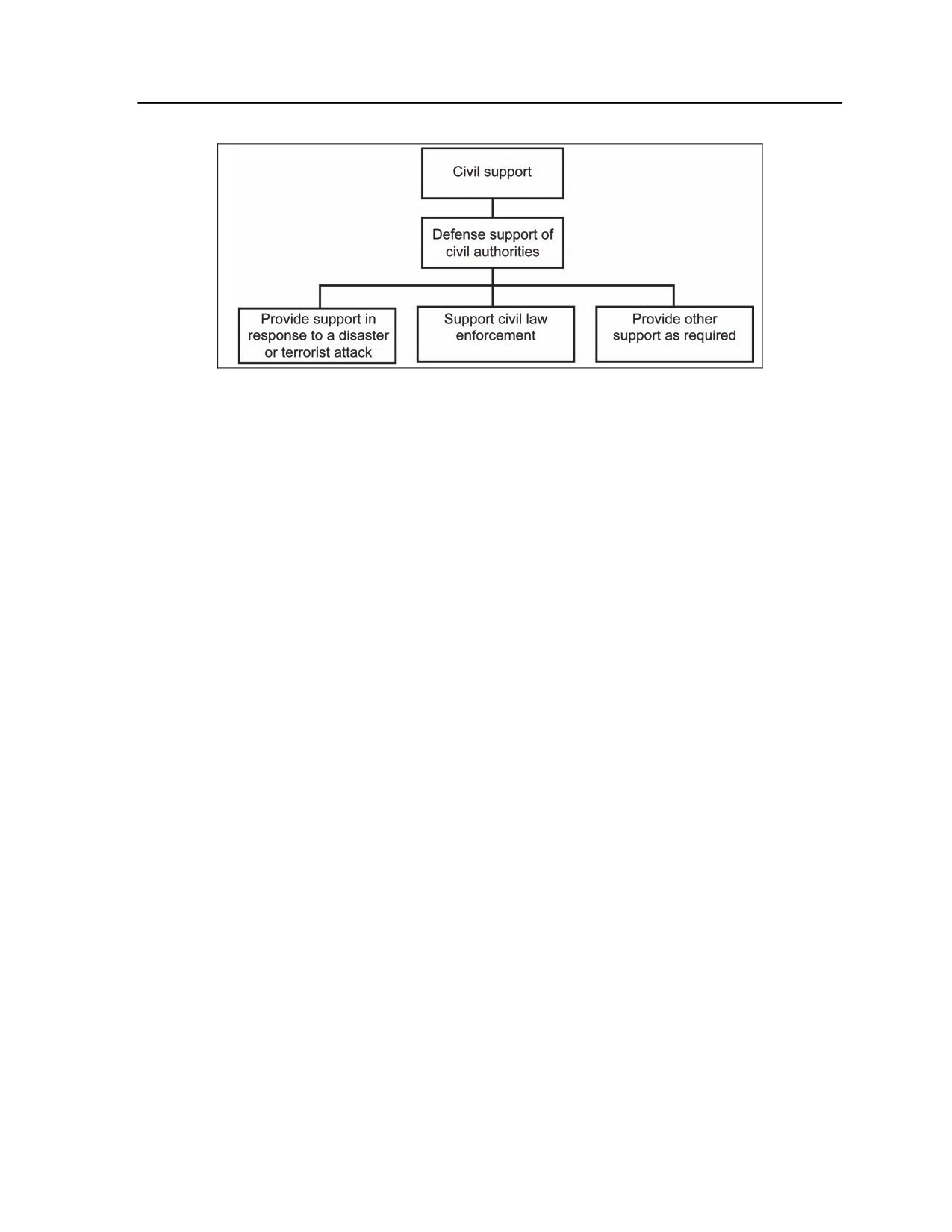
Stability and Civil Support Operations
Figure 7-1. Civil support framework
7-44. The Army supports civil authorities during civil support operations in a unity of effort. Most
disasters are handled at the state level and below. The Army may be under immediate response authority or
ordered by their respective chains of command at the local through state level. Federal resources are
committed when requested by the state in need. A civilian federal agency may be placed in charge of a
disaster response if the state government is overwhelmed or the incident triggering the disaster is an
incident of national significance. Chemical, biological, radiological, nuclear, and high-yield explosives
(CBRNE) assets may be required for disaster response. It is important for commanders and staffs to know
the proponent and its responsibilities. Initial coordination and training with these agencies facilitates the
planning process; however, there is usually little time to prepare for civil support operations. To be
prepared for such civil support operations, it is essential for commanders to have contingency plans
developed and units identified
7-45. Army forces conduct civil support operations as part of HLS within the United States and its
territories. HLS provides the nation with strategic flexibility by protecting its citizens, critical assets, and
infrastructure from conventional and unconventional threats. It includes the three missions of homeland
defense (HLD), civil support, and emergency preparedness planning. Unless the nation is attacked, Army
forces conduct civil support operations exclusive of the offense and defense. If the United States comes
under direct attack or is threatened by hostile armed forces, Army forces under joint command conduct
offensive and defensive operations against the enemy, while simultaneously providing civil support to
federal authorities. A defensive task routinely conducted in HLD missions is protecting critical assets and
key infrastructure during crises. The ability to conduct offensive operations, though maintained primarily
as a potential, is also present. That potential, simultaneously employed with defensive and civil support
operations, complements the execution of domestic support tasks. Similarly, effective and efficient civil
support operations reduce the need to conduct offensive or defensive operations to quell civil unrest or
protect infrastructure. Discipline, endurance, and unit cohesion developed during training prepare Soldiers
and units to deal effectively with the ambiguities and complexities of executing civil support operations.
BRIGADE COMBAT TEAM
7-46. Although not the norm, the BCT could be deployed into an area in support of civilian agencies to
provide essential services, assets, or specialized resources to help civil authorities deal with situations
beyond their capabilities. The BCT has a functional chain of command, reliable communications, and well-
trained and equipped forces that can operate and sustain themselves in an austere environment with organic
or attached assets. In civil support operations, the adversary is often disease, hunger, or consequences of
disaster. Companies and battalions from the BCT can expect to participate in civil support operations with
or without other units from time to time.
11 February 2009
FM 3-34.22
7-11
Chapter 7
Disaster or Terrorist Attack
7-47. In response to a disaster or terrorist attack, Army forces provide essential services to an affected
area. Essential services include—
z
Rescue.
z
Emergency medical care.
z
Veterinary services.
z
Epidemic disease prevention.
z
Food and water.
z
Emergency shelter.
z
Basic sanitation (sewage and garbage disposal).
z
Minimum essential access to affected areas.
7-48. Army forces work directly with state and federal officials to restore and return control of essential
services to civil authorities as rapidly as possible. As a result of disaster or attack, the capacity of
government may be reduced or overextended. Army forces provide C2, protection, and sustainment to
government agencies at all levels until they can function normally.
Law Enforcement
7-49. When authorized and directed, Army forces provide support to local, state, and federal law
enforcement officials. Support is normally provided when an emergency overwhelms the capabilities of
civil authorities. Typical contingencies include support to antiterrorism, counterdrug, civil disturbances,
border security, and disaster response. In extreme cases, when directed by the President, Regular Army
forces maintain law and order under martial law. The BCT could be selected to provide security, logistics,
and communications in support of antiterrorism efforts to reduce the vulnerability of personnel, equipment,
and facilities. The BCT could also serve in a supporting role to the lead federal agency to assist with
national special security events (state of the union address, democratic national convention, republican
national convention, Olympics [when held in the United States]). In support of counterdrug operations, the
BCT principal mission could be the detection and monitoring of the transit of illegal drugs into the United
States using its organic ISR assets.
Other Support
7-50. This task primarily denotes planned, routine, and periodic support not related to a disaster (military
support for parades, funeral details, community relations). Supporting and participating in events and
activities that benefit the Army and the civilian community builds on a long tradition of the Army helping
communities and can have a lasting effect on the attitudes of the American people. Commanders should
identify opportunities to conduct initiatives that meet specific needs; have specific start points and end
states; and advance the interests of the nation, the Army, and local communities. Installations may have
memorandums of agreement with neighboring towns to provide emergency snow removal or some other
capability not readily available. These activities provide an effective means of projecting a positive military
image, providing training opportunities, and enhancing the relationship between the Army and the
American public.
ENGINEERS
7-51. General engineer support for the restoration of essential services is the primary focus in civil support
operations; however, all three engineer functions may be applied simultaneously to some degree. The
generating force elements of the Engineer Regiment play a critical and significant role in civil support
operations. TECs, under their OPCON relationship with USACE, can provide C2 support. (See in FM 3-
34, appendix F, for more information on engineer applications in civil support operations.)
7-52. The BCT organic engineer company can provide manpower and limited support for maintaining or
restoring essential services and activities to mitigate damage, loss, hardship, or suffering that results from
natural or man-made disasters (CBRNE incidents). The organic geospatial engineering team within the
7-12
FM 3-34.22
11 February 2009
Stability and Civil Support Operations
BCT can support relief operations by providing geospatial products and the analysis of potential life
support areas. The likelihood is low that a BCT is committed to support CBRNE consequence
management, although the possibility certainly exists. Support to domestic CBRNE consequence
management is a major operation. It has, by far, the most extensive support requirements for military
personnel. Other U.S. government agencies have the primary responsibility for responding to domestic
terrorist incidents. Local authorities are the first to respond to a CBRNE incident. However, Army forces
have a key supporting role and can quickly respond when authorized.
7-53. As with stability operations, most BCT engineer requirements in civil support operations are likely
met with augmented general engineering and other specialized engineer capabilities. The BCT ENCOORD
must be prepared to direct and coordinate the simultaneous application of engineer capabilities in support
of the BCT mission. When the required engineer augmentation or capability is unavailable to the BCT, the
ENCOORD must rely on reachback or collaborative planning with other engineer elements for the
necessary technical support to enhance BCT organic engineer capabilities. If the BCT is committed in
response to disaster or a terrorist attack, its organic and augmenting engineer forces may perform or
support some critical relief and recovery functions, such as the—
z
Search and rescue.
z
Emergency flood control.
z
Hazard identification.
z
Food distribution.
z
Water production, purification, and distribution.
z
Temporary shelter.
z
Transportation.
z
Firefighting.
z
Medical support.
z
Veterinary support.
z
Communications.
z
Contamination control.
z
Sanitation.
7-54. In support of civil law enforcement, typical engineer tasks might include—
z
Constructing or repairing law enforcement target ranges; helipads; and fuel storage, billet, CP,
and maintenance facilities.
z
Producing geospatial products.
z
Constructing and upgrading access roads for drug interdiction patrols.
z
Clearing observation fields for counterdrug teams.
z
Providing explosive breach capability or training to law enforcement personnel.
z
Integrating engineer operations into stability and civil support operations.
7-55. Planning for civil support operations is significantly different than planning for stability
operations—not in terms of the degree of effort, but because of the unique nature of the threat. The threat
will likely be a natural or man-made disaster with unpredictable consequences. Additionally, planners must
be aware that civil support operations are governed by different laws and regulations than operations
conducted OCONUS. The U.S. Constitution, statutes, and regulations govern the use of military assistance
and restrict Army interaction with OGAs and civilians. Issues related to the Posse Comitatus Act, the use
of force, civil disaster assistance, and the federalizing of troops necessitates timely legal advice throughout
operations.
7-56. In stability and civil support operations, there may be a need for specialized engineer requirements
such as prime power, well drilling, and firefighting. Engineer planners must have a general understanding
of the capability of specialized assets within the engineer force structure and the ability to determine when
their employment would be appropriate.
11 February 2009
FM 3-34.22
7-13
Chapter 7
7-57. The ENCOORD and the engineer company commander may have a requirement to integrate the
activities of several engineer capabilities (assessments, engineering services, emergency repairs) within the
BCT AO. During a major reconstruction effort, additional engineer battalions and possibly an engineer
brigade could be task-organized to the BCT. These units are equipped and manned to fulfill design,
construction management, and C2 requirements needed to accomplish these missions, which will likely
include—
z
Base camp construction and power generation.
z
Emergency restoration of critical public services and facilities.
z
Infrastructure reconnaissance, technical assistance, and damage assessment.
z
Emergency demolition.
z
Debris or route-clearing operations.
z
Construction and repair of expedient (temporary) roads and trails.
z
FACE, to include the repair of paved, asphalt, and concrete runways and airfields.
z
Installation of assets that prevent FOD to rotary-wing aircraft.
z
Temporary bridge construction.
z
Area damage control missions that support the mobility of the civil support force.
z
Access to the region through the construction and upgrade of ports; airfields; and reception,
staging, onward movement, and integration (RSO&I) facilities.
INTEGRATION THROUGH THE WARFIGHTING FUNCTIONS
7-58. The following are considerations for integrating engineer operations through the warfighting
functions and into stability and civil support operations.
Movement and Maneuver
7-59. In stability operations, engineers support BCT movement and maneuver as they do in offensive and
defensive operations. However, there is likely to be more emphasis on minimizing the effects of breaching
or clearing operations on infrastructure and collateral damage to civilian areas. In stability operations,
improving mobility in the BCT AO may be part of the unit mission. If so, the BCT may be augmented with
U.S. military and civilian engineers, contractors, and HN engineers. This includes the tasks performed by
elements other than engineers (military police, CBRN, EOD). Depending on the magnitude of required
effort, the BCT may elect to establish an integration cell (assured mobility section) to coordinate the
associated activities.
7-60. Engineers must be creative in implementing nonlethal obstacles (fences, roadblocks, checkpoints) in
controlling civilians or separating belligerent forces while working within the limitations of the ROE or
use-of-force directives.
7-61. The movement and maneuver missions for engineers during civil support operations include combat
and general engineering efforts to clear roads, repair roads, and (in some cases) repair bridges. The BCT
organic combat engineering equipment is well suited for the removal of rubble and debris associated with
disasters.
Intelligence
7-62. In offensive and defensive operations, engineer IR identified during IPB tend to focus on the effects
of terrain and the threat engineer force mission, intent, and capabilities. In stability operations, the engineer
planner must expand beyond geographical and threat force capability considerations and understand more
on the ethnic and religious factions, assessments of infrastructure and key structures, and current
capabilities of existing facilities providing essential services. In civil support operations, the adversary is
often disease, hunger, or the consequences of a natural or man-made disaster.
7-63. Stability operations place more demand on understanding the civil considerations (political, cultural,
historical, economic, ethnic, and humanitarian factors) in an AO. For instance, cultural information might
be important in predicting the potential reactions of a civilian area to an operation. Determining the
7-14
FM 3-34.22
11 February 2009
Stability and Civil Support Operations
disposition of the civilian population and how they may react (hostile or neutral) to construction projects
may help engineer planners determine where best to apply engineer manpower and resources to be most
effective. Engineer planners must seek all available sources for information (engineer reconnaissance and
infrastructure assessments, USACE FFE, NGOs that were in the area before U.S. forces).
7-64. Civil considerations are assessed (ASCOPE) to determine how each might affect operations. Key
civilian areas and structures
(industrial centers, government centers, communication and media
infrastructure, power plants, roads and bridges, airports, schools, hospitals, places of religious worship) are
those that have significance to the local population. Assessing the capabilities of a HN includes
understanding the government’s ability to provide key functions or services (public administration, public
health, and emergency services). Consider organizations (military and nonmilitary groups, political or
religious organizations, intergovernmental organizations, NGOs) within the AO that influence, interact, or
have significance with the local population. Consideration of the people includes all the civilians in the AO
and AI whose actions, opinions, or political influence can affect the missions. Events (elections, religious
holidays, historically significant dates) to consider are those that have cultural significance within the AO
and the AI which could affect the mission.
Fires
7-65. FS planning for stability operations is the same as for offensive and defensive operations, though
there could be limitations and restrictions on the use of certain indirect-fire assets. Engineers provide
specialized geospatial products to highlight critical areas, structures, and infrastructure
(including
underground utilities such as oil pipelines) where there is an increased potential for collateral damage
(UXO) and subsequent effects on follow-on repair and reconstruction efforts.
7-66. During the planning of nonlethal fires (IO), engineers share their knowledge of public works systems
and reconstruction efforts in an attempt to effectively and efficiently focus efforts. In civil support
operations, engineers support the commander’s PA program by providing updates on engineering projects
supporting relief and recovery operations.
Sustainment
7-67. In stability operations, the support provided by sustainment units often extends beyond sustaining
military operations. Support provided to the population may become a crucial shaping or decisive
operation. Engineers may be a critical enabler in the provision of essential services until the HN
government or other agencies can do so. Engineering tasks primarily focus on assisting the stabilization of
a region by reconstructing or establishing infrastructure to provide essential services to the population in
addition to supporting the sustainment of maneuver forces in their missions. Infrastructure reconnaissance
plays a key role in assessing the requirements associated with providing essential services (see FM 3-
34.170). As the AO matures, the general engineering effort may transfer to theater support contracts or
external support contracts
(LOGCAP, Air Force Contract Augmentation Program, Navy Global
Contingency Construction Contract). Engineer planners must understand the availability and procedures
for employing HNS, DOD contracting, and local purchases.
7-68. Initially, there may be a need to deploy an advance party (heavy with logistics and engineering
support) if the AO does not have the infrastructure to support the operation. In other circumstances, it may
be necessary for the commander and a small group of specialized key personnel (CA, PA, staff judge
advocate [SJA]) to lead the advance party. These personnel set the groundwork for the rest of the force by
conducting face-to-face coordination with local civilian and military leaders. Show-of-force operations
most likely necessitate that the commander send a large contingent of forces to act as a deterrent and to
ensure initial security. In all cases, a well-developed movement order is essential.
Command and Control
7-69. Stability operations tend to be joint, multinational, or interagency. Similar to stability operations,
civil support operations involve a high degree of coordination and cooperation with a number of local,
state, and federal agencies and private sector and volunteer organizations to accomplish clearly established
11 February 2009
FM 3-34.22
7-15
Chapter 7
objectives. Conducting effective interagency coordination and ensuring a unity of effort may require the
establishment of working groups, boards, coordination centers, and the use of LNOs at various levels (see
FM 3-07 for more information on interagency coordination). Engineer planners must consider the span of
control in arraying C2 for engineer units. No single C2 option works best for all stability and civil support
operations. Additionally, Army forces may often be the supporting organization rather than the lead
agency.
Protection
7-70. In stability operations, engineers play a major role in protecting positions, headquarters, support
facilities, base camps, and highly vulnerable assets. In addition to protecting U.S. and multinational
military and civilian personnel, consideration must also be given to protecting contractors and local
workers. Stability operations are often decentralized to the battalion, company, or platoon level. Engineer
support requirements for protection may stretch throughout the AO as the BCT positions troops where they
can best stabilize the situation. Every unit has an inherent capability to provide basic survivability, which
can be supplemented with combat engineering equipment to establish lower-end hardening (with earth
berms and HESCO Bastion Concertainers). The most effective protection level can only be provided by
general engineers or civilian contractors. In stability operations, the BCT may face a mine or UXO threat.
Engineers typically play a major role in coordinating the effort to reduce the effects on military forces,
nonmilitary forces, and civilians.
7-71. In civil support operations, the immediate effort is on protecting civilians from the elements or the
residual hazards from a disaster. Engineers can assist in erecting temporary shelters or prefabricated
buildings. Engineer effort may include the construction of earth walls and berms to mitigate emergency
flooding and preserve property. Army forces may also have a role in protecting federal property and
federal government functions when the local authorities are unwilling or unable to do so.
7-72. Regardless of BCT requirements in stability and civil support operations, there most likely are not
enough engineer assets (including civilian-contracted engineer support) available. This situation requires
BCT units to construct their own fortifications and assist with other engineer tasks within their capabilities.
In prioritizing the use of engineers or organic forces to accomplish engineer tasks, the BCT commander
emphasizes the strengthening of protection measures.
CIVIL AFFAIRS OPERATIONS
7-73. As stated in FM 3-0, Army forces conduct CA operations as part of full spectrum operations. CA
operations are those activities that enhance the relationship between military forces and civil authorities in
areas where military forces are present. Commanders use CA operations to mitigate the impact of military
presence on the population and vice versa. These activities are fundamental to executing stability tasks.
7-74. Engineers have a critical role in CA operations, since military operations typically include engineer
activities of nonmilitary organizations and military forces. If the experiences of the Gulf War, Operation
Restore Hope, Operation Joint Endeavor, Operation Enduring Freedom, and Operation Iraqi Freedom are
repeated in future military operations, engineer operations will include many DOD civilians and the
services of NGO, international organizations, OGAs, and contractors. The total engineer force of active
and reserve military, civilians, contractors, HN personnel, and allies constitute primary resources for CA
operations; and the BCT commander can draw upon them to accomplish the engineer mission in their AO.
7-75. While CA units retain responsibility for the overall conduct of CA operations, all Army forces have
some inherent capability of supporting CA operations. The integration of engineers, military police, health
services, communications, transportation, and other SOF capabilities is essential to the overall effort.
Engineer capabilities are applied to provide specific construction and other technical support. The engineer
support must be fully integrated with the CA operations plan. Integration occurs through operations
process activities and is facilitated by coordination among the ENCOORD and S-9 staff. The BCT may
also form working groups under the S-9’s lead to ensure the integration of necessary capabilities.
7-16
FM 3-34.22
11 February 2009
Stability and Civil Support Operations
7-76. CA elements can assess the needs of civil authorities, act as an interface between civil authorities and
the military supporting agency, and act as a liaison to the civil population. They can develop population
and resource control measures and coordinate with international support agencies. The S-9 and civil affairs
team-bravo (CAT-B) team leader are the principal advisors to the commander on CA operations. In current
operations, most BCTs are task-organized with a civil affairs team (CAT). As with the PSYOP team, these
teams have proven to be an invaluable combat multiplier. The CAT operational focus is on the civil center
of gravity and on establishing, maintaining, influencing, and supporting the commander’s interaction with
OGAs, NGAs, and international organizations. CA activities include population and resource control,
foreign nation support, humanitarian assistance, civil-military actions, civil defense, civil assistance, and
civil administration during stability and civil support operations.
CIVIL-MILITARY PROJECT COORDINATION
7-77. For prioritizing and resourcing civil-military construction and engineer projects, the BCT can form a
working group, board, or project integration cell or use the civil-military operations center (CMOC) (if
established) to plan, synchronize, and execute approved projects that achieve the commander’s desired
effects. Civil-military construction and engineer project nominations are submitted by subordinate unit
commanders in the form of a statement of work (SOW). Projects are reviewed, prioritized, and presented to
the BCT commander for approval. Once approved and resourced, the project is synchronized through an
established format within the BCT and submitted through the BCT operations cell as a tasking,
construction directive, or execution order. The ENCOORD, financial management staff officer (S-8),
provost marshal officer (PMO), and S-9 are critical members in this process.
7-78. The ENCOORD role in civil-military construction and engineering projects includes orchestrating
infrastructure reconnaissance teams as required, coordinating for contracted construction or troop
construction projects in support of the approved CA operations initiatives, and tracking the progress of
ongoing projects. The ENCOORD also coordinates for geospatial products that can facilitate construction
activities and serves as the interface or initiates reachback to the USACE and other agencies to coordinate
for planning products, technical support, and professional expertise. The ENCOORD coordinates and
collaborates with adjacent or higher-unit engineer staff sections to ensure unity of effort.
SPECIAL CONSIDERATIONS
7-79. Infrastructure reconnaissance is a multidiscipline task conducted by a base team augmented, as
necessary, with additional expertise. The ENCOORD is likely responsible for coordinating infrastructure
reconnaissance, but should rely on other branches for help, depending on the category or required
expertise. The base infrastructure reconnaissance team includes expertise from engineer, CA, preventive
medicine, military police, and other disciplines. Augmentation from additional disciplines is provided
when possible. (See FM 3-34.170 for more information on infrastructure reconnaissance.)
7-80. In the OE, engineers at most echelons operate or interact with other government, nongovernment,
and international agencies and organizations participating in the operation. Given the multitude of
organizations and capabilities involved, it is important that ENCOORDs
(at the appropriate levels)
coordinate with these organizations to ensure that resources are focused to meet objectives. Establishing
and maintaining effective liaison with all participating agencies is critical to achieving the unity of effort.
The CMOC can be a focal point for this effort at the BCT level.
11 February 2009
FM 3-34.22
7-17
Chapter 8
Sustainment Support for Engineer Operations
Good logistics is combat power.
—Lieutenant General William G. Pagonis
Director of Logistics, Gulf War, 1991
Sustaining engineer capabilities in combat poses a tremendous challenge to engineer
commanders and staff at all echelons. With Army transformation into a modular
force, the engineer company organic to the BCT became completely dependent upon
BCT sustainment organizations for support. Engineer forces augmenting the BCT
may also rely substantially on those sustainment organizations. The efforts of
engineer planners at all levels to plan and coordinate engineer sustainment are
essential to the full integration of engineers into BCT sustainment structure. Within
the IBCT and HBCT, battalion level sustainment support for the engineer company is
provided through the BSTB. Support is provided through the BSB and headquarters
and headquarters company (HHC) for the SBCT engineer company. Sustainment
support for engineer operations includes logistics provisions, personnel services, and
HSS necessary to maintain and prolong operations until mission accomplishment.
Logistics tasks include transportation, maintenance, supply, EOD, distribution
management, contracting, and field services. This chapter focuses on sustainment
support for the organic engineer company in the BCT and highlights the sustainment
norms within the BCTs that affect augmenting engineer elements. (See FM 3-90.5,
FM 3-90.6, FM 3-90.61, and FM 4-90.7 for more information.)
PLANNING
8-1. Successful sustainment involves balancing effectiveness with efficiency. Sustainment operations are
characterized by being able to anticipate requirements, integrate joint and multinational sustainment,
improvise solutions, and be responsive and continuous.
8-2. During the operations process, engineer commanders and staff must plan, prepare, execute, and
continuously assess sustainment support for engineer capabilities. During the MDMP, engineer planners
concurrently develop a sustainment plan while conducting other operational planning. To ensure an
effective sustainment plan, the engineer planner must understand the engineer and supported unit mission,
commander’s intent, and concept of the operation.
8-3. The development of the sustainment plan begins during mission analysis and is refined during
war-gaming. Upon receipt of the mission, engineer planners initiate their portion of the logistics estimate
process, which is described in FM 5-0 as an analysis of logistics factors affecting mission accomplishment.
Engineer planners focus the logistics estimate on the requirements for the upcoming mission and the
sustainment of all subordinate engineer units that are organic and task-organized to the supported unit. The
engineer planner predicts support requirements by determining the—
z
Type of support required (maintenance, supply, transportation, medical support).
z
Quantity of support required.
z
Priority of support (type and unit).
8-4. After determining the support requirements, the engineer planner assesses the—
z
Sustainment resources available (supported unit, parent unit, contractor, HN).
z
Status of sustainment resources (location, maintenance, personnel).
11 February 2009
FM 3-34.22
8-1
Chapter 8
z
Time that sustainment resources are available to the engineer unit.
z
How resources are made available.
z
Shortfalls in equipment and supplies needed to support the operation.
8-5. Close integration with the BSB or forward support company (FSC) can simplify and accelerate this
process as the information to address many of these considerations should be readily available to
sustainment planners to facilitate rapid planning. It should also be resident in the FBCB2, medical
communications for combat casualty care (MC4), and Battle Command Sustainment Support System
(BCS3).
8-6. After conducting the logistics estimate, engineer planners work with the supported-unit S-4 and
compare the requirements with the reported status of subordinate units to determine the specific amount of
supplies needed to support the operation. These requirements are then coordinated with the BSB or FSC to
ensure that needed supplies are identified and resourced through next-higher stocks.
8-7. The ENCOORD translates the estimate into specific plans that are used to determine the
supportability of maneuver unit COAs. After a COA is determined, the ENCOORD incorporates the
specific sustainment input into the supported-unit base OPORD and paragraph 4 of the engineer annex.
(See appendix H.)
8-8. In each BCT, the ENCOORD works with the appropriate sustainment planner and executor to track
essential sustainment tasks involving supporting engineer units. Accurate and timely status reporting assists
the ENCOORD in providing the overall engineer status to the supported-unit commander and allows the
ENCOORD to intercede in critical sustainment problems when necessary. The ENCOORD also ensures
that supplies needed by task-organized or augmenting engineer units are integrated into supported-unit
sustainment plans. For the ENCOORD to execute these missions properly, accurate and timely reporting
and close coordination with sustainment planners and providers and organic and augmenting engineer
commanders and staff is essential.
8-9. Prior to execution, sustainment rehearsals are normally conducted at the brigade, battalion, and
company level to ensure a smooth, continuous flow of materiel and services.
LOGISTICS
8-10. The Army principles of logistics are defined in FM 4-0. The application of these principles facilitates
effective, efficient sustainment and enables operational success. Engineer commanders and staff
understand and use these principles while planning engineer operations. The logistics principles are
discussed (with an engineer focus) in the following paragraphs.
Responsiveness
8-11. Responsiveness is the key logistics principle. It means providing the right support in the right place
at the right time. Responsiveness includes the ability to anticipate operational requirements and is the
keystone logistics principle. Engineers identify all sustainment requirements in advance, taking command
or support relationships of task-organized engineer units into consideration. This information must be
passed through the proper sustainment channels and tracked through delivery. It involves identifying,
accumulating, and maintaining the minimum assets, capabilities, and information necessary to meet support
requirements. Engineers plan to meet the changing requirements of the operation on short notice. The
engineer sustainment system should be versatile enough to keep pace with rapid decision cycles and
mission execution to react quickly to crises or opportunities. It must continually respond to a changing
situation and the shifting of engineer units on the battlefield. Engineer planners are sensitive to engineer
task organization changes. Interim contingency sustainment support must be planned until task
organization is modified or changed. The plan should include aerial resupply when possible.
8-12. Personnel losses and unit capabilities must also be anticipated to plan for continuous operations and
future missions. Forward engineer units depend on the sustainment system of their parent unit or the
supported unit and may require significant support to accomplish engineer tasks. The ENCOORD at every
echelon must anticipate likely task organization changes that affect the flow of sustainment to engineer
8-2
FM 3-34.22
11 February 2009
Sustainment Support for Engineer Operations
organizations. Additional missions or tasks
(clearing an LZ for aerial resupply) are created by the
sustainment support plan. These missions or tasks must be anticipated (ensuring the passage of sustainment
units through obstacles to continue their support of the maneuver units) and planned for during mission
analysis.
8-13. The planner who anticipates is proactive—not reactive—before, during, and after operations. The
ability of the force to seize and maintain the initiative, synchronize activities along the entire depth of the
AO, and exploit success depends on the abilities of commanders, logisticians, and engineers to anticipate
requirements. Engineers consider joint, multinational, contract civilian, and interagency assets when
planning support for engineer operations. Engineers—
z
Use all available resources to the fullest (especially HN assets).
z
Prioritize critical engineer activities based on the concept of operations.
z
Anticipate engineer requirements based on war-gaming and rock drills, incorporating experience
and historical knowledge.
z
Organize and resource for simultaneous and noncontiguous operations, but do not think
contiguously or sequentially.
z
Participate in and evaluate the engineer significance of each phase of the operation throughout
the entire MDMP.
8-14. The ENCOORD at every echelon and the engineer unit commander forecast future requirements and
accumulate the assets needed to accommodate likely contingencies. Engineer operations frequently
require—
z
High fuel consumption rates (higher than most equipment found in a light brigade).
z
Engineer-specific Class IX repair parts that often require extraordinary coordination to obtain.
z
Large amounts of Class IV and V construction and barrier materials.
z
Demolitions for offensive and defensive operations.
z
A large commitment of maintenance and transportation support.
z
Financial services to support the local purchase and contracting of HN assets and materials.
Simplicity
8-15. Simplicity involves avoiding complexity and often fosters efficiency in planning and executing
logistics operations. Mission type orders and standardized procedures contribute to simplicity. Engineer
commanders and staffs establish priorities and allocate supply classes and services to simplify sustainment
operations. Engineers use preconfigured loads of specialized classes of supply to simplify transport.
Flexibility
8-16. The key to flexibility lies in the expertise for adapting sustainment structures and procedures to
changing situations and missions. Sustainment plans and operations must be flexible enough to achieve
responsiveness and economy. Flexibility may include the kind of improvisation that makes, invents, or
arranges what is needed from what is on hand.
8-17. Extraordinary methods may be necessary to ensure success during operations. Sustainment planners
attempt to push support forward to engineer units to ensure smooth combat operations. Sometimes this is
not feasible. In such cases, engineers improvise by making, inventing, devising, or fabricating what is
needed. Engineers rely on the results of engineer resource assessments to evaluate the availability of
materiel, resources, and terrain features that have engineer application (creating a demolition cratering
charge using common fertilizer and diesel fuel). (See FM 3-34.170 for more information on engineer
resource assessments.)
8-18. Sustainment organizations must improvise to meet current needs and respond to unforeseen
emergencies. They should plan for and use HN supply assets, facilities, and equipment when possible.
Specific damage assessment and repair procedures may also be implemented based on the need to
improvise during operations. Improvisation is not a substitute for good planning; requirements must be
anticipated. However, improvisation can be a great strength; engineer personnel must recognize it as an
advantage in meeting emergencies.
11 February 2009
FM 3-34.22
8-3
Chapter 8
Attainability
8-19. Attainability involves generating the minimum-essential supplies and services necessary to begin
operations. Commanders determine the minimum levels of support acceptable to initiate operations.
Engineers, in conjunction with logisticians, complete the logistics estimate and initiate resource
identification based on the supported commander’s requirements and priorities. An operation should not
begin until minimum-essential levels of support are on hand.
8-20. For engineers, attainability is at the very core of decisions. Trade-offs may be necessary to attain a
given goal or quality of product. While attainable, the cost may make other things unattainable. Since
engineer materiel must meet specific technical requirements, engineers work closely with the logistics staff
to help them understand these requirements and obtain acceptable and suitable alternatives when trade-off
decisions are required.
Sustainability
8-21. The engineer commander needs continuous logistics capability to gain and maintain initiative.
Pauses for rebuilding power impede momentum and rob the command of initiative. Engineer planners
synchronize all sustainment assets to ensure that the support operation does not impede the engineer
commander. Continuous operations are critical to success.
8-22. Sustainability ensures the longevity of logistics support to engineers throughout the AO for the
duration of the operation. Sustainability focuses on the engineer commander’s attention for long-term
objectives and the engineer force capabilities. Long-term support is a challenge for the engineer staff,
which must not only attain the minimum-essential materiel levels to initiate operations, but must also
sustain those operations through the end state. The ENCOORD must ensure that logistics requirements are
known and flowing based on available transportation assets.
8-23. Engineers are committed to the current operation or preparing for the next one. The tempo of the
operation requires a constant vigilance by the logistician and engineer commander to ensure a constant
flow of support. Supplies are pushed
(unit distribution method) forward when logistically feasible.
Maneuver units rely on lulls in the tempo of an operation to conduct sustainment operations, while
engineers may not. Engineers do not usually have this opportunity since many of their missions occur
during a lull in operations, and this may deny them the opportunity to use the supply point method. This
increases the need for engineers to plan for continuous, routine, and emergency logistics support.
8-24. General engineering involves constructing, repairing, operating, and maintaining infrastructure and
facilities to enhance sustainment provisions and services (see FM 3-34.400). Contracting support obtains
and provides supplies, services, and construction labor and materiel, often providing a responsive option or
enhancement to support the force (see FM 3-100.21, FM 100-10-2, and FMI 4-93.41). General engineers
and, potentially, USACE personnel may be required to provide subject matter expertise for the supervision
of contracted materiel and services.
Survivability
8-25. Survivability is based on being able to protect support functions from destruction or degradation.
Engineers contribute to ensuring that sustainment means are survivable by constructing sustainment bases
and clearing LOCs.
Note. The logistics principle of survivability is related to, but not exactly the same as, the
discussion of survivability operations in FM 5-103.
Economy
8-26. Economy is providing the most efficient support to accomplish the mission. Economy reflects the
reality of resource shortfalls, while recognizing the inevitable friction and uncertainty of military
operations. This requires commanders to set clear priorities in the resource allocation. The priority of effort
is established while balancing the mitigation of risk to the operation. Engineer commanders may have to
improvise to meet the higher intent and mitigate the risks.
8-4
FM 3-34.22
11 February 2009
Sustainment Support for Engineer Operations
Integration
8-27. Sustainment must be integrated into the tactical plan. Too often, a COA is selected that cannot be
supported logistically. The ENCOORD must ensure that the engineer plan meets the maneuver
commander’s intent and is able to be supported logistically. The ENCOORD should make accurate and
timely recommendations of required logistics support.
8-28. Integration consists of synchronizing sustainment operations with all aspects of Army, joint,
interagency, and multinational operations. The concept of operations achieves integration through a
thorough understanding of the commander’s intent and synchronization of the sustainment plan.
Integration includes coordination with and mutual support among Army, joint, interagency, and
multinational sustainment organizations.
8-29. Engineers support joint, interagency, and multinational operations. The theater commander integrates
operations in his area of responsibility (AOR), which often includes engineers from other Services or
countries and possibly civilian engineering contractors. FFE is one example of the integration of military
and civilian engineers (see FM 3-34).
8-30. Operational and tactical plans integrate all sustainment support to create a synergy with the concept
of operation. Engineer planners participate in and evaluate the sustainment significance of each phase of
the operation during the MDMP. They create a clear and concise concept of support that integrates the
commander’s intent and concept of operation.
OFFENSIVE OPERATIONS
8-31. In support of offensive operations, sustainment operations maintain the momentum of the attack. If
these operations are unsuccessful, the enemy might recover from the initial assault, gain initiative, and
mount a successful counterattack. Units must operate solely with their basic load and be prepared to
quickly transition to defensive operations. Shortages of sufficient haul assets and potential operations in
support of dismounted infantry challenge the ability of engineers to organically haul or stockpile supplies.
Due to the speed of the battle, the push package concept is the desired resupply method.
8-32. When preparing for offensive operations, engineer planners must consider several situations. For
example, when a maneuver battalion changes from search-and-attack to an approach march or a hasty
attack, great shifts in engineer sustainment plans are not normally required. However, other adjustments in
operations, such as transitioning to the defense, may cause a significant change in sustainment focus or
emphasis. Because of this, engineer planners must ensure that the supported unit S-4 sustainment plan is
organized to help the sustainment executor be proactive regarding a change of mission without interrupting
engineer-related sustainment. In planning offensive operations, it is important to—
z
Position vital, engineer-related sustainment supplies (explosives, Class III) well forward within
supported unit combat trains.
z
Use air resupply when possible.
z
Use previously planned and configured engineer LOGPACs of supplies when possible.
z
Plan for the resupply of Class V MICLIC and Volcano reloads.
z
Plan for the resupply of lane-marking material.
z
Plan for increased engineer equipment maintenance needs.
z
Use HN or captured-enemy engineer supplies (especially haul assets for bulky Class IV and V
supplies) when possible.
z
Increase LOC (air and ground) through mobility operations to support AO expansion, logistics
traffic increase, and casualty evacuation. Operations include engineer reconnaissance, route
clearance, FACE, and others.
z
Plan and prepare for replacement operations based on known and projected engineer losses.
11 February 2009
FM 3-34.22
8-5
Chapter 8
DEFENSIVE OPERATIONS
8-33. In contrast to offensive operations, defensive operations break the momentum of the enemy attack.
The engineer company does not have the requisite haul assets to transport necessary Class IV and V
supplies to the obstacle site. Mission-critical materials must be planned for and throughput coordinated to
bring those items to the obstacle site. Only the barrier material required to conduct specific engineer
mission support is requested to be brought forward. Stockpiling unit sustainment supplies (rations, water,
fuel) may also be required. Push and pull methods of resupply may be used, and the method used is
generally dictated by the time available before enemy contact is expected. In planning defensive
operations, it is important to—
z
Maintain a brigade level or, if possible, a division or JTF level focus on Class IV and V obstacle
material-handling in the brigade AO. Maneuver battalions have limited capability to move or
transport these materials, so it and this must be well coordinated.
z
Maintain a low signature of Class IV and V supply points. Enemy intelligence collection assets
key on these sites during reconnaissance operations.
z
Resupply during limited visibility conditions when possible. This reduces the fingerprint of the
obstacle material moving on the battlefield and the potential for enemy interference.
z
Plan for lost, damaged, and destroyed obstacle material and engineer equipment. Maintain an
emergency stockpile of Class IV and V supplies when possible.
z
Develop and use preconfigured obstacle packages to push logistics to the obstacle site. These
packages facilitate obstacle planning, delivery, and execution for the brigade.
z
Plan additional protection for engineer units, equipment, and sustainment during defensive
operations. These assets may be an HVT for the enemy.
z
Plan additional maintenance of engineer equipment and its rapid evacuation as required. Fuel
consumption and the expenditure of engineer-specific Class IX supplies are also high for
engineer equipment.
BRIGADE COMBAT TEAM UNITS AND FUNCTIONS
8-34. The BCT has units that provide sustainment support. These units are the—
z
BSB.
z
FSC.
z
BSTB.
BRIGADE SUPPORT BATTALION
8-35. The BSB is the organic sustainment unit of the BCT. The BSB commander is the BCT commander’s
single sustainment operator. The BSB support operations officer (SPO) manages sustainment and Army
health system (AHS) support operations for the BSB commander. The SPO provides technical supervision
for the external sustainment mission of the BSB and is the key interface between the supported units and
the BSB. The SPO plans and monitors support operations and makes necessary adjustments to ensure that
support requirements are met. The SPO requests and coordinates augmentation with the higher echelon
when requirements exceed capabilities. The BSB also has a automation management office that assists with
maintenance of logistics-related, Standard Army Management Information Systems (STAMISs) throughout
the BCT. The BSB has four FSCs (in the IBCT and HBCT only) and three other companies in addition to
its HHC (see figure 8-1). Companies within the BSB consist of the—
z
Distribution company. The distribution company provides all transportation and classes of
supply (excluding medical) for BCT units.
z
Field maintenance company (FMC). The FMC provides common maintenance support for the
BCT, excluding medical and automation support. It generally supports the BSTB (and HHC in
the SBCT) and BSB, since support for maneuver battalions comes from FSCs in the HBCT and
IBCT.
8-6
FM 3-34.22
11 February 2009
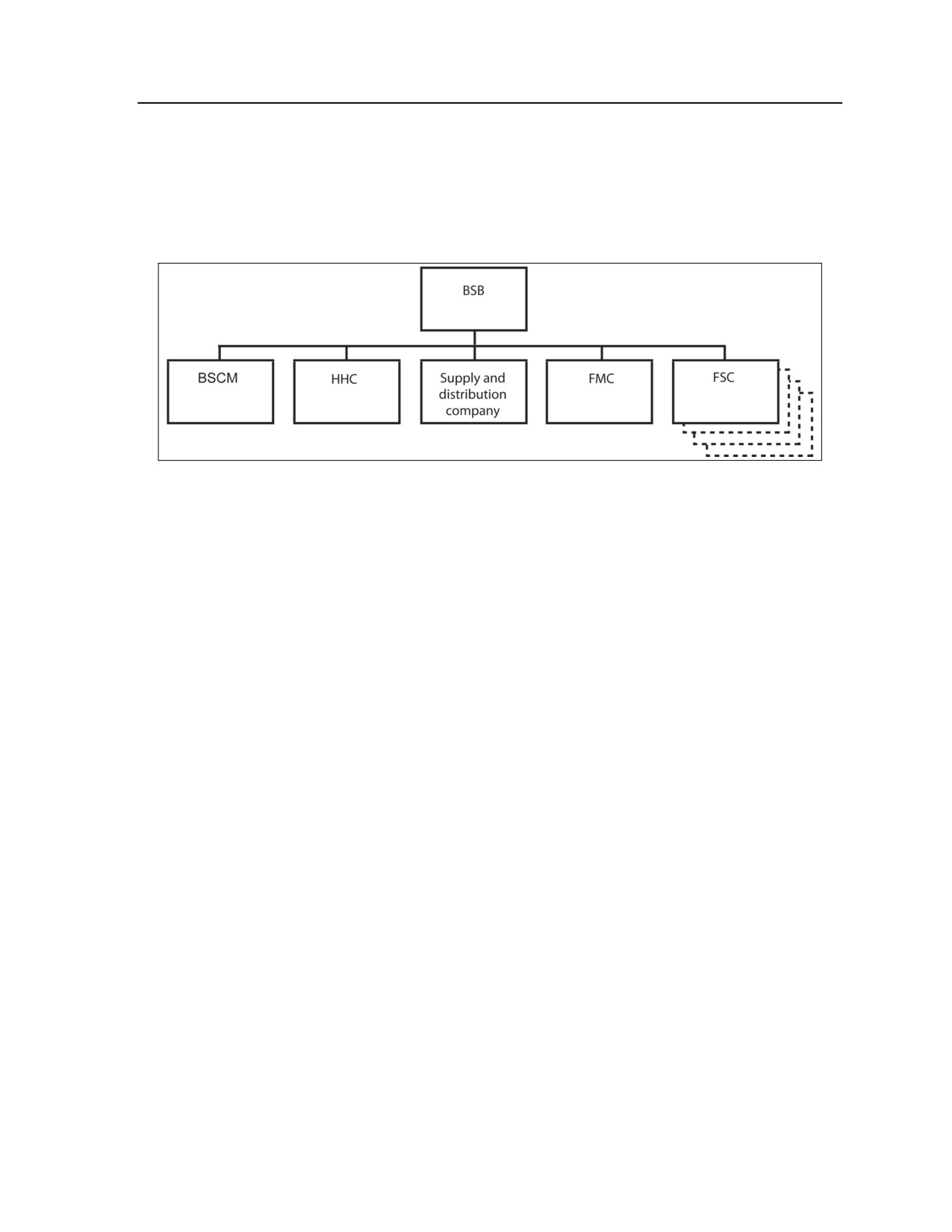
Sustainment Support for Engineer Operations
z
BSMC. The BSMC operates a Role 2 MTF and provides Role 2 AHS support to all units on an
area basis. The BSMC is responsible for providing MEDEVAC from supported units to its Role
2 MTF. It also provides Role 1 care to units without organic medical personnel and augments
and reinforces maneuver battalion medical platoons and sections.
z
FSC. The FSC (IBCT and HBCT only) has a distribution platoon that provides transportation,
food, and water, fuel, and ammunition and a maintenance platoon that provides repair parts,
maintenance, and recovery. There can be four FCSs (see figure 8-1).
Figure 8-1. BSB and subordinate unit organizations
FORWARD SUPPORT COMPANY
8-36. The HBCT and IBCT BSBs have FSCs to provide sustainment support to maneuver, reconnaissance,
and fires battalions. The SBCT BSB does not have an FSC authorized and creates improvised logistics
teams to support SBCT units. FSCs are assigned to the BSB, but are generally task organized to their
supported battalions. The FSC commander is responsible for executing the sustainment plan according to
the supported battalion commander’s guidance. The BSB provides technical oversight to each FSC. The
BCT commander must ensure that the staff and subordinate units understand the command and support
relationships of FSCs. If an engineer battalion augments the BCT, it should be accompanied by its
appropriate sustainment element that is task-organized to the battalion and augments the sustainment
capabilities of the BSB.
BRIGADE SPECIAL TROOPS BATTALION
8-37. The HBCT and IBCT each have a BSTB that provides unit level sustainment support to its organic
engineer company and provides attachments from engineer augmentation. Support includes medical,
maintenance, Class III supply
(petroleum, oils, and lubricants
[POL]), food service, and religious
assistance. The BSTB also coordinates the necessary support for attached units that are beyond the
capability of the support platoon. The BSTB commander has a significant challenge to ensure that units
receive sustainment support across the AO. Therefore, he must use BSTB-limited sustainment assets
efficiently. If resources prove insufficient, the BSTB commander must request additional resources from
the BCT to ensure that sustainment is fully available to support two BCT CPs and engineer, MI, military
police, and dispersed signal sections. (See FM 3-90.61 for additional information on the BSTB.)
ENGINEER LEADER RESPONSIBILITIES
8-38. Engineer leaders and planners are crucial to the accomplishment of sustainment for organic and
augmenting engineer organizations within the BCT. The basic sustainment responsibilities are to monitor,
report, and request requirements through the correct channels and to ensure that sustainment requirements
are met when sustainment is brought forward to the engineer unit. The engineer company XO and 1SG are
normally in charge of these functions within the engineer company, and they receive guidance and
oversight from the commander. They are also responsible for supporting any augmentation they may
receive. Accurate and timely submission of personnel and logistics reports and other necessary information
and requests is essential.
11 February 2009
FM 3-34.22
8-7
Chapter 8
COORDINATOR
8-39. The ENCOORD at all echelons is ultimately responsible for engineer logistics estimates and plans
and the monitoring of engineer-related sustainment execution within the supported unit. When engineer
elements are task-organized within the supported unit, the ENCOORD recommends the most effective
command or support relationship. The ENCOORD—
z
Writes the engineer annex and associated appendixes to the OPLAN or OPORD to support the
commander’s intent. Included is a recommended distribution for engineer-related,
command-regulated supply classes and special equipment.
z
Assists in planning the locations of engineer forward supply points (EFSPs) for the delivery of
engineer-configured loads of Class IV and V barrier material. These sites are coordinated with
the unit responsible for the terrain and the appropriate S-4.
z
Assists in planning the location of engineer equipment parks for pre-positioning critical
equipment sets (tactical bridging). These sites are coordinated with the unit responsible for the
terrain and the appropriate S-4.
z
Coordinates for appropriate material-handling equipment to unload supplies and equipment at
EFSPs and engineer equipment parks.
z
Works closely with the sustainment staff (including HN) to identify available haul assets and
recommends priorities to the sustainment planners.
z
Identifies extraordinary MEDEVAC requirements or coverage issues for engineer units and
coordinates with sustainment planners to ensure that the supporting unit can accomplish these
special workloads.
z
Identifies critical engineer equipment and engineer mission logistics shortages.
z
Provides the appropriate S-4 with an initial estimate of required Class IV and V supplies for
countermobility and survivability efforts.
z
Provides the appropriate S-4 with an initial estimate of required Class IV supplies in support of
construction. Monitors advice (as required) implications of statutory, regulatory, and command
policies for procurement of construction materials. A critical issue for the ENCOORD is
ensuring the timely delivery of materials that meet the required specifications, regardless of their
source.
z
Tracks the flow of mission-critical Class IV and V supplies into support areas and forward to the
supporting engineer units. Provides engineer assistance, as required, to accept delivery of
construction materials.
z
Coordinates MSR-clearing operations and tracks their status at the main CP.
z
Coordinates for EOD support and integration as necessary.
z
Develops engineer SOPs and integrates engineer considerations into maneuver unit SOPs to
facilitate the planning and execution of sustainment operations.
z
Provides terrain visualization and analysis in support of sustainment planning.
COMPANY COMMANDER
8-40. The company commander ensures that sustainment operations maintain the fighting potential of the
company and supporting unit and their ability to enhance the combat power of the BCT. The company
commander may provide critical insight during BCT planning, while also providing mission guidance to
sustainment operators within the BCT. The commander—
z
Coordinates sustainment support requirements external to the engineer unit.
z
Anticipates problems, works to avoid delays in planning and transition, and conducts
sustainment battle tracking.
z
Communicates with subordinate leaders to identify the need for push packages, ensures their
arrival, and tracks their expenditure.
z
Positions and monitors unit resupply point the operations.
z
Executes sustainment operations according to the supported-unit SOP and OPORD.
z
Monitors engineer equipment locations and maintenance status.
8-8
FM 3-34.22
11 February 2009