FM 3-34.22 ENGINEER OPERATIONS—BRIGADE COMBAT TEAM AND BELOW (February 2009) - page 2
Chapter 2
2-57. Commanders avoid excessive analysis when assessing operations. The assessment process must be
tailored to meet the needs of the commander. It must provide useful feedback on the progress of the
operation that allows the commander to provide guidance and recommendations to the planning staff on
potential course corrections. The focus should be on providing information in a means useful to the
commander. Staffs should avoid developing systems that become all-consuming of resources and staff
effort. Generally, the echelon at which a specific operation, task, or action is conducted should be the
echelon at which such activity is assessed. This focuses assessment at each echelon and enhances the
efficiency of the overall operations process.
PREPARATION
2-58. Preparation consists of activities performed by the unit before execution to improve its ability to
conduct the operation. Preparation requires staff, unit, and Soldier actions. Mission success depends as
much on preparation as planning. Key preparation activities include—
z
Planning refinement based on IPB updates and answering IR from ISR assets.
z
Conducting rehearsals such as confirmation briefs, combined arms rehearsals, and back briefs.
z
Implementing the task organization to include coordinating the linkup of engineer units with the
supported unit.
z
Performing ISR operations.
z
Moving troops.
z
Performing precombat checks and inspections.
z
Preparing for sustainment.
z
Integrating new Soldiers and units.
2-59. In many cases, engineer units conduct these preparation activities integrated within the combined
arms task organizations required by the operation. Combined arms rehearsals are critical to the success of a
breaching, clearing, or gap-crossing operation. Rehearsals help staffs, units, and individuals to better
understand their specific role in upcoming operations, practice complicated tasks before execution, and
ensure that equipment and weapons function properly. The rehearsal is one of the most effective
synchronization tools available to commanders. Commanders must ensure that subordinate units have
enough time to conduct rehearsals.
2-60. Implementing the engineer task organization and linking up engineers with their supported unit is an
important and challenging activity. The ENCOORD (in the headquarters directing task organization)
initiates the coordination effort by ensuring that the necessary linkup instructions are in the maneuver unit
fragmentary order (FRAGO) or OPORD. Information needed to conduct linkup includes the date-time
group, primary and alternate linkup points, digital and voice communication procedures, and recognition
signals
(vehicle markings and panels). The parent unit or controlling headquarters (BSTB, engineer
battalion, engineer company) conducts any required additional coordination with the gaining unit as early
as possible and provides further instructions (not contained in SOPs) to the subordinate engineer unit on
the linkup procedures in their unit FRAGO or OPORD.
2-61. The engineer unit conducting the linkup should report to their parent unit or controlling headquarters
when they depart for linkup and when linkup with the gaining unit is completed. Executing task
organization changes of critical engineer assets during mission execution may be required. This situation
presents even more challenges, especially with regards to terrain management, as unit positions and fire
control measures may have shifted. War-gaming these actions during mission planning and rehearsals and
implementing the necessary control measures and coordinating instructions are critical in managing the
risks of fratricide and the engineer unit effectively making the linkup. (See FM 3-90.5 and FM 3-90.6 for
more information on linkup operations.)
2-62. The commander and staff continuously review IPB products against the current situation and redirect
ISR assets to focus on the most important unknowns remaining, while emphasizing the CCIR. Plans are
continually refined based on IPB updates and ISR results (OBSTINTEL).
2-16
FM 3-34.22
11 February 2009
Integration of Engineer Operations
EXECUTION
2-63. Execution is putting a plan into action by applying combat power to accomplish the mission and
using SU to assess progress and make execution and adjustment decisions. It focuses on concerted action
to seize, retain, and exploit the initiative. The effective application of mission-tailored engineer modules
requires flexibility in task organization and the ability to shift engineer capabilities within the AO to meet
mission requirements. The Army operational concept emphasizes executing operations at a tempo that
enemies cannot match by acting or reacting faster than they can adapt. To achieve this type of flexibility,
commanders use mission command
(see FM
6-0) to focus subordinate commanders’ initiative.
Subordinates exercising initiative within the commander’s intent can significantly increase tempo;
however, they also may desynchronize unit warfighting functions. This may reduce the commanders’
ability to mass the effects of combat power. Even relatively minor, planned actions by CP cells affect the
areas of expertise of other cells and affect the overall synchronization of the operation.
2-64. Collaborative synchronization among subordinates is enabled and expected under mission command.
Subordinates’ successes may offer opportunities within the concept or develop advantages that make a new
concept practical. In either case, the commander’s intent keeps the force acceptably focused and
synchronized. Subordinates need not wait for top-down synchronization. Mission command is especially
appropriate for operations in which stability operations predominate. It allows subordinates to exploit
information about enemies, adversaries, events, and trends without direction from higher echelons.
2-65. The staff, both the engineer unit commander’s staff and the combined arms commander’s engineer
staff, assists the commander in execution through the integrating processes and continuing activities during
execution. In addition, commanders assisted by the staff perform the following activities specific to
execution:
z
Focus assets on the decisive operation.
z
Adjust CCIR based on the situation.
z
Adjust control measures.
z
Manage movement and positioning of supporting units.
z
Adjust unit missions and tasks as necessary.
z
Modify the concept of operations as required.
z
Position or relocate committed, supporting, and reserve units.
2-66. During execution, the current operations cell strives to keep the warfighting functions synchronized
and balanced between the initiative of subordinates and synchronized activities as the situation changes.
The current operations cell follows and provides its own level of collaborative synchronization. To assist
commanders in massing the effects of combat power at decisive times and places, the current operations
cell considers the following outcomes when making synchronization decisions or allowing other
collaborative synchronization to proceed:
z
Combined arms integration.
z
Responsiveness (proactive and reactive).
z
Timeliness.
2-67. Execution involves monitoring the situation, assessing the operation, and adjusting the order as
needed. Throughout execution, commanders continuously assess operation progress based on information
from the COP, running estimates, and assessments from subordinate commanders. When the situation
varies from the assumptions the order was based on, commanders direct adjustments to exploit
opportunities and counter threats. Commanders and staffs use the rapid decision-making and
synchronization process
(RDSP) (described in FMI
5-0.1) to make those adjustments and rapidly
resynchronize forces and warfighting functions.
RAPID DECISION-MAKING AND SYNCHRONIZATION
2-68. The RDSP is a decision-making and synchronization technique for commanders and staffs to use
during execution (see FMI 5-0.1). The main difference from the MDMP is that an order already exists
11 February 2009
FM 3-34.22
2-17
Chapter 2
when using the RDSP, and the RDSP seeks an acceptable solution whereas the MDMP seeks an optimal
solution. Implementing the RDSP requires the following three skills:
z
Leader ability to recognize when a variance requires an adjustment.
z
Leader ability to visualize several possible COAs and quickly select an acceptable one.
z
Leader knowledge of what actions are feasible in the time available.
2-69. For example, a situation RDSP might be appropriate when a subordinate maneuver unit reports the
failure of a breaching operation. This situation would clearly be a change to the current plan. The five steps
for the RDSP are as follows:
z
Step 1. Compare the current situation to the current plan and determine if there is a change
required to the current plan.
z
Step 2. Determine if the current plan must be adjusted. If the change affects the CCIR, a
decision is made to adjust the current plan. Someone must also be selected to make this decision.
z
Step 3. Develop possible COAs. This is performed by CP cell chiefs.
z
Step 4. Determine any effects the COAs would have on the mission. The appropriate functional
cell chiefs and staff section leaders quickly determine any effects (based on their areas of
expertise) the COAs would have on the mission, commander’s intent, or concept of operations
(especially the decisive operation). The COAs are presented to the decision authority, or the
commander may direct a COA. The COA is presented to the current operations cell for
validation
(suitability, feasibility, acceptability). If the COA is acceptable, it is refined to
resynchronize the warfighting functions.
z
Step 5. Implement the chosen COA, ensuring that the warfighting functions are resynchronized
(possibly through a huddle) and changes are disseminated.
2-70. The first two steps may be performed in any order, including concurrently. The last three steps are
performed repeatedly until an acceptable COA is found. The S-3 may intuitively perform these steps or, if
time is available, huddle CP cell chiefs and perform it in an open forum. When the COA is acceptable, it is
presented to the commander or the decision authority for approval.
WORKING GROUPS, MEETINGS, AND BOARDS
2-71. The organization of the BCT staff into functional and integrating cells was discussed in chapter 1.
Periodically or as required, commanders at each echelon may establish working groups, meetings, or
boards to solve problems and coordinate specific actions. The engineer staff is a key member on many of
these and may chair construction-related groups. These groups include representatives from within or
outside a CP and their composition varies depending on the issue. Unit SOPs generally establish the
purpose, frequency, required inputs, expected outputs, attendees, and agendas for—
z
Working groups. A working group is a temporary grouping of predetermined staff
representatives who meet to coordinate and provide recommendations for a particular purpose or
function. (FMI 5-0.1) Working groups conduct staff coordination at the action officer level and
are a major part of a CP battle rhythm. Generally, the BCT has the following three working
groups:
ISR.
Targeting (discussed further in chapter 5).
AC2.
z
Meetings. Meetings (sometimes called “huddles”) are informal gatherings used to present and
exchange information
(see FMI 5-0.1). Cell chiefs and staff section representatives hold
meetings, as needed, to synchronize their activities.
z
Boards. A board is a temporary grouping of selected staff representatives with delegated
decision authority for a particular purpose or function. (FMI 5-0.1) Boards establish policies,
procedures, priorities, and oversight to coordinate the efficient use of resources. When the
process or activity being synchronized requires command approval, a board is the appropriate
forum.
2-18
FM 3-34.22
11 February 2009
Integration of Engineer Operations
PROJECT MANAGEMENT
2-72. Engineer planners use the project management system described in FM 5-412 (to be revised as FM
3-34.405) as a tool for the process of coordinating the skill and labor of personnel using machines and
materials to form the materials into a desired structure. The project management process divides the effort
into the preliminary planning, detailed planning, and project execution. Today, when engineer planners are
focused on general engineering tasks, they rely extensively on the Theater Construction Management
System (TCMS) to produce the products (design, activities list, logic network, critical path method [CPM]
or Gantt chart, bill of materials) required by the project management system. Effective products produced
during the planning phases assist during the construction phase. In addition to TCMS, the engineer has
various other reachback tools or organizations that can exploit resources, capabilities, and expertise that is
not organic to the unit that requires them. These tools and organizations include, but are not limited to
USAES, Engineering Infrastructure and Intelligence Reachback Center (EI2RC), Engineer Research and
Development Center (ERDC), TeleEngineering Operations Center (TEOC), 412th and 416th TECs, Air
Force Civil Engineering Support Agency
(AFCESA), and Naval Facilities Engineering Command
(NAVFAC).
2-73. The project management process normally begins at the unit level with the construction directive.
This gives the who, what, when, where, and why of a particular project and is similar to an OPORD in its
scope and purpose. Critical to the construction directive are plans, specifications, and all items essential for
project success. Units may also receive general engineering missions as part of an OPORD, FRAGO,
WARNORD, or verbal order. When a leader analyzes a construction directive, he may need to treat it as a
FRAGO in that much of the information required for a thorough mission analysis may exist in an OPORD
issued for a specific contingency operation.
LIAISON OFFICER
2-74. A liaison officer
(LNO) facilitates communication of COP-related information and execution
information between the sending and receiving headquarters. LNOs convey information and its context by
interpreting and explaining it. A LNO represents the commander or staff officer and can transmit
information directly as necessary. LNOs can also expedite the passage of RI that answers CCIR and
exceptional information. As an example, an LNO from an engineer battalion TF headquarters that is in GS
to the BCT could be provided to the BCT engineer planning staff during certain portions of the planning
phase to provide subject matter expertise on potential general engineering requirements in the BCT AO.
(Refer to FM 6-0, appendix E, for detailed information on the roles and responsibilities of LNOs.)
11 February 2009
FM 3-34.22
2-19
Chapter 3
Engineer Support to Intelligence, Surveillance, and
Reconnaissance
Know your enemy and know yourself; in a hundred battles you will never be in peril.
—Sun Tzu
The BCT conducts ISR operations to produce intelligence that the commander needs
to develop SU of the OE and make timely decisions. Engineer support to ISR
operations is largely a function of two parts: (1) the engineer’s role as an integral
member of the combined arms staff in planning, synchronizing, and integrating ISR
operations within the BCT and (2) the employment of engineer reconnaissance
capabilities and the commitment of ERTs as valuable ISR assets for the BCT.
OPERATIONS
3-1. ISR operations are one of the continuing activities that occur during all operation process activities
and are fundamental to information superiority. ISR operations support friendly operations through the
four tasks of ISR synchronization and integration. Although ISR operations are part of the intelligence
warfighting function, they require entire staff participation to facilitate planning, synchronization, and
integration within the BCT. Engineers are integral members of the combined arms staff in collectively
determining IR that focuses ISR operations in generating intelligence to support the BCT mission. (See FM
2-0, FM 3-20.96, FM 3-90.5, and FM 3-90.6 for more information on ISR operations.)
3-2. ISR operations synchronize and integrate the planning and operation of sensors; assets; and
processing, exploitation, and dissemination systems in direct support of current and future operations. This
is an integrated intelligence and operations function (see JP 2-01). For Army forces, this activity is a
combined arms operation that focuses on PIR while answering CCIR.
3-3. Through ISR, commanders and staffs continuously plan, task, and employ collection assets and
forces. These assets and forces collect, process, and disseminate timely and accurate information, combat
information, and intelligence to satisfy the CCIR and other intelligence requirements. When necessary, ISR
assets may focus on special requirements (personnel recovery).
3-4. The development of an integrated ISR plan requires the participation of the entire staff. ISR
synchronization satisfies as many IRs as possible through staff coordination and RFIs. ISR integration
assigns ISR tasks to the most suitable collector. All staff elements within a CP have the responsibility to
satisfy IRs. Satisfying IRs through staff element coordination facilitates ISR planning by eliminating the
necessity to task an asset to collect information that another unit or asset already observed in the course of
operations. For example, an engineer unit conducting operations and reporting through engineer
headquarters could provide important answers to questions about the AO.
3-5. As the staff officer responsible for coordinating engineer assets and operations, the ENCOORD must
ensure that the following actions are taken regarding ISR synchronization and integration:
z
Advise the S-2 and S-3 on the availability and capability of engineer reconnaissance assets.
z
Ensure that the engineer elements assigned to collect information are suitable and recommend to
the appropriateness of tasking those elements to the S-3.
z
Maintain visibility on ISR tasks that are relevant to engineer operations and assist the S-2 as
needed in evaluating information (especially obstacle information).
11 February 2009
FM 3-34.22
3-1
Chapter 3
RECONNAISSANCE
3-6. Engineer reconnaissance can be an important part of ISR operations, providing data that contributes
to answering the CCIR and impacting the final plan. Timely and effective engineer reconnaissance is
essential to effective mission planning and execution. With regards to engineer missions, it can often
provide information that clarifies or alters the need for engineer activities and allows for limited engineer
resources to be applied elsewhere.
3-7. Reconnaissance operations are those operations undertaken to obtain (by visual observation or other
detection methods) information about the activities and resources of an enemy or potential enemy. It also
secures data concerning the meteorological, hydrographical, or geographical characteristics and the
indigenous population of a particular area. (FM 3-90) Reconnaissance is a focused collection effort. It is
performed before, during, and after other operations to provide information used in the IPB process and by
the commander to formulate, confirm, or modify the COA.
3-8. The new modular BCT designs have more than doubled its reconnaissance capabilities and provided
new surveillance and target acquisition capabilities. Each BCT is organized with a layered reconnaissance
system consisting of an RS (with three ground troops each) and a scout platoon in each maneuver battalion.
Despite these enhanced capabilities, commanders must know the capabilities and limitations of their
reconnaissance assets. This ensures that the employment of these assets is within their capabilities and on
missions for which they have been trained and equipped. Though reconnaissance primarily relies on the
human dynamic rather than technical means, the situation may require the collection of a higher degree of
technical information than nonspecialized units possess. Supporting units such as engineers, CBRN, EOD,
military police, and others have specialized capabilities to collect technical information that complements
the overall reconnaissance effort.
3-9. Engineer reconnaissance is instead a focused application of unique capabilities supporting
reconnaissance operations and is applicable to all four forms of reconnaissance. The capabilities are
generated from and organized by both combat and general engineer units with overarching support from
geospatial means. These units, except the HBCT engineer company, do not have organized and dedicated
engineer reconnaissance elements within their structure. Rather, combat and general engineers are task-
organized, as required by the situation, based on mission variables and may be teamed separately or with
other elements from across the engineer functions or even warfighting functions. (See FM 3-34.170 for
additional discussion on the generation of engineer reconnaissance capabilities.) Another example of
engineer reconnaissance is the intelligence gathered by an engineer unit conducting route clearance as they
gather IED components. This intelligence is then used by the BCT to target the IED network.
3-10. The engineer functions provide a menu of reconnaissance capabilities varying in linkages to
warfighting functions and varying in degree of technical expertise and effort applied to the assigned
mission and tasks. Engineer reconnaissance generated from and organized by the engineer functions
provides a range of technical reconnaissance capabilities. Each of the functions provides varying degrees
of technical expertise and effort within the assigned mission and tasks. The tasks and levels of expertise
provided overlap from function to function. For example, there is no clean dividing line between the
technical effort required for the combat engineer task of classifying a route for combat vehicle traffic and
the general engineer task of conducting a road reconnaissance to estimate the effort required for the
upgrade of an MSR. The combat engineer task effectively addresses the classification of the route but also
provides information useful in the general engineer’s estimate. Similarly, the general engineer estimate
effectively addresses the effort required for an upgrade, but also provides information useful in route
classification. Geospatial engineering is employed in support of both, and in varying degrees, as required
by the task and situation.
TACTICAL AND TECHNICAL CAPABILITIES
3-11. Combat engineers conduct tactical reconnaissance as described in FM 7-15 by Army tactical task
(ATT), “Conduct Tactical Reconnaissance,” which includes the following five subtasks:
z
Zone reconnaissance.
z
Area reconnaissance.
3-2
FM 3-34.22
11 February 2009
Engineer Support to Intelligence, Surveillance, and Reconnaissance
z
Reconnaissance in force.
z
Route reconnaissance.
z
Reconnaissance patrol.
3-12. Most tactical engineer reconnaissance capabilities enable the collection of technical information in
support of the combat engineer function. Reconnaissance in support of M/CM/S operations is conducted
primarily by ERTs comprised of combat engineers and has a focus on the collection of tactical and
technical information to support BCT freedom of maneuver and protection of friendly forces and facilities.
FM 3-34.170 provides a detailed discussion of reconnaissance support of the five functional areas of
mobility operations, obstacle integration and turnover in countermobility operations, fighting and other
protective positions, and other tactical operations in the BCT. The specific combat engineer reconnaissance
tasks include, but are not limited to—
z
Obstacle reconnaissance focused on bypass or breach of obstacles to create OBSTINTEL.
z
Route reconnaissance focused on route clearance operations.
z
Area reconnaissance focused on EHs, such as mines and UXO, requiring area clearance
operations.
z
Crossing-site reconnaissance focused on determining requirements for a gap crossing.
z
Route reconnaissance focused on establishing a combat road or trail.
z
Reconnaissance of planned or existing sites and facilities supporting forward aviation
operations.
z
Obstacle reconnaissance (to include demolition obstacles) focused on establishing friendly
obstacles integrated with fires.
z
Obstacle reconnaissance in preparation for target turnover.
z
Area reconnaissance focused on establishing vehicle fighting positions or protective works.
z
Area reconnaissance in support of urban combat operations.
z
Reconnaissance of tunnels and underground structures.
z
Reconnaissance to establish an initial assessment of environmental factors.
z
Reconnaissance to establish an initial assessment of infrastructure factors.
z
Reconnaissance in complex terrain.
z
Reconnaissance in conjunction with other engineer missions (route clearance, construction, and
so forth).
3-13. General engineers augmenting the BCT can provide a range of technical reconnaissance capabilities
that enable missions linked to BCT sustainment. General engineers may be teamed with ERTs, other BCT
units, or in stand-alone organizations. These tasks are tactical missions that include the requirement to
gather technical information needed for—
z
MSR maintenance and upgrade.
z
General engineering in support of airfields and heliports.
z
Bridge construction or repair.
z
General engineering in support of protection.
z
Procurement and production of construction materials.
z
General engineering in support of real estate support.
ENGINEER COORDINATOR
3-14. The ENCOORD is responsible for the application, coordination, and integration of engineer
reconnaissance. In this role, the ENCOORD is a critical link in the commander’s IM processes that provide
the translation from the gaps identified by the commander in CCIR to the technical information focus of
engineer reconnaissance. ENCOORD participation in the ISR working group facilitates a concerted effort
in planning and integrating engineer reconnaissance. The ISR meeting is a critical event in the BCT battle
rhythm. The ENCOORD or his representative must be prepared for each meeting to discuss the availability
of engineer reconnaissance assets, capabilities, limitations, and IR related to engineer operations.
11 February 2009
FM 3-34.22
3-3
Chapter 3
3-15. The formation of ERTs consequently degrades the capabilities of the organization from which the
personnel and equipment are drawn. The ENCOORD must understand the compromise between using
engineer assets in a reconnaissance role versus using them in a different M/CM/S role when making
recommendations to the BCT commander.
3-16. The ENCOORD must work together with the engineer unit commander providing ERTs to
understand specific unit capabilities, SOPs, and any augmentation they require (including integration
within the security and evacuation plan for the overall reconnaissance effort). The ENCOORD and unit
commander make the necessary coordination with the supported unit at the appropriate echelon to ensure
that ERTs are augmented with the necessary assets to accomplish the mission.
3-17. The ENCOORD must ensure the timely exchange of critical information pertaining to ERT
operations. Rapid information sharing between higher, lower, and adjacent units facilitates parallel
planning to get reconnaissance assets into a mission as early as possible. The ENCOORD must ensure that
the finalized ISR plan and other information provided to subordinate units in WARNORDs and OPORDs
allow the ERT leader to clearly understand the commander’s intent and know what is expected of the team
in each phase of the operation. The commander’s reconnaissance guidance, which is developed early in the
MDMP, provides clarity to subordinates in planning and executing the reconnaissance mission. This
guidance covers the following considerations (see FM 3-20.96 or FM 3-34.170 for further discussion):
z
Focus. Information-gathering activities are concentrated by defining “where” and “what” and
provide linkage to answering the CCIR and filling additional voids in the IR.
z
Tempo. The tempo can be stealthy or forceful, deliberate or rapid. The tempo allows the
commander to correlate time requirements for the reconnaissance with such factors as planning
time, movement formations, and operational methods, which influence the depth of detail that
the reconnaissance can yield.
z
Engagement criteria. The engagement criteria can be aggressive or discreet. It describes
restrictions regarding lethal and nonlethal engagements that are important deviations from the
rules of engagement (ROE).
3-18. The ENCOORD must ensure that engineer-oriented ISR tasks are specific enough to facilitate
effective decisionmaking. The S-2 has the lead on developing specific information requirements (SIR)
based on IRs and indicators and works with the S-3 in translating them into ISR tasks. Though this process
is primarily an S-2 and S-3 function, the ENCOORD should be aware of the process and provide the
necessary engineer input when needed.
3-19. ERTs from adjacent engineer units operating within the BCT AO must coordinate their activities and
address terrain management considerations. The ENCOORD on the BCT staff is best-postured to assist the
engineer unit providing the ERT with the necessary coordination. The ENCOORD is also postured to assist
with coordination for operational-level reconnaissance missions which must occur in the BCT AO. These
missions may be assigned or identified by EAB units requiring specific information.
ENGINEER RECONNAISSANCE TEAM
3-20. An ERT is the baseline engineering reconnaissance element. The identified element may be a team,
squad, platoon, or larger unit. Highly trained personnel are required for obstacle and other engineer
tactical, reconnaissance operations. This not only requires the TTP necessary for tactical, reconnaissance
operations, but also requires knowledge and experience in the specific technical IRs.
3-21. ERTs are generally employed at the tactical level and in support of the combat engineer function.
ERTs conduct the basic tactical reconnaissance mission with an added focus on collecting the required
technical information. The ERT usually employs the same techniques and forms for their reconnaissance
mission as the supported reconnaissance or maneuver element. The technical information collected by an
ERT is an embedded part of a tactical, reconnaissance mission, and the ERT is most effective as an integral
part of (attached or under OPCON to) a tactical, reconnaissance element. Combat engineer units are more
likely to provide the ERT, especially when it is attached or OPCON to a supported reconnaissance element.
Combat engineer units organic to and typically augmenting the BCT, can more effectively integrate their
ERT operations and coordinate for required support.
3-4
FM 3-34.22
11 February 2009
Engineer Support to Intelligence, Surveillance, and Reconnaissance
3-22. The ERT is normally task-organized for a specific mission, and its elements are drawn from the
combat mobility platoons or the mobility support platoon. The ERT—
z
Increases the supporting unit reconnaissance capabilities by providing detailed technical
information on complex obstacles and enemy engineer equipment.
z
Conducts an analysis of assets needed to bypass, breach, mark, or reduce any encountered
obstacle.
z
Provides detailed technical information on routes
(including classification) and specific
information on bridges, tunnels, fords, and ferries along the route.
z
Provides the initial level of technical information required for an airfield assessment.
z
Conducts tactical reconnaissance with a specified focus on the initial technical information
required for environmental or infrastructure assessments.
3-23. An ERT conducts operations as part of a larger combined arms force, directly augmenting the
reconnaissance element or operating as a discrete element within the plan. The team normally performs
reconnaissance of one named area of interest (NAI) or multiple NAIs within the same vicinity on the
battlefield. In most instances, the ERT conducts its reconnaissance dismounted. However, the team may
arrive in the vicinity of the reconnaissance objective in many ways—including dismounted, air, or ground.
If the team travels dismounted or is air-inserted, it should consist of at least three personnel. If the team
uses an organic vehicle to arrive in the vicinity of its reconnaissance objective, it should consist of at least
five personnel—three with the dismounted element and two with the team vehicle as the mounted element.
Ideally, it travels in a vehicle that is similar to other reconnaissance vehicles to blend in and maintain
comparable mobility, maneuverability, and vehicle protection. The dismounted element mission is to locate
and report all necessary information required by the supported commander according to the ISR plan.
3-24. This information can be transmitted directly to the supported unit headquarters on the appropriate net
(according to the SOP or the ISR plan) or relayed through the mounted element. The mission of the
mounted element is to maintain communication with the dismounted element and the supported unit. The
mounted element is responsible for relaying intelligence collected by the dismounted element to the
appropriate C2 node and ensuring that the team vehicle is not discovered by the enemy. OBSTINTEL
collected by a reconnaissance team is also sent to its parent engineer headquarters if possible. The
secondary mission of the mounted element is to be prepared to go forward and complete the
reconnaissance if the dismounted element is unsuccessful.
OTHER RECONNAISSANCE CAPABILITIES
3-25. Despite a lack of dedicated reconnaissance assets, engineer units can augment the supported BCT RS
troops or maneuver battalion scouts with ERTs by accepting risk to other engineer support requirements.
Engineers teamed directly with dedicated reconnaissance assets add a degree of technical skill to the team,
increasing the tempo and effectiveness of the reconnaissance mission. Combat engineers are typically task
organized directly to maneuver battalion scouts or RS troops to augment those units during tactical-
reconnaissance operations. The reconnaissance unit conducts the overall mission, while the assigned
engineer team focuses on the more technical information required (detailed information on a complex
obstacle or a proposed crossing site). While various engineers are available to be task-organized into
reconnaissance units, the teaming of engineers into the reconnaissance forces directly supporting the BCT
is the most common application.
3-26. If required, the engineer company commander forms ERTs that range in size from a three-man team
to a platoon. ERTs may operate independently; however, they normally augment one of the squadron
troops or other maneuver units directly involved in reconnaissance operations. If an ERT augments a
squadron element, the team must be task-organized with equipment that is compatible with mission
requirements and the supported reconnaissance force.
3-27. General engineer reconnaissance capabilities, when not in direct support of combat engineers, are
typically organized in the form of assessment or survey teams. These task-organized teams have a specific
focus for the collection of technical information and are less likely to be teamed directly with
reconnaissance units in the BCT. (Additional discussion on engineer assessment and survey teams is
provided in FM 3-34.170.)
11 February 2009
FM 3-34.22
3-5
Chapter 3
CAPABILITIES AND LIMITATIONS
3-28. The current engineer force structure does not provide personnel or equipment dedicated to
reconnaissance efforts. However, engineer units that identify and train personnel, establish SOPs, and
provide necessary equipment for the formation of task-organized reconnaissance teams have effectively
employed ERTs (see FM 3-34.170). The successful employment of engineers in a tactical reconnaissance
role requires a trained engineer staff at the BCT and in the engineer unit providing the capability.
3-29. ERTs have the capability to clear or reduce small obstacles that are not covered by fire or
observation. An ERT’s primary task (with regard to tactical and protective obstacles) is to reconnoiter
obstacles and locate and mark bypasses around obstacles and restrictions. ERTs have the following
limitations:
z
The engineer company does not have personnel and equipment listed on the table(s) of
organization and equipment (TOE) or the modified table(s) of organization and equipment
(MTOE) specifically dedicated for reconnaissance activities.
z
The team is extremely limited in its ability to destroy or repel enemy reconnaissance units and
security forces.
z
The distance the ERT can operate away from the main body is restricted by the range of
communications, the range of supporting indirect fires, and the ability to perform sustainment
operations.
3-30. The team has limited communications capability. Based on the radio configuration of the vehicle
used during the reconnaissance and whether the ERT is working under maneuver element control, the
dedicated monitoring of engineer nets may be difficult. However, with the Single-Channel, Ground and
Airborne Radio System (SINCGARS), the ERT should be able to scan critical engineer nets or, at the very
least, easily switch to the engineer net to report OBSTINTEL. Other communication means, including
digital systems, may not be as capable of rapidly switching linkages to reflect task organization changes.
3-31. The ERT has a very limited obstacle creation and reduction ability because it normally carries a light
basic load of demolitions. Obstacle reduction is normally limited to manually reducing obstacles not
covered by enemy fires and observation.
TECHNICAL AUGMENTATION
3-32. The ERT can be augmented with general engineer capability if required to focus more specifically on
detailed technical information supporting tactical sustainment missions, such as a road reconnaissance in
preparation for MSR upgrade missions. The ERT can also use reachback capability to apply substantial
additional technical resources in support of IR. In some cases, the ERT mission provides the initial
technical information to plan or focus the employment of follow-on assessment or survey elements from
the general engineer force. General engineer capabilities available to add technical expertise include—
z
Vertical or horizontal construction specialists.
z
Port or pipeline construction expertise.
z
Power generation and distribution specialists.
z
Water well-drilling and distribution specialists.
z
Divers and underwater construction specialists.
z
Real estate and facilities management expertise.
z
Environmental engineer specialists.
z
Structural engineering specialists.
3-33. ERTs may also be augmented with specialized capabilities from within the combat engineer
function. Special training on EH is available for select combat engineers, such as a search advisor course
and explosive ordnance clearance agent
(EOCA) training. With EOCA-trained members or when
augmented by EOCAs, the ERT can conduct limited UXO reconnaissance.
3-6
FM 3-34.22
11 February 2009
Engineer Support to Intelligence, Surveillance, and Reconnaissance
3-34. Engineer assessments and surveys are typically conducted at the operational level and in support of
the general engineering function. (Assessments and surveys are discussed in greater detail in FM 3-34.170
as technical reconnaissance support.) The assessment or survey teams are generally not employed when
direct contact with the enemy is likely. Rather, engineer assessment or survey is typically conducted in a
relatively secure area and is focused on specific and detailed technical information required for a future
engineer (or at least heavily engineered) mission. When operating within an assigned maneuver AO (BCT,
MEB, division, corps, JTF) the assessment or survey team must fully coordinate their activity with the
maneuver unit. However, the engineer team mission may or may not be an integrated part of the maneuver
unit reconnaissance operation. While combat engineer units conduct an assessment in some situations,
general engineer units are more likely to provide the required assessment or survey team. Additional
specialized assistance may also be provided from assets not typically organized into tactical units (USACE,
OGA, contractors, HN).
SUSTAINMENT CONSIDERATIONS
3-35. An engineer unit providing an ERT capability is likely able to provide only a limited amount of
logistics support, especially after the ERT crosses the line of departure (LD). For this reason, it is essential
that the supported unit understands and embraces the ERT requirements. The engineer unit must coordinate
closely with the brigade, battalion, or TF for support that they cannot provide or that can be provided more
effectively by the maneuver units. Examples include casualty evacuation, vehicle recovery, and
maintenance support (vehicle, communications, and weapon repair). Security considerations may also
require assistance from the supported unit.
3-36. For engineer units augmenting the BCT, staff coordination must be made at the appropriate battalion
or brigade level so that the supporting unit requirements are included in sustainment planning. Sustainment
planning at the battalion level is the primary responsibility of the battalion S-4. The battalion S-4
coordinates support for the attachments and verifies who is to provide this sustainment and how support for
attachments is to be requested. In coordination with all company executive officers (XOs) and first
sergeants (1SGs), the process is integrated into operations planning with the concept of logistics support
synchronized with operations. The attached unit leader must coordinate with the battalion personnel staff
officer (S-1), provide the S-1 a copy of his unit battle roster, and provide the battalion S-4 the status of all
key elements of equipment. The unit SOP should be the basis for battalion level sustainment operations
with planning to determine specific requirements and contingency preparation. The battalion and company
orders should address any specific support matters that deviate from the SOP.
11 February 2009
FM 3-34.22
3-7
This page intentionally left blank.
Chapter 4
Engineer Support to Security Operations
Strategy is the art of making use of time and space. Space we can recover; lost time, never.
—Napoleon Bonaparte
The BCT conducts security operations to provide early and accurate warnings of
threat operations, to provide the force being protected with time and maneuver space
within which to react to the threat, and to develop the situation to allow the
commander to effectively use the protected force. BCT units perform their security
operations as an organization or with reinforcements
(engineer units). Security
operations are typically shaping operations and are an essential part of all offensive
and defensive operations. Each of the three primary forms of security operations
(screen, guard, and cover) provide differing levels of protection and early warning to
the force or facility for which they are providing security. The type and level of
engineer support also varies for each form of security operations.
(Refer to
FM 3-20.96, FM 3-90, and FM 3-90.6 for more information on security operations in
the BCT.)
OPERATIONS
4-1. Security is essential to protect and conserve combat power. Security operations are conducted by a
military unit, an activity, or an installation to protect itself against all acts designed to (or that may) impair
its effectiveness. Security operations are inherent in every military operation. The purpose is to deny the
enemy knowledge of what the friendly force is doing. Security may be achieved by establishing protective
measures or by conducting deception operations that confuse and dissipate enemy attempts to interfere
with the force being secured. Effective security prevents the enemy from gaining an unexpected advantage
over friendly forces. Each commander is responsible for the security of his force. Security operations orient
on friendly forces and focus on providing BCT forces reaction time, maneuver space, and protection.
When properly task-organized, augmented, and supported, various elements assigned to or supporting a
BCT may perform security operations.
4-2. The modular BCT design added an RS to each BCT to serve as the BCT commander’s eyes and ears,
with reconnaissance as its primary role. The current patterns of operations stress fighting noncontiguous
battles over a larger AO. Battalions operate farther apart, presenting significant gaps on the battlefield.
Given these conditions, the RS is called upon with increased frequency to perform security missions.
Because the RS lacks organic engineers, augmentation may be required from EAB. However, organic
engineer forces within the BCT may be task-organized internally to support the RS, but this requires
commanders to accept a level of risk. Engineers in this role provide assured mobility to the RS (security
force) through M/CM/S and geospatial support.
4-3. Security operations consist of five fundamentals that engineers supporting the security force must
understand. (See FM 3-20.96, FM 3-90, and FM 3-90.6 for further details on these fundamentals.) The five
fundamentals for security operations are—
z
Provide early and accurate warning.
z
Provide reaction time and maneuver space.
z
Orient on the force, area, or facility to be protected.
z
Perform continuous reconnaissance.
z
Maintain threat contact.
11 February 2009
FM 3-34.22
4-1
Chapter 4
PLANNING CONSIDERATIONS
4-4. In addition to the considerations applicable to the specific type of security mission, the commander
assigning a security mission (along with the security force commander and his supporting engineer) must
address special considerations. These considerations include, but are not limited to—
z
BCT commander’s intent, security guidance, and CCIR.
z
Force or area to be secured.
z
Location and orientation of the security area.
z
Initial location and types of observation posts (OPs) if applicable.
z
Time allocated to establish the security force.
z
Criteria for ending the security mission.
z
Task organization and augmentation of security forces.
z
Augmentation of security forces.
z
Intelligence support to security operations.
z
Special requirements or constraints.
z
FS planning.
z
Integration of ground and air operations.
z
Engineer effort plan, including—
Mobility (route reconnaissance and clearance).
Countermobility (situational and point obstacles).
Survivability (fighting, protective positions, hardening of C2 elements, key equipment and
facilities).
Engineer reconnaissance.
Integration of fires with the situational obstacle plan.
Reports.
Positioning of C2 and sustainment assets.
Sustainment.
ENGINEER EFFORT
4-5. Planning for engineer support to security operations involves each of the engineer functions,
although the focus remains on combat engineering (M/CM/S). The amount and type of combat and general
engineering support varies according to the type of security mission and the mission variables. Geospatial
engineering support also varies, but the requirement to include it for all operations remains a constant. The
amount and type of engineer augmentation is critical since the organic engineer capabilities of each of the
BCTs are limited and, in some cases, completely lacking necessary engineer equipment or focused
expertise. A general list of engineer tasks supporting security operations include, but are not limited to—
z
Provide geospatial support.
z
Develop EAs.
z
Develop the situational obstacle plan integrated with BCT decision points.
z
Develop and execute the survivability plan.
z
Plan and emplace tactical obstacles to support the security mission.
z
Integrate fires with tactical obstacles and the situational obstacle plan.
z
Occupy engineer-focused or specific OPs, over-watching bridges, ford sites, point obstacles, and
reserve demolition targets.
z
Ensure the mobility of the security force.
z
Maintain mobility along key routes and trails (combat roads and trails).
z
Provide tactical bridging.
z
Support the identification of key enemy engineer equipment, to include breaching assets.
4-2
FM 3-34.22
11 February 2009
Engineer Support to Security Operations
z
Support the forward or rearward passage of lanes (open and close passage lanes, mark lanes and
passage points, and provide guides through passage points).
z
Breach enemy obstacles affecting the guard force.
z
Breach obstacles as required.
z
Fight as engineers.
SCREEN MISSION
4-6. A force providing a screen is tasked to maintain surveillance; provide early warning to the main
body; or impede, destroy, or harass enemy reconnaissance within its capabilities without becoming
decisively engaged. A screen may be stationary or moving and may be conducted to the front, flanks, or
rear of a BCT or to the flanks or rear (but not in front) of a moving BCT. Generally, the BCT assigns
screen missions to the RS, although any subordinate maneuver unit can conduct screens.
4-7. The screen is appropriate when operations have created extended flanks, when gaps exist between
maneuver units that cannot be controlled, or when early warning is required in gaps that are not considered
critical enough to require security in greater strength. This permits the protected force commander to
maximize the security effort where contact is most expected.
4-8. A security force normally conducts a screen by establishing a series of OPs and patrols to ensure
adequate surveillance of the assigned area. The commander uses reconnaissance patrols
(mounted,
dismounted, and aerial), relocates OPs, and employs technical assets to ensure continuous and overlapping
surveillance. The commander also employs terrain database analytical support systems to ensure the
integration of reconnaissance and surveillance assets to provide necessary coverage.
4-9. Unless the commander orders otherwise, a security force conducting a screen performs certain tasks
within the limits of its capabilities. A unit can normally screen an AA two echelons larger than itself, such
as a battalion scout platoon screening a battalion-size AA or a cavalry troop screening a regimental- or
brigade-size AA. If a security force does not have the time or other resources to complete all of these tasks,
the security force commander must inform the commander assigning the mission of the shortfall and
request guidance on which tasks must be completed and their priority. If the security unit commander
determines that he cannot complete an assigned task after starting the screen, such as maintaining
continuous surveillance on all AAs into an AO, he reports and awaits further instructions. Normally, the
main force commander does not place a time limit on the duration of the screen, as doing so may force the
screening force to accept decisive engagement. Screen tasks—
z
Deny enemy ground elements passage through the screen undetected and unreported.
z
Maintain continuous surveillance of all AAs larger than a designated size into the area under all
visibility conditions.
z
Destroy or repel all enemy reconnaissance patrols within their capabilities.
z
Locate the lead elements of each enemy advance guard and determine their direction of
movement in a defensive screen.
z
Maintain contact with enemy forces and report any activity in the AO.
z
Maintain contact with the main body and any security forces operating on its flanks.
z
Impede and harass the enemy within its capabilities while displacing.
4-10. Typical engineer tasks may include engineer reconnaissance, selected hardening to support
survivability, the improvement of combat roads and trails to support mobility, and the emplacement of
situational obstacles to support countermobility. Situational obstacles may be used to disrupt and delay the
threat (in conjunction with indirect and direct fires) in EAs. (FM 90-7 [to be revised as FM 3-90.13]
provides specific guidance for planning situational obstacles.)
GUARD MISSION
4-11. A unit performing a guard mission has the primary task of protecting the main force by fighting to
gain time and allow freedom of maneuver for the protected force, while observing and reporting
11 February 2009
FM 3-34.22
4-3
Chapter 4
information on enemy actions and changes to the terrain. A guard force prevents enemy ground
observation of and direct fire against the main body by reconnoitering, attacking, defending, and delaying.
Usually, the BCT assigns a guard mission to one of its maneuver units (such as a CAB or infantry
battalion); however, when augmented, the RS can perform guard operations under certain conditions.
4-12. A guard mission differs from a screen mission in that a guard force may be offensive or defensive in
nature, and the guard force is resourced with sufficient combat power to defeat, cause the withdrawal of, or
fix the lead elements of a specific enemy ground force before it can engage the main body with direct fire.
A guard force routinely engages enemy forces with direct and indirect fires. A screening force, however,
primarily uses indirect fires or close air support (CAS) to destroy enemy reconnaissance elements and slow
the movement of other enemy forces. A guard force uses all means at its disposal (including decisive
engagement) to prevent the enemy from penetrating to a position where it could observe and engage the
main body. It operates within the range of the main body FS weapons, deploying over a narrower front
than a comparable-sized screening force to facilitate the concentration of combat power.
4-13. A guard mission is appropriate when—
z
Contact is expected.
z
There is an exposed flank or a threat force to the rear.
z
The protected force is conducting a retrograde operation.
z
There is a requirement for greater protection than a screen.
4-14. A unit conducting a guard mission performs the tasks below within its capabilities unless otherwise
directed to alter this list. If a unit does not have the time or other resources available to complete all of
these tasks, it informs the commander assigning the mission and requests guidance on how to adjust the
task list. Guard tasks include the following:
z
Destroy the enemy advance guard.
z
Maintain contact with enemy forces and report activity in the AO.
z
Maintain continuous surveillance of AAs into the AO under all visibility conditions.
z
Impede and harass the enemy within its capabilities while displacing.
z
Cause the enemy main body to deploy, and report its direction of travel.
z
Allow no enemy ground element to pass through the security area undetected and unreported.
z
Destroy or cause the withdrawal of all enemy reconnaissance patrols.
z
Maintain contact with its main body and any other security forces operating on its flanks.
4-15. Whether the guard is for a stationary (defending) or moving (attacking) force, the various types of
guard missions and the knowledge of the terrain and enemy dictate the specific task organization of the
guard force. The guard force commander normally plans to conduct the guard mission as an area defense,
delay, zone reconnaissance, or movement-to-contact mission within the security area. The three types of
guard operations are as follows:
z
Advance. An advance guard for a stationary force is defensive in nature. It defends or delays
according to the main body commander’s intent. An advance guard for a moving force is
offensive in nature and normally conducts a movement to contact. The advance guard develops
the situation so that the main body can use its combat power to the greatest effect. The advance
guard is also responsible for clearing the axis of advance or designated portions of the AO of
enemy elements. This allows the main body unimpeded movement, prevents the unnecessary
delay of the main body, and defers the deployment of the main body for as long as possible.
z
Flank. A flank guard protects an exposed flank of the main body. A flank guard is similar to a
flank screen, except that the commander plans defensive positions in addition to OPs.
z
Rear. The rear guard protects the exposed rear of the main body. This occurs during offensive
operations when the main body breaks contact with flanking forces or during a retrograde
operation. The commander may deploy a rear guard behind both moving and stationary main
bodies.
4-4
FM 3-34.22
11 February 2009
Engineer Support to Security Operations
4-16. Engineer augmentation is often required for the BCT to support a guard mission. In an offensive
guard, the priority of engineer effort likely focuses on mobility. During a defensive guard, priority typically
focuses on countermobility and survivability. Geospatial support to the BCT is required for all guard
missions.
COVER MISSION
4-17. A cover mission is a type of security operation that protects the force from surprise, develops the
situation, and gives commanders time and space in which to respond to enemy actions. A covering force
accomplishes all the screening and guard force tasks. Additionally, a covering force is a self-contained
force capable of operating independently of the main body, unlike a screening or guard force. Therefore,
the covering force must have substantial combat power and engineer augmentation to engage the enemy
and accomplish its mission.
4-18. Engineer considerations for a covering force mission are similar to those of a guard mission. Since a
covering force operates independently from the main body, engineer augmentation of a task-organized
engineer battalion is almost certainly required. It is critical during initial planning that the requirement for
engineer augmentation be recognized and the task organization changed to reflect the necessary engineer
augmentation to the unit performing the cover mission. Countermobility plays a critical role for the
covering force. Properly integrated obstacles assist the security (cover) force in maintaining a mobility
advantage over the enemy and reducing the tempo of enemy operations during offensive and defensive
cover missions. In offensive cover, a commander can employ situational obstacles covered by fire on the
flanks of an advancing force to provide additional security and assure the mobility of the force. For a
defensive cover mission, the higher commander may decide to initially mass engineer support in the
security area and then shift support to the main battle area (MBA) once those units are prepared to begin
developing their respective EAs. Engineers enhance the mobility of the security force by identifying
repositioning routes and task-organizing engineers to provide in-stride breaching capability against
obstacles (enemy, friendly, and natural).
OPERATIONAL AREA SECURITY
4-19. Area security operations focus on protecting friendly forces, installations, routes, and actions within
a specified area. This includes reconnaissance and security of the area specified for protection (personnel,
airfields, unit convoys, facilities, MSRs, LOCs, terrain features, towns, equipment, critical points). Area
security is conducted to deny the threat the ability to influence friendly actions in a specific area or to deny
the threat use of an area for its own purposes. It may entail occupying and establishing a 360° perimeter
around the area being secured or taking actions to destroy threat forces already present. Area security
operations may require engineer augmentation (depending on METT-TC) to execute the wide variety of
supporting operations and tasks.
TASKS
4-20. When conducting an area security mission, the BCT prevents threat ground reconnaissance elements
from directly observing friendly activities within the area being secured. These missions may be conducted
by the RS or subordinate elements of the BCT. They prevent threat ground maneuver forces from
penetrating the defensive perimeter by employing a variety of techniques (OPs, BPs, ambushes, combat
outposts). A reserve or quick-reaction force
(QRF) is used to respond to unforeseen contingencies
providing area security. Other missions or tasks that support area security may include the following:
z
Establish a perimeter when the area being secured is not tied into an adjacent unit.
z
Screen along zones of separation or other designated areas.
z
Conduct route security of critical LOCs.
z
Conduct checkpoint operations.
z
Maintain an observable presence through demonstrations.
11 February 2009
FM 3-34.22
4-5
Chapter 4
ENGINEER DUTIES
4-21. The type and amount of engineer support for area security missions depends on METT-TC and may
require extensive engineer augmentation. Engineer requirements may span a wide range of engineer tasks.
Mobility support requirements may include clearing areas to be occupied of EH and other obstacles.
Engineer countermobility efforts support establishing perimeters and checkpoints (integration of hasty
protective obstacles for local unit security). The level of required protection determines the degree of
survivability effort and the type and amount of engineer augmentation required. Organic and augmenting
combat engineers can provide lower-end hardening (CCD through the construction of protective positions
[earth berms, dug-in positions]). Augmentation with general engineer units may be required, especially in
hardening existing structures or protecting critical infrastructure. (See FM 5-103 for more information on
survivability and integrating protection into the operations process.)
ROUTE SECURITY
4-22. Route security is a subset of area security. The purpose of route security is to prevent a threat from
attacking, destroying, seizing, containing, impeding, or harassing traffic along the route. It also prevents
the threat from interdicting traffic by emplacing obstacles on or destroying portions of the route. Route
security operations are defensive in nature and, unlike screen or guard operations, are terrain-oriented.
4-23. Threat forces try to sever supply routes and LOCs by various methods. Roads, waterways, and
railways may be mined; ambush sites may be located adjacent to the route being secured; or bridges and
tunnels may be destroyed by demolitions. Because of the nature of this mission, long routes may be
extremely difficult to secure; however, measures can be enforced to reduce the effect of threat forces on the
routes.
TASKS
4-24. A route security force operates on and to the flanks of a designated route. Since most BCTs have
only two maneuver battalions available for decisive operations, the RS may be used in an economy-of-
force role to secure critical MSRs or other routes. To accomplish the route security mission, the force
performs the following functions:
z
Conduct continuous mounted and dismounted reconnaissance of the route and key locations
along it to ensure that the route is trafficable.
z
Conduct route clearance at irregular intervals to prevent the emplacement of EHs along the
route.
z
Identify sections of the route to search suspected threat locations.
z
Establish roadblocks and checkpoints along the route and lateral routes to stop and search
vehicles and persons on the route and entering the route.
z
Occupy key locations and terrain along or near the route. If possible, establish a screen that is
oriented to prevent threat direct-fire weapons and observation from influencing the route.
z
Conduct ground and aerial patrols and surveillance aggressively to maintain route security.
z
Establish OPs (covert, overt) or ambushes at critical points to watch for threat activity.
4-25. Route security is conducted by the following three methods:
z
Route reconnaissance. Subordinate units of the BCT conduct route reconnaissance at irregular
intervals to avoid developing a pattern that the threat may exploit. Companies or troops
reconnoiter the route, including conducting zone reconnaissance, to a designated distance to
either flank. Attached aviation assets may reconnoiter in advance of ground troops or assist in
screening the flanks. In addition to reconnaissance, BCT elements may escort engineers
conducting route clearance, improvement, or maintenance; clearing terrain at chokepoints or
other potential ambush sites; or repairing damage caused by threat actions.
z
Cordon security. Cordon security uses an economy-of-force technique to protect only critical
sections along the route. The unit tasked to perform the mission establishes mutually supporting
4-6
FM 3-34.22
11 February 2009
Engineer Support to Security Operations
combat outposts and provides roving security between them. The combat outposts are typically
established at critical chokepoints or on high ground to prevent sabotage and to defend against
(or respond to) attacks to interdict the route between the combat outposts. A troop or company
can typically establish one or two combat outposts while a squadron or battalion can establish up
to six combat outposts, based on mission variables. A squadron or battalion can provide route
security by combining cordon security at two or more locations with periodic route
reconnaissance conducted along the rest of the route. Combat outposts should include or be
supported by FS assets (mortars, howitzer sections, and in select cases close air or gunship
support) that are capable of massing fires in support of the combat outposts and the operations
between them. Patrols are conducted at irregular intervals between the outposts based on threat
trends and recent activities. Patrols must be organized with sufficient combat power to destroy
near ambushes and to survive initial threat contact from far ambushes. Each combat outpost
maintains a QRF to respond to threat activity or reinforce patrols. These QRFs maneuver to
destroy threat forces or extract friendly forces.
z
Combat security. Combat security requires a squadron or battalion to take actions to seize or
secure the terrain necessary to secure the entire route. This is the most difficult route security
method because it requires more resources. The tasked unit conducts an initial route
reconnaissance, while follow-on units screen either flank, establish checkpoints at access points
to control access, and establish combat outposts at critical choke points. As time and forces
allow, defensive positions are established on key terrain with subsequent positions prepared to
support OPs on the screen line. Checkpoints are established at intersections, start points (SPs),
and release points
(RPs) to monitor and control nonmilitary traffic. They may also be
established at irregular intervals to stop and search vehicles and personnel. Checkpoints should
be sited along the route or in terrain that does not allow travelers to observe them from a
distance and thereby avoid the checkpoint holding area. As in cordon security, the combat
outposts established at critical chokepoints include sensors to provide early warning from
immediate and surrounding areas. All positions must be defensible with reinforced fighting
positions that enable a defense until the element is relieved or reinforced. (See FM 5-103 for a
discussion of entry control points and facilities.)
ENGINEER DUTIES
4-26. Engineers may be called upon to provide route reconnaissance, route clearance, and route
maintenance in support of route security missions. Augmentation may be required for specialized engineer
assets to clear the routes of EH or other obstacles. Engineers organic to the BCT focus on the mobility of
the unit performing the mission. Engineers are also needed to assist with the hasty construction of
checkpoints and for possibly constructing barriers that route traffic to designated search areas. The priority
of engineer effort is generally focused on mobility first, then survivability, and finally countermobility.
Engineer geospatial support assists in the planning, preparation, execution, and assessment of the mission.
This includes supporting the analysis of potential ambush sites or locations where the enemy could affect
friendly forces or local civilian traffic with obstacles or the emplacement of IEDs and other EHs. (See FM
3-34.2 and FM 3-90.119 for more information.)
CONVOY SECURITY
4-27. Convoy security operations are conducted to protect convoys when insufficient friendly forces are
available to continuously secure LOCs in an AO. They may also be conducted in conjunction with route
security operations. Figure 4-1, page 4-8, depicts an example of a CAB conducting a convoy security
mission. A convoy security force operates to the front, flanks, and rear of a convoy element moving along
a designated route. Convoy security missions are offensive in nature and orient on the force being
protected. (See FM 3-90.)
11 February 2009
FM 3-34.22
4-7
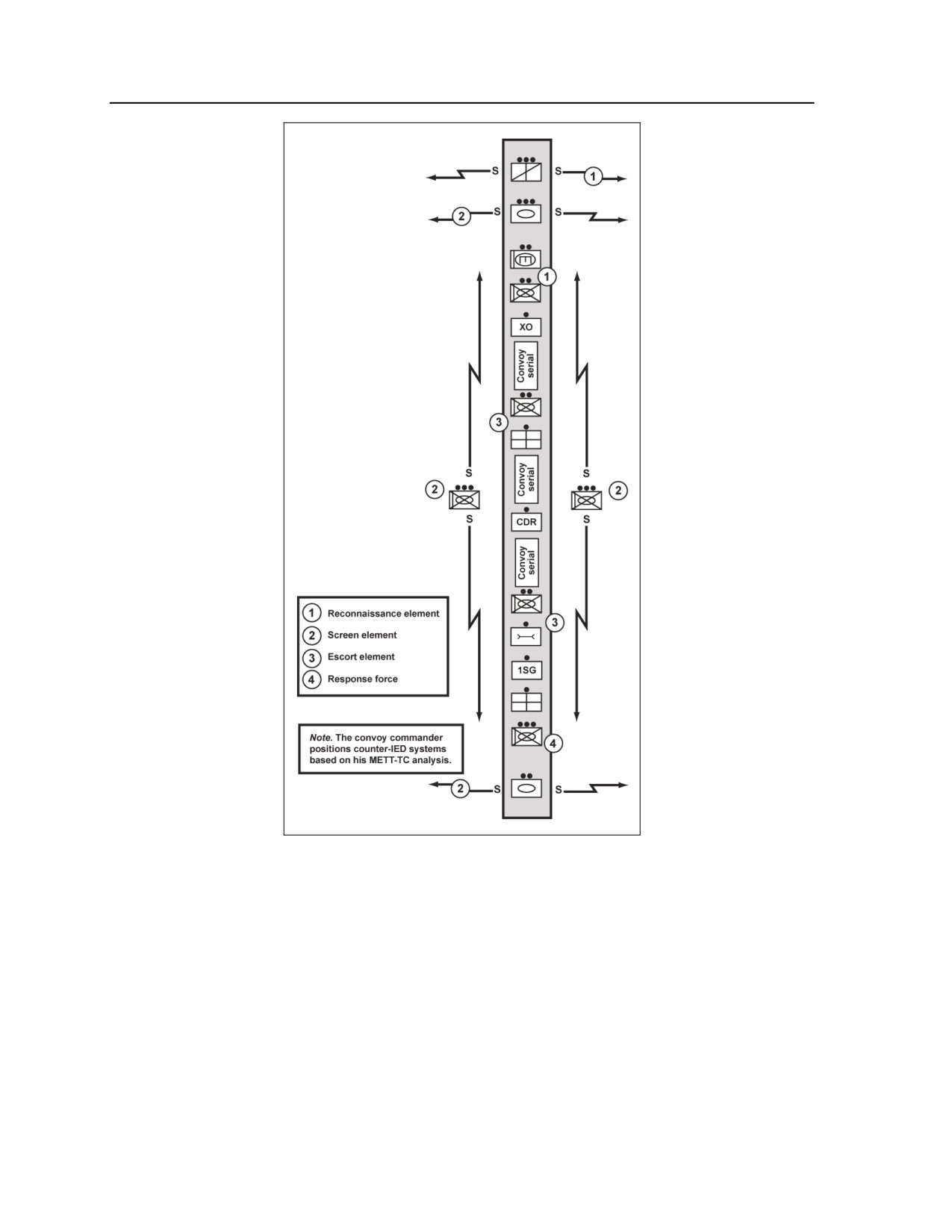
Chapter 4
Figure 4-1. CAB conducting convoy security
CRITICAL TASKS
4-28. A convoy security mission has certain critical tasks that guide planning and execution. To protect a
convoy, the security force must accomplish the following:
z
Reconnoiter the convoy route.
z
Clear the route of obstacles or positions from which the threat could influence movement along
the route.
z
Provide early warning and prevent the threat from impeding, harassing, containing, seizing, or
destroying the convoy.
4-8
FM 3-34.22
11 February 2009
Engineer Support to Security Operations
ORGANIZATION
4-29. The convoy security force consists of the following four elements:
z
Reconnaissance. The reconnaissance element performs tasks associated with route
reconnaissance forward of the convoy. It may also perform duties of the screen element.
z
Screen. The screen element provides early warning and security to the convoy flanks and rear. It
may also perform duties of the reconnaissance element.
z
Escort. The escort element provides local protection to the convoy. It may also provide a
response force to assist in repelling or destroying threat contact.
z
Response. The response force provides firepower and support to assist the other elements in
developing the situation or conducting a hasty attack. It may also perform duties of the escort
element.
PROCEDURES
4-30. Commanders plan and execute all troop and supply movement as tactical operations. Because of the
inherent dangers of convoy operations, emphasis is on extensive security measures, which include—
z
Secrecy when planning and disseminating orders, strict noise and light discipline during
movement, and varying routes and schedules.
z
Coordination with FS or aerial support units to ensure that they understand how support is used
to assist movement in enforcing preventive measures and in conducting close, continuous
support of combat operations.
z
Maneuver for counter-ambush actions, including contingency plans for immediate actions
against an ambush and the use of formations, which allow part of the column to be in position to
maneuver against an ambush force.
z
Communications and coordination with supporting units and units along the route, adjacent HN
forces, and higher headquarters (airborne radio relay assets).
z
Coordination with the supported unit moving in the formation, including C2, locations for
leaders, communications, medical support, and weapon systems.
z
Intelligence information to be gathered from local civilians along the movement route (possible
enemy ambush sites).
4-31. Convoy security missions generate unique requirements that the commander must consider when
formulating a plan. The convoy security commander and his subordinates are briefed on the latest
information regarding the threat situation and the area through which the convoy will pass. The
commander formulates his plans and issues his orders, including commander’s intent, assignment of troops
as security force elements (reconnaissance, screen, escort, response), the movement formation, intervals
between echelons and vehicles, rate of travel, and detailed plans for actions on contact. Immediate action
drills
(enemy ambush, obstacle, reaction to indirect fire) must be identified and rehearsed prior to
movement and executed in case of contact.
ENGINEER DUTIES
4-32. Combat engineers have the capability to conduct convoy security operations. They are best-suited for
the reconnaissance or escort element. Limited additional training may be required, but due to the nature of
combat engineer operations, they can fulfill any or all of the tasks associated with convoy security when
properly equipped. Geospatial support will help commanders identify choke points, potential ambush
locations, or potential road condition concerns during the IPB.
11 February 2009
FM 3-34.22
4-9
This page intentionally left blank.
Chapter 5
Engineer Support to Lethal and Nonlethal Fires
The clever combatant imposes his will on the enemy, but does not allow the enemy’s will to be
imposed on him.
—Sun Tzu
The fires warfighting function is the related tasks and systems that provide collective
and coordinated Army indirect fires, joint fires, and C2 warfare (including nonlethal
fires) through the targeting process. It includes tasks associated with integrating and
synchronizing the effects of these types of fires with the effects of other warfighting
functions. Lethal and nonlethal fires (including C2 warfare) are integrated in the
concept of operations during planning and targeting, based on targeting guidance.
Engineer operations contribute significant combat power (lethal and nonlethal) to all
elements of full spectrum operations. As part of the combined arms team, engineer
planners participate in the targeting process for the use of lethal and nonlethal fires to
ensure the integration of appropriate engineer capabilities. This chapter discusses the
targeting process for planning and coordinating lethal and nonlethal fires within the
BCT, along with prescriptive considerations for engineer planners.
FIRE SUPPORT PLANNING AND COORDINATION
5-1. FS is the collective and coordinated use of indirect-fire weapons, armed aircraft, and other lethal and
nonlethal weapons in support of the commander’s operational concept. The commander influences the
battle by shaping with fires, with a focus on accomplishing the FS essential tasks that the BCT requires to
accomplish the mission.
5-2. FS planning and coordination begins with mission receipt and continues throughout the operation. Its
purpose is to synchronize all available FS into the BCT scheme of maneuver. This is done primarily
through the inclusion of FS in the planning process. The BCT develops a concept of fires which is then
translated into a scheme of fires by assigning FS tasks and allocating assets and effects to subordinate
units. As part of the concept of fires, it is the BCT’s responsibility to set conditions for and provide indirect
fires to maneuver battalions engaged in the BCT decisive operation. The BCT provides fires in support of
the maneuver battalion close fight for a specific period of time or for a specific purpose. The BCT must
clearly specify the priority of fires. Refinements to the BCT scheme of fires from subordinate units are
integrated by essential FS tasks. Finally, the BCT integrates the movement and positioning of artillery units
with the scheme of maneuver.
LETHAL AND NONLETHAL FIRES
5-3. There is an inherent complementary relationship between the use of lethal force and the application
of military capabilities for nonlethal purposes. Lethal and nonlethal actions used together complement each
other and create dilemmas for the opponent, although each situation requires a different mix of violence
and restraint. Lethal means are at the heart of offensive and defensive actions, and their application is
critical to success in these operations. However, nonlethal means are becoming increasingly important.
Today’s threat operates from populated areas, wary of U.S. combat capabilities and welcoming the
potential carnage to noncombatants when combat erupts. They use IO effectively to dramatize any harm
inflicted on noncombatants by friendly forces. Nonlethal, constructive actions can persuade the local
population to withhold support for adversaries and provide intelligence to friendly forces. This can force
the enemy to choose between abandoning an area and exposing forces to lethal combat. Commanders
analyze mission variables to achieve a balance between lethal and nonlethal actions.
11 February 2009
FM 3-34.22
5-1
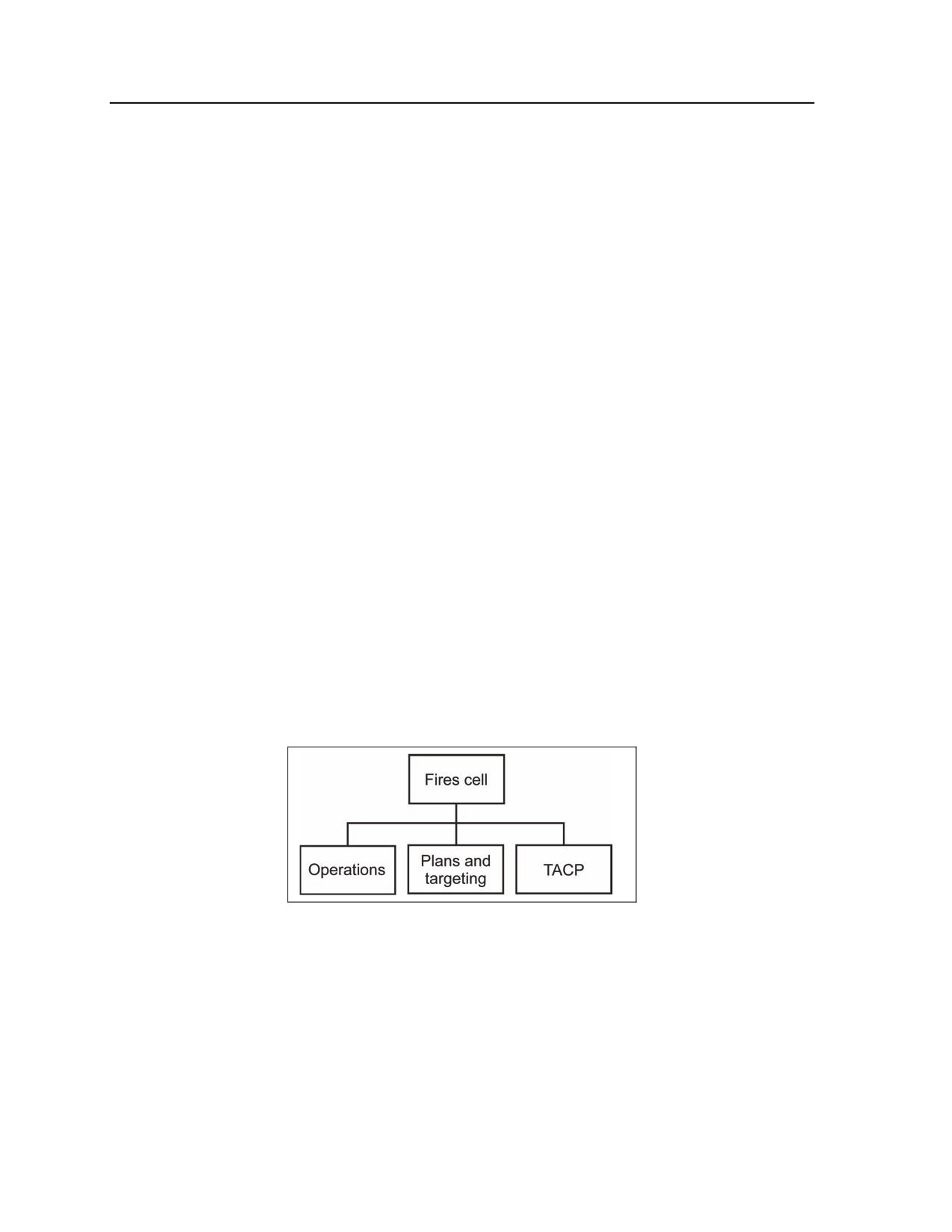
Chapter 5
5-4. IO are defined as the integrated employment of the core capabilities of electronic warfare (EW),
computer network operations, psychological operations
(PSYOP), military deception, and operations
security (OPSEC) (in concert with specified supporting and related capabilities) to influence, disrupt,
corrupt, or usurp adversarial human and automated decisionmaking while protecting U.S Soldiers (see FM
3-0). IO influence perceptions and engage enemies, adversaries, neutral groups and individuals, and
supporters to affect actions and generate a range of effects that contribute to mission accomplishment.
5-5. Lethal fires attempt to destroy their targets through blast, penetration, and fragmentation. Nonlethal
fires are any fires that do not directly seek the physical destruction of the intended target and are designed
to impair, disrupt, or delay the performance of enemy forces, functions, and facilities. PSYOP, EW, and
other C2 countermeasures are all nonlethal fire options.
5-6. Commanders consider the entire depth of their AOs, the enemy, the information environment, and
civil considerations and act in the times and places necessary to achieve their objectives. Army forces
increase the depth of their operations through combined arms, advanced information systems, and joint
capabilities. Because Army forces conduct operations across large areas, enemies face many potential
friendly actions. Depth is equally important in stability operations to preclude threats from operating
outside the reach of friendly forces, where they can affect the operation. In civil support operations, depth
gives the Army its ability to reach all citizens in an affected area, bringing relief and hope.
BRIGADE COMBAT TEAM FIRES CELL
5-7. The BCT FC is organic to the BCT headquarters and acts as the BCT CP functional cell for the fires
warfighting function. The FC is the centerpiece of BCT-targeting architecture, focused on lethal and
nonlethal target sets. It coordinates activities and systems that provide collective and coordinated use of
Army indirect fires and joint fires. This includes tasks associated with targeting and the targeting process.
The FC integrates lethal and nonlethal fires through the targeting process.
5-8. The FC is headed by the fire support coordinator (FSCOORD), and as shown in figure 5-1, includes
an operations element, a plans and targeting element, and a U.S. Air Force (USAF) tactical air control party
(TACP). The operations element tracks and maintains SU of all FS assets in the BCT. Its main function is
to execute current operations focused on the decisive fight. The principal functions of the plans and
targeting element are planning for future operations and targeting and shaping the BCT. The primary
mission of the TACP is to advise the shaping BCT commander on the capabilities and limitations of air
power and to assist in planning, requesting, and coordinating for CAS.
Figure 5-1. FC in the BCT
TARGETING PROCESS
5-9. The targeting process synchronizes the effects of fires and IO with the effects of other warfighting
functions. The targeting process determines what targets to attack to achieve the BCT commander’s desired
effects and how, where, and when to attack them.
5-10. The targeting process is based on the four functions of decide, detect, deliver, and assess (D3A).
Like other integrating processes, the targeting process is cyclical and occurs continuously throughout an
operation. Its steps mirror those of the operations process (plan, prepare, execute, and assess). Targeting
5-2
FM 3-34.22
11 February 2009

Engineer Support to Lethal and Nonlethal Fires
occurs within the MDMP and continues after the order is published, validating previous D3A decisions
while planning for future decisions. Table 5-1 provides an overview of targeting-process functions and
their relationship to the MDMP. (See FM 5-0, appendix H, for more detailed information on the targeting
process.)
Table 5-1. MDMP targeting process
Targeting-Process
MDMP Step
Targeting Task
Function
z
Perform a TVA to develop FS- and IO-related high-value targets
Mission
(HVTs).
analysis
z
Provide FS and IO input to targeting guidance and objectives.
COA
z
Designate potential HPTs.
development
z
Deconflict and coordinate potential HPTs.
z
Develop the HPTL.
Decide
z
Establish TSS.
COA analysis
z
Develop the AGM.
z
Determine MOP and MOE for BDA requirements.
z
Finalize the HPTL.
Orders
z
Finalize TSSs.
production
z
Finalize the AGM.
z
Submit IRs and RFIs to the S-2.
z
Execute the ISR plan.
Detect
z
Update PIRs and IRs as answered.
z
Update the HPTL and AGM.
z
Execute attacks according to the AGM.
Deliver
z
Execute IO tasks.
z
Assess task accomplishment (as determined by MOP).
Assess
z
Assess effects (as determined by MOE).
z
Monitor targets attacked with IO.
DECIDE
5-11. During MDMP, the decide function is primarily performed. The major targeting-related products of
mission analysis are HVTs and the commander’s targeting guidance. During IPB, the S-2, S-3, and
FSCOORD collaborate and conduct target value analysis (TVA) for each enemy COA to identify
high-value targets (HVTs). The following are produced after performing the decide function:
z
High payoff target list (HPTL). The HPTL is a prioritized list of targets (by target set) whose
loss to an enemy contributes to the success of the mission.
z
Targeting input to the intelligence synchronization plan (ISP). The ISP allows the S-2 (with
staff input) to synchronize the entire collection effort. This includes all assets the commander
controls, assets of lateral units, higher echelon units and organizations, and intelligence reach to
answer the CCIR.
z
Target selection standards (TSSs). These establish criteria for deciding when targets are
located accurately enough to act on.
z
Attack guidance matrix (AGM). This lists which targets or target sets to act on, how and when
to act on them, and the desired effects.
z
Target synchronization matrix (TSM). This combines data from the HPTL, ISP, and the
AGM. It lists high payoff targets (HPTs) by category and the agencies responsible for detecting
them, attacking them, and assessing the effects of the attacks.
5-12. The FSCOORD and information operations staff officer (S-7) work together to ensure that the BCT
nonlethal targeting effort is integrated and properly coordinated with higher, adjacent, and subordinate
units. BCTs can conduct two distinct targeting processes (one for lethal [FS] and another for nonlethal [IO]
11 February 2009
FM 3-34.22
5-3
Chapter 5
attack) or merge both processes into one. In either case, the targeting process (D3A) works equally well.
Although targeting objectives and effects may differ between IO and conventional targets, the main
difference is that IO targets are generally soft targets
(frequently, civilian personnel) as opposed to
conventional targets (normally, enemy units or equipment) to be destroyed or damaged. The S-2 and the S-
7 work together to identify enemy IO capabilities and vulnerabilities, which become IO-related targets. The
IO cell or the IO working group analyze these targets and provide the targeting working group with IO-
related HVTs for consideration.
DETECT
5-13. The detect function involves locating HPTs accurately enough to engage them. Characteristics and
signatures of the relevant targets are determined and then compared to potential attack system requirements
to establish specific sensor requirements. Information needed for target detection is expressed as PIR or IR
to support the attack of HPT and associated essential tasks for FS. As target acquisition assets gather
information, they report their findings back to the commander and staff. Detection plans, priorities, and
allocations change during execution, based on the mission variables.
DELIVER
5-14. The deliver function occurs primarily during execution, although some IO-related targets may be
engaged while the command is preparing for the overall operation.
ASSESS
5-15. The assess function occurs throughout the operations process but is most intense during execution.
RESPONSIBILITIES
5-16. The following are responsibilities of commanders and staff:
z
BCT commander. The BCT commander’s intent focuses and drives the targeting process. He
approves the recommendations of the targeting working group.
z
BCT XO. The BCT XO usually chairs the targeting meeting. Although the BCT commander
must approve the initial targeting products that accompany an OPLAN or OPORD, the XO or
deputy commanding officer (DCO) may be the approval authority for modifications to targeting
products.
z
FSCOORD. The FSCOORD is the special staff officer (field artillery [FA] lieutenant colonel
permanently assigned as a full-time FS staff advisor to the BCT commander and staff)
responsible for BCT fires, which include Army indirect fires and joint fires. He advises the BCT
commander and staff on all aspects of indirect fires planning, coordination, and execution in
support of BCT operations. The FSCOORD also facilitates the targeting working group
meeting.
z
BCT S-7. The BCT S-7 is responsible for planning, coordinating, integrating, and synchronizing
IO. Working with the FSCOORD, he advises the commander on IO effects in the context of
planned lethal and nonlethal fires in support of tactical operations. Advice is focused on the
capabilities and vulnerabilities of friendly, neutral, and adversarial IO systems.
z
BCT S-2. The BCT S-2 prepares the ISR plan and maintains information on the current enemy
situation and provides assessment of possible enemy actions, conducts analyses, and identifies
targets based on the commander’s guidance. The S-2 also provides enemy capabilities and
COAs, provides IPB products, and develops HVTs.
z
BCT S-3. One of the BCT S-3’s primary-targeting responsibilities is providing a detailed
interpretation of the commander’s concept of the operation to help in deciding when and where
targets should be attacked. The S-3 also chairs the targeting meeting in the absence of the XO
and DCO.
z
Air liaison officer (ALO). The ALO is a special staff officer responsible for coordinating
USAF support of BCT operations, including CAS, air interdiction, air reconnaissance, airlift,
5-4
FM 3-34.22
11 February 2009
Engineer Support to Lethal and Nonlethal Fires
and joint suppression of enemy air defenses (SEAD). The ALO is a senior USAF officer,
usually a major. The ALO directs the BCT TACP, supervises forward air controllers (FACs),
and processes air support requests for the BCT.
z
Targeting officer. The targeting officer in the FC facilitates the exchange of information
between the BCT S-2 and subordinate fires cells. The targeting officer’s primary responsibilities
are to help the S-2 and S-3 develop the ISR plan, develop the AGM, produce the TSS, and
manage target lists.
z
Electronic attack officer. The electronic attack officer’s targeting responsibilities include
determining HPTs to engage with electronic attack and coordinating tasking requirements for
electronic attack assets.
z
Public affairs officer
(PAO). The PAO is on the commander’s personal staff, but often
participates in targeting, especially those with nonlethal effects. The primary duty of the PAO is
advising the commander of the public affairs (PA) impacts and implications of planned or
current operations. The PAO monitors media and public opinion and facilitates media efforts to
cover operations by expediting the flow of complete, accurate, and timely information.
z
BCT PSYOP officer. The BCT PSYOP officer is responsible for planning, integrating, and
monitoring all tactical PSYOP within the BCT AO. The PSYOP officer advises the BCT
commander and staff on the psychological effects of BCT operations on the indigenous
population and serves as the commander’s resident staff expert on culture and psyche. As a
member of the FC, the PSYOP officer coordinates, synchronizes, and deconflicts PSYOP with
IO. The PSYOP officer plans, coordinates, and monitors BCT operations that focus on
influencing, informing, deceiving, disrupting, delaying, degrading, or destroying adversary
INFOSYS.
z
BCT civil affairs staff officer (S-5). The BCT S-5’s targeting responsibilities include providing
advice on the effects of friendly actions on the civilian population, providing input to the
restricted target list, and providing assessments on the effectiveness of CA activities.
z
Brigade judge advocate (BJA). The BJA serves as both a personal and special staff officer. As
a personal staff officer, the primary duty of the BJA is to advise the commander on operational,
military, administrative, and fiscal law and all other areas of the law as required. As a special
staff officer, the BJA (or the operational law judge advocate or trial counsel) provides legal
advice regarding ROE, targeting, and other legal aspects of the operation.
z
ENCOORD. The ENCOORD plays a vital role in targeting lethal and nonlethal fires. The
ENCOORD’s major role is ensuring that lethal fires are integrated with obstacles to provide
desired effects and planning and coordinating artillery-delivered and tactical aircraft-delivered
SCATMINES. The ENCOORD ensures these obstacles meet the BCT commander’s intent and
are placed in the most advantageous location with reinforcing terrain. The ENCOORD also—
Participates in the targeting working group and attends targeting meetings
(discussed
further in the following text).
Coordinates for establishing critical friendly zones (CFZs) at planned breach and crossing
sites.
Coordinates the survivability effort to protect critical FS assets (radars).
Advises the BCT commander and FC on environmental considerations (as the integrator)
that may be affected by lethal fires.
Advises the staff on possible damage to local infrastructure (as the integrator) which could
adversely affect the attitude of the local population.
Advises the commander of impacts on assured mobility caused by lethal fires.
MEETINGS
5-17. During the execution phase of operations, the targeting working group
(chaired by the XO)
continually assesses the current situation, tracks decision points, prepares update briefs for the commander,
and looks toward the future (generally 24 to 36 hours at the BCT level, depending on the mission). The
11 February 2009
FM 3-34.22
5-5
Chapter 5
targeting meeting provides a forum for the BCT to extend the FS planning that was conducted during the
MDMP throughout the operation, allowing the targeting working group to reconsider “who kills whom”
decisions and modify or initiate actions to implement those decisions.
5-18. The targeting meeting is an important event in the BCT battle rhythm. It focuses and synchronizes
BCT combat power and resources toward finding, tracking, attacking, and assessing HPTs. The following
occur during the targeting meeting:
z
The HPTL is verified and updated.
z
Available collection assets for each HPT are verified, updated, and retasked.
z
Delivery systems to engage each target (lethal and nonlethal) are allocated.
z
The assets tasked to verify the effects on a target after it has been attacked are confirmed.
z
Lethal and nonlethal actions (including IOs) are synchronized.
z
FS and IO assets to generate the desired lethal and nonlethal effects are synchronized.
Engineer Coordinator Participation in Targeting Meetings
5-19. Preparation and focus are keys to successful targeting meetings. Each representative must come to
the meeting prepared to discuss available assets, capabilities, and limitations related to their staff area.
Much of this preparation requires time-consuming, detailed planning and coordination with other staff
elements well in advance. Prior to attending the targeting meeting, the ENCOORD—
z
Gathers technical information available on enemy engineer units or equipment that are potential
HPT nominations, to include their relative location on the battlefield.
z
Gathers technical information on the employment of SCATMINEs.
z
Has recommendations for air-tasking order nominations (normally based on a 72-hour cycle) for
tactical air-emplaced SCATMINES.
z
Updates the engineer portion of the intelligence update based on new information on enemy
engineer units, activities, or obstacles (known or predicted) based on results of ISR or engineer
reconnaissance.
z
Provides updates on the effects of terrain based on engineer analysis, GEOINT, or
reconnaissance.
z
Provides additional geospatial products, as necessary, to support targeting decisions.
z
Is prepared to provide input to the restricted target list based on environmental considerations.
Engineer Considerations for Information Operations Targeting
5-20. If the BCT elects to conduct a separate IO targeting meeting or the IO cell conducts an internal IO
cell meeting prior to the BCT-targeting meeting, the ENCOORD or his representative participates.
Engineer participation in IO-targeting provides a medium for integrating the nonlethal effects of certain
engineer capabilities. It also provides the ENCOORD with an excellent opportunity to implement engineer
requirements into the prioritization of IO, PA, and psychological operations (PSYOP) (tactical PSYOP
teams [TPTs]) activities and the tasking of those limited assets within the BCT.
5-21. Although the PAO is not part of the IO cell, the PAO coordinates with nonlethal operations to ensure
that disseminated information is not contradictory. The ENCOORD coordinates with PAO for the inclusion
of engineer operations within BCT PA programs, which includes HN and U.S. media coverage of
engineering projects.
5-22. The ENCOORD coordinates with the BCT PSYOP officer for PSYOP surveys in local communities
to compare pending engineering projects with local population desires. PSYOP can also support PA
programs by helping to convince the general population of the credibility of the information that is being
provided by HN and U.S. forces, especially with regards to engineering projects. PSYOP can also reduce
civilian interference with friendly military operations.
5-23. The engineer knowledge of public works and HN infrastructure (derived from their participation in
infrastructure reconnaissance and surveys) can assist the S-7 in identifying IO-specific HVTs. Engineer
planners also provide current information regarding the status and plans for engineer projects throughout
the AO and AI. (See FM 3-34.170 for more information on infrastructure reconnaissance.)
5-6
FM 3-34.22
11 February 2009
Engineer Support to Lethal and Nonlethal Fires
5-24. Restoring the basic needs of the population is critical to winning the support of the HN. Engineering
projects executed by the BCT help set conditions to achieve many of the desired nonlethal effects. These
projects can facilitate positive targeting of local leaders or communities. An example of positive targeting
could be the execution of a priority project that has been requested by a local political or tribal leader.
When the project is accomplished, the population perceives that it was done for the local leader and
legitimizes his position. The target (local leader) then becomes more favorable to friendly force operations,
followed by more favorable reactions by the local population. As friendly forces receive more local
support, successful operations increase. (See FM 3-13 for more information on IO.)
11 February 2009
FM 3-34.22
5-7
Chapter 6
Engineer Support to Combat Operations
The tactician determines his solution by a thorough mastery of doctrine and existing TTP, tempered
and honed by experience gained through training and operations. He uses his creativity to develop
solutions for which the enemy is neither prepared, nor able to cope.
—FM 3-90
The modular engineer force provides mission-tailored capabilities to the BCT and
ACR in all combat operations. The organic engineer company in the BCT and ACR
and the organic geospatial engineering team within the BCT (or supporting the ACR)
provide the minimum combat and geospatial engineering capability and some very
limited and selected general engineering capability to support BCT and ACR combat
operations. Based on the maneuver commander’s essential tasks for M/CM/S
identified early in the planning phase, the BCT and ACR are augmented by EAB
modular engineer units to provide the necessary combat, general, and other
specialized engineering capabilities to fulfill mission requirements. This chapter
provides an overview of BCT offensive and defensive operations and discusses
engineer considerations for the associated tactical requirements of each.
(See
FM 3-90, FM 3-90.5, and FM 3-90.6 for detailed information on offensive and
defensive operations.)
TACTICAL ENABLING OPERATIONS
6-1. Tactical-enabling operations are specialized missions that units plan and conduct to achieve or
sustain a tactical advantage. Units execute these operations as part of an offensive, defensive, stability, or
civil support mission. Alone, enabling operations cannot assure success; however, neglecting them can
result in mission failure. The fluid nature of the OE likely increases the frequency with which engineers, as
part of a combined arms team, must execute tactical enabling operations.
BREACHING
6-2. Obstacle breaching is the employment of tactics and techniques to project combat power to the far
side of an obstacle. Breaching is a synchronized, combined arms operation under the control of a maneuver
commander. Combined arms forces apply the breaching fundamentals of suppress, obscure, secure, reduce,
and assault (SOSRA) when breaching against a defending enemy.
6-3. Breaching operations begin when friendly forces employ suppressive fires and end when battle
handover has occurred between a unit conducting the breaching operation and follow-on forces. Breaching
is an inherent part of maneuver. Effective breaching operations allow friendly maneuver in the face of
obstacles. (See FM 3-34.2 for more information on combined arms breaching operations. See appendix C
for potential augmentation to this type of operation.)
GAP CROSSING
6-4. The purpose of any gap crossing is to project combat power across an obstacle to accomplish a
mission. There are a number of similarities to combined arms breaching operations. A river crossing is a
special type of gap-crossing operation that requires specific procedures for success because a significant
amount of water is part of the obstacle that prevents normal ground maneuver. Gap crossing typically
requires unique technical support and more detailed planning and control measures than normal tactical
11 February 2009
FM 3-34.22
6-1
Chapter 6
breaching operations. The nature and size of the obstacle, the threat situation, and the available crossing
assets limit the commander’s options. More than likely, augmentation is required. As a result, the
ENCOORD must coordinate for EAB augmentation well in advance.
6-5. The types of gap crossings are hasty, deliberate, and covert. Regardless of the type of crossing, the
planning requirements and engineer technical support are similar. (See appendix E and FM 3-90.12 for
more information on combined arms gap-crossing operations.)
CLEARING
6-6. Clearing operations are designed to clear or neutralize all EHs and other obstacles from a route or
area.
(FM 3-90.11) Like breaching operations and gap-crossing operations, clearing operations are a
combined arms tactical enabling mission. They may include a combined arms breach, but are not limited to
reducing a lane or lanes through identified obstacles.
6-7. There are two types of clearing operations: route clearance and area clearance. Combat engineers
supporting clearing operations are task-organized to conduct route or area clearance. If a combined arms
breach is required as part of the clearing operation, selected combat engineers and other forces are task
organized specifically for the breaching operation. Bypassing or otherwise avoiding the obstacle may be
preferred over a combined arms breach; however, in clearing operations the objective is to eliminate the
enemy force or organized resistance within an assigned area or along an assigned route. Combat engineers
within the task-organized clearance force detect and mark EHs. They then either clear the route or area
(within their capability) or allow an EOD unit to respond appropriately based on the mission variables and
commander’s guidance. Only the EOD team is capable of eliminating or “rendering safe” an IED. (See
appendix C, appendix D, and FM 3-34.2 for more information.)
IMPROVISED EXPLOSIVE DEVICE DEFEAT
6-8. With the proliferation of technology and access to explosive materials, many enemy groups have
come to rely on IEDs as a primary means of attack. With a focus on clearing IEDs, the IED defeat
framework is derived from the fundamentals of assured mobility (predict, detect, prevent, avoid, neutralize,
and protect the force from IED attacks). Parallel to the framework of assured mobility, IED defeat
framework enables commanders and staffs to exploit (proactive defeat) IED networks and associated
operations before they occur.
6-9. Route clearance is a key enabling task in IED defeat. It provides the maneuver commander the
capability to employ a combined arms force of combat engineers, EOD, and other units task-organized,
equipped, and trained to neutralize the IED threat along critical routes. (See FM 3-90.119 for more
information.)
RECONNAISSANCE
6-10. Reconnaissance operations are conducted to obtain, by visual observation or other detection
methods, information about the activities and resources of an enemy or potential enemy or to secure data
concerning the meteorological, hydrographical, or geospatial characteristics and indigenous population of a
particular area.
6-11. Engineers participate in reconnaissance and enable other reconnaissance elements by enhancing the
quality of the reconnaissance. (The employment of engineer reconnaissance capabilities in support of BCT
operations is discussed in chapter 3. See FM 3-34.170 for detailed information on engineer reconnaissance.
See FM 3-20.96, FM 3-90, FM 3-90.5, and FM 3-90.6 for a further discussion of reconnaissance
operations.)
OFFENSIVE OPERATIONS
6-12. Offensive operations aim at defeating, destroying, or neutralizing the enemy. A commander may
conduct offensive operations to deprive the enemy of resources, seize decisive terrain, develop intelligence,
6-2
FM 3-34.22
11 February 2009
Engineer Support to Combat Operations
hold an enemy in position, or facilitate other friendly operations. Offensive operations tend to highlight the
assured mobility imperatives and attack the enemy’s ability to influence operating areas and maintain
mobility and momentum. Engineer operations in support of offensive operations focus on enabling
movement and maneuver.
6-13. The engineer running estimate (discussed in chapter 2 and appendix F) provides the framework for
the ENCOORD to synchronize and integrate engineer support into offensive operations. Conducting
parallel planning is vital in allowing engineer units to position critical assets and to establish linkup and
task-organize to their supported units. Early linkup with supported maneuver units provides critical time
for combined arms planning and rehearsals. ENCOORDs at the appropriate echelon coordinate engineer
reconnaissance to support the collection of necessary OBSTINTEL and other technical information. They
also coordinate the movement and positioning of any required engineer augmentation assets (combat and
general engineering). Although general engineering assets can be placed in command or support
relationships with the maneuver force, task-organizing these assets directly to the combat engineering unit
being augmented may be more effective. General engineering assets require added time for movement with
their heavy and wheeled equipment. Though the focus of supporting offensive operations is on mobility,
there may be requirements for protective positions for artillery systems, ADA systems, logistics positions,
and stationary C2 facilities, especially during halts in the advance. During the early planning stages, terrain
analysis teams can provide information on soil conditions, vegetative concealment, and terrain masking
along march routes to facilitate survivability for the force. (More planning considerations for offensive
operations are discussed in chapter 2.)
CHARACTERISTICS
6-14. Surprise, concentration, audacity, and tempo characterize successful offensive operations. Maneuver
commanders sustain the initiative by committing their forces aggressively against enemy weaknesses.
Attacks are force or terrain-oriented and facilitate the defeat of the enemy or the continuation of the attack.
Maneuver commanders extend their attacks in time and space by engaging the enemy in depth and
destroying key elements of the enemy force.
Surprise
6-15. Surprise denies the enemy the opportunity to focus and synchronize combat power against the
attacking force. It prevents the enemy from massing forces or fires at a critical (possibly decisive) place
and time. In place of cohesive resistance, surprise can produce confusion, fear, and piecemeal resistance.
Factors that contribute to surprise include the tempo and intensity in executing the attack plan and
employing unexpected factors
(selecting a less than optimal COA), varying operational tactics and
methods, conducting deception operations, and ensuring OPSEC. An enhanced COP and terrain
visualization enable engineer commanders to achieve surprise because they better understand enemy
defensive preparation. Engineers achieve surprise through obstacle reduction and the use of situational
obstacles. They enable surprise by rapidly overcoming obstacles, thus increasing the force tempo.
Concentration
6-16. Concentration is the massing of overwhelming effects to achieve a single purpose. The massing of
effects does not necessarily mean the physical massing of forces. With advancements in ground and air
mobility, target acquisition, and long-range precision fires, the concentration of effects can occur more
rapidly. The concentration of reduction assets and the negative influence from the presence of fortifications
and obstacle effects directly impact the maneuver unit’s ability to concentrate the terminal effects of its
fires. Concentration requires careful prior coordination within the combined arms team and with other
Services and multinational partners as required. Engineers begin the concentration planning by integrating
geospatial products and predicting threat obstacles. This effort is further enhanced with the employment of
engineer reconnaissance which can provide the necessary OBSTINTEL and other technical information
essential for detailed planning. This allows the maneuver force and the engineers that support them to
concentrate reduction assets and overcome obstacles or other impediments at the POP as part of the
maneuver unit breaching plan.
11 February 2009
FM 3-34.22
6-3
Chapter 6
Audacity
6-17. Audacity is a simple plan of action that is boldly executed. The audacious commander is quick,
decisive, and willing to take prudent risks. Engineers operating in a decentralized role, who comprehend
the commander’s intent, can enable the commander to see the OE and anticipate future operations. With
enhanced SU, commanders can be more audacious.
Tempo
6-18. Tempo is the rate of military action. Controlling or altering this rate is a necessary means of retaining
the initiative. An enhanced COP and extended operational reach allow the friendly unit to maintain a faster
tempo than the enemy. Engineer speed and flexibility are crucial to the attack. Rapid mobility operations
by engineers keep the maneuver force tempo. The ability to quickly reduce, mark, and guide the supported
maneuver unit through an obstacle is the engineer’s hallmark. The imperative of maintaining mobility and
momentum is highlighted as forces focus on achieving the fundamentals of avoid, neutralize, and protect.
TYPES
6-19. The four types of offensive operations are—
z
Movement to contact (MTC). Forces conduct an MTC to develop the situation and establish or
regain contact with the enemy. On contact, the commander has five options: attack, defend,
bypass, delay, or withdraw. MTCs include search and attack and cordon and search operations.
(See FM 3-06.20 for more information on cordon and search operations.)
z
Attack. An attack destroys or defeats enemy forces; seizes and secures terrain, or both. Attacks
incorporate coordinated movement supported by direct and indirect fires. They may be decisive
or shaping operations. Attacks may be hasty or deliberate, depending on the time available for
planning and preparation. Commanders execute hasty attacks when the situation calls for
immediate action with available forces and minimal preparation. They conduct deliberate attacks
when there is time to develop plans and coordinate preparations along with suitable intelligence.
z
Exploitation. Exploitation continues a successful attack to the point where enemy forces have
no alternatives but surrender or flight. Commanders of exploiting forces receive the greatest
possible latitude to accomplish their missions. They act with great aggressiveness, initiative, and
boldness.
z
Pursuit. Pursuits are offensive operations that follow successful attacks or exploitations. They
occur when the enemy fails to organize a defense and attempts to disengage. If it becomes
apparent that enemy resistance has broken down entirely and the enemy is fleeing, a force can
transition to a pursuit from any offensive operation. Pursuits require rapid movement and
decentralized control.
Note. See FM 3-90, FM 3-90.5, and FM 3-90.6 for more information.
Movement to Contact
6-20. Forces executing MTC seek to make contact with the smallest friendly force possible, leveraging the
use of electronic and unmanned means when possible. A unit conducting an MTC normally organizes into
a security force, advance guard, main body, flank guard, and rear guard. The priority for combat
engineering support is typically mobility, although it may rapidly shift to countermobility in anticipation of
an enemy attack. Figure 6-1 shows engineer support of an MTC. Considerations for engineers are based on
mission variables. The task organization of engineers for an MTC must balance task-organizing mobility
capabilities with the lead element to optimize response time and tempo without increasing the risk to the
mobility of the main body or limiting the ability to mass breaching assets against complex obstacles. Time
and distance factors (based on the terrain) for employing engineer assets and the potentially extreme
challenges of task-organizing on the move and linking up engineers with maneuver units that may be in
contact are significant considerations used in determining the ultimate task organization and positioning of
combat engineer assets within maneuver formations. (See FM 3-90, FM 3-90.5, and FM 3-90.6 for more
information.)
6-4
FM 3-34.22
11 February 2009
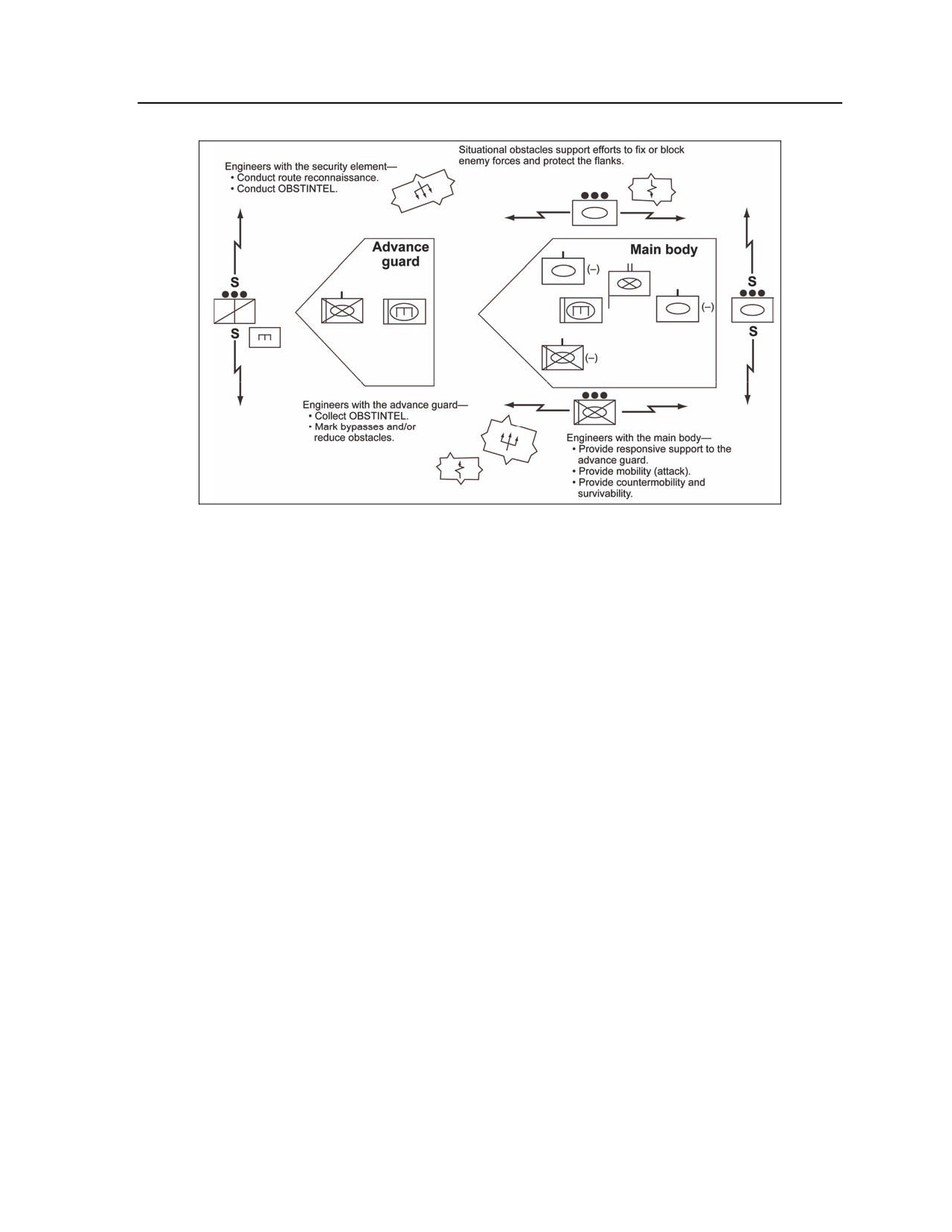
Engineer Support to Combat Operations
Figure 6-1. Engineer support to an MTC
Security Force
6-21. Engineers may augment the security force to reconnoiter obstacles and assist in gathering
OBSTINTEL to refine breaching planning operations for follow-on forces.
(See FM 3-34.170 for
information on conducting engineer reconnaissance.)
Advance Guard
6-22. The composition of the advance guard is based on mission variables. Engineers may augment or
follow the lead elements to locate, bypass, or breach obstacles along the main body axis of advance to
ensure the uninterrupted advance of the main body. Engineers use OBSTINTEL and combat information
from the security force to facilitate breaching operations. The advance guard is usually the main effort until
the main body is committed. Situational obstacles support efforts to fix or block enemy forces and must be
carefully executed to avoid affecting friendly maneuver. (See FM 90-7 for more information on situational
obstacles.)
Main Body
6-23. The main body contains the bulk of force combat elements and is arrayed to achieve all-around
security. It keys its movement to the advance guard. Engineers located within the main body are poised to
support its deployment and rapid maneuver to the decisive point on the battlefield to destroy the enemy.
Flank and Rear Guard
6-24. These elements remain at a distance from the main body to prevent the enemy from surprising the
main body with direct fires. Situational obstacles are used to help secure the flank. Obstacle control
measures and clearly defined triggers are critical in effectively employing situational obstacles.
Attack
6-25. The success of an attack depends on skillfully massing the effects of all warfighting functions. A unit
normally organizes into a security force, a main body, a reserve, and a sustainment organization. The task
organization of engineers depends on the factors of METT-TC and should occur early enough to ensure
11 February 2009
FM 3-34.22
6-5
Chapter 6
adequate time for rehearsals with the gaining or supported unit. The employment of engineer
reconnaissance (discussed in chapter 3) as part of the ISR effort helps generate OBSTINTEL, which
provides the necessary detailed picture of the enemy situation. If breaching operations are anticipated, the
breaching organization is established based on detailed reverse planning (see appendix C). Engineer
priority of effort is toward mobility, with the priority of support to the main effort. Countermobility effort,
primarily through the employment of situational obstacles, is initially directed at supporting the isolation
and fixing of enemy forces and protecting the flanks. Upon seizure of the objective and depending on the
follow-on mission, engineers are prepared to conduct countermobility and survivability operations in
support of a defense, while mobility operations center on clearing obstacles or improving lanes to support
friendly movement. (See FM 3-90, FM 3-90.5 and FM 3-90.6 for more information.)
Exploitation
6-26. An exploitation rapidly follows a successful attack to take advantage of a weakened or collapsed
enemy and seeks to expand an attack to the point where enemy forces have no alternative but to surrender
or flee. It is normally not conducted below the BCT level. The BCT (or higher-level unit) attacks rapidly
over a broad front to prevent the enemy from establishing a defense, organizing an effective rear guard,
withdrawing, or regaining balance. The BCT secures objectives, severs escape routes, and destroys all
enemy forces. The exploitation mission demands a force with a significant mobility advantage over the
enemy.
6-27. Engineers support an exploitation by breaching obstacles to facilitate the maneuver of ground forces,
keeping supply routes open and emplacing situational obstacles to protect the flanks. (See FM 3-90, FM 3-
90.5, and FM 3-90.6 for more information.)
Pursuit
6-28. A pursuit is designed to catch or cut off a hostile force attempting to escape with the aim of
destroying it. Pursuits often follow successful exploitations, but can develop at any point when enemy
forces are beginning to disintegrate or disengage. Unlike an exploitation, which may focus on seizing key
or decisive terrain instead of the enemy force, the pursuit always focuses on destroying the fleeing enemy
force. A pursuit is normally not conducted at the BCT level unless it is augmented with additional aviation
assets or ground maneuver units. When conducted, the goal of a pursuit is to fix the enemy between the
direct-pressure and encircling forces, then, destroy it.
6-29. The direct-pressure and encircling forces require engineers to be forward in movement formations to
quickly breach any obstacles that cannot be bypassed, thus ensuring unimpeded movement. Engineers also
conduct countermobility and survivability tasks in support of the encircling force. Normally, the
commander does not organize specifically for a pursuit ahead of time, although he may plan for a pursuit as
a branch or sequel to his offensive operation. (See FM 3-90, FM 3-90.5, and FM 3-90.6 for more
information.)
FORMS OF MANEUVER
6-30. The maneuver commander selects the form of maneuver based on analysis of mission variables. An
operation may contain several forms of offensive maneuver. For example, a frontal attack to clear enemy
security forces is followed by a penetration to create a gap in enemy defenses, which in turn is followed by
an envelopment to destroy a counterattacking force.
6-31. The five forms of maneuver are—
z
Envelopment.
z
Turning movement.
z
Frontal attack.
z
Penetration.
z
Infiltration.
6-6
FM 3-34.22
11 February 2009
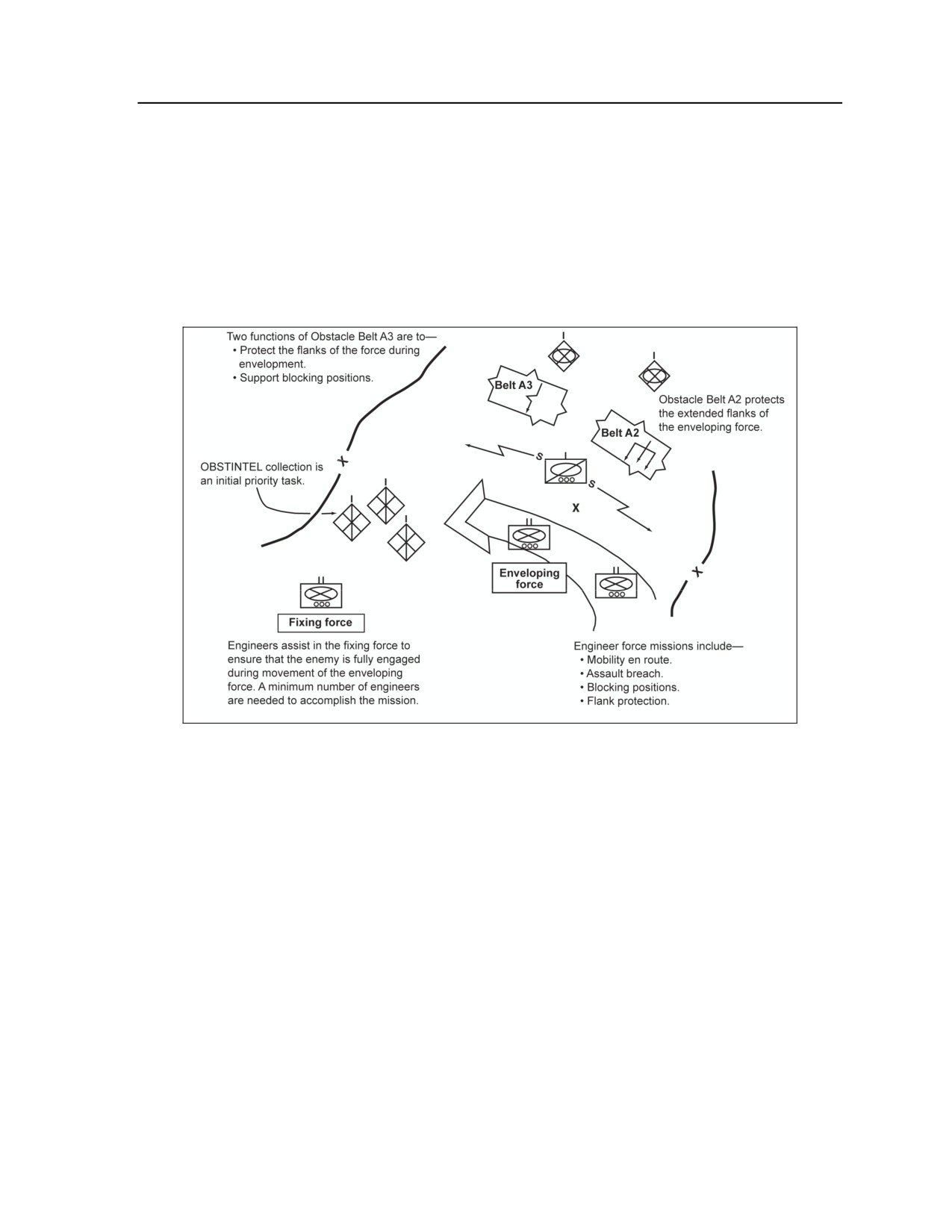
Engineer Support to Combat Operations
ENVELOPMENT
6-32. Envelopment is the preferred form of offensive maneuver. It seeks to strike the enemy on an
assailable flank or from the rear and forces the enemy to fight in a direction from which it is least prepared.
Enemy defensive positions, obstacle systems, and the terrain (not the march direction) define the flank. The
four types of envelopment are single, double, encirclement, and vertical. Figure 6-2 is an example of
engineer support to a single envelopment. Engineer support priorities for envelopment include enabling the
mobility of the enveloping force and providing protection for its extended flanks. Engineers plot known
and predicted enemy obstacles to determine if there is an assailable flank. Breaching an obstacle system
can provide the maneuver commander with the flank he needs; therefore, enemy obstacles and terrain must
be adequately studied.
Figure 6-2. Example of engineer support to a single envelopment
6-33. The maneuver force that makes up the enveloping force normally organizes for breaching operations.
Once committed, the enveloping force must have the capability to breach unforeseen obstacles with
minimal delay and maneuver. The following are critical to this ability:
z
OBSTINTEL gathered before the enveloping-force mission. The ENCOORD must ensure
that engineers are totally integrated into the brigade ISR plan and within the RS and battalion
scouts as applicable.
z
Engineers task-organized to the enveloping force. They provide responsive, rapid obstacle
reduction capabilities and the ability to further task-organize forces to accomplish the mission.
6-34. Engineer task organization must provide flexibility and redundancy. The main effort cannot afford to
wait for low-density equipment or units to be brought forward or replaced. Engineer planners can utilize
the reverse-planning process for determining engineer task organization requirements in support of
combined arms breaching operations. (See appendix C for further discussion on reverse planning.)
Main Effort
6-35. Engineer support to the main effort is broken into two separate areas that require dedicated engineer
forces to—
z
Provide mobility for the enveloping force.
11 February 2009
FM 3-34.22
6-7
Chapter 6
z
Protect enveloping-force extended flanks.
z
Provide engineer support to protect enveloping-force flanks centers on situational obstacles,
which are planned at the brigade level.
Note. SCATMINE systems are key components for this support.
6-36. A key aspect of mobility support to the main effort is maintaining the enveloping-force LOC. In
envelopment, the LOC for the main effort can quickly become extended, shifted in response to the attack,
or threatened by enemy units that have been bypassed. Engineers organic to the BCT have limited
sustainment capability and rely on EAB assets for augmentation, which should be determined early in the
planning phase.
Actions on the Objective
6-37. To provide engineer support to actions on the objective, the ENCOORD must understand the
enveloping-force mission. Fundamental to this understanding is the engineer’s involvement with the S-2 in
the IPB process. Determining the task organization of engineer units to the enveloping force centers on the
IPB process and the subsequent collection of information.
6-38. The mission of the enveloping force may be to attack and defeat or destroy a defending enemy force
or reserve. The priority of engineer effort is still mobility. The task organization must provide attacking
battalions with the capability to breach protective obstacles. However, the mission may be to secure key
terrain that denies the enemy’s use of LOCs. The enveloping force may then establish blocking positions.
Therefore, engineer support to actions on the objective may also require countermobility and survivability
operations. The organic engineer units can provide only limited survivability support. In these cases, the
ENCOORD, through wargaming, ensures that the enveloping force has the assets to maintain its mobility
during the attack, protect its flanks, and establish effective blocking positions.
Fixing Force
6-39. Providing the necessary assets to the fixing force is the greatest challenge of the ENCOORD. While
the main effort of engineer support and concentration of the engineer force is with the enveloping force,
engineer requirements for the fixing force must not be discounted. When the envelopment is successfully
executed, the fixing force is likely to be the only force required to breach extensive obstacles. More
importantly, the success of the main effort may depend on the ability of the fixing force to penetrate the
prepared defenses and fix the enemy during the movement of the enveloping force. This causes the enemy
to fight in two directions.
6-40. The engineer role in the fixing force is normally limited in scope because of support priorities to the
enveloping force. The ENCOORD carefully analyzes the requirements of the fixing force. This may
require focusing on the maneuver plan two levels down through close coordination with the engineer and
maneuver force commanders. The ENCOORD often recommends that the maneuver commander accept a
degree of risk and allocate the minimum force necessary to accomplish mobility requirements. However,
the ENCOORD can reduce the risk by initially focusing OBSTINTEL collection to confirm or deny
assumptions made about the enemy situation facing the fixing force. Adequate engineer augmentation
reduces the need to accept certain types of risk.
TURNING MOVEMENT
6-41. A turning movement (see figure 6-3) is a form of maneuver where the attacking force seeks to avoid
principal enemy defensive positions by seizing objectives to the enemy rear. The result should cause the
enemy to abandon their current positions or divert major forces to meet the new threat. This form of
offensive maneuver frequently transitions from the attack into an exploitation or pursuit. A turning
movement differs from envelopment because the force conducting a turning movement seeks to make the
enemy displace from the current location, whereas an enveloping force seeks to engage the enemy in the
current location from an unexpected direction.
6-8
FM 3-34.22
11 February 2009
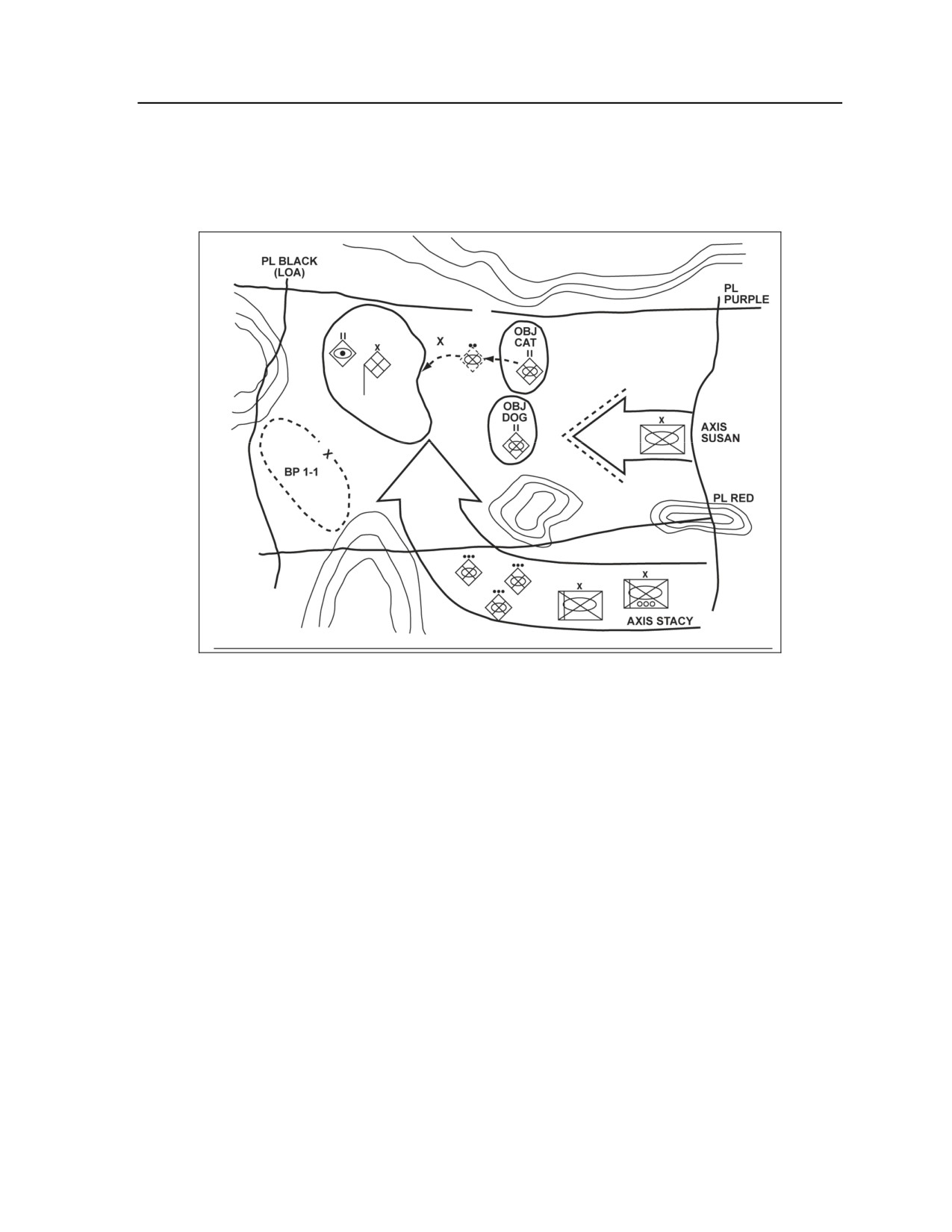
Engineer Support to Combat Operations
6-42. The commander directing a turning movement task-organizes resources into a turning force, a main
body, and a reserve. Each of these forces conducts security and reconnaissance operations. The turning
force or the main body can conduct the echelon decisive operation, given the appropriate mission variables.
The BCT is not likely to conduct a turning movement by itself, but it may be one of the components for a
training operation.
Figure 6-3. Example of a turning movement
Main Effort
6-43. Engineer support to the main effort requires dedicated engineer forces to—
z
Conduct engineer reconnaissance and provide geospatial support.
z
Provide mobility including the reduction of obstacles.
z
Protect the flanks.
z
Provide countermobility and survivability on the objective.
6-44. A key aspect of mobility support to the main effort is maintaining the turning-force LOC. In a
turning movement, the LOC for the turning force can quickly become extended, shifted in response to the
attack, or threatened by bypassed enemy units. Engineers organic to the BCT have limited sustainment
capability and rely on EAB assets for augmentation, which should be determined early in the planning
phase.
Actions on the Objective
6-45. To provide engineer support to actions on the objective, the ENCOORD and staff must understand
the scheme of maneuver. Fundamental to this understanding is ENCOORD involvement with the S-2 in the
IPB process. Determining the task organization of engineer units to the turning force centers on the IPB
process and the subsequent collection of information. Success of the turning movement implies the
potential requirement to transition to the defense to support the maneuver force fight against
counterattacking enemy forces.
11 February 2009
FM 3-34.22
6-9
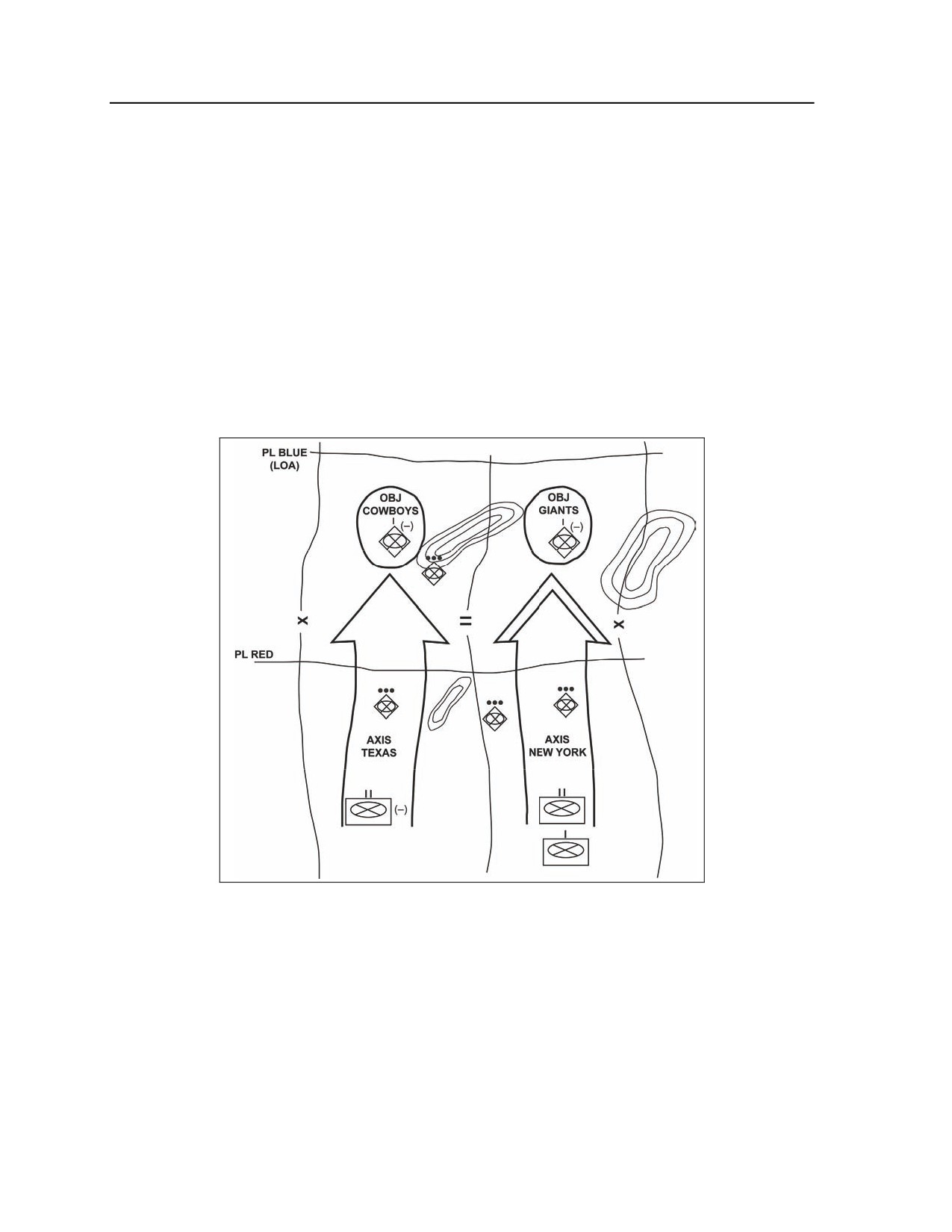
Chapter 6
6-46. If the BCT is the turning force, the supporting attack may be more in the nature of the follow-and-
assume or follow-and-support force within the BCT axis of attack. As such, the possibility of shifting
engineer assets is more possible than in a form of maneuver like a frontal attack. Instilling flexibility within
the task organization of engineer assets always presents a challenge to the engineer planner. The ability to
transition from a focus on mobility to one of countermobility and then back to mobility is critical.
FRONTAL ATTACK
6-47. A frontal attack (see figure 6-4) is a form of maneuver where an attacking force seeks to destroy a
weaker enemy force or fix a larger enemy force in place over a broad front. A maneuver force may conduct
a frontal attack to rapidly overrun a weak enemy force. A commander commonly uses a frontal attack as a
shaping operation in conjunction with other forms of maneuver. Normally, a frontal attack is employed
to—
z
Clear enemy security forces.
z
Overwhelm a shattered enemy during an exploitation or pursuit.
z
Fix enemy forces as part of a shaping operation.
z
Conduct a reconnaissance in force.
Figure 6-4. Example of a frontal attack against a stationary enemy force
6-48. It is also necessary to conduct a frontal attack when assailable flanks do not exist. Where a
penetration is a sharp attack designed to rupture enemy position, the commander designs a frontal attack to
maintain continuous pressure along the entire front until a breach occurs or the attacking forces succeed in
pushing the enemy back. Frontal attacks conducted without overwhelming combat power are seldom
decisive. Consequently, the commander’s choice to conduct a frontal attack in situations where he does not
have overwhelming combat power is rarely justified, unless the time gained is vital to the success of the
operation. Engineers are involved with ensuring the mobility of the force, with little opportunity to shift
engineer assets once committed. A commander conducting a frontal attack organizes the unit into an
element for reconnaissance and security operations, a main body, and a reserve. The mission variables
dictate the specific task organization. A frontal attack should almost always include significant combat
engineer augmentation.
6-10
FM 3-34.22
11 February 2009
Engineer Support to Combat Operations
Main Effort
6-49. Engineer requirements are associated with each of the elements of this force, but are likely to be
massed to ensure success of the decisive action. This is generally in support of the main effort. Engineer
support to the main effort is broken into several areas that require dedicated engineer forces to—
z
Conduct reconnaissance and provide geospatial support.
z
Provide mobility, including the reduction of obstacles.
z
Participate in a combined arms breach as required.
z
Protect the flanks.
Actions on the Objective
6-50. To provide engineer support to actions on the objective, engineers must understand the frontal attack
mission. When the attacking unit can no longer advance, it adopts a defensive posture. Whether on the
objective or not, engineers must be able to rapidly transition in support of maneuver element defensive
operations. Determining the task organization of engineer units for the frontal assault centers on the IPB
process, the subsequent collection of information, and an understanding of the intended scheme of
maneuver for the force. Reverse planning (see appendix C) should be applied for any anticipated combined
arms breaching operation.
Considerations
6-51. Providing the necessary assets to the supporting attack remains a challenge for the ENCOORD. The
main effort of engineer support and concentration of the engineer force may be with the elements
performing the decisive operation, though the engineer requirements for the supporting attack must not be
discounted. Given the nature of a frontal attack, engineers are hard-pressed to simultaneously support
across the broad frontage typically associated with frontal attacks. The supporting attack is likely to have
many of the same engineer requirements as the main attack (reducing obstacles). More importantly, the
success of the main effort may depend on the ability of the supporting attack to fix the enemy and keep the
majority of their force fully engaged.
PENETRATION
6-52. The purpose of a penetration is to rupture enemy defenses on a narrow front and disrupt the
defensive system (see figure 6-5, page 6-12). Units penetrate when enemy flanks are not assailable or time
does not permit some other form of maneuver.
11 February 2009
FM 3-34.22
6-11
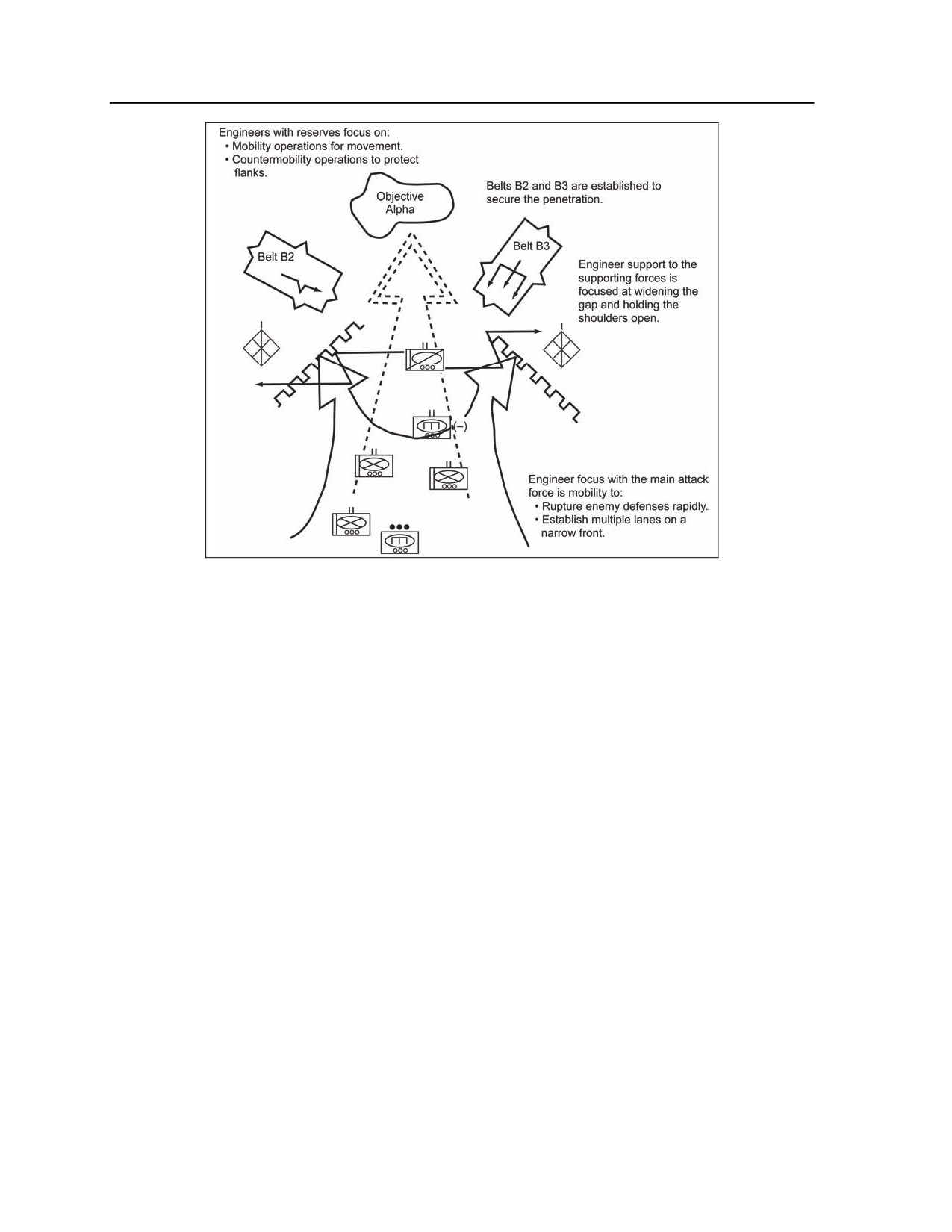
Chapter 6
Figure 6-5. Example of a penetration
6-53. Penetrations create assailable flanks and provide access to enemy sustainment areas. Because
penetrations frequently attack in the front of the enemy defense, they risk significantly more friendly
casualties than during an envelopment, turning movement, or infiltration. Augmentation of combat
engineer assets typically supports a brigade penetration.
6-54. A successful penetration requires the concentration of all combat multipliers, including the use of
night, stealth, and covered and concealed terrain. Penetrations have the following three stages:
z
Breaching enemy main defensive positions.
z
Widening the gap created to secure the flanks by enveloping one or both of the newly exposed
flanks.
z
Seizing the objective with its associated subsequent exploitation.
6-55. The main attack is used to rupture enemy defense. Supporting forces protect the flank of the main
effort and widen the gap by defeating adjacent enemy forces. The reserve is positioned to assist the main
attack and exploit success. Follow-and-support forces are used to—
z
Destroy enemy forces remaining in the zone.
z
Widen the penetration.
z
Secure the lodgment from counterattack.
Main Effort
6-56. Engineers support a penetration by providing the main effort with overwhelming mobility to rupture
enemy obstacles. This remains the engineer priority of support until a penetration is achieved. It requires
the ENCOORD to mass obstacle reduction assets in the main effort. Penetration requires the rapid
projection of combat power to maintain the momentum of the attack and quickly divide the enemy force.
To do so requires creating more lanes along a narrower front than normally associated with breaching
operations. Therefore, mass and redundancy drive engineer task organization to the main effort. Mass is
commonly achieved by weighting the main effort with task-organized EAB engineer augmentation, based
on the generally high number of essential tasks for M/CM/S associated with the main effort.
6-12
FM 3-34.22
11 February 2009