FM 3-34.22 ENGINEER OPERATIONS—BRIGADE COMBAT TEAM AND BELOW (February 2009) - page 1
*FM 3-34.22
Field Manual
Headquarters
Department of the Army
No.3-34.22
Washington, DC, 11 February 2009
Engineer Operations—
Brigade Combat Team and Below
Contents
Page
PREFACE
vi
INTRODUCTION
viii
Chapter 1
ENGINEER SUPPORT TO THE BRIGADE COMBAT TEAM
1-1
Requirements
1-1
Capabilities
1-3
Operations
1-7
Chapter 2
INTEGRATION OF ENGINEER OPERATIONS
2-1
Command and Control
2-1
Planning Considerations
2-6
Geospatial Support
2-7
Parallel Planning
2-8
Planning Process
2-9
Assured Mobility
2-12
Mobility, Countermobility, and Survivability
2-13
Continuing Activities and Integrating Processes
2-14
Project Management
2-19
Liaison Officer
2-19
Chapter 3
ENGINEER SUPPORT TO INTELLIGENCE, SURVEILLANCE,
AND RECONNAISSANCE
3-1
Operations
3-1
Reconnaissance
3-2
Engineer Reconnaissance Team
3-4
Distribution Restriction: Approved for public release; distribution is unlimited.
*This publication supersedes FM 3-34.221, dated 7 January 2005; FM 5-7-30, dated 28 December 1994; FM
5-71-2, dated 28 June 1996; and FM 5-71-3, dated 4 October 1995.
11 February 2009
FM 3-34.22
i
Contents
Chapter 4
ENGINEER SUPPORT TO SECURITY OPERATIONS
4-1
Operations
4-1
Screen Mission
4-3
Guard Mission
4-3
Cover Mission
4-5
Operational Area Security
4-5
Route Security
4-6
Convoy Security
4-7
Chapter 5
ENGINEER SUPPORT TO LETHAL AND NONLETHAL FIRES
5-1
Fire Support Planning and Coordination
5-1
Targeting Process
5-2
Chapter 6
ENGINEER SUPPORT TO COMBAT OPERATIONS
6-1
Tactical Enabling Operations
6-1
Offensive Operations
6-2
Forms of Maneuver
6-6
Defensive Operations
6-15
Urban Areas and Complex Terrain Considerations
6-24
Focused Support to Other Units Within and Augmenting the Brigade Combat
Team
6-25
Chapter 7
STABILITY AND CIVIL SUPPORT OPERATIONS
7-1
Stability Operations
7-1
Civil Support Operations
7-10
Civil Affairs Operations
7-16
Chapter 8
SUSTAINMENT SUPPORT FOR ENGINEER OPERATIONS
8-1
Planning
8-1
Brigade Combat Team Units and Functions
8-6
Engineer Leader Responsibilities
8-7
Support Functions
8-11
Appendix A
METRIC CONVERSION CHART
A-1
Appendix B
SELECTED ENGINEER ORGANZIATIONS AND CAPABILITIES
B-1
Organic Engineers in the Brigade Combat Team
B-1
Augmenting Engineer Units
B-2
Appendix C
COMBINED ARMS BREACHING OPERATIONS
C-1
Operations
C-1
Planning
C-22
Preparation
C-9
Execution
C-9
Appendix D
CLEARING OPERATIONS
D-1
Operations
D-1
Units
D-1
Route Clearance
D-4
Area Clearance
D-11
Appendix E
COMBINED ARMS GAP-CROSSING OPERATIONS
E-1
Types
E-1
ii
FM 3-34.22
11 February 2009
Contents
Planning
E-5
Phases of a Deliberate Gap Crossing
E-6
Control Elements
E-7
Appendix F ENGINEER RUNNING ESTIMATE
F-1
Planning
F-1
Preparation and Execution
F-7
Appendix G ORDERS AND ANNEXES
G-1
Engineer Annex
G-1
Engineer Unit Orders
G-5
Appendix H URBAN OPERATIONS
H-1
Operating in an Urban Environment
H-1
Planning for Urban Operations
H-5
SOURCE NOTES
Source Notes-1
GLOSSARY
Glossary-1
REFERENCES
References-1
INDEX
Index-1
Figures
Figure 1-1. The primary relationships of engineer functions to warfighting functions
1-9
Figure 1-2. BCT staff organization
1-14
Figure 2-1. Typical BCT CP layout
2-5
Figure 2-2. MDMP
2-9
Figure 4-1. CAB conducting convoy security
4-8
Figure 5-1. FC in the BCT
5-2
Figure 6-1. Engineer support to an MTC
6-5
Figure 6-2. Example of engineer support to a single envelopment
6-7
Figure 6-3. Example of a turning movement
6-9
Figure 6-4. Example of a frontal attack against a stationary enemy force
6-10
Figure 6-5. Example of a penetration
6-12
Figure 6-6. Example of an infiltration
6-14
Figure 6-7. Obstacle effects
6-19
Figure 7-1. Civil support framework
7-11
Figure 8-1. BSB and subordinate unit organizations
8-7
Figure 8-2. BCT maintenance operations
8-11
Figure B-1. BCTs and ACR structure
B-5
Figure B-2. Organic engineer staffs in BCTs and ACR
B-6
Figure B-3. Engineer company, HBCT
B-7
Figure B-4. Engineer company, IBCT
B-8
Figure B-5. Engineer company, SBCT
B-9
Figure B-6. Engineer company, ACR
B-10
11 February 2009
FM 3-34.22
iii
Contents
Figure B-7. Engineer battalion
B-11
Figure B-8. Sapper company
B-12
Figure B-9. MAC
B-13
Figure B-10. Clearance company
B-14
Figure B-11. Engineer support company
B-15
Figure B-12. MRBC
B-16
Figure B-13. Horizontal company
B-17
Figure B-14. Vertical company
B-18
Figure B-15. EHCC
B-19
Figure B-16. Engineer hazards team
B-20
Figure B-17. Mine dog detachment headquarters
B-21
Figure B-18. Mine dog squad
B-22
Figure C-1. Reduction area, breach area, and point of breach
C-2
Figure C-2. Sample execution matrix
C-8
Figure D-1. Sample organization for a route-clearing operation
D-5
Figure D-2. Sample contiguous clearance method
D-7
Figure D-3. Sample combat clearance method
D-8
Figure D-4. Sample clearance site layout
D-13
Figure D-5. Sample mechanical clearance method
D-14
Figure D-6. Sample mine dog handler team clearance method
D-14
Figure E-1. Type and categories of bridging
E-3
Figure E-2. Sample deliberate gap crossing
E-4
Figure E-3. Sample BCT crossing area overlay for a COA
E-6
Figure E-4. Overview of a deliberate gap crossing
E-7
Figure E-5. Graphic control measures
E-10
Figure G-1. Engineer annex
G-2
Figure G-2. Sample matrix and overlay
G-4
Figure G-3. Engineer unit OPORD
G-7
Figure G-4. Sample engineer execution matrix
G-10
Figure H-1. UO fundamentals
H-4
Tables
Table 1-1. Baseline engineering units
1-5
Table 1-2. Traditional engineer support capabilities
1-7
Table 2-1. Command and support relationships
2-2
Table 2-2. Engineer considerations in the MDMP
2-10
Table 2-3. Correlation of mission analysis and the engineer running estimate
2-11
Table 5-1. MDMP targeting process
5-3
Table 6-1. Enhanced technology impacts to defensive characteristics
6-16
iv
FM 3-34.22
11 February 2009
Contents
Table A-1. Metric conversion chart
A-1
Table C-1. Breaching tenets
C-3
Table C-2. Relationship between breaching organization and breaching
fundamentals
C-5
Table D-1. Selected units involved in clearing operations
D-2
Table D-2. Elements of a route-clearing team
D-6
Table D-3. Typical rate of march during sanitation operations
D-6
Table D-4. Selected planning considerations for route clearance
D-9
Table E-1. Gap-crossing fundamentals
E-1
Table E-2. CP tasks
E-8
Table F-1. Weather effects
F-3
Table F-2. IR in relation to METT-TC
F-7
Table H-1. Effects of an urban environment on warfighting functions
H-2
Table H-2. Terrain analysis in areas using OAKOC
H-6
Table H-3. Civil considerations using ASCOPE
H-7
11 February 2009
FM 3-34.22
v
Preface
The engineer support doctrine for the brigade combat team (BCT) is focused on tactical-level maneuvers. The
engineer organizations organic to the BCT are optimized to perform combat engineering (primarily mobility
with limited capabilities in countermobility and survivability) tasks with geospatial engineering support
provided by the organic terrain teams. Additional engineering support (combat and general) comes from
modular engineer organizations that are task-organized to the BCT or providing support from echelons above
brigade (EAB) organizations. This manual is aligned with current BCT doctrine (see Field Manual [FM] 3-
90.6) and describes engineer support for the heavy brigade combat team (HBCT), infantry brigade combat
team (IBCT), and Stryker brigade combat team (SBCT). Although the armored cavalry regiment (ACR) and its
engineer company is not specifically addressed, the basic principles of this manual also apply to those
organizations.
This manual combines, updates, and supersedes material from the following four tactical-level engineer
manuals:
z
FM 3-34.221.
z
FM 5-7-30.
z
FM 5-71-2.
z
FM 5-71-3.
This manual is built directly on the doctrine contained in the following manuals:
z
FM 3-0.
z
FM 3-07.
z
FM 3-34.
z
FM 3-90.
z
FM 3-90.5.
z
FM 3-90.6.
z
FM 3-90.61.
z
FM 4-0.
z
FM 5-0.
z
FM 6-0.
Given the magnitude of doctrinal changes in recent years, becoming familiar with these FMs is essential to
effectively using this manual. This manual applies across the spectrum of conflict, from peacetime engagement
to major combat operations. It is focused at the tactical level of war and meets the tactical commander’s
engineer support requirements. It is the tactical engineer commander’s guide regarding the aspects of operations
in support of the BCT and intended for use by brigade and below commanders and supporting staff
(augmenting unit commanders, staffs supporting brigade and below maneuver organizations).
This manual serves as a reference document for engineer commanders, staff, leaders, training developers, and
doctrine developers throughout the Army. It is a primary manual for instructional purposes within the U.S.
Army Engineer School (USAES) and assists other Army branch schools in teaching the integration of engineer
capabilities into Army operations, since engineer involvement is a given for nearly every military operation.
This manual includes guidance on integrating organic and augmenting engineer forces into BCT tactical plans,
orders production, and mission execution. It incorporates the use of essential tasks for mobility,
countermobility, and survivability (M/CM/S) in BCT operations and highlights the organic and likely engineer
augmentation to the BCT as it operates across the spectrum of conflict. The chapters and appendixes in this
manual are as follows:
z
Chapter 1 describes engineer roles in support of the BCT and includes considerations for
operating in the operational environment (OE).
z
Chapter 2 focuses on the integration of engineer operations during planning and the command
and control (C2) of engineer forces during execution.
vi
FM 3-34.22
11 February 2009
Preface
z
Chapter
3 describes engineer support to operations and the integration of engineer
reconnaissance.
z
Chapter 4 focuses on the varying levels and types of engineer support for each form of security
operations performed by the BCT.
z
Chapter 5 describes the targeting process and engineer involvement in planning lethal and
nonlethal fires in the BCT.
z
Chapter 6 describes how the modular engineer force provides specialized capabilities to meet
the needs of the BCT during offensive and defensive operations.
z
Chapter 7 provides an overview of and discusses some of the associated engineer tasks and
special considerations for each.
z
Chapter 8 focuses on sustainment support for engineer operations within the BCT.
z
Appendix A is a metric conversion chart that is included according to Army Regulation (AR)
25-30.
z
Appendix B provides detail on the engineers organic to the BCT and ACR and highlights some
of the likely modular engineer augmentation.
z
Appendix C serves as a quick reference for leaders in performing breaching operations.
z
Appendix D describes route and area clearance missions and provides leaders with some
fundamental planning considerations.
z
Appendix E highlights the fundamentals for conducting combined arms gap-crossing operations
and serves as a quick-reference guide for planners.
z
Appendix F provides detail on the engineer running estimate and how it supports planning,
preparing for, and executing operations.
z
Appendix G provides the format and instructions for producing the engineer annex and engineer
company or battalion task force
(TF) operation order
(OPORD) that facilitates mission
command.
z
Appendix H describes urban operations
(UO) and provides engineers with special
considerations for operating in urbanized terrain.
This publication applies to the Active Army, the Army National Guard (ARNG)/Army National Guard of the
United States (ARNGUS), and the United States Army Reserve (USAR) unless otherwise stated.
Unless stated otherwise, masculine nouns or pronouns do not refer exclusively to men.
The proponent for this manual is the U.S. Army Training and Doctrine Command (TRADOC). Send comments
and recommendations on Department of the Army (DA) Form 2028 (Recommended Changes to Publications
and Blank Forms) directly to Commander, U.S. Army Maneuver Support Center (MANSCEN), ATTN: ATZT-
TDD, 320 MANSCEN Loop, Suite 240, Fort Leonard Wood, Missouri 65473-8929. Submit an electronic DA
Form
2028 or comments and recommendations in DA Form
2028 format by e-mail to
<leon.mdottddengdoc@conus.army.mil>.
11 February 2009
FM 3-34.22
vii
Introduction
This manual provides engineer doctrine for operating at the BCT and below and within the framework of full
spectrum operations. Like FM 3-34, it describes engineer operations integrated through the warfighting
functions in a combined arms application of combat power. This manual, however, provides greater detail for
commanders and staff at brigade echelons and below to ensure synchronization of engineer capabilities
throughout operations and across the spectrum of conflict and applied operational themes. This manual answers
the question, “How to?” for engineers supporting the BCT.
This manual supersedes four manuals and reflects the considerable changes that have occurred over the 13
years since their release. Many of the tactical tasks associated with combat and general engineering support
have remained essentially constant, although the OE has dramatically shifted with new focused threats such as
improvised explosive devices (IEDs), and the increased emphasis on stability operations. Another major change
involves Army reorganization and restructuring to a modular force and the effects that this has on doctrine and
operations. Changes that directly affect this manual include the—
z
Replacement of battlefield operating systems with the warfighting functions and the subsequent
splitting of the M/CM/S battlefield operating system between the movement and maneuver and
protection warfighting functions.
z
Maturation of the term “assured mobility” (see FM 3-34, chapter 3 and chapter 4).
z
Restructuring of the engineer organizations within each of the three types of BCTs and the
ACR.
z
Formalization of a planning tool that supports the running estimate known as essential tasks for
M/CM/S (see FM 3-34).
z
Likelihood that the operations conducted will be joint, interagency, intergovernmental, and
multinational (see FM 3-0). The primary focus of joint engineer operations is to achieve the
commander’s intent by coordinating engineer support throughout the joint area of operations
(AO). All branches of Service possess the organic capability to conduct survivability operations.
When available, Naval construction force
(NCF)
(Seabees), Air Force rapid engineers
deployable heavy operations repair squadron, engineers
(RED HORSE), and prime base
engineer emergency force (Prime BEEF) organizations can greatly increase the breadth and
depth of the effort (see JP 3-34).
z
Alignment of engineer doctrine supporting FM 3-90.5 and FM 3-90.6.
z
Formalization of support requirements to homeland security (HLS) (see FM 3-07 and JP 3-28).
z
Frequency of contractors on the battlefield and their support for many of the survivability tasks
associated with general engineering
(see AR
715-9, FM
3-100.21, FM
100-10-2, and
FMI 4-93.41).
z
Resulting changes in the basic design and organizational structures and equipment of engineer
organizations to support ongoing Army transformation.
This manual includes the discussion of many items covered in greater depth in other engineer manuals that have
been recently released or are currently being rewritten. These manuals include—
z
FM 3-34.
z
FM 3-34.170.
z
FM 5-103.
z
FM 3-34.400.
z
FM 3-34.2
z
FM 3-90.12.
viii
FM 3-34.22
11 February 2009
Introduction
This manual incorporates those areas of emerging doctrine from the manuals above and—
z
Links assured mobility to the six warfighting functions and across the engineer functions.
z
Integrates engineer reconnaissance capabilities, specifically the engineer reconnaissance team
(ERT), within the combined arms team.
z
Acknowledges the term and concept shift from river-crossing operations to combined arms gap
crossing operations.
Note. The three types of gap crossings are also redefined to align with the three types of
breaching operations—introducing covert gap crossing as the third type of gap crossing.
z
Acknowledges the development of clearing operations (area and route clearance) as a tactical
enabling operation.
Finally, the OE on which this manual is based is more variable than the OE on which previous doctrine was
based. Engineers must be prepared to go into any OE and perform the full range of engineer tasks in support of
the maneuver commander while dealing with a wide range of threats and other influences. It builds on the
collective knowledge and wisdom gained through recent operations (combat and operations other than war)
numerous exercises, and the deliberate process of informed reasoning throughout the Army. It is rooted in time-
tested principles and fundamentals, while accommodating new technologies and diverse threats to national
security.
11 February 2009
FM 3-34.22
ix
Chapter 1
Engineer Support to the Brigade Combat Team
My engineers can do anything. There just aren’t enough of them.
—Major General Raymond Odierno
Commander, 4th Infantry Division, Operation Iraqi Freedom
Engineers supporting maneuver forces today face unique challenges, not only with
the unpredictability of the OE they operate, but also in adapting to the organizational
restructuring of the Army as it continues to transform to a modular force. Within the
BCT, this transformation has resulted in a streamlined, organic engineer company and
a reliance on task-organized EAB engineer augmentation. This chapter discusses the
need for engineer support within the BCT, the mechanism for providing responsive
and mission-tailored engineer capabilities, and the integration of the engineer
functions
(combat, general, and geospatial engineering) through the warfighting
functions to generate combat power in combined arms operations.
REQUIREMENTS
1-1. The Army operational concept is full spectrum operations. Full spectrum operations are the
purposeful, continuous, and simultaneous combinations of offense, defense, and stability or civil support to
dominate the military situation at operational and tactical levels. In full spectrum operations, Army forces
adapt to the requirements of the OE and conduct operations within it using synchronized action, joint
interdependent capabilities, and mission command. They defeat adversaries on land using offensive and
defensive operations and operate with the population and civil authorities in the AO using stability or civil
support operations. Integrated engineer support is not only critical in conducting combined arms in full
spectrum operations, but it also adds to the combined arms commander’s understanding of OE
requirements.
OPERATIONAL ENVIRONMENT
1-2. Understanding the OE is essential to successful operations. Today’s OE is more unpredictable than
those of the past, witnessing new threat and a complex and dynamic array of other influences. As with
other leaders, Army engineers are challenged to understand the OE they face and apply their knowledge
and capabilities to support the force. They must be prepared to face future adversaries that are adaptive and
have a wide array of asymmetric capabilities that allow them to successfully fight a more technologically
superior force. In the OE, engineers have difficulty predicting an enemy course of action (COA) based on
doctrinal templates. Engineers must be able to describe an enemy force in terms of function (fixing,
assaulting, exploiting, shielding) of subelements and not in terms of where it might be found on a
contiguous battlefield (2d echelon, main defensive belt). Engineers have to develop methods to discern and
identify threat engineer patterns of behavior. Engineers can also anticipate dealing with increased explosive
hazards (EHs) (mines, booby traps, IEDs, unexploded ordnance [UXO]) throughout the contiguous and
noncontiguous AO.
1-3. Warfighting commanders rely on engineers as one of the specialists available to add breadth and
depth to the overall understanding of the OE. The engineer view shares a common general understanding
of the OE, while adding a degree of focus on those aspects within the purview of an engineering
background. Guided by a common general understanding, the engineer view seeks to identify potential
challenges and opportunities associated with OE variables. The engineer view is not constrained to the
considerations that may result in engineer functional missions, and subsequent engineer planning is not
11 February 2009
FM 3-34.22
1-1
Chapter 1
limited only to the development of engineer functional tasks. The engineer, employing the common
analytical framework and a unique technical background, identifies significant and relevant challenges and
opportunities of potential impact to the combined arms operation to add to the overall understanding.
1-4. FM 3-0 describes an OE in terms of eight operational variables (political, military, economic, social,
infrastructure, information, physical environment, and time [PMESII-PT]). However, these variables are
too broad for planning at the tactical level. Army leaders at the BCT level and below narrow their focus to
the six mission variables
(mission, enemy, terrain and weather, troops and support available, time
available, and civil considerations
[METT-TC]). Once a mission or warning order (WARNORD) is
received, an analysis of the OE (in terms of mission variables) provides the relevant information (RI) that
commanders use to frame tactical problems. Engineers must understand these mission variables to best
understand how to leverage the capabilities organized into the engineer functions to support the BCT
mission. The resulting engineer view of the OE is then organized and linked to the warfighting functions.
The following are some examples of the engineer perspective for each of the mission variables:
z
Mission. Commanders analyze a mission in terms of specified tasks, implied tasks, and the
commander’s intent (two echelons up) to determine the essential tasks. Engineers conduct the
same analysis, with added focus on the engineer requirements, to determine the essential tasks
for M/CM/S. Early identification of the essential tasks for M/CM/S supports the maneuver
commander’s request for engineer augmentation. Engineer comprehension of the mission
requirements and the necessary engineer capabilities to meet those requirements facilitate the
appropriate task organization of engineer assets.
z
Enemy. The engineer view of the enemy concentrates on enemy tactics, equipment, and
capabilities that could threaten friendly movement, maneuver, protection, and sustainment and
may include an analysis of other factors within the AO or area of interest (AI) that could have an
impact on mission success.
z
Terrain and weather. As the terrain visualization experts, engineers analyze terrain (man-made
and natural) and weather to determine the effects on friendly and enemy operations. Engineers
analyze terrain using the five military aspects of terrain (observation and fields of fire, avenues
of approach, key terrain, obstacles, and cover and concealment [OAKOC]). Engineers integrate
geospatial products to help commanders and staffs visualize important aspects of the terrain to
support decisionmaking.
z
Troops and support available. Engineers consider the number, type, capabilities, and condition
of available engineer troops and support (joint, multinational, and interagency forces). They also
consider support from Department of Defense (DOD) or DA civilians, U.S. Army Corps of
Engineer (USACE) field force engineering (FFE), contracted civilians, and the host nation
(HN). FFE is the application of Engineer Regiment capabilities across the range of engineer
functions
(primarily general engineering-intensive) across the entire spectrum of conflict
through both reachback (TeleEngineering) and forward presence.
z
Time available. Effective commanders and staff know how much time and space their units
need to plan, prepare, and execute operations. Engineers understand the time required in
planning engineer operations and the importance of collaborative and parallel planning.
Engineers realize the time needed for positioning critical engineer assets and the time associated
with performing engineering tasks or projects.
z
Civil considerations. The influence of man-made infrastructure; civilian institutions; and
attitudes and activities of the civilian leaders, populations, and organization within the AO
impact the conduct of military operations. At the tactical level, they directly relate to key civilian
areas, structures, capabilities, organizations, people, and events (ASCOPE). This engineer view
provides a detailed understanding of infrastructure that comprises the basic facilities, services,
and installations needed for a community or society. The engineer view might identify
challenges associated with specific deficiencies in the basic infrastructure and opportunities in
the form of improvements to existing infrastructure.
1-2
FM 3-34.22
11 February 2009
Engineer Support to the Brigade Combat Team
FULL SPECTRUM OPERATIONS
1-5. In the spectrum of conflict, Army engineers operate as part of a joint force and often with
multinational and interagency partners. Joint integration, as part of a unified action, does not require joint
command at all echelons. Joint integration does require joint interoperability and certainly a working
knowledge of joint and multinational and interagency engineering capabilities (potentially available at all
levels). Integrated Army, joint, and other engineer capabilities are a significant force multiplier in
combined arms operations, facilitating the freedom of action necessary to meet mission objectives.
Engineer operations modify, maintain, provide understanding of, and protect the physical environment. In
doing so they—
z
Enable the mobility of friendly forces.
z
Alter the mobility of adversaries.
z
Enhance the protection and enable the sustainment of friendly forces.
z
Contribute to a clear understanding of the physical environment.
z
Provide support to noncombatants, other nations, and civilian authorities and agencies.
1-6. Engineer operations contribute significant combat (lethal and nonlethal) to all elements of full
spectrum operations. Engineer activities at the tactical level focus on support to the ordered arrangement
and maneuver of combat elements (in relation to each other and the enemy) that are required to achieve
combat objectives. Tactical missions are complex, and planning must consider both symmetric and
asymmetric threat capabilities. Organic engineer capabilities are embedded in each of the BCTs to provide
close support to the maneuver of those forces. Based on a METT-TC analysis, the BCTs may be task
organized with additional modular engineer capabilities to meet mission requirements.
1-7. For offensive and defensive operations, engineer augmentation in the BCTs is usually required.
Augmentation primarily comes from combat engineering, but also includes general engineering assets and
capabilities. Other, more technically specialized engineering capabilities may provide support to BCT
requirements for movement and maneuver, intelligence, protection, and sustainment. Engineer
augmentation may come in modular teams, sections, platoons, or companies or under the C2 of a task-
organized, multifunctional, battalion-size engineer TF headquarters. (See chapter 6 for more information
on engineer support to combat operations.)
1-8. Stability and civil support operations change the nature and focus of much of the engineer support to
the BCT. While augmentation of selected combat engineering skills remains essential, the likely
requirement centers on general engineering organizations and capabilities. As with support for combat
operations, engineer augmentation may come in modular teams, sections, platoons, or companies or under
the C2 of a task-organized, multifunctional, battalion-size engineer TF headquarters. If so, the focus of this
engineer battalion TF is likely on general engineering support and clearing operations with an emphasis on
reestablishing infrastructure within the AO. (See chapter 7 for more information on engineer support to
stability and civil support operations.)
CAPABILITIES
1-9. The streamlined engineer company organic to each of the BCTs provides a baseline of combat
capabilities to which augmentation can be added. The organic engineer staff within the BCT staff not only
identifies augmentation that is required, but also coordinates its application. Each BCT also has organic
geospatial engineering capabilities to provide a baseline of geospatial support. As mentioned, additional
Army, joint, multinational, interagency, and other engineering capabilities may be available to augment the
BCT. Additional Army engineering capabilities are organized within a modular engineer force pool. The
modular construct of the Army engineer operational force is a complementary and interdependent
relationship between four major unit categories (organic engineer, engineer headquarters, baseline, and
specialized engineering units).
11 February 2009
FM 3-34.22
1-3
Chapter 1
ORGANIC ENGINEER COMPANIES
1-10. The BCT is the Army basic instrument of tactical execution in implementing combat and stability
operations. It also has applicability in civil support operations. The following are the three types of BCTs:
z
HBCT. A single heavy brigade replaces the armored, mechanized, and balanced brigades of the
heavy divisions. This new HBCT fields tanks and mechanized infantry, in rough balance, within
a standardized combined arms battalion (CAB). The HBCT has a single organic engineer
company and is organized as part of the brigade special troops battalion (BSTB).
z
IBCT. As the light force, the IBCT is a uniform design that replaces the specialized airborne, air
assault, and light infantry brigade. The IBCT has a single organic engineer company and is
organized as a part of the BSTB.
z
SBCT. This lightly armored, motorized infantry brigade has a single organic engineer company
organized as an independent company within the BCT.
1-11. Each BCT and the ACR has an organic engineer (Sapper) company (see appendix B). In the HBCT
and IBCT, this company is located within the BSTB. In the SBCT, it is positioned as a separate unit under
the brigade. The combat engineering company of the ACR is also positioned as a separate unit under the
regiment similar to that of the SBCT. The engineer company is organic to the BCT and the ACR and is
focused on maneuver at the tactical level. Its mission is to provide assured mobility to the BCT and the
ACR by conducting M/CM/S and limited general engineering support to enhance maneuver in the AO. As
a combat multiplier, engineers concentrate their efforts on maintaining BCT freedom of movement and
lessening the enemy’s ability to mass and maneuver in the OE. Organic engineer capabilities include—
z
Providing geospatial data management and analysis (except in the ACR which does not have
organic geospatial elements).
z
Providing support to close combat (M/CM/S).
z
Providing mobility assessments.
z
Detecting and neutralizing EHs.
z
Supporting mobility through urban terrain.
z
Providing C2 for engineer forces.
1-12. During offensive and defensive operations, the BCT requires augmentation through baseline
elements that could include an engineer battalion headquarters. Other specialized engineering units and
equipment may also provide mission-tailored engineer support when their unique engineer capabilities are
required. Explosive ordnance disposal (EOD) elements may be included in this augmentation.
ENGINEER HEADQUARTERS UNITS
1-13. Engineer headquarters units are the basis for integrating engineer functions, elements, and
capabilities. They consist of the theater engineer command
(TEC), engineer brigade, and engineer
battalion. Each has a staff that allows the commander to provide C2 for assorted and various engineer
organizations. Each is also capable of providing C2 for other selected nonengineer units to support
multifunctional missions (combined arms breaching and combined arms gap crossing). The TEC provides
C2 for all assigned or attached Army engineer brigades and other engineer units and missions for the
combatant or joint task force (JTF) commander. The engineer brigade is one of the Army functional
brigades and provides C2 for up to five engineer battalions at the division and corps levels. The engineer
battalion is typically found within the engineer brigade or maneuver enhancement brigade (MEB) or in
support of a BCT.
1-14. When in support of a BCT, an engineer battalion conducts engineer missions and controls any mix of
up to five mission-tailored engineer companies. The engineer battalion headquarters is capable of
providing C2 for either combat or general engineering missions when they have been task-organized to
perform in these roles. The battalion may be focused on a single mission such as route clearance, security
construction, or cache interrogation and reduction. The engineer battalion may be organized to perform as
a breach force command when the BCT is conducting a combined arms breach. During a gap- or river-
crossing operation, the engineer battalion provides the option to be designated as the crossing site
1-4
FM 3-34.22
11 February 2009
Engineer Support to the Brigade Combat Team
command. For conducting construction or EH clearance missions, the battalion receives construction
design, survey, or EH teams to facilitate these missions.
BASELINE ENGINEERING UNITS
1-15. Baseline engineering units include combat and general engineering units (see table 1-1). They are the
primary building blocks for the organization of most engineer battalions. These units are used to augment
the organic engineer capabilities of a BCT and may be task-organized under an engineer battalion
headquarters to serve under a variety of larger headquarters, providing the specific tailored capabilities
needed to support any particular mission requirements. (See appendix B for more detailed information on
baseline engineering units.)
Table 1-1. Baseline engineering units
Combat Engineering Unit
General Engineering Unit
Sapper company
Engineer support company
Mobility augmentation company
Clearance company
Horizontal construction company
MRBC
Vertical construction company
Combat Engineering Units
1-16. Baseline combat engineering units are focused on supporting combined arms operations at the
tactical level and are designed to participate in close combat operations as necessary. All have the
capability to fight as engineers or, if required, as infantry. An engineer battalion headquarters is typically
included to provide the necessary C2, logistics, and staff supervision for attached and assigned units when
two or more are assigned to a BCT. Sapper units may construct tactical obstacles, defensive positions, and
fixed and float bridges; repair command posts (CPs), lines of communication (LOCs), tactical routes,
culverts, and fords; and conduct other selected general (horizontal and vertical, construction-related)
engineering tasks. Combat engineering units also provide engineer support for gap- and river-crossing
operations, assist in assaulting fortified positions, and conduct breaching operations. Airborne- and air
assault-capable engineer units also have the unique ability to employ air-droppable, rapid runway repair
kits in support of forcible-entry operations. The more specialized combat engineering capabilities of assault
bridging, breaching, and route and area clearance are added to the organic engineer capabilities in BCTs or
to deployed baseline Sapper companies to allow them to accomplish their broader mission requirements.
General Engineering Units
1-17. General engineering units are comprised of bridging, support, and construction capabilities. The
horizontal and vertical companies have a construction focus and are capable of constructing, rehabilitating,
repairing, maintaining, and modifying landing strips, airfields, CPs, main supply routes (MSRs), supply
locations, building structures, bridges, and other related aspects of the infrastructure. These units may also
perform repairs and limited reconstruction of railroads or water and sewage facilities. The basic capabilities
of these construction units can be significantly expanded. Through the augmentation of specialized
personnel and equipment, these baseline construction units can provide bituminous mixing and paving,
quarry and crushing operations, and major horizontal construction projects (highways, storage facilities,
airfields). Additional augmentation could also include pipeline construction or dive support depending on
the type and scope of the construction mission.
SPECIALIZED ENGINEERING UNITS
1-18. Specialized engineering units are a variety of typically low-density engineer forces that provide the
remaining category of engineer support. They are technically focused units that provide selected support at
the tactical level. These specialized forces include modules for construction support, infrastructure
development, EH mitigation, mine detection dogs, geospatial support, well drilling, real estate
management, and firefighting.
11 February 2009
FM 3-34.22
1-5
Chapter 1
OTHER ENGINEER CAPABILITIES
1-19. Each Service has baseline engineering units and capabilities that stem from their traditional roles and
associations to meet specific operational needs and to support accomplishing a variety of mission
requirements in any OE. Multinational, interagency, nongovernmental organization
(NGO), and
intergovernmental organization engineer capabilities can be a valuable addition to U.S. military engineer
forces. Host nation (HN), multinational, and U.S. civilian contractors may possess certain engineering
capabilities specifically adapted to the local environment
(in addition to providing labor, material,
infrastructure, and services).
1-20. There are other benefits to using multinational, HN, and U.S. contractors, but they must be weighed
against their potential limitations. HN engineer capabilities may be available if an adequate infrastructure
exists. This could potentially include a wide array of civil and public works organizations. It is also
increasingly common to contract for a wide range of engineer services with local or third party national
organizations and civilian contractors. These assets are typically used to free up military assets, minimizing
the military footprint in a theater, when requirements exceed military capabilities or when the engineer
operations and requirements are to be conducted in areas that are relatively safe from active combat. (See
FM 3-34, appendix D, for more information on other multinational, interagency, and HN engineer
capabilities.)
1-21. The engineering capabilities of each Service component may provide engineering support to the
other components to meet joint force requirements. (See FM 3-34, appendix C, and JP 3-34 for more
information on other Service engineer capabilities.) A brief summary of other Service engineer capabilities
are in the following paragraphs.
Navy Engineers
1-22. Navy construction battalion engineers, organized under the NCF, have rapidly deployable general
engineering units of various sizes and configurations, tailored to provide responsiveness and flexibility.
Seabees provide advanced base construction (airfields, LOCs, upgrade and maintenance, battle damage
repair, underwater and amphibious structures, and logistic facilities). Navy engineers also provide
engineering support to the Marines at various levels, including functioning as a major subordinate
command to a Marine air-ground task force (MAGTF). The Navy does not have combat engineers.
Marine Corps Engineers
1-23. The Marine Corps engineer’s primary tasking is combat engineering and limited general engineering
in support of MAGTFs. The Marine Corps has limited geospatial engineering capabilities, which reside in
the intelligence branch of the Marine Corps, with one topographic platoon supporting each Marine
expeditionary force (MEF).
Air Force Engineers
1-24. A primary tasking for Air Force engineers is enabling rapid global mobility for airlift, bombers, and
fighters and supporting other manned and unmanned aerial weapon systems. Air Force engineers are
trained and equipped with organic capabilities to support all aspects of airfield operations where heavy
strategic airlift, bombers, or fighters operate on a daily or frequent basis. The Air Force has the capability
to rapidly deploy general engineering units organized as part of an air and space expeditionary task force to
open, establish, and maintain airbase power projection platforms. These same units can deploy as detached
units operating in support of specific missions and operational tasks (airfield pavement evaluations, crash
and fire rescue, EOD, emergency management response, airfield damage repair, facility construction and
maintenance, utility systems construction and maintenance, aircraft arresting system installation and
maintenance, airfield lighting and marking, and navigation aid installation. Organized as Prime BEEF and
RED HORSE units, they provide a broad array of general and geospatial engineering capabilities.
1-6
FM 3-34.22
11 February 2009

Engineer Support to the Brigade Combat Team
OPERATIONS
1-25. Commanders visualize and direct operations through the warfighting functions. The warfighting
functions provide engineers with a common framework to link the required engineer capabilities to the
synchronized application of combined arms. Broadly categorizing engineer capabilities into engineer
functions enables a clear linkage to the warfighting functions and facilitates engineer planners in
integrating engineer operations into the BCT.
FUNCTIONS
1-26. Engineer functions are categories of related engineer capabilities and activities grouped together to
help joint force commanders integrate, synchronize, and direct engineer operations. The three engineer
functions are combat, general, and geospatial engineering. (FM 3-34) These engineer functions are useful
in describing the various engineer capabilities in support of the spectrum of conflict. (See table 1-2.)
Table 1-2. Traditional engineer support capabilities
Task
Actions Involved
Mobility
Breaching
Clearing
Bridging
Combat
Countermobility
Engineering
Emplacing or reinforcing obstacles
Survivability
Fighting positions
Protective positions
CCD
General
General construction
Engineering
Reinforcement of combat engineering tasks
Geospatial
Mapping
Engineering
Terrain analysis
Combat Engineering
1-27. Combat engineering is defined as those engineering capabilities and activities that support the
maneuver of land combat forces and require close support. Combat engineering consists of three types of
capabilities and activities—M/CM/S. (JP 3-34) Combat engineering is an integral part of a combined arms
unit’s ability to maneuver. It is focused on support of close combat forces. (See FM 3-34, chapter 3, for
further discussion of M/CM/S operations.) Combat engineering includes those capabilities organic to and
augmenting the BCTs. Combat engineering provides tactical-level engineer support to combat (offense and
defense), stability, or civil support operations. It may be augmented at times with general engineering
support, but retains its focus on the integrated application of engineer capabilities to support the combined
arms unit’s freedom of maneuver (mobility and countermobility) and protection (survivability). Combat
engineering is typically associated with close combat operations, while general engineering is not.
1-28. Mobility operations are defined as obstacle reduction by maneuver and engineer units to reduce or
negate the effects of existing or reinforcing obstacles. The objective is to maintain the freedom of
movement for maneuver units, weapon systems, and critical supplies. (FM 3-34) For combat engineering,
it is focused on the movement and maneuver warfighting function. (See FM 3-34.2 for information on
combined arms mobility operations, FM
3-90.12 for the specifics of combined arms gap crossing
operations, FM 3-90.119 for the specifics of combined arms IED defeat operations, and FM 3-34.210 for
the specifics of EH and military search operations).
11 February 2009
FM 3-34.22
1-7
Chapter 1
1-29. Countermobility operations are defined as operations that deny the enemy the freedom of maneuver
through the employment of reinforcing obstacles.
(FM 3-34) Countermobility also includes the
construction of entry control points and other barriers to deny free access to fixed sites. The primary
purpose of countermobility operations is to slow or divert the enemy, increase the time for target
acquisition, and increase weapon effectiveness. Countermobility operations block, fix, turn, or disrupt the
enemy’s ability to maneuver, giving the commander opportunities to exploit enemy vulnerabilities or react
effectively to enemy actions. Countermobility must include proper obstacle integration with the maneuver
plan, adherence to obstacle emplacement authority, and rigid obstacle control.
1-30. Survivability operations are defined as the development and construction of protective positions
(earth berms, dug-in positions, overhead protection, countersurveillance means) to reduce the effectiveness
of enemy weapon systems. (FM 3-34) Survivability considerations are applied in support of battle
positions (BPs), combat outposts, base camps and, in many cases, HN and other infrastructure support.
Two key factors in the development of defensive fighting positions are—
z
Proper siting in relation to the surrounding terrain.
z
Proper siting for the most effective employment of weapon systems.
1-31. Defensive protective positions may include—
z
C2 facilities and critical equipment (to include radars).
z
Supply and ammunition storage or holding areas.
z
Other items that are likely to be targeted first by enemy action.
Note. See FM 5-103 for more information on survivability operations.
General Engineering
1-32. General engineering is defined as those engineering capabilities and activities (other than combat
engineering) that modify, maintain, or protect the physical environment. Examples include—
z
Infrastructure, facility, LOC, and base—
Construction.
Repair.
Maintenance.
Operation.
z
Terrain modification and repair.
z
Selected explosive hazard activities.
Note. See FM 3-34, FM 3-34.400, FM 3-100.4, FM 7-15, and JP 3-34 for additional information
on general engineering.
1-33. General engineering capabilities are not organic to the BCTs, and general engineering tasks are not
typically associated with close combat, which is the focus for combat engineers. However, general
engineering tasks may be performed in support of combat operations. While general engineering is
typically performed by general engineers, selected general engineering tasks may also be performed by
combat engineers.
Geospatial Engineering
1-34. Geospatial engineering is defined as the art and science of applying geospatial information to enable
understanding of the physical environment for military operations. The art is the ability to understand
METT-TC and the geospatial information available, including intent of use and limitations, in order to
explain the military significance of the terrain to the commander and staff and create geospatial products
for decisionmaking; the science is the ability to exploit geospatial information, producing spatially accurate
products for measurement, mapping, visualization, modeling, and all types of analysis of the terrain. (FM
3-34)
1-8
FM 3-34.22
11 February 2009
Engineer Support to the Brigade Combat Team
1-35. Engineer planners are charged to be terrain visualization experts and advise commanders on how to
conceptualize the OE. They must be supported by terrain analysts to fully assist others in using terrain
more effectively. Integrating geospatial support within the BCT is discussed in chapter 2. (See FM 3-
34.230 and JP 2-03 for more information on geospatial support to Army and joint systems.)
COMBAT POWER
1-36. As stated in FM 3-0, Army forces generate combat power by converting fighting potential into effect
action. Commanders apply combat power through the warfighting functions using leadership and
information. To effectively support the combined arms team, engineer capabilities are organized by the
engineer functions and synchronized in their application through the warfighting functions. The engineer
functions are generally aligned in support of specific warfighting functions (see figure 1-1), although they
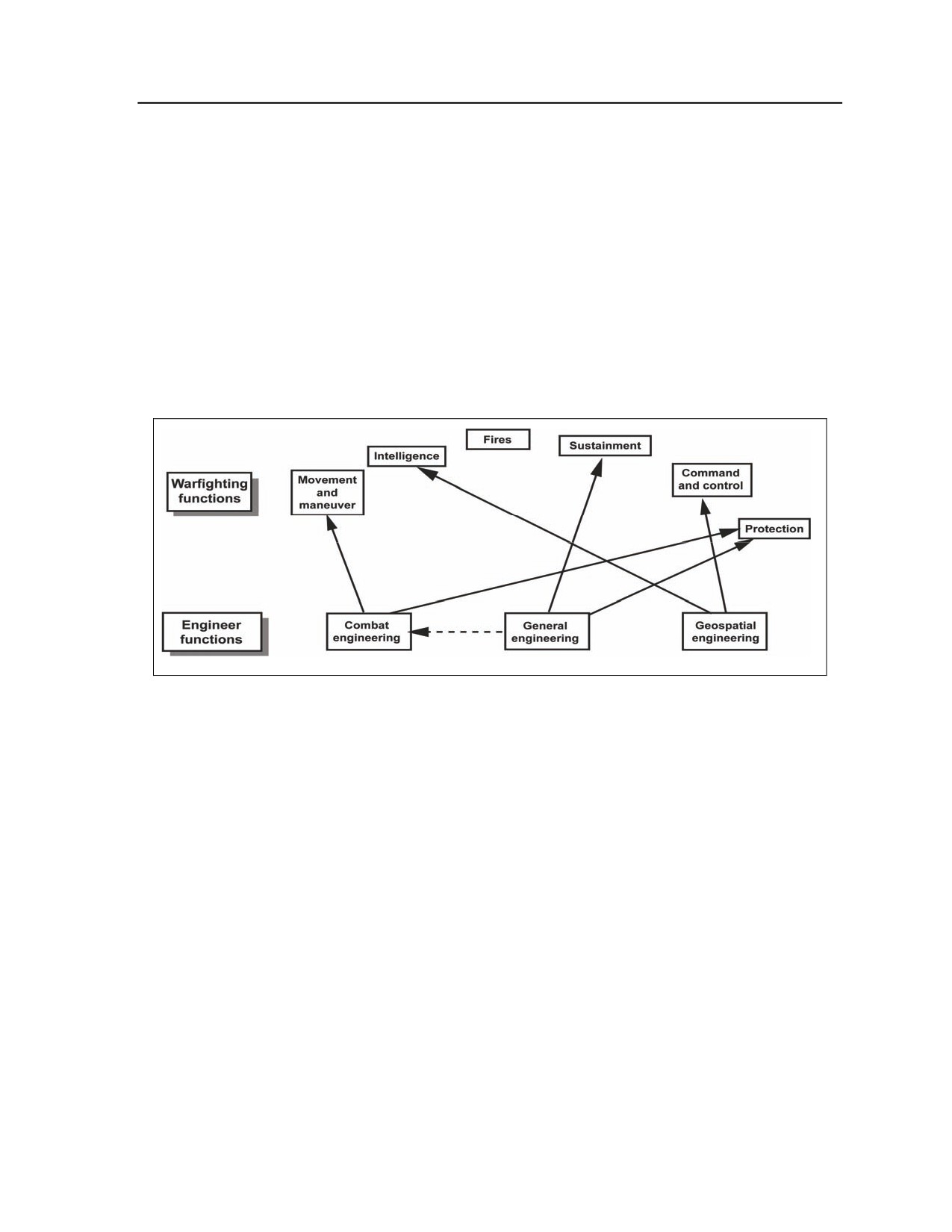
have impact on and across the others. Combat engineering is primarily aligned with movement and
maneuver and protection functions, general engineering focuses its support on sustainment and protection
functions, and geospatial engineering is primarily aligned with C2 and intelligence functions. (See FM 3-
34, chapter 3.)
Figure 1-1. The primary relationships of engineer functions to warfighting functions
Movement and Maneuver
1-37. The warfighting function of movement and maneuver is the related tasks and systems that move
forces to achieve a position of advantage in relation to the enemy. It includes those tasks associated with
projecting, protecting, and employing forces. Maneuver is the means by which commanders mass the
effects of combat power to achieve surprise, shock, and momentum. Movement is necessary to support that
function and assure the protection, dispersion, and displacement of the force as a whole. The use of tempo
and coordination with fires are indispensable to effective maneuver. The movement and maneuver
warfighting function includes the following tasks:
z
Deploy.
z
Maneuver.
z
Move.
z
Conduct mobility and countermobility operations.
z
Employ direct fires.
z
Occupy an area.
z
Employ battlefield obscuration.
11 February 2009
FM 3-34.22
1-9
Chapter 1
Combat Engineering
1-38. Combat engineering support applied through the movement and maneuver warfighting function
includes mobility operations (see FM 3-34.2) and countermobility operations (see FM 90-7 [to be revised
as FM 3-90.13]). Mobility operations include the following tasks:
z
Overcome barriers, obstacles, and mines.
Conduct breaching operations.
Conduct clearing operations.
Conduct gap-crossing operations (see FM 3-90.12).
z
Enhance movement and maneuver.
Construct and maintain combat roads and trails.
Construct and maintain forward airfields and landing zones (LZs).
z
Negotiate a tactical AO.
z
Provide diver support.
1-39. Countermobility operations include the following tasks:
z
Site obstacles.
z
Construct, emplace, or detonate obstacles.
z
Mark, report, and record obstacles.
z
Maintain obstacle integration.
1-40. Combat engineers fight alongside maneuver units with a focus on close combat. When conducting
combat operations, they must be prepared to fight as engineers; employing their combat skills, using fire
and maneuver to accomplish the engineer mission. Consequently, all combat engineers are organized,
trained, and equipped to fight as engineers to destroy the enemy in addition to their primary responsibility
of combat engineering.
1-41. Combat engineers are organized, trained, and equipped to engage as engineers in close combat to
accomplish the engineer missions and—
z
Support a movement to contact or attack as part of a maneuver formation to accomplish the
mission.
z
Fight as the breach force during BCT combined arms breaching operations.
z
Assist the supported organization to defeat an unexpected attack.
z
Protect a critical demolition target that must remain passable until friendly forces are able to
withdraw.
z
Maintain security at a work site.
z
Protect themselves in an assembly area or on the march.
1-42. During combat operations, combat engineering units are task-organized with maneuver units and are
integrated into the combined arms formation. The engineer unit is designed to provide demolition,
breaching, and hasty gap-crossing capabilities to the combined arms team. The engineer unit can also
employ direct-fire weapons systems to aid in employing demolitions and breaching assets. A combat
engineer organization is capable of executing infantry tasks or task organizing to fight as infantry with
other combat units. However, engineers have organizational deficiencies that include a lack of organic fire
control personnel, communications equipment, and medical personnel. If an engineer battalion has been
redesignated to fight as infantry (a maneuver unit), it typically must be retask organized. These reorganized
engineers require the same support and potentially the integration of other maneuver elements (armor, fire
support [FS]) into its task organization to accomplish its mission.
1-43. Any commander who commands combat engineers has the authority to employ them as infantry,
unless otherwise reserved. However, a commander must carefully weigh the gain in infantry strength
against the loss of engineer support. Engineers provide far more combat power in their primary mission
than when configured as infantry. Stopping the engineer work may reduce the combat power of an entire
force.
1-10
FM 3-34.22
11 February 2009
Engineer Support to the Brigade Combat Team
1-44. An emergency or immediate requirement for infantry may not require reorganization as engineers are
simply committed to the fight, to fight as engineers, and understanding their limitations. Reorganization
occurs when time allows, moving unneeded engineer elements and equipment from the battlefield and
augmenting the engineer structure with additional capabilities. A commander normally considers
reorganizing when forecasting a shortage of infantry before a future operation or phase of an operation.
The commander makes a decision after weighing METT-TC factors and determining an acceptable risk
level. Reorganizing engineer units as infantry requires resources, time, and training.
General Engineering
1-45. Support to movement and maneuver includes the support of tasks exceeding the capability of the
combat engineering force and more extensive upgrades or new construction of LOCs (see FM 3-34.400).
General engineering support is typically applied through the sustainment warfighting function, but may
include many of the following tasks that also crossover to support movement and maneuver:
z
Construct and maintain combat roads and trails exceeding the capability of combat engineering
assets.
z
Provide forward aviation combat engineering (FACE) exceeding the capabilities of combat
engineering assets, to include the repair of paved, asphalt, and concrete runways and airfields.
z
Install assets that prevent foreign object damage (FOD) to rotary-wing aircraft.
z
Construct tactical and LOC bridging.
Intelligence
1-46. The warfighting function is the related tasks and systems that facilitate the understanding of the OE,
enemy, terrain, and civil considerations. Commanders make decisions and direct actions based on their
situational understanding (SU). They keep their SU current by continuously assessing the situation and
stating the information they need in the commander’s critical information requirements (CCIR). The
required information is obtained through various detection methods and systematic observation,
reconnaissance, and surveillance. (See chapter 3 for engineer support to ISR operations.)
1-47. Engineer capabilities can be employed during key activities in the operations process to add to the
commander’s SU. Engineers play a major role in the intelligence preparation of the battlefield (IPB)
process by anticipating and providing terrain analysis products of likely contingency areas. Geospatial
support assists in describing the effects of the OE on enemy and friendly capabilities and broad COAs.
1-48. Engineer reconnaissance (see chapter 3) can provide data that contributes to answering the CCIR.
Most tactical engineer reconnaissance capabilities enable the collection of technical information in support
of the combat engineering function. Reconnaissance in support of M/CM/S operations is conducted
primarily by ERTs comprised of combat engineers and focuses on the collection of tactical and technical
information to support the BCT freedom of maneuver and protection of friendly forces and facilities. FM
3-34.170 provides a detailed discussion of reconnaissance support for the five areas of mobility operations,
obstacle integration and turnover in countermobility operations, fighting and other protective positions, and
other tactical operations in the BCT.
Fires
1-49. The fires warfighting function is the related tasks and systems that provide collective and
coordinated use of Army indirect fires, joint fires, and C2 warfare through the targeting process. It includes
tasks associated with integrating and synchronizing the effects of these types of fires with the effects of
other warfighting functions. Lethal and nonlethal fires (including C2 warfare) are integrated in to the
concept of operations during planning and targeting, based on the targeting guidance. Engineer operations
contribute significant combat power (lethal and nonlethal) to all elements of full spectrum operations.
(Engineer participation in the targeting process for the use of lethal and nonlethal fires is discussed in
chapter 5.)
11 February 2009
FM 3-34.22
1-11
Chapter 1
Sustainment
1-50. Sustainment is the provision of logistics, personnel services, and health service support (HSS)
necessary to maintain and prolong operations until mission accomplishment. The sustainment warfighting
function is the related tasks and systems that provide support and services to ensure the freedom of action,
extend operational reach, and prolong endurance. The endurance of Army forces is primarily a function of
their sustainment. Sustainment determines the depth to which Army forces can conduct decisive
operations, allowing the commander to seize, retain, and exploit the initiative.
1-51. General engineering applications are predominantly linked through major task categories and reside
in logistics support within warfighting functions. As already discussed, general engineering support can
also be applied in support of combat engineering applications and has linkages across the movement and
maneuver and protection warfighting functions. General engineering support to sustainment (see FM 3-
34.400) includes the following tasks:
z
Restore damaged areas.
z
Construct and maintain sustainment LOCs, including constructing and maintaining—
Roads and highways.
Over-the-shore facilities.
Ports.
Railroad facilities.
Airfield facilities.
Pipelines and bulk fuel storage facilities (tank farms).
Standard and nonstandard fixed bridges.
z
Provide engineer construction support.
z
Supply mobile electric power.
z
Provide facilities engineering support, including—
Waste management.
Real estate acquisition, management, and disposition.
Firefighting.
Base and installation construction, management, and maintenance.
Command and Control
1-52. The warfighting function is the related tasks and systems that support commanders in exercising
authority and direction. It includes those task associated with acquiring friendly information, managing RI,
and directing and leading subordinates. Geospatial engineers provide the foundation for the COP; giving
the commander a clear understanding of the physical environment by enabling visualization of the terrain
and explaining its impact on friendly and enemy operations. (Controlling engineer operations and the
engineer’s participation in the supported BCT commander’s C2 is discussed in chapter 2.)
Protection
1-53. The protection warfighting function is the related tasks and systems that preserve the force so that
the commander can apply maximum combat power (see FM 3-0). Preserving the force includes protecting
personnel
(combatant and noncombatant), physical assets, and information about the U.S. and
multinational partners. The protection warfighting function facilitates the ability of the commander to
maintain the integrity and combat power of the deploying force. Protection determines the degree to which
potential threats can disrupt operations. Protection efforts begin during preparation and continue
throughout the duration of the operation. Within the AO, the application of the protection warfighting
function integrates protection capabilities within the force to safeguard bases, secure routes, and protect
forces. The protection warfighting function includes the following tasks:
z
Air and missile defense.
z
Personnel recovery.
1-12
FM 3-34.22
11 February 2009
Engineer Support to the Brigade Combat Team
z
Information protection.
z
Fratricide avoidance.
z
Operational area security.
z
Antiterrorism.
z
Survivability.
z
Force health protection.
z
Chemical, biological, radiological, and nuclear (CBRN) operations.
z
Safety.
z
Operations security.
z
EOD.
1-54. Engineers have unique equipment and personnel capabilities that can be used to support protection
efforts. Combat engineers, supported by general engineering capabilities when required, provide selected
survivability operations
(see FM
5-103) through the protection warfighting function. Survivability
operations also include camouflage, concealment, and deception
(CCD) support to tactical ground
maneuver forces. Combat engineers typically provide “lower-end hardening” and CCD support, while
general engineering support is focused on those aspects that are not involved with close combat. General
engineering support is also applied through the protection warfighting function to control pollution and
hazardous materials (HM). Survivability operations include the following engineer tasks:
z
Protect against enemy hazards within the AO.
Construct vehicle fighting positions, crew-served weapon fighting positions, or individual
fighting positions.
Construct protective earth walls, berms, and revetments; or construct vehicle, information
systems, equipment, and material protective positions.
Employ protective equipment such as vehicle crash barriers and security fences.
Install bridge protective devices for an existing float bridge or river-crossing site to protect
against waterborne demolition teams, floating mines, or floating debris.
Install or remove protective obstacles.
z
Conduct actions to control pollution and HM (see FM 3-100.4).
1-55. When conducting stability operations or civil support operations, survivability remains a key
concern. Although the likelihood of combat operations is reduced, key resources and personnel remain
vulnerable to other types of hostile action or attack. Commanders must consider protecting vital resources
such as fuel sites, logistics convoys, logistics support areas, and forward operating bases (FOBs), since the
entire AO has an equal potential for enemy attack. Therefore, the priority of work for construction assets is
more focused on protecting these types of resources than constructing fighting positions for combat
vehicles or crew-served weapons. Engineers also employ protective obstacles as a key tool in protecting
these important assets and locations. Protective obstacles range from tetrahedrons and concrete barriers to
networked munitions. Physical barriers provide relatively inexpensive, inflexible protection capability.
Networked munitions, with their built-in sensor capabilities and central control over nonlethal and lethal
fields, provide a flexible intrusion detection and denial system. Vital resources requiring protection may
also include facilities critical to the civilian infrastructure such as key industrial sites, pipelines, water
treatment plants, and government buildings.
TEAM STAFF AND ORGANIZATION
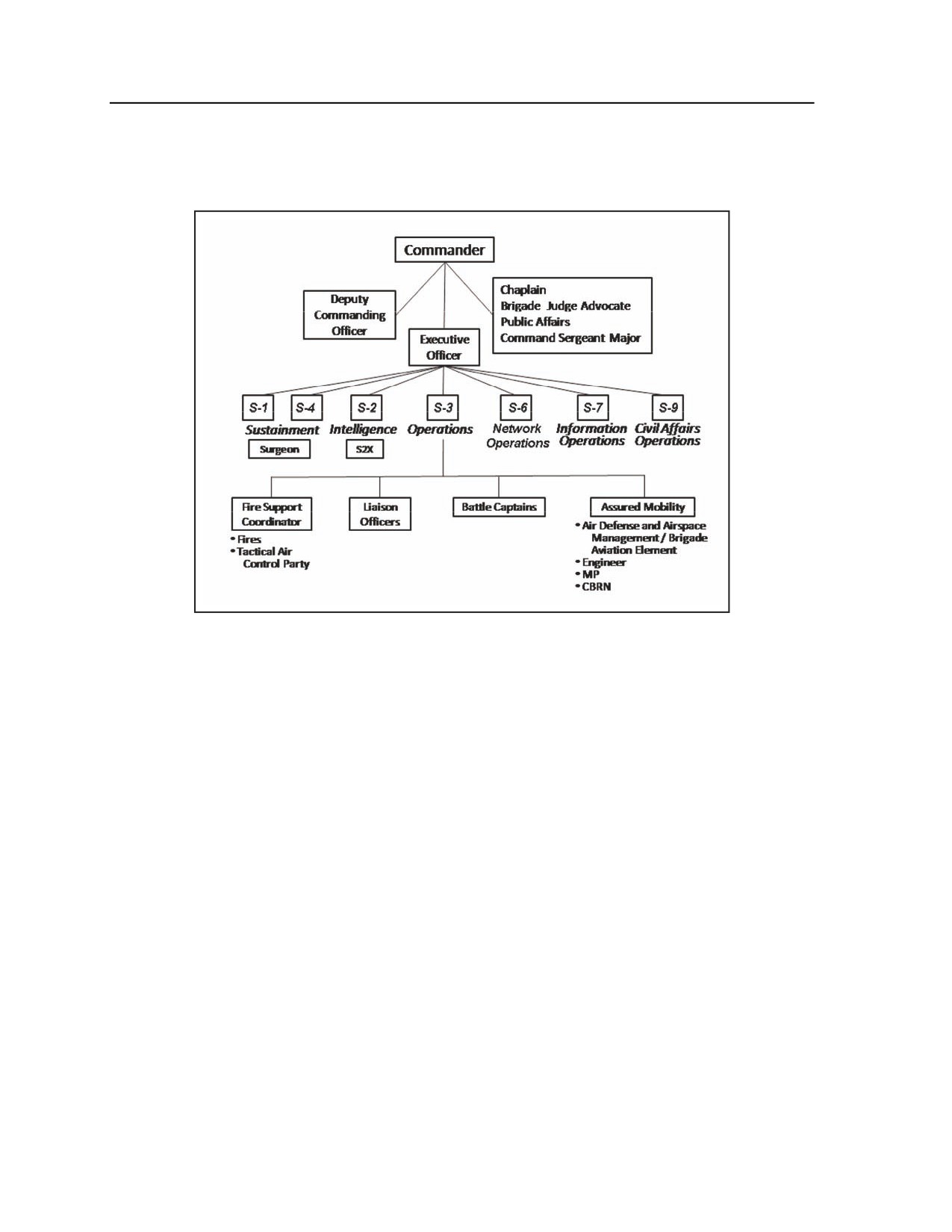
1-56. BCT staff sections are organized into functional and integrating cells
(see figure
1-2). This
organization may vary depending on the mission assigned to the BCT. (See FM 3-90.6 for more detailed
information.) The BCT staff usually organizes the following six functional cells:
z
Sustainment.
z
Intelligence.
z
Operations.
11 February 2009
FM 3-34.22
1-13
Chapter 1
z
Network operations.
z
Information operations (IO).
z
Civil affairs (CA) operations.
Figure 1-2. BCT staff organization
Assured Mobility Section
1-57. The assured mobility section is an integration cell that can include the air defense artillery (ADA)
officer, engineer coordinator (ENCOORD), provost marshal (PM), CBRN officer, EOD officer, and other
staff members when configured in the BCT. An assured mobility section leader is normally designated to
coordinate section actions and is usually the senior officer of the represented staff members. The purpose
of the assured mobility section is to coordinate all tasks associated with M/CM/S throughout the BCT AO
in coordination with the BCT operations cell. The exact organization and configuration of the assured
mobility section may vary, as can the roles and responsibilities of its members, and should be prescribed in
the unit standing operating procedure (SOP). (The integration of assured mobility within the BCT is
discussed in chapter 2.)
Engineer Coordinator
1-58. The ENCOORD is the special staff officer (usually the senior engineer officer on the staff)
responsible for coordinating engineer assets and operations for the command. (FM 3-34) When an organic
engineer staff does not exist at the maneuver battalion level, the ENCOORD is the senior engineer
supporting that unit. When an engineer battalion is task-organized in support of a BCT, the BCT
commander determines if a change will occur in ENCOORD designation. The ENCOORD is normally
located in the main CP, but may be located within the tactical CP based on METT-TC analysis. (See FM 3-
34.)
1-59. The ENCOORD’s primary duty is to coordinate engineer operations in support of the combined arms
operation. The ENCOORD must understand the full array of engineer capabilities (combat, general, and
geospatial engineering) available to the force and synchronize them to best meet the needs of the maneuver
commander. The ENCOORD integrates specified and implied engineer tasks into the maneuver unit plan
1-14
FM 3-34.22
11 February 2009
Engineer Support to the Brigade Combat Team
and ensures that supporting engineer units are integrated into mission planning, preparation, execution, and
assessment activities. Regardless of task organization, the ENCOORD is responsible for the functional
control
(through the maneuver commander) of all engineer units supporting the maneuver unit. In
conducting engineer operations, the ENCOORD plans, prepares, executes, and assesses.
1-60. When planning for operations, the ENCOORD—
z
Assists the intelligence staff officer
(S-2) with the IPB
(including information from the
preparation of the engineer running estimate).
z
Determines and evaluates critical aspects of the engineer situation.
z
Formulates ideas for engineer support to meet the maneuver commander’s intent.
z
Decides what engineer missions must be accomplished to support current and future operations.
z
Integrates geospatial products into the planning process to explain the military significance of
the terrain to the commander and staff and to support decisionmaking.
z
Advises the commander on using organic and nonorganic engineer assets, employing and
reducing obstacles, and employing engineer reconnaissance.
z
Identifies any support requirements for EAB engineer and other related assets.
z
Makes the maneuver commander aware of the capabilities, limitations, and employment
considerations of supporting engineers and related assets.
z
Develops a scheme of engineer operations concurrent with the maneuver COAs.
z
Recommends the engineer priorities of effort and support, essential tasks for M/CM/S, and
acceptable mission risks to the commander.
z
Recommends the engineer organization for combat.
z
Visualizes the future state of engineer operations within the supported maneuver unit.
z
Integrates the engineer functions of combat, general, and geospatial engineering into the
supported maneuver unit’s future plans.
1-61. When preparing for operations, the ENCOORD—
z
Trains the engineer cell located within the main CP.
z
Issues timely instructions and orders to subordinate engineer units through the maneuver unit
base order to simplify preparation and integration and develops the necessary input to maneuver
unit orders, annexes, and engineer unit orders (as required).
z
Coordinates the production and distribution of maps and terrain products.
z
Recommends intelligence requirements to the S-2 through the operations staff officer (S-3).
z
Participates in the targeting process.
z
Participates in appropriate working groups.
z
Plans and coordinates with the fires cell (FC) on the integration of obstacles and fires.
z
Recommends MSRs and logistics areas to the logistics staff officer (S-4) based on technical
information.
z
Coordinates with the appropriate S-4 for additional resources to support the M/CM/S effort.
z
Coordinates with the maneuver unit S-4 to support base camp, facilities, and other sustainment-
related construction requirements.
z
Advises the commander on environmental issues, coordinates with other staff members to
determine the impact of operations on the environment, and helps the commander integrate
environmental considerations into decisionmaking.
z
Recommends when engineer diver support may facilitate specific engineer reconnaissance in
support of the maneuver unit’s mission.
z
Ensures that EOD is integrated into operations.
11 February 2009
FM 3-34.22
1-15
Chapter 1
1-62. When executing operations, the ENCOORD—
z
Alters the engineer plan using the feedback received from subordinate maneuver and engineer
units as required.
z
Provides information on the status of engineer assets on hand.
z
Makes time-sensitive recommendations on requests for immediate engineer support received
from subordinate units and implements decisions.
1-63. When assessing operations, the ENCOORD—
z
Tracks all planned and known obstacles, scatterable mines (SCATMINEs), the survivability
status, the route status, engineer missions, and any other engineer-specific information.
z
Establishes and maintains a continuous, open link among engineer cells, ENCOORDs, and
(when applicable) supporting engineer CPs.
z
Uses the running estimate and the continuous link with the supporting engineer staffs and units
to compute resource and force requirements and recommend engineer task organization.
z
Monitors the execution of engineer orders and instructions by tracking current operations.
z
Uses reports from engineer units to measure and analyze engineer performance and anticipate
change and unforeseen requirements.
1-16
FM 3-34.22
11 February 2009
Chapter 2
Integration of Engineer Operations
The instruments of battle are valuable only if one knows how to use them.
—Colonel Ardant du Picq
Engineers are challenged when trying to execute engineering tasks in today’s OE.
Force modularity, the application of engineer force tailoring, and limited engineer
resources require flexible task organization and the ability of engineers to rapidly
transition within the AO to meet mission requirements. Commanders and planners
must understand this setting and the inherent C2 challenges they face in integrating
engineer operations. This chapter centers on engineer participation in the supported
BCT commander’s C2 and applies to organic and augmenting engineer unit
commanders and planners. This chapter discusses planning (which is part of C2) and
provides considerations for engineers as integrated members of the combined arms
team. The construct and format for essential tasks for M/CM/S and the engineer staff
running estimate are highlighted to assist engineer planners in integrating engineer
operations. Finally, this chapter provides an overview of integrating processes and
continuing activities and their contribution to the overall operations process.
COMMAND AND CONTROL
2-1. Limited engineer resources are a predominant factor in the OE. Careful prioritization and allocation
of resources must occur to accomplish objectives. Because engineer assets are mission-tailored and
allocated against specific requirements, engineers must be able to rapidly transition between phases of the
operation and shifted throughout the AO to meet mission requirements. Effective C2 of engineer units is
paramount.
2-2. FM 6-0 provides Army doctrine for C2 and are interrelated. Command resides with commanders; it
consists of authority, decisionmaking, and leadership. Control is how commanders execute command; it
resides with both commanders and staffs. Commanders cannot exercise command effectively without
control. Conversely, control has no purpose without command to focus it.
2-3. In the past, engineer commanders supporting combined arms operations were always confronted
with the dichotomy of exercising C2 responsibilities over their units, while fulfilling their role in
supporting the maneuver commander’s C2 of the unit. Engineer leaders today are more challenged in
ensuring effective C2 of engineer units given the requisite task organization of engineer forces (organic
and augmenting) within the construct of the modular Army. Engineer unit commanders and planners must
work together to ensure the effective control of engineer operations to facilitate their complete integration
into combined arms operations. Command and support relationships are the basis for building task
organization and provide the basis for ensuring the unity of command and unity of effort in operations.
(See FM 3-0 for more information on command and support relationships.)
COMMAND AND SUPPORT RELATIONSHIPS
2-4. Additional engineer units augmenting the BCT are task-organized to the BCT in a command or
support relationship, depending on the mission requirements. Those units and engineer units organic to the
BCT may also be task-organized to a maneuver TF or the reconnaissance squadron (RS) or be subordinate
to a company or troop. Command relationships prescribe the supporting engineer unit chain of command
11 February 2009
FM 3-34.22
2-1
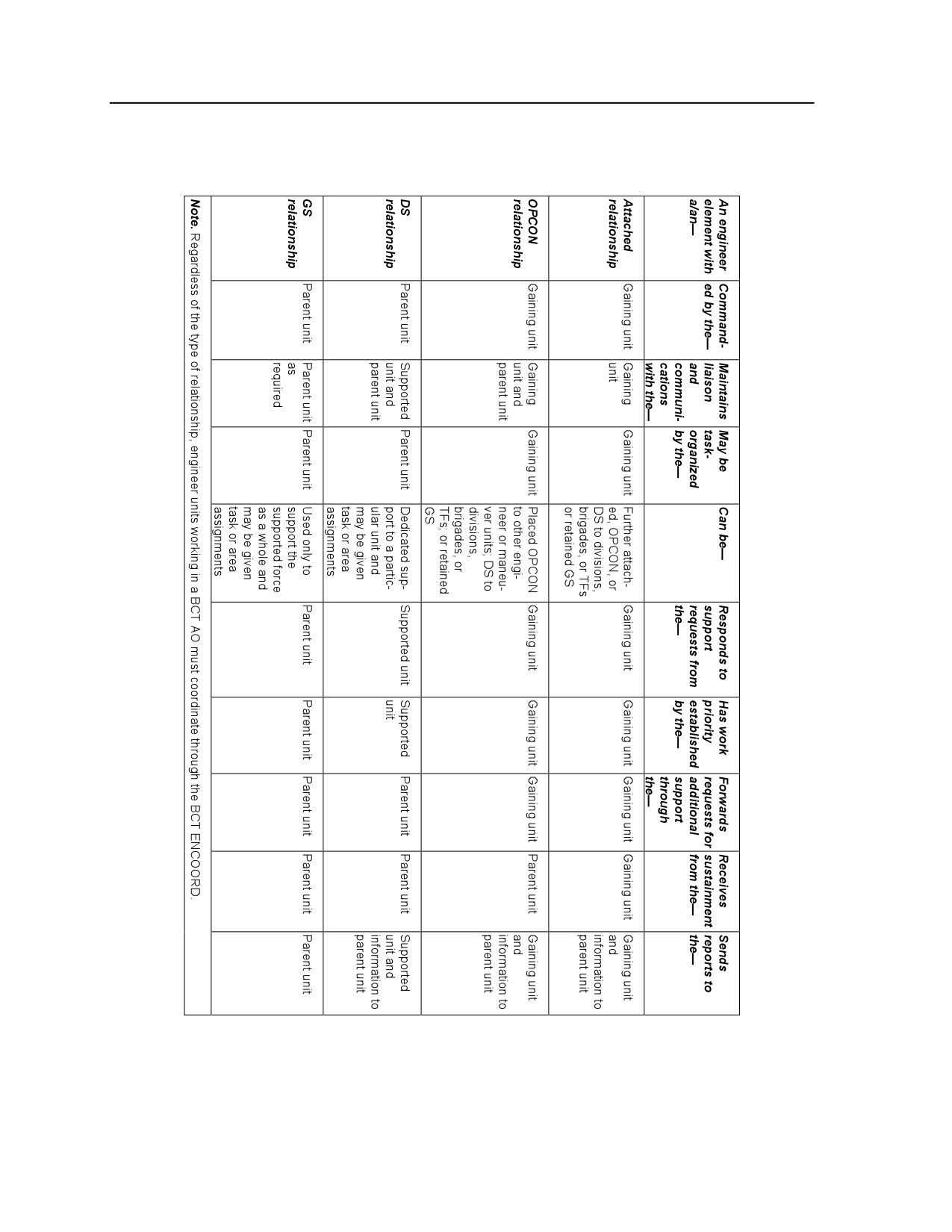
Chapter 2
and the degree of control that the gaining or supported commander exercises over the unit. Support
relationships define the manner of support that the supporting engineer unit provides (see table 2-1).
Table 2-1. Command and support relationships
2-2
FM 3-34.22
11 February 2009
Integration of Engineer Operations
2-5. Many factors are considered when task-organizing units and determining the appropriate command
or support relationships. A major determining factor is the expected longevity of the relationship with the
headquarters involved. The type of operation is also a factor, which is described further under Planning
Considerations, paragraph 2-19. Another important factor is based on variances in unit organizations, with
an aim to leverage existing C2 structures. The C2 structure for the organic engineer company in each of the
BCTs varies. Within the IBCT and HBCT, the organic engineer company is under the C2 of the BSTB and
this battalion level headquarters is able to provide C2 for most engineer augmentation to the BCT, short of
an engineer battalion. The situation in the SBCT and ACR is significantly different because its organic
engineer company is a separate element under the SBCT or regimental headquarters without a BSTB to
function in the role of a C2 headquarters for engineer augmentation. In this instance, the C2 for
augmenting engineer elements may require special consideration by engineer planners. In certain
situations, the augmentation of a BCT by a task-organized engineer battalion TF provides the necessary,
additional C2 to orchestrate engineer operations and support, but even this does not address a lack of an
organic TF engineer cell in many of the maneuver battalions and the RS of the BCTs.
2-6. Command relationships define superior and subordinate relationships between unit commanders. A
command relationship over engineer units allows maneuver commanders the ability to optimize
subordinate forces with maximum flexibility. Command relationships can be designated as attached or
operational control (OPCON). Attached engineer units are temporarily associated with the gaining unit and
return to their parent unit when the reason for the attachment ends. Engineer units are normally assigned
OPCON to a gaining unit for a given mission, lasting perhaps a few days. In both attached and OPCON
relationships, the augmenting engineer unit is tasked and provided priorities by the gaining unit. In an
OPCON relationship, all logistical support comes from the parent unit unless coordinated otherwise;
however, the gaining unit usually furnishes Class IV and V barrier materials. The OPCON relationship is
appropriate when the gaining unit needs task organization authority over the supporting unit and there is a
need for the parent unit to remain responsible for providing logistical support or to minimize the impact on
the gaining unit’s sustainment infrastructure.
2-7. Commanders establish support relationships when subordination of one unit to another is
inappropriate; typically when maximum flexibility is needed to rapidly move key engineer capabilities
between multiple units. All command, administrative, and logistical responsibilities remain with the parent
unit in a support relationship. The parent unit commander organizes the unit and allocates tasks in a
manner that most effectively meets the needs of the supported commander. Support relationships are
graduated from a supporting relationship between two units (direct support [DS]) ) to a broad level of
support extended to all units under the control of the higher headquarters (general support [GS]). In a DS
relationship, the supporting unit answers directly to the supported commander’s request for support. A DS
relationship is typically used when it is anticipated that a change to the engineer task organization may
require frequent shifting of an engineer unit to multiple locations. In a GS relationship, the supporting unit
receives all missions and support from its parent unit and the supporting unit aids the unit as a whole and
not as any particular part or subdivision. A GS relationship is appropriate when central control and
flexibility in employing limited engineer forces is required. Engineers in sustainment areas are typically
employed using a GS relationship.
CONTROL OF ENGINEER OPERATIONS
2-8. Control is the regulation of forces and warfighting functions to accomplish the mission according to
the commander’s intent. (FM 3-0) The primary function of the staff is to help the commander and
subordinate commanders exercise control. Control includes information management (IM) (the provision
of RI to the right person, at the right time, in a usable form, to facilitate SU and decisionmaking). IM uses
procedures and information systems (INFOSYS) to collect, process, store, display, disseminate, and protect
knowledge products, data, and information. (See FM 3-0.)
11 February 2009
FM 3-34.22
2-3
Chapter 2
COMMAND POST FUNCTIONS
2-9. CPs are facilities for exercising C2. CP staff and equipment are arranged to facilitate coordination,
the smooth exchange of information, and rapid decisionmaking. Well-designed CPs integrate command
and staff efforts by matching CP manning, equipment, INFOSYS, and procedures against its internal
layout and utilities. Organizing the CP into functional and integrating cells promotes efficiency and
coordination. Figure 2-1 shows a typical BCT CP layout. CP configurations and layouts vary between units
and echelons. Units establish detailed SOPs to standardize CP operations. These SOPs must be followed
and revised throughout training to ensure CP efficiency and ease CP personnel training.
2-10. Most CP functions directly relate to assessing and directing current operations, planning future
operations, or supporting the force. The five functions of a CP are—
z
Developing and disseminating orders.
z
Maintaining running estimates.
z
Controlling operations.
z
Assessing operations.
z
Administrating.
2-11. In performing their functions, all CPs have the responsibility to conduct the following five basic
functions of IM:
z
Collect RI.
z
Process information from data to knowledge.
z
Store RI for timely retrieval to support C2.
z
Display RI tailored for the needs of the user.
z
Disseminate RI.
INFORMATION MANAGEMENT
2-12. Proper IM ensures that the commander receives the necessary information to make timely decisions.
It consists of RI and INFOSYS. The commander must understand how to avoid potential information
overload while developing SU. The development of well-structured SOPs can provide roles and
responsibilities for staff sections and their members in collecting and processing RI and procedures to
handle critical or exceptional information.
2-13. Because collection assets are limited, a method of prioritizing collection and processing is required.
CCIR and intelligence requirements (IR) are the categories used to prioritize collection asset allocation and
information processing within the C2 system.
RELEVANT INFORMATION
2-14. RI is all information of importance to commanders and staffs in the exercise of C2. (FM 3-0) The
commander applies judgment to RI to reach SU. The potential volume of information provided to the
commander could be overwhelming—adversely affecting sound and timely decisionmaking. Utilizing RI
helps prevent information overload. The commander establishes CCIR to define RI to the staff.
2-4
FM 3-34.22
11 February 2009
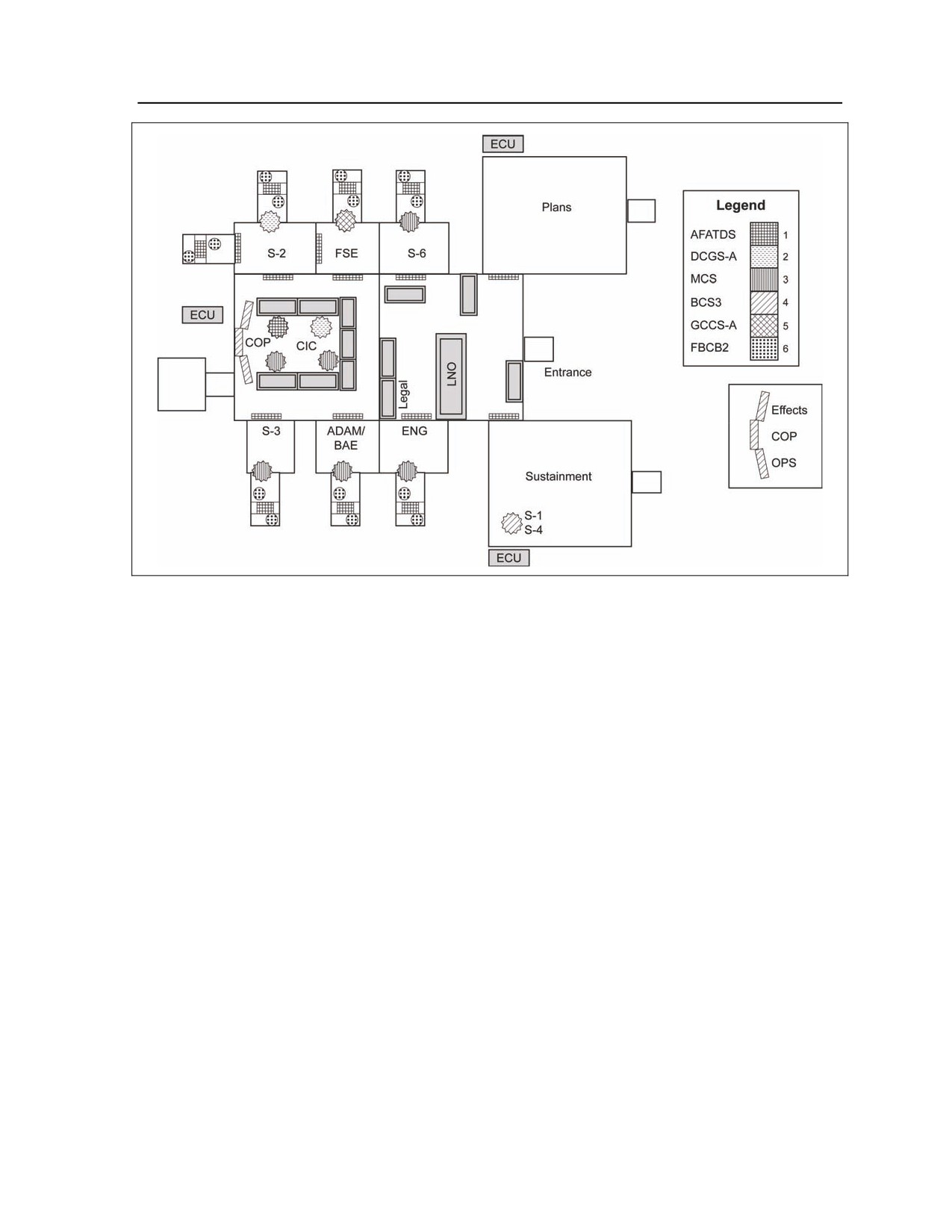
Integration of Engineer Operations
Figure 2-1. Typical BCT CP layout
2-15. The commander controls the flow and collection of critical information through establishing the
CCIR. The CCIR consist of the following two components:
z
Priority intelligence requirements
(PIR). PIR are intelligence requirements
(stated as a
priority for intelligence support) that the commander and staff need to understand the adversary
or the operational environment. (JP 2-0)
z
Friendly forces information requirements (FFIR). FFIR are information that the commander
and staff need about the forces available for the operation. (FM 6-0)
BATTLE TRACKING
2-16. Battle tracking involves monitoring elements of the common operational picture (COP) that are tied
to forecasted outcomes. Each engineer CP supporting the BCT (organic or augmenting) is responsible for
tracking the progress of the tactical operation. Because organic engineer company parent organizations
differ between the three types of BCTs, the information flow may differ also.
2-17. Engineer units augmenting a BCT are responsible for ensuring that their CP tracks engineer
execution and passes the information to the supported unit CP and the next higher engineer organization or
staff. When an engineer battalion is task-organized to a BCT, it gathers reports from its subordinate units
and forwards them to the BCT, main CP, and ENCOORD.
2-18. Battle tracking for engineer forces includes, but is not limited to—
z
Engineer unit locations and combat power (personnel, equipment, supplies).
z
Status of CCIR.
z
Obstacles planned and executed.
z
Survivability preparations.
11 February 2009
FM 3-34.22
2-5
Chapter 2
z
Enemy obstacle locations.
z
Breach sites and lanes.
z
Condition of existing bridges.
z
Condition of gap-crossing sites.
z
Results of engineer reconnaissance.
z
Barrier material availability and location.
z
Key engineer Class V (mines, mine clearing line charge
[MICLIC] loads, 25-millimeter
ammunition, explosives) stock levels.
PLANNING CONSIDERATIONS
2-19. Engineer operations are complex, are resource-intensive (time, manpower, materiel), and require
extensive and proactive coordination. The scope, complexity, and length of planning horizons are different
at the operational and tactical levels. Tactical planning has the same clarity of purpose, but typically
reflects a shorter planning horizon. Planning horizons (short-, mid-, and long-range) vary based on the type
of operations. Planning too far into the future may overwhelm the capabilities of planning staffs, especially
subordinate staffs. Not planning far enough ahead may result in losing the initiative and being unprepared.
The commander must ensure that the staff is focused on the right planning horizon. In some cases,
engineers may have to look farther out than their counterparts, based on budgeting constraints and
construction timelines associated with engineering projects. Engineer operations must be directed and
synchronized through planning as one of the critical activities in the operations process. Engineer planners
in a combined arms headquarters must understand the planning processes described in FM 5-0 and become
integral members of the planning staff during all phases of planning.
2-20. In planning engineer operations at every level, the ENCOORD should consider the following:
z
Speed. Engineering tasks are resource-intensive in terms of time, manpower, and materiel.
Practices that support speed include the utilization of existing facilities, standardization,
simplicity of design and construction, bare-bases construction, and construction in phases.
z
Economy. Engineering demands the efficient use of personnel, equipment, and materials.
Practices that support economy include the conservation of manpower, equipment, and materials
and the application of environmental consideration early in the process.
z
Flexibility. Standard plans that allow for adjustment, expansion, and contraction are used when
possible. For example, forward airfields should be designed and located so that they can be
expanded into more robust facilities.
z
Authority decentralization. The dispersion of forces requires that engineer authority at a
particular location must have authority consistent with responsibilities.
z
Priority establishment. Priorities and resource allocation must be established to determine how
much engineer effort should be devoted to a single task. All levels of command, beginning with
the joint force commander, issue directives establishing broad priorities. Resources are initially
assigned to the highest priority tasks, while low-priority tasks may be left unfinished while
recognizing and mitigating the risk.
2-21. During offensive combat operations, task-organized engineer units tend to have command
relationships to the supported unit. OPCON is the most common command relationship for engineers
during offensive operations because it allows them to be responsive and provides the maneuver
commander the greatest flexibility. Although the forms of offensive maneuver have different intentions, the
planning phase must always begin with predicting enemy intent through a thorough understanding of the
threat, engineer capabilities, and terrain effects. Geospatial products become the foundation and common
reference for planning. Knowledge of the threat disposition is especially critical and required for an
infiltration or penetration due to the requirements for stealth and surprise. Engineer planning tends to focus
on mobility support
(robust reconnaissance effort). A greater degree of planning is required for a
penetration from the breach to the ultimate control of the decisive objective. (More planning considerations
for offensive operations are discussed in chapter 6.)
2-6
FM 3-34.22
11 February 2009
Integration of Engineer Operations
2-22. During defensive combat operations, command or support relationships are considered based on the
ability of the parent unit to C2 operations and the flexibility to shift key assets as needed. Planning for
defensive operations is inextricably linked to offensive operations and, for planning purposes, must
consider the transition from offensive operations and follow-on offensive operations. During defensive
operations, engineers use geospatial products to determine the best locations for unit positions, engagement
areas (EAs), and obstacles. Engineers apply their understanding of threat engineer capabilities and TTPs,
while working with the intelligence staff to describe threat functions and predict where the threat is likely
to attack. The ENCOORD works with other staff members to ensure that the counterattack force can
maneuver and mass its effects on the enemy for decisive operations. The type of defensive operation
defines the amount and focus of engineer effort required. An area defense typically requires a greater
amount of effort due to increased survivability requirements. A mobile defense effort requires less effort
(although mobility requirements may increase) because it has greater flexibility and takes advantage of the
terrain in depth. (More planning considerations for defensive operations are discussed in chapter 6.)
2-23. In planning for stability operations, engineers consider the requirements necessary for the support of
primary stability tasks. Engineer assessment of the OE focuses on different aspects of the terrain and
friendly and threat capabilities. Terrain products continue to have a great deal of importance, but political
and cultural considerations may be more important than strictly a combat terrain analysis. Terrain analysts
work with the intelligence staff to develop usable products for the commander to reflect this information if
it is available. When analyzing the troops available, the ENCOORD considers if there are HN, third party
NGO, or other multinational forces involved with engineering capabilities. Interaction with these other
parties requires engineers to address interoperability, common standards, and mutual agreements.
Engineers should also plan for engineer units operating amongst civilians or in conjunction with NGOs and
other international organizations.
2-24. Planning for civil support operations is significantly different from offense, defense, or stability
operations because of the unique nature of the threat, although the basic missions may be very similar to
those of stability operations. The threat is likely a natural or man-made disaster with unpredictable
consequences. Additionally, planners must be aware of the number of statutes and regulations that restrict
Army interaction with other government agencies (OGAs) and civilians during civil support operations.
The local and state response normally leads the effort with a federal response providing support as
required.
GEOSPATIAL SUPPORT
2-25. Engineer staffs are responsible for terrain analysis and visualization. In their role as terrain
visualization experts, engineers advise maneuver commanders on ways to conceptualize the OE, which
must be supported by terrain analysis. Terrain analysis is a key product of geospatial support. It is the study
of terrain properties and how they change over time and under varying weather conditions. Terrain analysis
starts with collection, verification, processing, revision, and construction of source data. It requires the
analysis of climatology (current and forecasted weather conditions), soil conditions, and enemy or friendly
vehicle performance metrics. Terrain analysis is a technical process and requires the expertise of geospatial
information technicians and a geospatial engineer.
2-26. The geospatial engineer uses analysis and visualization capabilities to integrate people, processes,
and tools, using multiple information sources and collaborative analysis to build a shared knowledge of the
physical environment. In combination with other engineers and staff officers, the geospatial engineer
provides support to the unit mission and commander’s intent. (FM 3-34.230 and JP 2-03 are the primary
references for geospatial engineering.)
2-27. All three types of BCTs have an organic geospatial engineering team that performs analysis,
management, and dissemination of geospatial data and products in support of brigade planning,
preparation, execution, and assessment. It maintains the brigade common topographic operating picture
(CTOP) on the brigade server and provides updates to the brigade portion of the theater geospatial database
(TGD). The team primarily supports the S-2 and S-3, but also supports other staff and subordinate units as
directed. The team works with the intelligence staff to fuse intelligence and geospatial information into a
11 February 2009
FM 3-34.22
2-7
Chapter 2
COP for the commander. The brigade level team is too small to provide continuous support to the S-2, but
forms improvised geospatial intelligence
(GEOINT) cells as necessary to support operations. The
geospatial engineering team requires access to the classified tactical local area network (LAN) and Secret
Internet Protocol Router Network (SIPRNET) to update and disseminate geospatial information and
products. The geospatial engineering team has the capability to—
z
Generate and analyze terrain data.
z
Prepare decision graphics.
z
Produce image maps.
z
Provide three-dimensional (3-D) terrain perspective views.
z
Manage the theater geospatial database.
z
Update maps.
z
Produce tactical decision aids.
z
Produce IPB overlays.
z
Operate on a 24-hour basis.
2-28. Geospatial engineering provides commanders with terrain analysis and visualization, which
improves situational awareness
(SA) and enhances decisionmaking during planning, preparation,
execution, and assessment. Some example applications of tactical decision aids include—
z
Promoting the timely development of the modified combined obstacle overlay (MCOO) during
IPB to identify avenues of approach (AAs), mobility corridors, and choke points.
z
Enhancing rehearsals with the use of 3-D fly-throughs or simulations.
z
Facilitating the positioning and routing of ground and aerial surveillance assets through
visibility analysis (intervisibility lines and flight line masking).
PARALLEL PLANNING
2-29. Commanders must ensure that plans are sent to subordinates in enough time to allow them to
adequately plan and prepare their operations. Echelons plan in parallel as much as possible to accomplish
plan and prepare their operations. Parallel planning is two or more echelons planning for the same
operation nearly simultaneously. It is facilitated by continuous information sharing by higher headquarters
with subordinate units concerning future operations. Parallel planning requires significant interaction
between echelons. With parallel planning, subordinate units do not wait for their higher headquarters to
publish an OPORD or operation plan (OPLAN) to begin their own planning and orders development
process.
2-30. To facilitate effective parallel planning at the engineer unit level, engineer unit commanders and staff
planners must—
z
Understand the higher commander’s intent and planning guidance.
z
Analyze the terrain, obstacle intelligence (OBSTINTEL), and threat capabilities.
z
Know engineer systems and capabilities to accomplish the identified tasks within the time
allotted.
z
Identify risks where engineer capabilities are limited or time is short and identify methods to
mitigate the risks, ensuring that all potential reachback capabilities have been leveraged.
z
Consider the depth of the AO and the transitions that occur among operational elements
(integration of environmental considerations).
z
Plan for the sustainment of engineer operations. Engineers ensure that all logistical requirements
are analyzed and accounted for to the end state of the operation and resourced to accomplish the
mission and facilitate future operations.
DISTRIBUTED PLANNING
2-31. Digital communications and INFOSYS allow staffs to execute planning without being arranged in a
certain order. Distributed planning saves time and increases the accuracy of available information through
using rapid voice and data transmissions throughout the AO. A prime example is USACE FFE that allows
2-8
FM 3-34.22
11 February 2009
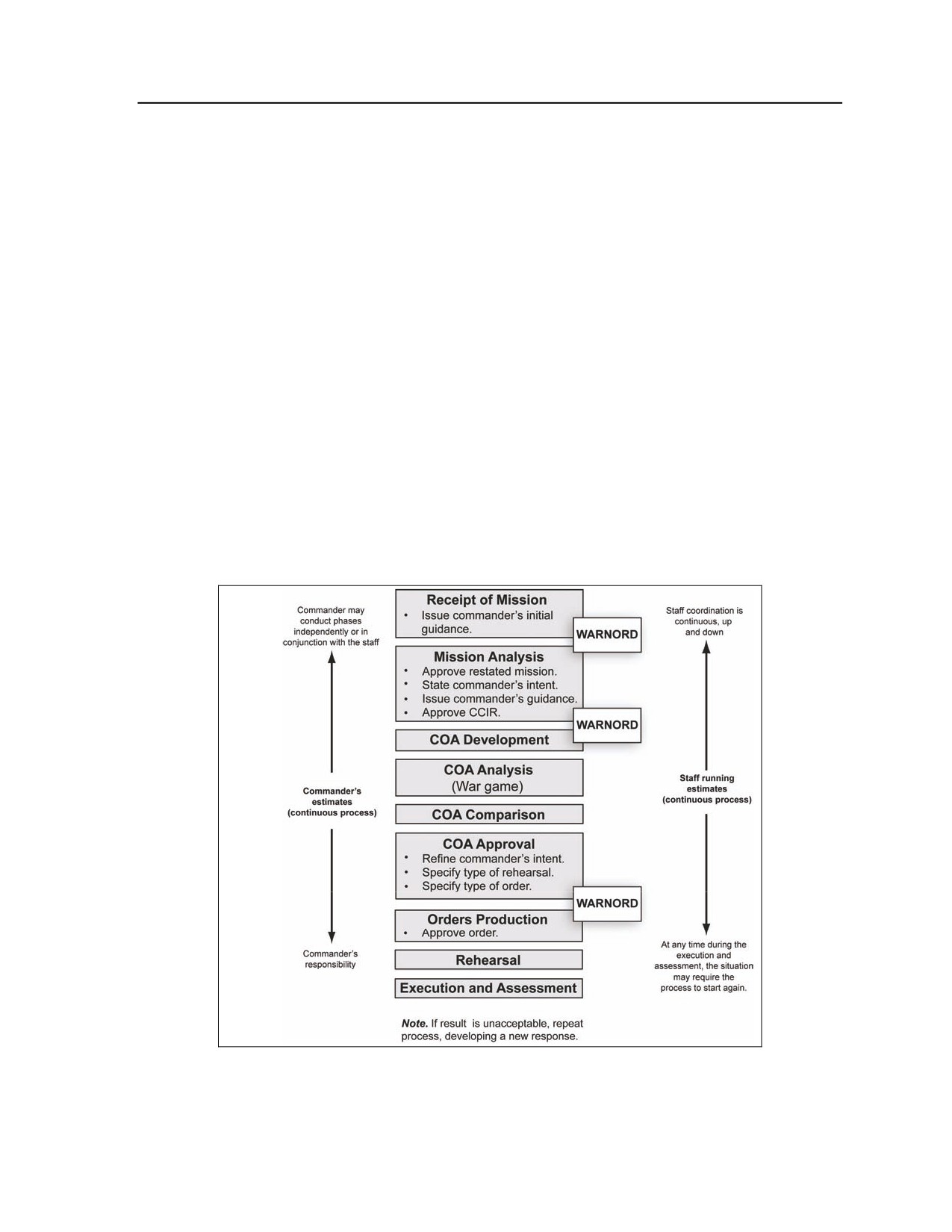
Integration of Engineer Operations
engineers in the field to use TeleEngineering and other reachback capabilities to access nondeployed
subject matter expertise that is in the USACE broad range of engineering service support.
COLLABORATIVE PLANNING
2-32. Collaborative planning is the real-time interaction among commanders and staffs at two or more
echelons developing plans for a particular operation. This could be between an ENCOORD at a battalion
TF or the BCT and an engineer battalion headquarters providing general engineering support in the BCT
AO.
PLANNING PROCESS
2-33. As members of the combined arms staff, engineer planners must thoroughly understand the planning
process and how they contribute during each phase. The military decision-making process (MDMP) can be
rather complex and time-consuming with no shortcuts. The engineer planning staff must implement parallel
and collaborative planning to leverage the information resources and planning support capacities of higher,
adjacent, and subordinate engineer units. Managing information, focusing on obtaining RI, and preventing
information overload are fundamental to effective planning.
MILITARY DECISION-MAKING PROCESS
2-34. The MDMP (and associated troop-leading procedures [TLPs]) is the doctrinal planning model that
establishes procedures for analyzing a mission; developing, analyzing, and comparing COAs against each
other; selecting the optimum COA; and producing a plan or order (see figure 2-2). TLPs are used at the
company level and below. (See FM 5-0 for more detailed references to the MDMP and TLPs.)
Figure 2-2. MDMP
11 February 2009
FM 3-34.22
2-9

Chapter 2
2-35. As part of the combined arms team conducting the MDMP, engineer planners focus their efforts on
specific considerations for each step of the process. Table 2-2 shows engineer considerations in relation to
each step of the MDMP. The ENCOORD uses all members of the engineer cell to help accomplish the
tasks. A planning SOP can be an effective method for delineating the various roles and responsibilities
within the engineer planning staff.
Table 2-2. Engineer considerations in the MDMP
Steps
Engineer Considerations
z
Receive higher headquarters plans, orders, and annexes.
z
Understand the unit mission and the commander’s intent (two levels up).
z
Understand the engineer mission, intent, and scheme of engineer operations (two
Receipt of the
levels up).
mission
z
Understand the higher echelon essential tasks for M/CM/S.
z
Request geospatial information on the AO.
z
Determine the availability of OBSTINTEL on existing obstacles.
z
Identify specified and implied tasks for M/CM/S, and develop a recommended list
of essential tasks for M/CM/S (for the commander’s approval during the mission
analysis brief).
z
Identify any obvious shortfalls in engineer forces or equipment based on specified
or implied tasks, and initiate RFIs or request augmentation as early as possible.
z
Analyze available OBSTINTEL on existing obstacles.
z
Evaluate the terrain, climate, and threat capabilities to determine the potential
impact on M/CM/S.
z
Identify available information on major roads, bridges, and key facilities in the AO.
z
Determine the availability of construction and other engineering materials.
z
Review the availability of engineer capabilities, to include Army, joint,
multinational, HN, and contract.
z
Determine troop support requirements (such as bed down) for the supported
Mission analysis
force.
z
Review theater construction standards and base camp master planning
documentation if available.
z
Review existing geospatial data on potential lodgment areas and base camps,
and conduct site reconnaissance if possible.
z
Determine the threat (environmental, EHs).
z
Obtain necessary geologic, hydrologic, and climatic data.
z
Determine the level of interagency cooperation required.
z
Determine engineer-related IR (terrain and mobility restraints, OBSTINTEL, threat
engineer capabilities, critical infrastructure), and make recommendations for
inclusion in the CCIR as necessary.
z
Integrate engineer IRs and reconnaissance into ISR operations.
z
Provide the commander with suggested guidance for engineers that can be
included in the commander’s guidance for COA development.
z
Identify priority engineer requirements.
z
Refine essential tasks for M/CM/S if necessary.
z
Integrate engineer support into COA development, and develop a scheme of
engineer operations for each COA.
COA development
z
Array engineer forces using task and purpose.
z
Recommend an appropriate level of protection effort for each COA, based on the
expected threat.
z
Develop COA evaluation criteria focused on the engineer effort.
z
Role-play as the enemy engineer, and interject enemy engineer actions or events
COA analysis
during wargaming.
z
Refine the engineer plan, based on the results of war-gaming.
z
Provide advantages and disadvantages of each COA from the engineer
COA comparison
perspective (ability to support, risk to engineer forces or equipment).
2-10
FM 3-34.22
11 February 2009

Integration of Engineer Operations
Table 2-2. Engineer considerations in the MDMP (continued)
z Gain approval for any changes to the essential tasks of M/CM/S.
z Gain approval for engineer priorities of effort and support.
COA approval
z Gain approval for requests for engineer augmentation to be sent to higher
headquarters.
z Provide input to the appropriate plans and orders.
Orders production
z Ensure that all engineer forces and critical equipment are properly allocated in the
task organization.
Rehearsal
z Coordinate and participate in combined arms rehearsals as appropriate.
ENGINEER RUNNING ESTIMATE
2-36. The engineer running estimate is a logical thought process and extension of the MDMP. It is
conducted by the ENCOORD, concurrently with the planning process of the supported maneuver force,
and is continually maintained throughout planning, preparation, execution, and assessment. This running
estimate allows for early integration and synchronization of essential tasks for M/CM/S (discussed later in
this chapter) into the combined arms planning process. It drives coordination between the engineer,
supported commander, and other staff members in the development of engineer plans, orders, and annexes.
An example of the engineer running estimate is found in appendix F and focuses on operations in support
of a BCT. Table 2-3 shows the relationship between mission analysis during the MDMP and the engineer’s
running estimate, including identification of essential tasks for M/CM/S.
Table 2-3. Correlation of mission analysis and the engineer running estimate
Mission Analysis
Engineer Running Estimate
z
Analyze higher headquarters order.
z
Analyze the higher headquarters orders,
z
Conduct IPB.
including the—
z
Determine specified, implied, and
Commander’s intent.
essential tasks.
Mission.
z
Review available assets.
Concept of operation.
z
Determine constraints.
Timeline.
z
Identify critical facts and assumptions.
AO.
z
Conduct risk assessment.
z
Conduct the IPB, including—
z
Determine the CCIR.
Terrain and weather analysis.
z
Develop an ISR plan.
Enemy mission and M/CM/S capabilities.
z
Plan for the use of available time.
Friendly mission and M/CM/S capabilities.
z
Write the restated mission.
z
Determine—
z
Conduct a mission analysis briefing.
Specified M/CM/S tasks.
z
Approve the restated mission.
Implied M/CM/S tasks.
z
Develop the commander’s intent.
Essential M/CM/S tasks.
z
Issue the commander’s guidance.
General engineering requirements.
z
Issue a WARNORD.
z
Review facts and assumptions.
z
Review available assets, including—
Limitations.
Risk as applied to engineer capabilities.
Time analysis.
Essential tasks for M/CM/S.
Restated mission.
z
Conduct risk assessment, including—
Safety.
Environment.
z
Determine terrain and mobility restraints,
OBSTINTEL, threat engineer capabilities, and
critical infrastructure.
z
Recommend CCIR.
z
Integrate engineer reconnaissance effort.
11 February 2009
FM 3-34.22
2-11
Chapter 2
2-37. The running estimate parallels the MDMP. The mission analysis, facts and assumptions, and analysis
of the mission variables furnish the structure for running estimates. In the running estimate, the engineer
staff continuously considers the effects of new information and updates the following:
z
Facts.
z
Assumptions.
z
Friendly force status (assessment of M/CM/S capabilities to ongoing and planned operations).
z
Enemy activities and capabilities (that can affect current operations and future plans).
z
Civil considerations (effects on current engineer operations and future plans).
z
Conclusions and recommendations.
2-38. During preparation, estimates continue to track resource status. The priority for assessment is on
answering PIRs and FFIRs that fall within the engineer area of expertise. Assessing during preparation also
includes confirming or disproving any assumptions that were made during planning.
2-39. During execution, estimates focus on identifying any variances, assessing their effect on achieving
the end state, and recommending corrective actions to keep the operation within the commander’s intent.
Assessments also address the supportability of possible sequels and future operations. During operations,
running estimates are usually presented orally, especially during preparation and execution. Written
estimates may be prepared to support contingency planning during peacetime. Even then, they are normally
prepared only at higher-level headquarters.
2-40. The running estimate provides the basis for action. When an estimate reveals a variance that requires
correction, staff representatives act within their authority to correct it. When the decision required is
outside their authority, they present the situation to the staff officer who has the authority to act or to the
commander. When the estimate reveals information that answers an information requirement, especially a
CCIR, engineer staff representatives send that information to the element requiring it. Engineer staff
representatives do more than collect and store information; they process it into knowledge and apply
judgment to get that knowledge to those requiring it.
ASSURED MOBILITY
2-41. Assured mobility is a framework of processes, actions, and capabilities that assure the ability of the
joint force to deploy and maneuver where and when desired, without interruption or delay, to achieve the
mission. (FM 3-34) Assured mobility is an integrating process for the warfighting functions similar to that
of ISR synchronization, targeting, composite risk management (CRM), and IPB. As an integrating process,
assured mobility provides linkage between the tasks associated with M/CM/S and their roles across the six
warfighting functions. It strives to ensure freedom of maneuver and preserve combat power throughout the
AO as it seeks to exploit superior SU. This construct is one means of enabling a unit to achieve the
commander’s intent. Assured mobility emphasizes proactive mobility and countermobility (and supporting
survivability) actions and integrates all engineer functions in accomplishing this. Assured mobility is
broader than the term “mobility” and should not be confused with the limited application of the mobility
operations as described in FM 3-34.2.
2-42. While the ENCOORD plays a primary role in assured mobility, other staff members support its
integration and also have critical roles. The ENCOORD or the assured mobility section leader
(if
designated) plays an integrating role in assured mobility that is similar to the role played by the S-2 in the
IPB integrating process. Other staff members also integrate M/CM/S tasks as a part of assured mobility.
Examples would include providing traffic regulation in the maneuver space or handling displaced persons.
2-43. The framework of assured mobility follows a continuous cycle of planning, preparing, and executing
decisive and shaping operations. Achieving assured mobility rests on applying six fundamentals that
sustain friendly maneuver, preclude enemy ability to maneuver, and assist in the protection warfighting
function. The fundamentals of assured mobility are—
z
Predict. Engineers and other planners must accurately predict potential enemy impediments to
joint force mobility by analyzing enemy TTP, capability, and evolution. Prediction requires a
constantly updated understanding of the OE.
2-12
FM 3-34.22
11 February 2009
Integration of Engineer Operations
z
Detect. Using ISR assets, engineers and other planners identify the location of natural and
man-made obstacles, preparations to create and emplace obstacles, and potential means for
obstacle creation. They identify actual and potential obstacles and propose solutions and
alternate COAs to minimize or eliminate their potential impact.
z
Prevent. Engineers and other planners apply this fundamental by denying the enemy’s ability to
influence mobility. This is accomplished by forces acting proactively before the obstacles are
emplaced or activated. This may include aggressive action to destroy enemy assets and
capabilities before they can be used to create obstacles.
z
Avoid. If prevention fails, the commander maneuvers forces to avoid impediments to mobility,
if this is viable within the scheme of maneuver.
z
Neutralize. Engineers and other planners plan to neutralize, reduce, or overcome obstacles and
impediments as soon as possible to allow the unrestricted movement of forces.
z
Protect. Engineers and other elements plan and implement survivability and other protection
measures that deny the enemy’s ability to inflict damage as joint forces maneuver. This may
include countermobility missions to deny the enemy maneuver and provide protection to
friendly maneuvering forces.
MOBILITY, COUNTERMOBILITY, AND SURVIVABILITY
2-44. Increased engineer requirements in the OE may limit engineer resources immediately available to
support the multitude of engineer tasks in support of BCT operations. Combat engineering (M/CM/S) and
general engineering requirements are often in competition for the same engineer assets. As is the case with
other reconnaissance capabilities, commanders must balance the application of engineer reconnaissance
against the corresponding trade-off in primary capability. In the case of engineers, engineer units tasked to
conduct a specified reconnaissance task may not be available for employment on other M/CM/S tasks. The
maneuver commander must set priorities to allow the force to perform the most critical tasks first. The
ENCOORD and other staff members assist the maneuver commander by identifying essential tasks for
M/CM/S.
2-45. Essential tasks for M/CM/S support assured mobility in a similar fashion to how essential fire
support tasks support targeting. An essential task for M/CM/S is a specified or implied M/CM/S task that is
critical to combined arms mission success. These tasks are identified from the specified and implied tasks
listed during mission analysis. From these tasks, combined with the maneuver commander’s guidance, the
ENCOORD and other staff representatives recommend essential tasks for M/CM/S to the maneuver
commander during the mission analysis brief. At the conclusion of the mission analysis brief, the
commander approves those essential tasks for M/CM/S.
2-46. After essential tasks for M/CM/S are approved, the ENCOORD and other planners integrate them
into COA development. They develop associated methods to complete the essential tasks for M/CM/S by
assigning resources and recommending priorities. The ENCOORD and other planners, in coordination with
the maneuver planner, synchronize the methods to achieve the desired effects on enemy or friendly forces.
A fully developed essential task for M/CM/S must be one in which—
z
The task is one or more clearly defined and measurable activity that can be accomplished by the
required individuals and organizations to achieve desired effects. (See FM 7-0.)
z
The desired or intended result of the task is stated in terms relating to the purpose of the
supported unit. This portion of the essential task for M/CM/S explains why it must be
accomplished. It also provides intent to the engineer commander so that he can be reactive as the
situation changes.
Note. Essential tasks are the most important M/CM/S tasks that must be accomplished. Often,
the entire operation depends on completing these tasks; and without their successful completion,
the operation is at risk.
11 February 2009
FM 3-34.22
2-13
Chapter 2
2-47. Properly constructed essential tasks for M/CM/S provide subordinate units with clear priorities and
facilitate the unity of purpose in planning, preparation, execution, and assessment. Essential tasks for
M/CM/S also provide CBRN, military police, IO, CA, and other nonengineer elements that are clearly
articulated and related to M/CM/S. The following are some examples of engineer-related essential tasks for
M/CM/S:
z
Essential Task for M/CM/S 1 (see FM 3-34.170).
Task: Conduct Engineer Reconnaissance of MSR Tigers from CP 1 to 2.
Purpose: Classify route, identify impediments to maneuver, and facilitate planning of route
clearance operations.
z
Essential task for M/CM/S 2 (see FM 3-34.170 and FM 3-90.12).
Task: Conduct Engineer Reconnaissance of Crossing Area White.
Purpose: Collect and confirm crossing site data and locate key BCT river-crossing
locations.
z
Essential task for M/CM/S 3 (see FM 3-34.170).
Task: Conduct an Infrastructure Reconnaissance of the Power Station at Grid ST231546.
Purpose: Assess the status of the power station to enhance the SU of critical infrastructure
throughout the AO.
z
Essential task for M/CM/S 4 (see FM 3-34.170).
Task: Conduct an Engineer Reconnaissance of Buildings at Grid ST234544.
Purpose: Determine if buildings are adequate to house BCT headquarters from a protection
standpoint.
z
Essential task for M/CM/S 5 (see FM 3-34.2).
Task: Conduct a Deliberate Breach at Point of Penetration (POP) 1 and 2.
Purpose: Facilitate the passage of BCT maneuver forces through obstacles and continue the
attack to BCT Objectives Red and Green.
z
Essential task for M/CM/S 6 (see FM 3-34.2).
Task: Conduct a Route Clearance of Route Dolphin.
Purpose: Clear the route of all obstacles and EHs to facilitate the uninterrupted movement
of critical sustainment elements to allow the resupply of BCT elements.
z
Essential task for M/CM/S 7 (see FM 5-103).
Task: Employ Sensored Scaleable Obstacles as Part of Base Camp Security.
Purpose: Provide early warning and a combination of nonlethal and lethal means of
defeating intruders.
z
Essential task for M/CM/S 8 (see FM 5-103).
Task: Support the Hardening of FOB Bears.
Purpose: Construct revetments and berms to protect key assets at the FOB.
CONTINUING ACTIVITIES AND INTEGRATING PROCESSES
2-48. Integrating processes and continuing activities contribute to the overall operations process that
commanders direct during all operations and process activities. Their directions take different forms during
planning, preparation, execution, and assessment. Commanders make decisions and direct actions based on
their SU. They keep their SU current by continuously assessing the situation. Assessing provides input to
all other processes and activities.
2-49. The following integrating processes occur during all operations process activities:
z
IPB.
z
Targeting.
z
ISR synchronization.
z
CRM.
z
Knowledge management.
2-14
FM 3-34.22
11 February 2009
Integration of Engineer Operations
2-50. As discussed earlier, the engineer staff performs IPB as part of the combined arms team during the
MDMP. The engineer areas of expertise within IPB are continually updated and integrated through the
development and maintenance of the engineer running estimate. Engineers also continue to provide
geospatial support and terrain analysis throughout the operations process as mentioned earlier in this
chapter. Engineer participation in targeting is discussed in chapter 5.
2-51. The following activities continue during all operations process activities (they are synchronized with
one another and integrated into the overall operation):
z
ISR (see chapter 3).
z
Security operations (see chapter 4).
z
Protection.
z
Liaison and coordination.
z
Terrain management.
z
IM.
z
Airspace command and control (AC2).
ASSESSMENT
2-52. Assessment is the continuous monitoring and evaluation of the current situation (particularly the
enemy) and progress of an operation. (FM 3-0) It is integral to the operations process and enables
commanders and staff to effectively plan, prepare, and execute operations. Commanders and staff
continuously observe the current situation which provides the foundation of SA and, with applied
judgment, leads to SU. Assisted by the staff, commanders compare the current situation with forecasted
outcomes using measures of performance (MOPs) and measures of effectiveness (MOEs) to judge progress
toward success.
2-53. A measure of performance is a criterion to assess friendly actions that is tied to measuring task
accomplishment (JP 3-0). MOPs answer the question, “Was the task performed as the commander
intended?” A measure of effectiveness is a criterion used to assess changes in system behavior, capability,
or OE that is tied to measuring the attainment of an end state, achievement of an objective, or creation of
an effect. (JP 3-0) MOEs answer the question, “Is the force doing the right things?”
2-54. Based on their assessment, commanders make decisions to direct adjustments. Subordinates assess
unit progress by comparing it with their mission and the commander’s intent (one and two levels up), and
adjust their actions to accomplish the mission and achieve the desired end state. The focus of assessment
varies during the operations process. The operations process is as follows:
z
Planning. Planning involves assessment focused on developing SU, establishing MOEs and
MOPs, and evaluating COAs for the commander’s decision.
z
Preparation. Preparation involves assessment focused on determining the friendly unit
readiness to execute the operation and any changes in the threat or civil considerations from
those developed during planning.
z
Execution. Execution involves assessment focused on identifying variances between the current
situation and forecasted outcomes.
2-55. Commanders monitor the current situation for unexpected success, failure, or enemy action that can
prevent the operation from progress toward the desired end state. As commanders assess progress, they
look for opportunities, threats, or acceptable progress according to plan. They embrace risk, seize
opportunities, mitigate threats, and adjust the plan as necessary.
2-56. Staffs analyze the situation in terms of the mission variables and/or operational variables to
understand the mission and prepare running estimates. They continuously assess the effects of new
information on the operation, update running estimates, and determine if adjustments are required.
Commanders empower their staffs to make adjustments within their areas of expertise. This requires staffs
to understand those aspects of operations that require the commander’s attention as opposed to those that
are delegated to their control.
11 February 2009
FM 3-34.22
2-15
///////////////////////////////////////