FM 3-34.22 ENGINEER OPERATIONS—BRIGADE COMBAT TEAM AND BELOW (February 2009) - page 4
Sustainment Support for Engineer Operations
z
Adjusts engineer-specific Class IV and V supply requirements, based on the reconnaissance of
mission sites.
z
Monitors engineer equipment use, maintenance deadlines, and fuel consumption.
z
Establishes systems for receiving, consolidating, and forwarding logistics, administrative,
personnel, and casualty reports to the parent or supported unit.
z
Provides proper medical support within the unit and properly coordinates additional support
requirements.
z
Establishes systems for the evacuation of casualties, detainees, and damaged equipment.
z
Properly assigns personnel replacements.
z
Conducts sustainment rehearsals at the company level.
z
Performs proper unit field sanitation activities.
z
Integrates EOD support as necessary.
COMPANY EXECUTIVE OFFICER
8-41. The company XO is the coordinator and supervisor of the company sustainment effort. During
planning, he receives status reports from platoon leaders, platoon sergeants (PSGs), and the 1SG. He
reviews the tactical plan with the commander to determine company sustainment requirements and
coordinates the requirements with the parent or supported unit S-4. During mission execution, the XO is at
the second most important place on the battlefield for the company. He retains oversight of engineer
sustainment requirements to ensure that they are met. The XO—
z
Serves as the link between the engineer company and the parent or supported-unit headquarters
to ensure that engineer Class IX requirements are met.
z
Supervises sustainment coordination external to the engineer company.
z
Anticipates problems, works to avoid delays in planning and battle transition, and conducts
company sustainment battle tracking.
z
Communicates with platoon leaders to identify the need for push packages, ensures their arrival,
and tracks their expenditure.
z
Determines the location of company resupply points and monitors their operation.
z
Compiles periodic maintenance updates from platoon leaders, PSGs, and the 1SG, providing
updates to the commander as required.
z
Ensures (along with the 1SG) that the company is executing sustainment operations according to
the supported-unit SOP and OPORD.
z
Monitors equipment locations and maintenance status.
z
Assumes command of the company in the absence of the commander.
COMPANY FIRST SERGEANT
8-42. The 1SG is the primary sustainment operator for the engineer company—executing the sustainment
plan and supervising company trains. The 1SG also ensures that the XO receives current status reports
from subordinate elements and assists in preparing reports and requests for the parent or supported unit.
The 1SG also helps the XO or company commander prepare paragraph 4 of the company OPORD (see
appendix F). The 1SG—
z
Executes and coordinates the company sustainment plan.
z
Directs and supervises procedures for receiving, consolidating, and forwarding logistics,
administrative, personnel, and casualty reports to the parent or supported unit.
z
Directs and supervises medical support within the company, coordinating for additional support
as required.
z
Supervises and monitors the evacuation of casualties, detainees, and damaged equipment.
z
Monitors company maintenance activities, orients new personnel replacements, and assigns
personnel to squads and platoons according to the commander’s guidance.
11 February 2009
FM 3-34.22
8-9
Chapter 8
z
Tracks platoon logistics requirements and relays and coordinates LOGPAC requirements with
PSGs.
z
Conducts sustainment rehearsals at the company level and integrates sustainment into company
maneuver rehearsals.
COMPANY SUPPLY SERGEANT
8-43. The supply sergeant is the company representative in the field trains. He assembles the LOGPAC
and moves it forward to the logistics release point (LRP). The supply sergeant—
z
Coordinates with the parent or supported-unit sustainment executor for Class I, III, and V
supplies.
z
Maintains individual supply and clothing records and requisitions Class II supplies as needed.
z
Requisitions Class IV and VII equipment and supplies.
z
Picks up replacement personnel and delivers them to the 1SG as necessary.
z
Receives and evacuates fatalities to the BSA mortuary affairs point.
z
Transports, guards, and transfers detainees as required.
z
Guides the LOGPAC and damaged vehicles (if applicable) back to the field trains.
z
Coordinates with the parent or supported-unit S-1 to turn in and pick up mail and personnel
action documents.
z
Collects bagged, contaminated soil and transports it to collection points as part of LOGPAC
procedures.
z
Maintains and provides supplies for company field sanitation activities.
PLATOON SERGEANTS
8-44. PSGs—
z
Ensure that crews perform proper maintenance on assigned equipment and collect and verify all
DA Forms 5988-E (Equipment Inspection Maintenance Worksheet).
z
Compile personnel and logistics reports for the platoon and submit them according to the SOP
or as directed.
z
Obtain mail and classes of supplies and equipment from the supply sergeant or 1SG and ensure
proper distribution within the platoon.
COMBAT MEDICS
8-45. A combat medic is the first individual in the medical chain who makes medically substantiated
decisions based on military occupational specialty (MOS) 68W-specific training. The headquarters platoon
combat medic is designated the senior company combat medic and supervises the platoon combat medics.
All combat medics provide emergency medical treatment (EMT) for sick, injured, or wounded company
personnel. EMT (immediate, far-forward care) consists of lifesaving steps that do not require the
knowledge and skills of a physician. EMT procedures performed by combat medics may include opening
airways, starting intravenous fluids, controlling hemorrhages, preventing or treating shock, splinting
suspected or confirmed fractures, and relieving pain. Emergency procedures performed by combat medics
are supervised by a surgeon or physician’s assistant assigned to the BSTB or the BSMC. The combat
medics—
z
Supervise triage for injured, wounded, and sick personnel (friendly and enemy).
z
Provide EMT for and stabilize injured, wounded, and sick personnel.
z
Evacuate seriously wounded personnel under the direction of the 1SG.
z
Implement force health protection measures to counter health threats and prevent disease and
nonbattle injury (see FM 4-02.17).
z
Provides predeployment, deployment, and post-deployment health assessments coordinated
through the 1SG to the supporting MTF for all engineer company personnel.
8-10
FM 3-34.22
11 February 2009
Sustainment Support for Engineer Operations
z
Request preventive-medicine support through the 1SG, as required.
z
Request combat and operational stress control support through the 1SG as required.
z
Ensure that company personnel are practicing good oral hygiene.
z
Conduct sanitation inspections of troop living areas, food service areas, waste disposal areas,
and potable water distribution points and equipment.
z
Supervise training of the company field sanitation team and oversee their performance.
z
Conduct sick call as required.
z
Assist in training company personnel on basic first aid procedures and the combat lifesaver
program.
z
Advise the company chain of command on personnel health status and HSS concerns.
z
Requisition Class VIII supplies (including combat lifesaver bags and first aid kits) for the
medical team and other company elements. Maintain medical sets, kits, and outfits (SKO).
z
Recommend locations for casualty collection points.
z
Mentor the company combat lifesaver.
SUPPORT FUNCTIONS
8-46. Sustainment support functions are an important part of engineer operations. They are discussed in
the following paragraphs.
MAINTENANCE SUPPORT
8-47. The Army has transitioned to two levels of maintenance—field and sustainment. To provide a quick
turnaround of maintenance problems, each engineer unit should coordinate for a field maintenance team
(FMT) from their supporting FSC, the BSTB maintenance section, or the BCT FMC). FMTs have contact
maintenance trucks and mechanics who are trained to repair company equipment. (See FM 3-90.6 and FM
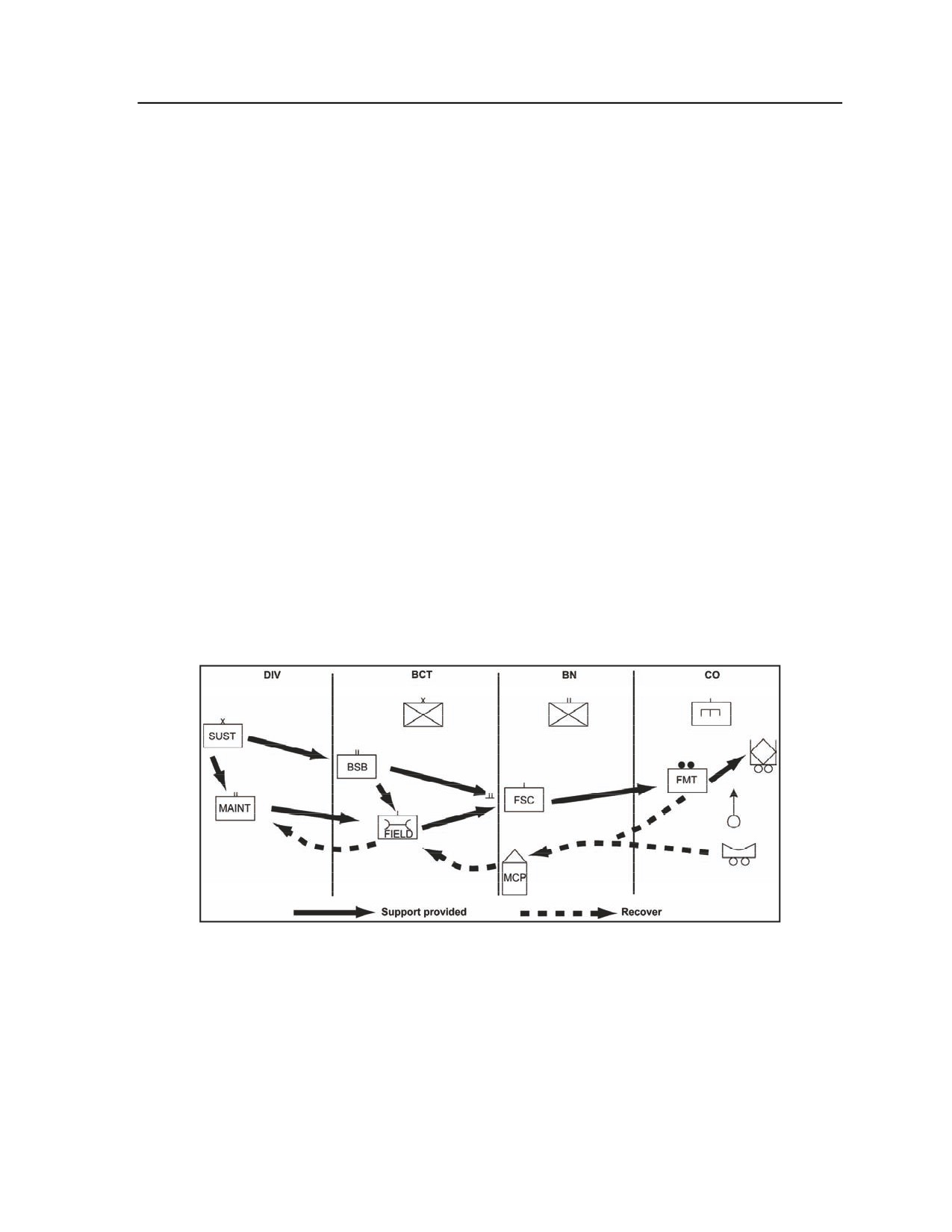
4-90.7 for more information on field maintenance in the BCT.) (See figure 8-2, page 8-12.)
Figure 8-2. BCT maintenance operations
8-48. In the SBCT, a tailored maintenance team from the FMC performs the same functions as previously
discussed. When individual engineer platoons are task-organized to Stryker infantry battalions, a mechanic
from this FMT normally accompanies the platoon. Additional field maintenance and evacuation support for
damaged equipment is received at the supported units supported unit maintenance collection point
(UMCP).
11 February 2009
FM 3-34.22
8-11
Chapter 8
Field Maintenance
8-49. Field maintenance returns repaired equipment to Soldiers, provides on-system maintenance, and
mainly involves preventive maintenance and the replacement of defective parts. It covers tasks previously
assigned to operator, crew, organization, unit, and DS maintenance levels. It includes some off-system
maintenance that is critical to mission readiness. Within the BCT, field level maintainers are generally
concentrated in the BSB (FSCs or FMC). Sustainment maintenance consists of repairing components of the
user’s system. It is generally a merging of the previous GS and depot maintenance levels.
Sustainment Maintenance
8-50. Sustainment maintenance is typically performed by an element of the sustainment brigade or higher
echelon (see figure 8-2). The ENCOORD ensures that sustainment maintenance is identified for each
supporting engineer unit. Company commanders ensure that vehicle crews and equipment operators
perform preventive-maintenance checks and services (PMCS).
SUPPLY
8-51. The various classes of supply are discussed in the following paragraphs.
Class I
8-52. Class I supplies consist of subsistence and gratuitous health and welfare items. They are
automatically requested based on daily strength reports. BCT units deploy with three days of operational
rations (meals, ready to eat [MREs]). MREs are distributed in case lots at the BSB distribution point and
picked up by the appropriate supply section (FSC or BSTB). Unitized group rations (UGRs) and A-rations
are broken down into lots at the BSB distribution point and picked up by the appropriate field-feeding
section (FSC or BSTB) for incorporation into the LOGPAC. Water is provided to Soldiers in two forms—
bulk and bottled. Water support is provided through organic water purification and distribution capability
when feasible. Bulk potable water is used as needed for individual Soldiers. Bottled water may be provided
on a limited basis, usually during the deployment phase of operations. Bottled water containers are issued
based on the same unit daily strength reports used for rations and field feeding. The BSB receives, stores,
and distributes water. The BSB may not have adequate equipment to satisfy BCT requirements for water
purification, therefore requiring augmentation. Each company has water trailers and five-gallon containers
for distribution of potable water. Company supply sergeants maintain water trailers in their company area
and refill them from the BSA. The refilling of five-gallon containers typically occurs during LOGPAC
operations.
Class II
8-53. Class II supplies consist of such items as clothing, individual equipment, tenting supplies, hand tools,
administrative and housekeeping supplies, and CBRN defense and decontamination items. Usually, the
BCT deploys with 30 days of common consumable supplies. These supplies are provided by the BSB and
are maintained as part of the BCT authorized stock list. Replenishment and other necessary supplies are
ordered by company supply sergeants using the Property Book Unit Supply-Enhanced (PBUSE) Program
from the BSB. Supplies are provided at the BCT distribution point to the supporting supply unit (FSC or
BSTB) for the appropriate company. They are carried forward with the next LOGPAC or immediately if
needed. Religious supplies and maps are also considered Class II items. Unit ministry teams (UMTs) order
consumable chaplain supplies as necessary. Maps are ordered using the PBUSE Program. Usually, paper
map sheets are delivered with appropriate supplies to the requester.
Class III
8-54. Class III supplies consist of bulk and packaged POL (petroleum fuels, lubricants, hydraulic and
insulating oils, preservatives, liquids and gases, bulk chemical products, coolants, deicer and antifreeze
compounds, components and additives of petroleum and chemical products, coal). The BCT usually
8-12
FM 3-34.22
11 February 2009
Sustainment Support for Engineer Operations
deploys with half-full vehicle fuel tanks, purged fuelers, and empty fuel cans. Fuel is issued upon BCT
arrival in the theater. Units forecast requirements based on the current or upcoming mission. The forecast is
SOP-dependent, but is usually for the 72-hour period beyond the next day or up to 96 hours. The BSB fuel
and water support platoon transports fuel to FSCs for maneuver battalions or the BSTB support platoon.
Class IV
8-55. Class IV supplies consist of construction materials, including fortification and barrier materials.
These are items for which allowances are not prescribed. The management of Class IV supplies for
survivability is most efficient when there is a shared interest between maneuvers and engineer logisticians.
BCT units deploy with a limited amount of Class IV barrier material, primarily for the protection of unit
perimeters and key positions. This material is considered the unit basic load (UBL), and is usually carried
on tactical vehicles. Replenishment is ordered by company supply sergeants using the PBUSE Program
from the BSB. Supplies are provided from the BCT distribution point and carried forward by sustainment
elements with the next LOGPAC or immediately if necessary. Barrier material may also be requested as
configured loads. The ENCOORD typically coordinates closely with the logistics staff to assist in
managing barrier and construction materials. (See FM 3-90.6 for additional information.)
Class V
8-56. Class V supplies consist of all types of ammunition (chemical, radiological, and special weapons;
bombs; explosives; mines; fuses; detonators; pyrotechnics; missiles; rockets; propellants). Class V supplies
are based on a required supply rate (RSR) or controlled supply rate (CSR). RSR is the amount of
ammunition, usually expressed in rounds-per-weapon per day, estimated to be required to sustain
operations, without restriction, for a specific period. The BCT S-3 develops the RSR. CSR is the rate of
ammunition consumption that can be supported (considering availability, facilities, and transportation) for
a given period. The CSR may be less than the RSR. If the RSR exceeds the CSR, the commander
determines who receives the ammunition. A combat load is the unit commander’s designated quantity of
munitions and items authorized to be carried by unit personnel and combat vehicles (turret load). Troop-
carried munitions to accompany troops (TAT) are those issued before departure from the aerial port of
embarkation (APOE). Turret load or combat load munitions are those authorized for transportation in
thick-skinned vehicles for deployment purposes. Generally, BCTs try to keep three combat loads of critical
munitions on hand. Most units do not deploy with their authorized basic load (ABL) of ammunition.
Instead, they are issued their combat load upon arrival in the theater. However, there are times when
selected units deploy with a full combat load of ammunition.
Class VI
8-57. Class VI supplies consist of all personal-demand items (candy, cigarettes, soap, cameras [nonmilitary
sale items]). BCT Soldiers are usually directed to deploy with 30 days of personal comfort items. Health
and comfort packages (HCPs) are also Class VI items. Class VI support is obtained through supply
channels when a post exchange (PX) is not available. Resupply flow is the same as for Class I supplies.
The delivery of HCPs is based on the head count provided for field feeding.
Class VII
8-58. Class VII supplies consist of major end items (launchers, tanks, mobile machine shops, vehicles,
organizational tool sets). Units deploy with all required equipment based on the appropriate MTOE.
Additional equipment may be issued to the unit in theater based on mission requirements. Class VII
replacement is based on losses reported through command channels. Reporting the loss of major end items
permits the commander to remain apprised of the operational status of subordinate commands and to direct
the distribution of items to those units having the most critical need. Replacement Class VII equipment is
delivered to the BSA BCT.
11 February 2009
FM 3-34.22
8-13
Chapter 8
Class VIII
8-59. Class VIII supplies consist of medical material (repair parts peculiar to medical equipment). Usually,
the medical company and medical platoons in support of the BCT deploy with a three- to five-day supply
of consumable medical supplies, and all companies deploy with complete combat lifesaver bags. Initial
sustainment supplies are pushed to the BSMC based on theater casualty estimates. Individual Soldiers
deploy with a 180-day supply of personal prescription medications. Soldier must advise their supporting
medical unit of their specific needs. Resupply of medical supplies is done through medical channels. The
BSMC and maneuver platoon medical personnel are responsible for maintaining medical SKOs. Combat
lifesavers and combat medics normally receive replenishment for their aid bags from their unit medical
platoon or section or from the medical company, platoon, section, or team providing Role 1 or Role 2
medical support.
Class IX
8-60. Class IX supplies consist of repair parts and components (kits, assemblies, subassemblies [repairable
and unrepairable that are required for maintenance support of equipment]). Each company in the BCT
stocks and deploys with combat spares for repair parts. Combat spares are a combination of prescribed load
list (PLL), shop stock, and bench stock. Stocks are based on demand history and usually issued in 30-day
supply quantities. Maintenance personnel replenish their combat spares and order other parts as needed
through the BSB. Class IX repair part requisitions are prioritized based on the commander’s priority of
maintenance and need and are ordered through the Standard Army Maintenance System-Enhanced
(SAMS-E).
Class X
8-61. Class X supplies consist of materials to support nonmilitary programs (agriculture and economic
development). Class X items are requested based on requirements from CA or operations channels.
Material for nonmilitary support is usually provided by the HN, NGOs (Red Cross), or DOS. Humanitarian
assistance is governed by Title 10, USC, Section 401, which specifies that humanitarian assistance must—
z
Be carried out according to HN military or civilian personnel.
z
Complement and not duplicate any other form of social or economic assistance that may be
provided to the HN by any other department or agency of the U.S. government.
z
Not be provided directly or indirectly to any individual, group, or organization engaged in
military or paramilitary activities.
z
Not be provided unless DOS specifically approves such assistance.
Note. Prior to providing civil-military support or humanitarian assistance, commanders should
seek legal review from their servicing SJA.
ARMY HEALTH SYSTEM
8-62. The AHS involves the delineation of support responsibilities by capabilities (roles of care) and
geographical area (area support). The AHS executes it HSS and force health protection missions as a
single, seamless, and integrated system. It is a continuum from the point of injury or wounding through
successive roles of care to the continental United States (CONUS) support base. The AHS encompasses the
promotion of wellness and preventive, curative, and rehabilitative medical services. It is designed to
maintain a healthy and fit force and to conserve the fighting strength of deployed forces.
Role 1 Medical Support
8-63. The first medical care a Soldier receives is provided at Role 1. This care includes immediate
lifesaving measures, EMT, advanced trauma management (ATM), disease prevention, stress prevention,
casualty collection, and evacuation from the supported unit to the supporting MTF. These elements include
8-14
FM 3-34.22
11 February 2009
Sustainment Support for Engineer Operations
the combat medic, assisted by first aid (self-aid or buddy aid), advanced first aid (combat lifesaver), and
the supporting Role 1 MTF (battalion aid station or treatment team). When Role 1 MTF capability is not
present in a unit, it is provided on an area support basis by the supporting Role 1 or Role 2 medical unit or
element. The engineer company receives Role 1 medical support from the BSTB or BSMC. The engineer
company receives Role 2 medical support from a BSMC or an area support medical company, depending
on its unit of attachment.
Combat Lifesavers
8-64. Combat lifesaver and buddy aid are crucial to sustaining HSS. The combat lifesaver is almost always
the first person on the scene to begin the process of providing enhanced first aid to wounded and injured
personnel. The combat lifesaver is a nonmedical Soldier trained to provide enhanced first aid and
lifesaving procedures beyond the self-aid or buddy aid level. The combat lifesaver is not intended to take
the place of medical personnel, but to slow the deterioration of a wounded Soldier’s condition until
medical personnel arrive. Each squad-, crew-, or equivalent-size deployable unit has at least one Soldier
who is trained and certified as a combat lifesaver.
Medical Evacuation
8-65. The vehicle commander is responsible for ensuring that injured crewmen receive immediate first aid
and for reporting casualties. Vehicle commanders coordinate with the 1SG and senior medic for ground
evacuation. The evacuation of injured Soldiers is categorized into two types—
z
MEDEVAC is the use of ground or air ambulances to evacuate from the point of injury to an
MTF while providing en route care.
z
CASEVAC is the use of nonmedical vehicles or other means for patient movement without
providing en route care.
8-66. Medical evacuation elements use the most expedient means available for the MEDEVAC of sick,
injured, or wounded Soldiers. The use of air ambulance is METT-TC-dependent and may not always be
available. Based on mission requirements, the combat aviation brigade, general support aviation battalion
(GSAB) determines where to position the forward support medical evacuation teams (FSMTs) and the
number of HH-60 Black Hawk aircraft in support of a BCT. The brigade aviation element (BAE) and BCT
surgeon coordinate the use and positioning of the FSMT. They integrate air ambulance support
(coordinating AC2 requirements, establishing clear lines of authority to launch a MEDEVAC, and
identifying pickup zones (PZs) and LZs. (See FM 4-02.2 for more information on MEDEVAC.)
8-67. Planners must anticipate the potential of high casualty rates and long evacuation distances while
retaining the flexibility to shift nonstandard evacuation assets to support mass casualty or CASEVAC as
required.
Role 2 Medical Support
8-68. Capabilities at the BSMC duplicate those found at Role 1 MTFs and expand available medical
services by adding operational dental, laboratory, X-ray, patient-holding, behavioral health, and
preventive-medicine capabilities. EMT and ATM are continued. If necessary, additional emergency
measures are instituted; however, these measures do not exceed those dictated by immediate needs. The
forward surgical team (FST) from echelons above division may collocate with the BSMC and provide
emergency resuscitative surgical support. The BSMC examines and evaluates casualty wounds and the
general physical condition to determine treatment and evacuation priorities. The BSMC provides sick-call
services, area medical support, and ground ambulance MEDEVAC support for the engineer company.
PERSONNEL SERVICES
8-69. Personnel services are those sustainment functions related to Soldier welfare, readiness, and quality
of life. The BCT S-1, augmented from higher headquarters, plans and coordinates human resources,
financial management, legal, and religious support. (See FM 1-0, FM 3-90.6, and FMI 1-0.01 for more
information on personnel services in the BCT.)
11 February 2009
FM 3-34.22
8-15
Chapter 8
Human Resources Support
8-70. The unit S-1 section provides Soldiers with an organic capability for essential personnel services.
The S-1 focuses on the two critical wartime functions—personnel accounting and strength reporting
(PASR) and casualty reporting. These functions must begin at the company level and are essential to
receiving timely replacements. They are conducted using the electronic military personnel office
(eMILPO). Company 1SGs and unit S-1s must reconcile personnel accounting on a periodic basis
(generally outlined in the unit SOP). The S-1 must ensure that Soldiers in the medical treatment process are
reconciled.
Casualty Operations
8-71. The single most important S-1 function in casualty operations is ensuring that all casualties are
reported (timely and accurately) in the required format. This ensures accurate and expeditious notification
of the next of kin (NOK). All changes in Soldier status must also be reported.
8-72. Casualty reporting starts at the point of injury with the preparation of DA Form 1156 (Casualty
Feeder Card). As casualties occur, the nearest observer informs the company 1SG by the most expedient
method available (messenger; voice; or electronic text data through Force XXI battle command-brigade
and below [FBCB2], Blue Force Tracker [BFT], or Enhanced Position Location Reporting System
[EPLRS]) per the unit SOP. The 1SG submits a duty status change on casualties using FBCB2 and the
personnel situation report (PERSITREP). FBCB2 sends the reports directly to the battalion CP. Casualties
are taken to casualty collection points for treatment and sorting into categories of evacuation precedence
(urgent, urgent-surgical, priority, routine, and convenience) for ground or air ambulance evacuation.
Casualties are evacuated to the nearest MTF that can provide the required treatments to enhance
survivability and save sight/limbs.
8-73. When a Soldier becomes a casualty, the combat medic or health care specialist from the medical
treatment element records the medical treatment on Department of Defense (DD) Form 1380 (U.S. Field
Medical Card). The unit S-1 should electronically receive a notification message to update the Soldier’s
patient tracking status. With this message, an S-1 can identify a casualty’s location and properly account
for him.
8-74. Engineer leaders must work with the appropriate S-1 to ensure that attachments and augmentations
are accurately reported. Each Soldier is only reported once and personnel must ensure that accurate
reporting occurs. Personnel from other branches of Service, DA civilians, and contractors may require
special procedures. The engineer company 1SG or his designated representative—
z
Forwards reports to higher headquarters within one hour after casualties occur.
z
Verifies and reconciles PASR data with the supported-unit S-1.
z
Coordinates requirements with the supported-unit S-4 for mortuary affairs items.
z
Coordinates with the supported-unit S-1 to ensure that proper NOK notification procedures are
followed.
z
Reconciles casualty reports.
z
Coordinates with the supported-unit S-1 for company personnel to return to duty.
z
Submits combat-critical personnel information to the supported-unit S-1 for database update.
Postal Services
8-75. Postal support comes from a postal unit provided by higher headquarters. The postal unit separates
the mail by battalion level organizations. The mail is picked up by the designated battalion mail clerk or
sent forward to him in combat trains. Outgoing mail is exchanged at the same time. The battalion mail
clerk receives and distributes the mail to the company mail clerk (usually the supply sergeant) who delivers
it to the 1SG, platoon sergeant, or Soldier.
8-16
FM 3-34.22
11 February 2009
Sustainment Support for Engineer Operations
Other Personnel Services
8-76. Special teams from higher headquarters sometimes augment the BCT to provide administrative
services
(awards, promotions, evaluations, reassignments); military pay support; morale, welfare, and
recreation (MWR) support; and Red Cross coordination.
FIELD SERVICES
8-77. Field services support includes food preparation, water purification, bakery facility operation,
clothing and light textile repair, laundry and shower facility operation, parachute packing, air item
maintenance, rigging supplies and equipment for airdrops, mortuary affairs, and force provider operations.
Usually, laundry, clothing, and light textile repair are not available outside theater staging bases.
Field Feeding
8-78. The FSC and BSTB field-feeding sections and BSB SBCT field-feeding teams, have trailer-mounted
containerized kitchens (CKs) to prepare meals for Soldiers. There is also a food sanitation center to support
field kitchen operations.
Showers
8-79. Small unit showers are authorized according to Common Table of Allowances (CTA) 50-909. One
shower unit consists of one heater, one shelter, and two water bags. Showers may be provided to the BCT
by sustainment brigade units during mission staging operations.
Mortuary Affairs
8-80. The recovery and identification of deceased personnel is the responsibility of each company.
Company 1SGs supervise the preparation of DD Form 565 (Statement of Recognition of Deceased). These
documents accompany the remains during transport to a remains collection point. Usually, remains
collection points are in the vicinity of combat trains, but not near the MTF. Once necessary reports are
complete, the remains are evacuated to the BCT unit remains collection point (usually in the BSA). From
there, remains are evacuated to a mortuary collection point established by the theater support command. If
remains have been contaminated by CBRN agents or toxic industrial materials (TIMs), the BCT S-4 (in
coordination with the BCT CBRN officer) should provide guidance to units before they handle or evacuate
the remains.
Host Nation Support
8-81. HNS is a common method of providing services to deployed U.S. Army forces. This support can
include assistance in almost every aspect required to sustain military operations within a theater. Planners
must consider that HNS meets local standards and not necessarily U.S. standards. HNS can be a significant
resource, provided it is available and the appropriate agreements are in place.
DETAINEES
8-82. Detainee is a term used to refer to any person captured or otherwise detained by an armed force.
More specifically, detainees encompass the broad category of EPWs, other detainees, civilian internees,
and retained persons. All persons captured, detained, or otherwise held in U.S. custody must receive
humane care and treatment (see FM 3-19.40). The unit S-3 leads the staff in planning the retrograde of
detainees. Soldiers who capture EPWs and detain civilians maintain control of them and any captured
documents and materiel until they are turned over to the proper authority. EPWs are evacuated to the
detainee collection point (DCP) as rapidly as possible. The BCT may be required to operate a detention
facility, but this site is more likely to be run by another unit.
11 February 2009
FM 3-34.22
8-17
Chapter 8
QUALITY OF LIFE SUPPORT
8-83. A direct relationship exists between adequate and well-thought out Soldier and family quality-of-life
programs, Soldier morale, and combat effectiveness. These operations include—
z
Postal services. Postal services include the movement, delivery, and collection of mail in the
company.
z
PA. PA is the provision for an expedited flow of complete, accurate, and timely information,
which communicates the Army perspective, keeps Soldiers and the American people informed,
and helps establish the conditions that lead to confidence in the U.S. Army.
z
Family readiness group programs. Family readiness group programs enhance Soldier
effectiveness by ensuring that their families are appropriately cared for in their absence.
8-18
FM 3-34.22
11 February 2009

Appendix A
Metric Conversion Chart
A-1. This appendix complies with AR 25-30 which states that weights, distances, quantities, and measures
contained in Army publications will be expressed in both U.S. standard and metric units. Table A-1 is a
metric conversion chart.
Table A-1. Metric conversion chart
U.S. Units
Multiplied By
Equals Metric Units
Acres
0.49470
Hectares
Cubic yards
0.76460
Cubic meters
Degrees Fahrenheit (-32)
0.55560
Degrees Celsius
Feet
0.30480
Meters
Inches
2.54000
Centimeters
Inches
0.02540
Meters
Inches
25.40010
Millimeters
Long tons
1.01600
Metric tons
Miles (nautical)
1.85320
Kilometers
Miles (statute)
1.60930
Kilometers
Short tons
0.90700
Metric tons
Metric Units
Multiplied By
Equals U.S. Units
Centimeters
0.39370
Inches
Cubic meters
1.30790
Cubic yards
Degrees Celsius (+17.8)
1.80000
Degrees Fahrenheit
Hectares
2.47100
Acres
Kilometers
0.53960
Miles (nautical)
Kilometers
0.62137
Miles (statute)
Meters
3.28080
Feet
Meters
39.37000
Inches
Metric tons
1.10200
Short tons
Metric tons
0.98400
Long tons
Millimeters
0.03937
Inches
11 February 2009
FM 3-34.22
A-1
This page intentionally left blank.
Appendix B
Selected Engineer Organizations and Capabilities
This appendix describes organic engineer staffing and organizations within the BCT
and ACR. It also highlights some of the modular engineer units that are likely to
augment the BCT and ACR or provide support within their AO. (See FM 3-34 for a
more complete listing of engineer organizations.)
ORGANIC ENGINEERS IN THE BRIGADE COMBAT TEAM
B-1. Each BCT and ACR has an organic engineer company. In the HBCT and IBCT, the organic
engineer (Sapper) company is located within the BSTB. In the SBCT, it is positioned as a separate unit
under the brigade (see figure B-1, page B-5). The ACR combat engineer company is also positioned as a
separate unit under the regiment, similar to that of the SBCT. The engineer company organic to the BCT
and ACR is focused on tactical-level maneuver. Its mission is to provide assured mobility to the BCT and
ACR by conducting combat engineering (M/CM/S) and limited general engineering to enhance maneuver
in the AO. As a combat multiplier, engineers concentrate their efforts on maintaining the freedom of
movement for the supported force and reducing the enemy’s ability to mass and maneuver on the
battlefield.
B-2. There is an organic engineer staff element within each BCT and ACR (see figure B-2, page B-6).
Though each type of BCT is slightly different, there is generally an ENCOORD, engineer planner, senior
engineer NCO, and geospatial engineering team in the HBCT and IBCT. In addition there are also organic
engineer personnel within the BSTB, and within the HHC, CAB, and infantry battalion. Engineer
personnel within the BSTB facilitate additional engineer forces being attached to augment the HBCT or
IBCT. Engineer units from company size and below are intended to be attached to the BSTB for C2 and
logistics support.
B-3. The organic geospatial engineering team within the BCT operates in the BCT main CP and provides
geospatial engineering support. The topographic section—
z
Generates and analyzes terrain data.
z
Prepares decision graphics.
z
Produces image maps.
z
Provides 3-D terrain perspective views.
z
Manages the theater geospatial database.
z
Updates maps.
z
Produces tactical decision aids.
z
Produces IPB overlays.
z
Operates on a 24-hour basis.
B-4. Equipment assigned to the topographic section includes—
z
One Digital Topographic Support System (DTSS-B)-Base: AN/TYQ-67 (light).
z
One DTSS-B: AN/TYQ-71 (deployable).
z
One light medium tactical vehicle (LMTV) with towed generator.
z
One high-mobility, multipurpose, wheeled vehicle (HMMWV).
B-5. Figures B-3 through B-6, page B-7 through B-10, show the organic engineer company in the ACR,
HBCT, IBCT, and SBCT.
11 February 2009
FM 3-34.22
B-1
Appendix B
AUGMENTING ENGINEER UNITS
B-6. As discussed in chapter 1, the organic engineer capability within the BCT and ACR is designed to
provide a baseline of combat capabilities to which augmentation can and typically will be added. METT-
TC analysis and the engineer requirements identified early in the planning phase determine the type and
amount of augmentation needed to support mission requirements. The primary means of augmenting the
BCT and ACR is baseline engineering units (combat and general engineering). The following paragraphs
summarize some of the baseline engineering units and their capabilities that can augment the BCT and
ACR. Depending on their number, augmenting units, likely come task-organized under an engineer
battalion headquarters to ensure effective C2.
ENGINEER BATTALION
B-7. The engineer battalion shown in figure B-7, page B-11, is capable of planning, integrating, and
directing the execution of combat and general engineering missions conducted by one to five assigned
engineer companies. Engineer battalions are typically found within the engineer brigade, within the MEB,
or in support of a BCT. The battalion receives design and/or survey teams or EHTs to facilitate
construction or EH clearance missions. When supporting a BCT, the battalion may be focused on a single
mission (route clearance, security construction, cache interrogation and reduction). The battalion may also
be organized to perform as a breach force command during BCT combined arms breaching operations.
During a gap-crossing operation, the battalion provides the option to be designated as the crossing-site
command.
SAPPER COMPANY
B-8. The Sapper company executes M/CM/S tasks in support of BCTs and support brigades to enable
force application, focused logistics, and protection. It often reinforces the organic engineers in the BCTs.
The Sapper company varies in design, though all are organized with three Sapper platoons (see figure B-8,
page B-12). Airborne- and air assault-capable Sapper companies have the unique ability to employ air-
droppable, rapid runway repair kits in support of forcible-entry operations.
MOBILITY AUGMENTATION COMPANY
B-9. The mobility augmentation company (MAC) conducts assault gap crossings, conducts mounted and
dismounted breaches, and emplaces obstacles in support of BCTs and support brigades to enable force
application, focused logistics, and protection. The MAC is equipped with a variety of assault-breaching
and countermobility equipment. It is organized with two assault breach platoons and one obstacle platoon
(see figure B-9, page B-13). It can provide four assault gap crossings for a BCT, four mounted breaches for
an IBCT or SBCT, two mounted breaches for an HBCT, and four additional dismounted breaches for a
BCT. It can emplace 4,432 linear meters of fix or disrupt tactical obstacle frontage without reloading.
CLEARANCE COMPANY
B-10. The clearance company conducts detection and limited IED neutralization (as outlined in FM 3-90)
along routes and within areas of support to enable force application, focused logistics, and protection. The
company provides battle command for three to five route, area, or Sapper platoons. In an area clearance
role it is capable of clearing 255 kilometers of two-way routes, 2 acres, 8,000 square meters per day. The
clearance company is equipped with a variety of EH-clearing equipment and is organized with three route
clearance platoons and one area clearance platoon (see figure B-10, page B-14).
ENGINEER SUPPORT COMPANY
B-11. The engineer support company provides rapid runway repair (RRR), constructs tactical UAS
airfields and LZs, performs initial base camp construction, and repairs and maintains ground LOCs. An
engineer support company is equipped with a variety of earth moving equipment and is organized with two
rapidly deployable, equipment-light (RDE-L) platoons and one rapidly deployable, equipment-medium
(RDE-M) platoon (see figure B-11, page B-15).
B-2
FM 3-34.22
11 February 2009
Selected Engineer Organizations and Capabilities
MULTIROLE BRIDGE COMPANY
B-12. The multirole bridge company (MRBC) is required for hasty crossings of gaps greater than 18
meters. One or more MRBCs are required to support deliberate gap crossings (wet or dry). (See appendix E
for more information on gap-crossing operations.) The MRBC is organized with a company headquarters,
two bridge platoons, and a support platoon (see figure B-12, page B-16). The company has maintenance,
equipment, park, and mess sections, which allow it to function as a single entity when performing gap-
crossing operations. The company can be task-organized into several sections and spread across the BCT
AO.
HORIZONTAL AND VERTICAL COMPANIES
B-13. The horizontal company (see figure B-13, page B-17) and vertical company (see figure B-14, page
B-18) have a construction focus and are capable of constructing, rehabilitating, repairing, maintaining, and
modifying landing strips, airfields, CPs, MSRs, supply installations, building structures, bridges, and other
related aspects of infrastructure. These units may also perform repairs and limited reconstruction of
railroads or water and sewage facilities. The basic capabilities of these construction units can be expanded
significantly through the augmentation of specialized personnel and equipment to provide bituminous
mixing and paving, quarrying and crushing, and major horizontal construction projects (highways, storage
facilities, airfields). Additional augmentation could also include pipeline construction or dive support,
depending on the type and scope of the construction mission.
EXPLOSIVE HAZARDS COORDINATION CELL AND EXPLOSIVE HAZARDS TEAM
B-14. The EHCC mission (see figure B-15, page B-19) is to gather and track EH incidents, maintain the
mine strike database, provide pattern analysis of EH incidents, and provide technical advice on EH to
enable the land component commander to predict, track, distribute information on, and mitigate EHs within
the theater. The 15-person cell provides technical advice on the mitigation of EHs (TTP development) and
provides training updates to field units. (EHTs are coordinated as shown in figure B-16, page B-20.)
EHCC capabilities include—
z
Establishing, maintaining, and sharing the explosive hazards database (EHDB) within the joint
operations area (JOA).
z
Ensuring accuracy of EH information distribution via the battle command system.
z
Coordinating site evaluations, strike incident investigations (four sites simultaneously), or unit
training (four sites simultaneously).
z
Assisting ISR planners with EH pattern analysis and intelligence collection management.
z
Coordinating technical and tactical training for the BCTs.
z
Providing updated TTP and guidance for route and area clearance.
EXPLOSIVE ORDNANCE CLEARANCE AGENT
B-15. The EOCA is not an engineer unit, but rather a special engineer capability. EOCA personnel are
combat engineers who are trained to perform limited identification and battlefield destruction of UXO as
outlined in the EOCA identification guide and supplemental list of EOCA ordnance (part of the ordnance
order of battle) provided by the theater EOD commander. If the UXO is out of the scope of operations for
the EOCA, EOD personnel must be called. EOCA personnel can assist EOD personnel in disposing of
other EH as requested. Properly trained and certified EOCA personnel capabilities include—
z
UXO reconnaissance. EOCA personnel are trained to perform detailed reconnaissance of
suspected UXO.
z
UXO identification. EOCAs can perform limited identification of the items listed in the EOCA
identification guide and the supplemental EOCA ordnance list. Items that the EOCA cannot
positively identify must be reported to EOD personnel.
z
UXO area marking. EOCAs mark the UXO area according to the standard UXO marking
system.
11 February 2009
FM 3-34.22
B-3
Appendix B
z
Protective works. EOCAs can provide protective works to isolate a blast and fragmentation
danger area of identified UXO. EOCA may provide an estimated blast and fragmentation danger
area for items similar to, but not included in, the EOCA identification guide and supplemental
EOCA ordnance list. EOCAs advise the on-scene commander with the recommended personnel
and equipment protective measures. When the commander determines that certain personnel or
equipment cannot be removed from the hazard area, protective works must be established to
protect those personnel and assets from the effects of the UXO. EOCAs recommend and
supervise the appropriate protective works to be completed.
z
UXO disposal. EOCAs are authorized to destroy (by detonation) individual UXO identified in
the EOCA identification guide and supplemental EOCA ordnance list.
z
IED disposal. EOCAs are authorized to “blow in place” single, munitions-based IEDs that are
positively identifiable in the EOCA identification guide and supplemental EOCA ordnance list.
B-16. The following are EOCA limitations
(see FM
3-90.119 for the most detailed and current
information). EOCAs—
z
Are not trained to move, combine, or destroy multiple UXOs (a cache or IED to incorporate
more than one munition).
z
Are not trained to perform reconnaissance or handling of IED or vehicle-borne IED incidents.
z
Can only perform explosive remnants of war operations under the direct supervision of EOD
personnel (including EHTs).
z
Are not to be used for EH response calls. If EOD is not readily available as determined by the
maneuver commander, EOCA personnel can be used to conduct an initial reconnaissance of the
UXO. If the UXO falls within their capability, EOCA personnel may dispose of the UXO.
Note. The joint force commander is advised by the senior EOD commander who creates and
manages modifications to the JOA UXO supplemental list. Requests to modify the supplemental
list are coordinated through the local EOD unit or EHT for approval by the CBRNE cell, EOD
group or battalion staff. Any modification to the JOA UXO supplemental list is provided based
on positively identifiable munitions in the theater ordnance order of battle.
ENGINEER DETACHMENT HEADQUARTERS (CANINE)
B-17. The engineer detachment headquarters (canine) (see figure B-17, page B-21) plans, coordinates,
supports, and controls canine clearance and specialized search operations. The detachment provides
support to route clearance, area clearance and reduction, and area identification and quality assurance and
proofing after mechanical clearance. The detachment headquarters is normally attached to an engineer
battalion or clearance company in support of a BCT or directly assigned to an engineer brigade or MEB in
support of echelons above BCT units.
B-18. The detachment headquarters can provide C2 for five engineer squads (canine) (see figure B-18,
page B-22). Each squad consists of six mine detection dogs and handlers. A dog handler and dog can
typically work four hours per day, depending on the weather, terrain, and soil conditions. Consistent
refresher and other training is required for each dog and handler.
B-4
FM 3-34.22
11 February 2009
Appendix C
Combined Arms Breaching Operations
Breaching operations are conducted to allow maneuver in the presence of obstacles.
Obstacle breaching is the employment of a combination of tactics and techniques to
advance an attacking force to the obstacle farside that is covered by fire. It is one of
the most difficult combat tasks a force can encounter. Breaching is a synchronized
combined arms operation under the control of a maneuver commander. This appendix
serves as a quick reference for leaders planning breaching operations. (See FM 3-
34.2.)
OPERATIONS
C-1. Attacks take place along a continuum based on the knowledge of enemy capability and disposition
and the intentions and details of friendly force planning and preparation. The following terms refer to the
opposite ends of that continuum and describe characteristics of the attack:
z
Deliberate attack. During a deliberate attack, friendly forces have more knowledge of the
enemy situation and have more time to plan and prepare for the enemy. With this knowledge,
friendly forces conducting a deliberate attack can develop detailed plans, task-organize to
accomplish the mission, and execute rehearsals down to the lowest levels (see FM 3-90).
z
Hasty attack. During a hasty attack, the enemy situation is vague or changes rapidly. Friendly
forces have little or no time to plan or prepare for this type of operation. Because the primary
purpose of the hasty attack is to maintain momentum or take advantage of the enemy situation, it
is normally conducted only with resources that are immediately available (see FM 3-90).
C-2. Breaching operations may be required to support an attack anywhere along this continuum.
Breaching operations must be adapted to best exploit the situation. The breaching tenets apply across the
continuum regardless of where the attack falls. The level and type of planning distinguishes which of the
following general types of breaching operations are used to meet mission variables (METT-TC):
z
Deliberate breach. A deliberate breach is used against a strong defense or complex obstacle
system. It is similar to a deliberate attack, requiring detailed knowledge of the defense and
obstacle systems. It is characterized by the most prior planning, preparation, and build up of
combat power on the obstacle nearside. Subordinate units are task-organized to accomplish the
breach. The breach often requires securing the obstacle farside with an assault force before or
during reduction. Amphibious breaching is an adaptation of the deliberate breach intended to
overcome antilanding defenses to allow a successful amphibious landing.
z
Hasty breach. A hasty breach is an adaptation to the deliberate breach and is conducted when
less time is available. It may be conducted during a deliberate or hasty attack due to a lack of
clarity on enemy obstacles or changing enemy situations (SCATMINE emplacement).
z
In-stride breach. An in-stride breach is a variation of a hasty breach that consists of a rapid
breaching adaptation conducted by forces organic to (or task-organized with) the attacking
force. It consists of preplanned, well-trained, and well-rehearsed breaching battle drills and the
use of the unit SOP. The in-stride breach takes advantage of surprise and momentum to
penetrate obstacles. The force uses an in-stride breach against weak defenders or very simple
obstacles and executes the battle drill on the move. Attacking forces should be configured to
execute an in-stride breach, except when a deliberate breach is planned.
z
Covert breach. A covert breach is used to pass through obstacles without being detected by the
enemy. It uses elements of deliberate and hasty breaches as required. Covert breaching is
11 February 2009
FM 3-34.22
C-1
Appendix C
characterized by using stealth to reduce obstacles, with support and assault forces executing
their mission only if reduction is detected. Covert breaches are usually conducted during periods
of limited visibility.
C-3. The breach area is the area where a breaching operation occurs. It is established and fully defined
by the higher headquarters of the unit conducting breaching operations. (FM 3-34.2) The area must be
large enough to allow the attacking unit to deploy its support force and extend far enough on the obstacle
farside to allow follow-on forces to deploy before leaving the breach area. One technique is to establish the
breach area using phase lines (PLs) or unit boundaries. The PL defining the breach area farside may be
established as a battle handover line (BHL).
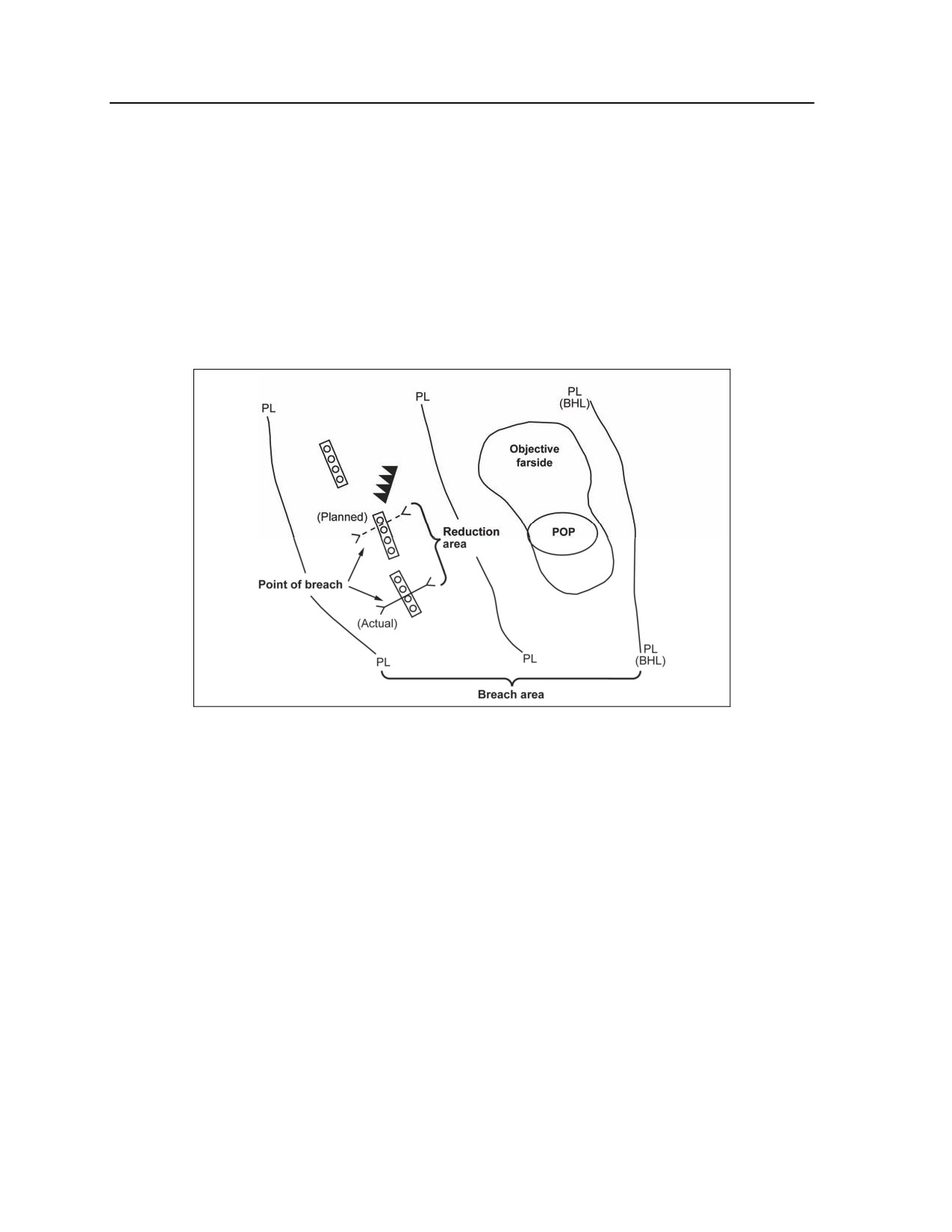
C-4. The reduction area is a number of adjacent points of breach that are under the control of the
breaching commander (see FM 3-34.2). The commander conducting the attack determines the size and
location of the reduction area that supports the seizure of a POP. (See figure C-1.)
Figure C-1. Reduction area, breach area, and point of breach
C-5. A breaching operation includes the reduction of minefields and other EHs and obstacles. Reduction
is the creation of lanes through or over the obstacle to allow the attacking force to pass. The number and
width of lanes varies with the enemy situation, size and composition of the assault force, and scheme of
maneuver. The lanes must allow the assault force to rapidly pass through the obstacle. Breaching is a
mobility operation planned for within the overall framework of assured mobility. Heavily reliant on
reconnaissance, it generally requires significant engineering support to accomplish.
C-6. Most combined arms breaching operations are conducted by a BCT or its subordinate battalion TF
elements as a tactical operation, but higher headquarters may also conduct operational-level combined arms
breaching. As previously mentioned in chapter 6, significant engineer augmentation from EAB is required
to enable a BCT breach or a battalion TF hasty or deliberate breach. Depending on the size of the
assaulting force, number of lanes required, and addition of the appropriate redundancy in reduction assets
the necessary engineer augmentation may include additional Sapper companies, a MAC, or a combat
engineer battalion.
PLANNING
C-7. Successful breaching operations are characterized by applying breaching tenets (see table C-1).
These tenets should be applied when an obstacle is encountered in the AO during an attack or route
clearance operation (see table C-1). The tenets are—
C-2
FM 3-34.22
11 February 2009

Combined Arms Breaching Operations
z
Intelligence.
z
Breaching fundamentals (SOSRA).
z
Breaching organizations.
z
Mass.
z
Synchronization.
Table C-1. Breaching tenets
Breaching Tenets
Actions
z
Show a template of enemy obstacles on the SITEMP for each enemy COA during IPB.
z
Determine the enemy engineer capabilities (manpower, equipment, materials, and time
available).
z
Predict obstacle locations based on the terrain and within the maximum effective range
Intelligence
of weapons from the template of enemy defensive positions.
z
Develop IRs on enemy engineer units, equipment, activities, and obstacles (location,
composition, types of mines).
z
Integrate IRs and engineer reconnaissance into the ISR plan to develop OBSTINTEL.
z
Implement fire control measures to allow the support force to provide effective direct
and indirect suppressive fires (suppress).
z
Determine the placement (wind condition), density, and timing of obscuration smoke
on enemy positions and screening smoke between the enemy and the reduction area
(obscure).
Breaching fundamentals
z
Resource the breach force based on combat power of enemy forces over watching the
(SOSRA)
obstacle (secure).
z
Determine the number and width of lanes based on the scheme of maneuver (one lane
per company and two lanes per battalion), determine reduction methods (explosive,
mechanical, electronic, or manual), and establish a lane-marking system (reduce).
z
Complete the breach when the enemy on the obstacle farside is destroyed (assault).
z
The support force—
Suppresses the enemy direct-fire systems covering the reduction area.
Controls obscuration smoke.
Prevents the enemy from repositioning or counterattacking to place direct fires on
the breach force.
z
The breach force—
Creates and marks lanes (breach element).
Breaching organizations
Secures the obstacle nearside and farside (security element).
Reports lane status and location.
z
The assault force—
Assaults through the obstacle and destroys the enemy farside.
Seizes terrain on the obstacle farside to prevent enemy direct fires on the created
lanes.
Is prepared to breach follow-on or protective obstacles after passing through the
breach area.
11 February 2009
FM 3-34.22
C-3
Appendix C
Table C-1. Breaching tenets (continued)
Breaching Tenets
Actions
z
Plan the point of breach where the enemy defense is the weakest.
Mass
z
Mass combat power to create enemy weakness at the point of breach.
z
Conduct detailed reverse planning.
z
Communicate clear subunit instructions.
Synchronization
z
Provide effective C2.
z
Perform combined arms rehearsals.
INTELLIGENCE
C-8. During IPB, the situation template (SITEMP) is developed to graphically depict enemy expected
disposition based on threat doctrine and the effects of the AO for a particular COA. The ENCOORD
creates a template of enemy obstacles on the SITEMP based on enemy countermobility capabilities
(manpower, equipment, materials, and time available), terrain, and the range of enemy weapon systems.
Any unknowns about the enemy obstacle effort become IRs and are integrated into the ISR plan to
generate OBSTINTEL. OBSTINTEL validates the template of obstacles and leads to refined maneuver and
breach planning. Utilizing engineers in the reconnaissance effort can improve the specificity of the obstacle
information being collected. Examples of obstacle-related IR include the—
z
Capability and location of enemy SCATMINE systems.
z
Location of existing and reinforcing obstacles.
z
Orientation and depth of obstacles.
z
Soil conditions (in the case of a minefield) to determine the ability to use tank plows.
z
Wire presence, location, and type.
z
Lane and bypass information.
z
Minefield composition (buried or surface-laid antitank
[AT] or antipersonnel [AP] mines,
antihandling devices [AHDs], and depth of mines).
z
Types of mines and fuses.
z
Composition of complex obstacles.
z
Areas between successive obstacle belts.
FUNDAMENTALS
C-9. The five breaching fundamentals (SOSRA) must be applied to ensure success when breaching
against a defending enemy. These fundamentals always apply, but may vary based on mission variables in
the AO.
ORGANIZATION
C-10. A commander organizes friendly forces to accomplish the breaching fundamentals quickly and
effectively. Table C-2 shows the relationship between the breaching organization and breaching
fundamentals. The commander organizes the following three forces to conduct breaching operations:
z
Support force.
z
Breach force.
z
Assault force.
C-11. Planners use reverse planning to determine the forces and assets needed to conduct breaching
operations and to ensure that actions on the objective are effectively resourced with the necessary
breaching assets. Reverse planning starts with actions on the objective and works backward to the LD. The
following apply to reverse planning:
z
The actions on the objective drive the size and composition of the assaulting force.
z
The size of the assaulting force determines the required number and location of lanes.
C-4
FM 3-34.22
11 February 2009

Combined Arms Breaching Operations
z
The lane requirements and type of obstacle drive the amount and type of mobility assets task
organized to the breach force.
z
The SITEMP depicting enemy direct-and-indirect fire coverage of predicted enemy obstacles
determines the size and composition of the breach force security element and the support force.
Table C-2. Relationship between breaching organization and breaching fundamentals
Breaching
Breaching
Responsibilities
Organization
Fundamentals
z
Suppress enemy direct-fire systems covering the
reduction area.
Suppress
z
Control obscuring smoke.
Support force
Obscure
z
Prevent enemy forces from repositioning or
counterattacking to place direct fires on the breach
force.
Suppress (provides additional
z
Create and mark the necessary lanes in an
suppression)
obstacle.
Obscure (provides additional
z
Secure the obstacle nearside and farside.
Breach force
obscuration in the reduction area)
z
Defeat forces that can place immediate direct fires
Secure (provides local security)
on the reduction area.
Reduce
z
Report the lane status and location.
z
Destroy the enemy on the obstacle farside that is
capable of placing direct fires on the reduction
area.
Assault
z
Assist the support force with suppression if the
Assault force
Suppress (if necessary)
enemy is not effectively suppressed.
z
Be prepared to breach follow-on and/or protective
obstacles after passing through the reduction
area.
Support Force
C-12. The primary responsibility of the support force is to eliminate the enemy’s ability to interfere with a
breaching operation. The commander must allocate enough direct- and indirect-fire systems to the support
force to allow it to accomplish its missions. The support force must—
z
Isolate the reduction area with fires.
z
Mass and control direct and indirect fires to suppress the enemy and neutralize any weapons that
are able to bring fires on the breach force.
z
Control obscuring smoke to prevent enemy-observed direct and indirect fires.
C-13. The support force must seize a support by fire (SBF) position, seeking maximum protection from the
terrain. To increase the survivability of the support force, the commander may establish CFZs for the
support force once it has occupied its SBF positions. If possible, the support force should follow a covered
or concealed route to the SBF position, take up its assigned sectors of fire and observation, and begin to
engage the enemy. It may have to make some adjustments to its direct-fire plan if the situation dictates.
Observation is particularly critical. Artillery observers with the support force may initially bring indirect
fires on enemy positions to fix and suppress the enemy. The support force adjusts the artillery-delivered
obscuring smoke, if necessary, to protect the breach and assault forces as they approach the reduction area.
Breach Force
C-14. The primary mission of the breach force is to reduce the obstacle. The breach force assists in the
passage of the assault force by creating, proofing, and marking lanes. It is a combined arms force and
includes engineers, reduction assets, and enough maneuver forces to provide additional suppression and
local security. The breach force must be allocated enough maneuver forces to provide additional
suppression against various threats, including—
11 February 2009
FM 3-34.22
C-5
Appendix C
z
Enemy direct-fire systems that cannot be effectively observed and suppressed by the support
force due to the terrain or masking of support force fires by the breach force as it moves forward
to reduce the obstacle.
z
Counterattacking or repositioning forces that cannot be engaged by the support force.
C-15. The breach force employs vehicle-mounted smoke systems and smoke pots, if necessary, for
self-defense and to cover lanes while the assault force is passing. Smoke may also be provided by indirect-
fire systems. The breach force secures itself from dismounted threat forces that are providing close-in
protection of the obstacle. The breach force also secures the lanes through the tactical obstacles (once they
are created) to allow safe passage of the assault force. The breach force assaults through the point of breach
to the obstacle farside and seizes the reduction area. The breach force is comprised of the following
subordinate elements—
z
Security element. The security element is comprised primarily of maneuver forces. It is
normally responsible for providing additional suppression, obscuration, and local security.
z
Reduction element. The reduction element is comprised primarily of reduction assets
(mine-clearing blades [MCBs]; MICLICs; armored, vehicle-launched bridges [AVLBs]; ACEs;
dismounted engineers). Assets are allocated based on the number of lanes required (one lane for
each assaulting company or two lanes for a battalion-size TF), terrain, and type of obstacle.
C-16. The breach force must be able to deploy and begin reducing the obstacle as soon as enemy fires
have been suppressed and effective obscuration is achieved. It can expect enemy artillery fires within a
matter of minutes. CFZs should be activated at the point of breach before the commitment of the breach
force. Engineers within the breach force are allocated with the reduction assets necessary to clear mines,
EHs, nonexplosive obstacles, and small gaps. Scouts, engineers, or other reconnaissance assets are also
capable of finding local bypasses or existing lanes in the obstacle system. The commander should plan for
a 50 percent loss of mobility assets in close combat. As a planning factor, one engineer platoon with the
necessary reduction assets should be allocated to create and mark one lane. After the breach force has
reduced the obstacle and passed the assault force through, the breach force may be required to hand over
the lane to follow-on units. At a minimum, the lanes must be marked and their locations and conditions
reported to higher headquarters and follow-on units as prescribed in the unit SOP.
Assault Force
C-17. The primary mission of the assault force is to destroy the enemy and seize terrain on the obstacle
farside to prevent the enemy from placing direct fires on created lanes. The assault force may be tasked to
assist the support force with suppression while the breach force reduces the obstacle. The assault force
must be sufficient in size to seize the POP. Combat power is allocated to the assault force to achieve a
minimum 3:1 ratio on the POP. In a breaching operation, particularly TF and above, the assault force
normally maneuvers as a separate force when attacking through a reduced obstacle. However, breach and
assault assets may maneuver as a single force when conducting lower-level breaching operations
(independent company team conducting an attack). If the obstacle is defended by a small enemy force,
assault and breach force missions may be combined. This simplifies C2 and provides more immediate
combat power for security and suppression. Fire control measures are essential, since support and breach
forces may be firing on the enemy when the assault force is committed. The suppression of over watching
enemy positions must continue and other enemy forces must remain fixed by fires until the enemy has been
destroyed. The assault force must assume control for direct fires on the assault objective as support and
breach force fires are lifted or shifted.
MASSED COMBAT POWER
C-18. Breaching is conducted by rapidly applying concentrated efforts at a point to reduce the obstacle and
penetrate the defense. Massed combat power is directed against the enemy weakness. The location selected
for breaching depends largely on enemy weakness, where its covering fires are minimized. If friendly
forces cannot find a natural weakness, they create one by fixing most of the enemy force and isolating a
small portion of it for attack. Denying the enemy’s ability to mass combat power against the breach is
C-6
FM 3-34.22
11 February 2009
Combined Arms Breaching Operations
achieved by isolating, fixing, or disrupting the defending forces; synchronizing the application of friendly
combat power; and simultaneously breaching at separate locations to prevent the enemy from concentrating
fires and defeating a breaching force in detail.
SYNCHRONIZATION
C-19. Breaching operations require the precise synchronization of breaching fundamentals by support,
breach, and assault forces. Failure to synchronize effective suppression and obscuration with obstacle
reduction and assault can result in rapid, devastating losses of friendly troops in the obstacle or the enemy
EA. A combined arms breach is a complex operation by nature. Support, breach, and assault forces must
apply breaching fundamentals (SOSRA) within a short time and distance. The support force masses its
direct fires and controls indirect fires in concert with breach and assault force maneuvers. The commander
must employ smoke at the right time and place to maximize its effectiveness or risk hampering target
acquisition and C2. The breach force must have the right reduction asset for the type of obstacle
encountered. Engineers must ensure that they do not prematurely exhaust the reduction assets needed to
reduce subsequent obstacles. The commander ensures synchronization through proper planning and force
preparation. Fundamentals to achieve synchronization are—
z
Detailed reverse planning.
z
Clear subunit instructions.
z
Effective C2.
z
Well-rehearsed forces.
C-20. Subordinate units must clearly understand the mission, how the mission relates to the phases of the
operation, and what role adjacent units play in the overall plan. The commander may use an execution
matrix to synchronize forces. An execution matrix is a superb synchronization tool and lists subunit
instructions sequentially in relation to key events or the sequence of the attack. It also provides subordinate
commanders with an understanding of how the mission and those of adjacent units fit into the overall plan.
More importantly, it allows subordinates to better track the battle and coordinate their own maneuver with
that of adjacent units. This is critical to achieving the unity of effort between support, breach, and assault
forces. (See figure C-2, page C-8, for a sample execution matrix.)
11 February 2009
FM 3-34.22
C-7

Appendix C
Figure C-2. Sample execution matrix
C-21. C2 is integrated into the plan through the use of maneuver and fire control measures and the
positioning of key leaders to see the battlefield. Maneuver control measures enable the commander to
graphically convey the intent, scheme of maneuver, and subunit instructions. The commander must be in
a position to best control the battle. Since effective suppression is the most critical event during
breaching operations, the commander may move with the support force (this enables the commander to
personally influence fire control and facilitate the necessary cross talk between breach and assault
forces). The S-3 may initially move with the breach force to track the progress of obstacle reduction and
anticipate the commitment of the assault force. A commander who feels that a personal influence is
required with the breach or assault force must make a conscious effort to track the entire battle and not
focus completely on the reduction of the obstacle or the assault itself.
C-8
FM 3-34.22
11 February 2009
Combined Arms Breaching Operations
PREPARATION
C-22. Intelligence collection continues throughout the preparations for a breaching operation. As
intelligence reports are received, the SITEMP and ISR plan are updated and revised. Intelligence reports
are also used to refine the task organization of support, breach, and assault forces and the scheme of
maneuver (proposed points of breach and target grids for smoke and suppressive fires). Updated
intelligence information is also used during combined arms rehearsals.
C-23. A unit meticulously plans, manages, and controls breaching rehearsals. Time is allocated to each
unit to perform combined arms rehearsals. A rehearsal site should reflect the actual obstacle system in as
much detail as possible. Friendly forces choose terrain similar to the operational area and construct a
practice obstacle system based on OBSTINTEL. At a minimum, rehearsals should include a leader and key
personnel walk-through and individual rehearsals by support, breach, and assault forces. As time permits,
conduct as many full-scale rehearsals as possible. When possible, friendly forces rehearse the operation
under the same conditions (operational environment, obscuration and darkness) expected during the actual
mission. Rehearsals should also include contingencies such as enemy counterattacks and attacks by enemy
indirect-fire systems (artillery, rockets, attack helicopters, other air assets, and enemy use of CBRNE). If
updates become available after the last possible rehearsal, the information should be immediately passed on
to affected elements.
EXECUTION
C-24. Each element of the breaching organization must accomplish its assigned tasks for a breaching
operation to be successful. Additionally, the entire force must be flexible when responding to changes in
the plan. Some changes might be—
z
Allocating additional assets to the support force due to attrition.
z
Changing the location of the POP.
z
Modifying the scheme of reduction and changing the order of the units passing through the
created lane.
C-25. All units must continually update the commander during mission execution. A critical phase of a
breaching operation is the movement of the support force from the LD to its SBF positions. The support
force must be prepared to maneuver to its SBF positions. Additionally, the support force must plan for the
enemy use of SCATMINEs along its axis of advance, which may require it to conduct a breaching
operation. After the support force has occupied its SBF positions and the commitment criteria of the breach
force have been met (achieved necessary suppression and obscuration), the breaching commander should
order the breach force to begin reduction. As the breach force commander maneuvers the force to the point
of breach, he must always remain cognizant of his relationship to the support force to ensure that he does
not unnecessarily mask their fires. Actions by the assault force at an assault position may include—
z
Verifying current friendly and enemy situations using tactical reports from company teams or
support forces.
z
Issuing FRAGOs and disseminating information to the lowest level.
z
Confirming target reference points (TRPs) and direct-fire responsibilities.
z
Positioning artillery observers.
z
Conducting final prepare-to-fire checks.
z
Reorganizing to compensate for combat losses.
C-26. The breach force commander should lead with the security element to allow it to establish nearside
security before the reduction element arrives at the obstacle. As the security element occupies its position,
the reduction element commander should conduct a reconnaissance to acquire obstacle information and
quickly confirm or refine the scheme of reduction. As the reduction element commander brings the element
forward, the exact location where the obstacle will be reduced and the estimated time to reduce, proof, and
mark the obstacle is reported. At the same time, the breach force commander must assess the effectiveness
of the suppression and determine if and how to augment support force fires.
11 February 2009
FM 3-34.22
C-9
Appendix C
C-27. As the reduction continues, the support and breach force commanders must update their commander
with the current status. Specifically, the support force commander must update the ammunition status and
strength of the unit. The breach force commander must update the progress of the reduction effort and the
effectiveness of obscuration and suppression. The breach force commander should verify who the assault
force will be and where it will come from to assist in their passage.
C-28. As the reduction effort nears completion, the breach force commander should report the grid
coordinates of the far recognition marker so that the assault force can begin movement to that location.
When reduction is complete, the breach force commander must—
z
Report lane completion.
z
Provide grid coordinates of the final approach marker.
z
Confirm and report the lane-marking pattern and material.
C-29. The breach force commander establishes farside local security and assists in the assault force
passage. Once the lanes have been reported or signaled as being open for traffic, the assault force passes
through the lanes to destroy forces that can bring direct fires on created lanes. To accomplish this mission,
the assault force may have to reduce enemy protective obstacles.
C-30. The obstacle system continues to be a choke point and danger area even after the assault force has
passed through created lanes. Additional lanes are constructed to speed follow-on force passage, and lanes
are monitored to ensure that they remain clear. Reduction assets need to be maintained near the points of
breach in case a scatterable minefield is emplaced by the obstacle. The lane-marking pattern is upgraded to
intermediate. There are many ways this can be accomplished, the higher headquarters—
z
Takes command of the point of breach and has some or all of the reduction element revert to its
control and continue creating or expanding lanes in the obstacle for follow-on forces.
z
Takes command of the point of breach and has additional reduction assets follow closely behind
the assault force and create additional lanes to allow the reduction element to remain under unit
control.
z
Tasks the breaching unit to maintain lanes in tactical obstacles.
z
Widens lanes to allow two-lane traffic through obstacles. They are marked with the full
lane-marking pattern. Deliberate marking and fencing systems are installed, and military police
establish necessary traffic control. Eventually, follow-on engineer forces clear obstacles and
eliminate the choke point.
C-10
FM 3-34.22
11 February 2009
Appendix D
Clearing Operations
Based on an analysis of the mission variables, the maneuver commander may order
clearing operations to facilitate mobility within the AO. He may order a critical route
or area cleared of mines, EHs, or other obstacles. The operation could be conducted
as a single mission to open or reopen a route or area or may be conducted on a
recurring basis in support of efforts to defeat a sustained threat to a critical route. This
appendix serves as a quick reference for leaders planning clearing operations. (See
FM 3-34.2 for more detailed information.)
OPERATIONS
D-1. In land operations, clearing operations are designed to clear or neutralize all mines, other EHs, or
obstacles from a route or area (see FM 3-34.2). Clearing operations are normally mobility operations
(however they can also support ISR operations) and, as with most mobility operations, is often performed
by a combined arms force built around an engineer-based clearing force. Clearing operations are a
combined arms tactical-enabling mission conducted when the commander orders all EHs (enemy and
friendly) and enemy obstacles to be cleared within an assigned area or along a specified route. This may
include a combined arms breach, but is not limited to reducing a lane or lanes through identified obstacles.
In both route and area clearance, engineers eliminate or neutralize all mines, EHs, and other obstacles that
are a threat to mobility along the route or within the specified area.
D-2. Clearing is a tactical mission task that requires the commander to remove all enemy forces and
eliminate organized resistance in an assigned area. (FM 3-90) The force does this by destroying, capturing,
or forcing the withdrawal of enemy forces so that they cannot interfere with the friendly unit mission.
D-3. Within the IED defeat framework described in FM
3-90.119, commanders employ mobility
operations (specifically route clearance) as one tool to enable the overall IED defeat mission. The focus of
clearing operations is on EHs or IEDs themselves. However, the device is merely the end product of a
complex set of enemy activities. An IED attack is the result of a planned tactical operation with several key
elements that work in a coordinated and synchronized manner to attain a desired result.
UNITS
D-4. The organic structure of the BCT does not include necessary combat engineer and other mobility
support elements necessary to conduct clearing operations and in addition to these added clearance
capabilities may also require additional breaching, clearing, or gap-crossing capabilities based on mission
requirements. The BCT commander and staff must correctly identify capability shortfalls and request the
appropriate augmentation early in the planning process. Combat engineers supporting clearing operations
(see table D-1, page D-2) are task-organized to conduct route or area clearance. If a combined arms breach
is required as part of the clearing operation, selected combat engineers and other forces are task-organized
specifically for the breaching operation. Bypassing or otherwise avoiding the obstacle is preferred over a
combined arms breach; however, in clearing operations the objective is to eliminate the enemy force or
organized resistance (EHs, other obstacles) within an assigned area or along an assigned route.
D-5. Combat engineers within the task-organized clearance force detect and mark EHs and they then
neutralize the hazard or allow an EOD unit to respond appropriately based on mission variables and the
commander’s guidance. In selected cases, specially trained combat engineers (known as EOCAs) can be
employed to supplement the capabilities of EOD. EOCA Soldiers are trained to perform limited battlefield
disposal of UXO.
11 February 2009
FM 3-34.22
D-1

Appendix D
Note. EOD personnel have specialized capabilities. Proper coordination and planning by the
EOD staff cell is imperative to employ these capabilities at the right time and place. (See
FM 4-30.16 and FM 4-30.51 for more information on EOD capabilities.)
Table D-1. Selected units involved in clearing operations
Unit
Mission
Capabilities/Planning Factors
z
Conducts
z
Provides training readiness and oversight of assigned route and
detection and
area clearance platoons
neutralization
z
Provides C2 for three to five route, area, or Sapper platoons,
Clearance
of EHs along
operating as an engineer team in the execution of route or area
company
routes and
clearance missions
within areas in
z
Clears 255 kilometers of two-way routes per day (three routes of 85
support of BCT
kilometers each)
operations
z
Clears 2 acres per day (two 1-acre areas)
z
Performs EH
z
Detects metallic and nonmetallic mines (both buried and
search and
surface-laid) and other EHs
detection in
z
Conducts minefield extraction, combat patrols, building searches
Engineer
support of
(disruptive and nondisruptive), vehicle searches, and cave
squad
route and area
clearances
(canine)
clearance
z
Searches open areas, fields, woods, hedgerows, and
embankments
z
Proofs along roads, tracks, and railways
z
Establishes
z
Provides EH battle tracking in theater
and maintains
z
Establishes, maintains, and shares the EH-tracking database within
an EH
the JOA
database
z
Consolidates and conducts an analysis of requests for
z
Conducts
modifications to the JOA UXO supplemental list
pattern
z
Provides training updates to field units
analysis
z
Coordinates the employment of EHTs
z
Investigates
z
Coordinates site evaluations and strike incident investigations (four
mine and IED
EHCC
sites simultaneously) or conducts unit training (four sites
strikes and
simultaneously)
UXO hazard
areas
z
Assists ISR planners with EH pattern analysis and intelligence
collection management
z
Provides
technical
z
Provides updated TTP and guidance for clearing operations.
advice and
TTPs on the
mitigation of
EHs
z
Provides
z
Performs geospatial pattern analysis for tracking and locating IEDs
Geospatial
terrain analysis
z
Provides geospatial input for the IPB process
engineering
and geospatial
team
support to the
field
D-2
FM 3-34.22
11 February 2009

Clearing Operations
Table D-1 Selected units involved in clearing operations (continued)
Unit
Mission
Capabilities/Planning Factors
z
Executes
z
Provides training readiness and oversight of assigned route and
M/CM/S tasks
area clearance platoons
and provides
z
Provides C2 for three to five Sapper, assault, obstacle, clearance,
support to
or tactical-bridge platoons operating as an engineer team in the
general
execution of M/CM/S missions
engineering
z
Executes 120 kilometers of hasty route clearance per day
missions in
Sapper
z
Executes six dismounted or urban breach lanes
support of BCT
company
z
Executes three mounted breach lanes
operations
z
Improves lanes and marking in the BCT AO
z
Employs engineer units to emplace LOC bridges
z
Receives and analyzes ground or airborne standoff mine detection
system data from other units
z
Provides 660 man-hours per day for general construction labor
tasks
z
Provides
z
Conducts site evaluation of EH incident sites (CEA, multiple UXO,
evaluation of
and postblast analysis)
EH incident
z
Conducts annual recertification, quarterly reinforcement, and
sites in support
predeployment training of EOCA Soldiers
EHT
of BCTs
z
Provides information for the EH database
z
Conducts TTP
z
Disposes of limited EHs (EHTs are not equipped to conduct render-
training on EH
safe procedures on EHs)
mitigation
z
Conducts
z
Provides training readiness and oversight of assigned route and
assault gap
area clearance platoons
crossings and
z
Provides C2 for three to five assault, obstacle, or Sapper platoons
mounted and
operating as an engineer team in the execution of mobility and
dismounted
countermobility missions
breaches
z
Enables a BCT to conduct four assault gap crossings
z
Emplaces
MAC
z
Enables an IBCT or SBCT to conduct four mounted breaches
obstacles in
z
Enables an HBCT to conduct two mounted breaches
support of BCT
operations
z
Enables a BCT to conduct four additional dismounted breaches
z
Emplaces 4,432 linear meters of fix or disrupt tactical-obstacle
frontage without reloading
z
Employs two breach platoons to execute route clearance
operations
z
Performs
z
Performs detailed reconnaissance of a suspected UXO
limited
z
Performs limited identification of the items listed in the EOCA
battlefield
identification guide and the JOA UXO supplemental list
disposal of
z
Marks the UXO area according to the standard UXO marking
UXO as
system
outlined in the
z
Provides the blast and fragmentation danger area of identified
EOCA
UXO; may provide the estimated blast and fragmentation danger
identification
area for items similar to but not included in the guide or list
EOCA
guide and the
z
Recommends the on-scene commander of personnel and
JOA UXO
equipment protective measures
supplemental
list
z
Recommends and supervises the appropriate protective works to
be completed
z
Assists EOD
personnel in
z
Destroys individual UXO by detonation when authorized
disposing of
other EHs as
requested
Note. The EOCA is not a unit; it is a specialty trained combat engineer Soldier.
11 February 2009
FM 3-34.22
D-3
Appendix D
ROUTE CLEARANCE
D-6. In land operations, route clearance is the detection, identification, marking, neutralization,
destruction, and removal of EHs and other obstacles along a defined route to allow a military operation to
continue with reduced risk (see FM 3-34.210). It is a combined arms operation that is usually preceded by,
but can include, a reconnaissance of the route to be cleared. It can be conducted to open a route for the
necessary traffic or on a recurring basis to minimize the risk along selected routes. Unlike a combined arms
breach, the clearing operation aims to completely eliminate or neutralize mines (or in an ISR role), EHs, or
other obstacles along the route. Also unlike a breach, route clearance is typically not conducted under fire.
However, a task-organized route clearance team is prepared to employ the fundamentals of SOSRA at any
point along the targeted route. While these actions may not be executed during route clearance they are
planned. Planning for route clearance operations is performed in the same way as it is for breaching
operations. The clearance team must be prepared to execute SOSRA fundamentals as necessary.
PHASES
D-7. The commander determines which routes or route sections must be cleared and establishes priorities
for the routes within his AO. The staff analyzes the threat of obstacles, EHs, and ambushes on or along
those routes, developing a SITEMP to establish what “normal” looks like along the route. The SITEMP
can be used to identify changes or abnormal points on the route. Threat information is based on
information gathered from the IPB, engineer running estimate, COP, and reconnaissance effort. Human
intelligence
(HUMINT) is especially useful for identifying threats along the route. Military police,
transportation, and other units that have recently moved along the route of interest may be able to provide
valuable intelligence.
D-8. Given the commander’s requirement and priorities for routes in the AO and the threat information,
the engineer and EOD team chief advises the commander on the recommended composition of the
clearance team, method of route clearance, and support requirements. The clearance effort is organized
based on the following two phases:
z
Sanitation phase. Sanitation is the initial clearance of a route where the obstacle threat is
undetermined or a confirmed obstacle threat is present. Prior reconnaissance of the route is
preferred, but clearance can include reconnaissance if required. The clearance team sweeps and
clears the entire route, identifying and neutralizing EHs and obstacles. An improvement element
is included as part of the route clearance team to remove rubble, debris, berms, holes, trenches,
vegetation, and trash from the medians and shoulders of routes to eliminate the concealment of
EHs and to aid in the visual and sensory detection of EHs. The team also analyzes previous
route reconnaissance records to identify and record the location of man-made objects (buried
pipe, cable) and investigate suspicious areas.
z
Maintenance and sweep phase. The route clearance team (minus the improvement element)
conducts systematic, random detection sweeps of the cleared areas and progresses to deterrence
and detection sweeps along the cleared route. It focuses a visual detection sweep on changed
conditions and investigates suspected devices remotely with a mine-protected clearance vehicle
or other system as required.
D-9. The route is cleared after the sanitation phase is conducted. When there is a sustained IED or other
EH threat, the route requires persistent surveillance to ensure that it is appropriate to move to maintenance
and sweep operations. Unless the route is secured and under continuous surveillance, each clearance
mission must be conducted as if it is the initial clearance. With persistent surveillance and a reasonable
level of security maintained along the route, the commander may weigh the risks and order maintenance
and sweep clearance.
TEAM COMPOSITION
D-10. Based on the mission, sufficient maneuver and engineer assets must be allocated to the clearance
team. Mission variables, route characteristics, and the type of clearance to be conducted determine the team
size. Depending on the type of route-clearing operation, the commander can expect a 50 percent loss of
sweep assets. Normally, as in breaching, a 50 percent redundancy of engineer assets should be allocated to
the team.
D-4
FM 3-34.22
11 February 2009
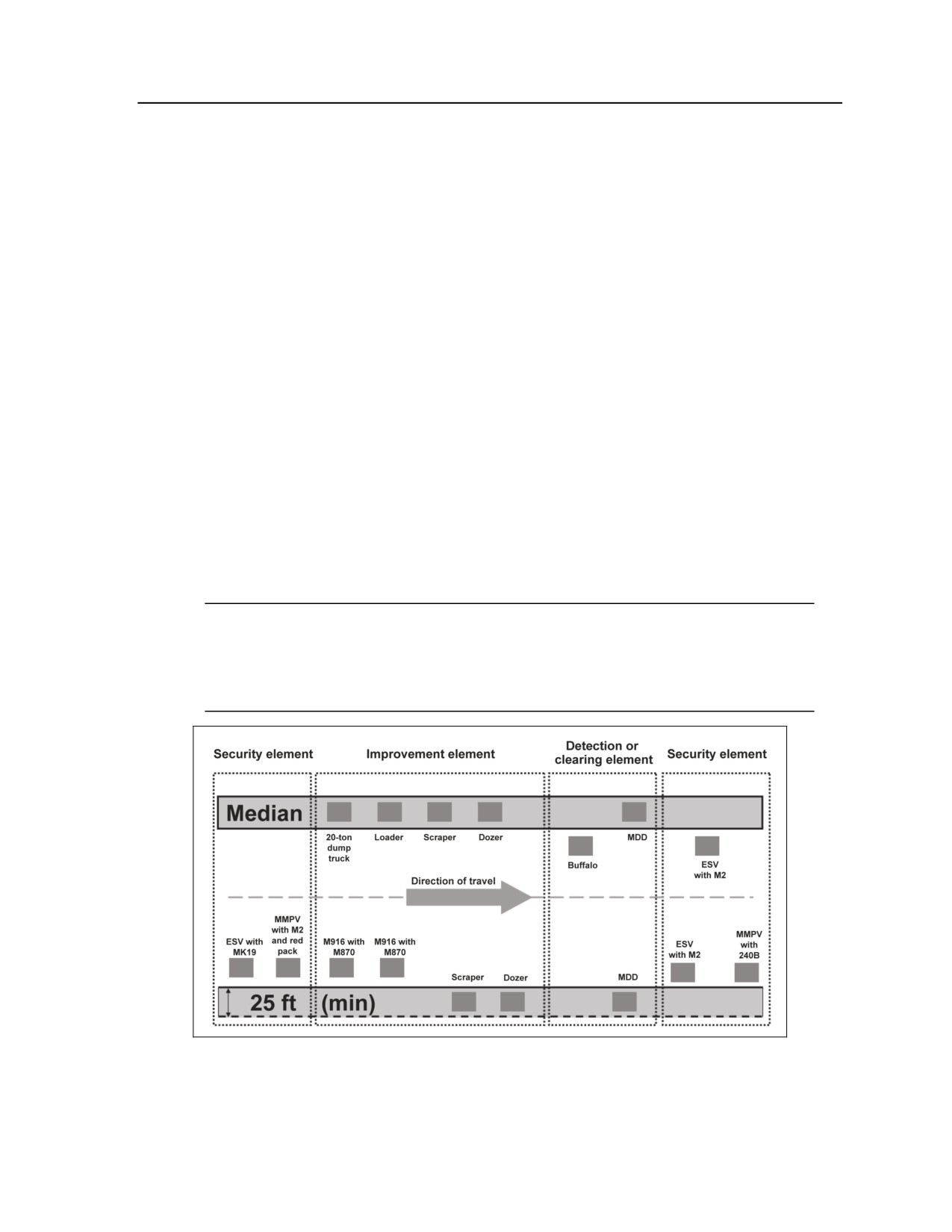
Clearing Operations
D-11. Route clearance teams are generally comprised of―
z
Combat engineers. Combat engineers (route clearance platoon, Sapper platoon, EHTs, and
engineer squad [canine]) provide detection of EHs and neutralization of mines and booby traps.
EOCA Soldiers in these units can remotely identify and dispose of (by detonation) those
designated UXO for which they are specifically trained and authorized.
z
General engineers. General engineers typically provide assets for the improvement element
during the sanitation phase of route-clearing operations.
z
Ground maneuver element. These assets provide reconnaissance and intelligence information
on routes in the AO and provide security elements to the route clearance team as required.
z
Aviation support. These assets also provide reconnaissance and intelligence information on
routes in the AO and provide security to the route clearance team as required.
z
Medical team. This team is on hand for rapid response to casualties.
z
EOD teams. EOD teams provide the technical expertise to render safe and dispose of IEDs and
UXO.
z
Special operations. PSYOP and CA teams provide counterintelligence support.
ELEMENTS
D-12. The route clearance team consists of the following elements (see table D-2, page D-6):
z
C2.
z
Security.
z
Detection and clearing.
z
Improvement.
D-13. Figure D-1 shows a sample organization for a route-clearing operation.
Note. The Vehicles depicted in figure D-1 are generic in nature. For specific vehicle
information, see FM 3-90.119, appendix E. See FM 3-34.210, chapter 6, for a description of the
tools and functions associated with each of the four elements of the organization. The placement
of additional combined arms assets are not reflected in figure D-1 and must be integrated
according to mission variables.
Figure D-1. Sample organization for a route-clearing operation
11 February 2009
FM 3-34.22
D-5

Appendix D
Table D-2. Elements of a route-clearing team
Element
Duties
z
Integrates the activities of the security, detection and clearing, and
improvement elements
C2 Element
z
Maintains communication with higher headquarters and the unit
responsible for the AO
z
Travels with the security element
z
Provides traffic control, crew-served weapons support, and protection
z
Observes oncoming traffic for threats, identifies hazards or obstructions
Security
in the route, and contains suspect vehicles identified by other elements
z
Forward security
(forward security section)
section
z
Protects the main body from threats on the shoulders or from oncoming
z
Flank security
traffic, observes vehicles passing through, and provides traffic control
section
within the work area (flank security section)
z
Rear security
z
Observes approaching traffic for threats, provides visual warning to
section
approaching traffic, contains suspect vehicles, and provides limited traffic
control (rear security section)
z
Scans the medians and shoulders of a route and sweeps them for EHs
z
Pinpoints the location and remotely investigates a suspected EH
z
Marks and reports UXO
Detection and Clearing
z
Secures and reports IEDs
z
Neutralizes or removes EHs on order (must have EOD support to
conduct render-safe operations)
Improvement
z
Removes all concealment for EHs from the entire width of the median
and from the shoulders of the route to a minimum distance of 25 feet
(when terrain allows)
z
Secures and reports IEDs
z
Includes two dozers, two scrapers, a bucket loader, and a 20-ton dump
truck if possible
RATE OF MARCH
D-14. Based on the equipment available in the improvement element, leaders can expect the rates of march
during sanitation operations as shown in table D-3. A typical rate of march during maintenance and sweep
operations is 255 kilometers per day for two-way routes. Other factors influence the rate of march,
including enemy activity; weather and terrain; type and quantity of EHs encountered; traffic; and length
and width, surface composition, and median or shoulder condition of the route.
Table D-3. Typical rate of march during sanitation operations
Two dozers, two scrapers, bucket
Vegetation
Two dozers
loader, and 20-ton dump truck
Light
3 kilometers per day
10 kilometers per day
Moderate
2 kilometers per day
8 kilometers per day
Heavy
1 kilometers per day
4 kilometers per day
METHODS
D-15. The three methods of route clearance are contiguous, combat, and combined. Each poses a certain
degree of risk and requires a thorough analysis of mission variables before selecting which method to use.
D-6
FM 3-34.22
11 February 2009
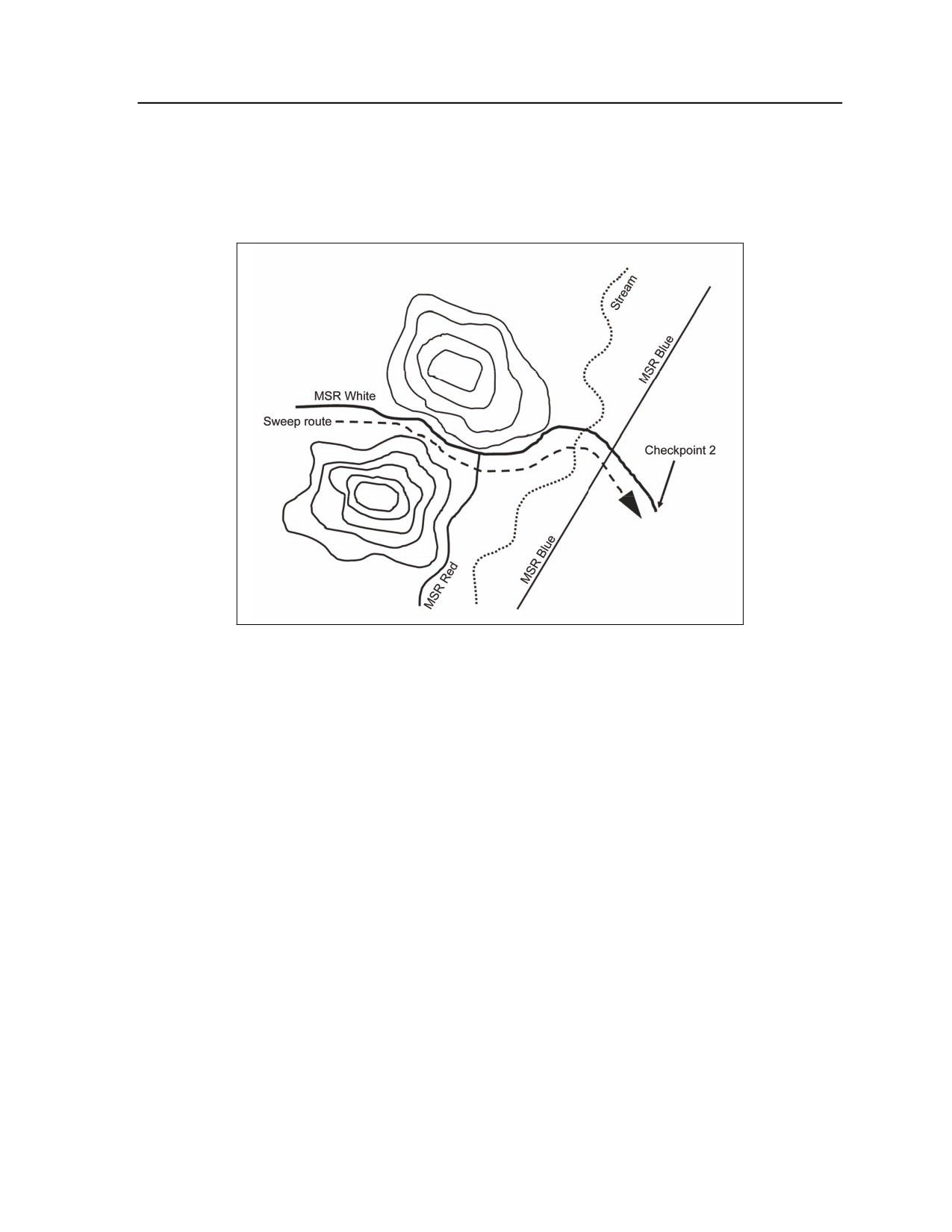
Clearing Operations
Contiguous
D-16. In contiguous clearance (figure D-2), the clearance begins at Checkpoint 1 and is completed at
Checkpoint 2. This method provides the best assurance of route clearance. Although effective, it is not the
most secure method in a high-threat environment. It is also time-intensive and constrains the maneuver
commander’s flexibility due to the movement of sustainment assets and patrols during route-clearing
operations.
Figure D-2. Sample contiguous clearance method
Combat
D-17. Whereas contiguous clearance focuses on a specific route, combat clearance (figure D-3, page D-8),
focuses on specific points along a route. As mentioned previously, the IPB or engineer running estimate
can identify likely areas for obstacle and ambush locations. These areas become NAIs or objectives for
combat clearance missions. The combat clearance method divides a route into sections according to the
number of suspected high-threat areas. Once the clearance team clears these sections, the route is
considered clear. Combat forces can patrol the route from these objectives to ensure that the route is
secure, and if necessary, a route clearance team can clear an identified section where an EH is suspected.
Following the seizure of these objectives, the commander must assume a moderate risk that the S-2 and the
ENCOORD have identified all high-threat areas and the route is clear of EHs.
11 February 2009
FM 3-34.22
D-7
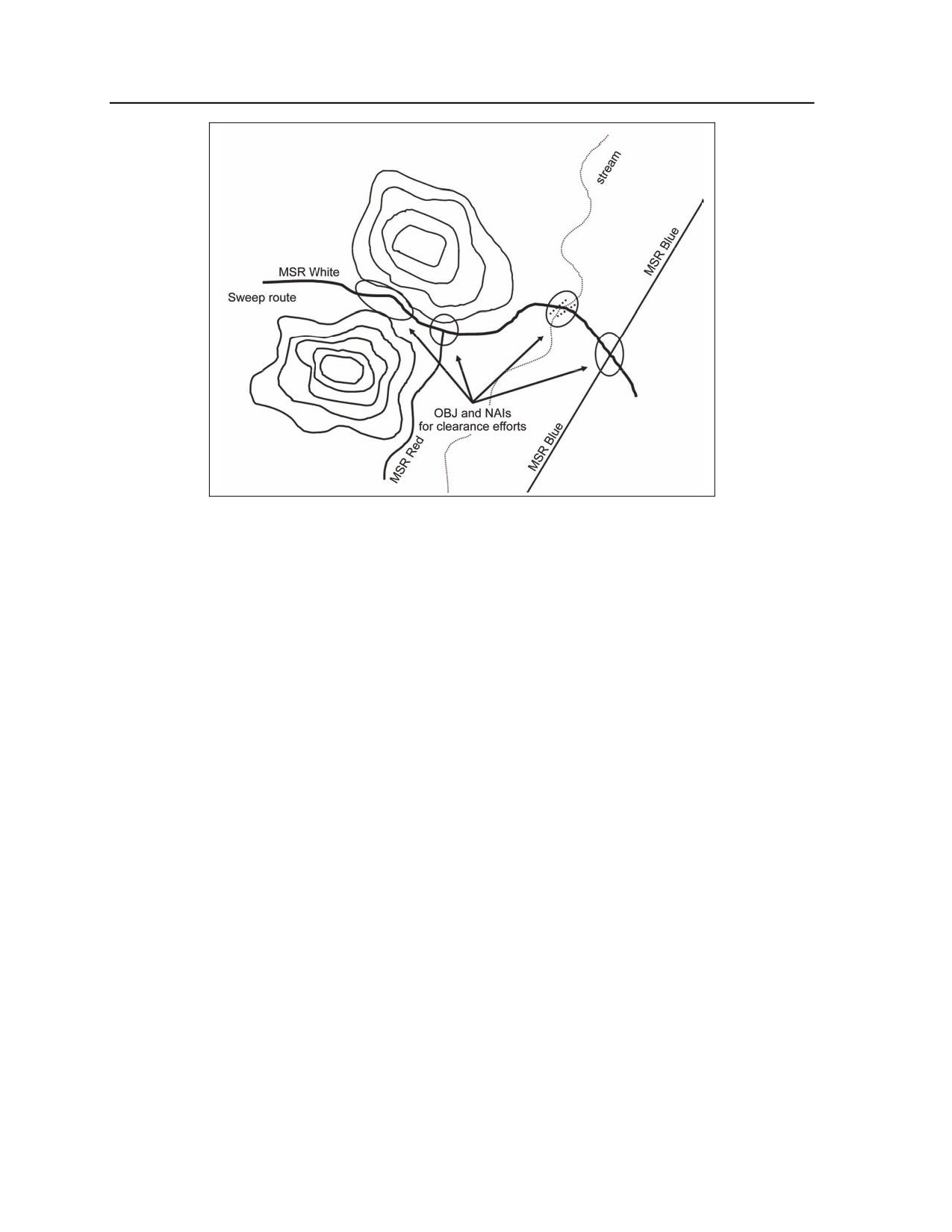
Appendix D
Figure D-3. Sample combat clearance method
Combined
D-18. The combined method combines the capabilities of the contiguous method with the security and
surprise elements of the combat method. It is a two-phase, force-intensive operation and may require a
larger element, depending on the route length. First, identified high-threat areas are targeted, secured, and
cleared of EHs and enemy forces before a route clearance team moves. The team then travels the entire
route and clears EHs missed or not identified during the IPB or running estimate. The advantage of this
method is that the commander immediately secures the route and ultimately assumes less risk that EHs
might be missed.
PLANNING
D-19. Like breaching, route-clearing operations require extensive planning and coordination. Planning
considerations for route-clearing operations are shown in table D-4.
D-8
FM 3-34.22
11 February 2009

Clearing Operations
Table D-4. Selected planning considerations for route clearance
Consideration
Descriptions
z
Identifies choke points, bridges, tunnels, critical road junctions, and built-up areas
as likely locations for obstacle emplacement
z
Maintains a situation map that reflects the most current intelligence information
z
Maintains an incident map with a graphics overlay to facilitate pattern analysis
z
Determines how the enemy has disrupted LOCs in the past
z
Develops an ISR plan, including—
A focus on ISR assets on likely enemy ambush sites
Usage of USAF, UAS, and Army aviation assets to provide aerial
Intelligence
reconnaissance and surveillance of the route
Integration of PSYOP and CA civilian interviews
z
Coordinates with HN organizations, NGOs, and SOFs for additional information on
the AO
z
Provides detailed OBSTINTEL, including—
Description of EHs most likely encountered
Composition and pattern of obstacles
Enemy TTPs used during obstacle emplacement
z
Provides current intelligence updates to team leaders prior to departure
z
Coordinates for the establishment of TCPs
z
Secures flanks (at least 100 meters) and suspected and known obstacle farside
locations
z
Closes the route to traffic during route-clearing operations to minimize the target
presented to enemy forces and develops a traffic control plan if unable to close
the route
z
Identifies and clears potential sniper positions before beginning obstacle
clearance
z
Provides security for the cleared route
z
Plans the building of static security points along the cleared route to reduce
Movement and
recurring threats
maneuver
z
Reports, clears, and marks obstacles and EHs to facilitate unimpeded movement
z
Ensures that lane marking meets the standards directed by the supported
commander and that materials and patterns are standard throughout the route
z
Blocks uncleared roads and trails that branch from the route being cleared to
protect units from inadvertently traveling an uncleared route
z
Conducts debriefings to collect information and the location, composition, and
orientation of all obstacles cleared and encountered to facilitate pattern analysis
z
Provides detailed OBSTINTEL, including—
Description of EHs most likely to be encountered
Composition and pattern of obstacles
Enemy actions or techniques used during obstacle emplacement
z
Positions mortars to ensure continuous coverage of the operation (one technique
is moving under the control of the security force)
z
Plans FS based on the ROE
Fires
z
Designates obstacle clearance sites as CFZs and no-fire areas
z
Plans suppression fires on enemy elements capable of placing direct or indirect
fires on the points of breach
11 February 2009
FM 3-34.22
D-9

Appendix D
Table D-4. Selected planning considerations for route clearance (continued)
Consideration
Descriptions
z
Plans for air and ground evacuation of casualties (the preferred evacuation
method is by air, and the routine method is by ground)
z
Conducts an air mission brief with air ambulance assets, including pick up zones
and markers
z
Rehearses procedures for evacuation requests
z
Locates the medical team with the security force
z
Ensures that the medical team consists of one or two ambulances
Sustainment
z
Identifies the ambulance exchange point along the route to be cleared
z
Ensures that all vehicles have tow cables in the front and rear and plans recovery
assets for extraction purposes
z
Ensures that all vehicles carrying troops have hardening (sandbags on floors and
sides)
z
Provides military police working dogs and explosive detection dogs to help in
route-clearing operations and provide security for convoys during and after
clearing operations
z
Designates a controlling, coordinating, and supporting headquarters for route
movement
z
Designates, recognizes, and includes EH indicators as part of clearance team
rehearsals
z
Designates a reserve force that is mechanized or air assault-capable
z
Ensures that proper rehearsals are planned and conducted. (At a minimum, the
team should rehearse actions at the obstacle, actions on enemy contact, casualty
evacuation, and controlling civilians)
z
Ensures that the team has a clear understanding of the mission, intent, and end
state
C2
z
Ensures that the team—
Controls the movement of all personnel and equipment along the route
Clears personnel within the minimum safe distance when clearing EHs
Prepares a risk assessment as part of mission planning
Tracks the status of routes based on the amount of time since the route was
cleared and the intelligence and enemy situations
Tracks and reports the progress of the clearing operation
Determines the route length, using clearly definable start and end points
Coordinates with adjacent units and other nonmilitary organizations within the
AO
z
Keeps all radios, electronic equipment, and aviation assets at a safe distance
during route-clearing operations
Protection
z
Considers capabilities and limitations of available equipment (see FM 3-34.2)
z
Controls the distance between vehicles based on METT-TC
DISMOUNTED
D-20. Casualty extractions are situations that demand dismounted route clearance, because time or access is
limited or the area has restrictive terrain that must be cleared prior to improvement. Task organization for
dismounted route clearance is similar to mounted route clearance, except the improvement element is not
included. The time required for the clearance may be greater. The security element must be prepared to
assist the detection element in disengaging from enemy contact.
D-21. The detection element consists of Soldiers with mine detectors or other available detection
equipment (handheld sniffers, mobile jammers, dogs). The number of mine detector operators required
D-10
FM 3-34.22
11 February 2009
Clearing Operations
varies with the width of the route to be cleared and the sweep width of the detector. For example, the
sweep width for the AN/PSS-14 mine detector is 1.5 meters. Divide the width of the road to be cleared by
1.5, and round up to determine the number of AN/PSS-14 mine detector operators needed.
Note. The commander may reduce the sweep width to 1 meter to ensure the proper sweep
technique and provide the greatest possibility of detecting low metallic hazards.
D-22. The sweep team must ensure redundancy of effort by mine detector operators so that no gaps exist in
multiple clearance lanes. The leader should consider mission variables and the individual Soldier’s fatigue
level and state of mind to determine the maximum amount of time an individual can operate a mine
detector. As a rule, 20 to 30 minutes is the maximum amount of time a Soldier can use an AN/PSS-14 or
similar mine detector effectively.
D-23. The sophistication of the detector used determines the amount of investigation that needs to be
performed to confirm an EH. A dedicated prober using appropriate techniques must investigate each
suspect object identified by the mine detector operator. Local policy and procedures determine the type of
marking device used. Provide at least 25 meters between Soldiers, spacing can vary depending on mission
variables.
AREA CLEARANCE
D-24. In land operations, area clearance is the detection, identification, marking, neutralization,
destruction, and removal of mines or other explosive ordnance, IEDs, and booby traps in a defined area to
allow a military operation to continue with reduced risk. (FM 3-34.210) Clearing of land mine hazards is
primarily the responsibility of combat engineer units, and clearing other EHs is primarily the responsibility
of EOD units within the Army or EOD elements in other supporting Services.
D-25. Area clearance is not normally conducted under fire or in adverse weather and is only conducted
during hours of daylight. Leaders and planners must strive to limit the areas requiring clearance to only
those areas necessary to support military operations. When possible, areas not required for military
operations and not an immediate threat to friendly forces are permanently marked and avoided.
D-26. Some situations where area clearance could be required include—
z
Airfield clearance.
z
Equipment retrieval operations.
z
Runway construction.
z
Logistics or maintenance facility construction.
z
Air and seaport recovery.
z
FARP operations.
z
Personnel extraction.
D-27. Depending on the size of the area being cleared and the duration of the clearance effort, multiple or
rotational units may be involved and enter the operation at different phases. To ensure continuity of effort,
a controlling headquarters for the area clearance effort is designated and responsible for—
z
Specifying the area to be cleared and the depth of clearance in tasking orders.
z
Specifying the standards and guidelines for the clearance mission.
z
Accrediting a unit ability to conduct clearance operations.
z
Maintaining an EH database of cleared and uncleared areas and showing the clearance status for
each EH area.
z
Establishing and maintaining a system to monitor current clearance activities and posting
clearance inspections of cleared areas.
11 February 2009
FM 3-34.22
D-11
Appendix D
D-28. Area clearance missions consist of the following three phases
(see FM
3-34.2 for more
information):
z
Technical survey, including—
Information gathering
(detailed technical and topographical information of known or
suspected hazardous areas).
Reconnaissance (visual or aerial, including the use of imagery).
EH survey
(defines the area in terms of size, described through measurements and
azimuths).
z
Clearing, including—
Planning (establish safe lanes, access lanes, and clearance boxes or lanes).
Site layout (see figure D-4).
Recognition (physical detection, verification, and technical-survey update).
Clearance (see figure D-5, page D-14 and figure D-6, page D-14).
Proofing.
Final marking.
z
Handover (conducting a walk-through of the area with the occupying unit leaders).
D-29. In the clearance phase, all EHs from a specified area to a specified depth are removed or destroyed.
The commander must be confident that cleared areas are safe for use. This requires management systems
and clearance procedures that are appropriate, effective, efficient, and safe. These procedures need to have
an internal audit mechanism to ensure that the end product is safe. The quality of clearance must be
acceptable to the using units and must be measurable and verifiable.
PLANNING
D-30. Before undertaking a new clearance task, plan where to establish safe and access lanes and the
location of clearance boxes (if using mine detection dogs) or clearance lanes. Safe lanes are prepared to
provide access for personnel and equipment to a box or area. They also provide safe start lines for the
clearing operation and may be used for CASEVAC. Safe lanes are 2 meters wide to allow safe passage for
personnel and equipment and to allow CASEVAC.
SITE LAYOUT
D-31. A safe clearing operation includes the proper design and layout of a clearance worksite by fencing
and marking hazardous areas, controlling the movement of Soldiers and visitors, enforcing safety
distances, and providing effective medical support. This requires the clearance unit to develop and
maintain appropriate local policies and procedures. (See figure D-4 for a sample layout of a clearance site.)
D-32. A clearance worksite is designed to—
z
Provide a clearly visible separation of hazardous areas (blast and fragmentation zones, cleared
areas, useable areas, unknown areas in and around the worksite).
z
Control the movement of Soldiers and visitors.
z
Limit the number of Soldiers and visitors allowed in the blast and fragmentation zones.
z
Take all reasonable precautions to exclude Soldiers and visitors from blast and fragmentation
zones during the controlled destruction of EHs or provide suitable protection inside buildings,
bunkers, or mobile structures.
z
Include measures to prevent collateral damage to structures and the environment.
D-33. The effective control of a worksite is achieved by establishing and clearly marking a number of
areas for safety and administration. Such areas should be outside the relevant safety distances from all
contaminated areas, clearance activity, and explosive storage. The terrain determines the layout of an area
clearing operation.
D-12
FM 3-34.22
11 February 2009
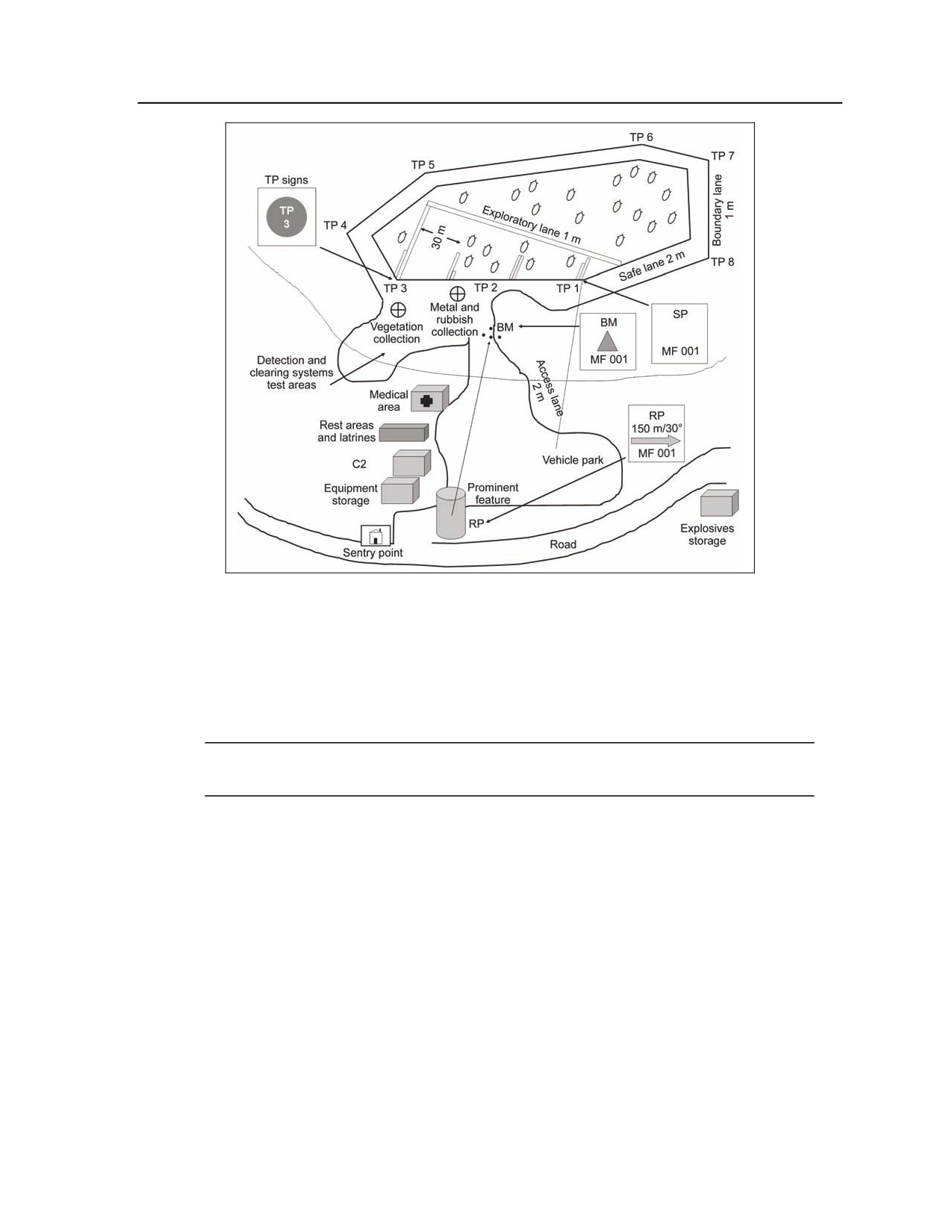
Clearing Operations
Figure D-4. Sample clearance site layout
METHODS
D-34. The clearance phase is the direct application of an asset to remove a specific threat. Mines are
cleared by mechanical mine-clearing systems, demolitions, or incendiary devices. UXO is neutralized by
EOD or EOCA using appropriate techniques. Based on the recognition of threat locations, leaders match
the best clearing method and equipment to the threat.
Note. The safe execution, highest possible effectiveness, and impacts on proofing methods in
future operations need to be considered.
D-35. Clearance procedures vary depending on the type of clearance equipment used. (See figure D-5,
page D-14 for a sample clearance technique using a mechanical system. See figure D-6, page D-14, for a
sample clearance technique using mine dog handler teams.) Progressive marking is also done during the
clearance phase.
11 February 2009
FM 3-34.22
D-13
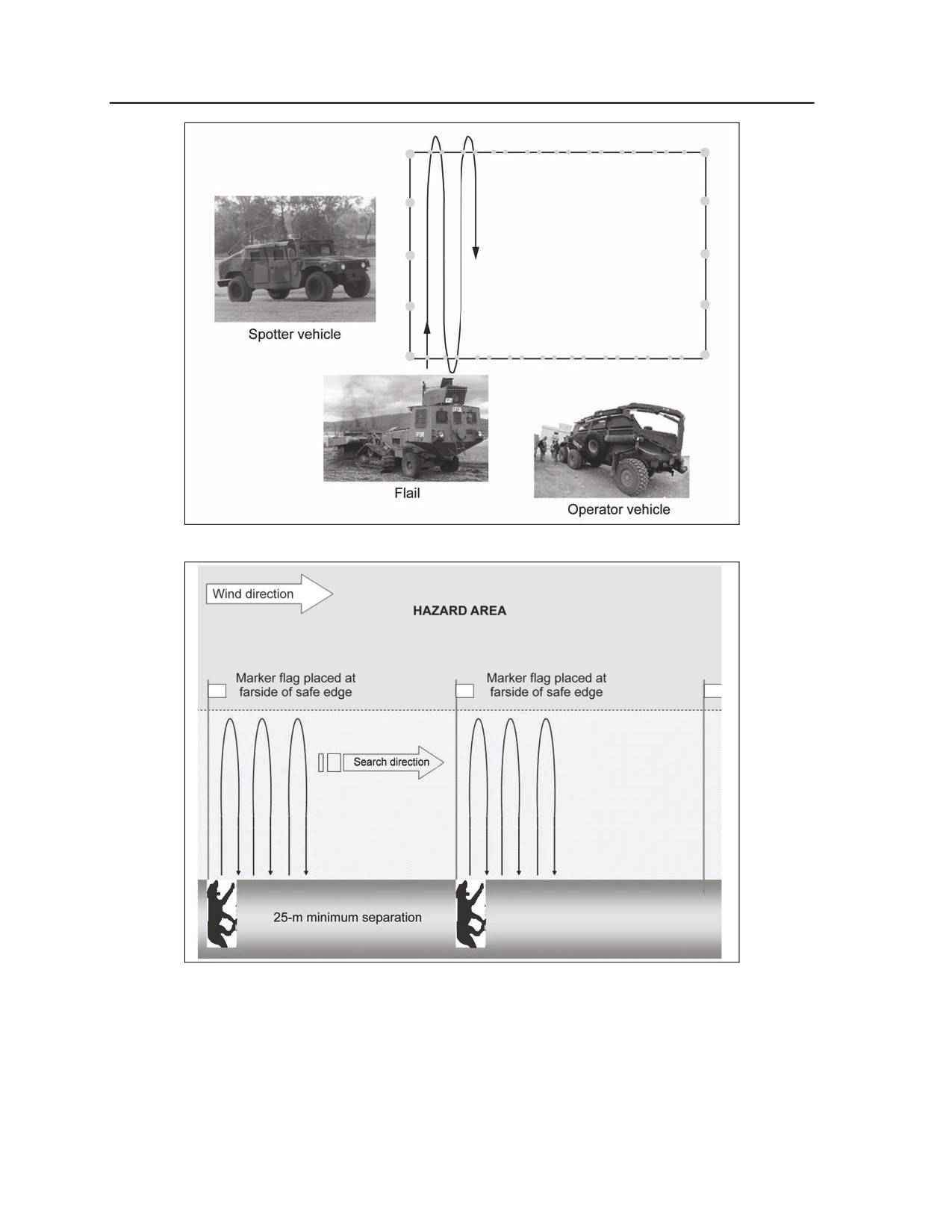
Appendix D
Figure D-5. Sample mechanical clearance method
Figure D-6. Sample mine dog handler team clearance method
D-14
FM 3-34.22
11 February 2009
Clearing Operations
D-36. The results of a clearing action may have adverse effects to nearby cleared areas. Certain pieces of
equipment, like flails, may kick EHs into previously cleared areas, as far as 100 meters from the flail.
Proofing must clear this area (usually by Soldier inspection, but at times mine dog detection teams are
required) in addition to the specified area. The end state of a clearing phase means that the area is ready for
proofing.
PROOFING
D-37. Proofing involves checking the entire cleared area. Using a different type of asset than what was
used in the clearing phase should yield a reasonable assurance that the area is clear of all EHs and safe for
use. The end state of the proofing phase means that the area is ready for use.
FINAL MARKING
D-38. Permanent marking systems should be used to indicate the outer edge of EH areas that are not
cleared immediately and should employ a combination of markers, signs, and physical barriers.
11 February 2009
FM 3-34.22
D-15