FM 3-22.27 MK 19, 40-mm GRENADE MACHINE GUN, MOD 3 (NOVEMBER 2003) - page 5

FM 3-22.27
Intermediate Training Objective 2: Load the MK 19.
CONDITIONS: The gunner is given an M3 tripod-mounted weapon in a designated
location and 10 rounds of linked 40-mm ammunition (dummy).
STANDARDS: The gunner must load the weapon.
PERFORMANCE MEASURES
GO
NO-GO
1.
Place the weapon on S (SAFE).
2.
Ride the bolt forward.
3.
Return the charger assemblies to the original upright
position.
4.
Open the top cover.
5.
Slide the rounds, female link first, through the feed
throat.
6.
Insert the first round into the feeder and across the first
pawl.
7.
Move the feed slide assembly to the left.
8.
Close the top cover.
9.
Charge the weapon.
10.
Lock the charger handles forward.
11.
Move the safety to F (FIRE).
12.
Press the trigger (bolt goes forward).
13.
Move the safety to S (SAFE).
14.
Charge the weapon (live round on bolt face).
15.
Lock the charger handles forward.
D-19

FM 3-22.27
Intermediate Training Objective 3: Correct malfunctions.
CONDITIONS: The gunner is given an M3 tripod-mounted weapon in a designated
location, 10 rounds of linked 40-mm ammunition (dummy), and a simulated stoppage.
STANDARDS: The gunner must correct the malfunction.
PERFORMANCE MEASURES
GO
NO-GO
1.
In a training situation, wait ten seconds after any
stoppage.
2.
Charge the weapon and try to fire.
3.
If the weapon fails to fire, recharge and try to fire. If
the weapon fails to fire (or when told that the gun did
not fire) after the second attempt, take remedial action:
4.
Unload and clear the weapon.
5.
Inspect the weapon and ammunition and try to find the
cause of the stoppage.
6.
If possible, correct the cause of the stoppage, reload,
and try to fire the weapon.
Intermediate Training Objective 4: Stop a runaway gun.
CONDITIONS: The gunner is given an M3 tripod-mounted weapon in a designated
location, ten rounds of linked 40-mm ammunition (dummy), and a simulated runaway gun.
STANDARDS: The gunner must stop the runaway gun.
PERFORMANCE MEASURES
GO
NO-GO
Lower one of the charging handles.
D-20
FM 3-22.27
STATION FOUR
Station Four has four intermediate training objectives.
TASK: Mount and dismount the MK 19 onto one of the following: M3 tripod, M4 pedestal
on a 1/4-ton vehicle, HMMWV with weapon platform, or commander’s cupola on a M113.
CONDITIONS: The gunner is given a complete MK 19, a complete MK 64, MOD 7, gun
cradle, a location in which to work, TM 9-1010-231-13&P, and one or more of the
following: M3 tripod, 1/4-ton vehicle with an M4 pedestal, HMMWV with weapon platform,
or M113.
STANDARDS: The gunner must mount and dismount the MK 19 on the gun cradle, mount
the gun on other mounts as directed. The time limit for moving the MK 19 from one mount
to another is four minutes.
TRAINING NOTE: When the MK 19 is mounted on a unit’s organic carrier or the M3
tripod, it is called a weapon system. The weapon system is mounted using the three-man
concept. The gunner is responsible for ensuring that it is mounted correctly, with the aid of
the other two-team members. The steps for securing the MK 19 to the gun cradle are the
same. The MK 19 is moved from one mount to another with the MK 64, MOD 7, gun
cradle attached.
Intermediate Training Objective 1: Mount the MK 19 on the M3 tripod.
CONDITIONS: The gunner is given a location in which to work, an M3 tripod with T&E
mechanism, the gun cradle, and TM 9-1010-231-13&P.
STANDARDS: The gunner must mount the gun cradle on the M3 tripod.
PERFORMANCE MEASURES
GO
NO-GO
MOUNTING:
1.
Set up the M3 tripod.
2.
Secure the MK 64, MOD 7, gun cradle onto the M3
tripod.
3.
Lift the gun into the gun cradle.
4.
Slide the front portion of the receiver into the gun
cradle.
5.
Secure the rear of the gun to the gun cradle.
6.
Attach the T&E mechanism to the M3 tripod.
7.
Attach the T&E mechanism to the gun cradle.
8.
Attach the feed throat.
D-21
FM 3-22.27
PERFORMANCE MEASURES
GO
NO-GO
DISMOUNTING:
9.
Remove the T&E mechanism retaining pin.
10.
Insert the gun cradle stow pin (left side).
11.
Unlock the M3 tripod pintle lock release cam.
12.
Lift the MK 19, with the MK 64, MOD 7, gun cradle
attached, from the M3 tripod.
D-22

FM 3-22.27
Intermediate Training Objective 2: Mount and dismount the MK 19 from the M4 pedestal.
CONDITIONS: The gunner is given a location in which to work, a vehicle with an M4
pedestal mount, an M3 tripod-mounted MK 19, the T&E mechanism, pintle adapter,
ammunition container bracket, and tools.
STANDARDS: The gunner must remove the MK 19 from the M3 tripod, mount it on the
M4 pedestal within four minutes, and dismount it from the M4 pedestal within four minutes.
PERFORMANCE MEASURES
GO
NO-GO
MOUNTING:
1.
Remove the T&E mechanism-retaining pin.
2.
Insert the cradle stow pin (left side).
3.
Unlock the M3 tripod pintle lock lever.
4.
Move the MK 19 to the M4 pedestal.
5.
Loosen the locking lever on the M4 pedestal.
6.
Insert the pintle adapter into the top part of the M4
pedestal.
7.
Remove the quick-release pin from the pintle adapter.
8.
Tighten the locking lever on the M4 pedestal.
9.
Lift up the MK 19 and insert the gun cradle pintle into
the top of the pintle adapter.
10.
Insert the quick-release pin into the pintle adapter from
either side.
11.
Attach the T&E mechanism to the gun mount.
12.
Center the elevation handwheel.
13.
Remove the stow pin.
14.
Attach the T&E mechanism clamp to the M4 pedestal.
15.
Attach the two support clamps to the M4 pedestal.
16.
Attach the ammunition container bracket (right side).
17.
Attach the empty case catch bag.
DISMOUNTING:
18.
Remove the ammunition container bracket (right side).
19.
Remove the pin securing the T&E mechanism to the
gun cradle.
20.
Insert the gun cradle stow pin.
21.
Remove the quick-release pin from the pintle adapter.
D-23
FM 3-22.27
PERFORMANCE MEASURES
GO
NO-GO
22.
Lift the MK 19 from the M4 pedestal.
23.
Loosen the locking lever on the M4 pedestal.
24.
Lift the pintle adapter from the M4 pedestal.
D-24

FM 3-22.27
Intermediate Training Objective 3: Mount and dismount the MK 19 from the HMMWV
weapon platform.
CONDITIONS: The gunner is given a mounted MK 19, a location in which to work, a
HMMWV with weapon platform, pintle adapter assembly, T&E mechanism, and TM
9-1010-231-13&P.
STANDARDS: The gunner must remove the MK 19 from its mount and install it on the
HMMWV weapon platform within four minutes.
PERFORMANCE MEASURES
GO
NO-GO
MOUNTING:
1.
Remove the MK 19 from its mount.
2.
Loosen the locking screws on the HMMWV
pedestal.
3.
Insert the pintle adapter into the HMMWV
pedestal.
4.
Tighten the locking screws.
5.
Remove the quick-release pin from the pintle
adapter.
6.
Lift the MK 19, with MK 64, MOD 7, gun
cradle attached to the pintle adapter and insert
the gun cradle pintle into the pintle adapter.
7.
Insert the pintle adapter quick-release pin.
8.
Attach the train and elevating assembly to the
gun cradle.
9.
Center the elevating handwheel.
10.
Remove the gun cradle stow pin.
11.
Attach the train and elevating mechanism to
the HMMWV pedestal.
12.
Attach the ammunition container bracket.
DISMOUNTING:
13.
Remove the ammunition container bracket.
14.
Remove the train and elevating mechanism
from the HMMWV pedestal.
15.
Remove the T&E mechanism from the gun
cradle.
16.
Insert the gun cradle stow pin.
D-25
FM 3-22.27
PERFORMANCE MEASURES
GO
NO-GO
17.
Remove the quick-release pin from the pintle
adapter assembly.
18.
Lift the MK 19 from the HMMWV pedestal.
19.
Remove the pintle adapter from the HMMWV
pedestal.
D-26
FM 3-22.27
Intermediate Training Objective 4: Mount and dismount the MK 19 from the commander's
cupola of an M113.
CONDITIONS: The gunner is given a mounted MK 19, a location in which to work, an
M113 with the commander’s cupola, pintle adapter, ammunition bracket, and TM 9-1010-
231-13&P.
STANDARDS: The gunner must remove the MK 19 from its mount and install it on the
commander’s cupola of the M113 within four minutes.
PERFORMANCE MEASURES
GO
NO-GO
MOUNTING:
1.
Insert the pintle adapter into the mount
receptacle.
2.
Remove the pintle adapter quick-release pin.
3.
Lift the MK 19 to the pintle adapter and insert
the cradle pintle into the pintle adapter.
4.
Insert the pintle adapter quick-release pin.
5.
Attach the ammunition bracket.
DISMOUNTING:
6.
Insert the gun cradle stow pin.
7.
Remove the ammunition bracket.
8.
Remove the pintle adapter quick-release pin.
9.
Lift the MK 19 from the commander's cupola.
D-27
FM 3-22.27
STATION FIVE
TASK: Identify characteristics of a defensive position for the MK 19.
CONDITIONS: The gunner is given an M3 tripod, a complete MK 19, a location in which
to work, a direction of fire, and a partially dug fighting position.
STANDARDS: The gunner must identify the actions needed to complete the fighting
position.
PERFORMANCE MEASURES
GO
NO-GO
1.
Check assigned direction of fire.
2.
Check gun traverse.
3.
Check overhead cover.
4.
Check fighting position camouflage.
5.
Check for protection against small-arms fire.
6.
Check for protection against indirect fire
fragments.
7.
Check for protection from aerial observation.
8.
Check for mutual support with other fighting
positions.
9.
Check for a good field of fire.
D-28

FM 3-22.27
STATION SIX
TASK: Prepare a range card for the MK 19.
CONDITIONS: During daylight, in a defensive position, the gunner is given a
tripod-mounted MK 19, a principal direction of fire and secondary sector of fire (both with
recognizable targets), paper, pencil, and compass.
STANDARDS: The gunner must prepare range cards that include a data and sketch section
for each sector of fire, with appropriate sketches and military symbols.
PERFORMANCE MEASURES
GO
NO-GO
1.
Orient the range card.
2.
Sketch the terrain that is to the front of the
position (prominent and man-made,
including terrain features).
3.
Fill in or construct the marginal data section.
a.
Gun number.
b.
Unit designation.
c.
Date.
d.
Magnetic north arrow.
4.
Sketch machine gun symbol.
5.
Specify gun location in relation to prominent
terrain feature or eight-digit grid coordinate.
a.
Determine azimuth in mils from the
terrain feature to the gun.
b.
Determine distance between the terrain
feature and the gun.
c.
Sketch and identify the terrain feature on
the card.
d.
Connect the feature and gun with a
barbed line.
e.
Write the distance in meters above the
line.
f.
Write the azimuth in mils below the line
from the feature to the gun.
6.
Sketch in the TRPs, if any.
7.
Label TRPs, if any.
D-29

FM 3-22.27
STATION SEVEN
TASK: Mount, place into operation, and dismount the AN/TVS-5 NVD from the MK 19.
CONDITIONS: The gunner is given a mounted MK 19 and an AN/TVS-5.
STANDARDS: The gunner must mount the AN/TVS-5 on the MK 19, place the sight into
operation, and dismount the AN/TVS-5 from the MK 19.
PERFORMANCE MEASURES
GO
NO-GO
1.
Mount the M2 mounting bracket onto the
MK 19.
2.
Mount the AN/TVS-5 onto the M2 bracket.
3.
Install the batteries in the device.
4.
Press your eye against the eye guard.
5.
Turn the ON-OFF/TUBE BRIGHTNESS
control to ON.
6.
Adjust the ON-OFF/TUBE BRIGHTNESS
control, as needed.
7.
Turn the ON-OFF/RETICLE BRIGHTNESS
control to ON.
8.
Turn the diopter focus ring until the clearest
image of the reticle pattern is obtained.
9.
Turn the objective focus ring until the target
in the field of view is sharply defined.
10.
Turn the ON-OFF/RETICLE BRIGHTNESS
control to OFF.
11.
Turn the ON-OFF/TUBE BRIGHTNESS
control to OFF.
12.
Remove the batteries from the AN/TVS-5.
13.
Remove the AN/TVS-5 from the M2 bracket.
14.
Remove the M2 bracket from the MK 19.
D-30
FM 3-22.27(FM 23-27)
APPENDIX E
ANNUAL GUNNERY TRAINING PROGRAM
This appendix contains four suggested annual training programs for the
MK 19, MOD 3; one for each of the fighting and supporting active and
reserve forces. Because of the high cost of M918TP and M430 HEDP
rounds, live fire is kept to a minimum. Gunnery training programs have been
prepared to adequately train gunners based on the mission profile of the unit.
Refer to Chapter 4, Marksmanship, and Appendix I, Gunnery Exercises, for
the firing tables that support these programs. A definition of each force,
along with a summary of the annual gunnery training program designed for
it, is included in this appendix.
E-1. LIVE-FIRE EXERCISES
LFXs allow the gunner to qualify on the MK 19 and to participate in collective
gunnery exercises. Gunners practice and qualify using Tables I through IV in
Chapter 4. The gun crews practice individual and collective skills using Tables I-1
through I-7 in Appendix I.
a. Practice and Qualification Table Matrix (Table E-1). The tables used for
gunner practice and qualification are in Chapter 4. There are four scorecards
available and they are used based on the type of target (hull or pop-up silhouettes)
and whether the practice-qualification is during the day or during limited visibility.
Each scorecard has two tables, one for practice and one for qualification. The tables
have versions for hull or pop-up silhouette engagements and for the type of NVD
used. Sample scorecards are shown in Figures 4-27 through 4-30 (and reproducible
forms are provided in the back of this manual). Gunners will only fire one day
practice-qualification and one night practice-qualification. Units should select the
practice and qualification based on the light conditions, type of targets available, and
type of NVDs used. The following table shows which scorecards should be used.
E-1

FM 3-22.27
Conditions
Target
Night Vision Devices
Scorecard
Day
Hull
NA
Scorecard I
Day
Pop-Up
NA
Scorecard III
Limited/Night
Hull
AN/PEQ-2A mounted on the TWS mounting
Scorecard II
bracket.
AN/PAS-13 mounted on the TWS mounting bracket.
AN/TVS-5 upgraded with the 3d generation tube
mounted on the TWS mounting bracket.
Limited/Night
Pop-Up
All night vision devices.
Scorecard IV
or E-
Type
Limited/Night
Any type
No night vision device.
Scorecard IV
Table E-1. Practice and qualification tables.
b. Gunnery Exercises. Gunnery exercises allow individual gun crews to
practice firing the MK 19 while performing other tasks such as mounting the gun and
preparing range cards. They also allow multiple gun crews to coordinate their fires
while engaging targets. Table E-1 outlines each of the seven exercises. Based on
their unit's training needs and the resources available, commanders must decide on
the number and type of gunnery exercises to include in their annual training program.
Table
Exercise
Number of GunsNumber of Rounds
I-1
Instructional Fire Exercise
1
26 rounds
I-2
Dismounted Range Card Exercise
1
42 rounds
I-3
Mounted Combat Exercise
1
26 rounds
I-4
Night Fire Exercise
1
22 rounds
I-5
Linear and Deep Targets
2 to 4
80 rounds per gun
I-6
Linear Targets with Depth
2 to 4
40 rounds per gun
I-7
Area Targets
4 to 6
80 rounds per gun
Table E-2. Gunnery exercises.
E-2. FIGHTING FORCES ACTIVE COMPONENT
These forces consist of infantry, military police, scout, and engineer units of the active
Army. Gunners assigned to these units are required to qualify semiannually. They are also
required to participate in squad/platoon-level live fires quarterly and combined arms live fire
exercises (CALFEX) annually. Assistant gunners are also required to qualify or fire
familiarization exercises annually.
a. Every quarter the unit conducts preliminary marksmanship instruction and crew drills.
The Gunnery Skills Test is also conducted.
b. During the first quarter, semiannual gunner practice qualification and qualification
exercises are performed (see Table E-1 for the correct tables to use). Assistant gunner
familiarization (with a zeroed gun) using Tables I and III are also conducted (see table E-1).
Unit LFXs are performed (see Tables I-5 through I-7).
c. During the second quarter, unit LFXs are performed (see Tables I-1 through I-4, and
I-5 through I-7).
E-2
FM 3-22.27
d. During the third quarter, semiannual gunner practice qualification and qualification
exercises are performed (see Table E-1 for the correct tables to use). Unit LFXs are also
performed (see Tables I-5 through I-7).
e. During the fourth quarter, conduct LFXs or CALFEX using exercises from Tables I-5
through I-7.
E-3. SUPPORTING FORCES ACTIVE COMPONENT
These forces consist of all other units in the active component not identified as fighting force
units. These guns are used primarily in defense of battalion, brigade, and division rear
operations. Gunners from these forces participate in instruction fire and qualification
annually.
a. Every quarter the unit conducts preliminary marksmanship instruction and crew drills.
The Gunnery Skills Test is also conducted.
b. During the first quarter, there is no additional training.
c. During the second quarter, perform LFXs (see Tables I-5 through I-7).
d. There is no additional training during the third quarter.
e. During the fourth quarter, annual day gunner practice qualification and qualification
exercises are performed. Night practice qualification and qualification is conducted once
every two years (see Table E-1 for the correct tables to use). Once every two years, assistant
gunner familiarization (with a zeroed gun) using Tables I and III is also conducted (see table
E-1).
E-4. FIGHTING FORCES RESERVE COMPONENTS
These forces consist of military police, engineer, and infantry units of the reserve
components. Gunners for these forces must maintain a level of proficiency higher than that
of the active support forces. At the same time, limited time and range resources must be
considered. Gunners of these forces conduct sustainment on the trainer at least quarterly.
Live fires consist of annual qualification and a unit level LFX. These forces are allocated
192 or 118 rounds each year for live fire and qualification.
a. Every quarter the unit conducts preliminary marksmanship instruction and crew drills.
The Gunnery Skills Test is also conducted.
b. There is no additional training during the first quarter.
c. There is no additional training during the second quarter.
d. During the third quarter, annual gunner practice qualification and qualification
exercises are performed. See Table E-1 for the correct tables to use. Once every two years,
the assistant gunner fires familiarization (with a zeroed gun) using Tables I and III (see table
E-1). Unit LFXs are performed (see Tables I-5 through I-7).
e. There is no additional training during the fourth quarter only.
E-5. SUPPORTING FORCES RESERVE COMPONENT
These forces consist of all reserve units not specifically outlined under the paragraph on
fighting forces. They are allocated 78 rounds for each year to qualify.
a. Every quarter the unit conducts preliminary marksmanship instruction and crew drills.
The Gunnery Skills Test is also conducted.
b. There is no additional training during the first quarter.
c. There is no additional training during the second quarter.
E-3
FM 3-22.27
d. During the third quarter, gunner practice qualification and qualification exercises are
performed once every two years. See Table E-1 for the correct tables to use. Once every two
years, the assistant gunner fires familiarization (with a zeroed gun) using Tables I and III
(see table E-1). Unit LFXs are performed (see Table I-7).
e. There is no additional training during the fourth quarter.
E-4
FM 3-22.27(FM 23-27)
APPENDIX F
FIRING TABLE
The table in this appendix provides information about the weapon
elevation, time of flight, and other factors of MK 19 projectiles.
NOTE:
40-mm TP, XM918 is reduced time-of-flight experimental ammunition.
ELEVATION (MILS)
FLIGHT TIME (SECONDS)
REMAINING VELOCITY
M430
M385
RANGE (M)
M430
M385
M918
XM918*
M430
M385
M918
XM918*
FPS
MPS
FPS
MPS
0
0.0
0.0
0.0
0.0
0.00
0.00
0.00
0.00
790
240.8
790
240.8
100
9.0
9.0
8.9
4.6
0.43
0.43
0.43
0.31
747
227.7
744
226.8
200
18.6
18.7
18.5
9.5
0.88
0.88
0.88
0.63
706
215.2
701
213.7
300
29.1
29.3
28.8
14.9
1.36
1.37
1.35
0.97
667
203.3
660
201.2
400
40.4
40.8
39.9
20.6
1.87
1.88
1.85
1.33
630
192.0
622
189.6
500
52.6
53.4
51.8
26.7
2.40
2.43
2.38
1.70
596
181.7
586
178.6
600
65.9
66.9
64.7
33.3
2.97
3.07
2.93
2.10
564
171.9
552
168.2
700
80.3
81.8
78.5
40.4
3.58
3.63
3.52
2.52
533
162.5
520
158.5
800
96.0
98.2
93.5
48.1
4.22
4.29
4.14
2.97
505
153.9
491
149.7
900
113.1
116.1
109.8
56.3
4.90
4.99
4.80
3.43
478
145.7
463
141.1
1,000
131.9
135.8
127.5
65.2
5.63
5.74
5.50
3.93
453
138.1
438
133.5
1,100
152.5
157.6
146.8
74.9
6.41
6.55
6.24
4.45
430
131.1
414
126.2
1,200
175.2
181.9
167.8
85.3
7.24
7.42
7.03
5.00
409
124.7
393
119.8
1,300
200.4
209.0
191.0
96.6
8.14
8.37
7.88
5.58
389
118.6
373
113.7
1,400
228.6
239.6
216.6
108.9
9.11
9.40
8.79
6.19
372
113.4
356
108.5
1,500
260.3
274.6
245.0
122.2
10.1
10.53
9.77
6.84
356
108.5
341
103.9
1,600
296.7
315.3
277.1
136.7
7
10.53
10.84
7.53
343
104.5
329
100.3
1,700
339.2
364.2
313.7
152.6
11.3
11.80
12.01
8.27
333
101.5
320
97.5
1,800
390.8
426.4
356.5
169.9
4
13.25
13.34
9.05
325
99.1
314
95.7
1,900
458.3
518.4
408.5
189.0
12.6
15.01
14.88
9.88
322
98.1
314
95.7
2,000
570.1
X
477.2
210.0
5
17.44
16.82
10.77
324
98.8
X
X
2,100
x
X
757.3
233.4
14.1
X
23.66
11.73
X
X
X
X
2,200
X
X
X
259.6
7
X
X
12.77
X
X
X
X
2,300
X
X
X
289.3
16.0
X
X
13.91
X
X
X
X
2,400
X
X
X
323.4
6
X
X
15.18
X
X
X
X
2,500
X
X
X
363.8
18.9
X
X
16.62
X
X
X
X
2,600
X
X
X
413.8
7
X
X
18.32
X
X
X
X
2,700
X
X
X
482.4
X
X
X
20.54
X
X
X
X
2,800
X
X
X
X
X
X
X
X
X
X
X
X
X
*REDUCED TIME-OF-FLIGHT EXPERIMENTAL AMMUNITION.
Table F-1. Comparison of direct-fire aiming data.
F-1
FM 3-22.27
REMAINING VELOCITY
ANGLE OF FALL (DEGREES)
MAXIMUM ORDINATE (FEET)
M918
XM918*
RANGE (M)
FPS
MPS
FPS
MPS
M430
M385
M918
XM918*
M430
M385
M918
XM918*
0
790
240.8
1100
335.3
0.0
0.0
0.0
0.0
0.0
0.0
0.0
0.0
100
750
228.6
1044
318.2
0.5
0.5
0.5
0.3
0.7
0.7
0.7
0.4
200
712
217.0
991
302.1
1.1
1.2
1.1
0.6
3.1
3.1
3.1
1.6
300
675
205.7
940
286.5
1.8
1.9
1.8
0.9
7.4
7.5
7.3
3.8
400
641
195.4
892
271.9
2.6
2.7
2.6
1.3
14.0
14.2
13.8
7.1
500
608
185.3
847
258.2
3.6
3.7
3.5
1.8
23.3
23.7
22.8
11.7
600
578
176.2
804
245.1
4.7
4.8
4.5
2.3
35.7
36.5
34.7
17.9
700
549
167.3
763
232.6
5.9
6.1
5.6
2.9
51.7
53.1
50.1
25.7
800
521
158.8
724
220.7
7.3
7.6
6.9
3.6
72.0
74.4
69.4
35.6
900
496
151.2
688
209.7
8.9
9.3
8.4
4.3
97.4
101.0
93.4
47.7
1,000
471
143.6
653
199.0
10.7
11.3
10.1
5.2
128.7
134.1
122.7
62.5
1,100
449
136.9
620
189.9
12.8
13.6
12.0
6.1
167.0
174.8
158.2
80.3
1,200
428
130.5
590
179.8
15.2
16.2
14.1
7.2
213.6
224.9
201.2
101.6
1,300
409
124.7
561
171.0
17.9
19.1
16.5
8.4
270.3
286.3
252.9
126.8
1,400
391
119.2
534
162.8
21.0
22.5
19.2
9.8
339.3
361.8
315.0
156.6
1,500
376
114.6
508
154.8
24.5
26.4
22.3
11.4
423.6
455.3
390.0
191.6
1,600
362
110.3
484
147.5
28.4
30.9
25.8
13.1
527.6
527.9
480.8
232.7
1,700
350
106.7
462
140.8
32.9
36.1
29.7
15.0
658.4
724.6
592.2
280.8
1,800
341
103.9
442
134.7
38.2
42.2
34.1
17.2
828.4
931.6
731.6
337.0
1,900
334
101.8
423
128.9
44.4
50.0
39.2
19.6
1,065.6
1,259.3
912.3
402.8
2,000
332
101.2
406
123.7
53.2
X
45.3
22.4
1,486.5
X
1,166.1
479.9
2,100
350
106.7
392
119.5
X
X
63.6
25.3
X
X
2,298.7
570.7
2,200
X
X
379
115.5
X
28.6
X
678.0
X
X
X
X
2,300
368
112.2
32.3
806.2
X
X
X
X
X
X
X
X
2,400
359
109.4
36.3
961.6
X
X
X
X
X
X
X
X
2,500
354
107.9
40.8
1,154.6
X
X
X
X
X
X
X
X
2,600
351
107.0
45.8
1,405.6
X
X
X
X
X
X
2,700
352
107.3
X
52.0
X
1,767.3
X
X
X
X
X
X
2,800
X
X
X
X
X
X
X
X
X
X
X
X
X
X
*REDUCED TIME-OF-FLIGHT EXPERIMENTAL AMMUNITION.
Table F-1. Comparison of direct-fire aiming data (continued).
F-2
FM 3-22.27(FM 23-27)
APPENDIX G
AIMING DEVICES
This appendix provides information on the employment of the
AN/PEQ-2A target pointer illuminator aiming light (TPIAL), AN/TVS-5,
and the AN/PAS-13B (V) 3 heavy weapon thermal sight (HWTS). These
devices have the advantage of greater magnification and resolution for the
employment of the MK 19 during periods of degraded visibility. These
devices, when properly boresighted and employed under proper
conditions, allow infantrymen to engage targets at the weapon's maximum
effective ranges during periods of degraded visibility.
G-1. AN/PEQ-2A DESCRIPTION AND OPERATION
The TPIAL projects an infrared laser beam that cannot be seen with the eye but can be
seen with NVD. It is also capable of projecting a much wider infrared illuminating beam
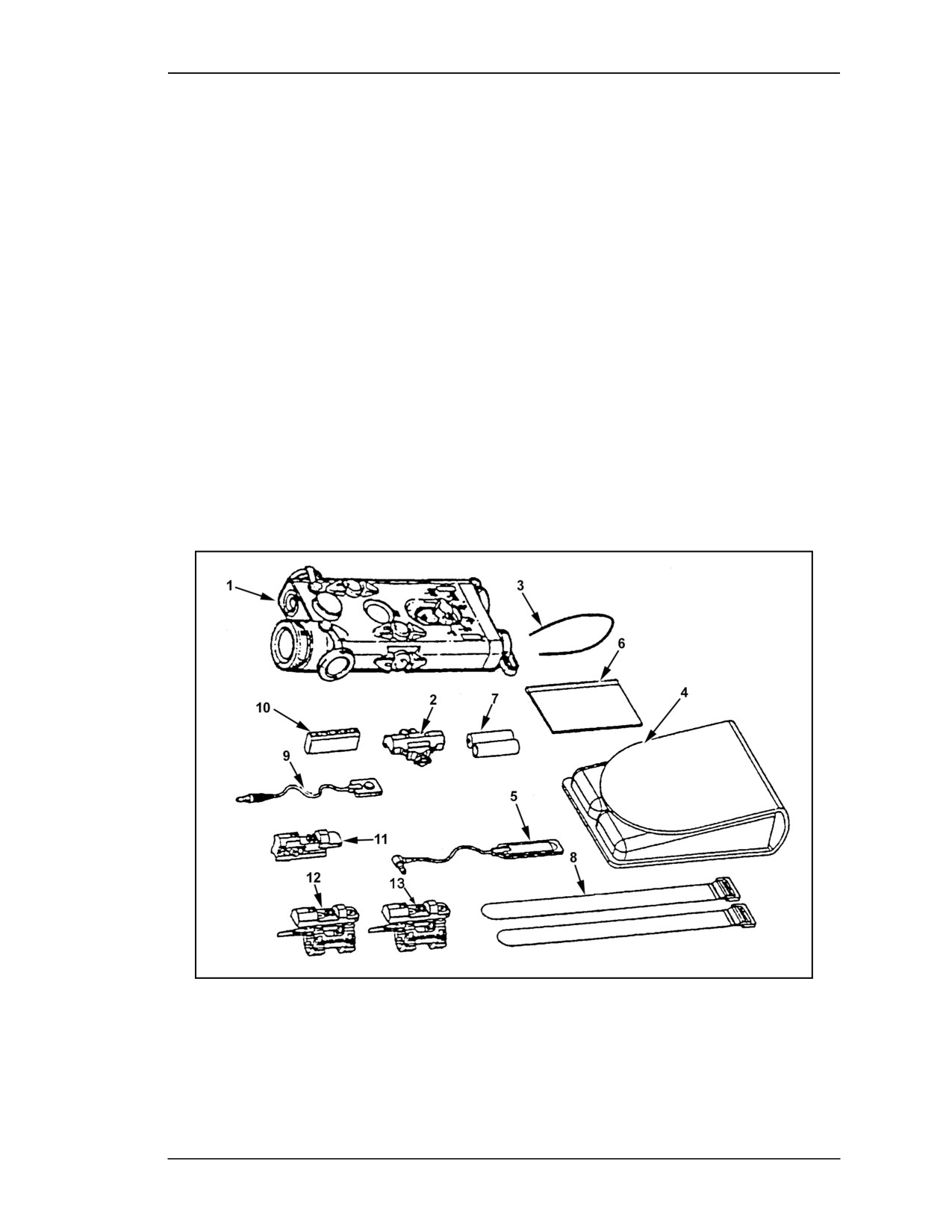
from an integral illuminator. The TPIAL works with night vision goggles and mounts on
various weapons with mounting brackets and adapters (Figure G-1 and Table G-1).
Leaders can also use the AN/PEQ-2A in the hand-held mode to illuminate and
designate targets.
Figure G-1. AN/PEQ-2A major components.
G-1
FM 3-22.27
ITEM
DESCRIPTION
1
TPIAL Assembly with Safety Block
2
Rail Grabber Mounting Bracket
3
Neck Cord
4
Carrying Bag
5
Cable Switch, 20 inch Remote, Button
6
Operator’s Manual
7
Batteries, 2 AA
8
Straps, Retention
9
Cable Switch, 12 inch, Membrane
10
Bracket Adapter
11
Training Extender (Army only)
12
M4/M16A2 Bracket Assembly (Army only)
13
M16A2 Bracket Assembly (Marine only)
Table G-1. Names of the AN/PEQ-2A major components.
a. Controls and Indicators. The AN/PEQ-2A has controls and indicators that allow
the user to operate the device and to select its different modes.
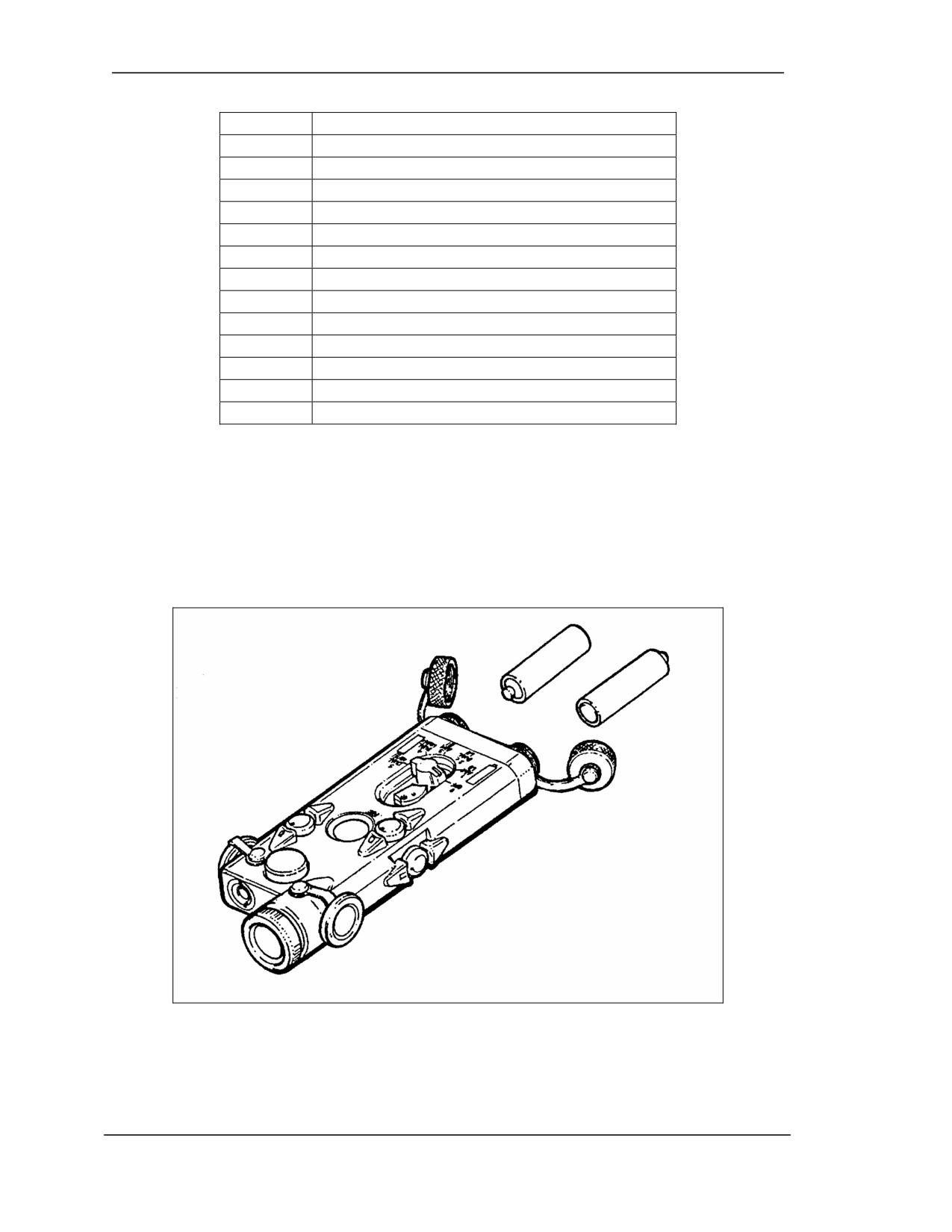
(1) Battery Installation. To install batteries in this device, first unscrew the
battery caps and install two AA batteries. Orient the batteries as indicated by the
markings on the AN/PEQ-2A body (Figure G-2).
Figure G-2. AN/PEQ-2A battery installation.
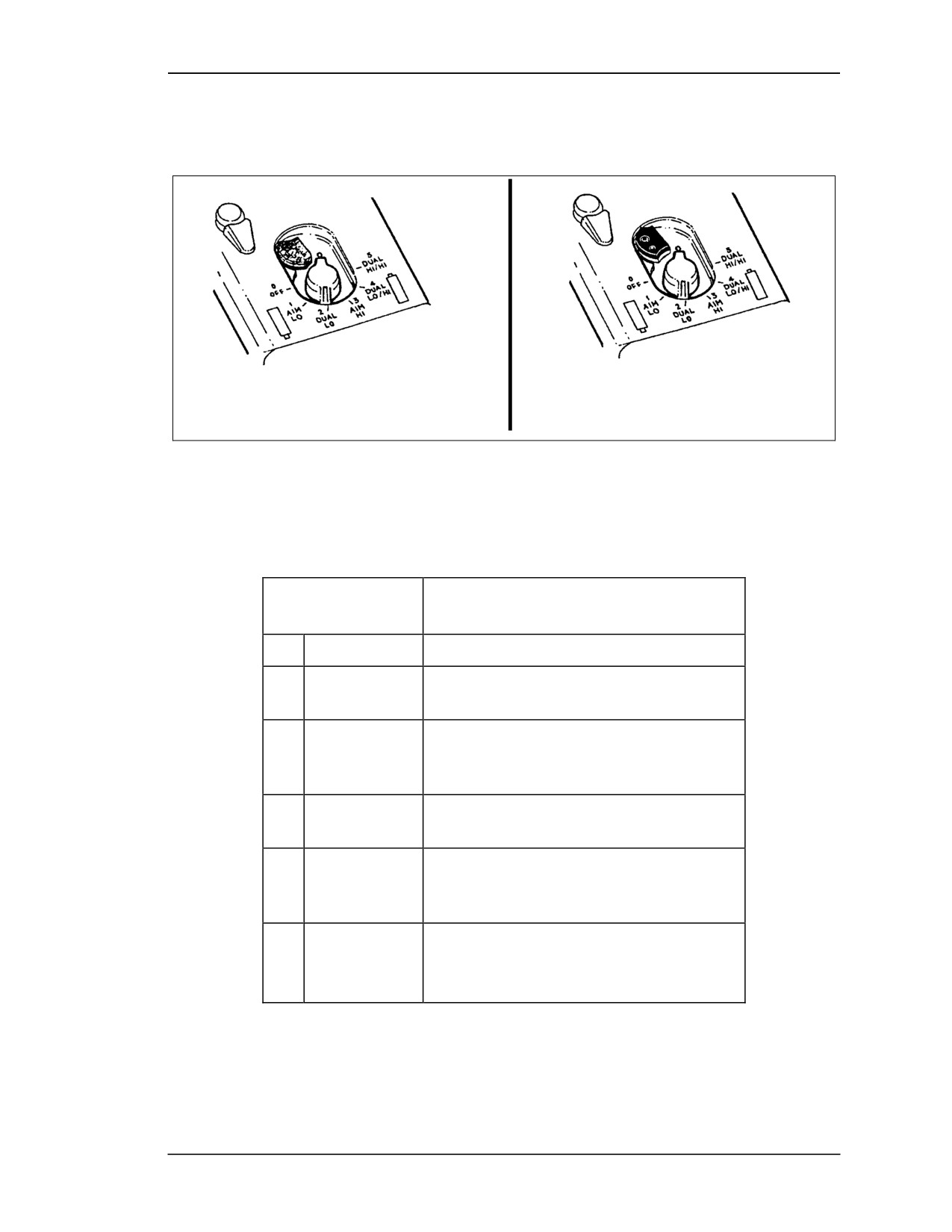
(2) Safety Block Installation. The safety block installed in the training mode (blue
side up) prevents the operator from accessing the non-eye safe modes (AIM HI, DUAL
G-2
FM 3-22.27
LO/HI, DUAL HI/HI) (Figure G-3). A .050 hex-head Allen Wrench is needed to unscrew
the block from the body and re-install it in the tactical mode (black side up).
TRAINING MODE (BLUE SIDE UP)
TACTICAL MODE (BLACK SIDE UP)
Figure G-3. Safety block installation.
(3) Mode Selector. The mode selector is used to set the mode in which the AN/PEQ-
2A will operate when the cable switch button or push button is depressed. The mode
selector has six positions (Table G-2).
KNOB
OPERATION
POSITION
0
OFF
The AN/PEQ-2A will not operate.
1
AIM LO
The aiming beam operates at low
power.
2
DUAL LO
The aiming beam and the
illuminating beam operate at low
power.
3
AIM HI
The aiming beam operates at high
power.
4
DUAL
The aiming beam operates at low
LO/HI
power and the illuminating beam
operates at full power.
5
DUAL HI/HI
The aiming beam operates at high
power and the illuminating beam
operates at full power.
Table G-2. Mode selector position.
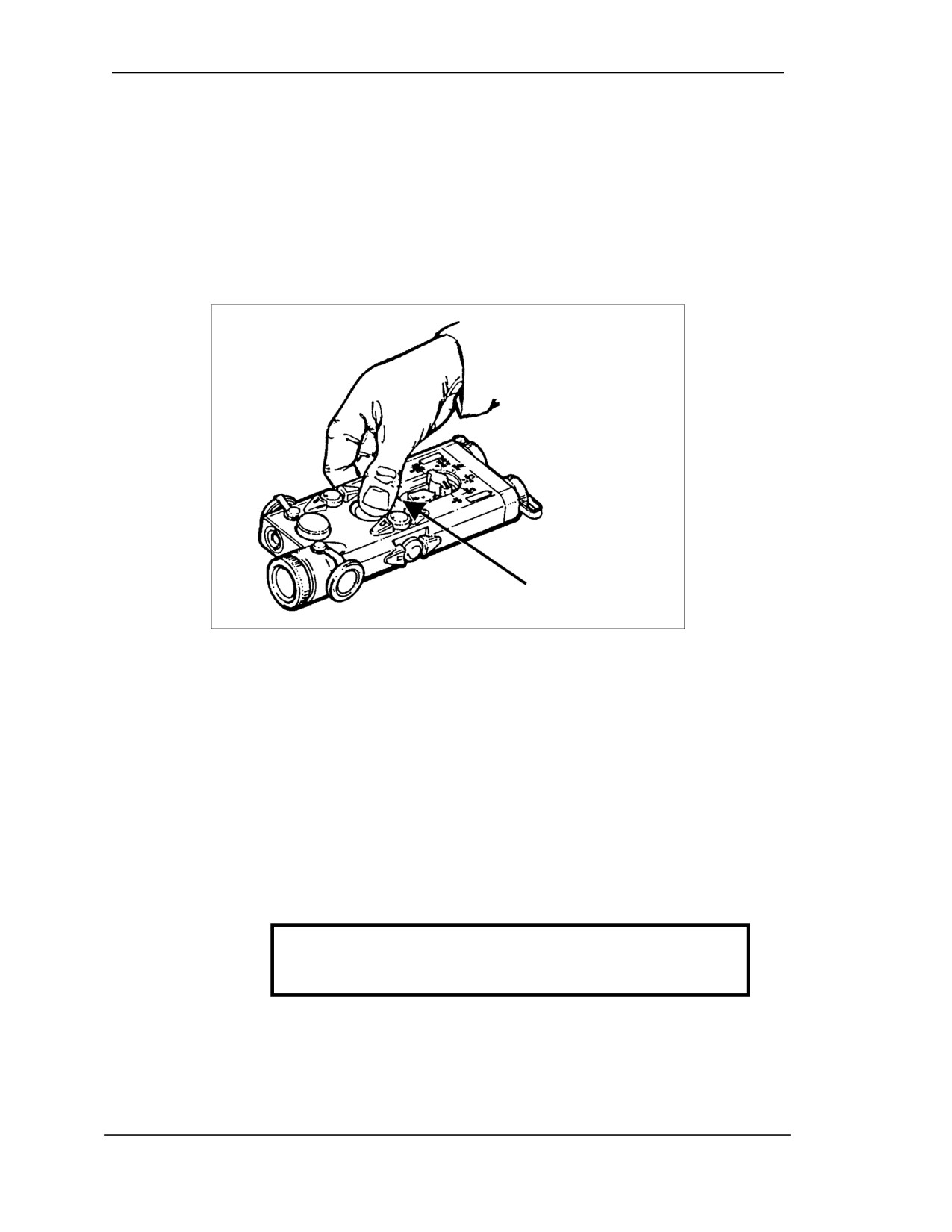
(4) Button Switch. The button switch is used when the AN/PEQ-2A is hand held.
Pressing the button switch operates the AN/PEQ-2A in the operational mode set by the
G-3
FM 3-22.27
mode selector switch (Figure G-4). When the button is released, the AN/PEQ-2A turns
off.
(a) A green LED is incorporated into the body of the AN/PEQ-2A to indicate that the
unit is ON. Whenever the AN/PEQ-2A is activated, the green LED will light and stay lit
until the unit is turned OFF.
(b) If continuous operation of the AN/PEQ-2A is desired, pressing the button switch
twice in rapid succession will latch the unit ON. The unit will remain ON until the button
switch is pressed the third time.
GREEN LED
Figure G-4. Operation of the button switch.
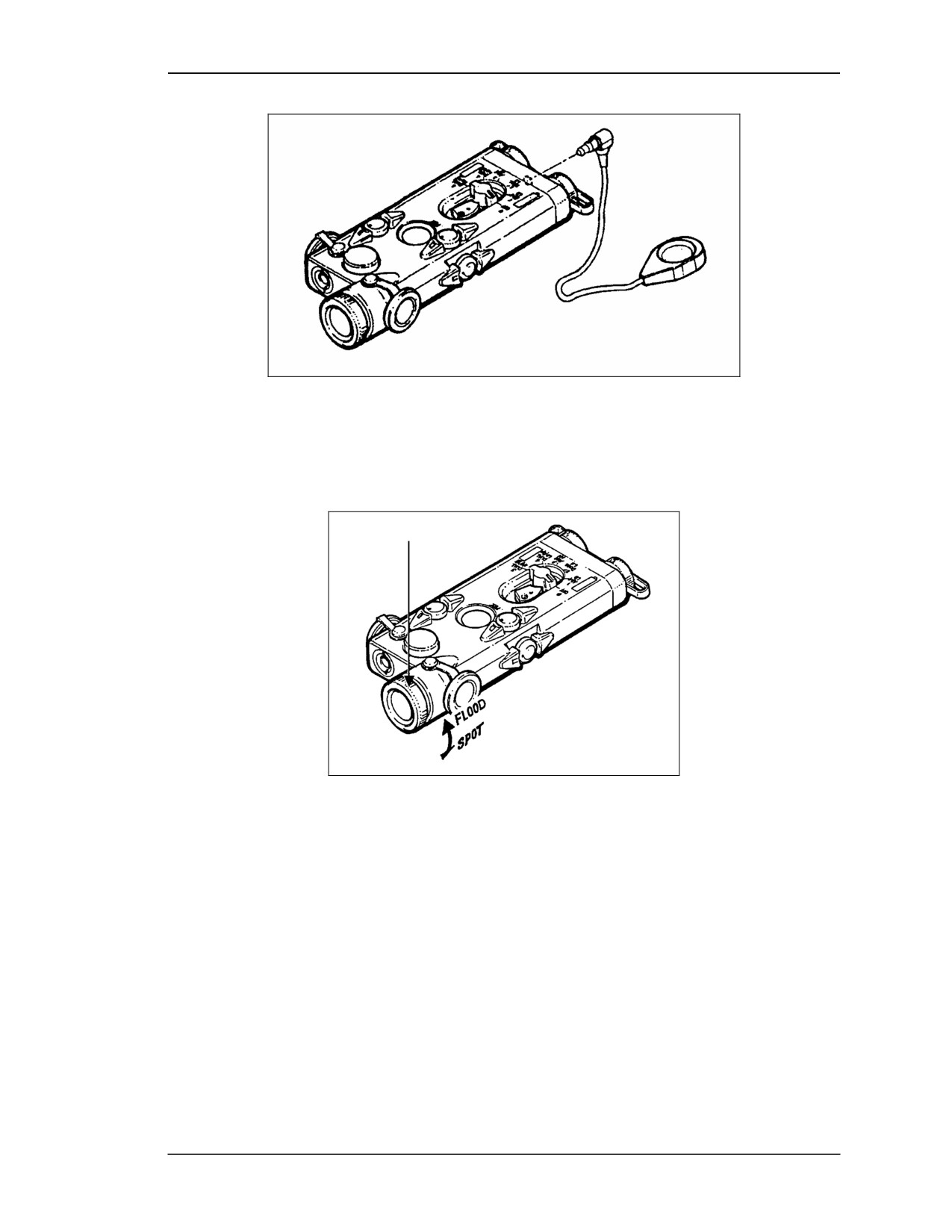
(5) Cable Switch. The cable switch is used when the AN/PEQ-2A is mounted on a
weapon (Figure G-5). The cable switch plugs into the back of the AN/PEQ-2A assembly.
Pressing the button or pad at the end of the cable switch causes the unit to turn on in the
operational mode selected by the mode select switch. When released, the AN/PEQ-2A
turns off.
(a) If continuous operation of the AN/PEQ-2A is desired, pressing the cable switch
twice in rapid succession will latch the unit ON. The unit will remain on until the push
button is pressed a third time.
(b) When the cable switch plug is installed in the AN/PEQ-2A, it automatically locks
into place. To remove the switch, pull back on the plug sleeve and pull the plug out.
CAUTION
Do not try to remove the plug by pulling on the cable.
G-4
FM 3-22.27
Figure G-5. Installation of the cable switch.
(6) Focus Knob. The focus knob is used to vary the spread of the illumination beam
based on the range and size of the area to be illuminated (Figure G-6).
FOCUS KNOB
Figure G-6. Using the focus knob.
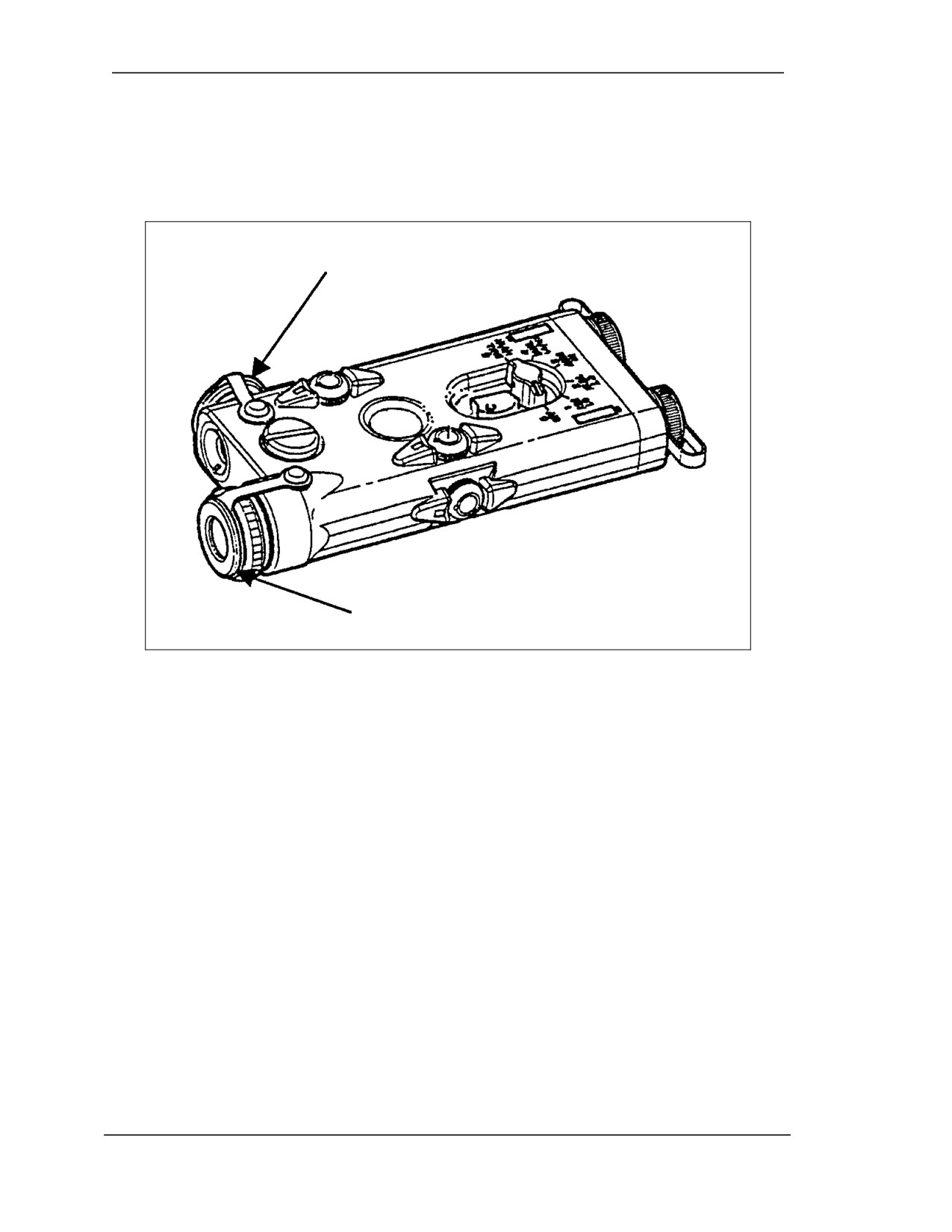
(7) Lens Caps. Several lens caps can be used with the AN/PEQ-2A for different
purposes (Figure G-7).
(a) The black lens cap blocks the AN/PEQ-2A illuminator or aiming laser beam
should the device be activated. To use the black lens cap, pull it from its stored location
on the side of the unit and stretch it over the front of the focus knob or aiming beam so
that it fits snugly in place.
(b) The diffuser lens cap enables the illuminator or aiming laser to emit in a 45-degree
cone (10 feet at 10 feet). To use the diffuser lens cap, pull it over the front of the focus
knob or aiming beam so that it fits snugly in place.
G-5
FM 3-22.27
(c) The neutral density lens cap enables the AN/PEQ-2A illuminator or aiming laser
to be operated in low power. To use the neutral density lens cap, pull it from its stored
location on the side of the unit and stretch it over the front of the focus knob or aiming
beam so that it fits snugly in place.
LENS CAP, AIMING
LENS CAP, ILLUMINATOR
Figure G-7. Installing the lens caps.
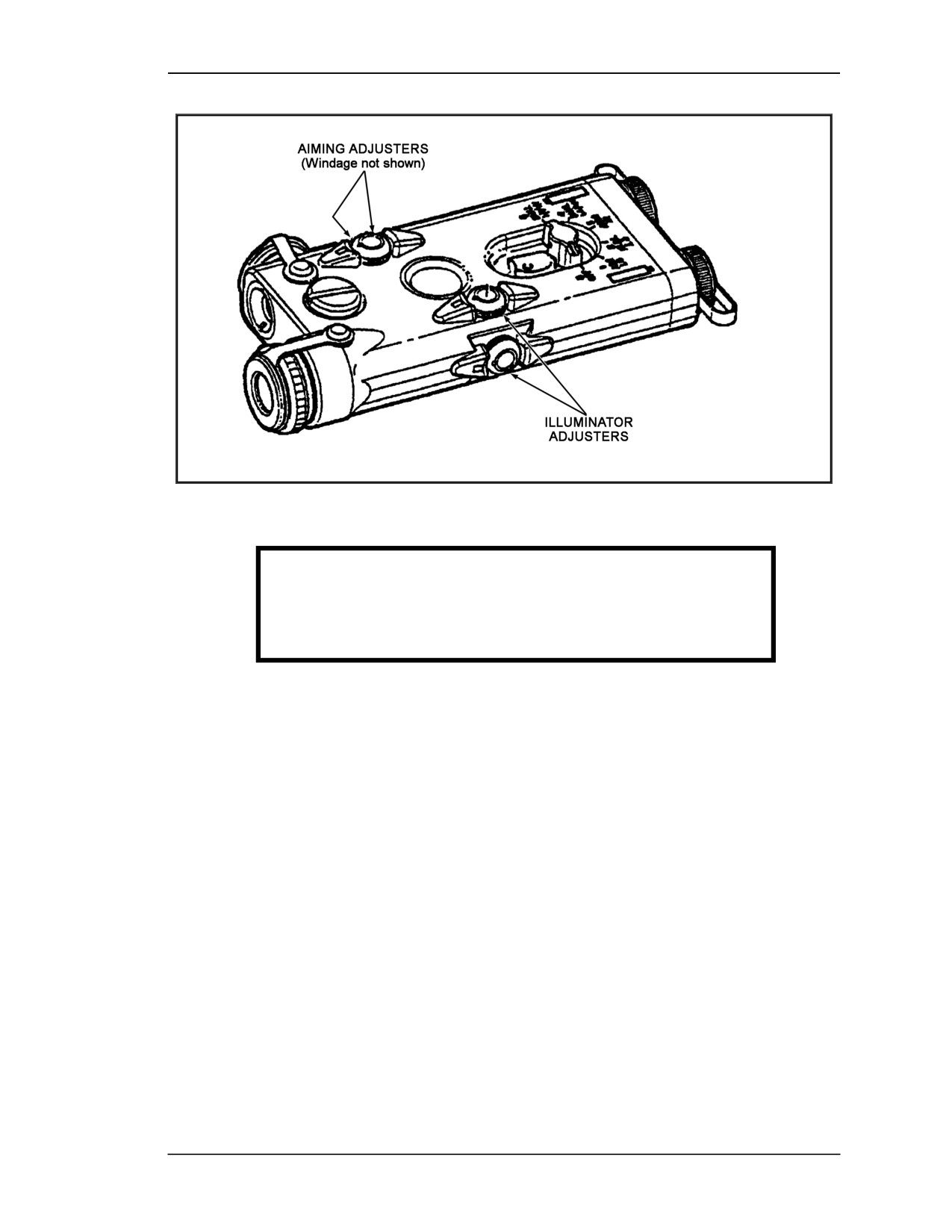
(8) Boresight Adjusters. The AN/PEQ-2A is equipped with boresight adjusters for
zeroing the aiming beam and illumination beam to the weapon (Figure G-8). The
AN/PEQ-2A adjusters move the beam in true horizontal and vertical directions with the
top adjusters used for elevation and the side adjusters for windage. When zeroing the
AN/PEQ-2A, it is best to zero the aiming beam to the weapon and then align the
illumination beam to the aiming beam.
G-6
FM 3-22.27
Figure G-8. Boresight adjusters for both aiming and illumination beams.
WARNING
Eye damage can occur if the laser is handled
carelessly. The danger area is 15 meters in the training
mode and 220 meters in the tactical mode.
b. Mounting and Dismounting Procedures. The AN/PEQ-2A can be mounted on
various weapons or used in the hand-held mode to illuminate and designate targets.
(1) Mounting Procedures. Ensure that the mounting bracket is installed before
proceeding.
(a) Secure the bracket adapter to the underside of the AN/PEQ-2A.
(b) Place the bracket adapter into the MK 19 bracket mounting groove, located in the
center of the rail grabber.
(c) Tighten the bracket’s lever screw into the bracket adapter hole.
(d) Plug the cable into the AN/PEQ-2A and run the cable to the front of the MK 19
bracket. The “cable switch, 12-inch, membrane” or the “cable switch, 20-inch, button”
may be used for remote access.
(e) Once the cable is secure at the front of the MK 19 bracket (ensure the cable will
not become damaged by the movement of the quadrant portion of the bracket) run it
between the MK 19 and the bracket to the handles on the backplate assembly. If using the
button cable, attach Velcro to the top of the night handle and secure excess cable to the
handle. If using the membrane pad, run it the same way as with the button cable and
attach the membrane to the inside of the right handle.
G-7
FM 3-22.27
(2) Dismounting Procedures. Dismount the AN/PEQ-2A when the mission is
complete, when it is needed on another weapon, or when it will be used in its hand-held
mode.
(a) Untie the cable and disconnect the remote button from the backplate handles.
(b) Unplug the cable from the AN/PEQ-2A and place the cable back in the
carrying case.
(c) Turn the AN/PEQ-2A mounting screw counterclockwise and remove the
AN/PEQ-2A from the bracket adapter.
(d) Unscrew the bracket adapter from the MK 19 bracket rail and place the bracket
adapter and the AN/PEQ-2A in its carrying case.
c. Boresighting Procedures. Boresighting aligns the sighting system to the bore of
the weapon. The AN/PEM-1 Borelight is used for this procedure.
(1) Place the MK 19 in the ready to fire position 10 meters from the bore light offset
zero target. Use the 10 meter distance gauge in the borelight kit to measure the distance.
Ensure the target and weapon are level and stable (the bore sight zero will be off if not)
before making any adjustments to the laser.
(2) Set the range on the MK 19 bracket to 500 meters.
(3) Mount the bore light and turn it on. While holding the MK 19 steady, zero the bore
light. Follow the instructions in the AN/PEM-1 borelight operations manual for further
details. The 40-mm MK 19 mandrel interface (NSN 3460-01-502-0575) is used with the
5.56-mm mandrel interface and has to be ordered separately.
(4) Make adjustments with the T&E mechanism until the bore light is on the bore light
aiming point.
(5) Adjust the windage and elevation of the aiming laser until the laser is on the laser
aiming point.
(6) Re-check the bore light aiming point and then the laser aiming point again.
(7) To zero the IR light source narrow the beam as much as possible and adjust its
windage and elevation until the beam is 4 centimeters horizontally to the left of the laser
aiming point while the aiming laser is still on the laser aiming point. The AN/PEQ-2A is
now boresighted.
d. Zeroing Procedures. Zeroing the weapon aligns the line of sight of the AN/PEQ-
2A with the trajectory of the round so that they intersect at 500 meters.
(1) Set the MK 19 mounting bracket to 500 meters by loosening the friction knob on
the left side of the mount. Press and hold the friction knob in (towards the mount), then
slide the mount assembly to the
500-meter increment. Release and tighten the
friction knob.
(2) Identify a 500-meter target downrange and fire one round; note the impact of the
round in relation to the target.
(3) Adjust the aiming light on the AN/PEQ-2A to the impact of the round by adjusting
the elevation and windage adjusters.
(4) Manipulate the T&E mechanism so that the aiming light is center mass on
the target. Repeat until the point of impact is the same as the point of aim.
(5) Adjust the illuminating beam’s elevation and windage adjusters so that the aiming
light is in the center of the illuminating beam.
G-8
FM 3-22.27
G-2. THE AN/PAS-13B (V) 3 HEAVY WEAPON THERMAL SIGHT
The AN/PAS-13B
(V)
3 HWTS is a silent, lightweight, compact, and durable
battery-powered infrared imaging sensor that operates with low battery consumption
(Figure G-9).
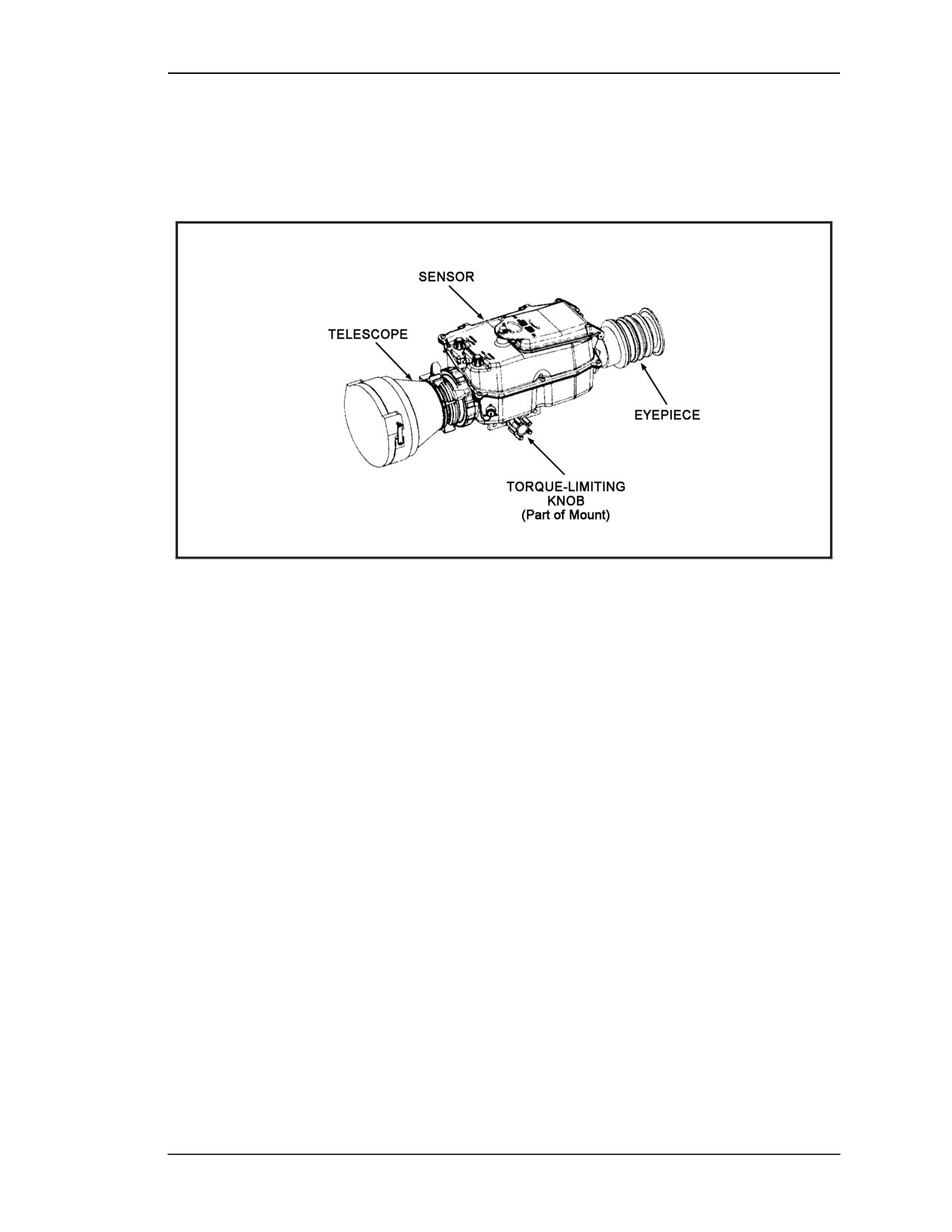
Figure G-9. AN/PAS-13B (V) 3 heavy weapon thermal sight.
a. Components. The HWTS is capable of target acquisition under conditions of
limited visibility such as darkness, smoke, fog, dust, and haze. The HWTS operates
effectively at night and can also be used in the daytime. Infrared light is received through
the telescope, detected by an IR sensor, converted to digital data, processed, and then
displayed for the user. Besides the carrying cases, the HWTS is composed of four major
components: the telescope, the basic sensor, the eyepiece, and the mount.
(1) Telescope. The telescope receives IR light emitting from an intended target and its
surroundings. The telescope magnifies and projects the IR light onto the basic sensor’s
scanner.
(2) Basic Sensor. The scanner reflects the IR light received from the telescope onto
the detective assembly. The detective assembly senses the IR light and converts it to
video. The sensor’s electronics condition the video for display on the LED array. The
LED array illuminates the IR image along with the reticle. The light from the LED array
is reflected off the scanner to form an image at the eyepiece.
(3) Eyepiece. The eyepiece displays the thermal image and all system indicators on
the cathode ray tube.
(4) Mount. A universal attachment interface between the HWTS and the MK 19
bracket (figure only shows the torque limiting knob).
b. Modes of Operation. The HWTS has three modes of operation: STANDBY, ON,
and EMERGENCY.
(1) STANDBY Mode. When the system is first turned on, the HWTS begins a cool
down period of approximately two minutes. After the cool down period, the HWTS
G-9
FM 3-22.27
enters the STANDBY mode. During the STANDBY mode, power is not applied to the
scanner or display in order to extend the life of the battery.
(2) ON Mode. When the HWTS is in the STANDBY mode and pressure is applied to
the eyecup, the HWTS switches to the ON mode, and a switch engages to provide power
to the scanner and display. After a three-second delay, the system is fully operational.
(3) EMERGENCY Mode. When switched to the EMERGENCY mode, the HWTS
continuously applies power to the entire system. This allows the operator to bypass the
three-second delay experienced when switching from the STANDBY to the ON mode.
Since power is applied to the entire system while in the emergency mode, battery life is
greatly reduced.
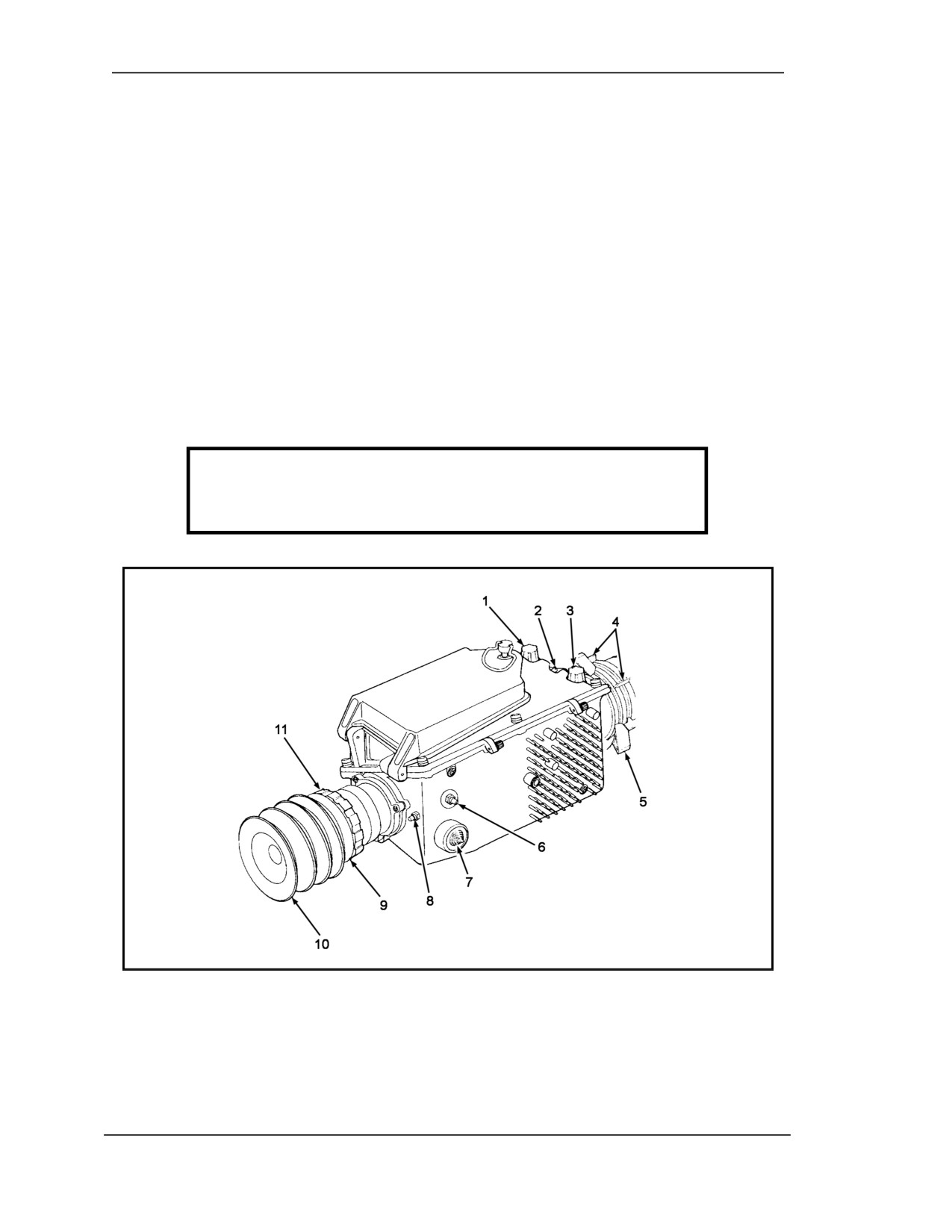
c. Controls and Indicators. Controls allow the gunner to configure the sight to the
situation and individual preferences while the indicators display the current configuration
(Figure G-10 and Table G-3).
(1) The CONTRAST CONTROL adjusts the contrast of the thermal image displayed
on the raster. It has an automatic and a manual mode.
CAUTION
Ensure the brightness control switch is depressed before
turning it on or off.
Figure G-10. Location of the HWTS controls and indicators.
G-10

FM 3-22.27
ITEM
DESCRIPTION
1
Contrast Control
2
Emergency Switch Control
3
Brightness Control
4
Focus Ring
5
Field of View Ring
6
Zoom/Reticle Select Switch
7
Reticle Adjust Switch
8
Black/White Polarity Switch
9
Diopter Holding Device
10
Eyecup
11
Diopter Focus Ring
Table G-3. HWTS controls and Indicators.
(2) The EMERGENCY SWITCH CONTROL places the HTWS in emergency mode.
The eyecup must be depressed in order to for the CRT to illuminate.
(3) The BRIGHTNESS CONTROL is a rotary switch with an off detent position
(turned fully counterclockwise). The purpose is to turn the system on or off and adjust the
brightness of the eyepiece display.
(4) The FOCUS RING adjusts the telescope focus from 20 meters to infinity. It
requires a manual adjustment and affects both the wide and narrow fields of view.
(5) The FIELD OF VIEW RING (FOV) is located on the telescope. It has a wide and
a narrow field of view. The wide FOV is for using low magnification during target
detection, and the narrow FOV is for using high magnification during recognition and
engagement.
(6) The RETICLE SELECT SWITCH selects one of the available reticles depending
on the type of thermal sight (medium or heavy) and the weapon. It must be held for two
seconds to enable reticle changes. After two seconds, release the switch to cycle to the
next reticle. This control is disabled after ten seconds of inactivity.
(7) The RETICLE ADJUST SWITCH adjusts the reticle aiming features in azimuth
and elevation. It is used during zeroing, and it must be held for two seconds to allow
changes to be made. After two seconds, each press moves the reticle aiming features one
increment. This control is also disabled after ten seconds of inactivity.
(8) The BLACK/WHITE POLARITY SWITCH selects the polarity of the thermal
image displayed on the raster. The initial setting is “white hot.” The polarity switch
affects the appearance of the target.
(9) The DIOPTER HOLDING DEVICE allows the diopter to be adjusted when
pulled back.
(10) The EYECUP controls the STANDBY/ON operating mode. When forward
pressure is applied to the eyecup, the system is in the ON mode. When forward pressure
is removed for more than 30 seconds, the system returns to the STANDBY mode.
G-11
FM 3-22.27
(11) The DIOPTER FOCUS RING adjusts the focus of the raster and indicators to the
operator’s eye. It ranges from +2 to -6 diopters.
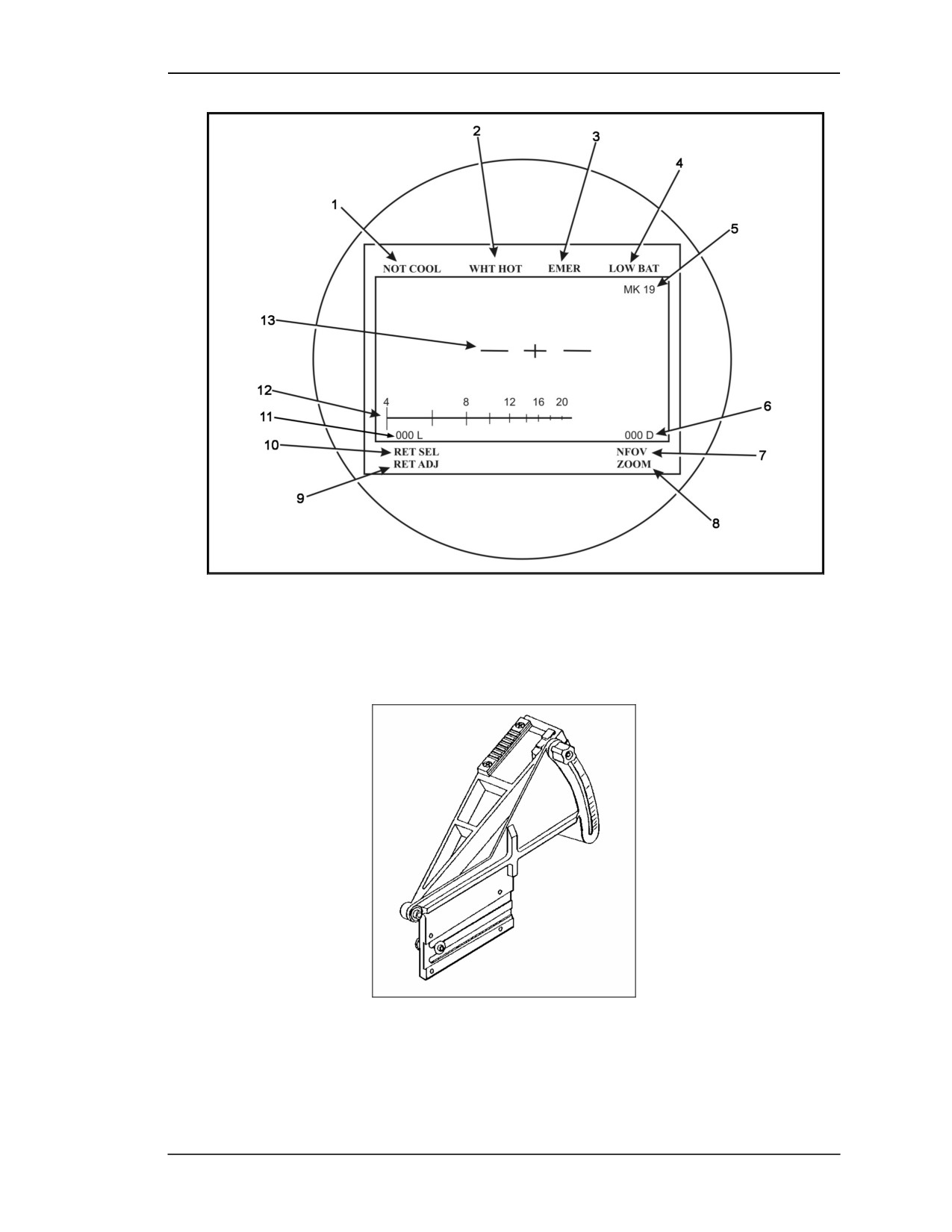
d. Status Indicators and Raster (Figure G-11). The status indicators and raster are
visible when the user presses his eye against the eyecup. The indicators display the
system status and configuration. The raster displays the thermal image, the selected
reticle, and azimuth/elevation zeroing adjustment indicators.
(1) The status indicators are:
• NOT COOL (1): Displayed when the system is not cool enough for proper
operation.
• WHT HOT/BLK HOT (2): Indicates the target polarity.
• EMER (3): Displayed when system is in emergency mode.
• LOW (4): Displayed when battery power is low (approximately fifteen minutes
of useful power left).
• FIELD OF VIEW (7): Indicates when the wide field of view (WFOV) or the
narrow field of view (NFOV) is in use
• ZOOM (8): Displayed when the zoom mode is selected
• RET ADJ (9): Indicates the reticle adjustment mode is selected
• RET SEL (10): Indicates the reticle select mode is selected
(2) The DISPLAY RASTER displays the thermal image with a superimposed reticle
and indicators:
• RETICLE SELECT (5): Identifies the selected reticle/weapon.
• ELEVATION INDICATOR (6): Indicates the elevation zeroing adjustment of
the reticle.
• AZIMUTH INDICATOR (11): Indicates the elevation zeroing adjustment of
the reticle.
• RANGE SCALE (12): The range scale allows the operator to estimate the
range to a target based on a known height or width. The numbers on the scale
are the range in hundreds of meters (example: = 400 meters). The vertical lines
on the scale reflect the height of a five-foot man at that range. The distance
between two consecutive lines reflects the width of a 10-foot tank at the range
specified by the vertical line on the left.
• CROSSHAIR/AIMING POINT (13): The vertical line at the aiming point
reflects the height of a five-foot man at 800 meters. The horizontal line of the
cross-hair reflects the width of a 10-foot tank at 800 meters.
G-12
FM 3-22.27
Figure G-11. Status indicators and raster.
e. Mounting and Dismounting Procedures. The HWTS is mounted on the MK 19
with a mounting bracket (Figure G-12). See TM 11-5855-312-10 for details.
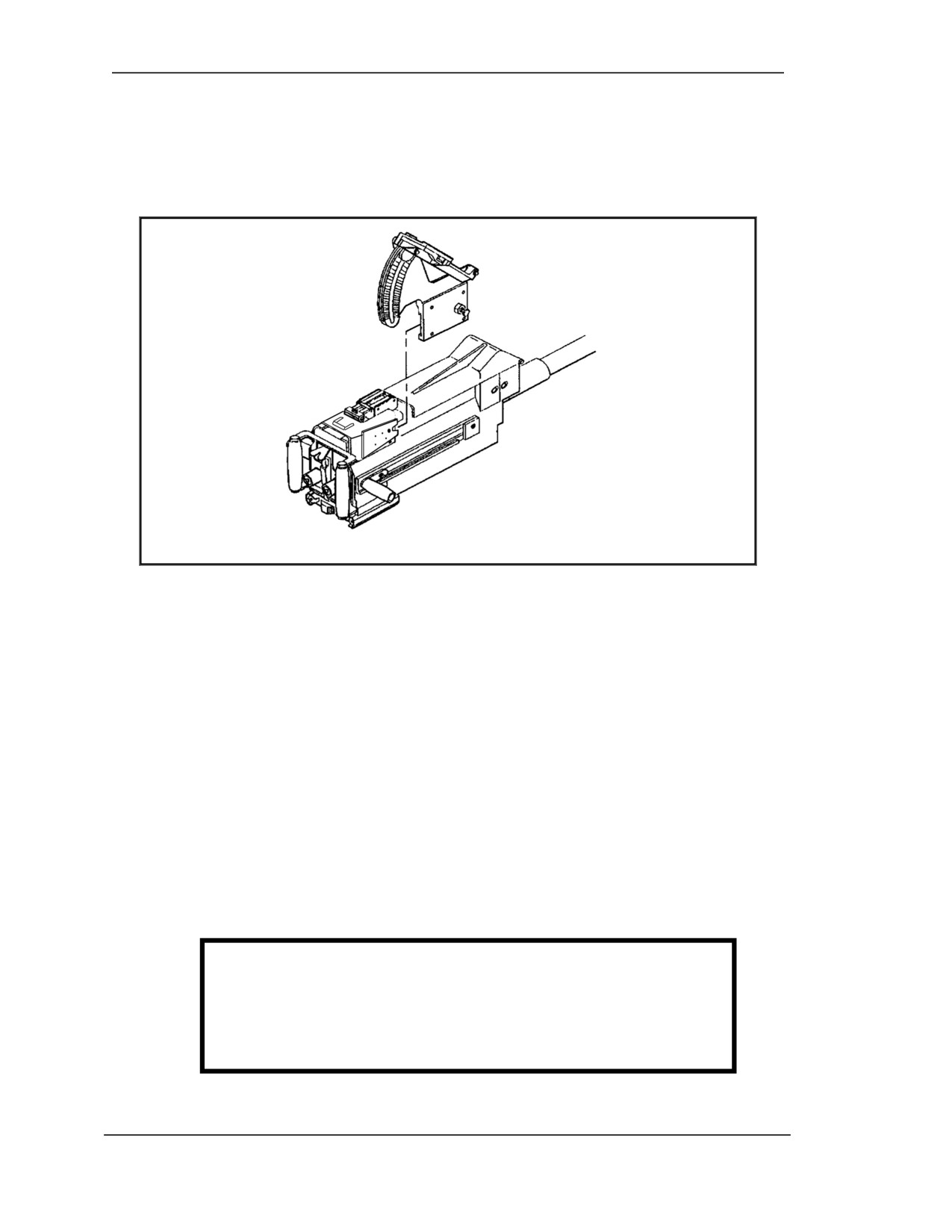
Figure G-12. MK 19 bracket.
(1) Mounting Procedures. Mounting the HWTS to the MK 19 is a two-step process
(Figure G-13):
G-13
FM 3-22.27
(a) Mount the bracket to the MK 19 by sliding the bracket into the dovetail slot until
the locking pin engages the mount.
(b) Install the HWTS onto the bracket mount.
(c) Shake the HWTS to make sure the sight is secured properly.
Figure G-13. Mounting the HWTS on MK 19.
(2) Dismounting Procedures. To dismount the HWTS:
(a) Take the HWTS off the mounting bracket rail and place the HWTS back in its
carrying case.
(b) Pull out the locking pin and slide the bracket off the mount.
G-3. AN/TVS-5
The AN/TVS-5 is a portable, battery-operated electro-optical instrument used for
observation and aimed fire of weapons at night (Figure G-14 and Table G-4). It amplifies
reflected light such as moonlight, starlight, and sky glow so that the viewed scene
becomes clearly visible to the operator. The sight does not emit visible or infrared light
(except from the eyepiece) that can be detected by the enemy. By using this device, the
gunner can observe the area and detect and engage any suitable target.
WARNING
Ensure the weapon is not loaded and is on S (SAFE)
before installing the HWTS on the weapon. A loaded
weapon may accidentally discharge causing severe
injury or death.
G-14
FM 3-22.27
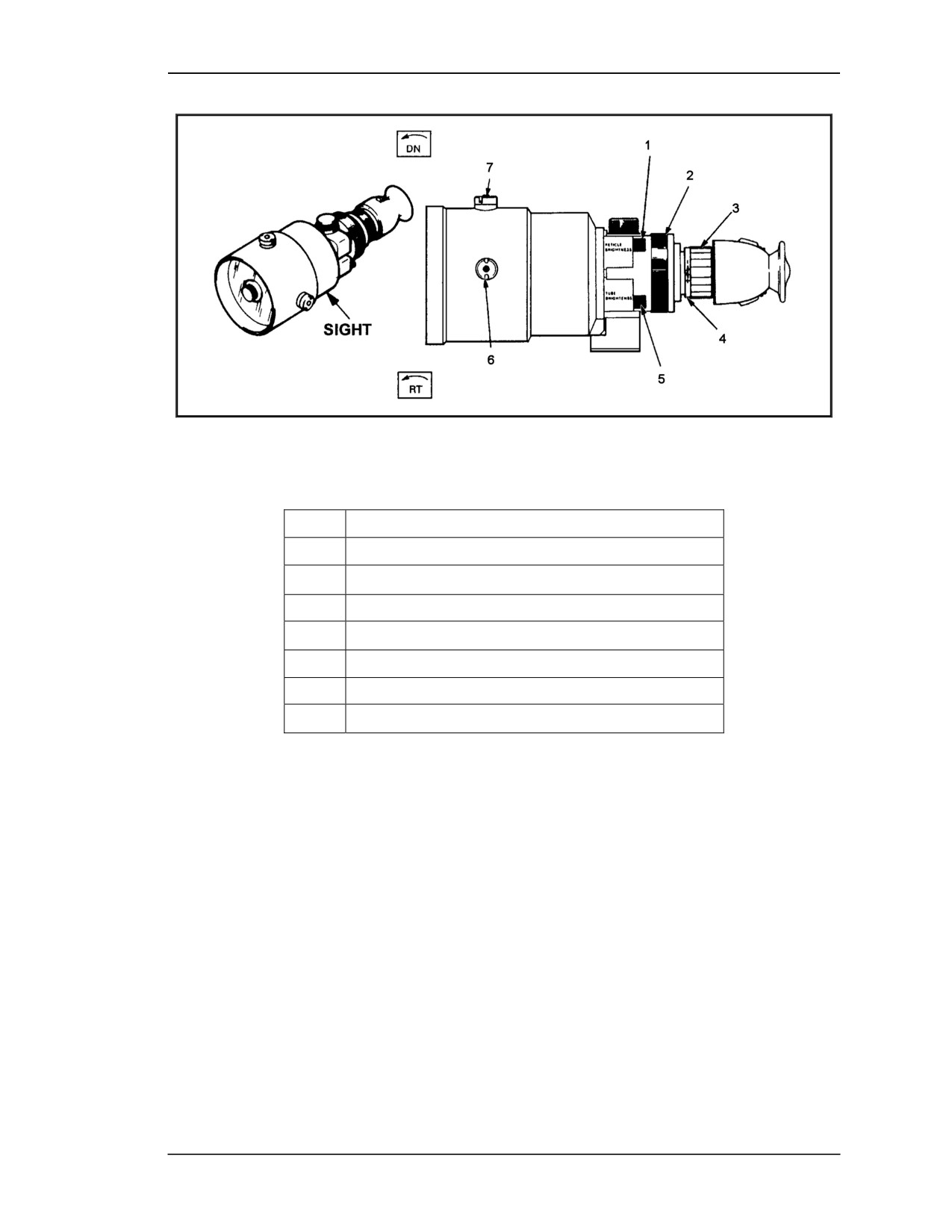
Figure G-14. Location of the AN/TVS-5 components.
ITEM
DESCRIPTION
1
ON-OFF/ Reticle Brightness
2
Objective Focus Ring
3
Diopter Focus Ring
4
Diopter Indicator
5
ON-OFF/ Tube Brightness
6
Reticle Azimuth Adjustment Acutator
7
Reticle Elevation Adjustment Acutator
Table G-4. AN/TVS-5 component names.
a. Controls and Indicators.Controls allow the gunner to configure the sight to the
situation and individual preferences while indicators display the current configuration.
(1) The ON-OFF/TUBE BRIGHTNESS control applies power to the sight and
controls the brightness of the image intensifier tube. It also enables the ON-OFF
RETICLE BRIGHTNESS control to function.
(2) The ON-OFF RETICLE BRIGHTNESS control applies power to the reticle and
controls the brightness of the reticle.
(3) The OBJECTIVE FOCUS RING adjusts the range focus from 25 meters to
infinity.
(4) The DIOPTER FOCUS RING adjusts the focus of the eyepiece.
(5) The DIOPTER INDICATOR indicates the direction of rotation of the DIOPTER
FOCUS RING for + and diopters.
G-15
FM 3-22.27
(6) The RETICLE ELEVATION ADJUSTMENT ACTUATOR controls the reticle
adjustment in the up and down direction. Each click of adjustment moves the strike of the
round 1.0 inch at 100 meters.
(7) The RETICLE AZIMUTH ADJUSTMENT ACTUATOR controls reticle
adjustment right or left. Each click or adjustment moves the strike of the round 1.0 inch at
100 meters.
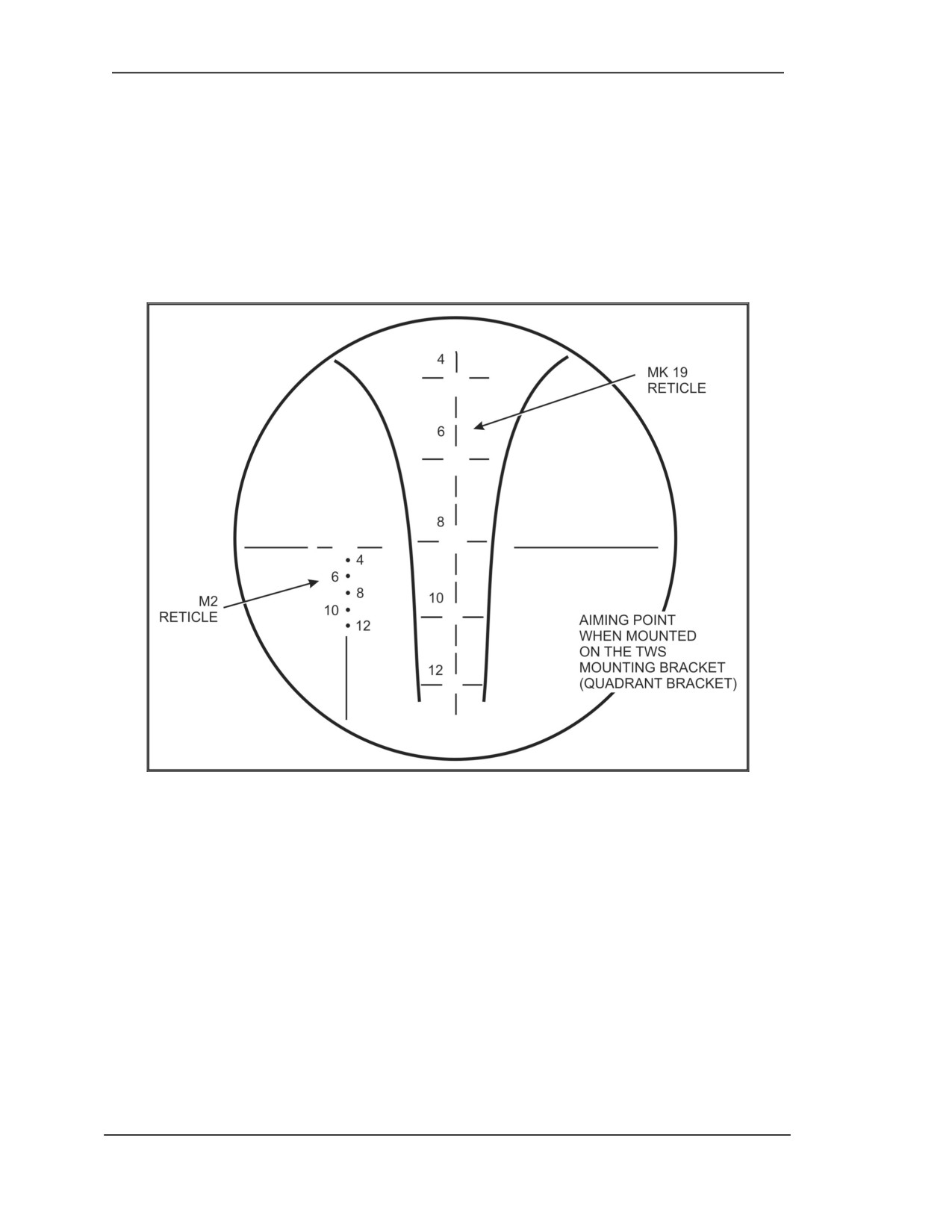
b. AN/TVS-5 Sight Reticle. The MK 19 and the M2 machine guns share the same
AN/TVS-5 sight reticle (Figure G-15).
Figure G-15. AN/TVS-5 reticle for the MK 19 and M2 machine guns.
G-16
FM 3-22.27
WARNING
1. Eye guard:
• To avoid recoil injury, attach the eye guard before using
the sight.
• When activated by pressure on the eye guard, the sight
emits illumination the enemy can detect. Therefore, avoid
touching the eye guard except when you wish to use the
sight, and then press your eye area against it to activate
it.
2. Batteries:
• Dispose of batteries as directed. The contents of the
mercury batteries cause extreme irritation to the eyes
and to oral and nasal passages.
• To prevent explosion, avoid disposing of batteries by
burning.
• Avoid short circulating batteries.
• Avoid recharging batteries.
• Remove batteries before storing sight.
• Always replace both mercury batteries at the same time.
c. Mounting Procedures. To mount the AN/TVS-5:
(1) Align the scribe line on the sight with the scribe line on the bracket.
(2) Place the sight in the grove of the bracket and tighten the lever screw clockwise.
(3) Secure the lever screw with lacing wire or tape to ensure the sight does not
vibrate loose.
(4) Seat the device. After firing the initial burst, retighten the lever screw to ensure the
sight is securely mounted. (If you are unable to fire at this time, lightly shake the sight to
ensure the sight is mounted correctly.)
d. Dismounting Procedures. To dismount the AN/TVS-5:
(1) Remove the lacing wire or tape from the lever screw.
(2) Loosen the lever screw until the sight is free to be lifted off the bracket.
(3) Remove the batteries and place the sight in its carrying case.
e. Boresighting. The AN/TVS-5 cannot be boresighted when used with the MK 19.
The sight cannot focus on a target closer than 25 meters, and the offset is too great at that
distance to boresight accurately.
f. Zeroing. To zero the AN/TVS-5 to the MK 19, follow the procedures in TM 11-
5855-214-10.
G-17

FM 3-22.27(FM 23-27)
APPENDIX H
CREW DRILLS
The purpose of a crew drill is to build precision, speed, skill, and
teamwork in checking equipment, placing the MK 19 into and out of action,
and moving the MK 19 to a new position. The main goal is achieved by
following prescribed procedures. Precision, speed, skill, and teamwork grow
with practice. During the crew drill, all oral and visual signals are repeated.
Once crewmembers can perform their duties well, they rotate to allow each
member of the crew to learn the duties of others. The ground-mounted MK 19
has three crewmembers: the gunner, the assistant gunner, and the
ammunition bearer. The vehicle-mounted MK
19 also has three
crewmembers: the squad leader, the gunner, and the driver. Normally the
crew is not required to carry the MK 19 and ammunition over long distances.
A vehicle usually carries the crew, ammunition, and equipment to the firing
position. The terrain and the enemy situation dictate how close the vehicle
may be brought to the firing position.
H-1. CREW EQUIPMENT AND DRILL AREA
Dismounted crew drills are conducted with a gunner, assistant gunner, and ammunition
bearer. For drills involving a vehicle, the squad leader, gunner, and driver are crewmembers.
In addition to individual weapons and equipment, each crewmember for dismounted drills
carries specific equipment used with the tripod-mounted MK 19 (Table H-1).
CREW MEMBER
SUGGESTED MINIMUM EQUIPMENT
Gunner
MK 19, binoculars, and compass
Assistant Gunner
M3 tripod, MK 64 gun cradle, with T&E
mechanism attached
Ammunition Bearer
One box of ammunition
Table H-1. Equipment.
A crew drill is conducted in an area large enough to allow crewmembers to move freely with
equipment and without interfering with the movements of other crewmembers.
H-1
FM 3-22.27
WARNING
Each soldier must wear all the protective equipment
required by range safety regulations. This may include
helmet, earplugs, and protective vest.
H-2. FORMATION FOR CREW DRILL
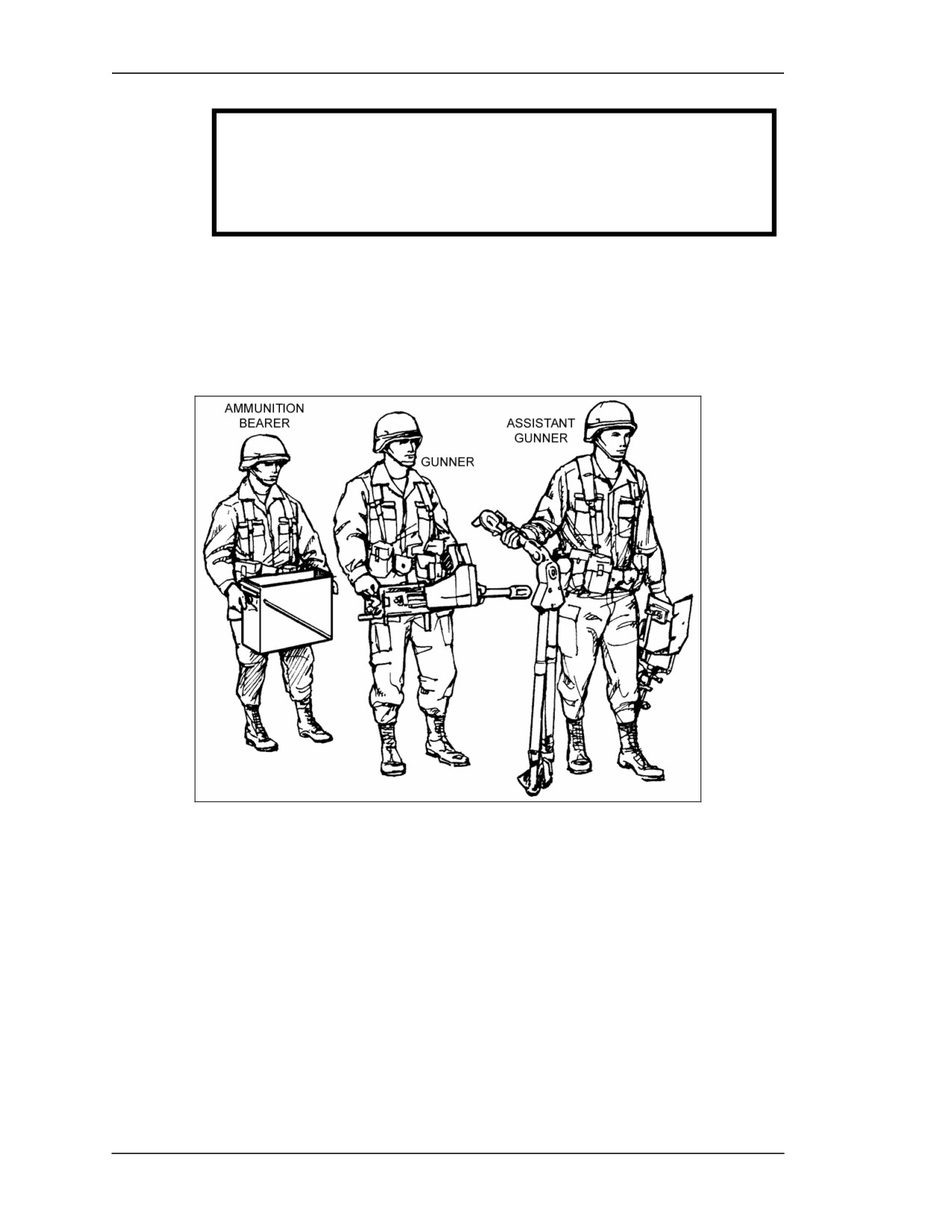
To form the crew for crew drill, the leader commands FORM FOR CREW DRILL. Upon
hearing the leader’s command, the crew repeats the command and forms into a column, five
paces apart, in the following order: assistant gunner, gunner, and ammunition bearer (Figure
H-1).
Figure H-1. Three-man MK 19 crew.
Each crewmember carries the following equipment in the specified manner:
• The assistant gunner carries the tripod, with the front leg positioned at a 60-
degree angle and the trail legs collapsed, in his right hand; he carries the gun
cradle, with the T&E mechanism attached, in his left hand.
• The gunner carries the MK 19, binoculars, and compass.
• The ammunition bearer carries one can of ammunition.
H-3. INSPECTION OF EQUIPMENT
The leader commands CHECK EQUIPMENT. All crewmembers repeat the command and
inspect the components. The equipment is inspected and verified by the following
crewmembers.
H-2
FM 3-22.27
a. The assistant gunner inspects the M3 tripod, gun cradle, and T&E mechanism and
ensures:
(1) The indexing levers and clamps on the front and trail legs work, and that the legs are
in the “short (low)” position.
(2) The front leg is placed at a 60-degree angle and the trail legs are closely folded and
the front leg clamp is tight.
(3) The sleeve lock latch and pintle lock release cam work.
(4) The pintle bushing is clean and has no burrs.
(5) The cradle pintle is clean, and all pins and bolts are seated.
(6) The T&E mechanism is centered.
b. The gunner inspects the MK 19 and ensures:
(1) The weapon is clean.
(2) The bolt is forward, the top cover is closed, and the weapon is on S (SAFE).
(3) The charger handles are forward and locked in the “up” position.
(4) The binocular lenses are clean and the focus mechanism works.
(5) The compass magnetic arrow and bezel ring work freely.
c. The ammunition bearer inspects the ammunition and ensures:
(1) The correct type of ammunition is on hand.
(2) The ammunition can is dent-free.
(3) All ogives are tight and the ammunition is clean.
d. The crewmembers report when the inspections are finished in the following manner:
(1) The ammunition bearer reports “Ammunition correct,” or any defects.
(2) The gunner reports “Gun and ammunition correct,” or any defects.
(3) The assistant gunner reports, “All correct,” or any defects.
H-4. PLACING THE MK 19 INTO ACTION
The leader commands and signals GUN TO BE MOUNTED, and points to the position
where the gun is to be mounted; FRONT, and points in the direction of fire; ACTION, and
indicates with his fist the MK 19’s direction in the chosen position. Crewmembers take the
following steps to place the gun into operation.
a. The assistant gunner:
(1) Drags the tripod to the firing position by its front leg with his right hand, and carries
the gun cradle with the T&E mechanism attached in his left hand.
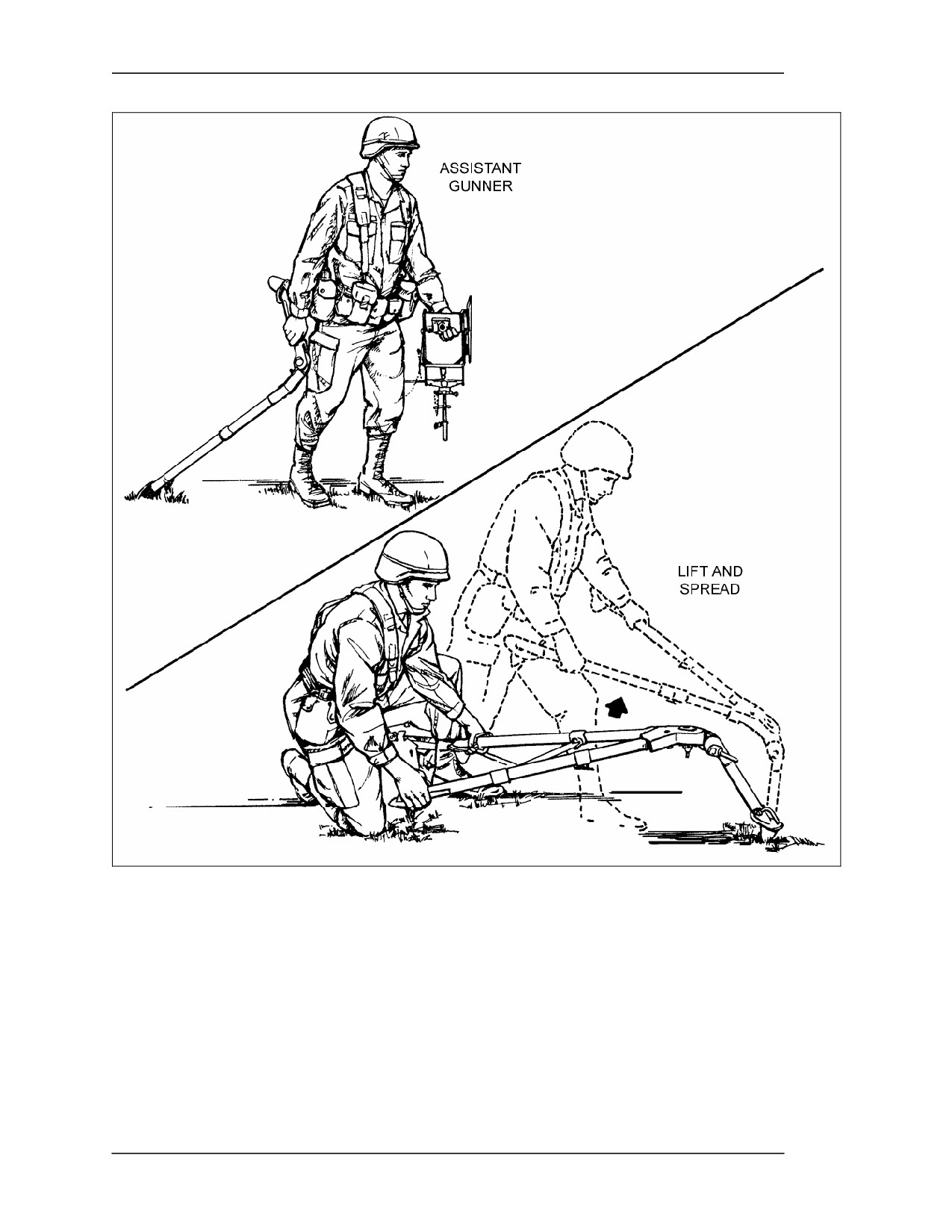
(2) When he arrives at the firing position, aligns the front tripod leg for direction and,
with one quick motion, snaps the trail legs apart. This action makes the sleeve lock-latch
snap in place (Figure H-2).
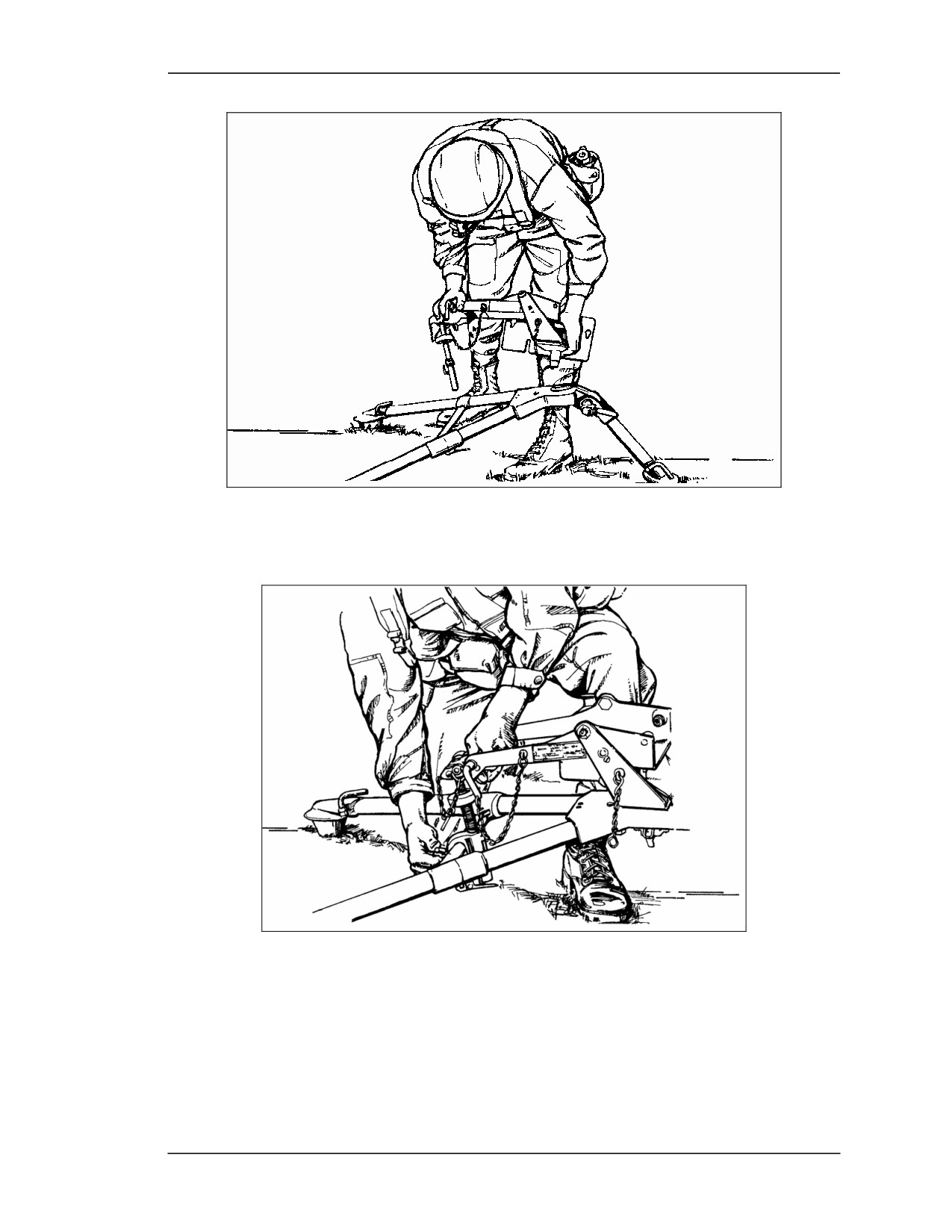
(3) Stamps each leg into the ground and secures the gun cradle to the tripod by using the
pintle lock release cam (Figure H-3).
(4) Secures the T&E mechanism to the tripod, by locking the traversing slide lock lever
(Figure H-4).
(5) Helps the gunner mount and load the MK 19.
H-3
FM 3-22.27
Figure H-2. Positioning the tripod.
H-4
FM 3-22.27
Figure H-3. Mounting the MK 19 mount on the tripod.
Figure H-4. Securing the T&E mechanism.
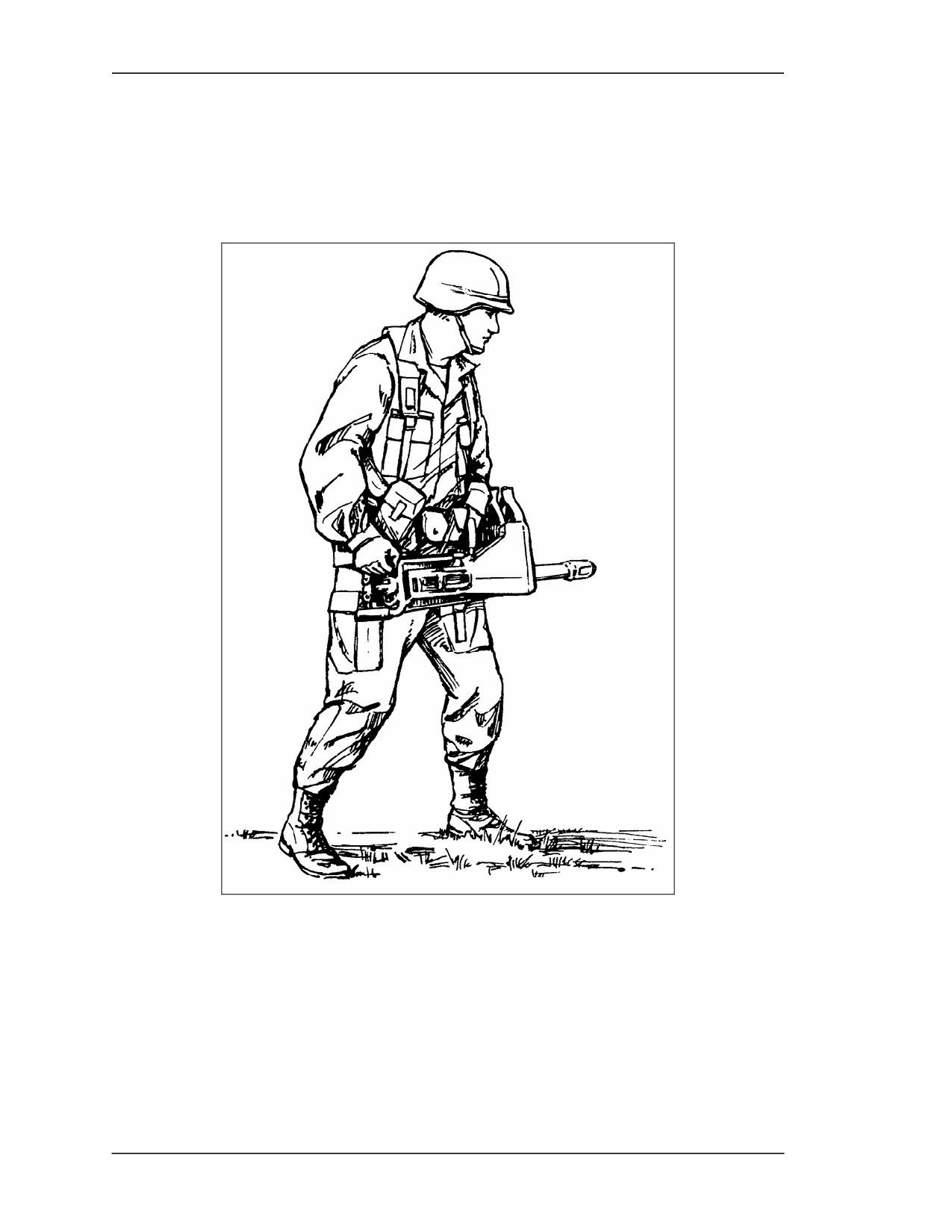
b. The gunner:
(1) Carries the MK 19 receiver to the tripod, with the barrel in his left hand, and the
control grip in his right hand (Figure H-5).
(2) At the tripod, the assistant gunner grasps the barrel while the gunner holds the grips.
H-5
FM 3-22.27
(3) The gunner and assistant gunner align the grooves on the receiver with the lugs in the
gun cradle, and slide the receiver forward (Figure H-6).
(4) Secures the rear of the weapon by inserting the retaining pin through the cradle and
sear assembly (Figure H-7).
Figure H-5. Gunner moving into position.
H-6