FM 3-22.27 MK 19, 40-mm GRENADE MACHINE GUN, MOD 3 (NOVEMBER 2003) - page 4
FM 3-22.27
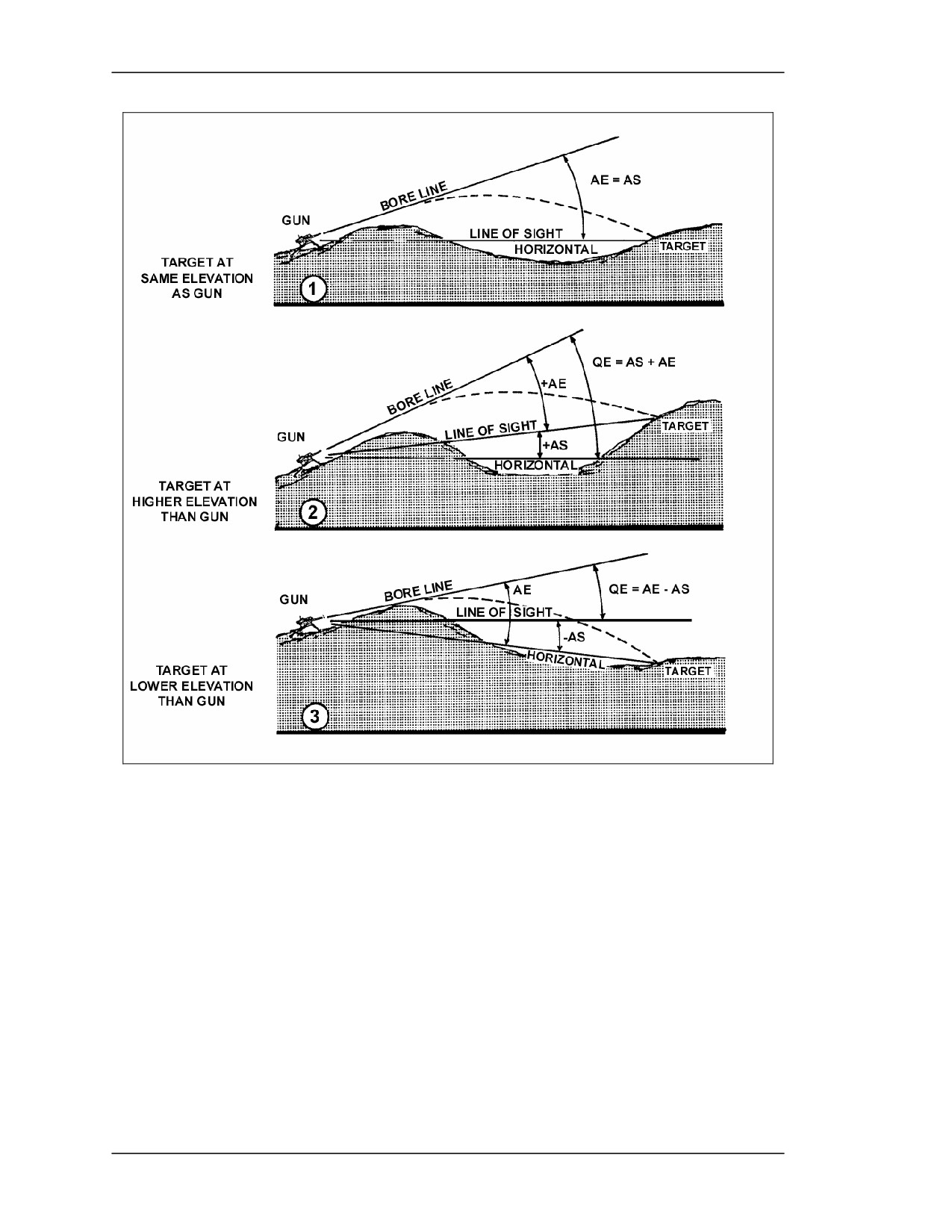
below the horizontal. It is the algebraic sum of the AE and the AS; that is, if the angle of
sight is positive, it is added to the AE; if the AS is negative, it is subtracted from the AE.
QE = AE + AS (target above horizontal line)
QE = AE - AS (target below horizontal line)
Other methods of elevation are as follows:
•
Computed quadrant elevation method. The leader must determine the correct
range to the target. Using the range, the leader finds the corresponding AE from
Appendix F, Firing Table. The leader must find the AS using binoculars, by
measuring in mils the vertical interval between the target and the estimated
horizontal. The leader may assume the distant horizon to be at a zero AS, or at
the same elevation as the MK
19 position. QE may be determined by
algebraically adding this data as previously described.
•
Measured quadrant elevation method. The gunner should locate the MK 19 in
partial defilade and lay it on the target using direct-lay methods. The leader
measures the QE with the M2 compass. The gunner moves the MK 19 into
defilade position and places the measured QE on the gun. For each meter
difference in elevation between the position in partial defilade and the firing
position, the gunner adds 1 mil to the QE when firing at a range of 1,000 meters;
1/2 mil when firing at 2,000 meters, and so on.
•
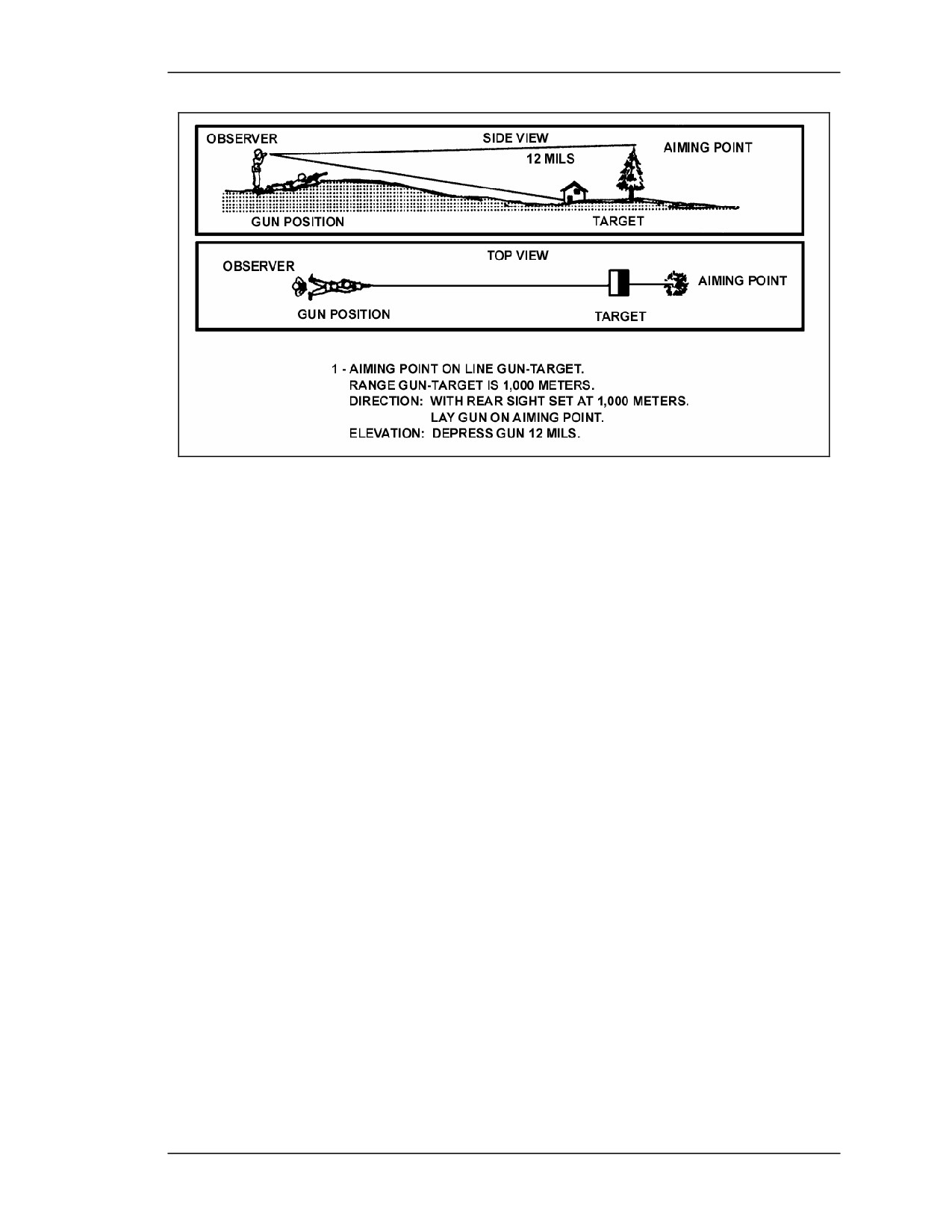
Aiming-point method. The gunner selects an aiming point visible from the MK
19 position; preferably a point at a greater range than the target and at a higher
elevation than the target, and the leader finds the range to the target. Using
binoculars, the leader measures the vertical angle in mils from the aiming point
to the base of the target. The leader has the gunner lay the MK 19 on the aiming
point, with the sight set to hit the aiming point, and then directs the gunner to
manipulate the gun through the number of mils measured from the aiming point
to the target. For example, the range to the target is 1,000 meters (Figure 5-25).
The angle read with the binoculars from the aiming point down to the base of the
target is 12 mils. The sight should be set at 1,000 meters, with the MK 19 laid on
the aiming point, and the muzzle then depressed 12 mils.
5-33
FM 3-22.27
Figure 5-24. Angle of elevation, angle of sight, and quadrant elevation.
(3) Mask Clearance. After the gun(s) has been laid, the leader must determine whether
or not the entire cone of fire will clear the mask, if mask clearance is not obvious. In order to
ensure mask clearance, the leader has the gunner sight on the crest of the mask and re-lays
the MK 19 for elevation on the target. The gunner ensures that the difference in elevation
from the MK 19 to the target and from the MK 19 to the mask is at least +10 mils. The
gunner checks this by sighting along the bottom of the receiver and the barrel.
5-34
FM 3-22.27
Figure 5-25. Aiming-point method for elevation.
NOTE: The procedures already discussed aid in the initial lay of the gun. The best
tactical application of fire from the defilade position is in defense when time is
not a factor, especially in a reverse slope defense. Leaders should try to register
their MK 19s on selected TRPs, as previously discussed. Use trial and error to
adjust for accurate fire from the defilade position. While the MK 19s are being
registered, every precaution must be taken to guarantee troop safety.
(4) Adjustment of Fire. Under field conditions, the MK 19 that is quickly laid on the
target seldom results in an initial impact directly on the target. Rapid adjustment of fire is
essential. This is assured by thoroughly training the observer to estimate range and lateral
distance. The observer should be in a position to see the initial impact. To ensure this, the
burst (three to five rounds) should be long. Except for long ranges, or when for other reasons
visual observation is hard, the observer does not ordinarily use binoculars for the initial
burst. If the initial lay is incorrect, the binocular’s limited field of view can cause the
observer to miss the impact of the round. Adjustment of fire should be bold and aggressive.
The observer should command large corrections and avoid creeping fire toward the target.
When a burst is incorrect for deflection and elevation, the observer’s next command should
correct both.
f. Construction of a Terrain Profile. The leader may use a side view or cross section
of the ground along a selected line or direction to determine where friendly and enemy forces
can see each other. The leader can also use it to plan fires; that is, to locate dead space, to
plan a defilade position, and so on. To construct a terrain profile, locate the gun position on
the map and determine the direction of fire, or profile line (Figure 5-26).
5-35

FM 3-22.27
Figure 5-26. Profile line (map contour lines are 20 meters).
(1) Place the edge of a lined piece of paper along the profile line. Tick-mark all points of
known elevation on the edge of the paper. These points are the contour lines. Any paper with
evenly spaced horizontal lines, such as graph or notebook paper, may be used. The wider the
spacing of the lines, the greater the vertical exaggeration in the profile; however this does not
affect the information.
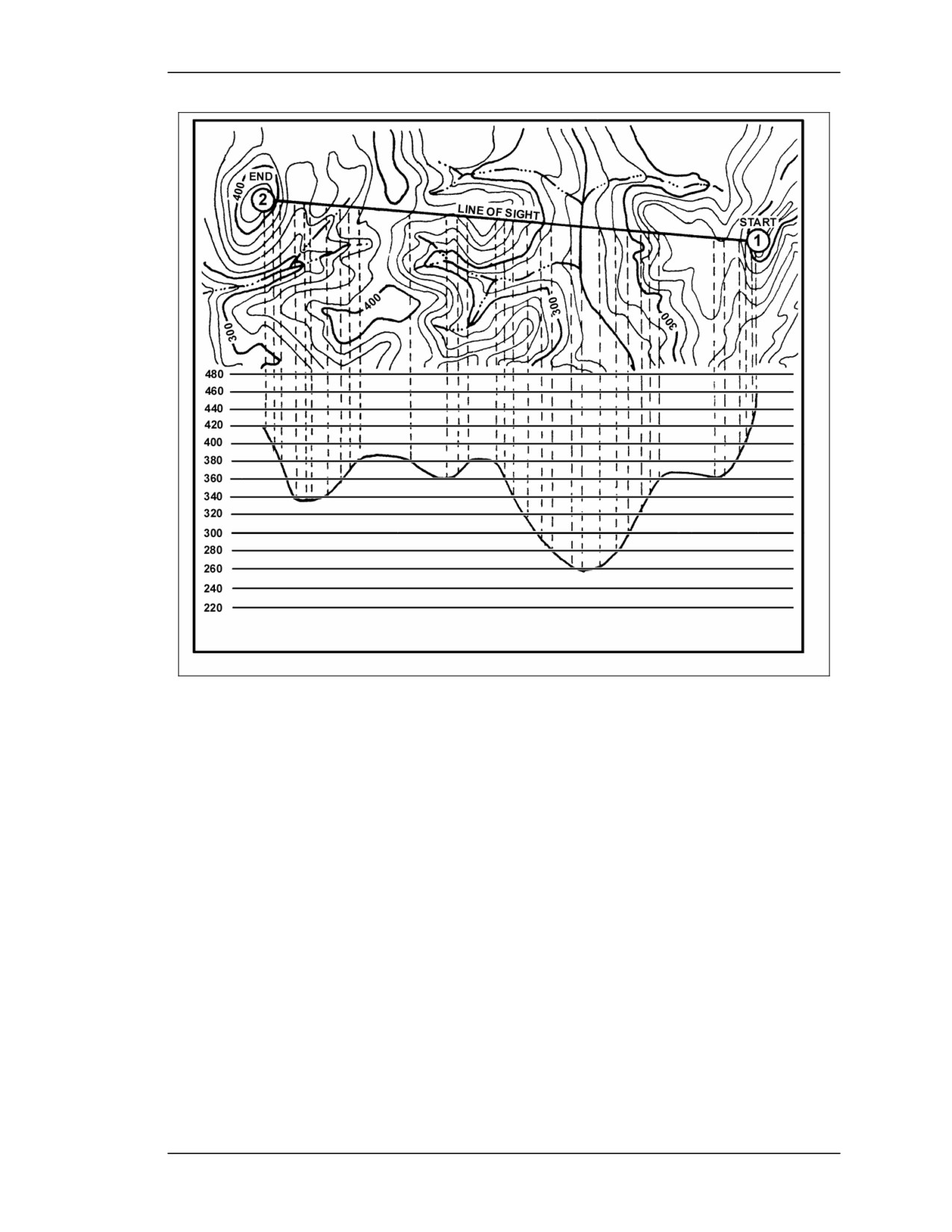
(2) Draw perpendicular lines, down across the horizontal lines for each marked point,
and identify the high and low points along the profile (Figure 5-27).
5-36
FM 3-22.27
Figure 5-27. Marking of elevation.
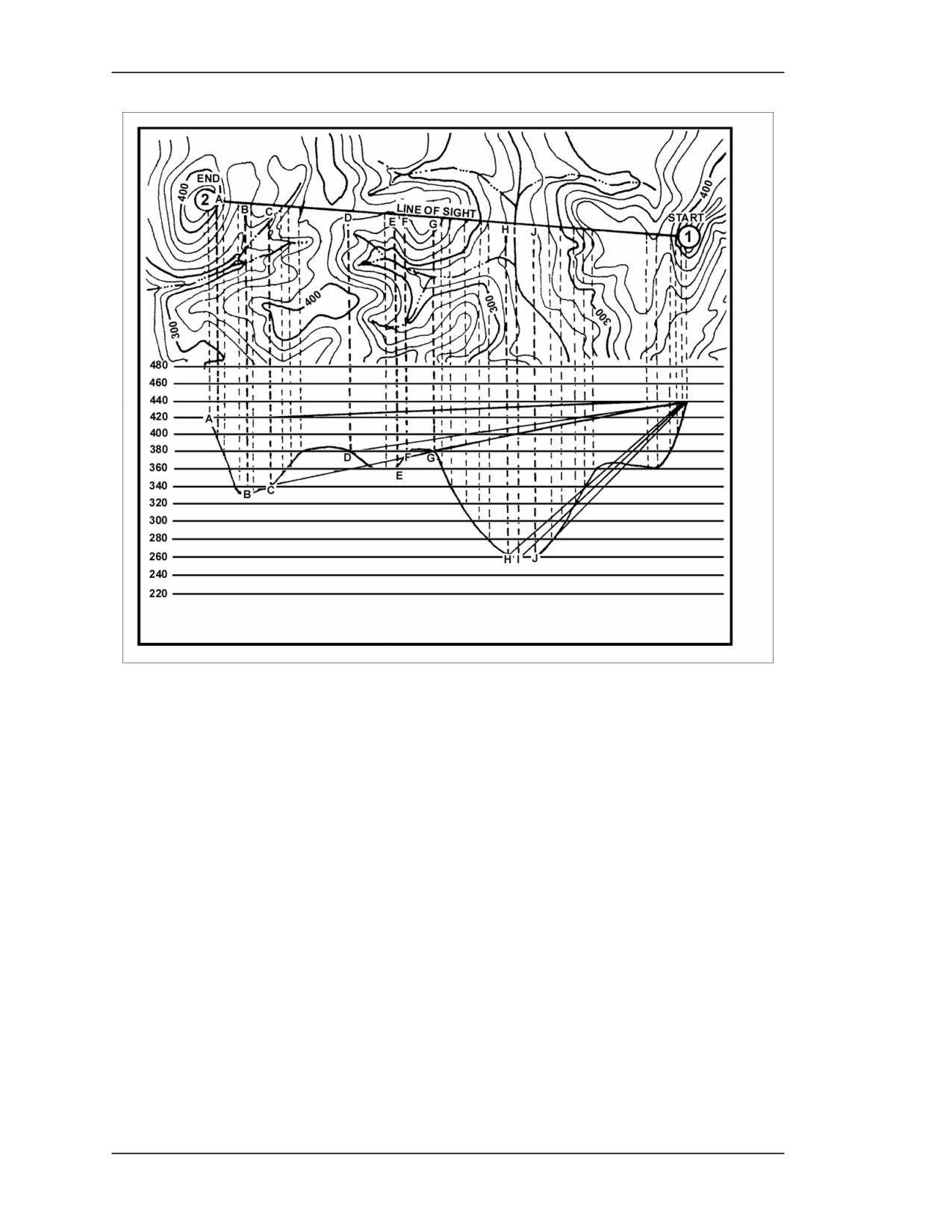
(3) Connect all the points with a smooth curve (Figure 5-28).
5-37
FM 3-22.27
Figure 5-28. Terrain profile.
Section IV. DEGRADED CONDITIONS
The MK 19 is fired the same way under degraded conditions as it is fired under good
conditions, except that degraded conditions limit the gunner’s ability to observe the impact
of rounds in relation to the target and to make adjustments. Refer to Appendix G, Aiming
Devices, for additional information.
5-14. NIGHT FIRING
The use of range cards and predetermined fires are important at night or during degraded
conditions because the targets or engagement areas are chosen and marked in advance,
which enables the gunner to adjust onto targets quickly and easily. The gunner must know
how to read his traversing slide bar and T&E mechanism. This task can be difficult at night
or during degraded conditions. The gunner can mark targets on the slide bar with luminous
tape, use mini-chemical lights, or use flashlights with red lens covers.
a. Firing with the use of illumination has proven to be much the same as firing during
normal daylight conditions. Estimation of distances and adjustment of rounds are difficult at
night or during degraded conditions. Gunners should be able, using illumination, to
effectively engage targets out to 800 meters as well as they can in the daylight. Due to long
5-38
FM 3-22.27
shadows and dispersion of light past this distance however, visibility is poor even with
illumination.
b. The AN/TVS-5 can be mounted on the MK 19 and used effectively to spot and adjust
rounds to targets out to ranges of 800 meters. Past this range, the elevation of the scope on
the gun is too high to see the impact of the rounds, so it can be handheld by an observer who
calls out adjustments to fire.
5-15. FIRING IN A NUCLEAR, BIOLOGICAL, OR CHEMICAL
ENVIRONMENT
Firing the MK 19 during NBC conditions is no different than firing in normal conditions.
Wearing the protective mask during firing does not change the way the gunner sights and
aims the MK 19 to engage targets. The assistant gunner should take care to avoid catching
his clothes or gloves while feeding ammunition. The gunner should also avoid contact with
the hot barrel.
5-16. FIRING IN FOG OR SMOKE
Neither the degraded conditions of fog or smoke change the way the gunner fires the MK 19.
The only limitations are observation of rounds and adjustment onto targets. The use of
predetermined fires, trip flares, PEWS, or forward observers can cut down on these
limitations.
Section V. PREDETERMINED FIRES
Predetermined fires are planned to cover target areas such as enemy avenues of approach,
likely sites for enemy guns, and probable enemy assault routes. Laying the MK 19 on
predetermined targets by either of the following methods may be verified by firing the MK
19 and adjusting it on target.
5-17. T&E MECHANISM METHOD
When the MK 19 is laid on target in the primary sector, the direction and elevation is taken
from the traversing bar and the T&E mechanism. Both direction and elevation, as well as the
range to each target, are recorded on the range card. Each target in the sector of fire must be
numbered and laid on in sequence.
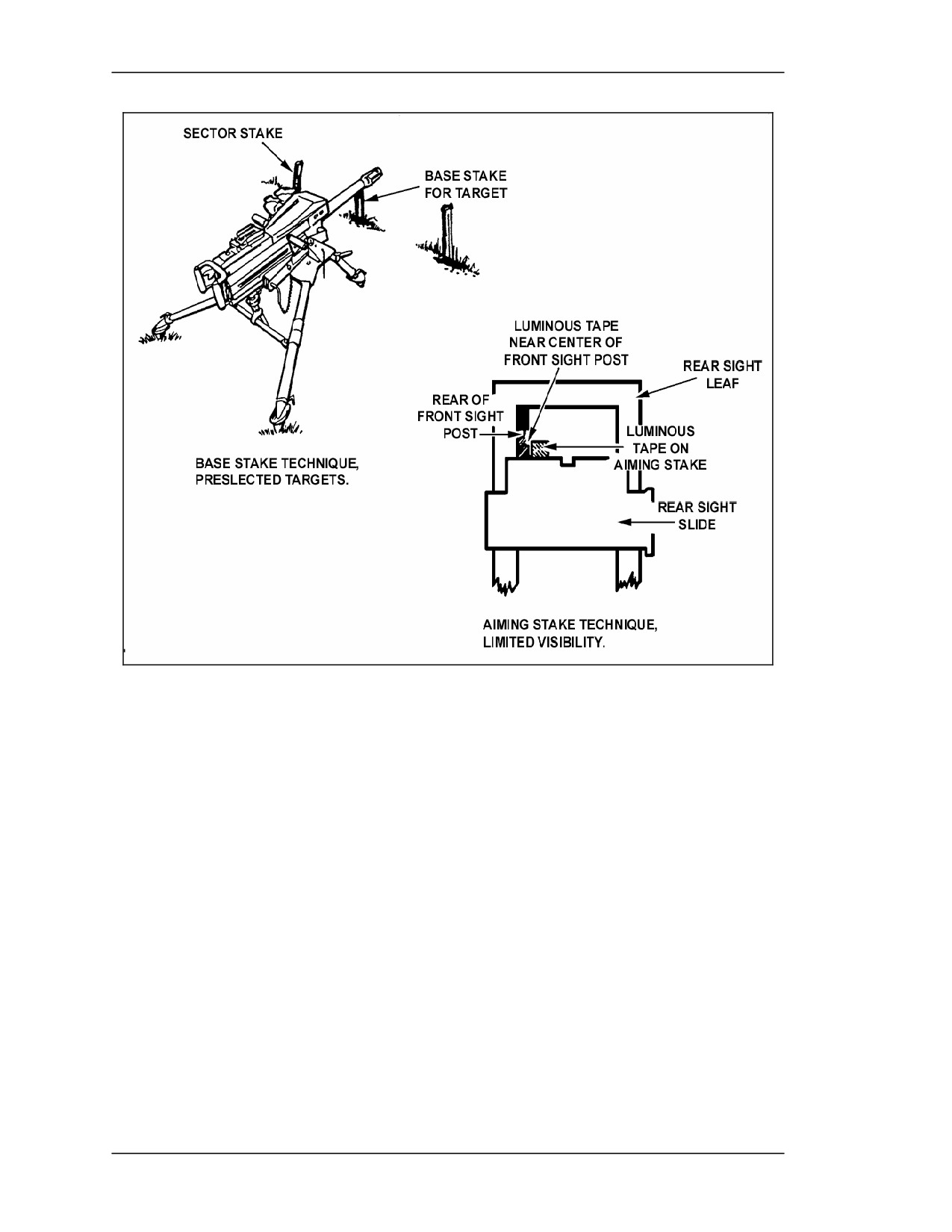
5-18. FIELD-EXPEDIENT METHOD OF LAYING THE MK 19
Another method for laying the MK 19 on predetermined targets is to use field expedients
(Figure 5-29). Field expedients must be used in the secondary sector, and consist of aiming
and base stakes. They can be used in the primary sector to aid the gunner.
5-39
FM 3-22.27
Figure 5-29. Techniques for laying the MK 19 using field-expedient method.
5-40
FM 3-22.27(FM 23-27)
CHAPTER 6
INFORMATION FOR INSTRUCTORS
This chapter provides information to aid instructors in training MK 19
crews to become skilled teams. This chapter is organized to lead the trainer
in a progressive manner through the material necessary to aid him in
training units. Information is presented beginning with preliminary subjects;
these areas include mechanical training, knowledge of the gun’s capabilities,
and the principles and fundamentals of MK 19 gunnery.
6-1.
PRESENTATION
To present instruction in the time allotted, the instructor must be prepared and rehearsed.
Assistant instructors and demonstrators must also be trained and rehearsed so they can
conduct demonstrations using training aids that clearly illustrate the information. Use public
address systems if the group is larger than a platoon.
a. Organization. Divide the soldiers into groups of appropriate size, while also
considering the phase of instruction and the facilities available. If available, assign an
assistant instructor to each crew; otherwise, position the assistant instructors so that they can
closely supervise the crew.
b. Presentation. Explain and demonstrate each portion of the instruction, following
with closely supervised practical work. Emphasize practice throughout training in order to
develop skill and teamwork. Secure and critique all MK 19 firing during training.
c. Examination. Ensure the soldiers make good progress throughout each period of
instruction. Those who do not progress well must receive more instruction under close
supervision. Give a formal or informal participation-type examination following each phase
of instruction to measure effectiveness of instruction.
6-2.
MECHANICAL TRAINING
During mechanical training, the gun is mounted on the M3 mount, or installed on a table.
Nomenclature charts (or mats) help the crewmembers learn the names of parts. If possible,
assign one assistant instructor for each crew. Present a brief history of the gun. Stress the
gun’s combat role and assigned mission. Emphasize the purpose, scope, and importance of
the instruction to be presented. Be sure to clearly define the term stoppage during the
introduction, and emphasize the need for correct care and cleaning procedures.
a. Organization. Organize the class into groups of appropriate size. If enough assistant
instructors are available, assign one to each crew; otherwise, position the assistant instructors
so they can closely supervise the crew.
b. Presentation. Table 6-1 can be used as a guide in presenting instruction in stoppages
and immediate action. Stress precision in detecting the cause and reducing stoppages. As the
soldiers progress, concentrate on speed in applying immediate action and other methods of
reducing a stoppage. Train the crew to function as a team.
6-1

FM 3-22.27
STOPPAGES
INSTRUCTION PREPARATION
Misfire due to defective primer.
Place a dummy cartridge in the belt.
Short round.
Place a short round in the belt.
Bulged round.
Insert a bulged round in the belt.
Belt loaded improperly.
Pull a cartridge partly out of the belt.
Battered or thick-rimmed
Place a battered or thick-rimmed
cartridge.
cartridge in the belt.
Failure to remove a round from
Place a dummy cartridge, with the
the chamber.
rim filed off, in the chamber.
Separated case that is removed
Drive the front portion of a cartridge
from the chamber by the new
securely on a dummy cartridge. Pull
round when the bolt is pulled.
the bolt to the rear and place the
cartridge properly on the face of the
bolt. Ease the bolt forward.
Table 6-1. Preparation for instructing stoppages and immediate action.
6-3.
CREW DRILLS
The demonstration crew must be well-trained and equipment must be complete. Use the
following equipment for each crew: basic table of organization and equipment (TOE) and
distinctive helmet markings that identify each crewmember according to his duties, and
normal individual equipment. For more information on crew drills see Appendix H.
a. Organization. Present initial instruction and demonstration to one crew. For
practical work, divide the class into crews of four men for each MK 19. To aid in control and
supervision, mark off equipment with engineer tape or wire, and line up the crewmembers
behind their equipment.
b. Presentation. Stress the fact that a crew drill is the first step in developing
teamwork, and that precision is required of every member for the crew to function smoothly.
During initial practice periods, work on precision. Talk each soldier through his duties as a
crewmember. Require the soldiers to do each operation when directed with speed and
precision.
c. Advanced Training. In advanced training, use a speed drill to create interest and
stimulate competition. This tactic also furthers teamwork and tests individual crew
performance. A well-trained crew should be able, without error, to place the gun into action,
or take it out of action in 25 seconds.
6-2
FM 3-22.27
6-4.
MARKSMANSHIP
With gun and mount, the instructor makes arrangements for a demonstration crew to be
available. He ensures that he has a sighting bar, an illustration of a correct sight picture, a
sighting target (panel with holder), a stopwatch, control flags, cleaning rods, and patches.
a. Organization. Organize the crew and the training area. Organize each crew with four
members, if possible. Use a centralized area, preferably with bleachers, for conferences and
demonstrations. The area should be fairly level, and large enough for the guns to be placed
10 meters from the targets.
b. Presentation. Ensure marksmanship basics are learned and practiced. Make sure the
soldiers know that marksmanship basics must be learned and practiced during the
preparatory phase of the marksmanship training, in order for them to satisfactorily complete
the marksmanship course. With the help of coaches and assistant instructors, ensure that
steps are done correctly during the preparatory phase of marksmanship. Give a brief
description of the operation, general data, and exterior nomenclature of the MK 19. Ensure
that assistant instructors disassemble and assemble the MK 19 while the procedure is being
explained.
NOTE: When the crews can skillfully disassemble and assemble the gun, demonstrate
this phase of instruction to them blindfolded, using an assistant. Doing this
encourages crews to practice during their free time, and develops individual skill
and initiative.
Ensure the crew does not assemble or disassemble the MK 19 under stress against time
because there is a danger of damaging the gun’s parts.
c. Operation. Each crew requires a MK 19 mounted on an M3 mount and a belt of five
dummy rounds. Emphasize the safety factors involved. Stress how the feed throat must be
attached before loading the MK 19. Demonstrate the method of letting the bolt go forward.
d. Functioning. Training aids are useful if the class is platoon-sized; otherwise, training
aids may be used for study and discussion during breaks. Use one gun for each crew, as in
previous mechanical training instruction. Divide functioning into six phases (see Chapter 2,
Operation and Function). Explain and demonstrate each phase of functioning. Assistant
instructors should duplicate each demonstration on the guns within each crew. With these
setups at the guns, each crewmember can see how the parts work. Setups may be used for
each phase of functioning.
6-3
FM 3-22.27(FM 23-27)
APPENDIX A
TRAINING STRATEGY
This appendix discusses the two primary components of training
strategies: initial and sustainment training.
A-1. COMPONENTS
Training strategies have two primary components: initial and sustainment training.
Both may include individual and collective skills, but initial training is critical. With
initial training a soldier retains a correctly taught task that he has learned well. With
such training, he can easily sustain or quickly regain his performance. Thus, leaders
must conduct initial training correctly and well.
a. Trainers use standard, common, and current procedures. Regardless of how
well skills are taught or learned, individual and unit skills decay over time. How fast
and how much skills decay depends on many factors. Personnel turnover is a primary
factor in the decay of collective skills. Other factors include the difficulty and
complexity of the tasks.
b. When the unit loses critical crewmembers, it must quickly train new gunners
to restore unit proficiency. If too much time passes between initial and sustainment
training periods or if the unit alters the established training doctrine, skills erode and
the unit might have to completely retrain its MK 19 gunners.
c. A critical step in the Army’s overall training strategy is to train leaders and
trainers first. Leader courses and unit publications help develop officer and
noncommissioned officer
(NCO) proficiencies needed to plan and conduct
marksmanship training. These resources also help leaders learn how to evaluate the
effectiveness of unit marksmanship programs. Proponent schools provide training
support materials. These materials include field manuals, training aids, training
devices, simulators, and programs of instruction that serve as the doctrinal foundation
and guidance for training the force.
A-2. INITIAL TRAINING
The MK 19 training strategy starts with leader training and goes on to unit training.
Because “MK 19 gunner” is a Skill Level 2 position, the MK 19 gunner receives most
of his MK 19 training within the unit. The training institution provides the unit with a
soldier who has received training in the basics of the MK 19. The unit plans minimal
MK 19 training for advanced individual training (AIT) soldiers.
A-3. SUSTAINMENT TRAINING
Basic MK 19 gunnery skills and gunner qualification continues in units. Once
soldiers learn individual and crew skills, the unit must help them sustain those skills.
To do this, leaders follow the annual gunnery-training program provided in Appendix
E, Annual Gunnery Training Program. In addition to sustaining skills, the unit
incorporates the MK 19 into collective training exercises such as platoon and squad
live-fire situational training exercises (STXs).
a. The strategy for sustaining basic MK 19 gunnery skills includes annual or
semiannual instructional and qualification range firing. However, the unit must set up
A-1
FM 3-22.27
a year-round sustainment program. Key elements of the sustainment program include
training the trainers, refreshing preliminary skills, and using devices to remedy the
training of soldiers who have trouble qualifying on the MK 19.
b. The unit also trains the gunner in other skills such as night firing; mission-
oriented protective posture
(MOPP) firing; engaging moving targets, using
camouflage, cover and concealment; firing and maneuvering; and preparing or
selecting a fighting position. The unit also integrates these skills into tactical training.
The references at the back of this manual contain additional guidance on the training
for these skills.
c. The unit integrates individual and leader MK 19 tasks into collective training
such as squad, section, and platoon drills and STXs as well as company LFXs and
field training exercises (FTXs). Organizational mission training plans (MTP) and drill
books include the tasks, conditions, and standards for the collective tasks in these
exercises. These books also explain how to plan and conduct such collective tasks.
Based on the type of organization, the unit evaluates collective exercises in leader and
trainer after-action reviews (AARs). Objectively evaluating both individual and unit
proficiency indicates the readiness and future training requirements.
d. Trainers schedule live fire after the soldiers demonstrate preliminary skills. For
initial fire, the trainer conducts an instructional exercise. This improves the soldiers’
ability to acquire targets with the MK 19. Once soldiers understand the gun and
demonstrate the skills needed to acquire a target, the trainer conducts additional live-
fire training and target-detection exercises at various ranges. To develop proficiency,
soldiers have to master targets and scenarios of increasing difficulty. After initial
individual training, the trainer conducts qualification fire on a range to evaluate each
soldier’s skills. When conducted in accordance with Chapter 4, Marksmanship, this
evaluation also gives leaders some insight into the unit’s skill and training
effectiveness.
A-2

FM 3-22.27(FM 23-27)
APPENDIX B
OPERATIONS CHECKLIST
This appendix consists of an operations checklist of procedures to be
followed before, during, and after use of the MK 19.
WEAPON PART
BEFORE
DURING
AFTER
1. Bore
Ensure it is clear and clean.
_______________
Clean and oil
lightly.
2. Moving parts
Oil lightly and test for worn or
Lubricate
working
Inspect, clean,
broken parts. The moving parts
parts. Observe the
and oil lightly.
should function without excessive
functioning of the gun
friction.
to anticipate failures.
3. Ammunition
a. Ensure the correct type of
Keep correctly aligned
Clean, store
ammunition is used.
in the feedtray. Check
carefully, and
resupply. Protect from
replenish
b. Ensure the ammunition is clean
sun, moisture, and
supply.
and dent free.
dirt. Watch for link
stoppage.
c. Ensure all ogives are tight.
d. Have an adequate supply of
ammunition on hand.
4. Top cover
Inspect the top cover for dents or
Keep closed and
Lube properly
damage.
locked down.
after cleaning.
5. Line of fire
Ensure the line of fire is clear of all
Cease fire if any
___________
obstructions.
obstruction appears in
the line of fire.
Table B-1. Operations checklist.
B-1
FM 3-22.27(FM 23-27)
APPENDIX C
STOPPAGES, MALFUNCTIONS, IMMEDIATE ACTIONS,
AND REMEDIAL ACTIONS
A stoppage is any interruption in the cycle of operation caused by faulty
action of the weapon or ammunition. A malfunction is a failure of the weapon to
function properly. Neither defective ammunition nor improper operation of the
gun by a crewmember is considered a malfunction of the MK 19. This appendix
lists the actions to correct common stoppages and malfunctions. For more
complete information on troubleshooting common malfunctions and stoppages,
refer to TM 9-1010-230-10 Troubleshooting Index.
Section I. STOPPAGES, IMMEDIATE ACTIONS, AND REMEDIAL ACTIONS
A stoppage is cleared through immediate or remedial action. Immediate action is the
action taken to reduce the stoppage without investigating the cause. The gunner takes
remedial action if immediate action does not end the stoppage. Remedial action has three
parts: the gunner first unloads and clears the MK 19, identifies the problem, and then
applies corrective action to fix the problem. If the MK 19 still does not fire, or cannot be
repaired at the user level, contact the unit armorer.
C-1. IMMEDIATE ACTION
Immediate action is different during peacetime and combat.
a. Immediate Action During Peacetime and Training. The gunner does the
following immediate action to reduce a stoppage during peacetime.
CAUTION
Both charger handles must be forward and up for firing. If either
handle is down, the gun will not fire.
(1) The gunner ensures the safety of other personnel and clears the weapon of
ammunition by performing the following steps in sequence:
(a) Clear the area of personnel.
(b) Pull bolt to the rear. If the bolt does not go to the rear, go to BOLT JAMMED.
(c) Catch the live round as it is ejected.
(d) Push the charging handles forward and up.
(e) Put the gun on S (SAFE) and check for any bore obstructions.
(f) If bore is clear, move safety switch from the S (SAFE) to the F (FIRE) position,
and attempt to fire.
(g) If nothing happens, put gun on S (SAFE) and wait 10 seconds.
(h) Pull the bolt to the rear.
(i) Catch the live round as it is ejected.
(j) Open the top cover and clear the ammunition.
(k) Check bore for any obstructions.
C-1
FM 3-22.27
(2) Charge the MK 19 in the normal manner and check to see the primary pawls have
clicked up behind the cartridge in front of the bolt face and that the secondary pawls have
clicked up behind the next round before firing. The feed pawls should click up within the
1-inch of charging handle travel.
(3) If the primary and secondary pawls do not click up within the last 1-inch of
charging travel, follow these procedures:
• Turn the MK 19 into unit level maintenance.
• Record ammo lot number, type of ammo, number of rounds fired, serial
number of the MK 19 and indicate whether ammo is linked with one-piece or
two-piece links.
WARNING
1. Do not use combat misfire procedures during peacetime
or training. Serious injury can result if precautions are not
observed.
2. Do not relink or fire ammunition that has been cycled
through the weapon.
b. Immediate Action During Combat. To correct a misfire during combat, perform
the following immediate actions:
(1) Press charger handle locks and rotate charger handles down.
(2) Pull charger handles to the rear until the bolt sears.
(3) Push charger handles forward and rotate charger handles up and lock.
(4) Relay and fire.
(5) Turn in live rounds that cycled through the weapon as instructed by current
directives.
C-2. REMEDIAL ACTIONS TO CLEAR STOPPAGES
If the weapon still does not fire, the gunner clears the weapon, identifies the problem and
then takes corrective action to fix or report the problem.
a. Bad Ammunition. Bad ammunition can cause a stoppage and is checked first.
(1) Primer on the Ejected Round is Indented. Clear the weapon and check to see if
the primer is indented. If the primer is indented, it is a bad round and dispose of it as
authorized. Reload the weapon and continue with the exercise.
(2) The Primer is Not Indented. Clear the weapon and check to see if the primer is
indented. If the primer is not indented, then the firing pin can be bad. Turn the MK19 into
unit level maintenance.
(3) Round on Bolt Face. Clear the weapon. If the round remains on the bolt face,
remove the round and place the weapon on S (SAFE) with the bolt to the rear. Check the
primer and see if it is indented. See the aforementioned steps for the corrective action.
b. Ammunition Jammed in Feeder. A misfire might occur due to ammunition
jammed in feeder. Clear the weapon and put gun on S (SAFE).
C-2
FM 3-22.27
(1) Feed Throat Improperly Attached. Check for proper attachment of the feed
throat. If the feed throat is attached incorrectly, then re-attach it and reload. Try to
recharge and fire the weapon. If charging is not possible, go to BOLT JAMMED.
(2) Rounds Crooked or Not Seated Firmly. Clear the weapon. If the rounds are
crooked or not seated firmly, remove the linked ammunition from feeder. Ensure the link
band is even and adjacent to copper band all around ammo. Reload and continue with the
exercise.
(3) Broken Link. A broken link can cause the weapon to stop firing. Clear the
weapon. If the link is inside the weapon, remove the link. If it is still on the round, then
remove the round and dispose it as authorized. Reload and continue with the exercise.
(4) Link Off Rotating Band. Clear the weapon. Remove round from belt, dispose of
round as authorized. Reload and continue with the exercise.
(5) Female Link Not First. A round loaded with the female link not first will cause a
stoppage. Clear the weapon. Reload the weapon and ensure that the female link is first.
c. Bad Firing Pin. A stoppage might occur due to a bad firing pin or firing pin
spring. A possible bad firing pin can be determined while checking for a bad round.
(1) Primer on Ejected Round Not Indented. Clear the weapon. If the primer on the
ejected round is not indented, then the firing pin may be bad. Report the defect to the
unit armorer.
(2) Firing Pin Tip Fails to Spring Forward. Clear the weapon. If the firing pin tip
fails to spring forward then the firing pin spring can be bad. Report the defect to the unit
armorer.
d. Defective Feeder or Feed Slide Assembly. A misfire might occur due to a
defective feeder or feed slide assembly.
CAUTION
Clear feeder of ammunition. Make sure gun is on S (SAFE).
(1) Broken or Worn Feed Pawls. Clear the weapon and check to see if the primary
and secondary pawls are broken, worn, without spring action, or the pin is missing or
dislodged. If they are, turn the MK 19 into unit level maintenance.
(2) Badly Worn or Gouged Link Guides. Clear the weapon and check to see if the
guides are worn or gouged. If they are, turn the MK 19 into unit level maintenance.
(3) Binding Feed Slide Assembly. Clear the weapon. Remove the feed slide assembly
and tray. Clean, inspect and lubricate feed assembly and tray. If the feed slide assembly
continues to bind, report the defects to armorer or support maintenance.
e. Bolt Won't Pick Up the Round. A misfire might occur because a bolt won’t pick
up the round.
(1) Charging Handles are Down. Clear the weapon. Raise the charging handles
before firing. If the weapon still does not fire, report defects to the armorer or support
maintenance.
(2) Dirt-Clogged, Weak, or Damaged Extractors. Clear the weapon and remove
obstruction. Clean, lubricate, and reload weapon. Continue with the exercise.
C-3
FM 3-22.27
(3) Feed Slide Out of Adjustment. Clear the weapon. The feed slide is out of
adjustment if:
• Round fails to feed.
• Round drops.
• Extractors won’t pick up round.
• Round stubs on face of chamber.
Report defects to armorer or support maintenance.
f. Bolt Drops a Round Before Firing. A stoppage may occur because a bolt drops
a round before firing.
(1) Weak or Damaged Extractors or Bolt Fingers. Clear the weapon and check for
weak or damaged extractors or bolt fingers. Report any defects to the armorer or support
maintenance.
(2) Binding Receiver Rails. A misfire might occur because of binding receiver rails.
Clear the weapon and pull the bolt to the rear without stopping or pausing. Ease it
forward (holding onto one charging handle while you press the trigger) and check for
binding. Place weapon on S (SAFE) and remove backplate pin. Lift up slightly on the
backplate assembly and pull the bolt and backplate assembly to the rear. Remove the
chargers. Check the charger rails and receiver rails for burrs. Report defects to armorer or
support maintenance.
WARNING
Be sure bolt is forward before removing backplate pin
assembly. If not, serious injury could result.
CAUTION
When installing bolt and backplate, ensure cocking lever is
in the forward position. Damage to equipment could result if
cocking lever is to the rear.
g. Bad Cocking Lever. Clear the weapon and remove the bolt and backplate
assembly. Examine the cocking lever on the left side of the bolt for wear or damage.
Report defects to armorer or support maintenance.
h. Unknown Cause. If the MK 19 stops firing and the procedures above do not
identify and correct the problem, then turn it into the armorer or support maintenance.
Section II. MALFUNCTIONS, EMERGENCY ACTIONS
AND REMEDIAL ACTIONS
A malfunction is a failure of the weapon to function properly. Neither defective
ammunition nor improper operation of the gun by a crewmember is considered a
malfunction of the MK 19. The two most common MK 19 malfunctions are sluggish
action and runaway gun.
C-4

FM 3-22.27
CAUTION
Do not try to break the ammunition belt; injury could result. Lower
one charging handle to stop the gun.
WARNING
1. Before performing any non-firing procedure, ensure the weapon is
clear of any ammunition.
2. Ensure all ammunition and non-essential personnel are at least 65
meters to the rear of the weapon.
3. If the bolt jams during firing, do not let the bolt slam forward as the top
cover is being opened because a round could fire.
4. Be sure to put bolt in forward position before removing the backplate
pin assembly. Serious injury can result if the pin assembly is removed
with the bolt to the rear.
5. Be prepared to catch dropped/ejected live round from weapon.
C-3. SLUGGISH OR ERRATIC FIRING
Excessive friction from dirt, carbon buildup, lack of lubrication, or burred parts usually
causes sluggish or erratic action. Once the gunner realizes that the gun is operating
sluggishly or erratically, he should cease-fire and clear the weapon. The two primary
corrective actions are cleaning or turning the weapon into the armorer. There are several
reasons why a weapon may exhibit sluggish or erratic firing.
a. Dirty Bore or Chamber. A dirty bore or firing chamber can cause sluggish or
erratic firing. Clear the weapon and clean its bore and chamber. Reload and continue with
the exercise.
b. Recoil Springs or Guide Rods. Clear the weapon and remove the bolt and
backplate assembly from gun. Push against springs to test for weakness. Note bent rods.
Report defect to armorer or support maintenance.
c. Bolt Sear Timing Adjustment. Clear the weapon and turn it into direct support
maintenance.
C-4. RUNAWAY GUN
A runaway weapon continues to fire after the trigger has been released. Worn parts or
short recoil of the bolt assembly may cause a runaway gun. Consider the amount of
ammunition left and the type of MK 19 mount used when determining the best way to
stop the weapon.
a. Emergency Action. This paragraph addresses emergency actions that must be
taken to stabilize uncontrolled automatic fire. The following procedures should be taken
to control a runaway gun:
(1) If ammunition is not low and the MK 19 is used in the free gun mode, keep
rounds on target until the all the rounds on the belt have been fired.
C-5
FM 3-22.27
(2) If the MK 19 is mounted on either the M3 tripod or on a vehicle with the T&E
mechanism attached, hold the grip with one hand. At the same time, press the charger
handle lock and lower one charger handle. This action interrupts the cycle of operation,
causing the MK 19 to cease firing. The gunner therefore:
(a) Keeps gun pointed downrange and slightly elevated.
(b) Presses charger handle locks.
(c) Lowers the charging handle(s) so the gun will stop firing.
(d) Places the gun on S (SAFE).
WARNING
Never try to break the ammo belt with your hands. Injury
could result. Lower one charger handle to stop gun from
firing.
b. Once the gun has stopped firing, clear the weapon and report the condition to the
armorer or support maintenance.
C-5. BORE OBSTRUCTION
A bore obstruction is indicated by a muffled sound of round firing, excess smoke out of
the chamber, and/or excess debris/gases below the gun.
a. Emergency Action. The emergency actions for an obstructed bore are the
following:
(1) Place weapon on S (SAFE).
(2) Notify range safety officer (during training).
(3) Depress feed pawls, release ammunition belt, and clear feed.
(4) Move the ammunition belt and can to a safe area.
(5) Remove the empty case catch bag.
(6) Charge gun and hold bolt to rear.
WARNING
Do not relink or fire any ammunition that has been
cycled through the weapon.
(7) Holding the bolt to the rear, insert a cleaning rod through the receiver rail to the
top of the shell casing and as close to the face of the bolt as possible.
(8) Place left hand underneath as close to the round as possible. Raise cleaning rod
upward forcing the round off the bolt face into the hand. Remove round to designated
area for explosive ordinance disposal (EOD).
b. Correcting an Obstructed Bore. To correct an obstructed bore follow these
procedures:
(1) Place selector lever on F (FIRE) and ease the bolt forward.
C-6
FM 3-22.27
(2) Remove the backplate pin bolt, backplate assembly, vertical cam assembly, and
primary drive lever.
(3) Check for any type of obstruction.
(4) Check and remove any case or round from bolt face.
(5) Insert bore obstruction detector into bore to check for a live round.
(6) Remove obstruction per round removal procedures (for exact bore obstruction
instructions using the round removal tool, refer to WP 0014 00).
C-6. GUN FIRES TOO SOON
If the weapon fires too soon, or when the trigger is not engaged, the gunner applies
emergency action and the weapon is taken to support maintenance. The gunner must not
continue to fire the weapon. The following emergency actions must be taken if a weapon
fires too soon:
WARNING
Do not attempt to clear the weapon if the weapon fires too
soon. Do not attempt to clear or fire the weapon until it is
fixed.
(1) Cease fire.
(2) Place weapon on S (SAFE).
(3) Clear area of personnel and ammunition.
(4) Notify the range safety officer.
(5) Check barrel for lodged round using the bore obstruction detector (BOD).
(6) After proper personnel have cleared weapon, evacuate weapon to support
maintenance.
C-7. BOLT JAMMED
The following actions are taken if the gunner cannot pull the bolt to the rear.
WARNING
The following procedures must be performed in sequence
to open the top cover. The bolt could spring forward
suddenly and fire a round causing severe injury. Be
prepared to catch ejected round.
a. Emergency Action and the Bolt Can be Pulled to the Rear. The following
emergency actions must be taken if the weapon initially jams but the bolt can then be
pulled to the rear.
(1) Put gun on S (SAFE).
(2) Press charger handle locks and rotate charger handles down.
C-7
FM 3-22.27
(3) Pull charger handles to the rear as far as possible without stopping or pausing,
until bolt locks. Ensure bolt will stay to the rear before releasing charger handles.
(4) Maintain rearward pressure on charging handles while assistant lifts top cover.
(5) Insert cleaning rod section through slot in side of receiver. Prepare to the catch
ejected, live round.
(6) Raise cleaning rod to force live round down. Catch live round as it is ejected.
(7) Remove ammo belt from feeder.
(8) Reposition ammo belt in feeder.
(9) Put gun on F (FIRE).
(10) Ride the bolt forward by grasping one charging handle and depressing the trigger.
(11) Ensure feed slide assembly is to the left.
(12) Ensure secondary drive lever is engaged with the feed slide pin. If not, engage
forked end with feed slide pin.
(13) Close top cover gently.
(14) Charge weapon and attempt to fire.
(15) If bolt still jams, repeat first seven steps. Put weapon on S (SAFE), and evacuate
to support maintenance.
b. Gunner's Actions. The gunner performs the following action once emergency
actions are completed:
(1) Clear the jam and make sure there is no bore obstruction.
(2) Charge the MK 19 in the normal manner, and check to see if the primary pawls
have clicked up behind the cartridge in front of bolt face and the secondary pawls have
clicked up behind the next round before firing. The feed pawls should click up within 1-
inch of the charging handle travel.
(3) Check the ammo link to ensure it is even and touches the copper band all around
the ammo. If the primary and secondary pawls do not click up within the last 1 inch of
the charging handle then:
• Turn MK 19 into unit level maintenance.
• Record ammo lot number, type of ammo, number of rounds fired, serial
number of the MK 19 and indicate whether ammo is linked with one-piece or
two-piece links.
(4) If the MK 19 does not require feed slide adjustment and there appears to be no
other deficiencies that would prevent the weapon from firing, it should be turned into the
armorer or support maintenance.
C-8
FM 3-22.27
C-8. SHORT RECOIL
A short recoil occurs when the bolt does not fully return to the rear.
WARNING
When firing HE or TP ammunition, the gunner should observe
downrange and attempt to determine if the round left the barrel and
also be alert to these three danger signals:
1. A muffled report from the gun.
2. Smoke and debris from the bottom of the receiver.
3. Failure of the projectile to leave the muzzle.
Any of these three symptoms mean a bore obstruction. Do not
attempt to clear a bore obstruction.
a. Emergency Actions after a Short Recoil. The gunner does the following actions
after a short recoil:
(1) Place weapon on S (SAFE).
(2) Clear area of personnel and ammunition.
(3) Notify range safety officer.
(4) Pull the charger handles to the rear, without stopping or pausing, until the bolt
locks. Ensure that the bolt stays to the rear before releasing the charger handles.
(5) Insert cleaning rod section through slot in side of receiver. Prepare to catch the
ejected live round.
(6) Raise cleaning rod to force live round down. Catch the live round as it is ejected.
(7) Raise top cover.
(8) Remove ammo belt from feeder.
(9) Check for bore obstruction using bore obstruction detector.
(10) If bore is obstructed, refer to the section above on clearing bore obstructions or
refer to WP 0014 00 for round removal procedures.
(11) If there is no obstruction, reposition belt in feeder.
(12) Ensure feed slide assembly is to the left.
(13) Charge weapon and attempt to fire.
b. If a short recoil occurs again, repeat the first eight steps. Put weapon on S (SAFE)
and turn it into support maintenance.
C-9. TOP COVER WILL NOT CLOSE
The gunner checks the following so that the top cover can be closed.
a. Improper Position of the Feed Slide Assembly. Move feed slide assembly all
the way left. The spring should touch the cover.
b. Bolt is Locked to the Rear. Ride the bolt forward.
c. Misaligned Ammunition. Ensure rounds are straight and firmly seated in the
feeder. Ensure links are evenly aligned in the link guide and on rounds. Clean dirt from
the feeder.
C-9
FM 3-22.27(FM 23-27)
APPENDIX D
GUNNERY TESTS
There are three gunnery tests: a diagnostic gunnery test, an intermediate
gunnery test, and a gunnery skills test. The instructor is responsible for the
conduct of all tests and must ensure that sufficient scorecards or answer
sheets are available.
D-1. DIAGNOSTIC GUNNERY TEST
This written test, given before and during preparatory training, evaluates trainees’
knowledge of the MK 19. It also serves as an evaluation tool for the instruction. Training
units prescribe procedures for the test, and announce scores of those who satisfactorily
complete the test. If this test is used, it should be given before range firing. To satisfactorily
complete the test, the trainee must earn 80 out of 100 points.
POINTS
1.
Name the five major assemblies of the MK 19.
5
2.
Explain how to clear and disassemble the MK 19.
15
3.
Explain how to assemble the MK 19.
15
4.
Explain how to perform a function check.
5
5.
Explain how to apply immediate action to a runaway gun.
5
6.
Explain how to apply immediate action when a malfunction occurs.
10
7.
Explain one phase of functioning (directed by the examining officer).
10
8.
Explain why the weapon should not be fired with the top cover
10
assembly open.
9.
Explain how to inspect ammunition before loading (belt to have at
10
least one each of the following: short round, bent round, loose bullet,
broken link or round not pushed fully into its link).
10.
Explain how to load to half-load position.
5
11.
Explain and demonstrate sight alignment.
10
___
TOTAL
100
D-2. INTERMEDIATE GUNNERY TEST
This written test, given at the end of preparatory marksmanship training, is used to evaluate
the instruction as well as the soldier’s gunnery skills. This test has 21 questions: 20 multiple-
choice and 1 true or false. Each soldier must correctly answer 17 of the 21 in order to move
on to the next phase of training. The instructor is responsible for the conduct of the test. The
following is a sample of the standard Intermediate Gunnery Test.
D-1
FM 3-22.27
INTERMEDIATE GUNNERY TEST
1.
What are the MK 19's five major groups (field strip groups)?
a. Receiver assembly, top cover assembly, sear assembly, bolt
assembly, and feed slide assembly.
b. Top cover assembly, receiver assembly, barrel, sear assembly
and feed tray, and bolt and backplate assembly.
c. Receiver assembly, feed slide assembly and feed tray, top
cover assembly, sear assembly, and bolt and backplate
assembly.
d. Sear assembly with chargers, receiver assembly, feed tray
assembly, top cover assembly, bolt and backplate assembly.
2.
Where on the weapon is the safety located?
a. On the right side of the receiver assembly.
b. On the left side of the receiver assembly.
c. On top of the receiver assembly.
d. On the sear assembly at the bottom rear of the receiver
assembly.
3.
In a nonfiring situation to clear the weapon, in which order are the
steps below taken?
a.
2, 4, 3, 1.
b.
1, 3, 4, 2.
c.
3, 1, 2, 4.
d.
1, 2, 4, 3.
1. Ensure that the safety switch is in the S (SAFE) position,
and the bolt is forward. Open the top cover by rotating the top
cover latch counterclockwise. Lift the cover.
2. Return the bolt to the full forward position. Rotate the
charger handles upward.
3. Inspect the feed tray and extractors on the top of the bolt to
make sure no round is in the “pickup” position.
4. Unlock and pull the charging handles to the rear two to
three inches. Inspect the face of the bolt and the chamber.
D-2
FM 3-22.27
4.
In which substance(s) should you never immerse the bolt and
backplate assembly?
a. Cleaning solvent.
b. Lubricant.
c. Bore cleaner.
d. All of the above.
5.
Under which conditions should you apply a generous second coat
of lubricant when cleaning the weapon?
a. Hot, wet, salt air, sea spray.
b. Hot, dry, sandy, dusty.
c. Cold, icy, snow.
d. All of the above.
6.
Under which conditions should you use a second coat of lubricant?
a. Hot, wet, salt air, sea spray.
b. Hot, dry, sandy, dusty.
c. Cold, icy, snow.
d. All of the above.
7.
During reassembly, what is the first major group you should place
back onto the weapon?
a. Sear assembly.
b. Bolt and backplate assembly.
c. Top cover assembly.
d. Receiver assembly.
8.
To ensure the primary and secondary drive levers align properly
when you close the top cover of the weapon, in what positions
should you place the feed slide assembly and bolt?
a. Left, to the rear.
b. Right, to the rear.
c. Left, forward.
d. Right, forward.
9.
What is the maximum range of the weapon, in meters?
a.
1,500.
b.
2,212.
c.
2,000.
d.
1,800.
10. What is the maximum effective range of the weapon, in meters, for
point targets?
D-3
FM 3-22.27
a.
1,500.
b.
2,212.
c.
2,000.
d.
1,800.
11. What is the cyclic rate of fire for the weapon, in rounds
per minute?
a.
225 to 275.
b.
275 to 325.
c.
325 to 375.
d.
375 to 425.
12. What is the main characteristic(s) of the MK 19?
a. Fully automatic.
b. Blowback operated.
c. Air-cooled.
d. All of the above.
13. Which mount(s) should you avoid attaching the weapon to?
a. M3 tripod without the T&E mechanism.
b. M3 tripod with the T&E mechanism.
c. M4 pedestal.
d. All of the above.
14. How much armor plating, in inches, can a M430 HEDP round
penetrate when fired at zero degrees obliquity?
a.
1.
b.
2.
c.
3.
d.
4.
15. Within how many meters must the 40-mm HE round impact to
cause casualties to exposed enemy personnel?
a.
5.
b.
10.
c.
15.
d.
20.
16. What steps must you take to stop a runaway weapon?
a. Release the trigger and step away from the weapon.
b. Grab and twist the ammunition belt to break it off.
D-4
FM 3-22.27
c. Unlock and lower one charging handle while keeping control
of the weapon.
d. None of the above.
17. When loading the weapon, place the female link end of the
ammunition belt through the feed throat and draw the ammunition
into the weapon feed area.
a. True.
b. False.
18. What term describes an interruption in the functioning cycle caused
either by faulty action of the gun or by faulty ammunition?
a. Blockage.
b. Breakage.
c. Malfunction.
d. Stoppage.
19. What steps must you take to perform corrective action?
a. Unload and clear the weapon.
b. Inspect the weapon and ammunition to find the cause of the
problem.
c. Correct the problem, reload, and try to fire the weapon.
d. All of the above.
20. When you engage a target, how many rounds should you fire in
each burst?
a.
3 to 5.
b.
5 to 8.
c.
7 to 10.
d.
9 to 12.
21. In which position(s) must you place both charger handles before
the weapon will fire?
a. Forward and down.
b. Forward and up.
c. To the rear and down.
d. None of the above.
D-5
FM 3-22.27
D-3. GUNNERY SKILLS TEST
This is a guide for unit commanders to standardize and maintain MK 19 gunnery skills. It is
a nonfiring, hands-on test given at the end of MK 19 training. The commander may authorize
indoor testing if the facilities are available. Seven stations are used for the skill tests. The
test is graded on a GO (pass) or NO-GO (fail) basis.
a. Instructions for the Gunner's Examination. The following is a guide for giving
gunners the skill test.
(1) To organize for testing, assemble the entire unit in one area and orient them
as follows:
“During the next _____ hours, you will take part in a performance-type
examination to test your knowledge of the MK 19 machine gun. Stay with
your assigned group during the entire examination. Initially, we will assign
each group to a specific station. At each station, an assistant instructor will
explain exactly what task or tasks you will perform. After beginning the
task, if you do not know a step or steps, ask the assistant instructor for help.
He will tell you how to perform the step. He will deduct the necessary
points from your grade, and then you may continue to work. You must
achieve a score of seventy percent in order to pass the test.”
(2) Organize the unit into seven equal groups that rotate from station to station until all
individuals have been tested. Gunners must wear their helmet and load-bearing equipment
(LBE) to be tested. Assign enough assistant instructors to each station to grade and critique
each gunner's performance. For ease in marking, give score sheets to each grader and collect
the sheets immediately after the test.
(3) At the end of testing for each group, have each grader assemble the soldiers and give
them a thorough five-minute critique.
b. Testing Stations. There are seven stations for gunnery skills testing. All stations
except one, six, and seven have intermediate training objectives.
c. Scoring. For tasks at stations one, six, and seven, score the soldier GO if all steps are
passed (P). Score the soldier NO-GO if any steps are failed (F). If the soldier fails any steps,
show him what was done wrong and how to do it correctly. For stations two through five,
score the soldier GO on a task if he receives no more than one intermediate training
objective NO-GO.
D-6

FM 3-22.27
STATION ONE
TASK: Identify the characteristics of the MK 19.
CONDITIONS: In any environment, the gunner is given a complete tripod-mounted
MK 19.
STANDARDS: The gunner will know characteristics of the MK 19.
PERFORMANCE MEASURES
GO
NO-GO
1.
General description (nomenclature).
2.
Weapons sight.
3.
Weight of gun.
4.
Maximum effective range for a point target.
5.
Maximum effective range for an area target.
6.
Cyclic rate of fire.
7.
Muzzle velocity.
8.
Types of ammunition.
9.
Weight of the MK 64, MOD 7, gun mount.
10.
Types of mounts.
D-7

FM 3-22.27
STATION TWO
Station Two has seven intermediate training objectives.
TASK: Perform operator’s maintenance on the MK 19.
CONDITIONS: In any environment, the gunner is given a complete MK 19, cleaning
equipment, tools, workspace, and TM 9-1010-230-10.
STANDARDS: Disassemble the MK 19 within four minutes. Use the cleaning materials as
specified in the operator’s TM to clean the MK 19. Inspect, lubricate, and assemble the MK
19 within four minutes, and perform a function check.
Intermediate Training Objective 1: The gunner must disassemble the MK 19.
CONDITIONS: The gunner is given a location in which to work, an assembled MK 19,
weapon-cleaning equipment, lubricant, and TM 9-1010-230-10.
STANDARDS: The gunner must disassemble the MK 19 within four minutes.
PERFORMANCE MEASURES
GO
NO-GO
1.
Clear the gun.
2.
Remove the bolt and backplate assembly.
3.
Remove the secondary drive lever.
4.
Remove the feed slide assembly.
5.
Remove the top cover assembly.
6.
Remove the feed tray.
7.
Remove the primary drive lever and vertical cam.
8.
Remove the alignment guide assembly.
9.
Remove the ogive plunger.
10. Remove the round-positioning block.
11.
Remove the charger assemblies (left hand [LH], right
hand [RH]).
12. Remove the sear assembly.
13. Complete within four minutes.
D-8

FM 3-22.27
Intermediate Training Objective 2: Clean the MK 19.
CONDITIONS: The gunner is given a disassembled MK 19, with the proper cleaning
equipment.
STANDARDS: The gunner must clean the MK 19.
PERFORMANCE MEASURES
GO
NO-GO
1.
Receiver assembly:
a.
Wipe or brush away dirt from all parts, especially
the interior of the receiver housing, receiver
rails, and feeder area.
b. Use a rag to apply the cleaning solvent.
c.
Swab out the bore and chamber using a bore
brush and RBC.
d. Wipe dry.
2.
Sear assembly:
a.
Wipe or brush away dirt.
b.
Use a rag to apply the cleaning solvent.
c.
Wipe dry.
3.
Alignment guide assembly:
a.
Wipe or brush away dirt.
b.
Soak assembly in cleaning solvent.
c.
Wipe dry.
4.
Ogive plunger assembly:
a.
Wipe or brush away dirt.
b.
Use a rag to apply the cleaning solvent.
c.
Wipe dry.
5.
Round-positioning block:
a.
Wipe or brush away dirt.
b.
Soak in cleaning solvent.
6.
Charger assemblies:
a.
Wipe or brush away dirt.
b.
Use a rag to apply cleaning solvent.
c.
Wipe dry.
7.
Vertical cam assembly:
a.
Wipe or brush away dirt.
D-9

FM 3-22.27
PERFORMANCE MEASURES
GO
NO-GO
b. Soak in cleaning solvent.
c.
Wipe dry.
8.
Primary drive lever:
a.
Wipe or brush away dirt.
b.
Soak in cleaning solvent.
c.
Wipe dry.
9.
Secondary drive lever:
a.
Wipe or brush away dirt.
b.
Soak in cleaning solvent.
c.
Wipe dry.
10.
Feed slide assembly:
a.
Wipe or brush away dirt.
b.
Use a rag to apply the cleaning solvent.
c.
Wipe dry.
11.
Feed tray:
a.
Wipe or brush away dirt.
b.
Soak in cleaning solvent.
c.
Wipe dry.
12.
Top cover assembly:
a.
Wipe or brush away dirt.
b.
Use a rag to apply the cleaning solvent.
c.
Wipe dry.
13.
Bolt and backplate assembly:
a.
Wipe or brush away dirt.
b.
Use a rag to apply the cleaning solvent.
c.
Wipe dry.
14.
Use only authorized cleaning materials.
D-10

FM 3-22.27
Intermediate Training Objective 3: Inspect the MK 19.
CONDITIONS: The gunner is given a disassembled and cleaned MK 19.
STANDARDS: The gunner must inspect the MK 19.
PERFORMANCE MEASURES
GO
NO-GO
1.
Receiver assembly:
a.
Inspect the receiver housing for cracks (even
hairline), rust, burrs.
b.
Inspect the receiver rails for burrs, deformity, or
unusual wear.
c.
Inspect the feeder pawls for spring action, burrs,
or broken pawls.
d.
Inspect the barrel for carbon buildup or pitting in
the bore or chamber.
e.
Inspect the flash suppressor for dents, cracks, or
loose pin.
f.
Inspect the rear sight for rust, and the sight scale
for readability.
2.
Sear assembly: Inspect for burrs, rust, or wear on sear
face, or binding in the safety switch movement.
3.
Alignment guide assembly:
a.
Inspect for deformed or cracked spring.
b. Inspect for cracks around the pin.
c.
Inspect for loose pin.
d. Inspect for burrs, dents, and cracks.
4.
Ogive plunger assembly: Inspect for cracks in the
housing.
5.
Round-positioning block:
a.
Inspect for burrs, dents, or cracks.
b. Inspect for broken, deformed, or missing springs.
c.
Inspect for bent, cracked, or broken parts.
6.
Charger assemblies (LH, RH):
a.
Inspect for burrs on grooved edges.
D-11

FM 3-22.27
PERFORMANCE MEASURES
GO
NO-GO
b.
Inspect for chipped, cracked, broken, or missing
handle assemblies.
c.
Inspect for spring tension in the charger handle
lock.
d. Inspect for spring tension in the lock plunger.
e.
Inspect for bent charger housing.
7.
Vertical cam assembly:
a.
Inspect for burrs or buckling.
b.
Inspect for scratches, chips, or aluminum buildup
on the chromed edge.
c.
Inspect for lock binding.
8.
Primary drive lever: Inspect for burrs around the pivot
post.
9.
Secondary drive lever:
a.
Inspect for burrs, cracks, chips, or buckling.
b. Inspect for missing retaining pin.
10.
Feed slide assembly:
a.
Inspect for burrs or cracks.
b.
Inspect for broken feed pawls, binding, or no
spring action.
c.
Inspect for deformed shuttle-spring tip.
d. Inspect for loose mounting screws.
11.
Feed tray:
a.
Inspect for burrs or cracks.
b. Inspect for lack of spring action.
12.
Top cover assembly:
a.
Inspect for burrs, cracks, or rust.
b. Inspect for loose or missing latch.
c.
Inspect for bent pins, and for missing or broken
cross pins.
13.
Bolt and backplate assembly:
a.
Inspect overall for burrs, rust, or cracks.
D-12
FM 3-22.27
PERFORMANCE MEASURES
GO
NO-GO
b. Inspect handles for cracks.
c.
Inspect for broken or bent recoil springs.
d. Inspect for bent or broken guide rods.
e.
Inspect for missing safety wire.
f.
Inspect for broken or worn cocking lever.
g. Inspect for cracked or chipped bolt sear.
h. Inspect for cracked or binding cam followers.
i.
Inspect for cracked or chipped bolt fingers.
j.
Inspect for chipped or broken firing pin tip.
k.
Inspect for chipped, cracked, or missing
extractors.
Inspect for bent or cracked backplate or missing
l.
retaining ring.
D-13

FM 3-22.27
Intermediate Training Objective 4: Lubricate the MK 19.
CONDITIONS: The gunner is given a disassembled, cleaned, and inspected MK 19, and
lubricant and brush.
STANDARDS: The gunner must lubricate the weapon.
PERFORMANCE MEASURES
GO
NO-GO
1.
Receiver assembly: Apply a light coat of lubricant on
the receiver rails, feeder, and feeder pawls.
2.
Sear assembly: Apply a light coat to all parts.
3.
Alignment guide assembly: Apply a light coat to all
parts.
4.
Round-positioning block: Apply a light coat to the
springs.
5.
Charger assemblies (LH, RH): Apply a light coat to
all parts, especially the grooved edges of the rails.
6.
Vertical cam: Apply a light coat to all parts,
especially the chromed edge.
7.
Primary drive lever: Apply a light coat to all parts,
especially the pivot posts.
8.
Secondary drive lever: Apply a light coat to all parts,
especially the pivot post and forked end.
9.
Feed slide assembly: Apply a light coat to all parts,
10.
especially the feed pawls.
Feed tray: Apply a light coat to all parts, especially the
pawl and guide rails.
11.
Top cover assembly: Apply a light coat to all parts,
especially the latch, the pivot post hole, and the pin
holes.
12.
Bolt and backplate assembly: Apply a light coat to all
parts, especially the bolt face, bolt sear, guide rods,
recoil springs, bolt rails, cam followers, and
cocking lever.
D-14

FM 3-22.27
Intermediate Training Objective 5: Assemble the MK 19.
CONDITIONS: The gunner is given a disassembled, cleaned, inspected, and lubricated MK
19.
STANDARDS: The gunner must assemble the weapon in the proper sequence within four
minutes.
PERFORMANCE MEASURES
GO
NO-GO
1.
Assemble the sear assembly.
2.
Assemble the charger assemblies (LH, RH).
3.
Assemble the round-positioning block.
4.
Insert the ogive plunger assembly.
5.
Insert the alignment guide assembly.
6.
Attach the vertical cam.
7.
Attach the primary drive lever.
8.
Attach the feed tray.
9.
Attach the feed slide assembly.
10.
Attach the top cover assembly.
11.
Attach and engage the secondary drive lever.
12.
Insert the bolt and backplate assembly.
13.
Complete within four minutes.
D-15
FM 3-22.27
Intermediate Training Objective 6: Perform a function check.
CONDITIONS: The gunner is given an assembled MK 19.
STANDARDS: The gunner must perform a function check on the weapon.
PERFORMANCE MEASURES
GO
NO-GO
1.
Close the top cover.
2.
Charge the weapon.
3.
Lock the charging handles forward.
4.
Place the gun on S (SAFE).
5.
Press the trigger.
6.
If the weapon fires, notify the supervisor.
7.
If the weapon does not fire, continue.
8.
Move the safety to F (FIRE).
9.
Press the trigger. Bolt should spring forward.
10.
Open the top cover.
11.
Check the tip of the firing pin. It should be exposed.
12.
Move the feed slide to the left.
13.
Close the top cover.
14.
Move the safety to S (SAFE).
D-16
FM 3-22.27
Intermediate Training Objective 7: Clean, inspect, and lubricate the MK 64, MOD 7,
gun cradle.
CONDITIONS: The gunner is given a gun cradle, TM 9-1010-231-13&P, and lubricant.
STANDARDS: The gunner must clean, inspect, and lubricate the gun cradle.
PERFORMANCE MEASURES
GO
NO-GO
1.
Clean the gun cradle.
a. Brush or wipe away dirt.
b. Use a rag to apply cleaning solvent.
c. Wipe dry.
2.
Inspect the gun cradle for:
a. Bent or cracked retaining pins.
b. Damaged threads on depression stop.
c. Damage to mounting surface on the gun cradle.
d.
Loss of mounting hardware (nuts, bolts, pins, or
chains).
e. Depression stop in place (training use only).
f.
Frozen pintle lock.
g. Missing cotter pins.
Lubricate the gun cradle. Apply a light coat to all pins
3.
and pivot points.
D-17

FM 3-22.27
STATION THREE
Station Three has four intermediate training objectives.
TASK: Load, unload, correct malfunctions, and clear the MK 19.
CONDITIONS: The gunner is given a location in which to work, a complete M3
tripod-mounted MK 19, and 10 rounds of linked 40-mm ammunition (dummy).
STANDARDS: The gunner must load, unload, and clear the MK 19, and take immediate
and remedial action according to TM 9-1010-230-10 and this training program.
Intermediate Training Objective 1: Clear the MK 19.
CONDITIONS: The gunner is given an M3 tripod-mounted weapon in a designated
location and 10 rounds of linked 40-mm ammunition (dummy).
STANDARDS: The gunner must clear the MK 19.
PERFORMANCE MEASURES
GO
NO-GO
1.
Place the gun on S (SAFE).
2.
Lock the bolt to the rear.
3.
Remove the live round or spent case from the bolt face.
4.
Catch the live round as it falls out.
5.
Open the top cover.
6.
Remove the rounds from the feeder.
7.
Move the safety to F (FIRE).
8.
Ride the bolt forward.
9.
Move the safety to S (SAFE).
10.
Move the feed slide assembly to the left.
11.
Close the top cover.
D-18