FM 3-22.27 MK 19, 40-mm GRENADE MACHINE GUN, MOD 3 (NOVEMBER 2003) - page 2
FM 3-22.27
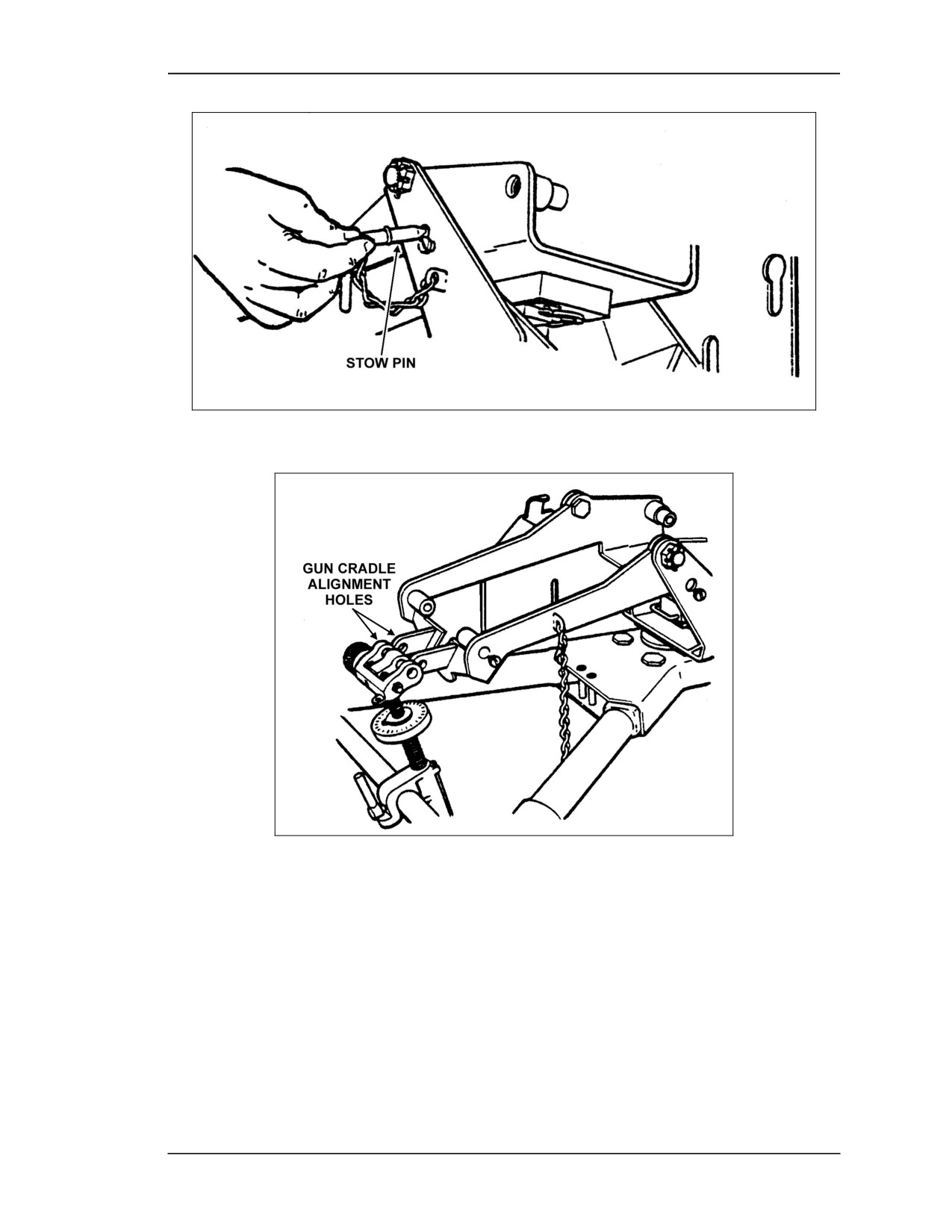
Figure 3-5. Stow pin.
Figure 3-6. Alignment of gun cradle to T&E mechanism.
(4) Lock the elevating sleeve mechanism onto the center of the traversing bar.
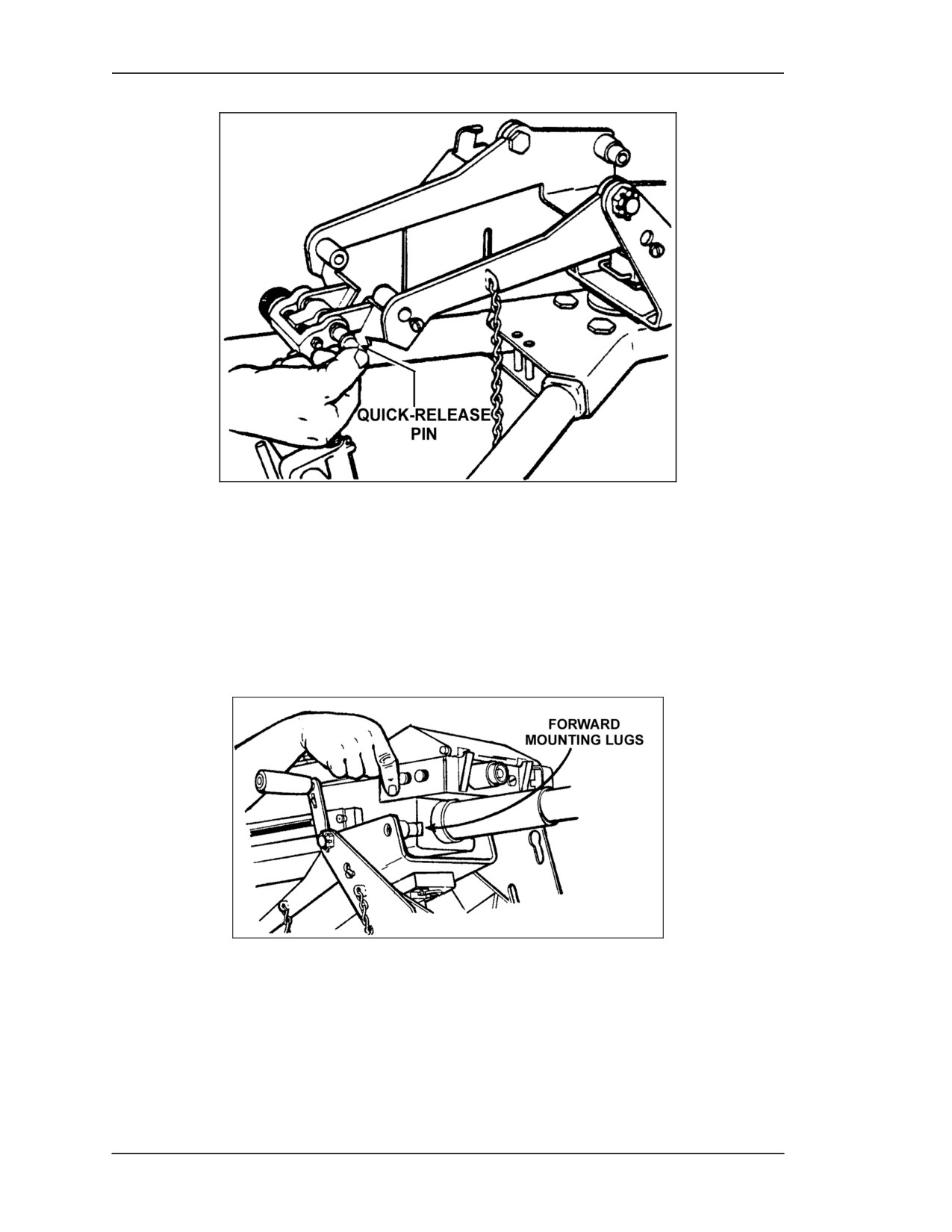
(5) Insert the quick-release pin from the right (Figure 3-7).
3-5
FM 3-22.27
Figure 3-7. Quick-release pin.
f. Mount the MK 19 by following these procedures:
(1) Lift the MK 19 into the gun cradle. One soldier holds the barrel while another holds
the control grips. The one holding the grips stands between the trail legs of the tripod; the
other straddles the front leg. The soldiers lift the MK 19, barrel first, onto the cradle.
(2) Align the grooves on the receiver with the lugs in the gun cradle, and slide the
receiver forward (Figure 3-8).
Figure 3-8. Mounting lugs.
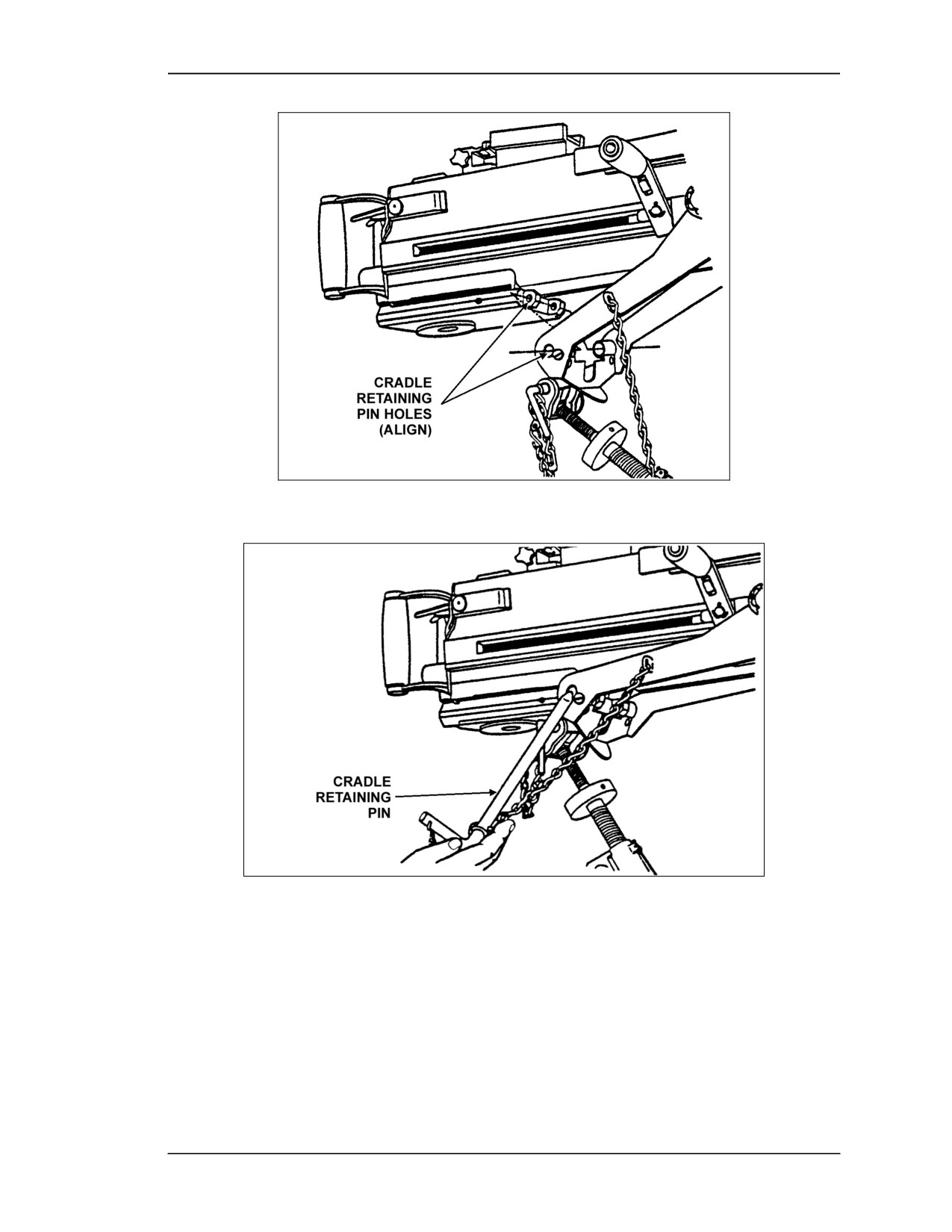
(3) Align the sear mounting holes with the gun cradle mounting holes (Figure 3-9).
Secure the rear of the receiver by inserting the retaining pin through the cradle and sear
assembly and rotate it until it locks in place (Figure 3-10). If a safety clip is attached, use it
to secure the retaining pin.
3-6
FM 3-22.27
Figure 3-9. Alignment of the sear assembly and pinholes.
Figure 3-10. Insertion of the cradle retaining pin.
g. Attach the feed throat to the MK 19 by following these procedures:
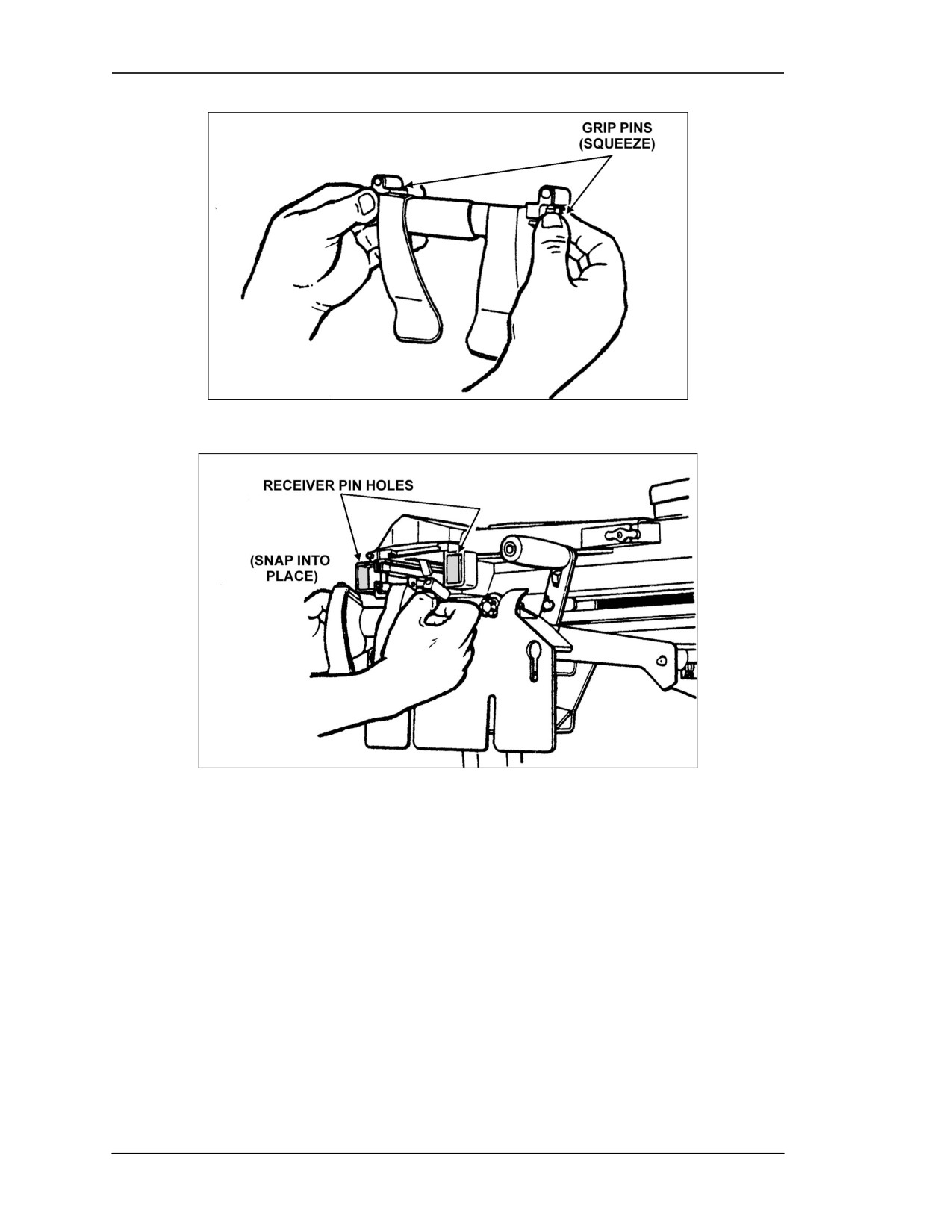
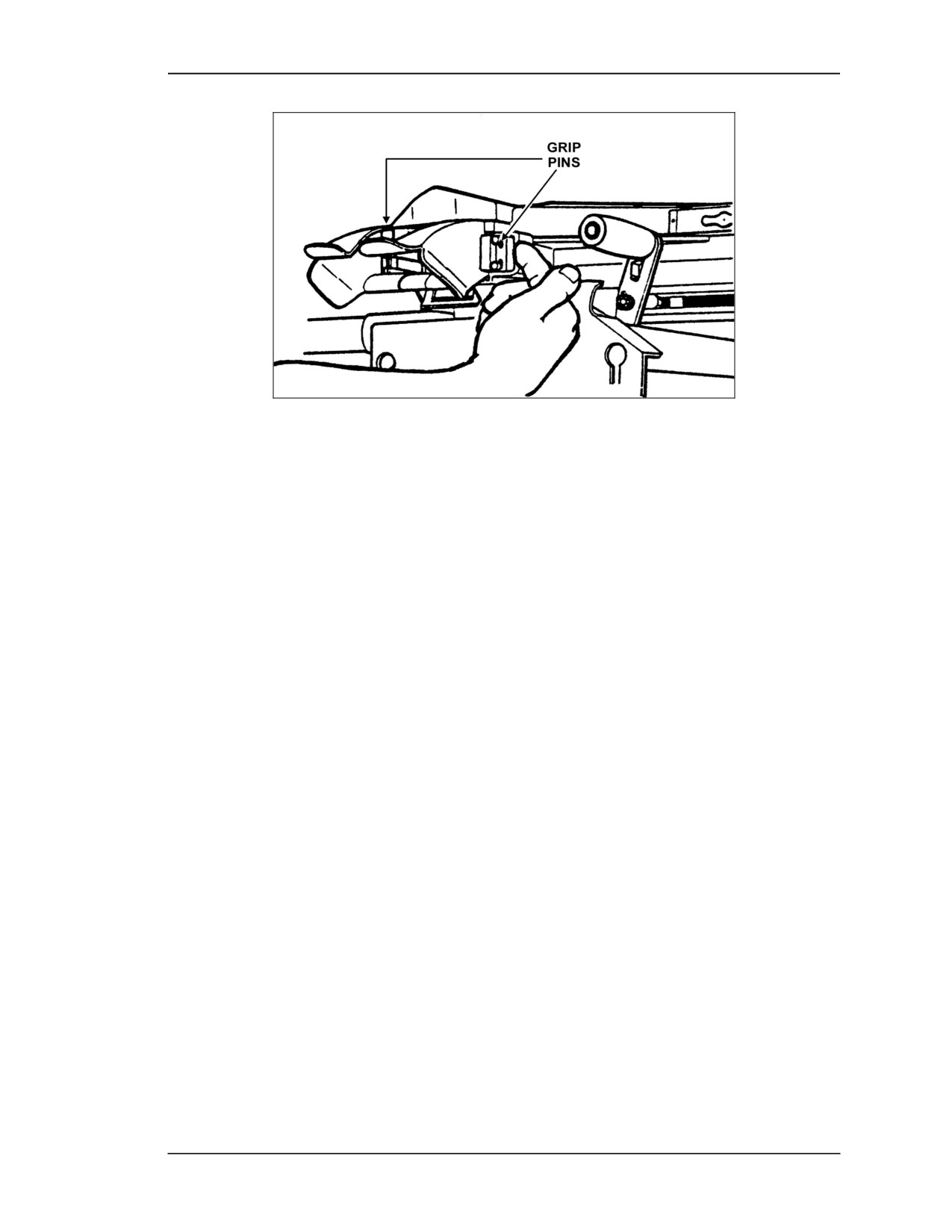
(1) Squeeze together each set of grip pins (Figure 3-11).
(2) Attach the feed throat to the front left-hand side of the receiver assembly. The pins of
the feed throat must line up with the pinholes in the receiver (Figure 3-12).
(3) Relax pressure on the spring-loaded grip pins so they will snap into place (Figure 3-
13, page 3-9).
3-7
FM 3-22.27
Figure 3-11. Grip pins.
Figure 3-12. Feed throat alignment.
3-8
FM 3-22.27
Figure 3-13. Feed throat installation.
NOTE: 1. When the MK 19 is mounted on the M3 tripod or any vehicle, it is called a
weapon system.
2. The same procedure is used to mount the MK 19 to the gun cradle regardless
of the type of mount used.
3-3.
VEHICLE-MOUNT
This section lists the accessories used and outlines the steps to mount the MK 19 onto
vehicles. Since mounting procedures for vehicles vary little, this section explains in detail
how to mount the MK 19 on the HMMWV and highlights the differences in mounting
procedures for other vehicles.
a. Accessories. Mounting the MK 19 on vehicles requires several accessories.
(1) Gun Cradle. The MK 64 gun cradle is used to mount the MK 19 onto any vehicle
having a pedestal mount for the M2 machine gun.
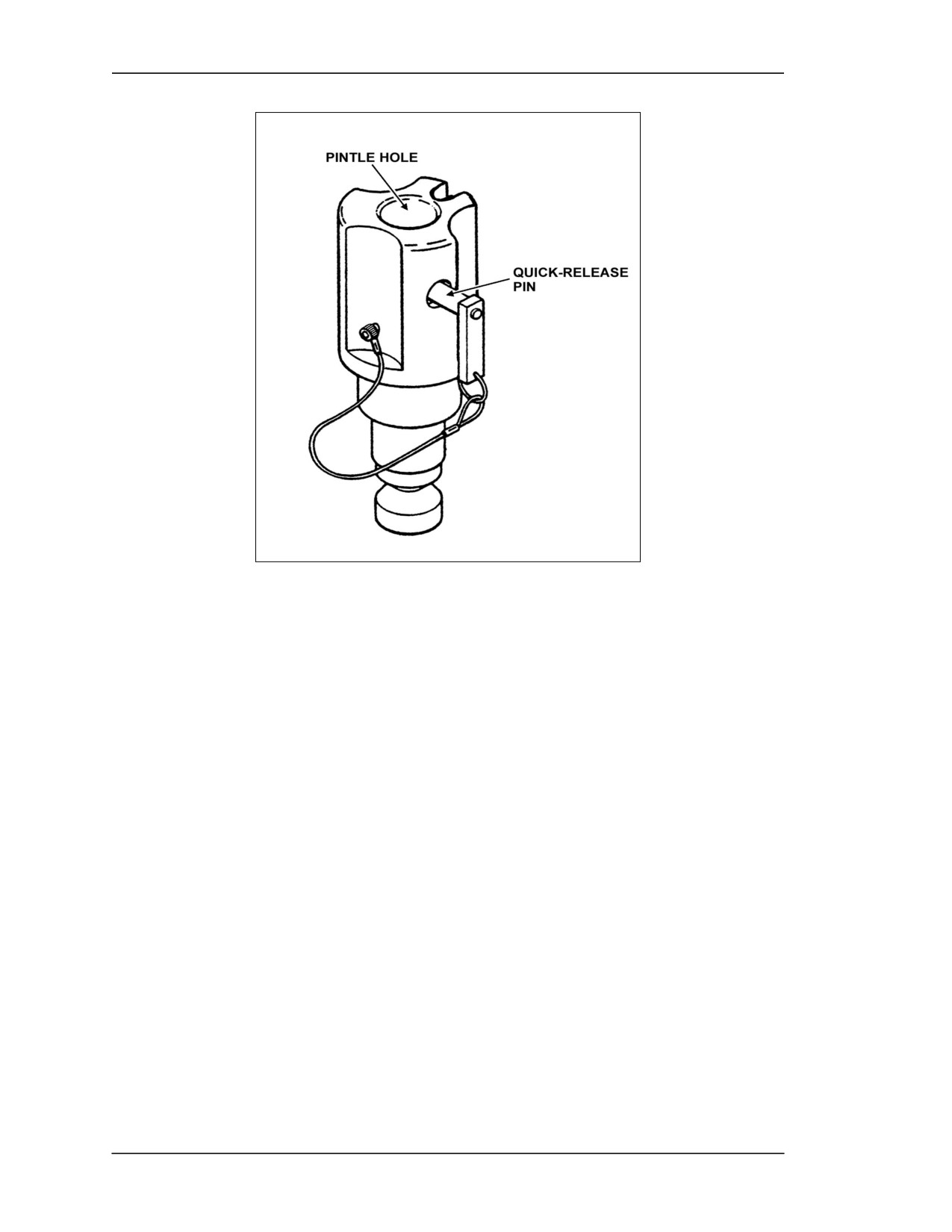
(2) Pintle Adapter. The pintle adapter is used to mount the MK 19 in all vehicular modes
(Figure 3-14). Other accessories are used to mount the MK 19 to specific vehicles. The upper
end accepts the gun cradle’s pintle, which is secured by a quick-release pin. The lower end
of the adapter fits the mounting wells on the M4 pedestal, HMMWV weapon platform,
M36A2 ring mount with M66 ring, and commander’s cupola on the M113 APC.
3-9
FM 3-22.27
Figure 3-14. Pintle adapter.
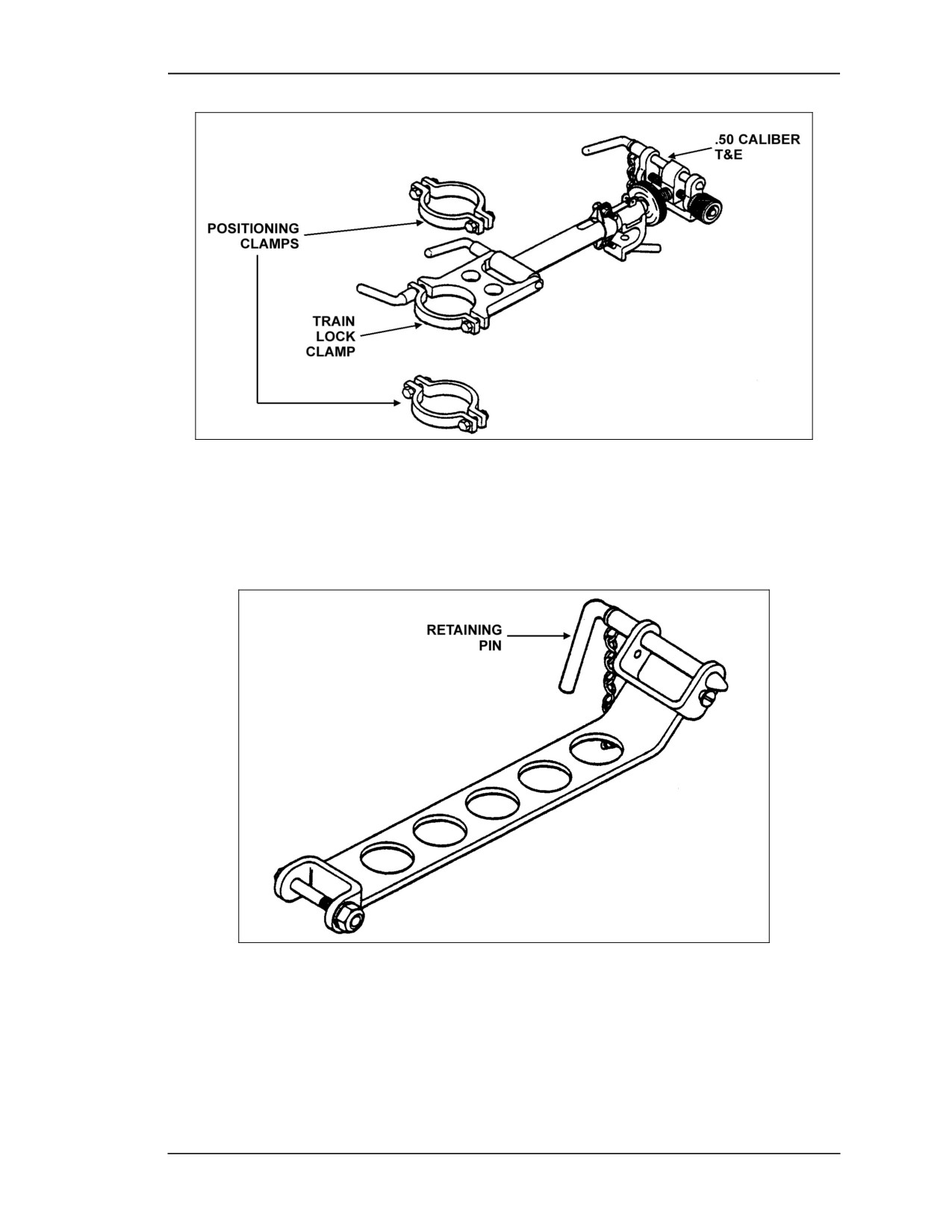
(3) Train and Elevating Assembly. This assembly secures the MK 64 gun cradle to the
M4 pedestal or HMMWV weapon platform pedestal and allows directional adjustments. The
lower end of the train and elevating assembly is attached to the pedestal by a train lock
clamp. The clamp is released or locked in position by a train lock handle. Two positioning
clamps are supplied to prevent vertical movement of the train lock clamp on the M4
pedestal. When used on the HMMWV weapon platform pedestal, only one clamp is needed
above the train lock clamp. The upper end of the train and elevating assembly is a standard
caliber .50 T&E mechanism and it is attached to the lower rear holes in the M4 cradle by a
retaining pin (Figure 3-15).
3-10
FM 3-22.27
Figure 3-15. Train and elevating assembly.
(4) Travel Lock Adapter. This adapter is used to hold the gun cradle securely during
travel. It is attached to the gun cradle by a retaining pin, which is inserted through the gun
cradle train and elevating mechanism mounting holes (Figure 3-16).
Figure 3-16. Travel lock adapter.
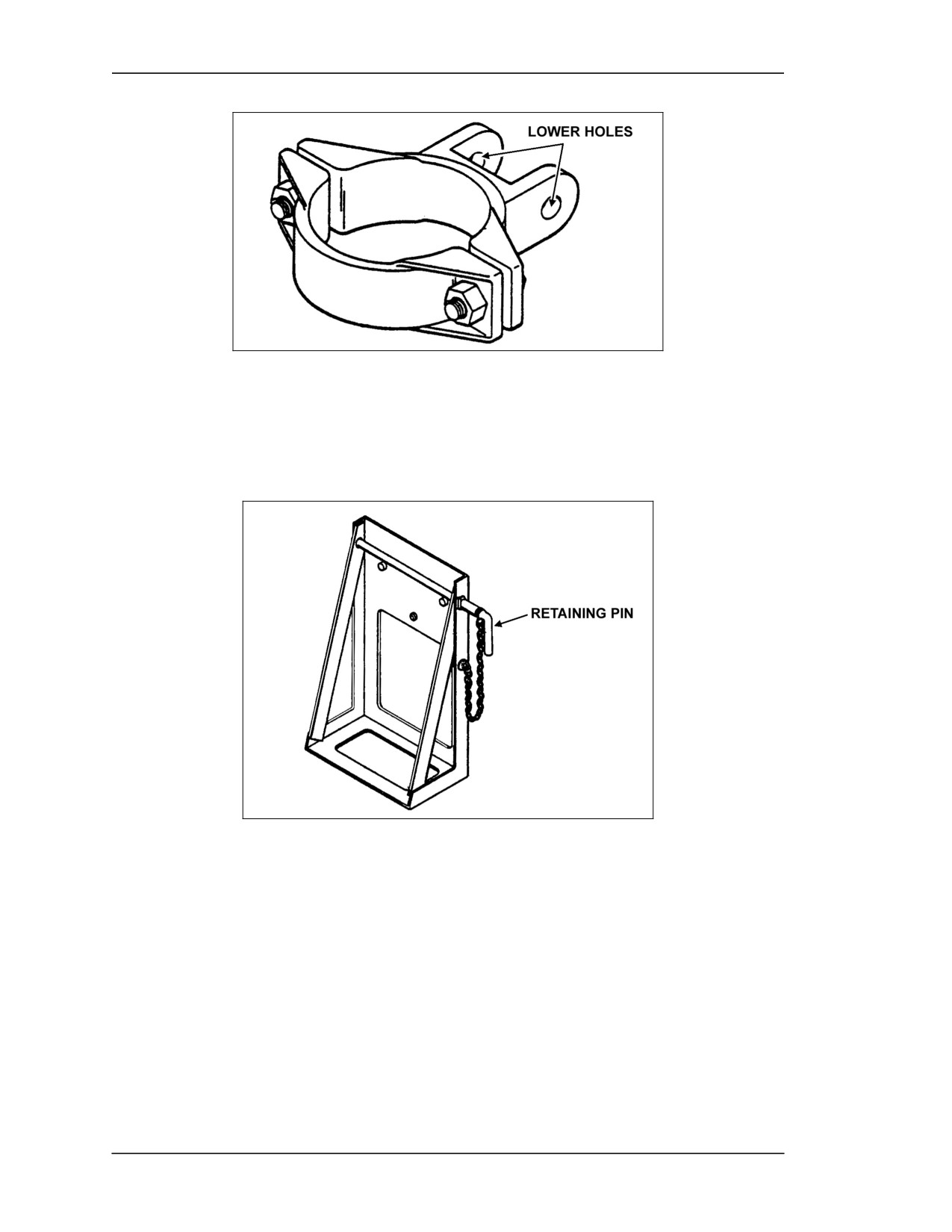
(5) Travel Lock Bracket. This bracket allows the travel lock adapter to be used with the
M4 pedestal mount. It has two halves that are secured around the pedestal with nuts and
bolts. The bracket is attached to the travel lock adapter by aligning the lower holes (Figure 3-
17).
3-11
FM 3-22.27
Figure 3-17. Travel lock bracket.
(6) Bracket Mounting Assembly. This assembly supplies a mount for the M548 metal
ammunition container. It has a metal frame that attaches to the gun cradle, and a retaining
pin that inserts through the top-inner end of the M548 ammunition container (Figure 3-18).
Figure 3-18. Bracket mounting assembly.
3-12
FM 3-22.27
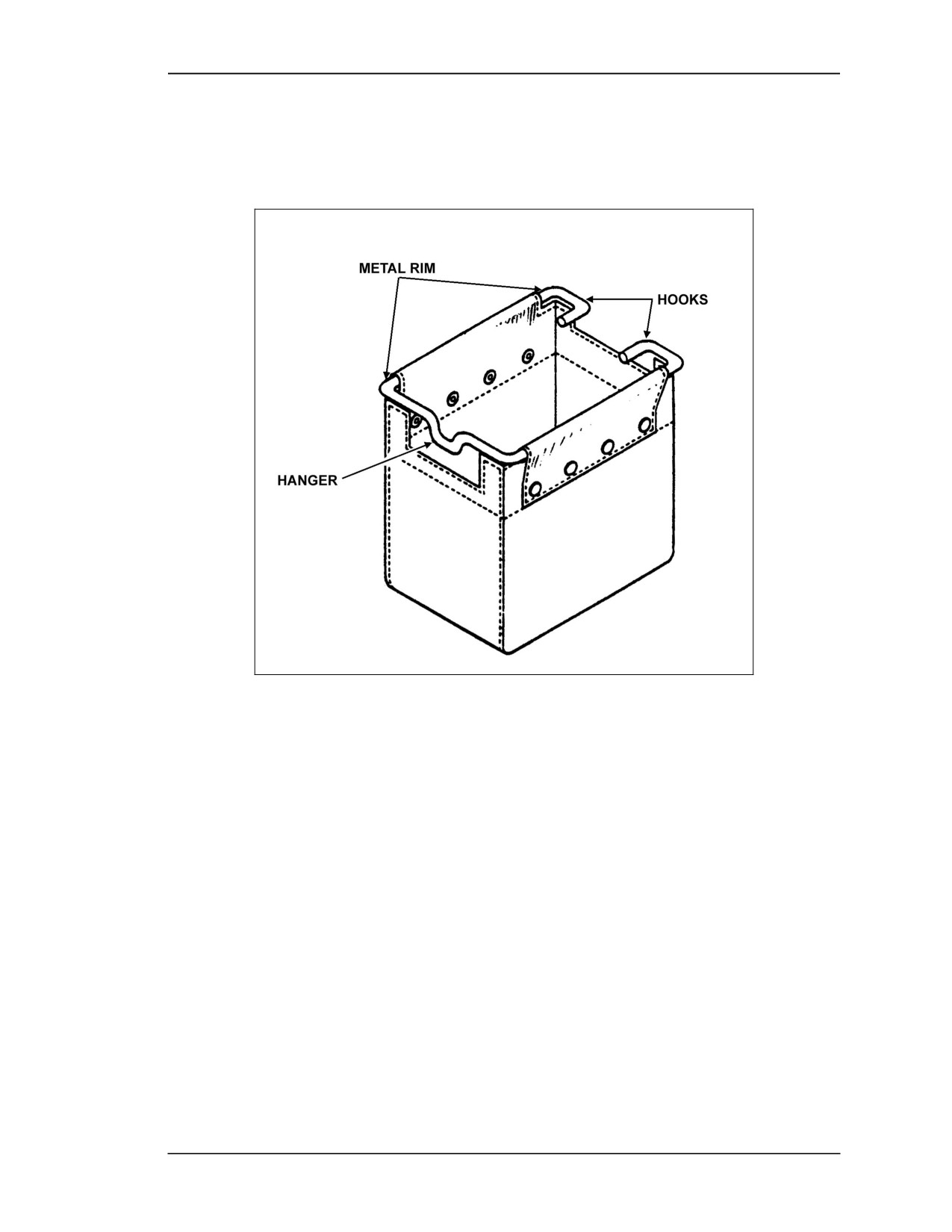
(7) Empty Case Catch Bag. This rubberized canvas bag catches empty cartridge cases as
they are ejected. It is held in place by a metal rim, which attaches to the bottom of the cradle
under the receiver by two hooks and a hanger (Figure 3-19).
Figure 3-19. Empty case catch bag.
NOTE: The 9/16-, 7/16-, and 3/8-inch open-end wrenches are necessary tools to mount
the MK 19 on vehicles.
b. Vehicle Mounts. Various vehicle mounts can be used with the MK 19.
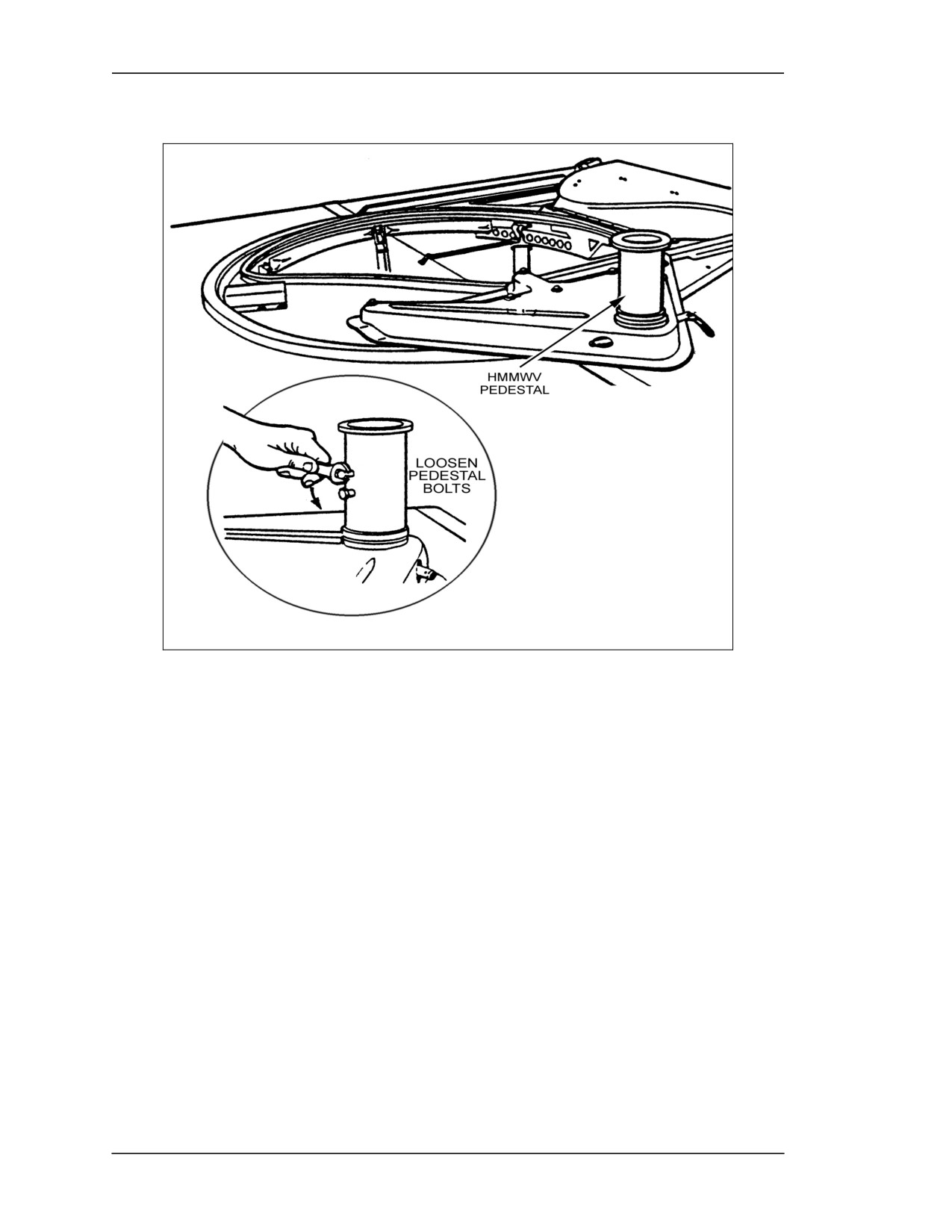
(1) HMMWV Weapon Platform. To mount the MK 19 on the HMMWV weapon
platform (Figure 3-20):
(a) Insert the pintle adapter onto the HMMWV pedestal by following these procedures:
(1) Loosen the HMMWV pedestal lock screws by turning counterclockwise until the
threaded ends are flushed with the pedestal’s inner wall (Figure 3-20).
3-13
FM 3-22.27
Figure 3-20. HMMWV pedestal.
3-14
FM 3-22.27
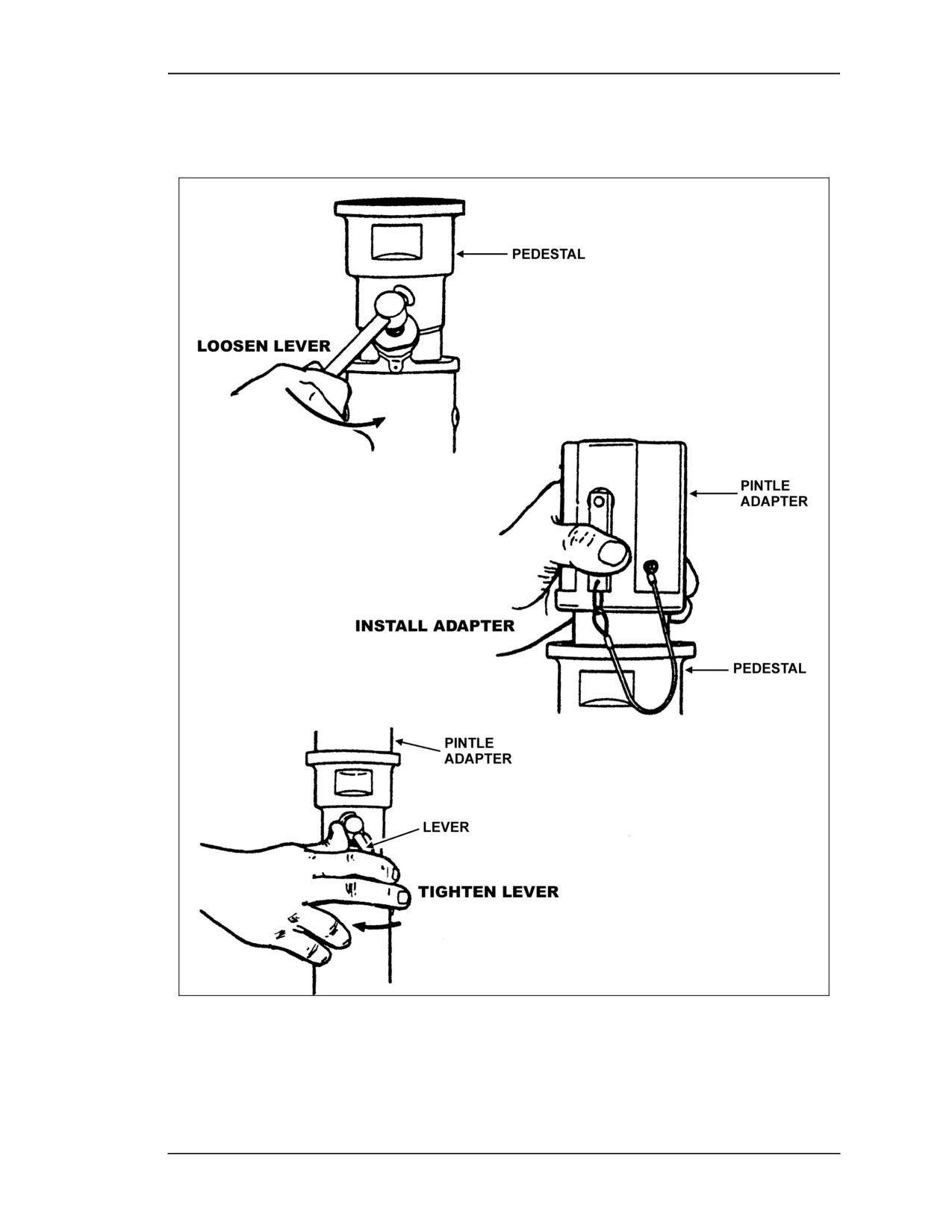
(2) Insert the pintle adapter assembly by placing the lower end of the pintle adapter into
the HMMWV pedestal (Figure 3-21).
Figure 3-21. Pintle adapter assembly.
(3) Tighten the lock screws with a 3/8-inch open-end wrench. Pull upward on the pintle
adapter to ensure it is secured in place.
3-15
FM 3-22.27
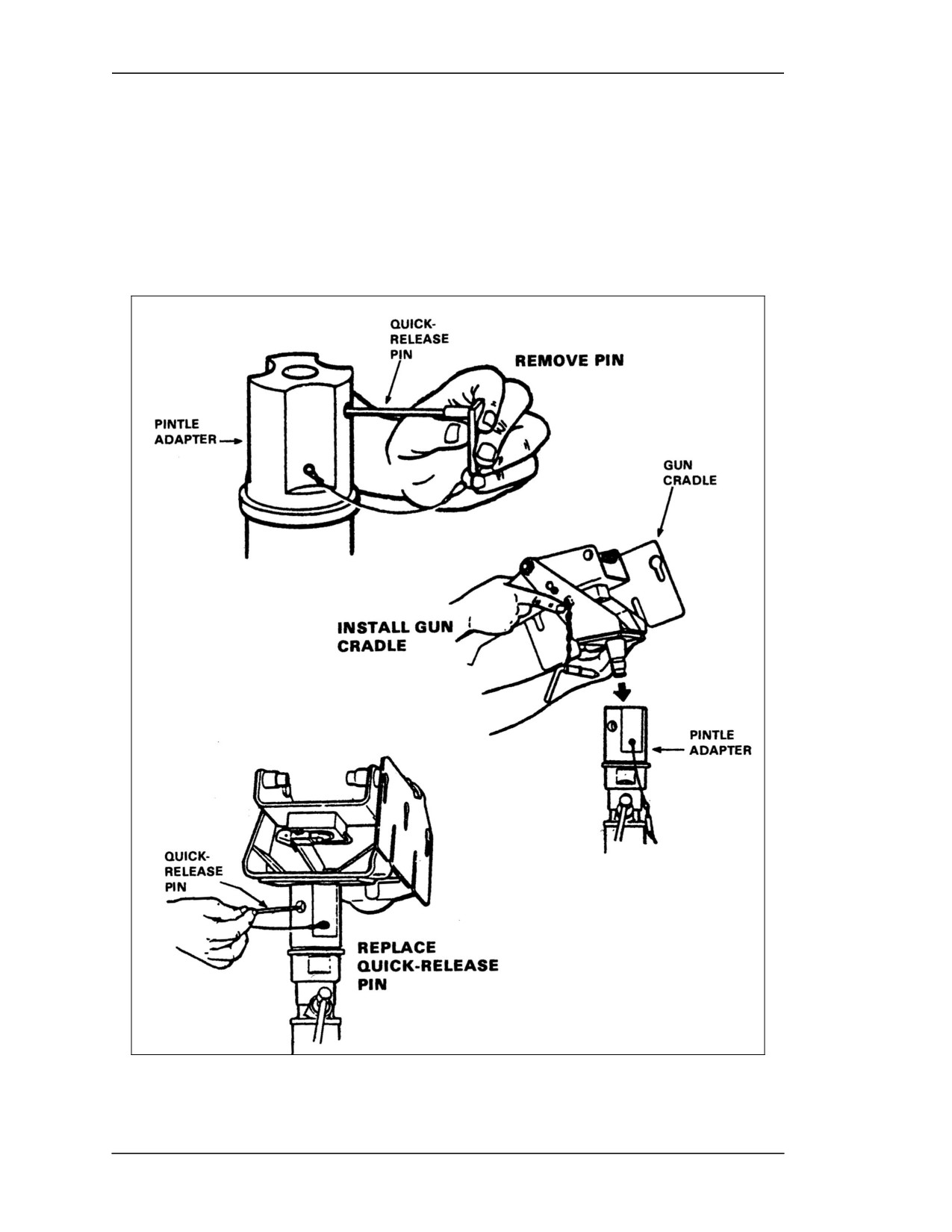
(4) Remove the pintle adapter quick-release by pressing in on the pin’s quick-release
button and pulling the pin from the pintle adapter.
(b) Install the carriage and cradle assembly by following these procedures (Figure 3-22):
(1) Insert the front stow pin to prevent relative movement to the carriage and cradle.
(2) Insert the carriage pintle into the top of the pintle adapter assembly.
(3) Press in on the pin’s quick-release button and insert the pin.
(4) Pull upward and twist the carriage and cradle assembly. It should lock into the pintle
adapter, but it should traverse freely left and right.
Figure 3-22. Install the carriage and cradle assembly.
3-16
FM 3-22.27
(c) Install the T&E mechanism in the train and elevation assembly by following these
procedures:
(1) Turn the elevating handwheel to read 250 mils.
(2) Loosen the pivot arm screws, using two 7/16-inch open-end wrenches.
(3) Insert the T&E mechanism all the way into the train and elevation assembly.
NOTE: The T&E mechanism is the upper portion of the training and elevation
assembly; it must be installed in the train and elevation assembly before the
training and elevation assembly can be installed on the vehicle.
(4) Position the traversing lock lever to the rear and the traversing knob to the left by
tightening the pivot arm screws, using the two wrenches.
(d) Separate the middle clamp on the train and elevation assembly by following these
procedures:
(1) Unscrew the train lock handle counterclockwise to remove.
(2) Using the 9/16-inch open-end wrench, remove the hex head screw on the other side
of the middle clamp.
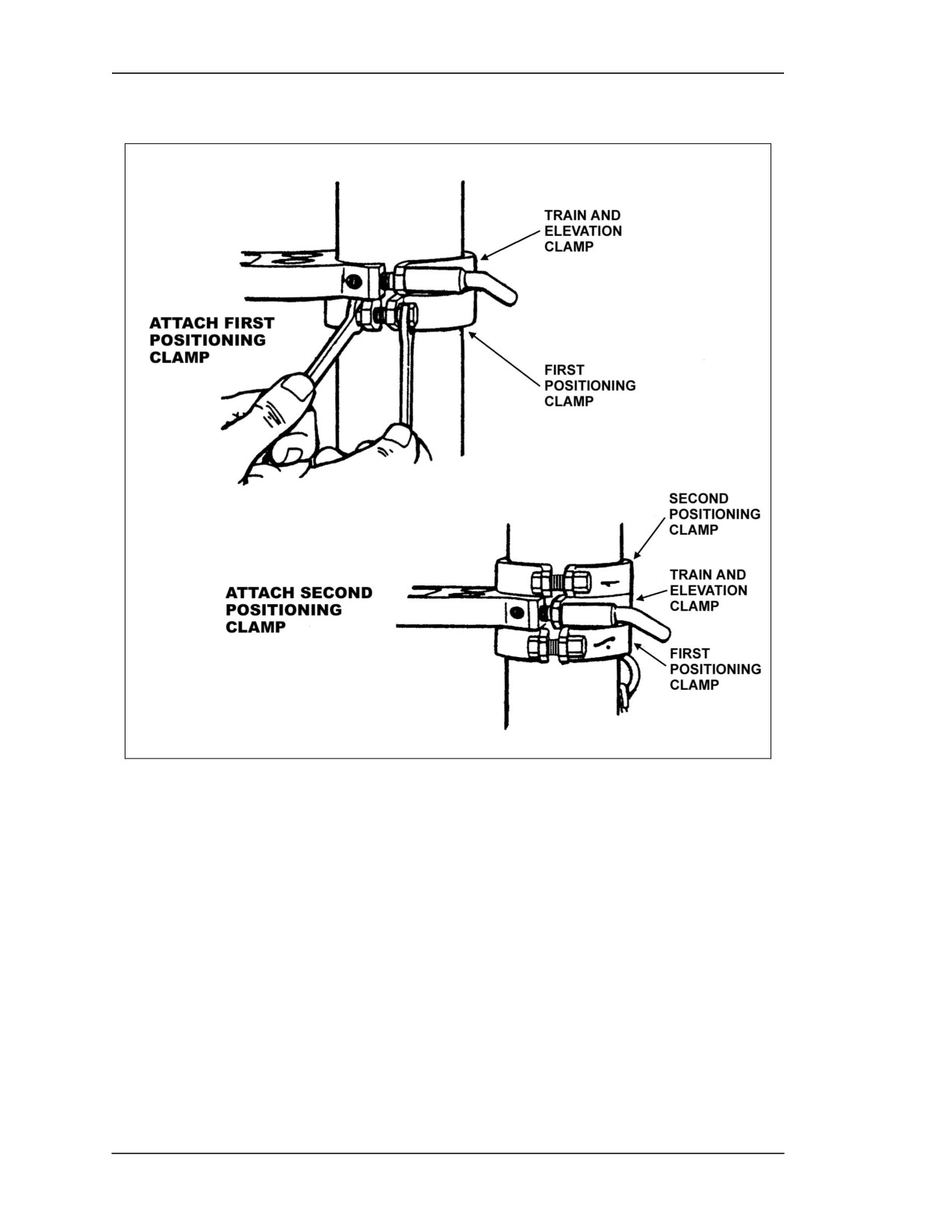
(e) Attach the train and elevation middle clamp to the HMMWV pedestal post by
following these procedures (Figure 3-23):
(1) Assemble the middle clamp around the pedestal.
(2) Tighten the clamp by turning the train lock handle clockwise.
(3) Using the 9/16-inch open-end wrench, equally tighten the screw on the other side of
the middle clamp.
3-17
FM 3-22.27
Figure 3-23. Train and elevation middle clamp.
(f) Install a support clamp above the middle clamp. To allow free left and right traverse
of the carriage and cradle assembly, loosen the train lock handle. To lock in place, tighten
the handle.
NOTE: The second or lower set of clamps is not used in this application since the train
lock rests on the built-up base of the HMMWV pedestal. This will also allow for
increased elevation. Using two 9/16-inch open-end wrenches, fasten one set of
clamps above the middle clamp. Tighten each screw two turns until snug.
(g) Attach the train and elevation assembly to the carriage and cradle assembly by
following these procedures:
(1) Pull out the front stow pin to allow the cradle to move.
(2) Pull out the train and elevation assembly's retaining pin.
3-18
FM 3-22.27
(3) Ensure the elevating handwheel is set at 250 mils. Position the lock lever to
the rear and ensure the traversing knob is on the left.
(4) Turn the traversing knob to center the elevating screw in the yoke.
NOTE: Ensure the elevating handwheel does not get jammed under the lip of the cradle.
(5) Turn the elevating handwheel to align the elevating mechanism holes with the lower
rear holes in the cradle.
(6) Insert the retaining pin and rotate to the locked position.
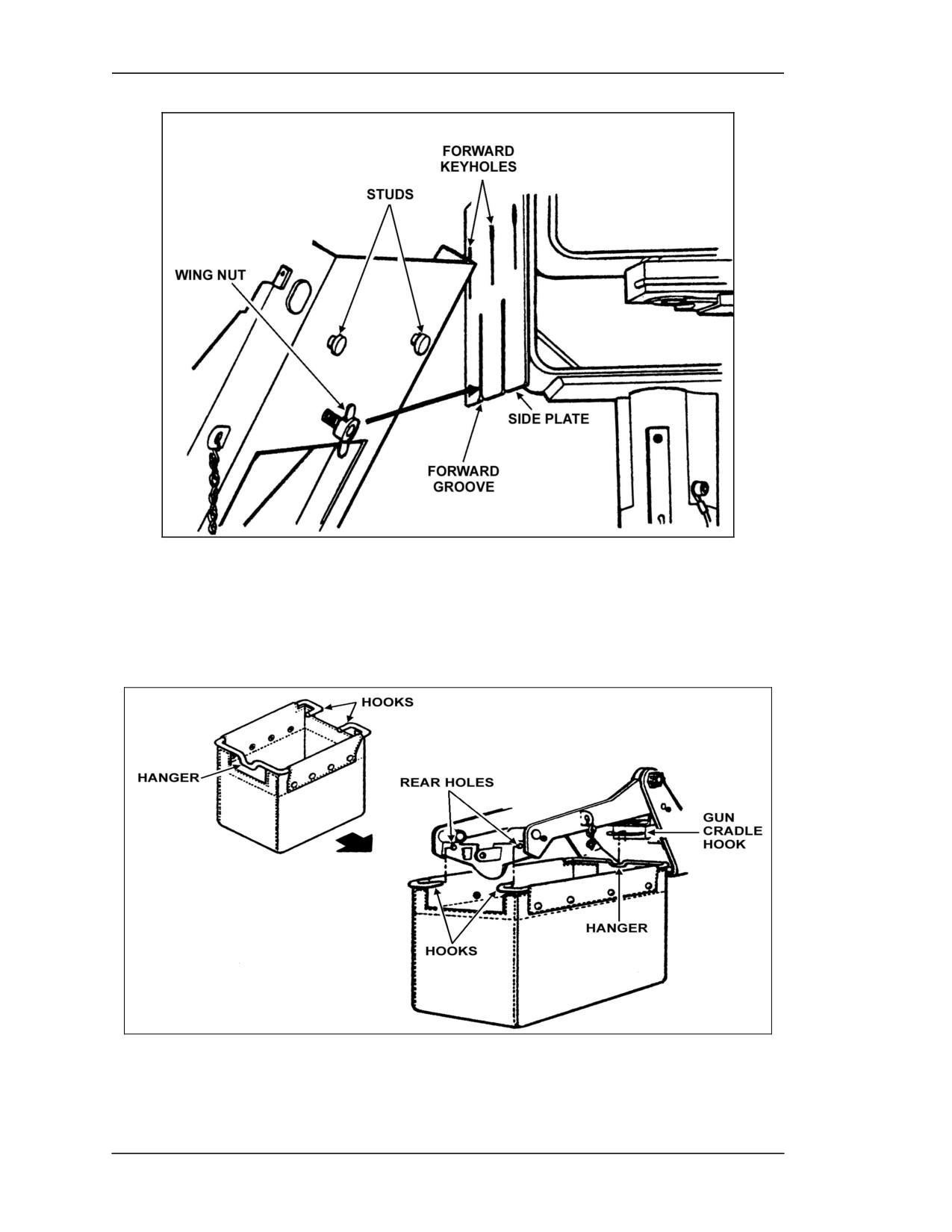
(h) Mount the ammunition can bracket by following these procedures:
(1) Partly unscrew the wing nut on the threaded stud of the bracket mounting assembly.
Align the stud with the forward groove in the gun cradle’s side plate. Push the bracket
mounting assembly up until the heads of the two mounting pins align with the two forward
keyholes. Push the heads of the two mounting pins into the keyholes and allow the bracket
mounting assembly to slide down. Tighten the wing nut behind the side plate of the cradle
(Figure 3-24).
3-19
FM 3-22.27
Figure 3-24. Attachment of bracket mounting assembly.
(2) Insert the two hooks on the empty case catch bag through the rear holes in the gun
cradle. Engage the single front hanger on the catch bag with the hook on the gun cradle
(Figure 3-25).
Figure 3-25. Attachment of empty case catch bag.
3-20
FM 3-22.27
(2) M66 Ring Mount (2 1/2- to 5-ton cargo trucks). To mount the MK 19 on the M66
ring mount:
(a) Insert the pintle adapter into the M36A2 ring mount with the M66 ring receptacle.
(b) Install the gun cradle and mount the MK 19.
(c) Attach the bracket mounting assembly and the empty case catch bag.
(3) Commander’s Cupola (M113 APC). To mount the MK 19 on the commander’s
cupola follow these procedures:
(a) Install the pintle adapter and the gun cradle.
(b) Mount the MK 19 and attach the bracket mounting assembly and the empty case
catch bag.
(c) Install the machine gun pintle adapter in the commander’s cupola mount by pushing
the lock handle down.
(d) Pull the lock handle up, if it does not come up when the pintle is installed.
(e) Insert the front stow pin to prevent relative movement of the carriage and cradle.
(f) Insert the carriage pintle into the top of the pintle adapter assembly.
(g) Press in on the pin’s quick-release button and insert the pin.
(h) Pull upward and twist the carriage and cradle assembly. It should be locked into the
pintle adapter, but it should traverse freely left and right.
(i) To remove, reverse the steps.
(4) The M88 Recovery Vehicle Mount. To mount the MK 19 on the M88 recovery
vehicle mount follow these procedures:
(a) Loosen the traverse locking screw.
(b) Install the machine gun pintle in the machine gun mount.
(c) Insert the front stow pin to prevent movement of the carriage and cradle. Insert the
carriage pintle into the top of the pintle adapter assembly.
(d) Press in on the pin’s quick-release button and insert the pin.
(e) Pull upward and twist the carriage and cradle assembly. It should be locked into the
pintle adapter, but it should traverse freely left and right.
(f) To remove, reverse the steps.
(5) Weather Cover. To install the weather cover on the MK 19 follow these procedures:
(a) Unzip the zipper on the weather cover.
(b) Pull the weather cover over the barrel, ammunition can, and rear of the MK 19.
(c) Zip the zipper to secure.
NOTE: The weather cover for the MK 19 is an auxiliary component not common to all
MK 64 mounts.
3-21
FM 3-22.27(FM 23-27)
CHAPTER 4
MARKSMANSHIP
This chapter gives guidance for instruction and development of MK 19
gunnery skills. It provides data needed to develop training programs, plans,
and lessons used to build the gunner’s confidence and skill in firing the MK
19. Marksmanship training ensures that each soldier keeps his combat firing
skills at a consistent level with the unit’s mission. See Appendix D, Gunnery
Tests, for more details concerning diagnostic and intermediate tests.
Section I. PREPARATORY MARKSMANSHIP TRAINING
Preparatory marksmanship training for the MK 19 covers the firing positions, the MK 19
fighting position, use of the T&E mechanism, and manipulation exercises. Thorough
instruction during the preparatory training and exercises helps ensure efficient use of time
and ammunition during range firing.
4-1. FIRING POSITIONS
Use the basic sitting, standing, and kneeling positions during training and range firing of the
MK 19.
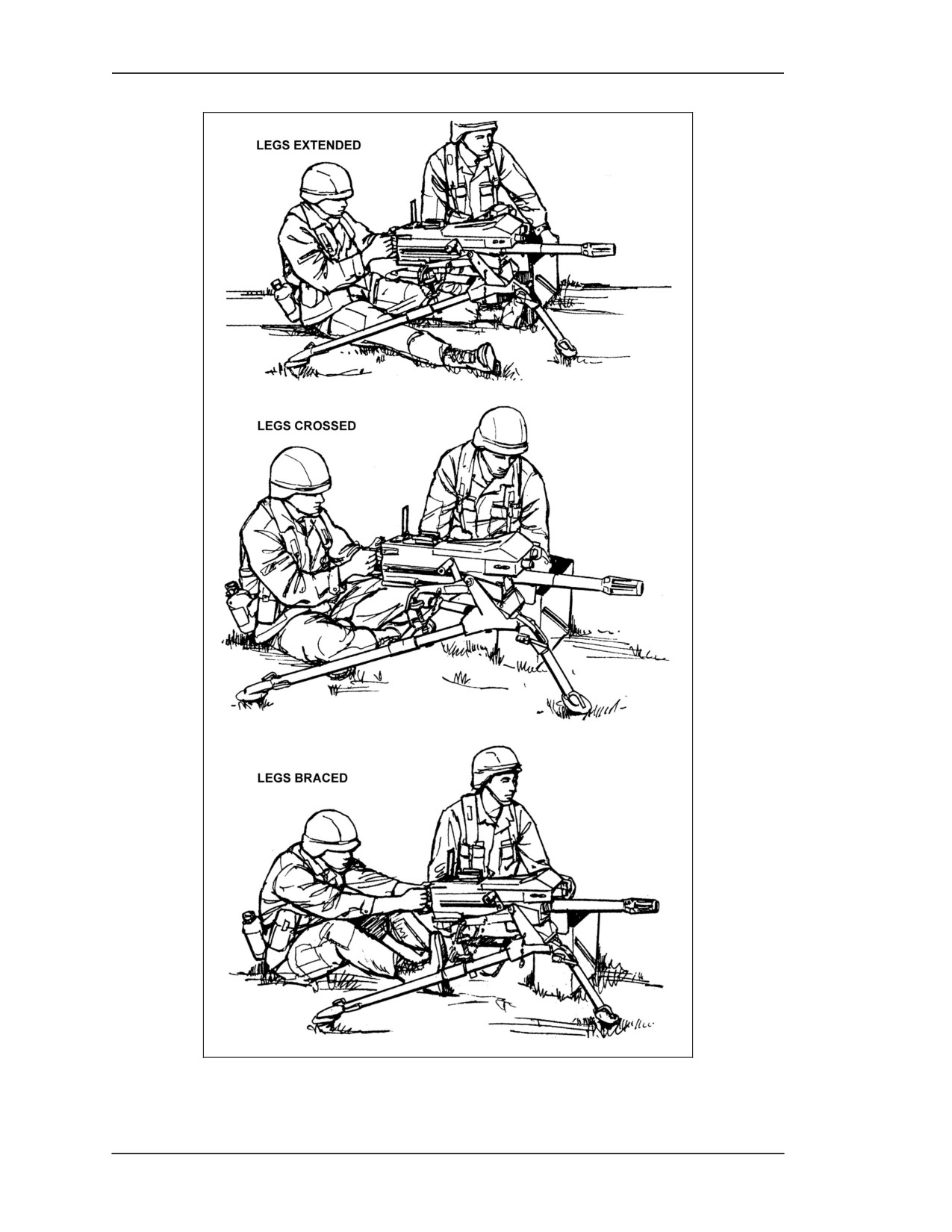
a. Sitting. When the tripod is used in the low or high position, sit directly behind the gun
between the trail legs of the tripod. Extend your legs under the tripod, cross them, or brace
your feet on the tripod (Figure 4-1). Place your elbows on the inside of your thighs for
support when crossing your legs or bracing your feet on the tripod.
4-1
FM 3-22.27
Figure 4-1. Seated firing positions.
4-2
FM 3-22.27
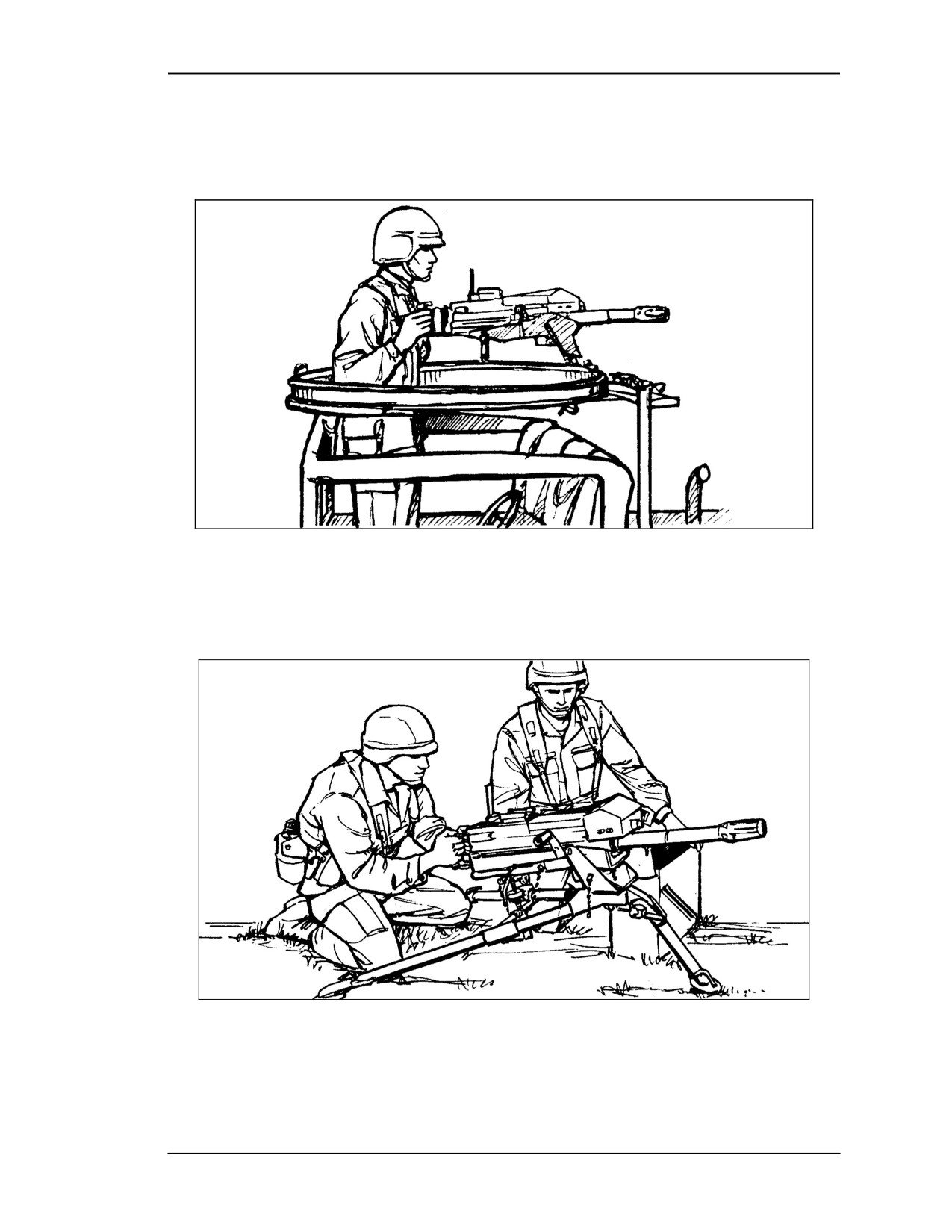
b. Standing. When the MK 19 is mounted on a vehicle, stand with both of your hands
on the control grips and your thumbs resting on the trigger. Keep your elbows against your
body, your body forward, and your chest against your hands to brace the gun (Figure 4-2).
Figure 4-2. Standing position.
c. Kneeling. When the MK 19 is in a fighting or hasty tripod-mounted position, kneel
and grasp the control grips with your thumbs on the trigger (Figure 4-3).
Figure 4-3. Hasty tripod position.
4-3
FM 3-22.27
4-2. FIGHTING POSITION
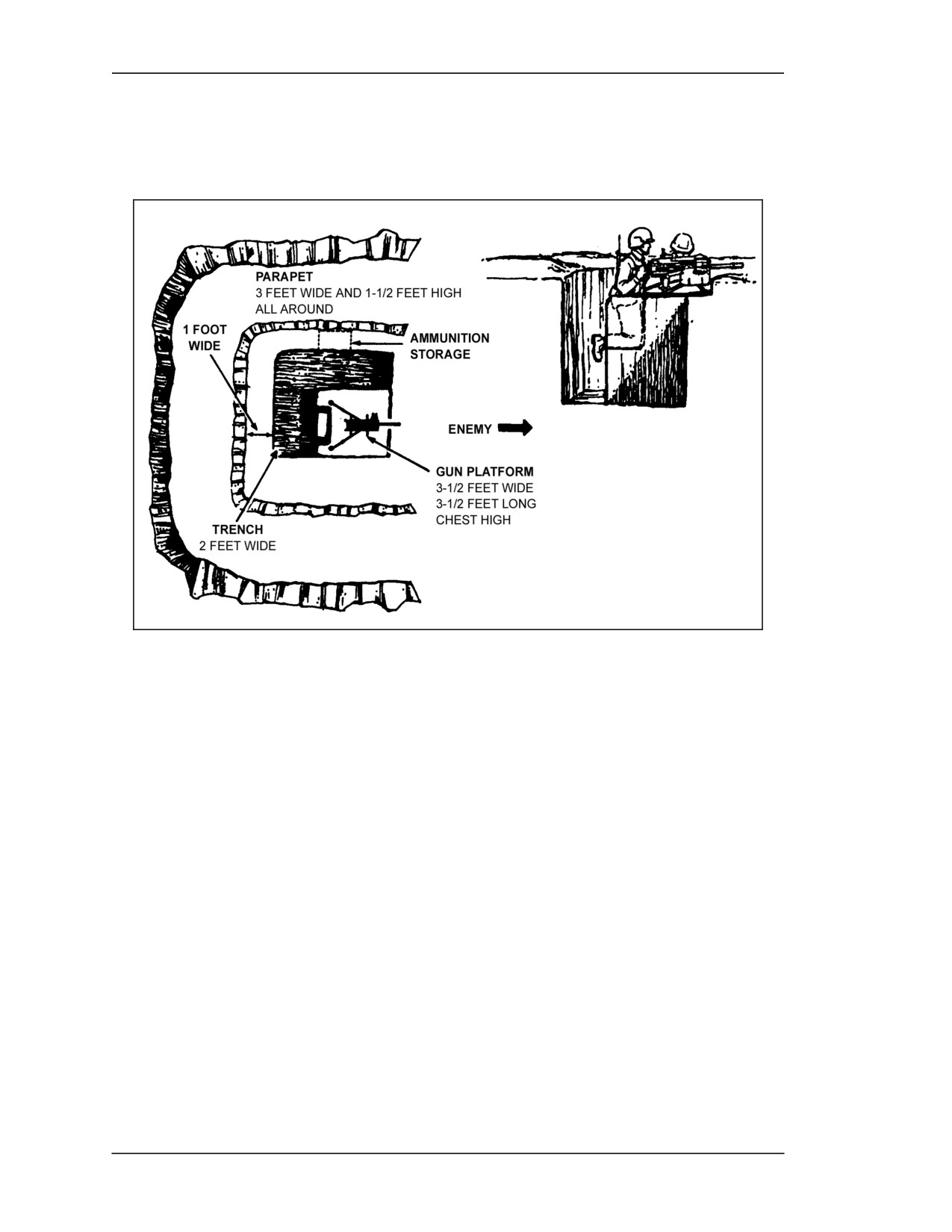
A fighting position is dug when the unit has time to prepare it or is in a defensive position.
Make the fighting position according to Figure 4-4.
Figure 4-4. Dug-in position.
a. Position the MK 19 so it is oriented on the center of the assigned sector of fire. Mark
the position of the tripod legs and trace the outline of the firing platform, which will be dug
about 3 inches deep.
b. Dig the position in an “L” shape around the firing platform. The position should be
chest-deep and wide enough to allow the MK 19 crew to load, operate, and place effective
fire on an assigned sector of fire. The position can be made so that the gunner can fire from
the kneeling position by digging the desired depth directly behind the gun.
c. Use the dirt from the hole to build flank parapets 3 feet wide and 1 ½ feet high. Dig
the ammunition storage area into the left wall of the “L” and close to the ground.
d. Make sure the wall behind the firing platform is sloped to allow for entrance to and
exit from the fighting position.
e. Follow these steps to build overhead cover:
(1) Put flank support logs, 4 to 6 inches in diameter, on top of each other along the entire
length of the flank parapets.
(2) Put logs, 4 to 6 inches in diameter, side by side across the support logs as the base for
the overhead cover.
(3) Put a waterproof layer over the base logs.
(4) Put 18 inches of dirt on top of the waterproofing material.
(5) Mold and camouflage the cover to blend with the terrain.
4-4
FM 3-22.27
f. Camouflage the position with natural materials such as rocks, logs, live bushes,
and grass.
4-3. TRAVERSE BAR AND T&E MECHANISM
Use the T&E mechanism to engage preselected target areas at night or during degraded light
conditions. Record direction and elevation readings from the traversing bar and T&E
mechanism. Record all readings in mils.
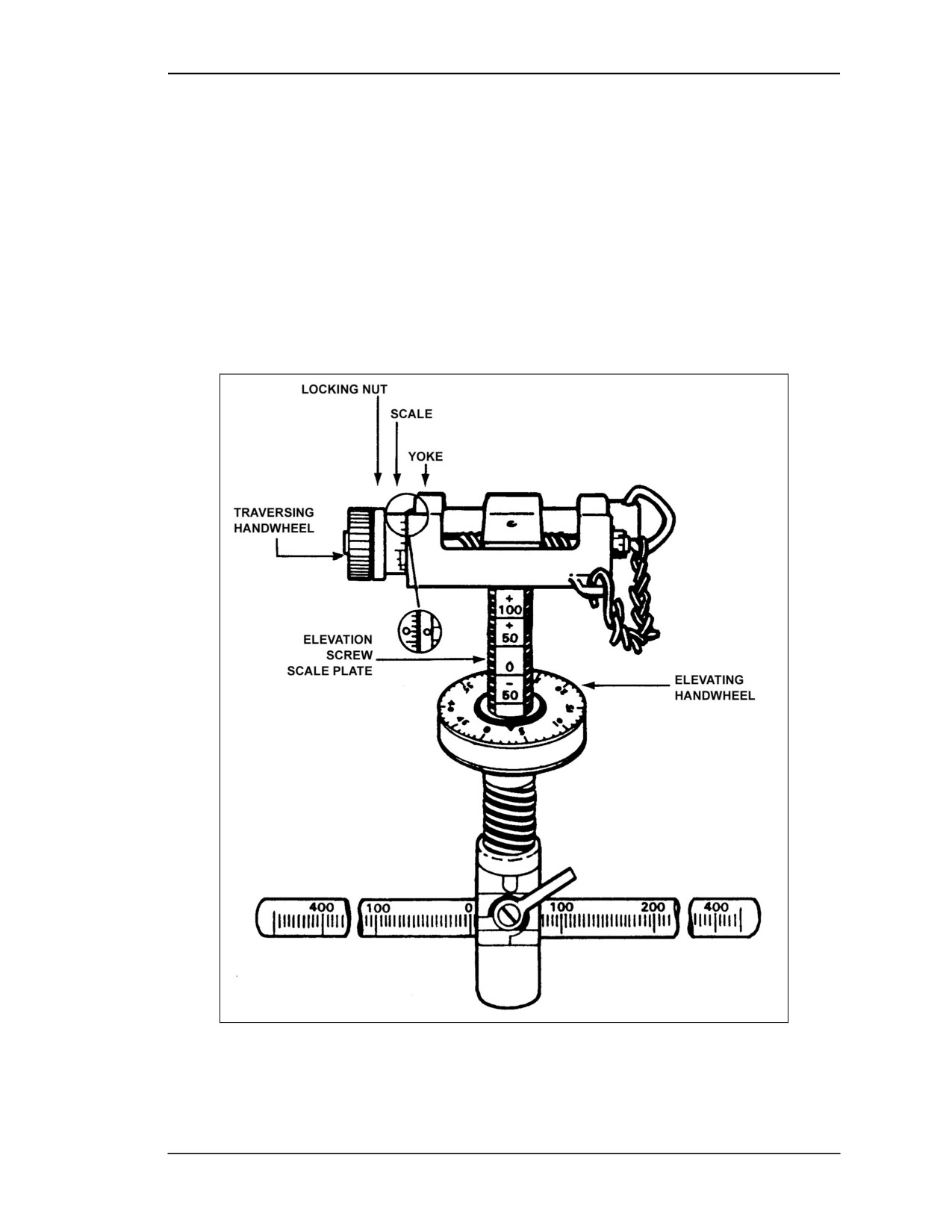
a. Zero the T&E Mechanism. Before the gunner can use the T&E mechanism to
engage targets, he must zero it (Figure 4-5). Refer to section 3-2 for more information on
zeroing the T&E mechanism.
Figure 4-5. Zeroing the T&E mechanism.
b. Lay the Gun for Direction. When a sector of fire has been assigned, pick up the rear
legs of the tripod and shift the tripod until the muzzle of the weapon points to the center of
4-5
FM 3-22.27
the sector of fire. Once the MK 19 is laid for direction, firmly stamp in the tripod shoes and
place sandbags on the legs. This aids stability and may prevent accidental movement.
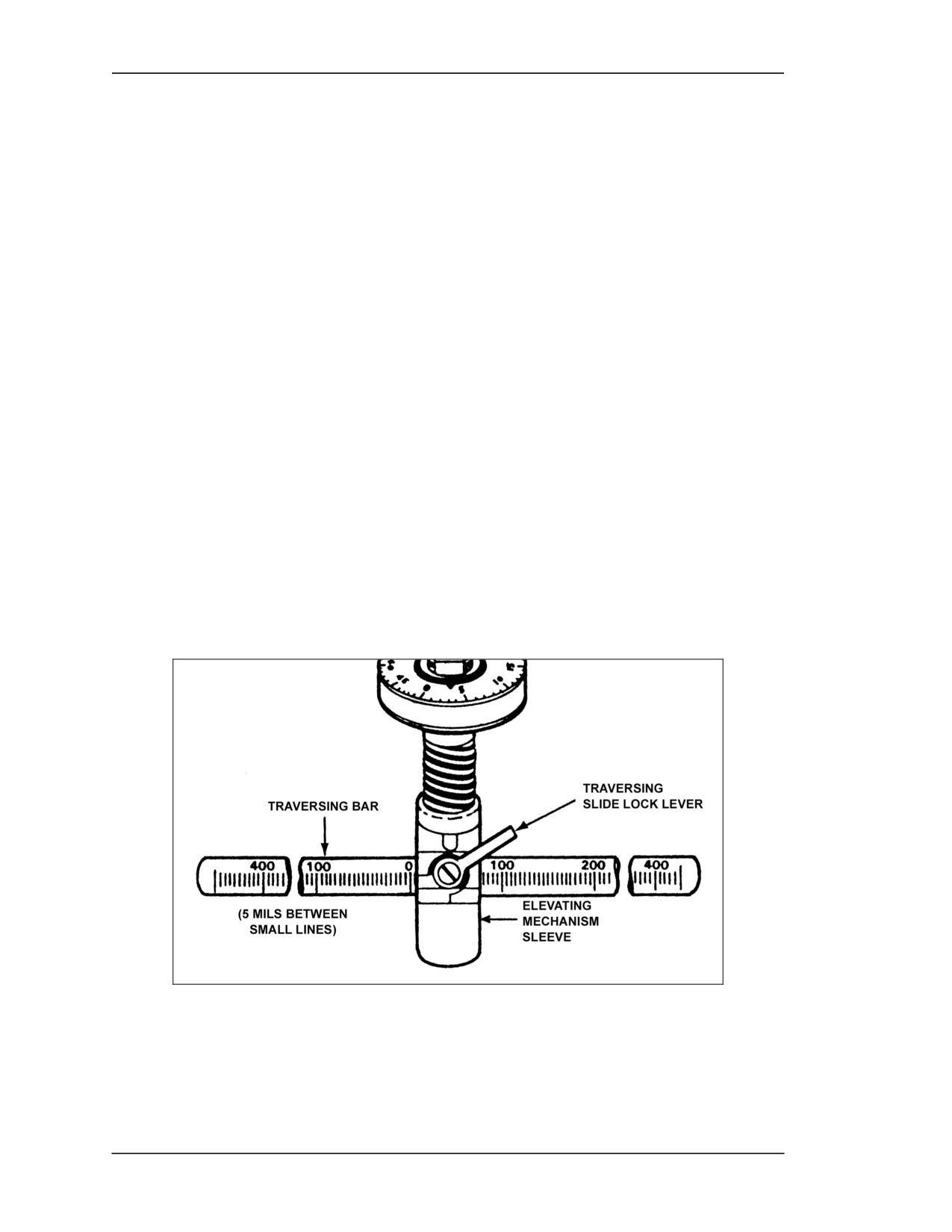
c. Obtain and Record Direction Readings to all Targets Within the Sector of Fire
(Figure 4-6). Loosen the traversing slide lock lever and move the slide along the traversing
bar until the MK 19 is laid on the center of a point target or on either flank of a linear target.
Lock the traversing bar and read the direction from the scale on the traversing bar. If the left
edge of the traversing slide does not fall exactly on a 5-mil tickmark, move the left edge of
the traversing bar slide back to the next smaller mil reading. Use the traversing handwheel to
complete the initial lay. Obtain a reading to the target by the direction of the MK 19 barrel. If
the barrel is moved to the right, record a right reading. Read the number on the traversing bar
from the left side of the traversing slide lock. If the barrel is moved to the left and the
traversing slide lock is on the right side of the zero, record a left reading. After taking a
direction reading for a target, measure the width of the target in mils using the traversing
handwheel to move across the target. Reposition the traversing mechanism before moving to
another target.
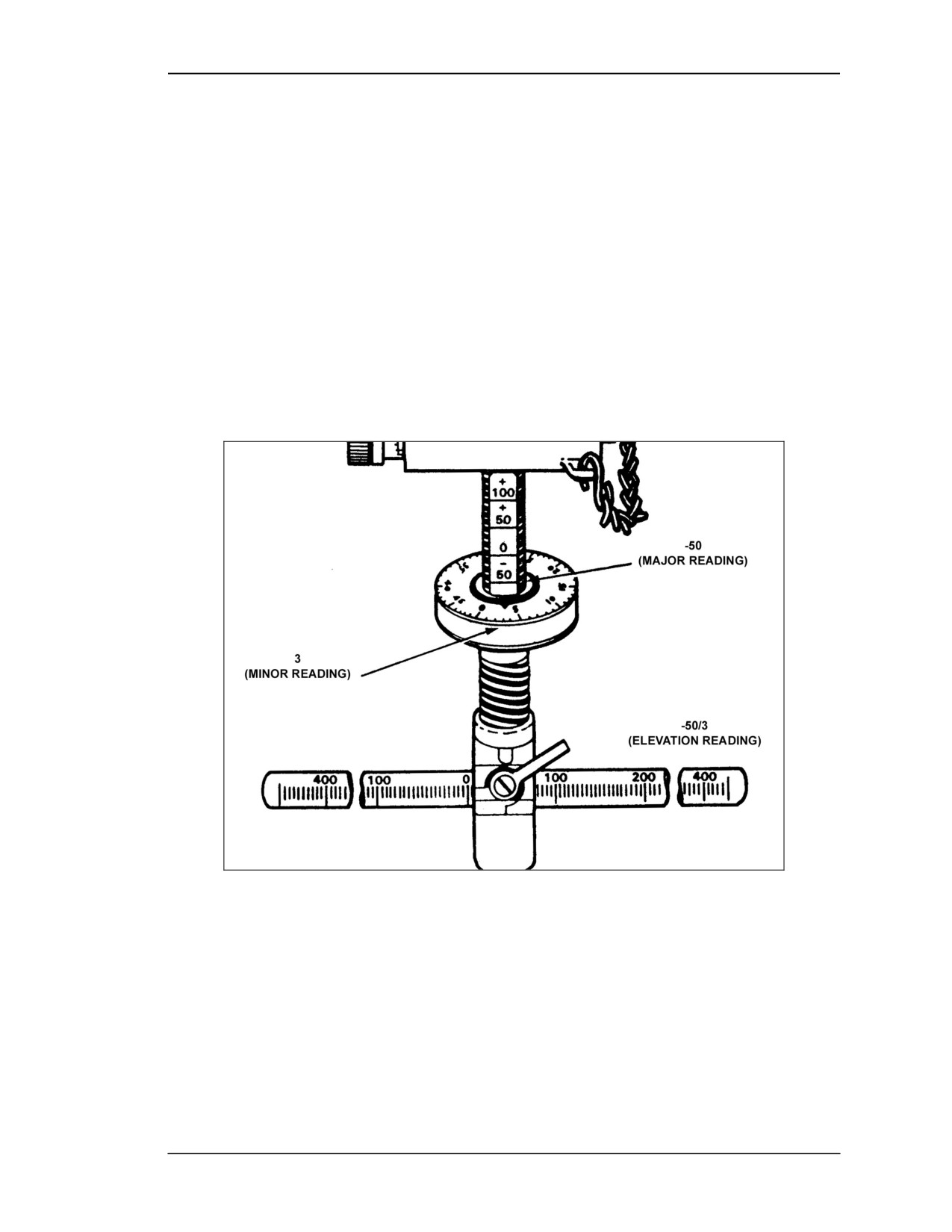
d. Obtain Elevation Reading. Ensure the MK 19 is laid on the center base of the target.
Read the elevation from two scales: the first, or major, part from the elevating screw plate
scale; the second, or minor, part from the elevating handwheel. Separate the two parts of the
elevation reading with a slash (for example, -50/3). An elevation reading may not be valid on
any other T&E mechanism than the one from which it was read. If the number of threads is
increased or decreased after the data is recorded, accurate fire cannot be placed on the target.
For example, if a weapon is freed to engage a secondary sector, and the base of the T&E
mechanism is rotated, the data is wrong unless the same number of threads is exposed before
and after the move.
Figure 4-6. Direction reading.
(1) Major Reading. The elevating scale plate is graduated in 50-mil increments from -250
to +100. Except for the zero, each number has a plus or minus sign above it. All numbers,
including zero, have an index line below them. To get the major elevation reading, hold the
4-6
FM 3-22.27
T&E mechanism so that the eyes are even with the top of the elevating handwheel. The
major reading (for example, -50) is the first number, with an index line, that is visible above
the handwheel (Figure 4-7).
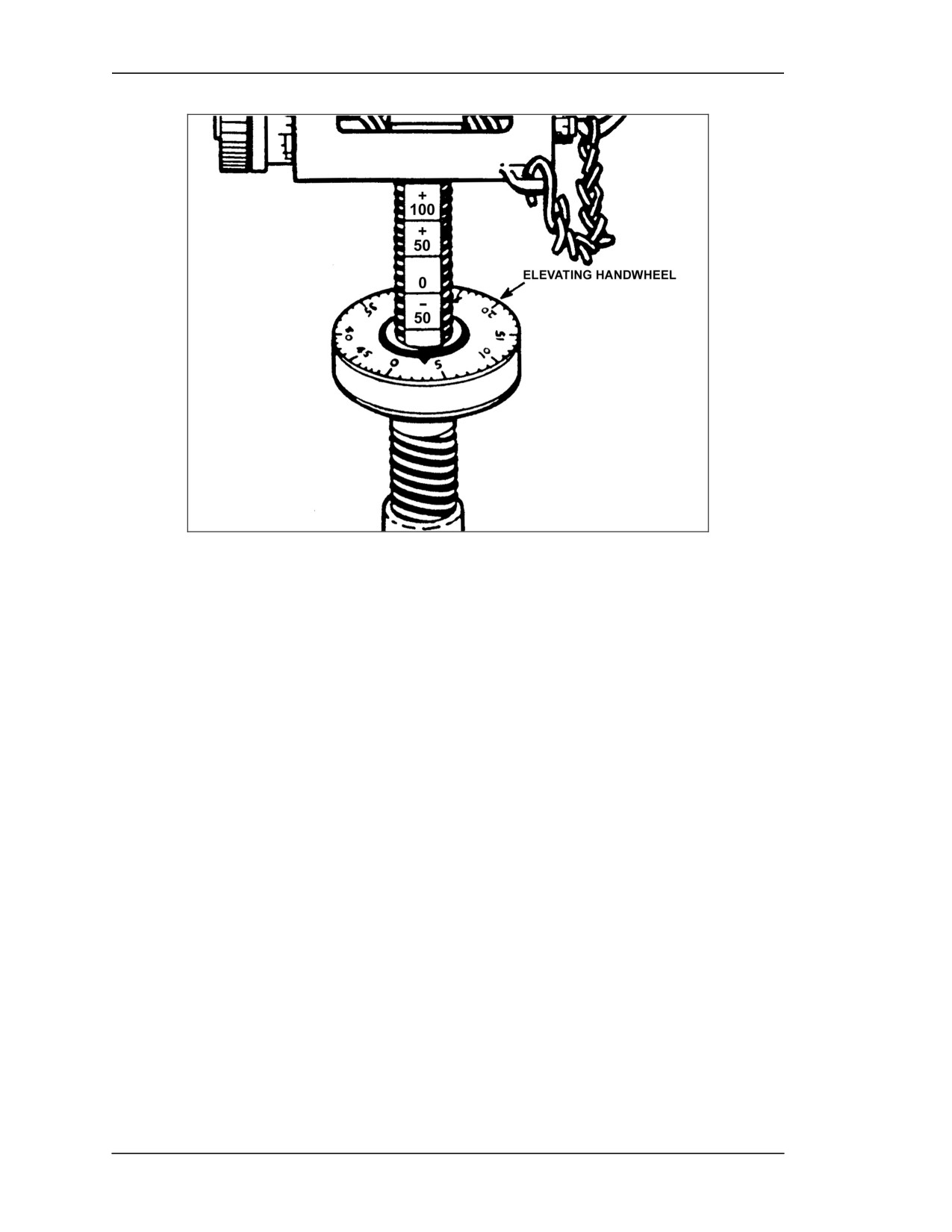
(2) Minor Reading. The elevating handwheel is marked in 50 increments of 1 mil each
(Figure 4-7). The minor reading, which has no plus or minus sign, is the number that lines up
with the pointer. The minor reading represents the number of mils the gun is laid below the
major reading, for example, 3 mils. Verify a direction elevation reading by firing and
adjusting on the target. Use the dry-fire method to get data to targets without live firing and
adjusting. Set the rear sight on the range to the target, lay the gun on the center base of the
target, and take direction and elevation readings. Use the dry-fire method only when firing is
not feasible.
NOTE: Correct range setting is critical since any discrepancy causes an error in the
elevation when the target is engaged.
Figure 4-7. Elevation readings.
4-4. EXERCISES
The exercises include sighting and aiming; sight setting and laying; manipulating;
determining the range; and preparing a range card.
a. Sighting and Aiming Exercises. There are two sighting and aiming exercises. The
first calls for the use of the sighting bar.
4-7
FM 3-22.27
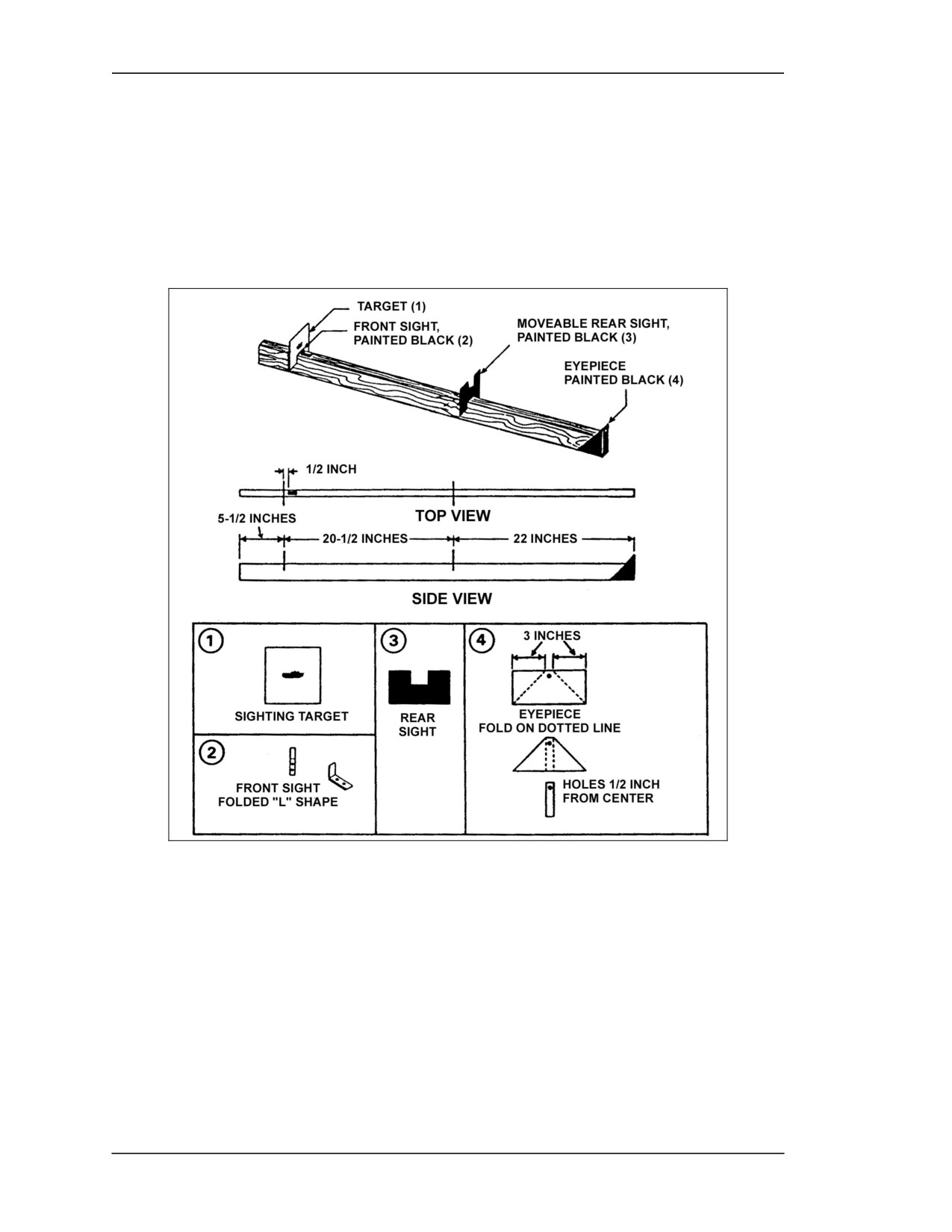
(1) This exercise teaches how to obtain the correct sight picture, and also teaches
alignment methods. Sight alignment means lining up the front and rear sights, with the top
center of the front sight blade appearing in the center of the rear sight. Sight picture means
lining up the front sight, the rear sight, and the target, with the tip of the front sight blade just
touching the bottom center of the target. Gunners must show skill in aligning sights correctly
and in getting the correct sight picture, using a sighting bar (Figure 4-8). Gunners must
correctly show the point of aim, after sight alignment, 8 out of 10 times.
Figure 4-8. Sighting bar.
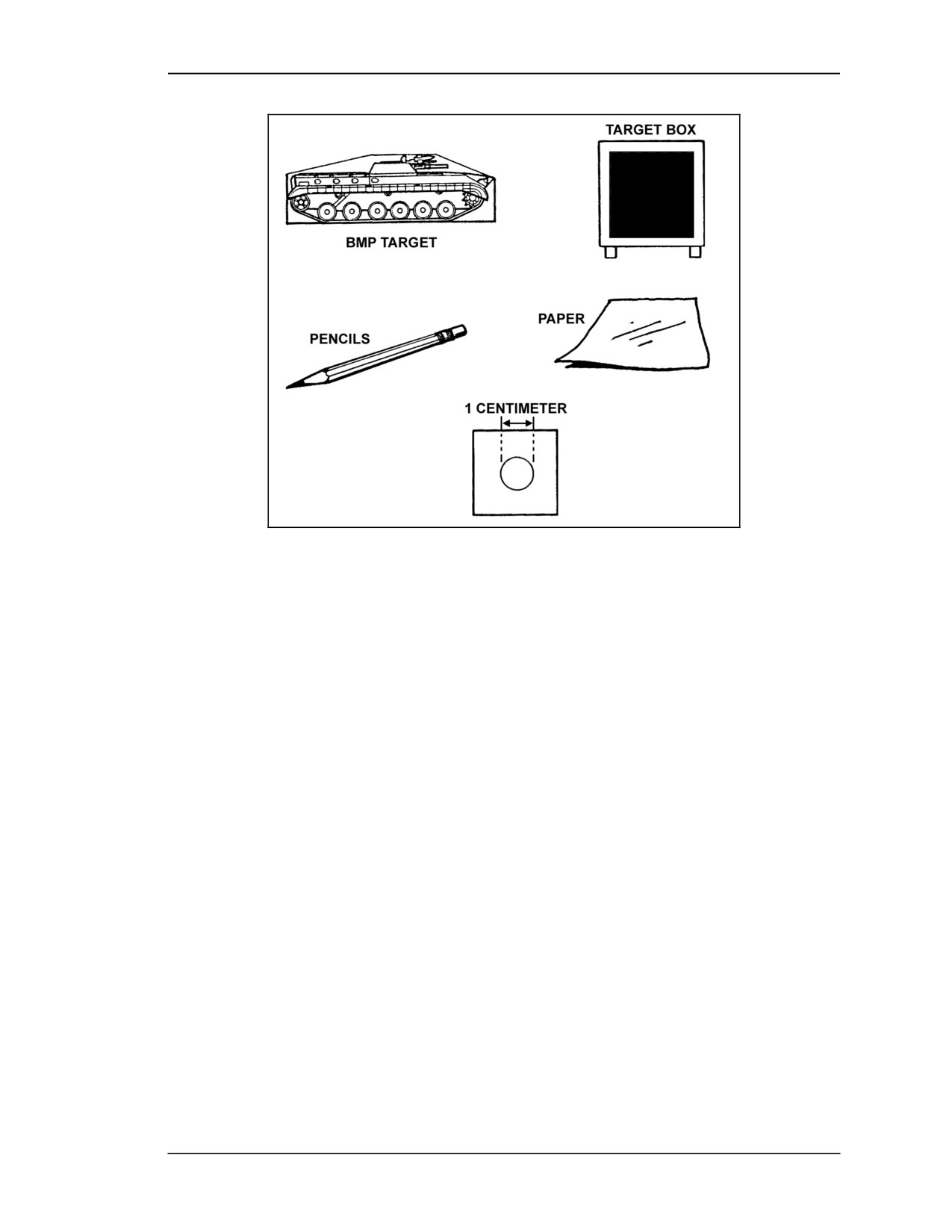
(2) The second sighting and aiming exercise, used with the MK 19 and target board,
allows the gunner to apply lessons learned during the first exercise. Place the target board 10
meters from the muzzle of the MK 19 (Figure 4-9). Use the T&E mechanism to get the
correct sight picture on each target that is called out. When the gunner feels he can sight and
aim, the coach checks and critiques the gunner’s ability to change from the start point on the
target board to any new target called by the coach.
NOTE: Continue this exercise until the gunner is skilled in sighting and aiming.
4-8
FM 3-22.27
Figure 4-9. MK 19 target board.
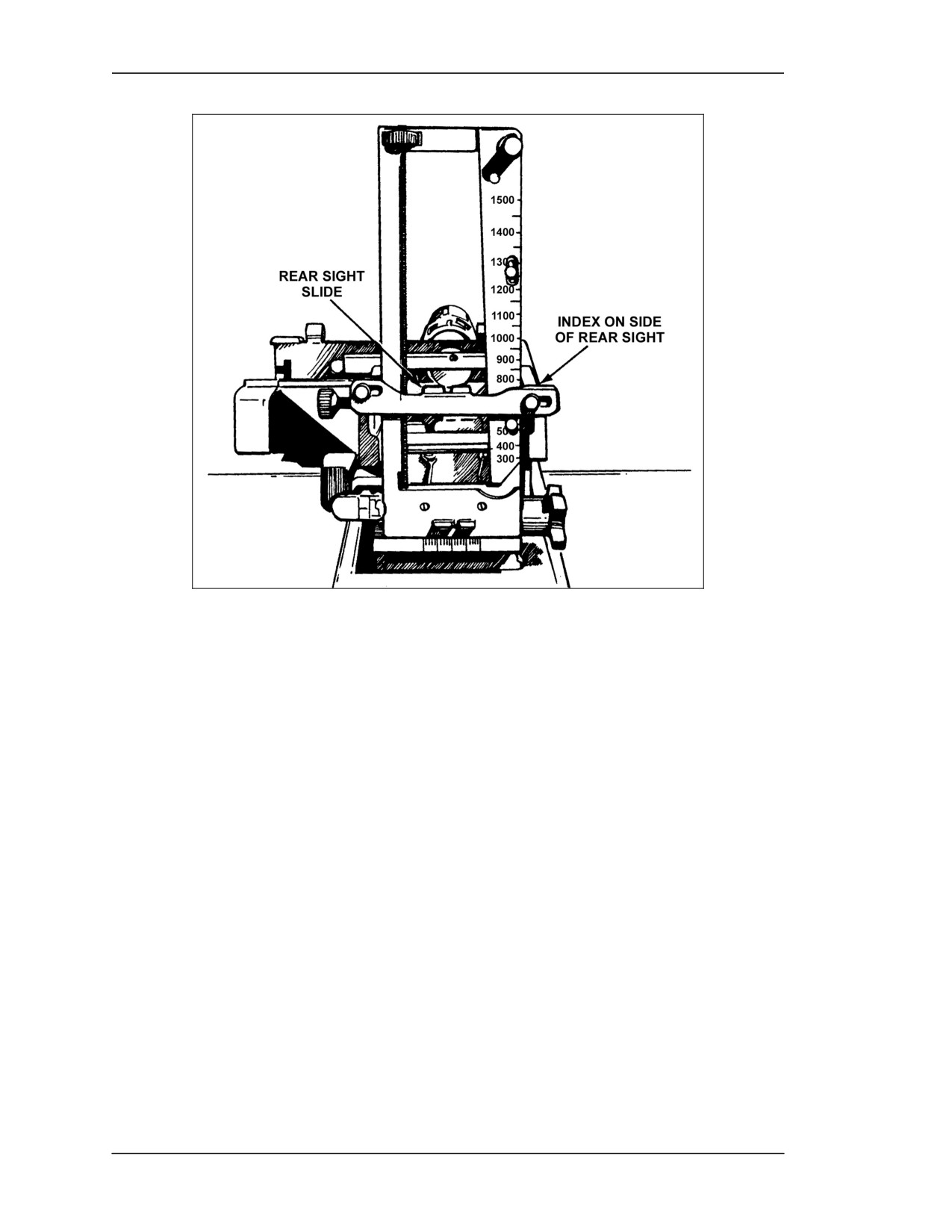
b. Sight Setting and Laying Exercises. This first exercise teaches the soldier how to set
the rear sight quickly and correctly (Figure 4-10). The second builds accuracy and speed in
laying the gun on an aiming point, and allows extra practice in sight setting. Explain and
show each exercise before beginning instruction.
(1) Sight Setting Exercise. Explain that, by training the elevating screw knob, the soldier
can make minor adjustments in elevation. All major adjustments are made by using the slide
release. Have one soldier act as gunner and another act as coach. Announce the range (for
example, “EIGHT HUNDRED”). Have the soldier in the gunner’s position conduct the
following:
• Repeat the range.
• Set the sight at the announced range.
• Assume the correct gunner’s position.
• Announce “Up.”
The soldier, acting as coach, checks the setting of the slide and points out any errors. The
soldiers work in pairs, change roles, and go through the exercise until each one can correctly
and rapidly set the sight.
4-9
FM 3-22.27
Figure 4-10. Rear sight adjustments.
(2) Laying Exercise. The MK 19 target board is used in this exercise. Explain that the
exercise starts with the sight leaf down and the sight slide at 500 meters. Ranges less than
400 meters or greater than 1,500 meters are not announced. Have one soldier act as the
gunner and another act as the coach at the gun. Announce an aiming point and range (for
example, “TARGET NUMBER ONE,” “ONE TWO HUNDRED”). Pause after each element
to allow the gunner time to repeat it. After the gunner repeats each element, have the gunner:
• Set the sights
• Manipulate the gun by turning the T&E handwheels until sights are aligned on
the chosen aiming point.
• Assume the correct gunner’s position.
• Report “Up.”
The soldier, acting as coach, checks the sight setting and lay of the gun. The soldiers work in
pairs, changing roles until each is skilled in doing the exercise.
c. Manipulation Exercise. Manipulation means shifting the direction of the gun from
one point to another. There are two manipulation exercises.
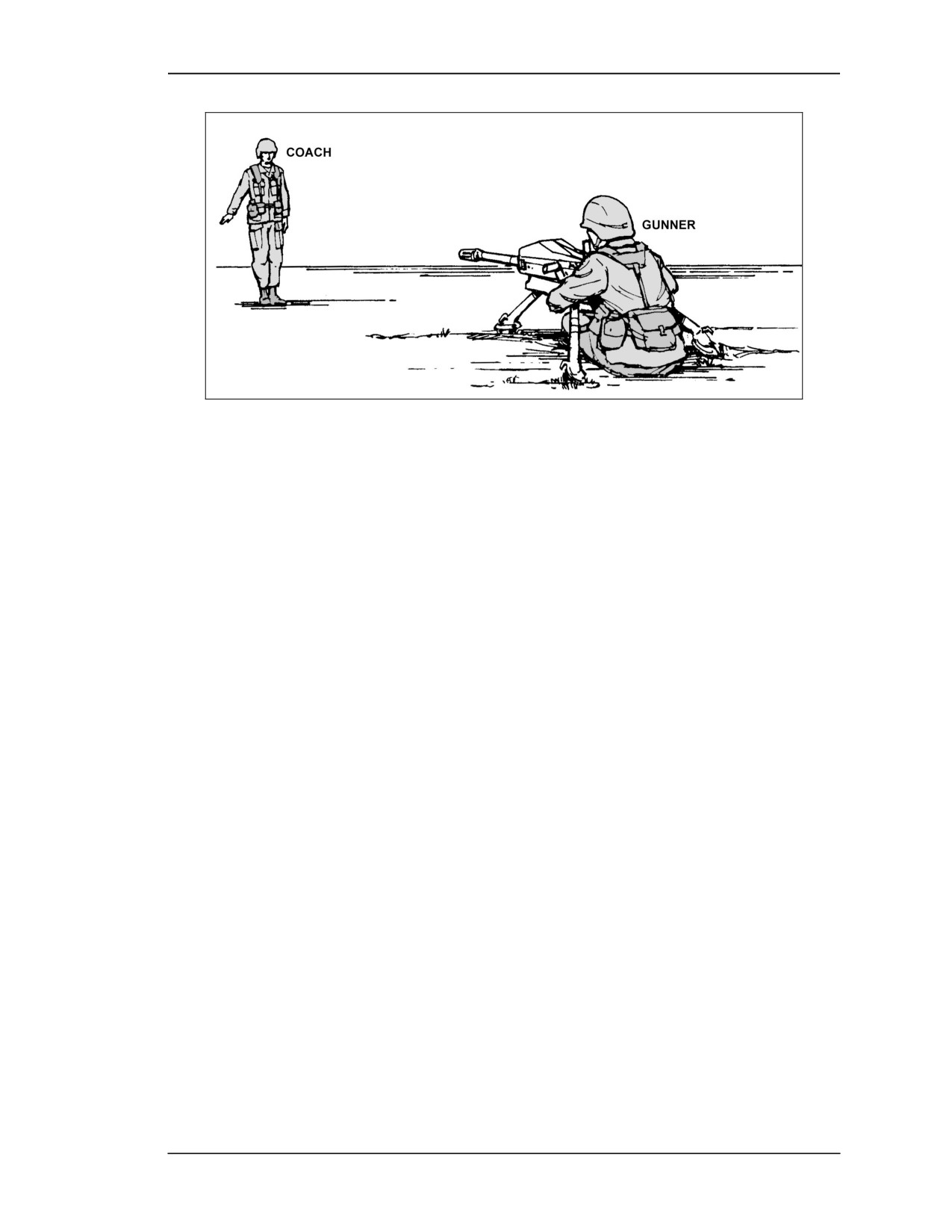
(1) The first exercise gives the gunner practice in manipulation. The coach stands 10
paces in front of the gun and uses hand signals to show the direction in which the gunner is
to move the muzzle (Figure 4-11). The gunner works the handwheel to manipulate the gun.
The coach observes and makes needed corrections. When the gunner reacts quickly and can
manipulate the gun as he has been shown, his instruction may continue.
4-10
FM 3-22.27
Figure 4-11. Coach and gunner exercise.
NOTE: Continue this exercise until the gunner is skilled in sighting and aiming.
(2) Once the soldier knows the basics of sighting and aiming, and can assume a good
firing position, give him the second manipulation exercise. Show him how to manipulate the
weapon to get a correct initial lay and how to skillfully shift the direction of the weapon to
successive points. Ensure the soldier understands and knows how to perform the following
instructions:
(a) Place the MK 19 target board 10 meters from the muzzle of the gun.
(b) Make large shifts in direction by releasing the traversing slide lock lever and moving
the slide to the right or left. Make small changes in direction by turning the traversing
handwheel with the left hand. One click on either T&E handwheel moves the strike 1 mil (1
cm on the target).
(c) Manipulate for elevation by rotating the elevating handwheel with the left hand
(Figure 4-12).
4-11
FM 3-22.27
Figure 4-12. Elevating handwheel.
d. Range Determination Exercise. Range determination means finding the distance
between the gunner’s position and his target. The gunner’s ability to engage a target depends
on his ability to correctly find the range to the target. Under combat conditions, ranges may
not be known in advance; the effectiveness of fire depends largely on the accuracy of the
range used. There are several methods for finding range. Some of these methods include:
estimating visually, firing the weapon, measuring range from a map or aerial photograph,
and pacing the distance. Binoculars or laser range finders may be used (see Chapter 5,
Techniques of Fire, for more on range determination).
e. Range Card Exercise. A range card is a record of the firing data needed to engage
predetermined targets within a sector of fire at night or during degraded conditions. The
range card may also be used to aid in target engagement during good visibility. It aids the
leader in preparing his defense plan. Predetermined targets in the secondary sector are
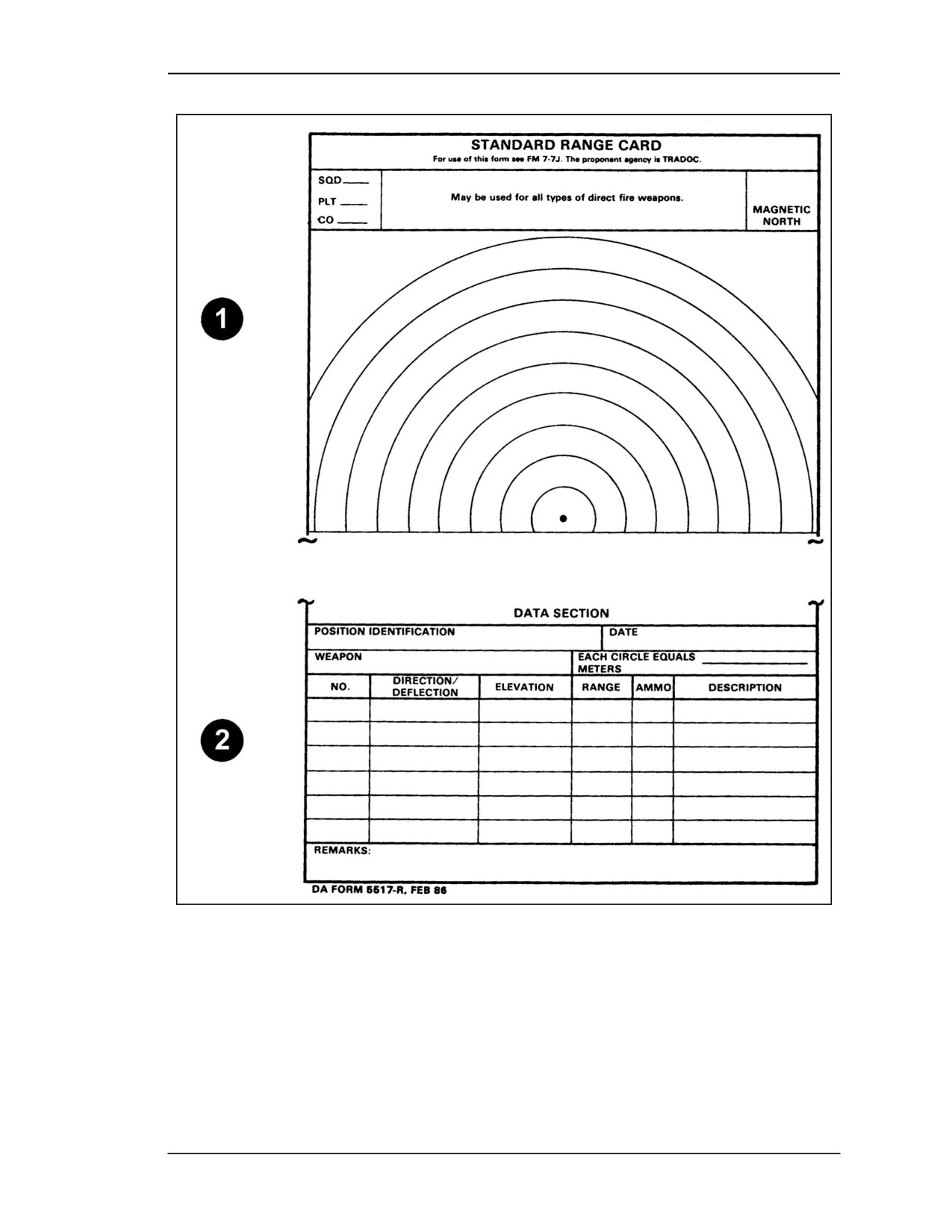
engaged by use of field expedients. A range card has two parts: a sketch section and a data
section. Although the sketch is not drawn to scale, the data referring to the targets must be
correct. DA Form 5517-R is the standard range card to be used (Figure 4-13).
4-12
FM 3-22.27
Figure 4-13. Range card sketch (1) and data sections (2).
(1) Range cards are prepared for primary, alternate, and supplementary positions. They
are prepared immediately upon arrival in a position, regardless of the length of stay, and are
updated as necessary. Range cards are prepared in duplicate. One copy stays at the gun
position, and the other is sent to headquarters. Range cards are prepared on arrival in a
position, regardless of the planned length of stay. Range cards are revised often during
occupation of a position.
4-13
FM 3-22.27
(2) Once the leader has decided where the firing position will be, the gunner prepares the
range card.
(3) The range card is prepared as follows:
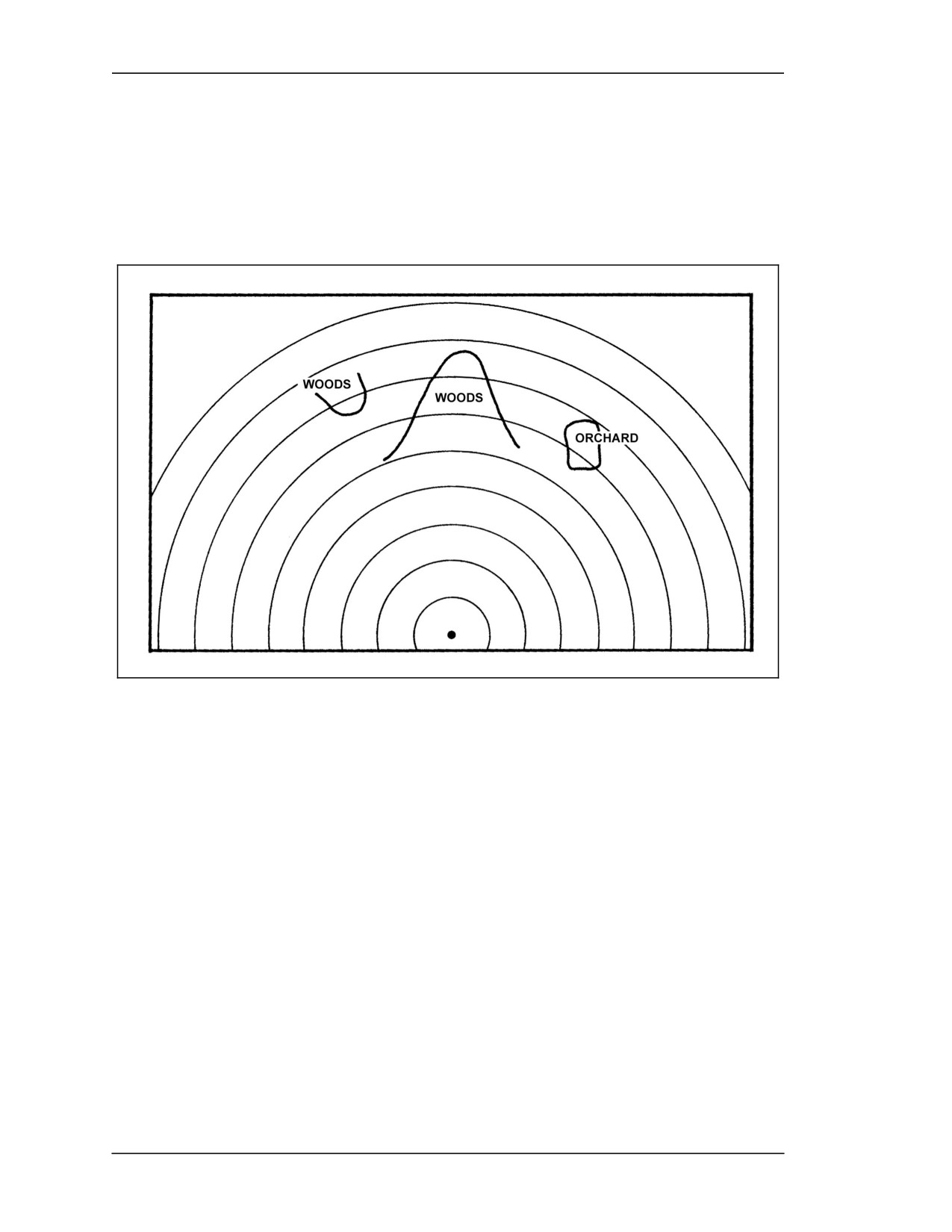
(a) Draw a sector sketch, covering the entire sector. Make the sketch as large as possible,
not to exceed the largest circle. For a large area covered by trees or woods, draw only the
outline and label the area “woods” or “orchard” (Figure 4-14).
Figure 4-14. Sketch of area on range card.
4-14
FM 3-22.27
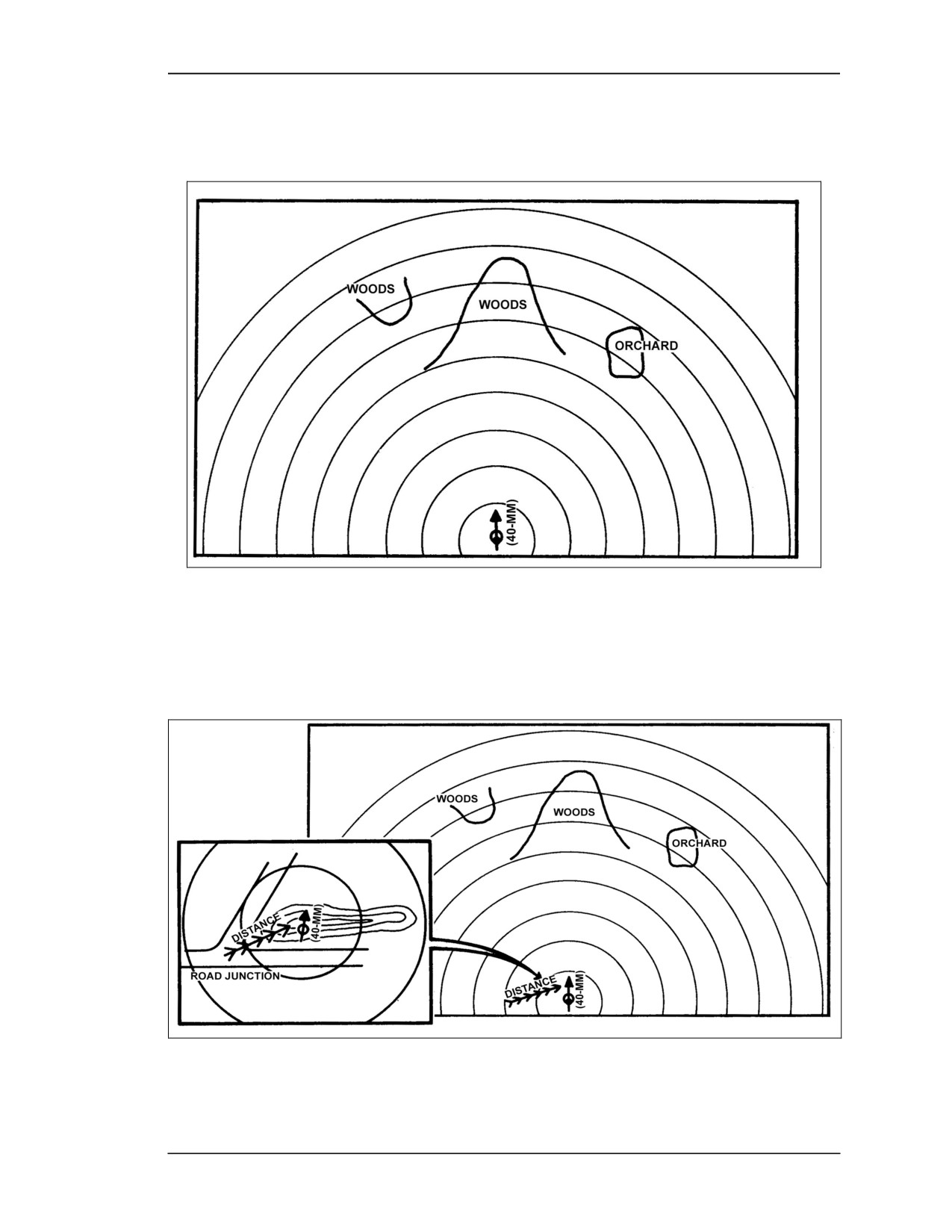
(b) In the lower center of the sketch section, show the firing position by drawing the
symbol for the weapon (Figure 4-15).
Figure 4-15. MK 19 symbol on range card.
(c) Show the location of the firing position by drawing a sketch of a nearby recognizable
terrain feature. Label it and draw an arrow to the weapon symbol. Add the distance and
azimuth from the terrain feature to the firing position (Figure 4-16).
Figure 4-16. Distance and azimuth to terrain feature.
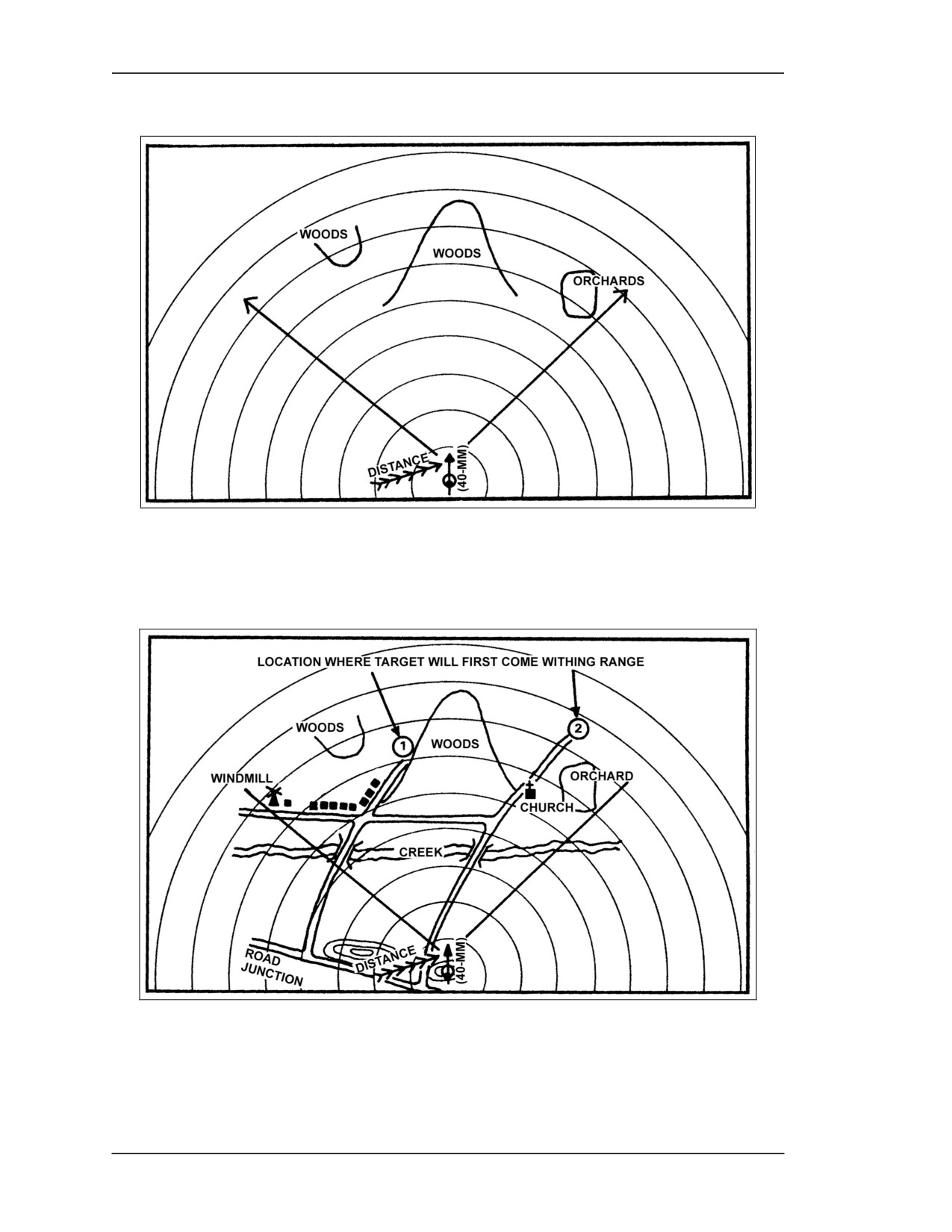
(d) Draw lines from the weapon symbol to reflect the left and right limits (Figure 4-17).
4-15
FM 3-22.27
Figure 4-17. Sector of fire.
(e) Number the planned target engagement locations from left to right, and write them on
the range card (Figure 4-18).
Figure 4-18. Planned target engagement areas.
4-16
FM 3-22.27
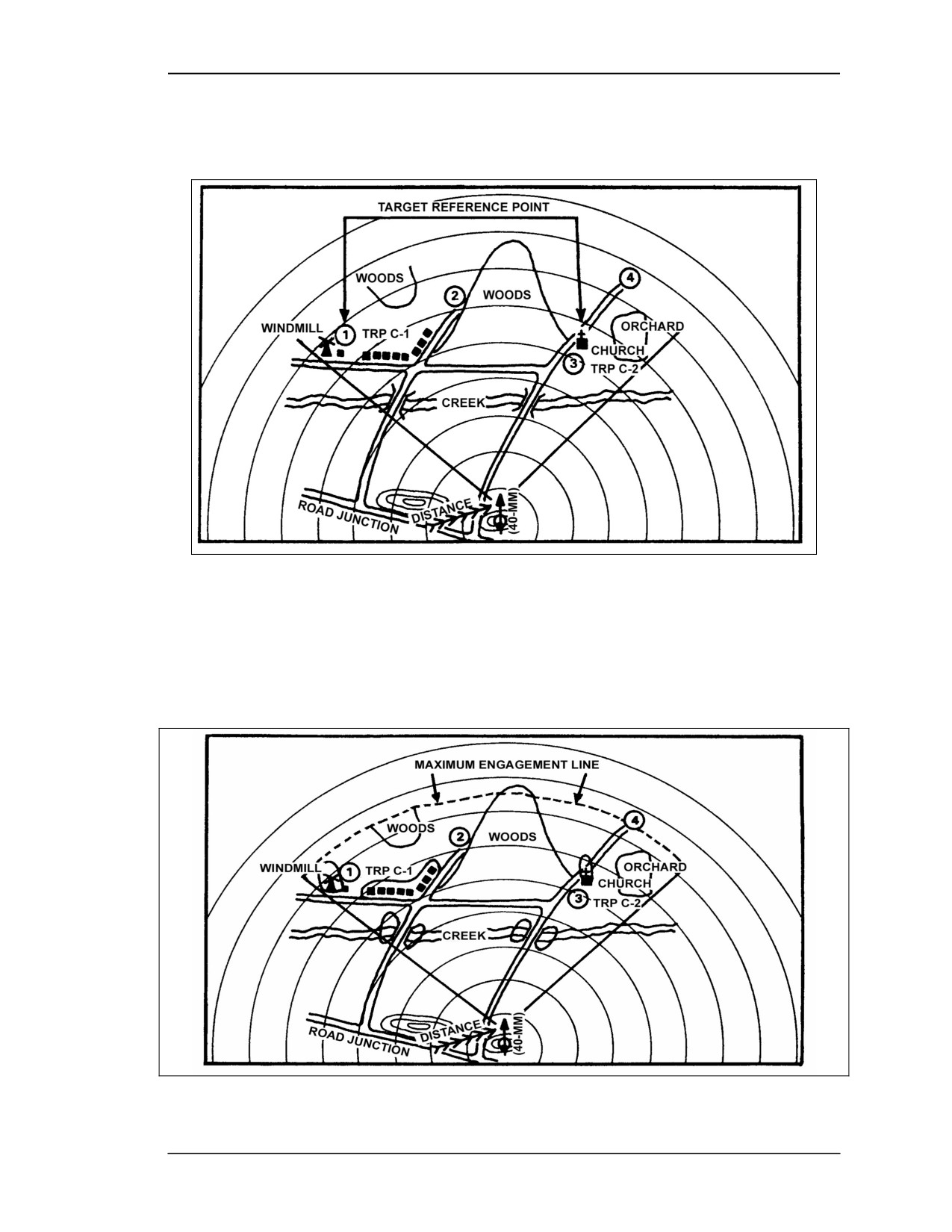
(f) Number the target reference points (TRPs) and write them on the range card (Figure
4-19).
Figure 4-19. Target reference points.
(g) If no limiting factors exist, the maximum engagement line curves and joins the left
and right sector-of-fire boundaries at the maximum engagement range (Figure 4-20). If
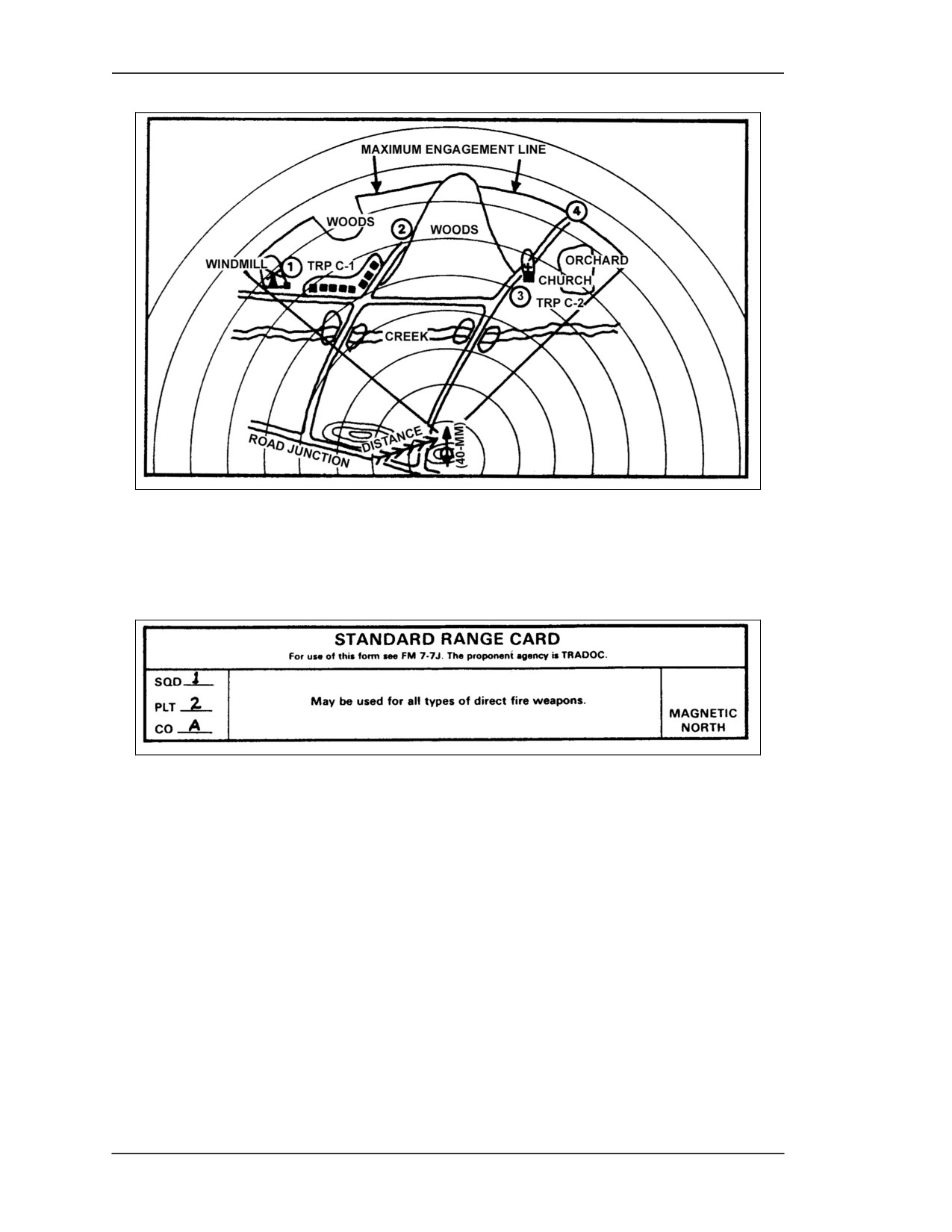
limiting factors exist, draw the maximum engagement line in front of the limiting terrain
features (Figure 4-21).
Figure 4-20. Maximum engagement line.
4-17
FM 3-22.27
Figure 4-21. Limiting factors on maximum engagement line.
(h) Fill in the marginal information at the top of the card in the following manner (Figure
4-22):
Figure 4-22. Marginal information.
• Unit description. Never show unit higher than company level.
• Magnetic north. Orient the range card with the terrain and find the direction of
magnetic north with a compass. Draw a magnetic north arrow using the straight
edge of the compass.
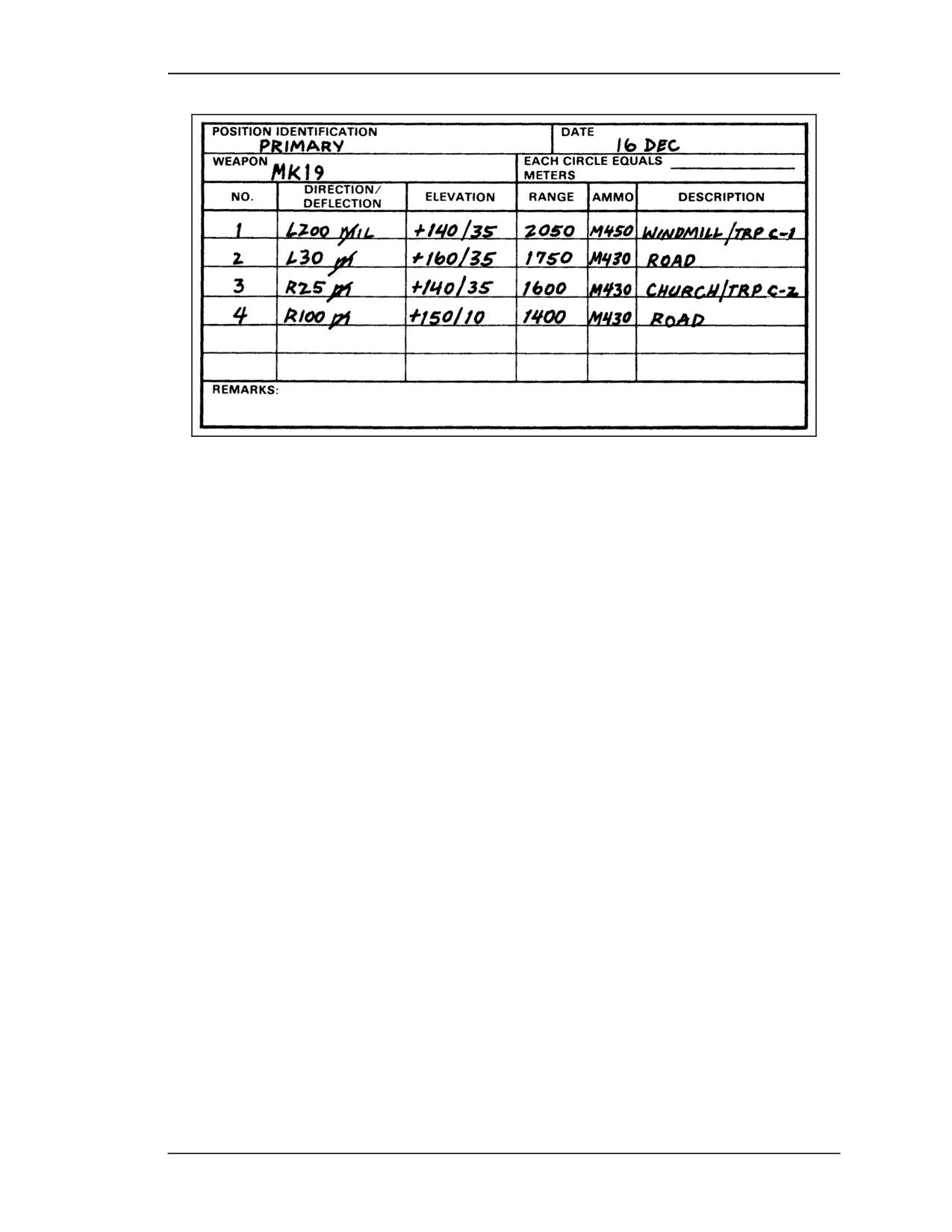
(i) Fill in the data section in the following manner (Figure 4-23):
• Position identification. Write primary, alternate, or secondary.
• Weapon. Write MK 19, grenade machine gun.
• Date. Write the day and month.
4-18
FM 3-22.27
Figure 4-23. Data section information.
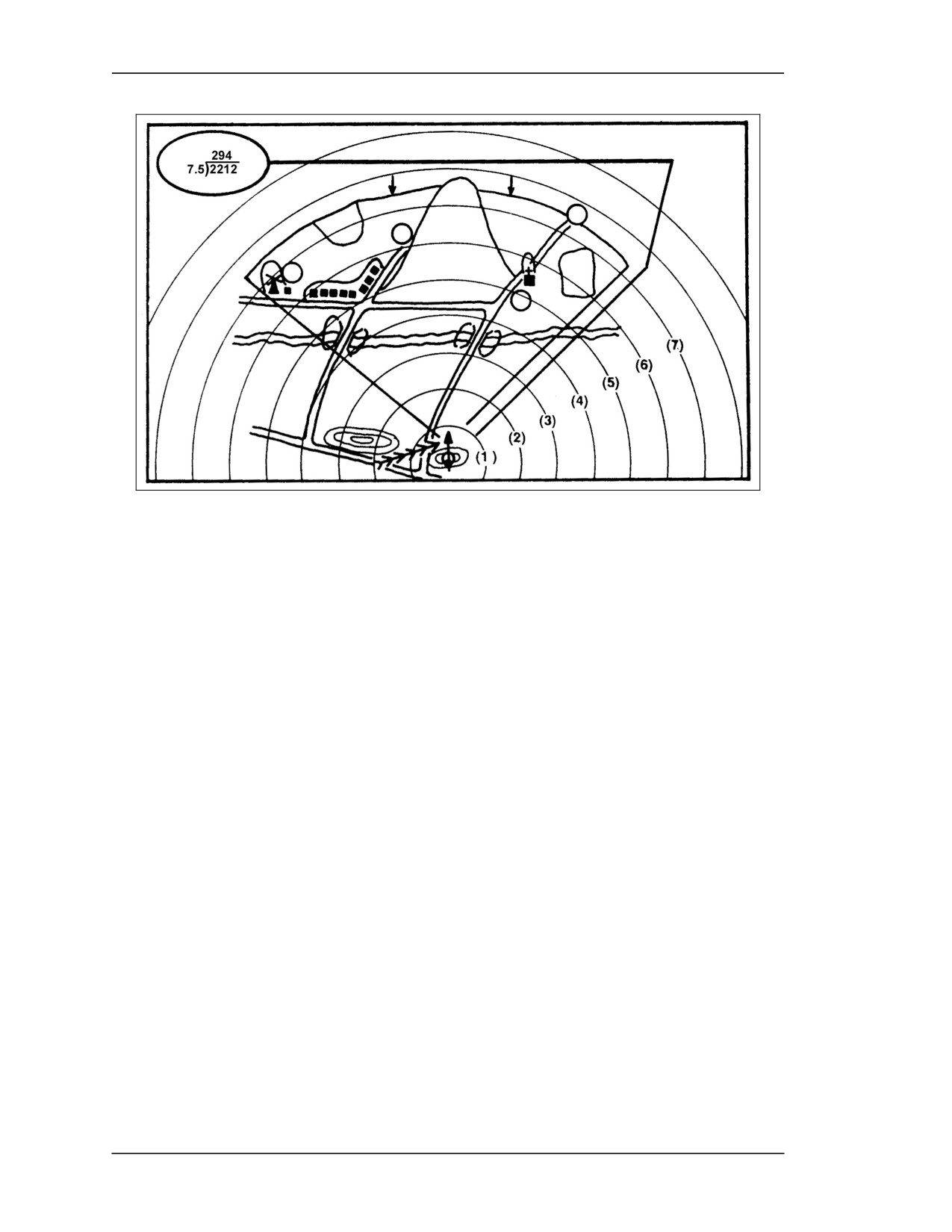
• Each circle equals 294 meters. Write in the distance in meters between the
circles. To find the distance, count the intervals from the weapon to the
maximum engagement line. Divide the number of intervals into the range. This
gives the distance between circles (Figure 4-24). For example:
2,212 meters = 294 meters between circles
7.5 intervals
4-19
FM 3-22.27
Figure 4-24. Determination of range the circles represent.
y Number (No.). Starting with number 1, write the numbers as listed for TRPs and
target engagement locations.
y Direction/deflection. Write the mils from the traversing bar and handwheel.
y Elevation. Write the elevation from the elevating screw plate scale and the
elevating handwheel.
y Range. Write distance in meters from the weapon to the TRP or target
engagement area.
y Ammunition. Write the type of round issued for the mission.
y Description. List the name of the object; for example: road, windmill, or church.
If the item is a TRP, list the TRP number also.
Section II. RANGE FIRE
Range firing gives hands-on MK 19 firing experience to the soldier who has completed the
Intermediate Gunnery Test. Use the procedures in this section to set up and conduct range
firing. The desired width for each lane is 100 meters at 800 meters from the firing line but
can be modified due to local range or terrain limitations. Range firing includes zeroing
procedures, observation and adjustment for fire, instructional firing, and qualification firing.
Active fighting-force gunners qualify semiannually and participate in exercises and
unit-level live fires quarterly. Active supporting-force gunners qualify and participate in
instructional fire annually. All reserve component gunners qualify annually. See Appendix
E, Annual Gunnery Training Program, for details.
4-20
FM 3-22.27
4-5.
DESCRIPTION
There are two types of ranges that may be used for MK 19 live-fire practice and
qualification. Regardless of which range is used, the MK 19 can be fired from either a tripod
or a vehicle.
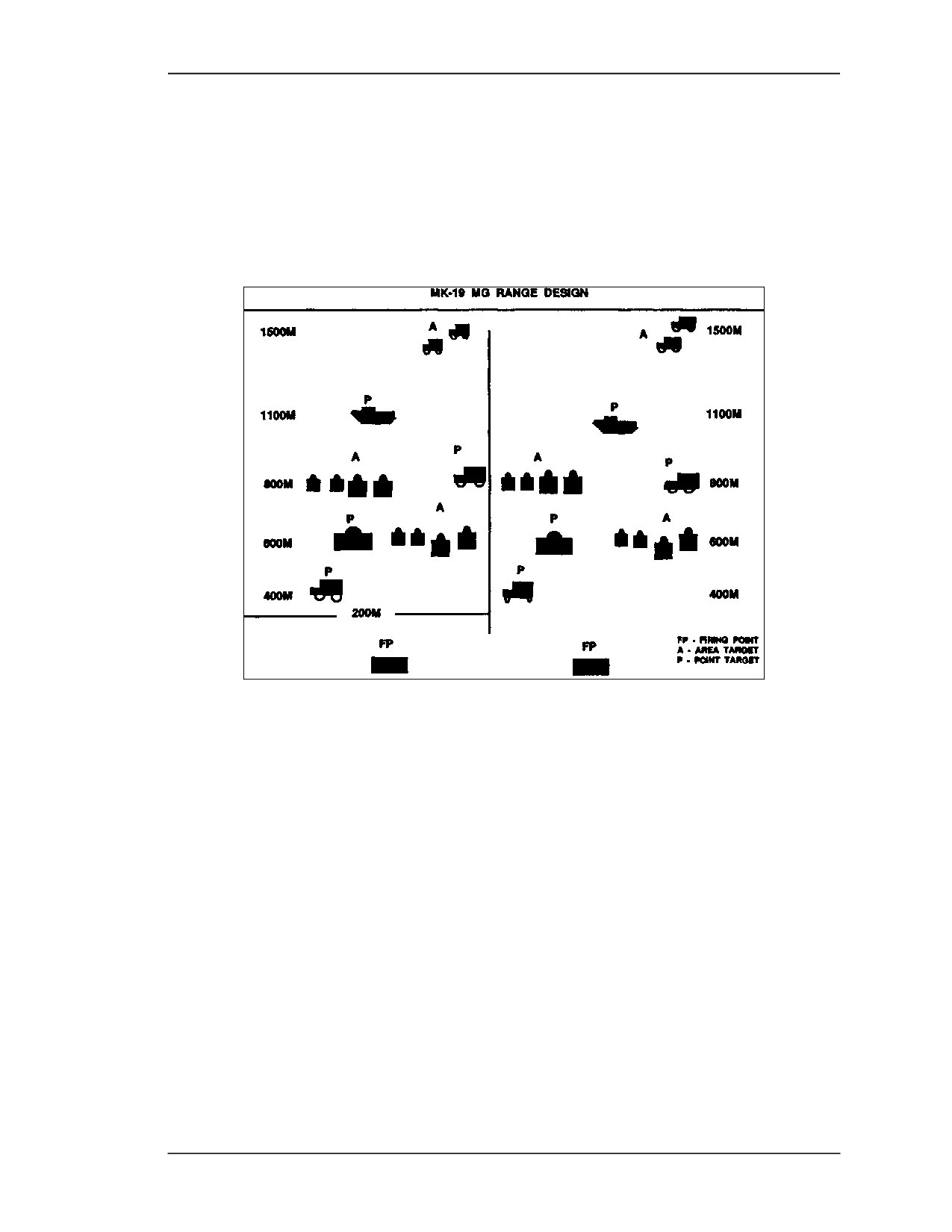
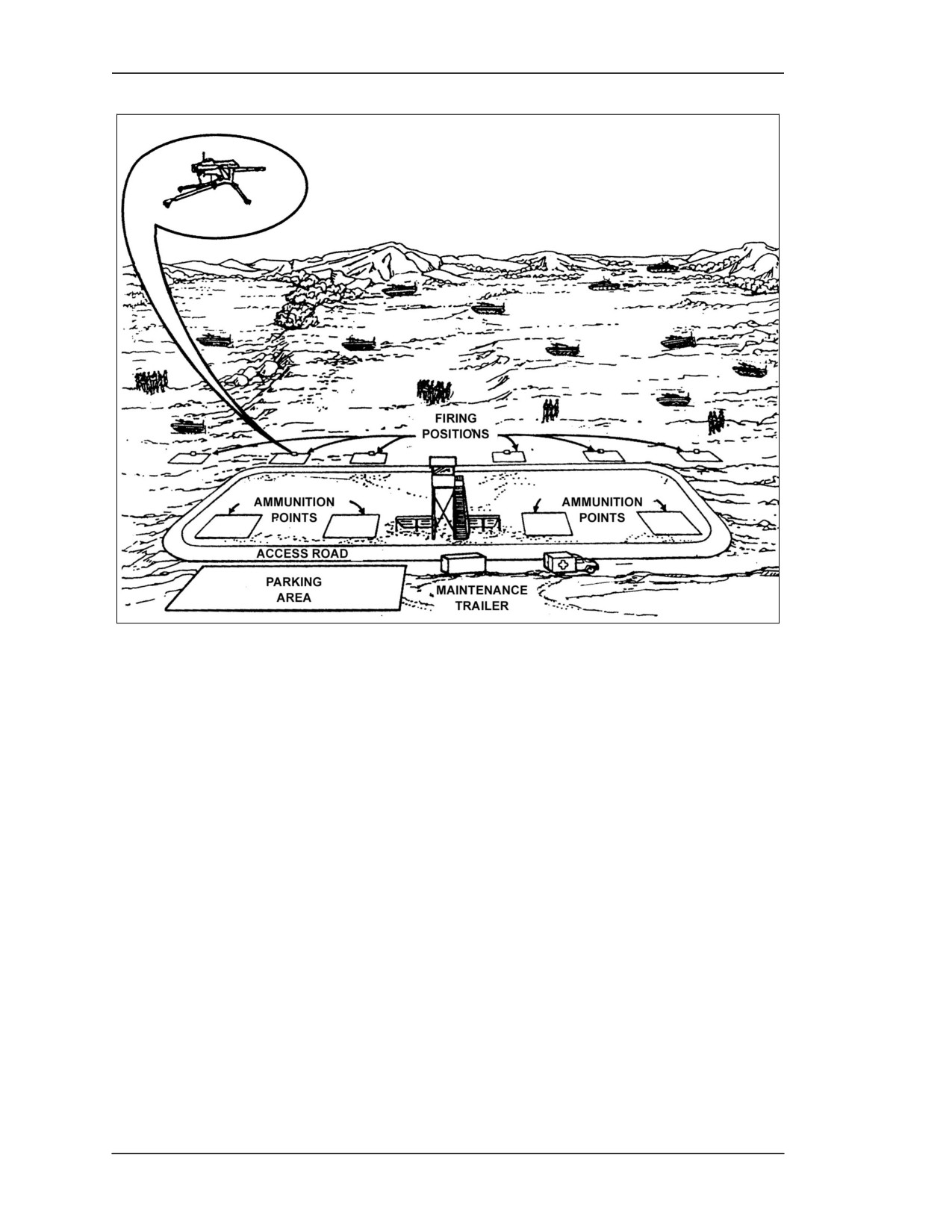
a. Multipurpose Gunnery Range for the 40-mm Grenade Machine Gun (Figures
4-25 and 4-26). This range is designed for the conduct of individual firing exercises and
qualifications against hull type targets. Details about this range can be found in TC 25-8.
Figure 4-25. Multipurpose gunnery range for the
40-mm grenade machine gun.
4-21
FM 3-22.27
Figure 4-26. Multipurpose gunnery range for the
40-mm grenade machine gun (continued).
b. Multipurpose Machine Gun Range. The MPMG is the range suggested for MK 19
live-fire training. It is used to train mechanized, motorized, combat support, and combat
service support units. The design and traits of this type of range are described in TC 25-8.
Only a non dud-producing practice round is used on this range.
4-6.
OPERATION
Use range operation procedures any time LFXs are conducted on the range. These
procedures are the same for all range firing exercises.
a. Brief the gun crews on the range setup, fire commands, and safety procedures.
Explain exercise needs as defined by the unit commander, or as they are to be done by the
firing tables.
b. Divide the crews into groups and assign each group a firing point and an assistant
instructor (AI). Ensure they are directed to their firing points and are shown their assigned
sectors of fire. Have the AIs ensure that all crews have the equipment needed to perform the
task.
c. Conduct the exercise. For example you can command GUNNER, WHEN I SAY
BEGIN, PLACE THE MK 19 INTO OPERATION ON THE TRIPOD (ORGANIC
CARRIER) WITHIN ____ MINUTES. ARE THERE ANY QUESTIONS? (pause) BEGIN.
4-22
FM 3-22.27
At the end of the given time period, direct STOP. AIs, CRITIQUE YOUR CREWS AND
GIVE ME YOUR “UP” SIGNAL WHEN YOU HAVE FINISHED.
4-7.
COACHES
The instructor may arrange for a coach to be present at each gun during the following
preparatory training, exercises, and instructional firing. Successful marksmanship training
depends on the coaches. Well-trained and well-rehearsed gunners or crew members may be
assigned as coaches. The coaches:
• Require the gunner to inspect his gun and equipment.
• Help the gunner place the gun on target.
• Require the gunner to explain the exercise that he is about to perform.
• Observe the gunner’s position, grip, and manipulation during simulated firing.
4-8.
FIRE PROCEDURES
Firing the MK 19 is not hard. However, to be effective, the gunner must be able to skillfully
manipulate the trigger and T&E mechanism; the weapon must be held down and to one side
while aiming and adjusting the T&E mechanism. The following steps are simple, but the
gunner must remember to estimate the distance to the target, set the sights for distance,
manipulate the T&E mechanism, press the trigger, and fire a single round; since the MK 19
is a fully automatic weapon, this can only be done by “popping” the trigger once. He must
spot the impact of the first round and adjust to the target area. He should begin firing six- to
nine-round bursts. This whole process can be done in a matter of seconds, the longest part
being the flight time of the round. To fire the weapon:
(a) Place the safety on F (FIRE).
(b) Ensure the charger handles are in the forward and upright position.
(c) Place your hands on the control grips, and your thumb(s) on the trigger.
(d) Hold the weapon down and to one side, and check sight picture.
(e) Press the trigger to fire.
WARNING
Because of the gun's recoil, the first burst is the hardest to
control. Ensure that the gun’s recoil does not cause the barrel of
the weapon to drop and rounds to strike short of the target. Keep
it elevated.
4-9.
ZEROING PROCEDURES
Zeroing procedures are crucial for hitting targets at ranges of 600 meters or more. It is
strongly recommended that a target at 400 meters be used to zero. The following is the
correct way to zero the MK 19 to the gunner.
a. Loosen the range plate screw. Move the range plate to the midpoint between the two
studs. Tighten the range plate screw. Move the rear sight slide to the meter mark that
4-23
FM 3-22.27
represents the distance to the target. For example, move to the 400-meter mark to zero on a
target known to be 400 meters away. Set the windage knob at the zero index line.
b. Align the sights on the base of the target using the T&E mechanism.
c. Fire a single round and spot the impact of the round. If it is on the target, fire another
short burst to confirm the zero. If the round is not on target, go on to the next step.
d. To adjust for a round that is not on target, do the following:
(1) If the impact of the round is short or over, adjust the elevation knob. Estimate how
short or over the round is. If the round is short, use this estimate to adjust the elevation knob
clockwise, which moves the sights up onto the knob counterclockwise to bring the sights
down to the target. For example, if the rounds impact 10 mils short, adjust the elevation knob
10 mils up by turning it clockwise. Realign the sights and adjust the gun back on target using
the T&E mechanism before the next round is fired.
NOTE: 1. If the adjustment was correct, the second round should be on target. If so, fire
the rest of the rounds to confirm the zero. If not, repeat the previous step.
2. If the impacts are not observed, bold adjustments may be necessary.
(2) If the round is to the right or left, adjust the windage knob. Estimate how far to the
right or left the sight needs to move to bring the rounds on target. Turn the windage knob
clockwise to adjust to the right; turn the windage knob counterclockwise to adjust to the left.
For example, if the rounds impact 10 mils to the right, adjust the sight 10 mils to the left by
turning the windage knob counterclockwise. Realign and adjust the sights back on target
using the T&E mechanism before firing the next round.
(3) Once the zero is completed, align the range plate scale at the exact range of the target
used to zero, and tighten it.
e. Point out errors and explain their effect.
f. When the gunner maintains the same sight picture, the type of firing position does not
alter the zero.
4-10. OBSERVATION AND ADJUSTMENT OF FIRE
Observation and adjustment gives the soldier a chance to practice adjustment of fire by
observing trajectory and impact or by re-laying often on the target using the sights. Live-fire
training is held on the firing range after the methods are explained in the classroom.
a. When firing on targets, adjust by moving the burst into the target. Based on the strike
of the rounds, adjust the number of clicks for elevation and direction needed to move the
center of impact onto the target. This does not call for the use of sights. For example, fire at a
target 500 meters away; the rounds impact 20 meters short and 50 meters right. Use the T&E
handwheels, moving the muzzle left and up the proper number of clicks, to manipulate the
gun onto the target.
b. Another procedure is the adjusted aiming point method. Use the sights and select an
aiming point calculated to place the second burst on target. For example, fire at a 500-meter
target; the rounds impact 20 meters short and 10 meters right. Rapidly select another aiming
point about 20 meters beyond and 10 meters to the left of the target, lay on that aiming point,
and fire.
4-11. INDIVIDUAL GUNNER EXERCISES AND QUALIFICATION
4-24