FM 3-22.27 MK 19, 40-mm GRENADE MACHINE GUN, MOD 3 (NOVEMBER 2003) - page 1
*FM 3-22.27(FM 23-27)
FIELD MANUAL
HEADQUARTERS
NO. 3-22.27
DEPARTMENTS OF THE ARMY
WASHINGTON, DC, 28 November 2003
MK 19, 40-mm GRENADE
MACHINE GUN, MOD 3
CONTENTS
Page
PREFACE……………
iv
CHAPTER 1.
INTRODUCTION
1-1.
Applications
1-1
1-2.
Description
1-1
1-3.
Training Strategy
1-8
CHAPTER 2.
OPERATION AND FUNCTION
2-1.
Cycle of Operation
2-1
2-2.
Operating Precautions
2-4
2-3.
Clearance Procedures
2-4
2-4.
Disassembly and Assembly
2-7
2-5.
Loading Procedures
2-20
2-6.
Malfunctions, Stoppages, and Corrections
2-22
2-7
Care and Cleaning
2-22
2-8.
Operation Under Adverse Conditions
2-23
2-9.
Destruction
2-23
CHAPTER 3.
GROUND AND VEHICLE MOUNTS
3-1. MK64, MOD 7, Gun Cradle
3-1
3-2. Ground-Mount Using the M3 Tripod
3-1
3-3. Vehicle-Mount
3-9
CHAPTER 4.
MARKSMANSHIP
Section
I.
Preparatory Marksmanship Training
4-1
4-1. Firing Positions
4-1
4-2. Fighting Position
4-4
4-3. Traverse Bar and T&E Mechanism
4-5
4-4. Exercises
4-8
DISTRIBUTION RESTRICTION: Approved for public release; distribution is unlimited.
________________________________________
*This publication supersedes FM 23-27, dated 27 December 1988.
i
FM 3-22.27
Page
Section
II.
Range Fire
4-21
4-5. Description
4-22
4-6. Operation
4-23
4-7. Coaches
4-24
4-8. Fire Procedures
4-24
4-9. Zeroing Procedures
4-24
4-10. Observation and Adjustment of Fire
4-25
4-11. Individual Gunner Exercises and Qualification
4-26
CHAPTER 5.
TECHNIQUES OF FIRE
Section
I.
Characteristics and Classes of Fire
5-1
5-1. Characteristics of Fire
5-1
5-2. Classes of Fire
5-1
Section
II.
Range Determination
5-4
5-3. Measurement by Visual Estimation
5-5
5-4. Measurement from a Map
5-6
5-5. Measurement by Pacing
5-6
5-6. Measurement Using Binoculars
5-7
5-7. Measurement Using AN/GVS-5 Laser Range Finder
5-10
5-8. Measurement by Firing
5-10
5-9. Measurement of Lateral Distance
5-10
Section
III.
Application of Fire
5-11
5-10. Fire Control
5-11
5-11. Fire Commands
5-12
5-12. Target Engagement
5-15
5-13. Defilade Position
5-29
Section
IV.
Degraded Conditions
5-38
5-14. Night Firing
5-38
5-15. Firing in a Nuclear, Biological, or Chemical Environment
5-39
5-16. Firing in Fog or Smoke
5-39
Section
V.
Predetermined Fires
5-39
5-17. T&E Mechanism Method
5-39
5-18. Field-Expedient Method of Laying the MK 19
5-39
CHAPTER 6.
INFORMATION FOR INSTRUCTORS
6-1. Presentation
6-1
6-2. Mechanical Training
6-1
6-3. Crew Drills
6-2
6-4. Marksmanship
6-3
APPENDIX A. TRAINING STRATEGY
A-1
APPENDIX B. OPERATIONS CHECKLIST
B-1
APPENDIX C. STOPPAGES, MALFUNCTIONS, IMMEDIATE ACTIONS,
AND REMEDIAL ACTIONS
C-1
APPENDIX D. GUNNERY TESTS
D-1
ii
FM 3-22.27
Page
APPENDIX E. ANNUAL GUNNERY TRAINING PROGRAM
E-1
APPENDIX F. FIRING TABLE
F-1
APPENDIX G. AIMING DEVICES
G-1
APPENDIX H. CREW DRILLS
H-1
APPENDIX I. GUNNERY EXERCISES
I-1
GLOSSARY …………
Glossary-1
REFERENCES ………
References-1
INDEX ………………
Index-1
iii
FM 3-22.27
PREFACE
This manual discusses how to train the unit to use the MK 19, 40-mm grenade machine
gun, model (MOD) 3, referred to in this manual as the MK 19. This manual highlights
mechanical training, weapon capabilities, and gunnery principles, methods, techniques,
and standards that apply to the MOD 3. It also includes preliminary gunnery, a gunnery
skills test, gunnery tables, and qualification tables. If this information conflicts with an
applicable technical manual (TM), revised TM, or TM update, the crew will follow the
guidance in the most recently published document.
The primary audiences for this manual are soldiers, trainers, and staff officers. Units can
modify the gunnery program to meet local training restraints. Although the gunnery
tables are intended for use with live fire, trainers can use the tactical engagement
simulator system (TESS), a video disc trainer (VDT), a multipurpose arcade combat
simulator (MACS), or other training device, except on qualification tables.
In all cases, units must evaluate their training to ensure that it follows the building-block
principle and adheres to sound training policy. Only a crew that is trained and does well
in preliminary gunnery exercises is likely to do well in live-fire exercises (LFX) and in
combat situations.
The proponent for this publication is the U.S. Army Infantry School. Send comments and
recommendations to doctrine@benning.army.mil or on a DA Form 2028 (Recommended
Changes to Publications and Blank Forms) directly to Commandant, U.S. Army Infantry
School, ATTN: ATSH-ATD, Fort Benning, Georgia 31905-5593.
Unless this manual states otherwise, masculine nouns and pronouns do not refer
exclusively to men.
iv
FM 3-22.27(FM 23-27)
CHAPTER 1
INTRODUCTION
Although the MK 19 is a recent entry into the Army’s inventory, development
began in 1963. The first version was a hand-cranked, multiple grenade launcher
called the MK 18. In 1966 the need for more firepower inspired the development of a
self-powered 40-mm machine gun called the MK 19, MOD 0. This model was neither
reliable nor safe enough for use as a military weapon system. Product improvements
begun in 1971 resulted in the 1972 MOD 1, of which only six were produced. The
MOD 1 performed effectively in Navy riverine patrol craft and broader applications
for the MK 19 were found. In 1973 the Navy developed the MOD 2, which featured
improved reliability, safety, and maintainability. In 1976 a complete redesign
resulted in the MK 19, MOD 3, which the Army adopted in 1983. The Army now uses
the MK 19 within the tactical environment for defense, retrograde, patrolling, rear
area security, urban operations, and special operations.
This chapter provides applications, training strategies, and descriptive,
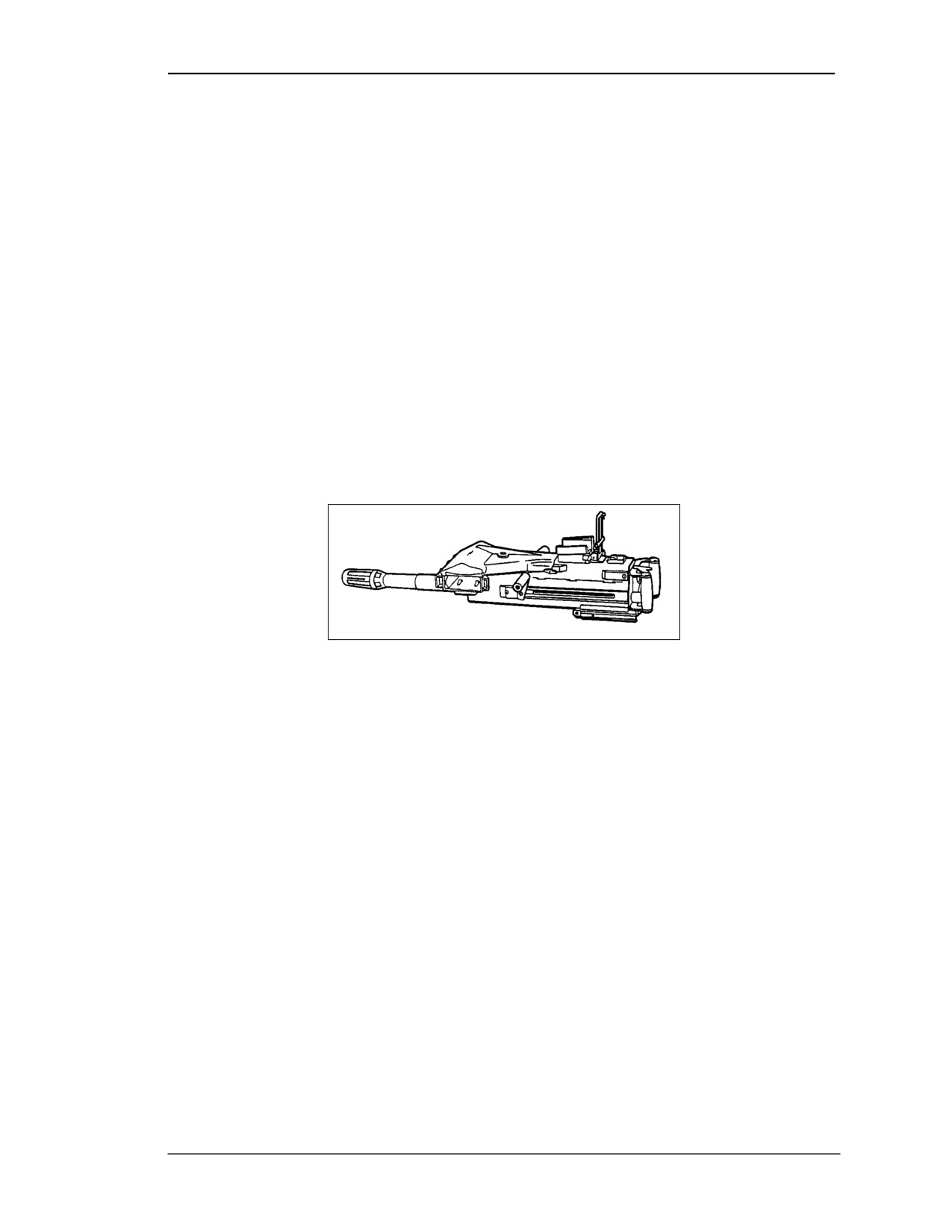
technical, and operational data for the MK 19 (Figure 1-1).
Figure 1-1. MK 19, 40-mm grenade machine gun, MOD 3.
1-1.
APPLICATIONS
The MK 19 supports the soldier in both the offense and defense. It gives the unit the
capability of laying down a heavy volume of close, accurate, and continuous fire. The MK
19 can also:
• Protect motor movements, assembly areas, and supply trains in a bivouac.
• Defend against hovering rotary aircraft.
• Destroy lightly-armored vehicles.
• Fire on suspected enemy positions.
• Provide high volumes of fire into an engagement area (EA).
• Cover obstacles.
• Provide indirect fires from defilade positions.
1-2.
DESCRIPTION
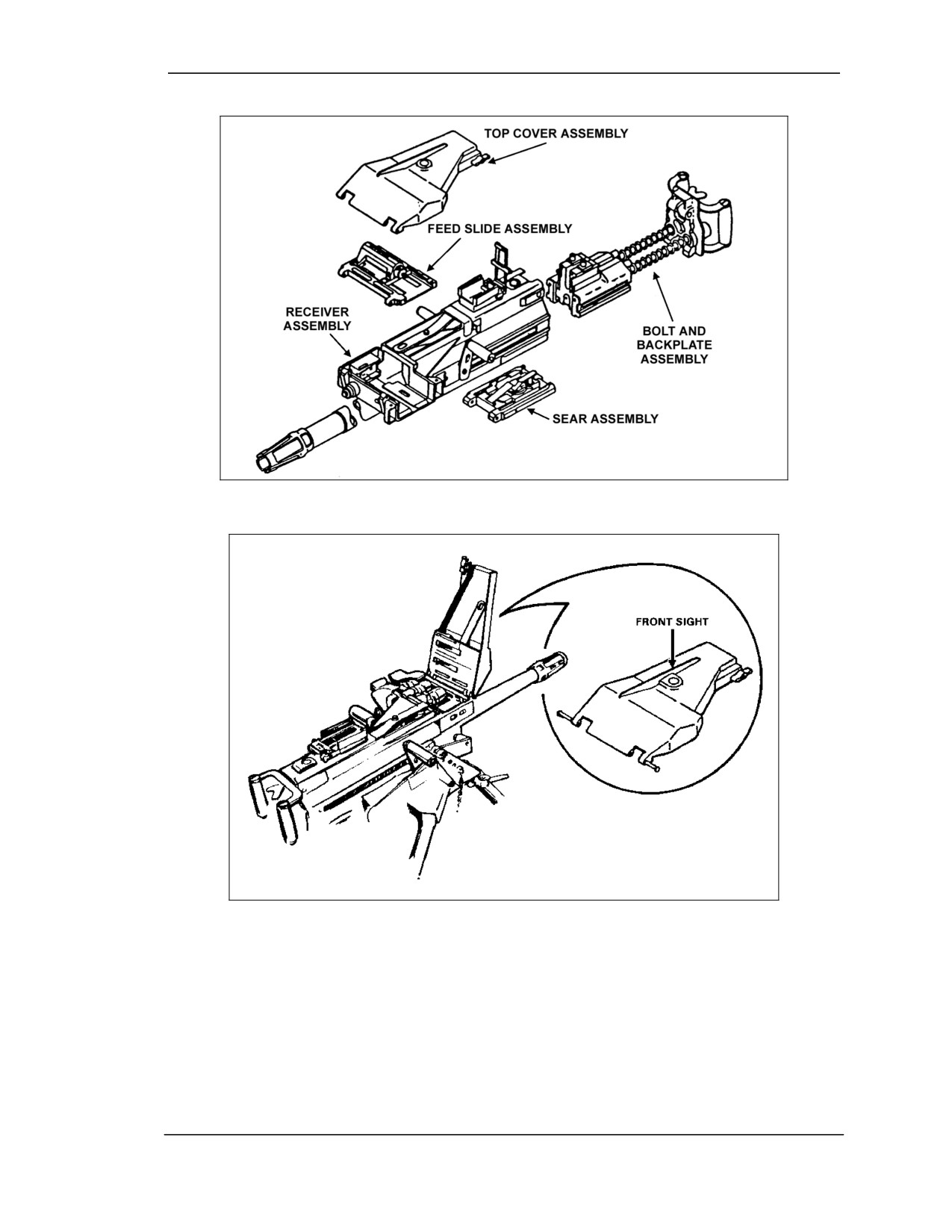
The MK 19 is an air-cooled, blowback-operated machine gun with five major assemblies
(Figure 1-2). A disintegrating metallic link belt feeds ammunition through the left side of the
weapon. Tables 1-1 and 1-2 provide MK 19 technical and operational data, respectively.
1-1
FM 3-22.27
a. Receiver Assembly. Holds the barrel and other parts of the gun. Ammunition is fed
into the left side of the receiver through the feed throat assembly. The MK 19’s barrel will
not overheat, even after prolonged firing.
b. Feed Slide Assembly and Tray. Holds the rounds in the feeder and indexes the
ammunition into position for delinking.
c. Top Cover Assembly. Holds the feed slide assembly and tray. It is opened by a latch
(left side) for loading or to clean and inspect feeder area. A blade-type front sight is attached
to the top cover assembly (Figure 1-3).
d. Sear Assembly. Holds the receiver sear. Trigger action releases the sear and allows
the bolt to go forward. The safety is attached to the sear assembly.
e. Bolt and Backplate Assembly. The bolt fires the round when the sear is depressed
by trigger action. The recoil springs drive the bolt forward on the receiver rails. The guide
rods hold the springs in position. Trigger and handgrips are located on the backplate
assembly.
f. Feed Throat Assembly. Allows smooth feeding of 40-mm ammunition. It attaches to
the forward left side of the receiver by two sets of spring-loaded retaining pins. Without a
feed throat, machine gun stoppages may occur because of twisted or misaligned rounds.
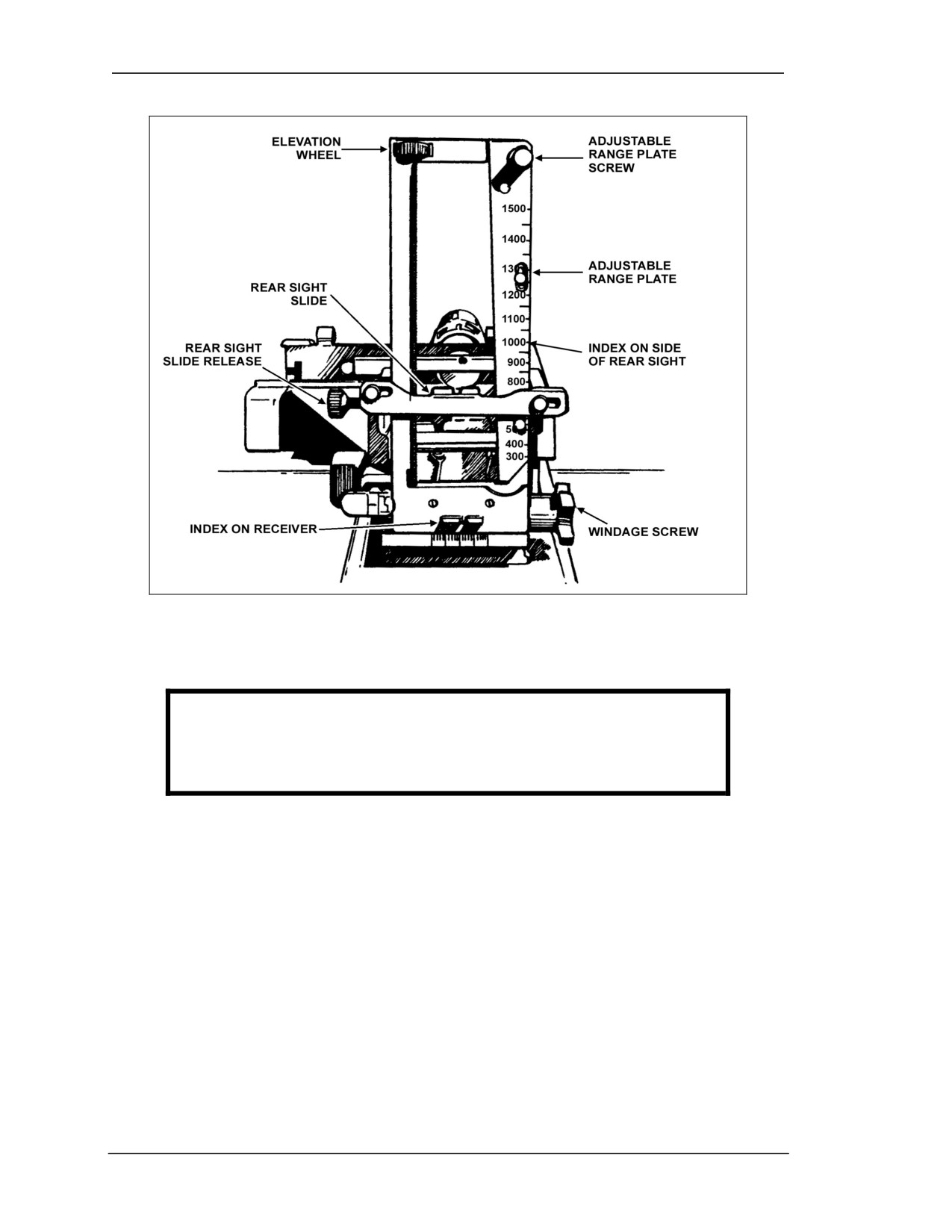
g. Leaf-Type Rear Sight (with adjustable range plate). Is marked in 100-meter
intervals from 300 to 1,500 meters. The sight is mounted on a spring dovetail base to the
receiver assembly (Figure 1-4). Before moving the weapon, the gunner folds the sight
forward to a horizontal position. The rear sight can be adjusted for range and windage.
(1) Range. Different adjustments can be made to the range. Use the rear sight slide
release to make major adjustments to the range. Use the elevation wheel to make fine
adjustments to the range.
(2) Windage. Use the rear sight to adjust for windage. One click equals a 1-mil change.
To move the sight to the right, turn the windage screw clockwise. To move the sight to the
left, turn the windage screw counterclockwise.
1-2
FM 3-22.27
Figure 1-2. Five major assemblies.
Figure 1-3. Front sight on top cover assembly.
1-3
FM 3-22.27
Figure 1-4. Rear sight.
WARNING
Use only prescribed ammunition. Mixing types of
ammunition could result in injury.
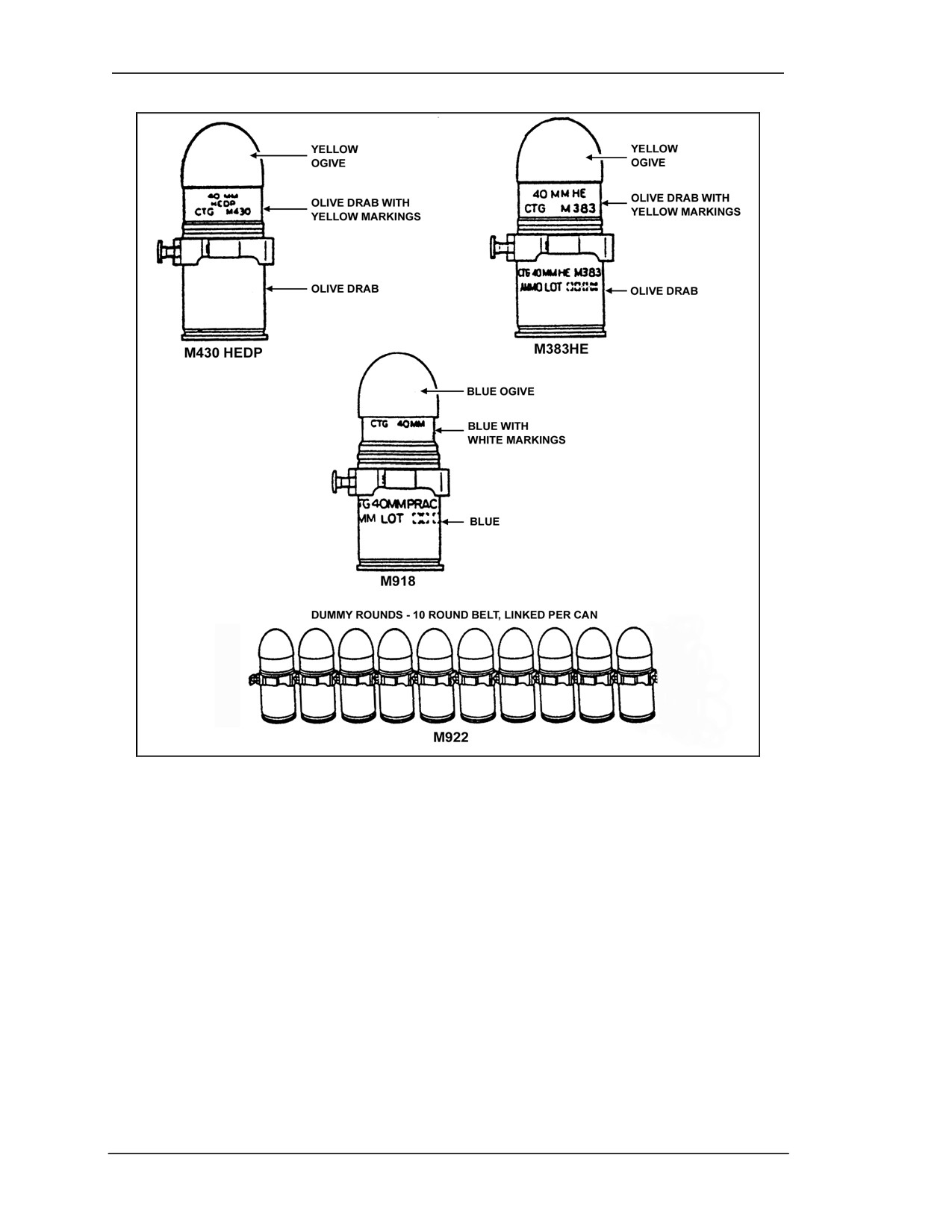
h. The MK 19 uses the following 40-mm cartridges (Figure 1-5, page 1-8).
(1) High-Explosive, Dual-Purpose M430 Cartridge. The high-explosive, dual-purpose
(HEDP) M430 cartridge is the standard round for the MK 19 (Department of Defense
Identification Code [DODIC] B542). They are linked with M16A2 links. The HEDP round,
the top-curved portion of the projectile, is olive drab with a yellow ogive and yellow
markings. It is packed in M548 (48 rounds) or PA120 (32 rounds) ammunition containers.
The HEDP, an impact-type round, can penetrate 2 inches of steel armor at 0-degree obliquity
and inflict personnel casualties out to 15 meters from impact. It arms within 18 to 30 meters
of the gun muzzle and has a point-initiating, base-detonating (PIBD) fuze.
(2) High-Explosive M383 Cartridge. The high-explosive (HE) M383 cartridge round is
olive drab with a yellow ogive and yellow markings. It is packed in a metal ammunition
container (48 rounds, linked, in each container). The HE round has a wound radius of 15
1-4
FM 3-22.27
meters. It lacks the armor-penetrating ability of the HEDP M430 round. The HE arms
between 18 to 36 meters of the gun muzzle fuze.
(3) M922 Dummy Cartridges. Each MK 19 is issued with one 10-round of inert dummy
rounds belt (DODIC B472). M16A2 links join the dummy rounds into a 10-round belt
packed in an M2A1 metal box. Trainers use dummy rounds to check weapon function and to
train crews.
(4) M918 Cartridge. The M918 is a training practice cartridge that has the same muzzle
velocity of 790 feet per second (fps), signature, and sound as the HE round (DODIC B584).
(4)
1-5
FM 3-22.27
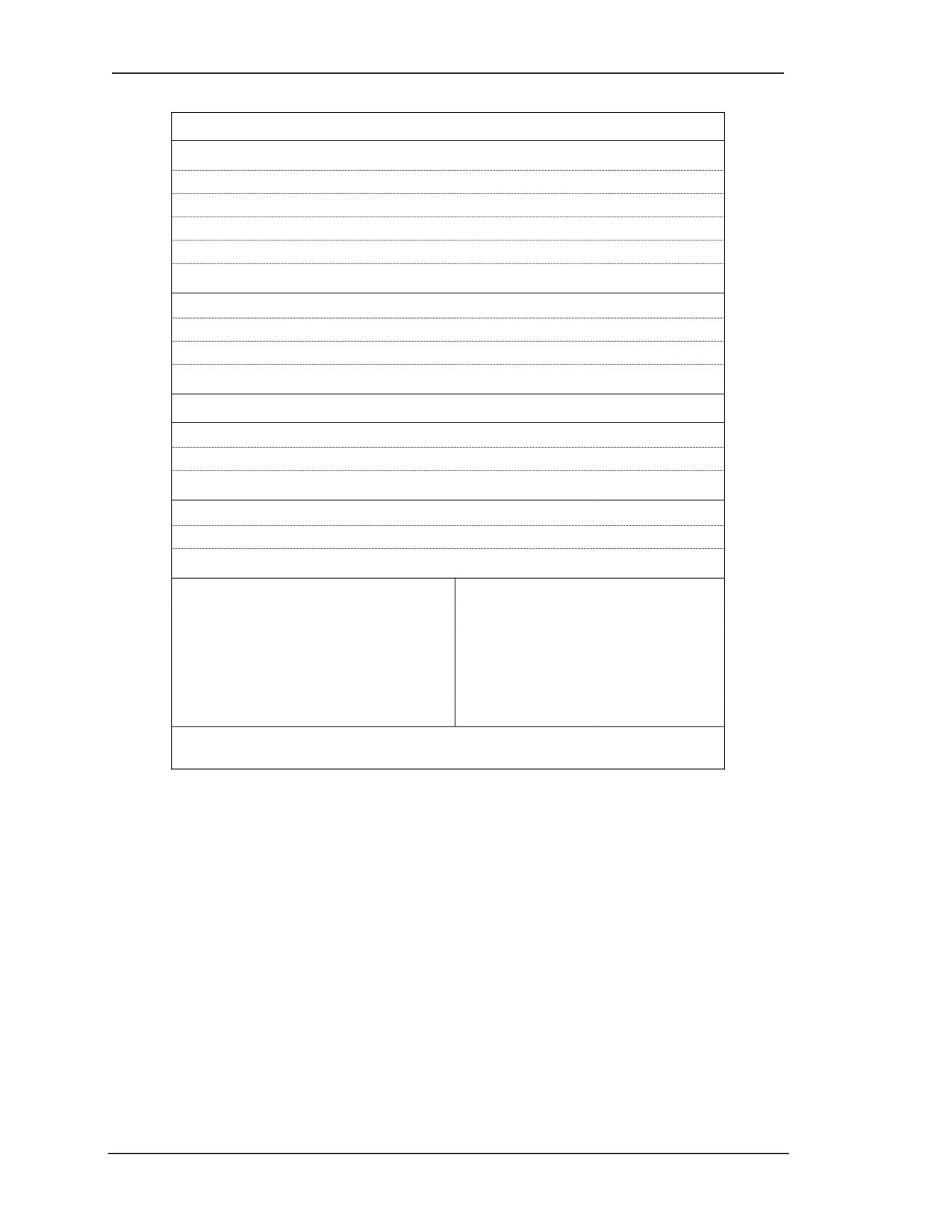
MK 19 TECHNICAL DATA
MK 19 (MOD 3):
Weight without feed throat
77.6
pounds
Weight with feed throat
78.0
pounds
Length
43.1
inches
Width
14.0
inches
Height
8.8
inches
MK 64 (MOD 7) gun cradle:
Weight
21.0
pounds
Length
17.5
inches
Height
9.5
inches
Tripod (M3) weight:
44.00
pounds
Gun and cradle:
Weight without feed throat
98.6
pounds
Weight with feed throat
99.0
pounds
Gun, cradle, and tripod:
Weight without feed throat
142.6
pounds
Weight with feed throat
143.0
pounds
Mounts:
Ammunition:
M3 tripod
M430 (HEDP)
M4 pedestal
M383 (HE)
M66 ring
M918 (TP)
HMMWV weapon platform
M922 (dummy)
M113 APC commander’s cupola
NOTE: Keep the feed throat attached to the weapon.
Table 1-1. Technical data.
1-6

FM 3-22.27
MK 19 OPERATIONAL DATA
Maximum range:
2,212
meters
Maximum effective range:
1,500
meters (point target)
2,212
meters (area target)
Rates of fire:
Sustained
40
rounds per minute
Rapid
60
rounds per minute
Cyclic
325 to 375
rounds per minute
Ammunition:
M430 HEDP
2
inch armor
15
meter casualty radius
M383 HE
15
meter casualty radius
Service frequency:
50,000
rounds
Elevation, tripod controlled:
100
mils
Depression, tripod controlled:
258
mils
Traverse, tripod controlled:
800
mils (400 left plus 400 right)
Muzzle velocity (average):
798
feet per second
Recoil forces (average):
500
pounds
Angle of automatic fire:
0 to 70
degrees elevation (automatic fire), based on
mounting arrangements
Weights:
Rounds
62 pounds (48 rounds in M548 metal container)
42 pounds (32 rounds in PA120 metal container)
Planned operating load
400 prescribed by local commanders
Table 1-2. Operational data.
1-7
FM 3-22.27
Figure 1-5. 40-mm cartridges.
1-3.
TRAINING STRATEGY
A training strategy that integrates resources with the instruction and training of individual
and collective skills is necessary to carry out a unit’s wartime mission. TRADOC
institutions, such as the noncommissioned officers education system (NCOES), and units
implement overall training strategies for the MK 19. This multifaceted approach includes
specific plans for using resources such as publications, ranges, ammunition, training aids,
devices, simulators, and simulations. These specific strategies develop critical soldier skills
and training tasks, as well as leader skills needed to support the intended outcome (see
Appendix A, Training Strategy, for more details).
1-8
FM 3-22.27(FM 23-27)
CHAPTER 2
OPERATION AND FUNCTION
This chapter includes the cycle of operation; operating precautions;
clearing; disassembly and assembly; loading; malfunctions, stoppages, and
corrections; operations under adverse conditions; and destruction of the
MK 19. Refer to Appendix B, Operations Checklist, for procedures to be
used before, during, and after operation of the MK 19 and Appendix C,
Stoppages, Malfunctions, Immediate Actions, and Remedial Actions, for
procedures to correct stoppages and malfunctions.
2-1.
CYCLE OF OPERATION
The MK 19’s cycle of operation includes six steps: charging, extracting (delinking),
cocking, firing, blowback, and automatic feeding. More than one step may be done at the
same time.
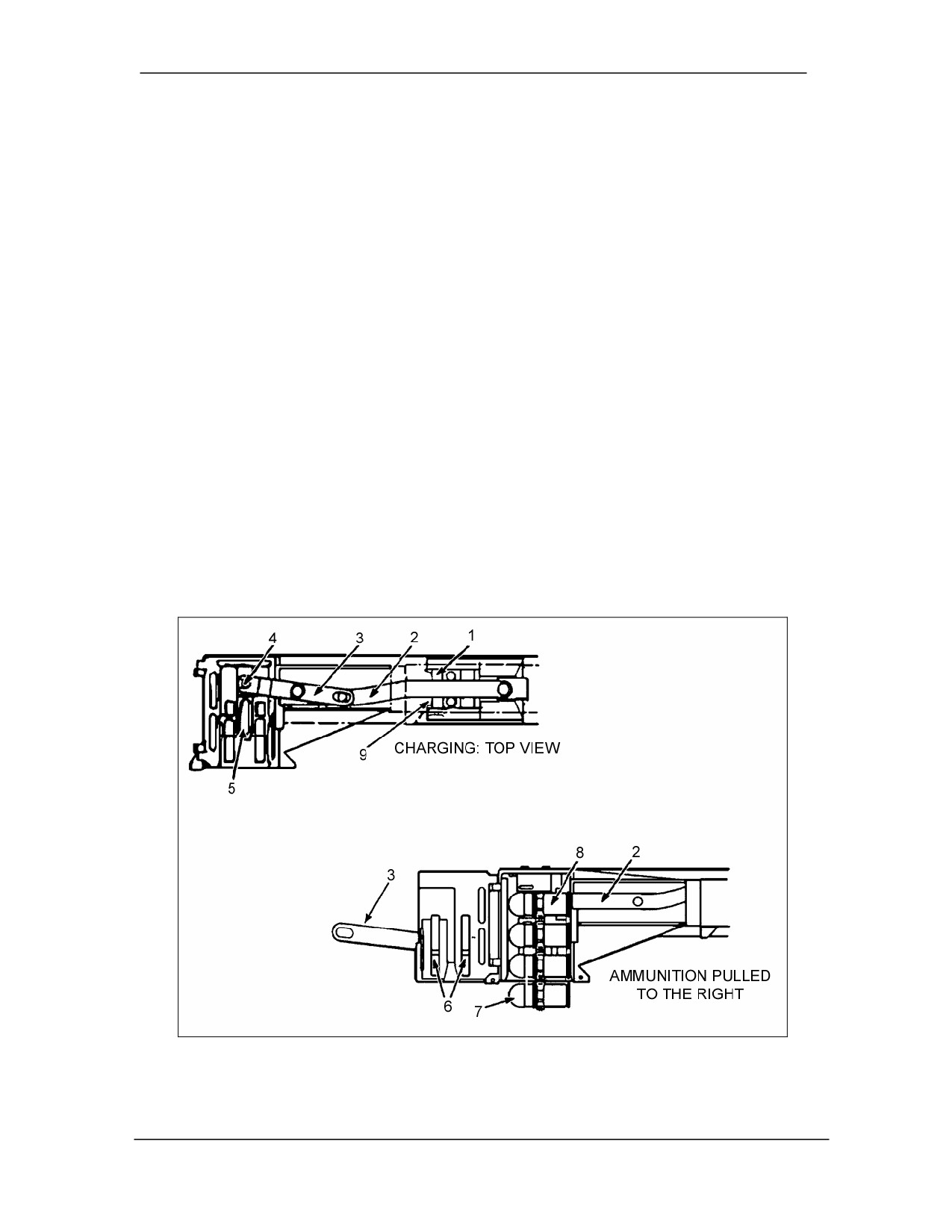
a. Charging. The charger handles are used to pull the bolt (1) to the rear, aligning the
round with the bolt extractors. The rearward movement of the bolt causes the primary drive
lever (2) to move to the left, which moves the secondary drive lever (3) to the right. The
forked end of the secondary drive lever, which rests on the feed slide pin (4), moves the
feed slide (5) to the right. The feed pawls (6) on the feed slide move the linked rounds (7)
over one place in the ammunition-feed area of the receiver. The leading round (8) lines up
with the bolt extractor (9). See Figure 2-1.
Figure 2-1. Charging cycle.
2-1
FM 3-22.27
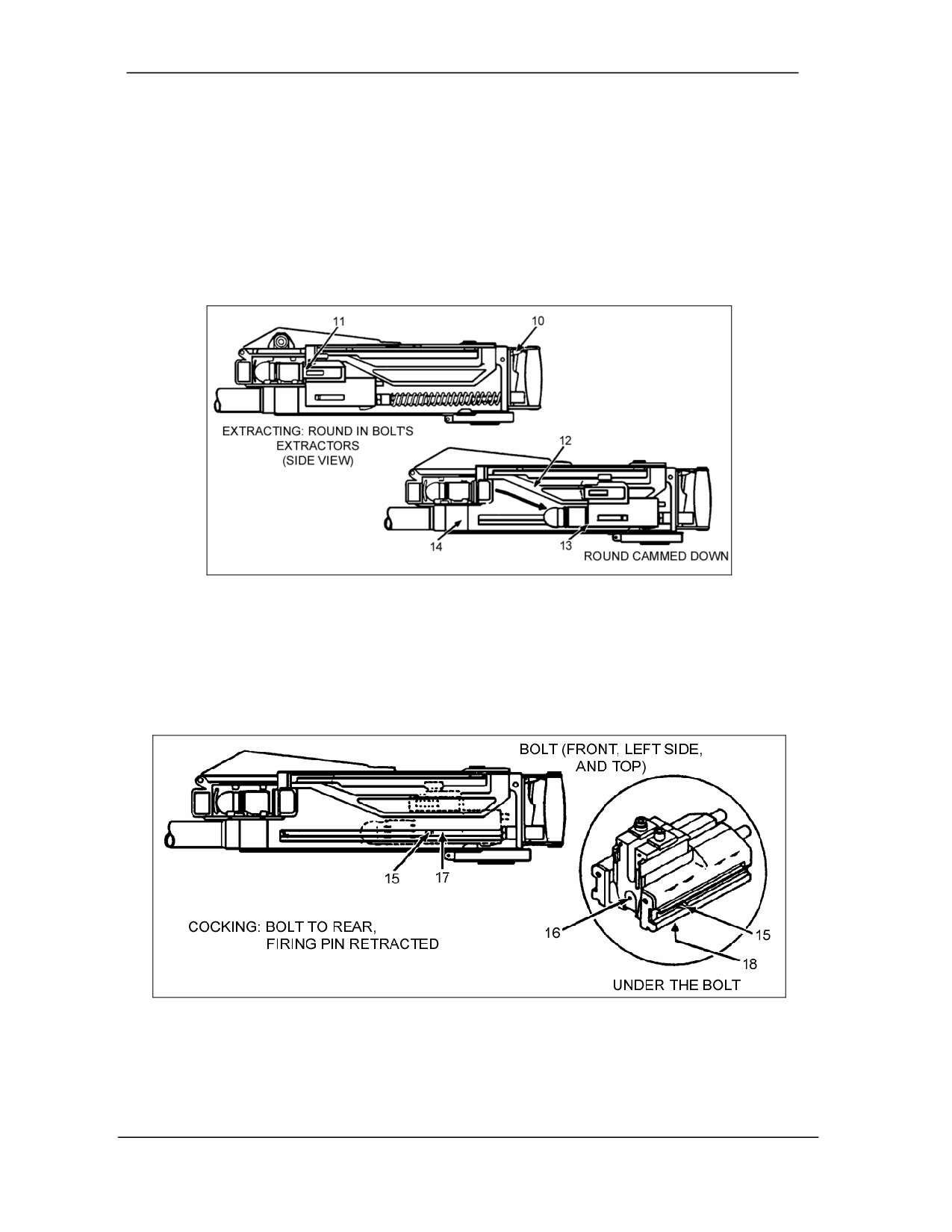
b. Extracting (Delinking). When a round is stripped from the belt, it is extracted or
“delinked.” This happens, after the MK 19 has been charged once, when the trigger (10) is
pressed. The bolt slams forward and the bolt’s extractors (11) snap over the rim of the
cartridge case. When the MK 19 is charged again, the extractor pulls the leading round to
the rear and separates the male and female links. The curved edge of the vertical cam (12)
forces the lead round out of the extractors and into the bolt fingers (13). With the bolt
completely to the rear, the round lines up with the chamber (14), and is ready to fire. As the
original leading round chambers, the next round aligns with the bolt extractors. See Figure
2-2.
Figure 2-2. Extracting (delinking) round.
c. Cocking. The rearward movement of the bolt causes the cocking lever (15) to
retract the firing pin (16). When the cocking lever hits the rear end of the left receiver rail
slot (17), the cocking lever is forced forward. When the cocking lever retracts the firing
pin, the firing pin sear holds the firing pin to the rear (18). See Figure 2-3.
Figure 2-3. Cocking the MK 19.
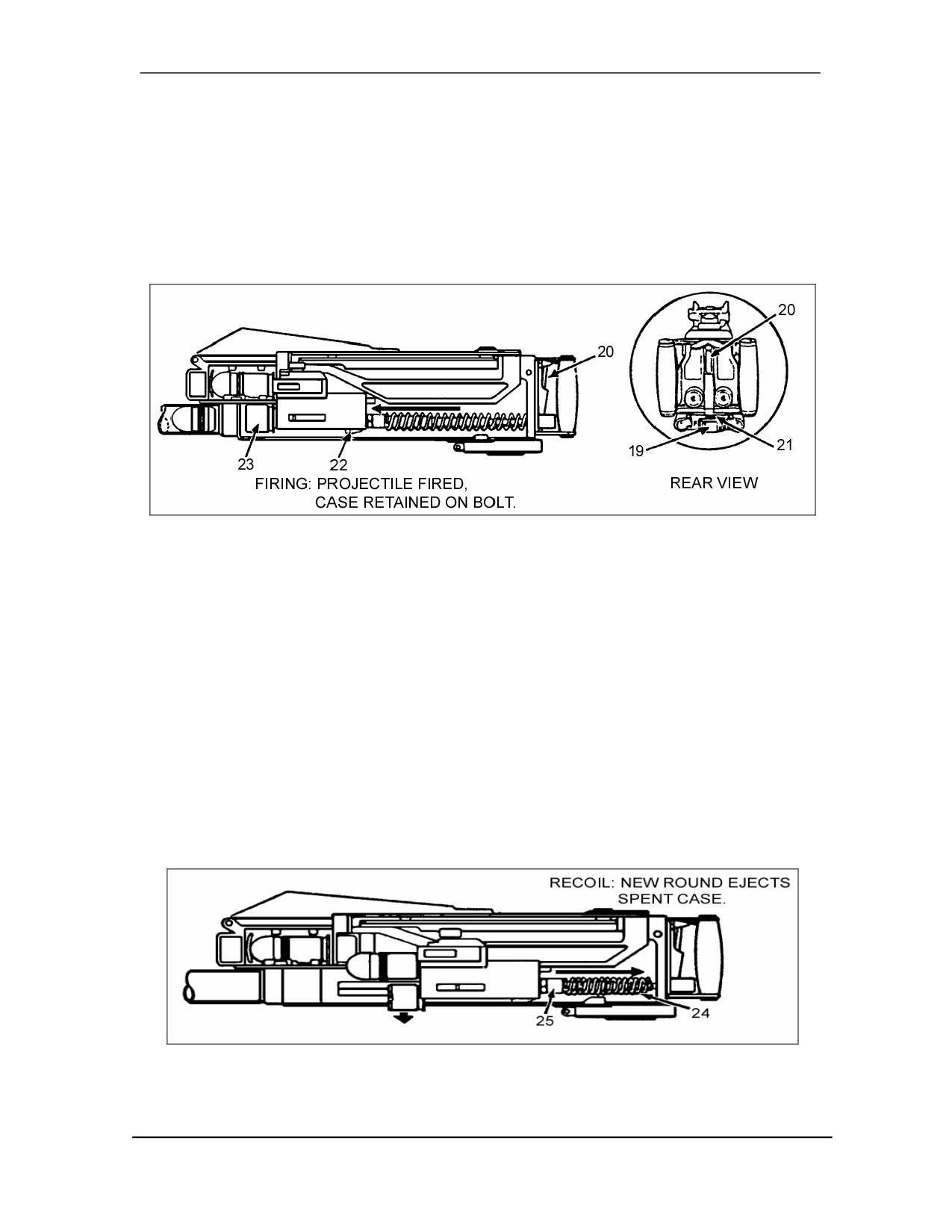
d. Firing Cycle. The safety switch is on F (FIRE). Pressing the trigger (20) depresses
the tip of the receiver sear (21). The receiver sear disengages the bolt sear (22), which
releases the bolt forward under spring pressure with a round in the bolt fingers. The
2-2
FM 3-22.27
cocking lever hits the forward end of the left receiver rail slot, forcing the lever to the rear.
The bolt sear hits a plate in the bottom of the receiver, which pushes the firing pin sear up
to release the firing pin. A combination of the bolt’s inertia and pressure from the firing pin
spring drive the firing pin forward. The tip of the firing pin detonates the primer. The round
is not completely inside the chamber at the moment the weapon is fired. The cartridge case,
held by the bolt fingers, protrudes from the chamber (23). The explosion forces the
projectile down the bore. See Figure 2-4.
Figure 2-4. Firing cycle.
e. Blowback and Automatic Feeding Cycle. The gases from the burning powder
force the bolt, with a new round in its extractors, to the rear. During this blowback, several
things happen at once. First, the curved rail of the vertical cam delinks and forces down the
new round on top of the spent case, which forces the spent case out of the bolt fingers and
ejects it out the bottom of the gun. Next, the feed slide assembly pulls the rounds to the
right in the receiver ammunition feed area, where a new round is ready to pick up
(automatic feed). During the bolt’s travel to the rear, the cocking lever is pushed forward,
which cocks the firing pin. When the bolt reaches the limit of its rearward travel, the recoil
springs (24) are completely compressed. The bolt buffers (25) absorb over-travel, reducing
trunnion load (recoil force) at the gun-mount attaching points. The bolt sear will not engage
the receiver sear if the trigger is still depressed, and another firing cycle occurs. Release of
the trigger causes the bolt sear to engage the receiver sear, which prevents the bolt from
going forward, and firing stops. See Figure 2-5.
Figure 2-5. Blowback and automatic feed.
2-3
FM 3-22.27
2-2.
OPERATING PRECAUTIONS
Precautions are taken before, during, and after firing of the MK 19.
a. Before firing the weapon ensure that:
(1) The correct ammunition is on hand.
(2) The ammunition is clean and dent-free.
(3) All ogives on the cartridges are tight.
(4) The line of fire is clear of obstructions.
b. While firing the weapon ensure that:
(1) The top cover is closed.
(2) The muzzle of the MK 19 is pointed downrange at all times.
NOTE: In the event of a runaway gun, lower one of the charging handles.
(3) Use the suggested three to five-round bursts.
c. After firing the weapon:
(1) Unload and clear the MK 19.
(2) Note weapon discrepancies and report them to the armorer.
(3) Clean and lubricate the MK 19 before storage.
2-3.
CLEARANCE PROCEDURES
The MK 19 is cleared differently in a firing situation than in a nonfiring situation.
a. Firing Situation. In a firing situation, use the following procedures to clear the MK
19:
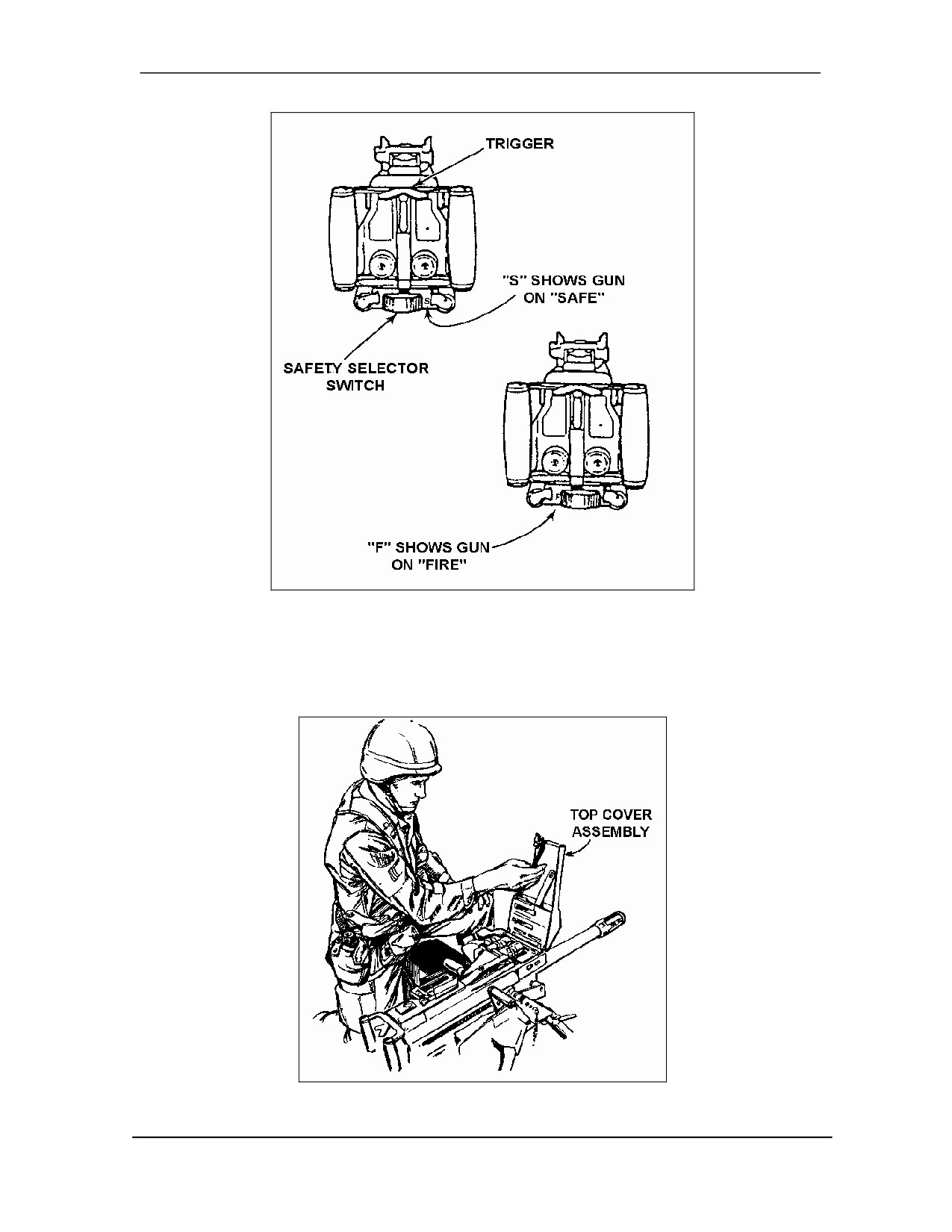
(1) Move the safety switch to S (SAFE) (Figure 2-6).
2-4
FM 3-22.27
Figure 2-6. S (SAFE) position.
(2) Open the top cover assembly (Figure 2-7). If all the ammunition has NOT been
fired, the bolt is to the rear and a round is on the bolt face. If the bolt is forward, lock it to
the rear.
Figure 2-7. Opening the top cover assembly.
2-5
FM 3-22.27
(3) Take the ammunition from the feed tray by reaching beneath the feed tray and
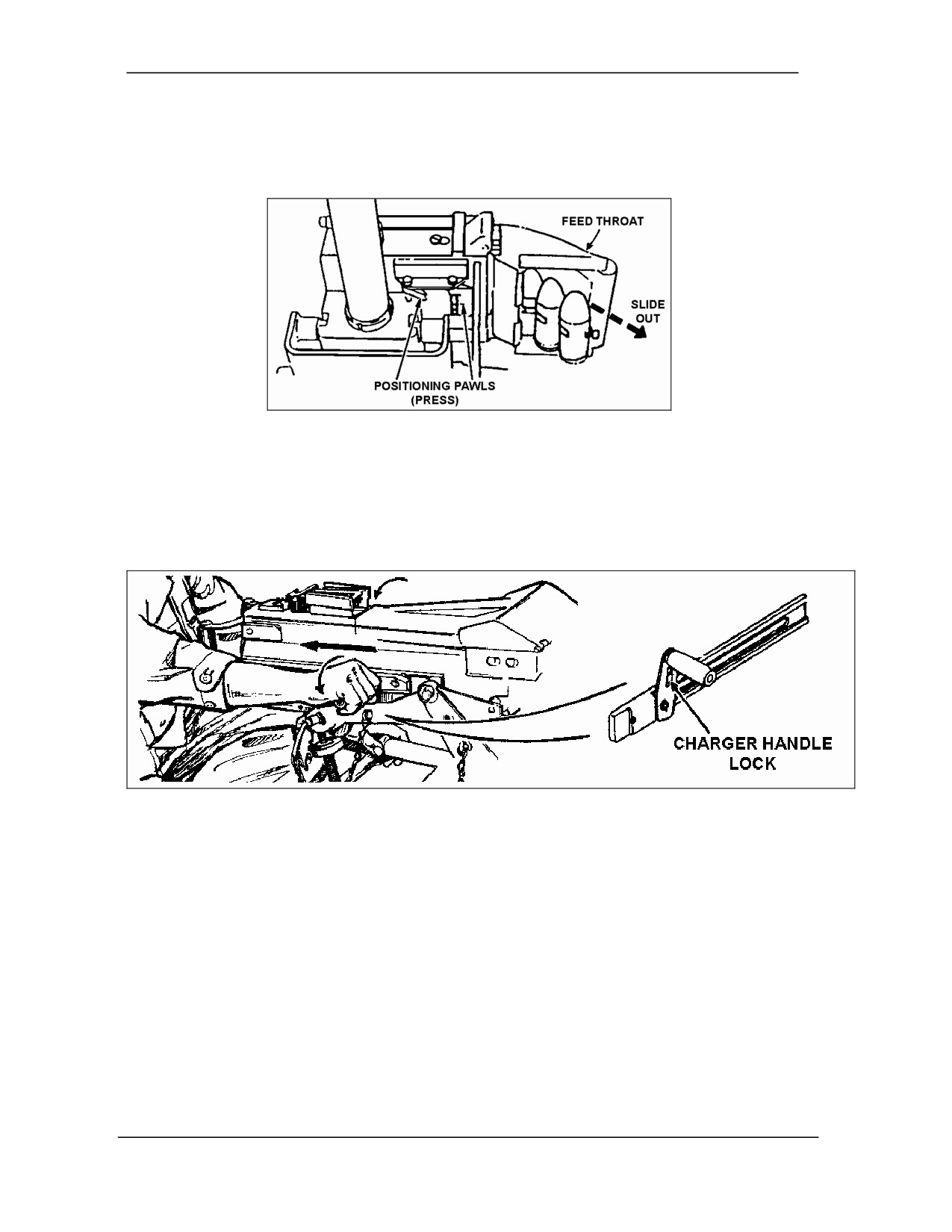
pressing the primary and secondary positioning pawls. While pressing the position
pawls, slide the linked rounds out of the MK 19 through the feed throat (Figure 2-8).
Figure 2-8. Removal of linked rounds from feeder.
(4) Insert a section of the cleaning rod or bayonet through either side of the receiver
rail. Place it on top of the live round or cartridge case, as close to the bolt face as possible,
and push down. This action forces the round out of the MK 19.
(5) Lower and pull both charger handles to the rear (Figure 2-9).
Figure 2-9. Charger handles.
(6) Inspect the chamber and bolt face to ensure that no live rounds are in the weapon.
(7) Place the safety switch on F (FIRE) (Figure 2-6).
(8) Maintain rearward pressure on the charging handle, press the trigger and ease the
bolt forward.
(9) Place the safety switch on S (SAFE).
b. Nonfiring Situation. In a nonfiring situation, use the following procedures to clear
the MK 19:
(1) Place the safety switch on S (SAFE) (Figure 2-6).
(2) Open the top cover assembly.
(3) Lower one or both charger handles.
(4) Pull the charger handle slightly to the rear.
(5) Allow sufficient space between the face of the bolt and the chamber to see both.
(6) Check for live ammunition.
2-6
FM 3-22.27
(7) Ride the bolt forward.
(8) Return the charger handle to its original upright position.
2-4.
DISASSEMBLY AND ASSEMBLY
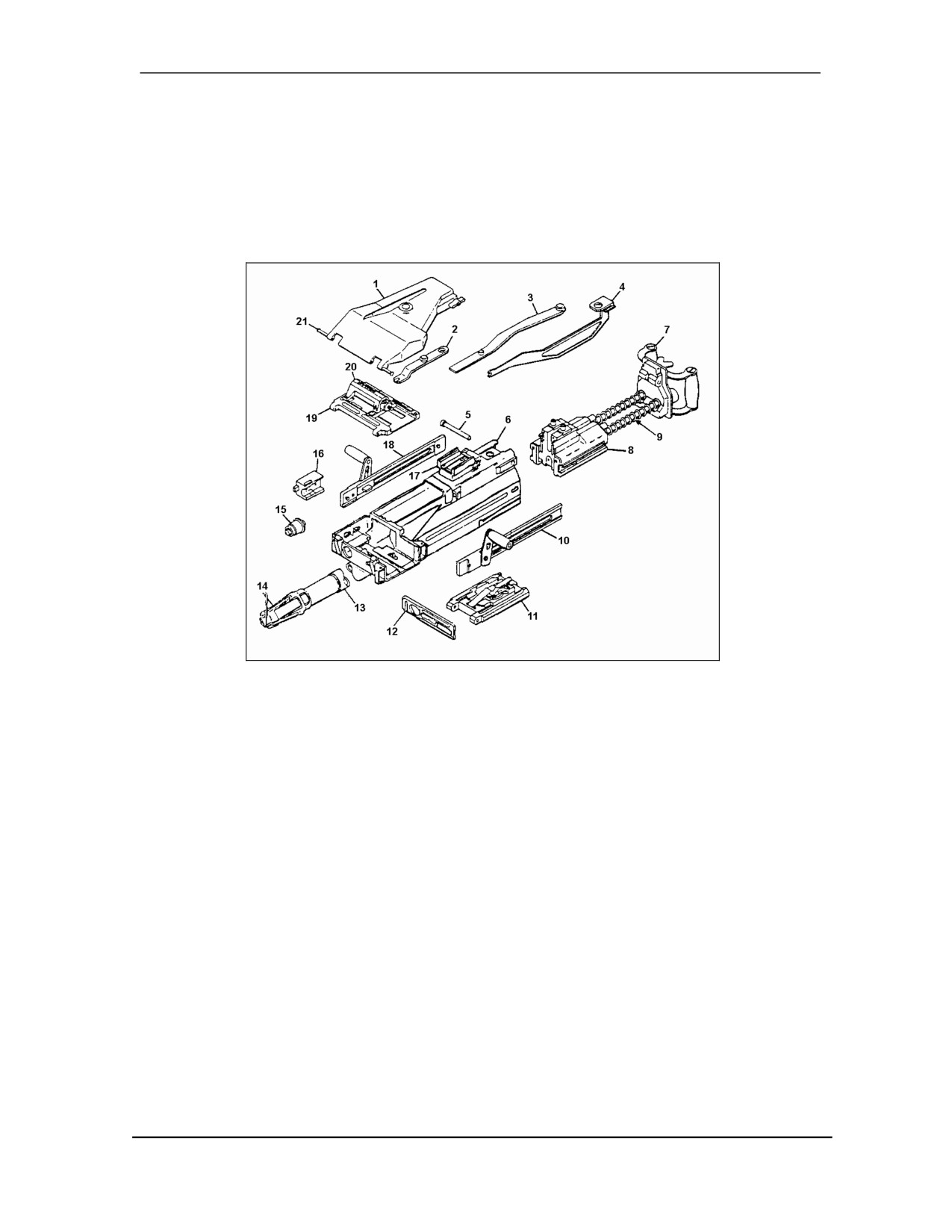
Only qualified ordnance personnel should disassemble the MK 19 beyond the steps
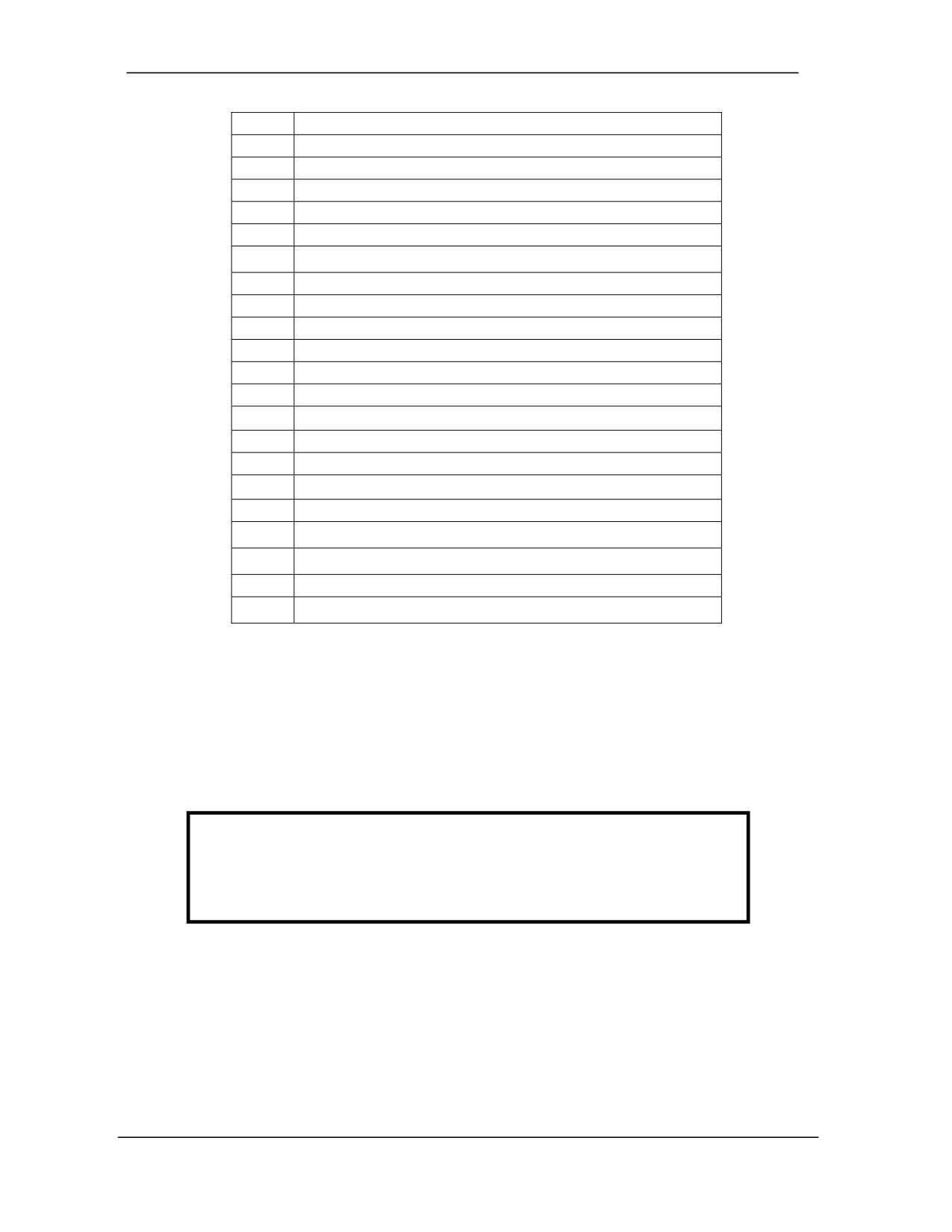
detailed in this paragraph (Figure 2-10 and Table 2-1).
Figure 2-10. MK 19 disassembled.
2-7
FM 3-22.27
ITEM
DESCRIPTION
1
Top Cover
2
Secondary Drive Lever
3
Primary Drive Lever
4
Vertical Cam Assembly
5
Backplate Pin
6
Receiver Assembly
7
Control Grip Assembly
8
Bolt
9
Guide Rods and Springs
10
Charger Assembly, Left
11
Sear Assemble
12
Alignment Guide Assembly
13
Barrel
14
Flash Suppressor
15
Ogive Plunger Assembly
16
Round-Positioning Block
17
Rear Sight Assembly
18
Charger Assembly, Right
19
Feed Tray
20
Feed Slide
21
Cover Pins
Table 2-1. Names of the MK 19 major components.
NOTE: High friction areas ― the under side of the primary drive lever (3), the vertical
cam assembly (4), the bolt (8), the area where the feed slide (20) and feed slide
tray (19) touch have been treated to prolong the life of the MK 19 ― should be
handled carefully during cleaning and handling.
CAUTION
The sear assembly should be removed only in a clean and well-
lit area because a small pin could possibly fall out and become
lost, which makes the gun inoperable.
a. Disassembly. Disassembly includes removal of parts to the extent explained in this
chapter. To ensure that parts are not lost and are replaced properly, place them (in the order
in which they are taken off) on a clean flat surface. A spent cartridge casing, a section of
the cleaning rod, and a cartridge link may be used as removal and replacement tools. To
disassemble:
(1) Clear the weapon.
(2) Take out the secondary drive lever by following these procedures:
2-8
FM 3-22.27
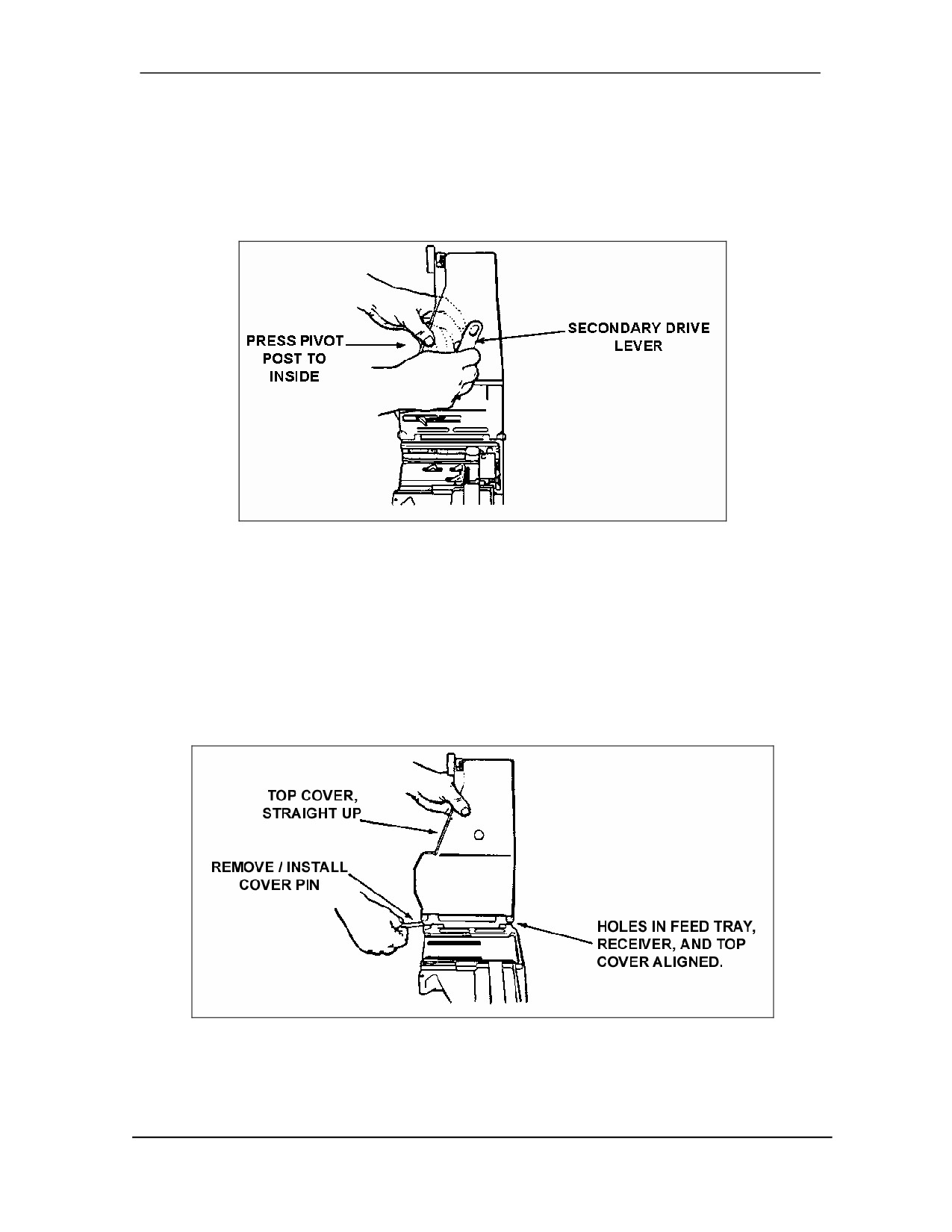
(a) Raise the top cover assembly and push the secondary drive lever pivot post from the
outside of the top cover assembly.
(b) Separate the secondary drive lever from the top cover assembly (Figure 2-11).
(c) Tap lightly on the secondary lever pivot post with any available tool, if necessary.
Figure 2-11. Secondary drive lever removal.
(d) Take the secondary drive lever from the slide assembly, and allow the feed slide
and tray assembly to close.
(3) Take off the top cover assembly by following these procedures:
(a) Hold the top cover straight up with one hand.
(b) Pull the top cover pins from both sides (Figure 2-12).
(c) Lift the top cover assembly straight up and off.
Figure 2-12. Top cover assembly.
2-9
FM 3-22.27
(4) Take out the feed slide assembly and separate the feed slide from the feed tray by
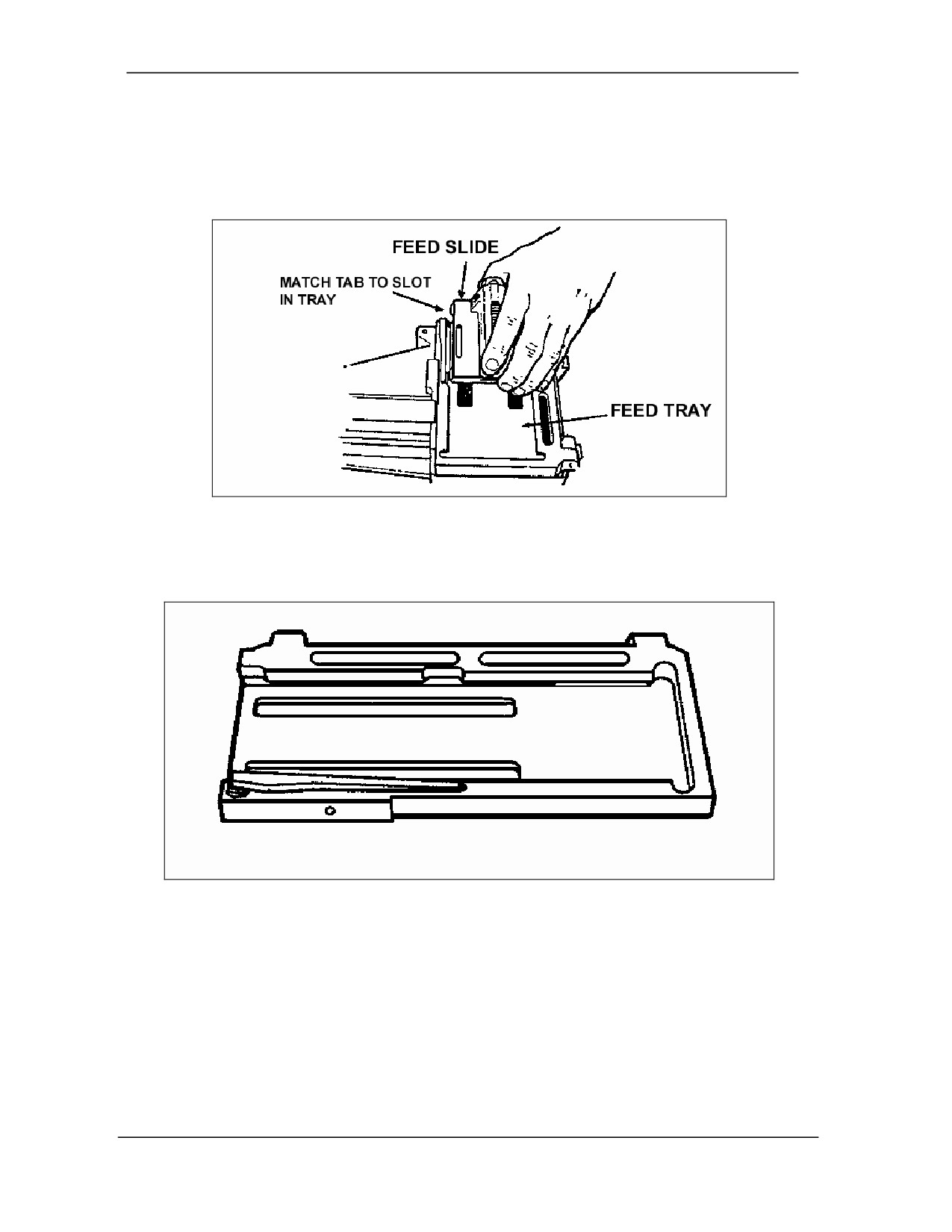
following these procedures:
(a) Align the tabs on the feed slide with the slots in the feed tray and lift them straight
up (Figure 2-13).
Figure 2-13. Feed slide assembly.
(b) Take out the feed tray by lifting it straight up (Figure 2-14).
Figure 2-14. Feed tray.
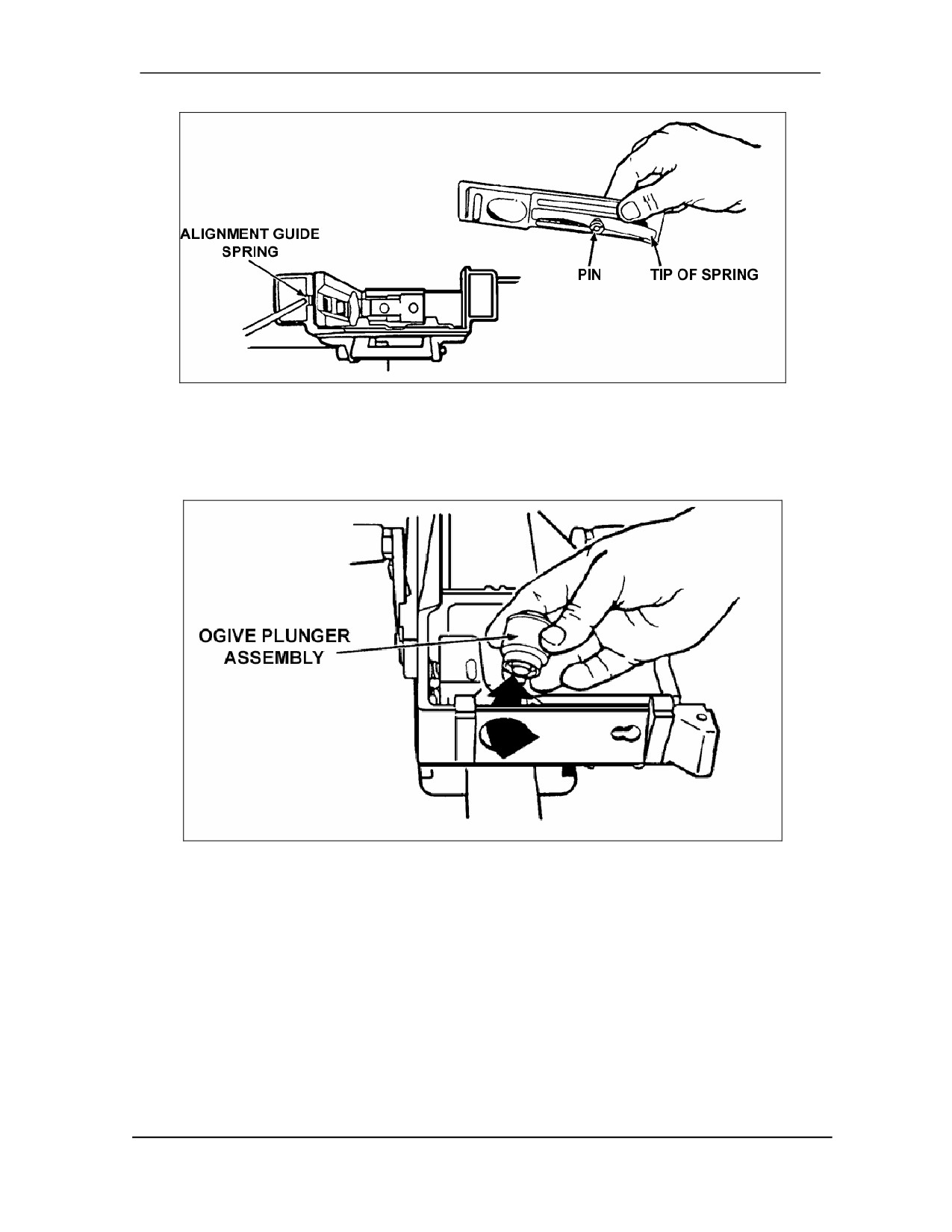
(5) Take off the alignment guide by following these procedures:
(a) Depress the tip of the alignment guide spring with the secondary drive lever or a
cleaning rod section.
(b) Slide the alignment guide out of the receiver by pulling the assembly slightly
rearward (Figure 2-15).
2-10
FM 3-22.27
Figure 2-15. Alignment guide.
(6) Take out the ogive plunger by pulling it out through the inside wall of the
receiver (Figure 2-16).
Figure 2-16. Ogive plunger.
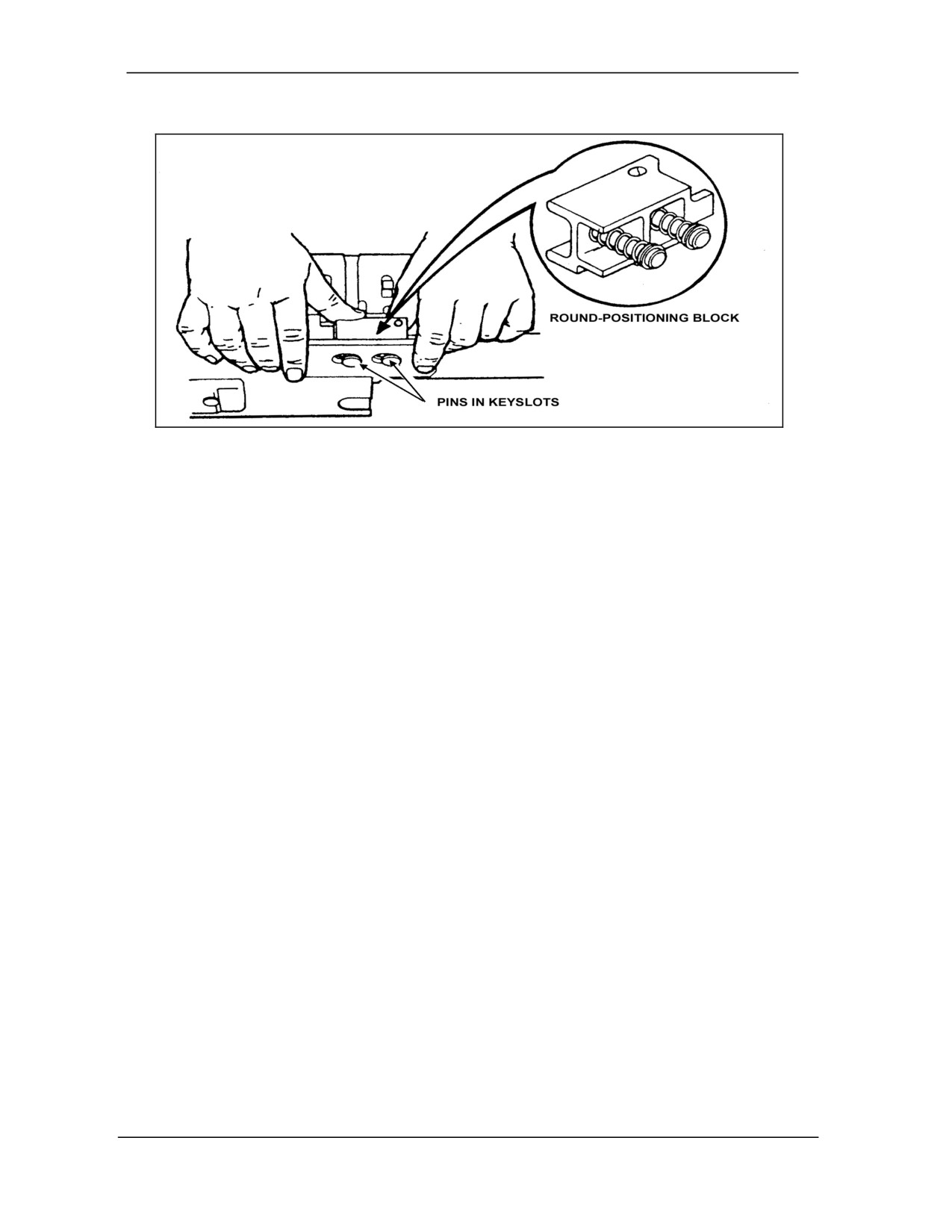
(7) Take off the round-positioning block by following these procedures:
(a) Push the round-positioning block into the side of the gun.
(b) Slide the round-positioning block forward.
(c) Release the round-positioning block forward from the keyslots in the receiver wall
(Figure 2-17).
2-11
FM 3-22.27
Figure 2-17. Round-positioning block.
(8) Take out the bolt and backplate assembly by following these procedures:
2-12
FM 3-22.27
WARNING
The backplate is under extreme pressure when the bolt is in
the rear position. To avoid serious injury, ensure the bolt is
forward before removing the backplate pin.
(a) Place the safety switch in the F (FIRE) position.
(b) Take out the backplate pin using the rim of a spent cartridge case or metal link.
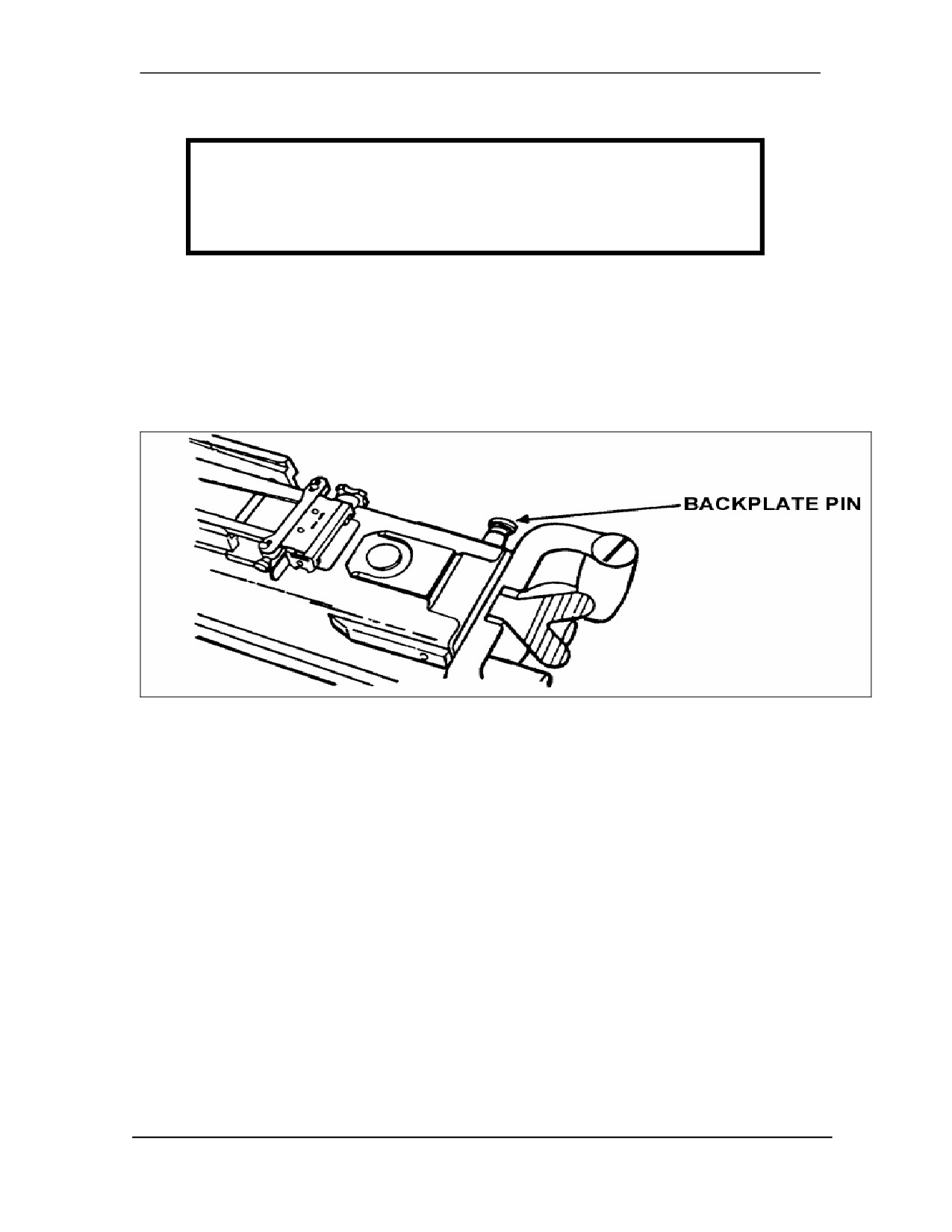
(c) Pry outward on the pin lip and remove the pin with the fingers (Figure 2-18). If the
pin cannot be removed with the fingers, hit the small end of the pin with the secondary
drive lever until the pin comes loose.
Figure 2-18. Backplate pin.
(d) Grasp the control grips with both hands and lift up slightly to disengage the
backplate from the locking lugs in the receiver.
(e) Pull the bolt and backplate assembly to the rear.
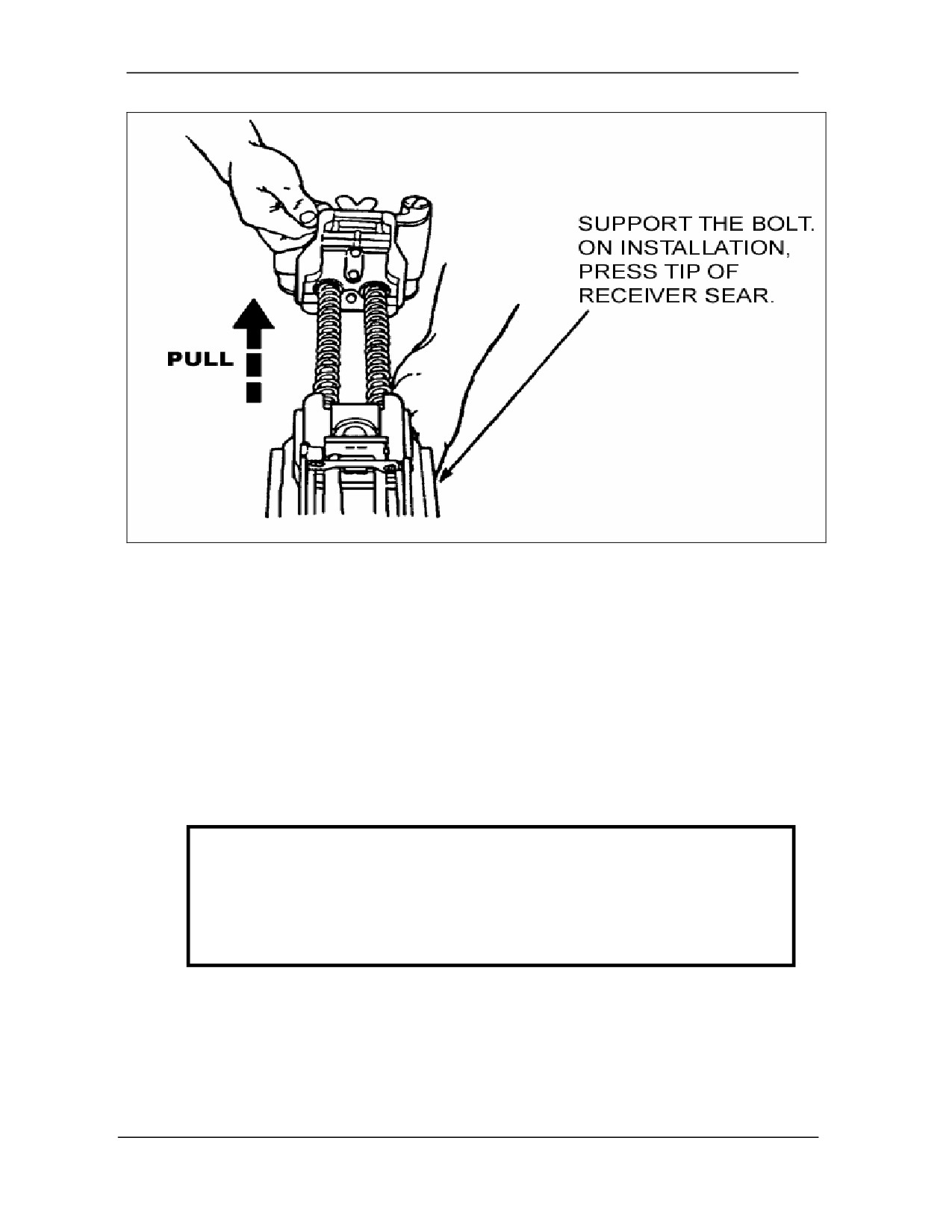
(f) Once the bolt clears the sear, catch the bolt in one hand to prevent damage to the
backplate assembly (Figure 2-19).
2-13
FM 3-22.27
Figure 2-19. Removal of bolt and backplate assembly.
(9) Take off the primary drive lever and vertical cam.
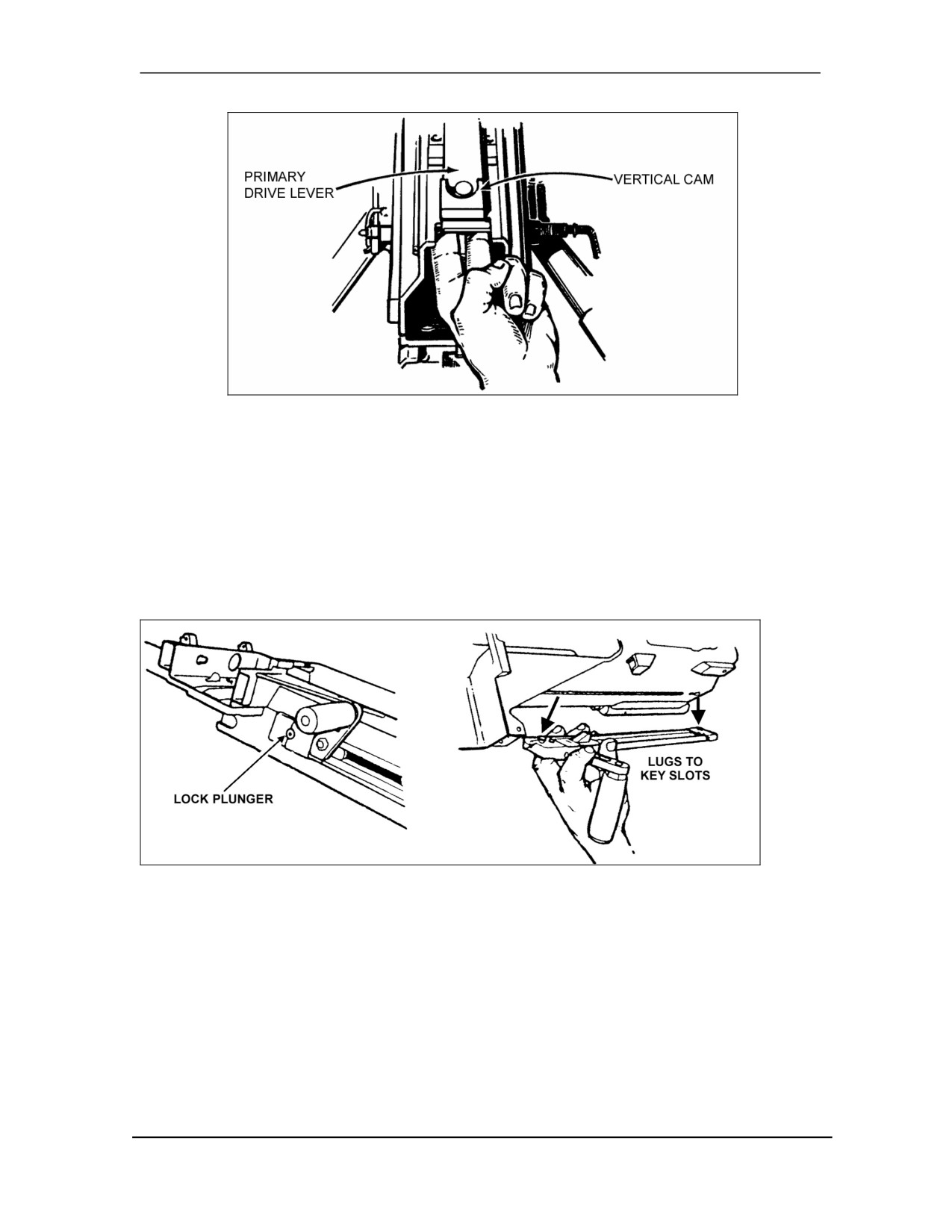
(a) Grasp the primary drive lever and vertical cam with one hand and ensure they do
not fall when released.
(b) Reach under the top of the receiver and locate the drive lever lock.
(c) Slide the lock one-quarter of an inch to the rear.
(d) Press down on the primary drive lever pivot post, which releases both the primary
drive and vertical cam.
(e) Pull the primary drive lever from the front of the weapon and the vertical cam from
the back (Figure 2-20).
CAUTION
Ensure you do not scratch the shiny portion of the vertical cam and
primary drive lever. These areas have been specially treated to
reduce friction; any scratches or use of abrasives will take off the
treatment and increase wear.
2-14
FM 3-22.27
Figure 2-20. Primary drive lever and vertical cam.
(10) Take out the charger assemblies from both sides by following these procedures.
(a) Place the charger assemblies in the upright position.
(b) Using a metal link or spent cartridge case, retract the lock plunger at the base of the
charger arm.
(c) Slide the charger housing rearward to disengage the lugs from the keyslots in the
receiver.
(d) Lift the charger assembly away from the receiver (Figure 2-21).
Figure 2-21. Charger assemblies.
(11) Take off the sear assembly by following these procedures:
(a) Turn the MK 19 on its side or upside down.
(b) Move the safety selector switch to F (FIRE), and use the rim of a spent cartridge
case to lift up the sear lock plunger.
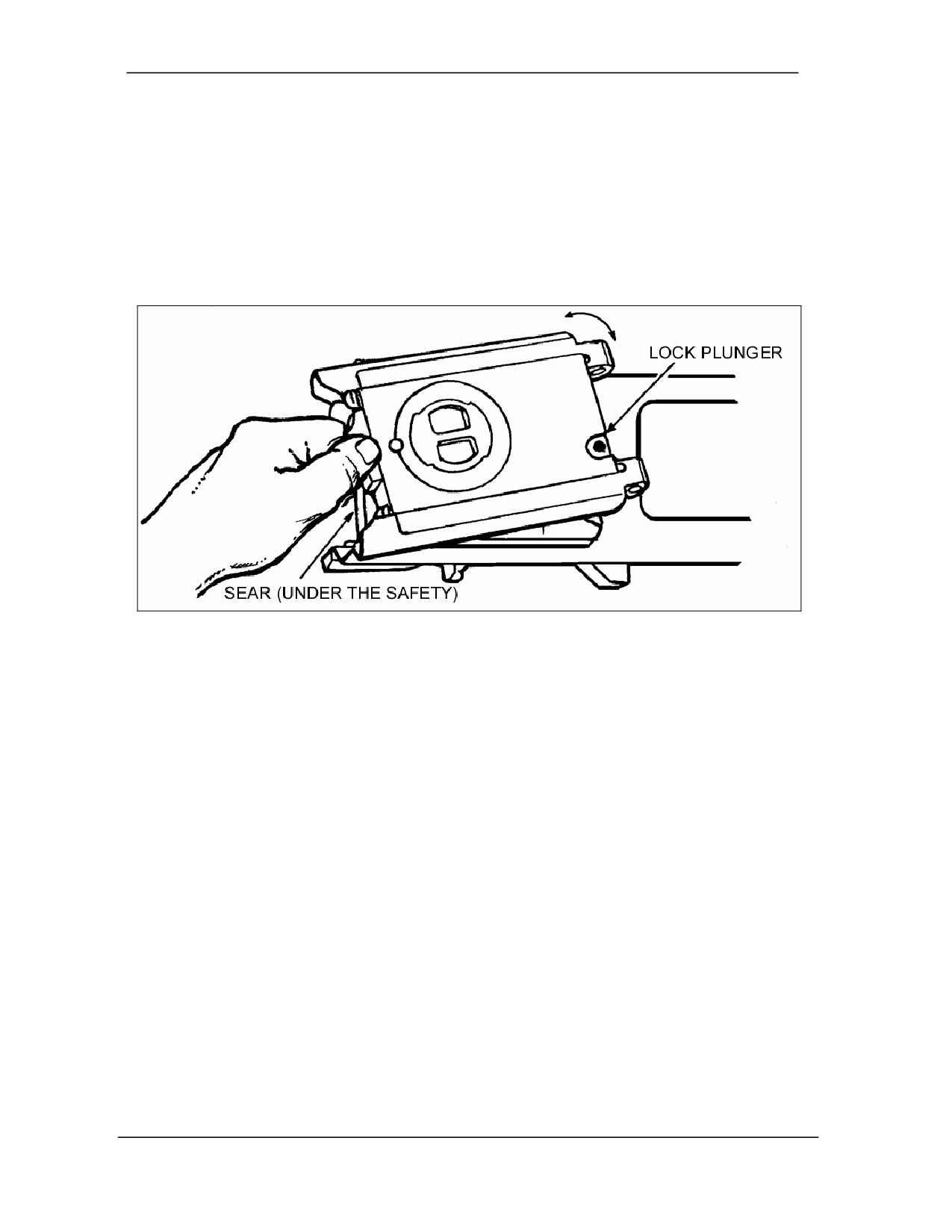
(c) At the same time, squeeze the sear and rotate the sear assembly (left or right) until
you can no longer hold the sear (Figure 2-22).
2-15
FM 3-22.27
(d) Release the plunger, and apply downward pressure to the sear assembly. (A spring
in the sear will push the sear away from the receiver preventing further turning of the sear.)
(e) With the sear pressed flush to the receiver, continue to turn the sear until you hear
a metallic click.
(f) Place the safety selector switch on S (SAFE) and continue to rotate the sear until it
is at a 90-degree angle to the receiver.
(g) Lift the sear straight off the receiver.
(h) Place the safety switch in the S (SAFE) position.
Figure 2-22. Sear assembly.
b. Assembly. To assemble the gun, replace the groups in the exact reverse order in
which they were taken off. Be sure the components are lubricated prior to reassembly.
(1) Install left and right hand charger assemblies by following these procedures:
(a) Turn receiver upright.
(b) Rotate charger handle to the forward straight-up position.
(c) Line up lugs on charger with slots in receiver rail. Insert charger lugs into slots.
(d) Hold charger tightly against rail. Slide charger forward until it locks in place.
(2) Install round-positioning block. Insert pins into the slots on the receiver and slide
the block forward until the pins lock into the small sections of the holes.
(3) Install the ogive plunger assembly. Insert ogive plunger as shown in Figure 2-16.
(4) Install alignment guide assembly by following these procedures:
(a) Position the alignment guide assembly so that the pin is lined up with the slot in the
feeder wall.
(b) Hold the alignment guide against the front wall and slide the alignment guide into
the receiver until it locks or ‘clicks.’
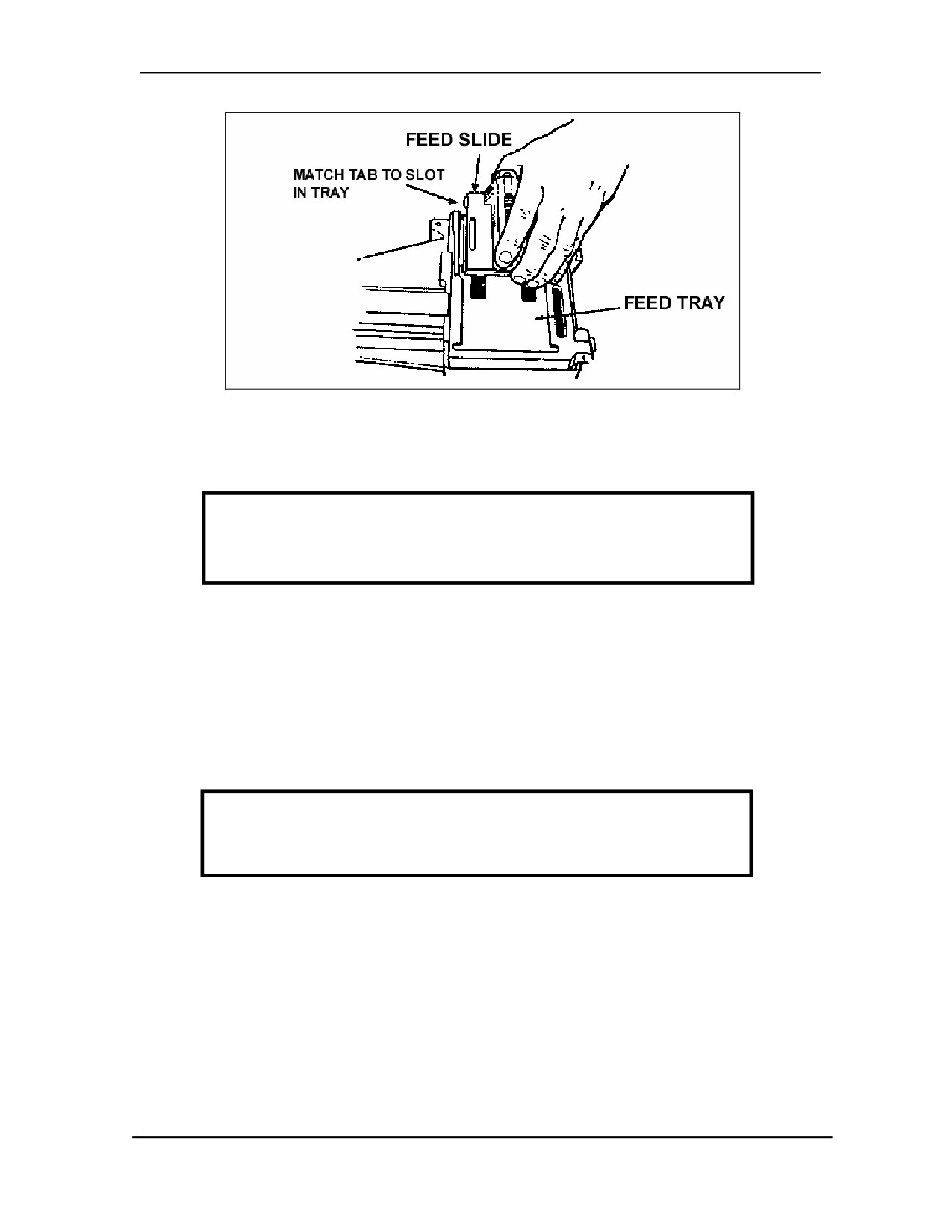
(5) Install feed tray and feed slide assembly by following these procedures (Figure 2-
23):
(a) Place tray into top of feeder, recessed side up. The tabs on the feed slide should
align with the slots on the feed slide tray.
(b) The hinge pinholes on the tray should line up with the hinge pinholes on the
receiver.
2-16
FM 3-22.27
Figure 2-23. Feed slide assembly.
(6) Install top cover assembly by following these procedures:
CAUTION
To avoid breaking the crosspin, be sure it is fully inserted into
the receiver before closing the top cover.
(a) Feed tray should be in place resting on the receiver.
(b) Place the top cover on the receiver with the hinge pinholes in line with the receiver
lug end feed tray hinge pinholes.
(c) Hold top cover at a right angle to the receiver so that the key slots are aligned.
Insert top cover pins on both sides. Ensure the crosspin is fully inserted then rotate the top
cover fully open.
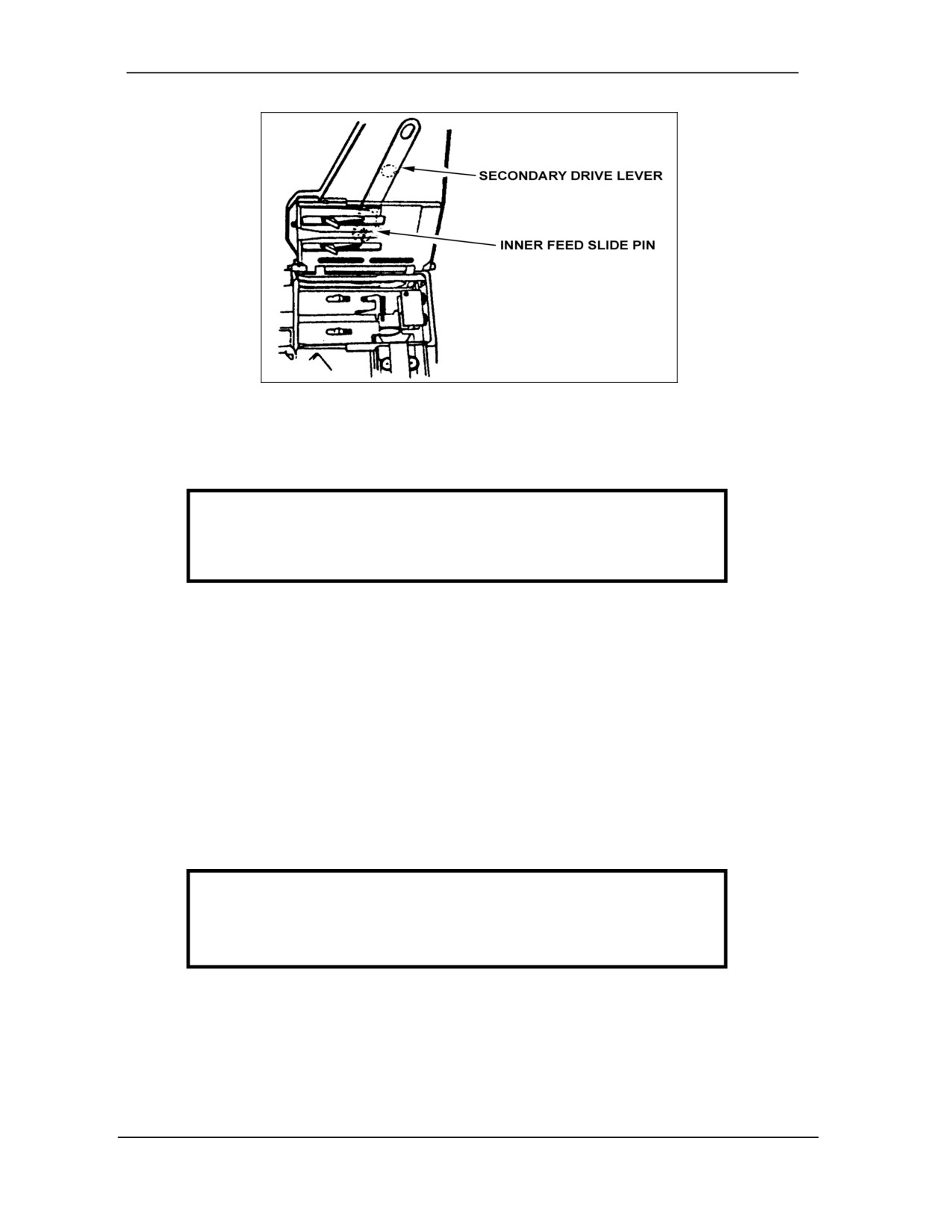
(7) Install secondary drive lever by following these procedures (Figure 2-24):
CAUTION
If the secondary drive lever is not properly engaged with the
feedslide pin, the gun will not fire.
(a) Rotate the feed slide assembly and tray upward.
(b) Engage forked end of secondary drive lever with the feed slide pin.
(c) Press raised pivot post through hole in top cover.
(d) Press secondary drive lever against top cover until it locks in place.
2-17
FM 3-22.27
Figure 2-24. Installation of the secondary drive lever.
(8) Install vertical cam assembly by following these procedures:
CAUTION
Do not damage vertical cam by hitting it on the inside of the
receiver.
(a) Slide vertical cam assembly through rear of receiver. Raised portion should slide
over the top of the receiver. Drive lever lock should be underneath.
(b) Engage forked end in the notch.
(9) Engage primary drive lever by following these procedures:
(a) Hold vertical cam assembly in place and slide primary drive lever into receiver and
rest the front end on the feed area.
(b) Slide drive lever lock rearward and engage pivot post of lever through holes in
receiver and vertical cam.
(c) Slide drive lever lock (on the vertical cam just beneath top of receiver) forward.
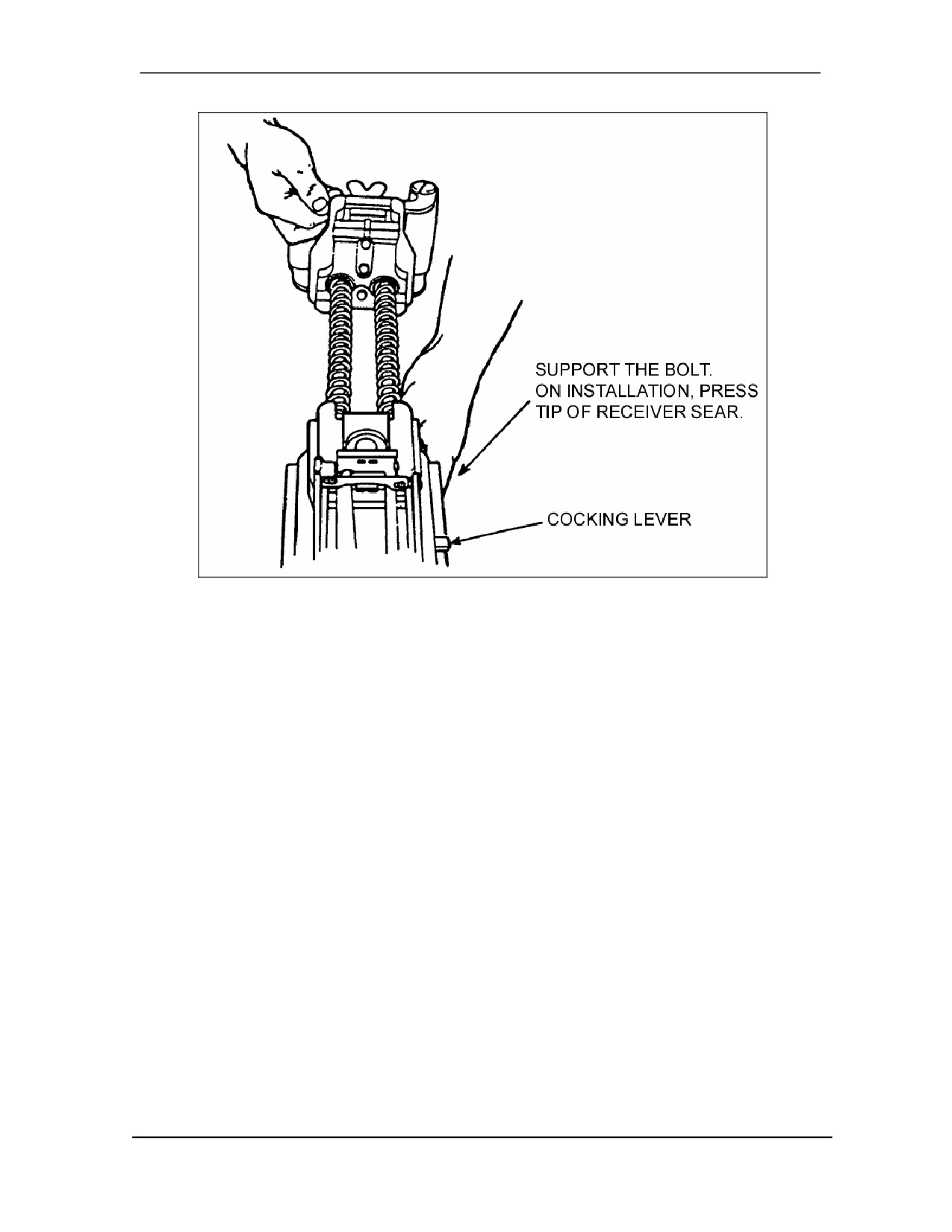
(10) Install bolt and backplate assembly. With the sear assembly on the gun, assemble
bolt and backplate using the following procedure (Figure 2-25):
CAUTION
Before inserting assembly, put cocking lever in forward
position.
2-18
FM 3-22.27
Figure 2-25. Installation of the bolt and backplate assembly.
(a) Place safety in F (FIRE) position.
(b) Ensure that the cocking lever is forward and align the bolt at the rear of the receiver
and slide the receiver forward until it stops.
(c) Press down on the bolt release, slide the bolt slightly forward, and remove hands
from the bolt release.
(d) Continue to slide the bolt forward until it stops again.
(e) Again, press down on the bolt release, slide the bolt slightly forward, and remove
hands from the bolt release.
(f) Continue to slide the bolt forward until it reaches its most forward position.
(g) Seat the bottom of the backplate into the slots on the bottom of the receiver.
(h) Insert backplate pin to lock assembly in place.
(11) Install sear assembly by following these procedures:
(a) Turn receiver over on its top.
(b) Place sear housing on the receiver and line up sear housing assembly at a right
angle to the barrel centerline.
(c) Put safety on F (FIRE) position.
(d) Press down and rotate the sear assembly until it locks in place.
(12) Install feed throat assembly by following these procedures:
(a) Squeeze the plungers, and align the pins with the holes in the receiver.
(b) Release plunger to reattach feed throat.
2-19
FM 3-22.27
NOTE: Ensure the safety switch is in the F (FIRE) position so the sear can be easily
depressed.
2-5.
LOADING PROCEDURES
Before loading, the gunner should ensure the MK 19 is on S (SAFE) and the bolt is in the
forward position.
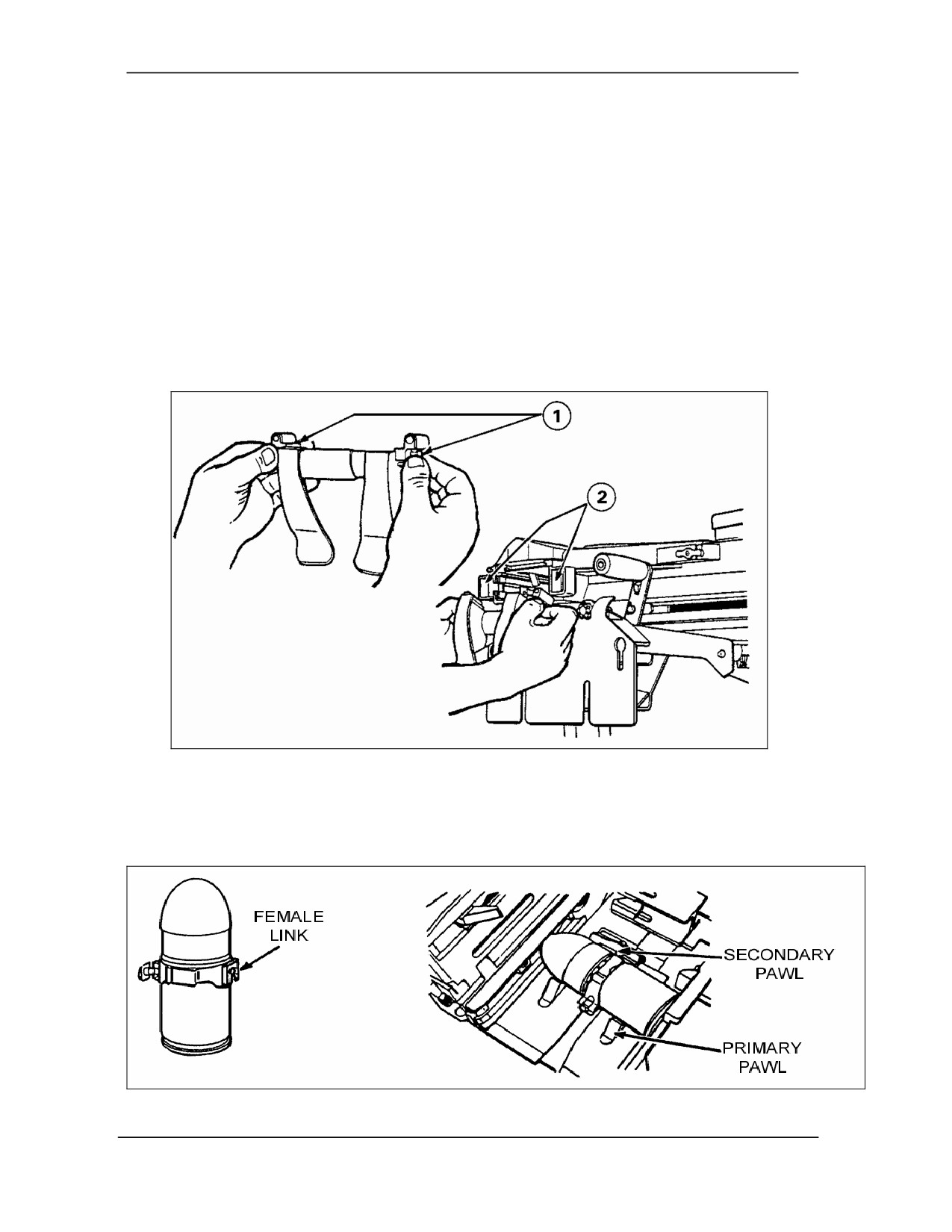
a. Before loading, use the following procedures:
(1) Attach the feed throat by squeezing the spring-loaded pins on the feed throat
(Figure 2-26).
(2) Insert the feed throat on both sides of the feeder.
(3) Ensure that the feed throat points down.
Figure 2-26. Attachment of feed throat.
b. When loading, use the following procedures:
(1) Insert the first round into the feeder (female link first) (Figure 2-27).
Figure 2-27. Loading of first round.
2-20
FM 3-22.27
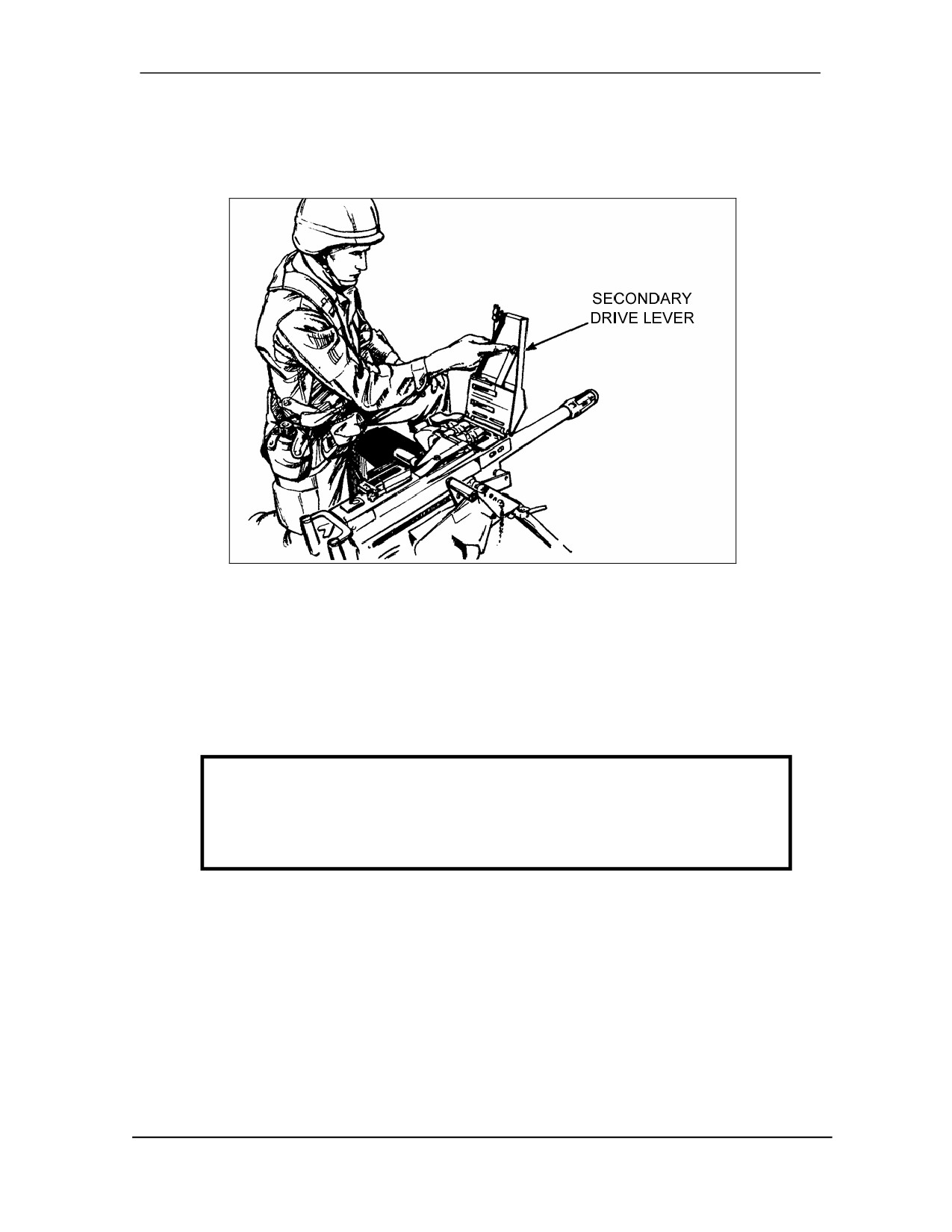
(2) Push the round across the secondary feed pawl. To move the feed slide to the left,
push the secondary drive lever to the right (Figure 2-28).
(3) Close the cover.
Figure 2-28. Positioning of feed slide assembly.
(4) Grasp the charger handles with the palms down.
(5) Press the charger handle locks in.
(6) Rotate the handles down and pull them sharply to the rear.
(7) Return the charger handles forward to their original upright position, after locking
the bolt to the rear.
CAUTION
Failure to completely pull the bolt to the rear may result in the
misalignment of the M16A2 links on the round, which causes the
round to feed improperly.
(8) Place the safety switch on F (FIRE) and press the trigger. The bolt slams forward
and grasps the first round in the bolt extractors.
(9) Grasp, unlock, and turn charger handles down, and lock the bolt to the rear again.
(10) Ensure the safety switch is on S (SAFE).
(11) Return the charger handles to their original upright position. The MK 19 is now
ready to fire.
2-21
FM 3-22.27
2-6.
MALFUNCTIONS, STOPPAGES, AND CORRECTIONS
A malfunction is a failure of the weapon to function properly. Neither defective
ammunition nor improper operation of the gun by a crewmember is considered a
malfunction of the MK 19. A stoppage is any interruption in the cycle of operation caused
by faulty action of the weapon or ammunition. Appendix C, Stoppages, Malfunctions,
Immediate Actions, and Remedial Actions, provides inspections, corrective actions, and
emergency actions of malfunctions and stoppages. For more information on
troubleshooting common malfunctions and stoppages, refer to TM 9-1010-230-10.
2-7.
CARE AND CLEANING
The MK 19 requires preventive maintenance checks and services (PMCS) and lubrication
before, during, and after firing. It should be checked and cleaned daily when used and not
fired, and weekly if not used. For more detailed guidance on the care, cleaning, and PMCS
for the MK 19, refer to TM 9-1010-230-10.
a. Cleaning and Lubrication. Several types of lubricants can be used on the MK19.
High friction areas of the gun have a protective coating and care must be taken to prevent
its removal. Listed below are authorized lubricants, and other information about lubricating
and cleaning the MK19.
(1) Authorized Lubricants. These are the authorized lubricants used on the MK 19:
(a) Lubricant, artic weather, automatic weapons (LAW).
(b) Lubricating oil, semifluid, automatic weapons (LSA).
(c) Lubricating oil, semifluid, automatic weapons, temperate (LSAT).
(d) Rifle bore cleaner (RBC). RBC should be used sparingly only in the bore and when
necessary.
(e) Grease, molybdenum disulfide (GMD).
(2) Use of Lubrications. The following is general guidance on the use of lubricants on
the MK 19.
(a) Never mix lubricants on the MK19. If you change lubricants or do not know for
sure which lubricant is currently applied to the MK19, completely clean off all old
materials before you apply a new lubricant.
(b) Never use cleaner lubricant petroleum (CLP) on a MK19. It gums up moving parts
instead of lubricating them.
(c) Apply a heavy coat of lubricant and do not wipe it off.
(d) In cold weather, 0 degrees F to -25 degrees F, use LSAT, GMD, or LAW.
(e) In extra cold weather, -25 degrees F and below, use LAW.
(3) High Friction Areas. The under side of the primary drive lever, the vertical cam
assembly, the bolt (where it rides on the rails), and the area where the feed slide and feed
slide tray connect have been treated to prolong the life of the MK 19. Special care is
required during cleaning and maintenance to prevent damage to the coating. CLP, acids,
and abrasives should never be used on the MK 19 because they will remove the protective
coating.
b. General Cleaning and Lubrication Instructions. The following is general
guidance for the cleaning of the MK 19.
(1) Wipe or brush off dirt and grime.
(2) When lubricating the weapon, give extra attention to the feed pawls, the cocking
lever rails, the pivot posts on the primary drive lever, and the bolt assembly.
2-22
FM 3-22.27
(3) Lubricate each part. Give special care to those hard-to-get spots.
(4) Work in the lubricant by moving the parts.
c. When to Clean, Lubricate and Inspect the MK 19. Clean and inspect the gun
thoroughly. Report all worn, burred, defective, or missing parts to your armorer or support
maintenance. In general, lubricate and clean the MK19 as follows:
(1) Always clean and lubricate the gun after firing.
(2) Clean and lubricate the gun daily if it is used but not fired.
(3) Clean and lubricate the gun weekly if the weapon is stored.
d. Inspections. Several parts of the MK 19 should be checked whenever possible.
These include:
(1) The vertical cam. Check closely for smoothness.
(2) The gap between the charger assemblies and the receiver.
(3) All parts for wear, cracks, missing items, and abnormal shapes.
2-8.
OPERATION UNDER ADVERSE CONDITIONS
The MK 19 is a robust weapon and designed to operate over a wide range of weather
conditions but additional care is required when the temperatures are hot or cold, and the
conditions are wet, sandy, or icy.
a. During hot, wet, or salty air conditions follow these procedures:
(1) Inspect the weapon more frequently for signs of rust.
(2) Keep gun as moisture-free as possible.
(3) Field strip, clean, and lubricate more often to preserve metal and prevent rust.
(4) Use a generous second coat of lubrication for extra protection.
b. During hot, dry, sandy, or dusty conditions follow these procedures:
(1) Do not lubricate the entire exposed metal surfaces as this will only collect dust and
sand.
(2) Clean the weapon thoroughly and lubricate only the moving components.
(3) Extreme heat dries up lubricant. Clean and lightly lubricate the moving components
of the weapon more frequently.
c. During cold, icy, or snowy conditions follow these procedures:
(1) Prior to using cold-weather lubricant, be sure to clean off all existing lubrication.
From 0 degrees F to -25 degrees F, use either LSAT, GMD, or LAW. At temperatures -25
degrees F and below, use LAW.
(2) If the weapon ‘sweats,’ dry and lube the parts before taking the weapon outdoors
and apply a light second coat to provide protection.
(3) Cover weapon if left outside.
(4) If possible, thoroughly clean, dry, and lubricate the weapon in a warm place.
(5) If the weapon is brought indoors, keep it away from direct heat.
(6) Perform functional checks and lubricate daily to help prevent corrosion.
2-9.
DESTRUCTION
Only the commander can direct the destruction of the MK 19. There are several ways to
destroy it. Methods include destruction by mechanical means, burning, gunfire, demolition
or disposal. Use the same methods to destroy equipment. However, ammunition must be
handled differently. The best way to destroy ammunition is to fire it. Otherwise, dispose of
it by burial, dumping it in a body of water, or using the demolition method.
2-23
FM 3-22.27
WARNING
Ammunition must never be scattered (this may result in a hazard
to friendly soldiers), burned (HE and HEDP rounds may explode),
or destroyed mechanically.
a. Mechanical Method. If possible, use the mechanical method to destroy MK 19s
and equipment. There are three ways to do this:
(1) Smash them. Using a sledgehammer or some similar heavy tool, damage the MK
19s so that they cannot be used.
(2) Bend the MK 19s’ guide rods over the receivers.
(3) Take off (or out) the same part from each of the MK 19s. If a different part is taken
from each gun, new MK 19s may be pieced together.
b. Burning Method. To burn equipment or MK 19s, use a fuel source that burns hot
enough to take the temper from the metal. For example, use jet propulsion fuel (JP-4), oil,
or gas. All friendly soldiers in the area are warned before equipment or MK 19s are bare
burned, because a fire will reveal the positions of friendly forces.
c. Gunfire Method. This is the least reliable way to destroy MK 19s or equipment.
Pile up all of the equipment and MK 19s and use MK 19s, grenades, or rifles to fire on
them. They will scatter so check after shooting to see that they are all destroyed.
d. Demolition Method. Use an explosive charge such as composition 4 (C4) or any
type of HE round. Place the charges so they will completely destroy all the MK 19s and
equipment.
e. Disposal Method. To dispose of MK 19s and equipment, break them down and
either scatter the parts into swamps or marshes, or bury them.
2-24
FM 3-22.27(FM 23-27)
CHAPTER 3
GROUND AND VEHICLE MOUNTS
The MK 19 can be mounted on the ground or on a vehicle. The M3
tripod, the most often used ground mount, allows the gunner to fire the
weapon in a stable manner from any angle. The MK 64, MOD 7, gun cradle
allows the MK 19 to be mounted on any vehicle equipped for the M2 caliber
.50 machine gun; this includes the 2 1/2 and 5-ton cargo trucks, high-
mobility multi-purpose wheeled vehicle (HMMWV), M113-series armored
personnel carrier (APC), and others. This chapter discusses both the ground-
and vehicle-mounting procedures.
3-1.
MK 64, MOD 7, GUN CRADLE
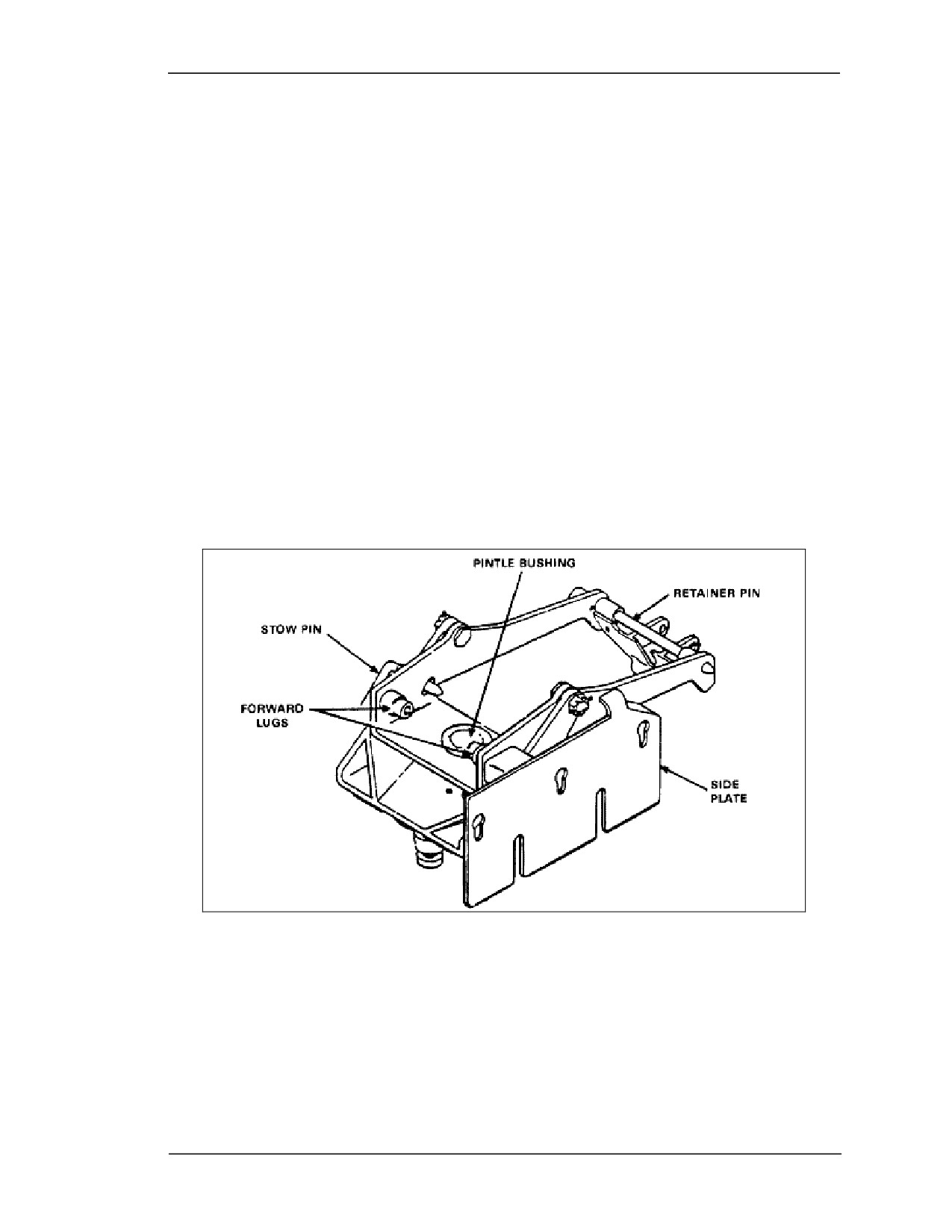
Use the MK 64 gun cradle to mount the MK 19 to the gun pedestal, stand, ring, or tripod.
Attach the ammunition container bracket to the side plate of the cradle. In the center of the
cradle is a pintle bushing and lock in which the M2 caliber .50 and M60 guns can be
mounted. The front of the MK 19 is mounted on the two forward lugs of the gun cradle; the
retainer pin secures the MK 19's rear. Insert the cradle stow pin to hold the cradle in a
horizontal position during travel (Figure 3-1).
Figure 3-1. MK 64 gun cradle.
3-2.
GROUND-MOUNT USING THE M3 TRIPOD
Mount the MK 19 as close to the ground as possible and lock the tripod’s trail legs open. Set
the adjustable front tripod leg to an angle of about 60 degrees to the ground. For example, in
flat terrain with the extensions closed, use the following method to place the MK 19 about 12
inches above the ground.
a. Set the tripod trail legs by following these procedures (Figure 3-2):
3-1
FM 3-22.27
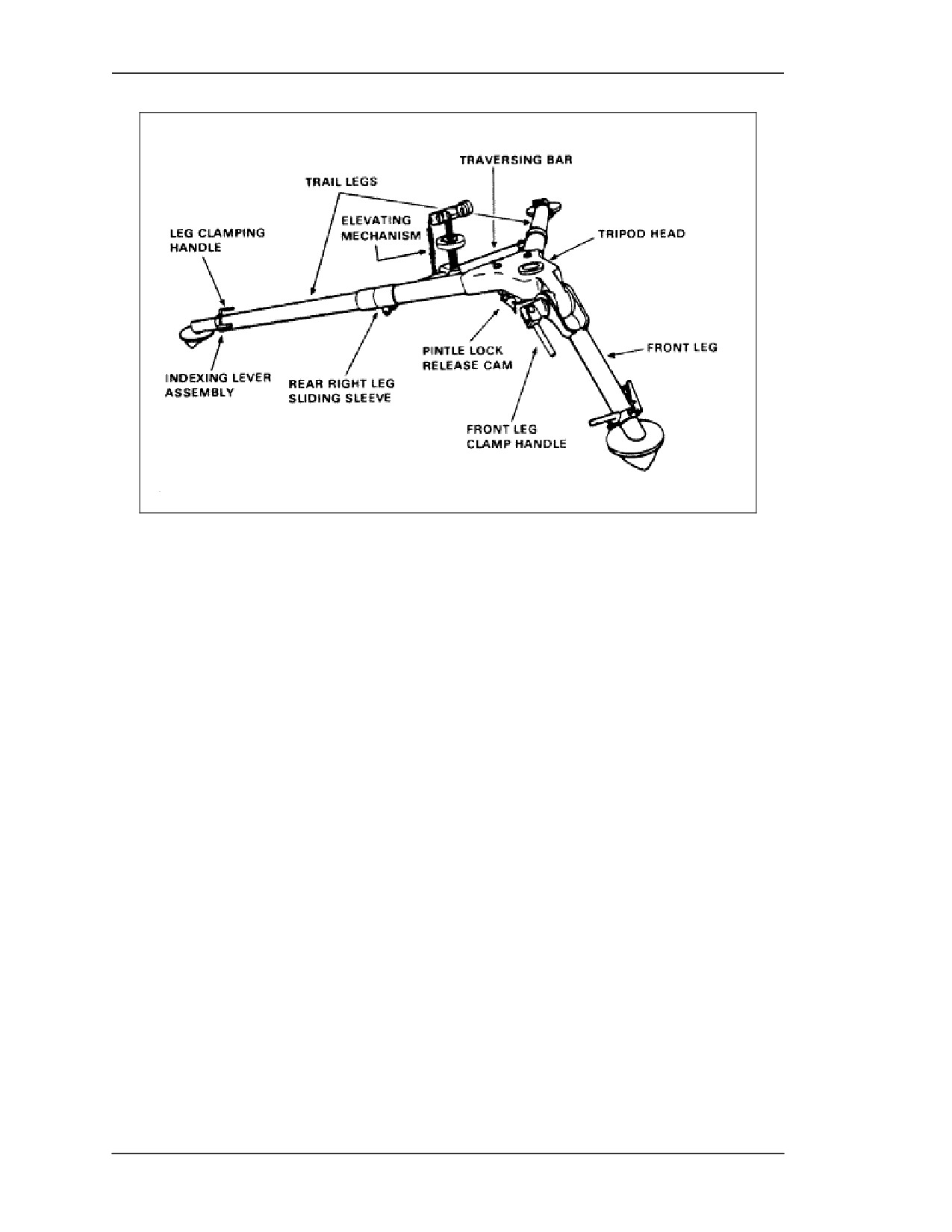
Figure 3-2. M3 tripod.
(1) Unscrew the leg-clamping handle; press down on the indexing lever, and extend the
leg to the desired length.
(2) Align the indexing lever stud with one of the holes in the tripod leg extension.
(3) Release pressure on the indexing lever, allowing the stud to fit the desired hole.
Tighten the leg-clamping handle.
b. Set the front leg of the tripod by following these procedures:
(1) Turn the front leg clamp handle counterclockwise to loosen the front leg.
(2) Adjust the leg to the desired angle, ensuring the tripod head is level, and tighten the
front leg clamp.
c. Secure the tripod legs by following these procedures:
(1) Stamp the metal shoe on each tripod leg into the ground.
(2) Sandbag each leg to stabilize the MK 19 for firing.
d. Mount the M64 gun cradle onto the M3 tripod by following these procedures:
(1) Unlock the tripod pintle lock release cam.
(2) Insert the gun cradle’s pintle into the tripod pintle bushing (Figure 3-3).
3-2
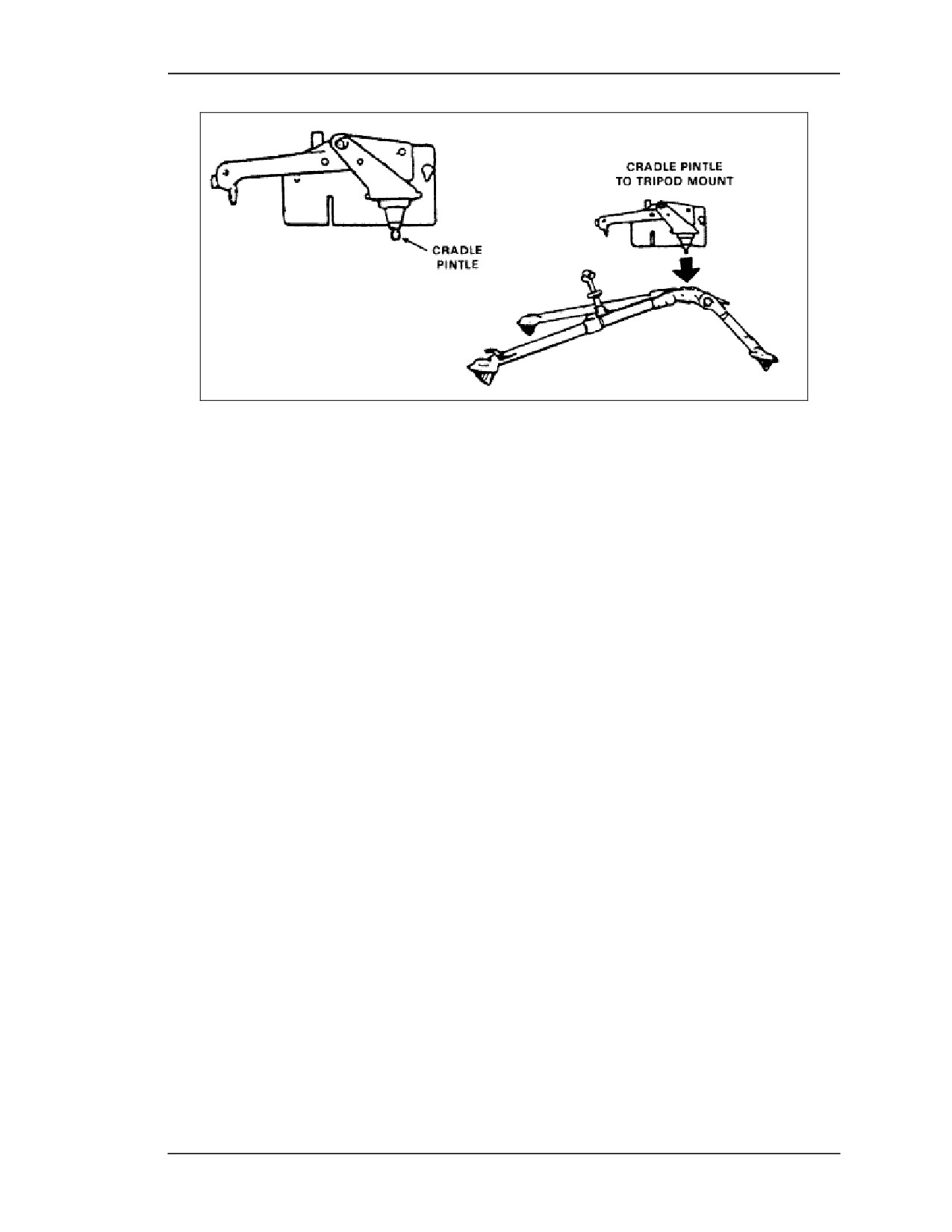
FM 3-22.27
Figure 3-3. Insertion of pintle into pintle bushing.
(3) Lock the pintle lock release cam to secure the gun cradle. Check the gun cradle, by
pulling up on it slightly, to ensure that it is seated and locked.
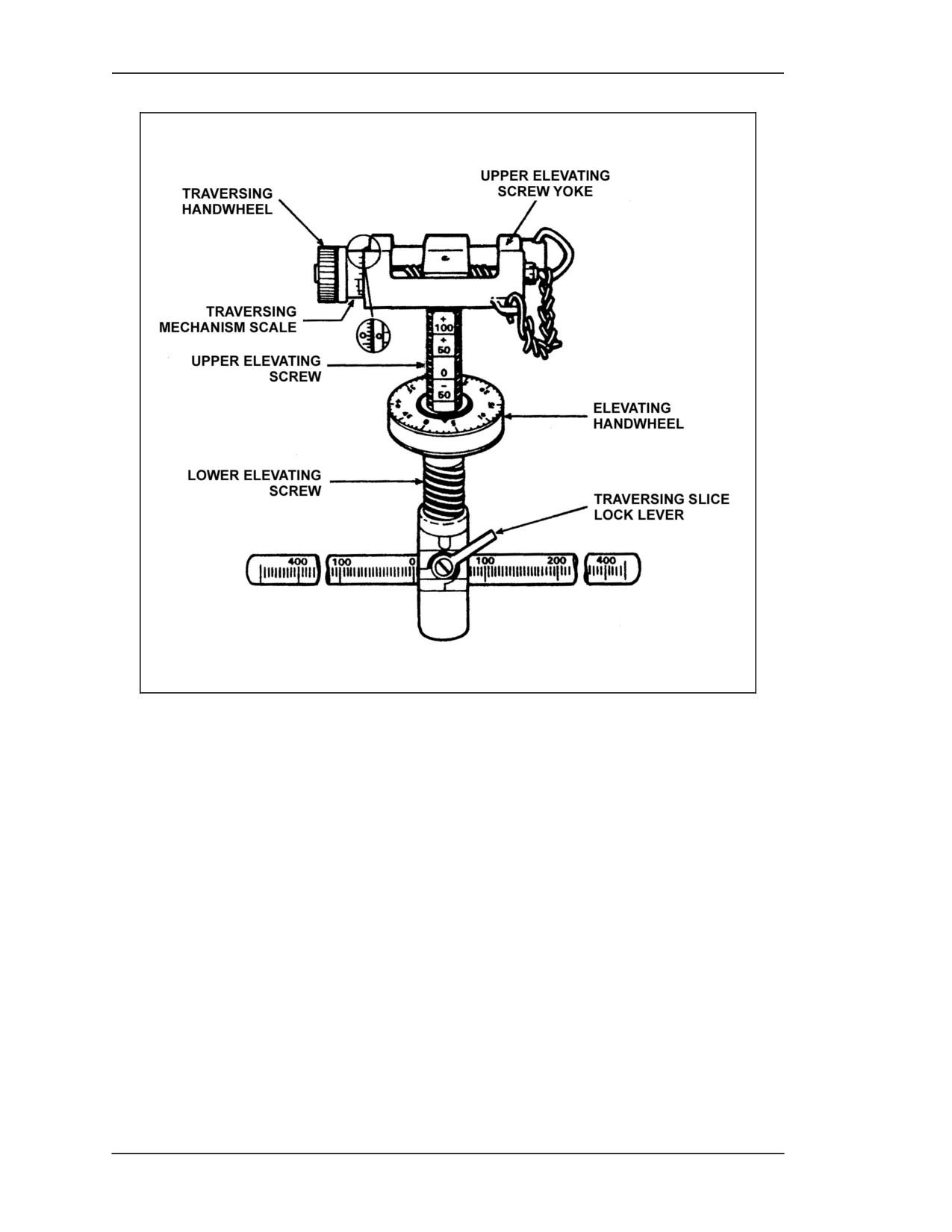
e. Attach the (traverse and elevating) T&E mechanism by following these procedures
(Figure 3-4):
(1) Zero the T&E mechanism by zeroing the traversing handwheel, elevating handwheel,
and the elevating mechanism sleeve to the lower elevating screw.
(a) To zero the traversing handwheel, hold the T&E mechanism so that the traversing
handwheel is on the left when looking at it, then turn the traversing handwheel toward you
until it stops. Loosen the locking nut slightly. Align the zero on the scale with the zero on the
elevating screw yoke. Hold the scale with the zeros aligned, and tighten the locking nut.
Make sure the zeros stay aligned. Turn the traversing handwheel two complete revolutions
away from you. If doing this at night, count 50 “clicks” away from you.
(b) To zero the elevating handwheel to the upper elevating screw, align the two zeros.
Rotate the elevating handwheel up or down until a zero with a line below it is visible on the
upper elevating screw. Position the elevating handwheel so the indicator is pointing at the
zero on the handwheel.
(c) Zero the elevating mechanism sleeve to the lower elevating screw. Rotate the
elevating mechanism sleeve all the way up; rotate it down until it stops and note the number
of complete turns. Rotate the elevating mechanism sleeve up half that number of turns.
Position the slide lock lever to face you.
3-3
FM 3-22.27
Figure 3-4. T&E mechanism.
(2) Remove the stow pin from the gun cradle (Figure 3-5).
(3) Align holes in the upper elevating screw yoke of the T&E mechanism with the rear
holes in the gun cradle (Figure 3-6).
NOTE: The stow pin locks the cradle in a horizontal position, preventing it from
depressing or elevating.
3-4
///////////////////////////////////////