FM 3-22.27 MK 19, 40-mm GRENADE MACHINE GUN, MOD 3 (NOVEMBER 2003) - page 6
FM 3-22.27
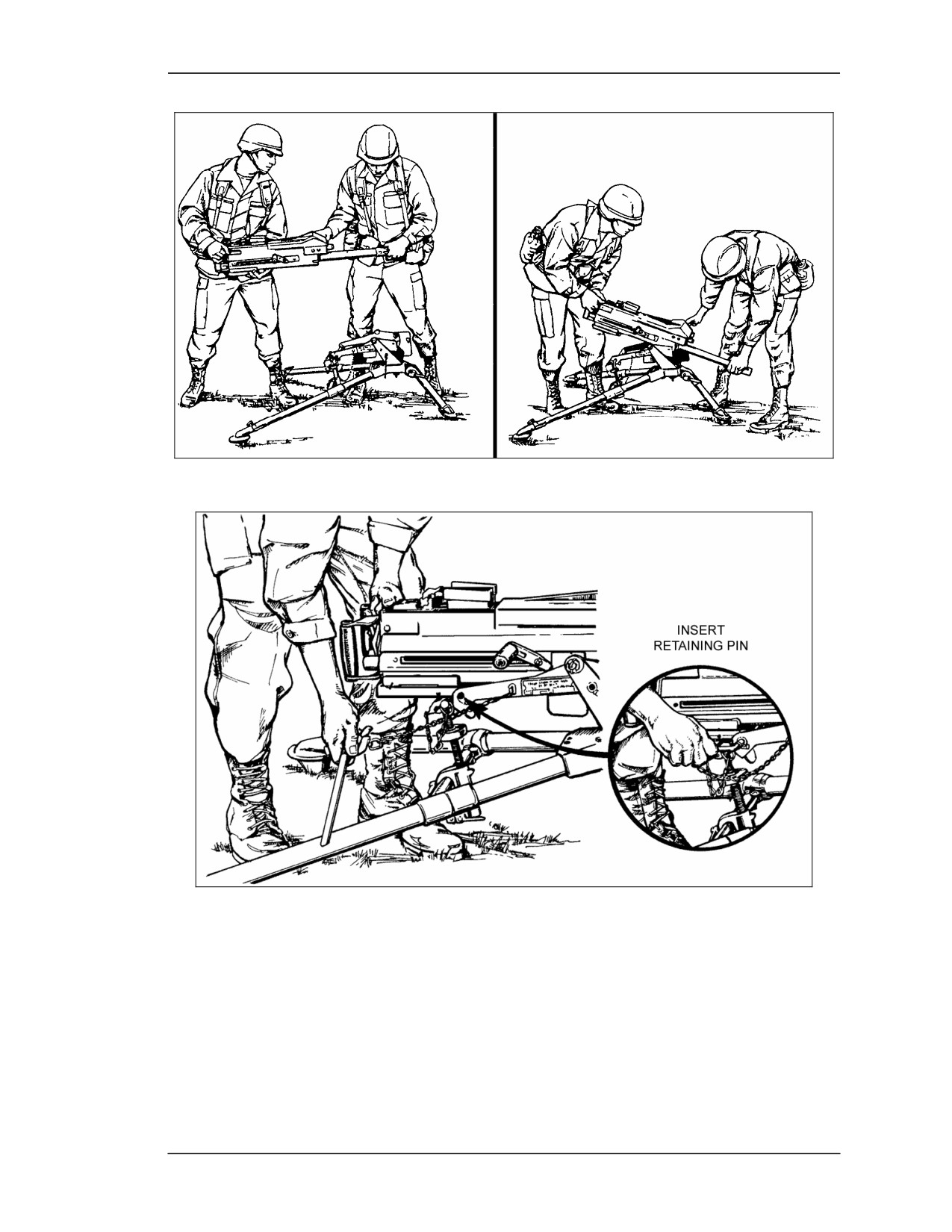
Figure H-6. Placing the MK 19 in the cradle.
Figure H-7. Securing the MK 19 to the cradle.
c. The ammunition bearer:
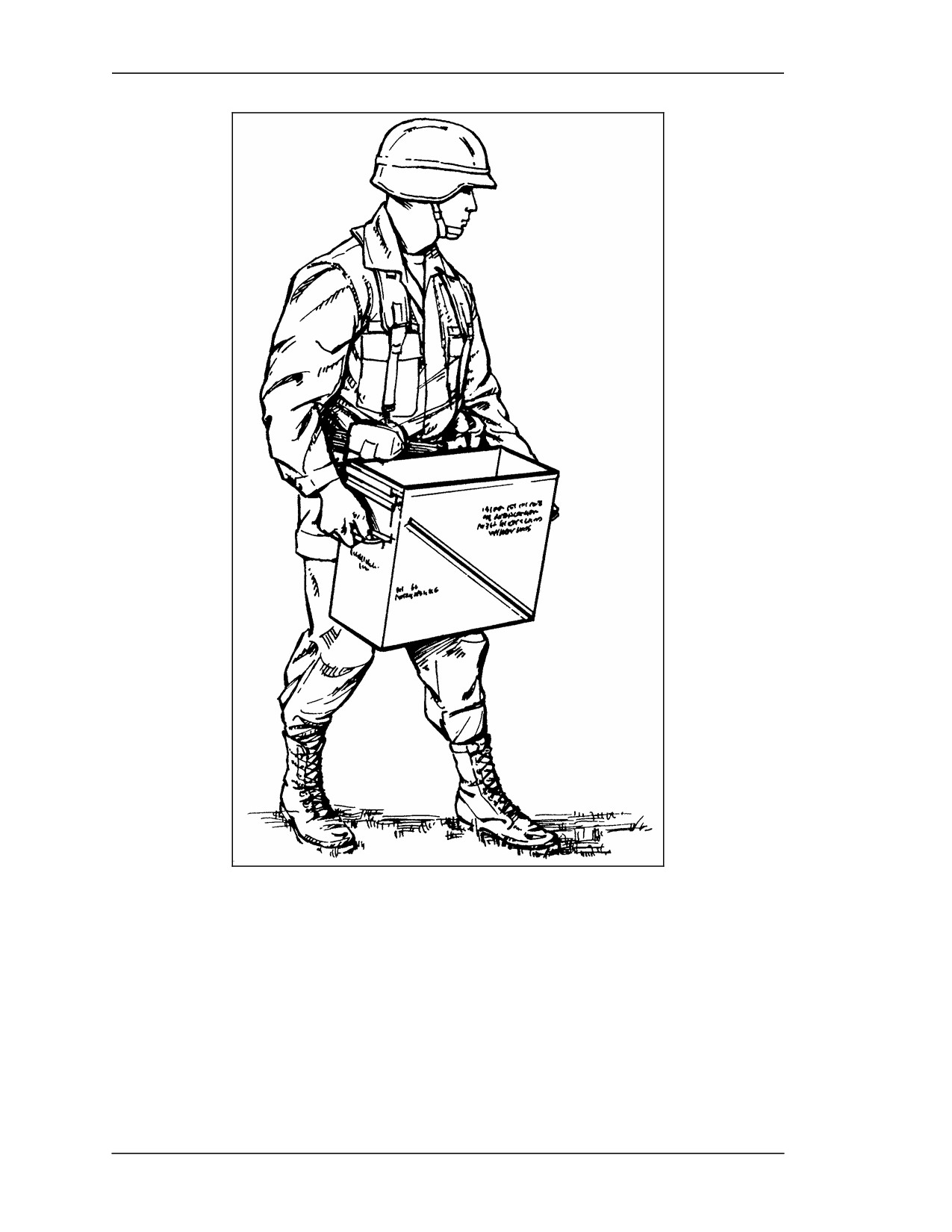
(1) Carries the ammunition can to the MK 19 position (Figure H-8).
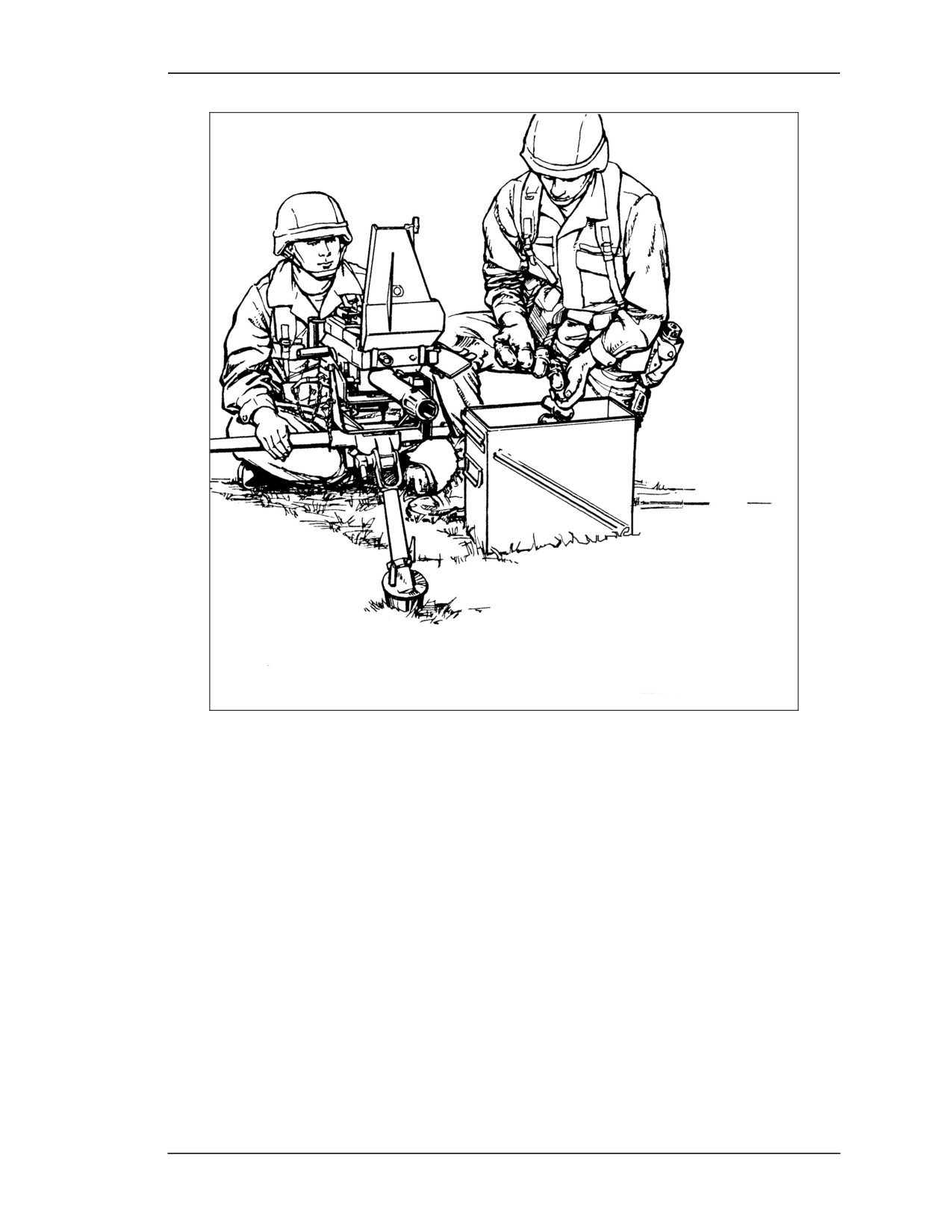
(2) Takes the lid off and ensures the ogive ends of the rounds are pointed downrange
(Figure H-9).
(3) Gives the can to the assistant gunner.
(4) Returns to the ammunition point and stands by to do whatever is needed to complete
the mission.
H-7
FM 3-22.27
Figure H-8. Ammunition bearer with ammunition can.
H-8
FM 3-22.27
Figure H-9. Alignment of ammunition belt.
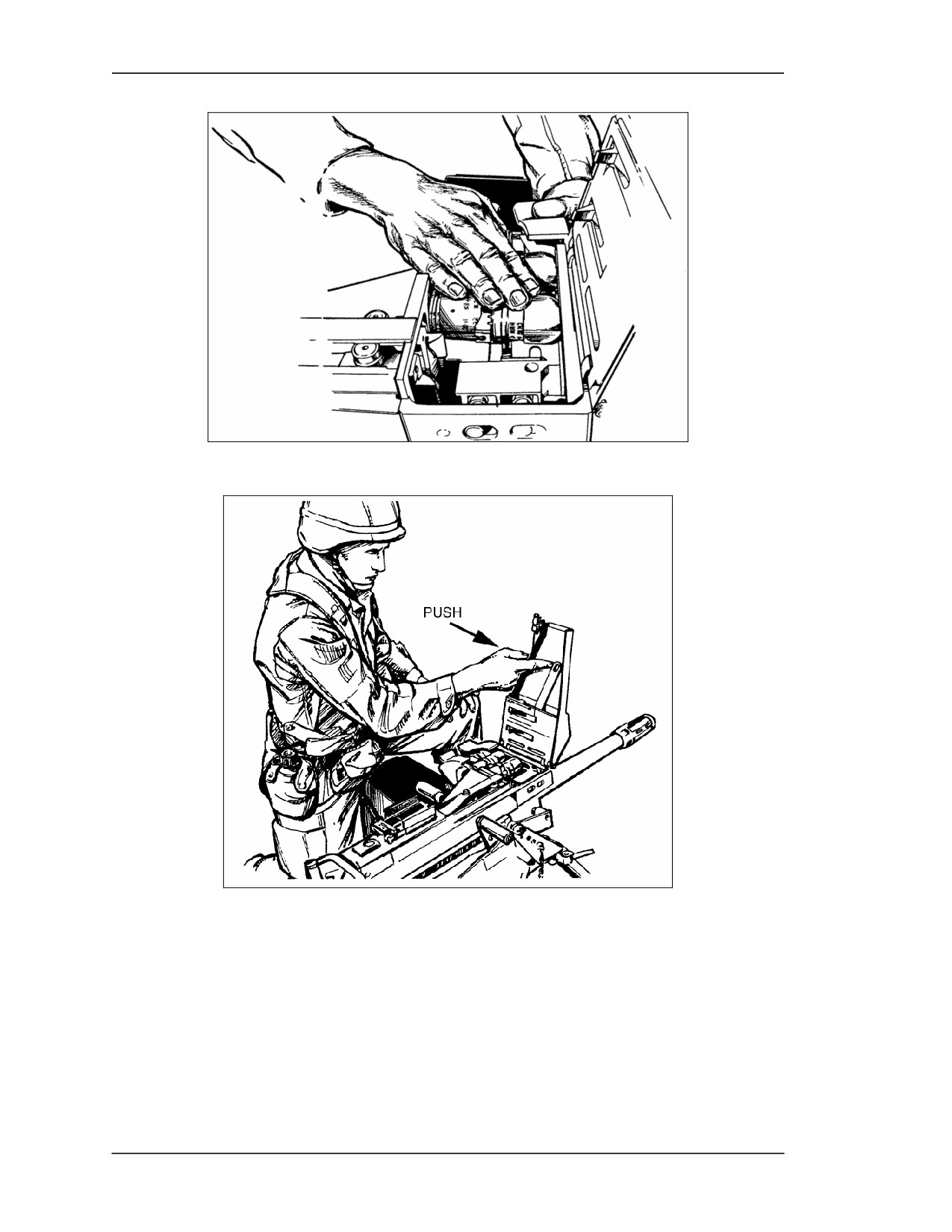
d. The gunner opens the top cover. The assistant gunner inserts the first round into the
feeder (female link first), pushes the first round across the primary feed pawl (Figure H-10),
and moves the feed slide assembly to the left by pushing the secondary drive lever to the
right (Figure H-11).
H-9
FM 3-22.27
Figure H-10. Placement of the round across the primary feed pawl.
Figure H-11. Feed slide assembly moved to the left.
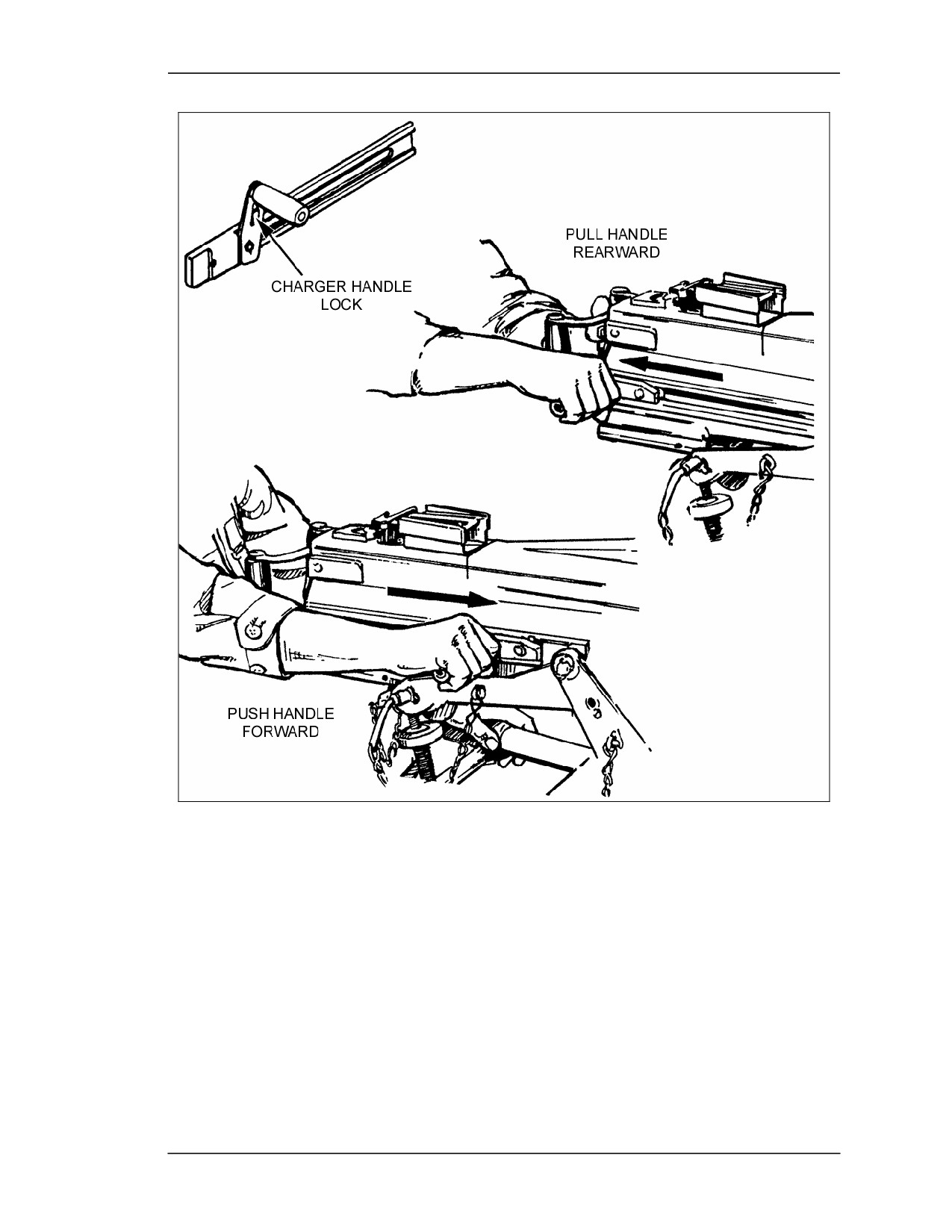
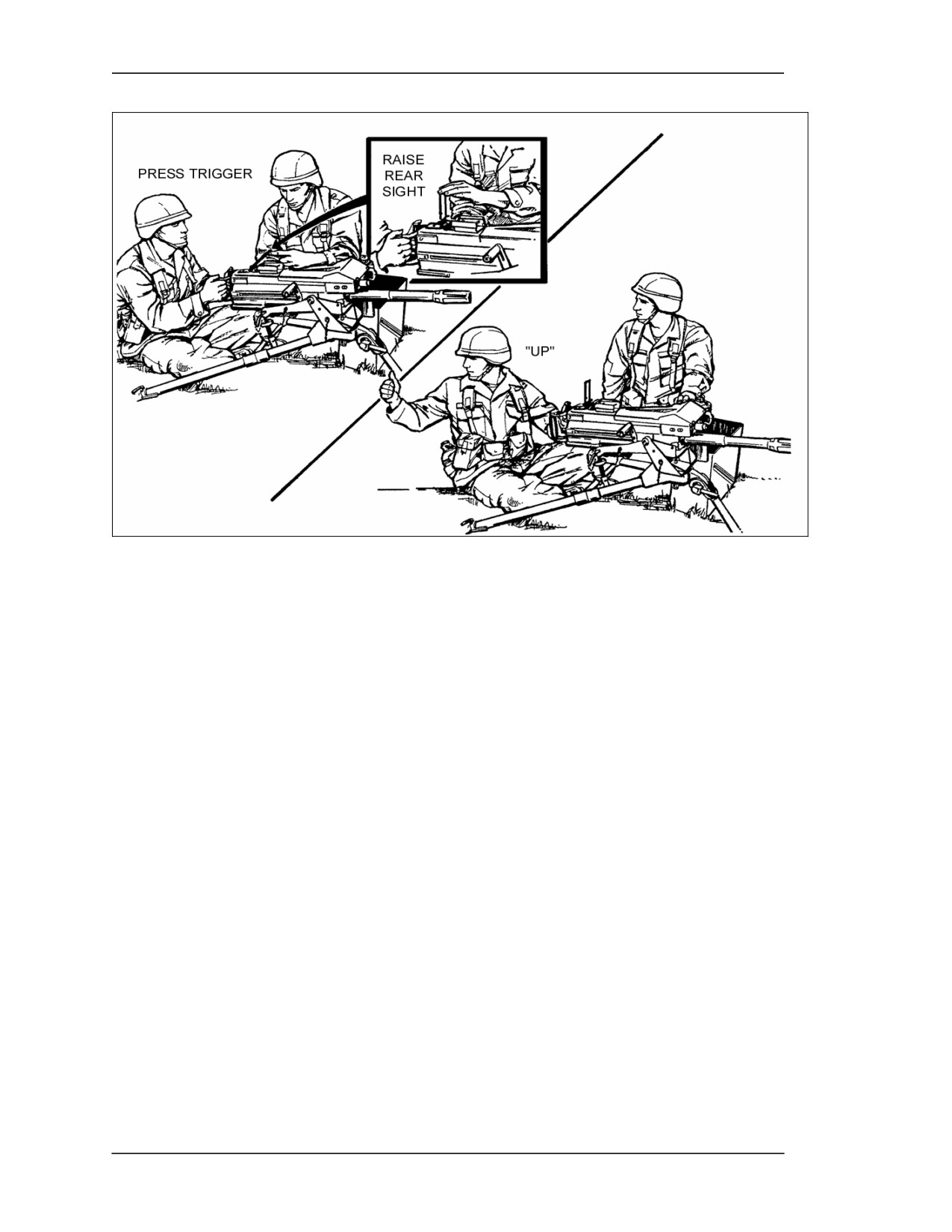
e. The gunner closes the top cover and charges the weapon (Figure H-12). The gunner
presses the trigger, which places the lead round in the bolt extractor. He charges the weapon
a second time, forcing the lead round from the bolt extractors into the bolt fingers. The
weapon is ready to fire. When the assistant gunner raises the rear sight, the gunner calls
“Up” (Figure H-13).
H-10
FM 3-22.27
Figure H-12. Gunner charging the MK 19.
H-11
FM 3-22.27
Figure H-13. Raising the rear sight.
H-5. TAKING THE MK 19 OUT OF ACTION
To take the gun out of action, the leader commands OUT OF ACTION. Each crewmember
accomplishes the following in sequence.
a. The gunner raises the top cover of the MK 19. The assistant gunner releases the
ammunition belt from the feed tray and places it in the ammunition can. The gunner takes the
round or spent cartridge case from the bolt fingers, places it in the ammunition can, and
closes the top cover.
b. The assistant gunner releases the MK 19 from the gun cradle. The gunner lifts the
MK 19 off the mount and moves to a position 10 paces behind the tripod. He places the MK
19 on the ground in front of him with the flash suppressor to the left and with the sights on
the top.
c. Once the gunner has moved away from the tripod, the assistant gunner:
(1) Releases the T&E mechanism and takes off the gun cradle/ T&E mechanism.
(2) Releases the tripod sleeve lock latch.
(3) Grasps the front leg and rotates the tripod to a vertical position.
(4) Releases the sleeve latch, and collapses the trail legs.
(5) Loosens the front leg clamp, folds down the front leg to a 60-degree angle, and
tightens the clamp.
(6) Returns, with the tripod and gun cradle, to a position five paces in front of the
gunner.
d. The ammunition bearer comes forward and gets the ammunition can(s) or any other
loose equipment, and returns to a position five paces behind the gunner.
e. The gunner announces “Up.”
H-12
FM 3-22.27
H-6. TRANSPORT OF THE TRIPOD-MOUNTED MK 19
To move the MK 19 and equipment a short distance, the gunner commands SECURE
EQUIPMENT, FOLLOW ME. The MK 19 can be moved using one of three methods:
a. Dragging. The gunner grasps the front leg and pulls the MK 19 to the new position,
and the assistant gunner secures any loose equipment.
b. Two-man Carry. The gunner stands behind the tripod with a trail leg in each hand.
The assistant gunner grasps the front leg and avoids touching the barrel if it is hot. The
gunner and assistant gunner carry the mounted MK 19. The assistant gunner returns to secure
any loose equipment.
c. Three-man Carry. The gunner and assistant gunner each holds a trail leg just above
the traverse bar. The ammunition bearer grasps the front leg and avoids touching the barrel if
it is hot. The crew moves to the new position. The ammunition bearer and the assistant
gunner go back and get the ammunition or loose equipment, and return to the new position.
H-7. DISMOUNT THE MK 19
To dismount the MK 19 from the vehicle-mounted or stowed position, each member of the
crew performs the following steps in order within four minutes.
a. To dismount the MK 19 from the mounted position the crew performs the following
actions.
(1) The squad leader:
(a) Dismounts the vehicle with binoculars and compass.
(b) Obtains the M3 tripod from the stow position.
(c) Takes the M64 gun cradle and T&E mechanism from the gunner and moves to the
ground firing position.
(d) At the firing position, the gunner aligns the front tripod leg for direction and snaps
the trail legs apart.
(e) Stamps the tripod legs into the ground.
(f) Zero's the T & E mechanism, if it is not zeroed.
(g) Secures the gun cradle to the M3 tripod and the T&E mechanism to the traverse bar
and gun cradle.
(h) Assists the gunner in mounting the MK 19.
(2) The gunner:
(a) Raises the top cover, releases the ammunition belt from the feed tray, and places it in
the ammunition can.
(b) Takes the round or spent cartridge case from the bolt fingers, places it in the
ammunition can, and closes the top cover.
(c) Lifts the MK 19 from the gun cradle after the driver releases it, and hands it to the
driver.
(d) Releases the T&E mechanism from the pedestal with the train lock handle and
removes the empty case catch bag assembly.
(e) Removes the gun cradle with the T&E mechanism attached and hands it to the squad
leader.
(f) Takes the MK 19 from the driver and moves to the firing position.
(g) With the squad leader’s assistance, the gunner secures the MK 19 to the gun cradle.
(3) The driver:
H-13
FM 3-22.27
(a) Dismounts the vehicle and assists the gunner in clearing the weapon.
(b) Removes the ammunition can and releases the MK 19 and takes it from the gunner.
(c) Gives the MK 19 to the gunner when the gunner is ready.
(d) Stows the empty case catch bag assembly and takes the ammunition can to the firing
position, while also removing the lid and ensuring the ogive ends of the rounds are pointed
downrange.
(e) Returns to the vehicle and monitors the radio and/or takes more ammunition to the
firing point, and maintains rear security.
(4) The squad leader and the gunner load the weapon (as in a crew drill), and place the
MK 19 into action.
b. To dismount the MK 19 from the stowed position the crew performs the following
actions.
(1) The squad leader:
(a) Secures the binoculars and compass.
(b) Obtains the M3 tripod, the M64 gun cradle, and the T&E mechanism from their
stowed position.
(c) Moves to the ground firing position where he aligns the front tripod leg for direction
and snaps the trail legs apart.
(d) Stamps the tripod legs into the ground.
(e) If required, zeros’ the T&E mechanism to the traverse bar and gun cradle.
(f) Assists the gunner in mounting the MK 19.
(2) The gunner:
(a) Dismounts the vehicle and obtains the MK 19 from its stowed position.
(b) Moves to the firing position with the MK 19.
(c) Secures the MK 19 into the gun cradle with the squad leader’s assistance.
(3) The driver:
(a) Dismounts the vehicle and moves to the firing position with a can of ammunition.
(b) Assists in obtaining both the M3 tripod and the MK 19 from the stowed position.
(c) Removes the lid from the ammunition can and ensures the ogive ends of the rounds
are pointed downrange.
(d) Returns to the vehicle, monitors the radio and/or takes more ammunition to the firing
position, and maintains rear security.
(4) The squad leader and the gunner load the weapon as in the crew drill and place the
MK 19 into action.
H-8. REMOUNT THE MK 19
The vehicle crew must be able to mount the MK 19 from the ground-mount to a vehicle-
mount or stowed position within four minutes.
a. To mount the MK 19 from the ground to the vehicle the crew performs the following
actions.
(1) The squad leader assists the gunner in clearing the weapon by releasing the
ammunition belt from the feed tray, and placing it in the ammunition can. He then:
(a) Removes the ammunition can and places it on the ground.
(b) Releases the MK 19 from the gun cradle.
(c) Releases the T&E mechanism from the tripod traverse rod and takes off the gun
cradle and T&E mechanism, after the gunner removes the MK 19.
H-14
FM 3-22.27
(d) Grasps the front leg of the tripod and rotates the tripod to vertical position, releases
the sleeve latch, and collapses the trail legs.
(e) Loosens the front leg clamp, folds down the front leg, and tightens the clamp.
(f) Returns to the vehicle, gives the gun cradle/T&E mechanism to the gunner, and stows
the M3 tripod.
(g) Stows the binoculars and compass in the vehicle and resumes his duties.
(2) The gunner raises the top cover of the MK 19 and takes the round or spent cartridge
case from the bolt fingers, and places it in the ammunition can, and closes the top cover. He
then:
(a) Lifts the MK 19 off the gun cradle when the squad leader releases it and moves to the
vehicle.
(b) Gives the MK 19 to the driver and mounts the vehicle.
(c) Takes the gun cradle and T&E mechanism from the squad leader and mounts the gun
cradle to the pedestal.
(d) Zeros’ the T&E mechanism if needed and reattaches it to the gun cradle.
(e) Attaches the T&E mechanism to the pedestal and clamps it with the train lock handle.
(f) Takes the MK 19 from the driver and installs it on the gun cradle.
(g) Attaches the travel lock assembly if movement is imminent.
(h) Takes the empty case catch bag assembly from the driver and attaches it to the gun
cradle.
(3) The driver receives the MK 19 from the gunner and gives it to him when he is ready.
He then:
(a) Assists the gunner in installing the MK 19 in the gun cradle.
(b) Moves to the firing position, retrieves the ammunition can and any loose equipment,
and returns to the vehicle.
(c) Places the ammunition can on top of the vehicle, with the ogive ends of the rounds
pointed down range.
(d) Hands the empty case catch bag assembly to the gunner.
(4) The squad leader and the gunner load the weapon (as in the crew drill) and place the
MK 19 into action.
b. To dismount the MK 19 from the ground mount to a stowed position, the crew
performs the following actions.
(1) The squad leader:
(a) Assists the gunner in clearing the weapon by releasing the ammunition belt from the
feed tray, and places it in the ammunition can.
(b) Removes the ammunition can and places it on the ground. He then releases the MK
19 from the gun cradle.
(c) Releases the T&E mechanism from the tripod traverse rod and takes off the gun
cradle/T&E mechanism after the gunner removes the MK 19.
(d) Grasps the front leg of the tripod and rotates the tripod to a vertical position, releases
the sleeve latch, collapses the trail legs, loosens the front leg clamp, folds down the front leg,
and tightens the clamp.
(e) Returns to the vehicle and stows the M3 tripod, T&E mechanism, binoculars, and
compass.
(f) Resumes his duties.
(2) The gunner:
H-15
FM 3-22.27
(a) Raises the top cover of the MK 19 and takes the round or spent cartridge case from
the bolt fingers.
(b) Places the round in the ammunition can, and closes the top cover.
(c) Lifts the MK 19 off the gun cradle when the squad leader releases it and moves to the
vehicle.
(d) Stows the MK 19 in its stowage position.
(3) The driver:
(a) Moves to the firing position.
(b) Collects the ammunition can and any loose equipment.
(c) Stows the ammunition can and assists the squad leader and gunner in stowing any of
their equipment.
H-9. CONVERT THE M966 HMMWV TOW MISSILE CARRIER FROM MK 19
MODE TO TOW 2 MODE
To convert the M966 weapon system from the MK 19 mode to the TOW 2 mode, the crew
performs the following actions.
a. The squad leader:
(1) Places the traversing unit in the traveling position.
(2) Obtains the nightsight and collimation cases from the stowed position and places
them on top of the vehicle near the gunner.
(3) Stows the gun cradle/ammo bracket, T&E mechanism, and empty case catch bag
assembly.
(4) Unstraps the missile guidance system (MGS), unlatches its cover, and stows the
MGS in the commander’s footwell.
(5) Connects the J-1 cable and the battery power conditioner cable to the MGS and MGS
battery power conditioner.
(6) Connects the nightsight power conditioner cable to the TOW vehicle power cable
(TVPC), uncoils the cable and hands it up to the gunner.
(7) Ensures that the power cable is connected to the TVPC, and that the TVPC switch is
on.
(8) Assists the gunner in boresighting the system.
b. The gunner :
(1) Raises the top cover and releases the ammunition belt from the feed tray and places it
in the ammunition can.
(2) He takes the round or spent cartridge case from the bolt fingers, places it in the
ammunition can, and closes the top cover.
(3) The gunner releases the MK 19 from the gun cradle, lifts the MK 19 out of the gun
cradle, and gives it to the driver.
(4) The gunner releases the T&E mechanism from the pedestal with the train lock
handle.
(5) Removes the empty case catch bag assembly and gives it to the squad leader. The
gunner moves the ammo can and gives it to the driver.
(6) Removes the gun cradle with the T&E mechanism attached and hands it to the squad
leader.
H-16
FM 3-22.27
(7) Opens the pedestal mount cover and secures it. Lifts the traversing unit with adapter
from the stowage base and secures the traversing unit to the pedestal mount with the
coupling clamp.
(8) Receives the launch tube from the driver and secures it to the traversing unit.
(9) Receives the optical sight from the driver and installs it on the traversing unit.
(10) Opens the nightsight case, removes nightsight device and installs it on the optical
sight and hands the case to the driver.
(11) Takes the TVPC cable from the squad leader and installs the nightsight device.
(12) Opens the collimation case, removes the collimator, attaches to nightsight, and
connects collimator power cable.
(13) Assists the squad leader in boresighting.
(14) Collimates sights, removes collimator and power cable, stores collimator and cable
in case, and hands case to the driver.
(15) Receives the missile from the driver and loads it in the system.
c. The driver:
(1) Dismounts the vehicle and enters the right rear passenger door and then unlocks and
opens the cargo hatch.
(2) Stows the MK 19 when received from the gunner.
(3) Stows the ammunition can when received from the gunner.
(4) Places the optical sight on top of the vehicle for the gunner.
(5) Unstraps a missile, inspects the missile, and gives the missile to the gunner.
(6) Ensures every item in the cargo hatch is secure, closes the cargo hatch, exits the
vehicle through the right rear passenger door and takes his place as driver.
H-10. CONVERT THE M966 HMMWV TOW MISSILE CARRIER FROM TOW 2
MODE TO MK 19 MODE
This exercise requires the crew to accomplish its task within three minutes. To convert the
M966 weapon system from the TOW 2 mode to the MK 19 mode and put the TOW 2 into its
stowed position, the crew performs the following actions.
a. The squad leader:
(1) Disconnects the J-1 cable from the MGS, coils the cable and stows in the traversing
unit.
(2) Disconnects the battery power conditioner cable from the MGS battery power cable,
and winds it on the stowage handle.
(3) Disconnects the MGS battery cable, recovers the MGS cover, stows the cable in the
MGS, replaces the cover on the MGS, and straps the MGS down.
(4) Disconnects the nightsight power cable from the TVPC, and winds and stows the
cable.
(5) Receives the nightsight case from the gunner and stows it in the vehicle.
(6) Gives the gunner the gun cradle/ammo bracket, T&E mechanism, and empty case
catch bag assembly.
b. The gunner:
(1) Arms the missile (if armed), unlocks the bridge clamp, removes the missile and hands
it to the driver.
H-17
FM 3-22.27
(2) Disconnects the TVPC power cable from the night sight and drops down the hatch.
(3) Disconnects the nightsight and places it in the case, and hands the case to the squad
leader.
(4) Disconnects the optical sight and hands it to the driver.
(5) Disconnects the launch tube, and hands it to driver.
(6) Unclasps the traversing unit, lifts the traversing unit out of the pedestal mount, and
takes it through the gunners hatch.
(7) Secures it to the TU stowage base, and closes the pedestal mount access cover.
(8) Takes the gun cradle/ammo bracket and T&E mechanism from the squad leader.
(9) Installs the cradle/ammo bracket on the heavy interdiction missile system (HIMS)
mount.
(10) Ensures the T&E mechanism is zeroed, installs the T&E mechanism to the gun
cradle and the pedestal mount on the HIMS.
(11) Takes the MK 19 from the driver and installs it on the gun cradle.
(12) He installs the empty case catch bag assembly on the gun cradle.
(13) Receives ammunition can from the driver, while ensuring that the ogive ends are
pointing down range, and loads the MK 19.
c. The driver:
(1) Dismounts the vehicle and enters the right rear passenger door, and unlocks and
opens the cargo hatch.
(2) Takes the missile from the gunner and stows it in the missile rack.
(3) Unstraps the nightsight case and gives it to the gunner.
(4) Takes the optical sight from the gunner and stows it in the vehicle.
(5) Takes the launch tube from the gunner and stows it in the vehicle.
(6) Unstraps the MK 19 from its stowage, and gives it to the gunner.
(7) Unstraps one can of ammunition and places it on top of the vehicle near the gunner.
(8) Replaces the forward handling ring and dust cover on the missile.
(9) Ensures that every item in the cargo hatch is secure and closes the cargo hatch.
(10) Exits the vehicle through the right rear passenger door and takes his place as the
driver.
H-11. ENGAGE TARGETS WITH THE MK 19
The MK 19 squad must be able to successfully engage a target while occupying a
firing position. This crew drill is based on the procedures found in Section III of Chapter 5,
Application of Fire. The purpose of this drill is to exercise proper fire techniques to
successfully engage a target while not hitting friendly troops or attempting to hit a target out
of range. The crew occupies a dismounted position when the squad leader announces, “Fire
mission.”
a. The squad leader then performs the following tasks:
(1) Announces direction using one of the following methods: orally (example:“Right
front,” or “Left flank”), by a reference point (example:“TRP 1,” “Lone tree.”), fires tracer
from a weapon or another MK 19, or by laying the gun on the target himself.
(2) Announces target description “Troops,” “Tank,” or if more than one type of target,
designated target, “Lead truck,” “Right building, far end.”
(3) Announces target range, for example, “Four five zero,” “One one hundred.”
H-18
FM 3-22.27
(4) Takes the following corrective actions, as required. If the gunner announces, “Cannot
identify,” the squad leader attempts to identify and gives further instructions. If the gunner
announces “Lost,” the squad leader gives additional target location. If the gunner announces
“Friendly, the squad leader gives new target description or gives end of mission.
(5) Announces the method of engagement by announcing the class and rate of fire.
(6) Announces method of control.
(7) Issues subsequent fire commands as needed.
(8) Terminates the alert: CEASE FIRE, END OF MISSION.
b. The gunner performs the following tasks:
(1) Attempts to acquire target. If he cannot, the gunner announces “Cannot identify,”
“Lost,” or “Friendly.”
(2) When identified, announces “Identified,” or “Up.”
(3) Makes an adjustment to the lay of the gun as the squad leader gives new data.
c. The driver performs the following tasks:
(1) Provides security for the vehicle or position.
(2) Prepares to get more ammunition to the gun as required.
(3) Prepares to move if the squad leader announces “Cease fire,” or “End of mission.”
H-19
FM 3-22.27(FM 23-27)
APPENDIX I
GUNNERY EXERCISES
There are seven exercises used to train MK 19 gunners and crews. The
first four exercises are individual gunnery firing exercises and allow the gun
crew to practice firing prior to the collective gunnery exercises.
Commanders dictate the level of MOPP used during MK 19 gunnery.
These seven tables are used for single and multiple gun-crew practice and
can be conducted on any MK 19 range. Each table has columns for the task,
condition, standard, ammunition required, time required, and a column to
record a satisfactory or unsatisfactory (SAT Y/N) score for the task.
I-1. INDIVIDUAL GUNNERY
These first four tables are used for gunnery practice. Each single gun exercise requires the
gun crew to mount and dismount the MK 19, and engage point and area targets at various
ranges. The two dismounted day exercises require the gun crew to prepare a range card and
engage targets using data from the range card (Tables I-1 and Table I-2). The third exercise
(Table I-3) is a mounted combat exercise and the fourth exercise (Table I-4) is a night fire
exercise.
a. Instructional Fire Exercise (Table I-1). The instructional firing exercise gives the
crew practice firing on a range.
I-1

FM 3-22.27
ACTION
CONDITIONS
STANDARDS
AMMO
TIME
SAT
Y/N
1. Mount the
Given a MK 19, M3 tripod,
Gun crew must be
0
1 min
MK 19 on the
T&E mechanism, MK 64
able to mount the
M3 tripod.
gun cradles, and a firing
MK 19 in its tripod
position.
mode within
1 min.
2. Prepare a range
Given a MK 19 mounted
Gunner must
0
15 min
card.
on a M3 tripod, and a firing
prepare a
position with a
completed range
designated sector of fire
card within
and targets.
15 min.
3. Zero the MK 19
Given a tripod-mounted
Gunner must
4 rds
N/A
while using a
MK 19, 400-meter BMP
impact on the
400-meter BMP
target, selected firing
target with at least
target.
position, and 4 rds of
2 of the 4 rds on
40-mm TP.
the BMP target at
400 meters.
4. Engage a BMP
Given a tripod-mounted
Gunner must
8 rds
N/A
target at
MK 19, completed range
impact on the
1,100 meters
card, BMP target at
1,100 meter BMP
while using
1,100 meters, selected
target with at least
range card data
firing position, and 8 rds of
2 out of 8 rounds.
(point target).
40-mm TP.
5. Engage a BMP
Given a tripod-mounted
Gunner must
8 rds
N/A
target at
MK 19, completed range
impact on the
1,500 meters
card, BMP target at
1,500 meter BMP
while using
1,500 meters, selected
target area with at
range card data.
firing position, and 8 rds of
least 1 out of
40-mm TP.
8 rds.
6. Engage
Given a tripod-mounted
Gunner must
6 rds
N/A
dismounted
MK 19, completed range
impact at least 4
troops at
card, dismounted troop
out of 6 rds within
600 meters while
targets at 600 meters,
5 meters of a
using range card
selected firing position,
silhouette at a
data (area
and 6 rds of 40-mm TP.
range of 600
target).
meters.
7. Dismount the
Given a MK 19, M3 tripod,
Gun crew must
0
1 min
MK 19.
and a selected firing
dismount the
position.
MK 19 from the
M3 tripod within
1 min.
Total:
26 rds
Exercise Scoring
Fully Trained (T) = Satisfactory on 7 of 7 tasks
Need practice (P) = Satisfactory on 5 or 6 tasks
Untrained (U) = Unsatisfactory on 4 or fewer tasks
I-2

FM 3-22.27
Table I-1. Instructional fire exercise.
During scoring procedures, the grader positions himself so that he can observe both the
gunner and the target. Once the exercise commences, he:
• Times the tasks having a time standard.
• Observes and informs the gunner of the strike of the rounds.
• Records the results of each task in the right hand column with a "Y" for a
satisfactory completion of the task or an "N" for an unsatisfactory completion.
• Sums the results and assigns an overall score in accordance with the scores in the
bottom box of the figure above.
b. Dismounted Range Card Exercise (Table I-2). The dismounted range card exercise
is held after instructional fire and gives the gunner and crew a chance to test their skills
against a time-and-hit exercise. It is held as often as the commander feels necessary to
maintain crew skills.
(1) Time the gunner and crew while they place the tripod-mounted MK 19 into operation
in a selected location.
(2) Time the gunner while he completes a range card with the ranges of all targets within
his sector of fire.
(3) Have the gunner suppress or kill single or multiple targets in his sector of fire while
using his range card data.
(4) Time the gunner and crew while they take the MK 19 out of operation.
ACTION
CONDITIONS
STANDARDS
AMMO
TIME
SAT
Y/N
1. Mount the
Given a MK 19, M3 tripod,
Gun crew must
0
1 min
MK 19 on an
M64 gun mount, T&E
mount the MK 19 on
M3 tripod.
mechanism, and a selected
the M3 tripod within
firing position.
1 min.
2. Prepare a
Given a MK 19 mounted on
Gunner must prepare
0
15 min
range card.
a M3 tripod, a firing position
a completed range
with an assigned sector of
card with all targets
fire, and designated targets.
in his sector of fire
within 15 min.
3. Zero the MK 19
Given a tripod-mounted
Gunner must impact
4 rds
N/A
while mounted
MK 19, selected firing
at least 2 out of 4 rds
on the M3
position, 400-meter BMP
on the 400-meter
tripod at a
target, and 4 rds of 40-mm
BMP target.
400-meter
TP.
BMP.
4. Engage a 600-
Given a tripod-mounted MK
Gunner must impact
4rds
1 min
meter and
19, selected firing position,
at least 3 out of 4 rds
tripod-mounted
600-meter BMP target, and
on the 600-meter
BMP target
4 rds of 40-mm TP.
BMP target within 1
while using
min.
range card data
(point target).
Table I-2. Dismounted range card exercise.
I-3

FM 3-22.27
ACTION
CONDITIONS
STANDARDS
AMMO
TIME
SAT
Y/N
5. Engage a
Given a tripod-mounted
Gunner must impact
8 rds
2 min
1,100-meter
MK 19, selected firing
on BMP target at
BMP target
position, BMP target at
1,100 meters with at
while using
1,100 meters, completed
least 2 out of 8 rds
range card
range card, and 8 rds of
within 2 min.
data.
40-mm TP.
6. Engage a
Given a tripod-mounted
Gunner must impact
6 rds
1.5
600-meter
MK 19, 6 rds of 40-mm TP,
at least 4 out of 6 rds
min
(area) troop
selected firing position, and
within 5 meters of a
target while
a troop target at
troop silhouette at a
using the range
600 meters.
range of 600.
card data.
7. Engage a BMP
Given a tripod-mounted
Gunner must impact
8 rds
2 min
target at
MK 19, 8 rds of 40-mm TP,
on the 1,500 meter
1,500 meters
selected firing position, BMP
BMP target with at
while using the
target at 1,500 meters, and
least 4 out of 8 rds
range card
a completed range card.
within 2 min.
data.
8. Engage a
Given a tripod-mounted
Gunner must impact
12 rds
3 min
BMP target at
MK 19, 12 rds of 40-mm TP,
at least 2 rds on the
1,100 meters
BMP target at 1,100 meters,
BMP target at 1,100
and
dismounted troop target at
meters, then shift to a
dismounted
600 meters, and a completed
dismounted troop
troops at
range card.
target and place at
600 meters
least 2 rds within 5
while using
meters of a troop
range card
silhouette at a range
data.
of 600 meters.
9. Dismount the
Given a mounted MK 19.
Gun crew must take
0
1 min
MK 19 from
the MK 19 out of
the M3 tripod.
operation from the
tripod mount within
1 min.
Total: 42 rds
Exercise Scoring
Fully Trained (T) = Satisfactory on 9 of 9 tasks
Need Practice (P) = Satisfactory on 7 or 8 tasks
Untrained (U) = Unsatisfactory on 6 or fewer tasks
Table I-2. Dismounted range card exercise (continued).
I-4
FM 3-22.27
During scoring procedures, the grader positions himself so that he can observe both the
gunner and the target. Once the exercise commences, he:
• Times the tasks having a time standard.
• Observes and informs the gunner of the strike of the rounds.
• Records the results of each task in the right hand column with a “Y” for a
satisfactory completion of the task or an “N” for an unsatisfactory completion.
• Sums the results and assigns an overall score in accordance with the scores in the
bottom box of the figure above.
c. Mounted Combat Exercise. The mounted combat exercise gives the gunner and the
crew practice fighting from a vehicle. It is held as often as the commander feels necessary to
maintain crew skills (Table I-3).
(1) Time the gun crew while they place the MK 19 into operation on its organic carrier.
Carriers may be HMMWVs, 2 1/2-ton trucks, M151-series utility trucks, or M113-series
APCs.
(2) Using the time-and-hit standards, give the gunner and crew a series of single and
multiple targets to suppress or kill in their sector of fire.
(3) Upon completion of mounted firing, time the gunner and crew while they take the
MK 19 out of operation.
I-5

FM 3-22.27
ACTION
CONDITIONS
STANDARDS
AMMO
TIME
SAT
Y/N
1. Mount the
Given a MK 19, organic
Gun crew must mount
0
2 min
MK 19 on its
carrier, and a selected firing
the MK 19 on its
organic
position.
organic carrier within
carrier.
2 min.
2. Engage a
Given a MK 19, organic
Gunner must impact
4 rds
1 min
BMP target at
carrier, 4 rds of 40-mm TP,
on the BMP target
400 meters
and a selected firing position.
with at least 3 out of
while
4 rds at 400 meters
mounted.
within 1 min.
3. Engage a
Given a MK 19, organic
Gunner must impact a
8 rds
1.5
BMP target at
carrier, 8 rds of 40-mm TP,
BMP target at
min
800 meters
and a selected firing position.
800 meters with at
while
least 3 out of 8 rds
mounted.
within 1.5 min.
4. Engage a
Given a MK 19, organic
Gunner must impact
6 rds
1.5
600-meter
carrier, 6 rds of 40-mm TP,
at least 4 out of 6 rds
min
(area) target.
and a selected firing position.
within 5 meters of a
troop silhouette at a
range of 600 meters.
5. Engage a
Given a MK 19, organic
Gunner must impact
8 rds
2 min
BMP target at
carrier, 8 rds of 40-mm TP,
the BMP target area
1,100 meters.
and a selected firing position.
at 1,100 meters with
at least 2 out of 8 rds
within 2 min.
6. Dismount the
Given a MK 19 and an
Gun crew must
0
2 min
MK 19 from
organic carrier.
dismount the MK 19
its organic
from its organic
carrier.
carrier within 2 min.
Total: 26 rds
Exercise Scoring
Fully Trained (T) = Satisfactory on 6 of 6 tasks
Need Practice (P) = Satisfactory on 5 tasks
Untrained (U) = Unsatisfactory on 4 or fewer tasks
Table I-3. Mounted combat exercise.
I-6
FM 3-22.27
During scoring procedures, the grader positions himself so that he can observe both the
gunner and the target. Once the exercise commences, he:
• Times the tasks having a time standard.
• Observes and informs the gunner of the strike of the rounds.
• Records the results of each task in the right hand column with a “Y” for
satisfactory completion of the task or an “N” for an unsatisfactory completion.
• Sums the results and assigns an overall score in accordance with the scores in the
bottom box of the figure above.
d. Night Fire Exercise (Table I-4). This LFX develops and improves
MK 19 gunnery skills at night or during degraded conditions. This exercise is conducted as
often as the commander feels it is necessary to maintain crew skills.
I-7

FM 3-22.27
ACTION
CONDITIONS
STANDARDS
AMMO
TIME
SAT
Y/N
0
2 min
1. Mount the
At night, given an AN/TVS-5
Gunner must mount
AN/TVS-5 to
complete, a MK 19, M3
the AN/TVS-5 on the
the MK 19.
tripod, and a T&E
MK 19 within 2 min.
mechanism.
6 rds
1 min
2. Engage a
At night, given an AN/TVS-5
Gunner must impact 3
400-meter
complete, a MK 19, an M3
out of 6 rds on a BMP
BMP target
tripod, 6 rds of 40-mm TP,
target at 400 meters
using a
and a 400-meter BMP target,
within 1 min.
zeroed MK 19
during the hours of daylight.
with an
AN/TVS-5
mounted for
observation.
8 rds
2 min
3. Engage a
At night, given a MK 19,
Gunner must impact
BMP target at
8 rds of 40-mm TP, and a
on a BMP target with
600 meters.
target at a distance of
at least 4 out of 8 rds
600 meters.
at 600 meters within 2
min.
8 rds
2 min
4. Engage a
At night, given a MK 19,
Gunner must impact
dismounted
8 rds of 40-mm TP, and a
within 5 meters of a
troop target at
target at a distance of
silhouette target with
800 meters.
800 meters.
at least 4 out of 8 rds
at 800 meters within 2
min.
0
2 min
5. Dismount
At night, given a MK 19 and
Gun crew must take
AN/TVS-5
an AN/TVS-5.
the AN/TVS-5 out of
from the MK
operation within
19.
2 min.
Total: 22 rds
Exercise Scoring
Fully Trained (T) = Satisfactory on 5 of 5 tasks
Need Practice (P) = Satisfactory on 4 tasks
Untrained (U) = Unsatisfactory on 3 or fewer tasks
Table I-4. Night fire exercise.
During scoring procedures, the grader positions himself so that he can observe both the
gunner and the target. Once the exercise commences, he:
• Times the tasks having a time standard.
• Observes and informs the gunner of the strike of the rounds.
• Records the results of each task in the right hand column with a “Y” for a
satisfactory completion of the task or a “N” for an unsatisfactory completion.
I-8

FM 3-22.27
• Sums the results and assigns an overall score in accordance with the scores in the
bottom box of the figure above.
I-2. COLLECTIVE GUNNERY
These three exercises test the application of fire from two or more guns against linear, deep,
linear with depth, and area targets. They test collective individual skills, fire control, leader
skills, adjustment of fire, methods of target engagement, and the control of one or more fire
units. Tables I-5 through I-7 should be used with unit LFXs. They can be held on
any range or piece of terrain that supports the MK 19. Targets may be made up of 55-gallon
drums, hulks of old vehicles, silhouettes, chalk, panel markers, or engineer tape.
ACTION
CONDITIONS
STANDARDS
AMMO
TIME
SAT
Y/N
1. Engage a
Given a linear target
Gun crews must
40 rds
2 min
linear target
100 meters wide from 800
cover 90 percent of
with a pair of
to 1,200 meters, two
the linear target with
MK 19s (two
MK 19s on tripods with T&E
effective fire while
guns).
mechanisms, during the
performing the
hours of daylight or under
following:
(see also Task 2)
degraded conditions.
1. The leader lays
the guns on his
respective flanks.
2. The leader issues
the fire command for
engaging a linear
target.
3. Gunners engage
using traversing fire.
4. Observers ensure
that fires remain on
the target and adjust
appropriately.
2. Engage a
Given a linear target
Same as Task 1,
80 rds
3 min
linear target
200 meters wide from 800
except the leader
with two pairs
to 1,200 meters, four
may have to
of MK 19s
MK 19s on tripods with T&E
subdivide the target.
(four guns).
mechanisms, during the
hours of daylight or under
degraded conditions.
Table I-5. Linear and deep targets.
I-9

FM 3-22.27
ACTION
CONDITIONS
STANDARDS
AMMO
TIME
SAT
Y/N
3. Engage a deep
Given a deep target
Gun crews must
40 rds
2 min
target with a
100 meters long with
cover 90 percent of
pair of MK 19s
midrange to the target from
the deep target with
(two guns).
800 to 1,200 meters, two
effective fire while
MK 19s on tripods with T&E
performing the
mechanisms, during the
following:
hours of daylight or under
1. The leader lays
degraded conditions.
the guns on his
respective ends of
the target.
2. The leader issues
the fire command for
engaging a deep
target.
3. Gunners engage
using searching fire.
4. Observers ensure
that fire remains on
the target and adjust
appropriately.
80 rds
3 min
4. Engage a deep
Given a deep target
Gun crews should
target with two
200 meters long with
cover 90 percent of
pairs of
midrange to the target from
the deep target with
MK 19s (four
800 to 1,200 meters, four
effective fire while
guns).
MK 19s on tripods with T&E
performing the same
mechanisms, during the
steps in task 3,
hours of daylight or under
except the leader
degraded conditions.
may have to
subdivide the target.
Total: 240 rds
Table I-5. Linear and deep targets (continued).
I-10

FM 3-22.27
ACTION
CONDITIONS
STANDARDS
AMMO
TIME
SAT
Y/N
1. Engage a
Given a target 100 meters
Gun crews must
40 rds
3 min
linear
wide and 50 meters long
cover 80 percent
for each
target with
(or 50 meters wide and
of the linear with
target.
depth using
100 meters long), from
depth target with
a pair of
800 to 1,200 meters, two
effective fire while
MK 19s
MK 19s with tripods and
performing the
(two guns).
T&E mechanisms, during
following:
daylight or under
1. The leader
degraded conditions.
lays the guns on
the gun crews’
respective flanks
(ends) of the
target.
2. The leader
issues the fire
command for
engaging a linear
target with depth.
3. Gunners
engage using
traversing and
searching fire.
4. Observers
ensure that fire
remains on the
target and adjust
appropriately.
2. Engage a
Given a target 200 meters
Same as Task 1,
80 rds
4 min
linear
wide and 50 meters long
except the leader
for each
target with
(or 50 meters wide and
may want to
target.
depth using
200 meters long), from
subdivide the
two pairs of
800 to 1,200 meters, four
target.
MK 19s
MK 19s with tripods and
(four guns).
T&E mechanisms, during
daylight or under
degraded conditions.
Total: 120 rds
Table I-6. Linear targets with depth.
I-11

FM 3-22.27
ACTION
CONDITIONS
STANDARDS
AMMO
TIME
TPU
1. Engage an
Given an area target from
The combined gun
160 rds
5 min
area target
1,000 to 1,400 meters
crews must cover
with two pairs
(midrange) extending over
70 percent of the area
of MK 19s
200 meters in length and
target with suppres-
(four guns).
width, four MK 19s on tripods
sive fire while per-
with T & E mechanisms,
forming the following:
during the hours of daylight or
1. The leader deter-
under degraded conditions.
mines direction and
elevation to the area
target (midrange).
2. The leader divides
the area target and
ensures that each gun
is laid on its portion,
and assigns TRPs.
3. Each gun registers
on its respective TRP.
4. The leader issues
the fire command for
an area target.
5. All MK 19s engage;
gunners use traverse
and search
manipulations to
adjust and
distribute fires.
6. Observers ensure
the fires remain on
target and adjust
appropriately.
2. Engage an
Given an area target from
The combined gun
240 rds
8 min
area target
1,000 to 1,400 meters
crews must cover
with three
(midrange), extending over
70 percent of the area
pairs of
300 meters in length and
target with suppres-
MK 19s
200 meters in width, six
sive fire while per-
(six guns).
MK 19s on tripods with T&E
forming the following:
mechanisms, during the
hours of daylight or under
(Performance
degraded conditions.
measures are the
same as for Task 1.)
Total: 400 rds
Table I-7. Area targets.
I-12
FM 3-22.27(FM 23-27)
GLOSSARY
ACRONYMS AND ABBREVIATIONS
AAR
after-action review
AE
angle of elevation
AI
assistant instructor
AIT
advanced individual training
APC
armored personnel carrier
AS
angle of sight
BMP
fighting vehicle manufactured by the former Soviet Union
BOD
bore obstruction detector
BRDM
Soviet Union vehicle
C4
composition four
CALFEX
combined arms live-fire exercise
CLP
cleaner, lubricant, preservative
cm
centimeter
DA
Department of the Army
deg
degrees
DODIC
Department of Defense Identification Code
EA
engagement area
elev
elevation
EOD
explosive ordinance disposal
FM
field manual
FOV
field of view
fps
feet per second
ft
feet
FTX
field training exercise
GMD
grease, molybdenum disulfide
HE
high explosive
HEDP
high-explosive dual-purpose
HIMS
heavy interdiction missile system
HMMWV
high-mobility multipurpose wheeled vehicle
HWTS
heavy weapon thermal sight
IAW
in accordance with
IR
infrared
JP-4
jet propulsion fuel
Glossary-1
FM 3-22.27
LAW
lubricant, automatic weapons, arctic
LBE
load-bearing equipment
LED
light emitting diode
LFX
live-fire exercise
LH
left hand
LSA
lubricant oil, semifluid, automatic weapon
LSAT
lubricant oil, semifluid, automatic weapons, temperate
MACS
multipurpose arcade combat simulator
MGS
missile guidance system
min
minute
mm
millimeter
MOD
model
MOPP
mission-oriented protective posture
MPMG
multipurpose machine gun
MPRC
multipurpose range complex
MTP
mission training plan
MWTS
medium weapon thermal sight
NBC
nuclear, biological, chemical
NCO
noncommissioned officer
NCOES
noncommissioned officers education system
NFOV
narrow field of view
No.
number
NVD
night vision device
PEWS
platoon early warning system
PIBD
point initiating, base detonating
PMCS
preventive maintenance checks and services
QE
quadrant elevation
RBC
rifle bore cleaner
rds
rounds
RH
right hand
RP
reference point
RPG
rocket propelled grenade
sec
seconds
SOP
standing operating procedure
STX
situational training exercise
T&E
traverse and elevating
TESS
tactical engagement simulator system
Glossary-2
FM 3-22.27
TM
technical manual
TOE
table of organization and equipment
TP
training practice
TPIAL
target pointer illuminator aiming light
TPT
training practice trainer
TRADOC
U.S. Army Training and Doctrine Command
TRP
target reference point
TVPC
TOW vehicle power cable
TWS
thermal weapon sight
VDT
video disk trainer
W
width
WFOV
wide field of view
Glossary-3
FM 3-22.27(FM 23-27)
REFERENCES
SOURCES USED
These are the sources quoted or paraphrased in this publication.
DA Cir 350-38
Standards in Weapons Training. 3 July 1997.
DA Form 5517-R
Standard Range Cards. February 1986.
DA PAM 385-63
Range Safety. 19 May 2003.
FM 3-22.68
Crew-Served Machine Guns, 5.56-mm and 7.62-mm.
31 January 2003.
FM 3-25.26
Map Reading and Land Navigation. 20 July 2001.
FM 25-2
Unit Training Management. 10 September 1984.
FM 25-3
Training in Units. 12 December 1984.
TC 25-8/ with change
Training Ranges. 16 November 1992.
DOCUMENTS NEEDED
These documents must be available to the intended users of this publication.
* DA Form 5517-R
Standard Range Cards (LRA). February 1986.
DA Form 7518-R
MK 19 Day Practice and Qualification (Hull Targets).
DA Form 7519-R
MK 19 Night Practice and Qualification with Hull Targets
and Night Vision Devices.
DA Form 7520-R
MK 19 Day Practice and Qualification (Pop-up Targets).
DA Form 7521-R
MK 19 Night Practice and Qualification with Pop-up Targets
or without Night Vision Devices.
* TC 23-13
Crew-Served Weapon Night Vision Sight. 20 January 1967.
* This source was also used to develop this production.
References-1
FM 3-22.27
* TM 9-1005-245-13&P/
Operator’s, Unit, and Direct Support Maintenance Manual
with 5 changes
with Repair Parts and Special Tools List for Machine Gun
Mounts and Combinations for Tactical/Armored Vehicles and
Ground Mounting M122A1 Machine Gun Tripod Mount, M3
Tripod Mount, M66 Machine Gun Mount Ring, M240E1
Flexible Machine Gun Mount, M142 Machine Gun Mount,
.50 Caliber Machine Gun Mount. 22 March 2002.
* TM 9-1010-230-10
Operator's Manual for Machine Gun, 40-mm, MK 19,
MOD 3. 30 May 2001.
* TM 9-1010-231-13&P
Operator's, Organizational and Intermediate Maintenance
with Repair Parts List and Components List Mount, Machine
Gun MK 64: MOD 4, 5, 6, 7, 8 used with Machine Gun, MK
19 MOD 3, 40-mm Machine Gun, M2, Caliber .50 Machine
Gun, M60 Machine Gun, 7.62-mm Machine Gun, M60E3,
7.62-mm. 31 October 2000.
* TM 11-5855-214-10
Operator's Manual for Night Vision Sight, Crew-Served
Weapon, AN/TVS-5. 15 February 1989.
* TM 11-5855-302-12&P
Operator's and Unit Maintenance Manual, Sight, Thermal,
AN/PAS-13 (V2), AN/PAS-13 (V3). 1 January 1997.
* TM 11-5855-308-12&P
Operator's and Unit Maintenance Manual Target Pointer
Illuminator/Aiming Light (TPIAL) AN/PEQ-2A.
15 May 2000.
* TM 11-5855-312-10
Operator’s Manual, Sight, Thermal AN/PAS- 13B (V2),
AN/PAS-13B (V3). 5 January 2001.
* TM 11-5860-201-10
Operator’s Manual for Laser Infrared Observation Set,
AN/GVS-5. 2 February 1982.
READINGS RECOMMENDED
These readings contain relevant supplemental information.
DoD Reg 5100-76-M
Physical Security of Sensitive Conventional Arms,
Ammunition, and Explosives. August 2000.
FM 3-5/ with change
NBC Decontamination. 31 January 2002.
FM 3-21.71
Mechanized Infantry Platoon and Squad (Bradley).
20 August 2002.
* This source was also used to develop this production.
FM 5-250
Explosives and Demolitions. 30 July 1998.
References-2
FM 3-22.27
FM 7-8/ with change
Infantry Rifle Platoon and Squad. 22 April 1992.
FM 7-20/ with change
The Infantry Battalion. 29 December 2000.
FM 31-70
Basic Cold Weather Manual. 12 April 1968.
INTERNET WEBSITES
Reimer Digital Library, http://www.adtdl.army.mil.
USAMC Logistics Support Activity, http://www.logsa.army.mil/.
Army Publishing Directorate, http://www.usapa.army.mil.
References-3