FM 3-11.86 MULTISERVICE TACTICS, TECHNIQUES, AND PROCEDURES FOR BIOLOGICAL SURVEILLANCE (OCTOBER 2004) - page 4
d. Building Air Exhausts (the Location and Number). Building air exhausts can
provide the best payback in providing coverage of large buildings. In comparison to
building air inlets, there tend to be fewer building air exhausts. The laws of physics and
common sense say that in order to provide equilibrium, whatever air enters the system
must exit through an air exhaust somewhere. These points of exhaust will contain air
that has passed through the building and may contain samples of biological agents that
have circulated within the building.
e.
Air Handling Systems (Heating, Ventilation, and Air Conditioning Systems).
Air handling systems provide fresh air from the exterior of a building and recirculate
interior air. Detectors placed in air handling systems or other means of obtaining air
from air handling systems also provide an indication of a biological agent release within
a building. They can also further the spread of contamination by moving air around
different parts of the building. Care should be taken when emplacing detectors to sample
air from air handling systems. If there is adequate detector coverage outside the building
and the detector is meant to protect against an interior release, then ensure that the
detector is sampling the air that is circulating and/or recirculating within the building
and not air entering from the outside.
f.
Traffic Throughout the Building. High-volume traffic throughout a building or
in certain areas of a building should also be considered. The movement of air in these
areas, as compared to areas of less movement (small office spaces), may present a target
of opportunity to capture an agent release within a building.
g.
Critical Infrastructure. Some buildings may contain critical infrastructure that
presents lucrative targets for a biological release. C2 nodes and areas critical to the
health and safety of an operation (such as clinics and hospitals) may receive detector
coverage.
h. High-Value Targets, High-Risk Billets, and High-Risk Personnel. HVTs, high-
risk billets, and high-risk personnel may require biological-detection coverage depending
on their “worth” to an operation. HVTs could be lucrative targets for a threat in
disseminating an agent. Examples of targets may include cafeterias, conference and/or
meeting rooms and centers, waiting areas, elevator areas and shafts, underground
transportation building connections, and areas of congregation (for example, large office
spaces, theaters, and entertainment areas).
i.
Detector Limitations, Capabilities, and Requirements (Sensitivity, Size, and
Power). Detector characteristics may determine placement. The ability to sample large
volumes of air, the size, and capability to draw air from small spaces (such as inside air
ducts), and the power it requires to operate for extended durations may affect placement.
j.
Building Characteristics. Every building is different. Each is a mini-
environment, with some being microcosms of mini-environments. Some are very porous,
letting air in and out from numerous locations throughout. Some are very secure in
terms of airflow, with the air circulating throughout easily monitored. Prior to
developing a detector plan for a building, obtain as much information about it as
possible, for example—
z
HVAC plans.
z
Areas not covered by HVAC systems.
E-23
z
Architectural and engineering plans (for example, sewage and water
diagrams).
z
Security plans.
z
The organization and distribution of the population within.
z
The local weather around the building.
k. Coordination. The placement of systems within the interior of a building
requires coordination with building engineers and management. Placement within
HVAC and air handling spaces, such as inlets and outlets, may need modification
requests for both insertions of the equipment and power requirements. Systems that use
additional tubing to bring air to a sampler should also be checked following placement
using accurate equipment to ensure that the intent of the air movement was met and
flow levels have not been compromised. This may require consultation with the
manufacturer or testing to verify that the equipment has been installed in a manner that
best contributes to the capture of the intended aerosol.
E-24
Appendix F
BIOLOGICAL-WARFARE ATTACK WARNING
1.
Background
a.
The decision to disseminate a BW-attack warning, with its requirement to
assume a protective posture, is an important one for the force commander. The
commander must minimize the occurrence of false alarms while ensuring that the
warning process is carried out as rapidly as possible to minimize exposure and maximize
opportunities for medical treatments.
b. The results from a single component in a biological-detection suite, a single
biological sensor, or the results from a single biological-detection suite, are not
necessarily enough to decide to warn. This decision must be made considering all the
evidence available: detection, intelligence, meteorological, and medical information. The
analysis of this information will provide the basis for the decision to warn. The
information required for the warning decision comes together best at the JTF and/or
corps level.
c.
Due to the dynamics of many BW agents, centralized analysis is generally
preferred prior to issuing a BW warning to the threatened force. Decentralized warning
may be ordered for specific phases of the operation or to units in the immediate
suspected hazard area.
d. Intelligence, NBC, and medical officers analyze initial detection reports in
light of the current situation. They evaluate each piece of data to determine if it is
consistent with a BW attack. Based on the commander’s decision and his guidance on
warning and protection criteria, the unit may execute its BW-warning and -reporting
procedures in one of two ways. It may warn—
z
Without a biological-detection and -identification capability.
z
With a biological-detection and -identification capability.
2.
Warning Without a Biological-Detection and -Identification Capability
a.
Determining that a BW attack has occurred will be difficult without a
biological-detection capability in the TO. Units are generally unable to distinguish a
biological attack from a chemical attack. The method of attack (for example, a spray, a
bomb, or a projectile) could be the same for BW and chemical warfare (CW). If a unit
observes a possible chemical-biological (CB) attack, but is unable to confirm it as a CW
attack (for example, an automatic chemical-agent detector and alarm not sounding or
negative results on M8 and/or M9 paper or M256A1 detectors), the unit should send an
NBC-1 Report—Agent Unknown.
b.
If the IPB is inconclusive for either CW or BW, a downwind hazard prediction
with the largest suspected hazard area should be disseminated in order to warn affected
units. The NBC control center generates and disseminates an NBC-3 (chemical or BIO)
report to warn the force.
F-1
3.
Warning With a Biological-Detection and -Identification Capability
A biological collector or detector can be deployed into an AO to provide a reliable
asset (a presumptive identification capability) to assess the possibility of a BW attack.
The results of the process are reported through the warning-and-reporting network. This
reported information, along with other intelligence and medical data, provides the chain
of command with the capability to assess whether a BW attack has occurred.
4.
Centralized Versus Decentralized Warning
An operational-level HQ is in a position to assess whether a BW attack has
occurred. As a general rule, any HQ receiving information indicating that a BW attack
occurred must produce and disseminate warnings. The protection afforded by assuming
at least a mask only mission-oriented protective posture (MOPP) level can significantly
reduce numbers of BW-attack casualties. The commander that has the biological-
detection assets must decide on what method of warning to employ. His decision should
take all the advantages and disadvantages of each method, centralized and
decentralized, into account.
a.
Centralized Warning and Reporting. The centralized warning-and-reporting
network is used when the operational level HQ makes a determination on when, to
whom, and where to issue the warning and appropriate protective measures (see
Table F-1). A centralized warning system will likely be used to support an area array.
The operational-level HQ will have access to multiple information resources (for
example, battlespace intelligence and medical surveillance). The reports of the biological-
detection unit contribute to the operational-HQ SA and assessments. For example, in a
biological-detection unit, incident reports flow up to the controlling HQ where they are
reviewed, consolidated, and analyzed by the NBC control center in coordination with the
unit surgeon. While the biological-detection asset may be physically located in a major
subordinate command (MSC) AO, the reports do not go through the subordinate units.
Since the controlling HQ makes the warning determination in the centralized option,
speed is of the essence and the reports need to be transmitted as rapidly as possible to
the controlling HQ. The operational, level-of-war controlling HQ has access to additional
potential BW-attack intelligence indicators that may not be available to lower HQ. The
results from the biological-detection asset should not be considered 100-percent accurate;
therefore, other attack indicators must be evaluated before arriving at the conclusion
that a BW attack has actually occurred. With the controlling HQ making the warning
determination, false alarms should be kept to a minimum. Upon the determination that
an actual BW attack has occurred, the appropriate warning is issued to the affected
commands with a directive to assume a higher protective posture. A simplified biological-
hazard prediction is performed followed by an NBC-3 (BIO) report.
b.
Decentralized Warning and Reporting. The decentralized warning-and-
reporting network delegates the warning to MSCs (see Table F-2). A decentralized
warning system will likely be used to support fixed-site operations. The fixed site (for
example, an AB or port) may have strategic- or operational-level significance. The
reports of the biological-detection unit contribute to the fixed-site HQ SA and
assessments.
F-2
Table F-1. Pros and Cons of the Centralized Warning System
Advantages
•
Reduces false alarms to a minimum. False alarms have the potential to cause subordinate units to
continually raise and then lower the protective posture. That can significantly affect OPTEMPO.
•
Ties together other indicators that may not be available to subordinate commanders.
•
Provides the ability to rapidly assess the situation with other corps staff sections before making a
recommendation to the corps commander to warn.
Disadvantages
•
Potentially slows down the warning time and could result in increased casualties throughout the corps
AO.
•
MSCs do not receive any biological-detection information and are kept in the dark while the BW cloud is
moving over their units. Analysis of the data would not happen below corps level.
Table F-2. Pros and Cons of Decentralized Warning System
Advantages
•
Allows for faster warning of personnel for actual BW attacks since reports go directly to MSCs.
•
Faster warning equals fewer casualties.
•
Mask-only MOPP is available to MSCs. This could minimize heat stress degradation.
Disadvantages
•
Requiring biological-detection units to send reports through normal command channels as well as
MSCs adds an additional report requirement to biological-detection unit operations.
•
MSCs do not always have access to all the other attack (intelligence) indicators. Decisions to warn by
MSCs could be based on incomplete data.
(1) In the decentralized warning system, the biological-detection unit will
send a summary of detection reports to the command delegated to receive the warnings.
The summary information should include the following data as a minimum:
z
The location of each biological-detection asset showing positive
results.
z
The micrometeorological conditions of each biological-detection asset
showing positive results.
z
The agent identified.
z
The confidence level: very high, high, medium, or low (if applicable).
(2) The delegated command makes the warning determination on whether to
warn and raise the protective posture based on the information reported. A simplified
biological-hazard prediction is then performed and an NBC-3 (BIO) report is sent to
lower, higher, and adjacent commands.
F-3
Appendix G
BIOLOGICAL-WARFARE SAMPLE EVACUATION PLANNING,
HANDLING, AND CHAIN-OF-CUSTODY
1.
Background
Samples are collected and initially packaged by the unit obtaining the sample. The
sample is properly labeled, double-bagged, and prepared for evacuation. Ensuring that
the chain-of-custody is maintained, the sample is evacuated to a sample transfer point
for further evacuation, or possibly to a ship-based medical lab for field confirmatory
identification. If a sample transfer point is used, a sample courier receives the sample for
transport to an in-theater medical lab or ship-based lab for field confirmatory
identification to support any appropriate treatment decisions. If there is an in-theater
Army Medical Laboratory, the sample can be split for in-theater field confirmatory
analysis and evacuation to CONUS for analysis and definitive identification. A portion of
the initial sample will ultimately be evacuated to CONUS for definitive identification. If
background samples are requested by an in-theater lab or ship-based lab, for whatever
reason, evacuation will be conducted in the same manner ensuring that the chain-of-
custody is maintained throughout the evacuation process.
NOTE: Precautions should be taken to protect the sample collector from
potential BW agents. At a minimum, respiratory protection, goggles, and
protective gloves must be worn. Additional care must be taken to prevent cross
contamination when collecting samples. Sample containers and packaging
should be decontaminated with a 0.5 percent chlorine solution to protect those
who handle the package.
2.
Sample Evacuation Planning and Execution
As indicated in Chapter IV, detailed planning and coordination by higher-level units
(JTF or HQ); units possessing biological-detection assets (such as BIDS, Joint Portal
Shield, or dry filter unit and handheld assay), hereafter referred to as biological-
detection units; NBC unit HQ elements (such as a NBC control center); medical units;
and supporting sample courier assets (such as a TEU) are required for supporting
successful sample operations.
a.
The supported unit prepares the required OPLANs and/or OPORDs to support
the sample evacuation process. OPLANs and/or OPORDs have previously alerted and
identified the assets needed to support the sample evacuation (for example,
transportation and communication assets). biological-detection units, escorts, and
medical activities form three of the basic elements of the evacuation process.
b.
Biological-detection units begin the process by collecting a liquid sample and
initiating the required chain-of-custody. The courier element provides safe handling and
security, with appropriately trained personnel for the shipment of the sample. Courier
personnel know key technical information (such as agent effects and characteristics) and
how to respond to emergencies. The supporting Army Medical Laboratory has the
capability to furnish in-theater sample analysis for field confirmatory identification. This
G-1
analysis can support joint force medical-treatment decisions. The supporting medical lab
also provides feedback to the biological-detection unit and the supported unit (JTF) on
sample analysis from background monitoring and suspected BW events. If an Army
medical laboratory or ship-based lab is not present, custody samples may be forwarded to
a CONUS reference lab by the courier element for definitive identification. Advanced
arrangements must be made with the reference lab, if possible. Coordination must also
be made with the HN when transporting samples through HN territories. This
coordination may involve the State Department.
c.
The following are examples of the types of planning and operations conducted
by the supporting unit.
z
The supported unit requests the deployment of a biological-detection unit,
a sample courier, and medical lab assets. There is also follow-up and
coordination to ensure the availability of biological-detection, courier, and
medical assets to support the sample evacuation process.
z
The commander and staff outline multiple options for the movement of
sample evacuation packages to CONUS for definitive identification.
Resources are requested to accomplish the requisite biological-detection,
courier, transport, and medical procedures. The commander prioritizes
the use of available assets to help ensure that the samples are moved
within the required time frames.
z
The command prepares and coordinates sample evacuation plans with the
applicable JTF component (Army forces [ARFOR] or Navy forces
[NAVFOR] medical lab activities) elements to support the option of in-
theater lab analysis and to ensure asset visibility throughout the
evacuation process. Planning must identify the use of all available
designated laboratories such as Navy laboratories afloat or ashore, other
service labs, or other agency labs within the region designated by the
COCOM. For example, Navy confirmatory labs include Navy
environmental and preventive medicine units, forward-deployed
preventive medical units, selected aircraft carriers and amphibious ships,
and selected medical facilities. These laboratories also have a reach-back
capability with a definitive lab for consultation.
z
The supported unit ensures that coordination for the designation of
potential sample transfer points is conducted between sample courier and
biological-detection units.
z
The command requests and designates alternate sample courier assets if
TEU assets are not available.
z
The supported commander requests that the supporting biological-
detection, escort, and medical-lab assets be provided with the requisite
communications capability if they lack an organic capability.
z
The supported commander plans for the receipt of biological-sample
analyses (results) from the supporting Army medical laboratory.
G-2
d. The following provide examples of the type of planning and operations that
should be conducted by the biological-detection unit:
z
Deploy an advance element to coordinate sample evacuation activities
with the supported unit and other key activities (such as sample courier
elements and Army medical laboratory and/or ship-based lab elements).
z
Establish sample transfer points, routes, and local security for moving
escort elements to sample transfer points in coordination with the
supported unit and courier assets.
z
Ensure the proper handling and storage of liquid samples.
z
Rehearse the sample evacuation and the chain-of-custody.
z
Use the sample evacuation plan of the supported unit to prepare a unit
OPLAN and/or OPORD (for example, sample transfer point locations,
courier, security, and identification requirements).
z
Plan for the receipt of results from supporting medical lab analyses.
z
Train sample courier teams on topics such as the preparing, packaging,
and safely handling samples; using IPE; executing emergency procedures;
determining decontamination requirements; maintaining the security of
the sample; completing sample documentation; and conducting sample
transfer procedures.
z
Prepare to handle multiple samples concurrently based on several
detections within a short time frame (12 to 24 hours).
e.
The commander’s NBC control center must be prepared to coordinate the
evacuation of samples from the subordinate units to a sample transfer point or directly to
a supporting lab. Samples to be evacuated will not only be suspected BW samples, but
also routine background samples when directed by higher HQ.
(1) The sample evacuation order should include the following:
z
Transportation requirements and taskings.
z
The sample courier qualification and training requirements.
z
Travel clearances.
z
The identification of the sample destination (lab).
z
Communications.
(2) The commander’s NBC control center must ensure that they understand
where samples are being taken. Communications with the lab are established so that the
lab knows samples are being shipped. Communications from the supporting lab to the
supported NBC control center are of key importance. A NBC control center must be
proactive in establishing these communications to ensure a timely report of confirmatory
or definitive identification and the status of the samples.
(3) Following presumptive identification, the NBC control center provides
instructions for sample evacuation. These instructions direct when to evacuate the
collected sample or samples, the sample transfer point location, specific identification of
the receiving escort team, and the NLT time to link up with the escort team at the
sample transfer point.
G-3
(4) Coordination should be conducted with the receiving lab when the tactical
situation or mission permits. Coordination facilities advance notification that a sample
will be forwarded.
(5) All samples will be evacuated to a lab for analysis. Laboratories will
prioritize sample analysis. The lab commander will determine the number and type of
samples to be analyzed.
3.
Sample Evacuation Logistics Requirements
To properly prepare a sample and the accompanying documentation for transport,
specific materials are required. The following are examples of some of the key items used
to properly package the sample:
z
A sample transfer case will be used to transfer samples. Sample transfer cases
can provide temporary storage for samples pending evacuation and should
have an internal visual temperature monitoring capability. Samples should be
kept at 1-4°C during storage and transportation.
NOTE: The Navy uses a shipping container specifically designed to ship
infectious substances.
z
Sample containers such as vials and bottles are provided as part of each
system and the associated sampling kits. The specific size of a container will
vary depending on the system that is providing the sample.
z
Clear plastic bags to double-bag collection items.
z
Tamper-resistant tape.
z
Lab film.
NOTE: Specific step-by-step procedures for the packaging of samples collected
for systems such as the BIDS or Joint Portal Shield network will vary but still
follow the basic steps indicated in this appendix. System-level sample-
packaging instructions are provided in system-level service guides, TMs, and
other reference publications.
4.
Chain-of-Custody Document Preparation
a.
The chain-of-custody form establishes the biological sample as official
government evidence and is a critical document. This document identifies who collected
the sample, who maintained custody of the sample, and what has been done with the
sample. A chain-of-custody must be maintained for every sample collected. The chain-of-
custody document must accompany the sample during transport from the point of
collection to the final receiving lab.
b.
Whenever samples are transferred from one person to another, a custody
transfer occurs. For example, sample transfer occurs when the operator who packaged
the sample transfers the sample package to a sample courier. A custody transfer also
occurs whenever supervision of the sample changes, such as when an operator changes
shifts. All sample transfers or custody changes will be documented on this form.
Figure G-1 provides a sample of a completed chain-of-custody form.
G-4

NOTE: This form is not reproducible. Unless no other option is available in the
field, use only original or computer-generated chain-of-custody forms.
Step 1. Receiving activity. Enter your unit designation.
Step 2. Location. Enter the address, code, or coordinates of the collecting
organization according to the SOP.
Step 3. Name, grade, and title of person and unit from whom received. Enter the
name, grade, and title of the operator. The title could be either “Operator” or
“Maintainer.” Always mark the Other block with an X.
Step 4. Address. If applicable, enter the nearest large city and the country. Include
the mailing address—Army Post Office (APO), fleet post office (FPO), or the zip code.
Step 5. Location from where obtained. Enter the address, code, or coordinates
according to the SOP for the location where the sample was collected (for example,
16SEC127731500).
Step 6. Reason obtained. Enter “Operational Biodetection.”
Step 7. Time/date obtained. Enter the date-time group (DTG) of the sampling period
in Zulu (Z) time. Obtain this information from the biological-event log. For a sampler
such as the dry filter unit, include the time sampling began, the time sampling
stopped, and the time of presumptive identification (handheld-assay testing).
NOTE: For a detection system such as the BIDS or Joint Portal Shield, the
operator enters the DTG for the time that the system alerted.
Receiving activity
Location
HQ, CO, 3rd BN 8th USMC
FN 12177 31500
Name, grade and title of person from whom received
Address (include zip code)
Owner
Rogers, C.C.
Camp Lejune, NC
28542, USA
X
Other
CWO4, NBCDOIC
Location from where obtained
Reason obtained
Time/date obtained
FN 12177 31500
Operational
0600/19 Aug 01
biodetection
Description of Articles
Item No.
Quantity
(Include model, serial number, condition, and unusual marks
or scratches)
1
1
50-ml conical tube, containing a cold-weather filter, placed in less
than 40 ml of collection fluid, wrapped with lab film, sealed with
tamper-resistant tape, in double clear plastic bags. Designated
container and clear plastic bags individually labeled
US010902001WAAZZ1A.
2
1
Sealed disk mailer, containing 1 biological-event log and 1 incident
report individually labeled US010902001WAAZZZ1A.
Figure G-1. Sample Chain-of-Custody Form
G-5

Nothing Follows
JC
Nothing Follows
JC
Chain-of-Custody
Item number
Date
Released by
Received by
Purpose of change of
custody
Signature
Signature
NBCCC
Jeffrey Curry
Curt Rogers
Shift change
ALL
010819
Name, grade or title
Name, grade or title
Curry, Jeffrey
Rogers, Curt CWO4
NBCDO
NBCDO
Signature
Signature
Released for
packaging and
Curt Rogers
Ann Gossage
evacuation
ALL
010819
Name, grade, title
Name, grade, title
Rogers, Curt
Gossage, Ann
CWO4 NBCDO
MGySgt NBCD
SNCOIC
Signature
Signature
Release for escort to
lab
Ann Gossage
Keith Bradfield
ALL
010819
Name, grade or title
Name, grade or title
Ann Gossage
Bradfield, Keith
MgySgt
Technical Escort
Signature
Signature
Name, grade or title
Name, grade, or title
Figure G-1. Sample Chain-of-Custody Form (Continued)
Step 8. Item number. Enter and itemize each package being evacuated.
Step 9. Quantity. The quantity will be always be “1” or greater.
NOTE: Finish the entries with an initialed line and the words “Nothing
Follows.”
NOTE: If item descriptions will not fit in the description block, continue the
descriptions on a plain sheet of paper, remembering to close out with initials
and the words “Nothing Follows.”
Step 10. Description of articles. Example descriptive information for evacuation
items follows:
z
Sample vial package. Sample vial, containing less than 10 milliliters of
the sample, wrapped with lab film, sealed with tamper-resistant tape,
placed into a 50-milliliter tube, with absorbent material, in double clear
G-6

plastic bags. Sample vial and clear plastic bags individually labeled
US010902001WAAZZZ1A.
z
Sample bottle. Sample bottle less than 50 milliliter of the sample,
wrapped with lab film, sealed with tamper-resistant tape, with absorbent
material, in double clear plastic bags. Sample bottle and clear plastic bags
individually labeled US010902001WAAZZZ1A.
NOTE: A sample bottle may contain fluid from multiple BW events. The alert
time recorded on the chain-of-custody form should be the first alert time
associated with the fluid that is in the sample bottle. A dry filter unit record
should indicate the estimated time period for the material (in the sample
bottle) that was sampled from Time “A” to Time “B”.
z
Cold-weather sample. 50-milliliter conical tube, containing a cold
weather filter, placed in less than 40 milliliters of collection fluid,
wrapped with lab film, sealed with tamper-resistant tape, in double clear
plastic bags. Designated container and clear plastic bags individually
labeled US010902001WAAZZ1A.
z
Supporting documents. Sealed disk mailer containing paper copies of
key information (for example, one each biological-event log and one each
incident report) individually labeled according to Table G-1 (for example,
US010902001WAAZZZ1A).
Table G-1. Sample Identification Numbers
Example Sample Identification Number: LA010115002WAAZZZ2D
LA
010115
002
WAAZZZ
2
D
Country code
Date
Daily
UIC
Detachment
Team
sequence
(YYMMDD)
number
Identified in
The date the
The first
The company
This number
This number
the unit
sample was
sample
UIC. This
identifies the
identifies the team
OPORD.
collected.
collected each
identifies the
detachment
that collected the
Given as year,
day starts with
specific
that collected
sample. It is only
month, and
001, and
company that
the sample. It
unique when
day.
following
collected the
is only unique
combined with the
samples are
sample. This
when
UIC.
numbered in
number is
combined with
sequence.
unique for a
the UIC.
unit.
This sample
This sample
This was the
This is a
This sample
More precisely, this
was collected
was collected
second
fictional UIC
was collected
sample was
in Laos.
in 2001 on
sample
for company
by a member.
collected by an
January 15.
collected on
Z. If you do not
individual assigned
January 15.
know your
to Team D.
UIC, ask your
team leader.
NOTE: If this sample is a background sample, it should also include the word “Background” below the
sample ID number.
G-7
Step 11. Chain-of-custody item number. Chain-of-custody applies to each item
number (see Step 8) entered on the form. If a separate action is done with only one of
the items on the list, then a separate entry for that action and item must be entered.
z
Date. The date of the transaction entered as (yymmdd).
z
Released by. Enter the name of the person currently responsible for the
custody of the item number.
z
Received by. Enter the name of the person assuming responsibility for
the items described by the item number.
z
Purpose of change of custody. Enter a brief, accurate explanation of
why the custody of the sample was transferred. The following are some
examples.
Released for a shift change.
Released for evacuation.
Released for escort to a sample transfer point or lab.
Released 5 milliliters (example amount) for in-theater field
confirmatory analysis.
Released for escort to final destination.
5.
Biological Sample Packaging
a.
All samples must be packaged in three layers of containment to meet air
transport regulations (the sample container, a primary container, and a secondary
container). Do this by using specialist transport media that comply with the United
Nations (UN) handling regulations, consisting of a primary container, held in absorbent
material within a secondary container, which is carried within an outer container; or by
double-wrapping or double-bagging the primary container for less hazardous samples.
For double-bagging or double-wrapping, the plastic bags or plastic container containing
the sample should be placed into a second bag. Excess air pockets should be removed.
The sample bags should be carried within an outer container packed with absorbent
material. Any breakable containers should be placed in more rigid containers to protect
them from puncture or breakage. Commercially manufactured packs specifically
designed for the transport of dangerous pathogens and approved by International Air
Transport Association (IATA), are widely available.
(1) Volume not exceeding 50 milliliters. Material will be placed in a securely
closed, watertight container (primary container—for example, a wet collector or vial),
which will be enclosed in a second, durable, watertight container (secondary container).
Several primary containers may be enclosed in a single secondary container, if the total
volume of all the primary containers enclosed does not exceed 50 milliliters. The space at
the top, bottom, and sides between the primary and secondary containers shall contain
enough nonparticulate absorbent material (paper towels) to absorb the contents of the
primary containers in case of breakage or leakage. Each set of primary and secondary
containers will then be enclosed in an outer shipping container (sample transfer case)
constructed of corrugated fiberboard, cardboard, wood, or other material of equivalent
strength.
G-8

(2) Volume greater than 50 milliliters. Packaging of material in volumes of
50 milliliters or more will comply with requirements specified in paragraph 5a of this
appendix. In addition, a shock-absorbent material, in volume at least equal to that of the
absorbent material between the primary and secondary containers, will be placed at the
top, bottom, and sides between the secondary container and the outer shipping
container. Single primary containers shall not contain more than 1,000 milliliters of
material. However, two or more primary containers whose combined volumes do not
exceed 1,000 milliliters may be placed in a single secondary container. The maximum
amount of agent that may be enclosed within a single outer shipping container shall not
exceed 4,000 milliliters.
b.
When handling the sample, eye protection, respiratory protection, and gloves
must be worn. See the applicable system-level TMs or TOs for specific instructions on
packaging liquid samples, such as sample vials or sample bottles. See Table G-2 for
specific instructions on preparing unique items, such as the dry filter unit filter pads, for
evacuation.
Table G-2. Preparing a Dry Filter Unit Filter for Shipment
Dry Filter Preparation Procedures
Item
Instructions
1
Obtain the tube that contains the dry filter unit filter.
2
Place an adhesive label containing the sample identification number on the tube.
3
Seal the tube first with lab film and then with tamper-resistant tape. Apply two strips of tape
across the cap in an “x” pattern ensuring that the tape reaches down both sides of the tube.
Ensure that the tape covers a portion of the label on the tube, but does not cover the sample
identification number.*
4
Place the tube inside a plastic bag or IATA container containing absorbent material. If using a
plastic bag, remove excess air, twist the neck of the bag until it forms a tight coil with the bag
snug around the tube, and seal it with a strip bag tie.
5
Place an adhesive label containing the sample identification number on the IATA container or
plastic bag.*
6
Place the tube inside a second bag or an IATA container. If using a plastic bag, remove the
excess air, twist the neck of the second bag until it forms a tight coil, and seal it with a strip
bag tie.
7
Place an adhesive label containing the sample ID number on the outer packaging.*
8
Place the package inside the sample transfer case.
9
Complete the chain-of-custody document. Ensure that the operator handling the sample signs
the initial signature immediately.
*After steps 3, 5, and 7, spray and wipe the package with a 0.5 percent chlorine solution.
6.
Sample Identification Number Assignment
a. The minimum essential information that must be addressed in the sample
identification number is as follows (see Table G-1 [page G-7]):
z
The country code (2 digits).
z
The year, month, and day the sample was collected (6 digits; yymmdd).
z
The daily sequence number (3 digits).
z
The unit identification code (6 digits).
G-9

z
The identification of the unit collecting the sample, down to the team or
detachment level (2 digits).
b.
If a shift change occurs prior to the evacuation notice, the stored sample must
be released to a new shift leader using the chain-of-custody form. The sample
identification number must be applied to the chain-of-custody form when a shift change
occurs.
7.
Supporting Documentation Packaging
The documents that support the evacuated sample are integral components of the
evacuation package and must accompany the sample. Table G-3 provides representative
instructions for packaging this material.
Table G-3. Packaging Supporting Documents for Evacuation
Packaging Supporting Documents
Item
Instructions
1*
Provide two copies of the biological-event log and incident report. Label each log sheet and
report with the sample identification number.
2
Place one copy of the log inside the disk mailer. Maintain the second copy of the log and
incident report.
3
Place an adhesive label containing the sample identification number on the disk mailer.
4
Seal the disk mailer.
5
Place tamper-resistant tape over all sealed edges of the disk mail sealer. Do not cover the
sample identification number with the tape. Place the sealed disk mailer into a plastic bag
so that it does not get wet.
6
Place the supporting documents package in the sample transfer case.
7
Complete the chain-of-custody document. Ensure that the operator handling the sample
signs the initial signature immediately.
*USN guidance lists supporting documentation as a handheld-assay report and a chain-of-custody
form.
NOTE: In the event that additional mailers are used, each one must have a
separate item description on the corresponding chain-of-custody form.
8.
Completed Evacuation Package
Each completed sample evacuation package is composed of the following items:
z
The sealed and packaged sample container.
z
The sealed disk mailer.
z
The chain-of-custody form. The completed chain-of-custody form will be hand-
carried by the sample courier. There will be one complete sample evacuation
package for each sample.
G-10
9.
Sample Evacuation Planning Considerations
Once samples are collected they must be evacuated in a timely manner. Specifically,
samples should arrive at an in-theater lab within 6 hours of collection. The samples
should be delivered to a CONUS lab within 24 to 48 hours.
NOTE: The time planning factors serve as guidelines. Samples should still be
evacuated even when mission constraints delay evacuation. Sample evacuation
planning and operations require close coordination between the installation
and the supporting lab. Samples should be kept at 1-4°C during shipment.
NOTE: Biological samples should be delivered to the supporting lab in the AO
for in-theater confirmatory analysis before they are transported out of the AO.
The supporting lab is responsible for providing confirmatory identification in
the AO.
10. Background Sample Evacuation
Depending on ambient background conditions, samples are collected for an
evaluation of background conditions. This could result in a sample being forwarded to
the supporting medical lab for analysis. As required, the supporting lab may maintain
negative samples on hand for historical record purposes.
G-11
Appendix H
LONG-RANGE BIOLOGICAL STANDOFF DETECTION SYSTEM
OPERATIONS
1.
Background
a.
This appendix addresses long-range biological-agent detection using the USA
biological-detection company LRBSDS, which is a corps and/or echelons above corps
(EAC) asset. The LRBSDS assists in providing early warning to maintain a COP and to
enhance FP. It employs a laser system that is mounted in a helicopter to scan a
designated area of interest (AOI) and find large, man-made aerosols suspected of
containing BW agents.
b.
LRBSDS teams obtain detection data and use the helicopter radios to submit
incident reports to a biological-detection company. The biological-detection company uses
the information to alert the ground-based biological-detection assets and to work with
the corps NBC officer to analyze data and determine if a biological attack has occurred.
When a potential BW attack is detected, the NBC center can predict the hazards. The
corps NBC officer, along with other battle-staff members, integrates the operational
indicators from the LRBSDS with biological-surveillance data from biological-detection
assets (BIDS), other intelligence, and other staff input. The staff analyzes and evaluates
all available indicators to ascertain if a biological attack has occurred and to determine
the appropriate recommendations for the force commander.
2.
Mission
The LRBSDS provides long-range biological-detection information to the designated
HQ (biological-detection company). The crew uses the LRBSDS that is mounted in a
UH-60 helicopter to scan the designated AOIs to detect, range, and track large-area
aerosols disseminated on the ground or in the air. Based on the LRBSDS outputs and
operator assessment, the team interprets the data presented and forwards an LRBSDS
incident report according to the instructions provided in the higher HQ OPORD.
Although the LRBSDS is configured for aerial-based surveillance, the system cannot be
configured for use on other small or medium rotary-winged aircraft. An LRBSDS mission
can be divided into the following three phases: preoperations, biological surveillance, and
postoperations. These three operations are discussed later in this appendix.
3.
Capabilities
a.
The LRBSDS provides the operational-level commander with multiple
capabilities. These capabilities include—
z
Cueing BW point detectors about incoming, man-made aerosols.
z
Providing early warning for forces on the move.
z
Providing a limited capability to detect man-made aerosols in an
economy-of-force role (for example, with a limited number of point
detectors, the LRBSDS can supplement other detection systems).
H-1
z
Enhancing the biological-detection surveillance array probability of
detection (specifically, the LRBSDS may detect man-made aerosols that
miss point detectors because of gaps in the cloud or low aerosol
concentration).
b.
The capabilities of the LRBSDS enable it to detect aerosol clouds and classify
them as man-made or naturally occurring. Therefore, depending on multiple METT-TC
factors (such as the available flight time and the assigned mission), commanders may
instruct the LRBSDS team to conduct the following tasks.
(1) Detecting and mapping a man-made aerosol. The team uses this
technique to map the left and right limits of the cloud and estimate the downwind drift
(direction and speed). This technique requires about 30 to 45 minutes and can support
the warning of specific areas.
(2) Detecting and tracking an aerosol. The team uses this technique to
estimate the downwind cloud drift and classify the aerosol as naturally occurring or
man-made. This technique does not determine the left and right limits of the cloud. It
requires about 15 minutes.
(3) Detecting and classifying an aerosol. The team uses this technique to
classify an aerosol as naturally occurring or man-made. This technique requires about
5 minutes. For example, the role of the LRBSDS could include detection and
classification to enable the cueing of downwind point detectors, detecting and mapping,
or detecting and tracking to support the tracking of an aerosol cloud. This information
supports estimates on the size of the area that needs early warning.
4.
Organization
a.
LRBSDS Teams. A six-man element is organic to the biological-detection
company HQ section. The element consists of three, two-man LRBSDS teams (one E6
and one E5). The LRBSDS noncommissioned officer in charge (NCOIC) is the senior
operator. The teamwork of the LRBSDS team and flight crew is important for successful
mission accomplishment.
b. Command and Support Relationships. Since the LRBSDS is organic to the
biological-detection company, the biological-detection company commands the element,
receives and analyzes LRBSDS reports, and provides administrative and logistics
support. One or more LRBSDS teams are normally placed within operational control
(OPCON) of an Army aviation brigade. The aviation brigade receives long-range
detection missions from corps OPORDs and/or FRAGORDs, assists in planning, and
controls mission execution. The aviation brigade provides mission helicopters from an
aviation company, trains the helicopter crews on LRBSDS missions, and provides
logistical support as directed. The aviation brigade NBC officer and/or NCO plans and
coordinates LRBSDS missions assigned to the brigade. If LRBSDS teams cannot
communicate directly to the biological-detection company, they radio their mission
reports to the aviation brigade tactical operations center (TOC) or other station for relay
to the biological-detection company CP where they are analyzed, acted on, and/or passed
to the corps NBC control center. If a biological-detection capability is needed for an early-
entry operation, the force package should include (as a minimum) a biological-detection
company consisting of a LRBSDS and biological-detection team, elements of the
H-2
biological-detection company HQ, and CLS teams. The biological-detection company
expertise is required to analyze the information generated by the LRBSDS and BIDS.
c.
Organizational Functions. The key functions of each member of the LRBSDS
teams are shown below.
(1)
LRBSDS NCOIC (senior operator). The LRBSDS NCOIC is responsible
for—
z
Supervising and leading the LRBSDS teams.
z
Providing input to the biological-detection planning process,
coordinating and preparing for LRBSDS missions, receiving
LRBSDS missions from the aviation brigade (when OPCON or
attached), monitoring the execution of missions, assisting in
postmission debriefings, and supervising custodial procedures for
data tapes.
z
Coordinating missions with the aviation brigade chemical officer and
flight operations center. With the tasked aviation company, he
directs and coordinates movement and linkup with the aviation
brigade and ensures that mission aircrews are briefed on laser
hazards.
z
Obtaining meteorological data.
z
Training teams, maintaining equipment, and ensuring that logistics,
morale, and discipline are maintained.
(2)
Operator. The LRBSDS operator is responsible for—
z
Coordinating and preparing for missions.
z
Receiving missions from the LRBSDS NCOIC.
z
Transporting equipment to the staging area.
z
Coordinating with pilots.
z
Loading and/or unloading the LRBSDS and preparing it for
operations.
z
Operating the LRBSDS during missions, interpreting LRBSDS data,
and downloading data and maintaining the data tapes.
z
Performing postsurveillance operations for the LRBSDS and support
equipment.
z
Conforming to safety procedures for the LRBSDS, the helicopter, the
generator, and the forklift.
z
Performing operator maintenance on LRBSDS and support
equipment.
(3)
Assistant operator. The assistant operator is responsible for—
z
Assisting the operator with the functions shown above.
H-3
z
Recording detection information on the mission data sheet (during
missions), obtaining flight information from the pilot, ensuring the
completeness of reports, and transmitting the reports.
d. Quality Management. Biological-detection company and LRBSDS unit leaders
assure team proficiency. Team proficiency is maintained through measures such as
periodic hands-on training that involves the controlled and approved use of simulants to
support system detection.
NOTE: The operator’s and assistant operator’s roles may alternate depending
on factors such as mission length.
5.
Employment Planning
a. LRBSDS planning will include information such as the time and desired
surveillance tracks to be flown and will identify the laser eye safety risk to personnel and
recommend measures to minimize that risk.
b.
To support LRBSDS, the corps aviation brigade will normally provide aircraft
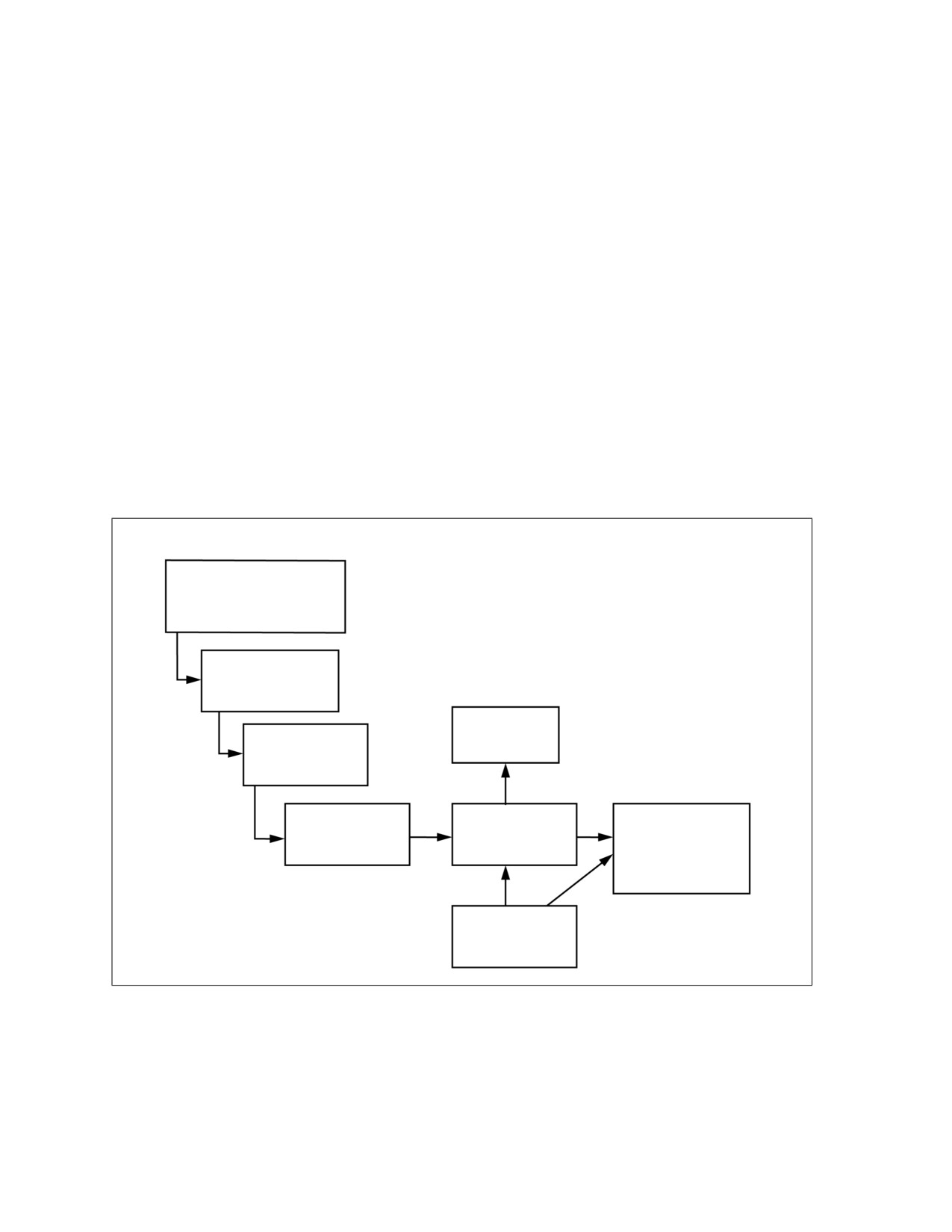
support for the surveillance mission. Figure H-1 provides a flow diagram of the LRBSDS
employment concept.
Threat warning
• Intelligence
• Meteorological forecast
• Threat flight activity
Corps G2
requests standoff
detection mission
BIDS
Corps aviation
input
BDE conducts
mission
Biological-
Chemical officer
LRBSDS team
detection
recommends alerts/
reports
company
all clear (if required)
observations
evaluates reports
and provides
recommendations
to G3/commander
Other
SITREPs
Figure H-1. LRBSDS Employment Concept
c.
LRBSDS operations will be planned to maximize the warning time for a large-
scale line source biological-agent attack against US forces. The primary value of
LRBSDS is to provide early indication of a possible line source attack by determining the
H-4
location and size of the suspect cloud. This allows time for the cueing of ground-based
biological detectors and casualty avoidance measures.
d. The corps aviation brigade will conduct the LRBSDS surveillance mission
according to the approved plan. The aviation officer will allocate the necessary aircraft
and coordinate airspace utilization with the USAF tactical air control system or other
airspace management authorities as appropriate. The aviation officer may adjust the
planned aircraft flight route to minimize risk, and mission planning could include
measures for suppression of enemy air defenses (SEAD).
e.
Conducting routine environmental checks to acquire background aerosol data
is a key to successful employment. Access to accurate meteorological forecasts,
intelligence information on threat BW capabilities, and timely information on potential
line spray activities (surface or air) help support a quick response by the airborne
LRBSDS team. For the LRBSDS to conduct the detection of a biological attack, the
aircraft should fly on a track parallel to the cloud with the appropriate standoff distance.
Normally, the planned flight track will be perpendicular to the surface wind direction.
f.
Effective use of the LRBSDS increases the overall probability of BW detection
(detecting a man-made aerosol). Planners coordinate with intelligence and aviation
personnel to analyze the air defense threat to minimize risks to the crew and aircraft.
Additionally, planners provide maximum flexibility in flight coordination measures
because of the many variables that can impact the downwind drift (wind shift) of man-
made aerosols.
g.
The basic information provided from LRBSDS operations can help to answer
the following questions:
z
Is there a suspect aerosol?
z
Where is the suspect aerosol, and where is it traveling?
z
How large is the suspect aerosol?
h. The force commander’s R&S plan organizes the collection of information. The
R&S plan will include specific biological-surveillance requirements and the biological-
detection company and/or the aviation brigade OPLAN and/or OPORD will integrate
requirements for long-range biological-detection missions. The LRBSDS element
implements the OPORD and responds to FRAGORDs.
i.
Planners consider multiple factors when employing the LRBSDS, including the
following:
z
What is the LRBSDS mission?
z
What are the required actions (detecting and mapping, detecting and
tracking, or detecting and classifying) to support the mission?
z
What friendly-force biological-detection assets are available? Are
planners using the LRBSDS and BIDS in an integrated manner or in an
economy-of-force role (for example, is the LRBSDS operating without
BIDS)?
z
What is the size of the NAI? The NAI size and location may cause
modification of flight tactics.
H-5
z
What threat information is available? For example, the threat is using an
air release, the estimated length of the long line source release is
50 kilometers, and the air defense threat dictates the use of the detection
and classification technique.
z
What is the threat BW capability?
z
What are the airspace flight coordination restrictions? Specifically, flight
corridors and/or egress routes will vary depending on the operational
situation.
6.
Long-Range Biological Standoff Detection System Employment
a.
When employed, the LRBSDS is used to enhance the force commander’s BW
detection capability. The LRBSDS can be used to provide large-area surveillance during
any type of operation when there is a possibility of a BW aerosol threat. It is especially
important to provide early warning during large-force movement. The information from
the LRBSDS supports the IPB process and directly supports ongoing and future
operations.
b.
The normal basis of issue for a corps will be three LRBSDS systems. The
systems should be retained as a corps asset. The area of concern for a mission, will be
determined by the commander and the duration of the surveillance mission or the
number of systems used will be based on factors such as—
z
Beneficial meteorological conditions for BW employment.
z
Force vulnerability (for example, during movements).
z
Indicators from intelligence sources.
z
The size of the AO.
c.
The options available for employing an LRBSDS team are shown in Table H-1.
The LRBSDS is most efficient when three systems are used together; however, LRBSDS
teams could be split. For example, two LRBSDS teams could be staged at one airfield and
the third LRBSDS team elsewhere.
NOTE: To split base the teams, the supporting aviation brigade will be
required to furnish additional logistics assets such as a forklift. In selecting the
employment option, planners consider NAI size (the area to be scanned),
meteorological conditions, force vulnerability, the degree of the threat, the
terrain within the LRBSDS scan area, the flight time required to detect or
track an aerosol cloud, the availability of helicopters and LRBSDS, and
logistics support.
d. Split basing the LRBSDS offers advantages and disadvantages. One advantage
is the ability to conduct additional aerial BW surveillance in a distant portion of the AO.
Disadvantages include part-time rather than full-time coverage at two locations (which
may result in decreased scanning time and periods of time with no LRBSDS coverage),
decreased biological-detection company flexibility during mission execution, and the
need for additional operational planning and logistics support at the additional LRBSDS
staging site.
e.
LRBSDS employment techniques could include the following alternatives.
H-6

Table H-1. LRBSDS Employment Options
Number Of
Coverage Required
Considerations
LRBSDS Used
Full time
1
Breaks in coverage due to refueling the aircraft and
(continuous coverage)
changing aircrews may occur if assets are unavailable to put
more LRBSDSs in the air.
2 or 3
Can use two systems on station.
Requires aircrew change for lengthy missions.
Part time
1
Least resource-intensive.
(interrupted coverage)
Least coverage per unit of time.
Appropriate for low-threat conditions.
Can use for background missions.
2
Each system can cover one-half of the area or can alternate
systems on station.
3
Each system can cover one-third of the area or can rotate
systems on station.
Best option for long-duration missions.
(1) Operate Three Systems Simultaneously.
(a) Each system conducts surveillance on a portion of the corps AO. This
option allows for maximum coverage and early warning potential. However, it is resource
intensive and allows no reserve detectors. Additionally, coverage is limited or
nonexistent during refueling and/or rearming operations. Operational work-arounds,
such as nonsimultaneous refueling operations, could reduce this limitation.
(b) Each system can scan one-third of the AO for part-time coverage.
Careful planning is required for aircrew changes and refueling operations. Using all
three may be appropriate when the threat is high and meteorological conditions are
favorable for BW employment. This option provides the fastest, most complete, and most
in-depth coverage of the NAI. It is also the most resource-intensive option.
(2) Operate Two Systems Simultaneously. Each system is responsible for
one-half of the surveillance area. The third system is used to provide surveillance during
refueling and/or rearming operations.
(3) Operate One System.
(a) The system conducts surveillance of the entire AO. It is the least
resource intensive and provides a maximum reserve capability; however, it provides the
least amount of coverage and limits early-warning potential.
(b) It is possible to scan the AO with one LRBSDS; however, the
helicopter must go off station to refuel and to change aircrews during long missions. This
option is the least resource intensive, provides the least amount of coverage per unit of
time, and limits early-warning potential. The use of a single system could be appropriate
for use when the threat is low or for background missions. This option could also be used
in case LRBSDS teams are split-based—two at one location and a third at another
staging site.
f.
Planners may use any of the options during a given surveillance period. The
LRBSDS is employed to detect and report suspected BW aerosols at distances of 5 to
H-7
30 kilometers under various atmospheric conditions. The LRBSDS requires a clear line
of sight (LOS) between the system and the aerosol. It cannot reliably detect point source
aerosols but can detect broken, long line source releases. The system is operated above
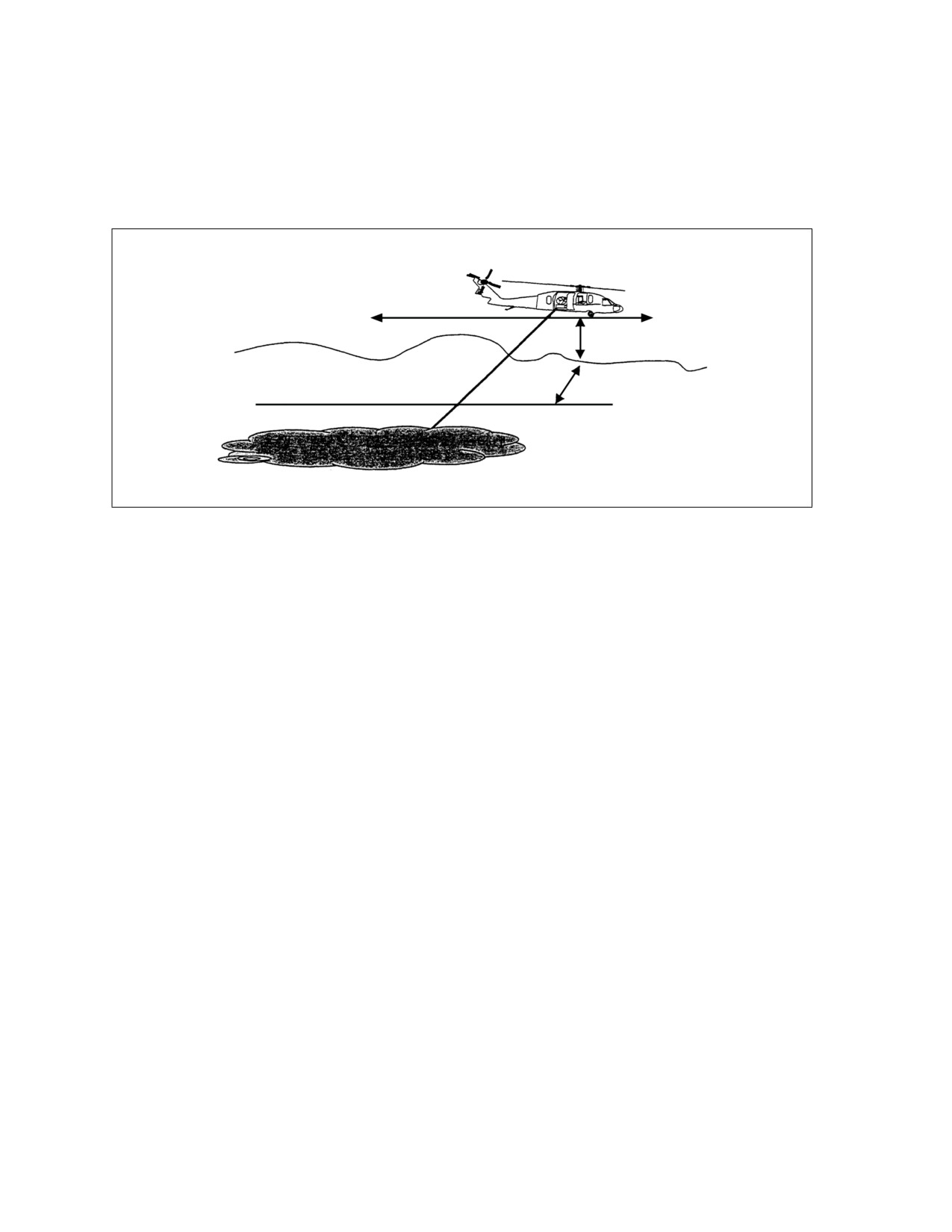
friendly territory and out of the range of effective threat fire. A typical mission is
illustrated in Figure H-2.
Course leg
Altitude AGL
Scan range
(30 km)
10 km
Aerosol cloud
Figure H-2. Sample LRBSDS Mission
NOTE: Figure H-2 shows a mission being flown on a course leg at a given
altitude, 10 kilometers behind the FLOT, and scanning at a range of
30 kilometers (20 kilometers beyond the FLOT). However, the distance from
the FLOT could range from 5 to 20 kilometers, depending on the threat.
7.
Long-Range Biological Standoff Detection System Mission Profiles
The LRBSDS has two mission profiles—scheduled and preplanned. These missions
are designed as follows.
a.
Scheduled. This mission is normally conducted to obtain aerosol background
information on the AO or to conduct other administrative missions. Scheduled missions
are routinely conducted to acquire atmospheric environmental data in the AOs. The
missions are planned and conducted as preplanned missions. The mission will appear in
the air tasking order as biological-surveillance missions.
b.
Preplanned.
(1) This mission is normally conducted when the threat of a BW attack is
high, based upon threat information and meteorological conditions. During this type of
mission, the LRBSDS team transports the system using assets organic to the aerial
platform. Upon arrival, the system is installed. The aviation brigade conducts all
airspace coordination and route planning. Preflight checks are completed. The mission is
executed at the prescribed time. Preplanned requests require at least 24 hours advance
notice for aircraft scheduling.
(2) Preplanned missions are designed to search for and detect biological
attacks. These missions are normally performed during periods of high risk based on
intelligence or meteorological forecasts. This mission category requires advance planning
to coordinate aircraft availability, routes, and duration.
H-8

8.
Mission Planning
A staff planning checklist is outlined in Table H-2. The checklist provides guidance
for staff planners when planning LBRDSDS missions.
Table H-2. Example of an LRBSDS Staff Planning Checklist
Requirements
Obtain the commander’s guidance.
Know the friendly situation.
Know the threat situation.
Assist in the preparation of IPB.
Develop the concept for LRBSDS employment.
Provide input for the R&S plan.
Consider command and support relationships.
Obtain approved NAIs for LRBSDS coverage.
Develop/update the time line for LRBSDS mission execution.
Coordinate with the aviation officer, biological-detection company, and aviation brigade to obtain,
recommend, provide, conduct, and coordinate the following:
•
Weather data for the AOI.
•
Obscurant situation for the AOI.
•
Map reconnaissance.
•
Flight corridors (primary/alternate).
•
Ingress/egress routes.
•
Flight tactics during LRBSDS scanning.
•
Airspace control measures.
•
Communications frequencies.
•
Required reports/formats.
•
NAI priorities.
•
Alternate NAIs.
•
Contingency plans.
•
Input for air-tasking order.
•
Downwind drift war-gaming of biological agents.
•
LRBSDS capabilities/laser safety considerations.
•
The required time on station.
•
Provisions for SEAD.
•
Risk management.
•
Lost communications procedures.
•
The status of LRBSDS teams/equipment.
•
Threat updates.
Obtain updates on the LRBSDS CLS status.
Review the AAR from previous LRBSDS mission.
Obtain update on evacuation procedures for LRBSDS topics/reports.
Anticipate and plan future missions.
a.
The JTF and/or corps NBC officer, assisted by the biological-detection company
operations officer, has the primary responsibility for LRBSDS mission planning. The
corps OPORD will provide guidance to the aviation brigade and the biological-detection
company. Subsequent FRAGORDs will include—
z
The LRBSDS mission to be performed (the area to be scanned and mission
times).
H-9
z
biological-detection sectors to provide sufficient coverage of the target
area to be scanned.
b. The aviation brigade NBC officer analyzes the LRBSDS mission. He
coordinates with the CP or the corps NBC control center of the biological-detection
company to determine the following:
z
The BW threat assessment, type of agent, threat targets, and threat
intent.
z
The ground and air defense area threat situation.
z
Current BW indicators and any estimates on potential windows (times)
when biological weapons may be employed.
z
Meteorological conditions for the duration of the mission (see
paragraph 5).
z
JTF and/or corps commander’s mission, intent, and CONOPS.
z
NAIs.
z
Aircraft decontamination.
c.
The aviation brigade operations staff officer (S-3) performs the following
functions:
z
Determines aircraft support requirements.
z
Determines and plots the designated biological-detection sectors and
course legs.
z
Selects the routes to and from the search area.
z
Recommends the flight profile to be employed during biological-detection
operations.
z
Determines refuel points and emergency landing zones (LZs).
z
Plans handoff procedures (times and locations) for primary and backup
aircraft.
z
Plans for SEAD.
z
Conducts airspace coordination.
d. Flight planning by the aviation brigade includes the selection of the flight
profile to be employed. The profile includes designating the routes to and from the
biological-surveillance target area, identifying the use of the designated course legs in
the biological-surveillance sectors, and prescribing the helicopter altitude and speed. The
altitude above ground level (AGL) and standoff distance from the FLOT will vary in the
flight profile. For example, the altitude can range from 200 to 5,000 feet AGL, and the
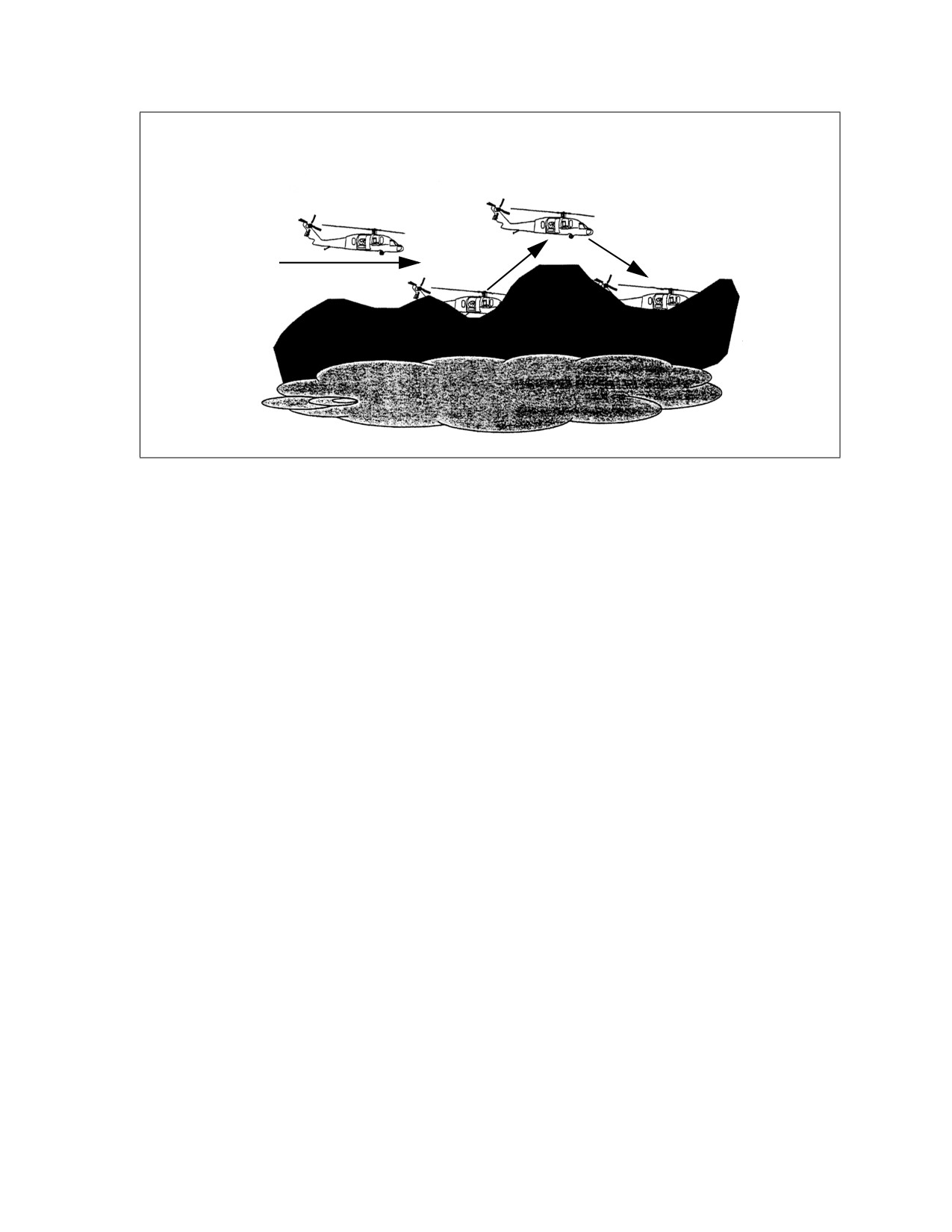
standoff distances from the FLOT can be 5 to 20 kilometers. Two general flight profile
options are shown in Figure H-3.
e.
Flight Profile. There are two basic flight profiles. These basic profiles may be
adjusted to fit the needs of the mission.
(1) A straight-and-parallel (racetrack) flight profile involves the helicopter
flying at a predetermined altitude and speed on a flight track downwind and parallel
H-10
Variable altitude and airspeed
(pop-up technique)
Straight and parallel
Terrain
Figure H-3. Flight Profile Examples for LRBSDS Missions
with the anticipated release line. For example, a general rule of thumb is that the
LRBSDS should maintain a LOS with an aerosol cloud every 15 to 20 kilometers during
the flight leg. This equals about 1 minute of scan time for every 5 minutes of flight time
at altitudes of 4,000 to 5,000 feet AGL. This flight profile could be used when hostilities
have not commenced or the air defense artillery (ADA) threat is low. This technique
provides the best probability of detection because more time is spent tracking.
(2) A variation of this straight-and-parallel technique involves an effort to
retrace the cloud. For example, after first contacting the cloud, contact with the cloud is
lost. Subsequently, the aircraft turns around until it can reacquire the cloud. The goal is
to map the ends of the cloud. The use of this technique depends on different factors, but
especially on having the airspace authorization to spend additional time within a specific
flight corridor.
(3) A variable altitude and airspeed flight profile is used in moderate to high
ADA threat environments. It allows the helicopter to fly alternately between masked and
LOS altitudes (pop-up technique). For example, the flight and LRBSDS crew picks
various points along a course leg. At those points, the helicopter flies at an altitude
where operators could scan the NAI. The helicopter flies at that altitude for a given time
period, then moves to a lower masked altitude until the next LOS requirement. This
profile has a lower probability of detection because less time is spent scanning for aerosol
clouds. The variable altitude and airspeed flight profile may be used when—
z
The detection and classification technique is employed. (The limited
time spent scanning the cloud will not provide enough information to
track or map the cloud.)
z
The mission is to detect long line source (100 kilometers or more),
point source, or short line source releases (less than 30 kilometers
long) where the variable flight profile will be of limited or no value.
H-11
z
The ADA threat is moderate to high, SEAD fires are unavailable,
and nap-of-the-earth (NOE) flying will not allow the LRBSDS to
detect man-made aerosols.
f.
LRBSDS planning will limit the time that the threat ADA can target the
helicopter; however, the LRBSDS operator must see five consecutive scans of an aerosol
cloud to make a classification. Planners use this information as a basis for calculating
the time required for LRBSDS scanning. Because the time required for five scans is
different for various altitudes, the time is calculated for three different altitude ranges.
When using a “sawtooth” flight profile, the following represents the minimum time the
helicopter must remain at an altitude to give the operator a sufficient LOS to the NAI
and allow scanning time to obtain sufficient returns:
z
1 minute for altitudes of 4,000 to 5,000 feet AGL.
z
45 seconds for altitudes between 2,000 to 4,000 feet AGL.
z
30 seconds for altitudes of 2,000 feet AGL or less.
g.
The LRBSDS can maintain a specific amount of time on station—generally
about 2 hours for most environments. Due to the limited time available for an LRBSDS
to conduct scanning, additional systems may be required during detection and mapping
missions. Conversely, limited on-station time and system availability may cause the use
of the detection and classification missions. For example, if detection and mapping are
required and the aerosol is greater than 25 kilometers in length, the majority of the
LRBSDS on-station time would be spent mapping one cloud.
h. Planners must be aware of factors that can impact the LRBSDS probability of
detection. For example, atmospheric visibility, the cloud particle backscatter, and the
range to the target cloud will influence LRBSDS detection ability.
(1) Atmospheric visibility has the strongest effect on LRBSDS ability to
detect aerosol clouds. Visibility is essentially a measure of how dirty or clean the air is.
The more particles there are in the air, the more they affect how well the energy of the
laser transmits through the air and how well the signals, reflecting from downrange
targets (aerosol clouds), reach the LRBSDS. Good visibility means that there is less
pollen, dust, and water (in the form of fog or haze) floating in the air. These particles
greatly affect the minimal density of an aerosol cloud that the LRBSDS can detect and
the range at which the LRBSDS can detect it.
(2) Particle backscatter is a measure (in terms of a percentage) of how much
of the energy of the laser a specific particle reflects back to the receiving telescope. A
higher particle backscatter means that a specific particle reflects more of the energy of
the laser back to the receiving telescope than a particle with lower particle backscatter.
If the LRBSDS is used to look at two clouds with the same density (particles per liter)
and different particle backscatter, the cloud with higher particle backscatter will be more
visible. In essence, the cloud with higher particle backscatter will be brighter to the
LRBSDS and will be detectable at greater distances.
(3) The distance to the cloud determines how much of the energy of the laser
intersects the particles of the cloud. As the distance between the laser and the cloud
increases, the amount of the energy of the laser that reaches the cloud decreases.
Applying more energy to the cloud by decreasing the distance means that it will appear
H-12

brighter to the LRBSDS. Simply put, the closer the LRBSDS is to the target NAI, the
better chance it has of detecting man-made aerosol clouds.
i.
Tables H-3 and H-4 support LRBSDS planning. They provide estimates on how
far away an LRBSDS can conduct detecting and mapping, detecting and tracking, or
detecting and classifying operations.
Table H-3. Helicopter NOE Altitude (150 to 1,000 Feet AGL)
LRBSDS
Visibility (km)
Range (km)
5
10
23
80
5
Detecting and
Detecting and
Detecting and
Detecting and
mapping
mapping
mapping
mapping
10
Detecting and
Detecting and
Detecting and
Detecting and
tracking
mapping
mapping
mapping
15
Detecting and
Detecting and
Detecting and
Detecting and
classifying
mapping
mapping
mapping
20
Detecting and
Detecting and
Detecting and
Detecting and
classifying
tracking
mapping
mapping
25
Detecting and
Detecting and
tracking
mapping
30
Detecting and
Detecting and
tracking
mapping
35
Detecting and
Detecting and
classifying
mapping
40
Detecting and
Detecting and
classifying
mapping
Detecting and mapping—detect and map for 30 to 45 minutes after release
Detecting and tracking—detect and track for 15 minutes after release
Detecting and Classifying—detect up to 5 minutes after release
(1) Tables H-3 and H-4 contain data that is based on the LRBSDS scanning a
1-kilogram-per-kilometer initial release of a dry form of Bacillus globigii. The tables
represent a worst-case threat using dry spores. Spores have a particle backscatter that is
lower than other agents (such as vegetative bacteria, toxins, and viruses).
Table H-4. Helicopter NOE Altitude (1,001 to 5,000 Feet AGL )
LRBSDS
Visibility (km)
Range (km)
5
15
23
80
5
Detecting and
Detecting and
Detecting and
Detecting and
mapping
mapping
mapping
mapping
10
Detecting and
Detecting and
Detecting and
Detecting and
mapping
mapping
mapping
mapping
15
Detecting and
Detecting and
Detecting and
Detecting and
classifying
mapping
mapping
mapping
20
Detecting and
Detecting and
Detecting and
Detecting and
classifying
tracking
mapping
mapping
H-13

Table H-4. Helicopter NOE Altitude (1,001 to 5,000 Feet AGL (Continued))
LRBSDS
Visibility (km)
Range (km)
5
15
23
80
25
Detecting and
Detecting and
Detecting and
tracking
tracking
mapping
30
Detecting and
Detecting and
Detecting and
classifying
tracking
mapping
35
Detecting and
Detecting and
Detecting and
classifying
tracking
mapping
40
Detecting and
Detecting and
Detecting and
classifying
tracking
mapping
Detecting and mapping—detect and map for 30 to 45 minutes after release
Detecting and tracking—detect and track for 15 minutes after release
Detecting and classifying—detect up to 5 minutes after release
(2) The particle backscatter is higher for other types of agents—meaning that
another threat cloud with the same number of particles as the spore cloud will appear
brighter to the LRBSDS. While this implies that the helicopter can fly the LRBSDS
farther from the NAI and still detect a threat cloud, the situation is not so simple
because of the difficulty in anticipating the selected agents and dissemination methods of
the threat.
(3) Tables H-3 (on page H-13) and H-4 also provide guidance on LRBSDS
scanning ranges. The other factors in the tables address the altitude and visibility of the
helicopter. Use Table H-3 (on page H-13) if the flight altitude of the helicopter is 1,000
feet AGL or less, and use Table H-4 if the flight altitude is 1,001 to 5,000 feet AGL. For
example, if a helicopter is flying at an altitude of 500 feet and visibility is at 80
kilometers, planners estimate that detection and mapping can be conducted at a 5- to
40-kilometers scanning range with the LRBSDS.
j.
BW threats can be disseminated in either wet or dry forms. The LRBSDS will
see a wet dissemination (with the same concentration, at the same distance, and in the
same visibility) twice as bright as a dry dissemination. Wet dissemination, however, is
considerably less efficient than dry dissemination. Wet agents do not travel as far as a
dry dissemination and do not have as many agent containing particles that can infect
personnel on the ground.
k. To optimize LRBSDS performance when selecting a flight profile, planners
consider the altitude, search angle, and airspeed. LRBSDS biodetection operations
should be conducted at an altitude of 150 to 5,000 feet AGL at 75 to 100 knots. The type
of flight profile selected will affect the settings of the system. The pilot must provide
flight profile information to the LRBSDS operators before commencing altitude changes.
(1) The distance from the helicopter to the NAI is also determined during
preflight planning. Specifically, the LRBSDS is limited to a 12-kilometers scan depth
when flying at altitudes of 2,000 feet and below. At lower altitudes, the LRBSDS can only
fully cover a 12-kilometer portion of the NAI. Planners must consider this when
assigning the air corridor that the helicopter will fly. If the depth of the NAI cannot be
reduced, flying at an altitude above 2,000 feet AGL could be considered. At an altitude
over 2,000 feet AGL, the LRBSDS operator can easily set the system to scan the full
depth of the NAI (from 10 to 30 kilometers).
H-14

(2) The selection of the flight profile is METT-TC dependent. For example, if
the atmospheric visibility is below 5 kilometers, the LRBSDS is not effective; it becomes
more effective as the visibility increases. Flight profiles that take advantage of available
terrain, especially when using a variable-altitude profile, are used. METT-TC
considerations that can impact flight profile selection include the following.
z
Mission. The number of NAIs requiring LRBSDS support, the
command and support relationships, reporting requirements, and
the NAI size.
z
Enemy. Threat ADA capability, BW threat agent, and the BW
intent and capability of the threat.
z
Terrain. Terrain characteristics, the available LOS, the
atmospheric visibility, and planning for fallback flight corridors to
help preclude flying through a threat cloud.
z
Troops. Number of LRBSDS available, CLS capability, BIDS array
availability and location, and the location of friendly forces.
z
Time available. Estimated time required for the LRBSDS to be on
station, the lead time required to obtain airspace clearance, the time
to analyze LRBSDS detection reports, and the mission time frames.
z
Civilian considerations. Civilian and HN assets within NAIs.
(3) To support the planning process, the LRBSDS NCOIC may use a mission
planning checklist (see Table H-5).
Table H-5. LRBSDS Mission Planning Checklist
Requirement
Actions Required
Plan for future
Perform maintenance and PMCS on equipment.
missions
Conduct operator training.
Report any equipment/personnel problems.
Obtain the necessary supplies.
Maintain the current intelligence/operations status.
Obtain the mission
Receive a WARNORD, OPORD, or FRAGORD.
Analyze the mission
Analyze the mission using METT-TC factors.
Issue a WARNORD
Determine which LRBSDS team is to perform the mission.
Issue a WARNORD to the team and clarify questions.
Perform coordination
Coordinate with the aviation brigade chemical officer, the LRBSDS team, and the
supporting helicopter unit.
Determine METT-TC information, logistics support, ground movement (if required),
rehearsals, and communications.
Obtain maintenance support (as required).
Make a tentative plan
Plan ground movement (if required).
Analyze biological-surveillance requirements (sectors or legs).
Plan the necessary support.
Conduct map
Select the route to and from the airfield (if necessary to travel).
reconnaissance
Complete the plan
Refer to FM 101-5, Appendix H.
H-15
9.
Long-Range Biological Standoff Detection System Mission Phases
An LRBSDS mission is divided into three phases: preoperations, biological-
surveillance operations, and postoperations. Each phase is discussed below.
a.
Preoperations Phase.
(1) Mission factors. To ensure success, LRBSDS capabilities are matched to
mission factors, including operational coverage needs, meteorological conditions, threat,
and aircraft availability. The biological-detection company operations officer and
detachment NCOIC have the primary responsibility for mission planning and
reconnaissance. Initial planning will normally occur at the corps NBC center or at the
biological-detection company. The biological-detection company operations officer and/or
detachment NCOIC will coordinate with the corps or controlling HQ staff to obtain—
z
The commander’s intent and CONOPS.
z
The aerial platform, number, usage windows, and location.
z
Meteorological conditions (for example, wind information at various
heights for the duration of the operation, stability categories, sunrise
and sunset information, and other pertinent factors; such as rain and
snow).
z
The type of threat expected.
z
The duration of the mission.
z
CONOPS for other BW detectors.
(2) Reconnaissance. Reconnaissance of the AO is required. If possible, the
leader coordinates for an aerial reconnaissance; however, if this is not possible, the
leader conducts a map reconnaissance to determine—
z
Surveillance sectors (it is best to select a primary and secondary to
compensate for major changes in wind directions).
z
Primary and alternate traveling routes and times.
z
Surveillance leg distance and duration.
(3) Flight profiles. Detailed planning determines what flight profile will be
employed during surveillance operations. The flight profile is METT-TC dependent.
When selecting a flight profile, the decision maker will consider three major factors: the
level of threat to the aircraft, location and size of the surveillance area, and LOS.
Generally, there are the following two general flight profile options.
(a) Straight and parallel. The platform flies at a predetermined altitude
and speed, scanning perpendicular to the wind. The key is to ensure LOS to the target.
This flight profile could be used when hostilities have not commenced or the antiair
threat is very low.
(b) Variable altitude and airspeed. The platform flies alternately
between a masked and LOS altitude. For example, the platform would rise to an LOS
altitude, conduct surveillance for a certain amount of time, and then descend to a
masked altitude and fly until the next LOS rise.
H-16
(4) Other planning factors. Additional detailed planning requirements for the
LRBSDS detachment include coordinating the passage of lines, communication
requirements, logistical support from the biological detector and supporting unit,
locations of the supporting airfields and FARPs, and decontamination support enroute to
the supporting unit.
(a) Following the initial planning, the LRBSDS will normally be located
with the HQ element of the biological-detection company, host unit, or the supporting
aviation brigade. Upon notification of a mission, the detachment or biological-detection
company operations officer conducts initial coordination with the biological-detection
company commander, JTF, corps NBC officer, and/or the corps NBC control center.
Initial information requirements include determining—
z
The BW threat window and the overall BW threat, type,
direction, and intent.
z
The ground, antiair, and threat situation.
z
Current BW indicators.
z
Meteorological conditions for the duration of the mission.
z
The corps or JTF commander’s mission, intent, and CONOPS.
z
Current information.
z
Key areas of concern.
(b) The detachment NCOIC provides the warning order (WARNORD) to
the teams and directs initiation of preoperational checks. The team leaders begin
preoperational actions, and conduct PMCS of associated support items of equipment and
detectors.
(c) The detachment conducts movement to effect a linkup with the
supporting operational platform, if required. On arrival, systems are installed onto the
aerial platforms. The detachment teams conduct preoperational checks on the system
and PMCS of associated support items of equipment as appropriate. The LRBSDS team
and the aerial platform crew conduct coordination with each other. The LRBSDS team
briefs the aerial platform crew on the following:
z
An LRBSDS orientation presentation—specifically LRBSDS
safety features and eye safety parameters.
z
Reporting procedures and formats are provided to the pilot and
crew.
z
Instructions on operating the laser are reviewed with the pilot.
z
The flight path and type are given to the team by the pilot (for
example, NOE, height above ground, speed, and flight
duration).
(5) Final mission preparation.
(a) During the final mission preparation, the LRBSDS detachment
follows the checklist information found in Table H-6 (page H-18). The LRBSDS NCOIC
(or the aviation brigade chemical officer and/or NCO) provides the WARNORD or
movement order to the team and directs the initiation of preoperational checks.
H-17

Following the preparation of the WARNORD, many key factors are verified or
researched. These factors could include planning estimates for the potential length and
location of course legs that must be flown. War-gaming provides estimated downwind
distances for BW aerosols. This premission planning is conducted in coordination with
the intelligence section (intelligence staff officer [S-2 and/or G-2]) and is used to help
determine the locations and lengths of the course legs for biological-surveillance
missions. Other input for this type of planning includes the threat BW capabilities,
weather data, NAI locations, and the length and location of the line source. During the
final preplanning, aviation personnel and LRBSDS teams consider and confirm what
tactics will be used for the missions. Map reconnaissance identifies any obstacles that
could block the scanning of the laser along a course leg.
Table H-6. LRBSDS Mission Preparation Checklist
Preparation Required
LRBSDS Team Actions
Issue WARNORD/movement order
Prepared by the LRBSDS NCOIC or aviation brigade chemical officer.
Move to link up with helicopter
Load equipment.
(if required)
Conduct road march.
Report movement per SOP.
Conduct preflight equipment checks
Conduct PMCS of equipment.
Perform initial adjustments, checks, and self-test of LRBSDS.
Conduct inspections.
Conduct rehearsals
Conduct rehearsals.
Issue team OPORD/FRAGO
Prepared by detachment NCOIC or aviation brigade chemical officer.
Install/check equipment
Install LRBSDS on helicopter.
Conform to safety procedures.
Perform preflight operational checks on LRBSDS.
Perform troubleshooting on LRBSDS.
Perform PMCS on generator.
Use generator to warm laser.
Coordinate with aircrew
Conduct air mission briefing.
Coordinate flight information.
Conduct laser safety briefing.
Report status
Report per SOP.
(b) The LRBSDS NCOIC or aviation brigade NBC officer and/or NCO
briefs the OPORD and/or FRAGORD of the LRBSDS team. The team OPORD and/or
FRAGORD is oral or written. It outlines important elements that include routes to and
from the biological-detection mission (normally two entry and exit routes will be
planned), flight corridors and/or course legs for LRBSDS scanning that include alternate
course legs, the distance of the NAI from the FLOT, and the depth of the NAI.
Coordinating instructions will also indicate that course legs crossing key boundaries
(corps or ARFOR and/or Marine Corps forces [MARFOR] boundaries) have been
coordinated by the appropriate aviation airspace activities (the joint airspace control
center [JACC]).
H-18
(c) If the LRBSDS team is not collocated at the supporting airfield, the
team or the supporting helicopter moves to the designated staging area. Movement is
reported according to the OPORD or SOP. On arrival, the team installs the LRBSDS
equipment on the helicopter, conducts preflight operational checks on the system, and
conducts PMCS on the equipment according to TM 3-6665-351-10.
(d) The LRBSDS team and helicopter crew conduct air mission briefings
(see Figure H-4) and coordination. The team briefs the helicopter crew on the LRBSDS
system (specifically LRBSDS safety features and eye safety), reporting requirements
and/or procedures, pilot clearance to operate the laser, and details of the biological-
surveillance mission. Preflight instructions will indicate that during full- or part-time
coverage, replacement LRBSDS units will receive an update on the mission situation
from the supporting OPCEN (biological-detection company CP or aviation brigade
OPCEN). Finally, the team receives a briefing from the pilot on safety, emergency
operations, and flight information (such as the flight path, the height above the ground,
the airspeed, and the flight duration).
Time.
Introduce team members.
General information.
Ground situation (S2/intelligence).
Weather.
Call signs.
Frequencies and communications net (all participants must monitor a common frequency).
Appropriate take-off times.
Flight route, altitude, time en route, airspace control measures, and egress routes.
Flight corridors (primary and backup).
Authentication procedures.
Abort codes.
Map datum.
Mission commander to LRBSDS team (airborne briefing sequence).
NAI description.
NAI location and elevation.
Terrain obstacles.
Required reports/SITREPs.
Communication nets and agencies.
Airspace coordination measures.
Restrictions.
Friendly troop locations.
Threat ADA.
Figure H-4. Sample Air Mission Briefing Guide
H-19

b.
Biological-Surveillance Operations Phase.
(1) LRBSDS detection process. The steps of the LRBSDS process are
detection, reporting, and postoperations analysis. The LRBSDS detection process is
summarized in Table H-7.
Table H-7. LRBSDS Biological-Detection Process
Tasks
Products
Required Components
Detect
Nonspecific alert
LRBSDS
Report
Detection report
Helicopter radio
Postoperations analysis
AAR
Detection report, mission logs, and LRBSDS 8-mm
(a) Detection. LRBSDS detection is nonspecific. The system relies on
operator experience and judgment to discriminate between natural and man-made
aerosols. An experienced operator can reasonably determine if the suspected aerosol is
man-made, but he cannot determine if it is a BW agent. When a biological agent is
released, the LRBSDS will detect the aerosol as long as its concentration is sufficiently
above the background for the current meteorological conditions. This detection window
lasts minutes to hours, depending on meteorology, the specific agent used, and the initial
amount and method of agent dissemination.
(b) Reporting. The LRBSDS team uses the helicopter radio to report the
detection of a possible biological aerosol by submitting a detection report. Planning
identified the following critical elements (as a minimum) to support reporting
requirements: call signs, frequencies, report formats, and content to ensure that the
ground station and flight crew understand required reports between the LRBSDS and
flight crews or any in-flight coordination requirements between members of the LRBSDS
crew.
NOTE: The helicopter can transmit reports via the following communication
capabilities: frequency modulation (FM) secure with KY-58, very high
frequency (VHF)-FM (nonsecure), or ultrahigh frequency (UHF) (nonsecure)
with frequency hopping.
(c) Postoperations analysis. Following an LRBSDS mission, the crew
consolidates key information gathered during the mission. Specifically, the crew records
will include detection reports (if any), mission logs, and 8-millimeter data tapes from the
LRBSDS. This information is safeguarded and, upon request, is forwarded to the
biological-detection company CP. Chain-of-custody documentation will accompany the
LRBSDS data tapes and documents if the information is required by the biological-
detection company CP.
(2) Biological-surveillance execution.
(a) The LRBSDS team uses the information in Table H-8 as a sample
checklist for executing a biological-surveillance mission. At the beginning of a course leg
and on the pilot’s order, the operator puts the laser into operation and scans the target
area. The laser is turned off at the end of a course leg before the helicopter executes its
turn. The laser is turned back on when the pilot notifies the operator that the helicopter
is at the beginning of the next leg. The operator begins tracking techniques on detection
of a suspicious aerosol. The assistant operator records information on the mission data
sheet and transmits incident reports. The laser operator ensures that the LRBSDS scan
H-20

remains on the NAI and that ongoing communications with the flight crew are
maintained to ensure that the scan is adjusted (as required) to remain within the NAI.
Table H-8. LRBSDS Biological-Surveillance Mission Execution Checklist (Sample)
Actions Required
LRBSDS Team Actions
Prepare to conduct a biological-
Check equipment.
surveillance mission
Set flight parameters.
Conduct equipment function tests.
Conduct the biological-surveillance
Operate the LRBSDS.
mission
Scan along the course legs in the designated area.
Analyze the display of any aerosol cloud detected.
Record aerosol cloud information and flight data.
Provide reports
Prepare detection report.
Complete the biological-surveillance
Download data onto data tapes, if required.
mission
(b) The operator determines the length of the aerosol cloud. If multiple
LRBSDS are used, each detector scans its own AO for the left and right limits of the
aerosol. If an aerosol is discovered on a course leg and then lost, the team requests
permission to backtrack along the same leg to reacquire the aerosol. If an aerosol is being
tracked on a leg and it continues beyond the course leg or across the corps boundary, the
team reports this and requests instructions. The helicopter does not deviate from the
approved flight plan without authorization or coordination.
(c) If directed by the biological-detection company, the operators will
attempt to determine the length of the aerosol cloud. This is accomplished in two ways.
z
The pilot hovers the helicopter perpendicular to the cloud and
the operator manipulates the detector to scan for the ends of the
cloud.
z
The helicopter is flown parallel to the cloud until the end of the
cloud is reached. If multiple detectors are in the air, then each
detector will scan its own AO for the left and right limits of the
cloud.
(d) During LRBSDS operations, the operator determines the following
information:
z
The presence of a suspected biological aerosol using a monitor
display of changes from the background.
z
Whether the cloud is natural or man-made, based on aerosol
characteristics.
z
The distance (range) of the cloud from the helicopter.
z
The height, length, and width of the cloud.
z
The height of the cloud above the ground.
H-21
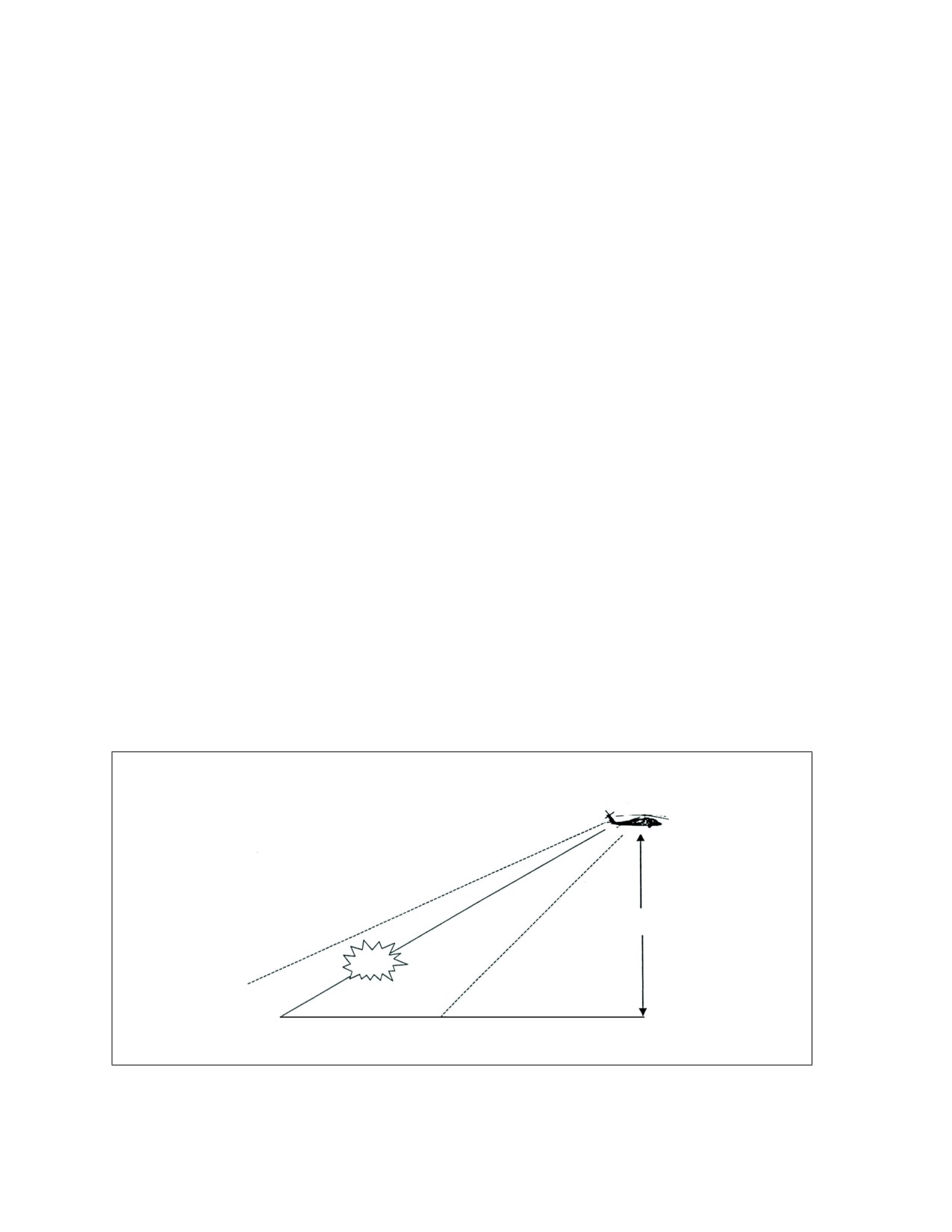
z
The relative aerosol concentration (high, medium, or low),
which may be estimated from the intensity of the color and
returned energy signal.
(e) During biological-surveillance operations, the assistant operator
uses a map to plot and track any aerosol clouds that were detected during the mission.
By plotting both ends of the cloud and estimating the forward edge, cloud movement can
be estimated. Communications with the flight crew on cloud movement can also decrease
the chances that the helicopter would inadvertently fly into a BW cloud.
(3) LRBSDS flight operations. LRBSDS biological-surveillance operations
require synchronization of flight operations between LRBSDS operators, flight-crew
personnel, and operations and planning sections. Operational factors that influence
flight operations include flight profile selection, aerial releases, ground releases,
elevation differences, altitude and flight profile considerations, optimal data collection
altitude, detections, laser scanning, in-flight protocols, communications protocols, and
reporting.
(a) Flight profile selection. The profile considers the altitude, the search
angle, and the airspeed that optimize LRBSDS performance. The LRBSDS can be flown
from 150 to 5,000 feet AGL. The optimal airspeed is between 100 and 120 knots. If the
atmospheric visibility is less than 5 kilometers, the system is marginally effective.
Higher altitude AGLs increase the LRBSDS scanning range and the probability of
detecting aerially disseminated man-made clouds within designated NAIs. Using
straight and level profiles rather than variable-flight also increases the probability of
detecting an aerosol cloud because of increased scanning time.
(b) Aerial releases. It is better to fly higher (see Figure H-5) to detect
aerial releases. The air at lower altitudes has more aerosol particles (dust, pollen, and
smoke) that reduce the power of the laser before it strikes the suspect cloud. Flying
higher means that more laser energy hits the suspect cloud, thus giving the operator a
stronger return signal. Flying at 4,000 to 5,000 feet AGL to scan the NAI provides an
optimal vantage point for detecting an aerial release.
Air release
5,000 ft
Cloud
Figure H-5. Optimal Altitude for Air Release
H-22
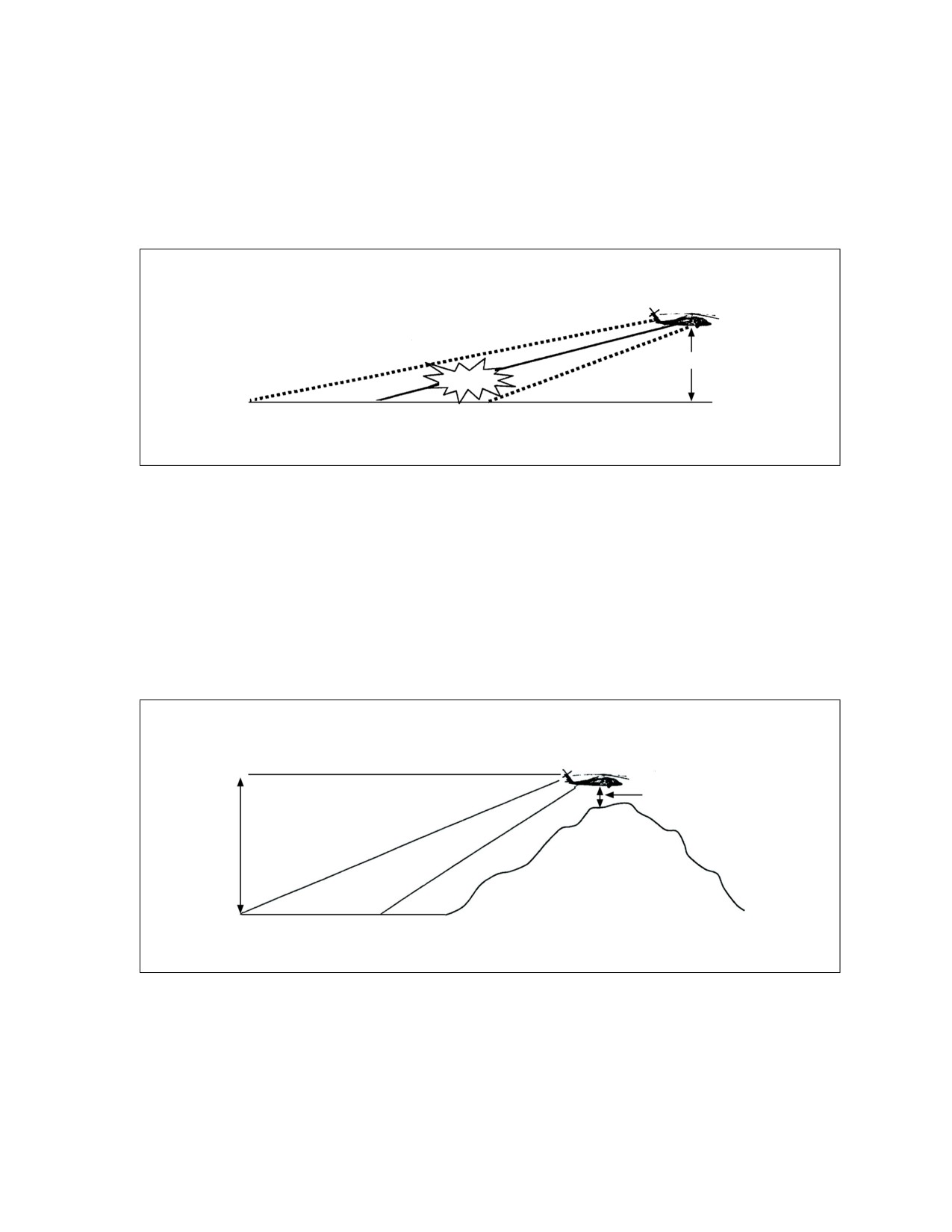
(c) Ground releases. Ground releases are more difficult to detect
because the operator has to differentiate the suspect cloud from the ground. Although
less laser energy hits the cloud, it is better to fly lower to reduce the angle at which the
laser strikes the cloud (see Figure H-6). This shallower angle improves the operator’s
chances of differentiating between the cloud and the ground. The optimal altitude for
detecting a ground release is 1,000 to 2,000 feet AGL.
2,000 ft
Cloud
Figure H-6. Optimal Altitude for Ground Release
(d) Elevation differences. The LRBSDS operators should note that the
helicopter flight altitude AGL might be different from the elevation of the NAI. For
example, the helicopter could fly just above a mountain ridge and be at 300 feet AGL;
however, the NAI being scanned could be 3,000 to 4,000 feet below the level of the
helicopter (see Figure H-7). Before a mission, LRBSDS operators conduct a map
reconnaissance of the NAI and the flight corridor to determine if an altitude and/or
elevation difference exists. The operators note any changes in the elevation of the NAI
that would require changes to LRBSDS settings.
300 ft AGL
3,300 ft
NAI
Figure H-7. Difference in Helicopter Altitude and NAI Elevation
(e) Altitude and flight profile considerations. At altitudes less than
2,000 feet AGL, the LRBSDS is limited to scanning only 12 kilometers deep into the NAI
(see Figure H-8 [page H-24]). If the NAI is deeper than 12 kilometers, planners may
consider using two LRBSDS to scan the entire NAI (see Figure H-9 [page H-24]). Other
H-23
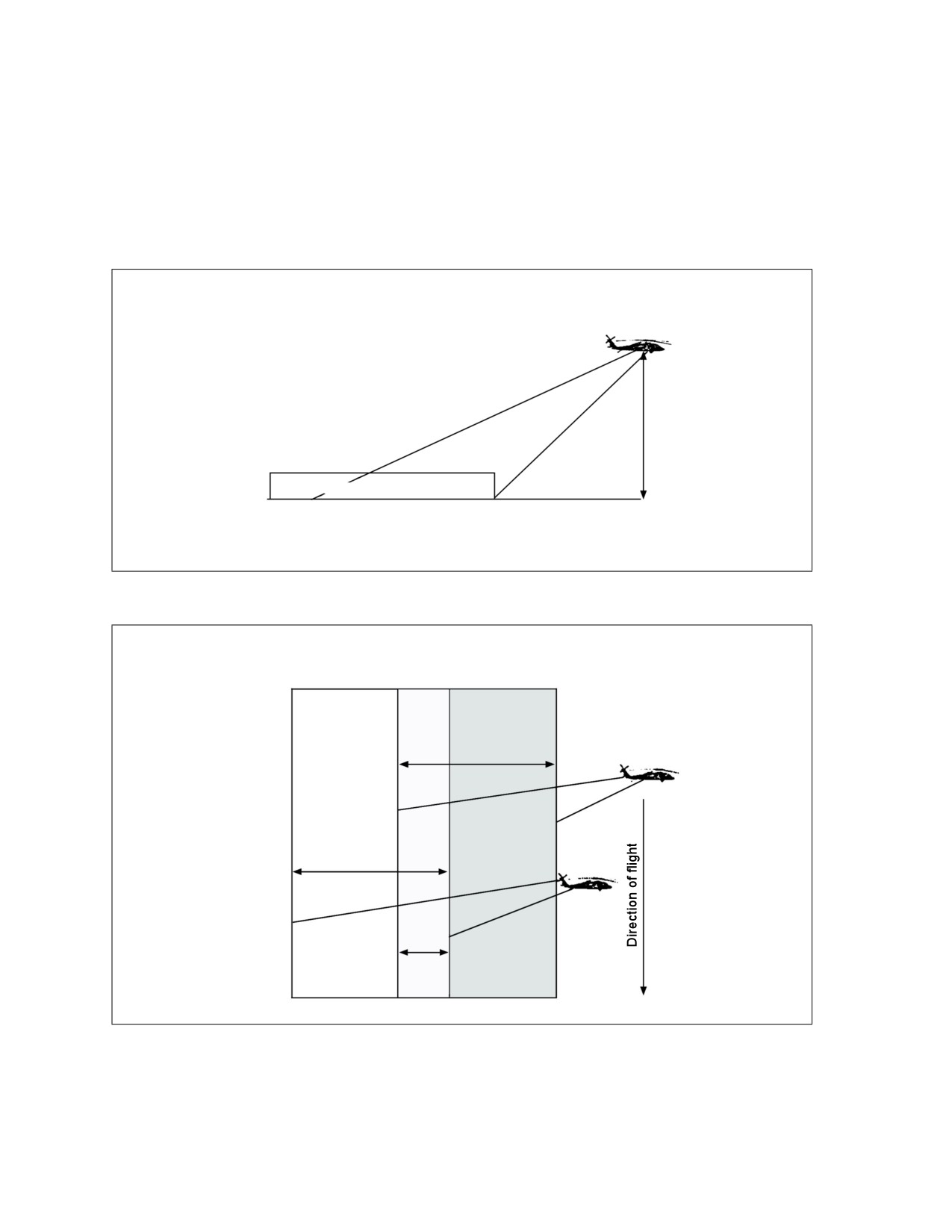
alternatives include scanning the front edge of the NAI using a checkerboard pattern
(see Figure H-10) or alternately scanning the near and far edges of the NAI. Figure H-11
shows another technique for a LRBSDS scanning an NAI that is more than 12 kilometers
deep at an AGL below 2,000 feet. During the flight leg, the LRBSDS initially scans the
front edge of the NAI and then scans the rear portion of the NAI. To ensure adequate
coverage, this alternative should only be used when the width of the NAI is less than 60
kilometers.
12 km
2,000 ft
scanning
depth
NAI 15 km deep
Figure H-8. Low-Altitude Flight Profile Considerations
Top view of NAI
AC #2 scan
footprint
AC #2
AC #1 scan
footprint
AC #1
Scan overlap
Figure H-9. Two LRBSDSs Scanning an Entire NAI
(f)
Optimal data collection altitude. The LRBSDS aircraft operates at
an altitude that should be an optimal data collection altitude for scanning the entire NAI
H-24
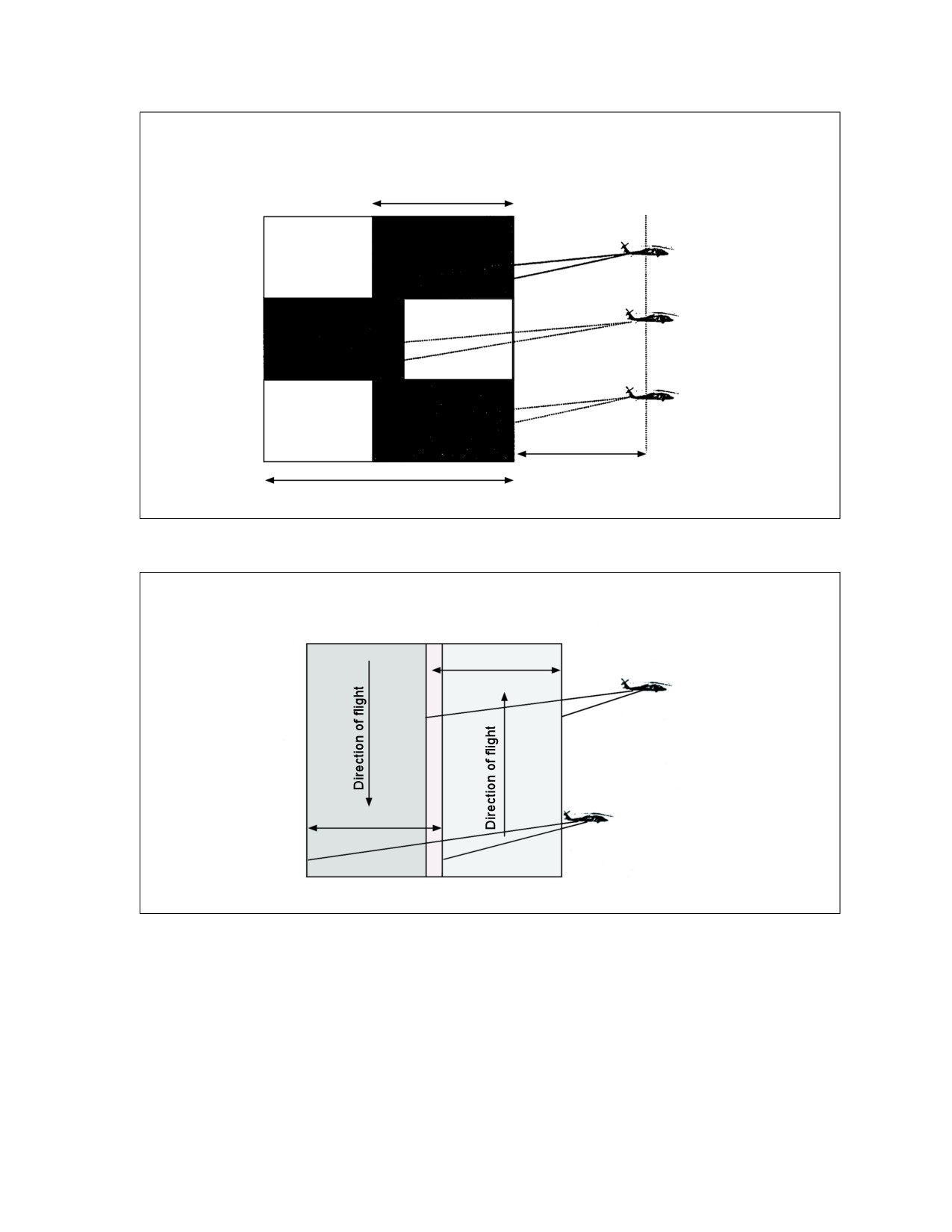
Top view of NAI
12-km-deep scan into NAI
Flight path
<2,000 ft AGL
10-km standoff
from NAI
20 km deep NAI
Figure H-10. An LRBSDS Scanning a Checkerboard Pattern Into an NAI
Next pass
scan footprint
First pass scan
footprint
Figure H-11. An LRBSDS Scanning the Front and Rear Edges of an NAI
in one pass. However, the aircraft may be within the threat ADA LOS, creating a need
for the aircraft to fly a major portion of the surveillance mission at the optimal collection
altitude, then go to a safer—but less advantageous—altitude for that portion of the
course leg where the ADA threat exists.
NOTE: See Figure H-12 (page H-26) for an example that indicates aircraft A
could be at risk from threat ADA capabilities.
H-25