FM 3-11.86 MULTISERVICE TACTICS, TECHNIQUES, AND PROCEDURES FOR BIOLOGICAL SURVEILLANCE (OCTOBER 2004) - page 5
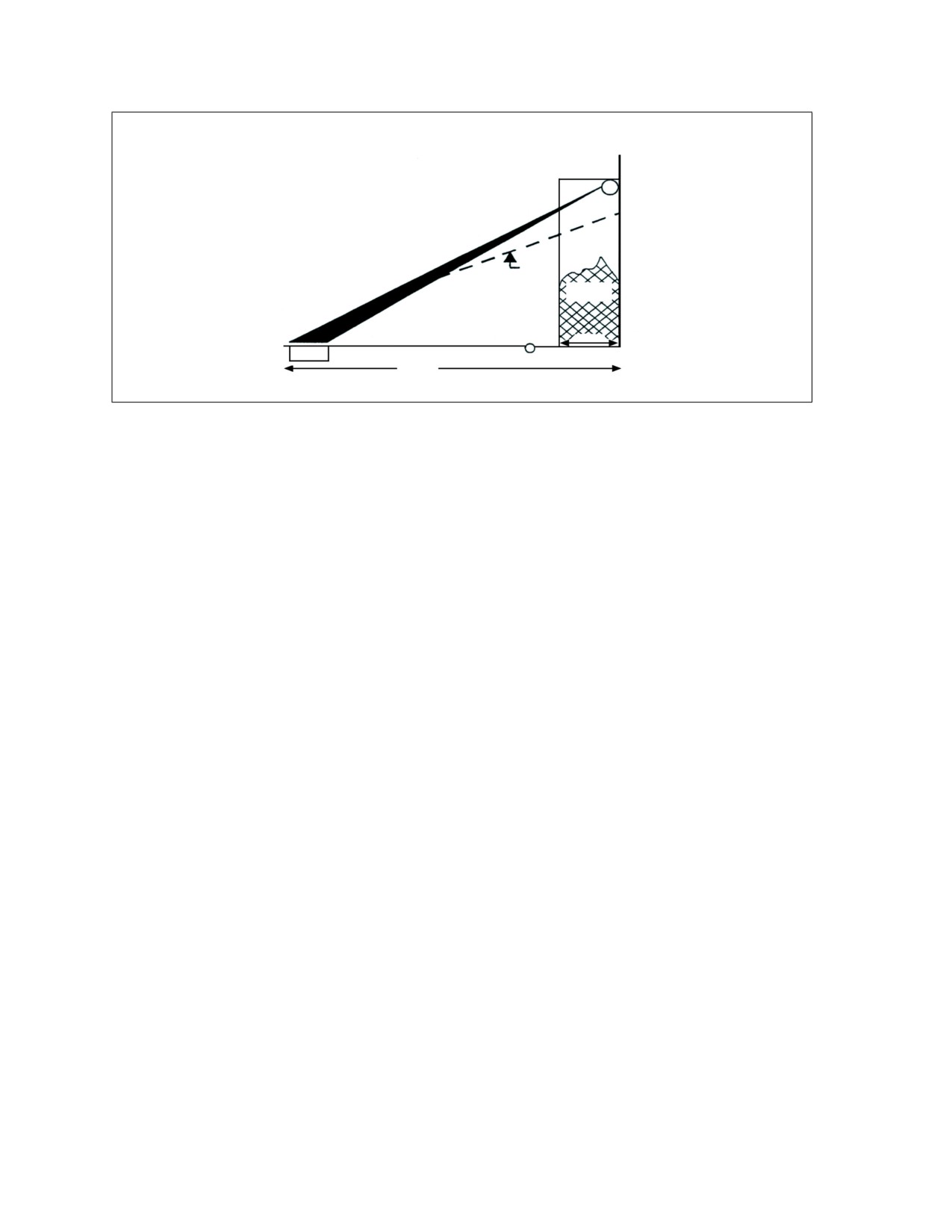
Altitude
A
Enemy
ADA
threat
Terrain
x
NAI
FLOT
Max system
range
Figure H-12. Optimal Data Collection Altitude
z
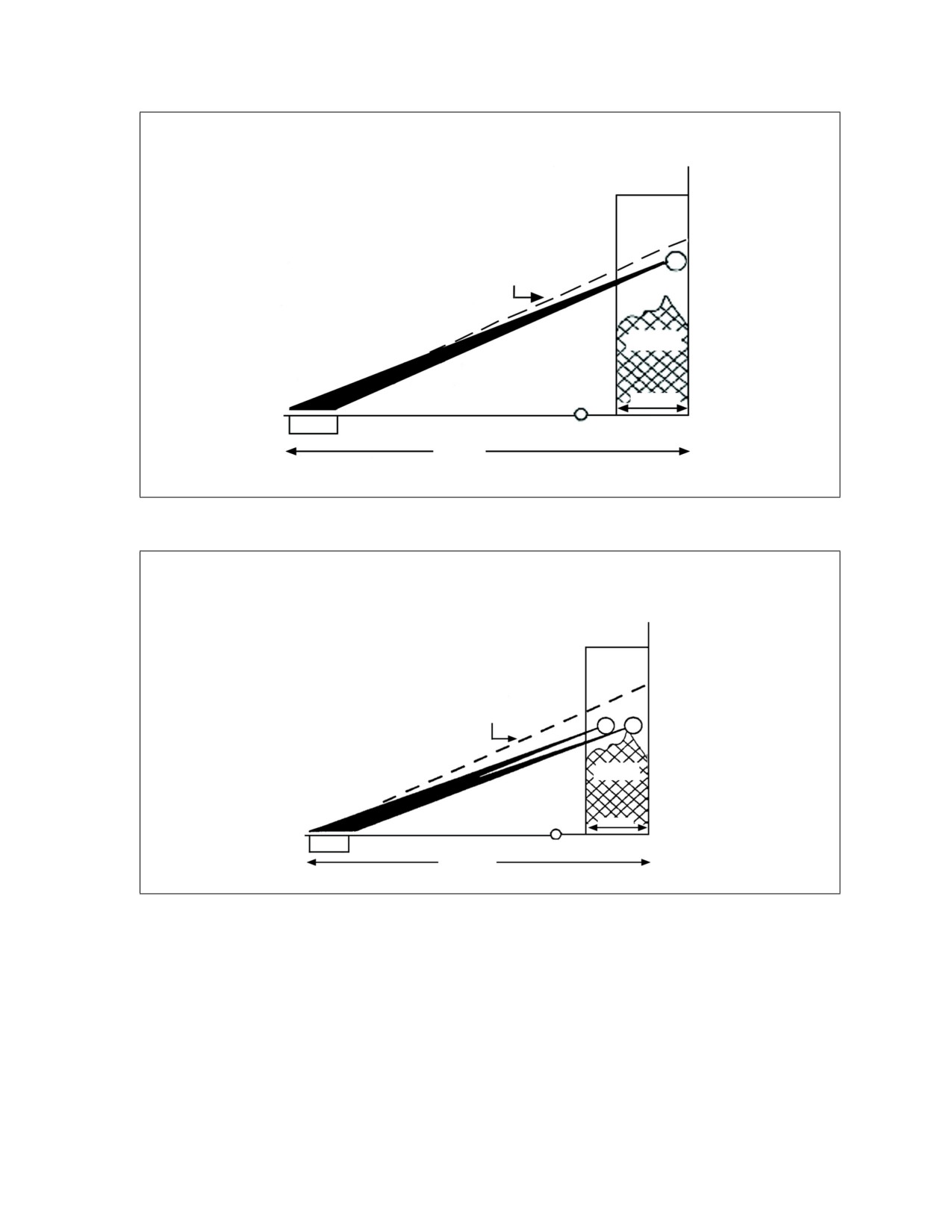
In Figure H-13 aircraft B is at an altitude allowing single pass
NAI coverage; however, due to the reduced altitude, the
LRBSDS operator may experience less data resolution and less
aerosol discrimination. This qualitative degradation does not
necessarily prevent the operator from identifying the cloud, but
it may make the task more difficult depending on system
alignment, range, moisture and background particulates in the
air, and BW-agent concentration. Any one of these factors can
prevent detection or discrimination. The more likely situation,
however, is the cumulative impact of several factors. The NBC
staff planner must appreciate these potential impacts and
recommend altitudes that will permit detection and
discrimination.
z
The examples in Figures H-12 and H-13 focus on single pass
options on a NAI. The third flight profile option (shown in
Figure H-14) depicts multiple passes on the NAI to obtain full
target coverage. In this example, aircraft C flies a low-level pass
at maximum range to scan the back half of the NAI, followed by
a second pass by aircraft D (flown farther from the FLOT) to
scan the closer half of the NAI. The staff may recommend this
option when flying multiple, low-altitude aircraft passes rather
than higher altitude passes would increase survivability.
(g)
Detection. The LRBSDS detection capability depends on the
operator’s skill and ability. As the system receives the returning laser signature, it
displays the information to the operator as a waveform display (similar to an
oscilloscope) and a graphical depiction of the scans that approximate the appearance of
the cloud. The operator interprets the display and determines whether the signal is a
man-made or naturally occurring aerosol. During the mission, the operator’s attention is
on the waveform display. The operator looks for five consecutive scans that are at least
twice as high as the background noise level. After observing five consecutive scans using
this criterion, the operator will direct the assistant operator to fill out a detection report.
After using the detection criteria, the operator also monitors the range to the cloud, cloud
H-26
Altitude
Enemy
B
ADA threat
Terrain
10km
x
NAI
FLOT
Max system
range
Figure H-13. Minimum Single-Pass Altitude
Altitude
Enemy
ADA
threat
C D
Terrain
x
NAI
FLOT
Max system
range
Figure H-14. Minimum Multipass Altitude
size and shape, height above the ground, relative intensity in the scan display, and cloud
travel consistent with the speed and direction of the wind.
z
If the LRBSDS crew scans the aerosol within 15 to 30 minutes
of the release, the LRBSDS operators should be capable of
further classifying a man-made cloud. Smoke clouds, vehicle
dust, and fog oil have very distinctive shapes and intensities.
H-27
z
Other discriminators that the LRBSDS operator evaluates
include whether there is a rapidly moving cloud edge, a poorly
defined plume pointing toward the ground, or no distinct cloud
edges that may be indicative of vehicle dust. A cloud close to the
ground that gradually builds to a high concentration and then
gradually dissipates is generally indicative of a large-area
smoke cloud. Large, stable clouds at ground level with no
significant buildup are indicative of haze and fog. However, BW
agents may be embedded within any of these aerosols. Such
conditions make BW detection more difficult, but an
experienced operator may be capable of picking out a BW cloud
if agent concentrations are above sensor thresholds.
(h) Laser scanning. During scanning, the following operational feedback
indicates guidance that should help increase the probability of detection when scanning.
z
Remain aware of the correct LRBSDS settings (for example,
scan extents and roll correction). Check for proper settings
before events (for example, starting a mission leg) instead of
randomly trying different settings.
z
Ensure that scanning occurs in the designated NAIs and that
friendly troop positions are not scanned.
z
Check that the LRBSDS roll setting value allows the best view
into the NAI when scanning up slope.
z
Check for the presence of a terrain obstacle (near-terrain
blocking) during scanning, if there is no ground return.
z
Remember that the LRBSDS waveform window may provide
the first indication of an aerosol cloud.
z
Use the color compression setting to help detect the extreme
ends of the aerosol when using the retrace flight technique (for
example, the aircraft turning around in mid-flight of the leg to
reacquire a lost cloud).
z
Ensure that the LRBSDS upper (waveform) and lower (scan)
windows are monitored continuously. When a cloud signal is
received, the assistant operator will get a mark (position
location) immediately from the flight crew or from their GPS.
z
Ensure that a solid ground return is present in the waveform
window before estimating cloud height.
(i)
In-flight protocols. The LRBSDS crew operates as a team with the
UH-60 flight crew. Examples of the crew interaction and teamwork may involve the
following situations.
z
Lost cloud. The LRBSDS operator will request a mark (such as
a position location) from the flight crew or their GPS
immediately upon losing contact with the biological cloud. The
operator will declare cloud contact lost if 2 minutes have
elapsed since the last positive scan.
H-28
z
Enemy ADA avoidance. The LRBSDS operator will turn off
the laser during evasive aircraft action. He will request a mark
from the flight crew or from their GPS upon initiation of aircraft
evasive-action maneuvers. He will also request the time he may
resume scanning along a course leg and a mark before
resumption of scanning.
z
The end of the previous leg and/or start of the next leg.
Before starting a course leg for LRBSDS scanning, the operator
requests a 10-second lead time (advance notice) from the flight
crew before scanning. At the end of the 10-second countdown,
the pilot provides the operator permission to scan. When
turning around at the end of a flight leg, the aircraft turns away
from the FLOT. The LRBSDS operator and flight crew ensure
that the LRBSDS is prepared to scan in the proper direction. A
situation report (SITREP) will be provided to the TOC if a
biological cloud is tracked beyond the end of a course leg.
z
In-flight communications. The flight crew and LRBSDS
operators communicate when the UH-60 changes altitude,
when the LRBSDS is not receiving ground return, when the
laser is turned on or off, when starting a course leg, on
completion of a course leg, before activating the laser (about
10 seconds before), when an upcoming terrain feature may
cause terrain blocking, when a cloud detection occurs, when
obtaining marks (position location) as part of the critical
information exchange (such as cloud location), or when evasive
action is required.
(j)
Communications protocols. Communications between the flight
crew, the LRBSDS team, and the TOC require timely and effective SITREPs and
detection reports. This section provides suggested message content and formats for
communications between the various members of the biological-surveillance team.
NOTE: The call signs used for this section are: LRBSDS team = Bloodhound 2;
ground controller = Eagle 24; biological-detection company officer = E5K.
z
Departure report. A departure report is used to notify the
TOC that the aircraft has cleared airfield traffic control.
Figure H-15 is an example of a departure report transmission.
Copilot to Assistant Operator: “As soon as we have cleared the airfield traffic control, please send your
departure report.”
Operator: “The system is operational.”
Assistant Operator: “Eagle 24, this is Bloodhound 2. Departure report, over.”
Operations Center NCO: “Bloodhound 2, this is Eagle 24. Send, over.”
Assistant Operator: “Bloodhound 2 has departed airfield Eagle at 2130 local. System green. Relay to E5K.
Over.”
Operations Center NCO: “WILCO. Out.”
Figure H-15. Departure Report
H-29
z
Course leg commencement request. A course leg
commencement request is used to notify the TOC that the
aircraft is close to reaching a specific course leg. Figure H-16 is
an example of a course leg commencement request.
Copilot to Assistant Operator: “We are 5 minutes from ACP 108, the starting point for course leg Zulu. The
pilot recommends commencing the LRBSDS mission. Call operations and request permission to execute.”
Assistant Operator: “Eagle 24, this is Bloodhound 2. Over.”
Operations Center: “Bloodhound 2, this is Eagle 24. Over.”
Assistant Operator: “We are preparing to execute LRBSDS mission along course leg Zulu. Over.”
Operations Center: “Roger. Out.”
Operator to Copilot: “Request permission to initialize the laser from ACLEFT.”
Copilot to Operator: “You are cleared to initialize the laser ACLEFT.”
Operator: “Initializing ACLEFT.”
Assistant Operator: “Laser ACLEFT.”
Copilot to Operator: “Commencing east-west run on course leg Zulu. You are clear to begin lasing ACLEFT.”
Operator: “Lasing ACLEFT.”
Figure H-16. Course Leg Commencement Request
z
Course leg commencement SITREP. The course leg
commencement SITREP format provides a notional situation
that informs the TOC that a new course leg is just beginning.
Figure H-17 is an example of a course leg commencement
SITREP transmission.
Copilot: “Coming up to start of second course leg, course leg Whiskey. Location ACP 55. You are clear to lase
ACLEFT!”
Operator: “Initializing ACLEFT.”
Assistant Operator: “Laser is ACLEFT.”
Operator: “Lasing ACLEFT.”
Assistant Operator: “Eagle 24, this is Bloodhound 2. SITREP, over.”
Operations Center: “Bloodhound 2, this is Eagle 24. Send it, over.”
Assistant Operator: “Time 2220 local. Beginning course leg Whiskey at FS 470490. System green. Relay to
E5K. Over.”
Operations Center: “WILCO. Out.”
Figure H-17. Course Leg Commencement SITREP
z
Initial LRBSDS detection report. The initial LRBSDS
detection report notifies the TOC of a possible detection.
Figure H-18 is an example of an initial LRBSDS detection
report.
z
Follow-up detection report. The follow-up detection report
transmission notifies the TOC when a cloud is reacquired.
Figure H-19 (page H-32) is an example of a follow-up detection
report transmission.
H-30
Operator: “We have a possible detection. Mark.”
Assistant Operator: “Time is 2303 local.”
Copilot: “Our present position is FS 315 558. Ground heading 200 degrees magnetic. Crab angle 1° right;
speed 85 knots, altitude 3,000 feet but are going to drop to 1,000 feet and attempt to detect the cloud from
further down the course leg.”
Operator: “The cloud appears man-made in a course line configuration. Width is 4 kilometers. Height is 80
meters. Range is 35 kilometers. Intensity is high. Seven scans. Continuing to track.”
Copilot to Operator: “We are descending to 1,000 feet. You need to shut down the laser until we climb back
up.”
Operator: “Laser off.”
Assistant Operator: “Eagle 24, this is Bloodhound 2. LAZER report, over.”
Operations Center: “Bloodhound 2, this is Eagle 24. Send it, over.”
Assistant Operator:
“Line: L1 FS 315 588
A1 35 kilometers
A2 4 kilometers
A3 N/A
A4 80 meters
BREAK.
Line: Z 2305 local
E1 3,000 feet
E2 200 degrees magnetic
E3 One degree right
BREAK.
Line: R1 Initial
R2 60 minutes
R3 N/A
R4 Confidence - High
R5 High-intensity, seven scans. Continuing to track, over.”
Operations Center: “Roger. Out.”
Figure H-18. Initial LAZER Detection Report
z
Cloud loss detection report. The cloud loss detection report
transmission notifies the TOC that LRBSDS scanning has lost
contact with the cloud. Figure H-20 (page H-32) is an example of
a cloud loss detection report transmission.
(k) Reporting. The LRBSDS team provides SITREPs according to the
biological-detection company SOP (such as the location and personnel and supply
statuses). During mission operations, the LRBSDS crew submits detection reports using
the information from Table H-9 (page H-33).
z
Detection and incident reports. The LRBSDS team reports
the detection of man-made clouds using the helicopter radio on
H-31
Copilot: “We have now leveled back off at 3,000 feet. You can turn your laser back on.”
Operator: “Laser is on ACLEFT. It appears that I have reacquired the cloud. Range 36 kilometers. Cloud width
is 5 kilometers. Cloud is 30 meters above the ground. Detected with three scans.”
Copilot: “Our position is FS 330560. All previously reported information is the same.”
Assistant Operator: “Eagle 24, this is Bloodhound 2. Follow-up detection report, over.”
Operations Center: “Bloodhound 2, this is Eagle 24. Send, over.”
Assistant Operator:
“Report follows:
L1 FS 330560
A1
36 kilometers
A2
5 kilometers
A4
30 meters
Z
2315 local
R1 Follow-up
R5
3 scans/relay to E5K. Over.”
Operations Center: “Roger, WILCO, out.”
Figure H-19. Follow-Up Detection Report
Operator: “No longer tracking cloud. Mark.”
Copilot to Operator: “Our present location is FS 390550 and our ground heading is 300 degrees magnetic.
Additionally, we are at ACP 36 at the end of course leg Zulu. You need to turn off the laser.”
Operator: “Laser off.”
Assistant Operator: “Eagle 24, this is Bloodhound 2. Cloud loss detection report, over.”
Operations Center: “Bloodhound 2, this is Eagle 24. Send, over.”
Assistant Operator:
“Line:
L1 FS 390500
Z
2345 local
E2
300 degrees magnetic
BREAK.
Line:
R1 Loss report
R5 Relay to E5K. Also, we have completed the second pass on course leg Zulu. Over.”
Operations Center: “Roger, WILCO, out.”
Figure H-20. Cloud Loss Detection Report
the appropriate communications net. The detection report may
be sent to the aviation brigade TOC (or other relay station) for
relay to the biological-detection company CP; however, the
preferred approach is to submit detection reports directly to the
H-32

Table H-9. Data Items for LRBSDS Detection Report
Line
Data Item
Leg Identification
L
L1
Position of the observer
Start track position, latitude/longitude, or coordinates
A
A1
Helicopter to aerosol range
Distance from helicopter to aerosol, in km
A2
Aerosol width
Width of aerosol, in m (cross section)
A3
Aerosol height (optional)
Height from ground to underside of aerosol, in m
A4
Aerosol height above ground
Altitude (AGL), in ft
Z
Z
Detection time
E
E1
Helicopter altitude
Direction of flight, ground track, and azimuth, in degrees
E2
Helicopter heading
Degrees from heading (left or right)
E3
Helicopter crab angle
Degrees from heading (left or right)
R
R1
Type of report
Initial, follow-on, or loss of cloud
R2
Flight time remaining
Estimated time the helicopter can remain on station
R3
Ground track (optional)
Direction on the map that the helicopter is tracking
R4
Confidence
High, medium, or low
R5
Remarks
Other information
biological-detection company CP. Incident reports are not
required for LRBSDS background missions.
z
Detection report data items. The data items on the detection
report may vary during a mission, depending on the specific
objective assigned to the LRBSDS team. The team will use one
of the following techniques to accomplish the assigned objective:
Detection and mapping. Each data item on the
detection report is reported.
Detection and tracking. The following critical data
items from Table H-9 are associated with detection and
tracking: L1, A1, Z, E1, E2, E3, R1, R4, and R5.
Detection and classification. The following critical data
items from Table H-9 are associated with only detection
and classification: L1, A1, Z, E1, E2, E3, R4, and R5.
z
Detection report remarks item. The remarks column holds
information such as the current ground speed and operator’s
assessment as to the type of man-made cloud (smoke or vehicle
dust). Operators may also generate a follow-on report once they
reacquire the cloud. This report consists of the same type of
information as the initial report. Follow-on reports provide the
ability to further track the cloud and determine the cloud drift.
Operators should also generate a loss-of-cloud report after there
has been no contact with the cloud for more than 2 minutes. The
loss-of-cloud report contains the time of cloud loss and the last
known location.
H-33
c.
Postoperations Phase.
(1) The LRBSDS team completes the checklist information shown in
Table H-10 after a mission. Since the LRBSDS internal hard drives have limited storage
capacity, the data from biological-surveillance missions must be downloaded from the
hard drives to tapes. Team members download the mission information and archive the
data tapes immediately after concluding the aerial mission. Archiving includes labeling
each tape with the times and locations of the biological-surveillance missions, matching
each tape with its corresponding mission documentation, and storing the tapes and
documents in the LRBSDS area. The team uses the tapes to conduct mission debriefs
and training. The biological-detection company may determine that some tapes are
needed for further review or interpretation. In such a situation, the team packages the
tapes and mission documentation for evacuation using a chain-of-custody form.
(2) Following the mission, the operator contacts the LRBSDS NCOIC, briefs
his current status, and receives follow-on orders. The operator receives an update from
the detachment NCOIC or the aviation brigade chemical officer on the current friendly
and threat situations. The team shuts down the LRBSDS if it is not immediately going
on another mission.
(3) The LRBSDS operator also completes a postmission debriefing with the
aircrew. Key data points of the mission are verified between the team and the aircrew.
The mission checklist is archived along with all other mission documentation.
(4) Upon completion of a mission, the aviation brigade chemical officer will
determine if the LRBSDS is to be removed (for example, if no other mission is scheduled).
If removal is required, operators remove the system, conduct PMCS, and return the
system to the storage site. The NCOIC finalizes return movement plans (if required),
such as passage of lines and support, and the team conducts movement. The team
NCOIC conducts planning, crew debriefing and training, equipment maintenance, and
resupply to prepare for future missions.
(5) The senior team member receives a brief from the detachment NCOIC on
the current friendly and threat situation.
(6) The senior team member finalizes return movement plans, such as
passage of lines and support.
(7) The unit conducts movement.
H-34

Table H-10. LRBSDS Postoperations Checklist
Actions Required
LRBSDS Team Actions
Perform the download of data
Download data onto data tapes.
Remove and package data tapes (if required).
Initiate DA Form 4137 procedures.
Determine the future mission
Obtain orders/updates.
requirement from LRBSDS
Determine the requirement for future missions.
NCOIC
Obtain permission to remove the LRBSDS.
Determine the disposition of data tapes.
Shut down the LRBSDS
Power down all components.
Lower the laser platform.
Lock the azimuth brakes.
Conduct the postmission
Verify mission data points with the aircrew.
debriefing with the aircrew
Annotate/verify the mission work sheet entries.
Remove the LRBSDS from the
Disconnect the power.
helicopter
Remove attachment fixtures from the helicopter floor.
Use the forklift to remove the LRBSDS from the helicopter.
Conduct PMCS of the equipment.
Conduct inspections.
Perform troubleshooting
Perform troubleshooting as required.
Conduct movement (if required)
Load the equipment.
Conduct the road march.
Report the movement per the SOP.
Prepare for the next mission
Perform planning, training, maintenance, and resupply.
H-35

Appendix I
BIOLOGICAL INTEGRATED DETECTION SYSTEM UNIT
OPERATIONS (M3IA1 AND M31A2)
1.
Background
This appendix provides information on the M31A1 and M31A2 BIDS. This appendix
also addresses BIDS unit information management and communications architecture.
2.
Preplanned Product Improved Biological Integrated Detection System
a. Preplanned Product Improvement Biological Integrated Detection System
(M31A1) Functions. The preplanned product improvement (P3I) BIDS is an enhanced
biological-agent detection system. It performs the basic functions (see Table I-1) of
monitoring, sampling, detecting, identifying, and reporting to presumptively identify
that a large-scale biological attack has occurred. Improvements in the P3I BIDS
individual components, as well as overall system design, provide an operator friendly,
automated detection suite that has a significantly increased capability.
Table I-1. P3I BIDS (M31A1) System Functions
Mission-Essential Tasks
Products
Required Components
Monitor
Nonspecific alert
UVAPS
Nonspecific alert
CBMS
Sample
Physical samples for analysis
Liquid sampler and/or biological sampler
Detect
Generic biological indicators
Mini-FCM
CBMS
Identify
Specific presumptive identification
Biological detector
Handheld assay
Report
PIRs/IRs
HF radio, FBCB2, and SINCGARS radio
(Platoon HQ—HF/FBCB2 [M31A2 only]/
SINCGARS/MSRT)
(1) Monitor. The P3I BIDS continuously monitors the air for an increase in
the number of aerosol particles within a certain size range. The product-improved
system uses two monitoring devices—the ultraviolet aerodynamic particle sizer (UVAPS)
and the chemical-biological mass spectrometer (CBMS)—to provide an added
discriminatory capability. The UVAPS can determine whether a biological mass is
present within the aerosol particles being monitored; the CBMS also supports this
function and can generically classify the biological material.
(2) Sample. The liquid sampler and the biological sampler are automatically
activated immediately following an alert within the P3I BIDS. The P3I BIDS liquid
I-1
sampler dispenses preset amounts for further tests that minimize the requirement for
any pipetting or transferring of liquid from one tube to another.
(3) Detect. The P3I BIDS detection capability (through the use of the
miniature flow cytometer [mini-FCM] and the CBMS) determines whether biological
material (cells, spores, or toxins) is present with greater sensitivity than previous BIDS
versions. A positive result from either the CBMS or the mini-FCM can lead to further
testing for identification results.
(4) Identify. The P3I BIDS uses the biological-detector device to
presumptively identify biological agents. The biological detector can identify up to eight
preselected BW agents. The biological detector is a more sensitive instrument and is
nearly completely automated compared to the nondevelopmental item counterpart
(which is much more labor intensive to operate).
(5) Report. The biological-detection teams report to the platoon HQ using the
AN/GRC-193A high frequency (HF), single-channel ground and airborne radio system
(SINCGARS) radio, and/or FBCB2 system. The following list provides general reporting
requirements. These requirements may vary based on the JFC PIR and/or IR and other
protection and warning criteria. During biological-detection operations, the biological-
detection team operates on a shift basis. The incoming shift receives a thorough brief (for
example, materiel and supply status, BW event status, and sample evacuation status)
from the outgoing shift.
(a) biological-detection teams report to the platoon leader when—
z
A new biological-detection site becomes occupied.
z
A new biological-detection site becomes operational.
z
Processing event data during operations at the biological-
detection site.
z
Mission-essential components fail.
z
A biological-detection team change of shift occurs.
(b) Biological-detection teams submit personnel status, logistics status,
and SITREPs as required. These reports help provide the command with the overall
readiness level of a biological detection team.
(c) Platoon leaders report to company operations when—
z
Any biological-detection team reports a positive detection.
z
Any biological-detection team reports a positive identification.
(d) Platoon leaders submit SITREPs as required. These include weather
and background data, key friendly information, and sample evacuation requests.
(e) It is critical for the biological-detection team to maintain
communications during biological-detection operations. BIDS incident report
information is time sensitive. For example, the leading edge of a BW aerosol cloud is
moving at about 1½ times the average wind speed. As each minute elapses from the time
of the alert, the suspected BW cloud is moving further downwind. Effective biological-
detection team reporting keeps unit leaders informed as to the current status of their
systems. Effective, timely event reporting also facilitates the event tracking process by
platoon leaders.
I-2
(f)
BIDS unit leaders conduct contingency planning to identify alternate
communications capabilities should the HF or the VHF fail. For example, the platoon HQ
can use their authorized mobile subscriber equipment (MSE) for forwarding reports.
(6) Communication. The following communication equipment and
capabilities allow the P3I BIDS to communicate with the biological-detection platoon,
company, and supported command; maintain SA; and report findings.
(a) High-frequency radio. The AN/GRC-193A HF radio allows long-
range secure communications between widely dispersed units of the biological-detection
company. The HF radio is an amplitude modulation (AM) radio that, depending on
atmospheric conditions, can communicate over extended distances. It is the primary
means for voice communications between the BIDS company HQ, platoons, and
individual detection teams. Each BIDS vehicle is equipped with a HF radio.
(b) Force XXI Battle Command/Brigade and Below. The FBCB2 system
provides SA and C2 capabilities to all elements of the BIDS company and facilitates C2
between the biological-detection company and FBCB2 equipped supported and
supporting units. For the M31A2 equipped biological-detection company, FBCB2 is the
primary means for digital communications between the BIDS company HQ, platoons,
and individual detection teams. Each BIDS is equipped with FBCB2. The FBCB2 system
is comprised of the following: AN/UyK-128 digital computer set; FBCB2 software;
position navigation and reporting capability (GPS); interface to a terrestrial
communication system (such as SINCGARS and/or Enhanced Position Location
Reporting System [EPLRS] radio); and combat identification capability. Only the
biological-detection platoon and company HQ for M31A2 units will have FBCB2 with an
EPLRS capability.
(c) Mobile subscriber receiver/transmitter. The mobile subscriber
receiver/transmitter (MSRT) is at the company and platoon level; the biological-detection
team does not have a MSRT. A MSRT has a secure digital and facsimile communications
capability and serves as the primary means of communication at the CP level. It is
normally used as the alternate operations and intelligence net. A MSRT may also be
used as the primary means to pass operations and intelligence information directly from
the biological-detection company CP to the FBCB2-equipped supported HQ chemical
officer.
b. P3I (M31A1) Sample Handling and Chain-of-Custody.
(1) P3I (M3A1) Sample Requirements. The supporting data provided by the
P3I BIDS will include alert, detection, and identification results. This data is provided on
data collection forms and as numerical, graphical information (communications interface
processor [CIP] mission files) stored on computer files. The P3I BIDS team provides—
z
A liquid biological-agent sample for confirmatory lab analysis.
z
Supporting information that provides descriptive data for the
sample.
z
Environmental background samples with their supporting
information.
I-3

(2) Logistics requirements. The following items specifically apply to sample
handling and the chain-of-custody for the P3I BIDS:
z
Sample transfer case. A direct current (DC) powered sample transfer
case is located in the biological-detection team support vehicle and
enables the support crew to conduct a sample evacuation. The
support vehicle sample transfer case provides a sturdy, rigid
container that maintains the sample temperature at 1-4°C and eases
carry and transport. A temperature monitor provides the biological-
detection team with the assurance that the sample transfer case
temperature remains between 1-4°C.
z
Onboard cooler. The BIDS vehicles have onboard coolers that are
identical to the sample transfer cases located in the support vehicles.
These items provide temporary storage for samples pending
evacuation. The P3I BIDS has one cooler.
z
Clear plastic bags. Clear plastic bags are the approved secondary
container for biological wet collectors. Due to the requirement to
double-bag these items, the recommended basic load for each BIDS
should be increased from 25 to 50 bags.
z
Tamper-resistant tape.
z
Lab film.
(3) Air-sample collection from the biological sampler. The primary purpose of
the P3I BIDS biological sampler is to collect and contain suspect material in a collection
medium for transport. In the P3I system, the sampler is normally activated by the CIP in
response to a UVAPS or CBMS alert. Upon completion of the sampling cycle, the sampler
provides the operator with about 40 milliliters of liquid in the wet collector.
(4) Chain-of-custody instructions. Instructions for filling out the chain-of-
custody form can be found in Appendix G.
(5) Biological sample packaging. Table I-2 gives specific instructions for
preparing the P3I BIDS wet collector for evacuation.
Table I-2. Preparing the Wet Collector for Evacuation
Completed
Item
Instructions
1
Close the wet collector with the prepacked rubber grommet.
2
Ensure that the lower lid is tight. Ensure that the upper lid is secured to the lower lid
of the wet collector. Apply lab film around the upper lid in case of leakage from the
wet collector.
3
Label the wet collector with the sample identification number.
4
Seal the lid of the wet collector with tamper-resistant tape. Apply the tape in an x
pattern, ensuring that the tape is long enough to reach the wet collector. Ensure that
the tamper-resistant tape covers a portion of the label on the wet collector.
5
Place the wet collector, with absorbant material, inside a clear plastic bag with.
Remove the excess air and twist the neck of the bag until it forms a tight coil with the
bag snug around the wet collector. Label and secure the bag with a quick-lock
fastener. Ensure that the sample identification number can still be read.
I-4

Table I-2. Preparing the Wet Collector for Evacuation (Continued)
Completed
Item
Instructions
6
Place the bagged wet collector inside another clear plastic bag. Remove the excess
air and twist the neck of the bag until it forms a tight coil with the bag snug around the
wet collector. Place an adhesive label containing the sample ID number on the bag.
Secure the bag with a quick-lock fastener.
7
Place the packaged wet collector in the sample transfer case.
8
Complete the chain-of-custody form.
(6) Alternate sample containers. If the biological sampler is not mission
capable, the liquid sampler will provide the liquid sample for evacuation (see Table I-3).
This procedure is restricted to situations when the biological sampler is either not
mission capable or the current operating protocol does not require the use of the
biological sampler. The conical tube should be selected according to guidance in
TM 3-6665-350-12&P.
NOTE: When using this procedure, ensure that the appropriate entries are
made on the corresponding chain-of-custody form.
Table I-3. Preparing an Alternate Sample Container for Shipment
Completed
Item
Instructions
1
Ensure that the wet collector is properly secured with a cap. Wrap lab film around the
cap.
2
Affix an adhesive label containing the sample ID number on the wet collector in a
lengthwise manner.
3
Seal the wet collector by applying a strip of tamper-resistant tape in a lengthwise
manner; starting at the side, run the strip up, over the cap, and down the other side.
Ensure that the tamper-resistant tape covers a portion of the label on the wet
collector. Add a temperature monitor strip.
4
Place the wet collector, with absorbent material, inside a clear plastic bag. Remove
the excess air and twist the neck of the bag until it forms a tight coil. With the bag
snug around the wet collector, place an adhesive label containing the sample
identification number on it. Secure the bag with a quick-lock fastener.
5
Place the bagged wet collector inside another clear plastic bag. Remove the excess
air and twist the neck of the bag until it forms a tight coil. With the bag snug around
the wet collector, place an adhesive label containing the sample ID number on it.
Secure the bag with a quick-lock fastener.
6
Place the package in the sample transfer case.
(7) Supporting Documents. The documents that support the evacuated
sample are integral components of the evacuation package. These items must accompany
the sample. Routinely, they will be comprised of a printed copy of the CIP display;
however, under some circumstances (such as the CIP or printer not being mission
capable), a copy of the BIDS incident report will be provided in lieu of page 2 from the
CIP display. Table I-4 (page I-6) provides instructions for packaging this material.
I-5

Table I-4. Packing Supporting Documents for Evacuation
Completed
Item
Instructions
1
Ensure that the chain-of-custody form is accurate.
2
Ensure that the printed copy of page 2 of the CIP display has the sample
identification number annotated.
3
Check the CIP printout for consistency with the chain-of-custody form.
4
Ensure that the sample ID number is present and consistent with the chain-of-
custody form and that the BIDS incident report is also submitted.
5
Place the printout and biological-incident report in a floppy disk mailer and seal it. If
additional mailers are used, each one must have a separate item description on the
corresponding chain-of-custody form.
6
Place an adhesive label containing the sample ID number on the outside of the
mailer, and place the mailer in the sample transfer case.
(8) The completed evacuation package. The completed sample evacuation
package is comprised of the following items, packed in either the P3I BIDS onboard
cooler or the support vehicle sample transfer case:
z
A sealed and packaged wet collector.
z
A sealed floppy disk mailer with the CIP printout or the BIDS
incident report.
NOTE: The completed chain-of-custody form will be hand carried by the escort.
(9) Evacuation methods. The methods used for executing a sample transfer
will vary. For example, the following options could be used:
z
The BIDS biological-detection team support crew could transport the
sample to the designated sample transfer point for pickup by escort
personnel.
z
Escort personnel could pick up the sample at the BIDS site.
z
Other BIDS unit personnel could receive custody from the biological-
detection team and transport the sample to a designated sample
transfer point.
c.
P3I BIDS (M31A1) Unit Employment. See Chapter III.
d. P3I BIDS (M31A1) Operational Modes and Data Analysis. This paragraph
outlines the basic operational modes and data collection and analysis information for the
P3I BIDS.
(1) Data collection methods. There are four basic methods for data collection.
(a) Standard protocol. The standard protocol is executed in response to a
UVAPS or CBMS alert condition. When a UVAPS and/or CBMS alert condition occurs,
the CIP activates both the liquid sampler and the biological sampler. The CIP uses input
from the generic detection components (UVAPS, CBMS, and mini-FCM) to determine if
detection has occurred. If positive detection results are obtained, a representative sample
is analyzed with a specific identification component (such as the biological detector or the
handheld assay). A detailed discussion of the standard protocol can be found in
TM 3-6665-350-12&P.
I-6

(b) Continuous-sampling protocol. The continuous-sampling protocol
involves activating the liquid sampler and turning off both monitoring devices (the
UVAPS and CBMS) to prevent damage to these components. The sampler collects one
liquid sample every 15 minutes for testing. This protocol could be used when directed by
the biological-detection company or platoon CPs. It can also be used during a weather
event (such as a severe dust storm) to prevent clogging of the UVAPS and/or CBMS air
intake and ensure that a BW cloud is not missed. See TM 3-6665-350-12&P for a detailed
discussion of continuous sampling.
(c) Reduced-capability operations. The P3I BIDS can operate at reduced
capability when one or more components of the biological-detection suite become
inoperable. Specific procedures for reduced-capability operations are summarized in
TM 3-6665-350-12&P.
(d) Threat-based protocol. The standard P3I BIDS operating protocol
can be adapted as a potential countermeasure against a threat BW capability (for
example, linking the biological-detection array to the command air defense early-
warning system [cued monitoring]). On receipt of a warning, the BIDS array initiates
continuous sampling (both triggers continue to operate). Therefore, if an alert occurs, the
BIDS is ready to test liquid samples almost immediately.
(2) Overall P3I BIDS system-level process. The system-level process begins
with a triggering event by either the UVAPS or the CBMS that indicates an alert
condition. This marks the beginning of a BIDS event. The second phase (detection)
occurs when the CIP receives all of the generic results from the UVAPS, CBMS, and
mini-FCM. If the system detection results are negative, the BIDS event ends; however, if
the detection results are positive, the BIDS team conducts presumptive-identification
procedures.
(a) P3I BIDS event cycle. The P3I BIDS event cycle, inclusive of the
alert, detection, and identification phases, could range from 18 to 25 minutes. Following
the alert, the detection process will last 3 to 11 minutes. During this phase, the CIP
receives UVAPS, mini-FCM, and CBMS data for a detection decision. During detection,
operator-1 tests two liquid samples on the mini-FCM, and the CBMS completes two
pyrolysis cycles (about 3 minutes each). Next, based on a positive detection, the
identification process (on the biological detector or the handheld assay) will take about
15 minutes.
(b) P3I BIDS detection classification. Each of the three components that
contribute to the P3I BIDS detection decision performs functions that complement each
other. See Table I-5 for a brief comparison of UVAPS, mini-FCM, and CBMS functions.
Table I-6 (page I-8) provides a brief description of each generic detectors capability.
Table I-5. Comparison of the UVAPS, CBMS, and Mini-FCM
Component
Results
Function
Speed
UVAPS
Detects a biological mass in
Continuously monitors
Updates results every 60
an agent containing particles
(triggering device)
seconds
CBMS
Detects ion activity, biological
Continuously monitors
Updates results every 3 minutes
versus nonbiological; cell,
(triggering device)
spores, or toxins
Mini-FCM
Detects cells or spores
Operates on demand
Results available in +/-100
(detection role only)
seconds
I-7

Table I-6. UVAPS, CBMS, and Mini-FCM Capabilities
Component
Capability
UVAPS
Fluoresces biological material within aerosol particles with an ultraviolet laser.
CBMS
Analyzes ionized molecules for characteristic patterns of cells, spores, and toxins.
The CBMS results are likely to be more accurate for spores and toxins than for cells.
Mini-FCM
Detects the presence of DNA/RNA within insoluble components (0.5 to 2.0 m) of
aerosol particles. Statistically, mini-FCM results are more accurate for cells than for
spores.
(3) Background effects. It is important to be aware of background data
results. In general, background can be broadly categorized into three types—low, high
(biological), and high (nonbiological).
(a) Background characteristics. The general characteristics of these
background types and their possible effects on the P3I BIDS are included in Table I-7.
For example, areas with a high biological background may yield positive mini-FCM
results and/or nonspecific binding results from the biological detector.
z
High (nonbiological) background conditions are often attributed
to high winds, which can cause more reaerosolization of soil or
surface particles. This type of background activity may cause
short-duration UVAPS alerts (most will be 1 minute) or low UV
fluorescence results.
z
Low wind speeds (less than 1 or 2 meters per second) may cause
high background results. If large numbers of aerosol particles
are present in the ambient air, low wind speeds may help keep
the background conditions high. Furthermore, biological-
detector results may also indicate nonspecific binding in very
high dust concentrations. Nonspecific binding may also occur
based on the BIDS being downwind of some artillery or weapons
fire by-products.
z
Background materials that may cause responses on the mini-
FCM or biological detector may not trigger the UVAPS or the
CBMS. Therefore, it is important for the BIDS team to be aware
of local background conditions. For example, detection results
could be affected by high-protein backgrounds and extremely
short aerosol dwell times.
(b) Background data recording. Certain data must be recorded during
the monitoring phase of a BIDS operation to ensure that all the pertinent information is
available for system-level analysis. This information (referred to as background) is listed
in Table I-8. Background data collection consists of position location, weather data, local
activity and conditions, mini-FCM and biological-detector results, and the sample from
the biological sampler. The wind speed and direction will be included in the report of
background data to the biological-detection platoon. A modified BIDS incident report
form can be used for recording background data at team level. The unit SOP or the
OPLAN and/or OPORD will specify the reporting frequency.
I-8

Table I-7. Possible Impact of the Environment on BIDS Component Results
Possible Impact On BIDS
Background Type
Environmental Factors
Component Results
Low
Cold climates, snow-covered terrain,
All components typically negative
temperate climates with dormant vegetation,
coastal areas, and regions of sparse
vegetation with low levels of fine sand or dust
High (biological)
Temperate/tropical climates with high levels of
Biological detector—possible
vegetation, primarily early in the growing
nonspecific binding
season; agricultural areas during the growing
Mini-FCM—possible cell results
season; and areas near industrial facilities
with biological processes/sewage treatment
High (nonbiological)
Dry/desert regions with high levels of fine
UVAPS—short-duration alerts
sand or dust; dry grassland/scrub, primarily
CBMS—possible cell results
late in the growing season; urban or industrial
areas; and artillery/weapons fire by-products
Mini-FCM—possible spore results
Biological detector—may cause
nonspecific binding
z
Background data should be recorded at the beginning of a
mission and periodically updated during the mission (every 4 to
8 hours and especially after sunset or sunrise). The recording
frequency depends on background conditions and operator
workload (see Table I-8).
Table I-8. P3I BIDS Background Data
Component
Data
CIP screen
GPS
Position location
CIP screen
Meteorological sensor
Wind direction (degrees)
CIP screen
Wind speed (kph)
Temperature (°C)
Relative humidity (percent)
BIDS team
Local activity/conditions
Support crew
Mini-FCM
Cell result
CIP screen and mini-FCM LCD
Spore result
Biological detector or handheld
Biological detector or handheld-
CIP screen or biological detector
assay
assay result
or handheld-assay strip
Biological sampler
Wet-collector contents
Biological sampler
z
If background conditions produce positive results on either the
biological detection or the mini-FCM, more frequent
background sampling should be conducted (but not more often
than every 2 hours). For example, the initial positive results on
the mini-FCM and biological detector may be a short-term
anomaly, and one or two follow-on assays could result in
negative results. Positive background results on the mini-FCM
and biological detector may be due to local activity (such as
vehicle dust).
I-9

z
It may become necessary to move the BIDS to an alternate
detection area away from the source of background data that
causes the positive mini-FCM and biological-detector results. It
is important to know if the background information has
changed before an alert condition to provide an accurate
system-level result.
(4) Data analysis (system-level analysis). A BIDS event begins with a
UVAPS and/or CBMS alert condition and ends when all steps in the data collection
process have been completed. See Table I-9 for BW event data. These results are used for
the P3I BIDS incident report. Critical event data includes local meteorological readings;
observations of local activity or weather conditions; alert, detection, and identification
results; and the location.
Table I-9. P3I BIDS Event Data
Source
Data
Alert result
Alert time
Meteorological sensor
Wind direction (degrees)
Wind speed (kph)
Temperature (°C)
Detection result
Cell, spore, toxin
Identification result
Agent result
BIDS team
Local activity/conditions
BIDS team
Location
(a) System-Level Analysis Process. The system-level analysis process is
summarized in Table I-10. The first phase of the process (alert) occurs when the UVAPS
or the CBMS indicates an alert condition. The second phase (detection) occurs when all
BIDS generic results have been obtained from the UVAPS, mini-FCM, and CBMS
following an alert. If all of these results are negative, the detection result is also
negative. If one or more of these results is positive, the detection result is positive. If the
detection event is negative, the incident is considered a nonevent, and the process is
terminated. The third phase (presumptive identification) occurs when specific results are
available from either the biological detector or handheld assay following a positive
detection. If all of these results are negative, the identification result is also negative. If
one or more of these results is positive, the identification result is positive. The fourth
phase (reporting) marks the end of a BIDS event.
(b) System-level analysis. The BIDS system-level analysis consists of
obtaining alert, detection, and identification results and adding information (as
required) about background results. In turn, the system-level results are reported to the
platoon HQ for use in unit-level analysis. This process consists of the following steps:
z
Alert. Consider alert results from the UVAPS and CBMS and
the most recent background results from the monitoring
devices. Report in the remarks section of the BIDS incident
report whether earlier background UVAPS monitoring caused
recurring ultrviolet fluorescence low or high results or whether
CBMS monitoring caused recurring positive results.
I-10

Table I-10. P3I BIDS System-Level Process
Phase
Criteria
Result
Alert
UVAPS or CBMS alert condition
Alert (event begins)
Detection
Negative results from CBMS, mini-
Negative detection (nonevent or no report)
FCM, or UVAPS following an alert
(analysis terminated)
Positive results from CBMS (toxin/
Positive detection (conduct biological
spores), mini-FCM (cells/spores), or
detection/handheld assay)
both CBMS/UVAPS alert
Presumptive
Negative results from biological
Negative identification
identification
detection/handheld assay following a
positive detection
Positive identification
Positive results from biological
detector/handheld assay following a
positive detection
Reporting
Positive detection and identification
P3I BIDS event data and BIDS location (event
result
ends)
z
Detection. If the detection decision is positive, go to
“identification.” If generic detection devices (such as the mini-
FCM and the CBMS) have provided positive results during
previous background testing, record that information in the
remarks section of the biological-detection team BIDS incident
report.
z
Identification. Consider current identification results and the
most recent background results from the biological detector.
Report in the remarks section of the BIDS incident report
whether previous background assays indicated positive
biological-detector results for a specific agent.
z
Report. Review and report the final system results.
(c) The BIDS incident report (plus any unusual local activity or weather
conditions) and associated background information is forwarded to the platoon HQ for
use in unit-level analysis. Follow-up reports of BW event results should include or
reference the alert time for the specific event being analyzed.
(5) System-level response profiles. Each decision regarding a possible BW
attack must consider all of the results produced by the P3I BIDS biological-detection
suite. The full set of results from the alert, detection, and identification components is
referred to as an event response profile. The biological-detection platoon and company
CPs use the results from their biological-detection team BIDS incident reports to
determine and assess system-level response profiles.
(a) Determining system-level response profiles. Response profiles are
determined by using alert, detection, and identification results from the P3I BIDS
incident report. The confidence level of the resulting profile is obtained from Table I-11
(page I-12). The final system-level result correlates agent classification results from the
detection and identification process and assigns an associated confidence level.
Consistency between the detection and identification results provides a high confidence
level.
I-11

z
Detection response profiles can be expressed in differing
confidence levels, depending on the concentration (high,
medium, or low) associated with the detection result. For
example, detection with an associated high concentration
(identification—none) results in a medium confidence level. A
confidence level of medium to high is typically considered a
possible BW attack indicator, and a low confidence level has
poor reliability. The assigned confidence level from Table I-11
indicates the relative probability that a particular response is
indicative of an actual BW attack.
z
Other factors can also influence the overall confidence
associated with a possible BW event. Factors such as the
current intelligence situation, LRBSDS results, and weather
will influence platoon- and company-level analyses.
Table I-11. P3I BIDS System-Level Response Profile
Alert
Detection
Identification
Confidence
UVAPS and/or
Toxin (H/M/L)
Toxin (such as Ricin)
Very high
CBMS
Cell, spore, or biological (H/M/L)
Toxin (such as Ricin)
High
Spore
Spore (such as Anthrax)
Very high
Cell, toxin, or bio (H/M/L)
Spore (such as Anthrax)
High
Cell
Cell (such as Plague)
Very high
Spore, toxin, or bio (H/M/L)
Cell (such as Plague)
High
Toxin, spore, or bio (H/M/L)
Virus (such as Venezuelan
High
Equine Encephalitis)
Spore (H), cell (H), toxin (H), or bio
None
Medium
(H)
Spore (M/L), cell (M/L), Toxin
None
Low
(M/L), or bio (M/L)
NOTE: H indicates a high concentration, M indicates a medium concentration, and L indicates a low
concentration.
(b) Factors that can impact system-level response profiles. The BIDS
teams maintain SA through the knowledge of key factors such as environmental
conditions, local activity, and METT-TC. This awareness leads to an understanding of
the impact that factors such as high wind speed may have on BW aerosols. See Table I-12
for information on environmental or threat factors that could result in medium or low
system-level response profiles.
(6) P3I Biological Integrated Detection System information management.
The P3I BIDS system-level results displayed on the CIP or the information management
system (IMS) are recorded by the operator on the BIDS incident report. Alternatively, if
the CIP becomes not mission capable, the BIDS operator will then observe and analyze
component-level responses and manually record the system-level results on the BIDS
incident report.
(7) P3I BIDS Records. The CIP mission files are downloaded onto compact
discs (CDs) following each mission (about a 12-hour duration). Data from each BW event
resulting in a positive detection or identification are also transferred to separate CDs.
I-12

Table I-12. Factors That Could Influence Medium or Low Confidence Levels
Selected Factors
Potential Impact on Bids System-Level Response
High wind speed
Short BW cloud duration (1 to 2 minutes)
•
Detection—positive
•
Identification—negative
•
Confidence—medium or low
Threat point source BW attack
Short BW cloud duration (1 to 2 minutes)
•
Detection—positive
•
Identification—negative
•
Confidence—medium or low
Significant aerosolization of dust in a dry,
UVAPS—short ultraviolet alert; mini-FCM—spores
grassland area late in the growing season
•
Detection—positive
•
Identification—negative
•
Confidence—medium or low
Terrain/vegetation causes large area BW
Multiple short-duration BW clouds (1 to 2 minutes)
aerosol clouds to separate
•
Detection—positive
•
Identification—negative
•
Confidence—medium or low
These records are complemented by the BIDS team written message logs. The BIDS
team maintains accurate records for each mission and forwards mission records to
higher HQ for retention upon the completion of an operation.
3.
Joint Biological Point Detection System (M31A2-Biological Integrated
Detection System) Operations
a.
Functions. The JBPDS provides the commander with an automated BW agent
detecting, collecting, identifying, reporting, and sample-evacuating capability. The
JBPDS is a biological-agent detection system that performs the same basic functions—
detecting, collecting and identifying—as its counterpart, the M31A1-BIDS (P3I).
However, the JBPDS provides more automated capabilities than the M31A1-BIDS. See
Table I-13 to see how system functions are accomplished by the M31A2-BIDS system.
Table I-13. JBPDS (M31A2-BIDS) System Functions
Alerting
Collecting
Identifying
Reporting
JBPDS
Determines if an
The activation
Determines the
The time range for the
increase in the number
of the sample
presumptive
reporting of
(M31A2-BIDS)
of particles within a
collector is
identification of up to
presumptive
certain size range
automatic.
10 preselected BW
identification is 18-20
occurs and if aerosol
agents.
minutes. Data
particles contain
recording and display
biological material.
is automated.
Detection is based on a
single component,
rather than multiple
components as in the
M31/M31A1-BIDS.
(1) Alerting. The JBPDS biological-aerosol warning sensor continuously
monitors the air for an increase in particles that may contain biological material. The
I-13
biological-aerosol warning sensor contains a particle counter that constantly compares
the airborne particle count of a given size range against an established background. The
biological-aerosol warning sensor laser detector fluoresces particles and measures their
emission wavelengths to determine if the airborne particles contain biological mass.
Based on an increased number of particles of the correct size and emission signature, the
biological-aerosol warning sensor triggers an alert and the follow-on collection and
identification process.
(2) Collecting. Following an alert, the collector begins a collection cycle to
gather a representative sample for analysis. The collector draws in air and captures
particulate matter using a cyclone principle that concentrates the sample in collector
fluid. The concentrated sample is then sent by the fluid transfer system to the identifier
for analysis. If the presumptive identification is positive for a BW agent, the fluid
transfer system routes a volume of the collected sample to either a sample vial or sample
bottle for evacuation.
(3) Identifying. The identifier uses immunoassay technology to
presumptively identify any of 10 preselected BW agents. Presumptive identification
processing is completed in approximately 15 minutes.
(4) Reporting. The time from the detection to presumptive identification is
approximately 20 minutes. Data is automatically displayed to the operator and recorded
in a JBPDS (M31A2-BIDS) biological-event log.
b.
Sample Handling and Chain-of-Custody. The JBPDS (M31A2-BIDS) provides
a liquid biological-agent sample for lab analysis and supporting information that
provides descriptive data for the sample. The JBPDS (M31A2-BIDS) sample evacuation
guidance is consistent with BIDS (P3I) sample evacuation guidance. The supporting data
includes the biological-event log that provides information about positive identifications
and detection events associated with a selected JBPDS (M31A2-BIDS) as each event
occurs. This information includes the date and time, agent identified, location of the
biological event, elevation, wind direction, and wind speed. The biological-event data is
stored on a CD and printed out on a paper copy. The printed copy will be packaged as
part of the sample evacuation process.
(1) Logistics requirements.
(a) Sample transfer case. The sample transfer case used for the JBPDS
(M31A2-BIDS) is identical to the one used in the BIDS (P3I). The JBPDS (M31A2-BIDS)
has one on-board cooler identical to the sample transfer cases located in support vehicles.
The cooler provides temporary storage for samples pending evacuation.
(b) Sample vial and sample bottle. These collection items used in the
JBPDS (M31A2-BIDS) are packaged separately. The sample vials are bulk packaged at
100 vials per box, and sample bottles are packaged two per box (two boxes are provided
as part of the system basic load). The sample extraction bottle is used in the dry
collection mode for the M31E2 for sample evacuation.
(c) Packaging container. The requirement for packaging the
M31A2-BIDS sample is described in the JBPDS TM or TO.
(d) Tamper-resistant tape. The requirement for tamper-resistant tape is
the same for the JBPDS (M31A2-BIDS) as for the BIDS (P3I). Tamper-resistant tape is a
I-14

special tape that tears easily after application. Tears in the tape indicate that the sealed
container has been opened.
(e) Lab film. The requirement for lab film is the same for the JBPDS
(M31A2-BIDS) as for the M31/M31A1.
(2) Sample collection. The primary purpose of the JBPDS (M31A2-BIDS) is to
collect and contain suspect materiel for evacuation and evaluation. If a presumptive
identification is made, a sample will be stored for evacuation and further analysis in one
of four sample vials. After the fourth sample vial has been used, any additional samples
will be stored in the sample bottle, if the sample vials are not replaced.
(3) Packaging the biological sample. When handling the sample from the
JBPDS (M31A2-BIDS), eye protection, respiratory protection, and gloves must be worn.
See instructions in the JBPDS TM or TO for specific instructions of preparing the JBPDS
(M31A2-BIDS) sample for evacuation. When directed to prepare the sample and
supporting materials for evacuation, operator 1 or 2 will package the sample and release
it to operator 3 or 4 using the chain-of-custody form. Operator 3 or 4 will then evacuate
the sample to the sample transfer point.
NOTE: The use of tamper resistant tape and the labeling of each packaging
container with the sample identification number for the M31A2 sample is
consistent with M31A1 sample processing procedures.
NOTE: If a shift change occurs prior to the evacuation notice, the stored
sample vial or common sample bottle must be released to the new shift leader
using the chain-of-custody form.
(4) Packaging the supporting documentation. The documents that support
the evacuated sample are integral components of the evacuation package and must
accompany the sample. While either operator 1 or 2 prepares the sample vial, sample
bottle, or sample extraction bottle for evacuation, the other should collect and package
the supporting documents for evacuation with the sample. Table I-14 provides
instructions for packaging this material.
Table I-14. Packaging Supporting Documents for Evacuation (JBPDS [M31A2-BIDS])
Packaging Supporting Documents
Item
Instructions
1
Print two copies of the biological-event log with the sample identification number. Label the
handwritten biological-incident report with the sample identification number.
2
Place one copy of the biological-event log and one copy of the biological-incident report
inside the disk mailer. Maintain the second copy of the biological-event log and the
biological-incident report with the JBPDS (M31A2-BIDS) vehicle log.
3
Place an adhesive label containing the sample identification number on the disk mailer.
4
Seal the disk mailer.
5
Place tamper-resistant tape over all sealed edges of the disk mail sealer. Do not cover the
sample identification number with the tape.
6
Place the supporting documents package in the sample transfer case.
7
Complete the chain-of-custody form. Ensure that the operator handling the sample signs
the initial signature immediately.
I-15
(5) The completed evacuation package. Each completed sample evacuation
package is comprised of the following items packed in the temperature-monitored JBPDS
(M31A2-BIDS) on board cooler or the support vehicle sample transfer case:
z
Sealed and packaged sample vial, sample bottle, or sample
evacuation bottle.
z
Sealed disk mailer with the printout of the biological-event log and
handwritten biological-incident report.
The completed chain-of-custody form will be hand carried by the escort. There will be one
complete sample evacuation package for each sample.
c.
JBPDS (M3IA2-BIDS) Unit Employment. See Chapter III.
d. JBPDS (M31A2-BIDS) Operational Modes and Data Analysis.
(1) The JBPDS (M31A2-BIDS) uses five operational modes to collect data.
They are discussed below.
(a) Standard mode. The biological-detection team initiates the standard
mode during normal JBPDS (M31A2-BIDS) operations when the system is fully
functioning. In standard mode, the M31A2 monitors ambient air particles, and, if
required, the biological-aerosol warning sensor will initiate the collection sequence,
perform the identification process, and store a portion of the sample.
(b) Single sample mode. The biological-detection team may initiate the
single sample mode to take a background reading or check conditions after an event such
as a sandstorm or a weather front moving through the area. In this mode, conducted
according to the SOP or on order, the detection process is not used (the biological-aerosol
warning sensor is not utilized; only collection and identification functions are performed
by the JBPDS). The JBPDS changes to the previous operational mode at the end of the
sequence.
(c) Periodic mode. The biological-detection team may use the M31A2
periodic mode when the biological-aerosol warning sensor is not functioning, or during
an operational situation such as an air defense alert (such as an imminent air or missile
attack or one in progress where the use of BW agents is suspected). In this mode, the
biological-detection team initiates established time intervals for the collection and
identification sequence that can range from 5 to 60 minutes in 5-minute intervals. The
operator ensures that consumables in the fluid transfer system are replenished.
(d) Degraded mode. The JPBDS enters the degraded mode
automatically when the identifier fails during either standard mode or single sample
mode operation. While in the degraded mode, the JPBDS performs detection and
collection operations only and stores the collected sample in the common sample bottle.
In turn, the biological-detection team used the identification assay strips to conduct the
identification process manually.
(e) Extreme cold mode. Operating the JBPDS (M31A2-BIDS) in extreme
cold conditions may cause the liquid in the JBPDS to freeze. When these conditions are
present (-10°C to -28°C), an audible and visual alarm will be sounded. The biological-
detection team places the system in the extreme cold mode.
I-16

(2) Background characteristics. It is important to be aware of background
data results. In general, background can be broadly categorized into three types that are
characterized as low, high (biological), and high (nonbiological).
(a) The general characteristics of these background types and their
possible effect on the JBPDS (M31A2-BIDS) are included in Table I-15.
Table I-15. Background Characteristics
Possible Impact on M31A2
Background Type
Environmental Factors
Component Results
Low
Cold climates; snow-covered terrain;
All components are typically
temperate climates with dormant
negative
vegetation; coastal areas; regions of
sparse vegetation with low levels of fine
sand or dust
High (biological)
Temperate/tropical climates with high
Possible positive on biological-
levels of vegetation, primarily early in
aerosol warning sensor
the growing season; agricultural areas
Identifier and manual
during growing season; areas near
identification—possible
industrial facilities with biological
nonspecific binding
processes/sewage treatment
High (non-biological)
Dry/desert regions with high levels of
Identifier and manual
fine sand or dust; dry grassland/scrub,
identification—possible
primarily late in the growing season;
nonspecific binding
urban/industrial areas; artillery/
weapons fire by-products
(b) JBPDS (M31A2-BIDS) background data should be recorded in the
log of the biological-detection team at the beginning of a mission and periodically
updated during the mission, especially after sunset or sunrise. It is important to know if
the background has changed prior to a “DETECTION” condition to provide an accurate
system level result. Further, a “POSITIVE” response on the identifier may necessitate
the evacuation of a biological sample to a supporting medical lab to determine the reason
for the positive results.
(3) System and platoon level reporting will include background data and the
BIDS incident report. Data analysis is conducted at two levels within the biological-
detection platoon. The first consists of system-level assessment using a single JBPDS
(M31A2-BIDS). The second level of analysis is unit-level analysis using input from
multiple JBPDS (M31A2-BIDS). This analysis is accomplished at the platoon level and
includes event tracking that is used to merge individual BIDS level results within the
platoon AOs.
(4) Table I-16 (page I-18) lists the information required for a background
report. Complete background data is obtained by operating the JBPDS in an iteration of
a single-sample mode operation.
(5) An M31A2-BIDS BW event begins with an alert condition and ends when
all steps in the data collection process have been completed. See Table I-17 (page I-18) for
BW event data that are needed for reporting purposes. These results are used for the
M31A2-BIDS incident report.
I-17

Table I-16. JBPDS (M31A2-BIDS) Background Data
Component
Data
Source
GPS
Position location
Time/location/weather screen
(basic biological suite unit)
Meteorological sensor
Wind direction (degrees)
Time/location/weather screen
Wind speed (mph)
(basic biological suite unit)
JBPDS (M31A2-BIDS) team
Local activity/conditions
Support crew
Identifier or manual identification
Positive or negative result
Alarm/screen or activity summary
screen (basic biological suite unit)
Collector/fluid transfer system
Sample vial, bottle, or extraction
Biological sample
bottle
Table I-17. JBPDS (M31A2-BIDS) Event Data
Source
Data
Alert results
Alert time
Meteorological sensor
Wind direction (degrees)
Wind speed (kph)
Identification result
Agent identification result (positive or negative) and
identification time.
JBPDS (M31A2-BIDS) team
Local activity/conditions
(6) The system level analysis is summarized in the four steps below. This
process consists of obtaining detection and identification results. System-level results are
reported to the platoon HQ for use in unit-level analysis. The system-level analysis steps
include:
Step 1. Alert. Record alert results from the biological-aerosol warning sensor.
Step 2. Report. Review and report alert results.
Step 3. Identification. Record current identification results.
Step 4. Report. Review and report identification results (positive or negative).
NOTE: It is critical that the biological-detection team reports alert results, and
then follows up with reporting either positive or negative identification
results.
4.
Biological Integrated Detection System Unit Information Management and
Reports
a.
BIDS Unit Reports. The following paragraphs contain generic sample
information and report formats for BIDS units. This section specifically outlines reports
that are used by biological-detection teams or biological-detection platoons, a suggested
incident data report format, and suggested techniques and procedures for biological-
event tracking. Specific reports required by different units or TM guidance may require
changes in these formats. Additional information management report formats may be
required to meet specific mission or unit requirements. The use of brevity codes (as
directed by the unit SOP or OPLAN) should also shorten the required message
transmissions.
I-18
(1) BIDS team reporting requirements require them to report to the platoon
leader at the following times:
z
Upon occupation of a new biological-detection site.
z
When operational at a new biological-detection site.
z
During operations at the biological-detection site. Submit BW event
data in the BIDS incident report format. BIDS incident reports
should include the following:
The time of the alert.
The identification result and time.
Weather data (for example, wind speed and direction).
The confidence level assigned to the BW agent detection or
identification.
The location.
z
When mission-essential components fail.
z
When operations at the biological-detection site are complete.
z
When the mission, SOP, threat, background, or location
characteristics change.
z
When the SOP or OPLAN requires a personnel or logistics situation
report.
(2)
The platoon leader submits reports to company operations based on:
z
The analysis of detection and/or identification data from BIDS teams
require a report.
z
The mission, SOP, threat, background, or location characteristics
require a report.
b.
Biological Integrated Detection System Situation Report. The sample BIDS
SITREP shown in Figure I-1 (page I-20) can be used to provide a complete status report
at pre-established times according to the unit SOP. It can also be used to report partial
information (such as an “operational at new site” report). For example, an “operational at
new site” report would simply state: “P61 this is T51, SITREP over.” “T51 this is P61,
send over.” “This is T51, line five ALPHA GOLF ONE, over.” “T51 this is P61, Roger,
out.” The team leader (TL) just communicated to his platoon leader that his team is in
position, fully mission capable, and operational.
c.
Biological Integrated Detection System Incident Reports. The BIDS incident
report is used by BIDS team members to record and subsequently report pertinent
information obtained during biological-detection operations. There are three
fundamental fields of data that are routinely compiled and reported by BIDS teams
during operations—alert, detection, and identification. As the data is completed for each
of these areas, it is transmitted to the platoon HQ element.
d. Biological-Event Tracking. The analysis of BIDS incident reports is a dynamic
process. The platoon HQ is the first organizational element to compile and assess report
data from multiple systems. Event tracking enables the platoon HQ to systematically
I-19

Line
Item
Content
Remarks
1
Platoon location
Grid coordinates or
NA
no change
1 (alternate)
Team location
Grid coordinates
NA
2a
COMM status: SINCGARS
G, A, R, or B
(Anything less than GOLF
requires explanation)
2b
COMM status: HF
G, A, R, or B
3
Personnel status
G, A, R, or B
4a
Supply status: Class I
G, A, R, or B
4b
Supply status: Class III
G, A, R, or B
4c
Supply status: Class V
G, A, R, or B
4d
Supply status: Class IX
G, A, R, or B
5a
System status: Team A
G, G1, A, R, or B
5b
System status: Team B
G, G1, A, R, or B
5c
System status: Team C
G, G1, A, R, or B
5d
System status: Team D
G, G1, A, R, or B
5e
System status: Team E
G, G1, A, R, or B
5f
System status: Team F
G, G1, A, R, or B
5g
System status: Team G
G, G1, A, R, or B
6
Leader assessment
G, A, R, or B
GOLF (G)—fully mission capable (green).
GOLF ONE (G1)—fully operational (green one).
ALPHA (A)—requires resupply or maintenance after mission (amber).
ROMEO (R)—requires resupply or maintenance before mission (red).
BRAVO (B)—NMC.
Figure I-1. Sample BIDS SITREP
evaluate the BIDS-report information. The characteristics associated with the downwind
travel of a BW aerosol cloud, as well as the effects of weather and terrain, provide the
basis for tracking the BW event. Based on a large-area BW attack, the data from
multiple BIDS are used by the platoon CP to make estimates on BW-aerosol cloud
direction. For example, BIDS teams deployed in depth could alert sequentially, based on
a BW aerosol cloud moving downwind. Two or more BIDSs located in a general crosswind
direction could detect the same BW aerosol cloud almost simultaneously. The BIDS alert
times also depend on factors such as wind speed and the downwind separation distance
between the BIDS.
NOTE: The leading edge of a BW aerosol cloud moves downwind at about 1.5
times the average wind speed, whereas the trailing edge of an aerosol cloud
moves at about 0.5 times the average wind speed.
I-20
(1) Event Tracking.
(a) The event-tracking process is normally initiated as a result of one or
more positive alert, detection, or identification results from an individual BIDS. The
following process is repeated each time a BIDS report is received.
z
Characterization. Characterization assigns a label to each
BIDS event. The label consists of the BIDS number; location;
time; weather data; and alert, detection, and identification
results to include the confidence level taken from the BIDS
incident report. All results should be considered during unit-
level analysis.
z
Grouping. The second step is to group events by assigning
each BIDS event to a specific group based on spatial and
temporal relationships. Relative time and space relationships
exist among the various BIDSs events because of the large area
over which the teams are placed and the nature of a BW attack.
These relationships are due to local meteorological conditions
and the physical distance between detectors. Detection and/or
identification conditions caused by a BW attack should occur
sequentially in a downwind direction with detection and/or
identification times between BIDSs related to wind speed and
downwind separation distance. Since the distance between
BIDSs will often be large (10-30 kilometers), the time interval
between adjacent downwind BIDS events is expected to be on
the order of 10 minutes to 3 hours. Two or more BIDSs located
in a general crosswind direction could detect the same BW
aerosol cloud nearly simultaneously. Events are assigned to the
same group if they could reasonably have resulted from the
same BW release, based on the relationship of their locations
and detection times with the prevailing wind speed and
direction. Any new event that does not appear to satisfy the
time and space relationships for a group is assigned to a new
group. Each group consists of one or more events, and the
membership of any particular group can change as more
information becomes available.
z
Attribution. Review all available information on local
conditions, friendly and threat information, and weather data to
determine if any non-BW causes exist for each group of BW
events. If a specific cause is identified, it is added to the event
tracking information. If no probable cause is identified, it is
labeled as unknown. If non-BW causes are identified, the
BIDS-team data is not deleted from the group array.
Information of each group array is augmented with applicable
narrative information on local activity or terrain data specific to
the AO.
(b)
Event tracking is a systematic process that is continually revised as
additional information becomes available. To support platoon-level BW event tracking,
I-21

Figure I-2 provides a sample BIDS incident report event-tracking format for recording
data from multiple systems. As information is received, it is recorded sequentially in
chronological order (left to right) on an event-tracking form.
BIDS Teams
Alert Time
Type (UVAPS, CBMS,
APS)
Meteorological—Wind
Speed (kph)
Meteorological—Wind
Direction (deg)
Detection Time
SAMPLE
(If applicable)
Type of Detection
Identification Time
Agent(s)
Notes
Figure I-2. Sample Event-Tracking Form
(2) Other Planning Factors. Other factors that platoon leaders should
consider include—
z
Whether multiple BIDSs are providing similar information.
z
The influence of wind or terrain on aerosols as the BW event reaches
various BIDSs.
z
Whether the specific agent or type of agent detected is suspected to
be in the arsenal of the threat.
z
The degree to which a BIDS event cannot be attributed to other (non-
BW) causes such as friendly activity or known background ambient-
air characteristics.
z
The current intelligence assessment of threat plans and operational
factors (such as air defense warning status, threat tactics, doctrine,
patterns of prior use, medical and operational impacts, potential
target value, and downwind hazards). This assessment should be
used to supplement the checklist, as required.
e.
Sample Biological-Warfare Event-Tracking. Figure I-3 illustrates a sample
scenario for a series of sample P3I BIDS incident reports submitted by individual
M31A1s. The scenario indicates a potential sequence of events when a BW aerosol cloud
I-22

passes over a platoon array. Figure I-4 (page I-24) provides a sample sector sketch for a
biological-detection platoon.
BIDS Teams
D
A
C
B
E
F
G
Alert Time
2300
2315
2318
2320
0300
0305
0308
Meteorological Wind
008
010
009
011
008
008
009
Speed (mph)
Meteorological Wind
270
260
260
260
270
270
260
Direction (deg)
Detection Time
2306
2320
2321
2323
0306
0310
0313
Type Detection
S
S
S
C
C
C
C
(Spores=S, Cells=C,
Toxin=T,
Biological=B,
None=N)
Identification Time
2322
2336
2337
2339
0326
0328
0330
Agent Code
65
Neg
65
Neg
64
64
Neg
(Example Only)
Agent(s) Name
Anthrax
Anthrax
Plague
Plague
NOTE: For example, “65” and “64” are the two-digit codes displayed by the biological detector for
anthrax and plague, respectively. The actual codes are classified.
Figure I-3. Sample BIDS Incident Report for Event Tracking
(1) A biological cloud was first detected at 2200 hours northwest of the
Division Support Command (DISCOM) sector by the LRBSDS. Traveling at a speed of
about 8 to 10 kilometers per hour, the aerosol cloud reached the first BIDS (Team D) in
the 501-support area about 1 hour later at 2300.
(2) With the wind direction at 260 degrees and the wind speed at
8 kilometers per hour, the next BIDS (Team A) alerted at about 2315, followed by Teams
C and B at 2318 and 2320, respectively. Based on the event-tracking process, the platoon
HQ element assigns Teams A, B, C, and D and BW event data to Group 1.
(3) Subsequently, Teams E and F provided BIDS report information to the
platoon CP about 4 hours later (within a 5-minute time frame of each other). The platoon
CP conducted BW event tracking and assigns Teams E and F to the same group (for
example, Group 2).
(4) Finally, Team G forwarded a BIDS incident report to the platoon CP. The
information cannot be readily correlated with any other team information. In turn, Team
G results are assigned to a separate group (for example, Group 3).
(5) The sample sketch (Figure I-4) is not drawn to a specific scale, but report
information (along with the sector sketch) provides a way to characterize and group
platoon BW information. The platoon CP could circle the team or group of teams that
come up with the same identification results. Event information indicates that Teams A,
B, C, and D can be grouped together as Group 1 and Teams E and F as Group 2. Team G
stands alone as Group 3. In examining this information, a platoon leader can
I-23
o
o
D
B
1/7 CML
1/7 CML
B
B
o
123 FSB
2D FSB
B
C
1/7 CML
DISCOM
X
HILL MASS
o
123 FSB
B
A
1/7 CML
o
302 FSB
2D FSB
B
E
1/7 CML
501 FSB
WD 270
RIVER
RIVER
302 FSB
PAVED
501 FSB
ROAD
o
B
WOODED AREA
G
1/7 CML
o
B
F
1/7 CML
B
1
7 CML
DIRT
DISCOM
WD 270
ROAD
X
GROUP 1: D/A/C/B
GROUP 2: E/F
GROUP 3: G
Legend:
B - Biological
o - Biological-detection team
- Higher-level HQ
WD - Wind direction
CML - Chemical
FSB - Forward support battalion
Figure I-4. Sample Biological-Detection Platoon Sector Sketch
characterize, group, and attribute all information for his platoon by using the sample
format in Figure I-2 (page I-22) and their sector sketch or operation map.
5.
Biological Integrated Detection System Unit Communication
a.
Communications and Organization.
(1) The biological-detection company or platoon is an operational level-of-war
asset. In general, the biological-detection unit HQ will establish a CP as close as possible
to the corps and/or JTF NBC control center. Generally, the biological-detection unit CP
and the corps chemical brigade main CP will be located where they can best support the
I-24
corps and/or JTF HQ. Normally, this will be within the same base cluster as the corps
and/or JTF main CP.
(2) A biological-detection company has a HQ element, three LRBSDS teams,
and five biological-detection platoons; each platoon has seven biological-detection teams.
The platoon leaders are generally located where they can best support their biological-
detection teams. Because of the size of the area covered, the platoon leader may be
located near a division main CP or logistics base. Biological-detection teams will
normally be positioned as far forward as possible, but out of threat direct fire or observed
indirect fire weapons range. Systems are widely separated, so biological-detection teams
operate an independent communications net. LRBSDS teams will likely be collocated
with an aviation unit that is tasked to fly LRBSDS missions. The communications link
for LRBSDS reports should be directly to the biological-detection company operations
section. However, factors such as distance or communications system compatibility may
require LRBSDS reports to be forwarded through the aviation unit back to the biological-
detection company operations section.
(3) Since the biological-detection company CP is generally located within the
same base cluster as the corps main CP and chemical brigade main CP, the corps and
chemical brigade staffs must establish requirements for running subscriber access cables
to the biological-detection unit CP. This hardwire system architecture should permit the
biological-detection unit CP to pass critical operational information directly to the
supported unit battle staff.
b. Communications Equipment.
(1) Company, platoon, and team equipment. The biological-detection
company CP, each biological-detection platoon CP, and each biological-detection team
should have the following communications equipment:
z
One AN/GRC-193A HF radio.
z
One AN/VRC-90 VHF radio (SINCGARS).
z
For M31A2 units, one FBCB2 system. The biological-detection
company and platoon will have EPLRS capability.
z
One AN/VRC-97 MSRT (biological-detection platoon and company
only).
NOTE: The biological-detection team does not have an MSRT.
(2) Use of the communications capability. The biological-detection company
and platoon coordinate to determine communications interoperability requirements with
their supporting and supported units. Key items for coordination include frequencies,
interoperability of communications capabilities (for example, identifying whether the
biological-detection company and platoon is supporting a digitized or nondigitized unit),
and periodic reporting requirements.
(a) For M31A2 equipped units, FBCB2 is the biological-detection team
primary means of forwarding reports (for example, BIDS incident reports and other
reports as required by the SOP) to the biological-detection platoon. The FBCB2 system
(which includes SINCGARS) provides SA information, and burst digital data
transmission. The system is capable of secure communications and has a range of
approximately 20 kilometers; however, the EPLRS nets at the biological-detection
I-25
platoon or company can support retransmission of data across the digital theater. The
biological-detection platoon uses FBCB2 as a primary means of communication with the
biological-detection company to forward required reports. FBCB2 communication from
the biological-detection teams to the biological-detection platoon is limited by the
capabilities of the AN/VRC-90 VHF radio (approximately 20 kilometer LOS).
(b) The HF radio (AN/GRC-193A HF radio) becomes an alternate means
of communication if distance or other operational factors prevent communication
through use of the FBCB2 system. The HF radio provides a long-range (300+ miles)
communications capability to send and receive reports. The HF radio provides a
command net capability for use by the biological-detection company.
(c) The SINCGARS (AN/VRC-90 VHF radio) provides a LOS (range
approximately 20 kilometers) communications capability. Distance permitting, the
SINCGARS provides a command net capability for use by the biological-detection
company. Additionally, SINCGARS is the primary means of communication internal to
the biological-detection platoon (for example, communication between the support crew
and BIDS crew). Coordination with the supported or supporting unit may identify
retransmission stations for transmittal of SINCGARS communications to tactical
satellite (TACSAT) interfaces. This allows biological-detection companies access to the
corps or theater “warfighter net” in the event other means of communication are not
available.
(d) Each biological-detection company and platoon CP has a MSRT,
which is similar to a modern cellular telephone. It provides continuous access to the area
communications system during movement and CP displacement. The MSRT has a secure
digital and facsimile communications capability. This is a particularly useful capability
for sending status reports and issuing FRAGORDs. The MSRT will serve as the primary
means of communication at the CP level. The LRBSDS will communicate with the
biological-detection company CP. LRBSDS reports may be communicated through
aviation unit communications assets (the MSRT or VHF) to the biological-detection
company CP.
c.
Communications Planning and Nets.
(1) Units must plan for the rapid transmission of a high volume of data to
and from the biological-detection company. Therefore, units plan for and use brevity
codes to communicate recurring items of information. Other key communications
planning considerations include the following:
z
Plan for interface between the supported unit and higher HQ
communications circuits and automated data processing (ADP)
systems.
z
Plan to use complementary communications to reduce the impact of
radio-electronic combat operations.
z
Ensure the interoperability of communications capability
(connectivity between nondigitized and digitized units). For example,
FBCB2 M31A2 units provide a digital communications capability.
M31A1 and M31 equipped units do not have a digital
communications capability.
I-26
z
Use data architecture planning to ensure that the systems are
interoperable and that the biological-detection company is included
in technical operational data (TECHOPDAT) instructions. Ensure
that the biological-detection company is provided a copy of exchange
message protocols.
z
Ensure that aviation assets for the LRBSDS are included in the
communications plan.
z
Plan for and monitor message precedence allocation.
z
Establish a combined coordination, communication, and integration
center for exchange of operational information. This is imperative
during joint or combined operations
z
Plan for communications with the supporting medical lab, theater
TEU, and theater CLS element for BIDS and/or LRBSDS.
z
Provide contingency plans for alternate communications (such as
losing the HF capability).
z
Plan for signal security (SIGSEC).
z
Plan for obtaining a set of SOI for frequencies and internal nets for
the biological-detection unit.
z
Guard against self-induced electromagnetic frequency interference
and keep a 10 to 15 megahertz separation between adjacent
transmitters for HF RF management.
(2)
There are four primary nets to consider:
z
FBCB2 net (for M31A2 unit only). This is the primary net for passing
the required reports as specified by the unit SOP (such as biological-
detection reports, SITREPs, logistics status reports, and sensitive
item reports) Use the FBCB2 net to maintain and transmit SA data
to communicate with the supporting unit and as a complementary
means of communication.
z
HF net. This is the primary operations and intelligence net and is an
alternate net for passing biological-detection reports for M31A2
units. It remains the primary means of passing biological-detection
reports for M31A1 and M31 equipped units.
z
VHF net. This is the primary administrative and logistics net. Use
the VHF net to maintain and transmit SA data to communicate with
the supporting unit and as a complementary means of
communication (for example, forwarding biological-detection reports)
with the biological-detection company and platoon CPs. This net is
also used to gain access to TACSAT and Joint Surveillance Target
Attack Radar System (voice and digital communications systems).
z
MSE network and MSRT. This is the alternate operations and
intelligence net. MSRT may also be the primary means to pass
operations and intelligence information directly from the biological-
detection company CP to the corps chemical officer. For example, the
I-27
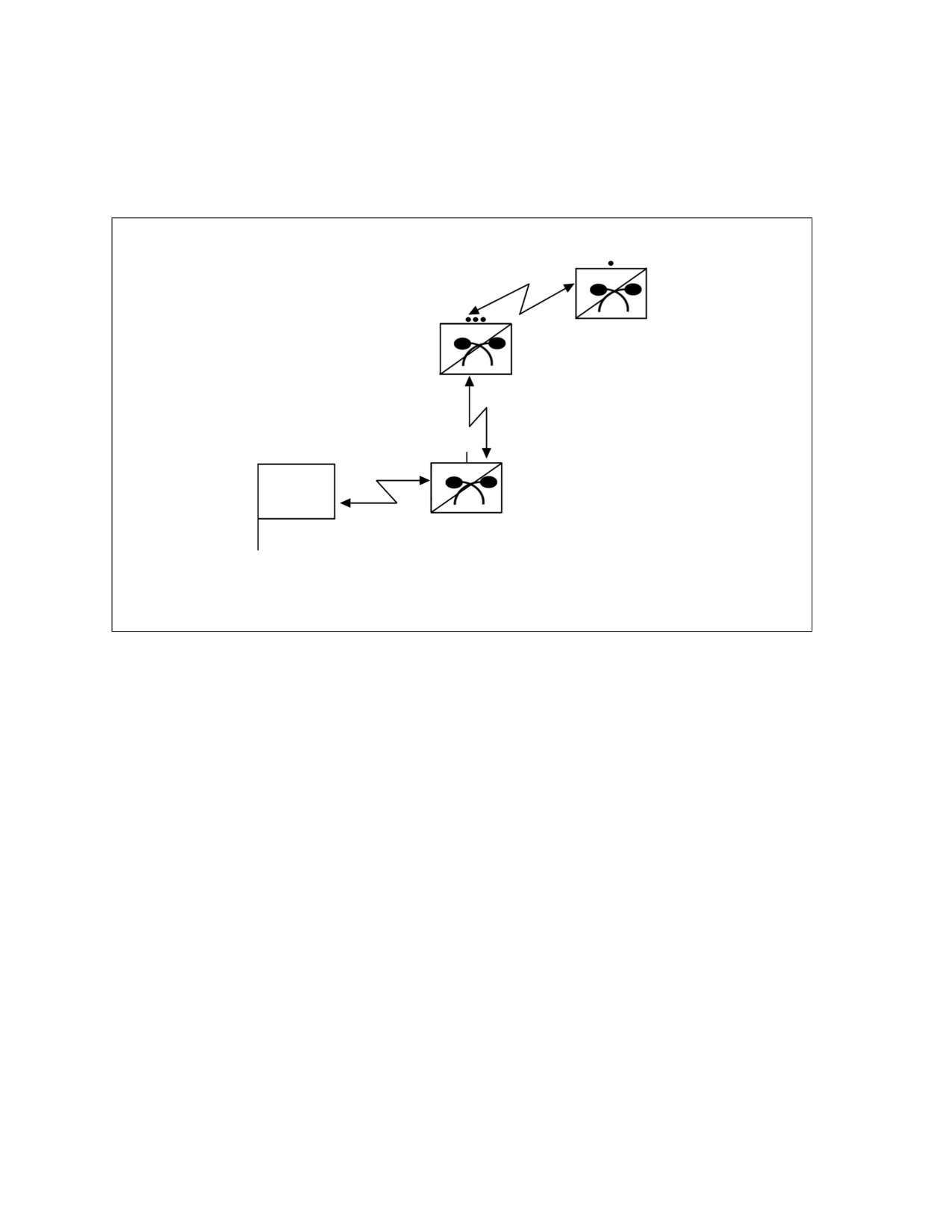
corps chemical battle staff may have a subscriber access node that
allows them to speak directly to the biological-detection company.
(3) Figures I-5 through I-7 provide graphical representations of the
communications architecture for biological-detection units.
B
X7
HF (O&I)
B
HF (O&I)
XXX
MAIN
B
HARDWIRED
OR MSRT (O/I)
Figure I-5. HF Network
d. Force XXI Battle Command Brigade and Below (for M31A2 Units Only).
(1) FBCB2 integration. FBCB2 is an additional communications capability
for M31A2 units. The FBCB2 system exchanges position locations, spot reports,
biological-incident reports, and SITREPs. FBCB2 software is presently found in
hardware in other platforms including combat vehicles, HMMWVs, and C2 operations
centers. FBCB2 software is also embedded in new combat vehicle upgrades and C2
components of the Army Tactical Command and Control System.
(2) FBCB2 Message Protocols. FBCB2 uses the joint variable message format
message set and the new military standard (MIL-STD) 188-220(A) message protocol.
Although designed primarily for use at the battalion, company, and below, there is
overlap through use of the embedded command interface between the Maneuver Control
System (MCS) and FBCB2, thereby closing the communications seam.
(3) Functional description. FBCB2 hardware is a militarized computer
communications capability. FBCB2 is connected to a positioning and navigation device,
for example, GPS and other embedded platform interfaces such as the Battlefield
Combat Identification System. These interfaces enhance the capability of FBCB2 to
provide relevant information to commanders, staffs, units, and soldier and/or weapon
platforms.
I-28
MSE (MSRT)
B
XX
X5
MAIN
HARDWIRED
OR MSRT
MSRT (ADMIN LOG)
XXX
MAIN
B
X
HARDWIRED
OR MSRT
LRBSDS
SUPPORT
Figure I-6. MSE Network
B
X7
B
XX
X5
MAIN
XXX
MAIN
B
X
VHF (SINCGARS) IS PRIMARY ADMIN/LOG
LRBSDS
NETWORK
SUPPORT
Figure I-7. VHF Network for M31, M31A1, and M31A2 and FBCB2 for M31A2 Only
(4) Employment.
(a) FBCB2 provides interoperability for the exchange of information
with other Army Battle Command Systems over a tactical network. For example,
I-29
biological-detection teams digitally submit biological-incident reports to the biological-
detection platoon using preformatted free message text reports (Figure I-8). The
biological-detection platoon receives, consolidates, and evaluates the incoming reports
and prepares and forwards an NBC-1 (BIO) report. The digitized message saves the time
required for voice communication.
BIDS Number: ___________________________
Sample Identification Number (19 Digits) : ______________________
1.
Detection time
a.
DTG
b.
Background sample
c.
Command directed sample
2.
Meteorological data
a.
Elevation
b.
Direction
c.
Wind speed
d.
Temperature
e.
Relative humidity
3.
Identification
a.
DTG
b.
Agent code
c.
Negative
4.
Mode of operation
a.
Standard
b.
Single sample
c.
Periodic
d.
Degraded
e.
Extreme cold
Figure I-8. Sample FBCB2 Free Message Text for Biological-Incident Reports
(b) FBCB2 supports the biological-detection company and platoon with
seamless C2 capabilities through interfaces with other Army and joint C2 HQ.
Communications planning identifies whether the M31A2 digitized reporting capability is
compatible with the supporting and supported unit. These capabilities allow the user to
send and receive C2 information horizontally and vertically across the AO irrespective of
task organization. FBCB2 facilitates a flow of communications that effectively supports
the synchronization of close combat operations.
(c) FBCB2 provides support for the following functional areas:
situational understanding, battle command, communications management, and
connectivity with other units.
(5) FBCB2 capabilities.
I-30
(a) FBCB2 capabilities provide the biological-detection team, platoon,
and company with the ability to create a common tactical picture that includes mapping,
maneuver, weather, CSS, intelligence, air defense, and fire support features. There is
applicability in each of these domains (for example, weather and mapping) for biological-
detection unit operations. For example, FBCB2 provides—
z
A visual image of the AO showing unit locations and the
location of the surrounding FBCB2 equipped systems. The
FBCB2 system provides each echelon with SA of the
battlespace, two echelons up and down, and units on the right
and left.
z
The automatic display of SA data, maps, grids, and overlays (for
example, the identification of friendly units, own unit, threat
units, fire plans, routes, unknown units, and obstacles).
z
Micrometeorological weather data for other locations within the
AO.
z
Visual imagery of digital maps to support biological-detection
site selection for primary, alternate, and supplemental sites.
z
Information on friendly force NAIs.
z
Available information on threat locations and the threat status.
z
Information on friendly force intent and locations to support
current and future operations.
z
Information on the air defense umbrella.
z
A capability to identify routes of march and movement times
between points.
z
Precise lightweight GPS receiver (PLGR) location (the PLGR is
connected to the FBCB2 through a serial interface).
(b)
Battle command provides—
z
The capability for the biological-detection company or platoon to
send and receive orders and the attached graphical overlays (for
example, sending the biological-employment plan overlay to
higher HQ or subordinate biological-detection teams).
z
The capability to forward biological-detection reports digitally
from the biological-detection team to the biological-detection
platoon or company; thereby saving the time required to
transmit the reports via voice.
NOTE: The capability to transmit reports will be
dependent on the range of the communications system
used (for example, HF or FBCB2).
z
An enhanced capability to track multiple biological events
graphically at different levels of command.
z
A capability to respond to emergency situations (such as a
request for medical evacuation [MEDEVAC] or calls for fire).
I-31