FM 3-11.86 MULTISERVICE TACTICS, TECHNIQUES, AND PROCEDURES FOR BIOLOGICAL SURVEILLANCE (OCTOBER 2004) - page 3
Environmental sample
Clinical specimen
(food or PVNTMED)
FSMC with minimal lab
Sample courier
CSH lab—Level A
Food—JBAIDS
PVNTMED—JBAIDS
CSH or microlab with
JBAIDS—Level A
Tech escort courier
Tech escort courier
Army medical laboratory (with
JBAIDS)—Level B/C
Tech escort courier
CONUS
lab
Figure B-1. Field Confirmatory Testing
Level D labs
D—CDC, USAMRIID; high-level molecular
BSL-4
characterization
Level C labs
C—State PHL, some MEDCENs, TAML;
BSL-3
molecular assays, reference capacity
Level B labs
B—Local PHL, MEDCENs, TAML,
BSL-2/3
forward-deployable preventive
medicine unit; confirm ID
Level A labs
BSL-2
A—Routine medical department
activity/CSH lab; presumptive ID
Front-line screening
Not part of Laboratory Response Network—front-line screening (PVNTMED
det, veterinary food inspection, BIDS)—sample collection and screening tests.
Figure B-2. Laboratory Response Network Structure
B-5
Appendix C
BIOLOGICAL-COLLECTION AND -DETECTION CAPABILITIES
AND LIMITATIONS
1.
Background
biological-point detection and -collection capabilities provide commanders with
critical SA information. This appendix provides information on detector and sampling
capabilities.
2.
Joint Portal Shield
a. The Joint Portal Shield network provides a capability to alert, collect, identify,
and warn commanders and the site populace of biological attacks. Upon detection, the
system provides automatic warning to active and passive command post (CP) computers.
b.
The Joint Portal Shield network is typically a suite of 10 to 24 detectors with
hardwired electricity and communications with radio frequency (RF) backup. The Joint
Portal Shield consists of a particle counter (aerodynamic particle sizer) and cyclone
sampler. The suite of components includes the following:
z
Global positioning system (GPS) and weather station.
z
Central processing unit (CPU) and radio modem data management. The
CPU controls the hardware associated with the system and compiles and
stores historical data from the detector.
z
Automated warning and reporting and downwind hazard prediction. The
The Joint Portal Shield network is capable of providing an automated
warning of a biological-agent release directly to a computer in the
OPCEN.
z
Environmental control unit (ECU). An ECU keeps the components, to
include the internal computer, cool.
z
Computer control component. The computer is a standard, commercial
off-the-shelf (COTS) high-speed personal computer (PC) with a dedicated
monitor and printer. The computer contains Joint Portal Shield network-
unique software that will generate system status and alarm data (visual
and audible) on the PC. The system software is also ATP-45 compatible
and can automatically prepare properly formatted NBC reports.
(1) The number of sensors employed at each site will depend largely on the
size of the installation and the shape of its perimeter. The sensors will be positioned at
stationary, presurveyed locations around an AB or seaport perimeter. The Joint Portal
Shield network allows the operator to configure the network by selectively activating
those sensors that are appropriate for the current BW threat. Additionally, individual
sensors, designated by the operator to be part of the network, can be further
programmed to operate in either an unarmed or armed mode. Unarmed sensors only
monitor the atmosphere for a rise in the particle count. If an airborne particle rise is
detected, the sensor will not collect a wet sample. Unarmed sensors will not collect wet
C-1
samples and will not inject a portion of the wet sample for testing. Armed sensors
perform surveillance and wet sample collection functions and, when conditions warrant,
they will accept a command from the computer to inject and test the wet sample.
(2) Tailoring the network is highly suited for accommodating changes in the
threat between operations during daylight and periods of darkness. Since BW attacks
are less likely to occur during daylight hours, the network may be configured to include
most upwind sensors—half of them armed with the remaining half unarmed—and some
downwind sensors, most in the unarmed mode. Because BW attacks are more likely
during hours of darkness, the number of active and armed sensors on the upwind and
downwind sides of the perimeter should be increased. The ability to tailor the net and
operating status of each sensor extends component life, minimizes operator maintenance
requirements, and reduces the consumption of expendable materials.
(3) Three network operating logic modes are available. They are the smart,
random, and manual modes. The computer logic that dictates sensor activity in the
smart and random modes is related to meteorological conditions and is intended for use
during high and low threat periods, respectively. The network logic should be set to the
smart mode when wind conditions are favorable for a BW attack. When in the smart
mode, all sensors that are designated as part of the network should be armed. The
random mode is desirable for periods when the wind speed is unfavorable or marginal for
a BW attack. In the manual mode, the operator initiates the sampling sequence. Because
of the reduced threat of a BW attack, some active sensors may be unarmed.
c.
The Joint Portal Shield network is capable of monitoring the local atmosphere
and testing samples for the presence of eight different biological agents simultaneously.
The eight agents that the system is set to monitor and test for are selected from a larger
menu of possible agents (the list of specific agents that can be detected is classified). The
selection of specific biological agents for monitoring is a command decision and will be
based on AOR threat information that is provided to the installation commander by the
medical and operational intelligence communities.
d. The Joint Portal Shield network accomplishes biological detection by injecting
a small amount of a wet sample that is suspected of containing a BW agent onto its
immunoassay optical ticket reader. The sensor contains immunoassay tickets that react
to BW agents. The Joint Portal Shield network sensors also incorporates a computer and
a built-in communications capability. All active sensors continuously report their status
and activities to the CP computer. The computer continuously analyzes all reported data
received from the sensors. Once the system has advanced to the network activation
stage, the computer will direct all triggered sensors to initiate wet sample testing for the
presence of BW agents. The Joint Portal Shield network alerting, sampling, identifying,
and reporting process parallels the process used by the BIDS (see Appendix I).
3.
Biological Integrated Detection System
a.
The BIDS provides the capability to alert, detect, collect, and identify BW
agents. It is a biological-detection asset designed for defense against a long line source
BW attack. BIDS units are operational level-of-war assets. The unit is optimally
deployed as a company-sized asset; however, platoon-sized deployments (with supporting
CSS, including CLS) can be planned and executed. BIDS units can be placed throughout
the AO to create a wide-area sensor array or network. Any presumptive identification is
reported directly to the operational-level commander. The operational-level commander
C-2

and staff then determine if a BW attack has taken place (as opposed to the single system
alert being due to local fluctuations—a false positive). If the determination is that an
attack has occurred, then appropriate warning and postattack actions are executed. The
BIDS functions are described in Appendix I.
b.
The BIDS consists of a shelter (S-788 lightweight multipurpose shelter)
mounted on a dedicated vehicle (high mobility multipurpose wheeled vehicle
[HMMWV]). It is equipped with a biological-detection suite employing complementary
technologies to detect large-area biological attacks.
(1) The system is capable of generating its own electrical power. To ensure
uninterrupted operation for at least 3 days, the complete BIDS system also includes a
second HMMWV that is used as a support vehicle (to carry spares and repair parts and
to courier suspect samples to a collection point). It also carries two of the BIDS four-man
crew.
(2) While each individual BIDS system is robust in itself, the fact that so few
systems are used to monitor large areas means that localized, point BW attacks may go
undetected. Several BIDS can be employed at a single high-priority site to provide
coverage of that site. There are currently three versions of BIDS in the USA inventory:
the M31, M31A1, and M31A2.
c.
See Appendix I for a description of system capabilities and operations. The
BIDS detection process includes monitoring, alerting, sampling, collecting, identifying,
and reporting (see Table C-1).
Table C-1. BIDS Comparison
Monitoring
Alerting
Sampling
Identifying
Reporting
Determines if an
Determines if
The sample
Determines the
The time range for
increase in the
aerosol particles
collector is
presumptive
reporting
number of
contain biological
automatically
identification of
presumptive
particles within
material. Detection
activated.
up to ten
identification is
a certain size
is based on single
preselected
18 minutes. Data
M31A2
range occurs.
component, rather
BW agents.
recording and
than multiple
display and
components as in
formatting to a
the M31/M31A1.
NBC report is
automated.
Determines
Determines with
The biological
Determines the
The time range for
whether
greater sensitivity
and liquid
presumptive
reporting
biological mass
than the M31 if
sampler is
identification of
presumptive
is present within
aerosol particles
automatically
up to eight
identification is
M31A1
aerosol
contain biological
activated.
preselected
18-25 minutes.
particles of a
material—cells,
BW agents.
The recording and
certain size
spores, or toxins.
display of data is
range.
automated.
Determines if an
Determines if
The biological
Determines the
The time range of
increase in the
aerosol particles
and liquid
presumptive
reporting
number of
contain biological
sampler is
identification of
presumptive
M31
particles within
material—cells,
manually
four to eight
identification is
a certain size
spores.
activated.
BW agents.
30-40 minutes.
range occurs.
The recording of
data is manual.
C-3
4.
Joint Biological Point Detection System, Fixed-Site or Trailer-Mounted
Version
The trailer-mounted JBPDS provides an alert, collection, and identification
capability. A designated prime mover tows the two-wheeled trailer. It can be transported
by the landing craft air cushion (LCAC). The trailer has the following components
mounted on its platform: basic biological suite unit, ECU, 2-kilowatt tactical quiet
generator, two 20-liter diesel fuel cans, stowage boxes, and a ladder. Power is supplied to
the system by the generator. Public utility power can also be used to supply power to the
system. The trailer-mounted JBPDS is essentially a man-portable JPBDS that has been
modified for trailer mounting. The trailer-mounted JBPDS is mounted on a modified
M116A3 trailer chassis. The fully integrated system consists of the JBPDS, shock
isolators, government-furnished equipment [GFE] components, cabling, and integration
hardware mounted on an M116A3 chassis.
5.
Long-Range Biological Standoff Detection System
a.
LRBSDS capabilities include being able to discriminate between man-made
and naturally occurring clouds in the atmosphere. See Appendix H.
b.
Just as many military systems employ the concept of defense-in-depth,
biological detection can be viewed as providing detection at different physical and
operational levels. In this context, the LRBSDS performs at the outer edge of the
detection environment, providing perhaps the earliest detection of a possible biological
attack. As an operational-level asset, the LRBSDS is flown as close to the forward line of
own troops (FLOT) as is safe and practical—the system is designed to be flown in a
utility helicopter; specifically, the UH-60. The long range of the system (30 kilometers or
more) allows detection of long line source attacks before the suspected agent has reached
and affected US forces, preventing what could be a substantial negation of US military
capability.
c.
The LRBSDS only warns that it has detected a man-made aerosol cloud; it
cannot determine if that cloud contains biological material. Other systems, such as the
BIDS, will be required to actually determine that there is an agent present once the
cloud reaches US forces.
6.
Maritime Biological Agent Detection Capabilities
a.
The shipboard JBPDS provides a capability to alert, collect, and identify
biological agents to support maritime operations. The first two components of the JBPDS
continuously monitor the air for a significant rise in particulate concentrations and/or
biological mass. If a significant rise over the background is detected, the instruments will
automatically collect an aerosol sample and alert the ship damage control center (DCC)
of the need to collect the sample and screen it using a handheld assay for a possible
presumptive identification. Positive presumptive identification results from the IBADS
and/or JBPDS providing a high-confidence result.
b. The maritime JBPDS detects and identifies BW agents. It contains or connects
to navigation, meteorological, and communications equipment that is used to identify the
location and sense the conditions under which the agent was detected. The maritime
JBPDS has the ability to detect and identify up to ten BW agents (for example, bacteria,
C-4

rickettsia, viruses, and toxins) during a mission. BW agent identification is limited only
by the available agent reactive assay strips housed within the identifier. It provides the
ability to collect and save BW agent samples for later lab analysis. The JBPDS consists
of the basic biological suite unit and a power pack.
c.
The maritime JBPDS provides the capability to monitor the ambient air for the
presence of BW agents. It is employed to provide presumptive identification support to
the commander and alerting, collecting, identifying, and reporting capabilities.
7.
Dry Filter Unit
a. The dry filter unit 2000 provides the commander with a capability for
biological sampling. This system, complemented by handheld assays, provides the
command with a manual presumptive identification capability for the analysis of the
samples. See Table C-2.
Table C-2. Dry Filter Unit 2000 Functions
Collecting
Identifying
Reporting
Dry Filter Unit 2000
Collects a sample at a
Determines the
The time range for the
prescribed interval.
presumptive
reporting of presumptive
identification based on a
identification is 18-20
manual handheld assay.
minutes following
collection of the sample.
NOTE: The dry filter unit has no trigger.
b.
The dry filter unit 2000 consists of a dry filter unit 1000 air sampler, outer
shelter, and preseparator. The system uses commercial power but comes equipped with a
generator that has automatic-start capability to change power sources in case of a
commercial power failure.
c.
The capabilities of the dry filter unit 2000 include—
z
biological-air sampling.
z
Collection and concentration of biological-particulate matter from the air.
z
A collection time of 1 to 8 hours.
z
Presumptive identification of BW agents. The filter is placed into the
buffer solution, shaken to extract particles, and analyzed using a
handheld assay.
z
Simple operation and maintenance.
z
Contained within a shelter for use in harsh exterior climates.
z
Exclusion of large particles and rain from the filters (via preseparator).
d. The dry filter unit 2000 collects particles from the ambient air for analysis. It
is a continuous sampler that collects and traps airborne particles onto a filter for later
extraction and analysis. Testing may be performed through antibody-antigen analysis,
such as with handheld assays. The dry filter unit 2000 requires minimal training and
maintenance. Operations are simple and require very little time. When deployed with
handheld assays and dry filter unit consumable kits, the dry filter unit 2000 becomes
both a biological-sampling and a presumptive identification system.
C-5

e.
The dry filter unit sampling and identification process (capabilities) consists of
collecting, identifying, reporting, and packaging the sample. See Table C-3 for process
information.
Table C-3. Dry Filter Unit 2000 Biological-Detection Process
Mission Essential Task
Product(s)
Collecting
Physical sample for analysis
Identifying
Presumptive identification
Reporting
Incident report
Evacuating
Confirmatory identification
(1) Collecting. The decision to conduct dry filter unit 2000 sampling
operations is made by the commander with input from his NBC, intelligence, medical,
and FP staff.
(2) Identifying. Manual presumptive identification, using handheld assays
and samples collected by the dry filter unit 2000, is conducted at intervals established by
the commander or his designated representative (for example, the FP officer).
(3) Reporting. The dry filter unit 2000 provides information based on the
results from the handheld-assay testing. The dry filter unit 2000 is deployed within an
installation. Communications linkages between the operators conducting the handheld-
assay testing and the installation OPCEN allow critical BW agent identification
information to support the commander’s SA.
(4) Evacuating. Following presumptive identification, the installation
provides a FRAGORD, when applicable, for sample evacuation. This FRAGORD directs
when to evacuate the collected sample or samples, the sample transfer point location,
specific identification of the receiving courier team, and a not later than (NLT) time to
link up with the escort team at the sample transfer point.
8.
Department of Defense Biological Sampling Kit
a.
The DOD biological sampling kit capability provides a presumptive
identification capability for areas suspected of being contaminated with BW agents. The
kits include all the necessary components to acquire a sample and provide presumptive
identification. The basic functions of the kit include collecting, identifying, and reporting.
b.
The DOD biological sampling kit is a single-use package containing the
handheld-assay sampling panel and all the supporting supplies to collect and process
suspect samples. Each kit holds up to eight handheld assays, phosphate-buffered saline
solution in a dropper bottle, two sterile cotton-tipped swabs, directions for use, and a
blue-capped 50-milliliter conical tube.
c.
The DOD biological sampling kit provides a capability to test areas suspected
of being contaminated with BW agents on a surface that is conducive to testing. The
handheld assays are designed to identify a limited list of biological agents from relatively
clean, nonporous surfaces. The handheld assay is not designed for soil, skin, wood, food,
or water sampling and is not for diagnostic use.
C-6
d. The DOD biological sampling kit and its associated handheld assays are
employed for—
z
Field-screening suspect munitions.
z
Munitions fragments.
z
Suspicious liquids.
z
Powders (or suspensions).
z
Terrorist labs or weapons materials that might be associated with the
manufacture or delivery of BW agents.
z
Reconnaissance of indoor or outdoor surfaces where it is suspected that
BW agents were released in fairly high concentrations.
e.
The DOD biological sampling kit sampling and identification process consists
of—
z
Sampling. The decision to conduct sampling is made by the commander
with input from the NBC, intelligence, and medical staffs and NBC
reconnaissance or explosive ordnance disposal (EOD) teams.
z
Identifying. The sampling team conducts manual presumptive
identification on completion of the sampling.
z
Reporting. The results of the presumptive identification process are
reported by the sampling team to the controlling OPCEN (for example,
the NBC control center).
z
Packaging. The sampling team ensures that sample are packaged
according to Appendix G.
z
Evacuating. Following a presumptive identification, the installation
provides a FRAGORD, when applicable, for sample evacuation. The
FRAGORD directs when and where to evacuate the sample.
9.
Common Limitation
a.
Each of the systems and the kit described in this appendix use immunoassay
technology to presumptively identify BW agents. This technology has limitations.
Handheld assays are not designed to be the sole method of identification, but are part of
a layered defense capability using follow-on lab assets to perform definitive or
confirmatory identification of the agent. Handheld-assay limitations include the
following.
(1) Handheld assays should not be used where there might be extremely high
concentrations of the agents. Clogging may occur during the assay and lead to an
inconclusive result.
(2) Handheld assays should not be removed from their foil packaging until
just prior to the assay. Additionally, do not use the handheld assay if the packaging has
been breached prior to testing. The handheld-assay membrane can absorb humidity from
the air and lead to an inconclusive test result.
(3) BW-aerosol concentrations might be below detectable limits for the
handheld assay, yet be above the infectious dosage. This could lead to false negative
C-7
results. Due to the limitations of the handheld assay, additional testing is always
necessary to assess an area as free of contamination from that BW agent.
b.
The handheld assay allows for presumptive identification only. Like all assays,
the handheld assay has a threshold of sensitivity—if the amount of the agent present is
below this concentration, the handheld assay will not detect it. Although the handheld
assay is sensitive, the infective dose for most pathogens is far lower than the sensitivity
of the handheld assay. Use of the handheld assays leads to presumptive identification
only (whether negative or positive) and must be confirmed by additional testing at a lab
using multiple microbiological methodologies.
C-8
Appendix D
BIOLOGICAL-DETECTION CONTRACTED LOGISTICS SUPPORT
1.
Background
Biological-detection assets use standard military support for supply and
maintenance; however, biological-detection assets often require the use of CLS as an
integrated element of their support and deployment package. Validated OPLANs and/or
OPORDs outlining the biological-detection logistics support concept and CLS must be
integrated into contingency planning. Logistics support planning must address CLS
considerations during mobilization, employment, and deployment. Planning also
addresses the contingency that multiple mission requirements will split biological-
detection operations into different theaters of operation, increasing risk and degrading
CLS support (the dilution of limited CLS assets).
2.
Principles
The use of CLS for military operations is governed by principles that emphasize
ensuring that a plan is executable from both an operational and a logistics perspective.
The following principles provide a framework for the use of CLS.
a.
Risk Assessment. Commanders must assess risk, evaluate factors (such as the
impact of the threat on contractor safety), and determine where CLS can safely operate.
The risk assessment identifies the survival training and equipment (for example, IPE)
that CLS will require during the assigned mission.
b. Force Structure Augmentation. CLS is an integral support requirement for
many biological-detection assets. CLS provides a force structure augmentation for
biological-detection units that may not be part of military core capabilities (for example,
a military unit may not be available to perform the required maintenance on biological-
detection suite components).
c.
Mission, Enemy, Terrain and Weather, Time, Troops Available, and Civilian.
METT-TC considerations help commanders and staff planners evaluate when and where
to use CLS. For example, the commander must consider the time required for CLS to
repair a component using a centrally located facility versus forward-deployed
maintenance contact teams. Additionally, commanders must consider other factors such
as the threat to operations involving low-density, highly skilled CLS technicians.
d. Integrated Planning. CLS leaders must participate in the logistics planning
process. CLS representatives must be present at planning sessions on the receipt of alert
directives or an OPLAN and/or OPORD. CLS representatives can provide useful input on
the logistics feasibility of COAs and the preparation of the administrative and/or logistics
annex to the OPLAN and/or OPORD.
e.
Customer Support. Links between the biological-detection unit and CLS must
not place additional burdens or requirements on the supported unit. CLS can use
whatever internal systems or procedures they choose; however, they must use the
military systems and procedures when interfacing with the military.
D-1
f.
International Agreements. International agreements and HN laws that apply
to the AO directly affect the use of CLS. Use of CLS may incur legal obligations to the
HN such as customs, taxes, vehicle registration and licensing, communications, support,
passports or restrictions, and inter- or intra-country travel. These agreements must be
considered when preparing contracts and OPLANs and/or OPORDs.
g.
Habitual Relationships. A habitual relationship is a long-term relationship
between CLS and the biological-detection asset. The nature of this relationship is
established through the terms and conditions of a contract and extends beyond that of
the organization to include the individual contractor, employee, and supported unit.
3.
Contracted Logistics Support Planning Considerations
Planning for CLS support is integral to any operation. Planning for an operation
involves several critical decisions concerning the integration of CLS capabilities. Key
CLS planning considerations are addressed in the following paragraphs.
a.
Responsibilities. Unit planning responsibilities ensure that the right resources
are deployed to support a mission.
b.
Operation Plan. The CSS sections of applicable OPLANs address the use and
employment of CLS. The level of detail in the OPLAN will vary depending on the level of
command.
c.
Risk Assessment. Risk assessment evaluates the ability of CLS to support
missions during the transition from peace to conflict. As mission requirements increase,
CLS must still respond with the same required support.
d. Responsiveness of Support. The nature of the operational environment (for
example, operations in multiple AOs and theaters of operation) may require the ability of
CLS to support deployed assets; however, uninterrupted sustainment support is still
required. CLS must be prepared to task-organize its assets to meet unanticipated
requirements.
e.
Transition From Peace to War. The risk of using CLS during peacetime is
normally low, increasing as operations transition from peace to war. The supported force
must protect CLS personnel in hostile areas, and the CLS contractor and his employees
must be trained and ready to operate and survive in an NBC environment.
f.
Communication Requirements. The CLS contract describes the scope of CLS
support. The contractor is not legally obligated to meet any requirement not in the
contract. Without a requirement specified in the contract, the government has no basis
for directing or requiring any contractor action. All requirements for CLS are
communicated to the contractor through the contract.
g.
Coordination Requirements.
(1) The supporting COCOM, the gaining COCOM, the biological-detection
unit, and CLS plan in coordination. CLS planning and coordination must address the
responsibility of the chain of command to feed, house, and protect contractor employees
operating on the battlefield. It must also include predeployment training and integrated,
time-phased force deployment planning.
(2) Within the scope of the existing contract, the major command contracting
office should appoint a task monitor. The appointed task monitor must be familiar with
D-2
CLS operations. Additionally, a CLS appointment letter will outline the task monitor’s
responsibilities. See paragraph 5 for information on task monitor responsibilities. The
task monitor must also be familiar with biological-detection operations.
(3) CLS must be attached to a military support element for functions such as
life support and personnel accountability. For example, the United States Army Materiel
Command logistics support element (LSE) would coordinate day-to-day life support
services for the CLS team; however, the LSE may not be within the AOR initially. In the
absence of the LSE, a designated unit such as a biological-detection company or a C2 HQ
element will coordinate the required life-support efforts for CLS personnel. A HN,
another service, or another Army unit could also furnish the actual life-support services.
Effective coordination and deployment planning ensures that deploying CLS teams
receive notification of deployment (concurrent with notification of biological-detection
assets) to allow CLS time to prepare for movement.
4.
Employment
Employment considerations include—
z
Obtaining information on the safety zone requirements. The safety zone is an
FP control measure for CLS operations. The boundaries are determined by the
COCOM, based on threat and mission considerations.
z
Locating CLS near the biological-detection assets C2 element.
z
Informing the gaining command of CLS facility requirements and conducting
coordination to ensure that required assets are furnished.
z
Locating CLS near main supply routes (MSRs), airfields, or ports of
debarkation (PODs) (air or sea) to facilitate the movement of supplies and
equipment.
z
Recognizing the requirement for permits or authorizations to move CLS teams
across international borders.
5.
Responsibilities
Managing and maintaining visibility over CLS requires the involvement of
commanders and their staffs at all levels. In planning and execution, responsibilities for
the integration of CLS range from the strategic to tactical level. It is necessary to ensure
that CLS is integrated into the decision-making process.
a. Supporting COCOM (Force Provider). The supporting combatant commander’s
responsibilities may include—
z
Providing the contracting officer for the CLS support effort.
z
Validating force requirements to support an OPLAN (ensure that
OPLANs address CLS requirements).
z
Preparing forces for commitment in support of OPLAN execution.
z
Coordinating movement with and deploying forces as scheduled by US
Transportation Command (USTRANSCOM).
D-3
z
Coordinating deployment changes with the supported COCOM and
USTRANSCOM.
z
Coordinating and supporting deployment requirements for biological-
detection and CLS assets.
z
Notifying the CLS contracting officer at the area contracting center on
deployment notification.
z
Designating installations (for example, Fort Benning, Georgia) as
mobilization stations for the execution of the mobilization mission
(receiving, processing, training, equipping, validating, and deploying CLS
personnel).
b.
Installation. Installation responsibilities can include supporting deployment
operations or supporting other personnel, medical, or logistics issues.
(1) For deployment, installations such as Fort Benning, Georgia, or Fort
Polk, Louisiana, may be designated as mobilization stations and aerial ports of
embarkation (APOEs). The primary responsibilities of the mobilization stations are to
receive, house, command, support, share assets, train, validate, and deploy biological-
detection units and CLS.
(2) Support from the installation can range from personnel, to medical, to
logistics issues. For example, the installation transportation officer may provide
guidance and help units prepare, maintain, and execute movement plans. They also
coordinate and monitor unit movement, provide assistance to units within or traversing
the installation support area, and coordinate commercial transportation support. They
prepare movement reports, process convoy clearances and special hauling permits, and
approve unit movement plans and associated data. Installation staffs should also be
responsible for physically processing military units and supporting biological-detection
CLS elements for deployment according to their readiness SOP. This support includes
conducting military and civilian readiness processing verification. This process can
include medical and dental processing, chemical defense equipment issue, and
organizational clothing and individual equipment issue.
c.
Continental United States Replacement Center.
(1) The CONUS Replacement Center (CRC) responsibility includes receiving,
processing, training, equipping, validating, deploying reserve soldiers and contract
civilians, and providing theater-specific equipment. The CRC coordinates equipping,
transporting, training, validating, and staging personnel for movement to a TO. The
CRC can also become a CONUS demobilization center upon redeployment. It receives,
out-processes, and accounts for individuals returning from the theater, to include
soldiers and civilians. Further, a military installation staff (supporting the CRC) will
physically process the military and civilian personnel. This includes functions such as
administration, soldier and civilian readiness processing, billeting, communications,
medical and dental support, organizational clothing and individual equipment issue, and
training.
(2) CRCs have responsibility for the following critical tasks:
z
Certifying military personnel and/or civilian contractor readiness-
processing qualifications.
D-4
z
Coordinating installation-processing requirements, when needed.
z
Coordinating the equipping of military personnel, government
civilians, and contract civilians.
z
Coordinating theater-specific briefings and training requirements.
z
Coordinating movement around the installation and to the port of
embarkation (POE).
z
Creating and providing manifests.
z
Coordinating out-processing procedures with the installation.
d. Gaining Combatant Command Responsibilities. The supported geographic
COCOM accomplishes key tasks that include—
z
Preparing operational plans that address CLS requirements. The OPLAN
has the time-phased force and deployment data (TPFDD), non-unit-
related cargo and personnel data, and movement data for the OPLAN.
The TPFDD includes integrated information for both the biological-
detection and CLS assets.
z
Providing facilities to support CLS requirements.
z
Requesting CLS capabilities and approving TPFDL requirements for the
biological-detection unit and their supporting CLS assets.
z
Ensuring the reception, staging, onward movement, and integration
(RSOI) of CLS assets.
e.
Service Component Commander. COCOMs may be forward-stationed or
CONUS-based. The service component develops the TPFDD and ensures that the
supporting plans are consistent with the unified commander’s OPLAN. The service
component is responsible for the following:
z
Developing supporting plans for OPLANs.
z
Training and preparing assigned forces for deployment.
z
Maintaining accurate unit movement data (UMD) for its assigned units.
z
Prescribing procedures, requirements, and responsibilities for deployment
planning and execution.
z
Coordinating deployment activities as scheduled by USTRANSCOM.
z
Planning and preparing to receive and support forces if deployed to its
AOs.
f.
Senior Theater Logistics Command. The senior theater logistics command is
responsible for synchronizing logistics and support operations, and for integrating CLS
into the overall support structure. The senior logistics command in the AOR assumes
responsibility for visibility of the CLS element in the theater, and maintains visibility
over who is in the theater, where they are operating, what support functions they are
performing, and when they provide support. The functions performed by the logistics
command are not related to contract compliance.
D-5
g.
Biological-Detection Assets. The biological-detection asset responsibilities can
include—
z
Coordinating FP for CLS assets.
z
Employing CLS capabilities.
z
Providing integrated unit and CLS movement data for submission to
support the TPFDL.
z
Coordinating the required life support for CLS during deployments.
z
Integrating CLS into readiness processing.
z
Offering training, as required.
z
Integrating CLS considerations and CLS team leaders into the
contingency planning process.
h. United States Transportation Command. The major transporter of CLS
equipment and supplies is USTRANSCOM and its transportation component
commands—Military Traffic Management Command (MTMC), Military Sealift
Command (MSC), and the Air Mobility Command (AMC). USTRANSCOM provides
strategic air, land, and sea transportation for biological-detection and CLS resources.
USTRANSCOM provides centralized global transportation management to ensure in-
transit asset visibility. USTRANSCOM assets support the biological-detection CLS effort
through the movement of CLS personnel and equipment, furnishing transportation
assets for resupply of consumables and line replacement units, and transporting CLS
assets between areas of responsibility, if required.
i.
Military Departments. Service departments support the geographic COCOMs
and/or JFCs through ensuring administrative and logistics support for COCOM and/or
JFC forces.
j.
Contracted Logistics Support Responsibilities.
(1) The CLS team provides system support for systems such as BIDS, Joint
Portal Shield, JBPDS, and LRBSDS. The CLS project manager supervises CLS team
activities and ensures that CLS elements are ready to support biological-detection unit
requirements.
(2) The CLS team has the overall responsibility for each aspect of the support
activity. These responsibilities include, but are not limited to the following:
z
Providing CLS planning for the supported unit.
z
Providing CLS load planning data to the supported unit and
establishing priorities for work accomplished.
z
Reviewing work and supply requests from the supply unit.
z
Managing and ensuring that CLS team personnel remain ready for
deployment (for example, monitoring training and medical and
dental requirements)
k. Contracting Officer’s Representative or Task Monitor.
(1) The contracting officer’s representative or task monitor is the contracting
officer’s designated representative who assists in the technical monitoring and
D-6
administration of a contract. The contracting officer’s representative is the link of the
supported unit to the contractor using the contract administration and management
process. This task monitor is designated, in writing, to perform the duties and
responsibilities delegated by the contracting officer.
(2) The contracting officer’s representative, administrative contracting
officer’s representative, or task monitor gives specific duties and responsibilities that are
delegated in writing by the contracting officer. Typically, a contracting officer’s
representative will be responsible for assisting the contracting officer in the following
areas:
z
Maintaining liaison and direct communications with both the
contractor and the contracting officer.
z
Monitoring the contractor’s performance, notifying the contracting
officer of deficiencies observed during surveillance, and
recommending appropriate corrective action.
z
Verifying that the contractor has performed the technical and
managerial requirements of the contract.
z
Performing all necessary inspections.
z
Verifying that the contractor has corrected all correctable
deficiencies.
z
Accepting supplies and services received (for the government).
(3) Although the contracting officer’s representatives provide a vital link
between the military and the contractor, there are certain limits to their authority. The
contracting officer’s representative, administrative contracting officer’s representative,
or task monitor is prohibited from—
z
Making any agreement with the contractor requiring the obligation
of public funds.
z
Making any commitments or changes that affect price, quality,
quantity, delivery, or other terms and conditions of the contract.
z
Discouraging the contractor from undertaking new work or
extending existing work beyond the contract period by words,
actions, or a failure to act.
z
Authorizing a contractor to obtain property for use under a contract.
z
Interfering with the contractor’s management prerogative by
“supervising” contractor employees or otherwise directing their work
efforts.
z
Modifying the tour of duty or hours.
(4) The task monitor’s responsibilities include—
z
Monitoring contract performance and notifying the contracting
officer’s representative of deficiencies observed during surveillance
(making recommendations).
z
Receiving feedback from the biological-detection and CLS leaders on
sustainment operations.
D-7
z
Coordinating with the CLS contractor on any changes in contract
requirements, if directed by the contracting officer and/or
contracting officer’s representative.
6.
Contracted Logistics Support Capabilities and Constraints
CLS requirements may include biological-detection systems specific maintenance
and/or supply support as required by the applicable contract. CLS requirements may
also include operating biological-detection equipment.
7.
Contracted Logistics Support Team Assessment
It is especially critical that CLS teams are responsive to short-notice deployment
requirements. The contracting officer and/or contracting officer’s representative may
assess the preparedness of CLS to respond.
a.
On receipt of notification of a requirement to deploy CLS, negotiation between
the CLS contractor and contracting officer results in agreement and/or certification that
the contractor will fulfill the requisite contractual requirements.
b.
Additionally, the contracting officer’s representative receives reports or
assessments from task monitors on the CLS team preparation for deployment. The task
monitor coordinates with units such as the on-site CLS team, the biological-detection
element, and applicable installation-level POCs. Examples of key information that the
task monitor may report during deployment processing include—
z
Satisfactory completion of readiness processing by CLS personnel, to
include required training.
z
Results of technical inspections of CLS vehicles.
z
The receipt of required organizational clothing and equipment (such as
protective masks and overgarments).
z
Completed packing of specified line replacement units, consumables,
spare parts, and other necessary items.
z
Responsiveness of CLS.
8.
Contracted Logistics Support Control
Planning for CLS addresses the military responsibility to feed, house, equip, and
protect contractor employees operating on the battlefield. It also includes predeployment
training and time-phased, force deployment planning. Overall, the CLS planning effort
must address the following considerations.
a. Command and Control. When coordinating CLS, the contract addresses the
relationship between the CLS team and support of the CLS team as a system contractor
to the military. This is a crucial point since commanders cannot order contractors to
provide services; they must use the contracting officer’s representative to direct work
within the scope of the existing contract. Additionally, the government CLS contracting
officer can appoint, in writing a military unit commander or his designated
representative as a task monitor. The task monitor has the authority to monitor CLS
operations. He provides general guidance and furnishes missions and priorities to the
D-8
supporting CLS team. The appointed task monitor should be familiar with biological-
detection CLS operations.
b.
Deployment of Contracted Logistics Support Personnel. The CLS personnel
will deploy in support of biological-detection unit operations. These deploying CLS teams
require early notification of deployment to allow adequate preparation time for
movement to become an integral part of the deployment package.
c.
Location on the Battlefield. Site determination of a CLS team requires the
consideration of several factors. Some of these include—
z
Geographical limits of the contractor safety zone and physical-security
requirements. The safety zone is an FP control measure for CLS
operations. The boundaries are determined by the COCOM, based on
threat and mission considerations.
z
The location of CLS teams near the biological-detection asset for
responsiveness, access to communications and biological-detection asset
logistics information, and daily coordination.
z
Facilities that support CLS supply and maintenance requirements (for
example, refrigeration support for selected supplies, power sources, and a
relatively dust-free environment).
z
The location of CLS teams near MSRs or PODs (air or sea) to expedite the
receipt or transport of supplies, components, or CLS teams to other
locations within or outside the theater.
z
Requirements to move CLS teams across international borders and the
corresponding requirements for permits and authorizations.
9.
Contracted Logistics Support Concept
a. Concept. CLS could range from maintenance and supply operations to
providing equipment operators for biological-detection systems.
b.
Maintenance Support.
(1) In general, military units are responsible for requesting, maintaining,
and turning in standard military issue equipment. This equipment includes items such
as generators, gas particulate filter units, vehicles, and radios.
(2) Military biological-detection asset leadership carefully analyzes
maintenance requirements with respect to movement and maintenance times for repair
versus replacement and evacuation of components. Unit leaders consider actions such as
establishing forward fixing points and weigh the travel and repair time for a contact
team at a forward fixing site versus the travel and repair times at a centralized location.
The biological-detection unit considers maintenance that may include repair by
replacement or repair forward.
(a) Repair by replacement. After troubleshooting fails to resolve the
problem, the biological-detection unit may request maintenance support. For example,
the biological-detection unit can remove the line replacement unit (enclosed in a carrying
case) for transport to the maintenance collection point or for a one-for-one, on-site swap
with a unit contact team. Alternatively, a military unit support crew could bring the line
replacement unit (with carrying case) to the detection site location and replace the line
D-9
replacement unit on site. Multiple options are available for the execution of repair by
replacement. Additionally, operational-readiness floats may be used when downtime
would degrade overall operational readiness to an unacceptable level and/or when repair
would exceed a specific time frame. Specific operational-readiness float procedures for
the issue and turn-in of components or systems will be outlined in unit SOPs. Repair by
replacement is generally the preferred option.
(b) Repair forward. The biological-detection unit, in coordination with
supporting CSS and CLS elements, designates forward fixing sites that are within the
safe zone and are secure. The forward fixing site is an intermediate point between the
biological-detection site and support elements for the repair and/or exchange of systems,
components, or consumables. Based on the assessment of repair requirements, a CSS
maintenance team may recommend the repair of the component at the CSS main
logistics support base.
c.
Supply Concept.
(1) Biological-detection teams require common, as well as unique supplies to
execute their missions. The unit requisitions unique supply items from the CLS supply
team based on standardized, onboard stockage levels and projected consumption rates
for current operations. The biological-detection unit in conjunction with the CLS
contractor, carefully plans and establishes CLS reorder points based on anticipated
supply transit times.
(2) Based on coordination between the CLS team leader and the biological-
detection unit, key leadership remains informed of key CLS logistics issues. To ensure
responsiveness, CLS prepares supply push packages. Daily coordination also helps
identify critical supply items that may require the biological-detection unit to establish
controlled supply rates. Alerting rear CLS to critical supply issues allows direct
coordination with the vendor for issue resolution.
(3) Resupply can be executed either on a centralized or decentralized basis
depending on METT-TC considerations. The biological-detection unit can pick up
supplies from a central supply point or supplies could be delivered to biological-detection
assets individually. Multiple factors will influence what resupply concept is used.
Factors to be considered include the location of the biological-detection element, location
of CLS supply points, urgency of a resupply requirement, and transport of supplies
across international borders.
d. System Operators. CLS may be required to provide operators for biological-
detection systems. The system operators are responsive to the supported unit. Factors
that are especially critical to CLS system operations include, but are not limited to,
ensuring the—
z
Requisite survival training and equipping (based on the risk assessment).
z
Uninterrupted continuity of operations.
z
Maintenance of operator-training proficiency.
D-10
Appendix E
BIOLOGICAL-COLLECTION AND -DETECTION SYSTEM
EMPLOYMENT
1.
Background
Biological detectors provide the commander with BW-collecting, sampling, and
presumptive identifying capabilities. The detectors provide a sample for presumptive
identification and follow-on analysis at higher-level labs. Biological detectors provide SA
and information (presumptive identification) that can be used to support detect-to-treat
decisions.
2.
Mission
Biological collectors and detectors are used to provide biological-detecting,
collecting, and presumptive identifying capabilities. They add to the commander’s total
chemical, biological, radiological, or nuclear (CBRN) common operational picture (COP).
3.
Concept of Operations
The employment of a biological-collection and -detection system is directly impacted
by the supported commander’s CONOPS. The CONOPS addresses preattack planning
along with during attack and postattack operations.
a.
Concept of Operations. Biological detectors should be used, operated,
maintained, and redeployed using a phased operation. The duration and implementation
of each of these phases is on order and therefore dependent on METT-TC considerations.
b.
Preattack. biological-surveillance CONOPS begins with the receipt of the
mission and guidance (see Figure E-1 [page E-2]). METT-TC considerations play a vital
role in establishing the CONOPS for biological surveillance. They are used throughout
the planning and development of the biological-surveillance plan. The preattack
CONOPS includes—
z
Conducting a BW-threat analysis. The BW-threat analysis is a
continual process of compiling and examining all available threat BW
information to identify the BW threat. This is done using the IPB process.
BW-threat analysis uses the best available information; however there
will be gaps in the overall intelligence and medical surveillance SA. The
complete picture (for example, did a BW attack occur or not occur) is a
composite of information from multiple sources.
z
Conducting a BW-vulnerability analysis. The BW-vulnerability
analysis is a continual process of compiling and examining information on
the BW-protective posture of a force or facility. It assesses the BW-
defense strengths and weaknesses of a force or facility BW-protective
posture. The NBC and medical planner analyze friendly-force BW-defense
preparedness, including the adequacy of individual and collective
E-1
Considerations:
Receive mission
METT-TC
and guidance
Conduct threat analysis
Conduct vulnerability
(IPB)
analysis
Classic agents/long line source
Treatments and prophylaxis
Unfavorable meteorological
available
Low conditions
Low
High protective posture
risk
NAIs not accessible to threat
risk
Detection capability/assets
activities
No indication of intent to deploy BW
agents
Treatments and prophylaxis not
Advanced agent development/point
available
release
Low protective posture
High
Favorable meteorological conditions
High
Little or no detection capability
risk
NAIs accessible to threat activities
risk
assets
Indication of intent to deploy BW
Poorly trained (for example, poor
agents
hygiene)
Conduct VA: develop overall
biological risk (low/medium/high/
extremely high)
Prepare a biological-surveillance plan
Develop an array plan
Identify warning triggers
Identify a warning
• Critical node; area
• Intelligence indicators
method
• Dice five, circle
• Detector results
• Centralized
• Security requirements
• Medical surveillance
• Decentralized
• Is the array logistically
supportable
No
Figure E-1. Biological-Surveillance Mission Planning—Preattack
E-2
Does the plan meet the commander’s intent and mission
requirements?
Yes
Identify decision points for:
• Changes to FP condition
• Medical actions (for
example, pretreatment)
Do the surveillance plan inputs support decision points?
Yes
No
Coordinate supporting plans
Adjust the array
• Medical surveillance
• Administrative/logistics plan
• Sample management plan
• Supporting or supported commander’s
OPLAN/OPORD
Figure E-1. Biological-Surveillance Mission Planning—Preattack (Continued)
protection and detection, medical, and decontamination resources against
possible BW releases.
z
Conducting BW-vulnerability assessment (VA). The BW-threat
analysis is compared with the BW-VA to create the NBC VA. The process
compares the BW threat with the force or facility ability to protect against
and/or reduce the threat of BW attacks. For example, if the BW-VA is
assessed as low, the biological-surveillance plan may direct that detectors
conduct collection operations in a standard mode (and thereby conserve
resources). Conversely, a high BW-VA will likely increase the number of
detectors used and lengthen the monitoring periods.
z
Preparing the biological-surveillance plan (including BW-
response planning). See paragraph 4 for information elements that
should be included in the plan.
c.
Attack and Postattack. The biological-surveillance CONOPS for conducting
during and postattack biological-surveillance operations (see Figure E-2 [page E-4])
includes—
z
Executing the biological-surveillance plan.
z
Maintaining SA.
z
Reassessing and adjusting as necessary.
E-3
Execute biological surveillance
• Analyze backgrounds
• Conduct surveillance operations
• Exercise proper quality control
No
Was there a BW event?
• Conduct a system-level analysis
• Conduct an array-level analysis
• Conduct an analysis of other
information (medical surveillance)
No
Yes
Does the input meet the decision point criteria?
No
Yes
Maintain SA
• Be prepared for
Execute the response plan (postattack)
additional attacks
• Conduct BW event-
tracking
• Continue BW
surveillance
Array
FP
Sampling
Warning
recovery
Reassess
• Conduct threat analysis
• Conduct vulnerability
analysis
• Conduct VA
• Adjust the plan as necessary
Figure E-2. Biological-Surveillance Mission Planning—Attack and Postattack
E-4
4.
Employment Considerations
Although some biological detectors provide the commander with the capability to
alert, sample, and even provide a presumptive identification capacity, not all deployed
systems have these functions. Dry filter units, for example, sample the particles present
in the nearby air and do not have an alerting capability. A dry filter unit is a continuous
collector that collects and traps airborne particles onto a filter at pre-established
intervals for manual presumptive identification.
a.
Biological detectors such as the JBPDS, Joint Portal Shield network, and BIDS
have both a monitoring and alert capability. These detectors collect particles from the
ambient air for analysis following an alert. Following the collection of the sample, these
systems begin the presumptive identification process.
b. The operational envelope for the use of biological detectors (such as
determining when or where to use detectors and/or collectors) is dependent on factors
such as system capabilities. As outlined in Chapter II, the operational envelope of some
systems is only applicable to fixed-site operations (for example, Joint Portal Shield
network, JBPDS [trailer-mounted and man-portable], or dry filter unit), while other
systems can be used to support maneuver land forces and/or maritime forces (for
example, BIDS and maritime dry filter units and JBPDS). BIDS units can be used for
fixed sites or to support maneuver forces. METT-TC factors will also impact where and
how detection and collection devices are used.
(1) Mission. Mission requirements will dictate where the detectors will be
employed.
(2) Enemy. Planners must consider threat capabilities such as the type of BW
agents that could be used and the method of dissemination (line or point source).
(a) Line source. The agent is disseminated along a line perpendicular to
the wind and upwind of the target. Example delivery systems include track-mounted
sprayers, aircraft sprayers, tanks, agricultural sprayers, or releases from ships.
(b) Point source. Agents are disseminated from single or multiple fixed
points. Example delivery systems include bombs, unitary missile warheads,
submunitions, fixed generators, or back sprayers.
(3) Terrain and weather. Planners remain aware that terrain and weather
conditions can impact biological-detection operations. A dirty environment may
adversely impact detector or sampler operations (for example, false positives on
handheld assays from nonspecific binding or a clogged detector filter). Additionally,
areas with high organic content in the ambient air may cause false positives during the
presumptive identification process. Other conditions such as sandstorms could also
degrade biological-detection operations (for example, the shutdown of alerting devices to
prevent damage to components).
(4) Troops available. The availability of a supporting lab, sample courier
assets, and CLS is critical for the support of biological-detector and -sampling systems.
Additionally, the use of systems such as the dry filter unit, Joint Portal Shield, and
JBPDS require deploying units to provide manpower and resources to conduct filter
collection and handheld-assay testing.
E-5
(5) Time available. Planners must consider time when employing detectors
and samplers. Detect-to-treat information may be especially critical if a fixed site has a
high throughput population. The fixed site may be an APOE, seaport of embarkation
(SPOE), APOD, or SPOD with a highly transient population. In this situation, the
frequency of sampling may need to be increased in order to limit the potential spread of a
biological agent by exposed personnel.
(6) Civilian. Planners consider and plan for the availability of civilian assets
such as CLS or the possibility of lab support from a civilian source (such as another
government agency).
c.
METT-TC factors are applied to achieve tradeoffs. Tradeoffs are necessary to
optimize the probability of detection for biological-detection surveillance support for
critical-nodes or area arrays.
(1) During planning for biological-surveillance operations, information such
as the following is used: the commander’s guidance, weather and terrain information,
intelligence information (such as agent types and the type of release), and the size of the
base or activity or the areas that require support. This information is used to produce the
biological-surveillance plan.
(2) The surveillance plan should include the—
z
BW-surveillance vulnerability analysis.
z
Meteorological assessment.
z
Recommended duration of operation for detectors and/or collectors.
z
Recommended mode of operation.
z
Separation distance between detectors and/or collectors.
z
Number of detectors required.
z
Detector array employment tactic (for example, dice five or line) and
the plan for siting systems (such as the distance from the perimeter
[critical node] or downwind distance from an estimated RP for a
biological agent [area array]).
z
Mission and the commander’s guidance and priorities (for example,
biological-detection array confidence results [medium or high])
would serve as input for triggering the commander’s decision.
(3) The commander approves the biological-surveillance plan. (See
paragraphs 5, 6, and 7 of this appendix.) Modifications to the plan may be required based
on changes in weather, the operational situation, or resource issues (such as equipment,
supply, or operator issues). There is risk associated with the implementation of a plan.
The commander uses other information sources (such as medical surveillance or
intelligence information) to maintain SA and to increase the confidence in an operational
assessment (to confirm or deny that a BW attack has occurred).
5.
Biological-Warfare Threat Analysis (Intelligence Preparation of the
Battlespace)
It is important to be aware of how the operational environment and meteorological
conditions affect biological-surveillance operations. The operational environment
E-6
(biological threat) and meteorological conditions will affect how often and how long
biological-detection and -sampling operations are conducted.
a.
BW-threat analysis is conducted to determine a recommended biological-threat
risk status—low, medium, or high (Figure E-3 [page E-8]). Risk assessments are
qualitative. The intelligence estimates are derived from the best available information,
and will likely not definitely answer intelligence IRs that may be on a checklist.
b.
Meteorological conditions are assessed.Meterorological conditions are assessed
to determine if weather conditions would be favorable for an enemy biological attack.
Stability, wind, direction, speed, turbulence, humidity, precipitation, heat, and cold are
factors that should be considered as part of the meteorological assessment.
(1) Table E-1 (page E-9) provides information on favorable, marginal, and
unfavorable conditions for BW-line source releases. Favorable conditions for line source
releases generally include the presence of stable meteorological conditions. Stable
conditions with accompanying winds support the wide-area dissemination of a BW
aerosol.
(2) Unstable meteorological conditions are more effective for dispersal of a
BW aerosol in a point attack. Unstable conditions provide the agitation that allows for a
wider dissemination of a BW agent on a target such as a fixed site. Conversely, stable
conditions during a BW attack would likely lead to thin, “cigar-shaped” cloud formations.
(3) Additionally, terrain features and man-made structures will cause a BW
aerosol to break up and increase the heterogeneous nature of the cloud. The
determination of cloud dynamics using dispersion models over terrain features and man-
made structures has yet to be fully realized.
6.
Duration and Modes of Operation for Biological Detection
The biological-surveillance plan should address the duration of the operation for the
detection and/or collection assets in the array. The surveillance plan will also indicate
the recommended mode of operation for the array.
a.
Comparison of threat and meteorological information provides input that can
be used to recommend the duration of the collection and/or detection intervals. For
example, during favorable conditions for threat BW use and high BW-risk conditions, the
commander may decide to conduct detection operations 24 hours per day, 7 days per
week (see Table E-2 [page E-9]).
(1) The recommended detection and/or collection intervals can be tailored for
specific locations and situations. For example, based on a low VA (such as peacetime
threat, FP conditions Alpha or Bravo), the commander may decide to use collection
system capabilities (dry filter units) and conserve assets that require more resources to
operate (biological-detection systems).
(2)
Risk is taken when BW-detection and -collection operations are not
conducted. However, the commander’s common operational pictures (COPs) (for
example, IPB and weather and terrain assessments) provide the basis for directing
detection and collection intervals.
E-7
Start here
Select YES if one or more of the subquestions
is answered yes.
Vulnerability reduction
Thread analysis
measures
1.
Ensure that immunizations are
Is the threat BW capable?
current.
Yes
No
2.
Maintain intelligence and
Is there a production capability?
passive data collection efforts.
Are there medical/pharmaceutical
3.
Maintain good personal
plants in country/theater?
hygiene.
Are there known agent stockages?
Low
Does the threat have BW-munition
4.
Maintain good area sanitation.
risk
plants?
5.
Ensure that MOPP gear is
readily available.
6.
Maintain physical conditioning.
Is the fixed site/unit within the
7.
Cover all supplies and
range of likely delivery
equipment.
systems?
Yes
No
8.
Know the threat/protective
measures.
—Aerial spray
—Aerial Bomb
—Artillery
—Missiles
9.
Use approved food/water/ice
—Rockets
—Mines
—Other
sources.
10.
Ensure that all defensive plans
include NBC defense measures.
Would the threat target the
unit doctrinally or as a possible
COA?
Yes
No
11.
Continue the steps above.
12.
Actively employ biological-
Are weather and terrain
Medium
detection capabilities.
favorable for employment?
risk
Yes
No
13.
Be alert to medical reports of an
unusual nature.
Is the threat trained and
14.
Be aware of threat activity
equipped to conduct BW
regarding BWs.
operations?
Yes
No
15.
Ensure that prophylaxis,
pretreatments, and
Does the threat have protective
immunizations are available for
masks and clothing readily
the known/suspected threat.
available?
Does the threat have
16.
Implement dispersal plans for
immunizations, prophylaxis,
personnel/supplies.
and pretreatements available?
17.
Continually monitor weather
conditions.
Have BW munitions been
18.
Assume the designated MOPP.
delivered to units?
High
Has probable use message
risk
traffic been intercepted?
Has the threat used BW
19.
Continue all the steps above.
weapons?
20.
Be prepared to transfer mission
functions to secondary
locations.
21.
Increase the MOPP level for
exposed personnel.
Assessment= ________ Risk
Figure E-3. Conducting BW-Threat Analysis (IPB)
E-8

Table E-1. Favorable, Marginal, or Unfavorable Meteorological Conditions for BW Line
Source Release
Meteorological
Unfavorable for BW
Favorable for BW Use
Marginal for BW Use
Conditions
Use
Wind speed at heights
9-15 kph
15-32 kph
Less than 9 or greater
below 16 meters
than 32 kph
Stability
Stable
Neutral
Unstable
Temperature
1-20°C
Less than 0 or 21-29°C
More than 30°C
Precipitation
None to very light
Light
Moderate to heavy
NOTE: Point dissemination can still be effective in less than favorable conditions.
Table E-2. Sample Duration Intervals for Biological Detection System or Collector
Operations
Low Risk (The threat has
Medium Risk (Intelli-
High Risk
the capability to employ
gence reports indi-
Wartime/Conflict
BW agents—peacetime
cate an increase in
(Hostilities have
threat—FP condition
the threat—FP condi-
begun)
Alpha or Bravo)
tion Charlie or Delta)
Meteorological
Day/night
Day/night
Day/night
conditions
Favorable for BW use
8 hours3/8 hours3
8 hours3/12 hours1
12 hours1/12 hours1
Marginal for BW use
4 hours3/8 hours3
8 hours3/8 hours3
8 hours1/12 hours1
Unfavorable for BW use
See 2
See 2/12 hours3
4 hours3/12 hours3
1 The biological detection system operates in standard mode.
2 The biological detectors of the array operate in standby mode. Based on notification that an attack is
imminent, the biological detectors of the array could be changed to standard mode.
3 The biological detectors or collectors of the array operate with a 4-hour collection interval.
b. The tailoring of the biological surveillance can also be applied to the mode of
operation of the array (for example, standard mode, single sample, collection only,
standby). System level technical publications (such as technical orders [TOs] and
technical manuals [TMs]) provide detailed information on the mode of operation for the
different detectors. The biological-detector mode of operation can be tailored based on the
operational situation. The modes of operation for a biological-detection system could be
adapted as follows:
z
Use the single-sample mode of operation to support specific requirements
such as taking a background sample to support environmental
characterization.
z
Use the collection capability of detectors during low-risk situations and
save considerable amounts of resources (such as consumables) that
otherwise would have been used during a standard mode of operation.
z
Use a periodic sampling mode based on an imminent threat (threat
missile is inbound or a BW cloud is expected to arrive at a certain time).
E-9
7.
Biological-Detection and/or -Collector Employment Tactics
The NBC staff recommends the employment of biological-surveillance assets. Many
factors impact employment, and the plan may be adjusted based on changes in the
weather, threat, and available assets. No employment tactic is 100-percent successful in
detecting and identifying a BW agent. For example, a terrorist could employ a single-
point source BW munition without the release being detected by a biological-detection
array. Factors that are considered in the employment of biological-surveillance assets
include:
z
Estimating separation distances between detectors and/or collectors at
critical nodes.
z
Estimating separation distances between detectors and/or collectors in
area arrays.
z
Recommending employment tactics for the detectors and/or collectors of
the array.
a. Critical-Node Separation Distances Between Collectors and/or Detectors. The
estimated separation distance between detectors or samplers will vary depending on
terrain and weather considerations; however, the following are suggested separation
distances.
(1) For on-target or near point source releases, the preferred distance
between detector and/or samplers is 200 to 400 meters. A 200- to 400-meter separation
distance is a general rule of thumb for the approximate cloud radius after cloud
dissemination.
(2) For line source releases, the distances between detectors and samplers
should not exceed 800 meters. The actual distance will be determined based on the
number of detectors or samplers available and the area to be covered.
b.
Area Array Separation Distances for Collectors and/or Detectors.
(1) Estimating line source separation distances for biological detectors in an
area array. The estimate associated with the separation distances considers the size (in
width) of the area to be protected, an estimate of the length of the line source, and the
number of detectors that should be in the cloud path to support BW event-tracking. For
example, if the width of the area to be protected equals approximately 60 kilometers, the
estimated length of a BW-line source is 20 kilometers, and the commander determines
that he wants two detectors intersecting with the cloud, a total of 7 detectors would be
required.
·
⎛width of sector being protected
number of detectors
⎞
number of
×
+
1=
⎝estimated length of line source
intersecting with the cloud⎠
detectors required
⎛60 km
⎞
×
2·
+
1
= 7 detectors
⎝20 km
⎠
(2) Locating biological-detection arrays downwind of the point of release of a
BW agent. As a general rule of thumb, a biological-detection array should be located
within 20 to 25 kilometers of the estimated RP of a BW agent to enable the detection of
this agent. Additionally, an aerially delivered BW agent aerosol may not reach near
E-10
ground level for 1 to 5 kilometers. The distance depends on the height of release, type of
aircraft, and wind speed. Also, a ground BW-point source will require 1 to 2 kilometers
before the aerosol begins to coalesce into an organized cloud.
c.
Biological-Detector Employment Tactics. The NBC staff will recommend a BW-
detector and -collection employment plan. The employment tactic for detectors and
collectors will be based on the capabilities and COE for the systems. For example,
detectors and collectors like the Joint Portal Shield, JBPDS (trailer-mounted and
man-portable), or dry filter unit are well suited for employment as point detectors or
collectors or a critical-node array at a fixed site. The specific employment tactics that
may be used will vary based on factors such as:
z
The BW-risk assessment and IPB (for example, the delivery system and
tactics for delivery).
z
Terrain and weather conditions.
z
The location and size of assigned NAIs.
z
The number of detection and/or collection assets that are available.
z
The commander’s guidance.
z
The desired confidence level to be achieved from the biological-detection
array.
(1) Dice Five. The dice five pattern of deployment refers to the deployment of
detectors or samplers in the pattern of the pips for the number 5 on a die. The dice five
array (Figure E-4 [page E-12]) is well suited for employing a detector or collector on an
APOD or SPOD (with one detector for each cardinal direction-north, south, east, and
west). Detectors or collectors could be shifted based on out-of-service detectors, weather
pattern shifts, or other METT-TC factors. The dice five tactic provides the most
flexibility and is particularly applicable for support of critical node (fixed site) or area
array operations. The dice five tactic is also adaptable to a varying number of detectors
or samplers (such as seven or nine detectors or samplers). This tactic provides depth to
an array (if an aerosol cloud misses one detector, another detection deeper in the array
should detect the cloud). A dice five tactic is a preferred tactic because in depth features
should increase the probability of detection.
(2) Circle. Employment of detectors or samplers in a circle configuration
provides 360° coverage. This tactic is effective when wind directions are constantly
changing. Figure E-5 (page E-12), provides an example of a circle employment of
samplers or detectors. The circle tactic is particularly applicable to critical-node
operations. However, this tactic could be resource-intensive (based on the size of the
base) and does not provide the depth of coverage provided by other tactics.
(3) Picket line. The picket line is designed to capture a BW-aerosol attack
coming from a specific direction. Ideally, it is placed upwind of friendly positions to
capture a line source attack. Figure E-6 (page E-12) is an example of a picket line
employment of detectors and collectors. The picket line tactic would be particularly
applicable for support of a maneuver land force; however, biological detectors may
require relocation if the wind direction shifts. This employment tactic provides no depth
to the array and has a limited application.
E-11
Figure E-4. Dice Five Array
Figure E-5. Circle Employment
Figure E-6. Picket Line Employment
E-12
(4) Semicircle. The semicircle employment of detectors and samplers provides
approximately 180-degree coverage. It is still directional in that it protects from an
upwind line source release, yet gives more coverage than a picket line and provides for
moderate wind direction changes. Figure E-7 provides an example of a semicircle
employment of detectors and collectors. The semicircle tactic could be used to support
fixed-site or maneuver forces; however, this tactic does not provide detectors in depth.
Figure E-7. Semicircle Employment
(5) Dense picket. The dense-picket employment of detectors and collectors
provides higher density coverage against line and point source attacks than the other
employment strategies. It is resource intensive and requires large amounts of detectors
and sensors. Figure E-8 provides an example of a dense picket employment of detectors
and collectors. The dense-picket tactic could be used for support of fixed site or maneuver
forces.
Figure E-8. Dense Picket Employment
8.
Preparing a Biological-Surveillance Plan
This paragraph provides two brief descriptions of sample biological-surveillance
plans. The NBC staff has only limited information for the two sample scenarios. The
sample scenarios indicate what tradeoffs were among METT-TC factors to increase the
probability of detection.
a.
Figure E-9 (page E-14), provides a notional setting for a JTF HQ in Northeast
Asia. Based on this setting, the NBC staff must prepare a biological-surveillance plan.
The NBC staff uses available information to proceed through the planning process.
E-13
1 km
400 m
400 m
400 m
400 m
JTF
400 m
400 m
200 m
400 m
400 m
400 m
400 m
400 m
Detector site
CLS main
Field confirmatory lab
The Setting
Biological-Surveillance Plan (Selected Elements)
Mission: Provide biological-surveillance
BW-Surveillance Risk Assessment: The risk assessment
support for the JTF HQ. Provide biological-
is rated as medium.
surveillance results with a high degree of
Meteorological Assessment: The weather conditions are
confidence. High confidence results may
considered favorable for the threat BW use.
trigger decisions for postattack medical
prophylaxis.
Duration of Operation: Operate detectors 12 hours during
the night and 8 hours during the day.
Enemy: The threat has a BW-point source
capability, air (air delivered missile capability).
Mode of Operation: Use the standard mode during night
A medium risk is assessed: FP condition
operations. Use a collection mode during day operations.
Charlie.
Separation Distances: Use a separation distance of 400 m
Terrain and Weather: Variable winds (6-12
between detectors.
kph); stable conditions; temperature 4°C;
Number of Systems Required: Planning assessed a
level terrain.
requirement for 16 detectors. (Based on a 250-m
Area: The JTF HQ occupies an area
separation; however, only 8 detectors were available.
approximately 1 km by 1 km.
Based on a limited number of detectors being available, a
tradeoff was made to increase the separation distance
Troops Available: 8 JBPDS (trailer-mounted
between detectors to 400 m.)
and man-portable)
Employment Tactic: A modified dice five employment
Time Available: Provide field confirmatory
tactic is used to provide in depth biological surveillance.
results prior to the onset of BW symptoms.
Commander’s Guidance: The recommended plan should
Civilian: CLS is collocated at the JTF HQ.
provide biological-surveillance results with a high degree of
confidence.
Figure E-9.
Critical-Node Array
E-14
z
The risk assessment for this OCONUS location is rated as medium (see
Figure E-3 [page E-8]).
The threat is BW capable.
The JTF HQ is within range of threat delivery systems.
The weather and terrain are favorable for BW employment.
z
Weather conditions are assessed as favorable for threat BW use (see
Table E-1 [page E-9]).
z
The schedule for biological-detection array operations establishes a
duration of 12 hours of monitoring during the night and 8 hours of
monitoring during the day (see Table E-2 [page E-9]).
z
A standard mode of operation is used during night operations and a
collection mode is used during the day.
z
An estimated separation distance of 400 meters between detectors is used
based on the threat point source capability (see paragraph 7a).
z
The NBC staff initially estimates a requirement for 16 biological detectors
(based on a separation distance of 250 meters); however, only 8 JBPDS
are available (see paragraph 7a).
z
A modified dice five employment tactic is recommended based on the
variable winds and the requirement for depth within the array.
Based on the 8 detectors being available, the separation distance
between systems is increased to 400 meters. The array in depth will
also be ready if there is a change in wind direction (see
paragraph 7a).
The modified dice five array provides an in depth detection
capability. If a heterogeneous BW-aerosol cloud misses one detector,
another detector should detect the cloud. If only one detector
provides a presumptive identification, other operational intelligence
and medical surveillance information would be assessed.
Additionally, if an upwind detector detects a cloud then downwind
detectors will be directed to conduct periodic monitoring (see
Chapter V, paragraph 6).
z
The NBC staff reviews the biological-surveillance plan to ensure that the
commander’s guidance is met. The commander wants a high-level of
confidence in the biological-surveillance plan. Based on the tradeoffs that
are made among the METT-TC factors, the biological-surveillance plan is
recommended for approval.
b.
Figure E-10 (page E-17), provides a notional setting for a US land force
conducting a combined arms exercise with a friendly nation. The combined forces operate
in an exercise area (20 by 30 kilometers) with an east and west orientation. The
international border is approximately 20 kilometers to the north. A belligerent nation
with a BW-line source capability lies to the north. The friendly nation land forces are
deployed near their northern border. One USA chemical company (biological detection), a
company HQ, and two platoons (14 BIDS total), are assigned a mission of providing
biological surveillance for the land forces operating within the exercise area. Based on
E-15
this setting, the NBC staff uses this limited information to prepare a biological-
surveillance plan.
z
The risk assessment for this OCONUS situation is assessed as medium
(see Figure E-3 [page E-8]).
The threat is BW capable.
Exercise land forces are within the potential downwind path of a
BW-aerosol cloud.
The weather and terrain are favorable for threat BW employment.
z
Weather conditions are assessed as favorable for threat BW use (see
Table E-1 [page E-9]).
z
The schedule for biological-detection array operations establishes a
duration of 12 hours of monitoring during the night and 12 hours of
monitoring during the day (see Table E-2 [page E-9]). Based on the risk
assessment and weather conditions, the extended schedule (24 hours per
day) of operation is recommended.
z
A standard mode of operation is used during night operations and a
collection mode is used during the day. Samples are collected twice (at
6-hour intervals) during the day.
z
Separation Distances.
To estimate the separation distance that will be used between
biological detectors, the NBC staff determines the width of the area
to be protected (30 kilometers). Coordination between NBC and
intelligence staff estimates that the possible length of a threat BW-
line source could range from 5 to 10 kilometers. To establish a high
degree of confidence in system-level results, the commander wants a
minimum of two detectors intersecting with the cloud.
·
⎛width of sector being protected
number of detectors
⎞
number of
×
+
1=
⎝estimated length of line source
intersecting with the cloud⎠
detectors required
⎛30 km
⎞
×
2·
+
1
= 13 detectors
⎝
5 km
⎠
Based on a 5- or 10-kilometer BW-line source distance, 13 or
7 detectors, respectively, would be required. A third calculation
using a line source distance of 7 kilometers indicates that 10
detectors would be required. To provide depth to the array, the NBC
planning uses an approximate 3-kilometer separation between
systems (see paragraph 7b).
The biological-detection array is placed within 20 to 25 kilometers of
the estimated RP for a threat BW-agent line source release.
z
Changes to the operational situation or the commander’s guidance could
increase or decrease the numbers of detectors required (for example, the
commander wants a minimum of three detectors intersecting with a BW
E-16
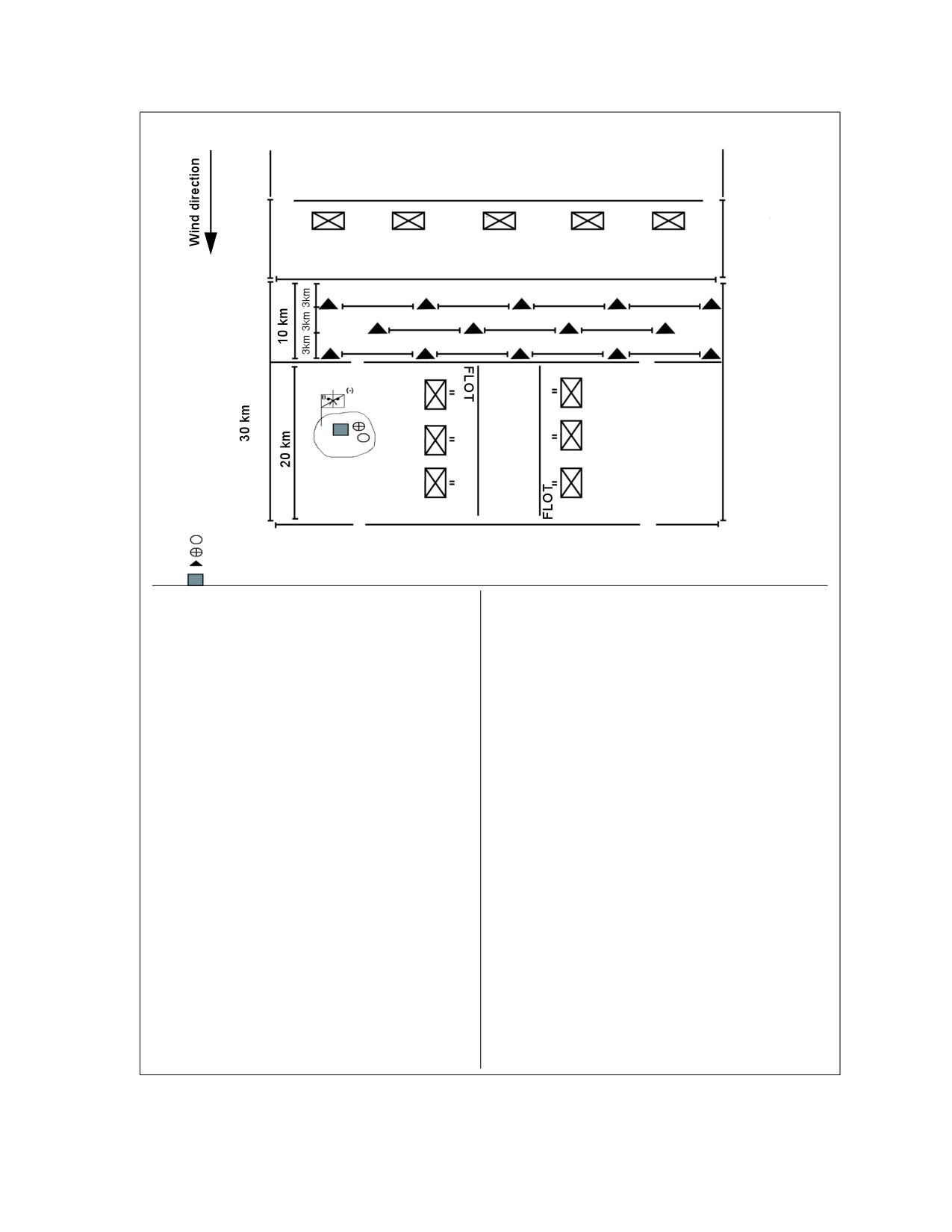
Belligerent Nation
IB
IB
10 km
10 km
30 km
Exercise area
7 km
7 km
7 km
7 km
7 km
7 km
7 km
7 km
7 km
7 km
7 km
X
X
30 km
LSA
X
X
Field confirmatory lab
Exercise area
Sample transfer point
30 km
Detector site
CLS main
The Setting
Biological-Surveillance Plan (Selected Elements)
Mission: Provide biological-surveillance support for
BW-Surveillance Risk Assessment: The risk
maneuver forces conducting combined arms
assessment is rated medium.
exercises. Based on the threat, the commander
Meteorological Assessment: The weather
wants a high degree of confidence in the biological-
conditions are assessed as favorable for threat BW
detection array results.
use.
Enemy: The threat has a ground point and line
Duration of Operation: The schedule indicates
source to employ spore-forming BW agents.
detectors should be operated 12 hours during the day
Terrain and Weather: Winds from the north (8-10
and 12 hours during the night.
kph); stable conditions; temperature 15°C; terrain is
Mode of Operation: A standard mode of operation is
grassy with gently rolling hills. Meteorological
used during night operations. A collection mode is
conditions are generally stable during the night and
used during day operations.
unstable to marginal during the day. The exercise
area is approximately 20 km by 30 km. It is
Separation Distances: A separation distance of 7 km
approximately 20 km from the international border to
between detectors is established.
the exercise area.
Number of Systems Required: The NBC staff
Troops and Support Available: 2 USA biological-
recommends that all 14 detectors be employed within
detection platoons (14 BIDS total) and the company
the array.
HQ (M31A2 equipped).
Employment Tactic: A modified dice five
Time Available: Provide field confirmatory results
employment tactic is used to provide in depth
from the lab prior to the anticipated onset of agent
biological surveillance.
symptoms.
Commander’s Guidance: The recommended plan
Civilian: CLS assets have movement restrictions.
should provide biological-surveillance results with a
Based on the FP situation, CLS must operate from
high degree of confidence.
the logistics support area SA.
Figure E-10. Area Array Support
E-17
cloud to increase the level of confidence). However, based on the current
situation, the NBC staff recommends using 14 detectors.
z
A modified dice five employment tactic provides an in-depth biological-
detection capability. If a heterogeneous BW-aerosol cloud misses one
detector, another detector should detect the cloud. Coordination between
the intelligence and NBC staff assessed that a threat BW-line source
attack would likely be a minimum of 5 to 10 kilometers in length. Based
on this assessment, two or more detectors should be in the path of a BW
aerosol.
z
The NBC staff reviews the biological-surveillance plan to ensure that the
commander’s guidance is met. Based on an assessment of METT-TC
factor tradeoffs, it is assessed that the plan meets the commander’s
guidance. The area array characteristics are as follows:
A modified dice five employment tactic is used for the two platoons
(14 BIDS).
East to west separation distances of 7 kilometers between systems
and north to south separation distances of 3 kilometers.
The two platoons are arrayed approximately 10 to 20 kilometers
from the international border.
The commander’s guidance for high confidence results should be
attained by placing BIDS assets in depth.
The biological-detection array uses a standard mode of operation
during night operations (with stable meteorological conditions) and a
collection mode of operation during day operations (with unstable to
marginal meteorological conditions).
9.
Maritime Biological -Detection and -Collection Employment Tactics
The operational envelope for USN employment of JBPDS detectors and dry filter
unit collectors includes their use on surface ships. USN ships spend approximately
20 percent of their total deployment in port for liberty and/or uploading of supplies.
These ships are vulnerable to covertly released BW-agent aerosols due to their static
position and geographical location (for example, the Middle East or Mediterranean).
a.
The detectors and collectors are used in conjunction with handheld assays.
This provides a presumptive identification ability.
b.
The CONOPS for collectors and detectors is to operate them in high-threat
areas using scheduled intervals (for example, 12-hour sample collection time and
24-hours per day sampling during a high-threat condition).
(1) The number of samplers or detectors used is dependent on the ship class.
Staggered sample retrieval times will provide a periodic series of test results. For
example, if a ship is in port by itself for 3 days and is operating 2 collectors with an
8-hour collection time, the time of resolution is 4 hours. Therefore, if operations turn on
both at 0000, check unit number 1 at 0400, check unit number 2 at 0800, check unit
number one at 1200, and so forth. Timely detection information could be obtained in
4-hour increments for the entire 3-day visit.
E-18
(2) Multiple ships and coordination between them will yield even lower time
resolutions. Collectors may also be used to sample air in the event of intelligence threats
or indications of an environmental release. Positive results using handheld assays will be
positive presumptive identification and samples will be properly packaged and shipped
to a medical lab that will be housed on large-deck surface ships. Samplers will probably
be positioned on the deck and/or dirty side of ventilation systems for collective protection
system ships.
c.
During in-port operations or when underway (for example, at chokepoints,
during amphibious operations or at sea release) dry filter units should be placed in
locations where there may be a high concentration of agents in the event of an attack.
d. Internal sampling by dry filter units could be conducted in compartments
receiving outside supplies or in mission critical spaces at 1- to 8-hour collection intervals.
e.
The collection interval established by the commander will vary depending on
the threat (for example, a 4- to 6-hour collection interval if a BW attack is probable or
imminent).
10. Common Detection Site Selection Criteria for Biological-Detection
Systems
a.
Reconnaissance. Reconnaissance is a fundamental step in site selection. Begin
with a map reconnaissance. Use the map reconnaissance to determine initial
surveillance areas that support the employment tactic, then select primary, alternate,
and supplemental surveillance sites within each surveillance area. Some rules of thumb
for the reconnaissance include the following:
z
Reconnoiter detection areas and potential sites first-hand, if possible.
z
Coordinate reconnaissance with the owner of the terrain before
conducting the reconnaissance.
b.
Site Selection. Factors that may affect site selection include the following:
z
Trafficability.
z
Security.
z
Communications.
z
The location of friendly activities.
z
Down-valley or up-valley winds.
c.
Exterior Deployment Area Selection.
(1) Deployment areas are planning tools that give biological-detection asset
leaders a frame of reference for selecting detection sites that are mutually supporting
and meet the requirement for FP. The rules of thumb for detection areas are as follows:
z
One-kilometer diameter for detection systems such as the BIDs.
z
One hundred and fifty-meter radius for collection and detection
systems.
z
Upwind placement of a fixed site or supported unit. Do not select
deployment areas immediately downwind of areas and/or facilities
E-19
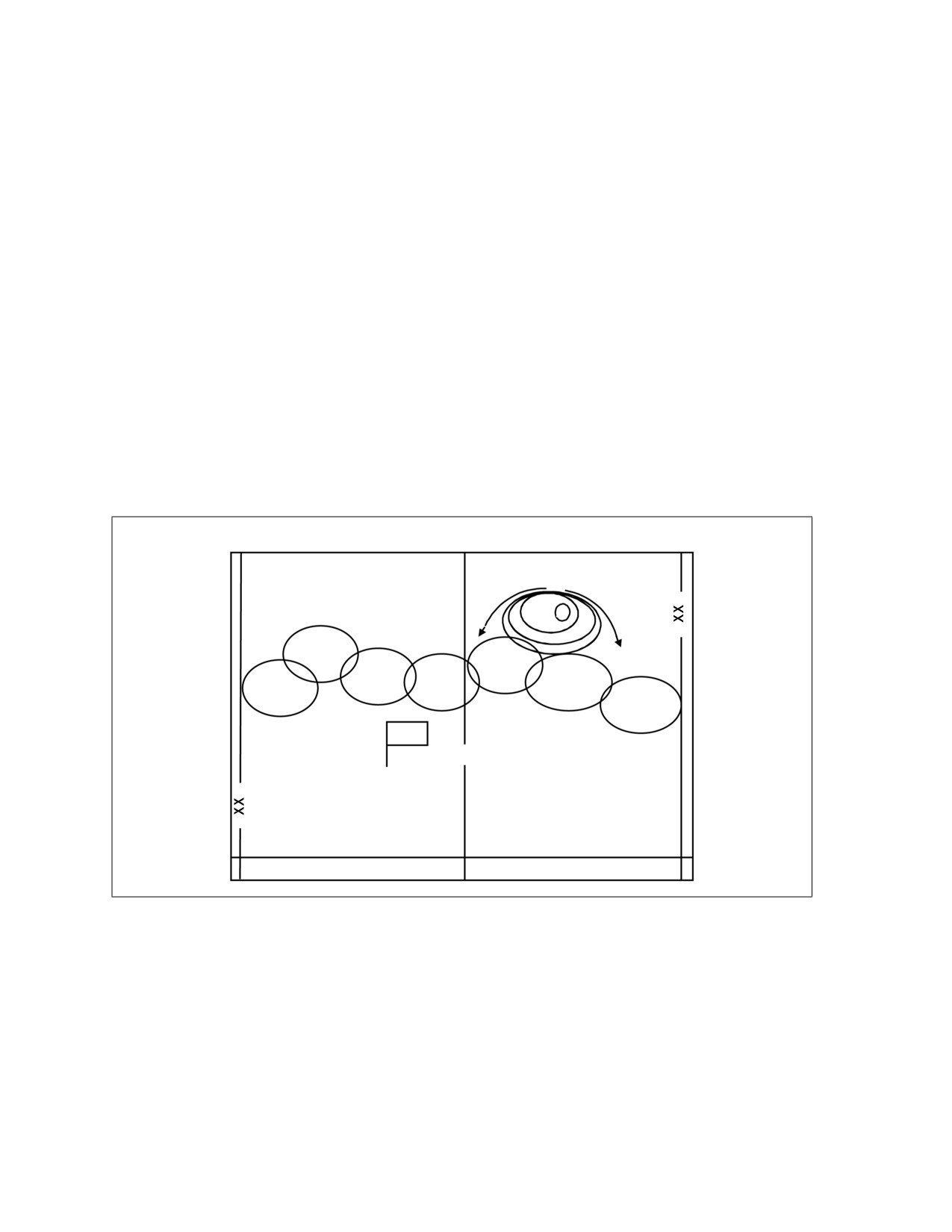
that might generate interferants (for example, forward arming and
refueling points [FARPs] or farms).
(2) When assigning deployment area numbers, use a five-digit alphanumeric
code for deployment areas and six digits for detection sites as follows:
z
The first two characters designate either deployment or detection
areas.
z
The third character is the unit designation (for example, a biological-
detection platoon).
z
The fourth character is the team designation (for example, a BIDS
team).
z
The fifth character is the primary (P), alternate (A), or supplemental
(S) area.
z
The sixth character is the sequence number for the detection site.
(3) Figure E-11 provides an example of a deployment area for a BIDS unit. In
this example, a BIDS platoon has deployment areas assigned to its seven detection
teams.
x
145
DA12P
DA15P
DA13P
DA14P
DA16P
DA11P
DA17P
CP
X
Figure E-11. BIDS Deployment Areas
d. Detection Site Selection. Detection sites are the actual biological-detection
positions. Leaders at all levels must deconflict site selection to reduce vulnerability to
fratricide and ensure that the coverage is within unit capabilities. Some rules of thumb
in selecting detection sites are as follows:
z
Has a 100-meter radius.
z
Permits maximum airflow of possible hazards.
E-20
z
Has minimal overhead cover. This will be very difficult for tactical
commanders to accept. However, without minimal overhead cover,
various detectors will not get maximum airflow over the collector-
concentrators.
z
Is upwind of the supported unit or critical node.
z
Permits rapid ingress and egress.
z
Is protected from threat direct fire. Depressions that do not exceed
4 meters in depth are ideal for protection; yet do not canalize steering
winds away from the site. The object is to not allow the biological-
detection team to be exposed to direct fire hazards.
z
Is concealed and camouflaged.
z
Is out of threat mortar and artillery range, if possible.
z
Permits effective communications.
e.
Outdoor Site Selection Considerations. Several considerations must be taken
into account when positioning individual biological-detection systems. Ensuring that the
site allows for the greatest probability of detecting a biological cloud will be a major
concern. To understand how the biological-cloud behavior impacts on your site selection
process, consider the—
z
Effects of environment, terrain, and weather on BW agents.
z
Biological-agent cloud behavior.
z
Methods of dissemination.
f.
Biological-Detection and -Collection Operations in Unusual Conditions.
(1) Cold weather operations. BW in the arctic is a possibility. It has been
found that the survival of microorganisms increased significantly at temperatures below
freezing. Temperature inversions that exist over snowfields tend to prolong the integrity
of an aerosolized biological cloud. It disperses more slowly and remains a threat for a
longer period. If an attack with these agents occurs, it will most likely be delivered by
covert means.
(2) Desert operations. During daylight, most aerosolized live biological agents
are short-lived. Spore-forming biological agents are an exception. This is a result of low
humidity and the ultraviolet (UV) radiation of direct sunlight and atmospheric
disturbance. But at night, favorable conditions could occur. Effectiveness of the live
biological agent, however, would quickly diminish during the daytime. Toxins are more
resistant to this harsh environment and could still be effectively employed.
(3) Jungle operations. Jungles provide excellent conditions for the use of
biological agents and toxins. Warm temperatures, high humidity, and protection from
sunlight all aid the survivability of disease-causing microorganisms. Low wind speeds
and jungle growth limit downwind hazards.
(4) Mountain operations. Detection of live biological agents in mountains
creates the same problems as in lower areas—the effects of the terrain on the agent
cloud.
E-21
(5) Urban terrain operations. Operations in an urban environment present
special problems for detecting biological agents. Just as with rough terrain, wind
turbulence caused by structures influences the dispersion of BW agents by reducing
agent effectiveness and area coverage. In addition, pollutant gases can interfere with
detection of BW agents and have been found to decrease the survival of many pathogens.
g.
Communications. Communications may affect site selection. While planning
site selection, communications considerations include—
z
The type of operation, the units involved, and the support requirements.
z
The physical characteristics of the AO and probable weather conditions.
z
The capabilities of the organic radio assets.
z
Alternate means of relaying information.
NOTE: Never rely on a single means of communication.
11. Indoor Site Selection for Biological Detectors or Collectors
Conducting indoor biological-detection and sample collection operations presents
some unique challenges and considerations in detector emplacement. The following
considerations affect biological-detector or sampler emplacement:
a.
The Coverage Required (Size of the Building Versus the Number of Detectors
Required). The size of the building will impact the number of detectors required to
properly provide coverage. Although size alone is not the determining factor, it is a
contributing factor when determining the number of detectors and sample collectors
required.
b.
The Type of Release to be Protected Against (Exterior Versus Interior Release).
The type of release to be protected against may determine the placement of detectors.
(1) Exterior release. If the building provides for adequate security controls
and measures, the threat of an interior release is decreased. Thus, the threat will most
likely come from an exterior release. In this instance, the placement of detectors and/or
collectors in the interior of the building should emphasize capturing air coming into the
building through air inlets, entrances, and exits. This method is likened to setting up a
perimeter defense. In such instances, detectors placed on the exterior of the building will
also provide a much-needed layer of protection outside of the perimeter.
(2) Interior release. Providing detector coverage against the threat of an
interior release will greatly influence the placement of detectors. When providing
coverage against an interior release, the method of providing a perimeter of detectors
does not work effectively. Detector and/or collector locations to be covered throughout the
building should include air exhausts, HVAC systems, high-value targets (HVTs) within
the building, high population areas, areas of congregation, high-risk billets, and high-
risk personnel.
c.
The Interior Airflow. The flow of air throughout a building will affect the
number and placement of detectors. Some buildings can be highly segregated in nature,
especially newer larger buildings—while others can be very open in terms of airflow. The
more segregated the building and its HVAC system, the less likely the chance of
biological contamination spreading.
E-22