FM 4-02.7 HEALTH SERVICE SUPPORT IN A NUCLEAR, BIOLOGICAL, AND CHEMICAL ENVIRONMENT (OCTOBER 2002) - page 4
FM 4-02.7
• NBC detection equipment such as, M8 chemical agent detection paper, M9 chemical agent
detection tape, radiation detection equipment, and biological agent sample/specimen collection supplies.
NOTE
This guideline contains items that are required specifically for HSS
operations in an NBC environment. The items are in addition to
supplies and equipment required for conventional operations. This
guideline is not all inclusive, but is a starting point for HSS units to
develop their specific guidelines.
C-12. Homeland Security
Health service support units and installation medical activities/centers must be prepared to provide support
in the event that CBRNE are used on the United States. Medical commanders and leaders should develop
plans on how the provision of medical support will be provided to a CBRNE event. The plan should
include, but not be limited to—
• Number and type of units required to respond.
• Medical equipment and supplies required.
• Personal protective equipment required for medical response personnel.
• Time required to prepare unit/personnel to respond.
• Length of time response support is required.
• Sources for food, shelter, local transportation, and resupply of expended or lost equipment
and supplies.
C-8
FM 4-02.7
APPENDIX D
MEDICAL PLANNING GUIDE FOR THE ESTIMATION
OF NUCLEAR, BIOLOGICAL, AND CHEMICAL
BATTLE CASUALTIES
Section I. INTRODUCTION
D-1. General
The primary purpose of the Medical Planning Guide for the Estimation of Nuclear, Biological, and Chemical
Battle Casualties—AMedP-8(A), a three-volume publication for NBC, is to assist medical planners, medical
logisticians, and medical staff officers in predicting NBC warfare contingency requirements for HSS
personnel, medical materiel stockpiles, patient transport or evacuation capabilities, and facilities needed for
patient decontamination, triage, treatment, and supportive care. The optional use of these guides is for
projecting medical NBC operational estimates at brigade, division, corps, and EAC.
NOTE
The use of “the guide” in this appendix refers to AMedP-8(A),
Volume I, II, or III. The AMedP-8(A), Volume I, II, or III, is the
text for each of the STANAGs. The contents of this appendix are
extracts from Sections 1, 2, and 3 of the guide.
D-2. Medical Planners’ Tool
Medical planners’ estimates (such as casualty, logistics, evacuation, and personnel cross leveling) must be
modified for the NBC environment. Estimates of NBC medical workload can be found in AMedP-8(A). A
compact disk containing these documents and an automated version of AMedP-8(A), the Casualty
Requirements Estimation Tool (CREST), can be obtained from Headquarters, Department of the Army,
ATTN: DASG-HCZ-FD, 5109 Leesburg Pike, Falls Church, VA 22041-3258. The CREST is primarily an
Army tool focusing on corps, brigades, and battalions, but also models aerial ports of debarkation, seaports
of debarkation, and other units.
This Section Implements STANAG 2475.
Section II. MEDICAL PLANNING GUIDE FOR THE ESTIMATION OF
NUCLEAR, BIOLOGICAL, AND CHEMICAL BATTLE CASUALTIES
(NUCLEAR)—AMedP-8(A), VOLUME I
D-3. General
a. Volume I of the guide provides estimates of casualties and remaining operational strength after
a nuclear detonation in a brigade-sized unit during an out-of-area contingency operation. These estimates
D-1
FM 4-02.7
include the numbers, injury type (initial nuclear radiation, blast, and thermal injuries), and injury severity
of nuclear patients based on several brigade scenarios. The scenarios include three different brigade-
sized units, in warned or unwarned posture, which have single detonation of 5, 20, or 50 KT in the unit
area.
b. The guide is organized into 10 sections. Section 1 introduces the guide and presents
background and medical planning considerations. Section 2 provides information on the methodology used
to develop the estimates of fatalities, casualties, and effectiveness of individuals remaining in the unit.
Section 3 explores the use of the casualty prediction tables based on combat effectiveness decrements and
estimates of the number of casualties categorized by insult level. Sections 4 through 10 contain tables of
casualty estimates.
c.
A sample of this information is graphically depicted in Tables 1-1 and 1-2 of the guide.
The casualty estimates used to prepare these tables are presented in the guide as Tables 6-4 and 10-4 in
Sections 6 and 10 respectively. The use of these tables is explained in paragraphs 3.1 through 3.6 of the
guide. Paragraphs 3.7 and 3.8 of the guide discuss how to use the guide for situations not explicitly
addressed.
d. The effects of residual radiation on personnel are not included in the guide. AMedP-6 and
AMedP-7 provide information on planning, operations, and treatment for a residual radiation situation.
Also not included is the impact of tumbling; impact of glass shards from windows of vehicles or buildings;
crushing deaths from building failure; or COSC casualties; thus causing underestimations on the number of
patients. Further, there will be personnel who get radiation doses or burns and do not seek medical care.
e.
A nuclear detonation may introduce new levels of destruction to the battlefield. There is very
little experience with nuclear effects and there is certainly no experience with these weapons on a modern,
highly technological battlefield. Therefore, there is little historical data on which to base estimates of
personnel injured. Computer simulations are generally used to estimate numbers of personnel injured.
Although these estimates may include significant uncertainty, they provide the best estimates to date.
D-4. Medical Planning Considerations
a. For effective mass casualty management, key medical and related considerations must be well
planned and practiced. These include on-site triage and emergency care, communications, health service
logistics, evacuation by ground and air resources, and personnel training in self-aid/buddy aid. Plans need
to be made for requirements that may differ from the usual combat situation. For example, in combat
situations, severe burn injuries in large numbers are relatively uncommon. Therefore, no special planning
for the care of large numbers of burn patients is required. In a nuclear environment, this may not be true,
and consideration must be given to the increased need for medical support that would result from a high
incidence of burn patients.
b. Prior to an attack, the data may be used by medical planners to augment the requirements for
conventional combat as appropriate for the nuclear situation. The tables can be used to prepare estimates of
the number of patients at all echelons.
D-2
FM 4-02.7
c.
After an attack, the effectiveness and adequacy of the medical support effort during the first 24
hours are critical. Commanders should be informed rapidly of the estimated medical load in order to
provide rescue and treatment resources or request assistance from higher headquarters, adjacent units, or
allied units. These estimates should be updated postattack based on aerial or ground reconnaissance and
survey.
d. In addition to casualties, a nuclear weapon detonation can generate an EMP that may cause
catastrophic failures of electronic equipment components and may adversely affect the capability of all units
in the area of the detonation. Electromagnetic pulse has no direct effect on personnel and is not further
addressed in this publication.
D-5. Triage
Since a nuclear detonation may produce mass casualties, plans for a triage system must be in place.
Paragraphs 3.4 through 3.5 of the guide describe patient categories by injury severity and may be used to
estimate the number and injury severity of patients for a particular operational scenario. The guide does
not, however, provide estimates of the number of patients by triage classification.
D-6. Evacuation
a. An efficient and flexible evacuation plan is absolutely essential for the preservation of life and
to retain the mobility of forward medical resources. In a potential mass casualty situation, the full range of
evacuation assets should be considered.
b. The extended hospital time of nuclear casualties will influence levels of evacuation or
hospitalization. In addition, estimates of the different types of casualties can be a consideration in evacuation
planning. In planning for evacuation, estimates provided in the guide can be used as a starting point from
which to estimate evacuation resources.
D-7. In-Unit Care
a. Some personnel within the military unit may not be classified medically as casualties, but will
require some self-aid and buddy aid. A casualty is defined as anyone entering the medical system.
Paragraph 2.5 of the guide further describes the basis for casualty calculation.
b. Nuclear detonations will produce a large number of blast, burn, and projectile injuries that
initially must be treated by individual soldiers trained in first aid procedures. The physical damage to the
surrounding area as a result of a nuclear detonation will increase delays in medical assistance and evacuation.
Training in self-aid/buddy aid will improve casualty survival rates and conserve medical resources. The
guide can be used to provide a conservative estimate of the numbers of injured that will require first aid.
The tables in Sections 4 through 10 of the guide, showing the status of unit personnel by time period, can be
used to indicate the numbers of personnel who are injured (but not casualties) who may require first aid.
D-3
FM 4-02.7
D-8. Hospital Bed Requirements
The data provided in the guide can be used to determine immediate additional bed requirements resulting
from a nuclear detonation. In addition to the numbers of patients who will need beds, the data provided in
the guide can also indicate the increased hospitalization time of nuclear casualties. Long-term bed
requirements, greater than 30 days, are not provided. Based on the theater evacuation policy specified for
the operation, the hospital bed days may be in theater or in CONUS.
D-9. Medical Logistics
The data provided in the guide can assist in estimating the needed supplies. The supply system must be
prepared for increased demands for certain types of medical and general supplies and equipment, kits,
dressings, and antibiotics. The treatment of combined injuries will not require any special types of supplies,
although demands for certain types of supplies will increase.
D-10. Medical Force Planning
The assignment of medical support is normally based upon the total military population and the expected
conventional casualty rate. The data provided in the guide may be used to assess the requirement for
additional medical units. The planning guidance presented in this document can (and should) be modified to
reflect the needs of the anticipated operation, including operational tempo, national/coalition priorities,
medical resource allotment, and so forth. When trying to augment personnel, consider that the use of a
nuclear weapon in a tactical situation could be an indication of an increased tempo of warfare. Therefore,
even though a unit may be targeted with a nuclear detonation, that unit may not be the site where the highest
numbers of casualties are being produced, and another unit may have priority of support.
This Section Implements STANAG 2476.
Section III. MEDICAL PLANNING GUIDE FOR THE ESTIMATION OF
NUCLEAR, BIOLOGICAL, AND CHEMICAL BATTLE CASUALTIES
(BIOLOGICAL)—AMedP-8(A), VOLUME II
D-11. General
The guide, AMedP-8(A), Volume II, provides estimates of casualties, and remaining operational strength,
after single BW attacks on tactically deployed, brigade-sized land force units, offshore naval and marine
forces, and selected strategic targets in rear areas. These worst-case casualty estimates are for personnel
D-4
FM 4-02.7
within both the targeted and the downwind hazard areas of the attacked forces. They assume that all
affected personnel will be unsheltered and unwarned. To further estimate worst-case outcomes, the guide
assumes that exposed individuals have not been vaccinated against any of the evaluated agents, nor have
they undergone any type of medical prophylactic treatment prior to exposure. The tables included in the
guide are designed to show numbers of expected casualties; expected fatalities; personnel at different
performance levels; and times after exposure. In selected scenarios, the guide provides a method for
estimating casualties among collocated civilians based on local population density.
a. The guide presents casualty estimates for all possible combinations of the following conditions:
• Eleven operational scenarios.
• Seven biological agents.
• Four types of delivery systems.
• Three attack intensities.
b. The guide is subject to limitations of extent and content. Since there are many more possible
attack variables than those considered, the guide presents a limited number of estimates and provisional
guidance for estimating cases not modeled. These estimates are based upon the best available medical data,
but such data result in qualified estimates. Therefore, for more authoritative medical descriptions, medical
planners and staff personnel should use FM 8-9, NATO Handbook on the Medical Aspects of NBC
Defensive Operations, AMedP-6(B), Part II—Biological. Users of the guide must amplify or modify these
estimates to meet emergent requirements such as injuries resulting from combined biological and con-
ventional attacks.
c.
Computer models that integrate available information have been used to predict the effects of
future biological attacks. These resultant estimates may include substantial uncertainties when applied to
specific situations. However, they provide the best estimates available to date.
d. The guide is also organized into 10 sections. Section 1 introduces features of the guide, and
then presents background and medical planning considerations. Section 2 provides information on the
methodology used to develop the estimates. Section 3 describes how to use the tables presented in the
guide. Sections 4 through 10 of the guide contain tables of casualty estimates, with one section for each of
the seven biological agents.
e.
Biological attacks are likely to have a significant impact on the medical system. As detailed
elsewhere in the guide, victims may number in the hundreds or even thousands. Demand for medical care
may quickly overwhelm available resources; this problem will be exacerbated if medical personnel
themselves become victims of the attack. Local civilian populations will be victimized as well, limiting
host-nation support and potentially adding to the demands on the military medical system.
f.
A variety of medical responses to BW attacks are available, depending on the agent used and
whether medical countermeasures are employed prior to attack or after exposure has already occurred.
D-5
FM 4-02.7
For many agents, immunization or pre-exposure prophylaxis with antibiotics may prevent illness in those
subsequently exposed. After exposure, disease can often be prevented or ameliorated via immunization and
therapeutic use of antibiotics, antiviral drugs, and hyperimmune gammaglobulins.
D-12. Medical Planning Considerations
a. Effective mass casualty management requires careful planning. The guide is designed to sup-
port such planning by providing medical planners and staff personnel with a systematic means for estimating
the number of biological casualties. However, casualty management also involves practice of self-aid and
buddy aid, on-site triage and emergency care, decontamination, transport to medical facilities, infection
control measures, communications, health services, logistics, and evacuation by ground or air transportation.
b. Medical requirements resulting from attacks with biological agents may be substantially
different from those resulting from conventional, nuclear, or chemical combat. There would be no indication
of the presence of biological agents in most tactical situations. Units downwind from an attack area may be
unexpectedly exposed to biological agents. In some cases, there will also be a risk of secondary infection
and subsequent epidemics amongst troops and/or the local population. Additionally, use of biological
agents may generate reservoirs within the local animal population that may serve as a further source of
infection.
c.
Often the first indication of an attack with a biological agent will be the development of
symptoms in exposed personnel. Diagnosis and treatment are complicated by the fact that many of the
agent-induced diseases described in the guide begin with symptoms associated with common illnesses, such
as influenza. In such cases, biological agent attacks may generally be distinguished from naturally occurring
epidemics by the sudden onset of disease, the large number of personnel presenting with similar symptoms,
and the concentration of those personnel in geographically contaminated areas.
D-13. Triage
a. Since a biological attack may produce mass casualties, preparations for a triage system should
be in place before the attack. Paragraph 3.3.8 of the guide describes patient categories by illness severity.
For a particular described operational scenario, this information may be used to estimate the number of
patients with specified levels of illness. The guide does not provide estimates of the number of patients by
triage classification or usual medical descriptions.
b. Decontamination of patients must be considered before further evacuation.
D-14. Evacuation
a. An efficient and flexible evacuation plan is essential for adequate casualty treatment and to
retain mobility of forward medical resources. For an assessment of a potential mass casualty situation, the
medical planner should consider the full range of evacuation assets, limitations, and obstacles. After an
D-6
FM 4-02.7
attack, the medical staff may need to estimate the number of casualties that could require evacuation at
given postexposure times.
b. Evacuation requirements will vary with the type of biological agent used. Casualties resulting
from some agents may not be evacuated because the time course of effects is relatively short. For others,
like botulinum toxin, casualties may require evacuation to a facility where they can receive care for weeks
or even months. Estimates provided in the guide can be used as a starting point from which to plan for
evacuation resources, including those required for decontamination of personnel and transportation assets.
D-15. In-Unit Care
The casualty estimates in the guide are presented without allowance for in-unit care. However, there may
be need for rapid intervention. Delays in obtaining medical care may occur because of physical damage or
contamination of the surrounding area. Soldiers trained in first aid procedures may be the first to provide
aid to biological agent casualties. The guide provides a conservative estimate of the numbers of exposed
personnel who will require first aid. The tables described in paragraphs 3.3.2 through 3.3.4 of the guide
give the time courses of effects that may apply to estimation of in-unit care and delayed medical
requirements.
D-16. Patient Bed Requirements
Bed requirements can be estimated using the tables described in paragraphs 3.3.2 through 3.3.4 of the
guide. The latter type of table is useful after an attack since it shows gains and losses of casualties over
time. The type of table described in paragraph 3.3.5 of the guide may be more useful for long-range
planning. It shows maximum numbers of personnel by illness severity category. The tables in the guide
only provide estimates for the first 35 days after attack. Based on the theater evacuation policy specified for
the operation, hospital days may be in theater or in the national area.
D-17. Medical Logistics
a. The estimates provided in the guide are intended to support projections of medical materiel
and logistical requirements. Increased demands may occur for certain types of medical and general
supplies, including equipment, kits, antibiotics, disinfectants, and other critical medical materiel. Demands
may also increase for items unique to the prevention and treatment of biological agent casualties, such as
vaccines, antibiotics, and antisera, as well as items adapted to contaminated environments. Tables showing
maximum numbers of personnel by illness severity category can provide useful input for logistical planning.
b. Often the first indication of an attack with a biological agent will be the development of
symptoms in exposed personnel. Diagnosis and treatment are complicated by the fact that many of the
agent-induced diseases described in the guide begin with symptoms associated with common illnesses, such
as influenza. In such cases, biological agent attacks may generally be distinguished from naturally occurring
diseases.
D-7
FM 4-02.7
D-18. Medical Force Planning
a. The assignment of medical support is normally based upon the total military population and
the expected conventional casualty rate. The guide may be used to assess requirements for additional
medical units.
b. Although a specific unit may be the target of a biological attack, more casualties could be
suffered by other units downwind. Accordingly, a unit other than the targeted one may have priority for
support. The tables presented in the guide can be used in planning for either situation. Some tables show
estimated maximum numbers of personnel by illness severity category. Such estimates should be combined
with a comprehensive array of other available information to increase the effectiveness of medical force
planning.
This Section Implements STANAG 2477.
Section IV. MEDICAL PLANNING GUIDE FOR THE ESTIMATION OF
NUCLEAR, BIOLOGICAL, AND CHEMICAL BATTLE CASUALTIES
(CHEMICAL)—AMedP-8(A), VOLUME III
D-19. General
a. The primary purpose of Volume III is to assist medical planners, logisticians, and staff officers
in predicting CW contingency requirements. Requirements include medical personnel, medical materiel
stockpiles, patient transport or evacuation capabilities, and facilities needed for patient decontami-
nation, triage, treatment, and supportive care. An optional purpose is to support medical operational
estimates.
b.
The guide provides medical worst-case estimates of casualties and remaining operational
strength after a single CW attack on a tactically deployed, brigade-sized land force units, with protection
available and protection unavailable. These worst-case casualty estimates are for personnel located within
both the targeted and the downwind hazard areas of the brigade. It is assumed that all targeted personnel
will be unsheltered and without medical pre-exposure prophylactic treatment. Tables in the guide are
designed to show total numbers of—
• Casualties with different types and severities of injury at various times after exposure.
• Personnel at different performance levels and times after exposure.
• Fatalities at specified times after exposure.
D-8
FM 4-02.7
c.
The guide presents estimates of personnel status at specific time points. These range from 1 to 3
hours to 7 to 30 days after an attack, depending on the type of agent considered. Such estimates are
projected from all possible combinations of the following conditions:
• Seven operational scenarios involving three types of units: heavy brigade, support
brigade, and light infantry brigade.
• Three chemical agents: the nerve agents GB and VX, and the blister agent HD.
• Three types of munitions delivering the agents: aerial bombs, tactical ballistic missiles,
and rounds from multiple launch rocket systems/artillery batteries—
•
Three attack intensities for each type of munition: light, moderate, and heavy.
•
Two postures of individual physical protection against the attacks: unavailable and
available.
d. An index to essential information and four sample problems to illustrate use of this information
are at the end of the guide (see Section 11). Section 11 provides a planning guide overview, describes
applications, and presents a brief explanation of modeling methods used to prepare estimates.
e.
The guide is subject to limitations of extent and content. Since there are many more possible
attack variables than those considered, the guide presents a limited number of estimates. These estimates
are based upon the best available toxicological values, but such values are qualified estimates. Therefore,
medical planners and staff personnel should use FM 8-9, NATO Handbook on the Medical Aspects of NBC
Defensive Operations, AMedP-6 (B), Part III—Chemical, for more authoritative medical descriptions and
information on effects of longer duration.
f.
The guide is most value to the user who needs to know what kinds of casualties to expect,
relative numbers of each, and the time frames in which they are likely to appear. To assist the user, who
lacks experience in actual CW, the guide describes types of injury, relevant factors, general magnitudes of
effects, and effects of time courses on chemical casualty numbers. The casualty estimates are appropriate
for training exercises. However, this initial attempt to provide complex estimates has limitations for
battlefield use. The limitations are described as follows:
• The guide provides estimates for a few of many possible chemical attacks. Each estimate
is based upon computer modeling of the consequences of specified conditions. This is like saying that the
numbers of men who sneeze, after inhaling an allergic flower pollen, might be predicted if specific
information (EXAMPLE: The wind speed and direction, the current weather, altitude, time of day, and
sites of concentrated flower growth) is known for the specific geographic location of a particular brigade on
a given mountain. If such estimates are made for a few widely different mountains, a user of the estimates
may be able to guess the numbers of sneezing men in his own brigade, located on a separate mountain.
However, if the conditions on both mountains are not nearly identical, the user will need to estimate a
scaling factor and apply it to adjust the number predicted for a different environment.
D-9
FM 4-02.7
• It is unlikely that exactly identical conditions will exist for any two mountains or chemical
attacks. The user of the guide must decide which scenario best represents his conditions (or interpolate
from two scenarios), then use or adjust the estimates. Therefore, each user must recognize any differences
from modeled conditions that might require him to increase, or decrease, an estimate. The user may need
to apply a commander’s guidance on acceptable risk levels, or consider restrictions of available resources,
before accepting, interpreting, or modifying the relevant planning guide numbers. The most difficult
problem for the user will be to determine how much to increase, or decrease, planning guide numbers to fit
the user’s situation. This problem is discussed in paragraph 3.4 of the guide.
• The user should be aware that medical worst-case targeting selects for maximal numbers
of survivors entering the medical system, not for maximal operational losses. The tabulated estimates are
very highly sensitive to the degree of clustering of personnel and their assumed location within a standardized
brigade area. Accordingly, use of this targeting method leads to large variations that are based upon the
probabilities of hitting clustered personnel, not evenly or widely distributed personnel. Therefore, these
estimates do not provide a good basis for estimating the most likely outcomes for a series of “average”
attacks, or for comparing a scenario with an actual attack. Although the tabular format of the guide
suggests that the listed numbers are exact, the user should understand that different targeting could readily
produce other numbers. Selection of a scaling factor is discussed in paragraph 3.4 of the guide.
D-20. Medical Planning Considerations
a. The guide provides medical planners and staff personnel with a systematic means for estimating
chemical casualties in various-sized units, without regard to composition. This document provides more
accurate and detailed estimates and is based upon detailed operational scenarios for brigade-sized units.
Both chemical planning guides support estimates of combat performance from individuals remaining in the
unit.
b. Effective mass casualty management requires careful planning. The guide is designed to
support such planning by providing medical planners and staff personnel with a systematic means for
estimating the number, type, and time-related status of chemical casualties.
NOTE
Each user is advised to consult any available national military NBC
defense doctrinal publications of similar nature.
c.
Medical requirements during CW may be substantially different from those for the usual
combat situation. There may be no indication of the presence of chemical agents in some tactical situations.
Unprotected units downwind from an attack area, or those entering contaminated areas in an unprotected
posture, may be unexpectedly exposed to chemical agents. However, casualty management also involves
practice of self-aid and buddy aid, on-site medical triage and emergency care, transport to medical facilities,
communications, health services, logistics, and evacuation by ground or air transportation.
D-10
FM 4-02.7
d. The signs and symptoms of chemical agent exposure may be sudden and intense, or delayed
and subtle, depending on the agent used and the level of exposure. Individuals may not reach the first level
of care for 15 to 60 minutes after the onset of effects. Decontamination may delay medical treatment.
Stabilization should occur before casualties leave emergency care areas, but contamination of these areas
may delay the stabilization process. However, effects of decontamination or secondary contamination on
estimated doses and effects are not considered in the guide. For medical planning, users of the guide need
to consider the various qualifications of its casualty estimates, as discussed in paragraphs 3.4 and 3.4.2. of
the guide.
e.
A chemical burn caused by HD can require more care than a same-sized burn induced by
conventional munitions. Therefore, the initial prognosis may require revision after treatment is underway,
and estimates of percent capable by performance band may require adjustment.
D-21. Triage
Since a chemical attack may produce mass casualties, preparations for a triage system should be in place
before the attack. Paragraph 2.5.1 of the guide describes patient categories by injury severity. For a
particular described operational scenario, this information may be used to estimate the number of patients
with specified levels of injury. The guide does not provide estimates of the number of patients by triage
classification or usual medical and toxicological descriptions.
D-22. Evacuation
a. An efficient and flexible evacuation plan is essential for adequate casualty treatment and to
retain mobility of forward medical resources. For assessment of a potential mass casualty situation, the full
range of evacuation assets, limitations, and obstacles should be considered by the medical planner. After an
attack, the medical staff may need to estimate the number of casualties that require evacuation resources at
given postexposure times.
b. Evacuation requirements will vary with the type of chemical agent used. Nerve agent casualties
may not be evacuated because the time course of severe effects is relatively short. Depending upon
exposure conditions, HD casualties may or may not require evacuation to a facility where they can receive
care for several days, or possibly 6 to 9 months. Estimates provided in the guide can be used as a starting
point from which to plan for evacuation resources.
D-23. In-Unit Care
The casualty estimates in the guide are presented with no allowance for in-unit care such as self-aid or
buddy aid. Soldiers trained in first aid procedures may be the first to see chemical injuries. The guide can
provide an estimate of the numbers of injured personnel who will require first aid. However, there may be
need for rapid augmentation, support, or other intervention. Delays in obtaining medical care may occur
because of physical damage or contamination of the surrounding area. The tables described in paragraphs
D-11
FM 4-02.7
3.3.2 and 3.3.3 of the guide give the time courses of effects that may apply to estimation of in-unit and
delayed medical requirements.
D-24. Patient Bed Requirements
Requirements for patient beds and hospitalization time may be greater after chemical exposures than after a
conventional attack. Such increases are particularly important for agents, such as HD, that produce injuries
followed by a long recovery period. Bed requirements can be estimated using the tables described in
paragraphs 3.3.2 and 3.3.3 of the guide. Casualties Occurring by Time Period tables (see paragraph 3.3.3)
in the guide are useful after an attack since they show gains and losses of casualties over time. Personnel by
Injury Category tables (as described in paragraph 3.3.4) in the guide may be more useful in long-range
planning. They show maximum numbers of personnel by injury severity category. The tables in the guide
only provide estimates for the first 30 days after attack. Depending upon the theater evacuation policy
specified for the operation, hospital days may be either in theater or in the national area.
D-25. Medical Logistics
The estimates provided in the guide are intended to support projections of medical materiel and logistical
requirements. Increased demands may occur for certain types of medical and general supplies. These may
include specific equipment, kits, dressings, antibiotics, and other critical medical materiel. Demands may
also increase for items unique to the chemical battlefield (such as nerve agent antidote autoinjectors), as well
as items adapted to chemical environments (including IV systems and special self-contained intensive care
units). Tables showing maximum numbers of personnel by injury severity category (see paragraph 3.3.4 in
the guide) can provide useful input for logistical planning.
D-26. Medical Force Planning
a. The assignment of medical support is normally based upon the total military population and
the expected conventional casualty rate. The guide may be used to assess requirements for additional
medical units. The use of chemical weapons in tactical situations could be one indication of an increased
tempo of warfare and need for additional personnel.
b. Although a unit may be targeted for chemical attack, that unit might not be located where the
highest number of casualties could occur (as in a downwind hazard area). Accordingly, another unit might
have priority for support. The tables presented in the guide can be used in planning for either situation.
Some tables (see paragraph 3.3.4 in the guide) show estimated maximum numbers of personnel by injury
severity category. Such estimates should be combined with a comprehensive array of other available
information to increase the effectiveness of medical force planning.
c.
The guide is organized into 11 sections. Section 1 introduces the guide and presents
background and medical planning considerations. Section 2 provides information on the methodology used
to develop the estimates of fatalities, casualties, and effectiveness of individuals remaining in the unit.
D-12
FM 4-02.7
Section 3 explores the use of the casualty prediction tables based on combat effectiveness decrements and
estimates of the number of casualties categorized by insult level. Sections 4 through 10 contain tables of
casualty estimates. Section 11 is a tutorial on use of the tool.
d. These medical worst-case casualty estimates (see paragraph 2.1.2 through 2.1.7 in the guide)
are for personnel in the chemical-targeted and downwind hazard areas of the brigade sector. The actual
areas presenting chemical agent hazards to personnel are relatively small and localized when compared to
the entire brigade sector. These estimates are not valid for acute effects from repeated exposures, possible
delayed effects of low dosage exposures, operational worst-case targeting, targets with different numbers or
distributions of exposed personnel, or attacks involving different conditions (of meteorology, terrain,
protective status, and so forth) than are modeled. Although the guide is primarily designed to support
medical force planning for future CW defense, it may be used to anticipate short-term requirements. For
example, delayed requirements of HD victims for care or evacuation resources may be predicted from
tables that give estimates of casualty numbers by injury type at given times after a CW attack (see
paragraphs 3.3.2 and 3.3.3 in the guide).
D-13
FM 4-02.7
APPENDIX E
Example X-__, ANNEX __, TO HSS PLAN/OPERATION ORDER __,
MEDICAL NBC STAFF OFFICER PLANNING
FOR HSS IN AN NBC ENVIRONMENT
1.
PURPOSE. Establish standardized procedures for medical NBC staff officers planning,
preparing for, detecting, reporting, and providing preventive/protective measures for NBC/TIM hazards.
Establish planning procedures for conducting HSS in NBC/TIM environments. Also, establish procedures
for providing technical guidance/support to leadership before, during, and after an NBC/TIM event.
2.
PROCEDURES
a. Medical NBC staff officers prepare list of equipment and procedural guidelines for HSS
operations under NBC/TIM conditions.
(Provide a list of radiological detection devices, chemical agent
detection/identification kits/devices, components of biological sample/specimen collection, and shipping
containers. Provide guidelines/references for operating detection/identification devices.)
b. Planning actions for use before an NBC/TIM event.
(Provide preventive/protective
measures that the leadership can employ to reduce the health effects of a NBC/TIM event. Also, provide
preventive/protective measures that leadership can employ to reduce the health effects of existing NBC/TIM
hazards/contamination in an AO. Provide HSS leadership with procedures that can be employed to protect
their unit and patients.)
c.
Planning action for use during an NBC/TIM event.
(Provide preventive/protective
measures that the leadership can employ to reduce the health effects of a NBC/TIM event. Provide HSS
leadership with procedures that can be employed to protect their unit and patients.)
d. Planning actions for use after an NBC/TIM event.
(Provide preventive/protective
measures that line leadership can employ to reduce/mitigate the health effects of an NBC/TIM event on the
force. Provide HSS leadership with procedures that can be employed to mitigate the effects on their unit and
patients.)
e.
Planning actions for preventive medicine support for NBC/TIM events.
(Provide types
and numbers of PVNTMED units/personnel required to perform PVNTMED missions during such events.
Describe mission requirements for units/personnel preparing for and reacting to the event. Describe types
of samples required and how samples must be collected, preserved, packaged, and shipped to supporting
medical laboratory for analysis. Describe detection/monitoring equipment required for the event; such as
AN/PDR77, AN/VDR2 radiac meter, chemical agent monitor (CAM), and M272 water test kit.)
f.
Planning actions for veterinary support for NBC/TIM events. (Provide types and numbers
of veterinary units/personnel required to perform the veterinary service missions during such events.
Describe mission requirements for units/personnel preparing for and reacting to the event. Describe types
of samples/specimens required and how samples/specimens must be collected, preserved, packaged, and
shipped to supporting medical laboratory for analysis. Describe food contamination and decontamination
procedures. Describe detection/monitoring equipment required for the event; such as AN/PDR77, AN/
VDR2 radiac meter, and CAM.)
E-1
FM 4-02.7
g. Planning actions for medical laboratory support for NBC/TIM events.
(Provide
requirements for medical laboratory support for an NBC/TIM event. Describe types of laboratory test/
procedures required to provide command verification on the use of an NBC device/weapon. Provide
medical laboratory reporting requirements; example: provide report to command surgeon; Joint Task
Force/theater commander; senior commander in affected operational area.)
h. Planning actions for combat health logistics support for NBC/TIM events.
(Provide
requirements for combat health logistics support units and personnel. Describe types of Class VIII supplies
required to support HSS response to an event. Examples: Numbers of chemical agent patient
decontamination MESs, chemical agent patient treatment sets, number of packets of chemical agent
pretreatment tablets required, and chemoprophylaxis required for personnel exposed to a biological agent.)
i.
Planning actions for combat stress control/mental health support for NBC/TIM events.
(Provide requirements for COSC/mental health support units/personnel. Describe where and how COSC/
mental health personnel will provide their support in response to the event.)
j.
Planning for medical treatment of NBC/TIM event casualties. (Provide requirements for
medical evacuation and treatment (including emergency dental care) support units/personnel. Provide
requirements for nonmedical personnel to perform patient decontamination at the MTF. Describe where
and how evacuation and treatment personnel will provide their support in response to the event, to include
supervision of patient decontamination procedures.)
3.
COORDINATION REQUIREMENTS.
(Provide requirements for support such as who
should transport/escort samples/specimens from unit of origin to support medical laboratory and on to the
CONUS gold standard laboratory. Example: The Technical Escort Unit normally provides transportation
and escort for suspect NBC samples, in their absence describe who will provide this service. Provide
requirements for numbers of personnel required to perform patient decontamination at supporting MTFs.
Describe decontamination support requirements for medical units; especially hospitals and major combat
health logistics facilities.)
4.
REPORTS. (Describe types of reports required and frequency of reporting on HSS aspects of
NBC/TIM events. Reports should provide, at a minimum, aspects of event and recommended preventive/
protective actions needed to prevent or minimize casualties.)
E-2
FM 4-02.7
APPENDIX F
EMPLOYMENT OF CHEMICAL AND BIOLOGICAL COLLECTIVE
PROTECTION SHELTER SYSTEMS BY MEDICAL UNITS
Section I. INTRODUCTION
F-1. General
To continue the HSS mission under CB conditions, MTFs must search out contamination free areas or
employ CPS systems. Levels I and II MTFs may be able to locate contamination free areas; however, due
to the mobility limitations of hospitals, they must always be prepared to operate under CB conditions if the
area is under attack. Systems that can be employed as an MTF (Levels I, II, III, and IV) are described in
this appendix.
F-2. Types of Collective Protection Shelter Systems
a. The CBPS system is employed at the BAS, DCS, and FST. The CBPS is attached to the hard-
walled box on the rear of a high mobility multi-purpose wheeled vehicle (HMMWV). The BAS will have
one CBPS system per treatment team; the DCS will have four CBPS systems; the FST will have three CBPS
systems. Also, systems will be issued to other selected medical treatment teams. When employed at the
DCS, the patient holding team will also require GP tents to hold their required number of patients (see
Chapter 4). Patients held inside the CBPS will be those that have been decontaminated and admitted into the
system for treatment and are recovering from the treatment procedures and are awaiting evacuation. Any
patients held in the GP tent must remain in MOPP Level 4 (the GP tent will not have collective protection);
these patients are those that are expected to RTD within 72 hours.
NOTES
1.
Normally, patients will not be held at the DCS under NBC
conditions unless evacuation cannot be accomplished. They should be
RTD or evacuated to a clean MTF, as soon as the mission permits.
2.
The CBPS can also be employed as the DCS in the conventional
mode. Employment in either mode still requires GP tentage for patient
holding to meet total patient holding requirements.
b. The DEPMEDS-equipped patient care areas of the US Army Force XXI hospital and the
hospital unit base (HUB) of the Medical Force 2000 (MF2K) will employ the CP DEPMEDS. It will not
protect personnel or patients from the thermal, blast, and initial radiation effects of nuclear weapons; however,
it will provide some protection against fallout effects. Areas of the hospital that are not included in the
chemically protected (CP) DEPMEDS are MF2K general hospital unit medical (HUM), MF2K field hospital
unit holding (HUH), MF2K combat support and general hospital unit surgical (HUS), minimum care wards,
administrative areas, food service, supply (including Class VIII), and staff quarters. The system includes—
F-1
FM 4-02.7
• Chemically/biologically protected liners for tent, expandable, modular, personnel
(TEMPER) and passageways.
• CB-filtered and conditioned (heated or cooled) air (field deployable environmental control
unit [FDECU] or H80 Army Standard Heater).
• Chemically/biologically protected ambulatory, litter, and supply air locks.
• Chemically/biologically protected latrines.
• Chemically/biologically protected seals for ISO shelters.
• Chemically/biologically protected water supply system.
c.
The M20 simplified collective protection system is another system that is available. It consists
of a chemically protected room liner, a CB filter blower, and an ambulatory air lock. However, it does not
have a litter air lock making it unsuitable for litter patient care. The M20 may be used to protect medical
staffs at the DCS, FST, and hospitals, patients held in the GP tents at the DCS and in the minimum care
wards and staff quarters of the hospitals. Thus providing additional CB protection for staffs and patients.
Section II. EMPLOYMENT OF THE CHEMICALLY BIOLOGICALLY
PROTECTED SHELTER SYSTEM
F-3. Establish a Battalion Aid Station in a Chemically Biologically Protected Shelter
To establish a BAS in a CBPS, use one CBPS per treatment team for conventional operations in a split team
mode. When operating in a squad configuration and in the conventional mode, the two CBPS systems may
be complexed to provide more workspace. However, keep in mind that the treatment squad is not staffed to
operate the two systems in the CB mode. Therefore, when the two systems are complexed and the
treatment squad must convert and operate in the CB mode, they may want to close the complexing door and
only use one system. When initially setting up the CBPS for operations in the CB mode, only one CBPS is
setup; see Note 2 below. Set up the system as described in TM 10-5410-228-10. To be operational as a
BAS, set up medical supplies and equipment as required or as designated in the TSOP. A PDS consisting of
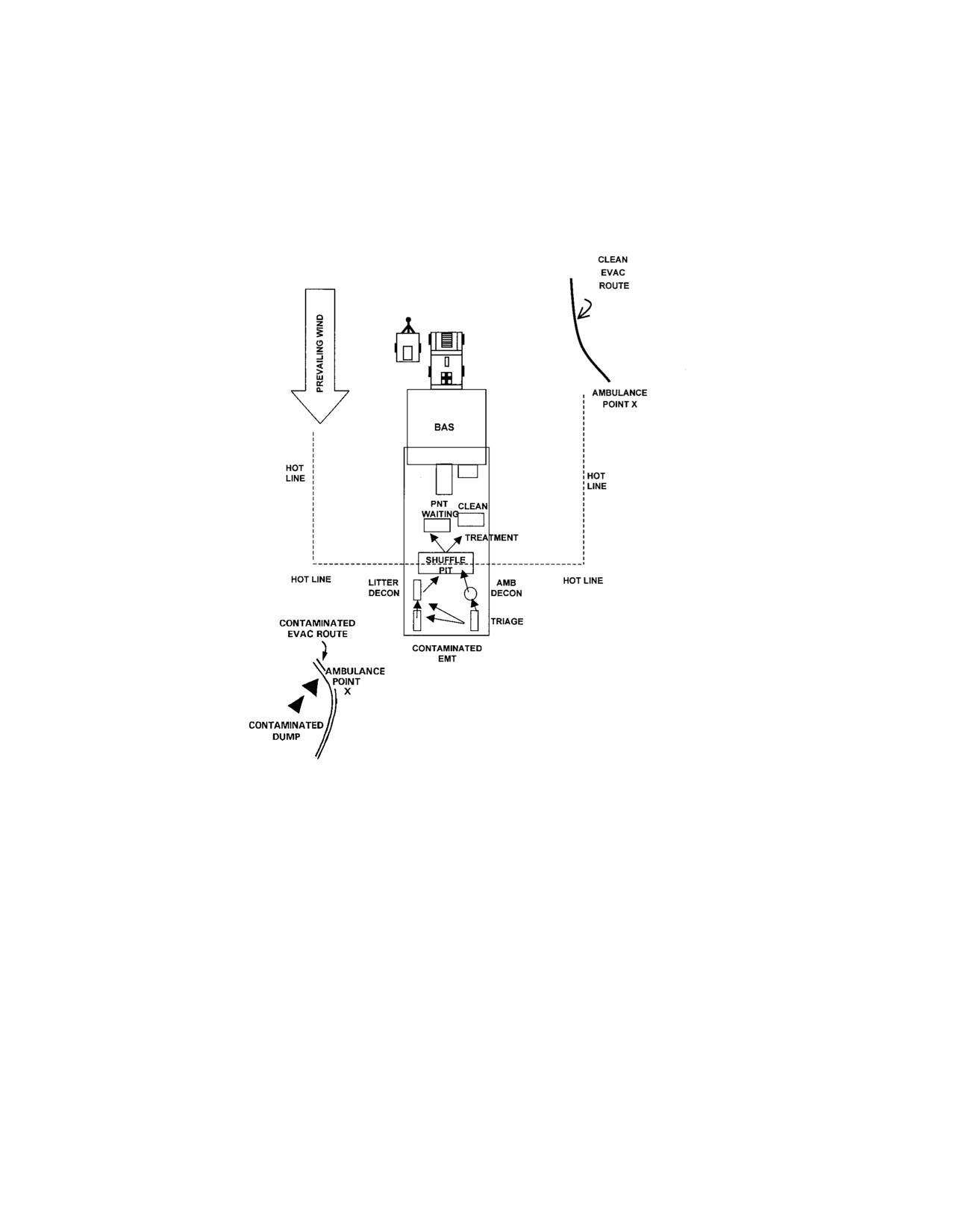
a contaminated ambulance point, contaminated triage point, a patient decontamination area, and a
contaminated treatment area is established on the downwind (prevailing wind) side of the CBPS. An
overhead cover of plastic sheeting (approximately 20 feet wide by 50 feet long) is set up over the PDS, the
hot line, and the clean treatment/waiting area; the cover overlaps the air locks. The clean treatment/waiting
area should have an area at least 20 feet wide by 15 feet long to allow space for placing patients into the
litter air lock without crossing the hot line. A second area covered with 20 x 25 feet of plastic sheeting (the
evacuation holding area) is set up beside the shelter on the opposite side from the generator. The clean
treatment area is separated from the decontamination area by a hot line with a shuffle pit. Only clean
F-2
FM 4-02.7
(decontaminated) patients or personnel are allowed to cross the hot line into the clean treatment area, or are
admitted into the CBPS. Figure F-1 presents one layout of a BAS using the CBPS. See TM 10-5410-228-10
for complete details on setting up, operating, and maintaining the CBPS. Each CBPS provides 300 square
feet of work area.
NOTES
1.
The overhead cover is not needed when the wind speed exceeds
10 knots per hour. The plastic will not stay in place.
2.
Although each treatment team of the BAS has a CBPS; only one
system is set up when operating in the CB mode. This is due to the
lack of authorized personnel to operate all systems at one time in the
CB mode. Eight medical personnel are required to operate the BAS
(employing one CBPS) in the CB mode. At least eight nonmedical
personnel are required to perform patient decontamination under
medical supervision. Also, only setting up one system in the CB
mode provides the BAS the ability to retain its flexibility in order to
maintain its support mission of being where it is needed and when it is
needed. The CBPS can be used as the treatment shelter in the
conventional mode as well. When the treatment squad is operating in
the split-team mode, each team will have a CBPS for use as its
treatment shelter. When operating one system in the CB mode, the
other system provides a replacement in the event the one in use in the
CB mode is damaged beyond repair. This ensures continued HSS to
the command.
F-3
FM 4-02.7
Figure F-1. Battalion aid station using the chemically biologically protected shelter.
F-4. Division Clearing Station in a Chemically Biologically Protected Shelter
To establish a DCS using the CBPS, set up four shelters as described in the TM. To be operational, medical
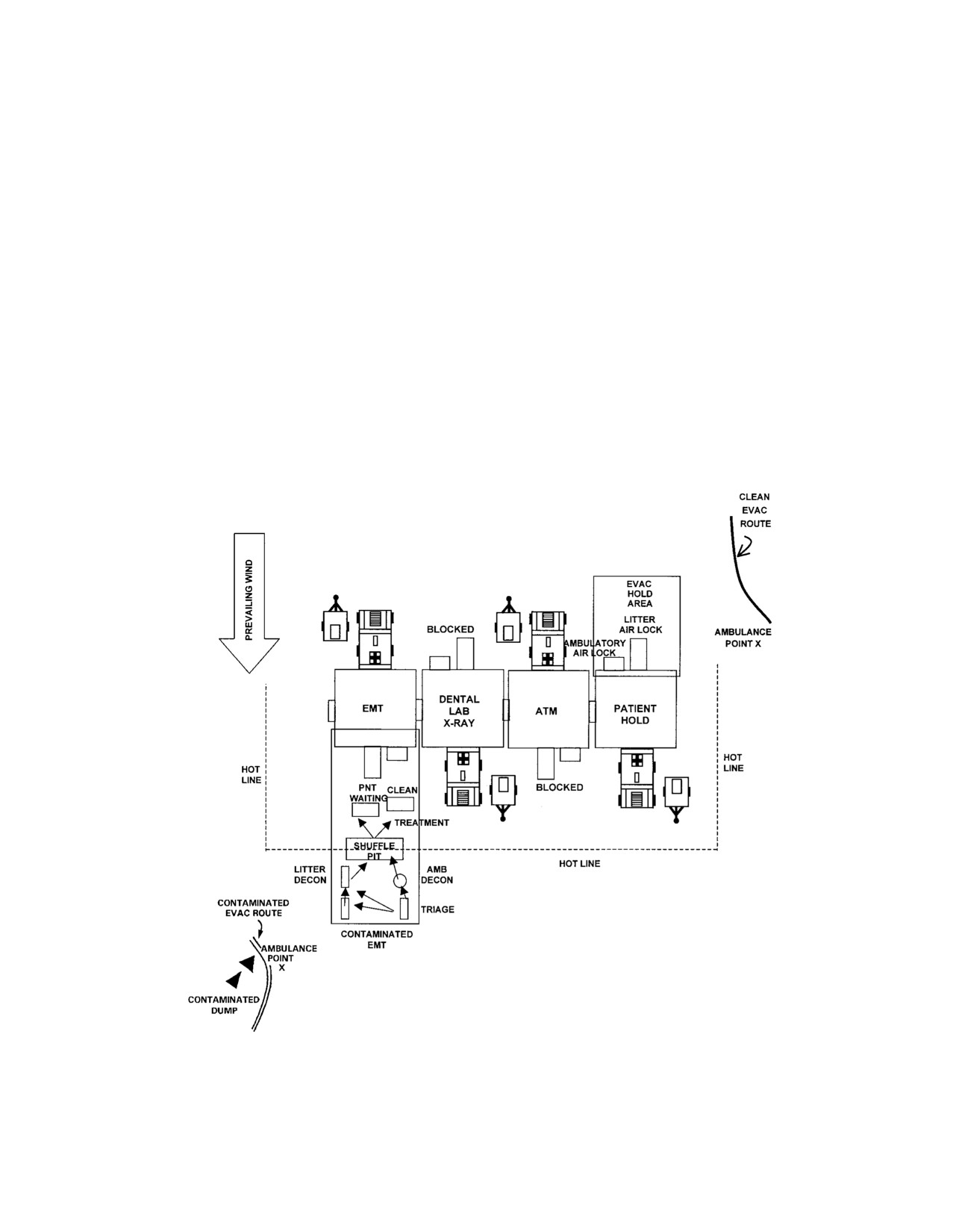
supplies and equipment are set up as outlined in the unit TSOP. The four shelters are complexed as shown
in Figure F-2. With four CBPS systems set up and operational, a total of 1,200 square feet of work area is
available. The contaminated triage, decontamination, and contaminated treatment areas are separated from
the clean treatment/waiting area by a hot line with a shuffle pit. Overhead covering is provided as described
for the BAS. Patients are admitted through the EMT litter or ambulatory air lock. Patients are released
through the patient holding air locks. This aids in controlling entry and exits; thus preventing the introduction
of contamination into the systems. At least eight nonmedical personnel from supported units are required to
perform patient decontamination under medical supervision at the DCS.
F-4
FM 4-02.7
NOTE
In the event that the overpressure system fails on a system that is in
use with entry/exit air locks, move to the available shelter with an
entry/exit air lock in the same direction for use as the entry/exit until
the failed system can be restored. Example 1: At the DCS the EMT
system fails, move to the ATM shelter to receive patients until the
EMT system has been restored. Example 2: At the DCS the patient
hold system fails, move exits to the dental/lab/x-ray shelter until the
patient hold system can be restored. Example 3: At the FST the
postoperative system fails, use the preoperative shelter until the
postoperative system can be restored. These options will allow patient
care operations to continue until the failed systems can be restored.
Figure F-2. Chemically biologically protected shelter configuration as a division clearing station.
F-5
FM 4-02.7
F-5. Forward Surgical Team in a Chemically Biologically Protected Shelter
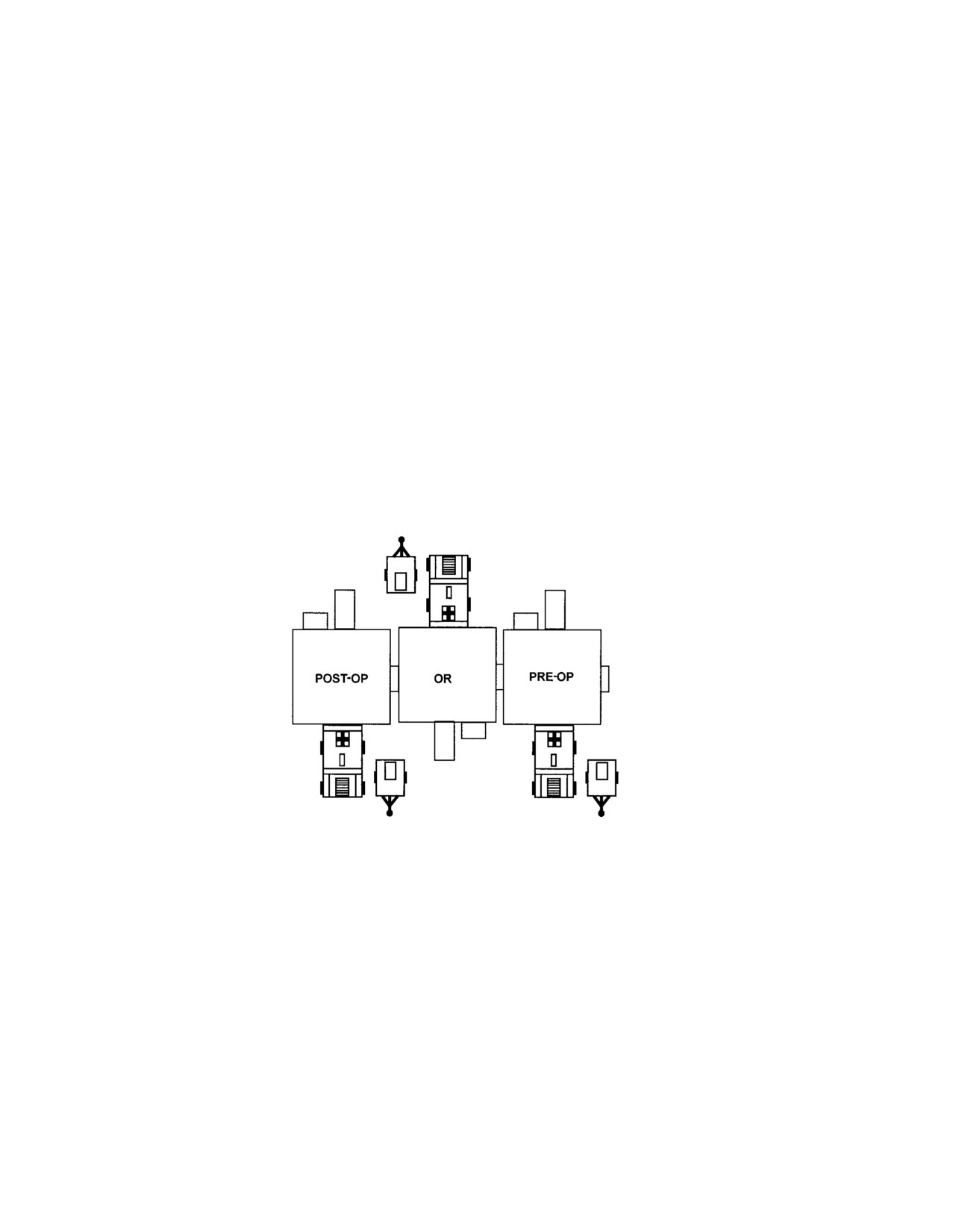
To establish a FST using the CBPSs, follow the procedures for the DCS except set up three CBPSs. All
equipment is set up inside the CBPS as required by your unit TSOP. With three CBPSs set up and
operational, a total of 900 square feet of work area is available (Figure F-3). When the FST is forward in
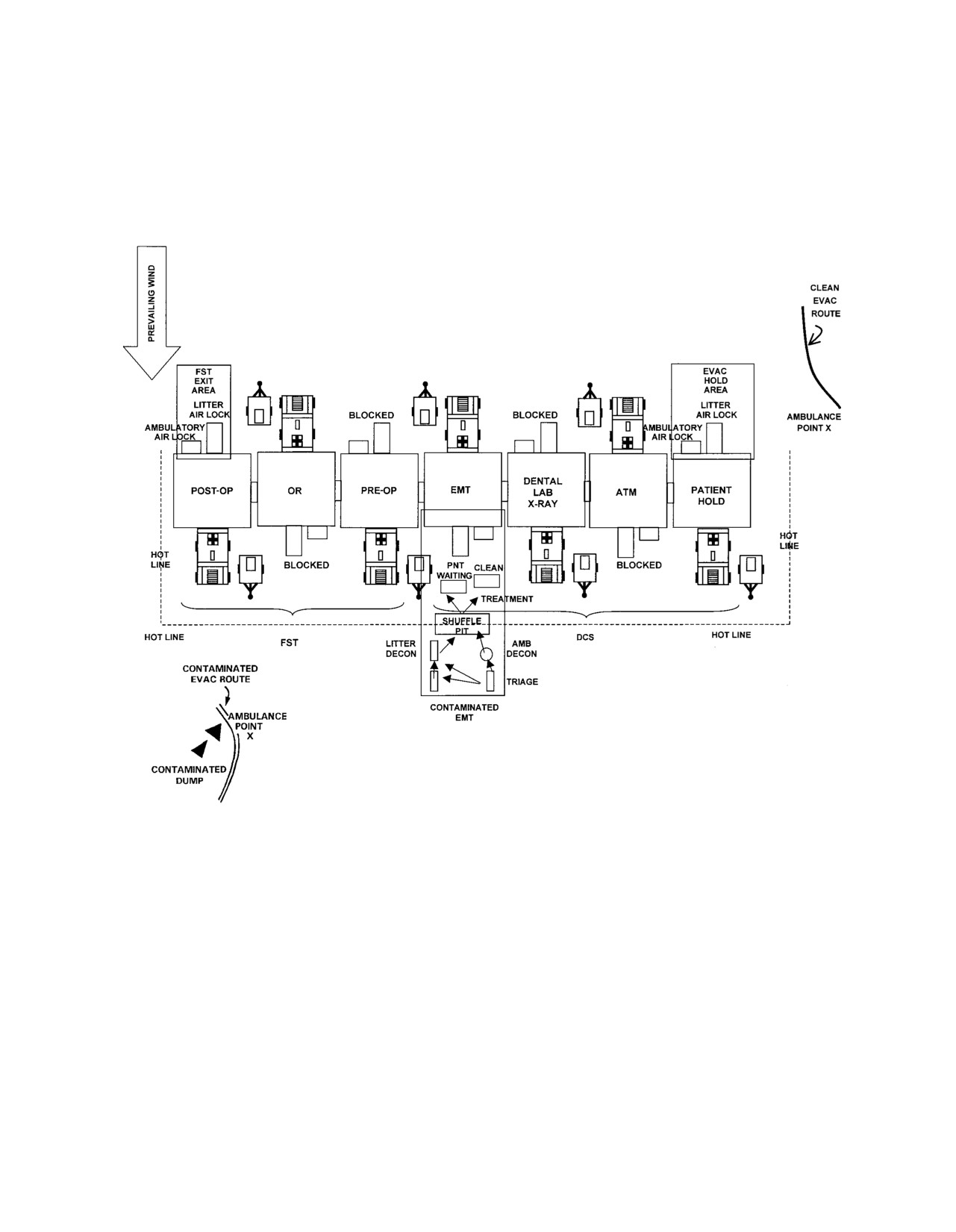
support of a medical company and operating in the CB mode, the FST systems are connected to the DCS of
the supported medical company. Figure F-4 shows the FST and DCS connected. When operating in the
CB mode with the medical company, all patients are received through the EMT air lock of the DCS. The
patients are triaged in the DCS and, based upon their injuries, they are routed to the DCS treatment area or
to the FST for surgical care. Patients released from the FST for evacuation are placed in a PPW and
processed through the litter air lock in the FST recovery section. Patient decontamination is performed at
the PDS operated by the DCS. The FST cannot operate in a CB environment without being complexed with
the DCS. They do not have any patient decontamination capabilities.
Figure F-3. Forward surgical team configuration for operations in conventional mode.
F-6
FM 4-02.7
Figure F-4. Forward surgical team and division clearing station configuration for operations in a nuclear,
biological, chemical environment.
F-7
FM 4-02.7
Section III. EMPLOYMENT OF THE CHEMICALLY PROTECTED
DEPLOYABLE MEDICAL SYSTEMS AND SIMPLIFIED COLLECTIVE
PROTECTION SYSTEMS
F-6. Collective Protection in a Deployable Medical System-Equipped Hospital
a. When the threat of NBC action is anticipated in the AO, the CP DEPMEDS components must
be set up as the hospital is being established. The system cannot be set up in a hospital that has already been
established; to do so requires the hospital to be closed, all TEMPERs be struck, and erected with the M28
liners installed during the erection process. To establish CPS in a DEPMEDS-equipped hospital, follow the
procedures as described in TM 10-5410-283-14&P. Training Circular 8-13 provides instructions on
establishing a US Army DEPMEDS-equipped hospital (without CPS). Figure F-5 presents one layout of
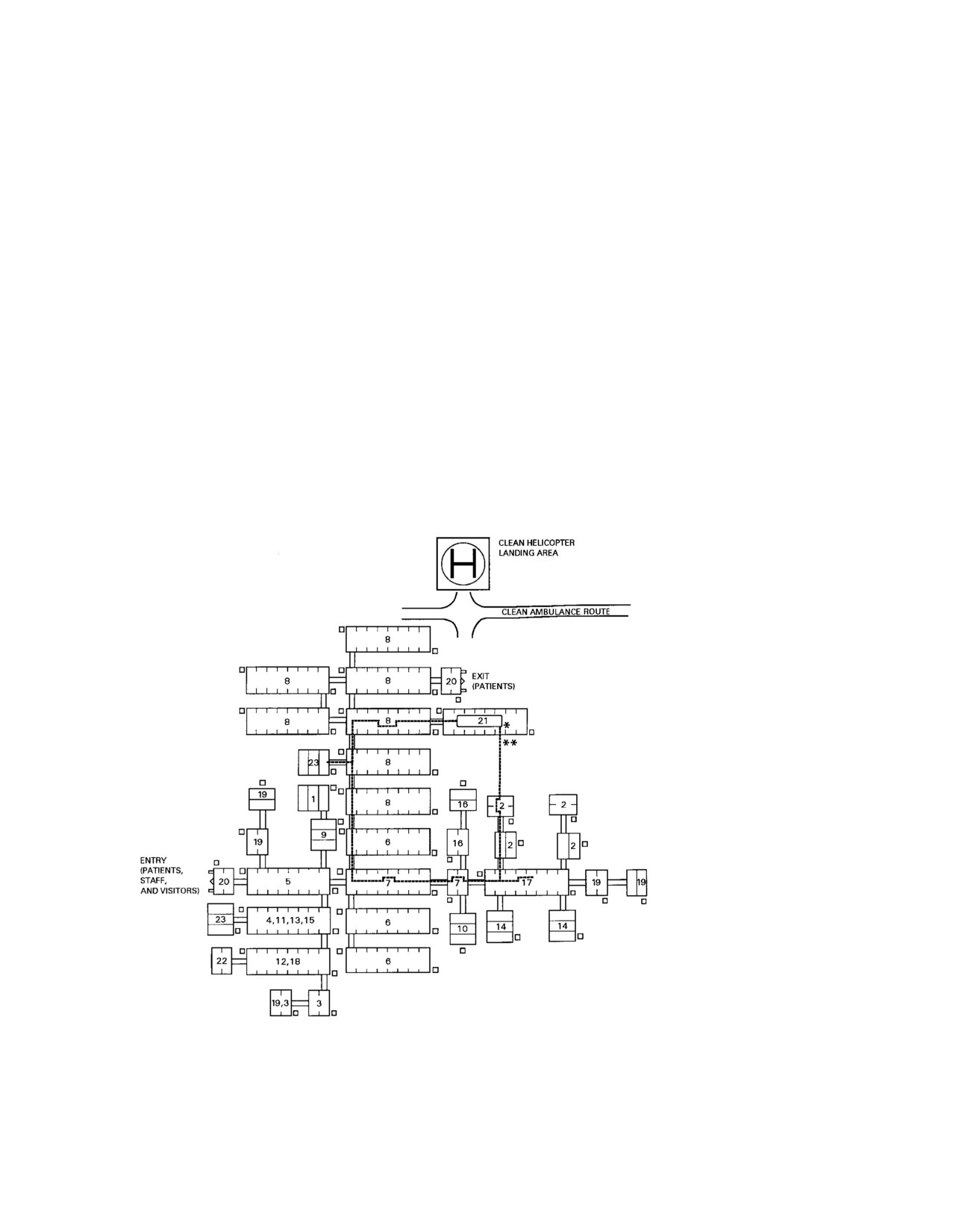
the DEPMEDS-equipped patient care area of a MF2K CSH HUB employing the CP DEPMEDS with an
internal water supply system. Figure F-6 presents a layout of the patient care area of the DEPMEDS-
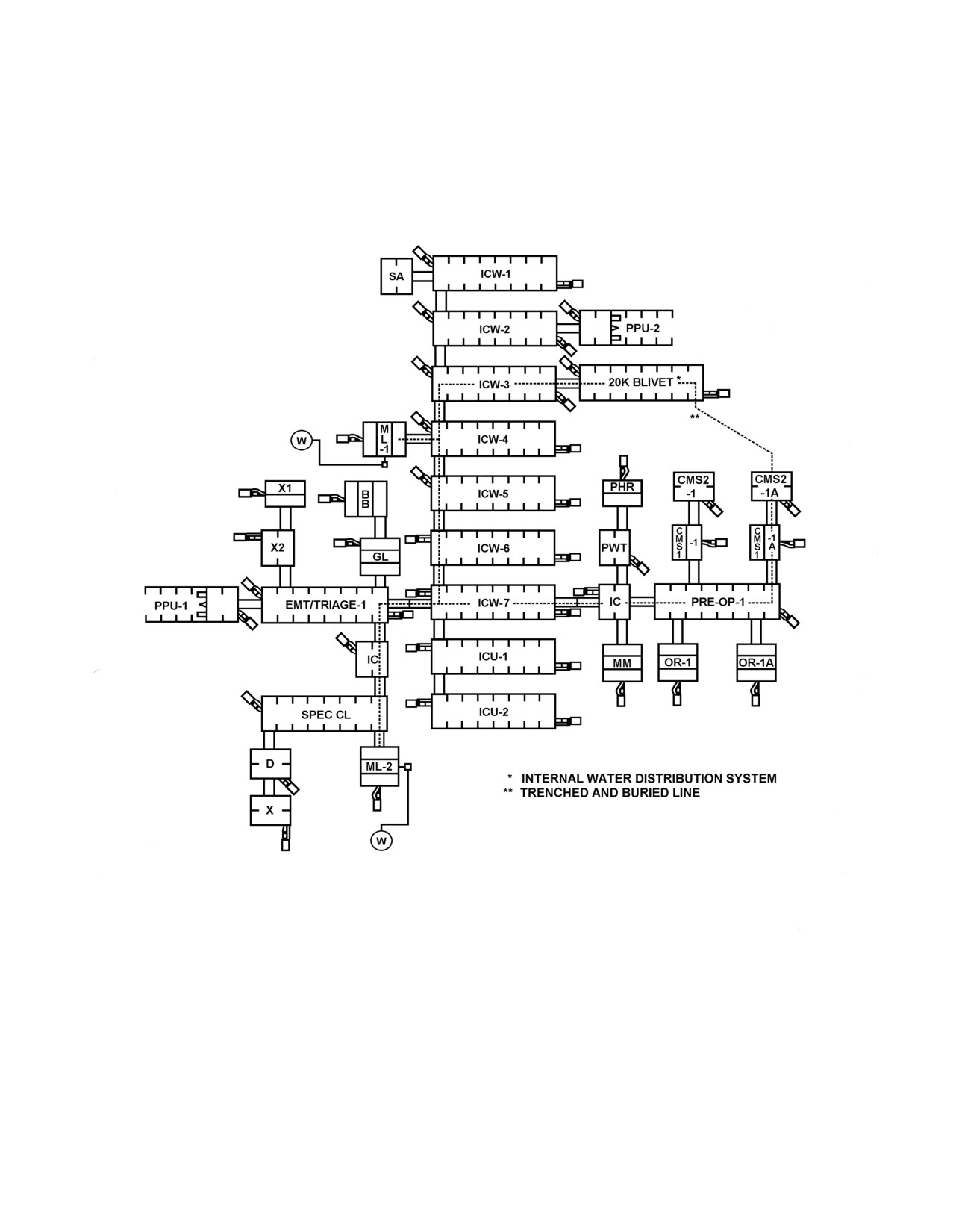
equipped portion of an 84-bed MRI hospital. Figure F-7 presents a layout of the patient care area of the
DEPMEDS-equipped portion of a 164-bed MRI hospital.
b. When employing CP DEPMEDS, provisions for waste disposal and protected water and food
supplies within the system are established. Additionally, Class VIII supplies must be protected from
contamination. Supplies not in use or needed in the protected operational areas are stored in medical chests,
shipping containers, or wrapped in layers of plastic that are inside covered areas, such as closed MILVANs
or tents. When contamination is present, only open these storage areas for operational area emergency
resupply. Use plastic sheeting or other leak-proof material to provide an additional barrier between the
supplies and the contamination. Wrap supplies in plastic or other barrier material for movement from the
storage area to the resupply air lock of the CP DEPMEDS.
• A water supply system with distribution hoses is established inside the CP DEPMEDS
areas (Figure F-5). Pumps continuously circulate the water from the storage tank through the hose system
back to the storage tank. The continuous circulation ensures that the chlorine residual is maintained in the
water supply. Personnel in areas that are not included in the continuous flow system must draw water from
the system and carry it to their work areas in 5-gallon water cans or other containers. Water resupply is
accomplished by passing a hose through the utility port at the end of the TEMPER and M28 liner for a
connection to the water transport vehicle. The ends of both hoses must be decontaminated with a 5 percent
chlorine solution before connecting them together. The vehicle must have a tank or water supply container
that is NBC protected to ensure that the water supplied is free of NBC contamination.
• Rations, as determined by the hospital commander, should be available within the
protected area for personnel and patients. Under emergency conditions the commander can authorize
feeding patients MRE rations for limited periods of time (up to 72 hours), if they are able to chew and
swallow. However, attempts must be made to ensure the required types of rations for patient feeding are
available in the CPS. The rations can be stored in any available space; however, the rations must be
protected from exposure to possible contaminants, especially liquids. Ration control measures are established
to ensure that the rations are only consumed as provided for in the hospital TSOP.
F-8
FM 4-02.7
• Two CB protected latrine systems are included in the CP DEPMEDS. The latrines
contain bedpan wash areas. The waste from the latrines is collected in an outside receiving container. The
waste is removed from the container and disposed of as outlined in the unit TSOP.
• Solid waste (including medical) must be placed in plastic bags. Seal the top of the bags to
prevent spillage, odors, or spread of infections/disease. NEVER overfill the bags; always leave enough room
in the bag to make a good seal. Place the sealed bags in the supply air lock. Inside personnel close the inner
door to the air lock. Outside personnel check to ensure that the inner air lock door is closed before opening the
outside door. Remove the bags and take them to the designated waste collection/disposal site. Disposal may
be by burial on site or by transport to a designated disposal facility. Transport may be by organic vehicles or
contractor support vehicles. The specific technique for disposal will be outlined in the unit TSOP.
• All liquid waste produced within the CP DEPMEDS is collected through a piped liquid
waste system to a central collection container. The waste container for the latrines may be used to collect
the liquid waste from the operational areas of the CP DEPMEDS. The container is emptied and the waste
disposed of as outlined in the unit TSOP.
* INTERNAL WATER DISTRIBUTION SYSTEM
** TRENCHED AND BURIED LINE
Figure F-5. Sample layout of a medical force 2000 combat support hospital unit base employing
chemically protected deployable medical system.
F-9
FM 4-02.7
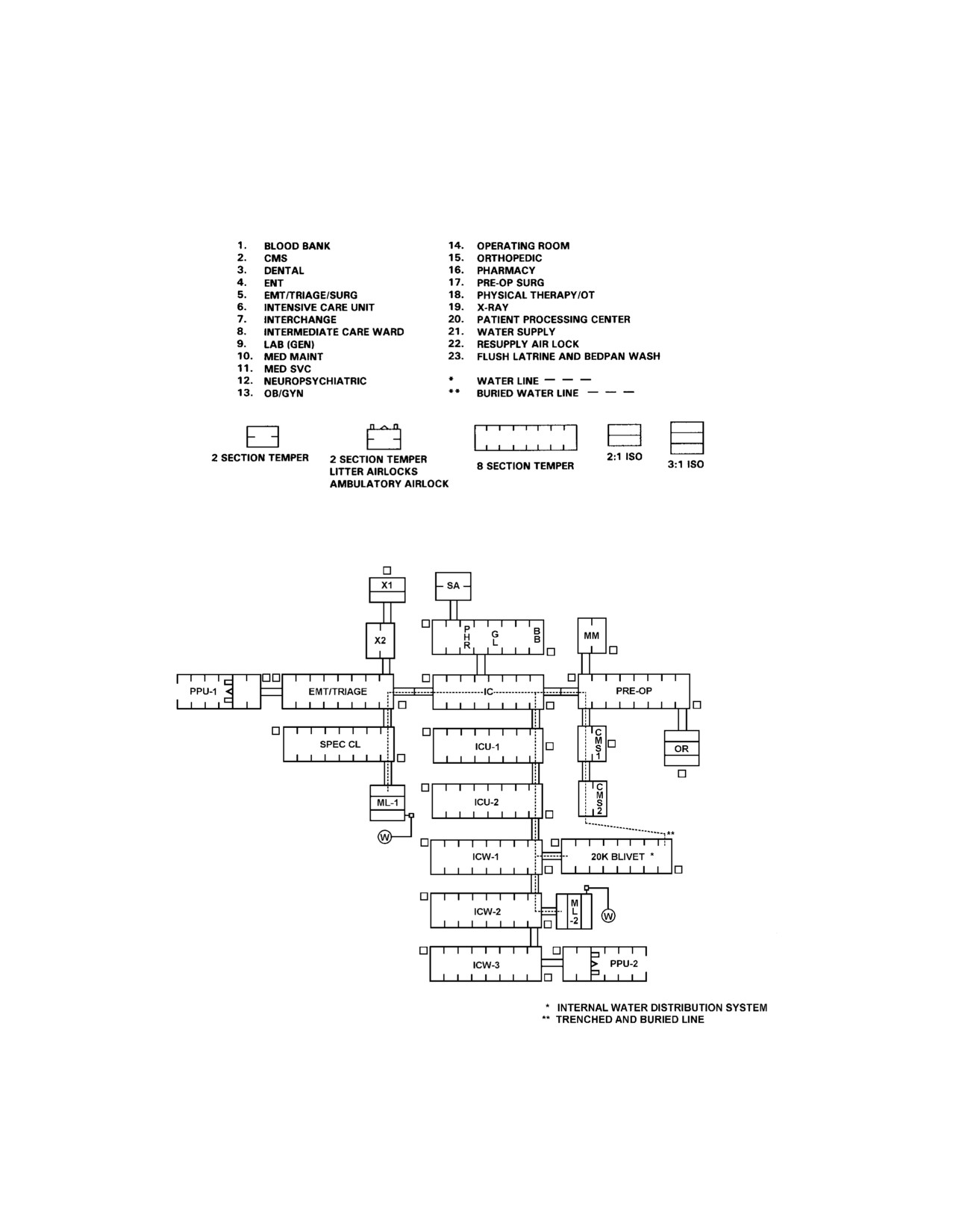
Figure F-5. Sample layout of a medical force 2000 combat support hospital unit base employing
chemically protected deployable medical system.
(Continued)
Figure F-6. Sample layout of an 84-bed medical reengineering initiative hospital employing chemically
protected deployable medical system.
F-10
FM 4-02.7
Figure F-7. Sample layout of a 164-bed medical reengineering hospital employing
chemically protected deployable medical system.
F-7. Chemically/Biologically Protecting the International Organization for Standardization Shelter
To chemically/biologically protect the ISO shelters, seal all seams and openings of the ISO to prevent the
entry of CB agents. The seals connecting the various sides and floor of the shelter may be a CB protected
material; thus providing a seal to the shelter. When the seals are not of a CB protected material, the seams
F-11
FM 4-02.7
must be taped to provide a CB protected barrier over the soft seals. Any openings not being used for
introduction of support power lines, water lines or waste water lines must be sealed to prevent entry of CB
agents. All access panels must be securely closed to prevent entry of vapors.
F-8. Chemically/Biologically Protecting the Vestibules
The vestibules connect TEMPERs to TEMPERs, ISOs to ISOs, and ISOs and TEMPERs. To harden the
vestibules, install the CB liners inside and fasten the ends to the liners of the TEMPER or to the doors of the
ISOs. Vestibule liner connectors are provided for use at the entry of each ISO.
F-9. Chemically/Biologically Protecting Air Handler Equipment
a. The FDECU is chemically/biologically protected. The system can be operated without the CB
filters. When required to operate in the CB mode, the fresh air intake on the FDECU is closed and the CB
filter blower is turned on drawing fresh air through the filters to support the FDECU and to provide clean
air for the CPS. Additionally, recirculation filters are placed within the shelter system to remove any agent
that may have entered through any of the entry/exit areas or through breaches in the shelter system.
b. When heaters are required, they must be chemically/biologically protected to prevent entry of
contamination. The CB filter units are connected to the fresh air intake side of the heater and the heated air
discharge side of the heater is connected to the air supply of the TEMPER/ISO.
F-10. Establish Collective Protection Shelter Using the M20 Simplified Collective Protection System
The M20 is used to establish a CPS within a room of opportunity, or inside a tent; however, the available
space will be limited by tent poles and other components of the tent. Currently this system only provides
ambient temperature air. See the TM and manufacturer’s publication provided with the system and system
components for details.
NOTE
The M20 does not have a litter air lock. Only staff or ambulatory
patients can enter. See the TM provided with the system for setup
procedures.
F-11. Casualty Decontamination
Patients admitted into the MTF must be contamination free. Therefore, a casualty decontamination area
must be established near the MTF. The casualty decontamination area should be provided with an overhead
cover as described for the CBPS system, except that it does not overlap the entry to the hospital. Also,
F-12
FM 4-02.7
consideration must be given to the location of other operations at the hospital site when establishing the
casualty decontamination area. However, the area must be close enough to the entry/exit of the CPS to
protect the patients from the environment and reduce their exposure to recontamination. Keep in mind that
under NBC conditions personnel outside of the CPS are at MOPP Level 4 (except decontaminated patients;
they have their mask on), thus increasing the stress load and reducing their overall performance capabilities.
The entry/exit area must have overhead cover to protect patients awaiting access to the CPS. See Appendix I
for setting up a casualty decontamination area and for decontamination procedures.
Section IV. OPERATIONS, ENTRY, AND EXIT GUIDELINES
F-12. Operations
These operations, entry, and exit guidelines may be used to prepare a unit SOP for the operation of CPS
systems in your unit.
a. When using these guidelines, the following should be considered:
• Location of the shelter (flat, hilly, rocky ground).
• General climate of the AO (high and low temperature variations during operation).
b. Information on setting up, striking, and operating the CPS is contained in the equipment
publications. Where applicable, special procedures are provided in these publications for setting up in both
clean and CB vapor hazard areas. However, the CP DEPMEDS is NOT set up in a CB vapor hazard area.
The commander will determine which procedures to use.
c.
During operations, periodic checks are made of the atmosphere within the shelter. These
checks are made by using available chemical agent detection equipment and material to determine if
chemical agent penetration has occurred. Should chemical agent penetration occur, all personnel must
mask; then ensure that patients are protected until the agent has been purged from the shelter.
F-13. Decontamination of Entrance Area
a. Normally, the MTF will not operate in a CB vapor hazard environment. However, if the
MTF must remain in an area on a temporary basis and liquid agent contamination is present, the immediate
area around the entrance must be decontaminated.
b. To decontaminate the area around the entrance, use one or more of the following methods:
• Turn over about 2 inches of soil.
F-13
FM 4-02.7
• Remove the top 1-inch layer of soil containing the liquid agent. Use the CAM or M8
detector paper to check the area after the topsoil is removed to ensure complete agent removal.
• Add several inches of clean soil or sand.
• Mix STB into the top 1/2 to 1 inch of soil.
• Use DS2 on contaminated hard-surfaced areas or frozen ground.
F-14. Procedures Prior to Entry
All personnel (staff and patients) must be decontaminated before they are permitted entry into the CPS.
• Use chemical detection equipment to check for the presence of contamination on individuals
and their equipment; also check for presence of contamination on individual weapons if they are allowed in
the CPS. Normally, weapons will not be allowed in the patient care areas, but will be stored outside near
the entry/exit. Thorough decontamination is critical in preventing contamination transfer into the CPS.
• When a chemical agent is detected, follow the procedures in Appendix C for patient
decontamination and FM 3-5 for other personnel decontamination before entering the CPS. All contaminated
clothing and equipment are placed in the contaminated dump. Weapons should not have been evacuated
with patients. However, if weapons are evacuated with the patient, they are decontaminated and held by the
MTF (administrative personnel or hospital supply) for disposition instructions.
• Decontamination must be thorough; procedures must be strictly followed. Failure to do so can
contaminate the interior of the MTF and injure medical treatment personnel; thus reducing their mission
support capabilities.
WARNINGS
1.
ALWAYS PURGE THE AIR LOCK BEFORE OPENING
THE INNER DOOR, IF THE OUTER DOOR HAS BEEN
OPENED.
2.
WHEN OPERATING IN A TOXIC ENVIRONMENT, NEVER
OPEN THE OUTER AND INNER DOORS OF THE AIR LOCKS
AT THE SAME TIME.
F-15. Entry/Exit for the Collective Protection Shelter System
a. Ambulatory Personnel.
F-14
FM 4-02.7
(1) Entry procedures.
(a) Ambulatory patients and others remove their MOPP (except their mask), BDUs, and
boots outside the air lock. This procedure reduces the amount of possible contamination entering the air lock.
(b) A check is made to ensure that the ambulatory air lock is empty and the inner door
is closed.
(c) The individual enters the air lock and closes the outer door.
(d) The air lock is purged for 3 minutes. At the end of the purge cycle, the individual
checks for contamination. If contaminated, the individual must return to the outside and decontaminate his
skin; then return to the air lock and repeat the purge cycle and contamination check. If no contamination is
detected, the protective mask is removed and placed in a plastic bag. The plastic bag is sealed and labeled.
The individual opens the inner air lock door and enters the CPS; the plastic bag is carried into the shelter
with the individual.
(2) Exit procedures.
(a) A check is made to ensure that the ambulatory air lock is empty and the outer door
is closed.
(b) The individual enters the air lock and closes the inner door.
(c) The individual puts on his protective mask; then exits through the outer door.
(d) The individual puts on his BDU and boots then assumes the established MOPP level
before departing the immediate area of the exit door.
WARNING
DO NOT OPEN THE OUTER DOOR UNTIL THE PROTECTIVE
MASK HAS BEEN PUT ON.
NOTES
1.
Ambulatory patients that enter the CBPS become litter patients
and are placed in PPW when released because the MTF does not have
replacement MOPP ensembles for patient issue.
2.
Exits must be spaced so that at least a 3 minute purge of the air
lock is accomplished before the inside door is opened. Only open the
doors long enough to permit passage.
F-15
FM 4-02.7
b. Litter Patients.
(1) Entry procedures.
(a) An outside aidman notifies an inside aidman that a litter patient is ready for
admission.
(b) The inside aidman ensures that the inner litter air lock door is closed. The outside
aidmen open the outer air lock door and place the litter on the litter rails; they push the patient into the air
lock headfirst; then they close the outer door. After a purge time of 3 minutes, an aidman inside the CPS
opens the inner door and checks the patient to ensure that he is contamination free. The patient is checked
by placing the CAM nozzle near absorptive surfaces, such as the patient’s hair. If no contamination is
found, the aidman removes the patient’s mask and places it in a plastic bag. The inside aidmen remove the
patient from the air lock and position him on treatment litter stands, or move him to the treatment area as
directed by supervisory personnel.
(c) Patients received at the treatment facility in the PPW are checked for contamination;
if they are contamination free, they may be processed through the litter air lock in the PPW. The inside
aidmen ensure that the inner litter air lock door is closed. The outside aidmen open the outer air lock door
and place the litter on the litter rails and push the patient into the litter air lock headfirst, then close the outer
door. Purge the air lock for 3 minutes. After the purge time, an aidman inside of the CPS opens the inner
air lock door and uses the CAM to check the patient to ensure that he is free of contamination. If no
contamination is found, the inside aidmen remove the patient from the air lock.
(If the patient is wearing a
protective mask, the mask is removed and placed in a plastic bag before the patient is moved from the air
lock.) As the patient is removed from the air lock, the PPW is opened and rolled inside out so that any
desorbing vapors are adsorbed by the charcoal layer. The inside aidmen remove the patient from the air lock
and position him on litter stands. The patient is transferred to a clean litter; then moved to the treatment area
as directed by supervisory personnel. The receiving litter and PPW is returned to the outside; dispose of the
PPW in the contaminated waste dump. Decontaminate the litter and return it to the litter pool.
NOTE
Should contamination be found when monitoring the air lock in (b) or
(c) above, repeat the purge cycle, then retest for contamination. All
vapor hazards must be eliminated before the patient is moved into the
CPS. Repeating the purge cycle may NOT be possible if the patient is
in need of immediate lifesaving care. The patient may have to be
returned to the outside treatment area for immediate care.
(2) Exit procedures.
(a) The litter patient is placed in a PPW. A battery operated blower unit with a CB
filter may be attached to the PPW to provide fresh air to the patient; thus reducing the heat load on the
patient and the carbon dioxide buildup inside the PPW.
F-16
FM 4-02.7
(b) An inside aidman notifies an outside aidman that the patient is ready to exit the
shelter. An outside aidman ensures that the outer air lock door is closed. The patient is placed in the litter
air lock feet first. The inner air lock door is closed. The outside aidmen open the outer door and remove
the patient.
(c) Hospital staff, visitors, or ambulatory patients exit through the ambulatory air lock.
Before entering the air lock, each individual must ensure that the outer air lock door is closed. The
individual enters the air lock and closes the inner door; puts on his protective mask and exits through the
outer door. The individual puts on his BDU and boots, and then assumes the established MOPP level before
departing the immediate area of the exit door.
WARNING
DO NOT OPEN THE OUTER DOOR UNTIL THE INNER DOOR
HAS BEEN CLOSED.
NOTE
Exits must be spaced at least 3 minutes apart to allow for a complete
purge cycle of the air lock.
F-16. Resupply of Protected Areas
Resupply of protected areas is accomplished by placing contamination-free supplies or equipment on a litter
and passing it through the litter air lock, or processing it through the supply air lock. The litter air lock
must be purged for 3 minutes. The supplies must be checked for contamination before they are removed
and placed within the CPS. The supply air lock must be purged for the stated time as outlined in the
supporting technical manual; usually 45 minutes. Again the supplies must be checked for contamination
before they are removed and placed within the CPS.
F-17
FM 4-02.7
APPENDIX G
PATIENT DECONTAMINATION
Section I. INTRODUCTION
G-1. General
a. Patient decontamination presents special problems for units and HSS personnel. Nuclear,
biological, and chemical contaminated patients create increased hazards to rescuers and HSS personnel;
thus, causing delays in providing essential first aid and medical treatment for injuries from sources other
than the exposure to NBC weapons/agents. Casualty decontamination procedures are performed by each
individual, as buddy aid, or at a unit decontamination station prior to the arrival of medical personnel. See
FM 3-5 for procedures on individual, buddy aid, and unit decontamination. Patient decontamination
procedures are normally performed at an MTF under medical supervision. Patient decontamination stations
may be established (collocated) at central unit decontamination facilities, if medical support is available.
However, augmentation medical support must be requested to provide patient care and supervise the patient
decontamination process. Because, when the unit is undergoing decontamination operations, organic
medical personnel must also decontaminate their equipment and personnel. Therefore, they are not available
to provide medical support for operating the patient decontamination station that is collocated with the
central unit decontamination facility.
b. The term “decontamination” as used herein means the removal or neutralization of radioactive
particles, BW agents, and CW agents to levels low enough that patients may be treated without contaminating
the MTF and without posing health risks to unprotected medical providers.
“Decontamination” does not
imply absolute removal of contaminants.
NOTE
The decontamination procedures described below are for NBC
contaminated patients. These procedures may also be used for most
TIM contaminated patients. However, soap and water will suffice for
most TIMs; but some TIMs react with water. For those TIMs another
material must be used to decontaminate patients. For detailed
information on decontamination of TIM contaminated patients, see
FM 8-500.
c.
Physical removal of contaminants is the primary method of decontamination. Physical removal
does not require vigorous scrubbing; in fact, vigorous scrubbing can force some agents deeper into the skin;
thus, increasing the agent effect rather than reducing its effects. The use of a M291 skin decontaminating
kit (SDK) neutralizes/reduces the effects of an agent, but physical removal is of utmost importance. When a
SDK is not available, the use of soap and water should be considered as the next best method. However,
the use of soap and water requires large amounts of water that may not be available because the soap must
be rinsed from the skin to reduce skin irritation from the soap. An alternate skin decontaminant is a
hypochlorite solution; but it should only be used when SDKs and/or sufficient quantities of water are not
available. Use a 0.5 percent hypochlorite solution on the protective mask and skin. A 5 percent hypochlorite
solution can be used on the mask hood, gloves, and other outer garments.
G-1
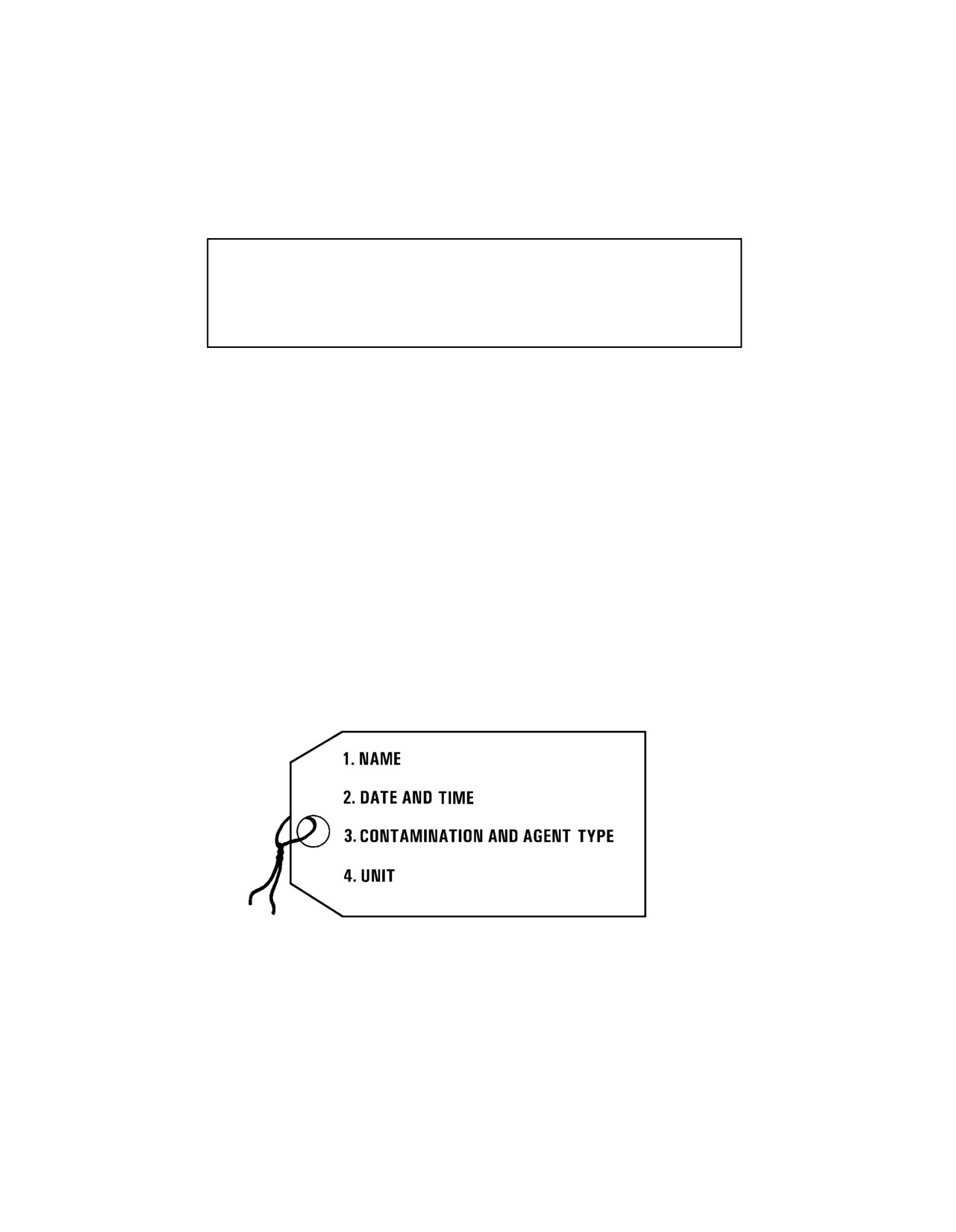
FM 4-02.7
CAUTION
Do not use the 5 percent solution on the skin; it can cause
severe skin irritation.
G-2. Immediate Decontamination
Decontamination must begin at the platoon and company level with the individual soldier, prior to the
arrival of medical personnel. The soldier himself or members of his team must perform immediate
decontamination. When the casualty’s condition and the mission permits, they may go through a MOPP
gear exchange at their unit before evacuation (see FM 3-5). Performing a MOPP gear exchange at the unit
before evacuation will reduce the amount of contamination that can be transferred to the MEDEVAC
vehicle. However, the MOPP gear exchange must not cause further injury to the casualty. First aid for
CW agent must be administered; such as administering nerve agent antidotes (such as nerve agent antidotes
and convulsant antidote for nerve agent [CANA]), as required. Enter the time and type of contamination on
a field expedient NBC casualty card (Figure G-1). Use the CAM, M8 chemical agent detector paper, or
M9 tape to determine the type of chemical contamination. Use a radiation detection meter/device to
determine the level of radioactive contamination, if required. Currently, there are no BW agent detectors
that can be used to check patients for BW agent contamination. Therefore, all patients suspected of being
contaminated with a BW agent must be decontaminated. When medical personnel arrive, they should enter
the time and type of contamination and number of antidote injections that were administered as first aid on
the Department of Defense (DD) Form 1380 (Field Medical Card [FMC]).
Figure G-1. Field expedient nuclear, biological, and chemical patient card.
G-3. Patient Decontamination and Thorough Decontamination Collocation
a. Collocating patient and thorough decontamination operations in the BSA may provide several
advantages (Figure G-2). It—
G-2
FM 4-02.7
• Preserves the principle of limiting the spread of contamination.
• Reduces confusion on the battlefield.
• Reduces demand on logistics support elements.
• Improves contamination control and reporting: One location and one person in charge.
• Reduces overall security requirements.
• Speeds PDS closure by using the thorough decontamination site.
b. An identified disadvantage is the increased size of the site and the requirement for medical
support augmentation (a treatment squad from another organization with required patient decontamination
and treatment MESs) to operate the PDS.
NOTE
Organic medical personnel must not be used to perform the HSS
mission at the collocated site.
They must go through the
decontamination process with their unit.
c.
These operations do not require that both patient decontamination and unit thorough
decontamination be executed simultaneously. The PDS can be running while the thorough decontamination
site is being prepared. Patient decontamination cannot be delayed since patients may be suffering life-
threatening injuries as well as exposure to NBC agents. Therefore, the PDS must be established and
operational before the first patients arrive. The wind direction must be common to both sites.
d. The decontamination platoon leader is responsible for establishing the combined
decontamination site. The medical unit commander/surgeon coordinates with the decontamination platoon
leader for the location of the patient receiving, PDS, and MTF. The lowest level at which this operation
will usually be planned is brigade. This operation requires extensive planning and must involve the brigade
chemical officer, brigade S4, and the medical company commander/brigade surgeon. Decontamination
support for special operation forces, other unique operational organizations, or for nonlinear operations
may require execution at a lower level. The supporting medical personnel operate the PDS. Nonmedical
personnel perform patient decontamination procedures under medical supervision. Patient decontamination
procedures are described below.
NOTE
Patient decontamination differs from thorough decontamination in that
the patients’ medical status must be monitored and medical treatment
must be provided during the decontamination process.
G-3
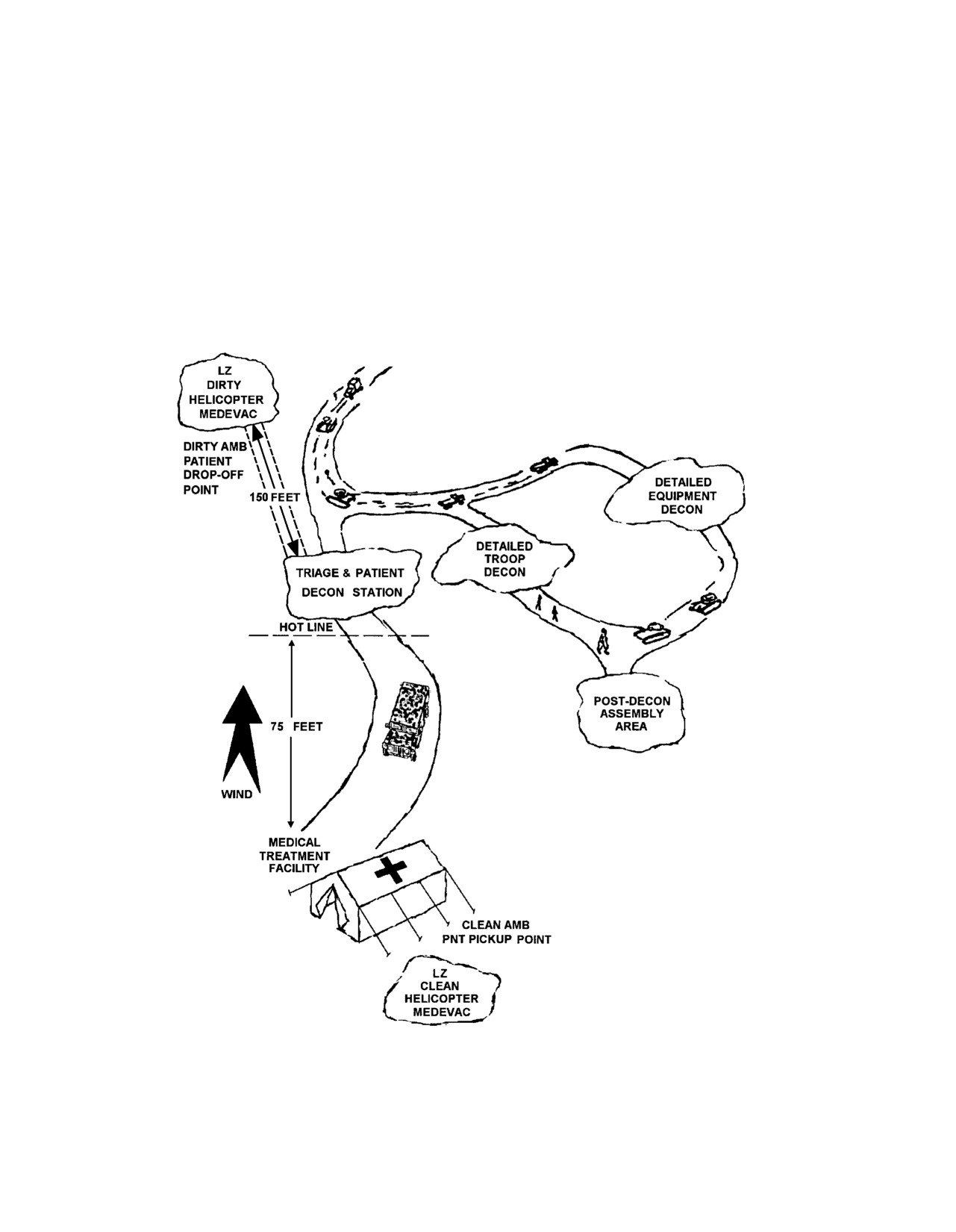
FM 4-02.7
e.
Although a PDS may be collocated with thorough decontamination, a PDS must be operational
at Levels I, II, III, and IV MTFs. Contaminated patients may present directly to the MTF for care, or
patients previously decontaminated may become contaminated en route. Therefore, all patients arriving at
an MTF must be checked for contamination. If contaminated, they must be decontaminated before they are
admitted to the MTF.
Figure G-2. Thorough decontamination site collocated with patient decontamination station, without
collective protection shelter.
G-4
FM 4-02.7
G-4. Patient Decontamination at the Battalion Aid Station (Level I)
a. When battle conditions prevent patient decontamination procedures forward or the patient is
contaminated en route, the patient may have to be decontaminated at the BAS. Contaminated patients
arriving at the BAS must be decontaminated before admission into the clean treatment area.
b. Patient decontamination is performed by eight nonmedical personnel from the supported unit
at the BAS. The patient decontamination personnel operate as two-man teams to perform the patient
decontamination procedures. The patient decontamination teams operate under the supervision of medical
personnel to ensure that no further injury is caused to the patient by the decontamination process. Each
team receives a patient from the triage point and performs both clothing removal and skin decontamination
procedures. The team requires assistance from another team to perform litter changes; see details below.
G-5. Patient Decontamination at the Medical Company Clearing Station (Level II)
The medical company clearing station may receive patients from the BAS or directly from other areas who
have not been decontaminated. The clearing station must also have a patient decontamination area. As with
the BAS, the clearing station must have a minimum of eight nonmedical personnel from the supported units
to perform patient decontamination. Procedures for patient decontamination at the clearing station are the
same as for the BAS.
G-6. Patient Decontamination at a Hospital (Level III or IV)
To the maximum extent possible, hospitals are located away from tactical or logistical targets. Contaminated
patients will arrive from forward MTFs and units located within the geographical area of the hospital.
Patient decontamination is done by at least 20 nonmedical personnel from units located in the geographical
area/base cluster of the hospital. Procedures for patient decontamination at the hospital are the same as for
the BAS. However, several patient decontamination stations can be operated simultaneously at the hospital
patient decontamination site. Further, all patients arriving at the hospital will be decontaminated and
receive full treatment within the capabilities of the hospital.
G-7. Prepare Hypochlorite Solutions for Patient Decontamination
An alternative patient decontamination agent is a hypochlorite solution; however, the hypochlorite solution
must be prepared. Two concentrations of the hypochlorite solution are required. A 5 percent hypochlorite
solution to decontaminate gloves, aprons, litters, cutting devices, the patient’s mask hood, and other
nonskin contact areas. The patient’s mask, skin, splints, and tourniquets and their wounds are irrigated
using a 0.5 (1/2) percent hypochlorite solution. To prepare the solutions, use calcium hypochlorite (HTH)
granules (supplied in 6-ounce jars in the chemical agent patient treatment and chemical agent patient
decontamination MES), bulk HTH, or sodium hypochlorite (household bleach). Prepare the required
solutions as shown in Table G-1 below.
G-5
FM 4-02.7
Table G-1. Preparation of Hypochlorite Solutions for Patient Decontamination
HTH
HTH MRE
HOUSEHOLD
PERCENT IN 5
OUNCES
SPOONFULS
BLEACH
GALLONS OF WATER
6
*5
2 QUARTS
0.5
48
40
**
5.0
* THESE MEASUREMENTS ARE USED WHEN BULK HTH IS USED. TO MEASURE THIS PREPARATION, USE THE PLASTIC
SPOON SUPPLIED WITH YOUR MEAL, READY-TO-EAT (MRE). THE AMOUNT OF HYPOCHLORITE TO BE USED IS A HEAPING
SPOONFUL (THAT IS, ALL THAT THE SPOON WILL HOLD). DO NOT SHAKE ANY GRANULES OFF OF THE SPOON BEFORE
ADDING TO THE WATER.
** DO NOT DILUTE IN WATER; HOUSEHOLD BLEACH IS 5 TO 6.25 PERCENT SOLUTION; IT IS USED FULL STRENGTH
FOR 5 PERCENT APPLICATIONS.
CAUTIONS
1.
Do not use the 5 percent hypochlorite solution on the
patient’s skin. The 5 percent solution can burn the skin.
2.
Only wipe the skin when applying the
0.5 percent
hypochlorite solution. Vigorous scrubbing may force the agent
into the skin.
G-8. Classification of Patients
On the NBC battlefield, two classifications of patients will be encountered—contaminated and
uncontaminated. Those contaminated may suffer from the effects of an NBC agent, of a conventional
wound, or both. Some may suffer combat stress or heat injuries induced by the stress of NBC conditions
and extended time spent in MOPP Level 4. It is important to follow proper decontamination procedures to
limit the spread of contamination to others and equipment. The most important decontamination is performed
at the site of contamination. Decontamination at a later time may be too late to prevent injury to the
individual, especially when exposed to vesicants. All agents should be promptly removed from the skin.
G-9. Patient Treatment
This appendix only describes patient decontamination procedures. For NBC treatment procedures, refer to
FM 4-02.283, FM 8-284, and FM 8-285.
G-6
FM 4-02.7
Section II. PATIENT DECONTAMINATION PROCEDURES
G-10. Decontaminate a Litter Chemical Agent Patient
Before contaminated patients receive medical treatment in the clean treatment area, they must be
decontaminated. Place the cutting device in a container of 5 percent hypochlorite solution between each
use. Each decontamination team member decontaminates his gloves and apron with the 5 percent
hypochlorite solution frequently to prevent spreading any contamination to patient’s skin. Decontaminate
the patient’s skin, bandages, wounds, mask, identification tags with chain, and splints with a 0.5 percent
hypochlorite solution. The litter patient is decontaminated and undressed as follows:
NOTE
Litter patients requiring EMT or ATM in the clean area of the MTF
will be completely decontaminated. A patient not requiring clean
EMT or ATM at the MTF, but requiring further evacuation (for
example: a stable patient with a partial amputation of a lower
extremity) should only have his wound area and MOPP spot
decontaminated to remove any gross contamination. The patient
should be evacuated in his MOPP.
a. Step 1. Physically remove gross contamination. Use any stiff material (stick, cardboard,
plastic strip, metal banding strap) to physically remove gross contamination from the patient’s MOPP
ensemble. Much of the CW agent contamination can be removed through physical means.
b. Step 2. Decontaminate the patient’s mask and hood. The patient has been triaged and
stabilized (if necessary) by the senior trauma specialist in the patient decontamination area. A two-man
decontamination team moves him to the litter stands at the clothing removal station.
(1) Decontaminate the mask and hood. Use the SDK, or use a 5 percent hypochlorite
solution or household bleach to sponge down the front, sides, and top of the mask hood. Decontaminate
spots with the SDK or the 5 percent hypochlorite solution.
(2) Remove hood. Remove the hood by cutting the hood. Before cutting the hood, dip the
cutting device in a 5 percent hypochlorite solution. For the M17-series mask, cut the neck cord and the
small string under the voicemitter. Release or cut the hood shoulder straps and unzip the hood zipper. Cut
the hood, close to the filter inlet cover and eye-lens outsert, upward to the top of the eye-lens outsert, and
across the forehead to the outer edge of the other eye-lens outsert. Proceed downward toward the patient’s
shoulder, staying close to the eye-lens, then across the lower part of the voicemitter to the zipper. After
dipping the cutting device in the 5 percent hypochlorite solution, cut the hood from the center of the
forehead over the top of the head (see Figure G-3). Fold the left and right sides of the hood to the side of
the patient’s head, laying the sides of the hood on the litter. For the M40-series protective mask cut the
G-7

FM 4-02.7
hood shoulder straps, then cut the quick-doff hood from the front bottom center to the chin through the
elastic band under the chin. Fold the left and right sides of the hood over the shoulders away from the head.
Figure G-3. Cutting the M17 protective mask hood.
(3) Decontaminate the protective mask and exposed skin. Using the SDK, soap and
water, or a 0.5 percent hypochlorite solution, wipe the external parts of the mask. Cover the mask air
inlet(s) with gauze or your hand to keep the mask filter dry. Continue by wiping the exposed areas of the
patient’s face, including the neck and behind the ears.
(4) Remove the Field Medical Card. Cut the patient’s FMC tie wire, allowing the FMC to
fall into a plastic bag. Seal the plastic bag and rinse the outside of the bag with a 5 percent hypochlorite
solution. Place the plastic bag with the FMC under the back of the protective mask head straps. The FMC
will remain with the patient.
c.
Step 3. Remove gross contamination from the patient’s overgarment. Remove all visible
gross contamination by scraping with a stick or other device.
d. Step 4. Remove the patient’s personal effects and protective overgarment.
(1) Remove patient’s personal effects. Remove the patient’s personal effects from his
protective overgarment and BDU pockets. Place the articles in a plastic bag, label with the patient’s
identification, and seal the bag. If the articles are not contaminated, return them to the patient. If the
articles are contaminated, place them in the contaminated holding area until they can be decontaminated,
and then return them to the patient.
(2) Cut the patient’s overgarment. The overgarment jacket and trousers may be cut
simultaneously. Two persons may be cutting clothing at the same time. Cut around bandages,
tourniquets, and splints, leaving them in place.
NOTE
A cut is a separation of material by use of a cutting device that cuts
material into two pieces. EXAMPLE: Cutting the sleeve from the
cuff to the jacket collar is one cut.
G-8