FM 4-02.7 HEALTH SERVICE SUPPORT IN A NUCLEAR, BIOLOGICAL, AND CHEMICAL ENVIRONMENT (OCTOBER 2002) - page 5
FM 4-02.7
CAUTION
Bandages may have been applied to control severe bleeding
and are treated like tourniquets. Only medical personnel remove
bandages, tourniquets, and splints.
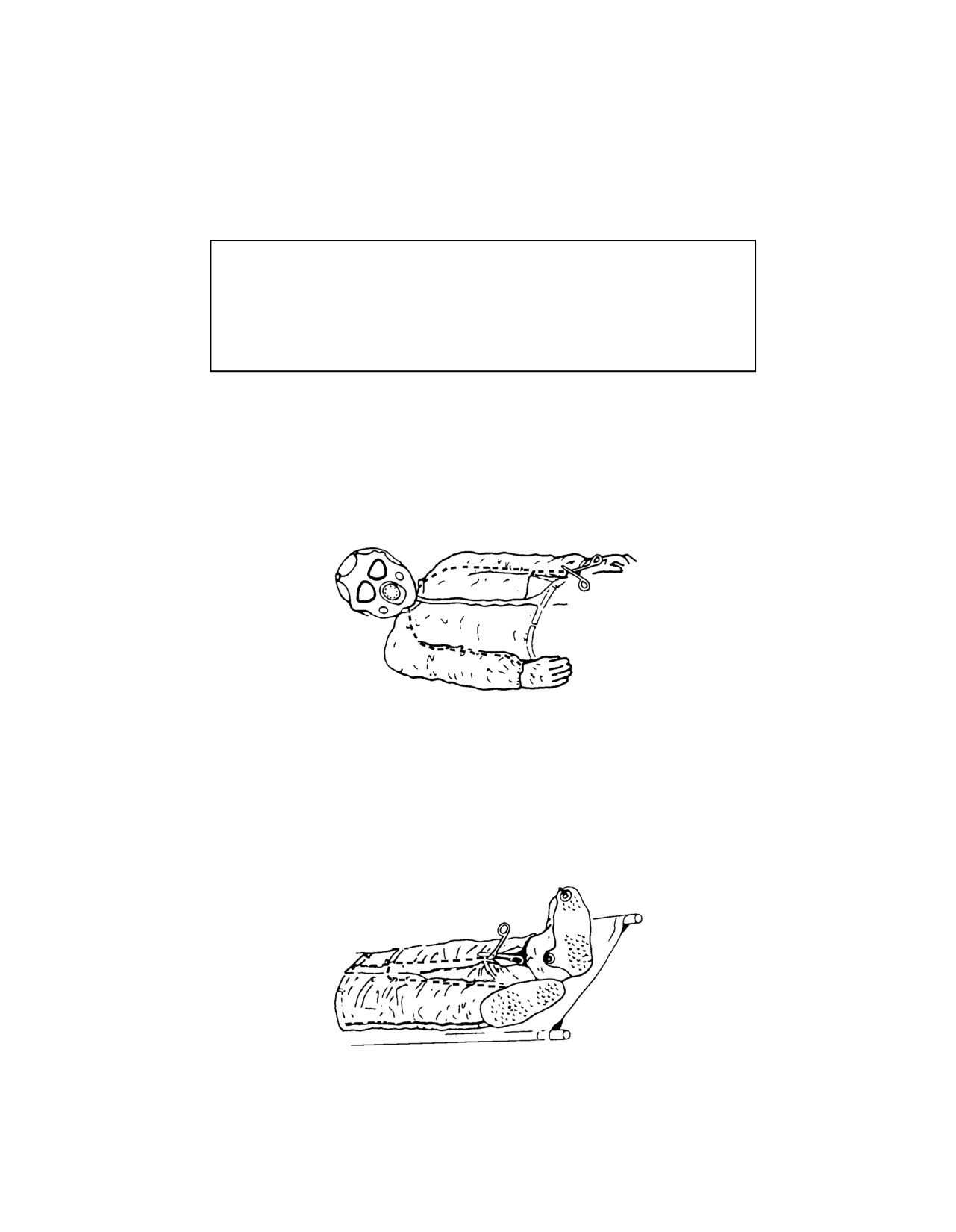
(3) Remove overgarment jacket. Make two cuts, one up each sleeve from the wrist up to
the shoulder, and then through the collar (Figure G-4). Do not allow the gloves to touch the patient along
the cut line. Dip the cutting device in the 5 percent hypochlorite solution before making each cut to prevent
contamination of the patient’s uniform or underclothing. Keep the cuts close to the inside of the arms so
that most of the sleeve material can be folded outward. Unzip the jacket; roll the chest sections to the
respective sides, with the inner surface outward. Continue by tucking the clothing between the arm and
chest. Roll the cut sleeves away from the arms, exposing the black liner.
Figure G-4. Cutting the overgarment jacket.
(4) Remove overgarment trousers. Cut both trouser legs starting at the ankle as shown in
Figure G-5. Keep the cuts near the inseams to the crotch. With the left leg, continue cutting to the waist,
avoiding the pockets. With the right leg, cut across at the crotch to the left leg cut. Place the cutting device
in the 5 percent hypochlorite solution. Fold the cut trouser halves away from the patient and allow the
halves to drop to the litter with contaminated (green) side down. Roll the inner leg portion under and
between the legs.
Figure G-5. Cutting the overgarment trousers.
G-9
FM 4-02.7
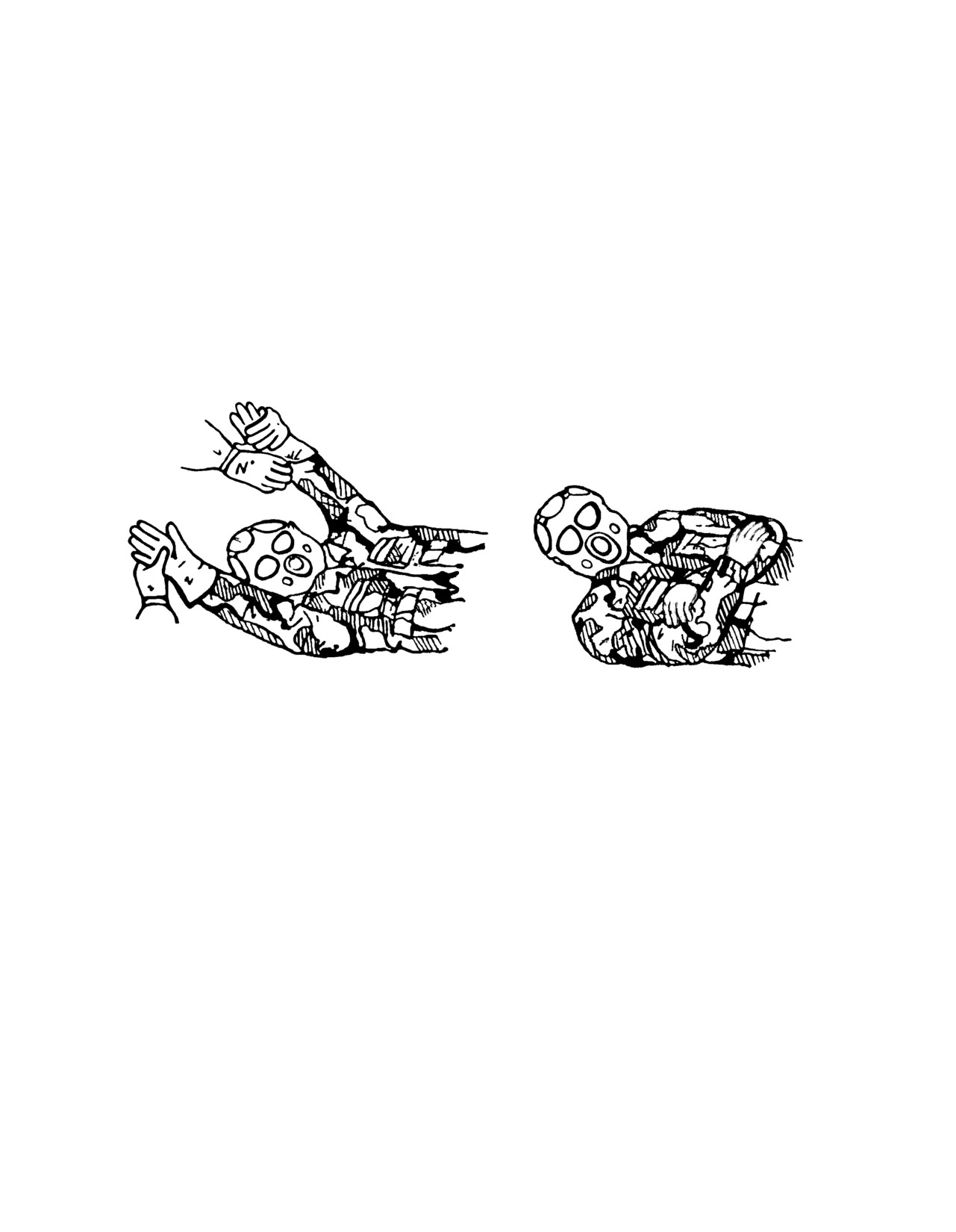
(5) Remove outer gloves. This procedure can be done with one person on each side of the
patient working simultaneously. The decontamination team will decontaminate their gloves in 5 percent
hypochlorite solution. Next, lift the patient’s arms up and out of the cutaway sleeves unless detrimental to
the patient’s condition. Grasp the fingers of the glove, roll the cuff over the fingers, turning the glove inside
out. Do not remove the inner cotton glove liners at this time. Carefully lower the arms across the chest
after the outer gloves have been removed (Figure G-6). Do not allow the patient’s arms to come into
contact with the exterior of his overgarment. Drop his gloves into the contaminated waste bag. Dip your
gloves in the 5 percent hypochlorite solution.
Figure G-6. Remove outer gloves and position arms after glove removal.
(6) Remove overboots. Cut the overboot laces and fold the lacing eyelets flat outwards. If
the green vinyl overboot (GVO) is worn, first try to remove the overboot without cutting; if necessary, cut
the boot along the front. While standing at the foot of the litter, hold the heel with one hand, pull overboot
downwards, and then pull towards you to remove the overboot over the combat boot heel. Remove the two
overboots simultaneously. This reduces the likelihood of contaminating one of the combat boots. While
holding the heels off the litter, have a decontamination team member wipe the end of the litter with the 5
percent hypochlorite solution to neutralize any liquid contamination that was transferred to the litter from
the overboots. Lower the patient’s heels onto the decontaminated litter. Place the overboots in the
contaminated waste bag. Decontamination personnel dip their gloves in the 5 percent hypochlorite solution.
e.
Step 5. Remove patient’s battle dress uniform.
(1) Remove battle dress uniform. Cut the BDU jacket and trousers as described above for
the protective overgarment. Roll the jacket and trousers as described for the protective overgarment.
(2) Remove combat boots. Cut the bootlaces along the tongue. Remove the boots by
pulling them towards you. Place the boots in the contaminated waste bag. Do not touch the patient’s skin
with contaminated gloves when removing his boots.
G-10
FM 4-02.7
(3) Remove undergarments. Remove the patient’s tee shirt. Dip the cutting device in the 5
percent hypochlorite solution between each cut. Cut both sleeves from the inside, starting at the elbow, up
to the armpit. Continue cutting across the shoulder to the collar. Cut around bandages or splints, leaving
them in place. Next, peel the tee shirt away from the body to avoid spreading contamination. If the patient
is wearing a brassiere, cut it between the cups. Cut both shoulder straps where they attach to the cups and
lay them back off of the shoulders. Remove the patient’s under shorts/panties by cutting from the lower
side of the hip to the waist on both sides. Fold the front flap of the shorts/panties down between the
patient’s legs onto the litter. Do not allow the outside of the garment to touch the patient’s skin. Remove
the socks and cotton glove liners. Do not remove the patient’s identification tags.
f.
Step 6. Transfer the patient to a decontamination litter. After the patient’s clothing has
been cut away, he is transferred to a decontamination litter or a canvas litter with a plastic sheeting cover.
Three decontamination team members decontaminate their gloves and aprons with the 5 percent hypochlorite
solution. One member places his hands under the patient’s legs at the thighs and Achilles tendons, a second
member places his arms under the patient’s back and buttocks, and a third member places his arms under
the patient’s shoulders and supports the head and neck. They carefully lift the patient using their knees (not
their backs) to minimize back strain. While the patient is elevated, another decontamination team member
removes the litter from the litter stands and replaces it with a decontaminated (clean) litter. The patient is
carefully lowered onto the clean litter. The contaminated clothing and overgarments are placed in bags and
moved to the contaminated waste dump. The dirty litter is rinsed with the 5 percent hypochlorite solution
and placed in the litter storage area.
g. Step 7. Decontaminate skin.
(1) Spot decontamination. With the patient in a supine position, spot decontaminate the
skin using the SDK or a 0.5 percent hypochlorite solution. Decontaminate areas of potential contamination.
Include areas around the neck, wrists, and lower parts of the face. Decontaminate the patient’s identification
tags and chain, if necessary.
NOTE
Complete body wash is not appropriate and may be injurious to the
patient. During complete body wash, the patient would have to be
rolled over to reach all areas of the skin. This is not necessary for
adequate decontamination.
(2) Trauma specialist care. During decontamination, the clothing around bandages,
tourniquets, and splints was cut and left in place.
• The trauma specialist replaces the old tourniquet by placing a new tourniquet 1/2 to
1 inch above the old one. He then removes the old tourniquet and decontaminates the patient’s skin using
the M291 pads or a 0.5 percent hypochlorite solution.
G-11
FM 4-02.7
• The trauma specialist gently cuts away bandages and decontaminates the area around
the wound; dusts the wound with the SDK, or irrigates soft tissue wounds with the 0.5 percent hypochlorite
solution. If bleeding begins, the trauma specialist replaces the bandage with a clean one. The trauma
specialist ensures splints are not removed, but are decontaminated in place by applying the 0.5 percent
hypochlorite solution to them, to include the padding and cravats. Splints will only be removed by a
physician or under the supervision of a physician.
WARNINGS
1.
DO NOT apply the SDK or irrigate wounds in the
abdominal and thoracic cavities or intracranial head injuries.
2.
DO NOT remove splints.
(3) Check patient for completeness of decontamination. The patient is checked with the
CAM or with M8 detector paper for completeness of decontamination.
NOTE
Other monitoring devices may be used when available.
(4) Dispose of contaminated waste. Dispose of contaminated bandages and coverings by
placing them in a contaminated waste bag. Seal the bag and place it in the contaminated waste dump.
h. Step 8. Transfer the patient across the shuffle pit.
(1) The patient’s clothing has been cut away; his skin, bandages, and splints have been
decontaminated. Now the litter is transferred to the shuffle pit and placed upon the litter stands. The shuffle pit is
wide enough to prevent the patient decontamination team members from straddling it while carrying the litter.
Four decontamination team members transfer the patient to a clean treatment litter in the shuffle pit. A member
of the patient decontamination team removes the bagged FMC and holds it so that a trauma specialist on the clean
side of the hot line can read it. A trauma specialist on the clean side of the hot line prepares a new FMC before
the patient is moved to the clean area. The old FMC is disposed of with other contaminated waste.
(2) Decontamination team members rinse or wipe down their aprons and gloves with the 5
percent hypochlorite solution.
(3) Three decontamination team members lift the patient off the decontamination litter (see
Step 6 for lifting procedures).
G-12

FM 4-02.7
(4) While the patient is elevated, another decontamination team member removes the litter
from the stands and returns it to the decontamination area. A trauma specialist from the clean side of the
shuffle pit replaces the litter with a clean one. The patient is lowered onto the clean litter. Two trauma
specialists from the clean side of the shuffle pit move the patient to the clean treatment area. The patient is
treated in this area or waits for processing into the CPS. The litter removed by the decontamination team
member is wiped down with the 5 percent hypochlorite solution in preparation for reuse.
NOTE
Before decontaminating another patient, each decontamination team
member drinks approximately one-half quart of water. The exact
amount of water consumed is increased or decreased according to the
temperature (see Table G-2 below).
Table G-2. Heat Injury Prevention and Water Consumption.
EASY WORK
MODERATE WORK
HARD WORK
WBGT
HEAT
WORK/
WATER
WORK/
WATER
WORK/
WATER
CATEGORY
INDEX
REST
INTAKE
REST
INTAKE
REST
INTAKE
DEGREES F
MIN
QT/HR
MIN
QT/HR
MIN
QT/HR
1
78-81.9
NL
1/2
NL
3/4
40/20
3/4
(WHITE)
2
82-84.9
NL
1/2
50/10
3/4
30/30
1
(GREEN)
3
85-87.9
NL
3/4
40/20
3/4
30/30
1
(YELLOW)
4
88-89.9
NL
3/4
30/30
3/4
20/40
1
(RED)
5
> 90
50/10
1
20/40
1
10/50
1
(BLACK)
THE WORK/REST TIMES AND FLUID REPLACEMENT VOLUMES WILL SUSTAIN PERFORMANCE AND HYDRATION FOR AT
LEAST 4 HOURS OF WORK IN THE SPECIFIED HEAT CATEGORY.
NL=NO LIMIT TO WORK TIME PER HOUR.
REST MEANS MINIMAL PHYSICAL ACTIVITY (SITTING OR STANDING) ACCOMPLISHED IN SHADE, IF POSSIBLE.
CAUTION: HOURLY FLUID INTAKE SHOULD NOT EXCEED 1 QUART.
DAILY FLUID INTAKE SHOULD NOT EXCEED 12 QUARTS.
WEARING BODY ARMOR ADDS 5° F TO WBGT INDEX.
WEARING ALL MOPP OVERGARMENTS ADDS 10° F TO WBGT INDEX.
WARNING
Do not exceed a fluid intake of 1 quart per hour. Do not
exceed a fluid intake of 12 quarts per day.
G-13
FM 4-02.7
G-11. Decontaminate an Ambulatory Chemical Agent Patient
a. All ambulatory patients requiring EMT or ATM in the clean area of the BAS will be
decontaminated. A member of the decontamination team or other ambulatory patients will assist the patient
in removing his clothing and decontaminating his skin.
b. Patients requiring only minimal care will undergo spot decontamination of their MOPP gear as
required for their medical treatment. They will be treated in the contaminated EMT area and returned to
duty. They will undergo decontamination and a MOPP gear exchange with their unit.
c.
Stable patients not requiring treatment at the BAS, but requiring evacuation to a higher level of
care for treatment (example: A patient with a broken arm) should be evacuated in MOPP Level 4 by any
available transportation. However, before evacuation, spot remove all thickened/persistent agents from
protective clothing.
NOTES
1.
Remember, do not remove clothing from an ambulatory patient
unless he requires treatment in the clean treatment area of the BAS or
clearing station. Only spot decontaminate the patient’s clothing and
evacuate him to the next level of care.
2.
Place cutting device used in this procedure in a container of 5
percent hypochlorite solution when not in use. Most ambulatory
patients will be treated in the contaminated treatment area and returned
to duty. Upon removal of an ambulatory patient’s clothing, he
becomes a litter patient. The BAS and clearing station do not have
clothing to replace those cut off during the decontamination process.
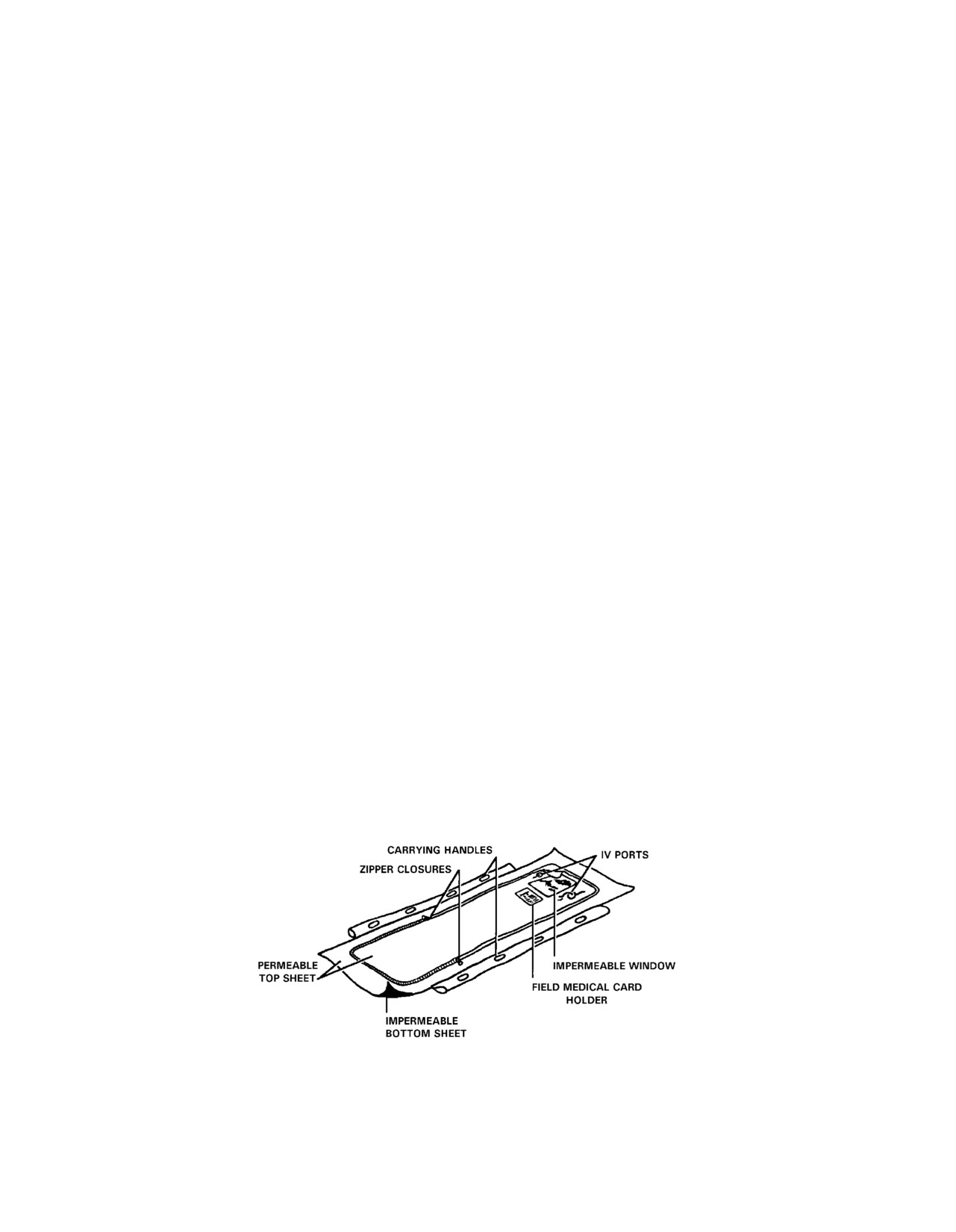
The patient must be placed in a PPW for protection during evacuation.
A battery operated blower unit with a CB filter may be attached to the
PPW to provide fresh air to the patient; thus reducing the carbon
dioxide buildup inside the PPW (Figure G-7).
Figure G-7. Chemical warfare agent protective patient wrap.
G-14
FM 4-02.7
d. Step 1. Remove load-carrying equipment. Remove load-carrying equipment (LCE) by
unfastening/unbuttoning all connectors or tie straps; then place the equipment in a plastic bag. Place the
plastic bag in the designated storage area for later decontamination.
e.
Step 2. Decontaminate the patient’s mask and hood. After the patient has been triaged and
treated (if necessary) by the senior trauma specialist in the PDS, the patient (assisted by another ambulatory
patient or a member of the patient decontamination team, if necessary) begins the clothing removal process.
(1) Decontaminate and remove mask hood. Sponge down the front, sides, and top of the
hood with a 5 percent hypochlorite solution. Remove the hood by cutting (Figure G-3) or, with the quick-
doff hood or other hoods, by loosening the hood from the mask attachment points. Before cutting the hood,
dip the cutting device in the 5 percent hypochlorite solution. Begin by cutting the neck cord and the small
string under the voicemitter. Next, release or cut the hood shoulder straps and unzip the hood zipper.
Proceed by cutting the hood upward, close to the filter inlet cover and eye-lens outserts, to the top of the
eye-lens outsert, across the forehead to the outer edge of the other eye-lens outsert. Proceed downward
toward the patient’s shoulder, staying close to the eye-lens and filter inlet. Cut across the lower part of the
voicemitter to the zipper. After dipping the cutting device in the 5 percent hypochlorite solution again, cut
the hood from the center of the forehead over the top of the head and fold the right and left sides of the hood
away from the patient’s head, removing the hood.
(2) Decontaminate the mask and patient’s face. Decontaminate the mask and the patient’s
face by using the SDK or a 0.5 percent hypochlorite solution. Wipe the external parts of the mask; cover
both mask air inlets with gauze or your hands to keep the mask filters dry. Continue by wiping the exposed
areas of the patient’s face, to include the neck and behind the ears.
f.
Step 3. Remove Field Medical Card. Cut the FMC tie wire, allowing the card to fall into
a plastic bag. Seal the plastic bag and rinse it with the 5 percent hypochlorite solution. Place the plastic bag
under the back of the protective mask head straps.
g. Step 4. Remove all gross contamination from the patient’s overgarment. Remove all
visible contamination spots by using the SDK (preferred method) or a sponge dipped in a 5 percent
hypochlorite solution.
h. Step 5. Remove overgarments.
(1) Remove the patient’s personal effects. Place the patient’s personal effects in a clean
bag and label with the patient’s identification. If they are not contaminated, give them to him. If his
personal effects are contaminated, place the bagged items in the contaminated storage area until they can be
decontaminated, then return them to the patient.
(2) Remove overgarment jacket. Have the patient stand with his feet spread apart at
shoulder width. Unsnap the jacket front flap and unzip the jacket. If the patient can extend his arms, have
him clinch his fists and extend his arms backward at about a 30° angle. Move behind the patient, grasping
his jacket collar at the sides of the neck, peel the jacket off the shoulders at a 30° angle down and away from
the patient. Avoid any rapid or sharp jerks that can spread contamination. Gently pull the inside sleeves
G-15
FM 4-02.7
over the patient’s wrists and hands. If the patient cannot extend his arms, you must cut the jacket to aid in
its removal. Dip the cutting device in the 5 percent hypochlorite solution between each cut. As with the
litter patient, cut both sleeves from the inside, starting at the wrist, up to the armpit. Continue cutting
across the shoulder to the collar. Cut around bandages or splints, leaving them in place. Next, peel the
jacket back and downward to avoid spreading contamination. Ensure that the outside of the jacket does not
touch the patient or his inner clothing.
(3) Remove overgarment trousers. Unfasten or cut all ties, buttons, or zippers before
grasping the trousers at the waist and peeling them down over the patient’s combat boots. Again, the
trousers are cut to aid in removal. If necessary, cut both trouser legs starting at the ankle, keeping the cuts
near the inside of the legs, along the inseam, to the crotch. Cut around all bandages, tourniquets, or splints.
Continue to cut up both sides of the zipper to the waist and allow the narrow strip with the zipper to drop
between the legs. Place the cutting device in the 5 percent hypochlorite solution. Peel or allow the trouser
halves to drop to the ground. Have the patient step out of the trouser legs, one at a time. Place the trousers
in the contaminated disposal bag.
(4) Remove overboots. Remove the patient’s overboots by cutting the laces with cutting
device dipped in the 5 percent hypochlorite solution. Fold the lacing eyelets flat on the ground. Step on the
toe and heel eyelets to hold the overboot on the ground and have the patient step out of it. Repeat this
procedure for the other overboot. If the GVO are worn, first try to remove the overboots without cutting; if
necessary, cut the overboots along the front. If the overboots are in good condition, they can be
decontaminated and reissued.
(5) Remove the patient’s outer gloves. Grasp the heel of the glove, peel the glove off with
a smooth downward motion. Place the contaminated gloves in a plastic bag with the overgarment jacket.
Do not allow the patient to touch his clothing or other contaminated objects with his exposed hands.
(6) Remove the patient’s cotton glove liners. Have the patient remove his cotton glove
liners to reduce the possibility of spreading contamination. Have the patient grasp the heel of one glove liner
with the other gloved hand, peeling it off of his hand. Hold the removed glove by the inside and grasp the heel
of the other glove, peeling it off of his hand. Place both glove inserts in the contaminated waste bag.
i.
Step 6. Remove patients BDU.
(1) Remove the patient’s personal effects. Place the patient’s personal effects in a clean
bag and label with the patient’s identification. If they are not contaminated, give them to him. If his
personal effects are contaminated, place the bagged items in the contaminated storage area until they can be
decontaminated, then return them to the patient.
(2) Remove BDU jacket. Have the patient stand with his feet spread apart at shoulder
width. Unbutton the front flap of the jacket. If the patient can extend his arms, have him clinch his fists and
extend his arms backward at about a 30° angle. Move behind the patient, grasping his jacket collar at the
sides of the neck, peel the jacket off the shoulders at a 30° angle down and away from the patient. Avoid
any rapid or sharp jerks that can spread contamination. Gently pull the inside sleeves over the patient’s
wrists and hands. If the patient cannot extend his arms, you must cut the jacket to aid in its removal. Dip
G-16
FM 4-02.7
the cutting device in the 5 percent hypochlorite solution between each cut. As with the litter patient, cut
both sleeves from the inside, starting at the wrist, up to the armpit. Continue cutting across the shoulder to
the collar. Cut around bandages or splints, leaving them in place. Next, peel the jacket back and
downward to avoid spreading contamination. Ensure that the outside of the jacket does not touch the patient
or his inner clothing.
(3) Remove BDU trousers. Unfasten or cut all ties, buttons, or zippers before grasping the
trousers at the waist and peeling them down over the patient’s combat boots. Again, the trousers are cut to
aid in removal. If necessary, cut both trouser legs starting at the ankle, keeping the cuts near the inside of
the legs, along the inseam, to the crotch. Cut around all bandages, tourniquets, or splints. Continue to cut
up both sides of the zipper to the waist and allow the narrow strip with the zipper to drop between the legs.
Place the cutting device in the 5 percent hypochlorite solution. Peel or allow the trouser halves to drop to
the ground. Have the patient step out of the trouser legs, one at a time. Place the trousers in the
contaminated disposal bag.
(4) Remove undergarments. Remove the patient’s tee shirt. Dip the cutting device in the 5
percent hypochlorite solution between each cut. Cut both sleeves from the inside, starting at the elbow, up
to the armpit. Continue cutting across the shoulder to the collar. Cut around bandages or splints, leaving
them in place. Next, peel the tee shirt away from the body to avoid spreading contamination. If the patient
is wearing a brassiere, cut it between the cups. Cut both shoulder straps where they attach to the cups and
lay them back off of the shoulders. Remove the patient’s under shorts/panties by cutting from the lower
side of the hip to the waist on both sides. Allow the shorts/panties to fall to the ground. Do not remove the
patient’s identification tags.
j.
Step 7. Check patient for contamination. After the patient’s BDU and underwear has
been removed check the skin for contamination by using M8 detector paper or the CAM. Carefully survey
all areas of the patient’s skin, paying particular attention to areas around the neck, wrist, ears, and
dressings, splints, or tourniquets.
k.
Step 8. Decontaminate skin.
(1) Spot decontamination. Use the SDK or the 0.5 percent hypochlorite solution to spot
decontaminate exposed neck and wrist areas, splints, other areas where the protective overgarment was
damaged, and where dressings or bandages were removed. Decontaminate the patient’s identification tags,
if necessary. Have the patient hold his breath and close his eyes. Have him, or assist him, lift his mask at
the chin. Wipe his face with the M291 pad or the 0.5 percent hypochlorite solution. Wipe quickly from
below the top of one ear, being careful to wipe all folds of the skin, top of the upper lip, chin, dimples,
earlobes, and nose. Continue up the other side of the face to the top of the other ear. Wipe the inside of the
mask where it touches the face. Have the patient reseal and check his mask.
CAUTION
Keep the decontamination solution out of the patient’s eyes.
G-17
FM 4-02.7
(2) Trauma specialist care. During clothing removal, the clothing around bandages,
tourniquets, and splints was cut and left in place.
• The trauma specialist replaces the old tourniquet by placing a new one 1/2 to 1 inch
above the old tourniquet. When the old tourniquet is removed, the skin is decontaminated with the SDK or
the 0.5 percent hypochlorite solution.
• Do not remove splints. Decontaminate them by thoroughly rinsing the splint,
padding, and cravats with the 0.5 percent hypochlorite solution.
• Usually, the trauma specialist will gently cut away bandages. The area around the
wound is dusted with the M291 pad or rinsed with the 0.5 percent hypochlorite solution, and the trauma
specialist applies the M291 pad or irrigates the soft tissue wound with the 0.5 percent hypochlorite solution.
If bleeding begins, the trauma specialist replaces the bandage with a clean one.
l.
Step 9. Dispose of contaminated waste. Dispose of contaminated bandages and coverings
by placing them in a plastic bag and sealing the bag with tape. Place the plastic bags in the contaminated
waste dump.
m. Step 10. Proceed through the shuffle pit to the clean treatment area. Have the
decontaminated patient proceed through the shuffle pit to the clean treatment area. Make sure that the
patient’s boots are thoroughly decontaminated by stirring the contents of the shuffle pit with his boots as he
crosses it. The patient will remove his combat boots and socks at the entrance of the clean treatment area or
CPS; remove the protective mask at the entrance to the clean treatment area or inside the ambulatory air
lock of the CPS.
G-12. Biological Patient Decontamination Procedures
The decontamination station as established for chemical agent patients is also used for biologically
contaminated patients. The eight-man patient decontamination team is required for biologically contaminated
patient decontamination procedures.
G-13. Decontaminate a Litter Biological Agent Patient
a. Remove the patient’s personal effects. Place the patient’s personal effects in a clean bag and
label with the patient’s identification. If they are not contaminated, give them to him. If his personal effects
are contaminated, place the bagged items in the contaminated storage area until they can be decontaminated,
and then return them to the patient.
b. Remove the Field Medical Card. Remove the FMC by cutting the tie wire and allowing the
FMC to drop into a plastic bag. Keep the FMC with the patient.
G-18
FM 4-02.7
c.
Remove the patient’s clothing. Patient decontamination team members first apply the 5
percent hypochlorite solution to the patient’s clothing and the litter. Then, remove the patient’s clothing as
in decontamination of chemical agent patients. Bandages, tourniquets, and splints are not removed. Move
patient to a clean litter as described for a chemical agent patient. Place patient’s clothing in a plastic bag
and dispose in the contaminated waste dump.
d. Decontaminate the patient’s skin. Bathe the patient with soap and warm water or apply the
0.5 percent hypochlorite solution. The trauma specialist places a new tourniquet 1/2 to 1 inch above the old
tourniquet, and then he removes the old one. The trauma specialist removes bandages and decontaminates
the skin and wound with the 0.5 percent hypochlorite solution; he replaces the bandage, if needed, to
control hemorrhage. Splints are disinfected by soaking the splint, cravats, and straps with the 0.5 percent
hypochlorite solution.
NOTE
Use a 0.5 percent hypochlorite solution to decontaminate patients
suspected of being contaminated with mycotoxins.
e.
Transfer patient to hot line. Two decontamination team members move patient to the hot
line. Request assistance from two other decontamination team members to transfer him to a clean litter as
described for chemical agent patients. Place the patient’s FMC in the plastic bag on the clean litter with
him. Two trauma specialists from the clean side of the hot line move the patient from the hot line to the
clean treatment/holding area.
G-14. Decontaminate an Ambulatory Biological Agent Patient
a. Remove the patient’s personal effects. Place the patient’s personal effects in a clean bag and
label with the patient’s identification. If they are not contaminated, give them to him. If his personal effects
are contaminated, place the bagged items in the contaminated storage area until they can be decontaminated,
then return them to the patient.
b. Remove the Field Medical Card. Remove the FMC by cutting the tie wire and allowing the
FMC to drop into a plastic bag. Keep the FMC with the patient.
c.
Remove the patient’s clothing. Patient decontamination team members first apply the 5
percent hypochlorite solution to the patient’s clothing. Then remove the patient’s clothing as in
decontamination of chemical agent patients. Bandages, tourniquets, and splints are not removed. Place
patient’s clothing in a plastic bag and dispose in the contaminated waste dump.
d. Decontaminate the patient’s skin. Have the patient bathe with soap and warm water or
apply the 0.5 percent hypochlorite solution. If the patient is unable to bathe himself, a member of the
G-19
FM 4-02.7
decontamination team must bathe him. The trauma specialist places a new tourniquet 1/2 to 1 inch above the
old tourniquet, and then he removes the old one. The trauma specialist removes bandages and
decontaminates the skin and wound with the 0.5 percent hypochlorite solution; he replaces the bandage, if
needed, to control hemorrhage. Splints are disinfected by soaking the splint, cravats, and straps with the
0.5 percent hypochlorite solution.
NOTE
Use a 0.5 percent hypochlorite solution to decontaminate ambulatory
patients suspected of being contaminated with mycotoxins.
e.
Direct patient across hot line. Direct the patient to cross the hot line to the clean treatment
area. His boots must be decontaminated at the hot line before he enters the clean treatment area.
NOTES
1.
Remember, do not remove clothing from an ambulatory patient
unless he requires treatment in the clean treatment area of the BAS or
clearing station. Only spot decontaminate the patient’s clothing and
evacuate him to the next level of care.
2.
Place cutting device used in this procedure in a container of 5
percent hypochlorite solution when not in use. Most ambulatory
patients will be treated in the contaminated treatment area and returned
to duty. Upon removal of an ambulatory patient’s clothing, he
becomes a litter patient. The BAS and clearing station do not have
clothing to replace those cut off during the decontamination process.
The patient must be placed in a PPW for protection during evacuation
(Figure G-7).
G-15. Decontaminate Nuclear-Contaminated Patients
The practical decontamination of nuclear-contaminated patients is easily accomplished without interfering
with the required medical care.
NOTE
Patients must be monitored by using a radiac meter (AN/VDR2, AN/
PDR27, or AN/PDR77) before, during, and after each step of the
decontamination procedure.
G-20
FM 4-02.7
G-16. Decontaminate a Litter Nuclear-Contaminated Patient
a. Remove patient’s personal effects. Patient decontamination team members remove the
patient’s personal effects and place them in a plastic bag. Place plastic bag in a clean holding area.
b. Remove patient’s clothing. Patient decontamination team members remove the patient’s
outer clothing as described for chemical agent patients. Do not remove bandages, tourniquets, or splints.
Move the patient to a clean litter. Place the patient’s contaminated clothing in a plastic bag and move the
bagged clothing to the contaminated waste dump.
NOTE
Patients arriving at the MTF in MOPP will only have their MOPP
removed. They can remain in their BDU unless contamination is
found on it.
c.
Spot decontaminate patient’s skin. Wash exposed skin surfaces with soap and warm water.
Wash the hair with soap and warm water, or clip the hair and wash the scalp with soap and warm water.
d. Transfer patient to hot line. Move the patient to the hot line. Two trauma specialists from
the clean side of the hot line move the patient into the clean treatment area.
G-17. Decontaminate an Ambulatory Nuclear-Contaminated Patient
a. Remove patient’s personal effects. Have the patient remove his personal effects and place
them in a plastic bag.
b. Remove patient’s outer clothing. Have the patient remove his outer clothing (or have a
decontamination team member assist him). Place his contaminated clothing in a plastic bag and move the
bagged clothing to the contaminated waste dump.
NOTE
Patients arriving at the MTF in MOPP will only have their MOPP
removed. They can remain ambulatory in their BDU unless
contamination is found on it.
c.
Spot decontaminate patient’s skin. Have the patient wash his exposed skin surfaces with
soap and warm water. Wash his hair with soap and water, or clip the hair and wash the scalp with soap
and water.
G-21
FM 4-02.7
d. Transfer patient to hot line. Direct the patient to move to the hot line. Decontaminate his
boots by stirring the shuffle pit contents with his feet before he crosses into the clean treatment area.
NOTE
If a new protective overgarment is not available, after treatment, the
ambulatory patient must be placed in a PPW for protection during
MEDEVAC to the next level of care MTF. Thus, he becomes a litter
patient for evacuation.
G-22
FM 4-02.7
APPENDIX H
FIELD EXPEDIENT PROTECTIVE SYSTEMS AGAINST
NUCLEAR, BIOLOGICAL, AND CHEMICAL ATTACK
H-1. General
Medical units must have protection from NBC attack and contamination to survive and function effectively.
The extent of protection provided is only limited by the resources available and efforts of unit personnel.
Protection as simple as an individually dug foxhole or as elaborate as the subbasement of a concrete building
may be used. Expedient protection from the effects of biological and chemical agents are usually much less
labor intensive.
H-2. Protection Against Radiation
The level of protection from radiation is expressed in terms of shielding. Material is available on the battlefield
to construct/prepare expedient fallout shelters that offer substantial shielding against gamma radiation (see
Table H-1). Generally, the denser or heavier the material, the better shielding it offers. The degree of
protection afforded by a fallout shelter is expressed as a “protection factor,” or a “transmission factor.” The
protection factor is simply the fraction of the available radiation dose that penetrates the shelter and reaches
those inside compared to the radiation received by an unprotected person. Thus, a protection factor of 2
indicates that an individual in the shelter receives one-half of the radiation dose he would receive if unprotected.
A protection factor of 100 (associated with about six half-value thicknesses) indicates that only 1/100 or 1
percent of the radiation dose reaches the inside. Transmission factors are expressed in percentages, or in
decimals. Either refers to that fraction of the ambient unshielded dose that is received by personnel within the
shelter. Fallout gamma transmission factors for some common shelters are shown in Table H-2.
Table H-1. Shielding Potential of Common Materials—Fallout Gamma Protection
MATERIAL
1/2 VALUE LAYER THICKNESS*
STEEL
1.8 CM
(.7")
CONCRETE
5.6 CM
(2.2")
EARTH
8.4 CM
(3.3")
WATER
12.2 CM
(4.8")
WOOD
22.4 CM
(8.8")
1/2 VALUE LAYER THICKNESS—THICKNESS OF A GIVEN MATERIAL WHICH REDUCES THE DOSE OR DOSE RATE
TO APPROXIMATELY ONE-HALF OF THAT FALLING UPON IT.
Table H-2. Transmission Factors for Nuclear Radiation*
INITIAL
ENVIRONMENTAL SHIELDING
NEUTRONS
GAMMA
RESIDUAL
BUILT-UP CITY AREA (IN OPEN)
1.0
0.5
0.7
FOXHOLES
0.3
0.2
0.1
H-1
FM 4-02.7
Table H-2. Transmission Factors for Nuclear Radiation* (Continued)
INITIAL
ENVIRONMENTAL SHIELDING
NEUTRONS
GAMMA
RESIDUAL
FRAME HOUSE:
FIRST FLOOR
1.0
0.9
0.5
BASEMENT
0.5
0.3
0.1
MULTISTORY BUILDINGS:
TOP FLOOR
1.0
0.9
0.1
INTERMEDIATE FLOORS
0.9
0.9
0.02
LOWER FLOOR
0.9
0.5
0.1
BASEMENT
0.5
0.3
0.01
SHELTER, CLOSED 91 CM (3 FT)
(EARTH COVER)
0.05
0.02
0.005
ARMORED VEHICLES:
ARMORED PERSONNEL CARRIER
0.3
0.2
0.1
TANKS
0.3
0.2
0.1
WOODED FOREST
1.0
1.0
0.8
INSIDE DOSE = TRANSMISSION FACTOR TIMES OUTSIDE DOSE.
H-3. Expedient Shelters for Protection Against Radiation
a. In many cases it will be unnecessary to construct field expedient or other types of fallout
shelters. There are many structures and terrain features available that afford a degree of fallout protection.
Existing fallout shelters are tunnels, caves, culverts, overpasses, ditches, ravines, and man-made structures.
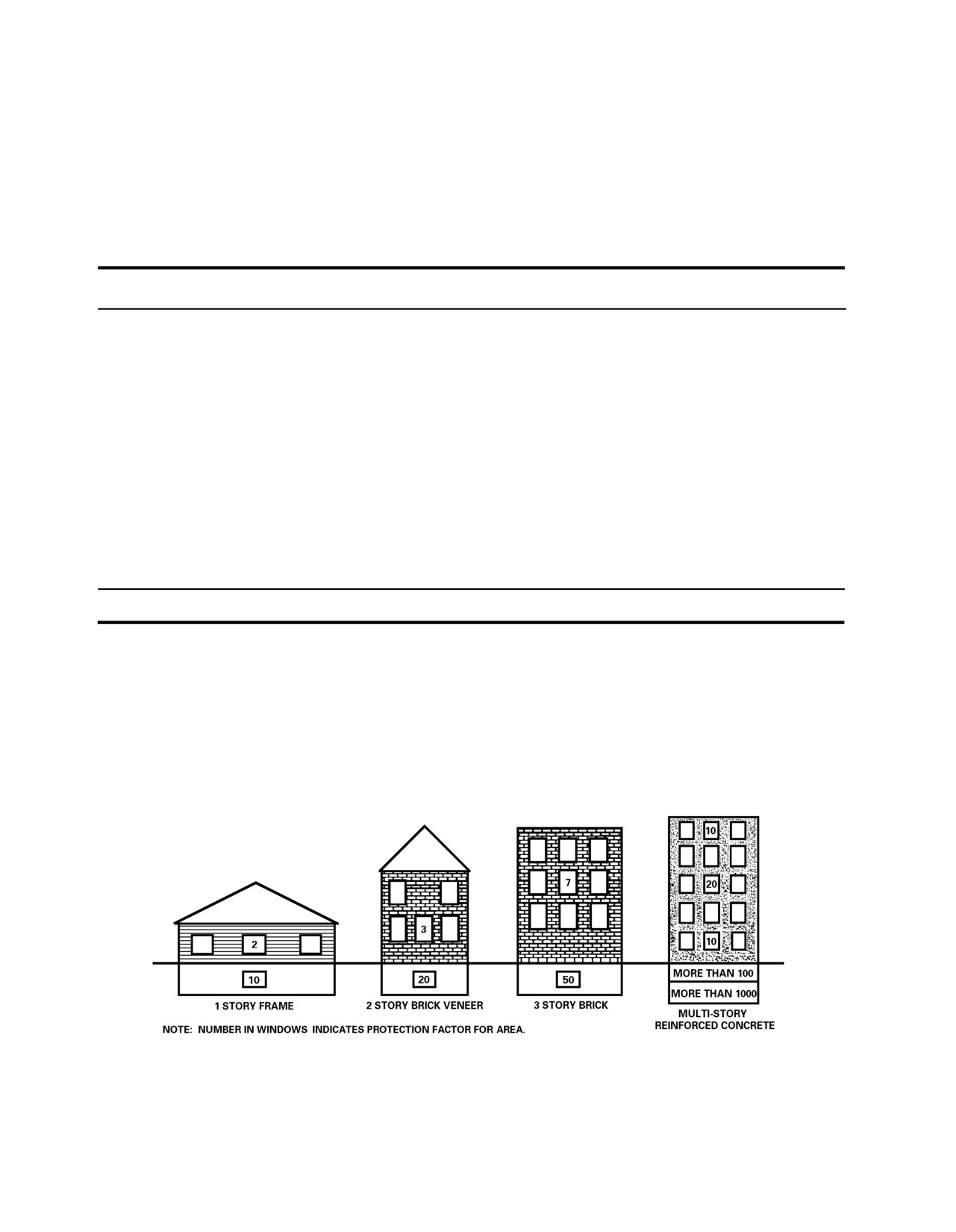
The best existing shelters are basements. Figure H-1 shows typical protection provided in buildings.
Windows can be sandbagged or covered with dirt from the outside to provide additional protection.
Figure H-1. Typical shelter protection provided in buildings.
H-2
FM 4-02.7
b. Planners should attempt to locate HSS units near existing shelters, whenever possible. However,
if an HSS unit is already established, or must be established where fallout shelters are not available, then a
shelter must be constructed. Elaborate shelters are not required, since they usually only need to be occupied
for a few days. There are a number of field expedients that will serve to save personnel and patients even
though they may not be comfortable for those few days.
c.
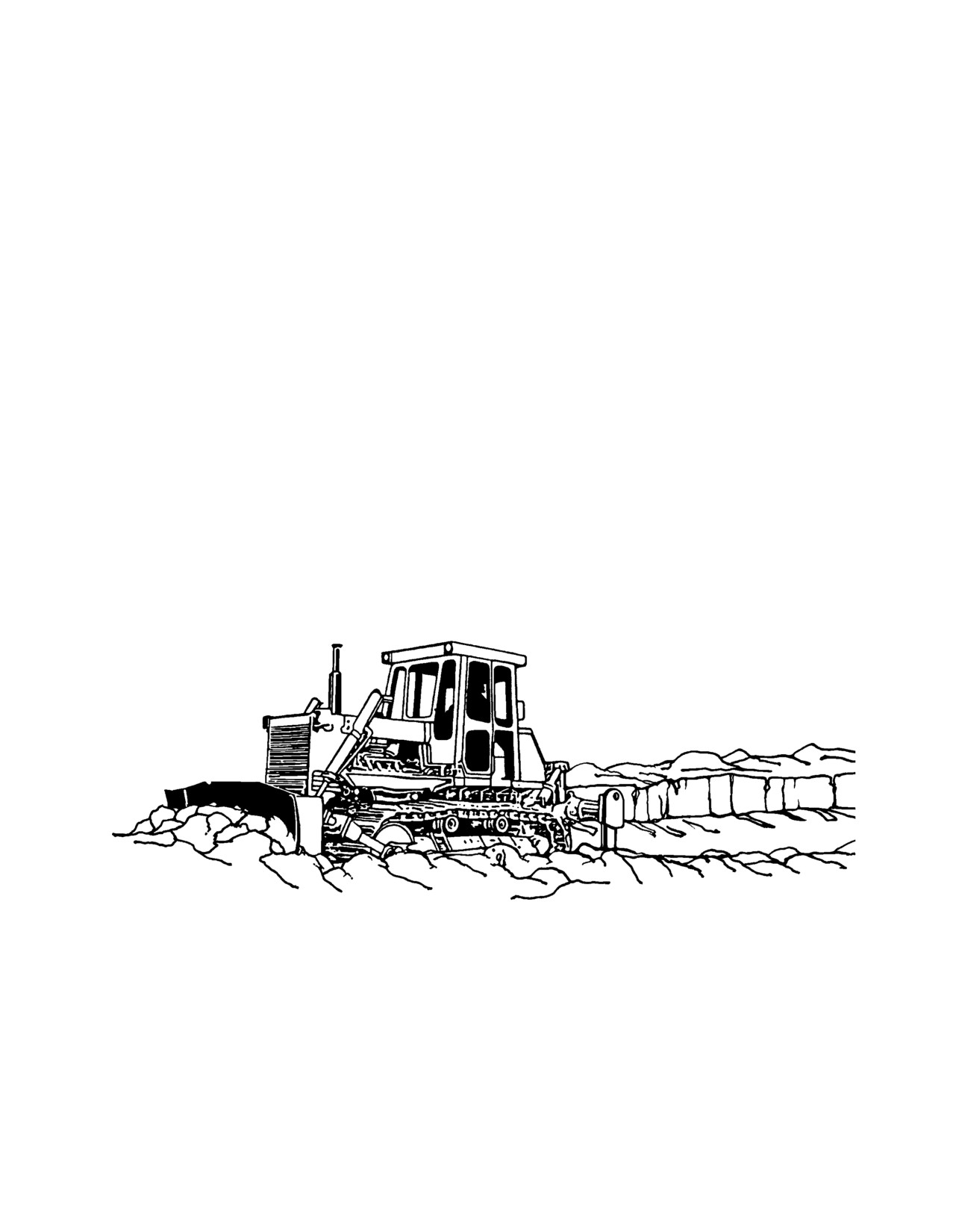
When engineer support is available, a bulldozer trench about 2.7 meters (9 feet) wide and 1.2
meters (4 feet) deep can be dug (Figure H-2). The length of the trench will be determined by the number of
patients/personnel to be sheltered. About 0.6 meter (2 feet) length of trench is required for each person to be
sheltered. These trenches reduce exposure of personnel lying on the floor to about 20 to 30 percent of the
radiation that they would receive in the open. Protection and comfort can be improved, as time permits, by
digging the trenches deeper; undercutting the walls (care must be taken in this option; the earth may cave in);
erecting tents over the trenches; and providing improved flooring. When used with other individual and
collective protection measures, bulldozer trenches provide adequate fallout shelters for most situations; they
can be provided in a minimum of time and effort. Trenches should not be dug in areas subject to flooding
during rainstorms; a berm should be formed on the uphill side of the trench to direct water around the trench
in the event rainfall occurs in the area. Undercutting will not be possible in sandy soil; also some form of
support to keep the walls from caving in is required.
Figure H-2. Dozer trench.
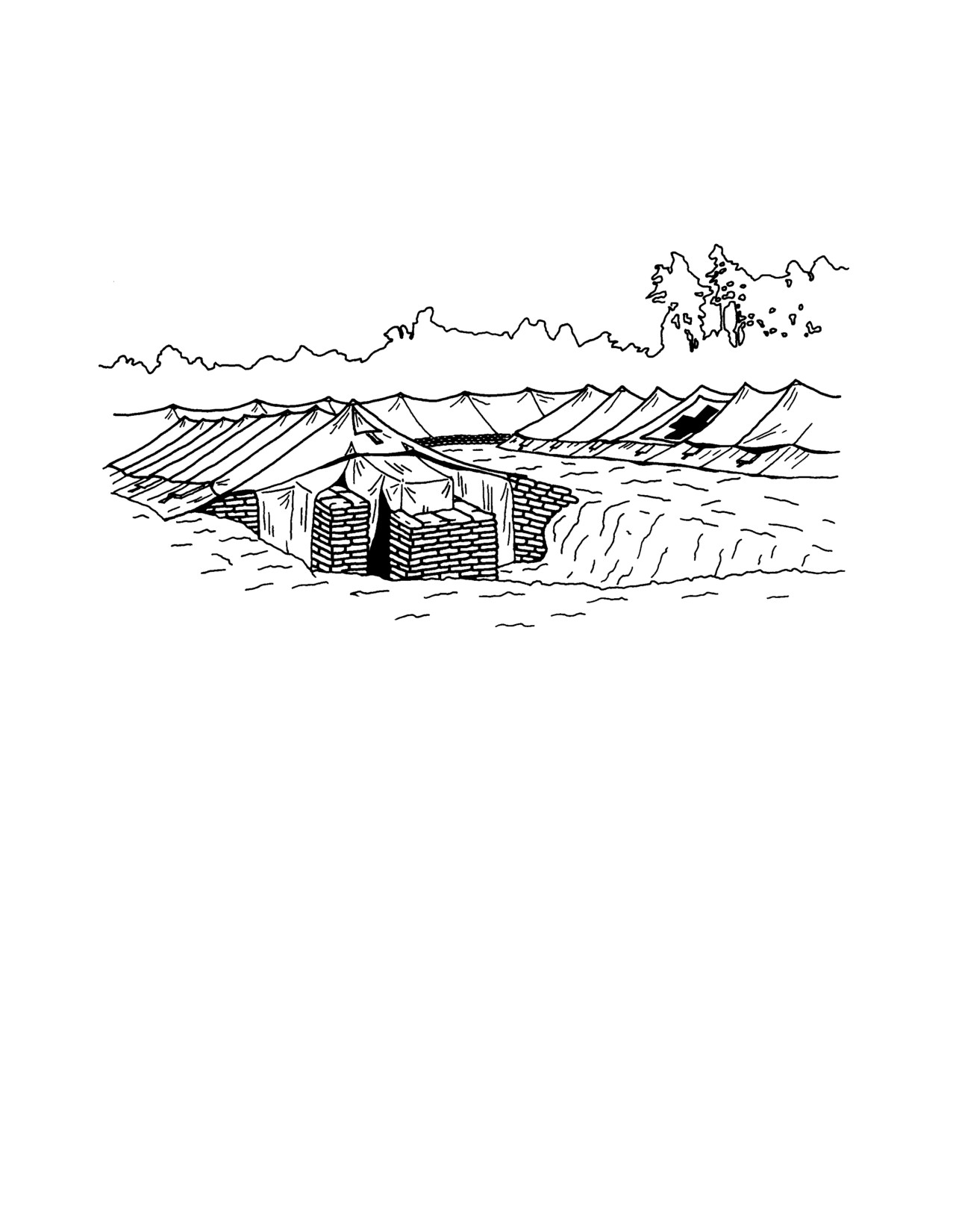
d. Dug-in tents (Figure H-3) for hospitals provide more comfort and require less movement than
the bulldozer trench; however, they have two drawbacks. First, they offer far less radiation protection than
the bulldozer trench, and second, they require considerably more engineer effort. This option should work
well with GP tents, but will probably be hard to accomplish with the TEMPER.
H-3
FM 4-02.7
Figure H-3. Dug-in tents.
e.
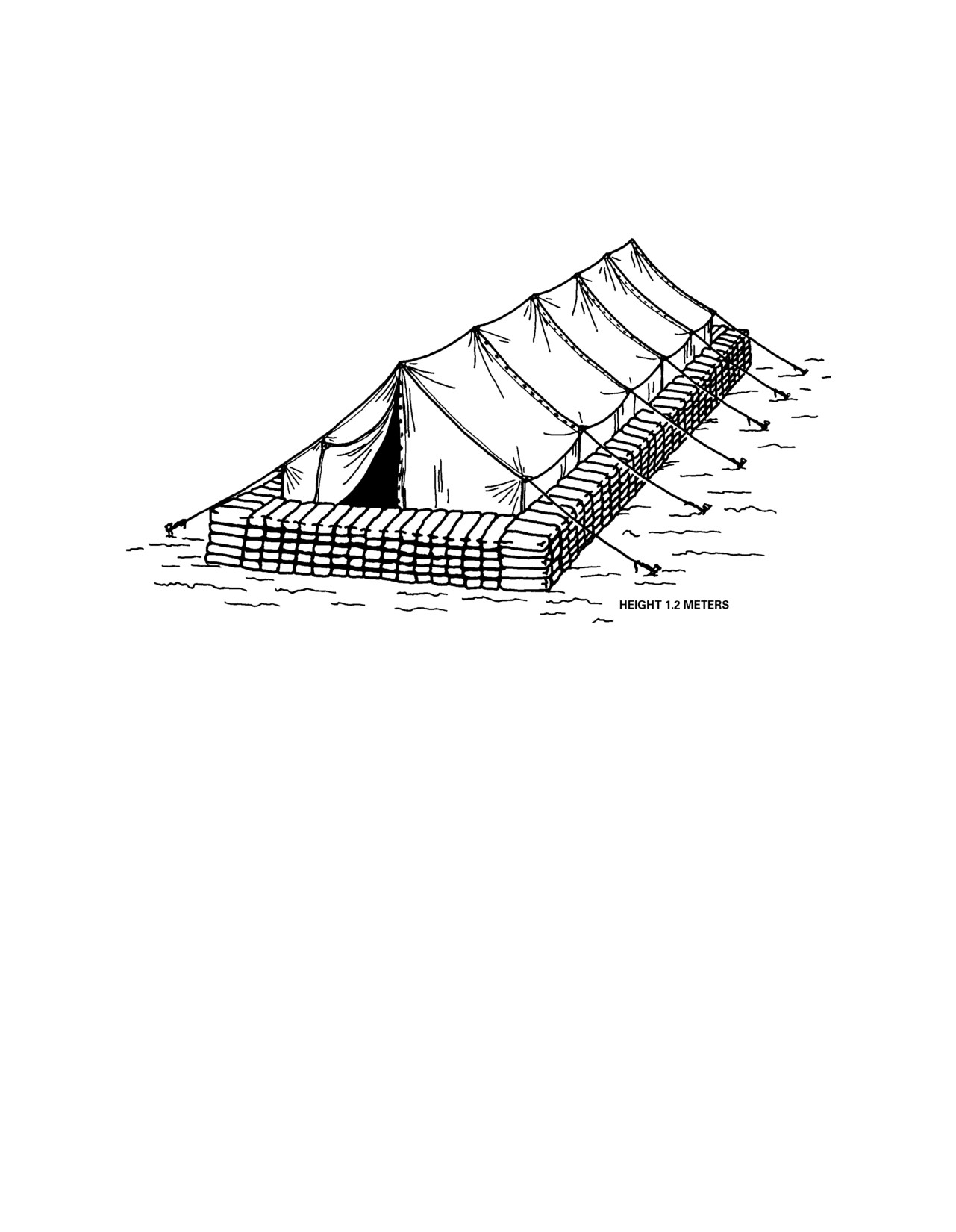
Sandbagged walls around the hospital tents, as shown in Figure H-4, or lightly constructed
buildings provide protection from fallout. Sandbagged walls 1.2 meters high give significant protection (20
to 40 percent transmission factor); however, the effort required to achieve the protection is such that it is
marginally feasible. Sandbagging is an effective means for supplementing other shelters by—
• Bolstering the shielding at weak points.
• Forming baffles at entryways.
• Blocking open ends of trenches.
• Covering windows and gaps.
f.
When other shelters are not available, HSS units must prepare foxholes and trenches for
patients and unit personnel. As time permits, improve these shelters by deepening, covering, undercutting,
and sandbagging.
H-4
FM 4-02.7
Figure H-4. Sandbag walls around tents.
H-4. Expedient Shelters Against Biological and Chemical Agents
a. When CPS systems are not available, well-sealed shelters (TEMPER, ISO, and GP) can
significantly minimize or prevent the entry of CB agents. The ventilation system must be turned off, and
kept off, before, during, and after the attack. The shelter must be totally sealed during this time to maximize
protection. Table H-3 provides examples of protection values for well-sealed shelters. For example, a well-
sealed TEMPER will only permit 1/60 of the CB agent outside to enter the shelter. If a persistent agent is
used, be aware of agent off-gassing hazards. Persistent agents can penetrate TEMPER fabric and create a
vapor hazard inside. In a CB agent attack, ensure that all staff and patients are protected by wearing their
MOPP or are in PPWs.
H-5
FM 4-02.7
Table H-3. Ratio of Nonpersistent Agent Concentrations (Inside/Outside) for Different Shelters
SHELTER
RATIO INSIDE/OUTSIDE
TEMPER TENT
1:60*
GENERAL PURPOSE TENT, MEDIUM, WITH COTTON LINER
1:50
GENERAL PURPOSE TENT, LARGE, WITH COTTON LINER
1:30
ISO SHELTER
1:60
* THE VENTILATION SYSTEM MUST BE TURNED OFF ON ALL SHELTERS TO PROVIDE THIS LEVEL OF PROTECTION.
b. Sealing shelters to prevent entry of CB agents does not require elaborate materials or
procedures.
(1) Materials needed for sealing shelters include, but are not limited to the following:
• Duct tape (or similar tape) for sealing.
• Velcro kits for TEMPER.
• Sand/dirt to seal base of GP tents.
• Plastic sheeting and tape to seal large openings, such as doors and windows of GP
tents.
(2) All vulnerable areas must be sealed. Seal—
• Joints in ISO shelters and GP tents with tape. Tape does not work very well on
TEMPER fabrics; use Velcro kits.
• Base of GP tents with sand/dirt.
• Stove pipe openings with tape and plastic.
• Windows of GP tents with tape and plastic. Seal TEMPER tent windows by aligning
and securing the Velcro border tightly; tape may be applied to the seams to provide some additional barrier.
• All ISO shelter doors that do not have CB protective seals, with tape. Seal GP tent
doors with plastic sheeting and tape.
• All windows, doors, and other openings of fixed sites with plastic and tape.
• All air ventilation system vents.
H-6
FM 4-02.7
NOTES
1.
Do not allow any entries/exits to shelters during a CB attack.
2.
In hot climates the heat load will rise in sealed shelters with the
ventilation system turned off. Personnel must carefully monitor each
other and the patients. All personnel must drink plenty of water to
prevent heat injuries; see FM 21-10.
H-7
FM 4-02.7
APPENDIX I
DETECTION AND TREATMENT OF NUCLEAR, BIOLOGICAL,
AND CHEMICAL CONTAMINATION IN WATER
I-1.
General
Water supplies in areas with NBC contamination and in surface water supplied by runoff from such areas
will most likely be contaminated. The contamination of water, whether intentional or inadvertent, may
reach concentrations that will produce casualties. By special methods of analysis, the presence of
contamination can be determined. Treatment of contaminated water requires chemicals and equipment that
are only available to quartermaster water purification units; individuals or units should not attempt to treat
their water. Decontamination of water is only undertaken when uncontaminated sources are not available;
then ONLY with the approval of the medical authority (PVNTMED or surgeon).
I-2.
Detection of Contamination in Water
a. Detection of nuclear contamination in water is accomplished by using the AN/PDR77, AN
PDR/27 or AN VDR/2 radiacmeters.
CAUTION
DO NOT allow the probe to come into contact with the water
source; allow at least one inch of air space between the probe
and water surface.
b. Detection of BW agents in water is accomplished by the use of field biological water test kits and
specially designed collection and detection kits. The specialty kits will be provided as needed, and will be
available to PVNTMED and supporting medical laboratory personnel. When required for the President and
Secretary of Defense purpose, samples must be collected and prepared for shipment to the supporting medical
laboratory. A chain of custody document must be prepared by the collector and maintained as the sample(s) is
being transported to the supporting medical laboratory and throughout its transit to the CONUS laboratory.
See Appendix F for details on suspect BW sample collection, packaging, chain of custody, and handling.
c.
The Chemical Agent Water Testing Kit, M272, provides a rapid field test to detect chemical
agent contamination in water. The test must be conducted before the water is treated with chlorine; the
chlorine will affect the accuracy of the test for chemical agents.
I-3.
Procedures on Discovery of Contamination in Water
When contamination is discovered the following actions are taken:
a. Mark the water source, using the standard NBC contamination markers, and ensure that
personnel do not consume the water until approved.
I-1
FM 4-02.7
b. Notify the commander that the water source is contaminated and unfit for drinking, food
preparation, and personal hygiene.
c.
Notify the supporting water production unit, such as the quartermaster water production and
distribution unit of the contaminated water source.
d. The commander establishes safeguards to prevent personnel from using the contaminated
water supply.
e.
An alternative source of uncontaminated water is sought and used. The primary source for
obtaining water is from quartermaster-operated water production and distribution points. Other sources are
considered only when quartermaster-operated facilities are not available. Alternative sources that may be
considered include—
• Ground water sources that are least likely to be contaminated.
• Local fixed facility water supplies. However, these supplies must be tested before use.
If NBC contamination is found do not use.
• Using another location to obtain an uncontaminated water source, when the tactical
situation permits.
f.
Contaminated water must not be used until it has been treated by quartermaster water
production and distribution units or other equally capable water purification units and approved for use by
the medical authority.
I-4.
Treatment of Contaminated Water
Contaminated water requires additional equipment and supplies to remove the contamination. Quartermaster
water purification and distribution units are equipped to perform these duties. See FM 10-52 for details.
I-2
FM 4-02.7
APPENDIX J
FOOD CONTAMINATION AND DECONTAMINATION
J-1.
General
a. Food Susceptibility. Stored, transported, and prepared food is susceptible to NBC
contamination throughout the TO. Planning for any battle or operation must include food protection from
contamination; food contamination detection; and contaminated food disposition (decontaminate or destroy).
b. Countermeasures. There are three primary countermeasures to overcome or reduce the NBC
hazard to food:
(1) Contamination avoidance.
(2) Nuclear, biological, and chemical agent detection.
(3) Nuclear, biological, and chemical agent decontamination.
c.
Priorities. The priorities for conducting NBC countermeasures are—
(1) Contamination avoidance. Contamination avoidance includes using natural and fabricated
barriers to prevent, or significantly reduce the spread of contamination. Also, using specific procedures for
entry and exit between contaminated and uncontaminated areas reduce the potential for spreading
contamination. Use of these barriers and procedures may reduce the subsequent need for detection and
decontamination.
(2) Detection, measurement, and identification. These activities are essential for determining
the presence, extent, and nature of NBC contamination. This information is essential in identifying the
existence of uncontaminated supplies, or decontamination requirements.
(3) Decontamination. Decontamination removes the contaminant and provides food that is
safe for consumption.
d. Decontamination. Decontamination efforts require an extensive amount of labor, time, and
supplies. The use of hasty decontamination is emphasized. That is, decontaminate just enough to sustain
operations and keep fighting, rather than to make a contamination-free environment. Normally,
decontamination efforts will be limited to the packaging and packing materials. Food decontamination will
only occur in critical situations where other food supplies are not available. Most decontamination is
performed in or very near the AO. Before beginning decontamination procedures, divide exposed food
items into groups based on protection of item at time of exposure. These groups establish priorities based
on ease of decontamination and the ability to monitor the food.
(1) Group I—Canned or packaged items exposed only to a chemical agent vapor.
(2) Group II—Canned or packaged items that are contaminated on the outside with a liquid
chemical agent, a biological agent, or radioactive fallout.
J-1
FM 4-02.7
(3) Group III—Unpacked or poorly packaged items that have been exposed to any NBC agent.
(4) Group IV—Food contaminated through the food chain.
J-2.
Protection of Food from Contamination
An adequate defensive posture for a chemical attack will also protect food against biological contamination
and radiation fallout.
a. Operational Rations. Operational rations include, but are not limited to, MREs; unit group
ration (UGR), A; unit group ration, heat and serve; and medical diet supplement.
(1) Packaging materials and storage methods normally protect these rations. The packaging
and packing of operational rations protect the contents from deterioration. As a result, the contents are
protected from moisture, to include chemical liquids, chemical vapors, and biological agents. Operational
rations delivered to an AO will usually have increased levels of packaging and/or packing protection.
Operational rations are substantially protected while contained in the shipping cases, especially if protected
with an overlay of fiberboard, shrink wrap, or film wrap.
(2) Enclosed storage is used whenever possible. Refrigerated warehouses, cold storage
rooms, and even prefabricated refrigerators and trailers provide excellent protection. Underground shelters,
caves, and tunnels that can be made airtight provide maximum NBC protection. Buildings provide protection
depending on how well they can be closed and sealed. The basement of a building is a good storage place.
However, keep in mind that chemical vapors tend to seek out low-lying areas. Storing rations indoors will
protect them from liquid droplet and fallout contamination unless the building is damaged by an attack.
Complete protection against chemical vapors is only offered by airtight closed spaces like cold storage
facilities.
(3) Chemical protective measures are to be integrated into daily logistical operation to avoid
the contamination of operational rations. Maximum use is made of alarm and detection equipment,
overhead shelter, shielding materials, and protective covers. Back up stocks of operational rations should
be dispersed to minimize the risk of destruction or contamination.
(4) An NBC Protective Cover or similar equipment will help greatly. The NBC Protective
Cover is discarded and replaced upon becoming contaminated; it reduces overall decontamination
requirements; and it improves the survivability of supplies and equipment. The NBC Protective Cover
provides 24-hour protection against liquid chemical contamination. Detection paper used on the NBC
Protective Cover will rapidly identify a contaminated cover.
b. Bulk and Fresh Foods.
(1) Field expedient or improvised storage may be the only choice available under high-risk
conditions. Expedient storage for food supplies may be a natural or man-made depression lined to protect
J-2
FM 4-02.7
contents against moisture, and then covered with earth and sod. The earth gives good protection against all
forms of chemical or biological contamination and nuclear fallout.
(2) Foods are only stored outdoors or in partially protected areas when absolutely necessary.
Only cases of foods packed in cans, bottles, or airtight foil or film wraps, and foods packed in sealed boxes
or multilayered wrappings can be subjected to exposed storage. Partial protection is provided by open
sheds, temporary roofing, or tents. When subsistence must be stored in the open, give as much protection
as possible. Protection material may include NBC Protective Covers, tarpaulins, tarpaulin sheds, or any
other available covering such as plastic sheeting. Tarpaulins and other treated or waterproof coverings do
not prevent contamination by chemical vapors, but they do reduce contamination from liquid agents.
Canvas will keep out more than 95 percent of liquid contamination for a short period of time after the
attack. The canvas must be removed soon after the attack to prevent the agent from seeping through onto
the subsistence; placement of spacers between the covering and the food will greatly reduce this problem.
Even the thinnest material will offer some protection and is better than nothing at all. Therefore, food
supplies must be covered by whatever material is available.
J-3.
Nuclear
a. Contamination.
(1) Following a nuclear detonation, food can become contaminated in three ways:
• Direct contamination. Direct contamination results by fallout collecting on plants,
animals, and stored food (surface contamination). Fallout has two effects. First, it produces a gamma
radiation field over the fallout area. Second, it contaminates the surface of anything on which it is
deposited. The whole-body gamma irradiation hazard to an individual far outweighs any potential hazard
from food contamination. The basic rule is: If you can safely be in the area to salvage the food, then the
food salvaged is safe to use (although slightly contaminated).
• Indirect contamination. This form of contamination can be spread throughout the
food chain. Humans can ingest contamination by eating plants that have absorbed radioactive isotopes;
products
(milk or meat) from animals allowed to graze on contaminated pastures; or fish from
contaminated water.
• Induced radiation. It is possible that food will be exposed to sufficient neutron flux
(an increase in the number of free neutrons) as the result of a nuclear explosion to produce considerable
induced radioactivity in food without it being destroyed by blast and heat. This is possible with enhanced
radiation weapons in the energy range of 1 KT where the radiation kill radius exceeds the blast destruction
zone. The elements that are most prominently involved are sodium, potassium, sulfur, copper, bromine,
zinc, and especially phosphorous. Thus, in an area of induced radiation, foods requiring the most caution
are dairy products, high salt content foods, dry beans, raisins, and ready-mixed cake and biscuit flours.
The radioactivity has a short half-life; therefore, the radiation will decay very rapidly. It should be possible
to consume foods containing induced radiation within a week or two. Cans, particularly those with “C”
enamel, may incur a high level of induced radiation (from zinc in the enamel, not from iron in the can).
J-3
FM 4-02.7
Glass, because of its high salt content, will show very high levels of activity; clear glass will turn brown.
Container radioactivity has no bearing on the food, it is safe to use. The radioactivity is not transferred to
the contents. No significant toxic by-products are formed in the exposed canned food.
(2) Consumption of food contaminated with radioactive fallout may cause a risk of radiation
injuries from internal radiation; that is, radiation from radioactive sources within the body. Most isotopes
will pass through the digestive tract or be excreted very quickly. However, the intestinal tract may receive
a considerable dose. Some isotopes are more hazardous because they are absorbed from the digestive tract
and enter the metabolism of man and animals.
• Strontium-89 (Sr-89) and Strontium-90 (Sr-90) are beta emitters and have half-lives
of 51 days and 28 years, respectively. Therefore, Sr-90 is the greatest radiation hazard in the long term.
These two isotopes are absorbed in the body and used in the same way as calcium. They accumulate in
bone, where bone marrow with its blood forming cells is vulnerable. Milk and other dairy products are the
primary sources of Sr-89 and Sr-90 in the human diet.
• Iodine-131 (I-131) is a beta and gamma emitter and has a short physical half-life of
approximately 8 days. It is efficiently absorbed and used by the body. Iodine-131 will contaminate plants
that will be eaten by grazing animals. Smaller amounts can also be absorbed by breathing contaminated air.
Cattle will excrete a large amount of I-131 in milk. Milk and other dairy products are the primary sources
of I-131 intake. One can also get smaller amounts by eating contaminated fruits and vegetables. Iodine-131
will be concentrated in the thyroid gland. The intake of I-131 will have its greatest impact the first few days
to weeks following a nuclear explosion.
• Cesium-137 (Cs-137) is a beta emitter and has a half-live of 30 years, but is
eliminated relatively quickly from the body. The biological half-live is 70 to 140 days. Cesium-137 is
found in most tissues of the body, but it will concentrate in muscle tissue. Cesium-137 is absorbed and used
the same way as potassium. Meat and milk are the primary sources of Cs-137. Much precipitation, lack of
minerals in the soil, and extensive cultivation increase the plants’ absorption of Cs-137; thus, the
contamination of plant products.
(3) Operational rations are safe when surface decontamination is performed before breaking
the package. Operational rations stored close to ground zero may become radioactive from induced
radiation. It is more likely, however, that the food will be damaged or destroyed by the blast and thermal
effects of the nuclear explosion.
(4) Bulk and fresh food stored in the open without protection will be contaminated.
Decontamination is very difficult and time-consuming. Efforts should be made to ensure proper packing to
prevent food contamination from radioactive fallout. Packing made from hard and nonporous materials,
such as plastic or multilayer cardboard with a smooth surface, should be used. In addition, storage facilities
should be enclosed to avoid the entry of fallout. Any material used as a protective cover will give some
protection against nuclear fallout. Protection against induced radiation, blast, and thermal effects requires a
hardened shelter or underground storage.
(5) Food supplies require protection throughout the chain of production or procurement.
Protection of the civilian-based food supply includes countermeasures along the production chain. Meats
J-4
FM 4-02.7
and milk are the most vulnerable products because of the possibility for concentration of radioactive
isotopes (Strontium, Cesium, and Iodine). The primary, and possibly the only, protection of animal
products is to keep the animals indoors and to avoid contaminated fodder. Immediate slaughter of food
animals is recommended if there is a shortage of uncontaminated fodder. Also, food animals exposed to
fallout should be considered fit for consumption and slaughtered using routine procedures. Unharvested
crops cannot be protected.
b. Inspection and Monitoring.
(1) Fallout close to ground zero, especially after a surface burst, may be visible as dust. The
presence of dust is an immediate indicator of contamination. Fallout on unprotected food produces a
grittiness that is unpleasant and warns against eating the food. The degree and means of food protection
(packaging and storage facilities) must be considered. Food in a building that remains intact should not
receive enough contamination to be dangerous when eaten.
(2) Veterinary units have the AN/VDR2 Radiac Set and UDR13 dosimeter to conduct
ground or aerial surveys for gamma radioactive contamination levels in an area. The measurement of the
external gamma radiation in the fallout area is an indication, but not a quantitative measure, for the degree
of hazard from food contamination. These units also use the AN/VDR2 Radiac Set for point detection of
gamma and beta radiation sources. Food monitoring is conducted in an area with low background radiation.
If the storage area is contaminated, the food must be moved to a cleaner area for monitoring. With the AN/
VDR2, the initial food monitoring is performed with the probe cover in place and the probe passed
approximately 6 inches from the surface. If the reading is twice the background dose rate, the food is
considered contaminated. If the reading is not above the background level but contamination is still
suspected, place the probe closer to the food with the beta probe cover off. Monitor meat and fish with the
probe cover off; pass the probe approximately one-half inch from the surface of the food.
(3) Monitoring food contaminated through the food chain is more complicated; depending
on the detection instrument used, special procedures must be followed. Gamma and beta emitting
radionuclides in small volumes may be detected using radiac sets such as the AN/VDR2; however, alpha
emitting ones cannot. They are rough instruments and may be used only for screening surface contaminated
food. To evaluate the hazards; the isotopes contributing to the radioactivity must be identified. Surface
contaminated food will contain a mixture of isotopes with some more hazardous than others, depending
upon whether they are used by the body. Milk will contain mostly I-131, Cs-137, Sr-89, and Sr-90. Meat
and fish will contain mostly Cs-137. To verify I-131, Cs-137, Sr-89, and Sr-90 contamination, samples
must be sent to laboratories equipped to analyze the samples.
(4) All newly selected food supplies must be surveyed. Begin continuous monitoring
immediately following receipt of a fallout warning, or when increased levels of radiation are detected by
periodic monitoring.
(5) Periodic monitoring is needed to establish baseline levels of background radiation in the
environment and various food products. This monitoring is performed during peacetime, when possible,
and throughout the time US forces are deployed in a TO.
J-5
FM 4-02.7
NOTE
The AN/VDR2 is being replaced by the AN/PDR77 Radiac Set.
c.
Decontamination. There are two methods for nuclear decontamination: aging and removing.
Aging is the process of allowing natural radiation decay to occur. The time necessary for this decay to take
place depends upon the isotopes present; each has a different decay rate (half-life). Aging may not be
possible when there is a short food supply. In some instances, such as with induced radioactivity, it may be
the only way to decontaminate. Removing nuclear contamination from areas, personnel, food, or moving
equipment to another location eliminates the immediate hazard. To determine which decontamination
method is required, food supplies are divided into groups. See Table J-1 for additional information on food
items and decontamination.
(1) Group II—Food in sealed and dust-proof packing such as cans, jars, fiberboard, and
cellophane. These products are easily decontaminated by removing the radioactive dust covering the
packing; brush, wash with soap and water, or remove the packing (depending on the type of packing
material). If radiation is still detected after removing the dust, repeat the brush/wash procedure and
remonitor. If radiation is still present, the food itself is then considered radioactive (induced radiation) and
is unfit for consumption. Decontamination of induced radiation is possible only through aging. After aging
one to two weeks, the food should be safe for consumption. After surface decontamination, the contents are
safe to eat unless the food has induced radiation.
(2) Group III—Unprotected food. The method chosen to decontaminate unprotected food
items will depend upon whether or not the food supply is critical. If the food supply is not critical, the
contaminated items are isolated and allowed to decontaminate by aging. If the food supply is critical, food
with surface contamination can, in principle, be decontaminated by removing the contaminated surface, or
by washing.
(3) Some products can be decontaminated by washing, peeling, or trimming the outer skin or
leaves. Decontaminate potatoes and hard-skinned fruits and vegetables by washing or scrubbing under
running water, followed by peeling or scraping, then washing again. Potatoes, carrots, beets, and turnips
can be washed at the supply depot. However, do not wash beans, rice, and onions until they are delivered
to the field kitchen; washing reduces their storage quality and shelf life. Citrus fruits, pineapples, corn,
peas, beans, melons, pumpkins, cabbage, and nuts can be peeled. Decontaminate cucumbers, tomatoes,
cherries, cranberries, grapes, pears, plums, and thin-skinned squash by soaking in a water or detergent
solution and rinsing with vigorous agitation or brushing. Apricots, peaches, most berries, asparagus,
broccoli, and leafy vegetables cannot be satisfactorily decontaminated because of fuzzy surfaces, irregular
shapes, or small size, which makes washing difficult.
• Fresh carcass meat, sausages, and fish can be decontaminated by several washings
with cold water. The exterior layer of the food item is removed if radioactivity is still present. There is,
however, a risk of contaminating the inner parts of the foodstuff in the process. Cooking with several
changes of water is the last step in decontamination.
J-6

FM 4-02.7
Table J-1. Decontamination of Food Supplies
SURFACE
TYPE OF CONTAMINATION
OR
MATERIAL
CHEMICAL
BIOLOGICAL
NUCLEAR
CANNED, BOTTLED,
IMMERSE IN BOILING,
WASH WITH SOAP AND WATER,
WASH WITH SOAP
OR PROTECTED BY
SOAPY WATER FOR 30
THEN IMMERSE IN DISINFECTANT
AND WATER, RINSE.
IMPERMEABLE
MINUTES AND RINSE.
SOLUTION. (IMMERSE IN BOILING
CONTAINER.
WATER FOR 30 MINUTES, FOOD
BRUSH, WIPE CHLORINE,
DISINFECTANT, OR 1/3 CANTEEN
FOOD CONTAMINATION
CUP OF HOUSEHOLD BLEACH
FROM SURFACE OF
IN 10 GAL OF WATER).
CONTAINER.
SPRAY WITH DS2
AND RINSE.
WASH IN HOT, SOAPY
BOIL IN WATER 15 MINUTES; NOT
WATER, RINSE, AND
EFFECTIVE ON TOXINS AND
AERATE.
SOME SPORES.
IMMERSE IN 5% SODIUM
CARBONATE (4 LB WASHING SODA
IN 10 GAL WATER), RINSE WITH
POTABLE WATER.
IMMERSE IN HOUSEHOLD BLEACH
SOLUTION (1/2 GAL BLEACH IN 25
GAL WATER) FOR 30 MINUTES
THEN RINSE AND AERATE FOR 10
MINUTES.
IMMERSE IN HTH SOLUTION (1/2 LB
IN 25 GAL WATER) 20 MINUTES,
THEN RINSE.
IMMERSE IN STB SOLUTION (1 LB
IN 25 GAL WATER) 30 MINUTES,
THEN RINSE.
IMMERSE IN 2% PERACETIC ACID
FOR 10 MINUTES, RINSE, AND
AERATE FOR 10 MINUTES.
NOT CANNED OR
FOOD KNOWN OR
BOIL IN WATER 15 MINUTES.
WASH OR TRIM
IMPERMEABLE
SUSPECTED TO BE
COOK.
CONTAMINATION FROM
CONTAINER.
CONTAMINATED
UNPACKAGED FOOD.
SHOULD NOT BE
IMMERSE IN OR SPRAY WITH
CONSUMED UNTIL
2% HOUSEHOLD BLEACH
APPROVED BY
SOLUTION. PACKAGED, PEELED,
VETERINARY
OR PARED FOOD MAY BE
PERSONNEL.
IMMERSED OR SPRAYED.
J-7
FM 4-02.7
• Decontaminate hard cheeses, margarine, and butter by cutting off the outer layer to
a depth of 2.5 to 3 cm.
• Let cooking oils stand for 3 to 5 days, then pour off the contaminated layer; use a
funnel to control spillage.
• Nonperishable items that are hard to decontaminate, such as flour, sugar, and salt,
can be set aside allowing natural radioactive decay. When supplies are short, dilute the contamination by
mixing with uncontaminated food. This will reduce the total amount of radioactive exposure in foods
prepared using these contaminated items.
• Decontaminate air permeable, double-sacked goods by removing the outer sack. If
the inner sack is free of radiation, double sack the food again to restore protection. However, when
contamination is present on the inside bag, the food in contact with the bag is likely to be contaminated.
Three methods can be used to handle this type of contaminated product. The easiest method involves
spraying the bag of dry goods (except sugar or salt) with water. This will wet a layer of the food inside the
bag. The wet layer can be removed when the bag contents are emptied. The uncontaminated contents are
scooped back into clean packaging. Another method involves using melted paraffin to uniformly coat the
outside of the bag. The paraffin solidifies after 30 to 40 minutes, and then the bag with the radioactive
contamination can be removed from the contents. Although this method will seal the radioactive substance
in the wax, it probably will not remove the layer of contaminated food product inside the bag. For the third
method, form a piece of sheet metal into a cylinder the same height as the bag and 4 to 6 cm smaller in
diameter. Insert the cylinder into the bag, then remove the top 3 to 4 cm of the contaminated product.
Carefully scoop the remaining product out into a clean sack. With the cylinder still in place, fold the bag
down catching the contaminated product on plastic sheeting, or a tarpaulin. When using this method,
mixing the contaminated portion with the uncontaminated portion is a problem. Check for contamination
remaining in the product.
• Boiling or cooking has no effect on radioactive contamination.
(4) Group IV—Food contaminated through the food chain. It is not practical to
decontaminate this food. Meat and milk are the two most common foodstuffs contaminated in this way.
• Milk may be decontaminated to a safe level by a complicated ion exchange process.
The I-131 activity will decline rapidly during storage of milk and milk-products, although the Cesium and
Strontium activity will remain almost constant for years. In an area with high-level fallout, milk is
withdrawn from human consumption. The duration of withdrawal will be dependent upon the type of
fallout and levels.
• Meat may be decontaminated to a safe level by soaking in water or brine. Cesium
is loosely bound in the meat. By repeated soaking of meat cut in small pieces, most of the Cesium activity
will be removed. Traditional meat preserving, such as salting with brine, will remove up to 60 to 70
percent of the Cesium activity. See Table J-2.
• Fruits, vegetables, root crops, and grain products may also contain hazardous
amounts of radioactivity if ingested.
J-8
FM 4-02.7
(5) Food animals. Food animals that have been exposed to fallout should be considered fit
for consumption and slaughtered using routine inspection and slaughter procedures. In those cases where
the animal has been exposed to fallout, but is not scheduled for immediate slaughter, the radiation burden
can be reduced by moving the animal to an uncontaminated area (barn if available) and washing it with soap
and water. Mild radiation sickness does not necessarily mean that the animals cannot be used for food. If
the animals have been exposed to an internal radiation hazard, the meat can be eaten if the internal organs
are discarded. Chickens that have eaten radioactive material may lay contaminated eggs, but most of the
radioactivity will be concentrated in the shells. The white and yolk will be free of harmful amounts of
radiation and can be eaten. Chickens will not lay eggs if the radioactive body burden is large enough that
their eggs are unfit to eat.
Table J-2. Traditional Salt Preserving Brine
MEAT, WHOLE 4-5 KG
25% NaCl (SALT) BRINE. 5-LITER BRINE PER KG.
KEEP MEAT IN BRINE FOR 3 WEEKS, TEMPERATURE BELOW 10°C.
SOAK IN WATER FOR 1-2 DAYS.
65-70% OF CS ACTIVITY WILL BE REMOVED.
MEAT, CUT 1-2 KG
25% NaCl BRINE. 5-LITER BRINE PER KG.
KEEP MEAT IN BRINE FOR 4 DAYS.
SOAK IN WATER FOR 4 HOURS.
65-70% OF CS ACTIVITY WILL BE REMOVED.
MUTTON/LAMB RIB
PIECE OF RIB 1-5 KG.
25% NaCl BRINE. 5-LITER BRINE PER KG.
KEEP IN BRINE FOR 2 DAYS.
SOAK IN WATER FOR 2 HOURS.
AIR-DRYING FOR 10 DAYS.
SOAK IN WATER FOR 2 HOURS.
BOIL IN WATER FOR 3 HOURS.
85-90% CS ACTIVITY WILL BE REMOVED.
DECONTAMINATION OF COARSELY CHOPPED MEAT
0.9% NaCl SOLUTION. 2-LITER SOLUTION PER KG.
SOAK IN NaCl SOLUTION FOR 10 MIN.
60-70% CS ACTIVITY WILL BE REMOVED.
REPEATED PROCEDURES WILL REMOVE THE SAME PERCENTAGE OF CS ACTIVITY.
SIX TIMES REPEATED TREATMENT WILL REMOVE NEARLY 100% OF CS ACTIVITY.
d. Considerations When Decontamination is Not Possible. When food cannot be decontaminated,
sealing the product in a wrapping material or container may be needed. Sealing the product can reduce or
shield the emanation of the contamination and/or fix the contamination in place. The hazard from
J-9
FM 4-02.7
contaminated food is small compared with that from external gamma radiation. Hungry people or animals
should not be denied food because of possible fallout contamination. It is not practicable or desirable to pre-
set maximum permissible limits of gross fallout radioactivity as a basis for judging whether or not food
should be used. Common sense must be applied in establishing priorities for distribution of available food.
For example, use the least contaminated and the most protected food first; hold milk products for 1 to 2
weeks before use.
J-4.
Biological
a. Contamination. Biological warfare agents exist in the form of toxins and microorganisms.
The normal packaging and packing of food (to protect against moisture, dust, and bacterial or other
contamination) provides protection against most biological agents. The exception may be toxins and
biologically derived substances. However, the protective methods used for chemical agents will also
protect against toxins and derived substances. Food in freezers, refrigerators, and in refrigerated trucks or
rail cars will be safe if these containers remain sealed until the outer surfaces are decontaminated.
(1) It is unlikely that a biological agent will affect the appearance, taste, or smell of the food
enough for the change to be apparent.
(2) Packaging and packing materials are not life supportive to pathogenic agents and are,
therefore, self-decontaminating with the exception of spore-forming organisms.
(3) Most operational rations are packaged in metal containers, or encased in heavy aluminum
laminated plastics that can withstand boiling water; also, they are impervious to arthropod penetration. This
food is highly resistant to biological agents.
(4) The use of unpackaged items (unwrapped meats, fresh fruits, and vegetables) should be
restricted; use only operational rations. Unprotected fresh food stored in the open and close to the source of
dissemination will become contaminated.
b. Detection.
(1) Rapid identification of agents used is absolutely essential to implement effective
countermeasures. Agent identification must be achieved quickly; it is the first step in answering critical
management questions. What adjustments must be made in food preparation and distribution? What are the
essential countermeasures? What is the expected outcome of the incident?
(2) Samples of food that are suspected of being contaminated are transported to the designated
supporting laboratory. Samples must be accompanied by a description of the samples, the sample collection
procedures, and the circumstances, which prompted the collection. The designated medical laboratory in
the TO will provide a field confirmation identification of the agent(s). Designated CONUS laboratories
accomplish definitive identification. See Appendix B for sampling procedures.
J-10
FM 4-02.7
NOTE
New biological detection equipment is under development that will
enable units to conduct presumptive identification of biological warfare
agents. However, samples must also be collected and processed as
described in Appendix B.
c.
Decontamination.
(1) Food contaminated with toxins is handled in the same manner as food contaminated with
chemical agents. Food contaminated with microorganisms is handled in the same manner as when
contaminated with the more common foodborne disease-producing microorganisms.
(2) Several methods are available to decontaminate food items contaminated with biological
agents. The following decontamination methods are considered to be the minimum. See Table J-1.
(3) Group II food that is sealed in containers that are resistant to the passage of biological
agents requires only that the exterior of the container be decontaminated. Decontamination of these items is
as follows:
(a) For containers made of metal, glass, plastic, or porcelain:
1.
Thoroughly wash the container in potable water and soap, or in a disinfectant
solution. If the water used for washing is contaminated, the soap and water wash may increase, not reduce,
the contamination hazard. After which, the food containers are immersed in a disinfectant solution for 30
minutes (see Table J-3); then rinsed with potable water, if available and time permits. Chlorine solutions
are not as reactive or corrosive as DS2.
2.
Place the containers in boiling soapy water for 15 minutes; then rinse with
potable water.
NOTES
1.
The chemical field decontamination kits do not meet the
requirements to decontaminate food supplies exposed to biological
agents.
2.
The same procedures should be followed even if there is only
suspicion of a biological warfare attack.
(b) Thoroughly wipe containers that will not withstand soaking with a cloth soaked in a
chlorine detergent solution. Remove the food from the container and place it in Group III.
J-11
FM 4-02.7
(c) Metal or glass containers determined to have trichothecenes (Yellow Rain) present
can be decontaminated using DS2. Allow a contact time of 5 to 30 minutes for the DS2 to neutralize the
toxin. Then rinse the container with potable water.
(4) Group III food items that are not protected by the packaging material are decontaminated
or disposed of as follows:
(a) Decontaminate foods that can be peeled or pared by immersing them in a disinfectant
solution for 30 minutes, and then rinsing them with potable water (see Table J-3). Peel or pare the items
after decontamination, then wash and, if appropriate, cook before eating.
(b) With the exception of certain heat-stable toxins, heat is the most practical means of
decontaminating food. Several heating methods may be used, but the method chosen depends upon the type
of food to be decontaminated. The key is to apply as much heat as possible without rendering the food unfit.
1.
Cook in a pressure-type cooker with 15 pounds of pressure at 250°F (121°C)
for 15 minutes.
2.
Cook in a low-pressure cooker at 228°F (109°C) for 1 hour.
3.
Bake bread or related items at 400°F (204°C) for 40 minutes.
CAUTION
Bread made with toxin-contaminated flour
(especially with
trichothecenes) is still toxic.
4.
Bake or roast meat at 325°F (163°C) for 2 hours.
5.
Boil for at least 15 minutes when no other method is available.
(c) Although decontamination methods are provided above, vegetables such as lettuce,
broccoli, and cauliflower, or unwrapped meats that have been exposed to biological agents should not be
eaten.
(d) Foods, such as butter, ice cream, and bread that will not withstand any of the above
treatments must be destroyed.
(5) Established meat inspection procedures are followed when animals exposed to biological
agents must be used for food. The meat must be thoroughly cooked.
J-12
FM 4-02.7
Table J-3. Chlorine Solutions for Decontamination of Biological Warfare Agents
CHLORINE
MIXTURE TO PRODUCE 200 PPM
SOURCE
SOLUTION OF AVAILABLE CHLORINE
HOUSEHOLD BLEACH
1/2 GAL/25 GAL WATER
HIGH-TEST HYPOCHLORITE
1/2 LB/25 GAL WATER
(CALCIUM HYPOCHLORITE)
SUPERTROPICAL BLEACH
1 LB/25 GAL WATER
J-5.
Chemical
a. Contamination.
(1) Contamination of foodstuffs by a chemical agent may occur at any point on the battlefield.
This contact may render the food unpalatable also. In many cases, decontamination is difficult, thus,
emphasis must be placed on protection. Keep food supplies covered at all times. Take special precautions
to protect food that is not packed in protective packages. Unprotected food, forage, and grain supplies may
be so contaminated that their consumption will produce gastrointestinal irritation, or systemic poisoning.
Nerve agents, vesicants, and arsenicals are the most dangerous. Field concentrations of phosgene,
hydrocyanic acid, irritants, and smokes will seldom be high enough to cause serious food contamination.
The effect of CK on food is not known. As a precaution, foods exposed to CK should be considered toxic.
(2) The effects of chemical agents on food depend on the nature of the agent and the type of
the food. The extent to which chemical agents penetrate food also depends on the amount, form of dispersal
(liquid [droplet size], or vapor) and duration of exposure. Nerve agents and mustard will penetrate deeply
into unprotected fatty foods and will readily penetrate granular products such as grain and sugar. Liquid
food products can be completely contaminated. Arsenicals readily hydrolyze to poisonous arsenical oxides
in some foods. Foods can be divided into three categories based on their water content, fat content, and
crystalline structure:
(a) Foods having a high water content, a low fat content, and/or a crystalline structure
(fresh vegetables, fruits, sugar, salt, and eggs) will absorb mustard and nerve agents, either as a liquid or as
a vapor. Nerve agents will be hydrolyzed slowly.
(b) Foods having a low fat content and an irregular (amorphous) structure (flour,
bread, grain, rice, cereals, dried fruits, dried vegetables, tea, coffee, peas, and beans) readily absorb
mustard and nerve agents in liquid form. As a vapor, these agents are absorbed to some extent, but are
easily removed by airing.
(c) Foods having a low water content and a high fat content, such as butter, fat, fatty
oils, ham, cheese, milk, bacon, fatty meat, and fish, absorb mustard and nerve agents such that removal of
the agents is virtually impossible.
J-13
FM 4-02.7
(3) Chemical agents can be physically and chemically absorbed into food. In addition to the
toxic effect, they often adversely affect taste, smell, and the appearance of the food. However, chemical
agents can cause the food to become very toxic without causing any other changes in the food. Table J-4
shows the effects of a number of chemical agents on food. Since food can be contaminated without any
outward change in appearance, the possibility of contamination must be assumed in a chemical agent
environment. Treat the food with the same precautions as established for known contaminated items.
(4) The protective properties of packaging materials are dependent upon a number of factors.
The factors include the form of the agent (liquid versus vapor); concentration and exposure time; weather
(temperature, wind speed, and humidity); and packaging material (the type of material, thickness, and the
presence of folds, tears, and small holes). Even the thinnest material will offer some protection and is better
than nothing at all. Therefore, always cover food supplies with whatever material is available. Table J-5
summarizes the protection values of various packaging materials against vapors and liquids.
(a) Operational rations are substantially protected while contained in the shipping cases
and especially if stored in the original palletized unit load with an overlay of fiberboard, shrink wrap, or
film wrap. The worst case is pallets of subsistence contaminated by liquid droplets during an attack. After
the attack, high vapor concentrations will exist in the vicinity of the palletized loads. If the outer barrier is
permeable such as fiberboard, it is possible that a liquid agent can seep through the overlay fiberboard and
contact the shipping containers in liquid form. Normally, with seepage resistant materials, such as shrink
wrap as the outer barriers, only the vapors of the agent are found within the pallet.
(b) While MREs are stored, the food is protected by up to six layers of material.
Multilayer barriers result in a complex diffusion process of the agent from the outside towards the interior.
Vapor penetration into nonhermetically sealed spaces is a simple gaseous diffusion process. Permeation
through packaging is a much more complex process regardless of whether the challenge is a liquid or a vapor.
1.
Liquid is adsorbed into permeable materials such as fiberboard or chipboard.
With permeation-resistant materials (such as shrink wrap), the agent dissolves into, seeps through, and then
desorbs from the barrier material. Shrink wrap provides adequate protection. Fiberboard sheathing
provides adequate protection against mustard agents, but not against nerve agents.
2.
The low-density polyethylene used to construct the menu bag can absorb
chemical agents and possibly toxins. If the menu bag is removed from the shipping container and is exposed
to liquid contamination, enough agent may pass through the bag to create a health hazard. Keep MREs in
the shipping container until issued to the soldier. The menu bags should then be kept under the same degree
of protection as the soldier.
3.
The aluminum-laminated materials used to construct the MRE (retort and
nonretort) pouches protect food from chemical contamination if hermetically sealed. The only item in the
MRE meal bag that is not adequately protected is the spoon.
(5) Mylar and cellophane are resistant to chemical agents.
J-14

FM 4-02.7
Table J-4. Effects of Chemical Agents on Food
INFLUENCE ON
RESIDUAL
AGENT
TASTE
SMELL
COLOR
TOXICITY
MUSTARD
BAD
BAD
DISCOLORS MEAT
+
N-MUSTARDS
BAD
BAD
DOESN’T DISCOLOR MEAT
+
ARSENICALS
ACID
BAD
DISCOLORS MEAT
+, ARSENIC
AND VEGETABLES
NERVE AGENTS
BAD
NONE
NONE
+
PHOSGENE
ACID
NONE
?
- AFTER
WEATHERING
CYANOGEN AGENTS
BITTER
BAD
NONE
- AFTER
WEATHERING
IRRITANTS
ACID
BAD
NONE
+
SMOKE
ACID
BAD
?
-
WHITE PHOSPHOROUS
?
?
?
+
+ INDICATES THE PRESENCE OF RESIDUAL TOXICITY.
- DENOTES THAT RESIDUAL TOXICITY IS NOT PRESENT.
? THE INFLUENCE HAS NOT BEEN DETERMINED.
Table J-5. Protection from Chemical Contamination by Packaging Methods and Materials
CHEMICAL VAPORS
LIQUIDS
BOTTLES AND CANS
AIRTIGHT BOTTLES
COMPLETE
COMPLETE
SEALED METAL CANS
COMPLETE
COMPLETE
GLASS BOTTLES
GOOD
GOOD
METAL CONTAINERS
GOOD
GOOD
BOXES
CARDBOARD
MODERATE
MODERATE
WOODEN CRATES
MODERATE
POOR OR NONE
WRAPPINGS
METAL FOIL LAMINATES
COMPLETE
COMPLETE
PAPER
POOR
NONE
TEXTILES
NONE
NONE
WAXED PAPER
GOOD
MODERATE
MULTILAYER BAGS
GOOD
MODERATE
CELLOPHANE
GOOD
GOOD
CELLOPHANE, WET
NONE
NONE
CANVAS
POOR
POOR
J-15
FM 4-02.7
b. Detection.
(1) Currently, a field method for detecting chemical agent contamination in food does not
exist. Contamination is not always spread evenly throughout food; this makes it impossible to take a single
sample and determine the presence or absence of chemical agents in the entire lot. Additionally, standardized
laboratory tests have not been developed for determining levels of chemical agents in food. Until a specific
method to detect chemical agents in food is available, reliance will have to be made upon determination of
contamination, or lack thereof, on the packaging material; the integrity of the packaging material; the protective
qualities of the packaging material; and the penetration characteristics of the suspected chemical agents.
(2) Food may become toxic without any change in outward appearance. Never taste or
smell food to determine if contamination is present in food.
(3) Veterinary and subsistence units have the following equipment available to detect
chemical agents in the field:
(a) The M8 Automatic Chemical Agent Alarm System consists of the M43 detector
unit and the M42 alarm unit. The detector unit is a portable, automatic, point-monitoring device that is
designed to be hand carried from point to point. The M8 is used to provide early warning of a toxic agent
position and detects the presence of chemical vapors and aerosols. The M43 detects all nerve, blood, and
choking agents, and some blister agents. The M43A1 (the replacement for the M43) only detects nerve
agents.
(b) The M256 Chemical Agent Detector Kit detects and identifies nerve, blood, and
blister agents. The M256 is the most sensitive of the chemical agent vapor detectors available. However, it
is not a continuous, real-time monitoring system. It requires 15 to 20 minutes for sampling and analysis.
(c) The ABC-M8 VGH Chemical Agent Detector Paper can detect and differentiate
between nerve and blister agents by color change. It is intended to be used by blotting and wiping surfaces
suspected of contamination. The M8 paper will respond with a visual color change in 10 seconds or less.
(d) The M9 Chemical Agent Detector Paper will detect liquid nerve (G & V) and
blister agents (H & L), but will not identify the specific agent or differentiate between nerve and blister
agents. The M9 tape is sensitive to droplets as small as 100 µ, and will respond with a visual color change
in 10 seconds or less.
(4) All subsistence in a chemical attack area are considered contaminated until a survey can
be conducted, preferably by veterinary and chemical personnel. Personnel must be at MOPP Level 4 while
conducting the survey. Concentrate the initial portion of the survey on the adequacy of the storage facility
and other protective measures in preventing chemical agent contact with subsistence items. The area
surrounding the storage facility is examined for the presence of animals, rodents, birds, and arthropods
acting unusual, or dead in unusual numbers. If animals are present and assistance is required in identifying
the NBC agent, specimens can be collected and submitted to the area medical laboratory. Damage such as
broken windows, holes, or loss of structural integrity of the storage facility is noted. This information
combined with knowledge of the agent form (liquid or vapor), type of agent (which will indicate the degree
J-16
FM 4-02.7
of persistency), and approximate time of attack will provide a risk assessment. Liquid agents should not
significantly penetrate an intact facility, but may produce vapor contamination by off-gassing.
(a) Upon entering the storage facility, the M8 can be used to determine the presence of
chemical vapors. However, precautions must be taken. The M42 alarm is not to be used inside shelters,
vehicles, vans, or other interior modes. Therefore, when checking food storage facilities, the alarm unit
must be left outside, turned off, or disconnected. Do not tilt the M43 detector more than 45 degrees
(because of the liquids it contains). This is not a problem with the improved M43A1, but the M43A1
requires attachment of an exit port filter when used indoors. The M256 Chemical Agent Detector Kit can
be used to sample the air.
(b) Pre-position M9 chemical agent detector paper in food storage areas; especially on
the least protected pallets and in areas where droplets may enter, such as near doors or windows. Examine
the M9 paper for indications of liquid chemical agents. If the M9 paper is positive, or if the packaging
materials show the presence of liquids or stains, use the M8 detector paper to determine the type of the
agent. If an agent is not indicated by the detector paper, then the amount of agent present will be
insufficient to cause secondary contamination when the outer package is removed.
(5) Detection procedures become more complicated if a chemical agent has penetrated or
permeated through the packaging and packing materials. Unless liquid has seeped through the cardboard,
any agent in the interior of the shipping case will be in a vapor form. Liquid seeping should be obvious.
The sampler-detectors in the M256 Chemical Agent Detector Kit do not have an aspirator for sampling the
interior of the case. However, there are several procedures that can be used. One is to open the case, place
the activated sampler-detectors inside the case, and then reclose the case. Another is to punch holes in the
case, place the activated sampler-detector over the holes, and cover the sampler-detector with an empty box
or can (open end down) to concentrate the vapors escaping from the case. Alternatively, remove the food
from the case and place it in a plastic bag with the sampler-detectors to concentrate the vapors. These
procedures require two sampler-detectors; one for blood agents and one for nerve and blister agents.
Neither method is very sensitive in low concentrations of vapor as is expected to be present inside shipping
containers. A better method is to modify to M43 detector with a field expedient probe of Teflon tubing
attached to the detector’s air inlet. Insert the open end of the tubing into a hole in the case or package to
sample the interior air. When available, the improved chemical agent monitor (ICAM) can be used; its
design will allow aspiration of air from inside shipping cases. The ICAM can also be used to detect and
identify liquid agents on a surface provided the agent is vaporizing in sufficient quantity. The ICAM gives
a visual representation of a hazard evaluation.
c.
Decontamination.
(1) Decontamination is only required for contamination remaining 10 minutes or longer.
Decontamination efforts on subsistence items will normally be limited to removal of the containers and
carton overwrap material.
(2) The need for decontamination is primarily dictated by the type of chemical agent used.
The method of decontamination selected will depend upon the type of packaging material used and the
urgency with which the food is required.
J-17
FM 4-02.7
(3) Food supplies in storage are not likely to be seriously contaminated if reasonable
protection precautions are taken. For this reason, large supplies of food are not to be condemned as a whole
simply because they have been exposed to possible chemical contamination. A prompt and careful survey
of the supplies may reveal that only a few items have been contaminated to a level that decontamination is
required. Prompt segregation of the heavily contaminated portions will prevent, or minimize, contamination
of the remainder. Foods without protective packages constitute the major difficulty.
(4) Individual decontamination is performed by each soldier on those subsistence items in his
possession at the time of the attack. Individual decontamination is limited to operational rations that are in
original, intact containers. Unit-level decontamination is performed by unit personnel under the supervision
of unit NBC personnel. Support decontamination is attempted at major subsistence storage facilities.
Again, decontamination is limited to packing material. Decontamination of food itself is only attempted in
emergency situations when alternative supplies are not available.
(5) Start decontamination operations with the easiest method and proceed to the most difficult.
This allows for the removal of a relatively large portion of the contamination in a minimum of time. The
simplest procedure is to allow the materials to age and air (“weather”). Substantial self-decontamination
will occur with most agents. Exceptions are thickened mustard, thickened GD, and VX. Table J-6 provides
the length of time for which contaminated subsistence supplies may present a contact hazard. Weather
elements that affect decontamination are—
(a) Warm temperatures speed liquid agent off-gassing and hasten the dispersion of
chemical agents into the air.
(b) High winds rapidly disperse chemical agent vapors and speed off-gassing from
surfaces.
(c) Moisture causes chemical agents to react with water to form nontoxic or less toxic
chemicals. Heavy rain or rain of long duration can aid decontamination by mechanically removing
chemical agents.
(d) Even in cold weather, direct sunrays warm surfaces above the air temperature and
hasten the off-gassing and decomposition of chemical agents.
Table J-6. Persistency of Selected Liquid Chemical Agents
WEATHER CONDITIONS
AGENT
SUNNY,
WET AND WINDY,
CALM, SUNNY,
AROUND 20°C,
AROUND 10°C
LYING SNOW,
LIGHT BREEZE
AROUND -10°C
MUSTARD (HD)
2 - 7 DAYS
1/2 - 2 DAYS
2 - 8 WEEKS
TABUN (GA)
1 - 4 DAYS
1/2 - 6 HOURS
1 DAY - 2 WEEKS
SARIN (GB)
1/4 - 4 HOURS
1/4 - 1 HOUR
1 - 2 DAYS
SOMAN (GD)
2 1/2 - 5 DAYS
3 - 36 HOURS
1 - 6 WEEKS
NERVE (VX)
3 - 21 DAYS
1 - 12 DAYS
1 - 16 WEEKS
J-18