FM 4-02.7 HEALTH SERVICE SUPPORT IN A NUCLEAR, BIOLOGICAL, AND CHEMICAL ENVIRONMENT (OCTOBER 2002) - page 3
FM 4-02.7
• Convulsions.
• Unconsciousness.
• Respiratory failure.
b. There are three major families of blister agents (vesicants); HD and HN, L, and CX. Most
vesicants (except CX) are relatively persistent. Mustards can modify the structure of nucleic acids, cellular
membranes, and proteins by combining with certain functional groups (particularly the sulfhydryl-containing
enzymes) for which they have an affinity.
(1) The cutaneous syndrome is divided into four phases: latent, erythema, vesication, and
necrosis. Vesicants can penetrate the skin by contact with either liquid or vapor. The latent period is
characteristic of the agent. For mustards it is usually several hours, for L it is short, and for CX it is
negligible. The latent period is also affected by the dose, temperature, and humidity. The symptoms of the
erythema phase are red, painful itching followed by painful necrosis that heals slowly.
(2) In the eyes, vesicants produce intense pain and photophobia. Blistering of the eyelids
and mucous membranes can result in temporary blindness. Even after recovery, scars on the cornea can
reduce visual acuity.
(3) In the respiratory tract, these agents attack the mucous membranes irritating them. They
can paralyze vocal chords and can lead to chemical pneumonitis, or possibly death.
(4) Although blister agents can affect other organs and produce deleterious effects, the skin,
eyes, and respiratory tract are the principle organs effected.
c.
Chemical agents that attack lung tissue (choking agents) and cause pulmonary edema are
classed as lung damaging agents. Choking agents consist of CG and DP, CL, and PS. Phosgene is typical
of the lung-damaging agents; it is used as the example here.
(1) Phosgene is a colorless gas that has an odor resembling new mown hay. Although
effects are primarily confined to the lungs, phosgene may also cause mild irritation of the eyes and upper
respiratory tract. Phosgene causes a shift in the membrane potential of the alveoli allowing the passage of
fluid into the alveoli, resulting in massive pulmonary edema and severely impairing the exchange of oxygen
(O2) and carbon dioxide (CO2) between the capillary blood and the alveolar air.
(2) Initially hypoxemia occurs and is followed shortly by hyperventilation when the frothy
edema fluid fills the bronchioli and CO2 expiration stops.
(3) Signs and symptoms during and immediately following exposure are coughing, tightness
of chest, nausea, occasionally vomiting, headache, and lacrimation (tearing).
d. Blood agents consist of AC and CK; both are readily absorbed by the mucous membranes and
the intact skin. The odor of AC resembles bitter almonds, but many people cannot detect it. Detecting the
A-21
FM 4-02.7
odor of CK is difficult because of its irritating and lacrimatory effects. It is also poorly absorbed by the
metallic salt-impregnated charcoal filters in the protective mask. These agents inhibit certain enzymes
(particularly cytochrome oxidase) that are important for oxidation-reduction in the cells; therefore, cell
respiration is inhibited and oxygen carried by the hemoglobin is not consumed causing the venous blood to
remain bright red. Initial symptoms are characterized by violent convulsions, increased deep respiratory
movements, followed by cessation of respiration within one minute, slowing of heart rate to death. High
concentrations exert their effects rapidly; however, if the patient is still alive after the cloud has passed, he
will probably recover spontaneously.
e.
Incapacitating agents are chemicals that produce a temporary disabling condition that persists for
hours to days after exposure to the agent has ceased (unlike that produced by riot control agents). While not
required, medical treatment produces a more rapid recovery. Characteristics of these agents are that they—
• Are highly potent and logistically feasible.
• Produce their effects mainly by altering or disrupting the higher regulatory activity of
the CNS.
• Produce effects that last for hours or days rather than momentary or fleeting.
• Do not seriously endanger life, except in exceedingly high doses.
• Produce no permanent injury.
The two types likely to be encountered are CNS depressants and CNS stimulants.
(1) Central nervous system depressants are compounds that have a predominant effect of
depressing or blocking the activity of the CNS; often by interfering with the transmission of information
across synapses. An example of this type of agent is BZ. The action of acetylcholine, both peripherally and
centrally, appears to be blocked by BZ. Low doses disrupt higher integrative functions of memory,
problem solving, attention, and comprehension. High doses produce toxic delirium that destroys the ability
to perform any military task. Within the CNS, BZ seems to produce its effects in the same way as atropine.
Small doses cause sleepiness and decreased alertness with elevated heart rate, dry skin and eyelids,
drowsiness, increased pupil size, and elevated skin temperatures. Progressive intoxication is marked by an
inability to respond effectively to the environment (4 to 12 hours), followed by increasing activity and
random/unpredictable behavior (12 to 96 hours). Because the patient cannot sweat, heat stress becomes a
problem.
(2) Central nervous system stimulants are agents that cause excessive nervous activity, often
by boosting or facilitating transmission of impulses across synapses. The effect is to “flood” the cortex and
other higher regulatory centers with too much information, making concentration difficult and causing
indecisiveness and an inability to act. These include LSD, psilocybin, and mescaline. Intoxication shows
sympathetic stimulation (rapid heart rate, sweaty palms, pupillar enlargement, and cold extremities) and
mental excitation (nervousness, trembling, anxiety, and inability to relax or sleep); feelings of tension,
exhilaration, heightened awareness, paranoid ideas, and profound states of terror may also occur.
A-22
FM 4-02.7
A-14. Management of Chemical Agent Patients
a. Management. Movement of chemical agent casualties can spread the contamination to clean
areas. All casualties are decontaminated as far forward as the situation permits. All patients must be
decontaminated before they are admitted into a clean MTF. The admission of one contaminated patient into
an MTF will contaminate the facility; thereby reducing its treatment capabilities.
b. Mass Casualty. A mass casualty situation is presented when chemical agents are employed.
Additional HSS personnel and equipment must be provided in a short period of time if the level of care is to
be maintained. Treatment at far forward MTFs is limited to life- or limb-saving care. Patients that can
survive evacuation to the next level of care are not treated at the forward facility. This provides time for
treating those patients that cannot survive the evacuation time.
c.
Decontamination. Decontamination is an individual and unit responsibility. However, some
individuals may arrive at the MTF that have not been decontaminated or that become contaminated en route
to the MTF. These individuals must be decontaminated at the MTF before they are admitted to prevent
contamination of the MTF and exposure of medical personnel to the chemical. See Appendix G for detailed
information on patient decontamination procedures.
d. Treatment. Field Manuals 8-9 and 8-285 provide treatment procedures for chemical agent
patients.
A-15. Management of Toxic Industrial Material Patients
a. Management. Movement of TIM casualties can spread the contamination to clean areas. All
casualties are decontaminated as close to the incident site as possible. All patients must be decontaminated
before they are admitted into a clean MTF. The admission of one contaminated patient into an MTF may
contaminate the facility; thereby reducing its treatment capabilities.
b. Mass Casualty. A mass casualty situation is presented when the number of casualties exceeds
the capabilities of medical personnel at the location to provide needed care at the incident site. Treatment at
the incident site is limited to life- or limb-saving care. Patients that can survive are evacuated to the nearest
MTF with a patient decontamination capability.
c.
Decontamination. Decontamination is an individual and first responder responsibility.
However, some individuals that self evacuated or were evacuated due to the mass casualty situation arrive at
the MTF that have not been decontaminated. These individuals must be decontaminated at the MTF before
they are admitted to prevent contamination of the MTF and exposure of unprotected medical personnel and
other patients to the TIM. See FM 8-500 for detailed information on decontamination procedures for TIM
contaminated casualties.
d. Treatment. Field Manual 8-500 provides treatment procedures for some TIM casualties.
Treatment for many TIM casualties is agent specific and receiving MTFs must be prepared for these events.
A-23
FM 4-02.7
EXAMPLE: Treatment for a casualty exposed to toxic levels of an inorganic phosphate pesticide would be
treated in the same manner as a nerve agent casualty except the amount of antidote for the pesticide
poisoned casualty will be many times greater than for the nerve agent casualty.
A-24
FM 4-02.7
APPENDIX B
SAMPLE/SPECIMEN COLLECTION AND MANAGEMENT
Section I. INTRODUCTION
B-1. General
a. Critical elements for accuracy in analysis of NBC samples and physiological specimens are
correct collecting, packaging, handling, and transporting techniques. The quality of any analytical evaluation
is directly related to the quality of the sample/specimen and the degree of postcollection degradation that
occurs prior to testing. Health service support personnel collect and submit specimens for suspect NBC
hazards/agents involving humans and animals. Chemical corps and other nonmedical units collect and
submit environmental (air, plant, and soil) samples for suspect NBC hazards/agents. Preventive medicine
personnel collect and submit water and ice samples for suspect NBC hazards/agents. Veterinary personnel
collect and submit food samples, such as fruits and vegetables, and specimens from animals for suspect
NBC hazards/agents. Specimens collected from patients that are suspect of being exposed to a biological
agent are forwarded to the supporting medical laboratory (such as the TAML, AML or US Navy Forward
Deployed PVNTMED Unit) for analysis.
b. Essentially all military operations from war to stability operations and support operations may
generate medical laboratory testing requirements. Each scenario, geographical region, population base,
and suspect agent will impact on the type and amount of samples/specimens required and the collection
process. During all operations, express permission is required before collecting specimens from civilians
because of religious or sociological beliefs in many cultures. To obtain such specimens without permission
could result in unnecessary mission complications.
NOTES
1.
The term “sample” refers to nonhuman and nonanimal origin.
The term “specimen” refers to human and animal origin.
2.
Always consider that chemical agents may have been employed.
Check for chemical agents before collecting a biological sample/
specimen. Chemical agents can damage or destroy biological agents.
Also, chemical agents not identified in the sample/specimen can pose
a hazard to receiving laboratory personnel. Mark all samples that are
potentially contaminated with chemical agents as such.
3.
Precautions should be taken to protect the sample/specimen
collector from potential BW agents; at a minimum, respiratory
protection and rubber gloves must be worn. Additional care must
be taken when collecting samples/specimens to prevent cross-
contamination. Gloves must be changed or decontaminated between
sample/specimen collections.
B-1
FM 4-02.7
4.
Samples will not be delivered to the clinical laboratory of an
MTF for analysis. They must be delivered to the designated sup-
porting medical laboratory for processing. This will prevent ac-
cidentally spreading a biological agent in the MTF.
c.
Coordination for follow-on testing is absolutely critical to the sample/specimen collection
process.
d. Coordination with the receiving laboratory should be made to establish sample requirements,
preferred collection techniques, methods of preservation, and transportation conditions, when the tactical
situation and/or mission permits.
e.
The number of medical specimens that need to be collected varies with the type of analysis
performed and the impact of the values determined. The number and types of “control” samples/specimens
required to validate test information is determined by the supporting medical laboratory personnel. Random
sampling, matched with control populations, or other techniques will be employed as the requirements are
identified.
B-2. Sample/Specimen Background Information
a. A complete history of the circumstances about each sample’s/specimen’s acquisition must be
provided to the agency conducting the analysis.
b. Critical information includes, but is not limited to—
• Meteorological conditions. Describe what the meteorological conditions were at the time
of the alleged attack and at the time of the sampling.
• Attack to collection time. State the length of time after alleged attack when sample/
specimen was taken.
• Circumstances of acquisition. Describe how the sample/specimen was obtained and the
source of the sample/specimen.
• Physical description. Describe the physical state of the sample/specimen (solid, liquid,
powder, apparent viscosity), color, approximate size, identity of the sample/specimen (that is, dirt, leaves,
blood, tissue), and dose rate (if radiologically contaminated).
• Circumstances of the agent deposition. Describe the type of delivery system, a description
of how the weapon functioned, how the agent acted on release, sounds heard during dissemination, a
description of any craters or shrapnel found associated with the burst, and colors of smoke, flames, or mists
that may be associated with the attack.
B-2
FM 4-02.7
• Agent effects on vegetation. Describe the general area (jungle, mountain, grassland) and
changes in the vegetation after the agent deposition (that is, color change, wilting, drying, dead) in the main
attack and fringe areas.
• Agent effects on humans. How the agent affected personnel in the main attack area
versus fringe areas; the duration of agent effects; peculiar odors that may have been noticed in the area
before, during, or after an attack; measures taken that alleviated or worsened the effects; and the approximate
number of victims and survivors (include age and gender).
• Agent effects on animals. Describe how they are affected.
• Grid coordinates or other descriptive information on sample collection location.
B-3. Sample/Specimen Collection and Preservation
a. Ante mortem Specimens. Physiological specimens from living human or animal patients can
include just about any conceivable body source or excreted by-product. It must be noted that specimen
types are seldom interchangeable; the exact type and amount of specimen required for a specific assay must
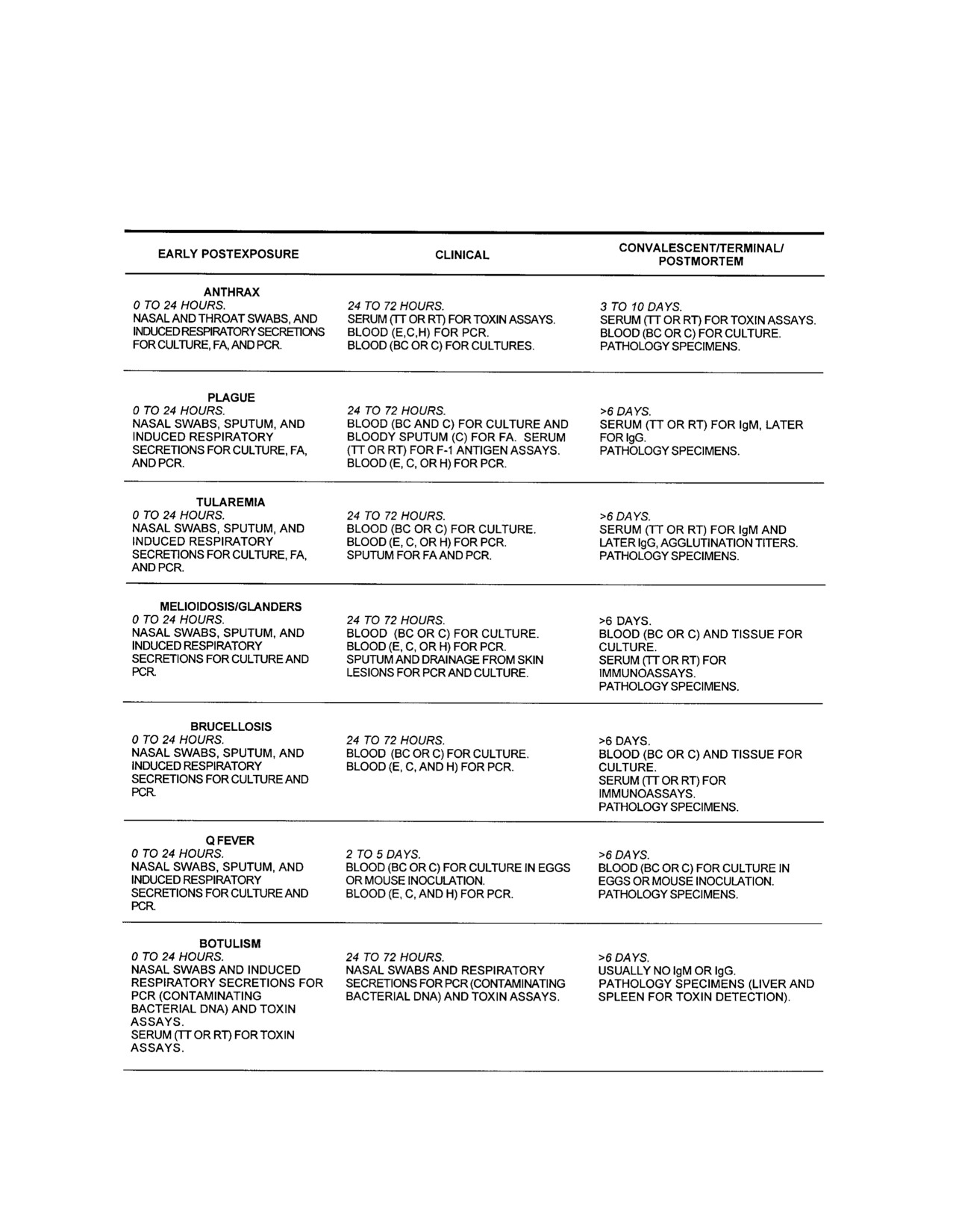
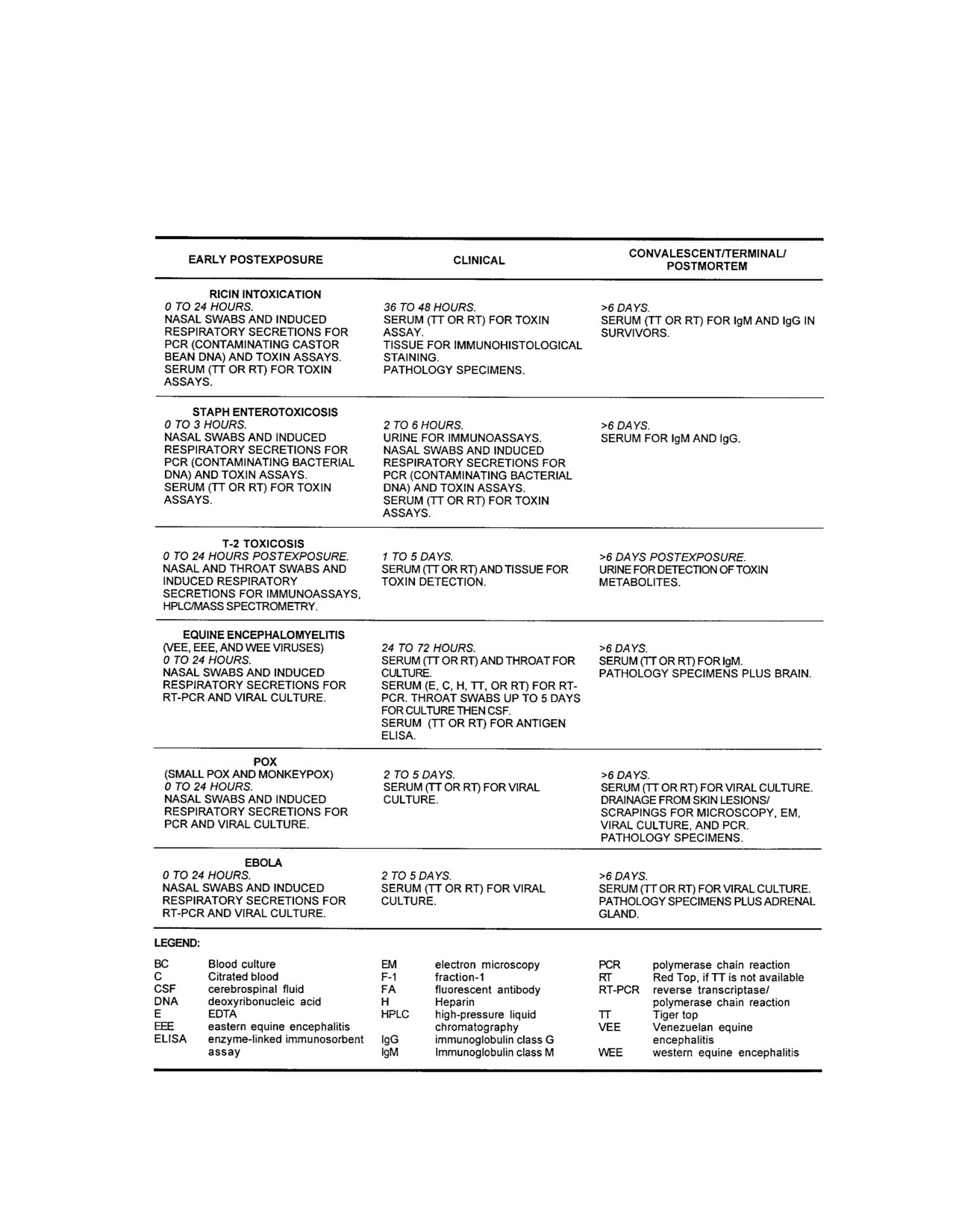
be known before a collection procedure is initiated (see Table B-1).
• Patients seen in an MTF may be the first and in some cases the only source for sampling
for suspect biological agent release. The primary medical care provider will determine the level of
treatment for these patients and the specimens required for laboratory diagnosis. The MTF laboratory is not
equipped to handle biological agents and, therefore, specimens generated will be forwarded to the supporting
medical laboratory for analysis. Patient disposition will be based on evacuation policies, exposure, suspect
agent, clinical symptoms, and required treatment/isolation.
• Blood specimens represent the most common analytical sample. Certain techniques and
special care must be exercised to ensure an acceptable specimen is collected and to minimize an adverse
affect to the patient or specimen collector. In general, phlebotomy requires the use of a 20 to 22-gauge
needle to minimize mechanical hemolysis during aspiration using a syringe or Vacutainer™ tube collection
system. Blood collected with a syringe and needle should be transferred to an appropriate Vacutainer™
tube immediately after collection. The type of tube, type of anticoagulant or preservative, and amount of
blood collected will vary with the specific assay requested. Unless some special sample preparation step is
required, the blood is best left in the original rubber-stopper tube for transport.
• Urine specimens are best collected using a clean-catch (midstream, if possible) technique
in a sterile urine cup. The volume of sample required will vary depending on the specific assay requested;
however, 25 to 50 ml is sufficient for most tests.
• Tissue specimens can originate from any body source accessible by scraping, swabbing,
or minor excision. Tissue specimens are collected only by medical trained personnel. Specific techniques
for collecting these specimens are not provided in this appendix.
B-3
FM 4-02.7
• Sputum specimens are best collected using a sterile cup. The volume of specimen will
normally be very small. However, a sufficient quantity must be collected to provide for in-theater testing
and to provide for CONUS laboratory testing.
• Nasal swabs should be collected using sterile cotton-tipped swabs. The swabs with
specimen from each person should be placed in a separate sterile container to prevent cross-contamination.
NOTE
In cases where the supporting laboratory cannot be contacted, as a
minimum the following specimens should be collected: Urine—25 to
50 ml in a sterile container. Blood—two 7 to 10 ml tubes without
anticoagulant (red-stopper Vacutainer™); two 7 to 10 ml tubes with
potassium or sodium ethylenediaminetetraacetate (EDTA) (lavender-
stopper Vacutainer™).
• All specimens (regardless of physiological source) must be labeled to positively identify
the individual or animal from whom it was collected; at a minimum, the individual’s full name, unique
personal identification number (social security number, when possible), military unit and location, and date
and time of collection should be written on the label of the specimen container.
• All specimens are collected using aseptic techniques. All specimens are packaged,
handled, and transported in a manner that ensures they arrive at the final destination laboratory in a testable
condition. Personal protection guidelines must be adhered to when collecting or processing specimens; at a
minimum, this includes gloves and a mask. In the laboratory, a gown or other protective items may also
need to be used. In the field, under suspect NBC conditions, collectors should be in MOPP Level 4 or
inside NBC-protected vehicles. Common sense and the clinical and/or tactical situation will determine the
extent of personal protection necessary.
• Preservation of specimens, either chemically or mechanically (cooling), will be necessary
to minimize the amount of analyte degradation that occurs after removing the specimen from its physiological
microenvironment. The optimal preservation technique will vary with different laboratory tests and must be
confirmed for each requested assay. While freezing may preserve some serum constituents, freeze-thawing
cycles may denature others. Freezing may also completely destroy certain microorganisms. This caution
also applies to tissue specimens since “fixing” tissue with a standard 10 percent formalin solution will
preserve tissue for special staining techniques; however, it renders the specimens completely useless for
microbiological culture. Always verify specimen preservation requirements for storage and transport with
the supporting medical laboratory before processing the specimen. Ideally, confirmation of the correct
handling conditions should be coordinated before collection.
• The importance of coordinating sample/specimen collection with the supporting lab-
oratory facility cannot be overstated. Contact the receiving laboratory for instructions when doubt exists
about the appropriate source, collection technique, storage and preservation conditions (such as, aerobic or
B-4
FM 4-02.7
anaerobic environment), and transportation requirements for samples/specimens. Extremely small volumes
of samples/specimens, properly collected and handled, can yield a tremendous amount of information to
assist in making medical, tactical, and strategic decisions. Conversely, very large quantities of poorly
collected and insufficiently preserved samples/specimens are essentially worthless for most analytical
techniques.
• Analysis beyond intratheater capabilities will be coordinated by the supporting laboratory,
when deployed, or through medical channels in the absence of an in-theater supporting laboratory.
b. Post mortem and Forensic Specimens. The analysis of specimens from deceased humans and
animals can provide valuable information about the disease, organisms, injuries, or environmental conditions
at the time of death. This information can greatly enhance the treatment of others affected by the same, or
physiologically similar, process. Specimen collection for post mortem or forensic examination is very
important; the techniques involved reflect a significant degree of training, experience, and skill. Most
specimens will be of the same type and size as for ante mortem specimens, but types and amounts of
specimens will be determined by the collector.
(1) The collection of specimens from remains should be conducted exclusively by a
pathologist, or other personnel specifically trained in forensic collection techniques. An exception is when
Special Operations Forces (SOF) personnel are operating under radio silence conditions; the most qualified
medical person with the operation collects, preserves, and transports or coordinates transport of specimens
for evaluation. The same chain of custody requirements applies to specimens collected by SOF personnel,
as with all other specimens.
(2) A large amount of support information can be gained by analyzing the site of injury and
subsequent death. This “site scene” investigation requires a tremendous attention to detail and a trained
observer. If forensic personnel cannot be contacted, or will be unduly delayed in arriving at the scene, then
photographs of the victim and the immediate surroundings should be made. The scope and extent of the
photographs should be composed to reflect as much detail as possible to assist forensic personnel in
reviewing the scene retrospectively. In the event that photography is not feasible, detailed sketches of the
scene should be made to assist the forensic investigation.
(3) Techniques such as cardiac or bladder puncture, needle biopsy of organs, spinal tap, or
exploratory laparotomy will not be performed by untrained personnel unless specifically requested and
directed by forensic investigators.
B-5
FM 4-02.7
Table B-1. Specimen Collection for Suspect Biological Warfare Agents
B-6
FM 4-02.7
Table B-1. Specimen Collection for Suspect Biological Warfare Agents (Continued)
B-7
FM 4-02.7
c.
Water Sample Collection.
(1) Water samples for identification or verification of biological agent contamination are
collected by PVNTMED personnel. The supporting laboratory should provide guidance on sampling
procedures and collecting kits for use in collecting the samples. In the absence of guidance, a technique for
use of the Sep-Pak™ is described in FM 3-19.
(2) When sampling kits are not available, samples may be collected in other available sterile
containers. The best containers for use are the 100-ml glass bottles used for collecting routine water
samples. All water samples must be collected and placed in a cooler or refrigerator until the sample is
transported to its destination. During transportation the samples must be maintained at a temperature
between 1°C and 4°C.
d. Food Samples. Veterinary personnel must collect suspect biologically contaminated food
samples for submission to the supporting laboratory for in-theater verification of contamination. All food
samples must be collected and placed in sterile containers. Place the samples in a cooler or refrigerator
until the sample is transported to its destination. During transportation the samples must be maintained at a
temperature between 1°C and 4°C.
e.
Animal Specimens. Veterinary personnel collect specimens from suspect biologically con-
taminated/diseased animals. The same types and amounts of specimens are prepared and shipped in the
same manner as are human specimens.
f.
Environmental Samples. Environmental samples are collected as directed in the operators’
manual or other publications for operating collection systems. Example: The Biological Integrated Detection
System (BIDS) collects an environmental sample using a single liquid sample collector. The collector is a
high-volume aerosol sampling and collection device. On demand it samples ambient air through a two-stage
virtual impactor that concentrates aerosol particles in the 2 to 10 micrometer diameter-size range. The
concentrate particle stream is directed through a wet collector containing a buffer solution and, over a 45-
minute period, a 40 to 50 ml sample is collected. On order or when test results indicate a suspected agent,
the sample and associated documentation are packaged and transported IAW FM 3-101-4.
B-4. Chain of Custody
a. A strict chain of custody must be maintained for every sample/specimen collected. Use DD
Form 1911 (Material Courier Receipt), or other document (such as DA Form 4137 [Evidence/Property
Custody Document]) as directed for each sample/specimen collected. The chain of custody document must
accompany the sample/specimen during transport from the point of collection to the final receiving
laboratory. Each time the sample/specimen is transferred to another individual, the receiving person must
sign the document to show that they received the sample/specimen and state what happened to the sample/
specimen while in their custody. The document will provide the answer to the following questions:
• When was the sample/specimen collected?
• Who has maintained custody of the sample/specimen?
B-8
FM 4-02.7
• What has been done with the sample/specimen at each change of custody?
b. The samples/specimens must be appropriately packaged, labeled, and evacuated to the
designated medical laboratory for confirmation of a biological attack. The standard chain of custody for the
evacuation would be as follows:
• Sampling unit.
• Unit S2/security office or medical operations officer.
• Technical escort unit or other command-designated escort personnel.
• In-theater supporting medical laboratory.
• Designated CONUS laboratory.
Section II. SAMPLING TECHNIQUES AND PROCEDURES
B-5. General
The collection of environmental, and background (control) samples/medical specimens is an integral part of
investigating allegations pertaining to the first use of chemical or biological agents. The types of samples/
specimens taken and the collection methods primarily depend upon the circumstances encountered by the
collector. During all chemical and biological sampling operations, the commander establishes the required
protective equipment to fit the situation. This appendix includes a recommended list of equipment for use
during chemical and biological sampling operations (Table B-2).
Table B-2. Example NBC Collection and Shipping Equipment List
AMOUNT
DESCRIPTION
STOCK NUMBER
20
LABELS, PAPER, PRESSURE SENSITIVE
7530-00-577-4376
2
GLOVES, 8-81/2, EDMONT WILSON™
8415-00-JO2-2902
2
GLOVES, 9-91/2, EDMONT WILSON™
8415-00-634-4639
1
TAPE, ADHESIVE, PRESSURE SENSITIVE, 2 INCH
7510-00-159-4450
1
PLIERS, #47, 5 INCHES
6520-00-543-5330
1
SCREWDRIVER, FLAT TIP, 1/4 INCH
5120-00-596-865
1
TONGS, TEFLON™ TIPS
AF 15-202-5
2
MICROSPATULA, WITH TEFLON™ ENDS
AF 21-401-50A
1
SCISSORS, UNIVERSAL TYPE
AF 08-951-30
1
SCOOP, POLYPROPYLENE, 5X2X2
ASP S1021-5
2
SPOON/SPATULA WITH TEFLON™
AF 14-356-10
B-9
FM 4-02.7
Table B-2. Example NBC Collection and Shipping Equipment List (Continued)
AMOUNT
DESCRIPTION
STOCK NUMBER
1
KNIFE, POCKET
5110-00-526-8740
5
BOTTLES, SAMPLE, POLYETHYLENE, 6 OUNCE
CP J-6103-50
1
PIPET, JUMBO, TRANSFER TYPE (500/PKG)
AF 13-711-7
10
PIPET, GRADUAL, TRANSFER TYPE (500/PKG)
AF 13-711-9A
10
BAG, INSULATED, TYPE 1
AF 01-814-8
10
BAG, INSULATED, TYPE 2*
AF 01-814-10
1
BAG, WHIRL/PAK, 6 OUNCE (500/PKG)
AF 01-812-6B
1
STRIP, pH TESTING, NONBLEEDING, PLASTIC
SW S-65271
1
SEP-PAK™ C18
W51910 (50/BOX)
2
SYRINGE, HYPODERMIC, 50 OR 60 ml
6515-00-168-6913
2
STOPCOCK, THREE-WAY
ASP S8965-2
1
TUBING, LABORATORY, R3602 CLEAR
AF 14-169-3B
1
PEN, MARKING, WATERPROOF
AF13-381 (12/PKG)
2
TUBES, TENAX™
EC ST-023
1
BLADE, SURGICAL, CS2L 150S
6515-01-009-5297
2
PACK, ICE
CP TR-6345-20
6
PAD, NONADHESIVE, 3X4, 100s
6510-00-111-0708
4
PAD, COOLING, CHEMICAL, 4S
6530-00-133-4299
2
PIGLETTES
SPECIAL ORDER
1
TAPE, ANTISEIZE
8030-00-889-3535
1
AIR SAMPLER, PERSONAL
LSS G4980
1
KIT, METRIC, POCKET BUBBLE
GL4981
2
METHANOL
1
WATER, DISTILLED (5 BOTTLE/PKG)
1
MATCHES, WATERPROOF
20
RAZOR, SURGICAL PREP
6515-00-926-2089
10
WATCH, WRIST
6645-00-066-4279
2
PARAFILM WITH DISPENSER
6640-01-185-3289
2
FLOOR SWEEP (VERMICULITE)
8720-01-026-9419
100
SEALS, TAMPER-RESISTANT
1
A GAS METER CAPABLE OF PROVIDING
ON-STATION ANALYSIS/DETECTION CAPABILITY
FOR MULTIPLE GASES TO INCLUDE INDUSTRIAL
GASES.
1
A COMBUSTIBLE GAS INDICATOR THAT
INDICATES PERCENTAGE OF OXYGEN AND
EXPLOSIVITY.
1
A GAS METER THAT DETECTS VAPOR IN PARTS
PER MILLION (PPM) AND INDICATES PRESENCE
OF VAPOR AND ITS STRENGTH.
1
SWABS, THROAT
2
CAN, 6 POUND, METAL
10
BAG, MYLAR
1
CONTAINER, LEAD SHIELDING (FOR RADIATION
SAMPLES)
1
CONTAINER, SHIPPING, IATA
1
CHEST, ICE
10
BAG, PLASTIC, RECLOSABLE
*WILL BE REPLACED BY MYLAR BAGS
B-10
FM 4-02.7
B-6. Expended Material
The NBC recon units collect samples under various circumstances. For example, a recon unit may collect
samples in an area free of hostile forces. The Special Forces NBC Reconnaissance team may collect
samples within the enemy area of operations or deep into the enemy’s rear area. Samples include toxic
agent munitions, chemical products, air, water, soil, and vegetation. In addition, all expended material
used to collect the samples should be turned in to the laboratory with the samples. This material includes
items such as expended M256A1 kits, M8 and M9 paper. These items should be recovered, packaged, and
shipped with the suspected samples for analysis. Different information may be derived from each type of
sample; Table B-3 compares different types of samples.
B-7. Environmental Samples
Control or background samples that are collected from clean samples must be identical to the samples
collected from the areas near the attack areas as baseline data. The contaminated samples must be
compared to the baseline data (control samples). This is especially true if unknown or nonstandard
chemical and/or suspected biological agents were employed. The analysis center uses the control samples
to compare with a contaminated one. The recon unit collects control samples of soil, water, and vegetation
from areas about 500 meters upwind of an alleged attack area. Control samples generically are the same as
those collected in an alleged attack area. For example, if leaves from an apple tree in an attack area were
collected as a suspected contaminated sample, the recon team should collect leaves (as a control sample)
from an apple tree outside of the contaminated area. If water from a pond in the attack area is collected, the
recon unit should collect control samples of water from a pond (not a moving stream) in a nearby clean
area. The size of an environmental control sample should be about the same as the suspected contaminated
sample collected from the attack area (see Table B-4, page B-20).
Table B-3. Comparison of Sample Types
SAMPLE STABILITY
ANALYSIS
SAMPLE TYPE
INFO VALUE
TO COLLECT
TIME REQUIRED
RELIABILITY
AIR
GOOD
GOOD
20 MIN
HIGH
WATER
GOOD
GOOD
5 MIN
HIGH
SOIL
FAIR
FAIR
5 MIN
MODERATE
VEGETATION
FAIR
POOR
10 MIN
LOW
TISSUE
EXCELLENT
FAIR
30 MIN
HIGH
BLOOD
GOOD
FAIR
10 MIN
HIGH
URINE
GOOD
FAIR
10 MIN
HIGH
MUNITION FRAGMENTS
FAIR
FAIR
10 MIN
FAIR
PACKING MATERIALS
FAIR
FAIR
10 MIN
FAIR
B-11
FM 4-02.7
B-8. Collection of Air and Vapor Samples
a. Air is a good sample matrix since it is a well-mixed medium. Air from a sample site contains
a static concentration of contaminants. The concentration of contaminants depends upon the flow rate of the
contaminant into the environment, the wind speed, and the physical state of the contaminant, the terrain
contours, and temperature as a variable. The sample should be taken within 102 meters of a contaminated
surface and at the downwind edge of a contaminated area. The method should consist of pumping a given
volume of air, by hand or electric pump, through sample tubes.
b. To avoid contamination, persons conducting air sampling should not use cologne, perfume,
insect repellent, medical creams, or strong soaps before taking a sample. The fragrances from these
products are volatile organic compounds that may be absorbed on the filter and skew analytical results.
Smoke also severely interferes with air sampling, therefore, avoid tobacco and vehicle exhaust smoke.
c.
The primary method for collecting air samples is with the PAS 1000 automatic air sampler in
conjunction with a Tenax™ tube for a total of three to four minutes when possible. Upon completion of
sampling, place the Tenax™ tube in a 21/4-inch piglette. Seal the piglette around the cap with either
pressure-sensitive or Teflon™ tape. Once sealed, place the piglette into a Mylar or reclosable bag. Fold
the bag around the piglette in a circular motion, then apply another bag and fold again. Once the bag is
folded around the piglette, use any type tape to secure the bag around the piglette. Place the piglette into a
refrigerator or cooler until the sample is transported to its destination.
d. When chemicals are permitted into the atmosphere from a facility, the best places to obtain
samples are close to the emission source where the concentration of the chemical is not diluted. The further
from the original point of release, the more diluted the sample becomes from mixing with air, water, or
environmental pollutants.
e.
Natural and man-made terrain features such as hills, valleys, and rows of buildings, sometimes
aid the collector by channeling emissions. When these features are associated with a particular facility,
their downwind side is a suitable place to collect a sample because the emission remains more concentrated
further from the release point.
f.
For collection in a possibly contaminated location, and if the situation permits, initially use a
detection kit such as the M18A2/M256AI to determine if a possible vapor hazard exists from known
chemical agents. Also, use the kit when personnel are required to examine possible toxic agent munitions.
In any case, collect air samples with the white-band tubes and save for identification and analysis.
g. Small air samplers also enable the collector to obtain vapor samples from alleged toxic agent
munitions at a safe distance while explosive ordnance disposal (EOD) operations are performed. If EOD
personnel are not on the scene, the air sampler can be activated, and the collector can stand at a safe
distance while the sampler is operating.
h. Perform sampling operations as soon as possible when directed by a higher headquarters or
after suspected chemical or biological contamination is encountered.
B-12
FM 4-02.7
B-9. Collection of Water Samples
a. Water sampling is a matter of collecting enough water to get acceptable information about the
contaminants. The collector should provide the analysis center with one C18 and one silica cartridge when
using the Sep-Pak™ technique or 100 ml in a sterile bottle when Sep-Pak™ is not available.
b. General guidelines: If it is believed that the threat has used standard chemical agents during an
attack, use the M272 chemical agent water test kit for initial screening and sampling.
c.
When collecting water samples using the Sep-Pak™ C18 cartridge, the following items are
required:
• One 60 cc syringe without needle.
• One 3-way sterile, plastic, stopcock with protective covers.
• One piece of plastic tubing (3/16" inner diameter x 6" long minimum).
• Sterile water or methanol.
• One clean container, such as a Teflon™ cup or glass jar.
d.
Prior to collecting each sample, prime the Sep-Pak™ system in the following manner:
• Step 1. Attach Sep-Pak™ directly to 60 cc syringe.
• Step 2. Pour small amount of sterile water or methanol into container.
• Step 3. Insert tip of Sep-Pak™ into container.
• Step 4. Withdraw at least 40 cc of solution.
• Step 5. Detach Sep-Pak™ from syringe and discard solution from syringe.
• Step 6. Repeat steps 3 through 5 using the same syringe.
e.
After priming the Sep-Pak™, assemble the components in the following configuration:
• Attach the 3-way stopcock to a 60 cc syringe.
• Attach the Sep-Pak™ to the opposite end of stopcock.
• Attach the plastic tubing to the open end of the Sep-Pak™.
f.
Use the following procedures to collect samples with Sep-Pak™:
B-13
FM 4-02.7
• Step 1. Ensure that the lever on the stopcock is turned sideways with the off arrow
pointed toward the large outlet port.
• Step 2. Place the open end of the plastic tubing into the water near the bottom, without
touching the bottom or sides of the body of water.
• Step 3. Draw 60 cc of water into the syringe.
• Step 4. Turn the stopcock lever to the off position by positioning the lever to point
toward the stopcock.
• Step 5. Push the plunger all the way in, discharging the water from the syringe through
the outlet port.
• Step 6. Repeat steps 1 through 5.
• Step 7. Detach a plastic tubing from the Sep-Pak™, and discard it as contaminated
waste.
• Step 8. Detach Sep-Pak™ from 3-way stopcock; place into sample container; seal with
pressure-sensitive tape; and mark for identification.
NOTE
You should take a minimum of four samples: three samples of the
suspected contamination and one control sample from a nearby
unaffected (none contaminated) area for reference.
• Step 9. Dispose of the syringe and stopcock as contaminated waste.
• Step 10. Insert the sample container in a cooler or refrigerator until the sample is
transported to its destination.
g. For samples to be representative of the overall contaminated area, the collection point should
be carefully selected. Collect samples from—
• Drains and slow-moving streams, since contamination and dilution from other sources
are minimized.
• Stagnant pools of water if the pools of water are part of chemical waste areas, such as
a landfill or chemical disposal area. Chemicals may percolate into stagnant pools or sumps close to the
site.
B-14
FM 4-02.7
NOTE
If an oil film, globules of organic materials, or an unnatural appearing
powder-like material is visible on the water’s surface, collect a surface
sample of the material. If not, collect the sample from near the
bottom of the water source (stream, lake, pond, water container).
The upper layers of water may have lesser amounts of contaminants,
due to higher temperatures that promote decomposition. Since most
chemicals of interest are more dense than water, contaminants usually
sink to the bottom of the water source.
h. Collect the sample without the Sep-Pak™ by immersing a capped or stoppered container to the
desired depth, removing the cap or stopper, letting the container fill, and then capping the container. An
alternate method for deeper water is to use a plastic, pump-operated siphon to pump water from a specific
depth.
i.
The best time to collect a sample of water from a location is when intelligence or local reports
indicate that a process of possible interest is ongoing. In the absence of reliable reporting, this may be
indicated by increased activity, higher than normal amounts of security, or increased flow from facility
chimneys or water discharge pipes. In field areas where a toxic agent has been sprayed or disseminated
over a land area, the best time to collect water samples is just after the start of a rainstorm when runoff is
beginning. Natural surface drainage will concentrate any remnants of toxic compounds in depressions,
streams, or ditches.
B-10. Collection of Soil Samples
Soil is a suitable medium to collect as samples for toxic organic compounds. A critical point, however, is
that the precise site of the agent deposition must be sampled for best results. Contamination may be
recognized by discoloration or apparent deposition of material on the soil’s surface. If discoloration or
deposits of material are evident, only collect the discolored soil or deposited materials, if possible. Dead,
malformed, and wilted foliage is an indicator of contamination. Soil samples should be collected from open
areas, along the drip line tents, stationary equipment, bottom of ditches and terrain depressions.
a. Collect the soil samples by using a knife, spoon, spatula, or similar item to scrape a square of
topsoil (2x5x1 centimeters) from areas that appear to have been contaminated in to a collection container. If
chunks or clods of earth are collected, select those that are no larger than 10x5x1 centimeters (see Table
B-4). Also, collect a control sample of soil of the same type and texture from a nearby uncontaminated
area.
b. Use a glass bottle, jar, or Teflon™ jar as the container when available. When these containers
are not available, Mylar bags may be used. When using a glass bottle, jar, or Teflon™ jar, seal the cap
with either pressure-sensitive or Teflon™ tape, and mark for identification. When using Mylar bags, place
each sample in a separate bag, push excess air out, and seal by folding the open end over two to three times
B-15
FM 4-02.7
and wrapping the bag with tape. Insert the first bag into a second bag, seal, tape, and mark for identification.
If possible, place the samples in a piglette.
CAUTION
Avoid direct contact with the sample to prevent exposing yourself
to the suspect agent (MOPP 4 is required).
c.
Collect samples as soon as possible when directed, upon detection of a suspect substance, or
after the alleged incident.
B-11. Collection of Contaminated Vegetation
As with soil samples, vegetation is also a suitable medium to collect as samples for toxic organic compounds.
a. Collect samples of vegetation that appear to be different from normal. Select leaves that have
wilted or appear to have been chemically burned. Collect samples of vegetation that appear to have liquid
or solid substances deposited on their surfaces (this may be noticed as a shiny or moist area).
b. Collect samples of vegetation at several locations within the suspected contaminated area.
Using a cutting tool or any sharp object, cut several affected leaves and/or a handsful of grass whenever
possible. Do not crush the sample. Place the sample into a Mylar or reclosable bag. Squeeze excess air out
of the bag and seal it. Fold the open end of the Mylar bag over two to three times, and wrap it with tape.
The minimum size for a sample is three leaves or three handsful of grass. One leaf is of little value, but is
better than nothing. Bark is acceptable but not preferred. Mark the bag for identification. Take a control
sample of similar material from an unaffected (uncontaminated) area. Fold, seal, tape, and mark the control
sample in the same manner as the actual sample.
c.
When it is possible to determine a probable center of attack in an area, collect vegetation
samples near the center of the area, about 100 meters upwind of the area, and in several 100-meter
increments downwind of the area. If the collector can discern a contamination pattern in the area, this
should be reported.
B-12. Medical Specimens
a. Just as blood and urine specimens are taken from humans who were allegedly exposed in an
attack, also collect specimens from individuals who claim not to be affected by a toxic agent and are from
the same group as exposed personnel. The purpose is the same as collecting environmental control
specimens; that is, to determine if a toxic substance is present in the individuals’ natural environment or if it
has been artificially introduced.
B-16
FM 4-02.7
b. Selection of humans for control sampling is somewhat more complicated than selection of
environmental control samples. This is because ethnic diets, racial differences, physiological makeup, and
actual living conditions of persons who are outwardly similar may introduce potentially large deviations.
Each of these factors must be accurately considered before selecting subjects as controls.
c.
Consideration of ethnic diets is important because of unique foods or methods of food
preparation that may exist. As an example, individuals in settled areas may purchase beer that has been
carefully filtered and sterilized, while individuals in a nearby unsettled area may ferment their own beer by
burying home crafted jugs in the ground and extracting the product little by little over several months.
d. Racial differences can account for differences in mortality and morbidity rates in specific
populations. One example of this could be the high rate of hemophilia in a population versus the rarity of
the disease in another.
e.
Physiological makeup is critical because of the differences in hormone balance and tissue
composition in males, females, adults, and juveniles. For this reason, medical control specimens should be
drawn from individuals of the same gender and approximate age as specimens from exposed personnel, if
possible.
f.
Differences in the actual living conditions of people also require a close look. The point here
is that conditions in remote, semicivilized camps are seldom the same as those in a well-established camp
that has access to modern amenities.
g. The bottom line in selecting subjects for medical control sampling is that they be as similar in
all aspects as possible.
B-13. Collection of Medical Specimens
a. Trained medical technicians or physicians should collect medical specimens (human or animal);
however, Special Forces NBC Reconnaissance team personnel are trained to do this procedure. Remember,
the collector must have express permission (authority) to collect medical specimens from the dead, because
of religious beliefs in many cultures. To obtain such specimens without permission may result in unnecessary
mission complications. Ensure all personnel handling or collecting medical specimens have received proper
immunizations for their own protection. They must be inoculated IAW The Surgeon General’s guidance.
b. Medical specimens collected during an investigation include blood, urine, sputum, nasal
swabs, and tissue specimens from living victims and blood and urine specimens from unexposed persons
(background control specimens).
c.
Collect blood specimens using either a standard 10 cc disposable syringe with a 1- to 11/2-inch
needle (20 to 22 gauge), or by using a Vacutainer™ system. When using a Vacutainer™ system, ensure
that multiple specimen needles and “red top” vacuum tubes are used. Ten cc of blood is sufficient for
analytical testing. Do not take more than 5 cc from small, malnourished children. After blood is collected,
it should be transferred to a polypropylene-type container and sealed with parafilm before transporting.
B-17
FM 4-02.7
All body fluids should be collected without violating antiseptic techniques. Also, prior to transporting
specimens, collectors need to check specimen containers for paper labels IAW guidelines for labeling
medical specimens. Collect blood specimens using the following materials equipment:
• Gloves.
•
10 cc sterile, disposable syringe.
•
1- to 1.5-inch sterile needle (20 to 22 gauge).
• Vacutainer™ device (adapter with needle).
• Constricting band.
• Disinfectant pads, Betadine, or alcohol.
• Sterile 2x2-inch gauze pads.
• Labels.
NOTE
Gloves should be worn whenever handling medical specimens. Do
not freeze liquid blood and urine specimens (ideal cooling temperature
is between 35° and 40°F [2° to 4°C].)
d. Collect urine specimens using either a standard urine cup or by a urine catheter and urine cup.
When collecting the specimen directly into a urine cup, the person must urinate into the cup until sufficient
fluid is collected (40 cc of urine is preferable, although 10 cc can support analytical testing). When the
person is unable to urinate, the catheterization technique is preferable. The catheterization technique is best
performed in a clinical environment. As with other body fluids collected, urine must be kept cold. Do not
freeze.
NOTE
For correct procedures on catheterization refer to STP 8-9lW15-SM-
TG.
e.
Collect tissue specimens using sterile scissors and forceps or as directed by the attending
physician.
B-18
FM 4-02.7
(1) When casualties have unidentified skin lesions, photographs of the lesion(s) and overall
photos of the extent of the lesion(s) should be taken, using color film before biopsy. A specimen of the
lesion should be obtained. This is done by surgically removing a portion of the skin with a sterile pair of
scissors and forceps.
(2) Place tissue specimens in a Teflon™ container filled 1/4 inch from the bottom with a
preservative, (formalin 10%) for preservation of the specimen until it reaches its proper destination. Seal
the container and lid with parafilm. As with any other medical specimens, tissue specimens are refrigerated
prior to shipment; but do not freeze tissue specimens.
f.
Collect nasal swabs by using a cotton-tipped swab. Place the swab with collected specimen in
a Teflon™ container filled 1/4 inch from the bottom with a preservative for preservation of the specimen
until it reaches its destination. Seal the container and lid with parafilm. Refrigerate the specimen for
shipment, but do not freeze.
g. Collect sputum by having the patient discharge the sputum into a small, sterile screw-top jar or
urine specimen cup. Seal the container and refrigerate the specimen for shipment, but do not freeze.
B-14. Post mortem Specimens
Post mortem specimens should be collected by individuals trained in forensics. When forensics-trained
individuals are not available, the most qualified medical person should collect human specimens. Specimens
from animals should be collected by veterinary personnel. In either case, the following specimens are
collected:
• Blood. Use a 50 to 60 cc sterile syringe with an 18-gauge, 5-inch (large bore) needle to
collect blood from the heart, and urine directly from the bladder. Use a spinal needle to collect cerebral
spinal fluids. Three of each type of specimens must be collected.
• Lungs. A biopsy needle is needed to properly collect lung tissue specimens. After collecting
specimens from the lungs, place specimens in a plastic or Teflon™ container filled with 10% formalin
(preservative) and seal the container for transporting to its destination.
• Liver. If possible collect liver core specimens, using a large-gauge needle (18-gauge, 5-inch
long) via intercostal or abdominal puncture. Or, if the family consents, perform a minilaparotomy and
obtain one or two 2x2x2 cm sections of liver. Store and package the specimen as directed for tissue
specimens. For suspect biological agents, see Table B-1 for specific types of specimens, amount, collection
medium, and from whom to collect.
NOTE
Before attempting any of the above procedures, collector must be
certified by a qualified person (medical doctor) on the correct pro-
cedures to collect specimens from cadavers.
B-19
FM 4-02.7
Table B-4. Standard Sizes of CB Samples/Specimens to be Collected
TYPE
SIZE
NOTES
CHEMICAL WARFARE SAMPLES
SOIL
(10 CM X 5 CM X 1 CM)
CIGARETTE-PACK SIZE OR LARGER
AREA IS MORE USEFUL THAN
GREATER DEPTH
DILUTE AGENT
10 ML
WATER
500 ML (MAXIMUM)
C18 SEP-PAK™
200 ML
VEGETATION
(EQUIVALENT TO 3 LEAVES OR
DEPENDS ON AMOUNT OF CONTAMI-
3 HANDSFUL OF GRASS)
NATION. BEST SAMPLES WILL BE
FOUND NEAR THE RELEASE POINT
BIOLOGICAL WARFARE SAMPLES
SOIL
(10 CM X 5 CM X 1CM)
CIGARETTE-PACK SIZE OR LARGER
AREA IS MORE USEFUL THAN
GREATER DEPTH
LIQUID
25 TO 50 ML
DO NOT USE C18 SEP-PAK™ WITH
MEDICAL SPECIMENS
VEGETATION
SIZE OF SOFT DRINK CAN
BEST SAMPLES DEPEND ON THE
AMOUNT OF CONTAMINATION
FOUND NEAR THE RELEASE POINT
MEDICAL SPECIMENS
URINE
20 TO 50 ML
MUST OBTAIN CONSENT TO COLLECT
SPECIMENS FROM OTHER THAN US
CASUALTIES
WHOLE BLOOD OR SERUM
5 ML
MUST OBTAIN CONSENT TO COLLECT
SPECIMENS FROM OTHER THAN US
CASUALTIES
CEREBRAL SPINAL FLUID
2 ML
MUST OBTAIN CONSENT TO COLLECT
SPECIMENS FROM OTHER THAN US
CASUALTIES
ORGAN TISSUE
30 G (MINIMUM)
MEDIASTINAL LYMPH
2
SHOULD BE REMOVED BY A SURGEON
NODES
DURING AN AUTOPSY
B-15. Reporting, Packaging, and Shipment
Although a sample/specimen collected from an alleged attack area can be significant, it can become useless
if proper steps are not taken to record critical information about its collection or if it is improperly packed
and breaks during shipment to an analysis center, This section discusses the information needed when
acquiring samples/specimens and the preferred methods for handling and packing samples/specimens for
shipment.
B-20
FM 4-02.7
a. A complete background information history of the circumstances about each sample’s/
specimen’s acquisition must be provided to the agency analyzing the sample/specimen.
b. Critical background information includes—
• Circumstances of acquisition. How the sample/specimen was obtained, where it was
found, and how it was collected.
• Physical description. The physical state (solid, liquid, powder, apparent viscosity),
color, approximate size, identity of the specimen (such as military nomenclature), dirt, leaves, or so forth.
• Circumstances of agent deposition. The type of delivery system, a description of how
the weapon functioned, how the agent acted on release, sounds heard during dissemination, a description of
any craters or shrapnel found associated with a burst, and colors of smoke, flames, or mist that may be
associated with the attack.
c.
Provide information on the agent effects on vegetation for soil or environmental samples. A
description of the general area (jungle, mountain, grassland) and changes in the vegetation after agent
deposition (such as color change, wilting, drying, dead) in the main attack and fringe areas.
d. Provide information on the agent effects on humans for medical specimens. Describe how the
agent affected personnel in the main attack area versus fringe areas; the duration of agent effects; peculiar
odors that may have been noticed in the area prior to, during, and/or after an attack; measures taken that
alleviated or deteriorated the effects; and the approximate number of victims and survivors, to include their
ages and genders.
e.
Describe the agent effects on animals. Provide information on the types of animals that were
or were not affected by an attack and of how they were affected.
B-16. Handling and Packaging Materials
Materials used for packaging samples/specimens primarily consist of Mylar collection bags, Teflon™
specimen jars and tubes, pigs and piglettes, ice chests, sealing materials, and wrapping and cushioning
supplies.
a. Collection Bag. Use the Mylar bag as the initial container for such samples as protective
masks and filter canisters, individual antidote and decon kits, munition fragments, and other items too large
to place in a specimen jar. Use it also to package sample/specimen containers to ensure a vapor barrier in
case the container is broken in transit. The bag acts as an initial or secondary vapor barrier to prevent air
from leaking inward and toxic material outward. Follow the procedures below when using the bag.
• If packaging a specimen container or nonenvironmental sample/specimen, first, verify
it has a sample/specimen number. Carefully place the sample/specimen in a bottom corner of the Mylar
bag.
B-21
FM 4-02.7
• Squeeze all the air out of the bag and seal it by removing the adhesive’s protective strip,
and pressing the two sides together.
• Place a piece of 2-inch-wide fiber or cloth tape across the end of the bag that you just
sealed to reseal the Mylar bag on the outside. This serves as extra insurance in case the internal seal is
broken.
• With the bag lying in front of you and the seal at the top, fold the bag across its width to
as small a size as possible without damaging the sample/specimen. At this point, use tape to hold the fold.
Next, fold the bag from the top down to the bottom of the bag to as small a size as possible. The sealing of
the bag is the most critical step during the packaging process.
• At this point, turn the bag over and use a marker or file label to put the sample/specimen
number on the outside of the bag so that analysis center personnel can identify the sample/specimen.
• Place the folded Mylar bag in a clear plastic reclosable bag, if available. Following the
same steps you used for the Mylar bag, fold and seal the plastic bag. When this has been completed, again
mark the sample/specimen number on the exterior of the bag.
b. Glass Specimen Jars and Polypropylene Tubes. Use glass containers to hold small environ-
mental samples, water samples, and medical and post mortem specimens. Use polypropylene containers to
hold medical specimens such as blood or urine. Polypropylene containers may be used for post mortem
specimens if required; however, glass containers are preferred. The use of glass rather than plastic
containers is preferred for environmental samples because toxic agents may leach chemicals from plastics
into a sample, introducing contamination and confusing the analysis efforts.
• If the container has a screw-on lid, place Teflon™ plumber’s tape (NSN 8030-00-889-
3535; Tape, Antiseize) on the threads of the container before putting on the lid. This helps to limit the
leakage of liquids and vapor from the container and to assure the lid will not fall off while in transit. If the
lid has a cardboard liner, remove the liner and replace it with one or two layers of parafilm (a laboratory
sealant film).
• Once the lid is on, stretch parafilm around the outside of the container at the junction of
the lid and the glass. Two wraps of the film are enough to provide a leakage barrier and more assurance
that the lid cannot fall off.
• At this point, ensure the sample/specimen number is on the outside of the container. Use
a diamond etching pencil or an adhesive label to put the sample/specimen number on the exterior of the
container.
c.
Six-Pound Metal Can. Use metal cans as the external container for packaging small items that
have been sealed in Mylar bags, specimen jars, and polypropylene tubes containing medical specimens.
The metal can helps absorb shock from rough handling during shipment and eliminates the spread of
contamination if a specimen container is broken. The six-pound metal can is capable of holding more than
one sample/specimen (depending upon size of samples/specimens).
B-22
FM 4-02.7
• Before placing samples/specimens in the can for shipping, ensure a sample/specimen
number is assigned and is visible on each item.
• Place about 1 to 2 inches of packing material in the bottom of the can.
• Wrap jars and tubes in plastic bubble wrap or 1/8- to 1/4-inch-thick foam rubber sheeting,
secure the wrap with tape or a rubber band, and place the wrapped item in the can.
• If bubble wrap or foam rubber is not available, use newspaper. The guiding principle is
that the sample/specimen containers should fit snugly and not be able to move in the can.
d. Ice Chest. Standard polyethylene or metal ice chests are the most easily procured items used
for transworld shipment of CB samples/specimens. The most easily used size is about 24 inches long by 18
inches high by 15 inches deep. This size permits the sender to ship two or three 6-pound metal cans in each
chest with sufficient dry ice to maintain freezing temperatures for about four days. Also, each chest
remains at a weight that one individual can handle.
e.
Transport Container. When the samples/specimens must be transported on commercial
aircraft, an IATA-approved sample transport container must be used for shipment/delivery to the CONUS
laboratory.
f.
Coolants. Samples/specimens submitted for laboratory analysis must be properly packaged,
labeled, and shipped to ensure they arrive in an analytically acceptable condition. All samples should be
maintained at a temperature of 1° to 4°C during transport. Ideally, samples/specimens should arrive at the
in-theater laboratory within 6 hours of collection. The samples/specimens should be delivered to the
CONUS laboratory within 24 to 48 hours. If the samples/specimens cannot be delivered to the CONUS
laboratory within this time, then they should be flash frozen to -165°C, if capabilities are available. If
available, dry ice should be used when flash freezing cannot be accomplished. If the samples/specimens
cannot be delivered to the CONUS laboratory within 24 hours, the supporting laboratory should subculture
the samples/specimens and send the subculture with the samples/specimens to the CONUS laboratory. The
subculturing date should also be provided.
g. Internal Insulation. While a commercial ice chest provides good insulation of both the
samples/specimens and the coolant, it is best to place extra insulation and cushioning around the metal cans
inside the chest. Newspapers, plastic bubble wrap, and foam rubber may all be used with almost equally
good results except newspapers and standard ice do not mix well.
B-17. Collection Reporting
a. The collector must provide a formatted message for transmission as soon as possible to report
acquisition and shipment of samples/specimens. During special operations in a theater in which a Special
Forces Group (SFG) is deployed, the message is transmitted by the fastest means through the fewest
channels to the NBC control (NBCC) center. If a NBCC center has not been deployed to the area of
operations, as in low-sample/specimen volume peacetime NBC sampling operation, the message is
B-23
FM 4-02.7
transmitted by the fastest means through the fewest channels to the message addressees below. In addition,
a written report accompanies each sample/specimen or batch of samples/specimens. The collector ensures
that the acquisition message has been properly classified.
b. The collection report includes at least the following addressees:
SECSTATE WASHDC
SECDEF WASHDCHOSD-ISA/OUS-DREH
JCS WASHDC//J-3/J-5H
CIA WASHDCHOSWR-STD-LSBNIC-NIO(STP)H
DIA WASHDC//DT-3B/DT-5A//
DIR AFMIC FT DETRICK MD//AFMIC-CR/AFMIC-SA//
DA WASHDC//DAMI-FIT/DAMO-SWC//
CMDT USACMLS FT LEONARD WOOD MO //ATSN-CM-CO//
CDR SBCCOM APG
MDHSMCCR-OPF/SMCTE-OPE-RA-ID2H
CDR FSTC CHARLOTTESVILLE VA//AIAST-RA-ID2H
CDR USAMRIID FT DETRICK MD (For suspect biological samples/specimens only.)
c.
A collection message contains the following information:
• The sample/specimen identification number is part of the subject line if only a single
sample/specimen is referred to in the text. Otherwise, refer to the sample/specimen number within the
message body with its background information.
• The shipment date, mode of transportation, courier identification, air bill of lading
number, flight number destination, and estimated time of arrival are included if the sample/specimen is to
be shipped immediately. Also, the material courier receipt form (DD Form 1911) should be used to
maintain chain of custody.
• Background information on the sample/specimen. Questionable circumstances sur-
rounding acquisition of a sample/specimen. The name of another country or agency that acquired a sample/
specimen from the same event or area and is not shown on the message address.
• A recommended priority and rationale for analysis to guide the analysis center on the
assessment of the potential value of the sample/specimen.
• All details relating to the collection of the sample/specimen, regardless of how insigni-
ficant they may seem to the collector.
d. Ship all samples/specimens by the fastest, safest means, preferably by a technical escort unit
(TEU) to the theater Chemical-Biological Sampling Control Element (CBSCE) or to a location the CBSCE
designates. If there is no CBSCE in the theater, send the samples/specimens IAW preplanned instructions
from the Chemical-Biological Sampling Control Center (CBSCC) at CBDA, Aberdeen, Maryland. The
CBSCC uses the following criteria to determine the final destination of each sample:
B-24
FM 4-02.7
• Is the sample/specimen chemical or biological in content?
• Is the sample/specimen content completely unknown?
• Is the sample/specimen a possible biological material?
(1) In any case, the NBCC center must be notified in advance of shipment of the sample so
additional instructions or deviations from standard instructions can be given. Figure B-1 shows an example
of a shipping notification message. The NBCC center will direct, in advance, that samples be sent to one or
more of the following locations, depending on the category of the samples. Prior to shipment of samples/
specimens, contact must be made with—
Commander
Technical Escort Unit
ATTN: SMCTE-OPE
Aberdeen Proving Ground, MD 21010
DSN: 584-4381 (Duty hours) DSN: 584-2773 (After duty hours)
(2) This unit controls the transport of samples/specimens to their final destination(s). Do not
ship suspected toxic samples/specimens or munition systems to CONUS technical centers or intelligence
agencies without coordination and prior approval by the recipient.
NOTE
Suspect CB samples/specimens are first delivered to the supporting
medical laboratory in the AO for in-theater analysis before they are
transported out of the AO. The supporting laboratory will withdraw
an aliquot of selected samples/specimens for analysis. The supporting
medical laboratory is responsible for providing the AO commander
confirmatory identification within the AO. The CONUS-based
reference laboratory is responsible for providing confirmatory identi-
fication for President and Secretary of Defense purposes.
B-25
FM 4-02.7
FM AMEMBASSY DDTTTT Z JAN 02
TO CDR TEU APG MD//SMCTE-OPE//
SECSTATE WASHDC
SECDEF WASHDC//OSD-ISA/OUS-DRE//
INFO CIA WASHDC//OSWR-STD-LSB/NIC-NIO(STP)//
JCS WASHDC//J-3/J-5//
DIA WASHDC//DT-3B/DT-5A//
DIR NSA FT MEADE MD
DIR AFMIC FT DETRICK MD//AFMIC-CR/AFMIC-SA//
DA WASHDC//DAMI-FIT/DAMO-SWC//
CDR FSTC CHARLOTTESVILLE VA//AIAST-RA-ID2//
CDR CBDA APG MD//SMCCR-OPF//
CDR USACMLS FT MCCLELLAN//ATZN-CM-CU//
CLASSIFICATION
SECSTATE FOR...
SECDEF FOR...
CIA FOR...
JCS FOR J-3/J-5 FOR..
DA FOR DAMO-SWC FOR..
AFMIC FOR...
CBDA FOR FIO...
FSTC FOR AMXST-FM/...
USACMLS FOR THREAT MGR...
E.O. 12356: DECL: OADR (Note: This is included if the message is classified.)
TAGS: ...
Subject: Shipment of CB Samples/Specimens
REF(S): TEU MSG # , (DTG DDTTTT [time zone] JAN 02)
1.
(W) SHIPPING INFORMATION:
A. DATE SHIPPED: JANUARY 11, 2002.
B. MODE OF TRANSPORTATION: AIR EXPRESS, AIR BILL NUMBER RPT
C. FLIGHT SCHEDULE: TO TYO BY JAL XXX, JANUARY 11, 2002. TO JFK BY JAL YYY, JANUARY 12, 2002. TO IAD BY
DEC ZZZ, JANUARY 12, 2002.
D. DESTINATION: DULLES INTERNATIONAL AIRPORT.
E. ESTIMATED TIME OF ARRIVAL: 2010 HOURS, JANUARY 12, 2002.
2. SPECIAL HANDLING REQUIREMENTS: DRY ICE ENCLOSED AS COOLANT.
3. SHIPMENT CONSISTS OF TWO ICE CHESTS (1 FOR CRDEC AND 1 FOR AFMIC) CONTAINING SIX SAMPLES/SPECIMENS.
ALL LIQUID SAMPLES/SPECIMENS ARE IN POLYPROPYLENE TUBES AND HAVE BEEN CAREFULLY PACKED TO AVOID
BREAKAGE. THE FOLLOWING SAMPLES ARE INCLUDED IN THE SHIPMENT:
SAMPLE/SPECIMEN NUMBER
MESSAGE REFERENCE
TH-850102-001AG THRU TH-850102-OO5AG
BANGKOK DDTTTTZ JAN 02
4. USDAO HAS STATED THAT THIS SHIPMENT IS PARTIAL FULFILLMENT OF CIR.
Figure B-1. Sample shipping notification message.
B-26
FM 4-02.7
B-18. Sample/Specimen Background Documents
The sample/specimen background document allows a collector to note the most relevant details associated
with pre- and postsample/specimen collection conditions. Do not consider the report to be all-inclusive.
The information collected should include at least the items listed in Figure B-2. Interviews should be
conducted with individuals exposed to the CB agent as well as individuals not exposed (see Figure B-3).
1.
ID NUMBER__________
2.
COLLECTION (DATE/TIME): ______________________________
3.
COLLECTOR/UNIT: _____________________________________
4.
TYPE: ENVIRONMENTAL___ BIOMEDICAL___ SINGLE___ MULTIPLE___
5.
PURPOSE: ATTACK___ CHEM/BIO ALARM___ CHEM DETECT___ RECON ILLNESS/DEATH___
OTHER___
6.
POSTEXPOSURE: HOURS___ DAYS___ WEEKS___ UNKNOWN___
7.
LOCATION: TOWN_______________________
COORDINATES______________________________
A. TERRAIN: FLAT___ HILLS___ MOUNTAIN___ DESERT___ JUNGLE___ SPARSE TREES___
GRASS___ BODY OF WATER/TYPE___
B. WEATHER: CLEAR___ CLOUDY___ RAIN___ FOG___ SNOW___ DUST___
C. WIND: LIGHT___ HEAVY___ GUSTY___ NONE____
D. ODOR: SWEET___ FRUITY___ PEPPER___ FLOWER___ IRRITATING___ CHANGING___
NONE___ OTHER _____
E. TEMPERATURE AT TIME OF ATTACK: _____TEMPERATURE AT TIME OF SAMPLE COLLECTION: ______
8.
COMMENTS:
______________________________________________________________________________________________________________________________________________________
_________________________________________________________________________________________________
9.
ATTACK: DATE/TIME __________ METHOD: ARTILLERY___ ROCKET___ AIRCRAFT___MORTAR___
RPG/GRENADE___ OTHER, DESCRIBE: ____________________________________
A. EXPLOSION: AIR ___________ (HEIGHT)___________ GROUND _____________ SIZE______
DISTANCE______________ DESCRIBE:___________________
B. CONSISTENCY: SMOKE___ MIST___ DUST___ RAIN___ GEL___ INVISIBLE, DESCRIBE:_______
10. ENVIRONMENTAL SAMPLE: SOIL___ WATER___ VEGETATION____ AIR___ OTHER___
11. BIOMED SPECIMEN: ACUTE___ CONVALESCENT___ EXPOSED___ NOT ILL___ POST MORTEM___
CONTROL, EXPLAIN: _______________________
BLOOD___ LIVER___ LUNG___ SPLEEN___
BRAIN___ SKIN___ KIDNEY___ URINE___
OTHER, DESCRIBE:______________________________
12. COMMENTS:
__________________________________________________________________________________________________________________________________________________
13. CASUALTY: SSN ____________________
UNIT________________________________ SEX ______
Figure B-2. Sample/specimen background document.
B-27
FM 4-02.7
14. SIGNS/SYMPTOMS: ONSET___ DURATION___
A. HEAD: FEVER___ CHILLS___ HEADACHE___ FLUSHED___ DIZZINESS___
UNCONSCIOUSNESS___ COMA___ HALLUCINATIONS____
B. EYES: SUNLIGHT SENSITIVE___ PAINFUL___ BURNING___ DROOPY EYELIDS___
DOUBLE VISION____ BLUFFED VISION___ LARGE PUPILS___ PINPOINT PUPILS___
C. NOSE: RUNNY___ BLEEDING___
D. THROAT: SORE___ DRY___ SALIVATING___ BLOODY SPUTUM___ HOARSENESS___
DIFFICULTY SPEAKING___
E. RESPIRATION: DIFFICULTY BREATHING___ CHEST/PAIN DISCOMFORT___ WHEEZING (IN/OUT)___
COUGHING___ LABORED BREATHING___
F. HEART: POUNDING OR RUNNING___ IRREGULAR HEARTBEAT____
G. GI: LOSS OF APPETITE___ NAUSEA___ FREQUENT VOMITING___ FREQUENT DIARRHEA___
VOMITING BLOOD___ DIARRHEA WITH BLOOD___
H. URINARY: BLOODY URINE___ UNABLE TO URINATE___
I.
MUSCULOSKELETAL: NECK PAIN___ MUSCLE TENDERNESS___ MUSCLE TREMBLING/
TWITCHING___
WEAKNESS___ PARALYSIS, DESCRIBE: ________________________
CONVULSIONS___ TREMORS___
MUSCLE ACHES___ BACK PAIN___ JOINT PAIN___
J.
SKIN: RASH___ REDDENING___ ITCHING___ BLISTERS___ PAIN___ NUMBNESS___
PROFUSE PERSPIRATION___
15. COMMENTS:
____________________________________________________________________________________________________________
16. ANIMALS AFFECTED: YES___ NO____ DESCRIBE: ________________________________________
17. RELATED SPECIMENS______________________________________________
ID NUMBER________________________________________________
DESCRIPTION_____________________________________________
18. COLLECTOR
SIGNATURE_________________________________
NAME______________________________
PHONE NUMBER__________________________
E-MAIL_____________________________
19. REVIEWER
SIGNATURE
NAME
PHONE NUMBER_____________
E-MAIL________________
Figure B-2. Sample/specimen background document (continued).
B-28
FM 4-02.7
CB INCIDENT INTERVIEW
DATE: ________________________________ INTERVIEWER: _______________________________________
SUBJECTS NAME: ___________________________________________________________________________
ALIAS #1_______________________________________ #2___________________________________________
AGE: _________________
SEX:
___M
___ F
YEAR OF BIRTH: ____________________
NATIONALITY: _______________________________________________________________________________
SUBJECTS ADDRESS: ________________________________________________________________________
IDENTITY CARD #: ___________________________________________________________________________
DELIVERY METHODS:
TYPE:
_____UNKNOWN
_____GROUND
_____AIR
_____ ARTILLERY/ROCKET
______ MINE
OTHER, DESCRIBE: __________________________________________________________________________
HEIGHT:
_________ (M)
SIZE:
__________ (AFFECTED AREA IN METERS)
DISTANCE: _________(M)
AGENT CHARACTERISTICS
ODOR:
_____NONE
_____SWEET
_____FRUITY
_____IRRITATING
_____PEPPER
____FLOWER
_____CHANGING
_____OTHER, DESCRIBE: __________________________________
COMMENTS:__________________________________________________________________________________
______________________________________________________________________________________________
CONSISTENCY:
_____SMOKE
_____MIST
_____DUST
_____RAIN
_____GEL
_____DRY
_____VISIBLE
_____INVISIBLE
_____OTHER, DESCRIBE: _________________________________
COLOR: ___________________ DESCRIBE DEVELOPMENT OF COLOR: _______________________________
AREA COVERAGE:____________________________________________________________________________
PHYSICAL DISSEMINATION/COVERAGE (i.e., DROPLET SIZE AND DISTRIBUTION):
WRITE OR DRAW ____________________________________________________________________________
SYMPTOMS: ________________________________________________________________________________
______________________________________________________________________________________________
INDIVIDUAL’S ACTIONS:
DURING ATTACK:____________________________________________________________________________
______________________________________________________________________________________________
AFTER ATTACK: ______________________________________________________________________________
______________________________________________________________________________________________
PROTECTIVE MEASURES: ____________________________________________________________________
TREATMENT RECEIVED: ______________________________________________________________________
_____________________________________________________________________________________________
ENVIRONMENTAL EFFECTS: VEGETATION CHANGE?
___YES
___NO
DESCRIBE:
________________________________________________________________________________
______________________________________________________________________________________________
ANIMALS AFFECTED?
___YES
___NO
DESCRIBE:
________________________________________________________________________________
OTHERS AFFECTED:
NAME
AGE
SYMPTOMS
RESOLUTION
____________________________________________________________________________________________
____________________________________________________________________________________________
______________________________________________________________________________________________________________________________________________________________________________________
Figure B-3. Chemical/biological incident interview.
B-29
FM 4-02.7
FM AMEMBASSY DDTTTT Z JAN 02
1. (X)
SHIPPING
TO CDR TEU APG MD//SMCTE-OPEI/
SECSTATE WASHDC
SECDEF WASHDC//OSD-ISA/OUS-DRE//
INFO CIA WASHDC//OSWR-STD-LSB/NIC-NIO(STP)//
JCS WASHDC//J-3/J-5//
DIA WASHDC//DT-3B/DT-5A//
DIR NSA FT MEADE MD
DIR AFMIC FT DETRICK MD//AFMIC-CR/AFMIC-SA//DA WASHDC//DAMI-FIT/DAMO-SWC//
CDR FSTC CHARLOTTESVILLE VA//AIAST-RA-ID2//
CDR CRDEC APG MD//SMCCR-OPE//
CDR USACMLS FT LEONARD WOOD MO//ATSN-CM-CO//
CDR USAMRIID FT DETRICK MD// (FOR SUSPECT BIOLOGICAL SAMPLES/SPECIMENS ONLY)
CLASSIFICATION
SECSTATE FOR...
SECDEF FOR
CIA FOR
JCS FOR J-3/J-5 FOR
DA FOR DAMO-SWC FOR
AFMIC FOR
CRDEC FOR FIO
FSTC FOR AMXST-FM)
USACMLS FOR THREAT MGR
E.O. 12356: DECL: OADR (NOTE: This is included if the message is classified.) TAGS:
SUBJECT: SHIPMENT OF CB SAMPLES
REF(S): TEU MSG, #_______, (DTG DDTTTT [time zone] Jan 02)
1. INFORMATION:
A. DATE SHIPPED: JANUARY 11, 2002.
B. MODE OF TRANSPORTATION: AIR EXPRESS, AIR BILL NUMBER RPT
C. FLIGHT SCHEDULE: TO TYO BY JAL XXX JANUARY 11, 2002. TO JFK BY JAL YYY, JANUARY 13,2002. TO
IAD BY DEC ZZZ, JANUARY 12,2002.
D. DESTINATION: DULLES INTERNATIONAL AIRPORT
E. ESTIMATED TIME OF ARRIVAL; 2010 HOURS, JANUARY 12,2002.
2. SPECIAL HANDLING REQUIREMENTS: DRY ICE ENCLOSED AS COOLANT.
3. SHIPMENT CONSISTS OF TWO ICE CHESTS (I FOR CRDEC AND I FOR AFMICO CONTAINING SIX SAMPLES/
SPECIMENS. ALL LIQUID SAMPLES/SPECIMENS ARE IN POLYPROPYLENE TUBES AND HAVE BEEN CAREFULLY
PACKED TO AVOID BREAKAGE. THE FOLLOWING SAMPLES/SPECIMENS ARE INCLUDED IN THE SHIPMENT:
SAMPLE/SPECIMEN NUMBER
MESSAGE REFERENCE TH-8501
1AG THRU TH-850102-005AG
BANGKOK DDTTTTZ JAN 0202-00
4. USDAO HAS STATED THAT THIS SHIPMENT IS PARTIAL FULFILLMENT OF CIR.
Figure B-4. Sample/specimen shipping report.
B-30
FM 4-02.7
APPENDIX C
GUIDELINES FOR OPERATIONAL PLANNING
FOR HEALTH SERVICE SUPPORT IN A
NUCLEAR, BIOLOGICAL, AND CHEMICAL ENVIRONMENT
C-1. General
As the HSS unit prepares for its support role, NBC, TIM, and CBRNE considerations must be included.
This appendix provides guidelines for HSS planning, preparing for, and conducting operations in an NBC
environment and responding to a homeland defense CBRNE event.
C-2. Predeployment
When preparing the unit’s mobilization plan and TSOP, include the supplies and equipment that will be
required for the unit to operate in an NBC environment. DO NOT wait until ordered to mobilize to begin
preparation for the mission. A well-prepared and trained unit stands a much better chance of surviving and
accomplishing their assigned mission. At a minimum include the following:
• Nerve agent pretreatment and antidotes (see FM 8-285).
• Blister agent antidote/treatment (see FM 8-285).
• Incapacitating agent treatment (see FM 8-285).
• Lung-damaging agents (choking agents) treatment (see FM 8-285).
• Blood agent (cyanogen) treatment (see FM 8-285).
• Biological agent immunizations and chemoprophylaxis (see FM 8-284).
• Biological agent treatment (see FM 8-284).
• Nuclear and radiological treatment (see FM 4-02.283)
• Protective mask with hood for each individual (see FM 3-4).
• Replacement filters for protective mask (see FM 3-4).
• Two sets of MOPP per individual assigned to unit (see FM 3-4).
• All authorized radiation detection equipment.
• All authorized chemical agent detection equipment.
• All authorized NBC alarm systems.
• Biological agent detection equipment, if available.
C-1
FM 4-02.7
• Sample/specimen collection, packaging, and shipping supplies for suspect NBC agents.
• Decontamination equipment and supplies (DS2, STB, pails, sponges, mops, decontaminant
application apparatus, individual skin decontamination kits, and individual equipment decontamination kits
[see FM 3-5]).
• Material for covering supplies and equipment (such as plastic sheeting, tape, and tarpaulins).
• Material for preparing improvised protection in shelters (such as plastic sheeting, tarpaulins,
tape, and sandbags).
• Collective protection shelter systems with repair parts, if available.
• Chemical agent patient decontamination Medical Equipment Set (MES). The MES can also be
used to decontaminate nuclear and biological patients, if authorized.
• Chemical agent patient treatment MES. Some components may also be used to treat nuclear
and biological patients, if authorized.
• Water supply for patient decontamination, if required.
• Shovels, picks, and axes.
• Lightweight decontamination system M17 and other decontamination apparatuses.
• Applicable references (Army Regulations [ARs], Joint publications, FMs, technical manuals
[TMs], training circulars [TCs]), and TSOPs).
C-3. Mobilization
During mobilization the unit must ensure that all supplies and equipment are on hand and are serviceable.
Commanders and leaders must also ensure that—
• Movement plans are prepared.
• Transportation support requirements are identified and requested.
• Load plans include provisions for the transportation of NBC supplies and equipment (medical
and nonmedical).
• A MOPP level has been established for the movement, if applicable.
• A checklist of training shortfalls is prepared and a training plan is in place.
C-2
FM 4-02.7
C-4. Establish a Medical Treatment Facility
Plans for establishing a BAS, DCS, or FST for operating in a NBC environment must include employment
of CBPS systems. When establishing a hospital using Deployable Medical Systems (DEPMEDS), the
chemically protected (CP) DEPMEDS must be set up as the conventional shelters are being set up. Once
the conventional shelter has been set up and is operational, CP DEPMEDS cannot be established without
first taking down the existing shelter. Follow the technical manual provided with the CP DEPMEDS
system issued to your unit. Plans for operating a DEPMEDS equipped hospital in the NBC environment
should include, but not be limited to—
• Coordinating with the supported unit to ensure unit casualty collecting points and patient
decontamination points are on the HSS template. If possible, integrate HSS units/elements into local units
NBC detection systems and communications systems.
• Surveying the AO. Survey the area to ensure contamination is not present before establishing
the MTF.
• Establishing detection stations on the unit’s perimeter.
• Determining direction of prevailing wind. All contaminated patients, ambulances, and
helicopters must arrive on the downwind side of the MTF; this must be done with or without CPS.
• Setting-up the contaminated triage, patient decontamination, and contaminated treatment areas
(including overhead cover).
• Establishing the contaminated ambulance point.
• Establishing the contaminated helicopter landing area.
• Preparing the contaminated waste dump.
• Establishing the clean ambulance point.
• Establishing the clean helicopter landing area.
• Marking the hot line and preparing the shuffle pit.
• Employing CP DEPMEDS system (close shelter, turn on CB filtration units, close air locks,
and maintain overpressure), if available.
• Establishing the clean treatment area 30 to 50 yards (meters) upwind of hot line, when CPS is
not available.
• Ensuring provisions for overhead cover at the patient decontamination area.
C-3
FM 4-02.7
• Requesting patient decontamination personnel from supported units for the BAS and DCS, or
from units located within the geographic area for hospitals.
• Requesting issue of chemical patient treatment and chemical patient decontamination MESs, if
not on-hand.
• Establishing contamination monitoring procedures in CPS.
• Establishing control procedures for personnel crossing the hot line (through the shuffle pit).
• Establishing CPS entry and exit control procedures (see Appendix F).
• Making improvisations; if the MTF must operate in a nuclear/radiological environment. For
optional improvisations, see Appendix H.
C-5. Operate a Medical Treatment Facility Receiving Contaminated Patients
Individuals should have decontaminated themselves or have been decontaminated by unit personnel;
however, an MTF must plan for and be prepared to receive contaminated patients. The patients may not
have been decontaminated at the unit, or they may have become contaminated en route to the MTF.
Selected CSHs may be designated as the primary NBC MTF and be augmented with additional supplies and
medical staff. When designated as such, plans must be prepared designating the location of the CSH that
can best support the forward deployed MTFs. All actions listed in paragraph C-4 must be taken. During
operations, actions that must be taken are—
• Establishing a MOPP level commensurate with the operation.
• Requiring all ambulances and helicopters with contaminated (or suspected) patients to stay
downwind of the MTF.
• Conducting initial triage, decontamination, and contaminated treatment downwind of the clean
treatment area (Appendixes F and H).
• Ensuring all personnel crossing the hot line are decontaminated.
• Monitoring personnel entering clean area to ensure that they are contamination free.
• Monitoring for contamination in the clean treatment area (with or without CPS).
• Establishing an internal monitoring program to periodically verify that the MTF is
contamination free.
• Monitoring CPS for entry of contamination.
C-4
FM 4-02.7
• Providing protection for patients if contamination enters the MTF.
• Ensuring personnel drink sufficient quantities of water to prevent heat injury (see FM 21-10).
• Providing protection for personnel and patients in a cold environment. Use sheltered/heated
area for patient decontamination.
• Providing protection of personnel and patients in a hot environment.
• Controlling contaminated waste.
• Isolating biological agent patients, if necessary, to control spread of agent/disease (see FM
8-284).
• Protecting supplies and equipment from contamination.
• Providing medical resupply to clean areas.
• Providing food service for personnel and patients in CPS.
• Providing latrine facilities in CPS.
• Providing drinking water in CPS.
• Providing waste disposal support. Remove waste from the CPS at least two times daily. More
frequently if large amounts are collected or if odors become a problem.
• Collecting suspect BW agent specimens from patients. Packaging, preparing chain of custody
document, and shipping specimens to supporting medical laboratory.
C-6. Preventive Medicine Services
Plans for providing preventive medicine services must include monitoring water supplies for contamination.
To perform this mission, equipment and supplies must be available and operational. Essential equipment
and supplies include—
• Radiation detection equipment such as AN/PDR77, AN/PDR27, AN/VDR2.
• Preventive Medicine Water Quality Control Set.
• M272 Chemical Agent Detection Set.
• Biological sample collection kit, shipping containers, refrigerant, and chain of custody forms.
C-5
FM 4-02.7
C-7. Veterinary Services
Plans for veterinary services must include provisioning for treatment to government-owned animals and
quality control of food supplies. To perform their mission, essential supplies and equipment include—
• Treatment for NBC injured animals. Especially, antidotes and treatment for CB agents.
• Radiation detection equipment.
• M272 Chemical Agent Detection Set.
• Biological sample/specimen collection kit, shipping containers, refrigerant, and chain of
custody forms.
C-8. Dental Services
Most dental services at the dental treatment facilities will have to be suspended in NBC contaminated areas
due to a lack of CPS. Plans must include for emergency dental services to be provided in a clean area or in
an MTF with a CPS. Essential supplies and equipment include—
• Dental treatment set for maxillofacial injuries.
• Material for covering and protecting supplies and equipment.
C-9. Combat Operational Stress Control
Although specific supplies and equipment are not required for COSC, plans must be prepared to provide
these services under NBC conditions. The COSC staff must locate clean areas to conduct COSC activities
or manage the COSC patients in a MOPP level commensurate with the command MOPP guidance.
C-10. Medical Laboratory Services
Planning for medical laboratory support must include plans for conducting analysis on suspect NBC
samples/specimens. Designated supporting medical laboratories must be prepared to analyze and provide
confirmation/identification on specimens/samples of suspect NBC agents from humans, water sources, food
supplies, and the environment (air and soil). The samples/specimens may be collected by MTF personnel,
chemical corps personnel, PVNTMED personnel, veterinary personnel, or other services personnel. To
perform this mission, supplies and equipment should include—
• General supplies and equipment.
•
Biological sample/specimen collection kits and supplies. To provide capabilities for
others to collect samples/specimens (in the event that they do not have these items otherwise available).
C-6
FM 4-02.7
•
Biological test kits or apparatus.
•
Microbiology services.
•
Immunology/serology MES.
•
Microbiology MES.
•
Laboratory, general MES.
•
Veterinary services.
•
Laboratory, veterinary MES.
•
Veterinary postmortem field MES.
•
Preventive medicine services.
•
Water, biological sampling and analysis supplies and equipment.
•
Radiation protection MES.
•
Entomology MES.
•
Alpha/beta detectors.
•
Microscope, phase.
•
Ambient air analyzer.
•
Epidemiology MES.
C-11.
Health Service Logistics
Plans must include health service logistics support to continue under NBC conditions. To continue this role,
all supplies must be protected from contamination. Materials required include—
• Detection equipment.
• Plastic sheeting.
• Tape.
• Tarpaulins.
C-7