FM 4-02.7 HEALTH SERVICE SUPPORT IN A NUCLEAR, BIOLOGICAL, AND CHEMICAL ENVIRONMENT (OCTOBER 2002) - page 2
FM 4-02.7
• Hospital personnel response. When NBC alarms are activated, all personnel
(including off duty personnel) report to their duty stations as soon as they are in the designated MOPP level.
This allows for 100 percent personnel accounting and provides additional personnel to secure patients and
materiel.
• Unprotected hospital areas. Areas of the hospital without CPS are at their
best posture with all openings secured and the ventilation systems turned off. For nonpersistent agents
(vapor hazards), personnel and patients stay at the designated MOPP level until the all clear signal is given;
then normal operations are resumed.
NOTE
Patients with injuries that prevent their assuming a protective posture
must be placed in a PPW or immediately evacuated to a clean MTF.
(b) Environmental protection. As noted previously, hospital complexes without CPS
offer some protection against liquid or fallout contamination, but little protection against vapor hazards.
• When MOPP Level 1 must be assumed, close and secure all tent flaps, vents,
and doors to prevent the entrance of liquids or particles. All hospital personnel outside of shelters assume
MOPP Level 4. Cover or move all equipment and supplies into shelters (tents, hard-walled shipping
containers), if possible. Placement under thick foliage trees is better than left out in the open. The best
policy is to keep all equipment and supplies not immediately needed covered or in closed containers.
• When MOPP Level 3 or mask-only posture is assumed, shut down the
hospital’s ventilation system to prevent drawing vapors or fallout contamination into the hospital. This
measure also provides some protection of the internal environment during the time required for the vapor to
penetrate the tentage.
(c) Patient protection.
• Patient protection depends upon prior planning and timely warning of the
chemical threat. Each patient’s protective mask must be available and serviceable. If the patient came from
a contaminated area, the mask must be decontaminated and the filters changed. The mask decontamination
and filter change may have to be performed by hospital personnel. If ambulatory patients’ medical
conditions permit (minimal care ward), they may be able to perform this task. The hospital supply staff
must ensure that mask filters are available at the supporting logistics support facility and can be requisitioned
to meet this requirement. Check all masks for serviceability as soon as the mission permits, but always
before they are needed. Do not wait until the warning has been received to begin checking the mask. Each
area must have an established plan for operations (to include assisting patients assuming MOPP or other
protective posture) in the NBC environment. Appendix F provides additional information on patient
protection.
4-7
FM 4-02.7
CAUTION
Remember, personnel must assume MOPP Level 4 before be-
ginning any decontamination process or risk becoming a casualty
themselves.
• Hospital staff always mask themselves first, then assist patients in masking.
On minimal care wards, most patients can put on their masks. For those who cannot, other patients can
assist them after putting on their own masks. On the intermediate care wards, some patients will be able to
put on their masks, but many will require assistance. Intensive care and emergency room staff will have to
assist their patients in masking.
• Many patients with head and neck wounds or who are on life-support devices
will be unable to wear their individual protective masks; these patients must be placed in a PPW. While the
PPW has two ports for intravenous or blood infusion lines, the staff may have to adapt for other devices
(Foley catheters, traction devices, and cardiac monitor) by using tape and other means to seal the gaps
created in the seal around the edge of the PPW. Patients requiring assisted ventilation are at extreme risk,
unless their air supply is protected. The sequence of protecting everyone is mask yourself first; assist those
patients who can wear their protective masks; and then place patients in the PPW.
(d) Materiel protection. Protection of materiel, especially expendable supplies, requires
covers and barriers. All materiel not required for immediate use is kept in shipping containers, medical
chests, or under cover (tentage, plastic sheeting, and tarpaulin) for protection against particulate or liquid
hazard. Protection against vapor hazard may require multiple barriers through which the vapor must
penetrate. For example, intravenous solutions are in their individual plastic bags, in the cardboard shipping
box, on a covered pallet, in a hard-walled shelter; such as a military-owned demountable container
(MILVAN). This presents four barriers against the vapor hazard. These principles should be used to the
maximum extent practical.
4-3.
Decontamination
a. Decontamination of nuclear-contaminated personnel, equipment, and the operational site is as
follows:
(1) Monitoring equipment is used to detect contamination; the contamination is then removed
by brushing or scraping with brooms, brushes, or tree branches. Flushing hard surface contaminated areas
with water are also effective in removing nuclear contamination. However, there remains a problem of
containing and removing the contaminated water. The best method of containment is to trench the area into
a sump for collection of the contamination. This will reduce the area of contamination; however, the level
of concentrated radiation may be such that there is an increased hazard to personnel. The collection area
must be clearly marked using the standard nuclear hazard signs.
4-8
FM 4-02.7
(2) Nuclear contamination of the site may require relocating the hospital. Scraping 1 or 2
inches of topsoil from the area, or covering the area with 1 or 2 inches of uncontaminated dirt will not be
practical. A need to relocate the hospital will depend upon the degree of contamination; the amount of
decontamination possible and the projected stay before a normal move in support of operations. If the
hospital is immersed in a high level of radioactivity, the best option may be to abandon it for 48 to 72 hours.
After this period the area should be checked and if the radioactivity has decayed sufficiently the hospital
may be reoccupied and continue operations or moved to a clean area. The command OEG must be followed
if reoccupying or moving the facility.
b. Suspect biological agents should be removed from equipment as quickly as possible. In the
absence of agent-specific guidance, clean exposed surfaces using a 5 percent hypochlorite solution or
copious quantities of soap and water (preferably hot). Liberally apply the hot, soapy water and scrub all
surfaces with a brush. Then rinse the surfaces with hot water. As previously discussed, the soapy water
used is contaminated and must be controlled and removed to a safe area. Supertropical bleach (STB) and
decontaminating solution Number 2 (DS2, US Army) are effective against most known biological agents
because of their caustic nature. If anthrax
(or other spore formers) is suspected, repeat the entire
decontamination process again to remove the spores. Other standard biological decontamination agents are
described in FM 3-5.
CAUTION
1. Keep liquid decontaminants out of equipment with electronic
or electrical circuits. Unplug electrical devices before attempting
to decontaminate them; prevent electric shock. Some electronic
devices maintain an electric charge, even after being unplugged,
use extreme care to prevent shock.
2. Soap and water only mechanically remove BW agents. The
soap and water solution must be contained to prevent spreading
the agent to other personnel, thus causing more casualties.
c.
Decontamination of chemical contamination is as follows:
(1) Personnel use their soldier skills and their M295 Individual Equipment Decontamination
Kit to decontaminate their personal equipment. The M13, decontamination apparatus, portable, is used to
decontaminate vehicles, trailers, and International Organization for Standardization (ISO) shelters. This
apparatus uses DS2 (a highly caustic, flammable solution that cannot be used to decontaminate tentage).
The DS2 must be washed off after sufficient time has passed for decontamination (see FM 3-5 for details).
Water used for NBC decontamination purposes becomes contaminated; therefore, it must be contained in
sumps. Dig shallow trenches to channel the water into sumps. This will be difficult in hospital areas
because relatively flat sites are needed for hospital complexing, but must be accomplished to reduce the
contamination levels in the hospital area.
4-9
FM 4-02.7
(2) When hospital tentage becomes contaminated, decontamination operations must be
considered immediately. Spot decontamination may be effective for small areas; however, gross
contamination of TEMPER and GP tentage is best decontaminated by aging. Without CPS and with
persistent agent contamination that absorbs into the tentage and presents a continuing vapor hazard, the
hospital stops receiving patients and evacuates all patients as quickly as possible. When large portions of
the hospital are contaminated, personnel decontaminate all equipment possible and relocate to a new site,
leaving the contaminated equipment to age or to be decontaminated by a specialized unit. When small
portions of the hospital are contaminated, the contaminated portions are removed to another location for
decontamination; hospital operations are continued, but at a lower operational level. For detailed equipment
decontamination procedures, see FM 3-5.
NOTE
Liquid decontamination material must not be used on electrical or
electronic components of equipment. Liquid decontaminants can
damage the equipment; thus making it inoperable and not available for
patient care or transport. The use of liquids to decontaminate
electronic equipment could also potentially result in injury or electro-
cution of personnel.
(3) Each US Army hospital is issued five chemical agent patient treatment MES and three
chemical agent patient decontamination MES, Chemical Agents Patient Decontamination, for use in
decontaminating patients. Each hospital must decontaminate and treat its own personnel who become
casualties; chemical casualties from units in its general area; or contaminated patients received from lower
level MTFs. See Appendix G for patient decontamination procedures and for establishment of a patient
decontamination and treatment station.
4-4.
Emergency Services
a. Providing emergency services will be complicated by several factors:
• Varying levels of treatment received prior to arrival at the hospital.
• Caring for combined conventional wounds and NBC agent effects.
• Managing heat-related complications associated with MOPP/PPW use.
• Controlling psychological effects caused by biological and chemical agents, the impact of
NBC weapons, or the isolation of MOPP gear or PPWs.
• Having EMT personnel working at the arrival point, decontamination site, and in the
hospital EMT area.
4-10
FM 4-02.7
• Conducting triage and providing patient care while in MOPP gear.
• Supervising supported units decontamination augmentation personnel. These personnel
will most likely be of any military occupational specialty (MOS), except medical. They will use hospital
equipment and supplies to decontaminate patients.
b. Contaminated patients must be triaged in the decontamination area that is established at the
hospital. Contaminated patients WILL NOT be brought into the clean EMT area until decontaminated. All
patients are screened for contamination. Based on the findings, the patient is routed to the contaminated
triage station, or to the clean triage station. Contaminated patients are triaged, then routed to the decon-
tamination area, or to the contaminated treatment area. Patient admission to the clean treatment area may
be delayed; however, life- or limb-saving care is provided in the contaminated treatment area before
decontamination.
4-5.
General Medical Services
The provision of general medical services in the hospital will be continued with minimal interruptions in the
NBC environment. The noninvasive nature of these services allows their continuation at most MOPP
levels. However, some general medical services will be constrained by MOPP Levels 3 and 4 and the
mask-only posture. These constraints may include, but not be limited to—
• Communication limitations.
• Loss of the oral route for administering medications to patients.
• Limited ability to accurately evaluate the eyes, nose, and mouth of patients wearing a protective
mask.
• Reduced ability to perform examination/assessment of patients in PPW or MOPP Levels 3 and 4.
• Inability to provide oxygen therapy or ventilator support to a patient in a vapor hazard
environment, unless a CB filter-supported respirator is available.
• Logistical constraints based upon the fact that key areas such as dietetics, supply, and laundry
are not in the CPS. These services may be reduced or delayed in the NBC environment. See Appendix F
for information on patient feeding under NBC conditions.
4-6.
Surgical Services
a. Surgical services will be severely limited in the NBC environment. At any level above MOPP
Level 0, without a CPS system surgical services are halted except for life- or limb-saving expedient
procedures. Surgery cannot be safely performed outside a CPS due to a variety of factors including—
4-11
FM 4-02.7
• Lack of protected ventilation for patients during and after surgery.
• Inability to maintain a sterile field while using MOPP gear.
• Direct access for agents through open wounds to the circulatory and respiratory systems.
• Decreased dexterity and vision resulting from MOPP gear use.
• Inability to quickly place the patient in a PPW should the need arise.
b. Due to the relatively high number of trauma cases, hospital services may be severely
constrained by NBC contamination. The hospital location and the possible need for relocation are two
major planning considerations for the command staff.
c.
Patient accounting and medical regulating are critical factors in the transfer of patients from a
hospital without a CPS that must move out of an NBC environment. Hospitals without CPS stop receiving
patients when a persistent hazard is identified; patients on hand are protected and transferred to a clean
MTF.
4-7.
Nursing Services
Providing nursing care in a hospital without CPS is influenced by the amount of protective gear worn by the
nursing staff and the patients. The patients may be in their MOPP gear, in a PPW, or wearing only their
protective mask; any of which will interfere with care. The nursing staff will wear the same level of
protection as the patients.
a. Direct assessment of a patient’s vital signs is extremely limited at MOPP Levels 3 or 4;
however, a carotid artery pulse can be taken by palpating the neck area. The patient’s respiratory rate and
level of consciousness may be assessed visually. Palpitation of the blood pressure through a PPW may be
possible if it is relatively strong, or at least in the normal range. The patient’s temperature cannot be
monitored; this is an area of concern due to the possibility of heat stress.
b. Only gross neurological signs can be assessed through the PPW or when the patient is in
MOPP Levels 3 or 4. However, even this assessment is complicated by the presence of miosis and by the
health care providers mask. Urinary output and cardiac monitoring is continued uninterrupted for patients
wearing a mask only and for patients in the PPW.
c.
Oral hygiene and bathing are postponed until a safe environment is available (MOPP Level 2
or less). All toileting will occur within the hospital complex using ISO contained latrines, chemical toilets,
bedpans, urinals, buckets, or containers with plastic liners. Waste from improvised containers must be
placed in containers with covers or in plastic bags and sealed to control odors and prevent spread of
infectious material within the facility.
4-12
FM 4-02.7
d. At MOPP Levels 3 and 4, feeding must be postponed. A nutritional assessment is needed to
determine how long each patient can tolerate a fasting state when MOPP Level 3 or Level 4 remains in
effect for over 24 hours.
e.
Intravenous (IV) medications are mixed in a clean area and then transported in a protective
wrap (multilayers of plastic, medical chest, or layered cardboard) to the user. However, IV solutions,
blood, and injections can be given to patients on an unprotected ward. Normally, oral medications are only
given at MOPP Level 2 or lower.
f.
Treatment procedures that have the potential of contaminating the patient’s pulmonary or
circulatory systems are conducted only at MOPP Level 2 or below. However, EMT procedures may have
to be performed in the contaminated treatment area, or the patient decontamination area.
g. Continuous oxygen therapy requires a collective protection environment or a CB filter
supported respirator.
h. Delivery of nursing care at MOPP Level 3 or Level 4 is limited due to the sensory restrictions
of MOPP gear. Time is taken to reassure the patients on a personal basis, as much as possible, and by
routinely monitoring the ward environment. Communications are difficult and identities are masked.
Maintain the identity of personnel by using handwritten name tags for staff and patients (including patients
in PPW).
i.
As with all procedures, the time required for recordkeeping rises markedly at MOPP Level 3
or Level 4. Contaminated paperwork cannot be evacuated with the patient. Transcribe essential information
onto uncontaminated documents for evacuation with the patient. A record of patient exposure time to a
contaminated area is prepared to assess the cumulative risk to the patient.
4-8.
Conventional Operations
For conventional operations of hospitals in a field environment see FM 4-02.10, FM 8-10-14, and FM
8-10-15.
4-13
FM 4-02.7
CHAPTER 5
OTHER HEALTH SERVICE SUPPORT
Section I. PREVENTIVE MEDICINE SERVICES
5-1.
General
On the integrated battlefield, PVNTMED services will be in greater demand than at any other time,
especially under BW conditions. Preventive medicine personnel will be called upon to assist the commander
in determining the health hazards associated with nuclear fallout; the safety of drinking water in an NBC
environment; as well as determining when to use prophylaxis, pretreatments, immunizations, and other
PVNTMED measures (PMM) associated with NBC warfare. Preventive medicine personnel must be aware
of the medical threat in the AO. They must continually update their medical surveillance activities to
identify disease trends (endemic and epidemic), potential disease vectors, and the susceptibility of troops to
these diseases. Under NBC conditions, diseases may manifest that exist in the area, but were not being
transmitted to personnel. However, due to the reduced health status of personnel from exposures to or from
stress-related NBC conditions, the troops begin to suffer their effects. The appearance of diseases or
arthropods not known to exist in the AO are indicators that BW agents have been used. For details on
PVNTMED operations, see FM 4-02.17.
5-2.
Disease Incidence Following the Use of Nuclear, Biological, and Chemical Weapons
a. Determining Factors. Factors of prime importance in determining the nature and severity of
the disease effects are—
• Immunization status of personnel.
• Population density.
• Degree of industrialization in the operational area.
• Availability of food supplies.
• Availability of water.
• Climate.
Finally, the manner and situation in which nuclear weapons are used are of importance. A single weapon
detonated in a socially stable area will have far less serious effects than a detonation in an area where
combat has already disrupted the social stability. At Hiroshima and Nagasaki, Japan (excellent examples of
the first type of situation), the survivors who could get away were able to obtain food, shelter, and care
from surrounding intact areas. With prolonged combat operations, such intact areas would not be available,
resulting in no food, shelter, or care for survivors. There will be a breakdown in social order and there will
be a lack of effective medical support; including PVNTMED functions and facilities.
5-1
FM 4-02.7
b. Disease Incidence. Without PVNTMED capabilities, increased incidence and morbidity from
diseases will follow. Some diseases will predominate in incidence, depending upon the geographical areas
involved and the endemic diseases present.
(1) In urban areas in temperate climates, several diseases are epidemic threats. These
epidemic threats may include—
• Dysentery (due to a variety of pathogens).
• Rickettsial diseases, particularly typhus and scrub typhus.
• Hepatitis.
• Tuberculosis.
• Sexually transmitted diseases.
• Malaria and cholera (in many parts of the world).
(2) There are several reasons for the increased risk of disease including, but not limited to—
• Crowding of surviving populations with limited sanitary facilities, such as was seen
in Europe at the end of World War II.
• A lack of prophylaxis and immunizations with resultant increases in the susceptible
faction of a given population.
• A lack of pest management.
• The effect of irradiation on susceptibility to infection. With the high levels of
fallout covering wide areas, a large number of people will sustain sublethal whole-body doses of irradiation.
The interaction of irradiation with infections is not clear; but it may be the result of latent infections
manifesting and decreased resistance to infection. The result is an increased incidence of disease.
• The ecological imbalance and host-parasite relationship following the use of nuclear
weapons. Each class and order of animals has marked differences in sensitivity to irradiation. Arthropods,
for example, are much more resistant than are vertebrates. The normal balance between arthropods and
birds that prey upon them in a given area may be severely upset, producing a marked overgrowth of the
arthropods. If the arthropods include vectors of disease there would be a serious increase in disease
hazards. If there is an increase in arthropods that destroy vegetation there would be a serious destruction of
food crops.
• The introduction of a BW agent in an AO in which the disease organism is endemic
or epidemic can increase the risk level for exposed personnel.
5-2
FM 4-02.7
5-3.
Preventive Medicine Section
The PVNTMED sections of the brigade, divisional, and nondivisional medical companies perform analysis
on water sources and supplies to determine the presence or absence of NBC/TIM contamination; see
Appendix I for additional information. Based upon their findings, the water is released for consumption, or
is restricted from use until it is treated (usually by water production personnel using the reverse osmosis
water purification unit [ROWPU]). They also collect water samples for suspect biological agent contamination
for supporting medical laboratory analysis (see Appendix B). They conduct medical surveillance activities, to
include occupational and environmental health threat surveillance. They conduct limited entomological
surveys to determine the existence of disease-vectoring arthropods in the AO. They inspect food service
facilities to determine the extent, if any, of NBC contamination. They evaluate the unit’s—
• Immunization status.
• Use of prophylaxis for specific diseases (such as antimalarial tablets) (see FM 4-02.33), for
nuclear radiation exposure (such as granisetron for nausea and vomiting) (see FM 4-02.283), and for BW
agents (such as Ciprofloxacin for postexposure chemoprophylaxis for Anthrax) (see FM 8-284).
• Use of nerve agent pyridostigmine pretreatment tablets (see FM 8-285), if warranted.
• Application of personal hygiene and field sanitation procedures (FM 21-10/MCRP 4-11.1D).
Based upon their findings, they provide recommendations for corrective actions to the commanders. They
assist in training US Army unit field sanitation teams (FM 4-25.12); they are not members of the unit field
sanitation team. They conduct medical surveillance activities for their command (FM 4-02.17).
5-4.
Preventive Medicine Detachment
The PVNTMED detachment provides PVNTMED services on an area support basis to units within their
assigned AO. These services include, but are not limited to—
• Conducting water surveillance, including NBC contamination. Collecting water samples
suspected of NBC/TIM contamination for analysis by supporting medical laboratory (see Appendix B).
• Performing food service sanitary inspections.
• Conducting medical surveillance and providing epidemiological consultation.
• Conducting pest (arthropod and rodent) surveys and surveillance.
• Conducting arthropod control operations. The aerial spraying missions are dependent upon
availability of helicopter support.
• Conducting occupational and industrial hygiene surveys.
5-3
FM 4-02.7
• Advising commanders on the application of PMM.
• Training the supported units’ field sanitation teams.
Section II. VETERINARY SERVICES
5-5.
General
The US Army Veterinary Service is the Executive Agent for veterinary services to all Services within the
DOD. They ensure that food and bottled water supplies are safe and provide veterinary medical and
surgical care for government-owned animals throughout the AO. On the integrated battlefield, their role is
particularly important; the potential for food supplies becoming contaminated with NBC agents is high. For
detailed information on provision of veterinary services see FM 8-10-18.
5-6.
Food Protection
Food may become contaminated from enemy employment of NBC weapons/agents or from terroristic
contamination of food procurement facilities and food supplies. The NBC agents may be introduced during
production or in the storage area of the procurement facility; while the product is in transit; at the military
storage facility; or at the unit food service facility. Regardless of where the agent is used, the effect is the
same; personnel will become ill or die if they consume the contaminated food. To ensure food safety,
veterinary personnel inspect and monitor food from its procurement until it is issued to the consumer.
Throughout the AO, all Services (Army, Navy, Marine, and Air Force) logistics and food service personnel
must take precautions to protect subsistence from contamination.
5-7.
Food Decontamination
Veterinary personnel are involved in the detection and monitoring of NBC contaminated rations; before
use, they must inspect all food suspected of being contaminated with NBC agents. Appendix J provides
guidance on food decontamination procedures. Veterinary personnel provide advice on the decontamination
of food to unit personnel owning the food, or personnel performing the food decontamination. Depending
on the type of contamination and packaging, the food may be—
• Consumed without being decontaminated.
• Decontaminated and then consumed.
• Destroyed.
Some items may be held to allow time for natural decay of nuclear or chemical contamination before
consumption. The commander, with advice from veterinary personnel, makes the decision on the disposition
of the food. However, veterinary personnel make the final determination of food safety.
5-4
FM 4-02.7
5-8.
Animal Care
Veterinary personnel are concerned with the protection of government-owned animals and animals being
procured for consumption. Animals must be protected from NBC contamination, whenever possible.
Animals should be moved into enclosures to protect them as much as possible from contamination. Protective
equipment is not available for military working dogs; however, protection of the animal’s feet and body
must be considered. When military working dogs must cross a contaminated area, protect their feet by
using butyl rubber material to improvise booties. Since CPS systems are not available, animal treatment
facilities must be established in contamination free areas. Veterinary treatment personnel must remain in
MOPP Level 4 when caring for NBC animal casualties until the animals have been decontaminated. The
treatment of military working dog NBC casualties is outlined in FM 8-10-18.
Section III. LABORATORY SERVICES
5-9.
General
Laboratory services must continue their support role even under NBC conditions. For the provision of
clinical and diagnostic support, the facility must be located in a contamination-free area or be inside
collective protection. Designated laboratories within the theater will analyze NBC samples/specimens
(including in theater field confirmation identification of biological agents by evaluating specimens from
symptomatic patients and animals and environmental samples collected from the AO). See Appendix B for
procedures in collecting biological samples/specimens, handling/packaging, maintaining chain of custody,
transporting samples/specimens, and analysis.
5-10. Level II
Laboratory support at this level is extremely limited; it consists of laboratory procedures in direct support of
MTF and FST activities. Laboratory personnel prepare collected suspect NBC specimens for submission to
the supporting laboratory for analysis; the specimens are forwarded to supporting medical laboratories
(Appendix B).
5-11. Level III
Laboratory support in a CSH is intended for providing clinical laboratory support and is primarily in
support of acute surgical cases, blood services, and statim (STAT) services required for intensive care
operations. Only extremely limited microbiology services (parasitological exams and gram stains) are
provided. In a mature theater, the microbiology services may be augmented to include limited cultures and
sensitivity testing. Patients with documented or suspected exposure to NBC weapons/agents will be
medically evaluated, specimens will be collected, packaged, and have chain of custody established. The
specimens will be forwarded through technical channels to the supporting medical laboratory (such as the
theater Army medical laboratory [TAML]) for analysis. See Appendix B for specimen collection, packaging,
chain of custody, and processing requirements.
5-5
FM 4-02.7
5-12. Level IV
a. Clinical Laboratories. The clinical laboratories in the combat support, field, and general
hospitals have the ability to perform a general, but limited, array of analytical procedures in hematology,
urinalysis, chemistry, microbiology, serology, and blood bank. Patient specimens of suspected biological
or chemical agent exposures are forwarded through technical channels to the supporting medical laboratory.
See Appendix B for sample/specimen collection, packaging, chain of custody, processing, and transporting
requirements.
b. Field Laboratories.
(1) Theater Army Medical Laboratory. The TAML is the specialized echelons above corps
(EAC) laboratory that provides clinical and nonclinical medical laboratory support. When equipped and
staffed, the TAML provides in-theater field confirmation identification of NBC samples or specimens.
Using sophisticated equipment and methods, the TAML has the capability to detect and identify NBC agents
in a variety of specimens/samples (such as human, air, soil, water, animals, vegetation, and food). Direct
support from continental United States (CONUS)-based laboratories aids the TAML with identification of
NBC agents. Command decision on use of protective/preventive measures and patient care may be based
on the TAML findings. Proper collection, packaging, and rapid shipment of specimens by MTFs and
samples from other sources will ensure effective, timely, and accurate laboratory analyses.
(2) Area Medical Laboratory. The Area Medical Laboratory (AML) is the specialized
laboratory within the theater that provides nonclinical medical laboratory support. The AML can be
deployed in the corps or to EAC for support missions. When fielded, the AML will replace the TAML in
the force structure. The AML provides in-theater field confirmation identification of NBC samples or
specimens. Using sophisticated equipment and methods, the AML has the capability to detect and identify
NBC agents in a variety of specimens/samples (such as human, air, soil, water, animals, vegetation, and
food). Direct support from CONUS-based laboratories aids the AML with identification of NBC agents.
Command decision on use of protective/preventive measures and patient care may be based on the AML
findings. Proper collection, packaging, and rapid shipment of specimens by MTFs and samples from other
sources will ensure effective, timely, and accurate laboratory analyses.
5-13. Level V (Continental United States)
Designated Level V medical laboratories perform analyses to provide definitive identification of suspect
biological agents for the President and Secretary of Defense purposes. The definitive identification of
suspect biological agents also aids commanders in the AO in maintaining the health of their command.
5-14. Field Samples
Chemical corps personnel collect environmental, air, soil, and vegetation samples. Preventive medicine
personnel collect samples from drinking water sources and supplies. Veterinary personnel collect samples
from food supplies and medical specimens from animals. All other units collect soil, vegetation, and small
5-6
FM 4-02.7
animal samples for laboratory analysis. Samples are subjected to initial screening with rapid test kits and in-
theater confirmatory identification at the supporting medical laboratory. The President- and Secretary of
Defense-required definitive identification is performed at the designated Level V medical laboratory.
Comprehensive databases will be maintained to provide historical testing results and will aid in the AO
commander’s decisions to conduct operations in an NBC environment. See Appendix B for specific
procedures for sample collection, packaging, transporting, maintaining chain of custody, and analysis.
Section IV. DENTAL SERVICES
5-15. General
Dental service support is provided in the AO at Levels II, III, and IV. Because of their location close to
main supply routes and other support assets, dental units are vulnerable to an NBC strike. Nuclear,
biological, and chemical operations have an impact at all levels; thus, dental units must be prepared to
survive on the integrated battlefield. Defense against NBC weapons must be included in the dental unit’s
TSOP. Individual and collective tasks must be intensely trained on a regular basis; survival depends on the
ability of personnel to use basic survival skills against an NBC attack. For details on provision of dental
services, see FM 4-02.19.
5-16. Mission in a Nuclear, Biological, or Chemical Environment
The overall mission of dental units to provide dental services is greatly affected in the aftermath of an NBC
attack. First, the unit must survive the attack and rapidly recover from its effects. Secondly, in the event of
mass casualties, the dental patient care effort must be redirected from dental treatment to the alternate
wartime role of augmenting the adjacent MTF. Dental units do not possess CPS; therefore, providing
dental services in an NBC environment will be limited to the treatment of maxillofacial emergencies
requiring immediate attention. This care will be provided at an MTF with a CPS.
5-17. Dental Treatment Operations
As a general rule, in the aftermath of an NBC attack, dental treatment operations cease until deliberate
decontamination of the unit and its equipment has been accomplished. Only maxillofacial injuries of an
immediate life-threatening nature should be considered for treatment. After an attack, the resources of the
dental treatment facility (DTF) are redirected toward support of any mass casualty situation that may have
been generated at an adjacent MTF, or toward decontamination and relocation to a noncontaminated area.
5-18. Patient Treatment Considerations
The only category of dental treatment appropriate in an NBC environment is emergency; and then, only
those emergencies of an extreme nature which demand immediate attention. The most likely condition
requiring such attention would be maxillofacial trauma and would most likely be treated at an MTF rather
5-7
FM 4-02.7
than a DTF. Although the likelihood of a requirement to treat dental patients in an NBC environment is
extremely low, DTFs must have a plan in the event that such patients do present.
a. Patient Decontamination. Decontamination of patients, dental patients included, is an absolute
requirement before admission into a clean MTF. Contaminated patients are triaged and decontaminated
before treatment (except for life- or limb-saving care). Both triage and decontamination should be
accomplished as far forward as possible. Specific details on patient decontamination are in Appendix G. It
is important to note that normally patient decontamination is not performed by medical or dental personnel.
Initial decontamination at the basic skill level is accomplished at the casualty’s unit. Detailed patient
decontamination is accomplished by the patient decontamination teams (made up of nonmedical personnel
from the supported units) that are supervised by medical personnel at the MTF.
b. Patient Decontamination at Dental Treatment Facilities. Neither dental units nor their DTFs
are equipped for patient decontamination. Any contaminated patients arriving at a DTF requiring urgent
attention must be directed or evacuated to the nearest MTF with a patient decontamination capability.
5-19. Patient Protection
Dental treatment facilities must also consider the need to protect patients in their care in the event of an
NBC attack, or when the threat of an attack is high. Special consideration must be made for maxillofacial
patients whose condition prevents them from wearing their protective mask.
a. Immediate Response. In the event of an attack or when the alarm sounds, dental treatment
providers immediately cease work and mask. The patients should do likewise. Only after putting on their
own masks, do the dental treatment providers assist the patient, if necessary, by removing materials that
impede the patient’s masking. Only those materials that impede masking or may compromise the airway
(such as rubber dam frames or impressions) are removed, the rest are left in place until the all clear is
sounded. Special attention must be given to patients who may have been medicated into a less than fully
conscious state, or are otherwise incapacitated.
b. Mission-Oriented Protective Posture Considerations. The MOPP level should be taken into
account when determining the category and extent of dental treatment to be provided. Patients, including
those seated in the dental chair, should be at the MOPP level prescribed for the DTF by its parent
headquarters. Dental treatment at MOPP Levels 3 and 4 is, of course, impossible because of the requirement
to wear the protective mask; however, treatment is still possible at MOPP Levels 0, 1, and 2. Treatment at
MOPP Level 2 should be limited only to emergency care requiring urgent attention. At MOPP Level 1,
most types of dental emergencies can be accommodated; however, only minimal essential treatment should
be undertaken in order to reduce risk of the patient being caught in a compromised state. At MOPP Level 0,
the provision of dental treatment generally is not limited. However, the degree of the NBC threat forecast
for the area should be considered before undertaking extensive treatment.
c.
Maxillofacial Injuries. Patients with maxillofacial injuries that prevent proper fit and seal of
the individual protective mask must be placed in a PPW. Though patients with these types of injuries are
5-8
FM 4-02.7
most likely to be found only in MTF channels, DTFs should nevertheless be prepared in the event a patient
presents to the DTF. Since the DTF does not have any PPWs; these patients should be immediately
evacuated to the adjacent MTF for treatment.
Section V. COMBAT OPERATIONAL STRESS CONTROL
5-20. General
When operating under the threat of or under actual NBC conditions, soldiers will be at a high risk of suffering
combat operational stress-related conditions. The invisible, pervasive nature of these weapons creates a
higher degree of uncertainty and ambiguity, presenting fertile opportunities for false alarms, mass panic,
and other maladaptive stress reactions. Therefore, commanders and leaders must take actions to prevent and
reduce the numbers of combat operational stress cases in this environment. The symptoms and physical signs
caused by excessive stress are similar to some signs of true NBC agent injury. In World War I, inexperienced
units initially evacuated two stress cases for every one true chemical casualty. Some minor chemical
casualties also had major stress symptoms. Therefore, far forward triage is essential to prevent over evacuation
and loss of the individual to the unit. For details on provision of COSC see FM 8-51 and FM 22-51.
5-21. Leadership Actions
a. Keep Personnel Informed of the Situation. Keep information flowing, dispel myths, and
control rumors by—
• Discussing the situation and its possible long-term implications honestly.
• Maintaining the perspective that the best chance for mission accomplishment is assured
when the unit and the Army stays mission focused.
b. Train Soldiers to Survive. Use training procedures that—
• Tell the lessons of history on NBC weapons employment. Show that the enemy’s use of
NBC weapons/agents will not give him enough advantage to justify the risk to his forces.
• Increase the chance of surviving and winning should the enemy use NBC weapons/agents.
• Emphasize the buddy system as a means of keeping watch for each other. Personnel
must always seek buddy aid before taking additional antidotes. This will reduce the numbers of individuals
using their antidotes when not needed; and prevent the increased heat stress caused by the effects of atropine
on the body’s cooling capabilities.
5-9
FM 4-02.7
c.
Put Nuclear, Biological, and Chemical Defense in Realistic Perspective. Continuously strive
to maintain a realistic perspective in the unit by—
• Comparing the risks of the threat with the increased risk of facing the conventional threat
in varying levels of MOPP. The decision to initiate a MOPP level should be like deciding how much cover
is needed to protect a unit from conventional weapons.
• Choosing the lowest MOPP level that protects the unit, yet permits accomplishment of
the mission. Do not try to be 100 percent safe from chemical attack if it means that there is—
• Only a small chance of mission accomplishment.
• A high probability of being killed by the enemy.
• A high personnel loss due to heat injury.
d. Train in the Protective Mask. Train in the protective mask often. It takes repeated wear and
time to acclimate and get over the claustrophobic feeling of wearing the mask. The training can be
conducted during a variety of activities.
• Have personnel wear the mask often in garrison or during lulls in other activities, even at
desk jobs. If on average, one person in five wears the mask, on a rotational basis, at any given time,
everyone will quickly become accustomed to wearing it.
• Periodic prolonged wear (8 hours or more) helps soldiers gain confidence and realize
that they can tolerate the discomfort.
• Have personnel wear the mask while performing combat-related (mission essential) tasks.
e.
Train in Mission-Oriented Protective Posture Level 4. Training in MOPP Level 4 (or simulated
MOPP 4, which is to overdress while wearing the protective mask, overboots, and gloves) will increase
personnel confidence in their ability to wear the ensemble.
f.
Ensure Sleep Plans are Safely Practiced. Have everyone practice wearing the mask while
sleeping. Ensure personnel only sleep in safe places; do not allow personnel to sleep under or near vehicles
or other motorized machinery. Require ground guides for all vehicles in the unit bivouac area. Ensure that
each individual get at least 4 hours of uninterrupted sleep during every 24-hour period, mission permitting
(See FM 21-10).
5-22. Individual Responsibilities
a. Follow Orders. By following orders, individuals can increase their ability to cope with and
prevent combat operational stress-related conditions. Coping with the stresses of an NBC environment requires
extra individual action. Concentrate on the positive aspects of survival, not the negatives of illness or death.
5-10
FM 4-02.7
b. Train. Use every opportunity to wear the protective mask or the entire MOPP ensemble
during training, when permitted. You build self-confidence and endurance by frequently training with your
protective mask, or at MOPP Level 4. Perform refresher training in basic NBC survival skills.
c.
Use Buddy System. Use the buddy system to increase your ability to survive. Service
members looking out for each other give a sense of security that relieves stress. Looking out for each other
improves every individual’s ability to perform his duties.
5-23. Mental Health Personnel Responsibilities
a. Staffing for Combat Operational Stress Control. Combat operational stress control is provided
by the following activities or units:
• Brigade mental health section.
• Division mental health section.
• Area support medical battalion mental health section.
• Neuropsychiatric ward and consultation service of each CSH, field hospital, and general
hospital.
• Medical detachment, COSC.
• Medical company, COSC.
b. Conduct Preventive Activities. In an NBC environment, prevention is the most economical
means of controlling combat operational stress reactions. Mental health personnel must begin consultation
services before NBC weapons/agents have been employed.
c.
Control Stress Reactions. Individuals with combat operational stress reactions require prompt
intervention. The evaluation of over-stressed personnel is difficult but not impossible when both the soldier
and the evaluator are in MOPP. The primary method of mental health evaluation is the interview and
mental status examination. For details on controlling stress reactions, see FM 8-51.
Section VI. HEALTH SERVICE LOGISTICS
5-24. General
As in all combat situations, the protection of medical supplies and equipment on the integrated battlefield is
a must. Without medical supplies and equipment, HSS will be greatly diminished. Thus, the flow of
5-11
FM 4-02.7
supplies must continue to forward units as they are requested, including during NBC operations. For
detailed information on providing health service logistics see FM 4-02.1 and FM 8-10-9.
5-25. Protecting Supplies in Storage
Protecting supplies can be accomplished by placing them under tents, using plastic wraps, or providing
storage warehouses with CB filtered-conditioned (heated or cooled) air systems. Wrapping supplies in two
layers of plastic material provides protection from most agents for a short period of time; the thicker the plastic
material, the longer the protection. Effectiveness of protective procedures can be checked by placing M9 tape
on supplies and between layers of the covering. Protection from the thermal and blast effects of nuclear
detonations requires much more elaborate measures. Placing the supplies in trenches, inside earthen berms,
behind stonewalls, or in other field expedient facilities will enhance the protective posture of supplies from the
nuclear effects. Even when taking these protective measures, a quantity of supplies will become
contaminated and must be replaced. Plans should be in place for replacement of lost items.
5-26. Protecting Supplies During Shipment
During shipment, supplies are protected by placement inside MILVANs, in covered enclosed vehicles, or
by wrapping them in several layers of plastic, in tarpaulins, or in other protective material. To monitor
exposure of supplies to chemical agents during shipment, place M9 detector paper between the wrappings.
If exposure is limited to the outer layer, simple removal of this layer may be all that is required to eliminate
the contamination. Decontamination is much easier when the supplies and equipment have been protected
by multilayers of over-wraps.
5-27. Organizational Maintenance
Maintenance on vehicles, equipment, and medical equipment will become much more complex under NBC
conditions. Most chemical agents are soluble in organic solvents such as gasoline, motor oils, and lubricants.
The agent may be removed from the equipment by these solvents, but exposure to the contaminated solvents
will produce the same effects as exposure to the agent on the equipment. The agents may seep down around
the threads of bolts, in cracks and crevices of the equipment, and inside the cabinets or enclosures of
equipment. These potential contamination sources produce an increased hazard to maintenance personnel.
Decontamination of some items, especially medical equipment, may be a problem for maintenance personnel.
The use of standard decontamination agents will cause damage beyond repair to most medical equipment
and electronic equipment. In some instances, removal of chemical agents will require aging (off-gassing) of
the agent. Turning the equipment on and running it, or just exposing the equipment to warm air will speed
the off-gassing process. Maintenance personnel must perform all procedures in MOPP Level 4 until
decontamination is completed. Radiation will penetrate the metal structures of vehicles and other equipment;
radioactive material will be absorbed into the lubricants and fuels. Decontamination of this type of
contamination is very difficult, if not impossible. Personnel must use radiation detection equipment to
determine the extent of contamination and decontaminate the items as much as possible. Dusting or
washing with water can remove any fallout on the surface of vehicles and nonelectrical/electronic
5-12
FM 4-02.7
components of equipment. Removal of radioactivity absorbed into metals or mixed in lubricants and fuels is
beyond the capabilities of unit personnel. See FM 3-5 for decontamination procedures.
Section VII. HOMELAND SECURITY RESPONSE
5-28. Chemical, Biological, Radiological, Nuclear, and High-Yield Explosive Response
Although, homeland security is not a specific military mission, commanders must plan for and be prepared
to support a lead federal agency (such as the Federal Bureau of Investigation or Federal Emergency
Management Agency) in response to CBRNE event. When the CBRNE event occurs on a military
installation, the Weapons of Mass Destruction-Incident Support Team (WMD-IST) is the lead federal
agency in charge of responding and establishes an incident command center (ICC). The installation medical
authority (IMA) provides the HSS initial response to the event site. Request for assistance from deployable
HSS organizations and staffs are initiated by the IMA through military channels. The incident commander
will submit a request for HSS assistance to a CBRNE event off the military installation through the
appropriate federal channels. The President will direct any DOD response in support of a lead federal
agency to a CBRNE event. The Presidential direction to assist will be passed down through military
channels to the appropriate HSS organization for response. The HSS response may be in the form of special
medical augmentation teams (SMART) support from US Army Medical Command resources or HSS (table
of organization and equipment [TOE]) units may be directed to respond. Normally, responding TOE units
will provide HSS to nonmedical military responders. However, the HSS mission may be to provide support
to the lead federal agency or civilian public health organizations, emergency medical services (ambulance
crews), or hospitals. The HSS response will include, but not be limited to—
• Providing medical care to casualties at the incident casualty decontamination site and
supervising the casualty decontamination process to ensure that no further injury is caused to the casualty.
• Providing en route care for casualties from the incident site to an MTF or designated
location for further care. Normally, TOE MEDEVAC assets are not used, but HSS personnel provide the
en route care on locally provided transport vehicles.
• Providing guidance to local responders in the management of CBRNE casualties. The
guidance may be on the correct use of antidotes, chemoprophylaxis, prevention of contamination spread in
the MTF, patient decontamination at the MTF, and other related medical management procedures.
• Identifying suspect chemical, biological, or radiological materials used in the event.
• Providing guidance on application of standard precautions for CBRNE, especially
preventive measures to prevent spread of contagious agents.
• Managing, triaging, and treating mass casualties.
5-13
FM 4-02.7
5-29. Capabilities of Response Elements
For detailed information on capabilities of SMARTs see FM 4-02 and FM 8-42. For detailed information
on capabilities and functions of TOE HSS units see FM 4-02- and 8-series publications.
5-14
FM 4-02.7
APPENDIX A
MEDICAL EFFECTS OF NUCLEAR, BIOLOGICAL, AND
CHEMICAL WEAPONS AND TOXIC INDUSTRIAL MATERIAL
A-1. General
Biological and chemical weapons/agents may be employed by assassins, terrorists, rebels, and insurgents,
as well as well-formed battle organizations, across the continuum of operations. In addition, nuclear
weapons will remain a threat on the future battlefield. Another weapon that may be used is the RDD. The
RDD can cause significant damage and present health hazards to fighting forces by exposing them to
radiation without the thermal and full blast effects of nuclear weapons. The RDD can disperse radioactive
material over an area of the battlefield; the area covered is dependent upon the amount of radioactive and
explosive material used. In order to detonate a nuclear weapon, an adversary must first obtain access to the
appropriate weapons-grade material. However, an RDD can be produced and used by anyone with access
to industrial or medical radioisotopes and explosives. Biological agents are easy to disperse on the
battlefield without immediate detection; however, their effects on exposed troops can change the course of
the battle. Some nations consider chemical weapons as a component of their munitions for the battlefield.
As more nations enter the arena of developing biological and chemical weapons, their potential effects on
our troops will increase. The enemy’s use of TIMs as weapons or collateral damage to TIM storage
facilities can severely affect the unit personnel’s ability to continue the mission. The signs and symptoms of
some TIM exposure can be the same as those presented from exposure to NBC weapons. Considerations of
both the physical and biological effects of these weapons are required for HSS operations. Field Manual
4-02.283 provides additional information on nuclear and radiological effects; FM 8-284 provides additional
information on biological agent effects; FM 8-285 provides additional information on CW effects; FM 8-500
provides detailed information on hazardous material (TIM) effects.
A-2. Physical Effects of Nuclear Weapons
a. The principal physical effects of nuclear weapons are blast, thermal radiation (heat), and
nuclear radiation. These effects are dependent upon the yield (or size) of the weapon expressed in kilotons
(KT), the physical design of the weapon (such as conventional and enhanced), and the method of
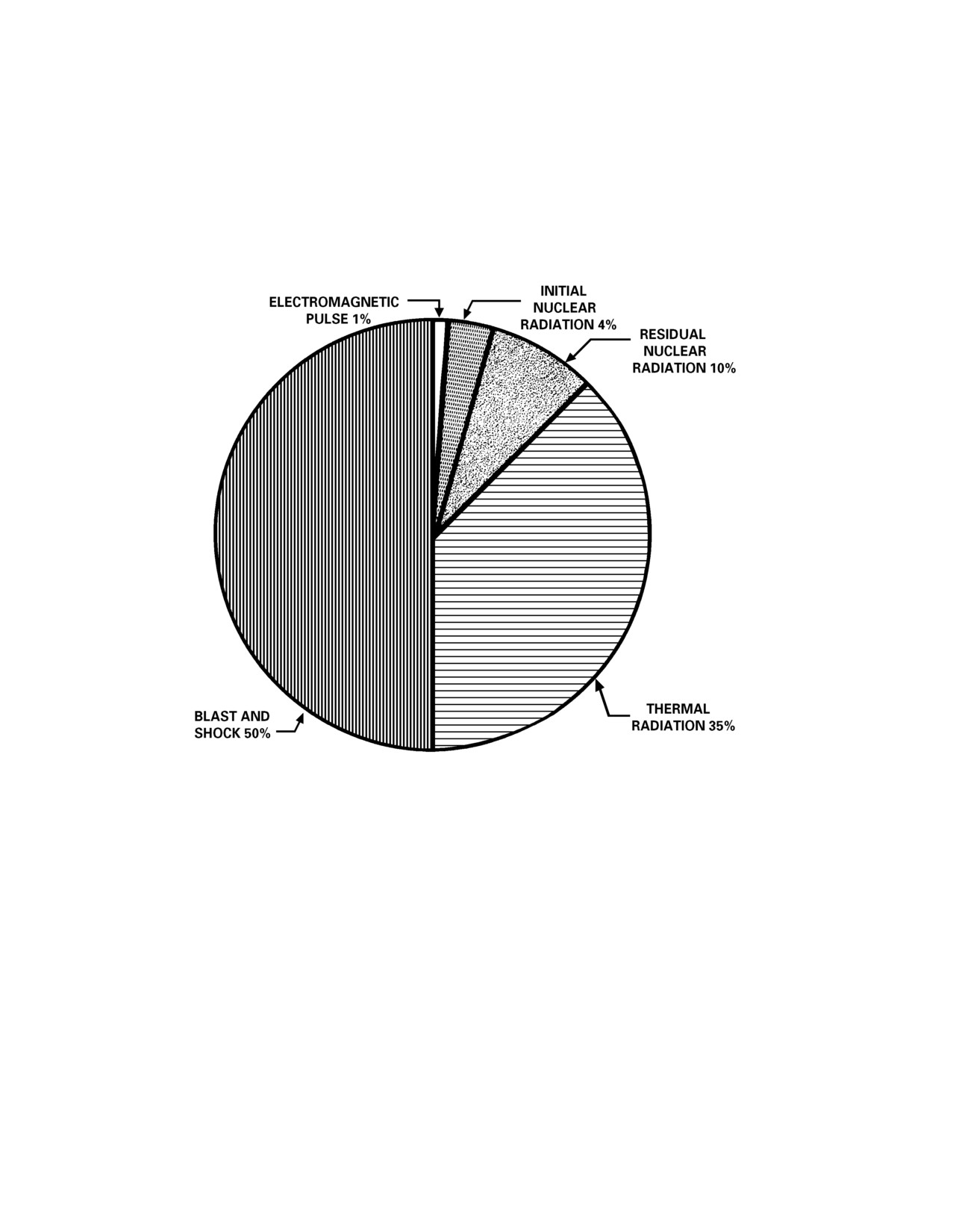
employment. The distribution of energy (Figure A-1) from the detonation of a moderate-sized (3 to 10 KT)
weapon is as follows:
(1) Fifty percent as blast.
(2) Thirty-five percent as thermal radiation; made up of a wide spectrum of electromagnetic
radiation, including infrared, visible, and ultraviolet light and some soft x-ray radiation.
(3) Fourteen percent as nuclear radiation, 4 percent as initial ionizing radiation composed of
neutrons and gamma rays emitted within the first minute after detonation, and 10 percent as residual nuclear
radiation (fallout).
(4) One percent as EMP.
b. Larger weapons are more destructive than smaller weapons, but the destructive effect is not
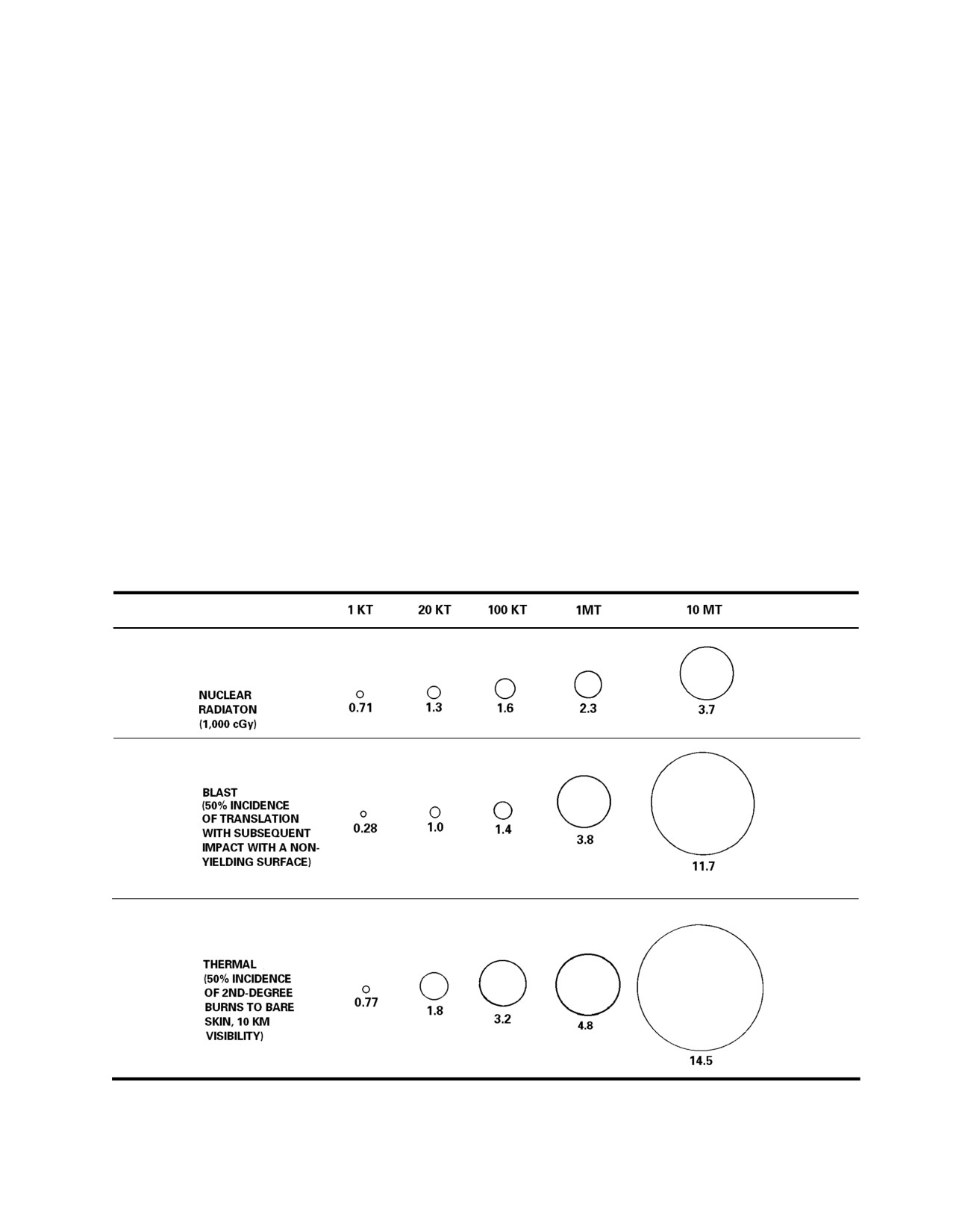
linear. Table A-1 presents a comparison of three aspects of nuclear weapons effects with yield.
A-1
FM 4-02.7
Figure A-1. Distribution of energy.
c.
The altitude at which the weapon is detonated determines the blast, thermal, and nuclear
radiation effects. Nuclear blasts are classified as air, surface, or subsurface bursts.
(1) An airburst is a detonation in air at an altitude below 30,000 meters, but high enough that
the fireball does not touch the land or water surface. The altitude is varied to obtain the desired tactical
effects. Initial radiation will be a significant hazard, but there is essentially no local fallout. However, the
ground immediately below the airburst may have a small area of neutron-induced radioactivity. This may
pose a hazard to troops passing through the area.
(2) A surface burst is a detonation in which the fireball actually touches and vaporizes the
land or water surface. In this case, the area affected by blast, thermal radiation, and initial nuclear radiation
will be smaller than for an airburst of comparable yield. However, in the region around ground zero, the
A-2
FM 4-02.7
destruction will be much greater and a crater is often produced. Additionally, all the material that was
within the fireball becomes fallout and will be a hazard downwind. A surface burst is the most likely type of
terrorist detonation.
(3) A subsurface burst is an explosion in which the detonation is below the surface of land or
water. Cratering usually results. If the burst does not penetrate the surface, the only hazard is from the
ground or water shock. If the burst penetrates the surface, blast, thermal, and initial nuclear radiation will
be present, though less than for a surface burst of comparable yield. Local fallout will be heavy over a
small area.
(4) A high altitude burst occurs above 30,000 meters. Radiation and physical effects do not
reach the ground and there is no local fallout. This is the only detonation where the effects of the EMP are
significant. Nonhardened electronic equipment including many medical devices may become inoperative.
The EMP damage is a moot point with other types of detonations, as its range is primarily limited to the area
of intense physical destruction.
Table A-1. Comparison of Weapons Effects (Radii of Effects in Kilometers—Airburst)
A-3
FM 4-02.7
A-3. Physiological Effects of Nuclear Weapons
The physiological effects of nuclear weapons are the result of exposure to the blast; thermal radiation;
ionizing radiation (initial or residual) effects; or a combination of these. For smaller weapons (less than 10
KT), ionizing radiation is the primary creator of casualties requiring medical care, while for larger weapons
(greater than 10 KT), thermal radiation is the primary creator of casualties.
a. The rapid compression and decompression of blast waves on the human body results in
transmission of pressure waves through the tissues. Resulting damage is primarily at junctions between
tissues of different densities (bone and muscle), or at the interface between tissue and airspace. Lung tissue
and the gastrointestinal system (both contain air) are particularly susceptible to injury. The tissue disruptions
can lead to severe hemorrhage or to an air embolism; either can be rapidly fatal. Direct overpressure
effects do not extend out as far from the point of detonation as the drag force and are often masked by the
drag force effects. A typical range of probability of lethality, with variations in overpressure for a 1 KT
weapon, is shown in Table A-2.
Table A-2. Range of Lethality of Peak Overpressure
LETHALITY
PEAK OVERPRESSURE
DISTANCE FROM
(APPROXIMATE %)
(ATMOSPHERES)
GROUND ZERO; METERS
1
2.3
- 2.9
150
50
2.9
- 4.1
123
100
4.1 +
110
(1) The significance of the data is that the human body is relatively resistant to static
overpressure compared to rigid structures such as buildings. For example, an unreinforced cinder block
panel will shatter at 0.1 to 0.2 atmospheres.
(2) Overpressure lower than those in Table A-2 can cause nonlethal injuries such as lung
damage and eardrum rupture. Lung damage is a relatively serious injury, usually requiring hospitalization,
even if not fatal; whereas eardrum rupture is a minor injury, often requiring no treatment at all.
(a) The threshold level of overpressure for an unreinforced unreflected blast wave that
can cause lung-damage is about 1.0 atmosphere.
(b) The threshold level for eardrum rupture is around 0.2 atmospheres; the overpressure
associated with a 50 percent probability of eardrum rupture is about 1.1 atmospheres.
(3) Casualties requiring medical treatment from direct blast effects are produced by
overpressure between 1.0 and 3.5 atmospheres. However, other effects (such as indirect blast injuries and
thermal injuries) are so predominate that patients with only direct blast injuries make up a small part of the
patient workload.
A-4
FM 4-02.7
b. The drag forces (indirect blast) of the blast winds are proportional to the velocities and
duration of the winds. The winds are relatively short in duration, but can reach velocities of several
hundred km per hour. Injury can result from missiles impacting on the body or from the physical
displacement of the body against objects and structures.
(1) The distance from the point of detonation at which severe indirect injury occurs is
greater than that for equally serious direct blast injuries. A high probability of serious indirect injury can
occur when the peak overpressure is about 0.2 atmospheres. This range will increase with the increased
size of the weapon; for a 1 KT weapon, the range is 0.22 km, whereas for a 20 KT weapon, the range is
0.76 km. At greater ranges injuries will occur and casualties will be generated, but not consistently.
(2) The drag forces of the blast winds produced by a nuclear detonation are so great that
almost any form of vegetation or structure will be broken up or fragmented into missiles. Thus, multiple,
varied missile injuries will be common, increasing their overall severity and significance. Table A-3 lists
ranges at which significant missile injuries can be expected.
Table A-3. Ranges for Probabilities of Serious Injury from Small Missiles
RANGES (km)
YIELD
1% PROBABILITY OF
50% PROBABILITY OF
99% PROBABILITY OF
(KT)
SERIOUS INJURY
SERIOUS INJURY
SERIOUS INJURY
1
0.28
0.22
0.17
10
0.73
0.57
0.44
20
0.98
0.76
0.58
50
1.4
1.1
0.84
100
1.9
1.5
1.1
200
2.5
1.9
1.5
500
3.6
2.7
2.1
1,000
4.8
3.6
2.7
1
INCIDENCE OF INJURY BASED ON SKIN AND TISSUE PERFORATION.
2
MISSILES USED WERE 10 GRAM (gm) IN WEIGHT.
(3) The velocity to which missiles are accelerated is the major factor in causing injury. The
probability of a penetration injury increases with increasing velocity, particularly for small, sharp missiles
such as glass fragments. Small, light objects are accelerated to speeds approaching the maximum (wind)
velocity. Table A-4 shows data for probability of penetration related to size and velocity of glass fragments.
Table A-4. Probability of Glass Fragments Penetrating the Abdominal Cavity
MASS OF GLASS
1%
50%
99%
FRAGMENTS (gm)
IMPACT VELOCITY (METERS PER SECOND)
0.1
78
136
243
0.6
53
91
161
1.0
46
82
143
10.0
38
60
118
A-5
FM 4-02.7
(4) Heavy, blunt missiles may not penetrate, but can result in significant injury, particularly
fractures. The threshold velocity for skull fractures from a 4.5 milligram (mg) missile is about 4.6 meters
per second (m/sec).
(5) The drag forces of the blast winds are strong enough to displace large objects (such as
vehicles), or cause large structures to collapse (such as buildings) resulting in serious crushing injuries.
Man himself can become a missile resulting in injuries (called translational injuries). The velocity at which
the body is displaced will determine the probability and the severity of injury. Assuming a displacement of
3.0 meters, the impact velocity associated with various degrees of injury is shown in Table A-5. The
velocities in Table A-5 can be correlated against yield. The ranges at which such velocities can occur and
the probability of injury are given in Table A-6.
Table A-5. Translational Injuries
A. BLUNT INJURIES AND FRACTURES
PROBABILITY OF INJURY
VELOCITY (m/sec)
1%
2.6
50%
6.6
99%
16.5
B. FATAL INJURIES
PROBABILITY OF FATALITY
VELOCITY (m/sec)
1%
6.6
50%
17.0
99%
39.7
Table A-6. Ranges for Selected Impact Velocities of a 70-Kilogram Human Body Displaced by Blast Wind
Drag Forces for Different Yield Weapons
WEAPON YIELD
VELOCITIES (m/sec)
(KT)
2.6
6.6
17.0
RANGES (km)
1
0.38
0.27
0.19
10
1.0
0.75
0.53
20
1.3
0.99
0.71
50
1.9
1.4
1.0
100
2.5
1.9
1.4
200
3.2
2.5
1.9
500
4.6
3.6
2.7
1,000
5.9
4.8
3.6
A-6
FM 4-02.7
A-4. Biological Effects of Thermal Radiation
The thermal radiation emitted by a nuclear detonation causes burns in two ways—by direct absorption of the
thermal energy through exposed surfaces (flash burns); or by the indirect action of fires in the environment
(flame burns). Indirect flame burns can easily outnumber all other types of injury.
a. Thermal radiation travels outward from the fireball in a straight line; therefore, the amount of
energy available to cause flash burns decreases rapidly with distance. Close to the fireball all objects will be
incinerated. The range for 100 percent lethality will vary with yield, height of burst, weather, environment,
and immediacy of treatment. The critical factors determining the degree of burn injury are the flux (calories
per square centimeter/second [cal/cm2/sec]) and the duration of the thermal pulse. The total amount of
thermal radiation needed to cause a flash partial thickness burn on exposed skin will vary with the yield of
the weapon and the nature of the pulse (Table A-7). Most burn patients will come from the zones where
partial thickness burns occur. In areas where radiation, blast, and thermal intensity are highest, burn
victims surviving long enough to reach medical care will be rare.
NOTE
The battle dress uniform (BDU), MOPP gear, or any other clothing
will provide additional protection against flash burns. The airspace
between the clothing significantly impedes heat transfer and may
prevent or reduce the severity of burns, depending on the magnitude
of the thermal flux.
Table A-7. Factors for Determining the Probability of Partial Thickness Burns
YIELD OF WEAPON
1 KT
10 KT
100 KT
1 MT
10 MT
RANGE (km) FOR PRODUCTION
OF PARTIAL THICKNESS BURNS
0.78
2.1
4.8
9.1
14.5
ON EXPOSED SKIN
DURATION OF THERMAL
0.12
0.32
0.9
2.4
6.4
PULSE IN SECONDS
Cal/cm2/sec REQUIRED TO
PRODUCE PARTIAL THICKNESS
4.0
4.5
5.3
6.3
7.0
BURNS ON EXPOSED SKIN
b. Indirect (flame) burns result from exposure to fires caused by the thermal effects in the
environment, particularly from ignition of clothing. The larger-yield weapons are more likely to cause
firestorms over extensive areas. There are too many variables in the environment to predict either incidence
or severity of casualties. Expect the burns to be far less uniform (in degree) and not limited to exposed
A-7
FM 4-02.7
surfaces. For example, the respiratory system may be exposed to the effects of hot gases produced by
extensive fires. Respiratory system burns cause high morbidity and high mortality rates.
c.
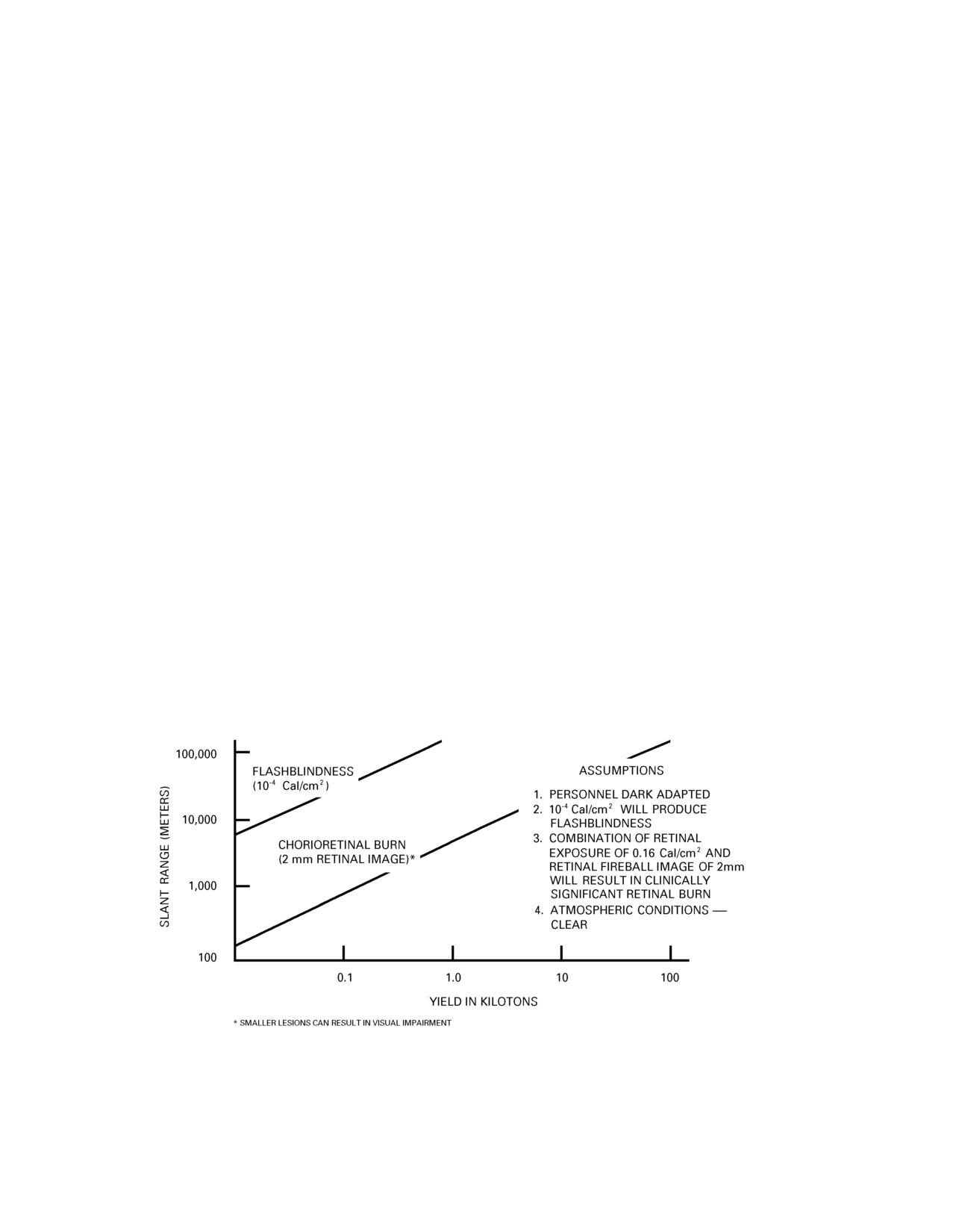
The initial pulse of radiation in the optical and thermal bands can cause injuries in the forms of
flash blindness and retinal scarring. The initial brilliant flash of light produced by the nuclear detonation
causes flash blindness. This flash swamps the retina, bleaching out the visual pigments and producing
temporary blindness. During daylight hours, this temporary effect may last for about 2 minutes. At night,
with the pupil dilated for dark adaptation, flash blindness will affect personnel at greater ranges and for greater
durations. Partial recovery can be expected in 3 to 10 minutes, though it may require 15 to 35 minutes for full
night adaptation recovery. Retinal scarring is the permanent damage from a retinal burn. It will occur only
when the fireball is actually in the individual’s field of view and should be a relatively uncommon injury. The
location of the scar will determine the degree of interference with vision. Because night vision apparatus
electronically amplifies an image, it cannot transmit the flash intensity and will not cause eye injury.
A-5. Physiological Effects of Ionizing Radiation
A nuclear burst results in four types of ionizing radiation: neutrons, gamma rays, beta, and alpha radiation.
The initial burst is characterized by neutrons and gamma rays while the residual radiation is primarily
alpha, beta, and gamma rays. The effect of radiation on a living organism varies greatly by the type of
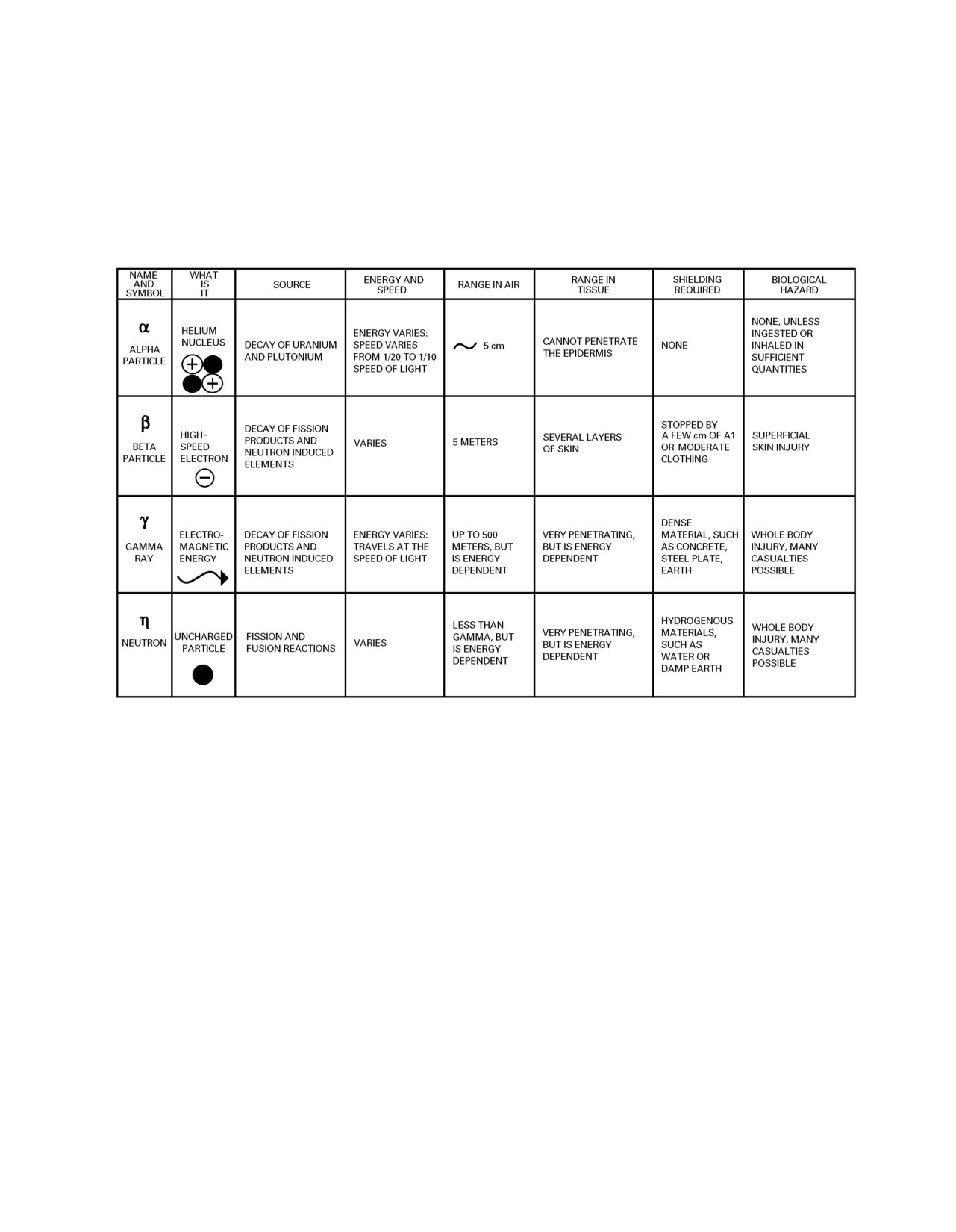
radiation to which the organism is exposed. See Table A-8 for characteristics of nuclear radiation.
a. Alpha particles are extremely massive, charged particles (four times the mass of a neutron);
they are a fallout hazard. Because of their size, alpha particles cannot travel far and are fully stopped by the
dead layers of the skin or by the uniform. Alpha particles are a negligible external hazard, but if inhaled or
ingested, can cause significant internal damage.
Figure A-2. Threshold distance for minimal chorioretinal burn and flash blindness
versus yield (airburst) at night.
A-8
FM 4-02.7
Table A-8. Characteristics of Nuclear Radiation
b. Beta particles are very light, charged particles that are found primarily in fallout radiation.
These particles can travel a short distance in tissue; if large quantities are involved, they can produce
damage to the basal stratum of the skin. The lesion produced is similar to a thermal burn (called a beta burn).
c.
Gamma rays, emitted during the nuclear detonation and in fallout, are uncharged radiation
similar to X rays. They are highly energetic and pass through matter easily. Because of its high
penetrability, radiation can be distributed throughout the body, resulting in whole body exposure.
d. Neutrons, like gamma rays, are uncharged, are only emitted during the nuclear detonation, and are
not a fallout hazard. However, neutrons have significant mass and interact with the nuclei of atoms, severely
disrupting atomic structures. Compared to gamma rays, they can cause 20 times more damage to tissue.
e.
When radiation interacts with atoms, energy is deposited resulting in ionization (electron
excitation). This ionization may involve certain critical molecules or structures in a cell, producing its
characteristic damage. Two modes of action in the cell are direct and indirect action. The radiation may
directly hit a particularly sensitive atom or molecule in the cell. The damage from this is irreparable; the
cell either dies or is caused to malfunction. The radiation can also damage a cell indirectly by interacting
with water molecules in the body. The energy deposited in the water leads to the creation of toxic
molecules; the damage is transferred to and affects sensitive molecules through this toxicity.
A-9
FM 4-02.7
f.
The most radiosensitive organ systems in the body are the male reproductive, the
hematopoietic, and the gastrointestinal systems. The relative sensitivity of an organ to direct radiation
injury depends upon its component tissue sensitivities. Cellular effects of radiation, whether due to direct or
indirect damage, are basically the same for the different kinds and doses of radiation. The simplest effect is
cell death. With this effect, the cell is no longer present to reproduce and perform its primary function.
Changes in cellular function can occur at lower radiation doses than those that cause cell death. Changes
can include delays in phases of the mitotic cycle, disrupted cell growth, permeability changes, and changes
in motility. In general, actively dividing cells are most sensitive to radiation. Additionally, radiosensitivity
tends to vary inversely with the degree of differentiation of the cell.
g. Predicting radiation effects is difficult because often it is unknown which organs were exposed.
Thus, most predictions are based on whole body irradiation. Partial body and specific organ irradiation will
occur due to shielding by equipment, from fallout particles, or from internal deposition. Depending upon
the organ system, the irradiation can be severe. The severe radiation sickness resulting from external,
whole body irradiation and its consequent organ effects is a primary medical concern. The median lethal
dose (LD) of radiation that will kill 50 percent of the exposed persons within a period of 60 days (designated
as LD50/60) is estimated to be approximately 4.5 gray (Gy) if appropriate medical care is not provided to
the casualties. Medical intervention should raise this figure to approximately 10 Gy. This larger figure
includes most of the casualties who would be actually capable of reaching medical care following a nuclear
detonation, and nearly all those who could be exposed to a RDD. For acute effects of single high dose rate
exposures of whole-body irradiation to healthy adults see Table A-9.
h. Recovery of a particular cell system will occur if a sufficient fraction of a given stem cell
population remains after radiation injury and appropriate stimulation and protection are received. Complete
recovery may appear to occur; however, the immune system may repair incompletely with consequent
greater susceptibility to future insult from a variety of agents. It is possible for late somatic effects to have a
higher probability of occurring because of the radiation damage. Efficacy of both prior and future
immunization in this group is not adequately understood.
i.
Interactions between radiological injury and chemical or biological agents appear to be
synergistic. Insult by these agents in radiologically injured personnel, even in individually subclinical
dosages, may result in significant clinical illness.
A-6. Handling and Managing Radiologically Contaminated Patients
a. Radiologically Contaminated Patients. Personnel from contaminated areas may have fallout
on their skin and clothing. Although the individual will not be radioactive, he may suffer radiation injury
from the contamination. Removal of the contamination should be accomplished as soon as possible;
definitely before admission into a clean treatment area. The distinction must be made between a radiation-
injured soldier and one who is radiologically contaminated. Although personnel may have received
substantial radiation exposure, this exposure alone does not result in the individual being contaminated.
Contaminated personnel do not pose a short-term hazard to the medical staff, rather the contamination is a
hazard to the individuals’ health. However, without patient decontamination, medical personnel may
receive sufficient exposure to create beta burns, especially with extended exposure.
A-10
FM 4-02.7
b. Handling Radiologically Contaminated Patients. To properly handle radiologically
contaminated personnel, medical personnel must first detect the contamination. Detectors that may be used are
the AN/PDR27 and AN/VDR2 to monitor patients for contamination. Generally, a reading on the meter
twice the current background reading indicates that the patient is contaminated. Monitoring is conducted when
potentially contaminated personnel arrive at the MTF. This monitoring is conducted at the MTF’s receiving
point before admitting the patient. Contaminated patients must be decontaminated before admission.
Removal of radiological contamination is less important than immediate lifesaving treatment and providing
the best possible medical care. Lifesaving care before decontamination is provided outside the MTF.
c.
Decontamination. Removing all outer clothing and a brief washing or brushing of exposed
skin will reduce 95 percent of contamination; vigorous bathing or showering is unnecessary. See Appendix G
for patient decontamination procedures.
d. Internal Contamination. Internalization of radioactive isotopes will primarily occur via
inhalation, ingestion, and contaminated wounds. Extensive internal decontamination should only be
undertaken when individual dose estimates indicate that the individual will benefit from the procedures.
Soldiers who wear their protective mask will be adequately protected from inhalation and ingestion of
radioactive particulate matter. Internal contamination is considered a delayed problem and does not
influence triage categories, as does irradiation injury.
e.
Treatment. Treatment procedures for radiation injuries are described in FM 4-02.283, FM 8-9,
and the NATO Handbook, Emergency War Surgery. Appropriate medical intervention and bone marrow
resuscitation will prevent most deaths secondary to irradiation and infection.
A-11
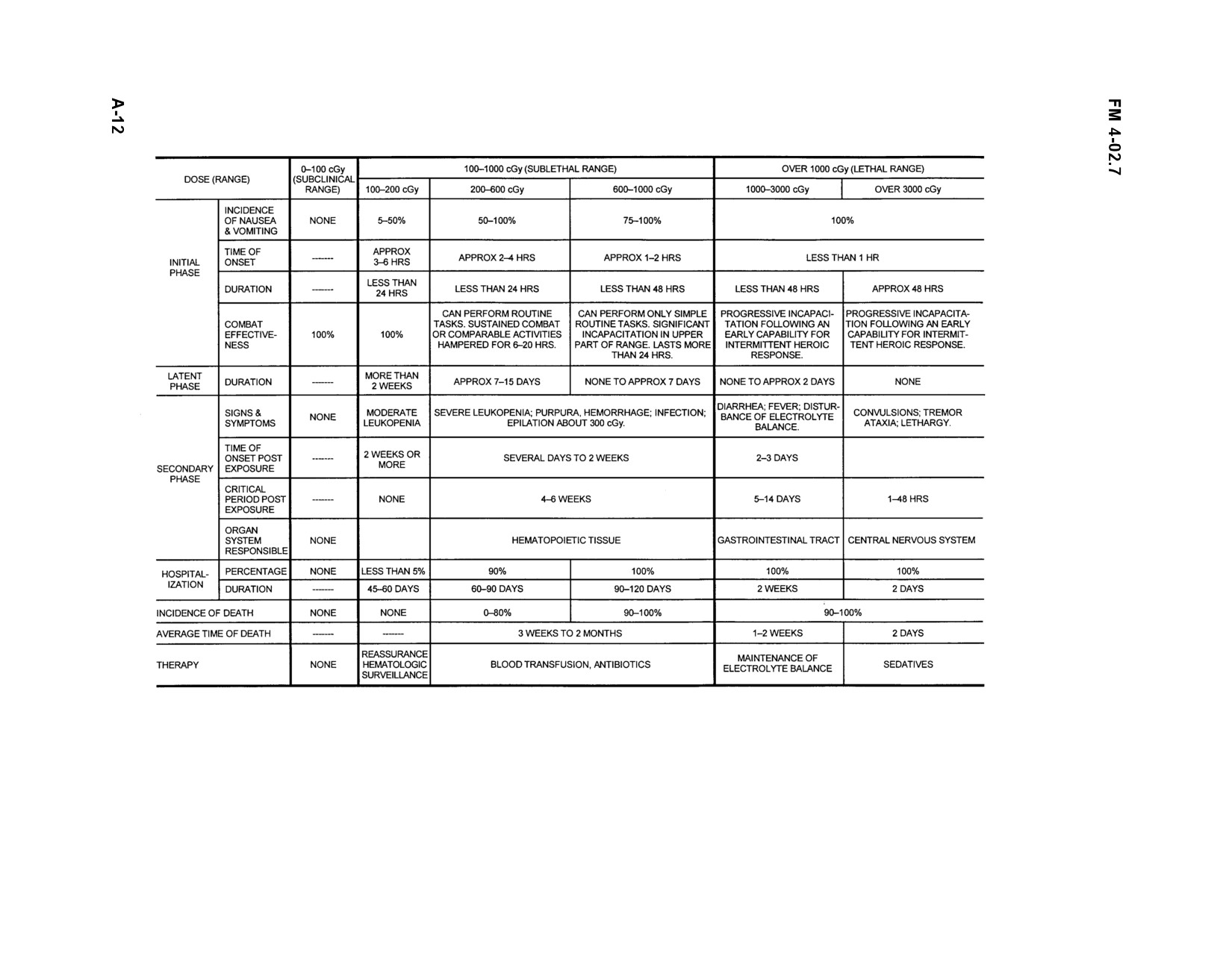
Table A-9. Acute Clinical Effects of Single High Dose Rate Exposures of Whole-body Irradiation of Healthy Adults
FM 4-02.7
A-7. Radiological Patients in Stability Operations and Support Operations
In stability operations and support operations, high levels of environmental contamination and the use of
RDD can cause radiological injury to personnel at levels below that necessary to produce performance
decrement and traditional casualty status. Treatment and evacuation guidelines will be in accordance with
command guidance. Individual physical dosimetry is the most expedient measurement technique for this
exposure (see Table A-10). These radiation injuries and effects may also be seen in war; especially, from
hostile forces employment of RDDs.
Table A-10. Stability Operations and Support Operations: Radiation Injuries and Effects of Radiation
Exposure of Personnel
RADIATION
TOTAL
STOCHASTIC RISK
EXPOSURE
CUMULATIVE
LONG-TERM
MEDICAL NOTE
MEDICAL ACTIONS
STATUS
DOSE
HEALTH EFFECTS
0
<0.05 cGy
NORMAL RISK.
US BASELINE 20% LIFETIME
RECORD IN EXPOSURE RECORD
RISK OF FATAL CANCER.
IF NORMALLY MONITORED
PERSONNEL.
1A
0.05 TO 0.5 cGy
UP TO 0.04%
NONE (0.001 Sv US ANNUAL
RECORD AS HISTORY IN
INCREASED RISK
GENERAL POPULATION
MEDICAL RECORD-TACTICAL
LIFETIME FATAL
EXPOSURE LIMIT.)
OPERATION EXPOSURE.
CANCER.
1B
0.5 TO 5 cGy
US RADIATION
REASSURANCE (0.05 Sv US
RECORD IN MEDICAL RECORD-
OCCUPATIONAL
ANNUAL OCCUPATIONAL
TACTICAL OPERATION
RISK.
LIMIT.)
EXPOSURE.
0.04%
- 0.4%
INCREASED RISK
LIFETIME CANCER.
1C
5 TO 10 cGy
0.4%
- 0.8%
COUNSEL REGARDING
RECORD IN MEDICAL RECORD-
INCREASED RISK
INCREASED LONG-TERM
TACTICAL OPERATION
LIFETIME FATAL
RISK.
EXPOSURE.
CANCER.
NO LIVE VIRUS
VACCINES X 3 MONTHS.
1D
10 TO 25 cGy
0.8% - 2% CANCER.
POTENTIAL FOR INCREASED
RECORD IN MEDICAL RECORD-
INCREASED RISK
MORBIDITY OF OTHER INJURIES
TACTICAL OPERATION
LIFETIME FATAL
OR INCIDENTAL DISEASE.
EXPOSURE.
CANCER.
<2% INCREASED LIFETIME RISK
CONSIDER ROUTINE
OF FATAL CANCER.
EVACUATION FROM THEATER
IAW COMMANDER’S
OPERATIONAL GUIDANCE.
1E
25 TO 75 cGy
2% - 5.6%
INCREASED MORBIDITY OF
RECORD IN MEDICAL RECORD-
INCREASED RISK
OTHER INJURIES OR
TACTICAL OPERATIONAL
LIFETIME FATAL
INCIDENTAL DISEASE
EXPOSURE.
CANCER.
<6% INCREASED LIFETIME RISK
CONSIDER EXPEDITED
OF FATAL CANCER.
EVACUATION FROM THEATER
IAW COMMANDER’S
OPERATIONAL GUIDANCE.
A-13
FM 4-02.7
A-8. Effects of Biological Weapons
Biological warfare is the intentional use, by an enemy, of live agents or toxins to cause death and disease
among personnel, animals, and plants, or to deteriorate materiel.
a. Live Agents.
(1) Live agents are living organisms like viruses, bacteria, and fungi. They can be delivered
directly (artillery or aircraft spray), or through a vector such as a flea or tick. Advances in modern
weaponizing of biological agents have become easier.
(2) For some agents, only a few organisms are needed to cause infection. Live agents are
small and light; they can be spread great distances by the wind and contaminate unfiltered or nonairtight
places.
(3) Aerosolized particles of 1 to 5 micron (µ) size carrying live agents are small and light.
They require time after they are ingested to multiply enough to overcome the body’s defenses. This
incubation period may vary from hours to days or weeks depending on the type of organism. Thus, to be
effective, a live agent attack would need to be launched well in advance of a tactical assault.
(4) These agents are sensitive to environmental conditions
(for example humidity and
sunlight). Many bacterial agents will not survive outside the host organism (human and animals).
(5) Live agents are not detectable by any of the five physical senses; usually the first
indication of a biological attack is the ill personnel. The diseases caused by live agents may be difficult to
control when the aerosol attack is directed against a large population. Some diseases may be transmitted
from person-to-person after the initial attack; examples include plague, smallpox, and some viral
hemorrhagic fevers.
(6) Because of their incubation period and life cycle, likely areas for live agent use are in the
combat service support (CSS) area; but attacks in forward areas cannot be ruled out.
b. Spore Forming Biological Agents. Spore formers such as anthrax can survive for an extended
time, even under very adverse environmental conditions (dry, extremes of temperatures, and flooding).
Once inhaled, ingested, or injected into the human body, the spores germinate and produce the illness.
c.
Toxins.
(1) Toxins are by-products (poisons) produced by plants, animals, or microorganisms. It is
the poisons that harm man, not the organisms that make the toxins. In the past, the only way to deliver
toxins on a large scale was by using the organism. With today’s technology large quantities of many toxins
can be produced; thus, they can be delivered without the accompanying organism.
(2) Toxins have several desirable traits. They are poisonous compounds that do not grow,
reproduce, or die after they have been dispersed; they are more easily controlled than live organisms. Field
A-14
FM 4-02.7
monitors capable of providing prompt warning of a toxin attack are not available; therefore, personnel must
learn to quickly recognize signs of attack, such as observing unexplained symptoms of victims. Toxins
produce effects similar to those caused by chemical agents; however, the victims will not respond to the
first-aid measures that work against chemical agents. Unlike live agents, mycotoxins (T2) can penetrate
intact skin; other toxins cannot. Because the effects on the body are direct, the symptoms of an attack may
appear very rapidly. The potency of most toxins is such that very small doses will cause injuries and/or
death. Thus, their use by an enemy may be an alternative to chemical agents because it allows the use of
fewer resources to cover the same or a larger area. Slight exposure at the edges of an attack area may
produce severe symptoms or death from exposure to toxins because of their extreme toxicity. Lethal or
injury downwind hazard zones for toxins may be far greater than those of CW agents.
A-9. Behavior of Biological Weapons
Biological agents can be disseminated in a spectrum of physical states. They may be living microorganisms
or spore forms of the organism. See Table A-11 for stability of various biological agents. They may be
spread by—
• Arthropods.
• Contact with infected animals.
• Contamination of food and water.
• Aerosol, liquid, or solid dispersion.
The only requirement is that they must be stable enough to survive transport and dissemination. The
toxicity of biological agents is not the same for everyone; each individual does not react exactly the same
way to the same amount of an agent. Some are more resistive than others because of race, sex, age, or
other factors. The dose is the quantity of a biological agent received by the subject. The penetration of
agents by various routes need not be accompanied by irritation or damage to the absorbent surface. There
are often unique signs and identifying symptoms depending on entry route (inhalation, ingestion, or dermal).
a. Biological agents dispersed by spray often enter the body through the respiratory tract
(inhalation injury). The agent may be absorbed by any part of the respiratory tract from the mucosa of the
nose and mouth to the alveoli of the lungs.
b. Liquid droplets and (less commonly) solids may be absorbed from the surface of the skin,
digestive tract, and mucous membranes. Agents penetrating the skin may form temporary reservoirs under
the skin.
c.
Contaminated food and water can produce casualties when ingested.
A-15
FM 4-02.7
Table A-11. Types and Characteristics of Some Biological Agents
ENTRANCE
TYPE OF AGENT
STABILITY
INCUBATION TIME
AEROSOL
NONAEROSOL
ANTHRAX
HIGH
HOURS TO 7 DAYS
INHALATION
SKIN, MOUTH
BOTULINUM TOXIN
HIGH
24 TO 36 HOURS
INHALATION
MOUTH, WOUND
HIGH IN WET
MOUTH, SKIN,
BRUCELLOSIS
1 TO 4 WEEKS
INHALATION
ENVIRONMENT
EYES
CHOLERA
MODERATE
HOURS TO 5 DAYS
MOUTH
PLAGUE (PNEUMONIC)
LOW
2 TO 4 DAYS
INHALATION
PLAGUE (BUBONIC)
MODERATE
2 TO 10 DAYS
BITE OF VECTOR
RICIN
HIGH
<36 HOURS
INHALATION
MOUTH
SMALLPOX
HIGH
7 TO 17 DAYS
INHALATION
LESION CONTACT
STAPHYLOCOCCAL
HIGH
1 TO 6 HOURS
INHALATION
MOUTH
ENTEROTOXIN B
TRICHOTHECENE MYCOTOXIN
HIGH
MINUTES TO HOURS
INHALATION
MOUTH, SKIN
MOUTH, SKIN,
TULAREMIA
LOW
2 TO 10 DAYS
INHALATION
BITE OF VECTOR
VENEZUELAN EQUINE ENCEPHALITIS
MODERATE
1 TO 6 DAYS
INHALATION
BITE OF VECTORS
VIRAL HEMORRHAGIC FEVERS
LOW
DAYS TO MONTHS
INHALATION
BITE OF VECTORS
A-10. Management of Biological Warfare Patients
a. Management. Management of patients suffering from the effects of BW agents may include
the need for isolation. Barrier nursing for patients suspected of suffering from exposure to BW agents will
reduce the possibility of spreading the disease to health care providers and other patients. Specimens must
be collected and submitted to the designated supporting laboratory for identification. For details on hospital
infection control aspects of managing BW casualties, see FM 8-284.
b. Mass Casualty. A BW agent attack can produce a mass casualty situation at all levels of HSS.
A major problem with a BW mass casualty situation is that HSS personnel are more susceptible to becoming
a casualty to BW agents. Also, the ill patient may be the first indicator that a BW agent has been dispersed.
c.
Decontamination. Decontamination is an individual and unit responsibility. However, some
individuals may arrive at the MTF that have not been decontaminated or that become contaminated en route
A-16
FM 4-02.7
to the MTF. These individuals must be decontaminated at the MTF before they are admitted to prevent
contamination of the MTF and exposure of medical personnel to the biological agent. See Appendix G for
details on patient decontamination.
d. Treatment. Specific treatment is dependent upon the BW agent used. Patients are treated for
symptomatic presentation unless the BW agent identity is known. Field Manuals 8-9 and 8-284 provide
detailed information on medical management and treatment.
A-11. Effects of Chemical Weapons
a. A chemical agent is a chemical that is used to kill, seriously injure, or incapacitate man
because of its physiological effects. They can be disseminated by artillery, aircraft, rocket, or by
nonconventional means used by terrorists. When first employed in combat during World War I, the chemical
weapon (chlorine) was so effective that the attacking Germans were not prepared to exploit the success.
b. Chemical agents are very effective weapons against poorly trained and equipped forces;
however, they are less effective against well-trained forces.
A-12. Behavior of Chemical Weapons
Chemical agents can be disseminated as a gas, vapor, or aerosol under ambient conditions. They have a range
of odors varying from none to highly pungent characteristics. Their stability is dependent upon the environ-
mental conditions in the area of employment. See Table A-11 for persistency of various chemical agents.
a. The toxicity of a chemical agent is not the same for everyone; each individual does not react
exactly the same way to the same amount of an agent. Some are more resistant than others because of
physiological factors. The dose is the quantity of a chemical received by the individual for percutaneous or
oral doses and as a time-weighted concentration, milligrams-minute (m3), for inhalation. It is usually
expressed as milligrams of agent per kilogram of subject body weight (mg/kg). The LD50 is the dose that
kills 50 percent of the exposed population. The incapacitation dose 50 (ID50) is the incapacitation dose for
50 percent of the exposed subjects. The penetration of agents by various routes need not be accompanied by
irritation or delayed superficial damage to the absorbent surface, but there are often unique signs and
symptoms identifiable by the route of entry.
(1) Gaseous, vapor, and aerosol chemical agents often enter the body through the respiratory
tract (inhalation injury). The agent may be absorbed by any part of the respiratory tract from the mucosa of
the nose and mouth to the alveoli of the lungs. Aerosol particles larger than 5 µ tend to be retained in the
upper respiratory tract; particles in the 1 to 5 µ range are retained in the deep volume of the lungs; while those
below 1 µ tend to be breathed in and out again; although a few are retained in the deep volume of the lungs.
(2) Vapors and droplets of liquids can be absorbed from the surface of the skin and mucous
membranes. Toxic compounds that are harmful to the skin can produce their effects in liquid or solid state.
Agents penetrating the skin may form temporary reservoirs under the skin; the vapors of some volatile
A-17
FM 4-02.7
liquids can penetrate the skin and cause intoxication. Additionally, wounds and abrasions may present areas
that are more permeable than intact skin.
b. Chemical agents may be divided into two main categories (persistent and nonpersistent) that
describe how long they are capable of producing casualties. Table A-12 lists the common chemical
agents, their effects and time of effectiveness. Table A-13 lists the types and characteristics of common
chemical agents.
(1) Persistent agents continue to present a hazard for considerable periods (days) after
delivery by remaining as a contact hazard, or by slowly vaporizing to produce a hazard by inhalation.
(2) Nonpersistent agents disperse rapidly after release and present an immediate, short
duration (hours) hazard. They are released as airborne particles, aerosols, and gases.
Table A-12. Common Chemical Warfare Agents
COMMON NAME
EFFECT
TIME TO EFFECT
TABUN (GA)
INHALATION: SECONDS TO MINUTES
SARIN (GB)
LETHAL NERVE AGENTS
TOPICAL: MINUTES
SOMAN (GD)
INGESTION: MINUTES TO HOURS
V-AGENTS
HYDROGEN CYANIDE
LETHAL BLOOD AGENT
MINUTES
MUSTARD
1 TO 12 MINUTES
BLISTER AGENTS
LEWISITE
MINUTES
LSD AND BZ
INCAPACITATING AGENTS
15 TO 60 MINUTES
PHOSGENE
MINUTES
LUNG-DAMAGING (CHOKING)
CHLORINE
SECONDS TO MINUTES
Table A-13. Types and Characteristics Chemical Agents
TYPE OF
PERSISTENCE
RATE OF
ENTRANCE
SYMBOL
AGENT
SUMMER
WINTER
ACTION
VAPOR/AEROSOL
LIQUID
GA, GB, GD
10 MIN-24 HR
2 HR-3 DAYS
VERY QUICK EYES, LUNGS
EYES, SKIN, MOUTH
NERVE
VX
2 DAYS-1 WK
2 DAYS-WEEKS QUICK
EYES, LUNGS
EYES, SKIN, MOUTH
CHOKING CG, DP
1-10 MIN
10 MIN-1 HR
IMMEDIATE
LUNGS
EYES
A-18
FM 4-02.7
Table A-13. Types and Characteristics Chemical Agents (Continued)
TYPE OF
PERSISTENCE
RATE OF
ENTRANCE
SYMBOL
AGENT
SUMMER
WINTER
ACTION
VAPOR/AEROSOL
LIQUID
HD, HN
3 DAYS-1 WK WEEKS
SLOW
EYES, SKIN, LUNGS EYES, SKIN
BLISTER L, HL
1-3 DAYS
WEEKS
QUICK
EYES, SKIN, LUNGS EYES, SKIN, MOUTH
CX
DAYS
DAYS
VERY QUICK EYES, LUNGS, SKIN EYES, SKIN, MOUTH
EYES, MOUTH,
BLOOD AC, CK
1-10 MIN
10 MIN-1 HR
VERY QUICK EYES, LUNGS
INJURED SKIN
A-13. Characteristics of Chemical Agents
The effectiveness of a chemical agent is a measure of how much agent is required to produce the desired
effect. Thus, an agent that is toxic at a lower dose than another similar agent is more effective. Besides
dose required for a given effect, persistency may be used to measure effectiveness. Persistency depends on
the agent’s physical characteristics, the amount of agent delivered, its physical state, weapons system used,
the terrain, and weather in the target area. The desired effects will determine the physical, chemical, and
toxicological properties of the chemical agent employed.
a. Nerve agents are primarily organophosphorus esters similar to insecticides. Those of military
importance are combined under this term. Although some have been given names, they are usually known
by their code letters: GA; GB; GD; and VX. They are all liquids, varying in volatility that is in a range
between gasoline and heavy lubricating oil. Their freezing points are -40 degrees Celsius or lower.
(1) Liquid nerve agents are pale yellow to colorless and are almost odorless. They are
moderately soluble in water and highly soluble in lipids (oil). They are rapidly destroyed by strong alkalies
and chlorinating compounds. Normal clothing is readily penetrated by liquid or vapor agents. Butyl rubber
and synthetic material are more resistant than natural fibers. Agents can penetrate into nonabsorbent
material such as web belts and can continue to present a hazard by desorption (off-gassing) of the vapor.
Although local sweating and twitching may occur, usually there is no local irritant change after cutaneous
exposure. Toxicity depends upon the route of entry and physical characteristics.
(2) Nerve agents strongly inhibit the cholinesterase enzymes. When acetylcholine is released
by the nerve junction, it is hydrolyzed by the enzyme. Acetylcholine is the chemical mediator for
transmission of the nerve impulses in numerous synapses of the central nervous system (CNS) and the
autonomic nervous system and at the endings of the cholinergic nerves (for example: affecting the smooth
muscles of the iris, ciliary, bronchial tree, and gastrointestinal tract). The inhibition of cholinesterase by
nerve agents is almost irreversible, so the effects are prolonged. Until the cholinesterase level is restored to
normal, there is an increased susceptibility to nerve agent exposure. During this time, the effects of
A-19
FM 4-02.7
repeated exposure are cumulative and the patient may feel “subpar” (for example: tired, fatigue easily, poor
appetite, impaired concentration) until recovery is complete.
(3) Nerve agent poisoning is easily identified by the characteristic signs and symptoms
as follows:
(a) MILD symptoms (self-aid). Casualties with MILD symptoms may experience most
or all of the following:
• Unexplained runny nose.
• Unexplained sudden headache.
• Sudden drooling.
• Difficulty in seeing (dimness of vision) (miosis).
• Tightness in the chest or difficulty in breathing.
• Localized sweating and muscular twitching in the contaminated area.
• Stomach cramps.
• Nausea.
(b) Casualties with MODERATE symptoms (buddy aid) will experience an increase in
the severity of most or all of the MILD symptoms. Especially prominent will be an increase in fatigue,
weakness, and muscle fasciculations. The progress of symptoms from MILD to MODERATE indicates
either inadequate atropine treatment or continuing exposure to agent.
(c) SEVERE symptoms (buddy aid). Casualties with SEVERE symptoms may
experience most or all of the MILD symptoms, plus most or all of the following:
• Strange or confused behavior.
• Wheezing, dyspnea (severe difficulty in breathing), and coughing.
• Severely pinpointed pupils.
• Red eyes with tearing.
• Vomiting.
• Severe muscular twitching and general weakness.
• Involuntary urination and defecation.
A-20