FM 4-02.7 HEALTH SERVICE SUPPORT IN A NUCLEAR, BIOLOGICAL, AND CHEMICAL ENVIRONMENT (OCTOBER 2002) - page 1
FM 4-02.7 (FM 8-10-7)
HEALTH SERVICE
SUPPORT IN A NUCLEAR,
BIOLOGICAL, AND
CHEMICAL
ENVIRONMENT
TACTICS, TECHNIQUES, AND PROCEDURES
OCTOBER 2002
HEADQUARTERS, DEPARTMENT OF THE ARMY
DISTRIBUTION RESTRICTION: Approved for public release; distribution is unlimited.
*FM 4-02.7 (FM 8-10-7)
FIELD MANUAL
HEADQUARTERS
NO. 4-02.7 (8-10-7)
DEPARTMENT OF THE ARMY
Washington, DC, 1 October 2002
HEALTH SERVICE SUPPORT IN A NUCLEAR, BIOLOGICAL,
AND CHEMICAL ENVIRONMENT
TACTICS, TECHNIQUES AND PROCEDURES
TABLE OF CONTENTS
Page
Preface
viii
CHAPTER
1.
NUCLEAR, BIOLOGICAL, AND CHEMICAL WARFARE ASPECT
OF THE MEDICAL THREAT
1-1
1-1.
General
1-1
1-2.
Medical Threat
1-1
1-3.
Nuclear, Biological, Chemical, and Radiological Dispersal Device
Threats—The Health Service Perspective
1-2
CHAPTER
2.
COMMAND AND CONTROL
2-1
2-1.
General
2-1
2-2.
Health Service Support Command and Control Planning
Considerations
2-1
2-3.
Health Service Support Command and Control Appraisal of the
Support Mission
2-2
2-4.
Health Service Support Units
2-2
2-5.
Movement/Management of Contaminated Facilities
2-3
2-6.
Leadership on the Contaminated Battlefield
2-5
2-7.
Homeland Security
2-6
CHAPTER
3.
LEVELS I AND II HEALTH SERVICE SUPPORT
3-1
3-1.
General
3-1
3-2.
Level I Health Service Support
3-2
3-3.
Level II Health Service Support
3-2
3-4.
Forward Surgical Team
3-3
3-5.
Actions Before a Nuclear, Biological, or Chemical Attack
3-3
3-6.
Actions During a Nuclear, Biological, or Chemical Attack
3-4
3-7.
Actions After a Nuclear, Biological, or Chemical Attack
3-4
3-8.
Logistical Considerations
3-5
DISTRIBUTION RESTRICTION: Approved for public release; distribution is unlimited.
*This publication supersedes FM 8-10-7, 22 April 1993. Change 1, 26 November 1996.
i
FM 4-02.7
Page
3-9.
Personnel Considerations
3-5
3-10.
Disposition and Employment of Treatment Elements
3-6
3-11.
Civilian Casualties
3-6
3-12.
Nuclear Environment
3-7
3-13.
Medical Triage
3-8
3-14.
Biological Environment
3-8
3-15.
Chemical Environment
3-9
3-16.
Operations in Extreme Environments
3-10
3-17.
Medical Evacuation in a Nuclear, Biological, and Chemical
Environment
3-10
CHAPTER
4.
LEVELS III AND IV HOSPITALIZATION
4-1
4-1.
General
4-1
4-2.
Protection
4-3
4-3.
Decontamination
4-8
4-4.
Emergency Services
4-10
4-5.
General Medical Services
4-11
4-6.
Surgical Services
4-11
4-7.
Nursing Services
4-12
4-8.
Conventional Operations
4-13
CHAPTER
5.
OTHER HEALTH SERVICE SUPPORT
5-1
Section
I.
Preventive Medicine Services
5-1
5-1.
General
5-1
5-2.
Disease Incidence Following the Use of Nuclear, Biological, and
Chemical Weapons
5-1
5-3.
Preventive Medicine Section
5-3
5-4.
Preventive Medicine Detachment
5-3
Section
II.
Veterinary Services
5-4
5-5.
General
5-4
5-6.
Food Protection
5-4
5-7.
Food Decontamination
5-4
5-8.
Animal Care
5-5
Section
III.
Laboratory Services
5-5
5-9.
General
5-5
5-10.
Level II
5-5
5-11.
Level III
5-5
5-12.
Level IV
5-6
5-13.
Level V (Continental United States)
5-6
5-14.
Field Samples
5-6
Section
IV.
Dental Services
5-7
5-15.
General
5-7
5-16.
Mission in a Nuclear, Biological, or Chemical Environment
5-7
ii
FM 4-02.7
Page
5-17.
Dental Treatment Operations
5-7
5-18.
Patient Treatment Considerations
5-7
5-19.
Patient Protection
5-8
Section
V.
Combat Operational Stress Control
5-9
5-20.
General
5-9
5-21.
Leadership Actions
5-9
5-22.
Individual Responsibilities
5-10
5-23.
Mental Health Personnel Responsibilities
5-11
Section
VI.
Health Service Logistics
5-11
5-24.
General
5-11
5-25.
Protecting Supplies in Storage
5-12
5-26.
Protecting Supplies During Shipment
5-12
5-27.
Organizational Maintenance
5-12
Section
VII.
Homeland Security Response
5-13
5-28.
Chemical, Biological, Radiological, Nuclear, and High-Yield Explosive
Response
5-13
5-29.
Capabilities of Response Elements
5-14
APPENDIX
A.
MEDICAL EFFECTS OF NUCLEAR, BIOLOGICAL, AND
CHEMICAL WEAPONS AND TOXIC INDUSTRIAL
MATERIAL
A-1
A-1.
General
A-1
A-2.
Physical Effects of Nuclear Weapons
A-1
A-3.
Physiological Effects of Nuclear Weapons
A-4
A-4.
Biological Effects of Thermal Radiation
A-7
A-5.
Physiological Effects of Ionizing Radiation
A-8
A-6.
Handling and Managing Radiologically Contaminated Patients
A-10
A-7.
Radiological Patients in Stability Operations and Support Operations
A-13
A-8.
Effects of Biological Weapons
A-14
A-9.
Behavior of Biological Weapons
A-15
A-10.
Management of Biological Warfare Patients
A-16
A-11.
Effects of Chemical Weapons
A-17
A-12.
Behavior of Chemical Weapons
A-17
A-13.
Characteristics of Chemical Agents
A-19
A-14.
Management of Chemical Agent Patients
A-23
A-15.
Management of Toxic Industrial Material Patients
A-23
APPENDIX
B.
SAMPLE/SPECIMEN COLLECTION AND MANAGEMENT
B-1
Section
I.
Introduction
B-1
B-1.
General
B-1
B-2.
Sample/Specimen Background Information
B-2
B-3.
Sample/Specimen Collection and Preservation
B-3
B-4.
Chain of Custody
B-8
iii
FM 4-02.7
Page
Section
II.
Sampling Techniques and Procedures
B-9
B-5.
General
B-9
B-6.
Expended Material
B-11
B-7.
Environmental Samples
B-11
B-8.
Collection of Air and Vapors
B-12
B-9.
Collection of Water Samples
B-13
B-10.
Collection of Soil Samples
B-15
B-11.
Collection of Contaminated Vegetation
B-16
B-12.
Medical Specimens
B-16
B-13.
Collection of Medical Specimens
B-17
B-14.
Post Mortem Specimens
B-19
B-15.
Reporting, Packaging, and Shipment
B-20
B-16.
Handling and Packaging Materials
B-21
B-17.
Collection Reporting
B-23
B-18.
Sample/Specimen Background Documents
B-27
APPENDIX
C.
GUIDELINES FOR OPERATIONAL PLANNING FOR HEALTH
SERVICE SUPPORT IN A NUCLEAR, BIOLOGICAL, AND
CHEMICAL ENVIRONMENT
C-1
C-1.
General
C-1
C-2.
Predeployment
C-1
C-3.
Mobilization
C-2
C-4.
Establish a Medical Treatment Facility
C-3
C-5.
Operate a Medical Treatment Facility Receiving Contaminated Patients .
C-4
C-6.
Preventive Medicine Services
C-5
C-7.
Veterinary Services
C-6
C-8.
Dental Services
C-6
C-9.
Combat Operational Stress Control
C-6
C-10.
Medical Laboratory Services
C-6
C-11.
Health Service Logistics
C-7
C-12.
Homeland Security
C-8
APPENDIX
D.
MEDICAL PLANNING GUIDE FOR THE ESTIMATION OF
NUCLEAR, BIOLOGICAL, AND CHEMICAL BATTLE
CASUALTIES
D-1
Section
I.
Introduction
D-1
D-1.
General
D-1
D-2.
Medical Planners’ Tool
D-1
Section
II.
Medical Planning Guide for the Estimation of Nuclear, Biological,
and Chemical Battle Casualties (Nuclear)—AMedP-8(A),
Volume I
D-1
D-3.
General
D-1
D-4.
Medical Planning Considerations
D-2
iv
FM 4-02.7
Page
D-5.
Triage
D-3
D-6.
Evacuation
D-3
D-7.
In-Unit Care
D-3
D-8.
Hospital Bed Requirements
D-4
D-9.
Medical Logistics
D-4
D-10.
Medical Force Planning
D-4
Section
III.
Medical Planning Guide for the Estimation of Nuclear, Biological,
and Chemical Battle Casualties (Biological)—AMedP-8(A),
Volume II
D-4
D-11.
General
D-4
D-12.
Medical Planning Considerations
D-6
D-13.
Triage
D-6
D-14.
Evacuation
D-6
D-15.
In-Unit Care
D-7
D-16.
Patient Bed Requirements
D-7
D-17.
Medical Logistics
D-7
D-18.
Medical Force Planning
D-8
Section
IV.
Medical Planning Guide for the Estimation of Nuclear, Biological,
and Chemical Battle Casualties (Chemical)—AMedP-8(A),
Volume III
D-8
D-19.
General
D-8
D-20.
Medical Planning Considerations
D-10
D-21.
Triage
D-11
D-22.
Evacuation
D-11
D-23.
In-Unit Care
D-11
D-24.
Patient Bed Requirements
D-12
D-25.
Medical Logistics
D-12
D-26.
Medical Force Planning
D-12
APPENDIX
E.
EXAMPLE X-__ , ANNEX__ , TO HSS PLAN/OPERATION
ORDER__, MEDICAL NBC STAFF OFFICER PLANNING
FOR HSS IN AN NBC ENVIRONMENT
E-1
APPENDIX
F.
EMPLOYMENT OF CHEMICAL AND BIOLOGICAL
COLLECTIVE PROTECTION SHELTER SYSTEMS BY
MEDICAL UNITS
F-1
Section
I.
Introduction
F-1
F-1.
General
F-1
F-2.
Types of Collective Protection Shelter Systems
F-1
Section
II.
Employment of the Chemically and Biologically Protected Shelter
System
F-2
F-3.
Establish a Battalion Aid Station in a Chemically Biologically
Protected Shelter
F-2
v
FM 4-02.7
Page
F-4.
Division Clearing Station in a Chemically Biologically Protected
Shelter
F-4
F-5.
Forward Surgical Team in a Chemically Biologically Protected Shelter ..
F-6
Section
III.
Employment of the Chemically Protected Deployable Medical
Systems and Simplified Collective Protection Systems
F-8
F-6.
Collective Protection in a Deployable Medical System-Equipped
Hospital
F-8
F-7.
Chemically/Biologically Protecting the International Organization for
Standardization Shelter
F-11
F-8.
Chemically/Biologically Protecting the Vestibules
F-12
F-9.
Chemically/Biologically Protecting Air Handler Equipment
F-12
F-10.
Establish Collective Protection Shelter Using the M20 Simplified
Collective Protection System
F-12
F-11.
Casualty Decontamination
F-12
Section
IV.
Operations, Entry, and Exit Guidelines
F-13
F-12.
Operations
F-13
F-13.
Decontamination of Entrance Area
F-13
F-14.
Procedures Prior to Entry
F-14
F-15.
Entry/Exit for the Collective Protection Shelter System
F-14
F-16.
Resupply of Protected Areas
F-17
APPENDIX
G.
PATIENT DECONTAMINATION
G-1
Section
I.
Introduction
G-1
G-1.
General
G-1
G-2.
Immediate Decontamination
G-2
G-3.
Patient Decontamination and Thorough Decontamination Collocation
G-2
G-4.
Patient Decontamination at the Battalion Aid Station (Level I)
G-5
G-5.
Patient Decontamination at the Medical Company Clearing Station
(Level II)
G-5
G-6.
Patient Decontamination at a Hospital (Level III and IV)
G-5
G-7.
Prepare Hypochlorite Solutions for Patient Decontamination
G-5
G-8.
Classification of Patients
G-6
G-9.
Patient Treatment
G-6
Section
II.
Patient Decontamination Procedures
G-7
G-10.
Decontaminate a Litter Chemical Agent Patient
G-7
G-11.
Decontaminate an Ambulatory Chemical Agent Patient
G-14
G-12.
Biological Patient Decontamination Procedures
G-18
G-13.
Decontaminate a Litter Biological Agent Patient
G-18
G-14.
Decontaminate an Ambulatory Biological Agent Patient
G-19
G-15.
Decontaminate Nuclear-Contaminated Patients
G-20
G-16.
Decontaminate a Litter Nuclear-Contaminated Patient
G-21
G-17.
Decontaminate an Ambulatory Nuclear-Contaminated Patient
G-21
vi
FM 4-02.7
Page
APPENDIX
H. FIELD EXPEDIENT PROTECTIVE SYSTEMS AGAINST
NUCLEAR, BIOLOGICAL, AND CHEMICAL ATTACK
H-1
H-1. General
H-1
H-2. Protection Against Radiation
H-1
H-3. Expedient Shelters for Protection Against Radiation
H-2
H-4. Expedient Shelters Against Biological and Chemical Agents
H-5
APPENDIX
I.
DETECTION AND TREATMENT OF NUCLEAR, BIOLOGICAL,
AND CHEMICAL CONTAMINATION IN WATER
I-1
I-l.
General
I-1
I-2.
Detection of Contamination in Water
I-1
I-3.
Procedures on Discovery of Contamination in Water
I-1
I-4.
Treatment of Contaminated Water
I-2
APPENDIX
J.
FOOD CONTAMINATION AND DECONTAMINATION
J-1
J-1.
General
J-1
J-2.
Protection of Food From Contamination
J-2
J-3.
Nuclear
J-3
J-4.
Biological
J-4
J-5.
Chemical
J-5
GLOSSARY
Glossary-1
REFERENCES
References-1
INDEX
Index-1
vii
FM 4-02.7
PREFACE
The purpose of this field manual (FM) is to provide doctrine and tactics, techniques, and procedures
for health service support (HSS) units and personnel operating in a nuclear, biological, and chemical
(NBC), radiological dispersal device (RDD), and toxic industrial material (TIM) environment. The manual
provides information for use by commanders, planners, leaders, and individuals in providing HSS under
these adverse conditions.
The use of trade or brand names in this publication is for illustrative purposes only. Their use does
not constitute endorsement by the Department of Defense (DOD).
The proponent of this publication is the United States (US) Army Medical Department Center and
School (AMEDDC&S). Send comments and recommendations directly to Commander, US Army Medical
Department Center and School, ATTN: MCCS-FCD, 1400 East Grayson Street, Fort Sam Houston, Texas
78234-5052.
The use of the term “level of care” in this publication is synonymous with “echelon of care” and
“role of care.” The term “echelon of care” is the old North Atlantic Treaty Organization (NATO) term.
The term “role of care” is the new NATO and American, British, Canadian, and Australian (ABCA) term.
The use of the term TIM in this publication is inclusive of RDD.
The use of the term “Health Service Support” in this publication is synonymous with Combat
Health Support as used in other publications. Health Service Support is the term used in Joint Publications
to describe medical support to Joint Forces.
Radiological and chemical detection devices discussed in this publication are currently being replaced
through modernization or new device developments. The users should adapt the application of doctrine as
described to fit the new devices when issued/authorized.
Unless this publication states otherwise, masculine nouns and pronouns do not refer exclusively to
men.
This publication implements NATO Standardization Agreements (STANAGs) 2475, Medical
Planning Guide for the Estimation of NBC Battle Casualties (Nuclear)—Allied Medical Publication (AMedP)
8(A), Volume I; 2476, Medical Planning Guide of NBC Battle Casualties (Biological)—AMedP-8(A),
Volume II; 2477, Planning Guide for the Estimation of NBC Battle Casualties (Chemical)— AMedP-8 (A),
Volume III. It is also in consonance with the following NATO STANAGs and ABCA Quadripartite
Standardization Agreements (QSTAGs):
TITLE
STANAG
QSTAG
Warning Signs for the Marking of Contaminated or Dangerous
Land Areas, Complete Equipments, Supplies and Stores
2002
501
Emergency Alarms of Hazard or Attack (NBC and Air Attack Only)
2047
183
viii
FM 4-02.7
TITLE
STANAG
QSTAG
Interoperable Chemical Agent Detector Kits
608
Emergency War Surgery
2068
Commander’s Guide on Nuclear Radiation Exposure of Groups
2083
898
Reporting Nuclear Detonations, Biological and Chemical Attacks,
and Predicting and Warning of Associated Hazards and
Hazard Areas—ATP-45(B)
2103
187
Friendly Nuclear Strike Warning
2104
189
Nuclear, Biological and Chemical Reconnaissance
2112
NATO Handbook on the Medical Aspects of NBC Defensive
Operations—AMedP-6(B)
2500
Concept of Operations of Medical Support in Nuclear, Biological,
and Chemical Environments—AMedP-7(A)
2873
Medical Aspects of NBC Defensive Operations
1330
Principles of Medical Policy in the Management of a Mass
Casualty Situation
2879
Medical Aspects of Mass Casualty Situations
816
Guidelines for Air and Ground Personnel Using Fixed and
Transportable Collective Protection Facilities on Land
2941
2000
Training of Medical Personnel for NBC Operations
2954
ix
FM 4-02.7
CHAPTER 1
NUCLEAR, BIOLOGICAL, AND CHEMICAL
WARFARE ASPECT OF THE MEDICAL THREAT
1-1.
General
a. After World War II, the Soviet Union represented the principal threat to the national security
interests of the US. During this period, the military capability of the Soviet Armed Forces grew enormously.
Starting in the later years of the
1980s, the international security environment has undergone rapid,
fundamental, and revolutionary changes. With the collapse of Soviet communism, the Soviet Union
disintegrated as a viable economic and political system. The Warsaw Pact dissolved as a political and
military entity. The central Soviet government was replaced by the Commonwealth of Independent States
(CIS), dominated by the Russian Republic. The cohesion of Soviet strategic military capability has been
fractured by—
• The dissolution of central Soviet control.
• The formation of the CIS.
• The unpredictability associated with uncertain loyalties and low morale.
The ultimate outcome of these events in terms of US national security interests is unclear. The military
capabilities of CIS like Russia, Ukraine, Kazakstan, and Belarus remain formidable. The capabilities
include strategic nuclear and impressive conventional, biological, and chemical warfighting capabilities.
b. From a global perspective, the economic power and influence of developing and newly
industrialized nations continue to grow. Centers of power (global or regional) cannot be measured solely in
military terms. Nation states pursuing their own political, ideological, and economic interests may become
engaged in direct or indirect competition and conflict with the US. More nations have acquired significant
numbers of modern, lethal, combat weapon systems; developed very capable armed forces; and become
more assertive in international affairs. In the absence of a single, credible, coercive threat, old rivalries and
long repressed territorial ambitions will resurface, causing increased tensions in many regions. Political,
economic, and social instability and religious, cultural, and economic competition will continue to erode the
influence of the US over the rest of the world. This erosion will also reduce the US influence of traditional
regional powers over their neighbors. This environment will encourage the continued development, or acquisition,
of modern armed forces and equipment by less influential nations; thus raising the potential for the use of NBC/
RDD weapons during internal conflict and armed confrontations in developing regions of the world.
c.
A third dimension to the threat is terrorist, rogue groups, and belligerents employing a number
of chemical and biological agents and the possible use of TIM to injure or kill US personnel. The actions
may be isolated or may be imposed by groups of individuals. Most will have the financial backing of
nations, large organizations, or groups that have the desire to cause harm and create public distrust in our
government.
1-2.
Medical Threat
Medical threat is the composite of all ongoing or potential enemy actions and environmental conditions that
will reduce combat effectiveness through wounding, injuring, causing disease, and/or degrading
1-1
FM 4-02.7
performance. Soldiers are the targets of these threats. Weapons or environmental conditions that will
generate wounded, injured, and sick soldiers, beyond the capability of the HSS system to provide timely
medical care from available resources, are considered major medical threats. Weapons or environmental
conditions that produce qualitatively different wound or disease processes are also major medical threats.
Added to the combat operational and disease and nonbattle injury (DNBI) medical threats are adversary use
of the following types of weapons, agents, and devices:
• Biological warfare agents.
• Chemical warfare agents.
• Nuclear weapons.
• Toxic industrial materials.
• Radiological dispersal devices.
• Directed-energy devices/weapons.
• Chemical, biological, radiological, nuclear, and high-yield explosives.
1-3.
Nuclear, Biological, Chemical, and Radiological Dispersal Device Threats—The Health Service
Perspective
a. Nuclear Weapons and Radiological Dispersal Device Threats. Since the breakup of the Soviet
Union, the number of countries with known nuclear capable military forces has almost doubled. Available
information suggests that a number of countries in the Middle East, Asia, and Africa have or may have
nuclear weapons capability within the next decade. Table 1-1 lists those countries known to have, suspected
of possessing, or seeking, nuclear weapons. Planners can expect, as a minimum, 10 to 20 percent casualties
within a division-sized force that has experienced a nuclear strike. In addition to the casualties, a nuclear
weapon detonation can generate an electromagnetic pulse (EMP) that will cause catastrophic failures of
electronic equipment components. Radiological dispersal devices, comprised of an explosive device with
radioactive material, can be detonated without the need for the components of a nuclear weapon. The RDD
can disperse radioactive material over an area of the battlefield causing effects from nuisance levels of
radioactive material to life-threatening levels without the thermal and, in most cases, the blast effects of a
nuclear detonation. For nuclear weapons effects see Appendix A.
Table 1-1. Countries Possessing or Suspected of Possessing Nuclear Weapons
KNOWN TO POSSESS
SUSPECT OR SEEKING
UNITED STATES OF AMERICA
IRAQ
RUSSIA
NORTH KOREA
UKRAINE
IRAN
1-2
FM 4-02.7
Table 1-1. Countries Possessing or Suspected of Possessing Nuclear Weapons (Continued)
KNOWN TO POSSESS
SUSPECT OR SEEKING
BELARUS
LIBYA
KAZAKSTAN
ALGERIA
PEOPLE’S REPUBLIC OF CHINA
SOUTH AFRICA
FRANCE
ISRAEL
UNITED KINGDOM
PAKISTAN
INDIA
b. Biological Warfare.
(1) Biological warfare (BW) is defined by the US intelligence community as the intentional
use of disease-causing organisms (pathogens), toxins, or other agents of biological origin (ABO) to
incapacitate, injure, or kill humans and animals; to destroy crops; to weaken resistance to attack; and to
reduce the will to fight. Historically, BW has primarily involved the use of pathogens in assassinations or as
sabotage agents in food and water supplies to spread contagious disease among target populations.
(2) For purposes of medical threat risk assessment, we are interested only in those BW
agents that incapacitate, injure, or kill humans or animals.
(3) Known or suspect BW agents and ABOs can generally be categorized as naturally
occurring, unmodified infectious agents (pathogens); toxins, venoms, and their biologically active fractions;
modified infectious agents; and bioregulators. See Table 1-2 for examples of known or suspected BW
threat agents. Also, Table 1-3 presents possible developmental and future BW agents.
Table 1-2. Examples of Known or Suspect Biological Warfare Agents
PATHOGENS
TOXINS
BACILLUS ANTHRACIS (ANTHRAX)
BOTULINUM TOXIN
FRANCISELLA TULARENIUS (TULAREMIA)
MYCOTOXINS
YERSINIA PESTIS (PLAGUE)
ENTEROTOXIN
BRUCELLA SPECIES (BRUCELLOSIS)
RICIN
VIBRIO CHOLERAE (CHOLERA)
VARIOLA (SMALLPOX)
VIRAL HEMORRHAGIC FEVERS
1-3
FM 4-02.7
Table 1-3. The Future of Biological Warfare Agents
CURRENT THREAT
FUTURE
PATHOGENS
MODIFIED PATHOGENS
LIMITED NUMBER OF TOXINS
EXPANDED RANGE OF TOXINS (ORGANO-TOXINS)
AGENTS OF BIOLOGICAL ORIGIN
PROTEIN FRACTIONS
AGENTS OF BIOLOGICAL ORIGIN
(4) Many governments recognize the industrial and economic potential of advanced
biotechnology and bioengineering. The same knowledge, skills, and methodologies can be applied to the
production of second and third generation BW agents. Naturally occurring infectious organisms can be
made more virulent and antibiotic resistant and manipulated to render protective vaccines ineffective.
These developments complicate the ability to detect and identify BW agents and to operate in areas
contaminated by the BW agents. For biological agent characteristics and effects see Appendix A. The first
indication that a BW agent release/attack has occurred may be patients presenting at a medical treatment
facility with symptoms not fitting the mold for endemic diseases in the area of operations (AO). See
Appendix B for sampling requirements, sampling procedures, packaging and shipping, and chain of custody
requirements.
c.
Chemical Warfare.
(1) Since World War I, most western political and military leaders have publicly held
chemical warfare (CW) in disrepute. However, evidence accumulated over the last 50 years does not
support the position that public condemnation equates to limiting development or use of offensive CW
agents. The reported use of chemical agents and biological toxins in Southeast Asia by Vietnamese forces;
the confirmed use of CW agents by Egypt against Yemen; and later by Iraq against Iranian forces; and the
probable use of CW agents by the Soviets in Afghanistan indicate a heightened interest in CW as a force
multiplier. Also, an offensive CW capability is developed as a deterrent to the military advantage of a
potential adversary. For a list of common chemical agents, their characteristics, behavior, and effects see
Appendix A. Table 1-4 lists those countries known or suspected of having offensive chemical weapons.
(2) The Russian Republic has the most extensive CW capability in Europe. Chemical strikes
can be delivered with almost any type of conventional fire support weapon system (from mortars to long-
range tactical missiles). Agents known to be available in the Russian inventory include nerve agents
(O-ethyl methyl phosphonothiolate [VX], thickened VX, Sarin [GB], and thickened Soman [GD]); vesicants
(thickened Lewisite[L] and mustard-Lewisite mixture[HL]); and choking agent (phosgene). Although not
considered CW agents, riot control agents are also in the Russian inventory.
(3) The US is in the process of destroying its stockpiles of CW weapons. Many weapons
have already been destroyed and the storage facilities have been rendered safe of all CW agent residues.
1-4
FM 4-02.7
Table 1-4. Nations Known or Suspected of Possessing Chemical Weapons
KNOWN TO POSSESS
SUSPECTED OF POSSESSING
UNITED STATES OF AMERICA
PEOPLE’S REPUBLIC OF CHINA
RUSSIA
NORTH KOREA
FRANCE
EGYPT
LIBYA
ISRAEL
IRAQ*
ETHIOPIA
IRAN
TAIWAN
SYRIA
BURMA
FOLLOWING THE PERSIAN GULF WAR (1990-91), THE UNITED NATIONS (UN) BEGAN DESTROYING CW MUNITIONS
DISCOVERED DURING INSPECTION VISITS TO IRAQ BY UN ARMS CONTROL INSPECTORS. INCLUDED AMONG THE CW
MUNITIONS DISCOVERED WERE SOME 2,000 AERIAL BOMBS AND 6,200 ARTILLERY SHELLS FILLED WITH MUSTARD AND
SEVERAL THOUSAND 122 MILLIMETERS (mm) ROCKET WARHEADS FILLED WITH NERVE AGENT (GB). IRAQ ALSO
DECLARED SURFACE TO AIR MISSILE (SCUD) WARHEADS FILLED WITH NERVE AGENT (GB AND GF). TABLE 1-5
PROVIDES A LIST OF KNOWN CW AGENTS.
Table 1-5. Chemical Warfare Agents
NERVE
VESICANT
INCAPACITATING
CHOKING
BLOOD
TABUN (GA) SULFUR MUSTARD (HD) CNS DEPRESSANT (BZ) PHOSGENE (CG)
HYDROGEN CYANIDE (AC)
GB
HL
CHLORINE (CL)
DIPHOSGENE (DP) CYANOGEN CHLORIDE (CK)
GD
L
CHLOROPICRIN (PS)
GF
PHOSGENE OXIME (CX) D-LYSERGIC ACID
VX
DIETHYLAMIDE (LSD)
d. Toxic Industrial Materials.
Toxic industrial materials can present a medical threat for deployed forces. Toxic industrial materials are
comprised of toxic industrial biologicals
(TIB), toxic industrial chemicals
(TIC), and toxic industrial
radiological (TIR) materials. These materials are found throughout the world and are used on a daily basis
for commercial and private purposes. Large storage facilities, transportation tankers (over the road and
railcars), as well as smaller containers of material, pose a danger to the health of personnel. Accidental
spills or releases and terrorist actions can all lead to release of these materials into the environment causing
potential casualty producing effects. Medical treatment facilities and nuclear power plants use radioactive
materials that can pose a health hazard if accidentally released or used by hostile forces, terrorists, or others
to contaminate an area. Biological materials used in medical research and pharmaceutical manufacturing
may be used by hostile forces, terrorists, or others to produce casualties. Many TICs produce the same
effects on personnel as CW agents. As a matter of fact, many TICs are of the same chemical structure as
CW agents. However, there is quite a difference in their potency; in most TICs the potency is much lower.
1-5
FM 4-02.7
For example, chlorine used to treat water supplies has also been used as a CW agent; organophosphate
pesticides can cause the same effects as some nerve agents. Hostile forces, terrorists, or others may use
RDDs to produce casualties as well. For detailed information on toxic industrial materials see FM 8-500.
1-6
FM 4-02.7
CHAPTER 2
COMMAND AND CONTROL
2-1.
General
The US forces may be attacked by or exposed to NBC, TIM, lasers, advanced electronics, high explosives,
fuel-air, thermoberic, and conventional weapons; or a combination of these weapons/materiel. Mass
casualty situations will be the rule and not the exception. Mass casualty situations can occur anyplace on the
battlefield. Combined NBC and conventional weapons injuries may predominate. Command and control
(C2) will be essential to prevent casualties and to provide effective HSS. However, C2 (to include HSS C2)
elements may be primary targets. Effective HSS in an NBC environment can be accomplished, but only if
necessary preparations to survive and to be mission capable are taken. Increased HSS C2 actions are
needed to maintain HSS proximity to the supported force; to clear the battlefield; to move and resupply the
HSS units, while managing multiple simultaneous mass casualty incidents; and to rapidly evacuate patients.
Health service support C2 units must push HSS augmentation to mass casualty sites, clear the site, evacuate
the patients to Medical Treatment Facilities (MTFs) that can provide essential care or out of the AO;
decontaminate and extract medical forces from NBC contaminated areas and redistribute or redeploy the
HSS forces. Within medical units, C2 will be challenged by the use of protective clothing and equipment,
the need to move (either to the patients or out of the contaminated area), and obtaining additional support.
Health service support advisers and staff officers must provide guidance to commanders on continued duty
for personnel who have been exposed to NBC weapons/agents and TIM effects. Leaders must greatly
increase coordinating, preplanning, using tactical standing operating procedures (TSOPs), and establishing
multiple C2 mechanisms. See Appendix C for guidelines on operational planning for health service support
in an NBC or TIM environment. See Appendix D for medical planning guide on NBC casualties. See
Appendix E for a sample format of a “medical NBC staff officer appendix to annex Q.”
2-2.
Health Service Support Command and Control Planning Considerations
a. Battle situational understanding is of great importance on the NBC battlefield. The number of
casualties from each NBC attack will overwhelm any single medical unit or MTF causing the medical
commander/leader to take action. To the extent possible, the commander/leader should be prepared for the
requirement instead of reacting to it. To ensure responsive C2 the HSS plan must consider:
• Likely targets (C2 nodes, main supply routes (MSR), supply nodes, troop concentrations,
key terrain features, key forces, or other high value targets).
• Patient estimates (conventional, NBC, and TIM).
• Availability of HSS resources (preestablished support plans).
• Availability of required nonmedical support (patient decontamination teams).
• Ability to maintain operations if C2 is lost at any HSS level.
• Ability to maintain C2 operations when normal communication systems have been
disabled due to EMP effects or other system failures.
2-1
FM 4-02.7
• Ability to maintain C2 operations while the unit is operating in mission-oriented protective
posture (MOPP) Level 4 (reduced audio and visual acuity).
• The requirements for immunizations, pretreatments, barrier creams, prophylaxis, insect
repellents, and other medical countermeasures to protect the forces.
• The resource requirements for treatment, MEDEVAC, and hospitalization (including
care for enemy prisoners of war [EPW]).
b. Clearing the battlefield will require preplanning and close coordination at all levels. Early
resuscitation, stabilization, and prompt medical evacuation (MEDEVAC) are mandatory for survival of the
sick and wounded.
c.
For conventional operations C2 see FM 8-10. Field Manual 8-55 provides HSS planning for
conventional operations.
d. Provisions for emergency medical care of civilians, consistent with the military situation. All
non-DOD civilian care must be approved by the AO Commander in Chief/senior official and coordinated
with the civil affairs unit and/or country team. For eligibility of care determinations guidance, see FM 8-10.
e.
For additional information on planning operations in an NBC environment see FMs 8-10,
4-02.10, 4-02.4, 4-02.6, 4-02.283, 8-9, 8-10-6, 8-10-26, 8-284, and 8-285. Higher headquarters must
distribute timely plans and directives to subordinate units to ensure that the subordinate unit’s HSS plan
supports their plan.
2-3.
Health Service Support Command and Control Appraisal of the Support Mission
The HSS personnel make an appraisal of the supported mission to determine the expected patient load.
Once the appraisal has been accomplished, HSS personnel prepare for the HSS mission by assigning
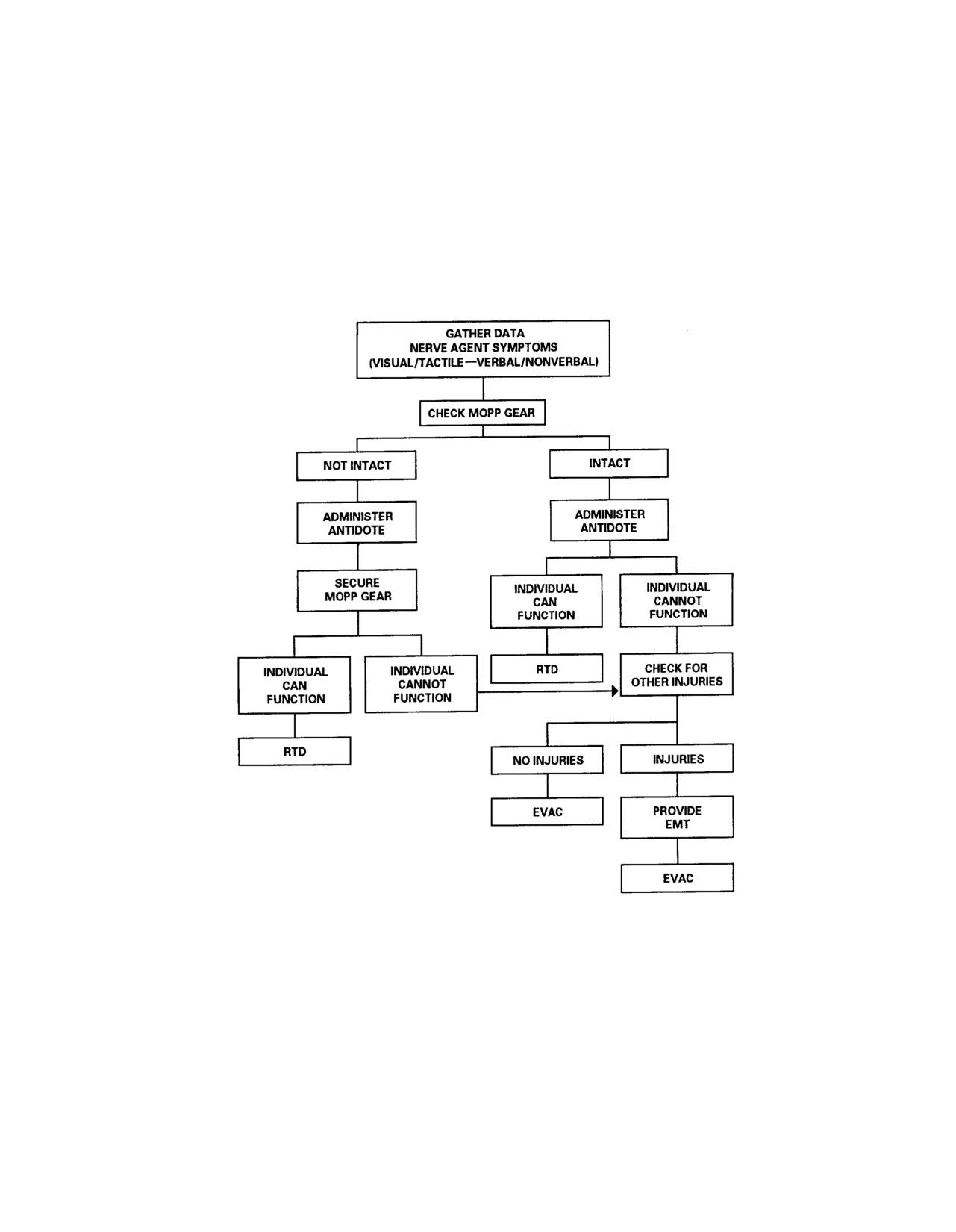
personnel responsibilities. Using triage and EMT decision matrices for managing patients in a contaminated
environment improves treatment proficiency. See Figure 2-1 for a sample decision matrix. Training HSS
personnel in the use of simple decision matrices should enhance their effectiveness and contribute to a more
efficient battlefield HSS process. Prior training for designated nonmedical personnel in patient
decontamination procedures will enhance their effectiveness in the overall patient care mission. See
Appendix D for planning factors on the estimation of NBC casualties.
2-4.
Health Service Support Units
Health service support units must plan, train, and routinely practice mass casualty management. The NBC
attack or TIM event will likely be in conjunction with enemy conventional operations. But, the TIM event
may be caused by terrorist or belligerent action. There will likely be increased conventional casualties in
addition to the NBC/TIM related casualties. The supply and transportation units will be using the MSR in
support of the combat commander’s requirements; thus, impacting on patient MEDEVAC and HSS unit
2-2
FM 4-02.7
resupply. Communications will be disrupted. Therefore, HSS C2 must plan and prepare for conducting
operations with limited or no communications with other HSS organizations.
Figure 2-1. Sample triage and emergency medical treatment decision matrix.
2-5.
Movement/Management of Contaminated Facilities
Operations in a contaminated area require the HSS commander/leader to operate with contaminated or
potentially contaminated assets. The following provides guidance in determining how to operate with
contaminated facilities:
2-3
FM 4-02.7
a. Fulfill Health Service Support Principles. In making his decision to move or continue to
operate with contaminated facilities, the commander/leader must apply the principles of conformity,
proximity, flexibility, mobility, continuity, and control. The unit’s operation must conform to the tactical
commander’s operation plan (OPLAN). Health service support must be provided to the tactical unit as far
forward as possible; this ensures prompt, timely care. Additionally, the HSS commander/leader must be
flexible; his support must be tailored to meet the supported commander’s OPLAN requirements. Therefore,
HSS assets must be as mobile as the unit they support. Finally, the HSS commander/leader must control his
assets. Dispersion on the integrated battlefield may enhance unit survivability; but the HSS commander/
leader may not be able to maintain control of his assets, they may become compromised.
b. Decision to Move. The HSS commander/leader (when deciding to move his unit to an
uncontaminated area or in support of the tactical commander’s plan) must base his decision to move on
several factors.
(1) Protection available. What type of protection is available in the new area? Will he need
to establish the units’ collective protection shelter (CPS) systems, or are indigenous shelters available (for
example, buildings, tunnels, caves)? Does the unit have sufficient individual protective equipment for unit
personnel?
(2) Persistency. If his unit has been in a contaminated area, is the contamination persistent
or nonpersistent? Is the area he will move to contaminated or clean? Persistency determines the MOPP
level; the degree of threat; and performance decrement caused by the protective measures used. The level
of contamination will determine whether employment of CPS is viable. The MTF may be able to continue to
operate at the location by employing CPS. Personnel and patient decontamination must be accomplished
before processing into the CPS.
(3) Patients. Before moving the entire facility, the HSS commander/leader must consider
the number and types of patients at the MTF; his ability to redirect en route patients to the new MTF
location; and his ability to evacuate the patients currently on hand. All patients should be stabilized before
movement; but, MEDEVAC must be continued.
(4) Alternate facilities. Alternate facilities may be used (if the facility can be configured to
ensure continuity of care or provide a protected area for patients) until the relocating activity is up and
operating. This is a viable consideration when CPS is not available or the current location is contaminated
with a persistent agent. Patient decontamination cannot be performed in an area heavily contaminated with
a persistent agent.
(5) Medical evacuation. Consideration must always be given to the patient. Routes of
MEDEVAC must be disseminated to supported and supporting units. The ability to evacuate patients
during the move must continue. All MEDEVAC considerations must be addressed before any move.
(6) Mobility. An MTF that is not 100 percent mobile requires movement support. Thus, the
commander/leader must coordinate movement support requirements with higher headquarters.
2-4
FM 4-02.7
(7) Mission. The primary consideration is the support mission of the MTF. The tactical
commander requires continuous HSS for his personnel; when a move jeopardizes the quality of care, the
move may be delayed.
(8) Sustainability. Hand-in-hand with the mission is sustainability (the ability of the unit to
continue it’s support mission). If the current location of the MTF hinders the unit’s ability to sustain its
support mission, then the MTFs support to the unit is in question. Similarly, if moving the MTF will result
in a disruption of support, then the move may not be viable.
(9) Decontamination. When a nonpersistent agent hazard exists and a CPS is not available,
patients may be directed to another MTF until the hazard is gone; or the MTF can move to a contamination
free area. Certain facilities may be decontaminated, patient protection procedures applied, and the operation
continued. However, an MTF contaminated with a persistent agent requires time-consuming and resource-
intensive decontamination operations; it may include replacement of contaminated shelters.
c.
Management of Contaminated and “Clean” Facilities. Facilities contaminated with a persistent
agent may be too resource intensive to decontaminate. Operating with a combination of contaminated assets
and “clean” assets may be necessary. Mark contaminated assets with standard warning tags. Use these
assets in contaminated environments and along contaminated routes. Keep clean assets in operation in clean
areas. Of primary importance is proper marking and the avoidance of cross contamination.
d. Medical Supplies and Equipment for Patient Treatment. Are sufficient medical supplies and
equipment available to perform the anticipated mission? Does the unit have special medical equipment
sets available
(chemical agent patient decontamination and chemical agent patient treatment medical
equipment sets)?
2-6.
Leadership on the Contaminated Battlefield
a. Operating on a contaminated battlefield will stress leadership. Heat stress from being in
higher levels of MOPP for long periods of time may lead to dehydration. The commander/leader must
ensure that his personnel rest, drink, and eat sufficiently to allow them to continue with the mission. In the
midst of activity, rest, hydration, and nutrition are often overlooked; however, a good leader will ensure
that his personnel needs are met. See FM 21-10 for work/rest cycles and water drinking requirements.
Individuals may suffer hyperventilation because of the enclosed feelings. Personnel remaining in MOPP
Level 4 around the clock may suffer from increased sleep loss. Use of CPS can reduce this problem by
allowing the personnel to rest out of their MOPP gear. Leaders must share leadership responsibilities and
delegate responsibilities as much as possible so that each one gets sufficient rest to maintain unit effectiveness.
Further, leaders should concentrate on supervision or unit mission, rather than on generation of new procedures
during and after an attack. The NBC battlefield will, therefore, require more proactive and dedicated leaders
who can balance the needs of their personnel and the mission. Further, leaders will be challenged by an
additional logistics burden of providing nontraditional respiratory protection for personnel against TIMs.
For detailed information on combat operational stress control (COSC) see FM 8-51 and FM 22-51.
2-5
FM 4-02.7
DANGER
The standard NBC protective mask will not protect
personnel from most TICs.
b. Leadership must plan for and establish procedures to maintain personnel performance during
NBC operations. Personnel performance while wearing MOPP is degrading. At MOPP Level 3 or 4, all
but the most basic patient care procedures may have to be suspended because—
• Wearing gloves reduces the ability to grasp and manipulate small items (fine motor skill).
• MOPP impedes the ability to move about (gross motor skills).
• The mask reduces visual fields and acuity (visual skills).
• The mask and hood greatly reduces vocalization and hearing abilities (auditory skills).
• The MOPP creates significant heat and mental stress (stamina). Heat injuries can occur
in a very short period of time.
2-7.
Homeland Security
Commanders and leaders must plan for and be prepared to support homeland security efforts; especially,
for response to chemical, biological, radiological, nuclear, and high-yield explosive (CBRNE) events.
Depending upon the location of the event, the response may be to a military installation in support of the
weapons of mass destruction-installation support team (WMD-IST) or to an event site off a military
installation. Response to a CBRNE event off a military installation will normally require a request for
Department of Defense support to the event from the first responders to the event (usually from the incident
commander or lead federal agency [Federal Bureau of Investigation or Federal Emergency Management
Agency]). See Appendix C for planning considerations.
2-6
FM 4-02.7
CHAPTER 3
LEVELS I AND II HEALTH SERVICE SUPPORT
3-1.
General
a. The use of NBC weapons is a condition of battle and HSS personnel must prepare to operate in
these environments. Added is the dimension of TIM releases/incidents in the operational area. The
importance of preventive medicine (PVNTMED) measures and first aid (self-aid, buddy aid, and combat
lifesaver [CLS] support) are even more critical. Heat and stress injuries related to MOPP wear are issues
for the HSS leadership as well as the force he is supporting. The stress load on personnel is increased by
the concerns of being exposed to TIM releases. Considering that staffing of HSS units is based upon the
minimum required to provide support on a conventional battlefield, they will be challenged to provide the
same level of HSS in these environments.
b. The HSS leadership must quantify the HSS capability to their commanders. The medical staff
must review OPLANS and make recommendations to reduce the number of patients. Medical NBC training
programs must stress the essential imperative of immediate decontamination, the need to monitor your
buddy for NBC and heat or combat/operational stress injury effects, and the proper use of NBC defense
prophylaxis, pretreatments, insect repellents, barrier creams, and immunizations.
c.
Maintaining close proximity to the supported force has been a major tenet of HSS doctrine and
a critical factor in reducing the mortality rate. Maintaining this proximity and finding a place clean enough
to provide necessary care requires intense coordination with the supported force. Alternate casualty
collection points, decontamination sites, medical treatment sites, and MEDEVAC routes must be established,
coordinated and communicated to the lowest level practical. Communication will be much more difficult,
but must be maintained. Timely reports through the HSS technical channels will allow an optimal HSS
response. Replacements for HSS front line losses must be rapidly filled after NBC weapons are employed.
d. Contamination (NBC and TIMs) can significantly hinder HSS operations. To maximize the
unit’s survivability and HSS capabilities and to avoid such contamination, leaders must use—
• Contamination avoidance techniques.
• Alarms and detection equipment.
• Unit dispersion techniques.
• Overhead shelter, shielding material, protective cover, and buildings of opportunity.
However, these shelters may not provide protection from chemical vapor or BW hazards.
• Collective protection shelters, if available. See Appendix F.
• Chemical agent resistant coatings on equipment.
e.
On the NBC battlefield, as on the conventional battlefield, HSS is focused on keeping soldiers
in the battle. Effective and efficient PVNTMED measures, triage, emergency medical treatment (EMT),
decontamination, advanced trauma management (ATM), and contamination control in the AO saves lives,
assures judicious MEDEVAC, and maximizes the return to duty (RTD) rate.
3-1
FM 4-02.7
3-2.
Level I Health Service Support
a. Level I (unit-level) HSS may consist of a combat medic section, a MEDEVAC section, and a
treatment squad. The treatment squad operates the Level I MTF (battalion aid station [BAS]). Level I HSS
is supported by first aid in the form of self-aid/buddy aid and the CLS. See FM 4-02.4 for detailed
information on conventional Level I HSS.
b. When operating under an NBC threat or when NBC attack is imminent, the BAS must prepare
for continuation of it’s mission. Should an attack occur or a downwind hazard exist, the BAS must seek out
a contamination free area to establish a clean treatment area, or must establish collective protection to
continue the mission. Some BASs have Chemically Biologically Protected Shelter (CBPS) Systems. When
available, these systems serve as the primary shelter for the BAS; they are operated in the full chemical/
biological (CB) mode when attack is imminent or has occurred. See Appendix F for information on
establishing a BAS in a CBPS system. When operating in the CB mode only patients requiring life- or limb-
saving procedures are allowed entry at the BAS. Patients that have minor injuries that can be managed in
the contaminated EMT area of the patient decontamination site will receive treatment in this area. After
treatment, these patients will have the integrity of their MOPP restored by taping the damaged area and
returned to duty. Patients with injuries that require further treatment, but who can survive evacuation to the
Level II MTF will have their MOPP spot decontaminated, their injuries managed, the integrity of their
MOPP restored, and be directed to an evacuation point to await transport to the Level II MTF (example, an
individual with a splinted broken arm). When patients or personnel are contaminated or are potentially
contaminated, they must be decontaminated before admission into the clean treatment area (see FM 3-5 for
personnel decontamination procedures and Appendix G for patient decontamination procedures).
3-3.
Level II Health Service Support
a. In the brigade, Level II HSS consists of—
• Evacuating patients from the BAS and MEDEVAC on an area support basis from within
the brigade support area (BSA).
• Providing area support Level I medical treatment.
• Operating the medical company clearing station (hereafter referred to as the division
clearing station [DCS]), which proves a patient holding capability for up to 40 patients for 72 hours. See
FM 4-02.6 and FM 8-10-24 for detailed information on Level II conventional operations.
• Providing limited dental service.
• Providing limited PVNTMED support in the areas of medical surveillance, occupational
and environmental health surveillance, food service sanitation, water quality control (including NBC
contamination surveillance), and communicable disease control.
• Providing limited COSC; these patients are returned to duty as far forward as their
condition permits.
3-2
FM 4-02.7
b. In the division, HSS is the same as for the brigade, except patients may be evacuated from the
BSA DCS, but not evacuated from the BAS.
c.
When operating under an NBC threat or when NBC attack is imminent, the DCS must prepare
for continuation of its mission. Should an attack occur or a downwind hazard exist the DCS must seek out a
contamination free area, or must establish collective protection to continue the mission. The DCS in some
medical companies have four CBPS Systems; they are complexed to provide space for DCS operations.
These systems are operated in the CB mode when attack is imminent or has occurred. See Appendix F for
information on establishing a DCS in CBPS Systems. When operating in the CB mode only patients
requiring life- or limb-saving procedures are allowed entry. Patients with minor injuries that can be
managed in the contaminated EMT area of the patient decontamination site will receive treatment in this
area. After treatment, these patients will have the integrity of their MOPP restored by taping the damaged
area and returned to duty. Patients with injuries that require further treatment, but who can survive
evacuation to the Level III MTF will have their MOPP spot decontaminated, their injuries managed, and be
directed to an evacuation point to await transport to the Level III MTF (example, an individual with a
splinted broken arm). When personnel and patients are contaminated or are potentially contaminated, they
must be decontaminated before admission into the clean treatment area (see FM 3-5 for personnel
decontamination procedures and Appendix G for patient decontamination procedures).
3-4.
Forward Surgical Team
Forward surgical teams (FST) are either organic to divisional and nondivisional medical units or are
forward deployed in support of divisional or nondivisional medical companies to provide a surgical
capability. Field Manual 8-10-25 describes FST operations. However, when forward deployed and NBC
contamination is imminent the FST must employ collective protection in order to continue their support
mission. When operating in a contaminated area the FST CBPS Systems must be complexed with the DCS
CBPS. The FST cannot operate in an NBC environment without the support of the DCS. They do not have
the capability to decontaminate patients. All patients are decontaminated in the DCS patient decontamination
area. They are then processed into the EMT section of the DCS; where they are triaged and routed to the
FST for surgery, if required. See Appendix F for FST employment of collective protection procedures.
3-5.
Actions Before a Nuclear, Biological, or Chemical Attack
a. Given the disruption of transportation, communications, and operations during and following
an NBC attack, it should be clear that preparation is the key to survival and effectively providing HSS.
Preparing a simple and complete TSOP and HSS plan that really integrates NBC is the first step. Critical
training for medical personnel before an NBC attack is how to—
• Survive the attack individually and as a unit.
• Operate the Level I or Level II MTF in the environment.
• Effectively care for NBC patients.
3-3
FM 4-02.7
b. Even minimal site preparation (nuclear hardening or CB protecting) may improve survival,
greatly reduce contamination, and maintain the ability to continue to provide HSS. See the discussion
below for more information on each environment. As with other military personnel, HSS personnel must
keep their immunizations current; use available prophylaxis against suspect CB agents; use pretreatments
for suspect chemical agents; use insect repellents, and have antidotes and essential medical supplies readily
available for known or suspected NBC effects. The best defense for HSS personnel is to protect themselves,
their patients, medical supplies, and equipment by applying contamination avoidance procedures. They
must ensure that stored medical supplies and equipment are in protected areas or in their storage containers
with covers in place. One method of having supplies and equipment protected is to keep them in their
shipping containers until actually needed. When time permits and warnings are received that an NBC attack
is imminent, or that a downwind hazard exists, HSS personnel should employ their CPS (see Appendix F)
or seek protected areas (buildings, tents, or other ABOVE ground shelters for biological or chemical attack;
culverts, ravines, basements, or other shielded areas for nuclear) for themselves and their patients.
c.
Other tasks include:
• Verifying NBC defense HSS inventories are complete.
• Reviewing supported units NBC plans, procedures, casualty collection points,
decontamination sites, and resources available to support the HSS mission.
• Coordinating with the S2/G2, S3/G3 and S4/G4 of the supported unit to develop the
medical courses of action; to obtain necessary materiel to support extended operations without resupply
(MSR contamination or transportation support not available).
• Coordinating with supported units for at least eight nonmedical personnel for patient
decontamination augmentation at the Level I and II MTFs.
3-6.
Actions During a Nuclear, Biological, or Chemical Attack
While it is possible that the NBC attack will be discrete short events, the more likely scenario is the enemy
will use NBC throughout the conflict. The warning and reporting system will provide as much notice as is
possible. Using the information provided, HSS personnel will continue their mission by using the best
available protected areas. If warned of a nuclear attack, they take up positions within the best available
shelter; movement out of these positions will be directed by leadership when it is safe to do so.
3-7.
Actions After a Nuclear, Biological, or Chemical Attack
All personnel must survey their equipment to determine the extent of damage and their capabilities to
continue the mission. Initially, patients from nuclear detonations will be suffering thermal burns or blast
injuries. Also, expect patients and HSS personnel to be disoriented. Nuclear blast and thermal injuries will
immediately manifest, most radiation-induced injuries will not be observed for several hours to days. Chemical
agent patients will manifest their injuries immediately upon exposure to the agent, except for blister agents.
3-4
FM 4-02.7
Biological agent patients may not show any signs of illness for hours to days after exposure, except for
trichothecene (T2) mycotoxins. All patients arriving at Levels I and II MTFs must be checked for NBC
contamination. Patients are decontaminated before treatment (see Appendix G) to reduce the hazard to HSS
personnel, unless life- or limb-threatening conditions exist. Patients requiring treatment before decontamination
are treated in the EMT area of the patient decontamination station. Examples of patient conditions that may
require treatment at the contaminated treatment station of the patient decontamination area—
• Massive hemorrhage.
• Respiratory distress.
• Severe shock.
3-8.
Logistical Considerations
a. Health service logistics (HSL) personnel must train and prepare to operate in all battlefield
situations. Operating in an NBC environment requires the issue of chemical patient treatment medical
equipment set and chemical patient decontamination medical equipment set. Expect disruption of MSR and
communications systems and plan accordingly. See FM 4-02.1 and FM 8-10-9 for details on HSL operations.
b. The medical platoon (Level I) is authorized two chemical agent patient treatment medical
equipment sets and one chemical agent patient decontamination medical equipment set. Each chemical
agent patient treatment medical equipment set has enough supplies to treat 30 patients. Each chemical agent
patient decontamination medical equipment set has enough consumable supplies to decontaminate 60 patients.
NOTE
The chlorine granules in the chemical agent patient decontamination
set are used to prepare the hypochlorite solutions for use to
decontaminate patients.
c.
The brigade, divisional, and nondivisional medical company’s are authorized five chemical
agent patient treatment medical equipment sets and three chemical agent patient decontamination medical
equipment sets. These medical equipment sets are for use at the DCS patient decontamination station.
3-9.
Personnel Considerations
During NBC actions, HSS personnel requirements increase; thus, HSS reinforcement or replacements are
necessary. Plans for HSS in a NBC battlefield must include efforts to conserve available HSS personnel
and ensure their best use. HSS personnel will be fully active in providing EMT or ATM care; they will
provide more definitive treatment as time and resources permit. However, to provide care they must be
3-5
FM 4-02.7
able to work in a shirt-sleeved environment, not in MOPP Levels 3 or 4. Nonmedical personnel conduct
search and rescue operations for the injured or wounded; they provide immediate first aid and
decontamination. See FM 3-5, for detailed information on personnel and equipment decontamination
operations. See FMs 4-02.283, 8-284, and 8-285 for detailed information on treatment of NBC patients.
3-10. Disposition and Employment of Treatment Elements
a. Select sites for the BAS and DCS that are located away from likely enemy target areas. Cover
and concealment is extremely important; they increase protection for operating the MTF.
b. Operating a CBPS System in the CB mode at the BAS requires at least eight medical personnel.
The senior NCO performs patient triage and limited EMT and minor injury care in the patient
decontamination area. One trauma specialist supervises patient decontamination and manages patients
during the decontamination process. Two trauma specialists work on the clean side of the hot line and
manage the patients until they are placed in the clean treatment area or are sent into the CBPS for treatment.
They also manage the patients that are awaiting MEDEVAC to the DCS. The physician, physician
assistant, and two trauma specialists provide ATM in the clean treatment area or inside the CBPS. See
Appendix F for CPS entry/exit procedures.
c.
When the BAS or DCS are receiving NBC contaminated patients, they require at least eight
nonmedical personnel from supported units to perform patient decontamination procedures. These facilities
are only staffed to provide patient care under conventional operational conditions. Without the augmentation
support, they can either provide patient decontamination or patient care, but not both.
d. A patient decontamination station is established to handle contaminated patients (see Appendix
G). The station is separated from the clean treatment area by a “hot line” and is located downwind of the
clean treatment area or CPS. Personnel on both sides of the “hot line” assume a MOPP level commensurate
with the threat agent employed (normally MOPP Level 4). The patient decontamination station should be
established in a contamination-free area of the battlefield. However, it may be necessary to establish a
patient decontamination station that is collocated with an MTF that is employing a CBPS, in a chemical
vapor hazard area in order to decontaminate patients and clear the battlefield before moving the MTF to a
clean area. When CPS systems are not available, the clean treatment area is located upwind 30 to 50 meters of
the contaminated work area. When personnel in the clean working area are away from the hot line, they may
reduce their MOPP level. Chemical monitoring equipment must be used on the clean side of the hot line to
detect vapor hazards due to slight shifts in wind currents; if vapors invade the clean work area, HSS personnel
must re-mask to prevent low-level CW agent exposure and minimize clinical effects (such as miosis).
3-11. Civilian Casualties
Civilian casualties may become a problem in populated or built-up areas, as they are unlikely to have
protective equipment and training. The BAS and DCS may be required to provide assistance when civilian
medical resources cannot handle the workload. However, aid to civilians will not be undertaken without
command approval, or at the expense of health services provided to US personnel.
3-6
FM 4-02.7
3-12. Nuclear Environment
a. The HSS mission must continue in a nuclear environment; protected shelters are essential to
continue the support role. Well-constructed shelters with overhead cover and expedient shelters (reinforced
concrete structures, basements, railroad tunnels, or trenches) provide good protection from nuclear attacks
(see Appendix H). Armored vehicles provide some protection against both the blast and radiation effects of
nuclear weapons. Patients generated in a nuclear attack will likely suffer multiple injuries (combination of
blast, thermal, and radiation injuries) that will complicate medical care. Nuclear radiation patients fall into
three categories:
• The irradiated patient is one who has been exposed to ionizing radiation, but is not
contaminated. They are not radioactive and pose no radiation threat to medical care providers. Patients
who have suffered exposure to initial nuclear radiation will fit into this category.
• The externally contaminated patient has radioactive dust and debris on his clothing, skin,
or hair. This radioactive debris can cause burns if not removed quickly. This usually presents a
“housekeeping” problem to the MTF, similar to the lice-infested patient arriving at a peacetime MTF.
However, an accumulation of radioactive debris, from several patients admitted to the MTF, may present a
threat to other personnel. The externally contaminated patient is decontaminated at the earliest time
consistent with required medical care. Lifesaving care is always rendered, when necessary, before
decontamination.
• The internally contaminated patient is one that has ingested or inhaled radioactive
material, or radioactive material has entered the body through an open wound. The radioactive material
continues to irradiate the patient internally until radioactive decay and/or biological elimination removes the
radioactive isotope. Attending medical personnel are shielded, to some degree, by the patient’s body.
Inhalation, ingestion, or injection of quantities of radioactive material sufficient to present a threat to health
care providers is highly unlikely.
b. Medical units operating in a radiation fallout environment will face three problems:
• The MTF may be immersed in fallout, requiring decontamination and relocation efforts.
• Patients may continue to be produced from continued radiation exposure.
• The contaminated environment hinders MEDEVAC.
c.
Decontamination of most radiological contaminated patients and equipment can be
accomplished with soap and water. Soap and water will not neutralize radioactive material. However, it
will remove the material from the skin, hair or material surface. See Appendix G for specific patient
decontamination procedures. The waste can become a concentrated point of radiation and must be managed
and monitored.
d. Commanders and leaders must consider the radiation exposure levels for themselves, their
staffs, and patients when operating in or determining if the unit will enter a radiologically contaminated
3-7
FM 4-02.7
area. The commander and leader must establish an operational exposure guide for their unit and personnel.
The operational exposure guide (OEG) is established for either battlefield exposures as shown in Table 3-1
or for exposures in stability operations and support operations as shown in Table 3-2. The tables present
radiation exposure status (RES) categories; however, they can be used to establish OEGs based on the same
exposure criteria.
Table 3-1. Radiation Exposure Status Categories for Tactical Operations
RES-0
THE UNIT HAS HAD NO RADIATION EXPOSURE.
RES-1
THE UNIT HAS BEEN EXPOSED TO GREATER THAN 0 cGy BUT LESS THAN OR EQUAL TO 75 cGy.
RES-2
THE UNIT HAS BEEN EXPOSED TO GREATER THAN 75 cGy BUT LESS THAN OR EQUAL TO 125 cGy.
RES-3
THE UNIT HAS BEEN EXPOSED TO GREATER THAN 125 cGy.
Table 3-2. Radiation Exposure Status Categories During Stability Operations and Support Operations
RES-0
< 0.05 cGy
RES-1A
0.05 TO 0.5 cGy
RES-1B
0.5 TO 5 cGy
RES-1C
5 TO 10 cGy
RES-1D
10 TO 25 cGy
RES-1E
25 TO 75 cGy
3-13. Medical Triage
Medical triage is the classification of patients according to the type and seriousness of illness or injury; this
achieves the most orderly, timely, and efficient use of HSS resources. However, the triage process and
classification of nuclear patients differs from conventional injuries. See FM 4-02.283 for nuclear patient
triage and treatment procedures.
3-14. Biological Environment
a. A biological attack (such as the enemy use of bomblets, rockets, spray or aerosol dispersal,
release of arthropod vectors, and terrorist or insurgent contamination of food and water) may be difficult to
recognize. Frequently, it does not have an immediate effect on exposed personnel. All HSS personnel must
monitor for BW indicators such as—
• Increases in disease incidence or fatality rates.
3-8
FM 4-02.7
• Sudden presentation of an exotic disease.
• Other sequential epidemiological events.
b. Passive defensive measures
(such as immunizations, good personal hygiene, physical
conditioning, using arthropod repellents, wearing protective mask, and practicing good sanitation) will
mitigate the effects of many biological agent intrusions.
c.
The HSS commanders and leaders must enforce contamination control to prevent illness or
injury to HSS personnel and to preserve the facility. Incoming vehicles, personnel, and patients must be
surveyed for contamination. Ventilation systems in MTFs (without CPS) must be turned off if BW
exposure is imminent.
d. Decontamination of most BW contaminated patients and equipment can be accomplished with
soap and water. Soap and water will not kill all biological agents; however, it will remove the agent from
the skin or equipment surface. See Appendix G for specific patient decontamination procedures.
e.
Treatment of BW agent patients may require observing and evaluating the individual to
determine necessary medications, isolation, or management. See FM 8-284 for specific treatment procedures
for BW agent patients.
f.
Medical surveillance is essential. Most BW agent patients initially present common symptoms
such as low-grade fever, chills, headache, malaise, and coughs. More patients than normal may be the first
indication of biological attack. Daily medical treatment summaries, especially DNBI, need to be prepared
and analyzed. Trends of increased numbers of patients presenting with unusual or the same symptoms are
valuable indicators of enemy employment of BW agents. Daily analysis of medical summaries can provide
early warnings of BW agent use, thus enabling commanders to initiate preventive measures earlier and
reduce the total numbers of troops lost due to the illness. See FM 4-02.17 for information of medical
surveillance procedures. See FM 8-284 for preventive, protective, and treatment procedures.
3-15. Chemical Environment
a. Consider that all patients generated in a CW agent environment are contaminated. The vapor
hazards associated with contaminated patients may require HSS personnel to remain at MOPP Level 4 for
long periods. The MTF must be set up in clean areas or employ CPS. If there is liquid agent contamination,
or a continued vapor hazard, the MTF should be moved and be decontaminated, mission permitting.
b. Initial triage, EMT, and decontamination are accomplished on the “dirty” side of the hot line.
Life-sustaining care is rendered, as required, without regard to contamination. Normally, the senior health
care sergeant performs initial triage and EMT at the BAS. Secondary triage, ATM, and patient disposition
are accomplished on the clean side of the hot line. When treatment must be provided in a contaminated
environment outside the CPS, the level of care may be greatly reduced because medical personnel and
patients are in MOPP Level 3 or 4. However, lifesaving procedures must be accomplished. See FM 8-285
for specific treatment of CW agent patients.
3-9
FM 4-02.7
c.
Decontamination of most chemically contaminated patients and equipment requires the use of
materials that will remove and neutralize the agent. See FM 3-5 for equipment decontamination procedures
and Appendix G for specific patient decontamination procedures.
3-16. Operations in Extreme Environments
Enemy employment of NBC weapons or TIMs in the extremes of climate or terrain warrants additional
consideration. Included are the peculiarities of urban terrain, mountains, snow and extreme cold, jungle,
and desert operations in an NBC environment with the resultant NBC-related effects upon medical treatment
and MEDEVAC. For a more detailed discussion on NBC aspects of urban terrain, mountain, snow and
extreme cold, jungle, and desert operations, see FMs 3-06.11, 31-71, 90-3, 90-5, and 90-10.
a. In mountain operations, passes and gorges may tend to channel the nuclear blast and the
movement of chemical and biological agents. Ridges and steep slopes may offer some shielding from
thermal radiation effects. Close terrain may limit concentrations of troops and fewer targets may exist;
therefore, a lower patient load may be anticipated. However, the terrain will complicate patient evacuation
and may require patients to be decontaminated, treated, and held for longer periods than would be required
for other operational areas.
b. The effects of extreme cold weather combined with NBC-produced injuries have not been
extensively studied. However, with traumatic injuries, cold hastens the progress of shock, providing a less
favorable prognosis. Thermal effects will tend to be reinforced by reflection of thermal radiation from
snow and ice-covered areas. Care must be exercised when moving chemically contaminated patients into a
warm shelter. A CW agent on the patient’s clothing may not be apparent. As the clothing warms to room
temperature, the CW agent will vaporize (off-gas), contaminating the shelter and exposing occupants to
potentially hazardous levels of the agent. A three-tent system is suggested for processing patients in
extreme cold operations. The first tent (unheated) is used to strip off potentially contaminated clothing.
The second (heated) is used to perform decontamination, perform EMT and detect off gassing. The third
(heated) is used to provide the follow on care and patient holding.
c.
In rain forests and other jungle environments, the overhead canopy will, to some extent, shield
personnel from thermal radiation. However, the canopy may ignite and create forest fires and result in burn
injuries. By reducing sunlight, the canopy may increase the persistency effect of CW agents near ground
level. The canopy also provides a favorable environment for BW agent dispersion and survival.
d. In desert operations, troops may be widely dispersed, presenting less profitable targets.
However, the lack of cover and concealment exposes troops to increased hazards. Smooth sand is a good
reflector of nuclear thermal and blast effects; generating increased numbers of injuries. High temperatures
will increase the discomfort and debilitating effects on personnel wearing MOPP, especially heat injuries.
3-17. Medical Evacuation in a Nuclear, Biological, and Chemical Environment
a. An NBC environment forces the unit leadership to consider to what extent he will commit
MEDEVAC assets to the contaminated area. If the battalion or task force is operating in a contaminated
3-10
FM 4-02.7
area, most or all of the organic medical platoon MEDEVAC assets will operate there. However, efforts
should be made to keep some ambulances free of contamination. For conventional MEDEVAC operations
see FM 8-10-6 and FM 8-10-26.
b. We have three basic modes of evacuating patients (personnel [litter bearers], ground vehicles,
and aircraft). Using litter bearers to carry the patients involves a great deal of stress. Cumbersome MOPP
gear, added to climate, increased workload, and the fatigue of battle, will greatly reduce personnel
effectiveness. If personnel must enter a radiologically contaminated area, an OEG must be established (see
Table 3-1). Radiation exposure records are maintained by the NBC NCO and made available to the
commander, staff, and medical leader. The exposure is entered into the individual’s medical record. Based
on the OEG, the commander and leaders will decide which MEDEVAC assets will be sent into the
contaminated area. Again, every effort is made to limit the number of MEDEVAC assets that are
contaminated. Medical evacuation considerations should include the following:
(1) A number of ambulances will become contaminated in the course of battle. Optimize the
use of resources; use those already contaminated (medical or nonmedical) before employing uncontaminated
resources.
(2) Once a vehicle or aircraft has entered a contaminated area, it is highly unlikely that it can
be spared long enough to undergo thorough decontamination. However, operational decontamination
should be performed to the greatest extent possible. This will depend upon the contaminant, the tempo of
the battle, and the resources available to the MEDEVAC unit. Normally, contaminated vehicles (air and
ground) will be confined to dirty environments. See FM 3-5 for details on decontamination procedures.
(3) Use ground ambulances instead of air ambulances in contaminated areas; they are more
plentiful, are easier to decontaminate, and are easier to replace. However, this does not preclude the use of
aircraft. If an air ambulance is deployed into a contaminated area, use it for repeated MEDEVAC missions
rather than sending other clean aircraft into the area.
(4) The relative positions of the contaminated area, forward line of own troops (FLOT), and
threat air defense systems will determine where helicopters may be used in the MEDEVAC process. One
or more helicopters may be restricted to contaminated areas; use ground vehicles to cross the line separating
clean and contaminated areas. The ground ambulance proceeds to an MTF with a patient decontamination
station (PDS); the patient is decontaminated and treated. If further MEDEVAC is required, a clean ground
or air ambulance is used. The routes used by ground vehicles to cross between contaminated and clean
areas are considered dirty routes and should not be crossed by clean vehicles, if mission permits. Consider
the effects of wind and time upon the contaminants; some agents will remain for extended periods of time.
(5) Keep the helicopter rotor wash in mind when evacuating patients, especially in a
contaminated environment. The intense rotor wash will disturb the contaminants and further aggravate the
condition. The aircraft must be allowed to land and reduce to flat pitch before patients are brought near.
This will reduce the effects of the rotor wash. Additionally, a helicopter must not land too close to a
decontamination station (especially upwind) because any trace of contaminants in the rotor wash will
compromise the decontamination procedure.
3-11
FM 4-02.7
c.
Immediate decontamination of rotor wing aircraft and ground vehicles is accomplished to
minimize crew exposure. Units include decontamination procedures in their standing operating procedures
(SOP). A sample aircraft decontamination station that may be tailored to a unit’s needs is provided in FM 3-5.
d. Evacuation of patients must continue, even in an NBC environment. The HSS leader must
recognize the constraints NBC places on operations; then plan and train to overcome these deficiencies.
e.
To minimize the spread of contamination inside the MEDEVAC aircraft, plastic sheeting
should be placed under the litter to catch any contaminant that drips off the patient or litter. The plastic
sheeting can be removed with the patient, removing any contamination with it. When plastic sheeting is not
available, placing a blanket under the litter will reduce the amount of agent that makes contact with the
inside of the aircraft.
NOTE
The key to mission success is detailed preplanning. A HSS plan must
be prepared for each support mission. Ensure that the HSS plan is in
concert with the tactical plan. Use the plan as a starting point and
improve on it while providing HSS.
f.
Medical evacuation by United States Air Force (USAF) aircraft will be severely limited until
runway repairs and decontamination has occurred. Aerial flights from contaminated areas into
uncontaminated airspace and destinations may be impossible for extended periods of time; some nations will
not allow patients from contaminated areas to travel through or over their country. Therefore, patient
holding on-site (or in theater) for an extended period of time must be anticipated.
g. Patient protection during evacuation must be maintained. Patients that have been decon-
taminated at the PDS at an MTF will have had their MOPP ensemble removed. The forward deployed
MTFs will not have replacement MOPP ensembles for the patients. These patients must be placed in a
patient protective wrap (PPW) before they are removed from the clean treatment area for evacuation (see the
PPW instruction sheet/PPW label for use of the PPW). The PPW provides the same level of protection as
the MOPP ensemble. The patient does not have to wear a protective mask when inside the PPW. The patient
is placed inside the PPW that is on a litter. The PPW may also have a battery-operated blower that can
provide a reduction of the body heat load and reduce the carbon dioxide level within the PPW. The PPW
will provide protection for the patient for up to 6 hours and is a one-time use item. The blower is reusable,
remove it and the attachment devices from the used PPW and return it to the patient movement items
inventory. See FM 4-02.1 for a discussion on patient movement items.
WARNING
DO NOT place contaminated patients in the PPW. It is for
use with uncontaminated/decontaminated patients only.
3-12
FM 4-02.7
CHAPTER 4
LEVELS III AND IV HOSPITALIZATION
4-1.
General
a. Many factors must be considered when planning for Levels III and IV hospital support on the
integrated battlefield. The hospital staff must be able to defend against threats by individuals or small
groups (two or three) of infiltrators and survive NBC strikes or TIM incidents while continuing their
mission. This threat may include the introduction of NBC or TIM in the hospital area, the water or food
supplies; and the destruction of equipment and/or supplies. On the larger scale of surviving NBC strikes
and continuing to support the mission, operating in a contaminated environment will present many problems
for hospital personnel. The use of NBC weapons or TIM release can compromise both the quality and
quantity of health care delivered by medical personnel due to the contamination at the MTF; constrain
mobility and evacuation; and contaminate the logistical supply base. While providing hospital support,
consider the following assumptions:
(1) Their location, close to other support assets, makes them vulnerable to NBC strikes and
release/dispersion of TIMs.
• Command, control, communications, computers, and intelligence (C4I) infra-
structure, logistical nodes, and base clusters are high value targets.
• Most NBC weapons are designed for wide-area coverage. Chemical and biological
agents may present a hazard some distance downwind from the area of attack; also, residual radiation may
extend for hundreds of kilometers (km) from ground zero.
• The large signature (size, heat, infrared) of a hospital makes it easy to find and
target (the assumption is that the hospital is very near the intended targets).
• Hospitals located near road networks and airfields for access to evacuation routes
increase their exposure to tactical strikes of NBC weapons and exposure to TIM releases.
• There are ever-increasing numbers of countries and individuals with the ability to
manufacture and deliver NBC weapons/agents. This activity increases their use potential at all levels of
conflict.
NOTE
When using existing civilian hospitals, the materials for an RDD may
be at these hospitals. Exploding the material in place is very practical
for a small team of terrorists.
(2) Large numbers of casualties are produced in a short period of time. Many of these
casualties may have injuries that are unfamiliar to hospital personnel. These injuries may include—
• Radiation casualties.
4-1
FM 4-02.7
• Biological casualties.
• Chemical casualties.
• Toxic industrial biological casualties (release of material from biological research
facilities).
• Toxic industrial chemical casualties.
• Toxic industrial radiological casualties.
• Chemical agent antidote overdose casualties.
• Combined conventional and NBC injuries.
• Stress casualties mimicking all the above.
(3) In addition to the wounding effects of NBC weapons on troops, their use will have other
effects upon the patient care delivery system.
• Follow-on treatment may have to be delayed due to the need for patient and facility
decontamination.
• The arrival of contaminated patients at the hospital will require hospital personnel
to perform triage; administer EMT procedures in the patient decontamination area; supervise augmentation
personnel performing patient decontamination; and constantly monitor the hospital for contamination. The
combat support hospital [CSH]) requires at least 20 nonmedical personnel from units within the geographic
area/base cluster of the hospital to perform patient decontamination under medical supervision. See
Appendix G for patient decontamination procedures.
• Patients may have been triaged and decontaminated at a Level I or Level II MTF.
However, all patients must be triaged and checked for contamination as they arrive at the hospital ambulance
drop off point. Triage ensures patients receive life- or limb-saving care in a timely manner. If patients are
arriving from a suspected NBC contaminated area, they must be decontaminated before admission into the
clean treatment area of the hospital. The patient decontamination area is established on the downwind side
of the hospital. When the hospital does not have collective protection, the patient decontamination point
must be at least 50 yards downwind of the hospital entry point. When the hospital is located inside a base
cluster, the patient decontamination area may have to be established some distance from the hospital to
prevent contamination of other units in the area. Should this be the case, the patients may have to be
transported by ambulance or other vehicle from the clean side (hot line) of the patient decontamination area
to the receiving point of the hospital.
• Conditions may mandate the use of nonmedical vehicles to transport casualties to
the MTF. The use of these vehicles limits or prohibits en route medical care, but may be the only way to
clear the battlefield and ensure timely care of patients at the hospital.
(4) Mission-oriented protective posture reduces the efficiency of all personnel.
4-2
FM 4-02.7
(5) Without CPS systems, hospitals may operate for a limited time in a nonpersistent agent
environment, but are incapable of operating in a persistent agent environment.
• Chemical/biological filters for fixed site hospital ventilation systems will be a critical
item of supply. Controlled entry and exit point with sufficient space to permit placement of litter patients
and/or numbers of personnel that permit purge of vapors will have to be established. All windows, doors,
and other points that may have air leaks will have to be sealed (use tape and plastic sheeting) to enable the
facility to have a positive overpressure to keep CB agents out.
• Liquid chemical agents can penetrate the TEMPER in about 6 hours or general
purpose (GP) tentage in a shorter period of time. These agents will penetrate the wrappings on medical
supplies and equipment; especially, sterilized equipment and supplies, paper-wrapped cotton sponges, and
open or lightly closed medications/solutions. They can also contaminate water/food supplies. Therefore,
equipment and supplies must be stored in protected areas or under protective coverings.
• Without a CPS system, treatment procedures involving open wounds or the
respiratory tract in the presence of a CB agent hazard is limited. Exposing open wounds and the respiratory
tract to the agent increases the effects of these agents on the patient.
• Without hardened protection, the hospital, staff, and patients are susceptible to the
effects (blast, thermal, radiation, and missiling) of nuclear weapons.
• Hospital electrical and electronic medical equipment is vulnerable to the effects of
the EMP produced by nuclear weapons. The EMP is not harmful to humans, animals, or plants, but is very
damaging to electronic equipment.
• Hospital equipment is very difficult to decontaminate. Aging (allowing the agent to
off-gas) may be the only means of decontamination.
• Hospitals are not kept in reserve. All personnel and equipment losses due to NBC
contamination or radiation will have to be replaced.
b. There are currently two force modernization initiative hospital systems in the force structure.
The Medical Force 2000 (MF2K) system consists of the CSH, the field hospital (FH), and the general
hospital (GH). The Medical Reengineering Initiative (MRI) consists of only one hospital system—the CSH.
The MF2K CSH is a corps asset, where as, the FH and GH are the echelon above corps hospital systems.
The MRI CSH will be located in the corps and at echelons above corps. The MRI CSH will replace the FH
and GH at echelons above corps. See FM 4-02.10, FM 8-10-14, and FM 8-10-15 for detailed information
on these hospital systems.
4-2.
Protection
a. Protection of hospital assets requires intensive use of intelligence information and careful
planning. The limited mobility of hospitals makes their site selection vital to minimize collateral damage
from attacks on other units.
4-3
FM 4-02.7
• Hospitals must be located as close to the supported units as possible to provide responsive
care in support of the tactical commander’s plan. However, their limited mobility must be considered when
selecting their locations.
• Protective factors (distance from other support units and interposed terrain features) must
be balanced against the operational factors (accessibility and time required for patient transport).
• Depending on the weapon systems used, local topography, and meteorological conditions,
relatively large portions of the tactical area may remain uncontaminated.
b. Many defensive measures will either impede or preclude performance of the hospital mission.
Successful hospital defense against an NBC threat is dependent upon accurate, timely receipt of information
via the nuclear, biological, and chemical warning and reporting system (NBCWRS). This information will
allow the hospital to operate longer without the limitations and problems associated with the use of the CPS
and personnel assuming MOPP Levels 3 and 4. The detailed information (provided in the NBC 5 and 6
reports respectively) on the areas affected and the types of agents used allows the hospital staff to—
• Project the number and types of patients to be expected.
• Establish a patient decontamination area.
• Request patient decontamination assistance.
(1) Protective procedures.
(a) Because most hospital sections operate in sheltered areas (tentage or hard-walled
shelter), some protection is provided against vapor, liquid, and particulate (fallout) hazards. Sealing all
openings can increase the temporary protection from such hazards; all entries and exits must be curtailed
while operating in this mode. Liquid agents will eventually seep through the tent fabric and create a vapor
hazard inside the shelter. Locating equipment, such as trucks, under trees or other cover provides similar
effects. Setting up hospitals in existing structures (concrete or steel buildings) provides greater protection
from hazards and eliminates many decontamination problems. However, without means to seal openings,
chemical agent vapors can enter the structure. The addition of CB filtration systems with air locks, that
provide overpressure, can provide maximum protection for occupants. Entry and exit procedures must be
established to prevent contamination being introduced by personnel and patients entering. See Appendix F
for entry/exit procedures when CB filters and air locks are in use.
(b) Concealment and good operations security (OPSEC) will help prevent identification
of a unit.
(c) Dispersion is a defensive measure employed by tactical commanders; however,
hospital operations limit the value of this technique. One technique that may be used is locating sections of
the hospital, such as the motor pool, personnel billets, laundry, and logistical storage, a greater distance
from the hospital complex than normal. This will increase dispersion without severely compromising the
hospital mission.
4-4
FM 4-02.7
(d) The MOPP ensemble does not protect against all radiation effects of nuclear
weapons. However, it provides some protection against alpha and beta radiation burns. By covering all
body surfaces, especially hairy areas, MOPP greatly expedites the decontamination process.
(2) Nuclear.
(a) Most protective measures for hospitals against nuclear attack require engineer and/
or intensive logistic support. This support includes placing sandbag walls around tents; digging trenches for
patient occupation; or constructing earthen berms (see Appendix H). Occupying existing structures,
depending upon their strength and potential flammability, may be the best protection against the effects of a
nuclear strike. The remainder of this section presents factors to consider when selecting the protective
posture for the hospital against a nuclear attack. Leaving equipment packed and loaded until actually
needed for operations will help protect materiel in an NBC environment. In any event the unit must have
established an OEG, implemented radiation monitoring, and have contingency plans if these radiation levels
are approached or exceeded.
(b) Personnel and patient protection requirements will depend upon the threat (blast,
thermal, immediate radiation, or fallout effects). The MOPP ensemble will not protect against internal
radiation, but will provide some protection from external radiological contamination.
• If the threat is nuclear fallout, the hospital structure provides protection; the
fallout can be brushed or washed off. This allows protection while permitting patient care to continue
virtually uninterrupted. A need to relocate the hospital will depend upon the degree of contamination; the
amount of decontamination possible; and the projected stay before a normal move in support of operations.
• Hospital tentage alone offers little protection against blast and missiling effects.
If the patients are to remain in the tents, they are placed on the floor. Place all equipment on the ground or
as low as possible and secure all loose objects. In GP tents, sandbags can be piled around the base of the
tent poles to add stability. The tent poles and patient beds should keep the canvas off the ground enough (if
the tent collapses) to continue minimal patient care and evacuation; however, be aware of possible tent pole
breakage.
• Hospital units are very susceptible to the thermal effect of a nuclear detonation.
Tents will not provide protection against the thermal pulse. If the thermal effect (fire) is an impending
threat, patients and personnel in tentage must move to trenches, bunkers, or other nonflammable areas.
• Protection factors that can reduce the overall radiation exposure rate for
hospital personnel and patients are—
•
Time. Reducing the exposure time to the radiation reduces the overall
exposure proportionally (cut the time of exposure in half and the overall exposure is cut in half).
EXAMPLE: An exposure time of 60 minutes to a dose rate of 100 centigray (cGy) is cut in half (30
minutes) to an exposure rate of 50 cGy.
•
Distance. Increasing the distance from the radiation source reduces the ex-
posure in an inverse square relationship (double the distance factor by 2 decreases the exposure factor by 4).
4-5
FM 4-02.7
•
Shielding. Placing material between personnel and patient and the
radiation source decreases the dose (the reduction factor is dependent on the type of radiation and the
density of the shielding material). Placement of sandbags (two feet wide) around the hospital tents and
shelters provides adequate shielding for protection from gamma and x-ray radiation; the thicker the sandbag
stacks the greater the protection factor. Tent material is a good shield for alpha particles and adequate
shielding from beta particles. See Appendix H for field expedient shielding techniques.
(3) Biological. The most likely use of a biological agent (such as anthrax) is releasing the
agent as an aerosol. While such agents may produce large numbers of casualties, initially patients may be
seen at the MTF in small numbers, but the number of patients will rapidly increase within a few hours to
days. When a trend is identified, the enemy use of a biological agent is suspected. General protective
measures are the same as for any infectious disease; specific protective measures are used once the vector or
method of transmission has been identified. Designating a single hospital to care for these patients (from a
patient care or disease transmission standpoint) may not be necessary. However, if the agent is
communicable, consolidating them all at one facility maximizes the use of limited assets and aids in limiting
the spread of the disease. Protective measures against biological attack are the same as those for chemical
agents when bombs, sprays, or gases are used; see (4) below. The difficulty in rapidly identifying
biological agents may force the use of protective measures for longer periods of time. Faced with this
situation, a careful evaluation of the mask-only posture is necessary before implementing any level of
MOPP. See FM 8-284 for additional information on prevention, protection, and treatment of biological
casualties.
(4) Chemical.
(a) Individual protection. When CPS systems are not available, using the correct
MOPP level is essential in hospital mission performance. The level of MOPP assumed depends upon the
level of threat. An alternative approach for the hospital commander is the use of the mask-only posture.
This posture is acceptable when the hazard is from vapor only (except mustard). See FM 3-4 for a
description of each MOPP level and mask only procedures.
• Hospital warning system. The hospital must have a warning system that alerts
all personnel of impending or present hazards. This system must include visual and auditory signals; the
signals must operate inside and outside the hospital complex. There are numerous problems associated with
warning personnel; they include—
•
The wide area covered by the hospital operations.
•
Some personnel will be asleep at all times of the day or night (two or
three shifts).
•
The considerable noise from mechanical support equipment; such as the
power generation and environmental control equipment.
•
Tentage and equipment interrupts line of sight.
4-6
///////////////////////////////////////