FM 4-93.4 THEATER SUPPORT COMMAND (APRIL 2003) - page 3
_________________________________________________________________________________
Chapter 4
• Provides technical assistance and information to maintenance units as
required.
• Maintains status of repair cycle time and capacity of the maintenance
system.
• Coordinates repair time guidelines with the MMC and with DS and
sustainment maintenance units.
• Coordinates pass-back maintenance support with the MMC and DS
maintenance units.
• Establishes repair priorities based on ARFOR commander directives.
• Provides instructions for maintenance units concerning evacuation of
unserviceable equipment.
Aviation Division
4-22. The aviation division performs the following functions:
• Prepares plans, policies, programs, and procedures involving the sup-
ply and maintenance of aviation equipment, including aircraft, avion-
ics, aircraft armament and associated repair parts.
• Establishes stockage levels based on ARFOR commander directives.
• Monitors and reviews current and projected supply requirements ac-
cording to the tactical situation and future plans.
• Provides technical assistance and information to AVIM units as re-
quired.
• Maintains status of repair cycle time and capacity of the maintenance
system.
• Coordinates repair time guidelines with the MMC and AVIM units.
• Coordinates back-up maintenance support with the MMC and AVIM
units.
• Establishes repair priorities based on ARFOR commander directives.
• Provides instructions for maintenance units concerning evacuation of
unserviceable equipment.
Troop Support Division
4-23. The troop support division performs the following functions:
• Prepares plans, policies, programs, and procedures involving the sup-
ply and maintenance of troop support materiel (Class II and IV, less
aviation and electronic items), including associated repair parts.
• Establishes Class II and IV supply levels based on ARFOR commander
directives.
• Monitors and reviews current and projected Class II and IV require-
ments according to the tactical situation and future plans.
• Coordinates with the DMC and the MMC on preplanned and precon-
figured push packages.
4-7
________________________________________________________________________
FM 4-93.4 (FM 63-4)
• Coordinates with the MMC on criteria and processing procedures for
Class II and controlled and non-controlled Class IV emergency resup-
ply.
• Coordinates Class IV throughput delivery with DMC, MMC, ENCOM,
and supported SSA.
Petroleum and Water Division
4-24. The petroleum and water division performs the following functions:
• Prepares plans, policies, programs, and procedures involving the re-
ceipt, storage, and distribution of bulk fuels and packaged Class III
products. In arid environments and other situations, where unit water
production and distribution is critical, it also performs these functions
for producing and distributing water.
• Coordinates with the MMC on criteria and processing procedures for
emergency bulk fuel resupply.
• Establishes polices on Class III quality surveillance.
• Establishes procedures for collecting and reporting petroleum man-
agement information.
• Monitors and reviews current and projected Class III requirements
according to the tactical situation and future plans.
• Maintains current storage capabilities of the petroleum (and water
when required) elements and facilities in the AO.
• Coordinates throughput bulk product delivery with theater petroleum
elements, the DMC, and the MMC.
• Maintains current locations of Class III bulk and water supply points
in the theater area.
• Establishes stockage levels based on ARFOR commander directives.
Subsistence Division
4-25. The subsistence division performs the following subsistence functions:
• Prepares plans, polices, programs, and procedures involving the sup-
ply, storage, and distribution of subsistence supplies.
• Establishes subsistence supply levels based on ARFOR commander
guidance.
• Monitors and reviews current and projected subsistence supply re-
quirements according to the tactical situation and future plans.
• Evaluates the efficiency of subsistence supply on the basis of summary
reports from the MMC and the DMC.
• Maintains close liaison with supported organizations in order to pro-
vide intermediate subsistence support.
• Develops subsistence supply procedures for emergency resupply.
• Coordinates Class I throughput delivery with the DMC, MMC, and
supported SSA.
4-8
_________________________________________________________________________________
Chapter 4
FIELD SERVICES DIRECTORATE
4-26. The director of field services exercises staff supervision over field ser-
vices functions. Field services include aerial delivery; MA; laundry, shower,
and personal clothing and light textile repair; and water purification. Force
provider operations also fall under the field services directorate's purview.
AERIAL DELIVERY
4-27. Airdrop responsibilities at the operational level provide backup airdrop
resupply support and airdrop equipment supply and maintenance support to
tactical-level airdrop units. Aerial delivery also includes sling loading. Cru-
cial to aerial delivery operations is a plan to backhaul air items once the re-
supply has been accomplished.
MORTUARY AFFAIRS
4-28. Mortuary affairs (MA) support is tailored to the tactical and logistics
situation. Depending on transportation assets, MA capability, and the MA
subprogram in effect, the unit recovers and evacuates remains to CONUS
point-of-entry mortuaries or to a mortuary or temporary cemetery in theater.
4-29. The geographical combatant commander decides which of the MA sub-
programs to use. Regardless of the subprogram in effect, units evacuate re-
mains through a series of collection points located throughout the theater. If
no temporary cemeteries or mortuaries are located in the theater, the unit
processes all remains through the theater mortuary evacuation point for
evacuation to a CONUS point-of-entry mortuary.
4-30. The MA officer and noncommissioned officer (NCO) coordinate plans
for the recovery of remains and MA support. Their input includes staff rec-
ommendations on—
• Evacuation policy.
• Processing of personal effects.
• Burial of allied soldiers, enemy soldiers, refugees, DA civilians, con-
tractor personnel, and EPWs.
• Procedures for isolated burials, mass burials, and contaminated re-
mains.
LAUNDRY, SHOWER, AND CLOTHING AND LIGHT TEXTILE REPAIR
4-31. The standard is to provide—at a minimum—a weekly shower to each
soldier and to launder, make minor repairs to, and return his own individual
clothing to him within a 24-hour period on a weekly basis. In the AO, a mix-
ture of field service units and contractors provide support. Contractor per-
sonnel may also provide any required laundry and renovation GS capability.
WATER PURIFICATION
4-32. Water is a critical combat commodity that may require intensive man-
agement and control. The amount of water required depends on the regional
climate and the type and scope of operations.
4-9
________________________________________________________________________
FM 4-93.4 (FM 63-4)
4-33. In an arid environment, available water sources are limited and widely
dispersed. Surface fresh water is almost nonexistent, and the availability of
subsurface water varies within geographic regions. This lack of water sources
mandates extensive purification, storage, and distribution. Engineer support
may be required for water sourcing.
4-34. Water purification is a field service function, while the supply and dis-
tribution is a supply function. Nonpotable water can be used for purposes
such as decontamination of materiel. Potable water is required for consump-
tion, food services, and medical services. Water units within the petroleum
group or ASG provide required support in the TSC AO beyond what is avail-
able in the theater.
DIRECTORATE RESPONSIBILITIES
4-35. The field services directorate performs the following functions:
• Develops plans, policies, programs, and procedures involving field ser-
vices.
• Maintains liaison with supported and supporting units.
• Recommends allocation of resources to support external mission sup-
port requirements.
• Establishes service levels based on ARFOR commander directives.
• Monitors and reviews current and projected services requirements ac-
cording to the tactical situation and plans.
• Recommends organizational modifications to field service units or ac-
tivities.
• Maintains current locations of field services capabilities in the AO.
HOST NATION SUPPORT DIRECTORATE
4-36. The director of host nation support (HNS) exercises staff supervision
over HNS functions and recommends allocation of resources to support ex-
ternal mission support requirements. The HNS directorate maintains visibil-
ity of HNS sources and of the materiel and services provided to ARFOR and
other U.S. forces as directed.
HOST NATION SUPPORT
4-37. Using HNS enhances the capability of U.S. forces to conduct successful
operations. HNS planning is necessary because the TSC’s AO is often in sov-
ereign foreign territory where the HN supports U.S. objectives. HNS directly
reduces the demands on strategic lift required to import military supplies.
4-38. HNS includes civil and military assistance provided by an HN to mul-
tinational forces and organizations located in or transiting through HN terri-
tory. This support can include assistance in almost every aspect required to
sustain military operations. HNS does not include contracted support.
4-39. HNS requirements and capabilities vary based on the wartime re-
quirements of the HN itself. Only the availability of resources and the ability
of the United States and HN to reach agreements concerning their use limit
the scope of HNS.
4-10
_________________________________________________________________________________
Chapter 4
4-40. Implementing HNS plans is based on capabilities, reciprocal arrange-
ments, national policy, and international law pursuant to DOD Directive
2010.9 and AR 570-7. Using local resources, consistent with international law
and U.S. policies with respect to local economic conditions may be essential to
support U.S. military, economic, and political objectives. FM 3-16 (FM 100-8)
and JP 4-08 provide more details on HNS.
DIRECTORATE RESPONSIBILITIES
4-41. The HNS directorate performs the following HNS functions:
• Develops plans, policies, programs, and procedures involving HNS.
• Maintains liaison with supported units and HN civil and military au-
thorities.
• Recommends allocation of resources to support external mission sup-
port requirements.
• Monitors and reviews current and projected HNS requirements accord-
ing to the tactical situation and plans.
• Coordinates delivery of HN supplies and services.
• Maintains status of HNS assets available to support external support
requirements.
• Maintains liaison with ARFOR staff sections with responsibility for
HNS oversight and planning.
CONTRACTING DIRECTORATE
4-42. The contracting directorate provides contracting services (to include
contracting with HN vendors), evaluates contractor performance, and coordi-
nates the receipt of supplies and services from vendors. The directorate
works directly with the principal assistant responsible for contracting
(PARC), located in the ASCC headquarters, to achieve the theater contract-
ing objectives in accordance with the priorities established by the head of
contracting activity (HCA). The HCA is usually the ARFOR commander. The
contracting directorate forms the nucleus for the theater contracting organi-
zation. The directorate coordinates contracting with the ARFOR G4, the
USAMC LSE, the ARFOR G5, and the HNS directorate, which plans and
manages HNS. ASGs, if present, provide contracting support to units within
their AOR and to CSGs on a back-up basis in accordance with the PARC’s
contracting support plan. The directorate procures those commodities, which,
due to scarcity or mission criticality, the PARC restricts to that level of ac-
quisition.
CONTRACTING SUPPORT
4-43. Contracting may augment existing support capabilities by providing an
additional source for required supplies and services. These supplies and ser-
vices include all classes of supply (Class VIII, subject to approval by medical
personnel, and Class IX may be limited); labor; mortuary services (within
specific parameters); laundry; showers; dining facility services; sanitation;
transportation; and port operations (if not under the control of MTMC or
AMC). Other services that this directorate may render include billeting,
maintenance and repair, printing and copier support, equipment leasing, and
4-11
________________________________________________________________________
FM 4-93.4 (FM 63-4)
access to communication networks, temporary real property leasing, and lim-
ited minor construction.
4-44. The PARC is on the ASCC staff. He sets the policy, priorities, and pro-
cedures for contracting in the theater, though his staff does no actual con-
tracting. The contracting directorate operates within the framework provided
by the PARC. It integrates contracted support into the overall support plan.
It coordinates with other contracting elements to ensure that they are not
competing for the same scarce resources. The TSC contracting directorate lo-
cates with the vendor base and in close proximity to the other TSC headquar-
ters elements.
4-45. Because of the importance of contracting and contract support to mili-
tary operations, elements of the contracting directorate may centralize at
JFC level. FM 4-100.2 (FM 100-10-2) details on contracting support in the
theater including the role of the TSC directorate.
DIRECTORATE RESPONSIBILITIES
4-46. The contracting directorate performs the following functions:
• Develops plans, policies, programs, and procedures involving TSC con-
tracts and contract administration.
• Maintains liaison with the ARFOR staff, the LSE, supported units, the
HNS directorate, and other contracting and CA organizations.
• Monitors contract administration and ensures compliance with legal
and regulatory requirements.
• Monitors and reviews current and projected contracting requirements
according to the tactical situation and plans.
• Provides technical advice to the commander and his staff on contract-
ing.
• Coordinates delivery of contracted supplies and services with applica-
ble support operations directorates and supported units.
• Coordinates with contract construction agents, the LSE, and ENCOM
for construction contract management.
4-12
Chapter 5
The TSC Role in Distribution Management
Distribution is a critical component of support operations. This chapter
discusses distribution management as it relates to the TSC. It also fo-
cuses on the role of the control centers (the MMC and MCA) in distribu-
tion management. Though many elements of the TSC are involved in
distribution, and the entire support
operations section—along with the
CONTENTS
specialized commands and modules—
Distribution Management Fundamentals
5-1
play key roles, this chapter focuses on
Components of Distribution Management
5-2
the TSC DMC, MCA, MMC, and
Functions of Distribution Management
5-6
MLMC. Doctrine for the Army's role
Distribution Planning
5-8
in theater distribution is explained in
Force Tracking
5-9
Maneuver and Mobility Support
5-10
FM 4-01.4 (FM 100-10-1).
Distribution Management Structures
5-11
Distribution Management Center
5-12
The Army is transitioning from a
Movement Control Agency
5-14
supply-based to a distribution-based
Materiel Management Center
5-16
CSS system. Such a system optimizes
Medical Logistics Management Center
5-19
available infrastructure, reduces sup-
port response time, maximizes throughput, and provides time-definite de-
livery. Effective distribution management synchronizes and optimizes the
various sub-elements of the distribution system. Methods may include,
but are not limited to: maximizing containerization, increasing standard-
ized transportation and MHE equipment, reducing storage, reducing
transportation mode transfer handling requirements, increasing ITV, and
reducing the support footprint in an AO.
TSC elements involved in the distribution mission operate in a joint and
often multinational environment. JP 4-01.4 discusses joint distribution,
and JP 4-0 addresses the joint boards and centers mentioned in this chap-
ter. JP 4-08 covers multinational considerations.
SECTION I - DISTRIBUTION MANAGEMENT FUNDAMENTALS
5-1. Distribution management is the process of planning and coordinating for
the time-definite delivery of units, materiel, equipment, personnel, and sol-
dier support to, within, and from the AO. Effective distribution management
depends on applying the following principles of distribution from FM 4-01.4
(FM 100-10-1):
• Centralize management.
• Optimize infrastructure.
• Minimize stockpiling.
5-1
________________________________________________________________________
FM 4-93.4 (FM 63-4)
• Maximize throughput.
• Maintain a seamless pipeline.
COMPONENTS OF DISTRIBUTION MANAGEMENT
5-2. The components of distribution management are control, capacity, and
visibility. The TSC distribution managers require visibility and control to
maximize the capacity of the system.
5-3. When the TSC is operating in a joint or multinational environment—as
it usually will—acquiring sufficient visibility and control to maximize the ca-
pacity of the system will be difficult. The TSC planners prepare to accommo-
date different service systems, different languages and cultures, and
different policies and doctrines with respect to attaining and maintaining
visibility and control of the distribution system. See Chapter 1 of this manual
and Chapter 5 of FM 4-0 (FM 100-10) for further information.
CONTROL
5-4. TSC distribution managers control changes within the system through
policy, prioritization, and allocation. When these three are clearly defined
and understood, the distribution system provides the right resources at the
right place and time to meet the ARFOR commander’s intent.
Policy
5-5. Policy for theater-level distribution management derives from the plans
and orders of the supported JFC. The ARFOR commander interprets the JFC
policies for the TSC commander to implement. The TSC, with its support op-
erations section and DMC, in coordination with the specialized commands,
executes Army distribution for the theater within the ARFOR commander
policy guidelines. The TSC commander recommends policy for the theater, or
given AO, as necessary.
Prioritization
5-6. The TSC commander delineates priorities for the DCSO and, ultimately,
the DMC in accordance with the policies and priorities set by the ARFOR
commander. In situations where the ARFOR commander does not clearly de-
fine the priorities, the TSC commander determines priorities based on his
understanding of the ARFOR commander’s intent. The TSC commander, the
DCSO, and the DMC chief develop a common understanding of the com-
manders’ intents (two levels up) to meeting both explicit and implicit priorities.
Allocation
5-7. Allocation involves the time and means of delivering resources. It is the
apportionment of available distribution capacity. The TSC DCSO and the
DMC chief work this out in detail. Authority for most allocation decisions is
pushed down to the DMC level in order to ensure responsive and anticipatory
support to the forward units.
5-2
_________________________________________________________________________________
Chapter 5
CAPACITY
5-8. Distribution system capacity is constrained by the capacity of the most
limiting part of the physical or resource network. Distribution system capac-
ity is always finite in the near term, but never static. Factors such as conflict
intensity, size and composition of the CSS force, sophistication of facilities,
and other variables influence the capacity of a distribution system at any
given point in time. Distribution managers focus on allocating and prioritiz-
ing resources in two general areas: short-term transaction management and
long-term capacity management.
Transaction Management (Short Term)
5-9. Transaction management operations deal primarily with the adjust-
ments to existing distribution plans to maintain optimal system capacity.
They represent the day-to-day system management associated with support
operations at all levels within the distribution system. These operations may
be programmed changes based on previously anticipated alternative COAs,
or they may be unprogrammed changes in response to dramatic changes. In
either case, transaction management routinely involves reallocating and/or
reprioritizing resources to maintain optimal system performance against spe-
cific short-term requirements. Examples of transaction management opera-
tions include deconflicting unit and sustainment movements within the
distribution network, diverting cargo or services to satisfy force require-
ments, and cross-leveling resources within the system to maintain total sys-
tem balance. The TSC control centers (MCA and MMC) and the MLMC are
involved in transaction management.
Capacity Management (Long Term)
5-10. As opposed to transaction management, capacity management opera-
tions focus on programming changes in the system infrastructure to modify
the finite capacity of the distribution system. Capacity management deals
with balancing distribution system capacity against evolving changes in
theater support requirements. Distribution managers plan for bottlenecks,
disruptions, and changes in the operational scheme in order to optimize a
theater’s distribution capacity. Capacity management operations use visibil-
ity and control to anticipate distribution needs, provide the necessary re-
sources at the right time, monitor CSS execution, and, as necessary, adjust
the distribution system to avoid distribution problems. Effective capacity
management minimizes the scope and impact of transaction management on
distribution operations, and is a critical element in the distribution manage-
ment planning process. The DMC is the key TSC player in capacity manage-
ment.
VISIBILITY
5-11. Commanders emphasize the timeliness and accuracy of data flowing
into the DMC. Without constant reinforcement, the imperative of “doing the
mission” soon overwhelms any reporting system. Reporting, though, is as im-
portant as actually distributing materiel because timely information, cor-
rectly understood, leads to dominance on the battlefield. Planners perform
5-3
________________________________________________________________________
FM 4-93.4 (FM 63-4)
this asset reporting in joint and multinational operations where data process-
ing and communications systems may not be compatible.
5-12. The TSC and specialized commanders decide what information is criti-
cal to their ability to perform their missions to support the ARFOR com-
mander. The staff assists the commander by recommending information
requirements (IR) for inclusion as commander's critical information require-
ments (CCIR). Their recommendations are based on assessments of opera-
tions throughout the plan, prepare, and execute cycle.
5-13. Distribution managers remain acutely aware of CCIR, particularly as
they pertain to enemy and friendly IR. The DMC intensively collects and
processes friendly IR for the commander. The DMC collects information on
the four distribution networks
(physical, resource, communications, and
automation), and on the status of assets within the distribution pipeline.
Physical Network Visibility
5-14. Visibility of the physical network and its capability to support distribu-
tion requirements is critical. Visibility of the characteristics and associated
restrictions of road, rail, water, and air transportation is crucial to numerous
distribution decisions. The availability of buildings, hospitals, fuel storage,
and general storage areas can influence the overall capability to perform the
distribution mission. Support operations and DMC personnel coordinate with
the G2 and G3 staffs and specialized staffs and operators to maintain visibil-
ity of the physical network.
Resource Network Visibility
5-15. The locations and the C2 and support relationships of the CSS units
and their materiel and manpower resources are critical force multipliers. The
resource network is comprised of military and HN units, equipment, and re-
sources that overlay the physical network. The support operations and DMC
recommends possible locations for arraying CSS units and critical distribu-
tion equipment throughout the physical network to optimize the distribution
flow. The DMC maintains visibility of the critical CSS capabilities available
to the commander in order to redirect or apply the resources towards specific
missions and maintains oversight of those critical capabilities.
Communications Network Visibility
5-16. Communications assets combined with automation systems provide ef-
ficiency and effectiveness to the distribution system. Maintaining visibility of
the communications network within the AO is critical. Distribution managers
coordinate with the G6 staff to ensure communications are available to pro-
vide timely and accurate information.
Automation Network Visibility
5-17. The automation network is a combination of all the information collec-
tion devices, automatic identification, and automated information systems.
Visibility and knowledge of the automation capabilities in an AO are critical
to obtaining distribution information. The DMC is part of the decision-
making process when determining the AIS/AIT needed for an operation, as
well as arraying those technologies across and within the AO.
5-4
_________________________________________________________________________________
Chapter 5
In-Transit Visibility
5-18. In-transit visibility (ITV) is visibility over those portions of the distri-
bution system encompassing the flow of assets from the consignor to the con-
signee, port, servicing airhead, supply support activity, or other destination.
This includes force tracking and visibility of convoys, containers and pallets,
transportation assets, other cargo, and distribution resources within the ac-
tivities of a distribution node. Current technology limits the DMC’s ability to
obtain in-transit visibility. Until the Army achieves integrated automated
support, several sources exist to assist the DMC in obtaining ITV. At the
strategic and tactical level, joint total asset visibility (JTAV) provides rela-
tively accessible and accurate information on materiel movements within the
CONUS and OCONUS. The DMC interfaces with MTMC representatives and
Air Force TALCEs through movement control teams at the ports to gain visi-
bility of arriving assets. MTMC representatives at each SPOD have access to
the WPS automated architecture. WPS can provide advanced notification of
all items moved through the SPOD. Each TALCE has similar information on
the cargo of each flight destined for its supported APOD.
5-19. ITV is most often lost in the transfer of materiel from the strategic to
operational modes of transportation. The TSC and Army TRANSCOM com-
manders make every effort to staff movement control elements of the MCA at
the POD. In addition, TSC and Army TRANSCOM staffs carefully manage
temporary holding areas within the ports.
5-20. The next most common area to lose ITV is the boundary between
movement control activities. The DAMMS-R provides automated support for
movement control, and satellite and radio frequency (RF) movement track
shipments. In theaters where automated support is not available, the DMC
limits manual reporting requirements to mission essential information. The
DMC makes every effort to maintain ITV. FM 4-01.4 (FM 100-10-1) discusses
the future role of the TC-AIMS II in ITV.
5-21. ITV involves three areas: in-container/on-pallet visibility, en route visi-
bility, and transition node visibility.
• In-container/On-pallet visibility. In-container/on-pallet visibility con-
sists of detailed content information. It is the source data first estab-
lished at the depot, vendor, or other source. Distribution managers
maintain visibility down to national stock number (NSN), transporta-
tion control number (TCN), and requisition number level of detail, even
when containers or pallets are reconfigured to different conveyances.
AIT enhances the pipeline capability and affords the opportunity to
update the database that provides visibility of the reconfigured ships
efficiently. This level of detail allows systems such as Army total asset
visibility (ATAV) and JTAV to provide a line-item level of detailed re-
sponses to queries.
• En Route visibility. En route visibility is the detailed visibility of
movement platforms and transportation assets while they are mobile
and underway. This visibility is provided in part through using com-
mercial, off-the-shelf technology. Containers equipped with RF tags
and transportation assets equipped with MTS or similar AIT devices
provide near-real-time visibility of movements throughout the distribu-
5-5
________________________________________________________________________
FM 4-93.4 (FM 63-4)
tion system as they pass interrogators along the physical network, or
transmit position reports via satellite. Specific shipment and move-
ment information is combined to provide en route visibility of the con-
tainer and its contents. This enhances the DMC's ability to redirect or
retask distribution assets to respond to the changing dynamics of the
distribution system
• Node visibility. The physical network and the CSS resource capabili-
ties in the theater determine the number and types of nodes. Regard-
less of the number or types of nodes, the distribution managers and
owning units correctly maintain cargo identity and its relationship to
the transportation asset that is transporting. They identify to the DMC
nodes as potential choke points within the distribution system.
FUNCTIONS OF DISTRIBUTION MANAGEMENT
5-22. In their roles within the theater distribution system, DMCs regulate
CSS resource managers’ and movement controllers operations’ to perform the
following functions:
•
Provide an integrated battlefield distribution information network.
•
Establish and maintain TAV.
•
Leverage the entire available distribution infrastructure and optimize
pipeline flow to meet requirements and priorities.
•
Project distribution pipeline volume, flow rates, contents, and associ-
ated node and port requirements. Adjust pipeline flow and respond to
changing operational requirements.
•
Monitor reception, staging, and onward movement (RSO). Integrate
and prioritize unit moves and sustainment moves.
•
Monitor distribution terminal operations and the flow of multi-
consignee shipments.
•
Synchronize reception of Army CSS resources with theater movement
control operations.
•
Ensure effective cross-leveling of supplies and efficient retrograde and
redeployment of equipment, personnel, and supplies.
•
Establish theater-specific, time-definite delivery schedules.
•
Provide advice and recommended changes to the distribution system to
the TSC commander/DCSO, JFC distribution managers, or HN.
•
Exercise staff supervision of materiel managers and movement control-
lers.
•
Maintain visibility of the physical, resource, communications and
automation networks within the TSC’s AO.
•
Identify capacity problem areas and actions to take within the distri-
bution system.
•
Manage and control the distribution pipeline flow through anticipatory
support and the synchronization of materiel management and move-
ment control.
The following paragraphs discuss some specific distribution functions.
5-6
_________________________________________________________________________________
Chapter 5
MAINTAINING VISIBILITY OF CUSTOMER LOCATIONS
5-23. The TSC DMC can obtain the location of DSUs and other unique dis-
tribution activities or events through STAMIS, such as Standard Army Re-
tail Supply System-Objective (SARSS-O). However, these systems do not
provide this information in a simple or usable form. The ILAP aggregates
and packages logistics data for effective management. Developers are also
working on TAV systems to make this information readily available in a
more usable form. Until GCSS-Army and MTS are in place, the DMC will
gather much of the data from various C2 systems such as the CSSCS.
MAINTAINING INFORMATION REGARDING SUPPORT RELATIONSHIPS
5-24. The ability of TSC distribution activities to hold, divert, and redirect
units and materiel to their ultimate delivery sites depends on knowing who is
supporting whom and where they are on the battlefield. When materiel has
entered the pipeline and is moving to an old support location, up-to-date in-
formation allows distribution managers and SSAs to forward or reship mate-
riel to the requiring unit’s new supporting SSA.
MONITORING RECEPTION, STAGING, AND ONWARD MOVEMENT OPERATIONS
5-25. Reception, staging, and onward movement (RSO) involves receiving
units’ personnel and materiel as they enter the theater, and delivering them
to the tactical assembly area for integration into the force. The DMC is inte-
gral to RSO operations, which involve high operational tempo distribution.
RSO operations consist of a set of processes within the total distribution sys-
tem. FM 4-01.8 (FM 100-17-3) and FM 4-01.4 (FM 100-10-1) give additional
details on RSO.
EFFECTING LATERAL DISTRIBUTION AND RECONSIGNMENT
5-26. The DMC establishes procedures and mechanisms to intervene into the
distribution system to respond promptly and effectively to extraordinary ma-
teriel requirements. This response likely entails either lateral distribution of
on-hand stocks or diversion of in-coming materiel. The DMC can obtain on-
hand visibility and due-in status to support lateral distribution from the fol-
lowing automated systems operated by the MMC and the MLMC:
• SARSS-O provides overall visibility of Classes I, II, III (B), III (P), IV,
VII, and IX located in theater SSAs.
• SAAS-MOD provides visibility of Class V.
• TAMMIS, operated by the MLMC, provides Class VIII visibility.
5-27. Working with data provided by the commodity managers in the MMC
and MLMC, the DMC determines the availability and location of on-hand
stocks. If none are available, the DMC inquires into asset-tracking tools
(JTAV, ATAV, GTN) to match a high-priority requirement to in-bound mate-
riel. If these tools are not available, the DMC uses the best means available
to harvest information while maintaining the appropriate level of security.
The DMC develops an SOP and template to guide this search activity.
5-28. Once it locates the materiel, the DMC instructs the MCA to employ
trace, expedite, and divert techniques. The MCA executes these actions
5-7
________________________________________________________________________
FM 4-93.4 (FM 63-4)
through the supporting transportation information management systems
such as DAMMS-R.
5-29. During this response cycle, the DMC closely monitors the implement-
ing actions of the MMC and MCA. The DMC provides updates to the organi-
zation that originated the requirement and tracks its status until closure.
DISTRIBUTION PLANNING
5-30. Detailed planning for distribution operations is a key part of the envi-
ronment of the distribution manager. Commanders, support operations ele-
ments, and control centers plan far enough in advance to influence the flow
within the strategic segment of the distribution pipeline. Success requires
continuous monitoring of resource and movement transactions, knowledge of
trends and performance, and knowledge of the commander’s operational pri-
orities. In order for TSC organizations to provide effective support, the plan-
ners thoroughly analyze the mission, determine requirements, assess the
capabilities of the supporting force, and apply resources against require-
ments resulting in the most responsive support possible. TSC and specialized
command staff officers and commanders anticipate rather than react when
determining support requirements. CSS commanders and staff personnel op-
erate at the same level of intensity as combat leaders and maneuver staff.
5-31. The distribution plan is closely related to the LPT and is a part of the
service support plan with its associated annexes and appendices. The ARFOR
commander OPLAN/OPORD provides operational mission information essen-
tial for TSC planners, in coordination with the ASCC G1 and G4, to develop
the LPT. The LPT provides the data required to prepare the logistics esti-
mate. This estimate draws conclusions and makes recommendations concern-
ing the logistics feasibility of various COAs and the effects of each COA on
CSS operations. Once the commander selects a COA, the TSC staff coordi-
nates with the specialized commands using both the logistics and personnel
estimates to develop the service support plan and the distribution plan. The
LPT, service support plan, and distribution plan are living documents within
the CSS planning triad that are changed, refined, and updated as a result of
continuing estimates and studies. Appendix B provides a template for a dis-
tribution annex or appendix.
5-32. Establishing and maintaining the distribution plan is the single most
important aspect of maximizing distribution operations. The DMC maintains
an accurate and viable snapshot of the distribution plan. The DMC at each
echelon maintains visibility of the customers, support relationships, and re-
sources located within its geographic AO. This customer and support infor-
mation forms the baseline for preparing the distribution plan. It also assists
the DMC in determining where and to whom to forward or direct routing and
diversion information for in-transit cargoes.
5-33. The plan is an appendix to the service support annex of the ARFOR
service support plan. It explains the architecture of the theater distribution
system and describes how to distribute units, materiel, equipment, and CSS
resources within the theater though a series of overlays and descriptive nar-
ratives. It portrays the interface of automation and communications net-
works for gaining visibility of the theater distribution system and describes
5-8
_________________________________________________________________________________
Chapter 5
the controls for optimizing the capacity of the system. It depicts—and is con-
tinually updated—to reflect changes in infrastructure, support relationships,
customer locations, and extensions to the distribution system. The distribu-
tion plan portrays a distribution pattern that is a complete CSS picture
showing the locations of supply, maintenance, transportation, engineer (as
appropriate), medical, finance, personnel, and field service activities. It be-
comes the tool by which planners and managers know where support flows
and where it may be diverted as operational needs dictate. The movements
annex or appendix depicts both known and anticipated transportation re-
quirements, and complements the distribution plan. The plan supports the
commander’s priorities by establishing what requirements to resource, given
available support assets, units, and infrastructure. In doing so, it effectively
uses these assets and identifies competing requirements and shortages. It is
a living document that requires updating to accommodate known and antici-
pated requirements. It constantly evolves as the theater matures and as the
execution of the campaign plan progresses. When done properly, the plan de-
fines the distribution system.
FORCE TRACKING
5-34. Force tracking is the process of gathering and maintaining information
on the location, status, and predicted movement of each element of a unit
while in transit to the specified operational area. These elements include the
unit’s command element, personnel, and unit-related supplies and equipment
The ARFOR G3 tracks readiness and location of all ARFOR. The TSC sup-
port operations sections support the ARFOR force tracking by monitoring the
logistical readiness of ARFOR and responding to shifting support priorities in
accordance with the ARFOR commander intent.
5-35. At the joint level, force tracking requires integrated use of C2 systems
and information technology. Force tracking occurs through the management
of JTAV and the GCCS COP. JTAV results from integrating requirements
and information systems from four areas: requisition tracking, visibility of
assets in storage or in process, visibility of assets in transit, and asset
management within the AO. In each case, a specified data repository serves
as a central hub for asset information and visibility. See JP 3-35 for further
information on these systems.
5-36. Once units enter the theater they transition from the strategic to the
operational and tactical levels of war. The responsibility of moving the unit
and maintaining ITV simultaneously shifts from USTRANSCOM to the
TSC’s MCA or other theater movement control organization. The MCA con-
tinues movement control of the unit to its final prescribed location in the
theater. The MCA uses TC-AIMS II, an emerging system that assists them in
force tracking. TC-AIMS II provides an automated information management
capability for allocating common user transportation in the theater, automa-
tion of movement control offices, and integrating data to the GTN and C2
systems at various commands. Another emerging system is the MTS; it will
be integrated with TC-AIMS II and GCSS-Army to provide movements track-
ing, movement control, and management capability. Currently, the MCA is
authorized DAMMS-R to assist with force tracking. This system is not as so-
phisticated as the emerging TC-AIMS II and MTS. However, it provides
5-9
________________________________________________________________________
FM 4-93.4 (FM 63-4)
timely and accurate information to movement managers, highway regulators,
and mode operators within the AO. This includes shipment-planning infor-
mation to determine priorities, forecast workload, and conveyance require-
ments, and to develop hazardous and locally required documents.
MANEUVER AND MOBILITY SUPPORT
5-37. Maneuver and mobility support (MMS), formerly known as battlefield
circulation and control (BCC), refers to functions of MP forces to support
movement control operations. MP forces support TSC operations in a variety
of ways, from law and order to forming tactical response forces, as required,
to meet JRA threats. However, MMS is perhaps the most direct MP contribu-
tion to the TSC’s movement control role as well as its core distribution man-
agement function. MPs conduct MMS as described below. FM 3-19.1 (FM 19-1)
and FM 3-19.4 (FM 19-4) describe MP functions in more detail.
5-38. The highway traffic division (HTD) of the responsible road network
controlling authority determines routes classification. In the TSC AO, the
HTD is in the TSC MCA. The HTD classifies routes based on how much con-
trol to exert on the route. From most to least control, routes are classified
as—
• Prohibited.
• Reserved.
• Supervised.
• Open.
5-39. MPs bar movement on a prohibited route and restrict traffic to certain
units or types of supplies on a reserved route. Control on a supervised route
is more limited. MPs patrol supervised routes. Control on an open route is
slight. MPs often simply prevent traffic congestion by posting signs on the
route and enforcing standard military movement regulations.
5-40. MPs regulate MSRs in accordance with HTD classification. The pur-
pose of MSR regulation is to ensure that only authorized movements, with
the proper priority, move on MSRs. MPs also ensure that vehicles that exceed
a routes’ physical capacity, such as weight or width, are prevented from
traveling on that route and are rerouted to alternate supply routes (SRs).
This keeps critical routes open for sustainment and security operations.
5-41. MP elements regulate routes with teams or squads that operate traffic
control posts (TCPs), roadblocks, checkpoints, and holding areas at key loca-
tions to expedite traffic on MSRs. Mounted MP patrols travel the MSRs to
monitor traffic and road conditions. They may work with HN civilian police
or MPs from other countries operating in the area. Along the routes, MPs en-
force MSR regulations consistent with the route classification.
5-42. MPs also ensure that dislocated civilians (DCs) do not spill over onto
MSRs. Although the HN usually provides measures to control the movement
of its population during a conflict, a massed flow of civilians can seriously
endanger the movement or security of military units. If this becomes likely,
ARFOR MPs may be required to assist, direct, or deny the movement of civil-
ians if their location, direction of movement, or actions would hinder military
activity. MPs direct DCs to secondary roadways and areas not used by mili-
5-10
_________________________________________________________________________________
Chapter 5
tary forces. MPs may direct DCs who need help to the closest DC collection
point. Control of DCs requires close coordination between MPs, ROCs at all
levels, civil-military operations centers (CMOCs), and the HN. This is be-
cause DCs present a security risk to military forces, such as infiltration by
enemy special operations forces (SOF), as well as implications for public per-
ceptions of military operations.
5-43. MPs may also assist CA personnel in operating a DC collection point.
They become involved in collection point operations only when the volume of
DCs threatens military traffic near the collecting point.
5-44. In summary, MP regulating points are set up at critical points on road
networks to control the movement of vehicles and personnel. The traffic con-
trol plan shows the location of TCPs. At these points, MPs—
• Monitor and assist traffic authorized to use MSRs.
• Redirect unauthorized vehicles to the road network they need.
• Provide route security for MSRs at critical locations or intersections.
• Monitor for NBC contamination.
• Reroute traffic as needed.
• Gather intelligence and report it.
• Provide information to passing units.
• Assist stragglers and DCs.
SECTION II - DISTRIBUTION MANAGEMENT STRUCTURES
5-45. The JFC has several organizational options for controlling distribution.
To ensure total integration, he normally assigns responsibility for theater
transportation movement control to a joint movement center. JP 4-01.3 cov-
ers the role of this center and of the entire joint movement control system,
while FM 4-01.30 (FM 55-10) discusses Army movement control.
5-46. The TSC is a critical agent in the distribution-based CSS system. Its
mission is to maximize throughput and follow-on sustainment of forces. The
DMC along with the MMC, MCA, and the MEDCOM MLMC are critical to
managing the system. The DMC is not a separate control center along the
lines of the established control centers for materiel, transportation, and
medical logistics. Rather, the DMC is the TSC staff agent for synchronizing
the theater distribution system.
5-47. The TSC has an MCA that provides movement management services
and highway traffic regulations to coordinate personnel and materiel move-
ment into, within, and out of theater. The MCA implements the theater pri-
orities established by the ARFOR commander with guidance from the TSC
DCSO. This requires close, direct coordination for force movements with the
ARFOR G3. It also requires close coordination with the MMC. The MCA in-
terfaces with the TSC ROC for area threat levels, unit locations, and plans
large unit moves through and within the TSC AO and beyond. The MCA re-
lies on the local ASG or TSC headquarters for administrative and other sup-
port.
5-11
________________________________________________________________________
FM 4-93.4 (FM 63-4)
5-48. To decentralize execution of its transportation management and
movement control functions, the MCA may divide the AO into transportation
movement regions. MCBs C2 movement functions in these regions. MCBs
have movement control teams (MCTs) that execute movement responsibilities
on an area basis or at key transportation nodes. The five types of MCTs are
port movement, area movement, movement regulating, division support, and
cargo documentation. For further information see JP 4-01.3 and FM 4-01.30
(FM 55-10).
DISTRIBUTION MANAGEMENT CENTER
5-49. The distribution management center (DMC) is responsible for manag-
ing Army theater distribution by balancing the existing capabilities of the
distribution infrastructure with the day-to-day and projected operational re-
quirements. To ensure distribution system responsiveness, the DMC main-
tains visibility of the overall distribution requirement and ensures that
sufficient support is positioned and allocated along the transportation net-
work and at transition nodes. This support consists of the proper equipment
to load, transship, and transport resources, and to provide base and installa-
tion support to accomplish the distribution mission. The DMC has the visibil-
ity and information fusion environment to assess the most critical CSS
requirements and shortfalls. It can task materiel and movement centers with
mission guidance and set priorities that adjust their day-to-day local priori-
ties and efforts. To accomplish this, the DMC analyzes the capabilities of the
specialized units and focuses on the seams and connectivity between special-
ized elements to optimize distribution capabilities. This does not mean that
the DMC is, or becomes, another de facto layer of command. The DMC tracks
the number, types, locations, and capabilities of the individual specialized
units available to support theater distribution. It is not responsible for their
internal operations, to include unit readiness or unit status reporting.
MISSION
5-50. The DMC acts as the distribution management support element for the
DCSO. It provides staff supervision for the TSC MMC and MCA, and coordi-
nates with the MLMC. These organizations normally locate near the TSC
DMC. The DMC also coordinates distribution operations with cells of the
relevant specialized commands.
5-51. Continuous coordination among the various control centers is crucial.
Each of the three specialized control centers (MMC, MCA, and MLMC) coor-
dinates with the related specialized directorate or command that establishes
policy and procedures (that is, the MMC coordinates with the supply and
maintenance directorate, MCA with the TRANSCOM, and MLMC with the
MEDCOM). However, the DMC, as the senior control center in the TSC repre-
senting the TSC DCSO sets priorities for the distribution system. The DMC is
under the direct supervision of the DCSO, who ensures that all elements of
the distribution system respect JFC and ARFOR commander priorities.
5-12
_________________________________________________________________________________
Chapter 5
5-52. The DMC performs the following functions to support forces:
• Maintains the commander’s visibility of the distribution system.
• Exercises staff supervision and tasking authority, as delegated by the
commander, over the MMC, MCA, and specialized directorates in order
to manage and control the distribution network.
• Deploys as part of the early entry module of the TFOP as discussed
later in Chapter 7.
• Leads the development of the TSC distribution plan to ensure the or-
derly flow of unit, personnel, equipment, sustainment, and soldier sup-
port IAW established priorities.
• Oversees execution of the distribution plan and recommends changes
to it.
5-53. The following mission essential task list (METL) for the DMC is an
example. The actual DMC METL is derived from the TSC METL, which is
based on the ASCC METL and guidance. How the DMC executes its METL
depends on METT-TC. The METL may be built around the following exam-
ple:
• Plan, establish, and maintain the distribution system.
Develop distribution plans.
Forecast distribution requirements.
Establish and maintain visibility, capacity, and control of the dis-
tribution system (including all four distribution networks).
Coordinate movements within the distribution system to optimize
flow.
Develop COAs (changes to the distribution system).
Provide update/recommendations to the distribution plans to the
plans and policy office of the support operations section.
Synchronize the distribution plan with the operational plans.
• Coordinate and control distribution operations.
Maintain visibility of the distribution system.
Optimize velocity and the capacity of the distribution system.
Ensure distribution priorities are followed.
ORGANIZATION
5-54. The DMC is an organic part of the TSC support operations staff as dis-
cussed in Chapters 3 and 4. It consists of three parts: the office of the DMC
chief, the distribution operations branch, and the distribution plans branch.
Distribution Operations Branch
5-55. The distribution operations branch works closely with and synchro-
nizes the operations of the materiel and movement management organiza-
tions—the MMC, MCA, and MLMC. It maintains CSS situational
understanding through TAV, ITV, and CSS C2 information. It ensures visi-
bility of International Standards Organization (ISO) shipping containers and
palletized loading system (PLS) flatracks, and develops and implements local
5-13
________________________________________________________________________
FM 4-93.4 (FM 63-4)
policies and procedures to return them to the distribution system. It monitors
the established theater priorities. It also maintains continuous liaison with
TSC directorates and the specialized commands to ensure the uninterrupted
flow of materiel, units, personnel, mail, and other goods to support the de-
ployed force, as well as to support retrograde operations.
Distribution Plans Branch
5-56. The distribution plans branch works closely with the support opera-
tions plans and policy office, as well as with the planning activities of the ma-
teriel and movement management organizations, to ensure adequate
movement plans and orders. With input from the elements of specialized
commands, organizations subordinate to the TSC, the MMC, the MCA, the
MLMC, the support operations directorates, and the distribution operations
branch, the distribution plans branch develops the distribution plan. It
tracks changes to the plan to maintain a current picture of the distribution
system. The support operations plans and policy office monitors and adjusts
the distribution plan.
MOVEMENT CONTROL AGENCY
5-57. Movement control exists at all levels of war and through the range of
military operations. It is established regardless of the political nature of the
U.S. involvement. It is the most critical element of the Army transportation
system.
5-58. In exercising directive authority for transportation services, the JFC
may delegate the operation of theater-controlled common-user transportation
and terminal functions to a service component, while retaining the authority
to set priorities, allocate resources, and monitor the entire operation. He may
also allow component commanders to plan for and perform their own move-
ment control or create integrated joint organizations, such as a joint trans-
portation board (JTB) and joint movement center (JMC).
5-59. The Army executes movement control at the operational-level through
a movement control agency (MCA). The MCA operates under the C2 of the
TSC. The MCA helps develop and execute the Army portion of the joint
movement program developed by the JMC. The MCA synchronizes its opera-
tions with those of the JMC, USTRANSCOM, and lower echelon movement
control organizations, and follows the priorities established by the ARFOR
commander.
MISSION
Emerging Doctrine:
The Army’s theater MCA is pending a reor-
5-60. The MCA provides move-
ganization that incorporates its functions
ment management services and
within transportation command elements
highway traffic regulation to exe-
(TCEs) that are subordinate to the Army thea-
cute the reception and redeploy-
ter TRANSCOM. One TCE supports each
ment and movement of forces,
theater of operations and combines the func-
cargo, and personnel. It does so by
tions of mode operations and movement con-
positioning subordinate movement
trol. Under this model, TSC staffs will interact
control battalions and their subor-
with a single TCE rather than the separate
dinate MCTs at critical nodes
elements of a TRANSCOM and an MCA.
within the AO. The MCA, through
5-14
_________________________________________________________________________________
Chapter 5
its subordinate movement control organizations, has committal authority
over the transportation assets assigned under the TSC structure developed
for the operation. It levies requirements on nodes, but it does not identify the
specific asset that is to accomplish the mission. The MCA monitors transpor-
tation assets throughout the AO and maintains a record of changes in termi-
nal capabilities. The MCA helps negotiate the acquisition of additional
transportation capability through contracts and HNS agreements. FM 4-01.30
(FM 55-10) contains additional information on Army movement control.
ORGANIZATION
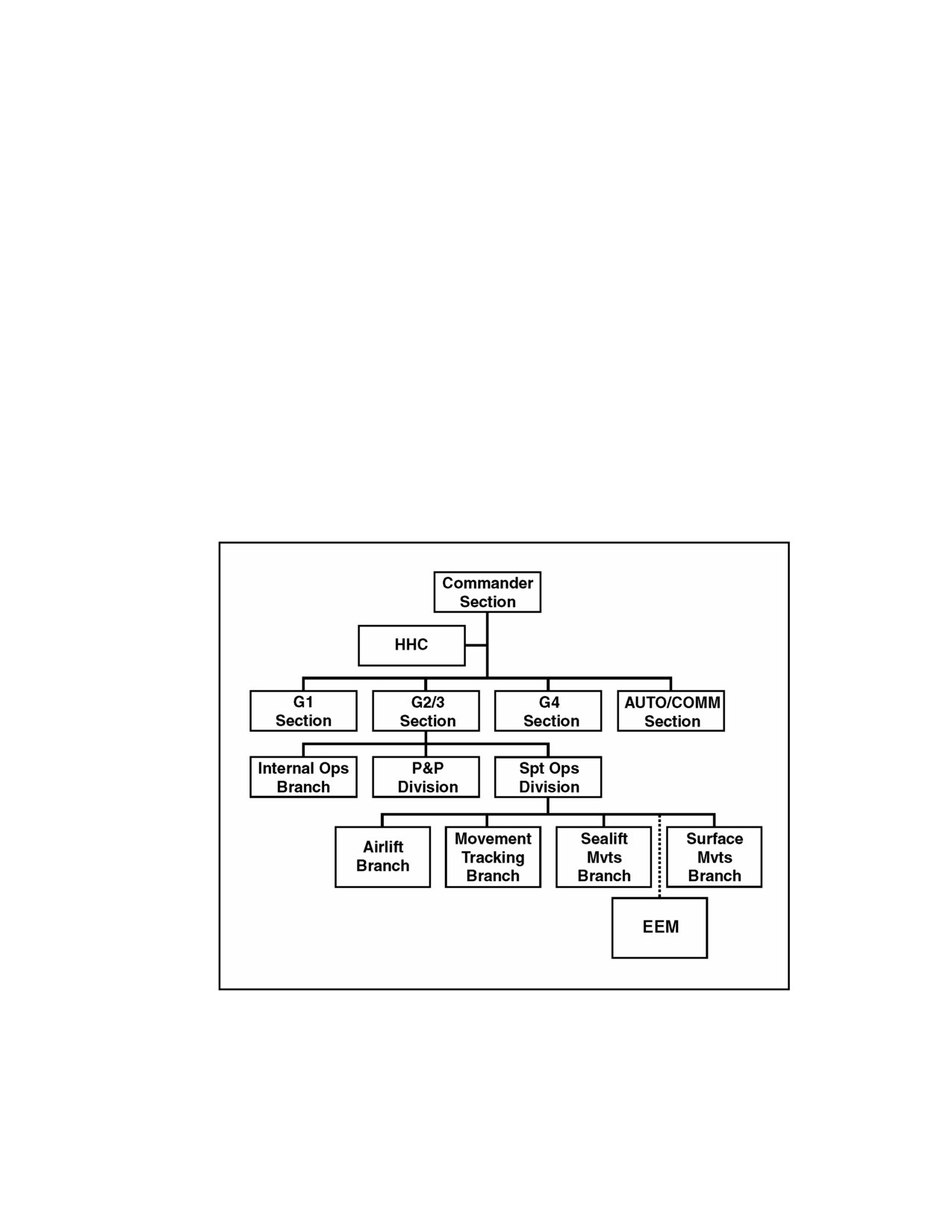
5-61. The Army executes theater movement control through an MCA with
subordinate MCBs. The MCA organization (see Figure 5-1) is flexible and de-
signed to meet the specific transportation and movement control require-
ments of the theater. It uses a building block concept, which assigns the
correct mix of battalions and teams to perform its missions based on the geo-
graphic size of the theater, the number of forces, the transportation infra-
structure, and the number and type of movement requirements.
Figure 5-1. MCA Headquarters Organization
MOVEMENT CONTROL BATTALIONS
5-62. To decentralize execution of transportation management and move-
ment control (MC) functions, the AO may be divided into transportation
5-15
________________________________________________________________________
FM 4-93.4 (FM 63-4)
movement regions. The number of customers served, the number of modes
and nodes, and the geographical size of the AO determine the size of these
regions. Movement control battalions (MCBs) provide C2 of MC functions
within the transportation movement regions. They are responsible to the
MCA for controlling and managing all movement matters in the theater
transportation system that take place in their region.
Movement Control Teams
5-63. Under the supervision of the MC battalion, movement control teams
(MCTs) serve as field representatives of the MCA, directly interfacing and
tasking the mode operators, shippers, and receivers. MCTs assigned to the
battalions help decentralize the execution of movement matters. They are as-
signed responsibility for an area or for key transportation nodes. MCTs pro-
vide the users of transportation the point of entry into the transportation
request system. MCTs are the common points of contact for mode operators
and users of transportation. Their role is to accelerate, coordinate, and moni-
tor traffic moving through the transportation system. There are five types of
MCTs. They provide flexibility in assignments based on forecasted workload.
The five types of MCTs are—
• Area movement control team. The function of this team is to control
the movement of units, materiel, and personnel within an assigned
geographic area.
• Port movement control team. This team expedites, coordinates, and
supervises transportation support of units, cargo, and personnel into,
through, and out of air or water ports.
• Movement regulating team. This team observes, assesses, and reports
on movements along main supply routes and adjusts movement sched-
ules as necessary. It works to coordinate movement of authorized traf-
fic, implement changes in unit moves or vehicle or convoy routings, and
resolve movement conflicts.
• Division support team. This team augments the Division Transporta-
tion Office. It helps with movement programming, highway regulation,
and division transportation support. It assists with the execution of di-
visional highway regulation for nontactical movements, and with plan-
ning and coordinating the divisions’ MSRs. It also provides movement
control for tactical and nontactical road marches.
• Cargo documentation team. This team provides cargo documentation
for the transshipment of cargo in water, air, motor, and rail terminals.
The cargo documentation team deploys, as needed, to support onward
movement of combat units and sustainment operations.
MATERIEL MANAGEMENT CENTER
5-64. The TSC materiel management center (MMC) (TOE 63703A000) serves
as a control center for materiel activities in the theater, and monitors supply
and maintenance actions daily. The TSC MMC is an assigned subordinate
unit of the TSC.
5-16
_________________________________________________________________________________
Chapter 5
MISSION
5-65. The MMC performs integrated supply and maintenance management
in the theater for all classes of supplies (less medical and map supply) and
those maintenance activities for which the TSC has control and responsibil-
ity. TSC MMC personnel perform the day-to-day planning for operations.
They implement policies and plans of the support operations staff and de-
velop and apply operating procedures. They continually analyze operations
and recommend necessary corrective actions to the appropriate staff element.
They also develop portions of plans and programs, develop requirements, and
make management decisions pertaining to daily operations.
5-66. The MMC performs these functions within the parameters of policies,
plans, priorities, and allocations that the DMC and supply and maintenance
directorate staffs provide. Staff officers refer matters of a critical or non-
routine nature and those requiring staff guidance or command decisions to
the appropriate support operations directorate.
Supply
5-67. In a theater, the MMC manages Class I, II, III (packaged and bulk), IV,
V, VI, VII, and IX supplies, unclassified maps, and water. (The MLMC man-
ages Class VIII supplies.) In accordance with the ARFOR commander sup-
port priorities, the TSC MMC provides direction for receiving, storing, and
issuing theater stocks. When the required stocks are not available or stock
replenishment is required, the TSC MMC passes requirements to the appro-
priate CONUS national inventory control point (NICP). For requirements be-
ing considered for local procurement, the MMC is the organization that
validates the requirement prior to forwarding to the TSC contracting direc-
torate. When practical, arriving shipments move directly from the port to the
requisitioning GSUs/DSUs. Otherwise, shipments are directed to an opera-
tional-level GSU with sufficient storage capacity.
5-68. Under management of the TSC MMC, basic loads and pre-positioned
stocks support units during the initial stages of an operation. The ENCOM
coordinates closely with the MMC for construction materiel available in the
theater. If possible, they are obtained locally, either from HNS or through a
contract. Initially, Class I, II, III (packaged), and IV supplies that cannot be
obtained locally are pushed to the theater. These supplies are shipped as far
forward as possible to a GS or DS supply unit. Customer units place re-
quirements on the DS supply unit designated to provide support; that unit ei-
ther fills the request or passes a requisition to the MMC. If the unit cannot
satisfy the request from theater GS stocks, the MMC passes a requisition to
the appropriate NICP in CONUS. As the supply situation stabilizes or the
theater transitions to the sustaining phase, supply support from the strategic
level shifts from push to pull methods.
Maintenance
5-69. The MMC also performs a critical role in the TSC maintenance mission
by coordinating maintenance functions with maintenance personnel within
the supply and maintenance directorate. The MMC—
5-17
________________________________________________________________________
FM 4-93.4 (FM 63-4)
• Evaluates the workload and capabilities of ASG, LSE, HNS, and con-
tracted maintenance organizations and cross-levels workload or re-
sources to maximize maintenance performance.
• Recommends maintenance priorities and monitors theater mainte-
nance operations.
• Provides maintenance management data and reports for support op-
erations staff directorates.
• Implements controlled exchange or cannibalization of unserviceable
and salvage equipment.
• Collects, sorts, analyzes, and acts on supply maintenance data re-
quirements.
• Implements plans, procedures, and programs for materiel management
systems.
• Provides guidance to ASGs and COSCOM MMCs on materiel evacua-
tion and reinforcing support.
• Recommends changes to customer support lists based on workloads
and unit capabilities.
• Supervises the equipment modernization plan IAW with policy estab-
lished by the director of the supply and maintenance directorate.
SPLIT-BASED OPERATIONS
5-70. The MMC provides on-site materiel management support from initial
entry into a theater through redeployment. This support responds to the
needs of the projected force and increases incrementally and appropriately as
the theater matures. The modularity of the organization enables it to conduct
split-based operations in order to minimize the in-theater logistics footprint.
The MMC can deploy forward cells simultaneously to multiple locations to
meet force projection and in-theater requirements.
5-71. The forward modular elements provide local, integrated MMC cover-
age, and they also support other theater requirements in addition to those for
the U.S. Army. Forward elements include two area support teams (ASTs),
two port expediter teams (PETs), and one corps liaison team (CLT) that can
deploy under the control of the MMC readiness operations division as the
forward TSC MMC. ASTs are assigned on the basis of one per ASG. CLTs are
assigned on the basis of one per deployed corps. PETs are deployed on the ba-
sis of one per major SPOD and APOD. ASTs, PETs, and CLTs communicate
logistical data through flyaway computers to the main fixed-base computers.
The readiness operations division reports materiel management and asset
visibility information to the DMC. MMC modular elements alert the main
MMC to materiel management problems in the AO.
5-72. Assured communication is necessary for the forward MMC to leverage
the capabilities of the main MMC at the MMC home station. The main MMC
processes the requirements for units in its own AO and for those activities
supported by the forward MMC. It transmits materiel release orders (MROs)
directly to SSAs or through the forward MMC to SSAs in the theater. When
stocks controlled by the MMC are insufficient to meet requirements, the
MMC transmits those requirements to the NICP.
5-18
_________________________________________________________________________________
Chapter 5
ORGANIZATION
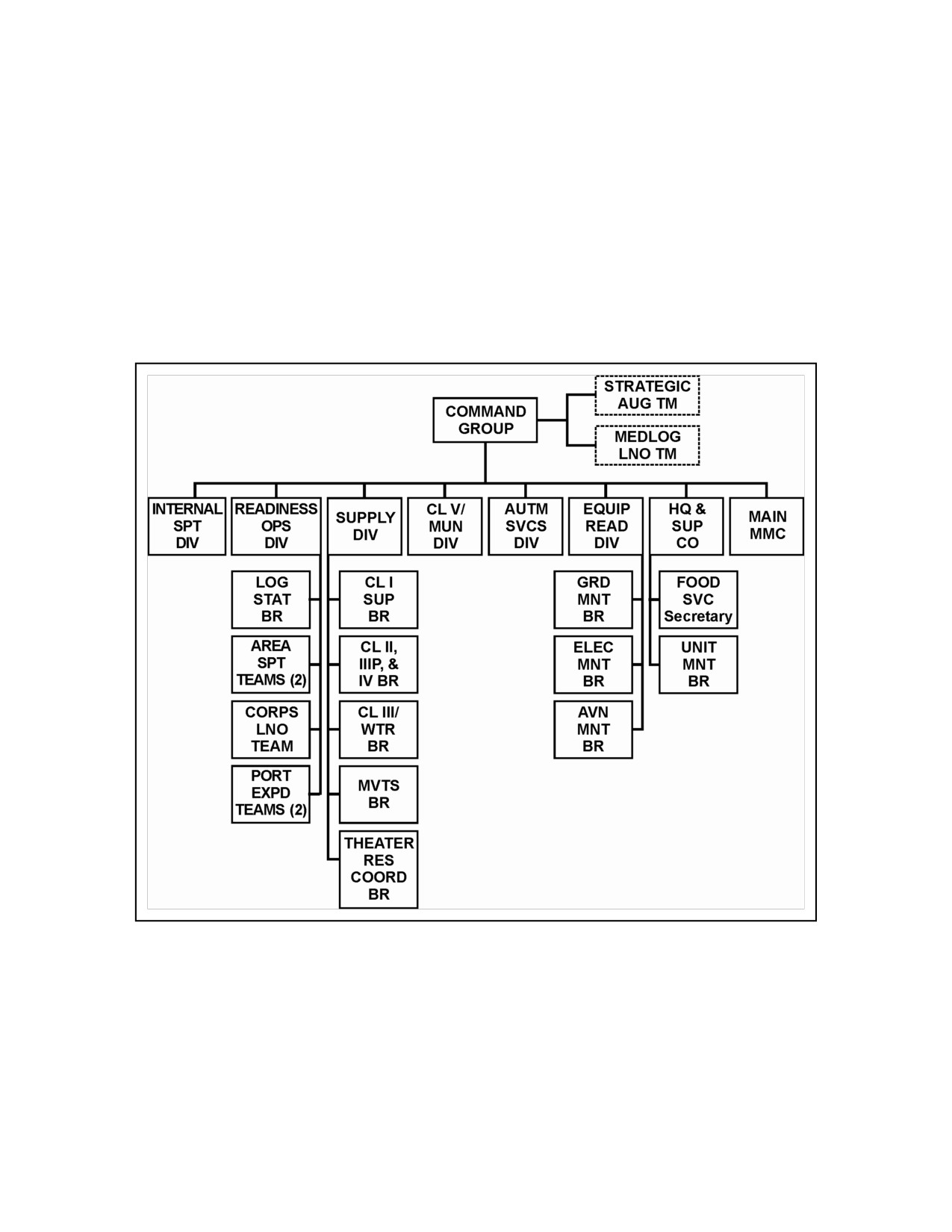
5-73. Figure 5-2 depicts the organization of the MMC. The divisions are or-
ganized along specialized lines to closely interface with major subordinate
commands of USAMC and NICPs. The specialized branch breakdown within
each division permits management of supply, repair parts, and maintenance.
Figure 5-2 details the organization of the MMC designed to deploy in a split-
based configuration. The main MMC that remains at home station is organ-
ized along the same specialized lines.
Figure 5-2. TSC MMC Organization
MEDICAL LOGISTICS MANAGEMENT CENTER
5-74. The medical logistics management center (MLMC) (TOE 08699A000)
(known as the theater medical materiel management center [TMMMC] until
the unit formally reorganizes into the MLMC) is subordinate to the theater
MEDCOM or the senior medical unit in theater. FM 4-02 (FM 8-10) and
FM 4-02.1 (FM 8-10-11) contain details on its operations.
5-19
________________________________________________________________________
FM 4-93.4 (FM 63-4)
MISSION
5-75. The MLMC provides management over the Class VIII commodity and
medical maintenance within the AO using split-based operations. The MLMC
base remains in CONUS while deploying a support team into the AO, linking
the strategic level to the operational level of logistics. The support team also
links Class VIII management with the distribution system within the AO
with a distribution section co-locating with the corps support operations sec-
tion of the COSCOM or TSC.
CLASS VIII
5-76. Units deploy to the AO with their unit basic load (UBL) or have re-
quired supplies provided to them at the POD, depending on the theater cir-
cumstances. Medical logistics
(MEDLOG) battalions deploy with their
authorized stockage list (ASLs). In all cases, stockage is consistent with the
nature of the contingency mission, threat, climate, geography, and other fac-
tors associated with the AO.
ORGANIZATION
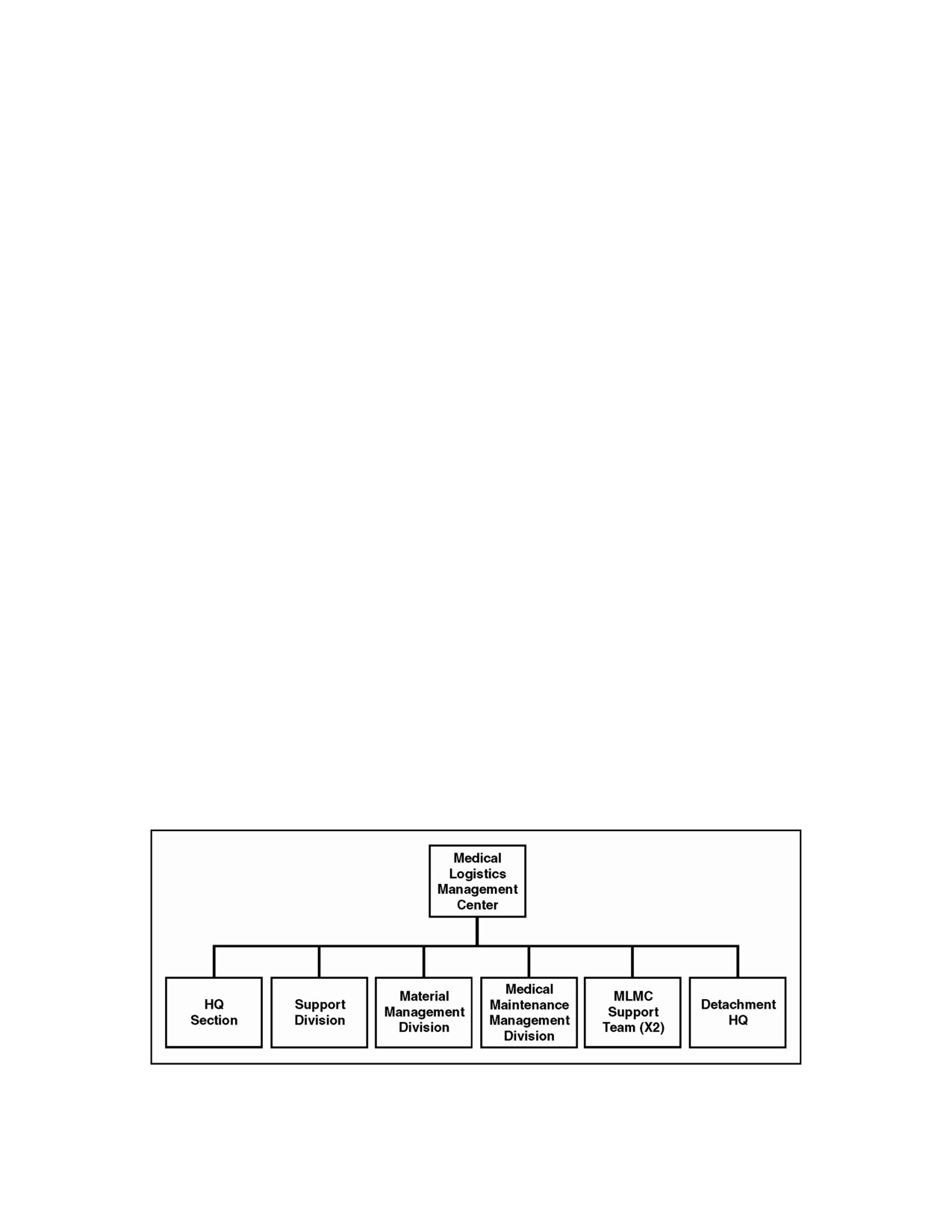
5-77. The MLMC is organized as shown in Figure 5-3 to manage medical
logistics. It employs split-based operations, deploying a modular support
team in the AO while maintaining CONUS-based operations. The MLMC
support team provides centralized, theater-level management of critical
Class VIII materiel, patient movement items, and medical maintenance. It
may also serve as the Class VIII contracting manager in the AO. Currently,
the TMMMC serves as the MLMC until formal reorganization of the MLMC.
5-78. The MLMC is assigned to the theater MEDCOM or senior Army medi-
cal unit in theater and provides liaison personnel to the DMC. It keeps the
theater MEDCOM or senior Army medical unit and the DMC informed of
trends and potential problem areas that deviate from the routine for support
of future operations. Its personnel analyze reports and listings, provide
required reports, and recommend ways to balance workload and medical re-
sources.
Figure 5-3. Medical Logistics Management Center
5-20
Chapter 6
The TSC Role in Force Protection
The UJTL presents "provide operational logistics and personnel support"
(OP4) as one of the six operational-level tasks (see CJCSM 3500.04C).
This task encompasses the primary mission of the TSC; therefore the bulk
of this manual deals with the TSC’s role in this task. However, the TSC
also has a role in force protection (OP6, UJTL). Force protection consists
of those actions to prevent or mitigate hostile actions against DOD per-
sonnel, resources, facilities, and critical information. The TSC role may be
limited to ensuring protection for TSC units, or it may extend to responsi-
bility as the JRAC. The latter instance is rare and requires significant
augmentation of the TSC.
The TSC’s role in force protec-
tion comes within the context
CONTENTS
The Joint Rear Area
6-1
of sustaining operations as
Responsibilities of the JRAC
6-3
discussed in the decisive-
Responsibilities of the TSC
6-4
shaping-sustaining operations
The Threat
6-5
framework in FM 3-0 (FM 100-
Threat Levels
6-6
5). Sustaining operations ele-
Security Measures
6-9
ments include CSS, movement
NBC Defense
6-10
control, terrain management,
Fire Support
6-10
and infrastructure develop-
Protective Measures
6-11
ment. This chapter specifically
Bases and Base Clusters
6-13
focuses on rear area and base
Terrain Management
6-17
security, as well as the related
Infrastructure Development
6-18
area of terrain management. It
includes a general explanation of area damage control, which is part of in-
frastructure development. However, infrastructure development is pre-
dominantly an engineer function (see FM 3-34.211 [FM 5-116]).
SECTION I - THE JOINT REAR AREA
6-1. This section describes the physical structure of the joint rear area (JRA)
and selected key positions involved in C2 within the JRA. The JFC is respon-
sible to the geographic combatant commander for force protection at the op-
erational level in a designated JOA. The ARFOR commander has
responsibility for force protection of ARFOR, and receives resources from the
ASCC to fulfill this mission. FM 3-93 (FM 100-7) discusses this topic in
greater detail. The JRA is a specified land area within a JFC’s operational
area that the JFC designates to facilitate protection and operation of instal-
lations and forces supporting the joint force. In the context of the overall bat-
tlespace, the JRA is a land area near, or contiguous with, the CZ, where land
6-1
________________________________________________________________________
FM 4-93.4 (FM 63-4)
component forces are conducting tactical operations. The JRA often shares
borders with both sea and air battlespace areas. The JFC may assign respon-
sibility for the JRA to a service component commander, such as the ARFOR
commander. The ARFOR commander may then serve as the JRAC, or ap-
point a subordinate commander or staff officer to serve as the JRAC.
Designating the TSC as the JRAC implies a significant increase in the TSC’s
mission that requires staff augmentation and additional unit capabilities.
6-2. The TSC supports ARFOR operations primarily from within the JRA
and executes Army lead service responsibilities to the joint force as assigned
by the ARFOR commander. The TSC is normally the ARFOR commander’s
largest subordinate element in the JRA. Some TSC assets may be positioned
in a sanctuary location, such as an ISB. However, the TSC’s most critical fa-
cilities and base areas are in the JRA. These include SPODs; APODs; road,
rail, and water networks; petroleum storage and distribution facilities; main-
tenance sites, and other critical facilities. The TSC commander, therefore, is
a key player in security, terrain management, and movement control within
the JRA. The TSC commander interacts closely with the JRAC, and TSC
subordinate units interact closely with other services’ security and support
forces. All friendly forces in the JRA develop a common understanding of
their mutually supporting roles and responsibilities.
6-3. Coastal areas often border the JRA and require a joint force interface
with the sea battlespace. The naval coastal warfare commander (NCWC) has
responsibility for the coastal area, normally up to either the high-water mark
or the high-water line (JP 3-10). The JFC determines the exact boundary.
The interface with the NCWC is critical to the TSC commander because tac-
tical operations on the coast may affect TSC support operations. For example,
when planning joint-logistics-over-the-shore (JLOTS) operations, the NCWC
has the principal responsibility for security, and the TSC may provide forces
to the JLOTS commander in a TACON relationship to receive and transport
the materiel being off-loaded (see JP 4-01.6).
6-4. The area air defense commander (AADC) and the airspace control au-
thority (ACA) control the air battlespace over the JRA. The JFC usually
places both these responsibilities under the joint forces air component com-
mander (JFACC) (see JP 3-01). The ACA and the AADC produce the air con-
trol plan (ACP) and air defense plan, respectively. These plans affect the
TSC’s support operations, particularly at the APOD, and the security of TSC
units throughout the JRA. Figure 6-1 presents a schematic JOA with a des-
ignated JRA.
6-2
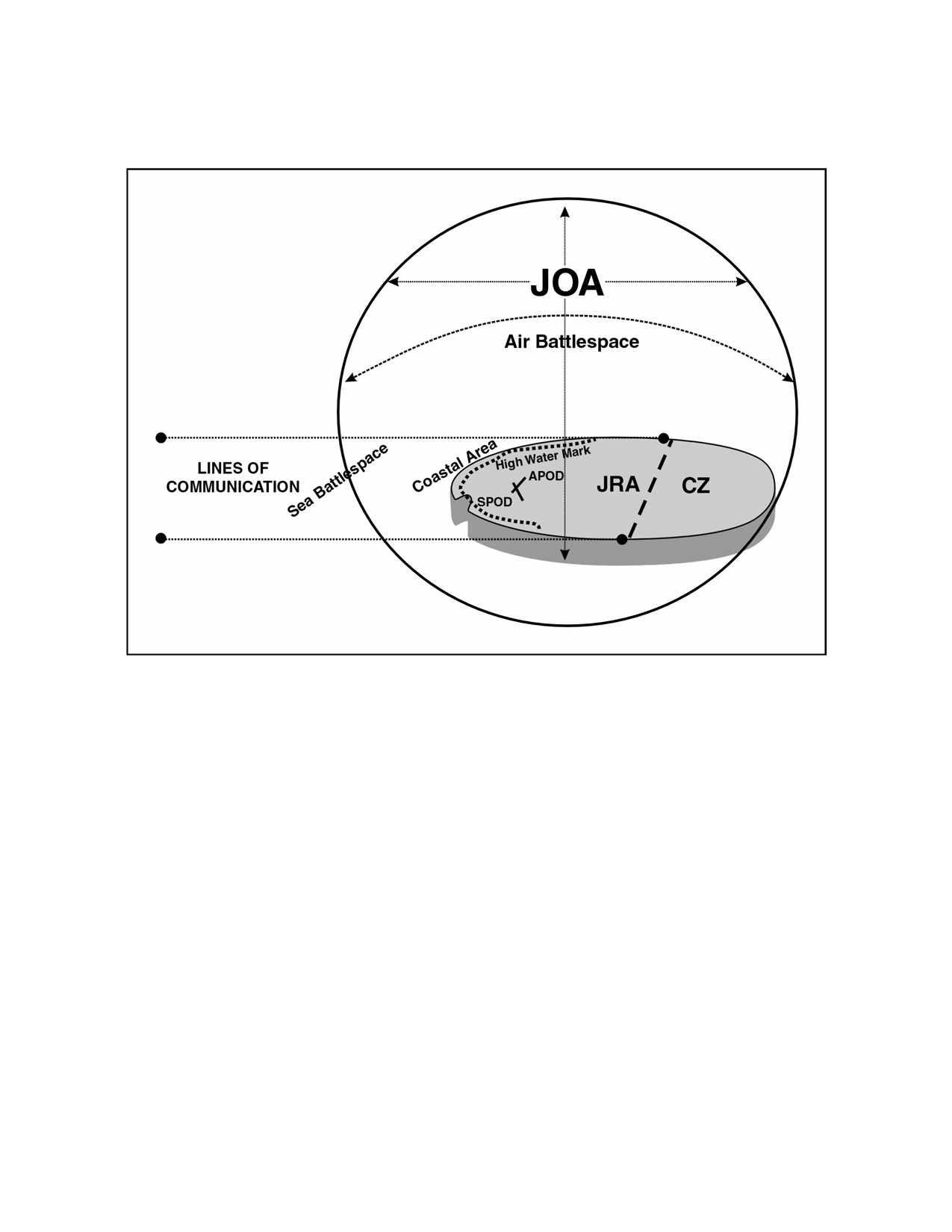
_________________________________________________________________________________
Chapter 6
Figure 6-1. Joint Rear Area within the Joint Operating Area
RESPONSIBILITIES OF THE JRAC
6-5. The joint rear area coordinator (JRAC) integrates the rear area security
and intelligence efforts of all functional and service component commands.
The JRAC also interfaces with the AADC and the NCWC functional elements
that control security for the battlespace adjacent to the JRA.
6-6. The JRAC may form a joint rear tactical operations center (JRTOC) us-
ing staff capabilities from all services operating in the JRA. Adjacent com-
mands such as the NCWC and the AADC place liaison elements with the
JRTOC. When a JRTOC is formed, its staff normally consists of three sec-
tions: an operations section, an intelligence section, and an NBC section.
JRTOC sections perform the following functions:
• Operations section effects all necessary coordination for security and
terrain management with the HN in accordance with agreements. It
drafts and recommends policy to the JRAC for oversight of security and
terrain management. It also coordinates rear security requirements of
other services and/or allied and coalition forces with security and ter-
rain management of the TSC and ASG.
• Intelligence section analyzes and reports intelligence data for the
JRAC.
• NBC section performs NBC functions and reporting for the JRAC.
6-3
________________________________________________________________________
FM 4-93.4 (FM 63-4)
6-7. A counterintelligence representative from the joint intelligence center
(JIC)/joint intelligence support element (JISE) is essential to the timely flow
of JRA requirements to and from the JIC/JISE. The JRTOC serves as the
JRAC’s centralized planning, coordinating, monitoring, and advising agency
for JRA operations. The J2, through the JIC/JISE, is responsible for allocat-
ing appropriate resources and operations to support these requirements. For
more details see JP 3-10.
6-8. The Army assets that support the JRTOC come from the ARFOR staff
with augmentation and liaison as required from subordinate Army head-
quarters, including the TSC. ARFOR and TSC support to the JRTOC does
not relieve Army elements of responsibility for security within their respec-
tive AOs.
RESPONSIBILITIES OF THE TSC
6-9. The TSC plans and executes security and terrain management for its
assigned and attached forces within its AO IAW directives from the ARFOR
commander. The TSC G3 rear operations branch oversees the security and
terrain management mission in the TSC AO, and interfaces with the JRAC
and JRTOC to synchronize TSC security arrangements with other forces in
the JRA.
6-10. During contingency operations, the TSC G3 rear operations branch and
the TSC ROC co-locate. The TSC ROC is a subordinate command assigned to
the TSC and consists of four sections: a headquarters section, an operations
and intelligence section, a planning section, and an area damage control sec-
tion. The mission of the TSC ROC is to assist in directing, coordinating, and
supervising the security and terrain management mission as directed by the
TSC commander.
6-11. The TSC ROC, with the TSC rear operations branch, may also include
liaison officers from subordinate units and other services. The TSC ROC sets
priorities and plans for unit defense within the TSC AO. The TSC typically
executes security responsibilities through its ASGs. FM 4-93.40 (FM 54-40)
discusses the ASG’s role in the security and terrain management mission in
more detail.
6-12. The TSC G3 rear operations branch, with the TSC ROC—
• Centralizes planning, coordinating, and controlling of TSC security and
terrain management.
• Coordinates with the ASCC/ARFOR rear CP and with all units within
the TSC’s AO.
• Identifies response forces for Level II threats.
• Assesses threats in its area.
• Assesses vulnerability and criticality of facilities and bases within its
AO, and sets priorities for protective measures.
• Establishes security and terrain management policy for its AO.
• Establishes control measures to ensure compliance with security plans,
policies, and priorities.
• Disseminates updated information on threats and current conditions to
elements within its AO.
6-4
_________________________________________________________________________________
Chapter 6
THE THREAT
6-13. Hostile action against U.S. forces may occur at any time, any place, and
under any conditions. Recognizable, armed combatants or persons who are or
appear to be civilians may commit hostile actions. CSS personnel exercise
vigilance against such attacks because the enemy seeks soft targets and as-
sumes that these can be found in the areas and facilities that sustain U.S.
forces. Therefore, CSS personnel approach their tasks with the same warrior
spirit that their combat arms counterparts exercise in their duties. This is
especially true on the evolving battlefield with increased lethality, larger
AOs, and more noncontiguous and nonlinear operations. Either the com-
mander has to use more assets to secure CSS activities or accept greater risk
and reduced levels of CSS activities when CSS personnel substitute protec-
tion measures for CSS operations. In any case, CSS personnel understand,
train for, and plan security operations within the context of their support ac-
tivities.
TERRORIST ACTION
6-14. Terrorism comes in varying forms of threats and violence and is usually
used to attain political, religious, or ideological
goals. Terrorists generate fear through acts of vio-
Terrorist Tactics
lence, intimidation, and coercion. Acts of terrorism
• Arson
such as hijacking and bombings occur routinely in
• Hijacking
certain parts of the world making almost anyone a
• Maiming
potential victim. Terrorist targets range from indi-
• Seizure
vidual soldiers or civilians accompanying the force
• Assassination
to key facilities and installations.
• Raids and am-
bushes
6-15. Accordingly, TSC commanders and staff
• Sabotage
train soldiers and subordinate units to always be
• Hoaxes
alert for terrorist action and take measures to pre-
• Bombing
vent terrorists from achieving their goals. Indi-
• Kidnapping
viduals are advised to—
• Hostage taking
• Not exhibit dress, conduct, and mannerisms
• Use of WMD
that attract attention.
• Try to blend into the local environment.
• Avoid publicity and large groups.
• Stay away from civil disturbances and demonstrations.
• Vary routes to and from work, and the times of departure and return
home.
• Vary modes of dress and not exercise at the same time and place each
day.
• Tell coworkers and family members where they are going, what they
will be doing, and when they expect to return.
• Watch for anything suspicious or out of place.
• Never give personal information over the telephone.
6-16. Terrorists select targets based on the objectives and capabilities of the
terrorist group. They observe the target to gather as much information and
intelligence as necessary to attack their target successfully. Individuals who
6-5
________________________________________________________________________
FM 4-93.4 (FM 63-4)
think they are being followed or who notice that a certain facility is being ob-
served should immediately report the incident to the chain of command
and/or the MP.
COMBAT ACTION
6-17. The combat threat in the TSC AO may include individual acts of sabo-
tage, inserting battalion-size or larger forces, and air and missile attacks.
Large-scale enemy attacks may require committing U.S. reserve forces, com-
bat units from forward areas, HN resources, or allied resources. U.S. forces
are trained to cope with threat forces when and where they attempt to dis-
rupt support operations. They use active and passive measures to defend
against detection from the air, and attack from the air, ground, and sea, and
other compromises of defense systems.
6-18. An understanding of the threat to the TSC AO and detailed intelligence
preparation of the battlefield (IPB) and LPT products help to protect the sup-
port structure. Threat forces conduct operations in rear areas and bases to
seize and maintain the initiative, facilitate strategic and operational level
penetrations, and degrade or destroy CS and CSS forces’ ability to conduct
support operations.
6-19. To achieve these aims, enemy activities target—
• Command and control nodes.
• Air defense artillery sites.
• Critical support facilities and units, such as:
Ammunition and weapon storage sites and delivery systems.
SPODs.
APODs.
POL terminals and facilities.
Maintenance, supply, and services activities.
• Regeneration sites.
• Key choke points along LOCs.
THREAT LEVELS
6-20. There are three levels of threats; each has an associated response.
These levels focus on the nature of friendly actions needed to defeat the
threat, rather than focusing on the size or type of threat.
6-21. These enemy activities do not necessarily occur in a specific order, nor
is there a necessary interrelationship among threat levels. Level I and II ac-
tivities often begin well ahead of general hostilities.
6-22. In addition, some enemy doctrine integrates air and attack helicopter
strikes; the delivery of long-range artillery, missiles, and rockets; and radio
electronic combat into deep operations planning. Thus, the complexity of en-
emy deep operations capabilities and doctrine may pose a formidable threat
to security in TSC operations.
6-23. To counter the enemy threat, the TSC commander establishes a system
of bases and base clusters within the TSC AO. This system provides a
framework for responding to the three levels of enemy threat activity. This
6-6
_________________________________________________________________________________
Chapter 6
chapter describes bases and base clusters in more detail later. Briefly,
though, the base and base cluster system is a method of organizing forces in
an AO for mutual support and self-defense against enemy action. Base de-
fense operations centers (BDOCs) develop a base defense plan. They submit
that plan to their designated base cluster. Base cluster operations centers
(BCOCs) consolidate these plans and forward them to their supporting ROC.
6-24. The ROCs plan for these levels of threats:
• Level I—Threats that base or base cluster self-defense measures can
defeat.
• Level II—Threats that initial response forces, but not base or base
cluster self-defense measures, can defeat. Bases and base clusters can
delay Level II threats until response forces arrive.
• Level III—Threats targeting several friendly rear elements as part of a
larger, coordinated effort, rather than individual, separate entities.
They require a tactical combat force to defeat them.
LEVEL I THREAT
6-25. Agents, sympathizers, and terrorists attempt to create confusion, fear,
or panic. They use sophisticated cameras, listening devices, or long-range se-
cure radios to gain information for exploiting vulnerabilities. They attempt to
cause delays by disrupting CP operations and communications and automa-
tion networks. Individual agents or small terrorist cells conduct random at-
tacks to sabotage support operations. Enemy sympathizers conduct political
demonstrations to create hostile civil strife in host countries. Reconnaissance
teams conduct clandestine surveillance to gather intelligence on support
structures and operations. They also conduct acts against targets of opportu-
nity.
6-26. Supporting ROCs disseminate information to bases and base clusters
on the current situation in the area, including likely enemy targets and in-
tentions. This information appears in the intelligence estimate and IPB
products produced by the ARFOR commander and TSC G2 sections.
6-27. High-priority targets include the TSC CP and its subordinate func-
tional control centers. The threat attempts to disrupt CP communications
and destroy the CSS automation management office at the TSC and each
ASG. Petroleum and ammunition supply points as well as supply points that
receive, store, or issue Class VII items present lucrative targets for sabotage.
MHE may also represent a priority target. Because of the reliance of logistics
units on MHE, the loss of MHE adversely affects support provided by the dis-
tribution system.
6-28. Units detect, isolate, minimize, and defeat Level I threats before sup-
port operations become disrupted. Base or base cluster self-defense meas-
ures, to include operations security
(OPSEC), COMSEC, and perimeter
defense can defeat Level I threats.
6-29. Base commanders form base defense forces. Base defense forces provide
internal base security and reinforce the base perimeter when threatened.
6-30. BDOCs and BCOCs switch organic radios to their supporting ROC’s
frequency to obtain data on security and terrain management and the tacti-
6-7
________________________________________________________________________
FM 4-93.4 (FM 63-4)
cal situation. Units within the base or base cluster transmit Level I incident
reports both to the ROC supporting their area (often an ASG ROC), and to
their chain of command. Subordinate ROCs report to the TSC ROC as di-
rected.
LEVEL II THREAT
6-31. Level II threat objectives include command, control, and communica-
tions facilities; supply convoys; pre-positioned stocks; and reserve unit mar-
shaling areas. Special purpose forces, squad-size or smaller, perform
reconnaissance, sabotage, and intelligence collection missions. These forces
are trained in demolitions, communications, and languages. They often dress
in HN or friendly forces uniforms or civilian clothes, and attempt to disrupt
communications and destroy facilities, often to prepare for a larger force’s in-
cursion.
6-32. Armored reconnaissance squads or airborne/air assault units infiltrate
their assigned areas to locate reserves, monitor unit positions or movements,
and conduct ground reconnaissance for avenues of approach. Other recon-
naissance elements raid supply points or conduct ambushes along MSRs.
6-33. CSS units use every possible measure to prevent surveillance by Level
II forces. The TSC ROC disseminates early warning information on threat
airborne or air assault activities or insertions in their AO. Following early
warning, the TSC ROC operations cell notifies the ASG ROCs and separate
bases, which then issue warning orders to response forces and base clus-
ters/bases.
6-34. The ROC allocates response forces—such as MPs—to the ASG for area
security. They also respond to bases or base clusters under attack by Level II
threat forces. BCOCs request MP assistance or supporting fires through the
ASG ROC. FM 3-93 (FM 100-7) discusses response forces.
6-35. The TSC ROC designates response forces to respond to bases or base
clusters under Level II and Level III threats. The size of the response force is
based on the current IPB and the commander’s risk assessment. The unit
designated as a response force and the supported ROC conduct a joint IPB,
review base and base cluster defense plans, exchange signal operations in-
structions, and identify response forces necessary to counter likely enemy ac-
tivities. If response forces encounter enemy forces beyond their ability to
defeat, they notify the appropriate ROC and maintain contact with the en-
emy until the commander commits a TCF.
LEVEL III THREAT
6-36. Airborne or ground infiltration forces, company to battalion-size, at-
tempt to seize industrial complexes, key terrain, airheads, landing zones,
seaports, bridgeheads, or river-crossing sites. They penetrate to attack tar-
gets in the rear area or bases. Level III threats attempt to disrupt command,
control, and communications facilities or to destroy pre-positioned stocks, lo-
gistics corridors, and supply convoys.
6-37. Exploitation forces could commit before the first echelon battle ends
and second echelon forces arrive. They try to prevent withdrawal or reloca-
tion of defending units by blocking withdrawal routes and seizing bridge-
6-8
_________________________________________________________________________________
Chapter 6
heads and road junctions. They also try to destroy LOCs, seize airheads, pre-
vent reserves moving forward, and destroy critical CSS facilities.
6-38. MP response forces can delay or disrupt Level III threats with support-
ing fires. However, by definition, a Level III threat requires the ARFOR
commander to commit a tactical combat force to defeat the threat. This force
may be an Army force or a force provided through coordination with another
service component or nation.
6-39. The TCF is normally a combined arms maneuver element of battalion-
size. When responsible for Level III responses, the ARFOR commander des-
ignates one of the following as the tactical combat force:
• Tactical units passing through the JRA.
• Units assigned or reconstituted in the JRA
• Tactical units of other service components or multinational forces
within the JOA under OPCON or TACON of the ARFOR commander,
when designated by the JFC or multinational commander.
• Tactical units from forward deployed elements.
• A task-organized force from assets arriving in the theater.
6-40. When the threat in the AO exceeds response force capabilities, the TSC
ROC requests the commitment of a TCF from the ARFOR commander. An
ASG ROC requests the TCF through the TSC ROC.
6-41. The TCF normally remains under the command of the ARFOR com-
mander. However, the TSC or the ASG commanders may be given OPCON of
the TCF under special circumstances. The TSC ROC or the ASG ROC assists
the TCF in completing all necessary coordination for rear or sustainment
area and base security operations. The TSC ROC coordinates with the TSC
distribution management center to divert critical supplies and services to
support the TCF and to identify and control routes to assist the TCF moving
into its positions. After completing the mission, the TCF returns to its par-
ent.
6-42. If the HN is viable and retains responsibility for external base and base
cluster security operations, the TSC or the ASG ROC coordinates with the
HN for TCF requirements as authorized by the ARFOR commander. The HN
assigns its TCF force to a tactical area. Depending on existing agreements,
U.S. forces within the area may also be placed under OPCON of the HN tac-
tical combat forces.
6-43. The ARFOR commander normally commands the TCF directly for the
duration of operations required for defeating the enemy threat. The TSC and
the ASG ROCs provide liaison teams to the TCF to facilitate movement and pre-
vent fratricide due to maneuvers and fires among friendly forces. For more
details on response to Level III threats, see JP 3-10, FM 3-93 (FM 100-7), and
FM 4-93.40 (FM 54-40).
SECTION II - SECURITY MEASURES
6-44. This section describes the ways in which friendly forces respond to spe-
cific enemy threats. Planners consider that a skillful enemy will pose these
threats simultaneously or in tandem to achieve greater effects.
6-9
________________________________________________________________________
FM 4-93.4 (FM 63-4)
NBC DEFENSE
6-45. Enemy nuclear, biological, and chemical (NBC) operations pose a sig-
nificant threat to JRA security. Many potential threat forces have the capa-
bility to employ NBC weapons that can reach critical facilities located in the
JRA. Support facilities, troop concentrations, and supplies in the JRA are
vulnerable to NBC attack. Threat forces may attack using a combination of
weapon systems. Aggressive precautions against the attack are necessary to
increase survivability. An adequate defense depends on all units and person-
nel employing common defensive measures with support from specialized
chemical units.
6-46. Ports, airfields, supply depots, railheads, maintenance facilities, and
major command headquarters are prime targets for NBC attacks. Enemy
forces operating in the JRA attempt to contaminate critical command head-
quarters or supply facilities and significantly degrade the responsiveness of
support organizations.
6-47. The NBC branch in the TSC G3 section develops the NBC defense plan
as discussed earlier in this manual. When TSC units perform defensive
tasks, they counter the effects of the NBC weapons. However, normal opera-
tions are more difficult and overall efficiency suffers. Therefore, the NBC
branch planners consider mission degradation and hazards when planning
defensive measures. Defensive tasks include contamination avoidance, pro-
tection, and decontamination. FMs in the 3-11-series (3-series) provide more
detail on NBC defense.
FIRE SUPPORT
6-48. The TSC ROC plans fire support (FS) within the TSC AO in coordina-
tion with ARFOR G3 rear operations branch, as well as with subordinate
ASG ROCs. Fires from attack helicopters and slower fixed-wing aircraft are
preferred because their gunners can observe the target and avoid nearby
friendly forces and civilian elements. Attack helicopters may also be the most
responsive and efficient means of providing FS to the JRA operations. Fire
support in the JRA conforms to the approved fire plan and restrictive fire co-
ordination measures.
6-49. The JFC provides the TCF additional fire support assets as necessary.
The TCF commander coordinates actions and fire support with the TSC
commander when designated the JRAC, through the JRTOC, and with ap-
propriate component and HN commanders. The JFC normally assigns the
JFACC responsibility for planning, coordinating, allocating, and tasking for
counterair operations based on the JFC’s concept of operations and air appor-
tionment decisions.
6-50. When the TSC commander is designated the JRAC, he ensures that air
defense requirements for the JRA are integrated into U.S., multinational,
and/or HN air defense plans in accordance with JFC priorities and concept of
operations. The TSC commander, as the JRAC, maintains close coordination
with the JFACC and AADC in order to maximize the contributions of all the
capabilities available to protect friendly forces. For more details on this sub-
ject, see JP 3-09 and JP 3-10.
6-10
_________________________________________________________________________________
Chapter 6
FIRE SUPPORT CONSIDERATIONS
6-51. The principles of FS planning and coordinating in the JRA do not differ
in technique from those used in the forward areas. There is, however, a dif-
ference in resources and risk factors. CPs in the JRA have limited manpower
and limited communications facilities. Fire support coordination within the
JRA accounts for the high risk of fratricide to CS and CSS units and destruc-
tion of critical supply activities located there. Close air support (CAS) and ar-
tillery controllers take special care to identify friendly forces and ensure that
they are not subject to direct attack or weapons effects from CAS and artil-
lery ordnance delivered against enemy forces operating in friendly rear ar-
eas. Positioning FS elements in the JRA also increases the risk of collateral
damage to friendly forces from enemy counter battery fire.
6-52. With few exceptions, indirect fire assets are not employed against a
Level I threat or against those Level II threat forces that base or base cluster
units or the reaction force can defeat. Enemy forces, battalion or larger, that
could comprise a Level III threat may require indirect fire assets.
6-53. The forces already on station are responsible for fighting the rear
threat initially. The immediate problem for the commander responsible for
security is how to manipulate his limited resources, including FS, at the right
time and place. Considerations that affect applying FS for security are as fol-
lows:
• Reduced FS available to the decisive or shaping operation.
• Suitability as determined by the overall tactical situation.
• Responsiveness of the available weapon systems.
• Precision and collateral damage effects of the weapon systems.
• Existing communications nets to facilitate FS activities.
• Availability of trained observers in the JRA necessary to identify tar-
gets and adjust fires properly.
FIRE SUPPORT COORDINATION MEASURES (FSCMS)
6-54. The procedures for establishing fire support coordination measures
(FSCMs) in the JRA become part of the overall planning process. The com-
mander assigns TCFs employed to deal with a Level III force in the rear or
sustainment area an AO. Establishing a boundary within the rear or sus-
tainment area and adding a TCF fire support officer (FSO) require close co-
ordination with the rear FSO. The higher headquarters routinely review
these measures; post them on rear CP operations maps; enter them into the
Advanced Field Artillery Tactical Data System (AFATDS); and give them to
every maneuver unit entering or currently operating in the JRA, as well as
supporting component forces, reaction forces, and the TCF.
PROTECTIVE MEASURES
6-55. TSC units take several measures to reduce their vulnerability to enemy
operations. These measures include dispersion; cover, concealment, camou-
flage; intelligence gathering; obstacles; and air and missile defense.
6-11
________________________________________________________________________
FM 4-93.4 (FM 63-4)
DISPERSION
6-56. TSC organizations disperse as much as possible throughout the TSC
AO. Dispersion as a protective measure is balanced against the potential
deficits to support operations and the base cluster defense system. Dispersion
helps avoid catastrophic damage from air and mass destruction weapons.
Even if a TSC unit is not the primary target, it may be attacked as a target of
opportunity. The dispersion required depends on the—
• Type of threat. The probability of attack by air, for example, requires
greater dispersion than an attack by small ground forces.
• Terrain. Road networks with good access that can bear expected traffic
loads allow for greater dispersion of elements. Occupying urban terrain
decreases dispersion requirements because of the cover provided by
buildings in built-up areas.
• Defensibility. Dispersion also depends on the ability of a unit to pre-
vent, resist, or defeat enemy forces. Built-up areas may offer more de-
fensible facilities requiring less improvement than field locations.
However, built-up areas may risk loss of mobility if withdrawal is nec-
essary. In the field, defensibility improves as dispersed units consoli-
date to form closely knit base clusters.
COVER, CONCEALMENT, AND CAMOUFLAGE
6-57. The enemy cannot target TSC resources that it cannot detect. Cover,
concealment, and camouflage remain critical to protecting CSS units, facili-
ties, and supplies from enemy detection and attack.
6-58. Cover includes natural and artificial protection from enemy observa-
tion and fire. When selecting sites, advance parties consider the type of cover
available. When available, engineers provide hardened sites for critical TSC
resources.
6-59. Concealment includes natural or artificial protection from enemy de-
tection. TSC units use concealed ingress and egress points and halt locations
within support locations.
6-60. Camouflage consists of using natural or artificial objects or tactical po-
sitions to confuse, mislead, or evade the enemy. With the exception of medi-
cal units, TSC units use camouflage to conceal operations and the identity of
critical assets.
OBSTACLES
6-61. Obstacles slow, impede, or channel enemy movement and incursion.
They buy time until reaction forces can deploy or a response force can arrive.
Effective use of obstacles involves sound countermobility planning and early
warning. Obstacles in urban environments are as important as in the field.
Strategically placed obstacles provide protection against terrorist access to
buildings.
AIR AND MISSILE DEFENSE
6-62. Air defense artillery (ADA) forces cannot provide dedicated air and
missile defense for all TSC forces and assets in the TSC AO. The commander
6-12
_________________________________________________________________________________
Chapter 6
positions TSC organizations to take advantage of coverage that available air
and missile defense forces provide. Using base clusters makes it possible for
ADA units to cover more TSC assets than if units disperse throughout the
TSC AO, but reduces the benefits of dispersion. TSC assets identified as air
and missile defense priorities that do not receive dedicated support are posi-
tioned to take advantage of the coverage provided by ADA units protecting
higher-priority assets.
6-63. Passive air and missile defense operations include the means a unit
uses to avoid enemy detection, along with measures to minimize damage
when attacked. TSC units use OPSEC to conceal their location from enemy
visual and electronic surveillance. Elements within base clusters disperse as
much as possible. Dispersal along with field fortifications and obstacles sig-
nificantly reduce casualties and damage from air and missile attack.
6-64. The JRAC coordinates with appropriate commanders and staffs to es-
tablish a reliable, responsive, and redundant early warning system from the
joint-force level to the base level in the JRA. The JRAC implements a stan-
dardized alert system throughout the JRA to ensure early warning and a co-
herent response to threats.
6-65. TSC personnel and air defenders share responsibility for force protec-
tion of TSC complexes. The TSC commander develops air and missile defense
priorities, which are integrated into the theater’s priorities. The air defense
coordinator coordinates the use of available air and missile defense assets to
protect the maximum number of priority assets. The ADA provides defensive
fires and TSC units employ self-defense measures to defeat enemy air and
missile attacks. The TSC ROC also integrates air and missile defense cover-
age into TSC planning for terrain management and movement control.
CONVOY SECURITY
6-66. Movement control always includes convoy defense considerations. Sup-
ply routes are assumed not to be secure on a nonlinear battlefield. Therefore,
CSS movements between supported unit areas are combat operations. The
TSC and supported unit commanders and staffs work together to integrate
defensive capabilities into convoys. Adequate convoy security depends on two
critical components. These are thorough staff planning to counter enemy
plans and capabilities and individual soldier training to counteract enemy ac-
tion.
6-67. The convoy commander ensures that CSS troops are trained in convoy
defense techniques. The damage a convoy prevents or incurs when attacked
often depends on the adequacy of convoy defense training. It also depends on
the route and timing of the convoy in relation to the enemy situation and the
adequacy of the intelligence and information convoy leaders receive in ad-
vance of the operation. FM 4-93.7 contains more information on convoy secu-
rity on a nonlinear battlefield.
BASES AND BASE CLUSTERS
6-68. ASGs and other subordinate support headquarters are responsible for
coordinating base and base cluster defense in the TSC AO. This defense pro-
tects elements from Level I and II threats in their assigned areas. Com-
manders ensure all bases and base clusters in their AOs train and prepare
6-13
________________________________________________________________________
FM 4-93.4 (FM 63-4)
for their roles. Cooperation and coordination between the support headquar-
ters and tenants are critical.
6-69. Bases and base clusters form the basic building block for planning, co-
ordinating, and executing base defense operations. The TSC G3 is the overall
TSC terrain manager. The TSC G3 along with the TSC ROC organizes units
occupying the support headquarters AO into base clusters (see Figure 6-2).
The TSC ROC recommends appointments of base cluster commanders from
units in the cluster to the TSC G3. The base cluster commander is usually
the senior commander in the base cluster. The base cluster commander forms
a base cluster operations center (BCOC) from his staff and available base as-
sets.
6-70. A base may be a single-service or a joint-service base. A joint-service
base is one in which one service has primary interest, or one in which two or
more services have equal interests. The base cluster commander appoints the
base commanders. Base commanders form base defense operations centers
(BDOCs).
6-71. Within the base cluster, three commanders have distinct responsibili-
ties. These three—the individual unit commander, the base commander, and
the base cluster commander—are discussed below.
INDIVIDUAL UNIT COMMANDERS
6-72. The commanders of units in a base are responsible for—
• Participating in base defense planning.
• Providing, staffing, and operating base defense facilities in accordance
with base defense plans.
• Conducting individual and unit training to ensure their forces’ readi-
ness to perform their assigned tasks in defense of the base.
• Providing appropriate facilities and essential personnel for the BDOC
and the base commander.
• Providing liaison personnel to advise the base commander on matters
peculiar to their units.
• Providing internal security of the base.
• Providing communications systems, including common-user communi-
cations, within the command.
6-73. TSC units use observation posts, listening posts, or unattended sensors
on likely avenues of approach to collect intelligence on threat activity. In ar-
eas where the populace is friendly, local law enforcement or government
agencies can provide information on threats in the area. BCOCs implement
an integrated warning plan within their cluster and with adjacent bases or
base clusters.
6-14
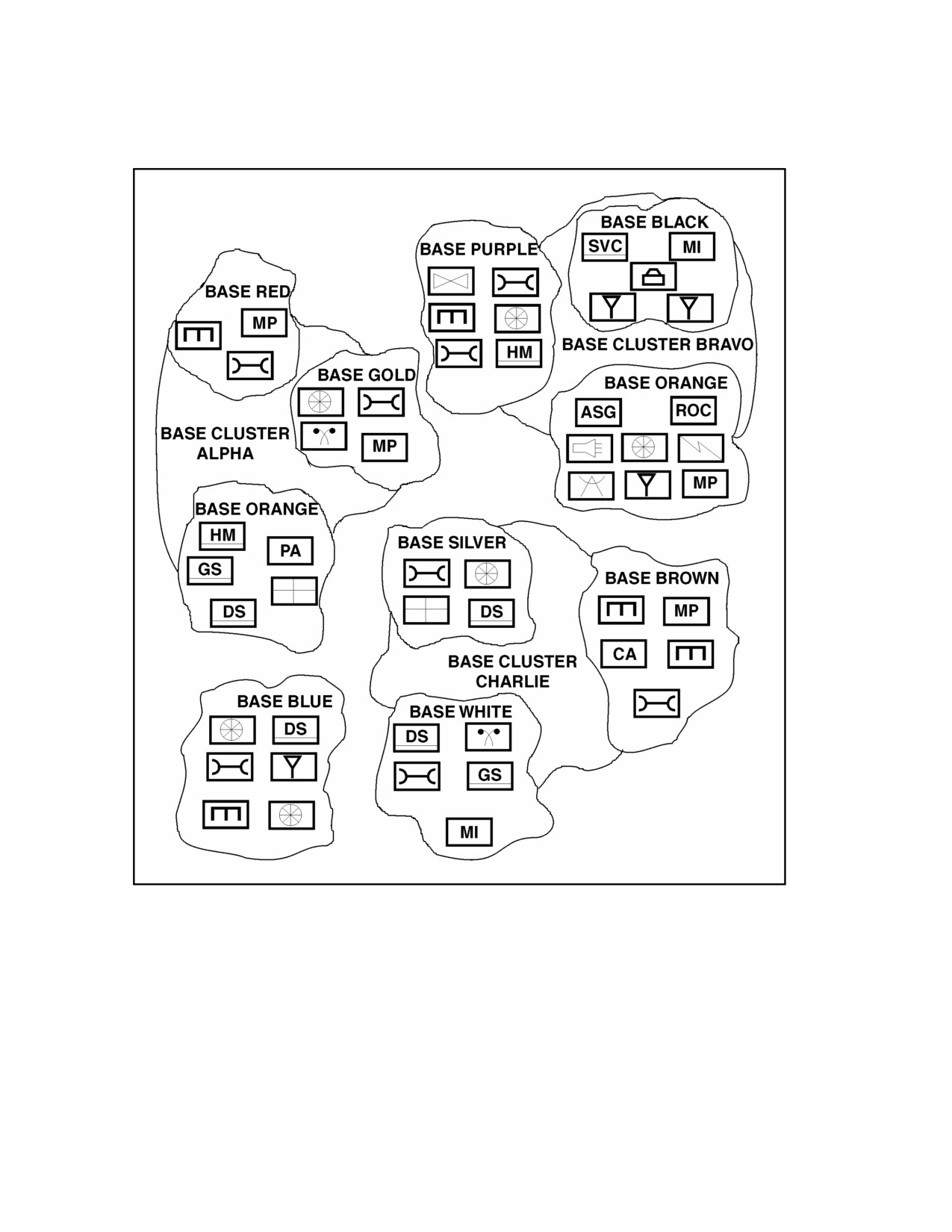
_________________________________________________________________________________
Chapter 6
Figure 6-2. A Sample of Notional Bases and Base Clusters
BASE COMMANDER
6-74. The base commander is responsible for base security and defense. All
forces assigned to the base are under his OPCON for base defense purposes.
The base commander’s responsibilities for base defense include—
• Establishing a BDOC from available base assets to serve as the base’s
tactical operations center (TOC) and focal point for security and de-
fense. The BDOC assists with planning, directing, coordinating, inte-
grating, and controlling base defense efforts.
6-15