FM 4-93.4 THEATER SUPPORT COMMAND (APRIL 2003) - page 4
________________________________________________________________________
FM 4-93.4 (FM 63-4)
• Establishing an alternate BDOC from base resources or, if base assets
are not available, designating a headquarters element from units dedi-
cated to the base for its local defense.
• Planning for including transient units by ensuring that base defense
plans include provisions for augmenting the regularly assigned base
defense forces with units present at the base during periods of threat.
BASE CLUSTER COMMANDER
6-75. The base cluster commander is responsible for securing his base, coor-
dinating the defense of bases within his base cluster, and integrating base
defense plans into a base cluster defense plan. His specific responsibilities in-
clude—
• Establishing a BCOC from his staff and available base or base cluster
assets to serve as the base cluster’s TOC and focal point for planning,
directing, coordinating, integrating, and controlling base cluster de-
fense activities.
• Providing appropriate facilities, housing, and services for necessary li-
aison personnel from bases from within the cluster.
BASE AND BASE CLUSTER DEFENSE PLAN
6-76. Base and base cluster commanders develop and implement comprehen-
sive defense plans to protect their support capability. The defense plan in-
cludes measures to detect, minimize, or defeat Level I and Level II threats.
To maximize mutual support and prevent fratricide, the base and base clus-
ter commanders coordinate defense plans with adjacent base and base clus-
ters and joint, multinational, and HN forces. The TSC ROC ensures that all
plans conform to the overall TSC and ARFOR security plans.
AREA DAMAGE CONTROL
6-77. Commanders of bases and installations within the AO coordinate re-
quirements for area damage control (ADC) with the JRAC through their re-
spective chains of command. Commanders establish priorities for ADC
missions as part of their planning process at the base or installation level. All
units are responsible for providing ADC within their base or installation to
the extent of their capabilities.
6-78. The senior engineer command plans, coordinates, and manages ARFOR
engineer missions in coordination with the TSC. It plans the engineer sup-
port required to perform ADC missions according to ARFOR commander pri-
orities. Commanders assign subordinate engineer headquarters ADC
missions in a specified area. These engineer headquarters coordinate the de-
velopment and execution of ADC plans. The area contingency engineering
manager (ACEM) and district contingency engineering manager (DCEM) are
responsible for ADC functions beyond the capability of the bases and units in
support of the TSC or subordinate support headquarters commanders.
6-79. The force takes ADC measures before, during, and after hostile action
or natural disasters to reduce the probability of damage, to minimize its ef-
fects, and to reestablish normal operations. Necessary repair begins after the
damage is contained.
6-16
_________________________________________________________________________________
Chapter 6
6-80. The TSC and subordinate support headquarters commanders antici-
pate ADC operations that employ assets within their areas. The TSC ROC
and G4 section develop the TSC ADC plan based on the policies and priorities
of the ARFOR commander. Plans highlight anticipated requirements for
ADC that may exceed the capabilities of organic resources and the priority of
ADC missions. U.S. and HN engineers have a major portion of the capability
to perform these tasks.
6-81. Other forces and assets that contribute to the ADC mission include
ordnance, MP, chemical, CA, maintenance, medical, signal, supply, transpor-
tation, and transiting units. HNS can be a vital resource for ADC in the TSC
AO. Early HNS identification and coordination are essential to supplement
ADC efforts. Responsibilities and support from HN assets are negotiated at
theater level and are part of the status-of-forces agreements and treaties.
SECTION III - TERRAIN MANAGEMENT
6-82. The Army defines terrain management as the process of allocating ter-
rain by establishing AOs, designating assembly areas, and specifying loca-
tions for units and activities to deconflict activities that might interfere with
each other; for example, ensuring artillery firing units are not placed within
air corridors. In rear operations, the process includes grouping units to-
gether to form bases, and designating a base cluster as necessary (FM 1-02
[FM 101-5-1]).
6-83. The ARFOR G3 is the overall terrain manager for the AO. Based on
ARFOR commander guidance and security considerations, the ARFOR rear
CP, with the ARFOR G3, assigns subordinate units to specific areas. Within
the TSC AO, the TSC G3 is the overall terrain manager. He receives guid-
ance and direction from the ARFOR G3 through the ARFOR rear CP. The
TSC G3 coordinates with the TSC ROC for terrain management. Based on
the TSC commander's guidance and security considerations, the TSC ROC,
with the TSC G3, positions units in the TSC AO. It positions TSC units based
on their mission, concept of the operations, and anticipated commitment.
While commanders position support units close to MSRs and LOCs to facili-
tate timely support, they do not position them near likely enemy avenues of
approach or in likely enemy landing zones (LZ) or drop zones (DZ). Support
units disperse as much as possible to minimize the effects of enemy attacks
on the overall sustainment effort.
6-84. In the joint context, area management has a similar connotation. It
consists of considerations for units, facilities, and supplies that enhance their
survivability while maintaining the efficiency of support operations. These
considerations include clustering and dispersing units, supplies, and facilities.
The commander balances these considerations through risk analysis, because
clustering certain assets may promote the efficiency of support operations yet
degrade security. In other instances, the opposite may be true. Clustering may
promote security but degrade support operations capability (JP 3-10).
6-17
________________________________________________________________________
FM 4-93.4 (FM 63-4)
SECTION IV - INFRASTRUCTURE DEVELOPMENT
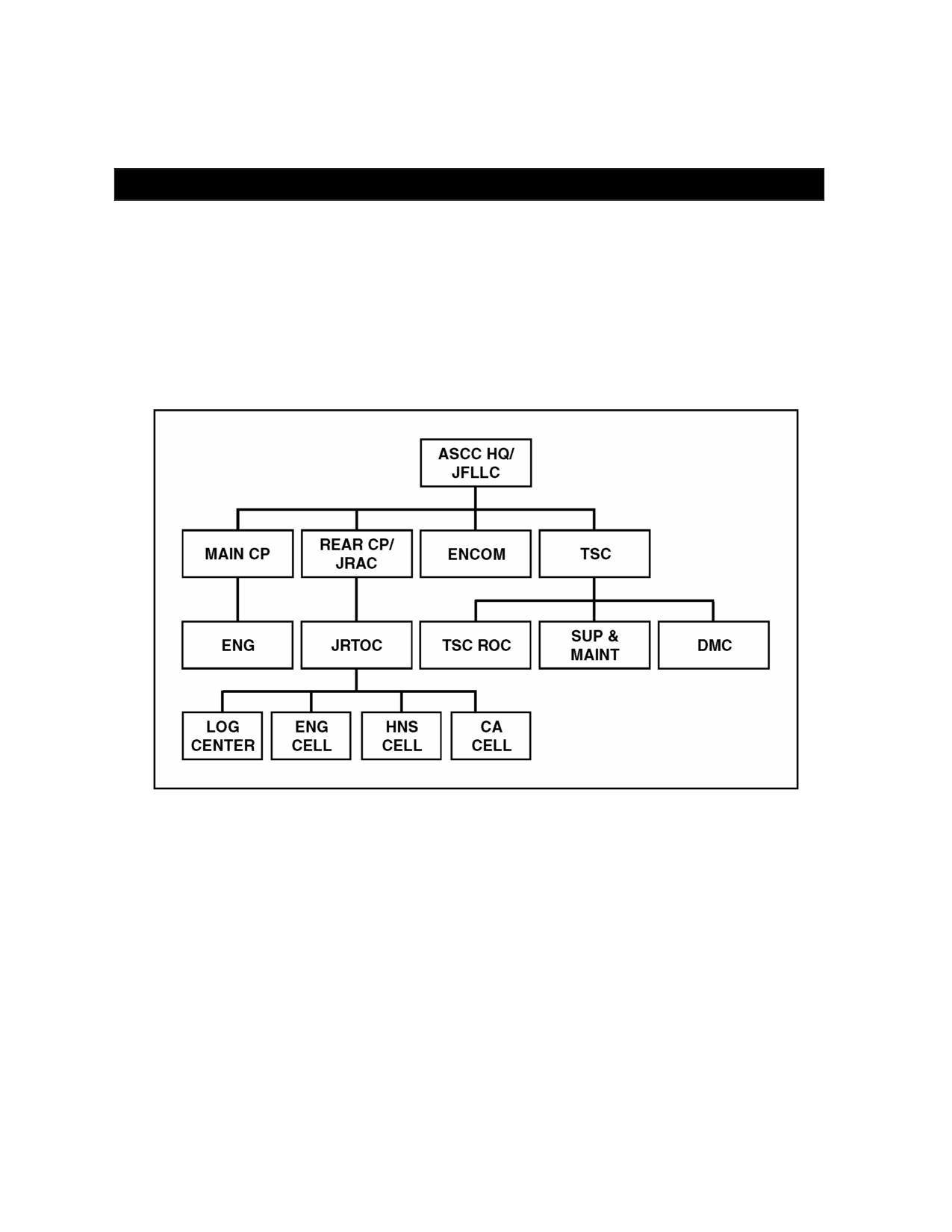
6-85. Figure 6-3 illustrates the key players who develop infrastructure. In-
frastructure development applies to all fixed and permanent installations,
fabrications, or facilities that support military forces. Infrastructure devel-
opment focuses on facility security modifications and area damage control.
6-86. In a joint environment the JFC, in conjunction with allies, coalition
partners, and the involved HN, is responsible for identifying the wartime fa-
cilities and construction requirements for U.S. forces prior to hostilities. The
JRAC coordinates with component commanders to ensure that the JFC’s con-
struction policy is implemented.
Figure 6-3. Infrastructure Development
6-87. The ARFOR rear CP has a logistics center, an engineer cell, and an HN
support cell to assist in coordinating infrastructure development require-
ments. The TSC headquarters has a supply and maintenance directorate and
the DMC to assist in coordinating infrastructure development. The ARFOR
rear CP coordinates with the ENCOM to support infrastructure development
requirements. The TSC headquarters also coordinates with the ENCOM. CA
personnel can interface with HN governments to assist the HNS cell in in-
terpreting and carrying out HNS agreements.
6-88. The joint boards that most affect unit infrastructure development in
the JRA are the joint facilities utilization board (JFUB) and the joint civil-
military engineering board (JCMEB). The JFUB evaluates and reconciles
component requests for real estate, use of existing facilities, interservice sup-
port, and construction to ensure compliance with JCMEB priorities. The
JCMEB establishes policies, procedures, priorities, and overall direction for
6-18
_________________________________________________________________________________
Chapter 6
civil-military construction and engineering requirements in the theater. The
JCMEB is a temporary board activated by the geographic combatant com-
mander and staffed by personnel from the components and agencies or activi-
ties that support the geographic combatant commander. The JCMEB
arbitrates all issues referred to it by the JFUB.
6-19
Chapter 7
Theater Force Opening Package
Deploying U.S. forces requires an in-theater support infrastructure capa-
ble of executing RSO&I operations and sustaining and redeploying the
force. Recent operations in Somalia, Haiti, and Bosnia demonstrate a
need for establishing early adequate support infrastructures in places
where they did not previously exist. The theater force opening package
(TFOP) is the Army mechanism to accomplish this.
SECTION I - TERMS OF REFERENCE
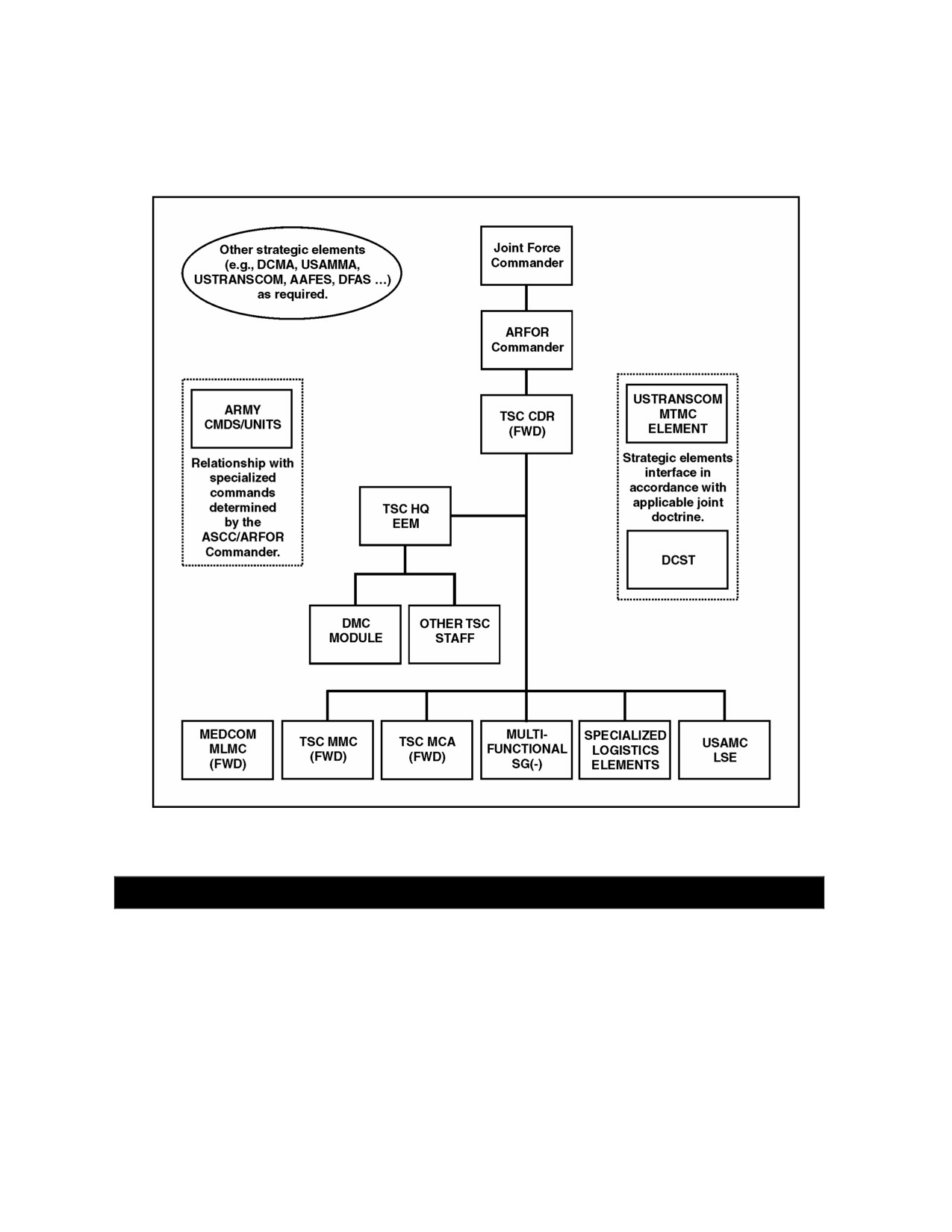
7-1. The TFOP is a modularly configured, multifunctional support task force
comprised of specialized CSS and related CS modules. A typical TFOP
needed during the initial stages of deployment includes transportation, engi-
neer, supply, contracting, maintenance, and medical modules. The JFC may
also elect to include strategic CSS cells from the USAMC, USAMMA, DLA,
MTMC, and DESC. A generic
representation of a TFOP with
CONTENTS
its strategic links appears in
Terms of Reference
7-1
Figure
7-1. A more detailed
Mission
7-2
structure of the TSC (forward)
Peacetime
7-3
with its downtrace appears in
Transition to Operations
7-4
Figure 7-2 and Figure 7-3.
Reception
7-8
Staging
7-8
7-2. The composition of the
Distribution
7-8
TFOP varies throughout the
Sustainment
7-9
stages of a force projection
operation until it becomes a
TSC. The composition of the TFOP also depends on numerous other factors,
including the type of operation, the nature of the supported military force,
the available infrastructure in the theater, available contracted support,
support provided to and by other services and multinational partners, and
the nature of the threat.
7-3. In this discussion, the term TFOP and EEM are not interchangeable.
EEM refers to the parts of the headquarters element, or C2 capability, of a
deploying unit. TFOP refers to the whole units or parts thereof that deploy
into the AO.
7-1
________________________________________________________________________
FM 4-93.4 (FM 63-4)
Figure 7-1. Representative TFOP
SECTION II - MISSION
7-4. The TFOP’s mission remains identical to that for the TSC found in
Chapter 2: to maximize throughput and follow-on sustainment of Army forces
and other designated supported elements. The only difference is scale. As the
TSC (forward), the TFOP is also uniquely responsible for building the theater
infrastructure from a combination of existing and deploying assets.
7-5. The TFOP does this by—
• Clearing incoming personnel and cargo at air and seaports, working
with USTRANSCOM elements, especially the MTMC and AMC.
• Designating and preparing routes for onward movement.
7-2
_________________________________________________________________________________
Chapter 7
• Coordinating movement within the theater.
• Identifying and occupying the real estate needed for marshaling areas
and the theater staging bases (TSBs). (The TFOP may also obtain, or
assist in obtaining, permission to use the required real estate. Its role
depends on the JFC’s contracting and HN support structure. If the con-
tracting function is managed at the JFC level, the TFOP may, at a
minimum, provide contracting officer’s representatives [CORs]. If the
contracting function is placed in the TFOP, the TFOP may negotiate in
accordance with applicable HN and status of forces agreements.)
• Providing initial sustainment support.
• Accomplishing other support missions as specified by the ARFOR
commander.
7-6. The TFOP deploys as early as possible. This is necessary to manage the
flow into theater from the outset. Such early entry of CSS organizations ac-
tually minimizes the CSS footprint by avoiding the calling forward of whole
operational-level CSS units when only the functionality of the unit might be
needed. It also ensures that supplies flowing into theater do not stack up into
“iron mountains.”
7-7. If a corps or smaller element is the ARFOR headquarters, the TSC
aligns directly under the ARFOR headquarters. The TSC headquarters EEM,
or any part of it, is not normally aligned under the COSCOM. This is because
the COSCOM focuses support forward for the corps’ combat elements. The
COSCOM’s ability to support diminishes when it focuses both backward for
the operational CSS mission and forward for the tactical support mission.
7-8. The TSC’s relationship to boards, bureaus, and centers (BB&C) at the
joint force level depends on how the geographic combatant commander/JFC
intends to control common item and transportation support within a given
theater, for a given operation. If the geographic combatant commander des-
ignates an augmented TSC as a subordinate JTF for CUL, it may either send
representatives directly to the applicable BB&C, or it may serve in lieu of
certain BB&C. As a major subordinate command of the ARFOR commander,
the TSC may represent the ARFOR commander in accordance with ARFOR
commander guidance.
7-9. The TSC relates to DLA through the DCST as a liaison element from a
strategic organization. DLA battles roster personnel only to a joint command.
They provide liaison to a service component command such as the TSC.
PEACETIME
7-10. During peacetime, the TSC’s focus is on readiness. TSC planners, in co-
ordination with specialized commands, examine potential AOs within their
AOR and develop a plan for the LPT. The purpose of LPT is to minimize the
CSS impact on the strategic lift required to project the force.
7-11. The relationship between the TSC and specialized commands develops
during peacetime. The optimal means for achieving a synchronized support
plan is for the specialized commands to station a planning and coordination
cell with the TSC during peacetime. Together they develop detailed plans,
policies, and estimates to support the theater in accordance with the ARFOR
7-3
________________________________________________________________________
FM 4-93.4 (FM 63-4)
commander’s plans, policies, and guidance. The cells remain with the TSC
during the transition to war and all phases of the operation to synchronize
operations and build a highly responsive integrated support system. The TSC
staff and specialized commands also plan for any changes to task organiza-
tion directed by the ARFOR commander throughout the phases of the opera-
tions.
TRANSITION TO OPERATIONS
7-12. During the initial phase of a force projection operation, the TSC de-
ploys a C2 and assessment team. Its purpose is to support the ARFOR as-
sessment team in analyzing the situation in the theater. It updates the LPT
by validating planning assumptions on support requirements and capabili-
ties to include available HNS and contracted support, the condition of the in-
frastructure and the current usage levels, and the flow of forces into the
theater. The team determines maintenance priorities for existing infrastruc-
ture. This includes setting priorities for repairing damaged or destroyed in-
frastructure and for constructing facilities to compensate for infrastructure
shortfalls.
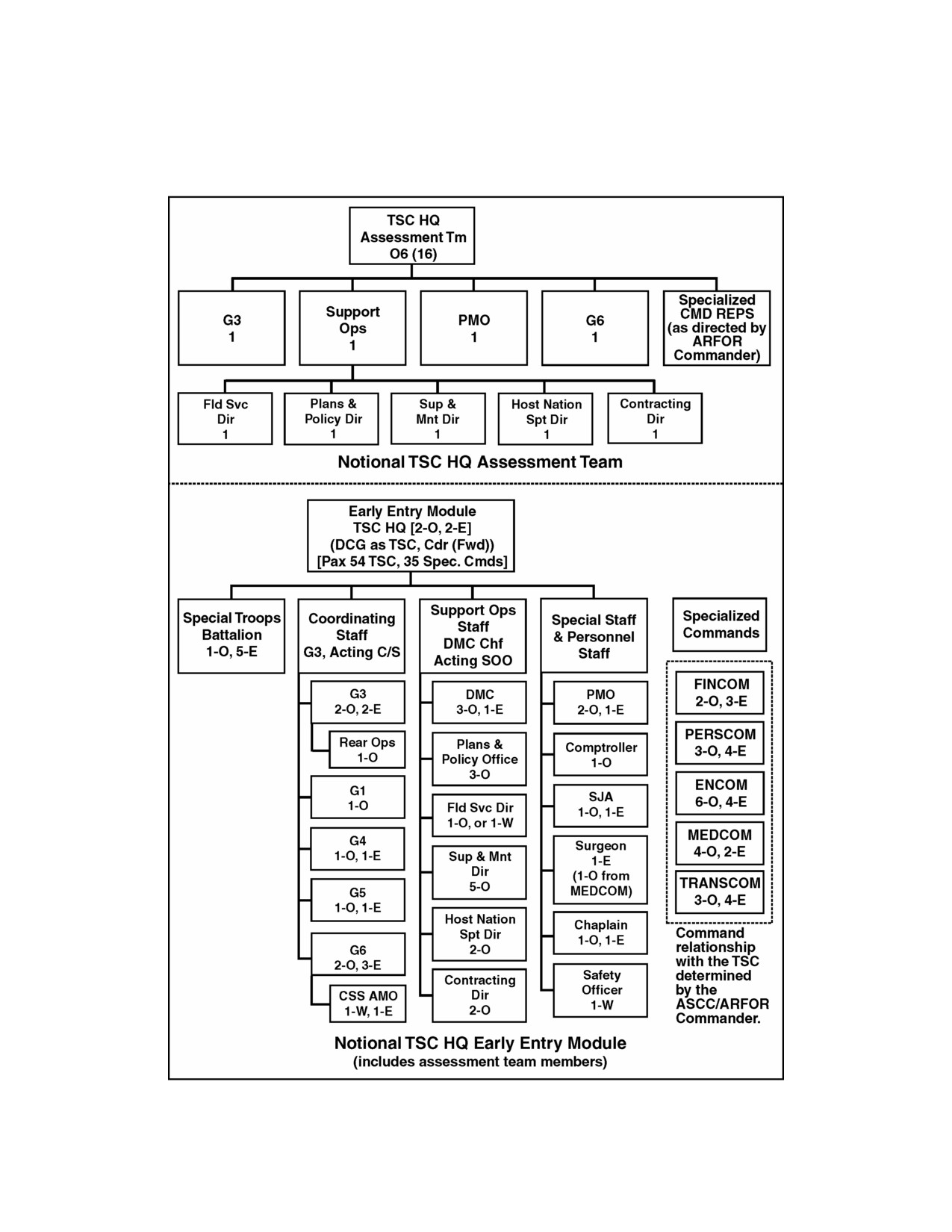
7-13. An example of what a TSC C2 and assessment team may consist of
early in a force projection operation appears in Figure 7-2. Team personnel
includes key members of the TSC headquarters EEM and, as directed by the
ARFOR commander, specialized command representatives. The TSC support
operations colonel directs the team that may include a representative from
the TSC G6 section.
7-14. As deployment continues, the rest of the TSC’s headquarters EEM de-
ploys into the theater and becomes the command element of the TFOP. The
DCSO deploys and becomes the TSC (forward) commander/TFOP com-
mander. Depending on the situation, the TSC commander may deploy to
command the forward element. If directed by the ARFOR commander, he
may serve as the single commander for theater-level CSS. The EEM is battle-
rostered from the TSC special and coordinating staff sections, and the sup-
port operations section. Elements from the materiel and movements man-
agement activities deploy along with the headquarters EEM. The TSC
headquarters EEM is intended to provide an early entry C2 capability that
allows the ARFOR commander to begin to build his operational-level support
structure at the same time he begins to build combat power.
7-15. The EEM may also include elements from the supporting TRANSCOM,
ENCOM, MEDCOM, PERSCOM, and FINCOM as well as DLA and USAMC.
Regardless of the command relationship with the TSC headquarters EEM,
early entry elements from the specialized commands maintain their technical
and operational ties to strategic-level agencies and establish working rela-
tionships with their ARFOR staff counterparts.
7-4
_________________________________________________________________________________
Chapter 7
Figure 7-2. Notional C2 and Assessment Team and TSC HQ EEM
7-5
________________________________________________________________________
FM 4-93.4 (FM 63-4)
7-16. The role of the TSC headquarters EEM, with any ARFOR commander-
directed augmentation from the specialized commands is to—
• Establish TFOP C2 links to provide in-theater connectivity among tac-
tical, joint, and strategic support systems for integrating initial Army
force deployments.
• Provide TFOP survey, liaison, and reconnaissance party (SLRP), off-
load preparation party (OPP), PSA, and advance party elements.
• Exercise control over ARFOR theater-level support operations to in-
clude support to other services.
• Update LPT information to refine theater force opening module re-
quirements.
• Coordinate support requirements of the supported Army force with the
strategic-level support system. Initiate requests for theater sustain-
ment supplies.
• Plan, acquire, and manage HN real estate in coordination with the
JFC staff. Manage initial local procurement, contracting, and HNS ac-
tivities.
• Plan force protection for operational support area RSO&I nodes in con-
junction with the ARFOR staff.
• Manage ARFOR force generation.
• Help develop and execute the Army portions of the joint movement
program developed by the JMC.
7-17. As the headquarters EEM is beginning to establish its operations, ele-
ments of the TFOP arrive in the AOR to rapidly expand the theater base.
These theater force opening modules (TFOMs) are tailored elements of oper-
ating units/commands providing support to theater forces. As previously in-
dicated the actual support forces required depends on numerous factors.
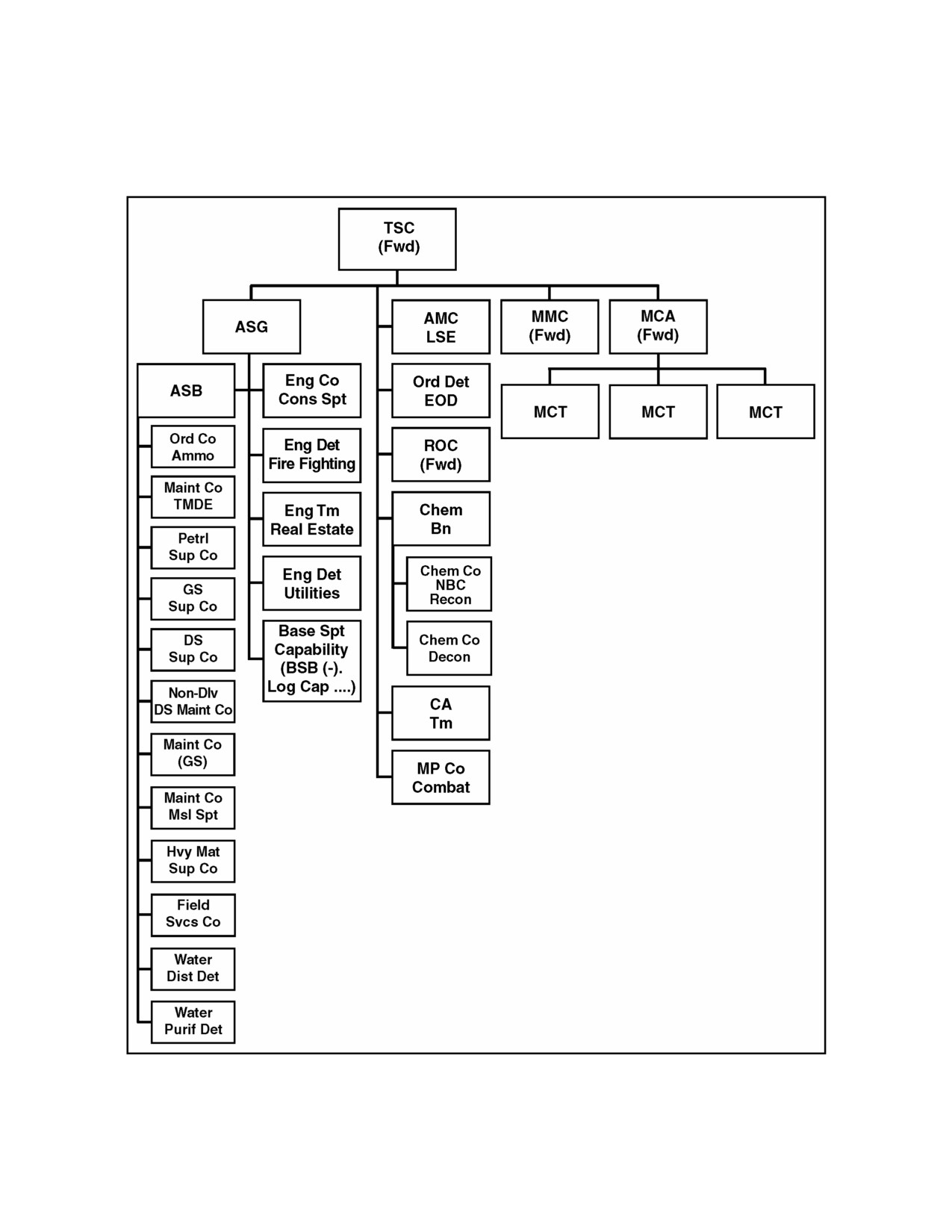
Figure 7-3 shows what a representative TFOP may look like early in a force
projection operation. The figure shows units from which TFOP elements may
come. It does not imply that the entire unit shown would deploy. Teams, pla-
toons, or sections from the units deploy as required to become a part of the
TFOP. As requirements change, additional elements are called forward to
provide support.
7-18. The structure in Figure 7-3 is capability based and represents an Army
organization. Planners consider the use of HNS, contracted support, and
support from other services as alternatives to adding force structure to the
TFOP.
7-19. When each unit arrives in theater, planners revise support plans, as-
sign missions for newly arrived CS and CSS units, adjust the missions of
units already providing support, and cross-level supplies and personnel. Each
time the force expands or contracts, planners review facilities and support
requirements to ensure that they are adequate to accomplish the mission.
This is accomplished through a clear understanding of the ARFOR com-
mander’s intent and integrated operations.
7-6
_________________________________________________________________________________
Chapter 7
Figure 7-3. Notional Operational-Level Support Structure
7-7
________________________________________________________________________
FM 4-93.4 (FM 63-4)
7-20. Key TFOP functions that relate to receiving, staging, and establishing
the distribution system are listed below. (Distribution functions cross over
into reception and staging, as well as onward movement and sustainment.)
RECEPTION
7-21. The TFOP role in reception includes the following functions—
• Establishing connectivity with the GTN that receives data from the
WPS and consolidated aerial port system (CAPS) to monitor the move-
ment of forces and cargo, as well as the movement of military and
commercial airlift, sealift, and surface assets.
• Establishing and conducting Army or commercial/contracted port op-
erations at MTMC-managed ARFOR or common user SPODs. Port op-
erations include beach or port preparation or improvement, cargo
discharge, harbor craft services, ship-to-shore movement of cargo by
lighterage, movement control, cargo marshaling and documentation,
and port clearance.
• Establishing and conducting Army air terminal operations at APODs.
Air terminal operations include movement control, cargo transfer, unit
and cargo marshaling, cargo documentation, and port clearance.
• Establishing and supervising contracts for transition of military port-
operating capability to commercial or HNS sources.
STAGING
7-22. During staging, TFOP elements—
• Establish and operate initial Army force provider facilities and arrange
for required commercial or HNS-operated theater staging bases.
• Provide equipment deprocessing and property transfers for pre-
positioned unit equipment.
• Establish areas for staging of APS materiel, transitioning personnel,
and supplies.
• Establish and supervise contracts for transition of selected military
staging area operations to commercial or HNS elements.
DISTRIBUTION
7-23. TFOP functions to establish the Army portion of the theater distribu-
tion system include the following:
• Establish and operate in-theater force and materiel tracking informa-
tion management systems that interface with strategic, joint, and
ARFOR commander ITV and TAV automatic data processing systems.
TFOP units install ITV interrogators at distribution terminals, along
LOCs, and at sustainment support nodes. They validate air, sea, rail,
and highway deployment rates for the force.
• Establish ARFOR movement management activities and conduct
movement control operations. TSC movement control elements coordi-
nate port clearance and inland theater movement of forces and mate-
riel.
7-8
_________________________________________________________________________________
Chapter 7
• Identify MSRs.
• Establish and operate the distribution infrastructure consistent with
the JFC’s theater framework. TFOP elements provide transportation
(Army, HNS, or commercial) support for port clearance and onward
movement of units and materiel to tactical assembly areas (TAAs) and
operational- and tactical-level supply support activities (SSAs).
SUSTAINMENT
7-24. As the theater matures and the primary focus of the support mission
shifts from force generation to sustainment of decisive operations, the TFOP
evolves into a TSC and whatever specialized commands the ARFOR com-
mander decides to have reporting directly to him. As previously indicated,
this transition should be planned and exercised during peacetime. Plans in-
clude the specialized command cells remaining with the TSC to synchronize
the execution of the overall support mission and to refine plans for later
stages of the operation.
7-9
Chapter 8
Internal Support Operations
The TSC’s coordinating staff (G-staff) and special staff sections manage
the TSC’s internal operations through coordination with staffs of higher,
lower, and adjacent units. The staff’s efforts support the commander and
subordinate units. The staff supports the commander by providing accu-
rate and timely information. It also produces estimates, recommendations,
plans, and orders, and monitors execution.
The staff streamlines cumbersome
CONTENTS
or time-consuming procedures by
Chief of Staff
8-1
ensuring that all activities con-
Role
8-2
tribute to mission accomplishment.
Duties
8-2
All TSC staff sections perform the
Coordinating Staff
8-3
common staff duties outlined in
G1 Section
8-3
G2 Section
8-4
Figure
8-1. FM
5-0
(FM 101-5)
G3 Section
8-4
details staff duties common to all
G4 Section
8-5
Army units.
G5 Section
8-6
G6 Section
8-6
SECTION I - CHIEF OF STAFF
Special Staff
8-7
Commander of Special Troops
8-7
8-1. The TSC chief of staff
Secretary of the General Staff
8-8
is the TSC commander’s
Adjutant General
8-8
principal assistant for
Comptroller
8-9
directing,
coordinating,
Internal Review and Audit
supervising, and training
Compliance Office
8-10
the special and coordina-
Staff Judge Advocate
8-11
ting staffs, except in those
Chaplain
8-12
areas the commander
Public Affairs Officer
8-12
reserves for himself. The
Safety Officer
8-12
TSC commander dele-
Surgeon
8-13
gates
the
necessary
Chemical Officer
8-14
executive
management
Explosive Ordnance Disposal Officer
8-15
authority
(equivalent to
Provost Marshall
8-15
command of the staff) to
Personal Staff
8-16
the chief of staff. The chief
Aide-de-Camp
8-17
of staff frees the com-
Command Sergeant Major
8-17
mander from routine de-
Chaplain
8-17
tails and passes pertinent
Public Affairs Officer
8-18
data, information, and
Inspector General
8-19
insights from the staff to
Staff Judge Advocate
8-19
the commander and from
the commander to the staff.
8-1
________________________________________________________________________
FM 4-93.4 (FM 63-4)
Advising and providing information to the com-
mander.
Preparing, updating, and maintaining staff esti-
mates.
Making recommendations.
Preparing plans and orders.
Monitoring execution of decisions.
Processing, analyzing, and disseminating informa-
tion.
Identifying and analyzing problems.
Conducting staff coordination.
Conducting training.
Performing staff assistance visits.
Performing risk management.
Conducting staff inspections.
Conducting staff writing.
Conducting staff research.
Performing staff administrative procedures.
Supervising staff sections and staff personnel.
Figure 8-1. Staff Duties
ROLE
8-2. The chief of staff anticipates battlefield events and shares with the
commander a near-identical battlefield vision of operations, events, and re-
quirements. The chief of staff understands the commander’s personality,
style, and instincts as they affect the commander’s intent. He communicates
the commander’s intent to the staff, as well as to subordinate commanders as
necessary. Staff members inform the chief of staff of any recommendations or
information they pass directly to the commander, or of instructions they re-
ceive directly from the commander.
8-3. The chief of staff helps the commander prepare subordinate units for
employment. He monitors their combat readiness status and directs actions
that position subordinate units for the commander to use. Under special con-
ditions or missions, the commander may give the chief of staff temporary
command of a portion of the force (such as in deployments, redeployments, or
when the commander and DCSO are unable to command).
DUTIES
8-4. The chief of staff’s duties and responsibilities vary according to the
commander’s specific desires. However, normal duties are as follows:
• Integrating and synchronizing plans.
• Managing the commander’s critical information requirements.
• Establishing, managing, and enforcing the staff planning timeline in
accordance with the commander’s guidance.
8-2
_________________________________________________________________________________
Chapter 8
• Determining liaison requirements, establishing liaison information ex-
change requirements, and receiving liaison teams.
• Monitoring the staff’s discipline, morale, and combat and mobilization
readiness.
• Organizing, planning, and conducting staff training.
• Supervising all tasks assigned to the staff.
• Directing the efforts of coordinating and special staff members.
• Ensuring that the staff integrates and coordinates its activities inter-
nally, vertically (with higher headquarters and subordinate units), and
horizontally (with adjacent units).
• Supervising the integration of risk management across the entire staff
for all planning and execution of operations.
• Supervising responsibilities for the special troops battalion com-
mander, secretary of the general staff (SGS), and LNOs.
SECTION II - COORDINATING STAFF
8-5. The TSC coordinating staff officers are the commander’s principal staff
assistants and are directly accountable to the chief of staff. Coordinating staff
officers are responsible for broad fields of interest. They assist the TSC com-
mander, and coordinate and supervise the execution of plans, operations, and
activities. Figure 3-2 shows the TSC coordinating staff.
8-6. TSC staff officers have collateral interests in other staff officers’ fields.
Therefore, a clear definition of staff responsibilities is necessary to ensure co-
ordination and to eliminate conflict. Unit SOPs or organization and functions
manuals give procedures that specify primary responsibilities and require-
ments for coordination.
8-7. TSC staff officers are responsible for acquiring information and analyz-
ing its implications for the command. More importantly, staff officers provide
timely and accurate recommendations to the commander to help him make
the best possible decisions. While doing so, TSC staff officers request and re-
ceive information and recommendations from special staff officers. They also
inform all other coordinating staff officers as required.
G1 SECTION
8-8. The Assistant Chief of Staff, Personnel (G1) section has two branches—
the manpower and personnel management branch and the morale, welfare,
recreation, and education branch. The G1 section serves as the principal staff
element for all internal TSC matters pertaining to human resource activities.
The section is responsible for establishing, monitoring, and assessing TSC-
unique human resource policies that affect soldiers, civilians, and contractors
supported by the TSC. This section has primary or coordinating responsibil-
ity for TSC strength management; finance support; casualty management;
morale support; postal services; civilian personnel; safety and accident pre-
vention, alcohol and drug abuse; and equal opportunity. The section prepares
the TSC personnel estimate and recommends priorities of fill for replacement
to the TSC commander and G3. This section provides advice and assistance
8-3
________________________________________________________________________
FM 4-93.4 (FM 63-4)
to supported unit commands on human resource support matters and pro-
vides staff supervision over supported units. The section develops and rec-
ommends the troop basis and The Army Authorization Documents System
(TAADS) changes concerning human resource functions. See FM 1-0 (FM 12-6)
for more information.
MANPOWER AND PERSONNEL MANAGEMENT BRANCH
8-9. The manpower and personnel management branch develops personnel
policies for such areas as promotions, appointments, demotions, classifica-
tions, assignments, reassignments, decorations, awards, separations, and ro-
tations for the TSC in accordance with ARFOR commander policy. It
maintains continuous personnel loss data and obtains summarized personnel
information for use in preparing support plans. This branch provides policy
and guidance on procurement, administration, and utilization of civilian per-
sonnel in the command.
MORALE, WELFARE, RECREATION, AND EDUCATION BRANCH
8-10. This branch develops and monitors the command MWR and education
programs. These programs ensure that soldiers have access to a variety of
leave, rest and recreation, and education facilities to enhance morale and
fighting effectiveness. This branch oversees the establishment and operation
of athletic activities, recreation programs, tours, unit lounges, learning cen-
ters, and libraries. The branch is also responsible for establishing programs
that support family members left behind.
G2 SECTION
8-11. The Assistant Chief of Staff, Intelligence (G2) section is the principal
staff section for MI matters. This section acquires, analyzes, and evaluates
intelligence information and data. It also presents intelligence assessments,
evaluations, and recommendations to the commander. The section provides
threat analysis to support OPSEC planning. It develops plans and require-
ments for terrain studies, mapping, and charting. It collects and distributes
weather data. The G2 assists the G3 in preparing deception plans by provid-
ing assessments of the enemy collection capabilities and susceptibility to de-
ception. It plans and executes, through intelligence units and other military
and civilian agencies, active and passive measures to counter or neutralize
hostile espionage, sabotage, and subversive activities. The section provides
staff supervision over subordinate intelligence units.
G3 SECTION
8-12. The Assistant Chief of Staff, Operations (G3) section is the principal
staff section in matters concerning operations, plans, organization, and train-
ing, less those support operations associated with the support operations sec-
tion and other staff sections having ARFOR-wide responsibilities. This
section has primary responsibility for force development and plans, opera-
tions (less external support operations), security operations, and NBC activi-
ties. It prepares broad planning guidance, policies, and programs for
command organizations, operations (less support operations), and functions.
The section develops policies and guidance for training and training evalua-
8-4
_________________________________________________________________________________
Chapter 8
tion of the command. The section has four branches—the force development
and plans branch, the operations branch, the rear operations branch, and the
NBC branch.
FORCE DEVELOPMENT AND PLANS BRANCH
8-13. The force development and plans branch prepares administrative and
logistics plans and orders, OPLANs and OPORDs, to include reviewing and
integrating annexes and appendixes prepared by other staff sections. The
branch also develops and maintains the troop basis, including reviewing and
revising, to ensure that the proper numbers and types of units needed to
support and accomplish the mission are assigned. It reviews, analyzes, and
recommends a planned or programmed force. It is responsible for force ac-
counting, including processing procedures for activation, inactivation, estab-
lishment, discontinuance, and reorganization. It allocates manpower
resources to subordinate commands within established ceilings and guidance.
OPERATIONS BRANCH
8-14. This branch authenticates and publishes administrative and logistics
plans and orders, OPLANs, and OPORDs. It coordinates the displacement of
subordinate commands and assignment of facilities and areas. It exercises
staff supervision over deception activities. It assists the commander in devel-
oping and training the unit’s METL. It identifies training requirements,
based on combat missions and the unit’s training status. It is responsible for
preparing and performing training programs, directives, and orders. It main-
tains the unit readiness status of each unit in the TSC.
REAR OPERATIONS BRANCH
8-15. The rear operations branch develops policies and reviews security
plans for the TSC commander and for the units and bases located in the
TSC’s AO. It exercises staff supervision over area damage control activities.
More information on its activities is included in Chapter 6.
NUCLEAR, BIOLOGICAL, AND CHEMICAL BRANCH
8-16. The nuclear, biological, and chemical (NBC) branch advises the TSC
commander and staff on all matters pertaining to NBC defense and the con-
cept for chemical unit support of the operational level. It has overall supervi-
sory responsibility for the chemical staff. It recommends NBC defensive
posture and operations. It supervises and monitors NBC training throughout
the command. It provides technical supervision of all NBC activities. It rec-
ommends the placement of biological detection units in the command. It co-
ordinates with the G4 on acquiring, storing, issuing, and moving chemical
equipment and supplies. This includes chemical defense equipment resupply
rates and distribution schedules. The FM 3-11-series (3-series) provides de-
tailed information on NBC defense.
G4 SECTION
8-17. The Assistant Chief of Staff, Logistics (G4) section has primary respon-
sibility for monitoring logistics support to TSC units, including supply, main-
8-5
________________________________________________________________________
FM 4-93.4 (FM 63-4)
tenance, transportation, services, food service, and construction support. It
has three branches—the logistics support branch, the food service support
branch, and the construction support branch.
LOGISTICS SUPPORT BRANCH
8-18. The logistics support branch integrates those functions that sustain the
TSC’s assigned and attached units in the AO. This branch provides staff su-
pervision and overall coordination for internal logistics support of TSC units,
to include internal supply, maintenance, transportation, and field services
(less field feeding).
FOOD SERVICE SUPPORT BRANCH
8-19. This branch exercises technical staff supervision over TSC food service
programs and subsistence operations. It develops plans, policies, and proce-
dures involving receiving, storing, and distributing subsistence. It conducts
assistance and inspection visits to subordinate food service areas and to sub-
sistence storage and distribution points.
CONSTRUCTION SUPPORT BRANCH
8-20. This branch is responsible for planning, managing, and coordinating
fixed facilities, construction, utilities, and real estate for the TSC. It is also
responsible for preventing and protecting against fires, and for monitoring
environmental issues. The branch maintains close liaison with the appropri-
ate Corps of Engineers contingency real estate support team (CREST). Due
to the significant requirements for facilities maintenance and repair through-
out the TSC area, augmenting the construction support branch with an engi-
neering element or cell is usually needed.
G5 SECTION
8-21. The Assistant Chief of Staff, Civil Affairs (G5) section is the principal
staff section for all matters concerning the civilian impact on military opera-
tions and the political, economic, and social effects of military operations on
civilian personnel. It plans, coordinates, and supervises civil-military opera-
tions to support TSC mission objectives. To accomplish these tasks, the G5
exercises staff supervision over attached and operationally-controlled CA
teams and units. The G5 staff coordinates other TSC staff interactions with ci-
vilians and helps these staff sections procure resources, supplies, facilities, and
other forms of civilian support for military operations. FM 3-05.40 (FM 41-10)
provides information on CA and civil-military relationships.
G6 SECTION
8-22. The Assistant Chief of Staff, Communications (G6) section is the prin-
cipal staff section for all matters concerning communications and automation
support within the TSC and subordinate units and activities. It develops
voice and data communications requirements, including video teleconferenc-
ing services, and coordinates requirements with the signal command. It has
three subordinate elements—the CSS automation management office, the
administrative services branch, and the communications branch.
8-6
_________________________________________________________________________________
Chapter 8
COMBAT SERVICE SUPPORT AUTOMATION MANAGEMENT OFFICE
8-23.The combat service support automation management office (CSSAMO)
serves as the automation manager for CSS STAMIS. It coordinates the instal-
lation and synchronization of STAMIS and system change packages. It assists
units with CSS automation and continuity of operations plans. It interacts with
the corps and EAC activities responsible for CSS system support.
ADMINISTRATIVE SERVICES BRANCH
8-24. The administrative services branch provides internal administrative
services support for the TSC headquarters. This includes a distribution cen-
ter, a central classified document control repository, a centralized admini-
stration reference library, and limited reproduction facilities. It manages
records, blank forms, mail, and files, and provides message center/ telecom-
munications center support.
COMMUNICATIONS BRANCH
8-25. The communications branch provides planning and policy guidance on
the communications systems hardware and its compatibility to support
STAMIS programs in the TSC. It coordinates and monitors signal support in
the TSC headquarters and supporting units.
SECTION III - SPECIAL STAFF
8-26. Special staff officers help the TSC commander and other members of
the staff in their professional or technical specialized areas. The commander
assigns responsibilities to specific coordinating staff officers for each of the
special staff functions. Although special staff personnel are not integral to a
coordinating staff section, there are usually areas of common interest and
habitual association. Therefore, a coordinating staff officer might be respon-
sible for coordinating a special staff's actions. Other special staff officers may
deal routinely with more than one coordinating staff officer. For example,
provost marshal (PM) functions are operationally aligned under the G3, but
he coordinates with the G1, G2, G4, and G5. The chief of staff has coordinat-
ing staff responsibility for the commander of special troops, the SGS, internal
review and audit compliance office, and the comptroller. The G1 coordinates
with the surgeon, chaplain, inspector general, public affairs officer, and the
staff judge advocate as required. The G3 has coordinating staff responsibility
for the provost marshal, chemical officer, and EOD officer. Figure 3-3 shows
the TSC special staff.
COMMANDER OF SPECIAL TROOPS
8-27. The commander of special troops is the special staff officer responsible
for soldiers assigned to the TSC headquarters who are not assigned or at-
tached to subordinate commands. Besides his common staff responsibilities,
the special troops commander is responsible for the following:
• Developing the TSC headquarters occupation plan.
• Providing for local headquarters security, to include constructing de-
fensive positions.
8-7
________________________________________________________________________
FM 4-93.4 (FM 63-4)
• Arranging and moving the headquarters.
• Providing training and morale activities for headquarters personnel.
• Providing food service, quartering, medical support, field sanitation,
and supply for headquarters personnel.
• Receiving and accommodating visitors and augmentees.
• Providing motor transportation organic to or allocated for use by the
headquarters.
• Maintaining equipment organic to or allocated for use by the head-
quarters.
SECRETARY OF THE GENERAL STAFF
8-28. The secretary of the general staff (SGS) is the special staff officer who
acts as executive officer for the chief of staff. Besides his common staff re-
sponsibilities, the SGS—
• Plans and supervises conferences chaired by the commander, deputy
commander, or chief of staff.
• Directs the preparation of and monitors the execution of itineraries for
distinguished visitors to the headquarters.
• Monitors preparation and execution of all official social events and
ceremonies involving the commander, deputy commander, and chief of
staff.
Emerging Doctrine:
ADJUTANT GENERAL
Under present organization, the AG sec-
8-29. The adjutant general (AG) is
tion is provided to the TSC from external
the special staff officer responsible
sources. Future changes in personnel
for sustaining personnel readiness
doctrine and organization may cause the
for the TSC. He directs TSC-wide
AG section to become an organic part of
human resource systems and sup-
the TSC staff. This is because many of the
port to commanders and soldiers.
personnel units in the Army’s structure
The commander of the personnel
may have their capabilities reintegrated
group or senior personnel unit sup-
into the staffs of supported headquarters.
porting the TSC serves as the TSC
AG. This special staff position is not the same as the one position coded “ad-
jutant general” in the TSC G6 section. In addition to his common staff re-
sponsibilities, the AG—
• Directs the TSC military and civilian personnel systems.
• Collects, summarizes, and analyzes information and assists the G1 in
preparing personnel estimates, projecting replacement requirements,
and recommending replacement priorities.
• Manages services to TSC soldiers and civilians, contractors, and joint
or allied personnel as required.
• Directs support activities for TSC postal and replacement management
systems.
• Synchronizes the TSC personnel network, ensuring activities support
the commander's desired end-state.
8-8
_________________________________________________________________________________
Chapter 8
COMPTROLLER
8-30. The comptroller is the special staff officer responsible for budget prepa-
ration and resource management (RM) analysis and implementation for the
command. Besides his common staff responsibilities, the comptroller’s re-
sponsibilities are as follows:
•
Supervises the development, including the training resource synchro-
nization, evaluation, revision, defense, and execution of the command
budget estimate and the program objective memorandum (POM).
•
Establishes plans, policies, and procedures for developing and imple-
menting the command’s budget.
•
Provides assistance to the staff on budget methods and formats, and
financial planning.
•
Provides fund ceilings to subordinate units.
•
Monitors execution of funded programs.
•
Coordinates required program budget activity meetings.
•
Identifies funding sources for operations. Acquires, reprograms, con-
trols, and distributes funding authority to subordinate resource man-
agement officers and to ordering officers.
•
Oversees cost capturing for operations to support requests for funding
authority for operations and requests to replace funds shifted from
other programs (mission training) to support an operation.
•
Provides resource stewardship, primary linkage to the logistics finan-
cial system for fiscal constraints, and interfaces with the contracting
authorities.
•
Develops and maintains effective financial and management controls,
procedures, and systems for best use of resources.
•
Develops policies, procedures, and techniques to ensure the most cost-
advantageous and effective methods of purchasing commercial prod-
ucts and services within fiscal and regulatory constraints.
•
Assists FINCOM to monitor administrative controls for accounting and
reporting receipt and disbursement of public funds, including special
contingency funds.
•
Assists FINCOM to develop policies, procedures, and techniques for es-
tablishing, maintaining, and operating the command’s budget account-
ing system.
•
Implements resources control procedures and serves as the command’s
primary fund certifying officer.
•
Supervises implementation of RM policies.
•
Provides integrated and independent progress and statistical reports
and analyses of command programs.
•
Develops a budget using HQDA cost factors for operational tempo
(OPTEMPO).
•
Develops annual non-OPTEMPO requirements.
8-9
________________________________________________________________________
FM 4-93.4 (FM 63-4)
8-31. The comptroller section, supervised by the comptroller, is responsible
for assisting the comptroller in accomplishing his responsibilities as listed
above. The section has two divisions—the management division and the pro-
gram and budget division.
MANAGEMENT DIVISION
8-32. The management division advises the commander on the effectiveness
of the command and recommends solutions to problems identified. It per-
forms management analysis as a tool for evaluating the command’s mission
and resources. It includes developing more efficient, effective, or economical
methods for achieving the command’s mission. It develops any required or-
ganization and functions manuals.
PROGRAM AND BUDGET DIVISION
8-33. The program and budget division plans, executes, and appraises the
administrative actions involved in establishing goals and using funds for
achieving these goals. It determines mission requirements, relates actual
performance and usage with programmed missions, workloads, and person-
nel and financial resources, and then reviews and analyzes the results. It
performs review and analysis for the commander to determine the status,
progress, results, and trends of command programs and activities.
INTERNAL REVIEW AND AUDIT COMPLIANCE OFFICE
8-34. The Internal Review and Audit Compliance Office (IRACO) chief is a
special staff officer responsible for providing a full range of objective and in-
dependent professional audit services to the command group, commanders,
and managers. The scope of the audit services includes all aspects of com-
mand, such as mission activities and contract operations in accordance with
AR 11-7. Besides the common staff responsibilities, the IRACO—
• Develops and executes the annual audit program that includes formal,
troubleshooting, and follow-up audits.
• Performs real-time audits of command systems, procedures, and inter-
nal controls to ensure their proper implementation and effective opera-
tion.
• Provides quick reaction reviews to the command, subordinate com-
manders, and program managers. Quick reaction audits address spe-
cific time-sensitive or critical issues. These audits provide the results
or answer in a matter of days.
• Provides consulting and advisory services to assist management in
making a decision or implementing an action. These reviews help en-
sure management identifies and considers all factors in their decision-
making role.
• Administers the audit liaison function with external audit groups such
as the General Accounting Office (GAO), DOD inspector general, U.S.
Army Audit Agency, and higher headquarters’ IRACOs. The IRACO is
the point of entry and exit of auditors, ensuring proper monitoring of
external audit activity within the command.
8-10
_________________________________________________________________________________
Chapter 8
• Coordinates and evaluates command replies to all audit reports as part
of the audit reply process, tracking each agreed-to recommendation un-
til implemented.
• Develops and maintains data for the command to include in the DOD
Inspector General Semiannual Report to the Congress and the semi-
annual DOD Follow-up Status Report to higher headquarters.
STAFF JUDGE ADVOCATE
8-35. The staff judge advocate (SJA) is a member of the commander’s special
and personal staff. The SJA communicates directly with the commander to
provide legal advice for all matters affecting morale, good order, and disci-
pline of the command. For other than disciplinary matters, the SJA serves
under the supervision of the chief of staff, provides legal services to the staff,
and coordinates with other staff members to provide responsive legal services
throughout the organization.
8-36. The SJA, as a field representative of The Judge Advocate General
(TJAG), provides technical supervision over all Judge Advocate General’s
Corps (JAGC) personnel and legal services in the command. This includes
planning legal support, requesting resources, conducting and evaluating
training, and assigning and professionally developing JAGC personnel as-
signed to the command. The SJA may also use the legal technical channel to
communicate with TJAG and other supervisory judge advocates.
8-37. The SJA is responsible for all legal support and services required by
the command. The SJA’s duties include—
• Providing legal support to operations across the six core legal disci-
plines (administrative law, civil law, claims, international law, legal
assistance, and military justice).
• Providing military justice advice and performing military justice du-
ties. (The U.S. Army Trial Judiciary and U.S. Army Trial Defense ser-
vice provide trial judiciary and trial defense services independently.)
• Resolving legal problems regarding administrative boards, investiga-
tions, or other military tribunals.
• Providing technical supervision of legal personnel in the command and
its subordinate units.
• Providing legal advice and assistance concerning contracts and fiscal
law.
• Providing legal advice concerning health care, environmental matters,
and compensation matters.
• Providing legal counsel to the civilian personnel office, equal employ-
ment opportunity office, and the command.
• Providing counsel to the Family Advocacy Case Review Committee.
• Serving as the command ethics counselor.
• Providing international and operational law assistance, to include ad-
vice and assistance to implement the DOD Law of War Program.
• Assisting with litigation in which the United States has an interest.
8-11
________________________________________________________________________
FM 4-93.4 (FM 63-4)
• Operating the command’s legal assistance, claims, procurement fraud,
federal magistrate court, victim-witness assistance, and military jus-
tice training programs.
• Providing legal advice concerning intelligence activities and informa-
tion operations.
CHAPLAIN
8-38. When performing as a special staff section, the chaplain section devel-
ops plans, policies, and programs for religious support. It coordinates area
and denominational religious support for the TSC. It provides staff supervi-
sion over religious support activities. The chaplain advises the commander on
religion, unit morale, and ethical issues as affected by religious support and
to meet the religious and spiritual needs of soldiers and other personnel. The
chaplain assistant analyzes, develops, implements, and assesses plans, poli-
cies, and programs affecting the religious support mission and operations.
The chaplain also serves on the TSC commander’s personal staff.
PUBLIC AFFAIRS OFFICER
8-39. The public affairs officer (PAO) advises the commander concerning
public affairs matters of soldier and media interest. It assists the commander
in planning, coordinating, and implementing command information, public
information, and community relations functions. It formulates, implements,
and supervises public affairs actions while complying with current directives
and policy guidance. The PAO also serves on the TSC commander’s personal
staff.
SAFETY OFFICER
8-40. Safety is a key responsibility of command. Leaders at all levels are re-
sponsible for conducting continuous, vigorous efforts to prevent accidents in
all operations and activities. The safety officer serves as the primary staff ac-
tion officer responsible for carrying out the functional duties of the com-
mander’s accident prevention program. The commander institutes safe
practices, procedures, and principles encompassing military training and tac-
tical movement to include equipment and materiel used in conducting opera-
tions. The safety officer assists the commander by—
• Conducting risk analysis of operations and providing risk management
recommendations to reduce risk to acceptable levels.
• Developing specific safety plans as well as annexes to OPLANs.
• Maintaining a comprehensive management information system that pro-
vides an audit trail of accidents, injuries, illnesses, and their causes.
• Recommending countermeasures deemed necessary and appropriate to
mitigate or control adverse trends.
• Maintaining constant coordination with command and sub-command
staff elements on matters concerning integrating loss control measures
during all operations.
• Recommending safety standards, policies, and procedures for immedi-
ate implementation in the TSC AO or during training.
8-12
_________________________________________________________________________________
Chapter 8
• Implementing accident investigation, reporting, and administration
procedures for early detection of accident trends.
• Representing the TSC commander in meetings with HN officials on
matters pertaining to the safety of soldiers, local nationals, or property.
SURGEON
8-41. The surgeon is the special staff officer responsible for coordinating CHS
resources and operations within the TSC. The TSC surgeon section supports
the surgeon. The surgeon’s responsibilities are as follows:
•
Plans and supervises—
Health education and combat lifesaver training for the TSC.
Casualty evacuation.
Combat stress control program.
Mass casualty plan.
Medical care of EPWs and civilians within the TSC's AO.
Treatment and hospitalization of sick, injured, or wounded sol-
diers.
Patient evacuation, including use of both the Army’s dedicated
medical evacuation (MEDEVAC) platforms (air and ground) and
Air Force evacuation aircraft.
Veterinary food inspection, animal care, and veterinary preventive
medicine activities of the command, as required and in coordina-
tion with the veterinary officer.
Preventive medicine services.
Medical laboratory services.
Combat health logistics, including blood management.
Supervision and preparation of health-related reports and battle-
field statistics.
Collection and analyses of operational data for on-the-spot adjust-
ments in the medical support structure and for use in post-
operations combat and materiel development studies.
•
Advises the commander and G5 on TSC health services and health
matters that concern the occupied or friendly territory within the TSC
commander’s AO.
•
Formulates the CHS plan.
•
Coordinates with the G2 to obtain national medical intelligence reports
and summaries.
•
Advises on the effects of the medical threat (including environmental,
endemic and epidemic diseases, NBC weapons, and directed-energy
devices) toward personnel, rations, and water.
8-13
________________________________________________________________________
FM 4-93.4 (FM 63-4)
• Examines and recommends using or processing captured medical sup-
plies.
• Maintains medical technical liaison with the senior medical officer in
theater to ensure consistency of health services and any lead service
medical administrative management.
CHEMICAL OFFICER
8-42. The chemical officer is in the G3 NBC branch, but he also serves as the
special staff officer responsible for the use of or requirement for chemical as-
sets and NBC defense and smoke operations. Besides his common staff re-
sponsibilities, the chemical officer’s specific responsibilities are as follows:
•
Recommends COAs to minimize friendly and civilian vulnerability.
•
Provides technical advice and recommendations on chemical defense
equipment, troop safety criteria, operational exposure guidance, NBC
reconnaissance, smoke operations, biological warfare defensive meas-
ures, and mitigating techniques.
•
Plans and initiates procedures to verify and report enemy first use of
NBC agents.
•
Assesses the probability and impact of NBC-related casualties.
•
Coordinates across the entire staff, assessing the impact of enemy
NBC-related attacks and hazards on current and future operations.
•
Coordinates with the surgeon on health support requirements for NBC
operations.
•
Conducts NBC IPB vulnerability analysis and recommends IR to the
G2 through the G3.
•
Plans, supervises, and coordinates NBC decontamination (except pa-
tient decontamination) operations.
•
Supervises the nuclear and chemical accident and incident response
assistance program.
•
Assesses weather and terrain data to determine if environmental fac-
tors are conducive to enemy employment of weapons of mass destruc-
tion.
•
Predicts downwind vapor hazard and fallout patterns from both
friendly and enemy nuclear weapons employment and their probable
effects on operations.
•
Plans, coordinates, and manages chemical and radiological survey and
monitoring operations.
•
Collates, evaluates, and distributes NBC attack and contamination
data.
•
Prepares NBC situation reports (SITREPs)
•
Plans, coordinates, and manages NBC reconnaissance operations.
•
Maintains and reports radiation exposure and dose status and coordi-
nates with surgeon.
•
Estimates effect of a unit’s radiation exposure state on mission as-
signments.
•
Estimates consumption rates of NBC defense equipment and supplies.
8-14
_________________________________________________________________________________
Chapter 8
• Operates the NBC warning and reporting system.
• Coordinates with the G4 on logistics as it pertains to chemical defense
equipment and supplies, maintenance of chemical equipment, and
transportation of chemical assets.
• Plans and recommends using flame-field expedients to supplement
unit defense and existing minefields and barriers.
• Advises the commander, in conjunction with the surgeon, on possible
hazards, such as low-level radiation and toxic industrial materiel.
• Advises commander on using riot control agents.
EXPLOSIVE ORDNANCE DISPOSAL OFFICER
8-43. The explosive ordnance disposal officer is the special staff officer for co-
ordinating the detection, identification, recovery, evaluation, safe render, and
final disposal of explosive ordnance. An EOD officer is authorized at TSC,
corps, and division levels and may be dual-hatted as the EOD group, battal-
ion, or company commander. Besides his common staff responsibilities, the
EOD officer—
• Establishes and operates an EOD-incident reporting system.
• Establishes, operates, and supervises technical intelligence reporting
procedures.
• Coordinates requirements for EOD support with requesting units,
other Army commands, sister services, federal agencies, and multina-
tional partners. This coordination may include arranging for adminis-
trative and logistics support for subordinate EOD units as required.
• Monitors the supply status of and expedite requests for special EOD
tools, equipment, and demolition materiel.
Note. For more details on the duties and responsibilities of the EOD officer
see AR 75-15, FM 5-0 (FM 101-5), FM 4-30.1 (FM 9-6), and FM 4-30.5
(FM 9-15).
PROVOST MARSHAL
8-44. The provost marshal (PM) is the special staff officer responsible for co-
ordinating MP assets and operations. The PM section provides staff advice on
MP functions in the areas of discipline, law and order, area security, con-
finement operations, maneuver and mobility support (MMS), internment and
resettlement operations, and EPW operations. The commander of the senior
MP unit (normally an MP brigade) assigned or attached to the TSC serves as
the TSC PM. When an MP brigade is assigned or attached to the TSC, its MP
long-range plans section co-locates with the TSC PM section. FM 3-19.1
(FM 19-1) and FM 3-19.4 (FM 19-4) include details on MP support in an AO.
8-45. The PM's special staff responsibilities are as follows:
• Plans and supervises—
Maneuver and mobility support to include route reconnaissance,
route surveillance, circulation control, and dislocated civilian and
straggler control.
8-15
________________________________________________________________________
FM 4-93.4 (FM 63-4)
Area security to include area and zone reconnaissance, sustain-
ment area security, response force and critical asset security,
which includes CP security and other designated sites and facili-
ties.
Internment and resettlement (I/R) to include EPW/civilian internee
(CI) handling, U.S. military prisoner handling, and populace and
resource control.
Law and order to include law enforcement, criminal investigations,
and U.S. customs. Police intelligence to include activities related
to collecting and disseminating combat, policy, and criminal in-
formation, criminal IPB, crime analyses, and joint/combined policy
information gathering and sharing.
•
Coordinates customs and counter-drug activities in conjunction with
the G5 and SJA.
•
Provides physical security guidance for commanders, assistance in
area damage control, and NBC detection and reporting.
•
Performs liaison with local civilian law enforcement authorities.
•
Coordinates with the G1 and SJA in administering discipline and law
and order, to include absentee/deserter investigations; courts-martial;
requests for transfer of internees, detainees, and prisoners; rewards
and punishments; and disposition of stragglers.
•
Coordinates with the G4 for all logistics requirements relative to EPW
and civilian internees, U.S. military prisoners, and dislocated civilians.
•
Coordinates with the comptroller on pay support for EPWs and civilian
internees, and on financial aspects of a weapons bounty program.
SECTION IV - PERSONAL STAFF
8-46. The TSC has personal staff officers who work under the immediate con-
trol of the commander and therefore have direct access to the commander.
The TSC commander establishes guidelines or gives specific guidance to the
personal staff officer to inform, or coordinate with, the chief of staff or other
members of the staff on issues.
8-47. Most personal staff officers also perform duties as special staff officers
working with a coordinating staff officer. This is done according to the guid-
ance of the commander or the nature of the task.
8-48. Listed below are the members who make up the TSC commander's per-
sonal staff. Either by law or regulation, these staff members have a unique
relationship with the commander.
• Aide-de-camp.
• Command sergeant major (CSM).
• Chaplain.
• PAO.
• IG.
• SJA.
8-16
_________________________________________________________________________________
Chapter 8
AIDE-DE-CAMP
8-49. The aide-de-camp serves as a personal assistant to the commanding
general. The aide-de-camp—
• Provides for the commander's personal well-being and security, and re-
lieves him of routine and time-consuming duties.
• Prepares and executes itineraries.
• Meets and hosts visitors at headquarters or quarters.
• Coordinates protocol activities.
• Acts as an executive assistant.
• Supervises other personal staff members (secretaries, assistant aides,
enlisted aides, and drivers).
COMMAND SERGEANT MAJOR
8-50. The command sergeant major (CSM) is the senior NCO of the com-
mand. The CSM is responsible for providing the commander with personal,
professional, and technical advice on enlisted soldier matters and the NCO
corps. The CSM’s duties and responsibilities vary according to the com-
mander’s specific desires; however, his general duties are to—
• Provide advice and recommendations to the commander and staff in
matters pertaining to enlisted personnel.
• Help formulate and supervise enforcement of established policies and
standards concerning enlisted personnel performance, training, ap-
pearance, and conduct.
• Maintain communication with subordinate NCOs and other enlisted
personnel through NCO channels.
• Monitor unit and enlisted personnel training and make corrections as
necessary.
• Administer and monitor the unit NCO development program (NCODP)
and sergeant’s time training (STT).
• Provide counsel and guidance to NCOs and other enlisted personnel.
• Administer and chair unit selection and soldier boards for enlisted per-
sonnel.
• Receive and orient newly assigned enlisted personnel.
• Help inspect command activities and facilities.
• Monitor and recommend actions to enhance the morale and discipline
of the command.
• Assist the headquarters commandant to coordinate unit security op-
erations.
CHAPLAIN
8-51. The chaplain is a personal staff officer responsible for coordinating the
religious activities and operations within the TSC. The chaplain is a confi-
dential adviser to the commander on religious matters. The chaplain—
8-17
________________________________________________________________________
FM 4-93.4 (FM 63-4)
• Advises the TSC commander on the issues of religion, ethics, and mo-
rale (as affected by religion), including the religious needs of all as-
signed personnel.
• Develops, exercises staff supervision over, and implements the com-
mander’s religious support program.
• Provides moral and spiritual leadership to the command and commu-
nity.
• Coordinates religious support with unit ministry teams of higher and
adjacent headquarters, other services, and multinational partners.
• Translates operations plans into battlefield ministry priorities for reli-
gious support.
• Advises the commander and staff, with the G5, of the impact of the
faith and practices of indigenous religious groups in an AO.
• Ensures that religious support to the command and community in-
cludes confined or hospitalized personnel, EPWs, civilian detainees,
and refugees.
• Provides liaison to indigenous religious leaders in close coordination
with the G5.
• Trains, equips, and supports subordinate chaplains and chaplain assis-
tants.
PUBLIC AFFAIRS OFFICER
8-52. As a personal staff officer, the public affairs officer (PAO) serves as the
TSC’s spokesman. He responds to media queries in a timely manner and en-
sures that the media clearly understand and accurately state the command
position. This section anticipates and responds to soldiers’ needs for military
and domestic information. It provides media representatives with accredita-
tion, meal, billet, transport, and escort support as authorized and appropri-
ate. The PAO—
• Plans and supervises the command public affairs program.
• Advises and informs the commander of the public affairs impact and
implications of planned or implemented operations.
• Serves as the TSC’s spokesperson for all communications with external
media.
• Assesses the information requirements and expectations of the Army
and the public, monitors the media and public opinion, and evaluates
the effectiveness of public affairs plans and operations.
• Facilitates media efforts to cover operations by expediting the flow of
complete, accurate, and timely information.
• Coordinates logistics and administrative support of civilian journalists
under administrative control of the command.
• Conducts liaison with media representatives to provide accreditation,
food service, billets, transport, and escorts when authorized and ap-
propriate.
8-18
_________________________________________________________________________________
Chapter 8
• Develops, disseminates, educates, and trains the command on policies
and procedures for protecting against the release of information detri-
mental to the mission, national security, and personal privacy.
• Informs soldiers, family members, and DOD civilians of their rights
under the Privacy Act, their responsibilities for OPSEC, and their roles
as implied representatives of the command when interacting with
news media.
• Coordinates with appropriate staffs to ensure that disseminated public
information is consistent with their staff responsibilities.
• Assesses and recommends news, entertainment, and other information
needs of soldiers and home station audiences.
• Works closely with the G5 and other agencies to integrate strategy and
unify efforts to communicate the Army’s perspective and to support the
mission’s tactical and operational objectives.
• Advises (in coordination with the SJA) the commander and staff on
Privacy and Freedom of Information Act (FOIA) matters.
For additional information on the duties and responsibilities of the PAO see
FM 3-61 (FM 46-1).
INSPECTOR GENERAL
8-53. The inspector general (IG) is a personal staff officer responsible for ad-
vising the commander on the overall welfare and state of discipline of the
command. The IG serves on the commander’s personal staff in accordance
with AR 20-1. The IG is a confidential advisor to the commander. The IG—
• Integrates the commander’s organizational inspection program.
• Conducts inspections, surveys, and studies as the commander requires,
and monitors corrective action.
• Receives allegations and conducts investigations and inquiries.
• Monitors and informs the commander of trends, both positive and
negative, in all activities.
• Consults staff sections, as appropriate, to obtain items for the special
attention of inspectors and to arrange for technical assistance.
• Provides the commander with a continuous, objective, and impartial
assessment of the command’s operational and administrative effective-
ness.
• Identifies and assists in resolving systemic issues.
STAFF JUDGE ADVOCATE
8-54. The staff judge advocate (SJA) is a personal staff officer, and communi-
cates directly with the commander to provide legal advice for all matters af-
fecting the morale, good order, and discipline of the command. The SJA
serves on the commander’s personal staff in accordance with AR 27-1. The
responsibilities of the SJA are as follows:
8-19
________________________________________________________________________
FM 4-93.4 (FM 63-4)
•
Provides legal advice to the commander on—
Military law.
Domestic law.
Foreign law, status of forces agreements, and international law.
The law of armed conflict (Geneva and Hague Conventions).
Rules of engagement.
Environmental laws and treaties.
Warfare treaties.
Treatment of EPWs and civilian internees.
•
Provides legal services in administrative law, claims, contract law,
criminal law, international law, legal assistance, environmental law,
and operational law.
•
Supervises and communicates directly with the commander concerning
the administration of military justice.
•
Coordinates with the G4 on the legal aspects of contracting policies and
drafts requisition forms and nonstandard local contracts.
•
Coordinates with representatives of the Army trial defense service to
provide trial defense counsel to represent soldiers.
•
Coordinates with representatives of the Army trial judiciary to provide
military judges for general and special courts-martial.
8-20
Appendix A
Logistics Preparation of
Theater Planning Checklists
This appendix provides detailed checklists for assisting logistics prepara-
tion of the the theater (LPT) planners. The purpose of these checklists is
to assist theater support command (TSC) support operations and G3 staff
planners in preparing for support operations. The support operations staff
at subordinate command levels can also use these checklists.
These lists are eclectic rather than systematic and are intended to help
planners notice important details that are frequently over-looked in plan-
ning. The lists supplement, and do not replace, the systematic procedures
in the military decision making process (MDMP) found in FM 5-0 (FM
101-5). Therefore, these lists are best referred to after the first draft of the
plan is complete.
The topics listed below are expanded in the subsequent annexes. The
categories are interrelated; some considerations listed in one area apply
to others. This is especially true of the “distribution” category.
• General.
• Concept of combat service support.
• Distribution.
• Supply and maintenance.
• Medical logistics.
• Field services.
• Engineering.
• Transportation.
• Financial management.
• Contracting.
A-1
Annex A
General
•
Are the appropriate doctrinal, policy, and procedural publications available to
the staff?
•
Which operation plans (OPLANs)/operation orders (OPORDs) apply?
•
Are all necessary maps on hand?
•
Is there a concise statement of intent for the service support plan?
•
What are the Army service component command (ASCC)/Army forces (ARFOR)
requirements, taskings, and concept of operations that the plan supports?
•
Is the commander's intent and end state understood by the whole staff?
•
Are definable and decisive objectives specified?
•
What are the assumptions on which the concept of operations and the concept of
support are based?
•
Are responsibilities for support clearly stated for the following:
o
The supported joint force commander (JFC)?
o
Supporting JFCs?
o
U.S. Transportation Command?
o
Military Traffic Management Command?
o
Air Mobility Command?
o
Military Sealift Command?
o
Special Operations Forces?
o
The supported ASCC/ARFOR commander?
o
National Guard Bureau?
o
Office of the Chief of the Army Reserve?
o
Defense Security Cooperation Agency?
o
Defense Mapping Agency?
o
Department of State/American Embassies?
o
Offices of Defense Coordination?
o
Military liaison offices?
o
Defense Logistics Agency?
o
General Services Administration/Federal Supply Service?
o
U.S. Army Materiel Command?
o
Army and Air Force Exchange Service (AAFES)?
o
U.S. Army Medical Command?
A-A-1
____________________________________________________________________________
FM 4-93.4 (FM 63-4)
o U.S. Army Medical Materiel Management Agency?
o U.S. Army Forces Command?
o TSC major subordinate commands?
o Other theater-level commands (finance command [FINCOM], personnel
command [PERSCOM], medical command [MEDCOM], engineer com-
mand [ENCOM], transportation command [TRANSCOM])?
A-A-2
Annex B
Concept of Combat Service Support
•
What combat service support (CSS) tasks the plan specify?
•
Does it specify which elements provide the support? Are the elements' capabili-
ties adequate? Is there any excess capability? Does the deploying force require
augmentation? Does it specify contingency measures?
•
Are initial preplanned supply support and U.S. Army Materiel Command
(USAMC) emergency support packages being considered?
•
What is the affect of terrain and known or suspected enemy capabilities on sup-
port operations?
•
What facilities are required to support the distribution system? Have the engi-
neers incorporated these requirements in their plans? Can host nation (HN) fa-
cilities satisfy any of the facility requirements?
•
Is site preparation required?
•
Has the staff properly analyzed the deployment flow to determine time-phasing
for introducing CSS elements?
•
Has the staff considered host nation support (HNS) availability and risk?
•
Are procedures in place to support deployed civilians and contractors?
•
Have arrangements been made with customs?
A-B-1
Annex C
Distribution
•
What is the specific supply system and procedural guidance?
•
Does the staff describe the flow of requisitions?
•
Does the staff describe the flow of materiel? Does the plan provide contingency
measures? Branches? Sequels?
•
Is a temporary force/activity designator upgrade required?
•
Is the in-country Department of Defense Activity Address Code (DODAACs) re-
quired (supply support activity or unit level)?
•
Are changes to DODAACs required, such as "ship-to" address?
•
Does the staff describe direct support system (DSS)/air lines of communication
(ALOC) procedures?
•
Are some supply support activities designated as ALOC or DSS?
•
Are provisions made for contracting?
•
Does the staff specify the stockage objectives for each class of supply?
•
Is a known or estimated time-definite delivery schedule provided?
•
What are the automated and non-automated procedures used? What are the im-
plications of this interface?
•
Is the communications capability provided compatible with the automated sys-
tems being deployed?
•
Has the staff identified interservice support requirements?
•
What support will the host nation, allies, coalition partners, or other services
provide?
•
What intratheater support is required?
•
Are procedures described for cancellation or diversion of materiel in process or in
transit at the termination of the operation?
•
Does the plan address control of aviation intensively managed items?
•
Are provisions made for emergency resupply?
•
Do logistic provisions provide support of civilians and prisoners of war? Has han-
dling of enemy prisoners of ware (EPWs) and detainees been considered in terms
of medical treatment, sundry packs, security, chemical/biological holding areas,
and evacuation?
•
Do meals for EPWs and detainees satisfy their religious requirements?
•
Is there covered storage in the area of operations (AO) to protect supplies from
the elements? If not, are shipments packed for outdoor storage?
•
Are materiel-handling equipment requirements provided?
•
Is sufficient rigging materiel available for airdrop?
A-C-1
____________________________________________________________________________
FM 4-93.4 (FM 63-4)
•
Has the Army air clearance authority been advised of cargo tonnage projected for
movement through the designated port?
•
Is the Defense Automatic Addressing System aware of the communications rout-
ing identifier and DODAAC for processing direct requisitions and direct supply
status?
•
Has the staff addressed map distribution procedures?
•
Are main supply routes (MSRs) described? What are their capabilities and limi-
tations?
•
What routes are available to support military operations?
•
What are the characteristics and capabilities of the routes available to support
military operations?
•
What are the convoy restrictions?
•
What are the dimensions of tunnels along the routes?
•
What are the dimensions and classifications of bridges along the routes?
•
What capability does the host nation have to repair damaged segments of routes?
•
What engineer assets are available to maintain or upgrade routes?
•
What chemical assets are available to upgrade routes and conduct nuclear, bio-
logical, and chemical (NBC) defense activities such as reconnaissance and decon-
tamination?
•
What segments of MSRs does the civilian population use extensively?
•
What are the most likely routes fleeing refugees might use?
•
What is the best source for additional information on the routes?
•
What fixed ports are available to support military marine terminal operations?
•
What are the characteristics and capabilities of the fixed ports?
•
What types and quantities of materiel-handling equipment are available to sup-
port military marine terminal operations?
•
How many berths and anchorages are available to support military marine ter-
minal operations?
•
What is the enemy’s capability to interdict the ports?
•
What port security measures are currently in use?
•
What is the port’s capability to handle containerized cargo and roll on/roll off
cargo?
•
What routes access the ports? Are there any special port clearance requirements?
•
What inland waterways access the port?
•
What is the current throughput capability of the port?
•
What are the characteristics and capabilities of the port’s warehouse facilities
and storage area?
A-C-2