FM 4-93.4 THEATER SUPPORT COMMAND (APRIL 2003) - page 2
________________________________________________________________________
FM 4-93.4 (FM 63-4)
ARFOR. The EOD commander is responsible for providing the EOD annex to
all operation plans (OPLANs) and operation orders (OPORDs). This ensures
that EOD forces understand and support the maneuver commander’s opera-
tions and provides force protection throughout the AO.
2-93. The JFC and ASCC staffs conduct theater strategic planning by using
the JOPES. The EOD staff officer at unified commands assists with these
planning efforts. In the absence of an assigned officer, the EOD battalion and
group commander can provide liaison officers (LNOs) to transmit critical in-
formation to these headquarters. The battalion commander can provide an
LNO to a brigade, division, or corps/JTF headquarters. The LNO ensures—
• Mutual cooperation and understanding between commanders and
staffs of different headquarters.
• Coordination on tactical matters to achieve mutual purpose, support,
and action.
• Precise understanding of implied or inferred coordination measures to
achieve synchronized results.
2-94. The EOD battalion/group commander considers military doctrine and
training, equipment, cultural differences, and language barriers when pro-
viding OPCON or TACON of alliance or coalition EOD forces. Lessons
learned indicate that few linguists have both the technical expertise and
depth of understanding to cross both language and doctrinal boundaries
when dealing with UXO and technical EOD procedures. Multinational opera-
tions require a significant resource commitment to dedicated liaison and lin-
guist teams from alliance or coalition EOD forces. The following FMs contain
additional details of EOD operations: FM 4-30.1 (FM 9-6), FM 4-30.5 (FM 9-15),
FM 4-30.11 (FM 21-16), and FM 3-100.38 (FM 100-38).
PETROLEUM GROUP
2-95. The petroleum group is the principal organization responsible for bulk
fuel distribution at the operational level. It commands petroleum pipeline
and terminal operating battalions and companies. These units operate and
maintain petroleum distribution facilities to support the theater petroleum
mission. The group also includes petroleum supply battalions to provide GS
petroleum supply. These battalions receive, store, and transfer bulk petro-
leum to DS supply units. They operate 5,000- or 7,500-gallon tankers and,
when practicable, rail cars or barges to distribute bulk fuels. When required,
these battalions can also provide bulk and retail supply point distribution. A
petroleum supply battalion may also be attached to an ASG. In such cases, it
serves as the link between the pipeline systems and DS supply units in its
AO.
2-96. The petroleum group also commands all GS water assets required in an
AO, such as bulk storage and distribution facilities. Water supply companies,
purification detachments, and truck companies dedicated to the line haul of
water conduct water operations. If the petroleum group does not deploy to the
theater, water supply battalions may be attached to ASGs. FM 4-20 (FM 10-1),
FM 4-03 (FM 10-67), and FM 4-20.21 (FM 10-52) contain details on petro-
leum and water operations.
2-26
_________________________________________________________________________________
Chapter 2
QUARTERMASTER WATER SUPPLY BATTALIONS
2-97. The quartermaster (QM) water supply battalion commands two to five
water supply companies, water purification detachments, transportation me-
dium truck companies, and as appropriate, water purification teams and tac-
tical water distribution teams. This unit depends on appropriate elements of
the corps or theater-level command for legal, CHS, finance, and personnel
and administrative services. It also requires a subordinate quartermaster
unit for food service support and unit maintenance on all organic equipment,
except secure communications equipment. The following doctrinal publica-
tions are applicable to the operation of this unit: FM 4-20.21 (FM 10-52), and
FM 4-20.23 (FM 10-52-1).
NBC ORGANIZATIONS
2-98. A chemical brigade may be attached to the TSC to provide nuclear, bio-
logical, and chemical (NBC) defense and smoke support to units in the TSC
AO. Initially, the chemical unit is usually a battalion.
2-99. The chemical brigade headquarters provides command and control of
NBC defense units that include NBC reconnaissance, biodetection, and dual-
purpose (smoke/decontamination) companies. In mature theaters, the bri-
gade's chemical battalions may support ASGs.
2-100. Units submit requests for NBC reconnaissance, decontamination, or
large-area smoke support to the ASG. If the supporting chemical unit has the
capability to perform the requested mission, it accepts the mission at this
level. If the ASG’s supporting chemical assets cannot fill the requirement, the
ASG may request additional support through the TSC or the ARFOR com-
mander. ARFOR assets normally include the chemical brigade headquarters,
one biological detection company, one NBC reconnaissance company, and
four smoke/decontamination companies
MILITARY POLICE BRIGADE
2-101. The military police (MP) brigade attached to the TSC provides MP
support in the TSC AO. The commander of the MP brigade assigns AOs and
missions to the battalions, companies, or detachments assigned as operating
elements of the brigade. The MP functions are—
• Maneuver and mobility support.
• Area security.
• Internment and resettlement.
• Law and order.
• Police intelligence.
2-102. The commander of the MP brigade assigns AORs and missions to its
subordinate battalions, companies, and detachments as required and sup-
ports the TSC. One of the brigade’s subordinate MP battalions may be at-
tached to or placed in DS of an ASG to develop a habitual and mutually
supporting relationship. This gives area-wide support to the area in which
the ASG is located, streamlining the reporting and response requirements to
any particular mission. FM 3-19.1 (FM 19-1) has details on MP operations.
2-27
________________________________________________________________________
FM 4-93.4 (FM 63-4)
CIVIL AFFAIRS BRIGADE AND BATTALION
2-103. A civil affairs (CA) brigade may be attached to or placed in DS of the
TSC to provide civil-military operations support of the TSC and its subordi-
nate organizations. It provides the interface between local civil authorities
and military forces. Its structure depends on METT-TC and the capabilities
required in the theater. FM 3-05.40 (FM 41-10) provides detailed discussion
on CA operations.
2-104. A general-purpose CA battalion may support an ASG to plan and co-
ordinate civil-military operations (CMO) and HNS operations for elements in
the ASG AO. Its primary roles are to identify, negotiate for, and assist the
procurement of HNS and to support the movement and emergency care of
dislocated civilians. CA teams may be attached to a CA battalion supporting
an ASG to provide a link between military forces and the interests of local ci-
vilians.
AREA SUPPORT GROUPS
2-105. Area support groups (ASGs) are subordinate units assigned to the
TSC. They are responsible for area support in the AO and may provide sup-
port to corps or other forces. The mission of the ASG is to provide DS logistic
support to designated units and elements within its AO. This support typi-
cally includes DS supply (less ammunition, classified map supply, and medi-
cal supply and support), DS maintenance, and field services, as well as other
support directed by the ARFOR commander through the TSC. ASGs can also
provide GS supply and sustainment maintenance support to TSC and CZ DS
supply organizations and sustainment maintenance to support the theater
mission. If an operational-level ammunition group is not established, special-
ized battalions assigned to the ASG provide ammunition support. ASGs can
support ISBs and RSO&I operations. EEMs of specialized units may be at-
tached to an ASG headquarters EEM during the initial stages of an opera-
tion.
2-106. ASGs provide a variety of support to units stationed in or passing
through their areas. An ASG area depends on the density of military units
and materiel to support and on political boundaries and identifiable terrain
features. One ASG is assigned to a TSC for every 15,000 to 30,000 troops
supported in the AO. ASGs are located along the LOC to take advantage of
the transportation network and provide responsive support to the units they
support. FM 4-93.40 (FM 54-40) contains additional details on the composi-
tion and capabilities of ASGs.
2-107. ASGs are composed of specialized and multifunctional units. The mis-
sion, functions, and organization of ASGs vary according to the type and ex-
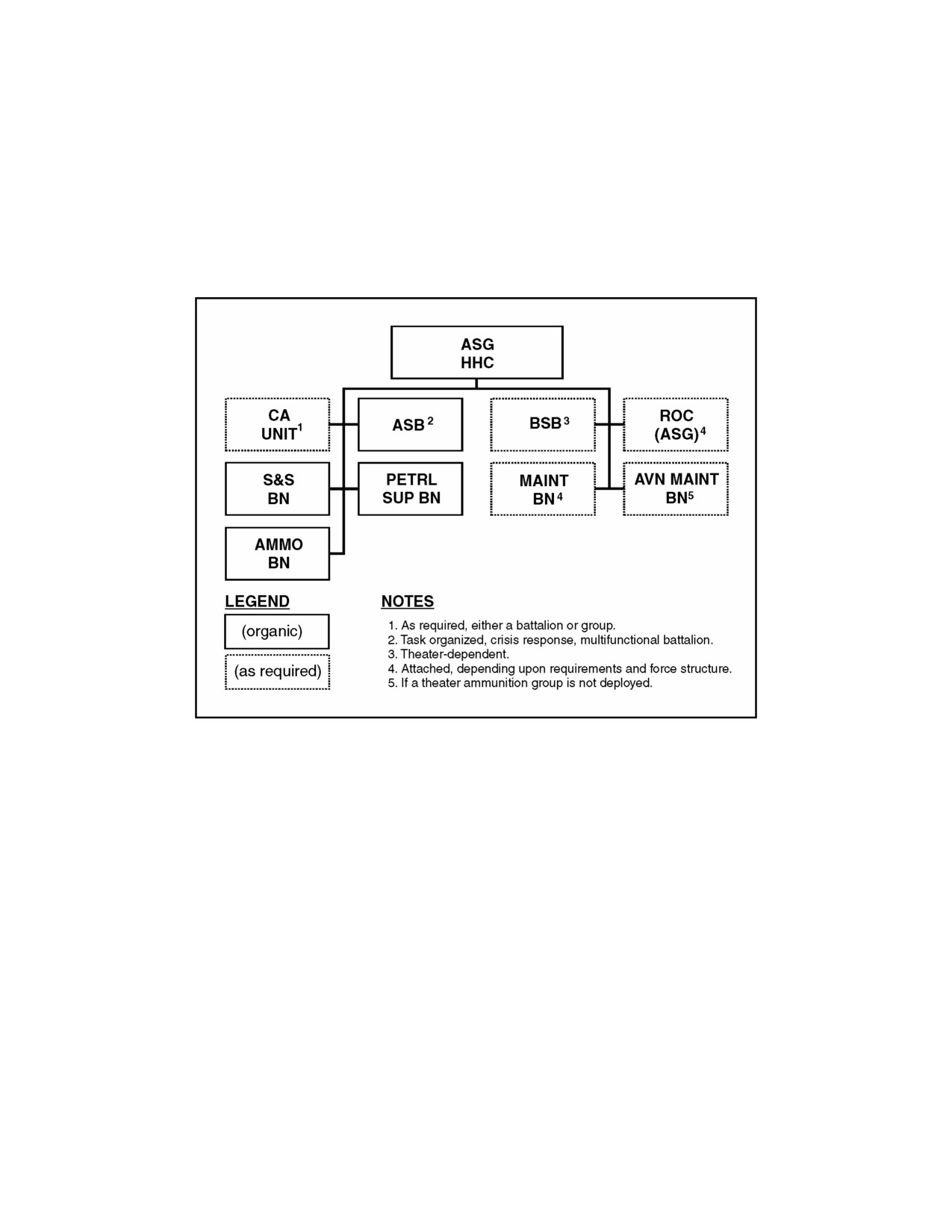
tent of support required. Figure 2-4 shows a typical ASG organization. The
ASG headquarters commands and controls all assigned and attached units. It
also—
• Supervises establishment of cantonment/billeting/staging areas.
• Coordinates HNS, as directed by the TSC commander.
• Manages terrain within its area.
2-28
_________________________________________________________________________________
Chapter 2
• Coordinates security operations within its designated area. An ASG
rear operations center (ROC) (TOE 51613L000) augments the head-
quarters organic capability to plan and control security operations.
• Provides PSA personnel for support of reception and marshaling opera-
tions.
Figure 2-4. Representative ASG Organization
MULTIFUNCTIONAL BATTALIONS
2-108. Multifunctional battalions under an ASG may include area support
battalions (ASBs) and base support battalions (BSBs). Neither has a fixed
structure.
2-109. ASBs provide required area support. Typical units assigned or at-
tached to an ASB include a DS supply company, DS maintenance companies
and teams, a field services company, and a water team. An ASB may control
specialized elements required to establish a support base in early stages of
an operation. An ASB may operate a regeneration site later in an operation.
2-110. BSBs perform missions to support military communities. A tailored
BSB may be attached to an ASG to establish base operations support from fa-
cilities previously inoperable or not under U.S. control. FM 4-93.40 (FM 54-40)
discusses both of these battalions in detail.
2-29
________________________________________________________________________
FM 4-93.4 (FM 63-4)
SUPPLY AND SERVICE BATTALION
2-111. The supply and service (S&S) battalion is one of the functional battal-
ions often assigned to an ASG. It can effectively command a variety of units.
Normally, an S&S battalion is assigned to an ASG to provide supply (less
medical, ammunition, and bulk fuel), mortuary affairs (MA), and aerial de-
livery support to units in the ASG AO. The ASG commander task organizes
the S&S battalion to meet the requirements of METT-TC. Units locate for
easy access to main supply routes (MSRs), rail lines, or airfields.
2-112. A battalion headquarters receives two to five subordinate units. It
may be assigned the following units:
• GS supply company to receive, store, and issue Class I, II, packaged
III, and IV supplies.
• Heavy materiel supply company to receive, store, issue, and deprocess
Class VII supplies.
• Repair parts supply company to receive, store, and issue Class IX re-
pair parts. It can also maintain stocks of Class IX non-air lines of
communication (ALOC) supplies and maintenance-related Class II and
Class IX ALOC supplies.
• Light airdrop supply company to provide aerial delivery support.
• Airdrop equipment repair and supply company to provide maintenance
support for aerial delivery equipment.
• Laundry and renovation company to receive, classify, launder, reno-
vate, and temporarily store clothing and lightweight laundered tex-
tiles.
• Quartermaster MA company (echelon above corps [EAC]) to operate
the theater mortuary evacuation point. It locates at the APOE desig-
nated as the evacuation point and processes remains for evacuation to
CONUS.
DS MAINTENANCE BATTALION
2-113. The direct support (DS) maintenance battalion provides maintenance
and repair parts support for a great variety of equipment, except for aircraft,
marine, rail, airdrop, missile-aircraft armament, office machines, avionics,
and photographic equipment.
2-114. The DS maintenance battalion has a variable number of maintenance
units attached to the headquarters in accordance with (IAW) the mission. A
typical DS maintenance battalion includes an HHC and three to five nondivi-
sional DS maintenance companies. The ASG commander, or other higher
headquarters, may augment DS maintenance battalions with non-
maintenance units to perform multifunctional logistic support if the opera-
tional situation requires it.
2-115. The primary mission of the DS maintenance battalion is to provide DS
maintenance, repair parts support, technical assistance, and recovery and
evacuation assistance of nondivisional (CS and CSS) unit equipment, and to
provide reinforcing DS maintenance support to corps, divisions, and separate
brigades.
2-30
_________________________________________________________________________________
Chapter 2
2-116. The support mission of the DS maintenance battalion is assigned by
the ASG based on area maintenance requirements, the number and types of
units requiring support, and the capabilities of the units attached to the bat-
talion. The battalion is then responsible for assigning support missions to
each of its attached maintenance units. The companies of the maintenance
battalion provide the following specific support functions:
• Diagnose, isolate, and repair faults within modules and components.
• Repair selected line replacement units
(LRUs) and printed circuit
boards (PCBs).
• Perform heavy body, hull, turret, and frame repair.
• Provide area maintenance support, to include technical assistance and
onsite maintenance as requested.
• Evacuate unserviceable end items and components, through the ap-
propriate supply support channels.
• Fabricate or manufacture repair parts, assemblies, components, jigs,
and fixtures as required.
Details on maintenance battalion operations are in FM 4-30.3 (FM 9-43-1).
ECHELONS ABOVE CORPS AVIATION MAINTENANCE COMPANY (EAC AMCO)
2-117. An echelons above corps
(EAC) aviation maintenance company
(AMCO) may be assigned to an ASG of the TSC as required. The company is
a flexible organization tailored to meet the specific needs of the supported
force. The EAC AMCO locates near an instrumented landing facility depend-
ing on METT-TC. Other employment considerations are the same as de-
scribed for the divisional and corps AMCOs. (See FM 3-04.500 (FM 1-500) for
further discussion on aviation maintenance operations.) Each EAC AMCO
provides—
• Aviation intermediate maintenance (AVIM) and backup aviation unit
maintenance (AVUM) support to operational-level support aircraft.
• Aviation repair parts supply support to operational-level aviation
units, including aircraft armament and avionics.
• Selected repair parts reparable exchange (RX) support for corps AVIM
units.
• AVIM overflow maintenance support to corps aviation AVIM units as-
signed or attached to the operational-level support organization.
• An aircraft RX repair parts facility supply program.
REAR OPERATIONS CENTER
2-118. The rear operations center (ROC) (TOE 51603L000) at the TSC head-
quarters level plans, coordinates, advises, monitors, and directs the execution
of the security activities based on the ARFOR commander's priorities and
plans. The ROC supports the TSC Assistant Chief of Staff, Operations (G3)
rear operations branch to execute its mission. The ROC—
• Provides a staff element to plan and coordinate TSC security.
• Monitors the security situation; provides security advice and informa-
tion to the unit commanders in the TSC's operating area; and coordi-
2-31
________________________________________________________________________
FM 4-93.4 (FM 63-4)
nates fire, maneuver (including aviation), force protection measures
(including NBC defense), and ADC support based on priorities and the
security plan.
• Recommends positioning and operational missions for tactical combat
forces (TCFs) in the TSC AO.
• Provides advice concerning the positioning of units, bases, and base
clusters in TSC AO.
• Identifies HNS security-related capabilities and coordinates this sup-
port from the HN.
• Conducts vulnerability analyses of bases and base clusters under TSC
control.
• Monitors and coordinates communications as they relate to rear area
and base security requirements.
SECTION V - OTHER SUPPORT SOURCES
2-119. In addition to the support provided by U.S. military organizations, the
TSC has to incorporate support provided by contractors and HNS into plans
and operations. These sources of support offer greater economy and may re-
duce demands on strategic lift. However, their use must be balanced with the
greater burden of force protection that they also bring.
CONTRACTED SUPPORT
2-120. Battlefield contractors are referred to as theater support contractors,
external support contractors, or system contractors. Regardless of their type,
the ARFOR commander is responsible for their proper integration into the
operational plan to include safety and security of contractor personnel. In all
cases, the units directly supported by contractor personnel take responsibil-
ity to ensure the contractor personnel’s safety and well being within the lim-
its of the contract agreement.
2-121. Theater support contractors support deployed operational forces under
prearranged contracts, or contracts awarded within the mission area by con-
tracting officers serving under the direct contracting authority of the theater
principal assistant responsible for contracting (PARC). Contracting officers in
the TSC contracting directorate or from other commands award these con-
tracts IAW the PARC's theater contracting plan. Theater support contractors
provide goods, services, and minor construction, usually from the local vendor
base to meet the immediate needs of the operational commander. Contracting
officers and their representatives consider up front the effect of local laws,
customs, holidays, labor unions, and any other condition affecting the execu-
tion of contracted support.
2-122. External support contractors provide support to deployed operational
forces that is separate and distinct from either theater support or systems
contractors. They may be prearranged contracts, or contracts awarded during
a contingency operation to support the mission. Contracting officers award-
ing these contracts are not under the contracting authority of the theater
PARC or the systems offices under program managers or USAMC. For exam-
ple, USAMC provides commercial depot support through contracts by its
2-32
_________________________________________________________________________________
Chapter 2
commodity commands. Its LOGCAP office also provides external support con-
tractors through its prearranged umbrella contract. The USAMC’s LSE,
which is usually attached to the TSC, administers this contract in the thea-
ter. Other elements attached to the TSC, such as the MEDCOM, may admin-
ister other external support contracts.
2-123. Systems contractors support deployed operational forces under prear-
ranged contracts awarded by program executive officers, program managers,
or USAMC. They support specific materiel systems throughout the system's
life cycle during war and peace. When systems contractors deploy to an AO,
they normally co-locate with the unit with which they have a habitual rela-
tionship for life support and security. Often those units are a part of the TSC.
For example, FM 4-93.41 (FM 63-11) describes USAMC contractors that fall
under the LSE in theater.
2-124. TSC planners consider all available contracted support when conduct-
ing its logistics preparation of the theater (LPT). Contracted support is a
powerful tool, a force multiplier, and has the capability of supporting nearly
any type of contingency. When planning contracted support, commanders
and planners are aware that a requirement for a particular system or capa-
bility may result in introducing these types of contractors into the opera-
tional plan and the support structure. All contracted support is coordinated
with and follows the policies and guidance of the supported combatant com-
mander and subordinate JFCs.
2-125. FM 3-100.21 (FM 100-21) addresses the planning for, management of,
and support for contractors on the battlefield. FM 4-100.2 (FM 100-10-2) ad-
dresses contracting support as an additional support alternative.
HOST NATION SUPPORT
2-126. Host nation support (HNS) is theater and situation dependent. Avail-
able support depends on the geographical area and prior agreements of the
nations in the area, and the nations’ willingness and ability to provide sup-
port. In some potential AOs, agreements may exist between the United
States and the HN; in others, no nation may be friendly to the United States,
in which case no HNS will be available—at least, not initially.
2-127. HNS is civil and/or military assistance a nation renders to foreign
forces within its territory during peacetime, crises, emergencies, or war based
on agreements mutually concluded between nations. The President and Sec-
retary of Defense (or those representing them) are responsible for establish-
ing treaties and agreements for HNS. HNS includes all civil and military
support a nation provides to multinational forces located on its sovereign ter-
ritory. HNS is not the same as contractor support, though multinational
forces contractors may affect the ability of an HN to provide HNS. HNS is
support in-kind provided to U.S. forces to further the mutual goals of the HN
and the United States. Contracted support is the materiel and services for
which the United States compensates the HN, or other entity, through acqui-
sition channels. HNS and contracted support are deconflicted during the CSS
planning of the operation, especially in areas of limited resources.
2-128. Potential HNS agreements address labor support arrangements for
port and terminal operations, use of available transportation assets in coun-
2-33
________________________________________________________________________
FM 4-93.4 (FM 63-4)
try, use of bulk petroleum distribution and storage facilities, possible supply
of Class III (bulk) and Class IV, and developing and using field services. HNS
agreements also consider warehouse space, office space, billets, waste dis-
posal, electric power supplies, and telecommunications assets availability.
After agreements with allies or coalition nations are initiated, they are con-
tinually evaluated for improvement, or specifically spelled out to enable TSC
planners to adjust for specified requirements. HNS planners consider up
front the affects of local laws, customs, holidays, labor unions, and any other
condition affecting the availability of HNS. See FM 4-0 (FM 100-10) for more
information on HNS. Chapter 4 discusses the role of the HNS directorate of
the TSC.
MULTINATIONAL SUPPORT
2-129. Multinational support consists of CUL support provided from one
multinational partner to another. One or more of the following organizational
and/or management options facilitates multinational support:
• National support elements (NSEs) provide national support.
• Individual acquisition and cross-servicing agreements (ACSAs) provide
limited support.
• A lead nation provides specific support to other contributing nations
(CN) military forces.
• A role-specialist nation provides a specific common supply item or ser-
vice.
• An MILU provides limited common supply and service support.
• An MJLC manages CUL support.
2-130. In all cases, the multinational force commander directs specific multi-
national CUL support within the applicable laws and regulations of the HN.
When operating within a formal alliance, the TSC commander and staff exe-
cute CUL support IAW applicable standardization agreements [STANAGs] or
quadripartite standardization agreements [QSTAGs]. FM 3-16 (FM 100-8),
FM 4-0 (FM 100-10), JP 4-07, and JP 4-08 discuss multinational logistic sup-
port.
2-34
Chapter 3
Command, Control, Automation, and Communications
This chapter describes the TSC headquarters and how its staff officers in-
tegrate and coordinate support. It also describes how the TSC headquar-
ters staff uses automation and communications devices to accomplish the
TSC’s mission.
SECTION I - COMMAND AND CONTROL
3-1. The TSC is a major subordinate command (MSC) of the ARFOR. Within
a developed theater, the TSC is the organizational equivalent of a corps
headquarters with other unique
considerations. Whereas most
CONTENTS
other MSCs of the ARFOR are
Command and Control
3-1
principally focused at the tactical
TSC Plans and Orders
3-1
level, the TSC focuses at the
Higher Headquarters
3-2
operational level of war. This role
Subordinate Units and Activities
3-3
entails a greater span of control
Liaison Requirements
3-3
in terms of geography and
Staff Organization
3-4
technical functions. ARFOR and
Staff Component Roles
3-5
TSC staff officers keep this
Coordinating and Special Staffs
3-6
unique role in view. Command
Support Operations Staff
3-6
relationships between the TSC
Special Troops Battalion and
headquarters
and
other
Headquarters Company
3-9
headquarters and elements are
Command Posts
3-9
described below.
Command Post Elements
3-9
Main Command Post
3-9
TSC PLANS AND ORDERS
Automation
3-11
3-2. The TSC staff performs two
CSS Automation Management Office
3-11
distinct planning processes. One
TSC Headquarters Automation
process leads to plans and orders
Interfaces
3-11
for the operational support of
Global Command and Control
ARFOR and the execution of des-
System
3-12
ignated lead service responsibili-
Army Battle Command System
3-12
ties. These plans and orders are
Standard Army Management
the ARFOR service support
Information Systems
3-14
OPLAN/OPORD or the service
Emerging Systems
3-19
support annex to the ARFOR
Communications
3-22
OPLAN/OPORD. The other proc-
G6 Staff Section
3-22
ess leads to plans and orders that
Communications Support Planning
3-24
direct the internal functions of
Subscriber Devices
3-24
the TSC.
Host Nation Interface
3-24
Radio Nets
3-25
3-3. The ARFOR staff directs
Contingency Satellite
and authenticates the content of
Communications
3-26
the service support orders. How-
3-1
________________________________________________________________________
FM 4-93.4 (FM 63-4)
ever, the TSC support operations staff may be the primary author because of
its familiarity with the capabilities of the TSC and its proximity to the TSC
coordinating staff. TSC coordinating and special staffs prepare staff esti-
mates and plans for the internal functions of the TSC. The TSC G3 normally
leads this process.
3-4. Section II of this chapter discusses in more detail the staff processes and
responsibilities for planning, and the relationship between the deputy com-
mander and the chief of staff. In most instances, the TSC chief of staff coor-
dinates these two planning processes. The chief of staff ensures that—
• The TSC’s internal operations order supports the operational support
order.
• The coordinating staff and the support operations staff produce esti-
mates and other staff products in a mutually supporting sequence for
developing coherent plans.
3-5. The TSC staff uses the military decision making process (MDMP) as out-
lined in FM 5-0 (FM 101-5), and in applicable joint publications, principally
JP 5-0 and CJCSM 3122.03. The TSC chief of staff or the TSC G3 (if dele-
gated to do so by the chief of staff) directs the specific format. The format he
chooses is consistent with the formats and direction of the ARFOR com-
mander, the TSC higher headquarters. FM 3-93 (FM 100-7) contains a sam-
ple
“Major Operations Plan Model—Operational Level” taken from joint
doctrine and Army formats in FM 5-0 (FM 101-5). Appendix B discusses the
difference between the operational support order/annex and the TSC opera-
tions order. It also includes an example of an operational level support order.
HIGHER HEADQUARTERS
3-6. During normal peacetime planning, the ASCC is the TSC’s higher head-
quarters, overseeing contingency planning. During operations, the TSC’s
higher headquarters is the ARFOR. The ARFOR headquarters is either the
ASCC or an augmented corps or division headquarters, depending on the
scale of operations. The higher headquarters issues mission-type orders to
the TSC. In peacetime, the ASCC staff prepares broad plans and guidance to
support anticipated operations. TSC staff officers develop detailed plans,
policies, and directives for support, which conform to ASCC policies, direc-
tives, and guidance.
3-7. In peacetime, the ASCC G1, G3, and G4 recommend priorities for sup-
port based on the commander's planning guidance. Based on staff recom-
mendations, the commander determines priorities. TSC staff officers
coordinate and supervise implementing ASCC policies and priorities to sup-
port current and future operations. They consolidate, analyze, and transmit
changes in support status and situations to the ASCC.
3-8. The TSC deputy commander for support operations (DCSO) coordinates
with the ASCC staff to ensure integrated CSS and supportability of future
operations. The TSC G3 coordinates with the TSC DCSO and the ASCC G3
to ensure that TSC and ASCC support planners understand the TSC’s capa-
bility and readiness to support current and future operations.
3-2
_________________________________________________________________________________
Chapter 3
SUBORDINATE UNITS AND ACTIVITIES
3-9. The TSC commands assigned and attached units such as the organiza-
tions discussed in Chapter 2. The specialized commands interface with the
TSC. The TSC headquarters coordinates command and policy matters with
subordinate commands and organizations through command channels. The
TSC support operations staff maintains continuous liaison with its counter-
parts in subordinate commands/units.
3-10. The DCSO and the chief of staff determine the reporting requirements
within their areas of supervision. Emerging information technology (IT) sys-
tems such as the GCSS-Army and CSSCS (see Section IV below) contains
features for compiling and presenting real-time information. Until these are
fielded, units develop local formats and SOPs suitable for assimilating and
analyzing the necessary information. The LPT checklist in Appendix A also
contains a list of the informational items the TSC obtains and analyzes.
3-11. Two rules guide reporting requirements that the TSC staff places on
subordinate and supported units. First, the necessary information should ar-
rive at the TSC in a uniform format that the staff can analyze quickly. The
TSC staff analyzes all reports for their content, reliability, coherence, and ul-
timate impact on support operations. The TSC staff’s analytical skills are
more important than the quantity of information received. Secondly, the
TSC’s reporting requirements minimize the burden on subordinate and sup-
ported unit staffs. This increases the likelihood of receiving quality informa-
tion in a timely manner.
LIAISON REQUIREMENTS
3-12. Support coordination teams and/or LNOs promote cooperation and co-
ordination. They do this through personal contact between the TSC and sup-
ported units. The support operations section provides the support
coordination team(s). They serve as information gatherers for the support op-
erations section. Responsibility for liaison is primarily from higher to lower
echelon headquarters (See Chapter 2, FM 3-93 (FM 100-7), and Appendix L,
FM 5-0 [FM 101-5]). Therefore, the TSC has critical requirements to place li-
aison elements with its principal subordinate headquarters, such as ASGs.
Placement priority of liaison elements is keyed to—
• Enhancing visibility and understanding the action at nodes in the re-
ception, staging, and onward movement process, such as SPODs,
APODs, and at staging and assembly areas.
• Ensuring close interservice and multinational coordination in joint
rear tactical operations.
TSC LIAISON OFFICERS TO ARFOR HEADQUARTERS
3-13. TSC support coordination teams and liaison officers (LNOs) perform
the following services:
• Communicate regularly between the ARFOR and TSC headquarters.
• Attend daily briefings and provide input on TSC status and plans.
3-3
________________________________________________________________________
FM 4-93.4 (FM 63-4)
• Keep the ARFOR commander informed of the TSC’s support situation
and capabilities.
• Obtain information from TSC LNOs assigned to ARFOR headquarters
or represented in ARFOR special staff divisions.
HOST NATION LIAISON OFFICER
3-14. The TSC may also provide liaison officers (LNOs) to the host nation
(HN). They normally come from the TSC HN support directorate. In turn,
they may provide LNOs to the TSC’s HN support directorate, the support op-
erations section, or to one or more of the control centers in the TSC. Head-
quarters company personnel arrange billeting, ration support, and other
required services for these LNOs.
SECTION II - STAFF ORGANIZATION
3-15. The TSC commander may—at the discretion of the ARFOR com-
mander—be the single commander for the bulk of CSS and CS specialized
support in the AO. To facilitate C2 in such a situation, major segments of the
TSC headquarters structure focus on either external support to supported
units or internal support to TSC units.
3-16. The staff may organize along the lines of one of two types of staff mod-
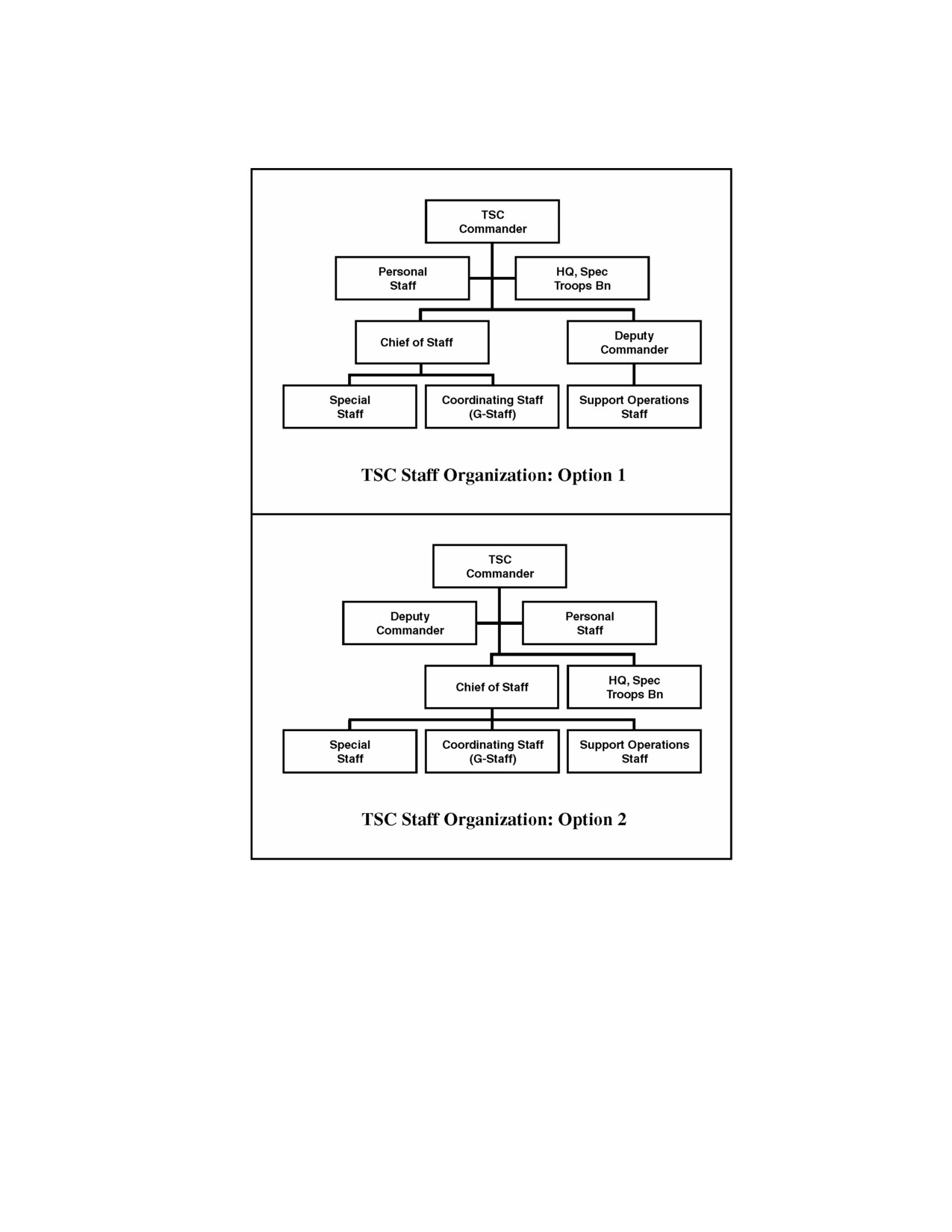
els. (See Figure 3-1.) In one form of organization, the coordinating staff, or
“G” staff, is supervised by the chief of staff and is wholly separate from the
support operations staff, which is supervised by the deputy commander for
support operations. This is the organization shown in Option 1 of Figure 3-1.
Under this organization, the integration of the staff processes and products
falls mainly to the TSC commander or the DCSO if the TSC commander as-
signs him that responsibility. This organizational option lends itself to opera-
tions where the TSC supports one or more full corps, the span of
responsibility is significantly increased, and the DCSO has sufficient staff
assistance to perform the integrating task. Under Option 2, the chief of staff
supervises the entire staff, to include the coordinating and support opera-
tions staffs. The deputy commander oversees those functions specifically as-
signed to him by the commander and tasks the chief of staff for staff products
in those areas that are under his assigned purview. These are normally sup-
port operations functions, but may extend beyond these if the TSC com-
mander so designates. This arrangement is often most applicable to
peacetime planning and operations where the span of control is too large.
3-4
_________________________________________________________________________________
Chapter 3
Figure 3-1. TSC Staff Organization
STAFF COMPONENT ROLES
3-17. The TSC’s coordinating and special staffs relate to the support opera-
tions staff primarily in terms of furnishing capabilities that meet require-
ments. The coordinating staff marshals the capabilities of the TSC to meet
the requirements determined by the support operations staff. Critical func-
tions of the coordinating staff include, but are not limited to, developing the
task organization of the TSC and monitoring the unit and individual readi-
ness of the TSC (to include unit strength, equipment status, and personnel
qualification fill rates). The support operations staff provides the Army thea-
ter support requirements to the coordinating staff and develops the Army
3-5
________________________________________________________________________
FM 4-93.4 (FM 63-4)
theater-level concept of support based on the capabilities. The support opera-
tions staff translates the ARFOR commander’s operational priorities into pri-
orities of support across the CSS spectrum for the TSC’s external customers.
This process of balancing capabilities to requirements is inherently cyclical.
Therefore, these two parts of the TSC staff continually coordinate their ef-
forts.
COORDINATING AND SPECIAL STAFFS
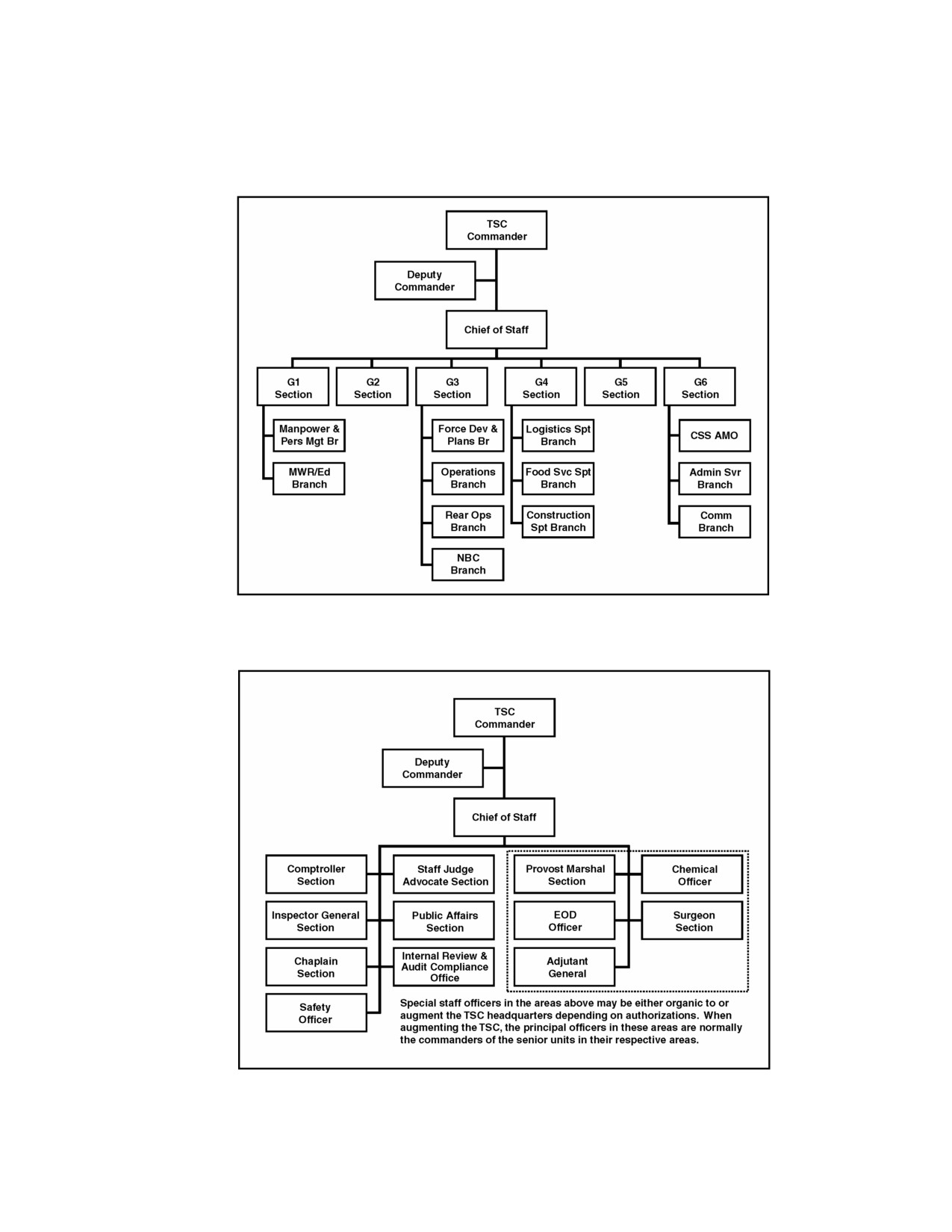
3-18. The TSC headquarters staff officers (see Figure 3-2 and Figure 3-3) co-
ordinate and supervise implementing ARFOR policies and directives relative
to supporting current and future operations. They develop plans and orders
to ensure continuous support of operations. Coordinating and special staffs
focus on internal TSC operations; the support operations staff focuses on ex-
ternal support. The fluidity of battle demands constant changes to these sup-
port plans. Detailed discussion on coordinating and special staffs is in
Chapter 8.
COORDINATING STAFF
3-19. The G1 through G6 coordinating staff officers perform common staff re-
sponsibilities discussed in Chapter 8 of this manual, with more detail pro-
vided in FM 5-0 (FM 101-5). They develop internal TSC policies and plans in
their respective technical areas and provide guidance, priorities, and alloca-
tions to subordinate commands. They also review the plans of counterpart
staffs in subordinate units.
SPECIAL STAFF
3-20. Special staff officers provide technical advice and planning assistance
to the TSC commander and staff on internal TSC activities. Chapter 8 de-
scribes the mission and functions of both special staff sections and coordinat-
ing staff sections in supporting those elements assigned, attached, or detailed
to the TSC. (In addition to the elements shown in Figure 3-3, the commander
of special troops and the secretary of the general staff are also considered
special staff officers, as are the chemical officer and the explosive ordnance
disposal officer.)
SUPPORT OPERATIONS STAFF
3-21. The support operations section oversees the TSC's external support
mission. The DCSO supervises supply, maintenance, and field service units
and synchronizes transportation, medical, personnel, finance, and engineer
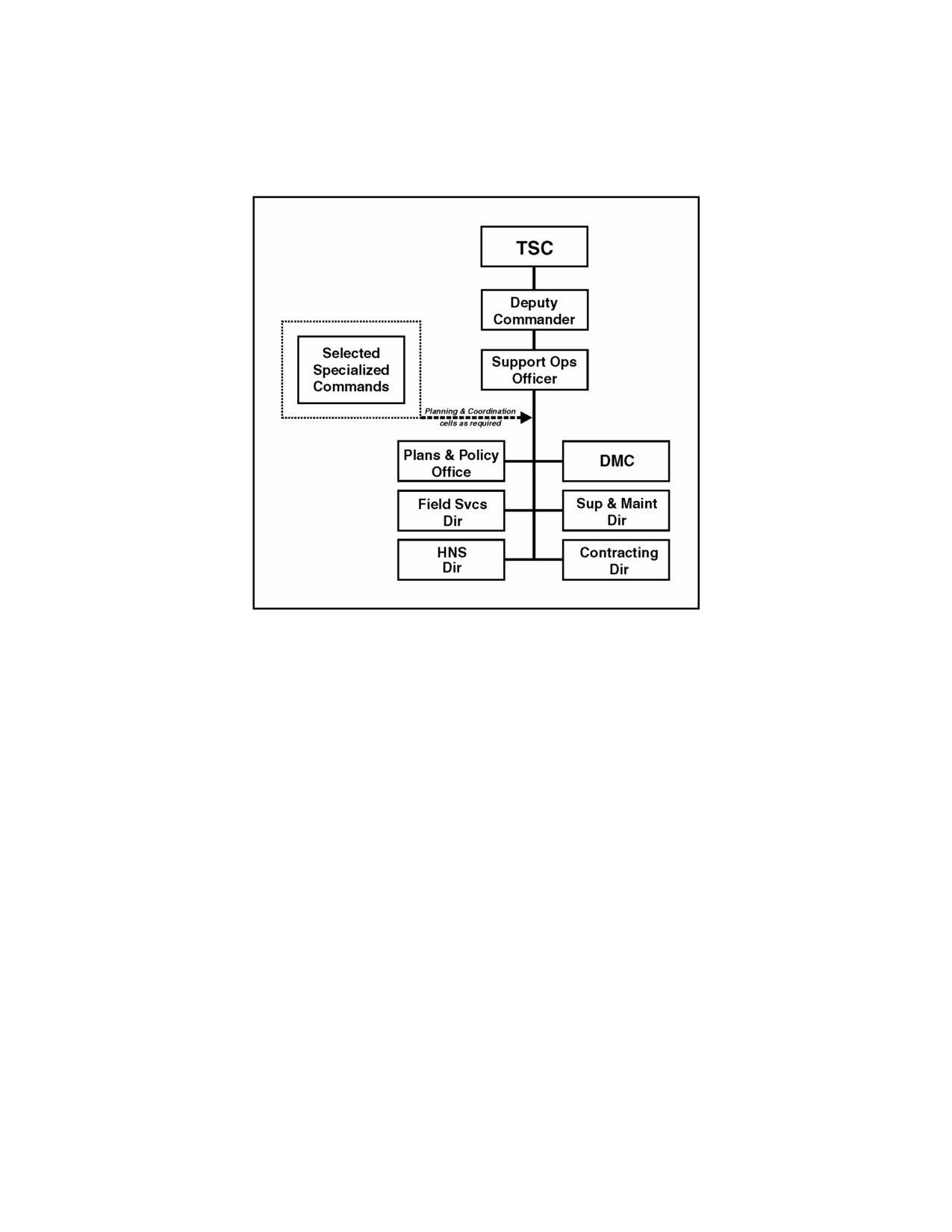
unit activities involved with external support. Specialized commands provide
cells or LNOs to work with the support operations staff to synchronize and
coordinate the planning for and execution of the total support mission. (See
Figure 3-4.) Chapter 4 discusses these cells.
3-6
_________________________________________________________________________________
Chapter 3
Figure 3-2. TSC Coordinating Staff
Figure 3-3. TSC Special Staff
3-7
________________________________________________________________________
FM 4-93.4 (FM 63-4)
Figure 3-4. Specialized Commands and TSC Support Operations Staff
3-22. The support operations section plans and policy office works closely
with the other elements of the support operations staff, as well as the special
and coordinating staffs and specialized commands to coordinate plans, poli-
cies, procedures, and programs for external supply, transportation, mainte-
nance, medical, personnel, finance, and engineering support. It develops
estimates and monitors operational readiness. The DCSO coordinates esti-
mates and plans for external support, to include—
• Support operations estimates.
• Annexes to the TSC OPLAN/OPORD.
• Support analyses.
• ARFOR service support plans/orders.
3-23. The TSC commander normally assigns the DCSO responsibility over
the two TSC control centers (MMC and MCA), as well as the subordinate
branches of the support operations section. The support operations section
also coordinates support activities with the MLMC. The MLMC stays under
C2 of MEDCOM, while the MMC and MCA are under C2 of the TSC. The
DCSO conducts frequent coordination to harmonize the efforts of the control
centers. He also resolves issues that the heads of the control centers cannot
resolve. Chapter 5 discusses TSC control centers in detail.
3-24. The subordinate directorates/elements of the support operations sec-
tion, and all assigned liaison elements and CSS specialized planning and co-
3-8
_________________________________________________________________________________
Chapter 3
ordination cells, coordinate with the control centers and support units to ac-
complish the following tasks directed by the ARFOR commander:
• Compute overall theater requirements.
• Manage theater stockage and maintenance programs.
• Coordinate theater reception, staging, onward movement and through-
put of forces and sustainment.
• Maintain theater-level distribution infrastructure networks.
• Cross-level resources.
• Exercise staff and technical supervision over TSC external mission
support operations.
• Provide contracting and HN support coordination.
• Use velocity management methodology, principles, and automation
tools, such as the Integrated Logistics Analysis Program (ILAP) and
automated information technology (AIT) to manage, requisition, and
track materiel and supplies.
Additional information concerning the support operations section and the
DMC, and the relationships among those involved in controlling and manag-
ing external support, is in Chapters 4 and 5.
SPECIAL TROOPS BATTALION AND HEADQUARTERS COMPANY
3-25. The special troops battalion headquarters commands all special troops
assigned or attached to the TSC headquarters. The headquarters company
commands and supervises enlisted personnel assigned to the TSC HHC.
Chapter 8 discusses these elements in more detail.
SECTION III - COMMAND POSTS
COMMAND POST ELEMENTS
3-26. The TSC field standing operating procedure (FSOP) establishes the
TSC’s command post (CP) organization and composition. The TSC CP con-
sists of main, alternate, and supplemental locations. The alternate and sup-
plemental locations are planned to enhance the security and survivability of
the main CP.
MAIN COMMAND POST
3-27. The main command post (CP) consists of those elements of the com-
mand group, staff sections, and administrative support personnel required
for C2, staff supervision, personnel staff support, and life support. It also in-
cludes planning cells or LNOs from specialized commands to synchronize
support plans. The CP includes the support operations, life support, and pe-
rimeter defense areas.
3-28. The CP configuration reflects broad specialized relationships,
continuity of operations, and information flow among sections. The
availability of existing facilities and terrain determines actual location of
elements and supporting staff sections. The special troops battalion
commander plans the layout.
3-9
________________________________________________________________________
FM 4-93.4 (FM 63-4)
SUPPORT OPERATIONS SECTION
3-29. The support operations section of the TSC serves as the focal point for
the entire spectrum of logistical and related CSS and CS operations. Within a
field environment, the support operations area is a limited access facility
within the main CP. It is typically occupied by the deputy commander for
support operations, plans and policies office, DMC, specialized directorates
(maintenance and supply and field services), and planning cells or LNOs
from the transportation, medical, engineer, finance, and personnel com-
mands. Support operations activities may obtain a degree of mobility and
survivability by setting up key staff elements in expansion vans.
3-30. The life support area includes facilities for providing field feeding, bil-
lets, and organizational supply and maintenance. The headquarters company
commander coordinates these support activities as well as other essential
support services, such as shower, laundry, and latrines. Life support services
are incorporated within the base perimeter.
3-31. An alternate CP provides continuity of C2 in case of destruction or in-
capacity of the main CP. The G3 selects alternate CP locations. The head-
quarters commandant is responsible for establishing the alternate CP layout.
COMMAND POST SECURITY
3-32. Command posts (CPs) use several survivability measures to improve
survival of critical C2 nodes in a high-risk environment. If a hardened site is
not available, CP dispersal enhances survivability. The following measures
can improve CP survivability:
• Establishing alternate CPs.
• Dispersing elements within CPs.
• Deceiving the enemy of the CP location.
• Using hardened, protective shelters.
• Reducing size.
• Reducing signature.
3-33. The headquarters commandant is responsible for coordinating internal
security and local defense of the main CP. CP security includes establish-
ing—
• Prepared defensive positions and a warning system for the main CP.
• Barrier systems and obstacles outside the perimeter.
• Manned guard posts.
• Sentries and guards for local internal security.
• Alternate and supplementary positions.
• Quick reaction force.
• Access control.
3-34. Each staff section is responsible for its own routine internal security.
This includes using—
• Signs and countersigns.
• Camouflage, noise, and light discipline.
3-10
_________________________________________________________________________________
Chapter 3
• Defensive positions.
• Access roster or passes.
• Proper automation security.
• Proper classified storage and handling procedures.
3-35. Unless the main CP is within the perimeter of a larger secure base, the
headquarters commandant controls access to the main CP. The G3 is respon-
sible for preparing and issuing passes. MPs may provide access control. The
headquarters commandant assigns crew-served weapons and is responsible
for employing alarm units. The NBC officer designates the location of chemi-
cal detectors. The headquarters commandant establishes an airborne early
warning network and implements an area alert system for ground and/or air
attacks. He also notifies the supporting ROC of attacks and forwards re-
quests for quick reaction forces through the G3.
SECTION IV - AUTOMATION
3-36. The TSC staff officers require accurate and timely data to prepare ac-
curate estimates and responsive plans and orders. Their recommendations to
the TSC commander and ARFOR staff relate directly to the timeliness and
accuracy of the received data. Automation support systems aid staff officers
in collecting, collating, analyzing, and disseminating information to aid
commanders in decisionmaking.
CSS AUTOMATION MANAGEMENT OFFICE
3-37. The combat service support automation management office (CSSAMO)
assigned to the TSC serves in a supervisory role, establishing CSS automa-
tion policy and providing guidance for all subordinate CSSAMOs in the com-
mand. It coordinates actions and serves as the systems integrator for the
command. This CSSAMO is the focal point for all new system fielding, soft-
ware changes, change proposals, and any other CSS automation actions re-
quiring coordination between internal and external agencies. It provides CSS
Standard Army Management Information Systems (STAMIS) software sup-
port to the TSC headquarters and coordinates signal requirements.
TSC HEADQUARTERS AUTOMATION INTERFACES
3-38. The TSC uses reliable, secure communications, both voice and data,
with the headquarters of all principal support elements. These links are es-
pecially critical during early entry operations. Examples include, but may not
be limited to, the following entities:
• Higher headquarters (ARFOR).
• Strategic services and commodity providers
(DLA, USAMC,
USTRANSCOM [MTMC and AMC]).
• Subordinate units (ASGs or CSGs, specialized battalions and groups).
• Specialized commands at EAC (TRANSCOM, ENCOM, MEDCOM,
PERSCOM, FINCOM).
3-11
________________________________________________________________________
FM 4-93.4 (FM 63-4)
• Support headquarters from other U.S. services (for example the Ma-
rine Corps force service support group [FSSG] or the Marine Logistics
Command [MLC]).
• Support headquarters from other nations.
• Contractors (see FM 3-100.21 [FM 100-21]).
3-39. The operational environment often does not afford connectivity through
standardized automation applications. This is especially true when interfac-
ing with other services and multinational partners. In this case, simple voice
communications via telephone and frequency modulation (FM) radio, and
non-secure Internet protocol (NIPR)/secure Internet protocol (SIPR)/Internet
communications, as appropriate, are essential. Ideally, the TSC commander
and staff obtain C2 and CSS management information through a network of
battlefield automated systems as listed below.
GLOBAL COMMAND AND CONTROL SYSTEM
3-40. The Global Command and Control System (GCCS) is the key joint C2
system. GCCS is a system of interconnected computers that provides an inte-
grated C2 capability to the entire joint community. It provides up to secret-
level information from a variety of applications that have migrated, or are in
the process of migrating, from other systems, including the JOPES. GCCS
provides a fused picture of the battlespace within the overall C2 system. The
Army Battle Command System (ABCS) is the Army’s component of GCCS.
ARMY BATTLE COMMAND SYSTEM
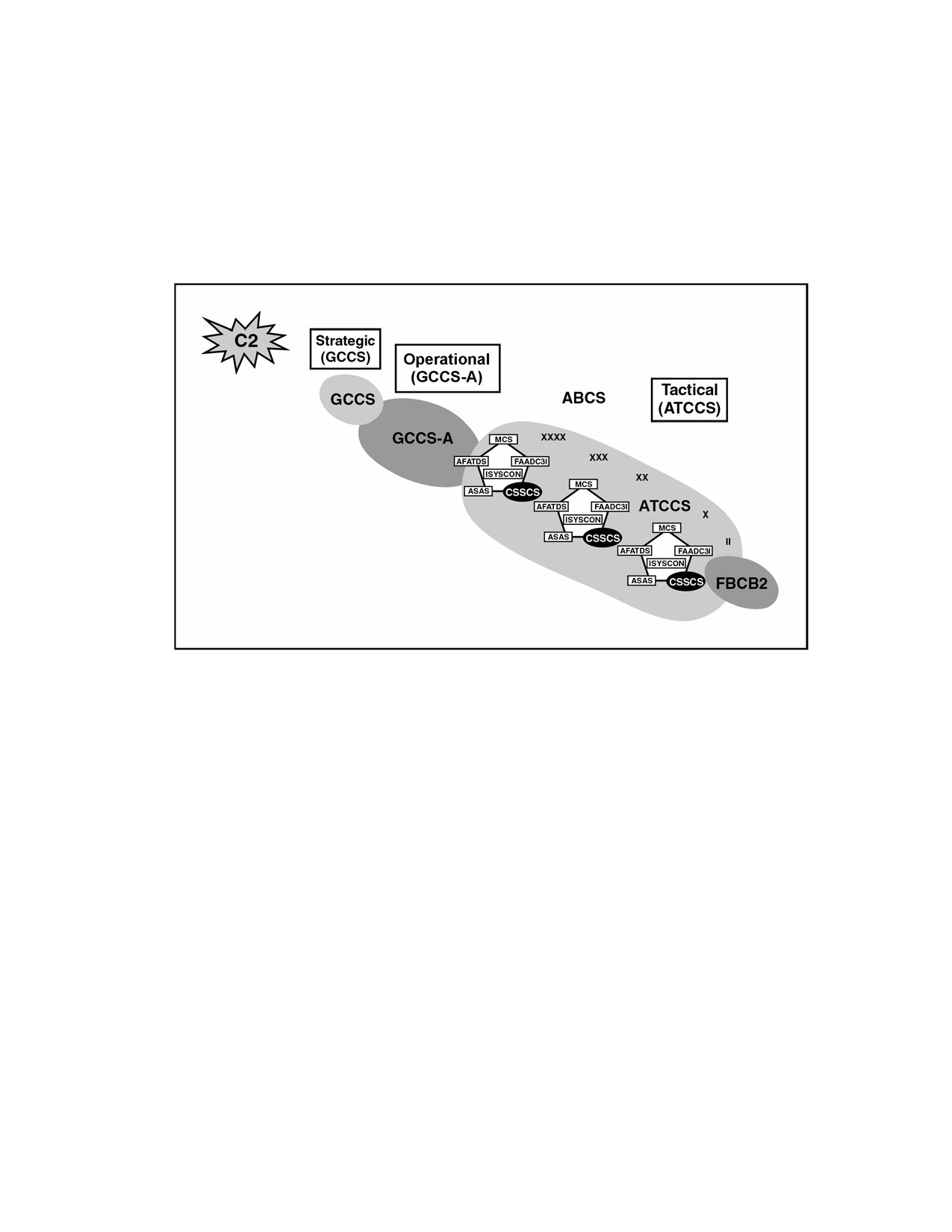
3-41. The Army Battle Command System (ABCS) integrates Army battlefield
functional area (BFA) systems to link strategic, operational, and tactical
headquarters. It provides commanders and staffs at theater and below a
relevant common picture through improved situational awareness and battle-
field digitization. ABCS includes three components: the Global Command
and Control System-Army (GCCS-A), the Army Tactical Command and Con-
trol System (ATCCS), and the emerging Force XXI Battle Command Brigade
and Below (FBCB2) system (see Figure 3-5).
GLOBAL COMMAND AND CONTROL SYSTEM-ARMY
3-42. The Global Command and Control System-Army (GCCS-A) is the corps
and above operational component of ABCS. It establishes a direct link with
the joint GCCS. GCCS-A receives input from CSSCS and the STAMIS/
GCSS-Army.
ARMY TACTICAL COMMAND AND CONTROL SYSTEM
3-43. The Army has fielded the Army Tactical Command and Control System
(ATCCS) to meet tactical C2 requirements from battalion to theater. ATCCS
includes a standard automation architecture that uses tactical communica-
tions. ATCCS consists of the following five automated Battlefield Functional
Area Control Systems (BFACs):
• Advanced Field Artillery Tactical Data System (AFATDS).
• Maneuver Control System (MCS).
3-12
_________________________________________________________________________________
Chapter 3
• Combat Service Support Control System (CSSCS).
• All-Source Analysis System (ASAS).
• Forward Area Air Defense Command, Control, Communications and
Intelligence System (FAADC3I).
Figure 3-5. Army Battle Command System
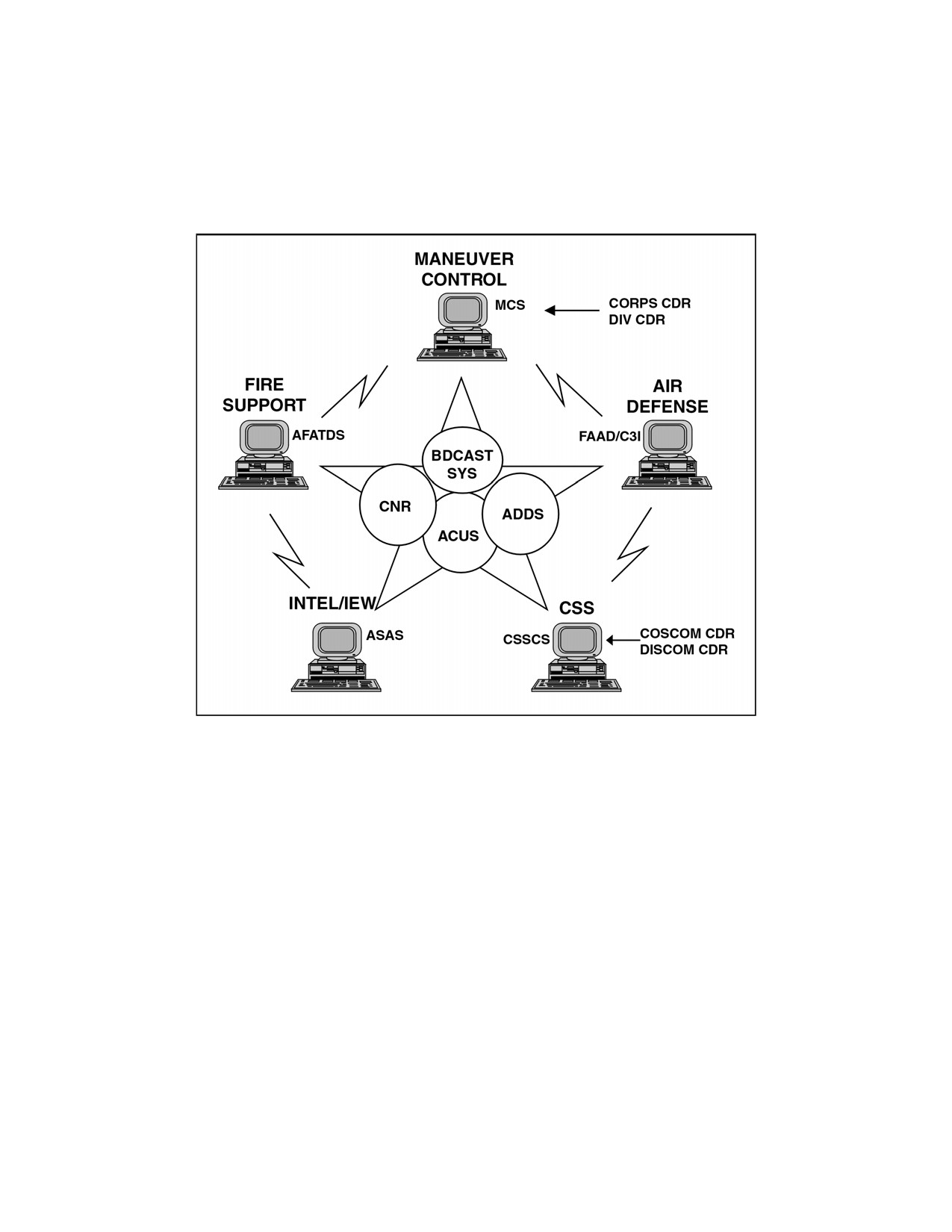
3-44. Figure 3-6 depicts the relationship between these BFACSs and sup-
porting communication. These systems use common and/or compatible appli-
cation software and communication protocols, system languages, report
formats, and necessary interfaces to ensure a cohesive and compatible overall
C2 system.
3-45. The CSSCS was developed to satisfy the Army’s need for an automated
system that provides the CSS commanders and their staffs with logistical,
transportation, medical, finance, and personnel information processing, re-
porting, and planning tools. This automated capability improves and acceler-
ates the tactical decisionmaking process, and reduces the manual processing
of data.
3-46. CSSCS provides automated support for the dual role of the CSS com-
mander. It supports the C2 of subordinate organizations as they support op-
erations. It also provides critical CSS resource information to the tactical-
level commander for the decisionmaking and battle planning processes.
3-47. CSSCS provides important C2 information to TSC and other com-
manders and their staffs based on data received from the CSS STAMIS,
FBCB2, and subordinate staff elements. In addition, CSSCS exchanges CSS
and tactical information between STAMIS and BFA information posted to
the CSSCS database to support the generation of reports, projections, and
3-13
________________________________________________________________________
FM 4-93.4 (FM 63-4)
administrative/logistics orders, and to aid decisionmaking and planning.
CSSCS interfaces with GCSS-Army and with FBCB2.
Figure 3-6. Army Tactical Command and Control System
STANDARD ARMY MANAGEMENT INFORMATION SYSTEMS
3-48. The Standard Army Management Information Systems (STAMIS) pro-
vide detailed, day-to-day processing of management information, and are the
key source of CSS data for the C2 systems. This section discusses legacy
STAMIS critical to TSC operations. The following section discusses emerging
systems.
STANDARD ARMY RETAIL SUPPLY SYSTEM
3-49. The Standard Army Retail Supply System (SARSS) consists of four
interrelated subsystems: SARSS-1, SARSS-2AD, SARSS-2AC/B, and the
SARSS Gateway. SARSS-1 is the automated system that operates at all eche-
lons to receive, store, and issue supplies. SARSS-1 also maintains the ac-
countable records. SARSS-1 has interfaces to receive and process requests for
issue from the Unit Level Logistics System (ULLS), Standard Property Book
System-Redesign (SPBS-R), and the Standard Army Maintenance System-1
(SAMS-1). SARSS-2AD is the automated supply management system used by
managers at separate brigade, armored cavalry regiment, or divisional mate-
3-14
_________________________________________________________________________________
Chapter 3
riel management levels. It provides the tools for managers to establish stock-
age levels, support relationships (i.e., which units are supported by which
SSA for which class of supply), and operating parameters. SARSS-2AD also
maintains a custodial Availability Balance File (ABF) that provides visibility
of SARSS-1 assets to control the lateral issue process (i.e., referrals) of assets
between SSAs. SARSS-2AC operates at the corps support command
(COSCOM), TSC, and the U.S. Property and Fiscal Office (USPFO). SARSS-
2AC provides the same management capabilities for the COSCOM and TSC
managers responsible for corps and theater SSAs that the SARSS-2AD pro-
vides for divisional managers. SARSS-2B operates at the COSCOM, TSC,
and USPFO to perform non-time sensitive supply management functions for
document history, catalog update, and demand analysis. SARSS-2B also in-
terfaces with financial systems. The SARSS-Gateway provides a communica-
tion network and the capability to send transactions to the Defense
Automatic Addressing System (DAAS). The SARSS-Gateway also provides
customer access to assets that are available within a specified geographic
area. Requests are electronically transmitted from customers to the SARSS-
Gateway where lateral search and issue decisions are made based on the re-
siding ABF. If assets are not available, the SARSS-Gateway forwards the re-
quest to the wholesale source of supply and provides status to customers on
action taken.
STANDARD PROPERTY BOOK SYSTEM-REDESIGN
3-50. Standard Property Book System-Redesign (SPBS-R) is an automated
property accountability system that provides on-line management informa-
tion and automated reporting procedures for property book officers (PBOs).
SBPS-R interfaces with SARSS at the SSA to requisition property book and
other accountable items required by units. It interfaces with ULLS-S4 at the
unit level to provide the information needed so that ULLS-S4 can generate
the hand receipt/sub-hand receipt and component listings. SPBS-R performs
automated reporting of assets to support Army total asset visibility (ATAV).
STANDARD ARMY MAINTENANCE SYSTEM
3-51. There are two versions of the Standard Army Maintenance System
(SAMS): SAMS-1 and SAMS-2. The Standard Army Maintenance System-1
(SAMS-1) is an automated maintenance management system used at the DS
maintenance company found in the separate brigade, division, corps, and
echelons above corps and the GS maintenance company at echelons above
corps. The system automates work order registration and document registers.
It automates inventory control and the reorder of shop and bench stock, as
well as automating work order parts and requisitioning. It produces pre-
formatted and ad hoc reports, and allows extensive on-line inquiry.
3-52. SAMS provides the capability for automated processing of DS and GS
maintenance shop production functions, maintenance control work orders,
and key supply functions previously performed manually. Requisitions are
prepared automatically and automatic status is received from SARSS-1.
SAMS also provides completed work order data to the logistics support activ-
ity (LOGSA) for equipment performance and other analyses.
3-15
________________________________________________________________________
FM 4-93.4 (FM 63-4)
3-53. SAMS-1 automates maintenance documentation and information gath-
ering and transmittal. It provides management of work orders and work or-
der tasks; allows transfer of repair parts and/or due-ins between work orders
and shop stock; accounts for direct, indirect, and nonproductive man-hours;
and simplifies and standardizes collecting and using maintenance data.
SAMS-1 improves readiness management and visibility by providing equip-
ment status and asset data; raises the quality and accuracy of performance,
cost, backlog, man-hour, and parts data through improved maintenance
management. SAMS-1 uses commercial off-the-shelf hardware.
3-54. The Standard Army Maintenance System-2 (SAMS-2) is an automated
maintenance management system used at the main support battalion
(MSB)/division support battalion (DSB) and the forward support battalion
(FSB) in the division. Materiel offices of specialized maintenance battalions
and support groups in the corps and EAC also use SAMS-2, along with the
MMC, DISCOM, COSCOM, and TSC.
3-55. The field commands use SAMS-2 to collect and store equipment per-
formance and maintenance operations data. They use this data to determine
guidance to give to their subordinate maintenance units. SAMS-2 provides
the capability of monitoring equipment non-mission- capable status and con-
trolling and coordinating maintenance actions and repair parts utilization to
maximize equipment availability.
3-56. SAMS-2 receives and processes maintenance data to meet information
requirements of the manager and to fulfill reporting requirements to custom-
ers, higher SAMS-2 sites, and the wholesale maintenance level. Management
can access data instantly to control, coordinate, report, analyze, and review.
SAMS-2 maintains equipment status by line number and unit within the
command, maintains a record of critical repair parts and maintenance prob-
lem areas, provides visibility of backlog and planned repair requirements,
and provides maintenance performance and cost evaluation tools.
3-57. SAMS-2 provides maintenance and management information to each
level of command from the user to the DA level. SAMS-2 collects, stores, and
retrieves maintenance information from SAMS-1 sites and allows managers
to coordinate maintenance workloads. SAMS-2 passes key maintenance and
supply information to higher commands for maintenance engineering and
readiness reporting. SAMS-2 operates on commercial, off-the-shelf hardware.
STANDARD ARMY AMMUNITION SYSTEM- MODERNIZED
3-58. The Standard Army Ammunition System-Modernized (SAAS-MOD)
automates retail ammunition management functions in the Army COSCOM
and TSC MMCs. The system provides in-transit visibility (ITV). It auto-
mates receiving, storing, and issuing operations at Army-operated TOE and
TDA ammunition supply points, and ammunition operations within the divi-
sion ammunition office. The existing system provides centralized information
management to support ammunition management functions on the battle-
field, in the continental United States, overseas, and within the major com-
mands.
3-59. SAAS-MOD is a real-time, interactive system. It enables the staff to
optimize allocation of ammunition resources to support those decisions nec-
3-16
_________________________________________________________________________________
Chapter 3
essary to ensure timely resupply of theater assets from the highest levels of
operation and management nodes down to the customer. The system incorpo-
rates embedded and sustainment training, automatic identification technol-
ogy, and enhanced communications technology, and operates on non-
developmental, commercial-off-the-shelf hardware. It is a go-to-war replace-
ment for the old SAAS. The new system design accommodates the force pro-
jection Army. SAAS-MOD current interfacing capability includes the
following—
• The SPBS-R, which provides major end-item data at battalion level
and above and basic load information.
• The CSSCS, which provides command and control data.
• The Unit Level Logistics System-S4, which passes ammunition re-
quests to SAAS-MOD (interface is presently a manual mode of opera-
tions).
• The Commodity Command Standard System, which acts on SAAS-
MOD daily reportable transactions that are passed to the Standard
Depot System.
• The Logistics Support Activity, which provides catalog data to SAAS-
MOD via Defense Logistics Information Service.
• The Worldwide Ammunition Reporting System, which processes SAAS-
MOD transaction data.
3-60. The Training Ammunition Management Information System (interface
is presently a manual mode of operations), which forwards training ammuni-
tion requests and forecasting requirements to SAAS-MOD.
DEPARTMENT OF THE ARMY MOVEMENT MANAGEMENT SYSTEM- REDESIGN
3-61. The Department of the Army Movement Management System-
Redesign (DAMMS-R) consists of two blocks. Block II provides highway
scheduling, convoy planning, and communications. The requesting unit plans
convoys and transmits requirements to the highway scheduler at theater-,
corps-, or division-level as appropriate. The highway scheduler coordinates
requests on the main supply route (MSR). DAMMS-R has been fielded to
CONUS power projection platforms and to theater, corps, and division units
in U.S. Army, Europe (USAREUR) and U.S. Forces, Korea (USFK).
3-62. Block III provides movements control, container management, mode
management, theater address,, and communications to transportation man-
agers in the AO. Block III is fielded at theater-, corps-, and division-levels in
USAREUR and USFK. DAMMS-R interfaces with the Worldwide Port Sys-
tem (WPS) to receive cargo manifests and to facilitate container management
within the theater. DAMMS-R also interfaces with the AMC Consolidated
Aerial Port System II (CAPS II) to assist in expediting priority cargo. The
mode capabilities support theater-, corps-, and division-level mode operators
by providing asset visibility and asset-tasking capability.
3-63. The theater address subsystem is an integrated part of DAMMS-R.
This subsystem provides support for both the movement control and mode
management requirements.
3-17
________________________________________________________________________
FM 4-93.4 (FM 63-4)
3-64. The communications subsystem provides users of DAMMS-R with a re-
liable communications capability. As outputs from the system are generated,
the system addresses the file to the appropriate addressee or addressees
without user intervention through a local area network (LAN) or a stand-
alone system with dialup connectivity. The communications subsystem can
operate in an austere environment using MSE or TRITAC. DAMMS-R will be
replaced and its functions incorporated into TC-AIMS II as a Pre-Planned
Product Improvement (3PI) in the 2004/5 time frame.
REPLACEMENT OPERATIONS AUTOMATION MANAGEMENT SYSTEM
3-65. The PERSCOM assists in projecting individual manpower require-
ments during OPLAN execution. Currently, the following three automated
systems support this mission:
• Automation of the Theater Shelf Requisitioning Process (AUTOREP)
generates fillers and casualty replacement requirements by personnel
category, military occupational specialty (MOS), grade, and rank to
predict the number of replacements required over time. Its product is
known as the shelf requisition.
• Non-unit replacement personnel (NRP) Flow Computer Assisted Pro-
gram (FLOWCAP) is used by PERSCOM and CONUS replacement
centers (CRCs) to schedule, control, and track the flow of replacements
from the CRC. Applications also provide manifest data for AMC, ad-
vance arrival information for the ARFOR commander, and internal re-
ports for the CRC to manage and process replacements.
• Automation of the Casualty Analysis Process (AUTOCAP) compares
actual casualty data and OPLAN modifications against projected and
actual flow of casualty replacements and fillers. It also allows the
ARFOR commander to adjust projected requirements.
STANDARD INSTALLATION/DIVISION PERSONNEL SYSTEM
3-66. The Standard Installation/Division Personnel System (SIDPERS) pro-
vides automated personnel support for active and reserve Army soldiers. It
supports strength accounting, personnel management, personnel actions, and
exchange of information with other automated systems. SIDPERS provides
commanders the ability to optimize personnel assets to meet peacetime, mo-
bilization, and wartime personnel service requirements. SIDPERS is a stan-
dardized personnel system responsible for strength reporting and personnel
administration. The system provides for data entry, ad hoc queries, word
processing, spreadsheet, battle rosters, personnel requirements reports, per-
sonnel summary reports, task force summaries, and miscellaneous functions.
The replacement for SIDPERS is in the early stages of development. It will
consist of a single corporate database with web-enabled base personnel proc-
esses to support commanders and soldiers.
THE ARMY MEDICAL MANAGEMENT INFORMATION SYSTEM
3-67. The Army Medical Management Information System (TAMMIS) tracks
patients within the theater and manages medical supply information. Medi-
cal C2 information is provided through data roll-ups on the statuses of medi-
3-18
_________________________________________________________________________________
Chapter 3
cal units, evacuation workloads, and critical workloads. The replacement for
the logistics portion of TAMMIS is in the early stages of development. It is a
joint system known as Defense Medical Logistics Standard Support
(DMLSS).
ARMY WAR RESERVE DEPLOYMENT SYSTEM
3-68. The Army War Reserve Deployment System (AWRDS) is designed to
support rapid force projection. AWRDS enables the Army to dispatch bri-
gade-sized sets quickly with all the equipment and spare parts they need to
sustain themselves. The AWRDS application is a distributed database appli-
cation that allows military personnel in the United States and numerous
sites around the world on land and sea to maintain and access current
equipment availability and readiness information. FM 4-93.41 (FM 63-11)
and FM 3-35.2 (FM 100-17-2) provide more information on using AWRDS.
EMERGING SYSTEMS
3-69. The systems described below are being developed to support force pro-
jection operations in the near term and beyond. TSC staffs and certain sub-
ordinate elements need access to these systems and their products in order to
manage distribution and the movement and sustainment of the force effec-
tively.
GLOBAL COMBAT SUPPORT SYSTEM
3-70. The Global Combat Support System (GCSS) is a DOD-level integration
and interoperability initiative to ensure interoperability across CSS func-
tions, as well as between CSS and C2 functions. It is neither an acquisition
program nor a standard information system, but a strategy for enhancing
CSS effectiveness within and among the services. It requires each service to
implement common technical standards for its automated information sys-
tems IAW the defense information infrastructure (DII)/common operating
environment (COE). This includes using standard data elements to improve
interoperability and understanding when sharing information among the
services during joint operations. Each service is in the process of upgrading
to these new technical standards. The Army’s program to implement these
standards is GCSS-Army.
GLOBAL COMBAT SUPPORT SYSTEM-ARMY
3-71. The Global Combat Support System-Army (GCSS-Army) is the re-
placement for several of the Army’s current STAMIS. It will operate in con-
junction with other key systems (such as the Transportation Coordinators'
Automated Information for Movement System [TC-AIMS II], Movement
Tracking System [MTS], and CSSCS). It provides support personnel detailed
information about support required by the war fighter and the current avail-
ability of needed materiel to include items in the distribution pipeline. GCSS-
Army will address the Army’s current automation dilemma of having "stove-
piped" systems, that is, systems that do not share information horizontally
among different functional areas. It will employ state-of-the-art technology to
include client-server technology designed to take full advantage of modern
communications protocols and procedures. It will be designed with the
3-19
________________________________________________________________________
FM 4-93.4 (FM 63-4)
maximum amount of communications capability and flexibility so that it can
take advantage of any available communication systems to include commer-
cial or military, terrestrial, or space-based. GCSS-Army will comply with the
DII/COE technical standards and data element standards. Compliance with
these DOD-level standards is a critical step toward achieving the required
joint interoperability goals to support the DOD GCSS.
TRANSPORTATION COORDINATORS' AUTOMATED INFORMATION
FOR MOVEMENT SYSTEM II
3-72. The Transportation Coordinators’ Automated Information for Move-
ment System II (TC-AIMS II) is being developed as the deployment system of
the future and will replace DAMMS-R and selected other Army transporta-
tion systems. It is a DOD system being designed for use by all services. It will
support all unit movement and deployment operations. The TC-AIMS II de-
sign incorporates the best parts of each component’s transportation system
and the unique needs of each service to create a joint transportation system.
3-73. TC-AIMS II operates in conjunction with the GCSS-Army and the MTS
to provide the automated tools needed for successful distribution manage-
ment (time-definite, location-specific delivery of materiel to the war fighter).
TC-AIMS II provides the capability to automate unit movement and installa-
tion transportation office/traffic management office (ITO/TMO) planning and
execution from both garrison and deployed field environments. TC-AIMS II
also provides an automated information management capability to managers
involved with movement control and allocation of common-user land trans-
portation in an AO. TC-AIMS II provides needed data to the Global Trans-
portation Network (GTN) and C2 systems at various command levels. TC-
AIMS II will be the standard joint transportation and deployment informa-
tion management system.
3-74. TC-AIMS II operates in garrison to support daily military transporta-
tion requirements, transportation and specific deployment-related deliberate
planning requirements, and transportation and deployment-related execution
requirements. The garrison configuration uses existing base communications.
3-75. For deployment, the TSC G3 uses TC-AIMS II software and unit equip-
ment data to estimate the transportation requirements. They access the
consolidated deployment equipment list (DEL) on the G4 TC-AIMS II com-
puter using the LAN that links to the two systems. The G3 reviews the con-
solidated DEL and movement packages and recommends changes based on
most current information about the OPLAN to execute. The support staff will
make the changes in coordination with subordinate unit movement officers
(UMOs). Based on the command deployment schedule, the support staff for-
wards the consolidated DEL for input to the GTN and to the Defense Trans-
portation System (DTS). The TSC TC-AIMS II also interfaces with the Joint
Force Requirement Generator II (JFRG-II) for TPFDD build.
3-76. TC-AIMS II has the capability to provide support in field conditions, to
include during RSO&I. All requisite data is available to accomplish RSO&I of
personnel, supplies, and equipment. The TSC requires the communications
capability to handle the interface and to share data with GTN and DTS, as
well as with joint/service/C2 systems and other critical transportation and
3-20
_________________________________________________________________________________
Chapter 3
deployment systems. Units with deployment, movement control, or mode op-
erations missions will deploy with their own TC-AIMS II hardware plat-
forms.
3-77. TC-AIMS II provides movement control organizations within an AO an
automated capability to forecast the arrival of personnel and inter-theater
cargo and containerized shipments, and to maintain visibility of command-
interest cargo throughout the theater. Movement control elements will have
the capability to coordinate and provide transportation services to shippers,
carriers, and receiving activities. Automated functions include documenting
transportation movement requests, tasking mode operators, forecasting, and
reporting container and cargo movements. Mode operators will have the
automated capability to receive commitments, task specific assets, and main-
tain fleet asset status data. Other capabilities include scheduling and decon-
flicting convoy movements, maintaining unit personnel location manifesting
data, and maintaining in-transit cargo and asset movement visibility.
MOVEMENT TRACKING SYSTEM
3-78. The Movement Tracking System (MTS) supports distribution manage-
ment through the full spectrum of military operations. The system’s integra-
tion with TC-AIMS II and GCSS-Army provides commanders and
distribution managers with improved movements tracking, control, and
management capability. It provides near-real-time information on the loca-
tion and status of distribution platforms using cabin console mounted hard-
ware and satellite technology. MTS incorporates various technologies,
including a Global Positioning System (GPS), AIT, vehicle diagnostics, and
non-line-of-sight communications and mapping.
3-79. MTS capabilities improve the effectiveness and efficiency of limited dis-
tribution assets. It provides flexibility and control over distribution opera-
tions to include the ability to re-route supplies to higher priority needs, avoid
identified hazards, and inform operators of unit location changes. Future
plans call for MTS to interface with embedded equipment diagnostic and
prognostic systems to provide accurate data that will aid fleet maintenance
and improve availability and overall service life.
3-80. MTS primarily enhances distribution operations from the POD to the
brigade rear boundary. MTS control stations will be established in DMCs,
the MCA, movement control battalions (MCBs), movement control elements,
distribution terminals, and mode operators. Additionally, MTS improves the
operational effectiveness and efficiency of a number of other support activi-
ties, including traffic regulation control, maintenance and recovery, medical
evacuation via ground ambulance, field services, financial management, reli-
gious support, and water transport. The plan is that all common-user logis-
tics transport (CULT) vehicles and related CS and CSS tactical wheeled
vehicles and watercraft will be fitted with MTS mobile units.
3-81. MTS provides the distribution system the capability to—
• Track the location of vehicles and communicate with vehicle operators
(U.S. and HN).
• Provide real-time ITV of movements within a theater.
3-21
________________________________________________________________________
FM 4-93.4 (FM 63-4)
• Redirect movements based on changes to battlefield requirements.
3-82. Transportation elements use MTS to monitor and control in-transit
status of their equipment tasked to move unit or non-unit equipment, sup-
plies, and personnel throughout the theater distribution system. The MTS
also provides the capability to synchronize resupply actions with fluid move-
ments of maneuver forces, ensuring that the right resources are at the right
place at the right time. MTS maximizes transportation asset utilization and
efficiency, thus reducing overall operational times and associated costs. AIT
documents arrival and departure events at nodes within the DTS for ITV.
MTS provides real-time tracking and messaging between transportation
managers and the vehicles actually moving resources. This permits rerout-
ing, redirecting, and synchronizing supplies with maneuver forces.
DEFENSE FINANCE BATTLEFIELD SYSTEM
3-83. The Defense Finance Battlefield System (DFBS) is a deployable com-
puter system that provides integrated finance, accounting, and resource
management support, such as military pay, disbursing, vendor support,
travel, civilian pay, and non-U.S. pay between the battlefield and the DFAS.
Finance organizations use the DFBS in concert with other systems and
automation enablers to facilitate responsive financial management support
in all operations. DFBS is compatible with other CSS platforms such as
GCSS-Army and CSSCS, and is upgradeable to incorporate future systems
and technological changes. See FM 1-06 (FM 14-100) for more information.
SECTION V - COMMUNICATIONS
3-84. The TSC passes information quickly and accurately to the Army service
component command, subordinate commands, corps, and units located in or
passing through its support areas. C2 operations provide the TSC com-
mander with the means of accomplishing the mission. For additional infor-
mation see FM 4-01.4 (FM 100-10-1). The following paragraphs discuss the
functions of the Assistant Chief of Staff, Communications (G6) staff section
and C2 planning, as well as the use of subscriber devices, radio nets, and con-
tingency satellite communications in the TSC.
G6 STAFF SECTION
3-85. The TSC Assistant Chief of Staff, Communications (G6) is the principal
staff officer for all matters concerning communications operations. The G6—
• Ensures communications operations are inclusive of network opera-
tions (NETOPS) and information management (IM).
• Advises the commander, staff, and subordinate commanders on com-
munications operations matters.
• Provides staff assistance to all staff section information management
officers on tactics, techniques, and procedures (TTP) for performing in-
formation management functions within the staff section.
• Supervises the activities of the NETOPS officer, information assurance
(IA) staff manager, information management coordinator (IMCOORD),
3-22
_________________________________________________________________________________
Chapter 3
relevant information (RI) officer, and information systems (INFOSYS)
officer.
3-86. The TSC G6 coordinates directly with—
• TSC staff officers.
• The ARFOR G6.
• Communications operations chiefs of subordinate and attached units.
• ARFOR/TSC staff officers for detailed TSC communications require-
ments.
• Supporting area signal officers on local communications matters that
pertain to TSC units.
3-87. The TSC G6 staff section exercises technical supervision over any com-
munications element assigned or attached to the TSC. The TSC G6 staff sec-
tion—
•
Establishes the internal communications system for the TSC HHC.
•
Establishes the internal communications system for the TSC’s func-
tional control centers and subordinate units.
•
Identifies communications links and requirements between the TSC
headquarters, subordinate TSC elements, supported units, and the
supporting area signal centers in the area communications system.
•
Monitors the communications capability organic to TSC units and links
these capabilities into a workable TSC communications system.
•
Prepares the communications annex to OPLANs and OPORDs.
•
Prepares, maintains, and updates communications operations esti-
mates, OPLANs, and OPORDs.
•
Monitors and makes recommendations on all technical communica-
tions operations activities within the command.
•
In conjunction with the G2 and G7 (assisted by the Land Information
Warfare Activity [LIWA]) performs communications systems vulner-
ability and risk management (see FM 3-13 [FM 100-6]).
•
Coordinates, plans, and directs communications security (COMSEC)
measures, including the operation of the Information Assurance Sys-
tems Security Office (IASSO).
•
Supervises the automation section.
•
Produces tactical telephone directories and listings for users.
•
Controls radio frequency allocations and spectrum management.
•
Coordinates signal interface with HN and allied forces.
•
Maintains configuration control of all software by ensuring that the
software is current, compatible, and standardized.
COMMUNICATIONS SUPPORT PLANNING
3-88. When preparing for projected operations, the G6 revises communica-
tions estimates, OPLANs, and OPORDs. During the preparation of the com-
munications annex to the TSC OPLAN/OPORD, the G6—
3-23
________________________________________________________________________
FM 4-93.4 (FM 63-4)
•
Analyzes the communications requirements of the TSC headquarters
and TSC units for projected operations.
•
Determines the extent of communications support required.
•
Recommends to the G3 locations for command posts based on the in-
formation environment.
•
In conjunction with the G2 and G3 plans office performs communica-
tions systems vulnerability and risk management.
•
Determines the sources and availability of communications assets.
•
Coordinates with the G5 on the availability of HN commercial informa-
tion systems and services for military use.
•
Develops plans to provide the TSC headquarters with continuous
communications from the time of alert through establishing operations
in the AO.
•
Establishes automation system administration procedures for all in-
formation software and hardware employed by the force.
•
Coordinates requirements with the ARFOR G6.
•
Recommends essential elements of friendly information (EEFI) for
communications.
•
Ensures that redundant communications means are planned and
available to pass time-sensitive critical information.
•
Coordinates, plans, and directs all IA activities conducted within the
command.
•
Requests and receives, as necessary, assistance from the LIWA.
SUBSCRIBER DEVICES
3-89. Digital nonsecure voice terminals (DNVTs) provide nonsecure voice ac-
cess to wire subscribers, usually at command post locations. DNVTs with
data ports interface with facsimiles for informal record traffic and single-
subscriber terminals (SSTs) for formal worldwide record traffic. Additionally,
Standard Installation/Division Personnel System 3 (SIDPERS 3) and unit-
level computer interface with the DNVT provides a means of entering the
CSSCS via the Area Common User System (ACUS).
3-90. Users install DNVTs and lay field wire to ACUS interface points. The
amount of wire the TSC headquarters requires depends on the requirements
of subordinate headquarters. FSOPs cover internal wire installation and con-
nectivity to ACUS interface points, and specify who does the installation and
connection, and in what priority.
HOST NATION INTERFACE
3-91. Host nation (HN) commercial telephone service can supplement tactical
communications systems. To reduce the burden on tactical communications
systems, TSC units use the commercial phone system when it is feasible to do
so without compromising operations.
3-92. Where HN support agreements exist, the TSC command net and MMC
net may interface with supporting HN organizations. Communications be-
tween the HN and TSC occur via fixed and field-type communications links.
To ensure interoperability with HN supporting units, the TSC needs commu-
3-24
_________________________________________________________________________________
Chapter 3
nications and automation equipment that allows them to interface with the
communications network of supporting HN organizations. Using existing HN
telephone lines enable communications with U.S. liaison teams.
3-93. STANAG 4214 covers digital interoperability with North Atlantic
Treaty Organization (NATO) units. STANAG 5000 covers facsimile AN/UXC-
7 interoperability capabilities.
RADIO NETS
3-94. G6 section personnel analyze the types of radio net requirements dis-
cussed below and arrange for installation as required by operations. As with
wire communications, radio nets support both the internal and external op-
erations of the TSC.
HIGH FREQUENCY (HF) NET
3-95. Support operations section personnel may use the high frequency (HF)
radio command operations net to coordinate supportability issues with
ARFOR headquarters and subordinate commands. The HF command net en-
ables the TSC staff to discuss critical support issues with ARFOR G3 and G4
staffs and TSC control centers. The HF command net enables TSC staff to ob-
tain real-time information and to maintain communications when relocating
the CP.
3-96. The TSC HF command net enables TSC command section staff and
support operations staff officers to disseminate mission taskings and trans-
mit critical requirements data with ARFOR headquarters, subordinate units,
and control centers.
FREQUENCY MODULATION (FM) NET
3-97. The frequency modulation (FM) net enables TSC headquarters and
subordinate functional centers and commands to react quickly to changes in
OPLANs and support requirements, and to direct/redirect subordinate units.
It provides a means to transmit daily support data, and it supports inter-staff
coordination. The FM net allows support operations staff officers to confer
with staff counterparts in subordinate groups and battalions.
3-98. TSC support operations staff officers use the FM net to direct support
efforts of subordinate commands and coordinate efforts with other CSS com-
mands and units. The FM command net also allows support operations staff
to transmit critical or time-sensitive information on the status of units and
supportability of specific operations.
REAR OPERATIONS NET
3-99. Organic short-range FM radios are also authorized to facilitate trans-
mitting rear operations data. They allow the TSC headquarters to coordinate
with the ARFOR headquarters, response forces, and other units in the TSC
area of responsibility.
3-100. The special troops battalion commander and headquarters company
commander use their FM radios for base security and to communicate with
other base elements. The rear operation net allows base and base cluster
3-25
________________________________________________________________________
FM 4-93.4 (FM 63-4)
elements to report incidents to and request support from the rear operations
center (ROC).
CONTINGENCY SATELLITE COMMUNICATIONS
3-101. The signal command supporting the theater provides tactical satellite
(TACSAT) support to the TSC during contingency operations missions.
TACSAT provides the TSC with standard secure voice or data, and analog or
digital capability that is compatible with other operational-level headquar-
ters in the AO. The contingency package may include a small extension node
(SEN), which provides one LAN and 16 voice connections.
3-102. Though TACSAT provides the communication link, planners consider
the following:
• The limited availability of TACSAT terminals.
• Possible long lead-time for satellite access requests (SARs). If the head-
quarters moves, early completion of the SAR improves the chances of
getting the request approved and back in a timely manner.
• Preemption by higher priority users. In rare instances, users with
higher priority cause the antenna used by the TACSAT terminal to
switch to another user. While these instances are rare, they do happen,
and system administrators give users plenty of warning to seek other
means of communications.
• Data rate constraints for satellite communications. Not all TACSAT
terminals can provide the higher data required by the subscribers.
Planers should take care to place the most critical circuits on the
TACSAT, and use other means for less important communications.
• The effect of weather on satellite communications.
• Limited electronic warfare (EW) survivability.
• Possible gaps in service when acquiring connections to satellites.
3-26
Chapter 4
Support Operations
This chapter focuses on the role of the support operations personnel or-
ganic to the TSC headquarters. It discusses support functions planned
and overseen by these personnel and gives the responsibilities of the vari-
ous elements of the support operations section.
SECTION I - ROLE OF SUPPORT OPERATIONS
4-1. TSC support operations focus on establishing and maintaining the Army
portion of the theater distribution system and sustaining the force in the AO
consistent with the ARFOR commander and JFC strategic support priorities.
The TSC support structure re-
sponsible for support opera-
CONTENTS
tions consists of three compo-
Role of Support Operations
4-1
nents—the support operations
Support Operations Section
4-1
elements of the headquarters
Plans and Policy Office
4-3
(in conjunction with the spe-
Distribution Management Center
4-3
cialized commands), the con-
The Directorates
4-4
trol centers, and the operating
Supply and Maintenance Directorate
4-4
units and organizations. The
Field Services Directorate
4-9
support operations staff with
Host Nation Support Directorate
4-10
specialized commands and
Contracting Directorate
4-11
planning and coordination
cells plan support operations, ensure plans are executed IAW the com-
mander’s intent, provide staff supervision over operating units, work to re-
solve support issues, and synchronize the operations of all TSC elements. The
specialized control centers manage supply, transportation, and maintenance
operations. Chapter 5 discusses these centers in depth. The operating units
actually execute the TSC support mission. Chapter 2 covers the units and
elements that provide this support, along with the specialized commands.
SUPPORT OPERATIONS SECTION
4-2. The support operations section supervises the provision of all TSC ex-
ternal mission support. It supervises supply, maintenance, field services, and
movement control units and activities involved with external support. It also
integrates transportation, aviation, medical, personnel, finance, and engineer
mission support requirements into the overall support plan. In order to do
this, the TSC support operations section requires planning and LNO cells
from the specialized commands co-located with it. This is because the support
operations section does not have organic specialized expertise to plan for and
synchronize transportation, medical, personnel, finance, and engineer opera-
tions with other support operations. The theater-level specialized commands
provide this expertise to the support operations section to ensure that their
functions are integrated into the overall support plan. Specialized command
representatives work most closely with the plans and policy office and the
4-1
________________________________________________________________________
FM 4-93.4 (FM 63-4)
DMC. Planning considerations include the location of support activities, the
use and maintenance of facilities, and the integration of distribution opera-
tions with other support operations. Examples include ensuring that Class IV
supplies are available when and where required to provide engineer support,
and ensuring that materiel handling equipment (MHE) and transportation
are available for postal operations. Working together, planners ensure that
all support providers have a common, relevant picture of support priorities
and can execute those priorities at the operational and strategic levels.
4-3. The specialized command planning, coordinating, and LNO cells may be
part of the EEMs that are attached to the TSC C2 EEM of the TFOP in early
stages of an operation. In any case, the cells locate with or near the support
operations staff, even in peacetime, to synchronize plans. They attend TSC
planning conferences and participate in training exercises. The distinction
between placing specialized command planning cells with the TSC rather
than LNOs is critical due to the unique relationship between the TSC and
other CSS providers. LNOs typically join a receiving unit on deployment only
to ensure close communications during a rapidly changing situation. Plan-
ning cells, on the other hand, have a continuous relationship in peacetime to
ensure that plans are synchronized as effectively as possible, thus reducing
chaos when activating an OPLAN. The elements from specialized com-
mands/organizations provide input to the DMC as needed to coordinate the
day-to-day management of distribution operations in their specialized areas.
4-4. The TSC support operations section serves as the focal point of coordina-
tion on all matters pertaining to external support for—
• Supported units and major commands.
• Other services or multinational partner forces.
• Other ARFOR major commands (to include EAC specialized com-
mands).
• Strategic-level organizations providing support in the theater.
• Joint boards, bureaus, and centers (in accordance with the command
relationships and SOPs established by the JFC).
4-5. Support operations staff officers interface with the DMC, control cen-
ters, specialized commands, and subordinate groups/brigades to support
Army and other designated forces. They exercise technical supervision over
TSC external mission support operations through coordination with the cen-
ters, specialized commands, and other staff elements. Support operations
staff officers—
• Compute overall requirements for the supported force.
• Manage theater stocks.
• Coordinate movements and throughput with the USTRANSCOM.
• Develop and manage the support plan.
• Cross-level resources.
• Use velocity management methodology, principles, and automation
tools—such as the ILAP and AIT—to manage, requisition, and track
materiel and supplies.
4-2
_________________________________________________________________________________
Chapter 4
4-6. The DCSO is responsible for the external support mission of the TSC.
The relationship between the DCSO and the TSC staff is unique. Staff mem-
bers do not work for the DCSO unless the commander directs this relation-
ship. The commander describes his deputy commander’s roles, duties, and
relationships with the chief of staff, the staff, and the commanders of subor-
dinate units. Typically, the TSC commander has the DCSO direct the work of
the support operations section. The DCSO may do this by tasking the support
operations section directly, or by working through the chief of staff. (See
Chapter 3 for further explanation of potential staff working relationships.)
PLANS AND POLICY OFFICE
4-7. The plans and policy office develops estimates, plans, policies, proce-
dures, and programs for external supply and maintenance, and movement
control by working closely with the other elements of the support operations
section, as well as the specialized commands and the TSC special and coordi-
nating staffs. It also monitors operational readiness. The development of es-
timates and plans for external logistics support include—
• Support operations estimates.
• Annexes to the TSC OPLAN/OPORD.
• Support analyses.
• Information, as requested, for ARFOR commander service support
plans/orders.
The plans and policy office is also responsible for contingency plans, input to
the troop list, and input to the TSC OPLANs published by the G3.
DISTRIBUTION MANAGEMENT CENTER
4-8. The distribution management center (DMC) acts as the distribution
management support element for the DCSO. It provides staff supervision to
the TSC MMC and MCA, and coordinates with the MLMC. It synchronizes
operations within the distribution system to maximize throughput and fol-
low-on sustainment, and executes priorities in accordance with ARFOR
commander directives. Specialized commands and organizations provide liai-
son personnel to integrate distribution aspects of other CSS functions (such
as postal or replacement operations, Class IV and V support to engineer op-
erations, Class VIII and medical materiel operations, and contracting activi-
ties) into the overall distribution operation.
4-9. The DMC has two branches—the distribution operations branch and the
distribution plans branch. The distribution operations branch maintains situ-
ational awareness of the distribution system and is the “fusion center” for
Army distribution-related information. It works closely with and synchro-
nizes operations of the MMC and MCA. The distribution plans branch as-
similates end-to-end information from the distribution pipeline to create a
synchronized picture of the flow of units, personnel, and materiel into and
throughout the AO concurrently. The term assimilate is significant in that
the DMC depends wholly on the control centers for reliable and timely infor-
mation.
4-10. The DMC is a coordinator of plans rather that a producer of plans. The
DMC may ultimately publish the Army’s distribution plan; however, it does
4-3
________________________________________________________________________
FM 4-93.4 (FM 63-4)
so only after assimilating the content for that plan from the MCA and the
MMC. It works closely with the support operations plans and policy office, as
well as with the planning activities of the materiel management and move-
ment control organizations, to ensure adequacy of plans and orders. It com-
piles the theater distribution plan from the input described above. Chapter 5
provides more details on the operations of the DMC, to include the interac-
tion of the MCA and the MMC.
SECTION II - THE DIRECTORATES
4-11. The TSC’s support operations directorates include supply and mainte-
nance, field services, HNS, and contracting. These directorates plan for their
respective areas as described below. As professional planners, their relation-
ship to the DMC and plans and policy section is that of specialists to general
practitioners. The DMC and plans and policy staffs integrate the products of
the directorates into coherent, multifunctional plans. The substance of these
plans, however, comes from the directorates. This section provides a detailed
discussion of each directorate. (As previously discussed, the TSC does not
have organic specialists for planning transportation, personnel, finance,
medical, and engineering support at the operational level; these come from
the specialized commands.)
SUPPLY AND MAINTENANCE DIRECTORATE
4-12. The director of supply and maintenance exercises staff supervision over
supply and maintenance functions; develops plans, policies, programs, and
procedures involving supply and maintenance activities; maintains liaison
with supported and supporting units; and recommends allocation of resources
to support external mission requirements.
4-13. This section summarizes supply and maintenance considerations at the
operational-level and then prescribes the functions of each division within
the directorate. Detailed discussions of supply and maintenance operations
are in FM 4-93.40 (FM 54-40), FM 4-0 (FM 100-10), FM 4-20 (FM 10-1), and
FM 4-30.3 (FM 9-43-1).
SUPPLY
4-14. Supply operations involve the requisition, receipt, storage, distribution,
protection, maintenance, and salvage of supplies. Typically, the flow of sup-
plies into theater begins prior to or concurrently with the flow of units and
personnel. Synchronization is critical to rapidly building combat power in
theater.
4-15. Planning is continuous and the focus is on readiness. The directorate
planners examine potential AOs and develop a plan for the LPT, which be-
comes the framework to determine where, when, and how to deploy limited
resources. The purpose of LPT planning is to minimize the logistics impact on
the strategic lift required to project the force. Planners determine supply re-
quirements for OPLANs and examine alternate ways to meet those require-
ments, including pre-positioned stocks, supplies locally available in the
4-4
_________________________________________________________________________________
Chapter 4
theater, supplies contractors can provide, and supplies the military system
provides.
MAINTENANCE
4-16. At the operational level, the TSC’s maintenance capability is organized
to provide DS and sustainment maintenance to units in and passing through
the AO, DS maintenance support to back up tactical-level organizations, im-
mediate support to aviation units, and sustainment maintenance support for
the theater. The directorate provides planning and policy for maintenance
provided by Army maintenance units, maintenance elements under the LSE,
and contracted support. If required, the commander may establish a theater
sustainment maintenance manager. The deployed elements of the sustain-
ment system fall under the operational control of the TSC, with a direct link
to the national sustainment maintenance manager. FM 4-93.41 (FM 63-11)
details the LSE’s role.
RESPONSIBILITIES OF DIVISIONS
4-17. The director supervises the activities of the directorates eight divisions
that deal with the following specialized areas: automotive equipment, missile
and munitions, armament and combat vehicles, electronics, aviation, troop
support materiel, petroleum and water, and subsistence. All of these divi-
sions perform, in general, the functions described above. This section lists the
specific functions of each division.
Automotive Division
4-18. The automotive division performs the following supply and mainte-
nance functions:
• Develops plans, policies, programs, and procedures involving the sup-
ply and maintenance of tactical wheeled and general-purpose vehicles,
construction equipment, and MHE. This includes repair parts and as-
sociated test equipment.
• Establishes stockage levels based on ARFOR commander directives.
• Monitors/reviews current and projected major end item supply re-
quirements according to the tactical situation and future plans.
• Provides technical assistance and information to maintenance units as
required.
• Maintains the status of repair cycle time and the capacity of the main-
tenance system.
• Coordinates repair time guidelines with the MMC and with DS and
sustainment maintenance units.
• Coordinates pass-back maintenance support with the MMC and DS
maintenance units.
• Establishes repair priorities based on ARFOR commander directives.
• Provides instructions for maintenance units concerning evacuation of
unserviceable equipment.
4-5
________________________________________________________________________
FM 4-93.4 (FM 63-4)
Missile and Munitions Division
4-19. The missile and munitions division performs the following missile and
munitions functions:
• Develops plans, policies, programs, and procedures for conventional
and special missiles and munitions, including associated repair parts.
• Develops missile and munitions procedures for emergency resupply.
• Provides technical assistance and advice to ammunition supply units.
• Coordinates with the DMC and the MMC on preplanned and precon-
figured push packages.
• Monitors and reviews current and projected missile and munitions
supply requirements according to the tactical situation and future
plans.
• Establishes stockage levels based on ARFOR commander directives.
• Coordinates Class V throughput delivery with the DMC, the MMC,
and supported ammunition supply point (ASP)/ammunition transfer
point (ATP).
Armament and Combat Vehicle Division
4-20. The armament and combat vehicle division performs the following
functions:
• Prepares plans, policies, programs, and procedures involving the sup-
ply and maintenance of armament and combat vehicles, including as-
sociated repair parts.
• Establishes stockage levels based on ARFOR commander directives.
• Monitors and reviews current and projected major end item supply re-
quirements according to the tactical situation and future plans.
• Provides technical assistance and information to maintenance units as
required.
• Maintains status of repair cycle time and capacity of the maintenance
system.
• Coordinates repair time guidelines with the MMC and maintenance
units.
• Coordinates pass-back maintenance support with the MMC and DS
maintenance units.
• Establishes repair priorities based on ARFOR commander directives.
• Provides instructions for maintenance units concerning evacuation of
unserviceable equipment.
Electronics Division
4-21. The electronics division performs the following functions:
• Prepares plans, policies, programs, and procedures regarding supply
and maintenance of all electronic equipment for all systems.
• Establishes stockage levels based on ARFOR commander directives.
• Monitors and reviews current and projected C-E supply requirements
according to the tactical situation and future plans.
4-6