FM 4-93.4 THEATER SUPPORT COMMAND (APRIL 2003) - page 1
*FM 4-93.4 (FM 63-4)
Field Manual
Headquarters
Department of the Army
No. 4-93.4
Washington, DC, 15 April 2003
THEATER SUPPORT COMMAND
Contents
Page
PREFACE
vi
CHAPTER 1 THE TSC ROLE IN ARMY OPERATIONS
1-1
Section I - Theater Operational Environment
1-1
Theater Structure
1-1
Combat Zone/Communications Zone
1-2
The Army in an Area of Operations
1-2
The Army Service Component Command
1-3
Section II - Support of Joint and Multinational Operations
1-4
Lead Service Responsibilities
1-5
Executive Agency
1-6
Multinational Support
1-6
Section III - Emerging Doctrine
1-8
CHAPTER 2 MISSION AND ORGANIZATION
2-1
Section I - Missions and Tasks
2-2
Mission
2-2
Key Tasks
2-2
Section II - Organizational Options
2-3
Higher Headquarters
2-4
TSC Task Organization
2-4
Design Characteristics
2-10
Section III - Operational-Level Combat Service Support
2-11
Deployment
2-11
Employment
2-12
Redeployment
2-13
Section IV - Operational-Level Support Organizations
2-14
National Strategic-Level Logistics Elements
2-14
Specialized Commands
2-18
Specialized Subordinate Organizations
2-23
DISTRIBUTION RESTRICTION: Approved for public release; distribution is unlimited.
*This publication supercedes FM 63-4, 24 September 1984.
i
________________________________________________________________________
FM 4-93.4 (FM 63-4)
Multifunctional Battalions
2-29
Section V - Other Support Sources
2-32
Contracted Support
2-32
Host Nation Support
2-33
Multinational Support
2-34
CHAPTER 3 COMMAND, CONTROL, AUTOMATION, AND COMMUNICATIONS
3-1
Section I - Command and Control
3-1
TSC Plans and Orders
3-1
Higher Headquarters
3-2
Subordinate Units and Activities
3-3
Liaison Requirements
3-3
Section II - Staff Organization
3-4
Staff Component Roles
3-5
Coordinating and Special Staffs
3-6
Support Operations Staff
3-6
Special Troops Battalion and Headquarters Company
3-9
Section III - Command Posts
3-9
Command Post Elements
3-9
Main Command Post
3-9
Section IV - Automation
3-11
CSS Automation Management Office
3-11
TSC Headquarters Automation Interfaces
3-11
Global Command and Control System
3-12
Army Battle Command System
3-12
Standard Army Management Information Systems
3-14
Emerging Systems
3-19
Section V - Communications
3-22
G6 Staff Section
3-22
Communications Support Planning
3-24
Subscriber Devices
3-24
Host Nation Interface
3-24
Radio Nets
3-25
Contingency Satellite Communications
3-26
CHAPTER 4 SUPPORT OPERATIONS
4-1
Section I - Role of Support Operations
4-1
Support Operations Section
4-1
Plans and Policy Office
4-3
Distribution Management Center
4-3
Section II - The Directorates
4-4
Supply and Maintenance Directorate
4-4
Field Services Directorate
4-9
Host Nation Support Directorate
4-10
Contracting Directorate
4-11
ii
__________________________________________________________________________
Table of Contents
CHAPTER 5 THE TSC ROLE IN DISTRIBUTION MANAGEMENT
5-1
Section I - Distribution Management Fundamentals
5-1
Components of Distribution Management
5-2
Functions of Distribution Management
5-6
Distribution Planning
5-8
Force Tracking
5-9
Maneuver and Mobility Support
5-10
Section II - Distribution Management Structures
5-11
Distribution Management Center
5-12
Movement Control Agency
5-14
Materiel Management Center
5-16
Medical Logistics Management Center
5-19
CHAPTER 6 THE TSC ROLE IN FORCE PROTECTION
6-1
Section I - The Joint Rear Area
6-1
Responsibilities of the JRAC
6-3
Responsibilities of the TSC
6-4
The Threat
6-5
Threat Levels
6-6
Section II - Security Measures
6-9
NBC Defense
6-10
Fire Support
6-10
Protective Measures
6-11
Bases and Base Clusters
6-13
Section III - Terrain Management
6-17
Section IV - Infrastructure Development
6-18
CHAPTER 7 THEATER FORCE OPENING PACKAGE
7-1
Section I - Terms of Reference
7-1
Section II - Mission
7-2
Peacetime
7-3
Transition to Operations
7-4
Reception
7-8
Staging
7-8
Distribution
7-8
Sustainment
7-9
CHAPTER 8 INTERNAL SUPPORT OPERATIONS
8-1
Section I - Chief of Staff
8-1
Role
8-2
Duties
8-2
Section II - Coordinating Staff
8-3
G1 Section
8-3
G2 Section
8-4
G3 Section
8-4
G4 Section
8-5
iii
________________________________________________________________________
FM 4-93.4 (FM 63-4)
G5 Section
8-6
G6 Section
8-6
Section III - Special Staff
8-7
Commander of Special Troops
8-7
Secretary of the General Staff
8-8
Adjutant General
8-8
Comptroller
8-9
Internal Review and Audit Compliance Office
8-10
Staff Judge Advocate
8-11
Chaplain
8-12
Public Affairs Officer
8-12
Safety Officer
8-12
Surgeon
8-13
Chemical Officer
8-14
Explosive Ordnance Disposal Officer
8-15
Provost Marshal
8-15
Section IV - Personal Staff
8-16
Aide-de-Camp
8-17
Command Sergeant Major
8-17
Chaplain
8-17
Public Affairs Officer
8-18
Inspector General
8-19
Staff Judge Advocate
8-19
APPENDIX A Logistics Preparation of Theater Planning Checklists
A-1
APPENDIX B TSC Plans and Orders
B-1
GLOSSARY
Glossary-1
BIBLIOGRAPHY
Bibliography-1
INDEX
Index-1
iv
__________________________________________________________________________
Table of Contents
Figures
Figure
1-1. Army Responsibilities for Support to Other Services
1-6
Figure
2-1. Sample TSC UJTL Tasks
2-3
Figure
2-2. TSC Relationships
2-5
Figure
2-3. Notional ARFOR Structure During Operations
2-8
Figure
2-4. Representative ASG Organization
2-29
Figure
3-1. TSC Staff Organization
3-5
Figure
3-2. TSC Coordinating Staff
3-7
Figure
3-3. TSC Special Staff
3-7
Figure
3-4. Specialized Commands and TSC Support Operations Staff
3-8
Figure
3-5. Army Battle Command System
3-13
Figure
3-6. Army Tactical Command and Control System
3-14
Figure
5-1. MCA Headquarters Organization
5-15
Figure
5-2. TSC MMC Organization
5-19
Figure
5-3. Medical Logistics Management Center
5-20
Figure
6-1. Joint Rear Area within the Joint Operating Area
6-3
Figure
6-2. A Sample of Notional Bases and Base Clusters
6-15
Figure
6-3. Infrastructure Development
6-18
Figure
7-1. Representative TFOP
7-2
Figure
7-2. Notional C2 and Assessment Team and TSC HQ EEM
7-5
Figure
7-3. Notional Operational-Level Support Structure
7-7
Figure
8-1. Staff Duties
8-2
v
Preface
This manual provides authoritative doctrine by which the theater support command (TSC) sup-
ports a full range of military operations. This manual serves as the basis for TSC training, or-
ganization, and materiel development. It describes how the TSC provides operational-level
support, and how it interfaces with strategic-level organizations and tactical forces.
Commanders and staffs assigned to a numbered Army, an Army service component command
(ASCC), a TSC headquarters, or their subordinate units, are the intended audience for this field
manual (FM). Because no two theaters of operation are the same, and conditions in any theater
can change quickly, commanders must adapt the doctrine in this manual to the needs of the
given theater. TSC staff members can use these guidelines to develop theater-unique procedures
to support operations in their theater.
This FM implements relevant joint doctrine and incorporates lessons learned from recent opera-
tions. It conforms to Army capstone doctrine. Where appropriate, the manual references other
doctrinal publications, such as FM 3-0 (FM 100-5), FM 3-93 (FM 100-7), FM 4-0 (FM 100-10),
FM 4-01.4 (FM 100-10-1), FM 3-100.15 (FM 100-15), and FM 3-35 (FM 100-17) series manuals, as
well as other Army capstone and joint manuals.
The proponent for this publication is Headquarters, U.S. Army Training and Doctrine Command
(TRADOC). Send comments and recommendations on DA Form 2028 (Recommended Changes to
Publications and Blank Forms) to Commander, U.S. Army Combined Arms Support Command
(CASCOM), ATTN: ATCL-CCD, Fort Lee, Virginia, 23801.
Throughout this publication the term “combat service support” is used in the context of the defi-
nition found in FM 3-0 (FM 100-5) and FM 4-0 (FM 100-10). This definition includes combat
health support, personnel support, finance management operations, religious support, legal sup-
port supply, maintenance, explosive ordnance, transportation, and field services.
Unless this publication states otherwise, masculine nouns and pronouns do not refer exclusively
to men.
vi
Chapter 1
The TSC Role in Army Operations
In full spectrum operations the theater support command (TSC) and other
Army forces operate as part of a joint force and often within a multina-
tional and interagency environment. This chapter discusses areas of op-
erations (AOs) and the basic responsibilities of the Army in the theater,
including joint and multinational considerations.
SECTION I - THEATER OPERATIONAL ENVIRONMENT
1-1. TSC planners first learn
the geographic combatant
command (COCOM) command-
CONTENTS
er’s intent and how he has
Theater Operational Environment
1-1
structured the theater in which
Theater Structure
1-1
they are operating. They also
Combat Zone/Communications Zone
1-2
understand the responsibilities
The Army in an Area of Operations
1-2
the geographic combatant com-
The Army Service Component Command
1-3
mander directs to the Army
Support of Joint and Multinational Operations..1-4
service component command
Lead Service Responsibilities
1-5
(ASCC) commander and how
Executive Agency
1-6
he intends to support the geo-
Multinational Support
1-6
graphic combatant command-
Emerging Doctrine
1-8
er’s plan. The ASCC command-
er is specifically responsible for
service-related
U.S. Code
(U.S.C.) Title 10 tasks to prepare, train, equip, administer, and provide com-
bat service support (CSS) to Army forces assigned or attached to combatant
commands. The ASCC may also have many lead service responsibilities,
which entail common-user logistics (CUL) support to other services, multina-
tional forces, government agencies (OGAs), and/or nongovernmental organi-
zations (NGOs). This section discusses these topics in general terms. FM 3-93
(FM 100-7) contains details about ASCC responsibilities.
THEATER STRUCTURE
1-2. A theater is a geographical area outside the continental U.S.
(OCONUS) for which a geographic combatant commander is assigned mili-
tary responsibility. The command views a theater from the theater-strategic
context, the level of international military cooperation required, or the degree
of dedicated U.S. military resources necessary. These influence perspective
Army operations in each theater. The theater is also referred to as the geo-
graphic combatant commander’s area of responsibility (AOR).
1-3. To conduct operations within his geographic area of responsibility, the
geographic combatant commander may designate a specific area within his
AOR as a theater of war, theater of operations (TO), or a joint operations
area (JOA). Commanders may use these terms independently or in conjunc-
1-1
________________________________________________________________________
FM 4-93.4 (FM 63-4)
tion with one another, depending on the needs of the operation. If used in
conjunction, the theater of war would encompass the larger area with smaller
TOs and JOAs within it. Joint publication (JP) 3-0 describes the criteria for
each designation in more detail. This manual uses the more generic term AO
to refer to any area where the commander may deploy TSC to conduct opera-
tions. The geographic combatant commander (or subordinate unified com-
mander) maintains responsibility for the operations of U.S. forces in an AOR,
or designates a joint task force (JTF) to command forces in a designated area.
The ASCC provides Army forces (ARFOR) to the JFC/JTF to support those
operations. FM 3-93 (FM 100-7) and JP 3-0 discuss theater organization.
COMBAT ZONE/COMMUNICATIONS ZONE
1-4. A combatant commander may divide the theater of operations into a
combat zone (CZ) and a communications zone (COMMZ). The area required
for combat operations is the CZ while the area outside the CZ—encompassing
the lines of communication back to CONUS—is referred to as the COMMZ.
TSC planners understand that if a geographic combatant commander deter-
mines these operational boundary definitions useful for a given operation,
they may employ them. When they do use them, TSC planners recognize why
they are used, and understand that elements of the TSC may operate in ei-
ther zone. The TSC may provide support to the tactical level, especially dur-
ing early entry operations. This requires entering the CZ.
1-5. The commander may designate the CZ for operational, political, or ad-
ministrative reasons. Operationally, the CZ can serve as a normal geographic
control measure for commanders to reference in giving orders. Politically, the
commander may or may not designate the CZ to influence the desired public
perception of ongoing operations. Administratively, he may designate the CZ
as the defining criterion for the receipt of hazardous duty pay, tax exemption
status, or other monetary incentives available to those deploying into the CZ.
TSC planners should remember that this administrative usage might obli-
gate the U.S. Government financially. It also may affect the Government’s
ability to employ contractors in the CZ.
THE ARMY IN AN AREA OF OPERATIONS
1-6. Each geographic combatant commander has a service component com-
mander from each service-level organization (Army, Navy, Marine Corps, and
Air Force). In order to fulfill its requirement to provide a service component
commander, the Army uses an ASCC headquarters table of organization and
equipment (TOE) structure (TOE 51001A00). These ASCC headquarters are
apportioned one to each unified and subunified combatant command. The
ASCC assigned to each geographic combatant commander supports him in all
areas required under Title 10 U.S.C.
1-7. As part of this support, the ASCC commander designates a com-
mander, ARFOR, to support each JFC/JTF. The ARFOR commander is the
senior Army commander in the AO. The ARFOR commander might be the
ASCC commander in a major theater war (MTW); or, he might be a lower-
level commander, such as a corps commander, or a division commander in a
smaller-scale contingency (SSC). The ARFOR commander executes those
Title 10 U.S.C. service-specific responsibilities that the ASCC commander as-
signs in support of the JFC/JTF commander.
1-2
_________________________________________________________________________________
Chapter 1
1-8. The ARFOR commander may be required to serve simultaneously as
both commander of a JTF and ARFOR commander. This happens when the
geographic combatant commander requires the ASCC commander to provide
a major Army unit as the nucleus of the headquarters and the command ele-
ment for a JTF. In these cases, each role carries distinct responsibilities to
be approached separately. To balance the span of control, the ARFOR com-
mander/JTF commander may elect to split his staff into separate Army and
joint entities, or delegate routine ARFOR commander functions to the next
senior Army commander in the AO. Only the ASCC commander, however,
can transfer ARFOR commander responsibilities. This is because the ASCC
commander is ultimately responsible to the Department of the Army (DA) for
the Army’s lead service and Title 10 U.S.C. support to the geographic com-
batant commander. Routine ARFOR commander functions include those
regular communications through ASCC and DA channels that facilitate the
provision of ARFOR to the JFC and their sustainment in the AO. Non-
routine ARFOR commander functions would likely include military-political
issues, serious incidents, and certain disciplinary matters. The ASCC com-
mander determines the criteria for routine and non-routine functions.
1-9. The ARFOR commander leads Army forces in the AO in implementing
the ASCC commander’s responsibilities as assigned by the geographic com-
batant commander. These responsibilities include planning and executing
operations to support the joint campaign, and executing support operations
to sustain Army forces. They also include acting as the lead service for many
tasks to support joint, interagency, and multinational entities.
1-10. The ARFOR commander commands the deployed portion of the TSC in
a given AO. The TSC (Fwd)’s higher headquarters is the ARFOR headquar-
ters. In an MTW scenario, the TSC would most likely report to the ASCC
headquarters deputy commander for support. In other cases, where a division
or corps is the ARFOR, the ARFOR commander may choose to delegate some
CSS-related, and possibly some related ARFOR functions, to a separate op-
erational-level support command. This Army organizational option is often
desirable in operational scenarios where there are significant operational-
level and/or CUL support requirements. In these operational situations, the
ARFOR commander may appoint a single subordinate support commander
responsible for executing operational-level Army and joint CUL require-
ments. This operational-level support command is formed around a major
support headquarters that is separate and distinct from ARFOR's tactical-
level support headquarters.
THE ARMY SERVICE COMPONENT COMMAND
The Three Armies
Third Army’s focus on the three army roles changed over time based on
METT-T. The initial focus was on its Army component command role to
coordinate the joint and combined functions necessary to secure facilities
to receive and sustain the arriving forces. Later, the focus was on a thea-
ter army to determine the forces needed and the order in which they were
to deploy to the Arabian Peninsula. Finally, the focus was as a numbered
field army to control combat forces during operations.
LTG John J. Yeosock, Military Review, September 1991
1-3
________________________________________________________________________
FM 4-93.4 (FM 63-4)
1-11. In support operations, as described in FM 3-0 (FM 100-5), the ASCC
commander may designate the TSC commander as the ARFOR commander.
This organizational option would most likely apply only in major support op-
erations, such as humanitarian assistance operations, where the threat level
is very low and logistical support is the main, and possibly the decisive, ef-
fort.
1-12. The Third Army’s multiple roles in Operation Desert Shield/Storm re-
veal the complex responsibilities facing the Army service component com-
mand (ASCC) commander. Part of this responsibility involves a wide array of
operational-level CSS functions and operations. Operational-level CSS fo-
cuses on theater support operations that involve force generation, force sus-
tainment, and redeployment. Many of these ASCC CSS functions support
ARFOR and other services, nations, and agencies when the ASCC has lead
service responsibility. Key functions associated with the operational level in-
clude—
• Reception, staging, onward movement, and integration (RSO&I) of
units, personnel, supplies, and equipment.
• Materiel management, movement control, and distribution manage-
ment.
• Allocating, managing, and redeploying units and soldiers.
• Managing and conducting in-theater contracting to acquire supplies
and services to support the mission.
• Reconstituting capabilities in accordance with the ASCC’s guidance.
• Sustaining maintenance of Army theater assets that support the sup-
ply system.
• Establishing and managing medical facilities, and medical materiel
management.
• Planning, coordinating, managing, and supervising the positioning and
security of CSS activities.
1-13. These functions are crucial for conducting operations. A variety of
sources contribute to these support functions. These include contractors, ci-
vilians, U.S. and multinational military organizations, and host nation (HN)
resources. Operational CSS enables success at the tactical and operational
levels of war.
1-14. The ASCC commander is responsible for providing the necessary capa-
bilities required of Army forces assigned to a joint force. The Army support
structure provides a phased expansion of capabilities and functions linked to
mission requirements.
1-15. CSS operations continue to sustain forces throughout full spectrum
operations, adapting as conditions change. At the operational level, they are
a dominant factor in determining the nature and tempo of operations. CSS
furnishes the means to execute the operational and strategic concepts.
SECTION II - SUPPORT OF JOINT AND MULTINATIONAL OPERATIONS
1-16. The JFC commander can organize forces in several different ways. The
JFC directs operations through service component commanders (ARFOR
1-4
_________________________________________________________________________________
Chapter 1
commander for the Army) or establishes functional commands. Such func-
tional commands include a joint forces land component command (JFLCC) to
provide centralized direction and control of all land operations. (See JP 0-2
and JP 4-07.) For CSS operations, the JFC assigns a lead service to provide
CUL wherever possible, to avoid redundancy and achieve greater efficiency.
LEAD SERVICE RESPONSIBILITIES
1-17. The combatant commander assigns lead service CUL responsibilities,
normally through the deliberate planning process, in order to achieve effi-
ciencies and eliminate duplication. He usually assigns lead service responsi-
bilities to the dominant user and/or most capable service for the particular
common supply or service. In many cases, the lead service for CUL and other
support within a joint or multinational force is an ARFOR responsibility.
These lead service support functions may include—
• Class I, II (common), III (B), IV, VIII in-theater receipt, storage, and
issue.
• Common land transportation and movement control.
• Rotary aircraft and vehicular medical evacuation.
• Transportation engineering for highway movements.
• Facility construction and repair.
• Finance, banking, and currency support.
• Legal support.
• Explosive ordnance disposal (EOD) support.
• Airdrop equipment and systems.
• Billeting, medical, and food service support for transient personnel
during other than unit moves.
• Environmental management, to include handling hazardous materiel
(HAZMAT).
1-18. The TSC executes many of the ARFOR commander’s support responsi-
bilities to other services. TSC planners assist ARFOR Assistant Chief of
Staff, Logistics (G4) section planners in identifying all lead service CSS re-
sponsibilities (to include joint, multinational, and interagency responsibili-
ties) as soon as possible so that scarce resources can be distributed
throughout the force. TSC planners synchronize those support responsibili-
ties falling to other Army theater-level commands with applicable portions of
the distribution plan.
1-19. Those Army lead service responsibilities that may fall outside of the
TSC’s direct AOR still require support planning by the TSC staff because the
TSC will often provide extensive support and manage the terrain where
these functions occur. Examples of non-CSS lead service requirements in-
clude military police (MP)-related functions of civilian internee and enemy
prisoner of war (EPW) support, chemical detection and decontamination, and
communications support. ARFOR commander can retain these responsibili-
ties or place them under a separate command element. JP 4-07 provides a
full discussion of CUL.
1-5

________________________________________________________________________
FM 4-93.4 (FM 63-4)
EXECUTIVE AGENCY
1-20. The Secretary of Defense designated the Army as the executive agent
for numerous Department of Defense (DOD) common support requirements.
These DOD-level executive agent requirements relate to lead service respon-
sibilities, but they are not one and the same. Executive agency refers to
Secretary of Defense directives and instructions to one service department to
provide specific categories of support to other service departments. Executive
agency reduces redundancy across the DOD and assists the services in pro-
gramming, planning, and budgeting. The term “executive agent” does not re-
fer to any specific ASCC
(or TSC) supporting a geographic combatant
command; however, service department executive agency is considered when
assigning lead service requirements within a particular joint operation. In
many cases, lead service requirements will be closely related to the DOD ex-
ecutive agent requirements. Figure 1-1 lists the tasking documents for some
current DOD executive agent joint logistic- and administrative-related re-
sponsibilities that the Army provides on a long-term basis.
Tasking Document
DODD 1300.22
DOD Mortuary Affairs Policy. 3 February 2000.
DODD 1315.6
Responsibilities for Military Troop Construction Support of the Department of the
Air Force Overseas. 26 August 1978.
DODD 2310.1
DOD Program for Enemy Prisoners of War (EPOW) and Other Detainees.
18 August 1994
DODD 4140.25
DOD Management Policy for Energy Commodities and Related Services.
20 April 1999.
DODD 4500.9
Transportation and Traffic Management. 26 January 1989.
DODD 4525.6
Single Manager for Military Postal Service. 5 May 1980.
DODD 4705.1
Management of Land-Based Water Resources in Support of Joint Contingency
Operations. 9 July 1992.
DODD 5030.49
DOD Customs Inspection Program. 6 January 1984.
DODD 5160.65
Single Manager for Conventional Ammunition (SMCA). 8 March 1995.
DODD 5515.8
Single-Service Assignment of Responsibility for Processing of Claims.
9 June 1990.
DODI 4140.50
Management of DOD Locomotives. 9 December 1982.
Figure 1-1. Army Responsibilities for Support to Other Services
MULTINATIONAL SUPPORT
1-21. Although each country is responsible for providing sustainment for the
forces it deploys, varying degrees of CUL support in multinational operations
can be expected in order to achieve economy of effort and avoid duplication.
Just as for U.S. services, allies and coalition partners can delineate responsi-
bilities among themselves based on theater requirements and the ability of
each country to provide materiel and services. Unity of effort among multina-
1-6
_________________________________________________________________________________
Chapter 1
tional CSS partners is essential. Selected CUL support, to include limited
multinational command and control (C2) and/or management, is possible for
some CSS functions, such as bulk fuel supply, contracting, movement control,
and some services. Countries determine the types of multinational CUL sup-
port arrangements and organizational options on a case-by-case basis consis-
tent with mission, enemy, terrain and weather, troops, time available, and
civilian considerations (METT-TC) and the force command structure. For ex-
ample, in operations where the United States is a leading player, the com-
batant commander may designate the U.S. force as the lead nation for
selected CUL support to the entire joint force and/or as the role-specialist nation
for a specific common item. A role specialist nation (RSN) is a nation that has agreed to
assume responsibility for providing a particular class of supply or service for all or part
of a multinational force. (See JP 4-07.) Routinely, the Army component of the U.S.
force provides these CUL-related missions.
1-22. Multinational commanders also typically form multinational CSS staff
sections to facilitate CSS coordination and support multinational operations.
The multinational commander may also establish a multinational joint logis-
tic center (MJLC) and/or multinational integrated logistics unit (MILU). It is
possible for the commander to designate a TSC as the building block for a
MILU or a MJLC, but in any case, the TSC will remain an Army service
component organization.
1-23. Multinational CSS is a major challenge. Potential problem areas in-
clude cultural differences, differences in CSS doctrine, stockage levels, CSS
mobility, interoperability, infrastructure, competition among services and al-
liance and/or multinational members for common support, environmental
considerations, and national resource limitations. In addition, multinational
CSS is subject to U.S. fiscal constraints. An accounting system may be re-
quired to ensure the appropriate nation or international agency is properly
billed for the logistics it receives.
1-24. Although multinational CSS poses serious challenges, TSC planners
must nevertheless develop mechanisms to accomplish the same level of asset
reporting and visibility as required for U.S. forces. Achieving interoperability
of equipment, through standard CSS systems, is desirable wherever possible.
(See allied joint publication
[AJP]-4[A} and allied logistic publication
[ALP]-9[C].)
1-25. Many of the same mechanisms that work with joint operations will
work in multinational operations; however, one aspect that requires special
attention in multinational operations is contractor support. Each nation, and
each service representing each nation, can obtain contracted support. The
TSC planners plan their CSS operations to minimize competition for con-
tracted support among the multinational partners and to ensure that con-
tracted support is reasonably available to all participants. (See FM 4-100.2
[FM 100-10-2] for further information.)
SECTION III - EMERGING DOCTRINE
1-26. U.S. forces seek to dominate an expanded CZ through depth and simul-
taneous attack with a minimal number of deployed forces. This implies that
future operations happen in a nonlinear, noncontiguous CZ; therefore, thea-
1-7
________________________________________________________________________
FM 4-93.4 (FM 63-4)
ter support forces will face vast challenges. They will have to meet simulta-
neous demands across a potentially large CZ with a reduced CSS force pres-
ence. They can accomplish this only with an agile system in which the
distribution flow suffers no breaks in the seams between levels. As the Army
emphasizes even more rapid deployment timeliness, the requirement to have
a capable, yet limited in size, operational-level support element up front in
the deployment sequence becomes even more critical. The ARFOR headquar-
ters and the supporting TSC lead the opening of the AO in every possible
case that offers permissive entry.
1-27. CSS transformation is much more than putting new technology on top
of old processes. It requires that U.S. forces be capable of rapidly deploying
to support current and future forces, effectively sustaining the full spectrum
of Army operations and synchronizing Army and joint efforts. The Army
G4’s CS/CSS transformation charter has a three-fold goal:
• Enhance strategic responsiveness to meet deployment timeliness.
• Reduce CS/CSS footprint in the CZ.
• Reduce logistics costs without reducing warfighting capability and
readiness.
1-28. Enhancing strategic responsiveness requires cultural change to Army
business practices. Common unit designs are one example of such change.
Common unit designs create modules that can be deployed based on METT-
TC rather than deploying entire units. Standardized loads that derive from
modular designs also maximize lift capabilities.
1-29. The Army increasingly leverages contracted and HN support assets,
develops split-based operations, and uses intermediate staging bases (ISBs)
only when they present an operational (versus logistical) advantage. These
are some of the key aspects of reducing the U.S. Army CS/CSS footprint in
the AO, and are the cornerstones of CSS reach operations as discussed in FM
4-0 (FM 100-10).
1-30. The objective automated environment greatly enhances the ability of
the TSC commander and staff to communicate status and near-term capabili-
ties to force commanders, as well as to anticipate requirements. It includes a
full set of sensors within weapon system platforms that report weapon status
in terms of readiness, required maintenance, fuel, manning, and ammuni-
tion. The staff transmits this information to either the Global Combat Sup-
port System-Army (GCSS-Army) or Combat Service Support Control System
(CSSCS) or both, depending on the specific information. GCSS-Army up-
dates CSSCS as frequently as required.
1-31. One facet of the Army Transformation is the Stryker Brigade Combat
Team (SBCT). This brigade contains an organic brigade support battalion
(BSB) that provides direct support to the brigade. The BSB headquarters
consolidates many of the CSS functions for command and control. The TSC
support operations section may be required to synchronize tactical support to
BSB operations. In the early stages of an SSC, the BSB may link directly
into the TSC (Fwd) for direct support. The implies that the TSC (Fwd) may
be required to provide temporary tactical-level sustainment, as well as opera-
tional-level support interface for the SBCT during early entry operations.
1-8
_________________________________________________________________________________
Chapter 1
Developers envisioned this potential for interim tactical-level sustainment
from the beginning.
1-32. One of the key techniques to support the SBCT and other organizations
is the operational role of the ISB. U.S. military forces have used some type of
ISB throughout the history of deployed operations. Emerging discussion of
the ISB modifies the existing paradigm of RSO&I to reception, staging, inte-
gration, and onward movement (RSI&O) at the ISB in order to meet the
needs of Army and U.S. forces in an era of accelerated force projection opera-
tions. As movement capabilities improve, the R, S, and I functions may be
performed as far back, or as early as the CONUS deployment platform, thus
eliminating the need for an ISB. Until that can be accomplished, remolding
the ISB is critical because the pace required of the Army's deployment proc-
ess has increased significantly. Movement operations that once took months
now must be done in days. Using an ISB in this context offers the ability to
optimize the balance between strategic and intra-theater transportation.
1-33. The implications for the TSC are that it will have to plan for split-
based operations. A portion of the TSC headquarters, such as the early entry
module (EEM), may deploy to the AO, while a rear section operates from the
ISB or from CONUS. Army planners are already considering this in many
theaters at present.
1-34. The Army is developing and maximizing the use of strategic mobility
enablers. This effort includes developing and improving automation capabili-
ties and CONUS/theater infrastructure; pre-positioning required support to
minimize lift requirements; leveraging technology to build high-speed/ultra-
large sealift and airlift capabilities; improving support infrastructures; and
leveraging future technologies to develop precision munitions, fuel efficient
engines, and built-in prognostics and diagnostics technology.
1-9
Chapter 2
Mission and Organization
This chapter describes the TSC mission and structure. It covers some of
the considerations and options for task organizing the TSC in an AO, and
gives basic information on those units and agencies that have elements
attached to a TSC or with which
CONTENTS
the TSC may have to synchronize
Missions and Tasks
2-2
support.
Mission
2-2
Key Tasks
2-2
Commanders visualize battlespace
Organizational Options
2-3
and arrange forces according to
Higher Headquarters
2-4
purpose, time, and space to accom-
TSC Task Organization
2-4
Design Characteristics
2-10
plish a given mission. The purpose-
Operational-Level Combat Service Support
2-11
based framework centers on deci-
Deployment
2-11
sive, shaping, and sustaining op-
Employment
2-12
erations (See FM 3-0 [FM 100-5]).
Redeployment
2-13
The TSC, or any of its subordinate
Operational-Level Support Organizations
2-14
elements, may serve any one of
National Strategic-Level Logistics
these three purposes for a given op-
Elements
2-14
eration. For example, the TSC may
Specialized Commands
2-18
be the force of choice for decisive
Specialized Subordinate Organizations
2-23
operations during humanitarian
Multifunctional Battalions
2-29
assistance or a stability operation.
Other Support Sources
2-32
In all cases in which it is employed,
Contracted Support
2-32
Host Nation Support
2-33
the TSC is involved in sustaining
Multinational Support
2-34
operations. Sustaining operations
include CSS, rear area and base
security, movement control, terrain management, and infrastructure de-
velopment.
CSS encompasses those activities at all levels of war that generate and
maintain forces on the battlefield. Rear area and base security include
measures a military unit, an activity, or an installation takes to defend
and protect it against all acts designed to impair—or threaten to impair—
its effectiveness. Terrain management includes allocating terrain, desig-
nating assembly areas, and specifying locations for units and activities.
Chapter 6 discusses rear area and base security and terrain management
as they relate to the TSC. Infrastructure development applies to all fixed
and permanent installations, fabrications, or facilities that support and
control military forces. Infrastructure development is primarily an engi-
neer function. The TSC provides requirements to the senior engineer or-
ganization.
2-1
________________________________________________________________________
FM 4-93.4 (FM 63-4)
SECTION I - MISSIONS AND TASKS
2-1. The TSC is a multifunctional support headquarters (TOE 63702A000)
that works at the operational level with links to strategic- and tactical-level
support organizations and agencies. The ASCC commander supervises the
TSC’s peacetime contingency planning. When the TSC, or any part of it, de-
ploys to an AO, it reports to the commander, Army forces. The ARFOR com-
mander may be the ASCC commander or a lower-level commander depending
on the scale of operations. During peacetime planning the ASCC commander
provides guidance for the types of combat support (CS) and CSS capabilities
that may be attached to the TSC for a given contingency. This is done in ac-
cordance with the Joint Operations Planning and Execution System
(JOPES). (See Chairman of the Joint Chiefs of Staff Manual [CJCSM]
3122.03.)
2-2. The TSC has some permanently assigned major subordinate units. The
ASCC commander may attach other units to the TSC for specific operations.
Support requirements at the operational-level vary considerably depending
on the type of operations and the scale of the deployment. The ASCC com-
mander has the flexibility to tailor the support presence in the AO appropri-
ately.
MISSION
2-3. The mission of the TSC is to maximize throughput and follow-on sus-
tainment of Army forces and other supported elements regardless of the scale
of operations. Throughput in this sense means that the TSC ensures that
unit personnel, unit equipment, and commodities move to their point of em-
ployment with a minimum number of intervening stops and transfers. For
this reason the TSC establishes command of support operations and control
of the distribution system before those elements arrive in the AO. (Chapters
4 and 5 provide more detail on support and distribution operations.) The TSC
provides area support to the operational-level units in the AOs and overall
sustainment support to Army forces. This support may include interim tacti-
cal-level support to early deploying corps and divisional elements. The TSC
also executes those lead service CUL support requirements that the ASCC
commander assigns.
2-4. The TSC commander has a vital interest in the security and terrain
management of the rear area. Depending on the joint force commander (JFC)
and ARFOR commander decisions, the TSC responsibility may range from
the inherent responsibility for the internal security of TSC elements to being
formally designated as the joint rear area coordinator (JRAC). Chapter 6 of
this manual and JP 3-10 give more detail on security and terrain manage-
ment.
KEY TASKS
2-5. The UJTL contains guidance for developing the TSC’s METL during the
deliberate planning process. The ASCC commander approves the TSC’s
METL. The TSC develops its battle-focused mission essential task list
(METL) as described in FM 7-0 (FM 25-100) based on guidance from its
ASCC higher headquarters. The TSC’s METL developers consider those spe-
2-2
_________________________________________________________________________________
Chapter 2
cific UJTL tasks that support the Army’s lead service responsibilities
(CJCSM 3500.04C). These tasks are either stated or implied in the ASCC
and geographic combatant command war plans. The TSC performs primarily
UJTL tasks in its support operations. However, some tactical-level tasks cov-
ered in the Army Universal Task List (AUTL) (FM 7-15), may also apply be-
cause the TSC provides interim tactical support and the TSC’s subordinate
units will perform tactical-level support tasks. In addition, the TSC performs
functions to support the Army’s lead service responsibilities. Figure 2-1 lists
sample UJTL tasks/subtasks that the TSC performs.
UNIVERSAL JOINT TASK LIST (UJTL), CJCSM 3500.04
• OP 1 Conduct Operational Movement and Maneuver. (Selected sub-tasks.)
OP 1.1 Conduct Operational Movement.
OP 1.3 Provide Operational Mobility. (Selected sub-tasks.)
OP 1.5 Conduct Operationally Significant Areas. (Selected sub-tasks; for
example, OP 1.5.5 Assist Host Nation in Populace and Resource Con-
trol.)
• OP 4 Provide Operational Logistics and Personnel Support. (This is the pri-
mary area of interest for the TSC and the specialized commands.)
• OP 5 Provide Operational Command and Control. (Selected sub-tasks.)
• OP 6 Provide Operational Force Protection. (Selected sub-tasks in this area
may apply to the TSC depending on the scope of rear area responsibilities
given to the TSC. See Chapter 6.)
• TA 4 Perform Logistics and Combat Support. (These tasks apply to the TSC
when supporting tactical-level units during theater build-up.)
• TA 6 Protect the Force. (Selected sub-tasks in this area may apply to the TSC
depending on the scale of the operation and the scope of rear area responsi-
bilities given to the TSC.)
Figure 2-1. Sample TSC UJTL Tasks
2-6. The logistics component of OP 4, Provide Operational Logistics and Per-
sonnel Support, centers on the TSC’s core functions. If so directed, the TSC
commander also serves as the ARFOR commander’s single commander of op-
erational-level logistics and other related CSS and CS functions. When this
occurs, the ASCC commander considers a greater range of tasks to the TSC
and ensures that the TSC is augmented with the necessary assigned and at-
tached capabilities.
SECTION II - ORGANIZATIONAL OPTIONS
2-7. This section describes the TSC’s command relationships within an AO. It
continues and expands on the discussion presented in Chapter 1 to show spe-
cifically where the TSC assists in a joint force and in an ARFOR. It also ex-
plains the general process for tailoring the structure of a TSC within an AO.
2-3
________________________________________________________________________
FM 4-93.4 (FM 63-4)
2-8. TSC functions are integral to the RSO&I of Army forces and the overall
sustainment of U.S. forces in an AO. The TSC participates in the deployment
process as a deploying element and as a support planner assisting the ASCC
commander. The TSC is capable of supporting deployments across the entire
spectrum of operations. The TSC is a modular organization that can deploy
incrementally into an AO to command and control various operational-level
support functions. (Chapter 8 focuses on the modular deployment of the TSC
and its downtraced elements.) The ASCC commander determines the compo-
sition and flow of TSC elements into an AO. Within an AO, the ARFOR com-
mander determines the scope of TSC responsibilities over the array of
operational-level support functions, based on the ASCC commander’s plan
and subsequent guidance.
HIGHER HEADQUARTERS
2-9. The burden on the ARFOR staff varies depending on the missions and
roles assigned by the JFC. Within an AO, the ARFOR commander may serve
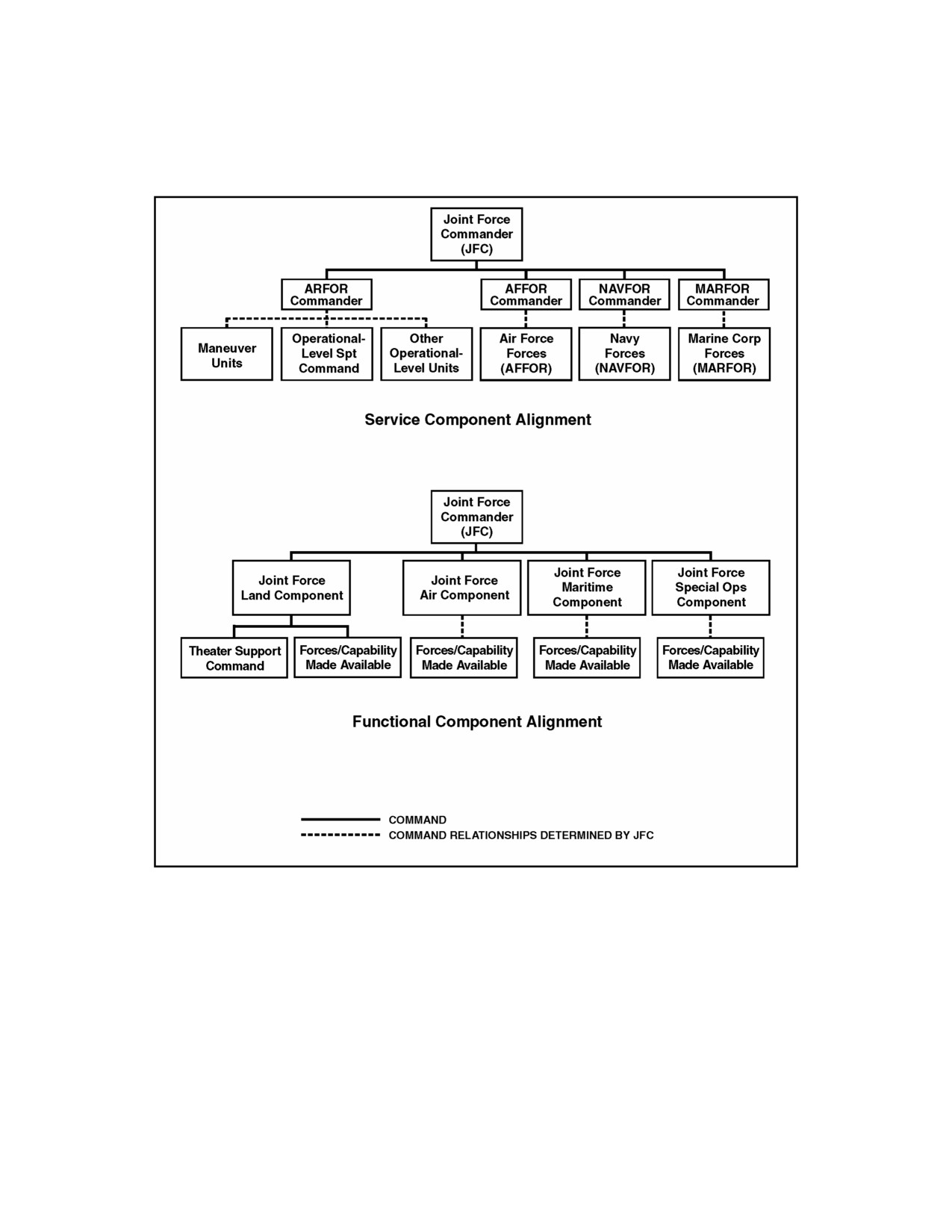
in the singular capacity of a service component commander. The top portion
of Figure 2-2 depicts this arrangement with the TSC commander reporting to
the ARFOR commander if the TSC is the operational-level support command.
The ARFOR commander may also serve in a dual role as the service compo-
nent commander and either the JTF commander or the JFLCC. Figure 2-2
shows possible arrangements with the ARFOR commander as component
commander under the JFC and as the JFLCC.
2-10. The Functional Component Alignment portion of Figure 2-2 does not
show the service component commands (ARFOR, Air Force forces [AFFOR],
Navy forces [NAVFOR], and Marine forces [MARFOR]). However, these ser-
vice component commands are still present and supporting the JFC in their
respective service component roles. In most cases, a service component com-
mander is serving a dual role as a functional component commander. The
service component commanders still exercise the full range of command over
their respective component elements, perhaps less operational control
(OPCON) or tactical control (TACON), as directed by the JFC. The point in
Figure 2-2 is that the TSC remains under the ARFOR commander, while it
may provide lead service CUL support throughout the JOA.
TSC TASK ORGANIZATION
2-11. The discussion below describes the organization of the TSC in terms of
the forces and capabilities allocated to the TSC and the general options for
task organizing the TSC. The discussion envisions two distinct sets of activi-
ties. The first set occurs during predeployment whenever the TSC conducts
planning at its home station in anticipation of deployment/employment. The
ASCC commander determines which forces and capabilities will be under the
direction of the TSC along with the respective command relationships. The
second set occurs during employment whenever the TSC is in an AO and is
performing its mission under the ARFOR commander.
2-4
_________________________________________________________________________________
Chapter 2
Figure 2-2. TSC Relationships
2-12. In predeployment planning, the TSC commander directs his staff to
prepare estimates based on the ASCC commander’s mission guidance for
specified contingency operations. These estimates include a restated TSC
mission with a list of specified and implied tasks the TSC performs. The TSC
staff’s analysis results in a list of recommended forces and capabilities the
TSC requires performing those tasks.
(See JP
3-05.1, CJCSM 3122.01,
CJCSM 3122.03, and FM 5-0 (FM 101-5) for doctrinal staff planning proce-
dures and enumerated tasks.) Each ASCC commander establishes standing
operating procedures (SOP) that govern the sequence of planning and trans-
2-5
________________________________________________________________________
FM 4-93.4 (FM 63-4)
acting of staff products. The relative time available affects each planning
process.
2-13. The ASCC commander approves, with or without modification, the rec-
ommended list of forces and capabilities required supporting the operation
and the appropriate C2 relationships. This determination depends on which
operational-level tasks the ARFOR commander performs directly, and which
he delegates to the TSC commander or some other subordinate commander of
the ARFOR commander. The ASCC commander has complete flexibility in
this regard. Some operational-level CSS and related CS forces may be at-
tached to the TSC, some may be attached less OPCON, and some may re-
main under the ARFOR commander with specified general support (GS) or
direct support (DS) relationships to the TSC. The specific C2 relationships
are always clarified in orders; however, METT-TC analysis guides the spe-
cific arrangement.
2-14. Once the commander determines the forces and capabilities for the
TSC, the TSC commander task organizes the TSC within the limits of the
designated C2 authorities to accomplish the missions assigned by the ASCC
commander. Task organizing the TSC is dynamic in that it accounts for the
sequencing in which capabilities are made available to the ARFOR com-
mander in the AO, as well as aligning forces under the TSC. The TSC does
this by designating the parts of its subordinate units that deploy in each
phase of an operation. Subordinate units deploy in modular elements, as does
the TSC headquarters, to optimize use of strategic transportation and mini-
mize the CSS footprint in the AO. The TSC recommends to the ASCC com-
mander the appropriate time-phased force and deployment data (TPFDD)
based on this task organization. The ASCC commander approves or modifies
the recommended TPFDD for the TSC and submits it to the supported geo-
graphic combatant commander for approval.
2-15. During employment, TSC elements are in the AO and the TSC com-
mander is supporting the ARFOR commander in accordance with the ASCC
commander's plan. The ARFOR commander assesses TSC missions and or-
ganization based on the ground situation, and makes adjustments within the
parameters of the ASCC commander’s intent and guidance. This is a dynamic
process in that the span of control and the support requirements change with
the arrival and departure of each deploying or redeploying unit and with the
tactical-operational situation.
2-16. Section IV below provides more detail on the types of units typically
found in a TSC. Logistics units such as area support groups (ASGs), petro-
leum units, ammunition units, and maintenance units are routinely attached
to the TSC. Other specialized units, such as selected MP units and civil af-
fairs (CA) units, may be attached. However, their specific relationships may
be further qualified as needed depending on the scope of the TSC’s support
responsibility.
2-17. The discussion in the remainder of this section relates mainly to five
Army specialized commands: transportation command (TRANSCOM), per-
sonnel command (PERSCOM), finance command (FINCOM), medical com-
mand (MEDCOM), and engineer command (ENCOM). In organizing the TSC,
the ASCC commander may elect to reduce his span of C2 over these special-
2-6
_________________________________________________________________________________
Chapter 2
ized commands. If he does, he has available to him the three command relation-
ships spelled out in FM 5-0 (FM 101-5) and defined in FM 1-02 (FM 101-5-1)—
attachment, OPCON, and TACON. In brief, these relationships are defined as
follows:
• Attachment is the placement of units in an organization where such
placement is relatively temporary. Subject to limitations imposed by
the attachment order, the commander of the organization receiving the
attachment has the responsibility to provide the attached units with
sustainment support beyond their organic capabilities.
• OPCON is the authority to perform those functions of command over
subordinate forces involving organizing and employing commands and
forces, assigning tasks, designating objectives, and giving authoritative
direction of military operations and joint training necessary to accom-
plish missions assigned to the command. In the Army, a unit OPCON
to a command/unit continues to receive logistics support from its par-
ent unit.
• TACON in the Army allows commanders to apply force and direct the
tactical use of logistics assets but does not provide authority to change
organizational structure or direct administrative and logistical sup-
port. As with the OPCON relationship, the parent unit retains respon-
sibility for logistics support to a unit under the TACON of another
unit.
2-18. FM 5-0 (FM 101-5) defines command as, “…the authority a commander
in military service lawfully exercises over subordinates by virtue of rank and
assignment. Command includes the authority and responsibility for effec-
tively using available resources and for planning the employment of, organiz-
ing, directing, coordinating, and controlling military forces for the
accomplishment of assigned missions.”
2-19. In structuring his operational-level support force, the ARFOR com-
mander retains command of the tailored TSC attached to his command by
the ASCC commander. For the specialized commands, the ASCC commander
has two basic command options. He may designate C2 of those organizations
to the ARFOR commander, or he may delegate it to the TSC using one of the
three options in Army doctrine (i.e., attachment, OPCON, or TACON). Typi-
cally when the ASCC commander decides to delegate command of one or
more of the specialized support commands to the TSC, the most appropriate
of the three relationships is attachment. Among other considerations, at-
tachment includes responsibility for logistics support, while OPCON and
TACON do not. The ARFOR commander may adjust these command rela-
tionships during operations in accordance with ASCC commander's guidance.
2-20. Regardless of the option the ASCC commander chooses for the special-
ized commands, they retain technical linkages with their respective national
provider-level command and ASCC staff principals in order to execute their
ASCC special staff functions. The ASCC commander considers the effect on
these links when specifying the command relationship. He may place any re-
striction on an attachment order that he believes is necessary to facilitate
provision of support.
2-7
________________________________________________________________________
FM 4-93.4 (FM 63-4)
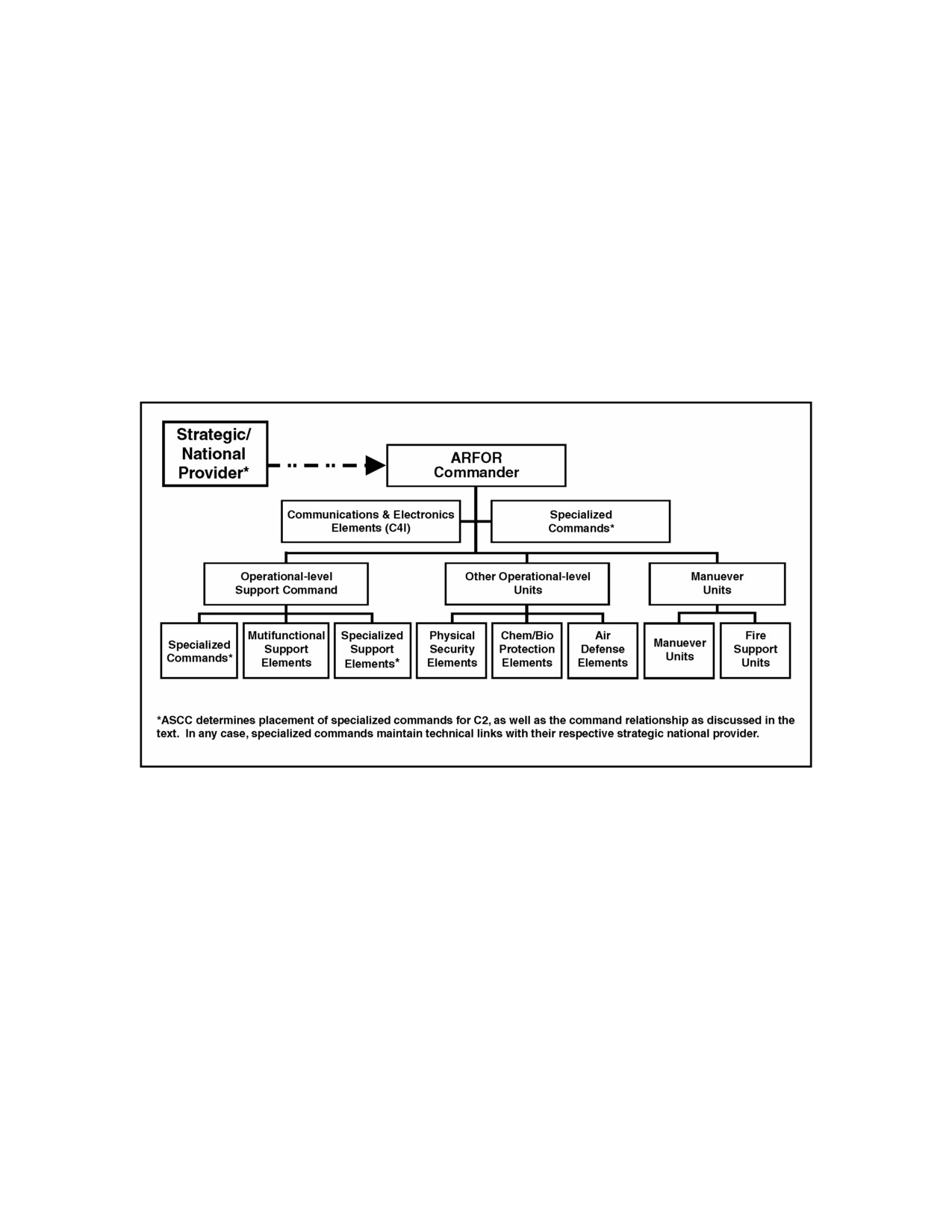
2-21. Figure 2-3 represents a notional ARFOR structure in an AO. The rele-
vant features for TSC are the operational-level support command box and the
specialized commands boxes. The figure indicates that the ARFOR com-
mander has placed forces under the command of an operational-level support
headquarters. The ARFOR commander chooses the most capable support
headquarters to form this command. This headquarters may be a TSC or the
headquarters of the one of the specialized commands, such as the ENCOM or
MEDCOM, in operational situations where those functions carry the main
support effort. Even in situations where the TSC is not the lead support
headquarters, the TSC often deploys selected TSC staff and/or subordinate
units to augment the ARFOR support forces.
Figure 2-3. Notional ARFOR Structure During Operations
2-22. When the ASCC commander chooses not to place the specialized com-
mands under the TSC, there is formal coordination between them for several
reasons. First, the ARFOR commander will likely designate the TSC to pro-
vide DS-level logistics (life support) to elements of the commands operating
in the AOs. In addition, the TSC provides many of the resources that the spe-
cialized commands may need to use to fulfill their missions. This is especially
true in the area of distribution. Even with no formal command relationship, a
specialized command provides a liaison cell to the TSC's support operations
section to help synchronize Army operational-level distribution operations.
Chapter 4 discusses this in more detail.
2-23. If the ARFOR commander attaches a specialized command to the TSC
without further qualification, the TSC commander assumes responsibility for
the specialized command’s operational mission and all other support respon-
sibilities. However, the ARFOR commander may attach the specialized com-
mand to the TSC, but retain OPCON at the ARFOR commander level. In this
2-8
_________________________________________________________________________________
Chapter 2
case, the TSC commander does not have responsibility for the specialized
command’s operational mission. In this attached less OPCON relationship,
the TSC commander retains responsibility for—
• Administration and support.
• Control of resources and equipment.
• Personnel management.
• Logistics support.
• Individual and unit training.
• Readiness reporting.
• Mobilization and demobilization planning and execution.
• Discipline.
2-24. In addition, under this C2 relationship the specialized command posi-
tions its units in accordance with the ARFOR commander's concept of sup-
port and in coordination with the TSC to achieve maximum efficiency in
distribution. The specialized command establishes its mission priorities in
accordance with ARFOR commander guidance.
2-25. The specialized command receives operational mission guidance di-
rectly from the ARFOR staff and/or the national provider-level command. For
example, a PERSCOM attached to a TSC less OPCON receives operational
guidance from the ARFOR commander and his Assistant Chief of Staff, Per-
sonnel (G1), and technical guidance from the DA deputy chief of staff for per-
sonnel; the Headquarters, Department of the Army PERSCOM; and the
adjutant general. Other commands operating under the attached less
OPCON C2 relationship would maintain similar links to the ARFOR staff
and their appropriate national provider-level organization. The ARFOR
commander retains authority to task organize the specialized command, and
the specialized commander retains the authority and responsibility to task
organize his subordinate units. The ARFOR commander, specialized com-
manders, and TSC commander coordinate to ensure that specialized units
are positioned for efficient distribution operations, logistic support, and local
security.
2-26. Though a specialized commander maintains the technical and opera-
tional links described above, all distribution-related support activities are co-
ordinated with the TSC support operations staff. This coordination is
important because the TSC commander is overall responsible for the Army
portion of theater distribution (as discussed in Chapter 5). The support op-
erations section’s distribution management center synchronizes the efforts of
the various CSS and CS organizations that relate to these operations. Spe-
cialized commanders provide coordination cells to the support operations sec-
tion of the TSC to ensure this integration.
2-27. An attached less OPCON relationship may be most suitable when the
ARFOR commander desires direct influence over a specific specialized capa-
bility. An example of this may be in early stages of a force projection opera-
tion or throughout an SSC when the ARFOR commander wants direct C2
over these units.
2-9
________________________________________________________________________
FM 4-93.4 (FM 63-4)
2-28. If the ARFOR commander chooses either to attach a command to the
TSC or to the TSC less OPCON, he may change the C2 relationship later in
the operation as the theater matures. The ARFOR commander, TSC, and
specialized commanders plan such a transition carefully to ensure the new
structure has all the resources required to do its mission while at the same
time making sure the TSC can still synchronize the support functions for
which it is responsible. In a forward presence theater during peacetime and
during operations in which the ASCC is the ARFOR commander, specialized
commands normally remain under the direct C2 of the ASCC.
DESIGN CHARACTERISTICS
2-29. The TSC has a number of characteristics that enhance its ability to
provide or coordinate for support within an AO. These characteristics are ex-
plained below:
•
Unity of command/unity of effort. The TSC can enhance unity of com-
mand for support operations under the ARFOR commander. It can help
synchronize logistics and other support in the AO by having logistics
and other related CSS and CS organizations under a single commander
if the ARFOR commander determines this will enhance support to the
force. Also, the TSC can help synchronize support operations of all the
ARFOR commander’s lead service support responsibilities to the joint
force. Because it is flexible and expandable, the TSC can integrate liai-
son teams from the Air Force, Navy, and Marine Corps into its support
operations structure as required. When the TSC is operating in a mul-
tinational/interagency environment, synchronizing support becomes
more complex. The TSC staff prepares to accommodate multinational
forces’ support operations staff elements and procedures and to employ
support capabilities of multinational forces when authorized to do so by
the ARFOR commander and the JFC. This may require trained sup-
port staff liaison personnel from the multinational forces to assist in
coordinating their procedures with U.S. Army procedures. Similar con-
siderations apply to interagency operations.
•
Battle-rostered positions. Personnel who perform TSC early-entry op-
erations are predesignated on battle rosters. This helps ensure imme-
diate availability and responsiveness when emergencies arise.
•
Use of DOD civilians. Elements from several strategic-level CSS or-
ganizations—such as the U.S. Army Materiel Command (USAMC),
Defense Personnel Support Center (DPSC), and Defense Energy Sup-
port Center (DESC)—may deploy under the command of the TSC or co-
locate with it. Many personnel from these organizations are DOD civil-
ians battle-rostered and trained for operating in overseas locations un-
der adverse conditions.
•
Split-based operations. Split-based operations are defined as opera-
tions that deploy only the required portions of a CSS management or-
ganization to an AO. The remaining personnel and equipment stay
behind and support operations from the home station, relying on mod-
ern communications and automation systems to provide required in-
formation to deployed elements. Split-based operations reduce
strategic-lift requirements and reduce in-theater support require-
ments.
2-10
_________________________________________________________________________________
Chapter 2
•
Modular, expansible, and deployable units. Modularity allows special-
ized support capabilities to match mission requirements. Only those
capabilities for a particular mission deploy to the AO. If the force needs
additional personnel or capabilities later, the commander can deploy
them. Conversely, personnel and equipment no longer required can re-
deploy back to the home station or to other locations.
•
Enhanced strategic/operational interfaces. Positioning cells and per-
sonnel from CONUS-based support organizations within the TSC cre-
ates an efficient interface between the ARFOR and the strategic
support structure. The interface is between deployed elements of the
TSC and the CONUS-based strategic support structures.
•
Enhanced training and transition to war. Having dedicated battle-
rostered personnel allows for realistic training and exercises. Soldiers
and civilians can train in peacetime for missions they will do during
crises. Consequently, the transition from peacetime operations to war
or stability operations or support operations becomes smooth and effec-
tive.
•
Centralized distribution management. A distribution management cen-
ter (DMC) is organic to the TSC. The DMC, discussed in detail in
Chapter 5, provides staff supervision over the TSC materiel manage-
ment center (MMC) and movement control agency (MCA). It also as-
sists in coordinating medical materiel distribution through the medical
logistics management center (MLMC) Chapter 5 describes.
SECTION III - OPERATIONAL-LEVEL COMBAT SERVICE SUPPORT
2-30. JP 4-0 and FM 4-0 (FM 100-10) identify three levels of CSS—strategic,
operational, and tactical. Each level provides critical yet different types of
support. Strategic- and operational-level CSS supports wars, contingencies,
campaigns, and major operations. Tactical CSS supports battles and en-
gagements. This section discusses the role of the TSC in force projection
operations.
2-31. Given the range of responsibilities confronting the ARFOR commander,
it is often necessary to consolidate and delegate selected responsibilities to
subordinate commands. The TSC is uniquely designed to execute many of the
CSS responsibilities for the ARFOR commander. During theater opening, the
TSC focuses primarily on supporting RSO&I. As the AO matures, the TSC
shifts focus to sustaining operations.
DEPLOYMENT
2-32. The ARFOR commander receives deploying forces, stages them, moves
them forward, and integrates them into the theater structure. RSO&I is
critical to successful force projection. RSO&I is complete when deploying
units are determined combat effective by the operational commander. The
ARFOR commander, based on guidance from the geographic combatant
commander/JFC, determines the necessary level of combat effectiveness and
the indices for determining this level. The TSC and other units track the
build-up of the force by providing appropriate reports. The operational
commander retains responsibility to track and report through operational
2-11
________________________________________________________________________
FM 4-93.4 (FM 63-4)
channels the build-up of combat capabilities. FM
4-01.8
(FM 100-17-3)
contains a detailed description of the RSO&I process.
2-33. To meet requirements in this process, the Army developed a modular
concept for opening theaters in which the TSC is a critical component. Modu-
larity involves incrementally deploying only the minimum capabilities re-
quired to an AO. This is the basis of the theater force-opening package
(TFOP) discussed in Chapter 7. The TSC early entry module (EEM) provides
C2 for many of the elements initially conducting RSO&I as directed by the
ARFOR commander.
2-34. Some of the functions that TFOP elements under the TSC C2 EEM
may have to perform include—
• Coordinate with strategic- and operational-level headquarters, such as
the geographic combatant commander/JFC, the ASCC, the ARFOR
headquarters, U.S. Transportation Command (USTRANSCOM), Defense
Logistics Agency (DLA), USAMC, and the U.S. Army Medical Materiel
Agency (USAMMA). (Section IV below contains more detail about the
role of each of these headquarters.)
• Assess and acquire available HN infrastructure capabilities and con-
tracted support.
• Establish the required elements of the Army distribution system (as
directed by the ARFOR commander).
• Coordinate the establishment of required reception capabilities.
• Establish and operate staging areas and or bases.
• Establish and operate supply support areas for staging sustainment
stocks.
EMPLOYMENT
2-35. Though the line between entry and decisive operations may not be
clear-cut, once the ARFOR commander has sufficient forces integrated into
the total force to meet the commander’s requirements, the emphasis for the
TSC shifts from RSO&I support to sustaining the force.
2-36. The ARFOR commander plans and conducts force sustainment opera-
tions throughout the AO. The TSC conducts operational-level force sustain-
ment to support the ARFOR, and tactical-level sustainment to forces
operating in or passing through the TSC’s AO. The TSC may also support
other services, multinational partners, and NGOs and/or OGAs in accordance
with the ARFOR commander’s lead service responsibilities. As the AO devel-
ops, the EEM matures into a TSC, with all required capabilities and other
required commands (as determined by the ARFOR commander).
2-37. The TSC distribution system can provide DS and GS to all designated
forces operating within the rear/sustainment area and to any forces requiring
related sustainment support as they transit the TSC AO. The primary cus-
tomers of tactical-level support in the rear and sustainment area are the ele-
ments of the TSC and any specialized CS and CSS commands in theater.
However, the TSC through the distribution systems may also be involved in
some direct support to tactical forces.
2-12
_________________________________________________________________________________
Chapter 2
2-38. The TSC is also involved in reconstitution either as part of sustaining
decisive operations or as preparing for redeployment. The ARFOR com-
mander plans and directs reconstitution operations. However, the TSC is re-
sponsible for providing support as necessary.
2-39. In a reorganization, the TSC is usually involved only when there is suf-
ficient time for CSS beyond normal sustainment. In such cases, it may sup-
port the reorganizing element through such actions as—
• Increasing logistics assistance through the logistics assistance program
(LAP) portion of USAMC's logistic support element (LSE).
• Providing on-site battle damage assessment (BDA) teams.
• Providing capability for limited depot and limited GS repairing of ex-
changed items.
2-40. The TSC, typically through an area support group/area support battal-
ion (ASG/ASB) is even more involved in regeneration. It usually establishes
the regeneration site and provides most of the CSS elements of the regenera-
tion task force. FM 4-100.9 (FM 100-9) provides details on reconstitution.
2-41. The goal during post conflict and post crisis operations is to attain the
strategic end state. This means transitioning responsibilities to the HN or
designated agency as smoothly as possible and supporting the other elements
of national power. During this time, ARFOR may be conducting such support
operations as handling refugees, decontaminating equipment, or clearing
minefields while preparing for redeployment. Security remains a primary
consideration during this period.
2-42. The TSC continues to provide selected sustainment support to the sup-
ported force during this stage. A key consideration is the continuously chang-
ing nature of the supported force, as well as changing support requirements
as the force changes the nature of its operations. Reliance on contracted sup-
port to provide common supplies and services may increase, thus allowing
Army CS and CSS forces to redeploy back to the home station or to subse-
quent operations in a different AO.
REDEPLOYMENT
2-43. The TSC is actively involved in redeployment in a number of ways. It
may help redeploying units move to assembly areas, and plays a major role in
reconstitution. It also controls the movement of units to the port of embarka-
tion (POE) and provides life support at all nodes in the TSC AO. (FM 3-35.5
[FM 100-17-5] contains more detailed redeployment information.)
2-44. Redeployment starts for forward units when they close into assembly
areas (AAs) and continues at redeployment assembly areas (RAAs) activated
and supported by the TSC. CSS activities are paramount during this period.
Logistics functions include: identifying, separating, and reporting excess
supplies and equipment to the appropriate materiel managers for disposing
or redistributing as appropriate; initiating detailed equipment maintenance
and cleaning; and canceling requisitions. Accounting for personnel and proc-
essing awards are two of the critical personnel activities under the responsi-
bility of the PERSCOM. Combat health support (CHS) is an important factor
throughout the redeployment process under the responsibility of the
2-13
________________________________________________________________________
FM 4-93.4 (FM 63-4)
MEDCOM. Before redeployment, medical screening for clinical signs of dis-
ease and injuries and medical surveillance is required to ensure a fit and
healthy force. If the ARFOR commander assigns the mission to the TSC
commander, the TSC may oversee these administrative activities.
2-45. In all anticipated cases, the TSC receives, identifies, and determines
disposition; maintains accountability; and stores, prepares for shipment, and
arranges for movement of Class I, II, III (packaged), IV, V, VI, VII, and IX
items to the port or designated storage location. Carrying out these functions
may require augmentation from other military elements and/or contractor
personnel. Contracted support may be the preferred solution to support Army
forces leaving the mission area by operating seaports and aerial ports of de-
barkation. This includes operating wash racks and providing life support for
redeploying units. The USAMC LSE or contractors may also repair items in
the theater or send them to designated forward stations or CONUS GS or de-
pot maintenance activities. USAMC's LSE also has major responsibilities for
retrograde of Army pre-positioned stocks (APS) in the theater.
2-46. The TSC staff plans to transfer its responsibilities to another organiza-
tion as the theater draws down. This may be an organization of another ser-
vice or multinational partner, the USAMC LSE, an host nation support
(HNS) organization, or an international agency. Plans are explicit on such
items as—
• Transferring authority.
• Transferring specific functions.
• Providing specific support, including the standard for each service or
good provided.
• Deciding the supported elements.
• Determining how to provide support and under what conditions.
• Determining what, if any, support equipment, supplies, etc. to transfer,
including applicable reimbursement agreements.
SECTION IV - OPERATIONAL-LEVEL SUPPORT ORGANIZATIONS
2-47. Regardless of the support structure put together by the ASCC com-
mander or adjusted by the ARFOR commander, the TSC commander and
staff synchronize TSC operations with all other organizations providing sup-
port in the AO.
NATIONAL STRATEGIC-LEVEL LOGISTICS ELEMENTS
2-48. Strategic logistics embraces national-level sustainment base capabili-
ties. The strategic logistics system supports the broad goals and objectives
that the President and Secretary of Defense establish in national security
policies. The TSC coordinates with elements of strategic-level organizations
to ensure a smooth flow of support into and throughout the theater. In almost
all operations, elements of the strategic organizations deploy to the theater to
enhance this coordination. Some of these elements, such as the USAMC LSE
and the DLA contingency support team (DCST), may be attached to, or work
2-14
_________________________________________________________________________________
Chapter 2
closely with, the TSC. (The DCST is a joint element and is not attached to a
service component headquarters.)
U.S. ARMY MATERIEL COMMAND (USAMC)
2-49. The LSE is the U.S. Army Materiel Command’s (USAMC’s) primary
organization for providing Army strategic-level support in actual operations.
It is a flexible, modular, table of distribution and allowances (TDA) organiza-
tion that provides strategic-level logistic support and is staffed with active
and reserve component soldiers, DA civilians, and contractors. It can also
provide a wide range of construction and engineering-related services using
the Logistics Civil Augmentation Program (LOGCAP) support contract. The
LSE is rapidly deployable, and its structure adapts to changing requirements
and capabilities of deployed organizations. It has a small peacetime cadre
that deploys at the request of the ASCC commander. The LSE oversees all
USAMC operations in the theater. Its elements retain technical lines to the
USAMC major commands. It can be attached to the TSC or operate inde-
pendently as the single, operational-level support command headquarters
under the ARFOR commander in lieu of the TSC in SSCs where there are
limited Army operational-level and joint CUL support requirements. An LSE
functioning as the single, operational-level support command may be particu-
larly appropriate during the late redeployment stage of an operation. When
this occurs, TSC planners plan for this potential transfer of authority and de-
fine the specific responsibilities, by phase, in detail. FM 4-93.41 (FM 63-11)
details operations of the LSE.
DEFENSE LOGISTICS AGENCY
2-50. The Defense Logistics Agency (DLA) is DOD's strategic logistics pro-
vider. DLA supports each geographic combatant commander with a DCST as
its focal point for coordinating DLA activities in an AO, as it enhances stra-
tegic and operational linkages. It integrates materiel management support of
DLA common commodities such as subsistence, clothing and other general
supplies, package/bulk petroleum, and medical materiel. The DCST also pro-
vides contract administration services and support through attached ele-
ments of Defense Contract Management Agency
(DCMA). DCMA is a
separate operating agency under DOD; however, its representatives work
through the DCST when supporting contingency operations.
2-51. The DCST may co-locate with the TSC DMC. DLA is responsible for
providing a variety of logistics, acquisition, and technical services to the mili-
tary services. These services include inventory management, procurement,
warehousing, and distribution for all classes of supply (except Classes V, VI,
and VII); administration of all military service weapon systems acquisition
contracts; and reutilization of surplus military materiel. In general, DLA
eliminates logistical redundancy within the services and standardizes com-
mon supplies.
2-52. DCMA manages contracts awarded by all DOD components and other
designated federal and state agencies, and foreign governments. DCMA is re-
sponsible for assuring that procured materiel is satisfactory and delivered
when and where needed. The services performed by DCMA include—
2-15
________________________________________________________________________
FM 4-93.4 (FM 63-4)
• Contract management.
• Pre-award survey.
• Quality assurance.
• Contractor payment.
• Support to small business and labor surplus areas.
• Transportation and packaging assistance.
2-53. In the AO, DLA provides reutilization and marketing services. It estab-
lishes theater-specific procedures for the reuse, demilitarization, or disposal
of facilities, equipment, and supplies, to include HAZMAT and waste. Ini-
tially, salvage and excess materiel destined for the Defense Reutilization and
Marketing Service (DRMS) is collected in the corps and division areas as the
situation permits. As the theater matures, DLA evacuates this materiel to
collection points for inspection, classification, and disposal by DLA-directed
activities. The TSC MMC coordinates DRMS operations for the ARFOR to
ensure that usable materiel is not disposed of or evacuated from the theater.
U.S. TRANSPORTATION COMMAND
2-54. The U.S. Transportation Command (USTRANSCOM) is a functionally
aligned combatant command responsible for providing and managing strate-
gic common-user airlift, sealift, and terminal services worldwide.
USTRANSCOM supports the geographic combatant command with interna-
tional cargo booking, and intertheater movements. Either USTRANSCOM or
the geographic combatant command may provide materiel handling equip-
ment and services. However, USTRANSCOM assets do not support intrat-
heater operations unless released by the USTRANSCOM commander-in-
chief.
2-55. USTRANSCOM's major subordinate commands include: Air Mobility
Command (AMC) for airlift, Military Sealift Command (MSC) for sealift, and
the U.S. Army's Military Traffic Management Command (MTMC) for termi-
nal services worldwide. The TSC establishes a link with USTRANSCOM,
normally through AMC and/or MTMC, to ensure it has visibility over re-
sources en route to the theater. The TSC works most closely with MTMC and
AMC to coordinate seaport and aerial port operations respectively. Details on
USTRANSCOM are in JP 4-01.
Military Sealift Command
2-56. The Military Sealift Command (MSC) is the sea transportation compo-
nent of DOD’s USTRANSCOM. The mission of the MSC is to provide ocean
transportation of equipment, fuel, supplies, and ammunition to sustain U.S.
forces worldwide during peacetime and in war for as long as operational re-
quirements dictate. The U.S. Coast Guard (USCG) works with the naval
component commander (NCC) to provide waterside physical security. This
includes security of harbors, channels, approaches, and vessels that are in
these areas. The USCG physical security plan is integrated with the port
commander's physical security plan for developing and maintaining compre-
hensive physical security and antiterrorist plans.
2-16
_________________________________________________________________________________
Chapter 2
Military Traffic Management Command
2-57. The Military Traffic Management Command (MTMC) is the surface
transportation component of DOD's USTRANSCOM and is DOD's single port
manager at the seaport of embarkation (SPOE) and the seaport of debarka-
tion (SPOD). Deploying units receive their port call instructions from MTMC.
The port call message identifies what date the unit arrives at the SPOE for
movement processing. MTMC schedules units to arrive at the SPOE in suffi-
cient time to allow processing and loading to meet vessel sailing schedules.
The Army’s operational-level transportation command coordinates specific
movement details with MTMC. The TSC support operations staff stays in-
formed of this coordination. In most cases, the TSC has supervisory responsi-
bility over attached elements from the Army-level TRANSCOM.
(See
TRANSCOM under specialized commands below.) MTMC performs many
functions to support the geographic combatant commander. The FM 3-35
(FM 100-17) series explains these functions in more detail.
2-58. MTMC’s port manager may also be referred to as the port commander.
The MTMC port manager directs the workload of the port operator. The port
operator is responsible for loading and off-loading vessels at the port. The
port operator may be a subordinate MTMC element or an ARFOR element
placed OPCON to the port manager. In the latter case, this ARFOR element
could be comprised of elements of an ASG under the TSC, or elements from
the Army-level TRANSCOM. MTMC can also contract for all or part of the
port operator function.
2-59. The port support activity (PSA) is a critical part of all port operations
and TSC planners coordinate these requirements with MTMC in preparing
for port operations. The PSA is a temporary military augmentation organiza-
tion comprised of personnel with specific skills that aid the port manager in
receiving, processing, and clearing cargo at the port, SPOE, or SPOD. The
MTMC port manager determines the required composition of the PSA and
coordinates the necessary capabilities. Again, the assets for the PSA may
come from MTMC, ARFOR, or contract sources, or a combination of these.
The PSA works directly for the port operator, who reports to the port man-
ager. The size and composition of the PSA varies according to METT-TC.
However, the PSA always needs four basic elements: a command element
(such as a company or battalion headquarters), a movements element (driv-
ers to move cargo and vehicles from the vessel to the marshaling area), a
maintenance element (to ensure operability of materiel handling equipment
and recovery vehicles). and a security element (to provide port-side security).
Air Mobility Command
2-60. The Air Mobility Command (AMC) is the airlift component of the
USTRANSCOM and serves as the single manager for air mobility. AMC air-
craft provide the capability to deploy the Army’s armed forces anywhere in
the world and help sustain them in a conflict. This includes air refueling of
Air Force, Navy, Marine Corps, and many allied aircraft, when required. Re-
fuelers also have an inherent cargo-carrying capability, which maximizes
AMC’s lift options.
2-17
________________________________________________________________________
FM 4-93.4 (FM 63-4)
2-61. The TSC interacts with AMC elements primarily at aerial ports of
embarkation and debarkation (APOE/APOD). The APOD is a joint facility
and is likely a multinational facility. It is a port of debarkation (POD) for
deploying forces and a POE for forces moving to other theaters and for
noncombatant evacuation. The HN may limit the APOD to military use or
the military may share the facility with commercial activities. The military
often competes for the use of the APOD with other governmental and
nongovernmental agencies. The APOD serves as the primary port of entry for
all deploying personnel, as well as for early-entry forces airlifted into the
theater together with their equipment.
2-62. The AFFOR and ARFOR share the responsibility for APOD operations.
The Army arrival/departure airfield control group (A/DACG) and port move-
ment control detachments are responsible for clearing personnel and cargo
and for life support as required. An Army cargo transfer company (CTC) is
normally assigned the A/DACG mission. The Air Force tanker airlift control
element (TALCE) operates the airfield. It is responsible for ramp operations,
aircraft parking, and supervising off-load operations. The TALCE releases
planeloads to the A/DACG for airfield clearance. Security at the airport is
also coordinated between the Army and the Air Force. In most cases, the Air
Force secures the immediate base area, but Army forces have responsibility
beyond the immediate perimeter and for air defense. These responsibilities
are closely coordinated between the ARFOR commander and AFFOR com-
mander.
SPECIALIZED COMMANDS
2-63. The role of the specialized commands remains essentially the same re-
gardless of what command relationship the ARFOR commander chooses. The
specialized commands provide the expertise to manage specialized skills es-
sential to supporting forces in the theater. They provide policy and technical
support to all of their respective specialized units in the AO. Their expertise
in the area of support leads to a natural interface with the TSC in one form
or another. In general, the specialized commands work with the TSC support
operations section. FM 3-93 (FM 100-7) discusses organizations other than
these commands that may provide this operational-level CSS.
TRANSPORTATION COMMAND
2-64. The transportation command
(TRANSCOM), through subordinate
transportation units, provides transportation support to operational-level
Army, joint, and multinational commands and other theater-level elements
as directed by the ARFOR commander. The command maintains a technical
relationship with the G4 transportation officer of the ARFOR commander
headquarters to assist in establishing transportation policy for the theater.
2-65. When attached to the TSC, the TRANSCOM supervises the prepara-
tion and coordination of the transportation portion of TSC support plans. The
TRANSCOM also provides transportation input to other theater support
plans as directed. It provides staff supervision over all operational-level
Army transportation units. If not attached to the TSC, the TRANSCOM still
works closely with the TSC support operations section to maintain the effi-
2-18
_________________________________________________________________________________
Chapter 2
ciency of the distribution system. It also works closely with the MP for traffic
management functions and the ENCOM for operational mobility.
2-66. The Army-level TRANSCOM facilitates Army use of inter- and intra-
theater air movement by identifying A/DACG requirements and coordinating
air support with the A/DACG, MCA, and DMC. It also identifies rail move-
ment requirements and the availability of rail assets. It coordinates rail sup-
port with the support operations section/DMC and the MCA, as well as the
HNS and contracting directorates.
2-67. The command is also responsible for coordinating terminal support
with MTMC. It identifies the capabilities and availability of TRANSCOM,
TSC, HN, and other cargo-handling personnel, equipment, and facilities. It
coordinates requirements, acquisition, and resources with USTRANSCOM
elements, as well as the HNS and contracting directorates of the TSC support
operations section. In multinational operations, allied forces conduct port op-
erations simultaneously. The TRANSCOM coordinates with the ARFOR staff
and other nations to resolve allocation problems in such areas as berthing
space and storage areas.
2-68. Emerging doctrine and structure for the TRANSCOM will make it
more modular in order to support multiple, simultaneous contingencies un-
der the TSC structure. FM 4-01 (FM 55-1) provides additional information on
transportation services in the theater.
MEDICAL COMMAND
2-69. The medical command (MEDCOM) directs CHS to all operational-level
Army medical elements in the AO. When the Army is the lead service for
medical support, it also supports joint and multinational commands and
other elements under the guidance of the ARFOR surgeon. The ARFOR sur-
geon provides policy and technical guidance to the MEDCOM and all Army
medical units in the theater. The MEDCOM maintains a technical relation-
ship with the ARFOR's staff surgeon to assist in establishing medical policy
for the theater. It also maintains technical linkages to various medical sup-
port activities at the strategic level.
2-70. The MEDCOM is responsible for developing plans, procedures, and
programs for CHS in the AO to include patient evacuation, patient care and
movement, hospitalization, stress control, preventive medicine services, den-
tal services, veterinary services, and labo-
ratory services. The Army’s MEDCOM
Emerging Doctrine:
supports the JFC surgeon’s joint patient
The Army’s theater TRANSCOM
is
movement requirements center in
pending a reorganization that estab-
accordance with lead service directives. It
lishes subordinate transportation com-
provides staff planning, staff supervision,
mand elements
(TCEs). One TCE
training, and administrative support of
supports each theater of operations and
Army medical brigades engaged in
combines the functions of mode opera-
operational-level medical support. It
tions and movement control. Under this
provides
combat health logistics,
model, TSC staff interact with a single
including medical requirements determi-
TCE rather than the separate elements
nation and medical supply control. If only
of a TRANSCOM and an MCA.
a module of the MEDCOM deploys, the
2-19
________________________________________________________________________
FM 4-93.4 (FM 63-4)
commander of the MEDCOM (forward) is the deputy commanding general
(CG) rostered from the MEDCOM.
2-71. The MEDCOM EEM provides the following capabilities: C2 of medical
subordinate organizations; technical and clinical supervision and assistance;
lead service responsibility for veterinary services as required, as well as for
Class VIII and blood product management; medical planning, operations, and
regulating services; preventive medicine; and information management ser-
vices. The MEDCOM specialized module, along with the EEM functions it
has subsumed, provides the following capabilities to the theater:
• C2 of medical units.
• Medical personnel assignment and the Professional Officer Filler Sys-
tems (PROFIS) coordination.
• Patient evacuation coordination.
• HN medical support coordination.
• Telemedicine services.
• Contracting for medical services.
• Geneva and Hague Conventions advice and staff legal assistance for
medical services.
• Lead service support for Class VIII and blood products management as
required.
• Theater-wide CHS operations planning and theater medical intelli-
gence services.
2-72. The command monitors the flow of Class VIII supplies and makes nec-
essary adjustments in coordination with the TSC support operations sec-
tion/DMC, the ARFOR commander G4, and the MLMC. It directs relocation
of stocks and medical equipment if necessary.
2-73. The MEDCOM also coordinates medical regulation operations with the
medical regulating office and the joint theater patient movement require-
ment center, as well as the TSC support operations section/DMC and the
MCA. It tracks medical treatment facility locations, capabilities, and work-
loads to plan and manage medical regulating, evacuation, and mass casualty
operations.
2-74. Among the other services planned and coordinated by the MEDCOM in
coordination with the ARFOR staff surgeon and the TSC support operations
section/DMC are—
• Preventive medicine operations.
• Medical professional service.
• Dental service support operations.
• Nursing support services.
• Veterinary services.
FM 4-02 (FM 8-10), FM 4-02.42 (FM 8-42), and FM 4-02.55 (FM 8-55) provide
guidance and crucial planning resources to assist MEDCOM personnel and
other staff elements.
2-20
_________________________________________________________________________________
Chapter 2
PERSONNEL COMMAND
2-75. The theater personnel command (PERSCOM) maintains and reports
the personnel readiness of Army forces, conducts strategic replacement op-
erations necessary to man Army forces, and provides human resources sup-
port. It exercises command over assigned and attached operational-level
personnel units. The PERSCOM may directly command Army replacement
battalions, personnel services battalions, a personnel detachment, postal
companies, a band, and DS replacement companies.
2-76. A key specific function of the PERSCOM is establishing the ARFOR
theater replacement system in coordination with the Army human resources
national provider and the ARFOR G1. It coordinates support, including life
support and transportation, for replacements with the TSC support opera-
tions section/DMC. It also integrates return-to-duty soldiers into the re-
placement system. Some other critical functions of the PERSCOM include—
• Estimating casualties and forecasting personnel requirements.
• Preparing strength-management data.
• Determining allocation of replacements in accordance with ARFOR
commander priorities.
• Managing the casualty reporting system.
• Managing the Army's theater postal system in coordination with the
joint postal manager and the TSC support operations section/DMC.
• Managing the Army's theater replacement operations in coordination
with the TSC support operations section/DMC.
• Managing the ARFOR personnel database.
FM 1-0 (FM 12-6) provides detailed information concerning personnel
operations.
FINANCE COMMAND
2-77. The finance command (FINCOM) performs operational-level finance
operations. The FINCOM provides finance support to all Army forces and to
joint and multinational commands in accordance with lead service responsi-
bilities. It provides technical guidance to all Army finance units in theater. In
conjunction with the ARFOR deputy chief of staff for resource management
(DCSRM), the FINCOM provides staff advice on all financial management
matters and provides financial management policies and procedures for all
Army financial management activities within theater.
2-78. Whether assigned directly to the ARFOR commander or attached to the
TSC, the FINCOM commander is responsible for those operational tasks that
support the theater. The FINCOM commander commands and controls all
Army finance groups and separate finance battalions, and provides technical
guidance over all Army finance units within the AO. The FINCOM maintains
technical relationships with the Defense Finance and Accounting Service
(DFAS), the Assistant Secretary of the Army for Financial Management and
Comptroller (ASA [FM&C]), and the ARFOR DSCRM. As required, the
FINCOM recommends when and which finance functions to perform, retro-
grade, or transfer to a designated finance support activity. The FINCOM
2-21
________________________________________________________________________
FM 4-93.4 (FM 63-4)
commander may have certain lead service support responsibilities. These
may include policy, overall direction, and coordination of strategic and opera-
tional finance and accounting tasks that pertain to other service components.
They may also include central funding support to all U.S. and allied organi-
zations and operations in the AO. All lead service support responsibilities are
conducted in accordance with U.S. fiscal law and applicable international
agreements.
2-79. Some of the battlefield functions of the FINCOM include—
• Establishing central funding operations in the theater and maintain-
ing appropriate records related to all disbursements within the thea-
ter.
• Controlling allied forces cash advances, including validation of re-
quirements and preparing support agreements.
• Processing commercial account transactions to support local procure-
ments.
• Conducting internal control operations.
• Providing foreign pay services (when augmented) in coordination with
the ARFOR commander/TSC Assistant Chief of Staff, Personnel (G1)
and Assistant Chief of Staff, Civil Affairs (G5).
• Providing civilian pay services (when augmented) in coordination with
the designated finance support activity.
• Managing appropriated and non-appropriated fund activities (when
augmented) in coordination with the PERSCOM, the TSC support op-
erations contracting directorate, and the designated finance support
activity.
FM 1-06 (FM 14-100) and JP 1-06 provide details on financial management
operations.
ENGINEER COMMAND
2-80. Theater infrastructure development is a primary concern of the engi-
neer command (ENCOM). The ENCOM is responsible for developing plans,
procedures, and programs for engineer support for the ARFOR commander,
including requirements determination, mobility, countermobility, general
engineering, area damage control, military construction, topography,
engineering design, construction materiel, and maintenance and repair of
real property. Engineer units are responsible for infrastructure planning,
development, construction, and maintenance. The ENCOM receives policy
guidance from the ARFOR engineer.
2-81. Typical operational-level engineer missions include the following:
• Planning, designing, constructing, or rehabilitating—
Airfields, ports, pipelines, bridges, roads, railroads, and inland wa-
terways, etc.
Hospitals, base camps, EPW and civilian internee compounds, bulk
petroleum storage and distribution systems, dry cargo and ammu-
nition storage areas, and equipment maintenance facilities.
2-22
_________________________________________________________________________________
Chapter 2
Missile sites, air defense emplacements, protective shelters, and lo-
cal security measures.
• Performing emergency runway repairs that exceed AFFOR capabili-
ties.
• Conducting rear area and base security missions, to include area dam-
age control (ADC).
• Augmenting ASG real property maintenance activities (RPMA) capa-
bilities.
• Providing topographic and military geographic intelligence support.
• Maintaining critical lines of communication (LOCs).
• Managing HN and contracted engineering efforts.
• Providing fire-fighting support as specified by the field commander.
• Providing environmental support.
2-82. The headquarters element of the ENCOM provides staff supervision
over operational-level engineer operations in the AO and directs engineer
support to all Army forces. The ENCOM may also support joint and multina-
tional commands and other elements in accordance with lead service respon-
sibilities as directed by the ARFOR commander. It provides policy and
technical guidance to all Army engineer units in the AO. This headquarters
element maintains a technical relationship with the ARFOR staff engineer to
help establish engineer policy for the theater, and it maintains required co-
ordination links with other service and multinational command engineering
staffs.
2-83. Several of the critical specific functions of the ENCOM headquarters
include—
• Monitoring engineer support for real property management. It consoli-
dates reports from engineer organizations and coordinates additional
support with the TSC support operations HNS and contracting direc-
torates.
• Monitoring requirements and priorities for Class IV and engineer
Class V materiel, and coordinating the flow of this materiel with the
TSC supply and maintenance directorate, the DMC, and MMC.
• Performing the engineer battlefield assessment. It coordinates with the
ARFOR engineer and Assistant Chief of Staff, Intelligence (G2) as well
as the TSC support operations section to communicate critical enemy
capabilities affecting support facilities and operations.
FM 3-34 (FM 5-100) and FM 3-34.211 (FM 5-116) provide details on engineer
operations in an AO.
SPECIALIZED SUBORDINATE ORGANIZATIONS
2-84. This section discusses specialized organizations routinely assigned or
attached to the TSC. In some cases, specialized organizations of battalion
size or smaller assigned or attached to a TSC may be further assigned or at-
tached to an ASG. Others may be separate organizations under the TSC.
This discussion briefly covers basic capabilities of principal organizations
2-23
________________________________________________________________________
FM 4-93.4 (FM 63-4)
that may be attached to the TSC. As discussed, operational-level specialized
commands may also be attached to the TSC.
AMMUNITION GROUP AND AMMUNITION BATTALIONS
2-85. The ammunition group consists of conventional ammunition units.
When established in theater, the ammunition group provides DS ammunition
support to units in its AO. Ammunition support includes supplying and
maintaining conventional ammunition and supplying ammunition-peculiar
repair parts.
2-86. When the TSC and its subordinate elements, including the ammunition
group and its battalions, are operating in joint and multinational environ-
ments their missions and functions become more complex. FM
4-30.13
(FM 9-13) describes the safety; field storage; issue, receipt, shipment and
turn-in; maintenance, inspection and surveillance; and destruction proce-
dures for ammunition. These requirements do not change when handling
joint or multinational forces ammunition. However, reporting and account-
ability procedures are affected. The TSC and the ammunition group staffs in-
corporate appropriate mechanisms into their plans to accommodate joint or
multinational ammunition. This may require trained ammunition liaison
personnel from the joint or multinational forces to provide assistance in in-
terfacing their procedures with U.S. Army procedures.
2-87. The conventional ammunition ordnance battalion may be attached to
the ASG to establish and operate ammunition supply facilities on an area ba-
sis. This battalion may serve as the theater-level ammunition unit. It may
also be assigned or attached to an ammunition group. The number of ammu-
nition units attached to the battalion depends on the—
• Tactical situation.
• Requirements.
• Theater stockage objectives.
• Existing HNS organization.
• Transportation assets and effectiveness of throughput.
• Type and density of weapons supported.
• Projected intensity of battle and ammunition consumption rates.
2-88. An ammunition battalion headquarters and headquarters company
(HHC) is allocated for each two to five companies commanded. Allocating
ammunition companies depends on the—
• Number of lifts needed to move the required ammunition tonnage from
the time of its arrival in the area until its issue.
• Estimated percentage of ammunition tonnage that can be throughput.
Refer to FM 4-30.1 (FM 9-6) for more information on ammunition operations.
ORDNANCE GROUP (EXPLOSIVE ORDNANCE DISPOSAL)
2-89. Army explosive ordnance disposal (EOD) provides the capability to
neutralize hazards from conventional unexploded ordnance (UXO), nuclear,
biological, chemical (NBC) and associated materiel, and improvised explosive
2-24
_________________________________________________________________________________
Chapter 2
devices (IEDs) (both explosive and NBC) that present a threat to operations,
installations, personnel and/or materiel. Army EOD forces also dispose of
hazardous foreign or U.S. ammunition, UXO, individual mines, booby-
trapped mines, and chemical mines. Routine clearing and rapid breaching of
foreign or U.S. minefields are the responsibility of the Army engineers. As
part of the combat arms team, EOD provides the force projection Army with
a rapidly deployable support package for eliminating hazards from UXO in
any operational environment. Army EOD forces equip, train, and organize to
support tactical land forces across the spectrum of operations.
2-90. Army EOD forces can support the geographical combatant commanders
in two simultaneous MTWs. The Army allocates each MTW one EOD ord-
nance group at ASCC level. The EOD group has three EOD battalions. An
EOD battalion supports Army forces at the ARFOR, corps, or division level.
The EOD group and battalion EOD ordnance companies are at specified loca-
tions that best support the commander.
2-91. The EOD ordnance group headquarters operationally commands and
controls all Army EOD assets and operations in theater. The EOD ordnance
battalion commands up to ten EOD ordnance companies. The EOD battalion
headquarters tasks, acquires and manages technical intelligence for, and pro-
vides limited administrative and logistical support to explosive ordnance
companies or smaller elements. EOD battalions may deploy as the senior
command element for Army EOD operations in a given operation. Ordnance
companies remain under the OPCON of their parent EOD battalion. Ord-
nance companies provide GS on an area basis or general support-reinforcing
(GS-R) to specified elements. The geographic combatant commander's plan-
ning staff develops the theater-level concept of EOD support. The
ASCC/ARFOR staff planning staff tailors EOD forces to support specified op-
erations down to a brigade combat team. Responsibilities of EOD command-
ers at all levels include—
• Recommending policy and distributing EOD assets.
• Monitoring EOD support missions and establishing workload priori-
ties.
• Serving as point of contact (POC) for technical intelligence coordination.
• Coordinating GS and GS-R EOD support.
• Ensuring each EOD unit establishes provisions for communications at
each level to support EOD operations.
• Supplementing other theater force protection procedures to meet the
existing threat.
• Coordinating administrative and logistics support, as required, from
the supported command(s).
2-92. The EOD group and EOD battalion staffs plan for Army EOD opera-
tions throughout their AO. Thus, the EOD group commander serves as the
EOD special staff officer to the ARFOR commander, JFLCC, and multina-
tional JFLCC. The EOD battalion commander serves as the EOD special
staff officer at the corps, JTF, and multinational JTF levels. In the absence of
a deployed EOD ordnance group or EOD ordnance battalion, the senior-
ranking Army EOD officer also serves as the EOD staff officer for the
2-25
///////////////////////////////////////