FM 4-01.41 ARMY RAIL OPERATIONS (DECEMBER 2003) - page 5
FM 4-01.41 ______________________________________________________________________________________Chapter 9
separately, or in any one of several ways. Quick, emergency lifts can be made by inserting chains or
cable slings through the side frame openings.
Cars
9-72. When lifting a car for rerailing, cables may be placed around the body of a solid top car and
underneath the trucks. Using this sling arrangement or a sling with an adjustable spreader bar gives
more stability to the lift. This arrangement is also preferable to the coupler hitch. To prevent
crushing the body of the car, gondolas or hoppers must be braced at the top. Bracing may also be
required for solid top cars. A crosstie cut to the proper length may also be used as a brace. Most
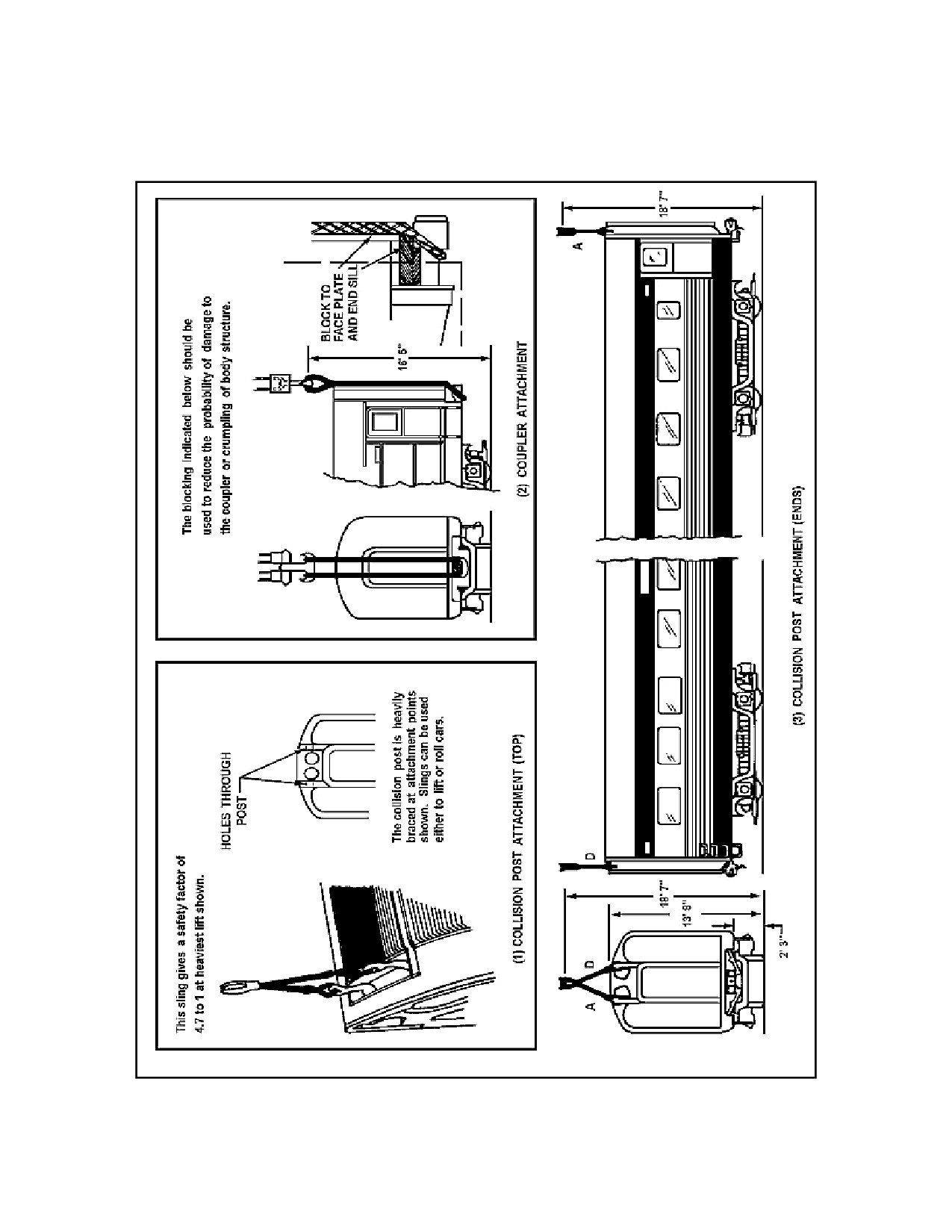
modern passenger cars have holes through the heavily braced collision posts at each end. These holes
permit the use of hooks or slings for lifting. The use of slings for coupler lifts and method of
blocking the coupler are shown in Figure 9-12. Because of the weight and construction of ambulance
unit cars, coupler lifts are not used. Jacking pads and lift lugs are used in lifting the car.
9-26
FM 4-01.41 ______________________________________________________________________________________Chapter 9
Figure 9-12. Method of Lifting Passenger Cars
9-27
FM 4-01.41 ______________________________________________________________________________________Chapter 9
LOCOMOTIVE LIFTS
9-73. Due to their weight, rerailing a diesel-electric or steam locomotive requires heavier and more
careful rigging than that used for cars. Small locomotives may be lifted by a one-wreck crane using a
spreader bar rig. Larger and heavier locomotives may require the use of two or three cranes.
Depending on the type of truck and locomotive involved, removing the trucks of diesel-electric
locomotives may decrease the lift required by 40 to 50 tons. When it is necessary to roll or lift a
locomotive that is some distance from the track and beyond the reach of the crane rope, extensions
should be fastened with suitable connectors. These should be of the same size and quality as the
crane cable.
9-74. There are two principal types of diesel-electric locomotives in the Army-owned fleet. For wreck
recovery planning, the weights of typical diesel-electric and steam locomotives in the Army fleet are
shown in Chapter 8.
Lifting and Rolling
9-75. Two cranes, one at each end, should be used to roll a locomotive. Although a single crane large
enough to handle the actual load and slings could be provided, an attempt to lift both ends at the
same time could result in buckling the frame and crumpling the body structure.
Blocking
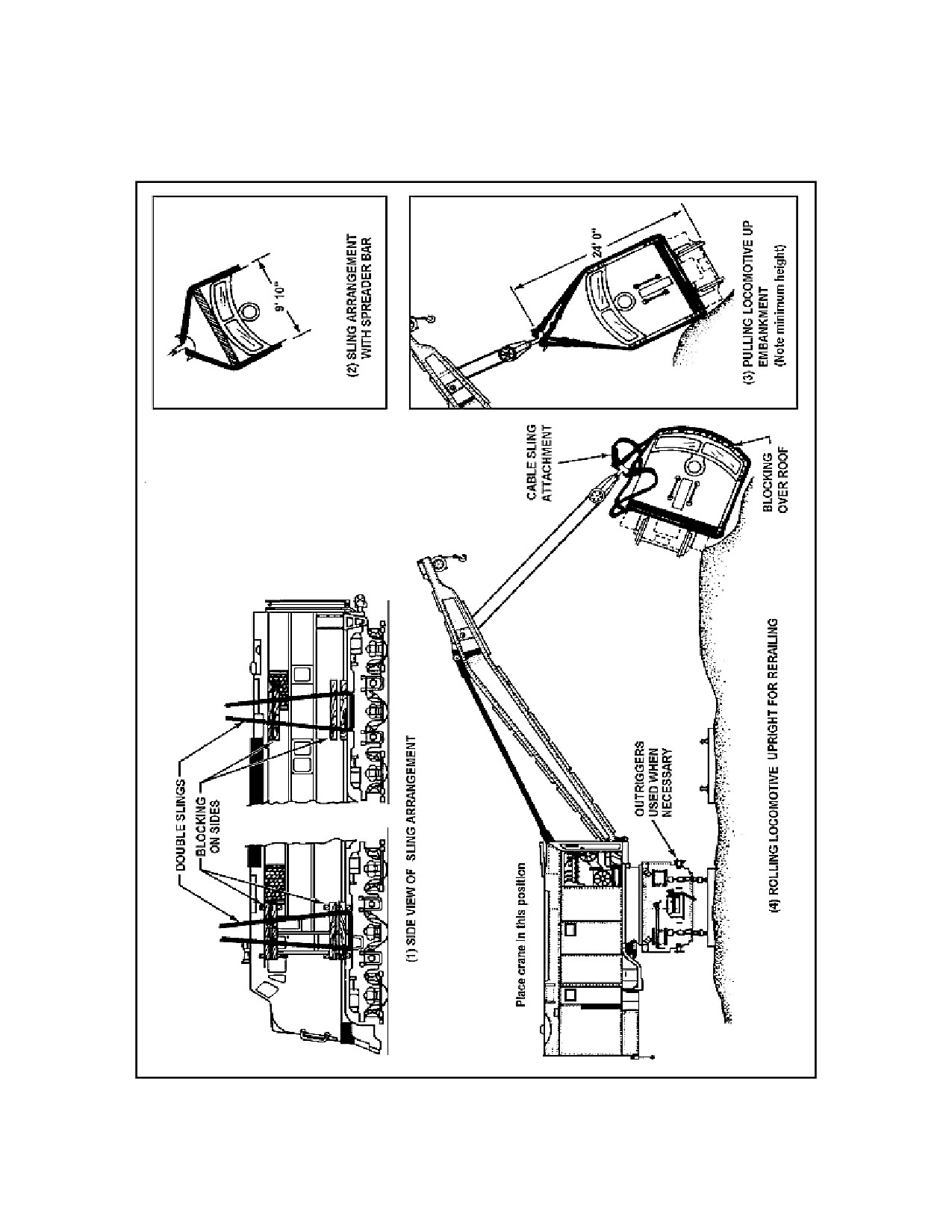
9-76. The body structure of a locomotive is heaviest directly over the bolsters. The load of the rolling
operation can be carried best at these points. Adequate blocking is necessary to distribute the load.
The amount of blocking necessary depends on the amount of roll required. If the locomotive is on
its side and the cranes are pulling at a considerable angle, the entire top of the locomotive must be
blocked to reduce damage (Figure 9-13, view 2). The major pull will be on this part of the structure
during the initial rolling operation. As the locomotive approaches an upright position and the crane
lift becomes more vertical, side blocking (shown in Figure 9-13, view 1) becomes more important.
9-28
FM 4-01.41 ______________________________________________________________________________________Chapter 9
Figure 9-13. Method of Rolling Diesel-Electric Locomotive Upright--Single Crane
9-29
FM 4-01.41 ______________________________________________________________________________________Chapter 9
Rolling
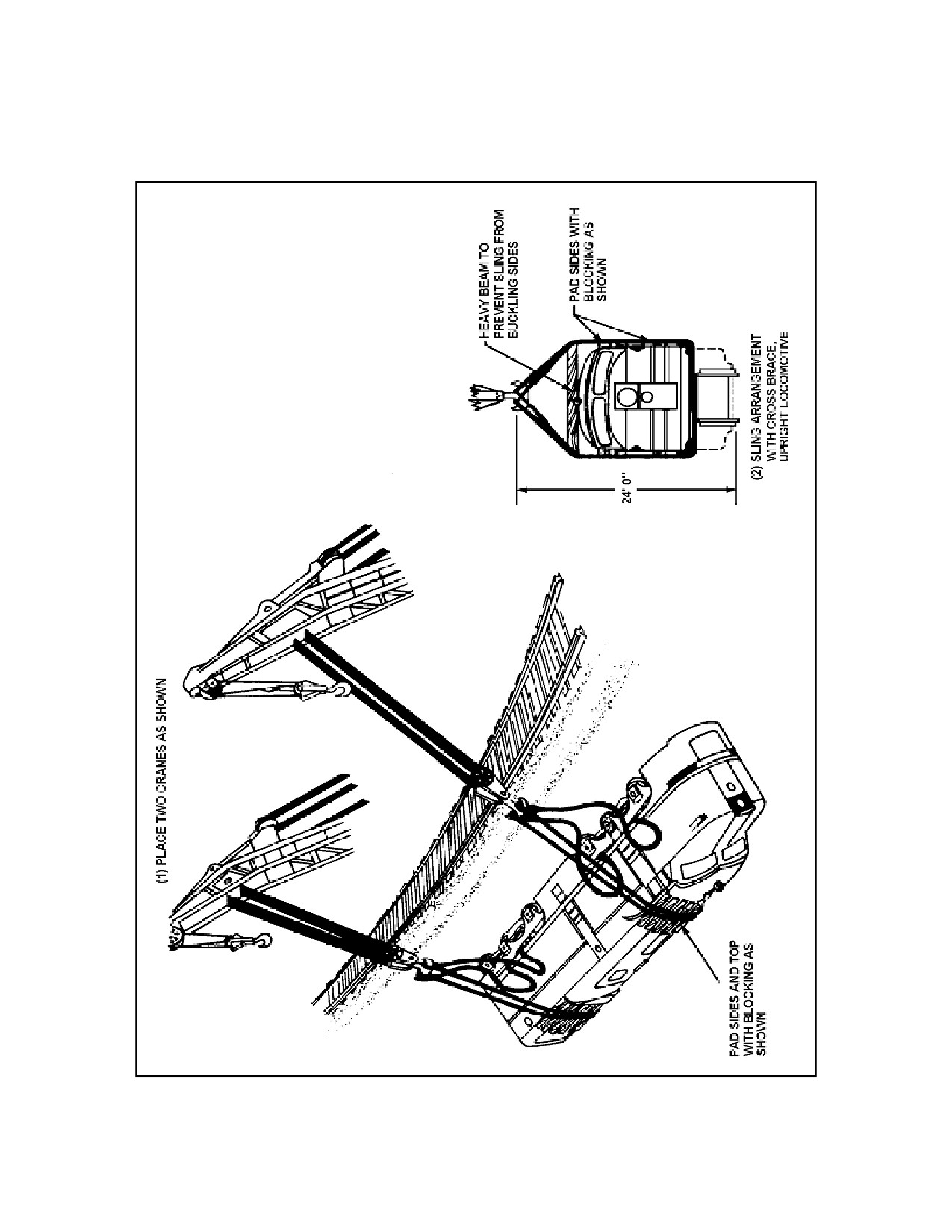
9-77. Two slings are used for each end of the locomotive in a rolling operation. Each sling is passed
from the hook down the side, around the centerplates, back to and up the side, and then back to the
crane hook. The stress caused by rolling the locomotive falls on the "underside" sling at each end
(Figure 9-13, view 3). When the roll is complete, the load is held by the four slings attached to the
two cranes. Two slings are at each end of the crane. The load is now secure for either lifting or
dragging. The method used when attaching two cranes to a locomotive, the sling positions when
upright, and the minimum hook-to-rail height (24 feet) necessary to rerail the locomotive are shown
in Figure 9-14. When possible, 24 feet of sling should be used to prevent the crane hook from
bearing on the top of the locomotive when the locomotive is lying on its side. Using the sling also
reduces the crushing action on the top sides of the locomotive after rolling is completed and actual
lifting is begun. Where the lifting range of the wreck crane boom (or other conditions) does not
permit a 24-foot clearance, a shorter cable rigs must be used.
9-30
FM 4-01.41 ______________________________________________________________________________________Chapter 9
Figure 9-14. Method of Rolling Diesel-Electric Locomotive Upright--Double Crane
9-31
FM 4-01.41 ______________________________________________________________________________________Chapter 9
Other Precautions
9-78. Attach an extension cable to each "underside" sling to prevent the crane hook from bearing on
the top of a rolling locomotive. This extension is removed when rolling is complete and before lifting
starts. Use a load spreader when lifting a locomotive in the position shown in Figure 9-14, view 2.
The crushing load at the top sides of the locomotive is approximately equal to the load to be lifted.
The side blocking is not sufficient to protect the locomotive structure. Therefore, a suitable load
spreader is placed over the top of the locomotive at each end to support the load. A load spreader
can be any suitable wooden beam, such as a crosstie of proper length, notched at the ends to hold
the slings against slippage.
Electro-Motive Division, Diesel-Electric Locomotive
9-79. All diesel-electric locomotive frames are designed to be supported at the bolsters. These frames
can be strained or bent if the span between lifting points is too great. This is true whether the lifting
slings are attached to the lifting lugs, couplers, or jacking pads. Any commercial-type EMD
locomotive can be lifted at the extreme end (coupler hitch) if the other end is supported at the
bolster. Military railway switcher type locomotives should be lifted only by the lugs. The special
lifting bars and lugs are designed only for vertical lifting and should not be used to slide the
locomotive.
Truck Centerplates
9-80. When only one end of a diesel-electric locomotive is to be lifted, place blocking between the
truck and frame on opposite ends to prevent cracking the centerplates between the truck and bolster.
The trucks are designed so that one end of the locomotive can be dropped below the rail height
without damaging the liners on the truck remaining on the rail (as in simple derailments). If the
derailed end is lifted excessively high, the liners are susceptible to damage. The clearance provided is
enough to take care of normal deflections; but during rerailing, it is mostly absorbed by the deflection
of the truck springs. Wreckmasters and crane operators must not lift one end of a locomotive more
than 6 inches above the rail, unless the other end is lifted enough to separate the centerplates on its
truck and bolster.
Lifting Lugs
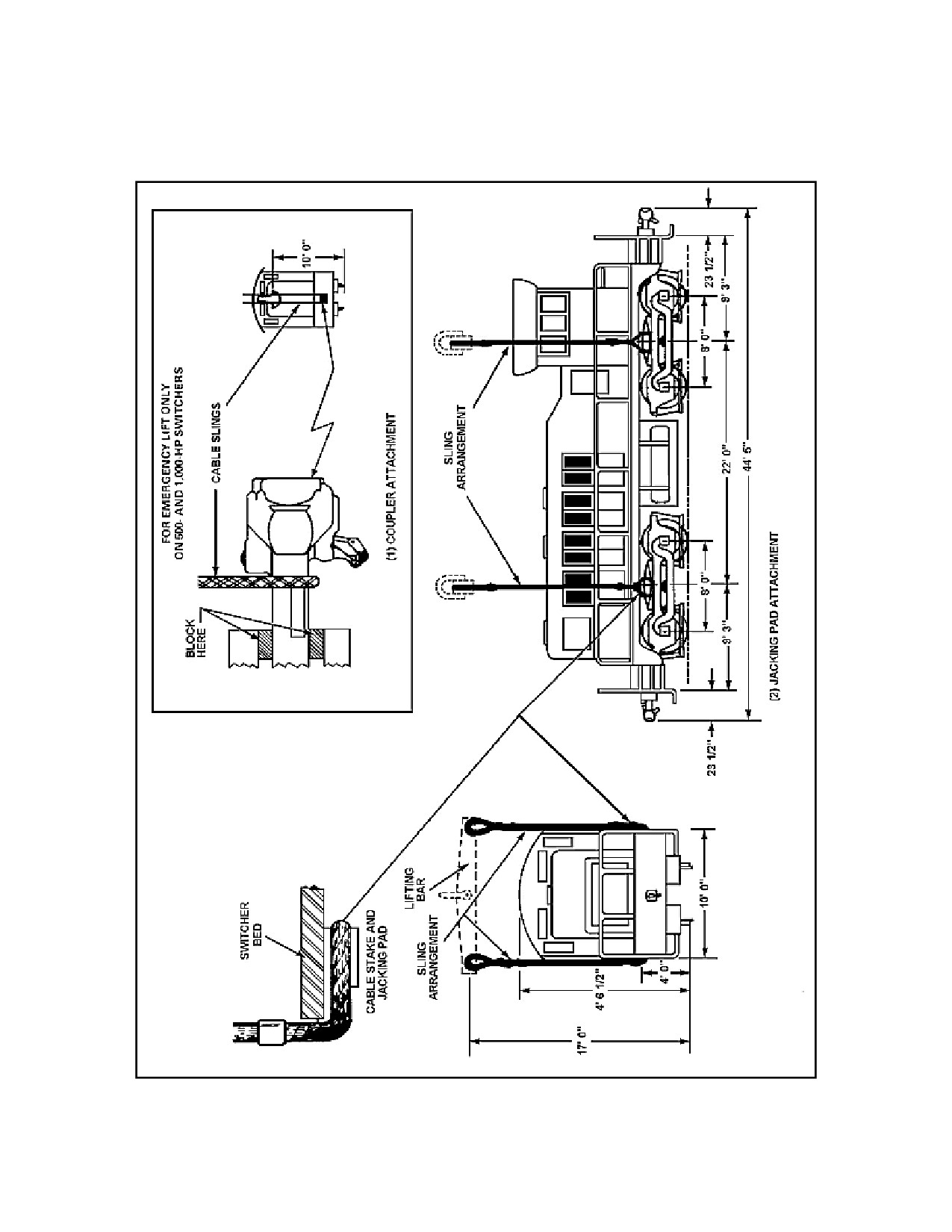
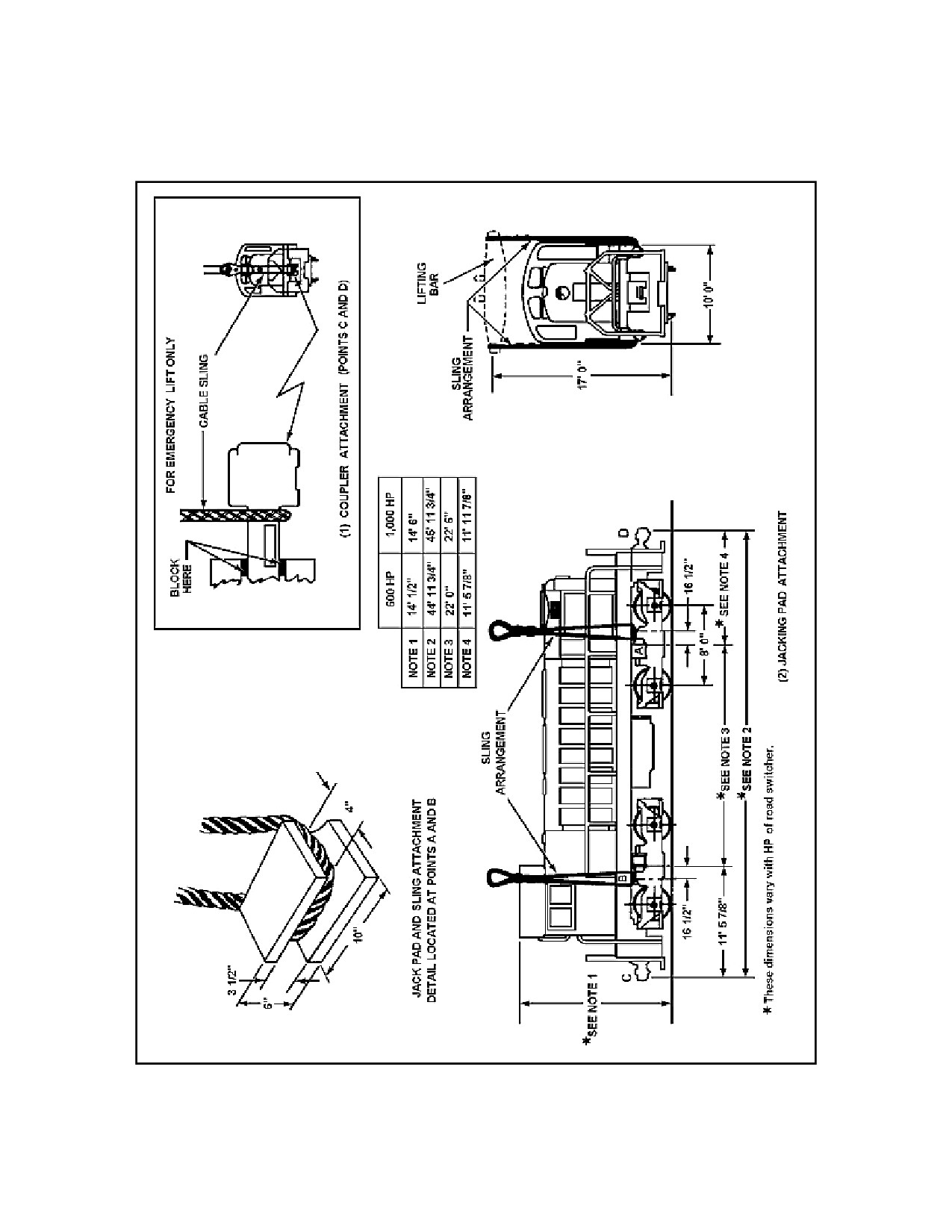
9-81. All EMD road switches equipped with lifting lugs on each side of frame bolsters. These lugs are
designed to permit wire rope slings to be directly attached to the bolsters. When rerailing this type of
locomotive, slings should have a minimum hook-to-rail clearance of 17 feet (Figure 9-15). Under
normal conditions, two slings and a lifting bar are used on each end of the locomotive. In an
emergency (and if properly blocked) one end of a switcher (up to 125-tons) may be lifted at the
coupler.
9-32
FM 4-01.41 ______________________________________________________________________________________Chapter 9
Figure 9-15. Methods of Lifting EMD Road Switcher Locomotive
9-33
FM 4-01.41 ______________________________________________________________________________________Chapter 9
Simple Derailment
9-82. Use the following procedure in simple derailments involving only one truck and when the
locomotive is upright.
· Rerail locomotive by using rerailers if available and when practicable.
· Use spreader bar and two wire rope slings of adequate strength if available.
· Use two slings if the locomotive is equipped with lifting lugs. No lifting beam is necessary.
· Use sling and coupler hitch on locomotives equipped with a standard coupler locomotive
if locomotive is not equipped with lifting lugs, or if the lift cannot be made from one side,
or if the wreck crane cannot reach the bolsters. The coupler must be blocked as shown in
Figure 9-15. If it can be avoided, never use a coupler hitch on any locomotive equipped
with a retractable coupler.
Truck Removal
9-83. EMD locomotive frames are strong enough to permit lifting operations with the trucks
attached as long as one end is supported at the bolster. However, truck removal may be required
under certain wreck conditions. EMD freight and switcher locomotives in the Army fleet use two 4-
wheel or two 6-wheel pedestal-type trucks. As preliminary steps, these trucks may be removed from
the locomotive by disconnecting brakes, sander hoses, airlines, and traction motor leads. Depending
on the locomotive type, the 4-wheel trucks are disconnected by removing three to five holding bolts.
Removing these bolts frees the truck locks from the body bolster and side bearings. Free 3-wheel
trucks, such as those on the EMD-military railway switcher (MRS-1), by removing the two nuts and
bolts that secure each side-bearing clip and then removing the clips. Locomotive frames must be
raised a minimum of 6 inches for sideways removal and 27 inches for endways removal.
American Locomotive-General Electric Diesel-Electric Locomotives
9-84. The frames of ALCO-GE locomotives, even though specially braced, are designed to be lifted
at the bolsters. Lifts closer to the ends of passenger locomotives may cause excessive stresses if the
trucks are attached at the time of lift. Road switcher locomotives with trucks attached can normally
be lifted at designated lifting points (Figure 9-16). Lifting eyes are designed only for vertical lifts.
When necessary to drag or roll the locomotive, the sling should be attached at the center of the truck.
9-34
FM 4-01.41 ______________________________________________________________________________________Chapter 9
Figure 9-16. Jacking Pad and Lifting Lugs, ALCO-GE Locomotive
9-35
FM 4-01.41 ______________________________________________________________________________________Chapter 9
Truck Centerplates
9-85. When lifting only one end of an ALCO-GE locomotive, the same precautions must be taken as
when lifting the EMD locomotive. Refer back to paragraph 9-80 on how to lift the EMD
locomotive.
Lifting Lugs
9-86. ALCO-GE road switchers are equipped with combination jacking pads and lifting lugs attached
to the frame on the body bolster (Figure 9-16). Methods of attaching cable slings for lifting are also
shown. If no other hitch is available, the coupler hitch could be used as an emergency lift for all
classes of ALCO-GE locomotives.
Simple Derailment
9-87. The recommended lifts, when one or both trucks are derailed and the locomotive is upright and
close to the rail, are shown in Figure 9-16. Slings, rather than rerailing devices (irons), are used to lift
ALCO-GE locomotives. The gear case or the gear of the driving axles could crack when using
rerailing devices. Do not use the coupler for lifting because of the danger of springing the coupler
and, more importantly, seriously springing the frame and buckling the cab. Another disadvantage of
the coupler lift is the extreme care required in preventing damage to the centerplates on the end of
the truck that is not being lifted. When a coupler lift must be used, the truck on the lifted end should
be disconnected. The coupler should be blocked and the sling placed as close to the body as possible.
CAUTION: UNDER NO CIRCUMSTANCES SHOULD COUPLER LIFT BE
ATTEMPTED ON BOTH ENDS AT THE SAME TIME. NOT ONLY WILL
THE FRAME BE SPRUNG, BUT IT IS ALSO VERY LIKELY THAT THE
LOCOMOTIVE WILL ROLL OVER.
Truck Removal
9-88. With the exception of certain extreme lifts, the frames of ALCO-GE road switchers are strong
enough to permit rerailing without removing the trucks. Truck removal may be necessary under
certain conditions because of limited crane capacity or to lighten the weight of the lift. ALCO-GE
locomotives in the Army fleet include both 4-wheel and 6-wheel trucks. In either case, traction motor
leads, air lines, sander pipes, brake rods, and any truck safety chains must be disconnected. The 4-
wheel trucks are disconnected from the locomotive frame by removing the four bolts used to hold
the truck locks in place. Removing these bolts allows the lock to disengage from the side bearings.
ALCO-GE passenger locomotives (none in the Army fleet) are equipped with 6-wheel trucks. Truck
locks on 6-wheel trucks are held in place by a bolt, which passes through the lock and engages three
locking lugs on the body bolster. Removing the two bolts allows the locks to swing free. The ALCO-
GE-MRS-type, 1,600-HP, multi-gauge, road switcher, 6-wheel truck does not have these locks.
Disconnecting the service appliances and safety hooks frees the truck from the frame.
9-36
FM 4-01.41 ______________________________________________________________________________________Chapter 9
INSPECTION AFTER RERAILING
9-89. Inspect the diesel-electric locomotive or car trucks after they are rerailed before lowering the
locomotive or car body onto the truck. Perform the following when inspecting the locomotive or car
truck.
· Raise journal box lids.
· Ensure that wedge and brass are in place.
· Ensure that truck springs are aligned.
· Examine journal lubricator or packing. Add any needed oil, then close box.
· Inspect brake rigging and bolster for loose or dragging parts.
Track Restoration
9-90. The preliminary report of a wreck or derailment given to the dispatcher includes an estimate of
how much track is torn up (in rail lengths) and the extent of the damage. The dispatcher relays this
information to the maintenance of way superintendent for his planning. The maintenance of way
superintendent alerts the section foremen (in the required numbers) to assemble their crews, tools,
and equipment at the wreck site or at a prescribed rendezvous point where they can be transported
by the wreck train. Ballast, rails, ties, and so forth, are usually available at emergency roadside
stockpiles to supplement the limited quantity of track repair materials carried on the wreck train.
9-91. The transportation railway engineering company, maintenance of way section crews can begin
to remove debris, any spilled car lading, and damaged crossties and rails as soon as the wreck cranes
clear away damaged equipment. Ballast is raked, leveled, and replaced as necessary for a firm
roadbed. New ties and new rails are laid, connected, gauged, and spiked. To expedite the start of
traffic, spiking may be temporarily limited to every other tie plate, and only two bolts, hastily
tightened, placed in angle bars. Moving trains over such hastily repaired sections is controlled by
"slow orders" issued by the dispatcher. Surfacing and lining is also limited initially to the minimum
standards required for safely moving trains at slow speeds. Complete ballasting, bolting, lining,
spiking, and surfacing can be done after the congestion has been cleared, the wrecked equipment
removed, and the line opened.
Restoring Communications
9-92. Derailed cars can break off or knock down telephone and telegraph poles. This can cut division
wire communications. It may be necessary during recovery operations to cut these lines or remove
poles to permit wreck crane booms necessary clearance. In such cases, personnel of the
communication and railway signal maintenance platoon, transportation railway engineering company,
repair the circuits as soon as possible to enable the division dispatcher to communicate with way
stations. When derailments occur in interlocking plant territory, railway signal maintenance section
personnel make the necessary repairs to the interlocking system.
9-37
FM 4-01.41 _____________________________________________________________________________________Chapter 10
Chapter 10
Rail Planning
Rail planning consists of determining what type of rail system is needed. It also includes what type of
services will be used and who will use and maintain the rail system.
RAILWAY INTELLIGENCE
10-1. Rail line and equipment planners and operators, either before or after entry into the theater of
operation, should gain as much information as possible on the rail system that they will be using for
operations. The following is a sample listing of information that they should maintain for operation.
· Types of locomotive. Their manufacturer, model, horsepower number, gauge, mechanical
condition, and if spare parts are available in area of operation.
· Types of rolling stock. Numbers, loading limits, repair condition, part availability, and
distribution within the system.
· Signal system. Type, automation (if any), state of repair, and effectiveness.
· Track structure. Size and type of rails, condition of crossties, rail and ballast, washout
and rockslide potential, number of single and double main lines, and the availability of
sidings or passing tracks.
· Layout of system. Branch lines, grades, curves, bridges, tunnel and clearance limitation
(both height and side clearance).
· Methods of operation. Fleet, block, or automation method. A very good system of
electronic communication must exist and be put to use by the rail system.
Other matters concerning railway intelligence may be found in Chapter 3.
RAIL OPERATIONS PLANNING
10-2. Staff and planning functions for theater rail operations are the responsibility of the commander
of the highest echelon of the unit in the theater. The railway plan that is developed is integrated into
the overall movements plan for the theater. Selected personnel of the transportation railway battalion
obtain the most detailed intelligence data through reconnaissance of captured or liberated rail lines,
with augmentation by personnel from higher echelon rail units. Railway battalion commanders, who
have been assigned a division of rail line, conduct a reconnaissance of their respective rail divisions
and gather intelligence data. They then make estimates of the time required to get the line operational
and the capacity or net tonnage that can be moved over the line. All intelligence information
collected and plans and estimates formulated are forwarded to the next command level. Here all the
information and estimates from the battalions are consolidated to form the transportation rail plan.
The planner must make assumptions based on the information he has and on past rail operations
experience if the required information is not available or cannot be easily obtained. The following are
some important items a planner should consider:
10-1
FM 4-01.41 _____________________________________________________________________________________Chapter 10
· The strategic importance and selection of certain rail lines. Planned strategy attack,
probable objective of the operation, lines of advancement, and enemy strengths and
dispositions all influence the selection of primary and alternate rail lines.
· Details shown on maps and photographs (such as the rail routes, the number and location
of railway facilities, and the number and kind of structures).
· A general description of the rail system (its facilities and its equipment). These descriptions
help the planner to determine the potential capacity of the system and the importance of
the system in the economic structure of the country in which it is located. Descriptions
should also give information about the ownership of the railroad, its general operating
procedures, and its organization.
· Detailed basic characteristics of routes, facilities, equipment, structures, and operations.
These details help the planner to estimate a more accurate rail capacity. Intelligence data
should include details on such items as right-of-way, roadbed, and track; types and amount
of equipment; supply and maintenance factors such as spare parts, enginehouse facilities,
and fuel and water stations; and availability of personnel.
· Types of gauges and classification of railways in the area. General gauge classifications are
standard, broad, narrow, and meter. For defensive reasons, neighboring countries often do
not construct railways having the same type of gauge. Such a precaution ensures that one
gauge does not operate on another.
10-3. The planner must also consider physical features of the area when selecting railways.
Considerations include the following:
·
Adequate yards, terminals, and shop facilities. Without adequate yards and terminals,
main lines become congested. Terminal yards should have sufficient track for receiving
trains, classifying cars, and making up trains for departure. Tracks should be long enough
to receive the longest train (without dividing it into segment(s)) intended to operate on
that rail division. Facilities are needed to spot cars, unload them, and promptly return the
empties to service. A terminal should include an enginehouse; car repair tracks; fuel, lube,
sanding, and water stations; and buildings to house crews of the railway battalion. The
heavy repair and maintenance of rail equipment require adequate shops located at or near
yards and terminals.
·
Single, double, or multiple tracks. Train density and overall rail capability are greatly
affected by the type and number of tracks. If there is a usable double track, trains may
operate in both directions without delays in schedules. However, the unit often takes the
usable parts of a damaged double track to make one single main line with good passing
tracks.
·
Seasoned roadbed, good ballast, and heavy rail. The roadbed, ballast, and weight of
the rails affect the speed and weight of trains. If the railway with the most seasoned
roadbed, the best ballast, and the heaviest rail is selected, the number of interruptions in
train operations caused by washouts and buckled rails are generally reduced.
·
Slight grade and curve. Trains operated in mountains with steep grades require more
motive power. Steep grades usually require pusher engines at the rear of a train, two or
more locomotives pulling or doubleheader at the front of a train, or shorter trains. Train
operations in mountainous terrain also reduce the train’s speed. Strong pulling and sudden
braking are hard on railcars and sometimes cause derailments. These cars require more
maintenance than those used on fairly level grade.
10-2
FM 4-01.41 _____________________________________________________________________________________Chapter 10
· Running time. Running time is greatly increased if the line has sharp or long curves. A
speed that can be reached on a straight run of track cannot be maintained on a curved
track. The ideal railway, with no grades and no curves, is never realized. However, the rail
lines with the slightest grade and the fewest, gentlest curves should be selected.
· Adequate sidings and spurs. Passing tracks should be long enough to permit the longest
train on the division to be able to completely clear the main-line track. Sidings and spurs
are desirable, but they are not a major basis in selecting rail lines.
· Strong bridges and tunnels of sufficient clearance. The strength of railway bridges
directly affects the kind of locomotives operated over them. If bridges must be
rehabilitated or constructed, they must be strong enough to support the locomotive and
the desired train weight. Any tunnels on the railway should have enough clearance for
wide and high loads (such as bulldozers and cranes) to pass.
10-4. When selecting rail lines, care must be taken to select those that are the least vulnerable to
traffic interruption. The following are some potential bottlenecks, which are vulnerable to enemy
action or natural forces.
· Tunnels.
· Long, high bridges or bridges over deep streams or valleys.
· Deep cuts and high fills.
· Limited access terminals or yards.
· Tracks located adjacent to banks of streams. These tracks are subject to the erosive action
of flood waters.
· Restrictive clearance points. Tracks running through cuts where land and rock slides are
common.
LINE CAPACITY PLANNING
10-5. While most military supply movements are primarily forward, military rail-line capacity
estimates are usually based on net tonnage moving in one direction. However, total capacity is based
on train density and must take into consideration movements of the train in both directions. When
the railway net under consideration is made up of several divisions and/or branch lines, separate
estimates should be made for each rail division and branch line. Use the following factors, formulas,
and computations for planning considerations. Since locomotives are prime power units, their
hauling capabilities must be established. Therefore, to establish a locomotive’s pulling power, certain
factors must be computed. The factors used are for initial planning and worse case situations. Once
implemented, or if intelligence data permits, plans may be modified.
Tractive Effort
10-6. Tractive effort is a measure of the potential power of a locomotive expressed in pounds. It is
the horizontal force that a locomotive’s wheels exert on a straight, level track just before the wheels
will slip on the rails. A locomotive’s tractive effort is included in the data supplied by the
manufacturer. Where such data are not available, tractive effort may be determined as described in
paragraphs 10-7 and 10-8.
10-3
FM 4-01.41 _____________________________________________________________________________________Chapter 10
Starting Tractive Effort
10-7. The power exerted by a locomotive to move itself and the load that it is hauling from a dead
stop is STE. It is correlated closely to the adhesion that the driving wheels maintain at the rails. If the
tractive effort expended exceeds this adhesive factor, the driving wheels will slip. Normally, the
adhesion factor when the rails are dry is 30 percent of the weight on drivers. When the rails are wet,
this factor is reduced to 20 percent. However, for planning purposes, 25 percent is used. For a diesel-
electric locomotive weighing 80 STONs or 160,000 pounds on the driving wheels, the STE is
computed as follows:
STE = Weight on drivers (pounds) =160,000 pounds
25 percent adhesion factor
4
STE = 40,000 pounds
Continuous Tractive Effort
10-8. CTE is the effort required to keep a train rolling after it has started. As the momentum of a
train increases, the tractive effort necessary to keep the train moving diminishes rapidly. The CTE of
a diesel-electric locomotive is approximately 50 percent of its STE. The locomotive cannot continue
to exert the same force while pulling a load as was attained in starting that load. The CTE of a diesel-
electric locomotive weighing 80 STONs or 160,000 pounds on the driving wheels is computed as
follows:
CTE = STE=
40,000 pounds
2
CTE = 20,000 pounds
Drawbar Pull
10-9. Drawbar pull is the actual pulling ability of a locomotive after deducting from tractive effort,
the energy required to move the locomotive itself. In planning,
20 pounds per ton of total
locomotive weight is taken from the tractive effort as follows:
Total locomotive weight = 80 STONs
80 X 20 = 1,600 pounds
CTE - 1,600 pounds = DBP or
STE = 160,000 = 40,000
4
CTE =40,000 =20,000
DBP = 20,000 - 1,600
= 18,400 pounds
2
10-10. Maximum DBP can be exerted only at lower speeds (up to about 10 miles [16 kilometers] per
hour) and for a limited length of time. At higher speeds, diesel-electric locomotive DBP diminishes
rapidly because the electric generator and traction motor cannot hold up under the heavy starting
voltage and amperage. The generator and motor would also burn out if the load continued for a
longer time after the locomotive reached a speed of 10 MPH.
10-4
FM 4-01.41 _____________________________________________________________________________________Chapter 10
Rolling Resistance
10-11. The force components acting on a train in a direction parallel with the track which tend to
hold or retard the train’s movement constitute rolling resistance. The following are the components
of RR:
· Friction between the railheads and the treads and flanges on the wheels.
· Resistance due to undulation of track under a moving train.
· Internal friction of rolling stock.
· Resistance in still air.
Although there is no absolute figure to be used as RR, Table 10-1 shows the safe average values to
use in a theater of operations.
Grade Resistance
10-12. Grade resistance is the resistance offered by a grade to the progress of a train. It is caused by
the action of gravity, which tends to pull the train downhill. In military railway planning, use the
factor of 20 pounds multiplied by the percentage of GR.
Curve Resistance
10-13. Curve resistance is the resistance offered by a curve to the progress of a train. No complete
satisfactory theoretical discussion of CR has been published. However, engineers in the US usually
allow from 0.8 to 1 pound per ton of train per degree of curve. In military railway planning, use the
factor of 0.8 pounds multiplied by the degree of curvature.
Table 10-1. Safe Average Values
Track Condition
Average Value
Exceptionally good
5
Good to fair
6
Fair to poor
7
Poor
8
Very poor
9 and 10
Weather Factor
10-14. The weather factor reflects, by percentage, the adverse effect of cold and wet weather on the
hauling power of a locomotive. Experience and tests has proven that whenever the outside
temperature drops below 32 degrees Fahrenheit, the hauling power of a locomotive is decreased.
Table 10-2, page 10-8, shows the weather factor (percent) for varying degrees of temperature.
10-5

FM 4-01.41 _____________________________________________________________________________________Chapter 10
10-15. Wet weather is usually regarded as local and temporary and is considered absorbed by average
figures. However, in countries having extended wet seasons (monsoons, fog, and so forth), the loss
of tractive effort due to slippery rails may prove serious if sanding facilities are lacking or inadequate.
The applicable reduction is a matter of judgment. However, in general, tractive effort will not be
reduced to less than 20 percent of the weight on drivers.
Table 10-2. Effect of Weather Upon Hauling Power of Locomotives
Most adverse
Loss in
Weather
temperature
hauling power
factor
(oF)
(percent)
(percent)
Above +32
0
100
+16 to +32
5
95
0 to +15
10
90
-1 to -10
15
85
-11 to -20
20
80
-21 to -25
25
75
-26 to -30
30
70
-31 to -35
35
65
-36 to -40
40
60
-41 to -45
45
55
-46 to -50
50
50
Gross Trailing Load
10-16. Gross trailing load is the maximum tonnage that a locomotive can move under given
conditions
(for example, curvature, grade, and weather). When diesel-electric locomotives are
operated in a multiple unit operation, the GTL is equal to the sum of the GTL for all locomotives
used. However, when the locomotives are not electrically connected for multiple unit operation,
deduct 10 percent of the total GTL for the human element involved. Determine GTL by combining
the factors discussed in the preceding paragraphs and using the following formula:
GTL =
DBP X WF
RR + GS + CR
Where-
GTL = gross trailing load
DBP = drawbar pull
WF = weather factor
RR = rolling resistance
GR = grade resistance
CR = curve resistance
10-17. Obtain the GTL by actual test for foreign or captured locomotives (for which little or no
information is available) as quickly as track and cars become available.
10-6
FM 4-01.41 _____________________________________________________________________________________Chapter 10
Net Trainload
10-18. Net trainload is the payload carried by the train. The total weight of the cars under load is
gross weight. The lightweight, or weight of empty cars, is tare. The difference between gross weight
and tare is the NTL (payload) of the train. For military railway planning purposes, the NTL is 50
percent of the GTL. The formula is computed as follows: NTL = GTL X .50.
Train Density
10-19. The number of trains that may be operated safely over a division in each direction during a
24-hour period is known as train density. Work trains are not included in computing TD. However,
their presence on divisions and the amount of time they block the main track can reduce the density
of a rail division. TD may vary greatly over various divisions depending on the following:
· Condition and length of the main line.
· Number and locations of passing tracks.
· Yard and terminal facilities.
· Train movement control facilities and procedures.
· Availability of train crews, motive power, and rolling stock.
10-20. On single-track lines, passing tracks generally are 6 to 8 miles (10 to 13 kilometers) apart.
Multiple tracks (three or more) generally are considered as double track, since it is often necessary to
remove a portion or all of the third and fourth tracks to maintain a double-track line.
10-21. The capacity or operating turnover of cars and trains into and out of terminal yards must be
considered, either from definite experience and intelligence factors or by inference from related
information.
10-22. The rule-of-thumb and the formula for determining single track are designed primarily to
determine freight train density. Both are reasonably accurate on lines over which passenger trains do
not exceed 20 percent of the traffic.
Rule-of-Thumb for Determining Train Density
10-23. If enough information is not available to evaluate the potential train density of a rail line, a
train density of 10 for single track and 15 for double track in each direction is used for planning.
Formula for Determining Single Track
10-24. If enough information is available, the following formula is used to determine train density for
a specified railway division. In determining the number of passing tracks, do not include those less
than 5 miles (8 kilometers) apart. Passing tracks should be uniformly spaced throughout the division.
TD = NPT + 1
X
24 x S 2
2
LD
Where-
TD = train density.
NPT = number of passing tracks.
10-7
FM 4-01.41 _____________________________________________________________________________________Chapter 10
1 = constant (number of trains that could be run if there were no passing tracks).
2 = constant to convert to each direction.
24 = constant (number of hours per day).
S=
average speed (Table 10-3).
LD =
length of division.
When the computation for train density results in a fraction, the result is raised to the next higher
whole number.
Net Division Tonnage
10-25. Net division tonnage is the tonnage in STONs, or payload, which can be moved over a railway
division each day. NDT includes railway operating supplies that must be programmed for movement.
The formula for NDT is: NDT = NTL X TD. Compute NDT separately for each division.
End Delivery Tonnage
10-26. In military operations, the end delivery tonnage is the through tonnage, in STONs, of payload
that may be delivered at the end of the railway line (railhead) each day. In an all-rail movement, the
EDT equals the NDT of the most restrictive division.
Table 10-3. Determining Average Speed Value
Average speed
Condition
Percent of
Single track
Double track
of track
grade
(mph)
(kph)
(mph)
(kph)
Exceptionally good
1.0% or less
12
19.3
14
22.5
Good to fair
1.5% or less
10
16.1
12
19.3
Fair to poor
2.5% or less
8
12.9
10
16.1
Poor
3.0% or less
6
9.6
8
12.9
Notes:
1. The most restrictive factor governs the speed selected.
2. Consider the following, when using the table for average speed factor.
a. If the condition of track and/or the percent of grade are not known, use
an average speed value of 8 MPH for single track and 10 MPH for double track.
b. Where the most restrictive factor occurs for a comparatively short
distance--that is, less than10 percent of the division--use the next higher speed.
c. Where average speed falls below 6 MPH because of the grade lines,
reduce the tonnage to increase speed (2 percent reduction in gross tonnage will
increase speed 1 MPH).
YARD CAPACITY DETERMINATION
10-27. The capacity of the yard needs to be determined based on planning factors and planning
formulas. The following describes the planning factors and planning formulas for classification yards.
10-8
FM 4-01.41 _____________________________________________________________________________________Chapter 10
Also described below are the planning factors for terminals with and without receiving and
forwarding yards.
Planning Factors for Classification Yards
10-28. The following factors are based on day and night operations and may be used for planning
purposes. Where two or more main line railways intersect at a major terminal, the facilities will have
to be duplicated accordingly.
10-29. Flat switching capacity is 30 cars per locomotive per hour. This includes time for switch
engines to push cars into the yard (based on foreign equipment). Hump switching capacity is 45 cars
per locomotive per hour.
10-30. The numbers of cars, at any given time, in a classification yard should not exceed 60 percent
of the yard’s capacity. When cars exceed yard capacity, switching room decreases and operating
efficiency is sacrificed.
10-31. Length of track in a classification yard generally is one train length, plus 20 percent, plus 300
feet
(91 meters). Track and/or train length varies with local terrain characteristics and railway
equipment and requirements.
10-32. Depending on the yard layout, the number of switch engines per shift that may be employed
in the operation of the loaded freight classification yard may vary from one to three. Therefore, one
switch engine may handle 30 to 60 cars per hour and three switch engines may handle 90 to 180 cars
per hour. Functions for switch engines include the following:
· One switch engine at the head of the receiving yard, preparing cut of cars for switching.
· One switch engine switching cut of cars into the classification yard.
· One switch engine at the opposite end of the classification yard, coupling cars and making
switching room.
During slack traffic periods, one switch engine may be used for all functions above. The switch
engine functions above are also used in the classification yard proper and do not include those
engaged in supporting other terminal operations.
10-33. The average time a car remains in the classification yard is 8 hours. Classification yard traffic
changes an average of three times per day. (Some cars may be held 48 hours; others may clear in less
than 8 hours.)
Planning Formulas for Classification Yards
10-34. You may use the following formulas to determine classification yard requirements and
capabilities.
· Determine the required length of yard tracks using the following:
LT = ACT X LC X 1.2
+ 300 feet (91 meters)
10-9
FM 4-01.41 _____________________________________________________________________________________Chapter 10
Where-
LT = length of track.
ACT = average cars per train.
LC = average length of car.
1.2 = operational factor (to allow for overall length of car coupler rather
than car length).
300 feet =clearance distance at each end of track from point of switch to
clearance.
· Determine the minimum number of tracks using the following:
NTR = TDs X 1.6
3
Where-
NTR = number of tracks required.
TDs = sum of train densities of using divisions
3 = turnover per day.
1.6 =
60-percent factor of static capacity.
When computing requirements for a terminal yard, the result obtained in this formula must be
doubled. The formula does not necessarily apply to railheads since classification of cars is not always
necessary at railheads.
· Determine static yard capacity using the following:
SYC= ACT X NT
Where-
SYC = static yard capacity (in cars).
ACT = average cars per train.
NT = number of tracks of the length determined in paragraph 10-34, first
bullet.
Daily yard capacity is equal to 1.6 times SYC. This figure takes into account that the number of cars
in a yard at any given time will not exceed 60 percent of the static capacity.
Planning Factors for Terminals With and Without Receiving and Forwarding
Yards
10-35. The following factors are based on how trains are moved in the terminal. These factors may
be used for planning purposes.
With Receiving and Forwarding Yards
10-36. Where trains are operated into and out of terminals at 48-minute intervals, there should be a
minimum of six tracks plus one runaround track in both the receiving and forwarding train yards to
handle empty and loaded trains. In general, the number of tracks required equals the train density
divided by 5, plus 1.
NT = TD + l
5
10-10
FM 4-01.41 _____________________________________________________________________________________Chapter 10
Without Receiving and Forwarding Yards
10-37. Normally, receiving and forwarding train yards will be in balance with classification and main
line capacity. However, some railways dispense with receiving and forwarding yards and operate all
trains directly into and out of classification yards. In such cases, the classification yard’s daily capacity
is reduced by approximately 25 percent.
Two-Wall Tonnage Traffic in Terminals
10-38. Where there is two-way tonnage traffic in large terminals, the various yards are normally
designed with yards for each direction. For example, northbound receiving, classification; forwarding
yards and southbound receiving, classification; and forwarding yards.
RAILWAY EQUIPMENT REQUIREMENTS
10-39. Availability of equipment in liberated or occupied territory depends upon inventories, extent
of destruction, condition of equipment, types of fuel and local availability of repair parts, types of
coupling devices, and many other such factors. Base allowances, for use of captured or locally
available equipment, on judgment after evaluation of the many factors involved. Technical data
concerning railway equipment may be found in strategic surveys, special transportation studies based
on intelligence reports, reports of governments or railways in peacetime, and sometimes in
publications such as Railway Gazette
(British) and Railway Age
(American). The categories of
equipment requirements considered when planning are as follows:
· Rolling stock, consisting of boxcars, gondolas, flatcars, tank cars, refrigerator cars, and
hopper cars.
· Road engines, the motive power used to pull trains between terminals or division points.
· Switch engines, the motive power used to switch cars within yards or at division terminals.
Step-by-step procedures for determining railway equipment requirements are given in Appendix B.
Rolling Stock
10-40. There are three classes of railway rolling stock. These classes consist of freight, passenger, and
special.
Freight
10-41. Compute requirements separately for operations between major supply installations or areas
on each rail system. Use the following formula to compute requirements.
Total cars Required = EDT (by type car)
X
TAT X 1.1
Average payload for type car
Where-
EDT = end delivery tonnage.
TAT = turnaround time.
10-11
FM 4-01.41 _____________________________________________________________________________________Chapter 10
10-42. Obtain the first factor of this formula from that part of the computation for 1 day’s dispatch
which determines the number of cars required by type to transport all or a given portion of the EDT
of a rail system (see Appendix B, third computation).
l DD=
EDT (by type car )
Average payload for type car
10-43. The number of cars dispatched in a day from the base of operations is 1 day’s dispatch. For
planning purposes, the number of cars dispatched from a division terminal, railhead, or other
dispatch point is considered the same as the number dispatched from the base of operations. Use the
formula shown in paragraph 10-42 to determine the rolling stock for 1 day’s dispatch. Computations
are made for each type of car to be used (boxcars, gondolas, and/or flatcars) and the sum of the
results for all types of cars that are computed are 1 day’s dispatch for the system (see Appendix B,
third computation).
10-44. Turnaround time is the estimated number of days required for a car to make a complete
circuit of the rail system. It is the days elapsed from the time the car is placed at the point of origin
for loading until it is moved to its destination, unloaded, and returned to its point of origin. Time
may be computed as follows: 2 days at origin, 1 day at destination, and 2 days in transit (1 day
forward movement, 1 day return movement) for each division or major portion of each division
which the cars must traverse. This method, rather than an actual hour basis, is used to incorporate
delays due to terminal and way station switching as well as in-transit rehandling of trains.
10-45. The 1.1 factor is used to express a 10-percent reserve factor. The reserve factor provides for
extra cars to meet operational peaks, commitments for certain classes of cars, and bad -order cars
(cars needing repair).
10-46. Compute planning factors for net load per freight cars by using 50 percent of the rated
capacity for all freight cars except tank cars. Tank cars are rated as carrying 100 percent of their
capacity.
10-47. Compute tank car requirements separately based on bulk POL requirements, tank car
capacities, and computed turnaround time. The disposition of rolling stock for the operation of a
railway system is shown in Table 10-4, page 10-16.
Table 10-4. Disposition of Rolling Stock
Rolling Stock
Disposition
Required
At base of operation
2 day’s dispatch
Forward traffic
1 day’s dispatch per
division
Return traffic
1 day’s dispatch per
division
At the railhead
1 day’s dispatch
10-12
FM 4-01.41 _____________________________________________________________________________________Chapter 10
Passenger
10-48. Passenger car requirements vary depending on troop movement policies, evacuation policies,
and rest and recuperation policies. Theater passenger car requirements normally are fulfilled by
acquisition of local equipment with the exception of equipment required for hospital cars or trains.
Special
10-49. Special equipment is that equipment used exclusively by the railroad for its own use. This type
of equipment includes maintenance of way equipment, work cranes, snow removal equipment,
locomotives, and so forth.
Road Engines
10-50. You may determine the number of road engines required for operation over a given railway
division by the following formula:
Road engines Required = TD x (RT + TT) = X 2 X 1.2
24
Where-
TD = train density.
RT = running time (length of division divided by average speed).
TT = terminal time (time for servicing and turning locomotive is 3 hours
for diesel-electric locomotives and 8 hours for steam
locomotives).
24 = number of hours per day.
2 = constant for two-way traffic.
1.2 = constant allowing 20-percent reserve.
(RT + TT) = engine factor (time during a 24-hour period in which a road
24
engine is in service). The engine factor provides for motive
power, which may make more than one trip per day over a
short division.
Switch Engines
10-51. No two ports, divisions, or terminal railheads are alike in design or operation. However, the
functions of the main yards in each are essentially the same. Receiving cars, classifying, and
reassembling them for delivery or forward movement constitutes the main functions of any yard.
The switch engine is the type of motive power used for these operations.
10-52. The number of switch engines required at a terminal is based on the number of cars
dispatched and received at, or passing through, the terminal per day. When the number of cars has
been computed, apply that figure to the factors shown in Table 10-5 to determine the number of
switch engines required at each terminal.
10-53. When the total number of switch engines required for the railway line has been computed, 20
percent is added as a reserve to allow for maintenance, operational peaks, and so forth (see Appendix
B, fourth computation).
10-13
FM 4-01.41 _____________________________________________________________________________________Chapter 10
Table 10-5. Switch Engines Required
Switch Engines
Location
Required
Port or loading terminal
1 per 67 cars dispatched
and received per day
Division terminals
1 per 100 cars passing
per day
Railhead or unloading terminals
per 67 cars dispatched
and received per day
PERSONNEL AND UNIT REQUIREMENTS
10-54. Requirements for rail units and personnel are based on the following:
· Number of divisions in the system. This provides a guide in determining the number of
battalions required for operation.
· Number of train operating crews required to operate road and switch engines. This
provides a guide to determine the number of train operating companies required in the
system.
· Maintenance requirements for right-of-way, locomotives, and rolling stock. This provides
a guide to determine the number and type of maintenance units and personnel required.
On the basis of these factors, you can use unit and organizational capabilities and normal
employment procedures to organize a command structure and to determine support requirements.
Road Crews
10-55. In computing the number of road crews required for each division, preparation time is
included. Preparation includes the following:
· A 2-hour period at the originating terminal for the crew to receive orders and instructions,
test the air, and check the train.
· Running time involved, which is computed by dividing the length of the division by the
average speed of the train. If information is not available to compute the speed, the speed
may be assumed to be 10 miles per hour. Normally, running time over a division will be
about 12 hours.
· A 1-hour period at the final terminal to submit necessary reports.
10-56. To allow enough time for the crews to rest, the running time normally does not exceed 12
hours. Although experience shows that safety and efficiency decrease when crews work continuous
daily shifts of more than 12 hours, this time can be exceeded in emergencies. However, it is possible
to work shifts of 16 to 18 hours, if the crews have enough rest periods before reporting for another
run. Sometimes it will be necessary to designate longer hours because of the length of the division
involved. In such cases, enough time off between runs should be permitted to limit the average daily
shift to 12 hours.
10-14
FM 4-01.41 _____________________________________________________________________________________Chapter 10
10-57. When determining the number of road crews needed per division use the following formula
(see fifth computation, Appendix B).
Number of road crews = TD X 2 X
(RT + 3) X 1.25
12
Where-
TD = train density.
2 = factor to convert to two-way traffic.
RT = running time (length of division divided by average speed).
3 =
2 hours allowed for preparation at originating terminal, plus 1 hour
at final terminal.
12 =
12-hour shift per road crew per day.
1.25 = constant factor to allow for ineffectives.
Switch Crews
10-58. To determine the number of switch crews required, the number of switch engines in use at
each terminal must be known. Two crews are required per switch engine per day. Use the following
formula to determine the number of switch crews required for each terminal (do not compute crews
for reserve switch engines) (see fifth computation. Appendix B):
Number of switch crews = SE X 2 X 1.25.
Where-
SE = number of switch engines.
2 = crews per engine.
1.25 = constant factor to allow for ineffectives.
SUPPLY REQUIREMENTS
10-59. Railway supply tonnages are normally quite large. Planners, when computing EDT, should
ensure that all concerned persons understand that supply tonnage must be deducted from EDT to
arrive at the actual figure that will be delivered to the units at the railhead. The following paragraphs
discuss the method of arriving at specific supply requirements for fuel, lubricants, and repair parts.
Fuel Consumption of Diesel-Electric Locomotives
10-60. Table 10-6, page 10-16, contains an estimated average rate of diesel fuel oil consumption in
gallons per train-mile for diesel-electric road locomotives and in gallons per hour of operation for
switch engines. For planning purposes, the operation of switch engines is assumed to be 20 hours per
day. The method of determining fuel oil requirements in gallons for road locomotives and switch
engines is as follows:
10-61. The following is the method of determining fuel oil requirements, in gallons, for road
locomotives:
· Multiply the train density of the first division by 2 (for two-way travel), then multiply the
result by the length of the division. This result is the train-miles per day for the division.
· Repeat this procedure for each division of the system.
· Total the daily train-miles for all divisions.
10-15

FM 4-01.41 _____________________________________________________________________________________Chapter 10
· Multiply the total daily train-miles by the fuel consumption factor to obtain the daily fuel
requirement.
· Multiply the daily fuel requirement by 30 to obtain the monthly fuel requirement.
· Add 5 percent to this computed total to provide a reserve for contingencies.
Table 10-6. Fuel Requirements for Diesel-Electric Locomotives
Estimated Average Rate
of Fuel Oil Consumption
Type of
Gallons Per
Gallons
Locomotive
Type of Operation
Train-Mile
Per Hour
*Standard gauge:
0-6-6-0, 120-ton
Road switcher
2.5
11.5
0-4-4-0, 50-ton
Road switcher
.9
8.0
*Narrow gauge:
0-6-6-0, 80-ton
Road switcher
1.5
10.0
0-4-4-0, 48-ton
Road switcher
.9
8.0
*When computing fuel requirements and the table does not provide or an
engine wheel match and/or tonnage match, the next largest wheel/tonnage
figure should be used.
10-62. The following is the method of determining fuel oil requirements, in gallons, for switch
engines:
· Multiply the total number of switch engines required (do not include reserve engines) by
20 to determine the total hours per train-day of operation.
· Multiply the total hours per train-day of operation by the fuel consumption factor of the
engine concerned (Table 10-3). This result is the daily fuel requirement in gallons.
· Multiply the daily fuel requirement by 30 to obtain the monthly fuel requirement.
· Add 5 percent to this computed total to provide a reserve for contingencies. When coal is
the fuel, use a reserve factor of 10 percent.
Lubricants
10-63. Use lubricants on all moving parts of railway tools, appliances, machinery; and on all motive
power and rolling stock. For planning purposes however, only the lubricants necessary for the
operation of motive power and rolling stock are based on an estimate of 1,000 pounds per month for
each train moving in either direction over each division in one day. Use the following method to
determine the amount of lubricants required:
· Multiply the train density of the first division by 2 (for two-way travel); then multiply the
result by 1,000. This gives the amount in pounds of lubricants required per month for the
division.
10-16
FM 4-01.41 _____________________________________________________________________________________Chapter 10
· Repeat this procedure for each division of the system.
· Total the amount of lubricants for all divisions to determine the grand total of STONs
required per month for the railroad.
Repair Parts
10-64. In a theater, the number and kinds of supplies and repair parts are seldom found necessary to
maintain the motive power and the rolling stock used by the unit. For planning purposes, only the
repair parts necessary for the maintenance of motive power and rolling stock are considered. An
estimate of repair parts required is based on a factor of 1.5 STONs per month for each train moving
in either direction over each division in one day. Use the following method to determine repair parts
required:
· Multiply the train density of the first division by 2 (for two-way travel). Multiply the result
by 1.5 to get the total amount in STONs of repair parts required per month for the
division.
· Repeat this procedure for each successive division of the system.
· Total the amounts to determine the grand total of STONs required per month for the
entire railroad.
10-65. Good judgment and certain assumptions are required when making allowances for railway
operating supplies. It is assumed that all trains operated over each division are tonnage trains and that
each division requires the same amount of operating supplies. The above formulas are an accepted
method for computing operating supplies from a broad spectrum; how ever, a more refined method
would employ the following methodology in making allowances:
· First division. No allowance is made, since the operating supplies are available at the port
terminal or base of operations.
· Second division. An allowance of 5 percent of the first division net tonnage, which
means only 95 percent of the first division net tonnage, will be hauled over the second
division.
· Third division. An additional allowance of 5 percent of the first division net tonnage, or a
total deduction of 10 percent of the first division net tonnage, which leaves only 90
percent of the original tonnage to be hauled over the third division.
· Additional division. An additional allowance of 5 percent of the first division net
tonnage will be made for each successive division, with a corresponding reduction in
tonnage hauled.
10-17
FM 4-01.41 _____________________________________________________________________________________Chapter 11
Chapter 11
Foreign Service
Host Nation Equipment
11-1. During wartime or contingencies U.S. forces face the prospect of having to utilize any
available equipment upon entry into the theater, particularly when host nation support is not
available. Either the tactical situation or security concerns may preclude the use of HNS, in
particular, in the rear areas of the Division, Corps and higher.
11-2. In many developing nations, U.S. forces may encounter cars, locomotives, and other
equipment that has been declared obsolete by American railroads years ago and exported outside the
U.S., either new, or used. They may also encounter foreign built equipment, primarily British or
Soviet-era that may differ significantly from what they are familiar with.
11-3. Commanders of Rail Units and Transportation Groups should thoroughly familiarize
themselves with the constraints and challenges of providing rail services in this type of environment,
and train accordingly.
TYPES OF EQUIPMENT
11-4. Diesel-electric locomotives should be thoroughly inspected to insure that they are mechanically
safe to operate, and should be brought up to the best level of maintenance that existing facilities and
supplies allow for. It is not mandatory that they are equipped exactly as required for CONUS
operations, but they must not present any type of hazard while being operated.
11-5. Electric locomotives most likely will not be able to be put into service in an austere
environment due to damage to infrastructure providing power. However, extreme care should be
taken when working on or around this equipment due to the threat of electrical shock. Soldiers
should have specific training relative to electric train operations and safety around overhead
catenary(power lines) before attempting any work on electric equipment.
11-6. Steam powered locomotives are still found in use in many parts of the world, if for no other
reason than their fuel is readily available and there is no money for replacement of these engines.
Steam locomotives have a proven ability to operate in extremely cold environments, which can be
advantageous. The maintenance and support requirements for steam operations far outweigh any
advantages, however unless there are adequate shop forces and repair parts readily available. Like
electric train operations, soldiers should have specific training in the operations and maintenance of
steam locomotives before attempting to operate them. It is strongly recommended that any steam
locomotive considered for use by U.S. forces is fully inspected according to the guidelines found in
49 CFR, Part 230, in order to prevent death or serious bodily injury to train crews.
Locomotives of all types, that appear to be serviceable, but with which soldiers have no
familiarity, or insufficient resources to place back into service, should be set-out on a siding
and secured until they can be repaired or re-utilized by HN or allied personnel.
11-1
FM 4-01.41 _____________________________________________________________________________________Chapter 11
11-7. Freight cars should be inspected as they would in CONUS to determine load capacity and
mechanical safety. Many cars may not have the tie-down characteristics or the capacities of CONUS
based cars. Soldiers should insure that cars are not loaded over-capacity or out of balance.
RULES
11-8. Absent any interaction with HN personnel, where the U.S. has exclusive use of trackage and
equipment, operations and maintenance should be conducted IAW current U.S. Doctrine and
operating rules.
11-9.
Where allied forces, HNS, or contractor support may share operating responsibilities,
representatives from all organizations involved in train operations must meet and determine what set
of rules will be followed. All train crews should be made familiar with the operating rules before
being placed into service. It should also be determined which language will be used for dispatching
and train crew communication. All communications must be clearly transmitted and clearly
understood by all personnel involved in train operations.
SUSTAINMENT OF RAIL OPERATIONS
11-10. Prior to commitment to conduct rail movements within the operational area, railway-
operating units must insure that there is an adequate maintenance and supply system in place to
support train movements. Planners should consider among other factors, track and structure repair
and maintenance; motive power and rolling stock fueling and maintenance; and an adequate supply
of repair parts for all track, structure, signal systems, rolling- stock and motive power.
11-11. Also of significance is the availability of material handling equipment (MHE) at both the
originating and destination points of the rail movement. Example: It would be useless to move
containers via rail if there was no container handling equipment available at the destination.
11-2
FM 4-01.41 _____________________________________________________________________________________Chapter 12
Chapter 12
Rail Accidents and Incidents
Any and all Army Rail Accidents and incidents are to be reported to the Transportation
Branch Rail Safety Office within 24 hours of occurrence, per Transportation Branch Rail
Safety Office Accident/Incident Reporting Policy. Information obtained from these
notifications/reports are used to identify problem trend areas in order to “develop accident
prevention measures” for the entire fleet
(AR 385-40, Safety, Accident Reporting and
Records).
RAIL HAZARD ISSUES
12-1. Following the Chief of Staff of the Army’s direction, it is this office’s mission to be
the user representative for both acquisition and training issues. It is incumbent on the users
in the field to inform this office or any issues or hazards before they cause injury or damage
to Army or contract personnel and equipment. The intent of the Hazard Issues web site is
to identify trends throughout the fleet and recommend, “fixes” to the appropriate Risk Level
Authority.
12-2. All Army Rail Accidents and incidents that meet the classification of an Army Class A
through D Accident will be recorded with the US Army Safety Center and Carbon Copied to
this office.
Accidents and Incidents Overview
12-3. Rail accidents and/or incidents (may also be known as Train accidents) involve any
collision, derailment, or injury as a result of the operation of any Army Rail equipment. Rail
accidents will be reported as Class A through Class D accidents and identified as
engineering, mechanical, Transportation, or Other, as appropriate on DA Form 285 (block
63). Rail incidents will be reported using your local SIR format.
12-4. Rail accidents and/or incidents include:
· Accidents/incidents occurring while loading, off-loading, or receiving services.
· Damage to Army property handled as a loaded commodity.
· Damage and all injuries to Army personnel occurring while operating or riding rail
equipment.
12-5. Rail accidents do not include accidents that are reportable under other major
categories prescribed in this regulation; for example, aircraft, missile, or chemical agent
accidents.
12-6. The following information covers trains and rail equipment under the jurisdiction of
DA that are:
· Operated and exclusively controlled or directed by the Army. This includes rail
equipment furnished by a contractor or another Government Agency when
operated by Army train personnel.
12-1
FM 4-01.41 _____________________________________________________________________________________Chapter 12
· Lent or leased to non-Army organizations for modification, Maintenance, repair,
test, contractor training, research, or development projects for the Army.
· Under test by Army agencies responsible for research, development, and test of
equipment.
· Under operational control of a contractor. Accidents involving Army equipment
lent or leased by the Army to a non-Army organization for maintenance, repair,
test, contract training, or experimental projects will not be charged to the Army if
the non-Army organization that has operational control of the equipment has
assumed the risk of loss.
This information does not negate the engineer or crew responsibility to report any applicable
rail accident, injury, or death involving commercial or Government owned property to the
FRA.
Notification Requirements
12-7. In addition to the notification required by Chapter 3, of AR 385-40 rail accidents
and/or incidents will be reported as follows: Rail Accident and incident. Any accident/incident
or injury that is caused by a hazard or creates a hazard to the crew, the equipment, or the
environment, or any occurrence affecting the worthiness or fitness for service of any part of
the locomotives, cars, equipment, or track (to include but not be limited to the switches, ties,
rail, ballast, or Frogs) will be telephonically or electronically reported to the Transportation
Branch Rail Safety Office, 705 Read Street, Fort Eustis, VA 23604-5113, DSN 826-3692,
Commercial (757) 878-3692, RailSafety@eustis.army.mil, within 24 hours.
Record Keeping
12-8. The person in charge of any rail equipment involved in an accident and/or incident
will retain all records relevant to the equipment IAW 49 CFR Part II. Records include, but
are not limited to, event recorder download, DD 862, records of air tests, and any
HAZMAT records, radio logs, crew and passenger lists and statements, alcohol and drug
tests, and drawings or photographs made at the scene of the accident, articles of shipment,
and other material which might be of assistance in investigating and determining the cause of
the accident. The person(s) responsible for these records’ custody shall make these records
available upon request to the authorized safety investigator(s).
12-9. The information on the trains’ data recorder will be saved before any rail equipment
involved in an accident or incident is put back into service.
Rail Accident Investigation
12-10. In addition to the normal procedures required for investigating Army accidents, rail
accidents require the following:
12-11. A copy of all data recorder information will be forwarded to the Defense Non-
Tactical Generator and Rail Equipment Center (DGRC), 6233 Aspen avenue, Building 1701,
Hill
AFB, Utah
84056, DSN
777-5913, Commercial
(801)
777-5913,
robert.arrington@hill.af.mil, with in 48hrs of the accident.
12-2
FM 4-01.41 _____________________________________________________________________________________Chapter 12
12-12. All rail accidents and/or incidents may be investigated by the Transportation Branch
Rail Safety Office, U.S. Army Transportation Center and School, Ft. Eustis, VA
23604. To
determine if possible safety violations were the cause of the accident / incident.
12-3
FM 4-01.41 ____________________________________________________________________________________ Appendix A
Appendix A
Blank Locally Reproducible Forms
This appendix contains blank reproducible forms (reduced to fit on page) that are
authorized for local reproduction. You may reproduce these forms on 8 1/2 x 11- inch
paper. You may also request these forms through appropriate distribution channels. The
forms are as follows:
DA Form 5620-R Daily Installation Situation Report
DA Form 4090-R Combined Register of Trains and Comparison of Watches
DA Form 5614-R Superintendent's Telegraphic Report of Accident
DA Form 4093-R Station Record of Train Movements and Operator's Transfer
DA Form 5619-R Daily Empty Car Situation Report
DA Form 4092-R Train Order
DA Form 4091-R Clearance Form "A"
DA Form 5706-R Track Bulletin
DA Form 5618-R Conductor's Wheel Report
DA Form 5615-R Set Out Report
DA Form 5616-R Car Inspector's Train Report
DA Form 5617-R Daily Statement of Cars On Hand
A-1
FM 4-01.41 ____________________________________________________________________________________ Appendix B
Appendix B
Railway Planning Example
This appendix contains an example of railway planning. Use this plan for the operation of any rail
system.
SITUATION
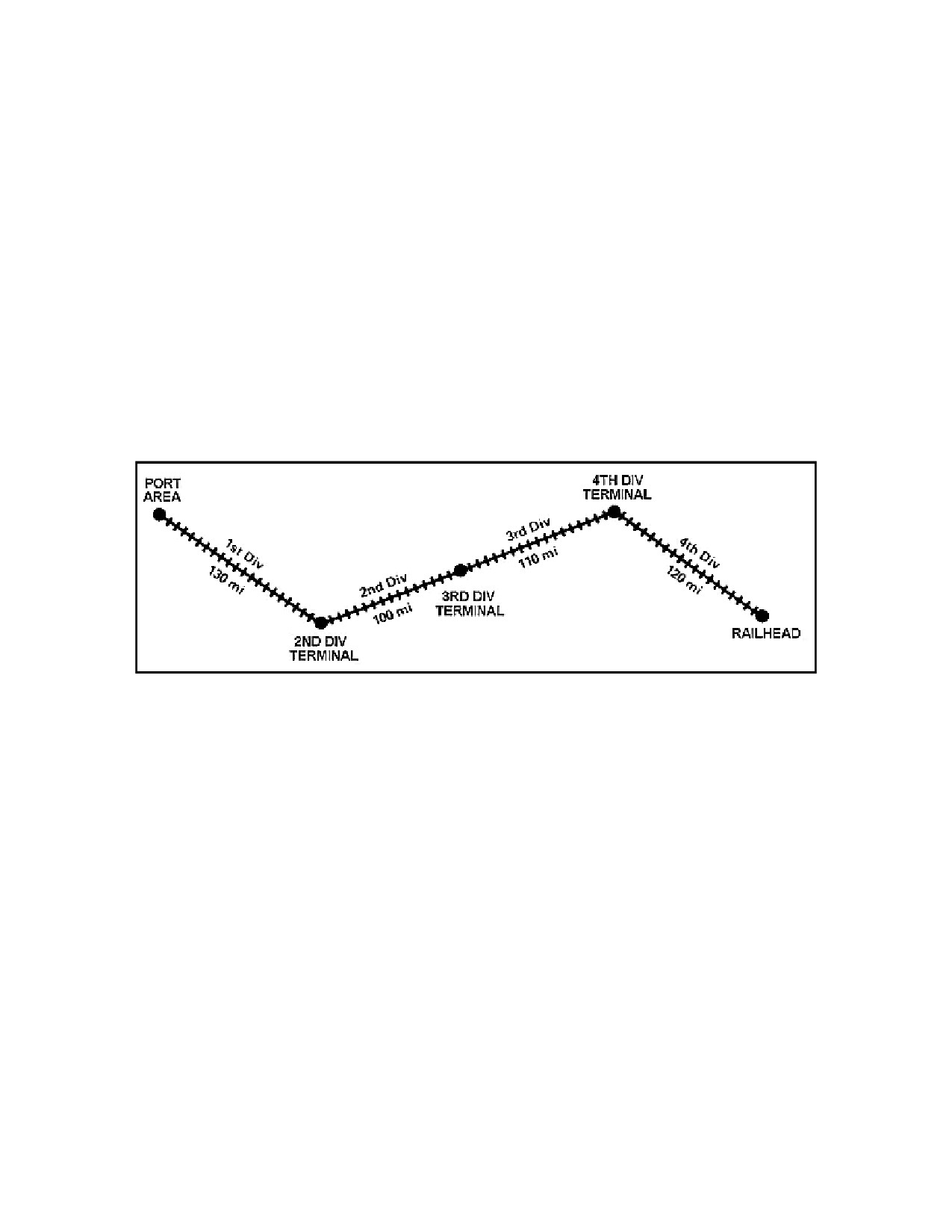
B-1. Plan for the operation of a rail system to move supplies in a theater of operations. The target
date for the initiation of service is on 1 December. Route all rail tonnages originating in the port to
the railhead over the main line of the system as shown in Figure B-1.
Figure B-1. Hypothetical Rail System for Planning
Note 1. All tonnages are expressed and computed in STONs.
Note 2. All computations resulting in a fraction are raised to the next higher whole number.
PLANNING DATA
B-2. Planning depends on the size and type of rails, condition of crossties, rail and ballast, washout
and rockslide potential, number of single and double main lines, and the availability of sidings or
passing tracks.
TRACK
B-3. If there is a usable double track, trains may operate in both directions without delays in
schedules. However, the unit often takes the usable parts of a damaged double track to make one
single main line with good passing tracks. Computations in this appendix are based on a single track.
Number
Single track (unless otherwise stated)
Gauge
Standard (56.5 inches)
Condition
All divisions: Good to fair
Percent of Grade
All divisions: 1.5 percent or less
B-1
FM 4-01.41 ____________________________________________________________________________________ Appendix B
Ruling Curve
All divisions: 5 degrees
All divisions:
Weather
Summer: +60oF to +95oF
Winter: +35oF to -20oF
Wet weather: Local and temporary
Passing Tracks
First divisions - 15
Second division - 9
Third division - 11
Fourth division - 14
MOTIVE POWER
B-4. Motive power consists of all self-propelling equipment found on a railroad. The most common
motive power refers to locomotives.
Road Engines
B-5. US Army 0-6-6-0, 120 tons, diesel-electric locomotive.
Switch Engines
B-6. US Army 0-4-4-0, 60 tons, diesel-electric locomotive.
ROLLING STOCK
B-7. Rolling stock refers to a collection of a large group of railway cars.
Boxcars
40-ton rated capacity
Gondolas
40-ton rated capacity
Flatcars
50-ton rated capacity
FIRST COMPUTATION
B-8. Determine the train density for each of the four railway divisions.
(NPT +1)
24 X S
TD =
X
2
LD
S =
10 mph (refer to Table 10-2)
STEP 1.
(15 + 1)
16
240
First Division:
TD =
X 24 X 10
=
2
130
2 X
130
3,840
=
= 14 + of 15 trains
260
B-2
FM 4-01.41 ____________________________________________________________________________________ Appendix B
STEP 2.
(9 + 1)
10
240
Second Division: TD =
X 24 X 10
=
2
100
2 X
100
2,400
=
= 12 trains
200
STEP 3.
(11 + 1)
12
240
Third Division:
TD =
X 24 X 10
=
2
110
2 X
110
2,880
=
= 13 + 14 trains
220
STEP 4.
(14 + 1)
15
240
Forth Division:
TD =
X 24 X 10
=
2
120
2 X
120
3,600
=
= 15 trains
240
SECOND COMPUTATION
B-9. Determine the end delivery tonnage of this rail line during winter months using single-engine
operation. You must use the following formulas:
· EDT = NDT of most restrictive division
· NDT = NTL X TD
· NTL = GTL X .50
· GTL = DBP X WF
RR + GR + CR
· DBP = CTE -- (Total weight of engine in STONs x 20 pound per STON)
· CTE = STE
2
· CTE = Weight on drives (lb)
25% adhesion factor
STEP 1. Compute the starting tractive effort.
STE = Weight on drivers (lb)
4
240,000
=
=
60,000 pounds
4
B-3
FM 4-01.41 ____________________________________________________________________________________ Appendix B
STEP 2. Compute the continuous tractive effort.
STE = STE
2
60,000
=
=
3,000 pounds
2
STEP 3. Compute the drawbar pull of the road engine.
DBP = CTE-- (Total weight of engine in STONs x 20 pounds per STON)
=
30,000 -- (120 X 20)
=
30,000 -- 2,400 = 27,600 pounds
STEP 4. Compute the gross trailing load.
GTL = DBP X WF
RR + GR + CR
Where:
DBP = 27,600 pounds (preceding calculations)
WF = 80 percent (see Table 10-1)
RR = 6 (see paragraph 10-4)
GR = 1.5 percent X 20 = 30
CR = 5 degrees X 0.8 = 4
27,600 pounds X .*80
GTL =
6 + 30 + 4
22,080
=
=
552 STONs
40
STEP 5. Compute the net trainload.
NTL = GTL X .50
=
552 X .50 = 276 STONs
STEP 6. Compute the EDT of the system by determining the NDT of the most restrictive division.
NTL X TD = NDT
First Division
276 X 15 = 4,140 STONs
Second Division
276 X 12 = 3,312 STONs
B-4
FM 4-01.41 ____________________________________________________________________________________ Appendix B
Third Division
276 X 14 = 3,864 STONs
Fourth Division
276 X 15 = 4,140 STONs
EDT = NDT of second division (most restrictive)
EDT = 3,312 STONs
THIRD COMPUTATION
B-10. Determine the rolling stock requirements for this rail system when operating at maximum
capacity during winter months using single-engine operation. Each type of freight car will move the
following percentages of the end delivery tonnage:
Boxcars
50 percent of EDT
Gondolas
25 percent of EDT
Flatcars
25 percent of EDT
STEP 1. Compute the portion of the EDT to be moved in each type of railcar:
Boxcars:
EDT X 50 percent = 3,312 X .50 = 1,656 STONs
Gondolas:
EDT X 25 percent = 3,312 X .25 = 828 STONs
Flatcars:
EDT X 25 percent = 3,312 X .25 = 828 STONs
STEP 2. Compute rolling stock requirements for one day’s dispatch. You must apply the following
formulas:
Total cars required = EDT (by type car) X TAT X 1.1
Average payload for type of car
EDT (by type car)
1 DD =
Average payload for type car
Note: Average payload in tons per type car = Rated capacity
2
Therefore, 1 day's dispatch for all types of cars is computed as follows:
1,656
Boxcars:
1 DD =
= 82 + or 83 cars
20
828
Gondolas:
1 DD =
= 41 + or 42 cars
20
828
Flatcars:
1 DD =
= 33 + or 34 cars
25
Total cars in 1 DD = 159 cars
B-5
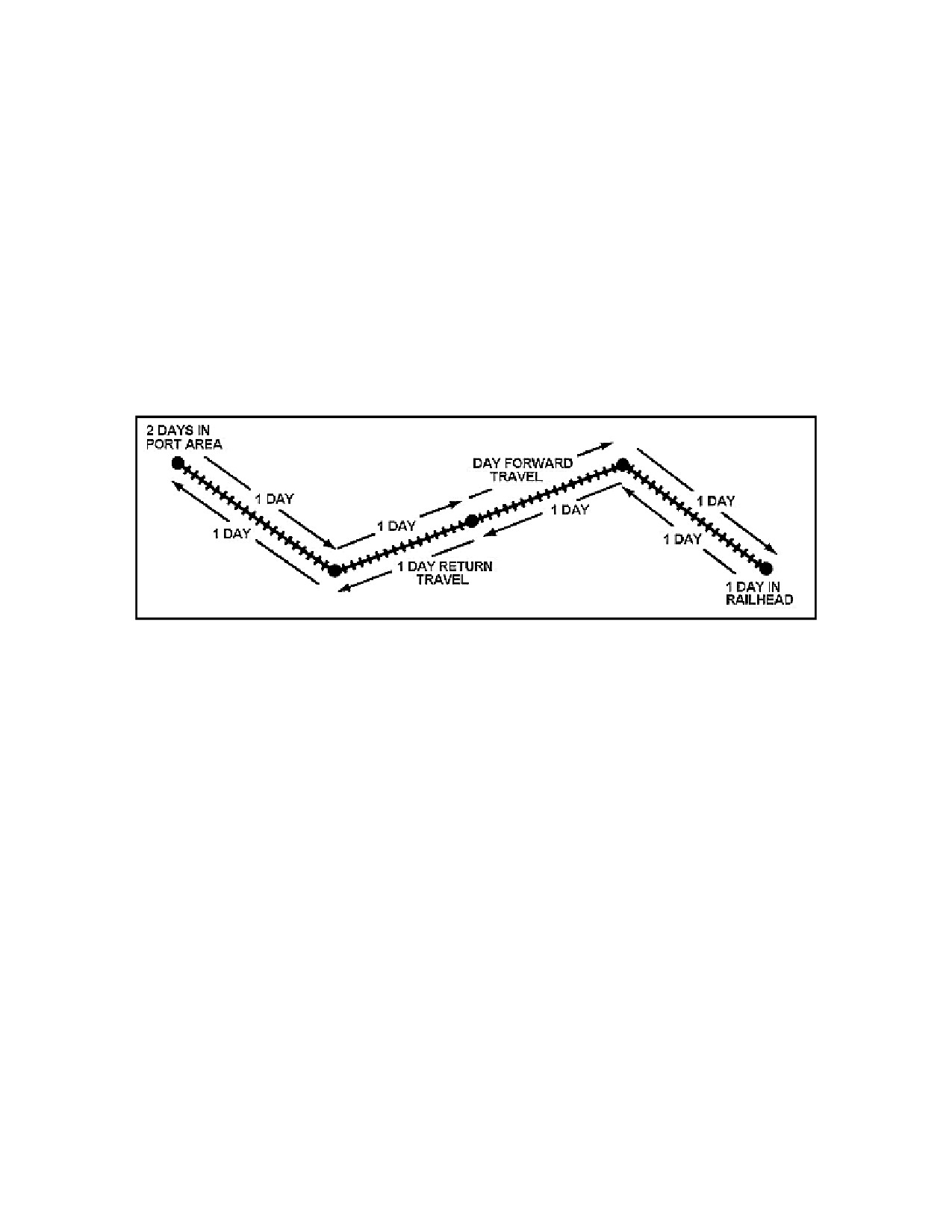
FM 4-01.41 ____________________________________________________________________________________ Appendix B
Rolling stock requirements are based on a TAT of 11 days (see paragraph 10-47). Therefore, total
rolling stock requirements are computed as follows: 1 DD X TAT = cars required X 1.1 (reserve
factor) = total cars required (also see Figure B-2).
1 DD X TAT = cars required X 1.1 (reserve factor) = total cars required
Boxcars:
83 X 11 = 913 X 1.1 =
1,004+ or
1,005 cars
Gondolas:
42 X 11 = 462 X 1.1 =
508+ or
509 cars
Flatcars:
34 X 11 = 374 X 1.1 =
411+ or
412 cars
Total rolling stock requirements: 1,926 cars
Figure B-2. Determination of Turnaround Time in Days
FOURTH COMPUTATION
B-11. Determine the road and switch engine requirements for the operation of the system at
maximum capacity during winter months using single engine operation.
STEP 1. Compute for road engines required.
(RT + TT)
Number of road engines = TD X
X 2 X 1.2
24
COMPUTE FOR FACTORS
B-12. Compute the running time for each division.
RT
TD
(Length of div ÷ avg speed)
First division:
15
130 ÷ 10 = 13
Second division: 12
100 ÷ 10 = 10
Third division:
14
110 ÷ 10 = 11
Forth division:
15
120 ÷ 10 = 12
B-6