FM 4-01.41 ARMY RAIL OPERATIONS (DECEMBER 2003) - page 3
FM 4-01.41 ______________________________________________________________________________________Chapter 6
that will make switching easier at the next terminal. After a train is assembled, the train consist is
repaired and sent to the yard office. Car inspectors make the departure or terminal airbrake test and
another general inspection. While they are checking the cars, the road engine crew switches the
engine from the engine ready track to the front end of the draft of cars. The train conductor must get
the waybills and the train consists from the yard office and train orders and Clearance Form "A"
from the train order office. Train orders give the priority of movement on the main line and the
Clearance Form "A" gives the exact time the train is authorized to occupy the main line. When the
brake tests are completed and the inspectors are satisfied that the equipment is in good shape and
ready to operate, markers are placed on the rear of the last car and the draft of cars officially become
a train. The train may leave the yard when the chief dispatcher gives the signal.
Combination Yard
6-8. Railroads frequently incorporate the receiving, classifying, and departure facilities into one yard.
This may result from insufficient volume of work to justify three separate yards or from a lack of
land to expand the yard layout. In combination yards, the number of tracks depends on the volume
of traffic. The established length of inbound and outbound trains determines the track length. These
yards are generally flat. Switching is accomplished by the back-and-forth movement of a yard engine
with cuts of cars. Since this method prevails in most small yards, flat-yard switching is generally done
in combination yards. In a combination yard, it is impossible to arbitrarily assign specific tracks for
receiving only. Road trains must be taken into the yard without delay to prevent blocking the main
track. The yardmaster decides which track to use. However, in a crowded yard, the yardmaster may
be forced to accept a train on any track that is able to accommodate it. It may be necessary to use
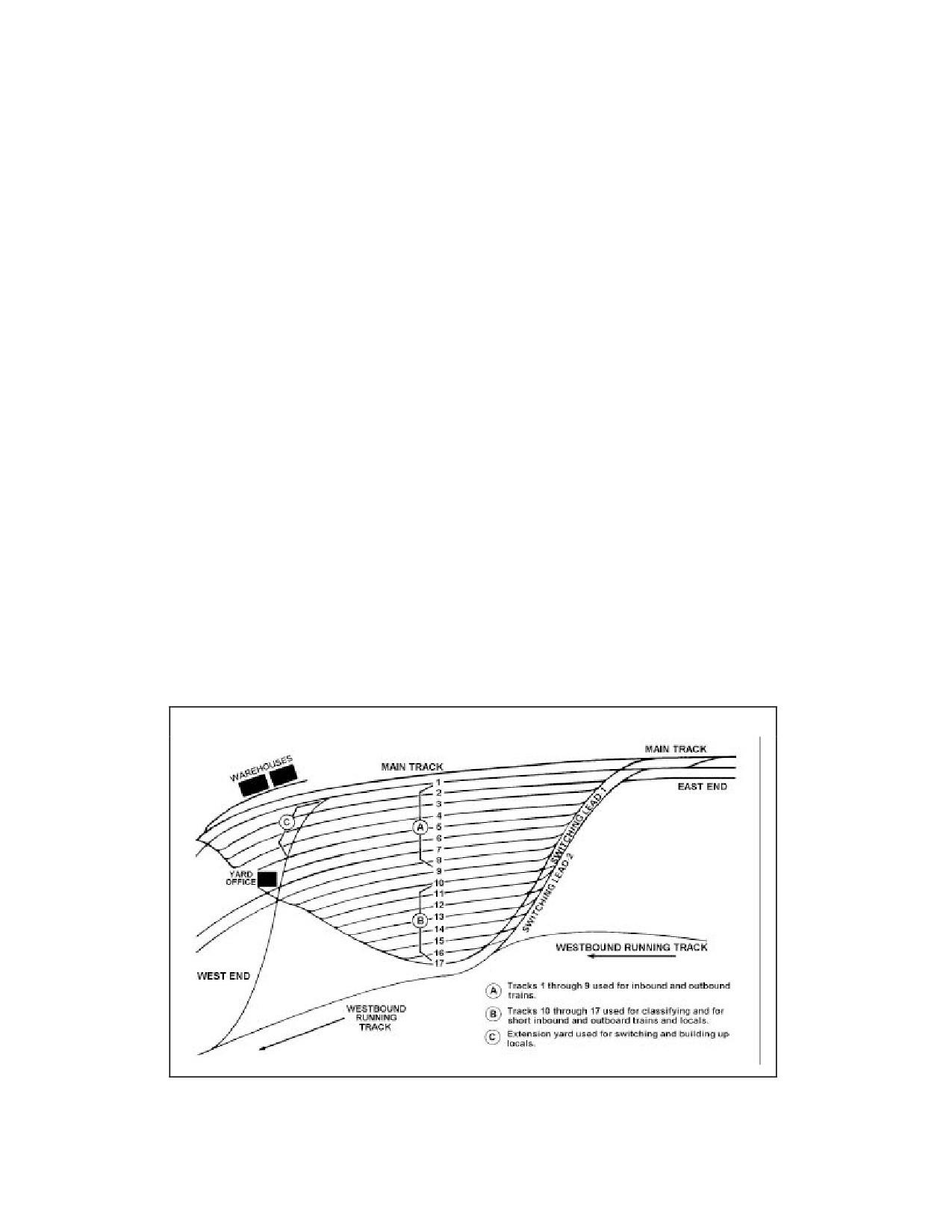
two tracks if the clear tracks are too short to accommodate the entire train. The longer tracks shown
at A, Figure 6-2, are used interchangeably for inbound and outbound trains and the remaining tracks
are used for classification.
Figure 6-2. Typical Combination Yard
6-4
FM 4-01.41 ______________________________________________________________________________________Chapter 6
TERMINAL FACILITIES
6-9. A railway terminal is a large installation at the beginning and end of a rail line for delivering and
receiving freight or loading and unloading passengers. In a theater of operations, a military rail line
will generally have a terminal at the beginning of the line but more often than not the forward end of
the line will end at a railhead. Adequate terminal facilities are of vital importance in railway
operations. Congestion can occur if facilities are not properly used or if they do not exist. The
following can result if congestion occurs:
· Cars cannot be moved.
· Cars cannot be promptly loaded and/or unloaded.
· Tactical forces may be deprived of urgently needed supplies.
Service Facilities
6-10. Every railway terminal includes one or more of the types of yards discussed above plus other
installations which may include inspection and repair tracks; locomotive ready tracks; fuel, sand, and
water service facilities; ash pits; scale tracks; and so forth. Buildings within the terminal include the
following:
· Sand houses and supplies which are located near service tracks.
· Shop buildings at the repair tracks.
· Yard offices and towers near the center of the yard for the control of classification and
switching operations.
· Other buildings that provide billet and mess facilities for train crews.
Consider the protection afforded by each building against NBC attack when selecting each site.
Certain types of buildings offer excellent shelter from nuclear hazards and require a minimum of
time and effort to adapt for use. The stronger the structure, the better the protection against blast
effects. An overpressure system, such as the SCPE, can be used to convert existing structures to
provide rest and relief for personnel from NBC hazards. The SCPE is a field expedient system. Gas
and particulate filters remove any NBC contamination from the air. The overpressure system stops
leakage of contaminated air into the enclosure. Personnel enter and eave through a protective
entrance. This entrance is an air lock; it prevents contamination from entering the enclosure. FM 3-4
provides more information on the other types of systems and their uses.
Freight Stations
6-11. Freight stations are named buildings, sheds, or warehouses. These stations provide facilities for
the receipt, loading, unloading, or storage of equipment and supplies. Loading and unloading areas
preferably have separate routes for vehicles to enter and depart. End ramps are provided for wheeled
and tracked vehicles. When not available and when time does not permit the construction of end
ramps, vehicles and tanks may be loaded on flatcars using field expedients discussed and shown in
C4, TM 55-2200-001-12. The named freight station and consignees should be clearly shown on
waybills or other documentation to permit prompt placement of cars by yard operating personnel.
6-5
FM 4-01.41 ______________________________________________________________________________________Chapter 6
Passenger Stations
6-12. Facilities for moving personnel by rail should include one or more tracks on which cars can be
placed before boarding time. Where facilities allow, cars used for the movement of troops should be
cleaned, inspected, and watered before being placed for loading. When cars are equipped for steam
heat, they should be heated (during cold weather) before troops board by using a station line, heater
cars, or locomotive. Space, free of vehicular traffic, should be available adjacent to the loading track.
This will allow personnel to assemble according to plan and permit ready handling of baggage and
equipment. Station facilities should include office space for field transportation officers and battalion
operating personnel, waiting rooms, storage sheds, car cleaning and watering tracks, and so forth.
Enginehouses
6-13. Enginehouses (roundhouses) are quite vulnerable to air attack because they, with the usually
adjacent turntable, are easily identified from the air. Where enginehouses are not available or are not
usable for tactical reasons, tracks adjacent to the yard should be constructed or set aside for servicing
locomotives. Such facilities should include fuel and water supplies, a pit for inspection and minor
underneath repairs, ash pits for cleaning fires if steam locomotives are used, and a Wye track for
turning locomotives in the absence of a turntable. Any new enginehouse constructed should be a
simple, rectangular, functional, shed-like structure. If necessary, store needed equipment and tools in
boxcars. A mobile workshop, operating from a mobile machine shop car, may be used at outlying
points where no facilities exist and new construction is not feasible or justified. Personnel of the
transportation railway equipment maintenance company operate the enginehouses.
TRACKS AND YARD CHARACTERISTICS
6-14. To expedite yard work, certain tracks are necessary. These include main tracks outside the yard
tracks, divided leads, running tracks, switching leads, sufficient track length, and so forth.
Outside Main Tracks
6-15. When main tracks are outside the yard tracks, time may be saved in switching cars. When a
main track separates a main yard from an auxiliary yard, crews are delayed in crossing from one yard
to another. Yardmasters have no control over the main tracks, and crews must obtain the
dispatcher’s permission before crossing the tracks. For example, a yard crew of 30 or 40 cars crossing
the main track will interrupt the entire switching operation for 15 to 30 minutes depending on main
line traffic. An ideal arrangement is to have the main tracks located several kilometers from yards or
yard tracks. A main track with a low train density may not restrict yard work significantly. One with a
high density of traffic may deal with yard operations to the extent that it might be advantageous to
relocate the main track.
Divided Leads
6-16. Divided leads may be located at each end of a yard. This enables two yard crews to work at the
same time. Where only a single lead exists and two crews are employed, one crew must generally
couple cars and make room on tracks while the other uses the lead in switching cars.
6-6
FM 4-01.41 ______________________________________________________________________________________Chapter 6
Running Tracks
6-17. Running tracks extend the entire length of the yard and provide a route of travel to any point in
the yard independent of the switching leads and classification tracks. When two running tracks exist,
they are assigned directional designations. Most railroads permit road and yard crews to use these
tracks without prior permission from the yardmaster. However, their movement must be in the
direction specified by the track designator. With the exception of yard facility tracks, running tracks
are generally the only ones that may be used without permission.
Long Leads and Approaches
6-18. Switching leads provides access to any point within a yard. They must be long enough to handle
the longest length of cars normally handled. They must also lead out of the yard to running tracks or
to the main line. Long approaches to the switching leads are desirable so that yard crews can move
long cuts of cars from one track to another.
Track Length
6-19. Tracks should be long enough to handle inbound and outbound trains without doubling or
moving cars off one track and coupling to cars on another. For example, if a 100-car train enters a
yard on a track that can hold only 65 cars, the train must double 35 cars to another track and block
the lead while making the double. When an outbound train is built up on two or more tracks of
limited length, delay will occur in doubling the train. When the train is on one track, the air test,
which must be made only after the train is complete, can be made before the train moves out to
block the lead. Pusher engines may be used to help reduce the delay by pushing the train out of the
yard.
Other Trackage and Yard Facilities
6-20. Ready tracks are located near enginehouses and are used when moving locomotives waiting to
go on the road. When a locomotive is ready for road or switching service, it is moved to the ready
track. When the locomotive is needed, it is moved through the lead track to the front of the
assembled train. Facilities to inspect, water, fuel, and sand locomotives are located alongside the
ready track.
6-21. Repair tracks (rip tracks) are located in the receiving yard. They are used during inspection to
repair cars with mechanical defects. Light and heavy repairs are made to cars in a large rail yard and
therefore require both light and heavy repair tracks. If the volume of traffic is great, rebuilt facilities
may be required. In any small yard, there will always be light repair tracks. Mechanically defective cars
are switched from trains and placed on bad-order tracks leading to the repair tracks. If extensive
repairs are required on a loaded car, transfer tracks are used to transfer the freight from the defective
car to another car to prevent long delays. If perishables are being handled, facilities for re-icing cars
or servicing mechanical refrigerator cars are required.
6-22. Inspection tracks are used to inspect locomotives and cars. The tracks may be equipped with a
pit and floodlight so the inspector can examine the underframe of cars, trucks, and locomotive
running gear.
6-7
FM 4-01.41 ______________________________________________________________________________________Chapter 6
6-23. Team tracks or spurs provide a place for loading and unloading railcars and must be accessible
to motor vehicles. They are frequently near ramps to allow for easier loading and unloading of
vehicles on flatcars for piggyback movement. Shippers provide their own vehicles for loading and
unloading cars on team tracks.
6-24. Dangerous commodity tracks are provided for handling ammunition, explosives, and POL
products. These tracks are isolated from other tracks in the yard. Other tracks may be identified for
the deliberate decontamination of locomotives and railcars.
6-25. Miscellaneous tracks include special tracks such as wreck train and work train equipment tracks
and storage tracks for cars loaded with sand, gravel, rails, crossties, and other maintenance of way
materials. They are functionally located within the yard and are readily accessible when cars are
switched out and placed in trains. If a railroad handles livestock and perishable freight, it must have
facilities for feeding, watering, and resting livestock, and for re-icing refrigerator cars containing
perishable shipments.
6-26. The enginehouse contains repair equipment, materials, and tools used to inspect, service, and
make running repairs on locomotives that operate on the railway division. The railway equipment
company operates the enginehouse. When inspections, services, and repairs are finished, the
locomotives are ready for road or yard service.
YARD PERSONNEL DUTIES AND RESPONSIBILITIES
6-27. The operation of a yard at a rail terminal requires a large number of workers assigned to a
variety of duties. The following describes the duties of the yardmaster, yard clerks, yard switch crews,
and car inspectors.
YARDMASTER
6-28. The yard office is the workshop from which the yardmaster supervises and coordinates all yard
and clerical work. The yardmaster is in complete charge of all workers and all activities within the
yard. He is responsible for safely, speedily, and economically switching inbound trains and building
up and forwarding outbound trains. These duties include distributing cars in the yard, assigning
tracks for loading and unloading cars, assigning work to switching crews, and calling train crews. The
clerical work in yard operation is also he yardmaster’s responsibility. This work consists of the
following:
· Making track checks.
· Notifying local consignees of cars arriving for them.
· Maintaining car record books.
· Compiling train consists.
· Sorting and distributing waybills.
· Preparing any other documentation necessary for dispatching trains from the yard to their
destination.
· The yardmaster is also responsible for the following records and reports.
6-8
FM 4-01.41 ______________________________________________________________________________________Chapter 6
Yardmaster’s Journal
6-29. When planning the switching of trains, the yardmaster must consider freight on hand. When a
yardmaster reports for duty, he should check the lineup of incoming trains and the cars already in the
yard. He should immediately begin to plan the make up of trains to clear the yard for inbound trains.
The check is made using the yardmaster’s journal.
6-30. The yardmaster’s journal, sometimes called a "turn-over book," provides information needed in
planning the switching and make up of trains. It is an up-to-date, permanent record maintained by
each yardmaster on each shift. It is used to inform each yardmaster of the status of every track in the
yard. Figure 6-3 shows a sample page from the journal that might be kept for the combination yard.
6-9
FM 4-01.41 ______________________________________________________________________________________Chapter 6
The actual form may vary among railroads but information found on journals are basically the same.
In a theater of operations, journals are kept as simple as possible and show only essential
information. In addition to the name of the yardmaster, the terminal or yard name, the date, and the
time, the journal may also show the following:
· A consist or lineup of inbound trains due in the next several hours. If there is no figure for
the estimated time of arrival, the dispatcher will estimate the arrival time later.
· The listing of every track in the yard including cars and their contents.
· The status of every track in the yard to include whether the cars are coupled, whether they
are at the east or west end, or whether the cars on the shop tracks are spaced or unspaced.
An appropriate notation is also made if the air has been tested and okayed on any track.
· A list of the yard crews and locomotives that will be working during the oncoming shift,
exactly what each crew is doing at the time of the yardmaster's change, and where each
engine is awaiting relief. Yardmasters usually change shifts a half or full hour before yard
crews change.
· A list and consist of trains ready for departure.
· Other data pertinent to yard operations. The journal pages have wide margins to allow for
additional entries as work progresses. After 2300 hours, all cars switched to the tracks
from the west end of the yard will be entered on the right side. Figure 6-4 shows a sample
of a journal page with all entries posted. These entries should be consulted and checked
after the switching operation is completed.
6-11

FM 4-01.41 ______________________________________________________________________________________Chapter 6
5.
Clear
6.
9 SV+9+6+30 DW (east end) + 1 DW + 1 DW
7.
100 mty 70-ton hoppers (air OK)
8.
Clear
9.
2A4+4+1+85 EV (coupled; west end) + 2 EV + 3 MO + 2 BR
10.
1 + 1- BR (coupled)
11.
1 + 9 MO
12.
Clear
13.
12 A4 + 4 ELT + 10 CY + 2 CY + 5 SW
14.
2 BP + 1 WD + 2 BP + 27 Elwood locals + 3LY
15.
12 Red River
16.
1 CP + 1 CP + 20W+ 14 CP + 12 OW (mixed)
17.
1 Shop + 12 Hold &Miscelleanous
Extension Yard
Shop Tracks
1.
1.
Figure 6-4. Part of Journal Page After Switching
Car Inspector’s Train Report (DA Form 5616-R)
6-31. Prepare this report for each train that is inspected when it enters or leaves a yard or terminal
(Figure 6-5). A blank DA Form 5616-R is in Appendix A. You may reproduce this form on 8 1/2 x
11-inch paper. Indicate the train number, engine number, station, and date at the top of the form.
Show the date, brake pipe leakage, and time of air test in the proper blocks. Indicate the percent of
brake pipe leakage. A "Remarks" block is provided for any other additional information. All other
blocks are self explanatory.
6-12
FM 4-01.41 ______________________________________________________________________________________Chapter 6
Daily Statement of Cars On Hand (DA Form 5617-R)
6-32. Station agents and yard clerks prepare this report using information obtained from the car-
record book and/or from a physical check of the cars on hand in the yard or station sidings (Figure
6-6). A blank DA Form 5617-R is in Appendix A. You may reproduce this form on 8 1/2 x 11-inch
paper. This form shows the car number, date received, type of contents, consignee, and length of and
reason for any delay. The report is forwarded daily through channels to the battalion commander
(division superintendent) for his information and his reports to higher authority.
Yard Clerks
6-33. Yard clerks prepare train consists, switch lists, and do other administrative jobs assigned by the
yardmaster. They also make yard checks, maintain an exact up-to-the-minute location of all cars, and
check car numbers of all arriving and departing trains. The number of yard clerks required depends
on the type and volume of work to be done. Three clerks are usually required on each shift. One
clerk handles the inbound clerical work, one does all outbound clerical tasks, and the third is assigned
to checking cars. When there is a large number of tracks, two or more clerks may be required to
check cars. Clerical duties may vary considerably among railroads in different localities.
Inbound Clerical Work
6-34. During inbound clerical work, the initials and numbers of all cars arriving in the yard must be
entered in the car record book. The inbound clerk checks the waybills against the completed track
check and makes sure that the numbers on the track check agree with those on the waybills. They
must also make sure that there is a car for every waybill and vice versa.
6-35. Many other reports are often necessary. These include arrival notices to local consignees, hold
notices, reweigh reports (necessary when bulk-loaded cars have lost part of their lading), and seal
reports. All yards stamp each waybill on the back with a junction stamp showing the time and date of
arrival and the name of the yard. Clerks are then able to check the time interval of cars n and
between various yards. These notations also enable yardmasters to inquire or start corrective actions
concerning cars that are subjected to unreasonable layovers between point of origin and destination.
Most yards maintain an inbound and outbound train sheet that shows the engine number,
conductor’s name, arrival or departure time, and the number of loads and empties in each train or
drag. A drag is generally a long, slow freight train handled by a yard engine on a main track. The train
sheet is usually maintained from 0001 through 2350 hours.
6-14
FM 4-01.41 ______________________________________________________________________________________Chapter 6
Outbound Clerical Work
6-36. When an outbound train has been called, the clerk assigned the outbound duties computes the
gross tonnage. The following forms help the clerk to keep an accurate account of all trains and
freight leaving the yard.
6-37. Train Consist. A train consist is prepared by showing a list of the cars which make up a train.
The report shows the initials, number, contents, weight, origin, and destination of each car in the
order (from front to rear) in which the car stands in the train. Immediately after a train is dispatched,
the train consist is sent by telephone or teletype to the yard at the train’s destination. No standardized
form is prescribed for the train consist. Four copies of the train consist are required for distribution.
Distribute the consist as follows:
· Original is sent to the car records office for posting and filing.
· A copy goes to the transportation movements officer at point of origin.
· A copy is kept by the yardmaster at train origin.
· A copy goes to the yardmaster at train destination.
The yardmaster uses it to plan his switching operations and track allocations. The train consist is also
placed in permanent files for use in financial accounting.
6-38. Commercial Freight Waybill. A commercial freight waybill authorizes a common commercial
carrier to move a railway car. The shipper prepares a waybill. The commercial freight waybill shows
the following:
· Car number and initials.
· Contents.
· Weight.
· Consignor.
· Consignee.
· Origin
· Destination.
· Date of issue.
· Number of seals used (if any).
· Any special instructions or information required for the movement.
This information is used to trace the shipment if it is lost, stolen, or damaged while en route. Similar
systems may be used in overseas areas where the HN railroad is used.
Note: A home route card will be used and attached inside the waybill when the railcar is to be
returned to the origin point. This would normally be used for special type cars to handle specialized
cargo.
6-39. Transportation Control and Movement Document. Where military standard transportation
and movement procedures are prescribed, all documentation must be according to MILSTAMP
6-16
FM 4-01.41 ______________________________________________________________________________________Chapter 6
directives in DOD Regulation 4500.32-R, Volume 2. The TCMD is used for all shipments from
military activities and may be used as a freight waybill. The number of any seals used, routing, and
any special instructions are inserted on the form.
6-40. Track Check. The outside clerk ensures that information on the track check corresponds to
the waybill and that the train is in station order. The clerk formats the track check and must show the
initials, number, contents, and type of each car (box, tank, hopper, or flat). He also records the seal
number of each car, applies new seals when necessary, and makes a record of the seals used. No seal
numbers are shown in the sample format (Figure 6-7, page 6-18) because the cars are empty. If seals
were required, an additional column would be added and the seal numbers recorded. The clerk
indicates at the top of each sheet at which end of the train the check was started.
6-41. Switch List. The switch list can be prepared using the same format used for the track check
(except a column for destination and track are added). The clerk prepares the switch list using
information on the track check. In turn, the switch list shows the destination of each car, whether it
is empty or loaded, the track to which a car must be switched, and the number and size of the cuts to
be made in breaking up the train. Figure 6-8, page 6-19, shows a track check converted to a switch
list.
Yard Switching Crew
6-42. A yard crew is generally composed of four members: the engineer, the conductor, and two
brakemen. The brakemen may also be called switchmen. The brakeman working farthest rearward
from the engine is known as the rear brakeman. If workload requires, additional brakemen may be
assigned. Where a long lead with a large number of switches exists, an extra brakeman or a
switchtender may also be assigned. The yard conductor, sometimes called the switch foreman, is in
complete charge of the crew and is responsible for carrying out the yardmaster’s instructions in a safe
and expeditious manner. The yardmaster usually delivers instructions in writing if verbal instructions
are complicated or would be confusing. The conductor must fully inform his crew what to do and
how to do it. The yard conductor normally uses a switch list. The switch list will be developed from
information obtained from the track check.
6-17
FM 4-01.41 ______________________________________________________________________________________Chapter 6
Engine Crew
6-43. The engine crew consists of an engineer. The engineer works under the direction of the yard
conductor. The engineer and conductor are both responsible for safe and efficient operation of the
locomotive. The engine crew is also responsible for certain duties in switching operations. These
duties include the following:
· Executing signals given by the ground crew.
· Interpreting hand signals and refusing any signals not clearly understood.
· Calling and repeating hand signals, switch-light colors, and signal-light aspects to each
other to ensure signals are read properly.
· Answering the whistle signals of main-track trains with the appropriate whistle signals of
the yard engine.
· Complying with timetable instructions in crossing main tracks.
· Questioning a signal when it may be unsafe to obey.
· Periodically inspecting and lubricating the locomotive’s running gear
Inspectors
6-44. In military railroading, personnel of the car repair platoon of the railway equipment
maintenance company are assigned to yards as inspectors. Car inspectors examine and make running
repairs to cars entering a yard. Air inspectors test the air brake equipment of trains after they are built
up and before their departure from the yard. All inspectors must be cautious when inspecting
inbound cars. Chemical contamination may be present and unknown to the train crew. Suspicious
liquid concentrations should be tested and all contaminated rolling stock marked using standard
NATO NBC markers.
Car Inspectors
6-45. One of the most important jobs in the movement of trains is that of the car inspectors. Car
inspectors must check each car for over 200 possible defects. Inspectors are required to make close
inspection of wheels and flanges, journals and bearings, underframes, brake rigging, handbrakes, air
brake equipment, grab irons, sill steps, draft gear, and many other parts. If defects are not noticed
and corrected, serious consequences may result. A defective car in a train could cause a derailment or
a lengthy delay in setting the car off en route. Roof sheets, ladders, and running boards on closed-top
cars must also be inspected. Experienced personnel can inspect a car in a short amount of time.
Air Inspectors
6-46. Inspectors, although qualified in all phases of inspection, are frequently detailed to air
inspecting and testing only. When a train is coupled, it is moved to a point where the air hose on the
first car is over the hose connected to the ground air line. Inspectors couple air gauges between these
hoses and walk the length of the train, coupling the hoses between cars as they progress. When all
hoses are coupled and enough pressure is attained in the train line and reservoirs, brakes are applied
on the train. Inspectors examine the piston travel to determine if enough braking force is being
exerted on the wheels of each car. Linkage may need to be adjusted so that brake shoes will exert
proper force. Every car is inspected for excessive air leakage and gauges are checked to determine the
entire train line leakage. If leakage is within permissible limits, the train is reported to the yardmaster
6-20
FM 4-01.41 ______________________________________________________________________________________Chapter 6
as ready for movement. The car inspectors will write a "shop" or bad-order tag for those defective
cars that cannot be immediately repaired. These cars are cut out by the train yardmaster.
FREIGHT GROUPING AND CLASSIFICATION
6-47. The governing principle throughout the grouping or blocking process is to group each cut of
cars by destination so that its position in the outbound train requires a minimum of handling in
setting it off. Classifying cars involves assigning them to a particular destination grouping and
switching them to a track having the same grouping. When enough cars accumulate on the same
track, either of one group or a combination of groups, an outbound train is ordered. Cars consisting
of several groupings or blocks are set into the train in the order that they will be set off along the
route. The first block to be set off is placed immediately behind the engine, followed by the next
setoff grouping, and so on. Placing the blocks directly behind the locomotive involves the least
amount of movement in setting them off. In special cases, there may be exceptions to this sequence.
For example, a group of expedite cars may be carried next to the engine (a location out of their
normal standing). This position would enable the yardmaster at the receiving terminal to remove
them from the train before car inspectors blue-flag the track on which they arrive. The cars would
then be placed on the head end of a departing train (again out of their normal standing) and handled
identically at the next division terminal. The cars would be kept on the head end of all trains until
they arrived at their destination. This method could save as much as 48 hours over an 800-kilometer
haul. It might be equally convenient to have a setoff at either end of the train in a yard where the
engine is to be changed.
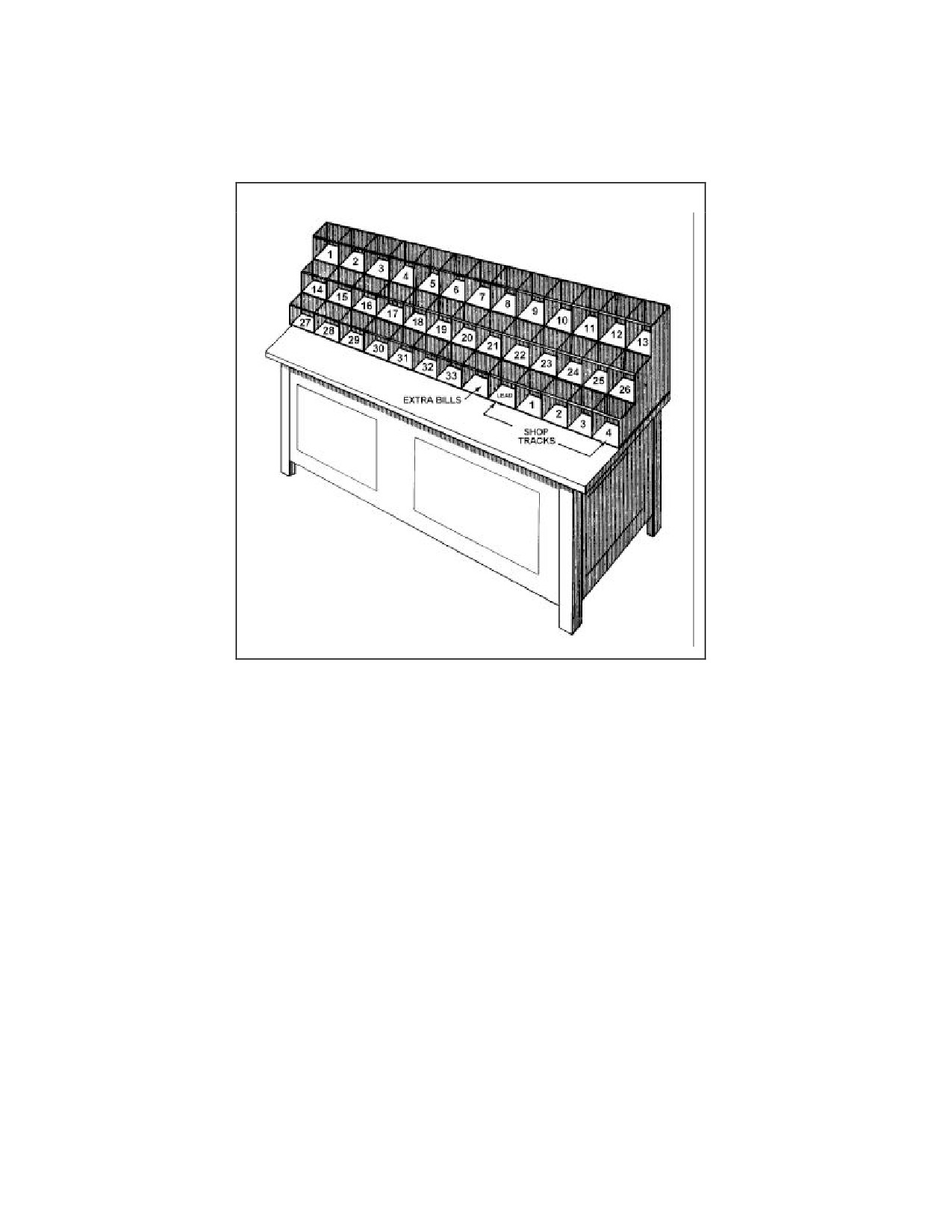
Bill Rack
6-48. A bill rack is another method of keeping track of waybills. However, it should never take
precedence over the entries in the journal. The rack always contains a separate section for every track
that the yardmaster has jurisdiction over. Waybills are put in the sections in the exact order that cars
enter and stand on the tracks. When a crew switches loaded cars in the yard, the yardmaster switches
the waybills to the appropriate slots in the bill rack (Figure 6-9). In a westbound yard, when cars are
switched to the west end of a track, the bills are usually placed in front of those already in the
particular track slot. When cars are switched to the east end, bills are placed behind those already in
the rack. Do not assume that because a slot is empty, the track is clear—too many people use it.
Careful switching of bills is as important as switching of the cars. When bills are correctly switched,
one may see that the exact standing of a track makes it a simple matter to estimate or compute the
tonnage of any track when planning an outbound movement. The journal, never the bill rack, is the
authority for determining the clear tracks. A particular slot in the bill rack may be empty but a
mistake may have been made in switching the bills.
6-21
FM 4-01.41 ______________________________________________________________________________________Chapter 6
Figure 6-9. Bill Rack
6-22
FM 4-01.41 ______________________________________________________________________________________Chapter 7
Chapter 7
Railway Structure, Reconnaissance,
Construction, and Rehabilitation
Railway structure is of strategic and tactical importance to the commander. Rail units are responsible
for reconnaissance to determine the condition and characteristics of track, rolling stock, yards,
terminals, shops, and other facilities. The highest unit headquarters determines requirements for
rehabilitation and new construction after the original reconnaissance is made.
TRACK AND STRUCTURES
7-1. The track is the most important and most vulnerable part of a railway system. It usually crosses
many miles of undefended territory. The track and structures are composed of many items designed
to provide a smooth and strong riding surface for rail traffic.
COMPONENTS AND FUNCTIONS
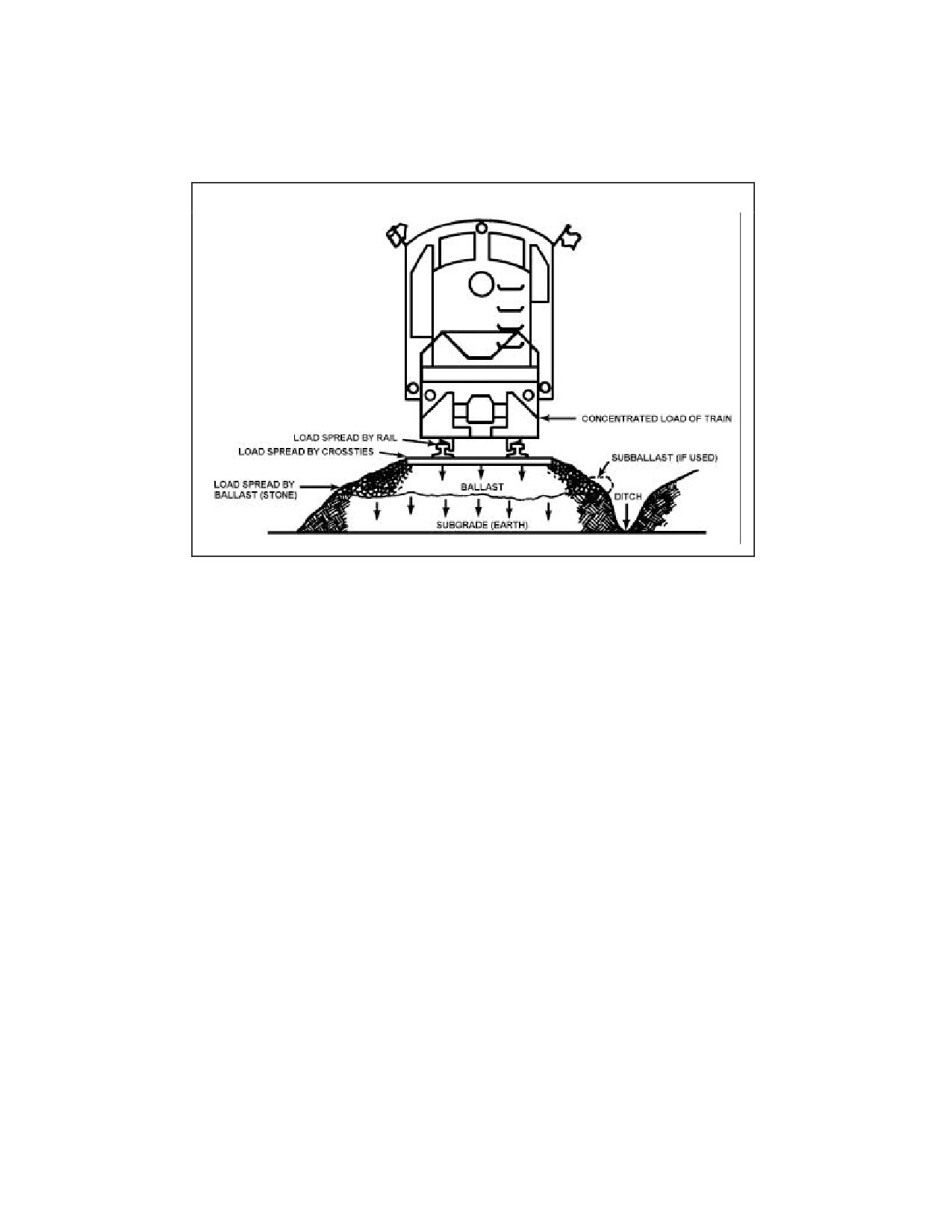
7-2. Components and their relationships are described in the following paragraphs (see also Figure 7-
l, page 7-2).
Subballast
7-3. Subballast consists of gravel, sand, or cinders, and it is inferior to ballast. Spread on the surface
of the cut or fill, subballast provides a level surface for the ballast and other track components. It is
spread about half the depth of the total ballast section and should never be less than 6 inches deep.
Using subballast does the following:
· Saves higher quality stone for the ballast.
· Seals off contact between the ballast and the subgrade, which allows better drainage.
· Prevents indentation in the subgrade caused by ties under the weight of the train.
Ballast
7-4. Ballast is gravel or broken stone laid on the ground to provide support for the track. The two
types of ballast are mainline and yard ballast. Mainline ballast is larger in size (3/4" to 2" square)
while yard ballast is smaller in size (3/8" to 1" square). Wooden, concrete, or steel crossties are laid
across the ballast to support the rail. Tie plates and rail anchors are laid on the crossties. The rail is
then secured to the crossties with spikes or screws. Sections of rail are then connected at the ends
and the joints are bolted or welded to complete the track.
7-1
FM 4-01.41 ______________________________________________________________________________________Chapter 7
Figure 7-1. Main Components of a Railroad Track
7-5. Materials most commonly used as ballast are trap rock, granite, blast furnace slag, limestone, and
graded gravel. For heavy tonnage and/or high speed traffic, broken or crushed stone is the most
desired ballast. Blast furnace slag is almost as good as crushed rock. Ashpit cinders may also be used
as ballast, but cinders are low in resistance to crushing. Other common but poorer ballast material are
pit-run gravel, engine cinders, oyster shells, decomposed granite, and sand. However, sand may be
used for light traffic lines. It is easily obtainable and drains reasonably well; but is difficult to tamp
when dry, erodes easily from wind and rain, and collects dirt quickly. Ballast is usually locally available
materials.
7-6. In order to perform its function, ballast must be resistant to water and weather, coarse for rapid
drainage, fine enough to facilitate handling, and angular to resist movement. Using ballast does the
following:
· Distributes the weight of the trains on the track.
· Keeps the track from moving under the weight of the trains.
· Provides adequate drainage for the track.
· Maintains proper track leveling and alignment.
· Retards growth of vegetation.
· Reduces dust.
· Distributes the load of the track and train to prevent overstressing the subgrade.
· Restrains the track laterally, longitudinally, and vertically under dynamic loads imposed by
trains and thermal stress induced in the rails by changing temperatures.
7-2
FM 4-01.41 ______________________________________________________________________________________Chapter 7
Cross and Switch Ties
7-7. Crossties are currently used mainly on conventional track. Regardless of their shape, dimensions,
or composition, crossties perform many functions necessary for an operational railroad track.
· The timber crosstie is used most often. The tie is cut from mixed softwoods and
hardwoods and is treated with creosote, creosote-coal tar, or creosote petroleum solutions
to prevent or retard fungi, bacteria, insects, borers, and decay. The treated timber tie varies
in dimensions: 5" x 5" to 7" x 10" in cross sections, 8 feet to 9 feet in lengths for standard
crossties, and 9 feet to 23 feet for switch ties and crossover ties. The standard US mainline
crosstie (7" x 9" x 8’6") weighs approximately 250 pounds.
· The concrete crosstie has the same general dimensions as the timber crosstie, but is almost
twice as heavy. Most concrete crossties have direct fixation fastenings with a cushioning
pad between the tie and the rail base. These fastenings can be either a threaded type or a
threadless type. In any of its forms, fastening is the weakest part of the concrete crosstie
system.
· Steel crossties are tough, flexible, and resistant to mechanical deterioration. They are
manufactured in a variety of shapes and include special features such as an integral
fastening system. They are not normally found in trackage that has an electric current as
part of a signal system or in an electrically powered railway system.
7-8. Crossties support vertical rail loads (train weight) and distribute those loads over a wider area of
the supporting material (ballast). Crossties provide a smooth surface onto which the rail can be
fastened, therefore resisting rail movements caused by train movement. Crossties also provide a
means to fix and maintain the gauge (distance) between the rails.
7-9. Switch ties should always be made of hardwood. Switch ties are specially cut and formed
crossties. Switch ties are designed mainly to support switches, switch stands, and the moveable rails
of the switch.
Rail
7-10. All parts of the track are essential. However, the rail is subjected to the greatest stresses and
which is basic to the energy saving efficiency of railroads.
Construction
7-11. Rail steel contains iron, carbon, manganese, and silicone. Impurities sometimes found in steel
are phosphorous, sulfur, and slag. Rail is identified by its weight per yard and its cross-sectional shape
design. The rail weight is referred to as its nominal weight per yard or meter, such as 115 pounds per
yard and 52 kilograms per meter. Rail can be manufactured in many different lengths. In the US, the
standard lengths for rail are 39 feet and 78 feet. Lengths in other countries are similar.
7-3
FM 4-01.41 ______________________________________________________________________________________Chapter 7
Joints
7-12. Rail can be constructed into a track in two ways. It may be jointed (conventional construction)
or welded (continuous welded rail).
7-13. In conventional construction, the 39-foot rail sections are joined together using bolts and joint
bars. The 39-foot rail sections are welded together at central rail welding plants. One quarter-mile
long strings are welded in place using the thermite welding process. Normally the only welds you find
in 39-foot jointed rail are found at road crossings and bridges. For continuous welded rail, the ties are
normally closer together and requires more and a better quality of ballast.
Rail Anchors
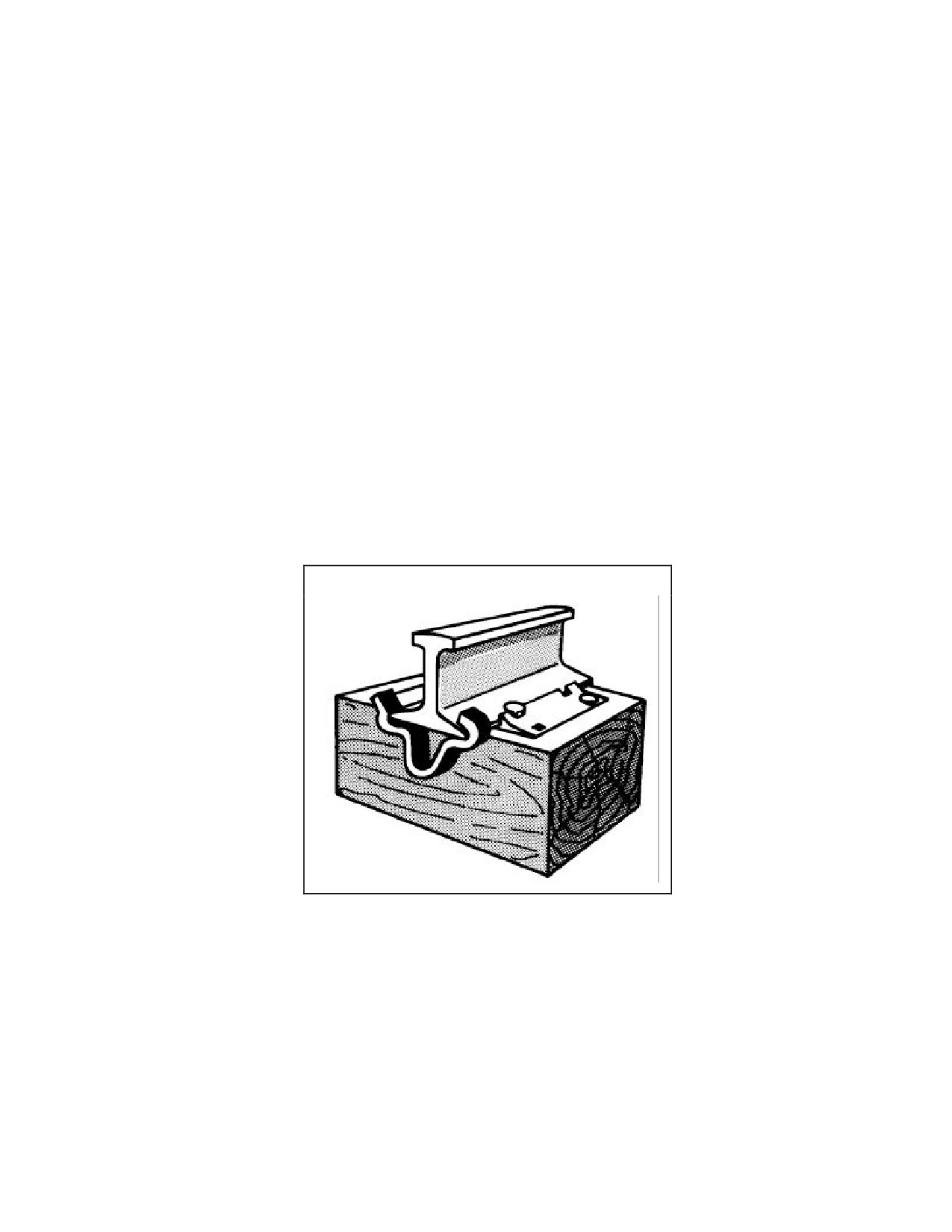
7-14. Rail anchors are installed on the rail base securely against the side of the tie. Anchors are
designed to resistor check the longitudinal movement of the rails under traffic. They also maintain
proper expansion and contraction forces that build up in continuous welded rail (Figure 7-2).
Without anchorage, the rail will run irregularly. At locations where expansion forces concentrate, the
track can buckle or warp out of line or surface. At locations where contraction forces concentrate,
the field welds can be broken or the bolts can be sheared.
Figure 7-2. Simple Rail Anchor on Base of Rail
Tie Plates and Fastenings
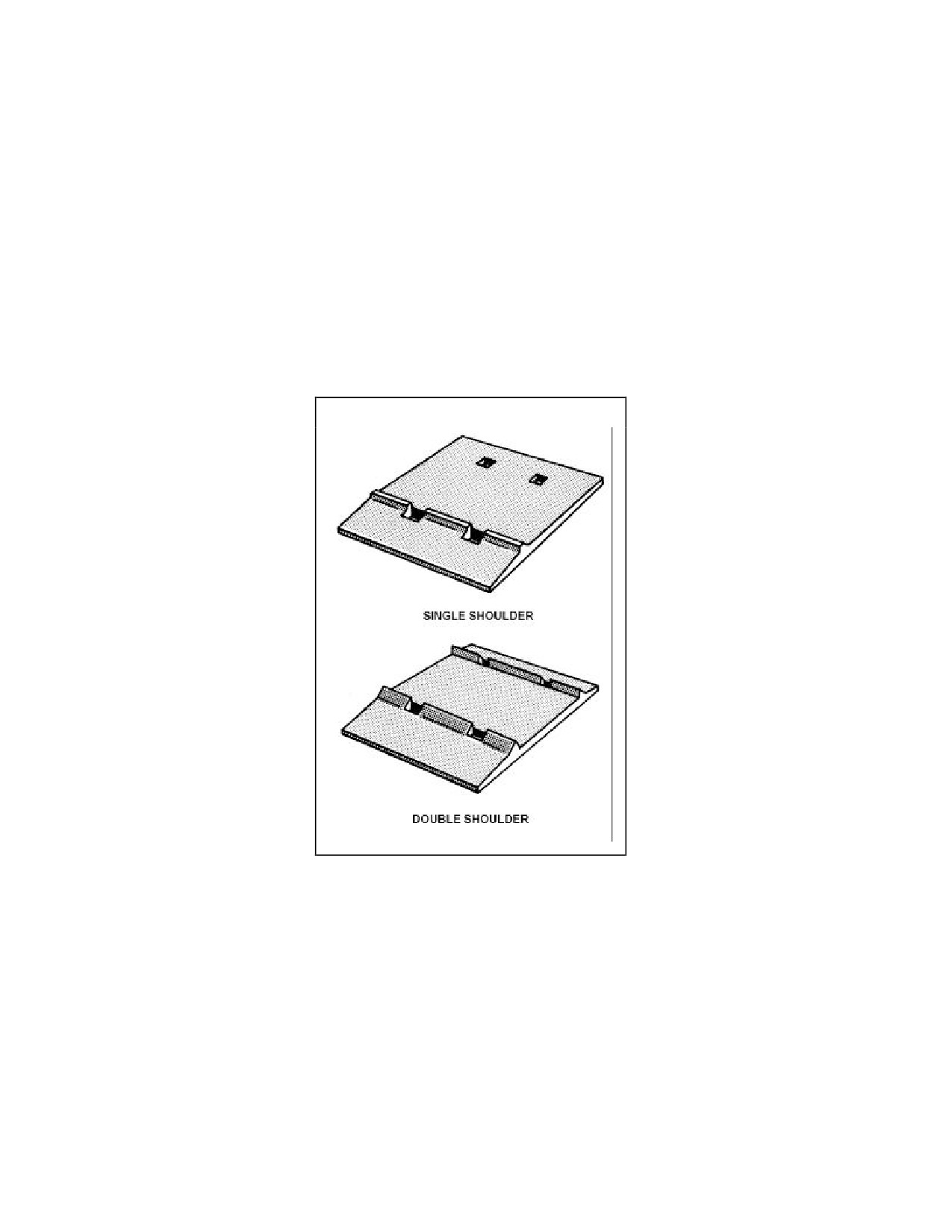
7-15. Tie plates protect the wooden crosstie from damage under rails and distribute wheel loads over
a larger area. They also hold the rail at the correct gauge, tilt the rail slightly inward to help counter
the outward lateral weight of wheel loads, and provide more desirable positioning of the wheel
bearing area on the rail head (Figure 7-3, page 7-5).
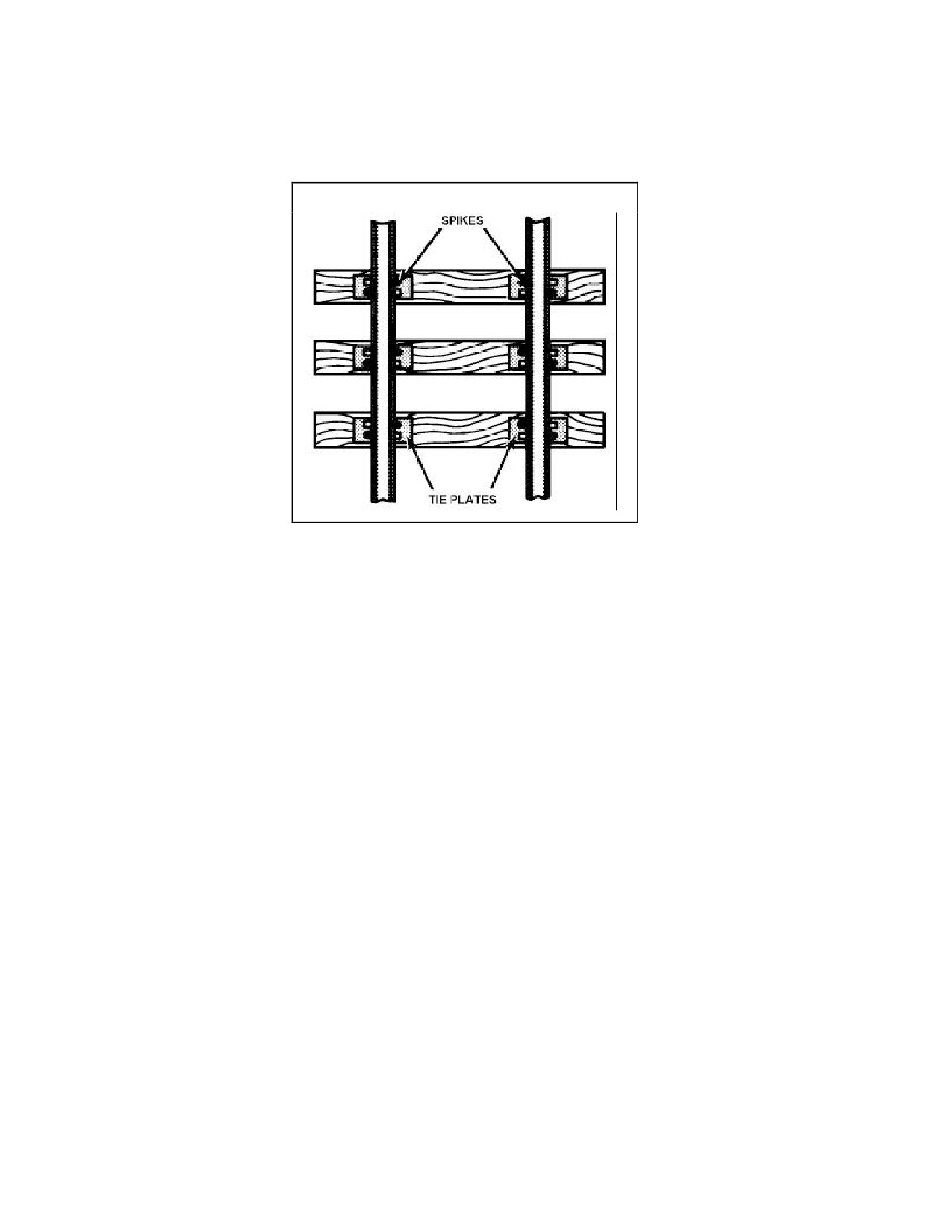
· Application. Tie plates are attached to the ties by spikes, screws, or other fasteners.
Attachments are installed into the tie through the holes manufactured into the tie plate.
7-4
FM 4-01.41 ______________________________________________________________________________________Chapter 7
Some of the spikes (or other fasteners) in each plate also hold the rails in the rail seat
formed in the tie plate (Figure 7-4, page 7-5).
· Functions. There are three primary functions of any rail fastening system. These
functions are as follows:
?
Transfers the wave motion of the rail (which precedes and follows a w heel) to the tie, which
will cushion the shock.
?
Provides an anchoring force to help restrain longitudinal movement of the rail.
?
Holds the rail alignment, while still providing a slight vertical flexibility.
Figure 7-3. Tie Plates
7-5
FM 4-01.41 ______________________________________________________________________________________Chapter 7
Figure 7-4. Correct Method of Setting Spikes
Track Spikes
7-16. Track spikes do the following:
· Holds the rails to the correct gauge and alignment.
· Prevents the rail from overturning.
· Secures tie plates to the ties.
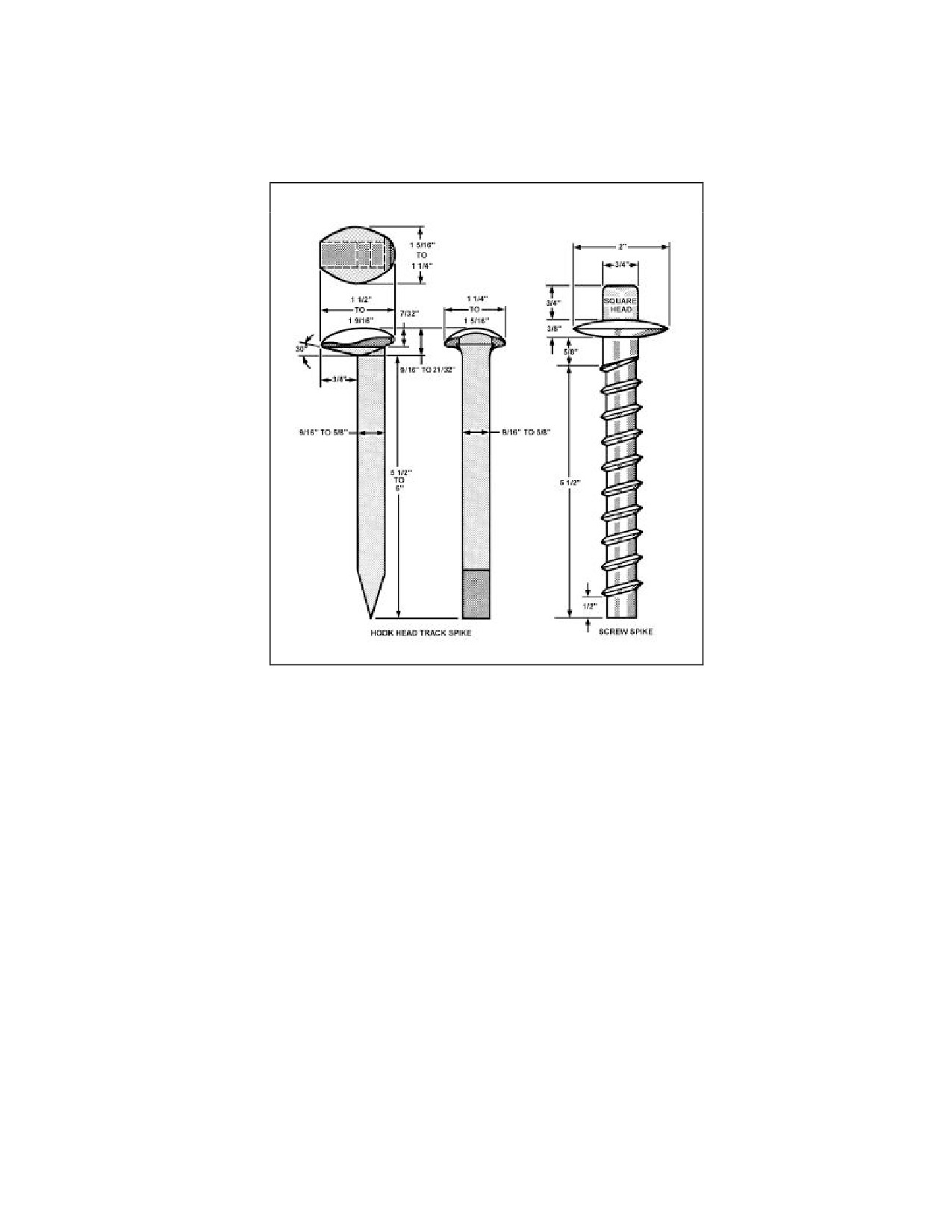
Hook head or cut spikes are used extensively in CONUS and in military railroading. Screw spikes are
used primarily in Europe. Four to eight spikes are used per tie. Use four spikes on straight track and
eight spikes on curved track. Examples of each are shown in Figure 7-5.
7-6
FM 4-01.41 ______________________________________________________________________________________Chapter 7
Figure 7-5. Spikes
Rail Joints and Accessories (Splice Bars)
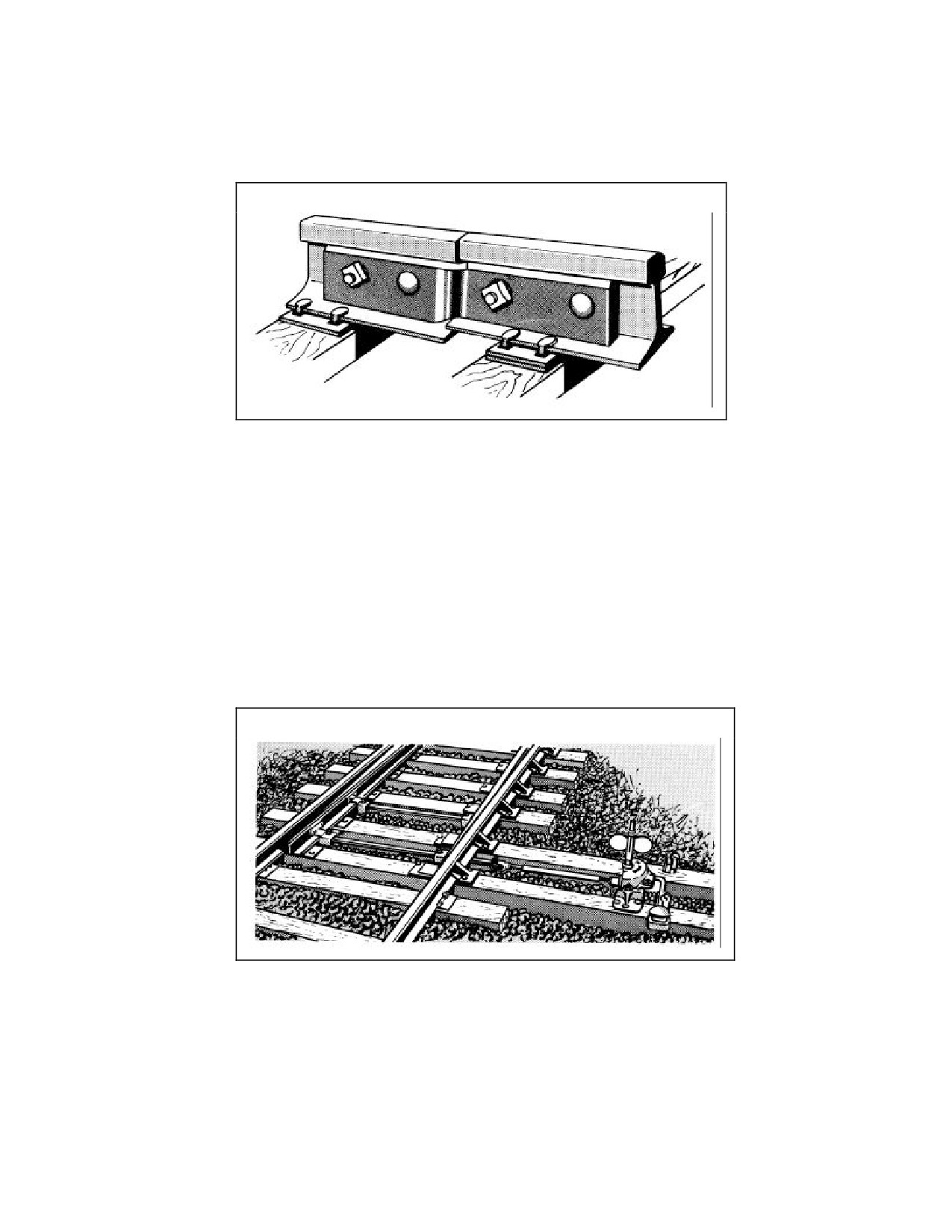
7-17. Rails must be connected at the joints so that the rails will act as a continuous girder with
uniform surface and alignment. Therefore, inspect all rail joints and accessories obtained from
suppliers or storage before they are placed in track.
· Functions. The primary purpose of any rail joint is to maintain the fixed relationship of
the abutting rail ends and to provide a structural means of transferring the wheel loads
from one rail to another. If possible, the rail joint should have the same strength and
stiffness as the rail. This can be done by using two steel members. They fit in the space on
each side of the rail and span the gap between the two rails. These compromise angle bars
are normally held in place by bolting (Figure 7-6).
· Types. The track bolt, spring (lock) washer, and nut are the most commonly used joint
accessories. The track bolt is made from heat-treated, high-carbon steel. It has an elliptical
neck under the bolt head which mates with a matching elliptical hole in the joint bar. This
provides a means of holding the bolt during the tightening operation. These holes are
normally alternated in the joint bar so that every other bolt is put through the assembly
from the opposite side. This practice makes it extremely unlikely that all the bolts in a joint
would be broken during a derailment.
7-7
FM 4-01.41 ______________________________________________________________________________________Chapter 7
Figure 7-6. Compromise Angle Bar
Switches
7-18. Switches are mechanical devices consisting of special crossties with rails that permit a train to
change tracks and therefore, change direction. Switches may be controlled either manually or
electronically.
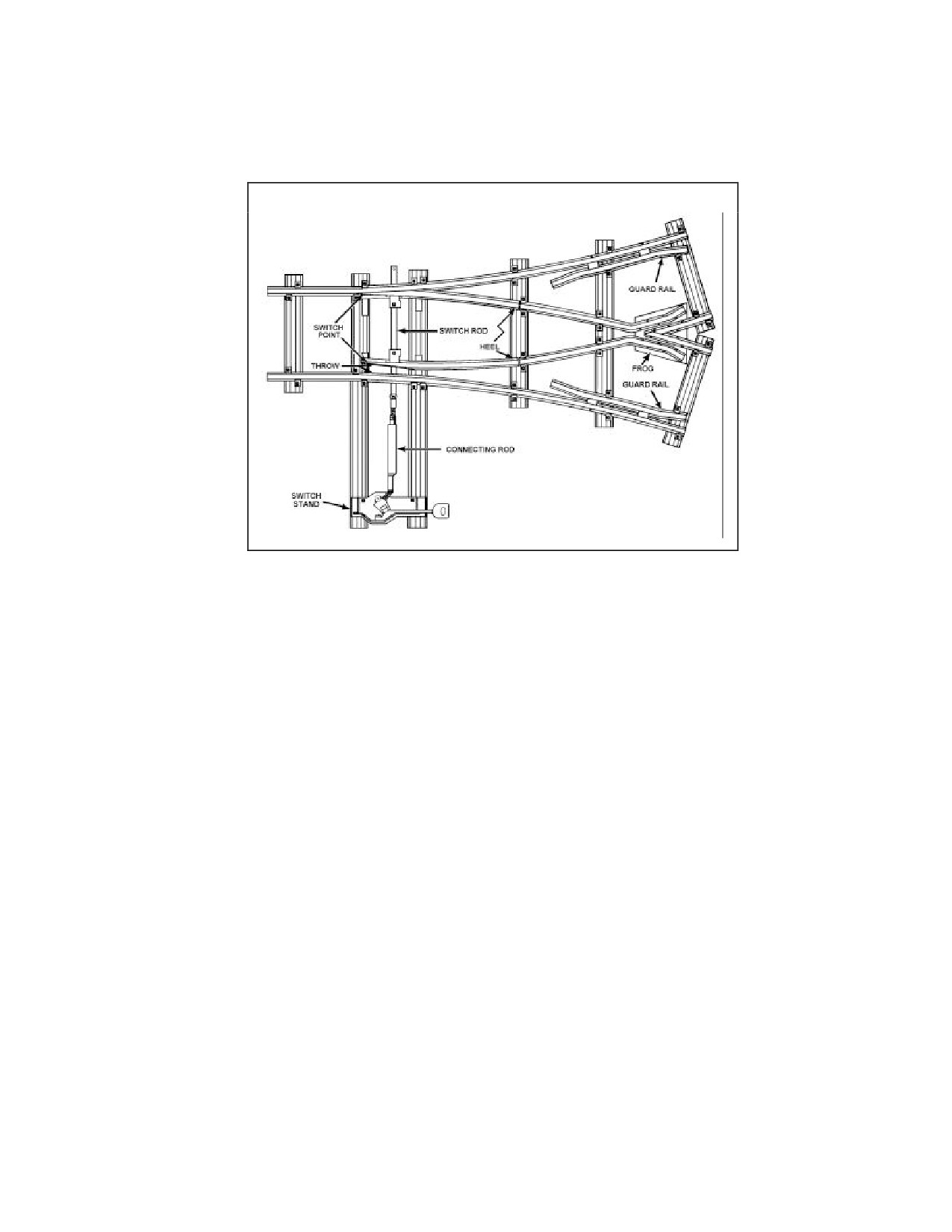
7-19. Switches have left-hand and right-hand switch points that divert the rolling stock to the proper
turnout. Switches also have one or more rods to hold the points in correct relationship to each other
and to prevent them from rising. A gauge and switch plates support the switch points at the same
elevation as the permanent rail and maintain the correct position of the switch. Clips unite the rods
with the switch points and metal guards provide foot protection (Figure 7-7 and Figure 7-8).
Figure 7-7. Manual Switch
7-8
FM 4-01.41 ______________________________________________________________________________________Chapter 7
Figure 7-8. Switch Components
Switch Stands
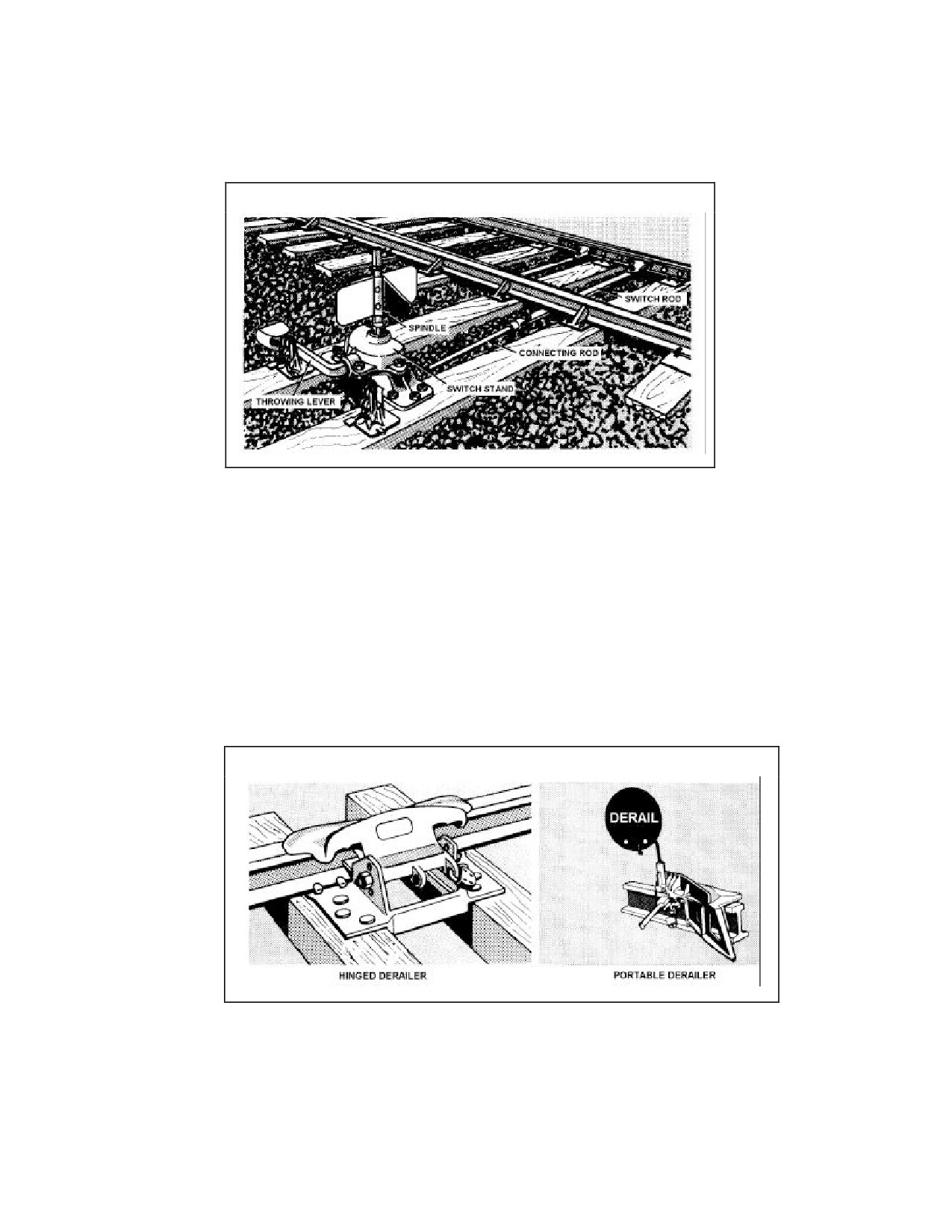
7-20. A switch stand is the mechanism which controls the operation of the switch. The stand also
shows the switch’s position. The following are the two types of switch stands.
Low stands (or ground throw stands). In low stands or ground throw stands, the hand-throwing
lever travels in a vertical plane.
High stands (or column-throw stands). In high stands or column-throw stands, the throwing
lever travels in a horizontal plane
7-21. A switch stand consists essentially of a base, spindle, and throwing lever. These parts are
assembled to form mechanisms which, by the use of cranks, gears, yokes, toggles, and other fittings,
transmit the circular motion of the throw lever to a switch connecting rod. Therefore, the spindle
and its associated mechanism are important parts of the switch assembly. The spindle and its
associated mechanism multiplies force applied to the throw lever, delivering maximum force at
critical positions in the throw. A switch stand is held in a fixed position, by the anchorage of its base
to two ties (Figure 7-9).
7-9
FM 4-01.41 ______________________________________________________________________________________Chapter 7
Figure 7-9. Switch Stand Assembly
Derails
7-22. Derails are safety devices designed to limit unauthorized movement of a car or locomotive
beyond a specific point. The most frequent use of derails is to prevent unauthorized movement of
equipment from a side track onto a main track. Derails are sometimes used to prevent the movement
of equipment onto portions of a side track where it might cause an accident or damage.
7-23. Derails are also used to ensure that rules or signals are obeyed and to protect personnel and
equipment against unauthorized, careless, or accidental procedures. If a train passes over an
operating derail, the train will be derailed. Types of derails are shown in Figure 7-10.
Figure 7-10. Derailers
7-10
FM 4-01.41 ______________________________________________________________________________________Chapter 7
Frogs and Guard Rails
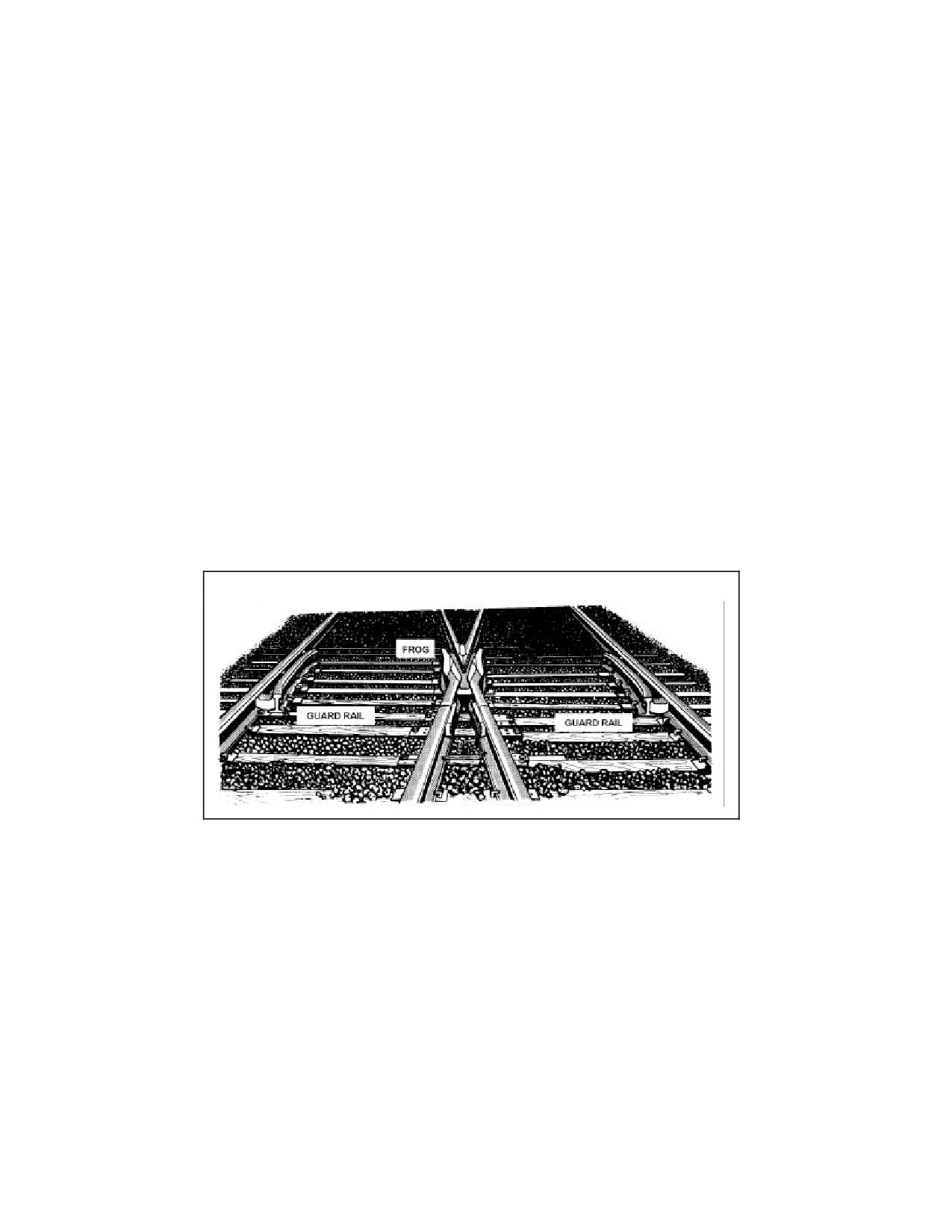
7-24. Frogs are special pieces of trackwork that enable flanged wheels to cross from one rail onto
another rail. Guard rails consist of a rail or series of rails that lay parallel to the running rails of a
track (also see Figure 7-11, page 7-12).
Frogs
7-25. Frogs provide continuous channels for the wheel flanges and support the wheels over the
intersection. Frogs are built of carbon or heat-treated steel rails, of carbon steel rails combined with
manganese steel casings, and of solid manganese casings. Frogs do not require any mechanical
operation.
Guard Rails
7-26. Guard rails helps prevent derailments. They also hold wheels in alignment and keep derailed
wheels on the ties.
Figure 7-11. Frog and Guard Rails
7-27. There are three types of guard rails. Each type is described below.
· Turnout guard rails. These rails are designed and installed to prevent the flanges of the
wheels from striking the points of the frogs on turnouts and crossovers.
· Curve guard rails. These rails are applied to sharp curves to guide the flanges of
locomotive and car wheels or to support the blind driving wheels of locomotives.
· Bridge guard rails. These rails prevent derailed wheels from running off the ties on a
trestle, bridge, or viaduct.
7-11
FM 4-01.41 ______________________________________________________________________________________Chapter 7
TRACK TOOLS
7-28. The mechanization of track maintenance equipment continually progresses in the variety of
machines and equipment as well as the functions they perform. However, the basic tools designed
for manual use are still required on all railroads. Such tools have a well-defined roll in specific work
assignments. For example, mechanized equipment may not always be available to replace a defective
rail or deteriorating ties, surface a rough spot, gauge a wide spot in a curve, replace a cracked joint
bar, or effect other random maintenance tasks that can be done efficiently with a small work crew.
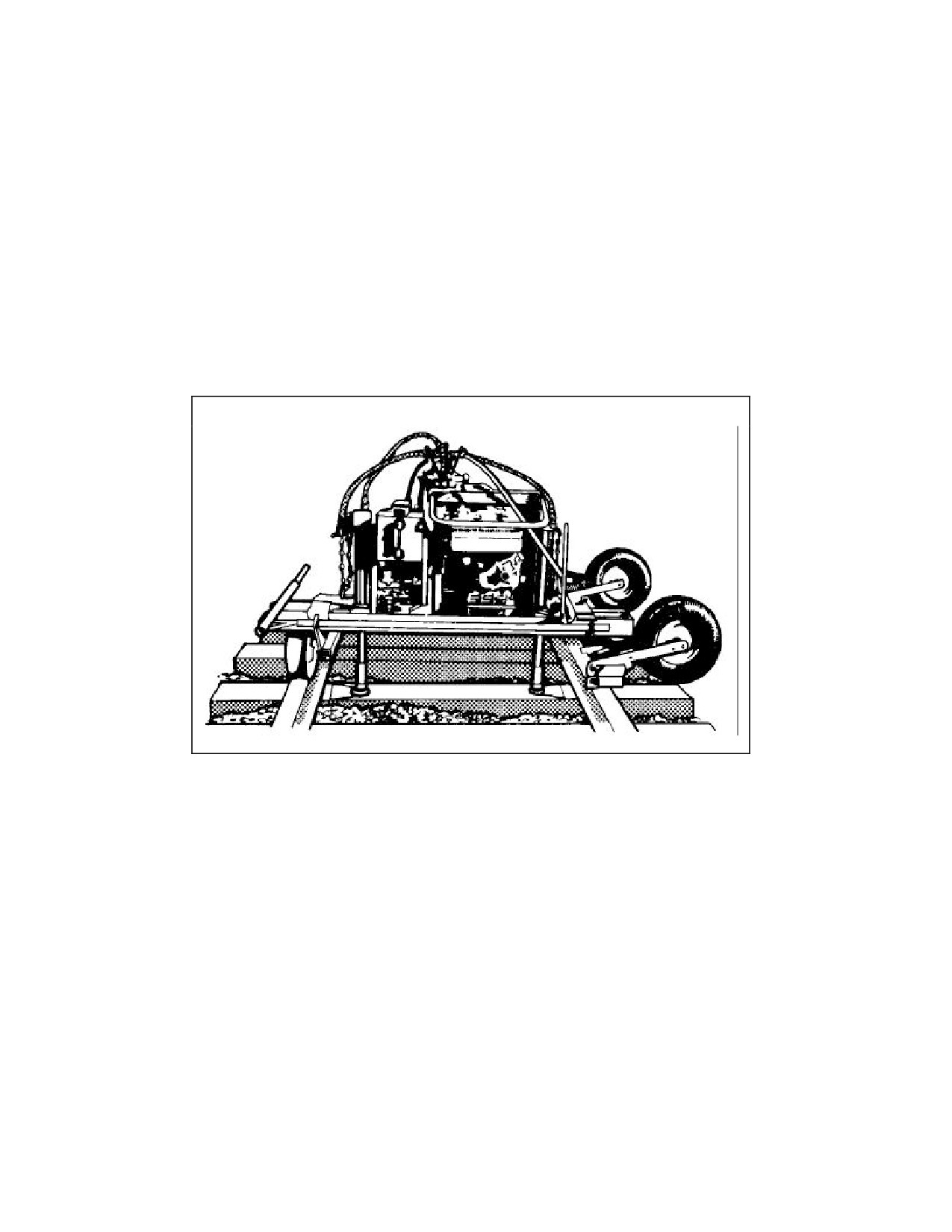
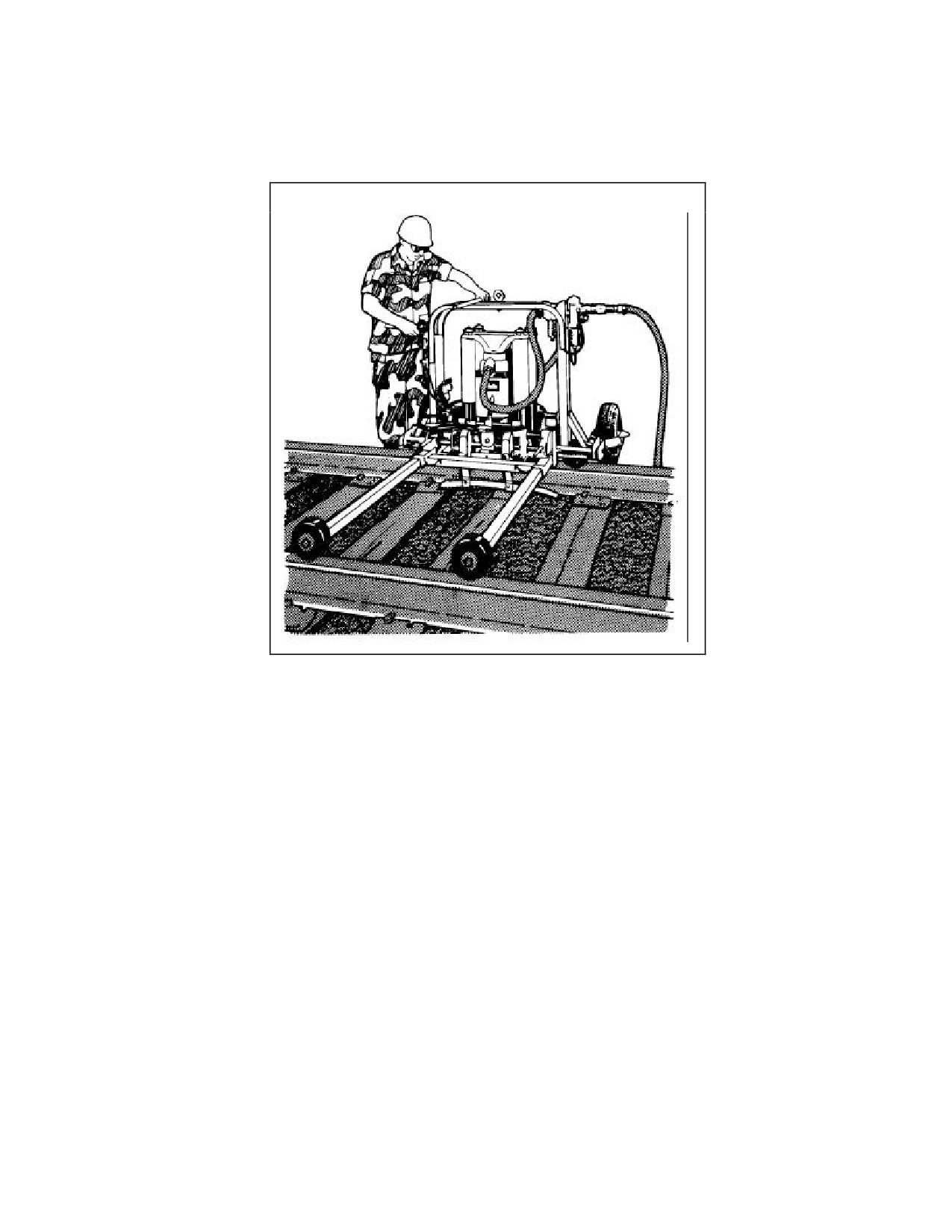
However, there is new equipment currently being used by the railroad industry, which has greatly
reduced the size of work crews and greatly increased productivity (Figure 7-12 and Figure 7-13).
Figure 7-12. Automatic Rail Lifter/Trade Jack
7-12
FM 4-01.41 ______________________________________________________________________________________Chapter 7
Figure 7-13. Spiker
EFFECTS OF TERRAIN ON TRACK ALIGNMENT AND PROFILE
7-29. The ideal railroad track would be on a flat terrain with no curves. Track routes are actually
determined by acquisition of property, general terrain of a particular area, and locations that are
served by the railroad. Other factors which determine military railroads are:
· Axis of advance.
· Main supply routes.
· Availability of existing lines and damage sustained to them.
· A unit’s ability to defend the lines.
Trade-offs are made between repairing a railway to full operating capacity while neglecting others,
and repairing multiple segments of lines to reduced capacity. It is almost always more important to
rehabilitate a rail line so that it can operate at a reduced capacity (no signals, primitive operations, and
so forth) than to hold all operations until the final spike is driven. In almost every case, trains will be
operating while railroad rehabilitation and construction is taking place. Many times operations will
continue over the very same track being repaired.
7-13
FM 4-01.41 ______________________________________________________________________________________Chapter 7
Track Profile
7-30. Track profile is the term applied to the vertical dimensions of the track caused by terrain
features such as hills or valleys. Every attempt is made to reduce inclines or grades since they have a
direct bearing on the amount of motive power needed to pull a train. From an operational point of
view, boring a tunnel through a mountain may therefore be preferable to going around or over a
mountain.
Track Alignment
7-31. Track alignment is the term applied to the horizontal dimension of a track (for example,
curves). Curves are needed to change track direction, whether intentionally (route) or unintentionally
(obstacles). The radius of the curve must be as large as possible, as curves apply rolling resistance to
train movement. Since a train in motion tends to move in a straight line, it applies a lateral force
against curves in the track and increases motive power requirements.
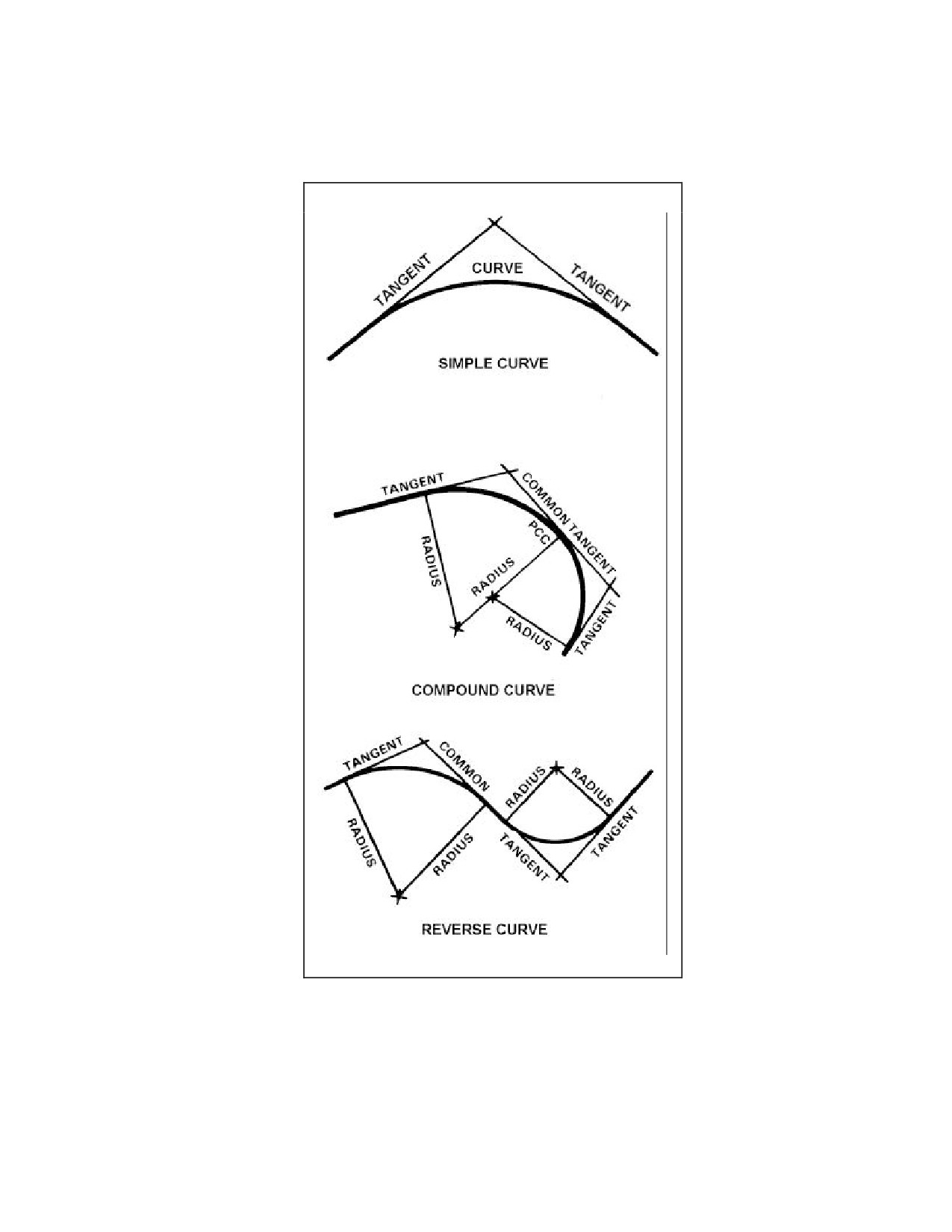
7-32. The alignment of a railroad consists of straight sections (tangents) connected by curved
sections. The sharpness of a curve is measured in degrees, minutes, and seconds. Horizontal curves
are classified as simple, compound, and reverse. A simple curve is a single arc connecting two
tangents. A compound curve is formed by two simple curves of different radii, both curving in the
same direction. A reverse curve consists of two curves that bend in opposite directions (Figure 7-14).
7-14
FM 4-01.41 ______________________________________________________________________________________Chapter 7
Figure 7-14. Types of Horizontal Curves
Ruling Grade
7-33. A key factor when calculating motive power requirements for a train is the ruling grade that will
be encountered between the starting point and the final destination. The ruling grade calculation
considers both track alignment and profile. The steepest grade might not be the ruling grade since
7-15
FM 4-01.41 ______________________________________________________________________________________Chapter 7
another location with a lesser grade, but a tight curve, could cause more rolling resistance. The higher
the rolling resistance, the more motive power is needed. Higher motive power for any one train is
obtained either by using a more powerful locomotive or by using tw o or more locomotives.
7-34. Grade lines are designated by the vertical change in 100 feet (30 meters). A grade rising 2 feet in
a horizontal distance of 100 feet is called a +2.0-percent grade; one descending the same amount is
called a -2.0-percent grad e. Any grade from 0.0 percent (or level) to 0.4 percent is called light; from
0.4 to 1.0 percent, moderate; from 1.0 to 2.0 percent, heavy; and above 2.0 percent, very heavy.
Determining Curvature
7-35. Use either the survey method or string method to determine curvative. Each of these methods
is described below.
Survey Method
7-36. When computing curvature, chord is measured as 100 feet (30 meters). Use the following
formula to determine an approximate value for the radius. However, it is possible to obtain an
approximate value for the radius from the following simple empirical formula:
· R =
5,730
Where— R = Radius, D = Degree of curvature
D
·
5,730 ft (1,747 m) = approximate length of radius of a l-degree curve
·
Likewise, D can be computed by:
·
D = 5,730
R
String Method
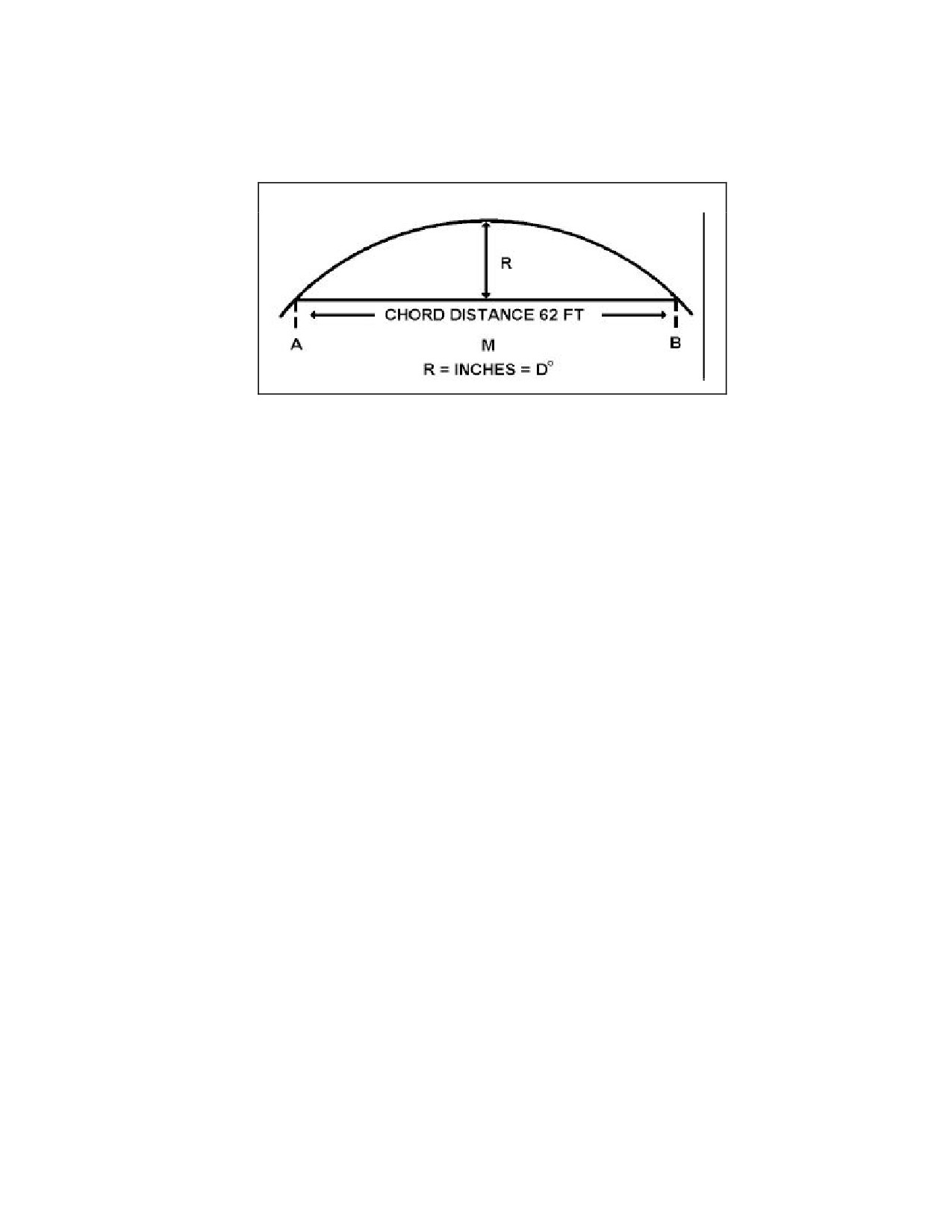
7-37. Use the string method to determine the approximate degree of curvature if a surveying
instrument is not available. A portion well within the main body of the curve is selected; a chord
distance of 62 feet (18.9 meters) is measured along the inside of the high rail (Figure 7-15, points A
and B). A string or strong chord is stretched tightly between points A and B, and the distance M is
measured at the midpoint of the chord. This distance, in inches, is approximately equal to the degree
of curvature. As a curve gets sharper, this distance increases. The normal method of horizontal curve
layout for railroads uses the string method.
7-16
FM 4-01.41 ______________________________________________________________________________________Chapter 7
Figure 7-15. String Method
STRUCTURES
7-38. Structures can generally be divided into two classes. The two classes are minor structures or
major structures. These two classes are described below.
Minor Structures
7-39. Minor structures are provided to carry the track over minor natural features (such as small
streams and ditches) or over man-made drainage features
(such as pedestrian walkways and
pipelines). Minor structures are mainly some form of pipe-like construction. These pipes can be of
corrugated metal or reinforced concrete. They are generally open-ended and cross under the track at
angles varying from 45 degrees to 90 degrees. These structures are vital to the long-term stability of
the track and roadbed.
Major Structures
7-40. Major structures are provided to carry the track over or through major natural or man-made
features (such as over rivers or highways or through mountain tunnels). Major structures are usually
considered to be bridges or trestles and tunnels.
Bridges
7-41. Bridges are normally constructed from steel, reinforced concrete, masonry, and timber. Two
general types of bridges are ballast deck and open deck. A ballast deck bridge has a trough-like deck
in which a layer of ballast can be laid. The track is constructed on the ballast using standard track
construction techniques. The ballast deck bridge is excellent from the standpoint of fire prevention
and track maintenance. This type also allows the use of normal track materials and maintenance
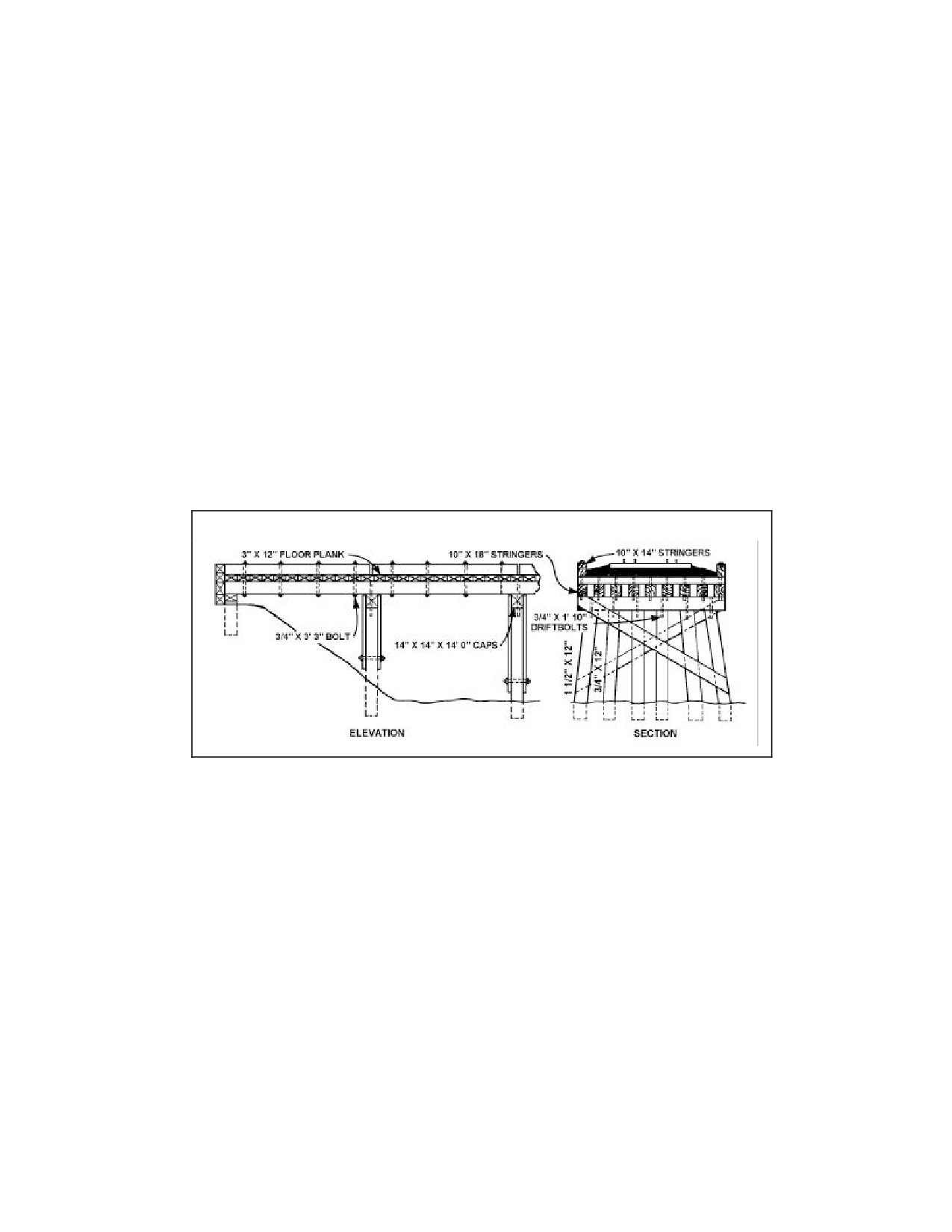
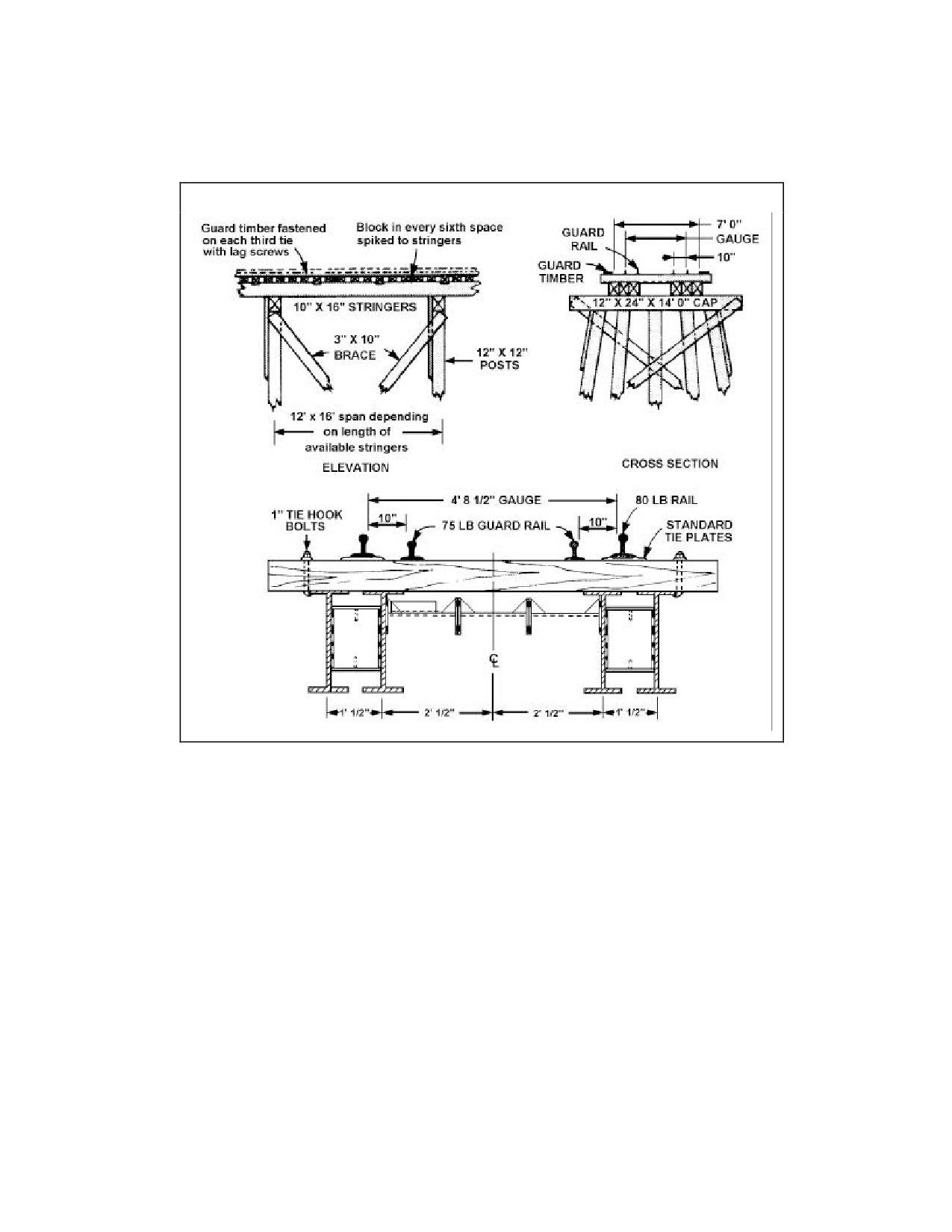
procedures (Figure 7-16). An open deck trestle uses the bridge’s ties as crossties for the track (Figure
7-17).
· Bridge Capacity. The design of bridges is to safely carry a specific concentrated load.
Loads which may be placed on a structure temporarily or which may be changed in
position are termed live loads to distinguish them from fixed, dead, or static loads. Live
loads are the tonnage trains; static loads are the superstructure, tracks, ties, and so forth.
The maximum live load consists of two coupled locomotives followed by the number of
7-17
FM 4-01.41 ______________________________________________________________________________________Chapter 7
cars that occupy the entire length of the bridge. Although various formulas have been used
to compute bridge capacity, the most accurate of these is Cooper’s E rating. In this
formula, each driving axle on the locomotive carries a proportionate part of the total
weight loaded on the drivers. A bridge designed to carry a
0-6-6-0 diesel-electric
locomotive weighing 240,000 pounds (108,844 kilograms) on the drivers, must have a
Cooper’s rating of at least E-40 (40 equals to 40,000 pounds). A 0-6-6-0 locomotive has six
driving axles. The following is the formula for computing the E rating of the locomotive:
240,000 pounds = 40,000 pounds
6 (driving axles)
or
108,844 kilograms = 18,144 kilograms
6 (driving axles)
= the amount each axle can carry
If the gross weight of a car in the train exceeds the weight of the locomotive pulling the
train, then the Cooper’s E rating must be computed based on the gross weight of that car.
The E rating must be for the heaviest piece of rolling stock in the train.
Figure 7-16. Ballast Deck Bridge
7-18
FM 4-01.41 ______________________________________________________________________________________Chapter 7
Figure 7-17. Open Deck Bridge
· Steel and Wooden Stringer Bridges. There usually is an economical consistency in the
design of all parts of a railroad bridge. Dimensions of the floor system are related to the
load for which the whole structure was designed. Table 7-1 and Table 7-2, page 7-22, show
the Cooper’s E rating of a number of typical railroad bridges and the stringer dimensions
of their floor systems.
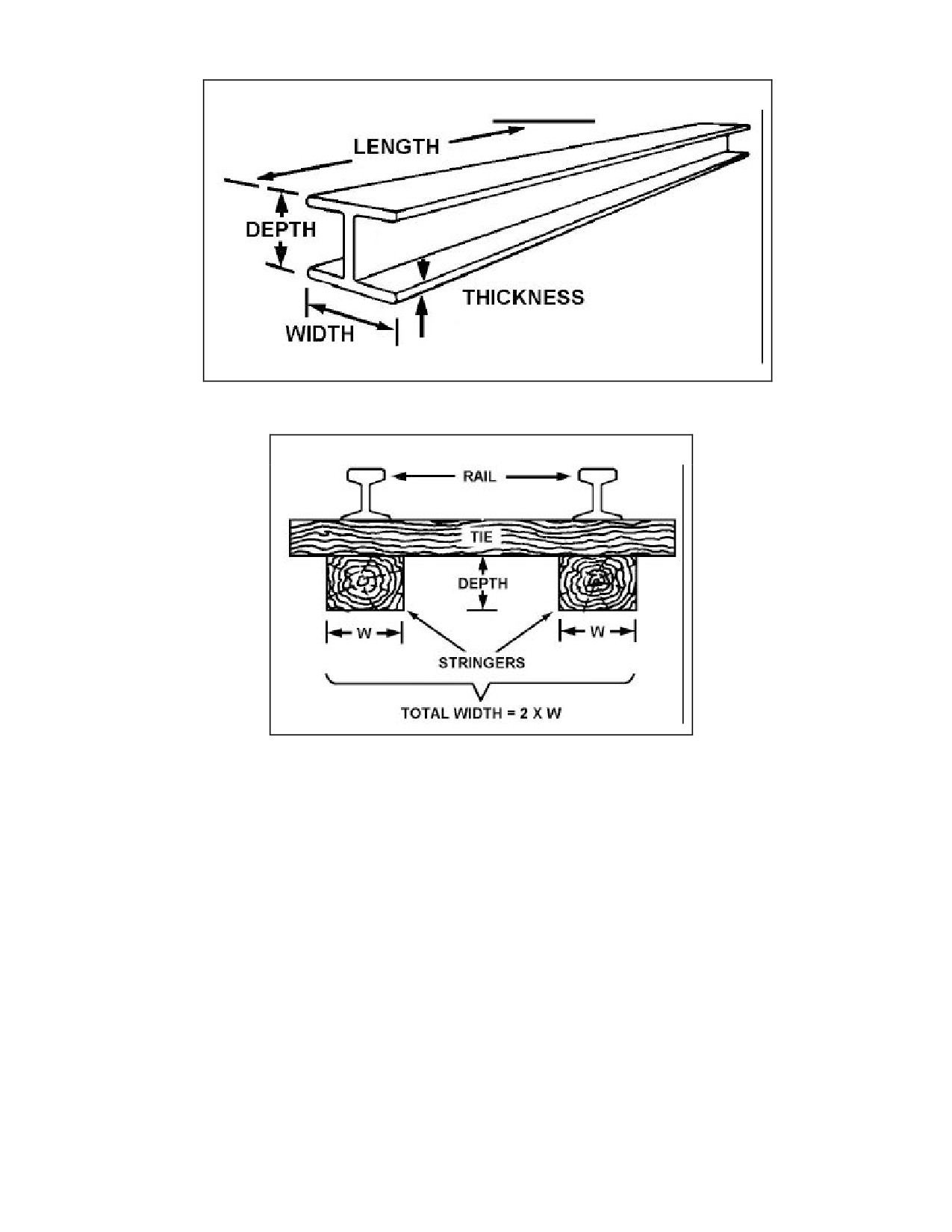
· To estimate the capacity of a railroad bridge with steel stringers or girders as part of the
floor system, the width and thickness of the lower flange of the stringer are measured
(Figure 7-18, page 7-21). The depth and the length of the stringer are also measured. The
corresponding E rating of the bridge is then determined from Table 7-1.
· To estimate the capacity of a railroad bridge with wooden stringers as part of the floor
system, the width of each stringer under one track is measured. The widths of all the
stringers are then added together to attain the total (Figure 7-19, page 7-21). The depth
and length of one stringer also are measured. From Table 7-2, the wooden stringer is
selected that most nearly approximates these dimensions and the corresponding E rating
of the bridge is determined.
7-19

FM 4-01.41 ______________________________________________________________________________________Chapter 7
Table 7-1. Determination of Bridge Capacity (Steel I-beam Construction) (Cooper's E Rating)
Stringer Dimensions (in)
Span Length (ft)
Thickness
Width
Depth
10
11
12
13
14
15
16
17
18
19
20
22
3/8
8 3/8
18
E-42
E-41
E-41
E-41
3/8
10 3/8
24
E-59
E-48
E-40
E-35
E-31
E-27
1/2
10 3/8
30
E-61
E-59
E-51
E-46
E-41
E-37
E-33
E-30
E-27
1/2
12 1/2
30
E-62
E-56
E-50
E-45
E-41
E-37
E-31
1
14
36
E-60
E-58
E-55
E-54
E-51
1/2
12 3/8
42
E-60
E-54
E-45
1 1/8
14
42
E-63
E-60
Stringer Dimensions (in)
Span Length (ft)
Thickness
Width
Depth
24
26
28
30
35
40
44
50
54
60
64
1/2
12 1/2
30
E-26
1
14
36
E-48
E-43
E-39
E-34
E-26
1/2
12 3/8
42
E-39
E-34
E-30
E-26
1 1/8
14
42
E-57
E54
E-51
E-45
1 1/8
16
42
E-60
E-54
E-42
E-32
1 1/2
16
48
E-59
E-52
E-47
E-43
E-33
1
E-66
E-57
E-45
E-35
E-30
1 5/8
14
54
E-54
E-43
E-36
E-28
1 3/4
14
60
E-60
E-54
E-43
E-37
E-30
E-27
Stringer Dimensions (in)
Span Length (ft)
Thickness
Width
Depth
40
44
50
54
60
64
70
74
80
84
90
1 1/2
14
60
E-57
E-48
E-38
E-33
E-27
2 1/8
15
66
E-57
E-54
E-46
E-41
E-34
E-31
E-26
2
14
66
E-56
E-48
E-40
E-35
E-30
E-26
2
14
72
E-62
E-54
E-44
E-39
E-32
E-29
E-25
2 1/2
15 1/2
72
E-55
E-51
E-43
E-38
E-33
E-29
2 1/8
14
78
E-64
E-52
E-46
E-39
E-35
E-30
2 1/2
16
84
E-64
E-54
E-49
E-41
E-38
E-30
2 11/16
20
96
E-59
E-51
7-20

FM 4-01.41 ______________________________________________________________________________________Chapter 7
Table 7-2. Determination of Bridge Capacity (Wood Beam Construction)
(Cooper's E Rating)
Stringer
Dimensions (in)
Span Length (ft)
Thickness
Width
10
12
14
16
18
20
22
18
12
E-16
E-12
18
14
E-22
E-18
E-10
18
16
E-28
E-20
E-15
E-10
18
18
E-38
E-26
E-18
E-14
E-12
20
12
E-18
E-12
20
14
E-25
E-17
E-12
20
16
E-33
E-23
E-16
E-12
E-10
20
18
E-43
E-29
E-21
E-16
E-13
E-10
24
12
E-22
E-15
E-11
24
14
E-30
E-21
E-14
E-11
24
16
E-40
E-28
E-20
E-15
E-12
24
18
E-52
E-36
E-25
E-19
E-15
E-12
E-10
36
12
E-34
E-23
E-17
E-12
E-10
36
14
E-47
E-32
E-23
E-17
E-14
E-11
36
16
E-62
E-43
E-30
E-23
E-19
E-15
36
18
E-78
E-53
E-30
E-30
E-24
E-20
E-16
40
12
E-38
E-26
E-19
E-14
E-11
40
14
E-52
E-36
E-26
E-20
E-16
E-12
40
16
E-69
E-47
E-35
E-26
E-21
E-17
E-17
40
18
E-87
E-60
E-44
E-34
E-27
E-22
E-18
48
12
E-46
E-31
E-23
E-17
E-13
48
14
E-63
E-43
E-31
E-24
E-19
E-15
48
16
E-69
E-47
E-35
E-26
E-21
E-17
E-17
48
18
E-105
E-73
E-53
E-41
E-33
E-27
E-22
54
12
E-52
E-35
E-27
E-19
E-15
54
14
E-72
E-49
E-35
E-22
E-18
54
16
E-94
E-65
E-46
E-36
E-29
E-24
54
18
E-119
E-42
E-60
E-46
E-38
E-30
E-25
60
12
E-58
E-40
E-30
E-22
E-17
60
14
E-79
E-55
E-39
E-30
E-35
E-20
60
16
E-104
E-72
E-52
E-40
E-33
E-27
60
18
E-132
E-92
E-67
E-52
E-42
E-34
E-28
7-21
FM 4-01.41 ______________________________________________________________________________________Chapter 7
Figure 7-18. Dimensions of a Steel Stringer
Figure 7-19. Dimensions of a Wooden Stringer
Tunnels
7-42. Two principal types of tunnels are lined and unlined. Lined tunnels are cut through
unconsolidated formations. A lining is provided to prevent cave-in on these types of tunnels. These
linings are usually formed from concrete or timber. Unlined tunnels are cut through solid rock
formations. The rock walls and ceiling that remain, form the exposed surfaces of the tunnel.
EFFECTS OF COLD WEATHER
7-43. Cold weather conditions can impose a considerable burden on the operation and maintenance
of railway service. Cold weather can effect yard switching (making it slow and difficult). It also has an
effect on starting trains and making steel car parts brittle. Heavy winds (common in cold weather)
can also hamper operations on the road and in the yards.
7-22
FM 4-01.41 ______________________________________________________________________________________Chapter 7
Track and Roadbed
7-44. In cold climates, having a terrain similar to that of Alaska, the elements may cause damage to
the track and roadbed. Areas of this type are underlaid with permafrost through which surface water
cannot penetrate and which drains off in the summer. During thaws, the water lies on top of the
ground, often partially covering the ties. This can cause tie rot and disturbs alignment, surface, and
gauge. In winter, the water freezes and heaves the track dangerously out of line. Maintenance must be
done on the track and roadbed as soon as the weather permits.
Bridges
7-45. Frost-heaving causes extensive maintenance repair to be made on bridges and trestles
constructed of wood pilings. These repairs may reduce division train density. Maintenance problems
occur when water below the ground surface freezes, therefore causing the piling to rise. This in turn
may raise the level of a bridge 2 or 3 inches higher than the normal level of the track. There is no
known way to combat this condition except by removing the decking, track, and ties; cutting off the
tops of the piling to a suitable height; and then replacing the top structure.
Pole Lines
7-46. In some areas it may be impossible to use telegraph or utility poles in the conventional manner.
In warm weather, the soil in low spots becomes so unstable that the poles cannot be kept vertical. In
winter, the poles may be heaved up by frost and the wires will break. Wires should never be too taut
between poles because winter contraction may cause them to break. Using poles built in a tripod
shape with a wide base that rests on the ground will help stabilize the poles. Nothing can be done
about wires that break due to heavy ice covering. An adequate supply of wire and splicing materials
and maintenance personnel must be available to keep communication functions open during the
winter.
Tunnels
7-47. Tunnels are usually a simple maintenance problem. However, in cold climates, water seepage
can cause extreme difficulties. Ice can form on the track, which often makes the tunnel impassable.
There is hardly any way to bypass tunnels. In summer, the frozen earth under the track heaves to the
extent that train movements may often be suspended. Work inside tunnels is slow and difficult
because of the confined space in which men and machinery must work. In some areas, much of the
difficulty has been overcome by steam heating some of the tunnels and putting doors on the portals.
Workmen are assigned throughout the winter as firemen and door tenders to keep the tunnels warm
and to open and close the tunnel doors for train passage. The tunnels are therefore kept at a
temperature above freezing, and the water that seeps through the walls and ceiling is drained to the
outside.
Track Obstructions
7-48. There are some obstructions that are either unforeseen or that anyone is able to control. Some
of these are discussed below.
7-23
FM 4-01.41 ______________________________________________________________________________________Chapter 7
Snowfalls
7-49. Heavy and frequent snowfalls require the constant use of snowplows. During heavy snows, a
locomotive with a plow may have to precede each main line train. At times, the snowfall may be so
heavy that two trains may have to remain in sight of each other. It may be practical to equip
locomotives with a small blade permanently attached to their pilots. Alaskan railroads have
successfully used a notch blade that can be lowered a couple of inches below rail level. This is an
expedient, which is only effective against snow a few inches deep. A snowplow, pushed by one or
more locomotives, is usually needed to clear overnight snowfalls or even snowfalls of a few hours
duration.
Earth and Rock Slides
7-50. Slides are a frequent source of trouble in a hilly, cold climate. They occur in deep cuts, along
steep slopes, and frequently at the mouths of tunnels when frozen hillsides or mountainsides thaw in
the spring. In Alaska, and similar climatic and topographical areas, the summer shifting of glacial
mountains is a problem. Glacial mountains move several feet each year over a lineal distance of
several hundred yards. When a rail line runs alongside a glacial mountain, the affected right-of-way
may have to be rebuilt. However, there is little that can be done if moving the track is not feasible.
Prudent planning includes storing materials, tools, and supplies where they are in no danger of being
covered by slides. Snow slides also present a serious problem in heavy snow climates. Such slides are
generally heavier in weight and greater in volume than in temperate climate areas. Off-track
machinery is not practical in cleanup operations because roads to reach such areas are usually
nonexistent. The extreme cold also hampers workmen. The use of high-speed rotary snowplows in
cleaning such slides is usually impossible because of the debris (for example; dirt, rocks, and twigs)
that may come in contact with its high-speed blades.
Wild Animals
7-51. The presence of wild animals on the track may cause temporary track obstructions and account
for major delays to freight and passenger trains. Animals may get on snow-cleared tracks and remain
there to escape the deep snow and because they have more of a chance to fight off other animals. All
reasonable efforts must be made to clear animals unharmed from the track. For example, many
moose have been killed on railroad tracks in Alaska, and trains running squarely over moose have
been derailed. There are recorded cases where moose walked ahead of trains for 15 miles before
leaving the track. During the rutting season, the bulls are extremely excitable and often charge a
moving train. Railroad personnel working under such conditions must exercise care.
CONSTRUCTION AND REHABILITATION REQUIREMENTS
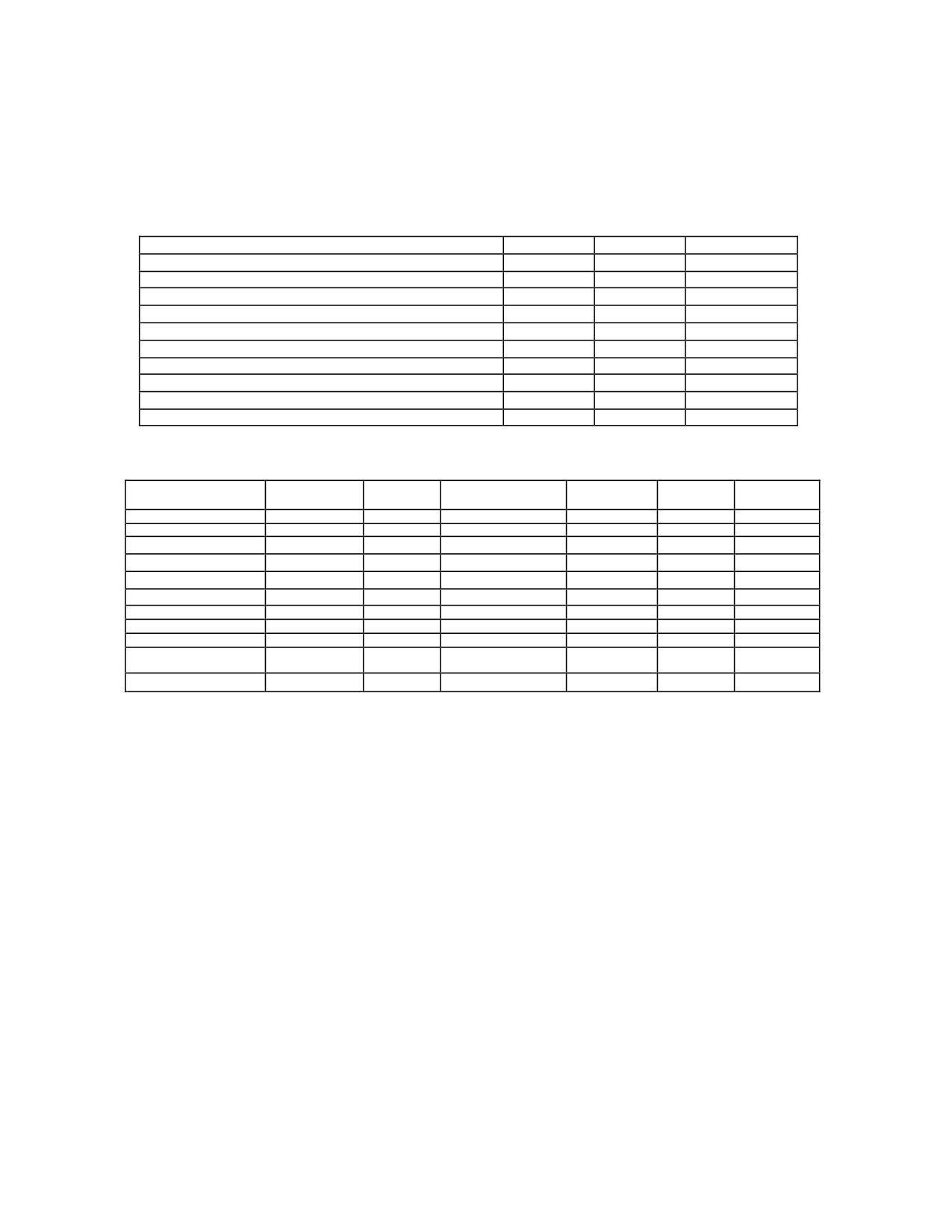
7-52. Table 7-3 lists the materials and net man-hours required for new construction of one mile of
standard-gauge, single-track railroad. Table 7-4 estimates the requirements for rehabilitating a 100-
mile standard-gauge, single-track division extending inland from a port using average percentage of
demolition over the entire division.
7-24
FM 4-01.41 ______________________________________________________________________________________Chapter 7
Table 7-3. Construction Requirements Per Mile Standard-Gauge Single-Track Railroad
ITEM
STONs
MTONs
MAN-HOURS
Grading (includes clearing average wooded terrain)
-
-
5,000
Ballast delivered, average haul--5 miles (8.05 km)
-
-
2,500
Tracklaying and surfacing
-
-
3,400
Bridging--70 linear feet (21.34 m)
128
111
3,200
Culverts, 7 per mile--280 feet (85.34 m)
8
7
1,400
Ties--2,900
218
300
-
Rail, 90-pound--ARA--A Section
79
45
-
115-pound--ARA--E Section
103
57
-
Fastening (based on 39-foot rail) (11.89 m)
33
10
-
Total
569
530
15,500
Table 7-4. Rehabilitation Requirements Per Railroad Division
Per 100 Miles
Percent of
Rehabilitation
Construction
Material1
Man-Hours1
Item
(161 km)
Demolition
(quantity)
STONs
MTs
(Thousands)
Main line trackage
100 mi
10
7.0 mi
2,708
1,033
36.4
Port trackage2
-
100
3.0 mi
1,368
1,092
14.4
Passing sidings2
2.4 mi
80
2.4 mi
1,049
874
11.5
Station sidings2
1.6 mi
80
1.6 mi
730
582
7.7
Railway terminal2,3
1.0 ea
75
0.75 ea
8,025
4,875
160.0
Water stations
3.0 ea
100
3.00 ea
135
210
9.0
Fuel stations
1.0 ea
100
1.00 ea
19
16
0.9
Bridging (70 ft per mile)
7,000
55
2,700 linear ft
2,700
2,672
70.0
Culverts
28,000 linear ft
15
4,200 linear ft
63
63
13.7
(74 ea)
Grading and ballast
-
-
-
-
-
40.5
1 Tunnels require special consideration. To repair (by timbering) a 50-foot demolition at each end of a single-track tunnel (100 ft total per
tunnel), allow 70 STONs or 87 MTs, and 3,000 man-hours.
2 Estimate includes ties, rails, fastenings, turnouts, tracklaying, and surfacing. It is assumed ballast is available at work sites.
3 Includes replacing buildings 100 percent, ties 30 percent, rail and turnouts 85 percent.
7-25
FM 4-01.41 ______________________________________________________________________________________Chapter 8
Chapter 8
Railway Equipment
Effective and adequate transportation railway support of military operations in a theater of
operations requires efficient use of railway rolling stock and motive power. The trainmaster reports
any misuse of rail equipment and facilities by shipping activities through the rail unit's chain of
command to the commanders responsible for loading and unloading cars. Commanders must ensure
that railway rolling stock is properly loaded and/or unloaded and released to the rail units.
EQUIPMENT USE
8-1. Passenger equipment is frequently limited to use in troop movements, leave trains, military
casual personnel trains, and ambulance trains. Special equipment includes specially designed rolling
stock for handling unusual cargo and railway work equipment and ambulance cars. If Army
ambulance cars are not provided in a theater of operations, passenger equipment may be converted
to ambulance cars.
8-2. When volume permits, containers and refrigerator or tank cars are handled in solid trains and
given a high movement priority from origin to destination and return. The increased use of
containers for the movement of military cargo provides a throughput service to the consignee.
Containers so shipped must receive a high movement priority from origin to destination consignee.
8-3. When trains are exposed to enemy ground or air attack, engines and cars should be modified to
provide for increased armored protection of cargo, passengers, and security elements. Armored trains
may be specifically created for use by security forces in support of operations in contested areas of
the railway route.
ROLLING STOCK
8-4. The worldwide inventory of Army-owned rolling stock includes locomotive cranes, tank cars,
freight cars of miscellaneous types, and other equipment. It includes numerous diesel-electric
locomotives stored or in use in various parts of the world. Most of the larger locomotives are
designed for foreign and domestic service and are equipped with multi-gauge trucks, which can be
adjusted to any gauge from 56 1/2 to 66 inches. Usually the changes in wheel gauges to suit overseas
requirements are made in CONUS where wheel presses are available.
8-5. Contingency operations might require supplementary railway motive power, rolling stock, and
materials. Local equipment, even if operable, would likely be inadequate to support transportation
requirements of the US and allied forces under wartime conditions. The Army multi-gauge fleet,
stored or used in CONUS and other parts of the world, is the basic source for supplementary items
pending establishment of a procurement program. Many countries, which are potential areas of
unrest, are served by narrow -gauge railroads. Equipment in these areas is often in poor condition.
The locomotives and freight cars are old and in need of repair. Locomotives have low tractive effort
and cars may consist largely of boxcars and a few flatcars with low-carrying capacities. These
countries often have insufficient railroad facilities to serve their economic needs. Superimposing, fast
moving, high-density, military tonnage would exceed local operating capabilities. The Army has
8-1

FM 4-01.41 ______________________________________________________________________________________Chapter 8
developed procurement specifications for narrow-gauge rail equipment to meet the operating
characteristics of the rail lines in contingency areas. Railway equipment characteristics are shown in
Tables 8-1 through 8-11. Figure 8-1 is an extract from The Official Railway Equipment Register.
Table 8-1. Characteristics of Locomotives
Tractive Force (lb)
Curvature
Minimum
Radius (ft)
Type
Gauge
Weight (lb)
Length Over
Extreme
Extreme
Starting at
Continuous
Horse-
Fuel
(in)
Couplers
Width
Height
30%
power
Capacity
Adhesion
(gal)
Diesel-Electric 131-T,
56 1/2
262,900
55'
10'0"
14'0"
75,700
37,850 at 10
1,000
231
1,600
0-6-6-0, domestic and
MPH
foreign svc
127-T, 0-6-6-0,
56 1/2
261,100
55'
10'0"
14'0"
75,700
37,850 at 10
1,000
231
1,600
domestic and foreign
MPH
svc
120T, 0-6-6-0, domestic
561/2,
240,000
57'5"
9'8"
13'6"
73,000
37,000 at 10
1,600
193
1,600
and foreign svc
60
MPH
63,66
245,000
800
w/steam
w/steam
generator
generator
120-T, 0-6-6-0,
56 1/2
240,000
56'9"
9'7"
13'5"
72,000
36,000 at 10
1,600
193
1,600
domestic and foreign
60, 63
MPH
800
svc
66
245,000
w/steam
w/steam
generator
generator
120-T, 0-4-4-0,
56 1/2
240,000
55'9"
10'3"
14'6"
75,000
40,000 at 11
1,500
150
800
domestic svc
MPH
120-T, 0-4-4-0,
56 1/2
246,000
48'10"
10'2"
14'6"
73,000
36,000 at 10
1,200
100
750
domestic svc
MPH
115-T, 0-4-4-0,
56 1/2
230,000
45'6"
10'0"
14'6"
69,000
34,000 at 15
1,000
50
635
domestic svc
MPH
100-T, 0-4-4-0,
56 1/2
199,000
44'6"
10'0"
14'4"
59,700
28,750 at 10
660
50
635
domestic svc
MPH
100-T, 0-4-4-0,
56 1/2
200,000
44'5"
10'0"
14'7"
69,700
35,000 at 10
800
100
600
domestic svc
MPH
80-T, 0-4-4-0, domestic
56 1/2
161,000
36'10"
9'6"
13'7"
48,000
24,000 at 10
500
75
400
svc
MPH
80-T, 0-4-4-0, domestic
56 1/2
161,000
36'10"
9'6"
13'7"
48,000
24,000 at 10
470
75
400
svc
MPH
80-T, 0-4-4-0, domestic
56 1/2
161,600
41'0"
9'6"
13'4"
48,000
21,000 at 5.2
550
75
400
svc
MPH
65-T, 0-4-4-0, domestic
56 1/2
130,000
34'0"
10'1"
13'5"
39,000
19,500 at 10
400
75
250
svc
MPH
60-T, 0-4-4-0, domestic
56 1/2
122,000
38'11" (Type
9'6"
13'4"
26,000
15,680 at
500
75
500
and foreign svc
60, 63
E) 39'3"
7.78 MPH
66
(Willison)
45-T, 0-4-4-0, domestic
56 1/2
90,000
33'6"
9'7"
12'0"
27,000
12,000 at
380
75
250
and foreign svc
6 MPH
45-T, 0-4-4-0, domestic
56 1/2
90,000
28'4"
9'6"
12'0"
27,000
13,500 at 6.2
300
50
165
svc (side rod drive)
MPH
44-T, 0-4-4-0, domestic
56 1/2
91,270
33'10"
9'4"
13'3"
26,400
11,000 at 9
380
75
250
svc
MPH
44-T, 0-4-4-0, domestic
56 1/2
89,000
33'5"
10'1"
13'3"
26,400
13,000 at 7.1
380
50
250
svc
MPH
25-T, 0-4-4-0, domestic
56 1/2
50,000
16'1"
8'7"
10'4"
15,000
6,200 at
150
50
75
8-2