FM 4-01.41 ARMY RAIL OPERATIONS (DECEMBER 2003) - page 2
FM 4-01.41 ______________________________________________________________________________________Chapter 4
Combined Register of Trains and Comparisons of Watches (DA Form 4090-R)
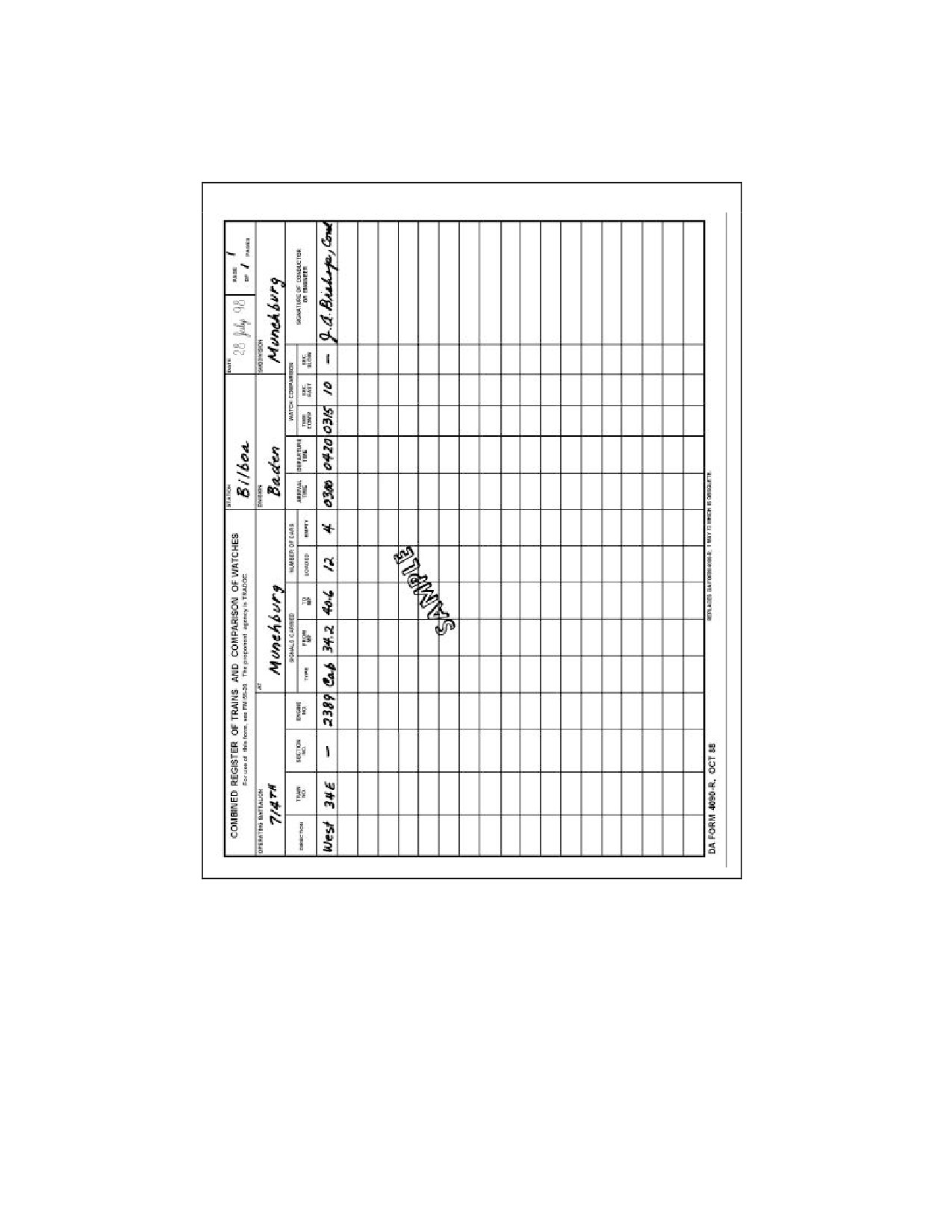
4-5. Train registers are located at stations designated by timetable. This register is a permanent record
of the movement of trains over the division. The conductor (or the engineman if there is no
conductor) must check and sign the register before departing from a register station. While this is the
responsibility of the train crew, station agents (when properly authorized) may enter the required
information on the register and then report the train to the dispatcher. Figure 4-2 shows a sample of
a DA Form 4090-R. The use of this form is to maintain a record of time comparisons. Instructions
to complete the DA Form 4090-R are self-explanatory according to block heading. You may
reproduce DA Form 4090-R on 8 1/2 x 11-inch paper. See Appendix A for a blank copy of DA
Form 4090-R.
TRAIN ACCIDENT REPORTS
4-6. When a personal injury occurs or when the main line is blocked and train movements are
affected, a report is submitted by the fastest available means to the chief dispatcher. The conductor,
track foreman, or yardmaster submits a report for any accident involving cars, locomotives, or trains.
The chief dispatcher promptly forwards the report to battalion HQ.
4-4
FM 4-01.41 ______________________________________________________________________________________Chapter 4
Figure 4-2. Sample DA Form 4090-R
Superintendent’s Telegraphic Report of Accident (DA Form 5614-R)
4-7. The general superintendent of transportation prepares this form (Figure 4-3) when he receives a
report of a train accident. This is an essential report to higher authority or other personnel
concerned. Division chief dispatchers through railway command channels must submit accurate and
concise information for its preparation. The accident number and the time and date of the accident
are entered at the top of the form. A blank DA Form 5614-R is in Appendix A. You may reproduce
this form on 8 1/2 x 11-inch paper. Instructions for those blocks that are not self-
explanatory are also shown in Figure 4-3 (page 4-8).
4-5
FM 4-01.41 ______________________________________________________________________________________Chapter 4
Station Record of Train Movements and Operator’s Transfer (DA Form 4093-R)
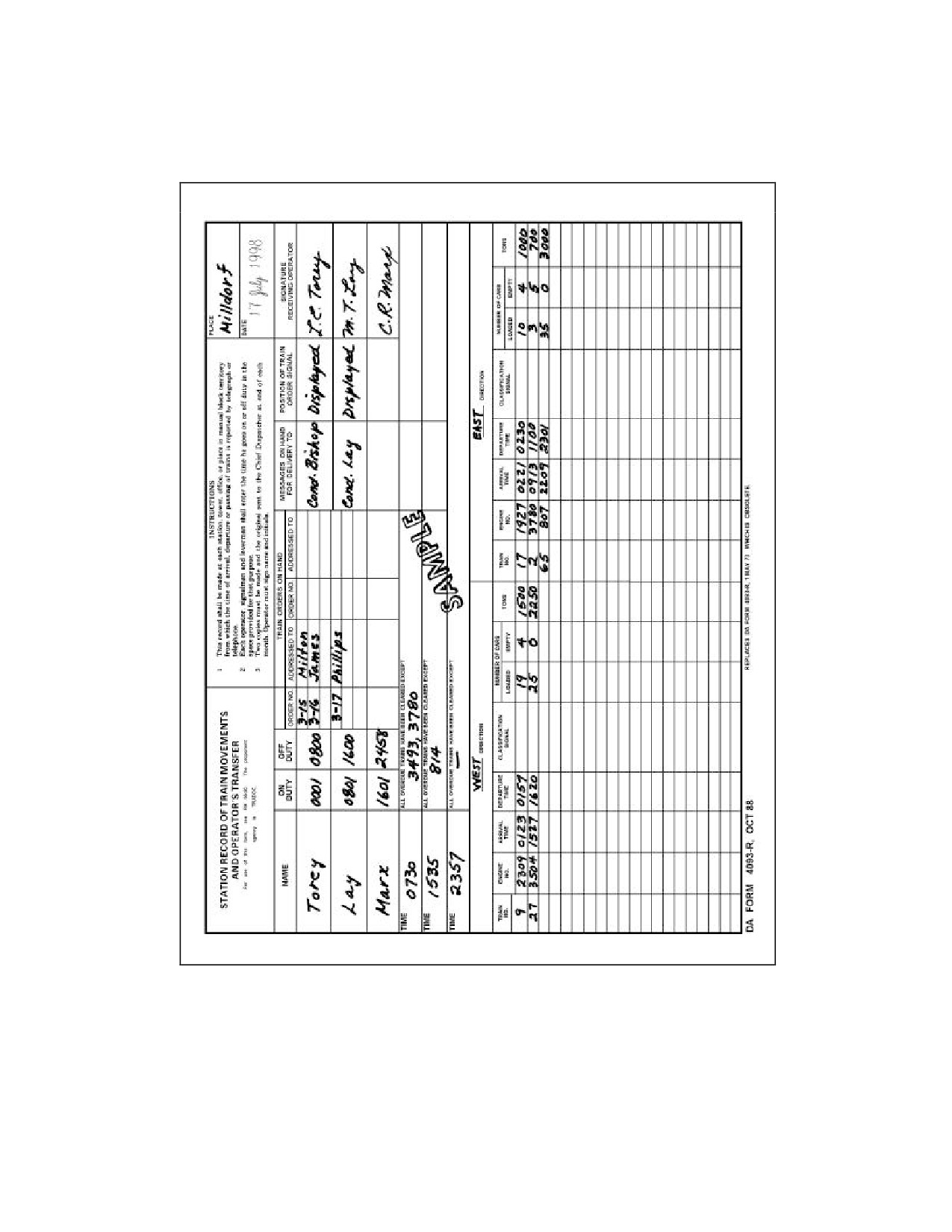
4-8. Station operators use this form (Figure 4-4, page 4-9) to record all train movements within their
jurisdiction. Each station operator records the time of his shift and specific information on train
orders and signals. Instructions for use of DA Form 4093-R are included in the form heading. A
blank copy of DA Form 4093-R is in Appendix A. You may reproduce this form on 8 1/2 x 11-inch
paper.
SINGLE-TRACK, DOUBLE-TRACK, AND MULTIPLE-TRACK OPERATIONS
4-9. A main track may consist of a single track or two or more tracks upon any of which the current
of traffic may run in either direction. The three types of main track operations are discussed below.
SINGLE-TRACK OPERATION
4-10. In a single-track operation, dispatching is carried out by written train orders. A first-class train
depends on the timetable schedule for its authorization. When leaving the starting terminal, the crew
is authorized to travel along the route according to the established timetable schedule. On a single-
track line, the timetable specifies the superior direction. Therefore, a first-class train traveling in the
superior direction would be superior to all other trains on the line. Inferior trains must clear the main
track completely by going into a siding or yard and line the switch for the main track. In no way
should the arrival of the first-class train be delayed.
4-6
FM 4-01.41 ______________________________________________________________________________________Chapter 4
Figure 4-3. Sample DA Form 5614-R (continued)
4-8
FM 4-01.41 ______________________________________________________________________________________Chapter 4
Figure 4-4. Sample DA Form 4093-R
Double-Track Operation
4-11. In a double-track operation, each track is designated a direction of traffic specified by timetable.
No deviation by crews is allowed without specific orders from the dispatcher. The dispatcher must
continue to ensure that inferior and superior trains do not meet and that opposing trains are
4-9
FM 4-01.41 ______________________________________________________________________________________Chapter 4
separated. Although double-track operations are simpler than single-track operations, the density of
traffic is generally two or three times greater than on a single line. Most double-track lines are
equipped with automatic block signals. These signals require the dispatcher to space the trains so that
neither of them are hindered by the reduce-speed and stop signals of the train ahead. Proper train
spacing is a delicate phase of dispatching. Too much starting and stopping results from trains being
too close together.
Multiple-Track Operation
4-12. Multiple-track systems are rare in military operations. Since towers (as directed by the
dispatcher) control movement, the dispatcher determines the flow of traffic for each train in order to
provide greater movement flexibility and track use. On three- and four-track systems, the operating
problems are even further reduced. Four tracks are ideal because they can provide high- and low-
speed tracks in both directions. High-speed tracks are usually on the outside to permit passenger
trains to load at stations. These tracks are often thought to be reserved for passenger trains only.
However, express trains and fast freights can use them providing they can make passenger-train
running time. The flow of traffic can be more rigidly enforced on a four-track system because there
are two tracks running in each direction.
4-13. Some railroads make a strict distinction between the standards of low-speed and high-speed
track. On the low-speed track, lighter rail is used, less ballast and subballast maintenance is
performed, and tie renewal is considered less often than on the high-speed track. The tracks are
designated either freight or passenger, and trains are interchanged only in emergencies. Continued
operation of heavy freights over passenger tracks require constant maintenance work to keep them in
the condition required to give maximum riding comfort.
4-14. Many railroads make no distinction between the standards of the low -speed and high-speed
tracks. The weight of the rail is identical, and the ties and subgrade are the same. The terms "high
speed" and "low speed" may be used to describe these tracks, but the timetable would refer to them
as numbers 1, 2, 3, and 4. A train would generally only run against the flow of traffic if both tracks in
one direction were blocked or otherwise rendered unusable.
DISPATCHING PERSONNEL
4-15. Railroad main line operations are complex, involving the movement of freight, passenger, and
mixed (freight and passenger) trains from one terminal or yard to another over a division or
subdivision of track. Competent dispatch personnel are needed in order to ensure that these
coordinated operations are successfully accomplished.
Chief Train Dispatcher (Chief Dispatcher)
4-16. A chief train dispatcher is in charge of the dispatch office. He supervises train movement,
reroutes rail traffic in emergencies, determines train tonnage, orders motive power, determines rail
line capacity, and establishes train movement priority. The chief dispatcher initials all orders,
messages, and instructions. In any matter affecting main-track operations, he acts as the
superintendent.
4-10
FM 4-01.41 ______________________________________________________________________________________Chapter 4
Train Dispatcher (Assistant Chief Dispatcher)
4-17. The assistant chief dispatcher may be assigned at a division terminal. An assistant chief must be
qualified to assume responsibility of the chief dispatcher. He must also be qualified to assume
responsibility of any train dispatcher working in the particular office, on shift, or in emergencies. A
large portion of work may be devoted to processing telegraphic accident reports and in preparing
train delay reports. The office train master or superintendent uses these reports. He does other
related work as prescribed by the chief dispatcher.
Senior Train Dispatchers and Train Dispatchers
4-18. A train dispatcher is responsible for main-line movement of passenger and freight trains on a
division. His objective is to get scheduled trains from one end of the division to the other according
to their published timetables. He must also get extras (unscheduled trains) over the road in the
briefest (but safest) possible time.
Car Distribution Clerk
4-19. The car distribution clerk maintains visibility for all railcars (including loaded or empty cars) in
the division area. The car distribution clerk will compare the car requirements for loading with the
location of empty cars and will prepare the documentation for redistribution of railcars as desired. He
will also report any delays in car unloading to the chief train dispatcher.
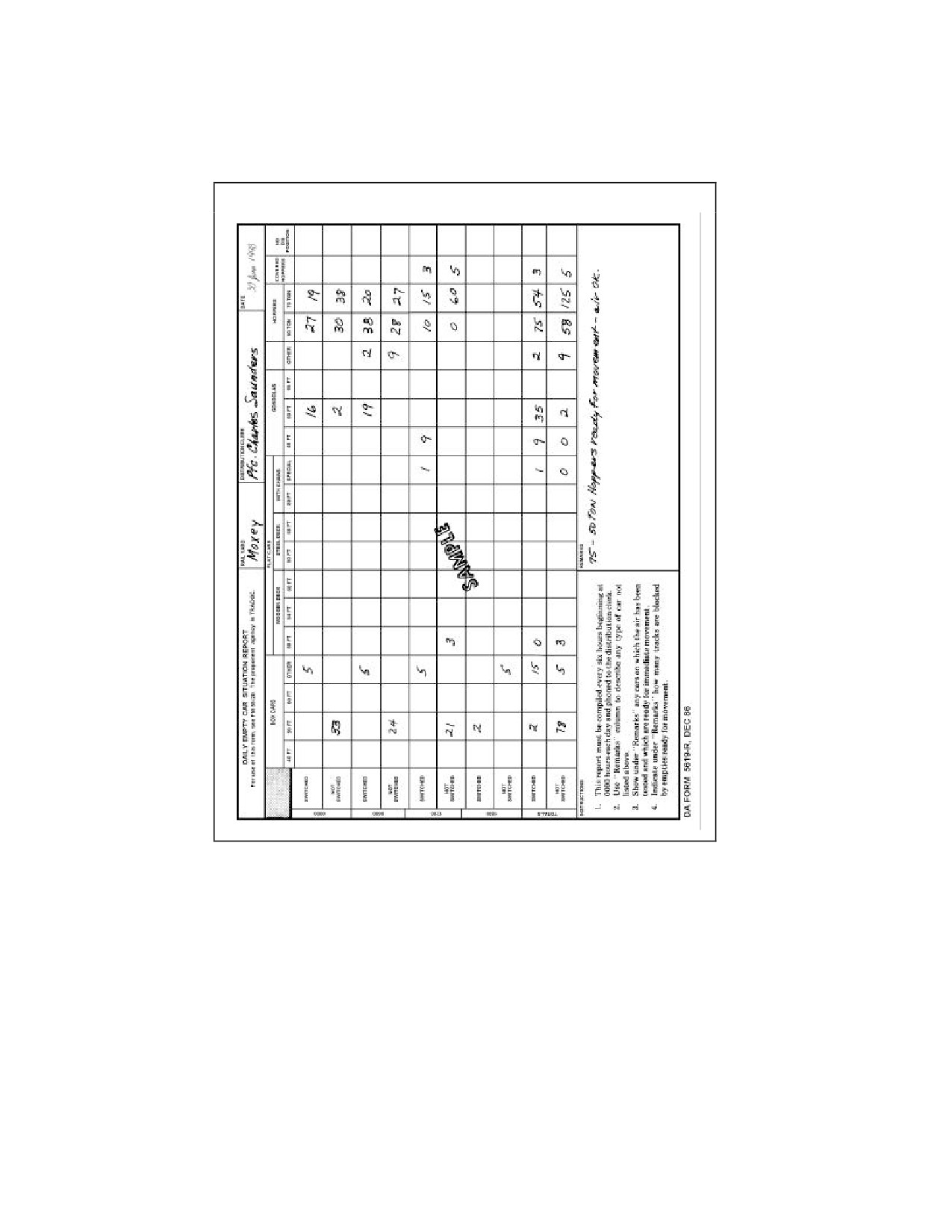
4-20. A car distribution clerk uses DA Form 5619-R (Figure 4-5, page 4-12) in performing his duties.
A blank copy of DA Form 5619-R is shown in Appendix A. You may reproduce this form on 8 1/2
x 11-inch paper.
4-21. The number of empty cars shown on the various yard reports are totaled by the distribution
clerk and entered on the consolidated empty car report. The forms for this report are not only
different among railroads but also between civilian and military railroads. As empties move out of a
yard, the distribution clerk deducts them from his master report. The next report from the yard omits
those moved but includes others accumulated since the previous report. A report from a yard often
does not change greatly from its previous one. The principal change is in the figures for "switched"
and "not switched" cars.
4-11
FM 4-01.41 ______________________________________________________________________________________Chapter 4
Figure 4-5. Sample DA Form 5619-R
TIMETABLE
4-22. A timetable authorizes the movement of scheduled trains. Designators in the timetable show
train superiority. First-class trains are superior to all other class-designated trains. Extra or
unscheduled trains are inferior to all regular trains having a class designator. No superiority or
inferiority exists between extra trains. The timetable on a single track also specifies the superior
direction. Division timetable pages dealing with schedules appear similar to those in the timetables
furnished to the traveling public. The two timetables should not be confused because the division
timetable contains much greater detail. You could use the division timetable as a supplementary book
of rules to amend, supplement, extend, and even interpret many of the standing operating rules.
4-12
FM 4-01.41 ______________________________________________________________________________________Chapter 4
4-23. In addition to the schedule of trains, a typical division timetable includes a variety of
information. Table 4-1 shows the various types of data and instructions that may be found in a
division timetable.
4-24. When schedules are worked out for publication in a single-track timetable, the meets of
scheduled trains are planned so train orders are unnecessary. However, scheduled trains may often
run late. When they do, train orders must be issued to other trains on the line to assist the overdue
trains in getting back on schedule or to prevent them from delaying other trains or operations.
Table 4-1. Data in a Division Timetable
Reduce speed areas
Company doctors, surgeons, and oculists.
Yard limits
Weight limitations of--
Special signal indications by name, location, and significance.
Track
Bridge
Passing sidings and their capacity in cars (available footage).
Trestles
Coal tipples
Location of and special instructions regarding--
Engine restrictions
Spring switches.
Close-clearance points
Time relay switches
Derails.
Location of--
New or nonstandard switching and signaling mechanisms.
Fuel and water facilities
Standard clocks
Special instructions on--
Telegraph offices
Care and lubrication of journal boxes.
First aid supplies and stretchers
Handling of cars having overheated journal bearings (hotboxes).
Running Ahead of Schedule
4-25. The right of a regular train to occupy the main track at a particular time is established in the
timetable. The train must travel in strict accordance with the published time figures in the train
schedule. A train cannot gain time en route and arrive at the various stations before it is due. A train
may gain time between any two successive stations, but it must not pass the advance station earlier
than the time shown in the timetable. When yard crews desire to cross or foul main tracks, or when
an inferior train occupies a track ahead of a superior one, crews must adhere strictly to the published
time figures in the timetable. Yard crews must never operate on or across main tracks (unless within
yard limits) without the authority of the dispatcher.
Running Behind Schedule
4-26. When a train becomes late according to its schedule, the result is many other delays to inferior
trains running over the division. Likewise, yard engines required to use or cross the main tracks in
doing their work may also be delayed. When a regular train becomes late, the dispatcher must be
cautious in authorizing movements that might interfere with its progress and efforts to get back on
4-13
FM 4-01.41 ______________________________________________________________________________________Chapter 4
schedule. The dispatcher would likely have no way of knowing how many minutes the engineer may
have gained since he reported past the last station. If the dispatcher takes no positive action, the
crews on the division must respect the published time until they are otherwise directed by a train
order.
LOSS OF TIMETABLE SCHEDULE
4-27. On occasion, a scheduled train may lose its right and its schedule. With a loss of schedule, the
train loses its right to continue occupying the main track. Loss of schedule and restricted superiority
are entirely different events and distinction must be clearly understood. A train may have its
timetable superiority temporarily suspended by a train order. This suspension puts restrictions on the
train. These restrictions are only temporary and the train continues on its normal schedule after the
train order is fulfilled. However, on two occasions the train actually loses its schedule and therefore,
its superiority.
More Than Twelve Hours Late
4-28. When a scheduled train becomes more than 12 hours late, it is said to "die on its schedule." A
train will die on its schedule if it arrives more than 12 hours late at a scheduled station or departs
more than 12 hours late. This means that it has lost its schedule and that all train orders, if it holds
any, are annulled. The train can proceed from the point where it loses its schedule only on new train
orders from the dispatcher. FM 55-21 specifies both arriving and leaving time as conditions in
determining if a train will lose its schedule. In either event, the dispatcher would have to recreate the
train as an extra or run it as a section of another scheduled train. Loss of schedule should not be a
common occurrence because some positive action should be taken to assist a train or annul its
schedule before it becomes 12 hours late.
Change of Timetable
4-29. A train may lose its schedule because a new timetable is issued. When a train is late and is going
to overlap a new timetable, the train’s schedule must be annulled and recreated as an extra.
SUPERIORITY AND RIGHT
4-30. "Right" as a dispatcher uses it, can be conferred by train order alone. ‘‘Superiority‘’ is granted
by the timetable based on a train’s superior class or superior direction. A regular train may have
timetable authorization or timetable superiority, but not necessarily superiority by right. In single-
track operations, a train is generally superior to another train by right, class, or direction—with right
being superior to class or direction. Direction is superior between trains of the same class. In double-
track operations, a train is generally superior to another train by right or class—with right being
superior to class. Direction is not significant in double-track operations since each set of tracks
would normally carry traffic in the opposite direction. Direction is a factor in single-track operations
since trains can travel toward each other on the same track.
4-31. Class is conferred by timetable and cannot be raised or lowered by train order. Class can be
taken away by annulling the train schedule and running the train as an extra. Extra trains are inferior
to all others. On most railroads, when two extra trains meet on a single track, the train moving in the
superior direction holds main track, while the other takes siding.
4-14
FM 4-01.41 ______________________________________________________________________________________Chapter 4
TRAIN ORDERS
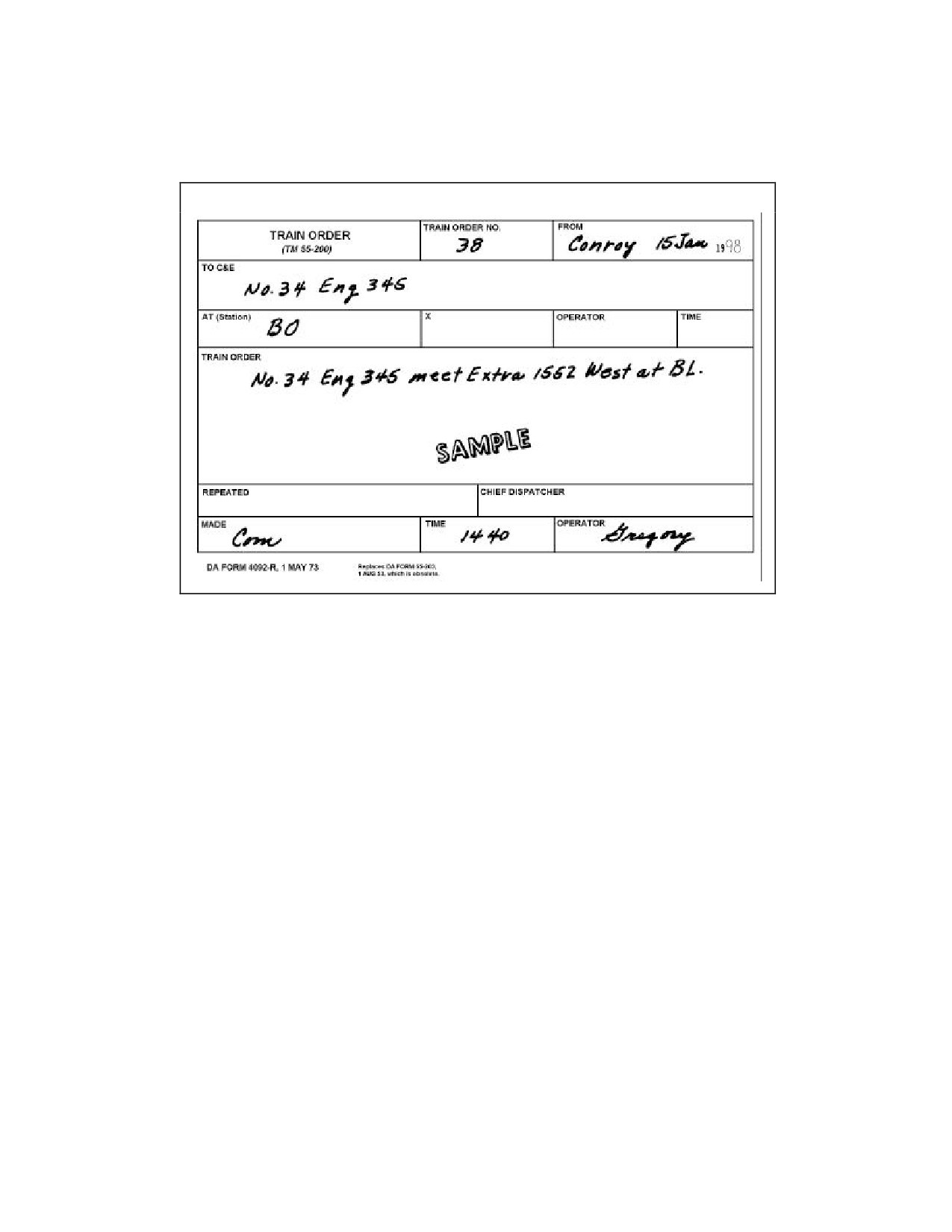
4-32. DA Form 4092-R authorizes the movement of trains not provided for in timetables. A sample
of a DA Form 4092-R is shown in Figure 4-6. A blank copy of DA Form 4092-R is shown in
Appendix A. You may reproduce this form on 8 1/2 x 11-inch paper. A train dispatcher issues the
train order orally by radio or by telephone through a station agent. The station agent writes the order
as received and repeats back the information to the sender to make sure it is accurate. The written
order is handed to passing train crews. Train orders are numbered consecutively each day beginning
at 0001 hours and are in effect until they have been fulfilled, superseded, or annulled. When
subdivisions of a railroad are under the jurisdiction of more than one dispatching office, a different
series of numbers are used by each office to prevent duplicating numbers for crews operating in
more than one dispatcher’s territory. Orders are addressed to station agents, conductors, enginemen,
or anyone who is acting as a pilot.
4-33. A train order conveys the dispatcher’s instructions to the crew. An order may amend, annul, or
supersede the class and directional superiority that the timetable establishes. However, it does not
waive compliance with a rule for one train unless it instructs another crew to protect the first train.
4-34. When the train order controls movements, the dispatcher’s movement plan must be totally
correct. Orders must be transmitted, relayed, or otherwise delivered in a foolproof manner. The
language of the order must be unmistakably clear to prevent misinterpretation. Strict accuracy of
stated time, engine number, station call letters, and direction is critical.
4-35. Crews receiving train orders must properly interpret and execute the orders. With involved
orders or series of orders, careful reading and concentration are necessary. Crew members must read
and repeat orders and then listen to others read and repeat them. It is prohibited for one member to
read and interpret orders to other members. Other mem bers may be influenced by incorrect
interpretation and they, in turn, may also misinterpret the order. Discussing complicated orders is
advisable, and complete and unanimous agreement should exist before acting on an order.
4-36. Dispatcher’s should write train orders in clear and legible handwriting. In writing orders, even
hours should not be used in stating time. Specifying time in even hours is conducive to
misunderstanding. When time normally would be 1300, it should be adjusted a little ahead or a little
behind (for example 1301 or 1259).
4-15
FM 4-01.41 ______________________________________________________________________________________Chapter 4
Figure 4-6. Sample DA Form 4092-R
4-37. When dictating train orders, the dispatcher writes in the train-order book as he reads. He
records all stations and trains to which the order is addressed. Each operator copies the entire text of
the order in longhand and puts his call letters in the heading. Operators repeat the order from their
copy in the same sequence as they were addressed. Figures, engine numbers, and dates are given by
pronouncing the number followed by the identification of the individual digits that make up the
number. For example, Eng. 345 (three hundred forty-five, three-four-five) or 14 November
(fourteen, one-four). Use this procedure in dictating and repeating train orders.
4-38. After the order is copied, the first operator addressed by the dispatcher reads the order back.
As the operator repeats the order, the dispatcher underscores each word. If the repetition is correct
in all respects, the dispatcher completes the order by saying "complete" and giving the exact time.
The word "complete" (abbreviated "com"), is written along with the time in the appropriate spaces at
the bottom of the train order (see Figure 4-6). Then, in turn, each of the other operators repeats the
order from his written copy.
4-39. As the order is read, the dispatcher underscores each word in his train-order book and
completes the order as he did for the first operator. Train orders have no validity until they have
been completed according to the superiority of the particular trains. The order for the superior train,
which is being restricted, must be completed before the order for the inferior train, which the order
helps. The only exception to this procedure is known as the "X" response.
4-40. When an order has been transmitted to several offices, the receiving operators must repeat the
order at once. The order is repeated in the succession in which the offices are addressed. The
dispatcher and all operators on the wire listen for any flaws or omissions in the repetitions.
Occasionally, the last operator must repeat the order first. This is permitted when the order can be
4-16
FM 4-01.41 ______________________________________________________________________________________Chapter 4
completed and delivered to an inferior train, which would otherwise be delayed while several other
operators are repeating the order to the dispatcher. When this occurs, the dispatcher directs that the
operator receiving the order for the superior train give the "X" response. This allows the operator
copying the order for the inferior train to repeat his order first and, when finished, to have it
delivered. Once the "X" response is given, the order will be repeated and made complete to the
inferior train before the operator copying for the superior train repeats his order. When the "X"
response has been given, the order to the superior train becomes a holding order and cannot be
delivered until it has been repeated and completed.
ORDERS AFFECTING SCHEDULED TRAINS
4-41. A run-late order has the same effect as changing the published train schedule for the particular
trip. It sets back the schedule by as many minutes as the train is late. In handling late trains, the
dispatcher has the following three options:
· Give the crew a run-late order to run late from origin to destination.
· Issue no restricting orders and permit the crew to make up as much of the late time as
possible.
· Give the crew a wait order, which would specify the earliest time the train could depart the
stations shown in the wait order.
A run-late order does not help the late train order because it does not permit the train to make up
any of the lost time. However, a run-late order may be helpful to an inferior train. When a dispatcher
issues a run-late order, he is amending the timetable schedule (called "putting out time") for the
particular train for the particular trip. Therefore, he is granting others the use of the time represented
by the difference in minutes between the advertised and the run-late time. If the dispatcher takes no
train-order action, the delayed train would be free to make up some of the time. However, other
trains and yard crews would not know the precise time to expect the train, and they could not depend
on using the full lost time because this figure might be progressively reduced as the train travels over
the division. Issuing a run-late order guarantees to all concerned that the amount of lost time will not
be reduced.
4-42. A wait order, also called a time order, may be issued instead of a run-late order. It is not
popular with all dispatchers and some railroads prohibit its use. A wait order permits the engineer to
make up time and tells everyone concerned about how much time will be made up. The order
permits a train to make up a specified number of stations, but the train may not leave a station before
a stated time. A new schedule is written for most of the run. In effect, the wait order shortens the
individual running time between certain stations.
Clearance Form "A"
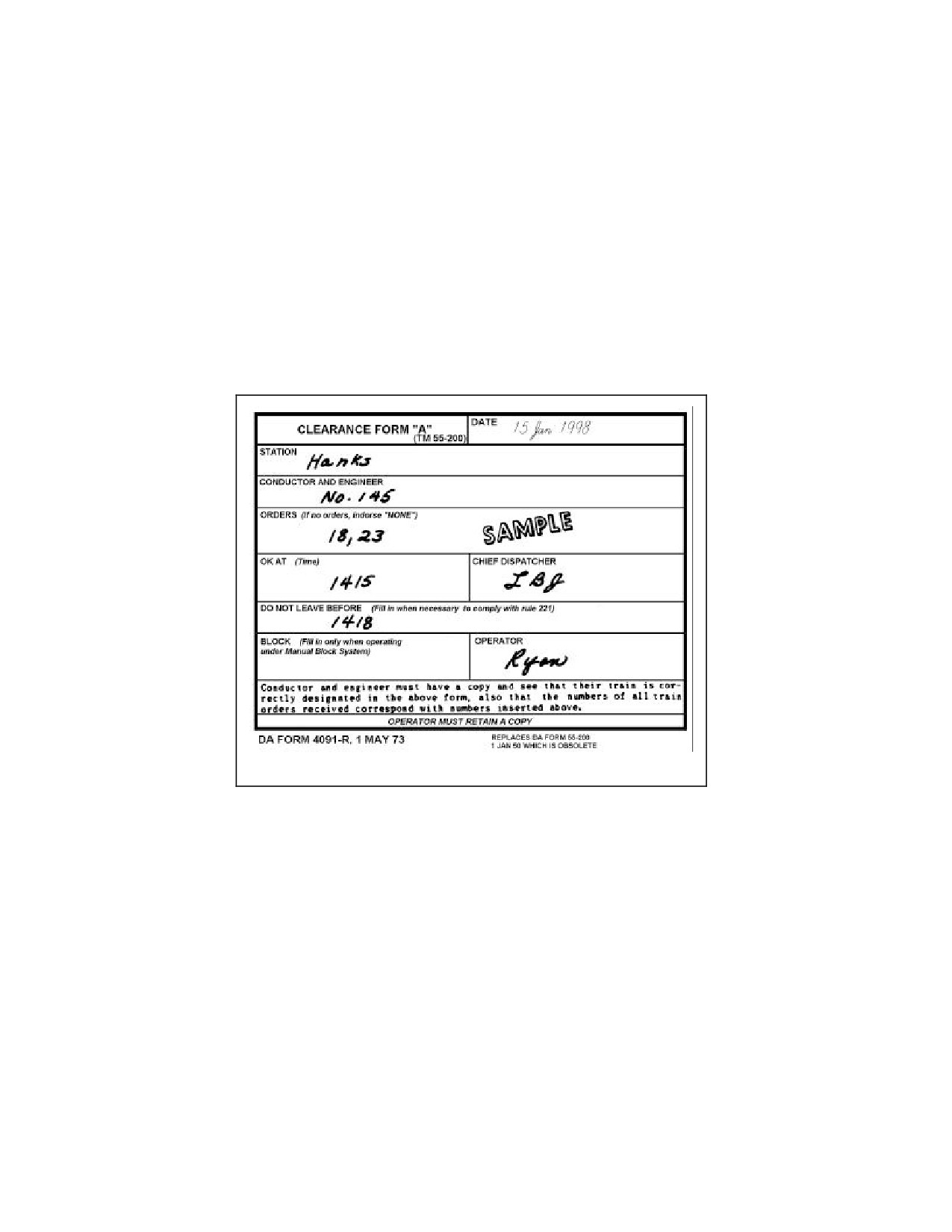
4-43. A train must first receive a DA Form 4091-R (Figure 4-7, page 4-20) before leaving a train
order station. A blank copy of DA Form 4091-R is shown in Appendix A. You may reproduce this
form on 8 1/2 x 11-inch paper. This form is not required if a train is to do station work or enter a
siding. Information entered on the form must be accurate and correct without any erasures or
alterations. The number of orders for the train and the number of each order must be entered on the
form and checked with the train dispatcher. The number must be identical with those entered in the
dispatcher’s train-order book. The dispatcher gives the station agent the okay, the time the clearance
4-17
FM 4-01.41 ______________________________________________________________________________________Chapter 4
form was checked for accuracy, and he initials for the chief train dispatcher. He makes a record of
the clearance in his book. The station agent enters the information received on the clearance form.
The clearance form and train orders are then given to the proper personnel to be carried out.
4-44. Before leaving, the conductor and engineman must know that the numbers shown on the
clearance form correspond with the orders received and that all information required on the form is
correct. Notice in Figure 4-7 that a space headed "do not leave before" is provided on the form. This
space is used for many purposes, but the most important one is the spacing of trains. By designating
the time the train should leave, the dispatcher controls the distance and time between trains. See FM
55-21 for more detailed information.
Figure 4-7. Sample DA Form 4091-R
TRAIN REGISTERS
4-45. When a train prepares to leave its starting point, the crew has no way of knowing whether all
superior trains have arrived and departed. The crew also has no way of knowing whether any
superior trains that have passed were displaying signals for following sections. In some areas, the
dispatcher advises a crew by an order of the superior trains for which they must wait before going
out on the main track. At other areas, train registers are kept to furnish this information for all
concerned. When a train arrives at a station where it has work or when it reaches a junction point,
the conductor signs the register. He writes in the number, class, arrival time of his train, and the type
of signals it is displaying (if any). Just before the train leaves, the conductor checks the register for
other arrivals or departures that may be superior and then enters his departure time. Extra trains
generally having no stops where the register is located are not stopped simply to register. Timetables
of most railroads provide that extra trains may register without stopping. Instead, the crew throws
off a message containing the necessary information and the operator enters it in the train register.
4-18
FM 4-01.41 ______________________________________________________________________________________Chapter 4
TRACK WARRANTS AND BULLETINS
4-46. The following rules pertain to those orders and instructions governed by track warrants and
bulletins. These rules are applicable only within TWC limits. Figure 4-8, page 4-24, shows an example
of a type of track warrant.
Rule 400. Authority
4-47. Where designated by special instructions or general order, use of the main track will be
authorized (under the direction and over the signature of the train dispatcher) by issuance of a track
warrant. Track warrants are numbered consecutively from the beginning of each calendar date.
Within TWC territory, there is no superiority of trains and trains will not be authorized by train order
or timetable schedule.
Rule 401. Designated Limits
4-48. The limits of a track warrant are designated by specifying the track, where required, and exact
points such as switches, mile poles, or identifiable points. Station names may be used. When a station
name is used to designate the first named point, the authority will extend from the last siding switch
or from a station sign if there is no siding.
4-49. When a station name is used to designate the second named point, the authority extends to the
first siding switch or to the station sign if there is no siding. At the second named point, authority
extends to the last siding switch when specific instructions include "hold main track at last named
point."
Rule 402. Requesting
4-50. Personnel requesting a track warrant must advise the train dispatcher of the movements to be
made and, when applicable, the tracks to be used and time required.
Rule 403. Copying
4-51. The conductor and the engineer must have a copy of the track warrant addressed to their train
or engine. The track warrant will show the date, location, name of person who copied it, and any
specific instructions issued. All information and instructions are entered on the track warrant form
provided and repeated to the train dispatcher. The dispatcher will check the copy and, if correct, will
give an "OK" and the time. The OK time is entered on the track warrant and repeated to the train
dispatcher. The track warrant is not considered in effect until the OK time is shown on it. If the
track warrant restricts movement or authority previously granted, it is not considered in effect by the
train dispatcher until acknowledgement of the OK has been received. Track warrants are relayed by
authorized personnel, who must then record the message on a track warrant.
Rule 404. Designation of Trains
4-52. In track warrants and track bulletins, trains are designated by engine number and direction
when applicable. When an engine of another company is used, it is designated by the initials or name
of the company preceding the engine number.
4-19
FM 4-01.41 ______________________________________________________________________________________Chapter 4
Rule 405. Mechanical Transmission
4-53. At points designated by special instructions, track warrants and track bulletins may be
transmitted mechanically. When so transmitted, repetition will not be required. OK time will be given
at the time transmitted and the name of the train dispatcher will be shown in the space provided for
name of copying personnel. Track warrants restricting the authority or movement of a train must not
be sent in this manner unless it is known that the train being restricted will not leave the point
without receiving the track warrant. Special instructions will prescribe how track warrants and track
bulletins are to be delivered at these points.
Rule 406. Specific Instructions
4-54. Track warrants will include specific instructions that must be complied with by those addressed.
Each track warrant must be given in the same words to all personnel addressed. Once in effect, the
track warrant must not be added to or altered in any manner except as provided by Rule 411.
Rule 407. Changing Track Warrant
4-55. When a track warrant is in effect and the limits or instructions are changed, a new track warrant
is issued with the instructions and will include the words "Track Warrant No______ is void." When
a track warrant of a previous date is voided, the date must be included. The previous track warrant
will no longer be in effect.
Rule 408. Operating With Track Warrant
4-56. A track warrant authorizes the train or engine addressed to occupy the main track within
designated limits. The train must not foul a switch at either end of the limits that may be used by an
opposing train or engine to clear the main track. Movement must be made as follows:
· When authorized to proceed from one point to another, movement is authorized only in
the direction specified.
· When authorized to "work between" two specific points, movement may be made in
either direction between those points.
Rule 409. Occupying Same Limits
4-57. Not more than one train or engine is permitted to occupy the same or overlapping limits of
a track warrant at the same time, except in the following circumstances:
· All trains or engines within the limits have been authorized to move only in the same
direction and are required to provide flag protection as prescribed by Rule 99.
· Two or more crews performing switching or work service have been notified of each
other and instructed that all movements must be made at restricted speed within the
overlapping limits.
Rule 410. In Effect
4-20
FM 4-01.41 ______________________________________________________________________________________Chapter 4
4-58. A track warrant is in effect until a crew member reports the train clear of the limits, the
warrant becomes void, or the time limit expires. The crew member must report to the train
dispatcher when they have cleared the limits. If a time limit is shown on the track warrant, a train
or engine must be clear of the limits by the time specified, unless another track warrant has been
obtained.
Rule 411. Marking Void
4-59. The word VOID must be written legibly across each copy of the track warrant when a
crew member has reported the train or engine clear of the limits, the time limit specified has
expired, or the track warrant has been changed as prescribed by Rule 407.
Rule 412. Protecting Men or Machines
4-60. A track warrant permitting men or machines to occupy or perform maintenance on main
track without other protection is issued in the same manner as that for trains or engines.
4-61. A track warrant must not be issued to protect men or machines within the same or
overlapping limits with a train or engine, except in the following circumstances:
· All trains or engines authorized to occupy the same or overlapping limits have been
authorized to move in one direction only and the track warrant specifies that it is granted
behind such trains or engines.
· Trains or engines authorized to occupy the same or overlapping limits have been notified
of the authority granted to the men or machines, have been instructed to make all
movements at restricted speed and have been instructed to stop short of men or machines
on or fouling track. The person in charge of maintenance must be so notified by a track
warrant. If track is not safe for movement at restricted speed, personnel in charge must
protect such track by placing red flags according to Rule 10(A).
Rule 413. Movement Against the Current of Traffic
4-62. When a track warrant authorizes movement against the current of traffic, the train or
engine must use only the track designated within the limits specified.
4-21
FM 4-01.41 ______________________________________________________________________________________Chapter 4
TRACK WARRANT
NO. ______________
DATE: _________________
TO: _____________________________
AT: _____________________________________
1.
TRACK WARRANT NO. ________________________________________ IS VOID.
2.
PROCEED FROM ____________ TO
_____________ ON ___________ TRACK.
3.
PROCEED FROM ____________ TO
_____________ ON ___________ TRACK.
4.
WORK BETWEEN ___________ AND _____________ ON _________ TRACK.
5.
NOT IN EFFECT UNTIL ________________________________________________.
6.
THIS AUTHORITY EXPIRES AT _________________________________________.
7.
NOT IN EFFECT UNTIL AFTER ARRIVAL OF
_________________________________ AT _________________________________.
8.
HOLD MAIN TRACK AT LAST NAMED POINT.
9.
DO NOT FOUL LIMITS AHEAD OF ______________________________________.
10.
CLEAR MAIN TRACK AT LAST NAMED POINT.
11.
BETWEEN __________ AND ____________ MAKE ALL
MOVEMENTS AT RESTRICTED SPEED.
LIMITS OCCUPIED BY TRAIN OR ENGINE.
BETWEEN __________ AND ____________ MAKE ALL
12.
MOVEMENTS AT RESTRICTED SPEED
AND STOP SHORT OF MEN OR MACHINES
FOULING TRACK.
DO NOT EXCEED _____________________________ MPH BETWEEN
13.
________________________________ AND ________________________________.
DO NOT EXCEED _____________________________ MPH BETWEEN
14.
________________________________ AND ________________________________.
15.
PROTECTION AS PRESCRIBED BY RULE 99 NOT
REQUIRED.
TRACK BULLETINS IN EFFECT:
16.
_________.
__________. ___________.
___________.
__________.
_________.
_________.
__________. ___________.
___________.
__________.
_________.
17.
OTHER SPECIFIC INSTRUCTIONS:
_______________________________________________________________________
_______________________________________________________________________
_______________________________________________________________________
OK ________________________ DISPATCHER ___________________________.
RELAYED TO __________________ COPIED BY _________________________.
LIMITS REPORTED CLEAR AT ___________________ BY _________________.
(Mark “X” in box for each item instructed)
Figure 4-8. Type of Track Warrant
TRACK BULLETIN (DA FORM 5706-R)
4-63. Within TWC territory and other territories designated by special instructions; the train
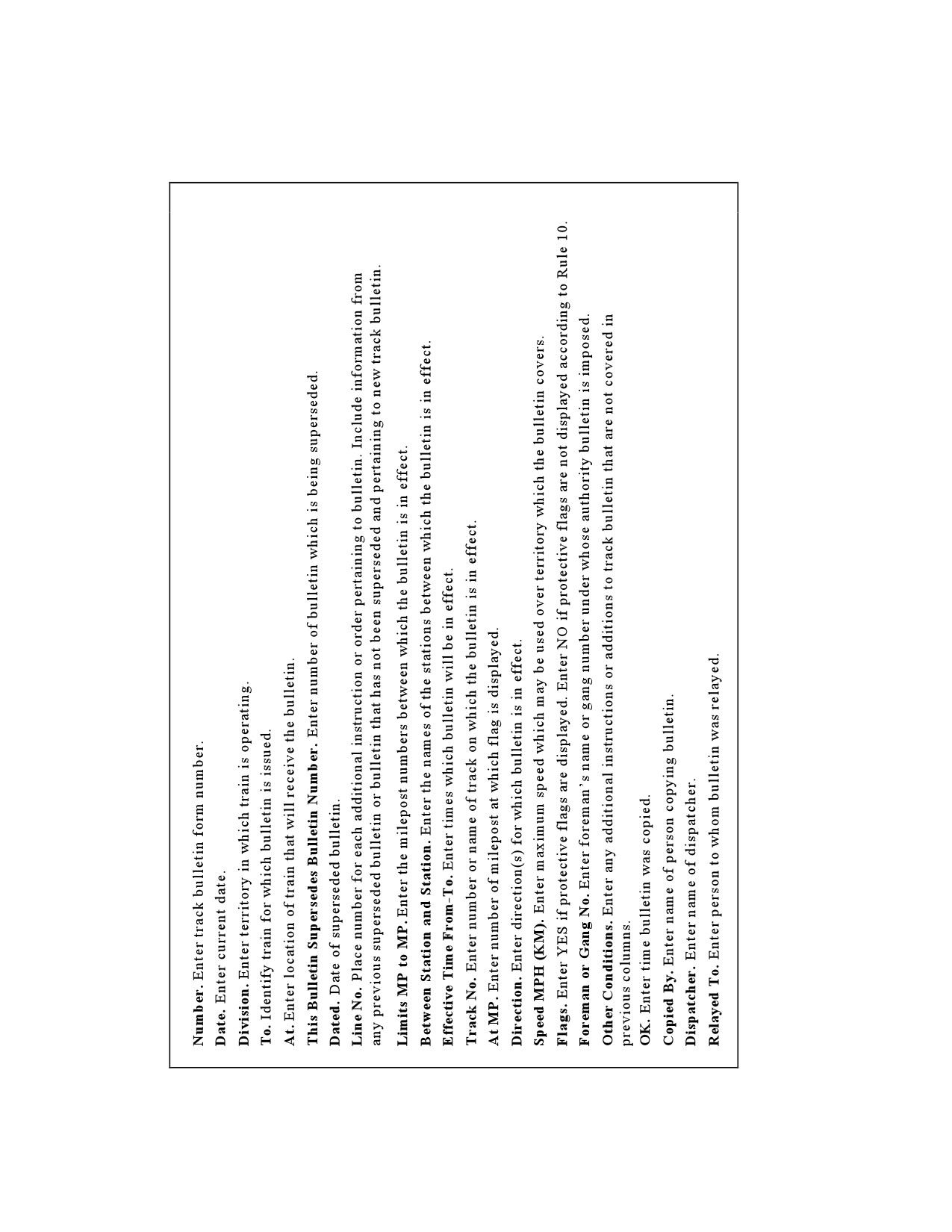
dispatcher, as required, will issue DA Form 5706-R (Figure 4-9, page 4-24). Bulletins contain
information as to all conditions affecting the safe movement of trains or engines. When track
4-22
FM 4-01.41 ______________________________________________________________________________________Chapter 4
bulletins are authorized, trains and engines must receive a track warrant at their initial station
unless the train dispatcher instructs otherwise. All track bulletins, which affect their movement,
must be listed on the track warrant. The conductor and engineer must have copies of all track
bulletins listed. Each crew member must read and understand the requirements of any track
bulletin he receives. Figure 4-9 shows a completed copy of DA Form 5706-R. A blank copy of
DA Form 5706-R is shown in Appendix A. You may reproduce this form on 8 1/2 x 11-inch
paper. Instructions for completing this form are also shown in Figure 4-9, page 4-24.
EXTRA TRAINS
4-64. An extra train is a train not designated by timetable. These trains are designated as extra,
extra passenger, and extra work trains. Since extra trains are not authorized by timetable, they are
identified by the number assigned to the locomotive pulling the train. For example, when
locomotive 310 is used to move a train eastward, the train is numbered "Extra 310 East" or
"Work Extra 9220."
Work Trains
4-65. Work extras are work trains from which personnel perform track maintenance and
construction along the right-of-way between specified points. Since these trains move in both
directions, no directional designator is used when referring to them. Unless provided in a train
order, a work extra must clear all regular trains and protect against other extras in both
directions. A work extra may not protect against a regular train; that is, work on the time of an
overdue scheduled train under flag protection unless instructed to do so by a train order. A train
is "protected" when the crew stations a flagman adequately ahead or to the rear of the stationary
train to stop any approaching train. Since work trains are almost always stationary, it is practical
to have them protect themselves against all trains. Work trains are located fairly close to a siding
so that they can enter the siding to clear the main track as another train approaches. The work
train's conductor ensures that his train clears all regular trains as specified by the rules. When a
wayside dispatcher telephone is near, the conductor maintains almost constant contact with the
dispatcher regarding the approach of extras. A work train that occupies a main track has a
flagman who must flag the main track to alert any approaching train. He is relieved from flagging
only when his train clears the main track. A number of blasts sounded on the locomotive’s
whistle signals that the track is clear.
Work Train Orders
4-66. When a work train must frequently move back and forth, it is impractical to have the
flagman walk ahead of the train. The dispatcher, knowing the kind of work being done and the
extras moving in the area, may issue an order that permits the work train to move unhampered.
If no extra is to arrive at the work limits before a specified time, the dispatcher may issue a train
order that will permit the maintenance personnel to carry out their tasks without protecting the
extras until that time.
4-23
FM 4-01.41 ______________________________________________________________________________________Chapter 4
Figure 4-9. Sample DA Form 5706-R (continued)
4-25
FM 4-01.41 ______________________________________________________________________________________Chapter 4
Protecting Against Work Trains
4-67. Trains of superior class do not protect against work trains. On double track, all operating
crews know the location of the work train’s work area. Notices posted in crew offices along the
line specify the work area, the number of days the work will be in progress, and a reduced-speed
limit for the area. On single track, all trains in each direction are given copies of the work extra’s
train orders. Instructions generally require all work extras to clear the trains without delay.
However, no approaching train, regardless of superiority, tonnage, or importance will run past a
work train flagman.
Military Work Trains
4-68. In a theater of operations, it may be necessary for all trains to protect against work trains-
signifying that the work train has a higher priority than the trains hauling troops or supplies. In
civilian practice, a work train may be in a particular location to do work solely to improve
passenger comfort or to make long-range repairs necessary to protect capital investment. Under
these conditions, it is much more economical for a work train to protect against and clear the
time of all trains. A military work train may be found blocking the main track because of more
pressing reasons. In a theater, passenger comfort and long-range maintenance are not main
priorities. Work trains operate only when absolutely necessary to keep trackage reasonably fit for
supply and troop trains. Failure to do track work quickly could result in a blockage in which no
trains would be able to move.
Proper Work Train Flagging
4-69. Work train flagging is almost impossible to over-emphasize. When the train is on the main
track, the flagman protects its rear by stationing himself far enough back to stop any approaching
train. On single-track lines, the forward end of the train must be protected in a similar manner.
When the work train pulls into a siding and clears the main, an appropriate number of blasts are
sounded on the whistle. This is called "whistling in" the flagman. Before the train again blocks
the main, a specified number of blasts are sounded and the flagman goes out to flag. This is
called "whistling out." The number of blasts varies according to the direction in which the train
is headed and to the number of main tracks. The alternate whistling in and whistling out, which
occurs when a train clears and blocks the main, involves a hazard that operating rules do not
stress and one that safety spokesmen seldom point out. The danger that occurs during flagging is
that the flagman may forget whether he is on the main track or in the siding. To keep track of his
position, the flagman maintains radio contact with the work train conductor.
Sections
4-70. Running additional sections are often necessary when handling passenger trains. A section
is one of two or more trains running on the same schedule. Technically speaking, there is no
such thing as a passenger train. A train either has a class designator or it is an extra. While it
appears logical that if there are no passenger trains, there could be no extra passenger trains.
Some railroads require all trains be designated by class or extras. Other railroads recognize the
need for the extra passenger train designation and use it for trains that cannot be run on another
train’s schedule. This designator receives more respect from yard crews and from crews of trains
4-26
FM 4-01.41 ______________________________________________________________________________________Chapter 4
of equal class. However, crews of scheduled trains must regard the extra passenger as inferior to
their own.
4-71. The dispatcher, when required, could authorize an additional train and call it a section. To
give this section first-class standing, the dispatcher can run it as a continuation of a first-class
scheduled train and call it a "second section." The dispatcher can give this section right over
other trains that would otherwise be superior by calling the section "Second 87" or some other
train number. By doing so, the regular train becomes "First 87." Both trains would receive train
orders, and the engine of the first section would have to display signals for another section.
CENTRALIZED TRAFFIC CONTROL
4-72. Operating a rail division controlled with CTC is much simpler than operating by the other
methods. The dispatcher merely flips a switch on the CTC panel. The switch opens a yard switch
and lights a proceed signal for the train. The dispatcher does not advise the train crew of his
plans and written orders are not necessary. Tracks have signals facing in each direction and there
is no established flow of traffic in CTC-controlled areas. This gives the dispatcher complete
flexibility of train movement. He may run trains on any track in either direction. Regardless of
the class of a train, it can continue to move against or ahead of trains of a superior class as long
as a signal tells it to do so.
4-73. The CTC system eliminates reading, repeating, interpreting, and remembering the
provisions of many train orders that would ordinarily be received. The crew receives visual
orders from the signal lights at the time and point where they are to be executed.
4-74. Many foreign railroads use electric interlocking (an early form of CTC). The layout may
extend for several kilometers on each side of the control tower from which the interlocking plant
is operated by a towerman. However, his control ends where the tracks join the area under the
control of the dispatcher. Generally used at congested junctions and terminals, such installations
allow the dispatcher and the tower operator more flexibility in handling trains and yard
movement in yard limits.
4-75. The dispatchers control panel or board has diagrams representing the track layout. All areas
under his jurisdiction controlled by CTC are shown on the panel. Small indicators, mounted at
intervals along the board, light up as the train reaches the point on the railroad represented by
each particular indicator. A dispatcher can watch the progress of any train within his jurisdiction
merely by observing the lights. He can also check the speed of a train by timing it between two
lights. He knows when a train makes an unscheduled stop or when it is losing time. The engine
crew never knows its exact path of travel until a short distance before reaching a point of
divergence. Reduce-speed signals are displayed enough in advance of a change of track to give an
engineer time to slow down. The engine crew relies on the permissive and restrictive aspects of
the signals automatically displayed when the dispatcher opens or closes the switches.
4-76. The CTC system has a safety feature that makes it impossible for a dispatcher to suddenly
take away a permissive route for a train after the engineer comes in sight of the signal. Although
the dispatcher can take away the displayed permissive signal and flash a restrictive signal "in the
face" of the crew, the switches controlling the track route cannot change if the engineer lacks
enough time to comply with the change signal. The system is wired so that the dispatcher cannot
set up conflicting moves. Single-track installations are connected so that if a train fails to make a
4-27
FM 4-01.41 ______________________________________________________________________________________Chapter 4
stop specified by a signal, other signals in advance of the train are automatically displayed to stop
a train that may be approaching on the same track from the opposite direction.
4-77. CTC is used mainly on single-track sections. Some railroads have converted double-track
sections to a single-track layout. The results have been reduced maintenance-of-way costs and
accelerated freight train schedules. Using CTC often permits an increase in train density because
the delay caused by wait-and-meet orders is reduced. With CTC, a dispatcher is often able to get
two trains by a given point without stopping either one. This is done by keeping one moving
through a siding while the other passes on the main track. If a siding is long enough, or if a single
track branches for several kilometers into a double track, a dispatcher may also have a train pass
another in the same direction without reducing the speed of either.
4-28
FM 4-01.41 ______________________________________________________________________________________Chapter 5
Chapter 5
Main Line Operations
and Procedures
Main line operations and procedures are complex. They involve the movement of freight,
passenger, and mixed (freight and passenger) trains from one terminal or yard to another over a
division or subdivision of track. In addition to their complexity, main line operations are a prime
target of enemy NBC weapons. Contingency plans must be developed with the capability and
flexibility to continue main line operations in an NBC environment.
TRAIN OPERATING COMP ANY PERSONNEL
5-1. In military railroading, the train operating company of the transportation railway battalion
provides crews for operating locomotives and trains. These crews operate either freight or
passenger trains over a main line or engines in rail yards. Certain terms are used to distinguish
between crews. Use of the terms "yard crew" and "road crew" refers to the crew’s place of
employment. The term "ground crew" applies to a yard conductor and his brakemen.
5-2. A road crew normally consists of the following:
· Conductor.
· Locomotive engineman.
· Senior brakeman.
· Brakeman.
If steam motive power is used, a fireman will be added to the crew. One of the two brakemen
normally assigned accompanies the engine or rides the train near the head end. He is known as
the forward or head brakeman. The other brakeman is permanently assigned to rear-end flagging
duties. The rear brakeman is known as the flagman. A third brakeman may be assigned when the
work load demands his service. The engineman and the fireman (if one is assigned) are called the
engine crew. The rest are known collectively as the train crew. The conductor is in charge of the
full crew (both trainmen and enginemen).
5-3. Military railroads in theaters of operations often needs armed security guards to accompany
a train to help protect shipments against pilferage. Such personnel are not a part of the crew. All
personnel will have their MOPP equipment with them during main line operations.
CALLING AND REPORTING
5-4. When a road crew is called for duty, each member should receive a written or a verbal notice
giving the time called, the train’s destination, and its type or symbol number. Depending on the
distance they are from their duty stations, crews receive notice from 1 to 2 hours ahead of the
time that they are called for work.
5-1
FM 4-01.41 ______________________________________________________________________________________Chapter 5
5-5. Upon reporting for duty, crew members sign a register and read and sign an
acknowledgment of any newly posted general orders or bulletins that may affect operations over
the portion of railroad their train will travel. They are told the engine number for the trip. Crew
register offices have standard clocks with which all crew members must synchronize their
watches. The conductor finds out from the yardmaster the track number the train is on and what
track the road engine is to use to go to that track.
Train Crew Duties
5-6. The locomotive engineman (or engineer) operates the locomotive and runs the train
according to the following:
· Operating rules.
· Timetable.
· Train orders.
· Other general notices or directives.
Although a locomotive located "first out" on a ready track is practically guaranteed to operate
properly, the engineman should inspect the fuel, sand, water, and lubricating and valve oil. He
should also inspect and oil (if necessary) the running gear of the locomotive. The engineman and
the head brakeman move the locomotive or road engine from the ready track to the departure
yard. A hostler is a person who moves engines around yards and enginehouse areas. On some
railroads, a hostler may take the engine from the ready track to the yard track.
5-7. The brakemen line switches at their respective ends of the train. They couple and uncouple
cars, connect and disconnect air hoses, set hand brakes, and relay hand signals (as does the
conductor). The brakemen also takes every opportunity to inspect the train for malfunction of
equipment or shifting of cargo.
5-8. The senior or head brakeman gives signals (by hand, lantern, flag, or verbal orders) for the
movement of trains. He should ride on or near the engine for the entire trip and do all front-end
flagging. He repeats signal aspects as the engineman calls them to ensure that concerned
personnel are reading them the same way. The head brakeman observes trains for any errors that
may be displayed in signaling.
5-9. When the head brakeman and engineman take a road engine from the ready track, they bring
it to the departure yard and back it against the train. After the engine is coupled to the first car of
the train, a road test should be made of the air brake system. Signal flags identifying the class of
the train are mounted when required.
5-10. The flagman checks his flagging equipment (which includes flags, fuses, torpedoes, and
lanterns with red and white lights). He mounts the marker lanterns, disks, or flags on the rear car
to give the train official standing, after it is on the main line.
5-11. The conductor is responsible for the whole train. The conductor compares watches with
the engine crew and briefs them on the orders they hold and the work they will do en route. He
reports to the yard office for waybills and train orders governing his trip on the main line. The
conductor performs the following at the yard office:
5-2
FM 4-01.41 ______________________________________________________________________________________Chapter 5
· Checks the waybills against the train consist.
· Prepares the wheel report.
· Supervises the disposition of cars set off.
· Surveys accidents or mechanical failure of equipment (including reporting damages or
delays).
The conductor, along with the other crew members, observes signals from towers, stations, and
from other trains. He receives and acts on any additional train orders en route. The engineman
will not move the train until he receives the signal from the flagman to depart. When the train
leaves the yard and enters the main line, the dispatcher controls its movement. However, the
conductor must see that his train runs according to operating rules and that it does not run ahead
of time.
5-12. If the train is not a through train, the conductor will usually make a penciled lineup and call
the dispatcher regarding setoffs en route. The dispatcher may tell the conductor what stations
have pickups for the train. If both telephone and dispatcher circuits exist, the conductor may call
two or three stations ahead. When contacting a distant yardmaster or station agent, the
conductor does the following:
· States what cars he has to set off and determines on which tracks they should be placed.
· Determines what cars will be picked up; the track number; and, if pickup will be some
distance from the yard office, the location of the waybills and wheel report. When a train
must pick up cars some distance from a yard office, the waybills may be delivered to the
moving train by a message hoop to prevent the train’s stopping twice. If weighted and
protected against bad weather, bills may be left on the end of the first car of the pickup.
· Asks the yardmaster where waybills should be left if the train is setting off cars some
distance from the yard office. A yard receiving a setoff of only a few cars may station
someone along the track to catch waybills thrown off the moving engine. Bills should be
wrapped securely around a rock or other heavy object to prevent the possibility of a
vacuum drawing them under the car wheels.
Departure Procedures
5-13. Before a train leaves the yard, the crew makes a road test of the air brake system. Upon
coupling the locomotive to the train, the engineman starts the locomotive’s air pumps to bring
the trainline or brake-pipe pressure within not less than 5 pounds below the standard pressure
prescribed for the train. When this figure is reached, the flagman signals the engineman to apply
the brakes and to reduce pressure by 15 pounds on the brake-pipe gauge. This is called a service
reduction. The amount of brake-pipe leakage must not exceed 5 pounds per minute as noted on
the brake-pipe gauge. When the brakes are applied, it indicates the flow of air is uninterrupted on
the entire length of the train. A signal is then given to release the brakes. After this test, the
reduction must be increased to 25 pounds. If the brakes apply and release, it is assumed that they
have performed the same on the entire length of the train. This assumption is based on the fact
that car inspectors have previously made a terminal air test and have walked the entire length of
the train to ensure the brakes have applied and released on all cars. If car inspectors are not on
hand, a conclusive air test can be made by a crew member walking beside the train and observing
each car. After the air test, and if train-line or brake-pipe leakage is within permissible limits, the
train is ready to pull.
5-3
FM 4-01.41 ______________________________________________________________________________________Chapter 5
5-14. At the head end, the conductor will brief the head brakeman and engineman on the type of
train and at what yards they will have setoffs and pickups. He will advise the head brakeman how
to handle waybills at each stop and will pass verbal orders from the dispatcher. If there are many
stops to be made or if instructions are involved, instructions may be given in writing. Waybills
and sections of the wheel report for cars that will be set off en route are given to the head
brakeman. Through waybills are kept by the conductor for additional clerical work.
Locomotive Instruments and Controls
5-15. The engine crew assumes the chief role in the safe and expeditious progress of a train on
the main line. A number of locomotive controls are used to keep a train running smoothly,
speedily, and safely. The objective of the engine crew is to take the train over the road safely in
the scheduled time, using the least amount of fuel with minimum wear on the rail equipment.
5-16. The engineman’s principal controls on a diesel-electric locomotive are as follows:
· Throttle lever that regulates the engine’s speed.
· Reverse lever that controls magnet valves in the reverser.
· Independent and automatic brake valves that control the locomotive brakes only, and
locomotive and car brakes, respectively.
AUTOMATIC SIGNAL SYSTEMS
5-17. Railway signals are devices, indications, and signs that control the movement of trains
along tracks and into and out of stations, terminals, and yards. These signals may be given by
hand or by a complex, automatically operated electrical system. Signals may be fixed such as
whistle posts, speed, and yard limit signs.
Block Signal System
5-18. The automatic block signal system permits faster train speeds than any other signal system.
It is designed to maintain predetermined intervals between trains by means of the track circuits
and appropriate electrical equipment activated by the trains. A section of track is divided into
blocks; each block is governed by a three-position light or semaphore signal. An approach aspect
displayed in each block indicates the situation in the next (succeeding) block. Therefore, each
train is protected to its rear by a signal indicating that the following train must proceed at
restricted speed and be prepared to stop if the block is occupied. The system may be used on
single- or multiple-track to control following or opposing trains. On single-track routes,
controlled movement, from siding to siding, sustains opposing traffic flow.
Central Traffic Control
5-19. A refinement of electric or pneumatic interlocking, this system permits the moving trains
through an extended area (200 to 300 miles) over tracks and blocks controlled from a distant
point. Division dispatchers have control over all switches and signals in the area. On a panel
board or wall before them, they have an electrically lighted diagram that shows all locomotive or
train locations, switch positions, and signal indications on the controlled sections of track. Using
a control machine, they can change switch positions and signal indications as required.
5-4

FM 4-01.41 ______________________________________________________________________________________Chapter 5
Interlocking Plants
5-20. Foreign railroads often use interlocking plants and/or switch towers. Unit personnel may
be required to control, operate, and maintain them in a phase I operation or to furnish
supervisory personnel in phase II and III operations. Conditions in a theater of operations
seldom are stable enough to justify installation of new interlocking plants. However, if possible,
existing plants should be used in areas of heavy traffic. Figure 5-1 contains a list of definitions
that personnel should be familiar with in order to understand further discussion.
Control tower (interlocking station) -- The place from which the interlocking plant is
operated.
Interlocking machine -- An assembly of manually operated levers or push buttons used
to control mechanically or electrically operated lights, signals, switches, derails, and
other units.
Electric lock -- A device which prevents movement of a lever, switch, or other
moveable object until properly released.
Foundation -- A fixed support for signal devices.
Lead out -- Mechanical connections between the interlocking machine and outside
equipment.
Pipelines -- Connections made with pipe or tubing and the supporting apparatus leading
from the operating lever to the operated unit.
Switch mechanisms -- Fittings for equipping a switch.
Signals -- Home, distant, and dwarf signals of an interlocking plant.
Figure 5-1. Definitions
Operation
5-21. Interlocking plants may be operated manually, electrically, or electro-mechanically. The
interlocking machine consists of a series of devices (so interconnected that they can be
manipulated and operated only in a predetermined order) which control traffic from a central
point by operating a series of signals and switches. Latches in the control levers activate
interconnecting bars, crosslocks, and dogs that prevent incorrect order of operation. A lever in
the machine or a button in the control panel regulates all signals and switches of that particular
interlocking. The switches and signals are interlocked electrically and mechanically to ensure that
the proper signal is displayed for a specific route and that the switch points match the displayed
aspects.
5-5
FM 4-01.41 ______________________________________________________________________________________Chapter 5
Location
5-22. An interlocking plant is centrally located in a large terminal or junction at a point of
maximum visibility. Specifically, interlocking installations usually are found at the following:
· Entrance or exit of large freight and passenger terminals.
· Large receiving, classification, and switching yards. Railroad crossings for trains traveling
in different directions or for trains of different railroad lines.
· Junctions with the main line.
Inspection and Maintenance
5-23. Since railway signaling equipment is complex and varied in design, concise instructions
covering its maintenance and repair cannot be included within the scope of this FM.
Manufacturer’s manuals contain specific details of construction and design. In oversea theaters,
these publications normally are not available for the signal equipment that rail units may
encounter. Therefore, whether or not this equipment can be used depends on its similarity to
American equipment, the possibility of repair or replacement with like items, and the ingenuity
of rail signal personnel. Maintenance required is directly related to the quality and frequency of
inspection. Constant, careful inspection and testing greatly reduce maintenance requirements.
Safety Procedures
5-24. When defective elements or parts of a signal system are removed, the signal devices must
be arranged to display the most restrictive aspects. Under no circumstances should agents,
operators, or train personnel make any but the most minor repairs. Railway signal equipment is
intended to provide the fastest train movement possible under safe operating conditions. If
repair is not rigidly controlled, signal equipment deteriorates until it becomes unreliable and
unsafe.
SIGNALS AND MARKERS
5-25. The three fundamental aspects to all railway signaling are: stop, caution, and proceed. The
following describes the signals and markers used in railway operations.
Fixed Signals
5-26. Fixed signals are defined as any signals of fixed location that affect the movement of a train
or engine. They may be in many sizes and shapes. The three basic fixed signals that are
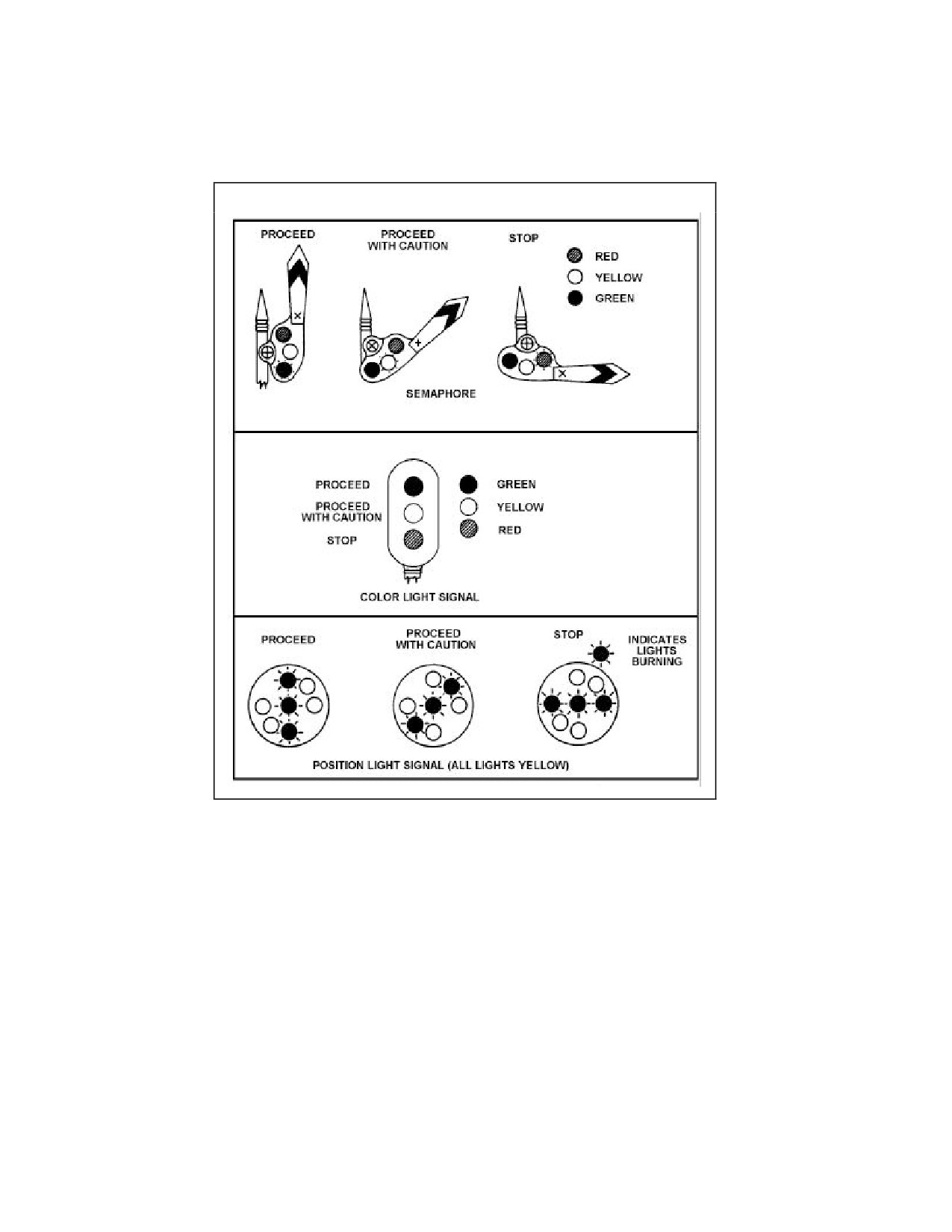
commonly found are semaphore, color light, and position light (see Figure 5-2). Aspects of fixed
signals are shown by the position of semaphore arms, color of lights, position of lights, or a
combination of color and position of lights.
5-6
FM 4-01.41 ______________________________________________________________________________________Chapter 5
Figure 5-2. Fixed Signals
Semaphore
5-27. The semaphore consists of an arm or blade secured by a moveable mechanism to a vertical
pole or mast. When the arm is in a vertical position (straight up) the train may proceed. When it
is in a horizontal position (straight out from the post) the train must stop. If the signal is in
approximately a 45-degree angle (between straight and straight out) the train may proceed with
caution at a reduced speed. If the signal is in any position other than the three named positions,
the train must stop. A signal imperfectly displayed or the absence of a signal must be promptly
reported to the train dispatcher. This measure protects against defective signals endangering the
movement of trains. During nighttime operations, the semaphore also has lights that can be seen
as the arm is raised or lowered.
5-7
FM 4-01.41 ______________________________________________________________________________________Chapter 5
Color Light
5-28. The color light signal has three lights: red, yellow, and green. It is similar to traffic-control
lights at street intersections.
· The train must stop if the light is red.
· The train may proceed if the light is green.
· The train may proceed with caution, but at a reduced speed, if the light is yellow.
As a safety precaution, the train must stop if two or more lights are burning at the same time or
if all the lights are out.
Position Light
5-29. The position light signal is used extensively worldwide. Therefore, it is likely to be present
in a theater of operations. This signal has yellow lights arranged in a circular pattern around a
central light that burns in rows representing semaphore arm aspects. A vertical row of lights
mean proceed; the next two blocks are clear. A diagonal row means proceed with caution at
reduced speed; the next block is clear, but the one beyond it is occupied. A horizontal row
means stop; the next block is occupied. The position of the lights rather than their color denotes
the command signal. Any combination of light positions other than those stated means to stop.
Signaling Procedures
5-30. As a train leaves the yard, the engineman should begin calling and repeating signals. The
engineman calls each signal indication along the main line by name. The head brakeman (or the
fireman if steam active power is used) will answer the engineman as he reads the signal. All signal
interpretations must agree between the engineman and head brakeman. Calling and repeating
signals is essentially a safety measure.
5-31. Main-line tracks equipped with automatic block signals are divided into sections which
have signals to show whether the two or more block sections immediately ahead are clear or
occupied. You should try to space signals at uniform distances. However; curves, sighting
distances, bridges, tunnels, traffic congestion, and speed limits frequently prevent this from
happening.
5-32. The signal name, when it is first seen, is called and repeated. The engineman must watch
the signal for possible changes until the train has passed the signal. Aspect 1 may change to a
more restrictive aspect if a switch is opened in one of the two blocks immediately ahead. Aspect
2 cannot change to a more restrictive aspect unless a switch is opened between it and the next
signal, but it may return to clear (aspect 1). Aspect 3 cannot change to aspect 1 without first
changing to aspect 2, unless the train causing the indication has left the main track for a siding.
The stop indication must be observed and the train must not pass.
5-33. For dispatching, the ideal arrangement for train movement is to have trains spaced so that
no train will be hampered in its progress by the stop or approach signals caused by the train
5-8
FM 4-01.41 ______________________________________________________________________________________Chapter 5
ahead. However, this is not always possible, but it is a condition that dispatchers should not
forget.
5-34. Besides warnings, the engineman will use the locomotive whistle or horn for a variety of
signals. Operating rules prescribe certain whistle signals that must be sounded in various
circumstances. These whistle sounds include the following:
· Calling for signals from towers and stations.
· Whistling persons flagging a train in and out.
· Acknowledging signals from other trains.
· Calling attention to signals the train may be displaying for one or more sections.
The engineman must whistle for all public and private road grade crossings. The final whistle
must be timed to occur when the engine is actually on the crossing.
Classification Signals and Markers
5-35. Even though markers are not signals, they do convey information about the train to
operating personnel. Classification signals are placed on the front of the engine. These signals
identify what type of train it is. The signals are flags during daylight hours and remain visible by
the addition of lights at night. Flags and lights placed on the rear of the train are called markers.
Every type of train must display markers to qualify as a train and to show that the train is
complete.
Classification Signals
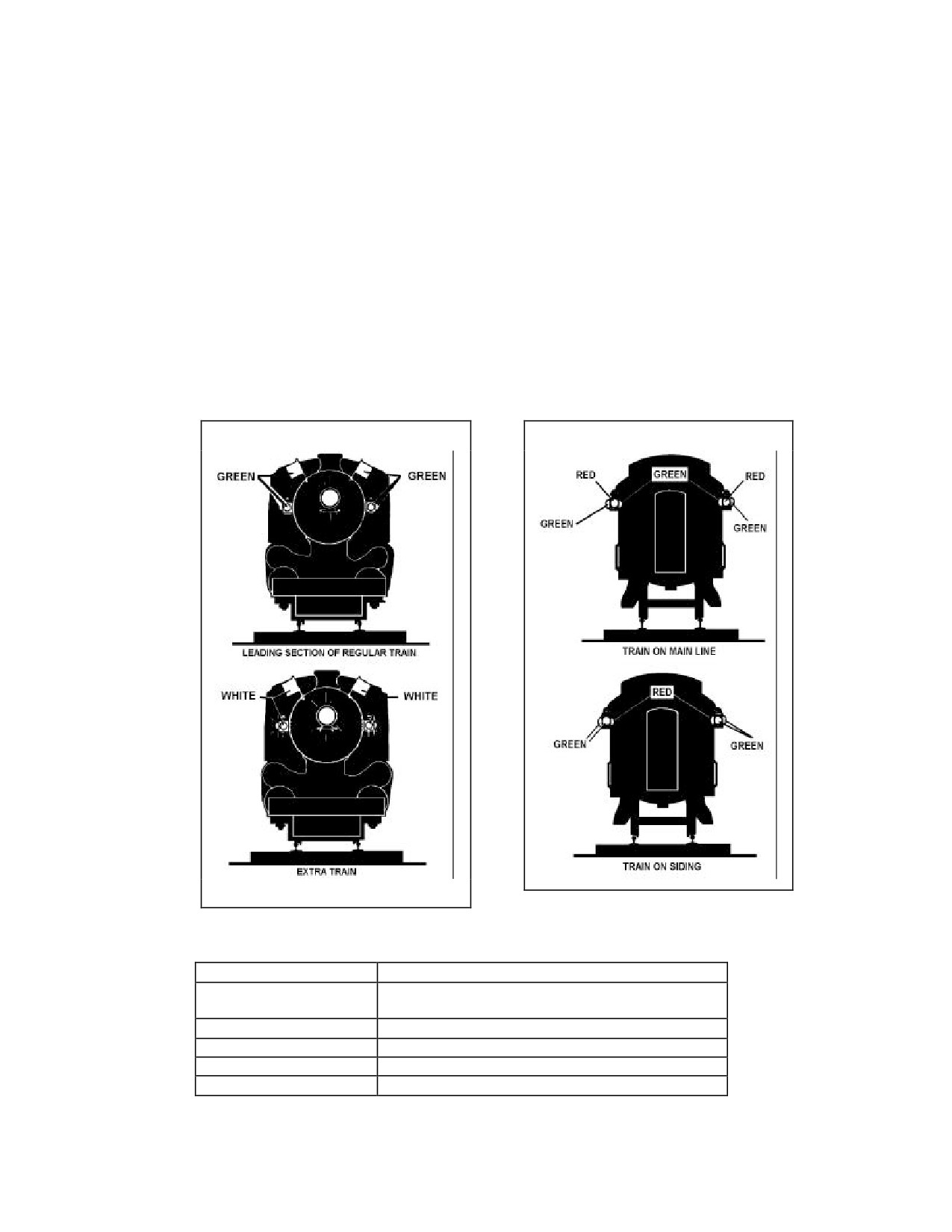
5-36. A regular train displays no classification signals in front unless it is being run in sections.
The first (or leading) section of a regular train displays green flags by day and green lights by
night on the front of the locomotive (Figure 5-3). Each section carries these same classification
signals, except the last section, which carries none. For example, if a train is being run in three
sections, the first two sections display the appropriate green classification signals and the last
section runs as a regular train showing no classification signals in front. If there are only two
sections, the first section displays the green classification signals; the second section does not.
Extra trains are not run in sections. Extra trains always display white classification signals on the
front of the locomotive (also shown in Figure 5-3). White flags are used during daylight; in
addition, two white lights are used by night.
Markers on the Rear of Trains
·
5-37. Markers are displayed on the rear of all trains. Because train operation in a theater
usually takes place on single-track main lines, the discussion of train markers is confined to
single-track operation. The markers displayed on a train on the main line (see Figure 5-4)
are red and green flags used by day and red and green lights used at night. When red lights
are displayed on the rear, it means that the main track is obstructed. A following train must
approach at reduced speed. When a train is in the siding and clear of the main track with
the switch lined for a through main line movement, it displays green flags by day and, in
addition, green lights by night on the last car of the train (see also Figure 5-4). A single
engine authorized by train order to run as an extra train must display white classification
signals on the front of the engine and markers on the rear.
5-9
FM 4-01.41 ______________________________________________________________________________________Chapter 5
Color Indications
5-38. Color signal indications are standard for all railroads. Not only does the position of a signal
give information to a railroader, but the color of the signal also has a specific meaning. Table 5-1
lists standard color indications.
Figure 5-3. Train Classification Signals
Figure 5-4. Rear Markers for Trains
Table 5-1. Standard Color Indications
Red
Stop.
Yellow
Proceed at restricted speed. Other uses prescribed by
the rules.
Green
Proceed. Other uses prescribed by the rules.
Green and White
Flag stop.
Blue
Protect workmen.
Purple
Stop (indication for siding derails).
5-10
FM 4-01.41 ______________________________________________________________________________________Chapter 5
5-39. These colors may be displayed in different ways or by different devices. A yellow disk
denoting a zone of restricted speed may have the authorized speed printed on it in black
numerals. A blue metal disk on a portable stand by day or a blue lantern or blue light by night,
are used as a signal by maintenance personnel. It is displayed at one end or at both ends of an
engine, car, or train to show that workmen are under or above it. No one except the person
placing the sign in position can remove it. A green and white signal near the right-of-way on an
approach to a station means that the station is a flag stop. If no signal appears at the station, the
train may continue without stopping.
NATO Train Identification
5-40. During operations in the NATO theater, identification symbols are assigned to trains to
help standardize the procedures for moving forces within the territories of NATO nations of
continental Europe. The procedures for obtaining these train identification numbers are found in
AMovP4.
CLERICAL WORK AND CAR MOVEMENTS
5-41. Other duties that the crew is responsible for include receiving messages, making reports,
and setting off and picking up cars en route.
Messages
5-42. When a train is moving, the head brakeman must be on the lookout for messages at all
open towers and telegraph stations. Messages are generally delivered "on the fly" by a message
hoop, or loop, to which they are attached. The hoop is handed to the brakeman as he stands on
the bottom locomotive step. He removes the message immediately and throws the loop to the
ground as the train continues on its way. Messages may also be provided by radio if the
locomotive is equipped. COMSEC procedures must be used at all times.
Delay and Accident Reports
5-43. If the train is delayed en route, the conductor records figures for a delay report, showing
every stop the train makes. The information includes the time stopped, time started, elapsed
time, reason for the stop, and exact location. Should the delay involve an accident; the time and
date, weather, names and addresses of the injured, witnesses, and damage estimates must also be
noted. This information is telegraphed in a separate report to the dispatcher or superintendent.
When a stop is made and the conductor does not have enough time to get to the head end
before the train starts up again, the head brakeman notifies the conductor of the reason for the
stop before the delay report is filed.
Conductor’s Wheel Report (DA Form 5618-R)
5-44. The wheel report (see Figure 5-5) is a record of the train’s run. It also contains most of the
information shown on the train consist. The conductor prepares the report and completes the
proper blanks to show the following:
· Train and engine numbers.
· Times of departure and arrival.
5-11
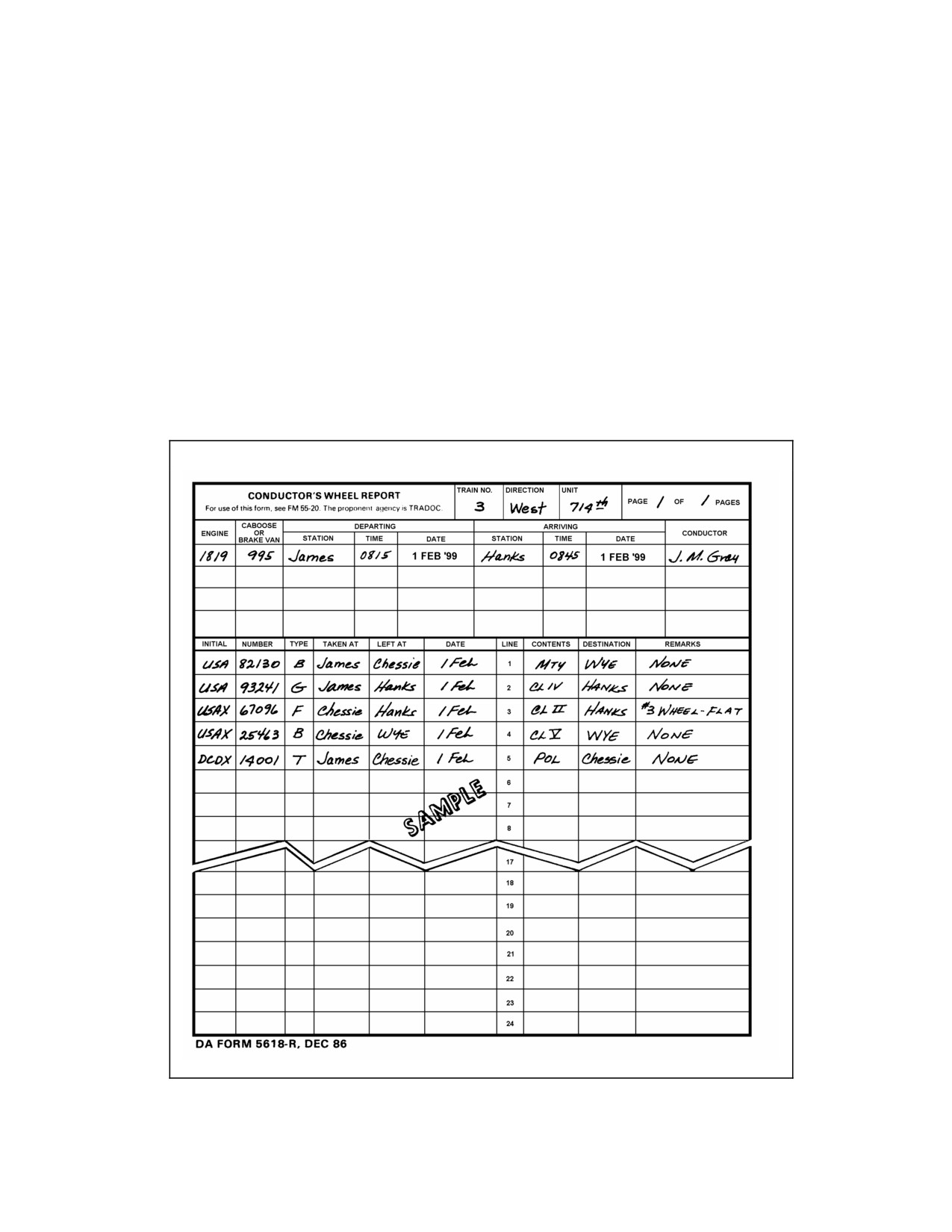
FM 4-01.41 ______________________________________________________________________________________Chapter 5
· Cars handled and where picked up and set out.
· Names of yards and stations where stops were made or the mileage/kilometer point if the
place is undesignated.
· Names of the crew members.
· Unit designation in military railroading.
Any special comments are recorded in the Remarks column. At the end of the trip, the wheel
report is completed and sent to the chief dispatcher or to the superintendent of work involved in
setting off and picking up car service. Additional reports made by the conductor may include
forms dealing with such freight as explosives, flammables, and perishables (see Figure 5-5). A
blank copy of the DA Form 5618-R is in Appendix A. You may reproduce this form on 8 1/2 x
11-inch paper.
Figure 5-5. Sample DA Form 5618-R
5-12
FM 4-01.41 ______________________________________________________________________________________Chapter 5
Setoffs and Pickups
5-45. The head brakeman usually does the work involved in setting off and picking up cars en
route. He gets permission from the yardmaster or dispatcher when making these car movements
at yards and stations, and delivers and gathers waybills for cars that the train leaves and picks up.
When necessary to cross main tracks against the current of traffic, the head brakeman must
assume head-end flagging duties. When the train leaves the area, switches and derails must be
relocked and left in their original or normal positions.
5-46. The conductor is responsible for the set out report. It is normally prepared in triplicate and
routed to the division superintendent (battalion commander) through the chief dispatcher and
the division master. The division superintendent and chief dispatcher will retain a copy. The
master mechanic ensures that all repairs are made and the dispatcher arranges pickup.
5-47. DA Form 5615-R (Figure 5-6) shows the following information:
· Location. Self-explanatory.
· To. Indicate closest car repair facility.
· Date. Enter current date.
· Train No. Indicate train number.
· Time. Show current time.
· Date. Show current date.
· Car No. and Initial. Self-explanatory.
· Commodity. Indicate class of supply carried by freight car.
· Set Out At. Indicate where car was set out.
· Reason for Set Out. Self-explanatory.
· Consignor. Self-explanatory.
· Point of Origin. Self-explanatory.
· Consignee. Self-explanatory.
· Destination and Route. Self-explanatory.
· Material Needed to Make Repairs. Indicate quantity and type of repair parts.
· Prospective Forwarding Date and Time. Indicate date and time that car is expected to
reach destination.
· Signature. Self-explanatory.
· Note: A blank copy of DA Form 5615-R is shown in Appendix A. You may reproduce
this form on 8 1/2 x 11-inch paper.
5-13
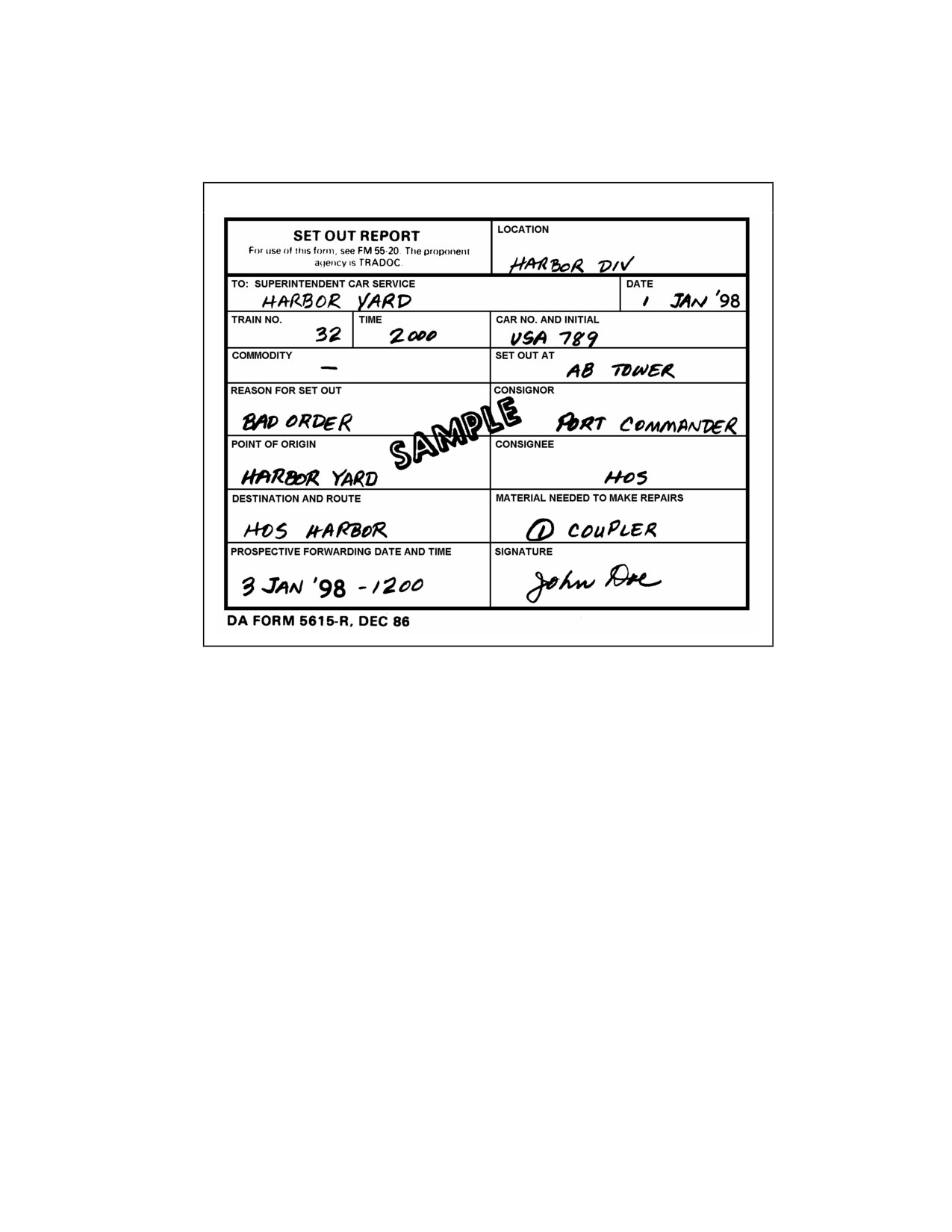
FM 4-01.41 ______________________________________________________________________________________Chapter 5
Figure 5-6. Sample DA Form 5615-R
NATO Rail Transport Requests
5-48. When operating in the NATO arena, request rail transport to move US troops and equipment according to
AMovP2.
SAFETY MEASURES
5-49. The safe movement of a train depends on the untiring watchfulness of the entire crew. The
responsibility of watching for signs of trouble rests equally on each crew member. The engine
crew is responsible for observing the track ahead and the conductor and flagman (rear
brakeman) are responsible for protecting the train from collision at the rear. Crew members (at
each end of the train) are also responsible for the following:
· Looking for hot journals.
· Shifting loads.
· Opening doors on boxcars and refrigerator cars.
· Dragging rigging.
· Other safety hazards.
5-14
FM 4-01.41 ______________________________________________________________________________________Chapter 5
These duties are best performed when the train is rounding curves and 30 to 50 percent of either
end of the train is visible alternately from the engine. Other activities of the crew to keep a train
safe and prevent accidents are discussed in the following paragraphs.
Flagging
5-50. From a safety standpoint, the flagman’s duties and responsibilities are equal to those of the
engineman. Proper flagging and prompt compliance by enginemen are the only known means of
preventing rear-end collisions on sections of railroad not protected by automatic train control.
Signal Lamp Markers
5-51. An important duty of the flagman is to light, hang, and turn train markers. Markers are
signal lamps displayed on the rear of a train. They have four opposing lenses: one is red and the
others are yellow or green. The markers are placed on hangers and may be turned to show any of
the colors or a combination of them. The flagman mounts the markers to show red to the rear
when running on the main track with the current of traffic. When the train takes a siding, he
reverses the markers to show yellow or green to the rear. If the flagman drops off the moving
train to do flagging duties when entering a siding, the conductor must reverse the markers. The
marker colors indicate to the engineman of a following train whether the train ahead is on the
main or in a siding.
Train Observation
5-52. The conductor and flagman spend much of their time looking over the train, the adjacent
tracks, and the right-of-way. The observer is continually on the alert for smoke, the acrid odor of
a hotbox (an overheated journal), or sticking brakes. A hotbox gives off brown smoke, while
sticking brakes give off bluish smoke. If a hot journal is discovered, the train must be stopped
and the car examined. It is often necessary to cool the journal, add fresh oil and packing, and set
the car off at the next opportunity. Damage to the bearing and journal is not the chief danger
resulting from a hotbox. If permitted to run unattended, it may become so hot that the axle
could break, drop to the ties, and derail the train. The dispatcher must be notified when a hot
journal is set off en route, and the waybill must be endorsed showing the trouble and the
disposition of the car. To keep the waybill and car together, the waybill must be left at the next
office following the point where the car was set off. The head brakeman keeps watch from the
head end. When trains are met or passed on adjoining tracks, the engine crew has little clearance
to observe the other train. If one or two clear tracks separate the trains, the head-end crew scans
the other train when passing. They watch for signs of hotboxes, dragging brake rigging, contents
leaking from cars, shifted loads, and open doors on boxcars and refrigerator cars. They also
watch for pilferers and trespassers.
Hand Signals
5-53. A unique system of hand signals has developed on most railroads to inform other crews of
safety hazards. They are not found in the operating rules or in the timetable, but they are well
understood by road crews who often use them to their advantage. When trains meet, the
conductor or flagman of each train stands on the rear platform looking over the other train. As
the trains pass, the crews wave an okay or give a stop sign. The stop sign is often followed by
another signal denoting the specific trouble. These signs are usually peculiar to a particular
5-15
FM 4-01.41 ______________________________________________________________________________________Chapter 5
railroad. One that appears to have fairly wide acceptance is squeezing the nose between the
thumb and forefinger to indicate the unpleasant odor of a hotbox. Another is holding the hands
at arm length and sliding one palm across the other to signify a sliding wheel.
Emergency Stop Signals
5-54. When a train is passing a defective train, a signal must be given to the engine crew when
passing the engine. If the defect is serious or if there is any doubt that the signal is clearly
understood, someone on the passing engine may throw off a lighted fuse in the path of the
overtaken train. This will cause the train in question to stop and investigate the trouble before
proceeding. The crew throwing off the fuse may throw off a written message at the next station
advising the dispatcher of their action and of the trouble with the train they passed.
5-16
FM 4-01.41 ______________________________________________________________________________________Chapter 6
Chapter 6
Yard and Terminal Operations
and Procedures
Railway cars normally spend over half of their useful life in yards and terminals. The major portion of
battalion personnel and equipment are involved in yard and terminal operations. Efficient yard and
terminal operations are required if the railway battalion is to exploit its maximum capabilities.
RAIL YARDS
6-1. A rail yard is a system of tracks within defined limits used for making up and breaking up trains,
storing cars, and allied purposes. Movements not authorized by timetable or train order may be made
over these tracks. Yards may be located at railheads, depots, interchange points, ports, or terminals.
Yards may also contain any number of tracks. The number and length of inbound and outbound
trains determines the number and length of tracks. Railroad yards are natural bottlenecks in the
movement of freight from one geographical area to another. In theory, cars may enter the receiving
end of a yard as fast as they arrive. However, in practice, they can only depart as fast as the yard
personnel can inspect, repair, classify and switch, and double them according to their setoff order.
Depending on the density of traffic, the number of rail lines, and the geographical location, a yard
may be one of two types: a progressive or a combination. Each of these types has certain
characteristics and facilities that distinguish it and determine its operation. A typical civilian yard is
shown in Figure 6-1.
Progressive Yard
6-2. A progressive yard is located at busy terminals and has tracks running east and west. A
progressive yard is subdivided into receiving, classification, and departure yards. Cars move through
each of these subyards in a progressive manner.
Receiving Yard
6-3. The purpose of the receiving yard or tracks is to clear trains promptly on arrival to prevent main
line congestion. As a train approaches the terminal area, it enters the yard by a lead track and clears
the main line so that other traffic is not tied up. The road locomotive is uncoupled and goes to the
enginehouse for inspection and repair. At this point, the train loses its identity and becomes a draft
of cars. A yard clerk collects the freight waybills and makes a track check from which a switch list is
prepared. On the track check, he records the initials, numbers, seal numbers, and kinds of cars in the
order they stand (from front to rear) and shows whether the cars are loaded or empty.
6-1
FM 4-01.41 ______________________________________________________________________________________Chapter 6
6-4. After removing the locomotive, car inspectors place a blue safety flag or marker at each end of
the draft of cars and makes a thorough inspection of each car. Inspections include complete checks
of the following:
· Brake system and rigging.
· Journal boxes (including journals, packing, and lubrication).
· Wheels and axles.
· Couplers, draft gear, and underframe.
· General state of the car body and its load.
Car inspectors should start at both ends of the draft of cars and walk along each side while making
the inspection. In some yards, a pit may be dug beneath the tracks. While in the pit, an inspector can
observe the underside of a car and its wheels and axles. When a defective car is found that cannot be
immediately repaired in the receiving yard, a bad-order car is prepared with defects noted and
attached to the car. The car is then placed on a bad-order track to await movement to the repair
tracks. When the inspectors complete their work, the blue safety flag or marker is removed and the
draft of cars is ready for switching to the classification yard.
Classification Yard
6-5. The classification yard is next to the receiving yard. In the classification yard, cars are sorted or
classified according to destination and priority of movement. The destination may be to a local depot
or supply point, a branch or connecting line points farther up the line, or a neighboring station or
local industry. In classifying by destination, the yardmaster designates by number, the tracks in the
classification yard to be used for the cars for each destination. If there are a large number of cars for
a particular station, tracks may be designated by station. For example, cars are blocked consecutively
in the draft so that the first cars to be set out en route are directly behind the locomotive. This
prevents delay when the blocks of cars are set out along the line. Individual cars or groups of cars are
switched to the various tracks according to a switching list that specifies the track number for each
car.
6-6. When an artificial hill is built in the classification yard, the entire yard is called a hump yard. In
hump switching, a switch engine pushes a draft of cars from the receiving yard up the hill or hump.
At the crest of the hump, they are individually cut off and permitted to roll by gravity down the
hump to the designated classification track. The conductor or brakeman positioned on the hump
cuts off the cars in switch-list sequence as they go over the crest. Control of the car speed is either by
handbrakes operated by brakemen riding the cars or by retarders controlled by a tower operator. The
advantage of hump switching is the quick and efficient way in which cars can be switched and
classified with a minimum use of active power. Hump switching is much faster than flat-yard
switching because the movement is in a forward direction only and does not involve the back-and-
forth movements of the locomotives. An entire train can be switched at one time, the train length
being limited only by the pushing power of the switching locomotive. However, hump yards are
expensive to build and are usually used only in large progressive yards where there is enough traffic
to justify their expense.
Departure Yard
6-7. Once cars are classified, they are switched to the departure yard to be made up into trains. The
cars are grouped from front to rear in the order in which they will be set off en route or in the order
6-3