FM 4-01.41 ARMY RAIL OPERATIONS (DECEMBER 2003) - page 4

FM 4-01.41 ______________________________________________________________________________________Chapter 8
svc
6.2 MPH
Gasoline/Diesel-
56 1/2
262,900
55'
10'0"
14'0"
75,700
37,850 at 10
1,000
231
1,600
Mechanical:
MPH
10-T, single-engine,
0-4-0, domestic svc
Table 8-2. Characteristics of Locomotive Cranes
Weight
Length Over
Extreme
Extreme
Boom
Reach Radius and
Type
Gauge (in)
(lb)
Couplers
Height
Width
Length (f t)
Capacity
Main
Aux
Hoist
Hoist
Locomotive, steam, wrecking, 75-T,
56 1/2, 60
191,000
30'10"
17'10"
10'4"
25 (2-piece,
16" (75-
25' (10-
broad gauge, domestic and foreign svc
63, 66
curved)
T)
T)
25' (34-
30' (8-T)
T)
Locomotive, crane, diesel, mech, 150-T,
56 1/2
291,700
31'0"
15'6"
10'4"
28 (2-piece,
28' (67-
-
domestic svc
straight)
T)
Locomotive, diesel, elec, 40-T, broad
56 1/2, 60
221,500
36'1"
13'6"
10'4"
50 (2-piece,
12' (40-
-
gauge, domestic and foreign svc
63, 66
straight)
T)
-
50' (6
3/4-T)
Locomotive, diesel, elec, 40-T, domestic
56 1/2
220,000
29'4"
15'1"
10'6"
50 (2-piece,
12' (40-
-
svc
straight)
T)
-
50' (6
3/4-T)
Locomotive, diesel, mech, 25-T, broad
56 1/2, 60
148,000
27'7"
13'0"
8'6"
50 (2-piece,
12' (25-
-
gauge, domestic and foreign svc
63, 66
straight)
T)
-
50' (4-T)
Locomotive, diesel, mech, 25-T, narrow
36, 39 3/8,
152,000
32'6"
12'0"
8'6"
40 (2-piece,
12' (25-
-
gauge, foreign svc
42
straight)
T)
-
40' (6-T)
Locomotive, diesel, mech, 25-T,
56 1/2
155,000
30'0"
15'2"
10'8"
50 (2-piece,
12' (25-
-
domestic svc
straight)
T)
-
50' (4-T)
Locomotive, diesel, mech, 35-T,
56 1/2
167,000
30'0"
15'7"
10'4"
50 (2-piece,
12' (35-
-
domestic svc
straight)
T)
-
50' (5-T)
Table 8-3. Characteristics of Railway Maintenance Motor Cars
Gauge
Weight
Length
Width
Height
Capacity
Horse-
Fuel Capacity
Type
(in)
(lb)
(in)
(in)
(in)
Power
(gal)
Gasoline, mech, 4 wheels, solid drawbar couplers,
56 1/2
2,950
112
65
58 w/o
8 person
62.6
8
closed cab with hand brake
cab
Gasoline, mech, 4 wheels, solid drawbar couplers,
56 1/2
1,700
103
65
50
10
62.6
8
open body with hand brake
person
8-3

FM 4-01.41 ______________________________________________________________________________________Chapter 8
Table 8-4. Characteristics of Open-Top Cars
Gauge (in)
Normal Capacity
Inside Dimensions
Light Weight
Type
(STONs)
(lb)
(cu ft)
Length
Width
Height
Gondolas:
High side, 8W, narrow gauge, foreign svc
36, 39 3/8, 42
60,000
940
34'5"
6' 10 1/2"
4'
13.0
Low side, 8W, narrow gauge, foreign svc
36, 39 3/8, 42
60,000
356
34'6"
6' 10 1/2"
1'6"
12.1
High side, 8W, broad gauge, foreign svc
56 1/2
80,000
1,680
40'
8' 3 3/4"
4'
18.0
Low side, 8W, broad gauge, foreign svc
56 1/2, 60, 63, 66
80,000
500
40' 4 1/2"
8' 3 1/3"
1'6"
16.0
Low side, 8W, drop ends, domestic svc
56 1/2
100,000
1.184
41'6"
9' 6 1/8"
3'
23.0
High side, std gauge, domestic svc
56 1/2
100,000
1.580
41'6"
9'6"
4'6"
25.0
Hopper Cars:
8W, domestic svc
56 1/2
100,000
-
33'
9' 5 1/2"
9'7"
-
Table 8-5. Characteristics of Flatcars
Gauge (in)
Normal
Platform
Platform
Platform Height
Light Weight
Type
Capacity
Length
Width
Above Rail
(STONs)
8W, narrow gauge, foreign svc
36, 39 3/8, 42
60,000
34' 8 1/2"
7'2"
3'7"
10.9
12W, domestic svc
56 1/2
200,000
54'
10' 6 1/2"
4' 1 1/4"
35.0
8W, domestic svc
56 1/2
200,000
54'
10' 6 1/2"
4' 1 1/4"
35.0
12W, broad gauge, foreign svc, 80-
56 1/2, 60,
160,000
46'4"
9'8"
4' 2 7/8"
35.3
T
63, 66
12W, domestic svc (passenger train
56 1/2
200,000
54'
10' 6 1/4"
4' 5 3/8"
-
svc)
8W, domestic svc
56 1/2
100,000
43'3"
10'6"
3'8"
25.5
8W, broad gauge, foreign svc
56 1/2, 60,
80,000
40'9"
8' 7 1/4"
3' 6 15/16"
14.5
63, 66
8W, broad gauge, depressed center,
56 1/2, 60,
140,000
50'7"
9'8"
NA
41.5
foreign svc
63, 66
Table 8-6. Characteristics of Boxcars
Type
Gauge (in)
Capacity
Inside Dimensions
Door Dimensions
Light Weight (STONs)
(lb)
(cu ft)
Length
Width
Height
8W, domestic svc
56 1/2
100,000
3.975
50'6"
9'3"
10'6"
10' wide, clear opening
23.0
8' high, clear opening
8W, broad gauge, foreign svc
56 1/2, 60, 63, 66
80,000
2,520
40'6"
8'6"
6' 5 5/8"
6' 8 3/4" wide,
18.5
8' 3 1/4" high
8-4

FM 4-01.41 ______________________________________________________________________________________Chapter 8
Table 8-7. Characteristics of Tank Cars
Gauge (in)
Length Over Tank
Normal Capacity
Inside Diameter (in)
Light Weight
Type
Heads
(gal)*
(STONs)
Tank
Dome
Nickel-clad, ICC-103-AW, 8W,
56 1/2
31'11"
7,500
78
45
-
domestic svc
(approx)
ICC-103, ICC-103-W, 8W, domestic
56 1/2
34' (approx.)
10,000
87
59 3/8
-
svc
(approx)
(approx)
Caustic soda, ICC-103-W, 8W,
56 1/2
34' (approx)
10,000
88
64
-
domestic svc
(approx)
Petroleum, 8W, narrow gauge,
36, 38 3/8, 42
38' 4 7/8"
6,000
62 1/2
54
16
foreign svc
Petroleum, 8W, broad gauge, foreign
56 1/2, 60, 63,
38' 5 3/8"
10,000
80 3/4
66 1/2
19
svc
66
Nitric acid, ICC-103-W, 8W,
56 1/2
33' 7 1/2"
7,800
78
33 3/8
-
domestic svc
(approx)
Phosphorus, ICC -103-W, 8W,
56 1/
34' 8 1/4"
8,000
78
64
-
domestic svc
(approx)
Petroleum, std gauge, domestic svc
56 1/2
-
10,000
-
-
23
*Specific gravity of a liquid should be checked before it is loaded to avoid exceeding weight capacity of car.
Table 8-8. Characteristics of Refrigerator Cars
Gauge (in)
Normal
Length Inside End
Width Inside Side
Ice Capacity
Door
Type
Capacity (lb)
Lining
Lining
(lb)
Dimensions
8W, disassembled, foreign svc
56 1/2
80,000
38' 9 1/2"
6'11"
11,000
4' wide
7' high
8W, disassembled, broad gauge,
56 1/2, 60,
80,000
32' 1/2"
7'8" (approx)
11,000
4' wide
foreign svc
63, 66
8W, mechanical, foreign svc
56 1/2, 60,
80,000
40'9" equipment
7'6" (approx)
None
6' wide
63, 66
compartment
7' high
Table 8-9. Characteristics of Special-Purpose Cars
Height
Type
Gauge (in)
Weight (lb)
Over End Sills
Remarks
Above Rail
Light
Loaded
Length
Width
Car, amb unit, 8W, domestic svc
56 1/2
157,000
167,300
78'11"
10'
13'6"
Capacity: 27 patients, 6 corpsmen, 1
nurse, 1 doctor
Car, guard, domestic svc
56 1/2
92,740
99,300
57'
9'1"
14' 2 1/2"
Air-conditioned, shower, toilet kitchen,
2 sleeping compartments
Car, kitchen, troop/amb train, 8W,
56 1/2
100,160
NA
54' 2
9' 5
13'6"
Width, side door opening: 6'
domestic svc
1/2"
3/4"
Car, kitchen, dining and storage,
56 1/2, 60,
111,400
NA
63' 1/4"
9'
13'
Seat capacity: 24
amb train, 8W, foreign svc
63, 66
(avg)
Car, personnel, amb train
56 1/2, 60,
111,400
NA
63' 1/4"
9'
13'
Berth capacity: 15 EM, 4 doctors, 2
63, 66
(avg)
nurses
8-5

FM 4-01.41 ______________________________________________________________________________________Chapter 8
Table 8-10. Characteristics of German Freight Cars
Height of Floor
Number of
Light Weight
Type
Capacity
Above Top of
Axles
(STONs)
Rail
Weight
Cube (cu ft)
Inside Dimensions
Door Dimensions
(STONs)
Length
Width
Height
Width
Height
Boxcar:
G
2
11.4
16.5
1,500
25' 11
8'
7' 4
4' 11
6' 6
4' 1/16"
3/4"
9/16"
1/16"
11/16"
GLMHS-50
2
13.4
23.1
2,500
36' 9
8' 11
9' 5/8"
6' 6
6' 6
4' 9/16"
5/16"
1/16"
1/16"
11/16"
GM-30
2
12.7
23.1
1,700
24' 10"
8' 10"
31' 4"
5' 6"
6'
Not avail
GMS-54
2
12.6
23.1
2,100
30' 5
8' 8
8' 9 1/2"
5' 10
6' 7 1/8"
4' 1/16"
11/16"
11/16"
13/16"
KMMKS-51
2
12/5
30.8
1,420
28' 8
9' 5/8"
5' 6 1/8"
5' 10
4' 10
4' 1 7/116"
13/16"
13/16"
5/8"
KMM8KS-58
2
14.3
29.7
1,800
28' 8
8' 11
7'
12' 8
6' 6
4' 11/16"
9/16"
1/16"
15/16"
3/4"
11/16"
Gondola:
X-05 (low side)
2
Not avail
23.1
320
25' 7"
8' 7"
1' 4"
NA
NA
Not avail
XLM-57 (low
2
8.4
23.1
330
29' 7"
8' 6"
1' 4"
NA
NA
4'
side)
OMM-37 (high
2
9.7
24.6
1,210
27' 7"
9'
4' 10"
NA
NA
4'
side)
OMM-52 (high
2
11.0
28.6
1,200
28'
8'
4' 10"
NA
NA
4'
side)
OMM-55 (high
2
11.0
27.5
1,200
28' 8
9' 3/8"
4' 11
5' 10
NA
4' 7/8"
side)
9/16"
1/16"
1/2"
OMM-53 (high
2
12.1
27.5
1,200
28'
8'9"
4'10"
NA
NA
4'
side)
OMM-33 (high
2
11.5
27.0
1,260
28' 7
9' 7/16"
5'1"
4' 11
NA
4' 5/8"
side)
3/16"
1/16"
OMM-33 (high
2
11.5
27.0
1,260
28' 7
9' 7/16"
5'1"
4' 1
NA
4' 5/8"
side)
3/16"
1/16"
Flatcar:
R-101
2
10.6
16.5
NA
33'
8'9"
NA
NA
NA
4'
25/16"
RM-311
2
14.3
22.1
NA
34' 11
8' 6
NA
NA
NA
4' 11/8"
9/16"
5/16"
RMM-331
2
11.4
27.0
NA
34' 8
9' 2 1/4"
NA
NA
NA
4' 1 1/4"
3/8"
RLMMS-561
2
14.0
25.3
NA
40'
8'11"
NA
NA
NA
4'
SM-141
2
11.9
23.1
NA
41' 6"
8'9"
NA
NA
NA
Not avail
SS-151
4
21.5
40.2
NA
48' 2"
8'9"
NA
NA
NA
Not avail
SSLMA-44
4
22.7
44.1
NA
59' 2
9' 1/4"
NA
NA
NA
4' 5 3/4"
7/16"
8-6

FM 4-01.41 ______________________________________________________________________________________Chapter 8
SSLMAS-53
4
26.3
61.6
NA
60' 8
8' 11
NA
NA
NA
4' 6 1/8"
5/16"
13/16"
SSKM-49
4
17.1
55.1
NA
40' 8
8' 5
NA
NA
NA
4' 3 9/16"
3/4"
15/16"
Flatcar (USA-
owned)
Tank car
2
14.0
NA
(2)
21' 2"
NA
Not
NA
NA
5'
avail
Tank car
4
26.4
NA
(3)
33' 1/2"
NA
Not
NA
NA
5'
avail
(MTs)
(MTs)
(cu m)
(m)
(m)
(m)
(m)
(m)
(m)
RS
4
24.0
56.0
51.3
18.5
2.77
NA
NA
NA
1.33
683,684,685
RS689
4
23.6
56.0
51.0
18.5
2.77
NA
NA
NA
1.33
REMMS665
4
21.4
58.5
35.1
12.6
2.78
NA
NA
NA
1.33
RES686
4
25.0
55.0
49.0
18.5
2.75
NA
NA
NA
1.23
SA705
6
22.3
67.5
35.3
11.2
2.73
NA
NA
NA
1.43
SA (h) S710
6
31.0
65.0
45.7
15.0
2.56
NA
NA
NA
1.37
Sahs 711
6
31.5
64.0
Turning side
NA
2.90
NA
NA
NA
NA
jacks flooding
molds
(MTs)
(MTs)
(cu m)
(m)
(m)
(m)
(m)
(m)
(m)
SGjs 716 (w)
4
24.0
18.8
55.0
2.7
NA
NA
NA
NA
1.24
718
shis
4
22.7
NA
NA
NA
NA
NA
NA
NA
NA
SAS709
6
30.6
65.0
46.0
15.0
3.09
1.37
NA
NA
NA
TS851
2
11.7
28.0
24.0
8.76
2.76
1.68
NA
NA
1.25
TCS850
2
11.6
28.0
24.0
8.66
2.76
1.68
NA
NA
1.25
TIS858
2
13.0
26.5
23.8
8.75
2.72
2.16
NA
NA
1.23
Tbis871
2
15.1
24.5
34.0
12.7
2.67
2.26
NA
NA
1.17
Tbis
2
14.4
25.5
34.0
12.7
2.67
2.26
NA
NA
1.17
869,870,875
1 Height of flatcar is determined by height of stanchion.
2 4,356 US gallons.
3 14,266 US gallons.
Table 8-11. Characteristics of Korean Freight Cars
Number of
Light Weight
Height of Floor
Type
Capacity
Door
Axles
(STONs)
Above Top of Rail
Weight
Cube (cu
Door Dimensions
Inside Dimensions (m)
(lb)
m)
(m)
Length
Width
Height
Width
Height
Boxcar:
40-T
4
21
88,160
87
12.95
2.7
2.5
1.7
2.1
1.1
8-7

FM 4-01.41 ______________________________________________________________________________________Chapter 8
50-T
4
22
110,200
95
13.04
2.8
2.6
1.8
2.1
1.6
Gondola:
40-T
4
19
88,160
40
11.00
2.6
1.4
NA
NA
1.1
50-T
4
20
110,200
49
13.04
2.7
1.4
NA
NA
1.6
Flatcar:
40-T
4
16
88,160
NA
12.20
2.5
NA
NA
NA
1.1
50-T
6
20
110,200
NA
15.00
2.9
NA
NA
NA
1.2
Tank car (USA-
4
22
88,160
(10,000
11.09
2.9
2.7
NA
NA
1.1
owned)
gal)
8-8
FM 4-01.41 ______________________________________________________________________________________Chapter 8
Figure 8-1. Characteristics of DOD Military Rail Fleet Cars
(Extract From The Official Railway Equipment Register) (continued)
LOCOMOTIVE CLASSIFICATION
8-6. Locomotives are classified according to wheel arrangement. The two systems used are the Wythe
and the Continental.
Wythe System
8-7. This system is generally accepted in Great Britain and the British Commonwealth and in North
and South America. The Army uses the Wythe system to classify steam and diesel-electric
locomotives. Locomotive wheels are grouped as leading, driving, and trailing wheels. Numerals
separated by hyphens represent the number of wheels in each group, starting at the front end of the
locomotive. The first figure represents the number of leading wheels, the second represents the
number of driving wheels, and the third the number of trailing wheels. Use the figure "0" if there are
no leading or trailing wheels. Tender wheels are not included. The weight distribution of a diesel-
electric locomotive is different from that of a steam locomotive. This is because the diesel has no
tender, leading trucks, or trailing trucks. All wheels on Army diesel-electric locomotives are driving
wheels. The locomotive’s weight is evenly distributed on the driving wheels.
8-10
FM 4-01.41 ______________________________________________________________________________________Chapter 8
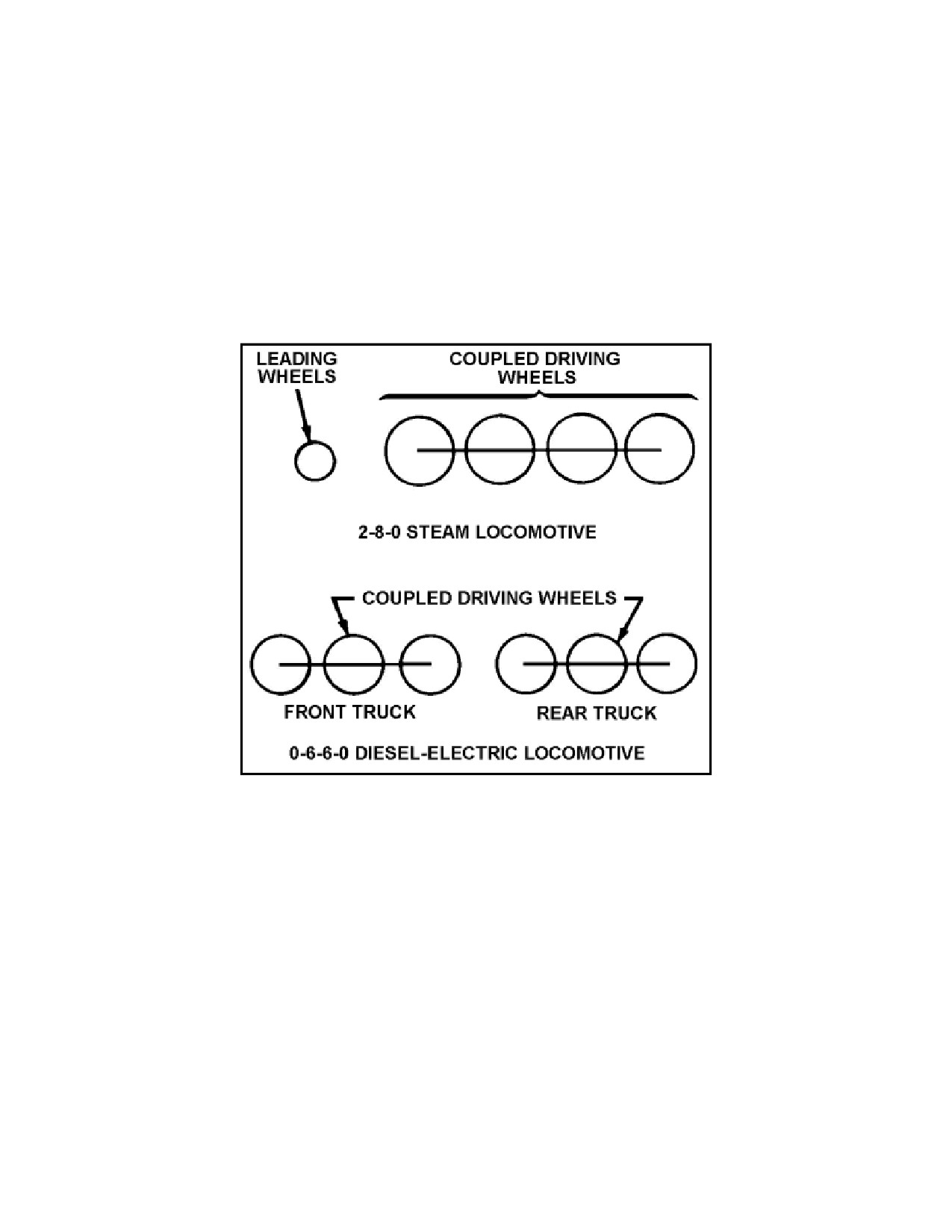
8-8. The wheel arrangements of two locomotives using the Wythe system are shown in Figure 8-2.
Since the wheel arrangement represents a side view of the locomotive, only one wheel of each pair is
shown. The 2-8-0 steam locomotive shown has two leading wheels, eight coupled driving wheels, and
no trailing wheels. The 0-6-6-0 diesel-electric locomotive shown has six driving wheels on the front
truck assembly, six on the rear truck assembly, and no leading or trailing wheels. The pulling capacity
of a locomotive is directly related to the number of driving wheels (drivers) and the amount of
weight that rests on them.
Figure 8-2. Wythe System of Wheel Arrangement
(Two Locomotives)
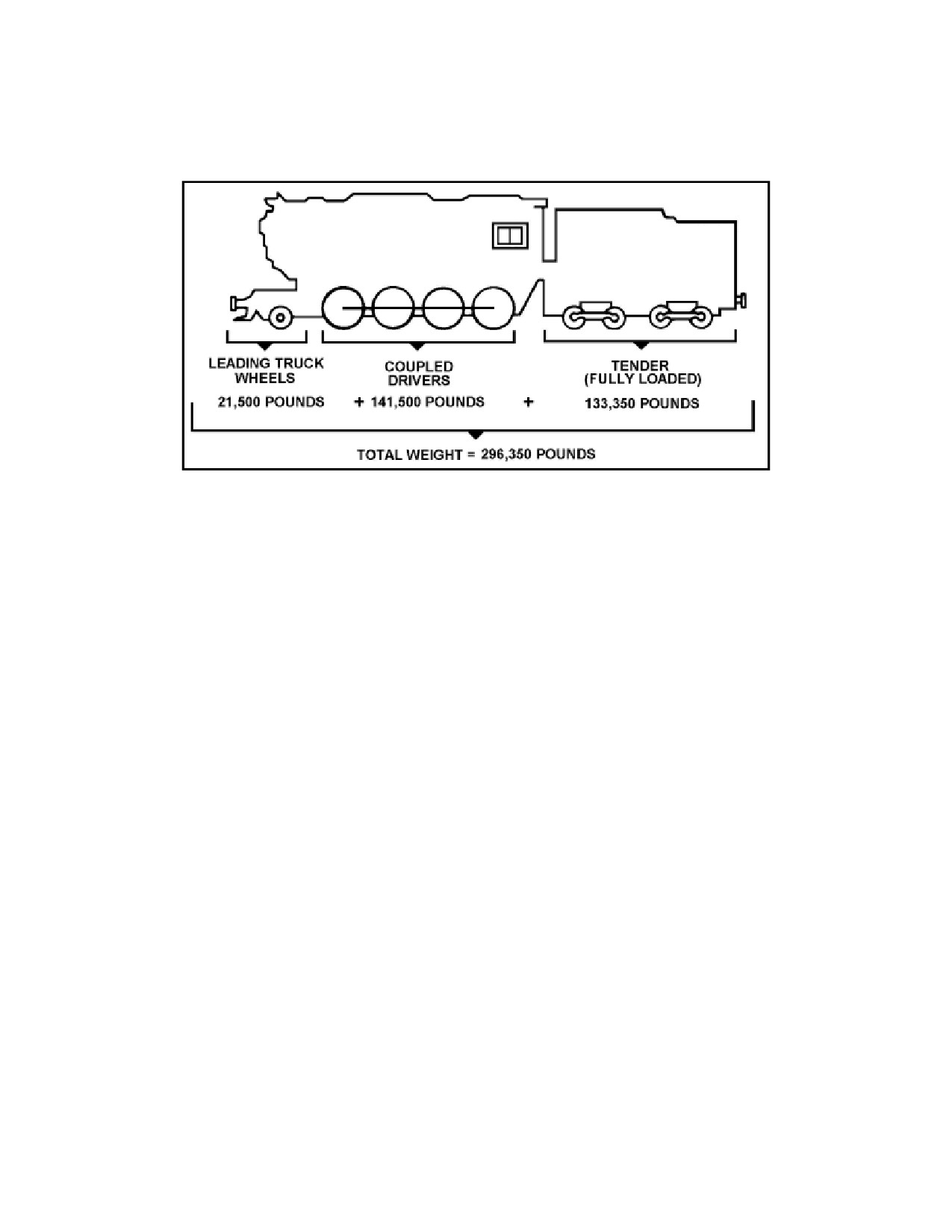
8-9. The amount of a locomotive’s weight that rests on its drivers is expressed in pounds or short
tons of 2,000 pounds each. All tons mentioned in this text are short tons. Therefore, the terms "ton"
and "short ton" are used interchangeably. The distribution of weight on drivers differs between
steam and diesel-electric locomotives. This is important when computing tractive effort. The weight
distribution of a 2-8-0 steam locomotive and tender is shown in Figure 8-3. The locomotive and
tender weigh 296,350 pounds, but only that portion of the total weight that rests on the driving
wheels (141,500 pounds) affects the work capacity or pulling power of the locomotive. On a diesel-
locomotive, the weight of the locomotive is evenly distributed over all the wheels since all wheels are
driving wheels.
8-11
FM 4-01.41 ______________________________________________________________________________________Chapter 8
Figure 8-3. Weight Distribution of a 2-8-0 Steam Locomotive
Continental System
8-10. This system, commonly used in Europe and other parts of the world, uses letters and figures to
identify a diesel or electric locomotive by its axles. Letters are used for driving axles and numbers are
used for nondriving axles. In this system, "A" stands for one driving axle, "B" for two, "C" for three,
and" D" for four. A small "o" placed after the initial letters shows that each axle is individually
powered. Therefore, a single unit locomotive with two individually powered two-axle trucks would
be classified as Bo-Bo. One with three axle trucks in which the center axle is an idler would be
designated as A1A-A1A.
TYPES OF RAILWAY EQUIPMENT
8-11. The three basic types of railway equipment are passenger, freight, and special. Each type of
equipment is discussed below.
PASSENGER EQUIPMENT
8-12. Passenger equipment is used to transport personnel. There are several different types of
passenger cars, each designed for a special purpose. Examples are coach cars, sleeper cars, baggage
cars, and dining cars. Passenger cars can be modified to handle medical patients and are moved in
designated ambulance trains.
FREIGHT EQUIPMENT
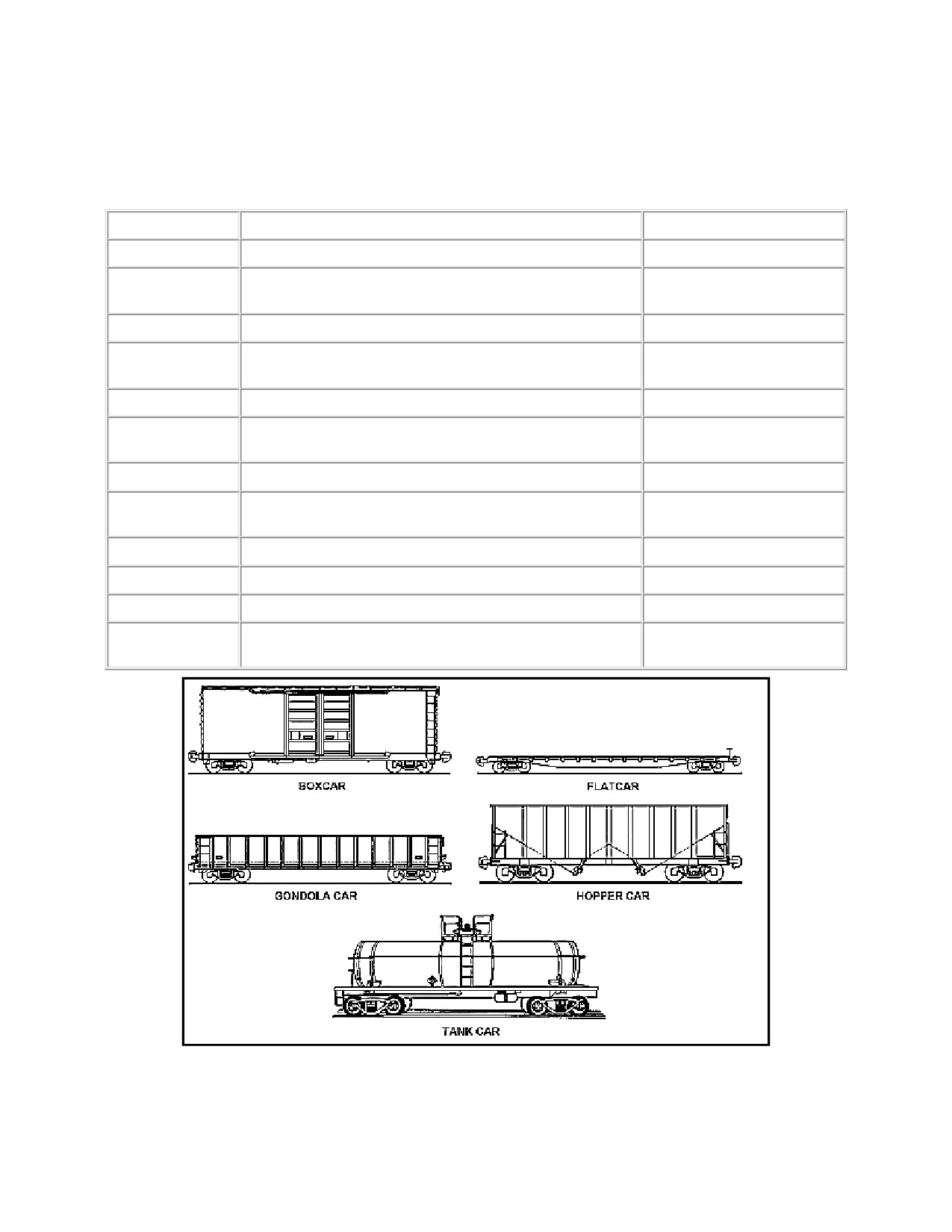
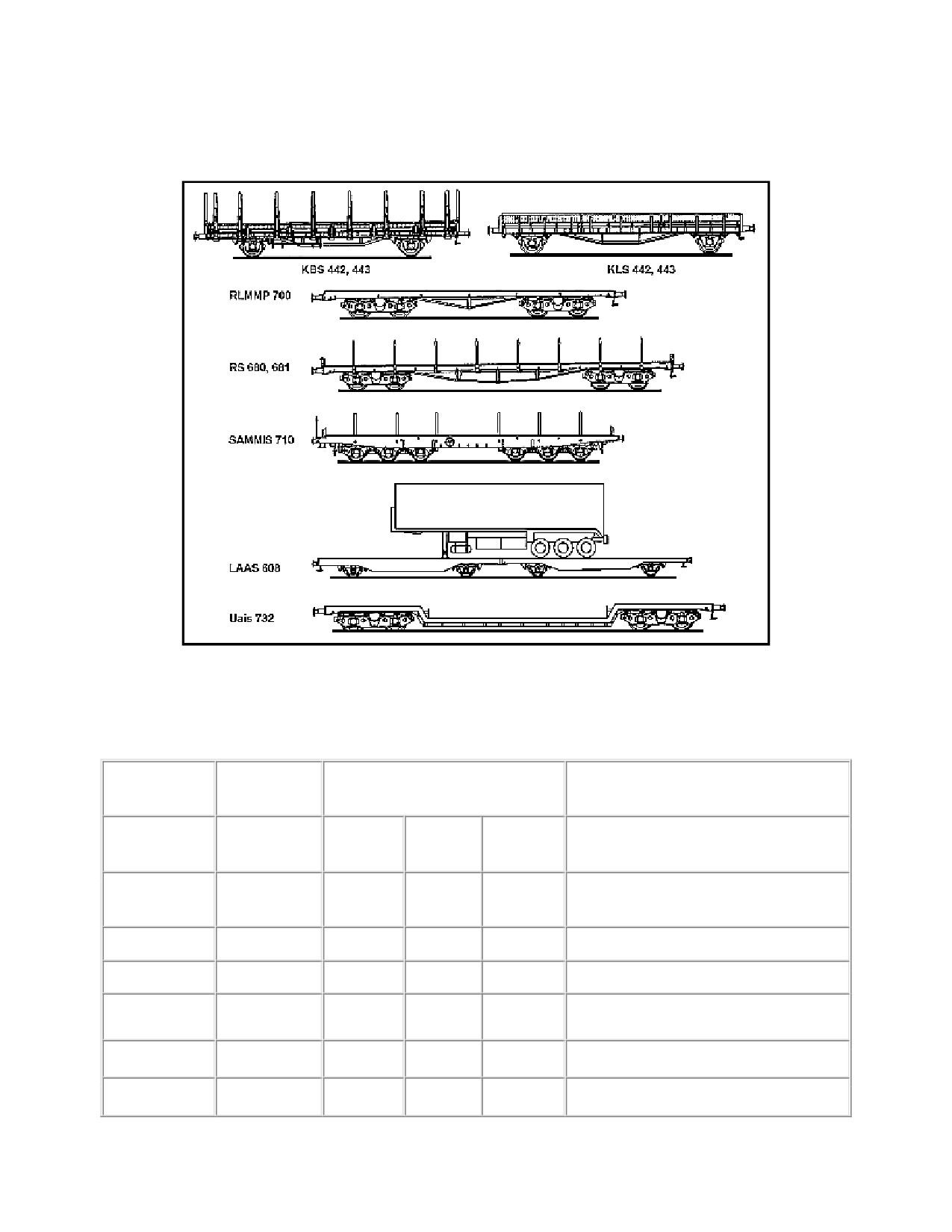
8-13. Use freight equipment primarily for the movement of general cargo. The commodity to be
moved dictates the type of freight car that will be used. Table 8-12, lists examples of the most
common freight equipment. Freight equipment, both domestic and foreign, is shown in Figure 8-4
and Figure 8-5. Table 8-13, lists freight equipment (by category) used in Europe by US forces.
8-12
FM 4-01.41 ______________________________________________________________________________________Chapter 8
Table 8-12. Examples of Railway Equipment
TYPE
COMMODITY
EXAMPLES
Boxcar
Bulk items that need protection from the weather and/or theft.
Paper, electronic gear, medical
equipment.
Flatcar
Bulk items where protection from the environment is not a
Vehicles, CONEXs,
factor. Also items that will not fit in other freight cars.
containers, oversize loads.
Gondola car
Bulk items where protection from the environment is not a
CONEXs, field barrier
factor. The sides of the car help keep the load from shifting.
materials, steel, scrap metal.
Hopper car
Free-flowing solids that need protection from the
Gravel, coal, sand, grain,
(covered hopper)
environment.
chemicals.
Tank car
Bulk liquids.
POL, chemicals, water, beer.
Refrigerator car
Items that need a constant temperature--either cool in a warm
Perishables, whole blood,
environment or warm in a cold environment.
electronic equipment.
Figure 8-4. Freight Equipment (Domestic)
8-13
FM 4-01.41 ______________________________________________________________________________________Chapter 8
Figure 8-5. Freight Equipment (Foreign Service)
Table 8-13. Examples of Foreign Flatcars
Number of
Maximum Loading
Type
Remarks
Axles
Specifications
Length
Width
Weight
(m)
(m)
(m)
Light-duty
flatcars:
KBS 442, 443
2
12.50
2.77
27
With stakes, removable side and end walls.
KLS 442, 443
2
12.50
2.77
27
With removable side and end walls.
Heavy-duty
flatcars:
RLMMP700
4
9.50
3.15
52
RS 680
4
18.50
2.74
56
8-14
FM 4-01.41 ______________________________________________________________________________________Chapter 8
RS 681
4
18.50
2.78
56
SAMMS 710
6
15.00
3.11
65
End jacks provide stability during loading and off-
loading.
Special flatcars:
LAAS 608
4
9.00 per
2.50
54
A short-coupled unit comprised of two 2-axle flatcar
section
sections.
Uais 732
4
10.00
2.50
50
Deep-well cars are available in various sizes but are few
in number and are in high demand.
SPECIAL EQUIPMENT
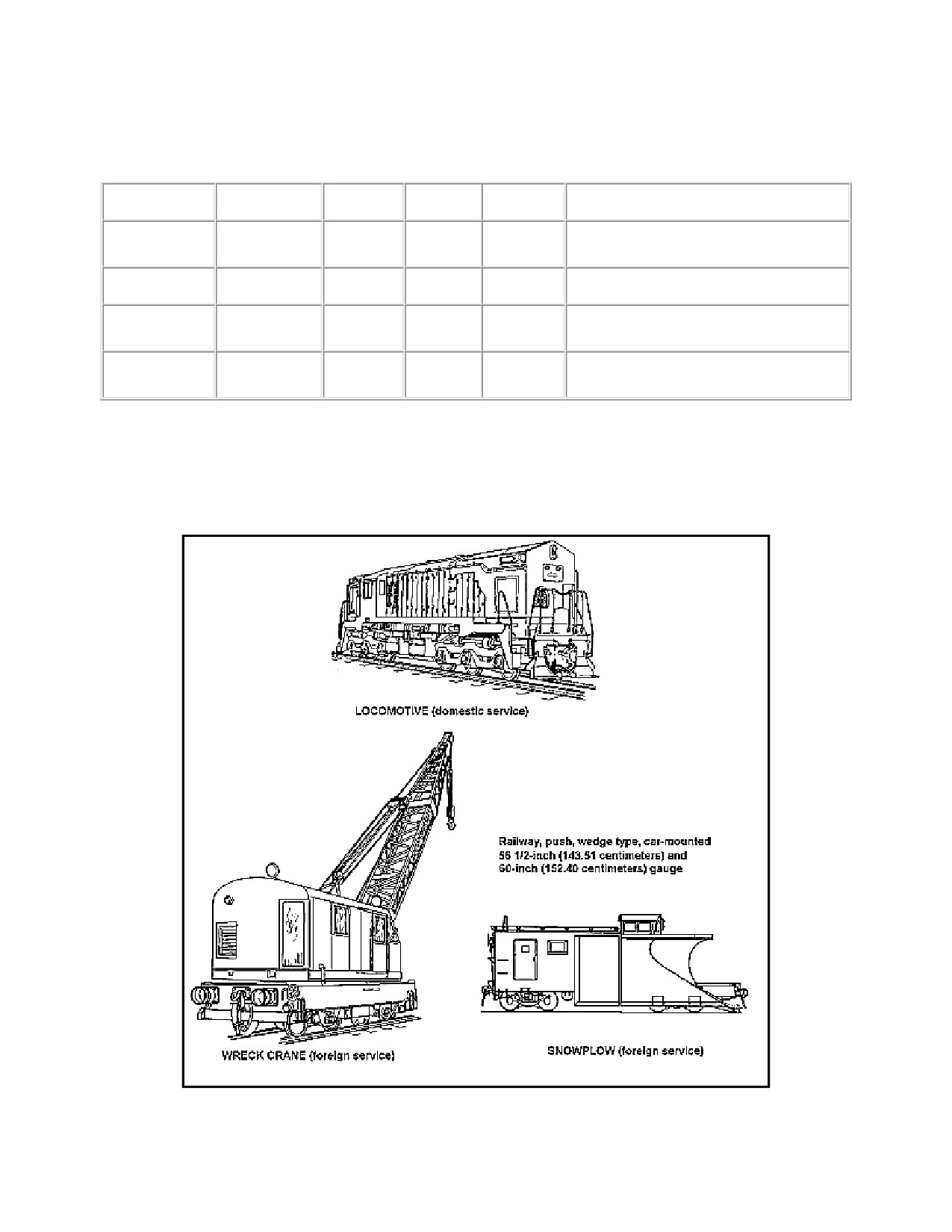
8-14. Special equipment consists of locomotives, wreck cranes, and snowplows. Figure 8-6, shows
the special equipment used in domestic and foreign service.
Figure 8-6. Special Equipment (Domestic and Foreign Service)
8-15
FM 4-01.41 ______________________________________________________________________________________Chapter 8
Car Components
8-15. Transporters must have a basic knowledge of car components. Those in rail operations must
have a thorough knowledge of car components. The four main components of a freight car are the
deck, underframe, truck, and coupler.
Deck
8-16. The deck is the surface on which the load rests. The deck or floor is usually steel or wood.
Underframe
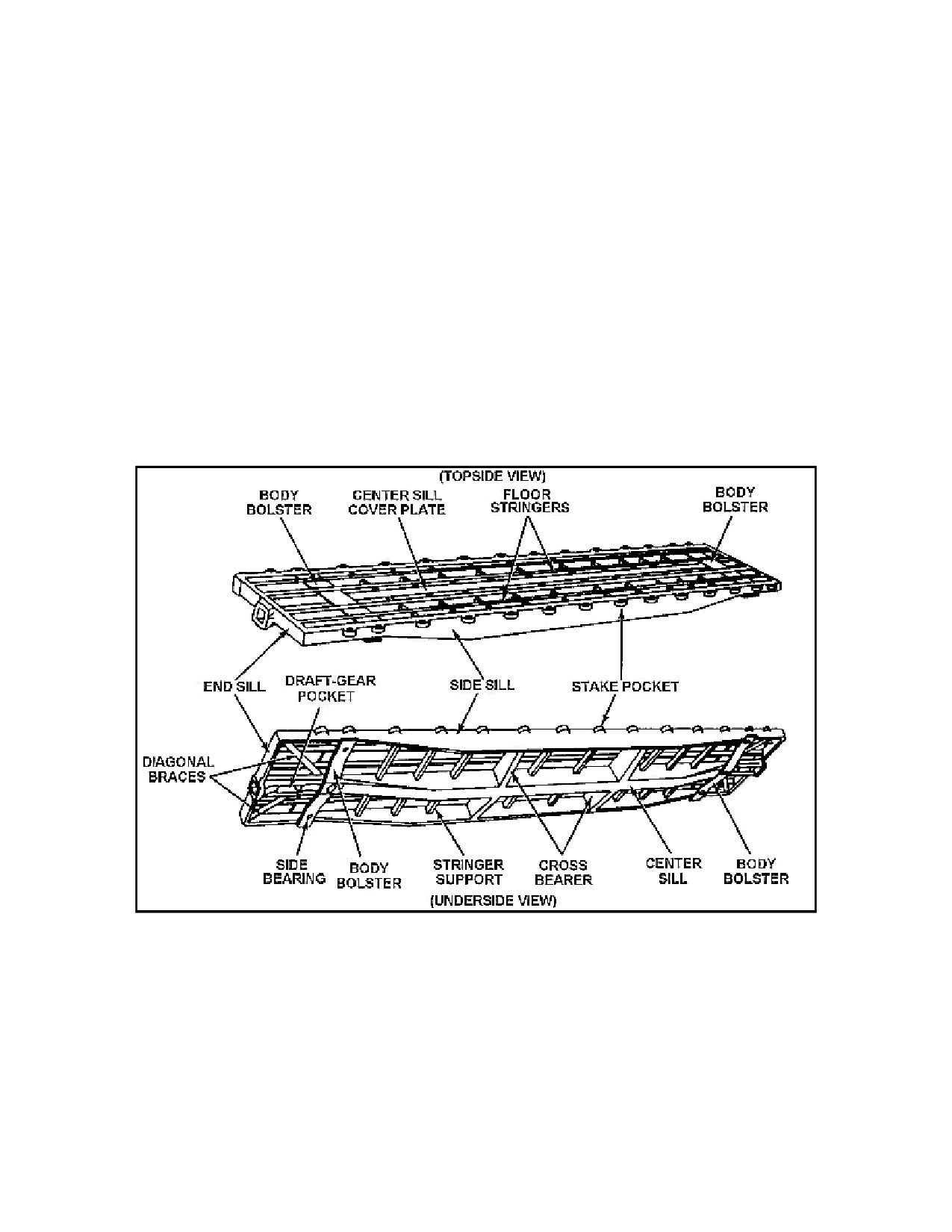
8-17. The underframe is the structure under the deck that supports the weight of the load. Figure 8-7,
shows the topside and underside views of the underframe.
Figure 8-7. Underframe
Truck
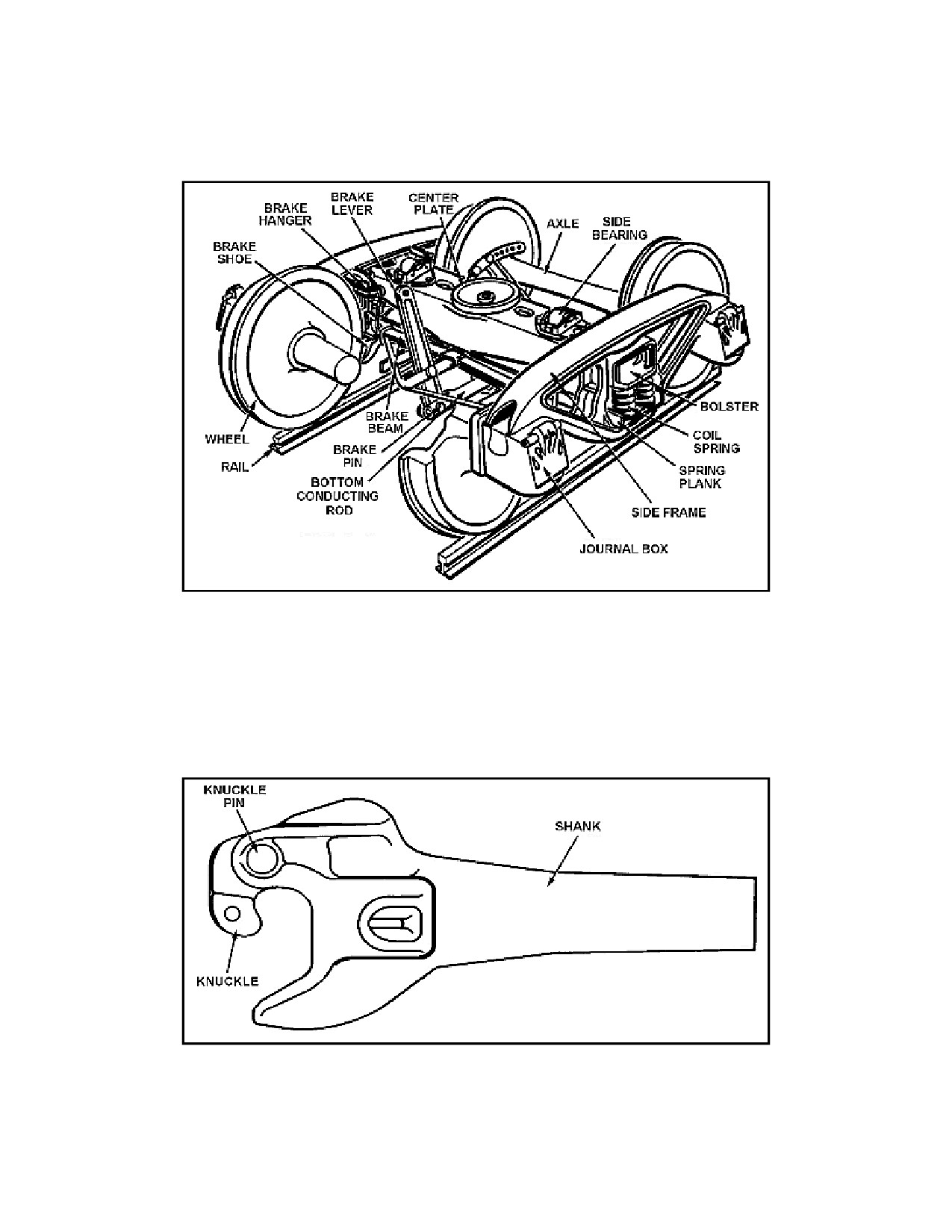
8-18. The truck is that assembly which contains a car’s wheels, axles, journals, suspension system, and
brake system. Figure 8-8, shows all the components of the truck.
8-16
FM 4-01.41 ______________________________________________________________________________________Chapter 8
Figure 8-8. TruckCoupler
8-19. The coupler is a device which connects or couples a car with another car (Figure 8-9). An
automatic or knuckle coupler is used in CONUS and in military railroading. The hook-and-link
system is used in Europe. The automatic coupler has two advantages over the hook-and-link system.
The automatic coupler is stronger (allowing for heavier trains) and it is also safer. The automatic
coupler does not require a trainman to step between the cars to couple them, but a hook-and-link
coupler does.
Figure 8-9. Automatic Coupler
8-17
FM 4-01.41 ______________________________________________________________________________________Chapter 8
EFFECTS OF COLD WEATHER ON MOTIVE POWER AND ROLLING STOCK
8-20. In the past, steam locomotives were used successfully by all railroads operating in cold climates.
Most of the world’s railroads have adopted the diesel because it offers certain advantages over the
steamers. However, there are certain modifications that must be made to both types of locomotives
before they are entirely suitable for extremely cold weather operations.
Steam Locomotives
8-21. Efficient steam locomotive operation depends on a local supply of fuel, water, and sanding
facilities at suitable points along the line. Coal platforms are constructed with their beds level with the
top of tenders. Such platforms have been used without any great difficulty resulting from cold
temperatures. Water tanks must be kept heated all winter. This is done with steam pipes, which
encircle the interior of the tank. In any climate having winter temperatures as low as 40 degrees
Fahrenheit, sand for wheels must be thoroughly dried.
Insulation
8-22. Personnel will insulate exposed water pipes to keep them from freezing and exposed steam
pipes to prevent heat loss. Locomotive cabs are especially insulated. On steam heated passenger cars,
cover windows at night with blankets to keep out the extreme cold.
Standby Service
8-23. When steam locomotives are used, engine watchers must be provided. The watchers must fire
up the engines to keep up pressure and must put water in the boilers. When first moving a steam
locomotive, the cylinder cocks must always be opened to relieve the cylinders of extremely heavy
condensation. In average winter climates, one watcher may tend as many as ten locomotives. In cold
climates, the number of locomotives for each man must be reduced because of the greater variety of
duties. These duties consist of continual operation and/or checking of the following:
· Stokers.
· Boiler blowoffs.
· Injectors.
· Cylinder cocks.
· Lubricators.
Reverse levers (particularly screw-reverse types) have to be operated frequently to protect against
freezing. Any water leaking on parts that move must be corrected at once to prevent ice from
forming. Placing locomotives inside heated roundhouses or enginehouses will substantially reduce
standby service.
Diesel Locomotives
8-24. Diesel locomotives require considerably less standby service than steam locomotives. In
extremely cold climates, the problem of water supply is virtually eliminated. However, before using
diesels in subzero temperatures, make the following modifications.
8-18
FM 4-01.41 ______________________________________________________________________________________Chapter 8
· Insulate all outside piping to protect against freezing.
· Preheat fuel because of the extreme difference between the unheated fuel and the
flashpoint. Install heaters in engine compartments.
· Keep engine coolant warm to aid in starting the locomotive under extreme conditions.
· Under extreme conditions, locomotives must not be shut down unless engine block
heaters are used.
· Keep storage batteries reasonably warm to secure maximum output. Place coils of pipe
around the battery boxes through which the saline water flows.
· Small steam generators must be provided to heat the cab and passenger coaches. Install
extra insulation in engine cabs.
· Windows of cabs and passenger coaches should have sealed, airtight, double-thickness
glass to keep out the cold.
Rolling Stock
8-25. One of the greatest problems encountered with cars is the freezing of journal boxes. When cars
stand for any length of time, the journal boxes freeze so tightly that the wheels slide instead of
turning when an attempt is made to move them. Sometimes a train of 20 cars that has been
stationary for even a few hours will have to be broken into three or four sections and each section
started individually. After moving the cars a short distance, the heat generated by the axle action on
the bearing will warm and thaw the journal box. This condition will naturally delay operations and
can only be overcome by moving cars and trains as much as possible. Cars equipped with roller
bearings are less of a problem. Extreme cold can cause steel car parts to become so brittle that they
break easily. As a result, knuckles may be broken when cars strike each other and drawbars pulled
when "frozen" trains are started. When possible, cars should be switched as soon as they come into a
yard and while the journal boxes are relatively warm. Trains on main tracks or in sidings should not
be permitted to remain stationary longer than absolutely necessary.
8-19
FM 4-01.41 ______________________________________________________________________________________Chapter 9
Chapter 9
Wreck Crews and Equipment
Wreck crews operate equipment assigned to the wreck train. They assist in clearing wrecks and other
line obstructions.
INTERRUPTIONS TO RAIL TRAFFIC
9-1. Interruptions to rail traffic must be cleared immediately. Major interruptions are reported to the
commander, transportation railway group or brigade, so that adjustments may be made in the traffic
flow. Interruptions may be listed according to their major causes. Interruptions may result from the
following:
· Major derailment.
· Minor derailments.
· Washouts.
· Floods.
· Slides.
· Tunnel cave-ins.
· Guerrilla action.
Since the chief dispatcher’s office, transportation railway battalion headquarters, controls the
movement of trains, it is the first office notified in the event of traffic interruptions. The chief
dispatcher immediately advises the battalion commander (division superintendent) or the battalion
executive officer (assistant superintendent) of any interruptions. In their absence, the chief dispatcher
takes any direct action required (such as ordering out wrecker crews). Major interruptions are
reported promptly through command channels. Assistance may be obtained from the engineer
command, communications personnel, and local civilians. In case of an accident involving a train, the
conductor is in charge until a senior battalion officer arrives. The battalion representative is
responsible for restoring service. He takes charge and coordinates the work of the wreckmaster, track
foreman, and other wreck crew personnel in clearing the line. He keeps the chief dispatcher informed
of any work progress. Rail units are responsible for restoring rail traffic as quickly as possible.
Assistance may be obtained from engineer and/or signal service command units when required. If
interruptions occur on a double-track line, traffic is restored immediately to one track. The other line
is cleared later.
The following are some major causes of rail traffic interruptions:
· Enemy action (including aerial bombing and artillery fire using either conventional or
nuclear weapons) and guerrilla activity.
· Human failure (including improper train operation, violation of rules, and improper
inspection and maintenance of equipment).
· Equipment or facility failure due to equipment faults or defects.
· Natural causes (including floods, slides, washouts, lightning fires, and so forth).
9-1
FM 4-01.41 ______________________________________________________________________________________Chapter 9
Major Interruptions
9-2. The causes of major interruptions in rail traffic in a theater of operations are mechanical or
human failure, natural causes, and enemy action. Corrective action must be as decisive and as prompt
as conditions permit. When traffic is disrupted, the paramount objective is to reopen the line as
quickly as possible.
Major Derailments and Wrecks
9-3. Clearing operations should be established from both sides of the derailment if wrecker
equipment is available. To save time, pending arrival of the wreck crane(s), undamaged cars should
be pulled away from the site and parked on the first available siding or spur. Damaged cars should be
rolled off the right-of-way and picked up later. Traffic should be rerouted if the length of the
interruption justifies it and if an alternate line is available. A rail truck transfer point may be
established if required.
Washouts
9-4. Flood waters may carry away bridges, trestles, and culverts. They may also undermine sections of
right-of-way and roadbed. Restoration may require temporary structures or field expedients. Action
to be taken where washouts are likely to occur should be pre-planned and repair materials should be
stockpiled at suitable locations. As in other major interruptions, urgent traffic should be diverted or
rerouted if alternate lines exist. Personnel may be transferred from one train to another by walking
around the washout. Transfer points may be established if motor transportation and suitable roads
are available.
Floods
9-5. Flood waters may cause the most damage to rail plants and equipment. They can also cause the
following to happen.
· Bridges, trestles, and culverts to be weakened or destroyed.
· Grade ballast and sub-ballast to be washed out.
· Equipment to be floated away.
· Contents of loaded cars to be damaged.
Damaged track, roadbed, and structures may take several days or weeks to repair (which may cause
operations to come to a standstill). Mud and silt left behind by receding waters interfere with the
operation of switches and electrical-signal mechanisms. Rail lines, which follow the course of a river
to avoid steep grades, frequently incur serious damage from flooded rivers. Little can be done to
protect against floods, except to take certain protective measures. Barring flash floods from
cloudbursts, rail personnel will often have advance warning of rising waters, which may be expected
to develop into flood conditions. The train dispatcher records the weather conditions on his train
sheet every 6 hours for most stations on his division. These reports may offer the first indications of
impending high water. Local weather bureaus and local labor forces offer valuable opinions on how
high a crest may be expected.
9-2
FM 4-01.41 ______________________________________________________________________________________Chapter 9
Protective Measures
9-6. Critical freight and equipment branch lines beyond the threatened area, loaded cars, and other
equipment should be moved to higher ground. Any storage or industry tracks that are higher than the
yard or main tracks, and even those running up to and down from the hump, should be filled with
the loaded cars that are most vulnerable to water damage. Moving ammunition, explosives, clothing,
and foodstuffs to higher ground should logically precede that of field pieces, vehicles, and other
freight not particularly vulnerable to high-water damage.
9-7. Detailed SOPs cite the precedence of the freight to be moved to safety. If there are any branch
lines that run at right angles to a threatening river, they may provide excellent storage places for
vulnerable freight and equipment. If possible, all locomotives should be moved to higher ground.
Diesel-electric and electric locomotives should be moved before steam locomotives. Rail bridges
over flooded rivers may be weakened or washed away. Bridges with many piers or timber-pile trestles
are often most vulnerable because of pressure from collected debris. The weight of heavily loaded
cars left on such structures usually tends to stabilize and assist in "anchoring" the bridge or trestle.
Such cars should contain only low-grade aggregates such as coal, ore, sand, gravel, and so on.
However, this method should not be used without approval from engineer bridge specialists or other
qualified engineering personnel.
Cave-ins and Slides
9-8. The following, particularly in very mountainous areas, are often major causes of rail traffic
interruptions:
· Tunnels and cut cave-ins.
· Dirt slides.
· Rock slides.
· Snowslides.
These may result from natural causes (such as earthquakes, melting snow, and soaking rains) or from
enemy action (such as bombing, artillery fire, or sabotage). Cuts and slides are cleared in the most
expeditious manner possible without regard to permanent construction. Heavy equipment should be
requested from the engineer service, TASCOM, when clearing the obstruction is beyond rail
transport operations capabilities. Where possible, a collapsed tunnel should be excavated or "day
lighted" to create a cut in its place. If this is not feasible, a bypass ("shoo-fly") track may be
constructed.
Terminal or Yard Congestion
9-9. Terminal congestion is often a by-product of a major traffic interruption or of poor control of
movements. To maintain fluidity, yards and terminals should not be filled beyond 60 per cent of
static capacity. When a yardmaster can foresee that a yard is about to be blocked, he should report
the situation to the chief dispatcher. The yardmaster may request that cars be set off at sidings or
diverted to other lines or yards until normal train movement is resumed. The battalion commander
(division superintendent) may request the TRANSCOM transportation officer to apply an embargo
on rail movement if the situation becomes serious.
9-3
FM 4-01.41 ______________________________________________________________________________________Chapter 9
Minor interruptions
9-10. Although many factors cause minor interruptions, they are generally classified in one of the
three common categories. Each of these categories are discussed as follows.
Derailments
9-11. Minor derailments are most often caused by equipment failures (such as dragging brake rigging,
sharp wheel flanges, splitting switches, wheels overriding derails, and so forth). Derailments usually
are repaired quickly by train crews using rerailing devices or jacks carried on locomotives. A more
serious derailment may require that a wreck train be brought to rerail the car(s) and repair track
damage.
Minor Floods, Slides, and Washouts
9-12. Local track gangs can normally repair minor flooding, slides, and washouts of track and
drainage culverts. Rock, mud, or snowslides may be removed by local labor and maintenance of way
equipment without the need of a work train. The necessary repair materials should be stockpiled at
suitable locations along the division right-of-way where these interruptions are frequent.
Signal Communication Interruptions
9-13. Local signal section personnel can usually quickly repair minor breaks in dispatcher circuits. As
instructed by the chief dispatcher, local block operations may continue the movement of trains by
"fleet" operations during such breaks. Signal service assistance may be requested in making signal and
communication line repairs, which may be beyond the scope of rail personnel.
WRECK TRAINS
9-14. The transportation railway company (TOE 55917) provides wreck train support to the division.
A wreck train consists of a locomotive, a wreck crane, tool cars, and enough bunk and cook cars for
personnel required for a particular wreck. Wreck cranes and tool cars are stationed at strategic points
along the railway line. Division terminals are considered strategic points because locomotives and
engine, train, and wreck car crews are available on call. Wreck train equipment must be prepared for
immediate movement. Ties, rails, spikes, and other repair materials are stockpiled at various points.
An emergency supply of such items are also loaded in suitable cars and held with each wrecker as
part of the wreck train. The transportation train operating company furnishes locomotive and train
crews for wreck trains. Wreck trains may be obtained from HN resources.
Traffic Interruptions
9-15. When a derailment or wreck blocks main line traffic, the dispatcher secures as complete a
record as possible about the extent of the damage. He also estimates the time required in restoring
train movement. The dispatcher orders and arranges for a wreck train and its crew to go immediately
to the scene. In serious wrecks, the wreck train may be ordered out from division points on both
sides of the wreck to hasten clearing operations. The dispatcher also notifies the following to take
appropriate action in his area of responsibility:
· Superintendent.
9-4
FM 4-01.41 ______________________________________________________________________________________Chapter 9
· Trainmaster (train crews).
· Unit commander (master mechanic).
· Wreck car crews.
· Maintenance-of-way superintendent (track repairs).
These officers go to the scene of the accident by the fastest available means. They survey the
situation and make plans for the wreck crane to go to work immediately upon its arrival. The prime
objective is to get the line open as quickly as possible. Cleanup and salvage operations can be
performed later if necessary.
Wreck Car Crews
9-16. Wreck crews operate under the general supervision of the platoon leader of railway equipment
maintenance platoon. A wreck crew consists of the following:
· Wreck foreman.
· NCOIC.
· Crane operator.
· Car repairman.
· Welders (as required).
This crew operates the equipment assigned to the wreck train. An officer or senior NCO, designated
as wreckmaster by the company commander, is in charge of the wreck crew(s).
9-17. The mission of wreck crews is to remove wrecks and other line obstructions. They also salvage
or repair wrecked rolling stock so that it can be safely moved to the nearest ship or repair track. The
wreckmaster coordinates closely with maintenance of way platoon personnel sent to the scene. The
mission of this platoon is to repair and restore right-of-way and tracks damaged or destroyed by
derailments, acts of God, sabotage, and so forth.
Wreck Crane Operators
9-18. A crane operator must know the parts, principles of operation, and the safety precautions
required of the crane to which he is assigned. He must be familiar with the types and capabilities of
the cable rope, wire rope, blocks, hooks, and shackles with which his crane is equipped. An operator
must be able to supervise the rigging of his crane for a particular lift. He must understand the
mechanical advantage of various pulley combinations, the use of dead-man rigs, and other expedients
required in rerailing locomotives and cars.
SAFETY
9-19. Two general rules found in FM 55-21 and which relate to safety are: "Safety is of the first
importance in the discharge of duty," and "Obedience to the rules is essential to safety."
9-5
FM 4-01.41 ______________________________________________________________________________________Chapter 9
OPERATING RULES
9-20. Personnel engaged in the operation of wreck trains and wreck cranes must be familiar with the
railway safety and operating rules given in FM 55-21. All personnel whose duties are affected by the
rules of this publication must be provided a copy. Wreck crane personnel must ensure that cables
and tackle of adequate strength are used when making heavy lifts. All personnel are also warned to
stay away from any area where there is a possibility of being injured if a cable should break or a load
slip.
Preoperational Safety Checks
9-21. Experience has proved that there are a number of potential hazards inherent to wreck crane
operations. Safety checks to be performed before crane operations and safety practices incidental to
operating the crane and making heavy lifts are discussed in the following paragraphs.
Equipment Servicing
9-22. Engine fuel, lubricants, and water should be checked and brought to the proper levels. Open
gears and fittings should be greased. Power stoppages and mechanical failures caused by inadequate
servicing can cause damage and injury. Wreck cranes should have air brakes, hand brakes, and
generators for electricity and lights. Cranes should be capable of self-propulsion in either direction.
Decks and Platforms
9-23. Wreck crane decks and platforms must be kept free of grease, cables, chains, buckets, barrels,
loose tools, and similar items. Machinery guards over open gears should be in place. Handholds and
steps must be kept clean, secure, and marked as appropriate.
Brakes, Clutches, and Switches
9-24. The action and effect of all braking devices, clutches, and the engine cutoff switch is checked
and required adjustments are made. On assuming his post, the crane operator will test the working
condition of these controls and his ability to operate them quickly and automatically in an emergency.
Crane operators must ensure that all dogs, pawls, and braking equipment are capable of effectively
braking a weight of at least one and one quarter times the weight of the full rated load. Outriggers are
used when testing a crane’s rated capacity, but the rated capacity for the crane should be that given
without outriggers.
Cables
9-25. The crane should have an adequate quantity of the following to meet capacity lift requirements:
· Cables.
· Devices.
· Falls.
· Sheaves.
· Pulleys.
9-6
FM 4-01.41 ______________________________________________________________________________________Chapter 9
· Other miscellaneous hoisting equipment.
Blocks and cables should be clean, free of dirt and sand, and properly lubricated at all times. Cables
and rope are kept free of kinks and are stored coiled. A crane operator, before beginning any lift
operation, will inspect cables and wire ropes for broken wires, fractures, and flat or pinched spots.
Sheaves and drums are checked for proper line placement.
Special Safety Considerations
9-26. Statistically, a free moving crane is a potentially dangerous instrument. One-third of the injuries
sustained in crane accidents result in fractures or severed limbs. Many of those injured are crane
operators. Most crane accidents are preventable because they are, to a large measure, the result of
actions, conditions, or situations directly under the control of the operating crews. Crane work must
be the coordinated activity of a team of skilled workers. The operator, wreckmaster, riggers, and
others assume control of lifts, movements, and similar actions. It is important that individual control
responsibilities are clearly defined and the procedure for transferring them is thoroughly understood.
Signals
9-27. The wreckmaster, or someone designated by him, is responsible for giving signals. The
responsibility for giving an emergency stop signal belongs to anyone on site who considers such a
signal necessary. Copies of authorized signals should be posted in obvious places so wreck train
personnel may become familiar with them. Crane and derrick operators must wait for a clear signal
from the designated signalman before operating the equipment. If there is any doubt or confusion
regarding the signal given, the operator must stop operations and clarify the signal before making
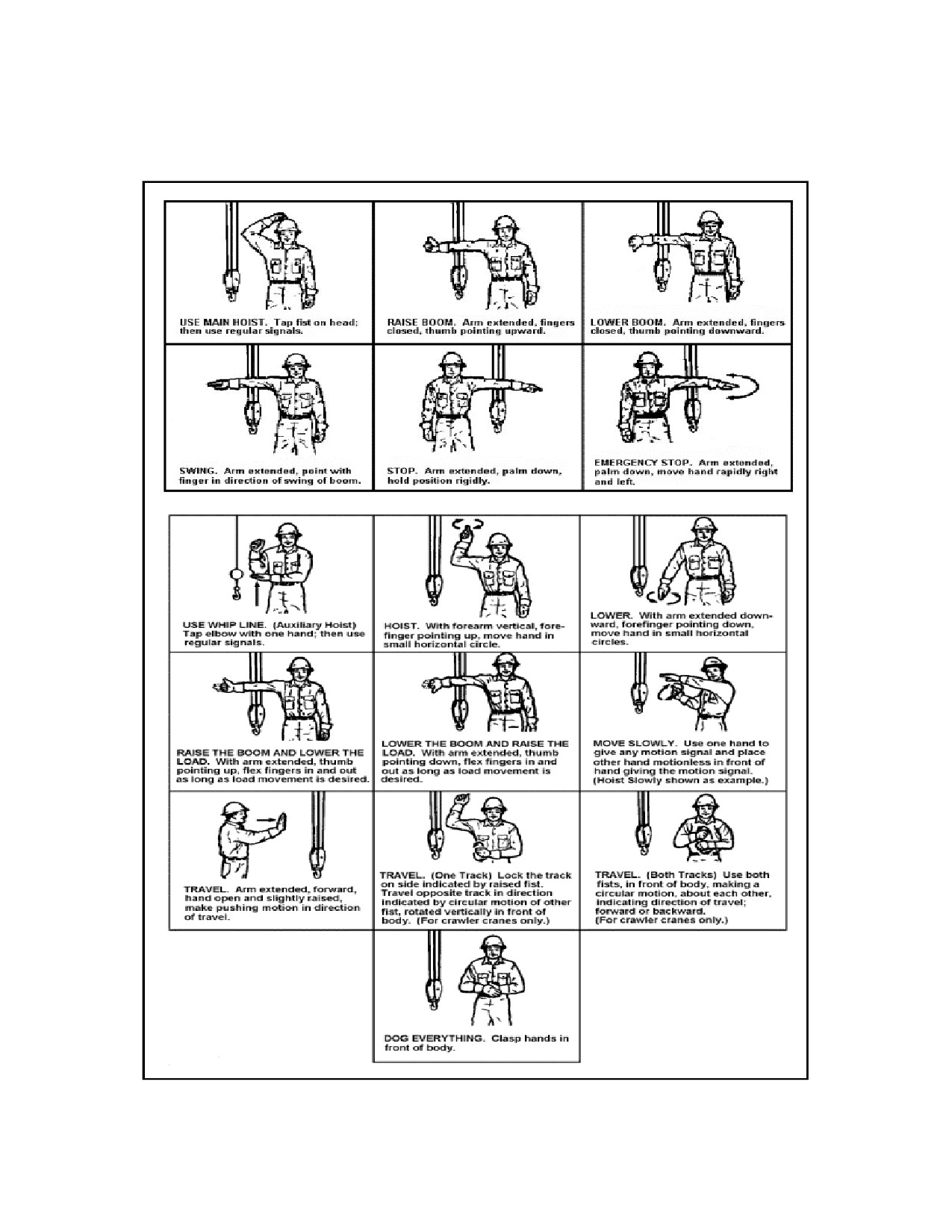
another move. Figure 9-1 shows the standard hand signals used when operating cranes and derricks.
These signals are used when visibility permits. Use lights or lanterns to give signals during periods of
darkness.
9-7
FM 4-01.41 ______________________________________________________________________________________Chapter 9
Figure 9-1. Standard Crane and Derrick Hand Signals
9-8
FM 4-01.41 ______________________________________________________________________________________Chapter 9
Overhead Powerlines
9-28. Wreck crane operations under or near electric powerlines are extremely hazardous. A closed
electric circuit and a difference in voltage are required for the passage of electric current. When a
crane boom or cables come in contact with a live powerline, the crane, cables, boom, and load
become electrically charged. A person on the ground steadying a swaying load or touching any part
of the crane becomes part of this closed electric circuit and can be instantly electrocuted or be
critically burned. The crane operator is responsible for keeping his crane boom and/or cables away
from powerlines. He is relatively safe while in the cab. Should he step off the crane and have one
foot on the crane step and one on the ground, he also could be electrocuted or burned.
Movement in Tow
9-29. Wreck cranes are powered for independent movement by gear-driven wheels. When cranes are
moved in tow, in work or wreck trains, operators must take the following precautions to avoid
damage to the crane, the train, or wayside objects.
· Secure the rotating deck parallel to the centerline of the track. Fasten the deck at front and
rear ends with tie bars provided.
· Lower the boom to the traveling position, preferably pointing to the rear. Place
transmission lever in NEUTRAL position.
· Disengage driving gears so wheels will turn freely. Use handcrank to draw the gear
assemblies out of mesh.
Safe Load Precautions
9-30. Cables and tackle must not be overloaded. When making heavy lifts, crane or derrick operators
must be sure of the following:
· Boom is properly positioned.
· Boom is as high as possible.
· Hoist cables have greater capacity than the load to be lifted.
· Hoist cables have no kinks or broken wires.
· Crane is level and outriggers are in place.
· Brakes are in good working order.
· Load to be lifted is properly slung (rigged).
· Load is kept near the ground when traveling and not lifted higher than necessary.
· The swing is started slowly when swinging loads.
· Loads are not left hanging on the hook.
Safety Factors
9-31. The safety factor is the ratio of the strength of the rope to the working load. For example, a
wire rope with the strength of 10,000 pounds and a total working load of 2,000 pounds would be
operating with a safety factor of 5. It is not possible to set exact safety factors for cranes with various
9-9
FM 4-01.41 ______________________________________________________________________________________Chapter 9
types of wire rope as this factor can safely vary with conditions. The proper safety factor depends not
only on the loads applied, but also on the following:
· Speed of operation.
· Type of fittings used for securing the rope ends.
· Length of the cable.
· Acceleration and deceleration.
· Number, size, and location of sheaves and drums.
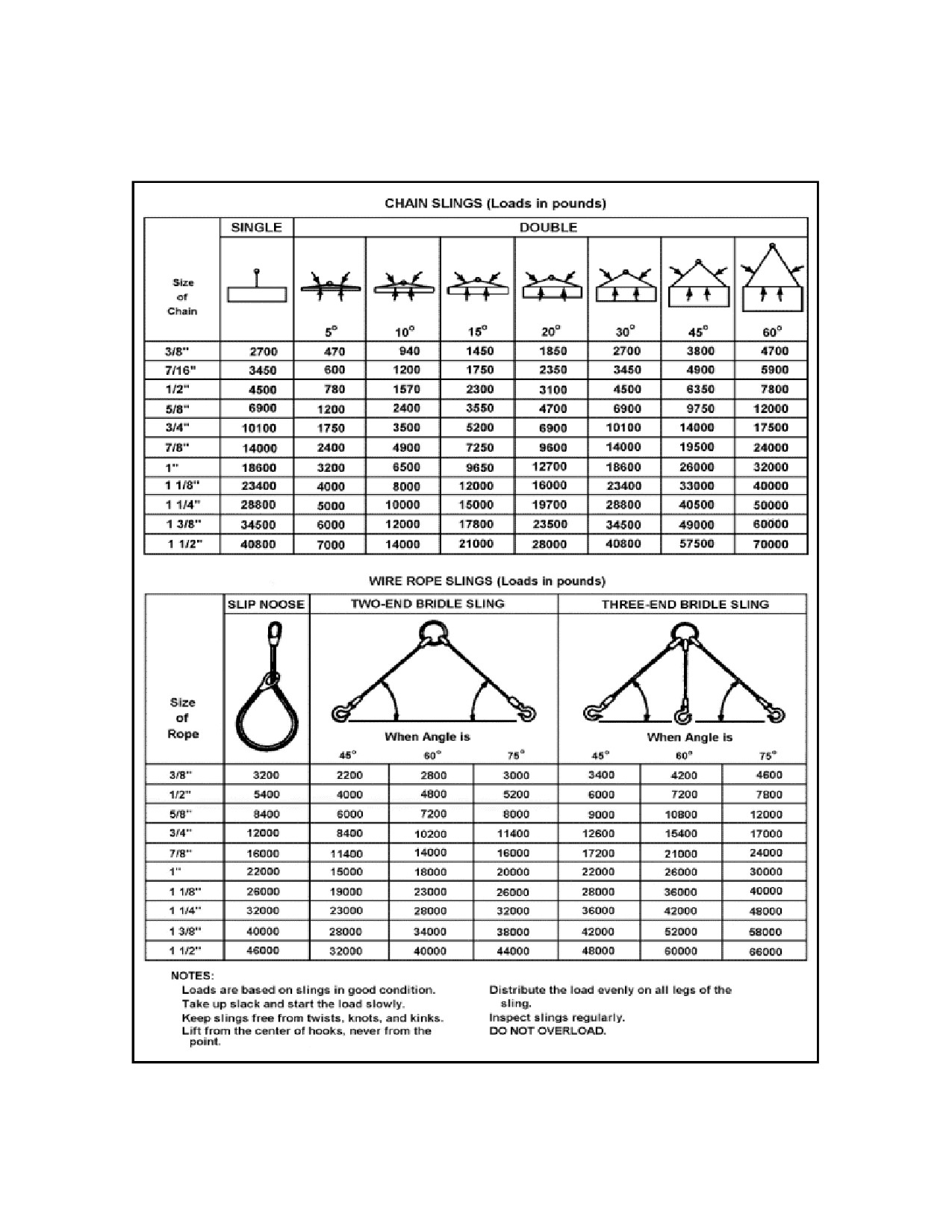
The safety factors given in Table 9-1 have been established, by experience, as the minimum required
for an average operation. Larger safety factors are desirable for greater safety and more efficient
operation. Safe working loads of slings are shown in Figure 9-2.
Table 9-1. Safety Factors
Use
Minimum Safety Factor
Guys
3.5
Miscellaneous hoisting equipment
5.0
Derricks
6.0
Slings
8.0
9-10
FM 4-01.41 ______________________________________________________________________________________Chapter 9
Figure 9-2. Safe Working Loads of Slings
9-11
FM 4-01.41 ______________________________________________________________________________________Chapter 9
LOAD FORMULAS
9-32. Safe working loads are selected from mathematically determined tables. However, the following
formulas are rule of thumb methods for determining safe working loads (in tons) for hooks, chains,
ropes, and cable (diameter in inches).
· Hooks. Where the hook starts to arc, the square of the diameter.
· Chains. Eight times the square of the diameter of one side of the link.
· Rope. Square of the diameter.
· Cable (wire rope). Eight times the square of the diameter.
SAFETY RULES
9-33. Crane operators MUST be sure of the following:
· Only authorized persons enter the crane cab.
· No one is in or about the crane before it is started.
· No hoist is made while anyone is riding on the load.
· A warning signal is sounded before traveling (moving the crane) or when the load
approaches near or over other persons.
HOISTING AND LIFTING MATERIALS
9-34. Standard wire rope (cable) is used on wreck cranes for hoisting. Manila or sisal rope, because it
is easy to handle, is carried for hand or tag lines, minor lashing, and rigging. All spare rope (both fiber
and wire) should be kept coiled when not in use. The sizes of rope used by the US Army are
designated as inches in diameter.
Fiber Rope
9-35. Fiber rope is made by twisting vegetable fibers together. The rope consists of three elements:
fibers, yarns, and strands. The direction of twist of each element is reversed to prevent the elements
from unraveling under load strain. Fiber rope is named for the kind of vegetable fibers of which it is
composed. Manila rope (made from the fibers of plantain leaves) and sisal rope (made from the
fibers of aloe leaves) are two types commonly used in military service. Manila rope is superior to
other fiber ropes in elasticity, strength, and wear qualities. It is smooth and runs well over blocks and
sheaves.
9-36. The minimum breaking strength of manila and sisal rope is much greater than their safe
working capacity. The difference between the two is the safety factor. The safe working capability (in
tons) for a given size of manila rope is approximately equal to the square of the diameter in inches,
using a safety factor of four. Under no circumstances should fiber rope be loaded to more than twice
its rated safe working capacity. As rope deteriorates, the safe load is one-half of the value shown in
Table 9-2.
9-12

FM 4-01.41 ______________________________________________________________________________________Chapter 9
Table 9-2. Properties of Manila and Sisal Rope
No. 1 Manila
Sisal
Nominal
Circumference
Breaking
Safe load
Breaking
Safe load
diameter
(inches)
strength (tons)*
(tons)*
strength
(tons)
(inches)
FS = 4
(tons)
FS = 4
1/4
3/4
0.27
0.07
0.22
0.06
1/2
1 1/2
1.32
0.33
1.06
0.26
3/4
2 1/4
2.70
0.67
2.16
0.54
1
3
4.50
1.12
3.60
0.90
1 1/4
3 3/4
6.72
1.69
5.40
1.35
1 1/2
4 1/2
9.25
2.31
7.40
1.85
2
6
15.50
3.87
12.40
3.10
3
9
32.00
8.00
25.60
6.40
*Breaking strength and safe loads are for new rope used under favorable conditions.
WIRE ROPE
9-37. Wire rope is made of steel or iron wires twisted to form strands. The strands may be wound
around each other or twisted over a central core of fiber or steel rope. The direction of twist of each
element of the rope is known as the "lay" of that element. Regular lay, the accepted standard for wire
ropes, denotes ropes in which the wires are twisted in one direction to form the strands. Strands are
twisted in the opposite direction to form the rope. In regular lay ropes, the wires are almost parallel
to the longitudinal axis of the rope. Due to the difference in direction of the strand and rope lays,
regular lay ropes are less likely to kink and untwist than ropes constructed with other lays. They are
also easier to handle. Overloaded wire cable breaks a strand at a time. To prevent corrosion and
internal abrasion, boom wire rope should be lubricated with lubricants thin enough to penetrate to
the inner strands.
9-38. Fiber cores are standard for most constructions of wire rope, but are not as strong as ropes
with wire cores. A fiber core supports the strands, supplies internal lubrication, and contributes to
the flexibility and resiliency of the rope. Wire core ropes are less suitable than fiber core ropes for
operations where shock loads are frequent. Wire rope constructions are designated by the number of
strands in the rope and the number of wires in each strand. Therefore, a rope composed of six
strands of 19 wires each is a 6 x 19 rope. This is the standard hoisting cable and is more universally
used than any other rope construction.
Chains
9-39. Chains are composed of a number of metal links connected together. The links are made of a
round or oval piece of rod or wire welded into a solid ring after being joined to the connecting link.
Chain size is determined by the diameter of the rod composing the links. While chains may stretch
under excessive loads, individual links will bend only slightly. Chains with bent links may suddenly
9-13
FM 4-01.41 ______________________________________________________________________________________Chapter 9
fail under load and break. Since chains are resistant to abrasion, they are often used to lift heavy
objects with sharp edges that might cut wire rope.
Blocks
9-40. A block is a shell or frame, which holds one or more grooved pulleys, called sheaves. The
sheaves revolve on a center pin or axle. A swivel-type hook is attached to one end of the block and
often an eye is attached to the other.
Types of Blocks
9-41. Block sizes are determined by the length of the shell (frame) in inches and by the number of
sheaves it contains. Single, double, triple, and quadruple blocks contain one, two, three, or four
sheaves respectively. Blocks can be identified by their construction and the manner in which they are
used. These two types of blocks are conventional and snatch.
· Conventional block. A conventional block is constructed of fiber or wire rope, which
must be reeved or threaded through the sheaves. This is the type block found on crane
booms.
· Snatch block. This type block, also called a gate block, is constructed so that one side
opens to permit a cable or rope to be placed over the sheave without reeving through the
block. It is easily identified by the hinge and lock on one side. It is normally used in
making rigs to obtain mechanical advantage where the cables or ropes are continuous lines
and cannot be threaded through the sheave.
Classification
9-42. Blocks are classified according to the manner in which they are used. These two types of blocks
are fixed and running.
· Fixed block. This block is fastened to a stationary object. It does not affect mechanical
advantage. Sometimes called a leading block, it does permit a change in direction of the
cable.
· Running block. This block (also called a traveling block) is fastened to the object to be
moved or lifted. This block does not produce a mechanical advantage.
Cable
9-43. The largest size cable or rope that can be used on a block is determined by the diameter of the
sheave, depth of the groove, and the size of the opening through which the line passes over the
sheave. The proper size is the largest one possible that fits the sheave groove and still has clearance
between the frame and the sheave. This diameter is usually from one-eighth to one-ninth the shell
length. The use of multiple sheave blocks increases the weight that can be lifted (mechanical
advantage). This increase depends on the number of sheaves in the sheave blocks and the number of
parts of cable between the blocks.
9-14
FM 4-01.41 ______________________________________________________________________________________Chapter 9
Hooks
9-44. Railway wreck cranes are equipped with two standard slip hooks (one large and one small). The
large hook is rigged to the triple block on the main boom hoist. On steam cranes, the small, single
hook is rigged to the single-hoist line over the sheave at the end of the boom. Army-owned, diesel-
mechanical cranes may be equipped with a double hook on the single-hoist line. Slip hooks are made
so the inside curve of the hook is an arc designed to be used with wire or fiber rope and chains.
Hooks usually fail by straightening, thereby releasing the load. Any deviation from a perfect inner arc
indicates overloading. Safe working loads of drop-forged steel hooks of various sizes are shown in
Table 9-3.
Table 9-3. Safe Loads on Hooks
Diameter at
Inside
Length of
Safe Load
Beginning
Diameter
Hook
on Hook
of Arc
of Eye
(Inches)
(Pounds)
(Inches)
(Inches)
1
1 1/4
6-7 1/8
3,400
1 1/2
1 3/4
10 11/32
8,000
2 1/4
2 3/4
14 13/16
13,600
3
3 1/2
19 3/4
24,000
Crane Rigging
9-45. Wreck crane rigging includes all the combinations of cable, rope, and tackle used to raise or
move heavy loads. Rigging may be used to change the direction of pull or to take advantage of
favorable terrain features. Various combinations of cables, blocks, and pulleys may be rigged to
create mechanical advantage. To employ crane rigging effectively, wreck crew personnel must
understand the various parts and how effort and resistance are distributed among them. When effort
is exerted on one end of a cable or a rope, there is equal resistance applied at the other end. Tackle
must be used if the resistance (object to be moved) exceeds the effort available. This difference is
supplied by the mechanical advantage of rigging.
9-46. The heavy load (main) hoist raises and lowers the big block on the crane boom. The main hoist
consists of a number of wire rope cables running from the load block up to the peak of the boom,
through sheaves, and down to the main hoist drum in the crane cab. The number and size of cables
vary with the lifting capacity of the crane. The auxiliary hoist line raises and lowers the hook at the
end of the boom. Cables for this line run through the sheaves of the light load hook to the sheaves at
the tip of the boom, then to the auxiliary hoist drum. These cables vary with the lifting capacity of
the light load hook.
EQUIPMENT RECOVERY AND LINE CLEARING OPERATIONS
9-47. The number of cars and locomotives off the track, whether they are upright or overturned, on
the right-of-way or down an embankment, or in a ravine or a riverbed, are all factors in the
equipment recovery and line clearing operations. Damaged equipment, that is unable to move on its
9-15
FM 4-01.41 ______________________________________________________________________________________Chapter 9
own wheels, is set aside for later recovery. The contents of cars must also be considered. Flammable
and explosive ladings present certain safety hazards. Maintenance of way and signal maintenance
personnel restores tracks and communication facilities that have been damaged. After traffic backlogs
have been moved, the wrecked equipment can be picked up and evacuated to shops or salvaged by
wreck trains operating in the traffic pattern. The division superintendent and other senior officers
must consider the following factors when performing equipment recovery and line clearing
operations:
· The military situation.
· Size and scope of the wreck.
· Density of traffic.
· Availability of personnel.
· Wreck cranes available.
Rerailers
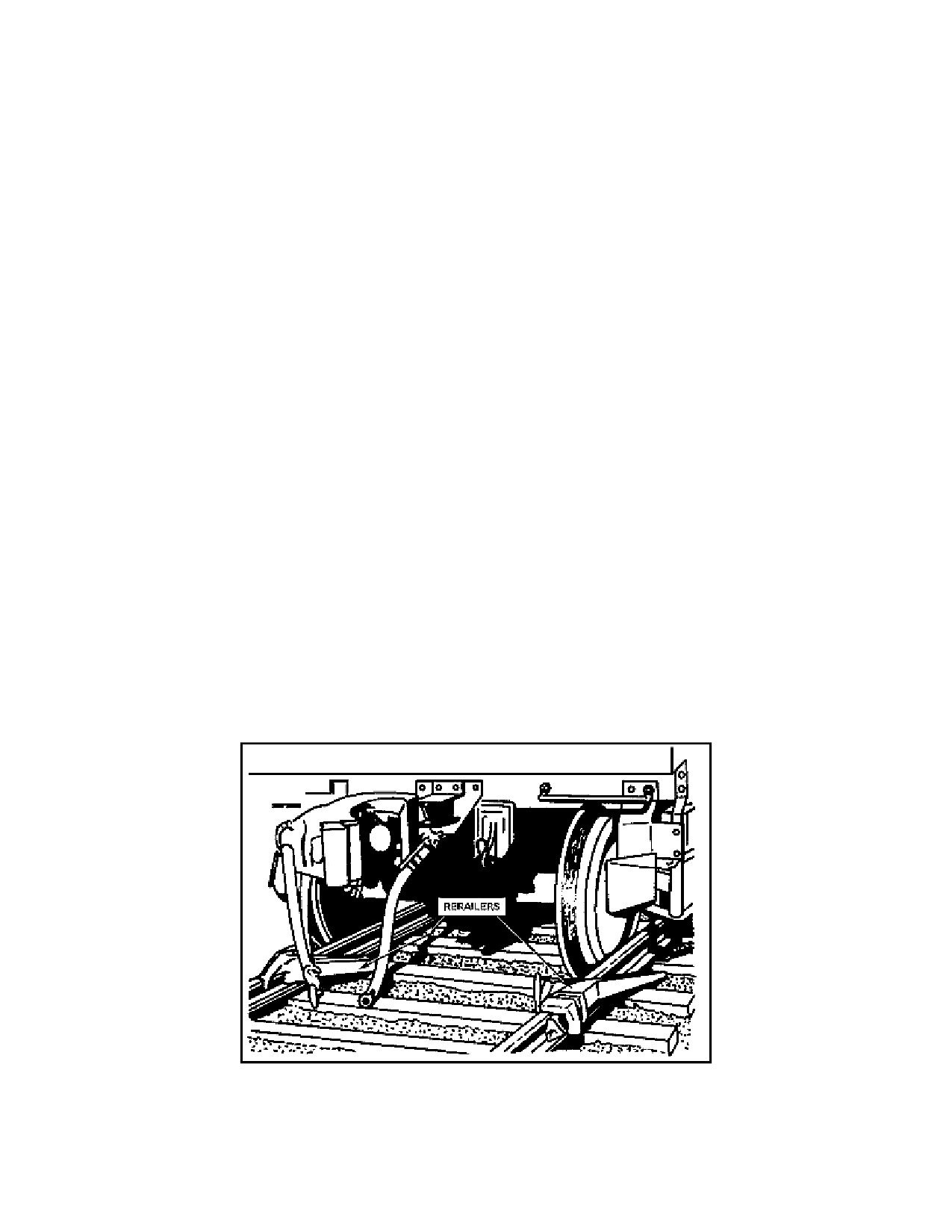
9-48. Rerailers are cast iron devices used in simple derailments to retract cars and locomotives.
Rerailers are carried on locomotives and wreck trains. Rerailers are made to fit over a rail with
grooves and runways designed to guide car wheel flanges back onto the rail to the proper running
position. Some rerailers are designed for use under either wheel; others are designed for use in pairs.
Those designed for use under either wheel must be spiked to a crosstie to prevent slipping. The
rerailer shown in Figure 9-3 is used in pairs. One of the paired rerailers guides the wheel on the
outside of the rail (right side), over the rail to position. The other one (left side) guides the wheel on
the inside of the rail into a flange position. All derailed cars are pulled onto the track when possible.
If the coupling is too low or too far away for a secure connection, chains should be used. The
rerailing devices shown have a tapered opening that fits against the outside web of the rail. A wedge
is driven between the outside web and the rerail device. The wedge tightens against the rail and
prevents the rerailer from slipping as a result of the thrust of the car wheel.
Figure 9-3. Using Rerailers to Retrack a Derailed Car
9-16
FM 4-01.41 ______________________________________________________________________________________Chapter 9
Note: Never attempt to rerail a diesel locomotive under its own power. Serious damage may result to
traction motors from spinning wheels. Unloaded traction motors attain dangerously high speeds.
Other Equipment
9-49. Mobile cranes and bulldozers may often be used effectively in clearing operations when
derailments or wrecks occur in areas accessible from the road. In complicated derailments involving a
large number of cars, mobile cranes and bulldozers may be used to move car bodies and car trucks
within reach of the wreck crane. Mobile cranes may also be used to lift and load small items during
clearing and salvage operations. Specially designed hydraulic jacks may be available to lift and rerail
rolling stock. These are especially useful when minor obstructions must be cleared quickly.
Preliminary Procedures
9-50. It is not practical to list all specific instructions covering the different kinds of lifts that must be
made under wreck conditions. Each wreck is different and depends on the following before any
recommendations can be applied to a particular wreck:
· Situation.
· Weather.
· Timing.
· Lifting hazards.
· Damage to equipment.
· Number and capacity of wreck cranes available.
The wreckmaster and other officials on the site must consider all factors and decide which action to
take.
Preparation for Lifting
9-51. The total weight of the anticipated lift should be calculated as accurately as possible. This
includes the weight of the material or object to be handled and the block, sling, or other devices
between the hook and the load. The light weight of the railway car is stenciled on the side of the car.
Net weights of the contents of loaded cars are available from train documents. The calculated total
weight is checked against the officially tested capacity of the wreck crane. Crane operators must
never operate any weight-handling equipment in excess of its rated capacity without specific
authorization from the officer in charge of the operation.
Load Security
9-52. Loads should not be lifted or moved unless they have been hitched in such a way that no
shifting of weight, slippage, or loss of load will occur. Incorrect rigging can damage lifting gear by
breaking the fiber or wire of the cable. This can result in making subsequent lifts an increasingly
hazardous operation.
9-17
FM 4-01.41 ______________________________________________________________________________________Chapter 9
Brake Tests
9-53. Heavy loads should be lifted a few inches off the ground and the load brakes tested to be sure
they will hold before the load s raised any higher. Test-rated lifting capacities should always be
checked to determine permissive loads. If the crane has been idle for a long time, hoist the load block
to the boom several times with the brakes lightly applied before hoisting a heavy load. This will dry
out any moisture in the brake lining. Excessive moisture in the brake lining will cause rough brake
performance and could cause the load to drop.
Footing
9-54. Making a safe lift depends largely on having a firm foundation and a level base for the crane.
The steel rails of the track usually provide a firm foundation, but a level base may require maximum
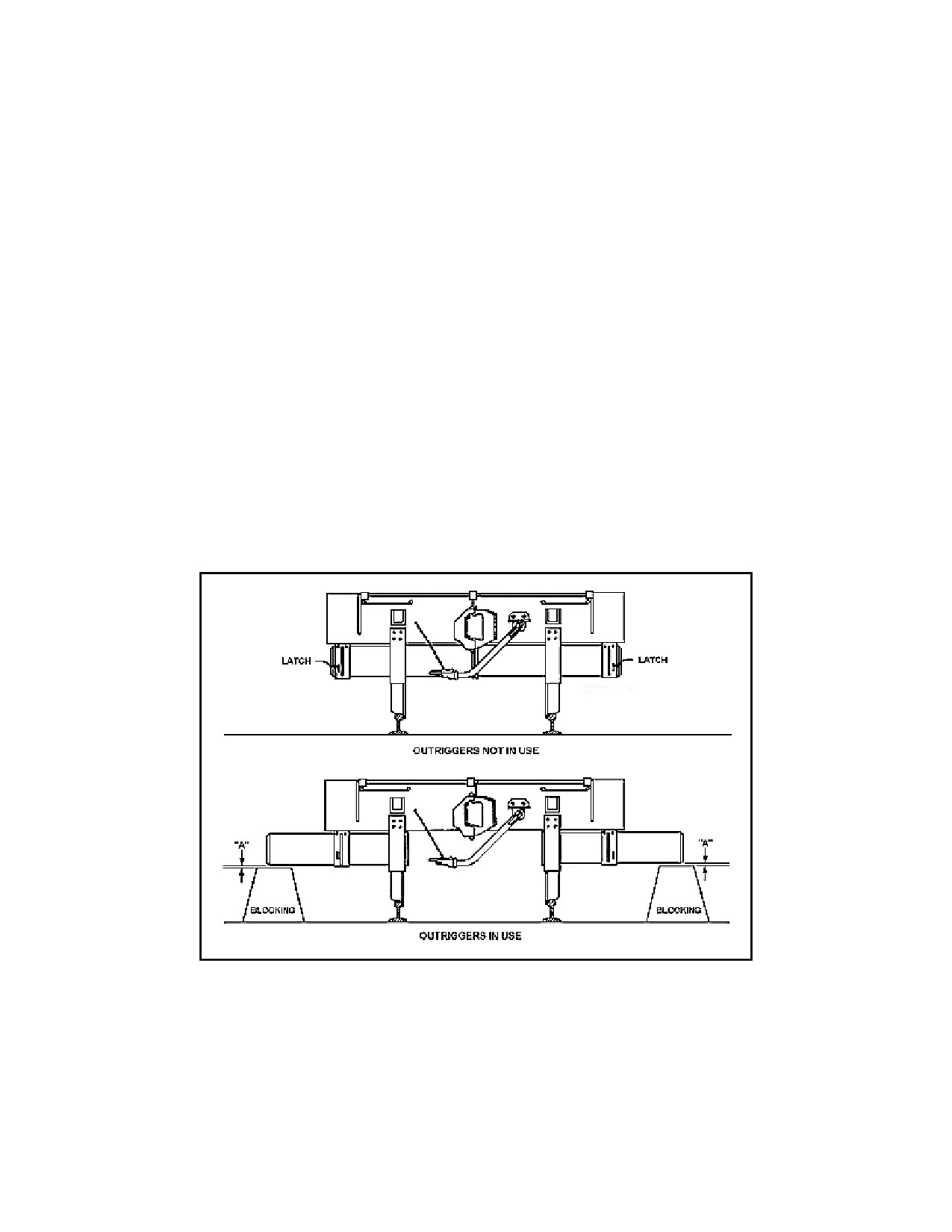
use of the outriggers and blocking. Outriggers are used when making heavy lifts or when making lifts
near the crane’s maximum capacity at any radius. If blocking rests on a firm base, a small clearance
must be allowed at points "A," (Figure 9-4). A level base is required to avoid swinging the load and to
reduce the possibility of tipping. Level swinging requires a minimum of power and is fast and stable.
Outriggers are securely extended and blocked before attempting near capacity lifts; footing must be
level and solid. Outriggers are not extended beyond the crane manufacturer’s recommended limits.
Figure 9-4. Outriggers
Lifting the Load (Mechanical Advantage)
9-55. In order to lift a load beyond the strength and capacity of the person lifting it, the mechanical
advantage must be determined. Mechanical advantage is determined by multiplying the force exerted
9-18
FM 4-01.41 ______________________________________________________________________________________Chapter 9
by the force applied to lift or move a load. Mechanical advantage may be computed for simple and
compound tackle systems.
Simple Tackle System
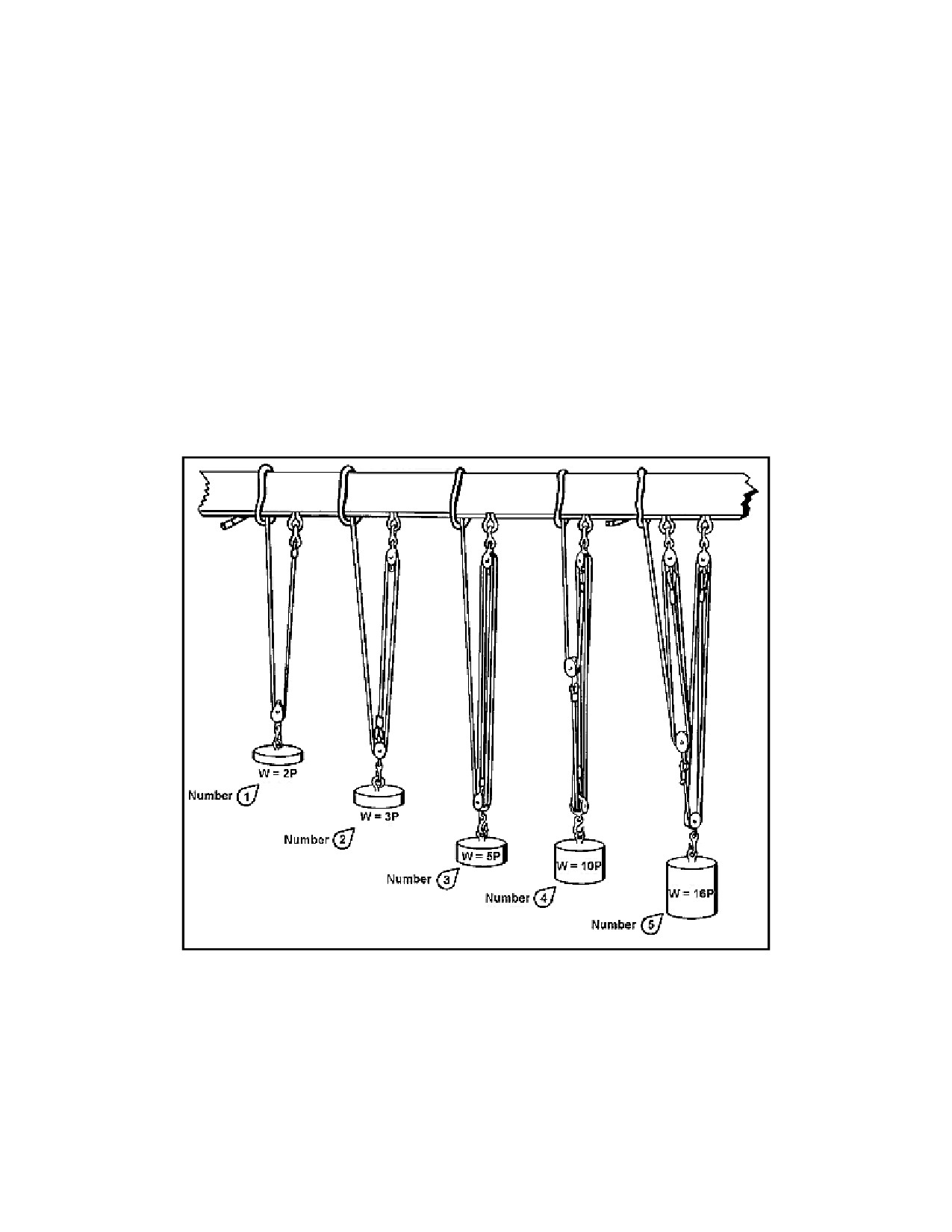
9-56. A simple tackle system (shown in Figure 9-5) has one cable (rope) and one or more blocks. In
this system (Figure 9-5, number 1), there are two lines leaving the load, the fixed end and the fall line
(pulling line). The fall line is bearing the pulley. The force in the line from the block to the load is P;
the tension in the rope as it leaves the block is also P, so two forces, each equal to P, are lifting on
the block. The total force being applied is 2P; therefore, the mechanical advantage is 2. In a simple
tackle system with three lines leaving the block (Figure 9-5, number 2) the mechanical advantage is 3.
In a simple tackle with two double blocks (Figure 9-5, number 3) and five lines leaving the load, the
mechanical advantage is 5.
Figure 9-5. Mechanical Advantage of Various Tackle Rigs
Compound Tackle System
9-57. A compound tackle system has more than one rope and two or more blocks. Compound
systems are made up of two or more simple systems. The fall line from one simple system is fastened
to a hook on the traveling block of another simple system that may include one or more blocks. In
such a compound system, the force exerted on the fall line of one simple system is multiplied by the
9-19
FM 4-01.41 ______________________________________________________________________________________Chapter 9
mechanical advantage of that system and applied to the fall line of the second simple system. This
force is then multiplied by the mechanical advantage of the second simple system. In a compound
system with five lines leaving the load (Figure 9-5, number 4) and the fall line of this tackle attached
to a traveling block with two lines supporting it, the mechanical advantage is 2 times 5, or 10. A more
complicated system is shown in Figure 9-5, number 5. This system is made up of two simple systems,
each of which has four lines supporting the load. The traveling block of the first simple system is
fastened to the fall line of the second simple system; the mechanical advantage of this compound
system is 4 times 4, or 16.
Deadman
9-58. A deadman provides anchorage for additional pulling power when secured to an inanimate
object. The deadman may consist of a log, rail, steel beam, or other similar object buried as deeply in
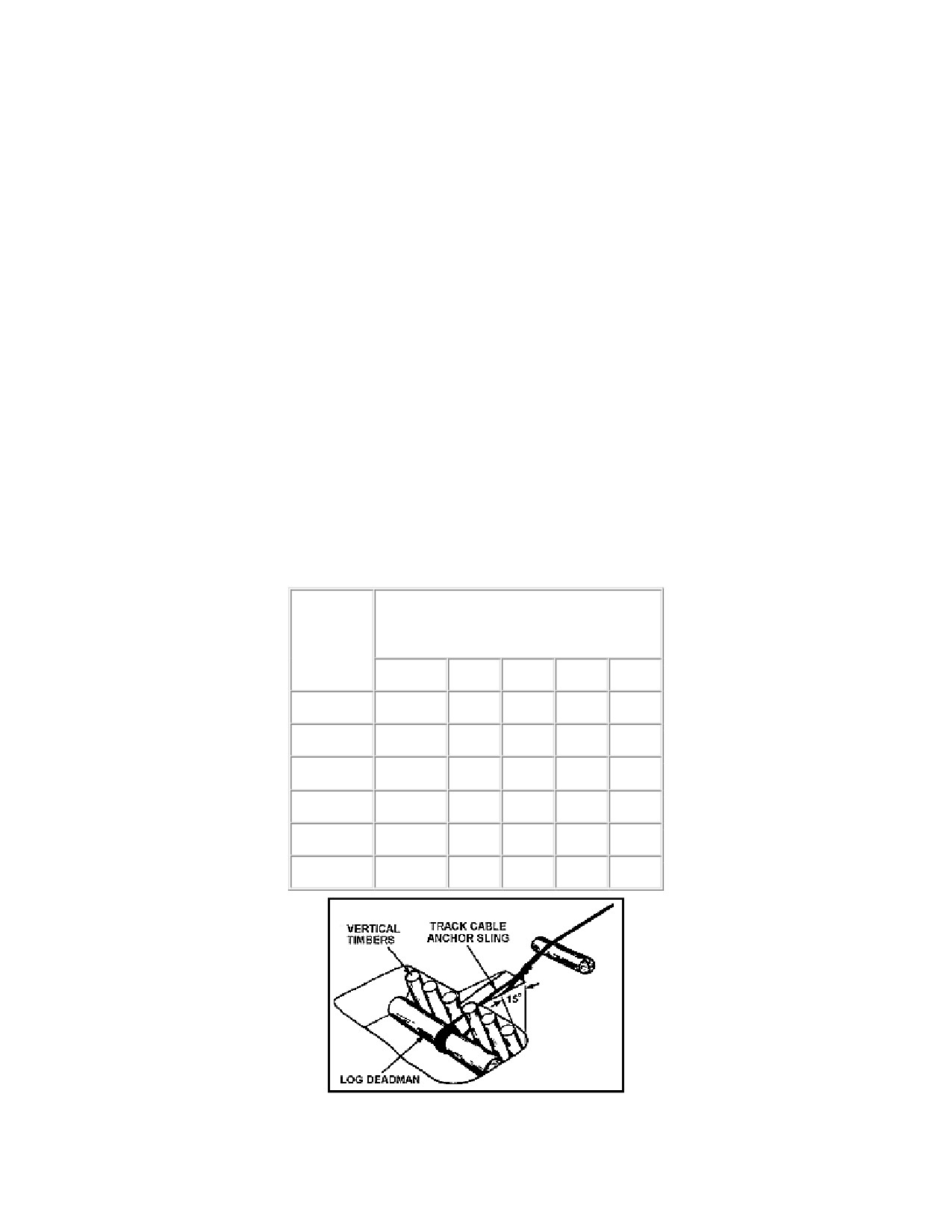
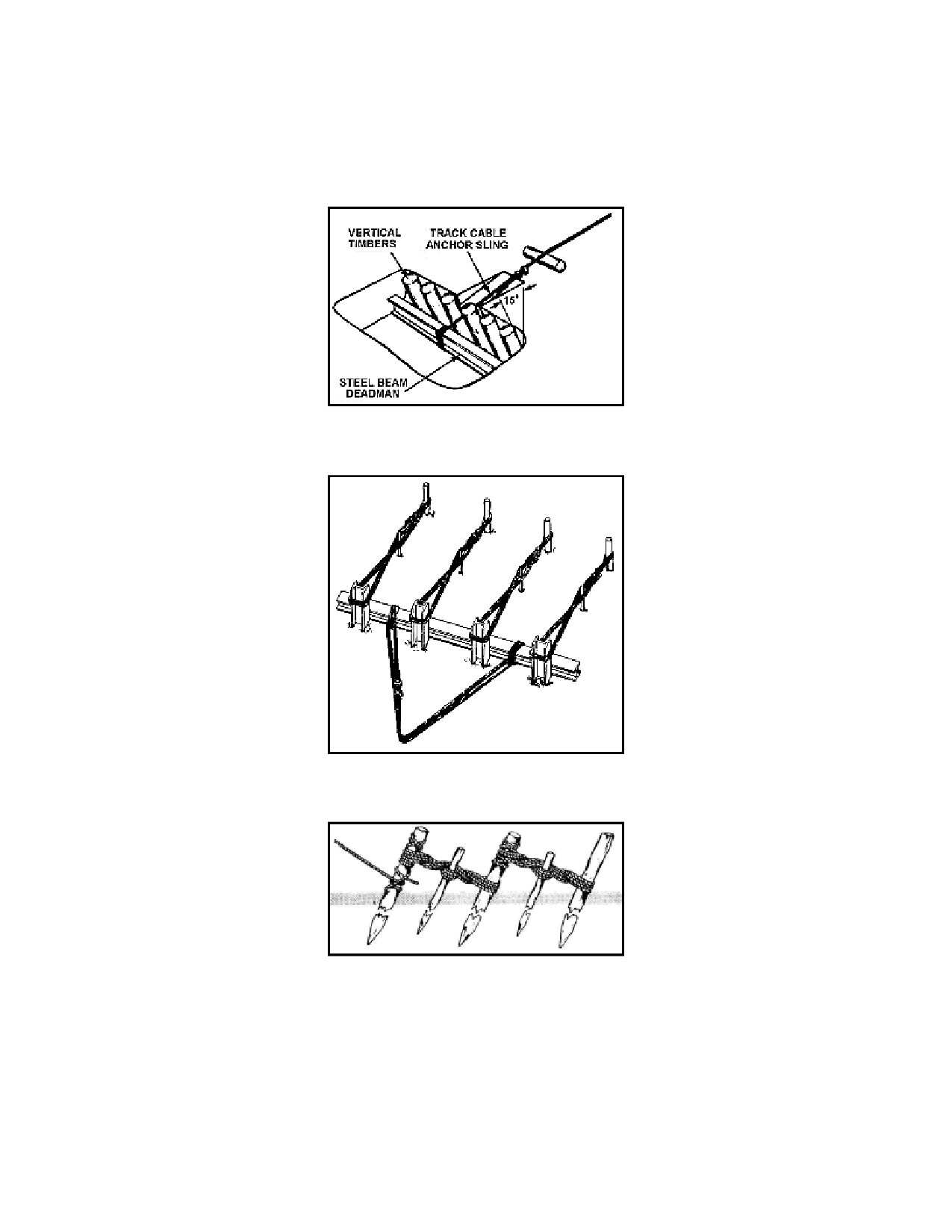
the ground as the force to be exerted requires (Table 9-4). The deadman has a guy line connected to
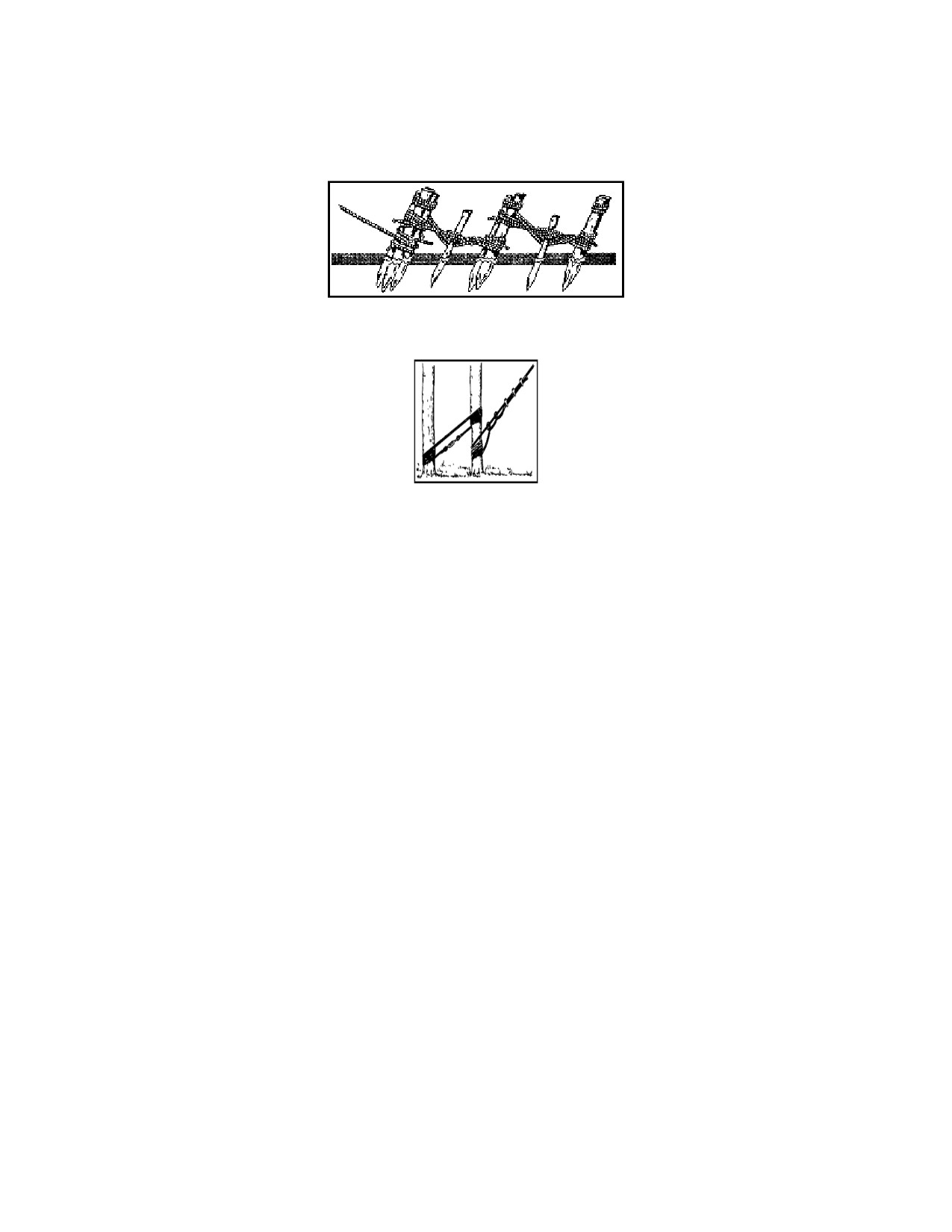
it at the center. Where digging is not practicable, holdfasts made of pickets, cable, rope, girders,
ground anchors, and so forth, may serve as anchorage for tackle hookups. Examples of these field
expedients are shown in Figure 9-6 through Figure 9-11.
Table 9-4. Holding Power of Deadman in Ordinary Earth
Depth of
Inclination of pull (vertical to horizontal)
anchorage
and safe resistance in deadman area
(feet)
(pounds per square foot)
Vertical
1-1
1-2
1-3
1-4
3
600
950
1,300
1,450
1,500
4
1,050
1,750
2,200
2,600
2,700
5
1,700
2,800
3,600
4,000
4,100
6
2,400
3,800
5,000
5,800
6,000
7
3,200
5,100
7,000
8,000
8,400
Figure 9-6. Log Deadman
9-20
FM 4-01.41 ______________________________________________________________________________________Chapter 9
Figure 9-7. Steel Beam Deadman
Figure 9-8. Combination Steel Picket Holdfast
Figure 9-9. Picket Holdfast, 1-1-1 Combination
9-21
FM 4-01.41 ______________________________________________________________________________________Chapter 9
Figure 9-10. Picket Holdfast, 3-2-1 Combination
Figure 9-11. Use of Two Trees as Natural Anchorage
Deadman Installation
9-59. The hole in which the deadman is to be buried should be deep enough to provide a good
bearing in solid earth. The bank in the direction of the guy line should be undercut at an angle of 15
degrees from vertical timbers (Figure 9-6). Stakes may be driven in the ground against the bank at the
same angle to provide a solid bearing surface. A narrow, inclined trench (cableway) should be cut
through the bank to the center of the deadman. A short beam or log should be placed under the guy
line at the outlet of the inclined trench (Figure 9-7). The guy line must be fastened securely to the
center of the deadman so that the standing part of the line (the part of the line on which the pull
occurs) leads from the bottom of the deadman. This method of fastening the guy line, plus the angle
of the bank, reduces the tendency of the deadman to move upward out of the hole. The strength of
the deadman depends partly on the strength of the log or beam used, but mainly on the holding
power of the earth (Table 9-4).
Picket Holdfast Installation
9-60. The strength of a picket holdfast depends on the following:
· How it is driven into the ground.
· The diameter and kind of stake used.
· The holding power of the ground.
· The depth to which the stake is driven.
· The angle of the stake.
· The angle of the guy line to the ground.
A combination steel picket holdfast provides more strength than wood and rope combinations
(Figure 9-8). A multiple picket holdfast forms a stronger holdfast than does a single picket holdfast.
To make a multiple holdfast, two or more pickets are driven into the ground in any desired
combination and are lashed together (Figure 9-9 and Figure 9-10). The principal part of strength for
a multiple picket holdfast is in the strength of the first (front) picket. To increase the surface area of
9-22
FM 4-01.41 ______________________________________________________________________________________Chapter 9
the first picket against the ground, three pickets are driven into the ground close to each other and
lashed together. They are then lashed to a second picket group that is lashed to a third picket (Figure
9-10). Intervening pickets provide additional strength. Two trees used as natural anchorage are
shown in Figure 9-11.
Lifts
9-61. When repetitive lifting is required, position the crane so it has the shortest possible swing cycle
in order to reduce cycle time. When multiple lifts are projected over an assigned area, position the
crane so that it begins to work at the point farthest from the next direction of travel to a different
area. Lifts are completed in one area before moving the crane to the next area.
Positions
9-62. Exact formulas and specific rules for positioning wreck cranes cannot be prescribed. Many
factors determine crane working positions. The most undesirable position for lifting is with the
boom at right angles to the crane body. This position is often required when clearing derailed or
wrecked cars and locomotives to one side of the track. Outriggers are usually required when lifting
capacity loads in this position. For heavy lifts, the crane should be positioned where it has the
maximum lift capacity. When there are a number of loads to lift, it is best to position the crane so
that the loads can be lifted to the most remote points first. When in this position, the crane has
greater boom clearance and subsequent crane operations are not blocked.
9-63. Each new job location or condition is checked for adequate boom clearance. During repetitive
lifts, when work conditions remain unchanged, one thorough clearance check and careful continued
observation will eliminate the need for raising and lowering the boom on each cycle. Wreck cranes
are positioned, for safety reasons, so loads are not lifted over personnel or equipment. They are also
positioned so that they do not touch overhead obstructions (especially electric wires). Crane hooks
are kept high enough so that they will clear personnel and vehicles. Radius clearances are established
by positioning the crane to provide adequate space between the load being handled and the point of
final placement. Loads are hoisted high enough to ensure proper clearance, but no higher than
necessary.
Resistance
9-64. When an overturned car or locomotive is to be rerailed, resistance must be overcome by force.
This force is supplied by the crane and its rigging. In serious wrecks, cars and locomotives are often
thrown some distance from the track. They must be dragged back to a lifting position, which may
involve several forms of resistance. These forms of resistance are described below.
· Friction. Created by the contact with an object being pulled across the ground. For
example, the amount of friction the resistance offers by soft sand is less than gravel.
· Grade resistance. Determined by the weight of the object pulling downhill and the angle
of the slope. By rule of thumb, grade resistance can be determined by multiplying one-
sixteenth of the weight of the car or locomotive by the number of degrees of slope. An
example of this is the resistance encountered when pulling an overturned car up an
embankment to track level.
9-23
FM 4-01.41 ______________________________________________________________________________________Chapter 9
· Overturning resistance. That part of the weight of an object, such as that of a diesel
locomotive, which acts against the force being exerted to get it upright and back on the
track. Half the weight of this object is the maximum that will ever be beyond the center of
gravity from the point of lift, so only half of the weight is resisting recovery. When any
overturned car or locomotive is to be set upright, the resistance is computed as one-half
the weight of the object to be set up.
· Tackle resistance. A loss of energy or force that is created by the flexing of the cable of
rope, the cable scuffing in the groove of the pulley or sheave, the sheave turning on the
pin, and so forth. This loss (tackle resistance) must be overcome before the load can be
moved. Each pulley or sheave in the tackle creates a resistance approximately equal to 10
percent of all the other resistance created by gravity, terrain, and so forth. If a standard 40-
foot flatcar to be rerailed or picked up creates a resistance of 60,000 pounds and three
sheaves are used in the tackle assembly (or crane boom), tackle resistance is 18,000 pounds
(30 percent of 60,000 pounds).
· Total resistance. The total resistance that must be overcome before an object can be
moved. Total resistance varies as conditions vary. For example, a car body weighing
20,000 pounds and dragged up a 6-degree, ice-covered slope would generate a total
resistance of
2,800 pounds. The same object pulled over sand would create a total
resistance of
5,000 pounds. An object dragged through mud or mire could create
resistance equal to its own weight.
Operating Techniques
9-65. Precise rules and techniques cannot be given because of the diversity and wide range of jobs on
which wreck cranes may be used. The experience and judgment of the wreckmaster and crane
operator will dictate the procedures to be followed.
Cables
9-66. Cable breakage can cause serious injuries, loss of life, and property damage. Wire rope
manufacturers recommend a safety factor of six for lifting operations. At full engine power, the
safety factor on the crane hoist line of most free-moving cranes usually drops to about two. Do not
load hoisting lines to the point where the engine begins to stall or use engine power as a gauge for
safe line lifting capacity. If the engine is stalled by line pull only, flywheel inertia adds to rated power.
A momentary increase in line pull to two and one-half times the full engine powerline pull will cause
the cable to snap. Fast lowering with sudden stops will also overload hoist lines. Boom hoist lines
usually encounter their heaviest loads when the load is just leaving the ground. At that point, the
angle of lift is flat and there is considerable inertia in starting or stopping.
Working Radius
9-67. The general rule for working radius is that the load should be handled at the shortest possible
radius in keeping with job conditions, boom length, height of lift, and boom clearance at all points in
the swing cycle. With a given boom length, the steeper the working angle, the shorter the working
radius. The nearer the boom moves to the vertical position, the greater the loss in radius for each
degree of increase in boom angle. Loads should not be hoisted higher than necessary and should be
lowered as quickly as possible to the proper height for swinging, traveling, or spotting.
9-24
FM 4-01.41 ______________________________________________________________________________________Chapter 9
Boom and Hoist Control
9-68. Lifting the load up and down with a boom lengthens the lift cycle and increases wear and tear
on the equipment. Hoisting is generally the best method. The following are the principal factors in
controlled handling of loads:
· Speed.
· Smoothness of operation.
· Stability.
· Shock.
· Tipping.
· Feel of the load.
· Safety.
Using the boom, a careful operator will slightly lift the load and check to ensure that it is secure
before lifting it completely off the ground. If not satisfied, he should lower the load and investigate
and correct the condition. Speed is an element almost fully within the control of the operator. Due to
centrifugal force, crane swing should be slow enough to avoid any outward throw of the load. The
action of the crane hook at the end of a line is similar to that of a pendulum. Therefore, the hook can
be controlled only at the slowest speeds. Tag lines are required for controlling the outward swing of
free-moving cranes. When conditions permit, handlines are used to ease the load down and guide it
into place. The hoist line is then eased off until the crane settles back gently to a stable position. In
case the boom and the crane have rocked from the release of the load, the operator should inspect
the cables on the boom and on the drums to ensure that they are in place. The cables may have
become wedged, damaged, or cut.
Block Positions
9-69. Before hoisting a load, the upper block is placed directly over the load to permit a vertical lift
and to prevent the load from swinging or kicking out. Tag lines are used to increase load stability.
Blocks are not pulled too close to the sheaves at any time. If the blocks come together and the
hoisting continues, the hoist line may break. There must be adequate clearance between the block
and point sheaves when lowering the boom. If not, the hoist line will tighten up and break or wedge
down through other cables on the drum. As a safety factor, at least two full wraps of cable should be
on the drums whenever they are in operation.
Car Lifts
9-70. When lifting a car, the coupler is the quickest and most practical place to make a hitch.
However, couplers must be properly blocked to prevent damage to the car body. Some cars have jack
pads or lifting eyes built integrally into the frames. Cars not equipped with these features can be
easily hoisted by passing cable slings under the car frame.
Car Trucks
9-71. Most car frames are braced so that trucks may be chained to the car frame and lifted with the
car body. When the car body must be lifted off the trucks for quick clearance, brake rods must be
disconnected manually or cut in two with an acetylene torch. Car trucks may be lifted intact,
9-25