FM 3-21.38 Pathfinder Operations (APRIL 2006) - page 4
Drop Zones
6-35.
At night, attach a small, liquid-activated light or 6-inch chem-light to the balloon to aid in
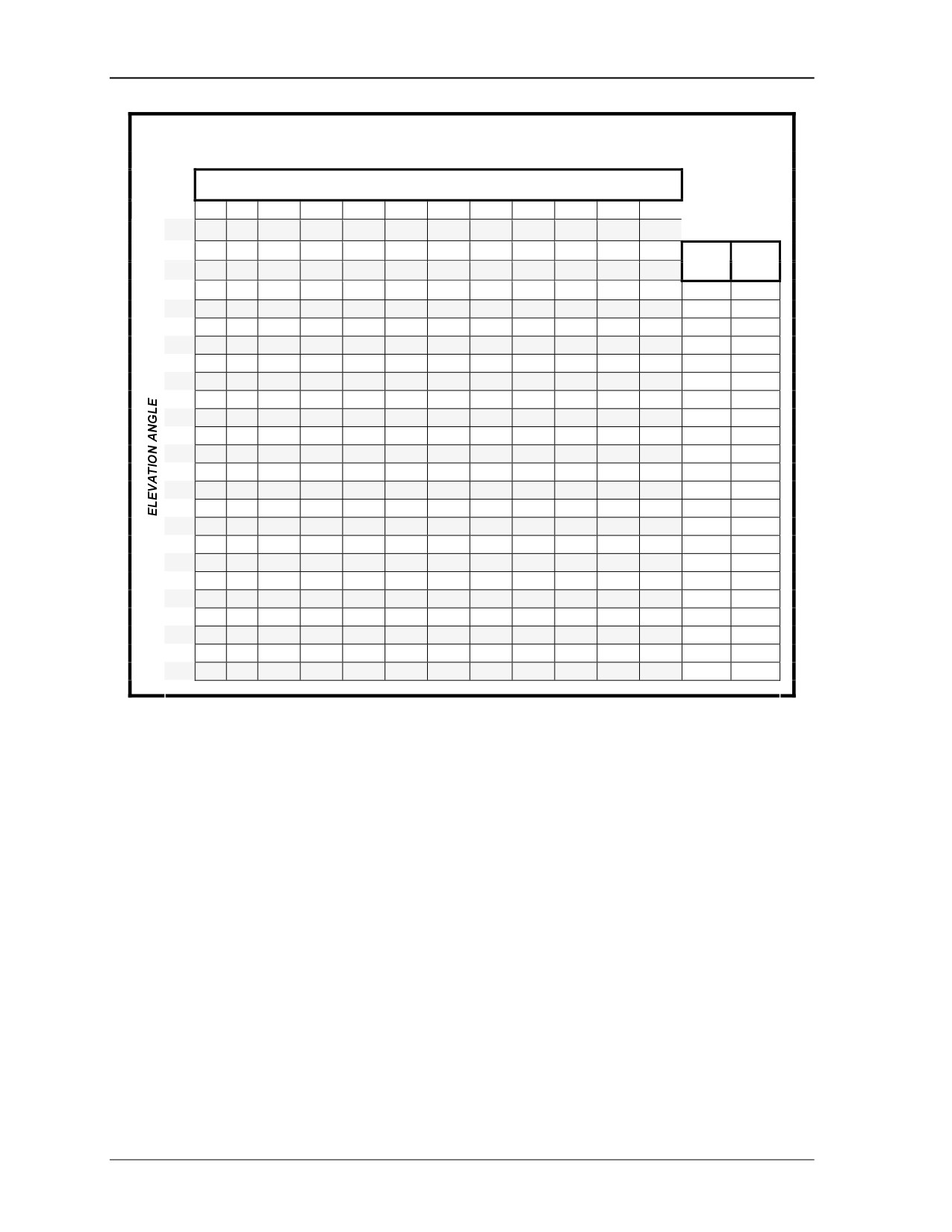
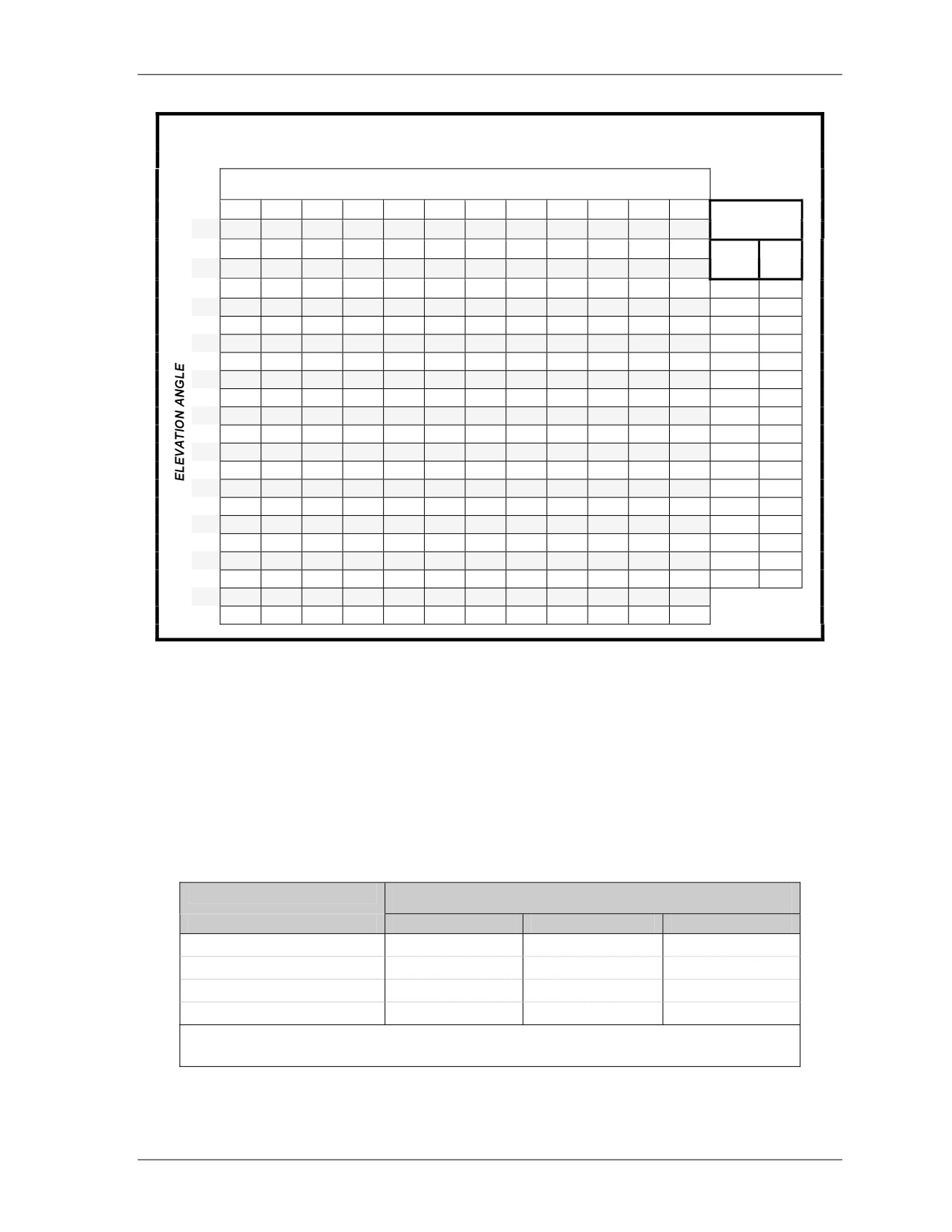
observation. Table 6-8A (this page) and 6-8B (page 6-16) show the PIBAL charts for the 10- and 30-gram
helium balloons, respectively.
25 April 2006
FM 3-21.38
6-15
Chapter 6
10-GRAM HELIUM BALLOON
Inflate balloon to 57-inch circumference for day and 74-inch circumference for night.
DROP ALTITUDE IN FEET
500
750
1000
1250
1500
1750
2000
2500
3000
3500
4000
4500
ASCENSION
70
02
02
01
01
01
01
01
01
01
01
01
01
TABLE
60
03
02
02
02
02
02
02
02
02
02
02
02
ALT
55
03
03
03
03
03
03
03
03
03
03
03
03
TIME
(FT)
50
04
04
03
03
03
03
03
03
03
03
03
03
0:10
80
45
05
04
04
04
04
04
04
04
04
04
04
04
0:20
170
40
06
05
05
05
05
05
05
04
04
04
04
04
0:30
250
35
07
06
06
06
06
05
05
05
05
05
05
05
0:40
330
30
08
07
07
07
07
07
07
07
06
06
06
06
0:50
400
25
10
09
09
09
08
08
08
08
08
08
08
08
1:02
500
24
11
10
09
09
09
09
08
08
08
08
08
08
1:10
540
23
11
10
10
09
09
09
09
08
08
08
08
08
1:20
610
22
12
11
10
10
10
10
09
09
09
09
09
09
1:30
670
21
12
11
11
10
10
10
10
10
10
10
10
10
1:43
750
20
13
12
11
11
11
11
11
10
10
10
10
10
1:50
790
19
14
13
12
12
11
11
11
11
11
11
11
11
2:25
1000
18
15
13
13
12
12
12
12
12
11
11
11
11
2:44
1100
17
16
14
13
13
13
13
12
12
12
12
12
12
3:05
1250
16
17
15
14
14
14
13
13
13
13
13
13
13
3:49
1500
15
18
16
15
15
14
14
14
14
14
14
14
14
4:30
1750
14
19
17
16
16
16
15
15
15
15
15
15
15
5:11
2000
13
21
19
18
17
17
17
17
15
15
15
15
15
6:34
2500
12
22
20
19
19
18
18
18
18
17
17
17
17
7:58
3000
11
24
22
21
21
20
20
20
19
19
19
19
19
9:22
3500
10
27
25
23
23
22
22
22
21
21
21
21
21
10:44
4000
09
30
27
26
26
25
24
24
24
23
23
23
23
12:08
4500
Table 6-8A. Conversion chart for
10-gram helium (pilot) balloons.
6-16
FM 3-21.38
25 April 2006
Drop Zones
30-GRAM HELIUM BALLOON
Inflate balloon to 75-inch circumference for day and 94-inch circumference for night.
DROP ALTITUDE IN FEET
500
750
1000
1250
1500
1750
2000
2500
3000
3500
4000
4500
ASCENSION
80
01
01
01
01
01
01
01
01
01
01
01
01
TABLE
70
03
03
03
02
02
02
02
02
02
02
02
02
ALT
60
04
04
04
04
04
04
04
04
04
04
04
04
TIME
(FT)
55
05
05
05
05
05
05
05
05
05
05
04
04
0:10
120
50
06
06
06
06
06
06
06
06
05
05
05
05
0:20
240
45
07
07
07
07
07
07
07
07
07
06
06
06
0:30
360
40
09
08
08
08
08
08
08
08
08
08
08
08
0:42
500
35
10
10
10
10
10
10
10
09
09
09
09
09
0:50
600
30
12
12
12
12
12
12
12
11
11
11
11
11
1:02
750
25
15
15
15
15
15
15
14
14
14
14
14
14
1:10
830
24
16
16
15
15
15
15
14
14
14
14
14
14
1:17
1000
23
17
17
16
16
16
16
15
15
15
15
15
15
1:48
1250
22
18
18
17
17
17
17
17
16
16
16
16
16
2:10
1500
21
19
19
18
18
18
18
17
17
17
17
17
17
2:34
1750
20
20
20
19
19
19
19
18
18
18
18
18
17
2:56
2000
19
21
20
20
20
20
20
19
19
19
19
19
18
3:43
2500
18
22
22
21
21
21
21
21
20
20
20
20
20
4:31
3000
17
23
23
23
22
22
22
22
22
21
21
21
21
5:21
3500
16
25
25
24
24
24
24
23
23
23
23
22
22
6:09
4000
15
27
27
26
26
25
25
25
25
24
24
24
24
7:00
4500
14
29
29
28
27
27
27
27
27
26
26
26
25
13
31
30
30
30
30
29
29
29
28
28
28
27
Table 6-8B. Conversion chart for 30-gram helium (pilot) balloons.
FORWARD THROW
6-36.
This refers to the effect of inertia on a falling object. An object that leaves an aircraft moves at the
same speed as the aircraft. The parachutist (or bundle) continues to move in the direction of flight until the
dynamics of gravity and the parachute take effect. The forward throw distance is the distance along the
aircraft flight path traveled by a parachutist or cargo container after exiting the aircraft, until the parachute
fully opens and the load is descending vertically. Forward throw distance for rotary-wing and STOL
aircraft equals half the aircraft speed (KIAS), expressed in meters. Table 6-9 shows the forward throw
distance from a fixed-wing aircraft.
Forward Throw Distances for Fixed-Wing Aircraft
Load
C-5
C-130
C-17
Personnel or Door Bundle
229 meters (250 yd)
229 meters (250 yd)
229 meters (250 yd)
Heavy Equipment
668 meters (730 yd)
458 meters (500 yd)
640 meters (700 yd)
CDS
N/A
503 meters (550 yd)
663 meters (725 yd)
TTB
N/A
147 meters (160 yd)
147 meters (160 yd)
NOTE: To convert yards to meters, multiply yards by 0.9144.
To convert meters to yards, divide meters by 0.9144.
Table 6-9. Forward throw distances for fixed-wing aircraft.
25 April 2006
FM 3-21.38
6-17
Chapter 6
APPROACH AND DEPARTURE ROUTES
6-37.
Ground unit commanders must choose adequate routes for the aircraft to and from the DZs.
They consider—
Enemy situation and location.
Obstacles to the aircraft such as television towers or high-tension lines.
Terrain higher than the drop zone.
Adjacent air operations and flight routes.
y No-fly areas.
SECTION II. DROP ZONE SUPPORT TEAM
The drop zone support team plans, establishes, and operates day and night drop zones for personnel and
resupply missions flown by fixed-wing and rotary-wing aircraft. The DZST is responsible for accomplishing
the mission on the DZ. In operations without the USAF special tactics team, the DZST will shoulder the overall
responsibility for the conduct of operations on the DZ. The DZST represents both the airborne and airlift
commanders. The DZST leader assumes all the responsibilities normally associated with the USAF STT and
the DZSO.
ORGANIZATION
6-38. The DZST must have at least two members. It might need more, depending on the complexity of
the mission. However, additional team members do not need to be DZSTL qualified. The senior member of
the DZST functions as the team leader. He must hold the rank of NCO (sergeant or above in the US Army,
E-4 or above in the USAF or USMC), an officer, or the civilian equivalent. He must have completed the
appropriate initial training as a DZST member and must satisfy current parent service requirements. To
conduct personnel and heavy equipment drops, he must also hold current jumpmaster qualification.
MISSIONS
6-39.
Primary missions of the DZST include wartime CDS drops to battalion or smaller units. They also
make peacetime, visual, and meteorological condition drops, with one to three aircraft, for personnel, CDS,
and heavy equipment. Secondary missions include wartime drops of brigade-sized or larger units,
peacetime drops of C-130, Adverse Weather Aerial Delivery System (AWADS) involving one to three
aircraft, or visual meteorological conditions (VMC) drops of four or more aircraft.
NOTE: Any authorized personnel, other than qualified combat controllers, who perform
DZSTL duties, are restricted to formation airdrops of four or less aircraft. The only exception is
on a military range with active range control.
EQUIPMENT FAMILIARIZATION
6-40.
The DZST leader must know how to use equipment to set up, mark, and operate the drop zone.
Depending on the mission, this equipment includes--
ANEMOMETER
6-41.
An anemometer is an instrument used to measure wind velocity. There are currently three types of
anemometers approved for use in support of airborne operations: AN/PMQ-3A, DIC and DIC-3, and
turbometer. The AN/ML433A/PM and meters that use floating balls or devices in a tube (sensor-based
devices) are not authorized for use during personnel or cargo airdrop operations. Other anemometers not
6-18
FM 3-21.38
25 April 2006
Drop Zones
tested and recommended for use should be employed only after a command-initiated risk assessment is
completed. Regardless of the method or device used to measure the wind on the DZ, the airborne
commander must ensure winds fall within the limitations for the type of drop being conducted.
Messages
6-42.
The following USAIS messages authorize several commercially available anemometers for use in
drop zone operations:
DTG 101000Z Mar 94, Subject: Use of Anemometers During Airdrop Operations.
DTG 212000Z Oct 94, Subject: Use of TurboMeters During Static Line Airdrop Operations
(personnel drops).
AN/PMQ-3A
6-43.
This is a handheld or tripod-mounted omnidirectional anemometer (NSN: 6660-00-515-4339). It
is capable of providing wind speed and direction. Because of its size, cost, and weight (10 pounds with all
components), it is not ideal for light Infantry units in operational environments. With the trigger pressed
down, the correctly oriented anemometer gives wind direction in degrees. It can read the wind from 0 to 15
knots on the low scale, and from 0 to 60 knots on the high scale. The anemometer requires recalibration
every six months.
DIC and DIC-3
6-44.
One piece, handheld, compact, lightweight, factory-calibrated devices, these commercially
purchased anemometers are approved for use during airborne operations. The DIC and DIC-3 use folding
cups to catch the wind and electronically display wind speed, but not direction. During use, it is critical that
the cups are fully extended to ensure an accurate reading. The device is omnidirectional and does not need
to be oriented with wind direction to provide accurate readings. Post manufacture calibration methods are
not available. The DIC and DIC-3 can depict wind data in knots, miles per hour, kilometers per hour, or
meters per second. The additional features of the DIC-3 are the ability to display peak wind velocity over a
given period, and average wind speed over two time periods. Because the DIC and DIC-3 cannot be
calibrated, they must be checked before use by—
Ensuring fresh batteries are installed.
Turning on the anemometer in a no-wind condition, such as in a building or enclosed vehicle. If
any reading other than zero is displayed, the device is unserviceable and must be turned in for
disposal or returned to the manufacturer.
Conducting a three-anemometer check by comparing the wind reading on three anemometers at
the same time under identical conditions. Discard the anemometer that reads differently then the
other two. This is most accurate if all anemometers are of the same type.
TurboMeter
6-45.
This anemometer is stocked under NSN
1670-00-T33-9004. It can also be commercially
purchased. It is a small, lightweight, electronic wind speed indicator. It does not display direction, but
when turned into the wind, it depicts wind data in knots, miles per hour, meters per second, and feet per
second. For the most accurate results, the TurboMeter must be oriented within 20 degrees of the wind
direction, with the wind entering the rear of the meter. Because the TurboMeter cannot be calibrated,
conduct the same preoperation and three-anemometer check as when using the DIC/DIC-3 anemometer.
25 April 2006
FM 3-21.38
6-19
Chapter 6
VS-17 MARKER PANEL, AERIAL
6-46.
The two-sided VS-17 marker panel (NSN 8345-00-174-6865) measures 2 feet wide by 6 feet
long. One side is international orange. The other side of the panel is cerise (red). Six tie-down points
permit attachment to stakes. The short ends in the stowage pocket have three snap fasteners. When folded,
the panel’s olive drab green should show. Pathfinders should display the panel side whose color contrasts
best against the surrounding area.
LIGHT, MARKER, GROUND OBSTRUCTION
6-47.
One BA-200 battery powers this “beanbag light” (NSN: 6230-00-115-9996). Interchangeable,
colored plastic domes offer different colors of light. These markers work well in light holes or on the
surface. The ground crew secures the markers with tent pegs or by filling the bottom with sand or rocks.
6-20
FM 3-21.38
25 April 2006
Drop Zones
RAISED-ANGLE MARKER
6-48.
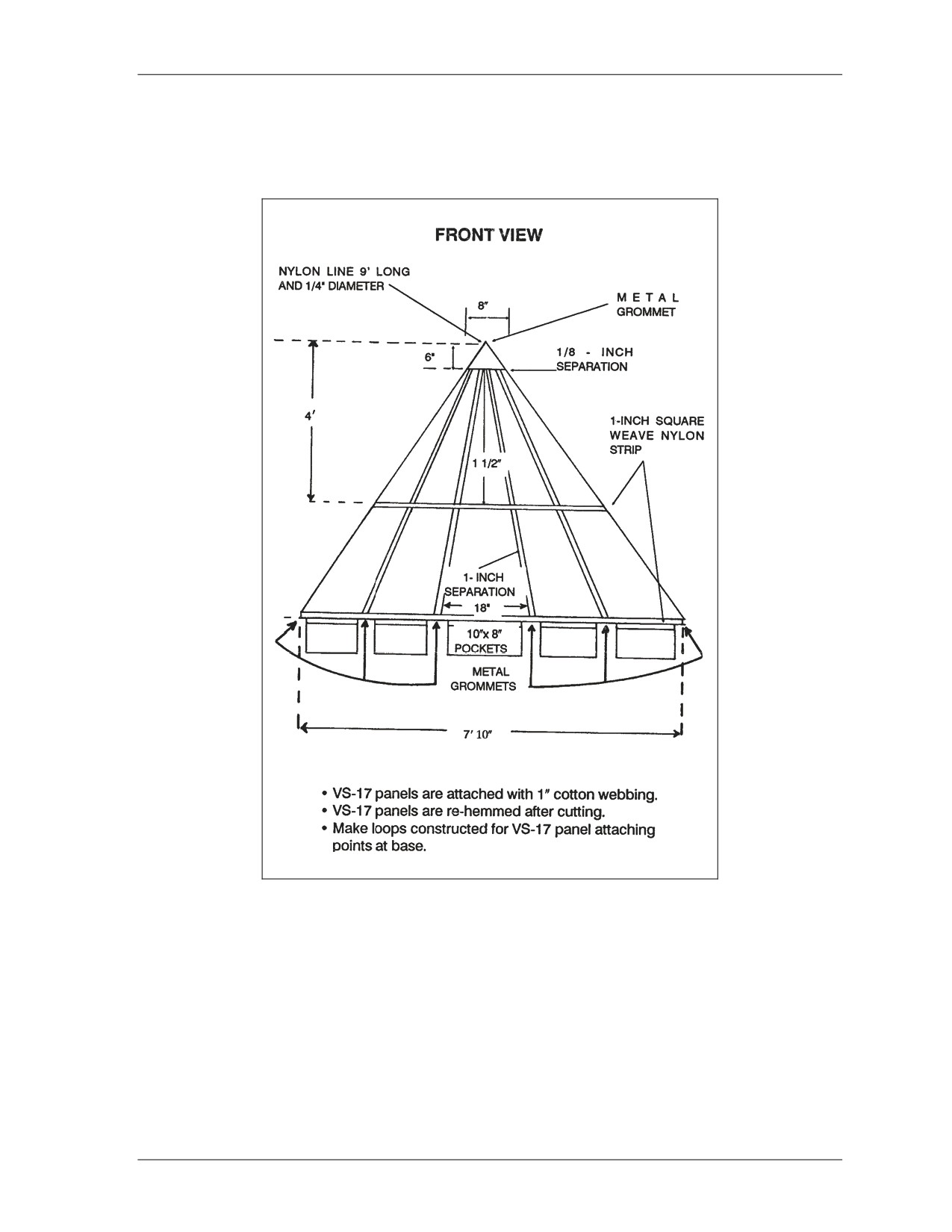
This locally constructed raised-angle marker (RAM) marks the PI on CARP DZs. It consists of
five VS-17 panels. Most rigger units have the ability to construct a RAM (Figure 6-5).
Figure 6-5. Raised-angle marker.
WHELEN LIGHT
6-49.
This light attaches to the top of one of two types of batteries originally used with the AN/PRC-77.
To place the light into operation, the user seats it on top of the battery. Different colored domes offer
different colors of light. The unit buys this light locally. The batteries are as follows:
Dry battery BA-4386/U.
Lithium battery BA-5598/U.
25 April 2006
FM 3-21.38
6-21
Chapter 6
M-2 LIGHT BATON
6-50.
Two BA-30s power this flashlight (NSN: 6230-00-926-4331). Different lenses (stored in the base
compartment) change the color of the light. This light works best in a light hole or on top of the ground
attached to a tent peg.
AERIAL MARKER, DISTRESS
6-51.
This omnidirectional flashing (strobe) light (NSN 6230-00-67-5209) has a very long range. An
optional directional cover snaps on top for tactical operations. Other snap-on caps change color and
function. The black cap, for example, makes the strobe light invisible except to devices that can
“see” infrared.
MIRROR, EMERGENCY SIGNALING, TYPE II
6-52.
Pathfinders can use the signal mirror (NSN 6350-00-105-1252) to signal aircraft by reflected
sunlight. The back of the mirror has a set of instructions for proper use and aiming. The signal mirror
works even on hazy days. It works in all directions—not just when the user faces the sun—and the
intended viewer can see it from as far away as the horizon.
PILOT BALLOON
6-53.
Pathfinders use the 10- or 30-gram rubber balloon to measure the mean effective wind. They fill
the balloon with helium until the balloon inflates to the specified circumference. National stock numbers
for PIBALs follow:
NSN 6660-00-663-7933, balloon, meteorological, 10-gram.
NSN 6660-00-663-8159, balloon, meteorological, 30-gram.
LIGHTING UNIT
6-54.
This light (NSN 6660-00-839-4927) attaches to the PIBAL for night operations. Overinflating the
PIBAL compensates for the weight of the light so it can ascend at the same rate as it would without the
light. Water or any other fluid will activate the PIBAL’s wet-cell battery. Below 50 degrees Fahrenheit,
warm water activates the light faster. A 6-inch chem-light may be used as a lighting unit in place of the
wet-cell battery.
DRIFT SCALE
6-55.
This slide-type scale uses a 90-degree angle to measure the ascent of the PIBAL. Pathfinders use
the drift scale to compute the mean effective wind. The local Training Support Center produces the drift
scale. Pathfinders can also use the pocket transit (small enough to carry in a pocket), theodolite (NSN
6675-00-861-7939) with built-in clinometer
(NSN 6675-00-641-5735), or the separate clinometer
(NSN 6675-01-313-9730).
AN/PRC-119A (SINCGARS) RADIO
6-56.
This man-portable radio (NSN 5820-01-267-9482) allows FM radio contact with aircraft. It also
permits navigational aid (NAVAID) for aircraft with FM-homing capabilities. Without power-increasing
accessories, it transmits between 4 and 16 kilometers.
6-22
FM 3-21.38
25 April 2006
Drop Zones
AN/PRC-113 (HAVE QUICK) RADIO
6-57.
This man-portable UHF/VHF AM radio (NSN 5820-01-136-1519) has a quick, jam-resistant,
ECCM transceiver. Pathfinders use it for short ranges—5 to 16 miles—for tactical, ground-to-ground, or
ground-to-air communication.
AN/PRC-117F (ALSO KNOWN AS RT-1796) RADIO
6-58.
This man-portable radio can transmit and receive in the 30 to 512 MHz frequency range. Thus, it
can be used for FM, AM, and SATCOM communications. With this one radio system, a Ranger radio
operator can communicate with any other radio system used in Ranger operations. The 117F operates in
three distinct frequency ranges.
VHF low band - 30 MHz to 89.99999 MHz.
VHF high band - 90 MHZ to 224.99999 MHz.
UHF band - 225MHz to 512MHz.
110 programmable radio nets.
6-59.
The 117F outputs 20 watts of power in the 90 mHz to 400 mHz range and 10 watts in the upper
and lower frequency ranges. The 117F is menu driven. It uses Vinson, ANDVT, Fascinator, and KG-84
embedded encryption. It operates on
26 volts of DC power
(VDC), and requires two BA-5590
nonrechargeable batteries. It has one H-250 handset, a VHF blade antenna with a flexible adapter base, a
VHF/UHF flex antenna, a KDU remote-control cable, a wide battery box, and the AN/PRC-117F
transceiver. It uses the AV-2040 satellite antenna used for SATCOM communications. With batteries
installed, the 117F weighs 15.9 lbs.
ASIP RADIO
6-60.
The ASIP is an FM, VHF, low-radio system with built-in communications security (COMSEC)
and a built-in test (BIT). Its frequency range is 30,000 to 87,975 MHz. It can be used man-packed or
vehicle-mounted. To power up in manpack configuration requires 13.5 VDC, which is provided by a
single BA5590 battery. In vehicular mode, it operates on 27.5 VDC, which it draws the vehicle's battery.
Four power settings include LOW (200 to 400 meters), MEDIUM (440 meters to 5 kilometers), HI (5 to 10
kilometers), and PA (10 to 40 kilometers). The latter setting (PA) is only used when the ASIP is
vehicle-mounted. It sends data at the rates of 600, 1,200, 2,400, 4,800, or 16,000 bits per second.
25 April 2006
FM 3-21.38
6-23
Chapter 6
COORDINATION
6-61.
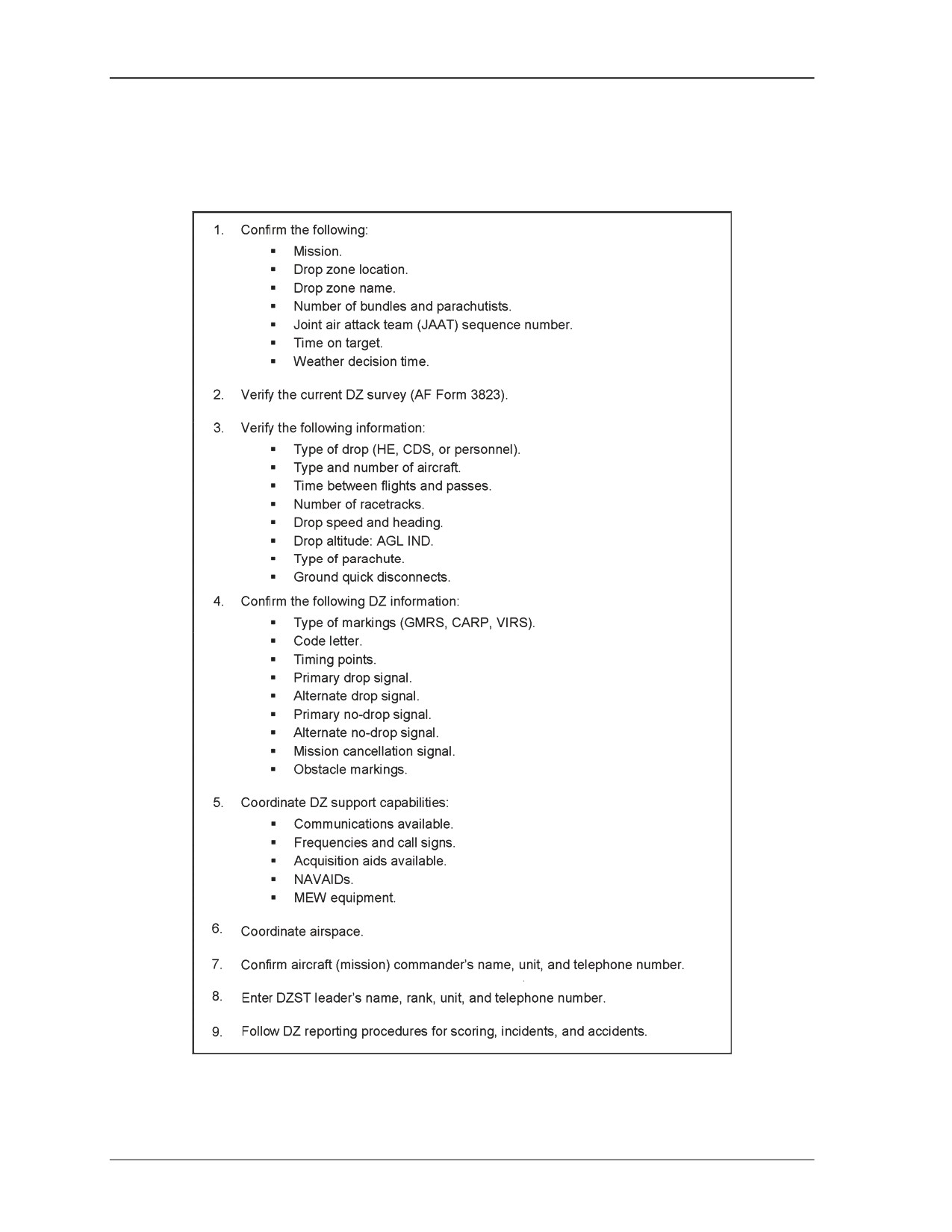
The drop zone coordination checklist provides the DZST leader with a tool for coordinating
before the mission without having to communicate with the aircraft (Figure 6-6).
Figure 6-6. Drop zone coordination checklist.
6-24
FM 3-21.38
25 April 2006
Drop Zones
SUPPORT REQUIREMENTS
6-62.
The DZSTL ensure that support requirements for the drop zone control group are coordinated and
in place no later than one hour before TOT. The two support groups are a complete support group and a
partial support group. If the drop zone is 2,100 meters or longer or 20 seconds or more in exit time, or if
more than one aircraft is executing the mission, then a complete control group must be used. If none of
these situations exist, then a partial control group may be used.
CONTROL GROUPS
6-63.
Control groups consists of--
An assistant DZSTL who is DZSTL qualified (complete control group) or not (partial control
group).
One (partial control group) or two
(complete control group) front-line-ambulance
(FLA)
qualified medical personnel for personnel drops and heavy equipment. These personnel are not
needed for CDS drops, depending on local rules and regulations.
One (partial control group) or two (complete control group) wind-measuring devices. One is
located at the control center with the DZSTL. In complete control groups, the second is located
with the assistant DZSTL at the highest location on the drop zone.
Malfunction officer with camera,who must be a qualified and current rigger IAW AR 59-4.
Parachute recovery detail with recovery kit.
Vehicles with drivers.
Road guards.
Military Police, if required to control traffic or provide crowd control.
Boat detail for PE drops only.
25 April 2006
FM 3-21.38
6-25
Chapter 6
RESCUE BOAT
6-64.
A boat detail is required for personnel drops if a water obstacle is within 1,000 meters of any edge
of the drop zone, at least 40 feet wide at the widest point, and at least 4 feet deep at its deepest point. If the
water is at least 4 feet deep, but less than 40 feet wide, a boat detail is not required. However, jumpers
must still use approved life preservers. The DZSTL may declare any body of water an obstacle based on
jumper safety.
6-65.
Units may supplement the requirements in this paragraph. When assessing DZ risk for a training
parachute jump, the commander should consider the distance from the water obstacle to the DZ and the
depth and width of the water obstacle.
6-66.
The following factors may also enter into risk assessment of a water obstacle: the bottom,
the current, the water temperature, the number of obstacles, the equipment available to reduce the risk,
jumper experience, available or artificial light, and the importance of the DZ to mission success.
Personnel
6-67.
The OIC, NCOIC, and boat operators must all be qualified and licensed to operate the boats and
the issued boat motors. Each boat needs one primary and one assistant operator and two recovery
personnel, ideally one of whom is lifeguard qualified and combat lifesaver certified. Everybody in the boat
should be a strong swimmer.
6-68.
The DZSTL must--
Determine if a follow-on assessment of the DZ has been conducted to confirm the
current status.
Ensure the OIC or NCOIC is fully briefed on the plan. Ensure all boat detail personnel have
been trained and have all necessary equipment available to conduct the mission.
Read all applicable regulations, FMs, and SOPs. Ensure copies are available throughout the
mission.
6-69.
The Jumpmaster must-
Ensure that, if approved life preservers are used, they have been inspected within the last 180
days and are serviceable.
Ensure that all jumpers have received training on life preserver wear, fit, and use (to include
manual inflation).
Ensure all personnel have received prejump training within the 24 hours before drop time, with
special emphasis on unintentional water landings.
Time Requirements
6-70.
The OIC or NCOIC ensures that at least two boats must be in place one hour before TOT. At least
10 minutes before TOT, both boats must be in the water with their engines running. Otherwise, a no-drop
situation exists.
Communications
6-71.
Two-way communications with the DZSTL must be established at least an hour before TOT, and
maintained throughout the jump operation.
6-26
FM 3-21.38
25 April 2006
Drop Zones
Coverage
6-72.
To ensure that the entire obstacle is accessible to the boat detail, each water obstacle might require
a different type of coverage.
Equipment
6-73.
Each recovery boat team needs the following equipment:
A rubber boat (RB-10) or solid-bodied boat of comparable size, with operable outboard motor.
Enough fuel and oil to complete the mission.
Life vest or other floatation device for each boat detail member, and as many extras as they can
carry for jumpers who might not already be wearing a B5 or B7 flotation device (water wings).
One life ring with attached rope.
One FM and one handheld radio, each with spare battery.
One each shepherd’s crook and grappling hook.
One long backboard for CPR.
One aid bag with resuscitation equipment.
One 120-foot long rope and four sling ropes with end-of-line bowlines and snap links.
y Four paddles.
6-74.
For night operations, add the following:
Two operational night vision devices with two sets of batteries.
One spot light.
Note: Jumpers wearing B5s or B7s need no life jackets.
BASIC EQUIPMENT LIST
6-75.
The DZSTL should maintain an inventory of the following basic equipment to support
the mission:
VS-17 panels.
Smoke grenades or flares.
White lights such as an M-2 light baton.
Air traffic control light (B-2).
Signal mirror.
Strobe light.
Binoculars.
Anemometer required for personnel and heavy equipment drops, recommended for measuring
the wind before all types of drop.
Compass.
PIBAL kit with helium.
Night vision goggles, for night drops.
Other equipment as needed, based on premission coordination or unit SOP.
DUTIES OF THE LEADER
6-76.
The DZST leader establishes and operates the DZ. He selects the locations of the control center,
PI, and release point. He bears the ultimate responsibility for accomplishing the mission. Specifically,
the leader—
25 April 2006
FM 3-21.38
6-27
Chapter 6
Makes sure the DZ reaches full operational status one hour before drop time.
Conducts premission coordination.
Opens the DZ through range control. After the mission, accounts for all personnel, air items,
and equipment, then closes the DZ.
At least one hour before the drop, reconnoiters the DZ on the ground or from the air for
obstacles or safety hazards.
Establishes communication with departure airfield control officer not later than (NLT) one hour
before drop time.
Controls all ground and air MEDEVACs.
Submits postmission reports to the appropriate agencies.
Operates all visual acquisition aids.
Ensures no-drop signals are relayed to the drop aircraft.
Ensures all DZ markings display correctly.
Establishes a ten-minute window. Ensures pathfinders continuously monitor surface winds,
starting NLT twelve minutes before time on target (TOT). This includes the ten-minute window
plus two extra minutes to relay a no-drop signal, if needed. For example, if TOT is 0700 hours,
then the ten-minute window (plus two minutes) begins at 0648 hours. If at any time during the
ten-minute window the winds exceed allowable limits, the DZST leader relays a no-drop to the
aircraft. Once he calls a no-drop, he establishes a new ten-minute window (without an extra
two minutes). For example, if the winds pick up at 0655 hours, the leader calls a no-drop. The
new ten-minute window counts from the time of the no-drop and extends to the new TOT ten
minutes after that, at 0705 hours.
Takes surface wind readings from the control center location and from the highest point of
elevation on the DZ when the DZ is 2,100 meters in length or longer, when exit time is 20
seconds or more, or for a multiple aircraft operation.
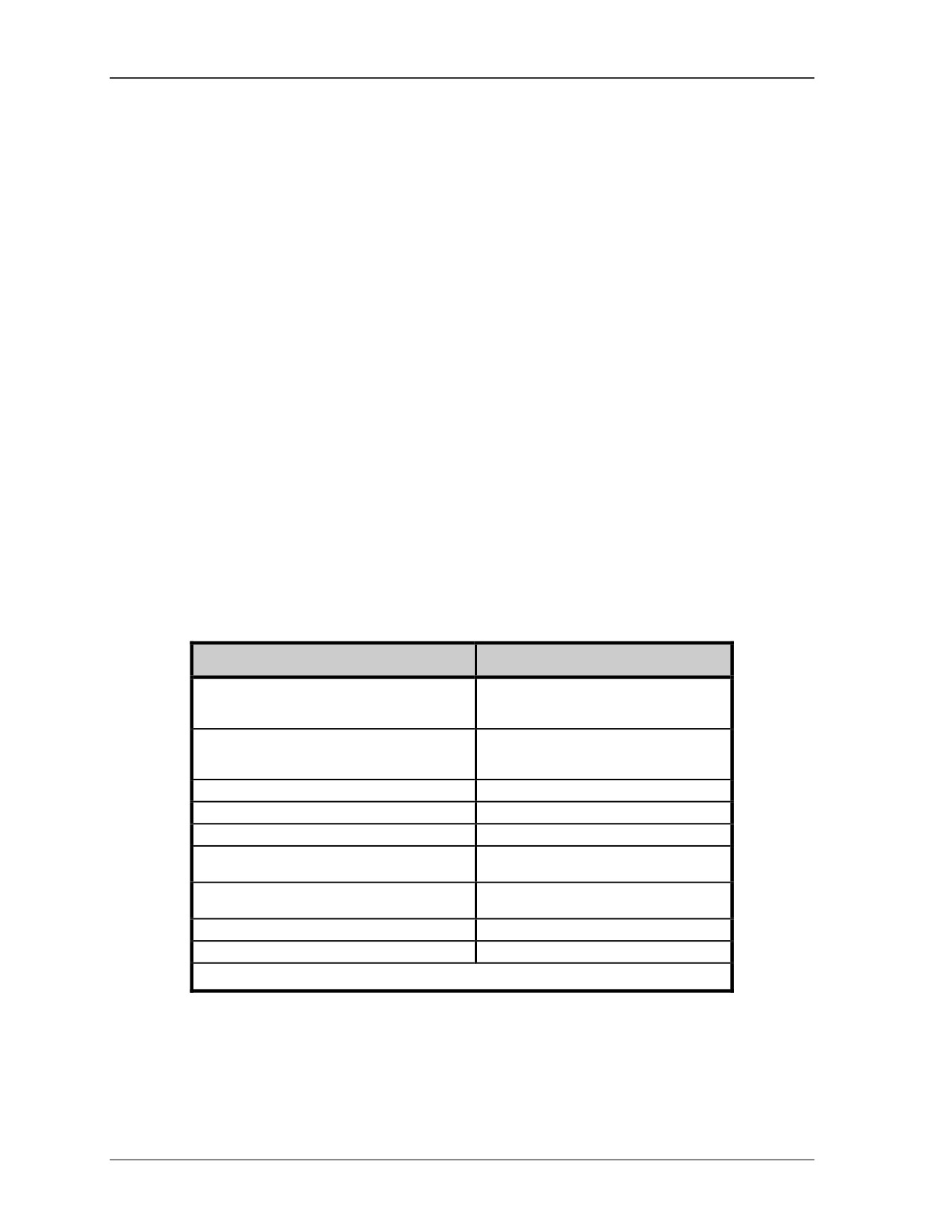
Calls a no-drop when surface winds exceed the limits shown in Table 6-10.
Type Of Load
Surface Wind (In Knots)
Personnel
Land
13
Water
17
HALO or HAHO
Land
18
Water
20
Equipment without ground disconnects
13
Equipment with ground disconnects
17
CDS using G-12 parachutes
13
CDS or door bundles using G-13 or G-14
parachutes
20
USAF tactical training bundles and simulated
airborne training bundles
25
High-velocity CDS at HAARS
No Restrictions
Free drop
No Restrictions
For USAF personnel and additional equipment, see AFI 13-217.
Table 6-10. Surface wind limits for airdrops.
6-28
FM 3-21.38
25 April 2006
Drop Zones
CONTROL CENTER
6-77.
The DZST leader controls and observes the airborne operation from the control center.
Pathfinders also take wind readings here. The DZST leader should position all radios, signaling devices,
and appropriate forms at the control center. The type of mission determines the location of the control
center.
PERSONNEL DROPS
6-78.
Locate the control center at the PI.
CDS DROPS
6-79.
Locate the control center 200 yards to the 6 o’clock of the PI.
OTHER DROPS
6-80.
For free drops, heavy equipment, high velocity CDS, HAARS, and AWADS (ceiling less than
600 feet), locate the control center off the DZ where you can see both the approaching aircraft and the PI.
For example, the wood line might obstruct the leading edge. If so, it would not make a good control center
location for these types of drops.
ALL GMRS AND VIRS DZS
6-81.
Locate the control center at the RP.
SIGNALS
6-82.
When voice control does not work, the ground support team uses visual signals to the aircraft.
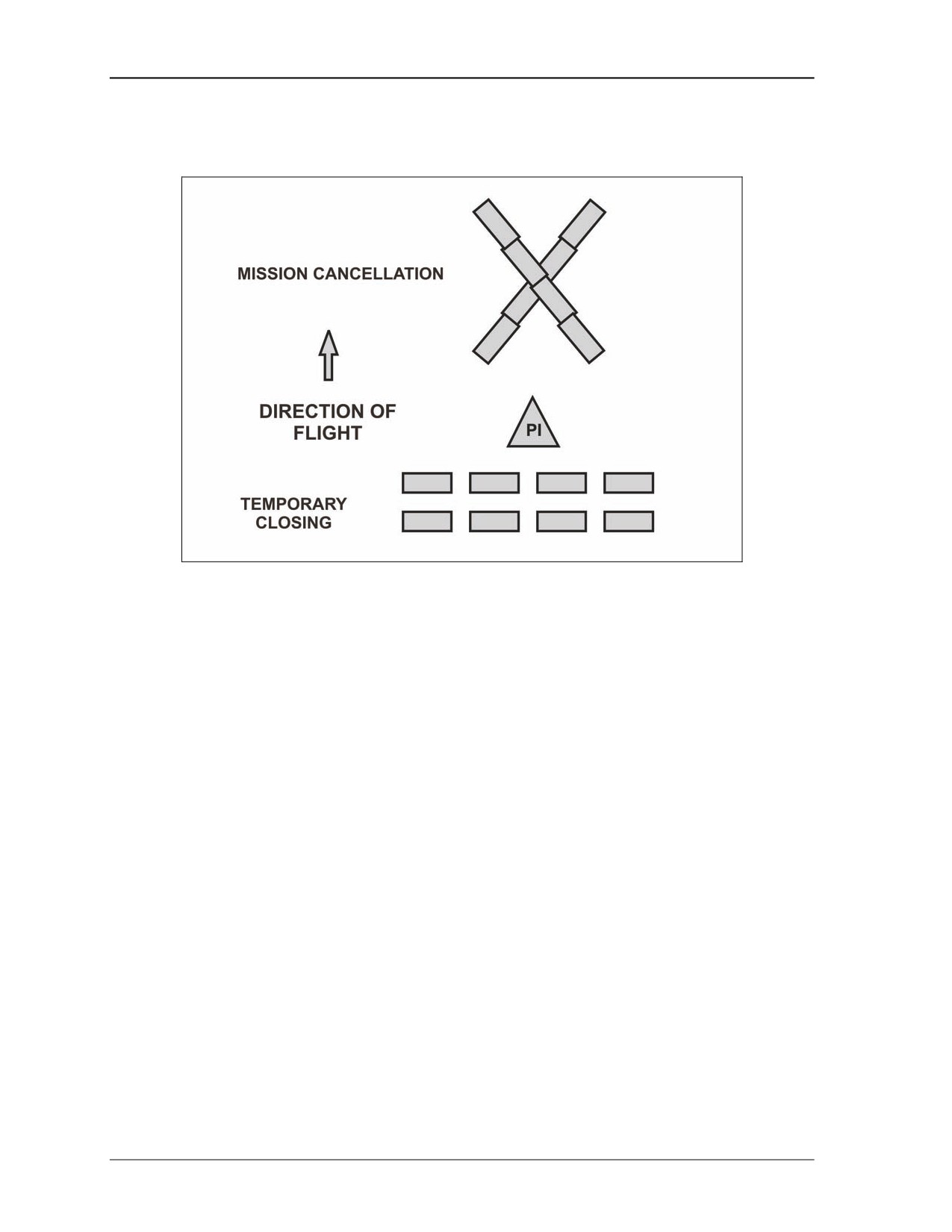
Two of the most important visual signals are no-drop and mission cancellation.
6-83.
To communicate a no-drop situation to the aircraft, scramble the shape designator and remove the
markings or any other previously coordinated DZ signal.
6-84.
The drop aircraft pilot should continue to fly racetracks if coordinated until you give the signal
indicating clear to drop. You can signal no-drop when—
Winds exceed the maximum limitations for that type of drop.
You see vehicles moving on the DZ.
Rotary wing aircraft fly in close proximity to the DZ.
You see anything else unsafe on the DZ.
6-85.
Decide in mission coordination how many no-drop passes the pilot must fly before the mission is
automatically cancelled and the pilot can begin his return to base.
6-86.
Cover signals for clear-to-drop also. You may decide to indicate clearance to drop by emplacing
DZ markings. You can also use this means if you have no smoke. If you plan to use smoke, decide what
each color of smoke will mean, but avoid using red to mean clear-to-drop.
6-87.
At night, your clear-to-drop signals could include any means coordinated in advance such as
shade-designator illumination, a flashing white light, a green light, and so on.
25 April 2006
FM 3-21.38
6-29
Chapter 6
6-88.
Multiple signals are best. For example, FM and smoke for clear-to-drop, or scrambled code letter
and FM for no-drop (Figure 6-7).
Figure 6-7. Drop zone cancellation and closing markers.
6-30
FM 3-21.38
25 April 2006
Drop Zones
DETERMINATION OF RELEASE POINT LOCATION
6-89.
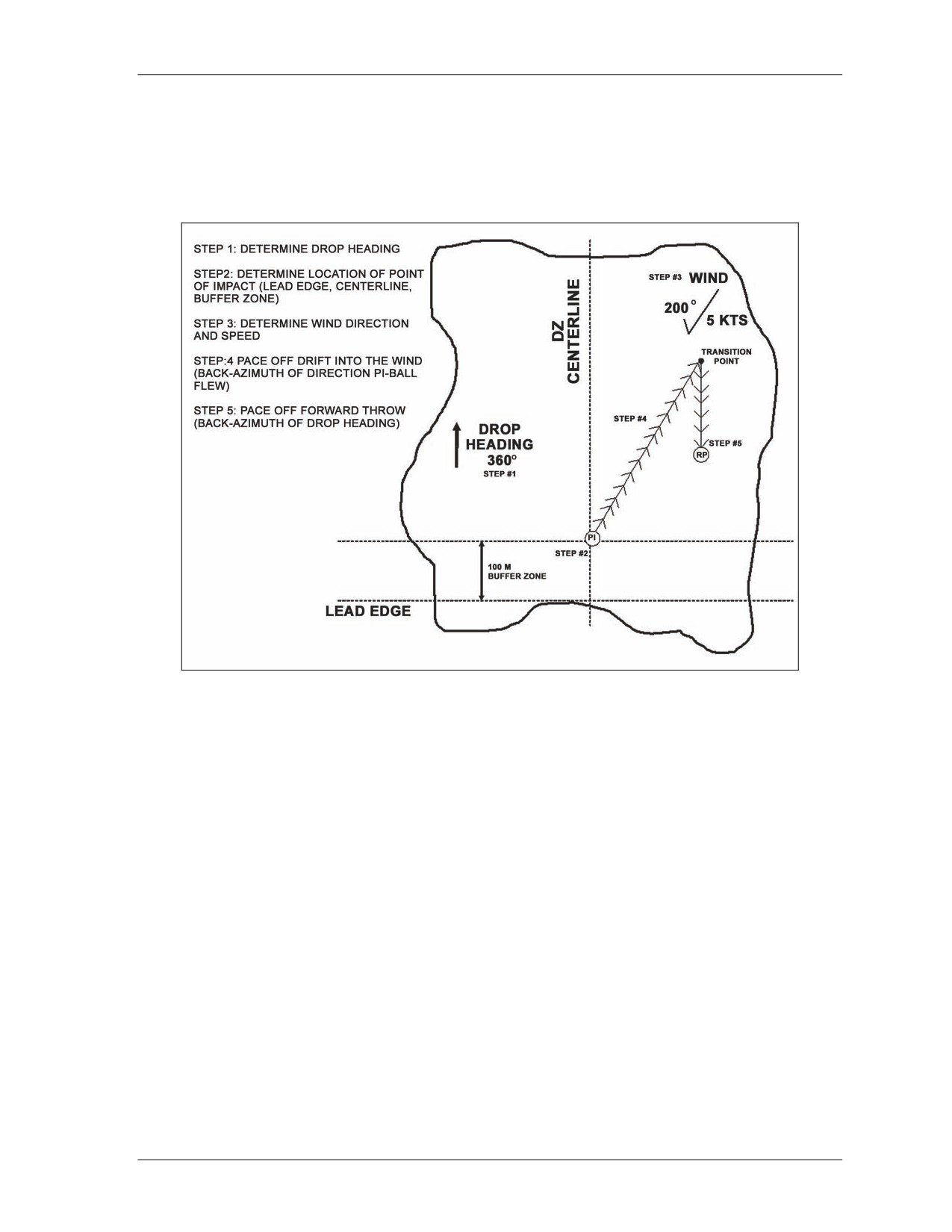
To determine a release point on a GMRS drop zone, Air Force fixed wing VIRS drop zone, or
Army rotary wing VIRS drop zone, complete the following steps (Figure 6-8):
Figure 6-8. Release point location.
STEP 1--DETERMINE DROP HEADING
6-90.
If the drop zone was surveyed and an AF IMT 3823, Drop Zone Survey, was published for the
drop zone, then the DZSTL uses the magnetic course indicated. The drop zone might have been surveyed
as a circular DZ, or a tactical assessment might have been done on it. It might be established as an ARMY
VIRS. In the latter case, the DZSTL determines the drop heading based on the long axis, wind direction,
and obstacles on the approach and departure ends of the DZ.
STEP 2--DETERMINE POINT OF IMPACT
6-91.
The PI for personnel is the centerline of the drop zone 100 meters from the leading edge. The PI
for bundles is the centerline of the DZ, but on the leading edge. These points may be adjusted forward, left
or right. For CDS and heavy equipment, the DZSTL uses the surveyed PI locations shown on the
AF IMT 3823. If a tactical assessment was done in lieu of an AF IMT 3823, he uses the standard PI
locations for CDS and heavy equipment from the CARP dummy tree.
STEP 3--DETERMINE WIND DIRECTION AND SPEED
6-92.
The DZSTL uses the PIBAL to determine the MEW. If he has no PIBAL, then he must use the
surface wind direction and speed. Once he determines the wind direction and speed, he calculates a D = K
x A x V formula for drift in meters.
25 April 2006
FM 3-21.38
6-31
Chapter 6
STEP 4--PACE OFF THE DRIFT IN METERS INTO THE WIND
6-93.
This should be the reciprocal heading of the PIBAL direction. If a PIBAL was not used, then a
field-expedient means of determining wind direction may be used. If the direction and distance of the drift
are paced into the wood line, the PI is adjusted as necessary, but only forward, left, or right.
Example:
90 knots drop speed = 45 meters forward throw.
GROUND-MARKED RELEASE SYSTEM
6-94.
The GMRS offers the DZSTL a way to identify the release point to the drop aircraft without using
a radio. The pilot uses the ground markings to adjust his flight path 100 meters to the right of the corner
panel or light, and parallel to the approach-corner panel or light axis. (This discussion uses the words
“panel” and “light” interchangeably.)
PATTERNS
6-95.
Use VS-17 panels to mark the DZ with an inverted “L,” “H,” or “T” pattern. The selected pattern
must be coordinated far in advance.
Inverted “L
6-96.
The inverted “L” has four panels:
The approach panel.
The corner panel.
The alignment panel.
The flanker panel.
“H” and “T"
6-97.
Align these other panels with and orient them on the corner panel. Due to side-angle-vision
limitations in the C-5, use the seven-panel “H” and six-panel “T” patterns.
VS-17 PANELS
6-98.
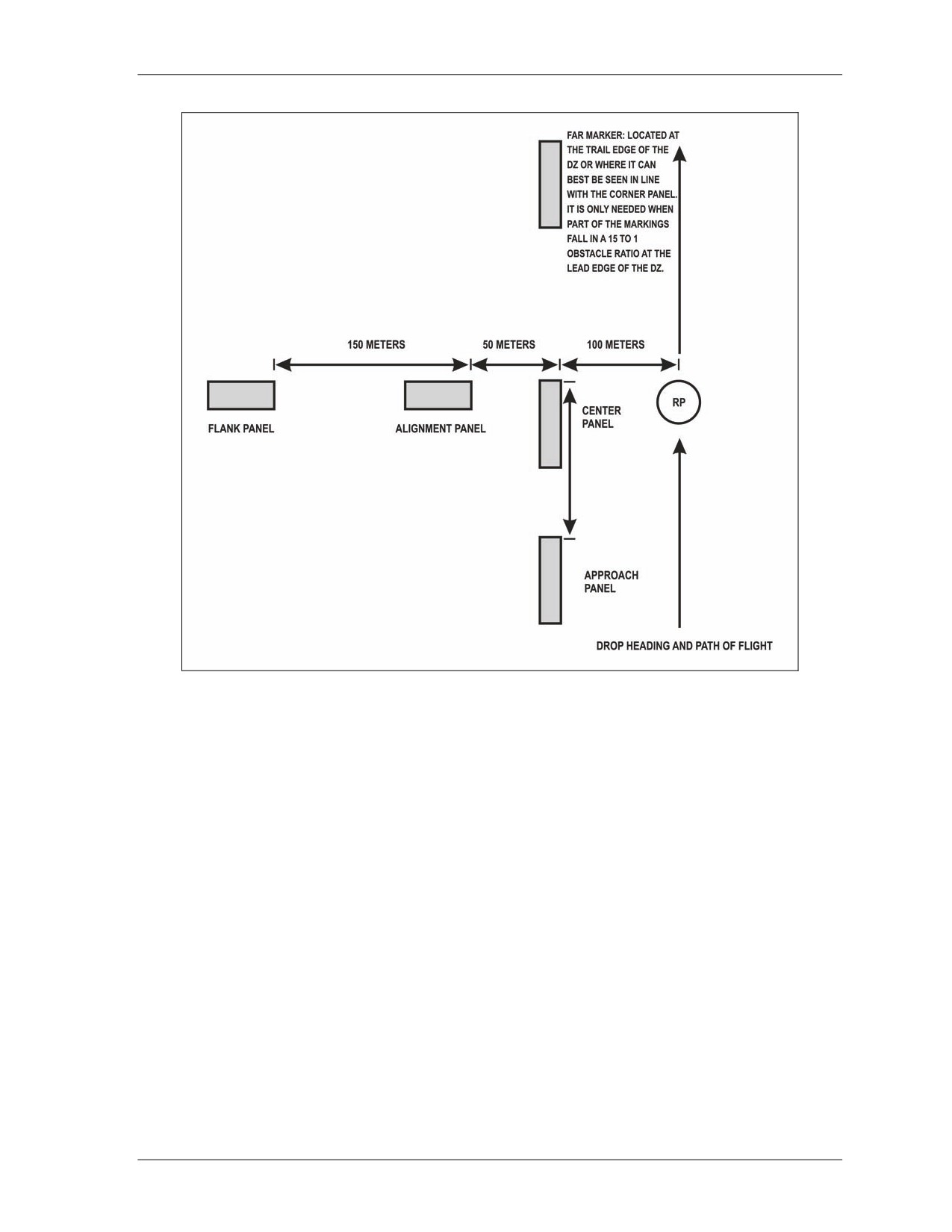
Figure 6-9 shows panel emplacement for “H” and “T” patterns (add an inverted “L” figure).
Distances and azimuths are measured from the upper right corner of each panel to the upper right corner of
the next, and from center mass of the selected RP. During daylight airdrops, the marker panels should be
raised at a 45-degree angle from the ground toward the aircraft approach path to increase the aircrew and
jumpmaster's ability to see them.
6-32
FM 3-21.38
25 April 2006
Drop Zones
Figure 6-9. Panel emplacement.
25 April 2006
FM 3-21.38
6-33
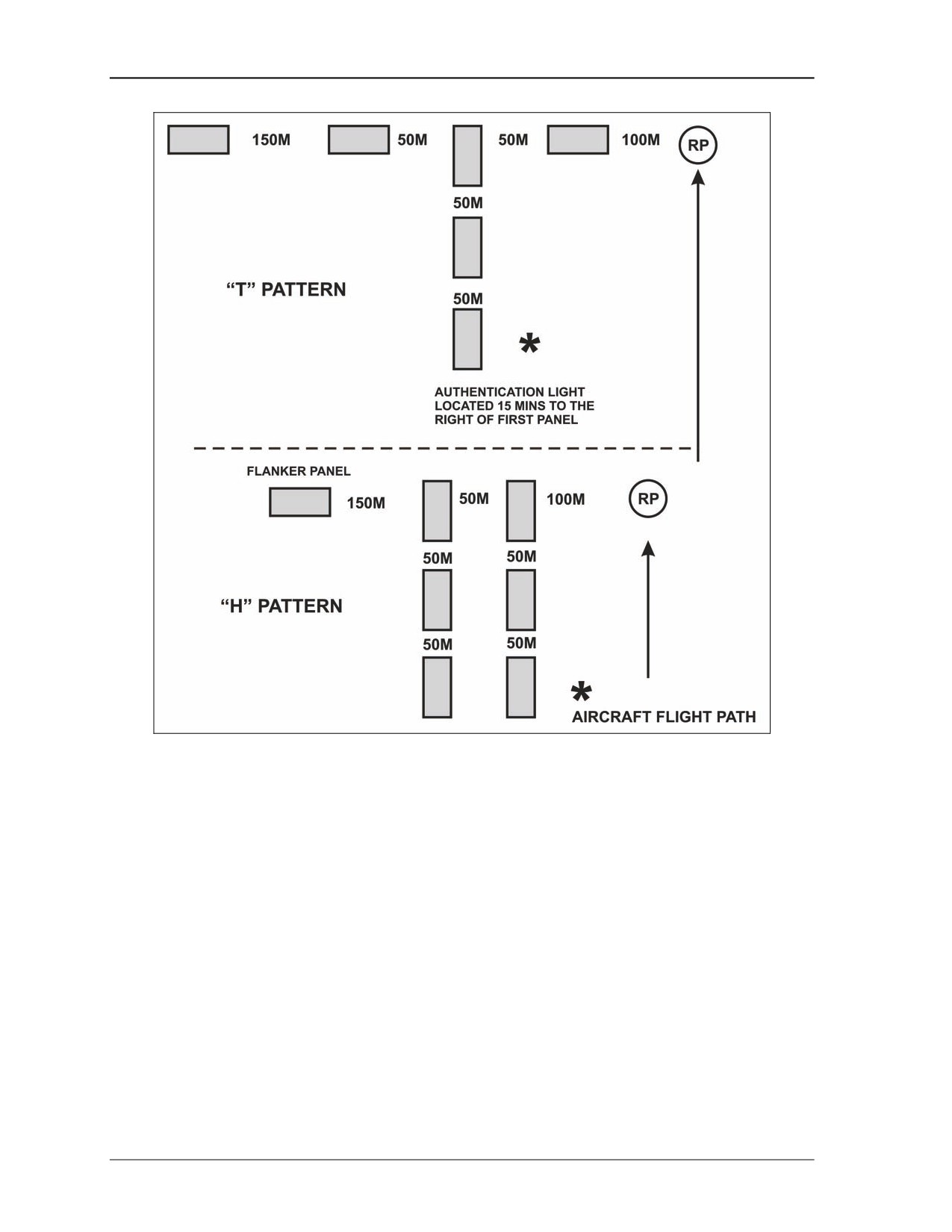
Chapter 6
Figure 6-9. Panel emplacement (continued).
Corner Panel
6-99.
Set up the corner panel 100 meters to the left of the RP (90 degrees from drop heading). Orient the
long axis of the panel so it is parallel with drop heading.
Alignment Panel
6-100. From the corner panel, move 50 meters in the same direction as above and emplace the alignment
panel. Orient the long axis of the panel so it is perpendicular (90 degrees) from drop heading.
Approach Panel
6-101. Place the approach panel 50 meters in front of the corner panel, on a back azimuth (opposite) from
the drop heading. Orient the long axis of the panel so it is parallel with drop heading.
6-34
FM 3-21.38
25 April 2006
Drop Zones
Flanker Panel
6-102. Place the flanker panel 150 meters to the left of the alignment panel, as seen from the drop
heading. Orient the long axis of the panel so it is perpendicular (90 degrees) from drop heading, and
parallel to the alignment panel.
LIGHTS
6-103. At night, replace panels with lights (use one light for each panel). Do not use chem-lights for DZ
markings. For operations requiring security, night DZ markings should be visible only from the direction
of the aircraft’s approach. If flashlights are used, they should be equipped with simple hoods or shields and
aimed toward the approaching aircraft. Omnidirectional lights, fires, or improvised flares may be screened
on three sides or placed in pits with the sides sloping toward the direction of approach. Use directional
lights for the approach, corner, alignment, and flanker. If necessary, you can use the directional light holes
for the far code letter and line up the base light with the corner light. Figure 6-10, page 6-36, provides
construction requirements for Army code letters. Mark the release point with some type of identifiable light
source to distinguish it from all other DZ markings.
25 April 2006
FM 3-21.38
6-35
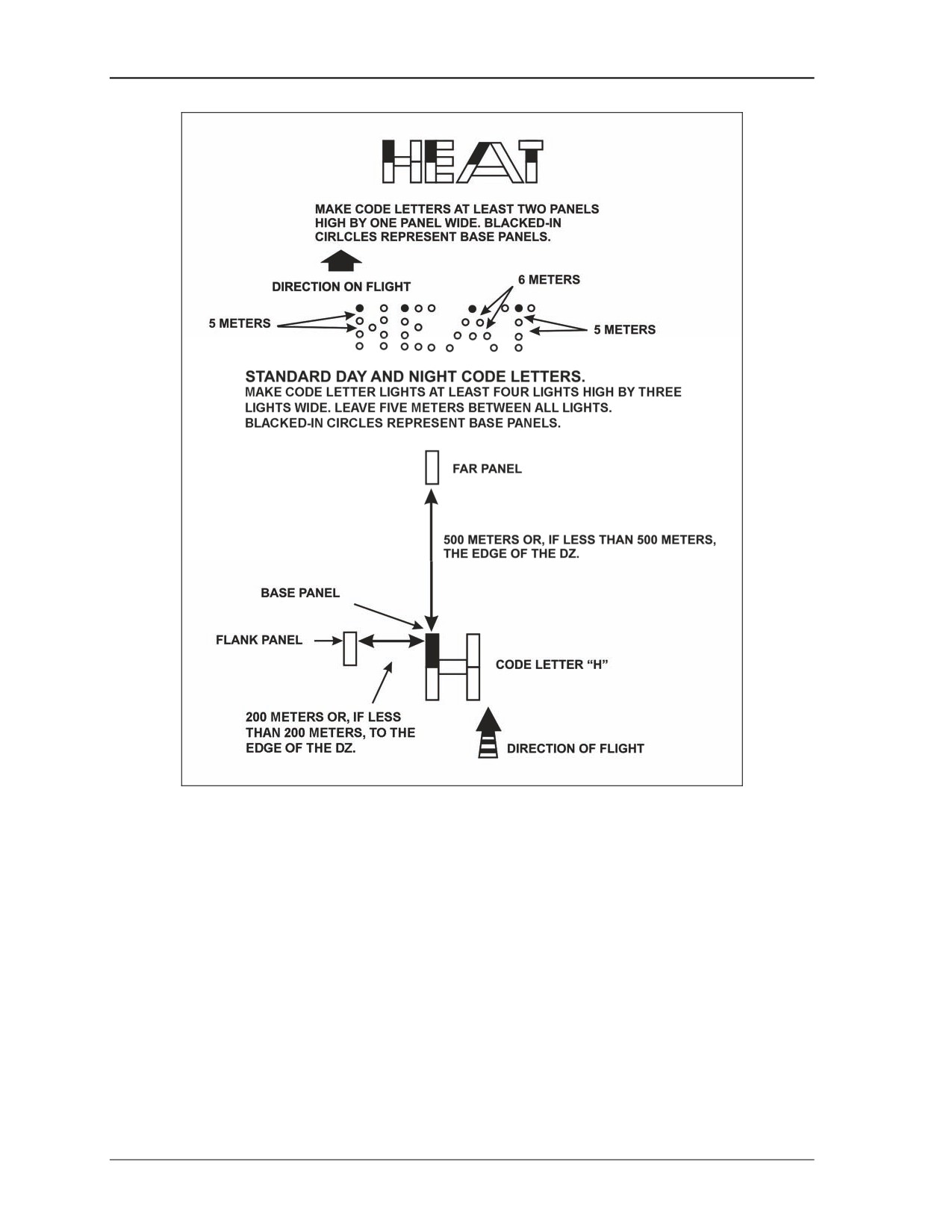
Chapter 6
Figure 6-10. Horizontal clearance and marker construction.
MARKING CONSIDERATIONS
6-104. Place the markings where obstacles will not mask the pilot’s line of sight. The DZ markings must
be clearly visible to the aircrew on approach as early as possible. If conditions preclude placing the
markings at the computed point, the DZSTL may have to adjust the location of the intended PI, ensuring
the new PI location complies with the requirements for the type of airdrop. Advise both the aircrew and
user of the change in PI location. As a guide, use a mask clearance ratio of 1 to 15 units of horizontal
clearance. For example, suppose you must position a DZ marker near a terrain mask, such as the edge of a
forest on the DZ approach. The trees measure 10 meters (33 feet) high. The markings would require 150
meters (492 feet) of horizontal clearance from the trees (Figure 6-11).
6-36
FM 3-21.38
25 April 2006
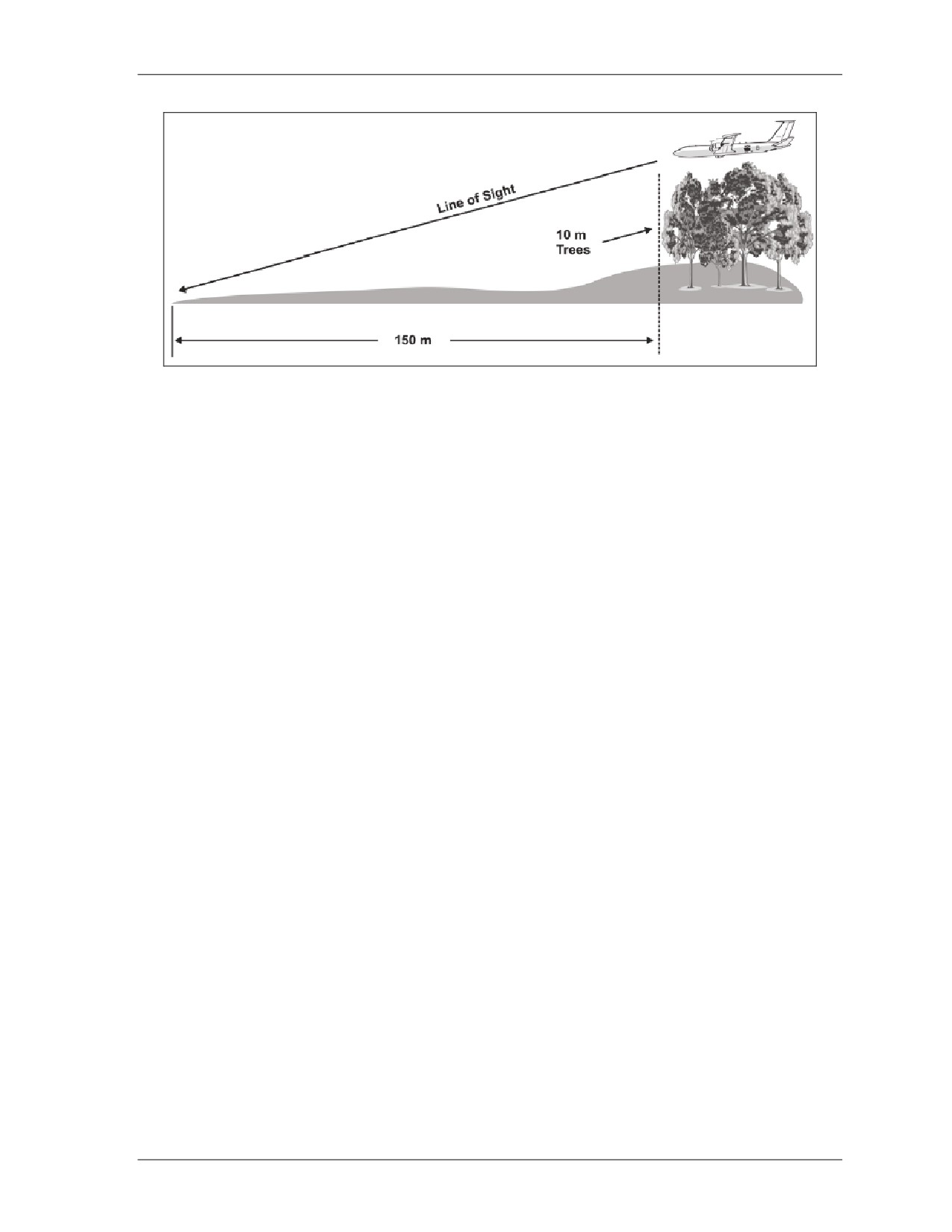
Drop Zones
Figure 6-11. The 15-to-1 mask clearance ratio.
6-105. If any of the GMRS markings fall within a 15-to-1 mask clearance ratio on the approach end of
the drop zone, and it is not feasible to adjust the selected PI, you can place an Army code letter (H, E, A, T)
or a far (marker) panel on the trailing edge of the DZ. However, before doing so, you must coordinate this
during either the DZST or aircrew mission briefing. Using a code letter will distinguish this DZ from other
DZs in the area. The code letter is located at the end of the DZ or where the pilot can see it best, and
aligned with the corner and approach panel, parallel to drop heading.
6-106. During daylight airdrops, the marker panels should be slanted at a 45-degree angle from the
surface toward the aircraft approach path to increase the aircrew and jumpmaster's ability to see them. If
security permits, smoke (other than red) may be displayed at the release point or corner marker to assist in
DZ acquisition.
ARMY VERBALLY INITIATED RELEASE SYSTEM
6-107. The Army VIRS method establishes the release point on the DZ through radio communications. If
tactically feasible, a code letter can mark the RP. However, the aircraft initiates the drop on verbal
command from the ground.
6-108. Emplace a standard Army code letter with VS-17 panels (for daytime operations) at the release
point. Position the base panel of this code letter exactly on the RP. Use code letter H, E, A, or T. Make the
letter at least two panels high by one panel wide (Figure 6-12, page 6-38).
25 April 2006
FM 3-21.38
6-37
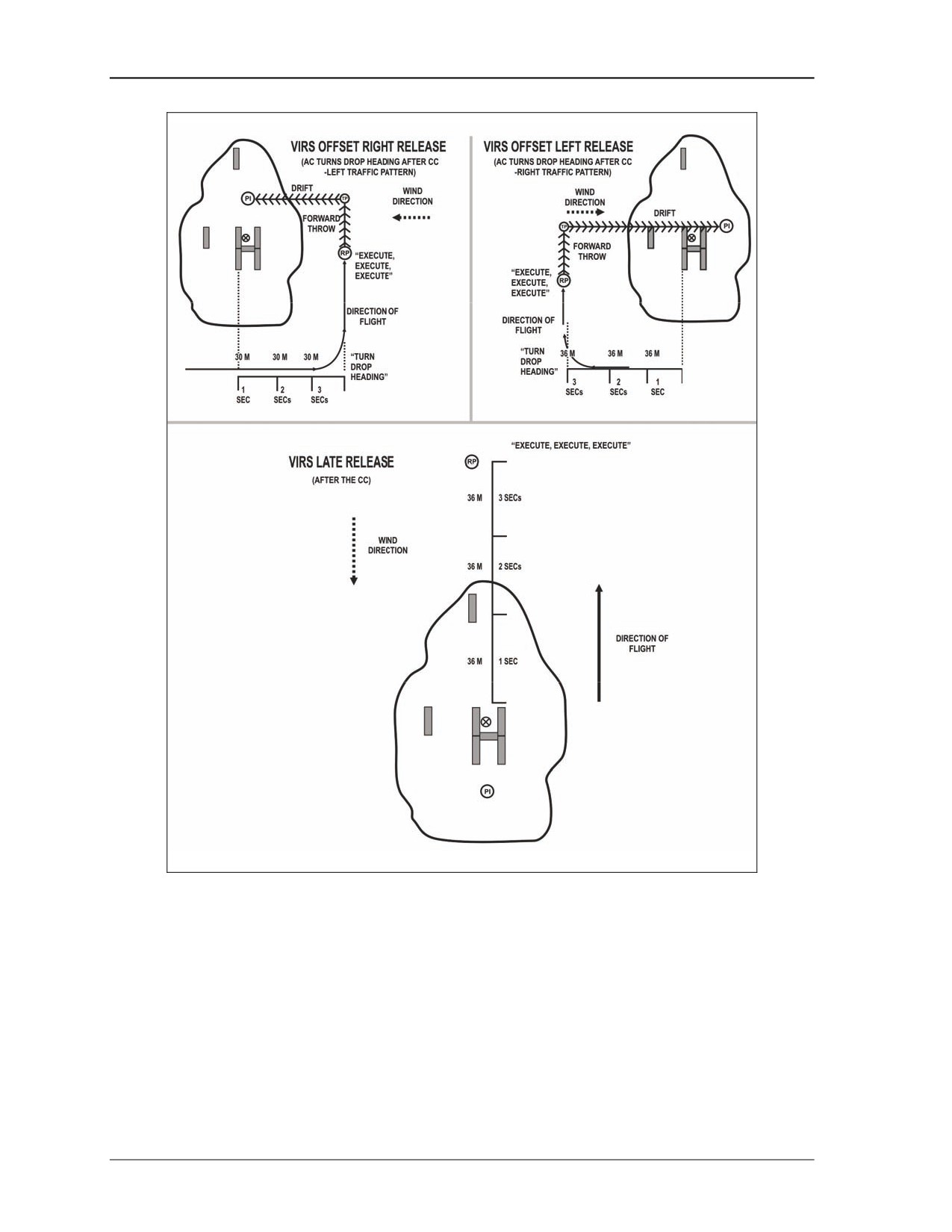
Chapter 6
Figure 6-12. Example Army VIRS offset.
6-109. Emplace a flank panel to the left of a code letter at a distance of 200 meters or on the edge of the
DZ, whichever is closer. Emplace a far panel 500 meters from the code letter along the drop heading or at
the end of the DZ, whichever is closer. Position each panel with its long axis parallel to the drop heading
and raised 45 degrees back toward the code letter. The DZSTL and radio operator position themselves at
the release point.
6-38
FM 3-21.38
25 April 2006
Drop Zones
6-110. At night, replace the panels with lights. Make the code letter at least four lights high by three
lights wide, with 5 meters between each light. To limit ground observation, you may place the code letter,
flank, and far light in holes as follows:
Place the code letter and far light in directional holes.
Place the flank light in a bidirectional hole (toward RP and direction of aircraft approach).
If the RP falls off the DZ, hide the markings, or if the DZSTL cannot see the aircraft, he can
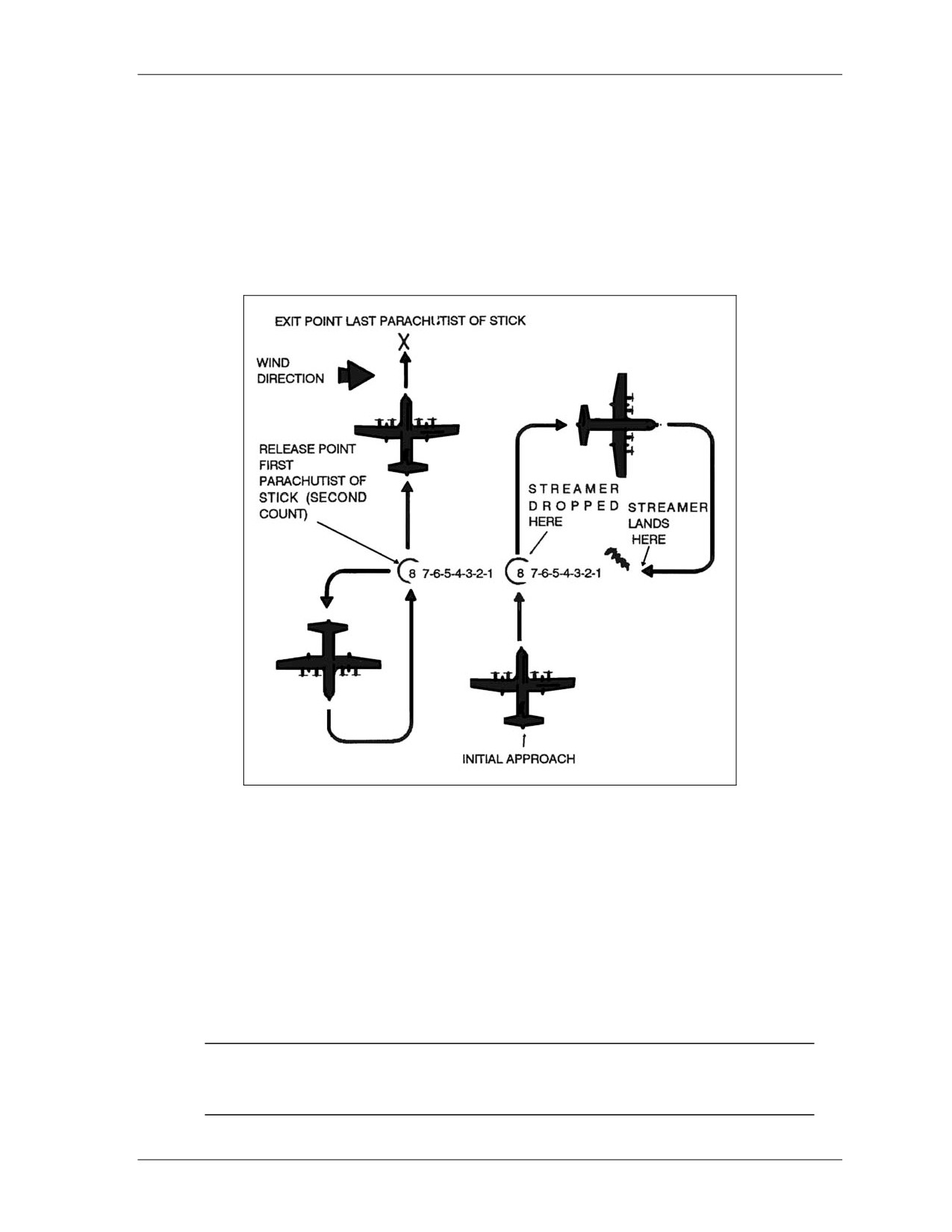
change the parachute drop to a jumpmaster-directed release operation using the wind streamer
vector count (Figure 6-13).
Figure 6-13. Wind streamer vector count.
If the RP falls off the DZ and the DZSTL cannot, due to the tactical situation, position himself
at the RP, then he can conduct an offset release (late, left, or right). To do this, he determines
how many seconds the aircraft must fly past him before initiating the release. He gives the
aircraft steering corrections to fly over the RP, just as in a standard VIRS. However, when the
aircraft has flown a set distance past the control center, the Pathfinder commands the pilot to
"turn drop heading" or “execute.” In Figure 6-14, the drop speed is 70 KIAS. The RP falls
about 80 meters off the DZ, and the old and new control centers are 118 meters apart.
Multiplying 70 KIAS by .51 equals 36 meters per second of flight. The 3 second offset places
the RP about 118 meters from the control center or code letter. The DZSTL, code letter, and
control center are positioned on the DZ at a distance from the RP that is rounded off to the
nearest second.
Note: These same procedures may be used when the tactical situation prevents the pathfinder
from positioning himself on the release point, but he must remain in a concealed location and
call the VIRS drop offset from his position.
25 April 2006
FM 3-21.38
6-39
Chapter 6
AIR FORCE VERBALLY INITIATED RELEASE SYSTEM
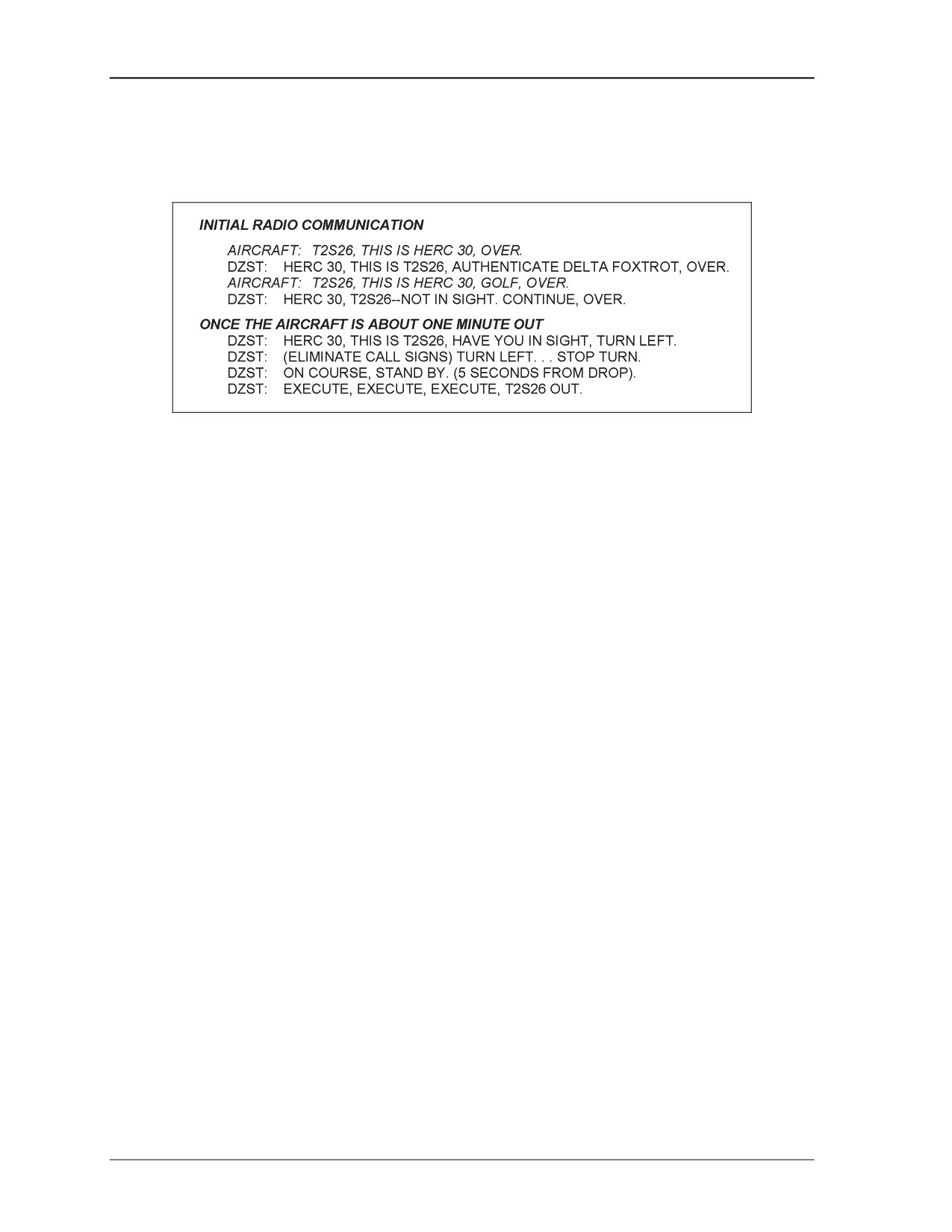
6-111. When using USAF VIRS, the DZST leader verbally guides the pilot over the RP to align the
aircraft for the drop. Figure 6-14 shows an example USAF VIRS transmission.
Figure 6-14. Example USAF VIRS transmission.
6-112. The leader uses this method when the tactical situation prevents use of regular markings or when
aircraft pilots could not see regular markings from the air.
6-113. He establishes the VIRS DZ just as he would establish a GMRS or rotary-wing VIRS release
point. (Figure 6-8, page 6-30, shows how to determine the location of the release point.) Unlike those
release points, however, the USAF VIRS DZ RP requires no markings.
6-114. The leader sets up communications with the drop aircraft and at least two FM, VHF, and UHF
radios on the DZ.
6-115. He transmits concise instructions to the aircraft. To align the aircraft on the desired inbound
heading, he gives left and right turns. When the aircraft lines up on course, the pathfinder signals STOP
TURN. About five seconds before the release, or at some other moment
(as briefed), he signals
STANDBY.
6-116. When the aircraft reaches the predetermined release point, the pathfinder leader gives an
EXECUTE three times.
6-117. When transmitting the MEW to the aircraft, he makes sure to identify it as such. He states the
altitude used to obtain it. He also provides pertinent details about any erratic winds or wind shears reported
by other aircraft.
AIR FORCE COMPUTED AIR RELEASE POINT
6-118. The DZST leader and DZ party mark the point of impact on a surveyed DZ. The aircraft navigator
computes the release point from the air.
COORDINATION
6-119. Coordinate authentication markings with the aircrew.
CODE LETTER ELEVATION
6-120. Never elevate the panels in the code letter.
6-40
FM 3-21.38
25 April 2006
Drop Zones
PERSONNEL BUFFER ZONE
6-121. There is a minimum buffer of 300 yards on the lead, left, and right sides of the DZ, and minimum
buffer of 200 yards on the trail edge of the DZ.
MARKERS
6-122. Markers differ for day and night.
Day Operations
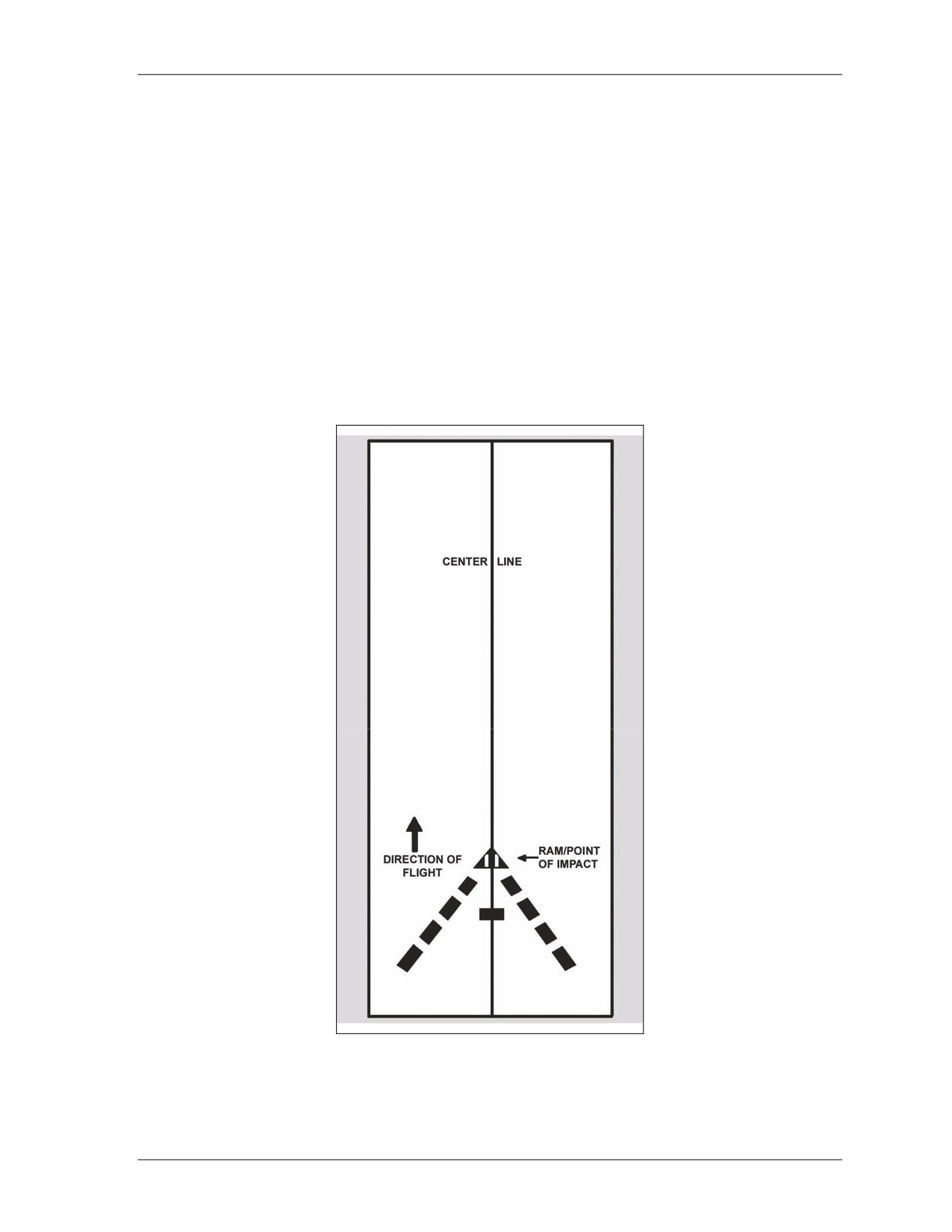
6-123. For day operations (Figure 6-15), pathfinders mark the point of impact with a RAM (Figure 6-5,
page 6-20) and an Air Force code letter
(optional), which could be a "J," "C," "A," "R," or "S"
(Figure 6-16). This applies to rectangular drop zones. They use "H" or "O" for circular drop zones. Each
letter must measure at least 35-feet square, and requires at least nine panels flat on the ground.
Figure 6-15. Drop zone placement (day).
25 April 2006
FM 3-21.38
6-41

Chapter 6
Figure 6-16. Code letters.
Night Operations
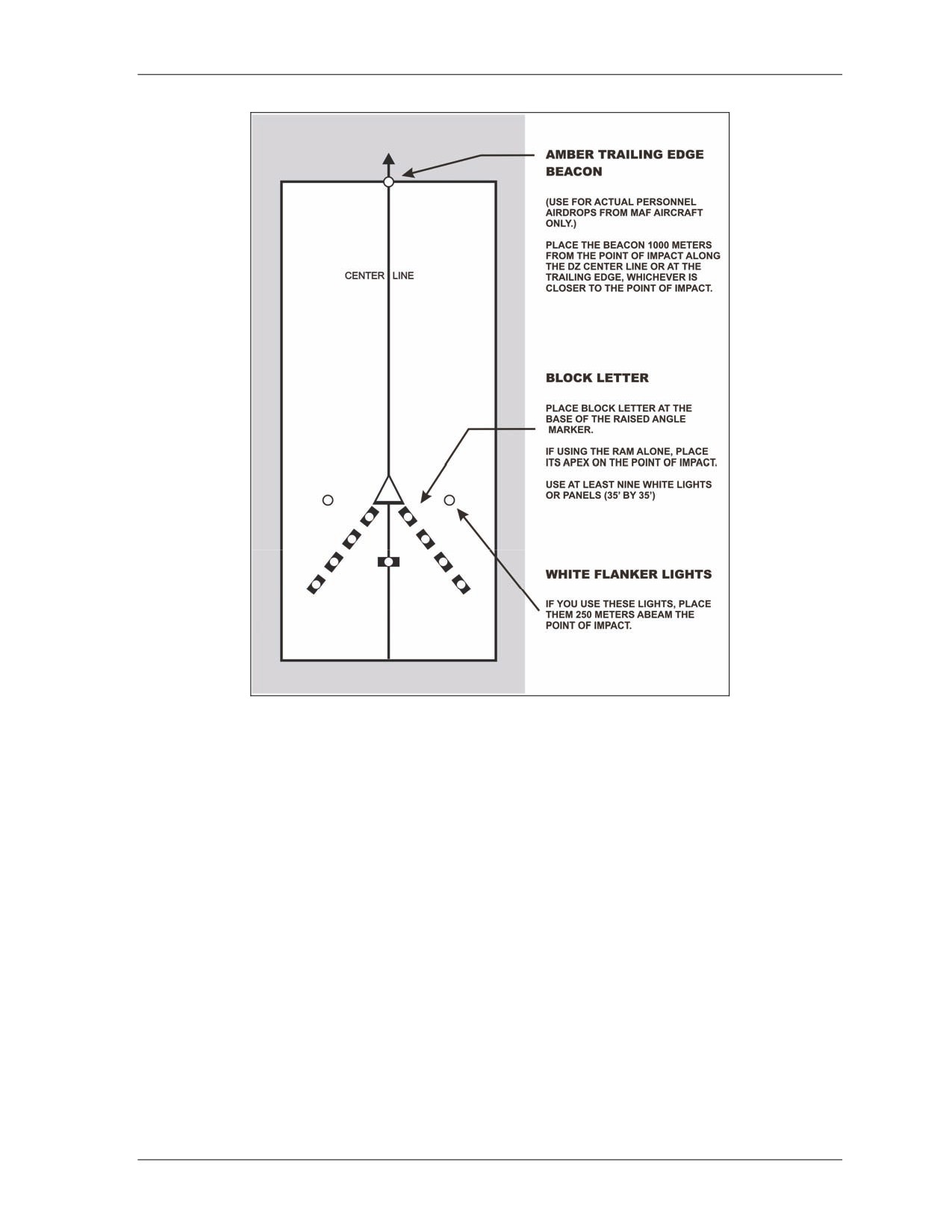
6-124. For night operations (Figure 6-17), mark the point of impact with—
A code letter (made of at least nine lights) placed at the point of impact.
One flanker light placed 250 meters to the left and right of the point of impact. If terrain
restricts the light placement to less than 250 meters, the aircrew will be briefed.
A trailing edge amber light placed 1,000 meters, centerline, from the shape designator at the PI
or at the trailing edge of the surveyed DZ, whichever is closer to the PI (optional). Usually, an
amber rotating beacon is used.
6-42
FM 3-21.38
25 April 2006
Drop Zones
Figure 6-17. Drop zone placement (night).
AUTHENTICATION
6-125. Authentication varies for day and night operations.
Day Operations
6-126. During day operations, the DZSTL may authenticate or identify different sites by specifying drop
times, drop headings, or alternating panel colors, or whatever he coordinates.
Night Operations
6-127. During night operations, the DZSTL may authenticate or identify different sites by replacing one
light in the code letter with any color light except white.
OTHER FORMS OF CARP ZONES
6-128. Some other forms of CARP drop zones are random approach, area, and cicular drop zones. The
GUC may also choose to place the point of impact randomly to better serve the mission.
25 April 2006
FM 3-21.38
6-43
Chapter 6
RANDOM APPROACH DROP ZONE
6-129. A random approach DZ is a variation of a previously surveyed DZ. It must be big enough for
multiple run-in headings. Any axis of approach may be used as long as the resulting DZ meets the
minimum criteria for the load or personnel being airdropped, and as long as it is within the boundaries of
the original, surveyed DZ. In all cases, the DZSTL performs a safety-of-flight review before using a
random approach DZ.
AREA DROP ZONE
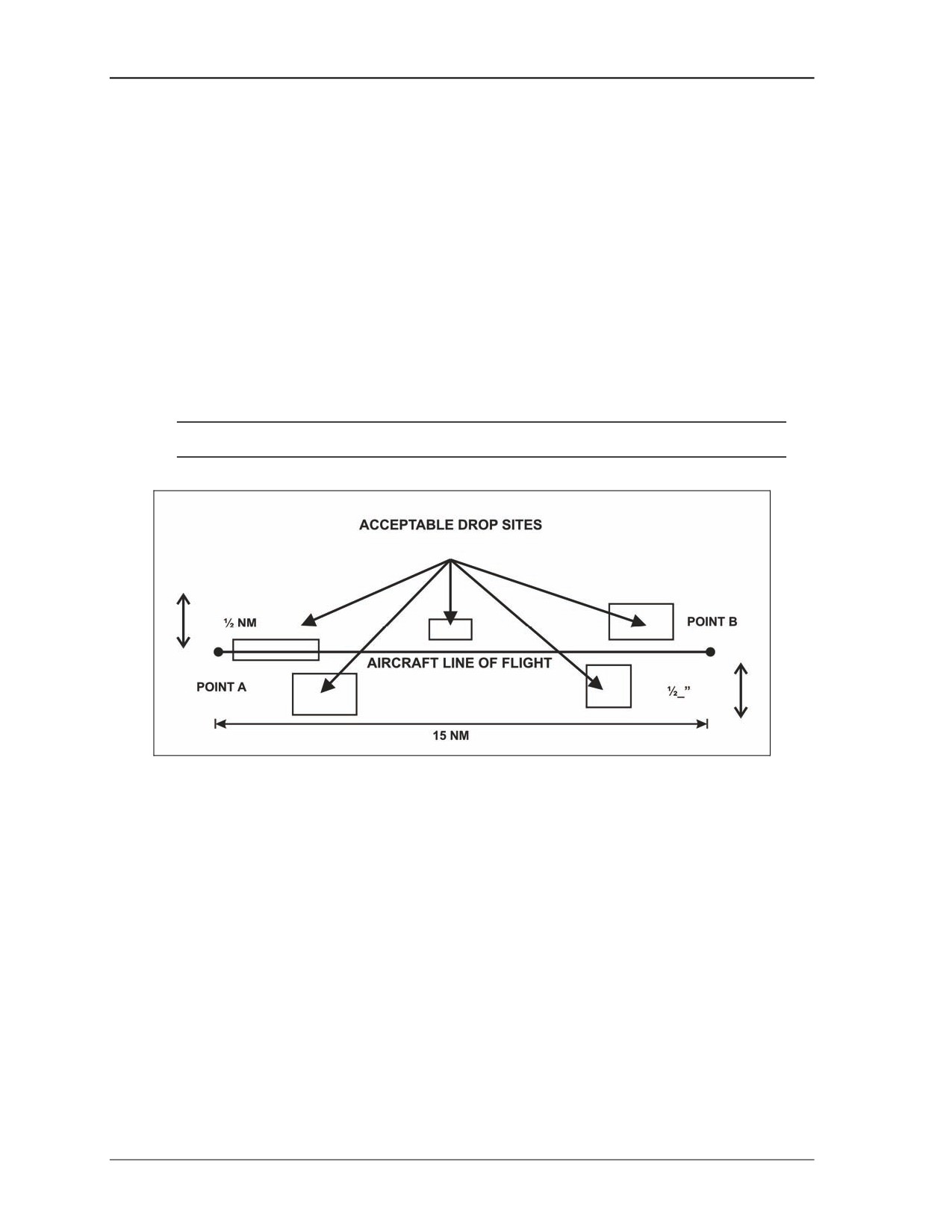
6-130. An area DZ (Figure 6-18) has a start point (A), an endpoint (B), and a prearranged flight path
(line-of-flight) over a series of acceptable drop sites between A and B. The distance between A and B is no
more than 15 nautical miles. Changes in ground elevation within one-half NM of centerline should be no
more than 300 feet. The reception committee can receive the drop anywhere between A and B within
one-half NM of centerline. Once the pilot identifies and locates the prebriefed signal or electronic
NAVAID, he can make the drop.
Note: Area DZs only apply to C-17 operations when crews are SOLL II qualified.
Figure 6-18. Area drop zone.
CIRCULAR DROP ZONE
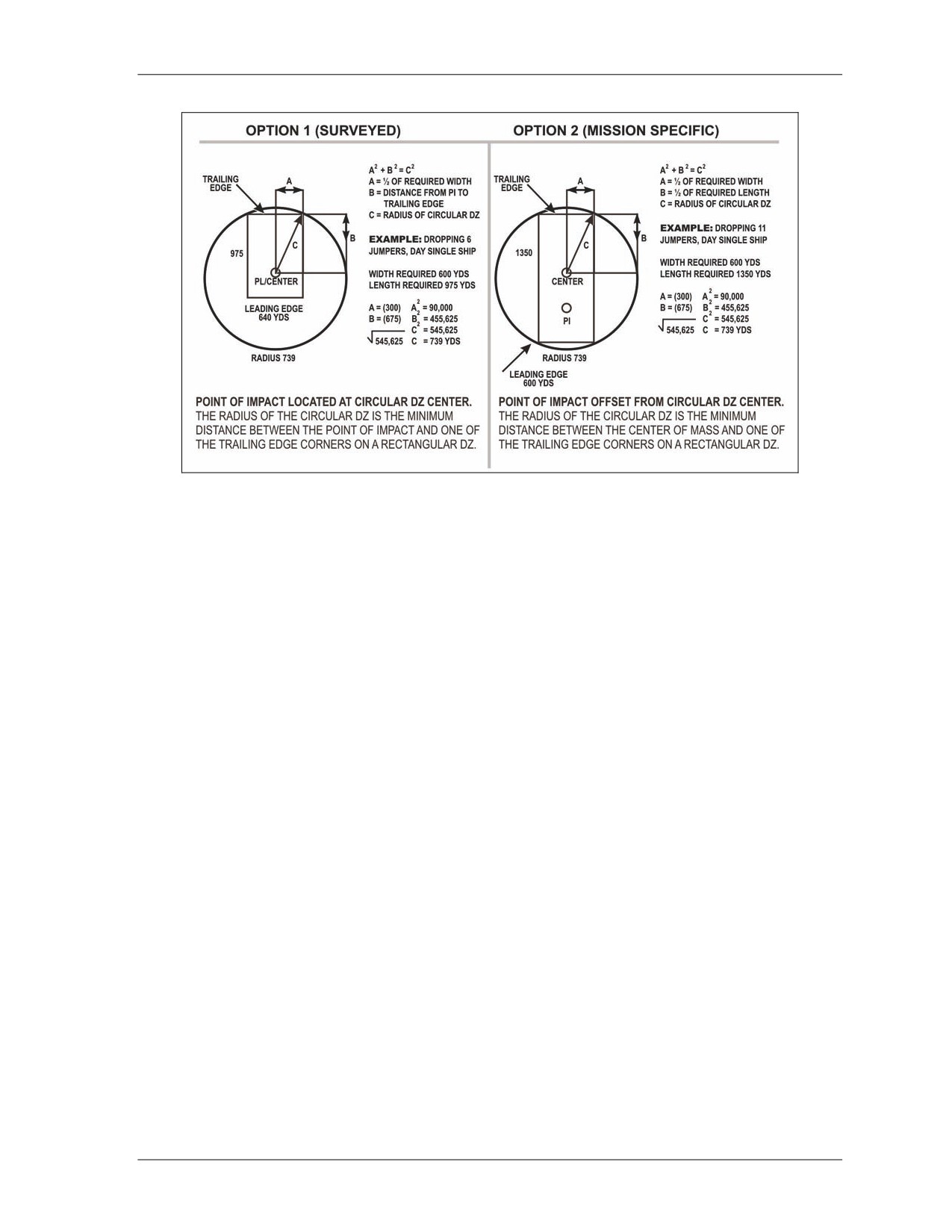
6-131. The size of the DZ is governed by mission requirements and usable terrain. The PI of a circular
DZ is normally at the DZ center to allow for multiple run-in headings. For specific missions, the PI
location may be adjusted to allow for dropping loads such as sequential heavy equipment (HE) loads or
mass container delivery system (CDS) loads on circular DZs. However, this limits the run-in heading to
only one direction. In all cases, the minimum DZ dimensions for the type and number of loads being
dropped must fit within the surveyed circular DZ. The DSZTL computes the circular drop zone as shown
in Figure 6-19 to determine whether the minimum DZ fits into the surveyed circular DZ. When the PI has
been relocated, he should use Option 2. The DZSTL calculates and records the size of the circular DZ
using Option 1 on the DZ survey form. This prevents confusion and reduces the risk of off-DZ drops if the
circle center point is used as the PI.
6-44
FM 3-21.38
25 April 2006
Drop Zones
Figure 6-19. Computation of circular drop zone.
RANDOM POINTS OF IMPACT
6-132. When mission requirements dictate, the DZSTL may use the RPI placement option. He has two
options:
Option 1
6-133. The mission commander notifies the DZSTL at least 24 hours in advance that RPI placement will
be used. When the DZ is established, the DZSTL randomly selects a point on the DZ and establishes that
point as the PI for the airdrop. The DZSTL ensures that the DZ meets the minimum size requirements for
the type of load and that the entire DZ falls within the surveyed boundaries.
Option 2
6-134. The mission commander or supported force commander may request the DZ established with the
PI at a specific point on the DZ. Requests should be made at least 24 hours in advance. The requestor
ensures that the DZ meets minimum size criteria for the type of load, and that the entire DZ falls within the
surveyed boundaries.
MULTIPLE POINTS OF IMPACT
6-135. An MPI airdrop is authorized if everyone involved has been properly briefed. An MPI airdrop is
the calculated dispersal, both laterally and longitudinally, of airdropped loads to predetermined locations
on a DZ. The DZ must meet the minimum size requirements for each PI, and the DZSTL must provide the
precise location of each PI to the aircrews. Offset PIs are surveyed PIs 250 yards left and right of the
surveyed PI. The DZ width must be increased to meet the distance criteria from the DZ edge to the PI. This
manner of placement reduces the effects of wake turbulence across the DZ.
25 April 2006
FM 3-21.38
6-45

Chapter 6
Note: Personnel airdrops from C-17s in formation may require offset (laterally displaced) points
of impact.
ASSAULT ZONE AVAILABILITY REPORT
6-136. The Zone Availability Report (ZAR) is a consolidated list of DZs and LZs maintained by HQ
AMC for use by DoD aircraft. The direction and guidance for DZ and LZ operations is AFI 13-217. The
ZAR currently contains both CONUS and OCONUS surveys forwarded by the owning command.
Overseas zones are not controlled by AMC, but will be included, as they are also forwarded by the owning
commands.
6-137. To request survey of a new or existing zone, the commander contacts 720th STG/DOO, Hurlburt
Field FL (DSN 579-6055). He should send new or updated DZ surveys to his nearest wing/group tactics
office for a safety of flight review. He forwards completed DZ, LZ, and HLZ surveys to HQ AMC/DOKT
for inclusion in the ZAR.
6-138. To obtain a completed survey, he can use the fax-on demand system at Scott AFB, IL
(DSN 576-2899), (Com (618) 256-2899). The Internet site available for military (.mil) users is located at
https://amc.scott.af.mil/do/dok/zar.htm.
Purpose
Address
Phone
Internet
To request a survey of a new
720th STG/DOO,
DSN 579-6055
NA
or existing zone
Hurlburt Field FL
To submit or obtain a
HQ AMC/DOKT, 402
DSN 576-2899
completed survey
Scott Drive, Unit
COM 618 256-2899
(.mil users only)
3A1, Scott AFB, IL
62225-5302
AF IMT 3823, DROP ZONE SURVEY
6-139. A drop zone survey is required for airborne operations. The two types of surveys are tactical and
existing surveyed drop zones. Completing a DZ survey requires a physical inspection of the DZ and
documentation of findings on AF IMT 3823. The using unit may complete the survey. The using unit is the
one whose equipment or personnel is being airdropped. For exercises and joint training operations, users
complete the survey and ensure the DZ meets the criteria for operational and safety standards. The user
physically inspects the DZ before use to identify and evaluate potential hazards to the airdropped personnel
or equipment, to man-made or natural structures, and to ground personnel. The DZST is qualified to survey
the DZ and complete the AF IMT 3823. After completing all blocks that apply, the DZST sends the survey
to the nearest active duty tactics office for review by the appropriate radio operator. The radio operator
then forwards the survey to HQ, AMC TACC/DOOXY, who determines the proper approval authority and
obtains the approval. After approval, the TACC/DOOXY enters the survey into the BBS, where it is then
available for use. These procedures are used to approve surveys for all AMC, ACC, and AMC/ACC gained
aircraft.
SAFETY-OF-FLIGHT REVIEW
6-140. The nearest group tactics office completes a safety-of-flight review on all DZ surveys. This
review ensures that an aircraft can safely enter and leave the DZ. The review includes an in-depth chart
study of the terrain features along the route of flight from the IP to about 4 nautical miles past the DZ
trailing
edge. For a complete list of regional group/wing tactics offices see
https://amc.scott.af.mil/do/dok/zar.htm.
6-46
FM 3-21.38
25 April 2006
Drop Zones
TACTICAL ASSESSMENT
6-141. During exercises and contingencies, when time or situation prevent the completion of a full DZ
survey, such as to support highly mobile ground forces, the using unit must at least complete a tactical DZ
survey.
6-142. Though using the AF IMT 3823 (discussed later in this chapter) is preferred, it is not required for
a tactical survey. Requests and surveys may be sent electronically. As much information as practical
should be obtained and forwarded for review. The unit sends requests for a final review of the tactical
survey to the designated exercise or contingency airlift, or to the senior representative of the special
operations airlift component.
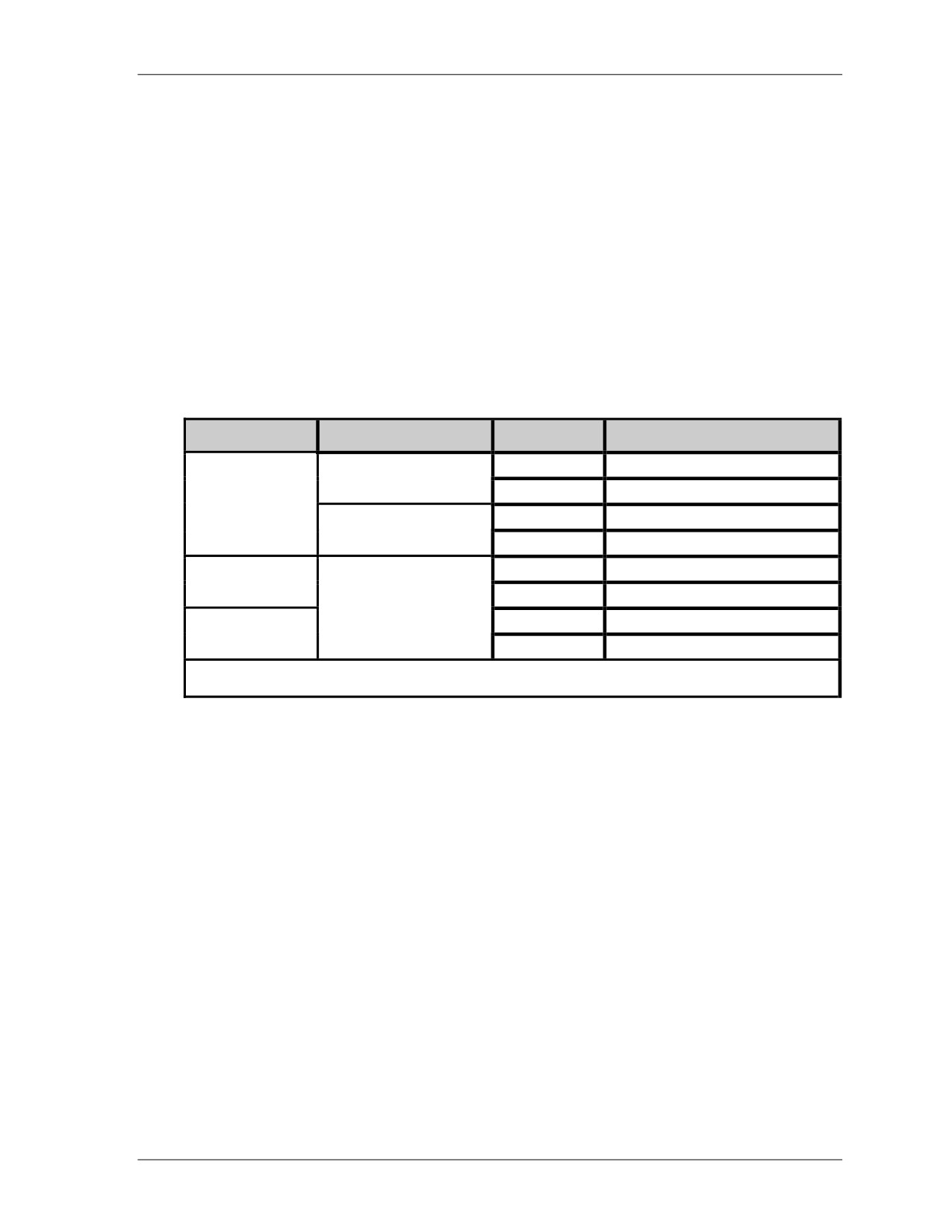
6-143. When using a tactical DZ (Table 6-11), the airlift unit assumes responsibility for aircraft safety of
flight; the receiving unit assumes responsibility for injury to personnel or damage to equipment or air
items. The DZ size is determined by the mode of delivery, load dispersal, and discussion with the receiving
unit about air item recoverability and load survivability.
Type Drop
Aircraft
Day or Night
Point of Impact *
CDS
C-130
Day
At least 200 yards/183 meters
Night
At least 250 yards/229 meters
C-17
Day
At least 225 yards/206 meters
Night
At least 275 yards/251 meters
Personnel
All USAF fixed-wing
Day
At least 300 yards/274 meters
aircraft
Night
At least 350 yards/320 meters
Heavy
Day
At least 500 yards/457 meters
Equipment
Night
At least 550 yards/503 meters
* Point of impact shown in distance from the leading edge of the drop zone and centerline.
Table 6-11. Favorable conditions for airdrops on tactically assessed DZs.
INSTRUCTIONS FOR COMPLETION
6-144. This paragraph explains how to complete AF IMT 3823, Drop Zone Survey, shown completed in
Figures 6-20A and 6-20B (pages 6-51 and 6-52). All blocks must be completed. The completer should
write "NA" in blocks that do not apply. When performing a safety-of-flight review on a foreign DZ, the
completer should enter as much information as possible on AF IMT 3823. At a minimum, he must provide
information for blocks 4D, 6A, 6B, 7, 9A-F, and 9H. He should attach a copy of the foreign DZ to the
safety-of-flight review.
Block 1A
6-145. Enter DZ name.
Block 1B
6-146. If the survey will be sent to HQ AMC/DOTK for inclusion in the ZAR database, then enter only
"NA." If the survey is for local use, then the group tactics office should complete this block.
25 April 2006
FM 3-21.38
6-47
Chapter 6
Block 2A
6-147. Enter the country where the DZ is located.
Block 2B
6-148. Enter the state, province, or territory.
Block 3
6-149. Enter map series, sheet number, edition, and date of map used.
Blocks 4A1 through 4A4
6-150. Enter the date of the original survey and the surveyor’s name, grade, telephone number, and unit
of assignment. The surveyor signs above his typed name.
Block 4B
6-151. The surveyor enters an "A" (if approving) or "D" (if disapproving) for each drop category.
He must complete all of the printed categories. He uses the blank column for special, additional approvals.
Block 4C
6-152. The ground operations approval authority verifies the survey by signing in this block.
Block 4D
6-153. The chief of group tactics or whoever the OG/CC or equivalent assigns to do so completes a
safety-of-flight review.
Block 4E
6-154. The reviewer's (OG/CC's or ACC's) signature in this block authorizes the aircraft to operate over
the DZ. If operational requirements dictate, he then sends the survey to HQ AMC/DOKT, 402 Scott Drive,
Unit 3A1, Scott AFB, IL 62225-5302, so they can add that DZ to their ZAR database. The group tactics
offices keep DZ surveys.
Blocks 5A through 5E
6-155. Enter the controlling agency responsible for scheduling the DZ. If the DZ is within a controlled or
monitored area, enter the range control data for that location. If the DZ is not located on government
owned property. If applicable, the requesting unit must obtain a land use agreement
(LUA) or
memorandum of understanding (MOU), checks the block (5A through 5E) that applies, and attaches a copy
of the memorandum. If the DZ falls within a controlled area, enter the range control data for that location.
Block 6A through 6C
6-156. Enter the DZ dimensions using either meters or yards. For a circular DZ, enter the radius.
Blocks 6D through 6F
6-157. Enter the distance from the leading edge of the DZ to each PI in either meters or yards.
6-48
FM 3-21.38
25 April 2006
Drop Zones
Blocks 7A through 7D
6-158. Enter the primary DZ axis in magnetic, grid, and true North, and include the source and date of
the variation data. Use the current year when obtaining the information from a GPS. If DZ is circular,
enter "NA."
Note: List any applicable DZ axis restrictions in the remarks block.
Block 8A through 8D
6-159. Enter the elevation in mean sea level (MSL) for each PI and for the highest point on the DZ.
Block 9A
6-160. Enter the spheroid used to compute coordinates for the DZ. You can find this information on the
map legend. If the GPS is set to operate in WGS-84 mode, then enter "WGS-84" in this block.
Block 9B
6-161. Enter the MGRS datum used to compute the coordinates. You can also find this information in the
map legend. Again, if you are using a GPS, enter "WGS-84."
Blocks 9C through 9E
6-162. Enter the grid zone, Easting, and Northing obtained from the map.
Block 9F
6-163. Place an “X” in the appropriate block.
Block 9G
6-164. Enter the grid zone designator, grid square identifier, and the ten-digit MGRS coordinates.
Briefly describe an easily recognized point on or near the DZ, such as a road intersection, benchmark, or
pond, that can be used by the DZ party to find the PIs. Include a distance and azimuth from this point to the
nearest PI. If needed, continue the point of origin remarks in Remarks.
Block 9H
6-165. Enter the ten-digit MGRS coordinates in local datum and spheroid and the WGS
84
latitude/longitude coordinates to the nearest one-hundredth minute for each indicated point.
Block 9I
6-166. For each corner of the DZ, enter the ten-digit MGRS coordinates in local datum and spheroid and
the WGS-84 latitudinal and longitudinal coordinates to the nearest one-hundredth minute.
Block 10
6-167. Enter the name of the DZ and clearly sketch it manually or using a computer program. Include all
obstacles or prominent features within the DZ boundaries. Add an arrow for magnetic north to orient the
user. Enter the name of the DZ.
25 April 2006
FM 3-21.38
6-49
Chapter 6
Block 11
6-168. Comment on pertinent operations here. Describe safety hazards such as towers. Describe all
charted or observed bodies of water and power lines within 1,000 meters of the DZ boundaries.
Block 12
6-169. State whether photographs of the DZ and approaches to it are available, and whether a low-level
route is associated with the DZ. Whoever completes the safety-of-flight review should know this
information and mark this block accordingly.
6-50
FM 3-21.38
25 April 2006
Drop Zones
AF IMT 4304, DROP ZONE/LANDING ZONE CONTROL LOG
6-170. The AF IMT 4304, Drop Zone/Landing Zone Control Log, Figure 6-21, page 6-57, is a scorecard
for the Air Force. Since the aircrew computes the air release point on the DZ, the Air Force needs
documentation of the crew's performance. The DZSTL ensures this form is complete and accurate based on
the instructions that follow:
DATE
6-171. Enter either calendar or Julian date and year. When time is required, use local or GMT consistent
with the date.
LOCATION
6-172. Enter DZ name.
CCT AND UNIT
6-173. Enter your (the DZSTL's) name and unit.
DZ/LZ CONTROL OFFICER AND UNIT
6-174. Enter the name of the person controlling the DZ.
DROP ZONE SAFETY OFFICER AND UNIT
6-175. Enter the names of the people (you or someone else) who is acting as the DZ safety officer and the
unit safety officer. If you are doing both, then write in your name for both.
LINE NO
6-176. Enter the mission sequence number of each aircraft. Each line number on any given drop zone
mission represents an individual pass over the DZ. If you have a multiple aircraft DZ, you should still use
a separate line number for each aircraft. For example, use three line numbers for a three-ship operation.
Assign a line number to no-drop passes also. Write the reason for each no-drop in remarks.
TYPE ACFT
6-177. Enter the mission design series.
UNIT
6-178. Enter the aircraft's (using) unit.
CALL SIGN
6-179. Enter the call sign of the lead aircraft and, if applicable, formation position numbers.
TYPE MSN
6-180. See the legend for abbreviations of the types of missions.
25 April 2006
FM 3-21.38
6-53
Chapter 6
ETA
6-181. Enter the estimated time of arrival, estimated TOT, or S3 air brief. Use the same unit of time
throughout the form.
ATA/ATD
6-182. Enter the actual time of each pass or the actual time of departure.
STRIKE REPORT
6-183. The strike report yards or clock is the actual purpose of this form. Observe the first
parachute-suspended item from the control center, and then determine the distance in yards and the clock
direction relative to the PI. Use 12 o'clock as the magnetic drop heading. If the first parachute lands within
25 yards of the PI, then write "PI" here to indicate a PI strike. If you were unable to maintain visual contact
with the first parachute, especially during a multiple aircraft operation, then score the drop "S"
(satisfactory) or "U" (unsatisfactory). If 90 percent of the parachutes land on the DZ, score the drop as
satisfactory. If less than
90 percent hit the DZ, score it unsatisfactory. If you maintain radio
communications with the drop aircraft, then relay strike reports to them so they can adjust their subsequent
passes accordingly.
YDS
6-184. If the first jumper, container, or pallet lands within 25 yards of the PI, write "PI." If it lands farther
from the PI, enter the distance from the PI in yards.
CLOCK
6-185. Use the direction of flight as 12 o’clock and its back azimuth as 6 o’clock. Estimate the direction
from the PI to the first jumper, container, or pallet. If you can, enter the actual measurement.
LZ
6-186. Mark the “S” (satisfactory) box if a landing occurred in the first 500 feet of the LZ. If the aircraft
had to go around again, if the drop fell short of the touchdown zone, or was more than 500 feet from the
beginning of the touchdown zone, mark the “U” (unsatisfactory), and comment in Remarks.
SURF WIND
6-187. Enter the surface wind direction in degrees. Enter the highest wind velocity measured during the
10 minute window for that pass.
SCORE METHOD
6-188. Select from the Legend the abbreviation for the method you use to determine the distance between
the PI and the first parachute.
E = Estimated (You made a calculated guess).
P = Paced (You paced off the distance).
M = Measured (You used a calibrated measuring device to determine the distance).
MEAN EFFECTIVE WIND
6-189. Enter the time you measured the wind and the altitude where you measured it.
6-54
FM 3-21.38
25 April 2006
Drop Zones
TIME
6-190. This is self-explanatory.
ALT
6-191. Enter the drop altitude.
DIR & LVL
6-192. Enter the wind direction in degrees and the velocity in knots.
REMARKS
6-193. Enter anything about the DZ operation that could help the Air Force during pilot debriefing. The
DZSTL forwards AF IMT 4304 (Figure 6-21) to the air operations officer, who submits it through the
chain of command to the USAF representative. If the DZSTL has radio communication with the aircraft,
he transmits the strike report directly to the aircraft, for example--
"Lifter one-six, strike report, three o’clock two-hundred yards."
or
"Lifter one-six, strike report, PI."
25 April 2006
FM 3-21.38
6-55
Appendix A
Close Air Support and Close Combat Attack
This appendix does not change existing doctrine, tactics, techniques, or procedures
for employing pathfinder teams and elements. It just introduces a vision of how CAS
affects pathfinder teams.
DEFINITIONS
A-1.
Close air support (CAS) is an air action by fixed and rotary wing aircraft against hostile targets
that are in close proximity to friendly forces and require detailed integration of each air mission with the
fire and movement of those forces.
A-2.
Close combat attack (CCA) is a technique to control attack helicopters (AH-64 or OH-58D) in a
close air support role, usually very near friendly troops in contact. It helps the pilot see the same target
you see.
PURPOSE
A-3.
The main purpose of CAS/CCA is to provide support to ground unit commanders. Other purposes
of CAS include the following:
AIR INTERDICTION
A-4.
Air interdiction
(AI) is very useful to the ground unit commander planning an assault. Air
superiority is essential in accomplishing the mission. AI assets will own the air in the area of operation,
eliminating the possibility of the friendly forces being hit by enemy CAS.
SECURITY AND RECONNAISSANCE
A-5.
Close air support aircraft can pull security during airmobile operations, as well as reconnoiter the
air before any mission to remove any air threats.
ATTACK
A-6.
CAS/CCA aircraft can attack targets without actually being on a support mission. CAS/CCA can
commence bombing runs or strafing runs on one of many different target types.
THEATER MISSILE DEFENSE
A-7.
CAS/CCA aircraft can provide missile defense.
SPECIAL OPERATIONS
A-8.
Certain CAS/CCA aircraft are set aside strictly for special operations units and missions.
SUPPORT BY FIRE
A-9.
Though not the main purpose of CAS/CCA, support by fire is the most common.
25 April 2006
FM 3-21.38
A-1

Appendix A
SUPPRESSION OF ENEMY AIR DEFENSES
A-10. Most CAS/CCA aircraft have SEAD capability, and usually conduct SEAD missions before
any air mission.
TYPES OF AIRCRAFT
A-11. The following aircraft are the ones that will be most commonly seen by the pathfinder team during
a deployment. Table A-1 shows the mission, armaments, capabilities, and limitations of each aircraft in the
CAS theater.
Aircraft
Mission
Armaments
Capabilities
Limitations
F15C
Air superiority, to include
Air-to-air missiles
Advanced air-to-air
No CAS
defensive counterair
(AIM-7, -9, -120).
capabilities.
capability
(DCA), offensive
(air-to-air only).
Guns: 20-mm cannon.
counterair (OCA), and
force protection.
F16 (Blocks
Primary: air superiority.
Air-to-air missiles
Situational
More diverse
30, 40, and
Secondary: SEAD.
awareness
missions equal
(AIM-7, -9, 120).
50)
Block 30 and 40 aircraft
datalink (SADL)
less CAS
Guns: 20-mm cannon,
can provide CAS.
provides
training. High
all general-purpose
up-to-date
speed limits
bombs (MK-82, -84),
battlefield
target
guided bombs
information. CAS
acquisition.
(GBU-10, -12, -15, -24,
depends on unit
Limited night
JDAM*), cluster bombs
proficiency.
employment.
(CBU-87, -89), and the
AGM-65 Maverick.
A-10
CAS and AI.
30-mm Gatling gun
Pilots: highly
Not all-weather.
“tank killer,” air-to-air:
trained in CAS
Slower speed
AIM-9, carries up to
missions.
makes it
16,000 lbs. of ordnance
vulnerable to
Aircraft: specially
(MK-82, -84, -77),
surface-to-air
designed to
GBU-10, -12, CBU-87,
missile attacks.
support ground
CBU-89, AGM-65
forces, slow speed
Maverick.
aids in target
acquisition, longer
loiter time.
AC-130
CAS for special
25-mm cannon, 40-mm
All-weather, long
Vulnerable to
Spectre
operations units, urban
cannon, and 105
loiter time, surgical
threats.
CAS, and
Howitzer. 25mm is only
strike.
Employed
reconnaissance.
on the AC130H.
normally at
night in a low
threat
environment.
EA-6B
SEAD.
AGM-88.
Electronic attack
Limited types of
Prowler.
and SEAD.
targets such as
SAM sites.
Table A-1. CAS theater aircraft.
A-2
FM 3-21.38
25 April 2006

Close Air Support and Close Combat Attack
Aircraft
Mission
Armaments
Capabilities
Limitations
F-14
Primary: fleet defense
Air-to-air 20-mm
Two sets of eyes
Pilots: Not all
Tomcat
and air superiority.
cannons, air-to-air
(the pilot and the
have CAS
Secondary:
missiles (AIM-7, -9,
RIO).
proficiency.
reconnaissance,
120), and 13,000 lbs. of
Aircraft: age
AI, FAC(A), and CAS.
ground ordnance.
and carrier
operations.
F-18
Air superiority, escort,
Air-to-air 20-mm
Highly proficient in
Diverse
fleet defense, AI, SEAD,
cannons, air-to-air
CAS.
missions have
reconnaissance, and
missiles (AIM-7, -9,
lower
CAS.
-120), and 14,000 to
proficiency
17,000 lbs of ground
levels.
ordnance.
AV-8B
Primary: CAS.
25-mm cannons and
CAS proficient and
Short range,
Harrier
Secondary: AI, antiair
the AIM-9, and up to
highly flexible
very small
warfare, helicopter
9,000 lbs of ground
deploy and employ
payload, short
escort, and
ordnance.
options.
loiter time, and
reconnaissance.
slow speed
make it
vulnerable to
air defenses.
AH-64
Tank attack and CAS.
2.75 rockets, hellfire
Detect and classify
Not all-weather.
Apache
missiles, and 30-mm
128 targets,
cannon.
prioritizing the 16
most dangerous.
OH-58
CAS, recon, and
2.75 rockets, Hellfire
Limited AI, recon,
Not all-weather.
limited AI.
missiles, .50 cal MG,
and CAS.
Vulnerable to
and air-to-air Stinger.
air defenses.
MH-6 Little
CAS for special
2.75 rockets, Hellfire
Highly
Not all-weather.
Bird
operations units.
missiles, .50 cal MG,
maneuverable.
Vulnerable to
and MK-19.
air defenses.
MH-60K
CAS for special
2x M134 6-barrel 7.62
CAS and
Not all-weather.
Blackhawk
operation units.
miniguns and 2.75
transportation of
Vulnerable to
rockets.
internal loads.
air defenses.
Table A-1. CAS theater aircraft (continued).
TARGET TYPES
A-12. Target types include—
Point (tank, radar antenna).
Soft (vehicle, personnel).
Hard (armor, bunker).
Area (column of armor, troops in the open).
WEAPONS EFFECTS
A-13. The method by which a particular weapon alters a target is called a damage mechanism. The five
most commonly encountered damage mechanisms for conventional weapons are as follows:
25 April 2006
FM 3-21.38
A-3