FM 3-21.38 Pathfinder Operations (APRIL 2006) - page 3
External Loads
strength requirements specified in FM 10-450-3. The Army's inventory includes a variety of equipment
adapted or designated for use in slingload operations.
AERIAL-DELIVERY SLINGS
5-12.
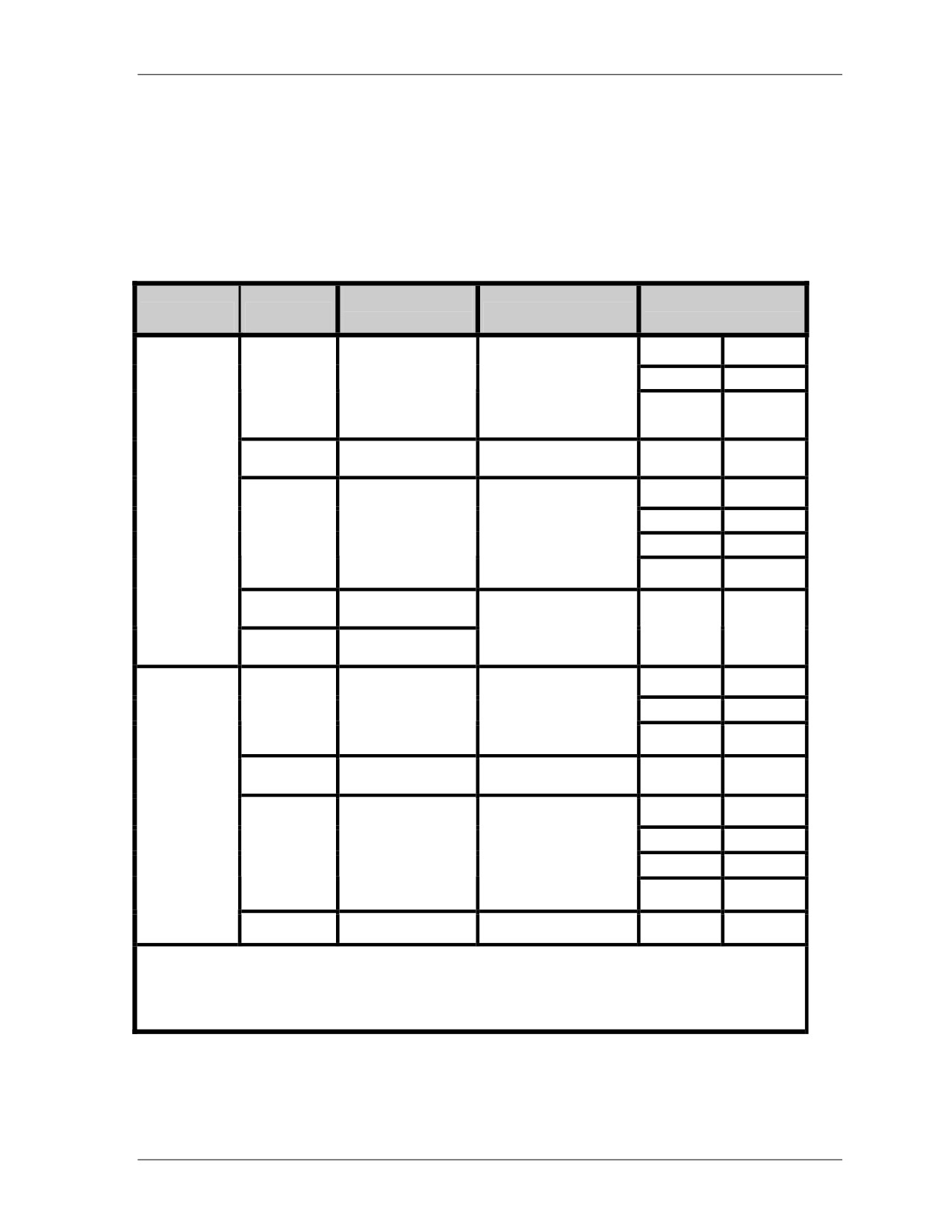
Aerial-delivery slings (ADSs) were originally designed to deliver heavy loads by air (Table 5-1).
They have been adapted for use in air assault operations. ADSs come in a variety of sizes and strengths, as
shown in FM 10-450-3.
Vertical Pendant
Available Lengths
Usage
Loop Slings
Pounds
Thicknesses
(In Feet)
3 feet
16 feet
9 feet
20 feet
2-Loop 1,2
8,900
4
11 feet
120 feet
12 feet
3-Loop
13,500
6
60 feet
140 feet
Pendant
3 feet
16 feet
9 feet
20 feet
4-Loop
17,800
8
11 feet
28 feet
12 feet
6-Loop
27,000
12
60 feet
120 feet
9-Loop
42,000
3 feet
16 feet
2-Loop 1,2
5,600
4
9 feet
20 feet
11 feet
120 feet
3-Loop
8,500
6
60 feet
140 feet
Part of
sling set
3 feet
16 feet
9 feet
20 feet
4-Loop
11,200
8
11 feet
28 feet
12 feet
6-Loop
17,000
12
60 feet
120 feet
1
Identified by colored thread stitched lengthwise down the middle of the strap.
2
Three-foot donut ring tensile strength for this sling equals 10,000 pounds. Using dual rings increases
tensile strength to 17,500 pounds.
Table 5-1. Aerial delivery specifications for the Type XXVI sling.
25 April 2006
FM 3-21.38
5-3
Chapter 5
HITCHES
5-13.
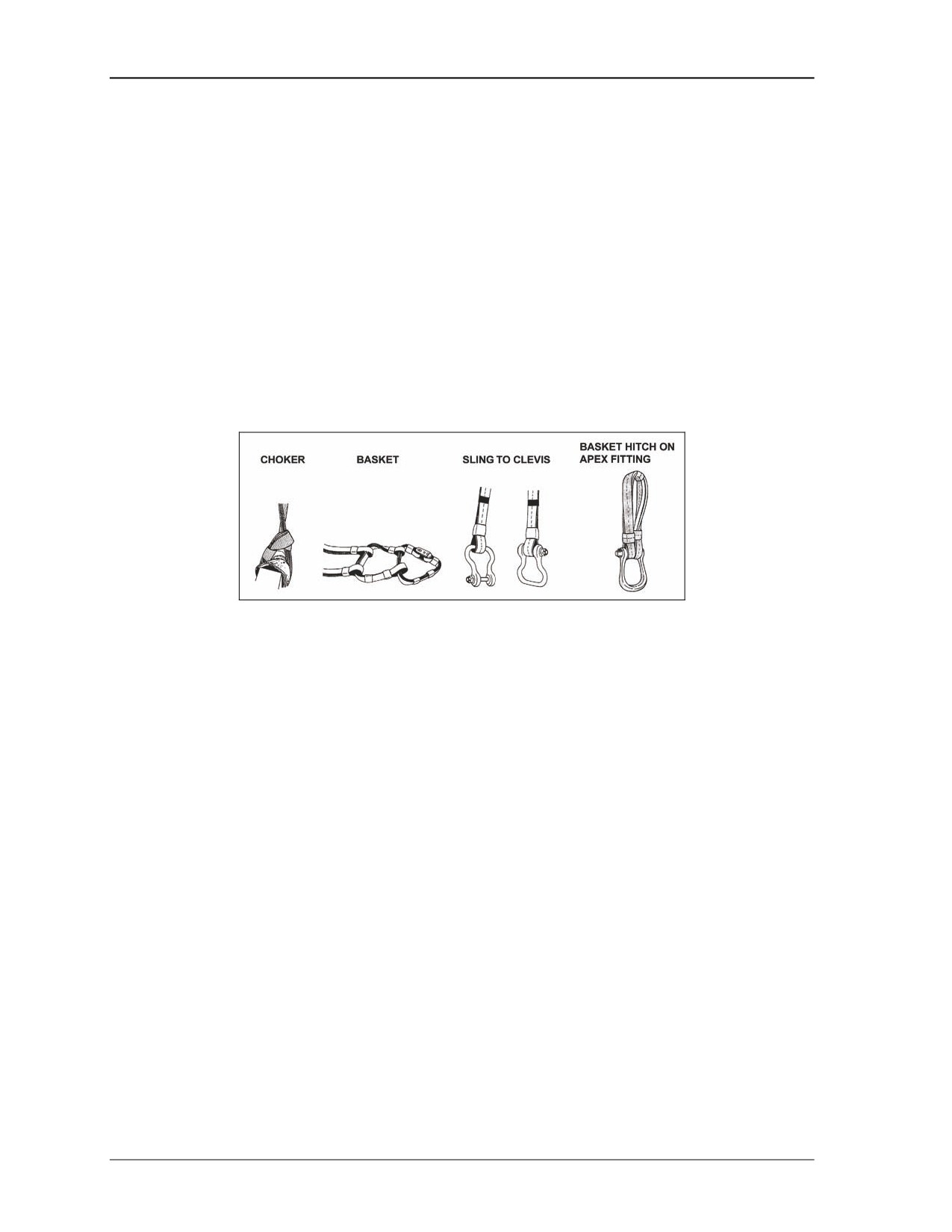
When connecting ADSs to metal air items or directly to the load, loaders use one of the following
hitches (Figure 5-1).
Choker
5-14.
Pull the free-running end of the sling around the point of attachment. Draw it between the loops of
the sling's standing end. After making sure that the cotton buffer is in its proper place, "milk" down the
keeper on the standing end to secure the sling.
Basket
5-15.
Separate the loops of the sling at one end. Place the sling over the suspension point. Ensure that
the cotton buffer is in its proper place. To secure the sling, "milk" down the keeper towards the
suspension point.
Figure 5-1. Hitches.
NETS AND CONTAINERS
5-16.
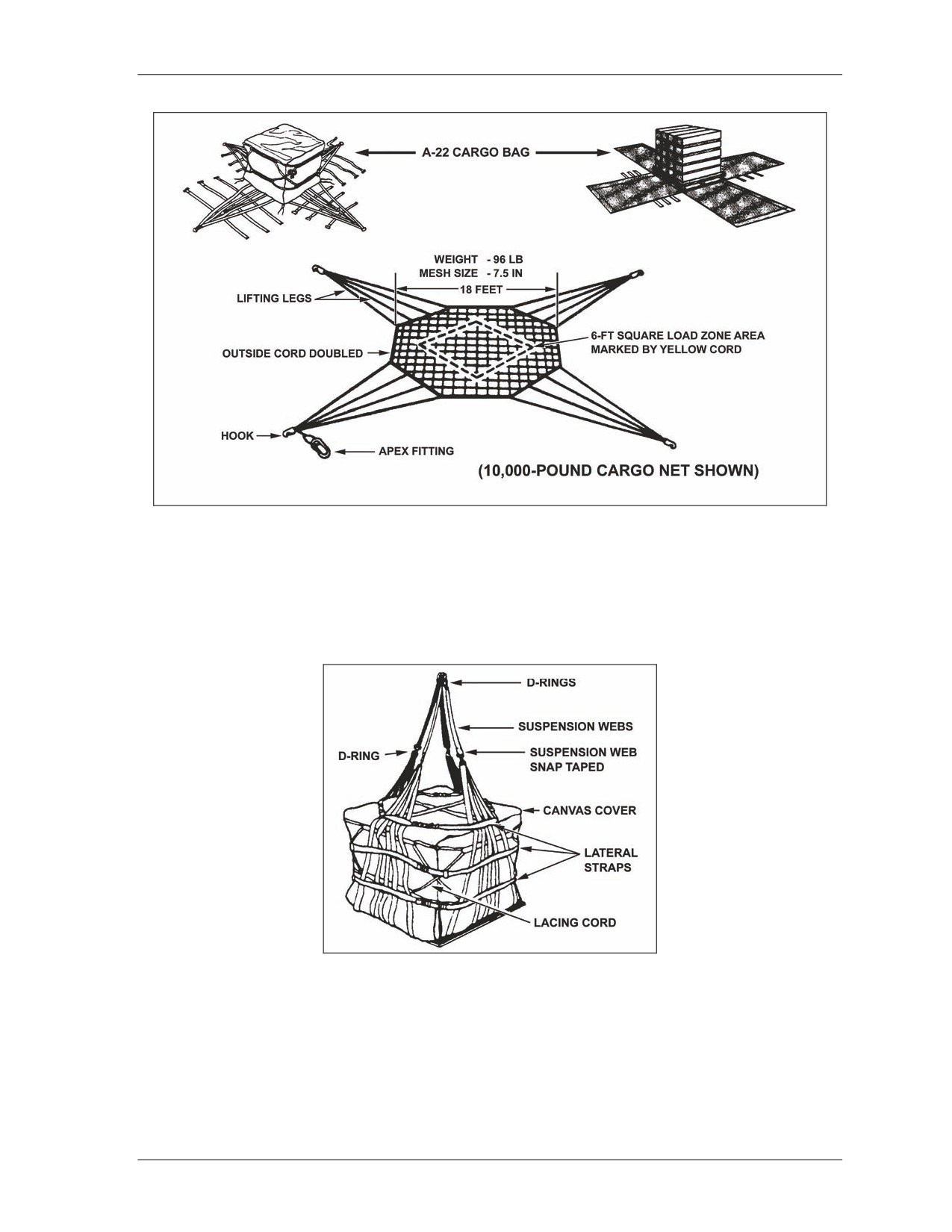
The Army has many types of cargo containers. However, the 5,000- and 10,000-pound cargo nets
and the A-22 cargo bag are the ones most often used to transport cargo externally. FM 10-450-3 describes
how to inspect both the large cargo net and the A-22 cargo bag (Figure 5-2). It also provides rigging
instructions. Avoid overloading the nets; use them with loads that fall within the aviation unit's prescribed
limits. Pick up the nets rather than drag them across the ground, because dragging them can cause them to
snag on something and damage the net or the thing it snags. Use a canvas insert when carrying items small
enough to slip through the netting.
Small (5,000-Pound Capacity) Cargo Net
5-17.
This olive drab net can carry up to
5,000 pounds or
125 cubic feet of cargo
(NSN
1670-01-058-3811, line item number [LIN] 2776).
Large (10,000-Pound Capacity) Cargo Net
5-18.
This larger net can carry up to 10,000 pounds or 380 cubic feet of cargo (NSN 1670-01-058-3810,
LIN NO 2708). It is 18 feet wide and can transport boxed or bulky loads (Figure 5-2).
5-4
FM 3-21.38
25 April 2006
External Loads
Figure 5-2. Cargo nets and bag.
A-22 Cargo Bag
5-19.
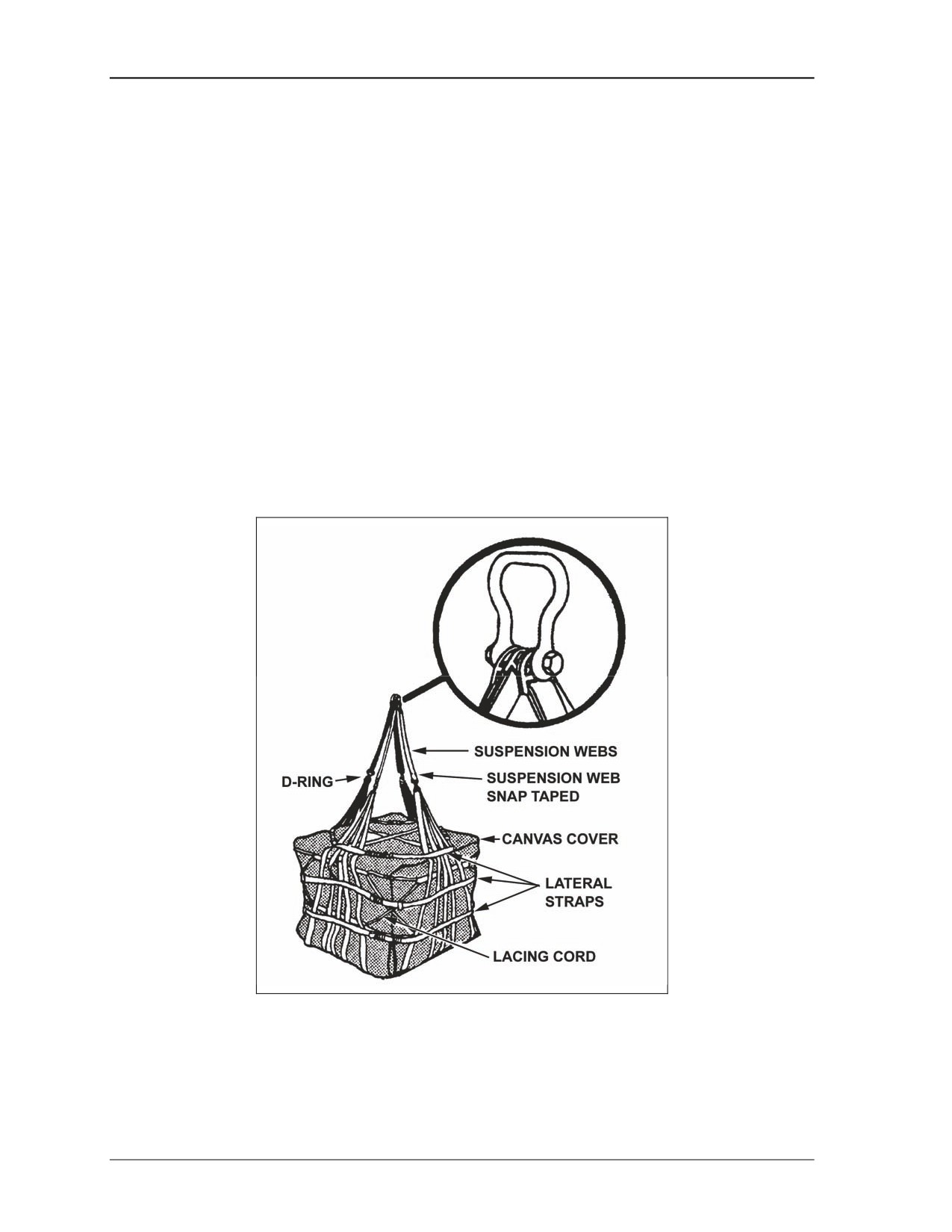
The A-22 cargo bag, with or without its canvas cover, can externally transport standard palletized
loads, loose cargo, ammunition, oil drums, and other general items whose total weight falls under 2,200
pounds (Figure 5-3).
Figure 5-3. A-22 cargo bag.
25 April 2006
FM 3-21.38
5-5
Chapter 5
Suspension Clevises
5-20.
Clevises come in three sizes.
Large
5-21.
This clevis (NSN 4030-00-090-5354) has a rated capacity of 12,500 pounds (pendant) with a
7,875-pound sling-to-lifting provision point of attachment. Adding more large clevises as attaching points
increases rated capacity as follows:
Two large clevises increase rated capacity to 15,750 pounds.
Three large clevises increase rated capacity to 23,625 pounds.
Four large clevises increase rated capacity to 31,500 pounds.
Medium
5-22.
This clevis (NSN 1670 4030-00-678-8562, Figure 5-4) has a rated capacity of 6,250 pounds
(pendant) with a 3,750-pound sling-to-lifting provision. Adding more medium clevises as attaching points
increases rated capacity as follows:
Two medium clevises increase rated capacity to 7,500 pounds.
Three medium clevises increase rated capacity to 11,250 pounds.
Four medium clevises increase rated capacity to 15,000 pounds.
Figure 5-4. Upper sling and medium clevis.
5-6
FM 3-21.38
25 April 2006
External Loads
Small
5-23.
This clevis (NSN 1670 4030-00-360-0304) has a rated capacity of 6,250 pounds (pendant) with a
3,750-pound sling-to-lifting provision. Adding more small clevises as attaching points increases rated
capacity as follows:
Two small clevises increase rated capacity to 7,500 pounds.
Three small clevises increase rated capacity to 11,250 pounds.
Four small clevises increase rated capacity to 15,000 pounds.
REACH PENDANTS
5-24.
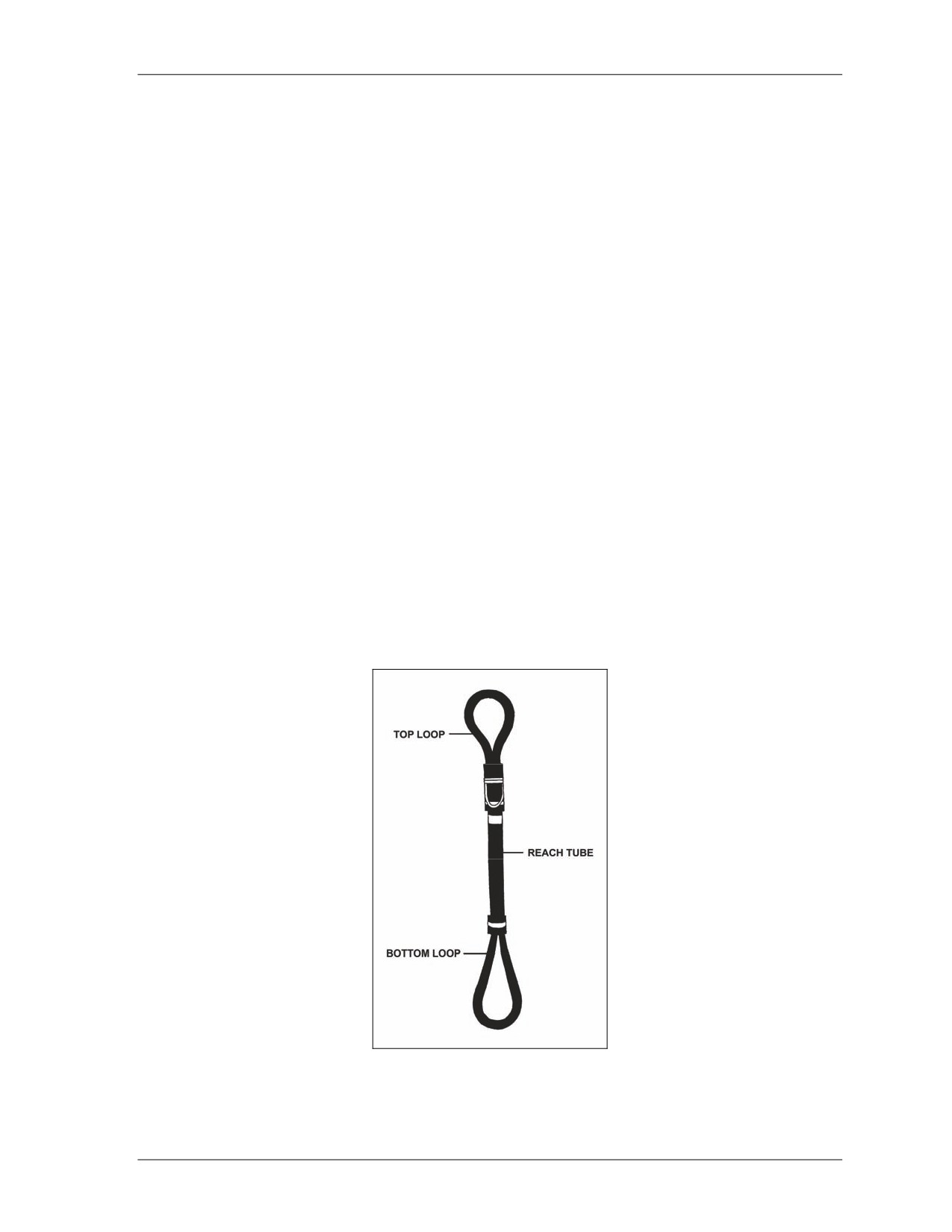
A reach pendant is a synthetic rope assembly with an attached, stiffened reach tube and a loop on
each end. The built-in reach tube enables the hookup man to place the pendant's top eye on the helicopter
cargo hook while the helicopter hovers at a higher distance over the load (Figure 5-5). Two reach pendants
are authorized for use with slingloads. To use either pendant with a sling set, remove the sling set apex
fitting pin; place the pendant's lower eye in the apex fitting; and reinstall the apex fitting pin.
11,000-Pound Capacity
5-25.
The 11K, NSN 4020-01-365-3115, part number DSG-5-11K, measures about 5 feet long and has
an 11,000-pound safe working load capacity. The top eye is black with a small diameter loop, while the
bottom eye is green with a larger diameter loop. The safe working load capacity is stamped on the
reach tube.
25,000-Pound Capacity
5-26.
The 25K, NSN 4020-01-337-3185, part number BOS-14-K7, measures about 5 feet long and has
a 25,000-pound safe working load capacity. The top eye is black with a small diameter loop, while the
bottom eye is also black, but has a larger diameter loop. The safe working load capacity is stamped on the
reach tube.
Figure 5-5. Reach pendant.
25 April 2006
FM 3-21.38
5-7
Chapter 5
Inspection
5-27.
Inspect the reach pendants before and after use. Check for cuts and tears in the nylon-urethane
plastic sheath on each loop. If the white strength member (third layer) shows, remove the pendant
from service.
Cleaning
5-28.
Clean the reach pendant with a mixture of warm water and mild dish or laundry detergent. You
can use mineral spirits to remove oil and grease. You can treat the top and bottom eyes with silicone spray.
However, do not use silicone spray on the reach tube.
Storage
5-29.
Store the reach pendants in a clean, dry area out of direct sunlight. Prolonged exposure to sunlight
will deteriorate the strength of reach pendants.
CAUTION
Avoid getting silicone spray on the reach tube. Avoid using chemical
cleaners on reach pendants. Chemicals may weaken the strength
members of the pendant. If a pendant becomes contaminated with
chemicals, remove it from service.
POLYESTER ROUNDSLINGS
5-30.
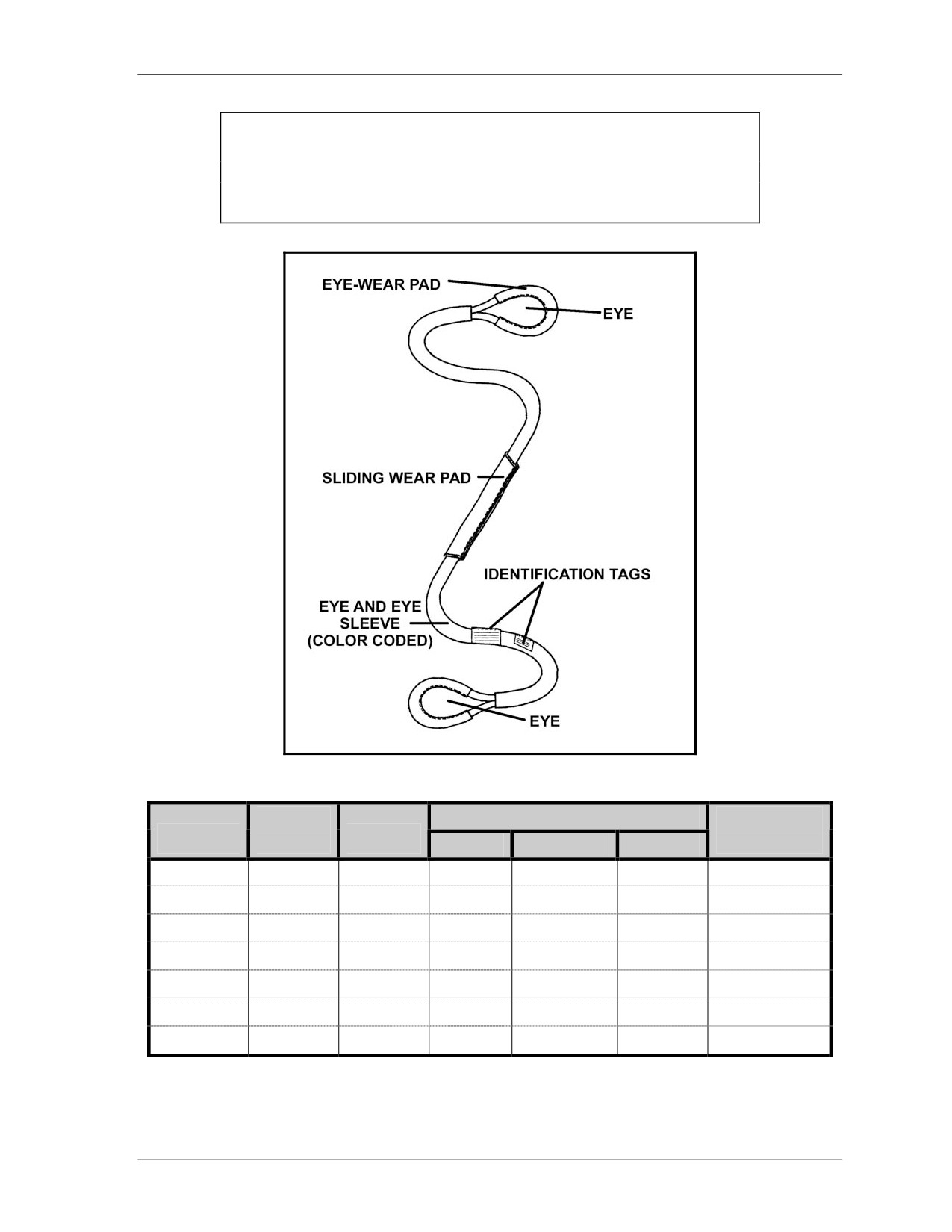
Use polyester roundslings as the primary vertical pendant (Figure 5-6). You can use one of three
hitches to attach roundslings to the load. The lifting capacity of polyester roundslings varies with the size
of the sling and the type of hitch used to attach the load. Each sling has two identification tags permanently
sewn to the eye and eye sleeve. These identify the size and capacity of the roundsling as well as other
information needed for its safe use. Roundslings are also color-coded by size. Table 5-2 lists roundsling
lengths and lift capacities.
Storage
5-31.
Store roundslings in a clean, dry, cool area out of direct sunlight. Prolonged exposure to sunlight
will deteriorate the strength of roundslings.
Inspection
5-32.
Inspect each polyester roundsling before and after every use. Remove it from service if you find
any of the following:
Missing or unreadable identification tags.
Acid or alkali burns.
Melted, charred, or weld-splattered portions.
Any holes, tears, cuts, snags, embedded particles, broken or worn stitching, or abrasive wear
that exposes the core fibers.
Knots in any part of the roundsling.
Distortion, excessive pitting, corrosion, or broken fitting(s).
Any other condition that causes doubt as to the strength of the roundsling.
5-8
FM 3-21.38
25 April 2006
External Loads
CAUTION
Avoid dragging roundslings on the floor or over rough surfaces. Never
twist them or join them together with knots.
Figure 5-6. Polyester roundslings.
Length
Lift Capacity
Weight
Part No.
(In Feet)
Color
(In Pounds)
Choke
Vertical
Basket
PRS2E008
8
GREEN
4,200
5,300
10,600
4
PRS2E017
17
GREEN
4,200
5,300
10,600
10
PRS3E008
8
YELLOW
6,700
8,400
16,800
5
PRS3E017
17
YELLOW
6,700
8,400
16,800
11
PRS5E030
30
RED
10,600
13,200
26,400
26
PRS7E065
65
BLUE
17,000
21,200
42,400
75
PRS7E070
70
BLUE
17,000
21,200
42,400
81
Table 5-2. Safe working loads (lift capacities) of polyester roundslings.
25 April 2006
FM 3-21.38
5-9
Chapter 5
SERVICE LIFE OF AERIAL-DELIVERY SLINGS
5-33.
The first person to use a sling must date-stamp it with the calendar or Julian date in
1-inch letters. He can use orange-yellow parachute-marking ink, strata blue parachute-marking ink, or an
orange-yellow tube-type marker. He marks near the first keeper at both ends of the sling. This date
determines the date of the next inspection. Every six months, the current user reinspects the sling; strikes
through the last date in the same color it was written in; and in either of the other two colors, marks the
date he reinspected the sling. Every single user inspects every single sling before and after every single use.
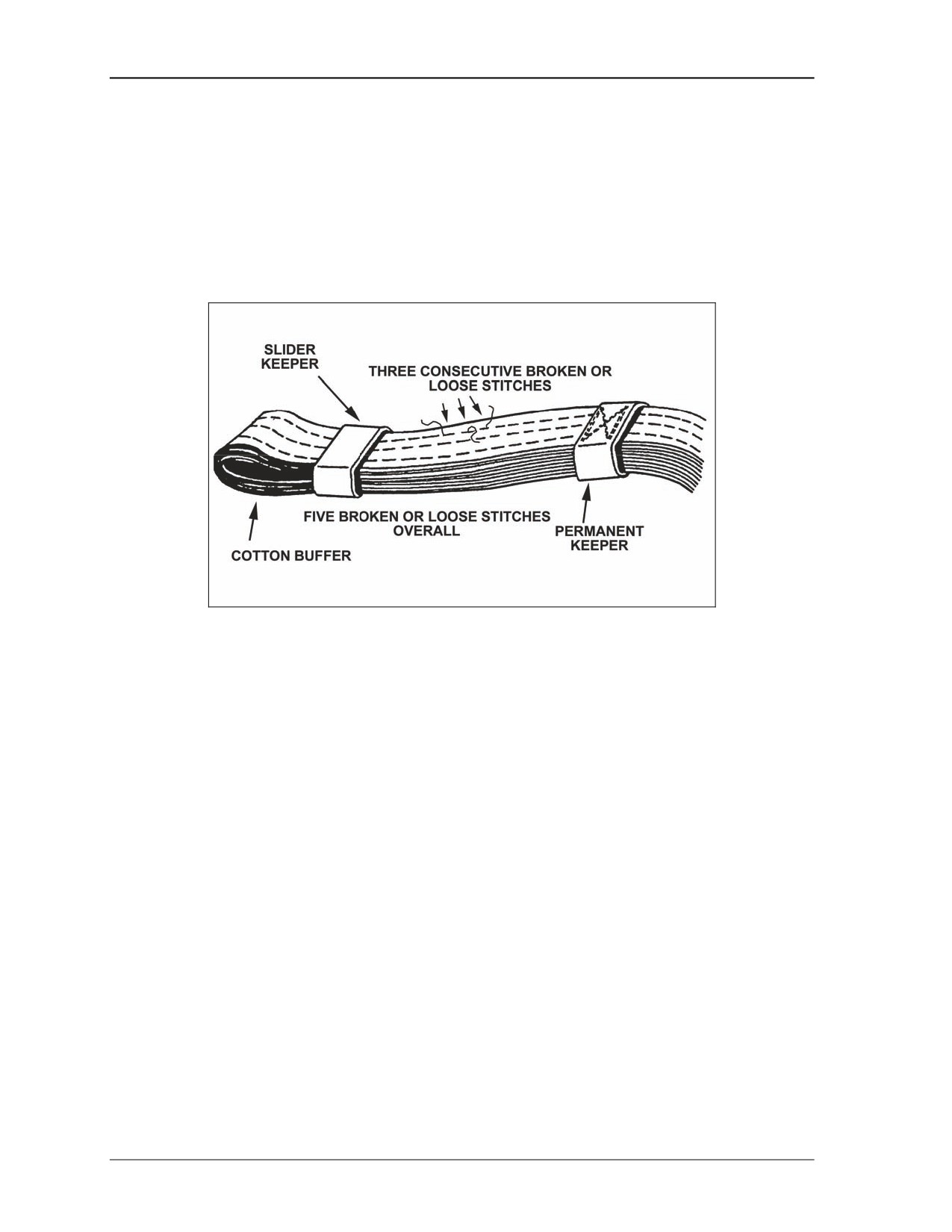
If the condition of the sling seems questionable, he removes the sling from service (Figure 5-7).
Figure 5-7. Unserviceable slings.
GENERAL INSPECTION
5-34.
When inspecting nylon air items, note that if you find more than three consecutive broken or loose
stitches, or five or more broken or loose stitches overall in the sewn portion, the item is unserviceable.
After rigging the load with any nylon air item, put cotton buffers in place to prevent any nylon-to-nylon or
nylon-to-metal contact. Look for the following:
Inspection date that has already passed (an inspection is overdue).
Foreign matter or chemicals such as mildew, paint, or grease.
y Cuts.
y Frays.
y Burns.
y Broken stitches.
Missing cotton buffers, sliding keepers, or permanent keepers.
y Rust.
CARGO STRAP
5-35.
The A7A cotton or nylon cargo strap measures 188 inches long and has a rated capacity of 500
pounds. A friction adapter located on one end of the strap has a thick-lipped metal floating bar. Supply
issues this strap with one metal D-ring. Inspect this piece of equipment for cuts or frays.
5-10
FM 3-21.38
25 April 2006
External Loads
CARGO TIE-DOWN EQUIPMENT
5-36.
Check the tie-downs for serviceability.
CGU-1B Tie-Down Strap
5-37.
The CGU-1B cargo tie-down device has a rated capacity of 5,000 pounds. You can adjust the
length of this device.
15-Foot Tie-Down Strap
5-38.
The 15-foot cargo tie-down strap, issued with a quick-fit strap fastener, has a rated capacity of
5,000 pounds.
Load Binders
5-39.
The two load binder types are rated for 10,000 pounds and 5,000 pounds. The 10,000-pound
capacity load binder has its rating stamped on the side.
METAL AIR ITEMS
5-40.
Thoroughly inspect metal air items for rust, stripped threads on the nuts or bolts, burrs, cracks,
bent or twisted metal, or oil. When using any clevis assembly, tighten the nut hand-tight only.
Inspection
5-41.
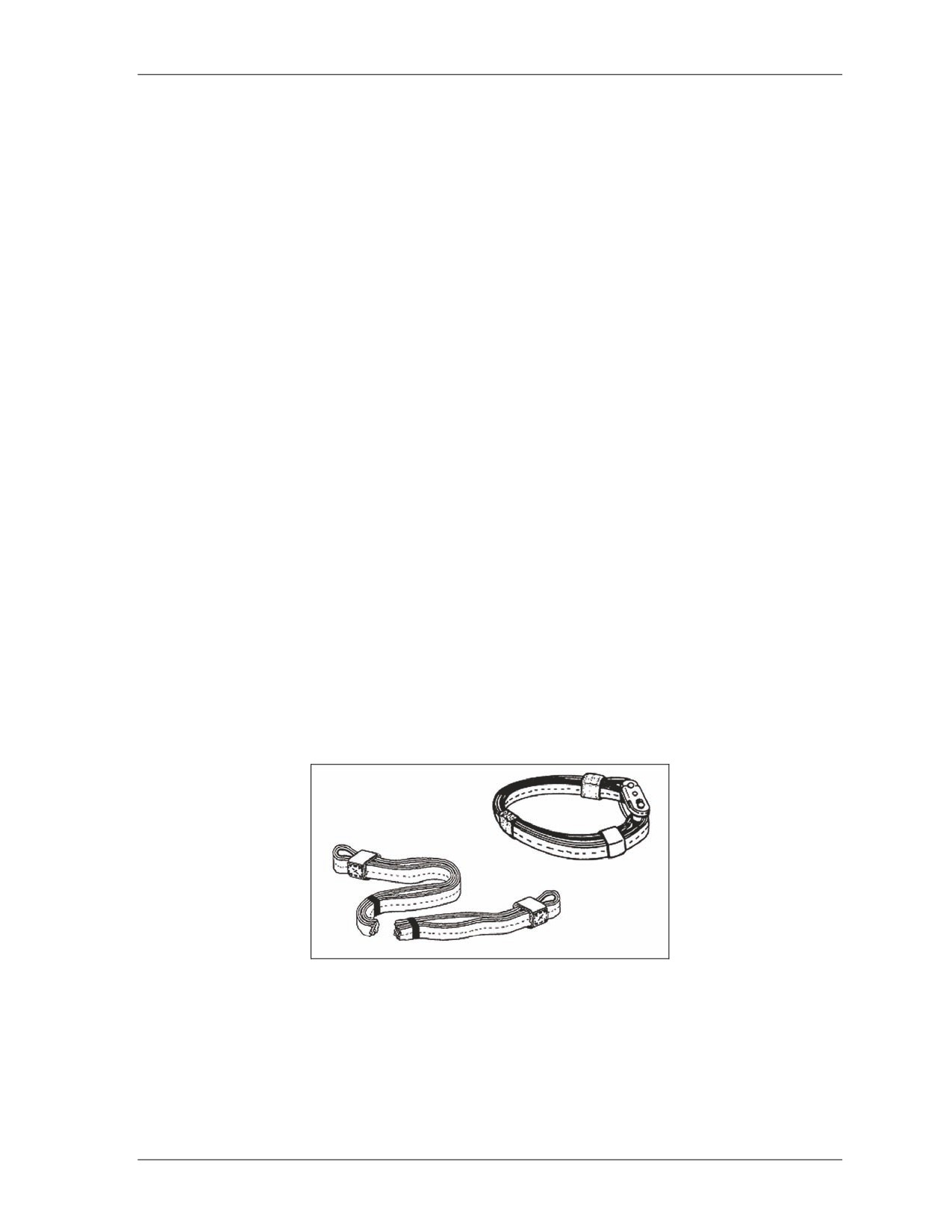
Use the Type IV link assembly (NSN 1670-00-783-5988) to build a 3-foot donut or to connect
one ADS to another (Figure 5-8). This link assembly has a rated capacity of 12,500 pounds. When
inspecting the Type IV link assembly, look for the following deficiencies:
Hard to rotate or irregularly rotating aluminum buffers.
Bent or cracked posts.
Bent slide connectors.
The absence of a metallic "click" when it locks.
Figure 5-8. Three-foot apex (donut) ring.
25 April 2006
FM 3-21.38
5-11
Chapter 5
Points of Attachment
5-42.
In slingload operations, the clevis assemblies serve as points of attachment from the aircraft to
the load.
Tightening
5-43.
When using any clevis assembly, tighten the nut by hand only. Tape both ends of the nut and bolt
to prevent slippage during use. Choose only case-hardened nuts and bolts. Never mix items. The bolt heads
have case-hardened marks such as ticks, numbers, letters, or a combination of all three.
LARGE-CAPACITY SLING SETS
5-44.
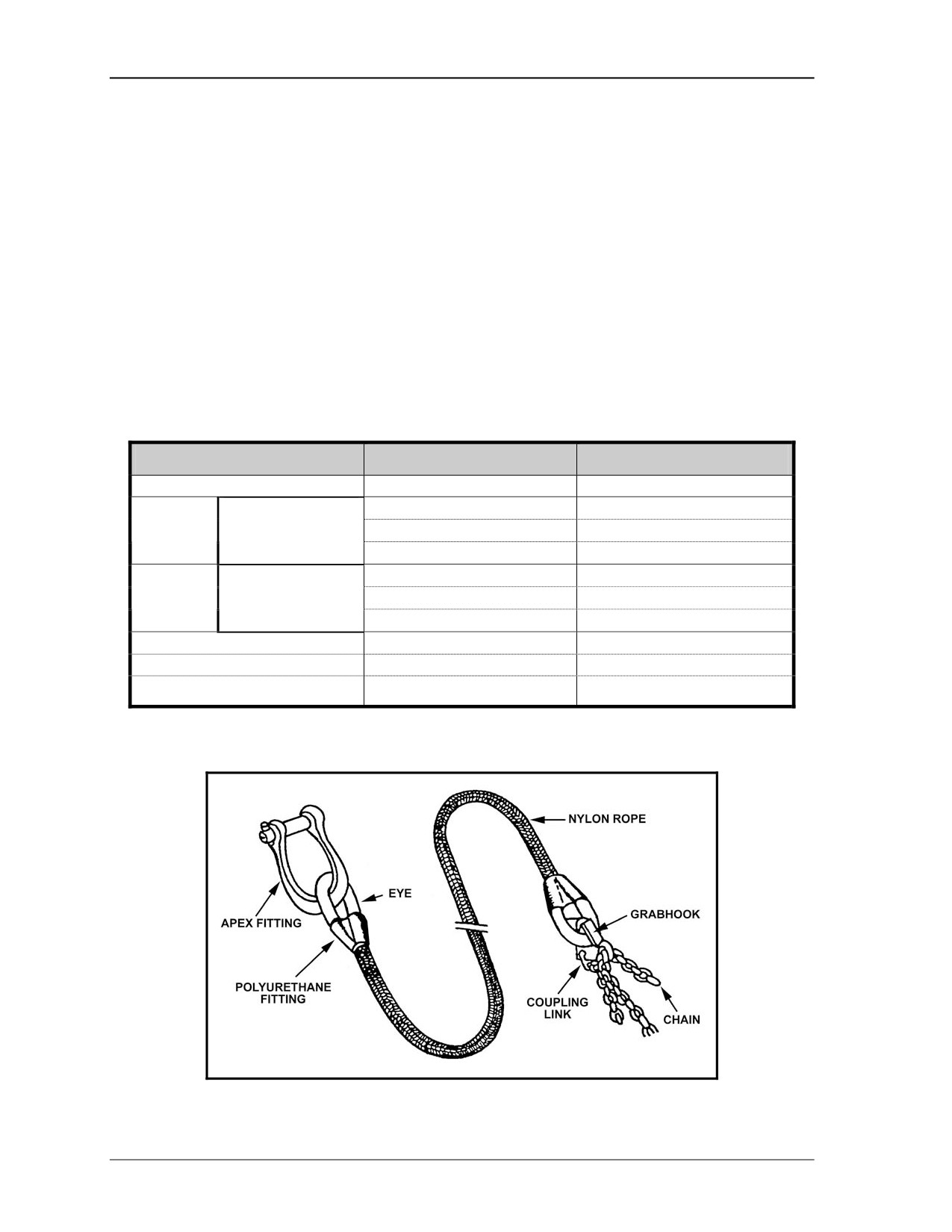
The new 10,000-pound and 25,000-pound capacity sling sets are similar, except for a few minor
differences. All components have identifying marks. You may only exchange apex fittings between sets.
Take care not to mix up the other components. Table 5-3 compares these two large-capacity sling sets, and
Figure 5-9 shows one.
Type Sling
10,000-Pound Sling
25,000-Pound Sling
Capacity:
10,000 pounds
25,000 pounds
Color:
Brushed aluminum
Gold steel
Apex fitting
Pin diameter:
1 1/8-inch diameter
1 1/2-inch diameter
Weight:
4 1/2 pounds
10 pounds
Color:
Olive drab
Black
Sling rope
Length:
12 feet
12 feet
Diameter:
7/8 inch
1 1/4 inch
Chain links-quantity:
110 to 115 links
86 to 88 links
NSN:
1670-01-027-2902
1670-01-027-2900
Total weight:
52 pounds
114 pounds
Table 5-3. Large-capacity sling sets.
Figure 5-9. 25,000-pound capacity sling set.
5-12
FM 3-21.38
25 April 2006
External Loads
CAUTION
Each sling set has four legs. Each leg has a rated capacity of
one-quarter of the total capacity of the set. On some loads, you will
use up to six legs. However, remember that adding two legs does not
increase the rated capacity of the entire set.
5-45.
The nylon rope assembly for each set has an interwoven eye located at each end. A polyurethane
fitting covers the eye to protect the leg from abrasion and ultraviolet radiation
(Figure 5-9). Each
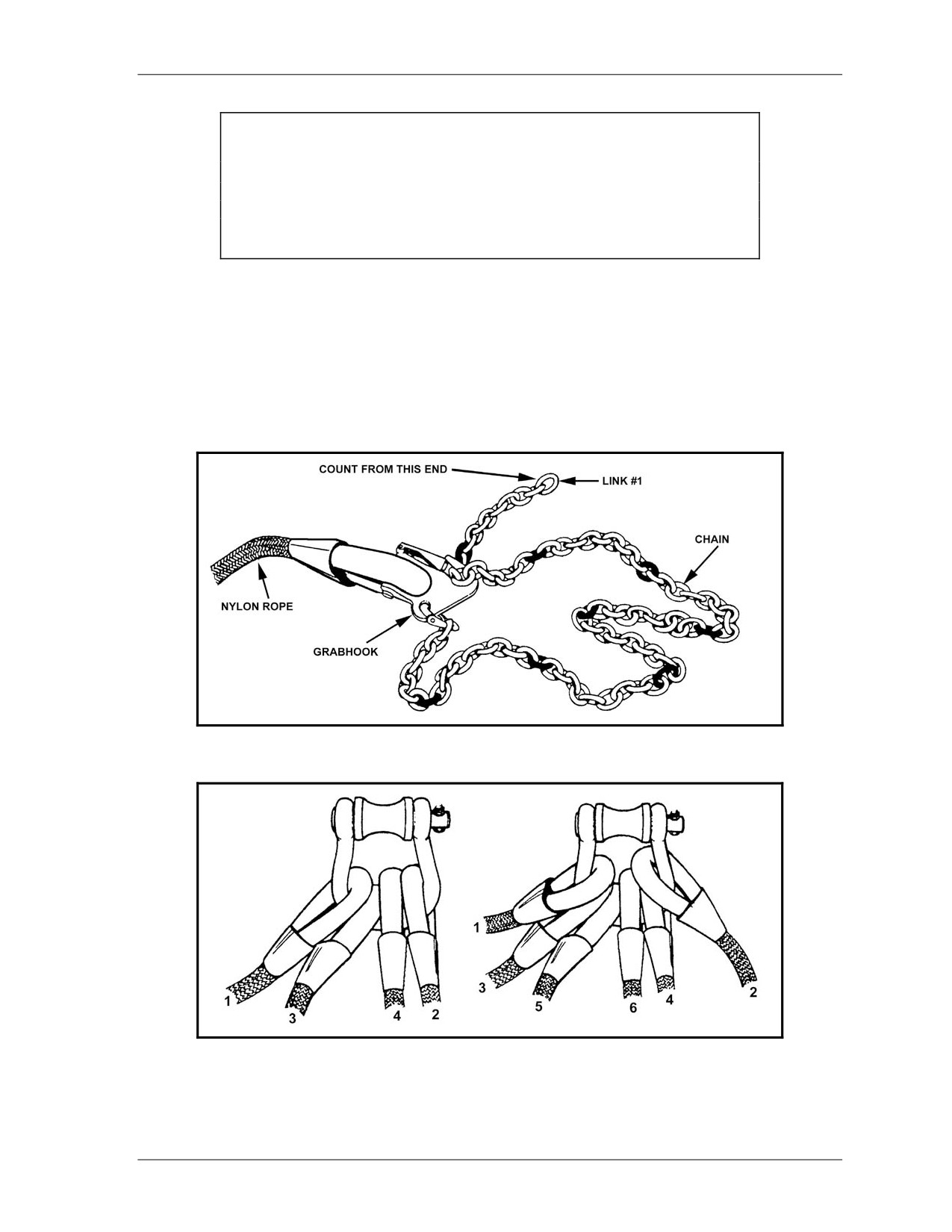
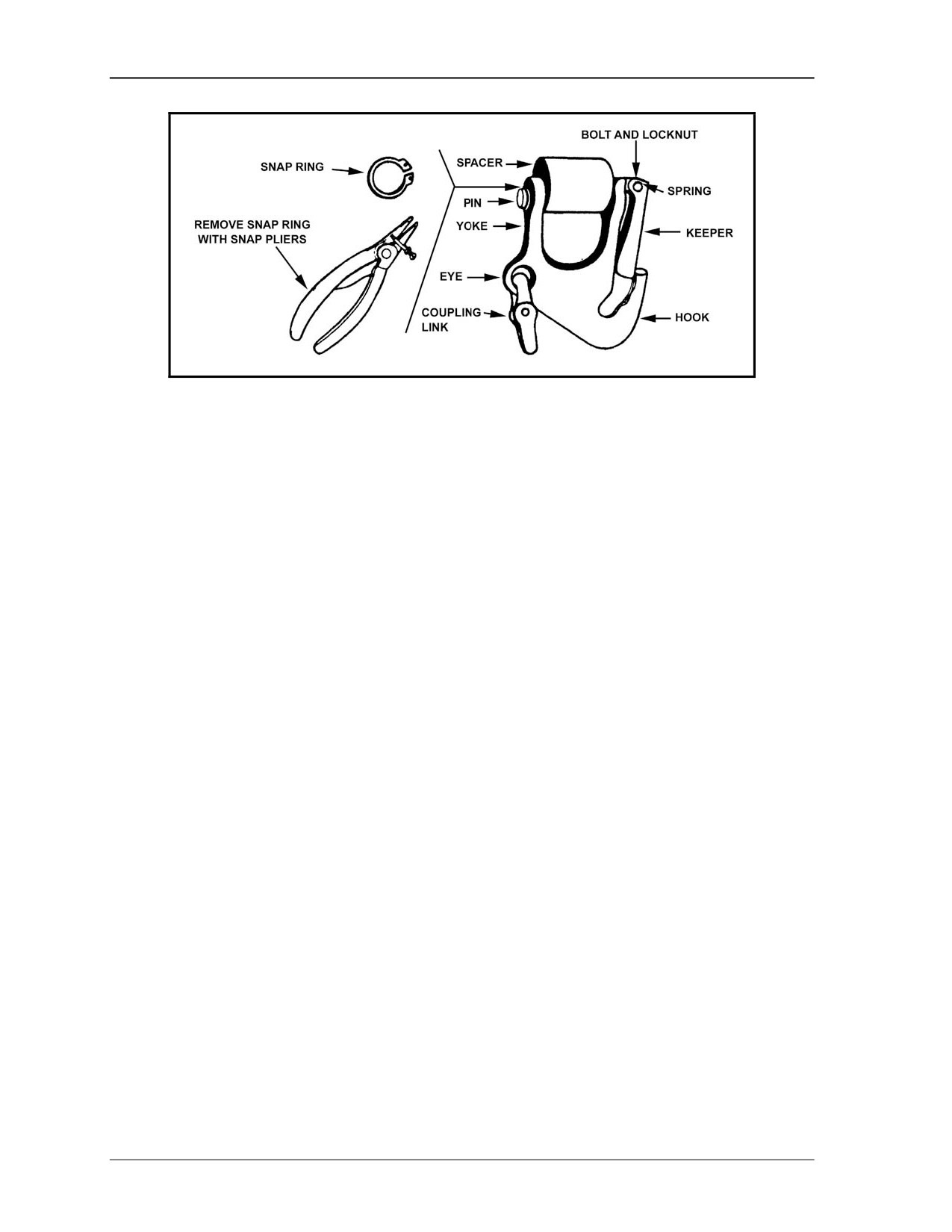
double-braided rope connects to a grabhook assembly. Figure 5-10, Figure 5-11, and Figure 5-12 show a
coupling link, sling leg-numbering sequence, and a grabhook, respectively. Though the grabhooks for the
two sets look alike, you cannot interchange them because they have different ratings.
5-46.
FM 10-450-3 and TM
10-1670-295-23&P discuss how to inspect the rope sling sets.
FM 10-450-3 also provides sling-conversion tables.
5-47.
Secure the cross pin on each apex fitting with a 3/8-inch bolt, a castellated nut, and a cotter pin.
Figure 5-10. Coupling link.
Figure 5-11. Sling leg-numbering sequence.
25 April 2006
FM 3-21.38
5-13
Chapter 5
Figure 5-12. Grabhook.
5-14
FM 3-21.38
25 April 2006
External Loads
AIRCRAFT LOAD LIMITATIONS
5-48.
The structural strength of the cargo hook assembly determines the maximum weight that any
aircraft can carry with an external slingload. In most cases, the tensile strength of the hook does not limit
the weight that an aircraft can lift; the allowable cargo load does. In fact, the capacity of the cargo hook
assembly usually exceeds the ACL.
TENSILE STRENGTH
5-49.
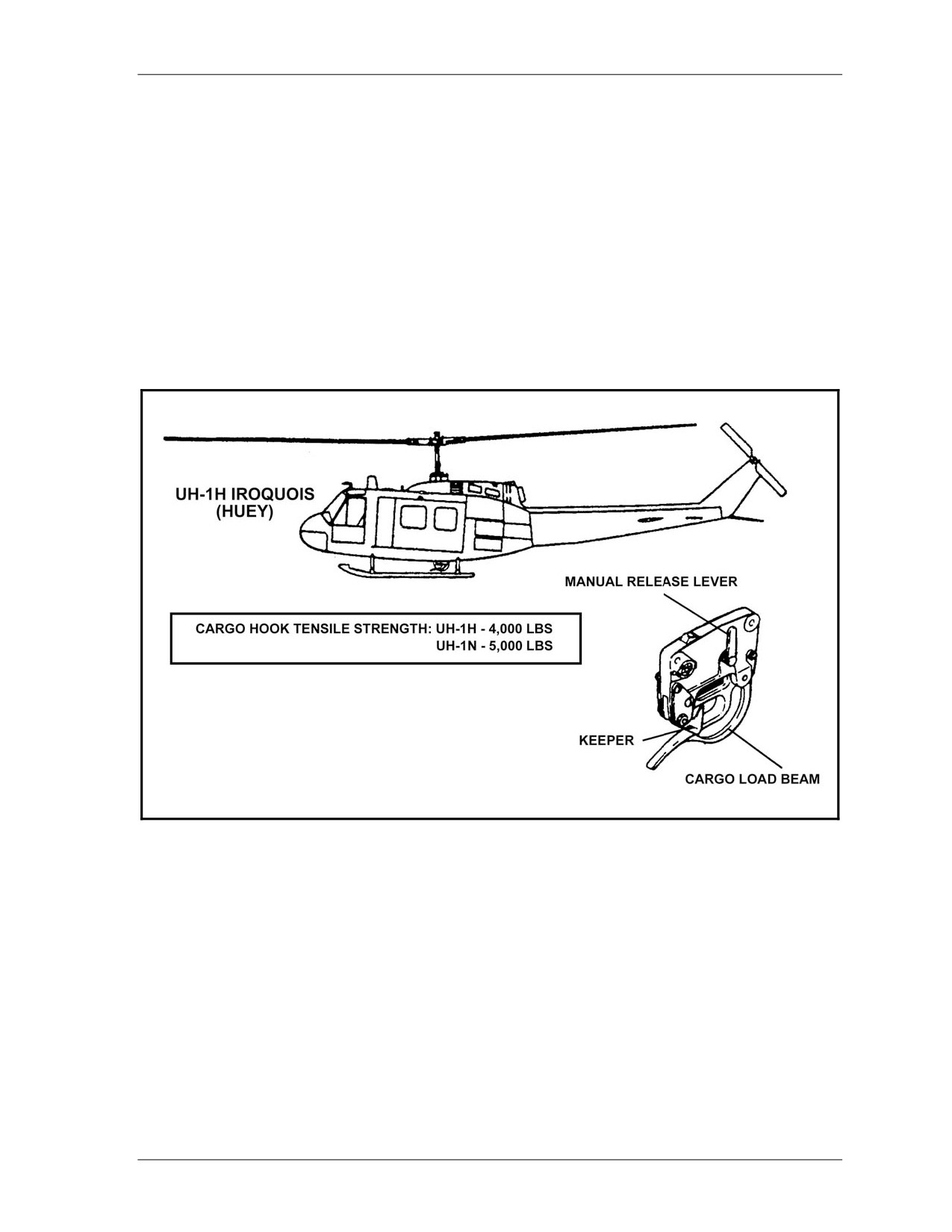
Cargo hook tensile strengths for US Army aircraft show—
UH-1H/UH-1N Iroquois - 4,000 or 5,000 pounds (Figure 5-13).
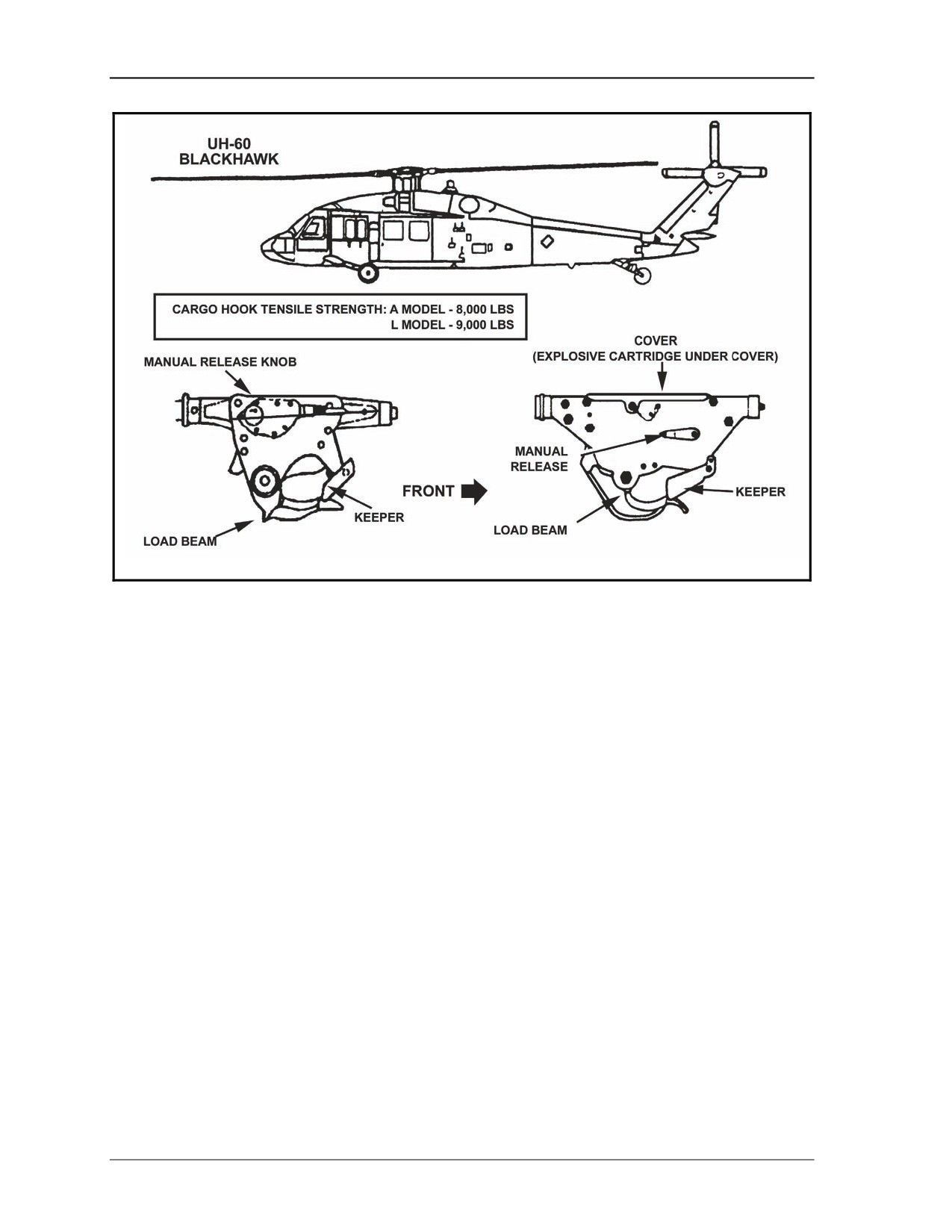
UH-60A/60L Blackhawks - 8,000 or 9,000 pounds (Figure 5-14).
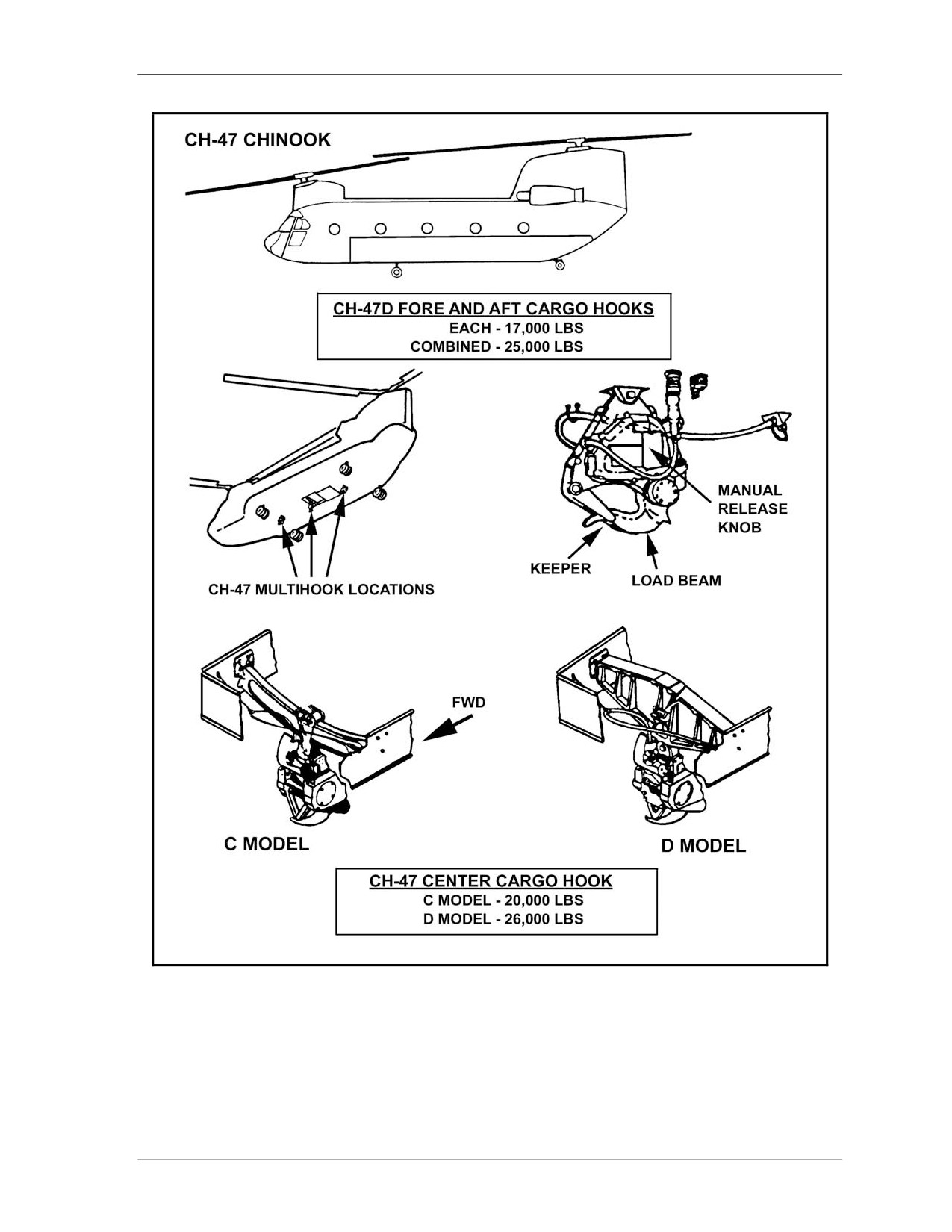
CH-47D Chinook - 26,000 pounds (Figure 5-15, page 5-18).
Figure 5-13. UH-1H Iroquois and its cargo hook.
25 April 2006
FM 3-21.38
5-15
Chapter 5
Figure 5-14. UH-60 Blackhawk and its cargo hooks.
5-16
FM 3-21.38
25 April 2006
External Loads
Figure 5-15. CH-47 Chinook and its cargo hooks.
25 April 2006
FM 3-21.38
5-17

Chapter 5
UH-1H
5-50.
When transporting external loads with a UH-1H, use a nylon donut or web ring to attach the load
to the aircraft. The cargo hook on the UH-1H is stationary; using an apex with a heavy load would bind the
hook and shear it off. The cargo hook tensile strengths for the UH-1H is 4,000 pounds; for the UH-1N, it is
5,000 pounds.
UH-60 BLACKHAWK
5-51.
When using the 10,000-pound apex to secure an external load to the UH-60, you must also use the
aluminum spacer. The spacer is not required, or recommended, when using a 25,000-pound apex.
However, if you use the 25,000-pound apex with spacer, the cargo hook must be manually operated by an
aircraft crewmember or a member of the hook-up team. Never use a donut or web ring on a UH-60. The
web ring will bind on the hook and prevent the crew from releasing the load in an emergency. The tensile
strength of the UH-60 cargo hook system is, for the UH-60A, 8,000 pounds and for the UH-60L,
9,000 pounds.
STANDARD WEIGHTS
5-52.
When using a UH-60 Blackhawk for airlift, coordinate closely with the aviation unit for the ACL.
For the standard weights of petroleum, oils, and lubricants (POL), for external loads only, see Table 5-4.
Standard vehicle and artillery weights follow in Table 5-5 and Table 5-6.
Fuel
55-Gallon Drum
500-Gallon Blivet
Motor gasoline (MOGAS)
404 pounds
3,400 pounds
Gasoline (JP4/JP8)
410 pounds
3,500 pounds
Diesel fuel
457 pounds
3,800 pounds
Lube oil (30 weight)
479 pounds
4,000 pounds
Table 5-4. POL for external loads only.
5-18
FM 3-21.38
25 April 2006
External Loads
Vehicle
Weight
M998/M1038 Truck, Cargo,
5,200 pounds (empty)
1 1/4-ton (HMMWV)
7,700 pounds (loaded)
M966 TOW Missile Carrier (HMMWV)
6,050 pounds (empty)
8,200 pounds (loaded)
M416 1/4-Ton Trailer
580 pounds
M101A2 3/4-Ton Trailer
1,350 pounds
M105A2 1 1/2-Ton Trailer
2,750 pounds
M35A2 2 1/2-Ton Truck
12,000 pounds (add 500 pounds
if equipped with a winch)
M149 1 1/4-Ton Water Trailer
2,540 pounds (empty)
6,060 pounds (full)
M149A1 1 1/4-Ton Water Trailer
2,540 pounds (empty)
6,060 pounds (full)
M149A2 1 1/4-Ton Water Trailer
2,800 pounds (empty)
6,320 pounds (full)
Table 5-5. Standard vehicle weights.
Artillery
Weight
M101 105-mm howitzer
4,600 pounds (add 300 pounds if
equipped with shields)
M102 105-mm howitzer
3,160 pounds (add 170 pounds for
section equipment)
105-mm ammunition
60 pounds (each box)
105-mm ammunition
47 pounds (each carton)
Table 5-6. Standard artillery weights.
AIR ITEMS REQUIRED FOR COMMON STANDARD LOADS
5-53.
Pathfinders require several types of expendable rigging supplies to complete the rigging of the
loads discussed in this paragraph. These supplies include
1/4-inch cotton webbing (80-pound test),
3/8-inch diameter rope (3,180-pound test), 7/16-inch diameter nylon rope (4,500-pound test), type III
nylon cord (550-pound test), pressure-sensitive tape, cellulose wadding or paperboard energy-dissipating
material, and canvas or felt padding. Pathfinders should obtain sufficient supplies of these items before
rigging the loads. To rig loads with ADSs and with more than one suspension point, twist an ADS once for
each 3 feet of sling length. This reduces vibration in the sling during flight. The nylon and chain multileg
sling sets and the 10,000- and 25,000-pound capacity sling sets do not require the twists. FM 10-450-3
discusses preparation and rigging for the following loads in detail.
25 April 2006
FM 3-21.38
5-19
Chapter 5
CARGO NET
5-54.
A 5,000-pound-capacity (15 feet square) or 10,000-pound-capacity (18 feet square) nylon cargo
net requires one A7A cargo strap or length of rope. With this the pathfinder can secure the net together on
top of the load to prevent smaller items from falling out of the net.
PERFORATED STEEL PLANKING
5-55.
Perforated steel planking (PSP) requires—
Two 16-foot, two or three-loop ADSs.
One 3-foot ADS with one type IV link assembly (for donut).
FUEL DRUMS
5-56.
One or two rubber or fabric fuel drums (blivets), each of which contains 500 gallons of fuel and a
10,000-pound-capacity sling set.
CONCERTINA WIRE
5-57.
The items required to move this load depend on the amount of concertina wire in the load.
CARGO BAG
5-58.
The A-22 cargo bag has a maximum capacity of 2,200 pounds.
SLINGLOAD THEORY
5-59.
The behavior of an external load in flight can greatly affect the performance of the aircraft
carrying it. High drag coefficients reduce airspeed. This means that the task takes longer or does not get
finished if the allotted time for the task expires. Therefore, whoever prepares the load must try to reduce
the drag of the load on the aircraft. A high drag coefficient can also endanger the aircraft and crew.
Because of this, the pilot must "punch" if he thinks that continuing to fly the load could endanger his crew
or aircraft. To stabilize a load, the loaders should consider the following:
ADDITION OF WEIGHT TO THE LOAD
5-60.
The heavier a load, the less air pressure will disturb it. Thus, carrying heavier loads assures greater
stability. However, make sure the load does not exceed the rated capacity of the equipment or the ACL of
the aircraft.
STREAMLINING OF THE LOAD
5-61.
Long, symmetrical loads fly crosswise to the direction of flight. This causes a lot of drag on the
aircraft. Loads tend to stabilize if the center of gravity (CG) is located in the first one-third of the load.
Either adjust the load or, if needed, add weight to move the CG toward one end or the other. The heavier
end of the load will "seek" the direction of flight and the load will stabilize. The lighter tail end of the load
will act just like the fins on a dart.
AIRSPEED OF THE AIRCRAFT
5-62.
The least desirable method is to have the aircraft fly slow to try to keep the load from
destabilizing. This burns extra fuel and takes more time to do less work. Prepare the loads so that the
aircraft can fly safely at speeds of 60 knots or more.
5-20
FM 3-21.38
25 April 2006
External Loads
SLING LENGTH
5-63.
Lengthening the slings that attach the load to the aircraft reduces the load's stability in flight. The
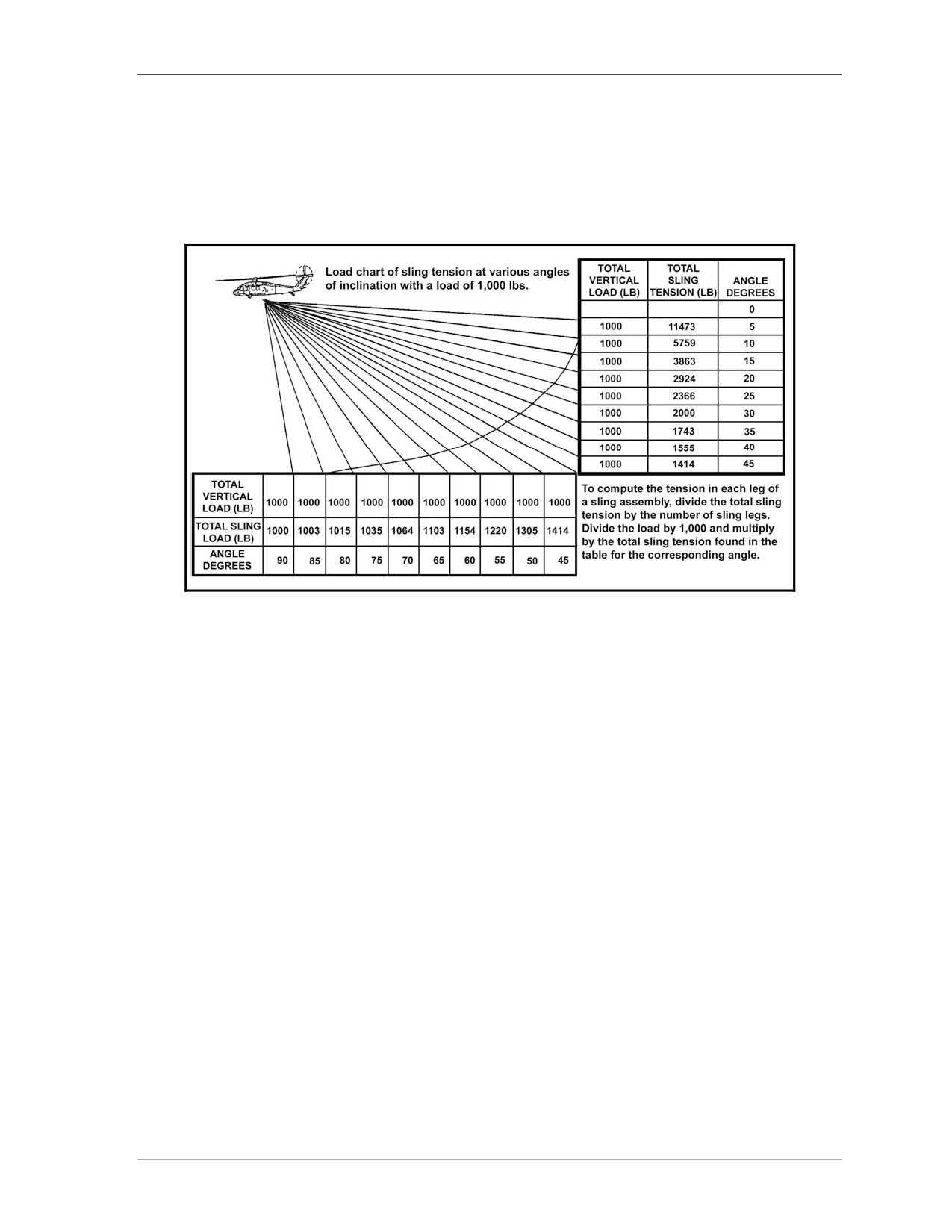
shorter, the better, as long as the sling measures at least 6 feet long. Also, the more vertical the attached
sling, the less stress on those that are more horizontal. Figure 5-16, page 5-22, shows how sling angle
affects load stress.
Figure 5-16. Load chart of sling tension at various angles of inclination with a load
of 1,000 pounds.
EFFECT OF VERTICAL SLING
5-64.
A vertical sling carrying 3,000 pounds has 3,000 pounds of stress on it. That means the stress
equals the weight of the load.
EFFECT OF 45-DEGREE SLING
5-65.
A 45-degree sling carrying 3,000 pounds has 4,242 pounds of stress on it. That means the stress
equals nearly one-and-a-half times the weight of the load.
EFFECT OF 5-DEGREE SLING
5-66.
A 5-degree (almost horizontal) sling carrying 3,000 pounds has 34,419 pounds of stress on it.
That means the stress equals more than ten times the weight of the load.
HOOKUP AND RELEASE PROCEDURES
5-67.
Hooking up a load requires a team effort. The signalman must position the aircraft over the load.
He does this so the slingload team can discharge the static electricity and attach the load to the aircraft as
quickly and safely as possible. Most of the time, the air crew releases the load. This seldom requires any
ground crew except the signalman.
25 April 2006
FM 3-21.38
5-21
Chapter 5
GROUND CREW PROTECTIVE MEASURES AND EQUIPMENT
5-68.
Working around hovering helicopters exposes ground crews to a variety of dangers. Leaders must
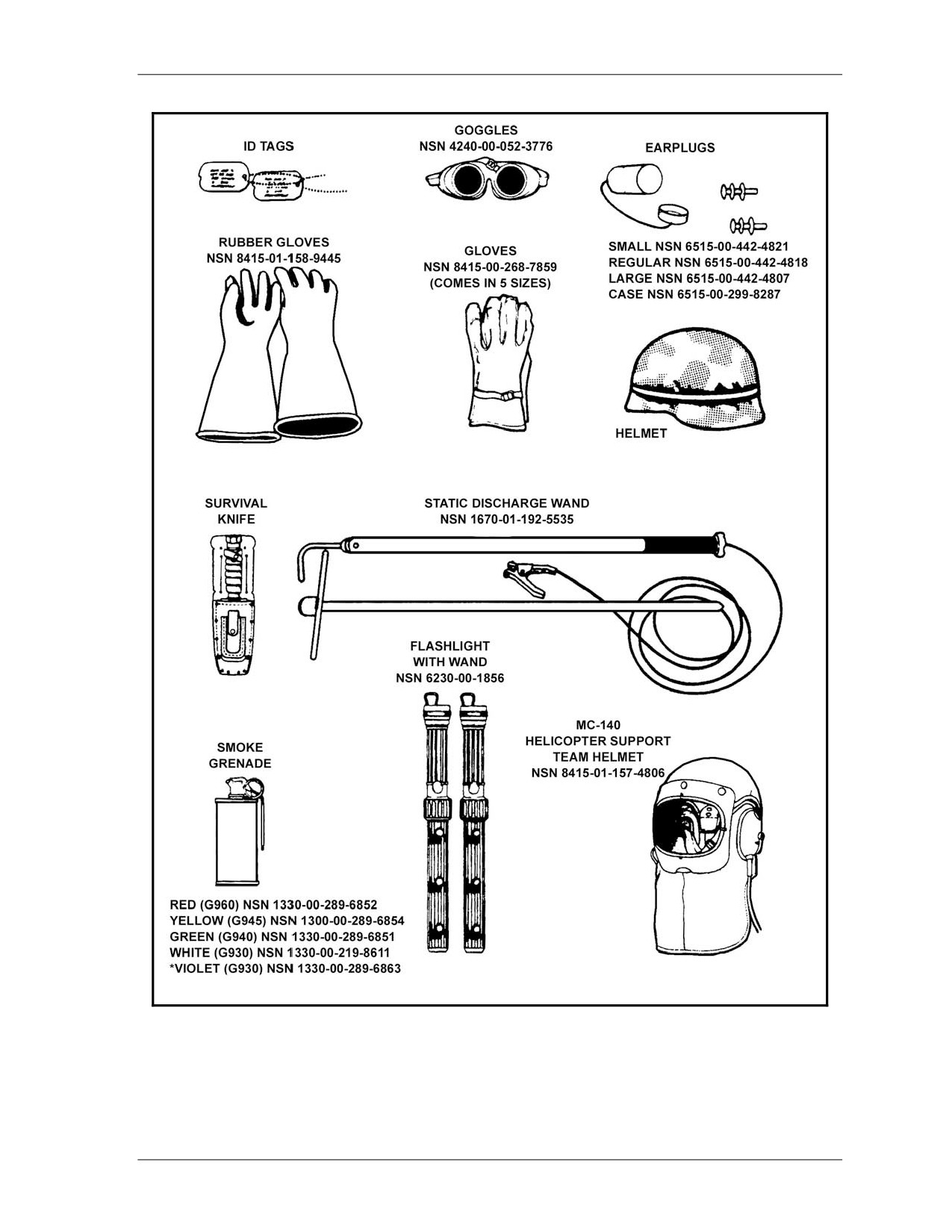
do everything they can to ensure the safety of the ground crews. The crews themselves should use the
following safety equipment (Figure 5-17).
Helmet
5-69.
This protects the wearer from head injuries caused by flying debris. It also protects him if his head
were to get caught between the aircraft and the load, for example. Wearers must keep helmets securely
fastened.
5-22
FM 3-21.38
25 April 2006
External Loads
Figure 5-17. Protective equipment.
25 April 2006
FM 3-21.38
5-23
Chapter 5
Protective Mask or Dust Goggles with Respirator
5-70.
In high dust or debris environments, each crewmember wears a mask or goggles. This protects the
crewmembers' faces, eyes, and respiratory systems from the airborne particles stirred up by the rotor wash.
The mask protects better than the goggles but can cause problems with depth perception (important for
signalmen).
Earplugs or Suitable Substitute
5-71.
These protect against the excessive noise associated with hovering aircraft. They also prevent
debris from entering the ear canal.
Hand Protection
5-72.
Marine Corps and Navy personnel must wear gloves designed to protect electrical workers against
burns due to static discharges. Everyone else (US Army, USAF, and USCG) should wear leather gloves to
help protect the hands and fingers. Whoever must use the static wand to discharge static electricity should
wear gloves designed for adequate protection from static discharge burns.
Inspect shockproof gloves before and after each operation. Check for excessive wear, fraying,
holes, and tears. Do not use a torn glove. Even a small hole leaves a person unprotected from
static electric shock.
Check each glove for holes by filling it with water and squeezing it while holding the open end
closed. Or, blow air into it like a balloon and submerge it in water. Any holes will cause air
bubbles.
Static Discharge Wand
5-73.
The static discharge wand protects the hookup man from electrical shock by grounding the cargo
hook. In flight, the helicopter stores static electricity. This electrical charge increases with the weight of the
helicopter, with low humidity, and with the amount of debris blown around by the rotor system (dust, sand,
or snow). Thunderstorms can cause huge discharges of static electricity. When the helicopter lands and
touches the ground, this charge grounds. However, while the helicopter remains airborne, such as when it
hovers to make a slingload drop, the charge stays in the aircraft. As soon as the ground-crew member
connects the apex fitting to the cargo hook, he becomes a path for an electrical charge to follow into the
ground. This charge can cause severe electrical burn or injury.
To avoid the possibility of a static electric shock, ground the cargo hook (connect the helicopter
to the ground) using grounding stakes and static discharge wands. (The stakes and wands may
be field-expedient or manufactured.) Because these wands connect the helicopter to the ground,
the electric charge dissipates. This protects the hookup man from receiving a shock when he
connects the apex fitting to the cargo hook.
Inspect the static discharge wand to make sure it is in serviceable condition. Drive the
grounding stake opposite the ground crew's exit direction. This keeps them from tripping on the
cable as they leave.
Drive the stake into the ground until it seats firmly—at least 6 to 8 inches in firm ground and
24 inches in sandy or loose soil. Drive the stake in at a 45-degree angle away from the side of
the load, in case someone falls on it. Connect the cable clamp to the vertical shaft of the stake.
When operating on concrete or asphalt surfaces, position the loads as close to the edge of the
surface as you can. This allows you to drive the grounding stake into the ground.
Do not hold the static discharge wand within 14 to 16 inches of the metal hook end—a strong
static charge can jump as far as 12 inches. During the hookup operation, the static discharge
wand must stay in contact with the cargo hook. If contact fails, all ground-crew members must
pull back from the hook until someone can reestablish contact between the wand and the
aircraft's cargo hook.
5-24
FM 3-21.38
25 April 2006
External Loads
Other Equipment
5-74.
Use smoke grenades to mark the location of the landing site or to indicate wind direction. Use
flashlights with wands to give arm-and-hand signals at night.
SAFETY
5-75.
In addition to using the proper equipment, Soldiers must also follow these other safety measures:
Wear long-sleeved shirts with the sleeves rolled down and fastened. Button your shirt collar.
Tuck shirttails or jacket bottoms into your trousers.
Police the operational area thoroughly before conducting slingload operations. This cuts down
on the amount of debris thrown about by rotor wash.
5-76.
Stay alert during hookup and release operations; sound judgment and common sense hold the keys
to success. Stay ready to get clear of the load. Soldiers have been crushed between the aircraft and loads.
Some have had loads dragged over them; others took an unwanted ride when they somehow entangled
themselves with the load. Whenever you have to make the hookup, take special care. Slings under tension
can easily crush an arm or leg against the load. Some of the particular hazards associated with loads
include—
Cargo Extensions or Projections
5-77.
Gun tubes, landing gear, missile launchers, bridge planks, and so forth can interfere with or injure
you by striking or tripping you. Stand clear of such projections or position yourself so you can clear the
load at once.
Sharp Projections, Hooks, Handles, Racks
5-78.
If possible, avoid these. Examples include protruding handles or levers such as tarpaulin tie-down
hooks, door handles, spare-tire racks, and similar projections. Sharp edges can cause serious injury. You
can quickly get hooked to the load if your clothing or equipment catches on something. Keep alert and
ready to move out of danger immediately.
Top-Heavy or Narrow-Based Loads
5-79.
Treat with caution any top-heavy or narrow-based loads that the rotor wash could blow over. If
possible, lay this kind of load on its side before starting the hookup. If you cannot do this, position the
crew on the side or end of the load that is least likely to tip. Again, stay ready to move away from the
danger quickly.
High Loads
5-80.
High loads can seriously injure you if you climb up on them to hook them up. Rotor wash can
sweep you off, or you might have to jump to avoid a dangerous situation. Pay attention to where you stand.
Try to stand on a lower projection or step rather than on top of the load. This way, if the aircraft makes
contact with the load, it does not catch you in between. Also, try to work from a crouched position or from
your hands and knees. Keep solid footholds and handholds, and stay ready to move quickly out of the way
if you need to. If possible, back a vehicle up to the load and use it as a working platform. (Move it out of
the way before the aircraft starts to lift the load.)
GROUND CREW EMERGENCY CONDUCT
5-81.
When an aircraft hovering over a slingload suffers an emergency severe enough for the pilot to
have to set the aircraft down, he will do so. This can happen all at once such as in a controlled crash. For
25 April 2006
FM 3-21.38
5-25
Chapter 5
this reason, whenever an aircraft seems to be having trouble, all members of the ground crew should clear
the slingload point by moving to a location coordinated with the aviation unit. Once they have moved far
enough away, they should each take a prone position or seek cover until the aircraft lands. Two
responsibilities require special note:
Signalman
5-82.
Face the aircraft; move to a safe spot.
Hookup Men
5-83.
Try to work along the same side of the load as your assembly area, or as coordinated. This way,
you do not have to climb over or go around the load to seek safety. You can instead move directly off and
away from the load. If the load is a heavy piece of equipment, you might want to keep the load between
you and the aircraft while you are moving. This offers you some protection if the aircraft were to crash.
GROUND CREW DUTIES
5-84.
Normally, the ground crew consists of one signalman and two hookup men, with one hookup man
acting as static wand man.
Signalman
5-85.
Duties of the signalman include the following.
Before the Aircraft Arrive(s)
5-86.
Direct the positioning of the load. Supervise the inspection of the load for proper routing of the
slings and proper preparation. Ensure that the load is ready to fly.
As the Helicopter(s) Approaches
5-87.
Station yourself 20 meters in front of the load where you can best maintain eye contact with the
crew. Give the arm-and-hand signal of "assume guidance." As the helicopter nears the load, use
arm-and-hand signals to position the cargo hook directly over the load, close enough that the hookup men
can place the apex fitting onto the cargo hook. During this time, position yourself so the pilot can see your
signals easily. Because the pilot of an Army aircraft sits on the right side of the aircraft, you will usually
stand just to the right of the aircraft. If the terrain forces you to stand somewhere else, make sure the pilot
can see you at all times.
During the Hookup Process
5-88.
Watch the cargo hook and apex fitting. After hookup, the pilot hovers the aircraft until the hookup
men clear away from the load. When they have moved clear, you will signal the aircraft upward slowly, so
the sling legs gradually take up the load. You must do this to make sure the sling legs clear the load. If the
sling legs foul, motion the pilot downward, and then instruct him to cut away the load. If you did a good
job of hooking up the load, and if the load suspends properly below the aircraft, then give the aircraft the
signal to depart. Then move quickly aside to clear the helicopter's path.
5-26
FM 3-21.38
25 April 2006
External Loads
DANGER
AT NO TIME WILL THE SIGNALMAN OR ANY OTHER MEMBER
OF THE SLINGLOAD TEAM ALLOW A SUSPENDED LOAD TO
PASS OVER HIS HEAD.
Hookup Men
5-89.
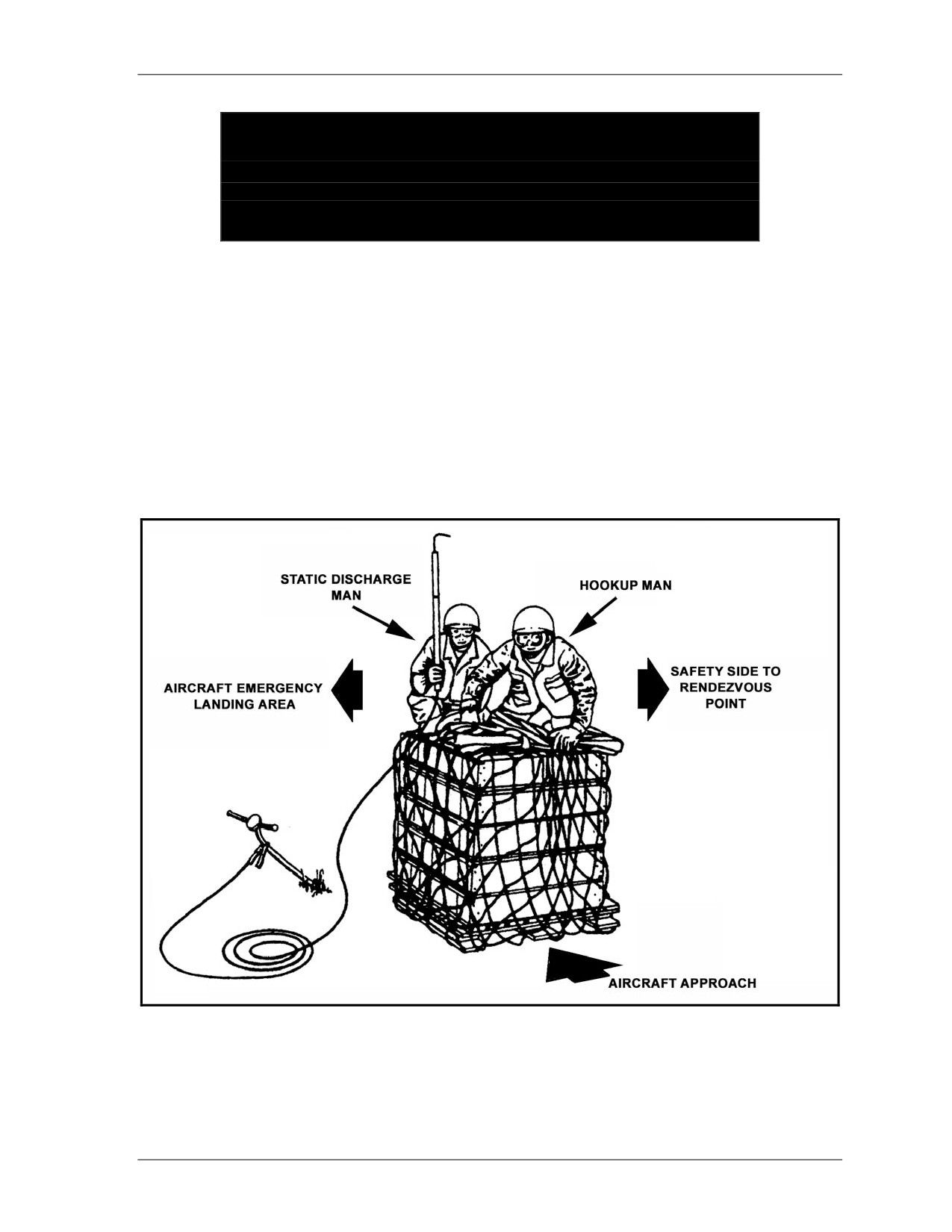
Duties of the hookup men include the following:
One of you handles the static discharge wand and the cargo hook. The other controls the apex
fitting of the slingload. Together, you must complete the hookup fast to reduce helicopter hover
time and to reduce your exposure time under the helicopter.
Position yourselves by the load so that, while the helicopter hovers over the load, you can
quickly complete the hookup (Figure 5-18). You must also make sure the signalman can
continually observe the operation.
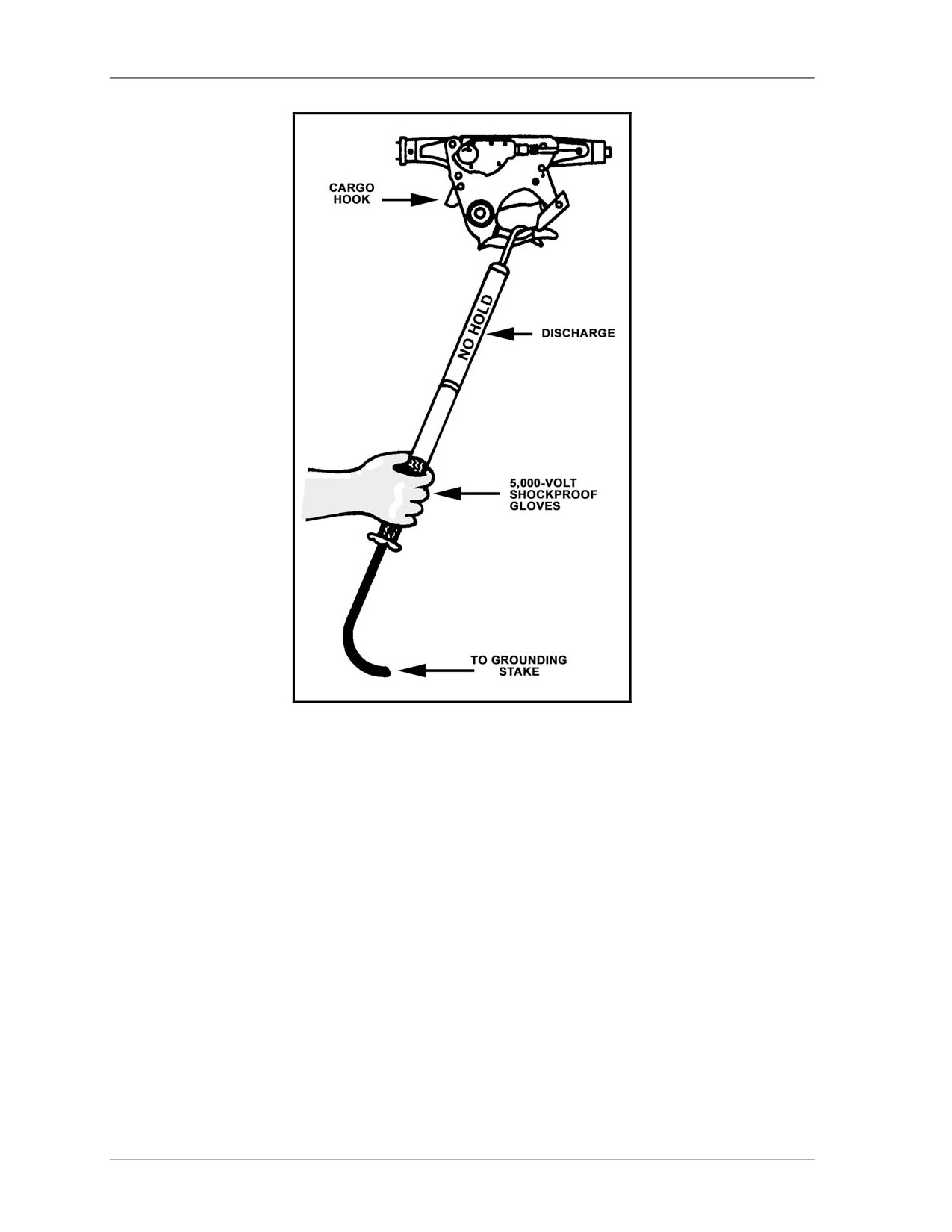
When the helicopter moves into the correct position for hookup, whichever one of you is the
static wand man must ground the aircraft. Touch the static wand to the cargo hook
(Figure 5-19, page 5-28) and keep it there to maintain a continuous ground.
Figure 5-18. Position of hookup team.
25 April 2006
FM 3-21.38
5-27
Chapter 5
Figure 5-19. Grounding technique.
Once the static wand man grounds the aircraft, the other hookup man places the apex fitting
onto the cargo hook, then checks to make sure that the hook is properly closed (and locked, if
required).
After you properly hook up the load to the aircraft, both of you must move quickly aside to the
location coordinated with the aviation unit. If the signalman learns that any of the legs have
fouled, he notifies the pilot at once. Also, you will have to rehook the load.
RELEASE PROCEDURES
5-90.
For this mission, leaders refer to the hookup men as the "cargo release team." As the helicopter
approaches the site, the pilot takes instructions from the signalman, who guides the aircraft into position for
cargo release. The cargo release team stands by, unless it must release the load manually. The signalman
directs the aircraft to set the load on the ground. He gives the release signal. At this time, the apex fitting
should fall free of the cargo hook. If it does not, the signalman has the aircraft hover, then he directs the
cargo-release team to move under the helicopter and manually release the load from the hook. The load
clears the hook. After the release, everyone moves out from under the aircraft. The signalman directs the
aircraft to depart and quickly moves out of its path. If the pilot cannot activate the cargo hook from within
the helicopter, and if cargo release personnel open it, then ground-crew members must use the following
emergency cargo release procedures:
5-28
FM 3-21.38
25 April 2006
External Loads
If a donut ring or basket hitch is used, try to disassemble the apex/donut. Pass the pin/ADS
through the hook.
If the cargo hook is attached to a clevis or apex fitting, unscrew the nut on the clevis or fitting
and remove the pin.
If necessary, derig the load so the aircraft can set down.
HOOKUP PROCEDURES DURING WHITEOUTS OR BROWNOUTS
5-91.
The hazards of these conditions
(snow or dust) prevent the use of a signalman or a
hovering hookup.
Rig the load with a 20-foot or a 40-foot extension (as required) using 20-foot ADS with two or
three loops and the appropriate number of type IV link assemblies. Place an apex fitting at the
end of the extension.
Lay the extension to the left of the load. The aircraft approaches normally, then taxis to the
location of the apex fitting and stops. Once the aircraft lands, the hookup person moves to the
aircraft and attaches the apex fitting to the cargo hook. The aircraft suspends the load and
departs as directed by the GTA.
When attaching the extension to skid-equipped helicopters, such as the UH-1H, take care that
the sling goes forward of but not through the skid. Then attach it to the cargo hook.
WARNING
Before the operation begins, coordinate the ground crew's
evacuation route to a rendezvous point. Proper coordination with
the liaison officer or helicopter crew prevents confusion.
Helicopter emergency procedures depend on terrain, wind
direction, and pilot choice. Good coordination also prevents the
helicopter and ground crews from moving in the same direction.
SLINGLOAD INSPECTION RECORD
5-92.
To improve slingload safety, the Department of the Army implemented inspection procedures for
all Army equipment moved by the slingload method of air delivery. These procedures went into effect 1
October 1997. All Army loads require inspection by a qualified inspector before the arrival of the
supporting aircraft. The inspector completes the Slingload Inspection Record. (Figure 5-20, page 5-30,
shows an example completed DA Form 7382-R, Sling Load Inspection Record.) This form is used to
inspect all loads, to include nonstandard, or unique, loads. The commander with high risk approval
authority (usually the first colonel in the chain of command) is the approval authority for a nonstandard
load, and will be annotated in the remarks block of the DA Form 7382-R.
INSPECTOR QUALIFICATIONS
5-93.
Inspectors must hold the grade of E-4 or more. They must also either be a pathfinder, a slingload
inspector course graduate, or air assault- qualified.
25 April 2006
FM 3-21.38
5-29
Chapter 5
DISTRIBUTION OF THE SLINGLOAD INSPECTION RECORD
5-94.
Reproduce the slingload inspection record onto 8 1/2 by 11-inch paper, get it through official
distribution channels, or download it from the AEL. Complete the inspection record in triplicate. Copies of
the completed form are distributed as follows:
Give a copy to the supporting aviation unit.
Securely tape or tie a copy to the load.
Give a copy to the supported unit.
Figure 5-20. Example completed DA Form 7382-R, Sling Load Inspection Record.
5-30
FM 3-21.38
25 April 2006
THIS CHAPTER IMPLEMENTS STANAG 3570.
Chapter 6
Drop Zones
The ground unit commander designates the drop zone, usually with the drop zone
support team leader's (DZSTL's) technical help. The drop zone is where drop aircraft
deliver personnel and equipment by parachute or free drop. The commander selects a
DZ location that best supports the tactical plan. In the case of tactical training, the
commander checks the USAF assault zone availability report (AZAR) to see if an
approved DZ already exists within the tactical area. If the AZAR does not include a
DZ in that area, the commander must assess the tactical situation before choosing a
DZ location.
SECTION I. SELECTION FACTORS
The commander uses the drop zone selection factors discussed in this section to analyze the suitability of a
drop zone.
AIRDROP AIRSPEEDS
6-1.
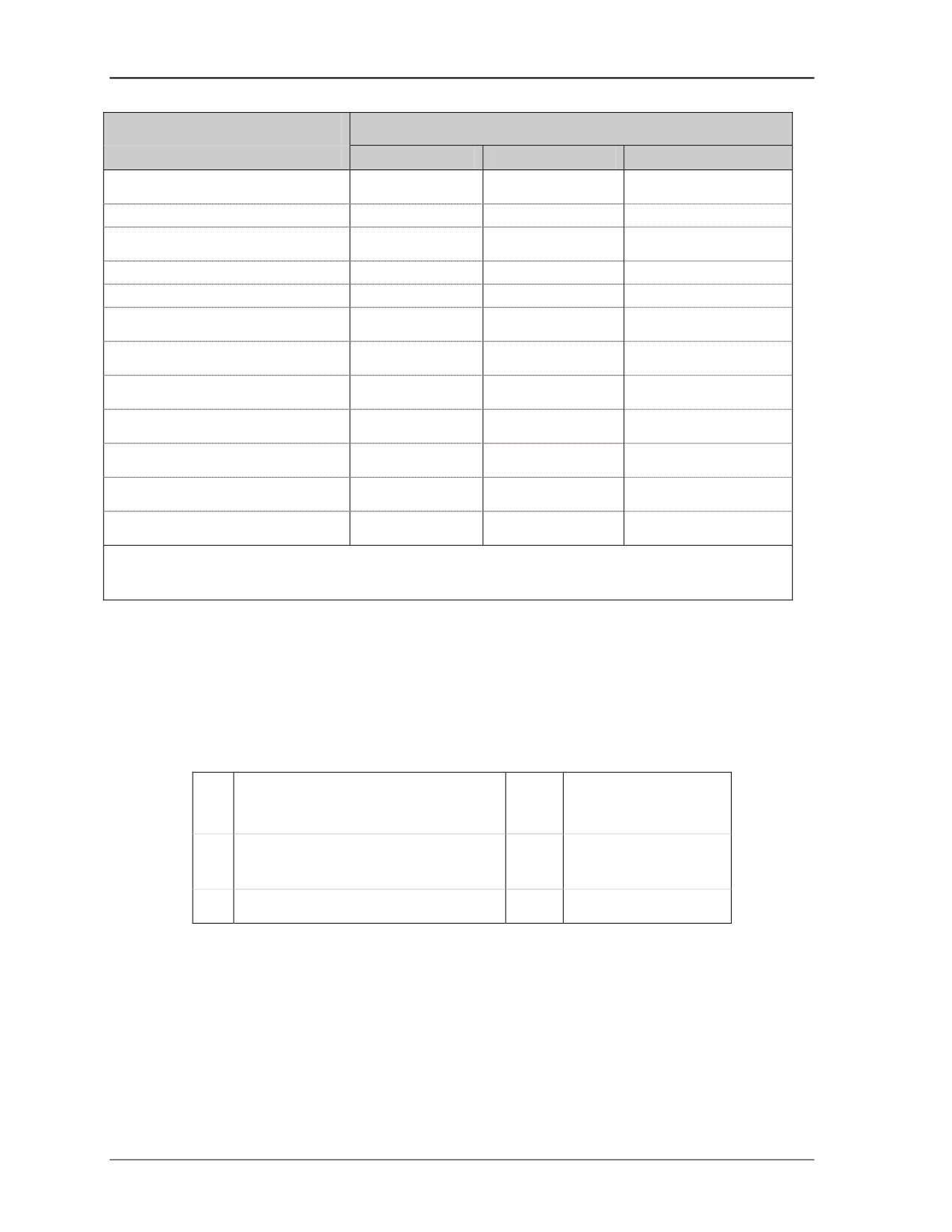
The speed of the aircraft (airspeed) determines how long the aircraft will remain over the
drop zone. Table 6-1 shows airspeeds for rotary-wing aircraft in knots indicated airspeed
(KIAS).
Table 6-2, page 6-2, shows the same thing, but for fixed-wing aircraft, by aircraft type and load.
Type of Aircraft
Airspeeds
UH-1 Huey
50 to 70 knots (optimum 70 knots)
UH-60 Blackhawk
65 to 75 knots (optimum 70 knots)
CH-46 (USMC)
80 to 90 knots
MH-53 (USAF)
80 to 110 knots (optimum 90 knots)
CV-22 Osprey (USAF)
80 to 110 knots (optimum 90 knots)
CH-47
80 to 110 knots (optimum 90 knots)
CH-46/53 (USMC)
80 to 110 knots (optimum 90 knots)
CH-54 Skycrane
65 to 75 knots (optimum 70 knots)
CH/HH3 (USAF)
70 to 90 knots
MC-130 Combat Talon I and II
70 to 90 knots
C-130/141/17/5
130 to 135 knots (personnel/door bundles)
C-7A Caribou
90 to 120 knots
C-27A (Aeritalia G-222)
125 knots
C-46 Commando/C-47 Sky Train
104 to 125 knots
DC-3 (Contract Aircraft)
104 to 125 knots
CASA-212
90 to 110 knots
Table 6-1. Airspeeds for rotary-wing aircraft.
25 April 2006
FM 3-21.38
6-1
Chapter 6
Airspeeds
Type of Load
C-130
C-141 or C-5
C-17
Personnel Static Line
130
130 to 135
130 to 135 (130 is ideal)
(130 is ideal)
Personnel HALO and HAHO
110 to 150
130 to 180
138 to 145
Container delivery system combination
130 to 140
150
140 to 150
and Equipment
(See note)
Heavy equipment
140
150
150
Free fall (free drop)
140
150
140 to 150
High velocity CDS
130 to 140
150
140 to 150
(See note)
Wedge
130 to 140
150
140 to 150
(See note)
Ahkio sled
130 to 140
150
140 to 150
(See note)
Combat rubber raiding craft (CRRC)
130 to 140
150
140 to 150
(See note)
Door bundle
130
130 to 135
130 to 135 (130 is ideal)
(130 is ideal)
Simulated airborne training bundle
Use same load as
Use same load as for
Not applicable
(SATB) (does not apply to C-17)
for actual drop
actual drop
High Speed, Low-Level, Aerial Delivery
En route airspeed
System (HSLLADS)
Note:
Use this type of load when gross weight exceeds 120,000 pounds. For combination drops, use the
higher airspeed KIAS. (A combination drop exists when the same or different type aircraft drop different
types of loads in the same pass over the DZ.)
Table 6-2. Airspeeds for fixed-wing aircraft.
DROP ALTITUDE
6-2.
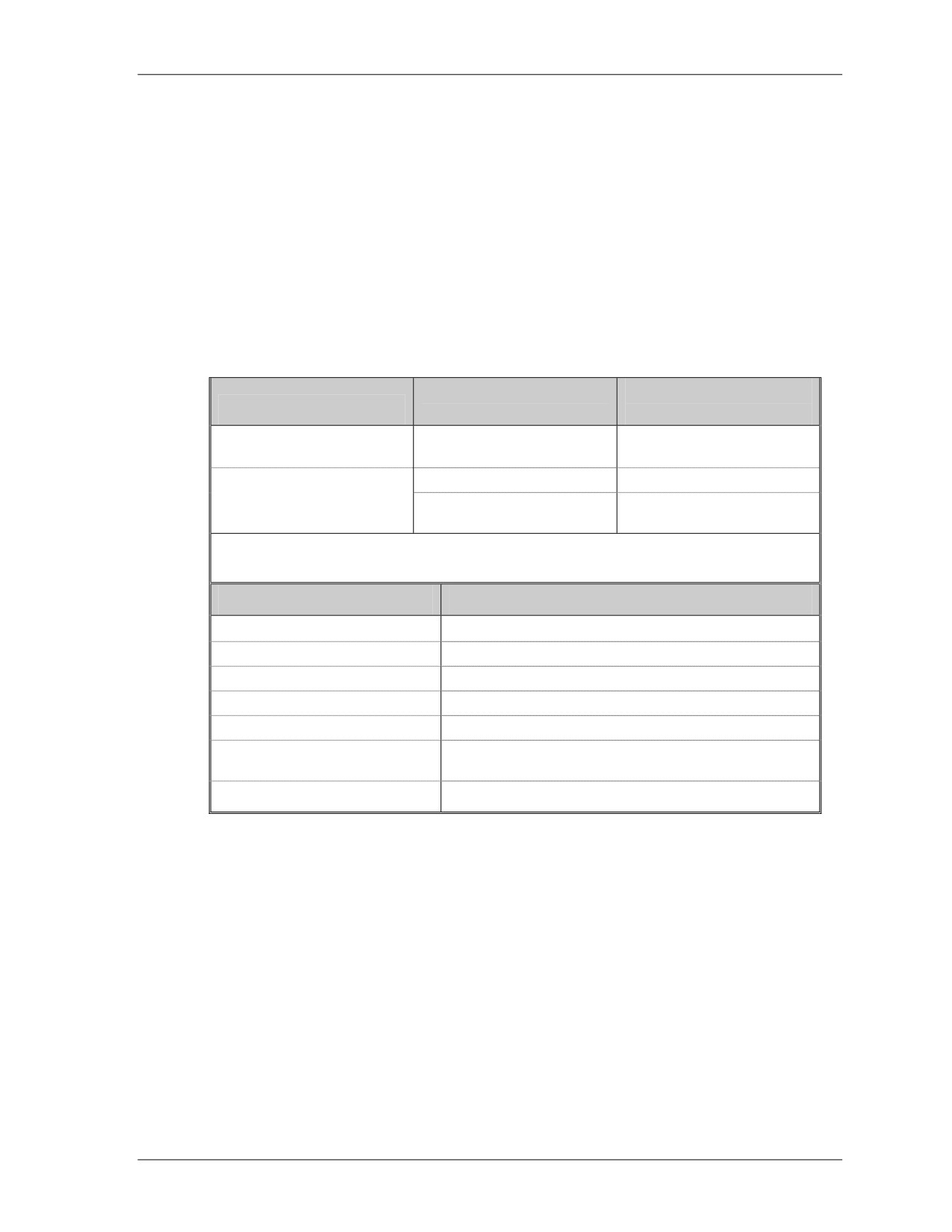
The DZSTL measures drop altitude in feet AGL (Table 6-3) from the highest point on the DZ (the
highest field elevation) to the aircraft. In combat (wartime) operations, airborne and airlift commanders
jointly determine drop altitudes. Table 6-4 shows drop altitudes, by load and aircraft type, in feet AGL.
A
Distance from highest field
800
Feet AGL
elevation in DZ to desired altitude
of aircraft, in feet.
B
Highest field elevation in feet above
+ 550
Feet field elevation
sea level, rounded up to next 50
(for example, round 505 up to 550).
C
Drop altitude in feet indicated.
1,350
Feet indicated
Table 6-3. Example calculation of drop altitude in feet indicated.
6-2
FM 3-21.38
25 April 2006
Drop Zones
6-3.
Table 6-4 shows airdrop altitudes for different types of training missions. (For more information
on drop altitudes, see AFI 11-231 and AFI 11-410.)
6-4.
The aircraft altimeter displays altitude in feet indicated (feet above sea level), not in AGL (feet
above the highest point on the ground). Thus, the pilot might request the drop altitude in “feet indicated.”
You can calculate this simply by following this example:
Obtain the drop altitude, that is, the distance in feet from the highest point on the drop zone
(field elevation) to the desired altitude of the aircraft. In this example, drop altitude equals 800
feet (A, Table 6-3).
Obtain the highest field elevation in feet above sea level. Round this number up to the nearest
multiple of 50 (round 537 up to 550, for example) (B, Table 6-3). For purposes of obtaining the
drop altitude in feet indicated, use this number for field elevation.
Sum the two numbers you obtained to yield drop altitude in feet indicated (C, Table 6-3).
Time of Day
Rotary Wing Aerial Delivery
Type of Load
(Light Conditions)
Altitudes
Personnel
Day or Night
1,500 Feet AGL
(includes limited visibility)
Bundles
Day
300 Feet AGL
Night
500 Feet AGL
(includes limited visibility)
Note: If the rotary wing aircraft is flying 90 KIAS or faster, then it can drop personnel as low
as 1,250 feet AGL.
Type of Load
Fixed Wing Aerial Delivery Altitudes
Planning
1,000 feet AGL
Combat operations (war)
Determined jointly by airborne and airlift commanders
Tactical training
800 feet AGL
Basic airborne training
1,250 feet AGL
HALO (minimum opening)
2,500 feet AGL
Simulated airborne training
500 feet AGL
bundle-personnel (SATB-P)
Tactical training bundle (TTB)
Use drop altitude of simulated load
Table 6-4. Airdrop altitudes for rotary- and fixed-wing aircraft.
TYPE OF LOAD
6-5.
The type of load is considered when estimating the drop zone time requirement, or how many
bundles or personnel can be exited in a single pass over the drop zone. This is a consideration as a
commander may request a DZ capable of exiting a certain amount of jumpers in a single pass, or may need
to know how many jumpers can exit over a preselected DZ. For personnel, allow one second for each
jumper after the first. For example, ten jumpers minus the first jumper equals nine jumpers. Multiply nine
times one second. Allow nine seconds for all ten jumpers to get out the door. For equipment, allow three
seconds for each door bundle after the first. For example, five bundles minus the first bundle equals four
bundles. Multiply four times three seconds each. Allow twelve seconds to get the equipment out the door.
There is no set time to wait between exiting bundles and personnel. However, the jumpmaster team must
ensure all bundles have exited the aircraft, and that no unsafe conditions exist, before they start exiting
personnel IAW Chapter 10 of FM 3-21.220. Bundles and personnel must never exit at the same time.
25 April 2006
FM 3-21.38
6-3
Chapter 6
DANGER
Never allow personnel and bundles to exit the aircraft at the
same time.
6-6.
For container deliver system (CDS) and heavy equipment, the time requirement is already
factored into the minimum computed air release point (CARP) DZ sizes found in AFI 13-217.
METHODS OF DELIVERY
6-7.
The type of airdrop determines method of delivery. The three methods are low-velocity,
high-velocity, and free-drop trips. The method then normally determines the location of the control center.
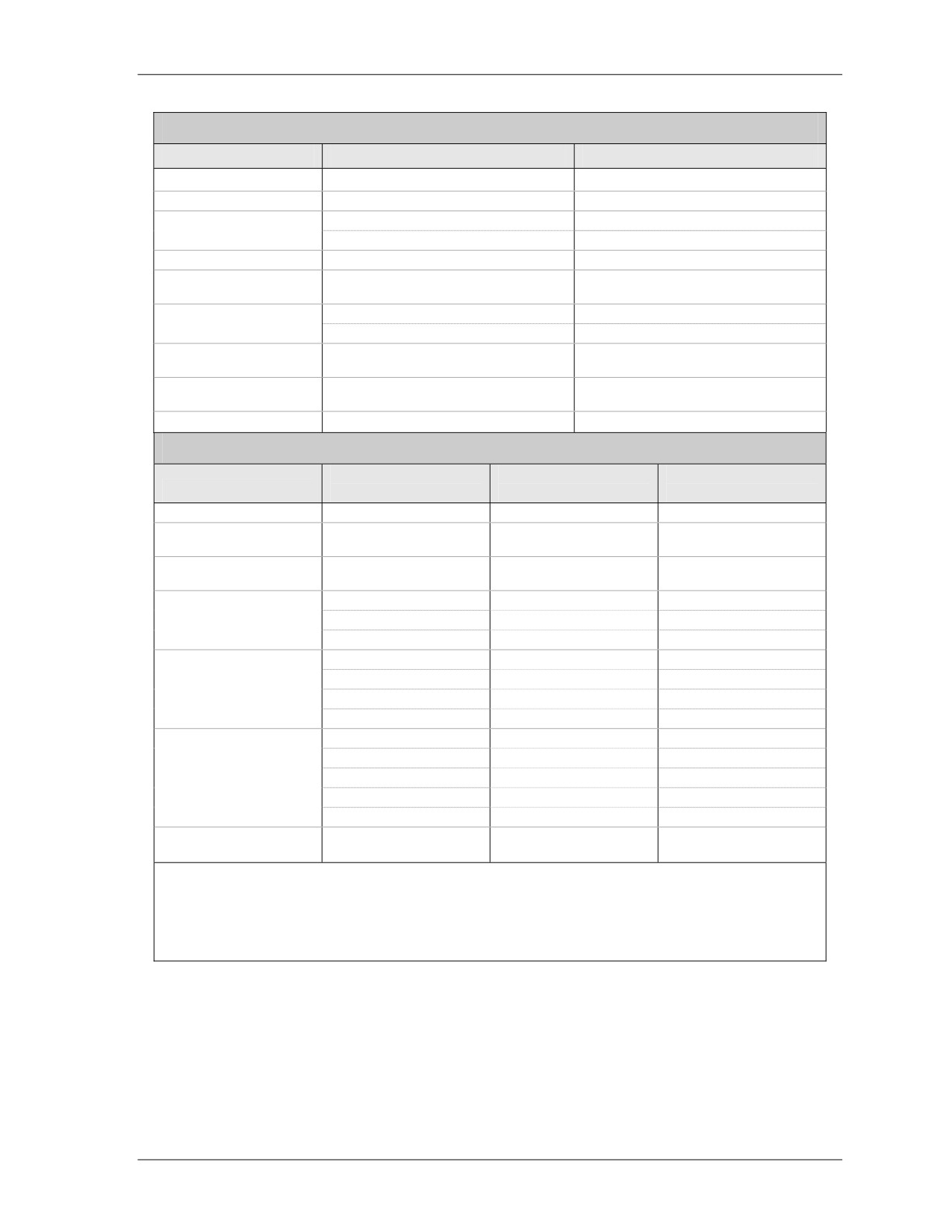
Table 6-5 shows the minimum airdrop altitudes, by aircraft, load, and parachute type.
USAF Fixed-Wing Aircraft: Door Bundles
Type of Parachute
Altitude for C-5, C-17, and C-141
Altitude for C-130
G-14
300 feet AGL
300 feet AGL
T-10 cargo
300 feet AGL
400 feet AGL
C-5, C-17, C-141: Container Delivery System
Type of Parachute
Number Parachutes or Containers
Airdrop Altitude
Planning drop altitude
NA
600 feet AGL
G-12D
Single canopy 1 to 6 containers
475 feet AGL
7 or more containers
575 feet AGL
2 or 3 parachutes
525 feet AGL
G-12E
Single canopy 1 to 40 containers (130
425 feet AGL
KIAS)
Single canopy 1 to 40 containers (140
375 feet AGL
to 150 KIAS)
2 or 3 parachutes
550 feet AGL
G-14
1 or 2 containers
300 feet AGL
3 containers
400 feet AGL
12- to 22-foot
NA
100 feet plus vertical distance for the
high-velocity ring-slot
load being drop
parachute
26-foot high-velocity
NA
100 feet plus vertical distance for the
ring-slot parachute
load being drop
SATB-C
NA
See parachute type being simulated
Table 6-5. Minimum aerial delivery altitudes.
6-4
FM 3-21.38
25 April 2006
Drop Zones
C-130: Container Delivery System
Type of Parachute
Number Parachutes or Containers
Airdrop Altitude
Planning drop altitude
Single canopy 1 to 6 containers
600 feet AGL
G-12D/E
7 or more containers
400 feet AGL
G-12D
2 or more parachutes
600 feet AGL
2 or more parachutes
600 feet AGL
G-12E
2 or more parachutes
550 feet AGL
CRRC (G-12D/E)
NA
600 (boat only) otherwise use personnel
drop
G-14
1 or 2 containers
400 feet AGL
3 containers
500 feet AGL
12- to 22-foot high-velocity
NA
100 feet plus vertical distance for the load
ring-slot parachute
being drop
26-foot high-velocity
NA
100 feet plus vertical distance for the load
ring-slot parachute
being drop
SATB-C
NA
See parachute type being simulated
C-5, C-17, C-141, C-130:
Heavy-Drop Equipment
Cluster Size (Number of
Altitude for
Altitude for
Type of Parachute
Canopies or Bundles)
C-5, C-17, and C-141
C-130
Planning drop altitude
NA
1,100 feet AGL
1,100 feet AGL
G-12D
NA
650 feet AGL
2 to 3 parachutes 650 feet
AGL
G-12E
NA
550 feet AGL
2 to 3 parachutes 550 feet
AGL
G-11A
1
900 feet AGL
900 feet AGL
2 to 7
1,100 feet AGL
1,100 feet AGL
8
1,300 feet AGL
1,300 feet AGL
G-11B
1
700 feet AGL
700 feet AGL
2 to 4
750 feet AGL
750 feet AGL
5 to 7
1,100 feet AGL
8
1,300 feet AGL
G-11C/X
1 to 2
975 feet AGL
1,050 feet AGL
3 to 4
1,025 feet AGL
1,100 feet AGL
5
1,075 feet AGL
1,150 feet AGL
6 to 7
1,125 feet AGL
1,200 feet AGL
8
1,225 feet AGL
1,300 feet AGL
SATB-H
NA
See parachute type being
See parachute type being
simulated
simulated
NOTES:
1.
Combination drops use the highest airdrop altitude. A combination drop exists when either of the
following occurs:
When different aircraft drop different types of loads in same pass over DZ.
When different type loads exit same aircraft in same pass over DZ.
2.
Minimum airdrop altitude for heavy equipment using the 5,000-pound parachute release is 1,000 feet AGL or by
parachute type, whichever is higher.
Table 6-5. Minimum aerial delivery altitudes (continued).
25 April 2006
FM 3-21.38
6-5
Chapter 6
LOW-VELOCITY AIRDROP
6-8.
Low-velocity airdrops are used for sensitive equipment and personnel. The parachute slows the
rate of the descent to prevent damage to equipment or injury to personnel.
HIGH-VELOCITY AIRDROP
6-9.
High-velocity airdrops are used to deliver certain supply items. The load must be rigged in an
airdrop container with an energy dissipater attached to its underside and a ring-slot parachute attached to
the top. The chute stabilizes the load and reduces the rate of fall, ensuring an acceptable landing shock.
FREE DROP
6-10.
Free drops are used for nonsensitive items only. This type of load has no parachute to stabilize or
slow its rate of descent. Loads may require special packaging to prevent damage from impact.
ADDED RISK
6-11.
When determining the suitability of the DZ and considering the method of delivery around
populated or built-up areas or airfields, the pathfinder also considers the added risk of injury to personnel
or damage to buildings when using high-velocity or free-drop methods.
OBSTACLES
6-12.
To ensure a safe airdrop, and to ensure Soldiers can recover and employ airdropped personnel and
equipment, the ground unit commander should assess the risks of obstacles on the DZ and adjacent areas.
OBSTACLES TO PERSONNEL
6-13.
This includes anything, natural or manmade, that could harm a parachutist or prevent mission
accomplishment.
OBSTACLES TO EQUIPMENT
6-14.
This includes anything, natural or manmade, that could damage or hinder the recovery of
equipment.
Trees
6-15.
Trees 35 feet (which is the distance from the top of a personnel parachute to the harness) or higher
that would impede recovery of personnel or equipment present an obstacle.
Water
6-16.
Water at least 4 feet deep and 40 feet wide, and within 1,000 meters of any edge of the surveyed
DZ is an obstacle.
Power Lines
6-17.
Power lines carrying 50 or more volts can kill a jumper.
6-6
FM 3-21.38
25 April 2006
Drop Zones
DANGER
Set up the DZ away from power lines. A 50-volt shock can kill a
jumper. Even if it does not, it could cause him to fall, and that
could kill him.
6-18.
Try to site the DZ at least 1,000 meters from a power line. If you cannot, and a power line is
located within 1,000 meters of any boundary of the DZ, then you must coordinate with the local power
company to shut off the power to that line NLT 15 minutes prior to TOT. If this is not possible, then the
flying mission commander, aircrew, and jumpmaster must assess the risk. They should consider at least the
following:
Type of jump.
y Jumpers' experience.
y Aircrew's experience.
y Ceiling.
Surface and altitude wind limits required to approve, suspend, or cancel.
6-19.
To further minimize risks, they should consider how they might alter the mission profile to raise
or lower drop altitudes, change the DZ run-in or escape headings, or remove inexperienced jumpers from
the stick. Also, if they can, they should clearly mark power lines with lights, smoke, or VS-17 panels.
DANGER
Set up the DZ away from power lines. A 50-volt shock can kill
a jumper. Even if it does not, it could cause him to fall, and that
could kill him too.
Also, never try to climb power line poles to position or affix
markings to the poles or the lines themselves.
25 April 2006
FM 3-21.38
6-7
Chapter 6
6-20.
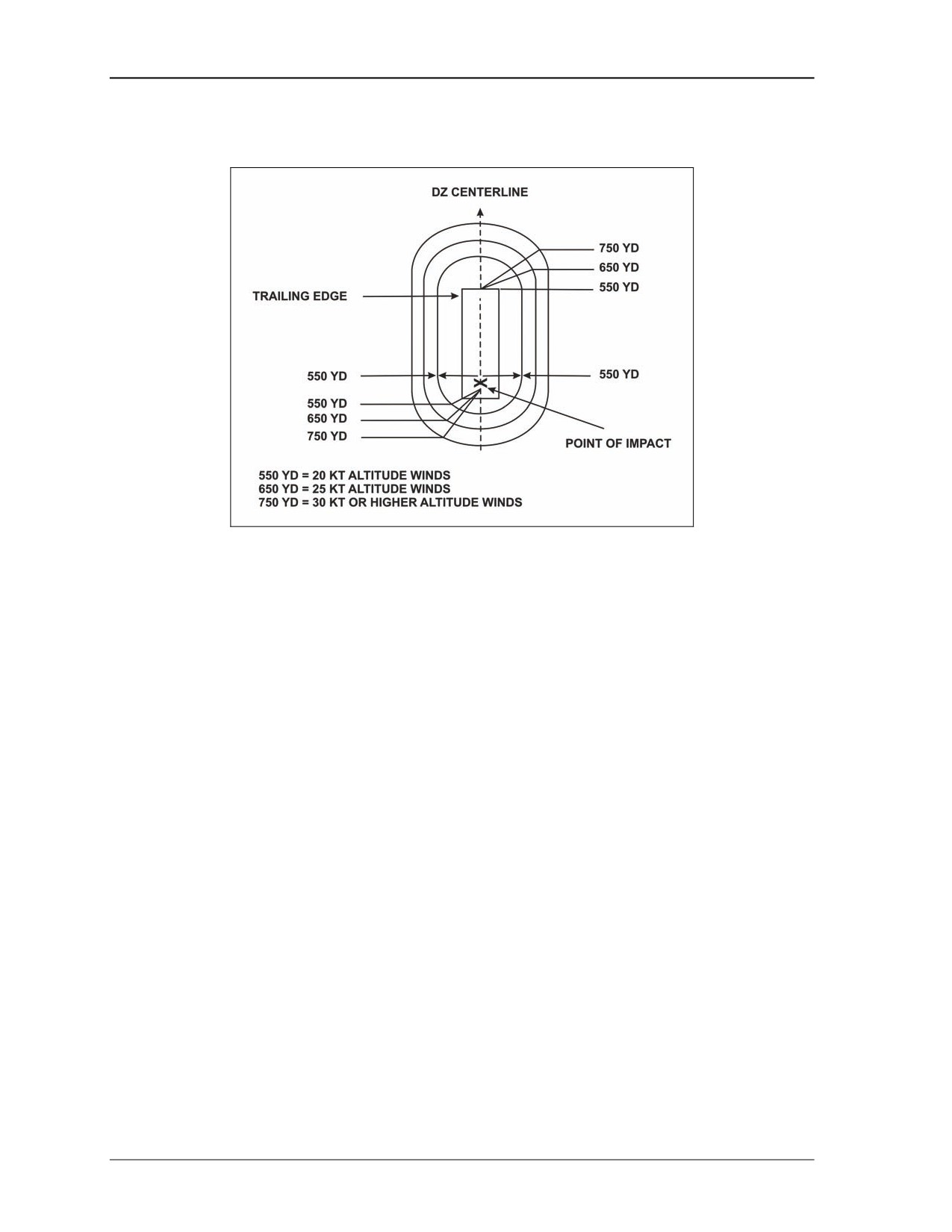
Figure 6-1 shows an example safety zone for when power lines fall within 1,000 meters of the
drop zone.
Figure 6-1. Recommended safety zones for high-tension lines.
Other Obstacles
6-21.
This includes anything else, such as barbed wire fences, swamps, rocks, ditches, steep inclines, or
gullies, that could injure parachutists, damage or prevent the recovery of equipment, or interfere with the
mission.
ACCESS
6-22.
Ground unit commanders should avoid any DZ that has a major obstacle between it and the
objective area. Ground unit commanders should also make sure the area has adequate routes to conduct
troop movement and to recover equipment.
6-8
FM 3-21.38
25 April 2006
Drop Zones
SIZE
6-23.
Ground unit commanders must use the following minimum peacetime drop zone sizes for fixed
wing aircraft, unless a waiver is issued. During wartime and contingency operations, the commander at the
appropriate level may waive the DZ size. AFI 13-217 provides information about waivers.
COMPUTED AIR RELEASE POINT
6-24.
The USAF prescribes the sizes of computed air release point DZs during peacetime
drop operations.
Heavy Equipment
6-25.
The minimum CARP DZ size (Table 6-6, top section) measures at least 600 yards (549 meters)
wide by 1,000 yards (915 meters) long for one platform. Add 28 meters (30 yards) to the length and width
for each 100 feet above 1,100 feet.
Personnel
6-26.
Table 6-6, bottom section, shows the CARP DZ size for personnel. The CARP DZ size for one
jumper is at least 549 meters (600 yards) by 549 meters (600 yards). For each additional jumper, add
64 meters (75 yards) to the length of the DZ.
Heavy Equipment
Drop Zone Length
Altitude
(Agl In Feet)
Width
One Platform
Additional Platforms
To 1,100
600 Yards
1,000 Yards
Add 400 yards (C-130) or 500 yards (C-17
or C-5) to trailing edge for each additional
platform.
Above 1,100
Add 30 yards to DZ width and length for each 100 feet above 1,000 feet (Add 15 yards to each
side of the DZ).
Personnel
Drop Zone Length
Altitude
(Agliin Feet)
Width
One Platform
Additional Platforms
To 1,000
600 Yards
600 Yards
Add 75 yards to trailing edge for each
additional parachutist. When using
CAPES, add 100 yards each instead.
Above 1,000
Add 30 yards to DZ width and length for each 100 feet above 1,000 feet (Add 15 yards to each
side of the DZ).
NOTES:
1.
For day visual formations, increase width by 100 yards (50 yards each side). For SKE formation, increase width
by 400 yards (200 yards each side). Official sunset to sunrise, increase width by 100 yards for single ship visual
drops (50 yards each side) or 200 yards for visual formations (100 yards each side).
2.
Official sunset to sunrise, increase length by 100 yards for visual drops (50 yards each end).
3.
For personnel formations, minimum DZ basic width using center PIs is 1,240 yards for 2-ship elements and
1,800 yards for 3-ship elements. When using offset PIs, minimum basic width is 1,100 yds for 2-ship elements
and 1,300 yds for 3-ship elements.
Table 6-6. Size criteria for tactical airlift drop zones, personnel, and heavy equipment.
25 April 2006
FM 3-21.38
6-9
Chapter 6
Container Delivery System
6-27.
Table 6-7 shows the CARP DZ sizes for the container delivery system.
CDS (C-130)
Number of Containers
Altitude
(AGL in Feet)
Width
Single
Double
Length
To 600 feet AGL
400 yards
1
1 to 2
400 yards
2
3 to 4
450 yards
3
5 to 6
500 yards
4
7 to 8
550 yards
5 to 8
9 or more
700 yards
Above 600 feet
Add 40 yards to DZ width and length for each 100 feet above 600 feet (Add 20 yards to each
side of the DZ).
CDS (C-17)
Number of Containers
Altitude
(AGL in Feet)
Width
Single
Double
Length
To 600 feet AGL
450 yards
1
1 to 2
590 yards
2
3 to 4
615 yards
3
5 to 6
665 yards
4 to 8
7 to 16
765 yards
9 to 14
17 to 28
915 yards
15 to 20
29 to 40
1,065 yards
Above 600 feet
Add 40 yards to DZ width and length for each 100 feet above 600 feet. Add 20 yards to each
side of the DZ.
High Velocity (HV) CDS (Using 12-, 22-, or 26-Foot, Ring-Slot Parachutes)
Altitude
(AGL in Feet)
Width
Length
Less than or equal
580 yards or
660 yards or 604 meters
to 3,000 feet AGL
530 meters
Add 50 yards or 46 meters to the trailing edge for each additional row
of containers
More than 3,000
Add 25 yards or 23 meters to each side and 100 yards or 91 meters to each end for every
feet AGL
1,000 foot increase in drop altitude.
High Altitude Airdrop Resupply System (HAARS) CDS
Altitude
(AGL in Feet)
Width
Number of Containers
Length
Less than or equal
500 yards or
1 to 8 containers
1,200 yards or 1,098 meters
to 3,000 feet AGL
457 meters
9 or more containers
1,900 yards or 1,739 meters
More than 3,000
Add 25 yards or 23 meters to each side and 50 yards or 46 meters to each end for every 1,000
feet AGL
foot increase in drop altitude.
High Speed Low Level Aerial Delivery System (HSLLADS)
Altitude
(AGL in Feet)
Width
Length
NA
300 yards or
600 yards or 549 meters
274 meters
Table 6-7. Size criteria for tactical airlift drop zones, Container Delivery System.
6-10
FM 3-21.38
25 April 2006
Drop Zones
Additional Size Requirements
6-28.
For each additional platform on a C-130, add 366 meters (400 yards) to the length of the DZ. For
each additional platform on a C-17, C-5, or C-141, add 458 meters (500 yards). For multiple aircraft not
flying in trail formation, add 100 yards to the width of all CARP DZs. From official sunset to sunrise, add
100 yards to the length and width of all CARP DZs. For SKE formations, increase the width by 400 yards.
For SKE formation, you need not add the 100 yards when the aircraft are not flying in trail.
6-29.
For C-17s flying in personnel formations, the minimum width for a basic DZ, using center PIs, is
1,240 yards for two ship elements, or 1,800 yards for three ship elements. When using offset PIs, the
minimum width is 1,100 yards for two ship elements, and 1,300 yards for three.
Note: Multiply yards by 0.9144 to convert them to meters; divide meters by the same number to
convert them to yards.
25 April 2006
FM 3-21.38
6-11
Chapter 6
ARMY VIRS AND GMRS DROP ZONES
6-30.
For the verbally initiated release system
(VIRS) and for the ground-marked release system
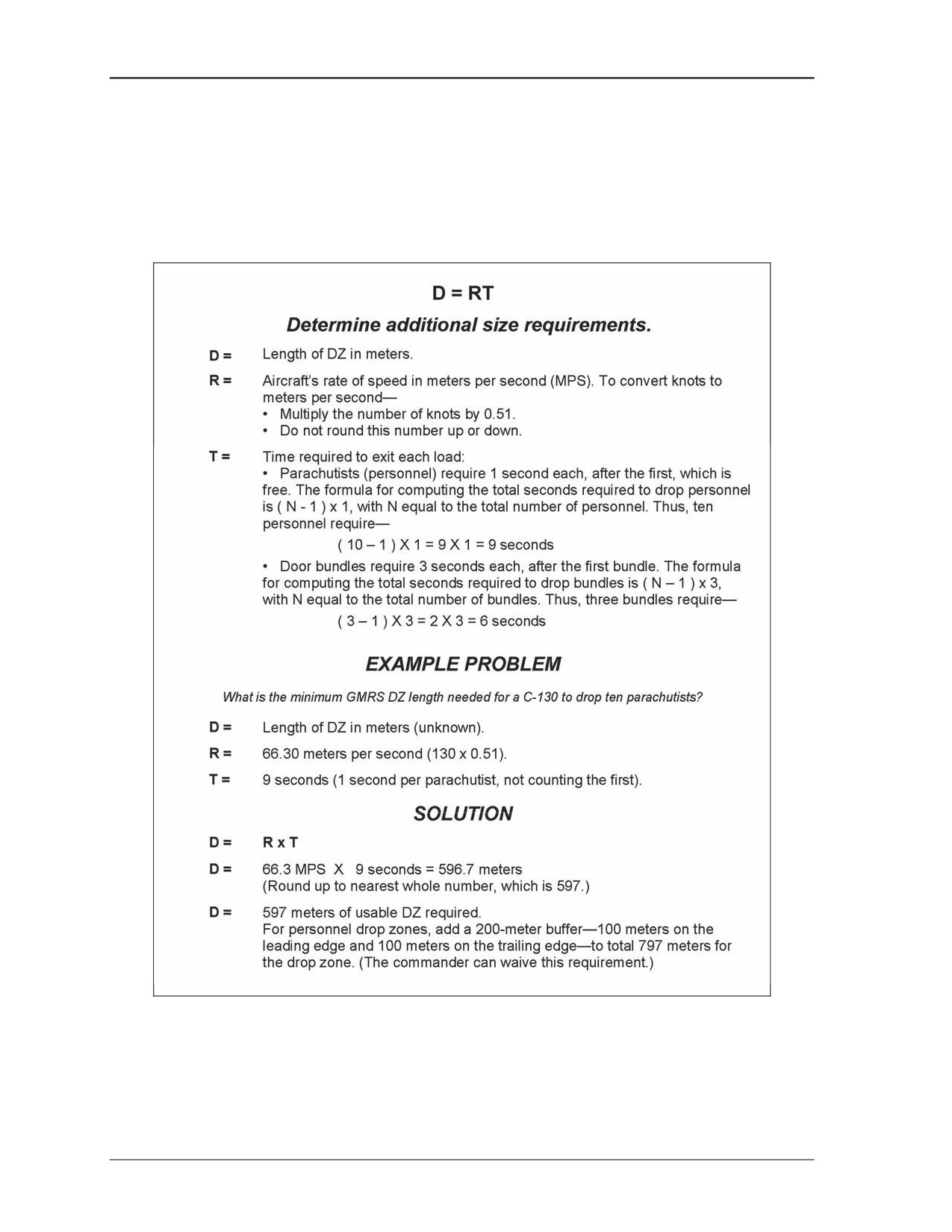
(GMRS), allow a minimum size of 300 yards by 300 yards (275 meters by 275 meters). To determine the
required size of Army VIRS DZs, use the D=RT formula (Figure 6-2). For personnel jumps, allow a
100-meter buffer zone at the leading and trail edges of the DZ. If local regulations permit, the local
commander can waive these buffer zones.
Figure 6-2. Example application of D=RT formula.
6-12
FM 3-21.38
25 April 2006
Drop Zones
PARACHUTISTS OR BUNDLES
6-31.
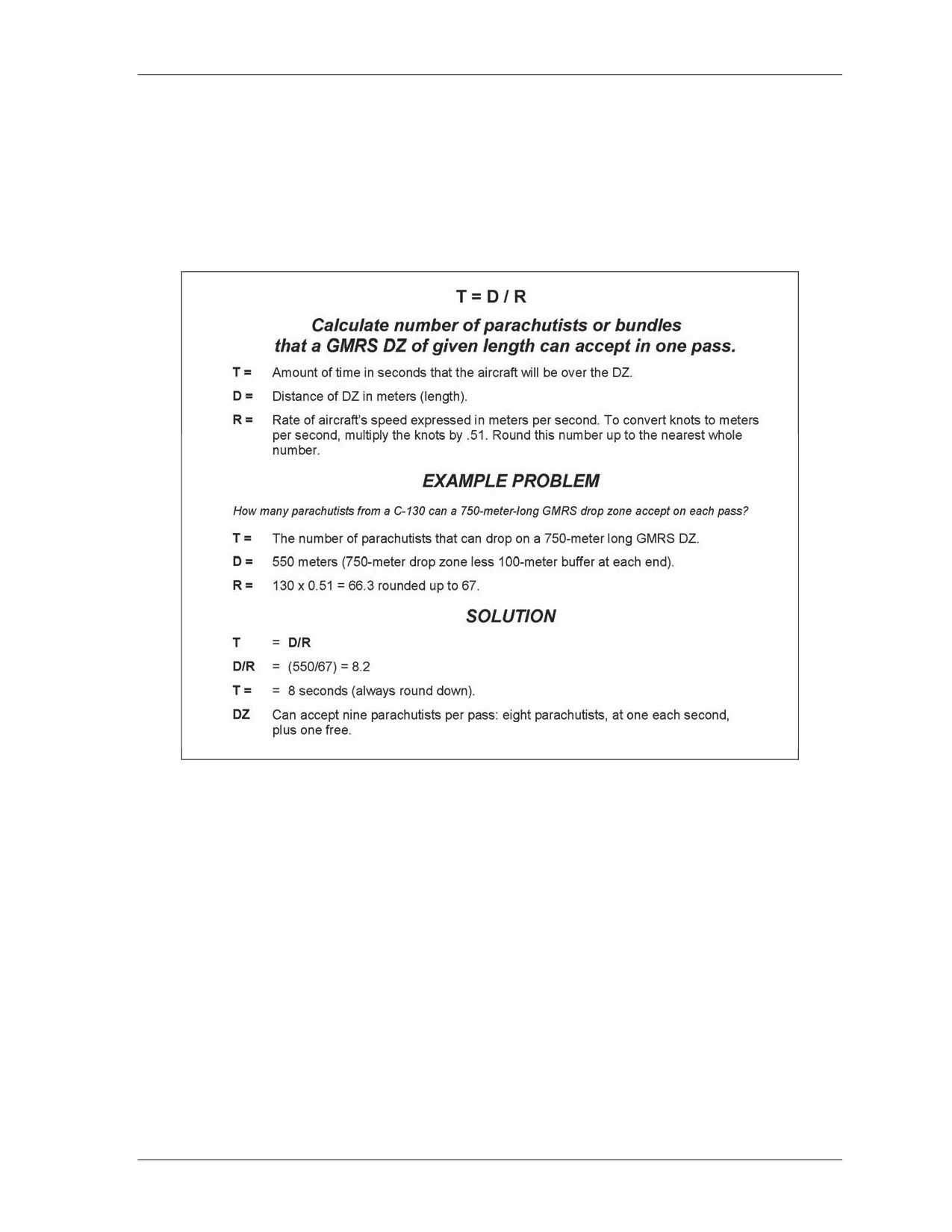
To calculate the maximum number of either parachutists or bundles that a GMRS or VIRS DZ of
given length can accept in one pass, use the T=D/R formula (Figure 6-3). You must know the type of
aircraft and drop speed, and type of exit. The T=D/R formula may also be used to calculate the same
information for a CARP DZ. In this case, measurement is from the PI to the trail edge of the DZ, minus the
buffer zone (personnel only). Minimum length for CARP DZ is 3 seconds. In all cases, once the PI is
established, the DZ time must be recalculated from the PI to trail edge, minus the required buffer.
Figure 6-3. Example application of T=D/R formula.
25 April 2006
FM 3-21.38
6-13
Chapter 6
LOAD DRIFT UNDER PARACHUTE
6-32.
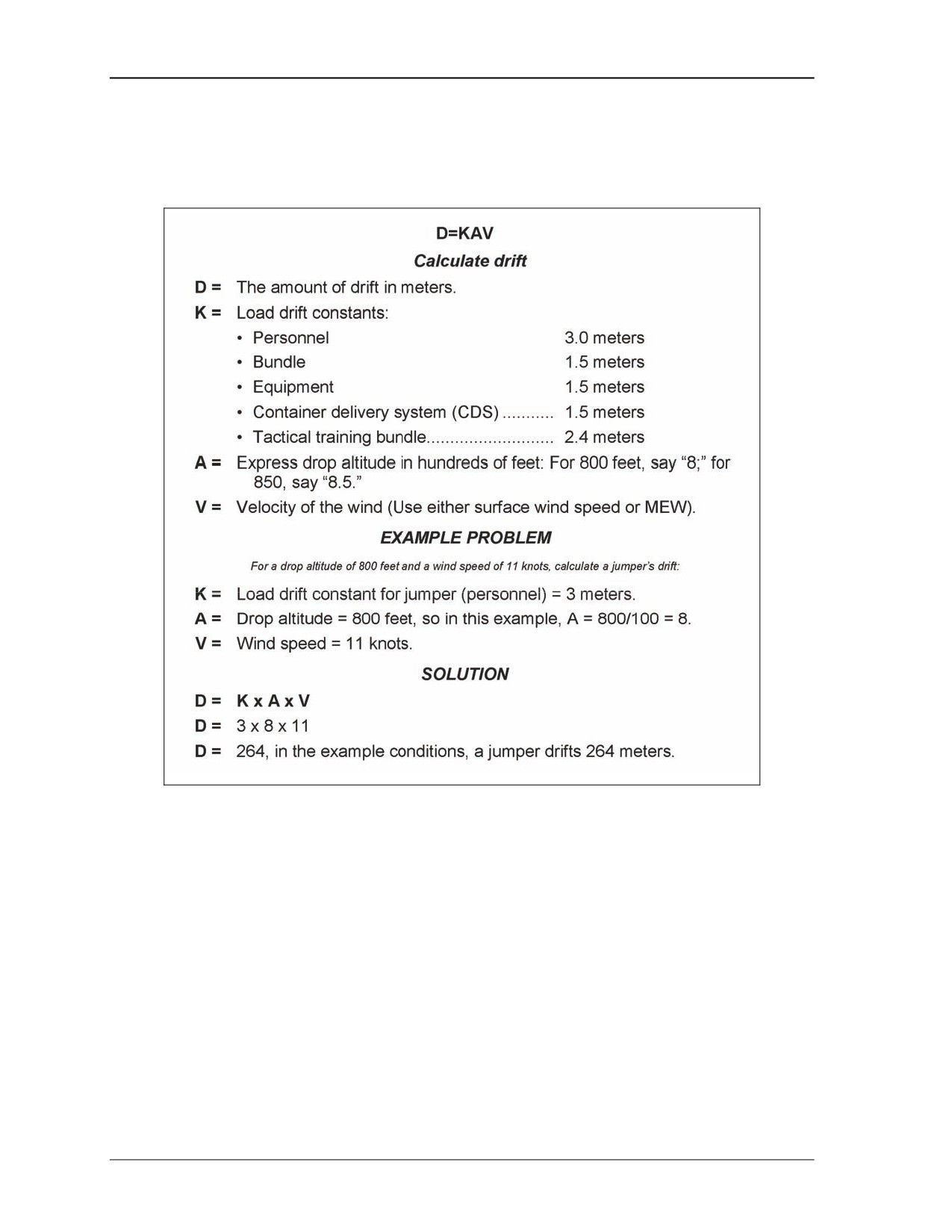
To calculate the amount of drift experienced by a load under a parachute, use the D=KAV formula
(Figure 6-4). Always round up to the next whole number.
Figure 6-4. Example application of D=KAV formula.
WIND
6-33.
Measuring wind on the drop zone entails measuring both surface wind and mean effective wind.
Use an authorized wind-measuring device to measure surface
(ground) wind speed, especially for
personnel and heavy equipment operations.
6-34.
Mean effective wind (MEW) refers to the average wind from ground level to drop altitude.
Measure the magnetic azimuth to the balloon and note the reciprocal heading. This gives you the MEW
direction to report. Use the pilot balloon (PIBAL) to measure MEW. PIBAL circumferences include—
10 grams for day—57 inches.
30 grams for day—75 inches.
10 grams for night—74 inches.
30 grams for night—94 inches.
6-14
FM 3-21.38
25 April 2006