FM 3-21.38 Pathfinder Operations (APRIL 2006) - page 5
Appendix A
BLAST
A-14. This effect is caused by tremendous overpressure (up to 700 tons per square inch). The bomb
expands to one and a half times its normal size. This effect is maximized with a surface burst. Targets
include buildings, machinery, and structures.
FRAGMENTATION
A-15. This effect extends over a greater area than that of a blast (up to 3,000 feet). The fragment size
depends on the thickness of case, the case material, and the explosive material. Targets include troops,
aircraft, and vehicles.
ARMOR PENETRATING
A-16. Amount of penetration and thickness is determined by the type of round used. Targets include
tanks and cement buildings.
CRATERING
A-17. General purpose bombs can make unpassible craters in the ground. Targets include airfields and
highways.
INCENDIARY
A-18. Dedicated incendiaries produce an intense, relatively small fireball that is more spectacular than
effective. Combined effects weapons include an incendiary element that burns intensely for a longer time
period. Maximize by hitting something that burns. Targets include uncovered supplies and combustibles.
AIRCRAFT WEAPONS TYPES
A-19. Aircraft weapons have evolved into complex systems capable of accurately targeting and
destroying even the most heavily-armored vehicles on the modern battlefield. Below are some of the most
common types of aircraft weapons.
GUNS
A-20. Guns include the 20 mm, 25 mm, 30 mm, 40 mm, and the 105-mm howitzer. They penetrate
armor and are highly explosive against soft targets. Guns are simple and cannot be jammed and spoofed.
GENERAL PURPOSE BOMBS
A-21. General purpose bombs include the MK-80 series and penetration bombs. Explosive weight is 10
percent to 30 percent of bomb weight. Heavy, forged-steel case to prevent breakup. Blunt-nosed and
flat-sided to prevent ricochet. Best penetration capability. Good fragmentation with fair blast.
AGM
A-22. The AGM-65 Maverick has easy mission planning. Launch and leave, as well as very accurate
missile. It has low collateral damage and must have fair weather to engage.
A-4
FM 3-21.38
25 April 2006
Close Air Support and Close Combat Attack
RISK ESTIMATED DISTANCES
A-23. The casualty criterion is a prone soldier in winter clothing who is unable to function within five
minutes after an assault. Troops in contact are friendlies within 1 kilometer of targets. Ordnance delivered
inside the 0.1% PI is considered danger close (Table A-2). The forward air controller (FAC) must advise
the ground commander by passing the ground commander’s initials. This indicates the acceptance of the
risk for ordnance. Peacetime numbers are found in ACCR 55-26.
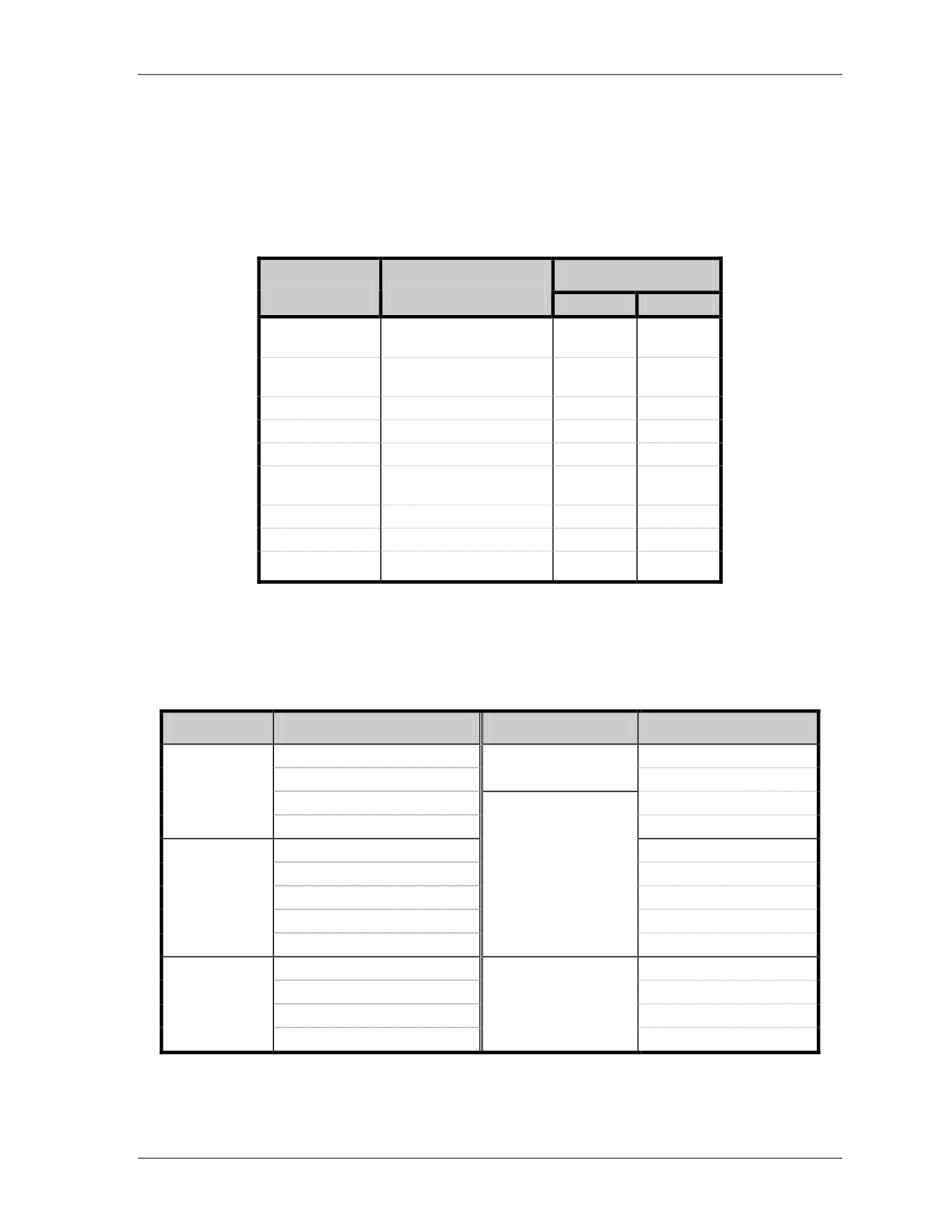
REDs (m)
Item
Description
10.0% PI
0.1% PI
2.75” rocket
Rocket with various
145
240
warheads
5” rockets
Zuni with various
220
340
warheads
Hellfire
AGM-114
40
105
GAU-8 (A-10)
30-mm gatling gun
40
65
AGM-65
Maverick
25
95
AC-130
25mm, 40mm
50/45
70/85
105mm
95
230
MK-82 LGB
GBU-12
95
300
MK-84 LGB
GBU-10/24
90
340
CBU-87
CEM or Gator
165
220
Table A-2. Risk estimated distances.
TARGET TO WEAPONS
A-24. Table A-3, page A-6, shows what weapons are used to destroy what targets.
Target
Weapon
Target
Weapon
Soft
GP bomb
Area denial and
CBU-89/CBU-104 Gator
channelization
CBU-52/58/71
AGM-154 JSOW
CBU-87/CBU-103 CEM
Armor
CBU-87/CBU-103 CEM
20-/25-/30-/40-/105-mm guns
AGM-65 Maverick
Hard
GP bomb with steel nose plug
30-mm (API)
BLU-109/113
CBU-97/CBU-105 SFW
AGM-65 Maverick
CBU-89/CBU-104 Gator
LGB
LGB
GBU-15
MK-20 Rockeye
Point
LGB
SAM and AAA site
Antiradiation missiles
AGM-65 Maverick
PGM
GBU-15
CBU
20-/25-/30-/40-/105-mm guns
GP bomb
Table A-3. Target to weapons.
25 April 2006
FM 3-21.38
A-5
This page intentionally left blank.
Appendix B
Operational Formats
Pathfinder leaders can use the operational formats described in this appendix to plan
and carry out pathfinder operations. These formats are intended as guides and should
be modified as required.
PLANNING FORMAT
B-1.
The pathfinder leader uses the operation planning format shown in Figure B-1, page B-3, to
organize an operation. This format consolidates information about each person or element. The leader can
refer to this information during his planning and briefing. This format provides columns for writing in—
ACFT NO
B-2.
Write in either the chalk number or the last three digits of the number painted on the tail of the
aircraft that will transport the pathfinder.
NAME
B-3.
Write in the name of each pathfinder.
LOAD TIME
B-4.
Write in what time the pathfinder must be on the aircraft with all of his equipment.
TO TIME
B-5.
Write in what time the aircraft will depart the staging area (the takeoff time).
DUTY AND LOCATION
B-6.
Write in each pathfinder’s mission assignment and location within the operational area.
CALL SIGN AND FREQUENCY
B-7.
Write in the radio call sign and frequency for each person operating a radio.
EQUIPMENT
B-8.
List all equipment, other than individual equipment, that each pathfinder element will carry.
REMARKS
B-9.
Write in any other pertinent information.
25 April 2006
FM 3-21.38
B-1
Appendix B
LANDING ZONE AND DROP ZONE CONTROL RECORDS
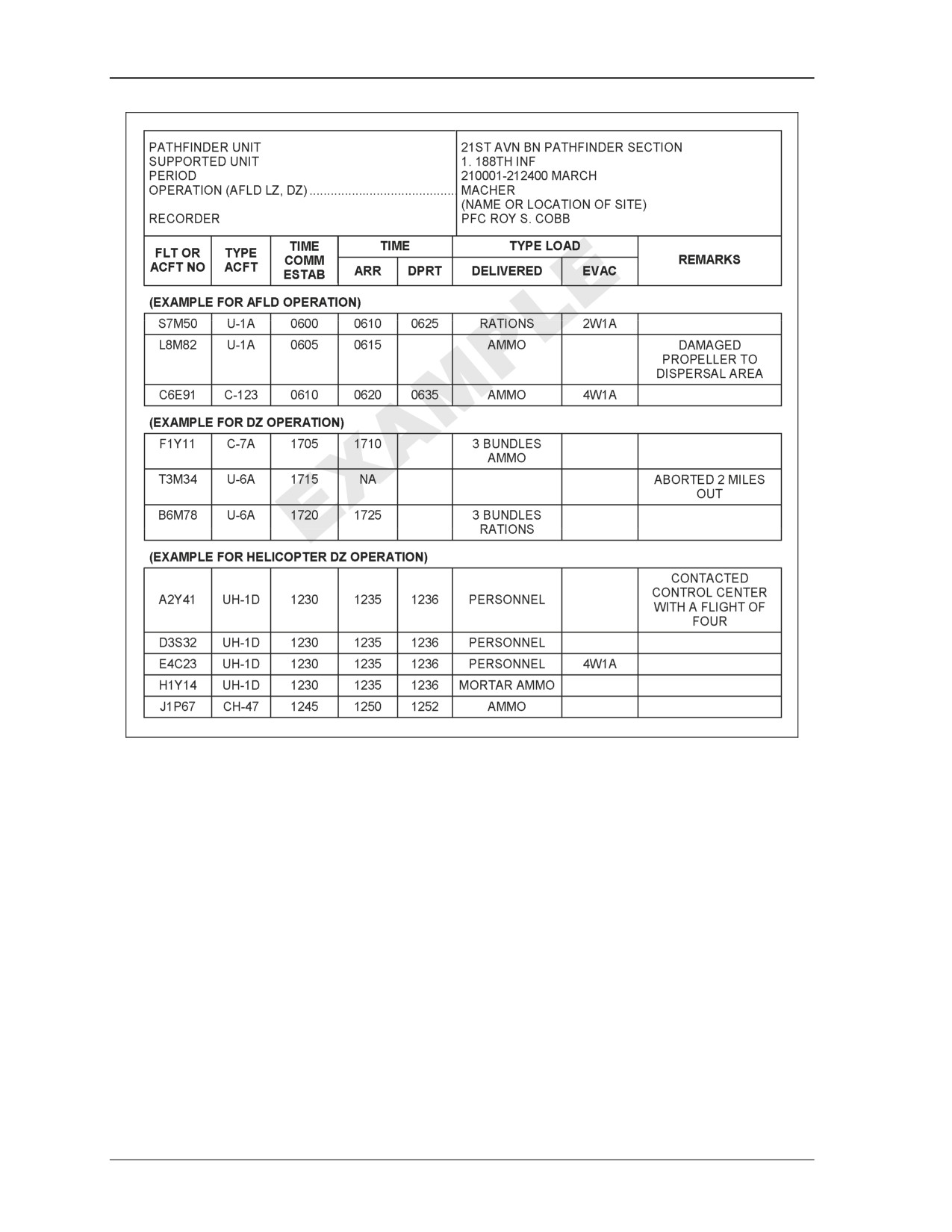
B-10. The leader can make up an LZ/DZ control record based on the example formats shown in
Figure B-2, page B-4. He uses this to record aircraft arrivals, departures, and load types. This record
provides information for both ground and aviation commanders. It helps account for personnel and
equipment. It can also help leaders initiate or conduct search-and-rescue operations for overdue or downed
aircraft. The pathfinder internal radio net(work) operator, located at the control center, normally maintains
this record.
FORMAT HEADINGS
B-11. Format headings include the following:
PATHFINDER UNIT
B-12. Enter the pathfinder unit’s code or number designation.
SUPPORTED UNIT
B-13. Enter the name of the main ground or aviation unit.
PERIOD
B-14. Enter the date and time the operation will start and finish. Enter 0001 for the start time of a
succeeding day. Enter 2400 for the end time if the operation will continue the next day.
OPERATION (AFLD LZ, DZ)
B-15. Enter the name or number of the operation. Cross out items that do not apply. Add any special
designation used.
RECORDER
B-16. Enter the name of the person who records data on this form.
B-2
FM 3-21.38
25 April 2006
Appendix B
Figure B-2. Example formats for the LZ/DZ control record.
COLUMN HEADINGS
B-17. Column headings include the following:
FLT OR ACFT NO
B-18. This means “flight or aircraft number,” so enter the flight or aircraft’s radio call sign.
TYPE ACFT
B-19. This means “type aircraft,” so enter the Army or Air Force aircraft model designation.
TIME COMM ESTAB
B-20. This means “time communication established,” so enter what time the aircraft acknowledges
contact (radio, visual, or both, as applicable).
B-4
FM 3-21.38
25 April 2006
Operational Formats
TIME (ARR, DPRT)
B-21. Enter the time the aircraft arrives or when the first of the flight lands. Enter the aircraft’s departure
time, or the time the last of the flight clears the ground.
TYPE LOAD (DELIVERED, EVAC)
B-22. Enter what type of load the aircraft delivered or evacuated (supplies, equipment, or personnel).
REMARKS
B-23. Write in any other pertinent information.
TROOP-LEADING PROCEDURES
B-24. From the moment he receives an order to conduct a pathfinder operation, the pathfinder leader
does his best to use the following troop-leading procedures (TLPs):
SECTION WARNING ORDER
B-25. Issue a section warning order, including—
Roll call.
A brief statement of the enemy and friendly situations.
The mission.
Chain of command and section structure.
Individual uniform and equipment (if not in SOP).
Equipment required.
Time schedule to complete work priorities (state who must show up, and where and when they
must show up).
Specific instructions and attached personnel.
Time hack.
TENTATIVE PLAN
B-26. Make a tentative plan of the operation.
Study the map.
Check the weather.
Study the unit SOP.
Make a quick estimate of the situation. Will you need extra personnel from the supported unit,
other equipment or materiel, or additional communications resources?
Begin planning.
MOVEMENT AND COORDINATION
B-27. Arrange for movement and coordination.
Arrange to move unit and inform second in command.
Coordinate with ground and aviation units. Cover the ground tactical plan, the landing and
unloading plan, the air movement plan, and the loading plan. Arrange for any extra people or
equipment needed from the supported unit.
25 April 2006
FM 3-21.38
B-5
Appendix B
TENTATIVE OPERATION PLAN
B-28. Prepare a tentative operation plan.
Reconnoiter when time permits (map, ground, air).
Continue the estimate and receive recommendations.
Complete the plan (work out details, formulate orders). Present the tentative plan to the
supported unit commander or his staff. Prepare the final plan based on the desires of supported
unit commander and on his final order.
Issue section order (normally an oral order).
Join supported unit.
Rehearse and inspect (if time and terrain permit).
B-6
FM 3-21.38
25 April 2006
Appendix C
Army Helicopter Specifications
For pathfinders to help select landing sites they must know the dimensions of Army
aircraft that US Army active and reserve units could employ. The art in this appendix
shows helicopters currently in use as of this manual’s publication date.
25 April 2006
FM 3-21.38
C-1
Appendix C
OBSERVATION HELICOPTERS
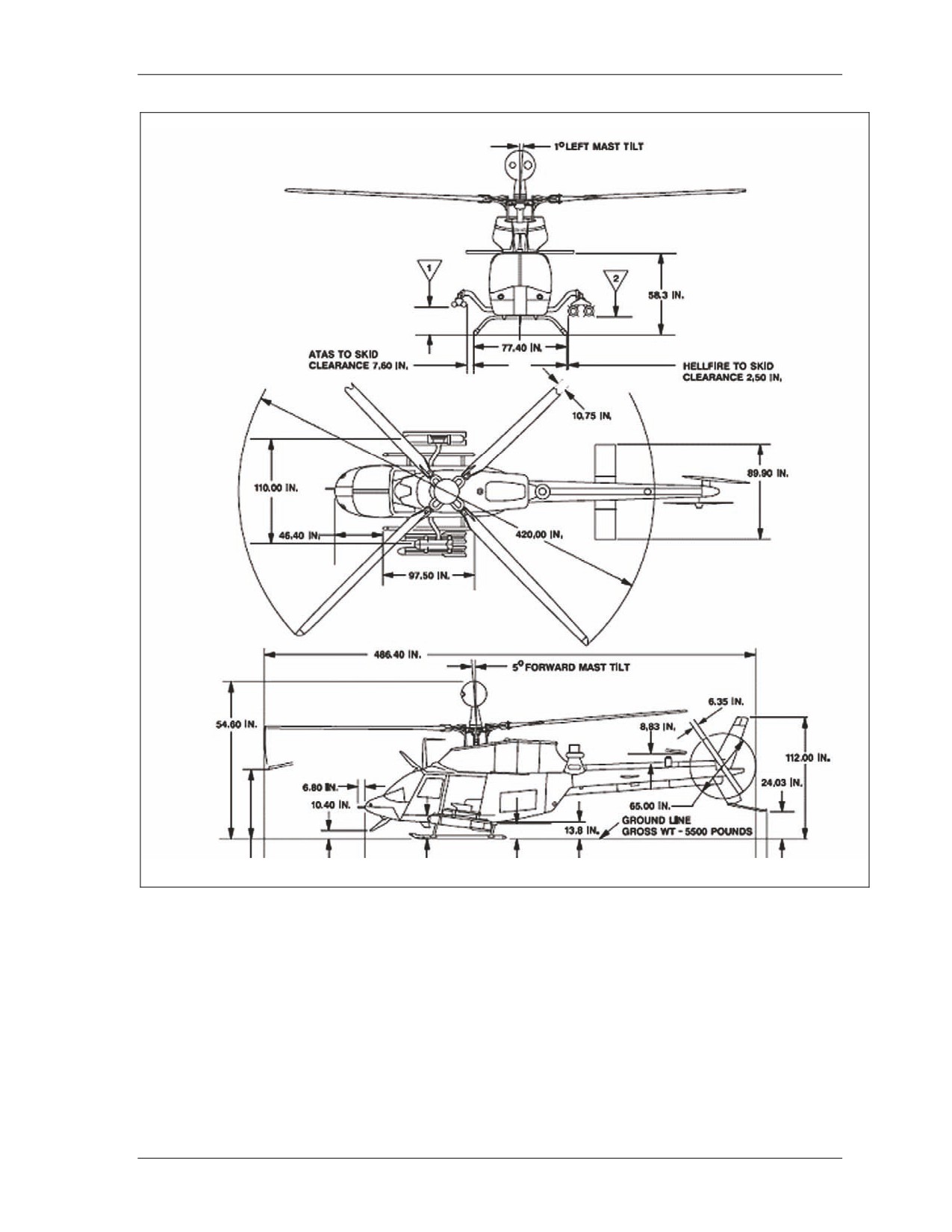
C-1. This category currently includes only the OH-58D Kiowa. Table C-1 shows specifications for the
Kiowa; Figure C-1 shows the aircraft from three angles.
Rotor Diameter
35’
Length:
Rotor Operating
42’ 2”
Blades Removed
33’ 10”
Height to Top of Turret
12’ 9 ½”
Tread of Skids
6’ 2”
Main Rotor:
Disk Area
0.962 sq ft
Blade Area
38.26 sq ft
Clear Area Needed for Rotor
12.5 m
TDP #1
25 meters diameter
Table C-1. Specifications for the OH-58D Kiowa.
C-2
FM 3-21.38
25 April 2006
Army Helicopter Specifications
Figure C-1. OH-58D Kiowa.
25 April 2006
FM 3-21.38
C-3
Appendix C
ATTACK HELICOPTERS
C-2. This category of helicopters includes the AH 64A Apache and the AH 64D Longbow Apache.
AH 64A APACHE
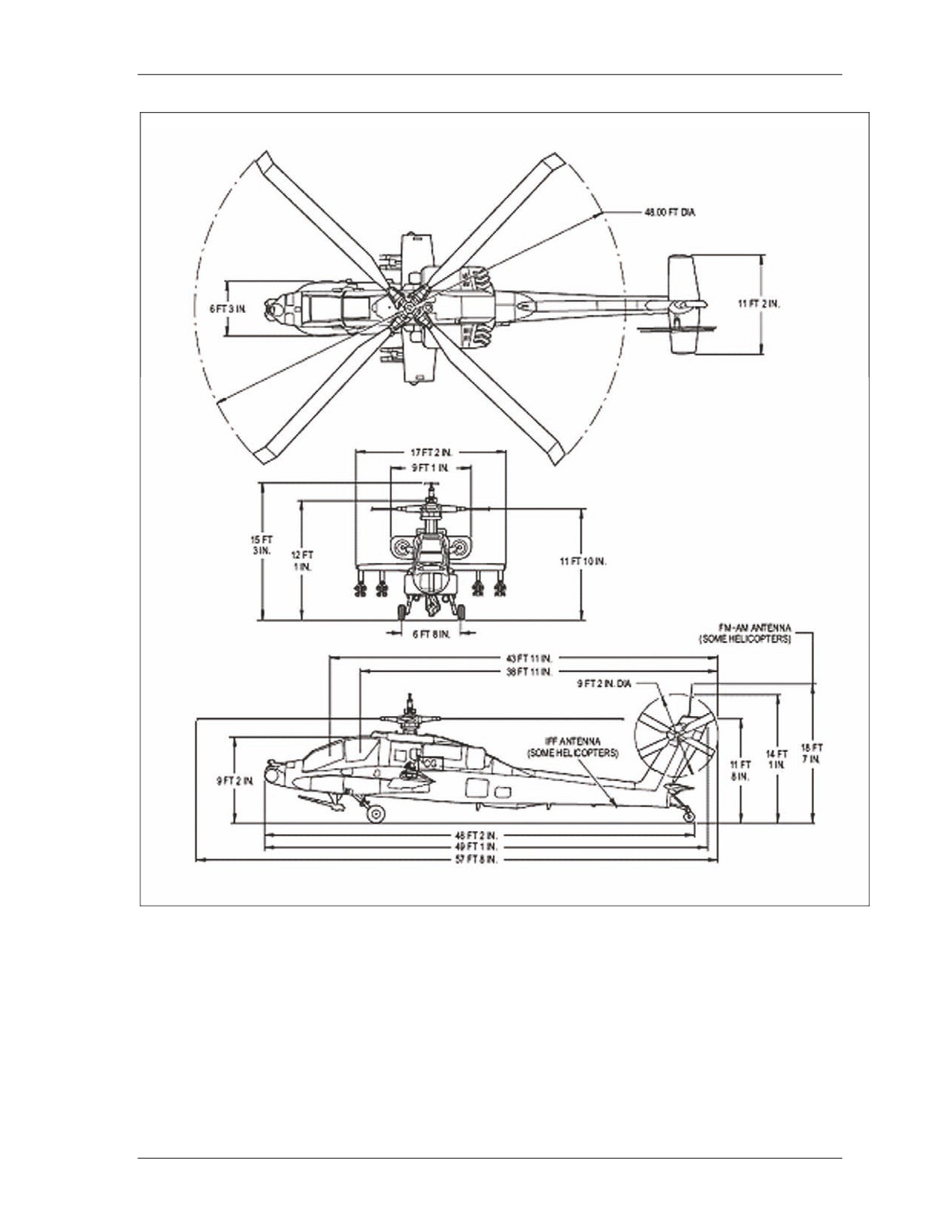
C-3. Table C-2 shows specifications for the AH 64A Apache; Figure C-2 shows the aircraft from
three angles.
Rotor Diameter
48’
Length:
Rotors Operating
58’ 3 ⅛”
Rotors Static
57’ 4”
Fuselage
48’
Height
15’ 3 ½”
Clear Area Needed for Rotors
17.9 m
Minimum TDP without
commander’s approval is #3
50 meters diameter
Table C-2. Specifications for the AH 64A Apache.
C-4
FM 3-21.38
25 April 2006
Army Helicopter Specifications
Figure C-2. AH 64A Apache.
25 April 2006
FM 3-21.38
C-5
Appendix C
AH 64D LONGBOW APACHE
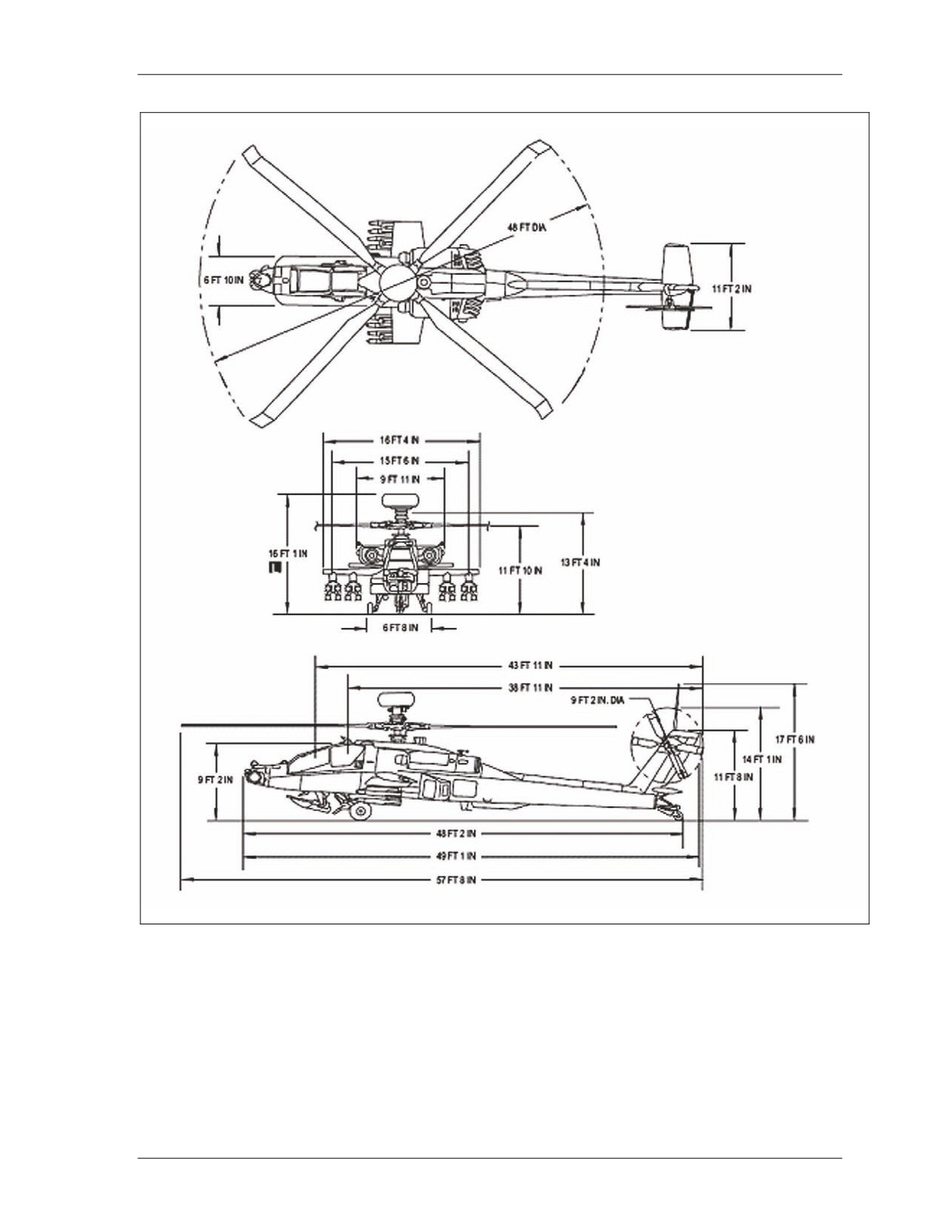
C-4. Table C-3 shows specifications for the AH 64D Apache; Figure C-3 shows the aircraft from
three angles.
Rotor Diameter
48’
Length:
Rotors Operating
58’ 3 ⅛”
Rotors Static
57’ 4”
Fuselage
48’
Height
15’ 3 ½”
Clear Area Needed for Rotors
17.9 meters
Minimum TDP without
commander’s approval is #3
50 meters diameter
Table C-3. Specifications for the AH 64D Apache.
C-6
FM 3-21.38
25 April 2006
Army Helicopter Specifications
Figure C-3. AH 64D Apache.
25 April 2006
FM 3-21.38
C-7
Appendix C
UTILITY HELICOPTERS
C-5. This category of helicopters includes the UH-1H Iroquois and the UH-60A/L Blackhawk.
UH-1H IROQUOIS
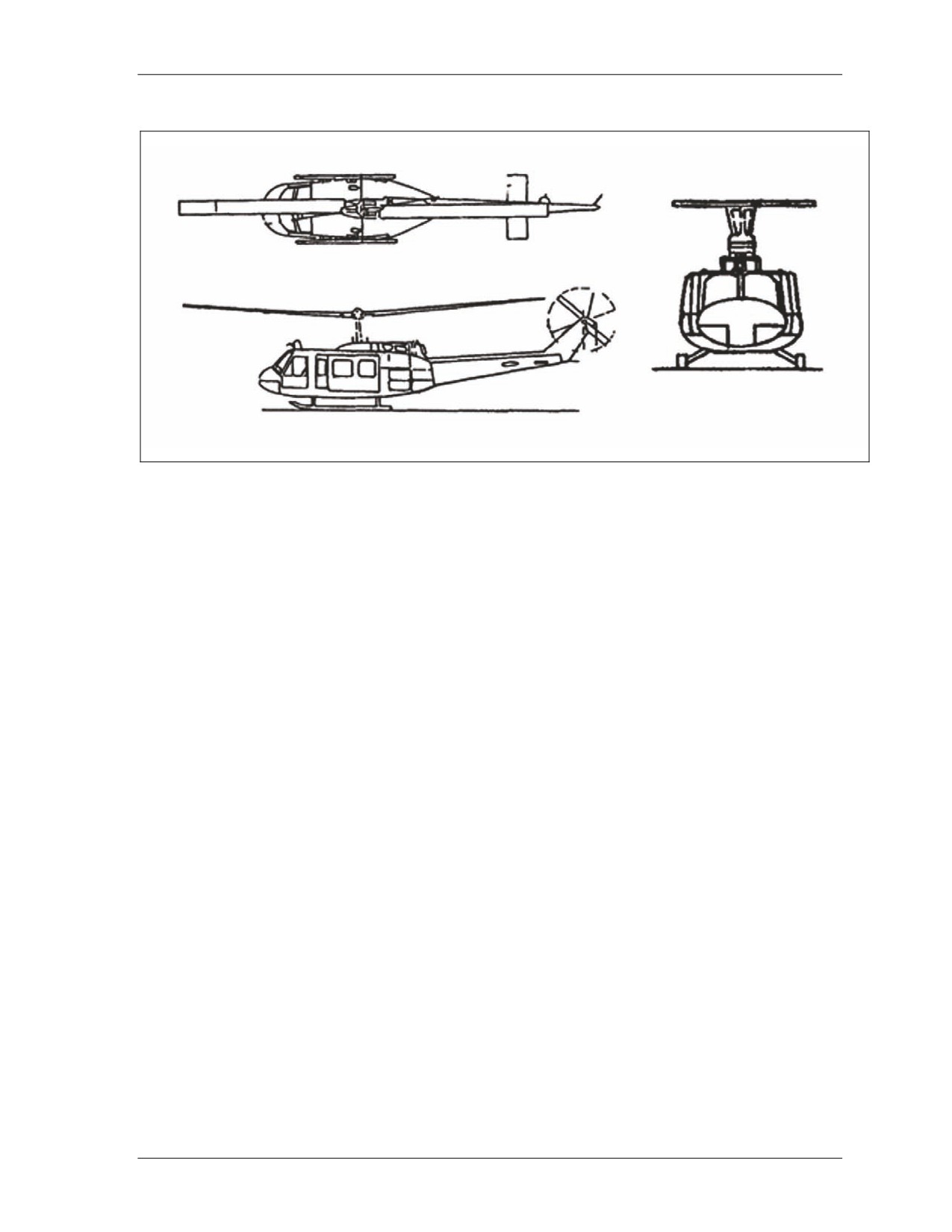
C-6. Table C-4 shows specifications for the Iroquois; Figure C-4 shows the aircraft from three angles.
Rotor Diameter
48’
Length:
Rotors Operating
57’ 1”
Rotors Static
57’ 1”
Fuselage
41’ 10 ¾”
Span, Maximum Lateral
9’ 4”
Height
14’ 6”
Tread
8’ 6 ½”
Main Rotor Ground Clearance,
Static Against Stops
6’ 6”
Clear Area Needed for Rotors
17.4 meters
TDP #2
35 meters diameter
Cargo Hook Capacity
4,000 lb
Table C-4. Specifications for the UH-1H Iroquois.
C-8
FM 3-21.38
25 April 2006
Army Helicopter Specifications
Figure C-4. UH-1H Iroquois.
25 April 2006
FM 3-21.38
C-9
Appendix C
UH-60A/L BLACKHAWK
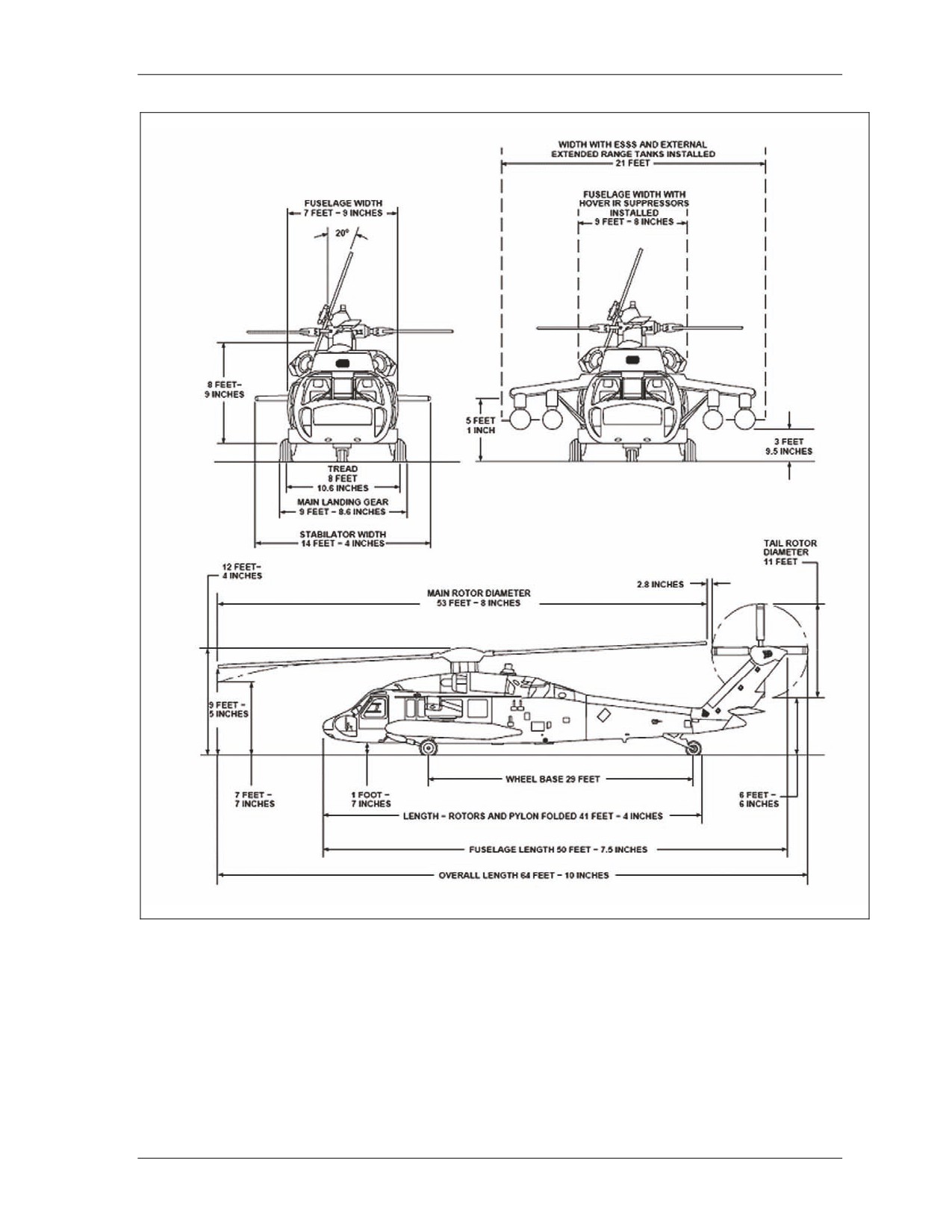
C-7. Table C-5 shows specifications for the UH-60A & L Blackhawk; Figure C-5 shows the aircraft from
above and from the left side.
Rotor Diameter
53’ 8”
Length:
Rotor Operating
64’ 10”
Rotor Folded
64’ 10”
Fuselage
50’ 7 ½”
Span, Maximum Lateral
9’ 8 ½”
Height
16’ 5”
Tread
8’ 10 ½”
Main Rotor Ground Clearance,
Static Against Stops
8’ 9”
Clear Area Needed for Rotors
19.5 meters
TDP #3
50 meters diameter
Cargo Hook Capacity
A Model
8,000 lbs
L Model
9,000 lbs
Table C-5. Specifications for the UH-60A Blackhawk.
C-10
FM 3-21.38
25 April 2006
Army Helicopter Specifications
Figure C-5. UH-60A/L Blackhawk.
25 April 2006
FM 3-21.38
C-11
Appendix C
CARGO HELICOPTERS
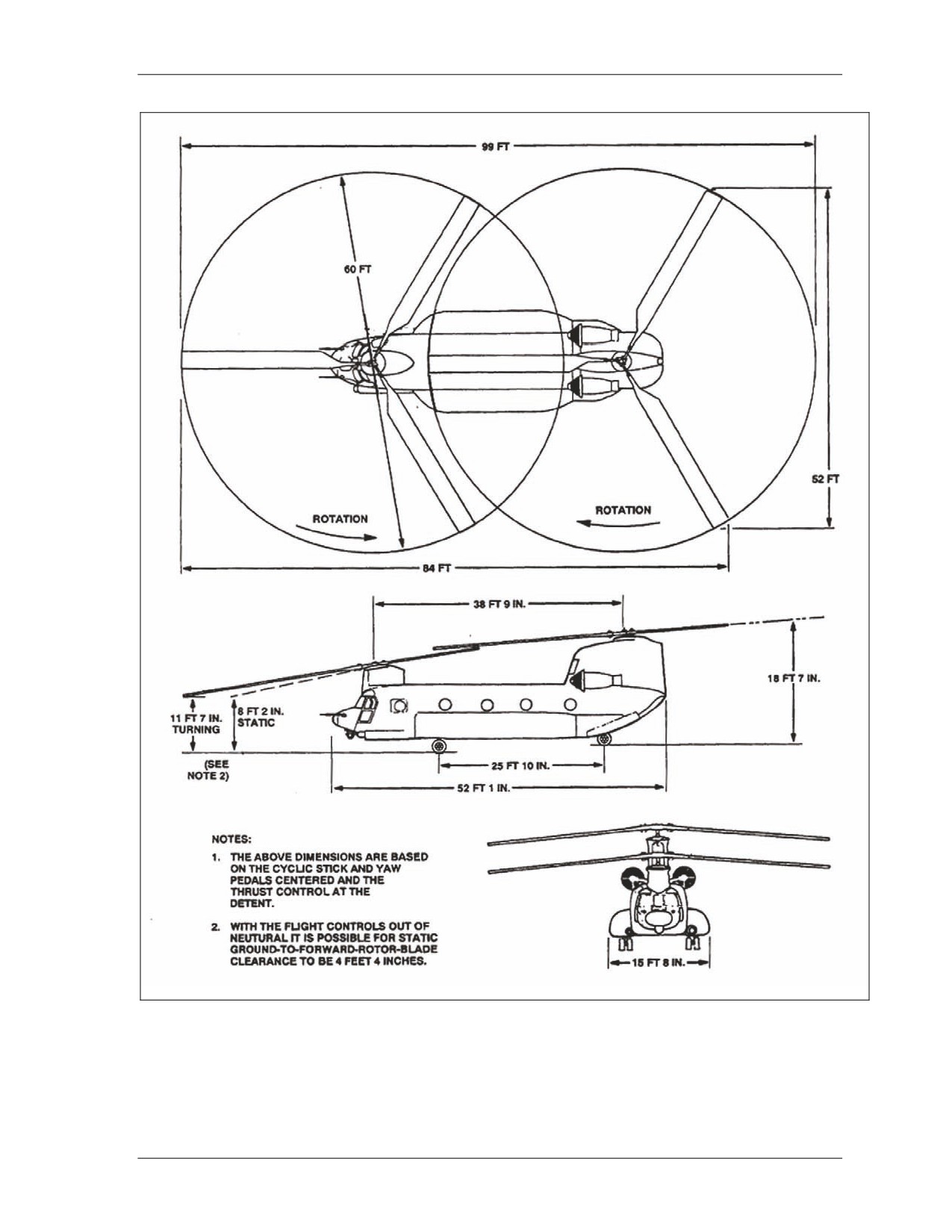
C-8. This category of helicopters includes only the CH-47 D Chinook. With slingload, cargo helicopter
TDP is #5 (100-meter diameter); without slingload, it is
#4 (80-meter diameter). Table C-6 shows
specifications for the CH-47 D Chinook; Figure C-6 shows it from three angles.
Rotor Diameter
60’
Length:
Rotors Operating
98’ 10 ¾”
Rotors Folded
51’
Fuselage
51’
Height (Overall)
18’ 7 13/16 ”
Tread
11’ 11”
Rotor Ground Clearance:
Static Forward
7’ 10 5/8 ”
Idling Forward
11’ 7/8 ”
Clear Area Needed for Rotors
30.4 meters
TDP #4
80 meters diameter
Allowable Cargo Load:
Forward Hook
17,000 lb
Center Hook
26,000 lb
Aft Hook
17,000 lb
Fore & Aft Hooks combined
25,000 lb
Table C-6. Specifications for the CH-47 D Chinook.
C-12
FM 3-21.38
25 April 2006
Army Helicopter Specifications
Figure C-6. CH-47 D Chinook.
25 April 2006
FM 3-21.38
C-13
Appendix D
Digitization Supplement
This appendix does not change existing doctrine, tactics, techniques, or procedures
for employing pathfinder teams and elements. It just introduces a vision of how
digitization will affect pathfinder teams.
DEFINITION
D-1.
“Digitization” refers to the ongoing effort to integrate the Army’s diversified battlefield operating
systems into a network in which leaders and Soldiers can share and interchange current information about
the battlefield environment for immediate or later use. Digitization is the near real-time transfer of
battlefield information between diverse fighting elements to permit a shared awareness of the tactical
situation. Accelerated operational tempo, instant communications, and immediate response times will
characterize the digital environment.
D-2.
Digitization is based on advancements in computers, communications, satellite navigation, and
own-the-night (OTN) vision and sighting capabilities. Satellite navigation, digital communications, and
digital mapping will allow leaders and Soldiers to share a common, digital picture of the battlespace
environment in real time.
D-3.
New computer capabilities will allow leaders to decisively concentrate their battlefield combat
power. High-speed digital data exchange, the simultaneous display of intelligence data to leaders at all
levels, and the rapid exchange of targeting data from sensors to shooters power this increased
effectiveness.
D-4.
New OTN capabilities enhance the ability to detect, identify, and engage targets during limited
visibility. They also increase accuracy and control of fires, which reduces the risk of fratricide.
PURPOSE, ADVANTAGES, AND CAPABILITIES
D-5.
The main purpose of digitization is to provide access to common, current data about friendly and
enemy forces. Leaders and Soldiers collect these data through networks of sensors, CPs, processors, and
weapons platforms. Every leader and Soldier will have immediate access to relevant information. All
Soldiers will know what is happening around and among them. Other purposes of digitization include the
following:
INFORMATION
D-6.
To provide an integrated digital information network that will improve information flow; increase
command and control; support battlefield fire and maneuver; and give leaders (decision makers), Soldiers
(shooters), and supporters customized information. Leaders, Soldiers, and supporters need--
To make the decisions necessary to prevail in any campaign.
To share vital battlefield information (friendly and enemy) rapidly, if not instantly, rather than
by slow voice radio or even slower liaison efforts.
To act on information faster than the enemy does.
To win the information war against any adversary.
To use common data collected through the digitized network.
25 April 2006
FM 3-21.38
D-1
Appendix D
SITUATIONAL AWARENESS
D-7.
To achieve near real-time situational awareness at all times and at all levels. This will allow
leaders and Soldiers to collect, share, and use relevant information at once.
OPERATIONAL AWARENESS
D-8.
Greater situational awareness leads to increased operational awareness, which is better
understanding the “big picture.”
OPERATIONAL TEMPO
D-9.
A greater grasp of the “big picture” enables leaders and Soldiers to set and maintain an increased
operational tempo, which will help in overwhelming the enemy.
LETHALITY, ACCURACY, AND SURVIVABILITY
D-10. To enhance the effectiveness and combat power of a force comprised of fewer and smaller units,
so it can execute its missions with greater lethality, accuracy, and survivability in an environment
characterized by an accelerated operational tempo, instant communications, and immediate response times.
PLANNING AND PREPARATION
D-11. To streamline and support mission planning, preparation, and execution, and to do so by
providing critical information to every leader at the same time. Having earlier access to needed information
compresses the mission planning and preparation cycles.
EFFECTIVENESS
D-12. To increase the pathfinder team’s effectiveness in conducting pathfinder operations for its
parent unit.
FIREPOWER
D-13. To synchronize direct and indirect fires more effectively. To mass the effects of dispersed
firepower. This replaces the existing way of fighting that relies on physically massing weapons and forces.
DECENTRALIZATION
D-14. To support more decentralized operations, thereby improving the effectiveness of team- and
element-level operations.
BATTLESPACE
D-15. To maintain a clear, accurate, simultaneous, and appropriate vision of the battlespace at each
echelon, from Soldier to commander, and to enhance the mission capabilities needed in a multidimensional
battlespace.
FRATRICIDE
D-16. To minimize fratricide.
D-2
FM 3-21.38
25 April 2006
Digitization Supplement
SIGNATURE
D-17. To reduce the team’s signature on the battlefield.
NAVIGATION
D-18. To improve navigation.
LINKUP
D-19. To improve linkup.
25 April 2006
FM 3-21.38
D-3

Appendix E
Air Force Instruction
Air force instructions are used primarily in the establishment of CARP drop zones
and used in certain cases for GMRS drop zones.
AIRDROP AIRSPEEDS
E-1.
The airdrop airspeed is used to determine additional size requirements on VIRS and GMRS drop
zones using the D=RxT and T=D/R formulas. It is also used to determine the forward throw for rotary
wing aircraft. See Table E-1 for the airdrop airspeeds for various aircrafts.
Drop Speed
Type of Aircraft
Type of Load
(Knots Indicated Airspeed)
UH-1
All
50 to 70 knots (optimum 70 knots)
UH-60
All
65 to 75 knots (optimum 70 knots)
CH-46 (USMC)
All
80 to 90 knots
CH-47
All
80 to 110 knots (optimum 90 knots)
CH-53 (USMC)
All
90 to 110 knots
CH/HH3 (USAF)
All
70 to 90 knots
C-130
Personnel (Static Line)
130 knots
Personnel (HALO & HAHO)
110 to 150 knots (optimum 130 knots)
Equipment/Combination **
130 to 140 knots
CDS*/Combination **
130 to 140 knots
Door Bundle
130 knots
SATB
Same as load simulated
C-17
Personnel (Static Line)
130 to 135 knots
Personnel (HALO and HAHO)
138 to 145 knots
Equipment/Combination **
145 knots +/- 5 knots
CDS*/Combination **
145 knots +/- 5 knots
Door Bundle
130 to 135 knots
SATB
N/A
C-141/C5A
Personnel (Static Line)
130 to 135 knots
Personnel (HALO and HAHO)
130 to 180 knots
Equipment/Combination**
150 knots
CDS*/Combination**
150 knots
Door Bundle
130 to 135 knots
SATB
Same as load simulated
* Includes free fall, high velocity CDS, wedge, Ahkio (military cold weather, squad-sized) sled, and combat rubber
raiding craft (CRRC).
** Combination airdrops (for example, heavy equipment followed by personnel) use the highest airdrop airspeed.
Table E-1. Airdrop airspeeds.
25 April 2006
FM 3-21.38
E-1

Appendix E
DROP ZONE SIZE
E-2.
The airlift mission commander is normally responsible for airdrop accuracy and safety-of-flight
for all drop zones meeting Air Force minimum size criteria. Standard DZ sizes are shown in Table E-2. For
more information, see AFI 13-217.
Altitude (AGL)
Width 1, 2
Length 3
Container Delivery System (CDS), Container Release System (CRS), and Container Ramp Loads (CRL): C-130
Single Containers
Double Containers
1
1 to 2
400 yards/366 meters
2
3 to 4
450 yards/412 meters
To 600 feet
400 yards/366 meters
3
5 to 6
500 yards/457 meters
4
7 to 8
550 yards/503 meters
5 to 8
9 or more
700 yards/640 meters
Add 40 yards/36 meters to width and length for each 100 feet above 600 feet
Above 600 feet
(20 yards/18 meters to each side of DZ, 20 yards/18 meters to each end).
CDS: C-141, C-17
Single Containers
Double Containers
1
1 to 2
590 yards/562 meters
2
3 to 4
615 yards/540 meters
To 600 feet
450 yards/412 meters
3
5 to 6
665 yards/608 meters
4 to 8
7 to 16
765 yards/700 meters
9 to 14
17 to 28
915 yards/837 meters
15 to 20
29 to 40
1,065 yards/974 meters
Add 40 yards/36 meters to width and length for each 100 feet above 600 feet
Above 600 feet
(20 yards/18 meters to each side of DZ, 20 yards/18 meters to each end).
CDS: High Velocity (HV) (Using 12-, 22-, or 26-Foot Ring Slot Parachutes)
660 yards/604 meters
To 3,000 feet
580 yards/530 meters
Add 50 yards/46 meters to trailing edge for each additional row
of containers.
Add 25 yards/23 meters to each side and 100 yrds/91 meters to each end for every 1,000-foot
Above 3,000 feet
increase in drop altitude.
CDS: High Altitude Airdrop Resupply System (HAARS)
1 to 8 containers
1,200 yards/1,098 meters
To 3,000 feet
500 yards/457 meters
9 or more containers
1,900 yards/1,739 meters
Above 3,000 feet
Add 25 yards/23 meters to each side and 50 yards/46 meters to each end for every 1,000-foot
increase in drop altitude.
High Speed Low Level Aerial Delivery System (HSLLADS)
Unknown
300 yards/274 meters
600 yards/549 meters
Personnel (Static Line)
1 parachutist
600 yards/549 meters
To 1,000 feet
600 yards/549 meters
Additional
Add 75 yards/69 meters the trailing edge for
parachutists
each additional parachutist
(PI for ST/para-rescue personnel).
Add 30 yards/28 meters to width and length for each 100 feet above 1,000 feet
Above 1,000 feet
(15 yards/14 meters to each side of DZ, 15 yards/13 meters to each end).
Table E-2. Standard drop zone size criteria.
E-2
FM 3-21.38
25 April 2006

Air Force Instruction
Altitude (AGL)
Width 1, 2
Length 3
Heavy Equipment
One platform
1,000 yards/915 meters
600 yards/549
To 1,100 feet
Additional
Add 400 yards/366 meters (C-130), 500 yards/457 meters
meters
platforms
(C-141/C-17/C-5) to the trailing edge for each additional
platform.
Above 1,100 feet
Add 30 yards/28 meters to the width and length for each 100 feet above 1,100 feet (15 yards/14
meters to each side of DZ, 15 yards/14 meters to each end).
1
This does not apply to AFSOC assigned or gained, to aircraft OPCON to USSOCOM, or to a theater special
operations command:
a. For day visual formations, increase width by 100 yards/92 meters (50 yards/46 meters on each side).
b. For C-141, C-130 station-keeping equipment (SKE) AWADS formation, increase width by 400 yards/366 meters
(200 yards/184 meters on each side).
c. At night, increase width by 100 yards/92 meters for single ship visual drops (50 yards/46 meters on each side).
Increase 200 yards/184 m for visual formations (100 yards/92 meters on each side).
2
C-17 DZ width adjustments. You might need to adjust more than once:
a. For visual formations (day or night), increase width by 100 yards/92 meters (50 yards/46 meters each side).
b. For night pilot-directed airdrops, increase width an additional 100 yards/92 meters (50 yards/46 meters each side).
This does not apply to aircraft performing GPS drops.
c. For SKE HE/CDS formation, increase width by 400 yards/366 meters (200 yards/183 meters each side).
d. For personnel formations, minimum DZ basic width using center PIs is 1,240 yards for 2-ship elements and 1,800
yards for 3-ship elements. When using offset PIs, minimum basic width is 1,100 yards for 2-ship elements and
1,300 yards for 3-ship elements.
3
This does not apply to AFSOC assigned or gained, to aircraft OPCON to USSOCOM, or to a theater special
operations command. At night, increase length by 100 yards/92 meters for visual drops (50 yards/46 meters on
each end). This also does not apply to a C-17 doing GPS drops.
Table E-2. Standard drop zone size criteria (continued).
GROUND MARKED RELEASE SYSTEM
E-3.
The GMRS is mainly used for small unit insertion and aerial resupply operations. It is the most
tactical drop zone because communication with the drop aircraft is not necessary. Table E-3 shows the
constants for different airdrop loads. Table E-4, page E-4, shows the forward throw distance for various
aircraft. Forward throw distance is how far a parachutist or cargo container travels along the aircraft flight
path. It begins after the person or cargo exits the aircraft, and continues until the parachute fully opens and
the load descends vertically. (For more on the GMRS, see AFI 13-217.)
Type Drop
K (Load Drift Constant)
Personnel (static line)
3.0
Heavy equipment
1.5
CDS/CRL/CRS
1.5
Door bundle
1.5
SATB
2.4
Table E-3. Ground marked release system load drift constants (K).
25 April 2006
FM 3-21.38
E-3

Appendix E
Type Drop
C-130
C-17
C-141
C-5
Personnel
250 yards
250 yards
250 yards
250 yards
(static line)/door bundle
(229 meters)
(229 meters)
(229 meters)
(229 meters)
Personnel (MFF)
328 yards
328 yards
328 yards
328 yards
(300 meters)
(300 meters)
(300 meters)
(300 meters)
Heavy equipment
500 yards
700 yards
730 yards
730 yards
(458 meters)
(640 meters)
(668 meters)
(668 meters)
CDS/CRS/CRL
550 yards
725 yards
750 yards
N/A
(503 meters)
(663 meters)
(686 meters)
SATB
160 yards
N/A
160 yards
N/A
(147 meters)
(147 meters)
Table E-4. Ground marked release system forward throw distance.
POINT OF IMPACT
E-4.
The point of impact is the location where the first piece of equipment or first personnel is planned
to land on the DZ. These are used in computing the release point on CARP drop zones and for tactically
assessed GMRS DZs for CDS or heavy equipment. For more information, see Table E-5 and AFI 13-217.
Distance From
Sides
Type Drop
(See Note 4)
Distance from Approach End
C-130/C-141/C-5 (See Notes 1 and 2)
Day
Night
CDS C-130 (See Note 3)
(See Note 4)
200 yards/183 meters
250 yards/229 meters
CDS C-141 (See Note 3)
(See Note 4)
225 yards/206 meters
275 yards/251 meters
Personnel
(See Note 4)
300 yards/274 meters
350 yards/320 meters
Equipment
(See Note 4)
500 yards/457 meters
550 yards/503 meters
C-17 (See Notes 1 and 2)
Day
Night
CDS (See Note 3)
(See Note 4)
225 yards/206 meters
275 yards/251 meters
Personnel
Offset
300 yards/274 meters
350 yards/320 meters
PI=250 yds left or
right of calculated
center PI
(or see Note 4)
Equipment
(See Note 4)
500 yards/457 meters
550 yards/503 meters
1
PI location may be adjusted to meet specific mission requirements. Participants must be briefed.
2
PI location may be adjusted for aircrew PI acquisition training. The PI may be located anywhere within the surveyed
DZ boundaries as long as the minimum required DZ size for that type airdrop and aircraft formation fits within the
boundaries, and provided the distance from the leading edge listed above is complied with. For lateral placement, the
PI must be located at least one-half the width of the minimum size DZ (based upon type airdrop and aircraft
formation) from the closest side of the DZ. All participants must be briefed when using this option.
3
For high velocity (HV) CDS and HAARS, laterally position the PI in the center of the DZ.
4
PI distance from sides of DZ must be at least one-half the minimum width for that type airdrop.
Table E-5. Standard point-of-impact placement.
E-4
FM 3-21.38
25 April 2006
Glossary
acft load
aircraft load; refers to cargo suspended below a slingload
ACL
allowable cargo load
ACP
air control point
ADS
aerial delivery sling
AEL
Army Electronic Library
AF
Air Force
AFB
Air Force base
AFI
Air Force Instruction
AFSOC
Air Force Special Operations Command
aft
to the rear, behind, or toward the tail of the aircraft
AGL
above ground level
AH
attack helicopter
Ahkio sled
a squad-powered sled for operations in extreme cold
AI
air interdiction
airdrop
delivery of cargo or personnel by parachute from an aircraft in flight
AL
airland
ALO
air liaison officer
alt
altitude
AM
amplitude modulation
AMC
Air Mobility Command
AO
area of operations
apex fitting
the uppermost point (clevis, shackle, ring, or loop) that gathers the sling
tension members and attaches to the cargo hook
apex fitting pin
A headed pin that extends through the two ends of the apex fitting-clevis,
retained in place by a bolt and nut apex fitting spacer (an hourglass-shaped
bushing that fits over the apex fitting pin), causing the apex fitting to stay
centered on the cargo hook
approach azimuth
the direction of an aircraft’s approach to the landing point, usually expressed
in degrees and measured clockwise from a reference point
arr
arrival
ASIP
advanced system improvement program
ATA
actual time of arrival
ATC
air traffic controller
ATD
actual time of departure
AWADS
All-Weather Aerial Delivery System
AZAR
assault zone availability report
basket hitch
a type of attachment in which a flat web nylon strap is formed in the shape of
the letter "U" with the two ends connected side-by-side
basket leg
the cable on a pallet sling that encircles the load
25 April 2006
FM 3-21.38
Glossary-1
Glossary
becket
a short length of rope with an eye on one or both ends, used to secure items
such as eyelets or coils of rope
bight
a formed loop in a rope or cable
BIT
built-in test
blivet
A rubber or fabric storage bag, transportable by air or ground, that holds fuel
or water
breakaway
use of material with a low breaking strength, such as tape or cotton webbing,
technique
to temporarily restrain the sling equipment from becoming entangled on the
load as the helicopter puts tension on the sling
breaking strength
resistance to breaking, commonly measured in pounds. (Refers to tensile
strength.)
brownout
a loss of orientation with respect to the horizon, caused by blowing sand, dust,
or dirt
CA
combat assault
cable
a suspended external cargo sling system. Cargo hook attached to the bottom of
the fuselage by a system of cables
CAPES
Chemlight-Assisted Personnel Exit System
cargo hoist
a device used to raise, lower, or winch cargo
cargo hook
a suspension hook device on which the apex fitting is placed to transport an
external load
cargo hook keeper
a spring-loaded device used to prevent the apex fitting from sliding off the
cargo hook load beam
cargo hook loading
also called a "shepherd's hook," with a hook on one end, which an aircrew
pole
member uses to pick up the apex fitting and connect it to the cargo hook. Used
when the hookup team cannot stand on top of the load
cargo net
a meshed arrangement of straps or cords that have been knotted or woven
together at regular intervals and used to transport supplies and equipment
cargo sling
consists of multiple tension members which, when properly rigged, enable
aircrew to suspend cargo and equipment under a helicopter
CARP
computed air release point
CAS
close air support
castle nut
a hexagon-shaped nut with a slot in each of its six sides and secured in place
by a cotter pin
CBRN
chemical, biological, radiological, or nuclear
CBU
cluster bomb unit
CC
control center
CCA
close combat attack
CCP
communications checkpoint
CDS
container delivery system
cellulose
a cushioning or padding material used to protect the load or sling legs
center (main) cargo
a cargo hook located in the center of the helicopter
hook
center of balance
location where an item would balance if it were possible to support the load at
that point
Glossary-2
FM 3-21.38
25 April 2006
Glossary
centerline
an imaginary line that extends lengthwise and bisects the bottom of the
helicopter fuselage
CG
center of gravity
CH
cargo helicopter
chemiluminescent
a plastic tube filled with a liquid chemical and a glass vial that when activated
light
produces a glowing light known as chemiluminescence
choker hitch
a knot formed by placing a strap or cord around an item and passing the free
end of the strap or cord through the loop formed by the other end
clevis
a "U"-shaped yoke device with a bolt or pin through the two ends
COMSEC
communications security
connector link
a metal link device that joins the ends of a nylon web loop together, such as
used on the web ring of the 15,000-pound capacity multileg sling
constant power
the point at which a helicopter engine produces a fixed level of performance
CONUS
Continental United States
CP
command post
CRC
control and reporting center
CRL
container ramp load
CRS
Container Release System
DCA
defensive counterair
dep
departure
det
detachment
DF
direction finding
down wash
also called "rotor wash." High-velocity air movement under a hovering
helicopter
downslope
downhill; descending; a slope that lies downward
downwind
in the direction that the wind is blowing
drawbar
a beam across the rear of a vehicle or aircraft to which implements are hitched
drop-off
a very steep or perpendicular descent
DS
direct support
DTG
date-time group
dual-point load
cargo or equipment rigged and suspended from two cargo hooks
DZ
drop zone
DZSO
drop-zone safety officer
DZST
drop-zone support team
DZSTL
drop-zone support team leader
ECCM
electronic countercountermeasures
ECM
electronic countermeasures
EMT
emergency medical technician
end bar
the removable side of a connector link
energy-dissipating
artificial cardboard packing material. In parachute operations, protects
material
equipment by dissipating shock or energy when the package lands
ETA
estimated time of arrival
25 April 2006
FM 3-21.38
Glossary-3
Glossary
EW
electronic warfare
exit path
the track or course of an aircraft departing the landing point
ext
extracted
external air
movement of supplies or equipment that is rigged and suspended from a
transport
helicopter cargo hook
external load
consists of supplies or equipment properly rigged with either one or more
slings, cargo bags, or cargo nets
eye sock
a loop formed at both ends of a sling leg
EZ
extraction zone
FAARP
forward area arming and refueling point
FB
Fort Benning
FEBA
forward edge of the battle area
field-expedient
individual slings or sling legs used as a vertical riser or pendant
pendants
field-expedient
a device fabricated from readily available material to discharge the helicopter's
static-discharge
static electrical charge
wand
field-expedient
any device locally fabricated to connect to an external load for the purpose of
drogue device
increasing the stability of the load
FLA
frontline ambulance
flat web nylon
a flat nylon strap or sling fabricated in either concentric loops or single lengths
floating web
(see sliding keepers)
keepers
FM
frequency modulated
FOC
flight operations center
forward cargo
a cargo hook located forward of the center or main cargo hook
hook
forward slope
ground whose surface forms an upward angle or incline with the horizon
FRAGO
fragmentary order
free-swinging cargo
a cargo hook attached to the end of a pendant or cable instead of attached
hook
directly to the helicopter fuselage
ft
feet
fuselage
the central body portion of a helicopter, which accommodates the crew,
passengers, and cargo
fwd
forward
GAIL
glide angle indicator light
GCA
ground-controlled approach
glide angle
(GAIL) A device that emits a three-color light beam that indicates a safe glide
indicator light
path over approach obstacles onto a landing site
glide path angle
the helicopter’s angle of approach to the landing point
GMRS
Ground Marked Release System
GMT
Greenwich Mean Time
GP
general purpose
grabhook
a hook for grabbing (as the links of a chain)
Glossary-4
FM 3-21.38
25 April 2006
Glossary
ground crew
personnel on the ground who help prepare and rig loads, guide the helicopter,
and connect the load to the helicopter
GSI
glide slope indicator
GTA
ground-to-air
GUC
ground unit commander
GWT
gross weight
HAARS
High Altitude Airdrop Resupply System
HAHO
high-altitude, high-opening
HALO
high-altitude, low-opening
handheld
designed to be operated while held in the hand
HE
heavy equipment
HEAT
helicopter external air transport
HLZ
helicopter landing zone
HMMWV
high-mobility, multipurpose wheeled vehicle
HO
HALO or HAHO
HSLLADS
High-Speed, Low-Level, Aerial Delivery System
HVCDS
High-Velocity Container-Delivery System
IAW
in accordance with
ID
identification
ILS
Instrument Landing System
immediate mission
a task or support mission that arises during the course of a battle and which by
its nature cannot be planned in advance
INR
internal net recorder
ins
inserted
ISA
international standardization agreement; see also QSTAG, STANAG
JAAT
joint air attack team
JP
jet petroleum
keeper
a device that holds something in position such as an apex fitting on the
helicopter cargo hook
KIAS
knots indicated airspeed
knotless nylon cord
a cargo net manufactured from braided nylon cord joined by a knotless
cargo net
intersection method
kt
knot(s)
landing point
a point within a landing site where one helicopter can land
landing site
a site within a landing zone that contains one or more landing points. This is
also known as the touchdown point
landing zone
any specified area used for the landing of aircraft
lanyard
a short piece of rope or cable used to fasten something or an extension of a
shorter device
lashing straps
a flat-web nylon strap with a D-ring on one end. Used to lash equipment
together
latch bar
the movable top part of the pallet sling tensioner
25 April 2006
FM 3-21.38
Glossary-5
Glossary
lateral slope
ground whose surface forms an angle oriented from either right to left or left to
right with the horizon
lb
pound(s)
lifting eye
a loop in a cable, rope, or other device used to lift an object
lifting leg hook
a hook on the end of a sling leg, usually used with a hoisting sling
lifting point/
an integral part of the equipment, commonly called a lug, eye, shackle, or ring
lifting provision
that provides a means of attaching a sling for safe lifting
lifting shackle
a ring or clevis that provides a means of attaching sling for safe lifting
liftoff
a vertical takeoff by an aircraft or a rocket vehicle or a missile
LIN
line item number
load beam
a structural member of the cargo hook that supports the weight of the external
load
load binders
a locking device used to tighten and secure
load oscillation
the swinging movement of an external load
locking detent
a slot in the pallet sling tensioner stirrup that engages the release knob
assembly on the latch bar
low-response,
a cargo hook attached to a suspension frame below the fuselage by a system of
external cargo sling
cables and pulleys
system
lunette
the towing eye on the trailer drawbar
LZ
landing zone
MAC
Military Airlift Command
MAF
Military Airlift Facility
main cargo hook
a mechanical drum with a cable attached to raise and lower the cargo hook
winch
manual release
a lever, knob, or other device that, when actuated by either the ground crew or
knob or lever
aircrew member, causes the cargo hook to open
mean effective
the average wind speed from the ground to drop altitude
wind
MEDEVAC
medical evacuation
METT-TC
mission, enemy, terrain, troops, time, and civil considerations
MEW
mean effective wind
MFF
military free fall
MGRS
military grid reference system
MK 100
(Mark 100) the designation given to the pallet sling that can accommodate a
pallet load 48 to 70 inches high
MK 86
(Mark 86) the designation given to the pallet sling that can accommodate a
pallet load 29 to 40 inches high
MOGAS
motor gasoline
MPS
meters per second
MSL
mean sea level
multileg-pole
A reach pendant that has one or more removable sling legs
pendant
NATO
North Atlantic Treaty Organization
Glossary-6
FM 3-21.38
25 April 2006
Glossary
NAVAID
navigation aid
NCO
noncommissioned officer
night vision goggles
an image-intensification device that improves visibility in low light situations
by amplifying available light
NLT
not later than
NM
nautical miles
no-load condition
a situation in which the sling legs are under no tension
no-sew fitting
a web keeper secured in place by a locking fork
NSN
national stock number
NVD
night vision device
NVG
night vision goggles
nylon donut
a ring formed by joining two ends of a flat, web-nylon strap using a Type IV
link or two-point link connector
OCA
offensive counterair
OPCON
operational control
OPORD
operation order
oscillate
to swing back and forth like a pendulum
OTN
own the night
overfly
to fly over; to pass over in an airplane
pendant
a releasable swivel hook. That is, a high-strength sling constructed of multiple
plies of nylon webbing with a remotely operated, manually released, full
360-degree swivel hook
pendant cargo
a cargo hook that is connected to the end of a strap and suspended below the
hook
fuselage
PEPI
personnel point impact
permanent keeper
a web keeper that encircles all of the loops of a nylon web strap and is either
sewn or otherwise retained in place
phraseology
a manner of organizing words and phrases into longer elements; a choice of
words
PI
point of impact
PIBAL
pilot balloon
pickup zone
landing site designated where an aircraft picks up passengers or cargo
piggyback load
cargo suspended below a slingload such as a cargo net carried beneath a
howitzer
POL
petroleum, oils, and lubricants
port side
the left-hand side (as one looks forward)
preclude
to make impossible by necessary consequence; to rule out in advance
preplanned mission
a task or support in accordance with a program planned in advance of
the operation
proword
procedure word; a word or phrase limited to radio telephone procedure used to
facilitate communication by conveying information in a condensed standard
form.
PSP
perforated steel planking
PZ
pickup zone
25 April 2006
FM 3-21.38
Glossary-7
Glossary
QSTAG
quadripartite standardization agreement
quick-fit strap
metal, V-shaped device with a double bar and a friction-grip crossbar. Used
fasteners
with lacing straps
racetrack
to fly in an oval flight pattern over a drop zone or point of impact
RAM
raised-angle marker
RB
radar beacon
reach pendant
braided fabric rope assembly with an attached, stiffened reach tube and a loop
on each end
reach tube
a length of tubing that encases the braided rope portion of a reach pendant
receiving unit
a unit receiving the transported supplies and equipment
recon
reconnaissance, reconnoiter
relative humidity
the ratio of absolute humidity to the maximum possible density of water vapor
in the air at the same temperature
rendezvous point
a clearly defined and visible point or assembly area for the ground crew during
helicopter operations
retainer strap
nylon web loop interwoven on the web ring of the 15,000-pound capacity
multileg sling that retains the sling legs on the lower part of the web ring
retention pins
metal devices used to secure objects such as clevises or shackles to the vehicle
frame
RIO
radar intercept officer
rope lay
an individual grouping of wire strands woven or twisted together, which when
braided together form a cable
rotor wash
(See down wash.)
RP
release point
SADL
situational awareness datalink
safe working load
the greatest capacity of a lifting device used in helicopter external load
operations
SAM
surface-to-air missle
SATB
simulated airdrop training bundle
SATCOM
satellite communications
SEAD
suppression of enemy air defenses
SIGINT
signals intelligence
signalman
A person who signals or who works with signals, or a member of the ground
crew who communicates with the pilot by means of arm-and-hand signals
SIGSEC
signal security
SINCGARS
Single-Channel, Ground and Airborne Radio System
single-point load
cargo or equipment rigged and suspended from one cargo hook
SKE
station-keeping equipment
sliding keeper
a web keeper located near the ends of a flat web strap that encircles all of the
loops and acts as a cinch
sling leg
An individual tension member of the sling set
slingload
Consists of supplies or equipment properly rigged with either one or more
slings, cargo bags, or cargo nets
Glossary-8
FM 3-21.38
25 April 2006
Glossary
sling-to-clevis
Connecting a flat web nylon strap to a lift provision by means of inserting a
attachment
clevis through the loop on the end of the strap and attaching the clevis to the
provision
SOI
signal operating instructions
SOP
standing operating procedure
SPIES
Special Patrol Insertion Extraction System
spreader bar
A device that prevents the sling legs from bearing against the load, which
could cause damage
STANAG
standard NATO agreement
starboard side
The right-hand side (as one looks forward)
static discharge
A member of the ground crew responsible for discharging the static electricity
wand crewman
from the helicopter. Also called “static probe crewman.”
static electricity
A electrical charge produced and stored in the helicopter fuselage during flight
STOL
short takeoff and landing
STT
special tactics team
supported unit
A unit requesting the mission to transport supplies and equipment
swage stops
Short lengths of metal tubing crimped on the pallet sling cables
tandem load
An external load consisting of two pieces of equipment joined together, such
as a prime mover and a howitzer
TDP
touchdown point
tensioner
A locking device on the pallet sling cables used to adjust the overall length of
the cable
tensioner stirrup
The fixed body of the pallet sling tensioner
theodolite
A surveyor's instrument for measuring horizontal and, usually, also vertical
angles
tie-down provision
An integral part of the equipment commonly called a lug, eye, shackle, or ring
that provides a means of attaching a hook, strap, or cable to restrain equipment
during shipment
tie-down strap
A device consisting of a flat web nylon strap with hooks on one or both ends
and a ratchet device used to secure items
TOT
time on target
touchdown hover
a helicopter landing with only part of the landing gear positioned on the
ground
TOW
tube-launched, optically tracked, wire-guided missile
transit
to pass across
TSC
Training Support Center
TTB
tactical training bundle
TTB/CDS
tactical training bundle/Container Delivery System
TTB/HE
tactical training bundle/heavy equipment
turbo meter
an instrument for measuring ground wind speed
turnaway
the act of refusing admittance
turnout
an act of turning out
two-point link
a device used to connect two ends of a flat web nylon strap together
connector
25 April 2006
FM 3-21.38
Glossary-9
Glossary
Type III nylon cord
a thin rope made of several strands of Type III nylon woven together
Type IV link
a device used to connect two ends of a flat web nylon strap together
connector
Type X sling
a nylon aerial delivery sling consisting of two, three, or four consecutive loops
of Type X nylon webbing
Type XXVI sling
a nylon multiloop-line sling consisting of two or more consecutive loops of
Type XXVI nylon webbing
UH
utility helicopter
UHF
ultra-high frequency
upslope
a slope that lies upward; uphill
upwind
the direction from which the wind is blowing
USAF
US Air Force
USCG
US Coast Guard
USMC
US Marine Corps
USSOCOM
United States Special Operations command
VAPI
visual approach-path indicator
VDC
volts of direct current
vertical pendant
a high-strength sling or strap used to increase the clearance between the
helicopter and the load
vertical riser
a suspension member oriented in a vertical direction
VHF
very high frequency
VIRS
Verbally Initiated Release System
VMC
visual meteorological conditions
V-shaped approach
the area within a designated arc or sector measured outward from the center of
path
the landing point
web ring
the apex fitting of the 15,000-pound capacity, multileg sling set
web ring connector
a metal connecting link that joins the two ends of the web ring strap on the
bar
15,000-pound capacity, multileg sling
web ring strap
a nylon web loop that forms the web ring on the 15,000-pound capacity,
multileg sling
whiteout
a loss of orientation with respect to the horizon due to caused by blowing
snow, the sun reflecting on the snow, or an overcast sky
windchill factor
the cooling effect of moving air
yd
yard(s)
Glossary-10
FM 3-21.38
25 April 2006
References
SOURCES USED
These are the sources quoted or paraphrased in this publication.
ARMY PUBLICATIONS
FM 3-21.220. Static Line Parachuting Techniques and Tactics. 23 September 2003.
FM 1-02. Operational Terms and Graphics. 21 September 2004.
FM 10-450-3. Multiservice Helicopter Slingload: Basic Operations and Equipment. 10 April 1997.
FM 21-60. Visual Signals. 30 September 1987.
FM 24-18. Tactical Single-Channel Radio Communications Techniques. 30 September 1987.
FM 24-24. Signal Data References: Signal Equipment. 29 December 1994.
TM 9-1370-206-10. Operator's Manual for Pyrotechnic Signals. 31 March 1991; with Change 1,
10 March 1992.
AIR FORCE INSTRUCTIONS
AFI 11-231. Computed Air Release Point Procedures. 7 July 2004.
AFI 11-410. Personnel Parachute Operations. 20 May 2004.
AFI 13-217. Assault Zone Procedures. 1 May 2003; with four supplements published between
1 October 2003 and 15 May 2004.
DOCUMENTS NEEDED
These documents must be available to the intended users of this publication.
AIR FORCE FORMS
AF IMT 3823. Drop Zone Survey.
AF IMT 4304. Drop Zone Control Log.
ARMY PUBLICATIONS
FM 3-97.6. Mountain Operations. 28 November 2000.
FM 90-3. Desert Operations. 24 August 1993.
FM 90-4. Air Assault Operations. 16 March 1987.
FM 90-5. Jungle Operations. 16 August 1982.
DEPARTMENT OF THE ARMY FORMS
DA Form 2028. Recommended Changes to Publications and Blank Forms.
DA Form 7382-R. Sling Load Inspection Record.
DA Form 7461-R. Internal Net Record.
25 April 2006
FM 3-21.38
References-1
References
INTERNATIONAL AGREEMENTS*
QSTAG 585. Marshaling Helicopters in Multinational Land Operations. 23 April 1981.
STANAG 2863. Navigational and Communication Capabilities for Helicopters in Multinational Land
Operations. 26 September 1988.
STANAG 3117. Aircraft Marshaling Signals. 17 October 1985.
STANAG 3281. Personnel Locator Beacons. 3 April 1978.
STANAG 3570. Drop Zones and Extraction Zones--Criteria and Markings. 26 March 1986.
STANAG 3619. Helipad Marking, Third Edition. 20 March 1997.
INTERNET WEB SITES
Some of the documents listed in these References may be downloaded from Army websites:
U.S. Army Publishing Directorate (USAPD)
Army Doctrine and Training Digital Library (ADTDL)
Air Force Publishing
NATO Online Library (for International Standardization Agreements [ISAs])
* To requisition copies of standardization agreements, send a completed DD Form 1425 (Specifications
and Standards Requisition) to Naval Publications and Forms Center (NPFC), 5801 Tabor Avenue,
Philadelphia, PA 19120.
References-2
FM 3-21.38
25 April 2006