FM 3-07 Stability Operations and Support Operations (FEBRUARY 2003) - page 4
________________________________________________________________________ Support Operations
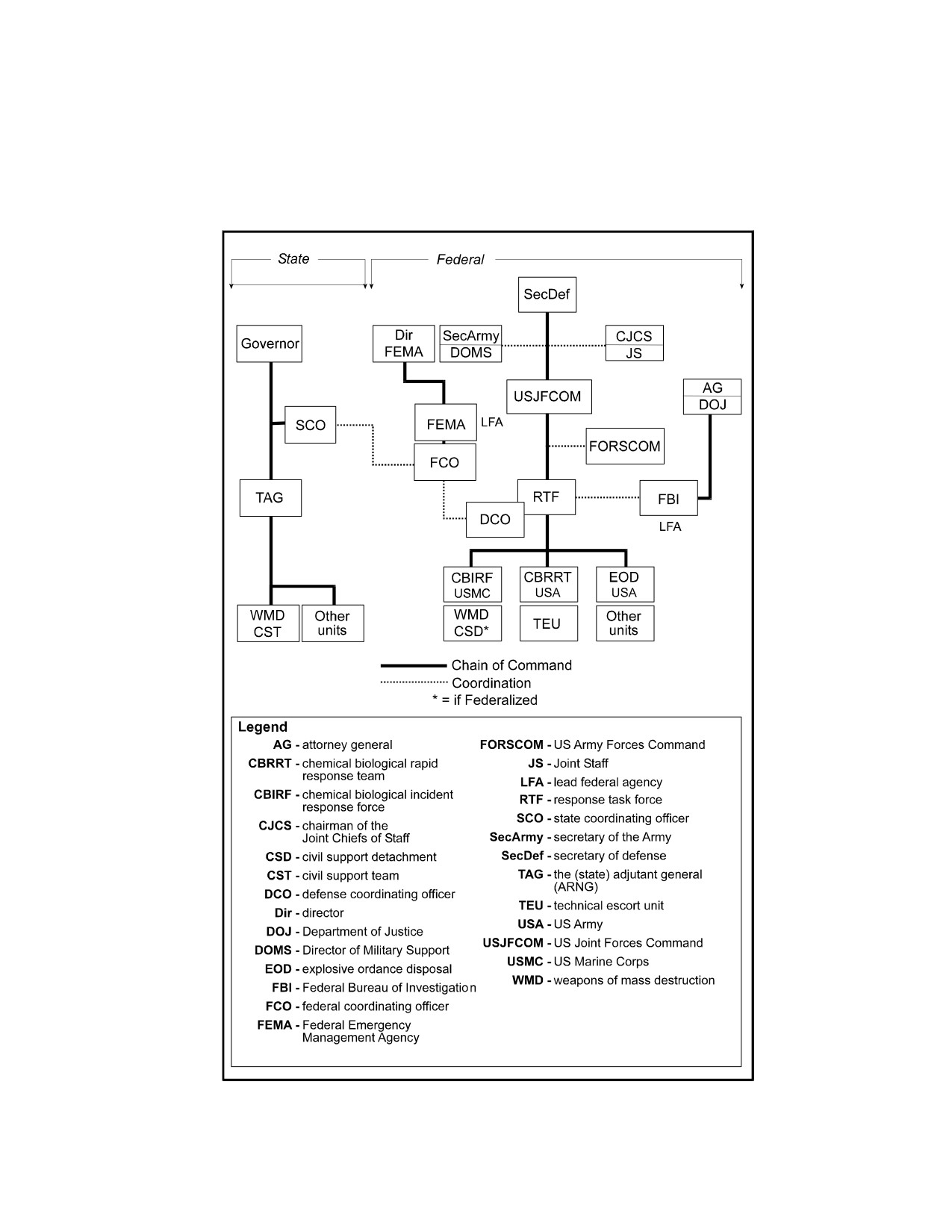
water, wastewater, solid waste, and mental health. Figure 6-4 lists activities
that support relationships for CBRNE consequence management support.
Figure 6-4. CBRNE Consequence Management
6-13
FM 3-07 __________________________________________________________________________________
6-47.
The Defense Against Weapons of Mass Destruction Act of 1996 man-
dates enhancing domestic preparedness and response capability for terrorist
attacks involving nuclear, radiological, biological, and chemical weapons. In
addition, Presidential Decision Directive
(PDD) 39 and PDD 62 direct
measures to prevent and manage the consequences of terrorist use of
CBRNE.
6-48.
Army forces assist civil authorities in protecting US territory, popula-
tion, and infrastructure before an attack by protecting critical efforts and
supporting domestic preparedness. When directed, Army forces can deploy in
response to a CBRNE incident and deal with its consequences. A large explo-
sion also is considered a CBRNE incident because the civil authorities have
yet to determine its cause, and the resulting damaged site may contain a
radiological, biological, or chemical agent.
6-49.
Responding to terrorism involves instruments that provide crisis man-
agement and consequence management. Based on the situation, a federal
crisis management response may be supported by federal consequence
management and technical operations, which may operate concurrently.
Crisis Management
6-50.
When a credible terrorist threat to
Crisis management in-
use a CBRNE device exists, crisis manage-
cludes measures to re-
ment procedures apply. The federal
solve a hostile situa-
government exercises primary authority
tion and to investigate
to prevent, preempt, and terminate
and to prepare a crimi-
threats or acts of terrorism and to appre-
nal case for prosecution
hend and prosecute the perpetrators.
under federal law.
State and local governments provide
JP 3-07.7
assistance as required. The LFA for re-
sponse to acts of terrorism is the Federal Bureau of Investigation (FBI).
Crisis management involves measures to resolve the situation, investigate,
and prepare a criminal case for prosecution under federal law. Involved US
government agencies support the FBI until the attorney general transfers
the role of the LFA to FEMA.
Consequence Management
6-51.
Consequence management
Consequence management is
begins after an actual CBRNE
actions which comprise those
release or detonation. State and
essential services and activi-
local governments exercise pri-
ties required to manage and
mary authority to respond to the
mitigate problems resulting
consequences of a terrorist inci-
from disasters and catastro-
dent. The federal government
phes, including natural, man-
provides assistance as required.
made, and terrorist incidents.
Consequence management is
JP 3-07.7
generally a multifunctional re-
sponse coordinated by emergency management agencies. FEMA has primary
responsibility for coordinating federal assistance to state and local govern-
ments.
6-14
________________________________________________________________________ Support Operations
Technical Operations
6-52.
Technical operations are
Technical operations include
activated to address aspects of
actions to identify, assess, dis-
nuclear, biological, and chemical
mantle, transfer, dispose of, or
materials when encountered in
decontaminate personnel and
crisis and consequence manage-
property exposed to explosive
ment operations. Technical opera-
ordnance or weapons of mass
tions may be before the operation
destruction.
to support the crisis management
Federal Response Plan
response and continue to support
the consequence management re-
sponse. The LFA for technical operations depends on the material involved
and the location of the incident. The Handbook of DOD Assets and Capabili-
ties for Response to a Nuclear, Biological, or Chemical Incident details the
federal support to technical operations, to include DOD response capabilities.
Command and Control Process
6-53.
All disasters are local. The local communities have the first responders.
These local responders are the first to help victims of a CBRNE incident.
First responders include fire, police, emergency medical services, and hazar-
dous materials units. In most cases the local fire chief, police chief, or other
local official will be the on-scene commander. (JP 3-07.7 contains tactics,
techniques, and procedures for support to a domestic CBRNE incident.)
6-54.
The NG weapons of mass destruction civil support teams (WMD-CST)
are the first military responders. The WMD-CST deploy to an incident site to
assess a suspected CBRNE event in support of an on-scene commander (such
as fire chief or police chief). These teams advise civilian responders regarding
appropriate action. They also facilitate requests for assistance from civil
authorities and help expedite the arrival of additional state and federal
assets. Each team has a mobile analytical laboratory for field analysis of
chemical or biological agents and a command suite that can provide
communications interoperability among the various responders. The WMD-
CST are designed for domestic consequence management and will normally
be quickly deployed as a state asset along with other NG units without DOD
authorization. If federalized, these teams may be deployed as an element of a
response task force in support of the LFA. (See Figure 6-3 for command
relationships in domestic CBRNE incidents.)
6-55.
FEMA coordinates the activities of federal, state, and local agencies at
the national level with its emergency support team and in the affected area
with its emergency response team. FEMA also ensures that state response
plans and capabilities are adequate and tested.
6-56.
The commander of a combatant command US Joint Forces Command
serves as the DOD principal planning agent and supported commander for
consequence management in the continental United States (CONUS). He also
validates all requests for military assistance to consequence management in
his area of responsibility. US Joint Forces Command resources and trains
Joint Task Force-Civil Support (JTF-CS) to provide the initial CBRNE inci-
dent response and serve as the DOD C2 headquarters in CONUS.
6-15
FM 3-07 __________________________________________________________________________________
6-57.The JTF-CS is a standing joint task force (JTF) under US Joint Forces
Command. The commander of JTF-CS is responsible for providing military
assistance to civil authorities for consequence management of CBRNE
incidents within the US, its territories, and its possessions. The JTF-CS is a
standing JTF headquarters trained for a flexible response, tailored to the
type of CBRNE, and support requested by the LFA. When employed, it pro-
vides DOD C2 and has operational control (OPCON) of all DOD assets (less
special operations forces) in support of the LFA. The JTF-CS initially focuses
its efforts on incident assessment and rapid deployment of DOD capabilities
to ensure efficient and synchronized support to LFA efforts. As forces arrive
on the scene, the focus shifts to fulfilling requests for assistance from the LFA
and the on-scene commander. Personnel from the active component, Army
Reserves, NG, government civilians, and contractors make up the JTF-CS.
6-58.
Subordinate to the JTF-CS are response task forces (RTFs), also C2 ele-
ments. These forces are regional: RTF-East (1st Army) and RTF-West (5th
Army). The RTF commander assumes OPCON of all committed DOD ele-
ments (less special operations forces) and coordinates military support of
crisis and consequence management. The initial response element
establishes liaison with the supported civil agencies and coordinates support
for the follow-on personnel. The RTF establishes a command post near the
incident and exchanges liaison officers with appropriate civil agencies and
military commands. US Joint Forces Command also has other deployable
assets for crisis management responses to CBRNE threats or incidents.
Protection of Critical Assets
6-59.
Hostile forces may attack facilities essential to society, the government,
and the military. These assaults can disrupt civilian commerce, government
operations, and military capabilities. Critical assets include telecommunica-
tions, electric power, public health services and facilities, gas and oil,
banking and finance, transportation, water, emergency services, and
government continuity. In conjunction with civil law enforcement, Army
forces may protect these assets or temporarily restore lost capability.
6-60.
DODD 5160.64 provides DOD policy and responsibilities for protecting
DOD and non-DOD critical assets worldwide. In peacetime, responsibility for
protecting non-DOD critical assets rests primarily with the civil sector
owners and with local, state, and federal law enforcement authorities.
Responsibility for protecting non-US critical assets rests with the appropriate
national authority. However, the Army and other DOD agencies must be
prepared to assist in their protection during emergencies that seriously
damage or threaten DOD operations.
Military Support to Foreign Consequence Management
6-61. DOD support to foreign consequence management operations focuses
on providing specialized assistance in response to CBRNE incidents
involving US military forces and installations, or vital interests. US military
forces may also respond to a request for assistance by a foreign government.
CJCSI 3214.01 contains guidance for planning and coordinating DOD
support to foreign consequence management operations. In accordance with
the instruction, each geographic combatant commander develops plans for,
6-16
________________________________________________________________________ Support Operations
identifies exercise forces for, and, when directed, responds to foreign CBRNE
incidents from their areas of responsibility.
6-62.
Primary responsibility for managing and mitigating the effects of a
foreign CBRNE incident resides with the host nation. The Department of
State is the LFA for foreign consequence management operations. All DOD
support will be coordinated through the responsible chief of mission and
country team.
6-63.
Army support for foreign consequence management operations is pro-
vided on presidential approval, either when requested by the host nation
(HN) or as part of an international relief effort. In both situations, all Army
assets stay under the command of the geographic combatant commander.
6-64.
The military can provide a sequential response to foreign consequence
management operations:
• Initial DOD response. When authorized by the president, each geo-
graphic combatant commander provides initial DOD response. The
response may be limited to deploying a headquarters element conduct
a situation assessment and evaluation. This headquarters element
forms the nucleus for subsequent DOD support and may assume C2 of
DOD assets committed to help resolve a particular incident.
• Subsequent DOD response. The level and type of subsequent DOD
assistance is determined by the type, severity, and location of the inci-
dent as well as the host-nation capabilities and requests for assistance.
Depending on presidential guidance, the affected geographic
combatant commander provides assets to the incident site for
immediate assistance.
• Follow-on assistance. When directed by the president, the US Joint
Forces Command deploys specialized CONUS-based assets to augment
the affected geographic combatant commander’s organic committed re-
sources.
Consequence Management Support Functions
6-65.
Support functions performed during consequence management opera-
tions are just as important as they are in other military operations. A CBRNE
event can have a catastrophic effect on the ability of a community to provide for
itself. US military forces and other DOD agencies are organized with per-
sonnel and equipment to support themselves while performing specific func-
tions. Army units need additional combat service support to provide substan-
tial assistance to the populace and local community. Examples of vital
support functions provided by Army forces are communications, transporta-
tion, engineering, maintenance, medical, and public affairs.
6-66. Fast, reliable, and accurate communications are essential for crisis
management. Army units come equipped with organic communication
systems that can be used to establish connectivity with the many nonmilitary
agencies involved in the incident. Securing adequate internal communica-
tions at the incident site, as well as establishing external communications to
higher echelons is critical. Commanders should look for government-
furnished telecommunications, commercially leased communications, and
existing available telecommunications. Communication officers should
6-17
FM 3-07 __________________________________________________________________________________
address the issue of frequency management early, as a large number of emer-
gency responders may be sharing the same frequencies. Mutual support,
connectivity, and minimum interference among agencies are vital.
6-67.
Transportation is an essential logistic function. Forces must deploy
from home station to the incident site and provide mobility once there. Army
units may have to use their internal assets to support the on-scene com-
mander if other sources of transportation are not available. Army equipment
is suited for negotiating the rubble and debris often associated with conse-
quence management. Required transportation support will likely include
ground and air, both fixed-wing and rotary. Helicopters can be used for
reconnaissance, and for aeromedical evacuation. Pilots must use care when
operating helicopters near a contaminated area as rotor wash tends to spread
the contamination.
6-68.
Public works and engineering support include technical advice and
evaluations, engineering services, construction management and inspection,
emergency contracting, emergency repair of wastewater and solid waste
facilities, and real estate support. Other engineering requirements are—
• Heavy equipment for camp construction and power-generation.
• Emergency clearance of debris for reconnaissance and passage of emer-
gency personnel.
• Temporary construction or repair of emergency access routes.
• Emergency restoration of critical public services and facilities.
• Technical assistance and damage assessment.
• Emergency demolition.
• An effective maintenance program to ensure required support is pro-
vided.
• Consideration of all classes of supply.
• Maintenance of safe food and water. Unless canned or otherwise pro-
tected, all food should be thoroughly inspected. Designated medical
authorities must approve all water and food supplies before consumed.
• Military transportation units for bulk supply distribution.
• Laundry facilities for both contaminated and noncontaminated clothes.
• Mortuary affairs.
6-69. Nuclear, biological, and chemical
(NBC) weapons can cause large
numbers of military and civilian casualties, and widespread destruction and
disruption that will challenge medical capabilities and resources. Rigorous
and disciplined adherence to public health standards can limit and mitigate
the effects of NBC incidents. Medical treatment facilities should have protec-
tive shelters to enable them to operate in contaminated environments. Speci-
fic medical responses include triage, trauma, and preventive medicine.
Patients requiring emergency medical treatment before decontamination are
treated in the decontamination area. Military medical assets can provide
limited neuropsychiatric triage and stabilization of clinical cases to reduce
the disabling effects associated with the posttraumatic stress disorder. Stress
management can also reduce hysteria surrounding the incident. Medics must
be prepared to perform casualty decontamination near the incident site, prior
to evacuation, or to establish decontamination and detection stations at local
6-18
________________________________________________________________________ Support Operations
hospitals. In a terrorist incident, many ambulatory casualties will self-
evacuate, arriving at the medical treatment facility or hospital still contami-
nated.
6-70.
Disseminating information to the world’s public is a media event. The
relationship developed between the military and the media will be critical to
the success of the operations as well as the story being accurately told. Public
affairs (PA) activities during the initial incident have immediate public im-
pact. A proactive, comprehensive PA program must be conducted to expedite
the flow of information to the public and internal audiences. There should be
a single story, coordinated with all federal agencies involved.
6-71.
Unless specifically authorized by the president, the military does not
conduct law enforcement activities. But Army units can conduct patrols to
look for disaster victims, to help in assessment, and to assist in communica-
tions. The presence of soldiers may deter looters and other violators. More-
over, soldiers can provide a labor force capable of performing whatever duties
may be required.
SUPPORT TO CIVIL LAW ENFORCEMENT
6-72.
It is DOD policy to cooperate with civil-
Support to Civil Law
ian law enforcement officials to the extent
Enforcement
practical. However, cooperation must consis-
tently meet the requirements of applicable
• Counterterrorism
law, the needs of national security and mili-
• Counterdrug
tary preparedness, and the historic tradition of
• Civil disturbances
limiting direct military involvement in civilian
• General support
law enforcement activities. US military forces
are never placed under the command of civilian law enforcement officers or
nonfederalized NG commanders. DODD 5525.5 contains the policy providing
military support, including personnel and equipment to LEAs.
6-73.
When compelling and extraordinary circumstances exist outside the
territorial jurisdiction of the US, the secretary of defense may approve direct
assistance by military personnel to execute the laws.
6-74.
The Army assists civil law enforcement by providing personnel, equip-
ment, training, and expert advice within the limits of applicable law. ARNG
units in state status (Title 32 USC) provide the primary source of military
assistance to state and local LEAs. They may assist civil authorities in
instances when federal units are precluded due to the restrictions of the
Posse Comitatus Act.
Support to Counterterrorism
6-75.
Only the president (or a presidential decision directive) may authorize
employing US military forces in response to acts or threats of domestic
terrorism. The secretary of defense must also approve all requests for
assistance in responding to acts or threats of domestic terrorism. (See Chap-
ter 5 discussion of Combatting Terrorism.)
6-76.
Army forces do not conduct domestic counterterrorism operations;
however, they may provide support to LFAs during crisis management and
6-19
FM 3-07 __________________________________________________________________________________
consequence management of a terrorist incident. Army forces may provide
specialized or technical capabilities to assist in defusing or resolving crises.
Support includes opening lines of communication for military assistance,
evacuating casualties, reconnaissance, and decontaminating or assessing
CBRNE events.
Support to Counterdrug Operations
6-77.
The DOD principal counterdrug (CD) mission is the detection and
monitoring of the aerial and maritime transit of illegal drugs into the US.
Title 10 USC, Chapter 18 gives basic guidance for interaction among active
component forces, reserve component forces, and civilian law enforcement
agencies. Title 10 prohibits the military from directly participating in arrests,
searches, seizures, or other similar activity unless authorized by law. The FY
1989 and subsequent National Defense Authorization Acts have authorized
the DOD to provide more support to LEAs in the CD effort.
6-78.
The Army significantly contributes to counterdrug support of federal,
state, and local LEAs. The Army provides operational support, linguist sup-
port, reconnaissance, maintenance, intelligence analysis, engineer support,
equipment, facilities, and training and planning support to LEAs in the
United States. Soldiers also provide counterdrug support to foreign nations
through the supported unified commanders. Host nations and LEAs world-
wide receive various means and methods of support. (See Chapter 5 for sup-
port to counterdrug operations and JP 3-07.4.)
6-79.
Training. Training support provided to LEAs includes basic military
skills such as basic marksmanship, patrolling, mission planning, medical, and
survival. DOD policy states that no US LEA personnel will receive advanced
military training. “Advanced military training” consists of advanced marks-
manship (including sniper training), urban operations, advanced urban
operations, close quarters battle or close quarters combat, and similar spe-
cialized training. As an exception to this policy, the US Army Military Police
School is authorized to train LEA personnel in the Counterdrug Special
Reaction Team Course, the Counterdrug Field Tactical Police Operations
Course, and the Counterdrug Marksman and Observer Course. Additionally,
on an exceptional basis, the commander in chief, US Special Operations
Command may approve such training by special operations forces.
6-80. JTF-6, US Army Training and Doctrine Command (TRADOC), and the
ARNG provide resources for domestic counterdrug training. JTF-6 provides
oversight to military mobile training teams in support of LEAs in CONUS.
TRADOC and the US Army Military Police School provide resident counter-
drug training for LEAs. The ARNG sponsors several counterdrug schools that
train law enforcement officers in enforcement-level counterdrug skills. In
addition, the National Interagency Civil-Military Institute (NICI) is a federally
funded DOD field operating activity of the National Guard Bureau operated by
the California National Guard. The NICI programs teach how to plan and
coordinate multijurisdictional and interagency counterdrug and support
operations and programs that use military resources. The institute includes a
research and analysis division that maintains an extensive library on joint
counterdrug operations and general drug policy. This information is available
for official use.
6-20
________________________________________________________________________ Support Operations
6-81.
Use of Technology. The Army Counterdrug Research, Development,
and Acquisition Office makes military research, development, and acquisition
available to LEAs. This office informs agencies of new technical capabilities
that may apply to law enforcement. It can also assist them in contracting and
procuring technical equipment. A program that resembles the surplus equip-
ment programs for civil defense and rural fire districts provides excess mili-
tary equipment to LEAs for counterdrug use. The secretary of defense has
established four regional support offices to support this program.
6-82.
Requests for Support. Law enforcement agencies may request sup-
port through several channels. These channels are either the state NG
counterdrug coordinator, the appropriate Continental United States army
(CONUSA), the US Army Forces Command
(FORSCOM) counterdrug
support cell, the National Guard Bureau counterdrug task force, or the DOD
coordinator for drug enforcement policy and support. The preferred method
for requesting support is through the state NG counterdrug coordinator. If
the NG cannot provide support, the request will be passed to the appropriate
CONUSA. Requests for CONUS counterdrug support, not related to NG
support activities, may be forwarded through Operation Alliance to JTF-6,
Fort Bliss, Texas. Requests for residence CONUS counterdrug training may
be forwarded directly to the US Army Military Police School.
6-83.
Provision of Support. Within the US, the NG is the primary source
of military support to federal, state, and local LEAs. The US Army Reserve
and active duty units also support LEAs. Army support to counterdrug
operations is another aspect of the Army’s traditional role of providing
military support to civil authorities. ARNG forces execute these missions
under control of their state governor, while US Army Reserve and active duty
units operate under the control of a JTF, such as JTF-6 in the southwest US,
or in support of a CONUSA.
6-84.
Each state or territory has a NG counterdrug coordinator who receives
LEA requests for support and coordinates the execution of support as
directed by the state adjutant general (or commanding general). The ARNG
conducts counterdrug operations in accordance with state laws and
applicable NG regulations.
Civil Disturbance Operations
6-85.
Civil disturbances may range
Civil disturbances are
from unruly demonstrations to wide-
group acts of violence
spread rioting with looting and arson.
and disorders prejudicial
In extreme cases, civil disturbances
to public law and order.
may include criminal acts of terrorism
JP 1-02
and violence. Civil disturbances in any
form are prejudicial to public law and order. The Army has a role in assisting
civil authorities to restore law and order when local and state law enforce-
ment agencies are unable to quell civil disturbances.
6-86. Under provisions of the Constitution and selected federal statutes, the
president may order federal armed forces to aid local and state civil authori-
ties to protect the Constitutional rights of citizens. DODD 3025.12 contains
6-21
FM 3-07 __________________________________________________________________________________
guidance concerning the use of military assets in civil disturbances. The
president may direct federal intervention in civil disturbances to
• Respond to state requests for aid in restoring order.
• Enforce the laws of the United States.
• Protect the civil rights of citizens.
• Protect federal property and functions.
6-87.
Conduct of Civil Disturbance Operations. The Army helps civil
authorities restore law and order when state and local law enforcement
agencies cannot control civil disturbances. Under the provisions of the
Constitution and selected federal statutes, the president may order federal
armed forces to aid local and state civil authorities to protect the
Constitutional rights of citizens. Federal military forces may also protect
federal facilities and installations in any state, territory, or possession. The
DOD Civil Disturbance Plan (GARDEN PLOT) provides direction for Army
forces directed to quell civil disturbances. FM 3-19.15 provides guidance in—
• Preparing for and providing assistance to civil authorities in civil dis-
turbance control operations.
• Planning and training for such operations.
• The operational tasks and techniques employed to control civil distur-
bances and neutralize special threats.
6-88.
The JTF commander exercises control of all federal military forces—
including NG in federal status—committed to assist civil authorities. Federal
military forces remain under the military chain of command during civil
disturbance operations. Federal forces will not be placed under the command
of civil officials or NG commanders in nonfederal status. Civilian authorities
retain control of their state and local LEAs. The JTF commander establishes
liaison with the senior civilian representative of the attorney general
(SCRAG) and other appropriate federal, state, and local civil authorities.
6-89.
Federal military forces must be tailored to the specific civil disturbance
situation. Combat support and combat service support units will be required
to sustain the force throughout employment. Coordination with civil authori-
ties may allow the force to draw on resources available from state and local
agencies. Close and continuous coordination between the federal military
forces and the LEAs provide commanders with the detailed information
required to employ and protect the force effectively.
6-90.
In supporting civil disturbance operations, intelligence personnel may
conduct close and continuous liaison with LEAs and the military police. This
liaison ensures that the units receive needed information to allow the com-
mander to adequately protect the force. He should staff intelligence support
missions with his senior intelligence officer and legal counsel before
approving them.
6-91. Federal military forces may perform tasks or missions appropriate to
their organization and training; they must not be employed in ways that vio-
late legal restrictions in effect. Military forces may disperse unlawful assem-
blies and patrol disturbed areas to prevent unlawful acts. They may assist in
distributing essential goods and maintaining essential services. Forces may
also establish traffic control points, cordon off areas, release smoke and
6-22
________________________________________________________________________ Support Operations
obscurants, and serve as security or quick-reaction forces. Certain types of
missions are always inappropriate for military forces during civil disturbance
operations. Military forces should never gather intelligence on civilians;
interdict a vehicle; arrest or stop and frisk civilians; or act as informants,
under cover agents, investigators, or interrogators.
6-92.
Requests for execution of specific military missions are typically passed
through one state or federal law enforcement coordinating officer, as
approved by the SCRAG. Validated requests are transmitted to the JTF com-
mander for staffing and coordination. Approved missions are assigned
through the military chain of command to the appropriate element or unit for
execution. Units and soldiers will not accept taskings or missions directly
from law enforcement or civilian officials, except when placed in a direct sup-
port relationship as approved and ordered through the military chain of
command.
6-93.
Military liaison should be provided to each LEA headquarters genera-
ting requests for support. This liaison can assist LEA officials in determining
the types and quantities of military support to request. The JTF headquar-
ters can facilitate this mission assignment process by providing LEAs with a
detailed listing of the types of missions military forces may conduct.
6-94.
A deployed unit’s area of operations should coincide with the jurisdic-
tion or subdivision boundaries of the LEA it supports. This arrangement
facilitates liaison and coordination between law enforcement agencies and
military chains of command.
6-95.
Committing military forces to civil disturbance control operations does
not automatically give these forces police power. The police power of military
forces is intentionally bound by legal constraints. Whenever possible, civil
police apprehend, process, and detain civil-law violators. Military forces only
perform these functions when necessity dictates and to the minimum extent
required. These functions are returned to civil authorities as soon as possible.
When military forces have achieved enough order to allow the local authori-
ties to resume control, the military’s mission is accomplished and its active
role in controlling the disturbance ends.
6-96.
Army commanders must know what options they have available. They
must be able to be flexible and selective in their responses. A commander
selects the option that best responds to a given civil disturbance in that speci-
fic physical and psychological environment. The commander strives to reduce
the intensity of the confrontation and to restore order.
6-97.
As the disturbance subsides, the commander gradually reduces the
number and scope of operations and begins removing his equipment from the
area. However, withdrawal is not immediate. That could lead to a resurgence
of the disturbance.
6-98. Roles. The NG, as a state organization, responds to the governor in
accordance with state law for civil disturbance operations. NG regulations
direct planning and training for the civil disturbance mission. During most
civil disturbance situations, the NG will be the first military responder and
will usually remain in state active duty status throughout the operation. The
6-23
FM 3-07 __________________________________________________________________________________
president may federalize the NG for civil disturbance operations at the state
governor’s request.
6-99.
Federal Army forces help civil authorities restore law and order when
the magnitude of the disturbance exceeds the capabilities of local and state
law enforcement agencies, including the NG. Federal military forces may also
protect federal facilities and installations in any state, territory, or
possession. The DOD Civil Disturbance Plan provides direction for Army
forces in civil disturbances.
6-100.
GARDEN PLOT provides guidance and direction for participation by
all DOD components in civil disturbance operations in support of civil
authorities. GARDEN PLOT applies to the military departments, the unified
and specified commands, DOD agencies, and other DOD components for
planning, coordinating, and executing military operations during domestic
civil disturbances.
The Los Angeles Riots
On 29 April 1992, the worst civil unrest since the riots of the 1960’s erupted in
the streets of Los Angeles. Forty-four people died and hundreds were injured
before order was restored. Property damage reached the billion-dollar mark
because of rampaging looters and the thousands of fires that they set. It
began as a small disturbance in south central Los Angeles, but quickly esca-
lated, spreading rapidly through the city and county. The violence initially over-
whelmed law enforcement authorities, resulting in the burning of large areas of
the city. California’s governor committed the state police and 2,000 National
Guard soldiers to assist in restoring law and order in the early morning hours of
30 April. A National Guard military police company arrived in the area that
afternoon and immediately began operations to support local police.
Joint Task Force-Los Angeles (JTF-LA) was formed following a presidential
executive order on 1 May. It federalized units of the California NG (CAARNG)
and authorized active military forces to assist in restoring law and order. JTF-
LA formed and deployed within 24 hours, assembled from US Army and
Marine forces. It operated in a unique domestic disturbance environment
while working with city, county, state, and federal agencies and the CAARNG.
JTF-LA successfully met the three objectives defined in its mission
statement. “JTF-LA assumes command and control of federalized National
Guard, active duty Marine and Army forces, establishes liaison with local law
enforcement agencies, and conducts civil disturbance operations to restore
order in the greater Los Angeles area.”
6-101.
Requests for Military Assistance. Requests for military assistance
normally originate with a state and are forwarded to the president. The
attorney general must coordinate and manage all requests for federal
military assistance for civil disturbance operations. He then advises the
president whether and when to commit federal military forces.
6-102. The attorney general, as the head of the LFA responsible for law
enforcement, will appoint a SCRAG. The SCRAG must coordinate federal
6-24
________________________________________________________________________ Support Operations
civil disturbance operations and assist the state civil authorities. The SCRAG
has the authority to request military assistance for civil disturbance support
from federal military forces. Civilian officials remain in charge of civil dis-
turbance operations.
6-103.
The secretary of the Army is the DOD executive agent for federal mili-
tary operations in response to civil disturbances. Within the department of
the Army, the DOMS coordinates the functions of all military services. The
DOMS, on behalf of the joint staff, publishes an execute order designating a
combatant command as the supported command for the civil disturbance
operations. This order also designates the supporting combatant commands,
services, and agencies.
6-104.
The supported combatant command will determine the organization
and forces required to accomplish the civil disturbance mission. The com-
batant command may establish a joint task force to make best use of the
forces available for the mission.
General Support
6-105.
Title 10 USC, Chapter 18, sections 371-382 and other federal laws
allow for additional limited military support to law enforcement agencies.
The military may share information and provide equipment, facilities, and
other services (see DODD 5525.5). The Army may provide training to federal,
state, and local civilian law enforcement officials. Such assistance may
include training in operating and maintaining equipment. This ordinarily
does not include large-scale or elaborate training nor regular or direct
involvement of military personnel in activities that are fundamentally
civilian law enforcement operations. Training of federal, state, and local
civilian law enforcement officials is provided under the following guidance:
• This assistance is limited to situations when using non-DOD personnel
would be infeasible or impractical from a cost or time perspective and
would not otherwise compromise national security or military pre-
paredness concerns.
• Such assistance may not involve DOD personnel in a direct role in a
law enforcement operation, except as otherwise authorized by law.
• Except as otherwise authorized by law, DOD personnel locate and per-
form such assistance where confrontation is unlikely.
• Military departments and defense agencies may provide expert advice
to federal, state, or local law enforcement officials in accordance with
Title 10 USC, Chapter 18, section 373.
• When loans of equipment facilities or personnel to law enforcement are
made, such loans are approved at a level no lower than general officer.
In addition, the secretary of defense must approve requests for poten-
tially lethal support.
COMMUNITY ASSISTANCE
6-106. Community assistance applies the skills, capabilities, and resources of
the Army to the needs and interests of America and local communities. Sup-
porting and participating in events and activities that benefit Army forces
and the civilian community build on a long tradition of the Army helping
6-25
FM 3-07 __________________________________________________________________________________
American communities. Community assistance can have a large impact be-
cause active component, ARNG, and US Army Reserve units are located in
thousands of towns and cities across the nation. What a command does, or
fails to do, for the community will affect the attitudes of the American people,
on whom the Army depends for its support and existence. Every commander
should identify opportunities to conduct initiatives that meet specific needs;
have specific start points and end states; enhance readiness; and advance the
interests of the nation, the Army, and local communities.
Fundamentals
6-107.
Community assistance projects and operations must enhance the
Army’s image, have a positive impact on the unit or individual soldier, and
contribute to the common good of the nation and local communities. Army
commanders must ensure that their initiatives do not compete with local
resources or services, do not benefit any particular interest group, and will
not result in any monetary or service remuneration. Army commanders
located outside of CONUS may find these principles useful in fostering their
established relationships with adjoining host-nation commanders. However,
they must consider applicable combatant command guidelines and host-
nation laws and agreements before implementing community assistance pro-
grams.
6-108.
Command Emphasis. Commanders should take an active interest in
their relationships with civilian officials, encouraging appropriate community
assistance programs. Establishing long-term, harmonious, productive rela-
tionships with national, state, and community officials can significantly bene-
fit both the Army and civilian communities.
6-109.
Individual and Unit Enhancement. Community assistance activi-
ties increase public awareness and understanding of the Army, inspire
patriotism, and enhance the Army’s reputation as a good neighbor. They
positively influence public opinion toward the Army while also enhancing the
combat readiness of the organization. They help build unit morale.
Community assistance activities are an excellent opportunity for soldiers to
serve as role models, which not only enhances recruiting, but also motivates
other soldiers. These activities promote their self-esteem and further their
sense of service to the nation.
6-110.
Readiness Enhancement. Community assistance activities should
enhance individual and unit combat readiness. They should make the best
use of assets and foster a positive training environment where soldiers can
become involved in realistic, hands-on training opportunities. Whenever pos-
sible, community assistance projects should exercise individual soldier skills,
encourage teamwork, challenge leader planning and coordination skills, and
result in measurable, positive accomplishments. Finally, they should enable
a unit to use its equipment, providing training opportunities that increase
operator proficiency.
6-111. Community Benefit. Community assistance activities should contri-
bute to the health and welfare of the nation and local communities, making
the Army an integral partner in progress and development. These activities
enhance the ability of the nation and communities to provide the best
6-26
________________________________________________________________________ Support Operations
possible services to the citizenry. They promote a positive, healthy, safe
environment as well as an understanding of the basic principles, values, and
ideals on which America is built. This results in increased awareness of
America’s history and the Army’s role in a continuously changing world.
6-112.
Common Interest and Benefit. Because the Army belongs to the
American people, it should support only events and activities of common
interest and benefit. Commanders should avoid providing assistance and
support to one sponsor that they cannot also provide to other sponsors. Army
assistance should not selectively benefit any person, group, or corporation—
whether profit or nonprofit, religious or sectarian, ideological, fraternal, poli-
tical, or commercial.
6-113.
Noncompetitive. Army community assistance projects should not
compete with resources and services commercially available in the commun-
ity. Commanders must not authorize assistance activities when local busi-
nesses can provide the same or similar assistance and support.
6-114.
Nonprofit. Army support for or participation in community assistance
activities cannot be provided if based on a monetary-profit. Commanders
must ensure that no Army person or unit realizes a monetary profit, a gra-
tuity, or remuneration in any form not provided for by public law or regulation.
Types
6-115.
Community assistance activities can be national efforts focused on de-
veloping public support for the Army and its national contribution. They can
also be state or local community efforts focused on improving the community,
its infrastructure, and its ability to serve the local population. Both types im-
prove the lives of American citizens, foster the values and purposes of demo-
cracy, and give the American people hope and confidence in a changing world.
6-116.
National Efforts. National efforts should develop an open, coopera-
tive relationship between the Army and the American people. National efforts
take advantage of the technical, vocational, and group skills of military
professionals to enhance the lives of American people. They supplement pro-
grams available in the civilian sector and through other government agen-
cies, not replace them. They provide opportunities for the Army to contribute
to the growth and welfare of the nation, improving its perception of the
Army, its capabilities, and its personnel. Army and DOD regulations provide
detailed guidance on national effort programs. Examples of national efforts
include Public Works Maintenance and Management, exercised through the
US Army Corps of Engineers, and assistance programs, such as the Civilian
Community Corps and Drug Demand Reduction Programs.
6-117. State and Local Efforts. The guiding principle behind state and
local efforts is that the installation and the community have a common inter-
est in providing the best possible support to each other. A cooperative rela-
tionship exists because soldiers stationed at the installation receive life sup-
port from the community while many of the civilians who make up the
community receive life support from the installation. The interdependence of
the military installation and the civilian community can involve economics,
education, health care, basic services, and quality-of-life issues.
6-27
FM 3-07 __________________________________________________________________________________
6-118.
The goal of local commanders should be to develop an open, mutually
satisfactory, cooperative relationship between the installation and the com-
munity. Good state and local efforts improve the community’s perception of
the Army; the installation; and the soldiers, family members, and civilians
who are part of the installation.
6-119.
Commanders should consider appointing a committee or small agency
to act as a clearinghouse for community assistance requests. The garrison
commander or the director of plans, training, and mobilization might head
this committee. It should include the public affairs officer, the staff judge
advocate, the chaplain, command surgeon, and representatives from the
directorate of resource management, the directorate of installation support,
and the directorate of personnel and community activities. Units that play a
major role in the activity should be represented. Key community leaders
should also be invited to serve on this committee.
6-120.
Community Cooperation. Many community activities and efforts
can be established in a more formalized manner. These efforts permit both
the installation and local community to expand and enhance their services to
their respective communities. Examples of these efforts are explained in the
following paragraphs.
6-121.
Memorandums of agreement or understanding permit the installation
or organization to enter into an agreement with the local community. They
can provide critical services not available in the community, augment com-
munity services unable to meet demand, or ensure that emergency services
are available in the shortest possible time. Examples include arrangements
to provide air ambulance support, search and rescue, fire fighting capability,
explosive ordnance disposal, emergency or broad-based medical care, wildlife
and domestic animal management, assistance in safety and traffic control,
emergency snow removal, and temporary supplemental housing for the dis-
placed or disadvantaged.
6-122.
Speakers effectively develop an understanding of the Army and stimu-
late patriotic spirit. They inform the public about installation activities, its
units, and its soldiers. Commanders should establish an installation speakers
bureau and encourage soldiers of all ranks to participate in the program.
6-123.
Maintaining liaison through informal community councils can
enhance open communications with community officials and organizations.
Councils have various responsibilities, such as developing and promoting
new ways for members of the command to participate actively in local
community activities and resolving potential and actual areas of conflict.
Commanders may present public service awards to private citizens, local
community leaders, citizen groups, and organizations for their support of the
Army. Commands can further community liaison through membership in
civic, business, and professional organizations when the goals and objectives
of those organizations benefit the Army and their programs and projects are
consistent with Army interests.
6-124. Participating in public events and memorials is an excellent way to
accomplish community relations objectives. These representatives of the
Army serve as ambassadors to the civilian community and promote patrio-
tism, interest in the Army, and awareness of the professionalism of US forces.
6-28
________________________________________________________________________ Support Operations
6-125.
Exhibits and displays of Army equipment, historical materials,
models, devices, and other information can enhance understanding of the
Army and the installation. They can also promote patriotism and educate the
public. They provide an excellent opportunity for our soldiers to interact with
members of the local community while communicating the professionalism,
readiness, and standards of our forces.
6-126.
Community service physical improvements focus on ensuring that the
physical infrastructure is as safe as possible and provides the fullest possible
range of support to the population. These activities encompass a wide range
of programs that do not compete with the services provided by contractors
and businesses in the local civilian community. Examples include
• Construction projects that enhance the recreational, educational, envi-
ronmental, or cultural facilities of the community, such as building
community picnic areas and hiking and biking trails.
• Projects that create or enhance a safe, clean environment, such as
removing debris from a community wildlife area or painting a com-
munity recreation center.
• Demolition projects that enhance the safety and appearance of the
community, such as the removal of unstable playground equipment.
6-127.
Community service social improvements, which focus on making the
social environment as healthy as possible, provide the widest range of sup-
port to the population. They encompass a myriad of projects, including—
• Support to youth programs, such as Scouting, and programs that assist
special need audiences, such as the Special Olympics.
• Involvement in ventures and projects that enhance the educational or
cultural climate of the community, such as adult literacy, school
reading, or community theater programs.
• Participation in special events, such as law enforcement or fire preven-
tion awareness programs that enhance the welfare of the community.
6-128.
Commanders should consider the contributions that all organizations
and personnel associated with their installation could make in community
assistance activities. For example, Army Reserve Officer Training Corps
(ROTC) cadets may be a valuable resource for participating in or supervising
selected community assistance projects. ROTC cadets, particularly those in
the final two years of training, can gain valuable leadership experience by
participating in community activities. Communities will benefit from the
dedication of intelligent, reliable, and energetic future Army leaders in their
community efforts.
6-129. Another example of soldiers who contribute to community assistance
activities is Army recruiters dispersed throughout the United States. These
noncommissioned officers serve as positive role models and leaders who may
be called on to assist in DOD-approved community activities as recruiting
duties permit.
6-29
Appendix A
Interagency Coordination
US Armed Forces as a whole must be multi-mission capable; interop-
erable among all elements of US Services and selected foreign mili-
taries; and able to coordinate operations with other agencies of govern-
ment and some civil institutions.
National Military Strategy of the United States of America, 1997
Success in operations can depend on the ability to blend and engage all
elements of national power effectively. Interagency coordination forges
the vital link between the military instrument of power and the economic,
political or diplomatic, and informational entities of the United States
(US) government (USG) as well as nongovernmental agencies. Stability
operations and support operations span a broad range of activities with
many organizations typically involved. Therefore, to have an overview of
the various organizations with which Army forces are involved during
these actions is vital. The interagency coordination process should bring
together the interests of multiple agencies, departments, and organi-
zations to achieve unity of effort toward a common goal. FM 3-16 and
JP 3-08 contain additional information.
NATIONAL LEVEL
A-1. The National Security Council (NSC) advises and assists the president
in integrating all aspects of the national security policy—domestic, foreign,
military, intelligence, and economic (in conjunction with the National Eco-
nomic Council). The NSC system is the principal forum for consideration of
national security issues requiring presidential decisions. The NSC system
provides the foundation for interagency coordination in developing and imple-
menting national security policy. It is the only level of the executive branch
in which authoritative direction to the various departments can be given. The
functions, membership, and responsibilities of the NSC are set forth in Presi-
dential Decision Directive (PDD) 2.
CONTENTS
National Level
A-0
Central Intelligence Agency
A-9
Domestic Relief Operations
A-1
US Agency for International
Federal Response Plan
A-1
Development
A-9
State and Local Authorities
A-2
Nongovernmental Organizations
A-10
Foreign Operations
A-3
Regional and International
Theater Orientation
A-4
Organizations
A-12
Department of Defense
A-4
Civil-Military Operations Center
A-15
Department of State
A-5
Liaison
A-17
A-0
___________________________________________________________________ Interagency Coordination
A-2.
The members of the NSC include the president, the vice president, the
secretary of state, and the secretary of defense. The Central Intelligence
Agency (CIA) director regularly attends meetings as a cabinet-level officer.
The Chairman of the Joint Chiefs of Staff (CJCS) is a statutory advisor and
also attends meetings of the NSC. Other regular attendees include the secre-
tary of treasury, the assistant to the president for National Security Affairs
(referred to as the National Security Advisor), the assistant to the president
for economic policy, and the chief of staff to the president. Heads of executive
departments and agencies and other senior officials, such as the US perma-
nent representative to the United Nations (UN), may be invited to attend
meetings of the NSC on an ad hoc basis. The NSC staff tracks and directs the
development and implementation of national security policies for the presi-
dent.
DOMESTIC RELIEF OPERATIONS
A-3.
Department of Defense (DOD) often provides disaster assistance to
support civil authorities responding to domestic emergencies. DOD policy
concerning domestic relief operations is contained in DOD Directive
(DODD) 3025.1. The following discussion relates to the conduct of disaster
assistance.
FEDERAL RESPONSE PLAN
A-4.
The Federal Response Plan (FRP) guides crisis response to disasters in
the US. Federal departments and agencies support the operations of the FRP
by executing their assigned functional responsibilities. The Robert T. Stafford
Disaster Relief and Emergency Assistance Act (Appendix B) provides statu-
tory authority for USG domestic disaster assistance.
A-5.
The FRP applies to natural disasters. These may include earthquakes,
forest fires, hurricanes, typhoons, tornadoes, floods, and volcanic eruptions;
technological emergencies involving radiological or hazardous material
releases; and other federal emergencies identified under the act.
A-6.
Following a request for assistance from the governor of the affected state
or territory and the determination that local ability to respond has been ex-
ceeded, the president implements the FRP by declaring a domestic disaster.
With this presidential declaration, the resources of the federal government
can be focused on restoring normalcy.
A-7.
While the secretary of defense retains the authority to approve the use of
combatant command resources for military support to civil authorities
(MSCA), the secretary of the Army acts as the DOD executive agent for exe-
cuting and managing MSCA. He responds to the president when coordinating
with the director of the Federal Emergency Management Agency (FEMA).
A-8. Federal assistance to a state or territory is provided under the overall
direction of the federal coordinating officer (FCO), appointed by FEMA on
behalf of the president after the president has declared a “disaster.” In coordi-
nation with the state, FEMA will send in the emergency response team con-
sisting of selected federal agency representatives to assess damage, establish
the disaster field office, and work at the state emergency operations center.
The FCO for FEMA must approve all taskings
(known as mission
A-1
FM 3-07 __________________________________________________________________________________
assignments) for the DOD to be reimbursed for its incremental costs for the
mission. When a domestic disaster occurs, FEMA’s catastrophic disaster
response group (CDRG) and emergency support team (EST) form at the
FEMA headquarters. The CDRG is the coordinating group that addresses
policy issues and support requirements from the FCO and emergency support
function response elements from the field. The EST, an interagency group
comprised of representatives from the ten primary federal agencies (including
the DOD) and the FEMA staff, resolves issues.
A-9.
Acting through the Chairman of the Joint Chiefs of Staff and Director of
Military Support (DOMS) (the DOD representative on the CDRG), the secre-
tary of defense approves an execute order designating the supported com-
batant commander and operating agent. This order also delineates support
relationships; directs the US Army Corps of Engineers to begin disaster site
support; and directs the Commander in Chief, US Transportation Command
to begin unit or equipment movement as required by the supported com-
batant commander. Acting through DOMS, the secretary of the Army tasks
and coordinates with the services and other DOD elements or other primary
agencies under the FRP and with the mission assigned by FEMA.
A-10.
The supported combatant commander designates a component com-
mand as a headquarters to execute the disaster relief operation. This head-
quarters will appoint and deploy a defense coordinating officer (DCO) and,
based on the severity of the situation, may also deploy a joint task force
(JTF). The DCO works with the FCO to integrate JTF efforts in support of
the operation. The DCO serves as the on-scene military point of contact for
the FCO and principal representatives of other USG agencies participating in
the relief operation. As a practical guide, the DCO and the JTF commander is
not the same individual because each has different responsibilities and
assets. Separating these distinct functions allows the JTF commander to
operate freely in the disaster area, while the DCO focuses on validating tasks
and coordinating DOD response activities in the disaster field office. Within
the continental US, the Commander in Chief, US Joint Forces Command—
through its Army Component Forces Command or the Continental United
States army (CONUSA)—can provide the JTF headquarters. The CONUSA
has regionally oriented commands with regional boundaries. These head-
quarters interact daily with state and local authorities, the FEMA regions,
and other federal agencies and provide a foundation for a rapid and smooth
transition to support operations during periods of disaster response.
A-11.
In addition, other agencies may request DOD assistance as part of a
federal response to domestic environmental disasters. Normally, such assist-
ance will be provided based on requests from the Environmental Protection
Agency, US Coast Guard, or Department of Interior as the lead agency.
Examples include flooding and radiological and hazardous material accidents
or incidents. While the DOMS normally coordinates DOD response to domes-
tic emergencies, the military may also respond when an interdepartmental
memorandum of agreement is in effect.
STATE AND LOCAL AUTHORITIES
A-12. DOD interaction with state and local authorities can take the visible
form of MSCA or the more routine involvement of commanders of DOD
A-2
___________________________________________________________________ Interagency Coordination
installations with state, county, and municipal governments. These activities
include contingency planning with local governments and field offices of
federal agencies and community and social activities.
A-13.
Each state governor is supported in a contingency by the state or terri-
torial Army and Air National Guard under the command of the state or terri-
tory adjutant general. DOD support is generally provided to assist or aug-
ment skills and resources to a federal agency field office or to a state or local
agency responsible for a particular activity.
A-14.
Each state and territory has an office of emergency services (OES) or an
equivalent responsible for preparedness planning and assisting the governor
in directing responses to emergencies. The OES coordinates state or terri-
torial assistance to its local governments through authority of the governor or
adjutant general, but it does not provide cross-border assistance. In some
states and territories, the adjutant general is designated as the senior state
emergency official (emergency manager). In other state and territories, the
adjutant general is usually equivalent to the state emergency manager. The
state usually designates a state coordinating officer (SCO), with authorities
similar to the FCO, to coordinate and integrate federal and state activities.
A-15.
Lower echelons establish relationships similar to those of DCO, FCO,
and SCO to facilitate coordination. For example, Army installation com-
manders may work with local mayors to align capabilities with needs.
A-16.
Federal support to law enforcement agencies can be coordinated with
the state or territory adjutant general, the OES, or principal law enforcement
agency, depending on the operation. Coordinating counterdrug operations
under federal and state oversight can be low-key, with interagency activities
taking place in specific localities.
A-17.
Commanders rendering aid at the request of local authorities to
prevent human suffering, save lives, or mitigate great property damage are
authorized to provide immediate response. One example is reacting to storm
devastation in a nearby community. If requested by local authorities, an
Army installation commander with appropriate resources can immediately
act, with coordination of state and federal activities to follow. This immediate
response by commanders does not take precedence over their primary
mission. Commanders should seek guidance through the chain of command
regarding continuing assistance whenever Army resources are committed
under immediate response circumstances.
A-18.
Coordinated activities between installations and the local community
can include support for public fire and rescue services, public works, police
protection, social services, public health, and hospitals. Routine interagency
coordination between the DOD, the Federal Aviation Administration, and the
municipality takes place daily where a joint-use Army airfield supports com-
mercial aviation serving the municipality. Examples include military
assistance to safety, traffic control, and search and rescue.
FOREIGN OPERATIONS
A-19. US foreign operations are conducted under authority of the president,
in line with treaties, conventions, and executive and other agreements to
A-3
FM 3-07 __________________________________________________________________________________
which the US is a party; relevant statute law; and relevant federal and
agency regulations. These operations are conceived and implemented through
an interagency process under the general direction and supervision of the
National Security Council and its staff. Specific agencies—such as the
Department of State, Department of Defense, and CIA—are normally desig-
nated as having the lead in the interagency working groups that do the bulk
of the day-to-day work involved in implementing policy.
THEATER ORIENTATION
A-20.
Within a theater, the geographic combatant commander plans and
implements theater and regional military strategies that require interagency
coordination. Coordination between the DOD and other USG agencies may
occur in a country team or within a combatant command. In some operations,
a special representative of the president or special envoy of the UN Secretary
General may be involved. Many USG organizations are regionally focused,
such as the Department of State (DOS) in its regional bureaus and the US
Agency for International Development (USAID). In individual countries, the
ambassador and country team supervise and direct the overall foreign
assistance program.
A-21.
The joint campaign plan is based on the commander’s concept. This
plan presents a broad vision of the required aim or end state and how opera-
tions will be sequenced and synchronized to achieve objectives. A campaign
plan is essential for laying out a clear, definable path linking the mission to
the desired end state. Such a plan enables commanders to help political
leaders visualize operational requirements for achieving objectives. Given the
systematic military approach to problem solving, often the combatant com-
mander formally or informally functions as the lead organizer of many opera-
tions. JP 3-08 outlines how to develop and execute a campaign plan in the
interagency arena.
A-22.
A political advisor (POLAD) is an officer from the DOS. Combatant
commanders are usually augmented with a POLAD. Army component com-
manders in multinational operations and other operations may also be aug-
mented with a POLAD. He provides diplomatic considerations and enables
informal links with embassies in the area of responsibility and with the DOS.
The foreign policy advisor supplies information regarding DOS policy goals
and objectives relevant to the geographic combatant commander’s theater
strategy. Other USG agencies also may detail liaison personnel to operational
level staffs when requested to improve interagency coordination.
DEPARTMENT OF DEFENSE
A-23. The DOD coordinates with the DOS and other USG agencies on many
issues including—
• Bilateral and multilateral military relationships.
• Treaties involving DOD interests.
• Technology transfers.
• Armaments cooperation and control.
• Humanitarian assistance.
• Peace operations (including those under the auspices of the UN).
A-4
___________________________________________________________________ Interagency Coordination
DEPARTMENT OF STATE
A-24.
The Department of State is the agency of the USG responsible for
planning and implementing the foreign policy of the United States. The DOS
is headed by the secretary of state, who is the ranking member of the presi-
dent’s cabinet and fourth in presidential succession. The secretary of state is
the president’s principal advisor on conducting foreign affairs and formu-
lating foreign policy. In its diplomatic role, the DOS is an important source of
foreign affairs data, national security and economic information, and data on
the policies and inner workings of the countries. In its consular function, it
provides notarial and citizenship services to American citizens abroad and
assists in implementing US immigration and naturalization laws.
Embassy Organizations
A-25. Country Team. The US
Country Team Members
country team is the senior, in-
country, United States coordi-
• Ambassador
nating and supervising body,
• Deputy Chief of Mission
headed by the chief of the
• Chief of Political Section
United States diplomatic
•
US Defense Representative Security
mission
(the ambassador)
Assistance Officer, or Defense Attaché
(JP 1-02). It is comprised of
• Consular Officer
the senior member of each
• Administration Officer
represented US department or
• Chief of Station
agency present in the country,
• Commercial and/or Economics Officer
as desired by the ambassador.
• Regional Security Officer
The country team composition
• Regional Medical Officer
varies widely depending on
• Public Affairs Officer
specific US national interests,
• USAID Representative
the desires of the ambassador,
Figure A-1. Likely Members of the
the situation in the country,
Ambassador’s Country Team
and the number and level of
presence of US agencies. Figure A-1 shows some possible members of the
country team.
A-26.
A country team facilitates interagency action on recommendations from
the field and implements effective execution of US programs and policies. It
provides the foundation for rapid interagency consultation and action on
recommendations from the field and effective execution of US missions, pro-
grams, and policies. A country team is relatively small and may not be ade-
quate for every need. A country team may not exist in every country, or it
may be inoperative due to damage or casualties from a natural or man-made
disaster. Country teams have generally received some crisis management
training, but they are usually not prepared to plan in detail. The relationship
with military chains of command is frequently ad hoc.
A-27. Defense Attaché Office. The Defense Attaché Office (DAO), which
consists of one or more defense attachés and support personnel, observes and
reports on the country’s military and political-military situation. This infor-
mation can be valuable when planning and executing various missions in the
country including noncombatant evacuation operations (NEOs), support to
counterdrug and counterinsurgency, and others. DAO personnel are active
A-5
FM 3-07 __________________________________________________________________________________
duty military attached to the embassy in a diplomatic status. The Defense
Intelligence Agency rates and funds defense attachés. They may add to the
daily embassy situation report and other written intelligence-related infor-
mation. All military personnel, even those not assigned to the embassy or
under direct control of the ambassador, should coordinate their activities
through the senior defense representative
(which may be the Security
Assistance Organization or the defense attaché, depending on the country.)
The DAO duties also include liaising with host-nation defense officials on
military matters related to threat assessments, intelligence, and in-country
capabilities. A smaller embassy may not have a defense attaché present;
rather it depends on a regional attaché who is accredited to the host nation
but stationed elsewhere.
A-28.
Security Assistance Organization. The security assistance organi-
zation (SAO) maintains a liaison with the host-nation military forces. It is the
most important military activity related to foreign internal defense under the
ambassador’s supervision. The SAO assists host-nation security forces by
planning and administering military aspects of the security assistance pro-
gram. It also helps the US country team communicate host-nation assistance
needs to policy and budget officials in the US government. In addition, the
SAO oversees training and assistance teams temporarily assigned to the host
nation
(HN). The law prevents the SAO from giving direct training
assistance. Instead, training is provided through special teams and organiza-
tions assigned to limited tasks for specific periods, such as mobile training
and technical assistance teams.
A-29.
The SAO is a joint organization. The chief of the US diplomatic mission
directs and supervises the SAO chief to accomplish the SAO’s security
assistance mission. The geographic combatant commander commands the
SAO in all matters that are not functions of the chief of the US diplomatic
mission. The director of the Defense Security Cooperation Agency prescribes
policy for managing security assistance programs by the SAO.
A-30.
The SAO may be known in country by many names according to the
number of persons assigned, the functions performed, or the desires of the
HN. Typical SAO designations include a joint US military assistance group,
military liaison office, US military training mission, and office of defense
cooperation. In countries where the US has no SAO, another member of the
mission oversees security assistance. In many countries, security assistance
functions are performed within the DAO. The defense attaché may also serve
as the SAO.
A-31.
The US tailors each SAO to the needs of its HN; thus, there is no
standard SAO. However, a large SAO normally has Army, Navy, and Air
Force components. Each component must accomplish its service portion of
security assistance activities. A small SAO has divisions by function but no
separate service components.
A-32. The primary functions of security assistance personnel are logistics
management, fiscal management, training management, and contract
administration of country security assistance programs. Security assistance
personnel maintain a liaison with host-nation defense establishments. They
operate with the host-nation military—primarily at the national level—to
A-6
___________________________________________________________________ Interagency Coordination
interpret US policies, resolve problems in materiel delivery, and obtain tech-
nical assistance for defective materiel. They assess the host-nation military
capabilities and requirements.
A-33.
The SAO provides host-nation governments with information necessary
to make decisions about acquiring and using US defense articles and services.
(These services include training under the auspices of US security assistance
programs.) It obtains information to evaluate the host-nation military’s capa-
bility to employ and maintain the equipment requested. The SAO processes
security assistance proposals of foreign governments. It also keeps communi-
cating with host-nation defense officials on military matters, such as the
threat and host-nation military capabilities.
A-34.
Documents describing SAO responsibilities and functions include
DODD 5105.65 and DODD 5132.3. The former establishes the responsi-
bilities, functions, authorities, and relationships of the Defense Security
Cooperation Agency as an agency of the DOD. The latter establishes DOD
policy and assigns responsibilities pursuant to The Foreign Assistance Act of
1961, as amended, the Arms Control Act, as amended, and related statutory
authorities, executive orders, and policies established by the secretary of
state relating to the administration of security assistance.
Embassy Representatives
A-35.
Chief of Mission. The chief of mission (the ambassador) has authority
over all elements of the USG in country, except forces assigned to a com-
batant commander. The ambassador represents the president but takes
policy guidance from the secretary of state through regional bureaus. The
ambassador integrates the programs and resources of all USG agencies
represented on the country team. As the president’s representative in the
HN, he has extraordinary authority. He may use the country team as a
coordinating mechanism that can be fine-tuned and tailored to each crisis as
it arises, based on the problem with little need for written rules. The am-
bassador functions at both the operational and tactical levels, where recom-
mendations and considerations for crisis action planning are provided
directly to the geographic combatant commander or senior military represen-
tative in the area.
A-36.
The president gives the chief of mission immediate direction and con-
trol over USG personnel in the country. This does not include personnel in
another mission, assigned to an international organization, or assigned to a
combatant command, including their subordinate elements. The chief of
mission ensures that all USG activities in the country serve US interests as
well as regional and international objectives. He promotes positive program
direction by seeing that all activities are necessary, are efficiently and eco-
nomically run, and are effectively interrelated.
A-37. Deputy Chief of Mission. The deputy chief of mission (DCM) is the
senior diplomatic official in the embassy below the rank of ambassador. The
DCM has the diplomatic title of minister, minister-counselor, or counselor
(depending on the mission size) and is usually a career Foreign Service Offi-
cer. He usually chairs the emergency action committee (EAC) meetings and
A-7
FM 3-07 __________________________________________________________________________________
coordinates embassy staff. The DCM helps ensure that all US in-country
activities best serve US interests.
A-38.
US Defense Representative. The US Defense Representative
(USDR) is an additional title assigned to a military officer serving in a speci-
fically designated position. This duty title may be assigned to either the
defense attaché or the security assistance officer. The USDR represents the
secretary of defense, the chairman of the Joint Chiefs of Staff, and the geo-
graphic combatant commander. He coordinates administrative, security, and
logistic matters to USG officials for all DOD noncombatant command
elements in the foreign country in which the USDR is assigned.
A-39.
Chief of Station. The chief of station is the senior intelligence advisor
to the ambassador. He is an excellent source of information on the country
and the current situation.
A-40.
Administration Officer. The administration officer oversees various
activities at the embassy compound. These activities may include security at
small posts; running the commissary, motor pool, and maintenance activities;
and handling monetary aspects of embassy business, including foreign ser-
vice national payroll, cash collection, and the budget. At a small post with no
security officer assigned, the administration officer assumes the functions of
the post security officer and has operational control of the Marine Security
Guard (MSG) detachment. The general services officer and information
management officer work for the administration officer:
• The general services officer is responsible for buildings, grounds, con-
struction, vehicles, and maintenance.
• The information management officer runs the post communications
center; processes and tracks all classified pouch material; and oversees
the computer system at the embassy. He is the point of contact for the
post’s communication capabilities.
A-41.
Political Officer. The political officer reports on political develop-
ments, negotiates with the host-nation government, and represents views
and policies of the USG. He maintains regular contact with host-nation
officials, political and labor leaders, and other influential citizens of the HN,
as well as other countries’ diplomats. The political officer is a major contribu-
tor to the overall intelligence picture.
A-42.
Commercial and/or Economic Officer. This officer analyzes, reports
on, and advises superiors, DOS, and DOD personnel on economic matters in
the HN. He also negotiates with the HN on trade and financial issues.
A-43.
Consular Officer. Consular officers screen, process, and grant US
passports and visas. Other duties mandated by law include attending to the
welfare of US citizens and maintaining a census of US nationals in the HN.
During NEOs, the consular officer provides personnel to screen documents of
all potential evacuees and instructs any evacuation control center personnel
who staff processing stations.
A-44. Regional Medical Officer. This officer is qualified for general prac-
tice and can set up triage, trauma, and mass casualty operations. He may
also advise the JTF on indigenous diseases and proper prophylactic pro-
cedures for forces executing a NEO. These officers are only found in certain
A-8
___________________________________________________________________ Interagency Coordination
embassies where the necessary support exists for them to carry out their
duties.
A-45.
Regional Security Officer. The regional security officer (RSO) is a
DOS diplomatic security agent responsible for the security functions of all US
embassies and consulates in a given country. He directs the MSG detachment
via the detachment commander. Similar to the regional medical officer, the
RSO is found in all but the smallest embassies. The RSO oversees:
• Post Security Officer. Posts with no RSO have a post security officer
(PSO). The PSO has general security duties at a specific embassy (or
consulate) and is usually the administration officer. The PSO is sup-
ported by a designated RSO in a nearby country.
• Mobile Security Division. The Mobile Security Division (MSD) con-
sists of DOS employees of the Diplomatic Security Service who respond
to crises in foreign countries. The MSD can respond to increased
threats or critical security needs at an embassy, provide additional se-
curity, and provide immediate response to a security-related incident.
• Local Guard Force. Embassies enhance security by hiring civilian se-
curity guards to provide perimeter security.
A-46.
Public Affairs Officer. The public affairs officer (PAO) is the ambas-
sador’s advisor concerning public affairs and overseer of US Cultural Center
operations. If the situation permits during an emergency, the PAO is respon-
sible for all press releases and inquiries for information directed to the em-
bassy. The PAO usually speaks at press conferences that the ambassador
cannot attend.
A-47.
Marine Security Guard Detachment. A MSG detachment has, on
average, six Marines, with the maximum number assigned dictated by need.
The Marine detachment commander is normally a member of the EAC and
responsible to the RSO or PSO for US personnel and internal security and
protection of classified material. Administrative control of detachment
Marines is through their company commander, the regional Marine officer.
CENTRAL INTELLIGENCE AGENCY
A-48.
The CIA coordinates the intelligence activities of other US departments
and agencies. It advises and recommends policy to the NSC on matters
regarding intelligence activities of all governmental departments and agen-
cies. It correlates and evaluates this intelligence and disseminates it in the
government. The CIA also conducts special activities approved by the presi-
dent. Executive Order 12333 directs that “no agency except the CIA (or the
Armed Forces of the United States in time of war declared by Congress or
during any period covered by a report from the President to the Congress
under the War Powers Resolution [87 Stat. 855] [50 USC 1541 et seq.]) may
conduct any special activity unless the President determines that another
agency is more likely to achieve a particular objective.”
US AGENCY FOR INTERNATIONAL DEVELOPMENT
A-49. The USAID manages US developmental, humanitarian, and civic
assistance activities. The USAID supervises and gives general direction on all
nonmilitary assistance programs under the Foreign Assistance Act of 1961,
A-9
FM 3-07 __________________________________________________________________________________
Public Law 480, and related legislation. The agency plans and implements
overseas programs to improve economic and social conditions. The agency
administers civic assistance programs in conjunction with the Department of
Agriculture. Under arrangements made with USAID, US affiliates of interna-
tional voluntary agencies conduct most of the food programs under Public
Law 480. Although USAID is concerned primarily with developmental assist-
ance and civic assistance, some programs it administers are security-related.
The agency representative in the HN fully coordinates these programs with
the DOD representative.
A-50.
The disaster assistance response team (DART) is an important USG
capability in foreign humanitarian crisis or complex emergencies. The
USAID’s Office of US Foreign Disaster Assistance developed DART to provide
rapid response to foreign disasters. A DART provides various trained spe-
cialists to assist US embassies and USAID missions with managing the USG
response to foreign disasters. JP 3-07.6 has more information.
NONGOVERNMENTAL ORGANIZATIONS
A-51.
Nongovernmental organizations (NGOs) do not operate within the mili-
tary or the governmental hierarchy or the chain of command. Therefore, the
relationship between the armed forces and NGOs is best characterized as an
association or partnership. The US military ordinarily tries to orchestrate its
interaction with NGOs by establishing a civil-military operations center
(CMOC).
A-52.
Where long-term problems precede a deepening crisis, NGOs are
frequently present when US forces arrive, or have been in the country until
forced to temporarily leave for security reasons. They often remain long after
military forces have departed. Some NGOs are independent, diverse, flexible,
grassroots-focused, primary relief providers. Others, however, provide a
channel for funds and hire other primary relief NGOs (usually local) to carry
out the programs. These organizations play an important role in providing
support to host nations. NGOs provide assistance to over 250 million people
annually. Their worldwide contributions total between
9 and 10 billion
dollars each year—more than any single nation or international body (such
as the UN). Most funds used by most NGOs come from governments or inter-
national organizations; that is, the NGOs act as implementing partners for
funding agencies. Because they can respond quickly and effectively to crises,
they can lessen the civil-military resources that commanders would otherwise
have to devote to an operation. Though differences may exist between mili-
tary forces and civilian agencies, short-term objectives are frequently similar.
Discovering this common ground is essential to unity of effort. In the final
analysis, the commander’s assessment of conditions and resources must
include the activities and capabilities of NGOs and then integrate them into
the selected course of action.
A-53. NGOs may range in size and experience from those with multimillion-
dollar budgets and decades of global experience in developmental and hu-
manitarian relief to newly created small organizations dedicated to a particu-
lar emergency or disaster. Some NGOs are not relief-oriented, but carry out
long-term development projects. The professionalism, capability, equipment
and other resources, and expertise vary greatly from one NGO to another.
A-10
___________________________________________________________________ Interagency Coordination
NGOs are involved in such diverse activities as human rights, education,
technical projects, relief activities, refugee assistance, public policy, and
development programs. The connection between NGOs and the DOD is ad
hoc, with no specific statutory link. While their focus remains grassroots and
their connections informal, NGOs are major players in many stability opera-
tions and support operations. They affect many lives and control resources,
making NGOs powerful in the interagency community. UN and USG agen-
cies often use individual organizations to carry out specific relief functions.
A-54.
Army forces may encounter many NGOs in an area of operations. In
Somalia, there were 78 private organizations contributing relief support and,
in the Rwanda crisis, over 100 relief organizations assisted the UN relief.
Over 350 such agencies are registered with the USAID. The first line of se-
curity for most NGOs is adherence to a strict principle of neutrality. Actions
which blur the distinction between relief workers and military forces may be
perceived as a threat to this principle, resulting in increased risk to civilian
aid workers.
A-55.
The extensive involvement, local contacts, and experience make NGOs
valuable sources of information about local and regional governments and
civilian attitudes toward the operation. While some organizations seek the
protection of the armed forces or the use of military aircraft to move relief
supplies to overseas destinations, others may avoid a close affiliation with
military forces, preferring autonomous operations. Their rationale may be
fear of compromising their position with the local populace or suspicion that
military forces intend to take control of, influence, or even prevent their
operations. Staffs should consult these organizations, along with the host-
nation government (if applicable), to identify local issues and concerns that
the proposed public affairs guidance should reflect.
A-56.
Public affairs planning should also include identifying points of contact
with NGOs that will operate in an affected area to arrange referrals of media
queries regarding their operations to an authorized spokesperson. Military
spokespersons should only comment on NGOs based on specific guidance. The
office of the assistant secretary of defense (public affairs) or regional organi-
zation (such as the North Atlantic Treaty Organization [NATO]) provides
guidance in cooperation with the in-country headquarters of the organization.
A-57. The president may determine that it is in the national interest to task
US military forces with missions that bring them into close contact with (if
not support of) NGOs. All participants then benefit when they closely coordi-
nate their activities. A climate of cooperation between NGOs and the military
forces should be the goal. Missions to support NGOs are short-term due to ex-
traordinary events. In most situations, the NGOs need logistics, communica-
tion, and security capabilities. However, in such missions, the role of the
armed forces should be to enable—not perform—NGO tasks. Often US mili-
tary assistance has proven to be the critical difference that enabled success of
an operation. Commanders should also understand that mutually beneficial
arrangements between the armed forces and NGOs may be critical to the
success of the operation. Appendix B of JP 3-08 describes many agencies that
commanders may encounter in an area of operations.
A-11
FM 3-07 __________________________________________________________________________________
A-58.
The International Red Cross and Red Crescent Movement is a well-
known NGO. It consists of three independent parts: the International Com-
mittee of the Red Cross (ICRC), the National Societies, and the Federation.
A-59.
Five citizens of Geneva founded the ICRC in 1863 as the “International
Committee for Relief of Wounded.” Voluntary contributions by governments
(the majority of funding), the national Red Cross and Red Crescent Societies,
and private sources finance it. The ICRC mission is, on the basis of the Ge-
neva Conventions and Protocols, to protect and assist victims of armed con-
flict and those affected by internal disturbances or tension, specifically to—
• Visit and interview, without witnesses, prisoners of war and detained
or interned civilians.
• Provide aid to the populations of occupied territories.
• Search for missing persons and to transmit messages to prisoners of
war and detained civilians.
• Offer services for establishing hospital zones, localities, and security.
• Receive requests for aid from protected persons.
• Exercise its right of initiative to pursue the above tasks and to offer its
services to the parties of internal disputes.
A-60.
In its own country, a national Red Cross (such as the American Red
Cross) or Red Crescent society assists the public authorities in humanitarian
matters. It primarily backs up the military medical services during conflict.
The International Federation of Red Cross and Red Crescent Societies sup-
ports the humanitarian activities carried out by the national societies.
REGIONAL AND INTERNATIONAL ORGANIZATIONS
A-61.
Regional and international organizations possess area or global influ-
ence. Regional examples include NATO, the Organization for African Unity,
Organization of American States, Western European Union, and Organiza-
tion for Security and Cooperation in Europe. International examples include
the UN, its agencies, and the ICRC movement. These organizations have
well-defined structures, roles, and responsibilities and are usually equipped
with the resources and expertise to participate in complex interagency opera-
tions. The following describes formal or informal ties between the United
States and some of the larger regional and international organizations.
The North Atlantic Treaty Organization
A-62.
NATO is a good example of the interagency process on a regional level.
NATO has been challenged by the demands for cooperation that characterize
every regional effort and has endured for over 50 years.
A-63. US efforts within NATO are led and coordinated by the permanent
representative. He is appointed by the president and has the rank and status
of ambassador extraordinary and chief of mission (Title 22 USC, section
3901). Figure A-2 lists the 19 member countries of NATO.
A-12

___________________________________________________________________ Interagency Coordination
NATO Members
Belgium
Canada
Czech Republic
Denmark
France
Germany
Greece
Hungary
Iceland
Italy
Luxembourg
Netherlands
Norway
Poland
Portugal
Spain
Turkey
United Kingdom
United States
Figure A-2. Member Countries of NATO
A-64.
Over the years, the alliance has undergone changes in organization,
orientation, and membership. Following the end of the Cold War, the alliance
was restructured to enable it to participate in peacekeeping and crisis
management tasks undertaken in cooperation with countries that are not
members of the alliance and with other international organizations. This is
evident in NATO support to UN operations in the former Yugoslavia.
A-65.
In Kosovo, Operation ALLIED FORCE demonstrated for the first time
NATO’s ability to conduct offensive operations to compel a noncompliant to
comply with the alliance collective will. The alliance has been actively in-
volved in planning, preparing, and implementing peace operations, such as
protection for humanitarian relief and support for UN monitoring of heavy
weapons.
A-66.
Beyond day-to-day operations, training exercises, and logistics
authorized by statute, extraordinary use of US military force with NATO in
both war and military operations other than war requires presidential appro-
val. They may also be subject to congressional review, including those em-
ployments authorized and limited by the War Powers Act. (See Appendix B.)
The United Nations
A-67.
Coordination with the UN begins at the national level with the Depart-
ment of State, through the US permanent representative to the UN. In some
administrations, this individual has been granted cabinet status. The US
representative is assisted at the US mission to the UN by a staff of some 100
foreign service, military, and civilian personnel. This staff includes a military
assistant who coordinates appropriate military interests primarily with the
UN Office for the Coordination of Humanitarian Affairs (OCHA) and the UN
Department of Peacekeeping Operations (UNDPKO).
A-68.
The Foreign Assistance Act of 1961, the UN Participation Act of 1945,
and Executive Order 10206 authorize various types of US military support to
the UN, either on a reimbursable or nonreimbursable basis. US military
operations in support of the UN usually fall within Chapter VI or Chapter
VII of the UN Charter. (See JP 3-08 for details regarding the UN Charter and
Chapters VI and VII of that charter.)
A-69. The UN normally authorizes peace operations or conducts humani-
tarian assistance under the provisions of a resolution or mandate from the
security council or the general assembly. Politicians and diplomats trying to
reach a compromise develop mandates. Because of this, military commanders
have often found it difficult to translate these mandates into workable
mission orders. Additionally, fast-changing events on the ground can quickly
A-13
FM 3-07 __________________________________________________________________________________
render a mandate obsolete. Commanders must quickly inform the chain of
command of significant changes in the situation.
A-70.
The UN headquarters coordinates peace operations and humanitarian
assistance around the world. However, it does not have a system for con-
ducting these operations that parallel that of the United States. The UN
organizational structure consists of the headquarters and the operational
field elements. Thus, a strategic- and tactical-level equivalent to the armed
forces exists, but no operational counterpart.
A-71.
The OCHA coordinates humanitarian operations, particularly to make
the necessary arrangements for the timely and effective delivery of assistance
by UN relief organizations. In complex emergencies, the department appoints
a field-based humanitarian coordinator who works under the authority of the
special representative to the UN Secretary General (SYG).
A-72.
In serious emergencies, the SYG may appoint a special representative
to direct day-to-day operations. He reports to both the SYG directly and
advises UNDPKO and OCHA at UN headquarters.
A-73.
The OCHA is a part of the UN secretariat. It coordinates UN assistance
in humanitarian crises that go beyond the capacity and mandate of any
single humanitarian organization. The head of this office, the emergency re-
lief coordinator, chairs the Interagency Standing Committee, thus uniting all
major humanitarian actors inside and outside the UN system. This com-
mittee works to analyze a given crisis. It also works to ensure interagency
decision making when responding to complex emergencies as well as when
developing humanitarian policy.
A-74.
The UNDPKO is the operational arm of the SYG for the day-to-day
management of peacekeeping operations. In this capacity, the department
acts as the main channel of communications between UN headquarters and
the field.
A-75.
The United Nations Development Program is a separate agency that is
part of the UN system. As indicated by its name, this agency focuses more on
long-term development than emergencies. The in-country program represen-
tative is often the UN resident coordinator, responsible to mobilize and
manage the local UN humanitarian resources and provide direction for the
field relief effort. If conflict erupts, a special representative to the SYG—who
has greater expertise in emergencies and negotiations—may replace the UN
resident coordinator.
A-76. UN-sponsored operations normally employ a force under a single com-
mander. The force commander is appointed by the SYG with the consent of
the UN security council. He reports directly to the special representative to
the SYG or to the SYG. In any multinational operation, the US commander
will retain command authority over all assigned US forces. The US chain of
command will flow from the president through the combatant commander.
With presidential authorization, the multinational force commander may
exercise operational control over US units in specific operations authorized
by the UN security council.
A-14

___________________________________________________________________ Interagency Coordination
CIVIL-MILITARY OPERATIONS CENTER
A-77.
The civil-military operations center is an ad hoc coordination center
established and directed by the commander’s civil-military operations officer.
The CMOC facilitates the coordination of activities of military forces with
USG agencies, NGOs, regional and international organizations, and local
authorities. The size, structure, and location of the CMOC are situation de-
pendent. As a coordination center, the CMOC is neither a unit nor an organi-
zation. (See FM 3-57.)
A-78.
If there is a host-nation government, it has the presumptive right to
establish the mechanisms for civil-military coordination. In Albania, for
example, the primary mechanism for such coordination was established and
hosted by the Albanian government.
A-79.
The CMOC may be neither the first coordinating mechanism nor the
primary one, depending on the situation. Strong consideration should be
given to co-locating CMOC functions with previously existing mechanisms,
such as an on-site coordination center, a humanitarian operations center, or a
civil-military cooperation center (see Figure A-3.) Force protection is always a
concern for the commander when considering where to locate the CMOC.
While placing the CMOC “inside the wire” enhances force protection, it also
can interfere with its ability to interact with NGOs and other actors. The
commander must consider this difficulty when analyzing METT-TC—
mission, enemy, terrain and weather, troops and support available, time
available, civil considerations.
A-80. Coordination centers have various names and functions according to
the mission and needs of the establishing commander. The CMOC is the type
of coordination center most employed by Army commanders. However, a
limited discussion of several others may also be helpful. (See Figure A-3.)
These coordination centers are discussed in more detail in JP 3-57.
Coordinating Center
Description
Humanitarian Operations
This center is usually established by a host-nation government or UN. The
Center (HOC)
HOC coordinates the overall relief strategy in large-scale FHA operations. It
is responsible for policy making and coordinating, but does not exercise
command and control. The HOC may submit requests for support to a
commander through a CMOC. HOCs were established in the UN
operations in Somalia and Rwanda.
On-Site Operations
The OSOCC is a support organization to a HOC. It assists in gathering,
Coordination Center
evaluating, collecting, and disseminating HOC information. During
(OSOCC)
Operation SUPPORT HOPE in Rwanda, the UN deployed an OSOCC—
which had essentially the same functions as a CMOC—and helped transmit
CMOC responsibilities to the UN.
Civil-Military Cooperation
CIMIC is a NATO doctrinal concept that roughly equates to the US term
(CIMIC) Center
“civil-military operations.” Thus, when the NATO-led Implementation Force
in Bosnia-Herzegovina established a center for coordination with the NGO
community, it was known as the CIMIC center rather than a CMOC, but it
performed the same functions.
Figure A-3. Example Coordination Centers
A-15
FM 3-07 __________________________________________________________________________________
A-81.
Military or civilian representatives from different agencies and organi-
zations compose the CMOC. Mission requirements, command directives,
operations security, workload, and accessibility to nonmilitary agencies im-
pact on its actual organization. Figure A-4 shows a sample CMOC organiza-
tion.
Civil-Military Operations Center
Director
Deputy Director
Operations
Civil Affairs
Support
Liaisons:
Administrative Staff:
Components
Plans Cell
Coalition
Operations Cell
NGOs
Funtional Specialties
Figure A-4. Model Organization of a CMOC
A-82.
The number of CMOCs supporting a given operation may vary based on
mission analysis. Commanders at any echelon may establish a CMOC. The
decision to establish a CMOC stems from civil-military coordination require-
ments. The distance from the headquarters serving a particular geographic or
tactical area can also influence the decision. A JTF often establishes a
CMOC; however, in operations where the joint force headquarters is located
in one locale and units are spread throughout the joint area of operations,
subordinate Army commanders may establish sector CMOCs.
A-83. A CMOC usually conducts daily meetings to identify needs and
available resources. Validated requests go to the appropriate JTF, Army, or
agency representative for action. CMOC tasks may include—
• Facilitating civil-military coordination between those involved:
Host nation.
International or regional organizations, such as the UN and NATO.
USG agencies—such as USAID and country team—to include the
disaster assistance response team deployed to the scene by
USAID’s Office of Foreign Disaster Assistance.
US or multinational commands.
NGOs.
• Assisting in transferring operational responsibility to nonmilitary
agencies.
• Receiving, validating, coordinating, and monitoring requests from
NGOs for routine and emergency military support.
• Coordinating requests to NGOs for their support.
• Convening ad hoc mission planning groups to address complex military
missions that support NGO requirements (such as convoy escort and
management as well as security of refugee camps and feeding centers).
• Convening follow-on assessment groups.
• Providing situation reports regarding force operations, security, and
other information for participants in the collective effort.
A-16
___________________________________________________________________ Interagency Coordination
• Chairing meetings on NGO logistics prioritization issues and liaising
with port and airfield control authorities.
• Facilitating the creation and organization of a logistics distribution
system for food, water, and medical relief efforts.
• Providing updated strike data to support unexploded explosive ord-
nance clearance and mine awareness activities.
• Providing daily security update, to include incidents of crime, landmine
strikes, militia activity, and general safety.
A-84.
The PAO should attend daily CMOC meetings. As an active member of
the CMOC, the PAO must ensure that member agencies agree on message
and press releases and develop a group consensus in response to media
queries. Although each agency’s message need not be identical, agencies must
not contradict each other.
LIAISON
A-85.
Liaison maintains contact and communication between elements of
military forces and other agencies to ensure military understanding and
unity of purpose and action. It is essential in most stability operations and
support operations because of the variety of external participants and the
coordination challenges present.
A-86.
Liaison officers (LNOs) are a focal point for communications in joint,
multinational, and interagency operations. LNOs centralize direction and
facilitate understanding while conducting operations with external agencies
or forces (see also Appendix E of FM 6-0). Supported agencies, departments,
and organizations need a much clearer understanding of the military
planning process. This is best accomplished by direct liaison. LNOs normally
work closely with the operations officer to seek and resolve interagency prob-
lems. Liaison teams should establish authoritative representation of the com-
mander, accurately interpret the commander’s intentions, and explain the
capabilities of the force. Conversely, the teams interpret the intentions and
capabilities of the nonmilitary organizations. Liaison teams provide input
while developing courses of action for future operations. They also work to
maximize current operations through proactive interaction with the agencies,
departments, and organizations to which they are attached.
A-87. The professional abilities of the LNO determine a successful liaison.
Additional factors that contribute to successful liaisons are—
• Knowledge of the doctrine, capabilities, procedures, and culture of their
organizations.
• Transportation.
• Language ability.
• Regional orientation.
• Communications.
• Single point of contact in the headquarters.
• In support of humanitarian assistance missions, functional skills and
experience aligning with the need for medical and logistics expertise.
A-17
FM 3-07 __________________________________________________________________________________
A-88. Civil affairs or special forces liaison elements may be available to serve
as LNOs. Using contracted interpreters to augment liaison teams may be
another option, although in some cases their loyalties may affect reliability.
A-89. Liaison teams are formed when a 24-hour representational capability is
required. Teams are tailored to the specific situation and may require CJCS-
controlled communications assets. Individual LNOs are assigned when 24-
hour representation is not required and adequate communications with the
JTF staff are available.
A-18
Appendix B
The Law in Stability Operations and Support Operations
B-1.
Law, regulation, and policy closely control the actions of the armed
forces. Military forces rely on a declaration of war, an executive order, or
other legal authority to direct their action. Congress must also appropriate
funds. Commanders and staff officers must look closely at the law to see
whether an action being considered is allowed. The rules vary by time and
place; what can be done under some circumstances is forbidden in others.
When the time for execution comes, Army forces must look at the policies
prescribed by law and regulation and conduct operations within these rules.
B-2.
This manual views laws and regulations in two ways. First, it considers
the laws prevailing at the time of its writing and attempts to explain some of
the more important ones. It does not attempt a definitive explanation of the
law; readers should look to their staff judge advocates (SJAs) for that. Second,
it anticipates that laws and regulations will grant authority necessary to con-
duct future operations effectively. Laws will define policy and convey specific
instructions and authority to military forces to accomplish their mission.
B-3.
Consideration of current law introduces the problem of terms of art.
These legal terms have meaning under particular circumstances and, in spe-
cific contexts, are restricted to some special case of their meaning in ordinary
language. Thus, humanitarian assistance means, in ordinary English, any
help given by any person to any other person in need. It is motivated by sym-
pathy for human suffering or hardship. This manual uses the term in its
ordinary sense. On the other hand, under the authority of Title 10 United
States
(US) Code
(USC), section
401, certain civil-military operations
overseas are known as humanitarian and civic assistance. Generally, this
manual does not use such terms except when dealing specifically with legal
matters. When it does use them, it explains them in context.
APPLICABLE BODIES OF LAW
B-4. Three bodies of law are relevant to the conduct of US military operations
in peace and conflict: international law, US law, and host-nation law. In
CONTENTS
Applicable Bodies of Law
B-1
Appropriations and Authorization Acts. B-5
International Law
B-2
Fiscal Law
B-5
US Law
B-2
Executive Orders
B-6
Host-Nation Law
B-2
Law of Armed Conflict
B-6
Legal and Regulatory Considerations
B-3
International Agreements
B-7
Posse Comitatus Act
B-3
Robert T. Stafford Disaster Relief Act ... B-7
Title 10 USC
B-4
War Powers Resolution
B-7
Foreign Assistance Act
B-4
Claims Administration
B-8
Economy Act
B-5
Use of Chemical Herbicides and Riot
Title 32 USC
B-5
Control Agents
B-8
B-1
FM 3-07 __________________________________________________________________________________
addition to this appendix, FM 1-04 has specific legal guidelines for stability
operations and support operations.
INTERNATIONAL LAW
B-5.
International law affects most stability operations and support opera-
tions. International law consists mainly of international agreements, such as
treaties and customary international law, which includes the agreements and
customary law known as the law of war. International agreements prescribe
the rights, duties, powers, and privileges of nations relative to particular
undertakings. International agreements affect US participation in stability
operations and support operations in matters such as—
• The use of force during armed conflict.
• The right of entry of US forces into a foreign country.
• The status of US personnel in the foreign country.
• Construction and operation of US bases.
• Aircraft overflight and landing rights.
• The processing of claims for damage to persons and property.
• The support provided to other armed forces, nongovernmental organi-
zations (NGOs), and local populace.
B-6.
The military planner must understand that such agreements or custo-
mary international law may govern all aspects of operations carried out in a
foreign country. In the absence of a viable host nation’s existing domestic law
or an appropriate international agreement, aspects of the operations may be
controlled by customary international law. In addition, US law and regula-
tion will govern the conduct of such operations.
US LAW
B-7.
Operations in peace and conflict must comply with US law, whether as a
statute, executive order, regulation, or other directive from a branch or agen-
cy of the federal government. The Uniform Code of Military Justice (UCMJ)
applies to questions of military justice. The Federal Acquisition Regulation
and various statutes govern acquisition of supplies and services for US
forces. The Foreign Assistance Act and the Arms Export Control Act pertain
to aid given to a foreign country. Various statutes, Executive Order (EO)
12333, and Department of Defense (DOD) and service regulations govern
intelligence activities. The Case Act and implementing directives govern the
negotiation and conclusion of international agreements. The SJA must
actively advise and participate in every stage of the operation, from the
initial planning to redeployment.
HOST-NATION LAW
B-8. If a viable host-nation government exists, whether at the national or the
local level, domestic laws of the host nation may apply to US forces in that
country unless an international agreement provides otherwise. Examples of
laws that may inhibit US operations include the fields of immigration, labor,
currency exchange, procurement of goods and services, customs and taxes,
and criminal and civil liability. A status-of-forces agreement (SOFA) between
the US and the host nation may cover these areas during the period of an
B-2
_________________________________________ The Law in Stability Operations and Support Operations
operation. Therefore, planners must understand the law to assess whether
and how it will adversely affect the operation. Assistance may be available
from the local US diplomatic mission or the command judge advocate, or the
command may have to rely on other sources for guidance. If local law hinders
or otherwise implicates the conduct the operation, commanders should
inform the diplomatic mission and request that it negotiate a solution.
LEGAL AND REGULATORY CONSIDERATIONS
B-9.
The following considerations show the legal complexities encountered in
stability operations and support operations. They provide only a starting
point for planning and conducting legal operations in peace and conflict. The
SJA is a critical member of the staff and must be involved with conducting all
operations. The Center for Law and Military Operations provides additional
resources and references for legal considerations in stability operations and
support operations.
POSSE COMITATUS ACT
B-10.
Posse Comitatus Act is the popular name for the statute (Title 18 USC,
section 1385) that makes it a crime to use Army forces to enforce civil law. It
is the keystone of a legal philosophy that emphasizes the distinction between
the military mission and that of domestic civil law enforcement. Several
exceptions to the statute exist that allow, with proper authorization, military
support to civilian law enforcement agencies (LEAs). The SJA must review
all operations to ensure that they comply with the act. (See Chapter 6.)
Constitutional Exceptions
B-11.
Under its inherent authority, the US government must preserve public
order and carry out governmental operations within its territorial limits, by
force, if necessary. Under the Constitution, two exceptions allow using the
military to execute or enforce the law.
B-12.
When Necessary to Protect Civilian Property and Functions. A
sudden and unexpected civil disturbance, disaster, or calamity may seriously
endanger life and property and disrupt normal governmental functions to
such an extent that local authorities cannot control the situation. At such
times, the federal government may use military force to prevent loss of life or
wanton destruction of property and to restore government functions and
public order. This exception has rarely been used.
B-13.
When Necessary to Protect Federal Property and Functions.
The federal government may use military force to protect federal property
and federal government functions when local authorities cannot or decline to
provide adequate protection.
Statutory Exceptions
B-14. Other statutory exceptions (Title 10 USC, sections 371-380) allow mili-
tary personnel to provide limited support to civilian LEAs indirectly. Under
these laws, the military may share certain information and provide equip-
ment, facilities, and other services to LEAs. The annual National Defense
Authorization Act also contains exceptions concerning military support to
B-3
FM 3-07 __________________________________________________________________________________
civilian authorities fighting illegal drugs. DOD policies for providing support
to civilian LEAs, including personnel and equipment, are contained in DOD
Directive
(DODD)
5525.5. AR
500-51 contains related Army policies.
Examples of support that do not violate the Posse Comitatus Act include—
• Loan of equipment and training to operate or repair the equipment.
Certain customs and other laws—the Controlled Substances Act and
the Immigration and Nationality Act—permit direct operation of this
equipment.
• Civilian LEAs’ use of installation research facilities.
• Transfer of information acquired during normal military operations.
• Actions that are taken for the primary purpose of furthering a military
or foreign affairs function of the US.
• Investigations and other actions related to enforcement of the UCMJ.
• Actions related to a commander’s authority to maintain law and order
on a military installation or facility.
• Protection of classified military information or equipment.
• When authorized by the president, prevention of loss of life or wanton
destruction of property and restoration of governmental function and
public order in a civil emergency.
• When authorized by the president, protection of federal property.
• Protection of the president, vice president, and other designated digni-
taries.
• Execution of certain warrants relating to enforcement of specified civil
rights laws.
• Support of territorial governors if a civil disorder occurs.
B-15.
Note: These exceptions must meet the requirements of applicable laws
and directives. In addition, there are other exceptions to the Posse Comitatus
Act. (See DODD 5525.5.)
TITLE 10 USC
B-16.
Title 10 is the “Armed Forces” section of the USC. Chapter 18 gives
basic guidance for the interaction of military, reserve component, and civilian
LEAs. Guidelines on reimbursement and restrictions on directly participating
in law enforcement activities, using information collected during military
operations, and using military equipment and facilities are some of the topics
covered. Title 10 prohibits the military from directly participating in arrests,
searches, seizures, or other similar activity unless authorized by law (such as
arrests on military property). The fiscal year (FY) 1989 and subsequent
National Defense Authorization Acts have authorized the DOD to provide
more support to LEAs in the counterdrug effort.
FOREIGN ASSISTANCE ACT
B-17. “The Mansfield Amendment” to the Foreign Assistance Act (Title 22
USC, section 2291[c][1]) prohibits US personnel from performing foreign law
enforcement activities overseas. Under Chapter 8 of Part I of the Foreign
Assistance Act, the president may give assistance to eligible countries and
international organizations for counterdrug
(CD) programs. The
1978
B-4
_________________________________________ The Law in Stability Operations and Support Operations
“Kennedy Amendment” to the Foreign Assistance Act (Title 22 USC, section
2304[a][2]) prohibits foreign governments with a record of gross human
rights violations from receiving security assistance funds. It also prohibits
using the act to support foreign police, prisons, or intelligence operations.
Occasional exceptions have been made, so the SJA must be consulted for
specific situations.
ECONOMY ACT
B-18.
The Economy Act (Title 31 USC, section 1535) requires that other
federal agencies reimburse the Department of Defense for services or support
provided. Reimbursement for DOD support provided to LEAs is not required
when that support—
• Is in the normal course of military training and operations.
• Results in benefit to the DOD that is substantially equivalent to that
which would otherwise be obtained from military operations or
training.
• Is provided under the authority of section 1004, National Defense
Authorization Act for FY 1991, as amended.
TITLE 32 USC
B-19.
Title
32 is the “National Guard” section of the USC. Section 112
describes how the secretary of defense may provide funds to state govern-
ments (including the District of Columbia, Commonwealth of Puerto Rico,
and US territories) for CD operations by the Army National Guard (ARNG)
when not in federal service. The Posse Comitatus Act does not apply to troops
when not in federal service. Unlike Title 10, this title does not specify how
the ARNG may be employed. Each state determines its own employment
laws. Nevertheless, under their regulations, members of the ARNG may not
participate directly in law enforcement activities. In some cases, however,
these soldiers may conduct limited law enforcement activities, such as
searches of shipping containers for illegal drugs, if their state law authorizes
it. For these reasons, section 112 requires that the plans submitted by the
state governors to the secretary of defense specify how the ARNG personnel
will provide support to LEAs.
APPROPRIATIONS AND AUTHORIZATION ACTS
B-20.
The yearly acts passed to authorize or appropriate funds to the DOD
often contain provisions relating to the CD effort. For example, the FY 1989
National Defense Authorization Act tasked the DOD to be the single lead
agency of the federal government for detecting and monitoring illegal drug
shipments into the US. The FY 1990-91 National Defense Authorization Act
tasked the DOD to create an integrated command, control, communications,
and technical intelligence network linking the military and the various
civilian LEAs. The first of these provisions was subsequently incorporated
into permanent law (Title 10 USC, section 124).
FISCAL LAW
B-21. Properly spending funds for operations is important. Failure to apply
fiscal principles correctly to federal activities can lead to unauthorized
B-5