FM 3-07 Stability Operations and Support Operations (FEBRUARY 2003) - page 3
FM 3-07 __________________________________________________________________________________
4-61.
Early in the peace operation, critical and immediate tasks normally
carried out by civilian organizations may have to be performed by the mili-
tary or with substantial military cooperation when the situation has tempo-
rarily exceeded their capabilities. In these situations, the PO force provides
immediate relief and helps to create a sustainable infrastructure. Forces may
also be required to prevent hostile, uncooperative, or criminally-oriented
groups from gaining control of services, facilities, administrative posts or sec-
tors of the economy. The same force will require civil affairs assistance when
dealing with a large number of refugees; displaced persons; UN and non-
governmental organizations; and local, regional, and national civil authori-
ties.
4-62.
CMO in peace operations should focus on empowering civilian agencies
and organizations to assume full authority for implementing the civil portion
of the peace effort. As the operation progresses, civilian organizations should
assume greater responsibilities for civil functions and require less assistance
from the military force. The relationships established in the initial stages
coupled with accurate assessments of progress achieved in civil-military
implementation are crucial to smoothly transitioning responsibility and ulti-
mately extracting the force. Plans for transition and termination should be
completed before deployment or as soon as possible during the initial phase.
4-63.
PO seek to restore peace by promoting national reconciliation and often
establishing or reestablishing effective government. The military often
achieves its military objectives quickly, but the completion of the mission and
its departure force invariably depend on progress in the civil arena.
4-64.
Leaders use military assets sparingly when civilian assets are more
appropriate in promoting the overall objectives of the mission. For example,
Army assets may be able to repair a road quickly and efficiently, but pro-
viding work to unemployed civilians may be a better solution. Such a decision
promotes support for the political settlement that the mission is seeking to
implement.
4-65.
Often coherence and accountability are best achieved by working
through the appropriate lead international organization. A lead agency is one
that the international community has mandated to initiate coordinating the
activities of the civilian organizations that volunteer to participate in a mis-
sion. It is normally a major relief agency. Specific responsibilities of a lead
agency are—
• Acting as a point of contact for other agencies, particularly in the areas
of planning and information sharing.
• Coordinating field activities to avoid duplicating effort and wasting
resources.
• Interfacing with the military.
4-66. The best way to understand the skills, knowledge, and capabilities of
international organizations, NGOs, and US government agencies is to main-
tain relationships with them before entering a mission. Including civilian
agency personnel in selected field training exercises effectively aids to
develop working relationships based on trust and understanding. Com-
manders should press for such team-building exercises with all entities before
deploying on a mission.
4-18
__________________________________________________________________________Peace Operations
4-67.
Many partners from the international community, such as interna-
tional organizations and NGOs, contribute to achieving the purpose of a
peace operation. However, the roles of indigenous leaders and organizations
should not be overlooked. Appropriately involving local institutions and agen-
cies with the international effort is a challenging but essential task.
LEGITIMACY
4-68.
Legitimacy is required to sustain the willing acceptance by the people
of the right of the government to govern, or a group or agency to make and
carry out decisions. It is a condition growing from the perception of a specific
audience of the legality, morality, and correctness of a set of actions. It is
initially derived from the mandate authorizing and directing the conduct of
operations. However, the perception of legitimacy can only be sustained with
the US public, US forces, indigenous parties, and the international com-
munity if operations are conducted with scrupulous regard for international
norms on the use of military forces and regard for the humanitarian princi-
ples. Commanders must be aware of the authority under which they operate
and the relationship between it and the other sources of legitimacy that are
present. During operations where a clearly legitimate government does not
exist, using extreme caution in dealing with individuals and organizations
will avoid inadvertently legitimizing them. Conducting information opera-
tions, to include the related activity of public affairs, can enhance both
domestic and international perceptions of the legitimacy of an operation.
Legitimacy also reinforces the morale of the PO force.
PERSEVERANCE
4-69.
PO forces must be prepared for the measured, sustained application of
military capability in support of strategic aims. While some peace operations
may be of short duration, most require long-term commitment that involves
more than military efforts alone. Underlying causes of confrontation and con-
flict rarely have a clear beginning or a decisive resolution. Commanders need
to assess actions against their contribution to long-term strategic objectives.
4-70.
Perseverance requires an information strategy that clearly explains the
goals, objectives, and desired end states and links them with US interests
and concerns. The long-term nature of many peace operations must be con-
tinually emphasized without giving the impression of permanency.
COMMAND AND CONTROL
4-71.
Commanders in peace operations must
It’s all about trust—up,
martial all their experience, knowledge, skill,
down, and all around.
and wisdom to succeed. They must often
Major General C. F. Ernst
operate outside the hierarchical structures to
which they are accustomed. Command and
control (C2) in peace operations often entails complex arrangements and rela-
tionships. Mutual trust is a necessity.
4-19
FM 3-07 __________________________________________________________________________________
COMMAND RELATIONSHIPS
4-72.
US military forces will normally operate as part of a multinational
peace force and apply the principles and considerations found in JP 3-16 and
FM 3-16. The preferred command relationship in PEO is lead nation or lead
alliance. This provides the peace force commander with the maximum control
of forces where the risk may be high.
4-73.
Three levels of authority govern UN peace operations. Overall political
direction and authority belong to the Security Council. Executive direction
and control rest with the Secretary-General. Field authority rests with the
UN Chief of Mission. Thus, the line of authority for UN operations runs from
the Security Council to the Secretary-General to the UN Chief of Mission.
Appendix A contains definitions of command relationships and more details
on UN organization.
4-74.
For military observers assigned to UN peacekeeping duties, the direct
line of command goes to the office of the US Military Observer Group-
Washington (under the Deputy Chief of Staff for Operations on the Army
Staff). If small contingents are assigned to UN duty, their chain of command
will likely run through a combatant commander.
4-75.
Leaders at all levels should understand the key documents related to
the PO mission. These documents include—
• ROE.
• Peace agreement.
• International organization mandate (NATO, UN).
• Terms of reference and military-to-military agreements.
• Status-of-forces agreements.
• Status of mission agreements.
• Memorandums of understanding (MOUs).
4-76.
Parties involved in the conflict will challenge leaders at every level.
Peace agreements that were signed by political leaders may not have the sup-
port or consent of all the people of the region. Consequently, situations arise
where individuals challenge the very existence of the agreed upon documents.
Leaders at every echelon must be familiar with these documents to perform
their mission.
4-77.
The role of the senior US commander in PO is more extensive than
what would be expected. It will encompass the full spectrum of threat, politi-
cal, and information dimensions of the operational environment. The com-
mander and his force must be prepared to adapt to this complex and fluid
environment.
COORDINATION
4-78. Coordinated Pol-Mil plans are essential for success in all peace opera-
tions and provide the civil-military interface that synchronizes the efforts of
the various agencies assisting the peace process. Whether objectives are
humanitarian, political, or military, synchronization of effort is essential.
Combatant commanders usually include the Pol-Mil plan in their plans. The
Pol-Mil plan is drawn from the national-level Pol-Mil plan and takes into
4-20
__________________________________________________________________________Peace Operations
account the goals and objectives of the various agencies assisting the peace
plan. (National-level interagency coordination is described in Appendix A.)
Perseverance aids in synchronizing the efforts of all involved. Competing
agendas create situations where synchronization can break down. The mili-
tary must keep focused but remain adaptable and work toward the end state.
Annex A to Appendix B in JP 3-57 contains a sample Political-Military Plan.
4-79.
The CMOC, or equivalent function, helps facilitate coordination
between the civilian and military elements. Lessons learned from PO have
shown that comprehensive civil-military coordination in peace operations
can—
• Harmonize military and civilian implementation and planning.
• Ensure the unity of effort.
• Streamline transfer of authority.
• Enhance relations with international organizations and NGOs.
• Eliminate duplication of effort.
• Eliminate confusion.
INTELLIGENCE
4-80.
Intelligence collection and production is challenging in peace opera-
tions. The situation in the area of operations often reflects a convoluted his-
torical process. The area may be remote. The intelligence community may not
have thoroughly studied it before deployment. Although the methodology for
collecting intelligence is generally the same as it is in other military opera-
tions, the focus and the sources are often quite different. In PO, the intelli-
gence operation must help to collectthen fusepolitical, criminal, eco-
nomic, linguistic, demographic, ethnic, psychological, and other information
regarding conditions and forces that influence the society. The sources of
information will be nontraditional and include open sources. These sources
can be travel agencies and commercial ventures as well as international
organizations and NGOs that have most likely been engaged in the area
before the arrival of Army forces.
PRINCIPLES OF INTELLIGENCE AND ELECTRONIC WARFARE SUPPORT
4-81. The principles of intelligence and electronic warfare operations outlined
in FM 2-91.1 apply in PO. Several principles contribute to the success of
intelligence support to peace operations:
• Human intelligence. Human intelligence (HUMINT) is the dominant
discipline in peace operations. It has broad focus, collecting against all
participants, to support not only the military operation but also the
political processes in which the military is involved. The collection may
be conducted by a multinational HUMINT organization as well as
national assets thus presenting challenges to integration and synchro-
nization. This is especially important when it comes to counterintelli-
gence and force protection. To be successful, HUMINT operations must
commence as soon as possible, ideally before the arrival of the main
force.
• Intelligence synchronization. Although important in any military
operation, synchronization takes on a broader dimension in a peace
4-21
FM 3-07 __________________________________________________________________________________
operation. Due to the multinational and civil dimensions of peace oper-
ations, the intelligence system must consider multinational partici-
pants, many of who do not have information sharing agreements with
the US. The intelligence system must give special attention to inte-
grating NGOs, information operations (IO), and host nations into the
process.
•
Tactical tailoring. Intelligence architecture must be task organized.
Traditional architecture does not normally broadcast national-level
intelligence to the tactical level. However, that is the type of informa-
tion that the tactical commander needs during PO. Military intelli-
gence units and organizations must adapt their traditional wartime
structure to meet the specific demands of a peace operation. PO often
require liaison with and support to organizations that normally would
not get liaison. Local civil, military, and police authorities; NGOs;
international organizations; and UN organizations must be included in
the information loop. Tailoring the intelligence structure to accommo-
date these critical links to information often requires economy of force
elsewhere.
•
Broadcast dissemination. Broadcast dissemination in peace opera-
tions facilitates the “push” of information to commanders in the field.
Commanders must ensure that broadcast dissemination encompasses
the various coalition command, control, communication, and intelli-
gence architecture, while maintaining information security and infor-
mation assurance guidelines. This becomes especially challenging
when working with coalition partners with whom the US does not have
information sharing agreements. The media must also be considered a
tool for dissemination as well as collection. Commanders must be
willing to adapt the system to function in coalition architectures as
well as civil structures in accordance with releasability guidance.
INTELLIGENCE FUNCTIONS
Indications and Warning
4-82. The commander monitors potential situations that affect the mandate
of the forces. Change can come from a friendly government, a belligerent, a
neutral, or from the political leadership. The commander should stay abreast
of breaking news events. Because these events can have significant political
and strategic impacts, the intelligence staff works closely with the informa-
tion operations cell and the planning staff.
Intelligence Preparation of the Battlefield
4-83. Intelligence preparation of the battlefield (IPB) is a continuous process
that includes gathering information on areas in which a unit might be
required to operate (see FM 2-01.3). It begins before deployment notification
and may be based on open-source intelligence. When notification comes,
having current information will reduce uncertainties regarding the adver-
saries, the environment—including the medical threat and terrain in a given
area—and facilitate mission planning. Successful intelligence support during
PO relies on continuous information collection and intelligence production.
4-22
__________________________________________________________________________Peace Operations
4-84.
Ground reconnaissance and meetings with key interagency, interna-
tional organization, and NGO players are essential to IPB. The information
gathering should focus on areas that influence people, such as cultures, poli-
tics, religion, economics, and related factors and any variances in affected
groups of people.
4-85.
IPB must be developed in sufficient detail to support information opera-
tions. Based on the breadth of information collected, pattern analysis, which
includes links and nodes, will be useful to the information operations cell for
nonlethal—and, if necessary, lethal—targeting.
Situational Development
4-86.
PO present challenges to maintaining a common operational picture.
The long-term nature of PO means that the situational development effort
will be long term. Analysts must consider “soft” political issues, civilian atti-
tudes, refugee movements, and the agendas of the friendly partners in the
PO. Predictive intelligence ensures that operations continue and initiative is
sustained. Anticipation is the watchword. It will be a key challenge because
the analysts must deal with the attitudes and behaviors of the people.
Targeting and Target Development
4-87.
The focus in peace operations is to integrate all aspects of military
power with nonmilitary instruments to achieve success. Such activities as
civic action, infrastructure support, and public relations events should be con-
sidered part of the targeting process. The concept of target and weapon sys-
tem must be expanded. Most targets will be engaged with nonlethal means.
The concept of target and weapon system must be expanded. High-value and
high-payoff target lists must focus on changing the behaviors of target
audiences. The effects on the target itself are not as important as the effects
on the target audience.
4-88.
Targets can include civil and military leaders who control or influence
the local population or the assets that these leaders use to achieve their ends.
For example, if the leaders are trying to turn a legal political rally into a riot,
then the radio broadcasts, loudspeaker vans, or even the busses to transport
troublemakers to the rally become targets.
4-89.
Assessment in peace operations is a challenge. The difficult issue in
peace operations is that the “target” is soft and does not fit neatly into the cri-
terion of damage assessment. Many times the results are psychological and
do not manifest themselves until weeks or months after the events. HUMINT
along with patience are critical.
Support for Force Protection
4-90. Early coordination for intelligence support to protect the force should
be conducted with allies, partners, and the host nation. The intelligence sup-
port must balance with the requirements for transparency and impartiality.
Additionally, the issue of intelligence sharing must be solved.
4-23
FM 3-07 __________________________________________________________________________________
INFORMATION OPERATIONS
4-91.
Offensive IO, including the use of the related activities of public affairs
and CMO, strengthen both consent and the legitimacy of the operation
through the fundamental of transparency. The impartiality of the force must
be maintained and conditions created to strengthen consent where it exists
and to create it where it does not. In peace operations, offensive IO influence
the behavior of people to work toward reconciliation and rebuilding. Informa-
tion is the peace operations commander’s primary means to influence groups
of people to change attitudes and behavior. IO can affect the center of gravity
directly. All sides understand the potential of information and will attempt
its exploitation.
NATURE OF INFORMATION OPERATIONS
4-92.
In PO, the military commander cannot exercise the degree of control
over the information environment that he can in war. The fundamentals of
transparency and legitimacy demand that he engage openly within this com-
plex environment.
4-93.
The PO force will be a latecomer to a situation that has a long, complex,
and convoluted history. The various factions will have been using information
as a weapon through censorship, propaganda, and disinformation. The local,
as well as the international, media will usually be operating before the forces
arrive and may be one of the causative factors in the military’s engagement.
4-94.
Additionally, allies and partner countries participating in multinational
force may have troops engaged before US military involvement. The opera-
tional area will not be a blank tablet. Information superiority will be transi-
tory in this environment, making absolute and sustained superiority impos-
sible.
4-95.
The commander must carefully consider the effects of IO before taking
action. Destroying a belligerent’s electronic warfare capability may bring
favorable tactical results, but it may also have a destabilizing effect on the
peace process. Permitting belligerents to not only monitor activities of each
other, but also of the PO force may provide the transparency that eases ten-
sion and increases trust.
4-96.
The information environment will extend down to the man on the street
and the soldier at the checkpoint. Individuals, by interacting directly with the
media or on-line, can become a powerful source of information that can
challenge the more traditional sources. Local events and the immediate im-
pressions of individuals about those events can have international signifi-
cance as the global media broadcasts them.
FUNDAMENTALS OF INFORMATION OPERATIONS IN PEACE OPERATIONS
4-97. The commander sets the tone. Although supported by a staff and IO
coordinators and sections, the commander sets the tone and drives the opera-
tion on the basis of senior political guidance and approved public information
themes. For IO to succeed, commanders must be involved. They must make
this their personal focus so that the entire force can speak with one voice.
Only commanders can provide the vision and the guidance that will unify the
effort. In PO, commanders will often be the media’s focus and chief
4-24
__________________________________________________________________________Peace Operations
negotiators in sensitive situations. Some actions they can take to unify the
effort include—
• Establishing commander’s critical information requirements that are
oriented around IO.
• Developing a media policy.
• Providing daily IO guidance.
• Implementing a decision cycle that supports IO. It must allow com-
manders to obtain situational understanding, perform the military
decision making process, and issue appropriate guidance before
meeting the media or entering negotiations.
4-98.
The IO cell incorporates the relevant multinational participants. It en-
sures that IO fully integrate into the joint and multinational targeting pro-
cess. Integration and synchronization should extend down to the individual
soldier.
4-99.
Support IO with intelligence. Without detailed intelligence that en-
compasses the complete spectrum of cultural, social, political, economic, and
psychological issues focused on an individual, IO cannot be properly targeted.
The IO planner will require such products as nodal and link analysis based
on accurate and up-to-date intelligence.
4-100.
Establish and sustain an integrated team approach. Successful
IO require synchronizing all participants involved in the peace process. The
combined effort must include nonmilitary agencies. Specifically, the public
affairs office and the PSYOP staff must be integrated and have access to
current and proposed military actions.
4-101.
Anticipate and respond with speed, accuracy, and truth.
Journalists provide immediate impressions and judgments while the military
relies on verified information. For the military, accuracy overrides
immediacy. However, perceptions can be formed and decisions can be made
based on these initial impressions. Timing is essential in shaping percep-
tions. The public affairs officer must know operations as they unfold and be
allowed to release information as quickly as possible.
4-102.
Involve every soldier. The soldier is the Army’s best ambassador.
The most powerful way to influence populations is for every member of the
force to be an information transmitter. Ensure that all members of the force
understand the information operations plan and can articulate its themes to
others.
4-103.
Maintain transparency. Transparency supports legitimacy and
assists in maintaining consent. Admiral Layton Smith, Commander IFOR,
had this objective, “If we [IFOR] know, they [the media] know.” Under these
circumstances, disseminate information, including bad news and mistakes, as
quickly as possible to gain and maintain credibility with the international
media and the host nation.
4-104. Gain and maintain access to the information environment. The
military force must actively participate in the information environment. The
outside media will be present outside the military headquarters and
4-25
FM 3-07 __________________________________________________________________________________
interested parties will be visiting the force’s web site. The commander should
consider developing an accessible web site.
4-105.
Prepare for IO before deployment. The belligerent parties will have
been waging an information campaign long before involving the Army. Army
forces should not wait unit they receive deployment orders to begin to
address the informational aspects of the operation and hope to gain the ini-
tiative. Commanders should consider predeployment preparation, antici-
pating future involvement in PO.
CIVIL LAW AND ORDER
4-106.
The rule of law is fundamental to peace and stability. A safe and
secure environment maintained by a civilian law enforcement system must
exist and operate in accordance with internationally recognized standards
and with respect for internationally recognized human rights and freedoms.
Civilian organizations are responsible for civil law and order. However, Army
forces may need to provide limited support.
POLICE
4-107.
To secure public order, the host nation or responsible international
authority requests introducing civilian police and establishing a police
training element such as the International Police Training Force in Bosnia.
The International Crime Investigative Training Assistance Program from the
Department of Justice may be used. International civilian police do not
ordinarily exercise executive authority, but rather monitor and mentor local
police. When the indigenous security and police forces are nonexistent or in-
capable and international police training programs cannot generate sufficient
resources quickly enough, the military may be required to assist. The mili-
tary commander should consider requesting civil law enforcement units from
member nations of the multinational force to take the lead in these missions.
This allows the military police to continue other high priority missions. This
gives the commander an advantage in dealing with the legal and practical
issue of what is essentially a civil police issue.
Civilian Administration
During Operation JOINT GUARD in Kosovo, until a complete code of law was
established, KFOR forces, in conjunction with the UN, served as the civil
police force until UN Mission in Kosovo Police (UNMIK-P) was established in
sufficient numbers. Each multinational force maintained its own detention
facility for local detainees. Local magistrates, lawyers, and peacekeeping
forces oversaw the judicial system. These facilities were also open to the
inspection of international organizations such as the Organization for the
Security and Cooperation in Europe and International Red Cross. The US
forces assigned only military police to these duties.
JUDICIARY
4-108. Army forces may assist in establishing a workable judicial system
with judge advocate general (JAG) and CA support. The law standards to be
4-26
__________________________________________________________________________Peace Operations
used and their effect on SOFAs and MOUs will be important considerations.
The commander’s legal and political advisors should be engaged in
developing the system to ensure that military concerns are addressed.
PENAL
4-109.
Army forces may be required to establish and run temporary confine-
ment facilities until civilian agencies take the lead. The engineer and
military police community should be prepared to deal with temporarily con-
fining civilian prisoners accused of civil crimes. Consideration should be
given to deploying the soldiers holding appropriate military occupational
specialty for confinement duties. The international community should
establish standards and rules of confinement during the planning phase to
allow proper preparation.
WAR CRIMES AND CRIMINALS
4-110.
War crimes and corruption can jeopardize the accomplishment of the
PO force’s objectives and prevent its timely withdrawal. As previously dis-
cussed, peace without justice undermines consent and can affect the entire
peace process. Although controlling corruption and organized crime is pri-
marily the responsibility of the host nation and the civilian police, the mili-
tary has capabilities—such as intelligence, communications, and the ability
to provide a security presence—that can help.
4-111.
The term war crime is sometimes used to describe a violation of the
law of war. In peace operations, US forces apply the principles and spirit of
the law of war to the extent practicable and feasible, even when a state of
war does not exist. US forces will comply with the law of war while con-
ducting all military operations and related activities in armed conflict.
4-112.
The UN Security Council may decide to establish a commission or
other body to investigate alleged war crimes. If the allegations appear to be
true, the Security Council may establish or help create a tribunal to prose-
cute the offenders. If the host nation is unwilling or incapable of bringing the
alleged war criminal to justice, then the civilian police and Army forces may
be called on to assist in detecting, apprehending, and transporting these indi-
viduals to the tribunal. Planning for these operations is detailed and should
include JAG and public affairs officer participation. An additional considera-
tion is that all nations in a multinational force may not agree to a role con-
cerning war crimes and war criminals.
LOGISTICS
4-113.
Logistics is as challenging in PO as it is in war. The logistics and com-
bat service support planning considerations presented in Chapter 2 apply to
peace operations. FM 3-16 and JP 3-16 are also excellent references for logis-
tic considerations in stability operations and support operations. The follow-
ing paragraphs contain additional considerations for PO.
4-114. The US military has the following capabilities that are frequently
requested in support of PO:
• Rapid C2 and logistics planning capability.
4-27
FM 3-07 __________________________________________________________________________________
• Strategic and tactical airlift.
• Emergency infrastructure repair and support (port, airfield, road).
4-115.
Army forces will usually conduct PO as part of a joint, multinational,
and interagency effort. Logistics must operate with multinational forces and
civilian organizations. Additionally, the military force may also provide sup-
port to the host nation. Army forces should establish a CMOC to coordinate
support with nonmilitary agencies. The location of this entity will greatly
influence its effectiveness (see paragraph A-79).
4-116.
Early in the planning process, the commander of the peace operations
force must receive guidance on the authority to direct logistics. The Army
commander involved in the peace operation must know what authority will
be delegated to him. If the force is multinational, the scope of that authority
must be appropriate to meet the needs of a multinational effort.
4-117.
The Army is responsible for the logistic support of its own forces,
except when logistic support is otherwise provided for by agreement with
national agencies, multinational partners, or by assignments to common,
joint, or cross-servicing agreements. The authority for logistics must be con-
sidered in the context of STANAG (Standard NATO Agreements), Foreign
Military Sales, agreements under the NATO Mutual Support Act, and other
bilateral and multinational agreements.
FORCE PROTECTION
4-118.
Force protection measures directly relate to mission accomplishment.
They should enhance consensus and assist in creating the conditions for other
political, economic, and humanitarian peace building activities to achieve the
political objectives.
4-119.
In PO, force protection measures should be consistent with the risk
assessment, but they should not be excessive. A level of force protection that
exceeds the risk assessment sends a psychological signal to the population
that they are still in a tense and uncertain environment. It may retard the
return to normalcy and the establishment of conditions that will prevent the
peace process from continuing. Additionally, it can limit the contact between
the force and local population, reducing the force’s capability to gather
HUMINT and the ability of the force to mitigate tense situations through
negotiations.
4-120.
Civilian organizations, the media, and others may request the military
force to provide security. Although this security is not technically “force pro-
tection,” it may serve to enhance credibility with these groups and potentially
provide the commander with an opportunity to advance cooperation.
4-121. Maintaining neutrality and transparency in operations enhances force
protection. However, personal awareness is the most proactive measure. This
awareness is based on an education, training, and preparation program that
acquaints the soldier with the culture and the environment.
4-28
Chapter 5
Additional Stability Operations
This chapter discusses stability operations that separate chapters in this
manual do not address. Several operations in this chapter—security assis-
tance, combatting terrorism, and show of force—may involve Army units
or individuals but are not tactical tasks. However, Army forces participate
in them in support of national or strategic objectives. The foundations of
stability operations and support operations discussed in Chapter 1 also
apply to these operations.
SECURITY ASSISTANCE
5-1. Security assistance (SA) includes the participation by Army forces in
any of a group of programs authorized by the Foreign Assistance Act of 1961,
as amended; the Arms Export Control Act of 1976, as amended; or other
related statutes. SA is the means through which the United States (US)
provides defense articles, military training, and other defense-related
services to eligible foreign governments or international organizations by
grant, loan, credit, or cash sales to further US national policies and
objectives. These programs include foreign military sales, and international
military education and training. SA is a group of programs, not a mission
assigned to Army units. However, Army units and soldiers participate in SA
programs through peacetime military engagement activities and by training,
advising, and assisting allied and friendly armed forces.
EQUIPMENT, SERVICES, AND TRAINING
5-2. SA programs furnish countries with the equipment, services, and
training to defend themselves from aggression and enable them to operate
alongside US forces in a multinational effort. Providing vital training and
US-manufactured weapon systems increases access and influence of the
military and improves the interoperability of potential coalition members. In
addition, these contacts help build and solidify relationships with emerging
CONTENTS
Security Assistance
5-1
Planning Considerations
5-10
Equipment, Services, and Training
5-1
Combatting Terrorism
5-11
Types of Programs
5-3
Counterterrorism
5-12
Agencies and Organizations
5-4
Antiterrorism
5-12
Humanitarian and Civic Assistance
5-5
Noncombatant Evacuation Operations
5-13
Support to Insurgency
5-6
Arms Control
5-16
Support to Counterdrug Operations
5-6
Show of Force
5-17
Types of Support
5-8
5-1
FM 3-07 __________________________________________________________________________________
democracies and security partners. SA can also deter aggression in unstable
regions and provide a cost-effective alternative to maintaining larger US
forces in a region.
Equipment
5-3.
Regional threats determine the general equipment needs of the
supported host nation (HN). Each security assistance organization (SAO) will
coordinate military equipment requests with the combatant commander and
the US embassy country team. The theater security cooperation plan—
developed by the regional commander of a combatant command—provides
recommendations (through the joint staff) to the Department of Defense
(DOD) on appropriate types of equipment to provide and its distribution.
Commanders must consider that—
• If equipment in the US inventory is inappropriate for host-nation use,
a nonstandard item may fill the requirement. However, commanders
must consider sustainability of nonstandard equipment, as well as
interoperability with existing equipment.
• HNs may request expensive equipment as a status symbol of regional
military power. This is done even when improved training and profes-
sionalism among the existing force would best enhance the overall
strength of the military. This is a delicate political situation that the
ambassador and combatant command should address.
Services
5-4.
Service support is usually integrated with equipment support. It
includes any service, test, inspection, repair, training, publication, technical
assistance, or other assistance or defense information used to furnish
military assistance. Many types of service teams exist, for example, those
that provide quality assurance and technical assistance. Quality assurance
teams inspect equipment to ensure it remains mission capable. Such teams
are intended only for short-term use. Technical assistance teams respond when
the HN has difficulty with US-supplied equipment. For more details, see DOD
5105.38-M.
Training
5-5.
This portion of SA can significantly impact the host-nation internal
defense and development program. SA training programs
• Create skills needed for effective operations and maintenance of equip-
ment.
• Assist the HN in developing expertise and systems needed for effec-
tively managing its defense establishment.
• Foster development by the HN of its own training capability.
• Promote military-to-military understanding, which leads to increased
rationalization, standardization, and interoperability.
5-6. There are four primary methods of training:
• Mobile training teams are used when a host-nation element requires
on-site training or needs surveys and assessments of training require-
ments. These teams may be single-service, joint, special operations
5-2
_______________________________________________________________Additional Stability Operations
forces, or conventional forces, but they are tailored for the training the
HN requires. A mobile training team is employed temporarily for a
period not to exceed 179 days.
• Extended training service specialist teams are employed on a perma-
nent change of station to assist the HN in attaining readiness on
weapons or other equipment. These teams train the host nation’s
initial instructor cadre so that the HN can assume responsibility for
training.
• Technical assistance field teams are also deployed on a permanent
change of station basis and train host-nation personnel in equipment-
specific military skills.
• International military education and training and mobile education
teams provide host-nation personnel with training opportunities in the
continental US and in the HN. This training not only meets the im-
mediate host-nation requirement of increased training, but also has a
longer-term impact of improving US-HN relations.
TYPES OF PROGRAMS
5-7.
The military components of SA in which the DOD is involved include
foreign military sales, the foreign military financing program, the interna-
tional military education and training program, and some peace operations.
The DOD implements these components in accordance with policies estab-
lished by the Department of State (DOS).
5-8.
Foreign military sales is a major security assistance program that
permits government-to-government sales of defense articles and defense
services, including training. Subject to the provisions of the Arms Export
Control Act and the international traffic in arms regulations, foreign govern-
ments may also purchase military equipment and services directly from US
defense industry contractors. Appendix B further discusses the Arms Export
Control Act.
5-9.
Foreign military financing program
(FMFP) provides funding to
purchase defense articles and services, design and construction services, and
training through foreign military sales or through commercial channels. The
FMFP can be an extremely effective foreign internal defense (FID) tool,
providing assistance to nations with weak economies that would otherwise be
unable to afford US assistance.
5-10.
International military education and training program provides train-
ing to selected foreign military and civilian personnel on a low-cost, grant aid
basis. This program has long-term, positive effects on the relations of US and
supported nations and on the development of strong and stable military
infrastructures. It allows the US to develop channels for communications
with foreign military and civilian personnel worldwide.
5-11. The peacekeeping operations program funds activities. These activities
include peacekeeping operations such as the multinational force and ob-
servers in the Sinai and the Organization for Security Cooperations in
Europe. Although related to FID, these operations are a part of SA given
their separate activities and very focused goals and objectives.
5-3
FM 3-07 __________________________________________________________________________________
5-12.
Excess defense articles may be transferred by the US government to
foreign governments as a form of security assistance through the provisions
of the Foreign Assistance Act (FAA). By nature, this program depends en-
tirely on the military service’s decisions regarding what equipment is excess
to their needs, as defined in the FAA. Also, excess equipment is not available
for transfer to foreign recipients until it has first been offered to eligible US
recipients as designated in the act.
5-13.
Drawdown authority may be used for unforeseen emergencies, when re-
quirements cannot be met under the authority of the Arms Control Export
Act, or when the president determines that it is in the national interest.
Under drawdown authority, the US government is authorized to draw down
articles and services from the inventory and resources of government agen-
cies to meet the needs and purposes as outlined in the FAA. This is particu-
larly effective in times of urgent humanitarian need when appropriated
funds are not readily available. It is another tool for promoting US
commitment to peace and stability in a region.
AGENCIES AND ORGANIZATIONS
5-14.
The chief agencies involved in SA activities are the DOS, the DOD, and
the military departments. Appendix A discusses roles and responsibilities of
these organizations. SA is subject to the continuous supervision and general
direction of the DOS, as well as congressional oversight. The undersecretary
of state for arms control and international security affairs coordinates poli-
cies, plans, and programs of all departments and agencies involved in SA
activities. US embassies and other diplomatic missions in host nations
develop and implement US collective security programs.
5-15.
The Defense Security Cooperation Agency oversees the execution of SA.
This agency directs, administers, and supervises the execution of such SA
programs through the military departments and geographic combatant com-
manders’ SA divisions. The agency conducts international logistics and sales
negotiations with foreign countries. It manages the credit-financing program
and serves as the DOD focal point for liaison with US industry regarding SA
activities. It provides the necessary guidance for program execution.
5-16.
The geographic combatant commander nominates, and the secretary of
defense appoints, a US defense representative. The contact officer works with
both the US mission and the host-nation military forces. The combatant com-
mander’s role is critical in stability operations and support operations. He
advises the Joint Chiefs of Staff on significant events in his area of responsi-
bility. His perspective is both regional- and country-specific. He identifies
and applies necessary resources to achieve US and foreign strategic policy
goals in his region. These resources minimize the likelihood of US combat
involvement. The service component commanders participate in the SA
planning process, especially in training matters. They have a large role in
executing and managing all relevant programs.
5-17. The Security Assistance Organization manages DOD security assis-
tance functions in a friendly country. It oversees all foreign-based DOD ele-
ments with SA responsibilities in that country. See Appendix A for more
information about the SAO. The SAO can provide only limited advisory and
5-4
_______________________________________________________________Additional Stability Operations
training assistance from its own resources. This assistance primarily is pro-
vided by survey teams, mobile training teams, technical assistance field
teams, technical assistance teams, language training detachments, weapon
systems logistics offices, quality assurance teams, site survey and defense
requirement survey teams, and other such teams and organizations.
HUMANITARIAN AND CIVIC ASSISTANCE
5-18. Under section 401 of Title 10 United States Code (USC), humanitarian
and civic assistance (HCA) authorizes using US military forces to carry out
humanitarian assistance projects and activities with military operations.
These deployments are an integral aspect of maintaining a forward US mili-
tary presence, ensuring operational readiness to respond to crises, and pre-
paring the active and reserve components for their wartime mission. Forces
may perform HCA in any foreign nation for which the Department of State
has approved the provision of such assistance. Military service operation and
maintenance funds subsidize these projects. Geographic combatant com-
manders decide which HCA projects are warranted in their areas of responsi-
bility. An interagency policy coordinating committee grants assistance based
on US policy. The director, Defense Security Cooperation Agency, is the DOD
approval authority for all HCA projects coordinated through the interagency
coordinating committee. In contrast to humanitarian and disaster relief con-
ducted under Foreign Humanitarian Assistance, HCA are planned activities
with specific budget limitations (Chapter 6 discusses Foreign Humanitarian
Assistance). HCA can be executed concurrently with or as part of other sta-
bility operations, such as FID. Assistance provided under HCA is limited to—
• Medical, dental, and veterinary care provided in rural or underserved
areas of a country.
• Construction of rudimentary surface transportation systems.
• Well drilling and construction of basic sanitation facilities.
• Rudimentary construction and repair of public facilities.
5-19. HCA incurring only minimal expenditures for incidental costs is
defined as “de minimus” expenditures. Geographic combatant commanders
determine if an expenditure is minimal for activities in countries under their
respective areas of responsibility—
• In the exercise of the commander’s reasonable judgement.
• In light of the overall cost of the military operation in which such
expenditure is incurred.
• For an activity which is merely incidental to the military operation.
• By taking into account the time spent on such activity during the
course of the operation.
• By reflecting the congressional intent that modest activities not be
subjected to the burdensome paperwork and other requirements.
For example, to establish a base camp the commander may order the opening
of an access road through trees and underbrush for several hundred yards,
but not the asphalting of a road. A medical team may visit a village for a few
hours, but not for the purpose of mass inoculations to the local populace.
5-5
FM 3-07 __________________________________________________________________________________
SUPPORT TO INSURGENCY
5-20.
On the president’s order, Army forces support insurgencies that oppose
regimes that threaten US interests or regional stability. While any Army
force can be tasked to support an insurgency, Army special operations forces
(ARSOF) usually receive these missions. ARSOF training, organization, and
regional focus make them well suited for these operations. (See FM 3-05).
Army forces supporting insurgencies may provide logistic and training sup-
port. They can, but normally do not, conduct combat operations.
5-21.
Army forces do not create insurgencies; however, when directed, they
support those already in existence. Army forces develop and sustain the
supported insurgent or resistance organization and synchronize its activities
to further US national security objectives.
5-22.
The US may support an insurgency during a major theater war or
smaller-scale contingency. It may support a citizen or partisan defense
intended as a deterrent or a resistance or secessionist movement intended to
change the existing political order. The types of operations in which US
forces can assist insurgencies include—
• Recruiting, organizing, training, and equipping forces to perform un-
conventional warfare. Unconventional warfare includes—
Guerilla warfare.
Sabotage.
Subversion.
Intelligence activities.
Unconventional assisted recovery.
• Psychological operations (PSYOP).
• Clandestine penetration of hostile and denied airspace.
• Resupply operations.
SUPPORT TO COUNTERDRUG OPERATIONS
5-23.
National Security Directive 221
Support to Counterdrug
identifies drug trafficking as a threat
to national security. It is also a threat
Operations
to the stability of many friendly na-
• Detection and monitoring
tions. The Fiscal Year
(FY)
1989
• Host nation support
National Defense Authorization Act
• Command, control,
imposed specific responsibilities upon
communications, and computer
the Department of Defense in support
• Intelligence, planning, CSS,
of the national counterdrug (CD) ef-
training and manpower
fort. It forms the basis for much of the
• Research, development, and
Army’s support CD efforts under law
acquisition
and approved DOD plans. JP 3-07.4
• Reconnaissance
details the threat and CD organiza-
tions, operations, planning, and execution. When operating inside the United
States and its territories, CD operations are support operations and are
subject to the limitations of the Posse Comitatus Act. When conducted
outside the US and its territories, counterdrug operations are stability
5-6

_______________________________________________________________Additional Stability Operations
operations. Whether operating in the US or in a host nation, Army forces do
not engage in direct action during CD operations.
5-24.
In CD operations, Army forces always support one or more govern-
mental agencies or services such as the Coast Guard, Customs Service, DOS,
Drug Enforcement Administration, or Border Patrol of the Immigration and
Naturalization Service. Those agencies may carry out CD operations in the
US or in foreign countries. Units that conduct these actions must fully under-
stand the legal limits on acquiring information on civilians.
5-25.
Two principles guide Army support to CD operations. The first
principle is to use military capabilities both to benefit the supported agency
and to train soldiers and units. The second is to ensure that military mem-
bers do not become directly involved in law enforcement activities.
5-26.
No standard organization exists for an Army force conducting support
to CD operations. Mission analysis and the directives of higher headquarters
influence the organization of Army forces. To optimize training and readi-
ness, however, commanders employ their forces using standard task organi-
zations.
5-27. Many organizations are involved in the national drug control effort.
Figure 5-1 shows lead agencies and their responsibilities. The US Army
Criminal Investigation Command conducts CD operations to detect, interdict,
suppress, and monitor drug trafficking and user demand that directly or indi-
rectly affect Army forces. The Army National Guard (ARNG) has a dual capa-
city to serve. Generally, the ARNG operates under Title 32 or state status.
When federalized under Title 10 status, the ARNG performs active duty
missions. The National Guard Bureau is the national-level agency of the
ARNG that coordinates state or territory plans.
Lead Agencies
Responsibilities
• Detect and monitor aerial and maritime transit of illegal drugs into
the US
DOD
• Provide LEA and host nation support
• Coordinate timely passing of data
• Approve and fund state governors’ plans for ARNG support to LEAs
• Enforce laws and regulations on drugs and controlled substances
• Investigate major interstate and international drug law violators
Drug Enforcement
• Enforce regulations on legal manufacture and distribution of
Administration (DEA)
controlled substances
• Manage national drug intelligence
• Coordinate LEA and international counterparts efforts
• Investigate violations of criminal laws (concurrently with DEA)
Federal Bureau of
• Target major multijurisdictional trafficking organizations
Investigation
• Dismantle trafficking networks
• Prosecute criminals
• Prosecute violators of federal laws concerning, money laundering,
US Attorneys
drug trafficking, tax evasion, and violent and organized crime
• Oversee Organized Crime Drug Enforcement Task Force activities
US Border Patrol
• Act as primary agency in land interdiction between US ports of entry
5-7

FM 3-07 __________________________________________________________________________________
Figure 5-1. Lead Counterdrug Agencies and Their Responsibilities
Lead Agencies
Responsibilities
• Lead in interdiction at land and sea US ports of entry and US
territorial waters (with US Border Patrol as primary agency between
US Customs Service
ports of embarkation)
• Co-lead (with Coast Guard) in air interdiction
• Lead in maritime interdiction
US Coast Guard
• Co-lead (with Customs Service) in air interdiction
DOS - International
• Coordinate US international supply reduction strategies
Narcotics Matters and
Law Enforcement
Affairs
Figure 5-1. Lead Counterdrug Agencies and Their Responsibilities (Continued)
5-28.
Army forces may be employed in various civil or military actions in
support of the geographic combatant commanders and law enforcement
agencies (LEAs). These forces detect, monitor, and counter the production,
trafficking, and use of illegal drugs and the infrastructure—personnel,
materiel, and distribution systems—of illicit drug-trafficking entities.
5-29.
“The Mansfield Amendment” to the Foreign Assistance Act (Title 22
USC, 2291[c][1]) contains a prohibition against US personnel performing
foreign law enforcement activities overseas.
TYPES OF SUPPORT
Detection and Monitoring
5-30.
Army forces contribute to the interdiction of illegal drugs by detecting
and monitoring drug traffickers attempting to enter the US. Detection and
monitoring (D&M) is the first phase in interdicting illegal drugs. D&M aims
to provide early notification to and, as necessary, prolonged tracking of aerial
and surface targets for appropriate LEAs. This enables the agencies to exe-
cute interceptions, searches, arrests of traffickers, and seizures of illegal
drugs and illegally obtained property. Host nations also conduct interdiction
operations with assistance from US D&M. The primary goal of land interdic-
tion is to seize drugs, drug-related money, and illegal munitions and chemi-
cals as they enter or leave the United States. During reconnaissance, line-
watch operations, and checkpoints along and in proximity to the US border
are used extensively. (See discussion of Reconnaissance in this chapter.)
Host-Nation Support
5-31. Army forces provide support indirectly through civilian agencies of the
US government and the civilian or military organizations of the HN. Geo-
graphic combatant commanders must integrate and coordinate the mission
categories of counterdrug support. Overseas, Army forces may engage in two
kinds of support to foreign countries: security assistance and civil-military
operations. Most of the CD efforts support US foreign internal defense ini-
tiatives. (See Chapter 3 for discussion of FID.)
5-8
_______________________________________________________________Additional Stability Operations
5-32.
SA support for CD operations includes equipment, services, and
training. Host nations can obtain equipment from the United States to meet
the threat to their internal defense and development. Services are sometimes
provided as a follow-on to equipment support. The training element of SA is a
significant means of assistance for host nations.
5-33.
Civil-military operations can enhance US counterdrug operations in
foreign countries through civil affairs (CA) and psychological operations. CA
provides information and analysis on the host-nation drug culture and impli-
cations of carrying out assigned CD missions. It also supports bilateral
cooperative programs; gathers information through contacts with host-nation
personnel; and assists the host-nation CD effort to change attitudes towards
drugs and drug traffickers. PSYOP provide information support and training
in counterdrug operations. (Chapter 2 contains additional information about
CA and PSYOP.)
Command, Control, Communications, and Computer Support
5-34.
Army personnel and equipment may assist LEAs and host nations in
designing, implementing, and integrating command, control, communica-
tions, and computer systems. Army personnel support national and depart-
mental drug operations and LEA analytical centers. In addition, Army forces
provide liaison to LEAs and host nations to facilitate the smooth and success-
ful integration of military support.
Intelligence, Planning, CSS, Training, and Manpower Support
5-35.
Army units and personnel provide intelligence support targeted at the
full range of narcotics traffickers’ operations. This support is provided
through individual intelligence analysts
(often using reserve component
specialists) and tactical analysis teams. These teams co-locate with the US
country team, in support of LEAs, and provide focused detection and moni-
toring on narcotics trafficking activities.
5-36.
Planning support can be one of the most effective means of supporting
the national CD effort. Army personnel support CD planning of both LEAs
and host nations. Understanding the supported agency or host nation, its
culture, and its people is critical. Planning support provided to LEAs must
consider the organization’s mission, current goals, structure or chain of com-
mand, measures of success, and even relationships with other government
agencies or countries. Planning support provided to host nations is similar to
that provided to LEAs. However, the host nation’s culture, historical perspec-
tives, political climate, and economic conditions are considered.
5-37. The Army can assist LEAs with logistics management and execution,
including transportation, as a type of combat service support (CSS). Typical
categories of support to agencies are executed under authority of Section
1004 of the FY 1991 National Defense Authorization Act (as amended). In
CD operations, a major Army contribution has been providing LEAs with
aerial and ground transportation. Army forces can provide supplies and field
services directly, if authorized, or assist other agencies in procuring and
managing them from other sources. Commanders who assist LEAs with
transportation of evidence, seized property, or contraband must be aware
5-9
FM 3-07 __________________________________________________________________________________
that a law enforcement officer must accompany the shipment to ensure conti-
nuity of the chain of custody.
5-38.
Training support is provided to host nations and LEAs. Most training
support to host nations is provided through SA funding. However, some pro-
grams conducted with host nations are not part of SA. Those include opera-
tions planning groups, joint and multinational exercises, and joint multina-
tional exercises for training. The latter provide Army units with the oppor-
tunity to deploy to a host nation for training. They provide readiness benefit
and promote interoperability between US Army and host-nation forces.
5-39.
The Army may provide individuals or units in support of host-nation
and interagency CD efforts. Categories of manpower support are eradication
support and administrative supportincluding staff judge advocate officers,
paralegal specialists, and accounting specialistsdiver support, linguist sup-
port, liaison officers, inspection support, military police support, and intelli-
gence analysts.
Reconnaissance
5-40.
This mission category includes aerial and ground reconnaissance
through various means such as observation or listening posts, foot or
mounted patrols, fixed- and rotary-wing aircraft (including unmanned aerial
vehicles equipped with sensors), and remote sensors. The mission of land
reconnaissance is specifically intended to define the support that the DOD
provides to US LEAs inside the United States. There are legal and regulatory
restrictions on the military’s role in protecting our borders. These restrictions
constrain the scope of land reconnaissance executed by Army forces.
PLANNING CONSIDERATIONS
5-41.
Because CD operations rely on current intelligence, planners must
thoroughly understand the drug trafficking threat to plan successful CD
operations. Since the drug threat is so inconsistent, CD planners consult the
current intelligence sources for accurate and timely threat information. LEAs
provide most information for the threat assessment. The G2 performs intelli-
gence preparation of the battlefield before each mission. He still must modify
it to account for the less predictable drug traffickers rather than for a doc-
trinally rigid threat.
5-42.
Leaders must clearly distinguish what constitutes a valid target. The
intelligence estimates will identify the most likely methods of delivery or
transportation of drugs. Informationsuch as expected rate of speed, routes
of suspects originating from particular areas, or descriptions of various
known drug trafficking vehicleswill provide principal means of determining
which targets law enforcement officials will pursue. This information is cru-
cial to the success of the mission and should be relayed to all participants of
the operation.
5-43. CD operations most often require applying the Mission Command
philosophy outlined in FM 6-0. Mission command allows for centralized com-
mand and decentralized execution, which promote establishing a clear focus
on the objectives while providing the tactical commander with the flexibility
to adapt to the developing situation.
5-10
_______________________________________________________________Additional Stability Operations
5-44.
Officials must establish clear command and control relationships. Clear
distinctions must exist to determine relationships or methods with and
between armed forces, diplomatic agencies, other US agencies, such as the
US Customs Service, the Drug Enforcement Administration, and other host-
nation forces and agencies. However, the military chain of command must
always be maintained within Army forces. Law enforcement officers will
command Army soldiers.
5-45.
All plans should include a method of assessing not only the success of
the mission, but also where it can be improved. These lessons learned should
be shared with all CD agencies. FM 6-0 discusses assessment of Army opera-
tions.
5-46.
Because so many legal implications exist in CD operations, the staff
judge advocate must review all CD plans. Commanders must ensure that
military personnel involved in CD operations act according to legal and policy
restrictions. Using military support may require special procedures. Such
procedures ensure that legal proceedings resulting from interagency CDI
operations can be effectively prosecuted and will not be dismissed from court
due to illegal or procedurally incorrect actions. Legal issues are addressed in
Appendix B. Additionally, USC provisions are addressed in JP 3-07.4. Status-
of-forces agreements should also be reviewed to legally protect soldiers parti-
cipating in the operation.
5-47.
Although commanders desire maximum communications interopera-
bility, it might not be possible, especially when working closely with host-
nation LEAs and military forces. Therefore, planning for alternative com-
munication methods is essential. Operators should know which systems sup-
porting agencies and host nations are using and be familiar with each
system’s capabilities and limitations. They should also plan for back-up sys-
tems and methods.
5-48.
Every effort should be made to prevent inadvertently sharing informa-
tion on CD operations with trafficking organizations or their informants.
Operations security (OPSEC) is crucial during all CD operations. Because
CD operations are repeated, often from the same site, OPSEC surveys of the
operations should periodically be accomplished.
COMBATTING TERRORISM
5-49.
Terrorism is the calculated use of unlawful violence or threat of un-
lawful violence; intended to coerce or to intimidate governments or societies
in the pursuit of goals that are generally political, religious, or ideological
(JP 1-02). Combatting terrorism (CBT) involves opposing terrorist actions
across the threat spectrum. These actions have both offensive and defensive
components. The offensive form of action is counterterrorism (CT). The defen-
sive form of action is antiterrorism (AT).
5-50. Although the Department of Defense is not the lead federal agency for
conducting CBT, Army personnel and units conduct CT operations anywhere
in the world. Normally, the DOS is the lead agency for incidents outside the
US. The Department of Justice is normally the lead agency for incidents
5-11
FM 3-07 __________________________________________________________________________________
within the US. AT is a normal part of force protection; Army commanders at
all echelons must protect their soldiers, equipment, and installations.
COUNTERTERRORISM
5-51.
CT usually involves offensive ac-
Counterterrorism is of-
tions, such as strikes and raids, against
fensive measures taken
terrorists and their infrastructure. By law,
to prevent, deter, and
the CT mission is assigned to designated
respond to terrorism.
special operations forces that are orga-
JP 1-02
nized and trained to combat terrorism.
Those forces conduct counterterrorism outside the territory of the United
States. Relevant National Security Decision Directives, National Security
Directives, contingency plans, and other relevant classified documents
address sensitive and compartmentalized CT programs. Commanders who
employ conventional forces to strike against organized terrorist forces
operating in their areas of operations conduct a conventional offensive
operation, not counterterrorism.
ANTITERRORISM
5-52.
To meet the terrorist
Antiterrorism is defensive meas-
threat, an integrated and com-
ures used to reduce the vulnera-
prehensive AT program must
bility of individuals and prop-
be developed and implemented
erty to terrorist acts, to include
at every echelon of command.
limited response and contain-
The program fosters a protec-
ment by local military forces.
tive posture in peacetime (such
JP 1-02
as units performing normal
duties and serving in security
assistance organizations, peacekeeping missions, or mobile training teams)
that will carry over to a wartime environment. Antiterrorist measures iden-
tify and reduce the risk of loss or damage of potential targets and develop
procedures to detect and deter planned terrorist actions before they take
place, thereby reducing the probability of a terrorist event. The measures
also encompass the reactive or tactical stage of an incident, including direct
contact with terrorists to end the incident with minimum loss of life and
property.
5-53.
The AT program stresses deterring terrorist incidents through preven-
tive measures. JP 3-07.2 details the AT program and its implementation
including the terrorist threat, legal considerations, intelligence and counter-
intelligence, executing crisis management, and preventive measures. Antiter-
rorism is a component of force protection. FM 3-07.2 has more information on
integrating antiterrorism into a force protection program.
5-54. Terrorists know the importance of their act’s emotional impact on an
audience other than the victim. News media coverage works for terrorists
who want to incite public fear while pursuing their objectives. Another deter-
minant of tactics and target selection is the role the terrorist group perceives
itself as playing. Terrorism can also be used as either an overt or a covert
aspect of a political movement engaged in a power struggle within an
5-12
_______________________________________________________________Additional Stability Operations
existing political system.
(Chapter
3 discusses counterinsurgency; this
chapter discusses insurgency.)
5-55.
Terrorist tactics vary in sophistication according to the level of training
the group has received. Tactics may include assassination, arson, bombing,
hostage taking, hijacking or skyjacking, kidnapping, seizure, raids or attacks
on facilities, sabotage, hoaxes, intimidation, and the use of weapons of mass
destruction.
5-56.
A terrorist incident may have several objectives. Some of the more com-
mon include attracting publicity for the group’s cause, demonstrating the
group’s power, showing the existing government’s lack of power, extracting
revenge, obtaining logistic support, and causing a government to overreact.
5-57.
Terrorist groups are categorized by government affiliation to help se-
curity planners anticipate terrorist targets and their sophistication of intelli-
gence and weaponry. Three general categories of terrorist groups exist:
• Nonstate supported is a terrorist group that operates autonomously,
receiving no significant support from any government. The Aum Shin-
rikyo, the group responsible for the 1995 nerve gas attack on several
Tokyo subway trains, demonstrates this group.
• State supported is a terrorist group that generally operates indepen-
dently but receives support from one or more governments. The Popu-
lar Front for the Liberation of Palestine, which receives support from
certain Middle-Eastern states, illustrates this group.
• State directed is a terrorist group that operates as an agent of a
government, receiving substantial intelligence, logistic, and operational
support from the sponsoring government. An example is the Abu Nidal
organization, which a North-African state directs to some degree.
NONCOMBATANT EVACUATION OPERATIONS
5-58.
Noncombatant evacuation operations (NEOs) are conducted to support
the DOS in evacuating noncombatants and nonessential military personnel
from a foreign nation to an appropriate safe haven or the United States.
These operations evacuate US citizens whose lives are endangered by war,
civil unrest, or natural disaster. Such operations also may include evacuating
selected citizens of the host nation or third-country nationals. NEOs usually
involve a swift insertion of a force, temporary occupation of an objective, and
planned withdrawal upon completion of the mission. (JP 3-07.5 contains tac-
tics, techniques, and procedures for conducting NEOs.)
5-59.
During a NEO, the chief of mission (COM), not the senior military com-
mander, has the ultimate responsibility for successfully completing the NEO
and safeguarding the evacuees. While the welfare of in-country US personnel
is the paramount consideration, a decision to evacuate an embassy and the
order to execute a NEO also impacts political elements that may influence
the timing of an evacuation. US foreign policy objectives are the determining
factor in the timing of an evacuation.
5-60. Uncertainty characterizes NEOs. They may be directed without warn-
ing because of sudden changes in a country’s government or its relationship
with the United States, or because of a sudden threat to US citizens from a
5-13
FM 3-07 __________________________________________________________________________________
force within or external to a HN. There is only one type of NEO. However, a
NEO may occur in any of the three operational environments: permissive,
uncertain, or hostile. Situations can rapidly change from permissive to
uncertain or hostile with little warning; alternative plans should be
developed for each.
Operation URGENT FURY
In October of
1983, anti-US Marxists overthrew Grenada’s leader, Maurice
Bishop. This posed an immediate threat to the nearly 600 American students and
400 other foreigners living in Grenada. Memories of the Iranian hostage crisis
were fresh. Anxious to avoid a similar experience, policymakers mounted
URGENT FURY in haste. The DOS requested DOD assistance in evacuating
noncombatants off the island. But DOS evacuation planning quickly shifted to
DOD planning for a much larger military operation. Early in the morning of
October 25, 1983, Operation URGENT FURY began with assaults on Grenada’s
airstrips at Point Salinas and Pearls. US Army Rangers rescued the medical
students, who were subsequently evacuated by military aircraft to Charleston Air
Force Base, South Carolina.
5-61.
In most NEOs, the United States does not actively engage militarily
against the forces posing a threat to the noncombatants. Therefore, the situa-
tion may limit military action. In some instances, constraints on introducing
military personnel into a country that occur before the evacuation operation
hampers planning and preparation. The DOS and embassy personnel coordi-
nate with the evacuation force regarding details, such as political constraints,
legal issues, agreements, rights, privileges, and immunities (if any) within
the host nation, the intermediate staging base, and the safe haven.
5-62.
The COM prepares an embassy Emergency Action Plan (EAP). The
appropriate combatant commander reviews the plan to ensure that the EAP
is accurate and adequate to allow support by military operations. Normally,
the EAP directs the use of scheduled airlines, chartered flights, or surface
transportation. EAPs include the following information:
• Evacuation sites.
• Anticipated number of evacuees.
• Assembly areas and major supply routes.
• Command posts.
• Key personnel.
• Description of the embassy communication system, transportation
fleet, and warden system.
• Quantity of Class I supplies on hand at the embassy.
• Standard map products of the local area with annotations identifying
critical landmarks.
5-63. An Army element, another service department, or a joint task force may
conduct a NEO. Figure 5-2 shows the organization of the evacuation force. As
early as possible in the planning, the evacuation commander forms the
advance party and requests permission to send it to the site of the operation.
5-14
_______________________________________________________________Additional Stability Operations
The advance party may consist of two elements: the forward command
element and the evacuation site party. The forward command element
coordinates with in-country DOS personnel and host-nation authorities and
establishes communication links among the higher headquarters and DOS.
The evacuation site party conducts reconnaissance to evaluate, validate, and
confirm assembly areas and evacuation sites. The evacuation commander
with the COM, or his designated representative, determines the size and
composition of the forward command element and evacuation site party.
5-64.
The size and composition of the evacuation force depends on the num-
ber of evacuees, evacuation sites, assembly areas, and the tactical situation.
The evacuation force assists the COM in protecting and evacuating the
evacuees. This duty may include providing security and other support in
caring for the evacuees as requested. Shelter, safety, interpreters, local
immigration, embassy, support liaison, and medical personnel should be
present during processing. As the advance party rejoins the main body, the
evacuation force may consist of the command group, marshalling element,
security element, logistic element, and communications element.
Evacuation Force
Advance Party
Forward
Evacuation
Command
Site Party
Element
Main Body
Communications
Marshalling
Security
Logistic
Element
Element
Element
Element
Command
Group
Liaison
Admin Team
LEGEND
and/or
Team
COMMAND
ECC
COORDINATE
Figure 5-2. Organization of the Evacuation Force
5-65.
The evacuation control center (ECC) conducts evacuee processing. The
ECC supports the DOS, which conducts processing, screening, and selected
logistic functions associated with emergency evacuation of noncombatants.
The three guiding principles for any ECC are accuracy (everyone is accounted
for), security, and speed (processing is accomplished quickly and efficiently).
The evacuation force staff should keep abreast of changes in the total number
of potential evacuees by receiving periodic updates from the embassy staff.
5-15
FM 3-07 __________________________________________________________________________________
5-66.
Evacuees move to safe havens as quickly as possible. Coordination for
using facilities, customs requirements, security, transportation, medical sup-
port, and billeting is required. A limited security force can provide necessary
internal and perimeter security and can consist of command groups, reception
teams, processing teams, comfort teams, scheduling teams, military pay and
allowance teams, and security teams.
5-67.
Repatriation, when American citizens and their families are officially
processed back into the continental US, is the final step in the evacuation
process. At that point, evacuees may require various services to ensure their
well being and onward movement to either their safe haven location or desig-
nated location. The Department of Health and Human Services (DHHS) has
total national responsibility for the repatriation of all US noncombatant
evacuees in a declared national emergency or on referral by Department of
State. Under DHHS plans, DOD is responsible for the repatriation of DOD
noncombatants and DHHS is responsible for the repatriation of all non-DOD
repatriates. DOD Directive 3025.14 designates the secretary of the Army as
the DOD Executive Agent for repatriation plans and operations concerning
the return of DOD noncombatant evacuees. The deputy chief of staff for per-
sonnel has been designated as the secretary’s action agent.
ARMS CONTROL
5-68.
The overarching goal of arms control is to prevent or deter war; pro-
mote stability; reduce the potential damage of a conflict; and reduce defense
expenditure. Arms control is a concept that connotes—
• Any plan, arrangement, or process, resting on explicit or implicit inter-
national agreement, governing any aspect of the following: the num-
bers, types, and performance characteristics of weapons systems (in-
cluding the command and control, logistics support arrangements, and
any intelligence-gathering mechanism); and the numerical strength,
organization, equipment, deployment, or employment of the armed
forces retained by the parties (it encompasses disarmament).
• On some occasions, those measures are taken for the purpose of
reducing instability in the military environment (JP 1-02).
5-69.
Arms control operations sometimes support diplomatic missions. When
conducting arms control operations related to diplomatic initiatives, Army
forces work closely with the DOS. Mission analysis determines the lead
agency. Arms control conducted in support of an Army operation prevents the
escalation of conflict or prevents or minimizes the effects of potential conflict.
5-70.
The executive agent for arms control within the US government is the
Department of State. It administers the confidence- and security-building
measures, including the arms control and disarmament programs that were
formerly under the Arms Control and Disarmament Agency before merging
with the Department of State.
5-71. Also, various interagency organizations negotiate and verify interna-
tional arms control and disarmament agreements. Participants usually in-
clude the DOS, DOD, Joint Chiefs of Staff, Department of Energy, and
others. The intelligence community supports and advises them in formulating
and verifying policy. Army personnel often participate in these organizations
5-16
_______________________________________________________________Additional Stability Operations
by providing knowledge of weapon systems to ensure their destruction or
other proper disposition, including secure movement and storage. Examples
of the various interagency organizations include—
• A deputies committee that advises the National Security Council on
arms control.
• US delegations to arms control negotiations.
• An on-site inspection agency that observes the execution of the treaty
to determine compliance.
• Working groups that coordinate the US position for treaty negotiations.
• US geographic combatant commanders with their own verification
responsibilities that complement those of the interagency groups.
5-72. Arms control may be a distinct mission or part of another operation.
During peace operations, arms control may aid in implementing or verifying
a treaty. During humanitarian assistance operations, it may help secure the
environment for the delivery of aid. Among other tasks, Army personnel and
forces conducting arms control may—
• Supervise or facilitate the implementation of a treaty or agreement.
• Enforce restrictions on weapons.
• Establish areas of limited armaments.
• Inspect weapons production facilities, demilitarized zones, storage
sites, and belligerent forces and facilities.
• Seize weapons of mass destruction (nuclear, biological, chemical, or
conventional) and other arms.
• Disarm belligerent forces.
• Secure confiscated weapons.
• Escort and transport sensitive items.
• Dismantle, destroy, or dispose of designated weapons and hazardous
material.
SHOW OF FORCE
5-73. A show of force is an operation designed to demonstrate US resolve that
involves increased visibility of US deployed forces in an attempt to defuse a
specific situation that, if allowed to continue, may be detrimental to US
interests or national objectives (JP 1-02). The US conducts shows of force for
three principal reasons: bolster and reassure allies, deter potential aggres-
sors, and gain or increase influence. Army units are not usually assigned the
mission to conduct a show of force; rather they usually conduct other opera-
tions such as those listed below, for the purpose of showing force. Shows of
force are normally executed as—
• A permanent forward deployment of military forces.
• Multinational training exercises.
• The introduction or buildup of military forces in a region or area.
• An increase in the readiness status and level of activity of designated
forces.
5-17
FM 3-07 __________________________________________________________________________________
Operation DESERT THUNDER
In the fall and winter of 1997, Saddam Hussein engaged in a series of aggres-
sive acts that threatened regional stability. He violated no-fly zones, threatened
to shoot down U2 reconnaissance over-flights, and interfered with United
Nations weapons inspection teams. The ensuing operation was named Opera-
tion DESERT THUNDER. Beginning in February 1998, General Anthony C.
Zinni, the combatant commander of the US Central Command, increased the
number of bombers, strike aircraft, and Tomahawk land attack missiles deployed
in Southwest Asia. At the same time, he deployed a potent ground force. The
rapid deployment of more than 7,000 soldiers and Marines into the theater gave
to the commander of the JTF-KU the combat power and support forces
necessary to deter Saddam Hussein’s aggression. It also provided assurance to
US allies in the Gulf that Kuwait would be defended as necessary. The mere
presence of forces does not show resolve or deter aggression. The presence of
powerful, capable forces has that desired effect. Effective shows of force
demonstrate credible, capable, and sustainable responses.
5-74.
Although actual combat is not the goal, shows of force can rapidly and
unexpectedly escalate. Forces employed as a show of force assume that com-
bat is probable and organize appropriately. All actions ordinarily associated
with the projection of a force to conduct combat operations pertain to show of
force deployment.
5-75.
Political concerns dominate shows of force to an extraordinary degree.
Army forces must conduct these operations within delicate legal and political
constraints. All elements of the force must define and clearly understand the
mission and rules of engagement. Often the actions of a single soldier can
have operational- or strategic-level consequences.
5-76. Commanders may also conduct a show of force as part of other stability
operations, such as peace operations. In peace operations, a show of force
may be in the form of a patrol or other operation designed to establish a
presence in a particular area. Such a presence has the effect of preempting or
deterring aggressive acts by hostile factions, reassuring the local populace
that they are safe and secure, and gaining or sustaining influence and
legitimacy.
5-18
Chapter 6
Support Operations
In support operations, Army forces provide essential services, assets, or
specialized resources to help civil authorities deal with situations beyond
their capabilities. Support operations usually involve actions that help
civil authorities or nongovernmental organizations (NGOs) provide re-
quired support directly to the affected population. Army forces may pro-
vide relief or assistance directly when necessary; however, they normally
support the overall effort controlled by another agency. When visualizing
a support operation, commanders recognize that they will have to use a
different definition of the enemy. In support operations, the adversary is
often disease, hunger, or the consequences of disaster. The types of sup-
port operations are domestic support operations (DSO) and foreign hu-
manitarian assistance (FHA) operations. They share four forms: relief
operations; support to chemical, biological, radiological, nuclear, and high-
yield explosive (CBRNE) consequence management; support to civil law
enforcement; and community assistance. The forms occur to varying
degrees in both DSO and FHA operations. Since domestic emergencies
can require Army forces to respond with multiple capabilities and ser-
vices, forms may be conducted simultaneously during a given operation.
DOMESTIC SUPPORT OPERATIONS
6-1. DSO supplement the efforts and resources of state and local govern-
ments and NGOs in the United States (US). During DSO, the US military
always responds in support of another civilian agency. The Department of
Defense (DOD) may also provide assistance to communities with programs
that improve the community, its infrastructure, and its ability to serve the
local population. DSO require extensive coordination and liaison among
interagency, joint, multijurisdictional
(state and local), and active and
reserve component entities. In all DSO, federal military forces remain under
the federal military chain of command.
6-2. Army forces provide domestic support primarily in accordance with DOD
Directive
(DODD) 3025.15. The military assistance to civil authorities
CONTENTS
Domestic Support Operations
6-1
Relief Operations
6-9
Domestic Emergencies
6-2
Support to Domestic CBRNE
Roles and Responsibilities
6-2
Consequence Management
6-12
Federal Response Plan
6-5
Support to Civil Law Enforcement
6-19
Foreign Humanitarian Assistance
6-8
Community Assistance
6-25
Forms of Support Operations
6-9
6-1
FM 3-07 __________________________________________________________________________________
directive is wide ranging, addresses responses to both natural and man-made
disasters, and includes military assistance to civil disturbances, counterdrug
activities, combatting terrorism, and law enforcement. See Figure 6-1.
DOMESTIC EMERGENCIES
6-3.
Domestic emergencies affect the public welfare and occur in the 50
states, District of Columbia, Commonwealth of Puerto Rico, or US
possessions and territories. These emergencies are a result of enemy attack,
insurrection, civil disturbance, earthquake, fire, flood, or public disasters or
equivalent emergencies that endanger life and property or disrupt the usual
process of government (JP 1-02). The term domestic emergency includes any
or all of the following emergency conditions:
• A civil defense emergency.
• Civil disturbances.
• A major disaster.
• A natural disaster.
6-4.
A civil defense emergency is a domestic emergency disaster situation re-
sulting from devastation created by an enemy attack and requiring emer-
gency operations during and following that attack. It may be proclaimed by
an appropriate authority in anticipation of an attack (JP 1-02).
6-5.
Civil disturbances are riots, acts of violence, insurrections, unlawful ob-
structions or assemblages, or other disorders prejudicial to public law and
order. The term civil disturbance includes all domestic conditions requiring
or likely to require the use of Federal Armed Forces pursuant to the
provisions of Chapter 15 of Title 10, United States Code (JP 1-02).
6-6.
A major disaster is any flood, fire, hurricane, tornado, earthquake, or
other catastrophe that, in the determination of the president, is or threatens
to be of sufficient severity and magnitude to warrant disaster assistance by
the federal government under Public Law 606, 91st Congress (42 United
States Code 58) to supplement the efforts and available resources of State
and local governments in alleviating the damage, hardship, or suffering
caused thereby (JP 1-02).
6-7.
A natural disaster includes all domestic emergencies except those
created as a result of enemy attack or civil disturbance (JP 1-02).
ROLES AND RESPONSIBILITIES
6-8.
The secretary of defense retains approval authority for support to civil
authorities involving use of combatant commander-assigned forces, per-
sonnel, units, and equipment; DOD support to civil disturbances; and DOD
responses to acts of terrorism. Approval can also involve DOD support that
will result in a planned event with the potential for confrontation with spe-
cific individuals and groups or will result in using lethal force.
6-9. The secretary of the Army, as executive agent for the secretary of de-
fense, is the approval authority for emergency support in response to natural
and man-made disasters (except CBRNE response). Military forces respond
to direction and guidance from the secretary of the Army’s action agent, the
Director of Military Support
(DOMS). When the combatant commander
6-2
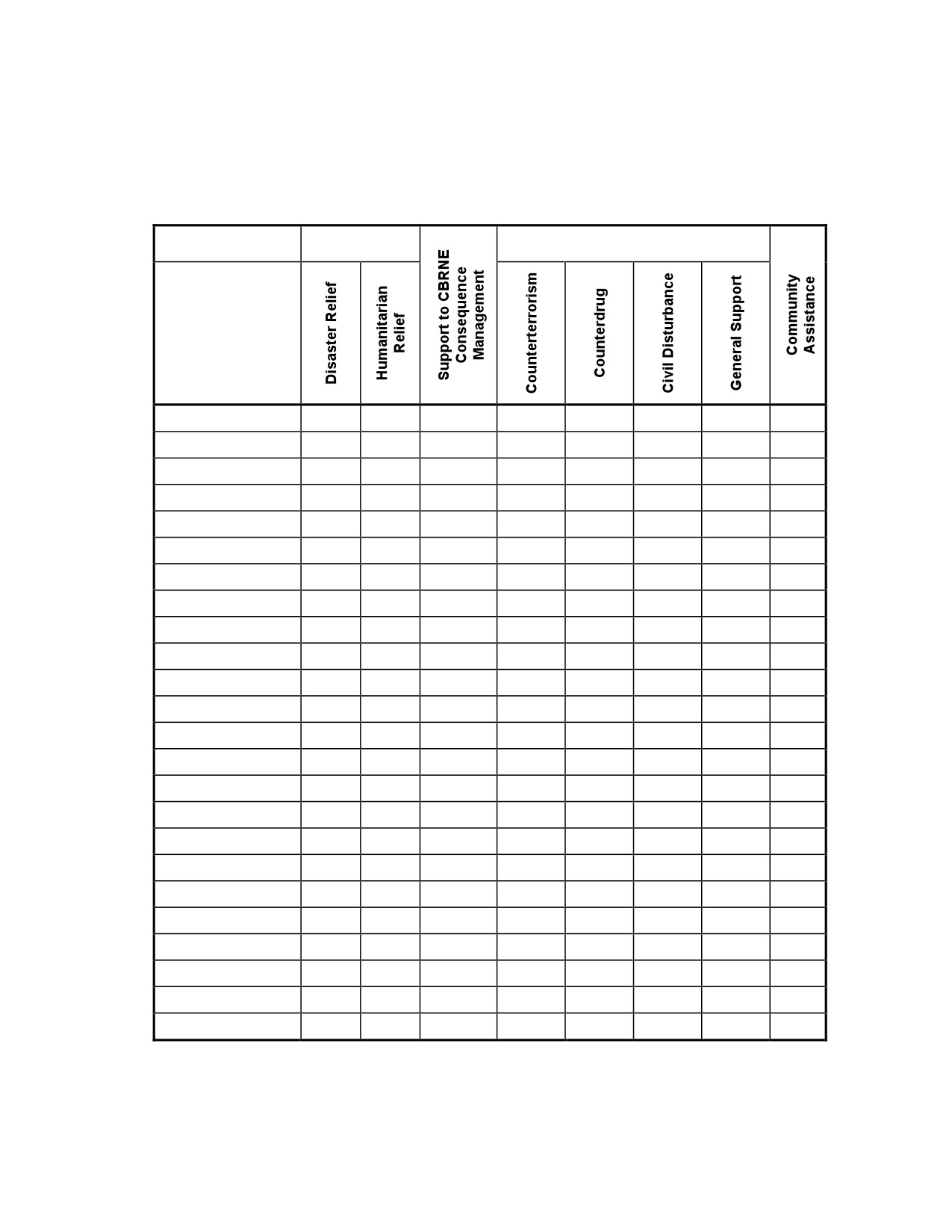
________________________________________________________________________ Support Operations
assets are not involved, the secretary of the Army may task the services or
DOD agencies to provide emergency support.
Relief
Support to Civilian Law
Operations
Enforcement Agencies
ACTIVITY
Reconnaissance
X
X
X
X
C2 Systems Support
X
X
X
X
X
Intelligence Support
X
X
X
X
X
Planning Support
X
X
X
X
X
Manpower Support
X
X
X
X
X
X
Training Support
X
X
X
X
Supply & Equipment
X
X
X
X
X
X
Transportation
X
X
X
X
X
X
Food Preparation
X
X
X
Water Purification
X
X
X
Mortuary Affairs
X
X
X
Laundry/Shower
X
X
X
Temporary Shelter
X
X
X
X
Health Support
X
X
X
X
NBC
X
Power Generation
X
X
X
General Engineering
X
X
X
X
X
Security
X
X
X
X
Restore Law and Order
X
X
X
X
EOD Support
X
X
Search and Rescue
X
X
X
X
Traffic Control
X
X
X
X
Fire Fighting
X
X
X
Provide Liaison
X
X
X
X
X
X
X
X
Figure 6-1. Forms of Support Operations and Some of Their Associated Activities
6-3
FM 3-07 __________________________________________________________________________________
6-10.
The DOMS serves as the secretary of the Army’s action agent for plans
and coordinates the DOD domestic support mission to civilian authorities. He
is a general officer appointed by the secretary of the Army. The DOMS is the
DOD primary contact for all federal departments and agencies during DOD
involvement in most domestic support operations. However, DSO respon-
sibilities in dealing with combatting terrorism are divided between the Joint
Staff and the DOMS. The Joint Staff handles crisis management response
assistance, while the DOMS provides consequence management response
support.
(See the discussions of Crisis Management and Consequence
Management later in this chapter.) The Joint Staff also supports counterdrug
operations.
6-11.
Each state governor appoints a state coordinating officer (SCO) to over-
see disaster operations for the state. The SCO is the primary point of contact
for the federal coordinating officer (FCO) in facilitating disaster assistance.
6-12.
The FCO is appointed by the director of the Federal Emergency
Management Agency (FEMA) for the president. The FCO coordinates the
timely delivery of federal disaster assistance to the affected state, local
governments, and disaster victims. He works closely with the SCO to deter-
mine state requirements and to coordinate national-level issues. This
includes coordinating with the catastrophic disaster response group and the
national-level centralized coordinating group of representatives from the
federal departments and agencies under the Federal Response Plan (FRP).
Operating from a forward-deployed disaster field office co-located with or
close to the state operations center, the FCO must laterally coordinate and
support between Emergency Support Function participants, as well as inte-
grate the support of agencies not part of the FRP.
6-13.
The defense coordinating officer
(DCO) is the DOD representative
designated to coordinate on-the-scene activities with the FCO. FEMA and
other federal agency requests for support from DOD go through the DCO for
validation and resourcing from appropriate military organizations.
6-14.
The Army National Guard (ARNG), in state status, is the governor’s
primary response organization for emergencies and disasters. The state
National Guard (NG) responds under the governor’s control, not DOD’s, and
in accordance with state laws. However, if the NG is federalized by order of
the president, it responds under the same limitations and command and con-
trol (C2) arrangements as active component military organizations. NG com-
manders must plan and train their forces for both federal and state missions.
6-15.
The state area command (STARC) of the NG develops disaster emer-
gency plans with other state and local agencies. The STARC and the DCO
establish necessary liaison to coordinate and effectively manage local, state,
and federal activities. The STARC can assist federal forces with contracting
support as well as logistic support from NG resources not otherwise com-
mitted. Within the state or territory, the NG coordinator for military
assistance is the plans, operations, and military support officer, responsible
to coordinate military assistance to civil authority programs.
6-16. The US Army Reserve is capable of extensive domestic support opera-
tions. This assistance and support may include the use of equipment and
other resources, including units and individuals. US Army Reserve personnel
6-4

________________________________________________________________________ Support Operations
may be activated in a volunteer status when ordered to active duty in lieu of
annual training or after the president has declared a national emergency.
Use of reserve component persons and units is restricted, under law, to
immediate response under provisions of DODD 3025.1 and to population and
resource control for CBRNE incidents. US Army Reserve units may be used
to respond to a CBRNE incident if they are in the area and in annual
training status. They may not be used for other types of emergencies.
6-17.
Civil affairs (CA) [forces] may be especially useful to a commander
during DSO due to their training in assessment, liaison, and civil-military
coordination. Commanders should consider requesting CA assets at the
earliest opportunity.
FEDERAL RESPONSE PLAN
6-18.
When the president declares a major disaster, federal agencies are
directed to provide disaster assistance to support state and local authorities.
For command and control purposes, FEMA is designated the lead federal
agency (LFA) responsible for coordinating federal emergency preparedness,
planning, management, and disaster assistance functions. FEMA carries out
these responsibilities by implementing the FRP, which they are also tasked
with developing and maintaining.
6-19. The FRP establishes a process and structure for the systematic, coordi-
nated, and effective delivery of federal assistance to address the consequences
of any major disaster or emergency declared under the Stafford Act (Title 42,
USC, sections 5142-5203). The FRP facilitates delivery of all types of federal
assistance to state and local governments by organizing federal agencies and
the American Red Cross under emergency support functions (ESFs). The
FRP identifies 12 ESFs and assigns responsibilities of the primary and
support agencies for each. DOD has a primary role in ESF 3, Public Works
and Engineering (DOD and Army Corps of Engineers) and a supporting role
in the others (see Figure 6-2).
Emergency Support Function
Lead Federal Agency
1
Transportation
Department of Transportation
2
Communications
National Communications System
3
Public Works and Engineering
Department of Defense
4
Fire Fighting
Department of Agriculture
5
Information and Planning
Federal Emergency Management Agency
6
Mass Care
Agency for International Development
7
Resource Support
Government Services Administration
8
Health and Medical Services
Department of Health And Human Services
9
Urban Search and Rescue
Federal Emergency Management Agency
10
Hazardous Materials
Environmental Protection Agency
11
Food
Department of Agriculture
12
Energy
Department of Energy
Figure 6-2. The Emergency Support Functions and Their Lead Federal Agencies
6-5
FM 3-07 __________________________________________________________________________________
6-20.
The FRP recognizes that DOD maintains significant resources that
may be available to support the federal response to a major disaster or
emergency. FEMA may request DOD support when executing the FRP.
Planning Considerations for DSO
6-21.
When directed, Army forces respond to domestic emergencies in accor-
dance with the FRP and combatant command supporting plans as tasked by
the Joint Strategic Capabilities Plan.
6-22.
The DOMS receives emergency support requests dealing with civil dis-
turbances, natural or man-made disasters, and their consequences and then
transmits them to the appropriate combatant commands, military depart-
ments, or DOD agencies. A commander’s mission analysis determines the
appropriate force to employ. Considerations include the nature and magni-
tude of the emergency and the anticipated scope of support.
Legal Considerations
6-23.
Army involvement in DSO involves many legal issues. DSO plans
require comprehensive legal review. Commanders involved in DSO should
staff plans, policies, programs, exercises, funding, operations, constraints,
and limitations with their staff judge advocates to ensure conformity with
legal requirements. Under the Constitution, civilian governments must
preserve public order and carry out government operations in its territorial
limits. The Constitution allows using the military to execute or enforce the
law when necessary to protect federal or civilian property and functions.
However, significant restrictions exist on employing federal military forces
domestically. (See Appendix B.)
6-24.
Military intelligence assets may not specifically target US citizens
during DSO. However, military departments should share with federal, state,
or local civilian law enforcement officials any information collected during the
normal course of military operations that may be relevant to a violation of any
federal or state law. This does not permit the planning or creation of missions
or training for the primary purpose of aiding civilian law enforcement offi-
cials. It also does not permit conducting training or missions for routinely
collecting information about US citizens. During disaster assistance opera-
tions, intelligence personnel and assets may be used for liaison and other
support activities. Intelligence capabilities may, with authority from DOD—
• Acquire information about threats to the physical security of DOD per-
sonnel, installations, operations, or official visitors or for force protec-
tion.
• Analyze and disseminate information to disaster relief personnel and
disaster field offices.
• Support disaster field officer operations using intelligence estimate
procedures and skills.
6-25. US law prohibits psychological operations units from targeting US citi-
zens. However, units can use these assets to help disseminate critical infor-
mation to the civilian population. Information may include safety and health
messages, location of water or food distribution points, and designations of
restricted areas and temporary shelters.
6-6
________________________________________________________________________ Support Operations
6-26.
DSO may take place simultaneously with other operations. However,
unless directed by the president, primary military missions take precedence
over DSO. Consequently, there may be competing requirements for units and
support—such as transportation, equipment, and supplies—that have to be
balanced with commitments elsewhere in the world. Sourcing conflicts must
therefore be resolved quickly to prevent delays in responding to time-
sensitive requirements.
Posse Comitatus Act
6-27.
The Posse Comitatus Act
Whoever, except in cases and
(Title
18 USC, section
1385)
under circumstance expressly
forbids federal military forces
authorized by the Constitution
from giving law enforcement
or act of Congress, willfully
assistance to civil authorities.
uses any part of the Army or the
However, Constitutional and
Air Force as a posse comitatus
statutory exceptions to this
or otherwise to execute the
prohibition do exist. The recent
laws shall be fined not more
emphasis on drug interdiction
than $10,000 or imprisoned not
has led to an increase in those
more that two years, or both.
exceptions.
Title 18 USC, Section 1385
6-28.
The Judiciary Act of 1798
allowed United States marshals to call on the military as a posse comitatus (a
body of persons called upon by law enforcement personnel to help preserve
the peace, make arrests, and serve writs). This law continued in effect until
after the Civil War, when the federal government used Army forces to exe-
cute Reconstruction policies in the states of the former Confederacy. The
southern states regarded this practice as abusive and repressive, and in 1878,
President Rutherford B. Hayes signed the original bill ending the practice.
6-29.
The Posse Comitatus Act prescribes criminal penalties for use of the
US Army or Air Force to execute the laws of or to perform civilian law
enforcement functions within the US. DOD policy extends this prohibition to
the US Navy and Marine Corps. Prohibiting the military from executing the
laws means that military personnel may not participate directly—
• In arrest, search and seizure, stop and frisk, or interdiction of vessels,
aircraft, or vehicles.
• In surveillance or pursuit.
• As informants, undercover agents, or investigators in civilian legal
cases or in any other civilian law enforcement activity.
6-30. The Posse Comitatus Act does not apply to
• Members of the NG when not in federal service.
• Members of the reserve components when not on active duty or active
duty for training.
• A soldier when off duty and acting only in a private capacity.
• Soldiers taking action for the primary purpose of furthering a military
or foreign affairs function of the US, for example, enforcing military
justice, maintaining law and order on military installations, or protec-
ting classified materials.
6-7
FM 3-07 __________________________________________________________________________________
Insurrection Act
6-31.
Under the Insurrection Act, (Title 10 USC, Chapter 15), federal forces
may be used to restore law and order during civil disturbances. Because the
use of federal forces to quell civil disturbances is expressly authorized by
statute, the proscriptions of the Posse Comitatus Act do not apply. The Insur-
rection Act permits the commitment of US forces by the president under
three circumstances:
• To support a state request. The federal government has a Constitu-
tional obligation to protect every state in the union, upon request, from
domestic violence. Federal forces were used to quell the Los Angeles
riots in 1994.
• To enforce federal authority. The president has the authority to
commit the US military to enforce federal law. The provisions of this
statute were used to enforce public school desegregation in Arkansas
and Alabama in the early 1960s.
• To protect Constitutional rights. Citizens of the US are guaranteed
equal protection under the law. The president is authorized to use the
US military, during times of insurrection, to protect citizens in states
that cannot protect the Constitutional rights of its citizens. President
Kennedy sent soldiers to Alabama in 1963 to protect the rights of civil
rights protesters.
Use of Force Guidelines and Rules of Engagement
6-32.
With the exception of support to counterdrug operations, the standing
rules of engagement for US forces, as delineated in Chairman of the Joint
Chiefs of Staff Instruction (CJCSI) 3121.01A, do not apply to forces in domes-
tic support operations. DOD civil disturbance plans contain use-of-force guid-
ance for forces in civil disturbance situations. US forces deployed to assist
federal and local authorities in disaster assistance missions, such as hurri-
canes and earthquakes, follow use-of-force guidelines as set forth in the
mission’s execute order and subsequent orders.
FOREIGN HUMANITARIAN ASSISTANCE
6-33.
In foreign humanitarian assist-
Foreign
humanitarian
ance operations, Army forces sup-
assistance operations are
plement or complement the efforts of
conducted to relieve or
host-nation civil authorities or agen-
reduce the results of
cies that have the primary respon-
natural or man-made disas-
sibility for providing assistance. FHA
ters or other endemic con-
is limited in scope and duration and
ditions such as human
focuses exclusively on prompt aid to
suffering, disease, or priva-
resolve an immediate crisis. Longer-
tion that might present a
term activities designed to support
serious threat to life or that
full recovery to predisaster condi-
can result in great damage
tions will normally become part of a
to or loss of property.
combatant commander’s theater
JP 3-07.6
engagement plan and transition to a
stability operation. DODD
5100.46 establishes policy guidance for FHA
operations.
6-8
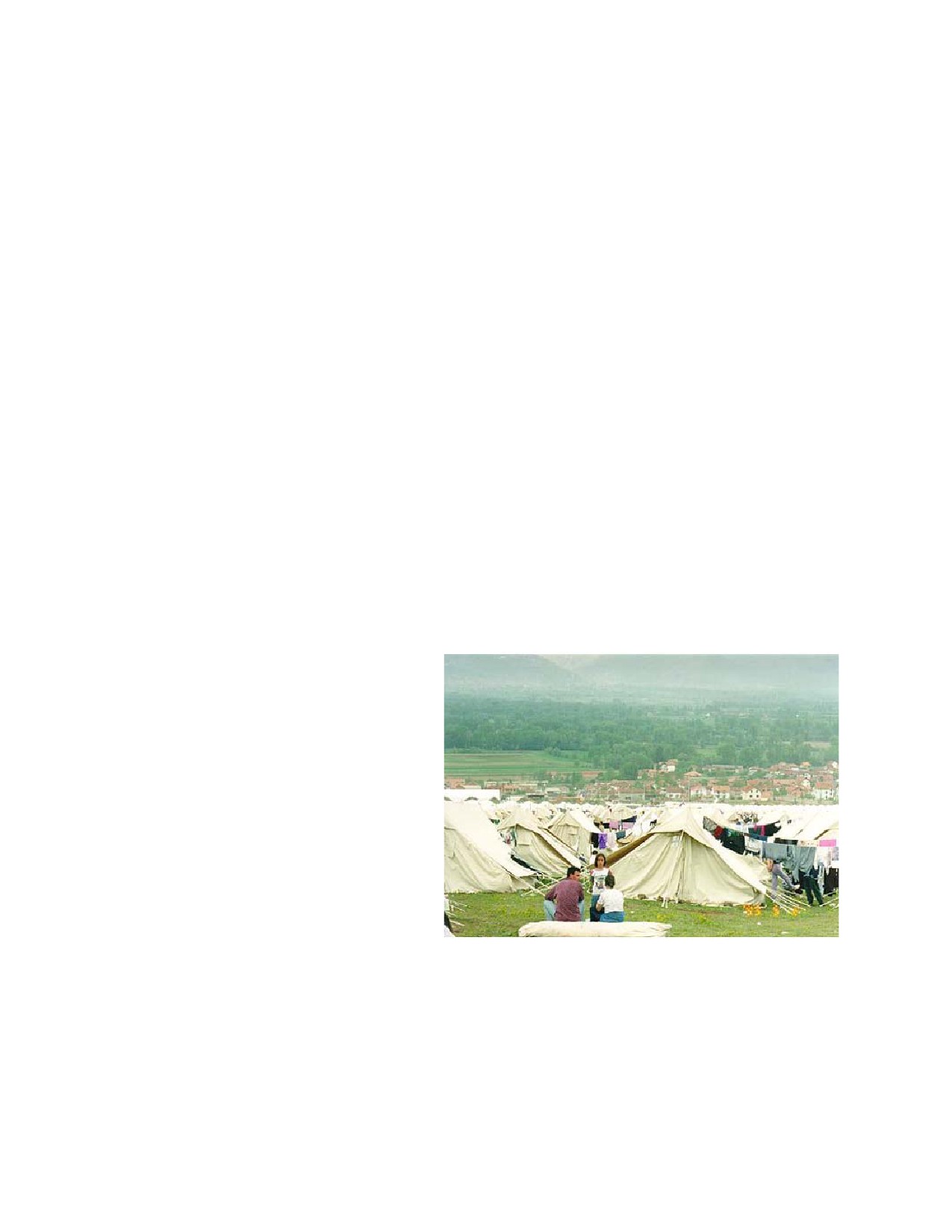
________________________________________________________________________ Support Operations
6-34.
Army forces normally participate in FHA operations as part of a joint
task force, with the US country team of the affected country. They provide
support in accordance with appropriate treaties, memorandums of agree-
ment, and memorandums of understanding and US fiscal authority and
foreign policy. The US Agency for International Development has LFA re-
sponsibility for coordinating FHA for strictly internal humanitarian disas-
ters. The Department of State’s Bureau of Population, Refugees, and
Migration has the lead when an emergency primarily involves refugees.
Army forces usually conduct FHA operations to support host-nation civil
authorities with other civilian agencies.
FORMS OF SUPPORT OPERATIONS
6-35.
The forms of support operations are relief operations, support to
CBRNE consequence management, support to civil law enforcement, and
community assistance. These forms may occur in both foreign and domestic
operations. However, in FHA Army forces most often conduct relief opera-
tions, and in some cases, support incidents involving CBRNE and community
assistance. These forms differentiate between the types of Army response,
command and control, and resources provided to civil authorities and popula-
tions. However, Army forces involved in support operations execute over-
lapping activities. For example, a CBRNE incident may cause mass effects
requiring support in the form of relief operations and support to civil law
enforcement. (See Figure 6-1.)
RELIEF OPERATIONS
6-36.
Relief opera-
tions respond to and
mitigate the effects
of natural or man-
made disasters (in-
cluding CBRNE in-
cidents). They main-
tain or restore es-
sential services and
activities to mitigate
damage, loss, hard-
ship, or suffering.
Relief is primarily a
state, local, or host-
nation
responsi-
bility. To support
the efforts of local authorities or the lead agency, the president can employ
Army forces before, during, or after an event to save lives; protect property,
public health, and safety; or lessen or avert the threat of catastrophe.
6-37. Actions that Army forces execute during relief operations in DSO
mirror those during FHA operations. Relief focuses on the well-being of sup-
ported populations or recovery of critical infrastructure after a natural or
man-made disaster. In disaster situations, Army forces provide
6-9
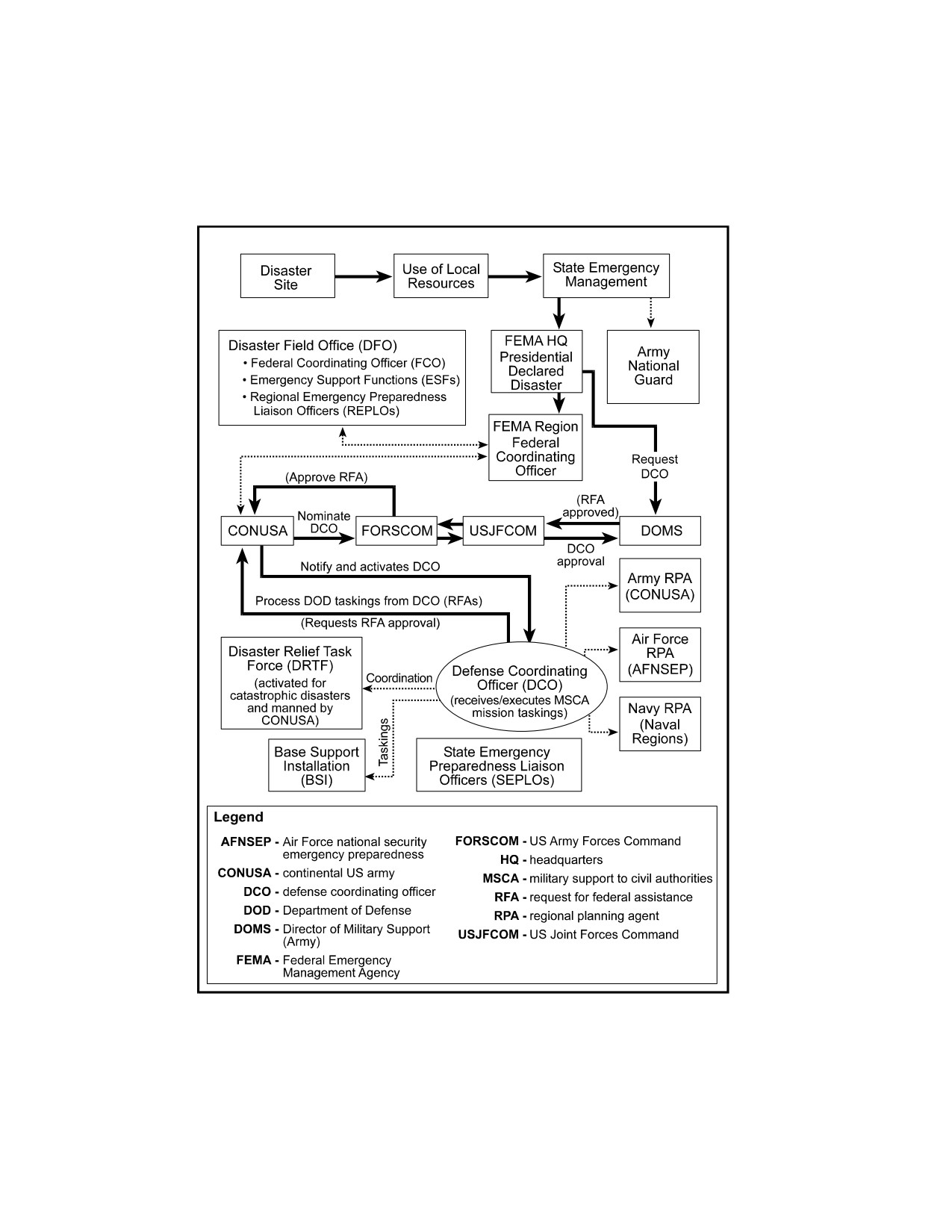
FM 3-07 __________________________________________________________________________________
predominantly combat support and combat service support units. Figure 6-3
lists critical relief functions.
Figure 6-3. Domestic Relief Operations in Disaster Relief
6-38. Domestically, relief operations include domestic emergencies and can
be conducted in response to environmental hazards. Hazards include animal
and plant diseases, oil and hazardous material spills, wildfires, nuclear
weapons and their radiological components, mass immigration emergencies,
6-10
________________________________________________________________________ Support Operations
and mail service augmentation during a postal work stoppages or natural
disaster. Foreign relief operations typically include constructing basic sanita-
tion facilities and shelter as well as providing food and medical care. They
may also include activities that support dislocated civilians, such as camp
organization, basic construction, administration, protection, and movement
or relocation to other countries, camps, and locations.
6-39.
In response to an emergency, relief focuses on lifesaving measures to
alleviate the immediate needs of a population in crisis. It often includes
providing medical support, food, water, medicines, clothing, blankets, and
shelter. In some cases, it involves transportation support to move affected
people from a disaster area. Relief operations also restore minimal infrastruc-
ture and create the conditions needed for longer-term recovery. This includes
establishing and maintaining the minimum safe working conditions needed
to protect relief workers and the affected population. Relief may involve
repairing or demolishing damaged structures; restoring or building bridges,
roads, and airfields; and removing debris from critical supply routes and
relief sites.
6-40.
Commanders may provide immediate response to domestic and foreign
disaster situations under provisions of DODD 3025.1. This immediate assist-
ance does not take precedence over ongoing combat and support missions.
Any commander or DOD official acting under immediate response authority
should quickly advise the DOMS through command channels and seek
approval or additional authorization as needed from the respective chain of
command.
6-41.
Immediate response is situation-
Immediate response is
specific and may or may not be asso-
that action authorized to
ciated with a declared disaster. Com-
be taken by a military
manders may use immediate response
commander or by respon-
authority to assist in the rescue, evac-
sible officials of other
uation, and emergency medical treat-
DOD agencies to provide
ment of casualties; the maintenance or
support to civil authorities
restoration of emergency medical capa-
to prevent human suffer-
bilities; and the safeguarding of public
ing, save lives, or mitigate
health. Commanders may assist with
great property damage.
the emergency restoration of essential
public services and utilities. This may
JP 3-07.7
include fire fighting, water, communications, transportation, power, and fuel.
They may also provide immediate assistance to public officials in emergency
clearance of debris, rubble, and explosive ordnance from public facilities and
other areas to permit rescue or movement of people and restoration of essen-
tial services. This list is not exhaustive. However, commanders should recog-
nize that this is not a blanket provision to provide assistance and that the
ultimate aim is to transition relief functions to civilian organizations.
6-42.
Although immediate assistance is given with the understanding that
costs will be reimbursed, such assistance should not be delayed or denied
when the requester is unable or unwilling to make a commitment to reim-
burse. Support under the provision of immediate response is generally
limited to 72 hours or less. Longer duration may transition the operation
6-11
FM 3-07 __________________________________________________________________________________
from response to recovery, which is not the intent of the provisions of
DODD 3025.1.
6-43.
Disaster relief operations normally include the stages response,
recovery, and restoration. The military role is often most intense in the
response stage, decreasing steadily as the operation moves into the recovery
and restoration stages. Response operations focus on those life-sustaining
functions required by the population in the disaster area. Recovery
operations begin the process of returning the community infrastructure and
services—both municipal and commercial—to a status that satisfies the
needs of the population. Restoration is a long-term process that returns the
community to predisaster normalcy. Military forces normally redeploy as
operations transition from the response to the recovery stage.
6-44.
DOD evaluates requests for employment of DOD resources according to
six criteria: legality, lethality, risk, cost, readiness, and appropriateness.
Commanders ensure that Army resources are used judiciously in relief opera-
tions by adhering to the following principles:
• Civil resources are applied first in meeting civil authorities’ terms.
• Army forces provide resources only when response or recovery require-
ments exceed the capabilities of civil authorities as determined by
FEMA or another LFA.
• Specialized capabilities (airlift and reconnaissance) must be used judi-
ciously because demand may be greater than availability.
• Army forces remain under military command and control at all times.
Authority is exercised through the DOD executive agent.
• Army forces may perform immediate response to assist civil authorities
or the public when the president has not declared a major disaster or
emergency. The local commander must determine that imminently
serious conditions exist and that prompt action is required to save
lives, prevent human suffering, or mitigate property damage.
• Unless otherwise directed by the secretary of defense, military
missions have priority over military assistance to civil authorities.
SUPPORT TO DOMESTIC CBRNE CONSEQUENCE MANAGEMENT
6-45.
Other US government agencies have
CBRNE incidents are
primary responsibility for responding to
deliberate or uninten-
domestic CBRNE incidents due to
tional events involving
terrorists or other causes. Local authorities
a chemical, biological,
will be the first to respond to a CBRNE
radiological, nuclear,
incident. However, Army forces have a key
and high-yield explo-
supporting role and can quickly respond
sive, that produce
when authorized. In a permissive overseas
catastrophic loss of
environment, the president may make
life or property.
Army assets available to assist a foreign
FM 3-0
government after a CBRNE incident. Such
assistance may be linked to concurrent relief operations.
6-46. CBRNE incidents require specialized resources. Mass casualties from
these incidents require decontamination and massive medical response. A
CBRNE incident can create public health threats related to food, vectors,
6-12