FM 3-99 Airborne and Air Assault Operations (MARCH 2015) - page 5
Chapter 10
z
Cover.
z
Concealment.
z
Good lines of communication and logistics.
z
Ease of linkup with other forces when appropriate.
Key Terrain
10-27. Key terrain is mission-dependent; however, in air assault operations key terrain is not limited to
that which influences the ground tactical plan. It must be analyzed in terms of the following actions:
z
Pickup zones or landing zones.
z
Flight routes.
z
Attack weapons team and scout weapons team battle positions.
z
Occupation by enemy air defense artillery assets.
z
Potential forward arming and resupply points.
z
Ground attack positions.
Obstacles
10-28. Obstacles are any natural or man-made obstruction designed or employed to disrupt, fix, turn, or
block the movement of an opposing force, and to impose additional losses in personnel, time, and
equipment on the opposing force (JP 3-15). While most obstacles can be bypassed by air assault forces,
obstacles that affect the ground tactical plan must be considered.
Cover and Concealment
10-29. Cover is protection from the effects of fires (ADRP 1-02). Concealment is the protection from
observation or surveillance (ADRP 1-02). Cover and concealment considerations which affect the ground
tactical plan includeʊ
z
Terrain masking for nap-of-the-earth flight routes and insertions.
z
Cover for attack weapons team and scout weapons team positions.
z
Landing zones that offer Infantry cover and concealment following insertion.
Weather
10-30. Weather and visibility information is analyzed for trends. (See figure 10-2.) If the operation begins
in marginal weather, the commander must consider the possibility that it deteriorates below acceptable
limits during the operation. This may result in interrupting helicopter support and requiring changes in
planned operations. Considerations includeʊ
z
Fog, low clouds, heavy rain, and other factors that limit visibility for aviators.
z
Illumination and moon angle during aviation operations with night vision goggles.
z
Ice and sleet, and freezing rain that degrades aerodynamic efficiency, and impact the ground
tactical plan.
z
High temperatures or density altitudes that degrade aircraft engine performance and lift
capability.
z
Darkness, normally an advantage to well-trained aviators and Soldiers.
z
High winds (large-gust spreads).
z
Weather conditions that create hazards on pickup zones and landing zones, such as blowing dust,
sand, or snow.
10-6
FM 3-99
6 March 2015

Ground Tactical Plan
FORMAT
MAXIMUM WINDS
Weather forecasts are received in the following
Observation helicopter (OH): 30 knots.
format:
Utility helicopter (UH):40 knots.
Ceiling.
Cargo helicopter (CH):60 knots.
Visibility.
*Note. Gusting winds, in excess of 15 knots
Weather (for example, clear, fog, rain, snow).
over the lull wind, may avoid UH usage.
Additional information as requested by the S-2
intelligence staff officer.
Significant weather patterns (which limit
operations) are moderate turbulance and
CONSIDERATIONS
icing.
Extremes Limiting Tactical Air
Allowable Weather Limits
Ceiling:1,000 feet.*
(Applicable to combat operations and tactical training
Visibility: 2 miles.*
at a military airfield).
Visibility:1/2 mile.
*Note. Operational design of a A-10, close air
Ceilings: Clear of clouds.
support aircraft. Other type aircraft
require better weather conditions.
Figure 10-2. Weather data.
TROOPS AND SUPPORT AVAILABLE
10-31. Troops and support available include the number, type, capabilities, and condition of assault and
support troops and support aviation available to conduct the air assault operation. Critical considerations to
the air assault operation include:
z
The AATF should have enough combat power to seize initial objectives and protect the landing
zones until follow-on echelons arrive in the objective area.
z
Assault (lift) helicopter capability is the single most important variable in determining how
much combat power can be introduced into the objective area.
10-32. Aircrew endurance must be considered. The aviation task force standard operating procedures
(SOP) outlines aircrew duty day and flying hour limits. If those limits are exceeded during a single period,
then degraded aircrew performance or limited aircrew availability can be expected on the following days.
TIME AVAILABLE
10-33. The commander assesses the time available for planning, preparing, and executing tasks and
operations. This includes the time required for pick up, air movement, insertion, movement to the final
objective, and delivery of follow-on forces in relationship to the enemy and conditions. Critical
considerations to the air assault operation include:
z
Air assault planning must be centralized and precise, and takes more time than that for other
operations. Time must be made available for air-ground operations preparation, planning,
and rehearsals.
z
Allot additional planning time for night operations and those involving multiple pickup zones or
multiple landing zones.
z
The AATFC must allow adequate time to ensure that all subordinates units, particularly aviation
aircrews, are thoroughly briefed. Viable SOPs and previous training significantly reduce
briefing time.
CIVIL CONSIDERATIONS
10-34. The ability to analyze civil considerations to determine their impact on operations enhances several
aspects of the air assault operation to include air movement, insertion into the objective area, movement to
the final objective, and follow-on operations.
(Refer to ATP
2-01.3
for more information.) Civil
considerations comprise six characteristics, expressed in the memory aid $6&23(ʊ
6 March 2015
FM 3-99
10-7
Chapter 10
z
Areas.
z
Structures.
z
Capabilities.
z
Organizations.
z
People.
z
Events.
ASSAULT OBJECTIVE AND LANDING ZONE DEVELOPMENT
10-35. The ground tactical plan for an air assault operation contains essentially the same elements as other
attacks but differs in that it is prepared to capitalize on speed and mobility to achieve surprise. Assault
echelons are placed on or near the objective and organized to be capable of immediate seizure of objectives
and rapid consolidation for subsequent operations. If adequate combat power cannot be introduced quickly
into the objective area, then the air assault force must land away from the objective and build up combat
power. The air assault force then assaults like other Infantry units and the effectiveness of the air assault
operation is diminished. (Refer to FM 3-21.20, FM 3-21.10, and FM 3-21.8 for more information.)
10-36. The scheme of maneuver may assume a variety of possibilities depending on the commander’s
evaluation of METT-TC to include, in particular, the availability of landing zones in the area. The
plan includesʊ
z
Missions of all task force elements and methods for employment.
z
Areas of operations with graphic control measures.
z
Task organization to include command relationships.
z
Location and size of reserves.
z
Fire support to include graphic control measures.
z
Sustainment.
SECTION III - AIR-GROUND OPERATIONS
10-37. Employing aviation forces with ground maneuver forces requires detailed integration and
coordinated force- oriented control measures to support ground maneuver while minimizing fratricide risks.
This section discusses the integration of air and ground maneuver, close combat attack, close air support,
and unmanned aircraft system employment during air-ground operations. (Refer to FM 3-04.111 for
more information.)
EFFECTIVE INTEGRATION
10-38. Integrating effective air and ground maneuver forces begins at the AATF and continues down to
the lowest unit level. In an air assault, the AATF plans and coordinates with the supporting combat aviation
brigade through their aviation liaison officer and the ADAM/BAE to support the ground tactical plan.
Integration should start at the home station with implementation of effective SOPs, habitual relationships,
and training if possible.
10-39. Integration involves merging the air and ground fights into one to apply proper aviation
capabilities according to the supported AATFC’s intent. Integration ideally begins early in the planning
process with the involvement of the ADAM/BAE. The ADAM/BAE advises the AATFC on aviation
capabilities and the best way to use aviation to support mission objectives. Ensuring the aviation liaison
officer or brigade aviation element passes along the task and purpose for aviation support and continually
provides updates as needed is of equal importance. Simply stated, ensuring the aviation brigade and
subordinate unit staffs fully understand the AATF scheme of maneuver and commander’s intent is critical to
successful air-ground operations.
10-40. Employing attack reconnaissance aviation with ground maneuver forces requires coordinated
force-oriented control measures and the CCA 5-Line attack brief allowing aviation forces to support ground
maneuver with direct fires while minimizing fratricide risks. Aviation liaison officers should identify early
in the planning process the minimum AATF graphics required for operations such as boundaries, phase
10-8
FM 3-99
6 March 2015
Ground Tactical Plan
lines, attack by fire positions, and objectives. Brigade aviation element and liaison officer personnel should
ensure that supported units are familiar with close combat attack request procedures and marking methods.
CLOSE COMBAT ATTACKS
10-41. A close combat attack is a coordinated attack by Army attack reconnaissance aviation aircraft
(manned and unmanned) against targets that are in close proximity to friendly forces. In most instances, the
attack aviation may already occupy holding areas, battle or support by fire positions or are in overwatch of
the ground maneuver force as it begins its assault. The AATF employs close combat attack procedures to
ensure that these aviation fires destroy the enemy with minimal risk to friendly forces.
10-42. Close combat attack is not synonymous with close air support flown by joint aircraft. Due to
capabilities of the aircraft and the enhanced situational awareness of the Army aircrews, terminal attack
control from ground units or controllers is not required. The most important factor of successful close
combat attacks is positive and direct communication between aviation and ground elements. Aviators and
ground elements need to understand the following to employ a successful close combat attack. (Refer to
FM 3-04.126 for more information.)
CLOSE COMBAT ATTACK REQUEST
10-43. When providing support to ground maneuver elements, Army aviation will operate on that
echelon's command network unless directed otherwise. The CCA 5-Line attack brief (Format 22) is the
standard brief for Army rotary wing and organic-armed UASs. The format is similar to the 5-Line RW
CAS attack brief, but will be prefaced with “Fire mission” vice a type of control. At check-in, Army attack
and scout weapons teams will brief the Format 23. CCA Check-in, Aircraft Transmits to Ground Unit.
(Refer to ATP 3-09.32 for more information.)
10-44. Any element in contact uses the CCA 5-Line attack brief to initiate the close combat attack. The
CCA 5-Line attack brief allows the ground maneuver forces to communicate and reconfirm to the aircraft
the exact location of friendly and enemy forces. The procedure remains the same regardless of the type of
unit in contact or the responding aviation element. The ground commander owning the terrain clears fires
during the close combat attack by giving aircrews the situational awareness of the location of friendly
elements. The ground commander deconflicts the airspace between indirect fires, close air support, UAS
and the close combat attack aircraft.
10-45. Transmission of the brief constitutes clearance to fire except in a danger close situation. For danger
close fire, the ground commander on the scene accepts responsibility for increased risk. Danger close must
be declared in the Line 5 when applicable by stating “Cleared Danger Close” and passing the initials of the
ground commander on scene.
10-46. After receiving the request for close combat attack, the aircrew informs the ground maneuver force
leader of the battle position, attack- or support by fire position
(or series of positions) the team is
occupying, and the location from which the attack aircraft engages the enemy with direct fire. The size of
this position varies depending on the number of aircraft using the position, the size of the engagement area,
and the type of terrain.
10-47. The position must be close enough to the requesting unit to facilitate efficient target handover.
Aircraft leaders normally offset the position from the flank of the friendly ground position. This helps to
ensure that rotor wash, ammunition casing expenditure, and the general signature of the aircraft do not
interfere with operations on the ground. The offset position allows the aircraft to engage the enemy on its
flanks rather than its front. It reduces the risk of fratricide along the helicopter gun-target line. (Refer to
ATP 3-09.32 for more information.)
GROUND MANEUVER FORCE AND TARGET MARKING
10-48. Marking methods for identifying targets and friendly positions vary from one ground maneuver
force to another. The close combat attack request should include a detailed description of all friendly
locations and target locations in relation to friendly positions. It should include the target description and
how it is marked.
6 March 2015
FM 3-99
10-9
Chapter 10
10-49. For mutual protection and clarity on the appropriate target, the ground maneuver force does not
mark the target until requested by the aviation element. This in no way restricts the ground maneuver force
from returning fire from the enemy. However, the ground maneuver force should consider that the aircrews
may not be able to distinguish the correct target from other fires if they mark the target with fire. Ground
maneuver forces should have multiple means of marking their positions. If the target is marked by fire, the
aviation element requests the ground maneuver force to stop marking. The aviation element calls when
clear of the area and reports estimated battle damage assessment.
10-50. The close combat attack cannot be conducted without positive identification of friendly and enemy
forces by both the ground and aviation commander before attack aviation aircraft opens fire. The aviation
element tailors its attack angles and weapon selections based upon the target and friendly unit proximity to
the target.
TARGET HANDOVER
10-51. The rapid and accurate marking of a target is essential to a positive target handover. Aircraft
conducting close combat attacks normally rely on a high rate of speed and low altitude for survivability in
the target area. As such, the aircrew generally has an extremely limited amount of time to acquire both the
friendly and enemy marks. It is essential that the ground maneuver force has the marking ready and turned
on when requested by the aircrew.
10-52. Attack reconnaissance aircrews use both thermal sights and NVGs to fly with and acquire targets.
After initially engaging the target, the aircrew generally approaches from a different angle for survivability
reasons if another attack is required. The observer makes adjustments using the eight cardinal directions
and distance (meters) in relation to the last round’s impact and the actual target. At the conclusion of the
close combat attack, the aircrew provides its best estimate of battle damage assessment to the unit in
contact.
BATTLE DAMAGE ASSESSMENT AND REATTACK
10-53. After the attack aircraft complete the requested close combat attack mission, the aircrew provides a
battle damage assessment to the ground commander. Based on his intent, the ground maneuver commander
determines if another attack is required to achieve his desired end state. The close combat attack operation
can continue until the aircraft have expended all available munitions or fuel. However, if the air mission
commander receives a request for another attack, he must carefully evaluate his ability to extend the
operation. If not able, he calls for relief on station by another attack team if available. It is unlikely that the
original team has enough time to refuel, rearm, and return to station.
CLEARANCE OF FIRES
10-54. During an air assault with numerous aircraft in the vicinity of the landing zone, it is critical that
procedures are in place to deconflict airspace between aircraft and indirect fires, considerations includeʊ
z
Ensure aircrews have the current and planned indirect fire positions
(to include mortars)
supporting the air assault before the mission.
z
Plan for informal airspace coordination areas and check firing procedures and communications
to ensure artillery and mortars firing from within the landing zone do not endanger subsequent
serials landing or departing, close combat attack, or close air support.
z
Ensure at least one of the aviation team members monitors the fire support net for
situational awareness.
z
Advise the aviation element if the location of indirect fire units changes from that planned.
z
Ensure all participating units are briefed daily on current airspace control order or air tasking
order changes and updates that may affect air mission planning and execution.
z
Ensure all units update firing unit locations, firing point origins, and final protective fire lines as
they change for inclusion in current airspace control order.
10-55. The AATFC or ground commander can establish an informal airspace coordination area. For
example, he can designate that all indirect fires be south of and all aviation stay north of a specified gridline
10-10
FM 3-99
6 March 2015
Ground Tactical Plan
for a specific period. This is one method for deconflicting airspace while allowing both indirect fires and
attack aviation to attack the same target. The ground commander then can cancel the informal airspace
coordination area when the situation permits. (Refer to FM 3-52 for more information.)
CLOSE AIR SUPPORT
10-56. Close air support is air action by fixed- and rotary-wing aircraft against hostile targets that are in
close proximity to friendly forces and that require detailed integration of each air mission with the fire and
movement of those forces. Like close combat attack, close air support can be conducted at any place and
time friendly forces are in close proximity to enemy forces based on availability. All leaders in the AATF
should understand how to employ close air support to destroy, disrupt, suppress, fix, harass, neutralize, or
delay enemy forces. Nomination of close air support targets is the responsibility of the commander, air
liaison officer, and S-3 at each level. The AATF may receive close air support from USAF, USN, USMC,
or multinational force. (Refer to JP 3-09.3 for more information.)
CAPABILITIES AND EMPLOYMENT
10-57. In some cases, USAF aircraft are available to provide close air support. Requests for these aircraft
are processed through the TACP colocated with the BCT main command post. The TACP is organized as
an air execution cell capable of requesting and executing Type 2 or 3 terminal attack control of close air
support missions. The manning of the cell depends on the situation but, at a minimum, includes an air
liaison officer and a JTAC. To make a recommendation to the commander regarding the use of close air
support aircraft, the leader on the ground should be familiar with the characteristics of the aircraft
predominantly used in the close air support role. (Refer to ATP 3-09.32 for more information.)
BRIEFING FORMAT
10-58. Two types of close air support requests are listed as follows:
z
Preplanned requests that may be filled with either scheduled or on-call air missions. Those close
air support requirements foreseen early enough to be included in the first air tasking order
distribution are submitted as preplanned air support requests for close air support. Only those air
support requests submitted in sufficient time to be included in the joint air tasking cycle planning
phases and supported on the air tasking order are considered preplanned requests.
z
Immediate requests that mostly are filled by diverting preplanned missions or with on-call
missions. Immediate requests arise from situations that develop outside the air tasking order
planning cycle.
10-59. The air liaison officer and JTAC personnel in the TACP are the primary means for requesting and
controlling close air support. However, forces may have joint fires observer certified personnel who can
request, adjust, and control surface-to-surface fires, provide targeting information in support of Type 2
and 3 close air support terminal attack controls, and perform autonomous terminal guidance operations.
(Refer to ATP 3-09.32 for more information.)
UNMANNED AIRCRAFT SYSTEMS
10-60. Unmanned aircraft system (UAS) operations provide surveillance capabilities to enhance the
AATFC’s situational awareness as he plans, coordinates, and executes the air assault. The commander can
employ UAS from his organic elements or he can request to have direct access to real-time feeds from
additional UAS support from his higher headquarters. They are particularly effective when employed
together with ground and attack reconnaissance elements as a team during shaping operations in which the
commander is trying to create the conditions for successful air assault execution. (Refer to chapter 4 of this
publication for UAS discussion.)
6 March 2015
FM 3-99
10-11
Chapter 10
SECTION IV - EXECUTION
10-61. An AATF is normally a highly tailored force specifically designed to hit hard and fast and is
employed in situations that provide the task force a calculated advantage due to surprise, terrain, threat, or
mobility. The following employment considerations govern the execution of the air assault operations.
CONDUCT OF THE AIR ASSAULT
10-62. The AATF normally should be assigned only missions that take advantage of its superior mobility
and should not be employed in roles requiring deliberate operations over an extended period. The basic
principles that apply to the conduct of air assault operations includeʊ
z
Air assault forces always fight as a combined arms team.
z
Availability of critical aviation assets is a major factor in an operation.
z
Air assault planning must be centralized and precise; execution must be aggressive and decentralized.
z
Air assault operations may be conducted at night or during adverse weather, but require more
planning and preparation time in those cases.
z
Assault force tactical integrity must be maintained throughout an air assault. Squads are loaded
intact on the same helicopter, with platoons located in the same serial ensures fighting unit
integrity upon landing.
z
Fires must provide for suppressive fires along flight routes and near landing zones. Priority for
fires must be to the suppression of enemy air defenses.
z
Infantry operations are not fundamentally changed by integrating aviation units with Infantry;
tempo and distance are changed dramatically.
z
An air assault operation may be the decisive operation; examples include river crossings, seizure
of key terrain, raids, and security area actions.
z
An AATF is employed most effectively in environments where limited lines of communication
are available to the enemy, where he lacks air superiority and effective air defense systems.
BUILDUP OF COMBAT POWER
10-63. The availability of aviation assets is normally the major factor in determining AATF task
organization. The AATF must provide a mission-specific balance of mobility and combat power to include
sustainment of combat power. Considerations for rapid massing and shifting of combat power during the
conduct of an air assault includeʊ
z
Delivery to the objective area as soon as possible, consistent with aircraft and pickup zone
capacities, to provide surprise and shock effect.
z
Arrival intact at the landing zone with assault force tailored to provide en route security and
protection from the pickup zone, throughout the entire flight route, and at the landing zone.
z
Nonstandard command relationship, attached for movement, used extensively during air assault
operations. Elements, to include field artillery, air defense artillery, intelligence, and engineer
may be attached to maneuver elements for movement only, to facilitate mission command,
maneuver, and security.
z
Task-organized with sufficient combat power to seize initial objectives and protect landing
zones, and with sufficient sustainment for rapid tempo until follow-on or linkup forces arrive, or
until the mission is completed.
10-12
FM 3-99
6 March 2015
Chapter 11
Landing Plan
The landing plan supports the ground tactical plan. It provides a sequence for arrival
of units into the area of operation, ensuring that all assigned units arrive at designated
locations and times prepared to execute the ground tactical plan. General
considerations to develop the landing plan follow.
SECTION I - LANDING ZONE SELECTION
11-1. Landing zones usually are selected by the AATFC or his S-3 based on technical advice from the air
mission commander or the aviation liaison officer. The section addresses keys considerations for landing
zone selection.
CRITERIA FOR SELECTING LANDING ZONES
11-2. Air assault landing zone selection is based on user requirements; type of environment; availability;
adequacy; security of landing zones on or near the objective area, or away from the objective area; threats
to the objective area; and aircraft/aircrew capability. Criteria for selecting landing zones includeʊ
z
Location. In general, two options are viable when selecting landing zones—land on the objective
or land away from the objective. The selection of either option is METT-TC dependent.
z
Capacity. Size determines how much combat power can be inserted at one time and the need for
additional landing zones or time separation between serials.
z
Types of loads. External loads generally require larger landing zones than landing zones for
personnel alone.
z
Elevation. The altitude of potential landing zones may not be supportable due to operating
restrictions of certain aircraft.
z
Alternates. An alternate landing zone should be planned for each primary landing zone to ensure
flexibility to support the mission.
z
Enemy composition, disposition, and capabilities. Landing zone considerations include enemy
force concentrations, weapons systems, and their capability to react to an air assault task force
landing nearby.
z
Cover and concealment. Select landing zones to deny enemy observation and acquisition of
friendly ground and air elements while they are en route to, from, or in the landing zone.
z
Obstacles. If possible, the air assault task force should land on the enemy side of obstacles when
attacking to negate their effectiveness. The air assault task force should consider using obstacles
to protect landing zones from the enemy at other times.
z
Landing point. Landing zones should be generally free of obstacles. The landing point or
touchdown point must be free of obstacles (any object or hole greater than 18 inches high or
deep). (Refer to FM 3-21.38 for more information.)
z
Identification from the air. If possible, landing zones should be easily identifiable from the air or
marked by friendly reconnaissance forces that have reconnoitered the landing zone.
z
Approach and departure routes. If possible, approach and departure air routes should avoid
continued exposure of aircraft to enemy fire.
z
Weather. Reduced visibility or strong winds may cause aircraft to avoid or limit the use of
primary or alternate landing zones.
6 March 2015
FM 3-99
11-1
Chapter 11
LOCATION OF LANDING ZONES
11-3. The AATF plans to land on or near the objective when the assault force is able maximize combat
power in the landing zone to rapidly eliminate enemy forces, immediately seize objectives, and rapidly
consolidate for subsequent operations. Considerations for landing on or near the objective include—
z
Air assault task force is assigned a terrain-oriented mission.
z
Commander has accurate up-to-date intelligence on the enemy.
z
Commander has accurate intelligence on terrain (especially landing zones), weather is favorable,
and suitable landing zones are available on or near the objective.
z
Shaping operations have set conditions for air assault execution.
z
Time in which to accomplish the overall mission is limited.
z
Civilian population is known to be supportive of U.S. presence in the area of operation.
11-4. When adequate combat power cannot be introduced quickly into the objective area, the air assault
force lands away from the objective to build up combat power and then assaults to seize objectives.
Considerations for landing away from the objective include—
z
Air assault task force is assigned an enemy-oriented mission.
z
Commander has incomplete or unknown intelligence on the enemy.
z
Commander has incomplete information on terrain (especially landing zones), weather is not
favorable, or no suitable landing zones are available near the objective.
z
Shaping operations have not set conditions for air assault execution or conditions cannot be
verified.
z
Time is available upon landing in the landing zone to develop the situation.
z
Civilian population is unknown or hostile to U.S. presence in the area of operation.
NUMBER OF LANDING ZONES
11-5. The AATFC decides whether to use a single landing zone or multiple landing zones. A large number
of landing zones for an air assault increases the tactical risk and complexity of the operation as well as the
difficulty of setting conditions at each landing zone before landing. The AATFC should plan for one
primary landing zone and one alternate landing zone according to the maneuver force regardless of
proximity to the objective. He should plan for more than one primary and one alternate landing zone
according to maneuver force only after careful analysis of the mission variables to determine if sufficient
forces are available to conduct shaping operations at each landing zone.
11-6. Using a single landing zone—
z
Requires less planning and rehearsal time.
z
Allows concentration of combat power in one location.
z
Facilitates control of the operation.
z
Concentrates supporting fires in and around the landing zone.
z
Requires fewer attack helicopters for security.
z
Provides better security for subsequent lifts.
z
Reduces the number of air routes in the objective area, making it more difficult for the enemy to
detect the air assault operation.
z
Centralizes required resupply operations.
11-7. Using multiple landing zones—
z
Avoids grouping units in one location, which creates a lucrative target for enemy mortars,
artillery, and close air support.
z
Allows rapid dispersal of ground elements to accomplish tasks in separate areas.
z
Reduces the enemy’s ability to detect and react to the initial lift.
z
Forces the enemy to fight in more than one direction.
z
Reduces the possibility of troop congestion in one landing zone.
11-2
FM 3-99
6 March 2015
Landing Plan
z
Eliminates aircraft congestion on one landing zone.
z
Makes it difficult for the enemy to determine the size of the air assault force and the exact
location of supporting weapons.
SECTION II - LANDING ZONE UPDATES
11-8. Just before the start of the air movement and just before the lift aircraft reach the release point, the
attack reconnaissance aircraft or unmanned aircraft system (UAS) provide a landing zone update to the
AATF, informing the AATFC ground commander, and air mission commander of the status of enemy
activity on the landing zone. The requirement for a landing zone update is METT-TC dependent and based
on the need to preserve surprise on the objective. The manner in which the landing zone update is
conducted should not divulge the exact location of the landing zone.
LANDING ZONE CONDITION
11-9. The landing zone is considered cold if no enemy activity is observed. If the landing zone is cold, the
air assault is executed as planned. The landing zone is considered hot if enemy activity is occurring on or
near the landing zone. If the landing zone is hot, the attack reconnaissance aircraft provide a situation report
consisting of enemy activity, their actions toward the enemy and a recommendation for using the alternate
landing zone. Based on the recommendation of the attack reconnaissance aviation element, the AATFC
decides whether to use an alternate landing zone. As part of the mission analysis and rehearsal process,
aircrews rehearse and execute the air movement using an alternate landing zone.
FIXED-WING SUPPORT
11-10. When available, fixed-wing aircraft can be used to provide a landing zone update or to eliminate
enemy activity. As long as lift aircraft or attack reconnaissance aircraft possess the proper communication
capabilities, fixed-wing aircraft can relay the update directly to the AATFC. If these capabilities are not
present, fixed-wing aircraft may relay the update to a command post that then relays the update to the
AATFC. The plan must account for time needed to relay the update to all parties.
UNMANNED AIRCRAFT SYSTEM SUPPORT
11-11. UAS can be employed to monitor and relay the updated status of the landing zone and surrounding
area during the air movement phase. This early information gives the AATFC more time to adjust plans if
required. UAS that fly at higher altitudes may observe with negligible risk of revealing landing zone or
objective locations.
SECTION III - HOT LANDING ZONE CONSIDERATIONS
11-12. Sometimes the presence of enemy activity is unknown or unclear until the first aircraft lands in the
landing zone. A unit should develop and rehearse its plan for reacting to enemy contact in that situation.
SCENARIOS
11-13. The enemy may employ one or a combination of the following actions to oppose
landing operations:
z
Conduct a near ambush.
z
Conduct a far ambush.
z
Deliver indirect fires by mortars, artillery, or rockets directed by an observer that can see the
landing zone.
z
Emplace obstacles, such as antipersonnel mines, booby traps, or other barriers.
11-14. The AATFC considers five options in response to a hot landing zone. They areʊ
z
Fight through the contact.
6 March 2015
FM 3-99
11-
Chapter 11
z
Divert to the alternate landing zone.
z
Abort remaining serials.
z
Slow airspeeds to delay serials.
z
Racetrack serials.
11-15. Racetracking is considered a high-risk option. All serials orbit at their current position. Once the
enemy has been neutralized or destroyed on the landing zone, the air assault resumes in the order outlined
in the air movement table. The air mission commander determines whether enough fuel, spacing, and time
is available between serials to conduct this option and advises the AATFC accordingly.
11-16. The AATFC makes the final decision on all options involving a hot landing zone, and the air
mission commander and ground commander execute. Whether landing away from or on the objective, it is
important that primary and alternate landing zones are mutually supporting to allow the AATFC to shift the
main effort if needed.
REACTION TO ENEMY CONTACT AWAY FROM THE OBJECTIVE
11-17. When landing away from the objective, ground maneuver forces can more readily divert to an
alternate landing zone. In doing so, the main effort of the decisive operation may be shifted to the force
landing at the alternate landing zone, and the force at the hot landing zone may be extracted or continue to
fight through the enemy contact. If the alternate landing zone is hot as well, the AATFC should choose
which force to designate as the main effort to accomplish the mission.
11-18. A force that encounters a near ambush, unless extremely successful in counteracting that ambush,
is usually extracted, reorganized, and reinserted into an alternate landing zone to continue the mission. A
force that encounters a far ambush, hostile indirect fires, or obstacles usually continues its mission.
REACTION TO ENEMY CONTACT ON THE OBJECTIVE
11-19. When landing on the objective, units react to contact and fight through. Because the landing zone
is on the objective, fighting for control of the hot landing zone is critical to mission accomplishment and
continuing the assault is the priority. The unit on the hot landing zone may be directed to fix the enemy,
while the main effort is shifted to the unit that lands at an alternate landing zone and fights through to the
objective.
11-20. If the alternate landing zone is hot as well, the AATFC should choose which unit to designate as
the main effort to accomplish the mission. Given the overall mission, breaking contact or extraction is not
likely for units caught on a hot landing zone. In cases other than a near ambush, units fight through enemy
contact and continue the mission without diverting serials to an alternate landing zone.
SECTION IV - PREPARATION AND SUPPORTING FIRES
11-21. Preparation fires are planned for each landing zone so they can be executed if needed. However, it
is desirable to make the initial assault without preparation fires to achieve tactical surprise. Planned fires for
air assault operations should be intense and short but with a high volume of fire to maximize the surprise
and shock effect.
11-22. Ground forces land ready to fight, with the integrated support of close air support, close combat
attack, and indirect fires. Supporting fires, direct or indirect, are directed and cleared on the landing zone by
the ground commander.
11-23. Factors to consider when developing fire support plans are listed as follows:
z
Deception. False preparations can be fired into areas other than the objective or landing zone
area to deceive enemy forces if rules of engagement allows. For example, some rules of
engagement might prevent any unobserved fires.
z
Duration of preparation fires. A preparation of long duration may reduce the possibility of
surprise. The preparation fires should begin as the first aircraft of the first lift crosses the release
point and end just before the first aircraft lands.
11-4
FM 3-99
6 March 2015
Landing Plan
z
Availability of fire support assets. The ground commander coordinates with the artillery unit to
arrange the preparation of units that can fire. In some cases, where an air assault is executed
across extended distances, preparation fires by close air support or attack helicopters may be the
only viable alternative.
z
Objective area fires. A known or suspected enemy force in the landing area, regardless of size,
warrants preparation fires.
z
Effects of ordnance on the landing zone. Some ordnances used in preparation fires (such as
artillery, bombs, or infrared illumination) may be undesirable since they can cause craters,
downed trees, fires, and landing zone obscuration.
z
Scheduling fires. Fires are scheduled to be lifted or shifted to coincide with the arrival times of
aircraft formations.
z
Collateral damage. The unintentional or incidental injury or damage to persons or objects that
would not be lawful military targets in the circumstances ruling at the time. Such damage is
lawful so long as it is not excessive in light of the overall military advantage anticipated from the
attack. (Refer to JP 3-60 for more information.)
z
Positive control measures. Control measures must be established for lifting or shifting fires.
z
Additional considerations include:
The ground commander clears all ground, air, and indirect fires inside the airhead line.
Door gunners in assault aircraft fire only at the base of the tree line to avoid fratricide of
overwatching gunships.
As long as the air assault continues, attack aviation works for the AATFC. Attack
reconnaissance aviation is placed in direct support of the ground commander for air assault
security and close combat attack within the objective area. The ground commander passes
control of attack aviation aircraft to subordinate commanders for close combat attack. Once
the threat is eliminated, attack aircraft are passed back to the ground commander‘s control.
Only a ground commander can clear Apache or Kiowa fires into the tree line assaulted by
friendly forces. (Refer to chapter 6 of this publication for more information.)
Indirect fires on the tree line being assaulted by friendly forces are always treated as danger
close. (In other words, in a right door exit, a fire mission into the right tree line would be
danger close.)
Know the locations of all friendly forces in the area, to include reconnaissance and long-
range surveillance units, pathfinders, and special operations forces.
SECTION V - LANDING SITE OPERATIONS
11-24. Aircraft formations on the landing zone should facilitate a rapid exit from the aircraft, an orderly
departure off the landing zone, and an organized deployment for the assault. The number and type of
aircraft and the configuration and size of the landing zone may dictate the formation. (See chapter 12 for a
discussion of standard flight and landing formations.) If contact is expected in the landing zone, elements
must land ready to fight and maneuver in all directions.
LANDING ZONE AND OBSTACLE MARKINGS
11-25. For daylight operations, pathfinders use panels or some other minimal identification means to
mark landing zones. Smoke might also be used to identify a landing zone and assist the pilot in determining
wind conditions. However, smoke is also easily identified by the enemy. For daylight operations, mark the
number one landing point using a single VS-17 panel, with the international orange side visible. Other
touchdown points might be marked, as coordinated. Mark obstacles using the cerise colored side of the
panel. For night operations, use chem-lights, lanterns, field expedients, or other methods to show the
direction of landing and to mark individual landing points. For day and night air assault operations, mark
all obstacles. (Refer to FM 3-21.38 for more information on daylight landing formations.)
11-26. At night, pathfinders can use lights of different colors (except red, which marks obstacles) to
designate different helicopter sites or to separate flights within a larger formation. A lighted "T" or inverted
6 March 2015
FM 3-99
11-5
Chapter 11
"Y" indicates both the landing point for the lead helicopter of each flight and the direction of approach.
Other lights mark touchdown points for the other helicopters in the flight. Each helicopter should land with
its right landing gear or its right skid 5 meters left of the lights. Large cargo helicopters (CH-47) land 10
meters to the left of the lights. (Refer to FM 3-21.38 for more information on night landing formations.)
11-27. For security, pathfinders and the ground unit turn off, cover, or turn all lights upside down until the
last practical moment before a helicopter arrives. Then they orient the lights in the direction from which the
lead helicopter is approaching, and a signalman directs its landing.
Note: Because the marking lights could be too bright for the aircrew member's night vision
goggles, crew members might have to look under the goggles to distinguish the colors. Also,
aircrew members wear night vision goggles with filtered lenses. These filters do not allow the
aircrews to see blue or green chem-lights. Colors such as yellow, orange, red, and infrared can
be seen by pilots wearing ANVIS.
11-28. During daylight landing operations, pathfinders use red-colored panels or other red, easily-
identifiable means to mark any hard-to-detect, impossible-to-remove obstacles such as wires, holes,
stumps, and rocks. During nighttime, pathfinders use red lights to mark any obstacles within the landing
site that they cannot reduce or remove.
11-29. In most combat situations, the need for security keeps pathfinders from using red lights to mark
treetops on the departure end of a landing zone. However, in training or in a rear area landing site, they do
use red lights. If they cannot mark obstacles or hazards, they must fully advise aviators of existing
conditions by ground to air radio. In any case, the pathfinder landing site leader makes sure that pathfinders
mark the most dangerous obstacles first and, if possible, that they remove them.
11-30. Pathfinders have a limited capability to secure a landing site. If they precede the initial assault
elements into a landing site, Soldiers from the supported ground unit can go with them for security. If
required to do so by the supported unit, pathfinders can mark initial assembly points for soldiers,
equipment, and supplies. They should choose locations that help ensure the quick, efficient assembly and
clearing of the helicopter landing site. If the unit uses assembly areas, the ground unit commander selects
their locations. If needed, supported ground unit Soldiers go with the pathfinders to reconnoiter and mark
the unit assembly areas, set up assembly aids, act as guides, and help with landing and unloading
operations. Having this help ensures that the pathfinders can rapidly clear soldiers, supplies, and equipment
from the landing points.
11-31. A landing zone formation may not have standardized distances between aircraft due to the size or
terrain on the landing zone. The goal in landing aircraft successfully is to select a safe landing area as close
to cover and concealment as possible to reduce Soldier exposure. If possible, the aircraft formation on the
pickup zone is the same as the landing zone. This provides Soldiers and leaders a preview of the landing
zone landing formation and gives them an idea of their location upon landing in relation to other elements.
11-32. The lead elements lifted into the landing zone are responsible for clearing the landing zone to
support follow-on lifts. This can be accomplished using a number of methods, which are entirely METT-
TC dependent. The most common method for clearing the landing zone is to assign assault objectives,
which requires subordinate units to move through an assigned area to clear enemy forces before reaching
their final objective.
EXITING THE AIRCRAFT
11-33. The two methods for exiting a UH-60 aircraft are the one-side off-load and the two-side off-load.
Soldiers exiting a CH-47 do so from the rear ramp. In each method, Soldiers must be careful to avoid the
main and tail rotors of the aircraft they are exiting and the rotors of other aircraft in their serial. The
separation between serials and the number of serials that can fit into the landing zone at one time are
critical planning considerations when determining the aircraft exiting method.
11-34. As part of an air assault, the mission may require the application of the fast-rope insertion and
extraction system (FRIES) for small units to infiltrate or insert into a confined area where a helicopter is
unable to land as an alternative method for exiting an aircraft. FRIES is the fastest method of deploying
11-6
FM 3-99
6 March 2015
Landing Plan
Soldiers from a rotary-wing aircraft that are unable to land. FRIES is not approved for Army-wide use and
is restricted to special operations forces and long-range surveillance units. (Refer to FM 3-05.210 for more
information.)
ONE-SIDE OFF-LOAD
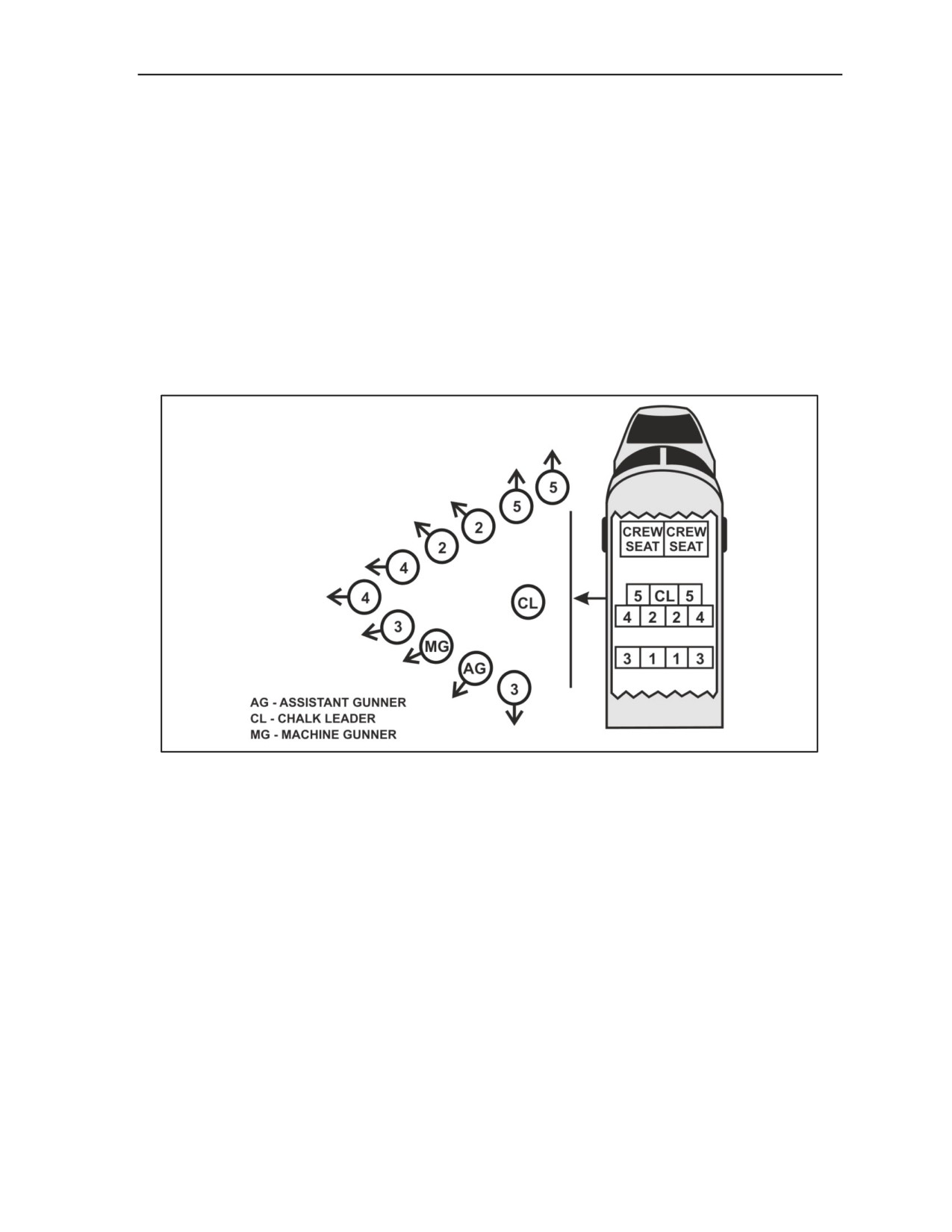
11-35. In this method, Soldiers exit from either the right or left side of the aircraft. (See figure 11-1.)
Soldiers exiting the aircraft should step outward and take up a prone position, forming 180-degree security
on that side of the aircraft yet remaining under the main rotor system and outside the landing gear of the
aircraft. Soldiers should remain in the prone position until the aircraft lifts off before departing the landing
zone. The chalk leader directs his chalk to move to the nearest covered and concealed position according to
the landing plan or SOPs.
11-36. A unit plans to execute a one-side off-load on the side away from known or potential enemy
positions but may be forced to exit the aircraft on the opposite side due to the enemy or other METT-TC
considerations once the aircraft has landed.
Figure 11-1. One-side off-load (UH-60)
Advantages
11-37. The one-side off-load simplifies mission command and the establishment of zones of responsibility
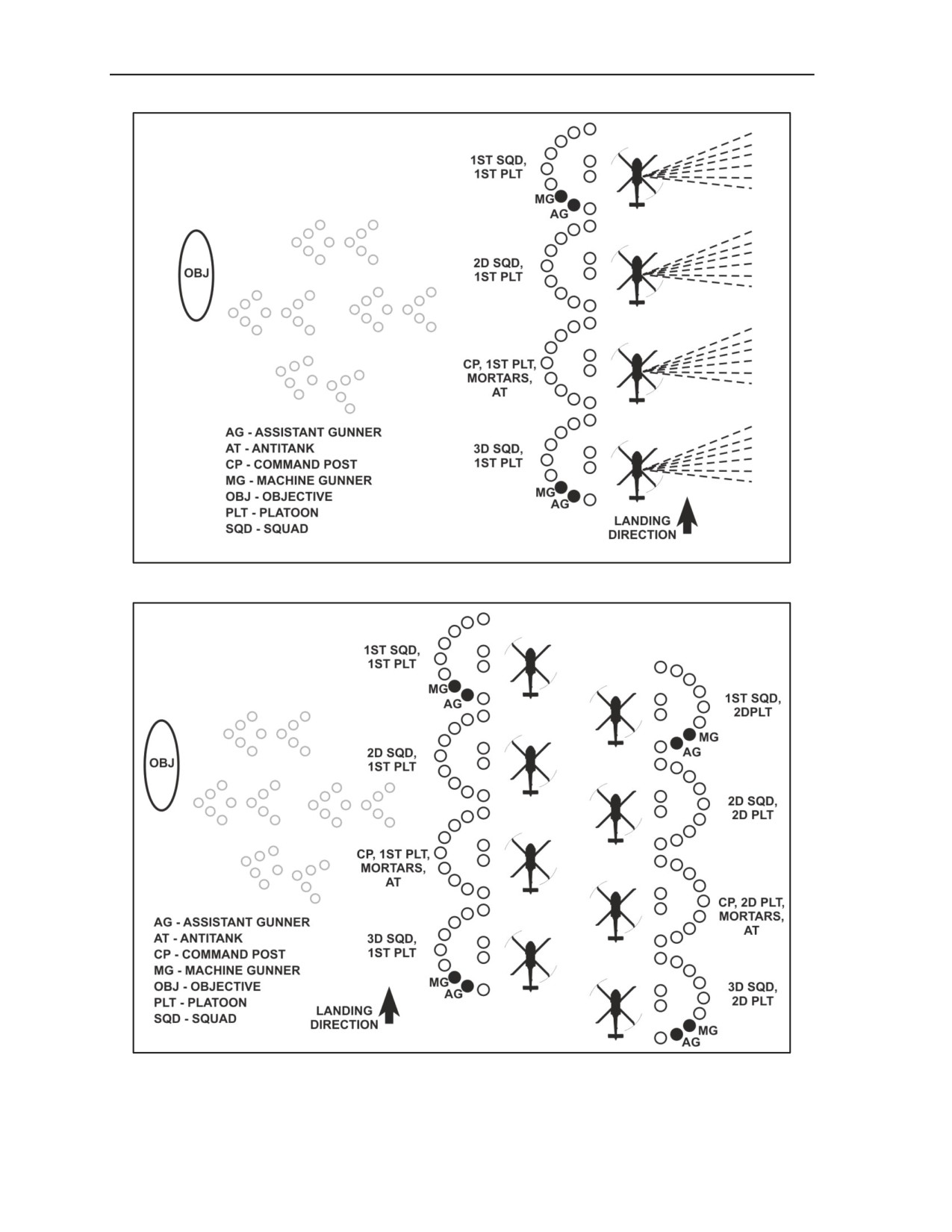
on the landing zone. It allows the door gunners on the opposite side of the aircraft to engage enemy
positions during off-loading. (See figure 11-2a, page 11-8.) This allows the door gunners of follow-on
serials to engage enemy on the far side of the landing zone. Figure 11-2b on page 11-8 allows for
immediate establishment of 360-degree security upon landing.
6 March 2015
FM 3-99
11-7
Chapter 11
Figure 11-2a. One-side off-load (squads in same chalk) trail landing formation
Figure 11-2b. One-side off-load (squads in same chalk) staggered trail right landing formation
11-8
FM 3-99
6 March 2015
Landing Plan
Disadvantages
11-38. The one-side off-load is the slowest of the off-loading methods. The Soldiers and aircraft are
exposed for a longer amount of time while exiting the aircraft, making them vulnerable to direct and
indirect fire.
TWO-SIDE OFF-LOAD
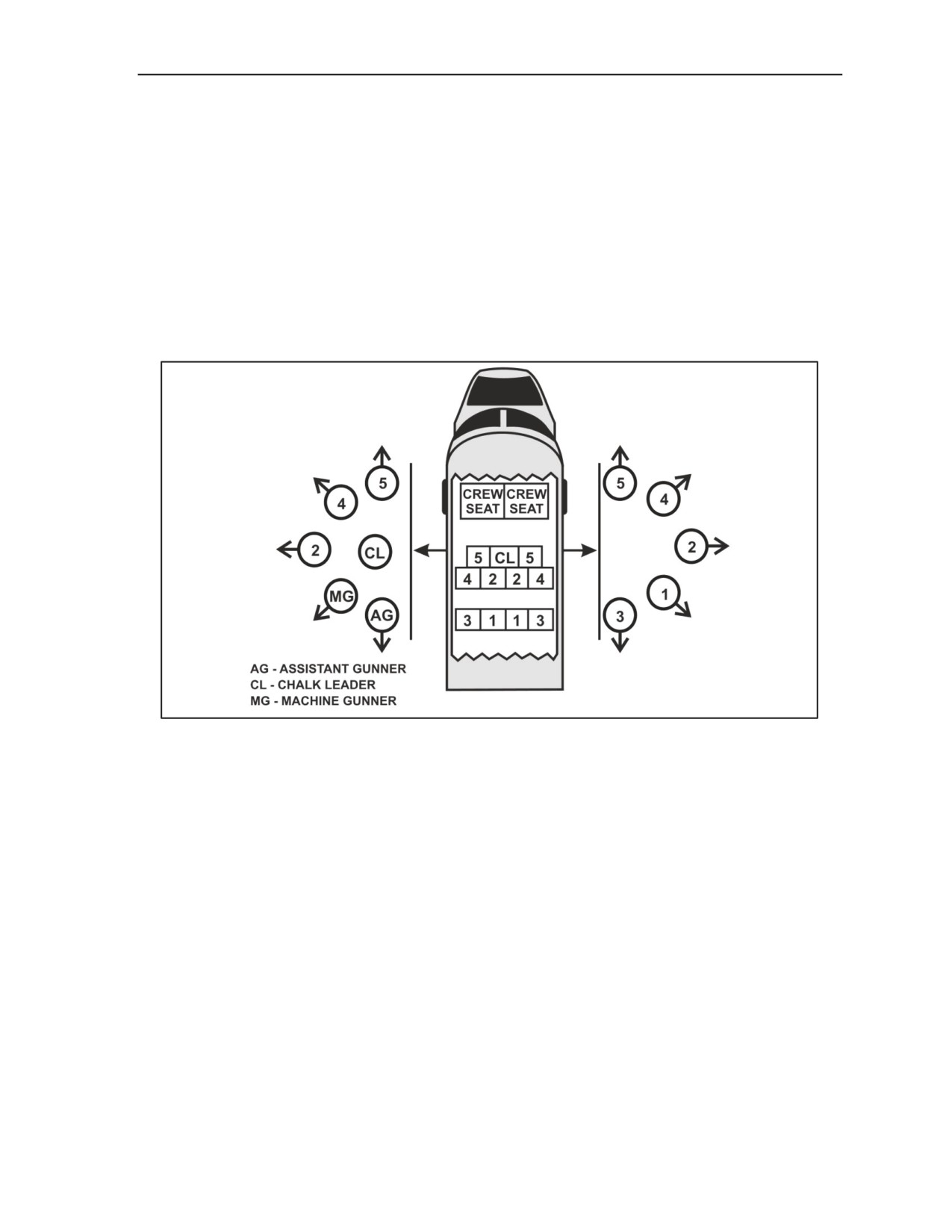
11-39. In this method, Soldiers exit from both sides of the aircraft. (See figure 11-3.) Soldiers exiting the
aircraft should step outward and take up a prone position, forming 180-degree security on that side of the
aircraft yet remaining under the main rotor system and outside the landing gear of the aircraft. Soldiers
should remain in the prone position until the aircraft lifts off before departing the landing zone. The squad
leader directs his squad to move directly to the nearest covered and concealed position according to the
landing plan or SOPs.
Figure 11-3. Two-side off-load (UH-60)
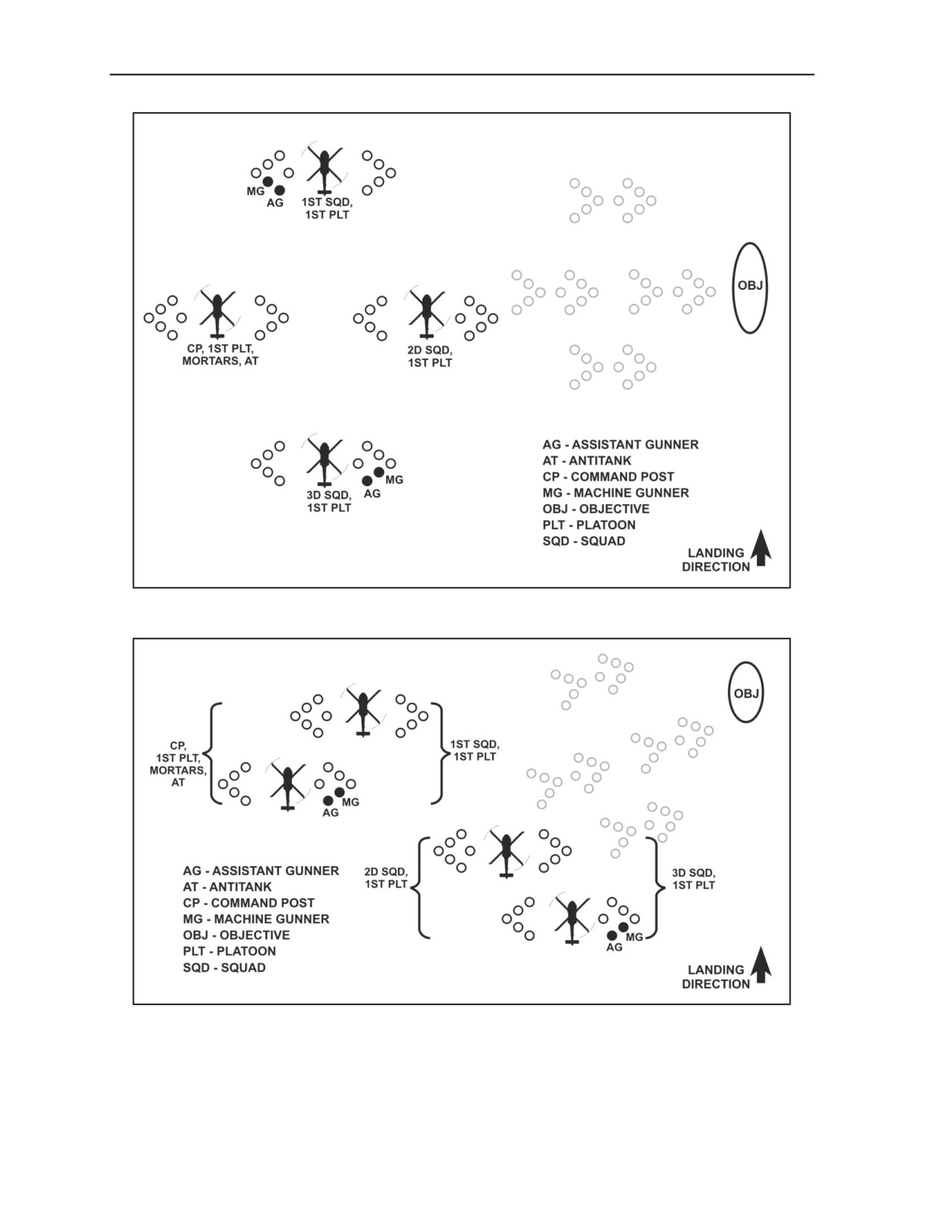
11-40. Cross-load options allow for pure unit integrity of chalks (See figure 11-4, page 11-10.) or mixed
loads to support moving to opposite sides of a large pickup zone. (See figure 11-5, page 11-10.) Cross-load
planning considerations support the mission command initially required on the landing zone and follow-on
lifts into the landing zone.
Advantages
11-41. The two-side off-load is the quickest method for exiting the aircraft. It simplifies control and the
establishment of zones of responsibility on the landing zone.
Disadvantages
11-42. The two-side off-load has the slowest movement time off the landing zone of all off-loading
methods, which exposes Soldiers longer to enemy direct and indirect fire. This method masks both door
gunner fires while Soldiers exit the aircraft, which increases vulnerability to enemy direct fire.
6 March 2015
FM 3-99
11-9
Chapter 11
Figure 11-4. Two-side off-load (squads in same chalk) diamond landing formation
Figure 11-5. Two-side off-load (chalks cross-loaded) heavy right landing formation
REAR RAMP OFF-LOAD
11-43. In this method, Soldiers exit from the rear ramp of a CH-47 or other rear exiting aircraft. Soldiers
move out from the aircraft and drop to a prone fighting position, establishing 360-degree security until the
11-10
FM 3-99
6 March 2015
Landing Plan
aircraft lifts to depart the landing zone. (See figure 11-6.) Once the aircraft departs the landing zone, the
unit may execute a one- or two-side landing zone rush according to the landing plan or SOPs.
Figure 11-6. Rear ramp off-load and landing zone exit (CH-47)
EXITING THE LANDING ZONE
ONE-SIDE LANDING ZONE RUSH
11-44. Upon exiting the aircraft and dropping to the prone position, Soldiers recover from the prone
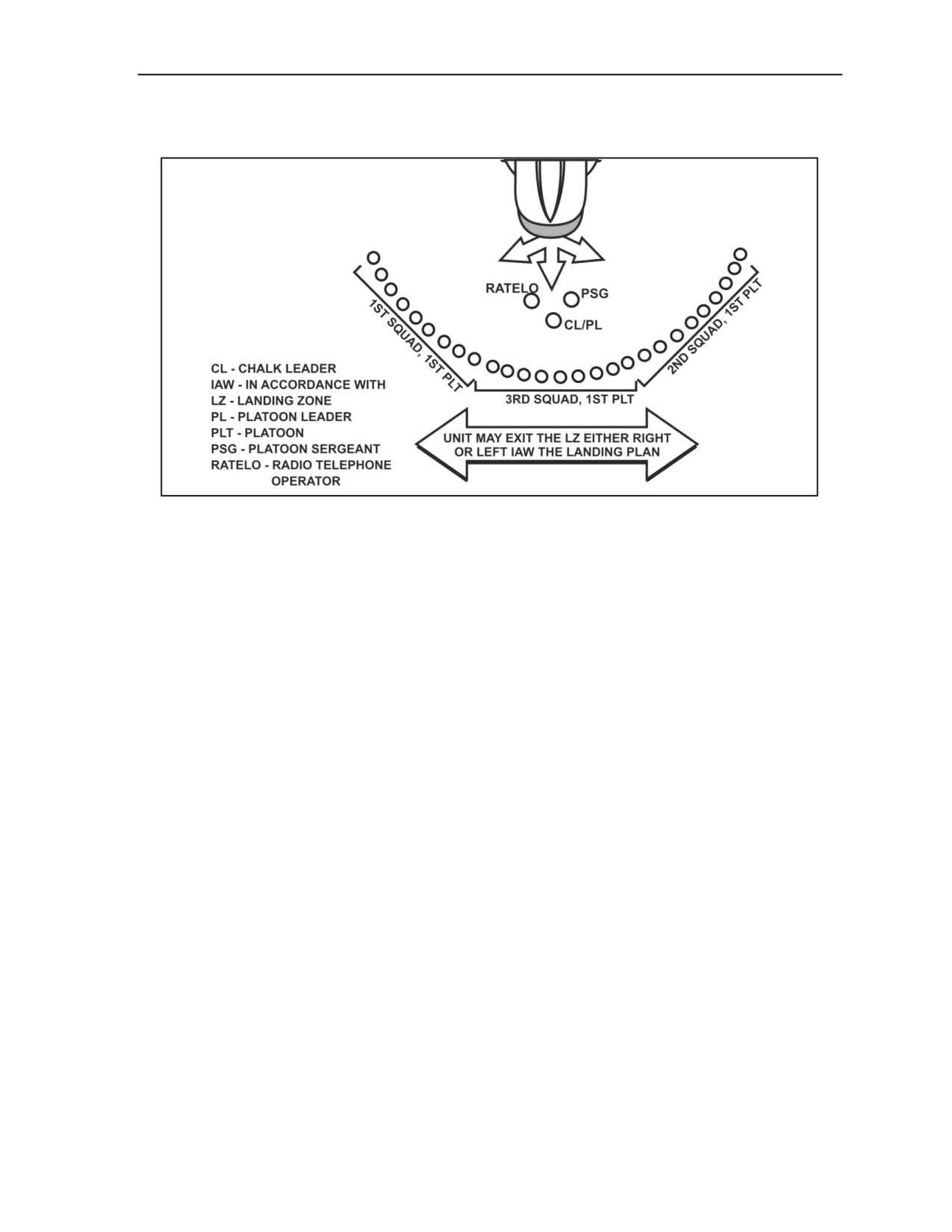
position and move immediately with their squad to a covered and concealed position (such as a tree line) in
wedge or other formation determined by their squad leader. Squads assemble at designated rally points and
then move to assault objectives on the landing zone or to objectives off the landing zone. This is the
preferred method to use when touchdown points are near covered and concealed positions. The unit may
plan a one-side landing zone rush away from a potential enemy position, allowing the door gunner closest
to the enemy position to continue firing while Soldiers exit the other side of the aircraft. (See figure 11-7,
page 11-12.)
6 March 2015
FM 3-99
11-11
Chapter 11
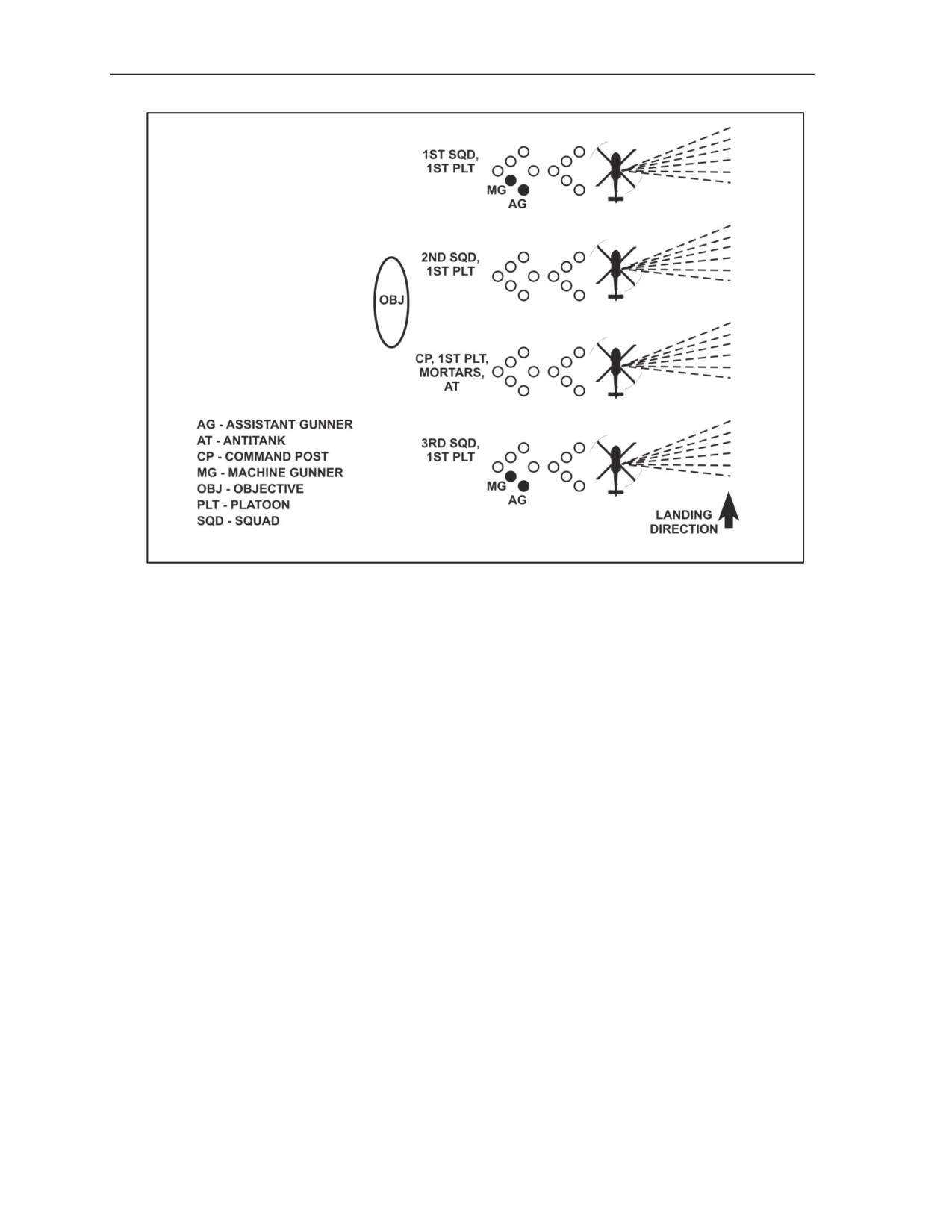
Figure 11-7. One-side landing zone rush (squads in same chalk) trail landing formation
Advantages
11-45. A one-side landing zone rush—
z
Moves the unit off the danger area quickly.
z
Facilitates control.
z
Maintains momentum and is less vulnerable to indirect fires.
z
Simplifies establishing zones of responsibility on the landing zone.
z
Minimizes aircraft cross-loading plans.
z
Allows door gunner of off-loading and follow-on serials to engage enemy on the far side of the
landing zone.
z
Clears the landing zone quickly for follow-on lifts.
Disadvantages
11-46. The unit executing a one-side landing zone rush is vulnerable to direct fire weapons while moving
off the landing zone.
TWO-SIDE LANDING ZONE RUSH
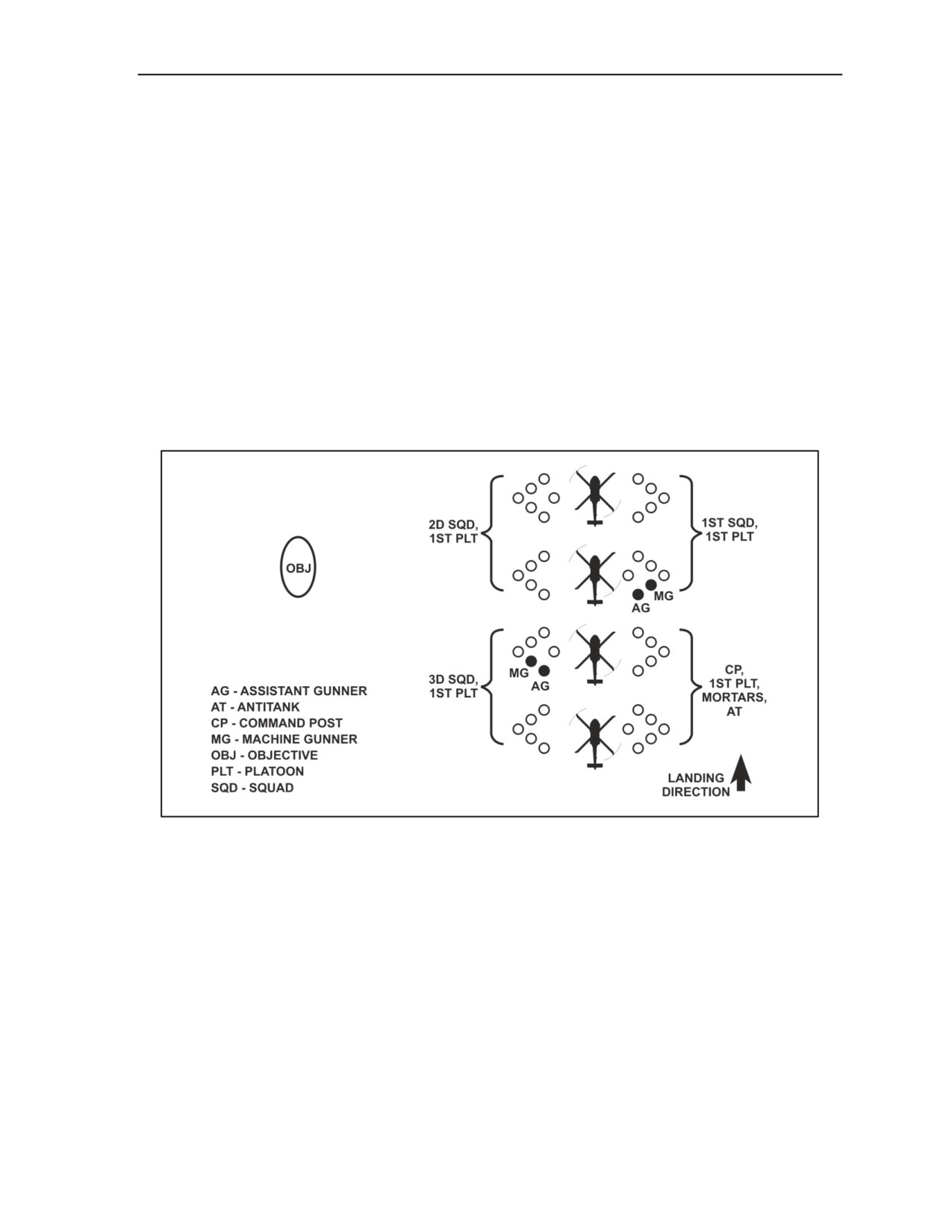
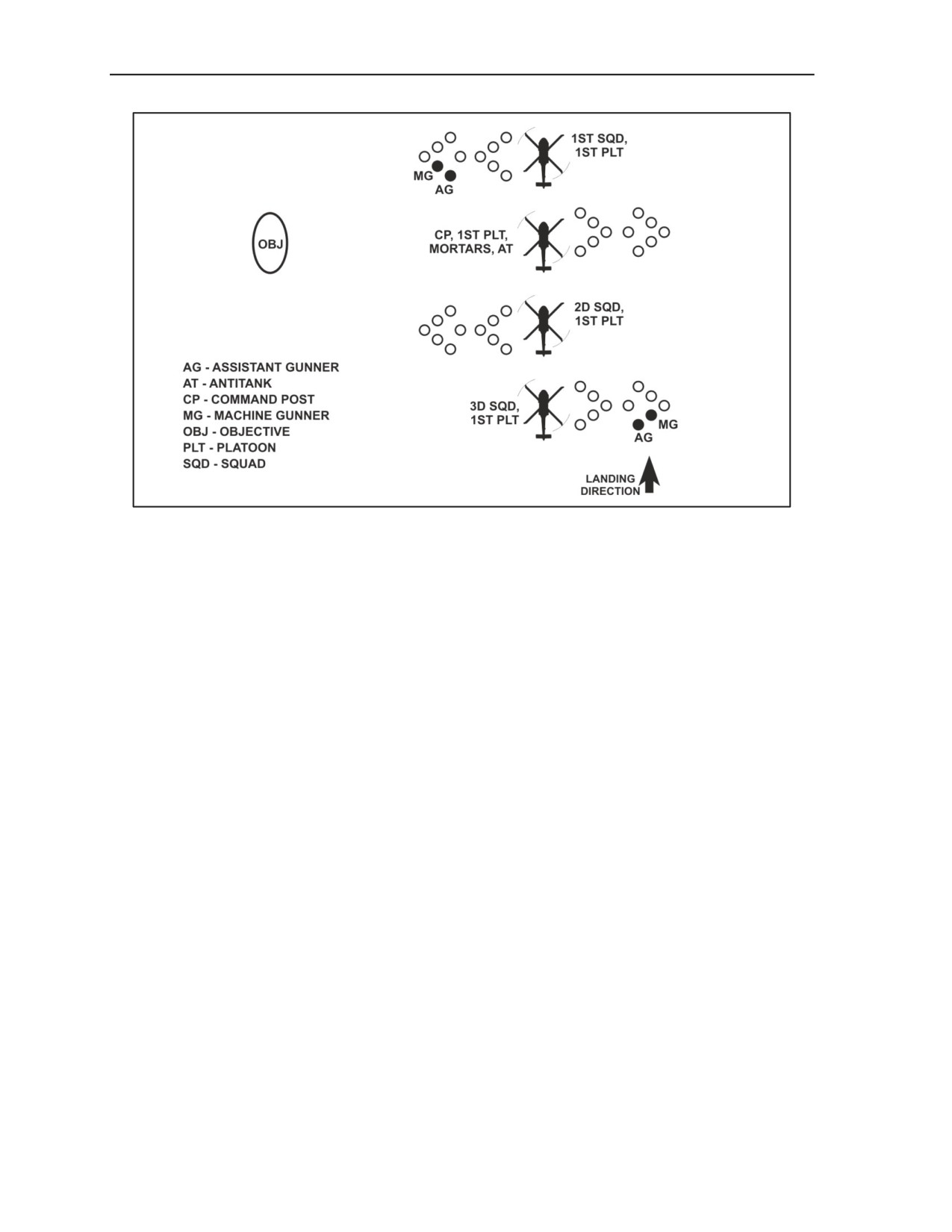
11-47. Aircraft loading options to consider when using a two-side landing zone rush are:
z
Split the squad across two chalks, with each fire team exiting the same door. (See figure 11-8.)
z
Keep each chalk as a pure squad, with even-numbered chalks exiting the right door and odd-
numbered chalks exiting the left door or vice versa. (See figure 11-9, page 11-13.)
11-48. Upon exiting the aircraft and dropping to the prone position, Soldiers recover from the prone
position and move immediately with their squad to a covered and concealed position in wedge or other
formation designated by their squad leader. Squads assemble at designated rally points and then move to
11-12
FM 3-99
6 March 2015
Landing Plan
assault objectives on the landing zone or to objectives off the landing zone. The aircraft landing formation
can help facilitate the unit in rapidly clearing Soldiers off the landing zone.
Advantages
11-49. A two-side landing zone rush—
z
Moves the unit off the danger area fastest.
z
Facilitates clearing and securing of the landing zone.
z
Facilitates fire control measures on the landing zone.
z
Maintains momentum and is less vulnerable to indirect fires.
z
Establishes zones of responsibility on the landing zone.
z
Clears the landing zone quickly for follow-on lifts.
Disadvantages
11-50. A two-side landing zone rush is more difficult to plan and control due to its complex aircraft cross-
loading plan. It masks fires of both door gunners while departing the landing zone, which increases
vulnerability to direct fire while moving off the landing zone.
Figure 11-8. Two-side landing zone rush (chalks cross loaded) trail landing formation
6 March 2015
FM 3-99
11-13
Chapter 11
Figure 11-9. Two-side landing zone rush (squads in same chalk) trail landing formation
11-14
FM 3-99
6 March 2015
Chapter 12
Air Movement Plan
The air movement plan is largely based on the ground tactical plan and landing plan.
It begins when the assault or lift helicopters cross the start point and ends when they
cross the release point. The air movement plan specifies the schedule and provides
instructions for air movement of Soldiers, equipment, and supplies from the pickup
zone to the landing zone. The air movement plan considers the impact of airspace
restrictions. It provides coordinating instructions regarding air routes, aircraft speeds,
altitudes, formations, and the planned use of attack reconnaissance helicopters.
SECTION I - DEVELOPMENT CONSIDERATIONS
12-1. The air movement plan is developed by the air assault task force (AATF) and supporting aviation
unit staffs in coordination with technical assistance and recommendations from the brigade aviation
element, air mission commander, and the aviation liaison officer. The aviation unit conducts all air mission
planning using the Aviation Mission Planning System (AMPS). This allows the aviation unit to plan
digitally, allowing rapid distribution of digital products between units within the AATF. However, the air
assault task force commander (AATFC) approves the final plan. The result of air movement planning is the
completion of the air movement table, which specifies the AATF movement from the pickup zone to the
landing zone.
12-2. Important considerations when developing the air movement plan areʊ
z
Air routes.
z
En route formations.
z
Terrain flight modes.
z
Fires.
z
Suppression of enemy air defense.
z
Air assault security.
z
Missioncommand.
AIR ROUTES
12-3. Components of an air route areʊ
z
Start point.
z
Release point.
z
Air control points.
z
Flight path between the start point and release point.
START POINT AND RELEASE POINT
12-4. The air route starts at the start point and ends at the release point. The location of start points and
release points are usually three to five kilometers from the pickup zones and landing zones respectively to
allow adequate flying time for execution of the flight’s en route procedures. The distance from the pickup
zone to the start point allows the aircraft to achieve the desired airspeed, altitude, and formation after
liftoff. The distance from the release point to the landing zone allows the flight leader to reconfigure the
formation and execute a tactical formation landing. The designated locations of the start points and release
points should—
6 March 2015
FM 3-99
12-1
Chapter 12
z
Profit from favorable weather conditions.
z
Avoid obstacles and known enemy positions.
z
Facilitate takeoff and landing into the wind by the best air route.
AIR CONTROL POINTS
12-5. Air control points designate each point where the air route changes direction. They include readily
identifiable topographic features or points marked by electronic navigational aids. A route may have as
many air control points as needed to control the air movement. The start points and release points are air
control points.
12-6. Once identified, air routes are designated for use by each unit. When large groups of aircraft are
employed, dispersion is achieved by using multiple routes. However, with large serials, it is often necessary
to use fewer routes or even a single route to concentrate available supporting fires. The number of alternate
and return routes may be limited.
CRITERIA FOR SELECTING ROUTES
12-7. Regardless of direction or location, certain criteria apply. All characteristics are seldom present in
any one situation, but all should be considered. Give careful consideration to the terrain and enemy forces.
Air routes should assist in navigation (day or night) and avoid turns in excess of 60 degrees to facilitate
control of the aircraft formation when formation flying is required or if sling loads are involved.
12-8. Factors to consider when selecting routes as follows:
z
Interference with ground action. Overflying ground elements may interfere with their supporting
fire. Clear air routes of the gun-target line when possible. Avoid over-flight of built-up areas.
z
Support of landing plan. To reduce vulnerability of the air assault force, air routes facilitate rapid
approach, landing, and departure from selected landing zones.
z
Enemy ground and air capabilities. Air routes maximize use of terrain, cover, and concealment
to minimize exposure to enemy observation, target acquisition, and direct fire.
z
Available fire support. Air routes allow fire support from all available resources. Avoid masking
friendly fires, particularly supporting fires.
z
Available air cover. Air routes are selected to provide air cover for friendly forces en route.
z
Weather conditions. Prevailing weather during the air assault operation significantly affects the
selection of air routes.
z
Terrain. Air routes use terrain to maximize the advantage of and reduce vulnerability of the
aircraft formations, providing cover by placing terrain mass and vegetation between the enemy
and the aircraft.
z
Distance from pickup zone to landing zone. Air routes should be as short as is tactically feasible
according to mission variables to reduce flying time.
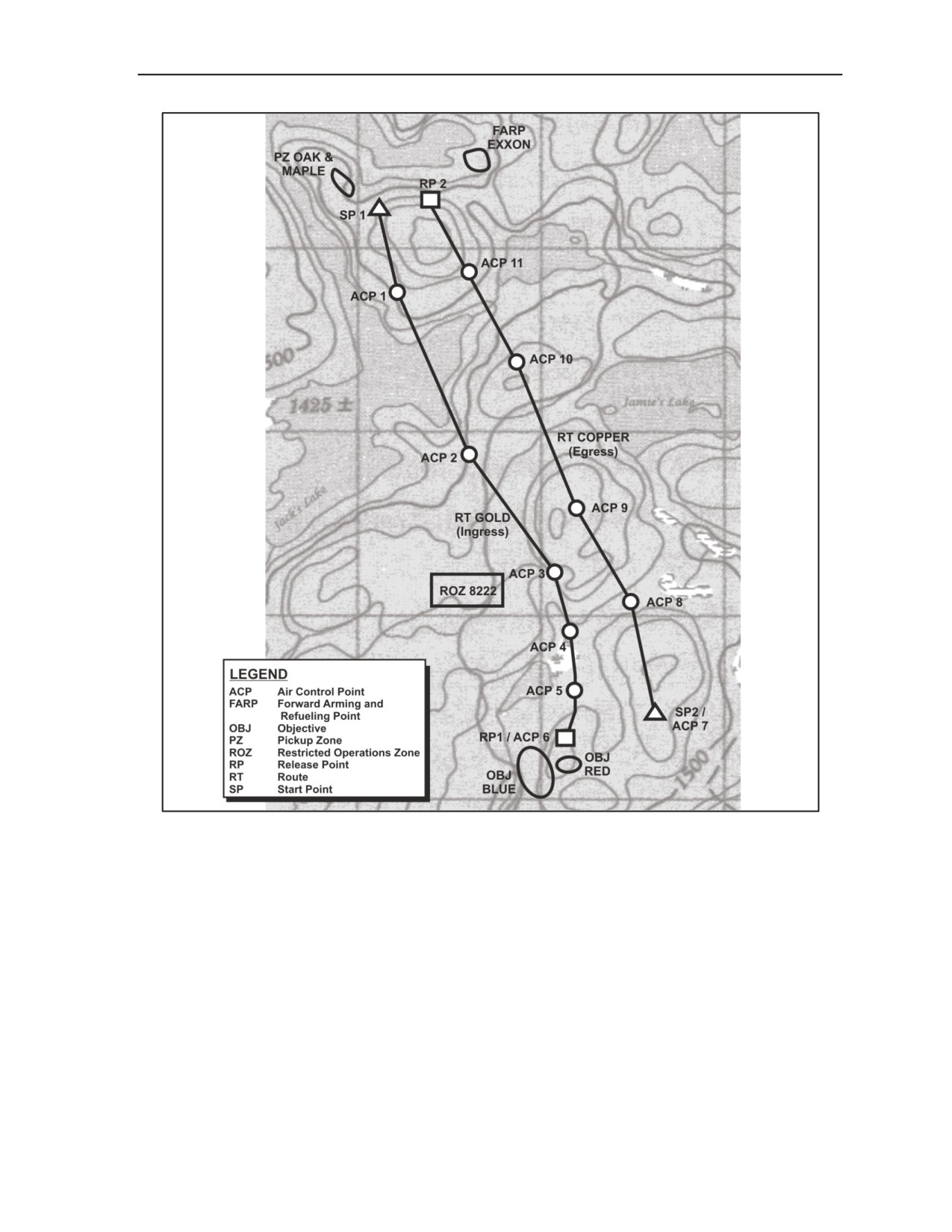
12-9. Maps or overlays containing air route information are prepared at aviation unit headquarters and
disseminated to subordinate and support units. Air routes and corridors are designated by a letter, number,
or word. (See figure 12-1, page 12-3.)
12-2
FM 3-99
6 March 2015
Air Movement Plan
Figure 12-1. Air route overlay
EN ROUTE FORMATIONS
12-10. Many factors dictate the flight’s formation, such as terrain, enemy situation, visibility, weather,
altitude, speed, type of aircraft mix, and the degree of control required. The air mission commander or
flight leader selects the en route formation and landing formation based on the mission analysis of the
ground tactical plan. Ideally, all aircrafts land at the same time in a planned flight formation as specified by
the air movement table. The landing site commander includes this information in his landing instructions to
the flight leader and the pathfinder establishing the landing zone. (Refer to FM 3-04.113 for more
information.)
12-11. The flight leader and pathfinder must understand the en route and landing formation and the
ground tactical plan to best support the ground unit and facilitate the air assault operation. The flight leader
should try to match the landing formation to the flight formation. Pilots should have to modify their
formations no more than necessary to accommodate the restrictions of a landing site, but it might be
necessary to land in a restrictive area. Touchdown points are established by the pathfinder in the same order
6 March 2015
FM 3-99
12-3
Chapter 12
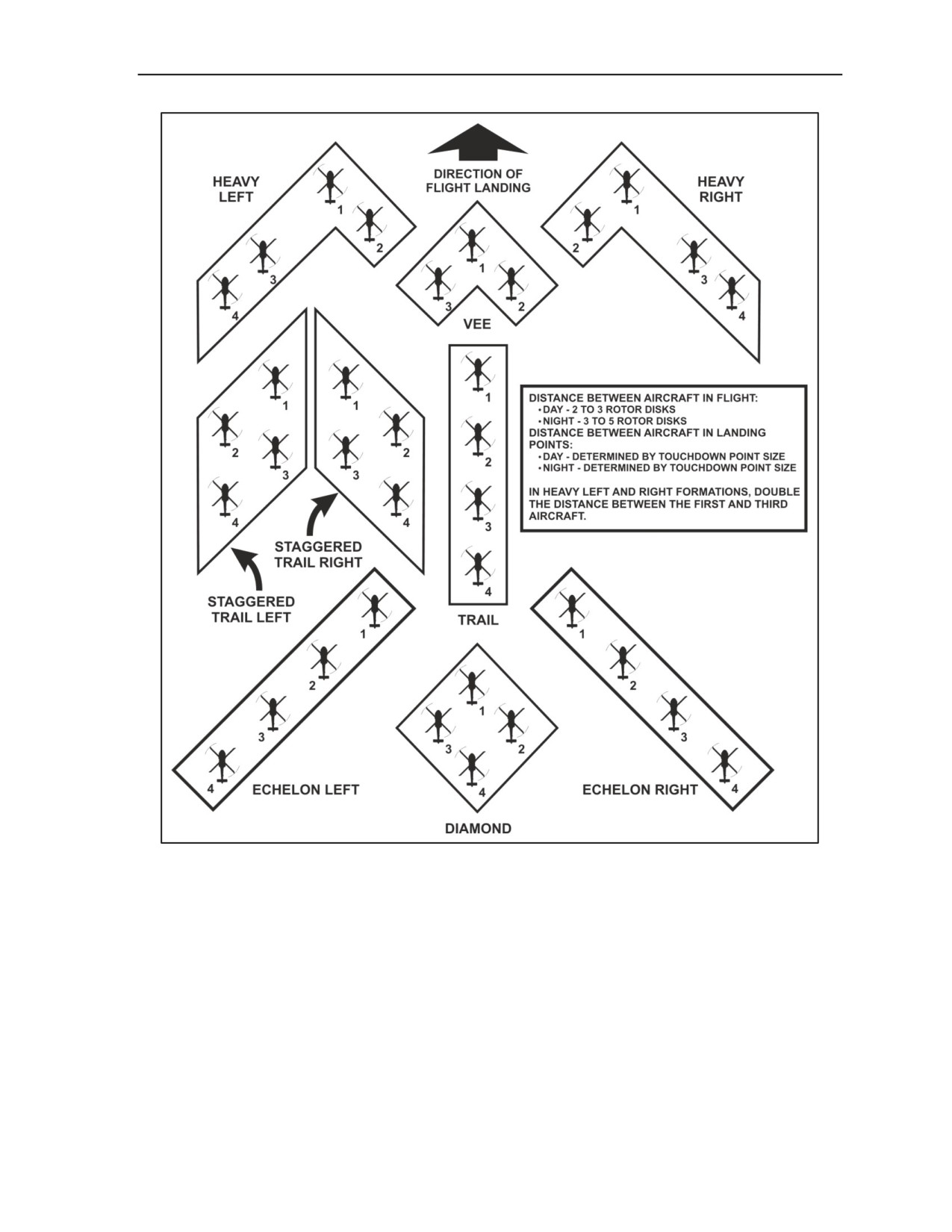
as indicated in the formation. The following standard flight and landing formations (See figure 12-2, page
12-5.) are used when conducting air assault operations:
z
Heavy left or right formation. Requires a relatively long, wide landing area; presents difficulty in
pre-positioning loads; restricts suppressive fire by inboard gunners; provides firepower to front
and flank.
z
Diamond formation. Allows rapid deployment for all-round security; requires relatively small
landing area; presents some difficulty in pre-positioning loads; restricts suppressive fire of
inboard gunners.
z
Vee formation. Requires a relatively small landing area; allows rapid deployment of forces to the
front; restricts suppressive fire of inboard gunners; presents some difficulty in prepositioning
loads.
z
Echelon left or right formation. Requires a relatively long, wide landing area; presents some
difficulty in prepositioning loads; allows rapid deployment of forces to the flank; allows
unrestricted suppressive fire by gunners.
z
Trail formation. Requires a relatively small landing area; allows rapid deployment of forces to
the flank; simplifies pre-positioning loads; allows unrestricted suppressive fire by gunners.
z
Staggered trail left or right formation. Requires a relatively long, wide landing area; simplifies
pre-positioning loads; allows rapid deployment for all-round security; gunners' suppressive fire
restricted somewhat.
12-4
FM 3-99
6 March 2015
Air Movement Plan
Figure 12-2. Standard flight and landing formations
12-12. The pathfinder chooses landing sites that have firm surfaces; are free of dust, sand, and debris that
might create problems when disturbed by rotor wash; and are cleared of obstacles. The landing site is laid
out in a location where helicopters will not fly directly over aircraft on the ground. The layout of the site
also depends on the landing space available, the number and type of obstacles, unit standard operating
procedures, and prearranged flight formations. En route formation impacts how the formation lands,
impacting loading and off-loading of aircraft. (Refer to FM 3-21.38 for more information.)
TERRAIN FLIGHT MODES
12-13. A specific en route flight altitude is not designated and is usually below the coordinating altitude.
Factors affecting flight altitude include enemy, terrain, navigation, weather, flight distance, need for
surprise, and pilot fatigue. Pilots may use one or some combination of the three terrain flight modes as
dictated by the mission variables.
6 March 2015
FM 3-99
12-5
Chapter 12
z
Nap-of-the-earth flight is conducted at varying airspeeds as close to the earth’s surface as
vegetation and obstacles permit. A weaving flight path remains oriented along the general axis
of movement and takes advantage of terrain masking. This is a general flight mode and may
likely be in close proximity to the enemy.
z
Contour flight is conducted at low altitudes, conforming to the earth’s contours. Relatively
constant airspeeds and varying altitudes as dictated by terrain and obstacles characterize it.
z
Low-level flight is conducted at constant altitudes and airspeed dictated by threat avoidance. Its
intent is to facilitate speed and ease of movement while minimizing detection. This mode of
flight is used when there is a low threat level. Fires along the air route are planned to suppress
known or suspected enemy positions. These fires should be intense and of short duration. Utilize
multiple target engagement methods as needed. On-call fires are planned along the air route to
ensure rapid target engagement if necessary.
FIRES
12-14. Fire plans cover the pickup zones, air routes, and landing zones. Fire support plans include
suppression of enemy air defenses (SEAD) systems and obscuration to protect formations from enemy
detection. This requires aggressive fire planning and direct coordination with field artillery and mortar fire
direction centers and other fire support elements.
12-15. All available fire support is used to suppress or destroy enemy weapons, to include close air
support, artillery, and attack reconnaissance helicopters. Support may comprise concealment or other
countermeasures for suppressing or confusing enemy air defense systems. During night operations, the use
of illumination fire requires detailed planning. Illumination can interfere with NVGs causing unsafe conditions.
SUPPRESSION OF ENEMY AIR DEFENSES
12-16. In executing air movement, the air mission commander integrates air routes based on pickup zone
and landing zone locations, avoiding known or suspected enemy air defense positions. The AATF is
responsible for planning, synchronizing, and executing lethal suppressive fires and nonlethal suppressive
effects on known or suspected enemy air defense positions that are unavoidable. Lethal and nonlethal assets
available to conduct SEAD missions includeʊ
z
Mortars and artillery (cannon, rocket and missile).
z
Fixed-wing assets, to include unmanned aircraft systems.
z
Naval gunfire.
z
Attack reconnaissance helicopters.
z
Radar suppression and jamming (lethal and nonlethal).
z
Communications suppression and jamming (lethal and nonlethal).
JOINT SEAD
12-17. The term Joint SEAD encompasses all SEAD activities provided by components of a joint force in
support of one another. When operating as a component of a joint force, different assets and unique
planning requirements may exist. (Refer to JP 3-01 for more information.) Joint SEAD includes all SEAD
categories and additional classifications to includeʊ
z
Operational area system suppression comprises operations within an operational area against
specific enemy air defense systems to degrade or destroy their effectiveness. It targets high
payoff air defense systems whose degradation most affects the enemy’s total system.
z
Opportune suppression is a continuous operation involving immediate attack of air defense
targets of opportunity. It is normally unplanned suppression, includes aircrew self-defense, and
attacks against targets of opportunity.
z
Localized suppression can occur throughout the area of responsibility or joint operations area
and can be conducted by all components. However, it is limited in time and to geographical
areas associated with specific ground targets.
z
Corridor suppression is planned joint SEAD focused on creating an air defense artillery
suppressed corridor to maneuver aircraft. Missions that normally require this suppression are air
12-6
FM 3-99
6 March 2015
Air Movement Plan
missions supporting tactical airlift or combat operations, search and rescue operations, and
operations in support of special operations forces.
SEAD PLANNING
12-18. The ground maneuver, aviation units, AATF operations officers, AATF intelligence officers (Refer
to FM 2-0 for more information.), and electronic warfare officer (See ATP 3-36.) participate in SEAD
planning. SEAD planning is conducted as part of the military decisionmaking process and targeting
process. Consider the following critical factors in mission analysis:
z
Ingress and egress air routes and locations of air control points.
z
En route airspeed.
z
Time, distance, and heading information for primary and alternate air routes.
z
Expected start point crossing time on ingress and egress.
z
Enemy air defense artillery locations within the area of operation.
z
Locations, frequencies, and call signs of friendly artillery.
z
Available assets to deliver SEAD fires.
12-19. When determining enemy air defense capabilities, mission planners—
z
Plot the location of all known enemy air defense artillery systems on a map.
z
Draw a circle (threat ring) around each air defense artillery system with a radius equal to the
maximum engagement range. Depending on the threat system and its means of target acquisition
(optical, infrared, and radar) and fire control, the size of the threat ring may change during hours
of limited visibility. Terrain that blocks electronic or visual lines of sight may reduce the radius
of a threat ring.
z
Use AMPS, Falcon View, or other automated systems to reduce workload and ensure accuracy.
z
Plot the primary and alternate air routes and all landing zones on the map. Air routes and landing
zones should avoid threat rings whenever possible.
12-20. Plan SEAD fires to engage the two types of targets, planned targets and targets of opportunity
described below.
Planned Targets
12-21. A planned target is a target that is known to exist in the operational environment, upon which
actions are planned using deliberate targeting, creating effects which support the commander’s objectives
(JP 3-60). The two types of planned targets are—
z
Scheduled targets that are prosecuted at a specified time.
z
On-call targets that have planned actions and are triggered when detected or located.
12-22. One example of a scheduled target is a deception SEAD mission. Deception SEAD may be fired
into an area to deceive the enemy or cause him to reposition his air defense weapons away from where
actual operations take place. Another example is an electronic attack of enemy air defense radars and
command and control information systems when enemy ADA assets are in civilian populated areas.
12-23. Provisions should also exist for immediate on-call fires in the SEAD plan. Establish a quick-fire
network for this purpose providing a direct link between an observer and weapon system (normally field
artillery). Order observers based on their priority of fire. Conduct a fire support rehearsal with the
supporting unit. Brief and rehearse with all participants during the combined arms rehearsal.
Targets of Opportunity
12-24. SEAD is conducted against ADA targets of opportunity and should reflect priorities established on
the high-payoff target list and attack guidance matrix. Delivery systems and quick-fire networks are critical
to engaging targets of opportunity.
6 March 2015
FM 3-99
12-7
Chapter 12
SEADEMPLOYMENT
12-25. SEAD fires should be planned against an enemy ADA system that threatens the air assault force. A
period of focused immediate SEAD is planned at each landing zone before the arrival of the AATF. If
possible, plan deception SEAD to mitigate further tactical risk.
12-26. Scheduled SEAD missions are planned against threat systems along the ingress and egress route of
flight. The start time for each SEAD mission may be calculated if the assault aircraft’s en route airspeed
and SP time on the air route are known. These calculations may be made manually or with AMPS or
similar planning systems.
12-27. Factors that determine the duration of each SEAD mission include aircraft speed and the range of
each enemy ADA system (size of the threat ring). This information may be used with planning software to
determine how long to suppress each ADA system along the air route. Calculations may be made manually
or estimated. A good planning estimate is that the air assault travels three kilometers in one minute.
12-28. Position units to support as much of the area of operation as possible. To ensure synchronization,
organize all planned fires into an SEAD schedule or add them to the execution matrix. Assess the
effectiveness of the SEAD plan during war-gaming.
AIR ASSAULT SECURITY
12-29. Air assault security is conducted throughout the air movement phase. Air assault security is not
necessarily just an escort mission. The air assault security process can be conducted sequentially,
simultaneously, or over a period of 24 to 72 hours before the start of the air assault mission. This process is
determined early in the mission analysis phase and is a direct result of the AATFC’s initial guidance and
key tasks.
12-30. UAS should observe the air routes and landing zones beginning well before launch to provide early
warning to the AATFC. Just before the launch of the air movement phase, attack reconnaissance units fly
along the route to conduct an air assault security mission. This mission is much like a movement to contact.
Usually, one to two attack reconnaissance companies conduct the mission just before the assault aircraft
launch for the air movement. This allows the attack reconnaissance units opportunity to conduct a relief on
station with elements that may already be on station providing reconnaissance.
12-31. The air assault security force generally makes the final landing zone update call, as the assault
forces are en route to the landing zone. Before assault forces land on the landing zone, air assault security
forces may be directed to shift to a landing zone overwatch mission, ensuring they do not conflict with the
air routes entering or exiting the landing zone. As the assault forces land on the landing zone, air assault
security forces may be directed to move forward to the next phase line to conduct a screening mission or to
occupy a battle position.
12-32. Attack reconnaissance units maintain the flexibility to execute on-call close combat attacks as
needed. Air assault security forces must maintain communications with the fires elements for immediate
suppression missions as needed.
MISSION COMMAND
12-33. In executing the air movement, the air mission commander takes operational control of all Army
aviation forces. The air mission commander controls all—
z
Timing for deconfliction.
z
En route fires.
z
Initiation and shifting of landing zone preparation fires.
12-34. Once the air assault force has cleared the landing zone and moved to its rally point, the tactical
commander on the ground assumes mission command of the element and continues his assigned mission.
Mission command should allow continued execution despite loss of radio communications. If the air
mission commander and lift flight leaders have air movement tables or the execution checklist in their
possession, they can continue the mission without radio communications.
12-8
FM 3-99
6 March 2015
Air Movement Plan
SECTION II - AIR MOVEMENT TABLE
12-35. The AATF staff and aviation unit staff develop the air movement table. (See table 12-1, page
12-10.) This table serves as the primary air movement document for the air assault operation.
AIR MOVEMENT TABLE DEVELOPMENT
12-36. The AATF S-3 Air and aviation liaison officer begin work on this document right after the initial
planning conference. This gives them an idea early in the planning process of challenges involved in
moving units to the landing zone. The table ensures that all personnel, equipment, and supplies are
accounted for in the movement and that each aircraft is fully loaded, correctly positioned in the flight, and
directed to the right landing zone. The air movement table—
z
Contains aircraft allocations.
z
Designates number and type of aircraft in each serial.
z
Specifies departure point; route to and from loading area; and loading, liftoff, and landing times.
z
Includes the refuel schedule for all lifts if required.
AIR MOVEMENT TABLE CRITERIA
12-37. The air movement table regulates the sequence of flight operations from pickup zone to landing
zone using the following line information:
z
Line number. Quick reference with brevity codes numbered sequentially.
z
Aviation unit. Aviation unit conducting the air movement. Depicted as unit designation over call
sign to save space.
z
Lifted unit. Unit being lifted or air assaulted. If more than one unit is in the load, use unit with
most assets in the load. Depicted as unit’s designation over call sign to save space.
z
Lift. Serials that make one complete turn out to and back from the area of operation. Numbered
sequentially.
z
Serial. A tactical grouping of two or more aircraft under the control of a serial commander
(aviator) and separated from other tactical groupings within the lift by time or space. The
capacity of the smallest landing zone determines the number of aircraft in each serial.
z
Chalk. Each aircraft equals one load. Number UH-60 and CH-47 chalks separately.
z
Pickup zone. Name of the pickup zone where chalks pick up the loads.
z
Pickup zone arrival and load time. Time the troops get on the aircraft or when the aircraft starts
to hookup the load.
z
Takeoff time. Time the aircraft lifts off the pickup zone.
z
Start point time. Time the aircraft hit the start point (brigade aviation element-determined point
usually three to five kilometers from the pickup zone).
z
Release point time. Time the aircraft hit the release point (brigade aviation element-determined
point usually three to five kilometers from the landing zone).
z
Landing zone. Landing zone name and location determined by the lifted unit’s ground tactical plan.
z
Landing zone time. Time the serial lands in the landing zone.
z
Landing zone degree. Compass heading at which the serial is landing, should be converted to
and shown in magnetic heading for the aircraft.
z
Landing zone formation. Landing formation, normally the trail formation.
z
Routes. Primary ingress and egress routes for the mission.
z
Load. Personnel and sling load configuration. Refer to the tadpole diagram to save space on
this page.
z
Remarks. Additional remarks
(such as scheduled delays, refuel, or other uncommon serial
characteristics).
6 March 2015
FM 3-99
12-9
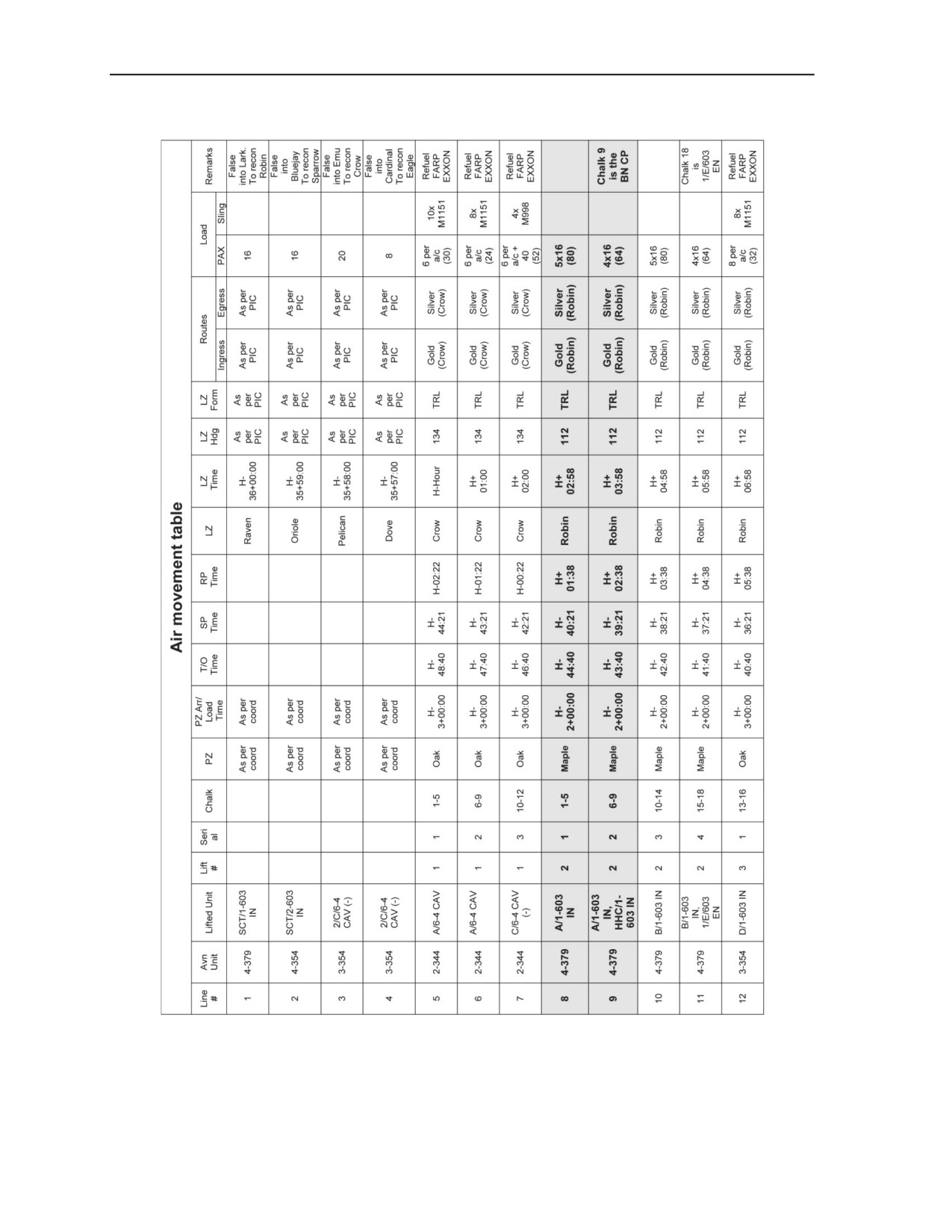
Chapter 12
Table 12-1. Example air movement table
12-10
FM 3-99
6 March 2015
Chapter 13
Loading and Staging
The activities that take place in or near the pickup zone are referred to as pickup zone
operations. These activities include both the loading and staging plan. Like the
previous steps in the air assault planning process, these plans support and are based
on the steps before them. Pickup zone operations are a collaborative effort between
the supported unit
(maneuver forces that compose the assault force) and the
supporting aviation unit. The assault force is organized on the pickup zone. Every
serial and lift is a self-contained element that must understand what it does upon
landing at either the primary or the alternate landing zone and later in executing the
ground tactical plan. Planning for insertion and extraction follows the same process
and requires the same forethought and attention to detail. Insertion and extraction
plans are developed during the air assault planning process and coordinated with all
supporting units at the initial planning conference or air mission coordination
meeting (AMCM). Both insertion and extraction loading and staging plans should be
rehearsed at the air assault task force (AATF), aviation, and assault force rehearsals.
SECTION I - LOADING PLAN
13-1. The loading plan ensures that Soldiers, equipment, and supplies are loaded on the correct aircraft and
moved from the pickup zone to the landing zone in the priority order designated by the air assault task force
commander (AATFC). The air movement table is the planning document that details how to execute this.
At the company level and below, leaders use an air-loading table to document how the loading plan is
executed. The basic information found in the air-loading table is found in the air movement table.
Considerations to develop a loading plan are described below.
PICKUP ZONE SELECTION
13-2. Operations requiring the pick up or extraction of personnel may require special considerations
dependent on the mission and or element requiring support. When the pickup zone or mission prevents a
helicopter from landing, the mission may require the use of the special patrol infiltration and exfiltration
system (SPIES). (Refer to FM 3-05.210 for more information.)
IDENTIFYING PICKUP ZONES
13-3. Identifying pickup zones is the first step in developing a loading plan. The goal of pickup zone
identification is to locate suitable areas to accommodate the lift aircraft. Identify primary and alternate
pickup zones at the same time.
PICKUP ZONE OPERATION
13-4. Establishing and running a pickup zone to standard is the first step in executing a successful air
assault. The number of pickup zones selected depends on the number and type of aircraft and loads
required to complete the mission. The mission may require the designation of both a light pickup zone
(UH-60) and a heavy pickup zone (CH-47). Based on his unit’s level of training, the air mission
commander may adjust the specifications for identifying and selecting pickup zones (such as degree of
slope, wind speeds, and distance between aircraft).
6 March 2015
FM 3-99
13-1
Chapter 13
SELECTION CRITERIA
13-5. Once available pickup zones are identified, the AATFC and his S-3 select and assign pickup zones
for each unit to use. Pickup zone selection criteria include:
z
Number. Multiple pickup zones avoid concentrating forces in one area.
z
Size. If possible, each pickup zone should accommodate all supporting aircraft at once.
z
Proximity to Soldiers. When possible, the selected pickup zones should not require extensive
ground movement to the pickup zone by troops.
z
Accessibility. Each pickup zone should be accessible to vehicles to move support assets and
assault forces.
z
Vulnerability to attack. Selected pickup zones should be masked by terrain from enemy
observation.
z
Conditions. Surface conditions of the area (for example, excessive slope; blowing dust, sand, or
snow; and man-made obstacles) create potential hazards to pickup zone operations.
Note. Using pickup zones located in secure forward operating base and outposts precludes much
of the effort required to identify and select suitable pickup zones.
PICKUP ZONE ORGANIZATION AND CONTROL
13-6. Once the AATFC selects the pickup zones, he designates a pickup zone control officer (PZCO) to
organize, control, and coordinate pickup zone operations. The designated PZCO is selected based on
experience and the size of unit that is conducting the air assault. For example, at BCT level, the BCT
executive officer is usually the PZCO. At the battalion level, the battalion executive officer or S-3 Air are
usually the PZCO. At company level, the company executive officer is usually the PZCO.
13-7. Once designated, the PZCO is responsible for the overall success of all pickup zone activities, to
include the following:
z
Forming a control party to establish control over the pickup zone by clearing the pickup zone
and establishing pickup zone security. The pickup zone control party comprises pickup zone
control teams and support personnel from subordinate units, typically to include a PZCO, a
pickup zone noncommissioned officer in charge (PZNCOIC), and—
Chalk guides guide the aircraft loads (Soldiers, vehicles, and equipment) from the chalk
check-in point to their respective staging areas on the pickup zone once they have been
inspected and approved for loading by the pickup zone control party.
Ground crew teams provide visual guidance to the aircraft pilots and hook up the vehicles
and equipment that are externally loaded (sling loaded) by the aircraft. UH-60 ground crew
teams typically consist of one hook-up person, one static probe person, and a signal person.
CH-47 hook-up teams typically consist of one hook-up person and one static probe person
according to sling hook-up point.
Crisis action teams are experienced officers or non-commissioned officers who are experts
with rigging all types of loads and hook-up procedures for all aircraft.
Security teams provide local security for all pickup zone operations. These teams may
include air defense teams if they are available.
Air traffic control teams (if available) use radio or directional light signals to provide flight
information, expedite traffic, and prevent collisions. Pathfinder teams are capable of serving
as air traffic control teams if required.
Pathfinder teams (if available) provide air traffic advisories and navigational aid for fixed-
and rotary-wing aircraft. They perform limited physical improvement and chemical,
biological, radiological, and nuclear monitoring and surveying within pickup zones, if
required. Pathfinder availability, the tactical plan, the complexity of the operation, the
terrain, and the air assault proficiency of the supported ground force may dictate
pathfinder support.
13-2
FM 3-99
6 March 2015
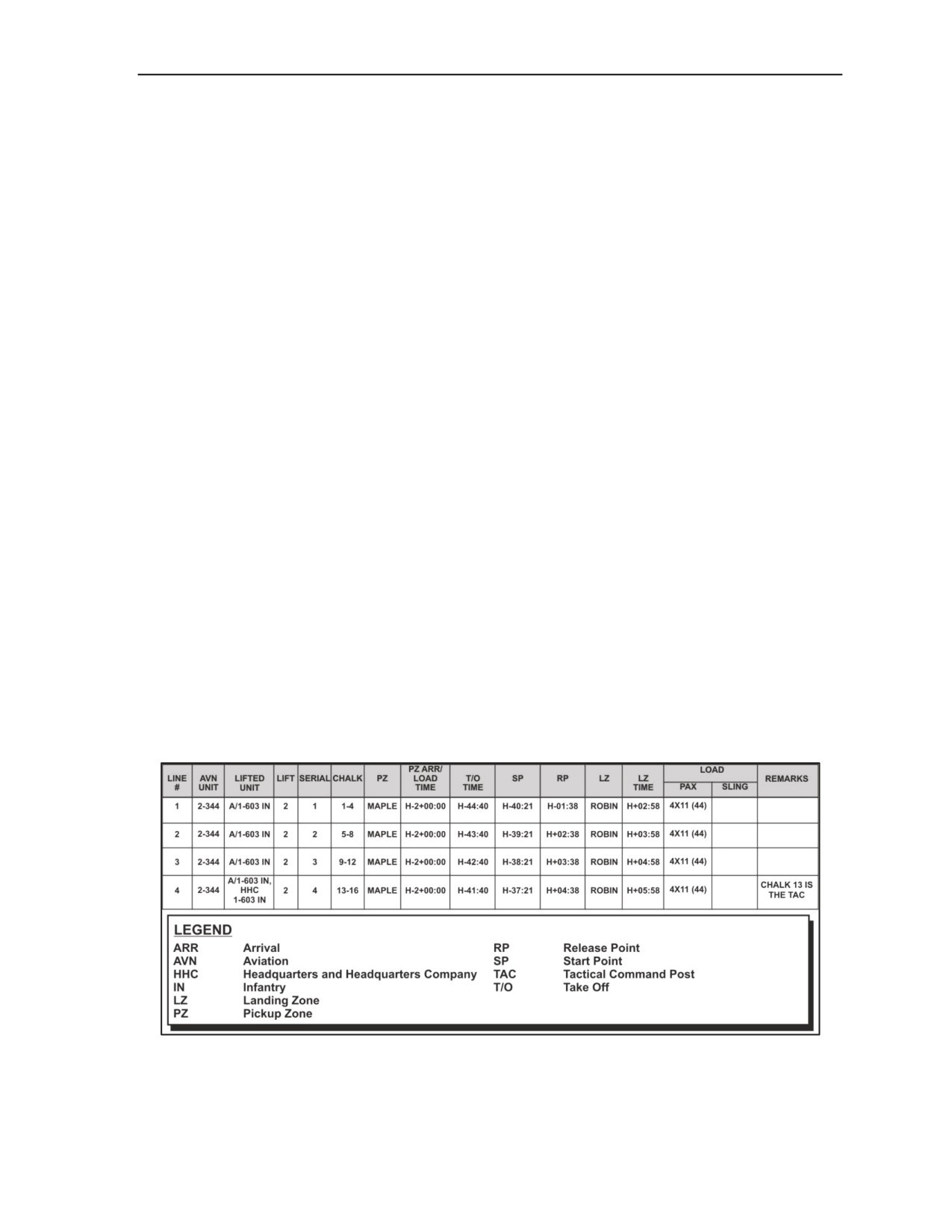
Loading and Staging
z
Establishing communications on two primary radio frequencies— one to control movement and
loading of units and the other on combat aviation net. Alternate frequencies are provided as
needed.
z
Planning and initiating fire support near pickup zones in coordination with the AATF to provide
all-round protection
(from available support) without endangering arrival and departure of
Soldiers or aircraft.
z
Planning and initiating security to protect the main body as it assembles, moves to the pickup
zone, and is lifted out. Other forces should provide security elements if the pickup zone is within
a friendly area. Security comes from AATF resources if a unit is to be extracted from the
objective area.
z
Marking the pickup zone as specified in unit standard operating procedure regardless of the type
of markers, pickup zone marking requirements depend on the type and number of aircraft and
are based on the minimum acceptable distance between aircraft. At a minimum, mark the pickup
zone to indicate where each aircraft, by type, is to land.
z
Clearing the pickup zone of obstacles.
z
Executing the bump plan.
COORDINATION WITH SUPPORTING AVIATION UNIT
13-8. Loading plans are carefully coordinated with the brigade aviation officer and aviation liaison. Copies
of the air movement tables and air loading tables should be distributed to the aviation liaison officer,
AATFC air mission commander, and PZCO.
13-9. The supporting helicopter unit must ensure that aviation expertise is present on the pickup zone. The
brigade aviation officer or aviation liaison officer (or another designated representative) should locate with
the PZCO during the pickup zone selection, setup, and execution phase. The aviation representatives
provide guidance on the pickup zone setup, considering aircraft factors. For example, the pickup zone
landing direction may change if the wind changes significantly. Additionally, the aviation representatives
can offer advice on surface conditions and their effects on helicopter operations.
PREPARATION OF AIR LOADING TABLES
13-10. The air-loading table assigns personnel and major items of equipment or supplies to a specific
aircraft (chalk) at the company and below level. The air-loading table is an accountability tool, a loading
manifest, for each aircraft. (See table 13-1)
Table 13-1. Example air loading table
13-11. When time is limited, the table can be written on a sheet of paper. It should contain a list, prepared
by the aircraft chalk leader, of Soldiers (by name) and equipment to be loaded on each chalk. This ensures
that information on personnel and equipment onboard is available if an aircraft is lost. The chalk leader
6 March 2015
FM 3-99
13-3
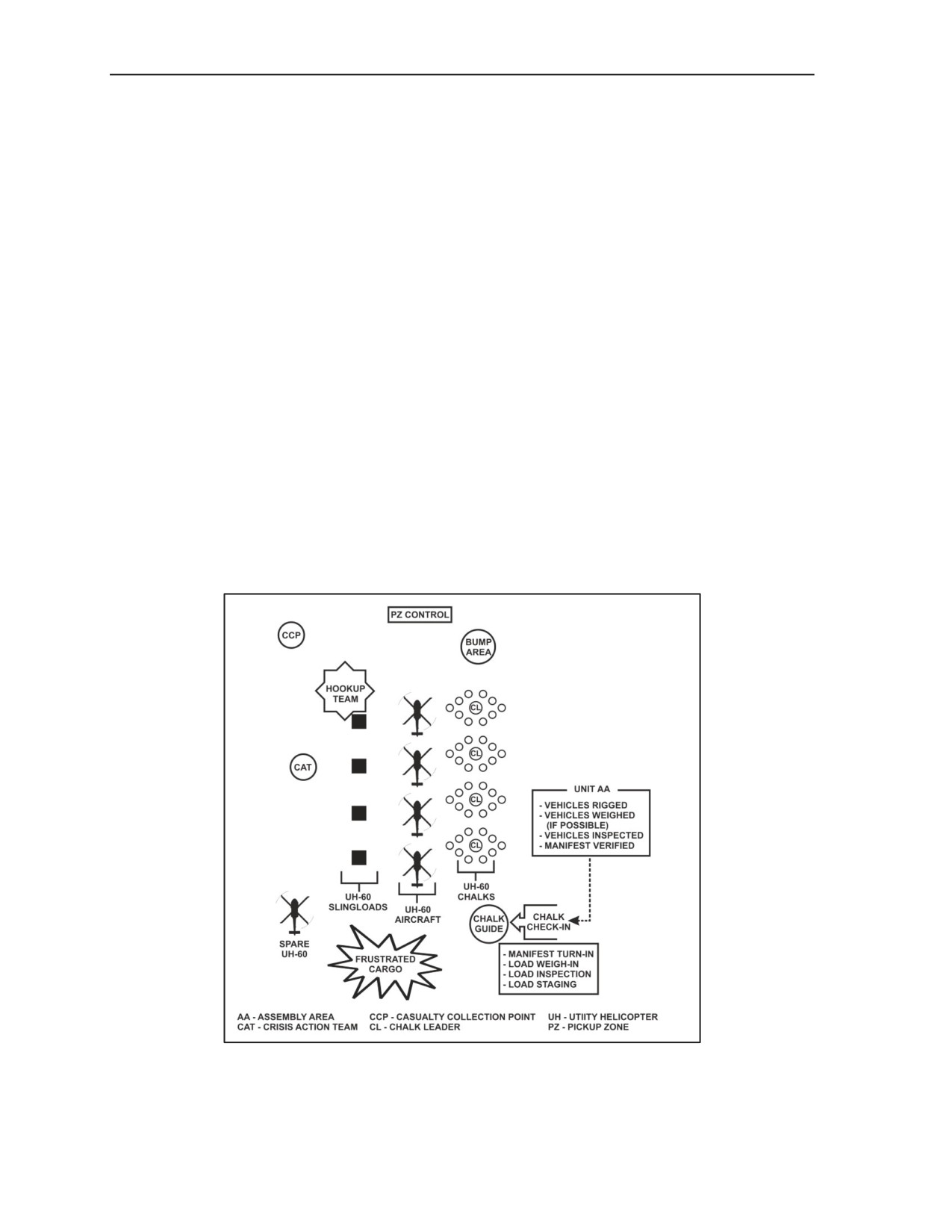
Chapter 13
gives a copy of the air-loading table to the pickup zone control party upon arriving at the pickup zone for
check-in.
13-12. During preparation of the loading tables, leaders at all levels maintain the—
z
Tactical integrity of units. Load a complete tactical unit, such as a fire team or squad, on the
same aircraft or a platoon in the same serial to ensure integrity as a fighting unit upon landing.
z
Tactical cross loading. Plan loads so that key personnel and critical equipment (for example,
crew-served weapons) are not loaded on the same aircraft. Thus, if an aircraft is lost to an abort
or enemy action, the mission is not seriously hampered.
z
Self-sufficiency of loads. Ensure that each unit load has everything required (weapons, crew, and
ammunition) to be operational upon reaching its destination. Ensure the following:
The prime mover accompanies every towed item.
Crews are loaded with their vehicle or weapon systems.
13-13. Leaders must determine whether internal or external (sling) loading is the best delivery method for
equipment and supplies. Helicopters loaded internally can fly faster and are more maneuverable.
Helicopters loaded externally fly slower at higher altitudes and are less maneuverable but can be loaded
and unloaded more rapidly than internally loaded helicopters. The method used depends largely on
availability of sling loading and rigging equipment.
DISPOSITION OF LOADS ON PICKUP ZONE
13-14. Position personnel and equipment on the pickup according to the pickup zone diagram. (See figure
13-1.) Flight crews must understand the loading plan and should be prepared to accept Soldiers and
equipment immediately on landing. Pickup zone diagrams depicting the location of chalks and sling loads
in the pickup zone assist flight crews in loading troops and equipment quickly once the aircraft arrive in the
pickup zone. Flight crews should be provided a pickup zone diagram.
Figure 13-1. Example pickup zone diagram
13-4
FM 3-99
6 March 2015
Loading and Staging
LIFTS, SERIALS, AND CHALKS
13-15. The loading plan and pickup zone selection should aim to maintain ground unit integrity. Just as a
squad should not be divided between chalks, a platoon should remain in one serial and a company should
not be divided into different lifts or pickup zones. To maximize operational control, aviation assets are
designated into lifts, serials, and chalks. (See figure 13-2, page 13-6.)
LIFTS
13-16. A lift is complete each time all aircraft assigned to the mission pick up Soldiers or equipment and
set them down on the landing zone. The next lift is complete, when all lift aircraft place their next chalk on
the landing zone and so on with all subsequent lifts.
SERIALS
13-17. A serial is a tactical grouping of two or more aircraft under the control of a serial commander
(aviator) and separated from other tactical groupings within the lift by time or space. The use of serials may
be necessary to maintain effective control of aviation assets. For example, due to METT-TC considerations,
it may be difficult to control 16 aircraft as a single serial. However, a lift of 16 aircraft with four serials of
four aircraft each can be more easily controlled.
13-18. Multiple serials may be necessary when the capacity of available pickup zones or landing zones is
limited. If available pickup zones or landing zones can accommodate only four aircraft in a lift of 16
aircraft, it is best to organize into four serials of four aircraft each.
13-19. Multiple serials are employed to take advantage of available air routes. If several acceptable air
routes are available, the AATFC may choose to employ serials to avoid concentrating his force along one
air route. If the commander wants all his forces to land simultaneously in a single landing zone, he does so
by having the serials converge at a common release point before landing. With a lift of 16 aircraft and four
available air routes, the ABNAFC can use four serials of four aircraft each, with each serial using a
different air route. Each time there is a new lift, a new serial begins. For example, within lift 1, there are
serials 1 through 4. For each lift thereafter, serials start again with one.
CHALKS
13-20. A chalk comprises personnel and equipment designated to be moved by a specific aircraft. When
planning the air movement, each aircraft within the lift is termed a chalk. For example, within a lift of 10,
there are aircraft chalks 1 through 10. For each lift thereafter, there are chalks 1 through 10. Each aircraft is
accounted for within each lift.
13-21. Chalks must be designated within serials just as they are within lifts. Counting within the serials is
continuous up to the total number of aircraft in the lift. For example, in a lift of 16 aircraft in lift 1, serial 1,
there are chalks 1 through 4. In lift 1, serial 2, there are chalks 5 through 8. In lift 1, serial 3, there are
chalks 9 through 12. Finally, in lift 1, serial 4, there are chalks 13 through 16.
6 March 2015
FM 3-99
13-5
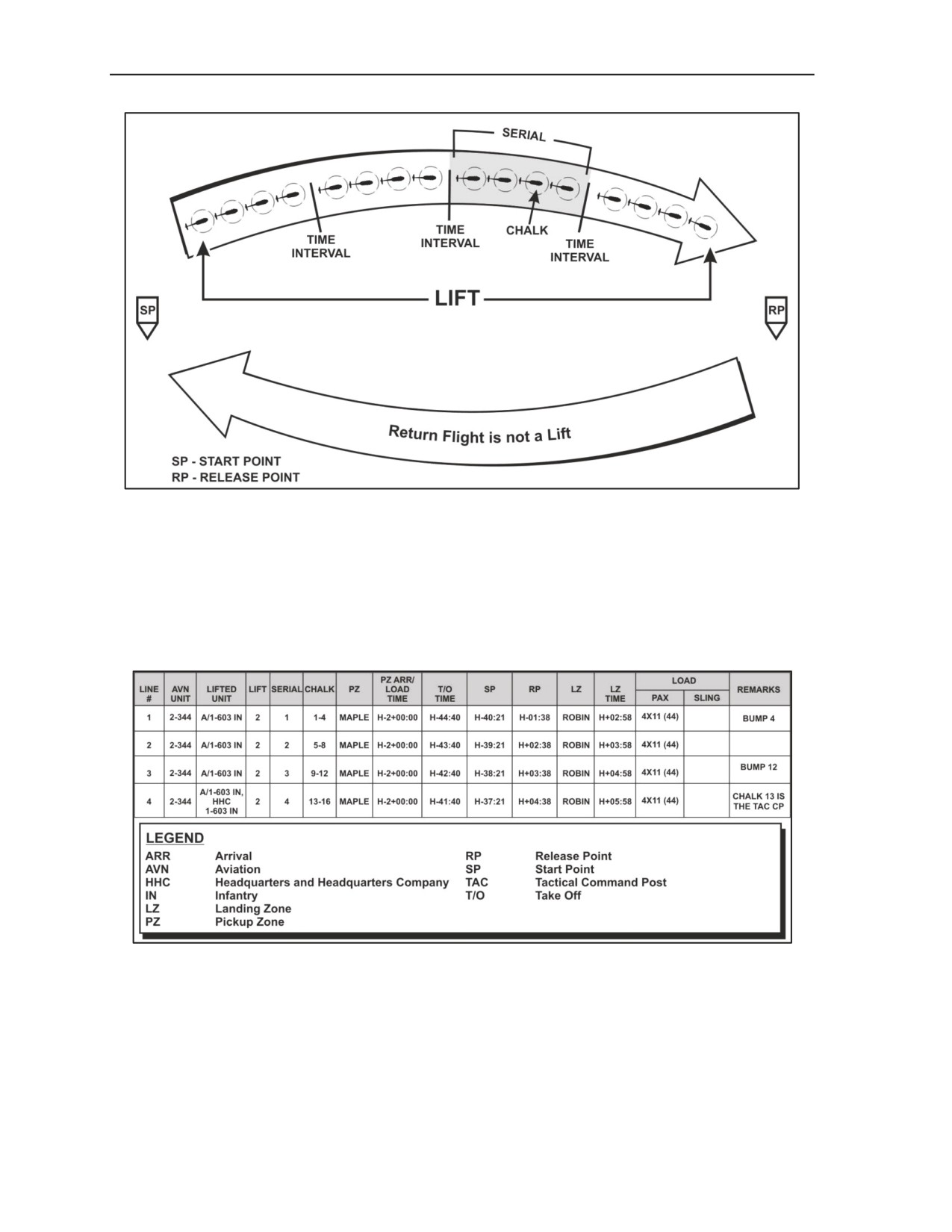
Chapter 13
Figure 13-2. Lifts, serials, and chalks
BUMP PLAN
13-22. The bump plan ensures that the most essential personnel and equipment arrive on time at the
objective area. It specifies personnel and equipment that may be bumped from an aircraft or serial, and
delivered later. Each aircraft load and serial has a bump plan sequence designated on its air movement
table. (See table 13-2.)
Table 13-2. Aircraft bump information
13-23. If all personnel within the chalk cannot be lifted, individuals must know who is to offload and in
what sequence. This ensures that key personnel are not bumped arbitrarily. This ensures that key aircraft
chalks are not left in the pickup zone. When an aircraft within a serial or flight cannot lift off and key
personnel are onboard, they offload and board another aircraft that has priority.
13-24. Bumped personnel report to a pickup zone bump area specified by company or larger units. At this
location, they are accounted for, regrouped, and rescheduled by the PZCO for later delivery to appropriate
landing zones. Sometimes, spare aircraft are held in reserve for bumped chalks in the event a primary
13-6
FM 3-99
6 March 2015
Loading and Staging
mission aircraft is unable to fly due to maintenance or other reasons. These spare aircraft remain staged on
the pickup zone for occasions such as these or to fly other high priority serials.
SECTION II - STAGING PLAN
13-25. The staging plan organizes the movement of Soldiers and loads into position for the forthcoming
air assault. It establishes the pickup zone and specifies the manner in which the supported unit organizes to
execute the loading plan. The staging plan prescribes the arrival of ground forces at the pickup zone in the
proper order for movement. It prescribes what actions the ground force must complete to prepare to load
the aircraft. All vehicles and equipment to be lifted should be properly configured, inspected, and ready to
load before the aircraft arrive at the pickup zone. Typically, ground forces arrive at the pickup zone and
posture in proper chalk order before their aircraft arrive. Considerations to develop a staging plan are
addressed in this section.
PREPARATION FOR LOADING
13-26. Preparations for loading are conducted in a unit assembly area or other secure location that is near
the pickup zone. Before reporting to the pickup zone, units complete all preparations to successfully load
the aircraft, to includeʊ
z
Completing the air-loading table or manifest. The chalk leaders verify the air-loading table to
ensure it is properly completed, making changes to the manifest before arriving to the pickup zone.
z
Preparing and inspecting all equipment for loading. The chalk leaders prerig all equipment to be
sling loaded and ensure vehicles have the proper equipment to rig and fly. The chalk leaders
inspect their loads and complete all necessary inspection records, to include DA Form 7382,
Sling Load Inspection Record, according to TM 4-48.09.
z
Conducting rehearsals for loading and off-loading the aircraft.
MOVEMENT TO PICKUP ZONE
13-27. Once units have completed preparations for loading, they begin movement to the pickup zone
according to the air movement table so that the Soldiers to load arrive shortly prior to the helicopter to be
loaded. This prevents congestion, preserves security, and reduces vulnerability to enemy actions on the
pickup zone. To coordinate the movement of units to the pickup zone, the PZCO—
z
Determines movement time of ground forces to the pickup zone.
z
Specifies arrival time(s).
z
Ensures that movement of units remains on schedule.
CHALK CHECK-IN AND INSPECTION
13-28. Upon arriving to the pickup zone area, the unit first checks in with the pickup zone control party at
chalk check-in. The PZCO should plan adequate time for check-in based on mission variables. As a rule,
the greater the number of serials in a lift, the longer it takes check-in and inspection for loading. Serials
with large numbers of vehicles and equipment to be sling loaded require more time to check in.
CHALK CHECK-IN
13-29. As the unit arrives at the check-in point, loads are identified by lift-serial-chalk. Chalk leaders are
briefed, and their air loading tables or manifests are inspected. The chalk leader provides one copy of the
manifest to the pickup zone control party.
LOAD WEIGH-IN
13-30. The loads then are weighed with all personnel and equipment to ensure they meet the ACLs as
briefed in the air mission brief. Overweight loads are sent to a designated frustrated cargo area to download
equipment before being reweighed.
6 March 2015
FM 3-99
13-7
Chapter 13
LOAD INSPECTION
13-31. All items to be loaded are inspected according to TM 4-48.09. For emergency purposes only, the
pickup zone control party may maintain a parts box for on-the-spot corrections. Units are responsible for
the serviceability and corrective maintenance of their own equipment.
13-32. Loads with deficiencies are sent to a designated frustrated cargo area. Loads must remain in the
frustrated area until deficiencies are corrected and the loads are inspected again. No load is allowed to leave
the frustrated area without permission from the PZCO.
LOAD STAGING
13-33. Once a serial is complete, a chalk guide from the pickup zone control leads it into position on the
pickup zone. Loads are staged in reverse chalk order by serial according to the pickup zone diagram.
13-34. Once the chalk is staged and in pickup zone posture, the chalk leader should brief his chalk on—
z
Seating arrangement.
z
Loading procedures.
z
Use of safety belts.
z
In-flight procedures.
z
Off-loading procedures.
SLING LOAD OPERATIONS
13-35. The three phases of a sling load operation are—
z
Preparation and rigging. Loads are prepared and rigged according to TM 4-48.09 or unit
standard operating procedures.
z
Inspection. A Pathfinder School graduate, Sling Load Inspector Certification Course graduate, or
an Air Assault School graduate in the rank of specialist and above is qualified to inspect and
certify each load. The individual who rigged the load cannot inspect the same load. The contents
of the load are recorded on a DA Form 7382.
z
Sling load operation. Trained ground crews hook up loads.
SLING LOAD UNITS
13-36. The three different elements involved in a sling load operation are the supported unit, the aviation
unit, and the receiving unit. In an air assault, the supported unit and the receiving unit are the same. The
responsibilities of each element are as described below.
z
Support unit is responsible for—
Selecting, preparing, and controlling the pickup zone.
Requisitioning all the equipment needed for sling load operations.
Inspecting and maintaining all sling load equipment.
Providing trained ground crews for rigging and inspecting, filing inspection forms,
controlling aircraft, aircraft guides, hooking up loads, and clearing the aircraft for departure.
Providing load dispositions and instructions to the aviation unit for the sling load
equipment.
Verifying the load weight (to include rigging equipment).
z
Aviation unit is responsible for—
Establishing coordination with the supported unit.
Advising the supported unit on load limitations.
Advising the supported units on the suitability of selected landing zones and pickup zones.
Providing assistance in the recovery and return of sling load equipment.
Establishing safety procedures and understanding of duties and responsibility between the
flight crew and ground crew.
z
Receiving unit is responsible for—
13-8
FM 3-99
6 March 2015
Loading and Staging
Selecting, preparing, and controlling the landing zone.
Providing trained ground crews to guide the aircraft and derig the loads.
Coordinating for the control and return of the sling load equipment.
Inspecting the rigging of back loads (sling load equipment returning to pickup zone).
SLING LOAD TEAMS
13-37. Three personnel are used for the ground crew in external load operations on the pickup zone or
landing zone. They are—
z
Signal person.
z
Static probe person.
z
Hook-up person.
13-38. The static probe person carries an electricity probe an insulated contact rod joined by a length of
metallic tape or electrical wire to a ground rod. All ground crew personnel wear the following
protective equipment:
z
Advanced combat helmet.
z
Goggles.
z
Earplugs.
z
Gloves.
z
Sleeves rolled down and buttoned.
z
Identification card and tags.
HOOK-UP SITE
13-39. The aircraft approaches the hook-up site, and the signal person guides it into position over the
load. The static probe person drives the ground rod into the ground and discharges the static electricity
from the aircraft by holding the contact rod, which is connected to the ground rod, to the cargo hook of the
aircraft. The hook-up person then attaches the apex fitting to the aircraft cargo hook.
Note. When using a cargo hook pendant the use of a static discharge wand is not required.
RELEASE SITE
13-40. The aircraft approaches the release site, and the signal person guides it into position. The hook-up
release team stands by but is not actively employed unless the slings cannot be released from the aircraft.
The ground crew at the landing zone comprises one signal person and two release personnel.
GROUND CREW EMERGENCY
13-41. In an emergency, the ground crew moves to a predesignated rendezvous point identified during
prior coordination with the aviation unit. Thorough preparation and rehearsal enable ground crews to react
to changes to the plan and unexpected events.
6 March 2015
FM 3-99
13-9
7KLV SDJH LQWHQWLRQDOO\ OHIW EODQN