FM 3-99 Airborne and Air Assault Operations (MARCH 2015) - page 3
Landing Plan
Requires moderately level, unobstructed landing zones with adequate soil trafficability.
Requires more time for delivery of a given size force than airdrop, especially for small,
restricted landing zones.
Generally requires improvement or new construction of airland facilities, which adds to the
engineer workload.
Requires some form of airlift control element support at offloading airfields. Mission
intervals depend on airlift control element size, offloaded equipment availability, and
airfield support capability.
Airland Organization for Movement
5-22. The tactical integrity of participating forces is a major consideration in an airland operation. Small
forces that are expected to engage in combat on landing, airland organizationally intact with weapons,
ammunition, and personnel in the same aircraft. Airland planning stresses placing forces as close as
possible to objectives, consistent with the availability of landing zones and the operational capability of the
aircraft employed. Because of aircraft vulnerability on the ground, forces unload as quickly as possible.
5-23. The airborne commander determines the composition of each aircraft load and the sequence of
delivery. The mission, the tactical situation, and the assault force’s task organization influence this
decision.
5-24. Forces should use facilities, such as roads and open areas, to reduce the time and effort required for
new construction. They should consider layouts that facilitate future expansion and provide maximum
deployment and flexibility. As the size and efficiency of an air facility improve, its value to the enemy as a
target increases. To reduce this vulnerability, the facilities should be dispersed and simple.
PLACE OF DELIVERY
5-25. Selecting drop zones and landing zones is a joint responsibility. The airlift commander is responsible
for the precise delivery of personnel and cargo to the drop zone or landing zone and selecting approaches to
the drop zone. Both joint and component commanders must base their decisions on knowledge of their
respective problems and on the needs of the overall operation. The nature and location of landing areas are
important considerations when preparing the scheme of maneuver. The general area in which they are to be
established is governed by the mission. At higher echelons, commanders can assign landing areas in broad
general terms. In subordinate units, leaders must describe their locations more specifically. Drop zones are
selected after a detailed analysis. If the enemy situation permits, the commander should choose a drop zone
directly on top of assault objectives. Commanders should consider the following factors when making their
selections:
z
Ease of identification. The drop zone should be easy to spot from the air. Airlift pilots and
navigators prefer to rely on visual recognition of terrain features to deliver personnel and
equipment in an accurate manner.
z
Straight-line approach. To ensure an accurate airdrop, the aircraft makes a straight-line approach
to each drop zone for at least 10 miles, or about four minutes at drop airspeed, before the start of
the drop.
z
Out of range. The commander should choose a drop zone that allows the forces to avoid enemy
air defenses and strong ground defenses and puts them outside the range of enemy suppressive
fires. To get to the drop zone, aircraft should not have to fly over or near enemy antiaircraft
installations, which can detect aircraft at drop altitudes. They should fly over hostile territory or
positions for the least possible time.
5-26. Suitable weather and terrain. The commander must consider the weather and terrain due to
conditions that may affect the usability of a drop zone.
z
Weather. Commanders should consider seasonal weather conditions when selecting drop zones.
Adverse weather effects can be devastating. Ground fog, mist, haze, smoke, and low-hanging
cloud conditions can interfere with the aircrew’s observation of drop zone visual signals and
markings. However, they do offer excellent cover for blind or area drop zones. Excessive winds
hamper operations.
6 March 2015
FM 3-99
5-5
Chapter 5
z
Terrain. Flat or rolling terrain is desirable; it should be relatively free, but not necessarily clear,
of obstacles. Obstacles on a drop zone do not prevent paratroopers from landing but increase
jump casualties. Sites in mountainous or hilly country with large valleys or level plateaus can be
used for security reasons. Small valleys or pockets completely surrounded by hills are difficult to
locate and should be used only in rare cases. Commanders must avoid man-made obstacles more
than 150 feet (46 meters) above the level of the drop zone within a radius of three nautical miles.
High ground or hills need not be considered a hazard unless the hills pose an escape problem
that is beyond the aircraft’s capability. High ground or hills more than 1000 feet (305 meters)
above the surface of the site should not be closer than three nautical miles to the drop zone for
night operations. The perimeter of the drop zone should have one or more open approach areas
free of obstacles that would prevent the aircrew’s sighting of the drop zone markings.
Cover and concealment. Cover and concealment near the drop zones or landing zones are a
distinct advantage when the airborne forces assemble and when airland forces land.
Road network. Having a drop zone near a good road network expedites moving personnel,
supplies, and equipment from that zone. If the landing area contains terrain that is to be
developed into an air landing facility, a road network is of particular value not only for
moving items from the facility but also for evacuating personnel and equipment as well.
However, a road network offers the enemy a high-speed avenue of approach and must be
defended.
Key terrain. The drop zone site selected should aid in the success of the mission by taking
advantage of dominating terrain, covered routes of approach to the objective, and terrain
favorable for defense against armored attack.
5-27. Minimum construction for drop zones or landing zones. Because of limited engineer support in the
airborne force, selected landing zones should have a minimum requirement for construction and
maintenance. Unless more engineer support is requested and received, construction and maintenance
restraints can limit the number of areas that can be used or developed.
5-28. Mutual support. Commanders should select mutually supporting drop zones or landing zones that
provide initial positions favorable to the attack.
5-29. Configuration. The division or brigade commander gives guidance on drop size in operations plans
or operations orders. Then each unit commander determines the exact shape, size, and capacity required.
z
Shape. The most desirable shapes for drop zones are rectangles or circles; these permit a wider
choice of aircraft approach directions. However, they require precise navigation and timing to
avoid collisions or drop interference.
z
Size. The drop zone should be large enough to accommodate the airborne force employed; one
drop zone that allows the aircraft to drop its entire load in one pass is desirable. Repeated passes
are dangerous because the initial pass can alert enemy antiaircraft and other emplacements,
waiting for subsequent drops.
There are certain situations, however, when multiple passes are used. This occurs mainly
when there is no significant air defense threat and orbits are made over areas where enemy
antiaircraft systems are not positioned. This applies especially to the seizure of islands
where small drop zones are the rule. If there are enough aircraft available to deliver the
force with fewer personnel on each aircraft, there is no real problem. However, if there are
only enough aircraft to deliver the assault echelon in one lift with each aircraft carrying the
maximum number of personnel, then the aircraft has to make multiple passes over the
drop zone.
A large drop zone can permit several points of impact to be designated and used. It is
desirable to saturate the objective area in the shortest possible time but there is a reasonable
limit to the amount of personnel and heavy equipment drop that can be stacked on a single
drop zone. Therefore, it can be desirable to use multiple points of impact on a single drop
zone provided the drop zone is large enough to permit this.
z
Capacity. The drop zone capacity is based on the expected number of forces to be dropped and
their dispersion pattern.
5-6
FM 3-99
6 March 2015
Landing Plan
5-30. Orientation. Thoughtful orientation allows the quickest possible delivery of the airborne force into
the objective area.
z
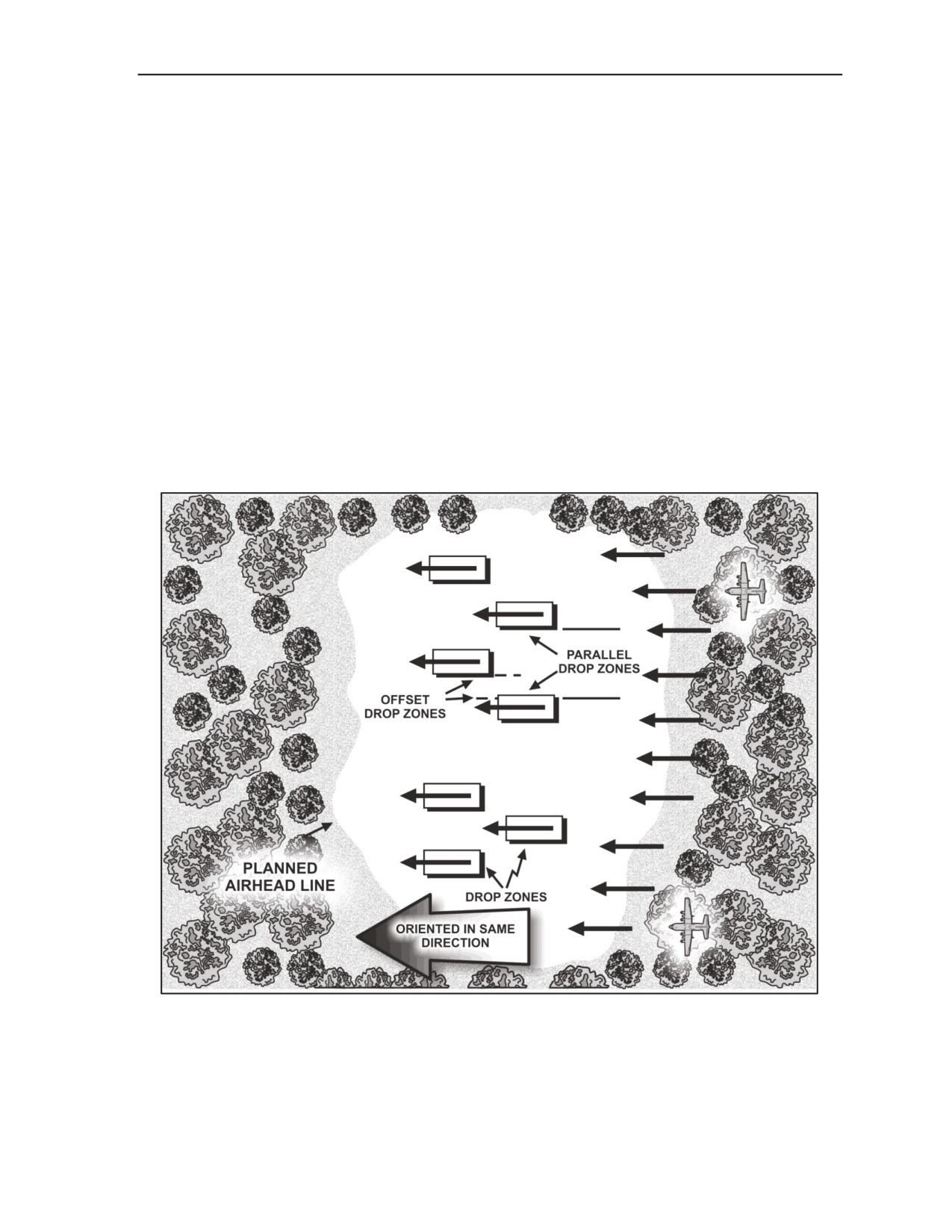
Ideal drop zones offset and parallel each serial. (See figure 5-1.) This allows aircraft to share a
flight route until they approach the objective area; then they can split at an initial point or release
point for simultaneous delivery on several drop zones.
z
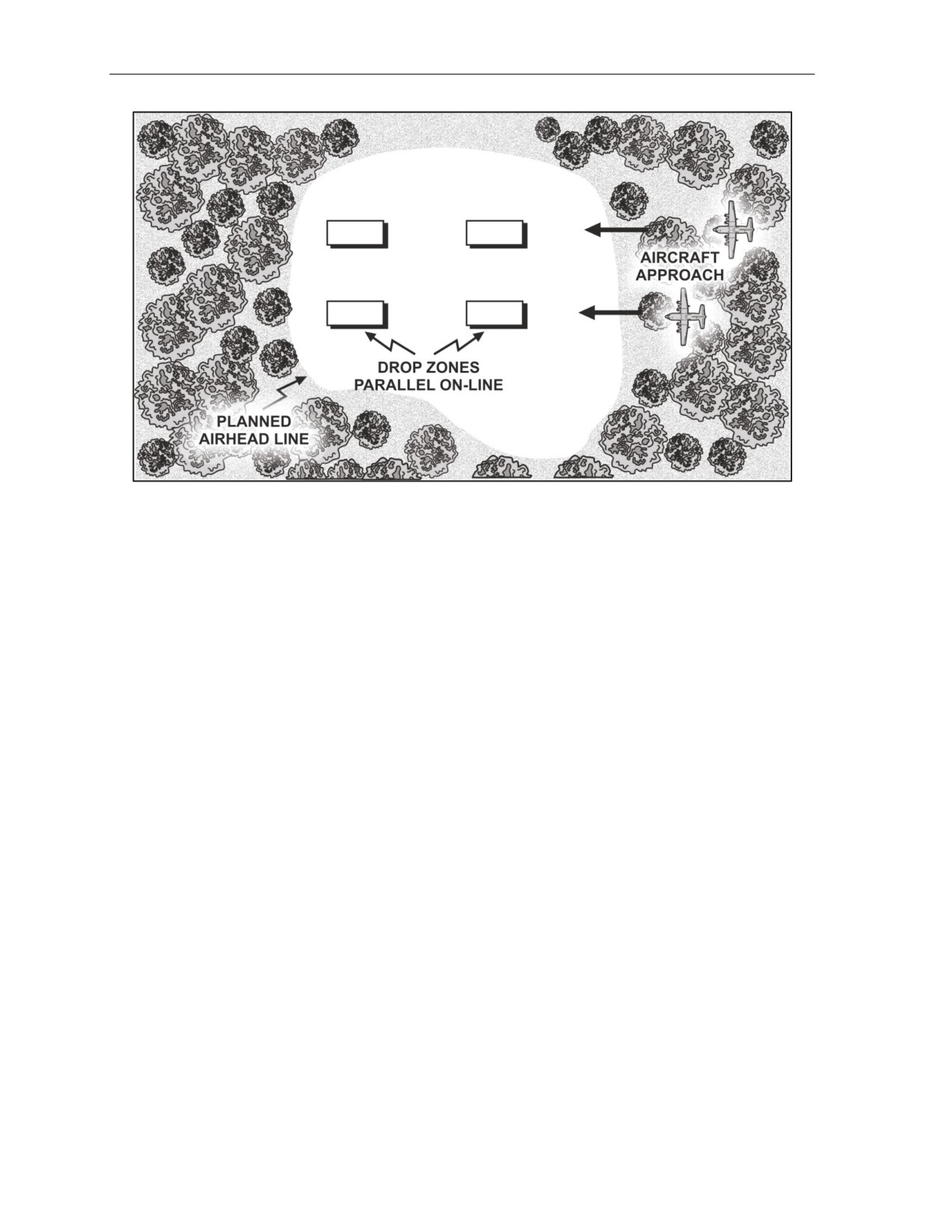
Another method is parallel on-line. (See figure 5-2, page 5-8.) This employs making two drops
on two drop zones in line , which eliminates a change of flight direction between the two drops.
The drop zones must be far enough apart to permit the navigators to compute the location of the
second release point.
z
Paratroopers are more likely to overshoot the drop zone than to undershoot it. The primary
objective for selecting the trailing edge drop zone for the primary assault is for personnel in the
front of the aircraft to exit last.
z
If a fighter aircraft escort or rendezvous is required for the drop, they must remain advised of the
drop pattern, the direction of all turns to be flown around the drop zone, and the areas to look for
possible enemy activity. Drop zones that require intersecting air traffic patterns should be
avoided, whenever possible. They delay simultaneous delivery of the force because of the safety
requirements to stagger delivery times and clear the air by at least a 5- or 10-minute formation
separation time. They require that joint suppression of enemy air defenses
(SEAD) is
accomplished for multiple routes instead of one. This may result in piecemeal delivery and an
unnecessarily complicated plan, violating the principles of mass and simplicity.
Figure 5-1. Offset and parallel drop zones
6 March 2015
FM 3-99
5-7
Chapter 5
Figure 5-2. Parallel on-line drop zones
5-31. Alternate drop zones or landing zones. Commanders must select alternate drop zones or landing
zones to compensate for changes that may occur.
5-32. Number of drop zones or landing zones. The number of drop zones to be used by the assault
parachute echelon of an ABN IBCT depends on the number, size, and relative position of suitable sites; the
ABN IBCT plan of maneuver; and the expected enemy situation. The maneuver battalions of an ABN
IBCT can land successively on the same drop zone, on separate battalion drop zones, or on adjacent areas
within a single large ABN IBCT drop zone. Advantages and disadvantages of each drop zone is address
below:
z
Single BCT drop zone. The use of a single ABN IBCT drop zone on which battalions land
successively has the following advantages:
It permits greater flexibility in the plan of maneuver and the plan of supporting fires.
It facilitates coordinating and controlling assault battalions.
It applies the principle of mass.
It makes logistical support easier.
It decreases the area of vulnerability.
z
The use of a single drop zone has the following disadvantages:
It slows the buildup of combat power.
It causes later airlift sorties to be vulnerable to enemy air because of the loss of surprise.
It allows the enemy to emphasize his efforts.
z
Separate battalion drop zones. The use of separate battalion drop zones has the following
advantages:
It increases readiness for action by deploying the ABN IBCT as it lands.
It reduces confusion on the drop zones during the landing and reorganizing.
It tends to deceive the enemy as to the intention and strength of the landing force.
It makes capture of the ABN IBCT objective easier when there is strong opposition on one
drop zone.
It increases the freedom of maneuver of the assault battalions.
z
The use of separate battalion drop zones has the following disadvantages:
It makes mission command more difficult.
5-8
FM 3-99
6 March 2015
Landing Plan
It reduces flexibility because forces are dispersed.
z
Adjacent drop areas. Landing battalions on adjacent areas within a single large ABN IBCT drop
zone has, although to a lesser degree, the same advantages and disadvantages of dropping on
separate drop zones.
TIME OF DELIVERY
5-33. No set rule can be prescribed for the timing of an airborne operation. It varies with each situation;
however, the airborne force tries to conduct airborne assaults during limited visibility to protect the force
and to surprise the enemy. The commander sets the specific time of delivery. However, for the landing
plan, times are stated in terms of P-hour. P-hour is the specific hour on D-day at which a parachute assault
commences with the exit of the first Soldier from an aircraft over a designated drop zone. P-hour may or
may not coincide with H-hour (FM 6-0). The following considerations affect the timing of the operation.
SUPPORT OF THE DECISIVE OPERATION
5-34. The airborne assault can be a shaping operation. If so, the time of commitment of the airborne forces
in relation to the decisive operation is directed by orders from higher headquarters. It is determined in
advance according to the mission, the situation, and the terrain. For example, the airborne force can be
committed in advance of the decisive operation to give the airborne assault an increased element of
surprise. It can be committed during the decisive operation to neutralize specific areas or to block the
movement of enemy reserves. It can be committed after the decisive operation to assist a breakthrough or to
block an enemy withdrawal.
VISIBILITY
5-35. The decision as to whether the airborne force is committed by night or day depends on the estimated
degree of air superiority, the need for security from enemy ground observation, the relative advantage to be
gained by surprise, and the experience of both airlift and airborne personnel.
5-36. As an advantage, night airborne operations greatly increase the chance of surprise and survivability,
and reduce the chance of attack by enemy aircraft during the air movement. They reduce vulnerability to
antiaircraft fire, conceal preparations for takeoff from the enemy, and reduce the effectiveness of the
defender’s fires. Daylight operations provide better visibility from the air and ground, more accurate
delivery, quicker assembly, and more effective friendly fires than night operations.
5-37. As a disadvantage, night airborne operations in zero visibility require well-trained Soldiers and
aircrews to locate the drop zone and assemble rapidly. They provide more air and land navigation problems
and offer slower rates of assembly than day operations. Night operations reduce the effectiveness of close
air support. Day operations increase vulnerability to enemy air defense, ground fires, and air attack, and
they result in loss of surprise.
INTERVALS
5-38. The time interval between delivery of the assault echelon (P-hour) and the follow-on echelon
depends on the availability of aircraft, the capacity of departure airfields, the number of aircraft sorties that
can be flown on the initial airborne assault, the availability of drop zones or landing zones within the
objective area, and the enemy situation. For example; if there are unlimited aircraft, ample departure
airfields, numerous drop zones or landing zones within the objective area, and little or no enemy air
defense, the commander could deliver the follow-on echelon immediately after the assault echelon. Thus,
the time interval could be so brief that it would be hard to determine which was the last aircraft of the
assault echelon and which was the first aircraft of the follow-on echelon. Regardless of the timing selected,
avoid setting a pattern.
SECTION III - PREPARATION AND SUPPORTING FIRES
5-39. An ABNAF’s organic fire support is typically limited to its mortars when initially conducting the
airborne assault phase of an entry operation. The ABNAFC must plan for the use of fire support external to
6 March 2015
FM 3-99
5-9
Chapter 5
the ABNAF until organic field artillery assets are delivered by heavy-drop or with the airland phase of the
operation. Once paratroopers de-rig and prepare their gun systems from the heavy-drop or airland and place
into action those systems, the ABNAFC then can use their supporting fires. As part of the landing plan and
following the ground tactical plan, the ABNAFC and staff must plan and integrate a fire support plan as
part of the operation.
FIRE SUPPORT PLANNING
5-40. Fire support planning for an airborne operation is initiated on receipt of the mission. Concurrent with
the development of the concept of the operation, the commander plans for fire support so that it is provided
throughout the operation.
PLANNING, COORDINATION, AND EXECUTION
5-41. Fire support teams, elements, and cells advise the commander on fire support capabilities and joint
fire support command and control, effective use of fires assets, and assist in the planning, coordination, and
execution of fires. Fire support planning, coordination, and execution for airborne operations are more
complex than ground operations not involving vertical envelopment due to the following factors.
5-42. The assault elements of the airborne force are quickly placed in direct contact with the enemy deep in
hostile territory. Initial operations are decentralized and communications can be limited or nonexistent.
During the initial airborne assault and periodically thereafter, airspace over the drop zone contains a high
density of airdrop aircraft, which complicates fire support aspects of airspace management.
5-43. Airborne force vulnerability increases during the time between landing and assembly or seizure of
assault objectives. This time varies based on force size and the mission variables of METT-TC. During this
vulnerable period, reliable communications are essential to coordinating and executing fire support
missions.
5-44. Calls for fire are sent under conditions where forces are in critical need of fire support. Units lack
firm knowledge of the situation, especially locating friendly and enemy forces. Calls for fire can come
when reliable ground communications have not been firmly established.
5-45. Initially, artillery support in the airhead is limited. This situation occurs at the same time as the
arrival of the assault echelon or the operation’s opening phase. Consequently, the bulk of fire support must
come from joint fire support assets and organic mortars. Fire support can be provided by the long-range
artillery of advancing friendly forces (if in range), Army long-range rocket or missile fire, and joint
interdiction.
INITIAL AVAILABLE FIRE SUPPORT
5-46. Joint fire support, organic mortars, and limited Army aviation and field artillery are usually the only
fire support available to the airborne force until the lodgment is established. Examples of initial available
fire support missions include:
z
Column cover for the assault and follow-up echelons and resupply sorties.
z
Suppression of enemy air defenses along the corridor selected for penetration and near the
objective.
z
Counterair operations to gain and maintain air superiority along the corridor and in the objective area.
z
Pre-assault fires of the airhead and other critical targets and deception.
z
Field artillery may conduct counterair missions by striking enemy aircraft bases, helicopter
forward aiming and refuel points, missile storage, and launch sites.
z
Air interdiction of the objective area to include armed reconnaissance missions targeted against
enemy forces that react to the airborne assault.
z
Air defense of marshalling areas, resupply airfields, and the airhead.
z
Close air support.
5-10
FM 3-99
6 March 2015
Landing Plan
FIRE SUPPORT ASSETS
5-47. Fire support assets can perform a variety of missions in support of the airborne assault. The
following are examples of standard missions arranged by type of asset.
Joint Air Support
5-48. Joint air support, preplanned and immediate, provides air interdiction and close air support to an
airborne operation. Types of support include:
z
Air interdiction pre-assault fires within the objective area and other critical targets.
z
Suppression of enemy air defenses.
z
Electronic warfare.
z
Close air support to the airborne assault force.
Naval Gun Fire
5-49. Naval gun fire, when available and in range, is a reliable, accurate, high-volume source of fire
support. Naval gun fire provides the following types of support:
z
Pre-assault fires of the objective area and other critical targets.
z
Suppression of enemy air defenses.
z
Direct support and general support of forces in contact.
z
Interdiction (land and sea).
Field Artillery
5-50. Artillery of linkup forces within range can provide the following support:
z
Interdiction fires.
z
Suppression of enemy air defense fires.
z
Counterfire.
z
Fires to maneuver units.
Army Aviation
5-51. Army aviation can conduct close combat attack when the intermediate staging base or forward
staging base is within range or when a secure airfield permits airland and buildup of Army aviation that is
transported in USAF airlift aircraft. They can support—
z
Interdiction of enemy reaction forces, especially mechanized forces with accurate, long-range
antitank fires.
z
Seizure of assault objectives with rocket fire and gunfire.
z
Reconnaissance and surveillance tasks within and beyond the security area.
FIRE SUPPORT CONSIDERATIONS
5-52. Fire support planning relies on careful, thorough planning based on fire support principles designed
to support maneuver. Fire support considerations include the following.
UNITY OF CONTROL AND CONTINUOUS LIAISON
5-53. Unity of control may be met through the establishment of joint headquarters (such as a joint task
force) to include a joint operations center or other higher headquarters, which is responsible for
coordinating fire support to the maneuver commander. Liaison, especially between Army and USAF units,
is necessary at all echelons down to battalion/squadron level. It must be supported with adequate
communications to facilitate command and to control lateral dissemination of information and
coordination. Joint agreements, memorandums of understanding, standard operating procedures, and signal
operating instructions all facilitate this effort. Example, each assault battalion and ABN IBCT must have
attached tactical air control party (TACP) and naval gun fire line of sight, if naval gun fire is available.
6 March 2015
FM 3-99
5-11
Chapter 5
CENTRALIZED COORDINATION
5-54. Due to the nature of the airhead and the required continuous airflow into the airhead, fire support
assets must be closely controlled to prevent fratricide and waste of assets. During the initial stages of an
airborne operation and before adequate ground communications can be established, coordination and
control of fire support are accomplished from an airborne platform.
5-55. On landing, each battalion/squadron or BCT or regimental headquarters establishes contact with the
airborne platform or joint airborne communications center/command post (JACC/CP) through the TACP.
Fire support, such as close air support, beyond that available from organic or direct support assets would be
requested from the airborne platform. Prioritizing and coordinating requests are accomplished by the
ground force commander’s representative in the airborne platform. His responsibilities include the following:
z
Prevent fratricide of ground personnel.
z
Ensure that requests do not interfere with incoming serials, other aircraft, or naval operations.
z
Determine the fire support means to be employed in coordination with appropriate commander’s
staff members.
z
Determine, while coordinating with the command staff, added safety or control measures
required then transmit them to the appropriate ground elements.
5-56. For air missions, the commander’s staff establishes contact with the appropriate flight, provides
essential information, and then hands the flight off to the appropriate TACP or forward air controller for
mission execution. At that point, the mission is conducted the same way as conventional operations. If
naval gun fire or air support is available, it is essential that a naval gunfire liaison officer be present in the
airborne platform to perform a similar function.
5-57. Once adequate facilities have been established in the airhead, fire support coordination
responsibilities are passed from the airborne platform to the ground commander and his staff. (There is no
doctrinal time for this transfer.) In some situations (for example, raids), this cannot occur; however, once an
ABN IBCT main or tactical command post is on the ground transfer takes place in most cases.
COORDINATION MEASURES
5-58. The ABNAFC, assigned an area of operation within the airhead, employs fire support coordination
measures (FSCMs) to facilitate rapid target engagement while simultaneously providing safeguards for
friendly forces. Boundaries are the basic FSCM. The fire support coordinator recommends additional
FSCMs to the commander based on the commander’s guidance, location of friendly forces, scheme of
maneuver, and anticipated enemy actions. FSCMs are either permissive or restrictive.
5-59. The primary purpose of permissive measures is to facilitate the attack of targets. Once they are
established, further coordination is not required to engage targets affected by the measures. Permissive
FSCMs include a coordinated fire line (CFL), a fire support coordination line (FSCL), and a free -fire
area (FFA).
5-60. The primary purpose of restrictive measures is to provide safeguards for friendly forces. A restrictive
FSCM prevents fires into or beyond the control measure without detailed coordination. Restrictive FSCM
include an airspace coordination area, a no-fire area (NFA), a restrictive fire area (RFA), and a restrictive
fire line (RFL). Establishing a restrictive measure imposes certain requirements for specific coordination
before the engagement of those targets affected by the measure. (Refer to FM 3-90-1 for a detailed
discussion of FSCMs.)
AIR MOVEMENT PLAN
5-61. Fire support during movement to the objective area is the responsibility of the airlift commander and
staff. However, the airborne force commander must be closely involved because of the possibility of
downed aircraft or a mission being diverted. Planning considerations includeʊ
z
Ensure fire support personnel and equipment is included on load plans and manifests.
z
Plan targets on enemy.
5-12
FM 3-99
6 March 2015
Landing Plan
ARTILLERY AND MORTAR EMPLOYMENT
5-62. The initial phase of the airborne operation is decentralized and flexible until the assault objectives are
secured and the airhead is established. During parachute assaults, the organic field artillery battalion of the
ABN IBCT provides field artillery support within the context of assigned tactical missions. Airborne
artillery adheres to tactics and methods applicable to other artillery units. Mortars provide rapid fire support
at the company and battalion level. If the battalion commander chooses to employ his mortars as a split
section, he also must plan how the mortar fire direction center will control fires.
NAVAL GUNFIRE
5-63. When operating on islands or near a coastline, naval gun fire support may be available to the airborne
force. Naval guns can provide high-volume, accurate fires employing a variety of ammunition.
Air and Naval Gunfire Liaison Company
5-64. The air-naval gunfire liaison company (ANGLICO) provides ship-to-shore communications and
long-range, fire control teams to adjust fire. In the absence of ANGLICO fire control teams, the fire support
team can call for and adjust fires through the ANGLICO team.
ANGLICO Organization
5-65. Deployed ANGLICO forces comprise a command element, operational element (air/naval gun fire
teams), and support element. Forces are as follows:
z
The company is organized into groupings. The headquarters or support section and divisional
air/naval gun fire section give command, control, administration, training, and logistics support
for the company. They provide fire support planning and liaison personnel to the airborne force.
Three ABN IBCT air/naval gun fire platoons provide liaison and control for air and naval gun
fire to the assault companies, battalion, and the ABN IBCT.
z
Each ABN IBCT platoon divides into an ABN IBCT team and two supporting arms liaison
teams, which support two forward battalions. Each supporting arms liaison team has two
firepower control teams, which support the forward companies of the battalions.
z
The ANGLICO assists the staff in matters concerning air and naval gun fire. It coordinates
requests for air and naval gun fire support from the battalions and squadron of the ABN IBCT
and represents the airborne mission control platform, if required.
z
The liaison officer and firepower control teams operate in the ground spot network. They
communicate with the ship by HF radio to request and adjust naval gun fire. The firepower
control team communicates with the liaison officer, using VHF radios. The liaison officer can
communicate with aircraft using UHF radios.
Tactical Missions
5-66. Naval gunfire ships are assigned one of two tactical missions—direct support or general support.
Missions are as follows:
z
Direct support. A ship in direct support of a specific unit delivers both planned and on-call fires.
(On-call fires are to the ship what targets of opportunity are to artillery units.) A fire control
party with the supported unit conducts and adjusts on-call fires; they can be adjusted by an naval
gun fire air spotter.
z
General support. General support missions are assigned to ships supporting units of ABN IBCT
size or larger. The fires of the general support ship are adjusted by an aerial observer or the
liaison officer assign the fires of the ship to a battalion supporting arms liaison team for fire
missions. Completing the mission, the ship reverts to direct support.
Coordination and Control Measures
5-67. Coordination and control measures that apply to naval gun fire are the same as for field artillery
except for adding the terms fire support area and fire support station. They are as follows:
6 March 2015
FM 3-99
5-13
Chapter 5
z
Fire support area. The fire support area is a sea area within which a ship can position or cruise
while firing in support. It is labeled with the letters “FSA” followed by a Roman numeral-for
example, FSA VII.
z
Fire support station. The fire support station is a specified position at sea from which a ship must
fire; it is restrictive positioning guidance. It is labeled with the letters “FSS” and followed by a
Roman numeralʊfor example, FSS VII.
AIR OPERATIONS
5-68. Air operations normally are conducted using centralized control and decentralized execution and are
integral to an airborne operation. They are performed concurrently and are mutually supporting and are
planned with ample communications for liaison and control. The following paragraphs discuss counterair
operations, close air support, air interdiction, airborne intelligence, surveillance, and reconnaissance, airlift
missions, specialized tasks, and air operations planning in support of airborne operations.
COUNTERAIR OPERATIONS
5-69. The ultimate objective of counterair operations is to gain and maintain theater air supremacy. This
has two purposes. It prevents enemy forces from effectively interfering with friendly areas and activities,
and it precludes prohibitive interference with offensive air operations in the enemy area. This is
accomplished by destroying or neutralizing the enemy’s air offensive and defensive systems. (Refer to
JP 3-01 for more information.)
Offensive Counterair Operations
5-70. Offensive counterair operations are conducted to seek out and neutralize or destroy enemy air forces
at a chosen time and place. They are essential to gain air supremacy and to provide a favorable situation for
other missions. Typical targets includeʊ
z
Enemy aircraft.
z
Airfields.
z
Tactical missile complexes.
z
Command and control facilities.
z
Petroleum, oil and lubricants and munitions storage facilities.
z
Aircraft support equipment and their control systems.
Suppression of Enemy Air Defense
5-71. Suppression of enemy air defenses (SEAD) is conducted to neutralize, destroy, or temporarily
degrade enemy air defense systems in a specific area by physical attack, electronic warfare, or both.
Airborne electronic warfare assets (See ATP 3-36.) often are used in conjunction with other air operations
or mission and are especially important to SEAD operations throughout the airborne operation. (Refer
to ATP 3-01.4 for more information.)
Defensive Counterair Operations
5-72. Defensive counterair operations contribute to local air control by countering enemy offensive
actions. By countering enemy offensive actions, theater forces can effectively use an in-place and
operational radar warning and control system, consisting of both ground and airborne elements. They
integrate and control the employment of fighters and air defense artillery.
5-73. Counterair tasks that are employed as a part of offensive and defensive counterair operations include
air-to-surface attacks, fighter sweeps, and the protection warfighting function (escort). Field artillery may
conduct counterair missions by striking enemy aircraft bases, helicopter forward arming and refuel points,
and missile storage and launch sites.
5-14
FM 3-99
6 March 2015
Landing Plan
CLOSE AIR SUPPORT
5-74. The objectives of close air support are to support surface operations by attacking hostile targets close
to friendly surface forces. Each air mission requires detailed integration with those forces. (Refer to JP 3-09.3 for
more information.)
AIR INTERDICTION
5-75. The objectives of air interdiction are to delay, disrupt, divert, or destroy an enemy’s military potential
before it can be brought to bear effectively against friendly ground forces. These combat operations are
performed far enough away from friendly surface forces so that detailed integration of specific actions with
the maneuver of friendly forces is not possible or required. (Refer to JP 3-03 for more information.)
AIRBORNE INTELLIGENCE, SURVEILLANCE, AND RECONNAISSANCE
5-76. Airborne intelligence, surveillance and reconnaissance missions are directed toward satisfying the
requirements of joint force and component commanders engaged in surface and air operations within the
joint operational area. The JFC’s J-2 and J-3 jointly develop an overall collection strategy and posture for
the execution of the intelligence, surveillance, and reconnaissance missions. These airborne missions
provide timely information, either visually observed or sensor recorded, from which intelligence is derived
for all forces. Surveillance operations continuously collect information; reconnaissance operations are
directed toward localized or specific targets. (Refer to JP 3-30 for more information.)
AIRLIFT MISSIONS
5-77. The basic mission of airlift is passenger and cargo movement. This includes combat employment and
sustainment, combat airlift missions that rapidly move forces, equipment and supplies from one area to
another in response to changing conditions. Within airborne operations, combat employment missions
allow a commander to insert surface forces directly and quickly into a objective area or airhead and to
sustain combat operations through air landing of follow-on forces and sustainment operations. (Refer to JP
3-17 for more information.)
SPECIALIZED TASKS
5-78. Specialized tasks are those operation conducted in direct or indirect support of primary air and
ground missions. These activities include, but are not limited to electronic combat, combat search and
rescue, and air refueling operations.
AIR OPERATIONS PLANNING
5-79. Planning for air operations begins with understanding the JFC’s and ABNTFC’s mission and intent,
and occurs in a collaborative manner with other components to integrate operations across the joint force.
The joint air operations plan is the JFC’s plan to integrate and coordinate joint air operations and
encompasses air capabilities and forces supported by, and in support of, the airborne operation and other
joint force components in the objective area.
Command and Control of Joint Air Operations
5-80. With the beginning of air operations in the objective area, provision must be made for command and
control air operations with the supported ground effort. A joint operations center, where the supporting air
component and the airborne force is represented, performs the planning, integration, direction, and
supervision of the air effort according to the needs of the airborne force. Command and control
considerations for air operations during airborne operations include:
z
Preparation. If an airborne operation includes tactical air elements, the joint force commander
directs part or all of the preliminary air efforts while other preparations for the operation are
completed. Air support before and during the mounting of an airborne operation is a USAF
responsibility . When the airborne force does not include tactical air elements. Therefore,
6 March 2015
FM 3-99
5-15
Chapter 5
requests from the joint airborne force commander involving both reconnaissance and fire
missions are processed through normal joint operations center channels.
z
Assault. Requirements during the assault phase are the same for all airborne operations. During
the dropping or air landing and assembly of assault elements, aircraft that are on air alert status
over drop zones or landing zones defend against hostile surface or aerial reaction to the assault.
z
Consolidation and exploitation. Air control network facilities in excess of tactical air control
parties and airborne platforms are meager until the air landing of more supplies and
reinforcements during this phase. In an operation, that does not involve an immediate linkup
after seizure of objectives; the air landing of reinforcing or supporting elements provides for the
rapid expansion and improvement of tactical air control networks to meet the needs of
anticipated emergencies.
Aircraft providing support subsequent to the assault phase are based within the objective
area, outside the objective area, or both. In view of the logistics demands of aircraft, air
support is based within the objective area only when it cannot be effectively provided from
outside. Limitations in the effective radius of aircraft are the determining factors. An
airstrip or sufficiently adaptable terrain is one of these factors in selecting an objective area.
A single commander in the objective area has command over both ground and air elements.
However, an officer charged with broader responsibilities whose headquarters is outside the
objective area can retain such command.
Integration to Support Ground Operations
5-81. Adequate air support of an airborne operation requires some integration of airborne forces and air
activity in support of ground operations.
z
The air operations plan is based on the overall USAF mission and the amount of available
strategic, tactical, and airlift effort. The effect of forecasted weather en route and in the proposed
area of operation must be considered.
z
Offensive and defensive air operations must be continuously planned in support of an objective
area. Immediate air support must be continuously available (on air alert) in spite of an apparent
absence of targets.
Air Traffic Control
5-82. Air traffic control in the airhead is initially an USAF combat control team responsibility. Augmented
combat control teams can be replaced by Army air traffic control units at a later time. Air traffic services
provided to airborne forces come from contingency corps assets. Liaison, beacon, and tower teams are the
most frequently employed elements. Actions are as follows:
z
During alert, marshalling, and deployment, a liaison team is sent to the headquarters that is
planning the operation; it serves as a part of the section and provides advice on airspace
management, especially in the airhead. The main concern in planning is the handoff between
combat control teams and air traffic control parties. Combat control teams control the airhead
with the advice and assistance from air traffic control personnel until follow-on air traffic control
elements arrive.
z
Beacon and tower teams deploy with the aviation or ABNAF main command post attached to
the S-3 section. These teams provide initial air traffic control in the airhead. The beacon team
provides terminal guidance for Army aircraft from their intermediate staging base into the
airfield. The tower team augments the combat control team party. The amount of control given
up by combat control teams to air traffic control teams depends on the size of the airflow.
z
Operational control of air traffic control assets usually passes to the senior aviation unit
commander once he is established in the airhead. Forward arming and refueling point and
aviation assembly area operations include air traffic control elements and services, as specified
by the senior aviation unit commander.
5-16
FM 3-99
6 March 2015
Landing Plan
SECTION IV - ASSEMBLY AND REORGANIZATION
5-83. The success or failure of the mission can depend on how fast the airborne force can regain its tactical
integrity. The first goal of an airborne assault must be to deliver and assemble all available combat power
as rapidly as possible. The more rapidly assault force personnel assemble and reorganize as squads,
platoons, and companies, the sooner they can derig equipment and conduct the operations plan as a
cohesive force. How efficiently and rapidly this happens is a direct result of detailed planning, cross
loading on assault aircraft, and assembly and reorganization on the drop zone.
ASSEMBLY
5-84. Because the assembly is a key to success, it must be as deliberate and simple as possible. Assembly
is more than accounting for personnel; the commander must ensure the force has regained its tactical
integrity, and is organized and prepared to fight as a combined arms team. The slower the force assembles,
the more it risks failure. An airborne force’s assembly plan consists mainly of the following tasks:
z
Establish and secure assemble areas and/or assault positions.
z
Place all organic and attached weapon systems into action as quickly as possible.
z
Reestablish mission command (such as radio networks or reporting to higher headquarters).
z
Assemble the force and account for casualties and stragglers.
CROSS LOADING FOR RAPID ASSEMBLY
5-85. Cross loading of key personnel and equipment is an important factor in rapid assembly. Careful
attention is given to cross loading and includes the following actions:
z
Personnel. Separate key personnel in case an aircraft aborts or fails to reach the drop zone. This
prevents the loss of more than one key officer or noncommissioned officer of a unit.
z
Heavy equipment drop loads. Always plan for the possibility that one or more heavy equipment
drop aircraft aborts before it gets to the drop zone or the equipment streams in and becomes
unserviceable.
z
Individual equipment and weapons. Planners should separate radios, mortars, antitank weapons,
ammunition bundles, and other critical equipment or supplies as much as possible. No like items
of combat-essential equipment from the same unit should be on the same aircraft if possible.
z
Paratroopers jumping additional equipment containers or weapons systems such as antitank
weapons should be jumped at any position in the stick to support cross loading and assembly
plans. The commander must make a risk assessment when locating paratroopers in the stick
carrying this equipment.
z
Risks to both the paratrooper and mission accomplishment are present. If the paratrooper falls
inside the aircraft, the remainder of the personnel may not be able to exit on that pass. In
addition, this equipment increases the risks of the paratrooper being towed outside the aircraft.
ASSEMBLY METHODS
5-86. Based on the mission variables of METT-TC, the ground force commander may elect to use one of
the following methods:
z
Assembly on the assault objective. This method may be used when speed is essential, the
objective is lightly defended, or the enemy can be suppressed.
z
Assembly on the drop zone. This method may be used when: the drop zone does not use follow-
on forces, speed is not essential, and dismounted avenues of approach from the drop zone to the
objective are available.
z
Assembly adjacent to the drop zone. This method may be employed when the drop zone is to be
used by follow-on forces or if the drop zone is compromised during the airborne assault.
ASSEMBLY AIDS
5-87. To speed up assembly after landing, airborne forces use assembly aids to orient themselves on the
ground and to locate their unit’s assembly area. Assembly aids help identify personnel, equipment, and
6 March 2015
FM 3-99
5-17
Chapter 5
points or areas on the ground. Units can use visual, audible, electronic, natural, or individual aids; for
reliability and ease of recognition, units combine these. Operators of assembly aids land as close as
possible to their assembly area so they can mark the area. An USAF combat control team or LRSC team
may place assembly aids if the situation permits. Partisans, special operations forces personnel, or high-
performance aircraft can deliver assembly aids. Whenever possible, regardless of the method chosen to
emplace the aids, commanders should provide backup personnel, backup aids, and backup delivery means.
Control Posts
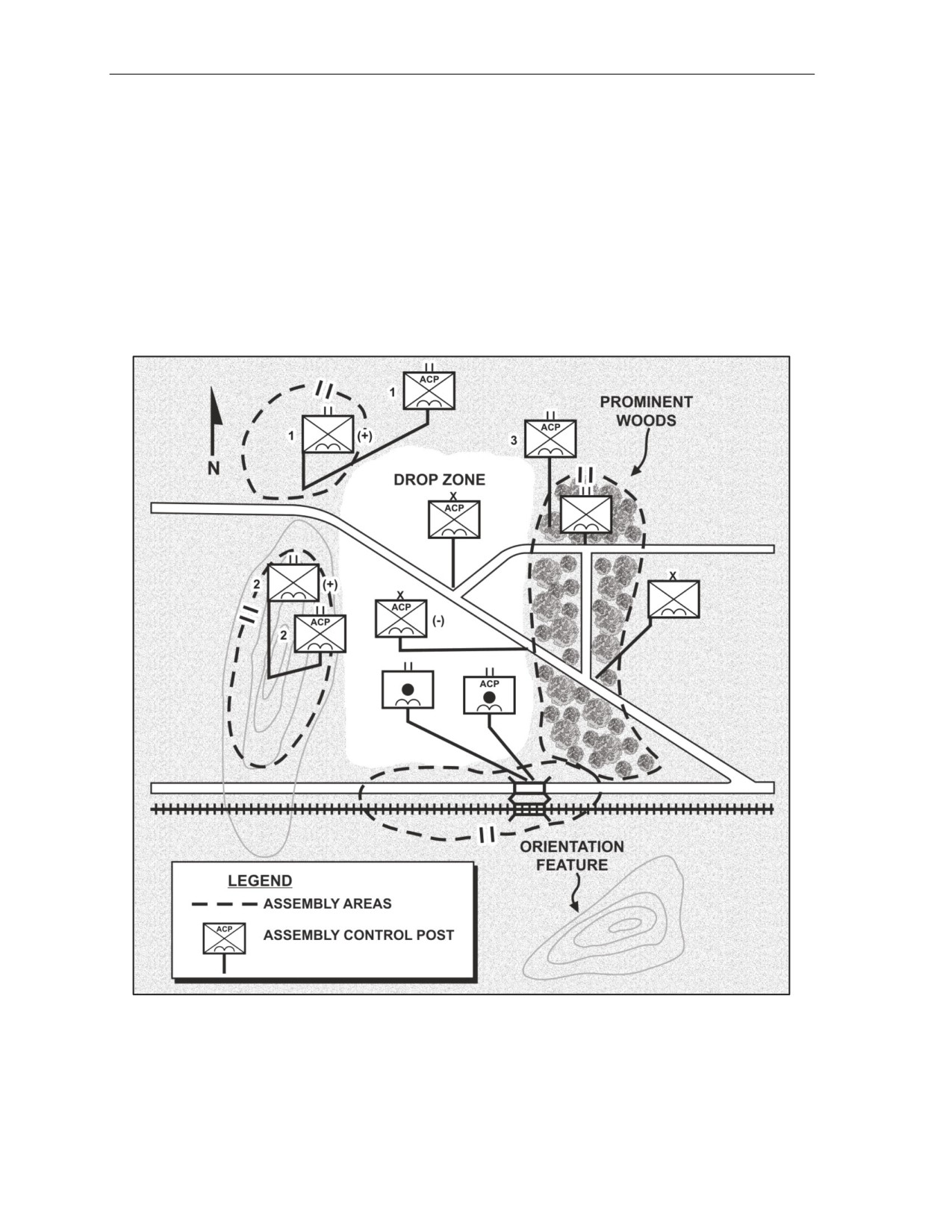
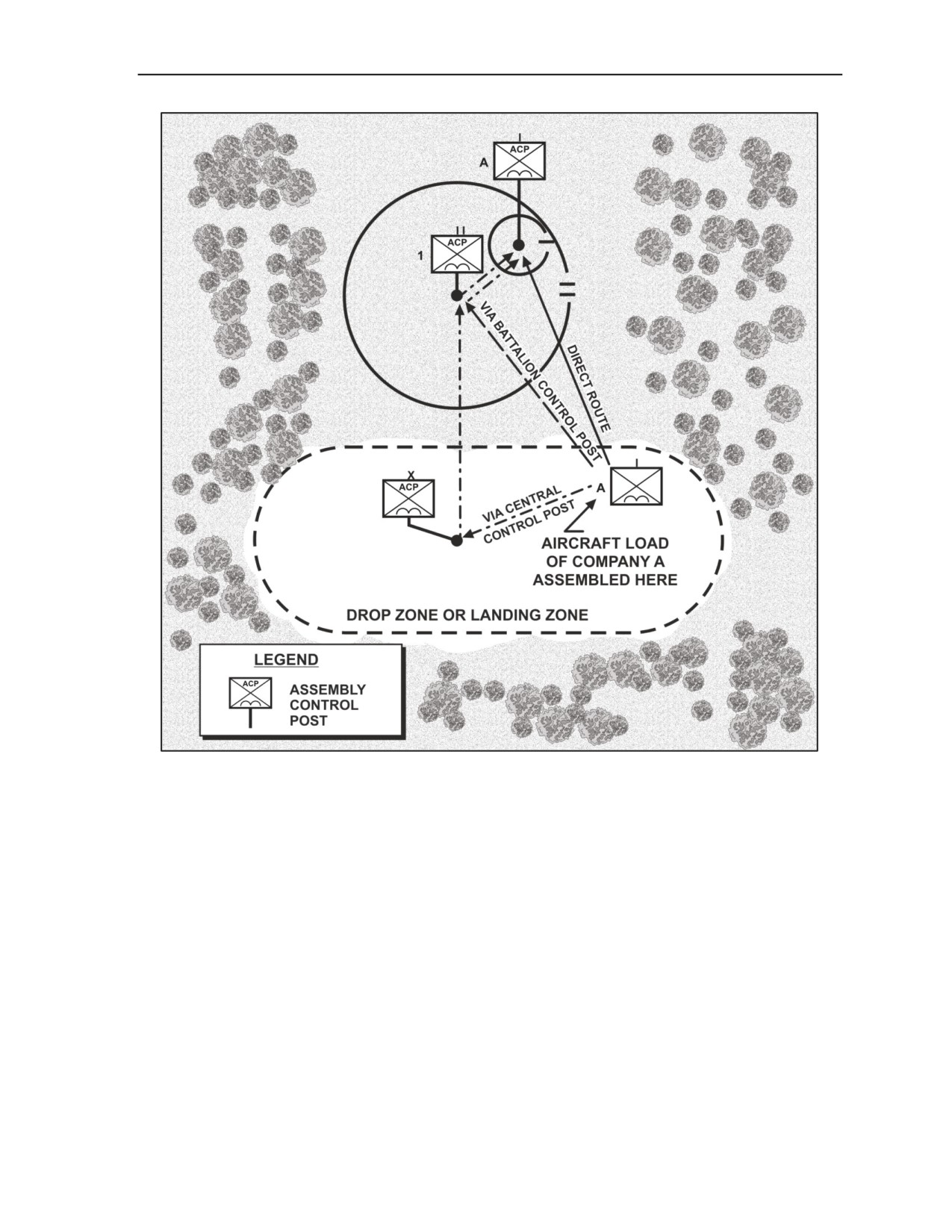
5-88. An assembly control post is established by a small party equipped with assembly aids, which moves
after landing to a predesignated location to help assemble assault forces. (See figures 5-3 and 5-4.) Each
drop zone or landing zone has a control post in or near the unit assembly area to coordinate and regulate
assembly. No standard organization exists for control posts; their composition varies with the size of the
parent unit, the number and type of assembly aids, the terrain, and the assigned mission.
Figure 5-3. Assembly control posts for ABN IBCT forces landing on one drop zone
5-18
FM 3-99
6 March 2015
Landing Plan
Figure 5-4. Movement of personnel to company assembly area
Line-of-Flight or Clock System
5-89. The line of flight parallels the parachute-landing pattern. This helps each paratrooper establish his
own landing position relative to those of the other members of their planeload. Leaders use the clock
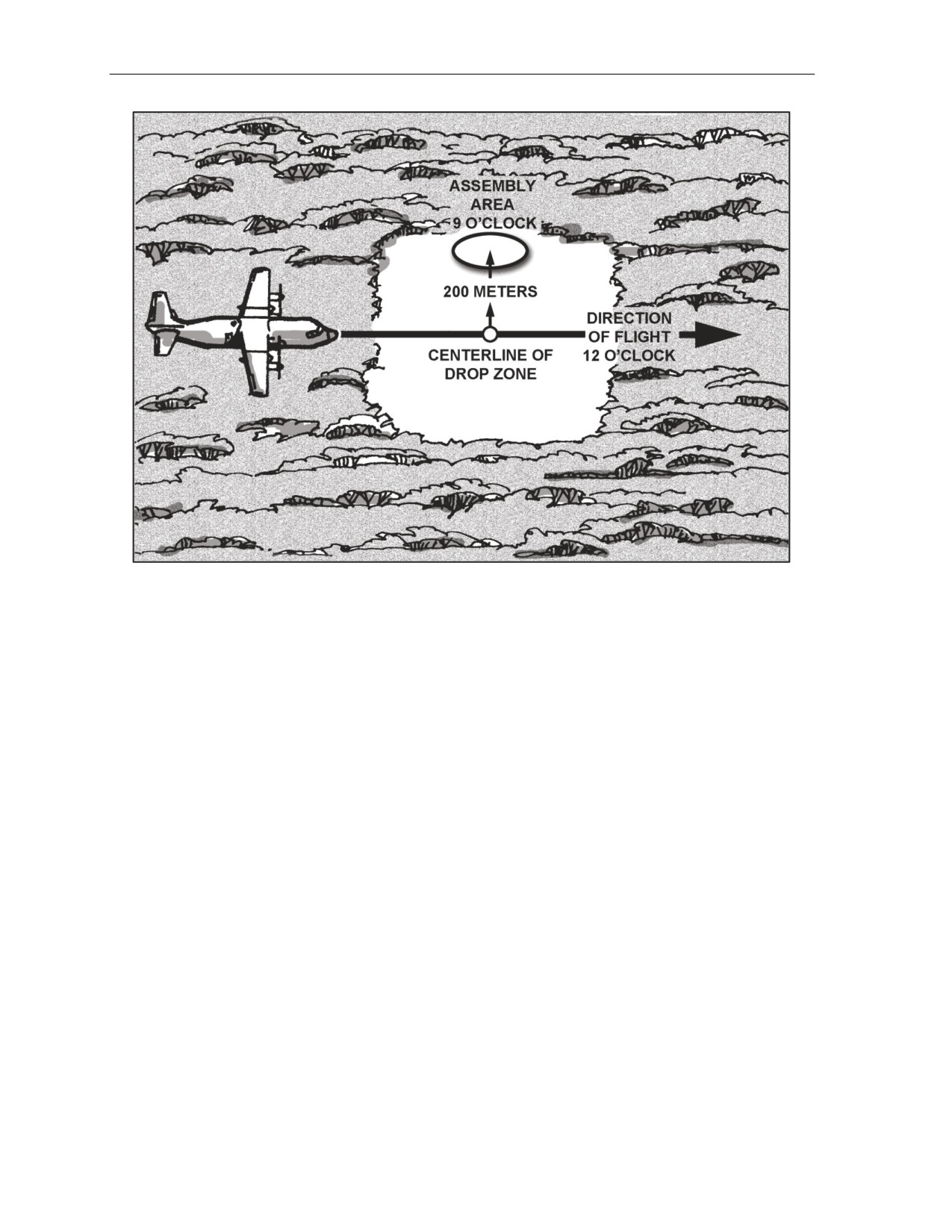
system to brief personnel, calling the direction of flight 12 o’clock. (See figure 5-5, page 5-21.) After
landing, personnel assemble to the right of the drop zone at 3 o’clock or to the left of the drop zone at 9
o’clock.
6 March 2015
FM 3-99
5-19
Chapter 5
Figure 5-5. Line-of-flight/clock system
Natural Assembly Aids
5-90. These aids include landmarks or easily recognizable terrain features that forces can use as assembly
aids or that personnel can orient their movement on. These features include hills; stream junctions; clumps
of woods; or man-made objects like radio towers, bridges, buildings, crossroads, or railroads. Units cannot
rely on natural features as the primary assembly aid. The assembly plan must be usable regardless of the
drop zone. Executing contingency plans en route may require assembly on an alternate drop zone; an
emergency exit from the aircraft can place paratroopers on an unfamiliar drop zone.
Assembly Equipment
5-91. Airborne forces carry visual, audible, or electronic aids to help them assemble. Planners assign
different colors, sounds, and coded signals to each unit. The unit standard operating procedures
standardizes assembly aids. However, units can adapt assembly aids to fit specific situations or
environments. Terrain restrictions and battlefield noise do not restrict the use of the best assembly aids,
which are simple to use. Units usually use visual assembly aids. Assembly equipment may include:
z
Visual aids. Visual aids include visible light sources (such as beacons, flashlights, strobe lights,
or signal mirrors; panels; flags), balloons; infrared lights (such as metascopes, flashlights with
filters, infrared weapons sights, or starlight scopes); pyrotechnics; and chemical lights. These
aids are simple to use and afford positive identification of assembly areas. However, the enemy
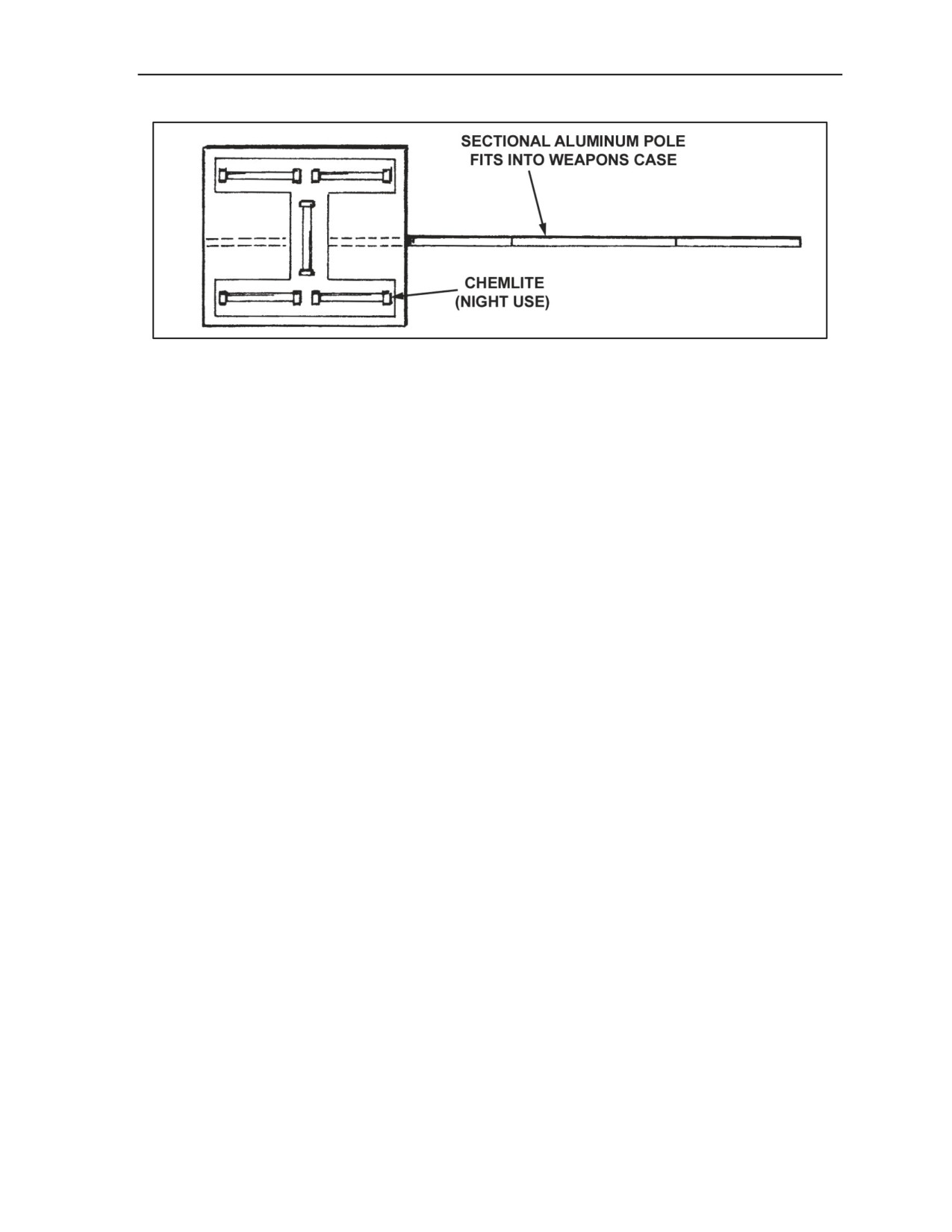
can see them as well as friendly personnel can. The Stiner aid has a cloth panel with a colored
letter; that is, HHC=White “H.” They are the same color for night use. (See figure 5-6.) It has
pockets for chemical lights; the letter and pockets are on both sides. It is mounted on a sectional
aluminum pole that fits into a weapons case.
5-20
FM 3-99
6 March 2015
Landing Plan
Figure 5-6. Stiner aid
z
Audible aids. Audible aids especially help small units assemble at night. They include tin
crickets, sirens, cowbells, air horns, triangles, dinner bells, ratchets, drums, gongs, whistles,
bugles, and voice signals. They are used to identify individuals or assembly areas. Strong winds,
gunfire, aircraft sounds, an elevation high above sea level, and other factors can limit their
effectiveness. The normal sounds of the battlefield easily mask or confuse the sounds of audible
assembly aids.
z
Electronic aids. Units can use organic radios to direct small units to assembly areas, using
landmarks as references. They can use radio homing devices. A homing device is a lightweight
attachment to a standard field radio; it is an excellent aid for day or night assembly. With it, a
radiotelephone operator (RATELO) can pick up a coded signal beam from a transmitter at the
assembly area. By following the beam, the RATELO homes in on the transmitter and leads the
unit to the assembly area. Signal crews can make equipment homing assembly aids from a
standard portable field radio or transmitter. The unit attaches the radio to the equipment and
turns it to a designated frequency. They encase it in shock-absorbing material just before its
extraction from the aircraft. This method is especially useful for assembling crews on heavy
equipment drop loads.
z
Field-expedient aids. The unit uses numerous field-expedient assembly aids; only the Soldiers’
imaginations limit the choices. For example, they can burn gasoline-soaked sand in cans or other
containers; fashion a light gun or a one-direction light source by placing a flashlight in the
receiver of a grenade launcher or other tube system; or lift a deployed main or reserve parachute
so other unit members can see it.
Identification Markings
5-92. Identification markings aid positive, rapid identification of personnel and equipment that speed up a
unit’s assembly. The airborne force standardizes personnel and equipment markings for all subordinate
units. Specifics on markings are as follows:
z
Personnel markings. Soldiers use individual assembly aids to help recognize individuals and
assemble units. Individual aids include colored armbands or helmet bands, distinctive patches or
designs on uniforms, or helmet bands of luminous tape. Sortie commanders and key leaders,
jumpmasters, safeties, other jumpmaster personnel, medics, and bump personnel use distinctive
markings. Larger force standard operating procedures prescribe unit designations to prevent
duplication and to allow unit-wide understanding.
z
Equipment markings. Aerial equipment containers are identified by simple, distinctive markings.
Distinctive unit markings are prescribed by larger force (ABN IBCT or division) standard
operating procedures to prevent duplication and to assist in recognition by other units. Unit
codes are placed on the bottom and all sides of each container; they should be visible for at least
50 meters. Various color parachute canopies, container colors, luminous tape and paints, smoke
grenades, homing devices and lights can be used with the containers to facilitate identification
on the ground and in the air. Lights and homing devices attached to equipment can be activated
6 March 2015
FM 3-99
5-21
Chapter 5
manually aboard the aircraft just before extraction, either by improvised timer, or on the ground
by the first individual to reach the equipment.
z
Assault aircraft markings. A simple code symbol
(using various designs, colors, and
combinations of letters and numbers) can be painted on both sides of the fuselage of assault
force aircraft to identify the contents. This symbol is large enough to be seen, and it indicates not
only the type of equipment contained in the aircraft but the unit to which the equipment belongs.
FORCE ASSEMBLY
5-93. Commanders base the assembly of the airborne force on a simple, flexible plan that adapts to any
likely situation. Assault forces assemble speedily, silently, and without confusion.
Drop Zone Assembly
5-94. When moving to an assembly area first as opposed to an assault objective, to speed assembly on the
drop zone, forces should—
z
Establish an assembly control point. Location of this point is dependent upon unit scheme of
maneuver. A designated assembly control point officer in charge or non-commissioned officer in
charge accounts for all paratroopers as they report to the control point. He then confirms azimuth
and distance to the assembly area, or if the situation changes gives a new azimuth and distance to
an alternate assembly area.
z
Establish the assembly area. Locate the force assembly area in a covered and concealed position
off the drop zone. The first group to arrive in the unit assembly area should first establish local
security, and then establish the predetermined assembly aid as soon as possible to assist in
directing the rest of the unit to the assembly area.
z
Depart the assembly area. Move out rapidly on assigned mission once enough combat power is
established. Leave a small element in the assembly area to assemble and account for personnel
that have not arrived for later linkup.
Troop Briefings
5-95. Assault force personnel must understand individual actions during assembly. Personnel briefings
include the following information:
z
Brief assault force personnel and rebrief them on the assembly plan for their unit and on those of
other units scheduled to share the same drop zone.
z
Use visual aids such as maps, aerial photos, terrain models, and sand tables.
z
Warn personnel to resist guiding on what appears to be a prominent terrain feature on a map.
Once they are on the ground, the terrain feature probably cannot be seen. This is especially true
if personnel land on the wrong drop zone or on the wrong part of a drop zone.
z
Use the clock directional system. Instruct personnel to orient themselves and the general location
of the assembly area by the direction of flight.
Note. Regardless of the actual azimuth, the direction of flight is always 12 o’clock.
FACTORS AFFECTING ASSEMBLY
5-96. When preparing the assembly plan consider dispersion (such as the speed, altitude, and flight
formation of airlift aircraft and their effect (along with wind) of personnel and equipment in landing. The
resultant landing pattern significantly affects assembly, as does the drop zone length and width, the training
level of the airborne forces and pilots, the enemy situation, and cross loading.
Dispersion
5-97. The extent of dispersion is the result of the airlift formation; type, speed, and altitude of the aircraft;
number of serials; sequence of delivery weather conditions; and aircrew proficiency. Dispersion covers the
following:
5-22
FM 3-99
6 March 2015
Landing Plan
z
The speed at which airplanes carrying paratroopers cross the drop zone affects the length of the
landing pattern. The greater the speed, the greater the distance that is covered between the exit of
each paratrooper, thus increasing the length of the landing pattern. Planes cross the drop zone as
slowly as is safely possible, and paratroopers exit rapidly to reduce dispersion.
z
As paratroopers descend, they drift with the prevailing wind, but usually not at a uniform rate for
each paratrooper. They can pass through strata of varying wind direction and velocity that causes
some dispersion within the force. Due to the wind and higher altitude, there is a great possibility
of dispersion. Therefore, the aircraft cross the drop zone at minimum altitudes that are consistent
with the safety of aircraft and paratroopers.
z
In parachute landings, the width of the landing pattern of paratroopers and equipment is the
approximate width of the aircraft formation at the time of the drop. Therefore, keep the
formation tight as possible to keep paratrooper and equipment together. If possible, place a
company or battalion in the flight formation so that all planeloads of the force land in a small
pattern as close as practicable to the assembly area.
Drop Zone Visibility
5-98. Darkness, fog, haze, rain, brush, trees, and terrain affect drop zone visibility on the ground, and
hence impact on assembly. Darkness complicates assembly— poor visibility and difficulty in identifying or
recognizing assembly areas, control posts, personnel, and equipment. Although it provide concealment,
darkness contributes to confusion, to stragglers, and to the loss of equipment. An assembly during darkness
takes longer and requires more elaborate assembly aids and larger control posts than a daylight assembly.
State of Proficiency
5-99. One of the most important factors that affect rapid assembly is proficiency. Assault forces must
conduct parachute assaults and assemble as they would in combat. For specific missions, previous training
is built on and tailored through detailed briefings to include maps, photos, and terrain models. When
possible, rehearsals using assembly methods planned for the assault are used. Thorough orientation,
rigorous training, aggressive leadership, and individual initiative have the single greatest impact on an
airborne assault and assembly.
Enemy
5-100. Enemy action can have both a direct and indirect effect on assembly. Enemy action indirectly
affects en route airlift capability to deliver the force to the correct drop zone. It directly affects friendly
assembly once on the ground. Enemy opposition during or immediately after landing is a critical
consideration affecting assembly due to the unusual vulnerability of the airborne force between landing and
the completion of assembly or seizure of assault objectives. While the commander should attempt to
achieve an unopposed landing, every possible provision is made to deal with enemy resistance. This
requires accurate intelligence, responsive fires, and effective OPSEC and military deception. When
assembly is on the assault objective, individuals linkup as they move using appropriate movement
techniques in accordance with the operation plan.
MULTIPLE POINTS OF IMPACT
5-101. A slightly more complicated but more efficient method to facilitate rapid assembly of paratroopers,
container delivery systems, and heavy equipment drop loads is the use of multiple points of impact. The
theory and methods of cross loading apply as much to this method of delivery as to any other. When the
USAF drops paratroopers along a single track (line of flight) down the center of the drop zone they use just
one personnel and one heavy equipment drop impact point. When conducting multiple points of impact,
USAF aircraft fly multiple tracks across the drop zone and use multiple impact points on the drop zone. By
efficient cross loading, selecting assembly areas, and carefully selecting personnel and equipment points of
impact, personnel, units, and equipment can be delivered closer to assembly areas than the single-track, one
personnel and one heavy equipment drop point of impact method.
(Refer to FM
3-21.38
for more
information.)
6 March 2015
FM 3-99
5-23
Chapter 5
KEYS TO RAPID ASSEMBLY
5-102. Rapid assembly results from well thought out and rehearsed cross loading to include heavy
equipment drop loads, and a thorough, but simple plan that applies for all drop zones. Take the following
actions:
z
Use the clock system (not magnetic azimuth system nor north, south, east, west) for direction or
route to the assembly area.
z
Use assembly areas that are easy to find without complicated assembly aids, even if dropped on
the wrong part of the drop zone or on an unplanned drop zone.
z
Be prepared with both day and night assembly aids, especially for drops scheduled at dawn
or dusk.
z
Locate assembly areas as close as possible to where personnel land.
z
To permit rapid assembly, never locate assembly areas at either end of the drop zone.
(Paratroopers should not have to walk from one end to the other.)
z
Use personnel, unit, and equipment markings to speed assembly.
z
Brief to all units what marking the same serial will use.
z
Use sand tables extensively to brief on and rehearse assembly procedures as often as possible.
ASSEMBLY AREA ACTIVITIES
5-103. Not only do forces assemble as quickly as they can, but they get out of the assembly area as
quickly as possible. They remain in the assembly area only long enough to establish mission command,
task organize for further operations, and to determine the status of assembly. They modify plans as needed
to meet changes in the situation and issue orders as appropriate.
5-104. Subordinate units determine minimum forces necessary to depart assembly areas early in the
planning process. As the unit assembles on the drop zone, it immediately moves to its assault objectives
once minimum force is established.
Departure From the Assembly Area
5-105. Battalion assault forces proceed on their assigned mission when assembly is complete or on order
of the ABN IBCT commander. Reorganization of an assault force is complete when all subordinate units
are assembled and command and fire control communications channels are established. As a result of
inaccurate landings, enemy action, or assembly delays, assault forces may have to attack before assembly is
complete. The ABN IBCT commander or acting commander makes this decision. In the absence of other
orders, the battalion commander decides when enough of his battalion assault force has assembled to
accomplish the mission. The time or conditions for assault forces to move out on their assigned missions
are ordinarily established in the operation plan by higher headquarters.
Reports
5-106. Because of the dispersion of personnel and equipment in landing, the possibility of inaccurate
landings, and the potential loss of aircraft during the air movement, commanders at all levels must learn the
status of personnel and equipment in their units as soon as possible after landing. They need this
information to determine combat power before executing the ground tactical plan. Reporting actions may
include:
z
All forces report their personnel and equipment status to the next higher unit at predetermined
times or intervals until reorganization is complete. These status reports indicate the location of
the unit; the number of personnel assembled and the number of known casualties; the number
and type of crew-served weapons, vehicles, radios, and other recovered key equipment; and
information available on missing personnel and equipment. Forces make abbreviated status
reports from the drop zone as soon as they establish radio communications in accordance with
standard operating procedures.
5-24
FM 3-99
6 March 2015
Landing Plan
z
As personnel arrive in assembly areas, units make status reports by squad, platoon, and
company. As commanders establish command posts in the assembly areas, they receive status
reports from within the battalion by radio, messenger, or direct contact between commanders.
Security
5-107. Assault forces of the airborne operation are responsible for their own security once on the ground
as they are vulnerable to enemy attack from all directions during assembly. For this reason, and because of
the size of drop zones or landing zones, protection requirements are great in comparison with the size of the
airborne force. Assault force actions may include:
z
In small-unit drops, jumpmasters or chalk leaders may provide local security as their plane loads
assemble and recover equipment dropped in aerial delivery containers.
z
Leaders of air-landed personnel provide local security while the equipment is off loaded.
z
Personnel linkup as the move to assembly areas using movement techniques as the situation
dictates for security as well as speed and control.
REORGANIZATION
5-108. Reorganization includes all measures taken by the commander to maintain unit combat
effectiveness or return it to a specified level of combat capability (FM 3-90-1). Reorganization is addressed
in the landing plan and starts during assembly in assembly areas. If the enemy situation permits, assault
forces may assemble on assault objectives after landing. Planning considerations for reorganization includeʊ
z
Designation and location of unit assembly areas and/or assault objectives.
z
Use of assembly control posts and assembly aids.
z
Establishment of command and fires communications networks.
z
Reporting requirements.
z
Limited visibility.
z
Securityoperations.
z
Reconnaissance and surveillance tasks.
z
Coordination and final preparations before the seizure of assault objectives.
z
Minimum force requirements to conduct mission.
z
Time or conditions for assault forces to move out on missions.
z
Designated personnel remain on the drop zone or landing zone to:
Assemble and provide security for stragglers.
Care for casualties.
Complete the recovery of accompanying or delayed equipment and supplies.
Establish straggler control and later linkup with the main force.
6 March 2015
FM 3-99
5-25
Chapter 6
Air Movement Plan
After development, backbriefs, and approval of the landing plan, planners begin to
finalize the air movement plan. This plan is the third step in planning an airborne
operation and supports both the landing plan and the ground tactical plan. It provides
the required information to move the airborne force from the departure airfield to the
objective area. The plan includes the period from when forces load until they exit the
aircraft. The air movement plan is a tab to the airborne operations appendix within
Annex C, Operations.
SECTION I - JOINT PLANNING
6-1. Airborne assaults are inherently joint operations with specific service component responsibilities.
Delivery by USAF airlift will be from either the continental United States, an intermediate staging base, or
a theater airbase. Although the commander, airlift force is solely responsible for executing the air
movement phase (See JP 3-17.), the ABNTFC normally exercises responsibility for the airlift plan, to
include priority of airdrop and airland sorties, the preparatory fires plan, and the ground tactical plan in the
airhead.
6-2. The ABNAF contributes its landing plan and the procedures for controlling and positioning
personnel at the departure airfield. The airlift force controls takeoff times and, based on the ABNAF’s
landing plan, coordinates air operations and timing between different departure airfields, to ensure the
proper arrival sequence at the drop zone, and/or landing zone (See JP 3-30.). The airlift force designates
rendezvous points and develops the flight route diagrams. The ABNTF operation plan and ABNAF ground
tactical plan determine flight routes and orientation of drop zones and landing zones.
SECTION II - ELEMENTS OF THE AIR MOVEMENT PLAN
6-3. The movement plan includes the period from when forces load until they exit the aircraft. Elements
of the air movement plan includeʊ
z
Air movement table.
z
Types of movement.
z
Aircraft requirements.
AIR MOVEMENT TABLE
6-4. The air movement table forms the principal part of the air movement plan with the following
information:
z
Departure airfield for each serial.
z
Number of aircraft for each serial.
z
Chalk numbers for each aircraft, each serial, and each departure airfield; aircraft tail numbers
correspond to aircraft chalk numbers.
z
Unit identity of the airlift element.
z
Name/rank of each USAF serial commander.
z
Number and type aircraft.
z
Employment method for each aircraft.
z
Army force identity.
6 March 2015
FM 3-99
6-1
Chapter 6
z
Name and rank of each Army commander.
z
Load times.
z
Station times.
z
Takeoff times.
z
Designated primary and alternate drop zones for each serial.
z
P-hour for the lead aircraft of each serial. (Given in real time.)
z
Remarks such as special instructions, key equipment, and location of key members of the chain
of command.
6-5. Besides the air movement tables, the air movement plan contains the following informationʊ
z
Flight route diagram.
z
Serial formation.
z
Air traffic control.
z
Concentration for movement.
z
Allowable cabin/cargo loads.
z
Airfield/forward logistic site aircraft maneuver on ground space.
z
Aircraft parking diagram.
z
Army personnel and equipment rigging areas at the departure airfield.
z
Army control procedures during preparation for loading.
z
Emergency procedures to include survival, evasion, resistance and escape and search and rescue
planning.
z
Weather considerations.
z
Joint suppression of enemy air defenses, counterair, and air interdiction considerations.
TYPES OF MOVEMENT
6-6. The type of movement administrative or tactical must be considered when determining how to load
the aircraft. Airborne forces can conduct an administrative movement to an intermediate staging base or
remote marshalling base, and then transload into assault aircraft by using tactical loading. They are as
follows:
z
Administrative movements are non-tactical. Personnel and equipment are arranged to expedite
their movement and to conserve time and energy. Economical use is made of aircraft cabin
space, and planners make maximum use of the allowable cabin load (ACL).
z
Tactical movements are when personnel and equipment are organized, loaded, and transported to
accomplish the ground tactical plan. The proper use of aircraft ACL is important, but it does not
override the commander’s sequence of employment.
AIRCRAFT REQUIREMENTS
6-7. When the airborne force deploys, planning guidance from higher headquarters indicates the type of
aircraft available for the movement. Based on this information, the unit commander determines and
requests the number of lifts by the type of aircraft required to complete the move. The air movement
planner must ensure that each aircraft is used to its maximum capability. This is based on the information
developed on unit requirements, ACLs, and available passenger seats. The methods of determining aircraft
requirements are the weight method and the type-load method. They are as follows:
z
Weight method. This method is based on the assumption that total weight, not volume, is the
determining factor. Since aircraft sometimes run out of space before exceeding the ACL, this
method is no longer widely used. It has been replaced by the type-load method. The long
distances involved in reaching an objective area, the necessity of the aircraft to circle for
extended periods before landing, and the large amounts of fuel needed to sustain the aircraft can
result in the aircraft having to reduce its ACL. As a rule, the longer the deployment, the lower
the ACL.
6-2
FM 3-99
6 March 2015
Air Movement Plan
z
Type-load method. In a force air movement, a number of the aircraft loads contain the same
items of equipment and numbers of personnel. Identical type loads simplify the planning process
and make the tasks of manifesting and rehearsing much easier. Used for calculating individual
aircraft lift requirements, the type-load method is the most common and widely accepted method
of unit air movement planning. It requires consideration of load configuration and condition on
arrival at a desired destination, rapid off-loading, aircraft limitations, security requirements en
route, and the anticipated operational requirements. Use the more detailed type-load method in
planning force movements.
SECTION III - LOAD PLANNING CONSIDERATIONS
6-8. When preparing the air movement plan, the S-3 Air considers tactical integrity, cross loading, self-
sufficiency of each load, and chance of executing the air land option. The S-3 air keeps units intact as much
as possible. For airborne operations, this can mean placing forces larger than squads on separate aircraft so
they exit their respective aircraft over the same portion of the drop zone. This facilitates rapid assembly by
placing units close to their assembly areas on landing.
TACTICAL INTEGRITY
6-9. Maintaining tactical integrity includes the following guidance:
z
The S-3 Air must understand and develop the tactical cross load based on the ground
tactical plan.
z
Key leader or staff groups are cross loaded and positioned within the assault echelon to best control
ground maneuver and provide redundancy of mission command for the airborne operation.
z
Fire support teams and their radiotelephone operators should be on the same aircraft with the
commander they support; they should jump to land next to him.
z
Platoon leaders (and platoon sergeants on different aircraft) should have their forward observers,
radiotelephone operators, at least one machine gun crew, and one Javelin gunner on the same aircraft.
z
Each aircraft has at least one unit non-commissioned officer or commissioned officer for each
unit with personnel on board. Each aircraft has Army leadership present.
z
To ensure tactical integrity, distribute the company commander, unit first sergeant, and
executive officer in different aircrafts.
CROSS LOADING
6-10. Cross loading distributes leaders, key weapons, and key equipment between the aircraft of the
formation to avoid total loss of mission command or force effectiveness if an aircraft is lost. Give careful
attention to cross loading during rapid assembly.
6-11. Separate key personnel in case an aircraft aborts or fails to reach the drop zone. This prevents the loss
of more than one key officer or NCO of a unit. Properly planned cross loading accomplishes the following:
z
Personnel from the same unit land together in the same part of the drop zone for faster assembly.
z
Equipment or vehicle operators and weapon system crews land in the same part of the drop zone
as their heavy-drop equipment so they can get to it, derig it, and put it into operation quickly.
z
If one or more aircraft abort either on the ground or en route to the drop zone, some key leaders
and equipment still are delivered.
6-12. When planning airborne force cross loading, remember—the fewer key people on the same aircraft,
the better. If possible, separate the following personnel:
z
The ABN IBCT commander from his executive officer and battalion commanders.
z
The battalion commander and his company commanders.
z
The brigade executive officer, and the brigade S-3.
z
The battalion executive officer, and S-3 from the same battalion.
z
The primary ABN IBCT and battalion staff officers and their assistants.
z
The company commander, executive officer, and first sergeant from the same company.
6 March 2015
FM 3-99
6-3
Chapter 6
z
The platoon leader and platoon sergeant from the same platoon.
6-13. Always plan for the possibility that one or more heavy equipment drop aircraft aborts before it gets
to the drop zone or the equipment streams in and becomes unserviceable. Take the following actions:
z
Cross load heavy-drop equipment to have the least possible impact on the mission if it does not
arrive in the drop zone. Separate critical loads so if an aircraft aborts or fails to reach the drop
zone, no single unit loses more than one key officer or non-commissioned officer or a significant
proportion of the same type of combat-essential equipment.
z
Coordinate closely with the Air Force so heavy-drop equipment loads are loaded in the reverse
order they should land.
z
Do not include the same type of critical equipment from the same unit, or like equipment from
different units in the same aircraft loads. This applies whether it is to be airdropped or air-
landed.
z
Cross load heavy-drop equipment in one of the following ways:
Select heavy equipment points of impact to support the ground tactical plan. Place loads so
they land close to the location where they are used.
Cross load the parachutists to first support the ground tactical plan; then coordinate their
landings with those of the heavy-drop platforms.
Coordinate the selected heavy equipment point of impact for each load with the Air Force
mission commander, when using multiple heavy equipment points of impact.
Do not load two or more like platforms from the same unit on the same aircraft because the
aircraft are moving too fast to drop more than one platform in the same area.
z
Separate radios, mortars, antitank weapons, ammunition bundles, and other critical equipment or
supplies as much as possible. No like items of combat-essential equipment from the same unit
should be on the same aircraft. Apply the following:
A weapons system should be loaded on the same aircraft as its crew.
Note. Only one crew-served weapons squad/team should be on each aircraft.
A RATELO should jump the same aircraft as the leader he supports, either just before or
after him. Another good method is for the leader to jump the radio himself. In this way, he
still can set up immediate communications even if he and his RATELO separate on the
drop zone.
The container, weapon, and individual equipment can and should be jumped at any position
in the stick to support cross loading and assembly plans. The commander makes a risk
assessment when locating paratroopers in the stick carrying this equipment. Risks to both
the paratrooper and mission accomplishment are present. If the parachutist falls inside the
aircraft, the remainder of the personnel may not be able to exit on that pass. This equipment
increases the risks of the paratrooper being towed outside the aircraft.
Individual crew-served weapons (such as machine guns, mortars, antitank weapons) and
other critical equipment or supplies should be distributed on all aircraft.
Communications equipment, ammunition, and other supply bundles must be cross loaded.
SELF-SUFFICIENCY
6-14. Each aircraft load should be self-sufficient so its personnel can operate effectively by themselves if
other aircraft misses the drop zone, makes an emergency landing somewhere else, or aborts the mission.
Take the following action:
z
A single (complete) weapons system should have the complete crew for that system on the same
aircraft along with enough ammunition to place the weapon into operation.
z
For airland or heavy equipment drop operations, trailers and weapons are manifested with their
prime movers.
z
Squads should stay together on the same aircraft; fire teams are never split.
6-4
FM 3-99
6 March 2015
Air Movement Plan
z
Squads and fire teams should jump both aircraft doors to reduce the amount of separation on the
drop zone.
SECTION IV - LOADING AND DELIVERY OF FORCES
6-15. The air movement plan contains the information required to ensure the efficient loading and delivery
of forces to the objective area in the proper sequence, time, and place to support the ground tactical plan.
The following paragraphs will discuss load planning sequencing, vehicle load planning, air movement
planning worksheet, and aircraft utilization.
LOAD PLANNING SEQUENCE
6-16. Planners can best accomplish the movement of forces by air for an airborne assault by developing
plans in an orderly sequence, such as—
z
Preparing vehicle load cards.
z
Preparing air movement planning worksheets for each unit (company through battalion).
z
Preparing basic planning guides
(company and battalion) and forwarding them to higher
headquarters (battalion and ABN IBCT).
z
Establishing priorities for entry into the objective area by echelonʊassault, follow-on, and rear.
Units establish priorities within each echelon to phase personnel and equipment into subsequent
echelons if aircraft are not available.
z
Preparing a force aircraft utilization plan to determine aircraft requirements and type loads.
z
Preparing air-loading tables to facilitate rapid deployment.
z
Complete and print draft load plans through the Integrated Computerized Deployment System
(ICODES) to help identify issues prior to completing actual load plans.
6-17. Units receive their missions and review previous plans. Units—
z
Amend the plans based on the task organization dictated by the ground tactical plan.
z
Allocate available aircraft. If aircraft are not available, they phase low-priority items to the
follow-on or rear echelon.
z
Prepare air-loading tables and manifests.
z
Prepare the air movement table.
z
Prepare a DD Form 1387-2 (Special Handling Data/Certification) for hazardous materials.
LOAD PLANNING OF VEHICLES
6-18. Base vehicle load plans on standard operating procedures and mission tailoring. Then, update them
according to aircraft availability and type.
z
Heavy-drop vehicles are first loaded with as much unit equipment as they can hold. The
vehicle’s load capacity should not be exceeded, and all cargo must be secured in the vehicle’s
cargo compartment.
z
Vehicles are measured and weighed after they have been loaded. Some items, especially
ammunition, cannot be rigged on the vehicle, but can be carried as ballast on the platform.
z
Vehicle load cards are made for each vehicle to be loaded aboard an aircraft. Each sketch
includes such information as load data for the vehicle; length and width of the vehicle when the
vehicle carries cargo; the names and locations of the cargo in the vehicle.
AIR MOVEMENT PLANNING WORKSHEET
6-19. The air movement planning worksheet is a consolidated list of a unit’s equipment and personnel. It is
not a formal DA form; it is an example of a locally made form. If necessary, use grid-type paper in lieu of a
printed form. The worksheet lists all the dimensions and cargo loads of vehicles. It must include all on-
hand equipment and personnel, and the full amount authorized by the unit table of equipment. Short items
still are included as equipment, and personnel shortages can be filled if alerted for deployment. This
6 March 2015
FM 3-99
6-5
Chapter 6
prevents the need for constant revision of the worksheet. Basic loads of ammunition carried with the unit,
which must be palletized or placed in door bundles, should be included.
6-20. The basic planning guide form is a report prepared by ground forces to determine the aircraft
required for an airborne operation. The S-3 Air for the battalion collects the basic planning guide forms
from the subordinate companies and consolidates them at battalion level. He submits them to U.S. Army
riggers, airlift control element (ALCE), and the departure airfield control group (DACG), depending on the
type of movement required.
UNIT AIRCRAFT UTILIZATION FORM
6-21. The unit aircraft utilization plan identifies equipment by aircraft load; this simplifies planning of
identical types of loads. The goal is to support the ground tactical plan while maximizing efficient use of
USAF assets. The first step is to weigh personnel and equipment by echelon. Then, add up the aircraft loads
to determine how many aircraft are needed. If too few aircraft are available to meet the planned
echelonment, this becomes readily apparent. At this point, priorities are applied and equipment and
personnel are phased back to fit airlift constraints.
SECTION V - AIRCRAFT LOAD AND AIR MOVEMENT TABLE
6-22. The development of aircraft loads is accomplished through reverse planning. The planner must have
a mosaic or facsimile when developing the heavy equipment point of impact, personnel point of impact,
and personnel manifests. Aircraft loads must support the assembly and ground tactical plans through
effective cross loading. This includes—
z
Preparing the load. Using the mosaic, facsimile, or sketch, preparers mark the desired single or
multiple heavy equipment points of impact for all equipment, and the personnel point of impact.
Line off the sketch in 70-meter (75-yard) increments from the personnel point of impact. This
represents the normal one-second parachutist interval. Make the set lines perpendicular to the
line of flight so that the name of the parachutist associated with a particular piece of equipment
can be marked on the sketch.
z
Planning purposes. Heavy-drop equipment lands 400 yards apart on C-130 and C-17. The name
of the parachutist who must obtain his equipment is entered on the line nearest the equipment.
Personnel not associated with a particular piece of equipment can be marked on the lines closest
to their assembly area. Take the personnel manifest directly off the drop zone schematic, the
result is a manifest order that facilitates quick assembly.
z
Allocating seats. Once the commander has developed the cross-load plan, he notifies involved
units how many and which seats they have on each aircraft. Platoons can be manifested in
multiple aircraft to facilitate cross loading, but personnel are placed in stick order on each
aircraft to exit and land in the same general area on the drop zone.
z
Making internal adjustments. Each company commander in turn cross loads his part of the split
platoon within his part of the stick to best support the assembly plan and ground tactical plan.
(See figure 6-1.)
z
Preparing the manifest. Manifesting is accomplished in the reverse order of exit. (Refer to
paragraph 6-26 of this publication for more information.)
6-6
FM 3-99
6 March 2015
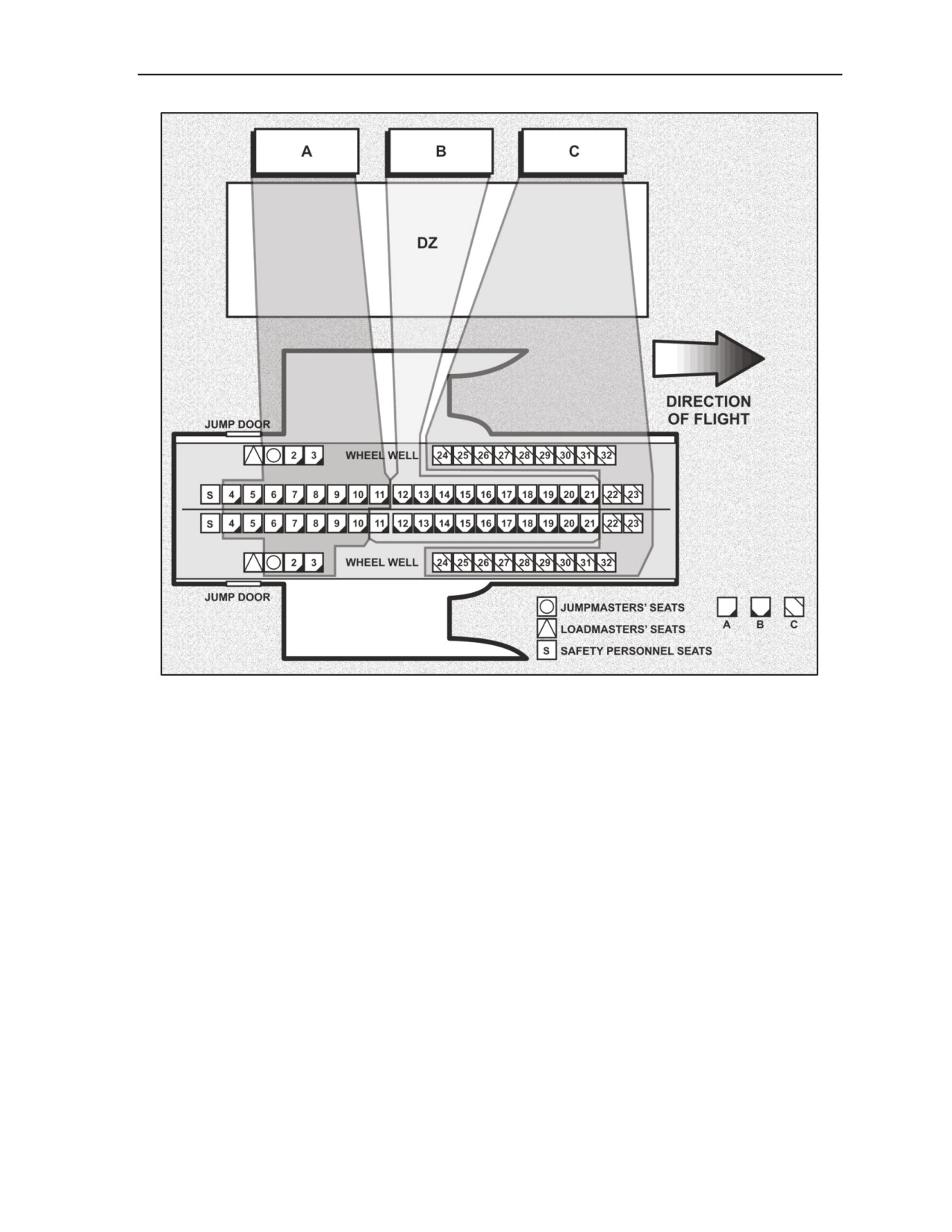
Air Movement Plan
Figure 6-1. Cross-loaded aircraft
6 March 2015
FM 3-99
6-7
Chapter 6
6-23. The air movement table assigns units to serials within the air columns. Locating units in successive
serials is according to priorities established for landing. Units maintain tactical integrity of Army and airlift
units as far as practicable. All elements in a given serial land on the same drop zone or landing zone in the
objective area; however, certain aircraft in a serial can continue on to drop reconnaissance and security
forces in their planned areas of employment.
6-24. The ground forces commander in coordination with the USAF commander prepares the air
movement table form. This form, used in the air movement plan to the airborne operations, allocates
aircraft to the ground forces to be lifted. It designates the number and type of aircraft in each serial and
specifies the departure area and the time of loading and takeoff. Exact format for the air movement table
depends on the needs of the commander, which are specified by unit standard operating procedures. There
is no specific format, but the air movement table should provide the following information:
z
Heading. When the air movement table is published as a part of the order, the following
elements are included:
Classification.
Appendix, annex and operations order number.
Headquarters.
Place of issue.
Date and time.
Map reference.
z
Serial number. Serial numbers are arranged consecutively in the order of flight. Consider the
following factors in the assignment of units to serials:
Mission of the airborne force.
Size of the drop zone or landing zone.
Distribution (cross loading) of personnel, weapons, and equipment.
z
Chalk number. The chalk number specifies the position of aircraft being loaded in each serial.
Loads are numbered sequentially according to serial numbering, such as Serial 1 contains Chalks
1 through 12; Serial 2 contains Chalks 13 through 24.
z
USAF units. This section includes USAF information that is important to the ground force
commander.
Airlift unit. This is the designation of the airlift unit that is transporting or furnishing the
aircraft for each serial.
Serial commander. This is the senior USAF officer in the serial.
Number and type of aircraft. The exact number and type of aircraft that actually fly in the
serial are shown in this column.
z
U.S. Army forces. This section includes information directly related to the ground forces.
Aircraft required. The number of airplanes required to transport the force.
Employment. Type of movement (such as parachute, heavy equipment, container delivery
system, or air-landed).
Unit loaded. The airborne force being loaded.
Serial commander. The senior airborne officer in the serial.
Departure airfield. Name or code name of the departure airfield.
Load time. The time established by the airlift and ground force commander to begin
loading. Parachutists can require 30 to 45 minutes to load, depending on the aircraft and
any accompanying equipment (door bundles, and parachutes for in-flight rigging). Heavy-
drop and container delivery system loads should take about two hours for loading.
Station time. The time the passengers, equipment, and crew are loaded and ready for
takeoff.
Takeoff. The time the aircraft is scheduled to depart from the airfield.
Aircraft formations. The type formation the aircraft will fly.
Objective. The name or designation of the drop zone, landing zone, or airfield.
6-8
FM 3-99
6 March 2015
Air Movement Plan
Time over target. Time over target is the time of arrival at the objective area.
Direction of flight over the objective area.
z
Other items. Other items that can be included in the air movement table (at the commander’s
discretion) are as follows:
Number of personnel by serial/chalk.
Initial and final manifest call times.
Prejump training times.
Type parachute.
Weather decision.
Weather delay.
Time for movement to the departure airfield.
USAF station time.
Remarks.
SECTION VI - MANIFESTS AND AIR-LOADING PLANNING SYSTEM
6-25. To help maintain order and sequence of delivery of personnel and equipment to the drop zone the
ABNAFC and planning staff use a process of prioritization and accounting for the ABNAF personnel and
equipment. Manifests and computerized systems stream line this process.
MANIFESTS
6-26. The flight manifest DD Form 2131 (Passenger Manifest) is an exact record of personnel by name,
rank, Department of Defense (DOD) identification number, and duty position in each aircraft. It is a brief
description of the equipment, with the station number, as loaded in the aircraft. Load computations for
personnel and equipment are listed. Make a separate form for each aircraft.
6-27. Copies are made for the arrival and departure airfield control group, departure airfield control officer,
pilot, and ALCE. The jumpmaster or senior Army representative on the aircraft retains a copy. The senior
ground forces member or primary jumpmaster in each aircraft finalizes the form. The USAF authorizes it,
and the ground force representative signs it after verifying the personnel on the manifest.
INTEGRATED COMPUTERIZED DEPLOYMENT SYSTEM
6-28. The Integrated Computerized Deployment System (ICODES) is a computer-based automated system
designed to simplify the outload plans for combat forces.
6-29. Files data base. By computerizing the necessary loading characteristics, weight restrictions, and
equipment configurations required to outload the airborne force, this system automatically tells the
commander the load configurations and number of aircraft required to move a specific force. The files data
base includes the following:
z
USAF aircraft characteristics. This file includes all data that affect the placement of equipment
on a particular aircraft; it contains data on the C-130, C-17, and C5A/B aircraft, which
appropriate personnel update as changes occur.
z
Items and uniform. This file contains size data on all the equipment in the unit that requires floor
space. Commanders use the data for airland or airdrop. The file contains information about the
aircraft center of balance, the psi of the tires, whether the item requires shoring or not, and
whether the item can be turned or not. The unique feature of this file is that it considers
inseparable items of equipment together (for example, a jeep and trailer or a high mobility
multipurpose wheeled vehicle and 105-millimeter howitzer). This permits the program to load an
item of equipment with its prime mover.
z
Force package and options. This file contains 12 force packages and about 1000 modular force
package options.
6-30. Commander input. The automated air load planning system allows commanders to input force
packages, options, items, prime movers and the towed pieces of equipment, and multiples of each. Once a
6 March 2015
FM 3-99
6-9
Chapter 6
force package or option is entered into the program, the force package or option can be changed for the
specific run of the program to meet mission requirements.
6-10
FM 3-99
6 March 2015
Chapter 7
Marshalling Plan
After the air movement plan is developed, backbriefed, refined, and approved, the
next plan to be finalized is the marshalling plan. The previous three plans— ground
tactical, landing, and air movement— are used to determine the number of personnel
and vehicles to be stationed at or moved through each airfield. The marshalling plan
provides the necessary information and procedures by which units of the airborne
force complete final preparations for combat, move to departure airfields, and loads
the aircraft. It provides detailed instructions for facilities and services needed during
marshalling. This chapter assists airborne assault force (ABNAF), commanders and
staffs in planning for marshalling and sustainment.
SECTION I - PREPARATION
7-1. Marshalling is the process by which units participating in an amphibious or airborne operation group
together or assemble when feasible or move to temporary camps in the vicinity of embarkation points,
complete preparations for combat, or prepare for loading (JP 3-17). The marshalling plan appears as a tab
to the airborne operations appendix Annex C, Operations. S-4s
(in coordination with S-3s), are the
principals to the commanders for marshalling. Marshalling begins when elements of the force are literally
sealed in marshalling areas and it terminates at loading. The marshalling plan is designed to facilitate a
quick, orderly launching of an airborne assault under maximum security conditions in the minimum
possible time.
7-2. Units complete the following preparations before marshalling as a minimum:
z
N-hour sequence. As soon as a force is notified of an airborne operation, it begins the reverse
planning necessary to have the first assault aircraft en route to the objective area at the
predetermined time. The N-hour sequence contains preparation activities, along with planning
actions that must take place within a flexible schedule, ensuring that the force is prepared and
correctly equipped to conduct combat operations on arrival.
z
Rehearsals. Rehearsals are conducted at every echelon of command. They identify potential
weaknesses in execution and enhance understanding and synchronization. Full-scale rehearsals
are the goal, but time constraints may limit them.
z
Static load training (SLT). Requires coordination with USAF loadmasters. Scripted event that
trains joint force for daytime and limited visibility aircraft egress and personnel and equipment
on/off-load procedures.
z
Sustained airborne training (SAT). Conducted no more than 24 hours prior to execution of the
airborne assault. Paratroopers receive SAT from the jumpmaster and safety from the door from
which they will exit. SAT normally is conducted during SLT. (See TC 3-21.220.)
z
Assembly, inspection, and maintenance. As soon as feasible, units assemble the equipment and
supplies that are to accompany them to the objective area. Hold inspections to determine the
status of equipment. Perform maintenance and prepare parachutes, aerial delivery containers,
and heavy equipment drop loads. Commanders and leaders brief personnel, and rations and
ammunition are issued. Personnel eat as time permits.
z
Storage of nonessential items. Individual clothing and equipment, and unit equipment not
needed in the objective area are packed in suitable containers and stored with the rear
echelon or rear detachment.
6 March 2015
FM 3-99
7-1

Chapter 7
Note. At a minimum, marshalling activities include briefing personnel, inspecting,
preparing airdrop containers, issuing rations and ammunition, and resting.
SECTION II - MOVEMENT
7-3. A marshalling area is a location in the vicinity of a reception terminal or pre-positioned equipment
storage site where arriving unit personnel, equipment, materiel, and accompanying supplies are
reassembled, returned to the control of the unit commander, and prepared for onward movement. (Refer to
JP 3-35 for more information.) Unit marshalling areas should be located near departure airfields to limit
movement, higher headquarters can either control the movement to the marshalling area completely, or it
can get a copy of the march table and use it to control the traffic out of the assembly area, along the route of
march, and into the marshalling area. Advance parties assign personnel to areas.
7-4. The S-4 of the unit to be marshaled notifies higher headquarters on the number of organic vehicles
that the unit can give to move its personnel and equipment to the marshalling areas. This information and
the personnel list furnished by the S-3 must be available early enough during planning to procure other
transportation required for the movement.
7-5. When marshalling areas are on airfields, they are placed temporarily at the disposal of the airborne
force’s higher headquarters. The air base commander’s permission is obtained by the tactical units that
must conduct activities outside of the camp area.
7-6. Parachute issue and rigging may be conducted on the ramp, alongside the aircraft, or in-flight.
Advantages and disadvantages are listed below in table 7-1.
Table 7-1. Parachute issue
Issue/Rig
Advantages
Disadvantages
RAMP
x Reduces the parachute supply problem.
x Parachutists may require transportation
x Efficient use of personnel.
to the aircraft.
x Supply accountability.
x Parachutists are rigged for a greater
period.
PLANE
x Parachutists are not required to walk while
x Parachutes must be transported to the
SIDE
rigged.
aircraft.
x Decentralized execution reduces rigging
x Rigging process may impede other
time.
activities.
IN-FLIGHT
x Prevents fatigue during long flights.
x Reduces the number of parachutists that
x Provides more time for rehearsals and
an aircraft can carry.
inspections.
x Requires loading of parachutes on the
aircraft.
SECTION III - PROTECTION
7-7. Protection tasks and systems preserve the force so the commander can apply maximum combat
power to accomplish the mission. Preserving the force includes protecting personnel and physical assets of
the U.S., host-nation, and multinational military and civilian partners.
7-8. The marshalling area should be surrounded by security fencing or, at least, triple-strand concertina. It
should have a posted security area outside the perimeter that is at least 50 meters wide and cleared of brush
and trees. If available, use lights to illuminate the security area. Gates to the camp should be two lanes wide
to accommodate heavy traffic.
PASSIVE DEFENSE MEASURES
7-9. Uncommitted airborne forces pose a strategic or operational threat to the enemy. Avoid concentrating
forces during marshalling to keep impending operations secret and to deny lucrative targets to the enemy.
Dispersal methods include the following:
7-2
FM 3-99
6 March 2015
Marshalling Plan
z
Move. Units move rapidly under cover of darkness to dispersed marshalling areas near air
facilities.
z
Control. Commanders control movement to loading sites so most personnel arrive after the
equipment and supplies are loaded on the aircraft.
z
Prepare. Commanders prepare for loading before arrival at the loading site.
z
Avoid. Commanders avoid assembling more than 50 percent of an ABN IBCT at a single point.
DISPERSAL
7-10. The degree of dispersal is based on an intimate knowledge of the operation’s problems and what is
best for the overall operation. Regardless of the dispersed loading method, the airlift commander ensures
that aircraft arrive over the objective area in the order required by the air movement plan. Depending on the
situation, one of the following methods is used:
z
Movement to departure air facilities. Move airborne forces and equipment to departure air
facilities where airlift aircraft may be dispersed.
z
Movement to intermediate staging base. Before the mission, airlift aircraft fly to an intermediate
staging base to pick up airborne forces and equipment. Airlift airborne forces and equipment to
dispersed departure airfields; the mission originates from these facilities.
z
Combining methods. Airlift aircraft fly to intermediate staging bases for the equipment before
the mission. The equipment is airlifted to the dispersed departure airfields and the mission
originates from these facilities, or airlift aircraft stop en route at intermediate staging bases to
pick up personnel. Crews load aircraft quickly, so the fewest possible aircraft are at the
intermediate staging base at one time.
SECTION IV - DEPARTURE AIRFIELD-MARSHALLING AREA
7-11. Base the departure airfield selection on the proposed air movement and the capability of airfields to
handle the traffic. Designate loading sites near departure airfields after selecting departure airfields.
SELECTING DEPARTURE AIRFIELDS
7-12. For a specific situation or operation, one or a combination of the following factors can determine the
selection:
z
Mission.
z
Airfields (number required, location, and type).
z
Runway length and weight-bearing capacity.
z
Communications facilities.
z
Navigational aids and airfield lighting.
z
Locating participating units and marshalling areas.
z
Radius of action required.
z
Vulnerability to enemy action to include chemical, biological, radiological, and nuclear.
z
Other air support available or required.
z
Logistical support available, required, or both.
z
Facilities for reception of personnel and cargo.
z
Facilities for loading and unloading of personnel and cargo.
z
Facilities for dispatch of personnel and cargo.
z
Facilities to support rigging and storage of heavy-drop platforms.
Note. While dispersion is necessary to avoid vulnerability to enemy action, excessive dispersion
increases control problems and can diminish the effectiveness of other supporting ground and air
operations.
6 March 2015
FM 3-99
7-
Chapter 7
SELECTING AND OPERATING MARSHALLING AREAS
7-13. The marshalling area is a sealed area with facilities for the final preparation of paratroopers for
combat. Commanders select marshalling areas based on the air movement plan and other considerations.
Another way to avoid concentration of personnel is to time-phase the movement of personnel from their
home bases through the marshalling area to the departure airfield, minimizing the buildup of forces. After
choosing the marshalling areas and departure airfields, choose loading sites near the airfields.
7-14. The following factors are considered when selecting marshalling areas:
z
Distance to airfield(s).
z
Time available.
z
Current facilities.
z
Availability of personnel and materials for construction.
z
Availability or access of maneuver and training areas.
z
Communications requirements.
z
Briefing facilities.
z
Locating participating units.
z
Security or vulnerability to enemy action.
z
Logistical support available or required.
7-15. In the marshalling plan, the S-4 (in coordination with the S-3), assigns units to marshalling areas near
the departure airfields the units will use. Make every effort to locate the areas as close as possible to
departure airfields to reduce movement time between them and to reduce requirement for vehicles.
7-16. The ABNAF’s higher commander is responsible for the operation and maintenance of the
marshalling areas. He includes the following:
z
Provide operating detachments and necessary equipment for each area. These detachments give
signal communications, transportation, medical, and postal services. They operate mess facilities
and utilities.
z
Marshal personnel from the units or from follow-on units of the ABNAF can assist in operating
the marshalling areas if it does not interfere with their preparations for the airborne operation.
Do not use equipment from these units because it must be packed and loaded for movement to
the objective area.
z
Maintain smalls stocks of supplies and equipment of all services at each marshalling area to fill
last-minute shortages of the units being marshaled. Furnish services maintenance support as
required.
Note. The number of personnel required to support operation and maintenance of marshalling areas varies.
Based on experience, about 10 percent of the number of personnel being marshaled is required for
supporting services.
FACILITY REQUIREMENTS
7-17. Commanders can use this information as a guide to selecting and modifying facilities for ABN IBCT
use. Figure 7-1 shows a typical marshalling area layout for an ABN IBCT-size unit that needs about 100 acres.
7-4
FM 3-99
6 March 2015
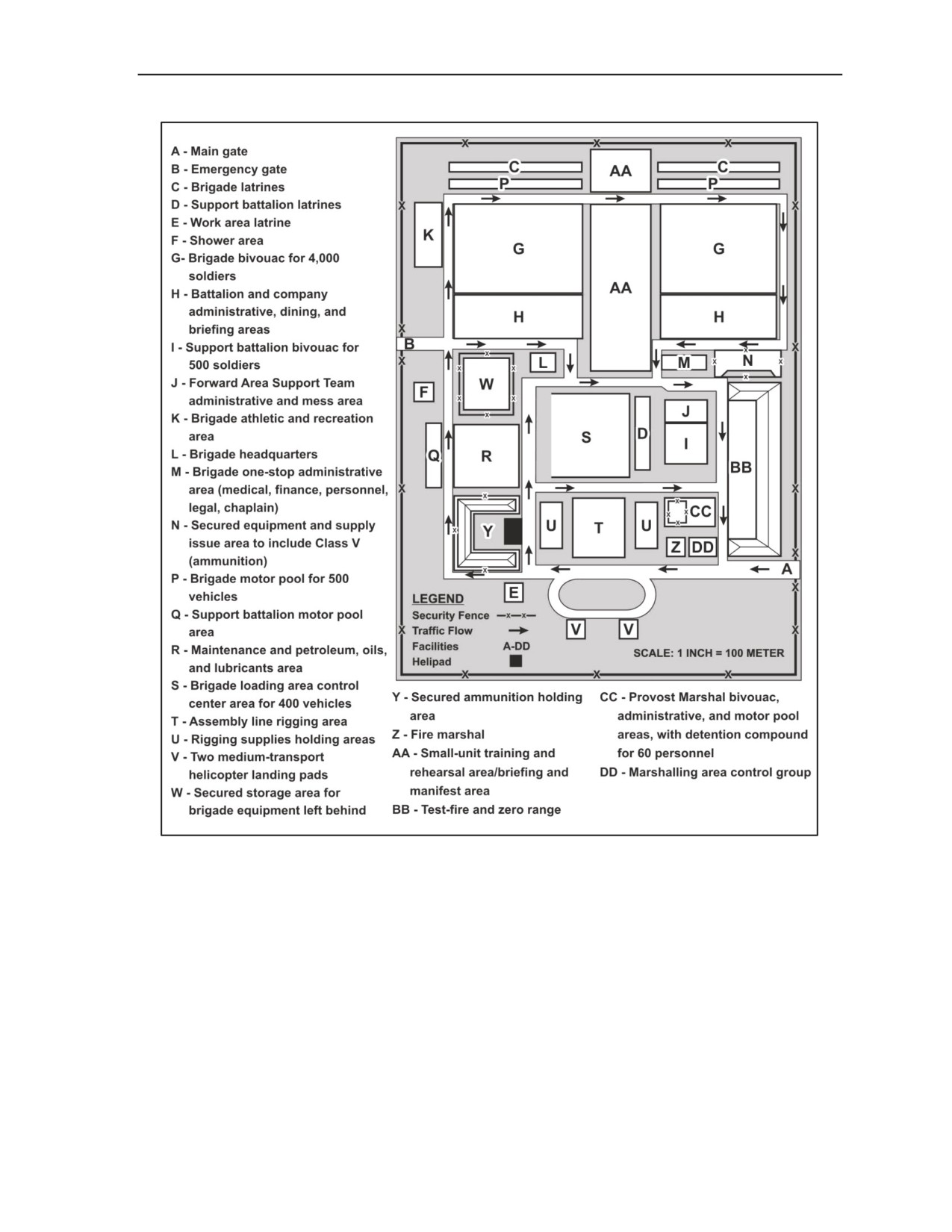
Marshalling Plan
Figure 7-1. Airborne task force marshalling area
7-18. Task force facility. The ABN IBCT or battalion (task-organized for the mission), and the marshalling
area control group occupy an ABNTF facility. If no facilities exist, support elements must construct the facilities.
7-19. Facility specifications. The ABNTF facility should be near a departure airfield and large enough to
support the ABN IBCT or battalion
(as specified), its attachments, supporting personnel, and the
marshalling area control group that supports the marshalling requirements of the ABN IBCT. Each facility
has a site for rigging the heavy-drop and palleted equipment for air delivery (airdrop and airland).
7-20. Facility security. The facility should be surrounded by security fencing or, at least, triple-strand
concertina. It should have a posted security area outside the perimeter that is at least 50 meters wide and
cleared of brush and trees. If available, use lights to illuminate the security area. Gates should be well
lighted into the facility and have two lanes to accommodate heavy traffic.
7-21. Quarters, unit headquarters, dining areas, supply rooms, and latrines should be constructed and
allocated to maintain unit integrity.
6 March 2015
FM 3-99
7-5
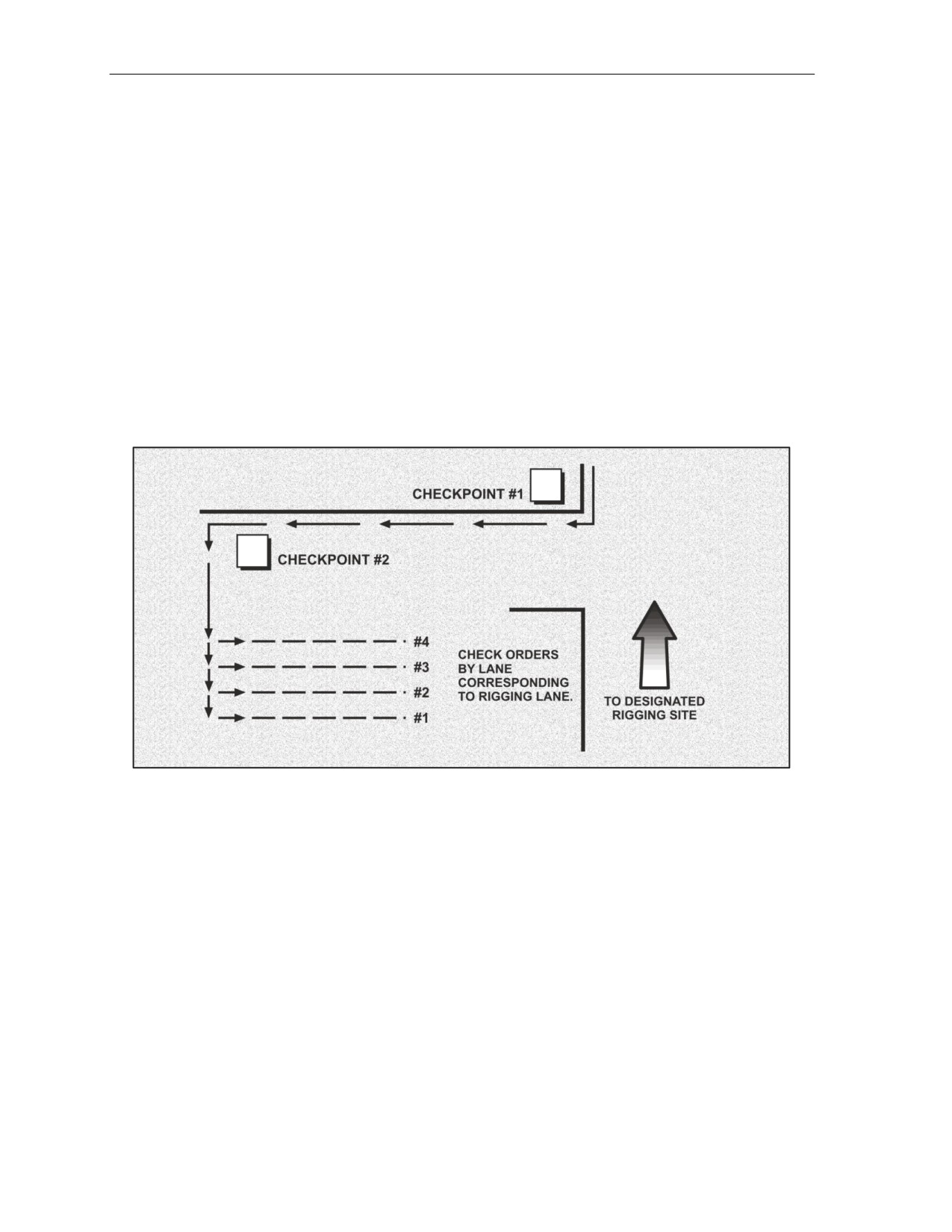
Chapter 7
z
Bivouac site. If billets are not available, a bivouac site can be prepared with tents laid out in
company streets.
z
Dining facilities. Determining facility size requirement to adequately feed force.
z
Latrine areas. There should be enough latrines to serve at least four percent of the male Soldiers
and six percent of the expected female Soldiers. Build latrines at least 100 yards downwind from
food service facilities to prevent food and water contamination. They need to be 30 yards from
the end of the unit area, but within a reasonable distance for easy access.
z
Shower facilities. Enough shower facilities should be provided to support the size force in the
marshalling area.
7-22. The airborne force requires facilities for rigging heavy equipment drops and container delivery
system platform loads. Although equipment can be rigged outdoors, it should be rigged in a large building,
such as a hangar, where it is protected from weather. The following facilities are needed to outload:
z
Loading area control center. The loading area control center (LACC) is provided for preparing
vehicles for heavy-drop, or airland. It should have a 10-foot by 20-foot area for each vehicle and
a 20-foot-wide area between rows for maintenance. A large area must be provided on either side
of the LACC for maneuverability within the LACC for maintenance or other vehicles. (See
figure 7-2.)
Figure 7-2. Heavy-drop loading area control center
z
Rigging sites. The rigging site accommodates the rigging and outloading of about 50 platforms
in a 24-hour period, depending on the availability of trained personnel, equipment, and supplies.
The rigging site uses an assembly line rigging method. Riggers can operate as many lanes as
required with augmentation and as available space allows. (See figure 7-3.)
7-6
FM 3-99
6 March 2015
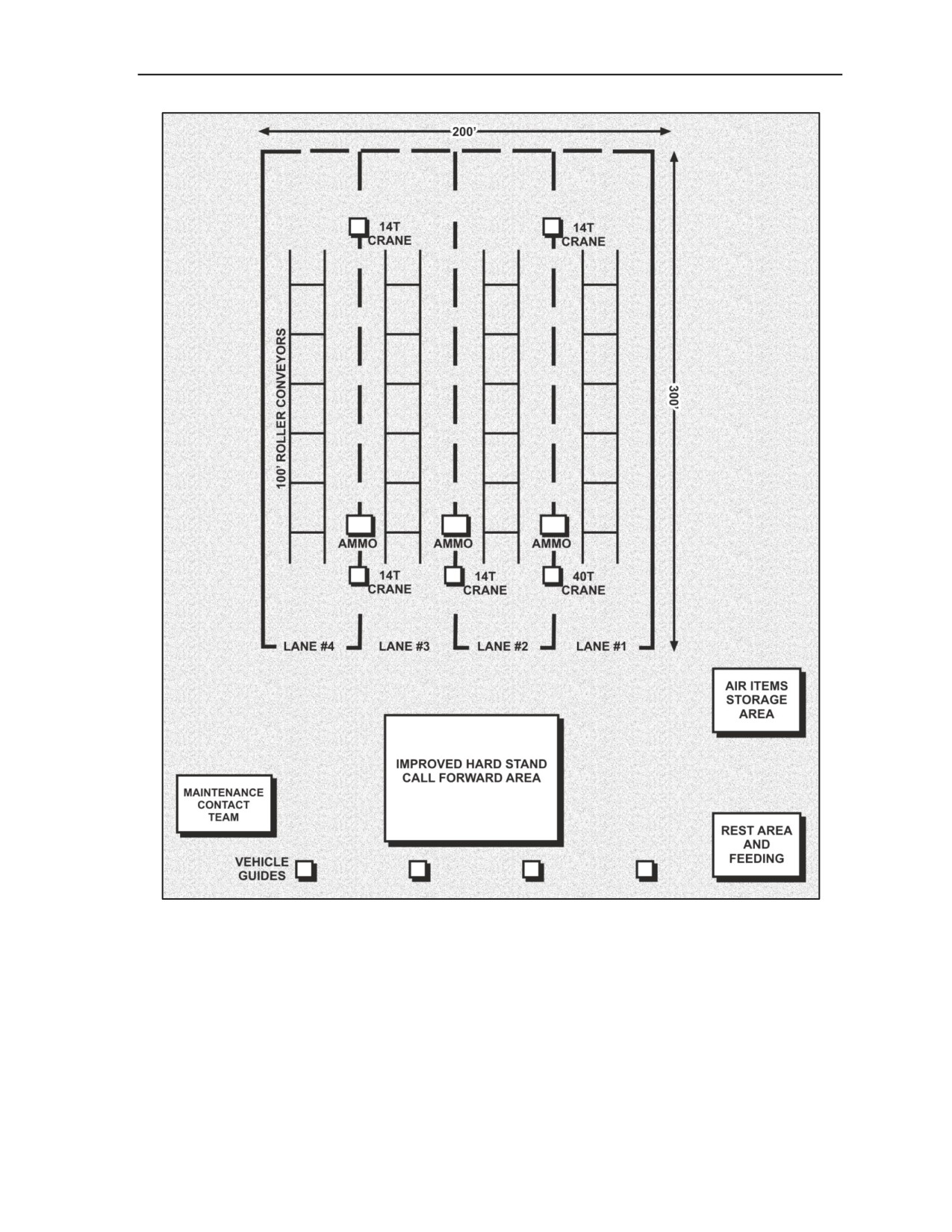
Marshalling Plan
Figure 7-3. Heavy-drop rigging site
MARSHALLED UNIT AND SUPPORT ORGANIZATION ACTIVITIES
7-23. Marshalling is comprised of four activities: assemble personnel and cargo; conduct unit inspection,
load equipment, and prepare; sequence loads; and establish support organization at the port of debarkation.
Marshalled unit and support organization activities although not inclusive are addressed in the following paragraphs.
MARSHALLED UNIT
7-24. Prior to marshalling, if possible the marshalled unit advises the marshalling area control group,
through a liaison officer or by personal contact, of the requirements for the deploying unit at the
marshalling area. The marshalling area control group is the provisional unit, made up of nonorganic and
6 March 2015
FM 3-99
7-7
Chapter 7
certain organic units not participating in the airborne assault, organized to support the deploying unit.
During marshalling coordinating staffs of the marshalled unit perform specific duties as follows:
z
The S-1 provides human resources support including requisitions replacements, requests
recreational facilities, legal services, and coordinates medical support.
z
The S-2 is responsible for intelligence readiness to include support to security programs,
counterintelligence, and deception measures to ensure secrecy.
z
The S-3 submits personnel rosters, and outlines training, briefing, movement, and rehearsal
requirements and tracks and submits required operational reports.
z
The S-4 continues to refine the deploying unit’s requirements for supply, maintenance,
transportation, and storage facilities.
z
The S-6
determines communications systems requirements, establishes network and
electromagnetic spectrum operations, network defense, and information protection.
z
The S-9 integrates civil affairs operations, gaining efficiencies presenting coordinated and
deconflicted activities during marshalling.
z
The staff makes requirements known as far as possible in advance of the marshalling period to
enable support personnel to procure the facilities and install them where necessary.
7-25. Marshalled unit, in accordance with an unit standard operating procedure may establish a departure
airfield control officer, (commonly referred to as the DACO), who will act as the ABN IBCT commander’s
principal representative for all activities conducted at the departure airfield. He may act as a liaison officer
between the marshaled unit and the marshalling area control group or departure airfield control group,
discussed later in this section. The departure airfield control officer also may control a departure airfield
control team designated to perform duties as prescribed in an airborne standard operating procedures
document. (Refer to unit standard operating procedures document for specific instructions.)
SUPPORT ORGANIZATIONS
7-26. When the ABN IBCT deploys and the marshalling areas close, the division support command acts as
the provisional logistical unit at the home station. The theater commander responsible for the area of
operation provides the provisional logistical support unit for the intermediate staging base. If a support unit
cannot preposition at the intermediate staging base, a support unit from the home station command is
included in the advance party. Marshalling control agencies assist the airborne and airlift force in executing
the operation.
7-27. Marshalling area control group. To enable most of the airborne force to concentrate on preparing for
planned operations, support agencies are designated by division headquarters to provide most of the
administrative and logistical support. As stated earlier these nonorganic units and certain organic units not
participating in the airborne assault organized into a provisional unit known as the marshalling area control
group. The marshalling area control group, commander is the principal logistical operator for the deploying
force; he executes the logistical plan. This control group provides services until the assault force departs
and the marshalling area is closed. Typical assistance provided by this unit includesʊ
z
Transportation.
z
Movement control.
z
All classes of supply.
z
Communications.
z
Facility construction, operation, and maintenance.
z
Maintenance.
z
Rigging.
z
Recreation and other morale services.
z
Local security personnel, when required.
z
Army health system support.
7-28. Airlift control element (ALCE). The ALCE coordinates and maintains operational control of all
airlift aircraft while they are on the ground at the designated airfield. This includes aircraft and load-
movement control and reporting, communications, loading and off-loading teams, aeromedical activities,
7-8
FM 3-99
6 March 2015
Marshalling Plan
and coordination with interested agencies, The ALCE’s support function includes activities that relate to
the airfield. Typical tasks for this USAF unit include—
z
On both planned and rapid notice, support and control exercises and contingency operations, as
defined in air mobility, and deployment and redeployment operations manuals and mission
directives.
z
Conduct around-the-clock operations to provide supervisory control and to ensure effective use
of the airlift force on assigned missions.
z
Direct, execute, and coordinate mission directives, plans, and orders assigned.
z
Distribute completed loading manifests as required.
z
Give copies of the aircraft-parking plan to support units.
z
Coordinate loading of aircraft.
z
Coordinate disposition of Army equipment and personnel remaining behind or returning because
of aborted sorties.
z
Ensure that appropriate and adequate briefings for Army and USAF personnel are conducted.
z
Coordinate flight clearances.
z
Coordinate configuration of aircraft.
z
Schedule and coordinate proper air force coverage of assault landing zones, and drop zones.
z
Schedule and publish air movement tables for supported units.
z
Provide or arrange weather support for the mission.
7-29. Departure airfield control group (DACG). The DACG ensures that Army units and their supplies and
equipment are moved from the marshalling area and loaded according to the air movement plan. Timing is
critical at this point in the operation. Maintain strict control of both air and ground traffic on and across
active runways.
7-30. Arrival airfield control group
(AACG). Organizing the AACG is similar to the DACG. When
personnel, supplies, and equipment are arriving on aircraft and need to be moved to marshalling facilities or
holding areas, the AACG is responsible for offloading them. Like the DACG, the AACG works closely
with the ALCE unit at the arrival airfield.
SECTION V - OUTLOAD
7-31. Complex outload operations are more difficult because they usually are conducted at night under
blackout conditions. Since most or all airborne units’ vehicles are rigged for air delivery, airborne forces
must rely on the supporting unit for transportation during outload. These requirements are closely related to
and dictated by the loading plans developed for the operation.
OUTLOAD PLANNING CONSIDERATIONS
7-32. Loading preparations are included in the marshalling plan. Loading plans outline the moving
personnel and equipment and heavy-drop loads from the alert holding area to planeside. They outline the
use of available materials-handling equipment. The loading plans are coordinated closely with the
supporting airlift force.
7-33. A loading plan is formulated at joint conferences. It contains information about the number of
personnel and the amount of equipment to be airlifted, ACLs, and the general sequence of movement.
7-34. Strict adherence to the loading timetable is mandatory. The loading of equipment and supplies must
be completed in time to permit post-loading inspection, joint pre-takeoff briefing, and personnel loading by
the designated station time.
7-35. The general delineations of loading responsibilities in connection with the airborne operation are as
follows:
z
Airlift commander responsibilities include—
Develops plans for specific loads and the sequence of movement in conjunction with the
unit being moved.
6 March 2015
FM 3-99
7-9
Chapter 7
Establishes and disseminates manifesting all cargo and personnel.
Provides instructions for loading, instructions for documenting and unloading aircraft and
for cargo tie-down.
Parks aircraft according to the parking plan.
Provides loading ramps, floor conveyors, tie-downs, load spreaders, and other auxiliary
equipment such as operation ejection equipment.
Prepares aircraft for ejecting cargo and for the safe exit of paratroopers from aircraft in
flight. Cargo to be ejected in flight is tied down by USAF personnel.
Ensures that a USAF representative is present to provide technical assistance and to
supervise the loading unit during the loading operations of each aircraft.
Verifies documentation of personnel and equipment.
Furnishes and operates materials-handling equipment required in aircraft loading and
unloading if the U.S. Army unit needs it.
z
Airborne commander responsibilities include—
Establishes the priority and sequence for movement of airborne personnel, equipment, and
supplies.
Prepares cargo for airdrop, airland, or extraction according to applicable safety instructions.
Marks each item of equipment to show its weight and cubage and, when appropriate, to
show the center of gravity. Ensures hazardous cargo is properly annotated on DD Form
1387-2.
Documents and manifests all loads of U.S. Army personnel.
Directs and monitors both movement of ground traffic to airfield or loading area, and
accepts delivery at the destination.
Delivers properly rigged supplies and equipment to the aircraft according to the loading
plan.
Loads, ties down, and unloads accompanying supplies and equipment into and from the
aircraft with technical assistance from a USAF representative. Cargo to be ejected in flight
is tied down and ejected by USAF personnel. (Exception is made in the case of containers
of supplies and equipment that are pushed from the jump exits by paratroopers immediately
before their exit from the aircraft.)
Ensures that U.S. Army personnel are seated aboard aircraft, are properly equipped, and
have their safety belts fastened by station time.
Briefs and supervises U.S. Army vehicle operators to ensure that the operators thoroughly
comprehend airfield vehicular traffic control measures and pertinent safety precautions
before they operate vehicles around aircraft.
Provides vehicles and loading personnel to outload U.S. Army personnel and cargo from
aborting aircraft and reload them on spare aircraft if time permits.
OUTLOAD CONTROL
7-36. A control system at arrival airfields is essential to prevent congestion and to facilitate orderly
movement of cargo and personnel. Outload control includes parking, traffic control, loading, bump plan,
and unloading.
PARKING
7-37. The main parking consideration is loading access. Dispersal must provide the most security possible
with the least possible vulnerability and, at the same time, allow maneuvering room for loading the equipment.
CONTROLLING TRAFFIC
7-38. A traffic control system is essential to avoid congestion at loading and unloading sites. In outloading,
force control is accomplished by using a call-forward system in which loads are brought into the loading
area as required. The following control system outline applies to air landing facilities as well as airfields.
(See figure 7-4.) The system provides a separate loading facility for personnel, heavy-drop loads, and aerial
7-10
FM 3-99
6 March 2015