FM 3-99 Airborne and Air Assault Operations (MARCH 2015) - page 4
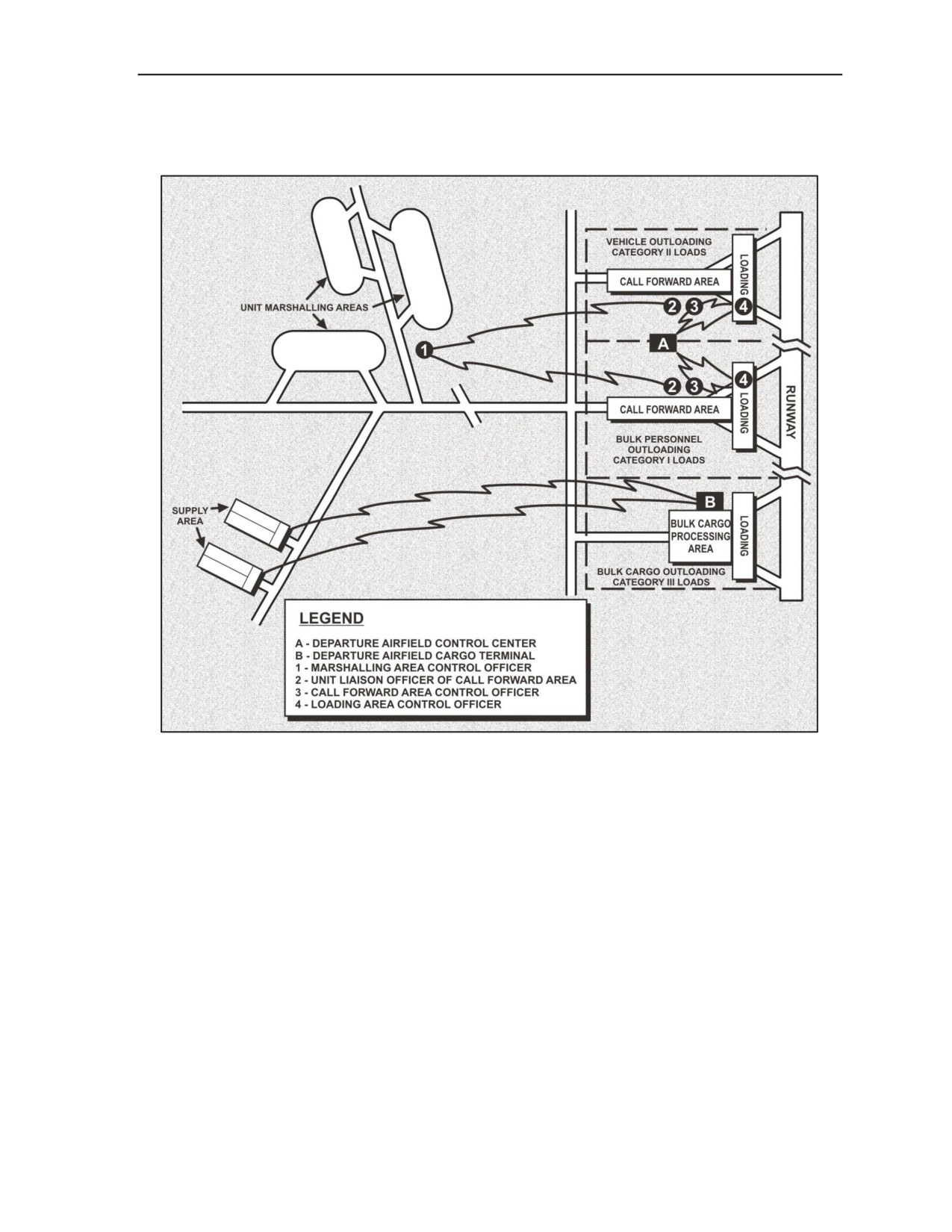
Marshalling Plan
supply. The separation is essential to control loading and decrease the time required to load. The airfield
control system is set up with the minimum required personnel and communications equipment, and with
regard to the size of the forces being moved.
Figure 7-4. Concept of outload control
LOADING
7-39. The actual outload is complex and requires close supervision to ensure all equipment and personnel
are loaded on the correct aircraft as quickly and efficiently as possible.
z
Initially, personnel and equipment are dispersed in marshalling areas distant from the loading
airfields, but in close communication with control groups at the airfields.
z
When called, the unit or equipment is moved by planeload to the call-forward area. The fewest
possible planeloads are maintained on hand in the call-forward area to ensure uninterrupted
loading. Use guides and military police as required.
z
As aircraft arrive in the loading area, planeloads are called forward; unit members load and tie
equipment down with the technical assistance of USAF personnel.
z
Control personnel maintain a log listing the departure of each aircraft. It contains the following
information:
Aircraft tail number.
Summary of load or unit load number. (Correlate manifests with this entry.)
Time aircraft was available for loading.
Station time.
Takeoff time.
6 March 2015
FM 3-99
7-11
Chapter 7
Remarks.
BUMP PLAN
7-40. A bump plan is used to ensure that critical personnel and equipment are delivered to the airhead in
the assault in the event of last-minute aircraft maintenance problems or the planned number of aircraft is
not available. When designing the plan, consider communications requirements, the time required/available
to execute the bump plan, and ensure secure en route communications package and tactical satellite
(TACSAT) supports the physical location of key personnel (i.e. commander on right door, TACSAT on
right door). A simple plan always works better under time constraints.
7-41. The bump plan must be coordinated through the ground liaison officer. State bump plan by priority
and sequence, the time required to execute the plan, and number of personnel to be bumped. Units must
keep in mind, the bump plan should account for the location of key personnel and communications
requirements (TACSAT hatch mounts for example).
7-42. The outload brief is coordinated and facilitated by the G-3 of the higher headquarters. This is a
working briefing and is the final coordination opportunity for all involved in the airborne operation. The
outload coordination brief sheet is filled out during the outload brief. Special attention should be given to
chalk number and formation, key personnel, key heavy drop, hot loads, air land loads, bump plan, number
of personnel and time line.
7-43. All paratroopers will be marked in accordance with unit marking standard operating procedures.
These markings must be strictly adhered to for both day and night jumps so that jumpmasters and key
leaders can recognize the tactical cross load within a chalk, implement timely bump plans, or reorganize
jumpers at the last minute to adhere to a cross load, and assemble quickly. At a minimum a bump plan
should include:
z
Identification and location of key personnel and communications and mission essential
equipment (in accordance with the mission).
z
Prioritization and sequence.
z
Actions to be taken to bump non-essential personnel.
z
Time required and available to execute the bump plan.
z
Location of key personnel down through task force level.
UNLOADING
7-44. At arrival airfields, the control system is the reverse of that used at departure airfields. On arrival,
crews unload aircraft and move the loads to dispersed holding areas where arriving elements build up to
convenient size for further movements. Crews keep load categories separated to facilitate control and movement.
7-12
FM 3-99
6 March 2015
PART II
Air Assault Operations
Chapter 8
Organization and Employment
An air assault operation is an operation in which assault forces, using the mobility of
rotary-wing assets and the total integration of available firepower, maneuver under
the control of a ground or air maneuver commander to engage enemy forces or to
seize and hold key terrain
(JP 3-18). An air assault is a vertical envelopment
conducted to gain a positional advantage, envelop or turn enemy forces that may or
may not be in a position to oppose the operation. Ideally, the commander seeks to
surprise the enemy and achieve an unopposed landing when conducting a vertical
envelopment. However, the assault force must prepare for the presence of opposition.
At the tactical level, vertical envelopments emphasize seizing terrain, destroying
specific enemy forces, and interdicting enemy withdrawal routes.
SECTION I - AIR ASSAULT AND AIR MOVEMENTS
8-1. Air assaults are not merely movements of Soldiers, weapons, and equipment by Army aviation units
and should not be considered as such. An air assault is not synonymous with an air movement. They are
separate and distinct missions.
8-2. An air assault is the movement of friendly assault forces by rotary-wing aircraft to engage and
destroy enemy forces or to seize and hold key terrain (JP 3-18). It is a precisely planned and vigorously
executed combat operation. An air assault allows friendly forces to strike over extended distances and
terrain barriers to attack the enemy when and where it is most vulnerable. Commanders and leaders must
develop an insight into the principles governing their organization and employment to take advantage of the
opportunities offered by an air assault.
8-3. Air movement is air transport of units, personnel, supplies, and equipment including airdrops and air
landings (JP 3-17). Army air movements are operations involving the use of utility and cargo rotary-wing
aircraft and operational support fixed-wing assets for other than air assaults. Air movements are conducted
to move Soldiers and equipment; emplace systems; and transport ammunition, fuel, and other high-value
supplies. The same general considerations that apply to air assaults apply to air movements. (Refer to
FM 3-04.113 for more information.)
SECTION II - AIR ASSAULT TASK FORCE
8-4. Air assaults are accomplished by forming and employing an air assault task force (AATF). The
AATF is a temporary group of integrated forces tailored to a specific mission under the command of a
single headquarters. It may include some or all elements of the BCT. The ground or air maneuver
commander, designated as the AATFC, commands the AATF.
6 March 2015
FM 3-99
8-1
Chapter 8
ORGANIZING FORCES
8-5. The division is the lowest echelon capable of resourcing an air assault, a combat battalion or task
force is the lowest echelon with a staff to properly plan an air assault, and the company is the lowest
echelon with a headquarters to execute an air assault. Once the commander determines the principal
components of the ground tactical plan and the maneuver and fire support schemes, the AATF organizes to
execute its assigned mission. (Refer to FM 3-94 for more information.)
8-6. BCTs, combat battalions or task forces, and aviation elements from a combat aviation brigade are
ideally suited to form powerful and flexible AATFs that can project combat power throughout an area of
operation with little regard for terrain barriers. The unique versatility and strength of an AATF is achieved
by combining the speed, agility, and firepower of rotary-wing aircraft with those of the maneuver forces in
the BCTs.
BRIGADE COMBAT TEAMS
8-7. All BCTs, whether Infantry, Stryker, or Armored have the capability to plan, prepare, and execute air
assault operations when the situation dictates. BCTs have maneuver, field artillery, reconnaissance and
surveillance, sustainment, military intelligence, signal, and engineer capabilities that allow for the effective
execution of air assault operations.
8-8. Although Stryker brigade combat teams (SBCTs) and Armored brigade combat teams (ABCTs) may
not conduct air assaults as frequently as IBCTs, such operations conducted on a limited scale may be the
decisive maneuver in an SBCT or ABCT operation. For this reason, all BCTs should be proficient in
conducting air assaults. Examples of air assault operations conducted by SBCTs and ABCTs include
seizing and retaining river-crossing sites, deliberate breach sites, and key terrain. Understanding the
detailed planning and preparation that goes into an air assault enables the SBCT or ABCT to—
z
Exploit the mobility and speed of task-organized or supporting helicopters to secure a key
objective in the offense.
z
Reinforce a threatened unit in the defense.
z
Place combat power at a decisive point in an area of operation.
8-9. Due to the abundance and unrestricted use of all forms of improvised explosive devices and the
threat of ground attack, it is common for aviation, engineer, and field artillery units to conduct air assault
operations alongside or air movement operations separate from their Infantry counterparts. Ground tactical
movement subjects the entire organization to the threat of improvised explosive devices or ground attack as
soon as the vehicles leave their assembly areas or base.
COMBAT AVIATION BRIGADES
8-10. Most of the Army’s aviation combat power resides in combat aviation brigades, which can be task-
organized based on the mission. (See table 8-1, page 8-3, and table 8-2, page 8-4.) These combat aviation
brigades include various types of organizations with manned and unmanned systems and specialize in
providing combat capabilities to multiple BCTs.
8-11. In a BCT-sized air assault, the combat aviation brigade typically task-organizes based on the mission
variables of METT-TC to form an aviation task force. Additional aviation companies, platoons, or sections
may be task-organized to include attack reconnaissance (manned and unmanned), mission command,
communications relay, air medical evacuation, and air traffic services. In BCT-sized air assaults,
reinforcement with additional aviation is a common way to mass combat power and accelerate force
buildup. Other combined arms forces, to include Infantry, field artillery, or engineer, and sustainment units,
may be part of the combat aviation brigade task organization for specific missions.
8-12. The aviation task force employs a mix of attack reconnaissance aircraft to support an air assault, Teams of
mixed attack and reconnaissance aircraft, commonly referred to as attack weapons teams and scout weapons
teams, are organized and employed based on METT-TC. An attack weapons team is composed of two AH-64
attack helicopters. A scout weapons team is composed of two OH-58D scout helicopters. Planning
considerations for the two airframes include:
8-2
FM 3-99
6 March 2015
Organization and Employment
z
The AH-64 offers longer range, increased station time, and a larger weapons load, but has a
larger signature.
z
The OH-58D has a shorter range, decreased station time, and a lighter weapons load, but has a
smaller signature.
z
Both airframes have a mix of sighting systems and optics capable of employment in various
environmental and weather conditions.
z
Forward arming and refueling point assets are postured and configured based on airframe type.
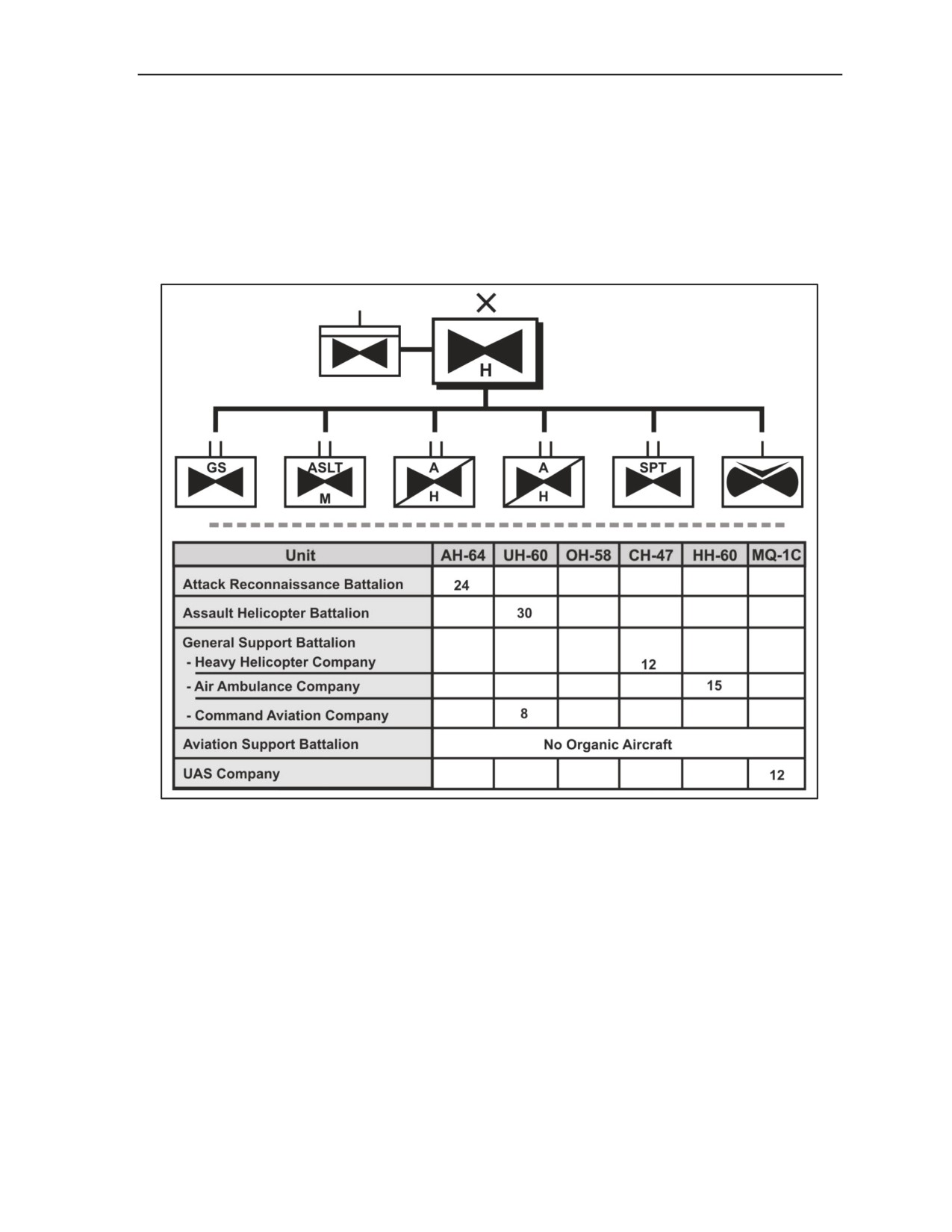
Table 8-1. Heavy Combat Aviation Brigade organization
6 March 2015
FM 3-99
8-
Chapter 8
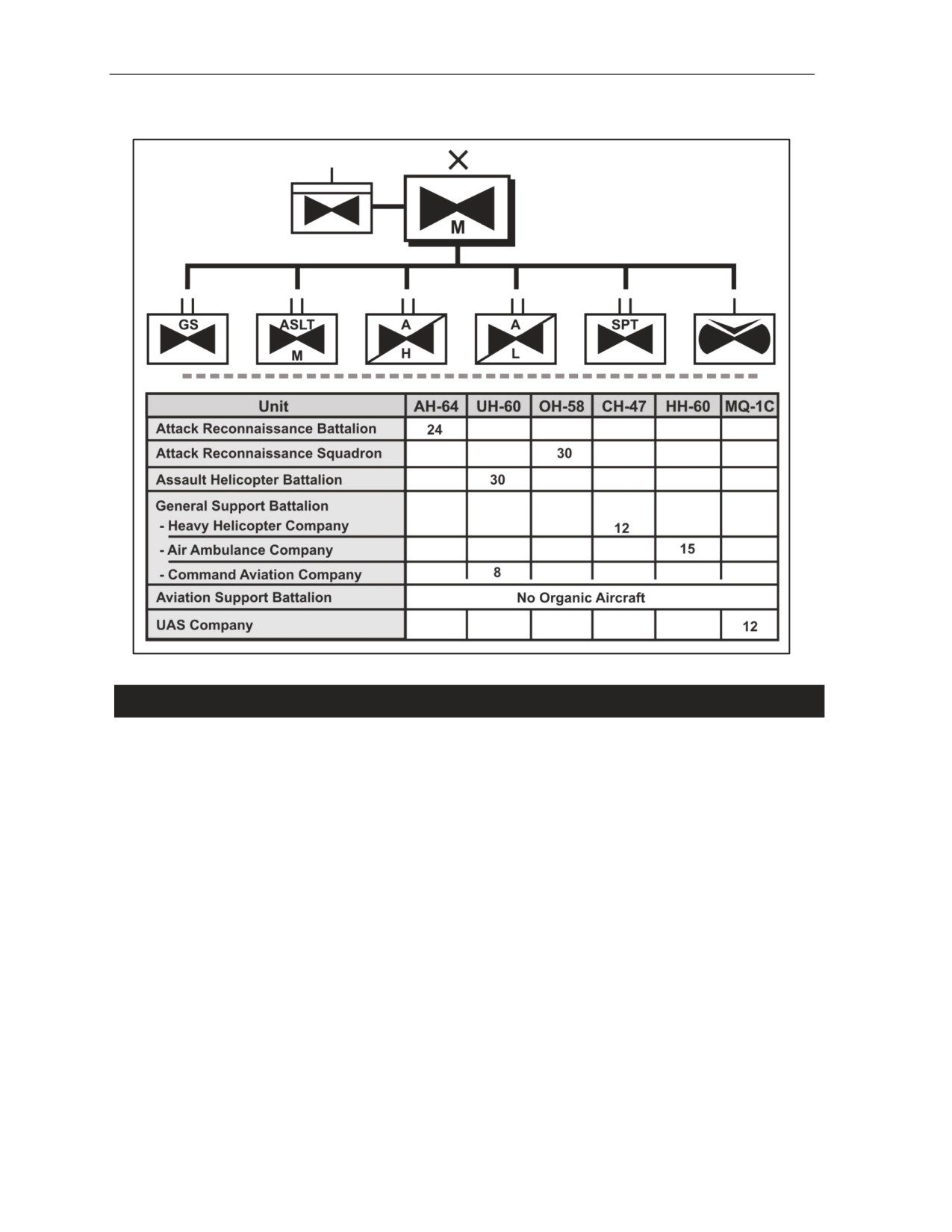
Table 8-2. Medium Combat Aviation Brigade organization
SECTION III - TASK FORCE CONSIDERATIONS
8-13. When forming an AATF, consider the following factors:
z
Early formation of the AATF. This force is formed early in the planning stage by a headquarters
that can allocate dedicated aviation resources. The directing or establishing headquarters
allocates units and defines authority and responsibility by designating command and support
relationships. Predesignated and well-understood command and support relationships ensure the
AATF fights as a cohesive, coordinated, combined arms team.
z
Availability of aviation assets. The warning order (WARNORD) may include task-organizing
the AATF, which must provide a mission-specific balance of mobility and combat power. The
AATF normally is organized with sufficient combat power to seize initial objectives and protect
landing zones. The required combat power should be delivered to the objective area consistent
with aircraft and pickup zone capacities to take advantage of surprise and shock effect.
z
Maintaining unit tactical integrity. When planning loads, squads normally are loaded intact on
the same helicopter, with platoons located in the same serial, to ensure unit integrity upon
landing. To perform its mission, an AATF must arrive intact at the landing zone. The force must
be tailored to provide en route security and protection from the pickup zone, throughout the
entire air route, and at the landing zone.
z
Sufficient sustainment capability. The AATF is organized with a sustainment capability to
support a rapid tempo until follow-on or linkup forces arrive, or until the mission is completed.
Units that support the air assault operation normally are placed in direct support to the AATF to
ensure close coordination and continuous, dedicated support throughout an operation. Normally,
8-4
FM 3-99
6 March 2015
Organization and Employment
an AATF exists only until completing a specified mission. After that, aviation and other
elements return to the control of their parent units.
SECTION IV - CAPABILITIES, LIMITATIONS, VULNERABILITIES
8-14. Gaining the initiative and setting the conditions requires commanders to know the capabilities,
limitations and vulnerabilities of their force. The flexibility of conducting air assault operations allows a
commander to control the tempo and exploit the initiative. A properly planned and executed air assault
operation generates combat power.
8-15. An air assault force is a force composed primarily of ground and rotary-wing air units organized,
equipped, and trained for air assault operations (JP 3-18). Air assault forces are most effective in situations
where the threat of speed from mobility provides surprise and affords seizure of key terrain. Air assault
forces are best suited for missions that require—
z
Massing or shifting combat power quickly.
z
Surprise.
z
Flexibility, mobility, and speed.
z
Gaining and maintaining the initiative.
8-16. Considerations for conducting air assault operations are as follows:
z
Best conducted at night or during weather conditions that allow aircraft operation but obscure
enemy observation to facilitate deception and surprise.
z
Close air support planning must provide suppression of threats en route to and the vicinity of the
vertical envelopment point.
z
As early as possible, ground and air reconnaissance should be conducted at landing zones.
CAPABILITIES
8-17. An AATF can extend the battlefield, move, and rapidly concentrate combat power like no other
available forces. AATF capabilities are as follows:
z
Attack enemy positions from any direction.
z
Conduct attacks and raids within the operational area.
z
Conduct exploitation and pursuit operations.
z
Overfly and bypass enemy positions, barriers, and obstacles and strike objectives in otherwise
inaccessible areas.
z
Provide responsive reserves, allowing commanders to commit a larger portion of his force to
action.
z
React rapidly to tactical opportunities, necessities, and threats in unassigned areas.
z
Rapidly place forces at tactically decisive points in the area of operation.
z
Conduct fast-paced operations over extended distances.
z
Conduct and support deception with false insertions.
z
Rapidly reinforce committed units.
z
Rapidly secure and defend key terrain (such as crossing sites, road junctions, and bridges) or key
objectives.
z
Delay a much larger force without becoming decisively engaged.
LIMITATIONS
8-18. An AATF relies on helicopter support throughout an air assault operation. As such, it may be limited byʊ
z
Adverse weather; extreme heat and cold; and other environmental conditions (such as blowing
snow and sand) that limit flight operations, helicopter lifting capability, or altitude and elevation
restrictions that affect operational capabilities.
z
Reliance on air lines of communication.
z
Threat aircraft, air defense, and electronic warfare action.
6 March 2015
FM 3-99
8-5
Chapter 8
z
Reduced ground mobility once inserted (particularly SBCT and ABCT forces).
z
Availability of suitable landing zones and pickup zones due to mountainous, urban, jungle, or
other complex terrain.
z
Availability of air routes (for example, air routes near international borders).
z
Availability of chemical, biological, radiological, and nuclear protection and decontamination capability.
z
Battlefield obscuration that limits helicopter flight.
z
High fuel and ammunition consumption rates.
z
Availability of organic fires, sustainment assets, and protection.
VULNERABILITIES
8-19. An AATF uses helicopters to move to and close with the enemy. Initial assault elements should be
light and mobile. They often are separated from weapon systems, equipment, and materiel that provide
protection and survivability on the battlefield. An AATF is particularly vulnerable toʊ
z
Enemy attack by aircraft and air defense weapon systems during the movement phase.
z
Enemy attack by chemical, biological, radiological, and nuclear weapons because of limited
protection and decontamination capability.
z
Enemy attack by ground, air, or artillery during the loading and landing phases.
z
Enemy air strikes due to limited availability of air defense weapon systems.
z
Enemy electronic attack to include jamming of communications and navigation systems, and
disrupting aircraft survivability equipment.
z
Enemy small-arms fire that presents a large threat to helicopters during the air movement and
landing phases.
SECTION V - AIRSPACE CONTROL
8-20. Airspace control requires both a control authority and a control system. Airspace control is a process
used to increase operational effectiveness by promoting the safe, efficient, and flexible use of airspace with
minimum restraint upon airspace users. Planning must include coordinating, integrating, and regulating
airspace to increase operational effectiveness. Proper planning causes effective airspace control and reduces
the risk of fratricide, enhances air defense, and permits flexibility.
CONCURRENT EMPLOYMENT
8-21. Airspace control is applying airspace control to coordinate airspace users for concurrent employment
in assigned missions. Effective airspace control enables all warfighting functions to work efficiently while
synchronizing air operations to support the commander’s intent. Successful airspace control is dependent
on the ability to perform the functions of identification, coordination, integration, and regulation of airspace
users.
8-22. Properly managed airspace increases combat effectiveness. Ensuring the safe, efficient and flexible
use of airspace, minimizes restraint placed on airspace users. It includes coordinating, integrating, and
regulating airspace to increase operational effectiveness. Effective airspace control reduces the risk of
fratricide, enhances air defense, and permits flexibility.
8-23. Airspace control does not denote ownership of a block of airspace or command over activities within
that airspace. Rather, it refers to users of the airspace. All air missions are subject to the airspace control
order published by the airspace control authority, which provides direction to deconflict, coordinate, and
integrate the use of airspace within the operational area.
8-24. Joint forces use airspace to conduct air operations, deliver fires, employ air defense measures, and
conduct intelligence, surveillance, and reconnaissance operations. At times, these missions may be time
sensitive and avoid the ability to conduct detailed coordination with the land force. It is imperative that land
forces provide their higher headquarters with all airspace coordinating measures to provide visibility to
other joint users and prevent fratricide.
8-6
FM 3-99
6 March 2015
Organization and Employment
8-25. Methods of airspace control are as follows:
z
Positive control relies on positive identification, tracking, and directing aircraft within the
airspace control area. It uses electronic means such as radar; sensors; identification, friend or foe
systems; selective identification feature capabilities; digital data links; and other elements of the
intelligence system and mission command network structures.
z
Procedural control relies on combining mutually agreed and promulgated orders and procedures.
These may include comprehensive air defense identification procedures and rules of
engagement, aircraft identification maneuvers, fire support coordination measures, and airspace
coordinating measures. Service, joint, and multinational capabilities and requirements determine
which method, or which elements of each method, that airspace control plans and systems use.
Procedural control is a common method used by all airspace users (to include indirect fire units)
to deconflict airspace. In Army rotary-wing operations, such as air assaults, procedural control is
used more often than positive control.
AIRSPACE COORDINATING MEASURES
8-26. Airspace coordinating measures are measures employed to facilitate the efficient use of airspace to
accomplish missions and simultaneously provide safeguards for friendly forces. (Refer to FM 3-52 for
more information.)
8-27. Common airspace coordinating measures used during an air assault are as follows:
z
Coordinating altitudes use altitude to separate users and as the transition between different
airspace coordinating entities. The airspace coordinating entities should be included in the air
control plan and promulgated in the airspace control order. Army echelons incorporate airspace
control planning guidance and integrate the airspace control order, area air defense plan, special
instructions, and air tasking order via operation orders (OPORDs). All airspace users should
coordinate with the appropriate airspace coordinating entities when transitioning through or
firing through the coordinating altitude.
z
Restricted operations areas are airspaces of defined dimensions created in response to specific
operational situations or requirements within which the operation of one or more airspace users
is restricted. They are known as restricted operations zones. The AATF may use a restricted
operations area or restricted operations zone to deconflict an area where prior coordination
enhances aviation safety.
z
Using standard Army aircraft flight routes that are routes established below the coordinating
altitude to facilitate the movement of Army aviation assets. They normally are located in the
corps through BCT support areas and do not require approval of the airspace control authority.
They normally are listed on the current airspace control order. Direction of travel can be dictated
as one- or two-way traffic.
z
Using air corridors that are restricted air routes of travel specified for use by friendly aircraft and
established for preventing friendly aircraft from being fired on by friendly forces. They are used
to route aviation combat elements between such areas as forward arming and refueling points,
holding areas, and battle positions. Altitudes of an air corridor do not exceed the established
coordinating altitude.
z
Using axis of advance that is a general route of advance, assigned for the purposes of control,
which extends toward the enemy. The axis of advance symbol graphically portrays a
commander’s intention, such as avoiding built-up areas or known enemy air defense sites. When
used for attack aviation operations, it provides the general direction of movement and may be
subdivided into routes.
z
Using air control points which are points easily identifiable on the terrain or an electronic
navigational aid used to provide necessary control during air movement. Designate air control
points at each point where the air route or air corridor makes a definite change in any direction
and at any other point deemed necessary for timing or control of the operation.
z
Using communication checkpoints which are points along the air route where serial commanders
report to the air mission commander. Radio transmissions should be used only when necessary.
If a report is required, consider using codes to ensure a short transmission.
6 March 2015
FM 3-99
8-7
Chapter 8
AIRSPACE DEVELOPMENT
8-28. When developing a course of action, the ground maneuver unit should plan an air axis of advance.
This provides the general concept to the aviation planners who further refine it into routes with enough
guidance to determine the direction from which the commander wants to approach. Do not submit the
developed axis of advance to the higher headquarters airspace control element.
AIR ROUTE PLANNING
8-29. Upon receipt of the course of action, the aviation liaison officer plans the air routes within the air
axis of advance. The aviation unit normally plans multiple routes within the axis of advance since the threat
air defense disposition may not be clear. The air defense airspace management/brigade aviation element
(ADAM/BAE) should assist in route planning, but the supporting aviation unit is responsible for
completing the routes and submitting them to the higher headquarters airspace control element for inclusion
on the airspace control order.
RESTRICTED OPERATIONS ZONE PLANNING
8-30. Any unit with organic unmanned aircraft system
(UAS) is responsible for planning their own
restricted operations zones for unmanned aircraft launch and recovery. All elements operating UAS in a
BCT submit their request through the ADAM/BAE for deconfliction before submitting it to the higher
headquarters airspace control element.
8-31. UAS launch and recovery restricted operations zones typically should be three kilometers in radius or
surface to coordinating altitude, but may be tailored to meet operational requirements. Due to their size,
unmanned aircraft launch and recovery restricted operations zones should not be planned near indirect fire
units, supporting aviation unit assembly areas, or forward arming and refueling points (FARPs) if possible.
8-32. The supporting combat aviation brigade submits restricted operations zone locations for mission
command and air medical evacuation aircraft to the higher headquarters airspace control element. Mission
command and air medical evacuation aircraft restricted operation zones should be at least three by three
kilometers in size. The combat aviation brigade plans both a primary and alternate restricted operations
zones for each aircraft. This enables control of the operation as it moves forward and provides a restricted
operations zone, if needed, for the higher headquarters mobile command group. Fire support units can
utilize restricted operations zones to assist in deconflicting airspace between firing locations and target
locations.
8-33. Special consideration should be given to planned employment of an organic UAS near a landing
zone. If required due to the tactical mission, small-UAS should be clearly separated by a defined terrain
feature from the landing zone area, and the approach and exit routes of aircraft.
METHODS TO DECONFLICT ON THE OBJECTIVE AREA
8-34. Three possible methods to deconflict airspace between attack reconnaissance aircraft and assault
aircraft on the objective are described in the following paragraphs. They include: grid line or terrain feature
separation, attack by fire positioning, and call clear methods.
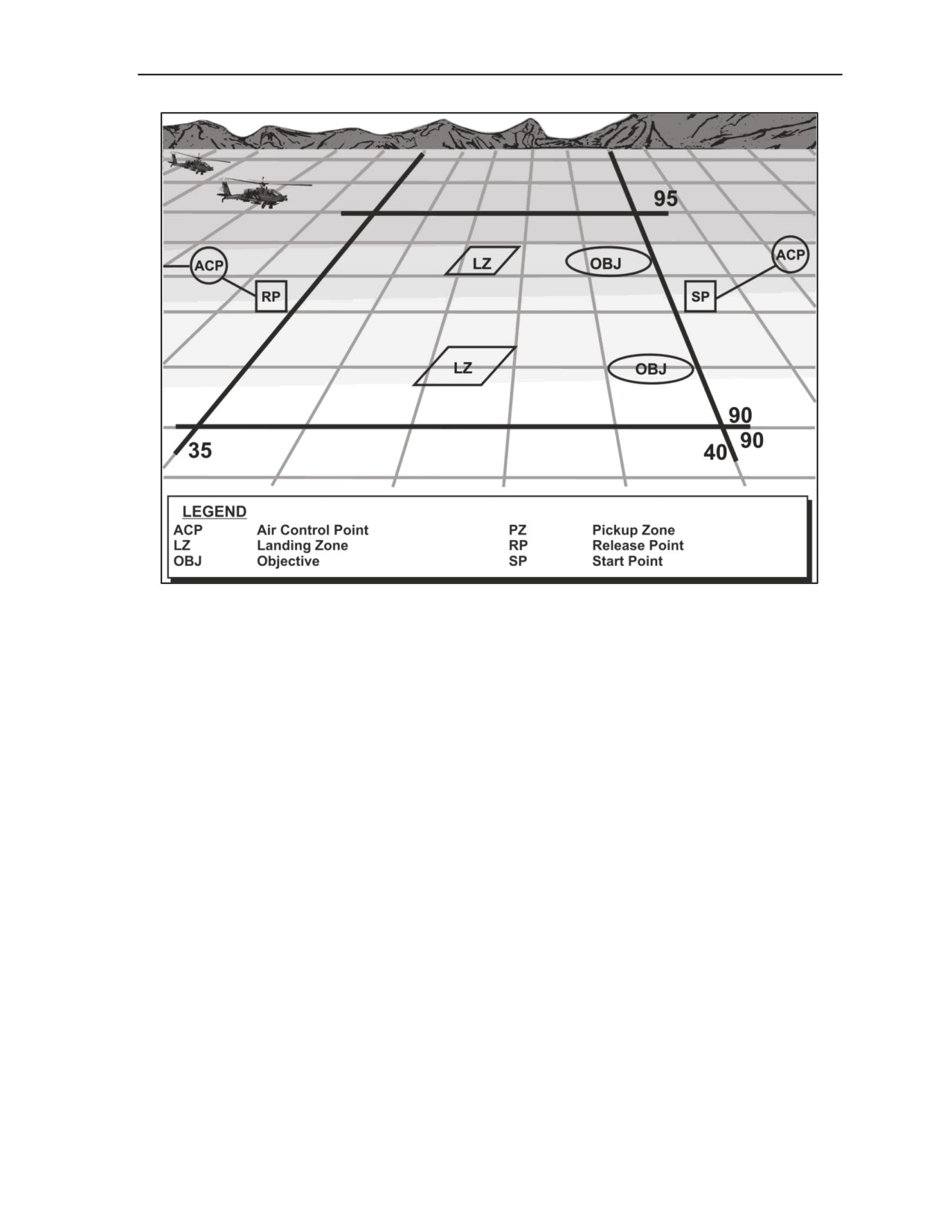
Grid Line or Terrain Feature Separation
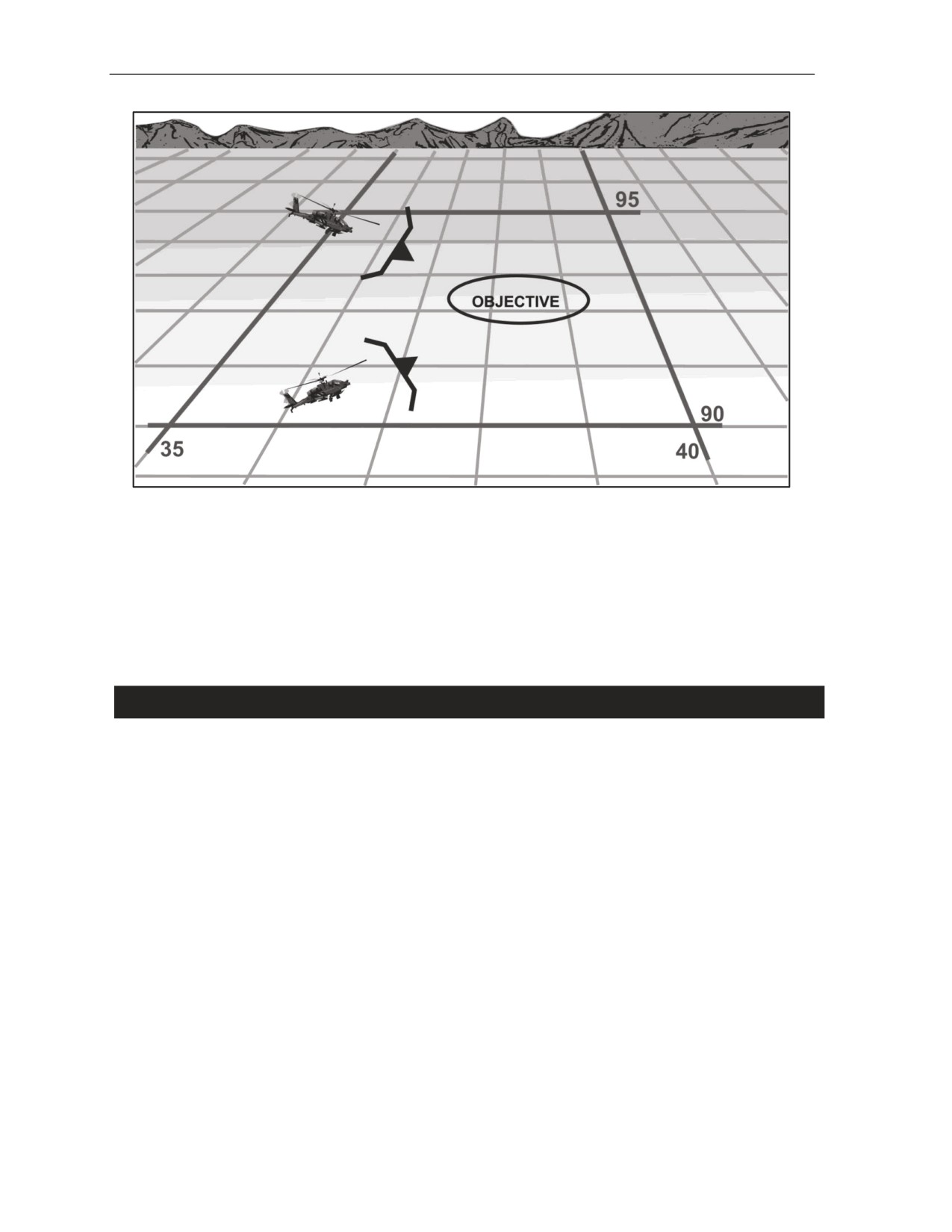
8-35. This is the most restrictive but easiest method to execute. It may not allow the attack reconnaissance
units to engage targets in the close combat attack role during the air assault, but this technique is
appropriate when time is limited for rehearsals, or when prior planning is extremely limited or not possible.
With this method, the attack reconnaissance units clear the airspace for inbound assault units by moving to
a designated grid line or terrain feature on either side of the objective. This movement and the subsequent
maneuver of the attack reconnaissance units in and around the objective area are executed according to the
instructions in the order. (See figure 8-1.)
8-8
FM 3-99
6 March 2015
Organization and Employment
Figure 8-1. Grid line method
Attack by Fire Positioning
8-36. Attack by fire positioning is a method of deconfliction, as it allows attack reconnaissance aircraft the
flexibility to engage targets during the air assault in support of the ground commander. The attack
reconnaissance units occupy known attack by fire positions according to the published OPORD. This
method restricts the attack reconnaissance units to the general vicinity of the attack by fire positions but not
to a specific grid. (See figure 8-2, page 8-10.)
8-37. The attack by fire positioning method requires the attack reconnaissance units to ensure they stay
clear of the landing zone and do not cross the centerline of the direction of flight. Using this method
requires the attack reconnaissance aircraft to have increased situational awareness. This method is best used
when all elements have adequate time to rehearse.
6 March 2015
FM 3-99
8-9
Chapter 8
Figure 8-2. Attack by fire method
Call Clear
8-38. The call clear method is used in contingency circumstances when assault or other aircraft (such as air
medical evacuation or mission command aircraft) are inbound to the objective area. It is initiated with an
inbound call of the assault or other aircraft to the landing zone and a response from the attack
reconnaissance air mission commander indicating that all elements of the landing zone and the flight path
to it from the release point are clear. Avoid using this method during the main air assault itself due to
congestion on the air battle network.
SECTION VI - AIR ASSAULT TASK FORCE MISSION COMMAND
8-39. Mission command is the exercise of authority and direction by the commander using mission orders
to enable disciplined initiative within the commander's intent to empower agile and adaptive leaders in the
conduct of unified land operations (ADP 6-0). Mission command— as a warfighting function— assist the
AATFC in balancing the art of command with the science of control, while emphasizing the human aspects
of mission command. Mission command systems within AATF includes the arrangement of personnel,
networks, information systems, processes and procedures, and facilities and equipment that enable the
AATFC to conduct air assault operations.
MISSION ORDERS
8-40. The AATFC, supported by his staff, conducts air assault operations through centralized planning and
decentralized execution based on mission orders. The commander during the development of mission
orders applies the foundation of mission command together with the mission command warfighting
function, guided by the following principles:
z
Build cohesive teams through mutual trust.
z
Create shared understanding.
z
Provide a clear commander’s intent.
z
Exercise disciplined initiative.
z
Use mission orders.
z
Accept prudent risk.
8-10
FM 3-99
6 March 2015
Organization and Employment
8-41. The AATFC’s intent, formalized in the order and understood at the execution level, provides the
AATF with the concept of operations (CONOPS), allowing the task force to act promptly as the situation
requires. The commander focuses his order on the purpose of tasks and the air assault operation as a whole
rather than on the details of how to perform assigned tasks. Orders and plans are as brief and simple as
possible. (Refer to FM 6-0 for more information.)
8-42. As the commander develops his CONOPS he considers the complexity of the operation, the mission
variables of METT-TC, and the experience level of his subordinate commanders and staffs to determine the
detail of command. In most situations, air assaults are centrally planned and well-rehearsed before
execution. This ensures that each subordinate leader knows the commander’s intent and is able to execute
his mission with minimal direction.
8-43. Contingencies or alternative courses of actions should be factored into the plan to allow for
continuation of the mission in a dynamic environment. Tasks must be planned to occur based on time or the
execution of a previous task (or tasks) so that actions occur at the specified time or in the specified
sequence. Use manned or UASs for communications relay to help mitigate potentially degraded or lost
communications. Commanders must plan contingencies for degraded or intermittent communications.
Refer to FM 6-02 for more information.)
8-44. Another factor for the AATFC to consider when determining mission command responsibility is the
location of the key AATF leadership. Key leaders should be positioned into discrete elements and dispersed
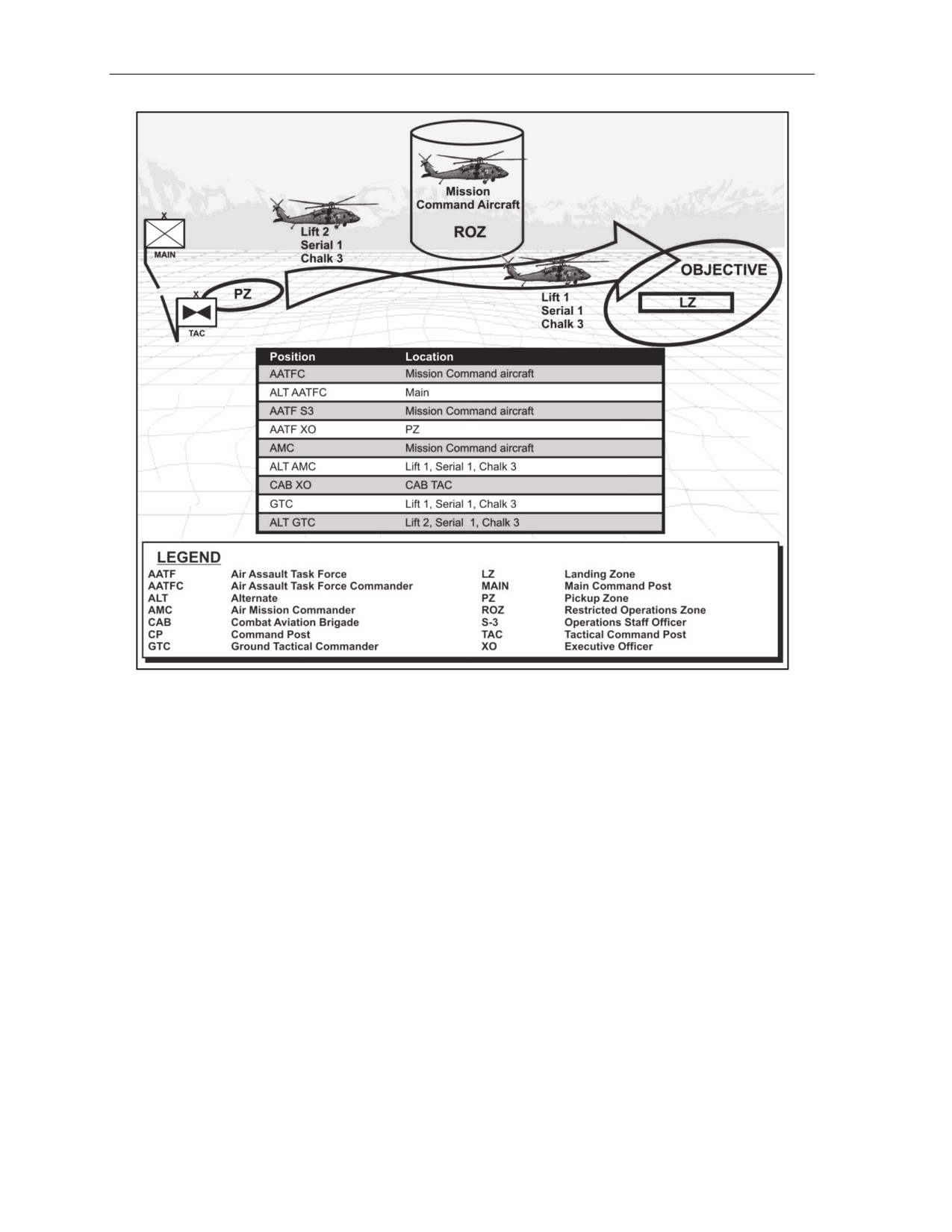
throughout the lifts with provisions to ensure continuity of command. (Figure 8-3 on page 8-12 shows an
example for positioning key leaders during an air assault.)
8-45. While air assault planning is centralized, air assault execution is aggressive and decentralized.
Subordinate commanders should be given as much freedom of action as possible (consistent with risk, the
situation, and mission accomplishment) to empower leaders to seize, retain, and exploit the initiative.
6 March 2015
FM 3-99
8-11
Chapter 8
Figure 8-3. Example of air assault leadership positioning
COMMAND POSTS
8-46. The AATFC executes mission command through the establishment of two primary command posts—
main command post and tactical command post. If the AATFC is the BCT commander, he has the option to
form a command group consisting of select staff members who accompany him and help exercise mission
command away from a command post. The following paragraphs addresses how the AATFC organizes the
AATF command posts for the conduct of an air assault.
MAIN COMMAND POST
8-47. The main command post provides control of operations when the tactical command post is not
deployed. When the tactical command post is deployed, the main command postʊ
z
Provides planning for future operations.
z
Maintains current enemy and friendly situations.
z
Gathers information and disseminates intelligence.
z
Keeps higher and adjacent organizations informed of the friendly situation and submits recurring
reports.
z
Acts as liaison to higher and adjacent organizations.
z
Coordinates for and advises the commander on the use of enablers for future operations.
z
Assists the tactical command post with executing operations as needed.
z
Develops and disseminates orders as necessary.
8-12
FM 3-99
6 March 2015
Organization and Employment
TACTICAL COMMAND POST
8-48. The AATFC employs the tactical command post as an extension of the main command post to help
control execution of the air assault for a limited period. The AATF tactical command post may be
employed into the objective area soon after the initial echelon if the enemy situation permits. The tactical
command post assists the commander in controlling current operations by taking the following actions:
z
Maintaining the common operational picture and assisting in developing situational
understanding.
z
Developing combat intelligence of immediate interest to the commander.
z
Maneuveringforces.
z
Controlling and coordinating fires.
z
Coordinating with adjacent units and forward air defense elements.
z
Serving as the main command post if the main command post is destroyed or unable to function.
8-49. The tactical command post comprises the AATFC, representatives from the S-2 and S-3 sections, fire
support officer, brigade aviation officer, and air liaison officer or whomever the commander designates.
The tactical command post deploys in a mission command aircraft in which the air mission commander
will be located. This aircraft contains a mission command package, which allows the commander to
observe and direct the air assault from a forward position if he chooses. The AATFC may elect to deploy a
tactical command post with the maneuver force. This command post is led by the AATF S-3 and comprises
a mission-tailored portion of the AATF headquarters.
COMMAND GROUPS
8-50. Command group is the commander and selected staff members who assist the commander in
controlling operations away from a command post (FM 6-0). The BCT headquarters can form two
command groups, which are organized based on the mission. Both are equipped to operate separately from
the tactical command post or main command post. Command groups give the commander and the
executive officer (if required) the mobility and protection to move throughout the area of operation and to
observe and direct BCT operations from forward positions.
8-51. Both command groups require a dedicated security element, additional considerations are required if
ground movement is planned. The command group led by the BCT commander comprises whomever he
designates. This can include the command sergeant major and representatives from the S-2, S-3, and fires
sections. The commander positions his command group near the most critical event, usually with or near
the decisive operation.
8-52. A second command group led by the brigade executive officer, if used, may include representation
from the operations staff section, intelligence staff section, and fire support element. The executive officer
usually positions his command group with a shaping operation or at a location designated by the BCT
commander. The executive officer must be able to communicate with the BCT commander, battalion and
squadron commanders, and command posts.
PERSONNEL AND KEY ELEMENTS WITHIN THE TASK FORCE
8-53. Emphasizing the human aspects of mission command are the personnel and key elements within the
AATF who operate command posts and assist the AATFC by exercising control of the air assault from the
initial planning stages through execution. This section describes the duties and responsibilities of personnel
and key elements within an air assault operations..
AIR ASSAULT TASK FORCE COMMANDER
8-54. The AATFC is the overall commander of the AATF. He ensures continuity of command throughout
the operation. He must position himself where he can best see the battlefield and control the operation. In
situations that allow, he is airborne in a mission command aircraft during the air movement stage. At other
times, he may fight the battle from a tactical command post.
6 March 2015
FM 3-99
8-13
Chapter 8
GROUND TACTICAL COMMANDER
8-55. The ground commander is the commander of the largest ground maneuver force inserted during an
air assault. He is usually one of the AATFC’s subordinate maneuver commanders (such as a battalion or
company commander). He flies on one of the first serials into the objective area, maintaining
communication with the AATFC during the flight.
AIR MISSION COMMANDER
8-56. The air mission commander is the aviation unit commander or his designated representative. He
receives and executes the AATFC guidance and directives, and controls all aviation elements. The air
mission commander ensures continuity of command for all supporting aviation units and employs attack
reconnaissance helicopters and artillery along the air route, fighting the battle from pickup zone to landing
zone while keeping the AATFC informed.
AIR ASSAULT TASK FORCE S-3
8-57. The AATF S-3 assists the AATFC with mission command. He normally leads the AATF tactical
command post when the AATFC is airborne in a mission command aircraft.
BRIGADE AVIATION OFFICER
8-58. The brigade aviation officer advises the AATFC on all matters relating to Army aviation and, along
with the AATF S-3 Air, jointly develops the detailed plans necessary to support the air assault operation.
During the execution phase, he should be available to assist the AATFC or S-3 Air in coordinating the
employment of aviation units.
AIR DEFENSE AIRSPACE MANAGEMENT/BRIGADE AVIATION ELEMENT
8-59. The air defense airspace management/brigade aviation element (ADAM/BAE), led by the brigade
aviation officer, is a functional element residing in the BCT’s main command post. This functional element
continually plans for airspace use, executes near real-time control during execution, and monitors
operations of airspace users. This situational understanding is critical to ensure that the BCT can react to
any situation requiring immediate use of airspace, such as immediate fires, close air support, unplanned
UAS launches, or a diversion of aviation assets.
8-60. The ADAM/BAE coordinates directly with the aviation brigade or the supporting aviation task force
for detailed mission planning. The ADAM/BAE element is equipped with the Tactical Airspace Integration
System (TAIS), which provides a digitized, integrated, and automated system to provide airspace control
and air traffic services. Shared functions between the ADAM and BAE include analysis of airspace use to
determine and resolve conflicts; maintaining, requesting, and dissemination of joint airspace coordinating
measures; and development and coordination of the airspace control appendix.
Air Defense Airspace Management
8-61. The ADAM plans and synchronizes air and missile defense operations with the ground commander’s
scheme of maneuver. The ADAM produces the integrated air picture, plans low-level sensor employment,
and develops and maintains the air defense artillery overlay to include unit locations; weapons control
status and weapon system coverage.
Brigade Aviation Element
8-62. The BAE advises the AATF on all tactical matters relating to Army aviation. The element provides
subject matter expertise on enemy threat weapons and tactics, techniques, and procedures; aircraft
survivability equipment; and mission planning and must be capable of 24-hour operations. The BAE:
z
Plans and synchronizes aviation with the BCT commander’s concept of operation.
z
Advises and plans the use of unmanned aircraft systems, reconnaissance, attack, assault, air
movement, sustainment, and medical evacuation.
z
Standardizes BCT unmanned aircraft system employment.
8-14
FM 3-99
6 March 2015
Organization and Employment
FIRE SUPPORT OFFICER
8-63. The AATF fire support officer plans, coordinates, and synchronizes fire support for all phases of the
air assault. He deploys with the AATFC in a mission command helicopter to ensure the fire support plan is
executed as planned.
AVIATION LIAISON OFFICER
8-64. Although the ADAM/BAE conducts many of the functions traditionally performed by liaison
officers, the aviation liaison officer from the supporting aviation brigade remains a critical part of the air
assault planning process. The aviation liaison officer can be the supporting aviation unit S-3, the aviation
mission survivability officer, or another aviation subject matter expert designated by the supporting
aviation unit commander.
8-65. While the members of the ADAM/BAE work directly for the BCT commander as permanent staff
members, aviation liaison officers represent the supporting aviation task force at a designated maneuver
headquarters only for a specific operation. If colocated with the ADAM/BAE, the liaison officer team
normally reports to the brigade aviation officer as a functioning addition to the ADAM/BAE staff section.
Often, the aviation liaison officer coordinates with the ADAM/BAE and then proceeds to a supported
ground maneuver battalion.
AIR LIAISON OFFICER
8-66. The air liaison officer (ALO) is an USAF officer who leads the tactical air control party (TACP)
colocated at the BCT headquarters and advises the BCT commander and staff on air operations. The ALO
leverages the expertise of the BCT TACP with links to the higher headquarters TACP to plan, coordinate,
synchronize, and execute air support operations. He maintains situational awareness of the total air support
and air support effects picture. Additional responsibilities of the air liaison officer includeʊ
z
Monitoring the execution of the air tasking order.
z
Advising the commander and staff about the employment of air assets.
z
Receiving, coordinating, planning, prioritizing, and synchronizing immediate close air support
requests.
z
Providing USAF input to analyses and plans.
PICKUP ZONE CONTROL OFFICER
8-67. A pickup zone control officer (PZCO) is designated for each pickup zone in an air assault. The
PZCO organizes, controls, and coordinates operations in the pickup zone. Depending on the unit that is
conducting the air assault, the PZCO may be a BCT, battalion, or company executive officer; BCT or
battalion S-3 Air; or sometimes a company first sergeant. The PZCO operates on the combat aviation
network and is prepared to assist in executing changes as needed.
MISSION COMMAND SYSTEM
8-68. The mission command system enables mission command. As with any operation the BCT uses
networks and information systems, such as Brigade Combat Team Network and/or LandWarNet, to share
the common operational picture with subordinates to guide the exercise of initiative. The common
operational picture conveys the BCT commander’s perspective and facilitates subordinates’ situational
understanding. This section identifies core Army battle command systems and discusses mission command
systems that enable centralized planning and decentralized execution specifically to air assault operations.
INFORMATION SYSTEMS
8-69. An information system consists of equipment that collect, process, store, display, and disseminate
information. This includes computers— hardware and software— and communications, as well as policies
and procedures for their use (ADP 6-0). The Army Battle Command System gives the BCT advantages in
collecting technical information, and distributing information and intelligence rapidly. The battle command
6 March 2015
FM 3-99
8-15
Chapter 8
system comprises core battlefield automated systems plus common services and network management.
Each system provides access and the passing of information from a horizontally integrated BCT mission
command network. The following are the core systems:
z
Tactical Battle Command. The Tactical Battle Command System comprises the functions
previously performed by the Maneuver Control System and the Command Post of the Future.
z
Global Command and Control System-Army.
z
Distributed Common Ground System-Army.
z
Battle Command Sustainment and Support System.
z
Air and Missile Defense Planning and Control System.
z
Advanced Field Artillery Tactical Data System.
z
Force XXI Battle Command-Brigade and Below/Blue Force Tracker.
z
Tactical Airspace Integration System.
z
Digital Topographic Support System.
z
Integrated System Control.
INTEGRATED SYSTEM CONTROL
8-70. The BCT and battalion S-6 signal officers and S-6 sections are the air assault staff proponents
responsible for planning and coordinating communications support for each phase of the air assault
operation. They use integrated system control to provide communications system network management,
control, planning, and support to the AATF. Also known as, the tactical internet management system,
integrated system control provides network initialization, local area network management services, and an
automated system to support the combat network radio-based wide area network. Features of integrated
system control include mission plan management, network planning and engineering, frequency spectrum
management, tactical packet network management, and wide area network management.
8-71. As the AATF executes the mission and distances become extended, communications for mission
command become less sophisticated. The AATF must make extensive use of airborne or unattended very
high frequency (VHF) retransmission, high frequency (HF) capabilities, and ultrahigh frequency (UHF)
tactical satellite
(TACSAT). Subordinate elements in the AATF may range beyond multichannel
capabilities and radio transmissions, and transmissions may be unintelligible due to enemy electronic
countermeasures. As a result, subordinate commanders of the AATF may have to make decisions without
being in contact with the AATFC.
RADIO NETWORK
8-72. The AATF uses combat network radios primarily for voice mission command transmission and
secondarily for data transmission where other data capabilities do not exist. Combat network radios are
designed primarily around the single-channel ground and airborne radio system, the single-channel
TACSAT, and the HF radio. (Refer to FM 6-02.53 for more information.)
8-73. AATF S-6 planners organize frequency-monitoring requirements into a communications card or
matrix and distribute to key leaders, command posts, and other key personnel. Using a dynamic mix of air-
to-air, air-to-ground, and ground-to-ground radio networks provides the necessary responsiveness and
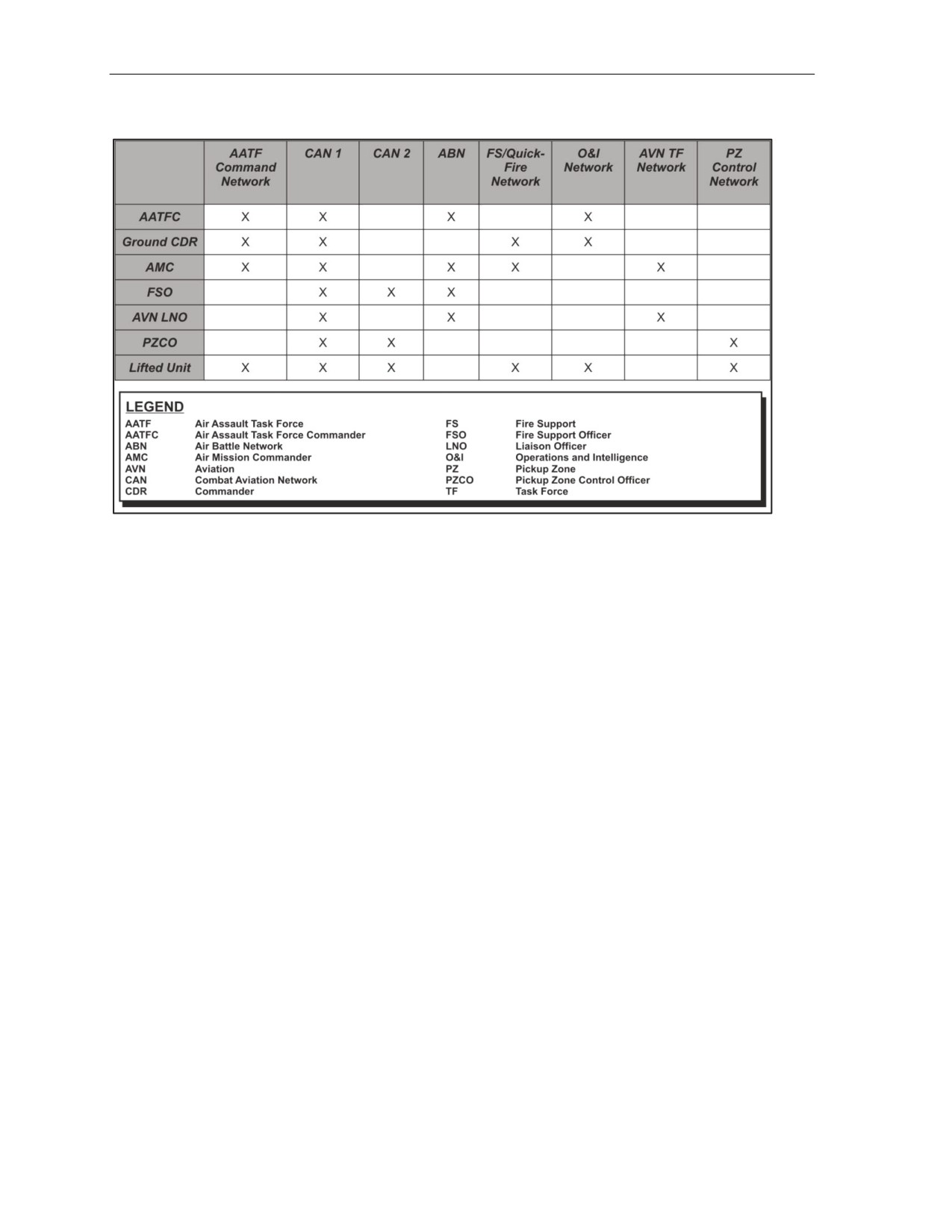
flexibility for air assault mission command. Table 8-3 on page 8-18 depicts the radio networks commonly
employed during air assaults and recommended monitoring requirements for each. Apply the following:
z
Air assault task force command network is a VHF command network dedicated to ground-to-
ground coordination during operations. It normally is secure and used by the AATFC to
communicate with his subordinate commanders. Given the VHF communication range
limitations in restrictive terrain, consider alternate means of communications such as UHF
TACSAT or HF when planning an air assault.
z
Combat aviation network (CAN) is a VHF network dedicated to air-to-ground coordination
during operations. All aviation elements and the remainder of the AATF elements monitor this
network before and during air movements. The two combat air networks typically employed
during an air assault are as follows:
8-16
FM 3-99
6 March 2015
Organization and Employment
CAN 1. CAN 1 provides common communications between the air assault task force
commander, air mission commander, ground commander, and the pickup zone control
officer.
CAN 2. CAN 2 is usually reserved as an anti-jamming network. The pickup zone control
officer can use this network to provide terminal guidance to individual flight leads when
required.
z
Air battle network is typically a UHF command network dedicated to air-to-air communications
between the air mission commander and all aviation element leaders. All aviation elements
monitor this network and receive instructions from the air mission commander or the air assault
task force commander when he is airborne. This network is operated on the lift unit’s UHF
command frequency if a dedicated airborne is not specified in the OPORD or air mission brief.
z
Fire support network is a VHF network operated by the air assault task force fire support
coordinator. All aviation element s must have access to this network to facilitate calls for fire
during movements, insertions, and extractions. An artillery quick-fire network is used when a
supporting battery or battalion is dedicated to an air assault. Plan alternate means of
communication, such as TACSAT, multi-use internet relay chat, and blue force tracker or Force
XXI Battle Command-Brigade and Below (FBCB2), in case of VHF communication failure.
z
Operations and intelligence network is a secure VHF network controlled by the S-2 section at
the main command post. All routine tactical reports and other intelligence reports are sent on this
network, freeing the air assault task force commander network for command and combat critical
traffic. The main command posts for all elements of the air assault task force and supporting
aviation units monitor the operations and intelligence network.
z
Aviation internal network is typically a VHF network operated by each aviation element leader
for internal use. Using VHF radios provides each element leader with a dedicated frequency with
which to direct and control individual aircraft, teams, or platoons and to communicate with air
traffic control authorities.
z
Pickup zone control network is a VHF network established by the pickup zone control officer for
communications between ground forces at the pickup zone. The pickup zone control officer may
request to use the communication platform from a mission command UH-60 if it is available.
The pickup zone control officer uses this network to control the flow of vehicles in and around
the pickup zone. He communicates with the pickup zone control party on this network. This
ensures that chalks are lined up correctly, external loads (sling loads) are ready, the bump plan is
activated if necessary, and extraneous vehicles and personnel are kept clear of pickup zone
operations. All lifted units should enter the pickup zone control network 30 minutes before their
pickup zone time. Specific chalks may be required to monitor the network if the aircraft
formation in the pickup zone requires them.
6 March 2015
FM 3-99
8-17
Chapter 8
Table 8-3. Standard air assault radio networks and monitoring requirements
8-18
FM 3-99
6 March 2015
Chapter 9
Air Assault Planning
Planning for air assault operations mirrors the military decisionmaking process
(MDMP). It incorporates parallel and collaborative planning actions necessary to
provide the additional time and detailed planning required for successful execution of
the air assault mission. Standardizing operations between units conducting the air
assault significantly enhances the ability of the unit to accomplish the mission.
SECTION I - ROLES AND RESPONSIBILITIES
9-1. Air assault planning is as detailed as time permits and should include completion of written orders
and plans. Within time constraints, the air assault task force commander (AATFC) carefully evaluates
capabilities and limitations of the total force and develops a plan that ensures a high probability of success.
The planning time should abide by the one-third/two-thirds rule to ensure subordinates have enough time to
plan and rehearse.
HIGHER HEADQUARTERS
9-2. The headquarters above the element forming the air assault task force (AATF) directs the formation
of the AATF. This headquarters allocates units, defines authority, and assigns responsibility by designating
command and support relationships. The staff of this headquarters is responsible for developing the task
organization of the AATF and conducting the necessary steps of the MDMP. A division-level commander
or his equivalent is the approving authority for the formation of an AATF larger than a company.
BRIGADE COMBAT TEAM
9-3. The brigade combat team (BCT) is the core of the air assault and the BCT commander is normally
the AATFC for a battalion air assault. The AATFC for a company air assault is normally the battalion
commander of the company conducting the assault. The primary role of the AATFC and his staff is to
develop the ground tactical plan by providing his staff and the supporting aviation unit staff with key tasks,
intent and aviation staff guidance concerning the weight of the attack reconnaissance coverage and the level
of acceptable risk for the supporting aviation units.
SUPPORTING AVIATION UNITS
9-4. Normally, supporting aviation units are operational control to the AATFC. Occasionally, an aviation
task force may be created to support an AATF. However, the combat aviation brigade commander typically
anticipates the needs of the AATFC and provides the necessary aviation units to support the mission of the
AATF. As the supporting unit, the combat aviation brigade commander directs aviation units within his
command or requests augmentation from his higher headquarters to meet the needs of the AATFC.
SECTION II - REVERSE PLANNING SEQUENCE
9-5. Air assault planning is based on careful analysis of the mission variables of METT-TC and detailed
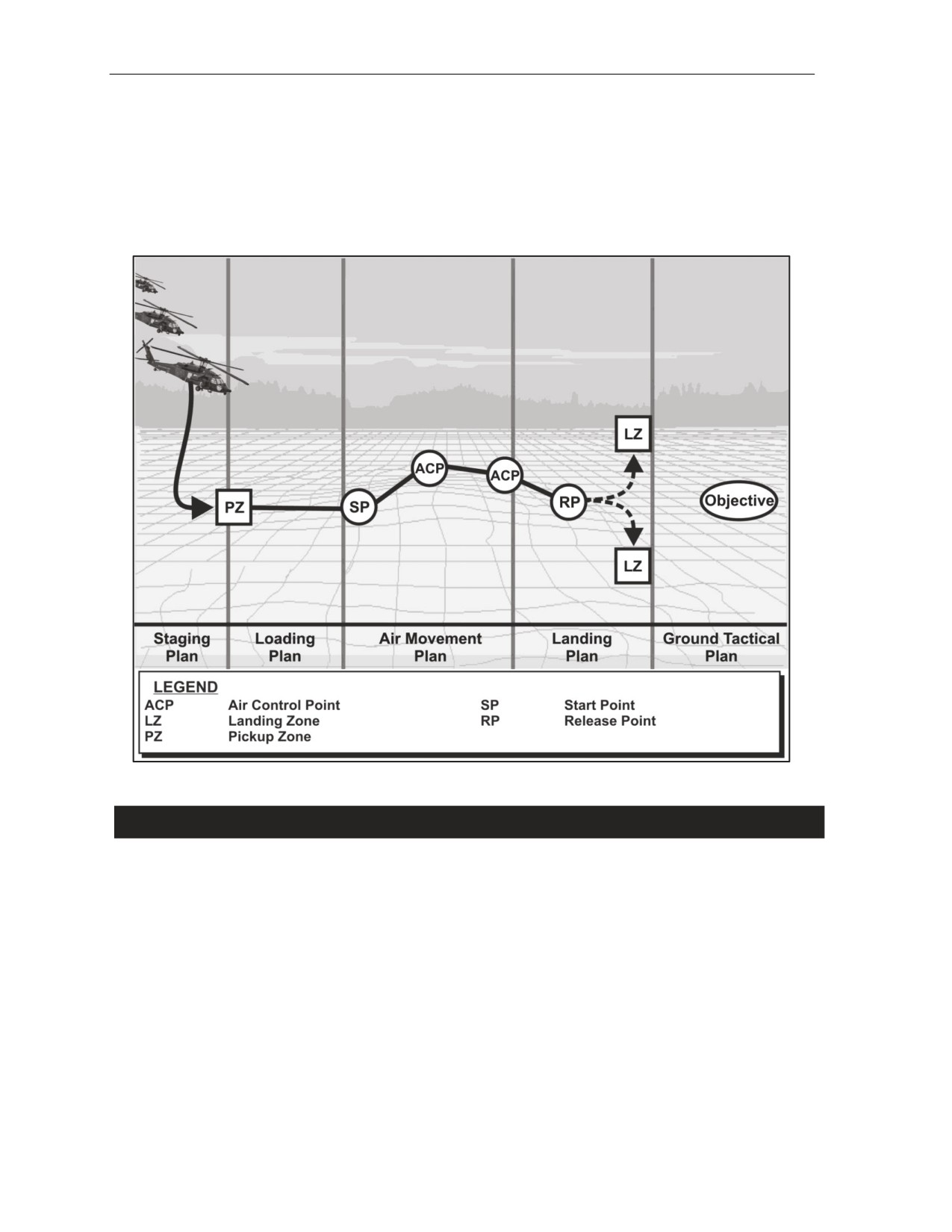
reverse planning. Five basic plans comprise the reverse planning sequence. (See figure 9-1, page 9-2.) They
areʊ
z
Ground tactical plan.
z
Landing plan.
z
Air movement plan.
z
Loading plan.
6 March 2015
FM 3-99
9-1
Chapter 9
z
Staging plan.
9-6. These plans are not developed independently. The AATF staff and supporting aviation unit
coordinate, develop, and refine concurrently to make best use of available time and resources. They
develop the ground tactical plan first, which serves as the basis to develop the other plans. Each plan may
potentially affect the others. Changes in an aspect of one plan may require adjustments in the other plans.
The AATFC must determine if such adjustments entail acceptable risk. If the risk is unacceptable, the
concept of operations (CONOPS) must change.
Figure 9-1. Air assault planning stages
SECTION III - PLANNING METHODOLOGY
9-7. The AATF staff conducts continuous coordination under the guidance of the AATF executive officer
and S-3 during course of action development. Concurrent planning includes identifying air assault hazards
and developing controls to mitigate risk.
9-8. The air defense airspace management/brigade aviation element (ADAM/BAE) and the supporting
aviation liaison officer from the combat aviation brigade serve as the link between the combat aviation
brigade staff and the AATF staff and are critical to the air assault planning process during mission analysis
and course of action development. The ADAM/BAE and the aviation liaison officer serve as the subject
matter experts on aviation operations to the AATF and supported unit staffs during this process. This
enables the AATFC and ground commander to concentrate on refining the ground tactical plan and follow-
on missions. The ADAM/BAE must anticipate requirements of the supported units and disseminate these
requirements as soon as possible to the aviation liaison officer.
9-9. The AATF, supported unit staff, and supporting aviation unit staff should receive and share the
following:
9-2
FM 3-99
6 March 2015
Air Assault Planning
z
Landing zone confirmations by imagery, aircraft videos, landing zone sketches, reconnaissance
products, patrols, and higher headquarters intelligence.
z
Composition of assault, follow-on, and area of operation echelons by unit.
z
Nomenclature of every vehicle and sling load to be flown and maximum expected weight and air
item availability for heavy and light loads.
z
Confirmed troop counts by serial for assault and follow-on echelons.
9-10. The collaboration between the AATF, supported unit staff, and supporting aviation unit staff results
in the Air Assault Appendix to Annex C (Operations), of the OPORD and may includeʊ
z
Tentative lift and serial composition (draft air movement table).
z
List of suitable pickup zones and landing zones.
z
Tentative air routes.
z
Landing zone imagery (if available).
z
Any deviations from standard planning factors.
z
An execution checklist.
DELIBERATE PLANNING
9-11. Air assaults are deliberately planned due to the complex nature and requirement to provide the
commander detailed intelligence concerning the enemy situation. The air assault planning process mirrors
the steps in the MDMP and incorporates parallel actions necessary to provide the additional time and
detailed planning required for successful mission execution. (Figure 9-2 on page 9-4 provides a comparison
of the MDMP and the air assault planning process when maximum time is available for planning.)
6 March 2015
FM 3-99
9-3
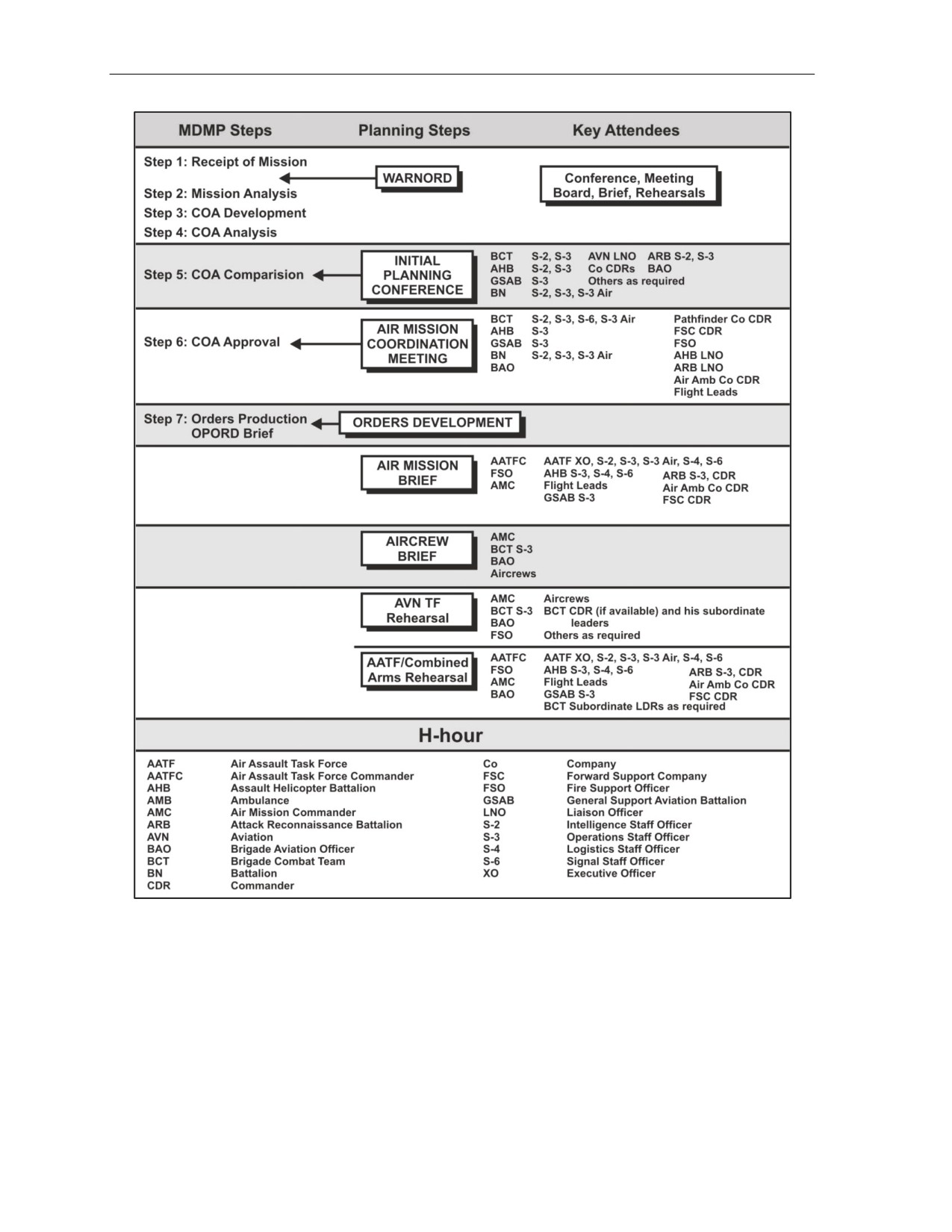
Chapter 9
Figure 9-2. MDMP and air assault planning process
TIME-CONSTRAINED PLANNING
9-12. Due to the dynamic nature of operations, units often are required to execute air assaults within short
time constraints, sometimes a few hours from the time of receiving the OPORD. Based on the time
available, the AATF executive officer adjusts the timeline as required. It is critical for the executive officer
to consider the ability of the supporting aviation unit to accomplish its tasks with its crew endurance
program. (See figure 9-3, page 9-5.)
9-4
FM 3-99
6 March 2015
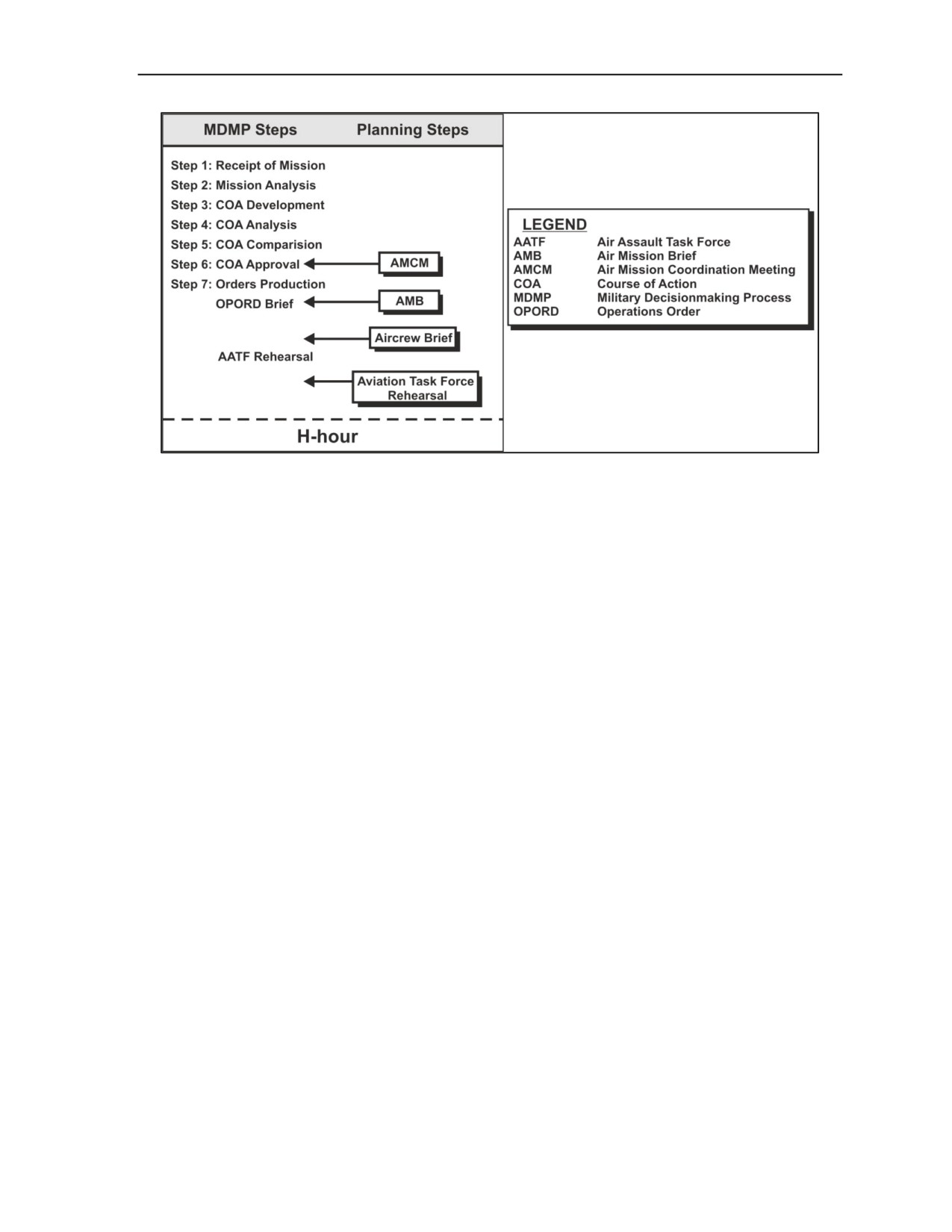
Air Assault Planning
Figure 9-3. Time-constrained air assault planning
9-13. Successful execution of an air assault in a time-constrained environment requires parallel and
collaborative planning by all units and staffs that are part of or supporting the AATF. Parallel planning
begins as soon as the mission is received, with the supporting combat aviation brigade providing liaison
officers or conducting coordination through the ADAM/BAE to the AATF if they are not colocated with
unit. Through continual coordination with the supporting combat aviation brigade, the ADAM/BAE
advises the AATF S-3 on limitations of aircraft or crew availability affecting course of action development.
9-14. Once the AATFC has provided a directed course of action or approved a course of action, the brigade
aviation officer immediately begins the air mission coordination meeting (AMCM). To save time by
reducing the number of meetings, specific portions of the air mission brief are included in the AATF
OPORD brief in lieu of doing a separate air mission brief. With the exception of the combined OPORD and
air mission brief, mission coordination and planning may be completed by phone, e-mail, video
teleconferencing, or other mission command systems. Backbriefs, aircrew briefs, and rehearsals still are
conducted as described earlier. The specific portions of the air mission brief included in the OPORD
brief areʊ
z
Staging plan.
z
Air movement plan.
z
Landing plan.
z
Attack reconnaissance coverage.
z
Landing zone condition criteria.
z
Weather decision.
z
Risk assessment.
RAPID DECISIONMAKING AND SYNCHRONIZATION PROCESS
9-15. Typically, the AATFC executes air assaults in response to time-sensitive intelligence or rapidly
changing battlefield conditions. If time is extremely limited, the AATFC may choose to rely on his
intuition and direct the staff to use the rapid decisionmaking and synchronization process (RDSP). While
the MDMP seeks the optimal solution, the RDSP seeks a timely and effective solution within the
commander’s intent, mission, CONOPS, and level of risk. Using the RDSP lets the staffs avoid the time-
consuming requirements of developing and comparing multiple courses of action. (Refer to ADRP 5-0 for
more information.)
6 March 2015
FM 3-99
9-5
Chapter 9
9-16. Due to a shortage of time, the primary method of coordination for the AMCM and the air mission
brief may be via video teleconference or conference call. However, a face-to-face meeting addressing the
contents of the air mission brief should be conducted before mission execution. This meeting may be
conducted on the pickup zone with aircraft shutdown. At a minimum, the flight lead, air mission
commander, chalk leaders, S-2, and the ground commander should be present. Rehearsals conducted in this
situation should be combined AATF and aviation unit events.
ALLOWABLE CARGO LOAD PLANNING CONSIDERATIONS
9-17. To load an effective AATF aboard helicopters, commanders and staffs must know the exact
composition of the AATF, the essential characteristics of the types of helicopters to be used for the
operation, and the methods of computing aircraft requirements.
9-18. Maximum allowable cargo load (ACL) is affected by altitude and temperature and differs widely
according to topography and climatic conditions common to specific zones or areas of military operations.
ACLs vary based on the location of, approaches to, and exits from landing zones; pilot proficiency;
aviation unit standard operating procedures; type of engine in the aircraft; and age of both aircraft and
aircraft engine. Therefore, two identical aircraft, of the same model and type, may not be able to pick up
and carry identical loads.
SECTION IV - PLANNING PROCESS
9-19. Throughout the operations process, the AATFCs and staffs synchronize the warfighting functions to
accomplish missions. Commanders and staffs use several integrating processes and continuing activities to
do this. Synchronization is the arrangement of action in time, space, and purpose, integration is combining
actions into a unified whole. (Refer to ADRP 5-0 for more information.)
9-20. The integrating processes combines the efforts of the AATFC and staff to synchronize specific
functions throughout the operations process. The integrating process includesʊ
z
Intelligence preparation of the battlefield. (Refer to ATP 2-01.3 for more information.)
z
Targeting. (Refer to FM 3-60 for more information.)
z
Risk management. (Refer to ATP 5-19 for more information.)
9-21. The AATFC and staff ensure several continuing activities are continuously planned and coordinated.
The following continuing activities require particular concern of the commander and staff throughout the
operationsprocess:
z
Information collection. (Refer to FM 3-55 for more information.)
z
Security operations. (Refer to FM 3-90-2 for more information.)
z
Protection. (Refer to ADRP 3-37 for more information.)
z
Liaison and coordination. (Refer to FM 6-0 for more information.)
z
Terrain management. (Refer to ADRP 3-90 for more information.)
z
Airspace control. (Refer to FM 3-52 for more information.)
9-22. MDMP integrates activities of the commander, staff, subordinate commanders, and other military
and civilian partners when developing an air assault OPORD. The AATF staff fosters a shared
understanding of the situation as it develops a synchronized plan or order to accomplish a mission.
WARNING ORDER
9-23. Air assault planning begins when the designated AATF receives a warning order (WARNORD) from
higher headquarters for the upcoming air assault mission. The WARNORD specifies the AATFC and task
organization. This allows the aviation commander to dispatch a liaison officer to the AATF headquarters
early in the planning phase. Other WARNORDs and fragmentary orders (FRAGORDs) should follow as
the AATF staff and commander work through the reverse planning sequence.
9-24. The following information is sent out with the WARNORD to provide units in the AATF the
information needed for planning:
z
Ground commander’s scheme of maneuver.
9-6
FM 3-99
6 March 2015
Air Assault Planning
z
Estimate of the size of the force to be air assaulted.
z
Likely pickup zones and landing zones.
z
Air assault task force commander’s intent on the number of lifts and general timeline.
z
Initial estimate on requirements for attack reconnaissance aircraft.
INITIAL PLANNING CONFERENCE
9-25. The initial planning conference is the first meeting between the AATF staff and supporting aviation
unit. The air mission commander, liaison officer, assault helicopter battalion S-2 and S-3, flight leads, and
select aviation brigade staff personnel should represent the aviation unit. This initial meeting allows the
supporting aviation unit planners to address impacts that environmental factors (climate and weather,
terrain, and altitude) may have on the performance capabilities of the aircraft and subsequent mission
accomplishment with the AATF planners, as early as possible in the planning process. The initial planning
conference is conducted at the AATF headquarters.
9-26. The AATF staff should have hastily war-gamed the concept for the ground tactical plan before the
initial planning conference in order for planners to discuss and determine landing zones, routes, and pickup
zones. If more planning time exists, units may conduct a subsequent AMCM (similar to the initial planning
conference), but this occurs after the ground tactical plan and other mission details are finalized.
9-27. Following the initial planning conference, the ground and aviation staffs should understand the
distance and general time involved for each lift. The staffs should know which forces are planned to be in
the first lift and in each serial of the first lift, and which first-lift serials are going to which landing zones
and by what route. Subsequent lifts and follow-on echelon lifts, while discussed at the initial planning
conference, can be planned in detail at a later AMCM if time permits.
AIR MISSION COORDINATION MEETING
9-28. The air mission coordination meeting (AMCM) is a meeting between the AATF and supporting
aviation units. An S-3 meeting follows the development of the ground tactical plan. The AMCM is run by
the brigade aviation element and chaired by the AATF S-3. The AMCM is scheduled to allow sufficient
time for maneuver units to decide on a specific course of action based on the WARNORD and the standard
planning factors.
9-29. The AATFC should approve the maneuver course of action before the AMCM. At the AMCM, unit
S-3s brief the concept of their ground tactical plans. S-3s show the composition of combat power, by
echelon, required at each landing zone. It is imperative that the subordinate unit S-3s attend this meeting
with an 80 to 90 percent solution on their requirements.
9-30. The meeting is not complete until the assault helicopter liaison officers know which loads go to
which landing zone and in what sequence. Attack reconnaissance liaison officers must know the air routes
to be used, and all must understand the landing zones and agree on a tentative air movement table with the
start and end times of the first and last serial on the landing zone. The brigade aviation element is the
central figure in coordinating this information.
9-31. The AATF S-3, executive officer, or commander must approve changes after the AMCM. It is
critical that the supported unit and the air assault planners come to the AMCM with the information needed
for an effective meeting.
(See table 9-1, page 9-8.) The end result of the AMCM is a finalized air
movement plan, landing plan, air routes, pickup zones, and landing zones.
6 March 2015
FM 3-99
9-7
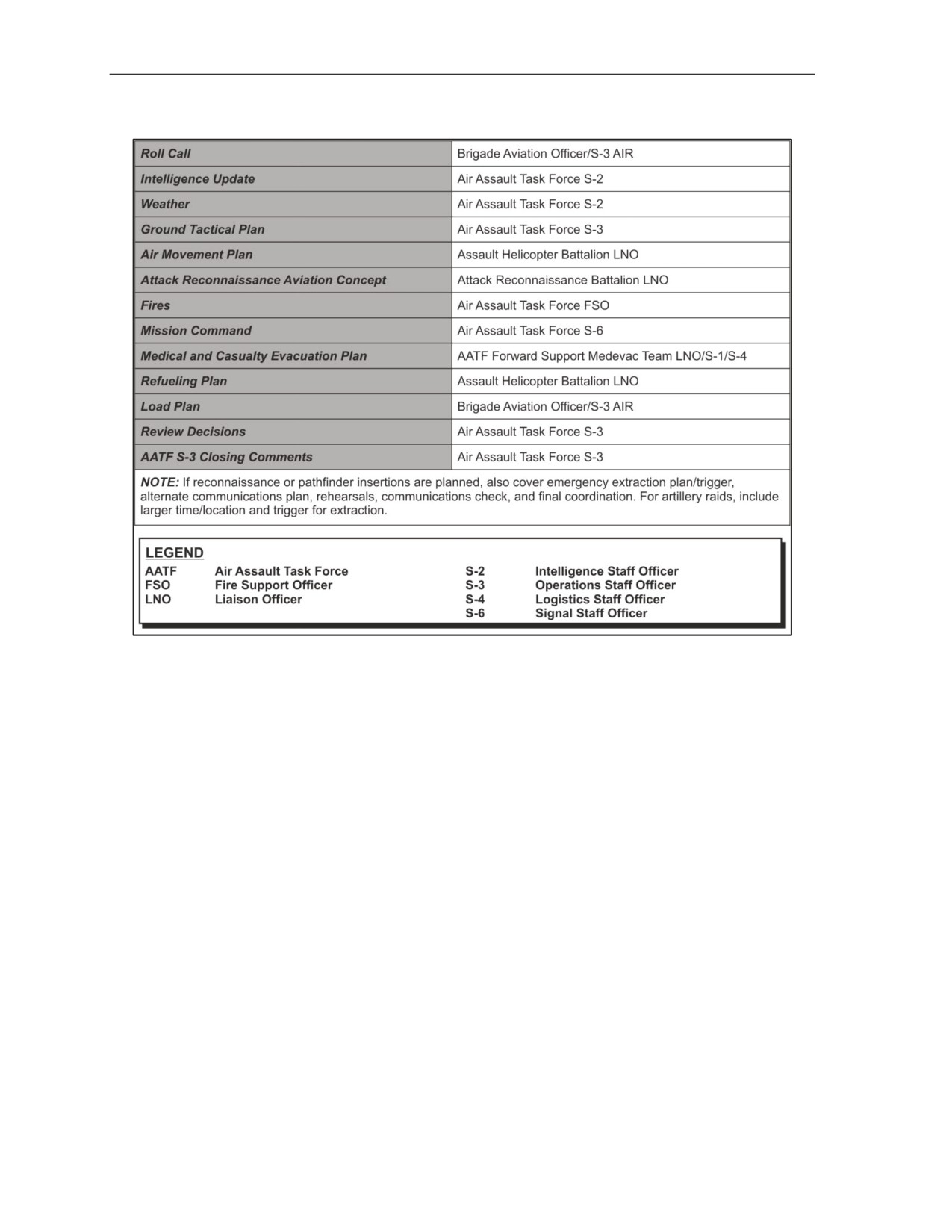
Chapter 9
Table 9-1. Example of an air mission coordination meeting agenda
AIR MISSION BRIEF
9-32. Air mission brief refers to the written product and the briefing itself. The air mission brief is a
coordinated staff effort during which the AATFC approves the air assault plan. The air mission brief is in
addition to the AATF OPORD and is published in the air assault appendix to the operations annex. (Refer
to FM 6-0 for more information.)
9-33. The air mission brief highlights air assault requirements to the AATF, aviation, and ground units. It
should not be a working meeting. It is a backbrief to the AATFC and important to the key subordinate
aviation and ground unit leaders who execute the mission. The combat aviation brigade or supporting
aviation unit staff plays a vital role in the air mission brief process.
9-34. The air mission brief should stress assault and attack concepts, sequence of events, and the reasoning
for the mission’s sequence. The slightest change in serial separation, landing zones, or other elements of the
mission can significantly affect the rest of the plan. The AATFC must approve changes to the air assault
mission after the air mission brief. It is difficult to resynchronize the different warfighting functions in the
short time that remains between the air mission brief and mission execution.
AIR MISSION BRIEF DOCUMENTS
9-35. Documents required to conduct a thorough air mission brief includeʊ
z
Air movement table. The air movement table regulates the sequence of flight operations from
pickup zone to landing zone. (Refer to chapter 12 of this publication for more information.)
z
Communications card. The communications card includes a summary of all call signs and
networks.
z
Pickup zone diagrams. The pickup zone diagram graphically depicts the pickup zone. Units
should prepare a separate diagram for each light and heavy pickup zone.
9-8
FM 3-99
6 March 2015
Air Assault Planning
z
Landing zone diagrams. Graphically depicts the landing zone and should be prepare for each
light and heavy landing zone.
z
Operations sketch. Sketch provided by each battalion S-3 describing the ground maneuver plan
and given to the aviation S-3 at the BCT rehearsal. Each pilot carries an operations kneeboard
sketch to provide situational awareness and to counter the potential for fratricide during close
combat operations. These sketches are included as enclosures to the air mission brief. Additional
documents that enhance the operations sketch include the grid reference graphic and a concept of
fires.
z
Route cards. Depict ingress and egress routes on the air assault.
z
Execution checklist. The air assault execution checklist permits brief, informative radio
transmissions on crowded radio networks. Execution checklists will use brevity codes to
represent critical points in the scheme of maneuver. Ensure brevity codes are aligned with multi-
service brevity codes. (Refer to ATP 1-02.1 for more information.)
AIR ASSAULT TASK FORCE REHEARSAL
9-36. The AATF combined arms rehearsal is culminating the formal air assault planning process. It is a
rehearsal of the entire air assault mission, beginning with condition setting and ending with the
commander’s expressed end state.
9-37. The rehearsal includes the aviation flight lead, S-3, the AATF staff, and other key leaders. The
emphasis is on synchronizing all units supporting and executing the air assault. Included in the rehearsal is
a discussion and demonstration of likely ground and air contingencies, such as downed aircraft, alternate
route or landing zone activation, delays in the pickup zone, alternate suppression of enemy air defenses
(SEAD) plan, and others suited to a particular mission.
9-38. It is critical that air assault security forces from attack reconnaissance aviation units are represented
at the rehearsal to confirm air route deconfliction, fire control measures, and locations of expected attack by
fire or battle positions. Additionally, the AATF S-3 or their designated representatives attend the rehearsal
to brief the ground tactical and fire support plans.
AIRCREW BRIEF
9-39. In the aircrew brief, aviation unit and serial commanders brief all flight crews executing the air
assault mission. The aircrew brief covers all essential flight crew actions and aviation planning necessary to
accomplish a successful mission. Flight crews must fully understand the mission to execute the air assault
successfully.
9-40. The aircrew brief is conducted at the aviation battalion level, with the aircrews from each unit in
attendance. The aircrew brief can be conducted at the aviation company level (with assistance from the
aviation brigade staff) when conditions do not allow the brief to be conducted at the battalion level.
AVIATION TASK FORCE REHEARSAL
9-41. The aviation task force combined arms rehearsal is similar to the AATF rehearsal. However, its
emphasis is the aviation scheme of maneuver and the contingencies associated with the movement of
aircraft and how they apply to the mission. The purpose of the aviation task force rehearsal is to validate
synchronization.
9-42. At a minimum, the rehearsal includes the pilot in command of each aircraft, the air mission
commander of each serial, the aviation task force S-3, and the aviation task force commander. Additional
requirements are set by the air mission commander. Topics discussed should include, but are not limited to,
route deconfliction, bump plan execution, execution matrix, downed aircraft recovery procedures,
personnel recovery, actions on contact, and pickup zone and landing zone procedures.
CONDITION CHECKS
9-43. Condition checks are coordination meetings conducted by the AATF staff to update the AATFC on
the status of how well shaping operations create the conditions to execute the air assault. These conditions
6 March 2015
FM 3-99
9-9
Chapter 9
are monitored constantly to ensure they exist for air assault execution. It is important to consider the
latency of the information when presenting it to the commander for a decision.
9-44. The initial air assault condition check usually is conducted in the AATF or ground tactical force main
command post. All air assault staff principals are represented. BCT and higher headquarter liaison officers
attend each other’s condition checks in person when possible and by video-teleconference or conference
call when necessary. The final condition check is conducted near the AATF’s pickup zone control
command post. It includes a review of the latest friendly, terrain and weather, and enemy situations.
9-45. An air assault condition check considers critical factors to evaluate and recommend the execution of
an air assault. For example, air assaults planned for dawn and dusk periods are extremely dependant on
weather and visibility. Air assaults planned for these periods increase the risks to air assets. The S-2
evaluates the weather and visibility conditions and provides recommendations to the AATFC based on his
assessment.
ABORT CRITERIA
9-46. Abort criteria is a predetermined set of circumstances, based on risk assessment, which makes the
success of the operation no longer probable; thus the operation is terminated. These circumstances can
relate to changes in safety, equipment or troops available, preparation or rehearsal time, weather, enemy,
losses during execution, or a combination of the above. The methodology used in executing an air assault
involves setting the conditions, providing suppressive fires immediately before and on landing, and
continuously monitoring abort criteria from beginning to end.
CONSIDERATIONS
9-47. Abort criteria are important considerations when a change of one or more conditions in the objective
area or landing zone seriously threatens mission success. As such, they are the friendly force information
requirement relating to ongoing air assault operations and requiring command consideration regarding
mission continuation. It is important that the air mission brief clearly defines abort criteria and that the
AATFC monitors them throughout the operation.
DECISION PROCESS
9-48. If an abort criterion is met, a decision sequence is used before aborting the mission—
z
Delay. If time is available, delay a mission in order to correct a circumstance that may abort a
mission.
z
Divert. If time is not available or a delay does not correct an abort criterion, the task force may
execute a divert contingency away from its primary air assault mission.
z
Abort. If an abort criterion exists and a delay or diversion to the mission does not correct it, the
mission can be aborted by the AATFC. Apply the following:
A lift is aborted when it reaches an abort criterion. The mission itself is not aborted.
A mission is aborted when an abort criterion exists for the entire mission and the AATFC
decides to abort.
9-49. Given the continued advantage of using the primary landing zone over the alternate, delay while en
route or at the pickup zone is preferable to diverting. The AATFC must evaluate the risk of such a delay in
light of time, fuel, enemy, and other mission variables.
9-50. Planners establish proposed abort criteria to assist commanders in deciding when success of the
operation is no longer probable. The AATFC retains authority for abort decisions. The six factors that
determine abort criteria for air assault missions are as follows:
z
Weather. Adverse weather conditions make flying unsafe and degrade the effectiveness of the
helicopter’s organic weapon systems. The support combat aviation brigade sets theater-specific
minimum weather conditions and establishes the appropriate approval authorities for risk
management.
z
Available aircraft. The ground tactical plan for an air assault operation depends on the rapid
massing of combat power at the critical place and time by helicopters. The supporting aviation
9-10
FM 3-99
6 March 2015
Air Assault Planning
task force manages combat power to support the AATF and keeps the staff informed of any
limitations.
z
Time. Refers to three distinct subjects: light and darkness, planning time, and fighter
management.
Light and darkness. U.S. armed forces gain a significant advantage over most military
forces in the world by operating at night. Night operations may increase aviation
survivability, but may increase accidental risk in periods of low illumination. The aviation
task force standard operating procedure specifies illumination thresholds related to mission
approval.
Planning time. In general, less planning time equates to increased risk. Time-sensitive
operations should be preplanned to the greatest extent possible and should rely on
established standard operating procedures.
Fighter management. Aircrew fighter management may impact the air assault timeline if
the mission is delayed or extended. The aviation task force standard operating procedure
specifies approval level for mission extension.
z
Mission essential combat power. Air assault mission planners use mission variables to determine
the minimum combat power (to include Infantry, field artillery, and aviation) needed to ensure
mission success. Use abort criteria to ensure friendly forces have the required combat ratio for
the operation.
z
Mission criticality. The success of units and future operations may depend on the success of the
air assault mission. Therefore, some air assault operations may proceed despite the presence of
circumstances that normally would abort the mission.
z
Enemy. Certain types of enemy activity, especially along air routes or near landing zones or
objectives, may abort an air assault mission. Abort criteria usually is stated in terms of the size
or type of an enemy unit, the type of enemy equipment (especially air defense), and the
proximity of the enemy to present or future friendly locations.
SECTION V - CONTROL MEASURES
9-51. A control measure is a means of regulating forces or warfighting functions (ADRP 6-0). Conduct of
air assault operations is inherently complex and requires unity of command. Complexity of the operation
necessitates keeping the operation as simple as possible with control measures.
FORCE-ORIENTED CONTROL MEASURES
9-52. Coordinated force-oriented control measures are crucial and allow for maneuvering ground and air
elements to operate with confidence. Control measures are preplanned steps that establish boundaries of an
area of operation.
9-53. Commanders use boundaries to assign units tactical responsibility of a designated geographical area.
They use control measures to govern airspace control and clearance on the ground of a diversity of fire
support ranging from artillery and naval gun fire
(to close combat attacks and close air support.
Commanders try to use easily identifiable terrain as a reference aid to enhance fire support coordination
measures (FSCMs) and easily recognizable terrain features on the ground to expedite maneuver.
9-54. An important point on maneuver control graphics; is that staffs must be knowledgeable regarding the
different maneuver control measures and their impact on clearance of fires. For instance, boundaries are
both restrictive and permissive, while corridors, routes, and direction of attack are restrictive.
9-55. Since boundaries serve as both permissive and restrictive measures, the decision not to employ them
has profound effects upon timely clearance of fires at the lowest possible level. This is important,
especially if maneuver units are not given areas of operations meaning that no boundaries are established.
9-56. The higher echelon may coordinate all clearance of fires short of the coordinated fire line, a time-
intensive process. It allows the unit to maneuver successfully and to engage targets in a swift and efficient
manner. It requires coordination and clearance only within that organization.
6 March 2015
FM 3-99
9-11
Chapter 9
BOUNDARIES
9-57. A boundary is a line that delineates surface areas for the purpose of facilitating coordination and
deconfliction of operations between adjacent units, formations, or areas (JP
3-0).
(Refer to JP
3-09,
FM 3-09, and FM 3-90-1 for more information.) Boundaries affect fire support in two ways. They areʊ
z
Restrictive. Boundaries are restrictive in that normally units do not fire across boundaries unless
the fires are coordinated with the adjacent unit or the fires are allowed by a permissive fire
support coordination measure, such as a coordinated fire line. These restrictions apply to
conventional and special munitions and their effects. When fires such as obscuration and
illumination affect an adjacent unit, coordination with that unit normally is required. A
commander may employ direct fires without clearance at specific point targets that are clearly
and positively identified as enemy. Targets and their triggers should be kept within the same
unit’s boundary without overriding other tactical or doctrinal considerations.
z
Permissive. Boundaries are permissive in that a maneuver commander, unless otherwise
restricted, enjoys complete freedom of fire and maneuver within his own boundaries. Thus, units
may execute joint fires without close coordination with neighboring units unless otherwise
restricted.
FIRE SUPPORT COORDINATION MEASURES
9-58. A fire support coordination measure (FSCM) is a measure employed by commanders to facilitate the
rapid engagement of targets and simultaneously provide safeguards for friendly forces (JP 3-0). The
following restrictive and permissive FSCMs— are used frequently in airborne or air assault tasks. See JP 3-
09, FM 3-09, and FM 3-90-1 for a discussion of FSCMs.
z
Restrictive Fire Support Coordination Measures. Restrictive measures impose requirements for
specific coordination before engagement of targets. Restrictive FSCMs are those that provide
safeguards for friendly forces and noncombatants, facilities, or terrain. Restrictive FSCMs
include the no-fire area, restrictive fire area, restrictive fire line, fire support area, fire support
station, and the zone of fire.
z
Permissive Fire Support Coordination Measures. Permissive FSCMs facilitate the attack of
targets by reducing or eliminating the coordination necessary for the clearance of fires.
Permissive FSCMs include the coordinated fire line, fire support coordination line, free fire area,
and the kill box.
AIRSPACE COORDINATING MEASURES
9-59. Airspace coordinating measures (ACM) are measures employed to facilitate the efficient use of
airspace to accomplish missions and simultaneously provide safeguards for friendly forces (JP 3-52). Two
ACMs-the airspace coordination area and the restricted operations area- are frequently used in airborne or
air assault tasks. Refer to JP 3-52, FM 3-52, FM 3-90-1 for a discussion of ACMs.
z
An airspace coordination area is a three-dimensional block of airspace in a target area,
established by the appropriate ground commander, in which friendly aircraft are reasonably safe
from friendly surface fires. The airspace coordination area may be formal or informal
(JP 3-09.3). The airspace coordination area is the primary ACM which reflects the coordination
of airspace for use by air support and indirect fires. (Refer to JP 3-09.3 for more information.)
z
A restricted operations area (ROA) is airspace of defined dimensions, designated by the
airspace control authority, in response to specific operational situations/requirements within
which the operation of one or more airspace users is restricted (JP 3-52). An ROA is used to
separate and identify areas, examples include but are not limited to artillery, naval surface fire
support, unmanned aircraft system operating areas, areas of combat search and rescue, special
operations forces operating areas, and areas which the area air defense commander has declared
weapons free. Air defense missions generally have priority over ROAs. (Refer to JP 3-52 for
more information.)
9-12
FM 3-99
6 March 2015
Air Assault Planning
SECTION VI - SHAPING OPERATIONS
9-60. A shaping operation is an operation at an echelon that creates and preserves conditions for the
success of the decisive operation. Shaping operations establish conditions for the decisive operation
through effects on the enemy, population, and terrain.
9-61. The AATFC determines the exact conditions that must be created and preserved according to the
mission variables of METT-TC and the level of risk associated with each air assault. When determining
these conditions, the AAFTC considers the following factors:
z
Shaping operations are not limited to conducting ground and air reconnaissance, suppression of
enemy air defenses, and preparation fires. They may require additional augmentation from
higher headquarters, the supporting aviation unit, and the supported unit staffs to succeed.
z
Assessing the effects of lethal fires by conducting battle damage assessment of enemy forces and
capabilities is not easy. Enemies often remove wounded or dead personnel and equipment to
make friendly battle damage assessment more difficult and less accurate.
z
In weighing the validity of battle damage assessment projections, it is important to balance
confirmed intelligence against friendly combat power applied. More combat power may be
useful against uncertain battle damage assessment.
z
The threat, the ability to assess the impact of shaping operations, and the air assault execution
time may determine the duration of shaping operations. Allocate as much time as possible.
9-62. Conducting shaping operations to create and preserve the proper conditions for air assault execution
is an iterative process. Based on his situational understanding, the AATFC decides what part of the
situation must change to ensure success of the air assault. The commander directs available reconnaissance
forces and surveillance assets to detect the location of enemy systems that unacceptably endanger the air
assault’s success. This allows lethal and nonlethal systems, such as artillery, jammers, attack
reconnaissance aircraft, and unmanned aircraft systems (UASs), to target and deliver the desired fires
and/or effects against enemy systems before launch.
9-63. The AATF staffs continue to plan and prepare for the air assault. The AATFC considers employing
service and joint fires to help set the conditions. The commander requests assistance from higher
headquarters if sufficient organic assets and information are not available to accomplish the mission. The
commander then assesses the progress of the shaping operations. This process repeats until the commander
is satisfied with the result or operational necessity forces him to either abort or conduct the air assault.
9-64. When available Army teams from the long-range surveillance company (LRSC), a divisional or
corps asset, are organized, trained, and equipped to deploy into the objective area and conduct
reconnaissance and surveillance tasks before the deployment of the air assault force. Special operations
forces may be inserted or already be operating in the objective area and become key components of the
initial effort to shape and set conditions. Special operations (to include special reconnaissance missions) are
keys to setting conditions, and integrated into the operation at every stage from initial planning to
transition. (See FM 3-05.) Refer to chapter 1 of the publication for additional information.
9-65. The AATFC employs his reconnaissance and surveillance forces
(to include cavalry, scouts,
chemical, biological, radiological, and nuclear platoon, and UAS to conduct reconnaissance and
surveillance of proposed landing zones and the objective area to identify and target enemy forces near the
landing zones and objectives. The field artillery battalion is positioned to provide fires throughout all
phases of the operation. Shaping operations should deny the enemy’s ability to conduct reconnaissance,
defeat his strike operations, and neutralize his ability to communicate and command. The supporting
aviation unit is prepared to conduct reconnaissance in coordination with reconnaissance forces or provide
lethal fires to neutralize or destroy enemy forces in the objective area once they have been identified.
9-66. The commander considers employing other capabilities that may not be in his task force, such as
close air support and electronic warfare assets. The purpose of these operations is to set and preserve the
conditions on the landing zone and objective area that allow the maneuver forces to launch the air assault
and execute a successful attack to destroy the enemy on the objective.
6 March 2015
FM 3-99
9-13
Chapter 9
9-67. Successful execution of an air assault may be decisive to accomplishing the mission, but it is not
necessarily the decisive operation. Air assaults often are conducted as shaping operations to establish the
conditions for the decisive operation through the effects rendered on the enemy and terrain. An example of
this is a company conducting an air assault to seize a bridge and secure a crossing site in support of a
combined arms battalion-level attack that requires the bridge as a crossing site.
9-68. Similarly, the AATF sets the conditions for a successful air assault by conducting shaping operations
of its own. The AATFC may employ ground and air reconnaissance units, attack aviation units, UAS, close
air support, and artillery fires to conduct shaping operations to mitigate the level of risk for executing the
air assault.
SECTION VII - MEDICAL AND CASUALTY EVACUATION
9-69. Medical evacuation refers to both air and ground casualty evacuation. Air medical evacuation
employs air assets from the air ambulance companies assigned to the combat aviation brigade and air
medical evacuation general support aviation battalions to evacuate casualties. Dedicated air medical
evacuation aircraft include specifically trained medical personnel to provide en route care. The nine-line
medical evacuation request is the standard method to request medical evacuation.
9-70. Casualty evacuation refers to the use of nonmedical vehicles or aircraft to evacuate casualties. Use
casualty evacuation only when the number of casualties exceeds the medical evacuation assets or when the
urgency of evacuation exceeds the risk of waiting for medical evacuation assets to arrive. Typically, air
assaults plan for both air and ground evacuations. (Refer to FM 3-04.113 and ATP 4-02.2 for more
information.)
MEDICAL EVACUATION PLANNING
9-71. The combat aviation brigade allocates medical evacuation assets to the supported AATF for the
duration of the air assault. However, the size and distance of the planned air assault dictates the duration of
medical evacuation support to the AATFC. As a rule, the supporting commander should provide medical
evacuation assets to the supported commander until ground lines of communications are established.
9-72. Typically, the evacuation platoon leader from the brigade support medical company and the air
ambulance platoon leader from the air ambulance company conduct the medical evacuation planning for
the air assault. They do so in coordination with the AATF S-1, AATF S-4, BAE, AATF S-3, supported unit
S-3, BCT surgeon section, and BCT support medical company commander. The air ambulance platoon
leader should brief the medical evacuation plan at the AMCM, AMB, and health service support rehearsal.
When planning for medical evacuation during an air assault they should—
z
Integrate ground evacuation measures into the overall medical evacuation plan.
z
Plan medical evacuation routes to Level II or III health care facilities. Ensure all aircrews
participating in the air assault know these routes.
z
Plan for medical personnel to fly on casualty evacuation aircraft if time and situation permit.
z
Ensure medical evacuation crews are available for air assault orders, rehearsals, and
preparations.
z
Brief casualty collection point locations and markings during the air assault rehearsal.
z
Plan to maintain a forward arming and refueling point (FARP) after the air assault is completed
so that medical evacuation aircraft have a staging place for follow-on ground tactical operations.
9-73. Medical evacuation aircraft are limited assets and should be scheduled and used accordingly. The
AATF’s casualty estimate provides planning guidance for the number of medical evacuation aircraft
needed to support the air assault. To maximize the amount of mission hours they can support the mission,
personnel should stage medical evacuation aircraft to support an air assault at the latest possible time.
Medical evacuation aircraft should support short distance air assaults from the pickup zone (PZ) or brigade
support area. Aircraft may stage at a FARP or use a restricted operations zone to expedite pick up of
casualties in long distance air assaults.
9-14
FM 3-99
6 March 2015
Air Assault Planning
9-74. Medical and casualty evacuation aircraft normally are under operational control to the AATF during
air assault operations. The air mission commander (AMC) controls the medical evacuation flights to
facilitate quick deconfliction of airspace. The AMC clears all medical and casualty evacuation aircraft
movements, to include launch and landings. The AATFC may retain launch authority, but the AMC is
responsible for medical evacuation.
9-75. Typically, requests for medical or casualty evacuation is over the combat aviation network for the
duration of the air assault operation until an evacuation network, if necessary, is established. This ensures
good coordination for deconfliction of fires and airspace. When planning medical evacuation operations—
z
Send medical evacuation aircraft into secure landing zones (LZs) if possible.
z
Integrate attack reconnaissance aviation units to provide escort and LZ overwatch as required.
z
Ensure terminal guidance into the LZ.
z
Ensure redundant means of communication with the supporting medical evacuation assets
throughout the air assault.
z
Designate a medical evacuation officer in charge, typically a medical officer from the
brigade support medical company, to ride on mission command aircraft to receive and
prioritize evacuation mission requests and forward this information to the AMC for launch.
CASUALTY BACKHAUL
9-76. The AATF staff and aviation unit staff plan the combined use of aerial and ground medical and
casualty evacuation assets during air assault planning. While assaulting aircraft may backhaul wounded
from the LZ, the time required to load and unload casualties could desynchronize the air movement table.
9-77. Casualty evacuation during an air assault may cause delays in air assault missions unless spare
aircraft are committed to replace aircraft designated to backhaul casualties. Designating separate casualty
evacuation aircraft may prevent delays of follow-on lifts. Procedures for casualty backhaul during an air
assault are as follows:
z
Medical evacuation request goes to mission command aircraft. The medical officer onboard
relays the request to the AMC. If the request is approved, the AMC directs the next serial’s last
two aircraft (dependent on METT-TC) to move to the LZ casualty collection point to pick up
casualties after dropping off personnel.
z
All backhauled casualties are taken back to the PZ casualty collection point.
z
Backhaul aircraft with casualties notify PZ control they are inbound with casualties.
z
Last serial of the final lift makes the final pick up of casualties before the conclusion of the air
assault, if necessary.
MEDICAL EVACUATION LANDING ZONE
9-78. During air assault planning, the AATF staff and AMC plan the combined use of air medical
evacuation and aerial casualty evacuation landing zones. The AATF plans a means of marking the casualty
collection point for air medical or assault aircrew identification. Preferred LZ signaling methods include
smoke or panel markers (VS-17 panel marker) during the day and strobe or chemical lights (not blue or
green which are not visible under night vision goggles) at night. If air assault crews evacuate casualties,
they must know where to take them and how to rejoin remaining lift aircraft for subsequent lifts. Using a
backhaul LZ within the normal assault PZ, FARP, or both can minimize disruption of the loading plan
while helping maintain serial integrity.
9-79. A dedicated medical evacuation LZ may be used for both air medical and aerial casualty evacuation.
Medical evacuation LZ selection and procedures include—
9-80. A dedicated medical evacuation LZ may be used for both air medical and aerial casualty evacuation.
Medical evacuation LZ selection and procedures include—
z
Select LZs that are level and clear of debris within a 50-meter radius.
z
Keep all other light sources away from the LZ unless instructed otherwise by aircrew.
z
Once medical evacuation aircraft are inbound, make an estimated time-of-arrival call.
6 March 2015
FM 3-99
9-15
Chapter 9
z
Ensure personnel communicating with the aircraft at the pickup site have visual on the LZ to
confirm the signal or to assist the crew as required.
z
Once medical evacuation aircraft has landed, if manned with medical personnel to provide en route
care, keep personnel away from the aircraft while the medical personnel come to the patient.
z
The unit should provide personnel to assist in loading the patient on the aircraft, and if present,
under direction of medical personnel.
9-16
FM 3-99
6 March 2015
Chapter 10
Ground Tactical Plan
The ground tactical plan is the foundation of a successful air assault on which all
other air assault planning stages are based. It is the decisive operation for the air
assault task force (AATF) because it accomplishes the mission assigned by the higher
headquarters. It specifies actions in the objective area that lead to accomplishment of
the mission and subsequent operations.
SECTION I - ELEMENTS
10-1. The ground tactical plan may assume a variety of possibilities depending on the commander’s
evaluation of the mission variables of METT-TC. The ground tactical plan for an air assault contains
essentially the same elements as other terrain or enemy-oriented offensive operation. However, the
elements of the ground tactical plan are prepared to capitalize on speed and mobility to achieve surprise.
The following elements are critical to the planning process.
TASK ORGANIZATION
10-2. Task organization is a temporary grouping of forces designed to accomplish a particular mission
(ADRP 5-0). When determining the task force organization, air assault planners emphasize the following:
z
Maximizing combat power in the assault to heighten the surprise and shock effect, which is
especially important if the air assault task force plans to land on or near the objective. Assaulting
forces organize on or near the objective are prepared to rapidly eliminate enemy forces,
immediately seize objectives, and rapidly consolidate for subsequent operations.
z
Ensuring the task force inserts enough force to accomplish initial objectives quickly. To prevent
being defeated by repositioning mobile enemy forces, air assault task forces must be massed in
the landing zone to build up a significant early combat power capability. If adequate combat
power cannot be introduced quickly into the objective area, the air assault force lands away from
the objective to build up combat power and then assaults like other combat unit.
z
Ensuring the air assault task force commander properly allocates his logistics assets to sustain
the task force until follow-on forces arrive.
MISSION STATEMENT
10-3. The mission is the task, together with the purpose, that clearly indicates the action to be taken and the
reason therefore. Commanders analyze a mission in terms of the commander‘s intent two echelons up,
along with specified and implied tasks. They consider the mission of adjacent units to understand how they
contribute to the decisive operation of their higher headquarters. This analysis produces the unit‘s mission
statement.
10-4. A mission statement is a short sentence or paragraph that describes the organization‘s essential task
(or tasks) and purpose— a clear statement of the action to be taken and the reason for doing so. The
mission statement contains the elements of who, what, when, where, and why, but seldom specifies how. It
is important to remember that an air assault is a type of operation and not a tactical mission task.
COMMANDER’S INTENT
10-5. The commander’s intent is a clear and concise expression of the purpose of the operation and the
desired military end state that supports mission command, provides focus to the staff, and helps subordinate
and supporting commanders act to achieve the commander’s desired results without further orders, even
6 March 2015
FM 3-99
10-1
Chapter 10
when the operation does not unfold as planned (JP 3-0). It is critical that the AATF planners receive the
commander’s intent as soon as possible after the mission is received. Even if the ground tactical plan is not
complete, air assault planning often begins after the AATFC issues his intent.
10-6. During planning, the initial commander's intent drives course of action development. In execution,
the commander’s intent guides disciplined initiative as subordinates make decisions when facing
unforeseen opportunities or countering threats.
CONCEPT OF OPERATIONS
10-7. The concept of operations is a statement that directs the manner in which subordinate units cooperate
to accomplish the mission and establishes the sequence of actions the force will use to achieve the end state
(ADRP 5-0). The concept of operations expands on the commander’s intent by describing how the
commander wants the force to accomplish the mission. It states the principal tasks required, the responsible
subordinate units, and how the principal tasks complement one another. Commanders and staff use the
operational framework to help conceptualize and describe their concept of operation.
10-8. The operational framework proves the commander with basic conceptual options for visualizing and
describing operations in time, space, purpose, and resources. Commanders are not bound by any specific
framework for conceptually organizing operations; and use one of three conceptual frameworks listed
below or in combination. These operational frameworks apply equally to both operational and tactical
actions.
z
The deep-close-security framework to describe the operation in time and space.
z
The decisive-shaping-sustaining framework to articulate the operation in terms of purpose.
z
The main and supporting efforts framework to designate the shifting prioritization of resources.
10-9. The deep-close-security operational framework has historically been associated with terrain
orientation but can be applied to temporal and organizational orientations as well. Deep operations involve
efforts to prevent uncommitted enemy forces from being committed in a coherent manner. Close operations
are operations that are within a subordinate commander’s area of operations. Security operations involve
efforts to provide an early and accurate warning of enemy operations and to provide time and maneuver
space within which to react to the enemy.
10-10. The decisive-shaping-sustaining framework lends itself to a broad conceptual orientation. The
decisive operation is the operation that directly accomplishes the mission (ADRP 3-0). It determines the
outcome of a major operation, battle, or engagement. A shaping operation is an operation that establishes
conditions for the decisive operation through effects on the enemy, other actors, and the terrain
(ADRP 3-0). A sustaining operation is an operation at any echelon that enables the decisive operation or
shaping operation by generating and maintaining combat power (ADRP 3-0).
10-11. The main and supporting efforts operational framework—simpler than other organizing
frameworks—focuses on prioritizing effort among subordinate units. Therefore, leaders can use the main
and supporting efforts with either the deep-close-security framework or the decisive-shaping-sustaining
framework. The main effort is a designated subordinate unit whose mission at a given point in time is most
critical to overall mission success. It usually is weighted with the preponderance of combat power
(ADRP 3-0). A supporting effort is a designated subordinate unit with a mission that supports the success
of the main effort (ADRP 3-0). (Refer to ADRP 3-0 for more information.)
DECISIVE-SHAPING-SUSTAINING FRAMEWORK EXAMPLE
10-12. Commanders identify the decisive operation and unit(s) responsible for conducting the decisive
operation. This allows them to articulate their shaping operations and the principal task of the units
assigned each shaping operation. Commanders complete their CONOPS with sustaining actions essential to
the success of decisive and shaping operations.
Decisive Operations
10-13. In figure 10-1, the AATF has been directed by its higher headquarters to conduct an air assault to
destroy enemy forces on Objective Horse. The AATFC determines that his decisive operation is the attack
10-2
FM 3-99
6 March 2015
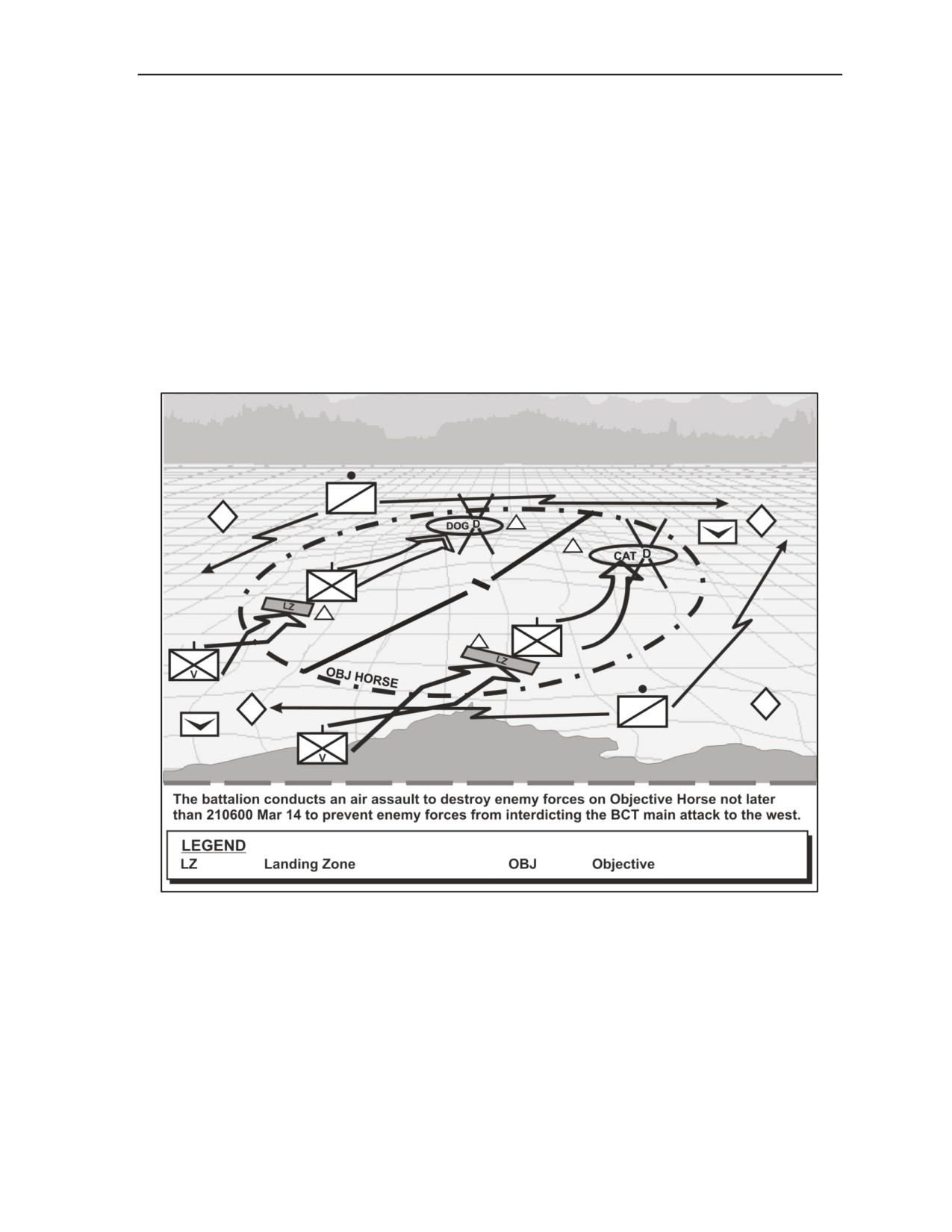
Ground Tactical Plan
to destroy enemy forces on Objective Horse. He further decides that the decisive point of this operation is
the successful air assault of his forces into the objective area to destroy the enemy.
Shaping Operations
10-14. In figure 10-1, the AATFC employs his reconnaissance force (to include scouts, CBRN platoon,
and UAS) to conduct reconnaissance and surveillance of proposed landing zones and the objective area to
identify and target enemy forces near the landing zones and objective vicinities. The field artillery battalion
is positioned to provide fires throughout all phases of the operation. It is prepared to deny the enemy’s
ability to conduct reconnaissance, defeat his strike operations, and neutralize his ability to communicate
and command. The supporting aviation unit is prepared to conduct reconnaissance in coordination with the
reconnaissance force or provide fires to neutralize or destroy enemy forces in the objective area once they
have been identified. The commander considers employing other enablers that may not be in his task force,
such as close air support and electronic warfare assets. The purpose of these operations is to set and
preserve the conditions on the landing zone and objective area that allow the maneuver forces to launch the
air assault and execute a successful attack to destroy the enemy on the objective.
Figure 10-1. Organizational framework
Sustaining Operations
10-15. The AATFC considers how he refuels the supporting aviation unit, resupplies, and provides
responsive medical and casualty evacuation to his task force. He determines that this operation may require
bringing a forward logistics element from the brigade support battalion and some of its crucial elements
forward to conduct casualty evacuation, resupply, and equipment recovery. He positions a forward surgical
team or treatment team with a maneuver force to treat casualties before evacuation to a medical treatment
facility.
6 March 2015
FM 3-99
0-
Chapter 10
TASKS TO SUBORDINATE UNITS
10-16. The BCT commander through his staff assigns tasks to subordinate units. The assignment of a task
includes not only the task (what), but also the unit (who), place (where), time (when), and purpose (why). A
task is a clearly defined and measurable activity accomplished by individuals and organizations. Tasks are
specific activities that contribute to accomplishing missions or other requirements and direct friendly
action. The purpose of each task should nest with completing another task, achieving an objective, or
attaining an end state condition.
10-17. Examples of decisive, shaping, and sustaining activities are as follows:
z
Mission command. The AATFC deploys in a mission command aircraft to allow the commander
to observe and direct the air assault from a forward position.
z
Movement and maneuver. Maneuver force conducts an air assault and attack to destroy enemy
forces on objectives. Aviation units conduct air insertion of reconnaissance force near the
objective area and provide interdiction and close combat attack against identified enemy forces
in the objective area.
z
Intelligence. Ensures the information collection effort focuses on landing zones and the objective
area to identify enemy forces for targeting by fires and aviation assets to set conditions for air
assault execution.
z
Fires. The field artillery battalion provides fires on identified enemy positions on or near landing
zones and the objective to neutralize enemy forces and help set conditions for air assault
execution.
z
Protection. Suppression of enemy air defenses— plan, synchronize, and execute route lethal
suppressive fires and nonlethal suppressive effects on known or suspected enemy air defense
positions that are unavoidable.
z
Sustainment. The brigade support battalion establishes a forward medical treatment point
colocated with the maneuver force. Aviation forward arming and refueling points may colocate
with brigade support battalion assets for security and to facilitate the refuel of aircraft.
SECTION II - PLAN DEVELOPMENT
10-18. The AATFC begins to visualize the application of his ground tactical plan to the battlefield by
defining the tactical problem and then begins a process of determining feasible solutions with his planning
staff using mission analysis. The results of mission analysis (to include intelligence preparation of the
battlefield and running estimates) inform the commander as he develops his operational approach that, in
turn, facilitates course of action development during the MDMP.
(Refer to ADRP
5-0 for more
information.)
MISSION ANALYSIS
10-19. Upon receipt of a warning order or mission, the commander supported by his staff, filters relevant
information categorized by operational variables into the categories of the mission variables used during
mission analysis. The commander uses mission variables to refine his understanding of the situation and to
gather relevant information used for mission analysis. Incorporating the analysis of the operational
variables with METT-TC ensures the commander considers the best available relevant information about
conditions that pertain to the mission. The mission variables of METT-TC consist of mission, enemy,
terrain and weather, troops and support available-time available, and civil considerations.
MISSION
10-20. The analysis of the mission is conducted early-on during mission analysis. The mission involves
the critical tasks that must be performed. The tasks are either specified tasks stated by the order or implied
tasks that the commander must deduce. Mission analysis determines not only what must be accomplished,
the intent of the commander ordering the mission (the why of the operation), and the limitations (when,
where, how) placed by the higher headquarters, but is the basis for deciding on task organization. Once the
10-4
FM 3-99
6 March 2015
Ground Tactical Plan
mission is analyzed and deductions are made, all other factors are considered in terms of their impact on the
mission. It is therefore imperative that the mission be understood.
ENEMY
10-21. Examining enemy factors should be as detailed as possible depending on the time available.
General factors to consider areʊ
z
Identification. Size and type of unit (regular or irregular force, or some combination of the two).
z
Location. Current and future movement.
z
Disposition. Organization or formation.
z
Strength. Compared to friendly forces.
z
Morale. Esprit, experience, state of training, regular or reserve.
z
Capabilities. Electronic warfare, chemical, biological, radiological, and nuclear, air defense,
airborne, air movement, attack helicopters, mobility (in comparison to the air assault force).
z
Composition. Armored, Infantry, artillery, and sustainment.
z
Probable courses of action. Likely mission or objective, probability of achieving it.
z
Most dangerous course of action as it applies to the AATF mission and its potential impact on
the ground tactical plan.
10-22. When planning an air assault operation, the following factors about the enemy must be considered:
z
Air defense weapons and capability.
z
Mobility; particularly his ability to react to an air assault insertion.
z
Chemical, biological, radiological, and nuclear capability; particularly his ability to influence
potential flight routes and landing zones.
z
Capability to interdict or interrupt air assault operations with his helicopters or fixed-wing
aircraft.
TERRAIN AND WEATHER
10-23. In air assault operations, terrain and weather must be analyzed in terms of their effect on the air
assault force. This includes the air assault force’s pick up, air movement, insertion, and movement to the
final objective, and in terms of the overall influence on aviation operations.
Terrain
10-24. Terrain preparation starts with the situational understanding of terrain through proper terrain
analysis. Terrain analysis described in terms of the military aspects of terrain includes observation and
fields of fire, avenues of approach, key terrain, obstacles, and cover and concealment (OAKOC).
Observation and Fields of Fire
10-25. Observation is the condition of weather and terrain that permits a force to see friendly, enemy, and
neutral personnel, systems, and key aspects of the environment. An assault force’s field of fire is directly
related to its ability to observe. Considerations related to both enemy and friendly forces and, for air assault
operations, includeʊ
z
Enemy visual observation or electronic surveillance of pickup zones, flight routes, and
landing zones.
z
Enhanced friendly observation provided by scout weapons teams and aerial field artillery
observationhelicopters.
z
Ease of navigation along flight routes particularly for night or adverse weather operations.
Avenues of Approach
10-26. Air and ground avenues of approach are considered in both offensive and defensive operations
from friendly and enemy viewpoints. A good avenue of approach for air assault forces offersʊ
z
A reasonable degree of mobility and few natural obstacles to the aircraft.
z
Little or no canalization.
z
Terrain masking that decreases effectiveness of enemy air defense weapons.
6 March 2015
FM 3-99
10-5