FM 3-99 Airborne and Air Assault Operations (MARCH 2015) - page 2
Organization and Employment
z
The Bravo Echelon is the reinforcing forces in the airhead. When needed, the Bravo
Echelon enters the objective area as soon as practical by air or surface movement, or a
combination of the two. It is manned and equipped for combat power augmentation and
lodgment expansion. It includes additional vehicles and equipment from the ABNAF, plus more
forces to include supporting personnel. The existence of one of the following conditions requires
an ABNAF to have a follow-on echelon:
Shortage of aircraft.
Aircraft that cannot land heavy items of equipment.
Any enemy situation, terrain, or weather that makes it impossible to land certain Soldiers or
equipment in the assault echelon.
z
The Charlie Echelon includes the remainder of the ABNAF and the airborne task force
(ABNTF) required for operations after the establishment of the airhead and securing or
expanding the lodgment. The Charlie Echelon gives the ABNAF the capability to conduct
sustained combat operations within the limitations of the IBCT and provides additional combat
power and equipment for the ABNTF. Depending on the mission and subsequent operations, the
Charlie Echelon may be either a reinforcing force or the first elements of what will become the
follow-on force.
Note. Airborne Infantry units can be committed to an airborne assault with the full complement
of the follow-on echelon as part of the assaulting force; however, if leaving a follow-on echelon
that must be brought forward by means other than air, it is often desirable or necessary to leave
certain personnel and equipment behind.
REAR ECHELON
2-11. The rear echelon is the echelon containing those elements of the force that are not required in
the objective area. The rear echelon is normally small for a brigade or battalion and includes personnel left
at its rear base to perform administrative and service support functions. A higher headquarters usually
controls the rear echelon for all units. The rear echelon can remain at the remote marshalling base when the
unit is to be relieved at an early date; or it can rejoin the unit when the IBCT remains committed to
sustained combat for a prolonged or indefinite period. In addition, if the airborne force continues in the
ground combat role after linkup, the rear echelon may be brought forward.
DESIGNATION OF RESERVE
2-12. The employment of the reserve element follows the normal employment of a reserve unit in a
ground operation. The location occupied by the echelon reserve depends on the most likely mission for the
reserve on commitment. With the reserve element at the departure airfield, the reserve commander must
continue planning for possible future commitment of his forces as far as maps, photos, and information of
the situation permit.
The Battalion as the Reserve
2-13. The reserve can be held in the departure area ready to be committed by air when and where the
situation dictates. This usually happens in large-scale airborne operations when suitable airfields in the
airhead are not available. However, it may cause delays in commitment—
z
If signal communications fail.
z
If the air movement is long.
z
If flying weather is unfavorable.
z
If time is added for coordination of air cover.
Brigade and Battalion Reserves
2-14. These reserves may be used to enter the airhead as part of the assault echelon. They provide depth to
the airhead by blocking penetrations, reinforcing committed units, and counterattacking. They consist of
6 March 2015
FM 3-99
2-3
Chapter 2
not more than a company at BCT level or a platoon at battalion level. However, their small size is dictated
by tactical considerations and assigned missions. Commanders should organize, task, and position the
reserve, ensuring that—
z
The size of the reserve is compatible with likely missions.
z
The reserve comes from the unit with the fewest priority tasks.
z
The reserve is not assigned assault objectives or an area of the airhead to defend.
z
The reserve is positioned in an area that allows for quick employment.
z
The reserve is mobile. (This can be achieved using organic vehicles (such as, weapons company,
forward support company, or if augmented with Armored or Stryker forces.)
z
The reserve is located in an assembly area, both initial and subsequent assembly areas, or a battle
position, so that it does not interfere with units assigned assault objectives.
z
The reserve is near lines of communication in a covered and concealed location to provide ease
of movement, to reinforce, or to block.
z
The reserve is located within the area of one unit, if possible.
z
The reserve’s location allows for dispersion of the force.
SECTION II - AIRBORNE ASSAULT FORCE CONSIDERATIONS
2-15. The ABNAF can be part of a larger unit, or it can be comprised solely of the initial assault force,
preparing the way for deployment of a follow-on force. This section discusses assault force considerations
for formation and support.
ASSAULT FORCE FORMATION
2-16. The ABNAF is formed early in the planning stage by a directing or establishing headquarters that
allocates units and defines authority and responsibility by designating command and support relationships.
Predesignated and well-understood command and support relationships includeʊ
z
A task organization that provides a mission-specific balance of maneuver, combat power, and
endurance to seize and protect the airhead or lodgment.
z
Unit tactical integrity that is maintained when developing load plans and cross loading key
leadership, crew-served weapons and equipment followed by all other personnel to ensure unit
integrity upon insertion into the drop zone and assemble.
z
A sustainment capability to support a rapid tempo until follow-on or linkup forces arrive, or until
the mission is completed.
JOINT AND ARMY CONTROL TEAMS
2-17. Terminal guidance aids and control measures are used on the ground in the objective area to assist
and guide incoming airlift aircraft to the designated drop zones or landing zones. Combat control teams
comprised of USAF personnel are organized, trained, and equipped to provide aircraft terminal guidance.
Army teams from the long-range surveillance company (LRSC), a divisional or corps asset, are organized,
trained, and equipped to deploy into the objective area and conduct reconnaissance and surveillance tasks
before the deployment of the airborne force.
COMBAT CONTROL TEAM
2-18. The combat control team is a small task-organized team of USAF parachute and combat diver
qualified personnel. The combat control team’s mission is to establish assault zones (drop zones and
landing zones) in austere and non-permissive environments. The mission includes initially placing en route
and terminal navigational aids; controlling air traffic; providing communications; and removing obstacles
and unexploded ordnance with demolitions. Combat control teams provide command and control,
reconnaissance and surveillance, and limited weather observations.
(Refer to JP
3-17
for more
information.)
2-4
FM 3-99
6 March 2015
Organization and Employment
LONG-RANGE SURVEILLANCE COMPANY
2-19. The long-range surveillance company (LRSC) is a corps level asset for the purpose of long-range
surveillance. The LRSC comprises a headquarters section, a communications platoon, a transportation
section, a maintenance section, and three long-range surveillance platoons with three teams each for a total
of 9 teams. The LRSC is modular in that it has the command, control, and communications capability to
support multiple operations simultaneously. (Refer to FM 3-55.93 for more information.)
SECTION III - CAPABILITIES, LIMITATIONS, VULNERABILITIES
2-20. Airborne forces deploy strategically, operationally, or tactically on short notice anywhere in the
world. They can be employed as a deterrent or as a combat force. The strategic mobility of airborne forces
permits rapid employment to meet contingence across the range of military operations; and provides a
means by which a commander can decisively influence operations. This section discusses the capabilities,
limitations and vulnerabilities unique to an ABNAF.
CAPABILITIES
2-21. Since airborne forces are able to respond on short notice, airborne operations provide distinct
advantages such as—
z
Ability to bypass all land or sea obstacles.
z
Surprise.
z
Ability to mass rapidly on critical targets.
2-22. Airborne forces can extend the area of operation, move, and rapidly concentrate combat power like
no other available forces. Specifically, airborne forces can—
z
Attack enemy positions from any direction.
z
Conduct attacks and raids beyond the area of operation.
z
Conduct limited exploitation and pursuit operations.
z
Overfly and bypass enemy positions, barriers, and obstacles and strike objectives in otherwise
inaccessible areas.
z
Provide responsive reserves, allowing commanders to commit a larger portion of their forces to
action.
z
React rapidly to tactical opportunities, necessities, and threats in unassigned areas.
z
Rapidly place forces at tactically decisive points in the area of operation.
z
Conduct fast-paced operations over extended distances.
z
Conduct and support deception with false insertions.
z
Rapidly reinforce committed units.
z
Rapidly secure and defend key terrain (such as crossing sites, road junctions, and bridges) or key
objectives.
z
Rapidly repair or construct infrastructure to receive follow-on forces.
z
Delay a much larger force without becoming decisively engaged.
2-23. Airborne forces, when augmented with appropriate support or augmentation, can conduct sustained
combat operations against the enemy.
LIMITATIONS
2-24. The commander and planners must recognize the limitations of airborne forces and plan accordingly.
They must consider the following:
z
An airborne force depends on USAF aircraft for long-range movement, fire support, and
sustainment. The availability and type of aircraft dictates the scope and duration of airborne
operations.
z
After the initial airdrop, the sustained combat power of airborne forces depends on resupply by
air. Any interruption in the flow of resupply aircraft can cause a potential weakening of the
6 March 2015
FM 3-99
2-5
Chapter 2
airborne force. Enemy air defense fires against resupply aircraft and long-range artillery and
mortar fires on the drop zone can hamper the delivery, collection, or distribution of critical
supplies.
z
Once on the ground, the airborne force has limited tactical mobility. That mobility depends on
the number and type of vehicles and helicopters that can be brought into the objective area with
the follow-on force.
z
The airborne force has limited field artillery and air defense artillery support until additional
assets can be introduced into the objective area. Additional target acquisition assets are needed
to provide accurate and timely targeting information.
z
Evacuation of casualties from the airhead is difficult. Until evacuation means are available, the
BCT must be prepared to provide medical care through the attachment of its organic medical
company or the attachment of echelon above BCT medical elements.
VULNERABILITIES
2-25. Airborne forces are vulnerable to enemy attack while en route to the drop zone. Although the USAF
can conduct limited airdrops without air superiority, large operations require neutralization or suppression
of enemy air defenses (SEAD). This may require SEAD, radar jamming, and fighter aircraft besides
transport and close air support sorties. Initial airborne assault elements are light and are separated from
weapon systems, equipment, and materiel that provide protection and survivability. An ABNAF is
particularly vulnerable to enemy—
z
Attack by aircraft and air defense weapon systems during the movement and airborne assault
phases.
z
Attack by chemical, biological, radiological, and nuclear weapons because of limited chemical,
biological, radiological, and nuclear protection and decontamination capability.
z
Attack by ground, air, or artillery during the assault and landing phases.
z
Air strikes if air superiority is not gained before the airborne assault.
z
Electronic attack, to include jamming of communications and navigation systems, and disrupting
aircraft survivability equipment.
z
Small-arms fire that presents a large threat to the aircraft during the air movement, airborne
assault and landing phases.
SECTION IV - AIRBORNE COMMAND AND CONTROL PLATFORMS
2-26. Airborne operations require extensive coordination between the USAF, Army, and often, other
services. During forcible entry, airborne command and control platforms may be employed separately or in
combination to augment or even replace the ground-based elements when response time is critical. This
section discusses the airborne elements of the tactical air control system, consisting of the Airborne
Warning and Control System (AWACS), Joint Surveillance Target Attack Radar System (JSTARS), and
the Joint Airborne Communications Center/Command Post (JACC/CP) or "Jackpot" package, designed to
fit aboard a C-130 aircraft.
AIRBORNE WARNING AND CONTROL SYSTEM
2-27. The AWACS, designated by the USAF as the E-3 radar, is a modified Boeing 707 that houses a radar
subsystem and vast communications equipment. It is under operational control of the tactical airlift control
center (TACC). The AWACS radar system can compensate for the major limitations of ground-based radar
systems such as their inability to detect low-flying aircraft due to line-of-sight restrictions. Other limitations
of ground-based radar systems include their susceptibility to electronic countermeasures and their
vulnerability to attack.
2-28. The AWACS can communicate with a wide range of systems. It has extensive high frequency (HF),
very high frequency (VHF), and ultrahigh frequency (UHF) radios used to communicate with ground
controllers, airborne forces, and ground forces. The E-3‘s radar flexibility allows it to support tactical
missions, defensive missions, or both at the same time. The aircraft is used for weapons control or as a
2-6
FM 3-99
6 March 2015
Organization and Employment
surveillance platform. In an air defense role, the E-3 radar provides weapons control and surveillance
capabilities. It provides control for weapons and air defense regions during stages of increased alerts.
JOINT SURVEILANCE TARGET ATTACK RADAR SYSTEM
2-29. The E-8C Joint Surveillance Target Attack Radar System (JSTARS) is an airborne command and
control, intelligence, surveillance and reconnaissance platform. Its primary mission is to provide theater
ground and air commanders with ground surveillance to support attack operations and targeting that
contributes to the delay, disruption and destruction of enemy forces. When available, JSTARS aircraft may
be employed as a viable airborne assault force command platform in support of forcible entry operations.
2-30. The E-8C is a modified Boeing 707-300 series commercial airframe extensively remanufactured and
modified with the radar, communications, operations and control subsystems required to perform its
operational mission. The most prominent external feature is the 27-feet (8 meters) long, canoe-shaped
dome under the forward fuselage that houses the 24-feet (7.3 meters) long, side-looking phased array
antenna. This aircraft is capable of in-flight refueling, allowing flexibility for extend operations in support
of forcible entry operations.
2-31. The radar and computer subsystems on the E-8C can gather and display detailed information on
ground forces. The information is relayed in near-real time to ground command, control, communications,
computers and intelligence systems. The antenna can be tilted to either side of the aircraft where it can
develop a 120-degree field of view covering nearly 19,305 square miles (50,000 square kilometers) and is
capable of detecting targets at more than 250 kilometers (more than 820,000 feet). The radar has some
limited capability to detect helicopters, rotating antennas and low, slow-moving fixed wing aircraft.
JOINT AIRBORNE COMMUNICATIONS CENTER/COMMAND POST
2-32. The Joint Airborne Communications Center/Command Post (JACC/CP), or "Jackpot" package is
designed to fit aboard a military C-130 aircraft and has military and civilian band radios and Internet
access. Joint Communications Support Element (JCSE) is the contingency support unit for the package
consisting of U.S. Army, Navy, Air Force, and Marine Corps personnel providing operator support to assist
G-6 in managing the variety of communications equipment to include: SECRET Internet Protocol Router
Network (SIPRNET) services through an international maritime satellite antenna; as well as, a full array of
FM and TACSAT networks. The JACC/CP can be deployed within 24 hours from the time the JCS issues
deployment approval messages. With most C-130 aircraft not being capable of in-flight refueling, time
available over an objective may be limited, possibly requiring basing from a forward area or an
intermediate staging base. (Refer to JP 6-0 for more information.)
2-33. The JACC/CP has four major components: operations center (12 SIPRNET laptop workstations),
communications control, generator, and an air conditioner/accessory trailer. The jackpot package provides
one high frequency, single sideband (HF/SSB) voice or teletype communication channel over its 1-kilowatt
transceivers or high frequency, double independent sideband with a total of four independent 3 kilohertz (3
SPKHZ) voice or teletype channels over its 10-kilowatt system. The 10-kilowatt system is limited to
ground operations only. The JACC/CP contains three radios, an AN/ARC-73 (VHF/AM), AN/ARC-54
(VHF/FM) and AN/ ARC-51BX (VHF/AM), for ground-to-ground and ground-to-air communications.
2-34. The voice radio system may be connected to a 10-line, 20-line, or 30-line, four-wire/two-wire
telephone switchboard. The switchboard can connect any telephone subscriber to another telephone or a
JACC/CP. The complete JACC/CP can be transported in a winch equipped C-130 or larger aircraft. A wide
lowboy trailer must be used to transport the vans any distance or over other than paved or gravel roads.
6 March 2015
FM 3-99
2-7
Chapter 3
Airborne Assault Planning
Airborne assaults may be conducted as a rapid crisis response against less capable
enemies, where the conditions needed for the entry are quickly set with limited
shaping operations or where forward deployed and rapid response elements must
conduct the airborne assault mainly with their organic capabilities and minimal
reinforcement. They may be larger-scale entry operations where there is significant
shaping required to set the conditions for the airborne assault. Commanders begin
planning for an airborne assault with a visualization of the ground tactical plan and
work backwards through the landing plan, the air movement plan, and the
marshalling plan. Planning is conducted in this order regardless of the type and
duration of the mission or the size of the force. This chapter addresses roles and
responsibilities, planning sequence and considerations, and shaping operations for an
airborne assault.
SECTION I - ROLES AND RESPONSIBILITIES
3-1. Airborne assault planning is as detailed as time permits and should include completion of written
orders and plans. Within time constraints, the ABNAFC carefully evaluates capabilities and limitations of
the total force and develops a plan that communicates a common vision and synchronizes the action of
forces in time, space, and purpose to achieve objectives and accomplish missions. The planning should be
highly structured involving the commander, staff, subordinate commanders, and others to develop a fully
synchronized plan or order. Planning time should abide by the one-third/two-thirds rule to ensure
subordinates have enough time to plan and rehearse.
HIGHER HEADQUARTERS
3-2. The joint task force commander directs the composition of the ABNTF headquarters and the
ABNAF. This headquarters allocates units, defines authority, and assigns responsibility by designating
command and support relationships. The staff of this headquarters is responsible to develop the task
organization of the ABNAF and conducting the necessary steps of the military decisionmaking process
(MDMP). A division-level commander or his equivalent is the approving authority for the formation of an
ABNAF. (Refer to FM 3-94 for more information.)
PLANNING RESPONSIBILITIES
3-3. The joint task force commander initiates airborne operations with a planning directive to
participating units. The directive assimilates through normal command channels at the corps and division
levels; pertinent information then is passed to BCTs. The directive must—
z
Specify missions.
z
Outline the command structure.
z
Identify participating ground and air forces.
z
List forces in support.
z
Provide a schedule of events.
z
State conditions under which the operation begins, is delayed, is altered, or is terminated.
z
Establish supported and supporting relationships.
6 March 2015
FM 3-99
3-1
Chapter 3
KEY PERSONNEL RESPONSIBILITIES
3-4. The ABNTFC establishes mission command by ensuring that his concept is understood
and
by
defining the responsibilities of key personnel for—
z
Accomplishing the ground mission.
z
Task-organizing and aircraft assignment.
z
Sustaining.
3-5. The commander, airlift force for defining responsibilities of key personnel for—
z
Aircraft allocation to support the ground tactical plan.
z
Assault force insertion.
z
Resupply and evacuation.
3-6. The ABNTFC and commander, airlift for defining joint responsibility of key personnel for—
z
Establishing control parties at departure location.
z
Loading (Soldiers and equipment).
z
Rehearsing.
z
Rehearsing communication coordination and standardization.
z
Selecting drop zones and landing zones.
z
Establishing control parties at drop zones and landing zones.
z
Uploadingaircraft.
z
Planning aerial resupply and evacuation.
z
Departing airfield security.
z
Working or planning air movement tables.
z
Coordinating movements (Soldiers and aircraft).
AIRBORNE ASSAULT FORCE
3-7. The ABN IBCT is the core of the ABNAF and the ABN IBCT commander is normally the ABNAFC
for a battalion or larger airborne assault. The primary role of the ABNAFC and his staff is to develop the
ground tactical plan by providing his staff and all supporting unit commanders and staffs with key tasks,
intent and guidance concerning the weight of the attack, reconnaissance coverage and the level of
acceptable risk.
SUPPORTING AVIATION
3-8. Strategic location of the airhead or lodgment may limit what aviation support can be provided for
reconnaissance and attack of the airhead or lodgment before the airborne assault. Once the joint force
commander relinquishes control of the operation to the ABNAFC, both fixed- and rotary-wing supporting
aviation units are under the operational control of the ABNAFC. Not all fixed-wing aviation falls under the
ABNAFC, only that which is in direct support of the ground tactical plan.
3-9. Once the airhead or lodgment is established, and dependent on the ground tactical plan, an aviation
task force may be created to support an ABNAF especially if the ground tactical plan necessitates support
for follow-on operations. However, the combat aviation brigade commander typically anticipates the needs
of the ABNAFC and provides the necessary aviation units to support the mission of the ABNAF. As the
supporting unit, the combat aviation brigade commander directs aviation units within his command or
requests augmentation from his higher headquarters to meet the needs of the ABNAFC.
SECTION II - REVERSE PLANNING SEQUENCE
3-10. The ABNTFC and his staff develop, in this order, the ground tactical plan, the landing plan, the air
movement plan, and the marshalling plan. The ABNAF staff and all supporting units coordinate, develop,
and refine concurrently to make best use of available time and resources. They develop first the ground
tactical plan, which serves as the basis to develop the other plans. Each plan may potentially affect the
others. Changes in an aspect of one plan may require adjustments in the other plans. The ABNAFC must
3-2
FM 3-99
6 March 2015
Airborne Assault Planning
determine if such adjustments entail acceptable risk. If the risk is unacceptable, the concept of operations
(CONOPS) must change.
GROUND TACTICAL PLAN
3-11. The ground tactical plan is the basis for the development of all other plans. The ABNAFC and his
staff give special consideration to the assembly and organization of the assault forces and to the
decentralized nature of initial operations in the objective area. The subordinate commander requires the
ground tactical plan of his higher headquarters before he can begin planning. He needs to know the type,
location, and size of objectives and the enemy situation at each one; the mission and intent of higher
headquarters two levels up; and his task and purpose. The ground tactical plan is generated down the chain
of command as a mutual effort. (Refer to chapter 4 of this publication for more information.) The ground
tactical plan includesʊ
z
Assault objectives and airhead line.
z
Reconnaissance and security forces to include observation posts.
z
Boundaries.
z
Taskorganization.
z
Designation of reserve.
z
Supply (accompanying, follow-up, routine).
z
Fire support plan.
z
Tactical cross load (for air land or parachute).
LANDING PLAN
3-12. The landing plan is the ABNAFC’s plan that links the air movement plan to the ground tactical plan.
It is published at brigade level and below. Before the ABNAFC can prepare an overall landing plan, he
must know where the subordinate commander wants to place his assault force. The landing plan is
generated up the chain of command as a mutual effort. (Refer to Chapter 5 of this publication for more
information.) The landing plan includesʊ
z
Drop zone, landing zone, locations and descriptions.
z
Sequence of delivery.
z
Method of delivery.
z
Place of delivery.
z
Time of delivery.
z
Cross-loading plan.
z
Assembly plan.
z
Landing plan worksheet.
AIR MOVEMENT PLAN
3-13. The air movement plan provides the information required to move the airborne force from the
departure airfields to the objective area. This plan is the third step in the reverse planning process and
covers the period from when units load to when they exit the aircraft. The airborne commander designates
the subordinate unit’s sequence of airflow and allocates aircraft. This allows the subordinate commanders
to conduct air movement planning. The air movement plan is generated up the chain of command as a
mutual effort. (Refer to chapter 6 of this publication for more information.) The air movement plan
includesʊ
z
Departure airfields.
z
Aircraft by serial.
z
Parking diagram.
z
Aircraft mission (air movement tables and flight routes).
z
Unit providing the aircraft.
6 March 2015
FM 3-99
3-3
Chapter 3
MARSHALLING PLAN
3-14. This plan is developed last in the reverse planning sequence and is based on the requirements of the
other plans. It provides the needed information for units of the assault force to prepare for combat, to move
to departure airfields, and to load aircraft. The marshalling plan provides detailed instructions for facilities
and services needed during marshalling. It is generated down the chain of command. (Refer to chapter 7 of
this publication for more information.) The marshalling plan includesʊ
z
Movement to the marshalling area.
z
Passive defensive measures.
z
Dispersal measures.
z
Departure airfields.
z
Marshalling operations.
z
Confirmation brief schedule.
z
Preparation for combat (backbrief, inspection, supervision, rehearsal, and rest).
z
Communications.
SECTION III - PLANNING CONSIDERATIONS
3-15. Whether done deliberately or rapidly, all planning requires skillful use of available time to optimize
planning and preparation throughout the unit. Taking more time to plan often results in greater
synchronization; however, any delay in execution risks yielding the initiative with more time to prepare and
act to the enemy. When allocating planning time ensure subordinates have enough time to plan and prepare
their own actions before execution.
PLANNING METHODOLOGY
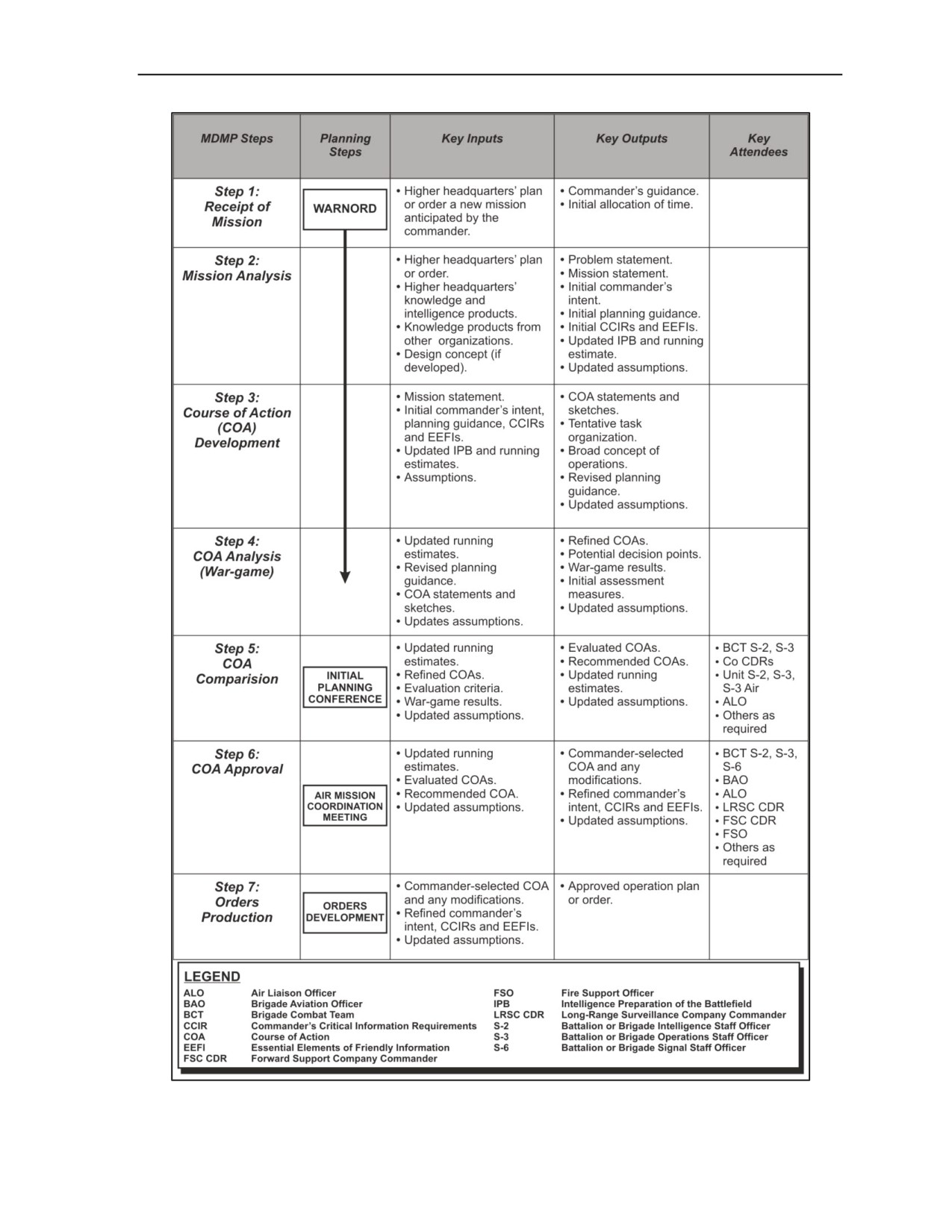
3-16. Planning for airborne operations mirrors the MDMP. (See figure 3-1.) It incorporates parallel and
collaborative planning actions necessary to provide the additional time and detailed planning required for
successful execution of an airborne assault mission.
3-4
FM 3-99
6 March 2015
Airborne Assault Planning
Figure 3-1. MDMP and airborne assault planning process
6 March 2015
FM 3-99
3-5
Chapter 3
PREDEPLOYMENT PLANNING AND PREPARATION
3-17. Units must plan for and prepare internal deployment standard operating procedures (SOPs) and
continually update and rehearse them. These SOPs should include actions that are common to all
deployments, to include airland, parachute assault planning, preparation, execution, and assessment. They
may include:
z
Conduct rapid, short notice deployment.
z
Emergency deployment readiness exercise (commonly known as EDRE).
z
Prepare personnel for overseas deployment. (Refer to FM 3-35 for more information.)
z
Update and review all vehicle load plans.
z
Validate and update movement plans with next higher headquarters.
z
Update access and recall rosters.
z
Review family readiness group rosters and rear detachment responsibilities.
z
Ensure special team personnel are identified and trained (movement, chemical, biological,
radiological, and nuclear, outload, ammunition handling).
X-HOUR/N-HOUR SEQUENCES FOR DEPLOYMENT
3-18. The X-hour/N-hour sequences for deployment are developed and followed to ensure all reports,
actions, and outload processes are accomplished at the proper time during marshalling. They aid in
developing air and deployment schedules and are flexible to allow for modifications based on the mission
and the unit commander’s concept of the operation.
3-19. X-hour is the unspecified time that commences unit notification for planning and deployment
preparation in support of potential contingency operations that do not involve rapid, short notice
deployment. X-hour sequence is an extended sequence of events initiated by X-hour that allow a unit
to focus on planning for a potential contingency operation, to include preparation for deployment.
3-20. N-hour is the time a unit is notified to assemble its personnel and begin the deployment
sequence. The N-hour sequence starts the reverse planning necessary after notification to have the
first assault aircraft en route to the objective area for commencement of the parachute assault in
accordance with the order for execution.
3-21. In anticipation of an order for execution; the ABNAF staff and its key leaders begin preparing or
updating an operations plan. The length of X-hour planning varies based on the contingency planning or
crisis action planning situation and the specific operations plan. It normally ceases with either the
designation of N-hour, or if political or military events warrant, no further action. Deployment planning
sequences fall into one of three scenarios:
z
Unconstrained X-hour sequence. Used primarily for deliberate planning or crisis-action planning
that is not under a time constraint.
z
Constrained X-hour sequence. Used for crisis action planning.
z
N-hour sequence. May be proceeded by an X-hour sequence.
OPTIMIZE AVAILABLE PLANNING TIME
3-22. Effective execution requires issuing timely plans and orders to subordinates. Timely plans are those
issued soon enough to allow subordinates time to plan, issue their orders, and prepare for operations. In
time-constrained environments, products contain just enough information for the commander to make a
reasoned decision and subordinates to assess the situation quickly and plan, prepare, and execute the
necessary actions. Regardless of whether time for planning is constrained or not, to optimize available time
and ensure the best possible synchronization, commanders encourage collaborative and parallel planning
between their headquarters and higher and lower headquarters.
COLLABORATIVE AND PARALLEL PLANNING
3-23. Both collaborative and parallel planning help optimize available planning time. Collaborative
planning is several echelons developing plans and orders together. Commanders, subordinate commanders,
3-6
FM 3-99
6 March 2015
Airborne Assault Planning
and staffs share their understanding of the situation, and participate in course of action development and
decisionmaking for development of the higher headquarters plan or order.
3-24. Parallel planning is two or more echelons planning for the same operation through the sequential
sharing of information from the higher headquarters before the higher headquarters publishes its operations
plan or operation order (OPORD). It requires significant interaction between echelons. During parallel
planning, subordinate units do not wait for their higher headquarters to publish an order to begin
developing their own plans and orders.
INFORMATION SHARING
3-25. The higher headquarters continuously shares information concerning future operations with
subordinate units through warning orders (WARNORDs) and other means. Frequent communication
between commanders and staffs and sharing of information
(such as intelligence preparation of the
battlefield (IPB) products) helps subordinate headquarters plan.
3-26. Generally, the higher the headquarters has more time and staff resources available to plan and
explore options. They are sensitive not to overload subordinates with information and planning
requirements. Higher headquarters provide subordinates with information and involve them in the
development of those plans and concepts that have the highest likelihood of being adopted or fully
developed.
3-27. Commanders provide plans and orders down the chain of command. However, for airborne
operations, higher headquarters often cannot complete their plans until subordinate units have conducted a
backbrief of their plans as a change in one plan impacts other plans.
3-28. Parallel echelons of the airlift and ABNAF units coordinate continuously from the time of the joint
planning conference until the operation is executed or cancelled. They exchange liaison officers to act as
advisors and coordinators immediately upon receipt of orders to participate in an airborne assault. ABNAF
liaison officers must be familiar with all aspects of the airborne assault. They must attend briefings and
conferences, and must be provided with adequate transportation and communications assets. Liaison
officers normally are exchanged between the ABNAF and—
z
Army units supporting the operation from outside the objective area.
z
Close air support and airlift elements.
z
Linkup forces.
z
Special operations forces. (Refer to FM 3-05 for more information.)
3-29. The specific duties of liaison officers LQFOXGHʊ
z
Represent their unit headquarters at the headquarters to which they are detailed.
z
Act as advisors to the headquarters on matters pertaining to their own commands.
z
Coordinate matters involving dual responsibility.
z
Discuss the time, place, personnel required, and material to be covered at coordination meetings
and when necessary hold coordination briefings, both at the joint and service level.
z
Examine parallel orders to ensure complete agreement of plans and arrangements.
z
Assess and plan for the availability and procurement of equipment and facilities required from
the higher headquarters.
z
Attend all joint conferences, have active knowledge with the agreements reached by the
commanders and with the operations plan.
z
Prepare joint reports.
z
Obtain copies of the marshalling plan and the parking diagram for their units.
z
Know the location and capacity of all installations at the airfields and air landing facilities that
concern their units.
z
Review the plans and arrangements for replacement aircraft if last minute failures occur; prepare
to assist the movement of ABNAF from aborting aircraft to reserve aircraft.
6 March 2015
FM 3-99
3-7
Chapter 3
z
Brief guides, who are furnished by the ABNAF, on airfield traffic measures and locations of
aircraft to be loaded. At dispersed locations, an ABNAF representative is located at the
coordination facility to perform this function and to act as individual liaison.
3-30. Commanders exchange liaison officers on a continuous duty status at echelons higher than ABNAF
level. At BCT and lower echelons, the S-3 liaison officers, the S-3 Air, or unit air movement officer can
perform these duties. For operations of less than ABN IBCT size, commanders exchange liaison officers as
needed.
3-31. When the ABNAF is a follow-on force after a special operations force, it requests a liaison before
arrival in the operational area. During the planning phase, a special operations force liaison officer is
attached to the ABN IBCT along with all communications assets needed for immediate use with special
operations forces assets at joint special operations task force (JSOTF) and at the objective area. The signal
plan must standardize not only frequencies and call signs, but address visual signals, and day and night
operations as well. (Refer to FM 3-05 for more information.)
3-32. Subordinate commanders must conduct confirmation briefs and backbriefs on all aspects of their plan
to the next higher commander. The backbrief differs from the confirmation brief (a briefing subordinates
give their higher commander immediately following receipt of an order) in that subordinate leaders are
given time to complete their plans. (Refer to FM 6-0 for more information.) This ensures that unit plans are
fully coordinated and in concert with the commander’s intent. Commanders conduct confirmation briefs or
backbriefs on a terrain model, a sand table, or a map. Planning for an airborne assault is a dynamic, fast-
changing process. A change in one plan impacts other plans. Plans remain in draft until every commander
in the chain has conducted a confirmation brief or backbrief. All commanders must inform their
subordinates of changes.
3-33. Rehearsals are essential to the success of an airborne operation. They are conducted at every level,
involve both air, and ground components. They are performed on terrain similar to the objective and under
the same conditions. Rehearsals may be conducted on a sand table, terrain model, mock-up, or map, and if
time permits a full-scale rehearsal. (See FM 6-0.) Rehearsals specific to airborne operations are listed in
order of priority as follows:
z
Ground tactical plan.
z
Landing plan with emphasis to assemble on the drop zone.
z
Air movement plan with emphasis on aircraft loading.
3-34. Leaders of the ABNAF must be able to make decisions to support the ABNTFC’s intent. Plans and
intelligence must be disseminated to the lowest level consistent with security requirements. (Refer to FM 2-
0 for more information.) The staff follows security requirements in disseminating the intelligence required
for subordinate units to develop their plans. Intelligence is provided on a need-to-know basis. As execution
approaches, units are provided with more detailed intelligence. The commitment of an ABNAF is sudden
and complete; there is no time for the commander to orient forces immediately after landing. Plans and
intelligence must be thoroughly briefed before the operation begins.
WARNING ORDERS
3-35. To conduct an airborne assault, planning begins when the designated ABN IBCT receives a
WARNORD from the ABNTF. The WARNORD specifies the ABNAFC and ABNTF task organization
and allows the ABN IBCT staff to start initial planning and request supporting element liaison officers to
report to the ABN IBCT headquarters early in the planning phase.
3-36. Once the ABNAFC receives the WARNORD, the planning process begins. This directive or
WARNORD includesʊ
z
Taskorganization.
z
Mission command for the operation.
z
Higher commander’s concept of the operation (includes tentative scheme of maneuver/primary
and alternate drop zones and landing zones).
z
Missions for subordinate units.
z
Time and duration of the operation (includes general timeline).
3-8
FM 3-99
6 March 2015
Airborne Assault Planning
z
Intelligence and security requirements.
z
Allocation and distribution of airlift assets.
z
Unit deployment list and sequence.
z
Departure airfields, remote marshalling bases, and intermediate staging bases.
z
Initial estimate on requirements for airborne intelligence, surveillance, and reconnaissance; close
air support; naval gun fire; and unmanned aircraft system support.
z
Signal requirements and instructions.
z
Linkup, withdrawal, and follow-on forces concepts.
3-37. Other WARNORDs and fragmentary orders (FRAGORDs) should follow as the ABNAF staff and
commander work through the reverse planning sequence.
CONTROL MEASURES
3-38. ABNAFCs employ the full range of doctrinal control measures and graphics to delineate
responsibilities, deconflict operations, safeguard friendly forces and civilians, and promote unity of effort.
These measures include, but are not limited to boundaries that circumscribe operational area or area of
operation, control measures to facilitate joint task force or ABNTF maneuver, fire support coordination
measures (FSCMs); and airspace coordinating measures (ACMs).
AIRHEAD
3-39. An airhead is a designated area in a hostile or potentially hostile operational area that, when seized
and held, ensures the continuous air landing of troops and materiel and provides the maneuver space
necessary for projected operations (JP 3-18). Due to the nature of the airhead (a perimeter defense) and the
required continuous airflow into the airhead, airspace coordinating measures and FSCMs must be
established throughout the joint operational area, to include the ABNAF area of operation (drop zones,
landing zones, assault objectives, and the airhead line).
3-40. During the initial stages of an airborne assault and before adequate ground communications can be
established, coordination and control of fire support are accomplished from an airborne command and
control platform. On landing, ABNTF and subordinate maneuver units establish contact with the airborne
command and control platform through the tactical air control party (TACP) or fire support officer. Fire
support, such as close air support, beyond that available from organic or direct support assets would be
requested from the airborne platform. Prioritization and coordination of requests are accomplished by the
ground force commander’s representative in the airborne platform. Responsibilities LQFOXGHʊ
z
Prevent fratricide of ground personnel.
z
Ensure that requests do not interfere with incoming serials, other aircraft, or naval operations.
z
Determine means of fire support coordination.
z
Determine added safety or control measures required; transmit them to the appropriate ground
elements.
3-41. Terminal guidance aids and control measures are used on the ground in the objective area to assist
and guide incoming airlift aircraft to the designated drop zones and landing zones. Combat control teams
comprised of USAF personnel are organized, trained, and equipped to provide aircraft terminal guidance.
Army teams from the long-range surveillance company, a divisional or corps asset, are organized, trained,
and equipped to deploy into the objective area and conduct reconnaissance and surveillance tasks before the
deployment of the airborne force.
3-42. For airspace coordination, ABNAF staff establishes contact with the appropriate flight, provides
essential information, and then hands the flight off to the appropriate TACP or forward air controller for
mission execution. At that point, the mission is conducted the same way as conventional operations. If
naval gun fire or air support is available, it is essential that a naval gunfire liaison officer be present in the
airborne platform to perform a similar function.
3-43. The area air defense commander (AADC) is responsible for integrating the joint force air defense
effort. All available surface-to-air assets should be incorporated into the overall air defense plan and
6 March 2015
FM 3-99
3-9
Chapter 3
comply with procedures and weapons control measures established by the AADC. The AADC exercises a
degree of control of all systems through established guidelines, determines weapons control status, and
joint force commander-approved procedural controls.
(Refer to FM
3-01
and JP
3-01
for more
information.)
3-44. Once adequate airspace ground control capabilities have been established in the airhead, fire support
coordination responsibilities are passed from the airborne platform to the ground to be conducted as in
other operations. (There is no doctrinal time for this transfer.) In some situations, this cannot occur;
however, in most cases once a BCT main or tactical command post is on the ground, the transfer takes
place.
PERMISSIVE AND RESTRICTIVE CONTROL MEASURES
3-45. Fire support coordination measures (FSCMs) both permissive and restrictive, are employed to ensure
the safety of friendly personnel, to synchronize all fire support means, and to permit maximum flexibility
with minimum restrictions on the employment of fire support. A common target and map grid system is
established to permit transmission of target and friendly unit locations. This is critical if standard maps are
not available. Provisions must be made to identify friendly force locations through the employment of
smoke, panels, beacons, or other devices. (Refer to FM 3-90-1 for more information.)
DETERMINE GO/NO-GO CRITERIA
3-46. Abort criteria is a predetermined set of circumstances, based on risk assessment, which makes the
success of an operation no longer probable; thus, the operation is terminated. These circumstances can
relate to changes in safety, equipment or troops available, preparation or rehearsal time, weather, enemy,
shaping operations prior to execution of the airborne assault, or a combination of the above. In the
development of a course of action (during the preparation and deployment phase), airborne assault go/no-
go criteria is developed. Criteria considerations include, but are not limited to:
z
Minimum force:
Number of C130s or C17s.
Number lost of critical chalks, Infantry battalion equivalent, BCT assault command post,
indirect fire systems, and mission command vehicle platforms.
Heavy-drop critical capability loss
z
Intelligence/Pre-assault fires (yes/no):
Team recon no-fire areas established.
Light airfield repair package
(LARP)— airfield damage is repairable with available
equipment.
Enemy surface to air assets neutralized; self-propelled anti-aircraft gun on objective
neutralized.
Indirect systems on objective destroyed.
Engineer forces on objective destroyed, or no larger than
Air forces—air superiority achieved.
z
Weather: Winds below 13 knots— Heavy equipment-17 knots—Personnel-13 knots.
z
Fire support assets/airspace coordinating measures:
Close air support assets are on station with sufficient loiter time until P-hour +_
Electronic warfare assets on station.
Airspace coordinating measures active.
z
Mission command sufficient assets until P-hour +_
AIRFIELD OPENING
3-47. When developing an operation that may include an airfield opening, entry force tactical planners
must have an understanding of the planning factors to consider for airfield opening in a hostile or
permissive environment. Planners with specific airfield opening expertise to include the designation of a
3-10
FM 3-99
6 March 2015
Airborne Assault Planning
senior airfield authority are integrated as early as possible in the planning process. (Refer to FM 3-17.2 for more
information.)
PLANNING AND ASSESSMENT
3-48. Planning for airfield opening begins at the strategic level where forces are assigned. Once
employment forces are assigned by the joint task force, more detailed planning is conducted in coordination
with the entry force and USAF contingency response group— first-responder airfield opening units. As
combatant commanders identify airfields for use and direct their staffs to generate the appropriate plans, the
missions and aircraft for which the airfield will be opened are determined and airfield capabilities
are assessed.
3-49. Airfield assessment begins with airfield opening planning, which should begin as soon as the mission
is assigned. Many tools are available to planners to begin the airfield assessment prior to actual arrival at
the field. After arriving at the airfield, the airfield assessment team verifies the information gained during
pre-mission planning with assault forces, collects additional data, and provides a recommendation to the
airfield opening forces.
3-50. An airfield assessment should be accomplished rapidly to verify information and evaluate or obtain
any items that were not pre-assessed. Assessments address areas such as runways, ramps, taxiways, force
protection, communications, facilities, and provide a recommendation to appropriate decision makers on
the suitability of future airfield operations (fixed- or rotary-wing).
OPERATION AND TRANSITION
3-51. Each contingency response group is scalable to meet specific tasking requirements. Primary
capabilities/tasks include: airfield assessment, contingency response element command and control
/port/quick-turn aircraft maintenance, force protection, intelligence, limited airfield security, airfield
management and air traffic control, communications, fuels, medical, financial management, contracting,
and supply.
3-52. When the responsibility for all or a part of an airfield changes from one organization to another, there
is a requirement for a detailed and deliberate transfer. Likely transitions to occur during the life cycle of an
airfield areʊ
z
From airfield seizure to airfield opening.
z
From airfield opening to follow-on or sustainment.
z
From airfield sustainment to closure or turnover to the host nation.
SECTION IV - SHAPING OPERATIONS
3-53. Shaping operations establish conditions for the decisive operation through effects on the enemy,
population, and terrain. Airborne operations may be designed as a sudden attack in force to achieve
decisive results or as a shaping operation to create and preserve conditions for the success of a larger
operation or campaign. When planning indicates the future requirement for an airborne assault, appropriate
shaping operations or activities emphasize identifying and neutralizing an enemy’s anti-access capabilities.
CREATE CONDITIONS
3-54. The ABNAF commander and his staff determine the exact conditions required according to the
mission variables of mission, enemy, terrain and weather, troops and support available-time available, and
civil considerations (METT-TC), to include the degree of acceptable risk with regard to each condition.
Setting conditions is not limited to conducting SEAD and preparation fires. It requires the participation of
numerous staffs, units, cells, and boards in different echelons and services.
3-55. Condition setting is an interactive process. The ABNAFC’s situational understanding determines
what part of the situation must change to ensure the success of the airborne assault. The ABNAFC tasks
available reconnaissance forces and surveillance assets to detect the location of those enemy systems that
6 March 2015
FM 3-99
3-11
Chapter 3
unacceptably endanger the operation’s success. This allows fire support systems to target and deliver
effective fires against those enemy systems.
3-56. The most effective reconnaissance combines ground, aerial, and surveillance systems to provide
constant coverage and multiple assessments of enemy activities throughout the objective area prior to the
airborne assault. Surveillance is the systematic observation of aerospace, surface, or subsurface areas,
places, persons, or things, by visual, aural, electronic, photographic, or other means
(JP
3-0). The
commander uses available reconnaissance forces and surveillance assets, to include available joint systems,
to provide information that increases the accuracy of his situational understanding during planning and
preparation.
3-57. The ABNAFC tasks the other warfighting functions to continue planning and preparing for the
operation while employing service and joint fires to enable conditions. The ABNAFC requests assistance
from higher echelons if there are not sufficient organic assets and information to accomplish the mission.
The ABNAFC then assesses the progress of all the warfighting functions. This process repeats until the
commander is satisfied with the set conditions or operational necessity forces him to either cancel or
conduct the airborne assault.
3-58. Planning considerations should encompass special operations forces. Special operations forces may
be inserted or already be operating in the objective area and become key components of the initial effort to
shape and set conditions. Special operations forces regional expertise and environment preparation
activities support well in advance of airborne assault planning and execution. Special operations forces may
be introduced to the area well in advance of a possible assault to develop or prepare an area for airborne
assault.
PRESERVE CONDITIONS
3-59. As the airborne assault extends in time and geography, extended lines of operations increase the
assault unit’s vulnerability to enemy capabilities designed to interrupt the expansion or reinforcement of the
airhead or lodgment and follow-on operations. As the ABNAF expands its influence within an area of
operation, the ABNAF becomes the primary means of setting conditions for operations that seize the
initiative in other contested domains. The ABNAF leverages its presence to defeat enemy capabilities that
limit freedom of action.
3-60. Continued high operational tempo and pressure preserves condition to hinder the enemy’s ability to
regroup, reconstitute capabilities, or reconfigure forces to support new plans. A primary means of
maintaining continuous pressure is the continuous and rapid cycling of joint enablers and capabilities under
operational level direction.
3-61. To rapidly transition from entry operations to follow-on operations, intermediate staging bases
remain a critical part of baseline condition setting to: enable shorter range recycling of intra-theater lift
capabilities, reorganization and reconfiguration of capabilities to meet evolving assault force demands and
recalibration of battle and logistical rhythms.
3-12
FM 3-99
6 March 2015
Chapter 4
Ground Tactical Plan
The ground tactical plan is the base from which commanders develop all other plans.
They must complete the ground tactical plan before finalizing the landing plan, the
air movement plan, and the marshalling plan. It provides the commander’s intent, his
concept of the operation, fire support plan, and task organization of the units making
the initial airborne assault. Ground combat following airborne operations is
conducted along conventional lines but under unusual conditions. Once these
conditions are appreciated, the tactics and methods of ground combat can be applied
after the execution of airborne operations.
SECTION I - ELEMENTS
4-1. The ground tactical plan following an airborne assault contains essentially the same elements as other
offensive operations. The elements, driven by the evaluation of the mission variables of METT-TC, are
prepared to capitalize on speed and mobility to achieve surprise. Elements critical to the ground tactical
plan includeʊ
TASK ORGANIZATION
4-2. Task organization is a temporary grouping of forces designed to accomplish a particular mission
(ADRP 5-0). Once ABNAFC determines the principal features of the ground assault plan (scheme of
maneuver and fire support), he task organizes subordinate units to execute assigned missions and
determines boundaries. To ensure unity of effort or to increase readiness for combat, part or all of the
subordinate units of a command can be formed into one or more temporary tactical groupings (teams or
task forces), each under a designated commander. Infantry units usually form the nucleus tactical groupings
of the team; Infantry unit commanders lead the teams. These teams are tailored for the initial airborne
assault by the attachment of required supporting units. They are attached as soon as possible in the
marshalling area. Many of the units detach as soon as centralized control can be regained and the parent
unit headquarters can be established on the ground. After the task organization of Soldiers for the airborne
assault is announced, units organize into assault, follow-on, and rear echelons. (Refer to chapter 2 of this
publication for more information.)
z
Assault echelon. The assault echelon is composed of those forces required to seize the assault
objectives and the initial airhead, plus their reserves and supporting Soldiers.
z
Follow-on echelon. The airborne force does not need the follow-on echelon in the objective area
during the initial assault, but does need it for subsequent operations. When needed, the follow-on
echelon enters the objective area as soon as practical by air, surface movement, or a combination
of the two.
z
Rear echelon. The rear echelon includes the part of an airborne unit that is not considered
essential for initial combat operations. It includes people left at its rear base to perform
administrative and support functions that cannot be done efficiently in the combat area.
MISSION STATEMENT
4-3. The ABNAFC’s mission statement is a short sentence or paragraph that describes the ABNAF‘s
essential task (or tasks) and purpose— a clear statement of the action to be taken and the reason for doing
so. The mission is analyzed in terms of the commander‘s intent two echelons up, mission statement
(mission essential task and purpose) of the higher headquarters, specified tasks, and implied tasks. The
6 March 2015
FM 3-99
4-
Chapter 4
mission of adjacent units must be analyzed to understand how they contribute to the decisive operation
of their higher headquarters.
COMMANDER’S INTENT
4-4. The ABNAF commander’s intent is a clear and concise expression of the purpose of the operation
and the desired military end state that supports mission command, provides focus to the staff, and helps
subordinate and supporting commanders act to achieve the commander’s desired results without further
orders, even when the operation does not unfold as planned (JP 3-0). ABNAF planners receive the ABNAF
commander’s intent as soon as possible after the mission is received. Even if the ground tactical plan is not
complete, airborne assault planning often begins after the ABNAFC issues his intent.
CONCEPT OF OPERATIONS
4-5. The concept of operations is a statement that directs the manner in which subordinate units cooperate
to accomplish the mission and establishes the sequence of actions the force will use to achieve the end state
(ADRP 5-0). The concept of operations expands on the commander’s intent by describing how the
commander wants the force to accomplish the mission. It states the principal tasks required, the responsible
subordinate units, and how the principal tasks complement one another. Commanders and staff use the
operational framework to help conceptualize and describe their concept of operation.
4-6. The operational framework proves the commander with basic conceptual options for visualizing and
describing operations in time, space, purpose, and resources. Commanders are not bound by any specific
framework for conceptually organizing operations, and may use one of three conceptual frameworks listed
below or in combination. These operational frameworks apply equally to both operational and tactical
actions, and are listed as follows:
z
The deep-close-security framework to describe the operation in time and space.
z
The decisive-shaping-sustaining framework to articulate the operation in terms of purpose.
z
The main and supporting efforts framework to designate the shifting prioritization of resources.
4-7. The deep-close-security operational framework has historically been associated with terrain
orientation but can be applied to temporal and organizational orientations as well. Deep operations involve
efforts to prevent uncommitted enemy forces from being committed in a coherent manner. Close operations
are operations that are within a subordinate commander’s area of operations. Security operations involve
efforts to provide an early and accurate warning of enemy operations and to provide time and maneuver
space within which to react to the enemy.
4-8. The decisive-shaping-sustaining framework lends itself to a broad conceptual orientation. The
decisive operation is the operation that directly accomplishes the mission (ADRP 3-0). It determines the
outcome of a major operation, battle, or engagement. A shaping operation is an operation that establishes
conditions for the decisive operation through effects on the enemy, other actors, and the terrain (ADRP 3-
0). A sustaining operation is an operation at any echelon that enables the decisive operation or shaping
operation by generating and maintaining combat power (ADRP 3-0).
4-9. The main and supporting efforts operational framework—simpler than other organizing
frameworks—focuses on prioritizing effort among subordinate units. Therefore, leaders can use the main
and supporting efforts with either the deep-close-security framework or the decisive-shaping-sustaining
framework. The main effort is a designated subordinate unit whose mission at a given point in time is most
critical to overall mission success (ADRP 3-0). It usually is weighted with the preponderance of combat
power. A supporting effort is a designated subordinate unit with a mission that supports the success of the
main effort (ADRP 3-0). (Refer to ADRP 3-0 for more information.)
TASKS TO SUBORDINATES
4-10. Tasks to subordinate units direct individual units to perform specific tasks. They are a clearly defined
and measurable activity accomplished by individuals and organizations and contribute to accomplishing the
ABNAF mission or other requirements. The assignment of a task includes not only the task (what), but also
4-2
FM 3-99
6 March 2015
Ground Tactical Plan
the unit (who), place (where), time (when), and purpose (why). The purpose of each task should nest with
completing another task, achieving an objective, or attaining an end state condition to the airborne assault.
Example of activities includeʊ
z
Movement and maneuver. Maneuver units conduct an airborne assault and attack to destroy
enemy forces on objectives. Units such as scouts, cavalry, long-range surveillance and special
operations forces conduct reconnaissance and surveillance near the objective area, facilitate joint
fires and close combat attack against identified enemy forces in the objective area, and conduct
limited offensive tasks to interdict enemy forces.
z
Intelligence. Ensures the information collection effort focuses on drop zones and landing zones
and the objective area to identify enemy forces for targeting by fires and aviation assets to set
conditions for airborne assault execution.
z
Fires. While cannon artillery is part of the ABNAF, the primary support is close air support,
naval gun fire and organic mortars initially on conduct of the airborne assault. Upon airland or
follow-on force arrival, the field artillery battalion provides fire support on identified enemy
positions on or near drop zones and landing zones to neutralize enemy forces and help set
conditions for follow-on operations.
z
Sustainment. Once the lodgment or airhead is secure for air-land or follow-on forces to arrive,
forward logistics element from the brigade support battalion can begin casualty evacuation,
resupply, equipment recovery, and refueling of vehicle and aviation assets in support of the
ground tactical plan.
z
Mission command. The ABNAFC may deploy in an airspace control aircraft to provide mission
command oversight of the mission.
SECTION II - PLAN DEVELOPMENT
4-11. The ABNAFC begins to visualize the application of his ground tactical plan to his area of operation
by defining the tactical problem and then begins a process of determining feasible solutions with his
planning staff. The ground tactical plan incorporates considerations for those actions to be taken in the
objective area, for example, during the assault and subsequent operations phases. This is the first plan to be
finalized. It must be keyed on the accomplishment of the commander’s concept of the operation.
4-12. The ground tactical plan is developed as other tactical plans using the procedure as delineated in FM
3-90.6, Brigade Combat Team. However, the initial goal of airborne operations is the establishment of an
airhead and its subsequent defense. Essential elements of the ground tactical plan are developed in the
following sequence:
z
Assault objectives and airhead line (selected concurrently).
z
Airhead and security area boundaries (developed sequentially).
z
Assault force and security force task organization (developed sequentially).
MISSION VARIABLES OF METT-TC
4-13. When the ABNAF is alerted for deployment and assigned a mission, its assigned higher headquarters
provides an analysis of the operational environment. That analysis includes the following operational
variables: political, military, economic, social, information, infrastructure, physical environment, and time.
The mission variables of METT-TC are used to filter the broader scope of operational variables into
variables that directly affect a specific mission. The ABNAFC uses mission variables to gather relevant
information for his mission analysis. This analysis enables him to combine operational variables and
tactical-level information with knowledge about local conditions relevant to the mission. The following
paragraphs address the mission variables of mission, enemy, terrain and weather, troops and support
available-time available and civil considerations (METT-TC). (Refer to ADRP 5-0 for more information.)
MISSION
4-14. The mission of an airborne Infantry battalion or BCT is to close with the enemy by means of fire and
movement to destroy or capture him, or to repel his assault by fire, close combat, and counterattack. These
6 March 2015
FM 3-99
4-
Chapter 4
missions usually require the seizure and defense of objectives and surrounding terrain. Airborne assault
forces rely strongly on the element of surprise.
ENEMY
4-15. Commanders analyze all available information to determine the enemy’s situation. The following
factors are considered:
z
Enemy morale, leadership, and probable intentions.
z
Enemy capabilities.
z
Enemy tactics.
z
Probable enemy reactions to an airborne assault.
The enemy that can react the fastest poses the immediate threat.
The enemy that can cause the most damage or prevent the airborne force from
accomplishing its mission poses the most significant threat.
z
Enemy reserves and paramilitary organizations
(gendarmeries, police, border guards, and
militia) and their ability to mobilize and react.
z
Enemy capability to conduct guerrilla, partisan, or sabotage activities and the enemy’s
relationship to the local population.
TERRAIN AND WEATHER
4-16. The staff must consider these components; observation and fields of fire, avenues of approach, key
terrain, obstacles, and cover and concealment (OAKOC) and then act on the following factors:
z
The availability of drop zones and landing zones. Division or corps staff provides a landing area
study to subordinate elements before the preparation of the airborne assault and follow-on
landing plan. However, the availability and selection of drop zones should not influence the
selection of assault objectives, the airhead line, or unit boundaries.
z
Obstacles within the airhead line and out to the maximum effective range of direct- and indirect-
fire weapons, with emphasis on those that can be prepared or reinforced with minimal engineer
effort.
z
Enemy avenues of approach, since the enemy tries to reach and destroy the airborne force before
it can assemble and reorganize. This consideration weighs heavily in determining the location of
assault objectives.
z
Key terrain that can determine how the airborne force can best defend the area in-depth.
z
Friendly and enemy observation and fields of fire (particularly for indirect fires and anti-armor
weapons).
z
Cover and concealment for movement and consolidation.
z
The staff must consider the effects of climate and weather onʊ
Flight formations.
Trafficability.
Visibility.
Close air support.
Logistics.
Personnel and equipment.
Manned and unmanned aerial platforms.
TROOPS AND SUPPORT AVAILABLE
4-17. Commanders consider all forces available to accomplish the mission. These include all assigned,
attached, and supporting forces.
z
U.S. ground forces. Commanders evaluate the plans, missions, capabilities, and limitations of
U.S. ground forces. They consider whether artillery can support the airborne forces and whether
the forces perform a linkup or passage of lines.
4-4
FM 3-99
6 March 2015
Ground Tactical Plan
z
United States Air Force (USAF). Close air support often can compensate for the lack of armor
and heavy artillery. The airborne commander must consider the Air Force’s ability to support the
force and must bring knowledgeable airlift and tactical air planners together early.
z
United States Navy (USN). The airborne commander examines the availability and feasibility of
naval gun fire support and naval or U.S. Marine Corps (USMC) air support. Early arrangements
for liaison and coordination must be made to support the operation.
TIME AVAILABLE
4-18. Time is critical in all operations. There are several time considerations that are unique to an airborne
operation. Significant time may be required to mass the lift force. The time between the initial assault and
the deployment of the follow-on echelon must be considered. The amount of time before linkup or
withdrawal drives sustainment planning.
CIVIL CONSIDERATIONS
4-19. Understanding the operational environment requires understanding the civil aspects of the joint
operational area. Social and economic variables often receive close analysis as part of civil considerations
at brigade and higher levels. Depending on mission, the ABNTFC considers national and regional
characteristics such as—
z
Religion and customs.
z
Politics and tribal affiliations.
z
Support or lack of it for central and local governments or occupying powers.
z
Loyalty to political or military leaders.
z
Available labor.
z
Support or lack of it for U.S. forces.
4-20. Civil considerations is the influence of manmade infrastructure, civilian institutions, and activities of
the civilian leaders, populations, and organizations within an area of operations on the conduct of military
operations (ADRP 5-0). The ability to analyze civil considerations to determine their impact on operations
at brigade and below enhances several aspects of the airborne operation to include insertion into the
objective area, seizure of assault objectives and establishment of the airhead, and follow-on operations.
Civil considerations comprise six characteristics, expressed in the memory DLG $6&23(ʊareas, structures,
capabilities, organizations, people, and events. (Refer to ATP 2-01.3 for more information.)
ASSAULT OBJECTIVE AND AIRHEAD LINE
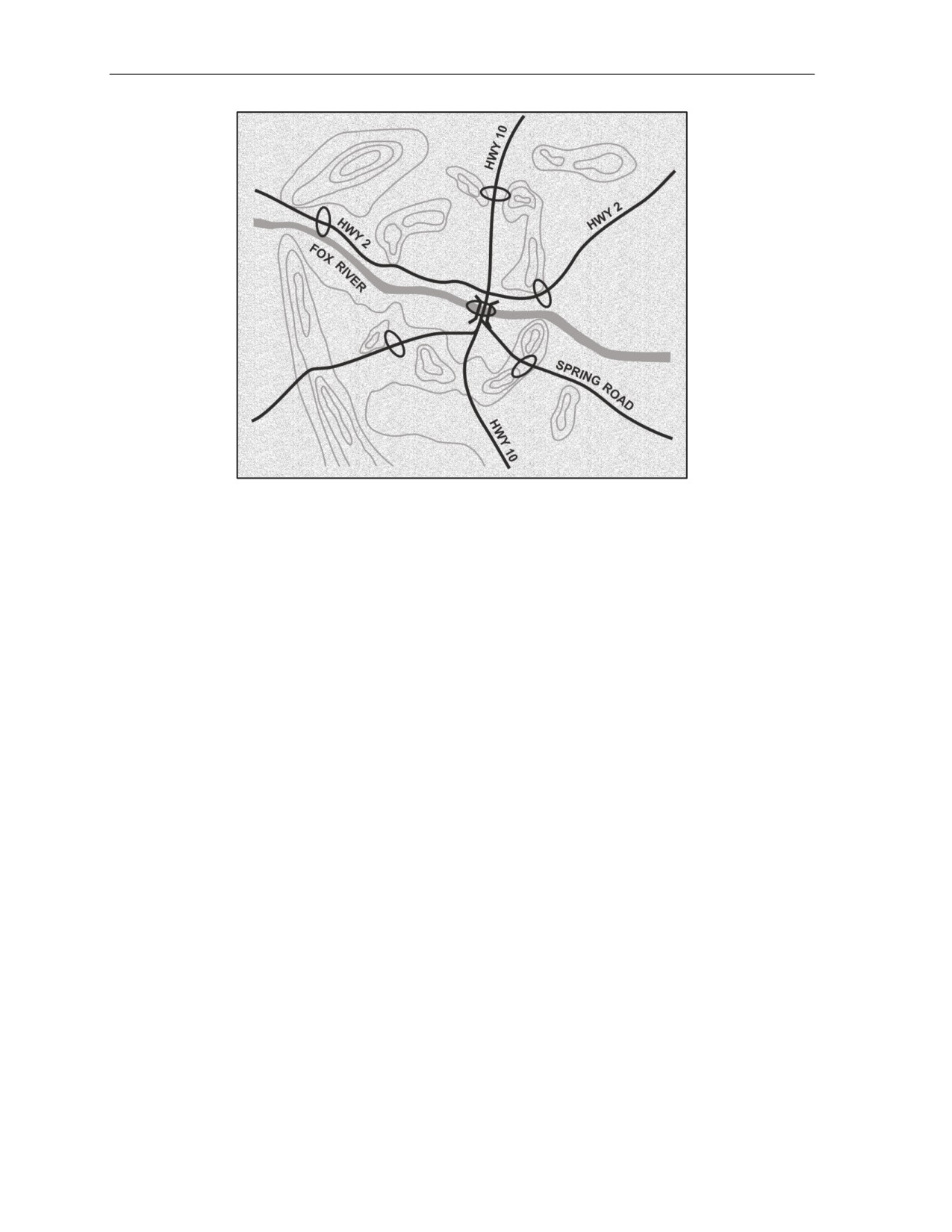
4-21. Based on his analysis of METT-TC, the commander selects specific assault objectives.
(See
figure
4-1, page
4-6.) Although the airhead line is developed and the assault objectives determined
concurrently, the assault objectives dictate the size and shape of the airhead.
6 March 2015
FM 3-99
4-5
Chapter 4
Figure 4-1. Assault objectives
4-22. This selection does not necessarily include those objectives that the force must seize to secure the
airhead line. An appropriate assault objective is one, which the force must control early in the assault to
accomplish the mission, or it must control to enhance the security of the airborne unit during the
establishment of the airhead.
4-23. Objectives should allow for the accomplishment of mission-essential tasks while meeting the
commander’s intent. They can include key terrain within the airhead or terrain required for linkup. For
example, the commander has directed the airborne force to secure a bridge for later use by linkup forces.
The force must secure this bridge before the enemy can destroy or damage it; therefore, the commander
designates the bridge as an assault objective.
4-24. The airborne unit is vulnerable from the time of the airborne assault until follow-on forces can be
delivered to the airhead. A mobile enemy unit attacking the airhead during these early moments can
completely disrupt the operation. Therefore, the commander selects assault objectives terrain that
dominates places where high-speed enemy avenues of approach enter the airhead.
4-25. Enemy positions that both threaten the mission and are located within the airhead can be selected as
assault objectives. However, commanders would not classify mobile forces as assault objectives.
4-26. Assault objectives must be seized immediately to establish the airhead and to provide security for
follow-on forces coming into the airhead.
4-27. Other considerations influence the development and final selection of assault objectives.
Subordinate commanders decide the size, type, or disposition of the force to gain/maintain control.
z
Division selects brigade assault objectives.
z
Brigade selects battalion assault objectives.
z
Battalion selects company assault objectives.
Senior commanders choose as few assault objectives as possible since subordinate
commanders must select additional objectives to establish a cohesive defense of their
assigned areas of the airhead.
Assault objectives are ranked in order. A unit SOP may predesignate a numbering system
for subordinate objectives. For example, all first brigade objectives begin with a “Q,” or for
OPSEC purposes, they may be randomly numbered or lettered. Priorities are chosen based
on the most likely threat or on the needs of the friendly force.
4-6
FM 3-99
6 March 2015
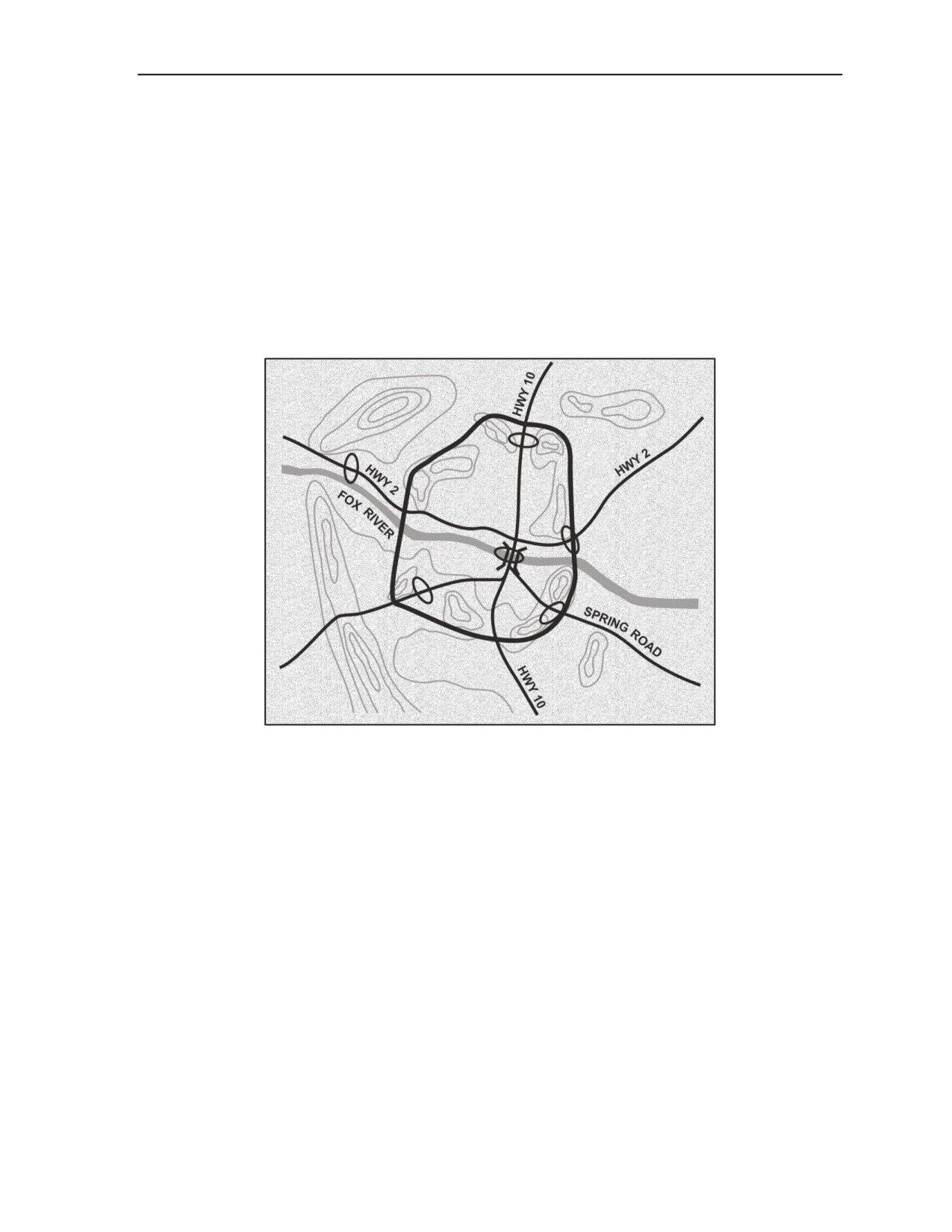
Ground Tactical Plan
Assault objectives are secured before the defense is setup in the airhead line. The airhead is
then cleared of organized enemy resistance and forces are positioned to secure the airhead
line.
4-28. When commanders select assault objectives, they should consider the extent of the airhead. The
airhead includes the entire area under control of the airborne force. It acts as a base for further operations
and as a respite that allows the airborne force to build combat power. Once the force secures the airhead,
they must clear enemy forces within it; then, they must defend it.
4-29. The airhead line is a line denoting the limits of the objective area for an airborne assault (JP 3-18). It
delineates the specific area to be seized and designates the airhead. Several principle factors determine the
location, extent, and form of the airhead or airhead line, they are as follows:
z
The actual trace of the airhead line reflects the control of key or critical terrain essential to the
mission. (See figure 4-2.)
Figure 4-2. Airhead line
z
The airhead line anchors on obstacles, and the airhead itself takes advantage of natural and man-
made obstacles.
z
The airhead contains enough drop zones and landing zones to ensure interior rather than exterior
lines of communication and to permit mass rather than piecemeal assault.
z
The airhead must allow enough space for dispersion to reduce vulnerability to chemical,
biological, radiological, nuclear weapons.
z
The airhead must be large enough to provide for defense in depth, yet small enough for the unit
to defend. Although this is largely METT-TC dependent, a battalion can defend an airhead three
to five kilometers in diameter. An IBCT can occupy an airhead five to eight kilometers in
diameter.
SECURITYAND RECONNAISSANCE
4-30. Security in all directions is an overriding consideration early in the airborne operation, since an
airhead or lodgment is essentially a perimeter defense. Another overriding consideration, the airborne unit’s
method of arriving into the objective area requires the conduct of an immediate and thorough
reconnaissance and the rapid transmission of this information to higher headquarters. Security operations
and reconnaissance missions within the security area enable these efforts.
6 March 2015
FM 3-99
4-7
Chapter 4
4-31. Security operations are those operations undertaken by a commander to provide early and accurate
warning of enemy operations, to provide the force being protected with time and maneuver space within
which to react to the enemy, and to develop the situation to allow the commander to effectively use the
protected force (ADRP 3-90). Reconnaissance is a mission undertaken to obtain, by visual observation or
other detection methods, information about the activities and resources of an enemy or adversary, or to
secure data concerning the meteorological, hydrographic, or geographic characteristics of a particular
area (JP 2-0).
4-32. After the force makes the initial assault landing and accomplishes its first missions, the commander
organizes the airhead line as the defense perimeter. The terrain and situation dictates how units occupy and
organize the airhead line. Forces assigned reconnaissance and security tasks, usually include reinforcing the
security area. The mission, enemy capabilities, and defensive characteristics of the terrain determine the
degree to which the airhead line is actually occupied and security area forces are organized for the airhead.
Task organization of security and reconnaissance forces is METT-TC-dependent and may include scouts,
Infantry, cavalry, antitank weapons, engineers, Army aviation, electronic warfare, and follow-on Stryker
and Armored forces.
Security Forces
4-33. Security forces land early in the assault echelon. In the early stages of an airborne operation, the
security force acts as a screening force. In later stages (when assault missions have been accomplished,
when the airhead is relatively secure, and when more forces are available), it acts as a guard force. The
security area is established four to six kilometers from the airhead line to afford security to the airborne
force during its landing and reorganization. Security forces come under BCT control except during short
missions such as raids, when they come under battalion or squadron control. The mission of the security
force is to—
z
Give the airhead early warning.
z
Develop information collection, to include the location, direction, and speed of an enemy attack.
z
Deny the enemy observation of and ability to direct indirect fire on the airhead.
z
Deceive the enemy as to the actual location of the airhead.
z
Delay and disrupt the enemy.
4-34. The need for and positioning of additional security forces is determined by the next subordinate
commander. When possible, mobile forces are selected to facilitate rapid initial movement to positions and
to facilitate withdrawal and adjustment. An aggressive reconnaissance and surveillance effort at lower
echelons augments the security force. The following considerations apply to the selection of positions for
the security force:
z
Locate them within radio communications and fire support range. However, this range can be
extended, if necessary, with retransmission stations, split section indirect-fire operations, and
attachment of vehicles, mortars, or other assets to the security force.
z
Locate them as roadblocks, obstacles, ambushes, patrols, or sensors (depending on the enemy)
on dominant terrain. This allows long-range observation and fields of fire out to the maximum
range of supporting fires.
z
Locate them to observe, control, and dominate enemy high-speed avenues of approach.
z
Locate them to deny enemy long-range observation and observed indirect fire into the airhead.
z
Locate them far enough out to provide early warning.
z
Locate them to provide routes of withdrawal to the airhead. Observation posts generally rely on
their ability to hide as their main protection; they can allow the enemy to pass their position and
not withdraw.
Reconnaissance Forces
4-35. Designated forces under control of the ABNAFC perform reconnaissance missions within the
security area; emphasis is placed on likely enemy avenues of approach. The mission of these forces is to
gain and maintain contact with enemy units reacting to the airborne assault. This force is mobile and not
4-8
FM 3-99
6 March 2015
Ground Tactical Plan
used to defend a particular part of the airhead. It may be supported with fire from USAF assets, naval gun
fire, or Army missile systems. The following considerations govern the employment of this force:
z
These forces orient on enemy high-speed avenues of approach to develop intelligence to include
the location, direction, and speed of the enemy’s advance.
z
Commanders of these forces consider known enemy locations, the number of high-speed
approaches, and communications-relay abilities while orienting on enemy units.
z
Usually employed beyond the airhead at a distance based on the tactical situation, commanders
can extend their range if communications permit.
z
Aviation assets can extend to 50 kilometers or more, although the commander must consider
loiter time so the forces can provide continuous coverage. (Forward arming and refueling points
[FARPs] can increase this distance.)
z
Long-range surveillance teams may perform surveillance of enemy garrisons and major routes
into the airhead.
z
Reconnaissance forces must be mobile and task-organized for the mission.
BOUNDARIES
4-36. Commanders visualize the employment of subordinate units to organize them for combat
commensurate with the missions. Commanders use boundaries to assign areas of responsibility to major
subordinate combat elements, which then clear the area of enemy forces. (See figure 4-3, page 4-10.) In
selecting
and designating assault boundaries for airborne operations, several points are considered as
follows:
z
Each unit should be able to clear its assigned area; therefore, commanders must consider
boundaries concurrently with task organization. To assign boundaries, commanders subdivide
the area into areas with equal tasks (not necessarily into equal areas). This requires a careful
analysis of the enemy, the tasks to be accomplished, and the terrain within the objective area.
z
Commanders should avoid splitting (between two units) the responsibility for the defense of an
avenue of approach or key terrain.
z
Commanders should ensure there is adequate maneuver space in the area, to include key terrain
features that control it.
z
Commanders should avoid designating boundaries in such a way that a major terrain obstacle
divides a unit area; this presents problems for maneuvering forces.
z
The boundaries should provide adequate room to permit the commander to maneuver forces on
both sides of their assault objectives.
z
Commanders must choose boundaries that are recognizable both on the map and on the ground.
Roads should not be used as a boundary because they represent a high-speed avenue of approach
and need to be covered with a clear understanding of responsibility. Instead, commanders can
use rivers, streams, railroad tracks, the edge of a town, woods, the edge of a swamp, and so on.
z
An ABN IBCT area of operation should include at least one drop zone and one landing zone to
allow for follow-on forces to land during the assault. This facilitates resupply and evacuation of
enemy prisoners of war and casualties. Having a drop zone and landing zone allows for ease of
sustainment operations. Regardless of boundaries, units should drop on the drop zone closest to
their assault objective.
z
Commanders should establish boundaries that serve during the airborne assault and during later
operations. These should be readily recognizable during limited visibility.
z
Commanders should choose boundaries that do not require a unit to defend in more than one
direction at once. They should not expect a unit to secure objectives within the airhead at the
same time they establish its defense.
z
Boundaries should extend beyond the trace of the security force as far as needed to coordinate
fires. This allows subordinate units to operate forward of the airhead with minimal coordination.
z
Commanders should plan coordinating points at the intersection of the airhead line and security
force ground trace boundaries.
6 March 2015
FM 3-99
4-9
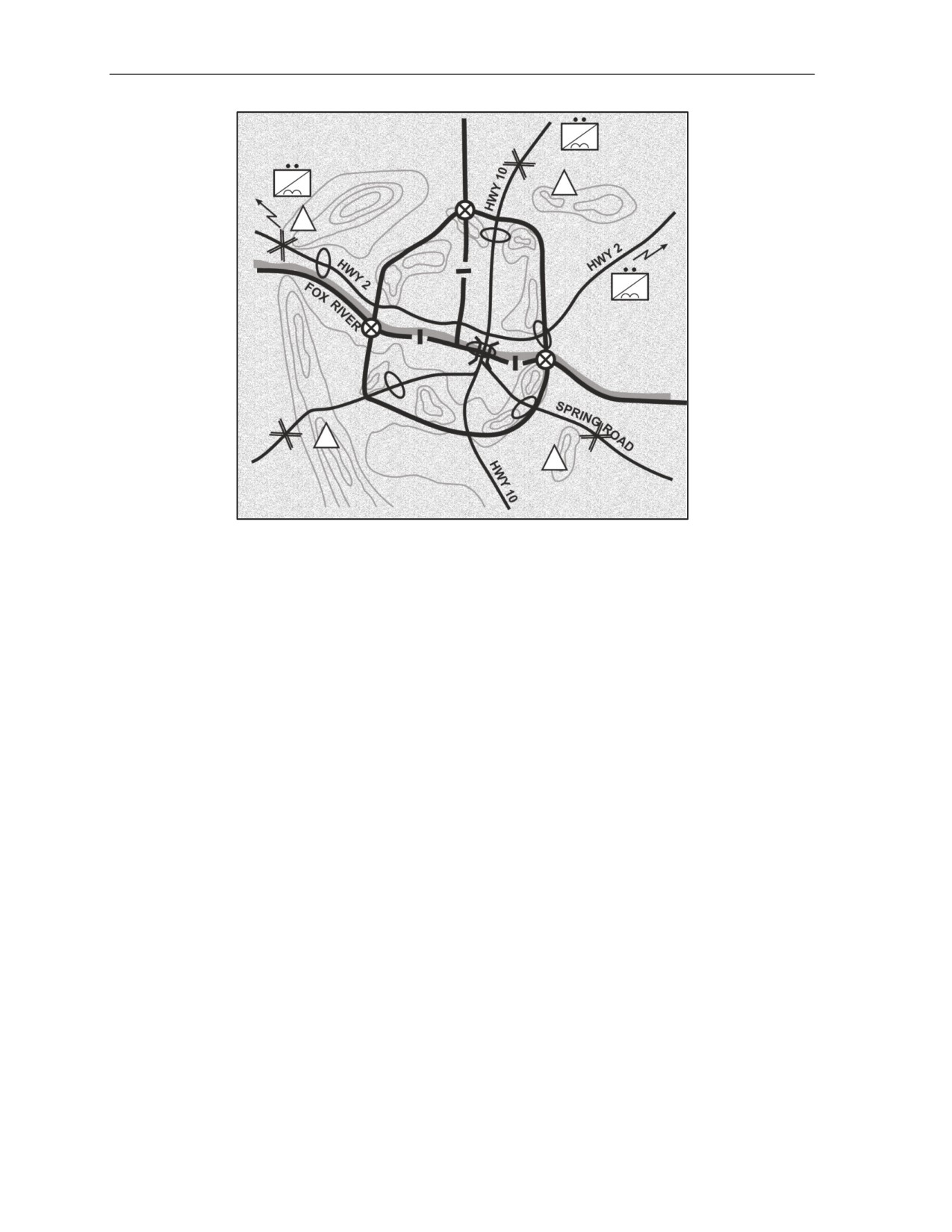
Chapter 4
Figure 4-3. Boundaries
METHOD OF ATTACK
4-37. There are three basic methods of attacking an objective. They are:
z
Jumping or landing on top of the objective. This method works best for attacking a small
objective that is specially fortified against ground attack. However, an airborne landing into an
area strongly defended against air attack requires surprise to succeed.
z
Jumping or landing near the objective. This method works best for the capture of a lightly
defended objective that must be seized intact such as a bridge. If the enemy has strong defenses
against air attack, only surprise can enable the unit to achieve success with few casualties.
z
Jumping or landing at a distance from the objective. This method is the least often used of the
methods available. Airborne forces use this method for large complex objectives that must be
seized by deliberate attack. The drop zone is selected to emphasize security and preservation of
the force. The plan is based on METT-TC considerations and should surprise the enemy.
METHOD OF LANDING
4-38. There are two basic landing methods. They are as follows:
z
Multiple drop zones. The use of multiple drop zones creates a number of small airheads in the
objective area. This method supports the principle of mass by placing the maximum number of
paratroopers in the objective area in the minimum amount of time. Additionally, the commander
can capitalize on the principle of surprise because the main effort is not easily determined by the
enemy. This method normally is used by division-size elements and larger.
z
Single drop zone. IBCT and smaller-size airborne forces often establish an airhead by
conducting the airborne assault onto a single drop zone. This method allows the assaulting unit
to assemble quickly and mass combat power against the enemy.
4-10
FM 3-99
6 March 2015
Ground Tactical Plan
TIME-SPACE FACTORS
4-39. Commanders schedule the delivery sequence and the time between serials to provide the least time
and distance separation between each aircraft and serial. The airborne force assembles maximum combat
power on the drop zone as quickly as possible, using either of the following options:
z
Land all elements in the same area. Aircraft approach the drop zone in a deep, narrow formation
and all Soldiers jump into a small area.
z
Land all elements at the same time. Aircraft in a wide formation approach various drop zones
situated close to each other and all Soldiers jump at the same time or as near to it as possible.
LANDING PRIORITIES
4-40. Airborne units are cross loaded to land close to their assault objectives and are organized to try to
maintain tactical unity.
z
Battalions or battalion task forces land intact on a single drop zone. An IBCT lands in mutually
supporting drop zones. Two or more battalions land successively on the same drop zone or each
can land on a separate drop zone within a general IBCT drop zone area.
z
The airborne force sends as many assault unit personnel and equipment as possible into the area
in parachute serials. Commanders must consider the mobility of equipment after the landing. For
example, the carriers or prime movers that are deliverable by parachute, but difficult to move or
carry on the ground; can accompany the weapons in the assault element. Paratroopers
accompany their units’ principal items of equipment.
FIRE SUPPORT PLAN
4-41. The following fire support planning and coordination actions are the responsibility of the
IBCT/battalion/squadron during ground movement:
z
Support the scheme of maneuver. The goal is to place the maximum amount of indirect
firepower on the ground as quickly as possible.
z
Control indirect-fire systems. Initially, control is decentralized; a forward observer calls for fire
directly to a fire support asset.
z
Plan fires to block enemy avenues of approach.
(Consider family of scatterable mines
[FASCAM] delivered by air.)
z
Plan fires to eliminate enemy resistance (groups and series in the objective area).
z
Plan fires to defend key terrain needed to link up with friendly forces.
z
Plan fires to support security or reconnaissance forces in the objective area.
z
Plan fires on top of, to the flanks, and beyond assault objectives.
z
Plan close air support.
z
Plan final protective fires.
z
Recommend priority of fires.
z
Select initial field artillery and mortar positions that can be occupied quickly from drop zones
and landing zones.
z
Select subsequent field artillery and mortar positions to provide combat outposts and security
forces.
z
Coordinate landing plan. Planning and coordination of fire support during the air movement and
pre-assault fires are the joint task force’s responsibility; he plans SEAD fires along the flight
route and in the objective area. Once on the ground, friendly positions are marked. The assault
force must ensure that pre-assault air strikes are planned against other enemy positions in the
objective area.
z
Pre-assault fires are planned as follows:
On and around the landing zone or drop zone (alternate and false).
On enemy air defense artillery.
On enemy command, control, and communication.
6 March 2015
FM 3-99
4-11
Chapter 4
On enemy indirect-fire systems.
Sequence and location of delivery for field artillery and mortars.
SECTION III - AIR-GROUND OPERATIONS
4-42. Air action by fixed- and rotary-wing aircraft against hostile targets that are in close proximity to
friendly forces require detailed integration of each air mission with the fire and movement of ground forces.
This section discusses fundamental considerations for effective air-ground operations, close combat attack,
and close air support. It addresses unmanned aircraft system operations to provide surveillance capabilities
and to enhance the ABNAFC’s situational awareness as he plans, coordinates, and executes the airborne
assault.
FUNDAMENTAL CONSIDERATIONS
4-43. To ensure effective air-ground operations, airborne assault commanders and staffs must consider the
integration of air and ground maneuver forces. The following fundamentals provide a framework for
enhancing the effectiveness of both air and ground maneuver:
z
Understanding capabilities and limitations of each force.
z
Using standard operating procedures.
z
Forming habitual relationships.
z
Using regular training events.
z
Rehearsals.
z
Maximizing and concentrating effects of available assets.
z
Synchronization.
4-44. Integration involves merging the air and ground fights into one to apply proper aviation capabilities
according to the supported ABNAFC’s intent. Integration ideally begins early in the planning process with
the involvement of the air defense airspace management/brigade aviation element (ADAM/BAE). The
ADAM/BAE advises the ABNAFC on aviation capabilities and the best way to use aviation to support
mission objectives. Ensuring the AVN LNO or BAE passes along the task and purpose for aviation support
and continually provides updates as needed is of equal importance. Simply stated, ensuring the aviation
brigade and subordinate unit staffs fully understand the ABNAF scheme of maneuver and commander’s
intent is critical to successful air-ground operations.
CLOSE COMBAT ATTACK
4-45. A close combat attack is a coordinated attack by Army attack reconnaissance aircraft (manned and
unmanned) against enemy forces that are in close proximity to friendly forces. The close combat attack is
not synonymous with close air support flown by joint aircraft. Terminal control from ground units or
controllers is not due to the capabilities of the aircraft and the enhanced situational understanding of the
aircrew (FM 3-04.126). In most instances, the attack aviation already may occupy holding areas, battle or
support by fire positions or are in overwatch of the ground unit as it begins its assault. The ABNAF
employs close combat attack procedures to ensure that these aviation fires destroy the enemy with minimal
risk to friendly forces.
4-46. After executing the airborne assault, employing attack reconnaissance aviation with ground
maneuver forces requires coordinated force-oriented control measures and the close combat attack (CCA)
5-Line attack brief allowing aviation forces to support ground maneuver with direct fires while minimizing
fratricide risks. The aviation liaison officer should identify early in the planning process the minimum
ABNAF graphics required for operations (boundaries, phase lines, attack by fire positions, objectives, and
so on). Brigade aviation elements and liaison officer personnel should ensure that supported units are
familiar with close combat attack request procedures and marking methods
CLOSE COMBAT ATTACK REQUEST
4-47. A close combat attack is coordinated and directed by a team, platoon, or company level ground unit
using the standardized Format 22. CCA 5-Line attack brief. (Refer to chapter 10, section III of this
4-12
FM 3-99
6 March 2015
Ground Tactical Plan
publication for more information.) The most important factor of successful close combat attack is positive
and direct communication between aviation and ground forces. As stated earlier, close combat attack does
not require a joint terminal attack controller (JTAC) unlike close air support missions. However, utilizing a
joint fires observer can minimize the risk of fratricide and expedite the clearance of fires procedures. (Refer
to FM 3-04.126 and ATP 3-09.32 for more information.)
4-48. Any element in contact uses the CCA 5-Line attack brief to initiate the close combat attack. The
CCA 5-Line attack brief allows the ground maneuver forces to communicate and reconfirm to the aircraft
the exact location of friendly and enemy forces. The ground commander owning the terrain clears fires
during the close combat attack by giving aircrews the situational awareness of the location of friendly
elements. The ground commander deconflicts the airspace between indirect fires, close air support, and the
close combat attack aircraft.
4-49. After receiving the request for close combat attack, the aircrew informs the ground unit leader of the
battle position, attack or, support by fire position (or series of positions) the team is occupying, and the
location from which the attack aircraft engages the enemy with direct fire. The size of this position varies
depending on the number of aircraft using the position, the size of the engagement area, and the type of
terrain. The position must be close enough to the requesting unit to facilitate efficient target handover.
Aircraft leaders normally offset the position from the flank of the friendly ground position. This helps to
ensure that rotor wash, ammunition-casing expenditure, and the general signature of the aircraft do not
interfere with operations on the ground. The offset position allows the aircraft to engage the enemy on his
flanks rather than its front. It reduces the risk of fratricide along the helicopter gun-target line.
TARGET HANDOVER
4-50. The rapid and accurate marking of a target is essential to a positive target handover. Aircraft
conducting close combat attacks develop an attack plan that is METT-TC dependent and meets the ground
commander’s task and purpose. The aircrew generally has an extremely limited amount of time to acquire
both the friendly and enemy locations. It is essential that the ground unit has the marking ready and turned
on when requested by the aircrew. Attack reconnaissance aircrews use both thermal sight and night vision
goggles (NVGs) to fly with and acquire targets. After initially engaging the target, the aircrew generally
approaches from a different angle for survivability reasons if another attack is required. The observer
makes adjustments using the eight cardinal directions and distance (meters) in relation to the last round’s
impact and the actual target. At the conclusion of the close combat attack, the aircrew provides its best
estimate of battle damage assessment to the unit in contact.
BATTLE DAMAGE ASSESSMENT AND REATTACK
4-51. After the attack aircraft complete the requested close combat attack mission, the aircrew provides a
battle damage assessment to the ground commander. Based on his intent, the ground maneuver commander
determines if another attack is required to achieve his desired end state. The close combat attack operation
can continue until the aircraft have expended all available munitions or fuel. However, if the air mission
commander receives a request for another attack, he must carefully evaluate his ability to extend the
operation. If not able, he calls for relief on station by another attack team if available. It is unlikely that the
original team has enough time to refuel, rearm, and return to station.
CLEARANCE OF FIRES
4-52. During an airborne assault with numerous aircraft in the vicinity of the drop zone, it is critical to
deconflict airspace between aircraft and established indirect fires once air-land or follow-on forces arrive,
to include the following:
z
Ensure aircrews have the current and planned indirect fire positions
(to include mortars)
supporting the ground tactical plan.
z
Plan for informal airspace coordination areas and check firing procedures and communications
to ensure artillery and mortars firing from within the drop zone do not endanger subsequent
serials landing or departing, close combat attack, or close air support.
6 March 2015
FM 3-99
4-13
Chapter 4
z
Ensure that at least one aviation team members monitors the fire support network for situational
awareness.
z
Advise the aviation element if the location of indirect fire units changes from that planned.
z
Ensure all participating units are briefed daily on current airspace control order or air tasking
order changes and updates that may affect air mission planning and execution.
z
Ensure all units update firing unit locations, firing point origins, and final protective fire lines as
they change for inclusion in current airspace control order.
4-53. The ABNAFC or ground commander can establish an airspace coordination area. For example, he
can designate that all indirect fires be south of and all aviation stay north of a specified gridline for a
specific period. This is one method for deconflicting airspace while allowing both indirect fires and attack
aviation to attack the same target. The ground commander then can deactivate the informal airspace
coordination area when the situation permits.
CLOSE AIR SUPPORT
4-54. Close air support is air action by fixed- and rotary-wing aircraft against hostile targets that are in
close proximity to friendly forces and that require detailed integration of each air mission with the fire and
movement of those forces (JP 3-0). Like close combat attack, close air support can be conducted at any
place and time friendly forces are in close proximity to enemy forces based on availability. All leaders in
the ABNAF should understand how to employ close air support to destroy, disrupt, suppress, fix, harass,
neutralize, or delay enemy forces. (Refer to JP 3-09.3 for more information.)
4-55. Only joint terminal attack controllers (JTACs) or forward air controllers
(airborne)
(FAC[A]s)
personnel have the authorization to perform terminal control of close air support aircraft during operations
(combat and peacetime) within proximity of their supported ground combat units. Nomination of close air
support targets is the responsibility of the commander, air liaison officer, and S-3 at each level. The
ABNAF may receive close air support from USAF, USN, USMC, or multinational units.
(Refer to
ATP 3-09.32 for more information.)
CAPABILITIES AND EMPLOYMENT
4-56. Before and during an airborne assault, USAF aircraft are available to provide close air support.
Requests for these aircraft are processed through the tactical air control party (TACP) colocated with the
IBCT main command post. The TACP is organized as an air execution cell capable of requesting and
executing Type 2 or 3 terminal attack control of close air support missions. The staffing of the cell depends
on the situation but at a minimum, includes an air liaison officer and a JTAC. (Refer to ATP 3-09.32 for
more information.) To use close air support aircraft, the leader on the ground should be familiar with the
characteristics of the aircraft predominantly used in the close air support role.
BRIEFING FORMAT
4-57. Two types of close air support requests are as follows:
z
Preplanned requests that may be filled with either scheduled or on-call air missions. Those close
air support requirements foreseen early enough to be included in the first air tasking order
distribution are submitted as preplanned air support requests for close air support. Only those air
support requests submitted in sufficient time to be included in the joint air tasking cycle planning
phases and supported on the air tasking order are considered preplanned requests.
z
Immediate requests that are mostly filled by diverting preplanned missions or with on-call
missions. Immediate requests arise from situations that develop outside the air tasking order
planning cycle.
4-58. The air liaison officer and JTAC personnel in the TACP are the primary means for requesting and
controlling close air support. However, reconnaissance units conducting shaping operations, such as
reconnaissance and surveillance missions that have joint fires observer certified personnel, may observe
and request close air support through the JTAC. (Refer to ATP 3-09.32 for more information.)
4-14
FM 3-99
6 March 2015
Ground Tactical Plan
UNMANNED AIRCRAFT SYSTEM
4-59. Before the airborne assault, the ABNTFC may rely on unmanned aircraft system (UAS) operations to
provide surveillance capabilities and to enhance the ABNAFC’s situational awareness as he plans,
coordinates, and executes the airborne assault. UAS employment prior to the assault is weighted against the
element of surprise. Once the airborne assault is executed, the commander can employ UAS from his
organic elements or he can request to have direct access to real-time feeds from additional UAS support
from his higher headquarters. UAS employment is particularly effective when employed together with
ground and attack reconnaissance elements as a team during shaping operations in which the commander is
trying to create the conditions for successful airborne assault execution.
(Refer to FM
3-04.155 for
more information.)
CAPABILITIES
4-60. UAS bring numerous capabilities to the ABNAF. Employment of these systems before executing the
airborne assault and employment with ground and attack reconnaissance units provides reconnaissance,
surveillance, and target acquisition capabilities. UAS also can support military deception by flying in an
area to make the enemy think it is a friendly objective. The RQ-7B Shadow can participate in attack
operations by either employing indirect fires and by laser designation of targets for joint aircraft and remote
engagements by armed manned and unmanned aircraft. The MQ-1C Gray Eagle can do the same and may
be armed with Hellfire missiles to engage autonomously or fire its missiles for a remote designator.
Reconnaissance Operations
4-61. When UAS complement the ground reconnaissance units during reconnaissance operations, they
operate forward of the element (METT-TC dependent). They can conduct detailed surveillance of areas that
are particularly dangerous to ground reconnaissance units, such as drop zones, landing zones and objective
areas. They can be employed effectively in support of operations in urban terrain.
4-62. They can support route reconnaissance forward of reconnaissance and security units or be employed
in conjunction with reconnaissance and security units when it is necessary to reconnoiter multiple routes
simultaneously. The reconnaissance unit leader can employ UAS to support an area or zone reconnaissance
mission. Upon contact, UAS provide early warning for the element and then maintain contact until the
element conducts a reconnaissance handover from the UAS to another element.
Security Operations
4-63. In security operations, UAS complement reconnaissance units by assisting in identification of enemy
reconnaissance and main body elements and by providing early warning forward of reconnaissance units.
Besides acquiring enemy forces, UAS can play a critical role in providing security through the depth of the
screen by observing dead space between ground observation posts. They can support reconnaissance units
during area security missions by screening or conducting reconnaissance.
Reconnaissance/Target Handover
4-64. When a UAS makes contact, particularly during reconnaissance operations, the operator hands over
the UAS contact to ground or attack reconnaissance units as quickly as possible. Rapid handover allows the
UAS to avoid enemy air defense weapons and helps maintain the tempo of the operation. During the
handover, the UAS assists in providing direction to the ground or attack reconnaissance unit charged with
establishing contact with or engaging the enemy. It maintains contact with the enemy until the units are in
position and have established sensor or visual contact.
4-65. The first action in the handover process is a report (such as, spot report or situation report) from the
UAS operator to the ground or attack reconnaissance unit. Next, the UAS reconnoiters the area for secure
positions for the unit (such as hide, overwatch, observation posts or battle positions) and likely mounted
and dismounted routes into the area. The ground or attack reconnaissance unit moves to initial hide
positions along the route selected by the leader based on UAS-collected information. The ground or attack
reconnaissance unit then moves to establish sensor or visual contact with the enemy. Once this contact is
6 March 2015
FM 3-99
4-15
Chapter 4
established, the ground or attack reconnaissance unit sends a report to the UAS operator. When the UAS
operator confirms that the ground or attack unit can observe enemy elements and has a clear picture of the
situation, handover is complete. The UAS then can be dedicated to another mission or, in the case of target
handover to attack reconnaissance units, may be used for battle damage assessments and reattack if necessary.
SECTION IV - EXECUTION
4-66. The initial airborne assault emphasizes the coordinated action of small units to seize initial battalion
objectives before the surprise advantage has worn off. As assault objectives are seized, the airborne force
directs its efforts toward consolidating the airhead.
CONDUCT OF THE AIRBORNE ASSAULT
4-67. Tactical surprise and detailed planning should enable units to seize their assault objectives and to
establish the airhead before the enemy has time to react in force. Missions of units change when necessary
by the enemy defense of initial objectives. The enemy can be expected to launch quick uncoordinated
attacks along major avenues of approach using local forces. The degree of coordination and strength of
these attacks increase progressively, therefore, the airborne force must develop correspondingly greater
strength in its defensive positions. Preparing early defense against armored attack is a major consideration.
4-68. Units assigned to perform reconnaissance and security missions should be cross loaded in the load
plan so that during the airborne assault, they are to be some of the first elements on the ground to move and
establish roadblocks, locate enemy forces; disrupt enemy communication facilities; and provide the
commander with early warning, security, and information. Since ground reconnaissance by unit
commanders is seldom possible before the airborne operation, it must begin immediately after units hit the
ground, and assemble. The information flow must be continuous. Information requirements do not vary
from those employed by other ground units. However, the unit’s method of arrival in the area of operations
makes immediate and thorough reconnaissance and transmission of information to higher headquarters
necessary.
4-69. If the initial objectives are heavily defended, the bulk of the force is assigned the task of seizing these
objectives. When initial objectives are lightly defended, the bulk of the force can be employed in clearing
assigned areas and preparing defensive positions in depth. Extensive patrolling is initiated early between
adjacent defensive positions within the airhead line, and between the airhead and the limits of the security
area. Army aircraft are well-suited for support of this patrolling effort. Contact with friendly guerrilla
forces, long-range surveillance teams and special operations forces in the area is established as soon as
possible.
4-70. Brief personnel on unit plans, adjacent and higher units’ plans, and alternate plans. This helps units
or personnel landing in unplanned areas to direct their efforts to accomplishing the mission. Misdelivered
units or personnel establish contact with their respective headquarters as soon as practical.
4-71. Sufficient communication personnel and equipment must be moved into the airhead in advance of the
command post they are to serve to ensure the timely installation of vital communication. (Refer to FM 6-02
for more information.) As soon as communication and the tactical situation permit, commanders regain
centralized mission command. Therefore, immediate establishment of the following is necessary for
effective mission command:
z
Command and fire control channels within the airborne forces.
z
Communication with supporting air and naval forces.
z
Communication with airlift forces concerned with buildup, air supply, and air evacuation.
z
Communication with bases in friendly territory.
z
Communication between widely separated airborne or ground forces, such as linkup forces, with
a common or coordinated mission.
4-72. The commander influences the action by—
z
Shifting or allocating fire support means.
z
Moving forces.
4-16
FM 3-99
6 March 2015
Ground Tactical Plan
z
Modifying missions.
z
Changing objectives and boundaries.
z
Employing reserves.
z
Moving to a place from which he can best exercise personal influence, especially during the
initial assault.
4-73. When initial objectives have been secured, subordinate units seize additional objectives that facilitate
the establishment of a coordinated IBCT defense or the conduct of future operations. Defensive positions
are organized, communications are supplemented, and reserves are reconstituted. These and other measures
are taken to prepare the force to repel enemy counterattacks, to minimize the effects of attack by chemical,
biological, radiological, and nuclear means, or to resume the offensive.
4-74. Reserves prepare and occupy blocking positions, pending commitment. Typical missions for reserves
committed during the initial assault include taking over the missions of misdelivered units, dealing with
unexpected opposition in seizing assault objectives, and securing the initial airhead.
DEVELOPMENT OF THE AIRHEAD
4-75. After the airborne forces make the initial assault landings and accomplish the initial ground missions,
commanders must organize the airhead line. Considerations include:
z
Size. The airhead line extends far enough beyond the landing area to ensure uninterrupted
landings of personnel, equipment, and supplies. It secures the requisite terrain features and
maneuver space for such future offensive or defensive tasks as called for in the mission.
z
Occupation and organization. Units occupy and organize the airhead line to the extent demanded
by the situation. Commanders adjust the disposition of units and installations to fit the terrain
and the situation. Units take reconnaissance and security measures; this usually includes the
reinforcement of the security area. The degree to which the airhead line is actually occupied and
organized for defense is largely determined by the mission, enemy capabilities, and the
defensive characteristics of the terrain.
z
Buildup. This proceeds concurrently with seizing and organizing the airhead line and, if
required, repairing or constructing an airfield to receive follow-on airland echelons. As more
combat personnel arrive and commanders organize them by unit, positions are reinforced on and
within the airhead line, reserves are constituted, and preparations are made for such offensive
tasks as the mission requires.
BUILDUP OF COMBAT POWER
4-76. The buildup of combat power is the introduction of the follow-on echelon into the airhead. This
increase of friendly combat power yields a corresponding ability to conduct a defense of the airhead and to
conduct a short-term sustainment of those forces. The intent of the buildup is to provide a secure operating
and logistic base for forces working to move the airhead away from the original point of attack. Usually,
this distance is equal to the enemy’s direct fire capability to harass and destroy incoming aircraft or landing
craft (5 to 10 kilometers).
4-77. Composing the follow-on echelon depends on METT-TC. All though not inclusive, it can consist of
Armored, Stryker, Infantry, field artillery, air defense artillery, and combat engineers as well as other
significant supporting elements (military information support operations, civil affairs, military police, and
chemical, biological, radiological, and nuclear) and sustainment assets.
4-78. The time involved in the defense varies. It depends on the mission assigned, the composition and size
of the force, the enemy reaction, and the type of operation contemplated. A well-prepared defense in short-
duration missions in isolated objective areas may not be required. Security can be accomplished by
completely or almost completely destroying or dispersing the enemy forces in the immediate objective area
during the assault; then, airlifting the striking force before the execution of a coordinated enemy
counterattack.
4-79. Defense of an airhead. The airborne force usually defends an airhead by securing key terrain within
the airhead and dominating likely avenues of approach. Units deny the enemy the areas between the
6 March 2015
FM 3-99
4-17
Chapter 4
occupied positions with a combination of patrols, fires, and natural and man-made obstacles. Units
aggressively reconnoiter between positions within the airhead and forward of the airhead line in the
security. They increase emphasis on reconnaissance forward of the airhead line during limited visibility.
The airhead configuration allows the commander to shift forces, reserves, and supporting fires quickly to
reinforce other areas of the airhead. Regardless of the form of defense chosen, the force prepares positions
in depth within its capabilities.
4-80. Defense during withdrawal. Should withdrawal from the initial positions be required, the final area to
which the airborne force withdraws must contain adequate space for maneuver, for protecting critical
installations, and for planned air landing or air evacuation operations.
4-81. Defense against armor. During the initial phases of an airborne operation, one of the main defenses
against enemy armor is air support. Aircraft attack enemy armor targets as they appear, as far as possible
from the objective area, and continue to attack and observe them as long as they threaten the airborne force.
Strong points defending the airhead use existing obstacles such as ditches, thick foliage, and structures,
plus reinforcing obstacles such as mine fields, tank traps, demolitions, and man-made obstacles. Units
emplace AT weapons in depth along avenues of approach favorable for armor. They cover all dangerous
avenues of approach with planned fires. Javelins, AT-4s and light anti-armor weapons of the rifle
companies, the tube launched, optically tracked, wire guided weapons of the battalion weapons company,
and the antitank weapons of division and corps aviation units give the airborne force a substantial amount
of antitank firepower. Some of the antitank weapons, organic to battalions that are in holding areas not
under armored attack, can be moved to reinforce threatened areas.
4-82. Defense against airborne assault: All personnel must recognize that the enemy can conduct airborne
assault operations and must defend against these attacks. Helicopters afford the enemy one of its best
means of rapidly moving significant operating forces to the airhead area.
4-83. Friendly forces must counterattack an enemy airhead immediately with available forces and fires to
disrupt the enemy’s plan and force build up, and continue until the enemy airborne assault has been
neutralized.
4-84. Defense against guerrilla action and infiltration: The defense must include plans for countering
enemy guerrilla attacks or infiltrated forces attacking the airhead area. The basic defense against these
attacks is an extensive patrol and warning system, an all-round defense, and designated reserve units ready
to move quickly to destroy the enemy force. Units must be especially alert during limited visibility to
prevent the enemy from infiltrating. If the enemy can build up forces in the airhead interior, it can influence
operations. Units must locate and destroy the enemy that has infiltrated the airhead.
SECTION V - FOLLOW-ON OPERATIONS
4-85. An airborne assault is as rapid in its execution as it is time-consuming in its preparation.
Commanders must develop contingency plans for possible follow-on operations. These plans should be
modified based on the most current intelligence. Advanced planning can allow more rapid decisionmaking
and timely commitment of forces.
4-86. The employment of ABNAF on the ground is similar to that of other Infantry ground forces. The
entire range of these operations include movement to contact, attack, area defense, or retrograde.
Additional operations may include raids, linkup, relief in place, passage of lines, withdrawal
(either
overland or by air), exfiltration, and noncombatant evacuation. (Refer to FM 3-21.20, FM 3-21.10, and FM
3-21.8 for more information.)
SECTION VI - SUPPORTING OPERATIONS
4-87. Airborne forces can deploy from a continental United States base directly to the objective area. A
more common method would be for the airborne unit to first deploy to a remote marshalling base or to an
intermediate staging base
(ISB) before establishing a lodgment in the area of operation. In certain
circumstances, the objective can be beyond the range of aircraft operating from a remote marshalling base
4-18
FM 3-99
6 March 2015
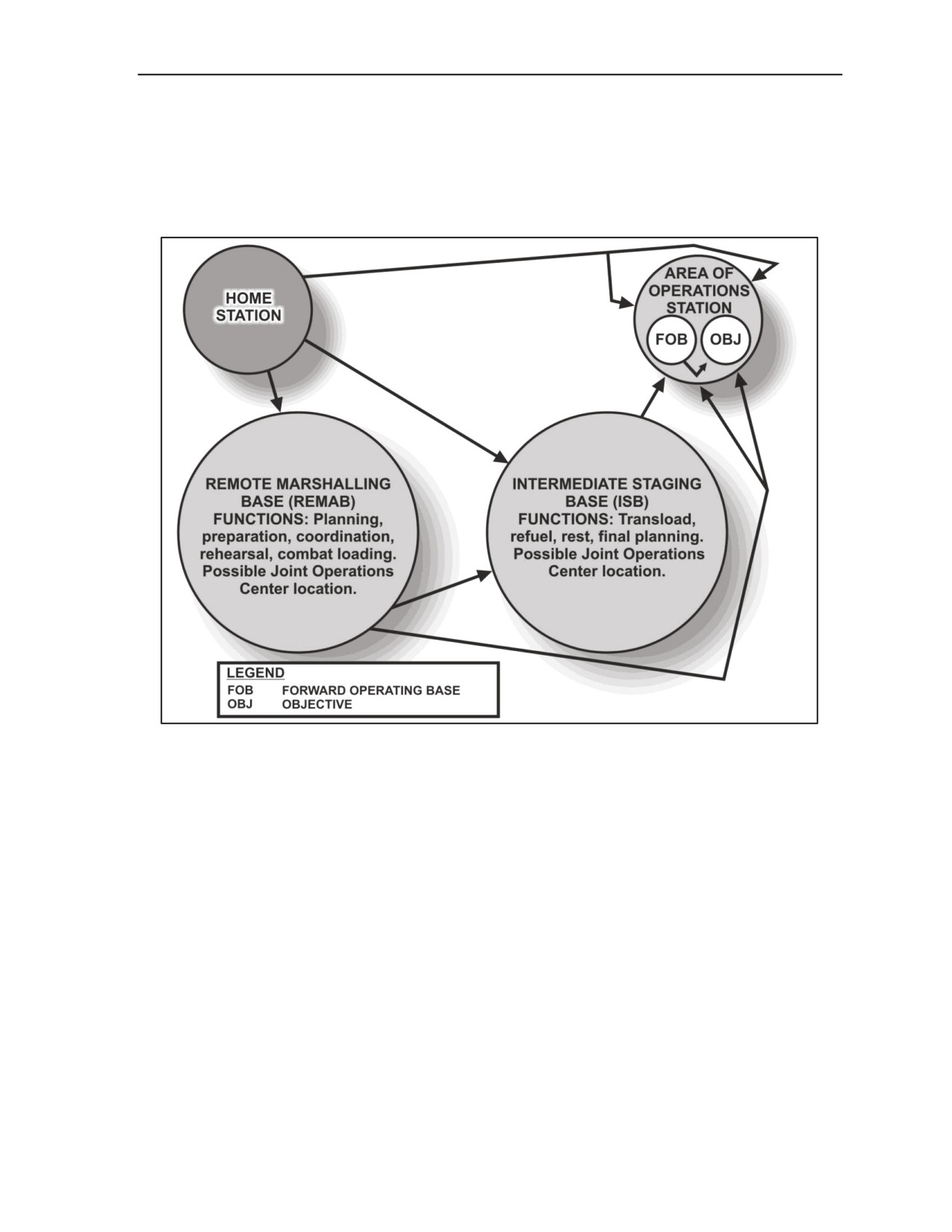
Ground Tactical Plan
or ISB in friendly territory. Therefore, a forward operating base in hostile territory can be seized to
facilitate or project further operations.
REMOTE MARSHALLING
4-88. The remote marshalling base is a secure base to which the entire airborne force (to include organic
and attached support elements) deploys and continues mission planning. (See figure 4-4.)
Figure 4-4. Base options
z
Location. The remote marshalling base is within the geographical area encompassed by the
command authority of the theater or joint task force commander. This ensures that the
sustainment elements providing support to the airborne unit are operating within their normal
area. It prevents or lessens out-of-area support requirements for sustainment elements. The
remote marshalling base should be in an area similar in terrain and climate to the objective area.
Time spent at the remote marshalling base lets the unit begin acclimatization.
z
Planning and coordination. The remote marshalling base provides a secure location for the unit
to conduct detailed planning and coordination with the controlling headquarters staff.
z
Preparation. In the remote marshalling base, the commander conducts rehearsals, refines and
modifies plans, determines priority intelligence requirements, and coordinates with the proper
intelligence source to receive that information.
z
Additions to the unit. In the remote marshalling base, individual specialists who augment the
force are integrated into the unit if they have not already joined. Specially trained supporting
units (such as aviation and communication elements) join the force at the remote marshalling
base.
z
Functions of a remote marshalling base. The remote marshalling base must provide—
Access to the controlling headquarters staff.
Physical security of billeting, planning, maintenance, and communication areas.
6 March 2015
FM 3-99
4-19
Chapter 4
Mess, billeting, latrine, and shower facilities for the force and its supporting elements.
Access to a C-17 or C-130 capable airfield, possibly with all-weather operations.
Access to secure communication and processed intelligence.
Access to rehearsal areas where sites can be built and live-fire rehearsals can be conducted.
Access to the unit locations of major supporting elements such as naval landing craft or
Army aviation units.
An external security force and an active counterintelligence agency.
Vehicle transport for personnel lift, equipment transfer, and administrative use.
Access to maintenance support facilities.
Army Health System support facilities to augment the airborne medical personnel.
Covered areas for packing parachutes and rigging airdrop loads.
INTERMEDIATE STAGING BASE
4-89. When the assaulting force must move a considerable distance from its sustaining base, the
commander should consider establishing one or more intermediate staging bases. Before establishing an
intermediate staging base, the commander must weigh the benefits of establishing the base against the cost
in terms of combat power or effort diverted from the support mission to secure the intermediate staging
base, and the potential of increased vulnerability to enemy air and missile attack.
4-90. Forward operating bases extend and maintain the operational reach by providing secure locations
from which to conduct and sustain operations. They not only enable extending operations in time and
space; they contribute to the overall endurance of the force. Forward operating bases allow forward
deployed forces to reduce operational risk, maintain momentum, and avoid culmination. Generally, they are
located adjacent to a distribution hub. This facilitates movement into and out of the operational area while
providing a secure location through which to distribute personnel, equipment, and supplies.
4-20
FM 3-99
6 March 2015
Chapter 5
Landing Plan
The landing plan supports the ground tactical plan. It provides a sequence for the
arrival of forces into the area of operation, ensuring that all forces arrive at
designated locations and times prepared to execute the ground tactical plan. The
commander finalizes the landing plan after completing the ground tactical plan. The
landing plan phases forces into the objective area at the correct time and place to
execute the ground tactical plan. Executing the landing plan is vital to the swift
massing of combat power, protecting the force, and subsequent mission accomplishment.
SECTION I - DELIVERY CONSIDERATIONS
5-1. The landing plan is the ABNAFC’s plan that links the air movement plan to the ground tactical plan.
It is published at ABN IBCT level and below. Before the ABNAFC can prepare an overall landing plan, he
must know where his subordinate commanders intend to land their assault forces. The landing plan is
generated up the chain of command as a collaborative effort.
ORGANIZATION
5-2. Airborne forces organize landing plans to maintain tactical integrity. Battalions or battalion task
forces normally land intact on a single drop zone. Two or more battalions land successively on the same
drop zone or each can land on a separate drop zone within a general ABN IBCT area of operation. The
ABN IBCT lands in mutually supporting drop zones.
5-3. The ABNAF sends as many assault force personnel and equipment as possible into the area in
airborne assault serials. The ABNAFC must consider the mobility of equipment after the landing. For
example, the carriers or prime movers that are deliverable by parachute, but difficult to manhandle on the
ground, can accompany the weapons in the assault force. Assault forces accompany their units’ principal
items of equipment.
REQUIREMENTS
5-4. To develop the landing plan, commanders at each level need to know their commander’s priorities,
the airlift plan, the landing area study, the parent and subordinate unit task organization and ground tactical
plans, and subordinate unit landing plans. During the backbrief of the ground tactical plan, the commander
establishes airlift and delivery priorities and airlift plan. He provides as much of this information as
possible to subordinate units at the end of the ground tactical plan backbrief.
5-5. As with the ground tactical plan, each echelon (fire team through brigade) must conduct confirmation
briefs and backbriefs to their landing plans. The landing plan remains tentative until leaders complete
backbriefs and coordinate changes. The leaders take the following actions:
z
Landing plan. In the case of the landing plan, backbriefs ensure coordination of who is using
what drop zone, and or landing zone and when, the preferred orientation of drop zones, and who
is landing in which areas and when. The landing plans follow the commander’s priorities, the
airlift plan, and ground tactical plan.
z
Assembly plan. One of the most critical parts of the landing plan is the assembly plan. Each
leader must brief his Soldiers, require a backbrief, rebrief his Soldiers, and require another
backbrief. Each Soldier should know exactly what to do, how to do it, and when to do it to
assemble quickly. Assembly plans of one unit do not interfere with the assembly plans of other units.
6 March 2015
FM 3-99
5-1
Chapter 5
z
Aircraft requirements. The backbrief of the landing plan identifies aircraft requirements for each
subordinate unit. If there are not enough aircraft available to lift the entire assault force at one
time, commanders must decide the units that should be lifted first, and then allocate aircraft
accordingly. In making this decision, he analyzes the priorities dictated by the mission and the
higher commander.
PRIORITIES
5-6. Commander must set the priorities for each assault objective to determine the delivery sequence for
units that are to secure these objectives. This does not necessarily match the sequence in which the units
secure objectives. The commander must know—
z
Priorities for deliveries on each drop zone (personnel drop, container delivery system, and
heavy drops).
z
The drop zone sequence.
z
Priorities for delivering the remainder of the forces.
z
Method of delivery for each unit and its equipment.
z
The location of the heavy equipment point of impact, and the personnel point of impact.
z
Abort criteria (Go/No-Go) and bump plan.
5-7. Airlift plan. The USAF airlift planners responsible for the airlift plan develops the plan, in
coordination with ABNTF planners, to best support the ground tactical plan. This plan includes aircraft
formations and the sequence of personnel drops, and heavy drops. ABNTF planners choose the sequence
and the time intervals between serials, which are groups of like aircraft (C-130s, C-17s) with the same
delivery method (personnel drops, heavy drops,) going to the same drop zone.
5-8. Landing area study. Division or corps staff, working with U.S. Army topographic engineers and the
USAF, develops the landing area study and provides it to subordinate units. This study enables subordinate
units to select the location, size, and orientation of drop zones to best support their scheme of maneuver.
5-9. Subordinate unit landing plans. Subordinate commanders should develop landing plans to support
their own respective schemes of maneuver. Subordinate units then backbrief their landing plans so that
higher headquarters can finalize their plans. Units must know the initial locations of sustainment assets.
This information should become available as subordinate units backbrief their ground tactical plan.
SECTION II - DELIVERY ELEMENTS
5-10. A designated lodgment area in a hostile or potentially hostile territory, when seized and held, makes
the continuous landing of troops and materiel possible and provides maneuver space for the transition to
follow-on operations. The five elements of the landing plan include: sequence of delivery, method of
delivery, place of delivery, time of delivery, and assembly plan. Assembly and reorganization are discussed
in Section IV of this chapter.
SEQUENCE OF DELIVERY
5-11. The ABNAFC’s priorities within the ground tactical plan determine the sequence of delivery, with
the initial assault designed to surprise and concentrate overwhelming combat power against the enemy and
to protect the assault force. Neither aircraft allocations nor the availability of aircraft should influence
these decisions. He determines final aircraft allocations after the landing plan confirmation brief.
5-12. Advance serials may precede the main airlift column to drop USAF combat control teams and Army
long-range surveillance teams. The combat control team places and operates navigation aids on the drop
zones and landing zones; the long-range surveillance teams provide surveillance on named areas of interest
and reports to the ground force commander. Insertion location of advance serials whether within the
objective area or some distance away from the objective area are always METT-TC dependent, as the
commander strives to achieve surprise regarding exact objectives within the airborne operations.
5-2
FM 3-99
6 March 2015
Landing Plan
METHOD OF DELIVERY
5-13. This part of the landing plan addresses how the force with its needed supplies and equipment arrives
in the objective area. The assault echelon comes in by parachute. The ABNAFC can use a number of other
means to introduce additional personnel, equipment, and supplies into the objective area.
PERSONNEL AIRDROP
5-14. The airborne force delivers assault personnel by parachute drop. This method allows quick, nearly
simultaneous delivery of the force. Planners choose terrain with minimal obstacles that allows the assault
force to land on or close to objectives. In some cases and with special equipment, it can deliver personnel
into rough terrain. Special teams can use high-altitude high-opening (HAHO) or high-altitude low-opening
(HALO) parachute techniques. These methods allow for early delivery without compromising the
objective’s location.
EQUIPMENT/SUPPLY AIRDROP
5-15. Airborne forces can airdrop supplies and equipment directly to ground forces behind enemy lines or
in other unreachable areas. However, there are advantages and disadvantages.
z
Advantages are as follows:
Prerigging and storing emergency items for contingencies considerably reduces shipping
and handling time and increases responsiveness.
Since the delivery aircraft does not land, there is no need for forward airfields, landing
zones or material handling equipment for offloading.
This reduces flight time and exposure to hostile fire and increases aircraft survivability and
availability.
Ground forces can disperse more since they are not tied to an airfield or strip.
z
Disadvantages are as follows:
Airdrops require specially trained rigger personnel and appropriate aircraft.
Bad weather or high winds can delay the airdrop or scatter the dropped cargo.
Ground fire threatens vulnerable aircraft making their final approach, especially if
mountains or high hills canalize the aircraft.
Since the aircraft do not land, no opportunity for ground refueling exists. Planned aerial
refueling can extend aircraft range and should be considered on long flight legs to increase
objective area loiter time and mission flexibility.
Bulky airdrop rigs for equipment prevent the aircraft from carrying as much cargo as when
configured for airland.
The possibility of loss or damage to equipment during the airdrop always exists.
Ground forces must secure the drop zone to prevent items from falling into enemy hands.
Recovery of airdropped equipment is slow and manpower intensive.
Types of Delivery
5-16. All means of delivery are exploited to maximize combat power in the lodgment. Free drop, high-
velocity airdrop, low-velocity airdrop, and joint precision airdrop, are different types of airdrop delivery.
Free Drop
5-17. Less than 600 feet above ground level (AGL), free drop requires no parachute or retarding device.
The airdrop crew can use energy-dissipating materiel around the load to lessen the shock when it hits the
ground at a rate of 130 to 150 feet a second. Fortification or barrier material, clothing in bales, and other
such items can be free dropped.
6 March 2015
FM 3-99
5-
Chapter 5
High-Velocity Airdrop
5-18. Parachutes, which have enough drag to hold the load upright during the descent at 70 to 90 feet a
second, stabilize loads for high-velocity airdrops. Army parachute riggers place airdrop cargo on energy-
dissipating material and rig it in an airdrop container. This method works well for subsistence, packaged
petroleum, oils, and lubricants (POL) products, ammunition, and other such items. The ground commander
may use the standard high-velocity delivery system, which is the container delivery system, to deliver
accompanying and follow-on supplies; they can be delivered within an area 400 by 100 meters. A container
delivery system is the most favored means of resupply; it is the most accurate of all airdrop methods. Each
pallet holds up to 2200 pounds. A C-130J holds up to 16 of these containers, and a C-17 holds up to 40 of
these containers. Planners should calculate the computed air release point (CARP) near assembly areas or
resupply points. The air liaison officer or Army drop zone support team controls receipt of container
deliverysystems.
Low-Velocity Airdrop
5-19. 700 ft AGL to 1300 ft AGL. Low-velocity airdrop requires cargo parachutes. Crews rig items on an
airdrop platform or in an airdrop container. They put energy-dissipating material beneath the load to lessen
the shock when it hits the ground. Cargo parachutes attached to the load reduce the rate of descent to no
more than 28 feet a second. Fragile materiel, vehicles, and artillery can be low-velocity airdropped.
z
Heavy drop. Airborne forces use this method most often to deliver vehicles, bulk cargo, and
equipment. Airdrop aircraft deliver heavy-drop equipment just ahead of the main body or, if
following personnel drops, at least 30 minutes after the last paratrooper exits. For night drops,
the heavy-drop precedes personnel drops.
z
Door bundles. Requires the use of either the A7A cargo sling or the A21 cargo bag. With these,
aircraft personnel can drop unit loads of up to 500 pounds just before the first Soldier’s exit.
Airdrop standard operating procedures dictate the number and type of door bundles that specific
aircraft can drop.
Joint Precision Airdrop
5-20. The Joint Precision Airdrop System (JPADS) is a high altitude-capable guided precision airdrop
system that provides increased control release from the aircraft, and reduces on-ground load dispersion with
GPS-supported accuracy. Two current increments of JPADS support precision delivery of cargo pallets up
to 2200 pounds and up to 10,000 pounds.
Airland
5-21. Airborne forces can accomplish certain phases of airborne operations, or even the entire operation,
by using airland to deliver personnel and equipment to the objective area. The advantages and
disadvantages are as follows:
z
Advantages. In some cases, air landing rather than air-dropping personnel and equipment may be
advantageous because air landing—
Provides the most economical means of airlift.
Delivers Army aviation elements, engineering equipment, artillery pieces, and other
mission-essential items in one operation.
Provides a readily available means of casualty evacuation.
Allows forces to more easily maintain tactical integrity and to deploy rapidly after landing.
Allows the use of forces with little special training and equipment.
Does not require extensive preparation and rigging of equipment.
Offers a relatively reliable means of personnel and equipment delivery regardless of
weather.
Precludes equipment damage and personnel injuries forces may experience in parachute
operations.
z
Disadvantages. In other cases, air landing is not advantageous because it—
Cannot be used for forced entry.
5-4
FM 3-99
6 March 2015