FM 3-99 Airborne and Air Assault Operations (MARCH 2015) - page 1
*FM 3-99
Field Manual
Headquarters
No. 3-99
Department of the Army
Washington, DC, 6 March 2015
Airborne and Air Assault Operations
Contents
Page
PREFACE
ix
INTRODUCTION
x
Chapter 1
OVERVIEW
1-1
Section I - Forcible Entry Operations
1-1
Joint Principles for Forcible Entry Operations
1-2
Operational Applications of Forcible Entry Operations
1-4
Joint Command and Control
1-6
Joint Operation Planning
1-13
Joint Entry Force
1-16
Section II - Vertical Envelopment
1-18
Tactical Applications
1-18
Command Responsibility
1-21
Space Operation
1-25
PART ONE AIRBORNE OPERATIONS
Chapter 2
ORGANIZATION AND EMPLOYMENT
2-1
Section I - Airborne Assault Force
2-1
Organization of Forces
2-1
Echelon Employment
2-2
Section II - Airborne Assault Force Considerations
2-4
Assault Force Formation
2-4
Joint and Army Control Teams
2-4
Section III - Capabilities, Limitations, Vulnerabilities
2-5
Capabilities
2-5
Limitations
2-5
Vulnerabilities
2-6
Section IV - Airborne Command and Control Platforms
2-6
Airborne Warning And Control System
2-6
Joint Surveilance Target Attack Radar System
2-7
Distribution Restriction: Approved for public release; distribution is unlimited.
*This publication supersedes FM 90-26, dated 18 December 1990 and ATTP 3-18.12, dated 1 March 2011.
0DUFK
)0
L
Contents
Joint Airborne Communications Center/Command Post
2-7
Chapter 3
AIRBORNE ASSAULT PLANNING
3-1
Section I - Roles and Responsibilities
3-1
Higher Headquarters
3-1
Airborne Assault Force
3-2
Supporting Aviation
3-2
Section II - Reverse Planning Sequence
3-2
Ground Tactical Plan
3-3
Landing Plan
3-3
Air Movement Plan
3-3
Marshalling Plan
3-4
Section III - Planning Considerations
3-4
Planning Methodology
3-4
Predeployment Planning and Preparation
3-6
X-hour/N-hour Sequences for Deployment
3-6
Optimize Available Planning Time
3-6
Control Measures
3-9
Determine Go/No-Go Criteria
3-10
Airfield Opening
3-10
Section IV - Shaping Operations
3-11
Create Conditions
3-11
Preserve Conditions
3-12
Chapter 4
GROUND TACTICAL PLAN
4-1
Section I - Elements
4-1
Task Organization
4-1
Mission Statement
4-1
Commander’s Intent
4-2
Concept of Operations
4-2
Tasks to Subordinates
4-2
Section II - Plan Development
4-3
Mission Variables of METT-TC
4-3
Assault Objective and Airhead Line
4-5
Section III - Air-ground Operations
4-12
Fundamental Considerations
4-12
Close Combat Attack
4-12
Close Air Support
4-14
Unmanned Aircraft System
4-15
Section IV - Execution
4-16
Conduct of the Airborne Assault
4-16
Development of the Airhead
4-17
Buildup of Combat Power
4-17
Section V - Follow-on Operations
4-18
Section VI - Supporting Operations
4-18
Remote Marshalling
4-19
Intermediate Staging Base
4-20
ii
FM 3-99
6 March 2015
Contents
Chapter 5
LANDING PLAN
5-1
Section I - Delivery Considerations
5-1
Organization
5-1
Requirements
5-1
Priorities
5-2
Section II - Delivery Elements
5-2
Sequence of Delivery
5-2
Method of Delivery
5-3
Place of Delivery
5-5
Time of Delivery
5-9
Section III - Preparation and Supporting Fires
5-9
Fire Support Planning
5-10
Fire Support Considerations
5-11
Air Operations
5-14
Section IV - Assembly and Reorganization
5-17
Assembly
5-17
Reorganization
5-25
Chapter 6
AIR MOVEMENT PLAN
6-1
Section I - Joint Planning
6-1
Section II - Elements of the Air Movement Plan
6-1
Air Movement Table
6-1
Types of Movement
6-2
Aircraft Requirements
6-2
Section III - Load Planning Considerations
6-3
Tactical Integrity
6-3
Cross Loading
6-3
Self-Sufficiency
6-4
Section IV - Loading and Delivery of Forces
6-5
Load Planning Sequence
6-5
Load Planning of Vehicles
6-5
Air Movement Planning Worksheet
6-5
Unit Aircraft Utilization Form
6-6
Section V - Aircraft Load and Air Movement Table
6-6
Section VI - Manifests and Air-Loading Planning System
6-9
Manifests
6-9
Integrated Computerized Deployment System
6-9
Chapter 7
MARSHALLING PLAN
7-1
Section I - Preparation
7-1
Section II - Movement
7-2
Section III - Protection
7-2
Passive Defense Measures
7-2
Dispersal
7-3
Section IV - Departure Airfield-Marshalling Area
7-3
Selecting Departure Airfields
7-3
Selecting and Operating Marshalling Areas
7-4
6 March 2015
FM 3-99
iii
Contents
Facility Requirements
7-4
Marshalled Unit and Support Organization Activities
7-7
Section V - Outload
7-9
Outload Planning Considerations
7-9
Outload Control
7-10
PART TWO AIR ASSAULT OPERATIONS
Chapter 8
ORGANIZATION AND EMPLOYMENT
8-1
Section I - Air Assault and Air Movements
8-1
Section II - Air Assault Task Force
8-1
Organizing Forces
8-2
Brigade Combat Teams
8-2
Combat Aviation Brigades
8-2
Section III - Task Force Considerations
8-4
Section IV - Capabilities, Limitations, Vulnerabilities
8-5
Capabilities
8-5
Limitations
8-5
Vulnerabilities
8-6
Section V - Airspace Control
8-6
Concurrent Employment
8-6
Airspace Coordinating Measures
8-7
Airspace Development
8-8
Section VI - Air Assault Task Force Mission Command
8-10
Mission Orders
8-10
Command Posts
8-12
Personnel and Key Elements within the Task Force
8-13
Mission Command System
8-15
Chapter 9
AIR ASSAULT PLANNING
9-1
Section I - Roles and Responsibilities
9-1
Higher Headquarters
9-1
Brigade Combat Team
9-1
Supporting Aviation Units
9-1
Section II - Reverse Planning Sequence
9-1
Section III - Planning Methodology
9-2
Deliberate Planning
9-3
Time-Constrained Planning
9-4
Rapid Decisionmaking and Synchronization Process
9-5
Allowable Cargo Load Planning Considerations
9-6
Section IV - Planning Process
9-6
Warning Order
9-6
Initial Planning Conference
9-7
Air Mission Coordination Meeting
9-7
Air Mission Brief
9-8
Air Mission Brief Documents
9-8
Air Assault Task Force Rehearsal
9-9
Aircrew Brief
9-9
LY
FM 3-99
0DUFK
Contents
Aviation Task Force Rehearsal
9-9
Condition Checks
9-9
Abort Criteria
9-10
Section V - Control Measures
9-11
Force-Oriented Control Measures
9-11
Boundaries
9-12
Fire Support Coordination Measures
9-12
Airspace Coordinating Measures
9-12
Section VI - Shaping Operations
9-13
Section VII - Medical and Casualty Evacuation
9-14
Medical Evacuation Planning
9-14
Casualty Backhaul
9-15
Medical Evacuation Landing Zone
9-15
Chapter 10
GROUND TACTICAL PLAN
10-1
Section I - Elements
10-1
Task Organization
10-1
Mission Statement
10-1
Commander’s Intent
10-1
Concept of Operations
10-2
Tasks to Subordinate Units
10-4
Section II - Plan Development
10-4
Mission Analysis
10-4
Assault Objective and Landing Zone Development
10-8
Section III - Air-ground Operations
10-8
Effective Integration
10-8
Close Combat Attacks
10-9
Close Air Support
10-11
Unmanned Aircraft Systems
10-11
Section IV - Execution
10-12
Conduct of the Air Assault
10-12
Buildup of Combat Power
10-12
Chapter 11
LANDING PLAN
11-1
Section I - Landing Zone Selection
11-1
Criteria for Selecting Landing Zones
11-1
Location of Landing Zones
11-2
Number of Landing Zones
11-2
Section II - Landing Zone Updates
11-3
Landing Zone Condition
11-3
Fixed-wing Support
11-3
Unmanned Aircraft System Support
11-3
Section III - Hot Landing Zone Considerations
11-3
Scenarios
11-3
Reaction to Enemy Contact Away From the Objective
11-4
Reaction to Enemy Contact on the Objective
11-4
Section IV - Preparation and Supporting Fires
11-4
0DUFK
FM 3-99
Y
Contents
Section V - Landing Site Operations
11-5
Landing Zone and Obstacle Markings
11-5
Exiting the Aircraft
11-6
Exiting the Landing Zone
11-11
Chapter 12
AIR MOVEMENT PLAN
12-1
Section I - Development Considerations
12-1
Air Routes
12-1
En Route Formations
12-3
Terrain Flight Modes
12-5
Fires
12-6
Suppression of Enemy Air Defenses
12-6
Air Assault Security
12-8
Mission Command
12-8
Section II - Air Movement Table
12-9
Air Movement Table Development
12-9
Air Movement Table Criteria
12-9
Chapter 13
LOADING AND STAGING
13-1
Section I - Loading Plan
13-1
Pickup Zone Selection
13-1
Pickup Zone Organization and Control
13-2
Coordination With Supporting Aviation Unit
13-3
Preparation of Air Loading Tables
13-3
Disposition of Loads on Pickup Zone
13-4
Lifts, Serials, and Chalks
13-5
Bump Plan
13-6
Section II - Staging Plan
13-7
Preparation for Loading
13-7
Movement to Pickup Zone
13-7
Chalk Check-In and Inspection
13-7
Load Staging
13-8
Sling Load Operations
13-8
GLOSSARY
........................................................................................................................ Glossary-1
REFERENCES
References-1
INDEX
........................................................................................................................... Index-1
Figures
Figure 1-1. Joint phasing model
1-5
Figure 3-1. MDMP and airborne assault planning process
3-5
Figure 4-1. Assault objectives
4-6
Figure 4-2. Airhead line
4-7
Figure 4-3. Boundaries
4-10
ǀŝ
FM 3-99
0DUFK
Contents
Figure 4-4. Base options
4-19
Figure 5-1. Offset and parallel drop zones
5-7
Figure 5-2. Parallel on-line drop zones
5-8
Figure 5-3. Assembly control posts for ABN IBCT forces landing on one drop zone
5-18
Figure 5-4. Movement of personnel to company assembly area
5-19
Figure 5-5. Line-of-flight/clock system
5-20
Figure 5-6. Stiner aid
5-21
Figure 6-1. Cross-loaded aircraft
6-7
Figure 7-1. Airborne task force marshalling area
7-5
Figure 7-2. Heavy-drop loading area control center
7-6
Figure 7-3. Heavy-drop rigging site
7-7
Figure 7-4. Concept of outload control
7-11
Figure 8-1. Grid line method
8-9
Figure 8-2. Attack by fire method
8-10
Figure 8-3. Example of air assault leadership positioning
8-12
Figure 9-1. Air assault planning stages
9-2
Figure 9-2. MDMP and air assault planning process
9-4
Figure 9-3. Time-constrained air assault planning
9-5
Figure 10-1. Organizational framework
10-3
Figure 10-2. Weather data
10-7
Figure 11-1. One-side off-load (UH-60)
11-7
Figure 11-2a. One-side off-load (squads in same chalk) trail landing formation
11-8
Figure 11-2b. One-side off-load (squads in same chalk) staggered trail right landing
formation
11-8
Figure 11-3. Two-side off-load (UH-60)
11-9
Figure 11-4. Two-side off-load (squads in same chalk) diamond landing formation
11-10
Figure 11-5. Two-side off-load (chalks cross-loaded) heavy right landing formation
11-10
Figure 11-6. Rear ramp off-load and landing zone exit (CH-47)
11-11
Figure 11-7. One-side landing zone rush (squads in same chalk) trail landing
formation
11-12
Figure 11-8. Two-side landing zone rush (chalks cross loaded) trail landing formation
11-13
Figure 11-9. Two-side landing zone rush (squads in same chalk) trail landing
formation
11-14
Figure 12-1. Air route overlay
12-3
Figure 12-2. Standard flight and landing formations
12-5
Figure 13-1. Example pickup zone diagram
13-4
Figure 13-2. Lifts, serials, and chalks
13-6
Tables
Table 1-1. Command responsibility of airborne operations
1-22
Table 1-2. Command responsibility of air assault operations
1-24
0DUFK
FM 3-99
YLL
Contents
Table 7-1. Parachute issue
7-2
Table 8-1. Heavy Combat Aviation Brigade organization
8-3
Table 8-2. Medium Combat Aviation Brigade organization
8-4
Table 8-3. Standard air assault radio networks and monitoring requirements
8-18
Table 9-1. Example of an air mission coordination meeting agenda
9-8
Table 12-1. Example air movement table
12-10
Table 13-1. Example air loading table
13-3
Table 13-2. Aircraft bump information
13-6
YLLL
FM 3-99
0DUFK
Preface
Army Field Manual (FM) 3-99, Airborne and Air Assault Operations, establishes doctrine to govern the
activities and performance of Army forces in forcible entry (specifically airborne and air assault operations) and
provides the doctrinal basis for vertical envelopment and follow-on operations. This publication provides
leaders with descriptive guidance on how Army forces conduct vertical envelopment within the simultaneous
combination of offense, defense, and stability. These doctrinal principles are intended to be used as a guide and
are not to be considered prescriptive.
FM 3-99 encompasses tactics for Army airborne and air assault operations and describes how commanders plan,
prepare, and conduct airborne and air assault operations by means of joint combined arms operations. This
publication supersedes FM 90-26, Airborne Operations and Army Tactics, Techniques, and Procedures 3-18.12,
Air Assault Operations.
To comprehend the doctrine contained in this publication, readers must first understand the principles of war,
the nature of unified land operations, and the links between the operational and tactical levels of war described
in Joint Publication (JP) 3-0, Army Doctrine Publication (ADP) 3-0, and Army Doctrine Reference Publication
(ADRP) 3-0. The reader must understand the fundamentals of the operations process found in ADP and ADRP
5-0 associated with the conduct of offensive and defensive tasks contained in FM 3-90-1 and reconnaissance,
security, and tactical enabling tasks contained in FM 3-90-2. In addition the reader must also fully understand
the principles of mission command as described in ADP
6-0 and ADRP 6-0 and command and staff
organization and operations found in FM 6-0.
The principal audience for FM 3-99 is the commanders, staff, officers, and noncommissioned officers (NCOs)
of the brigade, battalions, and companies within the brigade combat team. The audience also includes the
United States Army Training and Doctrine Command institutions and components, and the United States Army
Special Operations Command. It serves as an authoritative reference for personnel developing doctrine, materiel
and force structure, institutional and unit training, and standard operating procedures (SOPs) for airborne or air
assault operations.
Commanders, staffs, and subordinates ensure their decisions and actions comply with applicable United States,
international, and, in some cases, host-nation laws and regulations. Commanders at all levels ensure their
Soldiers operate in accordance with the law of war and the rules of engagement. (Refer to FM 27-10.)
FM 3-99 uses joint terms where applicable. Selected joint and Army terms and definitions appear in both the
glossary and text. Terms for which FM 3-99 is the proponent publication (the authority) are marked with an
asterisk(*) in the glossary. Terms and definitions for which FM 3-99 is the proponent publication are boldfaced
in the text and the term is italicized. For other definitions shown in the text, the term is italicized and the
number of the proponent publication follows the definition.
This publication applies to the Active Army, the Army National Guard/Army National Guard of the United
States, and the United States Army Reserve unless otherwise stated.
The proponent for FM 3-99 is the U.S. Army Training and Doctrine Command (TRADOC). The preparing
agency is the United States Army Maneuver Center of Excellence
(MCoE). Send comments and
recommendations by— mail or e-mail—using or following the format of DA Form 2028, (Recommended
Changes to Publications and Blank Forms). Point of contact information is as follows:
E-mail: usarmy.benning.mcoe.mbx.doctrine@mail.mil
Phone: COM 706-545-7114 or DSN 835-7114
Mail: Commanding General, Maneuver Center of Excellence, Directorate of Training and Doctrine, Doctrine
and Collective Training Division, ATTN: ATZK-TDD, Fort Benning, GA 31905-5410
Unless otherwise stated, whenever the masculine gender is used, both men and women are implied.
0DUFK
FM 3-99
L[
7KLV SDJH LQWHQWLRQDOO\ OHIW EODQN
Introduction
Assured access is the desired conditions that the United States seeks to maintain in
potential areas of strategic importance throughout the world. Assured access is the
result of a combination of geopolitical factors that affect the United States’ ability to
exert influence and project power in a variety of political, economic, humanitarian,
and military situations. While assured access includes the freedom of movement
through the global commons of international airspace and oceanic sea lanes,
operational access is the ability to project military force into an operational area with
sufficient freedom of action to accomplish the mission.
Operational access is the joint force contribution to assured access, the unhindered
national use of the global commons and select sovereign territory, waters, airspace
and cyberspace. Operational access challenges can be categorized in a number of
ways. They can be classified in terms of geographical, military, or diplomatic access
issues. They can be described in terms of anti-access challenges, capabilities
designed to prevent entry into an operational area, or area-denial capabilities
designed to limit freedom of action within the operational area.
Army forces, as part of the joint force, contribute to projecting military force into an
operational area and sustaining it in the face of armed opposition by defeating enemy
anti-access and area denial capabilities. Projecting and sustaining forces require the
capability to secure multiple entry points into an operational area. As a major
application of forcible entry, the joint force uses vertical envelopment (airborne and
air assault operations), giving leaders flexibility and depth to set conditions for
decisive action. Vertical envelopment capitalizes on mobility to surprise the enemy,
seize a lodgment, and gain the initiative.
The joint force establishes several precepts for gaining operational access. Foremost
among them is “Conduct operations to gain access based on the requirements of the
broader mission, while also designing subsequent operations to lessen access
challenges.” Consistent with this precept, entry operations into enemy territory are a
means to military or political objectives, rather than an end in themselves. Entry
operations are planned within the larger context of the campaign’s overarching
purpose. Without considering the impacts of entry operations on the larger objectives
of a military campaign it is possible that entry may be gained through means that
decrease the likelihood of achieving political and military objectives.
Operations during the last 25 years make clear that future entry of forces onto hostile
or uncertain territory will be necessary for a number of purposes, one of which is the
establishment of a lodgment. Joint doctrine defines forcible entry as the “seizing and
holding of a lodgment in the face of armed opposition,” and a lodgment as “a
designated area in a hostile or potentially hostile operational area that, when seized
and held, makes the continuous landing of troops and materiel possible and provides
maneuver space for subsequent operations.” Each service and functional component
has an important role in how joint forcible entry operations overcome opposed access.
This manual provides doctrinal guidance for forcible entry operations at the
operational and tactical levels. It describes relationships within the operational joint
0DUFK
FM 3-99
[
Introduction
task force; vertical envelopment, organizational roles, functions, capabilities, and
limitations; and responsibilities for the brigade combat team and its subordinate units
within the assault force during airborne and air assault operations. A summary of key
constructs to FM 3-99 follows:
x Operational access—forcible entry and vertical envelopment—within the operational
environment.
x Task force organization, mission, capabilities, and limitations as well as the duties and
responsibilities for the conduct of airborne and air assault operations.
x Task force command and staff operations; cross-functional staff organizations (cells, working
groups, and centers) to assist in coordination.
x Meetings, working groups, and boards to integrate the staff, enhance planning, and
decisionmaking within the task force.
x Airborne and air assault task force unique capabilities and planning considerations in transitioning
to other tactical operations.
[L
FM 3-99
0DUFK
Chapter 1
Overview
Adaptive adversaries and enemies will contest United States joint forces across all
domains— air, sea, land, space and cyberspace. Enemies are likely to employ anti-
access strategies to prevent friendly force ability to project and sustain combat power
into a region, and area denial strategies to constrain our nation’s freedom of action
within the region. Assured access— the unhindered national use of the global
commons and selected sovereign territory, waters, airspace and cyberspace, is
achieved by projecting all the elements of national power. Often the United States
requires operational access— the ability to project military force into an operational
area with sufficient freedom of action to accomplish the mission. Operational access
is the desired condition that the United States seeks to maintain in areas of strategic
importance, to achieve assured access. Army forces, as part of joint forces project
forces into an operational area and conduct operations to defeat enemy anti-access
and area denial capabilities and establish security conditions and control of territory
to pressure freedom of movement and action for follow-on operations or deny that
area’s use to the enemy. Forcible entry operations are complex and always involve
taking prudent risk to gain a position of relative advantage over the enemy. Equally
critical is the transition between phases of the operation. This chapter discusses
forcible entry operations and in particular the application of vertical envelopment as a
tactical maneuver conducted by airborne or air assault forces to seize, retain, and
exploit the initiative.
SECTION I - FORCIBLE ENTRY OPERATIONS
1-1. United States forces gain access to sovereign spaces through invitation
(humanitarian
relief),
negotiations (basing rights), coercion (peacemaking operations under United Nation charter) or through
force. The joint force’s ability to project power and influence is challenged by proliferated anti-access
weapons with increasing range, diversity, density and sophistication in the hands of both state and nonstate
actors who are devising innovative approaches to contest joint forces in all domains. This evolving threat
necessitates the development of comprehensive joint force solutions for gaining and maintaining
operational access. (Refer to JP 3-18 for more information.)
1-2. The composite of the conditions, circumstances, and influences that make up an operational
environment affects the employment of capabilities and impacts the decisions of commanders. The
operational environment of the access force includes all enemy, adversarial, friendly, and neutral systems
across the range of military operations; it includes an understanding of the physical environment, the state
of governance, technology, local resources, and the culture of the local population. (Refer to JP 2-01.3 for
more information.)
1-3. Forcible entry is the seizing and holding of a military lodgment in the face of armed opposition (JP
3-18). A lodgment is a designated area in a hostile or potentially hostile operational area that, when seized
and held, makes the continuous landing of troops and materiel possible and provides maneuver space for
subsequent operations (JP 3-18). A forcible entry operation is conducted to gain entry into the territory of
an enemy by seizing a lodgment as rapidly as possible to enable the conduct of follow-on operations or
conduct a singular operation. The operations must be designed to provide maneuver space for subsequent
operations. This section addresses the principles and operational application of joint forcible entry
6 March 2015
FM 3-99
1-1
Chapter 1
operations. It discusses joint command and control, planning process and considerations, and the entry
force.
JOINT PRINCIPLES FOR FORCIBLE ENTRY OPERATIONS
1-4. Fundamental principles are essential to plan, prepare, execute, and access joint forcible entry
operations. Joint principles for forcible entry operations are:
ACHIEVE SURPRISE
1-5. Commanders and planners strive to achieve surprise regarding exact objectives, times, methods, and
forces employed in forcible entry operations. Surprise depends upon comprehensive information-related
capabilities [operations security (OPSEC) and military deception] followed by disciplined execution by the
joint force. (Refer to JP 3-13.3 and JP 3-13.4 for more information.) Surprise is not a necessary condition
for operational success (particularly when the force has overwhelming superiority), but it can reduce
operational risk significantly.
CONTROL OF THE AIR
1-6. Counterair integrates offensive and defensive operations to attain and maintain a desired degree of air
superiority and protection in the operational area to protect the force during periods of critical vulnerability
and to preserve lines of communications. At a minimum, the joint force must neutralize the enemy’s
offensive air and missile capability and air defenses to achieve local air superiority and protection over the
planned lodgment. The joint force controls the air through integrated and synchronized air and missile
defense operations. Air interdiction of enemy forces throughout the operational area enhances the
simultaneity and depth of the forcible entry operation.
CONTROL OF SPACE
1-7. Space superiority allows the joint force commander access to communications, weather, navigation,
timing, remote sensing, and intelligence assets without prohibitive interference by the opposing force.
Clearly defined command relationships are crucial for ensuring timely and effective execution of space
operations and provide depth, persistence, and reach capabilities for commanders at the strategic,
operational, and tactical levels.
ELECTROMAGNETIC SPECTRUM MANAGEMENT
1-8. Electromagnetic spectrum management is the planning, coordinating, and managing use of the
electromagnetic spectrum through operational, engineering, and administrative procedures (JP 6-01). It
includes the interrelated functions of frequency management, host-nation coordination, and joint spectrum
interference resolution that together enable the planning, management, and execution of operations within
the electromagnetic operational environment during all phases of military operations. The electromagnetic
operational environment is the background electromagnetic environment and the friendly, neutral, and
adversarial electromagnetic order of battle within the electromagnetic area of influence associated with a
given operational area (JP 6-01). (Refer to JP 6-01 for more information.)
OPERATIONS IN THE INFORMATION ENVIRONMENT
1-9. Information superiority is the operational advantage derived from the ability to collect, process, and
disseminate an uninterrupted flow of information while exploiting or denying an adversary’s ability to do
the same (JP 3-13). It enables the primary mission objective and information-related activities within
information operations. Information operations is the integrated employment, during military operations, of
information-related capabilities in concert with other lines of operation to influence, disrupt, corrupt, or
usurp the decisionmaking of adversaries and potential adversaries while protecting our own (JP 3-13).
(Refer to JP 3-13 for more information.)
1-10. Information in an operational environment is an important contributor to operational access as it
enables commanders at all levels to make informed decisions on how best to apply combat power,
1-2
FM 3-99
6 March 2015
Overview
ultimately creating opportunities to achieve decisive results. Operations in the information environment—
the aggregate of individuals, organizations, and systems that collect, process, disseminate, or act on
information (JP 3-13) requires—
z
Complementary tasks of information operations that inform and influence a global audience and
affect morale within the operational environment.
z
Cyber electromagnetic activities (See FM 3-38.) to ensure information availability, protection,
and delivery, as well as a means to deny, degrade, or disrupt the enemy’s use of its command
and control systems and other cyber capabilities.
z
Knowledge management capabilities to allow the commanders to make informed; timely
decisions despite the uncertainty of operations.
z
Information management to help commanders make and disseminate effective decisions faster
than the enemy can.
z
Information systems to understand, visualize, describe, and direct operations.
SEA CONTROL
1-11. Local maritime superiority is required to project power ashore in support of the joint forcible entry
operation and to protect sea lines of communications
(SLOCs). Protection of SLOCs ensures the
availability of logistic support required to sustain operations and support the transition to continuing
operations by follow-on forces.
ISOLATE THE LODGMENT
1-12. A lodgment is a designated area in a hostile or potentially hostile operational area that, when seized
and held, makes the continuous landing of troops and materiel possible and provides maneuver space for
subsequent operations. The joint force attacks or neutralizes enemy capabilities with the potential to affect
the establishment of the lodgment. These capabilities include—
z
Enemy ground, sea, and air forces that can be committed to react to joint force assaults.
z
Indirect fire systems and theater missile systems that can range the lodgment.
z
Related enemy sensors, command and control systems, and digital networks.
GAIN AND MAINTAIN ACCESS
1-13. Gaining and maintaining access is a critical precondition for successful forcible entry and follow-on
operations. In any given operational area, numerous and diverse limitations to access present themselves.
Access may be restricted due to diplomatic, economic, military, or cultural factors. Ports, airfields, and
infrastructures may be physically limited. Additional access precondition considerations include—
z
Leveraging established basing, access, and security cooperation agreements as well as the
regional and national expertise and partner capabilities developed through precrisis engagement
activities at the national and regional levels.
z
Appropriate shaping operations or activities focused on identifying and neutralizing an
adversary’s anti-access capabilities balanced against the need for surprise.
z
Operational access to expand the degree to which the full range of joint capabilities within the
joint operations area is utilized.
NEUTRALIZE ENEMY FORCES WITHIN THE LODGMENT
1-14. The joint force must neutralize enemy forces within the lodgment to facilitate the establishment of
airheads (Refer to chapter 3 of this publication for more information.) and beachheads (Refer to JP 3-02 for
more information.) within the operational area and to provide for the immediate protection of the force.
Planning considerations should include—
z
Identification of enemy infrastructure, which may be of value for future use by friendly forces.
z
Limiting physical damage to lessen the time needed to rebuild.
6 March 2015
FM 3-99
1-3
Chapter 1
EXPAND THE LODGMENT
1-15. The joint force quickly builds combat power in order to enhance security and the ability to respond to
enemy counter attacks, enable continuous landing of troops and materiel, and facilitate transition to
subsequent operations. Analyze requirements to expand with regards to maximum on ground capabilities,
throughput, and infrastructure.
MANAGE THE IMPACT OF ENVIRONMENTAL FACTORS
1-16. Managing the impact of environmental factors refers to overcoming the effect of land and sea
obstacles; anticipating, preventing, detecting, and mitigating threat use of chemical, biological,
radiological, and nuclear
(CBRN), and weapons of mass destruction; and, determining the impact of
climate, weather, and other naturally occurring hazards. (Refer to JP 3-11, JP 3-40, and JP 3-59 for more
information.)
INTEGRATE SUPPORTING OPERATIONS
1-17. Reconnaissance, surveillance, security, and intelligence operations are critical to information
collection based on the commander’s critical information requirement. Information operations, civil-
military operations, and special operations (to include special reconnaissance missions) are keys to setting
conditions, and integrated into the operation at every stage from initial planning to transition. Logistic
services comprise the support capabilities that collectively enable the joint force to rapidly provide
sustainment of entry forces in order to achieve the envisioned end state of the joint force commander (JFC).
OPERATIONAL APPLICATIONS OF FORCIBLE ENTRY
OPERATIONS
1-18. The Army combines campaign qualities and expeditionary capabilities to contribute decisive,
sustained land power to unified actions. Campaign quality extends expeditionary capability well beyond
deploying combined arms forces that are effective upon arrival. It is an ability to conduct sustained
operations for as long as necessary, adapting to unpredictable and often profound changes in an operational
environment (OE) as the campaign unfolds. Expeditionary capability is the ability to promptly deploy
combined arms forces worldwide into operational environments (OEs) and conduct operations upon arrival.
Future conflicts, involving forcible entry operations, place a premium on promptly deploying land power
and constantly adapting to each campaign’s unique circumstances as they occur and change.
CAMPAIGN QUALITY
1-19. The joint force commander (JFC) conducts campaigns to translate operational-level actions into
strategic results and exploits the advantage of interdependent service capabilities. Through operational art
and the principles of joint operations, the JFC determines the most effective and efficient methods for
applying decisive operations in various locations across multiple echelons.
EXPEDITIONARY CAPABILITY
1-20. Expeditionary operations require the ability to deploy quickly with little notice, shape conditions in
the operational area, operate immediately on arrival exploiting success and consolidating tactical and
operational gains. Expeditionary capabilities of an entry force are more than physical attributes; they begin
with a mindset that permeates the force. The Army provides entry forces to the joint force commander that
are organized and equipped to rapidly deploy as well as conduct sustained operations.
PHASING AND TRANSITIONS
1-21. A phase is a planning and execution tool used to divide an operation in duration or activity (ADRP 3-
0). Phasing is critical to arranging complex operations. It describes how the commander envisions the
overall operation unfolding in time. Within a phase, a large portion of the force executes similar or
mutually supporting activities. Achieving a specified condition or set of conditions typically marks the end
1-4
FM 3-99
6 March 2015
Overview
of a phase. Descriptions of efforts during each phase should emphasize effort, concentrate combat power in
time and space at a decisive point, and accomplish its objectives deliberately and logically.
1-22. Phasing is critical to arranging all tasks of an operation that cannot be conducted simultaneously.
Commanders, with the assistance of the staff, visualize the mission, decide which tactics to use, and
balance the tasks of unified land operations while preparing their intent and concept of operations
(CONOPS). They determine which tasks the force can accomplish simultaneously, if phasing is required,
what additional resources are necessary, and how to transition from one task to another. At the operational
level, this requires looking beyond the current operation and prioritizing forces for the next phase or sequel.
1-23. Transitions mark a change of focus between phases or between the ongoing operation and execution
of a branch or sequel. Transitions require planning and preparation well before their execution to maintain
the momentum and tempo of operations. The force is vulnerable during transitions, and commanders
establish clear conditions for their execution. Transition occurs for several reasons. It may occur from an
operation dominated by combined arms maneuver to one dominated by wide area security. An unexpected
change in conditions may require commanders to direct an abrupt transition between phases. In such cases,
the overall composition of the force remains unchanged despite sudden changes in mission, task
organization, and rules of engagement. Typically, task organization evolves to meet changing conditions;
however, transition planning also must account for changes in mission. Commanders continuously assess
the situation and task-organize and cycle their forces to retain the initiative. They strive to achieve changes
in emphasis without incurring an operational pause.
1-24. The JFC’s vision of how a campaign or operation should unfold and anticipated enemy action drives
decisions regarding phasing. Generally, joint operations and campaigns involve six phases (shape, deter,
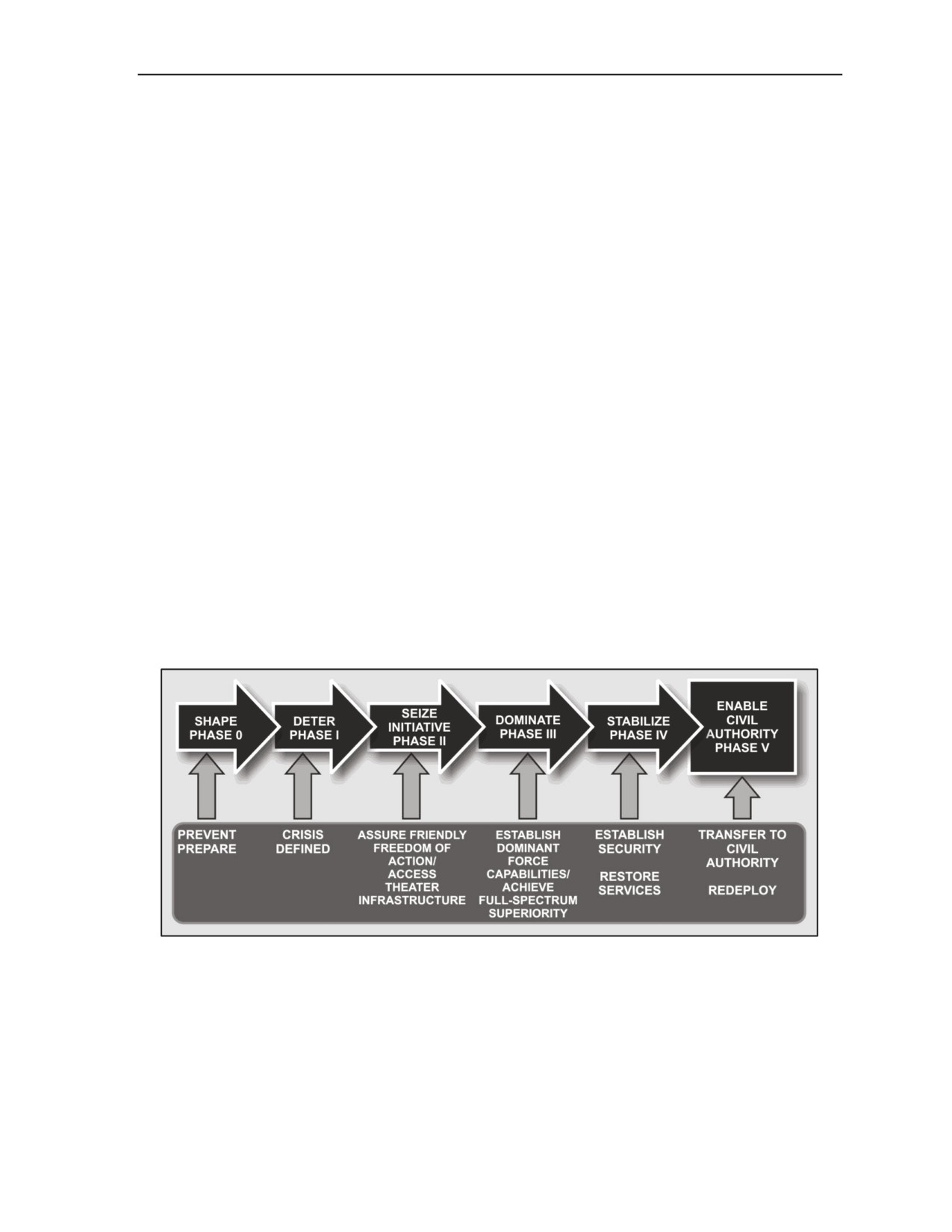
seize initiative, dominate, stabilize, and enable civil authority) as illustrated in figure 1-1. Phasing assists in
framing commander’s intent and assigning tasks to subordinate commanders. By arranging operations and
activities into phases, the joint force commander can better integrate and synchronize subordinate
operations in time, space, and purpose. Each phase represents a natural subdivision of the campaign or
operation. Within the context of the phases established by a JFC, subordinate JFCs and component
commanders may establish additional phases that fit their CONOPS. A creditable threat of forcible entry
operations can be an effective deterrence and may be applicable in both Phase 0 (Shape) and Phase I
(Deter).
Figure 1-1. Joint phasing model
1-25. A forcible entry operation normally is conducted during Phase II (Seize the Initiative) or Phase III
(Dominate) of a joint operation. A forcible entry operation may be the JFC’s opening move to seize the
initiative. For example, a JFC might direct friendly forces to conduct a vertical envelopment (airborne or
air assault operation) to seize and hold a lodgment to ensure the continuous landing of troops and materiel
and provide the maneuver space to conduct follow-on operations. The establishment of the lodgment,
followed by the arrival and preparation of follow-on forces, usually marks the end of the forcible entry sub-
phase of the operation and a transition to further offensive operations to seize the initiative or dominate.
6 March 2015
FM 3-99
1-5
Chapter 1
1-26. Forcible entry operations during the dominate phase of a campaign may be used for the following
purposes:
z
A sudden attack in force to achieve decisive results (a coup de main).
z
Conducting operational movement and maneuver to attain positional advantage.
z
A military deception.
1-27. The defeat of enemy forces usually marks the end of the dominate phase of the operation and a
transition to area security and further operations to stabilize and enable civil authority. The mere existence
of a forcible entry capability may be used by the JFC as a military deception operation, as a show of force
or to force enemy movement even without mounting a forcible entry operation.
JOINT COMMAND AND CONTROL
1-28. Joint and partner interoperability (to include communications, planning and operations processes,
staff functionality, language skills, and cultural knowledge) is critical to achieve unity of effort. Joint
command and control information systems must enable interoperability and help synthesize information
into knowledge while operating in austere environments, on the move, and across wide areas.
1-29. Joint command and control capabilities must maintain communications when networks are
compromised or degraded due to friendly or enemy actions as well as materiel breakdown, natural
atmospheric effects, or geospatial interference. The following paragraphs provide guidance on the
employment options, organization of the operational area, command relationships, and command and
control functions that support the conduct of forcible entry operations.
FORCE EMPLOYMENT
1-30. The combination of forcible entry capabilities employed depends on the mission. Unity of command
is vital when multiple forcible entry capabilities are used or combined. Forcible entry operations are
complex and must be kept simple in concept and well understood by all elements of the joint force and
supporting commands.
1-31. If the JFC decides to use a combination of forcible entry capabilities, he must decide whether to
conduct the forcible entries as concurrent or integrated operations. The distinction between concurrent and
integrated operations has implications for organizing forces, establishing command relationships, and
applying force to accomplish the mission. He must consider the unique aspects of the specific operation and
should organize the force, establish command relationships, and apply force in a manner that fits the
current situation.
1-32. Concurrent operations occur when a combination of amphibious, airborne, or air assault forcible
entry operations are conducted simultaneously but as distinct operations with separate operational areas and
objectives. Integrated forcible entry operations result when amphibious, airborne, or air assault forcible
entries are conducted simultaneously within the same operational area and with mutually supporting
objectives. Integrated forcible entry operations feature the complementary employment of forces and seek
to maximize the capabilities of the respective forces available to the commander.
1-33. Dispersed joint forces use strategic and operational maneuver via air and sea to deploy or employ
from the global system of main operating bases, forward operating sites, cooperative security locations, and
amphibious and other sea-based platforms to project military force into an operational area with sufficient
freedom of action to accomplish the mission. The complementary capability to employ from the air, with
airborne and air assault forces, and the sea, with amphibious and air assault forces, complicates the
adversary’s defense. By requiring the adversary to defend a vast area against our mobility and deep power
projection, joint forces can render some of his force irrelevant while exploiting the seams created in his
defensivedisposition.
1-34. Advanced force operations include strike operations, clandestine insertion of special operations
forces and organic or supporting reconnaissance and/or surveillance teams, deception, counter-mine or
counter-obstacle operations, and information operations. These activities combine with efforts to gain
localized air and maritime superiority in the approaches to and entry areas. Joint strike operations along
with theater air and missile defense, computer network operations, and electronic attack help provide
1-6
FM 3-99
6 March 2015
Overview
protection and select areas of domain advantage allowing for the conduct of entry operations. (Refer to JP
3-05 and ADRP 3-05 for more information.)
1-35. To counter the enemy’s defensive capabilities, joint forces attack from multiple directions and
dimensions and disperse or concentrate forces depending on the intelligence preparation of the operational
environment. (See JP 2-01.3.) Ideally, they avoid enemy defenses and seize undefended entry points
through vertical envelopment, attacking the rear and flanks of a force, in effect cutting off or encircling the
force. In hostile environments, assault forces conduct simultaneous force projection and sustainment to
multiple unexpected or austere locations along a coastline and unexpected or austere landing zones ashore.
1-36. Operational maneuver requires the near-simultaneous movement and support of multiple tactical
formations by ground, air, and sea from separate staging areas to locations in depth from which their
military capabilities can be focused against critical enemy forces and facilities. High operational tempo and
continuous pressure disrupts the enemy’s ability to regroup, reconstitute capabilities, or reconfigure forces
to support new plans. The primary means of maintaining continuous pressure is the rapid cycling of joint
functions, related capabilities and activities grouped together to help JFCs integrate, synchronize, and direct
joint operations.
1-37. An intermediate staging base is a tailorable, temporary location used for staging forces, sustainment
and/or extraction into and out of an operational area (JP 3-35). Intermediate staging bases (ISBs) are a
critical capability that enables shorter range recycling of intra-theater lift capabilities, reorganization and
reconfiguration of capabilities to meet evolving tactical demands and recalibration of battle and logistical
rhythms. Obtaining ISBs remains a critical part of baseline condition setting for joint force employment
worldwide in access operations. Absent ISBs, the joint force’s ability to maintain continuous pressure in the
face of area denial capabilities is reduced significantly.
1-38. Joint commanders can employ forces in ISBs as a deterrent or as part of a forcible entry or other
combat operation to defeat enemy forces. Besides conducting forcible entry to secure a lodgment as a
prelude to a larger campaign, they may conduct limited attacks to seize key terrain upon which the enemy
has emplaced air and missile defenses and anti-satellite missiles to ensure freedom of action in other
domains.
1-39. Entry operations may rely on joint assets in an ISB for command and control, fires, protection,
intelligence, reconnaissance, surveillance, and sustainment. Under austere conditions or when overcoming
anti-access capabilities joint ISBs help reduce the requirement for large ground-based sustainment stocks
and extended ground lines of communication, which could be vulnerable to enemy attack and which
require additional forces to secure.
1-40. Forcible entry may include an airfield opening to support air operations following the initial entry.
An airfield is an area prepared for the accommodation
(including any buildings, installations, and
equipment), landing, takeoff of aircraft. (JP 3-17). As airfields are identified for use and the missions and
aircraft for which the airfield will be opened are determined; operators and planners generate options for
one of three operational environments: permissive, uncertain, and hostile. Once employment forces are
assigned by the joint task force, more detailed planning is conducted in coordination with the entry force
and United States Air Force (USAF) first-responder airfield opening units.
ORGANIZATION OF THE FORCIBLE ENTRY OPERATIONAL AREA
1-41. Gaining operational area access. Joint forces seek to achieve periods of advantage in every domain to
counter enemy anti-access capabilities and gain access to an operational area. They attack enemy anti-
access capabilities and gain access to an operational area by conducting cross-domain operations in an
effort to maximize the advantages and negate the disadvantages encountered in a single domain. Gaining
total domain dominance is rarely obtainable, access forces fight for domain superiority—
z
To gain an advantage in time and place that need not be permanent or widespread.
z
At critical times and places within the operational area to achieve, the degree of freedom of
action required to accomplish objectives.
1-42. Maintaining operational area access. The Army’s role in the joint fight for maintaining operational
area access is the integration of ground maneuver into a joint effort; conducting entry operations; and
6 March 2015
FM 3-99
1-7
Chapter 1
employing and sustaining forces while fighting to maintain freedom of action. The primary means of
maintaining continuous pressure on the enemy is the continuous and rapid cycling of capabilities under
operational-level direction throughout the duration of operations.
1-43. Operational area. Operational area is an overarching term encompassing more descriptive terms for
geographic areas in which military operations are conducted. Operational areas include, but are not limited
to, area of operations, amphibious objective area, joint operations area, and joint special operations area
(JSOA). The JFC may designate operational areas on a temporary basis to facilitate the coordination,
integration, and deconfliction between joint force components and supporting commands. Operational areas
have physical dimensions comprised of some combination of air, land, and maritime domains and are
defined by geographical boundaries.
1-44. Area of operations. Defined areas of operations for land and maritime forces typically do not
encompass the entire operational area of the JFC, but should be large enough for the land and maritime
component commanders to accomplish their missions and protect their forces. Component commanders
with areas of operations may designate subordinate area of operations within which their subordinate forces
operate. For example, the joint force land component commander
(JFLCC) may assign subordinate
commanders separate areas of operations within an assigned airborne or air assault area of operations.
These subordinate commanders employ the full range of joint and service doctrinal control measures and
graphics to delineate responsibilities, deconflict operations, safeguard friendly forces and civilians, and
promote unity of effort.
1-45. Amphibious objective area. An amphibious objective area is an area of land, sea, and airspace,
assigned by a joint force commander to commander, amphibious task force (CATF) to conduct amphibious
operations. The amphibious objective area should be specified in the initiating directive. This area must be
of sufficient size to ensure accomplishment of the amphibious force’s mission and must provide sufficient
area for conducting necessary sea, air, and land operations. This three-dimensional area often is limited in
height (for example, up to 25,000 feet). Amphibious objective area air control procedures are identical to a
high-density airspace control zone (HIDACZ) and CATF is the regional (or sector) air defense commander
(RADC or SADC).The amphibious objective area extends below the water surface, and can have a depth
limitation. (Refer to JP 3-02 for more information.)
1-46. Joint special operations area (JSOA). A joint special operations area is an area of land, sea, and
airspace, assigned by a JFC to the commander of a joint special operations force to conduct special
operations activities. The JFC may establish a JSOA when geographic boundaries between special
operations forces and conventional forces are the most suitable control measures. Establishment of a JSOA
for special operations forces to conduct operations provides a control measure and assists in the prevention
of fratricide. The commander, joint special operations task force
(CDRJSOTF) may request the
establishment of a JSOA. When a JSOA is designated, the CDRJSOTF is the supported commander within
the designated JSOA. The CDRJSOTF may further assign a specific area or sector within the JSOA to a
subordinate commander for mission execution. The scope and duration of the special operations forces
mission, operational environment, and politico-military considerations all influence the number,
composition, and sequencing of special operations forces deployed into a JSOA. It may be limited in size to
accommodate a discrete direct action mission or may be extensive enough to allow a continuing broad
range of unconventional warfare operations. (Refer to JP 3-05 for more information.)
1-47. Airspace control area. An airspace control area is that airspace laterally defined by the boundaries
that delineate the operational area. This airspace may include subareas. This airspace may entail an
operational area and is a means of planning and dividing responsibility. While an operational area is in
existence, airspace control within the operational area is delegated according to JFC guidance, the airspace
control plan, and airspace control order. (Refer to JP 3-52 for more information.)
1-48. Control and coordination measures. Control and coordination of forcible entry operations pose a
difficult challenge to all elements of the joint force. In addressing this challenge, the JFCs and appropriate
commanders may employ various control and coordination measures that facilitate the execution of
operations and, at the same time, protect the force to the greatest possible degree. These measures include,
but are not limited to, boundaries that circumscribe operational areas; control measures to facilitate joint
force maneuver; fire support coordination measures (FSCMs); and airspace coordinating measures. (Refer
to JP 3-52 for more information.)
1-8
FM 3-99
6 March 2015
Overview
COMMAND RELATIONSHIPS FOR FORCIBLE ENTRY OPERATIONS
1-49. The JFC has full authority to assign missions, redirect efforts, and direct coordination between
subordinate commanders to ensure unity of command. He may organize the forcible entry force as a
subordinate joint task force or the forcible entry force may be organized from a component. An initiating
directive provides guidance on command relationships and other pertinent instructions for the duration of
the forcible entry operation. Joint force commander subordinate command relationships may include:
Functional Component Commanders
1-50. Designating joint force functional component commanders, allows resolution of joint issues at the
functional component level and enhances component interaction at that level. Delegating control of the
forcible entry operation to a functional component commander permits the JFC to focus on other
responsibilities in the operational areas. Based on the JFC’s guidance, the forcible entry operation may be
conducted by a functional component commander. (Refer to JP 3-30, JP 3-32, and JP 3-02 for more
information.) Responsibilities when organized under functional lines include the following:
z
Joint force land component commander (JFLCC). Plans, coordinates, and employs designated
forces or capabilities for joint land operations in support of the joint force commander’s
CONOPS. Normally commands forcible entry operations that involve airborne or air assaults
that originate from land bases, and typically designates subordinate airborne and air assault task
force commanders.
Airborne task force commander
(ABNTFC). Serves as the airborne assault force
commander’s (ABNAFC) higher echelon commander. The ABNTFC may be the joint force
commander or ground commander, depending upon experience and the scope of the
operation. Responsible for the planning, coordination, and employment of designated
airborne forcible entry forces or capabilities in the support of the joint force commander’s
CONOPS. The ABNTFC has overall responsibility to synchronize and integrate the actions
of assigned, attached, and supporting air capabilities or forces in time, space, and purpose.
The command relationships established between the joint force commander, ABNAFC,
commander, airlift force; joint force air component commander
(JFACC), and other
designated commanders of the forcible entry force are key to mission success.
Air assault task force commander (AATFC). Serves as the overall commander of the air
assault task force (AATF) using fixed- and rotary-wing aircraft deploying from land-based
facilities and ships. Responsible for the planning, coordination, and employment of
designated air assault forcible entry forces or capabilities in the support of the joint force
commander’s CONOPS. The AATFC ensures continuity of command throughout the
operation by forming and employing the AATF, which is a temporary group of integrated
forces tailored to a specific mission under the command of a single headquarters.
z
Joint force air component commander (JFACC). Synchronizes and integrates the actions of
assigned, attached, and supporting air capabilities or forces in time, space, and purpose in
support of the joint force commander’s CONOPS. The JFACC coordinates with the supported
functional component commander or joint task force commander to establish airspace control
and air defense plans in support of a forcible entry operation.
z
Joint force maritime component commander
(JFMCC). Plans, coordinates, and employs
designated forces or capabilities for joint maritime operations in support of the joint force
commander’sCONOPS.
Commander, amphibious task force
(CATF) and commander, landing force
(CLF)
amphibious assault forcible entry operations include air and land assaults that originate
from the sea. The amphibious force is organized to best accomplish the mission based
on the CONOPS.
Establishing command relationship between the CATF, CLF, and other designated
commanders of the amphibious force is an important decision. An establishing directive is
essential to ensure unity of effort within the amphibious force. Normally, a support
relationship is established between the CATF and CLF by the JFC or establishing authority.
6 March 2015
FM 3-99
1-9
Chapter 1
Special Operations Forces Command
1-51. When directed, Commander, United States (U.S.) Special Operations Command provides continental
U.S.-based special operations forces to a JFC. The JFC normally exercises combatant command (command
authority) of assigned and operational control of attached special operations forces through a commander,
theater special operations command (TSOC), or a subunified commander. When a JFC establishes and
employs multiple task forces concurrently, the TSOC commander may establish and employ multiple joint
special operations task forces (JSOTFs) to manage special operations forces assets and accommodate joint
task force/task force special operations requirements. Accordingly, the joint task force commander, as the
common superior, establishes support or tactical control command relationships between the JSOTF
commanders and joint task force/tasks force commanders. The special operations forces liaison to the JFC
helps coordinate the operations of the supported or supporting special operations force and advises the joint
force commander of special operations forces capabilities and limitations. (Refer to FM 6-05 for more
information.)
Multinational Partners
1-52. Entry forces participating in a multinational operation always have at least two distinct chains of
command: a national chain of command and a multinational chain of command. Although nations often
participate in multinational operations, they rarely, if ever, relinquish national command of their forces.
1-53. Forcible entry operations with multinational partners are planned and conducted much the same as a
U.S. joint force operation. Attaining unity of effort through unity of command for a multinational operation
may not be politically feasible, but it should be a goal. Forcible entry objectives must be understood by all
national forces. (Refer to FM 3-16 for more information.)
AIRSPACE CONTROL
1-54. The JFC normally designates a JFACC as the commander for joint air operations. In addition, to a
JFACC, the JFC may designate an area air defense commander (AADC) and an airspace control authority
or he may designate the JFACC as the AADC and airspace control authority. If a separate airspace control
authority or AADC is designated, close coordination is essential for unity of effort.
Airspace Control Authority
1-55. The airspace control authority plans, coordinates, and develops airspace control procedures and
operates the airspace control system. He monitors, assesses, and controls operational area airspace and
directs changes according to the joint force commander’s intent. The airspace control authority normally
controls the airspace through the theater air control system (TACS) and the Army air-ground system
(AAGS) in forcible entries. Situations may limit establishment of ground systems and require airborne or
sea-based systems to conduct airspace control. Commanders and staffs should closely monitor and plan the
employment of critical communication systems within TACS/AAGS.
(Refer to JP
3-52
for more
information.)
Army Air-Ground System
1-56. Army components of the AAGS consist of airspace elements, fire support cells, air and missile
defense sections, and coordination and liaison elements embedded in Army command posts. Collectively
they coordinate and integrate airspace use —joint, coalition, nonmilitary and Army manned and unmanned
aircraft systems, directed energy, munitions— for the echelons they are assigned. These participants consist
of airspace elements, fire support cells, air defense airspace management/brigade aviation elements
(ADAM/BAEs), an Army air and missile defense command
(AAMDC), battlefield coordination
detachments (BCDs), ground and reconnaissance liaison detachments, and air defense artillery fire control
officers
(ADAFCOs). Some participants of the theater air-ground system
(TAGS) —such as the air
mobility liaison officer, the tactical air control party, and the air support operations center— remain under
operational control of different Services but provide direct support during the conduct of operations. (Refer
to FM 3-52 for more information.)
1-10
FM 3-99
6 March 2015
Overview
Airspace Elements by Echelon and Role
1-57. Airspace elements are organic to brigade combat teams BCTs and higher. Corps and division
airspace elements are the same and both contain an airspace element in their main and tactical command
posts. The BCTs contain a version of an airspace element referred to as an ADAM/BAE. The ADAM/BAE
integrates brigade airspace, including air and missile defense (AMD) and aviation functions. Each of these
elements coordinates with higher, subordinate, and adjacent elements to maximize the effectiveness of
airspace control.
1-58. The ADAM/BAE manages the airspace control working group to facilitate and synchronize
contributions from all the elements that perform the airspace collective tasks. The airspace control working
group typically consists of an air liaison officer and representatives from the airspace element, aviation
element, AMD element, fire support cell, tactical air control party, and unmanned aircraft systems element.
Airspace Coordination and Liaison Element
1-59. The JFACC establishes one or more joint air component coordination elements (JACCEs). JACCEs
colocate with the joint force commanders headquarters and other component commanders’ headquarters.
When established, these elements act as the JFACC’s primary representatives to the respective
commanders and facilitate interaction among the respective staffs. The JACCE facilitates integration by
exchanging current intelligence, operational data, and support requirements. It also aids integration by
coordinating JFACC requirements for airspace coordinating measures (ACMs), FSCMs, close air support,
air mobility, and space requirements.
1-60. The battlefield coordination detachment (BCD), the Army liaison to the JFACC, is located in the
joint air operations center
(JAOC). The BCD facilitates the synchronization of air and Army ground
operations within the area of responsibility. BCD personnel work with their counterparts in the JAOC to
facilitate planning, coordination, and execution of air-ground operations. The BCD expedites the exchange
of information through face-to-face coordination and digital interfaces with JAOC elements and with—
Army ground liaison officers at USAF operations centers, the Army theater main command post, the corps
main command post (or if necessary the tactical command posts), and with subordinate unit command
posts, if appropriate. At the corps or division main command post, the BCD exchanges information with the
integrating and functional cells within the headquarters. (Refer to FM 3-52 for more information.)
1-61. The BCD also supervises the Army’s reconnaissance liaison detachments and ground liaison
detachments that provide coordination among Army forces and USAF reconnaissance, fighter, and airlift
wings. The Army assigns ground liaison detachments to each USAF air wing operations center supporting
ground operations. The Army ground liaison detachments provide Army expertise, interpreting and briefing
pilots on the ground commander’s concept of operations, tactics, equipment, and the ground situation. They
also provide guidance on target designation, help identify friendly troops, and participate in the debriefing
of pilots on their return from missions. These detachments are also the principal points of contact between
the USAF contingency response groups and Army airfield control groups for controlling Army theater
airlift movements. (Refer to JP 3-17 for more information on air mobility operations.)
Airspace Control Coordination During Airborne and Air Assault Force Operations
1-62. Missions such as airborne, air assault and other incursions into enemy territory require specific
airspace control coordination. When supporting a forcible entry operation, the air component commander
for the operation or JFACC (if designated) may use airborne command and control assets to enhance
coordination and control of joint air operations and airspace management. Additional considerations
include the following:
z
Force employment and system interoperability normally determines the systems available to the
airspace control authority in designating airspace control system to control joint air operations.
z
Distances involved and the duration require establishing special air traffic control facilities or
special tactics teams to extend detailed control into the objective area.
z
Air traffic volume demands careful coordination to limit potential conflict and to enable the
success of mission-essential operations within the airhead.
6 March 2015
FM 3-99
1-11
Chapter 1
z
Establishment of a high-density air control zone around a drop zone or landing zone (includes
sufficient terrain and airspace) to permit safe and efficient air traffic control.
z
A high-density air control zone can be nominated by the ground force commander and should
include, at a minimum, the airspace bounded by the airhead line. (Refer to chapter 4 and chapter
10 of this publication for more information.)
z
Within the high-density air control zone, all aircraft flights should be coordinated with the drop
zone, landing zone, and the agency responsible for controlling the joint airspace.
z
Air mission commander coordinates with the assault force commander to select the time on
target and the direction of approach into and through the airhead.
z
Environmental effects on airspace control coordination may dictate force employment
techniques and aircraft selection for specific mission profiles.
AREA AIR DEFENSE COMMANDER
1-63. The JFC designates an area air defense commander (AADC) with the authority to plan, coordinate,
and integrate overall joint force defensive counterair operations. The AADC normally is the component
commander with the preponderance of air and missile defense assets and the capability to plan, coordinate,
and execute integrated air and missile defense operations. Additionally, the AADC is granted the required
command authority to deconflict and control engagements and to exercise real-time battle management.
1-64. As approved by the joint force commander, the AADC may designate the commander, Army air and
missile defense command (AAMDC) as a deputy AADC for air and missile defense [DAADC (AMD)] in
support of the AADC for defense counterair operations. The AAMDC is responsible for balancing the
Army counterair assets/capabilities between the Army/JFLCC maneuver units and theater-level
requirements. The AAMDC ensures that Army theater air and missile defense operations are internally
coordinated and properly integrated with the joint force and multinational forces.
1-65. The Army provides mission command, sensors, and weapon systems for the counterair operational
area, but does not provide the capability for regional or sector air defense commands within the land
component area of operations. Regional or sector air defense commands normally are provided by
command and control elements [control and reporting center (AADC), tactical air operations center United
States Marine Corps (USMC), or Aegis United States Navy (USN)] of the other components.
1-66. The operational area, to include ingress and egress routes, must be fully protected by an integrated air
defense system consisting of air, land, maritime, cyberspace, and space assets. The joint force is
particularly vulnerable to attacks by enemy aircraft or surface-to-surface missiles during the early stages of
a forcible entry. Accordingly, the primary objectives for air defense operations are to assist in gaining air
superiority.
1-67. The AADC integrates all available surface-to-air assets into the overall air defense plan and complies
with procedures and weapons control measures established by the joint force commander or JFACC. The
AADC exercises the degree of control of all systems through established guidelines; weapons control status
and joint force commander-approved procedural controls.
1-68. During air movement to the operational area, the AADC controls air defense operations from an
airborne platform (for example, Airborne Warning and Control System). In practice, extended distances
from staging bases to designated areas of operation may require the AADC to delegate control
responsibilities to an air control element on board the airborne platform. Initial air defense assets may be
limited to fighter aircraft only. Control of these aircraft is exercised through established procedural
controls.
1-69. Forces initially entering the area of operation are accompanied by organic short-range air defense
systems that must be integrated into the air defense architecture. Planned procedural control measures and
guidelines may be established by the AADC to expedite integration of assets. With force buildup and the
introduction of follow-on forces into the lodgment area, more robust high- to medium-altitude air defense
systems normally become available. These systems must establish communications with the AADC’s
command and control agency and be incorporated into the established air defense system.
1-12
FM 3-99
6 March 2015
Overview
COMMUNICATIONS
1-70. Communications systems supporting forcible entry operations must be interoperable, agile, trusted,
and shared. The complexity and tempo of assault force operations requires the technical capability to
support an increased level of lateral coordination and integration between assault, special operations forces,
and multinational forces in the operating area. Assault forces rely upon en route collaborative planning,
rehearsal, execution and assessment tools and beyond-line-of-sight, over-the-horizon, on-the-move
communications.
1-71. Typical forcible entry operations communications employ single and multichannel tactical satellites
(TACSATs); commercial satellite communications (SATCOM); and single-channel ultrahigh frequency
(UHF), very high frequency
(VHF), and high frequency (HF) radios. When operating in degraded
environments, assault forces must be prepared to operate using only line-of-sight or intermittent
communications.
Communications System Planning
1-72. Communications system planning must be an integral part of joint force planning. Once specific
command and control organization for the forcible entry operation is established, communications system
planning begins and information exchange requirements are established.
1-73. The communication directorate of a joint staff (J-6) is responsible for planning and establishing the
communications system and the communications estimate of supportability. The J-6 must be able to
integrate communication across the joint force among elements conducting assault force operations, initial
assault elements forward planning at an ISB, and the main assault force preparing for operations from home
station.
1-74. Communications system planning is conducted in close coordination with the operations directorate
of a joint staff (J-3) and intelligence directorate of a joint staff (J-2) to identify specialized equipment and
dissemination requirements for some types of information. (Refer to JP
6-0 and FM 6-02 for more
information.)
Communications Support During Airborne and Air Assault Force Operations
1-75. Communications requirements vary with the mission, size, composition, geography, and location of
forcible entry forces and the senior headquarters. Significant considerations include the use of intermediate
staging bases and airborne command and control platforms, to include en route mission planning and
intelligence sharing, which can add to the complexity of managing the communications architecture.
1-76. Because communications systems must be built up at the objective area, some aspects of
communications support are unique in forcible entry operations. Assault force support considerations
include the following:
z
Long-range radio communications through retransmission and relay sites with U.S.-based forces
or intermediate staging bases to facilitate control of personnel, supplies, and equipment.
z
Interoperability with the overall joint force communications architecture—communications
redundancy for assault force and subordinate commanders.
z
Initial deployment communications capability largely based on UHF SATCOM, becomes more
robust as signal units and equipment enter the operational area.
z
Command relationships, networks, frequency management, codes, navigational aids, and other
communication issues must be resolved before the assault phase begins.
JOINT OPERATION PLANNING
1-77. Joint operation planning includes all activities that must be accomplished to plan for an anticipated
operation: the mobilization, deployment, employment, sustainment, redeployment, and demobilization of
joint forces. It integrates military power with other instruments of national power to achieve a desired
military end state; the set of required conditions that defines achievement of the commander’s objectives.
Joint operation planning connects the strategic end state to campaign design and ultimately to tactical
missions. The following paragraphs discuss the joint operation planning process and intelligence
6 March 2015
FM 3-99
1-13
Chapter 1
preparation of the operational environment, and planning considerations in support of forcible entry
operations.
JOINT OPERATION PLANNING PROCESS
1-78. In conducting joint operation planning, commanders and staffs apply operational art to operational
design using the joint operation planning process
(JOPP). This includes forcible entry operation
requirements. The JOPP is an orderly, analytical planning process comprised of a set of logical steps to
analyze a mission; develop, analyze, and compare alternative course of actions; select the best course of
action; and produce a plan or order. The process provides a methodical approach to planning at an
organizational level before and during the joint operation. It focuses on the interaction between an
organization’s commander, staff, the commanders and staffs of the next higher and lower commands, and
supporting commanders and their staffs.
1-79. Through the application of operational art and operational design and by using JOPP, the JFC and
staff combine art and science (control) to develop products that describe how (ways) the joint force will
employ its capabilities (means) to achieve the military end state (ends). Operational art is the application of
creative imagination by commanders and staffs— supported by their skill, knowledge, and experience.
Operational design is a process of iterative understanding and problem framing that supports commanders
and staffs in their application of operational art with tools and a methodology to conceive of and construct
viable approaches to operations and campaigns. Operational design results in the commander’s operational
approach, which broadly describes the actions the joint force needs to take to reach the end state. JOPP is
an orderly, analytical process through which the JFC and staff translate the broad operational approach into
detailed plans and orders. (Refer to JP 5-0 for more information.)
JOINT INTELLIGENCE PREPARATION OF THE OPERATIONAL ENVIRONMENT
1-80. The J-2 has the primary staff responsibility for planning, coordinating, and conducting the overall
joint intelligence preparation of the operational environment (JIPOE) analysis and production effort at the
joint force level. The JIPOE supports decisionmaking and planning by identifying, analyzing, and
estimating the enemy’s centers of gravity, critical factors, capabilities, limitations, requirements,
vulnerabilities, intentions, and courses of action that are most likely to be encountered by the joint force.
1-81. Joint task force joint intelligence support element or joint task force joint intelligence operations
center (JIOC) is the intelligence organization at the joint task force level that is responsible for complete
air, space, ground, and maritime threat characteristics analysis for the joint operation. It identifies adversary
centers of gravity; analyzes command, control, and communications systems, targeting support; collection
management; and maintenance of a 24-hour watch in a full JIPOE effort.
1-82. The joint intelligence support element or JIOC continuously develops, updates, and tailors JIPOE
products while proactively seeking out and exploiting all possible assistance from interagency and
multinational intelligence sources. It directs the effort, integrating analyses with all products produced by
subordinate commands and other organizations and ensures the JIPOE process encompasses a systematic
analysis of all relevant aspects of the operational environment with tailored products continuously
developed and updated to support the planning process.
(Refer to JP
2-0
and JP 2-01.3
for more
information.)
PLANNING CONSIDERATIONS IN SUPPORT OF FORCIBLE ENTRY OPERATIONS
1-83. Forcible entry, which may include airborne, air assault, and amphibious operations, or a combination
of all three can create multiple dilemmas by creating threats that exceed the enemy’s capability to respond.
These operations are complex and high risk and should remain as simple as possible in concept.
1-84. Forcible entry operations require extensive intelligence, detailed coordination, innovation, and
flexibility. Schemes of maneuver and coordination between forces need to be clearly understood by all
participants. Forces are tailored for the mission and echeloned to permit simultaneous deployment and
employment.
1-14
FM 3-99
6 March 2015
Overview
1-85. Entry forces require seamless intelligence and operations integration from the small unit up through
national-level decision makers, enabling leaders at all levels to access relevant information at the proper
time and place. The JIOC ensures the intelligence staffs of subordinate component commands have
appropriate reconnaissance, surveillance, and intelligence products prepared for each domain in which
entry forces operate.
1-86. As part of achieving decisive advantages early, joint force operations may be directed immediately
against the enemy’s center of gravity using conventional and special operations forces and capabilities.
Attacks may be decisive or may begin offensive operations throughout the enemy’s depth that can create
dilemmas causing paralysis and destroying cohesion.
1-87. When airborne, air assault, and amphibious operations are combined, unity of command is vital.
Rehearsals are a critical part of preparation for forcible entry. Participating forces need to be prepared to
fight immediately upon arrival and require robust communications and intelligence capabilities to move
with forward elements. The forcible entry force must be prepared to immediately transition to follow-on
operations, and should plan accordingly.
1-88. Force entry actions occur in both singular and multiple operations. These actions include establishing
forward presence, preparing the operational area, opening entry points, establishing and sustaining access,
receiving follow-on forces, conducting follow-on operations, sustaining the operations, and conducting
decisive operations. Additional activities to consider include—
z
Information operations. The full impact of information operation on friendly, neutral, and hostile
forces should be considered with the key goal of information operations achieving and
maintaining information superiority for the U.S. and its allies; and exploiting enemy information
vulnerabilities. Information operations are the integrated employment, during
military
operations, of information-related capabilities in concert with other lines of operation to
influence, disrupt, corrupt, or usurp the decision making of adversaries and potential adversaries
while protecting the entry force. (Refer to JP 3-13.)
z
Operations security and military deception. Use to confuse the enemy and ease access. Actions,
themes, and messages portrayed by all friendly forces must be consistent if military deception is
to be believable. Operations security helps foster a credible military deception.
(Refer to
JP 3-13.3 and JP 3-13.4.)
z
Special operations forces. May precede forcible entry forces to include the following:
Identify, clarify, and modify conditions in the lodgment.
Conduct the assaults to seize small, initial lodgments such as airfields or seaports.
Provide or assist in employing fire support.
Conduct other operations: seizure airfields, reconnaissance of landing zones or amphibious
landing sites.
Conduct special reconnaissance and direct action well beyond the lodgment to identify,
interdict, and destroy forces that threaten the conventional entry force (See JP 3-05).
1-89. Entry forces must collect, process, and disseminate relevant information in near real time to support
fire and movement, and maintain the ability to deliver and control joint fires throughout the assault. Given
the distances from which entry forces are deployed and employed, ground forces require access to and
direction of joint fires during the assault, stabilization of the lodgment, and introduction of follow-on
forces.
1-90. Targeting intelligence supports forcible entry operations in verifying existing information and
making recommendations on targeting and collateral damage estimate with respect to intelligence
preparation of the operational environment, service capabilities, and rules of engagement. Targeting
intelligence analysis encompasses many processes, all linked and logically guided by the joint targeting
cycle, that continuously seek to analyze, identify, develop, validate, assess, and prioritize targets for
engagement in order to achieve the commander’s objectives and end state. (Refer to JP 3-60 and ATP 3-
60.1 for more information.)
1-91. The threat a tactical mission may pose to the civilian populace requires balanced lethal and nonlethal
actions during forcible entry operations. Overcautious prevention activities or procedures limit the freedom
6 March 2015
FM 3-99
1-15
Chapter 1
of action just as unrestrained action can result in provocation tactics by adversaries. (Refer to ATP 3-09.32
for more information.)
1-92. Obtaining accurate combat identification provides the ability to differentiate among friendly, enemy,
neutral and unknown personnel and objects. Combat identification is the process of attaining an accurate
characterization of detected objects in the operational environment to support an engagement decision (JP
3-09).
1-93. To achieve surprise or strike a decisive blow, entry forces focus on identifying and defeating enemy
area denial capabilities (mine development, emplacement and control network). Commanders must weigh
the benefit of massed fires versus the requirement for precision in an area denial environment.
1-94. Contingency response groups planners are integrated into the planning process as early as possible.
Contingency response groups provide the USAF first-responder airfield opening unit capability to the JFC
regardless of service or mission of the field being opened. Each contingency response group can be scaled
to meet specific tasking requirements to support air operations at specific points up to large-scale airfields.
(Refer to FM 3-17.2 for more information.)
1-95. Sustainment requirements can be formidable, but must not become such an overriding concern that
the forcible entry operation itself is jeopardized. Commanders and staffs must carefully balance the
introduction of sustainment forces needed to support initial combat with combat forces required to
establish, maintain, and protect the lodgment as well as forces required to transition to follow-on
operations.
JOINT ENTRY FORCE
1-96. Forcible entry is executed as either a major operation or a part of a larger campaign to seize and hold
a military lodgment in the face of armed opposition for the continuous landing of forces. Joint entry forces
can strike directly at the enemy and can open new avenues for other military operations. The entry force
employs distributed, yet coherent, forcible entry operations to attack the objective area or areas. The net
result is a coordinated attack that overwhelms the adversary before the adversary has time to react. A well-
positioned and networked force enables the defeat of adversary reaction and facilitates follow-on
operations, if required.
INTELLIGENCE, SURVEILLANCE, AND RECONNAISSANCE
1-97. Joint entry forces must operate a fully integrated and collaborative intelligence, surveillance, and
reconnaissance enterprise that provides timely intelligence and counterintelligence to meet entry force
requirements. This enterprise must be sustainable and remain responsive and adaptive, and capable of
addressing new challenges and opportunities as they emerge. (Refer to JP 2-01 for more information.)
1-98. Entry forces have to fight for and collect information in close contact with the enemy and civilian
populations through continuous physical reconnaissance, persistent surveillance, security operations, and
intelligence operations: to develop the contextual understanding to counter enemy anti-access capabilities
and gain access to an operational area; counter area denial strategies to ensure freedom of action; and adapt
continuously to changing situations. (Refer to FM 3-55 and ATP 2-01 for more information.)
1-99. Human interaction on the ground must complement other intelligence to create contextual
understanding of events on the ground. This aids in the ability to locate, target, and suppress or neutralize
hostile anti-access and area denial capabilities in complex terrain with lethal or nonlethal effects while
limiting collateral damage. (Refer to FM 2-22.3 for more information.)
1-100. Long-range surveillance and special operations forces support entry forces by conducting shaping
operations in support of forcible entry operations, to include reconnaissance and surveillance and raids.
Advanced force operations include strike operations, clandestine insertion of special operations forces and
organic reconnaissance teams, deception, counter mine or counter obstacle operations, and information
operations. (Refer to FM 3-55.93 and ATTP 3-18.04 for more information.)
1-16
FM 3-99
6 March 2015
Overview
INTEGRATION AND SYNCHRONIZATION
1-101. The complex nature and operational tempo of forcible entry operations requires entry forces to
support an increased level of lateral coordination and integration throughout the application of unified
action within an operational area. The entry forces’ role in the operation for access is the integration of
ground and littoral maneuver into the joint effort; conducting entry operations; and employing and
sustaining forces while fighting to maintain access throughout the duration of operations.
1-102. Integrating and synchronizing near simultaneous execution of a broad range of operations is
essential to presenting the enemy with the greatest range of challenges against which to react. Designing,
planning, and executing these operations require a philosophy that embraces decentralization of resources
and authority for portions of the force yet more centralized planning and execution for missions where
resources are scarce, or strategic sensitivities demand greater control. However, entry forces must be
prepared to operate with decentralized decisionmaking, as adversaries may attempt to isolate units by
attacking communications capabilities.
REHEARSALS
1-103. Forcible entry is a deliberate operation in that the situation allows for the development and
coordination of a specified task organization and a detailed plan, to include multiple branches and sequels.
The process of learning, understanding, and practicing a plan in the time available before actual execution
reduces and mitigates operational frictions inherent to entry operations.
1-104. Rehearsing key entry force actions and sustainment activities allows participants to become
familiar with the operation and the visualization of the plan. This process assists in orienting joint and
multinational forces to their surroundings and to other units during execution. Rehearsals provide a forum
for subordinate leaders to analyze the plan, but they must exercise caution in adjusting the plan. Changes
must be coordinated throughout the chain of command to prevent errors in integration and synchronization.
1-105. While the joint entry force may not be able to rehearse an entire operation, commanders should
identify essential elements for rehearsal. Operation plan rehearsal benefits include:
z
Common understanding.
z
Unity of effort.
z
Articulate supporting intents.
z
Subordinate and supporting commanders questions.
z
Branches or sequels.
z
Integration and synchronization.
OPERATIONAL PHASING
1-106. As stated earlier in this chapter, forcible entry operations are conducted during the “Seize the
Initiative” or “Dominate” phase of a joint operation. Within the context of these phases established by a
higher-level JFC, the joint entry force commander may establish additional phases that fit the forcible entry
CONOPS. Planning for each phase must include branch and sequel planning. Transitions between these
phases are designed to be distinct shifts emphasized by the joint entry force, often accompanied by changes
in command or support relationships. Forcible entry operations may be planned and executed in the
following five phases.
Phase I -- Preparation and Deployment
1-107. Forcible entry operations are conducted by organizations whose force structures permit rapid
deployment into the objective area. Joint entry forces may deploy directly to the operational area or to
staging areas to prepare for subsequent operations. Key activities include:
z
Planning. All phases, includes Department of Defense agencies and interagency participants.
z
Movement. Planning from both strategic and operational perspectives.
z
Intelligence. Focused on answering the commander’s critical information requirement.
z
Reconnaissance and surveillance. Insertion into operational area.
6 March 2015
FM 3-99
1-17
Chapter 1
z
Transition to assault. Sets conditions required for successful assault.
Phase II -- Assault
1-108. Assault phase, in airborne and air assault operations, a phase beginning with delivery by air of the
assault echelon— the element of a force that is scheduled for initial assault on the objective area, and
extending through attack of assault objectives and consolidation of the initial airhead or lodgment area. Key
activities include:
z
Initial assault designed to surprise and overwhelm the enemy with decisive force and to protect
assault force.
z
Overcoming natural and man-made obstacles intended to restrict or halt movement that allows
the enemy to mass its forces and repel the assault.
z
Main assault entry by parachute assault and air assault, landed forces must have immediately
available joint fire support.
z
Transition to stabilizing the lodgment, introduction of follow-on forces to assist in securing and
preparing or repairing the lodgment to allow the landing of air assets, and continue to follow-on
operations without an operational pause.
Phase III - Stabilization of the Lodgment
1-109. Stabilization of the lodgment involves securing the lodgment to protect the force and ensure the
continuous landing of personnel and materiel.
z
Organizing the lodgment to support the increasing flow of forces and logistic resource
requirements.
z
Expanding the lodgment as required, support the joint force in preparing for and executing
follow-on operations.
z
Transition to introducing follow-on forces intended to conduct follow-on operations, in extreme
circumstances, follow-on forces may be required to assist assault forces in the seizure of initial
objectives, or may be used to help secure and defend the lodgment.
Phase IV - Introduction of Follow-On Forces
1-110. The introduction of follow-on forces is required when subsequent operations are planned for
conduct in or from the lodgment. It provides the joint force commander with increased flexibility to
conduct operations as required.
Phase V - Termination or Transition
1-111. Forcible entry operation to subsequent operations or termination must be an integral part of the
planning phase of the joint deployment process. Completed in one of two ways: attainment of the campaign
objectives (termination), or completion of the operational objectives when a lodgment is established for
follow-on combat operations (transition). (Refer to JP 3-18 for more information.)
SECTION II - VERTICAL ENVELOPMENT
1-112. Operational experience has demonstrated that the rapid projection of combat power is the key to
successful ground and littoral maneuver. Experience and analysis have shown that the most effective
method of doing so is through a combination of vertical and surface means. These complementary means
provide flexibility in negating threats unique to operational access. This section addresses vertical
maneuver within forcible entry operations, the airborne or air assault force, and command responsibilities.
TACTICAL APPLICATIONS
1-113. Forcible entry, composed of an entry force, together with other forces that are trained, organized,
and equipped for entry operations, project power. Forcible entry can be executed through vertical
envelopment, directly against the enemy in a sudden attack in force to achieve decisive results or to
1-18
FM 3-99
6 March 2015
Overview
establish a lodgment to allow for the introduction of follow-on forces. Besides serving as a forcible entry
assault force, such forces can conduct follow-on operations from the lodgment. The following paragraphs
discuss the application of vertical envelopment as conducted by airborne or air assault forces to achieve
operationalobjectives.
TACTICAL MANEUVER
1-114. Vertical envelopment is a tactical maneuver in which troops that are air-dropped, air-landed, or
inserted via air assault, attack the rear and flanks of a force, in effect cutting off or encircling the force (JP
3-18). Commanders conduct vertical envelopment to occupy advantageous ground to shape the operational
area and accelerate the momentum of the engagement. An enemy may or may not be in a position to
oppose the maneuver. While the commander should attempt to achieve an unopposed landing when
conducting vertical envelopment, the assault force must prepare for the presence of opposition.
1-115. Vertical envelopment, airborne and air assault operations, allows a tactical commander to do the
following:
z
Threaten enemy echelon support areas, causing the enemy to divert combat elements to protect
vital bases or installations and hold key terrain.
z
Overcome distances quickly, overfly barriers, and bypass enemy defenses.
z
Extend the area over which the commander can exert influence.
z
Disperse reserve forces widely for survivability reasons while maintaining their capability for
effective and rapid response.
z
Exploit combat power by increasing tactical mobility.
COMMON FACTORS
1-116. Planning results in establishing positions that support completing the assigned mission. Factors
that are common to vertical envelopments include reverse planning process, condition setting, and the
impact of meteorological conditions (weather and light data).
Reverse Planning Process
1-117. Airborne and air assault commanders begin planning operations with a visualization of the ground
tactical plan and work through a reverse-planning sequence. Planning factors common to airborne and air
assault operations are as follows:
z
Ground tactical plan. A ground tactical plan is the basis for planning throughout the planning
process. It is the first plan completed and it addresses the destruction of enemy forces that pose
an immediate threat to the lodgment area. However, each plan affects the others, and changes in
one plan can require adjustments in the others.
Note. For example, the amount of lift available determines the feasibility of the ground tactical
plan. If there are not enough lift systems to put all the required forces in place at the required
time, the commander adjusts the ground tactical plan as well as the other plans. Therefore,
vertical envelopment planning requires the unit staff obtain vital planning data, such as the
availability of lift systems and the technical and tactical capabilities of those systems, as early as
possible.
z
Landing plan.
z
Movement plan.
z
Loading and staging plans. (Air assault.)
z
Marshalling plan. (Airborne.)
z
Additional planning factors include—
In analyzing the plan the commander and staff consider lodgment terrain and infrastructure,
with a emphasis on the ability to support follow-on operations and forces.
Intelligence regarding the enemy and terrain characteristics of the objective area is vital to
this planning process. (Refer to ADRP 2-0 and FM 2-0 for more information.)
6 March 2015
FM 3-99
1-19
Chapter 1
Positive target identification vetted to ensure correct identification. (Refer to ATP 3-09.32
for more information.)
Continuous coordination between the parallel echelons of the assault force and the
supporting forces; from the beginning of an operation until its completion or abandonment.
Maximized use of combined arms capabilities to ensure the assault force has sufficient
power to accomplish its mission and defend itself.
Short planning times often require staffs to modify contingency plans and SOPs to meet the
exact situation while still ensuring adequate coordination.
1-118. The commander determines if adjustments to any of these plans entail acceptable risk. If the risk is
unacceptable, the CONOPS changes.
Condition Setting
1-119. Condition setting is an iterative process where the commander’s situational understanding
determines what part of the situation must change to ensure the success of the vertical envelopment.
Warfighting capabilities or functions continually assess until the commander is satisfied with the result or
operational necessity forces him to either cancel or conduct the vertical envelopment. Conditions common
to airborne and air assault operations are as follows:
z
Posture the air assault or parachute force for success with the degree of acceptable risk.
z
Suppression of enemy air defense, plan preparation and deception fires.
z
Cross-service and echelon-staff, cell, and board synchronization and integration.
z
Exchange liaisons.
z
Reconnaissance and surveillance detect systems that unacceptably endanger the operational
success.
z
Service and joint fires-detected targets.
Meteorological Conditions (weather and light data)
1-120. Meteorological conditions influence the conduct of operations. Conditions common to airborne
and air assault operations are as follows:
z
Impacts vertical envelopment to a greater extent than other operations.
z
Long-range forecasts affect planning for force build up and sustainment by aerial delivery.
z
Current and future forecasted impact on tactical operations and aircraft performance.
z
Current weather information at departure sites and pickup zones, along approach routes, and in
the objective area.
z
Marginal weather conditions may enhance the element of surprise, but they increase the risk
of accidents.
z
Deteriorating weather condition: postponement of planned operation or reduced tempo of an
ongoing operation when risk becomes unacceptable.
z
Weather condition affects on joint fires and medical evacuation or withdrawal of forces.
z
Conditions that include wind shears, crosswinds, and the ambient temperatures throughout the
course of the operation.
z
High temperature and altitude degrade aircraft lift performance— a combination of these factors
results in trade-offs in the operating parameters.
(For example, a commander may insert
dismounted reconnaissance teams on mountainsides in the cool of the morning, but be unable to
execute the same mission in the noonday heat.)
AIRBORNE ASSAULT FORCE
1-121. Airborne forces may be used as the assault force or used in combination with other capabilities for
a forcible entry; or they may conduct follow-on operations from a lodgment. As an assault force, airborne
forces may air land or parachute into the objective area to attack and eliminate armed resistance and secure
designated objectives. Airborne forces may be employed from a lodgment in additional joint combat
operations appropriate to their training and equipment. Airborne forces offer the JFC an immediate forcible
entry option since they can be launched directly from the continental United States and/or forward
1-20
FM 3-99
6 March 2015
Overview
deployed location without the delays associated with acquiring intermediate staging bases or repositioning
of sea-based forces. (Refer to this publication, Part I, Airborne Operations, for more information.)
AIR ASSAULT FORCE
1-122. An air assault force is a force composed primarily of ground and rotary-wing air units organized,
equipped, and trained for air assault operations (JP 3-18). Air assault forces can deploy from land-based
facilities and ships. Fires from aircraft (manned and unmanned) or ships (surface and subsurface) take on
added importance to compensate for the lack of artillery. An air assault force may require the establishment
of an intermediate staging base. These forces can rapidly project combat power throughout the depth of an
operational area. (Refer to Part II, Air Assault Operations, of this publication for more information.)
COMMAND RESPONSIBILITY
1-123. Entry forces conduct airborne and air assault operations with a preference for decentralized
decisionmaking. The ability to integrate and synchronize near simultaneous execution of a broad range of
operations is essential to presenting the enemy with the greatest range of challenges against which to react.
Designing, planning and executing these operations requires a philosophy that embraces decentralization of
resources and authority for portions of the force yet more centralized planning and execution for missions
where resources are scarce or strategic sensitivities demand greater control.
COMMAND RESPONSIBILITY OF AIRBORNE OPERATIONS
1-124. The airborne assault of a forcible entry operation is delivered by strategic airlift from the
continental United States or by strategic or tactical airlift from an intermediate staging base. An airborne
assault over intercontinental distance, places additional requirements on joint command and control.
Effective employment of an airborne assault force (ABNAF) requires an organizational structure with an
Army intermediate higher headquarters nested within the joint task force. This intermediate headquarters,
tailored to accompany the assault force to the objective area facilitates the assault force in the execution of
its ground tactical plan by controlling enabling functions and units. (See table 1-1, page 1-23.)
6 March 2015
FM 3-99
1-21

Chapter 1
Table 1-1. Command responsibility of airborne operations
AIRBORNE TF
AIRBORNE ASSAULT FORCE
JTF
CDR/HQ
CDR/HQ
CDR / HQ
(Division)
(IBCT)
Operational planning.
Operational/tactical planning.
Ground tactical planning.
JIPTL development.
Joint fires integration.
Joint fires execution.
Joint ISR integration.
LRS/SOF integration.
Update IPB.
Joint operational access.
Receipt of assault fires
Forcible entry condition
C2/mission command pre-assault
handover.
setting.
fires.
En route mission planning and
rehearsal.
APOE SA and integration en route
Rig/outload paratroopers and
mission command, airspace control
equipment.
Operational level
aerial relay using joint
Conduct airborne assault.
command and control
communications between
Seize assault objective.
through JOC, CAOC.
JTF/APOE and IBCT/APOD
Establish APOD C2/mission
command network.
APOE/APOD C2/mission
Secure APOD.
command.
Repair/maintain APOD.
RSOI.
Expand lodgment.
Airflow management.
Generation of combat power
Follow-on forces.
LEGEND
APOD - aerial port of debarkation
IPB- intelligence preparation of the battlefield
APOE - aerial port of embarkation
ISR - intelligence, surveillance, reconnaissance
APOE SA - aerial port of embarkation staging area
JIPTL - joint integrated priority target list
CAOC - combat air operations center
JOC - joint operations center
C2 - command and control
JTF - joint task force
LRS - long-range surveillance
CDR - commander
RSOI - reception, staging, onward movement, and integration
HQ - headquarters
SOF - special operations forces
IBCT - Infantry brigade combat team
COMMAND RELATIONSHIPS FOR AIRBORNE OPERATIONS
1-125. The airborne assault force commander
(ABNAFC) is responsible for seizing the airhead. He
accompanies the initial assault and focuses on the planning and execution of the ground tactical plan.
Although the size and composition of the assault force varies according to the mission, the ABNAF is
typically an Airborne (ABN) Infantry brigade combat team (IBCT).
1-126. The airborne task force commander (ABNTFC) is a higher echelon commander. He may be the
joint force commander or ground commander, depending upon experience and the scope of the operation.
As the assault requires an ABN IBCT, for example, the BCT commander leads the assault force and the
parent Army headquarters (normally a division but could be a corps headquarters) provides the ABNTFC.
This ensures that the commander fighting the ground tactical plan can give his full attention to the fight in
the airhead without having to manage en route follow-on forces and support. An assault command post of
the ABNTFC accompanies the initial ABNAF in order to provide a command element in the airhead to
facilitate these functions and to act as an interface with the airborne command post.
1-127. The ABNTFC organizes the parachute assault force, strategic airlift force, supporting fires force,
and follow-on airland forces in such a way as to best accomplish the mission. The ABNTFC’s
responsibilities end upon achievement of a secure airhead line (Refer to chapter 4 of this publication for
1-22
FM 3-99
6 March 2015
Overview
more information.) and the establishment of either a JFLCC or designated ground commander command
post in the airhead.
1-128. En route mission planning and rehearsal systems allow the airborne force to maintain situational
awareness and to receive and disseminate updated intelligence while en route from load time until arrival
over the airhead.
z
Ground commanders in airlift aircraft may communicate with the chain of command over the
Army secure en route communications package. Normally, the airlift mission commander and
the airborne force commander are in the same aircraft. The senior ground commander can advise
embarked ground commanders of changes in the ground tactical situation or to the air movement
plan.
z
Airborne operations require the use of redundant airborne and ground command posts.
Normally, a joint force airborne command post operates from a joint airborne communications
center and command post, while a command post from the airborne force operates from a fixed-
wing platform with required communications installed.
z
TACSAT downlink and other en route communications systems can be used to communicate
with USAF special tactics teams, air mobility liaison officers, contingency response elements,
and contingency response teams in objective areas.
z
The use of special navigational aids and homing devices to direct aircraft to specified areas (for
example, a designated drop zone) may be needed. Specialized airborne or air assault force
personnel (for example, special tactics teams or long-range surveillance units) are equipped with
navigational aids, global positioning systems, and homing devices. These teams are employed
early to guide the airborne units, and provide reconnaissance, surveillance, visual flight rules
service, and limited instrument flight rules air traffic control service. Other joint force assets
such as special operations forces are capable of performing some of these functions.
COMMAND RESPONSIBILITY OF AIR ASSAULT OPERATIONS
1-129. Air assault operations embody the combined arms concept through coordination and planning
between the air and ground commanders. Infantry and air units are fully integrated with other members of
the combined arms team to form a powerful and flexible joint task force. An air assault operation
dramatically extends the commander’s ability to influence operations within the area of operations and to
execute operations in locations beyond the capability of more conventional forces. Effective employment
of an air assault force requires an organizational structure with intermediate higher headquarters nested
within the joint task force. (See table 1-2, page 1-25.)
6 March 2015
FM 3-99
1-23

Chapter 1
Table 1-2. Command responsibility of air assault operations
JTF
CDR /
AIR ASSAULT TF
AIR MISSION
GROUND TACTICAL
HQ
CDR / HQ
CDR / HQ
CDR / HQ
(Div/BCT/BN)
(BDE/BN/CO)
(BCT/BN/CO)
Operational
Operational/tactical
Air movement and Ground tactical,
Planning
planning.
planning.
landing planning.
loading, and staging
planning
Air space
management
Conduct air assault.
PZ/LZ selection and
Air movement of
Operational C2
PZ control.
personnel and
Seize assault OBJs.
Execution
through JOC,
JFE condition
equipment.
Secure LZ.
CAOC.
monitoring.
OPCON of all
Expand lodgment.
Aerial relay using
aviation elements.
joint comms between
JTF/PZ and BCT/LZ.
PZ and follow-on
Mission command Mission command of
forces control.
Mission
Airflow
from PZ to LZ
all elements cleared
Go/No Go criteria
Command
management.
(AATFC colocated
from LZ.
assessment and
with AMC).
decisions.
Joint fires
planning/integration.
Joint Integrated
Pre-assault fires/Joint
En route fires.
Clear
and direct all
Prioritized Target
Fires
SEAD/SEAD.
Facilitation from
fires inside the airhead
List (JIPTL)
Clear and direct all
PZ to LZ.
line.
development.
fires outside the
airhead line.
Personnel recovery
Approve, disapprove,
operations
Decision
or modify all
authority (above
Authority
components of the
immediate unit
assault plan.
level).
Legend:
get list
AMB - air mission brief
AMC - air mission commander
AATFC - air assault task force commander
BCT - brigade combat team
CAOC - combat air operations center
C2 - command and control
CDR - commander
fenses
HQ - headquarters
JFE - joint fires element
COMMAND RELATIONSHIPS FOR AIR ASSAULT OPERATIONS
1-130. The AATF is a combined arms force under the command of a single headquarters consisting of
Infantry, assault and attack reconnaissance helicopters, fire support, electronic warfare, and sustainment
assets. The commander ordering the air assault designates the AATF commander. The AATF commander’s
headquarters coordinates airspace with other airspace users, to include artillery, air defense, unmanned
1-24
FM 3-99
6 March 2015
Overview
aircraft, close air support, and other aviation units. It coordinates the AATF’s plans for maneuver and
sustainment with those of higher, subordinate, and adjacent units.
1-131. Normally, a BCT commander serves as the AATF commander for a ground maneuver battalion-
size air assault and a ground maneuver battalion commander serves as the AATF commander for a
company-size air assault. The air mission commander and the ground maneuver unit commander are
subordinate to the AATF commander.
1-132. The air mission commander is the aviation unit commander or his designated representative. The
air mission commander receives and executes the guidance and directives from the AATFC, and controls
all aviation elements. The air mission commander ensures continuity of command for all supporting
aviation units and employs attack helicopters and artillery along the air route, fighting the battle from the
pickup zone to the landing zone, while keeping the AATFC informed. The air mission commander has
operational control of assault helicopters providing lift to the ground maneuver force and the aviation unit
providing assault helicopters is either in direct support of the ground combat unit or under the operational
control of the AATF. The support relationship may end at a predetermined point during the operation, on
order of the higher commander, or the AATF commander may determine with the air mission commander’s
input when the operational control relationship begins and ends.
1-133. The commander directing the air assault normally does not attach aviation airlift or escort units to
the AATF, because it is unlikely that a ground unit can control the aviation unit and supply the aviation-
specific munitions and large amounts of fuel required by aviation units. Direct support and the operational
control command relationships do not place logistics responsibility for the supporting unit on the supported
unit. The operational control command relationship allows the AATF commander to reorganize the
aviation airlift and escorting units when necessary as dictated by the situation. The direct support
relationship allows the overall commander to shift the support of these aviation units to other units in
response to unexpected developments. Consequently, direct support or operational control is usually the
desired relationship between air and ground units in air assault operations.
1-134. The commander ordering the air assault considers the availability and allocation of assault and
attack aviation assets when determining the AATF’s task organization. He ensures that the ground
maneuver force contains sufficient combat power to seize its initial objectives and defend its landing zones.
The ground maneuver force requires a mission specific balance of mobility, combat power, and
sustainment capabilities. The available rotary-wing aircraft must be able to insert the required combat
power into the objective area as quickly as possible to provide surprise and shock effect, consistent with
aircraft and pickup zone and landing zone capabilities.
1-135. Air assault operations require the use of redundant airborne and ground command posts. Normally,
a joint force airborne command post operates from a joint airborne communications center and command
post, while a command post from the air assault force operates from fixed-wing or rotary-wing platform
with required communications installed or a specially configured mission command rotary-wing aircraft.
SPACE OPERATION
1-136. Airborne and air assault forces rely on space-based capabilities and systems for precision,
navigation and timing, communication, terrestrial and space weather, and intelligence collection platforms
to be successful during forcible entry operations. (Refer to JP 3-14 and FM 3-14 for more information.)
These systems are critical enablers to plan, communicate, navigate and maneuver, maintain situational
awareness, engage the enemy, provide missile warning, and protect and sustain the entry force.
1-137. Space specialists supporting tactical planning by providing expertise and advice regarding
available space capabilities and limitations enable space operations. Planning and coordination of space
support with national, service, joint, and theater resources takes place with Army space professionals who
are attached at the corps and division levels to provide expertise and advice to the commander on space
related issues that may impact operations.
1-138. Space support capabilities include receiving accurate status of positioning, navigation, and timing
for planning operations, providing capabilities and limitations of space-based intelligence, surveillance and
reconnaissance, weather, and communication systems, as well as providing assistance and notification of
deliberate enemy interference activities such as attempts to jam or spoof friendly communications.
6 March 2015
FM 3-99
1-25
Chapter 1
1-139. Space-based systems enable airborne and air assault forces and subsequent follow-on forces byʊ
z
Providing rapid communications that enable a commander to gain and maintain the initiative by
developing the situation faster than the enemy can react.
z
Maintaining a shared common operational picture.
z
Retaining the ability to recognize and protect own and friendly forces, as well as synchronize
force actions with adjacent and supporting units.
z
Providing communication links between forces and commanders within theater and worldwide.
z
Monitoring terrestrial areas of interest through information collection assets to help reveal the
enemy’s location and disposition, and attempting to identify the enemy’s intent.
z
Providing global positioning system status and accuracy of positioning, navigation, and timing
for planning and conducting mission operations such as support for targeting.
z
Providing update of solar environment and the impact to both terrestrial and space-based
segments of friendly communication systems.
z
Providing meteorological, oceanographic, and space environmental information which is
processed and analyzed to produce timely and accurate weather effects on operations.
1-26
FM 3-99
6 March 2015
PART I
Airborne Operations
Chapter 2
Organization and Employment
An airborne operation involves the air movement into an objective area of combat
forces and their logistic support for execution of a tactical, operational, or strategic
mission (JP 3-18). The means employed may be any combination of airborne units,
air transportable units, and types of transport aircraft, depending on the mission and
the overall situation. This chapter focuses on the role, organization, and capabilities
of the airborne assault force (ABNAF) as well as the duties and responsibilities of
personnel within or task-organized to an airborne (ABN) Infantry brigade combat
team (IBCT) for airborne operations.
SECTION I - AIRBORNE ASSAULT FORCE
2-1. An airborne assault is the use of airborne forces to parachute into an objective area to attack and
eliminate armed resistance and secure designated objectives (JP 3-18). An ABNAF comprises an ABN
IBCT with capabilities organized, trained, and equipped to gain entry into an operational area to enable the
conduct of follow-on operations or conduct a singular mission.
2-2. The ABNAF seizes an airhead to destroy or capture enemy forces; repel enemy assaults by fire, close
combat, or counterattack; for follow-on forces; or for any combination. It can deploy rapidly and be
sustained by an austere support structure; and can conduct operations against conventional and
unconventional enemy forces in all types of terrain and climate conditions. This section addresses how an
ABNAF is organized to include distinct levels of echelon employment and application to conduct an
airborne assault
ORGANIZATION OF FORCES
2-3. Once the commander determines the principal features of the ground assault plan (scheme of
maneuver and fire support), he task-organizes subordinate units to execute assigned missions and
determines boundaries. To ensure unity of effort or to increase readiness for combat, part or all of the
subordinate units of a command can be formed into one or more temporary tactical groupings (teams or
task forces), each under a designated commander. No standard organization can be prescribed in advance to
meet all conditions. Infantry units usually form the tactical nucleus of the team; Infantry unit commanders
lead the teams. These teams are tailored for the initial assault by the attachment of supporting units. These
supporting units join the Infantry units as soon as possible in the marshalling area to plan and prepare for
the initial assault. Dependent on the ground tactical plan, certain supporting units may be detached once
centralized control is gained. Other units such as higher echelon command posts can be attached for the
movement only.
6 March 2015
FM 3-99
2-1
Chapter 2
INFANTRY BRIGADE COMBAT TEAM
2-4. As the assault requires an ABN IBCT, the BCT commander leads the assault force and the parent
Army headquarters (normally a division but could be a corps headquarters) provides the ABNTFC. This
ensures that the commander fighting the ground tactical plan can give his full attention to the fight in the
airhead and not be consumed with managing en route follow-on forces and support. Although the size and
composition of the ABNAF varies according to the mission, the ABNAF is typically an ABN IBCT that is
scalable and tailored with additional capabilities and forces as determined by the ABNTFC.
INFANTRY BATTALION
2-5. For control, the airborne Infantry battalion usually is reinforced for the airborne assault and is
organized into a task force. This is especially true if battalions land in widely separated drop zones or
landing zones. A battalion task force usually comprises an airborne Infantry battalion with reinforcements
based on the IBCT commander’s estimate for the airborne assault. Follow-on echelon— those additional
forces moved into the objective area after the assault echelon. Follow-on echelon reinforcements may
include more Infantry, Armored, Stryker, cavalry, antitank, engineer, dedicated artillery, and other units or
detachments needed to expand the lodgment. As in the IBCT, attachments to the task force for the airborne
assault are made early in the planning phase. They can be withdrawn as soon as the ground situation
stabilizes.
INFANTRY RIFLE UNITS
2-6. Airborne Infantry rifle companies and platoons can be reinforced for the airborne assault according
to the usual considerations governing a ground attack. Attachments are made before the move to, or on
arrival in, the marshalling base.
CAVALRY SQUADRON
2-7. The cavalry squadron of the airborne IBCT, assigned to perform reconnaissance and security
missions within the assault phase, usually is reinforced for the airborne assault into a task force. After the
ABNAF makes the initial assault landing into the objective area and consolidates the initial airhead, the
commander organizes the airhead line, confirms reconnaissance and security plans, and task-organizes the
cavalry squadron for operations in the security area.
ECHELON EMPLOYMENT
2-8. After the task organization of units or Soldiers for the airborne assault or landing is announced, units
organize into assault, follow-on, and rear echelons. The airborne IBCT as the ABNAF, employs organic
forces and other attached units assigned for the mission over three echelons: the assault echelon, the follow-
on echelon, and the rear echelon. Elements of the higher headquarters ABNAF are employed throughout
the three echelons as directed by the ABNAFC.
ASSAULT ECHELON
2-9. The assault echelon (airborne assault) referred to as the Alpha Echelon, is the initial entry force. It is
part of the ABNAF that conducts the parachute assault on an unsecured drop zone to seize the lodgment or
initial assault objectives. The airborne assault echelon is composed of those forces required to conduct the
parachute assault to seize assault objectives and establish the initial airhead, and if appropriate, prepare an
airfield to receive follow-on echelons. This echelon is deployed with sufficient supplies to sustain
operations for 72 hours. It includes the assault command post of the ABNTF headquarters providing joint
interoperability.
FOLLOW-ON ECHELON
2-10. The follow-on echelon comprises two elements. Referred to as the Bravo Echelon and the Charlie
Echelon, these elements are the airland portion of the ABNAF.
2
FM 3-99
6 March 2015
///////////////////////////////////////