FM 4-02.4 MEDICAL PLATOON LEADERS' HANDBOOK: TACTICS, TECHNIQUES, AND PROCEDURES (August 2001) - page 3
FM 4-02.4
(2) The ambulance squad has one emergency care SGT (MOS 91W20) and three ambulance/
aide drivers (MOS 91W10).
(3) The combat medic element has one trauma specialist, MOS 91W10.
b. Section Sergeant. This NCO, also a health care SGT, assists the flight surgeon in accom-
plishing his duties. The specific duties of this NCO are the same as those described for the health care SGT
in the DIVARTY HHB (refer to paragraph 2-34).
c.
Health Care Specialists. The duties and functions of these specialists are the same as those
discussed in paragraph 2-34.
d. Trauma Specialists. The duties and functions of trauma specialists are described in para-
graph 2-20.
e.
Ambulance Squad. Paragraph 2-21 describes duties of ambulance squad members.
f.
Employment. The medical section establishes a BAS near the squadron headquarters and
provides Echelon I CHS for members of the squadron.
(1) The section employs a treatment HMMWV, a cargo trailer, and two MESs (one trauma
treatment set and one general sick call set).
(2) For communications, the section employs a telephone set (TA 312/PT) and is deployed
in the headquarters and headquarters support companys wire communications net. It also employs an FM
tactical radio and is deployed in the net designated by the squadron SOI. This section has access to the
supporting medical companys tactical operations net for requesting Echelon II CHS.
g.
Operations. Paragraphs 2-19 describes a BAS operation; these are equally applicable to the
squadron BAS. Figures 2-8 and 2-9 show suggested layouts of a BAS.
h. Medical Evacuation. Evacuation of patients from the squadron aid station is provided by the
supporting medical company.
i.
Medical Supply. The medical section maintains a 2-day (48-hour) stockage level of medical
supplies for the squadron. Routine requests for Class VIII resupply are submitted through command
channels to the DMSO. Supplies may be picked up by the requesting unit or forwarded to the BAS during
routine ambulance runs. For emergency resupply procedures, see paragraph 2-25.
j.
Property Exchange. See paragraph 2-32.
2-39. Medical Section, Headquarters and Headquarters Company, Division Headquarters, L-Edition
TOE
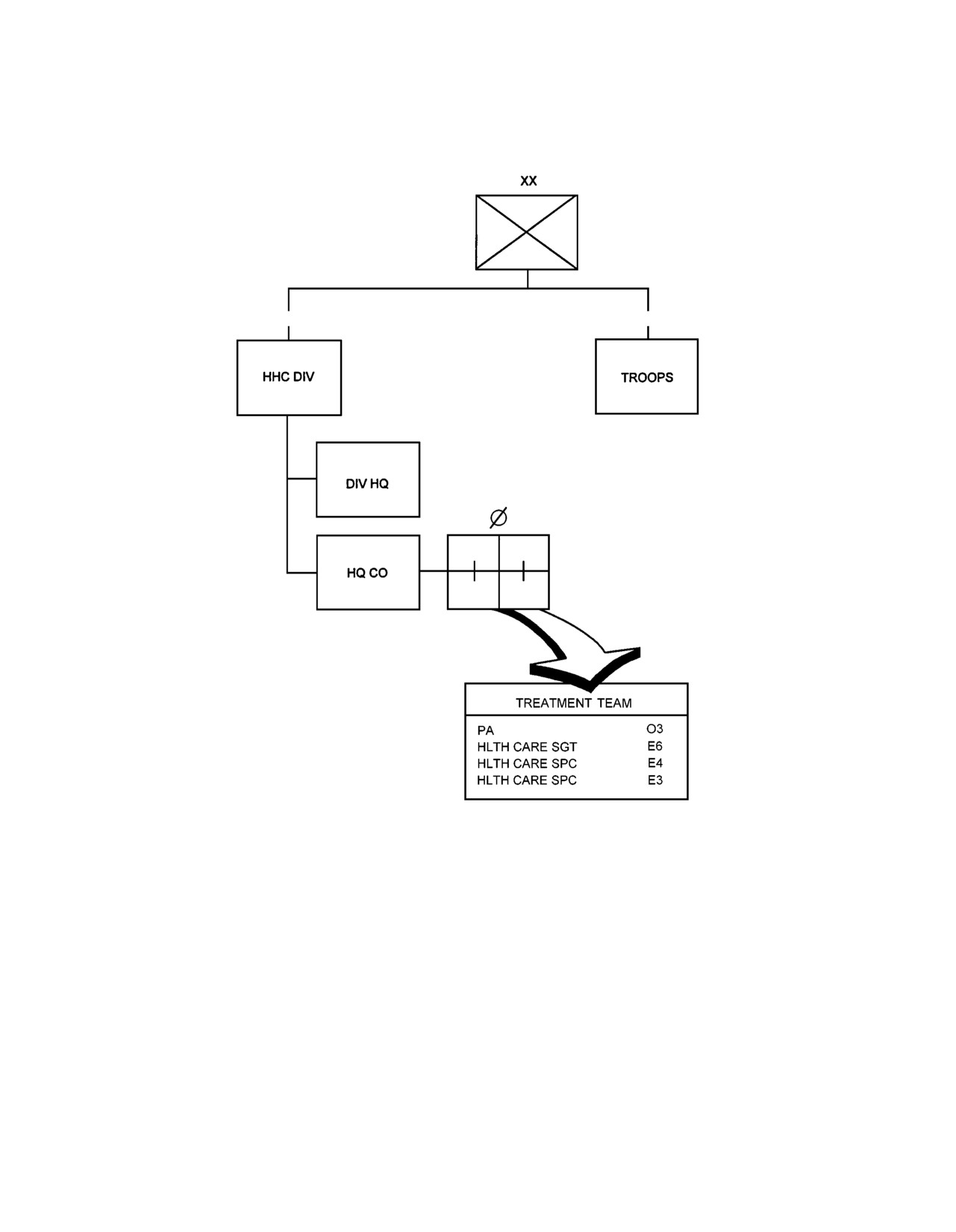
a. Organizations and Functions. The HHC division headquarters medical treatment team is
organized as shown in Figure 2-18. Personnel staffing of this section includes a PA, a health care SGT, and
two health care specialists.
2-50
FM 4-02.4
Figure 2-18. Medical section, headquarters and headquarters company, division headquarters.
(1) Physician assistant. The PA is responsible for the medical treatment provided by HHC
medical personnel. He works under the clinical supervision of the division surgeon. In the division
treatment team, the PA is the principal advisor to the division surgeon in the areas of PA affairs, executive
medicine issues, and quality assurance/implementation. The specific duties of the PA are the same as those
described in the DIVARTY HHB (refer to paragraph 2-34).
(2) Health care sergeant. Refer to paragraph 2-34.
(3) Health care specialists. Refer to paragraph 2-34.
2-51
FM 4-02.4
b. Employment. The medical treatment team establishes an aid station near the division
headquarters and provides Echelon I CHS for members of the division HHC.
(1) The section employs a treatment HMMWV, a cargo trailer, and two MESs (one trauma
treatment set and one general sick call set).
(2) For communications, the section employs a telephone set (TA 312/PT) and is deployed
in the HHC wire communications net. It also employs a FM tactical radio and is deployed in the net
designated by the division SOI. This section has access to the MSMCs tactical operations net to request
Echelon II CHS as required.
2-40. Combat Medic Section, Headquarters and Headquarters Company, Combat Engineer Bat-
talion, L-Edition TOE
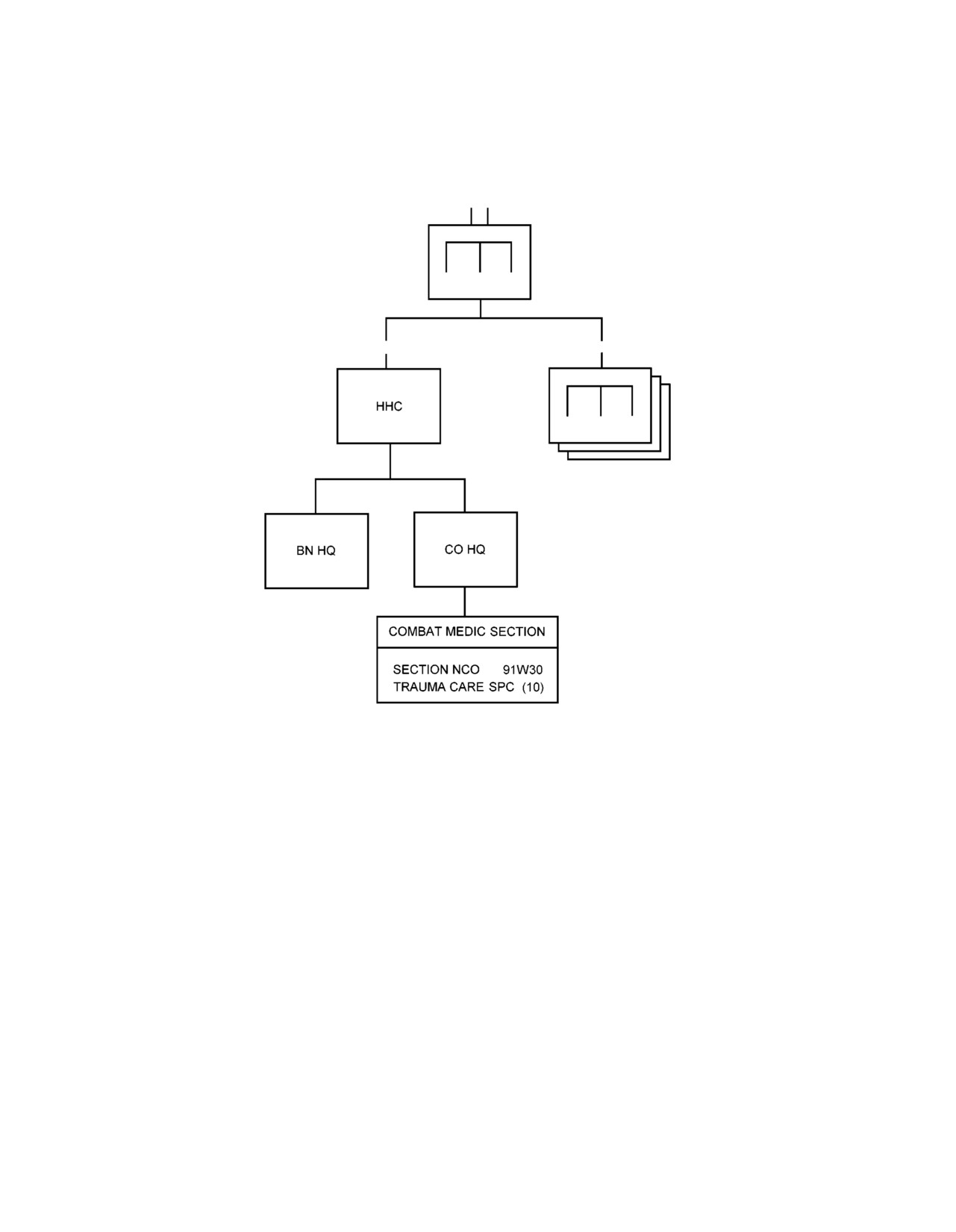
a. Organization and Functions. The combat medic section of the combat engineer battalion is
organized as shown in Figure 2-19. Personnel staffing of this section includes a section SGT and ten trauma
specialists. The combat medic section provides EMT and treatment of minor wounds and injuries. It
coordinates for and/or requests MEDEVAC support as required.
b. Section Sergeant. The section SGT, MOS 91W30, prepares reports, requests general and
medical supplies, maintains supply economy procedures, and maintains the ASL of expendable supplies.
He supervises combat medic section personnel. He coordinates Echelon I CHS from supported maneuver
battalion medical platoon and Echelon II CHS from the supporting medical companies. His duties also
include
Assigning tasks to trauma specialists.
Providing and/or coordinating for Class VIII resupply for trauma specialists when
deployed with engineer platoon or squad.
Conducting tactical and technical proficiency training for subordinate members of
the section.
Conducting sanitation inspections of troop living areas, food service areas, waste
disposal areas, and potable water distribution points and equipment.
Coordinating and conducting CLS training for the battalion.
Providing medical planning input to the S1 on battalion operations.
c.
Trauma Specialists. The duties and functions of trauma specialists are described in paragraph
2-20.
2-52
FM 4-02.4
Figure 2-19. Medical platoon, headquarters and headquarters company, engineer battalion.
Section VII. ADDITIONAL MEDICAL ASSETS OPERATING IN THE
BRIGADE AREA OF OPERATIONS (FORCE XXI/DIGITIZED DIVISION)
2-41. Treatment Squads/Teams from the Forward Support Medical Company, F-Edition TOE
The treatment squad provides emergency and routine sick call treatment to soldiers assigned to supported
units. These teams can perform their functions while located in the FSMC area, or can operate
independently of the FSMC for limited periods of time. The squad has the capability to split and operate as
separate treatment teams (Teams Alpha and Bravo) for limited periods of time. While operating in these
separate modes, they may operate two separate treatment stations. Normally, a squad or team deploys
2-53
FM 4-02.4
forward to augment or reinforce maneuver battalion medical platoons. Ambulance squads/teams may be
deployed to AXP especially when there are extended evacuation routes. It can be assigned to reinforce or
reconstitute battle losses of maneuver battalion medical platoons.
2-42. Forward Surgical Team, A-Edition TOE (Force XXI/Medical Reengineering Initiative)
Corps-level initial surgical support will be provided by the FST. The FST (Corps), TOE 08518LA00, and
the FST (Airborne/Air Assault Division/ACR [Light]), TOE 08518LB00, are clinically standardized modules
regardless of their assignment. These teams are comprised of 20 personnel and each has two operating
room (OR) tables. The FST is organized into four functional areastriage-trauma management, surgery,
recovery, and administrative/operations. The mission of the FST is to provide a rapidly deployable
immediate surgical capability enabling patients to withstand further evacuation. The requirement to project
surgery forward increases as a result of the extended battlefield. This small, lightweight surgical team is
designated to provide surgical augmentation to the FSMCs in support of the maneuver brigades, brigade
TF, or the Interim Brigade Combat Team (IBCT). The FST is capable of continuous operations with
divisional or nondivisional medical companies/troops for up to 72 hours; the ability to continue operations is
limited by personnel fatigue/exhaustion and available supplies. The FST provides urgent, initial surgery for
otherwise nontransportable patients. The FSTs surgical capability is based on two OR tables with a
surgical capacity of 24 OR table hours per day. Other capabilities include
Emergency medical treatment, to include assets to receive, triage, and prepare incoming
patients for surgery.
Surgery, including initial surgery and continued postoperative care for up to 30 critically
wounded or injured patients over a period of 72 hours with the FSTs organic MESs prior to resupply.
Nursing care. Postoperative acute nursing care for up to eight patients, simultaneously, prior
to further medical evacuation.
Rapid strategic deployability. The teams personnel and equipment (less vehicles) are capable
of deploying in one C-130 aircraft for initial entry missions, when required. The FST is capable of
subsequent movement by helicopter sling-load operations.
Tactical mobility. The team is 100 percent mobile with organic vehicles; it has a total of six
HMMWVs.
For definitive information of the FST, see FM 8-10-25.
2-43. Forward Support Medical Evacuation Team, L-Edition TOE (Force XXI/Medical Reengineer-
ing Initiative )
The brigade may be augmented with a corps FSMT. When deployed forward to the BSA, the FSMT leader
coordinates the air ambulance teams evacuation missions. The FSMT, assisted by the support operations
2-54
FM 4-02.4
section, provides real-time tactical information to the air ambulance crew about evacuation missions from
the brigade combat team units/elements to supporting brigade MTFs. When air ambulances operate
forward of the BSA, they will execute the A2C2 plan through the maneuver brigade S3. The FSB support
operations section provides planning and coordination between aeromedical evacuation and the supported
maneuver brigade. The brigade S3 provides the A2C2 plan that includes the air corridors, air control
points, and communications checkpoints. The brigade S3 will provide updates as required. Air ambulances
deployed to the BSA provide medical evacuation from forward areas (BAS) back to the BSA. Air
ambulance evacuation from the point of injury will be METT-TC-dependent. Corps air ambulances
providing GS evacuate from the BSA to supporting corps MTF. Aeromedical elements provide around the
clock immediate response evacuation from either the BSA or their location based on METT-TC. To
accomplish this, elements must maintain a close tie with the A2C2 system in the brigade. The brigade
A2C2 element provides an airspace plan through the division OPORD/OPLAN A2C2 annex. The aircrew
must also be familiar with the daily airspace control order and the airspace control plan. These documents
contain all airspace control measures (ACM), to include free fire areas, no-fly fire areas, restricted operations
zones, and established and standard Army aircraft flight routes. These routes and ACM change on a daily
basis and cannot be integrated into the division OPORD. The BSS will ensure all A2C2 information is
provided to corps aeromedical elements. The BSS does not generate A2C2 information, but does provide
A2C2 planning information to division A2C2 elements. For definitive information on the corps air
ambulance company and its FSMT that deploy forward into the brigades AO, see FM 8-10-26.
2-44. Corps Ground Ambulance Company, Either the L-Edition TOE or the A-Edition TOE Sup-
porting Force XXI/Medical Reengineering Initiative
The corps ground ambulance company is assigned to the corps MEDEVAC battalion. The basis of
allocation within the combat zone is one per division supported. The current Army of Excellence ambulance
company has four ambulance platoons with each platoon having 10 ambulances each. Under the MRI, the
new MRI ground ambulance company will have a total of 24 ground ambulances. When deployed to the
division, the ground ambulance company is attached to the MSB or division support battalion for Force
XXI. The mission of the ground ambulance company in the division is to provide medical evacuation
support to the divisions maneuver brigades and to other divisional units and corps units operating in the
division, as required. Normally, corps ground ambulances provide medical evacuation from the FSMC
located in the BSA and from either the MSMC or the DSMC (Force XXI) to the supporting corps combat
support hospital. The corps ground ambulance will reinforce the MEDEVAC assets in the medical
companies of the division, as required.
2-45. Corps Combat Stress Control Augmentation, A-Edition TOE (Force XXI/Medical Reengi-
neering Initiative)
The division may be augmented with additional CSC personnel, if requested. The base of allocation for the
CSC medical detachment is one per division supported by the corps. The CSC medical detachment
provides complete MH and combat stress preventive and treatment services in DS of division and corps
personnel deployed forward. The new MRI detachment is a 43-person unit composed of a headquarters, a
CSC preventive section and a CSC fitness section. The old Medical Force 2000 CSC medical detachment
2-55
FM 4-02.4
had 23 personnel and was designed to be a corps-level package to augment the organic MH sections of the
divisions. Whereas, the new MRI CSC medical detachment retains the mission of providing DS to a
divisions maneuver brigades and general/reinforcing support to the DSA, including corps units in those
areas. In addition, the detachment now augments area support in the corps immediately behind the division.
The detachment must function with its elements widely dispersed, some working in and for the supported
division and others working in the corps for the medical command/brigade. The CSC medical detachment
personnel provide CSC planning, consultation, training, and staff advice to C2 headquarters and the units to
which they are assigned/attached regarding
Combat and operational stressors affecting the troops.
Mental readiness.
Morale and cohesion.
Potential for BF casualties.
The detachment and its personnel are dependent on units that they are attached for support, to include
Food service.
Water distribution.
Medical treatment.
Logistical support including Class VIII items.
Patient administration (detachment has one patient administration specialist, MOS 71G10, that
works with the supporting unit).
For definitive information on the CSC medical detachment, Medical Force 2000 and MRI, see Change 1,
FM 8-51.
2-56
FM 4-02.4
CHAPTER 3
COMMAND AND CONTROL
Section I. PREPARATION FOR COMBAT HEALTH SUPPORT
3-1.
Plans
a. Mission Analysis. Planning starts with mission analysis. The battalion begins mission analysis
when the brigade provides a warning order (WARNO). The mission analysis is Step 1 of the military
decision-making process (MDMP). See FM 101-5 for further discussion on the MDMP. For guidance on
military decision making in abbreviated planning for a time-constrained situation, see FM 101-5. The
battalion headquarters conducts concurrent planning with the brigade headquarters or after the brigade plan
is developed. The battalion staff may receive additional information from the brigade staff elements to
assist them with the planning process. This information is normally transmitted in a force text e-mail
message via the tactical local area network (LAN). As part of the mission analysis and based on the
battalion commanders intent and guidance, the medical platoon develops CHS estimates for supporting
battalion operations. An understanding of the battalions time lines or battle rhythm will assist the battalion
medical platoon leader and field medical assistant in developing the CHS input, through the battalion S1, to
the battalions OPLAN/OPORD. The battalion surgeon and field medical assistant work with and through
the battalion S1 for mission analysis input. See Chapter 5 and Appendix H of FM 101-5 for additional
information on WARNOs. Mission analysis includes
Assessing CHS capabilities (organic and attached assets with current status and location).
Assessing limitations (specify reason that CHS assets are not available).
Identifying specified, implied, and essential CHS tasks in the brigade OPORD.
The following are examples of subject areas that should be addressed during mission analysis:
Treatment (to include surgical requirements).
Emergency dental treatment.
Combat stress control.
Preventive medicine.
Medical evacuation support by air and ground ambulances (and nonmedical evacuation
platforms, if necessary).
Class VIII resupply.
Medical maintenance.
Nuclear, biological, and chemical operations.
3-1
FM 4-02.4
Threat to treatment and evacuation assets that is capable of causing CHS failure.
Casualty estimates (number and types of casualties).
Terrain effects on location, acquisition, and evacuation of casualties.
Current medical status of battalion personnel.
b. Battalion Course of Actions. Battalion COAs development/analysis and wargaming are
accomplished after mission analysis. Course of action development and wargaming result in the production
of the OPORD and the CHS annex. During wargaming, the evacuation and treatment facets of the medical
plan are synchronized with the overall battalion plan. The S1 will provide the overall casualty figures by
battalion and, possibly, company. The questions of how many casualties, at what point in the fight (when),
where they will occur, and how they are produced (direct fire, artillery, chemical, and so forth) can be
forecasted based on input from the S1. During the wargaming, the S2 will portray enemy capabilities and
likely actions. The S3 will focus on friendly actions. The medical platoon leader needs to pay careful
attention to this exchange. This will be the best predictor of what, when, where, how, who, and other
information that will be useful in adjusting the CHS plan. This information allows the medical platoon
leader and field medical assistant options to select preplanned locations for positioning ambulances or
treatment teams. Locating the treatment teams in the appropriate locations is of the utmost importance. The
published movement planning factors for inside the division AO for wheeled and tracked vehicles in good
terrain and weather are 8 kilometers and return in 1 hour (or 16 kilometers per hour). See FM 8-55 for
additional planning guidance. The trauma specialists goal is to get the casualty to ATM within 30 minutes.
For an ambulance to leave the BAS and pick up a patient and return within 30 minutes, it must be within 4
kilometers of the soldiers point of injury. Keep in mind that this is under favorable conditions. Limited
visibility, difficult or unfamiliar terrain, obstacles (friendly and enemy), and enemy actions will make the
evacuation mission longer. If the BAS is farther than 4 kilometers away, it starts out as an impossibility.
The METT-TC will govern specific solutions. Supporting the fight and maintaining a good support distance
becomes a definite challenge because most of your evacuation routes can potentially be covered by enemy
weapons and direct and indirect fire. For example, Russian manufactured AT-5 spandrel antitank-guided
missiles have a 4-kilometer direct fire range. The medical platoon plan must take this threat into account.
Information obtained from the S2 and S3 will also provide the triggers that will allow medical elements to
occupy these positions at appropriate times and in a manner that reduces the risk from threat actions. This
information is incorporated into the CHS plan and is published in the battalion order. The following are
examples of key areas that will be analyzed during this process; they include
Casualty estimates broken down to the lowest level possible, by TF, by phase line, and
so forth.
Battalion- or brigade-directed actions as part of the squadron or brigade CHS plan.
Current medical platoon equipment status (maintenance status on all the platoons key
items of equipment, both medical and nonmedical).
3-2
FM 4-02.4
3-2.
Operation Order
Once the battalion receives the brigade WARNO, it begins mission analysis and determines its tactical plan.
This process continues until the full brigade OPORD is issued. Part of the mission analysis is to assess the
brigade CHS plan for its adequacy of support to the battalion. If the medical platoon leader finds a
problem, he briefs this to the battalion commander. The mission analysis brief will be after the staff has
analyzed the full OPORD. Another part of the analysis is determining the employment and emplacement of
medical treatment elements (BAS/treatment team) based on the brigade plan. This information is provided
to the battalion S3 and he updates the battalion plan. This is normally accomplished prior to the brigade
combined arms rehearsal. When the battalion commander approves the OPLAN, it becomes the OPORD.
The OPLAN and OPORD are developed by the S3 section using input from each of the staff elements with
the S1 being the staff coordinating element for CHS. The battalion OPORD is revised or updated based on
mission changes. Table 3-1 is an example of an OPORD/OPLAN outline format.
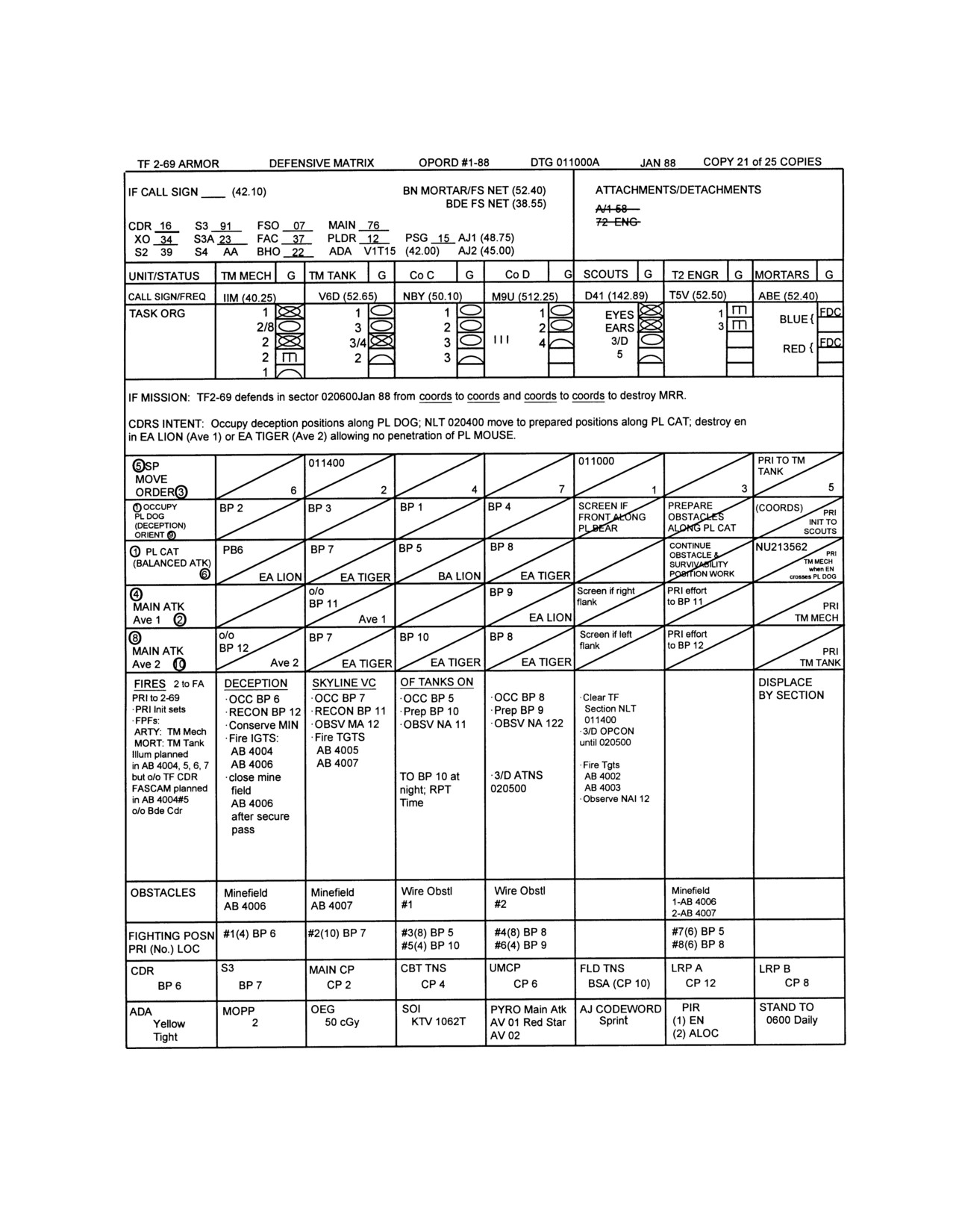
a. Matrix Operation Order. A matrix OPORD may be used as an alternative to the standard five-
paragraph OPORD. The purpose of the matrix OPORD is to cut orders production time and to provide
subordinates more time for RECON, preparation, and rehearsal. There is no standard format for a matrix
OPORD. Matrix orders expand on the execution matrix found on many operations overlays. The single-
page format may include all signal information for the day of the operation and it can be placed in the corner
of a map case for easy reference. Matrix orders are usually issued with standard operations, intelligence,
and fire support overlays. Rather than a five-paragraph order outline format as seen in Table 3-1, the
medical platoon leader is more likely to see and work with a matrix OPORD. Figure 3-1 is an example of a
matrix OPORD.
b. Medical Support Matrix. The medical support matrix should be integrated with the tactical
overlay. Figure 3-2 is a sample format for a medical support matrix. If deviation from the matrix occurs,
the BAS location must be known at all times. The BAS should remain on location as long as practical. Extra
first aid medical supplies can be issued to maneuver elements for resupply of CLS.
3-3
FM 4-02.4
Table 3-1. Sample Outline Format for an Operation Order/Plan
(CLASSIFICATION)
TIME ZONE USED THROUGHOUT THE PLAN (ORDER)
REFERENCES:
TASK ORGANIZATION:
1.
SITUATION
A. ENEMY FORCE
B. FRIENDLY FORCE
C. ATTACHMENT AND DETACHMENTS
D. ASSUMPTION (OPLAN ONLY)
2.
MISSION
3.
EXECUTION
INTENT:
A. CONCEPT OF OPERATION
(1) MANEUVERS
(2) FIRES
(3) RECONNAISSANCE AND SURVEILLANCE
(4) INTELLIGENCE
(5) ENGINEER
(6) AIR DEFENSE
(7) INFORMATION OPERATIONS
B. TASK TO MANEUVER UNITS
(1) ENGINEER
(2) AIR DEFENSE
(3) FIELD ARTILLERY
C. TASKS TO COMBAT SUPPORT UNITS
(1) INTELLIGENCE
(2) FIRE SUPPORT
(3) SIGNAL
(4) NBC
(5) PROVOST MARSHAL
(6) PSYOP
(7) CIVIL MILITARY
(8) AS REQUIRED
D. COORDINATING INSTRUCTIONS
(1) TIME OR CONDITION WHEN A PLAN OR ORDER BECOMES EFFECTIVE
(2) COMMANDERS CRITICAL INFORMATION
(3) RISK REDUCTION CONTROL MEASURES
(4) RULES OF ENGAGEMENT
(5) ENVIRONMENTAL CONSIDERATIONS
(6) FORCE PROTECTION AS REQUIRED
(7) AS REQUIRED
4.
SERVICE SUPPORT
A. SUPPORT CONCEPT
B. MATERIEL AND SERVICE
C. MEDICAL EVACUATION AND HOSPITALIZATION
D. PERSONNEL
E. CIVIL MILITARY, AS REQUIRED
F. AS REQUIRED
5. COMMAND AND SIGNAL
A. COMMAND
B. SIGNAL
ACKNOWLEDGE:
NAME (COMMANDERS LAST NAME)
RANK (COMMANDERS RANK)
OFFICIAL: NAME AND POSITION
ANNEXES
(CLASSIFICATION)
SEE FM 101-5 FOR DEFINITIVE INFORMATION ON OPERATION PLANS/ORDERS. ADDITIONAL INFORMATION IS PROVIDED IN
APPENDIX 3 (PERSONNEL) OF ANNEX I, OR IN A SEPARATE APPENDIX FOR CHS.
3-4
FM 4-02.4
Figure 3-1. Matrix operation order.
3-5
FM 4-02.4
UNITS
CROSS
CROSS
CROSS
ON OBJ
LD
PL RED
PL BLUE
DALLAS
CO A
TT 1
TT 1
TT 1
TT 1
AND
(NB 583492)
(NB 585501)
(NB 587507
(NB 591510)
CO B (-)
(TOM)
(JIM)
(BILL)
(GREG)
CO C
TT 2
TT 2
TT 2
TT 2
AND
(NB 581489)
(NB 583499)
(NB 585505)
(NB 589508)
RESERVE
(VICKY)
(BETH)
(JANET)
(JOY)
RM 1: USE ROUTE STEVEN
RM 2: USE ROUTE ANNA
Figure 3-2. Medical support matrix.
c.
Implementation of Combat Health Support Annex. For successful implementation of the CHS
annex of the battalion plan, the CHS plan must be coordinated and synchronized with the battalion plan so
that CHS requirements are met. The medical platoon leader may receive additional coordinating instructions
from the BSS as the CHS annex is developed. This additional information permits the medical platoon
leader to make informed decisions as he develops the CHS annex and affords some additional time for better
development of good initial plans. For successful implementation of the CHS annex of the battalions/
squadrons plan, the CHS plan must be coordinated and synchronized with the overall plan. To achieve
optimal synchronization, the battalion CHS plan is rehearsed as an integral part of the combined arms plan
at the combined arms rehearsal. The CHS rehearsal by itself is a technique that will increase understanding
and synchronization, but is not as effective as when it is integrated into the combined arms rehearsal. The
rehearsal of the CHS plan will allow battalion medical elements and leaders to analyze the tactical CHS plan
to ascertain its feasibility, its common sense, and the adequacy of its C2 measures prior to execution.
3-3.
Rehearsal
To achieve optimal synchronization, the battalion CHS plan is rehearsed as an integral part of the combined
arms plan at the combined arms rehearsal. Medical platoon leaders and field medical assistants provide
input to the battalion plan and develop the concept for the battalion CHS plan. During the decision-making/
orders process, they identify critical events and synchronize the CHS plans. In addition to medical locations
on the CSS overlay, these plans indicate the triggers for CHS events. At the battalion rehearsal, battalion
leaders practice their synchronized plans that include CHS. The sequence of events for the CHS portion of
the battalion rehearsal includes
Ambulance teams practicing execution of triggers for area medical support responsibilities and
triggers for movement of supporting FSMC ambulances.
The medical platoon SGT detailing the concept and procedures for MEDEVAC (both ground
and air ambulances) in the battalion.
3-6
FM 4-02.4
The battalion XO or S4 explaining triggers for BAS/treatment team movement and ensuring
that the battalion HHC and maneuver companies understand when and where the BAS/treatment teams are
located.
The medical elements providing projected triggers and times they will be at projected locations.
The CSS/CHS annex of the battalion OPORD that includes map overlays is the conclusion of the medical
planning efforts; the rehearsal is the culmination of the preparation phase for an operation. The medical
platoon leader has the responsibility for rehearsing CHS operations. Rehearsals are done to achieve a
common understanding and a picture of how the plan will be implemented.
All plans must be completed prior to the battalion rehearsal.
The CHS portion of the battalion rehearsals should focus on the events that are critical to
mission accomplishment. A successful rehearsal ensures explicit understanding by subordinate medical
personnel of their individual missions; how their missions relate to each other; and how each mission relates
to the commanders plan. It is important for all medical echelons to see the total CHS concept.
Rehearsing key CHS actions allows participants to become familiar with the operation and to
visualize the triggers which identify the circumstances and timing for friendly actions. This visual
impression helps them understand both their environment and their relationship to other units during the
operation. The repetition of critical medical tasks during the rehearsal helps leaders remember the sequence
of key actions within the operation and when they are executed.
The battalion OPORD is then issued through effective troop leading procedures.
Section II. TROOP-LEADING PROCEDURES
3-4.
Eight Steps of Troop Leading
The commander makes most tactical decisions. He then announces them in the form of orders that include
his intent and concept of the operation. Based on these orders, the medical platoon leader uses troop-
leading procedures to organize his time during planning and preparation and to translate the operation into
instructions his soldiers can understand. He can then lead the platoon more effectively in the execution of
the mission. Troop leading is a dynamic process that begins when the unit receives a new mission or is
notified by a WARNO that a new mission is imminent. Whenever possible, troop-leading procedures are
integrated and accomplished concurrently rather than sequentially. Time management is the key. The
medical platoon leader normally uses one-third of the available time to plan, prepare, and issue the order;
his field medical assistant, platoon SGT, ambulance squad leaders, and treatment team leaders then have the
remaining two-thirds of the time available to prepare their ambulances and MES to support the operation.
The following discussion focuses on the eight steps of troop leading procedures:
Receive and analyze the mission.
3-7
FM 4-02.4
Issue a WARNO.
Make a tentative plan.
Initiate movement.
Conduct RECON and coordination.
Complete the plan.
Issue the order.
Supervise and refine.
a. Receive and Analyze the Mission. The medical platoon leader normally receives his orders as
an oral OPORD or as a fragmentary order (FRAGO) updating a previously issued OPORD. Graphics may
be copied from the S3s overlay or sent by digital transmission. Initial coordination within the battalion S1,
medical platoon personnel, and with the supporting FSMC should be accomplished upon receipt of the
mission.
NOTE
Before the OPORD or FRAGO arrives, the medical platoon leader
may receive a series of WARNOs from the battalion S3 providing
advance notice of an impending operation. The medical platoon leader
should disseminate all pertinent information contained in the WARNO
as quickly as possible after they are received. The battalion S4 may be
the one who issues orders to the medical platoon since he has tactical
control of the combat trains.
(1) Upon receipt of the WARNO, the medical platoon leaders first task is to extract the
CHS mission based on the battalion commanders guidance and intent. The key to understanding the
medical platoon CHS mission, as part of the battalion team, lies in two elements of the planthe
commanders intent and the purpose he envisions for the battalion and each company.
(2) The medical platoon leaders knowledge of the intent and purpose allows him to use his
initiative and to be proactive and exploit battlefield opportunities to accomplish the CHS mission. If the
medical platoon leader does not understand the intent or purpose, he should ask the commander for
clarification.
(3) The medical platoon leader analyzes the mission using the factors of METT-TC. These
factors allow the platoon leader to identify the platoons purpose; the specified, implied, and essential tasks
it must perform; and the time line by which the platoon will accomplish those tasks. The following outline
3-8
FM 4-02.4
of METT-TC factors will assist the medical platoon leader in analyzing the mission and creating a time line.
The medical platoon leaders need the answers to the questions pertaining to METT-TC.
(a) Mission.
What is the battalion commanders intent?
What are the current capabilities (organic and attached assets with current
status and locations)?
What are the specified, implied, and essential CHS tasks in the battalion and
brigade OPORD?
What are the limitations (CHS assets that are not available, specify reason)?
What other tasks must be accomplished to ensure mission success (implied
tasks)? Implied tasks are those that are not specified in the OPORD but that must be done to complete the
mission. They do not include tasks that are covered in the unit SOP. The medical platoon leader identifies
implied tasks by analyzing the enemy, the terrain, friendly troops available, and the operational graphics.
What is the current patient status (for example, awaiting evacuation)?
Are patient evacuation vehicles required to use contaminated routes?
Are patient decontamination stations required?
Where are the locations of the treatment team and of BAS or other MTF
providing area medical support?
(Current/projected?)
What are the area medical support responsibilities?
(b) Enemy.
What have been the enemys recent activities?
What is the composition of the enemys forces?
What are the capabilities of his weapons?
What is the location of current and probable enemy positions?
What is the enemys most probable COA?
Enemy information is included in paragraph 1 of the OPORD. It is important that the medical platoon
leader analyze this information in terms of how the medical platoon supports the operation. For example,
3-9
FM 4-02.4
the threat the enemy imposes on the battalion will influence how CHS operations are conducted based on the
projected number of casualties the enemy will inflict on the battalion.
(c) Terrain (and weather). The medical platoon leader analyzes the terrain using the
factors of OAKOC (obstacles; avenues of approach; key terrain; observation and fields of fire; and cover
and concealment). Elements of this analysis include the following:
Obstacles.
Where are natural and existing obstacles located, and how can they
affect medical treatment and evacuation?
Where are likely areas for enemy-emplaced obstacles, and how can they
affect maneuver?
Are there bypasses, or must obstacles be breached?
Avenues of approach. Where are the best avenues of approach (mounted and
dismounted) for enemy and friendly forces? These are considerations for determining evacuation routes
and in planning for future locations for the BAS.
Key terrain.
Where is the key terrain? Will FM communications be affected?
How can key terrain be used to support the mission?
Observation and fields of fire.
Are these influenced by the key terrain that dominates avenues of
approach?
Where can the enemy observe and engage battalion personnel (danger
areas)?
Where are the natural firing positions that medical platoon personnel can
use to defend against enemy attack?
Cover and concealment.
What routes within the AO offer cover and concealment for placement of
the BAS or a treatment team?
Do the natural firing positions in the AO offer cover and concealment for
the platoon or enemy?
3-10
FM 4-02.4
Weather. The medical platoon leader can use these questions as he analyzes
the impact of weather on the mission:
What are the light conditions (including percentage of night illumination)
and visibility?
What are the times for beginning of morning nautical twilight (BMNT),
sunrise, sunset, end of evening nautical twilight (EENT), moonrise, and moonset?
How has recent weather affected the AO?
How will fog, rain, dust, heat, snow, wind, or blowing sand affect the
men and equipment during the mission?
NOTE
The effects of weather on smoke or NBC weapons/operations should
also be considered.
(d) Troop.
What is the supply status of ammunition, fuel, and other necessary items
including Class VIII?
What is the present physical condition of the soldiers, as well as of vehicles
and equipment?
What is the training status of the platoon?
What is the state of morale?
How much sleep have the men had?
How much sleep will they be able to get before the operation begins?
Does the platoon need any additional assets to support or accomplish its
mission?
What attachments are available to help the platoon accomplish its mission?
What is the task organization in the WARNO or OPORD?
(e) Time available.
What times were specified by the commander in the OPORD for such activities
as movement, RECON, rehearsals, and LOGPAC operations?
3-11
FM 4-02.4
What priorities of work can the platoon accomplish (examples include security,
maintenance, resupply, coordination, rehearsals, inspections, and sleep)?
NOTE
The medical platoon leader conducts reverse planning to ensure that
all specified, implied, and essential tasks can be accomplished in the
time available. He develops a reverse planning schedule (time line)
beginning with actions on the objective and working backward through
each step of the operation and preparation to the present time. This
process also helps the platoon in making efficient use of planning and
preparation time. Once the METT-TC analysis is complete, the
medical platoon leader can then write the platoon mission statement
based on the battalion CHS plan and answer the questions of WHO,
WHAT, WHEN, WHERE, and WHY. This is a clear, concise
statement of the purpose of the operation and the essential task(s) that
will be crucial to its success. The essential tasks (the WHAT) should
be stated in terms that relate to enemy forces, friendly forces, and/or
the terrain
(for example, ESTABLISH BAS (-) ONE OR TWO
TERRAIN FEATURES FROM THE MAIN BATTLE AREA;
ESTABLISH THE BAS 1 TO 3 KILOMETERS FROM THE MAIN
BATTLE AREA; or BE PREPARED FOR RAPID FORWARD
DEPLOYMENT OF A TREATMENT TEAM IN SUPPORT OF
COMPANY A). The purpose (the WHY) explains how the platoon
mission supports the commanders intent. The elements of WHO,
WHERE, and WHEN add clarity to the mission statement.
NOTE
Simultaneous planning and preparation are key factors in effective
time management during the troop-leading procedures. The next five
steps (issue a WARNO; make a tentative plan; initiate movement;
conduct RECON and coordination; and complete the plan) may occur
simultaneously and/or in a different order. There may be multiple
WARNOs.
b.
Issue a Warning Order. The medical platoon leader alerts his platoon to the upcoming
operation by issuing a WARNO that follows the five-paragraph OPORD format (see Table 3-1).
NOTE
The medical platoon leader will often do this from the battalion TOC
during mission analysis.
3-12
FM 4-02.4
Warning orders maximize subordinates planning and preparation time by providing essential details of the
impending operation and detailing major time line events that will support mission execution. The amount
of detail included in a WARNO depends on the available time, the platoons communications capability, and
the information subordinates need to initiate proper planning and preparation. The WARNO may include
the following information:
Changes to task organization.
Updated graphics (platoons equipped with intervehicular information systems or appliqué
digital systems send new overlays).
Enemy situation.
Battalion mission.
Commanders intent (if available).
Combat health support mission.
A tentative time line, to include the following:
Earliest time of movement.
Readiness condition and vehicle preparation schedule.
Reconnaissance.
Training/rehearsal schedule.
NOTE
Some individual and collective training may be initiated by the medical
platoon leader before he issues the OPORD; this technique maximizes
preparation time and allows the platoon to focus on tasks that will
support the anticipated operations. For example, a medical platoon
may train on treatment of different types of wounds or injuries that
may be seen during the operations.
Time and location at the battalion OPORD will be issued, plus the platoon OPORD
will also be briefed.
Service support instructions (if not included in the time line).
3-13
FM 4-02.4
As critical information is received or updated, the medical platoon leader should issue subsequent or
updated WARNOs to keep the platoon informed.
c.
Make a Tentative Plan. The medical platoon leader begins developing his CHS plan when the
battalion receives its first WARNO from the brigade. Based on the commanders intent, guidance, and the
results of his mission analysis, the medical platoon leader develops a tentative plan that addresses all
specified, implied, and essential tasks using the OPORD format. The tentative plan also covers RECON
and coordination requirements between the platoon and adjacent and supporting units. The field medical
assistant and the medical platoon SGT are excellent sources of ideas concerning the battalion CHS plan.
The medical platoon leader can develop his COA and OPORD almost simultaneously with the battalion
OPORD. Since the medical platoon is a battalion asset, most of their specified tasks will be developed
during the battalion MDMP. The medical platoon leader can issue a WARNO from the battalion TOC
during his participation in the MDMP. By the time the OPORD is given, he should have most of his platoon
order prepared. The development of the platoon time line from backward planning should be his priority as
soon as the battalion OPORD is prepared.
d. Initiate Movement. Many of the battalion-level operations require movement to forward
assembly areas and to battle positions during the planning phase of an operation. This means that elements
of the medical platoon will also move to these locations in support of the battalion units. Medical platoon
elements move with the supported units according to the battalion plan. As often as possible, within the
restraints of OPSEC, medical task organization should be done during hours of daylight, or as early as
possible. In spite of multiple
own the night technologies, executing movements required by task
organization is still more efficiently accomplished in daylight. Activities may include ensuring CHS for the
company quartering party or beginning priorities of work.
e.
Conduct Reconnaissance and Coordination. Effective RECON takes into account the factors
of METT-TC and OAKOC from both friendly and enemy perspectives. As a minimum, the field medical
assistant or the platoon SGT conducts a detailed map RECON to identify primary and alternate routes of
MEDEVAC and preplanned sites for locating the BAS or a BAS (-). If time and security considerations
permit and authorization is obtained from higher headquarters, an on-site ground RECON is the best way to
survey the AO. In addition, the medical platoon leader should check with the S2 for an intelligence update.
The medical platoon leader should take as many ambulance squad leaders as possible on his RECON. For
offensive operations, the medical platoon leader should attempt to find a vantage point that will permit rapid
accessibility to supported units while making use of natural terrain features to afford as much protection as
possible for the BAS. Ground RECON for offensive operations usually is limited to checking routes to the
start point (SP), the line of departure (LD), and the axis just beyond the LD. For defensive operations, the
medical platoon leader should conduct a RECON of the unit position and the MEDEVAC routes to be used.
Whenever tactically feasible, the platoon should make provisions to mark routes and locations for day and
night operations during the RECON. See Chapter 4 for TTP on marking routes and positions. During the
RECON (or during battalion-level rehearsals), the medical platoon leader or his representative should
coordinate evacuation routes with supported companies.
f.
Complete the Plan. The medical platoon leader refines the plan based on the results of the
wargame, RECON, and coordination with the BSS FSMC and supported battalion units. He then completes
the plan using these results and any new information from his commander. He should keep the plan as
simple as possible, at the same time ensuring that the CHS plan supports the commanders intent.
3-14
FM 4-02.4
g. Issue the Order. Prior to the order, the platoon NCO should ensure that all subordinate
elements have copies of the overlays correctly posted to the maps and a copy of any matrices from the
battalion OPORD that covers key CHS actions. All platoon members receiving the OPORD verbally should
be prepared to copy these instructions in the five-paragraph OPORD format. They should ask for
explanations of any terminology or actions that they do not understand. If possible, the medical platoon
leader issues the order from a vantage point overlooking the terrain on which the platoon will support the
maneuver units. If not, he uses a terrain model, sand table, sketches, or his map to orient the platoon. He
can also build a model of the AO using a briefing kit that contains such items as engineer tape, colored yarn,
3- by-5-inch index cards, and micro vehicle models. When time and security permit, the medical platoon
leader issues the order to as many members of the platoon as possible. As a minimum, he assembles the
treatment teams and ambulance squads, and combat medic section. He briefs the platoon using the five-
paragraph OPORD format. He should then send the ambulance emergency care SGT to brief the trauma
specialist assigned to each of the maneuver companies. To ensure complete understanding of the operation,
the medical platoon leader and medical platoon personnel conduct confirmation briefings immediately after
the OPORD is issued. The treatment team and ambulance team leaders brief the medical platoon leader to
confirm their understanding of his intent, the specific tasks their team must perform, and the relationship
between their tasks and those of other medical units/elements in the operation. If time permits, the medical
platoon leader should lead the medical platoon in a walk-through using a sand table.
h. Supervise and Refine. Flexibility is the key to effective operations. The medical platoon
leader must be able to refine his plan whenever new information becomes available. If he adjusts the plan,
he must inform the platoon and supervise implementation of the changes. Once the operation has begun, the
medical platoon leader must be able to direct his platoon in response to new situations and new orders.
Platoon orders, back-briefs, rehearsals, and inspections are essential elements of the supervision process as
the platoon prepares for the mission. The following paragraphs discuss these procedures in detail:
(1) Team orders. The medical platoon leader, the field medical assistant, and the platoon
SGT make sure all ambulance team members have been briefed by squad leaders (heavy battalion and
mechanized infantry medical platoons have track commanders [TC] for their M113 and M557 armored
ambulance and treatment vehicles) and understand the platoon mission and concept of the operation.
(2) Back-briefs. The back-brief is, in effect, a reverse briefing process; those who receive
an OPORD confirm their understanding of the order by repeating and explaining details of the operation for
their leader or commander. In the medical platoon, the medical platoon leader should conduct back-briefs
after the TC/team leaders have had a chance to review the OPORD but before the platoon rehearsal begins.
The TC/team leaders brief the medical platoon leader on how their teams will accomplish the specific tasks
assigned to them in the order.
NOTE
Although the back-brief is an effective means of clarifying the specifics
of the plan, it does not require medical platoon personnel to practice
or perform their assigned tasks. By itself, therefore, it is not an ideal
rehearsal technique.
3-15
FM 4-02.4
(3) Rehearsals. A rehearsal is a practice session conducted to prepare units for an upcoming
operation or event. The medical platoon leader should never underestimate the value of rehearsals. Many
units, in fact, consider rehearsals as a separate step (ninth) of troop-leading procedures. The medical
platoon leader uses well-planned, efficiently run rehearsals to accomplish the following:
Reinforce training and increase proficiency in critical tasks.
Reveal weaknesses or problems in the plan.
Synchronize the actions of subordinate elements.
Confirm coordination requirements between the platoon and supporting medical
units/elements.
Improve each soldiers understanding of the concept of the operation, the direct fire
plan, anticipated contingencies, and possible actions and reactions for various situations that may arise
during the operation.
Effective rehearsals require personnel to perform required tasks, ideally under conditions that are as close
as possible to those expected for the actual operation. Participants maneuver their actual vehicles or use
vehicle models or simulations while interactively verbalizing their elements actions. In a platoon-level
rehearsal, the medical platoon leader will select the tasks to be practiced and will control execution of the
rehearsal. The platoon can prepare for operations using reduced-force rehearsals and/or full-force
rehearsals. The medical platoon leader conducts reduced-force rehearsals when time is limited or the
tactical situation does not permit everyone to attend. Platoon members, who can take part, practice their
actions on mock-ups, sand tables, or actual terrain (usually over a smaller area than in the actual operation).
The full-force rehearsal is the most effective, but consumes the most time and resources. It involves every
soldier who will participate in the operation. If possible, it should be conducted under the same conditions
(such as weather, time of day, and terrain) that the platoon expects to encounter during actual operations.
The medical platoon leader can choose among several techniques in conducting rehearsals, which should
follow the crawl-walk-run training methodology to prepare the platoon for increasingly difficult conditions.
Rehearsal techniques include the following:
Special rehearsal. Individual and/or team tasks that will be critical to the success of
the operation are rehearsed as necessary. The medical platoon leader may initiate special rehearsals when he
issues the WARNO.
Map rehearsal. This is usually conducted as part of a back-brief involving the TC
or a complete ambulance team. The leader uses the map and overlay to guide participants as they back-brief
their role in the operation. If necessary, he can use a sketch map.
Communications rehearsal. This reduced-force or full-force rehearsal is conducted
when the situation does not allow the platoon to gather at one location. Crewmen check their vehicles
communications systems and rehearse key elements of the platoon fire plan.
3-16
FM 4-02.4
Key leader rehearsal. Usually conducted as part of a larger force, this rehearsal
involves leaders moving over the key terrain in wheeled vehicles while discussing the mission.
Sand table or terrain model. The reduced-force or full-force technique employs a
small-scale table or model that depicts graphic control measures and important terrain features for reference
and orientation. Participants walk or move micro vehicles around the table or model to practice the
actions of their own vehicles in relation to other members of the platoon.
Force on force. This is used during a full-force rehearsal. The platoon may
rehearse with sections or individual tanks going force on force against each other. Platoons should first
rehearse with good visibility over open terrain. Rehearsals become increasingly realistic until they
approximate those expected in the AO.
(4) Inspections. Inspections allow the medical platoon leader to check the platoons
operational readiness. The key goal is to ensure that soldiers and vehicles are fully prepared to execute the
upcoming mission. Inspections also contribute to improved morale. It is essential that all leaders in the
medical platoon know how to conduct precombat checks according to the platoon SOP. Procedures for a
comprehensive inspection include the following:
Perform before-operation maintenance checks and report or repair deficiencies.
Upload vehicles according to platoon SOP. The standardization of load plans allows
the medical platoon leader, the field medical assistant, and the platoon SGT to quickly check accountability
of equipment. It also ensures standard locations of equipment in each vehicle; this can be an important
advantage if the soldiers are forced to switch to a different vehicle during an operation.
Review the supply status of rations, water, fuel, oil, ammunition, MES, first-aid
kits, and batteries (for such items as flashlights, night vision devices, and NBC alarms). Direct resupply
operations as necessary.
Ensure vehicles are correctly camouflaged so they match the AO.
The medical platoon leader, the field medical assistant, and/or the platoon SGT should observe treatment
and ambulance teams during preparation for CHS operations. They should conduct the inspection once the
TC/squad or team leader report that their team(s) and vehicles are prepared. The precombat inspection
must be a hands on, show me that it works event. This is the only way to ensure the platoon is properly
prepared. If trauma specialists and/or ambulance teams cannot return to the platoon, then someone goes to
inspect them.
3-5.
Abbreviated Troop-Leading Procedures
When there is not enough time to conduct all eight troop-leading steps in detail, such as when a change of
mission occurs after an operation is in progress, the medical platoon leader must understand how to trim the
procedures to save time. Most steps of these abbreviated troop-leading procedures are done mentally, but
3-17
FM 4-02.4
the medical platoon leader skips none of the steps. Once the order is received, the medical platoon leader
conducts a quick map RECON, analyzes the mission using the factors of METT-TC, and sends for the TC
and team leaders. He makes sure they post the minimum required control measures on their maps and
issues a FRAGO, covering the key elements of the enemy and friendly situations, the platoon mission, and
the concept of the operation. The medical platoon leader and TC may also conduct a quick walk-through
rehearsal of critical elements of the CHS plan using a hastily prepared terrain model or sand table. In some
cases, there may not be enough time even for these shortened procedures. The platoon may have to move
out and receive FRAGO by radio or at the next scheduled halt. It then becomes critical for the medical
platoon leader to send FRAGO of his own to the TC and team leaders explaining the platoons requirements
and objectives in supporting the battalion maneuver plan. Digital and Global Positioning Systems (GPS) are
valuable tools when the platoon is forced to use abbreviated troop-leading procedures and FRAGO. They
allow the medical platoon leader to designate way points to assist in navigation and identifying evacuation
routes. Other keys to success when abbreviated procedures are in effect include a well-trained platoon;
clearly developed, thoroughly understood SOP; and an understanding by all members of the platoon of the
current tactical situation (situational understanding). The medical platoon leader, the field medical assistant,
and the platoon SGT must keep the platoon informed of the ever-changing enemy and friendly situations.
They accomplish this by monitoring the battalion net and issuing frequent updates to the other platoon
members using the radio and digital information systems. Whenever time is available, however, there is no
substitute for effective, thorough troop-leading procedures. The odds of success increase still further when
detailed planning and rehearsals are conducted prior to an operation, even if time is limited. Successful
medical platoon leaders make the most of every available minute. Specified delegation of tasks will also
speed this process up.
Section III. COMPUTERS, INFORMATION, DIGITIZATION,
AND COMMUNICATIONS
3-6.
Medical Standard Army Management Information System
The MC4 system when fielded will be a theater, automated CHS system, which links commanders, health
care providers, and supporting elements, at all echelons, with integrated medical information. The MC4
system when developed and fielded will receive, store, process, transmit, and report medical C2, medical
surveillance, casualty movement/tracking, medical treatment, medical situational understanding, and
MEDLOG data across all levels of care. This will be achieved through the integration of a suite of medical
information systems linked through the Army data telecommunications architecture. The MC4 system
begins with the individual soldier and continues throughout the health care continuum. The best way to
visualize the future MC4 system capability is as a piece of the Army digital computer network where all ten
CHS functional areas have been digitized and CHS information is available to specified commands, supported
units, and their personnel. See FM 8-10 for information on AMEDD functional areas. When fully
developed, not only will the MC4 system provide Army commanders with CHS information, but will
provide them with a seamless transition to the joint CHS environment. The MC4 system will consist of
three basic components: software, hardware, and telecommunications systems.
3-18
FM 4-02.4
a. Software capability.
(1) The joint TMIP will provide government off-the-shelf (GOTS)/commercial off-the-shelf
(COTS) software and interoperability standards to support joint theater operations. The software provides
an integrated medical information capability that will support all echelons of care in a theater of operations
with links to the sustaining base. Medical capabilities provided by the software to support commanders in
the theater will address medical C2 (including medical capability assessment, sustainability analysis, and
MI); MEDLOG (including blood product management and medical maintenance management); casualty
evacuation; and health care delivery.
(2) The MC4 system will support Army-unique requirements and any software needed to
interface with Army information systems such as CSSCS, Global Combat Support System-Army (GCSS-
A), FBCB2, Warrior Programs, and the Movement Tracking System. These systems will also be used in the
medical platoons of the new IBCT. For additional IBCT medical platoon information, see Appendix D.
b. Hardware Systems. The hardware will consist of COTS automation equipment supporting the
above software capabilities. Examples include, but are not limited to, computers, printers, networking
devices, a digital patient record, and personal information carriers (PIC) that contain medical information.
c.
Telecommunications Systems. The MC4 system will rely on current and proposed Army
solutions for tactical, operational, and strategic telecommunications systems to transmit and receive digitized
medical information throughout the theater and back to the sustaining base. There will be no separate
AMEDD communication system. Telecommunications at brigade and below will be accomplished through
the tactical internet; above brigade level, telecommunications will be accomplished through the Warfighter
Information Network (WIN) architecture. The MC4 system will include hardware or software required to
interface with current and emerging technologies supporting manual, wired, and wireless data transmission.
At end-state, the MC4 system users will exchange data electronically via the WIN architecture. In the
interim, commercial satellite and/or high frequency radios will be fielded to selected medical units (for
example, Medical Detachment-Telemedicine [MDT], and so forth) receiving the MC4 system to support
high bandwidth requirements until the WIN architecture is fully fielded. Personnel operating satellite assets
are resourced in the MDT TOE and will be located with the MDT.
d. Patient Treatment Recording System. In the future under the MC4 system, medical information
about each soldier of the maneuver battalion will be entered into a local database maintained at the
supporting BAS or troop medical clinic. This information will include the soldiers immunization status,
medical deployability status, and dental deployability status. Until a digital patient record and the PIC are
fully functional and fielded, and in accordance with AR 40-66, a field medical record jacket (DD Form
2766) and its accompanying records will be maintained by the soldiers primary care provider. See
Appendix B for definitive information on management of the individual health record in the field.
3-7.
Information and Communications
a. The Medical Platoon Communications and Information Systems. Information and communi-
cations assets available to the BSS include those identified in Table 3-2. In the digitized medical platoon,
3-19
FM 4-02.4
each vehicle will have a FBCB2/position/navigation system (1 each). The FBCB2 system aids the medical
platoon with maintaining real-time situational understanding of what is happening on the battlefield. The
medical platoon exchanges information with forward deployed medical platoon elements, the FSMC, and
the BSS.
b. Combat Health Support Functions on Force XXI Battle Command Brigade and Below System.
The FBCB2 system is a hardware/software suite that digitizes C2 at brigade and below level. This system
provides a seamless battle command capability for performance of missions throughout the operational
continuum at the tactical level. The FBCB2 system is the implementation of information technology to
provide increased battlefield operational capabilities. The system is positioned on specified platforms and
will perform combat, CS and CSS functions for the planning and execution of operations. This system
gives the medical platoon a CRP of the current CHS situation at BASs, AXPs, and the FSMC. For the first
time, the medical organizations and elements are digitally linked to the platforms and organizations they
support. The current CSS functionality on FBCB2 system gives the combatant a common relevant picture
of the current CSS situation at his level of command and at subordinate levels. It also provides the
personnel and logistics leaders situational understanding of CSS operations throughout their battle space. It
provides an enhanced capability to synchronize support to customer units. Combat service support
functionally on FBCB2 includes the following:
Logistical Situational Report (LOGSITREP).
Personnel Situational Report.
Medical Situational Report (MEDSITREP).
Situational understanding.
Logistics call for support.
Logistics task order.
Currently, the FBCB2 system also permits information to be entered using free text such as comments and
other pertinent CSS information. This common battle space picture will enable CHS providers to maintain
the operational tempo set by the maneuver commander. There are three medical screens incorporated into
the CSS FBCB2 function. They are the medical functionality in the LOGSITREP, the MEDSITREP, and
the MEDEVAC request. It is important that units use standard message and report formats to eliminate
confusion. As the system is further developed and additional CHS screens are added, there will be less
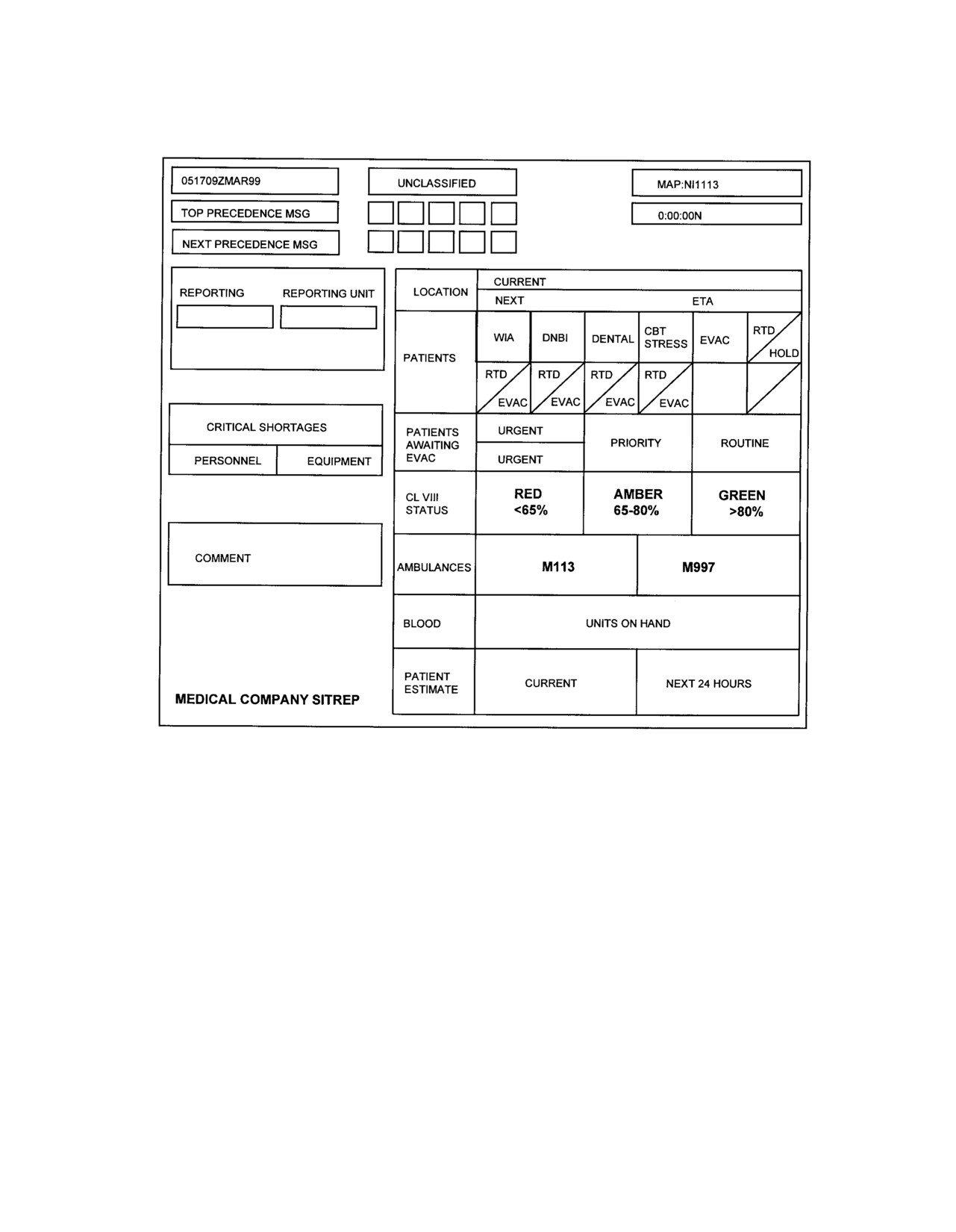
space for using free text. Figure 3-3 is the medical screen as seen on the CSS function of FBCB2.
Descriptions of each screen are provided below.
(1) Medical functionality in the logistical situational report. This message provides visibility
of selected Class VIII items at the BAS and FSMC stock levels, date and time group of the most recent
report, and location of medical units. Recipients of the report are the FSC, the FSB support operations
(HSSO), the BSS, and the DSS. This report is entered into the CSSCS by the BSS.
3-20
FM 4-02.4
Figure 3-3. Sample of medical screen incorporated into the combat service support
Force XXI Battle Command Brigade and Below function.
(2) Medical Situational Report. The FSMC and BAS prepare and submit this report. The
recipients of the report are maneuver commanders and their S1, the FSC, the FSB support operations
(HSSO), the BSS, and the DSS. The BSS and FSMC receive roll up from the BASs. The DSS receives a
roll up of the FSMC reports. Adjacent units can receive information copies of the MEDSITREP. This
message reports the following information:
(a) Current location and proposed next location with estimated time of arrival.
(b) Number of patients seen and classified as wounded in action, DNBI, dental, and
combat stress. The field will also show the number of patients evacuated and the number RTD.
(c) Patient(s) awaiting MEDEVAC.
3-21
FM 4-02.4
(d) The Class VIII status of the element/unit, the number of ambulances that are
mission capable, and the number of units of blood and type on hand, if required.
(e) There will be a free text field for critical Class VIII or other supply shortages and
commanders comments.
(3) Medical evacuation request. This request is currently embedded into FBCB2 and is a
digitized standard 9-line MEDEVAC request. The current messaging is from the requestor to the medical
platoon leader (with an information copy to the maneuver battalion commander). The medical platoon
leader either responds or forwards the request to the FSMC commander who dispatches the appropriate
MEDEVAC asset. Information copies of all MEDEVAC requests are sent to the BSS so they can maintain
real-time situational understanding on the volume of requests. The FSMC commander sends an information
copy to the BSS with after-action information that includes destination of evacuated patient(s).
3-8.
Radio Nets
a. Battalion Communications. Battalion communications are sent over a variety of radio nets.
Primary battalion communications nets are
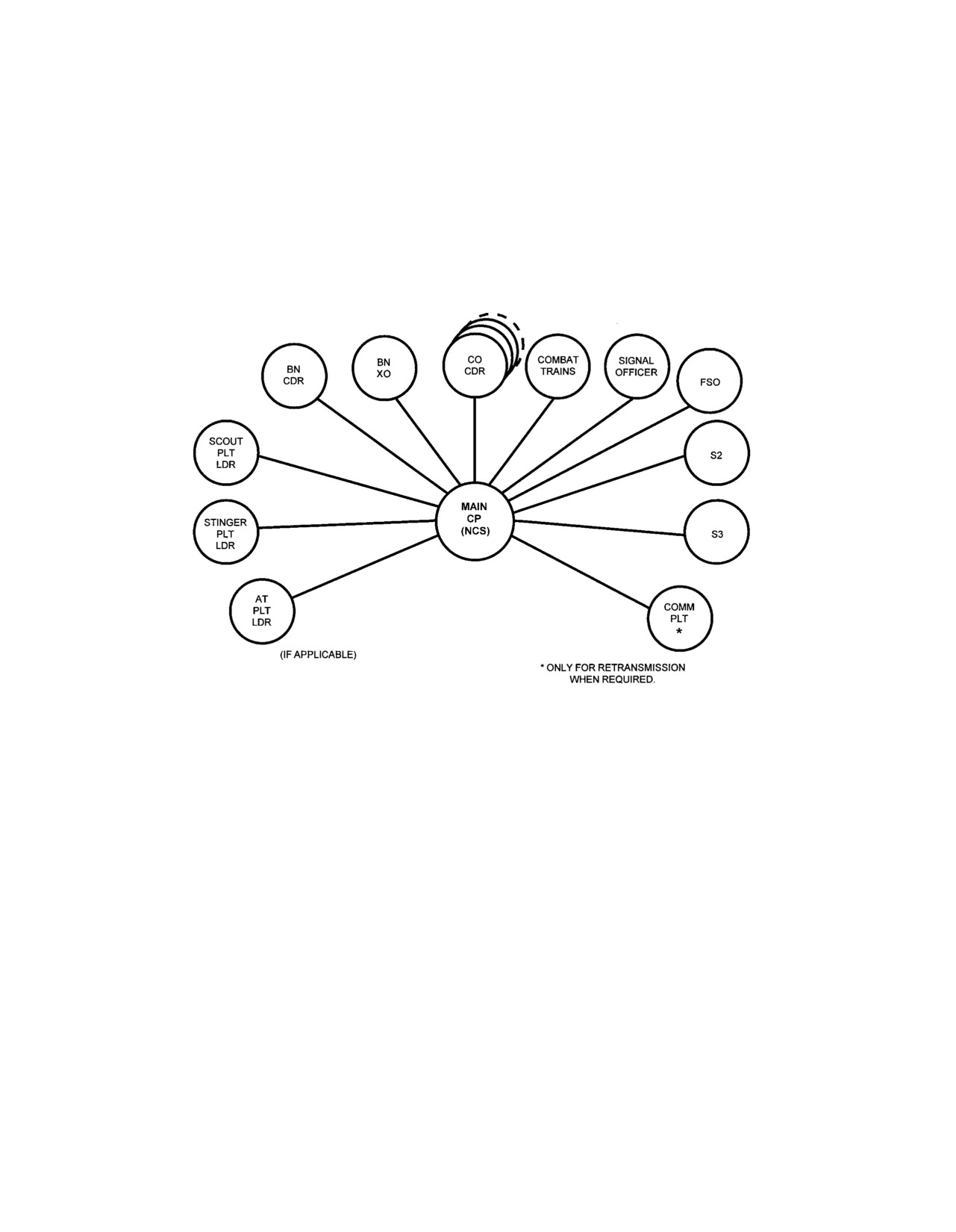
(1) Command net. A secure command net is used for C2 of the TF. All organic and attached
units, including the FSO, forward air controller, and leaders of supporting elements, enter the battalion
command net. Primarily, during the execution of the mission, only commanders transmit; all others
monitor and transmit only essential information. The command operations net (see Figure 3-4) is controlled
by the battalion main CP.
(2) Operation and intelligence net. The operations and intelligence (O&I) net is a secure net
established to provide a mechanism for the battalion TF to accept routine items of information concerning
O&I reporting without cluttering or interfering with the battalion command net.
(3) Administrative/logistics net. The administrative/logistics net is a tactical net, controlled
by the combat train command post (CTCP), used to communicate the administrative and logistical
requirements of the TF. All organic and attached units normally operate in this net.
(4) Special radio nets.
(a) The scout platoon net or a designated frequency may function as a surveillance net
when required. The S2 and elements assigned surveillance missions operate on this net. Other elements
enter or leave the net to pass information as required.
(b) The FSE and company fire support teams operate in the supporting FA command
fire direction net and a designated fire direction net to coordinate FA fires for the battalion. The TACP
operates in USAF tactical air-request and air-ground nets to control air strikes.
(c) Supporting air defense units monitor the early warning net. In the absence of
collocated air defense support, the main CP will also monitor the division early warning net.
3-22
FM 4-02.4
(d) Attached or OPCON support assets may operate in their parent unit nets, but they
must also monitor the command net at all times.
Figure 3-4. Example of a battalion command operations net.
b. Administrative/Logistics Radio Net. The administrative/logistics radio net
(see Figure 3-5) is
used for most CSS traffic. However, at battalion level, CSS communications can be via any combination of
FM radio, mobile subscriber equipment (MSE), courier, computer, or wire. Lengthy reports should be sent
by messenger, wire, computer, or tactical facsimile (FAX).
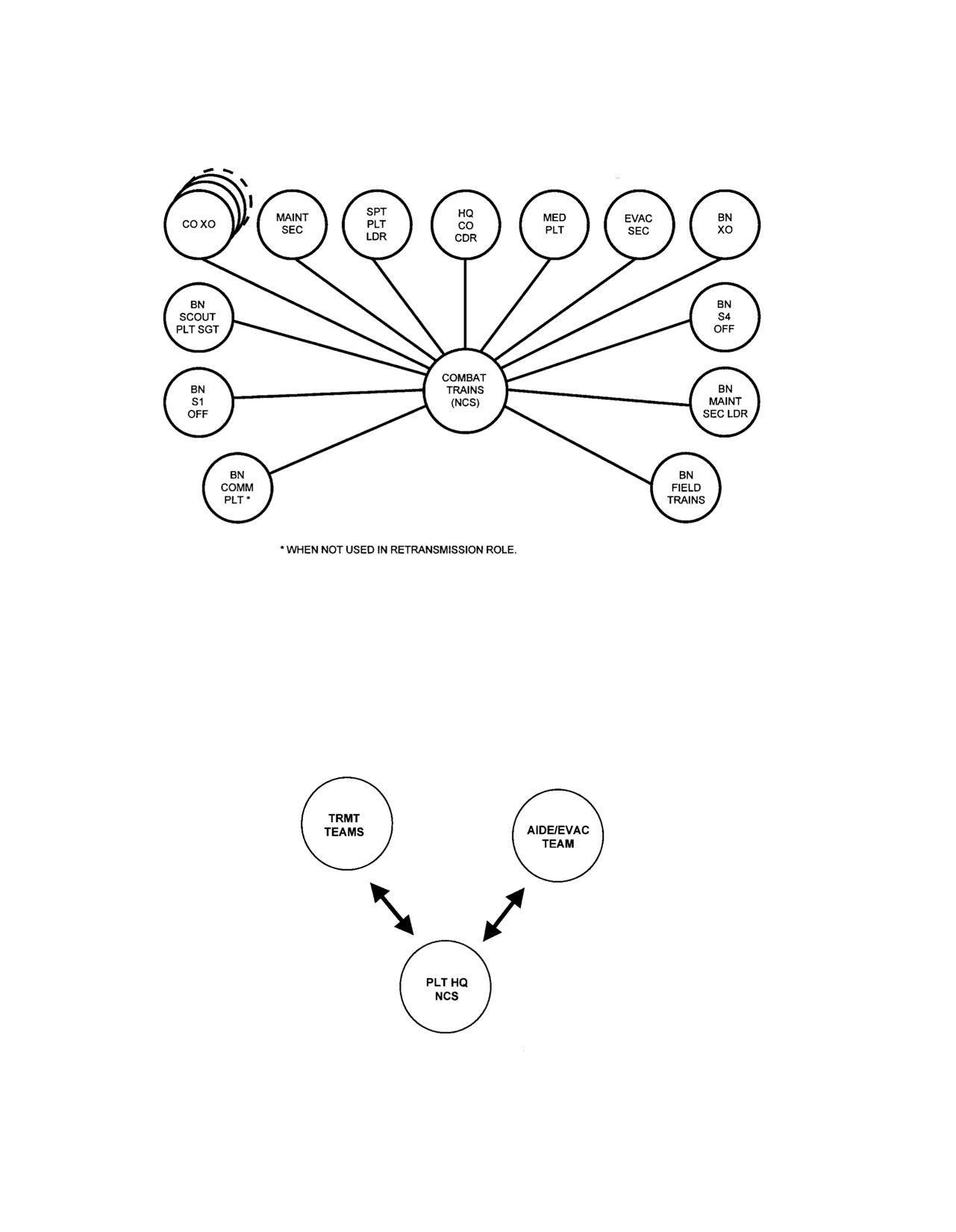
(1) The CTCP is the NCS for the administrative/logistics net. The S4, S1, HHC commander,
battalion maintenance team (less light), support platoon leader, medical platoon leader, company XO or
1SG, and others (as required) operate in the battalion administrative/logistics net. The CTCP also operates
in the brigade administrative/logistics net and in the battalion command net.
(2) The main CP and CTCP should be positioned, when wire is available and circumstances
permit, so wire can be used as the main means of communication between them. Wire allows a constant
flow of information between the CP. It also enhances the ability of the CTCP to stay abreast of the tactical
situation and thus to provide better support. Wire communications produce no electronic signature and,
therefore, are more secure than radio. When MSE is fielded, wire is needed only as a backup means of
communications.
3-23
FM 4-02.4
Figure 3-5. Example of an administrative/logistics net.
c.
Medical Platoon Internal Operations Net. The platoon has access to the maneuver battalion
HHC wire communications network for communications with all major elements of the battalion. Wireless
communications for this section consists of a tactical FM radio mounted in the platoon headquarters vehicle.
The medical platoon employs an FM radio network for CHS operations. The platoon headquarters section
serves as the NCS for the platoon (see Figure 3-6). Table 3-2 lists the information and communications
assets available to the Force XXI medical platoon.
Figure 3-6. Example of the medical platoon internal operations net.
3-24
FM 4-02.4
Table 3-2. Information and Communications Assets Available to the Force XXI
Battalion Medical Platoon
RADIO SETS
AN/VRC-89F
PLATOON HEADQUARTERS VEHICLE AND TREATMENT TEAM ALPHA (SURGEON) VEHICLE (1 EACH)
AN/VRC-88F
TREATMENT TEAM BRAVO
AN/VRC-90F
PLATOON AMBULANCE (1 EACH)
ROUTERS
COMPUTER SYSTEMS
TACTICAL LAN MC4 LAPTOPS FOR EACH TREATMENT AND AMBULANCE VEHICLE
LAN ROUTER
FBCB2, 1 IN EACH VEHICLE ASSIGNED TO THE MEDICAL PLATOON
OTHER SYSTEMS
FBCB2
MEDICAL PLATOON VEHICLE (1 EACH)
GPS
MEDICAL PLATOON VEHICLE (1 EACH)
EPLRS
MEDICAL PLATOON VEHICLE (1 EACH)
BCIS
MEDICAL PLATOON VEHICLE (1 EACH)
DVE
MEDICAL PLATOON VEHICLE (1 EACH)
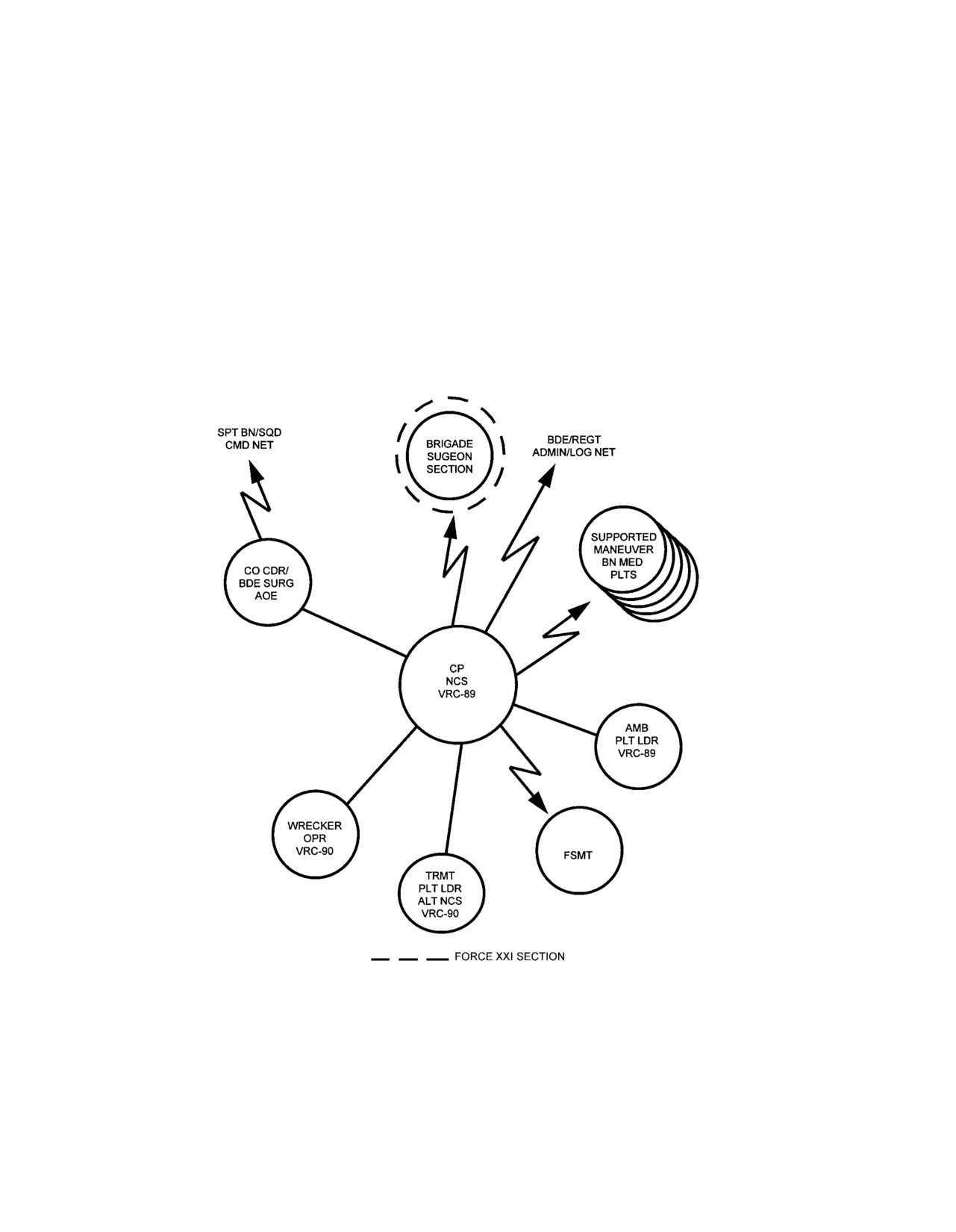
d. Brigade Medical Operations Net. The brigade medical operations net under Army of
Excellence units is the FSMCs command net. For Force XXI brigades and brigades with surgeons
sections assigned to the brigade, the brigade headquarters will maintain communications with medical
elements supporting the brigade through its FM medical net. Single-channel ground and airborne radio
system (SINCGARS) components provide the BSS with an AN/VRC-89 series radio set (FM) which has a
receiver/transmitter (RT) capable of using two FM nets for reception and transmission. This permits the
BSS to communicate with CHS elements via the administrative/logistic net (FM). The AN/VRC-89 series
has two RTs (and one power amplifier). Two RTs allow the BSS to participate in two FM nets. These nets
include the brigade administrative/logistics net and one each of the three medical platoons operations nets.
The BSS also communicates using amplitude modulated (AM)-improved high frequency radios (IHFR) with
its AN/GRC-213 or AN/GRC-193A radio. Another technique is to use the FSMC command net for
brigadewide medical communications while using the administrative/logistics net for other CSS integration
(see Figure 3-7). Situational understanding is monitored using the FBCB2 system and by face-to-face
contact with other brigade staff members in the brigade TOC.
e.
Mobile Subscriber Equipment. Mobile subscriber equipment will allow the BSS to communi-
cate throughout the battlefield in either a mobile or static situation. As the Army continues to digitize the
battlefield and modernize the force, the use of automation continues to develop. The MSE packet switching
network gives units the ability to connect to division and corps LAN or wide area networks (WAN). A
WAN is similar to the LAN but covers a larger distance. This allows units/CP to connect computer systems
such as the CSSCS, maneuver control system, and FBCB2 system to an ethernet cable (coaxial) and send
and receive information in an extremely efficient manner. Because of the limitations of a network
constructed with coaxial cable, a WAN uses a combination of the MSE packet switch network and radio
3-25
FM 4-02.4
networks to distribute the data where necessary through the system. Packet switching does not use or take
up existing telephone lines. Instead, telephone lines are freed up even more because information is being
sent over a network on computers and related equipment. Using the common hardware/software facilitates
the interface and exchange of information between the BSS and the medical platoons operating BAS, the
FSMC, the DSS, the corps, and the division medical elements. See FM 63-2-2 for information concerning
automated data processing continuity of the operations plan.
Figure 3-7. Medical company/troop command FM net/brigade medical operations net.
3-26
FM 4-02.4
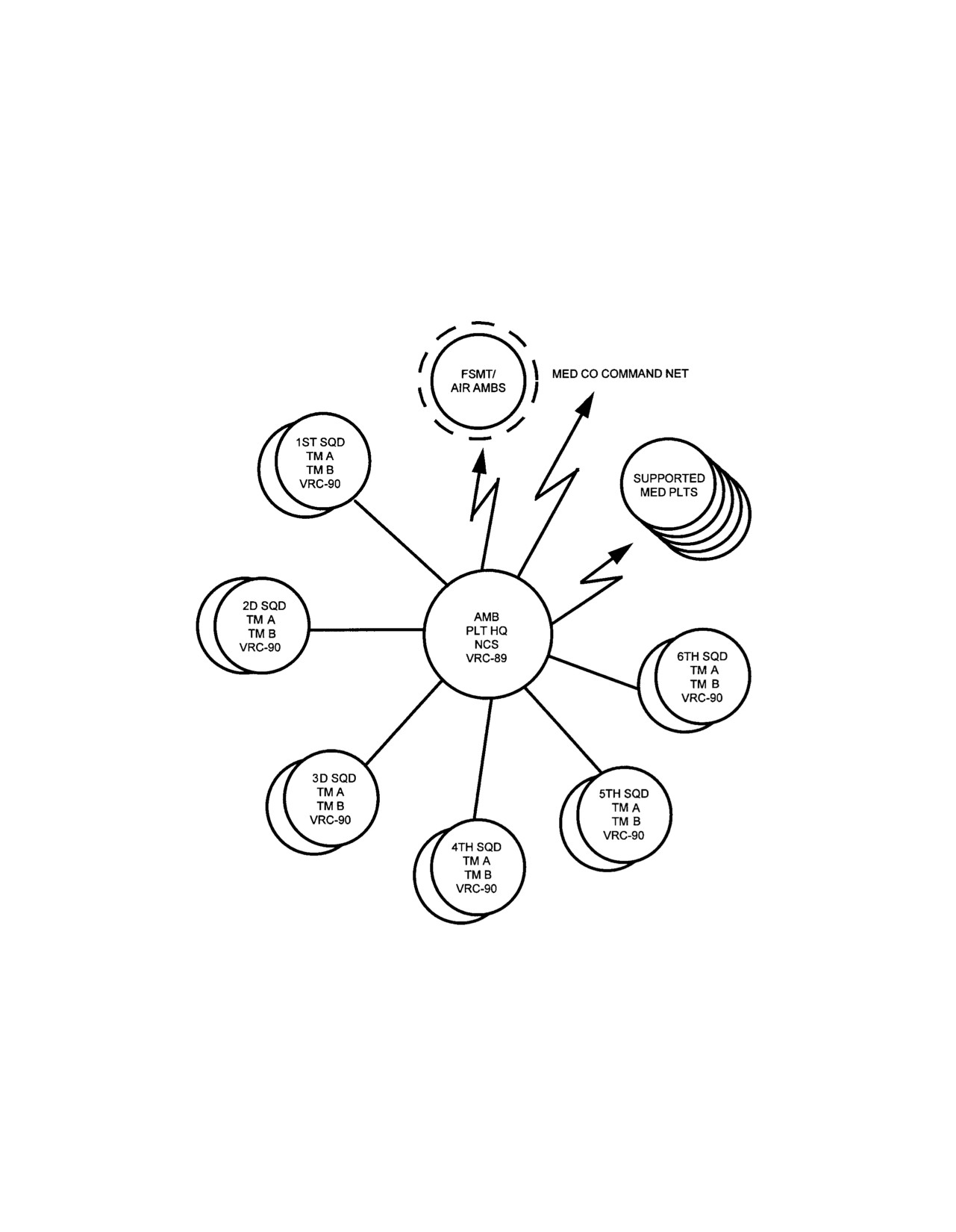
Figure 3-8. Dedicated medical evacuation FM net.
3-27
FM 4-02.4
CHAPTER 4
COMBAT HEALTH SUPPORT OPERATIONS
4-1.
Combat Health Support for Reconnaissance Operations
Reconnaissance precedes all military operations and verifies or refutes analyzed information in IPB products.
The RECON information may require that the initial plans or COA be modified or discarded. The R&S
systems are used to see the enemy, terrain, and other aspects of the battle space that will affect operations.
As advanced warfighting systems are fielded, the R&S capabilities at all levels will be significantly enhanced
but will never completely replace human collection requirements. The scout platoon is the primary R&S
asset for the battalion/TF. This unit is specifically designed and equipped to conduct R&S operations and
can do some limited intelligence analysis. It is the only element in the battalion/TF specifically trained in
reconnaissance and can work up to 30 kilometers across the forward line of own troops (FLOT) forward of
the battalion/TF. The key to synchronizing this asset is predicated on each member of the platoon
understanding the battalion/TF commanders operational intent and concept. Members should understand
their roles in obtaining the major decision point criteria. Detailed plans and orders are key to effective
employment of the scout platoon. The continuous nature of the R&S process requires the commander to
manage the employment of the scout platoon for R&S requirements tied to critical decision points.
Reconnaissance missions require a detail list of exactly what is being tasked and a clear priority for
collection. If RECON assets could find and report only one piece of information, what does the commander
want it to be? For example, the answer to this questions is reflected in the instructions to the scouts.
Execute zone RECON forward of the battalion/TF, beginning at 0345 hours. Collect and report the
following in priority. Phase I: Number 1, confirm or deny enemy antitank minefield at grid FT 456689;
Number 2, determine enemy unit and type and disposition of hill 413, grid FT535731. This allows the
scout platoon leader to collect vital information first and focus his efforts, enhancing the battalion/TFs
planning process. Reconnaissance assets should not be launched without determining the initial RECON
plan. The medical platoon leader will be involved with developing the CHS portion of the RECON plan.
The RECON plan can be issued as a FRAGO and should include
Composition/task organization for RECON.
Key facts (priority intelligence requirements) to be gathered by the RECON party and expected
results.
Movement routes/formations to the RECON location.
Actions on reaching the location.
Special instructions to members of the RECON party. Collection task should be specified.
Any special equipment required (chemical detection kits, expedient or directional antennas,
and so on).
Contingency plans.
Requirements for continued surveillance after the RECON.
4-1
FM 4-02.4
Indirect fire support for RECON.
Security arrangements.
Communications arrangements (nets, retransmission sites, and so on).
Withdrawal, linkup, and dissemination plans.
Combat service support considerations for RECON include
Developing SOPs for load plans of outposts.
Establishing CSS procedures for both mounted and dismounted RECON missions.
Establishing CSS procedures for air versus ground insertion of RECON assets.
Developing procedures for both aerial and ground sustainment.
Developing resupply techniques to include
Using multiple/false landing zones away from outposts as cache drop-off points.
Predetermining the locations and times for resupply of Classes I, III, IV, V, VII, and XI.
Establishing locations for caches on successive missions/insertions.
Combat health support considerations include
Determining the CHS requirements.
Deploying trauma specialists and medical assets in DS of RECON operations, as required and
appropriate.
Planning for casualty evacuation/extraction operations.
Developing a CHS SOP for supporting RECON elements deployed deep into enemy territory.
Selecting evacuation sites (remembering that all cache sites are potential casualty evacuation
sites).
Developing TTPs for cross-FLOT casualty extraction.
Establishing the time for pick up and the pickup point for aerial extraction of casualties.
(The
last known/reported location is normally the aerial pickup point and the best time is 30 minutes prior to
BMNT or 30 minutes after EENT.)
4-2
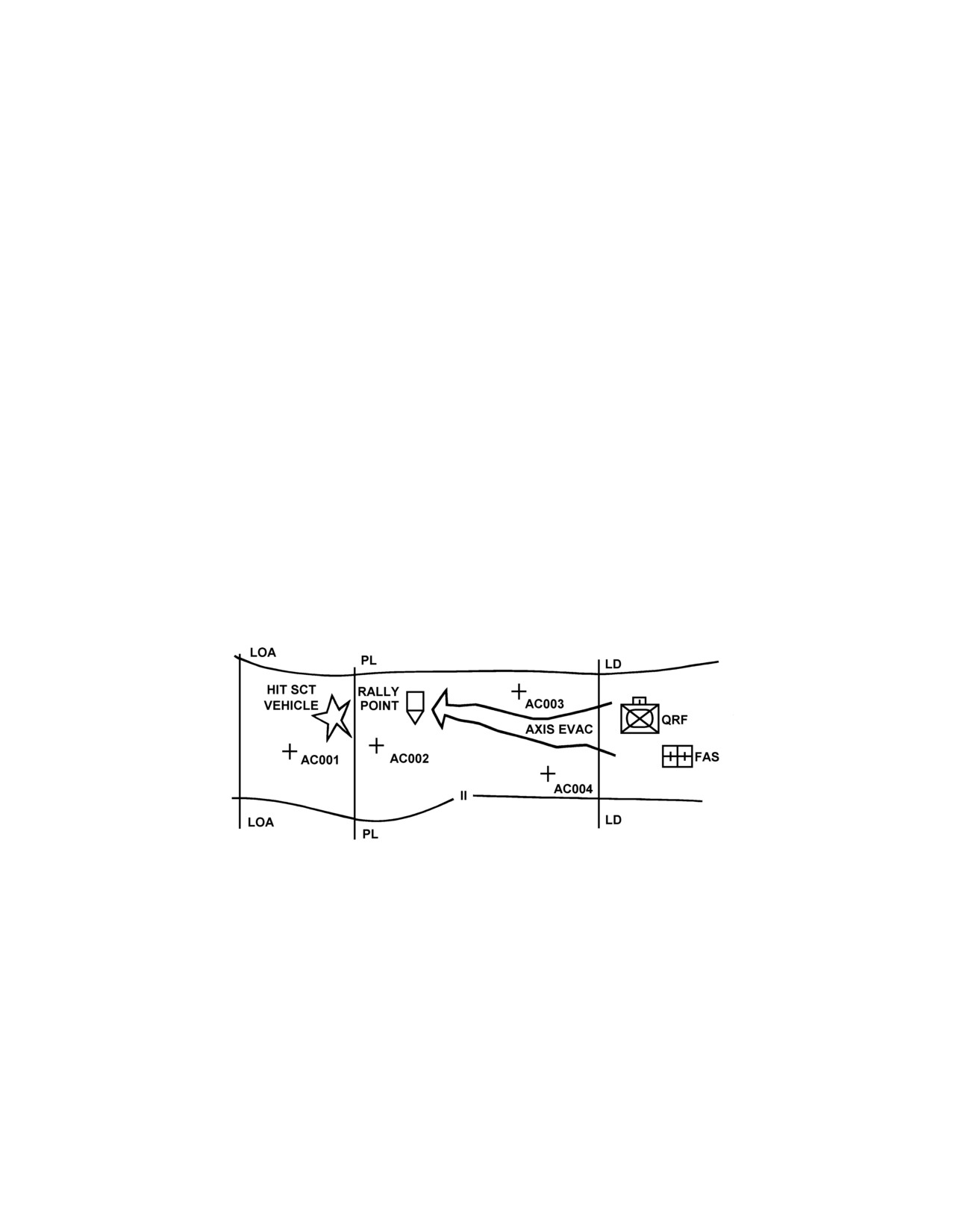
FM 4-02.4
Developing a detailed plan for ground extraction, to include link up to quick reactionary force
(QRF) and escort to casualty exchange point.
Conducting rehearsals for day and night extractions.
Requesting escort if a QRF is not established.
During RECON missions if a member or members of the platoon become casualties, initial care will be self-
aid, CLS advanced first aid, or EMT from a trauma specialist. Trauma specialists may be deployed as a
rider in one of the scout vehicle or an ambulance team may be in support. If casualties/patients require
extraction/medical evacuation, it becomes a combat mission. Since this is a combat mission that may
require offensive action, medical personnel are placed under the control of a QRF leader. Provided in
Figure 4-1 is a technique for conducting cross-FLOT ground extraction and lists the overall considerations.
Figure 4-2 is a technique for conducting cross-FLOT air extractions and lists the overall considerations.
Since the RECON element is usually small, enemy contact could produce a significant number of casualties
requiring extraction of the entire team. Either ground or air could be used to execute the extraction of the
RECON team. As stated above, this is a combined arms operation. Medical personnel will participate in
the planning, preparation, and execution of these missions. If medical evacuation vehicles are not sent with
the extraction force, then one vehicle should be designated for casualties and augmented with a trauma
specialist. For additional information on reconnaissance operations, see FMs 7-20, 7-30, 7-92, 17-98, and
71-3.
OVERALL CONSIDERATIONS
EXTRACTION IS A COMBAT MISSION
ALERT ALL RECON ASSETS
PLAN/REHEARSE QRF
USE RECON ASSETS IN SECTOR/ZONE TO VECTOR QRF
PLAN COMBAT MULTIPLIERS
TO RALLY POINT
PLAN ARTILLERY SUPPORT THROUGHOUT
POSITION AID STATION NEAR QRF STAGING AREA
ZONE/SECTOR
PLAN MUST COVER MOVEMENT IN AND OUT OF
PLAN FALSE/DISTRACTING ARTILLERY
SECTOR/ZONE
CLOSE AIR SUPPORT
LIMITED ATTACKS TO DISTRACT ENEMY/CLEAR
GRAPHICS ISSUED TO SUPPORT MISSION
ROUTES, ETC.
Figure 4-1. A technique for cross-FLOT ground extraction.
4-3
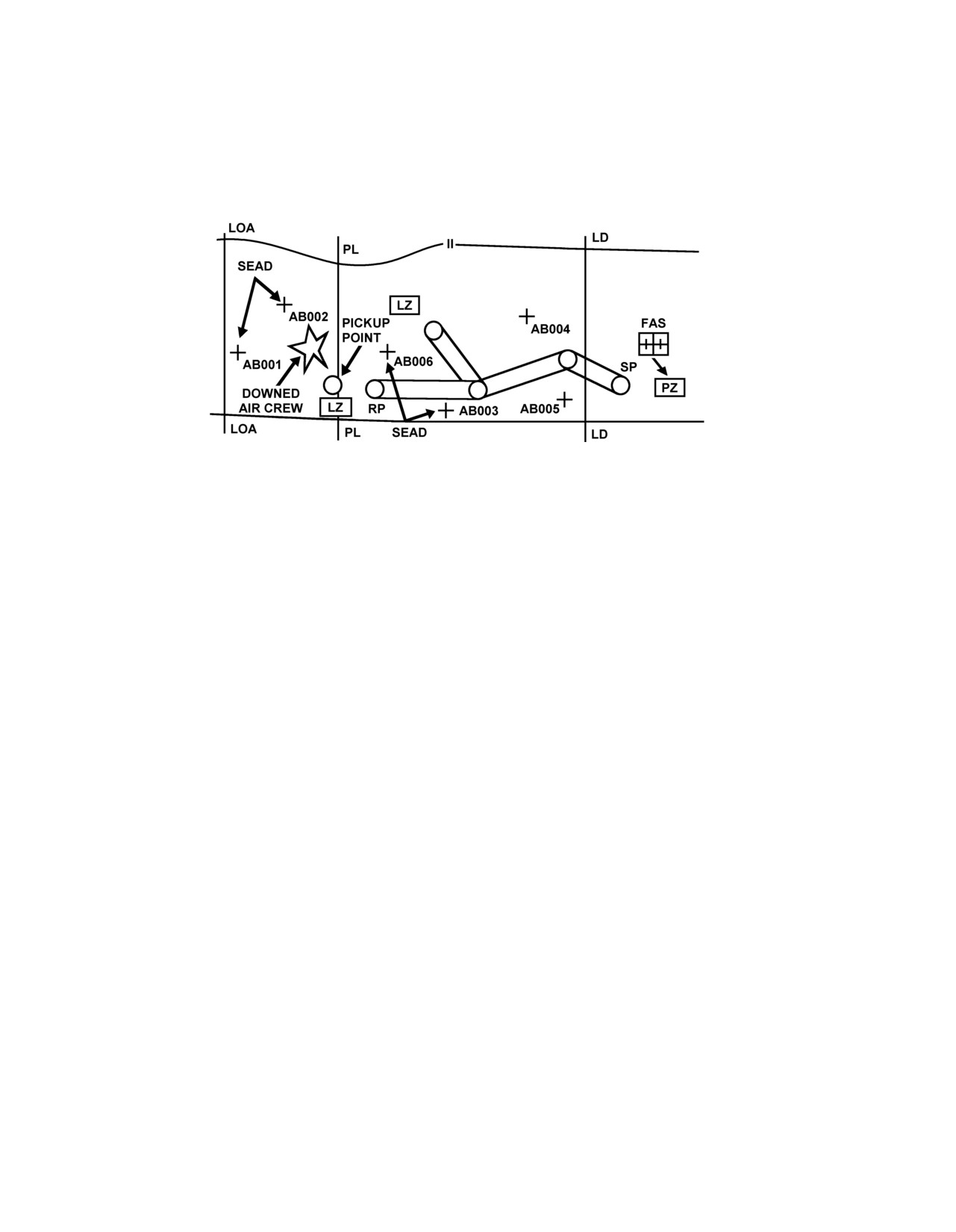
FM 4-02.4
OVERALL CONSIDERATIONS
EXTRACTION IS A COMBAT MISSION
CLOSE AIR SUPPORT
PLAN COMBAT MULTIPLIERS
ALERT ALL RECON ASSETS
LETHAL SEADINGRESS/EGRESS
ISSUE INTEL UPDATE AT PZ
NONLETHAL SEADTLQ-17/COMPASS CALL
USE RALLY POINTS/DOWNED CREW PICKUP POINTS
FALSE LZ/INSERTIONS
POSITION AID STATION NEAR LZ
FALSE ARTILLERY/SEAD
Figure 4-2. A technique for cross-FLOT air extraction.
4-2.
Combat Health Support for the Offense and the Defense
a. Combat Health Support for the Offense.
(1) The offense is the decisive form of war, the commanders only means of attaining a
positive goal, or of completely destroying an enemy force (FM 100-5). Rapid movement, deep penetrations,
aggressive action, and the ability to sustain momentum regardless of counterfires and countermeasures
characterize the offense.
(2) When developing the CHS plan to support the offense, the CHS planner must consider
many factors (FM 8-55). The forms of maneuver, as well as the threats capabilities, influence the
character of the patient workload and its time and space distribution. The analysis of this workload
determines the allocation of CHS resources and the location or relocation of MTF.
(3) Combat health support for offensive operations must be responsive to several essential
characteristics. As operations achieve success, the areas of casualty density move away from the supporting
MTF. This causes the routes of MEDEVAC to lengthen. Heaviest patient workloads occur during
disruption of the threats main defenses, at terrain or tactical barriers, during the assault on final objectives,
and during threat counterattacks. The accurate prediction of these workload points by the CHS planner is
essential if MEDEVAC operations are to be successful.
4-4
FM 4-02.4
(4) As advancing combat formations extend control of the battle area, supporting medical
elements have the opportunity to clear the battlefield. This facilitates the acquisition of the battle wounded
and reduces the vital time elapsed between wounding and treatment. There are two basic problems
confronting the supporting medical units and MEDEVAC elements. First, contact with the supported units
must be maintained. Responsibility for the contact follows the normal CHS patternhigher echelon
evacuates from lower echelon. Contact is maintained by forward deployed air and ground evacuation
resources. Secondly, the mobility of the MTF supporting the combat formations must be maintained. The
requirement for prompt MEDEVAC of patients from forward MTF requires available ambulances to be
echeloned well forward from the outset. Air and ground ambulance support beyond the capabilities of the
FSMC is requested from the supporting corps MEDEVAC battalion.
(5) In traditional combat operations, the major casualty AO is normally the zone of the main
attack. As the main attack accomplishes the primary task of the combat force, it receives first priority in the
allocation of combat power. The allocation of combat forces dictates roughly the areas that are likely to
have the greatest casualty density.
(a) In the division, CHS (Echelon I) for the brigade is provided by maneuver battalion
medical platoons. The medical platoon operates the BAS or squadron aid station, places trauma specialists
in DS of the maneuver companies and RECON troop, provides patient evacuation from forward areas,
and deploys treatment teams in DS of battalion or squadron elements for up to 48 hours without resupply.
The FSMC (Echelon II) located in the BSA provides MEDEVAC support from the BAS/squadron aid
station to the BSA and reinforces treatment capabilities at BAS/squadron aid stations for limited periods of
time. When combat operations commence, the medical platoon normally locates its BAS as far forward as
combat operations permit. The BAS treatment squad can split into two treatment teams and operate as two
separate aid stations (BAS [-]), normally not to exceed 24 hours. Treatment Team A operates the main aid
station (MAS) and Treatment Team B operates the forward aid station (FAS). In continuous operations,
when operating for longer periods, personnel efficiency and unit capability will tend to deteriorate. Each
team employs treatment vehicle(s) with two MESone trauma set and one general sick call set. The
medical platoon will depend on CLS, trauma specialists, company health care SGT, and unit 1SG to assist
with clearing the battlefield and getting injured or wounded soldiers to the CCP. From the forward areas
and the CCP, armored ambulances will provide medical evacuation to the FAS and MAS. Based on
casualty estimates, additional ambulances may be forward positioned at CCP. The CCP, Treatment Team A,
and Treatment Team B must select sites that provide cover and concealment and afford some protection to
their patients. For additional information on force protection, see Appendix E. Treatment teams must
maintain as much mobility as possible while providing stabilization care and rapid medical evacuation.
Treatment and evacuation elements must ensure that adequate stocks of Class VIII items are on-hand and, if
necessary, request Class VIII resupply from the FSMC.
(b) The Force XXI medical platoon may deploy a treatment team forward in support of
brigade RECON troops based on mission requirements. As the battle moves from the original area of
contact, coordinated movements of treatment teams allow for continuous CHS. Once patients are received,
a treatment team from the BAS or squadron aid station will care for and treat these patients until their
MEDEVAC or appropriate disposition. The remaining treatment teams of the maneuver BAS and squadron
aid stations move with the battle and provide CHS to the maneuver and RECON elements according to the
brigade order.
4-5
FM 4-02.4
(c) Careful coordination must be used when deciding when and which treatment team
will receive patients. The plan must take into account maintaining the mobility of the medical platoon so
that at least one treatment team will be able to follow the force as it maneuvers. This will keep evacuation
routes and times to a minimum. Maneuver BAS/treatment teams provide area medical support to units
without organic medical support operating in the maneuver battalions AO. Brigade RECON will plan for
area medical support for cross-FLOT operations. After MEDEVAC or appropriate disposition of their
patients, the treatment team prepares for its next move. This echeloned displacement (leapfrog) technique
provides for maximum utilization of medical platoon treatment teams and permits continuous uninterrupted
CHS to maneuver battalions on the move. Each of the above actions must be coordinated with the CTCP
and the FSMC.
(d) The BAS is under the tactical control of the battalion S4 and is normally deployed
in the vicinity of combat trains. To reduce ambulance turnaround time in providing ATM to patients within
30 minutes of wounding, the BAS may split and place its treatment teams as close to maneuvering companies
as tactically feasible. The battalion S4 closely coordinates locations for forward positioning CSS elements
(including medical treatment elements) with the battalion S3. This is to ensure that the location of these
elements is known by commanders of maneuvering and CS forces. Coordination ensures that CSS elements
are not placed in the way of friendly maneuvering forces; in line of incoming or outgoing fires; or in areas
subject to be overrun by rapidly advancing enemy forces. Treatment teams situated close to (within 1,000
meters of) maneuvering companies in contact must be prepared to withdraw to preplanned, alternate
positions on short notice. They must also be aware of enemy capabilities. Some adversaries will possess
weapons capable of direct fire at 4,000 meters.
(e) Trauma specialists are allocated to infantry and mechanized infantry companies on
the basis of one trauma specialist per platoon and, under Force XXI, a health care SGT is allocated for each
company. In armored units, the allocation is one health care SGT and one ambulance team per company.
The location of the trauma specialist is of extreme importance for early acquisition and medical treatment of
casualties. The mechanized infantry platoon trauma specialist normally locates with, or near, the element
leader. When the platoon is moving on foot in the platoon column formation, he positions himself near the
element leader trailing the base squad forward of the second team. This formation is the platoons primary
movement formation. When the platoon is mounted, the trauma specialist will usually ride in the same
vehicle as the platoon SGT. The company senior trauma specialist collocates with the 1SG. When the
company is engaged, he remains with the 1SG and provides medical advice as necessary. When a casualty
occurs, first aid will be rendered by self-aid/buddy aid or by the CLS. The platoon/company trauma
specialist will then go to the casualtys location or the casualty will be brought to the trauma specialist. The
trauma specialist makes his assessment; administers initial medical care; initiates a DD Form 1380 (FMC);
then requests evacuation or returns the individual to duty. The patient is evacuated from the point of injury
or is transported on a nonmedical vehicle (coordinated by the 1SG) to a collection point. A vehicle from the
medical platoon evacuation section (usually pre-positioned forward) picks up the patient and transports him
to the BAS. As the tactical situation allows, the trauma specialist will provide medical treatment and
prepare patients for evacuation. The ambulance team supporting the company works in coordination with
the trauma specialists supporting the platoons. When a casualty occurs in a tank or an armored fighting
vehicle, the evacuation team will move as close to the vehicle as possible, making full use of cover,
concealment, and defilade. Assisted, if possible, by the vehicles crew, they will extract the casualty from
the vehicle and administer EMT. They move the patient to the treatment team or to a CCP to await further
4-6
FM 4-02.4
MEDEVAC. The company health care SGT normally remains with the company CP, but may be used
anywhere in the company, assisting the ambulance teams in some situations. The 1SG oversees the
evacuation of casualties back to a CCP and may employ nonstandard medical platforms to accomplish his
mission. The company health care SGT will position himself at the CCP and provide medical treatment, to
include prioritizing patients for MEDEVAC to the BAS.
(6) When maneuvering companies anticipate large numbers of casualties, augmentation of
the medical platoon with one or more treatment teams from the FSMC should be made. Augmenting
treatment teams are under the tactical control of the battalion S4, but are under the technical control of the
battalion surgeon. Medical treatment facilities should not be placed near targets of opportunity such as
ammunition, POL distribution points, or other targets that may be considered lucrative by the opposing
force. Considerations for the location of the BAS should include
Tactical situation/commanders plan.
Expected areas of high casualty density.
Security.
Protection afforded by defilade.
Convergence of lines of drift.
Evacuation time and distance.
Accessible evacuation routes.
Avoidance of likely target areas such as bridges, fording locations, road junctions,
and firing positions.
Good hard stand on solid ground with good drainage.
Near an open area suitable for helicopter landing.
Available communication means.
(7) Types of operations in the offense include
(a) Movement to contact. Medical evacuation support in movement to contact is keyed
to the tactical plan. Prior deployment of FSMC ground ambulances with the maneuver battalions organic
medical platoons permits uninterrupted and effective MEDEVAC support from the BAS to the FSMC
located in the BSA. Movement to contact operations is executed when there is little or no threat information.
The FSMC and treatment teams from maneuver BAS in support of these operations must maintain their
flexibility and be prepared to adjust CHS once contact is established.
4-7