FM 4-02.4 MEDICAL PLATOON LEADERS' HANDBOOK: TACTICS, TECHNIQUES, AND PROCEDURES (August 2001) - page 1
FM 4-02.4 (FM 8-10-4)
MEDICAL PLATOON
LEADERS HANDBOOK
TACTICS, TECHNIQUES, AND PROCEDURES
HEADQUARTERS, DEPARTMENT OF THE ARMY
DISTRIBUTION RESTRICTION: Approved for public release; distribution is unlimited.
*FM 4-02.4 (FM 8-10-4)
FIELD MANUAL
HEADQUARTERS
NUMBER 4-02.4
DEPARTMENT OF THE ARMY
Washington, DC, 24 August 2001
MEDICAL PLATOON LEADERS’ HANDBOOK
TACTICS, TECHNIQUES, AND PROCEDURES
TABLE OF CONTENTS
Page
PREFACE
vii
CHAPTER
1.
COMBAT ORGANIZATIONS
1-1
Section
I.
The Division
1-1
1-1.
Background
1-1
1-2.
Role of the Division
1-1
Section
II.
Types of Divisions
1-1
1-4.
Light Infantry Division
1-2
1-5.
Airborne Division
1-2
1-6.
Air Assault Division
1-3
1-7.
Medium Division
1-3
Section
III.
The Division Staff
1-3
1-8.
The Division Commander
1-3
1-9.
Assistant Division Commanders
1-3
1-10.
Chief of Staff
1-3
1-11.
Staff Section
1-4
Section
IV.
Organizations of Division
1-4
1-12.
Division Organizations
1-4
1-13.
Ground Maneuver Brigade
1-4
1-14.
Aviation Brigade
1-4
1-15.
Division Artillery
1-5
1-16.
Engineer Brigade
1-5
1-17.
Division Support Command
1-5
1-18.
Division Cavalry Squadron
1-8
1-19.
Air Defense Battalion
1-8
1-20.
Military Intelligence Battalion
1-8
1-21.
Signal Battalion
1-9
1-22.
Military Police Company
1-9
1-23.
Division Chemical Company
1-10
1-24.
Division Band
1-10
DISTRIBUTION RESTRICTION: Approved for public release; distribution is unlimited.
*This publication supersedes FM 8-10-4, 16 November 1990.
i
FM 4-02.4
Page
Section
V.
Maneuver Brigades and Regiments
1-10
1-25.
Organization of the Armored or Mechanized Infantry Brigade
1-10
1-26.
Organization of Infantry Brigades
1-12
1-27.
Armored Cavalry Regiments
1-13
Section
VI.
The Battalion
1-14
1-28.
Organization of the Infantry Battalion
1-14
1-29.
Organization of the Mechanized Infantry and Armored Battalions
1-15
1-30.
Battalion Task Force on the AirLand Battlefield
1-16
Section
VII.
The Battalion Staff
1-17
1-31.
Command and Control Responsibilities of the Battalion
1-17
1-32.
Staff
1-17
1-33.
Coordinating Staff
1-18
1-34.
Special Staff
1-21
1-35.
Other Staff Assets
1-22
CHAPTER
2.
DIVISION COMBAT HEALTH SUPPORT
2-1
Section
I.
Overview of Division and Corps Medical Assets
2-1
2-1.
Tables of Organization and Equipment
2-1
2-2.
Division Medical Assets, L-Edition TOE (Army of Excellence/AirLand
Battle)
2-1
2-3.
Division Medical Assets, F-Edition TOE (Force XXI/Digitized
Division)
2-3
2-4.
Division Surgeon, L-Edition TOE (Army of Excellence/AirLand
Battle)
2-5
2-5.
Division Surgeon, F-Edition TOE (Force XXI/Digitized Division)
2-7
2-6.
Division Surgeons Section, F-Edition TOE (Force XXI/
Digitized Division)
2-7
2-7.
Corps Medical Assets in Support of Divisions
2-8
Section
II.
Division Support Command Medical Units and Elements
2-10
2-8.
Division Support Command, L-Edition TOE (Army of Excellence/
AirLand Battle)
2-10
2-9.
Division Support Command, F-Edition TOE (Force XXI/Digitized
Division)
2-12
Section
III.
Brigade Headquarters Medical Assets
2-17
2-10.
Brigade Surgeon, F-Edition TOE (Force XXI/Digitized Division)
2-17
2-11.
Brigade Surgeons Section, F-Edition TOE (Force XXI/Digitized
Division)
2-18
2-12.
Brigade Surgeon, L-Edition TOE (Army of Excellence/AirLand
Battle)
2-19
2-13.
Armored Cavalry Regiment and Separate Brigade Surgeons (Army of
Excellence)
2-20
2-14.
Armored Cavalry Regiment Medical Troop
2-20
ii
FM 4-02.4
Page
Section
IV.
Medical Platoons (Army of Excellence/AirLand Battle)
2-21
2-15.
Assignment
2-21
2-16.
Battalion Surgeon/Medical Platoon Leader, L-Edition TOE
2-24
2-17.
Platoon Headquarters, L-Edition TOE
2-24
2-18.
Treatment Squad, L-Edition TOE
2-26
2-19.
Battalion Aid Station/Treatment Squad Operations, L-Edition TOE
2-26
2-20.
Combat Medic Section, L-Edition TOE
2-30
2-21.
Ambulance Squads, L-Edition TOE
2-31
2-22.
Employment and Functions of the Ambulance Team, L-Edition TOE
2-32
2-23.
Medical Evacuation, L-Edition TOE
2-32
2-24.
Evacuation and Disposition of Remains
2-34
2-25.
Class VIII Resupply, L-Edition TOE
2-35
Section
V.
Medical Platoons, Force XXI/Digitized Division
2-36
2-26.
Medical Platoon Assignment, F-Edition TOE
2-36
2-27.
Platoon Headquarters, F-Edition TOE
2-36
2-28.
Battalion Surgeon/Medical Platoon Leader, F-Edition TOE
2-37
2-29.
Treatment Section, F-Edition TOE
2-38
2-30.
Combat Medic Section, F-Edition TOE
2-38
2-31.
Ambulance Squads, F-Edition TOE
2-39
2-32.
Property Exchange
2-39
Section
VI.
Treatment Teams, Medical Sections, and Special Purpose Medical
Platoons (Army of Excellence/AirLand Battle)
2-40
2-33.
Combat Support Unit and Division Headquarters Treatment Team,
L-Edition TOE
2-40
2-34.
Medical Section, Headquarters and Headquarters Battery, Division
Artillery, L-Edition TOE
2-40
2-35.
Treatment Team, Headquarters and Headquarters Battery, Field
Artillery Battalion, L-Edition TOE
2-43
2-36.
Medical Treatment Team, Headquarters and Headquarters Company,
Division Aviation Brigade/Combat Aviation Squadron, L-Edition
TOE
2-45
2-37.
Medical Section, Headquarters and Headquarters Company, Attack Heli-
copter Battalion, Division Aviation Brigade, L-Edition TOE
2-47
2-38.
Medical Platoon, Headquarters and Headquarters Troop, Reconnaissance
Squadron, Division Aviation Brigade, L-Edition TOE
2-47
2-39.
Medical Section, Headquarters and Headquarters Company,
Division Headquarters, L-Edition TOE
2-50
2-40.
Combat Medic Section, Headquarters and Headquarters Company,
Combat Engineer Battalion, L-Edition TOE
2-52
Section
VII.
Additional Medical Assets Operating in the Brigade Area of
Operations (Force XXI/Digitized Division)
2-53
2-41.
Treatment Squads/Teams from the Forward Support Medical Company,
F-Edition TOE
2-53
iii
FM 4-02.4
Page
2-42.
Forward Surgical Team, A-Edition TOE (Force XXI/Medical Reengi-
neering Initiative)
2-54
2-43.
Forward Support Medical Evacuation Team, L-Edition TOE (Force XXI/
Medical Reengineering Initiative)
2-54
2-44.
Corps Ground Ambulance Company, Either the L-Edition TOE or the
A-Edition TOE Supporting Force XXI/Medical Reengineering
Initiative
2-55
2-45.
Corps Combat Stress Control Augmentation, A-Edition TOE (Force XXI/
Medical Reengineering Initiative)
2-55
CHAPTER
3.
COMMAND AND CONTROL
3-1
Section
I.
Preparation for Combat Health Support
3-1
3-1.
Plans
3-1
3-2.
Operation Order
3-3
3-3.
Rehearsal
3-6
Section
II.
Troop-Leading Procedures
3-7
3-4.
Eight Steps of Troop Leading
3-7
3-5.
Abbreviated Troop-Leading Procedures
3-17
Section
III.
Computers, Information, Digitization, and Communications
3-18
3-6.
Medical Standard Army Management Information System
3-18
3-7.
Information and Communications
3-19
3-8.
Radio Nets
3-22
CHAPTER
4.
COMBAT HEALTH SUPPORT OPERATIONS
4-1
4-1.
Combat Health Support for Reconnaissance Operations
4-1
4-2.
Combat Health Support for the Offense and the Defense
4-4
4-3.
Combat Health Support for Maneuver and Enabling Operations
4-11
4-4.
Combat Health Support During Night Operations
4-15
APPENDIX
A.
THE GENEVA CONVENTIONS
A-1
A-1.
Effects of Geneva Conventions on Combat Health Support
A-1
A-2.
Geneva Wounded and Sick
A-1
A-3.
Identification and Protection of Medical Personnel under Geneva Wounded
and Sick
A-1
A-4.
Identification of Medical Units, Facilities, and Vehicles
under Geneva Wounded and Sick
A-2
A-5.
Camouflage of the Geneva Emblem
A-3
A-6.
Defense of Self and Patient under Care
A-3
A-7.
Geneva Prisoners of War
A-4
A-8.
Geneva Civilian Persons
A-5
A-9.
Compliance with the Geneva Conventions
A-5
iv
FM 4-02.4
Page
APPENDIX
B.
MANAGEMENT OF INDIVIDUAL HEALTH RECORDS IN
THE FIELD
B-1
B-1.
General
B-1
B-2.
Health Records of Deployed Soldiers
B-1
B-3.
Use of Field Files/DD Form 2766
B-3
B-4.
Storage of Health Records and Civilian Employee Medical Records
B-3
B-5.
Establishment and Management of the Field File in the Operational
Area
B-3
B-6.
Health Assessments after Deployment
B-4
B-7.
Field Record Administration after Hostilities Cease
B-5
APPENDIX
C.
COMBAT LIFESAVER
C-1
C-1.
Role of the Combat Lifesaver
C-1
C-2.
Training the Combat Lifesaver
C-1
C-3.
Administering the Combat Lifesaver Course
C-1
C-4.
Combat Lifesaver Aid Bag
C-3
C-5.
Class VIII Resupply of Combat Lifesaver Aid Bag
C-3
APPENDIX
D.
INTERIM BRIGADE COMBAT TEAM
D-1
Section
I.
Infantry Battalion Medical Platoon
D-1
D-1.
Medical Platoon
D-1
D-2.
Medical Communications for Combat Casualty Care
D-5
D-3.
Battalion Combat Health Support Planning
D-6
D-4.
Combat Health Support During Night Operations
D-8
D-5.
Combat Health Support Tactical Standing Operating Procedures
D-8
Section
II.
Reconnaissance, Surveillance, and Target Acquisition Squadron
D-9
D-6.
Medical Platoon
D-9
D-7.
Platoon Headquarters
D-9
D-8.
Treatment Squad
D-10
D-9.
Evacuation Section
D-11
D-10.
Squadron Combat Health Support Planning
D-11
D-11.
Squadron Operation Plans and Operation Orders
D-13
D-12.
Rehearsal
D-13
D-13.
Combat Health Support for the Offense and the Defense
D-14
D-14.
Reconnaissance, Surveillance, and Target Acquisition Squadron
Operations and Combat Health Support
D-14
D-15.
Combat Health Support During Night Operations
D-14
Section
III.
Overview of Medical Force Structure in Support of the Interim
Brigade
D-14
D-16.
Combat Health Support for the Interim Brigade
D-14
D-17.
Brigade Surgeons Section
D-15
D-18.
Brigade Support Medical Company
D-16
D-19.
Forward Surgical Team
D-16
v
FM 4-02.4
Page
D-20.
Medical Force Protection
D-16
D-21.
Medical Logistics (Class VIII/Blood)
D-17
D-22.
Infantry Battalion Medical Platoon
D-17
D-23.
Reconnaissance, Surveillance, and Target Acquisition Squadron
D-17
D-24.
Field Artillery Battalion
D-17
D-25.
Engineer Company
D-17
D-26.
Antitank Company
D-18
D-27.
Units Without Organic Medical Personnel
D-18
APPENDIX
E.
FORCE PROTECTION
E-1
Section
I.
Understanding Force Protection
E-1
E-1.
Protection
E-1
E-2.
Force Protection
E-1
E-3.
Field Discipline
E-1
E-4.
Safety
E-2
E-5.
Fratricide Avoidance
E-2
Section
II.
Risk Management, Security Measures, and Terrorism
Considerations
E-2
E-6.
Risk Management
E-2
E-7.
Preventive and Protective Security Measures
E-2
E-8.
Terrorism Considerations
E-3
APPENDIX
F.
TACTICAL STANDING OPERATING PROCEDURE
F-1
F-1.
General
F-1
F-2.
Sample Tactical Standing Operating Procedure
F-1
GLOSSARY
Glossary-1
REFERENCES
References-1
INDEX
Index-1
vi
FM 4-02.4
PREFACE
This field manual (FM) provides information on the structure and operation of all medical platoons
and medical sections that are organic to combat and combat support (CS) battalions and squadrons. It is
directed toward the medical platoon leader and medical platoon members. The tactics, techniques, and
procedures (TTP) provided are not all-inclusive. They provide a way of performing a particular mission,
but may require modification based on mission, enemy, terrain, troops, time available, and civilian
considerations (METT-TC).
This publication provides information on the organization of the division and how medical platoons
and sections organic to division units provide combat health support (CHS). It outlines the responsibilities
of medical platoon/section leaders. It provides definitive information on planning, rehearsing, and
conducting CHS at Echelon I. It provides TTP for directing, controlling, and managing CHS at the medical
platoon/section level. It describes the troop-leading procedures for CHS operations and identifies interface
and coordination requirements with other brigade medical elements. This publication provides doctrine for
the Force XXI medical platoon.
This FM is not a stand-alone reference. It is a doctrine publication that speaks to the current Army
of Excellence (AOE) Division and the Force XXI Digitized Division and Brigade CHS and will require the
user to be familiar with FMs 4-02.21, 8-10, 8-10-1, 8-10-3, 8-10-5, 8-10-6, 8-10-7, 8-10-9, 8-10-26, 8-42,
and 8-55.
This publication implements the following North Atlantic Treaty Organization (NATO) Standardi-
zation Agreements (STANAGs) and American, British, Canadian, and Australian (ABCA) Quadripartite
Standardization Agreements (QSTAGs):
Title
STANAG
QSTAG
Medical and Dental Supply Procedures
2128
Regulations and Procedures for Road Movement and
Identification of Movement Control and Traffic
Control Personnel and Agencies
2454
Orders for the Camouflage of the Red Cross and
the Red Crescent on Land in Tactical Operations
2931
Medical Materiel Management during Patient Evacuation
435
Minimum Labelling Requirements for Medical Materiel
436
vii
FM 4-02.4
As the Army Medical Department (AMEDD) transitions to the 91W military occupational specialty
(MOS), positions for 91B and 91C will be replaced by 91W when new unit modification table(s) of
organization and equipment (MTOE) take effect.
Users of this publication are encouraged to submit comments and recommendations to improve
the publication. Comments should include the page, paragraph, and line(s) of the text where the change
is recommended. The proponent for this publication is the United States (US) Army Medical Depart-
ment Center and School (AMEDDC&S). Comments and recommendations should be forwarded directly
to Commander, AMEDDC&S, ATTN: MCCS-FCD-L, 1400 East Grayson Street, Fort Sam
Houston, Texas
78234-5052, or by using the e-mail addresses on the Doctrine Literature website at
Unless this publication states otherwise, masculine nouns and pronouns do not refer exclusively to
men.
Use of trade or brand names in this publication is for illustrative purposes only and does not imply
endorsement by the Department of Defense (DOD).
viii
FM 4-02.4
CHAPTER 1
COMBAT ORGANIZATIONS
Section I. THE DIVISION
1-1.
Background
The division is the largest Army organization that trains and fights as a tactical team. Largely self-
sustaining, it is capable of independent operations. The division is a unit of maneuver organizations with
varying numbers and types of combat, CS, and combat service support (CSS) units. It may be armored,
mechanized, light infantry, airborne, or air assault; each can conduct operations over a wide range of
environments. The success of Army operations depends on the success of its divisions.
1-2.
Role of the Division
Traditionally, divisions have operated as part of a US corps. In corps operations, divisions are normally
comprised of 9 to 12 maneuver battalions, organic artillery battalions, and supporting CS and CSS units.
Divisions perform a wide range of tactical missions and, for limited periods, are self-sustaining. The corps
augments divisions, as missions require. All divisions must be able to deploy and conduct offensive and
defensive operations, stability operations, and support operations.
Section II. TYPES OF DIVISIONS
1-3.
Armored and Mechanized Divisions
a. Army of Excellence. The US Armys armored and mechanized divisions (referred to
collectively as heavy divisions) provide mobile, armor-protected firepower. Armored and mechanized
divisions are normally employed for their mobility, survivability, lethality, and psychological effects on the
enemy. These divisions destroy enemy armored forces. They can seize and secure land areas and key
terrain. During offensive operations, armored and mechanized divisions can rapidly concentrate over-
whelming lethal combat power to break or envelop enemy defenses or offensive formations. These
divisions then continue the attack to destroy fire support, command and control (C2), and logistics elements.
Their mobility allows them to rapidly concentrate, attack, reinforce, or block enemy forces. Their collective
protection systems enable them to operate in a nuclear, biological, and chemical (NBC) environment.
Armored and mechanized divisions operate best in open terrain where they gain the advantage with their
mobility and long-range, direct-fire weapons. Because of strategic lift requirements, armored and
mechanized forces are slow to deploy from home or staging bases into an area of operations (AO). They
have high consumption rates of supplies, can deploy relatively few dismounted infantry, and have limited
use in restrictive terrain. See FM 71-100 for organizational structure of the division.
b. Force XXI, Digitized Division. The Armys Force XXI Division is a redesign of our cur-
rent divisions that represent a leap forward into the realm of 21st Century technology. The smaller Force
XXI Division possesses greater lethality and quicker mobility, as well as the CSS imperative of
1-1
FM 4-02.4
situational understanding. The digital technological enablers will enhance situational understanding and
provide the means for information dominance by enabling friendly forces to share a complete common
relevant picture (CRP). This provides the commanders a CRP while communicating and targeting in real or
near real-time. Digitization permits the division to conduct operations over an extended battle space by
increasing the operational areas of responsibility for all maneuver elements. Digitization will decrease
decision-making time by optimizing the flow of information. This information enables Force XXI
commanders to quickly mass forces allowing the division to defeat a larger, but less technologically
advanced enemy. It will contribute increased lethality, survivability, and operational tempo while reducing
the potential for fratricide.
1-4.
Light Infantry Division
The light infantry division fights as part of a larger force in conventional conflicts and conducts missions as
part of a joint force in stability operations and support operations. The light infantry division is one of our
most rapidly and strategically deployable divisions. Its C2 structure readily accepts any augmentation
forces, permitting task organizing for any situation. The factors of METT-TC largely determine the
augmentations required for the division. The optimum use of light forces is as a division under corps
control, its mission capitalizing on its capabilities. The division exploits the advantages of restricted terrain
and limited visibility. It achieves mass through the combined effects of synchronized small-unit operations
and fires, rather than through the physical concentration of forces on the battlefield. Light division forces
physically mass only when risk to the force is low and the payoff is high. The division deploys as an entity;
widely dispersed to conduct synchronized, but decentralized, operations primarily at night or during periods
of limited visibility. Light force limitations include their austere CS and CSS systems, and their requirement
for support from the corps or joint force headquarters, based on METT-TC. For organizational structure of
the light infantry division, see FM 71-100.
1-5.
Airborne Division
The airborne division can rapidly deploy anywhere in the world to seize and secure vital objectives. The
airborne division must be able to conduct forced entry operations. It conducts parachute assaults to capture
initial lodgments, execute large-scale tactical raids, secure intermediate staging bases or forward operating
bases for ground and air operations, or rescue US nationals besieged overseas. It also can serve as a
strategic or theater reserve as well as reinforcement for forward presence forces. The airborne division can
assault deep into the enemys rear areas to secure terrain or interdict enemy supply and withdrawal routes.
It can seize and repair airfields to provide a forward operating base and airheads for follow-on air-landed
forces. It is capable of all other missions assigned to light infantry divisions. The airborne division uses its
strategic and operational mobility to achieve surprise on the battlefield. The US Air Force (USAF) can
accurately deliver the airborne division into virtually any objective area under almost any weather condition.
All equipment is air transportable; most are air-droppable. All personnel are trained for parachute assaults
and airborne operations. Engagements with enemy armored or motorized formations require special
consideration. The division does not have sufficient armored protection to defeat heavier armored formations
at close range. Antitank weapons in the division compensate for, but do not completely offset, this deficit.
For division organizational structure, see FM 71-100.
1-2
FM 4-02.4
1-6.
Air Assault Division
The air assault division combines strategic deployability with tactical mobility within its AO. It attacks the
enemy deep, fast, and often over extended distances and terrain obstacles. The air assault division must be
able to conduct forced entry operations. The airmobile division of the Vietnam era provided the US Army
the operational foundation, experience, and tactics for todays air assault operations. Air assault operations
have evolved into combat, CS, and CSS elements (aircraft and troops) deliberately task-organized for
tactical operations. Helicopters are completely integrated into ground force operations. Air assault
operations generally involve insertions and extractions under hostile conditions, as opposed to mere air
movement of troops to and from secure locations about the battlefield. Once deployed on the ground, air
assault infantry battalions fight like battalions in other infantry divisions; however, normal task organization
of organic aviation results in greater combat power and permits rapid aerial redeployment. The rapid tempo
of operations over extended ranges enables the division commander to rapidly seize and maintain the
tactical initiative. For division organizational structure, see FM 71-100.
1-7.
Medium Division
The medium division consists of one armored brigade, one mechanized brigade, and one air assault brigade,
and traditional heavy division aviation, CS, and CSS units. The Army designed this division to provide
commanders operational flexibility with armor lethality and light infantry strength in restrictive terrain.
Section III. THE DIVISION STAFF
1-8.
The Division Commander
The division commander is responsible for everything the division does. He assigns missions, delegates
authority, and provides guidance, resources, and support to accomplish the mission.
1-9.
Assistant Division Commanders
Within a division there are two assistant division commanders (ADC). The division commander prescribes
their duties, responsibilities, and relationships with the staff and subordinate units. Normally, the
responsibilities are broken down as operations and training (or maneuver) and support. Light divisions have
an ADC for operations and training (ADC-OT), while in the heavy division, he is referred to as the ADC
for maneuver (ADC-M) and, in both heavy and light divisions, there is an ADC for support (ADC-S).
1-10. Chief of Staff
The chief of staff directs the efforts of both the coordinating and special staffs. His authority usually
amounts to command of the staff.
1-3
FM 4-02.4
1-11. Staff Section
The command sergeant major (CSM), Assistant Chief of Staff, G1 (Personnel), Assistant Chief of Staff, G2
(Intelligence), Assistant Chief of Staff, G3
(Operations and Plans); and Assistant Chief of Staff, G4
(Logistics) function at division level in much the same way their counterpart staffs function at battalion and
brigade level. The Assistant Chief of Staff, G5 (Civil Affairs) is the civil-military operations officer. This
position is normally authorized only at division level and higher. For a detailed discussion of staff
organization and functions, see FM 101-5. Provided in paragraph 1-33 is a detailed discussion of the
coordinating staff and, in paragraph 1-34, a detailed discussion of the special staff.
Section IV. ORGANIZATIONS OF DIVISIONS
1-12. Division Organizations
All divisions are generally organized with a similar basic design. This design comprises a division
headquarters and headquarters company (HHC), three ground maneuver brigades, an aviation brigade, an
artillery brigade (referred to as division artillery [DIVARTY]), a support command, a cavalry squadron, an
air defense artillery
(ADA) battalion, an engineer battalion or brigade, a signal battalion, a military
intelligence battalion, a military police (MP) company, and in most cases, a chemical company. The
division headquarters provides C2 for the divisions organic, attached, or supporting units. The HHC
provides logistics support and personnel for the division headquarters and staff sections. Ministry teams in
each division unit provide religious support to soldiers and their families. These teams provide worship
opportunities, pastoral care, religious education, and spiritual fitness. The HHC is normally located near
the divisions main command post (CP). See FM 71-100 for definitive information on division organizations.
1-13. Ground Maneuver Brigade
The maneuver brigade headquarters provides the C2 facilities necessary to employ maneuver and fires. The
only unit permanently assigned to the brigade is the brigade HHC. The necessary combat, CS, and CSS
units to accomplish the brigade mission are attached, under operational control (OPCON), or placed in
support of the brigade. The brigades HHC furnishes logistics support (including equipment and personnel)
and security for the brigade headquarters staff sections. The brigade normally controls from two to five
attached maneuver battalions. It can be employed in autonomous or semiautonomous operations when
properly organized for combat. Field Manuals 7-30 and 71-3 contain details on employment of the brigade.
Ground maneuver battalions and additional units are placed in a command relationship to the brigade
headquarters. This allows the division to accomplish missions in any environment. As units are added to
brigades and the division, the division support command (DISCOM) is modified to meet changes in the
divisions supply, maintenance, and medical requirements.
1-14. Aviation Brigade
The aviation brigade is a maneuver force of organic, attached, and supporting Army aviation units. They
include attack, air assault, reconnaissance
(RECON), electronic warfare (EW), and general support
1-4
FM 4-02.4
(GS) units. The division and aviation brigade commanders can tailor the brigade for virtually any combat,
CS, and CSS operation to accomplish division missions. The brigade is most effective when its aerial forces
concentrate at critical times or places to destroy units and exploit enemy vulnerabilities. The brigade
extends the division capability to simultaneously strike the enemy throughout his depth and from multiple
directions. The aviation brigade commander may be required to operate over great distances with his forces
spread throughout the divisions AO. This makes timely and accurate coordination difficult. Coordination
is one the most important functions of the aviation brigade staff. Corps aviation brigades may augment or
support the division. Aviation units in these organizations include attack helicopter and assault helicopter
battalions, medium helicopter and theater aviation companies, and command aviation battalions. Field
Manual 1-111 is the doctrinal base for aviation brigade operations.
1-15. Division Artillery
The DIVARTY is the divisions primary organic indirect fire support organization. It normally comprises
cannon and rocket artillery. Fire support systems neutralize, suppress, or destroy enemy forces. The
DIVARTY provides close support, interdiction, and counterfire fire support to division operations. The
division normally receives additional field artillery (FA) support from the corps or joint force commander.
This support could include cannon and multiple launch rocket system (MLRS) battalions or brigades. Corps
155-millimeter cannons and MLRS battalions are organized similar to DIVARTY battalions. Corps artillery
battalions have a liaison section to coordinate with supported units. Field Manual 6-20-2 provides further
detail concerning DIVARTY operations.
1-16. Engineer Brigade
Divisional engineers accomplish mobility, countermobility, survivability, general engineering, and geospatial
missions. Additionally, they may perform infantry combat missions and tasks when required. Armored
and mechanized divisions have an organic engineer brigade; light, airborne, and air assault divisions have
only an engineer battalion organic to the division. A division, when fully committed, normally requires a
corps combat engineer battalion and a CS equipment company to augment its organic engineer units. Corps
provides additional engineer units based on an METT-TC analysis. The airborne, light, and air assault
divisions have limited hauling and earth-moving capabilities. This reduces their capacity for obstacle
creation and reduction, protective shelter construction, and combat route missions (mobility, counter-
mobility, and survivability). The engineer brigade commander (the engineer battalion commander in light
divisions) serves as the division engineer. He coordinates the efforts of all engineers working within the
division sector. He requests support from higher headquarters based on his engineer estimate and the
commanders concept for the operation. Additional assets may be attached, under OPCON, or in direct
support (DS) of the division. Corps engineer units often reinforce a division. Field Manual 5-71-100
details division engineer operations.
1-17. Division Support Command
The DISCOM provides division-level CSS to all organic assigned and attached elements of the division. It
furnishes limited CSS to nondivisional units in the division area. The DISCOM routinely performs the
1-5
FM 4-02.4
functions of arming, fueling, fixing, moving, and sustaining soldiers and their systems. The DISCOM
commanders role is complex. He is a brigade-level commander and the divisions principal CSS operator.
He exercises full command authority over organic units in the support command. He also has a close
relationship with the division G4 and the ADC-S because of their overlapping interests. Although the
division G4 has coordinating staff responsibility for logistics planning and develops division-level plans,
policies, and priorities, the DISCOM commander advises the division staff during the formulation of plans,
estimates, policies, and priorities. The ADC-S, on the other hand, commands and supervises all rear area
operations. The G3, with the G4, and the DISCOM commander normally locate the CSS elements in the
division rear area. The forward support battalions (FSB) provide DS to brigades and are positioned in the
brigade support areas (BSA). Assigned to the FSB is the forward support medical company (FSMC) that
provides Echelon II medical care to those battalions with organic medical platoons. The company provides
both Echelon I and Echelon II medical treatment on an area support basis to units operating in the BSA and
brigade AO. The FSMC establishes treatment facilities (division clearing stations) in the BSA. The FSMC
performs the following functions:
Treatment of patients with disease and nonbattle injuries (DNBI), triage of mass casualties,
advanced trauma management (ATM), initial resuscitation and stabilization, and evacuation of patients
incapable of returning to duty from battalion aid stations (BAS) to the FSMC.
Ground evacuation for patients from BAS and designated collecting points to the FSMC.
Sick call services for the BSA and brigade rear area.
Maintenance of field health records for personnel receiving their primary care from the FSMC
according to Army Regulation (AR) 40-66.
Operational dental care (includes emergency and essential dental care).
Emergency Class VIII resupply to unit operating in the brigade AO.
Unit-level medical maintenance.
Diagnostic medical laboratory and radiology services commensurate with Echelon II medical
treatment facilities (MTF).
Outpatient consultation services for patients referred from Echelon I MTF.
Limited reinforcement and augmentation to supported medical platoons.
Patient holding for up to 40 patients (20 patients in light infantry divisions) able to return to
duty (RTD) within 72 hours.
Reconstitution/regeneration support for maneuver medical platoons
The main support battalion (MSB) is located in the division support area (DSA) to provide area support to
divisional units in the DSA and backup support to the FSB. Assigned to the MSB is the main support
1-6
FM 4-02.4
medical company (MSMC). The MSMC provides Echelons I and II medical care to units without organic
medical treatment elements operating in the DSA. The MSMC establishes its MTF and base of operations
in the DSA and
Provides advice and guidance to the MSB commander and his staff on the health of the
command and CHS activities.
Performs triage, initial resuscitation and stabilization, and preparation for evacuation of sick,
injured, and wounded personnel.
Provides medical evacuation (ground) support on an area support basis in the DSA.
(Corps
ambulances are normally used to evacuate patients from the BSA; however, this mission could be assigned
to the MSMC.)
Provides treatment squads that may operate independently of the division clearing station for
limited time periods.
Provides reconstitution support for forward deployed medical companies/elements.
Provides sick call services for the BSA and brigade rear area.
Maintains the field health records of personnel receiving their primary care from the FSMC
according to AR 40-66.
Provides operational dental care (includes emergency and essential dental care).
Provides Class VIII resupply through the division medical supply office (DMSO) to division
and nondivisional units via supply point distribution, logistical packages, redirected ambulance backhaul,
and emergency deliveries.
Performs unit-level medical maintenance.
Provides diagnostic medical laboratory and radiology services commensurate with Echelon II
MTF.
Provides outpatient consultation services for patients referred from Echelon I MTF.
Provides patient holding for up to 40 patients (20 patients in light infantry divisions) able to
RTD within 72 hours.
Provides mental health (MH) and neuropsychiatric consultation services and combat stress
control (CSC) for the division.
Provides preventive medicine (PVNTMED) and environmental health surveillance, inspections
and consultation services for division units.
1-7
FM 4-02.4
Provides optometry support limited to eye examinations, spectacle assembly using presurfaced
single-vision lenses, and repair services.
Medical elements from the BSA and DSA may be deployed forward with a forward logistics element (FLE)
and temporarily provide support for forward areas. Additionally, corps support organizations may use FLE
for special support requirements and to rapidly resupply as far forward as possible. Although the division
has its own organic CSS units, it relies on corps and corps support command (COSCOM) units to sustain
the division for continuous operations.
(It may also coordinate through the civil affairs [CA] staff for
available host-nation [HN] support.) The medical brigade supporting the corps provides CHS that includes
hospitals in GS of the division. In DS, it provides a forward surgical team (FST), air and ground medical
evacuation (MEDEVAC), CSC, and veterinary, PVNTMED, and combat health logistics (CHL) services
that include Class VIII resupply and blood management. See FMs 63-2, 63-2-2, 63-20, 63-20-1, 63-21, and
63-21-1 for information on DISCOM CHS operations. See FMs 4-02.1, 4-02.21, 8-10-1, 8-10-3, 8-10-5,
8-10-9, 8-10-25, 8-10-26, and 8-51 for definitive information on CHS for the division.
1-18. Division Cavalry Squadron
The division cavalry squadron performs RECON and security for division operations. This helps the
division commander to maneuver his brigades and battalions and attack the enemy at the most critical
points. It fills gaps between units and establishes physical contact with divisional units and adjacent units.
The division cavalry squadron also
Facilitates the divisions movement with RECON, establishing contact points and passage
points, and coordinating with higher and adjacent headquarters.
Performs RECON and security operations in the divisions rear area.
Performs damage control and combat operations in the divisions rear area when tasked as, or
as part of, a tactical combat force (TCF).
See FM 17-95 for definitive information on cavalry squadron operations.
1-19. Air Defense Battalion
The division ADA battalion retains the divisions freedom of maneuver, protects critical division assets,
destroys enemy aircraft before they release their ordnance, and denies the enemy aerial RECON. The
divisions ADA battalion commander is the air defense coordinator. He integrates the divisions air defense
plan with both corps and echelons above corps (EAC) air defenses and integrates any OPCON air defense
units. See FM 44-100 for definitive information on air defense operations and procedures.
1-20. Military Intelligence Battalion
The military intelligence (MI) battalion provides the division dedicated intelligence, counterintelligence
(CI), and EW support, including communications intercept, direction finding capability, and electronic attack.
1-8
FM 4-02.4
The MI battalion responds to the G2- and G3-assigned intelligence, CI, and EW requirements and missions.
The MI battalion receives, analyzes, and disseminates intelligence information from echelons above division
(EAD) as well as from assets within the division. The division MI battalion conducts G2-tasked intelligence
collection operations according to the division commanders priority intelligence requirements and
information requirements through the analysis and control element (ACE). The ACE is organic to the MI
battalion and operates under the direction of the G2. Additionally, the MI battalion conducts G3-tasked EW
operations missions per the commanders EW priorities. The MI battalion coordinates and directs corps
and EAC intelligence and electronic warfare (IEW) assets supporting the division. A MI brigade performs
IEW support at the corps level. It provides GS to the corps and, on occasion, may reinforce the divisions
intelligence efforts. When required, intelligence, imagery, EW, operations security (OPSEC) support, and
interrogation assets directly support the divisions. See the FM 34-series (MI) manuals that provide the
foundations for MI operations.
1-21. Signal Battalion
Signal support to the division is a collective and integrated application of communications, automation, and
information services and systems. The signal battalion uses three distribution systems to cover the divisions
AO. They are the area common user system, the combat net radio (CNR) system, and the automatic data
distribution system. Their integrated operation forms the division communications system. Signal units
attached to or supporting the division will be under OPCON of the division signal battalion commander
unless otherwise assigned or attached. The corps signal brigade links the division communications system
to corps and higher echelons. The resulting architecture provides deployed forces with secure global, voice,
and digital data communications. If required for special missions, corps and EAC signal assets can augment
the divisions existing signal capabilities. Specific responsibilities for the signal staff and the signal battalion
are contained in FMs 11-50 and 101-5.
1-22. Military Police Company
The division MP company performs five functions in support of division operations:
Maneuver and mobility support, to include support to river crossing operations, breaching
operations, and passage of lines: straggler and dislocated civilian control; route RECON and surveillance;
and main supply route (MSR) enforcement.
Area security, to include RECON operations, area damage control, base/air base defense,
response force operations and critical site, assets, or high-risk personnel security.
Internment and resettlement operations, to include enemy prisoner of war (EPW) and civilian
internee operations, confinement of US military prisoners and populace, and resource control.
Law-and-order operations, to include law enforcement, criminal investigation, and US military
prisoner confinement.
1-9
FM 4-02.4
Police intelligence operations, to include criminal information used to support the intelligence
preparation of the battlefield (IPB), police assessment process, and joint information.
The MP company commander normally collocates with the division rear CP in the DSA to direct the use of
his MP unit. Finally, the division normally receives one corps MP company to support sustained operations.
Like the divisional MP company, this attached corps MP company works under the staff supervision of the
provost marshal. Field Manual 3-19.1 details MP operations.
1-23. Division Chemical Company
The division chemical company is found in all divisions except light infantry. It reduces the effects of
enemy NBC weapons and counters enemy sensor systems by using smoke and obscurants on division
combat operations. Its primary focus is NBC RECON, decontamination (less patient decontamination), and
smoke generation. Several NBC organizations and detachments provide added NBC defensive capabilities
to the division. Corps chemical units may support corps CS and CSS units operating in the division area
and may reinforce the divisional chemical company. Other sources of chemical support for divisions are
mechanized or motorized smoke units, NBC RECON units, NBC decontamination units, and dual-purpose
(light divisions only) smoke and decontamination companies. When additional companies are attached to or
under OPCON of a division, a separate chemical battalion headquarters and headquarters detachment may
be needed for command, control, and communications (C3). It will report directly to the division chemical
officer for operational taskings. Field Manual 3-100 provides the doctrinal base for chemical company
operations.
1-24. Division Band
The mission of the Army bands is to provide music to enhance unit cohesion and morale and to musically
support military operations. Bands provide important support to information operations and should be
integrated into public affairs, CA, and psychological operations (PSYOP) plans. Army bands are assigned
secondary missions (except the US Army Band, the US Army Field Band, and the US Army Military
Academy Band which have unique missions). These principal secondary missions are augmentation of
security operations for CPs, or augmentation of perimeter security for EPW/civilian internee operations.
Section V. MANEUVER BRIGADES AND REGIMENTS
1-25. Organization of the Armored or Mechanized Infantry Brigade
The armored or mechanized infantry brigade is a combination of armored and mechanized infantry battalion
task forces (TF) and other supporting units grouped under the command of a brigade headquarters. It
participates in division or corps operations according to the principles and concepts set forth in FMs 71-100
and 100-5.
1-10
FM 4-02.4
a. Divisional Brigades.
(1) Close combat-heavy brigades are the major subordinate maneuver commands of armored
and mechanized infantry divisions. The only permanent unit assigned to a brigade is its HHC. The HHC
provides direction and control over units assigned to, attached to, or supporting the brigade. The new Force
XXI digitized brigade has gone through some organizational changes; for example, the maneuver battalion
now has only three companies. There was also a redesign of its CSS in the maneuver battalions and the
supporting DISCOM FSB. The Force XXI maneuver battalion with its enhanced computers, communi-
cations, and digitalization has real-time situational understanding that provides personnel a CRP.
(2) Divisional infantry, armored, and mechanized battalions are attached to brigades to
destroy the enemy and to seize and hold terrain. Normally, each brigade can control three or four
maneuver battalions with their CS and CSS units. When it is necessary to concentrate forces, control of
more battalions may be necessary. However, the battalions assigned to a brigade must be limited to a
number that can be controlled in a very complex battle situation.
(3) Light infantry battalions may be attached to the heavy brigade for specific missions and
for a short duration. Use of light forces requires careful consideration of key employment and logistics
support.
(4) The divisional brigade does not have support assets assigned to it; however, a habitual
support relationship does exist between a designated FSB and the maneuver brigade. Normally, brigade
support is also provided by a DS FA battalion; an ADA battery; an engineer company; a forward area
signal platoon; an MP platoon; combat IEW elements; a tactical air control party (TACP); and a DISCOM
FSB. Attack helicopter units may also operate with the brigade. When sorties are allocated for planning,
USAF tactical air operations support the brigade.
b. Separate Mechanized Infantry and Armored Brigades.
(1) Since separate brigades conduct operations under corps command, they are organized to
provide their own support. Units organic to the separate brigade include
A brigade HHC to provide C2 and limited CS assets, to include MP, chemical, and
air defense elements.
Tank and mechanized battalions to fight battles, destroy or disrupt enemy forces,
and seize and hold terrain.
An armored cavalry troop for RECON, security, and economy-of-force operations.
A DS FA battalion to provide fire support.
An engineer company for combat engineer support.
1-11
FM 4-02.4
An MI company to assist in collecting, processing, and disseminating intelligence
and to support EW operations.
A support battalion organized to provide CSS in the same way as the DISCOMs
FSB provides CSS to divisional brigades, but with the added ability to link directly with the COSCOM for
augmentation.
(2) Additional combat, CS, and CSS units may be attached to a separate brigade as required
by the brigades mission and operating circumstances. The separate brigade may be attached to a division
(less support) but is usually controlled by a corps.
1-26. Organization of Infantry Brigades
a. Divisional Brigades.
(1) Light infantry, airborne, or air assault brigades are the major subordinate maneuver
commands of infantry, airborne, or air assault divisions.
(2) There may be three or four brigades assigned to an infantry division, depending on
operational requirements but in most cases it is three.
(3) Combat support and CSS are provided to the brigade by the division. Normally, FA
support is provided by a light FA DS battalion. An engineer company, a forward area signal center
platoon, combat IEW elements, and DISCOM forward support elements also routinely support a brigade.
From time to time, attack helicopter units and USAF bombers may operate in support of the brigade.
b. Separate Light Infantry Brigades.
(1) Since separate brigades sometimes conduct independent operations, they are organized to
provide their own support. Each is generally organized with
A brigade HHC to provide C2.
Infantry battalions to destroy the enemy and to seize and hold terrain.
A support battalion with several support units to provide CSS.
A combat IEW company to assist in collecting, processing, and disseminating
intelligence and to support EW operations.
A light FA battalion to provide fire support.
An engineer company for combat engineer support.
An armored cavalry troop for RECON, security, and economy of force operations.
1-12
FM 4-02.4
(2) Additional combat, CS, and CSS units may be attached to the separate brigade, as
required. The separate brigade may be attached to a division or placed under the control of a higher
command such as a corps.
1-27. Armored Cavalry Regiments
The armored cavalry regiments (ACR) are designed as either an ACR (armored) or an ACR (light) (L).
a. Armored Cavalry Regiment (Armored). The ACR is a self-contained combined arms
organization composed of armored cavalry squadrons (ACS), an aviation squadron, a support squadron,
and separate CS companies and batteries. The ACR is a separate unit that supports the corps or a joint task
force (JTF). It is often reinforced by corps CS units and divisional maneuver battalions. The ACR operates
independently over a wide area and at extended distances from other units. The ACR is a highly mobile,
armored force capable of fighting the fully mechanized threat in the environmental states of war or conflict.
The ACR may be rapidly deployed to a theater of operations by sealift. When supporting a light corps,
limitations may exist in corps support capabilities, strategic mobility, and terrain restrictions. The regimental
ACS, a highly mobile, armor-protected force, is discussed below. The regimental aviation squadron (RAS)
provides the regiment with combat aviation assets. It is organized with air cavalry/RECON troops, attack
helicopter troops, and an assault helicopter troop. The squadron adds a very responsive, terrain-independent
combat capability to the regiment. The maneuverability and flexibility of the RAS enhance the combat
flexibility of the regiment. The RAS may operate independently of or in close coordination with the ACS,
or it may provide troops to the ACS.
b. Armored Cavalry Regiment (L). The ACR (L) is a self-contained combined arms organization
capable of being packaged and rapidly deployed by air or sealift as part of a force projection Army
responding rapidly to worldwide contingencies. The role of the ACR (L) may be traditional, initial entry,
or follow-on. The traditional role would support a US corps or TF through a RECON, security, and
economy-of-force capability. As an initial entry force, the ACR (L) would support Army or JTF operations
with credible force as a demonstration of US resolve. In the follow-on role, the ACR (L) will follow an
opposed entry force (division-ready brigade type) to expand the point of entry, to provide RECON and
security, and to serve as the initial combat-capable maneuver force. Because of the C2 structure and
support base within the regiment, it is a very modular organization capable of rapidly integrating armored
forces into its task organization. This factor supports the Army with a force package that can be tailored for
the situation and expanded once it is deployed to a theater if the situation dictates the need for armored
forces. The ACR (L) is composed of ACS, an aviation squadron, a support squadron, and separate CS
companies and batteries. The ACR (L) is a separate unit that supports the contingency corps. It is often
reinforced by corps CS units and divisional maneuver battalions. The ACR (L) operates independently over
a wide area and at extended distances from other units. The ACR (L) is a highly mobile force capable of
executing the full range of doctrinal cavalry missions against a comparable threat in the environmental states
of war or conflict. It is also capable of conducting stability operations and support operations. When
supporting a light corps, limitations may exist in corps support capabilities, strategic mobility, and terrain
restrictions. The organizational structure for the ACR (L) is similar to the ACR (armored) with some
significant exceptions. These differences may require modification of the TTP prescribed for the ACR
according to FM 17-95. The following assets or capabilities are not organic to the ACR (L):
1-13
FM 4-02.4
Neither the ACR (armored) nor the ACR (L) is authorized a tactical CP.
The chemical company of the ACR (L) is not organized with a smoke platoon.
The engineer company of the ACR (L) is not organized with bridging assets.
Organic assets do not include digital terrain database development.
The MI company of the ACR (L) does not have ground surveillance radar.
The aviation squadron of the ACR (L) does not have attack helicopter troops.
Limited ballistic protection offered by the high-mobility multipurpose wheeled vehicle (HMMWV) and lack
of organic tank assets require judicious application of standard cavalry doctrine. The ACR (L) is ideally
suited for force packaging and employment by the contingency corps against a comparably equipped threat,
but must be reinforced to defeat a modern mechanized or armored force. For definitive information on both
the ACR (armored) and the ACR (L), see FM 17-95.
Section VI. THE BATTALION
1-28. Organization of the Infantry Battalion
a. Organization. An infantry battalion is organized and equipped to give it the capabilities
needed to accomplish its missions. It is large enough to engage enemy regiments using a full range of
organic and nonorganic weapons and support. However, it is small enough that the battalion commander
can personally lead and immediately influence the action of his units in battle.
(1) To understand the organizational structure of the battalion, one must understand the
organizational roles of echelons above and below the battalion and how the battalion serves as the interface
for these echelons.
(2) Within the context of organizational roles, platoons normally fight as part of a company.
Companies fight using their subordinate platoons as fire or maneuver elements. Battalions provide support
to the companies; ensure the battlefield has depth; and synchronize the various arms and services to achieve
the maximum effect from the available forces. The brigade task-organizes the battalion, fitting the forces to
the ground, mission, and enemy situation. Divisions provide CS and CSS force multipliers. Corps
conducts operational-level warfare, providing additional CS and CSS assets in accordance with the corps
main effort.
(3) To execute doctrine, the infantry battalions require adequate troop strength; an organic
antiarmor capability; supporting arms; optimized task organization based on the mission; and adequate
support. These requirements are met through the organization of the infantry battalions and through
augmentation and task organization where required.
1-14
FM 4-02.4
b. Types of Battalions. There are six basic types of infantry battalions: mechanized infantry, air
assault, airborne, ranger, light, and mountain. The fundamental combat mission of the infantry battalion,
regardless of type, is to destroy or capture the enemy by means of fire and maneuver; or to repel his assault
by fire, close combat, and counterattack. To accomplish specific missions, the battalion is normally
augmented with combat, CS, and CSS assets.
c.
Task Organization. Normally, infantry battalions operate as table of organization and
equipment (TOE) units only in garrison. For training and for combat, they are task organized for the
mission at hand. Task organizing tailors the unit to get the most from its capabilities and to minimize its
limitations. It is a temporary grouping of forces designed to accomplish a particular mission. Task
organization involves the distribution of available assets to subordinate control headquarters by attaching or
placing assets under OPCON to the subordinate. Task organization is made after analysis of the mission
and all of the other METT-TC factors. When developing the task organization, the commander must clearly
understand the capabilities and limitations of his organic and supporting units; he must consider the existing
C2 relationships.
1-29. Organization of the Mechanized Infantry and Armored Battalions
Mechanized infantry battalions and armored battalions are organized, equipped, and trained to accomplish
specific missions; each type battalion has unique capabilities and limitations.
a. Missions.
(1) The mission of the mechanized infantry battalion is to destroy or capture the enemy by
means of fire and maneuver, or to repel his assault by fire, close combat, and counterattack.
(2) The mission of the armored battalion is to close with and destroy enemy forces using
fire, maneuver, and shock effect, or to repel his assault by fire and counterattack.
(3) Battalion TF accomplish missions and tasks as part of a brigades operation. Occasion-
ally, TF will conduct operations directly under a divisions or an ACRs control; such as participating in the
higher headquarters covering force; acting as a reserve; or forming a TCF in rear area operations.
b. Capabilities.
(1) The capability of the mechanized infantry battalion and the armored battalion is increased
through task organization. Based on situational estimates, the brigade commander task-organizes armored
and mechanized infantry battalions by cross-attaching companies between these units. As a rule, cross-
attachment is done at battalion level because it has the necessary C2 and support capabilities to employ
combined arms formations. The brigade commander determines the mix of companies in a TF. Similarly,
the TF commander may cross-attach platoons to form company teams for specific missions.
(2) Tank and mechanized infantry battalion TF apply their mobility, firepower, and shock
effect to
1-15
FM 4-02.4
Conduct sustained combat operations in all environments.
Accomplish rapid movement and limited penetrations.
Exploit success and pursue a defeated enemy as part of a larger formation.
Conduct security operations (advance, flank, or rear guard) for a larger force.
Conduct defensive, retrograde, or other operations over assigned areas.
Conduct offensive operations.
c.
Limitations.
(1) Because of the high density of tracked vehicles, the battalion has the following limitations:
Mobility and firepower are restricted by urban areas, dense jungles and forests,
very steep and rugged terrain, and significant water obstacles.
Strategic mobility is limited by substantial quantities of heavy equipment.
Consumption of supply items is high, especially Classes III, V, and IX.
(2) Battalions are task-organized according to mission; they are routinely augmented to
improve engineer, fire support, air defense, intelligence, and CSS capabilities.
1-30. Battalion Task Force on the AirLand Battlefield
a. The foundation of AirLand Battle doctrine at the TF level is classical maneuver warfare. In its
simplest form, maneuver warfare involves using a part of the force to find, then contain the enemy, while
the remainder of the force moves to a position of advantage and attacks his weakest pointusually a flank or
the rear. The goal is to mass enough combat power at the critical place and time to destroy or threaten the
enemy with destruction, while preserving freedom for future action.
b. The TF commander must understand the intent of the brigade and division commander to
properly employ his force. The TF commander develops his intent and concept and accepts risks to achieve
decisive results. He seizes the initiative early and conducts offensive action aimed at imposing his will on
the enemy. The objective of his maneuver is to position strength against weakness, throw the enemy off
balance, and aggressively follow-up to defeat and destroy the enemy.
1-16
FM 4-02.4
Section VII. THE BATTALION STAFF
1-31. Command and Control Responsibilities of the Battalion
The commander establishes a standard C2 system by defining the functions of key individuals, organizations,
and facilities. He organizes his staff in a manner to accomplish the mission. He will develop a basic
organization flexible enough to be modified to meet changing situations. This section discusses the individual
and staff functions and responsibilities and how they are organized to facilitate C2.
1-32. Staff
a. Commander. The commander commands and controls subordinate combat, CS, and CSS
elements that are organic or attached to his unit or under its OPCON. The commanders main concerns are
to accomplish his units mission and to ensure the welfare of his soldiers.
(1) The commander cannot win the battle alone. He must rely on his staff and subordinate
commanders for advice and assistance in planning and supervising operations. He must completely
understand their limits and capabilities. He must train subordinate commanders to execute his concept in his
absence. Also, he must cross-train his staff to continue unit operation when staff elements suffer combat
losses.
(2) The staff reduces the demands on the commanders time; they assist him by
Providing information.
Making estimates and recommendations.
Preparing plans and orders.
Supervising the execution of orders issued by, or in the name of, the commander.
The commander assigns clear-cut responsibility for functions to unit staff officers to ensure that conflicts do
not arise. As a rule, staff officers are delegated the authority to say yes to requests by subordinate unit
commanders. They defer to the commander when the answer is no. The staff must be responsive to
subordinate unit commanders.
b. Executive Officer. The executive officer (XO) is second in command and is the principal
assistant to the battalion commander. The XO is prepared to assume the duties of the commander. He
formulates and announces staff operating policies and ensures the commander and staff are informed on
matters affecting the command. The XO ensures that
The required liaison is established.
1-17
FM 4-02.4
All staff officers, unless otherwise instructed by the commander, inform him (the XO) of
any recommendations or information they gave directly to the commander, or of any instructions they
received directly from the commander.
The XO functions as the Chief of Staff and directs and coordinates staff activities.
He represents the commander, when required, and exercises supervision of the tactical operations center
(TOC) and its operations.
c.
Command Sergeant Major. The CSM is the senior noncommissioned officer (NCO) in the
unit. He acts in the name of the commander when dealing with other NCO in the unit; he is the
commanders primary advisor concerning the enlisted ranks. He should understand the administrative,
logistical, and operational functions of the unit to which he is assigned. Since he is the senior enlisted
soldier in the unit, his attention should be focused on operations, training, and how well the commanders
decisions and policies are being carried out. He is the senior enlisted soldier who is responsible to the
commander for training in the organization. He coaches and trains first sergeants (1SGT) and platoon
sergeants (SGT); he works very closely with company commanders in this regard. He maintains close
contact with subordinate and attached unit NCOs. The CSM may act as the commanders representative in
supervising critical aspects of an operation. The CSM can lead the advance/quartering party during a major
movement. He may also help in the CSS effort during the battle.
1-33. Coordinating Staff
a. Adjutant (US Army).
(1) The Adjutant (US Army) (S1) has primary responsibility to provide all activities and
functions associated to sustain personnel manning of the unit, provide personnel support, and other human
resource support to service members. The S1 section is principally structured to provide critical wartime
functions of personnel strength accounting and casualty reporting. Battalion S1 sections can provide limited
personnel services and support within the battalion, but require augmentation support to provide the full
spectrum of human resource support and services. The S1 participates in the planning process, personnel
estimates, loss estimates, and recommends replacement priorities. Within the battalion, the S1 coordinates
EPW support, limited legal support, CHS planning (in conjunction with the battalion surgeon), and public
affairs. The battalion S1 also coordinates legal actions with the brigade S1.
(2) Information linkages and split-base operating procedures should minimize the distinction
between wartime/peacetime and forward/rear in regards to personnel support. Personnel (S1) sections
provide additional services at the home station. When deployed, the S1 performs replacement operations,
postal operations, strength management, personnel actions (awards, promotions, evaluations, reassignments,
and military pay), morale welfare and recreation support, and Red Cross coordination. The commander
must leverage his reach capability with these functions.
(3) During deployment, the S1 operates from the combat trains and is normally collocated
with the Logistics Officer (US Army) (S4). While collocated, functional responsibilities between the S1 and
S4 are not intended to be interchangeable.
1-18
FM 4-02.4
b. Intelligence Officer (US Army). The Intelligence Officer (US Army) (S2) exercises overall
staff responsibility for intelligence. He conducts the IPB with the commander and Operations and Training
Officer (US Army) (S3) using
Higher collection sources.
Ground and aerial RECON.
Observation posts.
Ground surveillance radar.
Target acquisition.
Electronic warfare assets.
Organic scout platoon.
In conjunction with the IPB process, he prepares and disseminates intelligence estimates. The tactical
intelligence officer assists the S2. The tactical intelligence officer is part of a two-man battalion information
coordination center (BICC). The BICCs primary responsibility is to manage the units intelligence
collecting, processing, and disseminating effort for the S2. The BICC develops and initiates the
reconnaissance and surveillance (R&S) plan; identifies requirements that cannot be met by the battalions
assets; and notifies the brigade S2.
c.
Operations and Training Officer (US Army). The S3, as the operations officer, is the
commanders principal assistant for coordinating and planning the battle. The S3
Monitors the battle.
Makes sure that CS assets are provided when and where required.
Anticipates developing situations.
He advises the commander on
Courses of action (COA).
Combat and CS matters.
Organization and training.
Operational matters during the battle.
He prepares the operations estimate and conducts planning and coordination with other staff sections
resulting in published operation orders (OPORD), operation plans (OPLAN), and training programs.
1-19
FM 4-02.4
In conjunction with his planning duties, he is responsible for PSYOP; EW activities, OPSEC; deception;
and, in conjunction with the S4, tactical troop movement. He establishes priorities for communications to
support tactical operations and coordinates with the XO and the battalion signal officer on the location of the
main CP.
(1) Operations and Training Officer (US Army) (Air). The S3 (Air), the principal assistant
to the S3, is normally in the TOC. He assumes the duties of the S3 in his absence. He coordinates the
employment of close air support with the fire support element (FSE) and the TACP, as well as the air
defense section leader.
(2) Nuclear, biological, and chemical personnel. The assistant S3/chemical officer is
assigned to the S3 section of combat battalions with a chemical NCO as his assistant. A decontamination
specialist is assigned to the HHC of airborne and air assault battalions. The chemical officer and NCO train
and supervise the battalion decontamination crew. During combat operations, chemical personnel provide a
24-hour capability within the S3 section to receive, correlate, and disseminate information on NBC attacks.
They consolidate subordinate units operational exposure guide (OEG) radiation status and report to higher
headquarters as required. They provide recommendations concerning mission-oriented protective posture
(MOPP) levels and employment of supporting NBC RECON and smoke units. If the unit comes under
NBC attack, battalion NBC personnel organize and establish a battalion NBC center. They supervise
activities of the radiological survey and monitoring teams and the chemical detection teams. The NBC
personnel also coordinate and supervise decontamination missions (less patient decontamination) conducted
with or without support-level decontamination assets.
d. Logistics Officer (US Army). The S4 has primary staff responsibility for determining CSS
requirements and priorities. The S4 is responsible for CSS planning in the military decision-making
process. His section is responsible for the procurement, receipt, storage, and distribution of supplies; and
for transportation of units, personnel, and CSS items to their required locations. He designates lines of
communications (LOC) and supply routes and locations of CSS elements; and prepares and develops CSS
plans in concert with the current tactical plan. The S4 is responsible for the preparation, authentication, and
distribution of CSS support plans and orders when published separately. The S4 establishes the requirements
for civilian labor and the collection and disposal of excess property, salvage, and captured material.
e.
Command and Control, Communications, and Computer (C4) Operations Officer (US Army).
The Assistant Chief of Staff, (Signal) (G6)/Communications Staff Officer (US Army) (S6), C4 operations
officer, is the principal staff officer for all matters concerning C4. A G6/S6 is located at all echelons of
command from battalion through corps. He is responsible for advising the commander, staff, and
subordinate commanders on C4 operational matters. Command and control, communications, and computer
operations are inclusive of network operations and information management. Network operations include
network management, information dissemination management, and information assurance. Information
management includes relevant information and information systems functions.
f.
Battalion Maintenance Officer. The battalion maintenance officer (BMO) plans, coordinates,
and supervises the maintenance and recovery efforts of the maintenance platoon and ensures that adequate
maintenance support is provided to the TF. Although he is a staff officer in the battalion headquarters, he is
also the maintenance platoon leader. The maintenance warrant officer assists the BMO by providing
1-20
FM 4-02.4
technical assistance and supervision of the maintenance platoon. The BMO supervises the unit maintenance
collection point in the armored and mechanized infantry battalions only.
1-34. Special Staff
a. Battalion Surgeon. In this role the battalion surgeon is a special staff officer and advisor to the
battalion commander on employment of the medical platoon and on the health of the battalion. He is also
the supervising physician (medical officer/field surgeon) of the medical platoons treatment squad. This
officer is responsible for all CHS provided by the platoon. His responsibilities include
Planning and directing CHS for the maneuver battalion. He does this in conjunction with
the battalion S1, who is the coordinating staff officer responsible to the commander for health and welfare
of the troops.
Advising the maneuver battalion commander and his staff on CHS operations and the
medical threat.
Supervising the health, welfare, organizational training, administration, discipline,
maintenance of equipment, supply functions, and employment of medical platoon personnel.
Examining, diagnosing, treating, and prescribing courses of treatment for patients, to
include ATM.
Training combat lifesavers (CLS).
Supervising the battalion CSC program.
Supporting humanitarian assistance programs, when directed.
Providing PVNTMED support for the battalion. Requesting PVNTMED support from
the brigade for PVNTMED requirements beyond his (battalion surgeon) capabilities.
Planning and overseeing PVNTMED training for battalion personnel.
Advising the commander on the health of the battalion.
Supervising the training of unit field sanitation teams.
Ensuring the field health records are maintained according to AR 40-66.
Advising the commander on the effects of the Geneva Conventions on CHS. See
Appendix A, The Geneva Conventions, for additional information.
b. Chaplain. The chaplain advises the commander and staff on religious matters and of the
influence of indigenous religious groups and customs on the commanders courses of actions. The chaplain
1-21
FM 4-02.4
is a member of the battalions unit ministry team (UMT). This team is the staff section that provides
religious support to the battalion. The team advises the commander on unit morale and ethical issues and
assists in meeting the religious and spiritual needs of the soldiers. The team consists of a chaplain and a
chaplain assistant. The chaplain provides the clergy-related support to the unit. These include worship and
prayer services, funeral and memorial services, and in-depth grief counseling. The chaplain assistant
provides the administrative and logistical management for the team as well as the teams security. The
chaplain exercises the necessary staff authority for developing, coordinating, and executing the religious
support plan. Additionally, the chaplain facilitates soldiers free exercise of their religious rights, beliefs,
and worship practices and makes recommendations for ethical decision-making and moral leadership
programs. See FM 16-1 for definitive information on religious support for the battalion.
1-35. Other Staff Assets
a. Headquarters and Headquarters Company Commander. The HHC commander has the
responsibility of ensuring that the command facilities are provided logistical support. Normally, he places
his XO with the main CP to supervise support, security, and movement. The HHC commander locates
himself at the field trains CP to monitor and coordinate all battalion activities there. He uses landlines and
messengers to control all elements in the field trains and communicates with the combat trains using the
administration/logistics net (a frequency modulated [FM] radio net). The HHC commander is available for
other tactical missions as dictated by the estimate of the situation. These roles normally come into play
during operations other than sustained ground combat. They may include coordination and control of the
RECON/counter-RECON effort; combat patrols; or any other task designated by the battalion commander.
b. Physician Assistant. The physician assistant
(PA), normally a Captain, Army Medical
Specialist Corps, performs general technical health care and administrative duties. The PA is ATM-
qualified and works under the clinical supervision of the medical officer. This officer serves as the medical
platoon leader in the absence of an assigned physician.
c.
Field Medical Assistant. The field medical assistant, a Medical Service Corps (MS) officer,
normally a Lieutenant, is the operations/readiness officer for the medical platoon. He is the principal
assistant to the battalion surgeon for operations, administration, and logistics. The field medical assistant
coordinates CHS operations with the battalion S3 and S4 and coordinates patient evacuation with the
FSMC.
d. Fire Support Officer. The integration of fire support into the maneuver operation is a decisive
factor in the success of battle. The maneuver commander is responsible for the whole of his operation
including the fire support plan. The fire support officer (FSO) is responsible for advising the commander
on the best available fire support resources; for developing the fire support plan; for issuing the necessary
orders in the name of the commander; and for implementing the approved fire support plan. The FSO
normally locates with the commander, but it may be necessary to locate where he can communicate best.
e.
Air Defense Artillery Officer. The senior leader of any supporting ADA unit(s) advises the
commander on the employment of ADA assets. During the planning process, he is at the TOC to ensure the
integration of air defense into the concept of operation. During the execution of the plan, he positions
1-22
FM 4-02.4
himself in a location that will enable him to best C2 the air defense assets. He monitors the command net to
remain responsive to the needs of the commander. He also monitors the early warning net to assist in the
acquisition and dissemination of early warning information as a member of the Army airspace C2 system.
f.
Engineers. The leader of the supporting engineer unit advises the commander on the
employment of engineer assets. During the initial planning, he is at the TOC to advise the commander on
employment of his unit. During the battle, the engineer unit provides a representative with a radio at the
TOC, if possible, to coordinate the engineer effort. If no representative is available, the TOC periodically
monitors the engineer net. Regardless of the system used, the engineer leader is responsible for maintaining
constant communications with the battalion.
g. Antiarmor Company Commander/Platoon Leader (Light Battalion). This leader advises the
commander on the tactical employment of his weapon systems. He may serve as a fourth maneuver element
or as an alternate battalion CP when properly task-organized. The first alternate CP for the battalion is the
combat trains CP (CTCP).
h. Scout Platoon Leader. He advises the commander and the S2 on the employment of his
element. He is responsible for conducting tactical RECON in support of the battalion. He assists the S2 in
developing the R&S plan.
i.
Battalion Mortar Platoon Leader. He advises the battalion commander and the FSO on
tactical employment of the battalion mortar platoon; he may assist the FSO with his fire support coordinator
responsibilities. His platoon headquarters may also serve as an alternate CP.
1-23
FM 4-02.4
CHAPTER 2
DIVISION COMBAT HEALTH SUPPORT
Section I. OVERVIEW OF DIVISION AND CORPS MEDICAL ASSETS
2-1.
Tables of Organization and Equipment
The TOE provides a model for fielding a unit at full capability, or at a reduced capability if resource
constraints so mandate. The TOE also specifies the capabilities that the unit has to accomplish its mission.
Tables of organizations and equipment are scheduled for revision when changes in doctrine occur, upon
introduction of new or improved equipment, or to incorporate more effective organizational design. New
TOEs are developed to accommodate the requirements of new organizations. If the TOE is not scheduled
for revision or replacement by a new TOE, it will be scheduled for cyclic review every 3 years. There are
different editions of TOE that are identified as under the TOE modernization system. For example,
A-Edition TOE were developed to identify restructuring initiatives for existing L-Edition TOE. Example of
TOE editions based on modernization of the Army include
Division 86, H-Edition TOE.
Army of Excellence (AirLand Battle/Medical Force 2000), L-Edition TOE.
Medical Reengineering Initiative (MRI), A-Edition TOE.
Force XXI (Digitized Division), F-Edition TOE.
The MTOE is the document that is seen at the unit level. The MTOE is a modified version of a
Headquarters, Department of the Army (DA)-approved TOE that prescribes the unit organization, personnel,
and equipment necessary to perform a mission in a specific geographical or operational environment. At
unit level, the MTOE is the base document for requesting personnel and equipment; distributing personnel
and equipment resources; unit status reporting; and reporting supply and maintenance status. In addition to
the TOE, some organizations have a table of distribution and allowances (TDA). The TDA prescribes the
organizational structure for a unit having a support mission for which a TOE does not exist and which may
include civilian positions. For the remainder of this chapter only the Army of Excellence/AirLand Battle
and the Force XXI/Digitized Division TOE (with some information pertaining to MRI units) will be discussed.
2-2.
Division Medical Assets, L-Edition TOE (Army of Excellence/AirLand Battle)
The Army of Excellence/L-Edition TOEs were developed to support the AirLand Battle/Medical Force
2000 doctrine. They will be in the Armys inventory until the Army completes its Army XXI and other
modernization initiatives. Medical assets that are organic to the division with units under the L-Edition
TOE include
Division surgeons section (DSS) that has a surgeon and three additional medical personnel.
Division support command, division medical operations center (DMOC), which could have up
to 18 personnel assigned, depending on type of communications equipment the DMOC is using.
2-1
FM 4-02.4
Main support battalion, health service support officer (HSSO).
Main support medical company.
Headquarters section.
Treatment platoon.
Ambulance platoon.
Division medical supply office.
Mental health section.
Preventive medicine section.
Optometry section.
Forward support battalion, HSSO.
Forward support medical company.
Headquarters section.
Treatment platoon.
Ambulance platoon.
Aviation brigade flight surgeons section
In addition, medical platoons/section are assigned to the following combat arms battalions or squadrons:
Armored.
Mechanized infantry.
Airborne infantry.
Air assault.
Light infantry.
Armored cavalry.
Artillery.
2-2
FM 4-02.4
Reconnaissance, surveillance, and target acquisition (RSTA) squadron.
Air defense artillery battalion.
Also, medical personnel may be assigned to the following units.
Engineer battalion.
Signal battalion.
Antitank company.
Military police company.
2-3.
Division Medical Assets, F-Edition TOE (Force XXI/Digitized Division)
The F-Edition TOEs were developed to support the Force XXI/Division Redesign Initiative and Force XXI
doctrine. Digitization of the new Force XXI Division is a high priority.
NOTE
Digitization is defined as the application of information to acquire,
exchange, and employ timely battlefield information. It will enhance
situational understanding and provide the means for information
dominance by enabling friendly forces (ten divisions, Reserve Compo-
nents, and joint/combined forces) to share a common picture of the
battlefield while communicating and targeting in real or near real-
time. Digitization will reduce the fog of war and decrease decision-
making time by optimizing the flow of information. It will allow the
orchestration of combat power at critical times and places faster
than an adversary can. It will contribute increased lethality, surviv-
ability, and operational tempo while reducing the potential for fratri-
cide to ensure seamless digital communications from the sustaining
base to the tactical and strategic levels.
Medical assets that are organic to the division with units under the F-Edition TOE include
Division surgeons section (a surgeon and 12 additional medical personnel).
Division support command medical operations branch, including an officer and an NCO.
Division support command medical materiel management branch (MMMB) (one officer and
one NCO).
2-3
FM 4-02.4
Division support battalion HSSO.
Division support medical company (DSMC).
Headquarters section.
Treatment platoon.
Ambulance platoon.
Mental health section (a division psychiatrist, an NCO, and one MH specialist are
assigned to this section.
Preventive medicine section (one environmental science officer and a PVNTMED NCO
are assigned to this section).
Optometry section.
Forward support battalion, CHS cell/HSSO (an officer and an NCO are assigned to this
section).
Forward support medical company.
Headquarters section.
Treatment platoon (one less treatment squad than the L-Edition TOE).
Ambulance platoon.
Mental health section (a division psychiatrist, an NCO, and one MH specialist are
assigned this section).
Preventive medicine section (one environmental science officer and a PVNTMED NCO
are assigned to this section).
Maneuver brigade surgeons section (BSS) (six personnel assigned).
Medical platoons/sections are assigned to the following combat arms and CS battalions:
Armored.
Mechanized infantry.
Artillery.
2-4
FM 4-02.4
Engineer.
Signal.
Medical personnel may be assigned to the following units:
Engineer company.
Antitank company.
2-4.
Division Surgeon, L-Edition TOE (Army of Excellence/AirLand Battle)
The division surgeon is an Medical Corps (MC) officer, area of concentration (AOC) 60A. He is a special
staff officer and normally coordinates his CHS activities through the G1. Generally, the surgeons duties
are administrative; the division commander charges him with full responsibility for the technical control of
all medical activities in the command. The division surgeons staff is assigned to the DSS of the division
HHC. Personnel assigned to this section include an operations NCO (MOS 91W40), a clerk typist (MOS
71L10), and a patient administration specialist (MOS 71G10). These personnel along with the DMOC staff
located in the DISCOM, assist the division surgeon in the performance of his duties. The division surgeons
responsibilities include
Advising on the health status of the command and of the occupied or friendly territory within
the commanders area of responsibility.
Briefing the division commander and/or his representative during all routine and emergency
division briefings on CHS operations.
Participating in the preparation of division OPLAN and contingency plans and identifying
potential medical hazards associated with geographical locations and climatic conditions.
Determining reporting requirements and frequencies.
Advising on the health effects of the environment.
Advising on the health effects of NBC devices/weapons, to include OEG.
Exercising technical supervision of subordinate brigade surgeons, physicians, and PAs.
Providing consultation and mentoring to subordinate brigade surgeons, physicians, and PAs.
Advising on the health effects of directed-energy devices/weapons.
Determining requirements for the requisition, procurement, storage, maintenance, distribution
management, and documentation of Class VIII supplies within the division.
2-5
FM 4-02.4
Monitoring critical Class VIII items and keeping the division commander informed.
Determining requirements for medical personnel and making recommendations concerning
their assignments.
Coordinating with medical unit commanders, to include leaders of medical platoons and
sections, for continuous CHS.
Submitting to higher headquarters those recommendations on professional medical problems
that require research and development.
Recommending use of captured medical supplies in support of EPW and other recipients.
Advising on medical intelligence requirements (including the examination and processing of
captured medical supplies as directed by the corps surgeon).
Providing recommendations on allocation and redistribution of AMEDD personnel, CHL, and
CHS during the reconstitution process.
Advising commanders about the PVNTMED aspects of reconstitution and availability and use
of CSC teams.
Forwarding the Command Health Report (RCS MED-3 [R7]) according to Chapter 3, AR 40-5.
Advising commanders on the effects of accumulated fatigue, radiation exposure, possible
delayed effects from exposure to chemical warfare (CW) or biological warfare (BW) agents, and use of
countermeasures and pretreatments.
Advising commanders on disposition of personnel exposed to lethal, but not immediately life-
threatening, doses of radiation or CW and BW agents.
Ensuring the divisions CHS annex is developed for all contingency plans. For CHS planning
factors, see FM 8-55.
Initiating, through the division commander and the G3, medical training, first aid training,
and CLS training programs for the division.
Overseeing the continuing health education program for the division and ensuring compliance
with AR 351-3.
Ensuring that all physicians and nonphysician health care providers have gone through a
credentialing committee according to AR 40-68 to validate clinical privileges.
Ensuring that clear and accurate patient records are maintained of all clinical encounters for
supported/deployed personnel through the use of appropriate forms as directed by AR 40-66. See Appendix B
2-6
FM 4-02.4
for management of individual health records in the field. For additional information on the division
surgeon, see FMs 8-10-3 and 8-10-5.
2-5.
Division Surgeon, F-Edition TOE (Force XXI/Digitized Division)
The division surgeon, an MC officer (Lieutenant Colonel [LTC], AOC 60A00), is a division-level special
staff officer. He normally works under the staff supervision of the division Chief of Staff. The division
surgeon is responsible for the technical control of all medical activities in the command. He oversees and
coordinates CHS activities through the DSS. The division surgeon advises the division commander on all
medical or medical-related issues. The division surgeons responsibilities are the same as those identified
above except for
Briefing the division commander and/or his representative during all routine and emergency
division briefings on CHS operations. This is normally accomplished using the Combat Service Support
Control System (CSSCS).
Monitoring the status of critical Class VIII items list and providing the G4 a list of medical
items that should be a part of the commanders tracked items list.
Developing the divisions CHS annex for all contingency plans. For CHS planning factors,
see FM 8-55.
Ensuring that clear and accurate patient records are maintained of all clinical encounters for
supported/deployed personnel through the use of appropriate forms as directed by AR 40-66. See Appendix B
for management of individual health records in the field. Also, digital patient records at the division and
brigade level will be available through the fielding of Medical Communications for Combat Casualty Care
(MC4) and the Theater Medical Information Program (TMIP); see Chapter 3. For additional information
on the division surgeon, see FM 4-02.21.
2-6.
Division Surgeons Section, F-Edition TOE (Force XXI/Digitized Division)
The DSS is normally located with the division main and consists of a medical plans and operations cell, a
CHL cell, a patient disposition and reports cell, and a PVNTMED cell. Figure 2-1 shows the typical
organization and staffing of the DSS.
a. Medical Plans and Operations Cell. The medical plans and operations cell is responsible for
coordinating, planning, synchronizing, rehearsing, and conducting CHS for the division. For definitive
information on the organization, functions, and operations of this section, see FM 4-02.21.
b. Combat Health Logistics Cell. The CHL cell is responsible for planning, coordinating, and
prioritizing CHL and medical equipment maintenance programs for the division. The CHL cell is staffed
with a health service materiel officer (HSMO). The HSMO (Major, AOC 70K67) works closely with the
DISCOM MMMB and medical logistics (MEDLOG) company. The HSMO coordinates and oversees the
CHL support for the division.
2-7
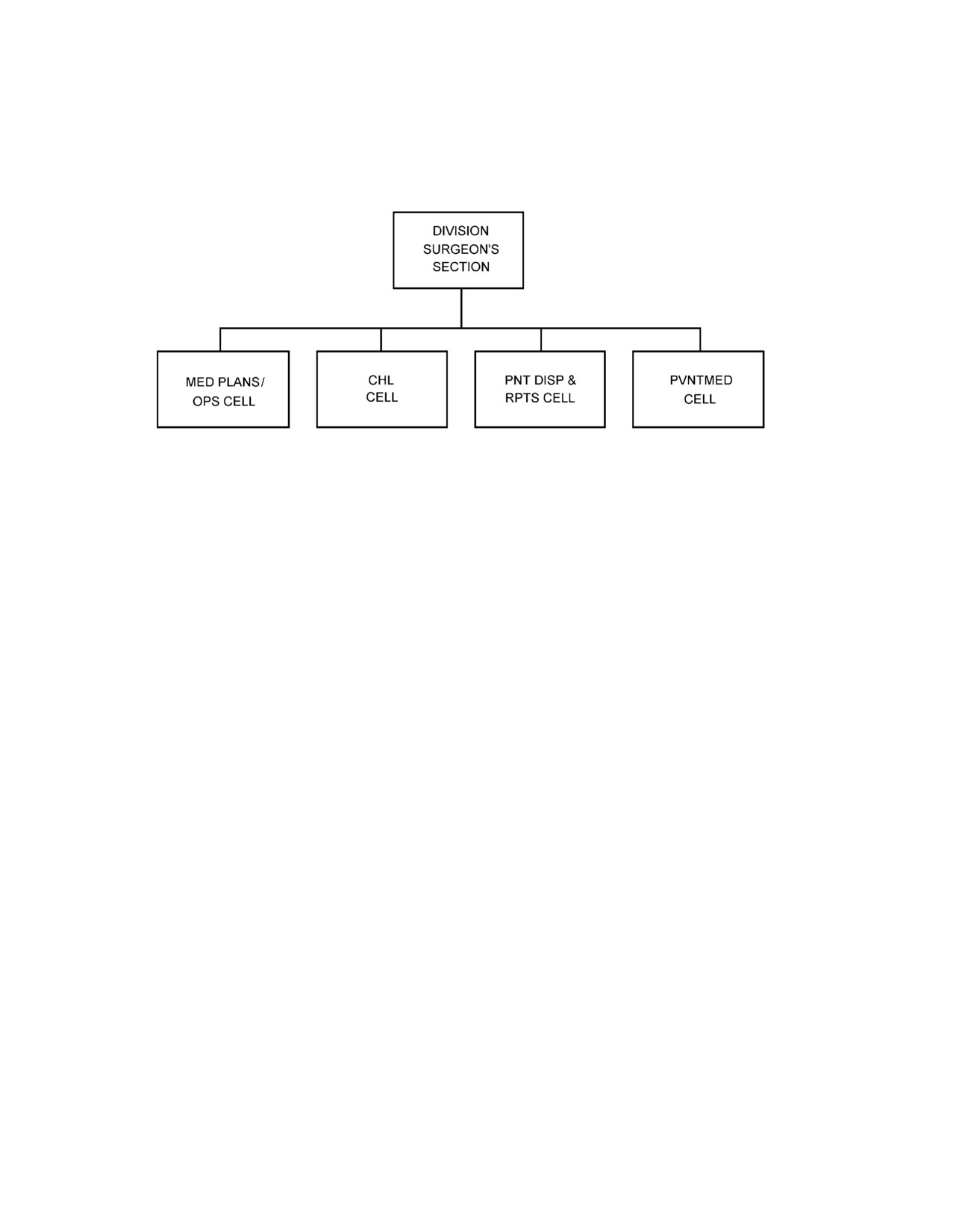
FM 4-02.4
Figure 2-1. Division surgeons section.
c.
Patient Disposition and Reports Cell. The patient disposition and reports cell is responsible
for coordinating patient disposition throughout the division. The branch obtains and coordinates disposition
of patients with the medical plans and operations cell and the corps medical regulating office(r) (MRO). It
prepares and forwards appropriate medical statistical reports as required. The patient disposition and reports
cell is staffed with a patient administration NCO and two patient administration specialists.
d. Preventive Medicine Cell. The division PVNTMED cell is responsible for
Supervising the command PVNTMED program, to include health assessment and medical
surveillance; see AR 40-5 and FM 4-02.17.
Ensuring PVNTMED measures are implemented that protect division personnel against
food-, water-, and vectorborne diseases, as well as environmental injuries (for example, heat and cold
injuries).
Monitor disease trends within the division.
The PVNTMED missions are accomplished according to the division CHS plan and coordinated by the
PVNTMED officer through the medical plans and operations cell with the DSMC and FSMCs. Division
PVNTMED personnel provide advice and consultation in the areas of environmental sanitation, epidemi-
ology, and entomology, as well as limited sanitary engineering services and pest management. Additional in-
formation pertaining to the PVNTMED personnel and their specific functions is discussed in FMs 4-02.17,
8-10, 8-10-1, and 8-10-3. The PVNTMED cell is staffed with a PVNTMED officer. The PVNTMED
officer (Major, AOC 60C00) is responsible for the implementation of the command PVNTMED program.
2-7.
Corps Medical Assets in Support of Divisions
Corps medical units in GS and DS of the division are normally assigned to the corps medical command
(MEDCOM) or medical brigade. The MEDCOM/brigade will provide subordinate units to support the
2-8
///////////////////////////////////////